 filings.tools
Agilent Technologies 10-K 2020-10-31
Filed 2020-12-18. 21 sections, 589K characters. Original on sec.gov · Markdown · JSON
Cover and table of contents
UNITED STATES
SECURITIES AND EXCHANGE COMMISSION
Washington, D.C. 20549
Form 10-K
(MARK ONE)
☒ ANNUAL REPORT PURSUANT TO SECTION 13 OR 15(d) OF THE SECURITIES EXCHANGE ACT OF 1934.
For the fiscal year ended October 31, 2020
or
☐ TRANSITION REPORT PURSUANT TO SECTION 13 OR 15(d) OF THE SECURITIES EXCHANGE ACT OF 1934.
For transition period from to
Commission File Number: 001-15405
Agilent Technologies, Inc.
(Exact name of registrant as specified in its charter)
| Delaware | 77-0518772 | |||||||||||||||||||
| (State or other jurisdiction of incorporation or organization) | (IRS Employer Identification No.) |
Address of principal executive offices: 5301 Stevens Creek Blvd., Santa Clara, California 95051
Registrant's telephone number, including area code: (800) 227-9770
Securities registered pursuant to Section 12(b) of the Act:
| Title of each Class | Trading Symbol | Name of each Exchange on which registered | ||||||||||||||||||||||||
| Common Stock, $0.01 par value | A | New York Stock Exchange |
Securities registered pursuant to Section 12(g) of the Act: None
Indicate by check mark if the registrant is a well-known seasoned issuer, as defined in Rule 405 of the Securities Act. Yes ☒ No ☐
Indicate by check mark if the registrant is not required to file reports pursuant to Section 13 or Section 15(d) of the Act. Yes ☐ No ☒
Indicate by check mark whether the registrant (1) has filed all reports required to be filed by Section 13 or 15(d) of the Securities Exchange Act of 1934 during the preceding 12 months (or for such shorter period that the registrant was required to file such reports), and (2) has been subject to such filing requirements for the past 90 days. Yes ☒ No ☐
Indicate by check mark whether the registrant has submitted electronically every Interactive Data File required to be submitted pursuant to Rule 405 of Regulation S-T (§232.405 of this chapter) during the preceding 12 months (or for such shorter period that the registrant was required to submit such files). Yes ☒ No ☐
Indicate by check mark whether the registrant is a large accelerated filer, an accelerated filer, a non-accelerated filer, a smaller reporting company or an emerging growth company. See the definitions of "large accelerated filer," "accelerated filer", "smaller reporting company" and "emerging growth company" in Rule 12b-2 of the Exchange Act.
| Large accelerated filer | ☒ | Accelerated filer | ☐ | Non-accelerated filer | ☐ | |||||||||||||||||||||
| Smaller reporting company | ☐ | Emerging growth company | ☐ |
If an emerging growth company, indicate by check mark if the registrant has elected not to use the extended transition period for complying with any new or revised financial accounting standards provided pursuant to Section 13(a) of the Exchange Act. ☐
Indicate by check mark whether the registrant has filed a report on and attestation to its management’s assessment of the effectiveness of its internal control over financial reporting under Section 404(b) of the Sarbanes-Oxley Act (15 U.S.C. 7262(b)) by the registered public accounting firm that prepared or issued its audit report. ☒
Indicate by check mark whether the registrant is a shell company (as defined in Rule 12b-2 of the Exchange Act). Yes ☐ No ☒
The aggregate market value of the registrant's common equity held by non-affiliates as of April 30, 2020, was approximately $18.0 billion. Shares of stock held by officers, directors and 5 percent or more stockholders have been excluded in that such persons may be deemed to be affiliates. This determination of affiliate status is not necessarily a conclusive determination for other purposes.
As of December 10, 2020 there were 306,849,526 outstanding shares of common stock, par value $0.01 per share.
DOCUMENTS INCORPORATED BY REFERENCE
| Document Description | 10-K Part | |||||||
| Portions of the Proxy Statement for the Annual Meeting of Stockholders (the "Proxy Statement") to be held on March 17, 2021, and to be filed pursuant to Regulation 14A within 120 days after registrant's fiscal year ended October 31, 2020 are incorporated by reference into Part III of this Report | III |
TABLE OF CONTENTS
Forward-Looking Statements
This report contains forward-looking statements including, without limitation, statements regarding growth opportunities, including for revenue and our end markets, strength and drivers of the markets we sell into, sales funnels, our strategic direction, new product and service introductions and the position of our current products and services, market demand for and adoption of our products, the ability of our products and solutions to address customer needs and meet industry requirements, our focus on differentiating our product solutions, improving our customers’ experience and growing our earnings, future financial results, our operating margin, mix, our investments, including in manufacturing infrastructure, research and development and expanding and improving our applications and solutions portfolios, expanding our position in developing countries and emerging markets, our focus on balanced capital allocation, our contributions to our pension and other defined benefit plans, impairment of goodwill and other intangible assets, the impact of foreign currency movements, our hedging programs and other actions to offset the effects of tariffs and foreign currency movements, our future effective tax rate, tax valuation allowance and unrecognized tax benefits, the impact of local government regulations on our ability to pay vendors or conduct operations, our ability to satisfy our liquidity requirements, including through cash generated from operations, the potential impact of adopting new accounting pronouncements, indemnification, source and supply of materials used in our products, our sales, our purchase commitments, our capital expenditures, the integration and effects of our acquisitions and other transactions, our stock repurchase program and dividends and the potential or anticipated direct or indirect impact of COVID-19 on our business that involve risks and uncertainties. Our actual results could differ materially from the results contemplated by these forward-looking statements due to various factors, including those discussed in Part I Item 1A and elsewhere in this Form 10-K.
PART I
Item 1. Business
Overview
Agilent Technologies Inc. ("we", "Agilent" or the "company"), incorporated in Delaware in May 1999, is a global leader in life sciences, diagnostics and applied chemical markets, providing application focused solutions that include instruments, software, services and consumables for the entire laboratory workflow.
For fiscal year ended October 31, 2020, we have three business segments comprised of the life sciences and applied markets business, the diagnostics and genomics business and the Agilent CrossLab business.
Our life sciences and applied markets business provides application-focused solutions that include instruments and software that enable customers to identify, quantify and analyze the physical and biological properties of substances and products, as well as enable customers in the clinical and life sciences research areas to interrogate samples at the molecular and cellular level. Our diagnostics and genomics business is comprised of six areas of activity providing active pharmaceutical ingredients ("APIs") for oligo-based therapeutics as well as solutions that include reagents, instruments, software and consumables which enable customers in the clinical and life sciences research areas to interrogate samples at the cellular and molecular level. The Agilent CrossLab business spans the entire lab with its extensive consumables and services portfolio, which is designed to improve customer outcomes. In addition, we conduct centralized order fulfillment and supply chain operations for our businesses through the order fulfillment and supply chain organization ("OFS"). OFS provides resources for manufacturing, engineering and strategic sourcing to our respective businesses. Each of our businesses, together with OFS and Agilent Technologies Research Laboratories, is supported by our global infrastructure organization, which provides shared services in the areas of finance, information technology, legal, certain procurement services, workplace services and human resources.
We sell our products primarily through direct sales, but we also utilize distributors, resellers, manufacturer's representatives and electronic commerce. As of October 31, 2020, we employed approximately 16,400 people worldwide. Our primary research and development and manufacturing sites are in California, Colorado, Delaware, Massachusetts, Texas and Vermont in the U.S. and in Australia, China, Denmark, Germany, Italy, Japan, Malaysia, Singapore and the United Kingdom.
Life Sciences and Applied Markets Business
Our life sciences and applied markets business provides application-focused solutions that include instruments and software that enable customers to identify, quantify and analyze the physical and biological properties of substances and products, as well as enable customers in the clinical and life sciences research areas to interrogate samples at the molecular and cellular level. Key product categories include: liquid chromatography ("LC") systems and components; liquid chromatography mass spectrometry ("LCMS") systems; gas chromatography ("GC") systems and components; gas chromatography mass spectrometry ("GCMS") systems; inductively coupled plasma mass spectrometry ("ICP-MS") instruments; atomic absorption ("AA") instruments; microwave plasma-atomic emission spectrometry ("MP-AES") instruments; inductively coupled plasma optical emission spectrometry ("ICP-OES") instruments; raman spectroscopy; cell analysis plate based assays; flow cytometer; real-time cell analyzer; cell imaging systems; microplate reader; laboratory software for sample tracking; information management and analytics; laboratory automation and robotic systems; dissolution testing; vacuum pumps and measurement technologies.
We employed approximately 5,300 people as of October 31, 2020 in our life sciences and applied markets business.
Life Sciences and Applied Markets
Our life sciences and applied markets business focuses primarily on the following five markets:
The Pharmaceutical, Biopharmaceutical, CRO & CMO Market. This market consists of “for-profit” companies who participate across the pharmaceutical value chain in the areas of therapeutic research, discovery & development, clinical trials, manufacturing and quality assurance and quality control. One sub-segment of this market is core and emerging pharmaceutical companies ("pharma"). A second sub-segment includes biopharmaceutical companies ("biopharma"), contract research organizations ("CROs") and contract manufacturing organizations ("CMOs"). Biopharma companies and, to a somewhat lesser extent, CROs and CMOs typically participate in specific points in the pharmaceutical industry value chain. Additionally, due to the relatively low drug efficacy within oncology, pharma companies are partnering with diagnostic companies to bring validated tests to the market with their new drugs.
The Academic and Government Market. This market consists primarily of “not-for-profit” organizations and includes academic institutions, large government institutes and privately funded organizations. The academic and government market plays an influential role in technology adoption and therapeutic developments for pharmaceutical and molecular diagnostics companies. After decades of investment in basic biomedical research by government funding bodies, the focus has widened to include translational research - multidisciplinary scientific efforts directed at accelerating therapy development.
The Chemical & Energy Market. Our products and solutions are used throughout the chemicals sector in the development, manufacturing, and quality control of commodity chemicals, specialty and agrochemicals, and fine chemicals. Chemical market customers use our products to determine chemical composition, perform impurity analysis, qualify raw materials, conduct materials characterization, and verify and ensure the environmental safety of operations and employees. The natural gas and petroleum exploration and refining markets use our products to analyze crude oil composition, perform intermediate material analysis, verify and improve refining processes and ensure the overall quality of gasoline, fuels, lubricants and other products.
The Environmental & Forensics Market. Our instruments, software and workflow solutions are used by the environmental market for applications such as laboratory and field analysis of chemical pollutants in air, water, soil and solid waste. Environmental industry customers include all levels of government, the industrial and manufacturing sectors, engineering and consulting companies, commercial testing laboratories and colleges and universities. Drug testing and forensics laboratories use our instruments, software and workflow solutions for applications such as analyzing evidence associated with crime, screening athletes for performance enhancing drugs, analyzing samples for recreational drugs, or detecting and identifying biological and chemical warfare agents. Some of our instruments are used in mobile laboratories as well. Customers include local, state, federal, and international law enforcement agencies and health laboratories.
The Food Market. Our instruments, software, and workflow solutions are used throughout the food production chain, including incoming inspection, new product development, quality control and assurance, and packaging. For example, our mass spectrometer portfolio is used to analyze contaminants and residual pesticides in food. There is also a significant food safety market involved in analyzing food for pathogen contamination, accurate verification of species type and evidence of genetically modified content.
Life Sciences and Applied Markets Products and Applications
Our products fall into eight main areas of work: liquid chromatography, gas chromatography, mass spectrometry, spectroscopy, software and informatics, lab automation and robotics, vacuum technology and cell analysis
Showing the first 8K of 61K characters. Open the full section
Item 1A. Risk Factors
Risks, Uncertainties and Other Factors Specific to Our Company That May Affect Future Results
T****he COVID-19 pandemic has adversely impacted, and continues to pose risks to, our business, results of operations and financial condition, the nature and extent of which are highly uncertain and unpredictable.
Our global operations expose us to risks associated with public health crises, including epidemics and pandemics such as COVID-19. The global spread of COVID-19 had, and may continue to have, an adverse impact on our operations, sales and delivery and supply chains. Many countries including the United States implemented measures such as quarantine, shelter-in-place, curfew, travel and activity restrictions and similar isolation measures, including government orders and other restrictions on the conduct of business operations. Due to these measures we experienced significant and unpredictable reductions or increases in demand for certain of our products. Moreover, these measures caused delays in installations and significantly impacted our ability to service our customers on site. If the COVID-19 pandemic continues or worsens, we may again experience a decline in sales activities and customer orders in certain of our businesses. Continuing travel restrictions, prolonged quarantines or other government orders in response to the pandemic may significantly impact our ability to support our sites and service customers in those locations. The COVID-19 pandemic has also impacted our supply chain as we experienced disruptions or delays in shipments of certain materials or components of our products. If the pandemic continues or worsens, our manufacturing facilities, our distribution centers where inventory is managed and the operations of our logistics and other service providers may be significantly impacted. Accordingly, COVID-19 has negatively affected our revenue growth in certain of our businesses. It is uncertain how materially COVID-19 will affect our global operations generally if these impacts persist, worsen or re-emerge over an extended period of time. The extent and duration of these impacts are dependent in part on customers returning to work and economic activity continuing to ramp up. The impact on our business also depends in part on the pace at which our customers resume non-COVID-19 related patient care and testing, as well as the timing of when research performed by laboratories and other institutions returns to normal levels.
Additionally, the COVID-19 pandemic caused significant volatility and uncertainty in U.S. and international markets. A disruption of global financial markets or resulting economic downturn may reduce our ability to incur debt or access capital and increase the cost of doing so. There are no assurances that the credit markets or the capital markets will be available to us in the future or that the lenders participating in our credit facilities will be able to provide financing in accordance with their contractual obligations.
We cannot reasonably estimate the length or severity of the COVID-19 pandemic or the related response, or the extent to which the disruption may impact our business, financial position, results of operations and cash flows. Ultimately, the COVID-19 pandemic could have a material adverse impact on our business, financial position, results of operations and cash flows. To the extent COVID-19 conditions improve, the duration and sustainability of any such improvements will be uncertain and continuing adverse impacts and/or the degree of improvement may vary dramatically by geography and by business. The actions we take in response to any improvements in conditions may also vary widely by geography and by business and will likely be made with incomplete information; pose the risk that such actions may prove to be premature, incorrect or insufficient; and could have a material, adverse impact on our business and results of operations.
Our operating results and financial condition could be harmed if the markets into which we sell our products decline or do not grow as anticipated.
Visibility into our markets is limited. Our quarterly sales and operating results are highly dependent on the volume and timing of orders received during the fiscal quarter, which are difficult to forecast and may be cancelled by our customers. In addition, our revenue and earnings forecasts for future fiscal quarters are often based on the expected seasonality of our markets. However, the markets we serve do not always experience the seasonality that we expect as customer spending policies and budget allocations, particularly for capital items, may change. Any decline in our customers' markets or in general economic conditions would likely result in a reduction in demand for our products and services. Also, if our customers' markets decline, we may not be able to collect on outstanding amounts due to us. Such declines could harm our consolidated financial position, results of operations, cash flows and stock price, and could limit our profitability. Also, in such an environment, pricing pressures could intensify. Since a significant portion of our operating expenses is relatively fixed in nature due to sales,
research and development and manufacturing costs, if we were unable to respond quickly enough these pricing pressures could further reduce our operating margins.
If we do not introduce successful new products and services in a timely manner to address increased competition through frequent new product and service introductions, rapid technological changes and changing industry standards, our products and services may become obsolete, and our operating results may suffer.
We generally sell our products in industries that are characterized by increased competition through frequent new product and service introductions, rapid technological changes and changing industry standards. Without the timely introduction of new products, services and enhancements, our products and services may become technologically obsolete over time, in which case our revenue and operating results could suffer. The success of our new products and services will depend on several factors, including our ability to:
-
properly identify customer needs and predict future needs;
-
innovate and develop new technologies, services and applications;
-
appropriately allocate our research and development spending to products and services with higher growth prospects;
-
successfully commercialize new technologies in a timely manner;
-
manufacture and deliver new products in sufficient volumes and on time;
-
differentiate our offerings from our competitors' offerings;
-
price our products competitively;
-
anticipate our competitors' development of new products, services or technological innovations; and
-
control product quality in our manufacturing process.
In addition, if we fail to accurately predict future customer needs and preferences or fail to produce viable technologies, we may invest in research and development of products and services that do not lead to significant revenue, which would adversely affect our profitability. Even if we successfully innovate and develop new and enhanced products and services, we may incur substantial costs in doing so, and our operating results may suffer. In addition, promising new products may fail to reach the market or realize only limited commercial success because of real or perceived concerns of our customers. Furthermore, as we collaborate with pharmaceutical customers to develop drugs such as companion diagnostics assays or provide drug components like active pharmaceutical ingredients, we face risks that those drug programs may be cancelled upon clinical trial failures.
General economic conditions may adversely affect our operating results and financial condition.
Our business is sensitive to negative changes in general economic conditions, both inside and outside the United States. Slower global economic growth and uncertainty in the markets in which we operate may adversely impact our business resulting in:
-
reduced demand for our products, delays in the shipment of orders, or increases in order cancellations;
-
increased risk of excess and obsolete inventories;
-
increased price pressure for our products and services; and
-
greater risk of impairment to the value, and a detriment to the liquidity, of our investment portfolio.
Failure to adjust our purchases due to changing market conditions or failure to accurately estimate our customers' demand could adversely affect our income.
Our income could be harmed if we are unable to adjust our purchases to reflect market fluctuations, including those caused by the seasonal nature of the markets in which we operate. The sale of our products and services are dependent, to a large degree, on customers whose industries are subject to seasonal trends in the demand for their products. During a market upturn, we may not be able to purchase sufficient supplies or components to meet increasing product demand, which could materially affect our results. In the past, we have experienced a shortage of parts for some of our products. In addition, some of the parts that require custom design are not readily available from alternate suppliers due to their unique design or the length of time necessary for design work. Should a supplier cease manufacturing such a component, we would be forced to reengineer our product. In addition to discontinuing parts, suppliers may also extend lead times, limit supplies or increase prices due to capacity constraints or other factors. In order to secure components for the production of products, we may continue to enter into non-cancelable purchase commitments with vendors, or at times make advance payments to suppliers, which could impact our ability to adjust our inventory to declining market demands. If demand for our products is less than we expect, we may experience additional excess and obsolete inventories and be forced to incur additional expenses.
Demand for some of our products and services depends on the capital spending policies of our customers, research and development budgets and on government funding policies.
Our customers include pharmaceutical companies, laboratories, universities, healthcare providers, government agencies and public and private research institutions. Many factors, including public policy spending priorities, available resources, mergers and consolidations, institutional and governmental budgetary policies and spending priorities, and product and economic cycles, have a significant effect on the capital spending policies of these entities. Fluctuations in the research and development budgets at these organizations could have a significant effect on the demand for our products and services. Research and development budgets fluctuate due to changes in available resources, consolidation, spending priorities, general economic conditions and institutional and governmental budgetary policies. The timing and amount of revenue from customers that rely on government funding or research may vary significantly due to factors that can be difficult to forecast, including changes in spending authorizations and budgetary priorities for our products and services. If demand for our products and services is adversely affected, our revenue and operating results would suffer.
Economic, political, foreign currency and other risks associated with international sales and operations could adversely affect our results of operations.
Because we sell our products worldwide, our business is subject to risks associated with doing business internationally. We anticipate that revenue from international operations will continue to represent a majority of our total revenue. International revenue and costs are subject to the risk that fluctuations in foreign currency exchange rates could adversely affect our financial results when translated into U.S. dollars for financial reporting purposes. Foreign currency movements for the year ended October 31, 2020 had an overall unfavorable impact on revenue of approximately 1 percentage point when compared to the same period last year. When movements in foreign currency exchange rates have a negative impact on revenue, they will also have a positive impact by reducing our costs and expenses. In addition, many of our employees, contract manufacturers, suppliers, job functions, outsourcing activities and manufacturing facilities are located outside the United States. Accordingly, our future results could be harmed by a variety of factors, including:
-
interruption to transportation flows for delivery of parts to us and finished goods to our customers;
-
changes in a specific country's or region's political, economic or other conditions;
-
changes in diplomatic and trade relationships, such as the United Kingdom's exit from the European Union and the increased uncertainty around its implementation caused by COVID-19, as well as, new tariffs, trade protection measures, import or export licensing requirements, new or different customs duties, trade embargoes and sanctions and other trade barriers;
-
tariffs imposed by the U.S. on goods from other countries and tariffs imposed by other countries on U.S. goods, including the tariffs enacted and proposed by the U.S. government on various imports from China and by the Chinese government on certain U.S. goods;
-
negative consequences from changes in or differing interpretations of laws and regulations, including those related to tax and import/export;
-
difficulty in staffing and managing widespread operations;
-
differing labor regulations;
-
differing protection of intellectual property;
-
unexpected changes in regulatory requirements;
-
geopolitical uncertainty or turmoil, terrorism and war; and
-
impact of public health crises, including pandemics and epidemics, such as COVID-19 on the global economy.
We sell our products into many countries and we also source many components and materials for our products from and manufacture our products in various countries. Future tariffs and tariffs already implemented could have negative impact on our business, results of operations and financial condition. It may be time-consuming and expensive for us to alter our business operations in order to adapt to any such change. Further, additional tariffs, the scope and duration of which, if implemented, remains uncertain, which have been proposed or threatened and the potential escalation of a trade war and retaliatory measures could have a material adverse effect on our business, results of operations and financial condition.
Most of our accounting and tax processes including general accounting, cost accounting, accounts payable, accounts receivable and tax functions are centralized at locations in India and Malaysia. If conditions change in those countries, it may adversely affect operations, including impairing our ability to pay our suppliers and collect our receivables. Our results of operations, as well as our liquidity, may be adversely affected and possible delays may occur in reporting financial results.
In addition, although the majority of our products are priced and paid for in U.S. dollars, a significant amount of certain types of expenses, such as payroll, utilities, tax, and marketing expenses, are paid in local currencies. Our hedging programs reduce, but do not always entirely eliminate, within any given twelve-month period, the impact of currency exchange rate movements, and therefore fluctuations in exchange rates, including those caused by currency controls, could impact our business, operating results and financial condition by resulting in lower revenue or increased expenses. For expenses beyond that twelve-month period, our hedging strategy does not mitigate our exposure. In addition, our currency hedging programs involve third-party financial institutions as counterparties. The weakening or failure of financial institution counterparties may adversely affect our hedging programs and our financial condition through, among other things, a reduction in available counterparties, increasingly unfavorable terms, and the failure of the counterparties to perform under hedging contracts.
Our strategic initiatives to adjust our cost structure could have long-term adverse effects on our business, and we may not realize the operational or financial benefits from such actions.
We have implemented multiple strategic initiatives across our businesses to adjust our cost structure, and we may engage in similar activities in the future. These strategic initiatives and our regular ongoing cost reduction activities may distract management, could slow improvements in our products and services and limit our ability to increase production quickly if demand for our products increases. In addition, delays in implementing our strategic initiatives, unexpected costs or failure to meet targeted improvements may diminish the operational and financial benefits we realize from such actions. Any of the above circumstances could have an adverse effect on our business and operating results and financial condition.
Our business will suffer if we are not able to retain and hire key personnel.
Our future success depends partly on the continued service of our key research, engineering, sales, marketing, manufacturing, executive and administrative personnel. If we fail to retain and hire a sufficient number of these personnel, we will not be able to maintain or expand our business. The markets in which we operate are very dynamic, and our businesses continue to respond with reorganizations, workforce reductions and site closures. We believe our pay levels are very competitive within the regions that we operate. However, there is intense competition for certain highly technical specialties in geographic areas where we continue to recruit, and it may become more difficult to hire and retain our key employees.
Our acquisitions, strategic investments and alliances, joint ventures, exiting of businesses and divestitures may result in financial results that are different than expected.
In the normal course of business, we frequently engage in discussions with third parties relating to possible acquisitions, strategic investments and alliances, joint ventures and divestitures, and generally expect to complete several transactions per year. In addition, we may decide to exit a particular business within our product portfolio. As a result of such transactions, our financial results may differ from our own or the investment community's expectations in a given fiscal quarter or over the long term. We may have difficulty developing, manufacturing and marketing the products of a newly acquired company in a way that enhances the performance of our combined businesses or product lines. Acquired businesses may also expose us to new risks and new markets, and we may have difficulty addressing these risks in a cost effective and timely manner. Transactions such as acquisitions have resulted, and may in the future result in, unexpected significant costs and expenses. In the future, we may be required to record charges to earnings during the period if we determine there is an impairment of goodwill or intangible assets, up to the full amount of the value of the assets, or, in the case of strategic investments and alliances, consolidate results, including losses, of third parties or write down investment values or loans and convertible notes related to the strategic investment.
Integrating the operations of acquired businesses within Agilent could be a difficult, costly and time-consuming process that involves a number of risks. Acquisitions and strategic investments and alliances may require us to integrate and collaborate with a different company culture, management team, business model, business infrastructure and sales and distribution methodology and assimilate and retain geographically dispersed, decentralized operations and personnel. Depending on the size and complexity of an acquisition, our successful integration of the entity depends on a variety of factors, including introducing new products and meeting revenue targets as expected, the retention of key employees and key customers, increased exposure to certain governmental regulations and compliance requirements and increased costs and use of resources. Further, the integration of acquired businesses is likely to result in our systems and internal controls becoming increasingly complex and more difficult to manage. Any difficulties in the assimilation of acquired businesses into our control system could harm our operating results or cause us to fail to meet our financial reporting obligations.
Even if we are able to successfully integrate acquired businesses within Agilent, we may not be able to realize the revenue and other synergies and growth that we anticipated from the acquisition in the time frame that we expected, and the costs of achieving these benefits may be higher than what we expected. As a result, the acquisition and integration of acquired
businesses may not contribute to our earnings as expected, we may not achieve our operating margin targets when expected, or at all, and we may not achieve the other anticipated strategic and financial benefits of such transactions.
A successful divestiture depends on various factors, including our ability to effectively transfer liabilities, contracts, facilities and employees to the purchaser, identify and separate the intellectual property to be divested from the intellectual property that we wish to keep and reduce fixed costs previously associated with the divested assets or business. In addition, if customers of the divested business do not receive the same level of service from the new owners, this may adversely affect our other businesses to the extent that these customers also purchase other Agilent products. In exiting a business, we may still retain liabilities associated with the support and warranty of those businesses and other indemnification obligations. All of these efforts require varying levels of management resources, which may divert our attention from other business operations. If we do not realize the expected benefits or synergies of such transactions, our consolidated financial position, results of operations, cash flows and stock price could be negatively impacted.
If we fail to maintain an effective system of internal controls, we may not be able to accurately report our financial results, which could lead to a loss of investor confidence in our financial statements and have an adverse effect on our stock price.
Effective internal controls are necessary for us to provide reliable and accurate financial statements and to effectively prevent fraud. We devote significant resources and time to comply with the internal control over financial reporting requirements of the Sarbanes Oxley Act of 2002 and continue to enhance our controls. However, we cannot be certain that we will be able to prevent future significant deficiencies or material weaknesses. Inadequate internal controls could cause investors to lose confidence in our reported financial information, which could have a negative effect on investor confidence in our financial statements, the trading price of our stock and our access to capital.
Our customers and we are subject to various governmental regulations. Compliance with or changes in such regulations may cause us to incur significant expenses, and if we fail to maintain satisfactory compliance with certain regulations, we may be forced to recall products and cease their manufacture and distribution, and we could be subject to civil or criminal penalties.
Our customers and we are subject to various significant international, federal, state and local regulations, including but not limited to regulations in the areas of health and safety, packaging, product content, employment, labor and immigration, import/export controls, trade restrictions and anti-competition. In addition, as a global organization, we are subject to data privacy and security laws, regulations, and customer-imposed controls in numerous jurisdictions as a result of having access to and processing confidential, personal, sensitive and/or patient health data in the course of our business. The EU's General Data Protection Regulation ("GDPR"), which became effective in May 2018, applies to all of our activities related to products and services that we offer to EU customers and workers. The GDPR established new requirements regarding the handling of personal data and includes significant penalties for non-compliance (including possible fines of up to 4 percent of total company revenue). Other governmental authorities around the world have passed or are considering similar types of legislative and regulatory proposals concerning data protection. Each of these privacy, security and data protection laws and regulations could impose significant limitations and increase our cost of providing our products and services where we process end user personal data and could harm our results of operations and expose us to significant fines, penalties and other damages.
We must also comply with complex foreign and U.S. laws and regulations, such as the U.S. Foreign Corrupt Practices Act, the U.K. Bribery Act, and other local laws prohibiting corrupt payments to governmental officials, anti-competition regulations and sanctions imposed by the U.S. Office of Foreign Assets Control and other similar laws and regulations. Violations of these laws and regulations could result in fines and penalties, criminal sanctions, restrictions on our business conduct and on our ability to offer our products in one or more countries, and could also materially affect our brand, our ability to attract and retain employees, our international operations, our business and our operating results. Although we have implemented policies and procedures designed to ensure compliance with these laws and regulations, there can be no assurance that our employees, contractors, or agents will not violate our policies.
These regulations are complex, change frequently and have tended to become more stringent over time. We may be required to incur significant expenses to comply with these regulations or to remedy any violations of these regulations. Any failure by us to comply with applicable government regulations could also result in the cessation of our operations or portions of our operations, product recalls or impositions of fines and restrictions on our ability to carry on or expand our operations. In addition, because many of our products are regulated or sold into regulated industries, we must comply with additional regulations in marketing our products. We develop, configure and market our products to meet customer needs created by these regulations. Any significant change in these regulations could reduce demand for our products, force us to modify our products to comply with new regulations or increase our costs of producing these products. If demand for our products is adversely
affected or our costs increase, our operating results and business would suffer.
Our products and operations are also often subject to the rules of industrial standards bodies, like the International Standards Organization, as well as regulation by other agencies such as the FDA. We also must comply with work safety rules. If we fail to adequately address any of these regulations, our businesses could be harmed.
We are subject to extensive regulation by the FDA and certain similar foreign regulatory agencies, and failure to comply with such regulations could harm our reputation, business, financial condition and results of operations.
A number of our products and services are subject to regulation by the FDA and certain similar foreign regulatory agencies. In addition, a number of our products and services may in the future be subject to regulation by the FDA and certain similar foreign regulatory agencies. These regulations govern a wide variety of product and service-related activities, from quality management, design and development to labeling, manufacturing, promotion, sales and distribution. If we or any of our suppliers or distributors fail to comply with FDA and other applicable regulatory requirements or are perceived to potentially have failed to comply, we may face, among other things, warning letters; adverse publicity affecting both us and our customers; investigations or notices of non-compliance, fines, injunctions, and civil penalties; import or export restrictions; partial suspensions or total shutdown of production facilities or the imposition of operating restrictions; increased difficulty in obtaining required FDA clearances or approvals or foreign equivalents; seizures or recalls of our products or those of our customers; or the inability to sell our products. Any such FDA or other regulatory agency actions could disrupt our business and operations, lead to significant remedial costs and have a material adverse impact on our financial position and results of operations. In addition, the global regulatory environment has become increasingly stringent for our products and services. For example, the EU is going to enforce new requirements, known as the EU In Vitro Diagnostic Regulation (the “EU IVDR”), which imposes stricter requirements for the marketing and sale of in vitro diagnostics in the European Union. These new regulations are more stringent in a variety of areas, including clinical requirements, quality systems and post-market surveillance activities. We will have until May 2022 to meet the new EU IVDR requirements. Failure to meet these requirements could adversely impact our business in the EU and other regions that tie their product registrations to the EU requirements.
Some of our products are subject to particularly complex regulations such as regulations of toxic substances, and failure to comply with such regulations could harm our business.
Some of our products and related consumables are used in conjunction with chemicals whose manufacture, processing, distribution and notification requirements are regulated by the U.S. Environmental Protection Agency (“EPA”) under the Toxic Substances Control Act and by regulatory bodies in other countries under similar laws. The Toxic Substances Control Act regulations govern, among other things, the testing, manufacture, processing and distribution of chemicals, the testing of regulated chemicals for their effects on human health and safety and the import and export of chemicals. The Toxic Substances Control Act prohibits persons from manufacturing any chemical in the United States that has not been reviewed by the EPA for its effect on health and safety and placed on an EPA inventory of chemical substances. We must ensure conformance of the manufacturing, processing, distribution of and notification about these chemicals to these laws and adapt to regulatory requirements in all applicable countries as these requirements change. If we fail to comply with the notification, record-keeping and other requirements in the manufacture or distribution of our products, then we could be subject to civil penalties, criminal prosecution and, in some cases, prohibition from distributing or marketing our products until the products or component substances are brought into compliance.
Our business may suffer if we fail to comply with government contracting laws and regulations.
We derive a portion of our revenue from direct and indirect sales to U.S. federal, state, local, and foreign governments and their respective agencies. Such contracts are subject to various procurement laws and regulations and contract provisions relating to their formation, administration and performance. Failure to comply with these laws, regulations or provisions in our government contracts could result in the imposition of various civil and criminal penalties, termination of contracts, forfeiture of profits, suspension of payments, increased pricing pressure or suspension from future government contracting. If our government contracts are terminated, if we are suspended from government work, or if our ability to compete for new contracts is adversely affected, our business could suffer.
Our reputation, ability to do business and financial statements may be harmed by improper conduct by any of our employees, agents or business partners.
We cannot provide assurance that our internal controls and compliance systems will always protect us from acts committed by employees, agents or business partners of ours (or of businesses we acquire or partner with) that would violate U.S. and/or non-U.S. laws, including the laws governing payments to government officials, bribery, fraud, kickbacks and false claims, pricing, sales and marketing practices, conflicts of interest, competition, employment practices and workplace behavior, export and import compliance, money laundering and data privacy. In particular, the U.S. Foreign Corrupt Practices Act, the U.K. Bribery Act and similar anti-bribery laws in other jurisdictions generally prohibit companies and their intermediaries from making improper payments to government officials for the purpose of obtaining or retaining business, and we operate in many parts of the world that have experienced governmental corruption to some degree. Any such improper actions or allegations of such acts could damage our reputation and subject us to civil or criminal investigations in the United States and in other jurisdictions, and related shareholder lawsuits could lead to substantial civil and criminal, monetary and non-monetary penalties and could cause us to incur significant legal and investigatory fees. In addition, the government may seek to hold us liable as a successor for violations committed by companies in which we invest or that we acquire. We also rely on our suppliers to adhere to our supplier standards of conduct, and material violations of such standards of conduct could occur that could have a material effect on our business, reputation and financial statements.
Our retirement and post retirement pension plans are subject to financial market risks that could adversely affect our future results of operations and cash flows.
We have significant retirement and post retirement pension plan assets and obligations. The performance of the financial markets and interest rates impact our plan expenses and funding obligations. Significant decreases in market interest rates, decreases in the fair value of plan assets and investment losses on plan assets will increase our funding obligations and adversely impact our results of operations and cash flows.
The impact of consolidation and acquisitions of competitors is difficult to predict and may harm our business.
The life sciences industry is intensely competitive and has been subject to increasing consolidation. Consolidation in our industries could result in existing competitors increasing their market share through business combinations and result in stronger competitors, which could have a material adverse effect on our business, financial condition and results of operations. We may not be able to compete successfully in increasingly consolidated industries and cannot predict with certainty how industry consolidation will affect our competitors or us.
If we are unable to successfully manage the consolidation and streamlining of our manufacturing operations, we may not achieve desired efficiencies, and our ability to deliver products to our customers could be disrupted.
Although we utilize manufacturing facilities throughout the world, we have consolidated, and may further consolidate, our manufacturing operations to certain of our plants to achieve efficiencies and gross margin improvements. Additionally, we typically consolidate the production of products from our acquisitions into our supply chain and manufacturing processes, which are technically complex and require expertise to operate. If we are unable to establish processes to efficiently and effectively produce high quality products in the consolidated locations, we may not achieve the anticipated synergies and production may be disrupted, which could adversely affect our business and operating results.
Our operating results may suffer if our manufacturing capacity does not match the demand for our products.
Because we cannot immediately adapt our production capacity and related cost structures to rapidly changing market conditions, when demand does not meet our expectations, our manufacturing capacity may exceed our production requirements. If during an economic downturn we had excess manufacturing capacity, then our fixed costs associated with excess manufacturing capacity would adversely affect our gross margins and operating results. If, during a general market upturn or an upturn in one of our segments, we cannot increase our manufacturing capacity to meet product demand, we may not be able to fulfill orders in a timely manner which could lead to order cancellations, contract breaches or indemnification obligations. This inability could materially and adversely limit our ability to improve our results.
Dependence on contract manufacturing and outsourcing other portions of our supply chain, including logistics and third-party package delivery services, may adversely affect our ability to bring products to market and damage our reputation. Dependence on outsourced information technology and other administrative functions may impair our ability to operate effectively.
As part of our efforts to streamline operations and to manage costs, we outsource aspects of our manufacturing processes and other functions and continue to evaluate additional outsourcing. If our contract manufacturers or other outsourcers fail to perform their obligations in a timely manner or at satisfactory quality levels, our ability to bring products to market and our reputation could suffer. For example, during a market upturn, our contract manufacturers may be unable to meet our demand requirements, which may preclude us from fulfilling our customers' orders on a timely basis. The ability of these manufacturers to perform is largely outside of our control. If one or more of the third-party package delivery providers experiences a significant disruption in services or institutes a significant price increase, we may have to seek alternative providers, our costs could increase, and the delivery of our products could be prevented or delayed. Additionally, changing or replacing our contract manufacturers, logistics providers or other outsourcers could cause disruptions or delays. In addition, we outsource significant portions of our information technology ("IT") and other administrative functions. Since IT is critical to our operations, any failure to perform on the part of our IT providers could impair our ability to operate effectively. In addition to the risks outlined above, problems with manufacturing or IT outsourcing could result in lower revenue and unexecuted efficiencies and impact our results of operations and our stock price.
Environmental contamination from past and ongoing operations could subject us to substantial liabilities.
Certain properties we have previously owned or leased are undergoing remediation for subsurface contamination. Although we are indemnified for liability relating to the required remediation at some of those properties, we may be subject to liability if these indemnification obligations are not fulfilled. In other cases, we have agreed to indemnify the current owners of certain properties for liabilities related to contamination, including companies with which we have previously been affiliated such as HP, Inc., Hewlett-Packard Enterprise (formerly Hewlett-Packard Company) and Varian Medical Systems, Inc. Further, other properties we have previously owned or leased at which we have operated in the past, or for which we have otherwise contractually assumed, or provided indemnities for, certain actual or contingent environmental liabilities may or do require remediation. While we are not aware of any material liabilities associated with any potential environmental contamination at any of those properties or facilities, we may be exposed to material liability if environmental contamination at material levels is found to exist. In addition, in connection with the acquisition of certain companies, we have assumed other costs and potential or contingent liabilities for environmental matters. Any significant costs or liabilities could have an adverse effect on results of operations.
Our current and historical manufacturing processes and operations involve, or have involved, the use of certain substances regulated under various foreign, federal, state and local environment protection and health and safety laws and regulations. As a result, we may become subject to liabilities for environmental contamination, and these liabilities may be substantial. Although our policy is to apply strict standards for environmental protection and health and safety at our sites inside and outside the United States, we may not be aware of all conditions that could subject us to liability. Further, in the event that any future climate change legislation would require that stricter standards be imposed by domestic or international environmental regulatory authorities, we may be required to make certain changes and adaptations to our manufacturing processes. Failure to comply with these environmental protection and health and safety laws and regulations could result in civil, criminal, regulatory, administrative or contractual sanction, including fines, penalties or suspensions. If we have any violations of, or incur liabilities pursuant to these laws or regulations, our financial condition and operating results could be adversely affected.
Third parties may claim that we are infringing their intellectual property, and we could suffer significant litigation or licensing expenses or be prevented from selling products or services.
From time to time, third parties may claim that one or more of our products or services infringe their intellectual property rights. We analyze and take action in response to such claims on a case by case basis. Any dispute or litigation regarding patents or other intellectual property could be costly and time-consuming due to the complexity of our technology and the uncertainty of intellectual property litigation and could divert our management and key personnel from our business operations. A claim of intellectual property infringement could force us to enter into a costly or restrictive license agreement, which might not be available under acceptable terms or at all, could require us to redesign our products, which would be costly and time-consuming, and/or could subject us to significant damages or to an injunction against the development and sale of certain of our products or services. Our intellectual property portfolio may not be useful in asserting a counterclaim, or negotiating a license, in response to a claim of intellectual property infringement. In certain of our businesses, we rely on third-party intellectual
property licenses, and we cannot ensure that these licenses will continue to be available to us in the future or can be expanded to cover new products on favorable terms or at all.
Third parties may infringe our intellectual property, and we may suffer competitive injury or expend significant resources enforcing our rights.
Our success depends in large part on our proprietary technology, including technology we obtained through acquisitions. We rely on various intellectual property rights, including patents, copyrights, trademarks and trade secrets, as well as confidentiality provisions and licensing arrangements, to establish our proprietary rights. If we do not enforce our intellectual property rights successfully, our competitive position may suffer, which could harm our operating results.
Our pending patent, copyright and trademark registration applications may not be allowed, or competitors may challenge the validity or scope of our patents, copyrights or trademarks. In addition, our patents, copyrights, trademarks and other intellectual property rights may not provide us with a significant competitive advantage.
We may need to spend significant resources monitoring and enforcing our intellectual property rights, and we may not be aware of or able to detect or prove infringement by third parties. Our competitive position may be harmed if we cannot detect infringement and enforce our intellectual property rights quickly or at all. In some circumstances, we may choose to not pursue enforcement because an infringer has a dominant intellectual property position or for other business reasons. In addition, competitors might avoid infringement by designing around our intellectual property rights or by developing non-infringing competing technologies. Intellectual property rights and our ability to enforce them may be unavailable or limited in some countries, which could make it easier for competitors to capture market share and could result in lost revenues. Furthermore, some of our intellectual property is licensed to others which may allow them to compete with us using that intellectual property.
Changes in tax laws, unfavorable resolution of tax examinations, or exposure to additional tax liabilities could have a material adverse effect on our results of operations, financial condition and liquidity.
We are subject to taxes in the U.S., Singapore and various foreign jurisdictions. Governments in the jurisdictions in which we operate implement changes to tax laws and regulations periodically. Any implementation of tax laws that fundamentally change the taxation of corporations in the U.S. or Singapore could materially impact our effective tax rate and could have a significant adverse impact on our financial results.
The U.S. Tax Cuts and Job Act ("the Tax Act") significantly changed the taxation of U.S. based multinational corporations. Our compliance with the Tax Act requires the use of estimates in our financial statements and exercise of significant judgment in accounting for its provisions. The implementation of the Tax Act requires interpretations and implementing regulations by the Internal Revenue Service ("IRS"), as well as state tax authorities. The legislation could be subject to potential amendments and technical corrections, any of which could materially lessen or increase certain adverse impacts of the legislation. As regulations and guidance evolve with respect to the Tax Act, and as we gather information and perform more analysis, our results may differ from previous estimates and may materially affect our financial position.
We are also subject to examinations of our tax returns by tax authorities in various jurisdictions around the world. We regularly assess the likelihood of adverse outcomes resulting from ongoing tax examinations to determine the adequacy of our provision for taxes. These assessments can require a high degree of judgment and estimation. Intercompany transactions associated with the sale of inventory, services, intellectual property and cost share arrangements are complex and affect our tax liabilities. The calculation of our tax liabilities involves dealing with uncertainties in the application of complex tax laws and regulations in multiple jurisdictions. There can be no assurance that the outcomes from ongoing tax examinations will not have an adverse effect on our operating results and financial condition. A difference in the ultimate resolution of tax uncertainties from what is currently estimated could have an adverse effect on our financial results and condition.
If tax incentives change or cease to be in effect, our income taxes could increase significantly.
We benefit from tax incentives extended to our foreign subsidiaries to encourage investment or employment. Several jurisdictions have granted us tax incentives which require renewal at various times in the future. The incentives are conditioned on achieving various thresholds of investments and employment or specific types of income. Our taxes could increase if the incentives are not renewed upon expiration. If we cannot or do not wish to satisfy all or parts of the tax incentive conditions, we may lose the related tax incentive and could be required to refund tax incentives previously realized. As a result, our effective tax rate could be higher than it would have been had we maintained the benefits of the tax incentives.
We have outstanding debt and may incur other debt in the future, which could adversely affect our financial condition, liquidity and results of operations.
We are party to a $1 billion five-year unsecured credit facility that will expire on March 13, 2024. As of October 31, 2020, the company had no borrowings outstanding under the credit facility. On August 7, 2019, we entered into an amendment to the credit agreement, which provided for a $500 million short-term loan facility that was used in full to complete the acquisition of BioTek and was repaid in full as of October 31, 2020. On October 21, 2019, we entered into a second amendment to the credit agreement, which refreshed the amount available for additional incremental term loan facilities under the credit agreement to permit additional incremental facilities of up to $500 million. We had no borrowings under the additional incremental facilities as of October 31, 2020. On May 1, 2020, we entered into a new $1.0 billion commercial paper program, and as of October 31, 2020 we had $75 million of commercial paper outstanding. We also have outstanding an aggregate principal amount of $2.3 billion in senior unsecured notes. We may borrow additional amounts in the future and use the proceeds from any future borrowing for general corporate purposes, future acquisitions, expansion of our business or repurchases of our outstanding shares of common stock.
Our incurrence of this debt, and increases in our aggregate levels of debt, may adversely affect our operating results and financial condition by, among other things:
-
increasing our vulnerability to downturns in our business, to competitive pressures and to adverse economic and industry conditions;
-
requiring the dedication of an increased portion of our expected cash flows from operations to service our indebtedness, thereby reducing the amount of expected cash flows available for other purposes, including capital expenditures, acquisitions, stock repurchases and dividends; and
-
limiting our flexibility in planning for or reacting to changes in our business and our industry.
Our credit facility imposes restrictions on us, including restrictions on our ability to create liens on our assets and engage in certain types of sale and leaseback transactions and the ability of our subsidiaries to incur indebtedness, and requires us to maintain compliance with specified financial ratios. Our ability to comply with these ratios may be affected by events beyond our control. In addition, the indentures governing our senior notes contain covenants that may adversely affect our ability to incur certain liens or engage in certain types of sale and leaseback transactions. If we breach any of the covenants and do not obtain a waiver from the lenders or noteholders, then, subject to applicable cure periods, our outstanding indebtedness could be declared immediately due and payable.
If we suffer a loss to our factories, facilities or distribution system due to catastrophe, our operations could be seriously harmed.
Our factories, facilities and distribution system are subject to catastrophic loss due to fire, flood, terrorism, public health crises, increasing severity or frequency of extreme weather events, or other natural or man-made disasters. For example, in the first quarter of fiscal year 2020, the outbreak of COVID-19 in China led to an extension of the Lunar New Year holiday, which impacted our business and results, reduced the number of selling days and otherwise impacted our supply chain. As described above, the COVID-19 pandemic continued to impact our business operations, supply chain and financial results and may have a material adverse effect on our business and results of operations. In addition, several of our facilities could be subject to a catastrophic loss caused by earthquake due to their locations. Our production facilities, headquarters and laboratories in California, and our production facilities in Japan, are all located in areas with above-average seismic activity. If any of our facilities were to experience a catastrophic loss, it could disrupt our operations, delay production, shipments and revenue and result in large expenses to repair or replace the facility. If such a disruption were to occur, we could breach agreements, our reputation could be harmed, and our business and operating results could be adversely affected. In addition, because we have consolidated our manufacturing facilities and we may not have redundant manufacturing capability readily available, we are more likely to experience an interruption to our operations in the event of a catastrophe in any one location. Although we carry insurance for property damage and business interruption, we do not carry insurance or financial reserves for interruptions or potential losses arising from earthquakes or terrorism. Also, our third-party insurance coverage will vary from time to time in both type and amount depending on availability, cost and our decisions with respect to risk retention. Economic conditions and uncertainties in global markets may adversely affect the cost and other terms upon which we are able to obtain third-party insurance. If our third-party insurance coverage is adversely affected or to the extent we have elected to self-insure, we may be at a greater risk that our financial condition will be harmed by a catastrophic loss.
If we experience a significant disruption in, or breach in security of, our information technology systems, or if we fail to implement new systems and software successfully, our business could be adversely affected.
We rely on several centralized information technology systems throughout our company to provide products and services, keep financial records, process orders, manage inventory, process shipments to customers and operate other critical functions. Our information technology systems may be susceptible to damage, disruptions or shutdowns due to power outages, hardware failures, computer viruses, attacks by computer hackers, telecommunication failures, user errors, catastrophes or other unforeseen events. Our information technology systems also may experience interruptions, delays or cessations of service or produce errors in connection with system integration, software upgrades or system migration work that takes place from time to time. If we were to experience a prolonged system disruption in the information technology systems that involve our interactions with customers or suppliers, it could result in the loss of sales and customers and significant incremental costs, which could adversely affect our business. In addition, security breaches of our information technology systems could result in the misappropriation or unauthorized disclosure of confidential information belonging to us or to our employees, partners, customers or suppliers, which could result in our suffering significant financial or reputational damage.
We cannot assure that we will continue to pay dividends on our common stock.
Since the first quarter of fiscal year 2012, we have paid a quarterly dividend on our common stock. The timing, declaration, amount and payment of any future dividends fall within the discretion of our Board of Directors and will depend on many factors, including our available cash, estimated cash needs, earnings, financial condition, operating results, capital requirements, as well as limitations in our contractual agreements, applicable law, regulatory constraints, industry practice and other business considerations that our Board of Directors considers relevant. A change in our dividend program could have an adverse effect on the market price of our common stock.
General Risks
Adverse conditions in the global banking industry and credit markets may adversely impact the value of our cash investments or impair our liquidity.
As of October 31, 2020, we had cash and cash equivalents of approximately $1,441 million invested or held in a mix of money market funds, time deposit accounts and bank demand deposit accounts. Disruptions in the financial markets may, in some cases, result in an inability to access assets such as money market funds that traditionally have been viewed as highly liquid. Any failure of our counterparty financial institutions or funds in which we have invested may adversely impact our cash and cash equivalent positions and, in turn, our operating results and financial condition.
Regulations related to “conflict minerals” may cause us to incur additional expenses and could limit the supply and increase the cost of certain metals used in manufacturing our products.
We are subject to the rules of the SEC which require disclosures by public companies of specified minerals, known as conflict minerals, that are necessary to the functionality or production of products manufactured or contracted to be manufactured. The rule, which requires an annual disclosure report to be filed with the SEC by May 31st of each year, requires companies to perform due diligence, disclose and report whether or not such minerals originate from the Democratic Republic of Congo or an adjoining country. Our ongoing implementation of these rules could affect sourcing at competitive prices and availability in sufficient quantities of certain minerals used in the manufacture of our products, including tin, tantalum, gold and tungsten. The number of suppliers who provide conflict-free minerals may be limited. In addition, there may be material costs associated with complying with the disclosure requirements, such as costs related to the due diligence process of determining the source of certain minerals used in our products, as well as costs of possible changes to products, processes, or sources of supply as a consequence of such verification activities. As our supply chain is complex and we use contract manufacturers for some of our products, we may not be able to sufficiently verify the origins of the relevant minerals used in our products through the due diligence procedures that we implement, which may harm our reputation. We may also encounter challenges to satisfy those customers who require that all of the components of our products be certified as conflict-free, which could place us at a competitive disadvantage if we are unable to do so.
Item 1B. Unresolved Staff Comments
None.
Item 2. Properties
As of October 31, 2020, we owned or leased a total of approximately 6.6 million square feet of space worldwide. Of that, we owned approximately 4.6 million square feet and leased the remaining 2.0 million square feet. Our sales and support facilities occupied a total of approximately 0.8 million square feet. Our manufacturing plants, R&D facilities and warehouse and administrative facilities occupied approximately 5.8 million square feet. All of our businesses share sales offices throughout the world.
Information about each of our businesses appears below:
Life Sciences & Applied Markets Business. Our life sciences and applied markets business has manufacturing and R&D facilities in Australia, China, Germany, Italy, Malaysia, Singapore, United Kingdom and the United States.
Diagnostics and Genomics Business. Our diagnostics and genomics business has manufacturing and R&D facilities in Belgium, Denmark, Germany, Malaysia and the United States.
Agilent CrossLab Business. Our Agilent CrossLab business has manufacturing and R&D facilities in Australia, China, Germany, Japan, Netherlands, Singapore, United Kingdom and the United States.
Item 3. Legal Proceedings
We are involved in lawsuits, claims, investigations and proceedings, including, but not limited to, intellectual property, commercial, real estate, environmental and employment matters, which arise in the ordinary course of business. There are no matters pending that we currently believe are probable and reasonably possible of having a material impact to our business, consolidated financial condition, results of operations or cash flows.
Item 4. Mine Safety Disclosures
Not applicable.
PART II
Item 5. Market for the Registrant's Common Equity, Related Stockholder Matters and Issuer Purchases of Equity Securities
Our common stock is listed on the New York Stock Exchange with the ticker symbol “A”. As of December 2, 2020, there were 20,173 common stockholders of record.
The information required by this item with respect to equity compensation plans is included under the caption "Equity Compensation Plans" in our Proxy Statement for the Annual Meeting of Stockholders to be held March 17, 2021, to be filed with the Securities and Exchange Commission pursuant to Regulation 14A, and is incorporated herein by reference.
STOCK PRICE PERFORMANCE GRAPH
The graph below shows the cumulative total stockholder return on our common stock with the cumulative total return of the S&P 500 Index and our peer group, consisting of all companies in the Health Care and Materials Indexes of the S&P 500, assuming an initial investment of $100 on October 31, 2015 and the reinvestment of all dividends.
Agilent’s stock price performance shown in the following graph is not indicative of future stock price performance. The data for this performance graph was compiled for us by Standard and Poor’s.
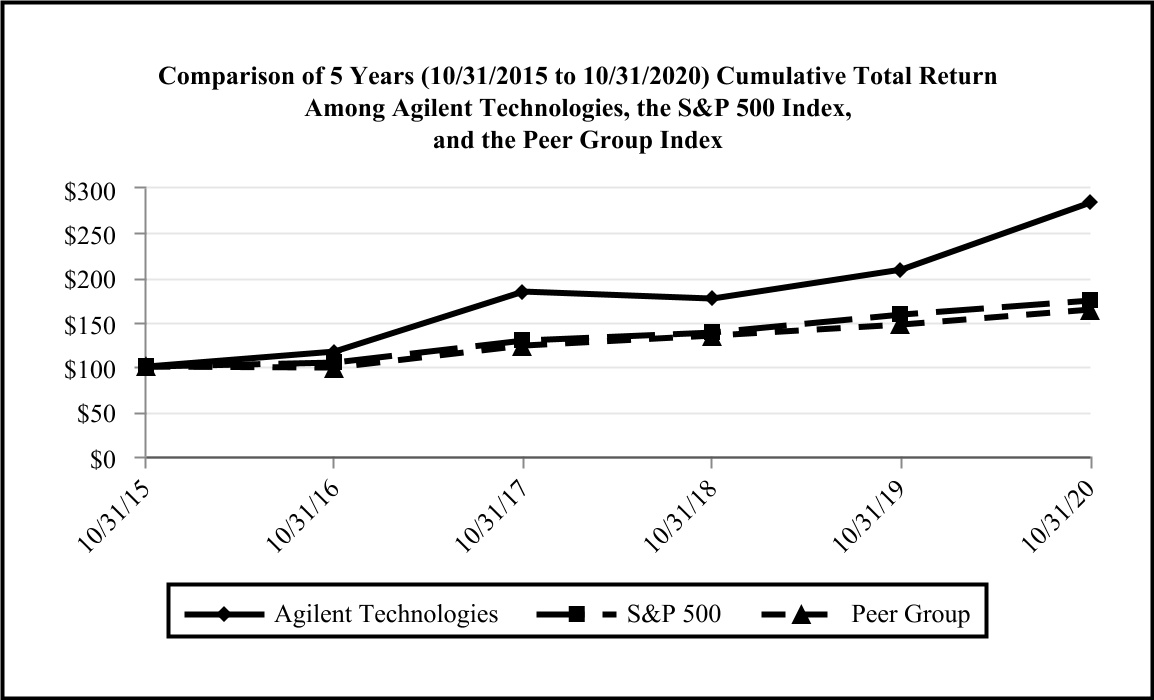
| INDEXED RETURNS | ||||||||||||||||||||
| Base | Years Ending | |||||||||||||||||||
| Period | ||||||||||||||||||||
| Company Name / Index | 10/31/2015 | 10/31/2016 | 10/31/2017 | 10/31/2018 | 10/31/2019 | 10/31/2020 | ||||||||||||||
| Agilent Technologies | 100 | 116.63 | 183.87 | 176.70 | 208.42 | 283.31 | ||||||||||||||
| S&P 500 | 100 | 104.51 | 129.21 | 138.70 | 158.57 | 173.97 | ||||||||||||||
| Peer Group | 100 | 99.21 | 123.71 | 134.82 | 147.29 | 163.88 |
ISSUER PURCHASES OF EQUITY SECURITIES
The table below summarizes information about the company’s purchases, based on trade date, of its equity securities registered pursuant to Section 12 of the Exchange Act during the quarterly period ended October 31, 2020. The total number of shares of common stock purchased by the company during the fiscal year ended October 31, 2020 was 5,227,273 shares.
| Period | Total Number of Shares of Common Stock Purchased(1) | Weighted Average Price Paid per Share of Common Stock(2) | Total Number of Shares of Common Stock Purchased as Part of Publicly Announced Plans or Programs(1) | Maximum Approximate Dollar Value of Shares of Common Stock that May Yet Be Purchased Under the Plans or Programs (in millions)(1) | ||||||||||||||||||||||
| August 1, 2020 through August 31, 2020 | 526,247 | $ | 98.38 | 526,247 | $ | 756 | ||||||||||||||||||||
| September 1, 2020 through September 30, 2020 | 1,041,643 | $ | 98.98 | 1,041,643 | $ | 653 | ||||||||||||||||||||
| October 1, 2020 through October 31, 2020 | 908,745 | $ | 104.62 | 908,745 | $ | 558 | ||||||||||||||||||||
| Total | 2,476,635 | $ | 100.92 | 2,476,635 |
(1)On November 19, 2018 we announced that our board of directors had approved a new share repurchase program (the "2019 repurchase program") designed, among other things, to reduce or eliminate dilution resulting from issuance of stock under the company's employee equity incentive programs. The 2019 repurchase program authorizes the purchase of up to $1.75 billion of our common stock at the company's discretion and has no fixed termination date. As of October 31, 2020, we had remaining authorization to repurchase up to $558 million of our common stock under this program. The 2019 repurchase program does not require the company to acquire a specific number of shares and may be suspended, amended or discontinued at any time. As of October 31, 2020, all repurchased shares have been retired.
(2)The weighted average price paid per share of common stock does not include the cost of commissions.
Item 6. Selected Financial Data
SELECTED FINANCIAL DATA
(Unaudited)
| Years Ended October 31, | |||||||||||||||||||||||||||||
| 2020 | 2019 | 2018 | 2017 | 2016 | |||||||||||||||||||||||||
| (in millions, except per share data) | |||||||||||||||||||||||||||||
| Consolidated Statement of Operations Data: | |||||||||||||||||||||||||||||
| Net revenue (1) | $ | 5,339 | $ | 5,163 | $ | 4,914 | $ | 4,472 | $ | 4,202 | |||||||||||||||||||
| Income before taxes | $ | 842 | $ | 919 | $ | 946 | $ | 803 | $ | 544 | |||||||||||||||||||
| Net income (2) | $ | 719 | $ | 1,071 | $ | 316 | $ | 684 | $ | 462 | |||||||||||||||||||
| Net income per share - Basic | $ | 2.33 | $ | 3.41 | $ | 0.98 | $ | 2.12 | $ | 1.42 | |||||||||||||||||||
| Net income per share - Diluted | $ | 2.30 | $ | 3.37 | $ | 0.97 | $ | 2.10 | $ | 1.40 | |||||||||||||||||||
| Weighted average shares used in computing net income per share: | |||||||||||||||||||||||||||||
| Basic | 309 | 314 | 321 | 322 | 326 | ||||||||||||||||||||||||
| Diluted | 312 | 318 | 325 | 326 | 329 | ||||||||||||||||||||||||
| Cash dividends declared per common share | $ | 0.720 | $ | 0.656 | 0.596 | $ | 0.528 | $ | 0.460 |
(1) In 2019 we adopted ASC Topic 606, Revenue from Contracts with Customers, using the modified retrospective approach. Results for reporting periods for 2019 and after are presented under ASC 606, while prior period amounts were not adjusted and continue to be reported in accordance with ASC Topic 605, Revenue Recognition.
(2) Net income for the year ended October 31, 2019 was impacted by a tax benefit of $299 million related to the extension of tax incentives in Singapore. Net income for the year ended October 31, 2018 was impacted by a tax expense of $552 million related to the enactment of the U.S Tax Cuts and Jobs Act of 2017 (the "Tax Act").
| October 31, | |||||||||||||||||||||||||||||
| 2020 | 2019 | 2018 | 2017 | 2016 | |||||||||||||||||||||||||
| (in millions) | |||||||||||||||||||||||||||||
| Consolidated Balance Sheet Data (1)****: | |||||||||||||||||||||||||||||
| Cash and cash equivalents | $ | 1,441 | $ | 1,382 | $ | 2,247 | $ | 2,678 | $ | 2,289 | |||||||||||||||||||
| Working capital | $ | 1,948 | $ | 1,109 | $ | 2,677 | $ | 2,906 | $ | 2,690 | |||||||||||||||||||
| Total assets | $ | 9,627 | $ | 9,452 | $ | 8,541 | $ | 8,426 | $ | 7,794 | |||||||||||||||||||
| Long-term debt | $ | 2,284 | $ | 1,791 | $ | 1,799 | $ | 1,801 | $ | 1,904 | |||||||||||||||||||
| Stockholders' equity | $ | 4,873 | $ | 4,748 | $ | 4,567 | $ | 4,831 | $ | 4,243 |
(1) In 2020, we adopted ASC Topic 842, Leases, using the modified retrospective method. Results for reporting periods beginning November 1, 2019 are presented under ASC 842, while prior period amounts were not adjusted and are reported under ASC 840.
Item 7. Management's Discussion and Analysis of Financial Condition and Results of Operations
The following discussion should be read in conjunction with the consolidated financial statements and notes thereto included elsewhere in this Annual Report on Form 10-K. This report contains forward-looking statements including, without limitation, statements regarding growth opportunities, including for revenue and our end markets, strength and drivers of the markets into which we sell, sales funnels, our strategic direction, new product and service introductions and the position of our current products and services, market demand for and adoption of our products, the ability of our products and solutions to address customer needs and meet industry requirements, our focus on differentiating our product solutions, improving our customers’ experience and growing our earnings, future financial results, our operating margin, mix, our investments, including in manufacturing infrastructure, research and development and expanding and improving our applications and solutions portfolios, expanding our position in developing countries and emerging markets, our focus on balanced capital allocation, our contributions to our pension and other defined benefit plans, impairment of goodwill and other intangible assets, the impact of foreign currency movements, our hedging programs and other actions to offset the effects of tariffs and foreign currency movements, our future effective tax rate, tax valuation allowance and unrecognized tax benefits, the impact of local government regulations on our ability to pay vendors or conduct operations, our ability to satisfy our liquidity requirements, including through cash generated from operations, the potential impact of adopting new accounting pronouncements, indemnification, source and supply of materials used in our products, our sales, our purchase commitments, our capital expenditures, the integration and effects of our acquisitions and other transactions, our stock repurchase program and dividends and the potential or anticipated direct or indirect impact of COVID-19 on our business that involve risks and uncertainties. Our actual results could differ materially from the results contemplated by these forward-looking statements due to various factors, including those discussed in Part I Item 1A and elsewhere in this Form 10-K.
Overview and Executive Summary
Agilent Technologies Inc. ("we", "Agilent" or the "company"), incorporated in Delaware in May 1999, is a global leader in life sciences, diagnostics and applied chemical markets, providing application focused solutions that include instruments, software, services and consumables for the entire laboratory workflow.
COVID-19 Pandemic
Both our domestic and international operations have been and continue to be affected by the ongoing global pandemic of a novel strain of coronavirus (“COVID-19”) and the resulting volatility and uncertainty it has caused in the U.S. and international markets. Many countries, including the United States, implemented measures such as quarantine, shelter-in-place, curfew, travel and activity restrictions and similar isolation measures, including government orders and other restrictions on the conduct of business operations at different times. Due to these measures, we experienced unpredictable reductions or increases in demand for certain of our products, disruptions or delays in shipments of certain materials or components of our products, and delays in installations and services due to the inability to access customer sites, primarily in the latter part of our second quarter.
As an essential business throughout the COVID-19 pandemic, we have remained open with our top priority being the health and safety of our employees, customers and community. At every stage of the pandemic, we have taken decisive and appropriate precautions, including a mandatory work from home policy for all employees with the exception of manufacturing, distribution, and certain laboratory environments, as well as restrictions on all non-essential travel and visitors into our facilities. At this time, our factories continue to operate around the world in accordance with the guidance issued by local, state and national government authorities. Our digital workplace strategy and strategic technology investments have enabled us to provide modern connectivity and collaboration tools to our employees to meet remote working needs as this situation has escalated. We have taken and continue to take proactive measures to ensure the health and safety of our global employee base. We designed a multi-phase return-to-office process for the safe return of our employees to our sites. We developed and implemented rigorous return-to-office protocols to promote a safe work environment in all locations for employees who have been working on-site throughout the pandemic and for employees who will be returning in the future, as well as, for the safety of all customer and vendor interactions.
At this time, the COVID-19 pandemic has not significantly impacted our manufacturing facilities or third parties to whom we outsource certain manufacturing processes, the distribution centers where our inventory is managed or the operations of our logistics and other service providers. We continue working with our customers and suppliers to understand the existing and potential future negative impacts to our delivery and supply chain and take actions in an effort to mitigate such impacts. The majority of the markets we serve, such as the pharmaceutical, biopharmaceutical, food, environmental and diagnostics and clinical markets, have continued to operate at various levels throughout the pandemic, and we continue working closely with
our customers to ensure their seamless operations. From a customer-facing perspective, we continue leveraging digital demand generation activities, including virtual demonstrations across all regions, remote instrument repairs, virtual sales seminars, online product training, and rapid one-on-one communications over emails, phone and video conferencing.
Despite the economic challenges due to the COVID-19 pandemic, we ended fiscal year 2020 with revenue growth of 3 percent year over year with revenue growth from most of our key end markets. In the latter part of the fiscal year, our Agilent CrossLab business began to see an increase in revenue for our on-demand services and installation services due to the re-opening of laboratories around the world, especially in Europe. While we began to see elective medical procedures resume in the fourth quarter, revenue from our diagnostics and genomics business continues to be negatively impacted by the COVID-19 pandemic. In our life sciences and applied markets business, we saw an increase in demand for some of our products for use in the COVID-19 testing, vaccine and therapeutic drug development. We also benefited from our cost savings actions which included reduction in travel and non-essential spending.
The COVID-19 pandemic continues to be dynamic, and near-term challenges across the economy remain. Although we anticipate there will be vaccines distributed widely in the near future, we expect continued volatility and unpredictability related to the impact of COVID-19 on our business results. We continue to actively monitor the pandemic and we will continue to take appropriate steps to mitigate the adverse impacts on our business posed by the on-going spread of COVID-19.
2030 Senior Notes
On June 4, 2020, we issued an aggregate principal amount of $500 million in senior notes ("2030 senior notes"). The 2030 senior notes were issued at 99.812% of their principal amount. The 2030 senior notes will mature on June 4, 2030, and bear interest at a fixed rate of 2.10% per annum. The interest is payable semi-annually on June 4th and December 4th of each year and payments commenced on December 4, 2020.
Acquisitions
In 2019, we acquired 100 percent of the stock of ACEA Biosciences Inc. ("ACEA"), a developer
Showing the first 8K of 115K characters. Open the full section
Item 7A. Quantitative and Qualitative Disclosures About Market Risk
We are exposed to foreign currency exchange rate risks inherent in our sales commitments, anticipated sales, and assets and liabilities denominated in currencies other than the functional currency of our subsidiaries. We hedge future cash flows denominated in currencies other than the functional currency using sales forecasts up to twelve months in advance. Our exposure to exchange rate risks is mainly managed on an enterprise-wide basis. This strategy utilizes derivative financial instruments, including option and forward contracts, to hedge certain foreign currency exposures with the intent of offsetting gains and losses that occur on the underlying exposures with gains and losses on the derivative contracts hedging them. We may also hedge equity balances denominated in foreign currency on a long-term basis. We do not currently and do not intend to utilize derivative financial instruments for speculative trading purposes. To the extent that we are required to pay for all, or portions, of an acquisition price in foreign currencies, we may enter into foreign exchange contracts to reduce the risk that currency movements will impact the cost of the transaction.
Our operations generate non-functional currency cash flows such as revenues, third party vendor payments and inter-company payments. In anticipation of these foreign currency cash flows and in view of volatility of the currency market, we enter into such foreign exchange contracts as are described above to manage our currency risk. Approximately 52 percent of our revenue in 2020, 51 percent of our revenue in 2019 and 53 percent of our revenue in 2018 were generated in U.S. dollars. The overall unfavorable effect of changes in foreign currency exchange rates, principally as a result of the strength of the U.S. dollar, has decreased revenue by approximately 1 percentage point in the year ended October 31, 2020. We calculate the impact of movements in foreign currency exchange rates by applying the actual foreign currency exchange rates in effect during the last month of each quarter of the current year to both the applicable current and prior year periods.
We performed a sensitivity analysis assuming a hypothetical 10 percent adverse movement in foreign exchange rates to the hedging contracts and the underlying exposures described above. As of October 31, 2020 and 2019, the analysis indicated that these hypothetical market movements would not have a material effect on our consolidated financial position, results of operations, statement of comprehensive income or cash flows.
We are also exposed to interest rate risk due to the mismatch between the interest expense we pay on our loans at fixed rates and the variable rates of interest we receive from cash, cash equivalents and other short-term investments. We have issued long-term debt in U.S. dollars or foreign currencies at fixed interest rates based on the market conditions at the time of financing. We believe that the fair value of our fixed rate debt changes when the underlying market rates of interest change, and we may use interest rate swaps to modify such market risk.
We performed a sensitivity analysis assuming a hypothetical 10 percent adverse movement in interest rates relating to the underlying fair value of our fixed rate debt. As of October 31, 2020 and 2019, the sensitivity analyses indicated that a hypothetical 10 percent adverse movement in interest rates would result in an immaterial impact to the fair value of our fixed interest rate debt.
Item 8. Financial Statements and Supplementary Data
REPORT OF INDEPENDENT REGISTERED PUBLIC ACCOUNTING FIRM
To the Board of Directors and Stockholders of Agilent Technologies, Inc.
Opinions on the Financial Statements and Internal Control over Financial Reporting
We have audited the accompanying consolidated balance sheets of Agilent Technologies, Inc. and its subsidiaries (the “Company”) as of October 31, 2020 and 2019, and the related consolidated statements of operations, comprehensive income, equity and cash flows for each of the three years in the period ended October 31, 2020, including the related notes and schedule of valuation and qualifying accounts for each of the three years in the period ended October 31, 2020 appearing under Item 15(a)(2) (collectively referred to as the “consolidated financial statements”). We also have audited the Company's internal control over financial reporting as of October 31, 2020, based on criteria established in Internal Control - Integrated Framework (2013) issued by the Committee of Sponsoring Organizations of the Treadway Commission (COSO).
In our opinion, the consolidated financial statements referred to above present fairly, in all material respects, the financial position of the Company as of October 31, 2020 and 2019, and the results of its operations and its cash flows for each of the three years in the period ended October 31, 2020 in conformity with accounting principles generally accepted in the United States of America. Also in our opinion, the Company maintained, in all material respects, effective internal control over financial reporting as of October 31, 2020, based on criteria established in Internal Control - Integrated Framework (2013) issued by the COSO.
Change in Accounting Principle
As discussed in Note 2 to the consolidated financial statements, the Company changed the manner in which it accounts for leases in 2020 and the manner in which it accounts for revenue from contracts with customers in 2019.
Basis for Opinions
The Company's management is responsible for these consolidated financial statements, for maintaining effective internal control over financial reporting, and for its assessment of the effectiveness of internal control over financial reporting, included in Management's Report on Internal Control over Financial Reporting appearing under Item 9A. Our responsibility is to express opinions on the Company’s consolidated financial statements and on the Company's internal control over financial reporting based on our audits. We are a public accounting firm registered with the Public Company Accounting Oversight Board (United States) (PCAOB) and are required to be independent with respect to the Company in accordance with the U.S. federal securities laws and the applicable rules and regulations of the Securities and Exchange Commission and the PCAOB.
We conducted our audits in accordance with the standards of the PCAOB. Those standards require that we plan and perform the audits to obtain reasonable assurance about whether the consolidated financial statements are free of material misstatement, whether due to error or fraud, and whether effective internal control over financial reporting was maintained in all material respects.
Our audits of the consolidated financial statements included performing procedures to assess the risks of material misstatement of the consolidated financial statements, whether due to error or fraud, and performing procedures that respond to those risks. Such procedures included examining, on a test basis, evidence regarding the amounts and disclosures in the consolidated financial statements. Our audits also included evaluating the accounting principles used and significant estimates made by management, as well as evaluating the overall presentation of the consolidated financial statements. Our audit of internal control over financial reporting included obtaining an understanding of internal control over financial reporting, assessing the risk that a material weakness exists, and testing and evaluating the design and operating effectiveness of internal control based on the assessed risk. Our audits also included performing such other procedures as we considered necessary in the circumstances. We believe that our audits provide a reasonable basis for our opinions.
Definition and Limitations of Internal Control over Financial Reporting
A company’s internal control over financial reporting is a process designed to provide reasonable assurance regarding the reliability of financial reporting and the preparation of financial statements for external purposes in accordance with generally accepted accounting principles. A company’s internal control over financial reporting includes those policies and procedures that (i) pertain to the maintenance of records that, in reasonable detail, accurately and fairly reflect the transactions and dispositions of the assets of the company; (ii) provide reasonable assurance that transactions are recorded as necessary to permit
preparation of financial statements in accordance with generally accepted accounting principles, and that receipts and expenditures of the company are being made only in accordance with authorizations of management and directors of the company; and (iii) provide reasonable assurance regarding prevention or timely detection of unauthorized acquisition, use, or disposition of the company’s assets that could have a material effect on the financial statements.
Because of its inherent limitations, internal control over financial reporting may not prevent or detect misstatements. Also, projections of any evaluation of effectiveness to future periods are subject to the risk that controls may become inadequate because of changes in conditions, or that the degree of compliance with the policies or procedures may deteriorate.
Critical Audit Matters
The critical audit matter communicated below is
Showing the first 8K of 276K characters. Open the full section
Item 9. Changes in and Disagreements with Accountants on Accounting and Financial Disclosure
None.
Item 9A. Controls and Procedures
Evaluation of Disclosure Controls and Procedures
Our management has evaluated, under the supervision and with the participation of our Chief Executive Officer and Chief Financial Officer, the effectiveness of our disclosure controls and procedures as of October 31, 2020, pursuant to and as required by Rule 13a-15(b) under the Securities Exchange Act of 1934 (“Exchange Act”). Based on that evaluation, our Chief Executive Officer and Chief Financial Officer have concluded that, as of October 31, 2020, the company's disclosure controls and procedures, as defined by Rule 13a-15(e) under the Exchange Act, were effective and designed to ensure that (i) information required to be disclosed in the company's reports filed under the Exchange Act is recorded, processed, summarized and reported within the time periods specified in the SEC's rules and forms, and (ii) information is accumulated and communicated to management, including the Chief Executive Officer and Chief Financial Officer, as appropriate to allow timely decisions regarding required disclosures.
Management's Report on Internal Control Over Financial Reporting
Our management is responsible for establishing and maintaining adequate internal control over financial reporting, as such term is defined in Exchange Act Rule 13a-15(f). Under the supervision and with the participation of our management, including our Chief Executive Officer and Chief Financial Officer, we assessed the effectiveness of our internal control over financial reporting based on the framework in Internal Control - Integrated Framework (2013) issued by the Committee of Sponsoring Organizations of the Treadway Commission ("COSO"). As a result of that assessment, management concluded that our internal control over financial reporting was effective as of October 31, 2020 based on criteria in Internal Control - Integrated Framework (2013) issued by the COSO.
The effectiveness of our internal control over financial reporting as of October 31, 2020 has been audited by PricewaterhouseCoopers LLP, an independent registered public accounting firm, as stated in their report which appears in Item 8 of this Annual Report on Form 10-K.
Changes in Internal Control Over Financial Reporting
There were no changes in our internal control over financial reporting that occurred during Agilent's last fiscal quarter that have materially affected, or are reasonably likely to materially affect, our internal control over financial reporting.
Item 9B. Other Information
None.
PART III
Item 10. Directors, Executive Officers and Corporate Governance
Information regarding our directors appears under “Proposal No. 1 - Election of Directors” in our Proxy Statement for the Annual Meeting of Stockholders (“Proxy Statement”), to be held March 17, 2021. That portion of the Proxy Statement is incorporated by reference into this report. Information regarding our executive officers appears in Item 1 of this report under “Executive Officers of the Registrant.” Information regarding our Audit and Finance Committee and our Audit and Finance Committee's financial expert appears under “Audit and Finance Committee Report” and “Corporate Governance” in our Proxy Statement. That portion of the Proxy Statement is incorporated by reference into this report.
There were no material changes to the procedures by which security holders may recommend nominees to our Board of Directors in fiscal year 2020. Information regarding our code of ethics (the company's Standards of Business Conduct) applicable to our principal executive officer, our principal financial officer, our controller and other senior financial officers appears in Item 1 of this report under “Investor Information.” We will post amendments to or waivers from a provision of the Standards of Business Conduct with respect to those persons on our website at www.investor.agilent.com.
Compliance with Section 16(a) of the Exchange Act
Information about compliance with Section 16(a) of the Exchange Act appears under “Section 16(a) Beneficial Ownership Reporting Compliance” in the Proxy Statement. That portion of the Proxy Statement is incorporated by reference into this report.
Item 11. Executive Compensation
Information about compensation of our named executive officers appears under “Executive Compensation” in the Proxy Statement. Information about compensation of our directors appears under “Compensation of Non-Employee Directors” and “Compensation Committee Report” in the Proxy Statement. Those portions of the Proxy Statement are incorporated by reference into this report.
Item 12. Security Ownership of Certain Beneficial Owners and Management and Related Stockholder Matters
Information about security ownership of certain beneficial owners and management appears under "Beneficial Ownership" in the Proxy Statement. That portion of the Proxy Statement is incorporated by reference into this report.
EQUITY COMPENSATION PLAN INFORMATION
The following table summarizes information about our equity compensation plans as of October 31, 2020. All outstanding awards relate to our common stock.
| Plan Category | Number of Securities to be Issued upon Exercise of Outstanding Options, Warrants and Rights | Weighted-average Exercise Price of Outstanding Options, Warrants and Rights | Number of Securities Remaining Available for Future Issuance under Equity Compensation Plans (Excluding Securities Reflected in Column (a)) | ||||||||||||||
| (a) | (b) | (c) | |||||||||||||||
| Equity compensation plans approved by security holders (1)(2)(3) | 3,687,752 | $ | 37 | 51,367,003 | |||||||||||||
| Equity compensation plans not approved by security holders | — | — | — | ||||||||||||||
| Total | 3,687,752 | $ | 37 | 51,367,003 |
(1)The number of securities remaining available for future issuance in column (c) includes 25,770,573 shares of common stock authorized and available for issuance under our current Employee Stock Purchase Plan ("ESPP"). The number of shares authorized for issuance under the ESPP is subject to an automatic annual increase of the lesser of one percent of the outstanding common stock of Agilent or an amount determined by the Compensation Committee of our Board of Directors. Under the terms of the ESPP, in no event shall the aggregate number of shares issued under the ESPP exceed 31 million shares.
(2)We issue securities under our equity compensation plans in forms other than options, warrants or rights. On November 15, 2017 and March 21, 2018, the Board and the stockholders, respectively, approved the Agilent Technologies, Inc. 2018 Stock Plan (the “2018 Plan”), which was an amendment and restatement of the company’s 2009 Stock Plan, approved by the Board and the stockholders, respectively, on November 19, 2008 and March 11, 2009. The 2018 Plan provides for awards of stock-based incentive compensation to our employees (including officers), directors and consultants. The 2018 Plan provides for the grant of awards in the form of stock options, stock appreciation rights, restricted stock, restricted stock units, performance shares and performance units with performance-based conditions to vesting or exercisability, and cash awards. The 2018 Plan has a term of ten years.
(3)We issue securities under our equity compensation plans in forms which do not require a payment by the recipient to us at the time of exercise or vesting, including restricted stock, restricted stock units and performance units. Accordingly, the weighted-average exercise price in column (b) does not take these awards into account.
Item 13. Certain Relationships and Related Transactions, and Director Independence
Information about certain relationships and related transactions appears under "Related Person Transactions Policy and Procedures" in the Proxy Statement. Information about director independence appears under the heading "Corporate Governance — Director Independence" in the Proxy Statement. Each of those portions of the Proxy Statement is incorporated by reference into this report.
Item 14. Principal Accounting Fees and Services
Information about principal accountant fees and services as well as related pre-approval policies appear under "Fees Paid to PricewaterhouseCoopers LLP" and "Policy on Preapproval of Audit and Permissible Non-Audit Services of Independent Registered Public Accounting Firm" in the Proxy Statement. Those portions of the Proxy Statement are incorporated by reference into this report.
PART IV
Item 15. Exhibits and Financial Statement Schedules
(a) The following documents are filed as part of this report:
- Financial Statements.
See Index to Consolidated Financial Statements under Item 8 on Page 54 of this report.
- Financial Statement Schedule.
The following additional financial statement schedule should be considered in conjunction with our consolidated financial statements. All other schedules have been omitted because the required information is either not applicable or not sufficiently material to require submission of the schedule:
SCHEDULE II
SCHEDULE II
VALUATION AND QUALIFYING ACCOUNTS
| Column A | Column B | Column C | Column D | Column E | ||||||||||||||||||||||
| Description | Balance at Beginning of Period | Additions Charged to Expenses or Other Accounts* | Deductions Credited to Expenses or Other Accounts** | Balance at End of Period | ||||||||||||||||||||||
| (in millions) | ||||||||||||||||||||||||||
| 2020 | ||||||||||||||||||||||||||
| Tax valuation allowance | $ | 134 | $ | 6 | $ | (8) | $ | 132 | ||||||||||||||||||
| 2019 | ||||||||||||||||||||||||||
| Tax valuation allowance | $ | 135 | $ | 9 | $ | (10) | $ | 134 | ||||||||||||||||||
| 2018 | ||||||||||||||||||||||||||
| Tax valuation allowance | $ | 138 | $ | 4 | $ | (7) | $ | 135 |
- Additions include current year additions charged to expenses and current year build due to increases in net deferred tax assets, return to provision true-ups, other adjustments and other comprehensive income impact to deferred taxes.
** Deductions include current year releases credited to expenses and current year reductions due to decreases in net deferred tax assets, return to provision true-ups, other adjustments and other comprehensive income impact to deferred taxes.
- Exhibits.
Exhibits are incorporated herein by reference or are filed with this report as indicated below (numbered in accordance with Item 601 of Regulation S-K):
- Indicates management contract or compensatory plan, contract or arrangement.
SIGNATURES
Pursuant to the requirements of Section 13 or 15(d) of the Securities Exchange Act of 1934, the registrant has duly caused this report to be signed on its behalf by the undersigned, thereunto duly authorized.
| AGILENT TECHNOLOGIES, INC. | ||||||||||||||
| BY | /s/ MICHAEL TANG | |||||||||||||
| Michael Tang | ||||||||||||||
| Senior Vice President, | ||||||||||||||
| General Counsel and Secretary |
Date: December 17, 2020
POWER OF ATTORNEY
KNOW ALL PERSONS BY THESE PRESENTS, that each person whose signature appears below constitutes and appoints Michael Tang and P. Diana Chiu, or either of them, his or her attorneys-in-fact, for such person in any and all capacities, to sign any amendments to this report and to file the same, with exhibits thereto, and other documents in connection therewith, with the Securities and Exchange Commission, hereby ratifying and confirming all that any of said attorneys-in-fact, or substitute or substitutes, may do or cause to be done by virtue hereof. Pursuant to the requirements of the Securities Exchange Act of 1934, this report has been signed below by the following persons on behalf of the registrant and in the capacities and on the dates indicated.
| Signature | Title | Date | ||||||||||||
| /s/ MICHAEL R. MCMULLEN | Director, President and Chief Executive Officer | December 17, 2020 | ||||||||||||
| Michael R. McMullen | (Principal Executive Officer) | |||||||||||||
| /s/ ROBERT W. MCMAHON | Senior Vice President and Chief Financial Officer | December 17, 2020 | ||||||||||||
| Robert W. McMahon | (Principal Financial Officer) | |||||||||||||
| /s/ RODNEY GONSALVES | Vice President, Corporate Controllership | December 17, 2020 | ||||||||||||
| Rodney Gonsalves | (Principal Accounting Officer) | |||||||||||||
| /s/ KOH BOON HWEE | Chairman of the Board of Directors | December 17, 2020 | ||||||||||||
| Koh Boon Hwee | ||||||||||||||
| /s/ MALA ANAND | Director | December 17, 2020 | ||||||||||||
| Mala Anand | ||||||||||||||
| /s/ HANS E. BISHOP | Director | December 17, 2020 | ||||||||||||
| Hans E. Bishop | ||||||||||||||
| /s/ PAUL N. CLARK | Director | December 17, 2020 | ||||||||||||
| Paul N. Clark | ||||||||||||||
| /s/ HEIDI KUNZ | Director | December 17, 2020 | ||||||||||||
| Heidi Kunz | ||||||||||||||
| /s/ DANIEL K. PODOLSKY, M.D. | Director | December 17, 2020 | ||||||||||||
| Daniel K. Podolsky, M.D. | ||||||||||||||
| /s/ SUE H. RATAJ | Director | December 17, 2020 | ||||||||||||
| Sue H. Rataj | ||||||||||||||
| /s/ GEORGE A. SCANGOS, Ph.D. | Director | December 17, 2020 | ||||||||||||
| George A. Scangos, Ph.D. | ||||||||||||||
| /s/ DOW R. WILSON | Director | December 17, 2020 | ||||||||||||
| Dow R. Wilson | ||||||||||||||
| /s/ TADATAKA YAMADA, M.D. | Director | December 17, 2020 | ||||||||||||
| Tadataka Yamada, M.D. |