 filings.tools
AbbVie 10-K 2019-12-31
Filed 2020-02-21. 22 sections, 452K characters. Original on sec.gov · Markdown · JSON
Cover and table of contents
UNITED STATES
SECURITIES AND EXCHANGE COMMISSION
WASHINGTON, D. C. 20549
FORM 10-K
| (MARK ONE) | ||
| ☒ | ANNUAL REPORT PURSUANT TO SECTION 13 OR 15(d) OF THE SECURITIES EXCHANGE ACT OF 1934 |
For the fiscal year ended December 31, 2019
OR
| ☐ | TRANSITION REPORT PURSUANT TO SECTION 13 OR 15(d) OF THE SECURITIES EXCHANGE ACT OF 1934 |
For the transition period from to
Commission file number 001-35565

AbbVie Inc.
(Exact name of registrant as specified in its charter)
| Delaware | 32-0375147 | |
| (State or other jurisdiction of incorporation or organization) | (I.R.S. employer identification number) |
1 North Waukegan Road
North Chicago**,** Illinois 60064-6400
(847) 932-7900
(Address, including zip code, and telephone number of principal executive offices)
Securities Registered Pursuant to Section 12(b) of the Act:
| Title of Each Class | Trading Symbol(s) | Name of Each Exchange on Which Registered | ||
| Common Stock, par value $0.01 per share | ABBV | New York Stock Exchange | ||
| Chicago Stock Exchange | ||||
| 1.375% Senior Notes due 2024 | ABBV24 | New York Stock Exchange | ||
| 0.750% Senior Notes due 2027 | ABBV27 | New York Stock Exchange | ||
| 2.125% Senior Notes due 2028 | ABBV28 | New York Stock Exchange | ||
| 1.250% Senior Notes due 2031 | ABBV31 | New York Stock Exchange |
Indicate by check mark if the registrant is a well-known seasoned issuer, as defined in Rule 405 of the Securities Act.
Yes ☒ No ☐
Indicate by check mark if the registrant is not required to file reports pursuant to Section 13 or 15(d) of the Act.
Yes ☐ No ☒
Indicate by check mark whether the registrant (1) has filed all reports required to be filed by Section 13 or 15(d) of the Securities Exchange Act of 1934 during the preceding 12 months (or for such shorter period that the registrant was required to file such reports) and (2) has been subject to such filing requirements for the past 90 days.
Yes ☒ No ☐
Indicate by check mark whether the registrant has submitted electronically every Interactive Data File required to be submitted pursuant to Rule 405 of Regulation S-T during the preceding 12 months (or for such shorter period that the registrant was required to submit such files).
Yes ☒ No ☐
Indicate by check mark whether the registrant is a large accelerated filer, an accelerated filer, a non-accelerated filer, or a smaller reporting company. See the definitions of "large accelerated filer," "accelerated filer" and "smaller reporting company" in Rule 12b-2 of the Exchange Act.
| Large Accelerated Filer | ☒ | Accelerated Filer | ☐ |
| Non-Accelerated Filer | ☐ | Smaller reporting company | ☐ |
| Emerging growth company | ☐ |
If an emerging growth company, indicate by check mark if the registrant has elected not to use the extended transition period for complying with any new or revised financial accounting standards provided pursuant to Section 13(a) of the Exchange Act. ☐
Indicate by check mark whether the registrant is a shell company (as defined in Rule 12b-2 of the Act).
Yes ☐ No ☒
The aggregate market value of the 1,462,630,048 shares of voting stock held by non-affiliates of the registrant, computed by reference to the closing price as reported on the New York Stock Exchange, as of the last business day of AbbVie Inc.'s most recently completed second fiscal quarter (June 30, 2019), was $106,362,457,090. AbbVie has no non-voting common equity.
Number of common shares outstanding as of January 31, 2020: 1,479,156,683
DOCUMENTS INCORPORATED BY REFERENCE
Portions of the 2020 AbbVie Inc. Proxy Statement are incorporated by reference into Part III. The Definitive Proxy Statement will be filed on or about March 19, 2020.
ABBVIE INC.
FORM 10-K
FOR THE YEAR ENDED DECEMBER 31, 2019
TABLE OF CONTENTS
PART I
Item 1. BUSINESS
Overview
AbbVie(1) is a global, research-based biopharmaceutical company. AbbVie develops and markets advanced therapies that address some of the world's most complex and serious diseases. AbbVie's products are focused on treating conditions such as chronic autoimmune diseases in rheumatology, gastroenterology and dermatology; oncology, including blood cancers; virology, including hepatitis C virus (HCV) and human immunodeficiency virus (HIV); neurological disorders, such as Parkinson's disease; metabolic diseases, including thyroid disease and complications associated with cystic fibrosis; pain associated with endometriosis; as well as other serious health conditions. AbbVie also has a pipeline of promising new medicines in clinical development across such important medical specialties as immunology, oncology and neuroscience, with additional targeted investment in cystic fibrosis and women's health.
In June 2019, AbbVie announced that it entered into a definitive transaction agreement under which AbbVie will acquire Allergan plc (Allergan). Allergan is a global pharmaceutical leader focused on developing, manufacturing and commercializing branded pharmaceutical, device, biologic, surgical and regenerative medicine products for patients around the world. Allergan markets a portfolio of brands and products primarily focused on key therapeutic areas including aesthetics, eye care, neuroscience, gastroenterology and women's health. See Note 5 to the Consolidated Financial Statements for additional information regarding the proposed acquisition.
AbbVie was incorporated in Delaware on April 10, 2012. On January 1, 2013, AbbVie became an independent, publicly-traded company as a result of the distribution by Abbott Laboratories (Abbott) of 100% of the outstanding common stock of AbbVie to Abbott's shareholders.
Segments
AbbVie operates in one business segment—pharmaceutical products. See Note 16 to the Consolidated Financial Statements and the sales information related to HUMIRA, IMBRUVICA and MAVYRET included under Item 7, "Management's Discussion and Analysis of Financial Condition and Results of Operations."
Products
AbbVie's portfolio of products includes a broad line of therapies that address some of the world's most complex and serious diseases.
Immunology products. AbbVie maintains an extensive immunology portfolio across rheumatology, dermatology and gastroenterology. AbbVie's immunology products address unmet needs for patients with autoimmune diseases. These products are:
HUMIRA. HUMIRA (adalimumab) is a biologic therapy administered as a subcutaneous injection. It is approved to treat the following autoimmune diseases in the United States, Canada and Mexico (collectively, North America) and in the European Union:
| Condition | Principal Markets | |
| Rheumatoid arthritis (moderate to severe) | North America, European Union | |
| Psoriatic arthritis | North America, European Union | |
| Ankylosing spondylitis | North America, European Union | |
| Adult Crohn's disease (moderate to severe) | North America, European Union | |
| Plaque psoriasis (moderate to severe chronic) | North America, European Union | |
| Juvenile idiopathic arthritis (moderate to severe polyarticular) | North America, European Union | |
| Ulcerative colitis (moderate to severe) | North America, European Union | |
| Axial spondyloarthropathy | European Union | |
| Pediatric Crohn's disease (moderate to severe) | North America, European Union | |
| Hidradenitis Suppurativa (moderate to severe) | North America, European Union | |
| Pediatric enthesitis-related arthritis | European Union | |
| Non-infectious intermediate, posterior and panuveitis | North America, European Union |
| (1) | As used throughout the text of this report on Form 10-K, the terms "AbbVie" or "the company" refer to AbbVie Inc., a Delaware corporation, or AbbVie Inc. and its consolidated subsidiaries, as the context requires. |
2019 Form 10-K |  1 1 |
HUMIRA is also approved in Japan for the treatment of intestinal Behçet's disease.
HUMIRA is sold in numerous other markets worldwide, including Japan, China, Brazil and Australia, and accounted for approximately 58% of AbbVie's total net revenues in 2019.
SKYRIZI. SKYRIZI (risankizumab) is an interleukin-23 (IL-23) inhibitor that selectively blocks IL-23 by binding to its p19 subunit. It is a biologic therapy administered as a quarterly subcutaneous injection following an induction dose. SKYRIZI is approved in the United States, Canada and the European Union and is indicated for the treatment of moderate to severe plaque psoriasis in adults who are candidates for systemic therapy or phototherapy. In Japan, SKYRIZI is approved for the treatment of plaque psoriasis, generalized pustular psoriasis, erythrodermic psoriasis and psoriatic arthritis in adult patients who have an inadequate response to conventional therapies.
RINVOQ. RINVOQ (upadacitinib) is a once-daily oral selective and reversible JAK inhibitor and is approved in the United States, Canada and the European Union. RINVOQ is indicated for the treatment of moderate to severe active rheumatoid arthritis in adult patients who have responded inadequately to, or who are intolerant to one or more disease-modifying anti-rheumatic drugs (DMARDs). RINVOQ may be used as monotherapy or in combination with methotrexate.
Oncology products. AbbVie’s oncology products target some of the most complex and difficult-to-treat cancers. These products are:
IMBRUVICA. IMBRUVICA (ibrutinib) is an oral, once-daily therapy that inhibits a protein called Bruton's tyrosine kinase (BTK). IMBRUVICA was one of the first medicines to receive a United States Food and Drug Administration (FDA) approval after being granted a Breakthrough Therapy Designation and is one of the few therapies to receive four separate designations. IMBRUVICA currently is approved for the treatment of adult patients with:
| • | Chronic lymphocytic leukemia (CLL)/Small lymphocytic lymphoma (SLL) and CLL/SLL with 17p deletion; |
| • | Mantle cell lymphoma (MCL) who have received at least one prior therapy*; |
| • | Waldenström’s macroglobulinemia (WM); |
| • | Marginal zone lymphoma (MZL) who require systemic therapy and have received at least one prior anti-CD20-based therapy*; and |
| • | Chronic graft versus host disease (cGVHD) after failure of one or more lines of systemic therapy. |
- Accelerated approval was granted for this indication based on overall response rate. Continued approval for this indication may be contingent upon verification of clinical benefit in confirmatory trials.
VENCLEXTA/VENCLYXTO. VENCLEXTA (venetoclax) is a BCL-2 inhibitor used to treat hematological malignancies. VENCLEXTA is approved by the FDA for adults with CLL or SLL. In addition, VENCLEXTA is approved in combination with azacitidine, or decitabine, or low-dose cytarabine to treat adults with newly-diagnosed acute myeloid leukemia (AML) who are 75 years of age or older or have other medical conditions that prevent the use of standard chemotherapy. VENCLYXTO is approved in Europe for CLL in combination with rituximab in patients who have received at least one previous treatment.
Virology Products. AbbVie's virology products address unmet needs for patients living with HCV and HIV.
HCV products. AbbVie's HCV products are:
MAVYRET/MAVIRET. MAVYRET (glecaprevir/pibrentasvir) is approved in the United States and European Union (MAVIRET) for the treatment of patients with chronic HCV genotype 1-6 infection without cirrhosis and with compensated cirrhosis (Child-Pugh A). It is also indicated for the treatment of adult patients with HCV genotype 1 infection, who previously have been treated with a regimen containing an HCV NS5A inhibitor or an NS3/4A protease inhibitor, but not both. It is an 8-week, pan-genotypic treatment for patients without cirrhosis and following the EXPEDITION-8 study, also in patients with compensated cirrhosis who are new to treatment. MAVIRET is now also indicated for the treatment of HCV genotypes 1-6 in children between 12-18 years.
VIEKIRA PAK AND TECHNIVIE. VIEKIRA PAK (ombitasvir, paritaprevir and ritonavir tablets; dasabuvir tablets) is an all-oral, short-course, interferon-free therapy, with or without ribavirin, for the treatment of adult patients with genotype 1 chronic HCV, including those with compensated cirrhosis. In Europe, VIEKIRA PAK is marketed as VIEKIRAX + EXVIERA and is approved for use in patients with genotype 1 and genotype 4 HCV. AbbVie's TECHNIVIE (ombitasvir, paritaprevir and
| 2 | 2019 Form 10-K |
ritonavir) is FDA-approved for use in combination with ribavirin for the treatment of adults with genotype 4 HCV infection in the United States. The use of VIEKIRA in the United States, Europe and Japan is currently limited given the significant use of pangenotypic regimens, including MAVIRET.
Additional Virology products. AbbVie's additional virology products include:
SYNAGIS. SYNAGIS (palivizumab) is a product marketed by AbbVie outside of the United States that protects at-risk infants from severe respiratory disease caused by respiratory syncytial virus (RSV).
KALETRA. KALETRA (lopinavir/ritonavir), which is also marketed as ALUVIA in emerging markets, is a prescription anti-HIV-1 medicine that contains two protease inhibitors: lopinavir and ritonavir. KALETRA is used with other anti-HIV-1 medications as a treatment that maintains viral suppression in people with HIV-1.
Metabolics/Hormones products. Metabolic and hormone products target a number of conditions, including testosterone deficiency due to certain underlying conditions, exocrine pancreatic insufficiency and hypothyroidism. These products include:
CREON. CREON (pancrelipase) is a pancreatic enzyme therapy for exocrine pancreatic insufficiency, a condition that occurs in patients with cystic fibrosis, chronic pancreatitis and several other conditions.
Synthroid. Synthroid (levothyroxine sodium tablets, USP) is used in the treatment of hypothyroidism.
AndroGel. AndroGel (testosterone gel) is a testosterone replacement therapy for males diagnosed with symptomatic low testosterone due to certain underlying conditions.
AbbVie has the rights to sell AndroGel, CREON and Synthroid only in the United States.
Endocrinology products. Lupron (leuprolide acetate), which is also marketed as Lucrin and LUPRON DEPOT, is a product for the palliative treatment of advanced prostate cancer, treatment of endometriosis and central precocious puberty and for the preoperative treatment of patients with anemia caused by uterine fibroids. Lupron is approved for daily subcutaneous injection and one-month, three-month, four-month and six-month intramuscular injection.
Other products. AbbVie's other products include:
ORILISSA. ORILISSA (elagolix) is the first and only orally-administered, nonpeptide small molecule gonadotropin-releasing hormone (GnRH) antagonist specifically developed for women with moderate to severe endometriosis pain. The FDA approved ORILISSA under priority review. It represents the first FDA-approved oral treatment for the management of moderate to severe pain associated with endometriosis in over a decade. ORILISSA inhibits endogenous GnRH signaling by binding competitively to GnRH receptors in the pituitary gland. Administration results in dose-dependent suppression of luteinizing hormone and follicle-stimulating hormone, leading to decreased blood concentrations of ovarian sex hormones, estradiol and progesterone. Outside the United States, ORILISSA is also launched in Canada and Puerto Rico.
Duopa and Duodopa (carbidopa and levodopa). AbbVie's levodopa-carbidopa intestinal gel for the treatment of advanced Parkinson's disease is marketed as Duopa in the United States and as Duodopa outside of the United States.
Sevoflurane. Sevoflurane (sold under the trademarks Ultane and Sevorane) is an anesthesia product that AbbVie sells worldwide for human use.
Marketing, Sales and Distribution Capabilities
AbbVie utilizes a combination of dedicated commercial resources, regional commercial resources and distributorships to market, sell and distribute its products worldwide. AbbVie directs its primary marketing efforts toward securing the prescription, or recommendation, of its brand of products by physicians, key opinion leaders and other health care providers. Managed care providers (for example, health maintenance organizations and pharmacy benefit managers), hospitals and state and federal government agencies (for example, the United States Department of Veterans Affairs and the United States Department of Defense) are also important customers. AbbVie also markets directly to consumers themselves, although in the United States all of the company's products must be sold pursuant to a prescription. Outside of the United States, AbbVie focuses its marketing efforts on key opinion leaders, payers, physicians and country regulatory bodies. AbbVie also provides patient support programs closely related to its products.
AbbVie's products are generally sold worldwide directly to wholesalers, distributors, government agencies, health care facilities, specialty pharmacies and independent retailers from AbbVie-owned distribution centers and public warehouses. Although AbbVie's business does not have significant seasonality, AbbVie's product revenues may be affected by end customer and retail buying patterns, fluctuations in wholesaler inventory levels and other factors.
| 2019 Form 10-K | 3 |
In the United States, AbbVie distributes pharmaceutical products principally through independent wholesale distributors, with some sales directly to pharmacies and patients. In 2019, three wholesale distributors (McKesson Corporation, Cardinal Health, Inc. and AmerisourceBergen Corporation) accounted for substantially all of AbbVie's sales in the United States. No individual wholesaler accounted for greater than 42% of AbbVie's 2019 gross revenues in the United States. Outside the United States, AbbVie sells products primarily to customers or through distributors, depending on the market served. These wholesalers purchase product from AbbVie under standard terms and conditions of sale.
Certain products are co-marketed or co-promoted with other companies. AbbVie has no single customer that, if the customer were lost, would have a material adverse effect on the company's business. No material portion of AbbVie's business is subject to renegotiation of profits or termination of contracts at the election of the government. Orders are generally filled on a current basis and order backlog is not material to AbbVie's business.
Competition
The markets for AbbVie's products are highly competitive. AbbVie competes with other research-based pharmaceuticals and biotechnology companies that discover, manufacture, market and sell proprietary pharmaceutical products and biologics. For example, HUMIRA competes with anti-TNF products and other competitive products intended to treat a number of disease states and AbbVie's virology products compete with other available HCV treatment options. The search for technological innovations in pharmaceutical products is a significant aspect of competition. The introduction of new products by competitors and changes in medical practices and procedures can result in product obsolescence. Price is also a competitive factor. In addition, the substitution of generic pharmaceutical products for branded pharmaceutical products creates competitive pressures on AbbVie's products that do not have patent protection. New products or treatments brought to market by AbbVie’s competitors could cause revenues for AbbVie’s products to decrease due to price reductions and sales volume decreases.
Biosimilars. Competition for AbbVie’s biologic products is affected by the approval of follow-on biologics, also known as “biosimilars.” Biologics have added major therapeutic options for the treatment of many diseases, including some for which therapies were unavailable or inadequate. The cost of developing and producing biologic therapies is typically dramatically higher than for conventional (small molecule) medications, and many biologic medications are used for ongoing treatment of chronic diseases, such as rheumatoid arthritis or inflammatory bowel disease, or for the treatment of previously untreatable cancer. Significant investments in biologics infrastructure and manufacturing are necessary to produce biologic products.
HUMIRA is now facing direct biosimilar competition in Europe and other countries, and AbbVie will continue to face competitive pressure from these biologics and from orally administered products.
In the United States, the FDA regulates biologics under the Federal Food, Drug and Cosmetic Act, the Public Health Service Act and implementing regulations. The enactment of federal health care reform legislation in March 2010 provided a pathway for approval of biosimilars under the Public Health Service Act, but the approval process for, and science behind, biosimilars is complex. Approval by the FDA is dependent upon many factors, including a showing that the biosimilar is "highly similar" to the original product and has no clinically meaningful differences from the original product in terms of safety, purity and potency. The types of data that could ordinarily be required in an application to show similarity may include analytical data, bioequivalence studies and studies to demonstrate chemical similarity, animal studies (including toxicity studies) and clinical studies.
Furthermore, the law provides that only a biosimilar product that is determined to be "interchangeable" will be considered substitutable for the original biologic product without the intervention of the health care provider who prescribed the original biologic product. To prove that a biosimilar product is interchangeable, the applicant must demonstrate that the product can be expected to produce the same clinical results as the original biologic product in any given patient, and if the product is administered more than once in a patient, that safety risks and potential for diminished efficacy of alternating or switching between the use of the interchangeable biosimilar biologic product and the original biologic product is no greater than the risk of using the original biologic product without switching. The law continues to be interpreted and implemented by the FDA. As a result, its ultimate impact, implementation and meaning remains subject to substantial uncertainty.
Intellectual Property Protection and Regulatory Exclusivity
Generally, upon approval, products may be entitled to certain kinds of exclusivity under applicable intellectual property and regulatory regimes. AbbVie’s intellectual property is materially valuable to the company, and AbbVie seeks patent protection, where available, in all significant markets and/or countries for each product in development. In the United States, the expiration date for patents is 20 years after the filing date. Given that patents relating to pharmaceutical products are often obtained early in the development process and given the amount of time needed to complete clinical trials and other development activities required for regulatory approval, the length of time between product launch and patent expiration is significantly less than 20 years. The Drug Price Competition and Patent Term Restoration Act of 1984 (commonly known as the Hatch-Waxman Act) permits a patent holder to seek a patent extension, commonly called a “patent term restoration,” for
| 4 | 2019 Form 10-K |
patents on products (or processes for making the product) regulated by the Federal Food, Drug, and Cosmetic Act. The length of the patent extension is roughly based on 50 percent of the period of time from the filing of an Investigational New Drug Application (NDA) for a compound to the submission of the NDA for such compound, plus 100 percent of the time period from NDA submission to regulatory approval. The extension, however, cannot exceed five years and the patent term remaining after regulatory approval cannot exceed 14 years. Biological products licensed under the Public Health Service Act are similarly eligible for terms of patent restoration.
Pharmaceutical products may be entitled to other forms of legal or regulatory exclusivity upon approval. The scope, length, and requirements for each of these exclusivities vary both in the United States and in other jurisdictions. In the United States, if the FDA approves a drug product that contains an active ingredient not previously approved, the product is typically entitled to five years of non-patent regulatory exclusivity. Other products may be entitled to three years of exclusivity if approval was based on the FDA’s reliance on new clinical studies essential to approval submitted by the NDA applicant. If the NDA applicant studies the product for use by children, the FDA may grant pediatric exclusivity, which extends by 180 days all existing exclusivities (patent and regulatory) related to the product. For products that are either used to treat conditions that afflict a relatively small population or for which there is not a reasonable expectation that the research and development costs will be recovered, the FDA may designate the pharmaceutical as an orphan drug and grant it seven years of market exclusivity.
Applicable laws and regulations dictate the scope of any exclusivity to which a product or particular characteristics of a product is entitled upon approval in any particular country. In certain instances, regulatory exclusivity may offer protection where patent protection is no longer available or for a period of time in excess of patent protection. It is not possible to estimate for each product in development the total period and scope of exclusivity to which it may become entitled until regulatory approval is obtained. However, given the length of time required to complete clinical development of a pharmaceutical product, the periods of exclusivity that might be achieved in any individual case would not be expected to exceed a minimum of three years and a maximum of 14 years. These estimates do not consider other factors, such as the difficulty of recreating the manufacturing process for a particular product or other proprietary knowledge that may delay the introduction of a generic or other follow-on product after the expiration of applicable patent and other regulatory exclusivity periods.
Biologics may be entitled to exclusivity under the Biologics Price Competition and Innovation Act, which was passed on March 23, 2010 as Title VII to the Patient Protection and Affordable Care Act. The law provides a pathway for approval of biosimilars following the expiration of 12 years of regulatory exclusivity for the innovator biologic and a potential additional 180 day-extension term for conducting pediatric studies. Biologics are also eligible for orphan drug exclusivity, as discussed above. The law also includes an extensive process for the innovator biologic and biosimilar manufacturer to litigate patent infringement, validity, and enforceability. The European Union has also created a pathway for approval of biosimilars and has published guidelines for approval of certain biosimilar products. The more complex nature of biologics and biosimilar products has led to close regulatory scrutiny over follow-on biosimilar products, which can reduce the effect of biosimilars on sales of the innovator biologic as compared to the sales erosion caused by generic versions of small molecule pharmaceutical products.
AbbVie owns or has licensed rights to a substantial number of patents and patent applications. AbbVie licenses or owns a patent portfolio of thousands of patent families, each of which includes United States patent applications and/or issued patents and may also contain the non-United States counterparts to these patents and applications.
These patents and applications, including various patents that expire during the period 2020 to the late 2030s, in aggregate are believed to be of material importance in the operation of AbbVie’s business. However, AbbVie believes that no single patent, license, trademark (or related group of patents, licenses, or trademarks), except for those related to adalimumab (which is sold under the trademark HUMIRA), are material in relation to the company’s business as a whole. The United States composition of matter (that is, compound) patent covering adalimumab expired in December 2016, and the equivalent European Union patent expired in October 2018 in the majority of European Union countries. In the United States, non-composition of matter patents covering adalimumab expire no earlier than 2022. AbbVie has entered into settlement and license agreements with several adalimumab biosimilar manufactures. Under the agreements, the license in the United States will begin in 2023 and the license in Europe began in 2018.
In addition, the following patents, licenses, and trademarks are significant: those related to ibrutinib (which is sold under the trademark IMBRUVICA) and those related to glecaprevir and pibrentasvir (which are sold under the trademarks MAVYRET and MAVIRET). The United States composition of matter patent covering ibrutinib is expected to expire in 2027. The United States composition of matter patents covering glecaprevir and pibrentasvir are expected to expire in 2032.
AbbVie may rely, in some circumstances, on trade secrets to protect its technology. However, trade secrets are difficult to protect. AbbVie seeks to protect its technology and product candidates, in part, by confidentiality agreements with its employees, consultants, advisors, contractors, and collaborators. These agreements may be breached and AbbVie may not have adequate remedies for any breach. In addition, AbbVie’s trade secrets may otherwise become known or be independently
| 2019 Form 10-K | 5 |
discovered by competitors. To the extent that AbbVie’s employees, consultants, advisors, contractors, and collaborators use intellectual property owned by others in their work for the company, disputes may arise as to the rights in related or resulting know-how and inventions.
Licensing, Acquisitions and Other Arrangements
In addition to its independent efforts to develop and market products, AbbVie enters into arrangements such as acquisitions, option-to-acquire agreements, licensing arrangements, option-to-license arrangements, strategic alliances, co-promotion arrangements, co-development and co-marketing agreements, and joint ventures. The acquisitions and option-to-acquire agreements typically include, among other terms and conditions, non-refundable purchase price payments or option fees, option exercise payments, milestones or earn-outs, and other customary terms and obligations. The licensing and other arrangements typically include, among other terms and conditions, non-refundable upfront license fees, option fees and option exercise payments, milestone payments and royalty and/or profit sharing obligations. See Note 5, "Licensing, Acquisitions and Other Arrangements—Other Licensing & Acquisitions Activity," to the Consolidated Financial Statements included under Item 8, "Financial Statements and Supplementary Data."
Third Party Agreements
AbbVie has agreements with third parties for process development, product distribution, analytical services and manufacturing of certain products. AbbVie procures certain products and services from a limited number of suppliers and, in some cases, a single supply source. In addition, AbbVie has agreements with third parties for active pharmaceutical ingredient and product manufacturing, formulation and development services, fill, finish and packaging services, transportation and distribution and logistics services for certain products. AbbVie does not believe that these manufacturing related agreements are material because AbbVie's business is not substantially dependent on any individual agreement. In most cases, AbbVie maintains alternate supply relationships that it can utilize without undue disruption of its manufacturing processes if a third party fails to perform its contractual obligations. AbbVie also maintains sufficient inventory of product to minimize the impact of any supply disruption.
AbbVie is also party to certain collaborations and other arrangements, as discussed in Note 5, "Licensing, Acquisitions and Other Arrangements—Other Licensing & Acquisitions Activity," to the Consolidated Financial Statements included under Item 8, "Financial Statements and Supplementary Data."
Sources and Availability of Raw Materials
AbbVie purchases, in the ordinary course of business, raw materials and supplies essential to its operations from numerous suppliers around the world. In addition, certain medical devices and components necessary for the manufacture of AbbVie products are provided by unaffiliated third party suppliers. AbbVie has not experienced any recent significant availability problems or supply shortages that impacted fulfillment of product demand.
Research and Development Activities
AbbVie makes a significant investment in research and development and has numerous compounds in clinical development, including potential treatments for complex, life-threatening diseases. AbbVie's ability to discover and develop new compounds is enhanced by the company's use of integrated discovery and development project teams, which include chemists, biologists, physicians and pharmacologists who work on the same compounds as a team. AbbVie also partners with third parties, such as biotechnology companies, other pharmaceutical companies and academic institutions to identify and prioritize promising new treatments that complement and enhance AbbVie’s existing portfolio.
The research and development process generally begins with discovery research which focuses on the identification of a molecule that has a desired effect against a given disease. If preclinical testing of an identified compound proves successful, the compound moves into clinical development which generally includes the following phases:
| • | Phase 1—involves the first human tests in a small number of healthy volunteers or patients to assess safety, tolerability and potential dosing. |
| • | Phase 2—tests the drug's efficacy against the disease in a relatively small group of patients. |
| • | Phase 3—tests a drug that demonstrates favorable results in the earlier phases in a significantly larger patient population to further demonstrate efficacy and safety based on regulatory criteria. |
The clinical trials from all of the development phases provide the data required to prepare and submit an NDA, a Biological License Application (BLA) or other submission for regulatory approval to the FDA or similar government agencies outside the United States. The specific requirements (e.g., scope of clinical trials) for obtaining regulatory approval vary across different countries and geographic regions.
| 6 | 2019 Form 10-K |
The research and development process from discovery through a new drug launch typically takes 8 to 12 years and can be even longer. The research and development of new pharmaceutical products has a significant amount of inherent uncertainty. There is no guarantee when, or if, a molecule will receive the regulatory approval required to launch a new drug or indication.
In addition to the development of new products and new formulations, research and development projects also may include Phase 4 trials, sometimes called post-marketing studies. For such projects, clinical trials are designed and conducted to collect additional data regarding, among other parameters, the benefits and risks of an approved drug.
Regulation—Discovery and Clinical Development
United States. Securing approval to market a new pharmaceutical product in the United States requires substantial effort and financial resources and takes several years to complete. The applicant must complete preclinical tests and submit protocols to the FDA before commencing clinical trials. Clinical trials are intended to establish the safety and efficacy of the pharmaceutical product and typically are conducted in sequential phases, although the phases may overlap or be combined. If the required clinical testing is successful, the results are submitted to the FDA in the form of an NDA or BLA requesting approval to market the product for one or more indications. The FDA reviews an NDA or BLA to determine whether a product is safe and effective for its intended use and whether its manufacturing is compliant with current Good Manufacturing Practices (cGMP).
Even if an NDA or a BLA receives approval, the applicant must comply with post-approval requirements. For example, holders of an approval must report adverse reactions, provide updated safety and efficacy information and comply with requirements concerning advertising and promotional materials and activities. Also, quality control and manufacturing procedures must continue to conform to cGMP after approval, and certain changes to the manufacturing procedures and finished product must be included in the NDA or BLA and approved by the FDA prior to implementation. The FDA periodically inspects manufacturing facilities to assess compliance with cGMP, which imposes extensive procedural and record keeping requirements. In addition, as a condition of approval, the FDA may require post-marketing testing and surveillance to further assess and monitor the product's safety or efficacy after commercialization, which may require additional clinical trials, patient registries, observational data or additional work on chemistry, manufacturing and controls. Any post-approval regulatory obligations, and the cost of complying with such obligations, could expand in the future.
Outside the United States. AbbVie is subject to similar regulatory requirements outside the United States for approval and marketing of pharmaceutical products. AbbVie must obtain approval of a clinical trial application or product from the applicable regulatory authorities before it can commence clinical trials or marketing of the product. The approval requirements and process for each country can vary, and the time required to obtain approval may be longer or shorter than that required for FDA approval in the United States. For example, AbbVie may submit marketing authorizations in the European Union under either a centralized or decentralized procedure. The centralized procedure is mandatory for the approval of biotechnology products and many pharmaceutical products and provides for a single marketing authorization that is valid for all European Union member states. Under the centralized procedure, a single marketing authorization application is submitted to the European Medicines Agency (EMA). After the agency evaluates the application, it makes a recommendation to the European Commission, which then makes the final determination on whether to approve the application. The decentralized procedure provides for mutual recognition of individual national approval decisions and is available for products that are not subject to the centralized procedure.
In Japan, applications for approval of a new product are made through the Pharmaceutical and Medical Devices Agency (PMDA). Bridging studies to demonstrate that the non-Japanese clinical data applies to Japanese patients may be required. After completing a comprehensive review, the PMDA reports to the Ministry of Health, Labour and Welfare, which then approves or denies the application.
The regulatory process in many emerging markets continues to evolve. Many emerging markets, including those in Asia, generally require regulatory approval to have been obtained in a large developed market (such as the United States or Europe) before the country will begin or complete its regulatory review process. Some countries also require that local clinical studies be conducted in order to obtain regulatory approval in the country.
The requirements governing the conduct of clinical trials and product licensing also vary. In addition, post-approval regulatory obligations such as adverse event reporting and cGMP compliance generally apply and may vary by country. For example, after a marketing authorization has been granted in the European Union, periodic safety reports must be submitted and other pharmacovigilance measures may be required (such as Risk Management Plans).
Regulation—Commercialization, Distribution and Manufacturing
The manufacture, marketing, sale, promotion and distribution of AbbVie's products are subject to comprehensive government regulation. Government regulation by various national, regional, federal, state and local agencies, both in the United States and other countries, addresses (among other matters) inspection of, and controls over, research and laboratory
| 2019 Form 10-K | 7 |
procedures, clinical investigations, product approvals and manufacturing, labeling, packaging, marketing and promotion, pricing and reimbursement, sampling, distribution, quality control, post-marketing surveillance, record keeping, storage and disposal practices. AbbVie's operations are also affected by trade regulations in many countries that limit the import of raw materials and finished products and by laws and regulations that seek to prevent corruption and bribery in the marketplace (including the United States Foreign Corrupt Practices Act and the United Kingdom Bribery Act, which provide guidance on corporate interactions with government officials) and require safeguards for the protection of personal data. In addition, AbbVie is subject to laws and regulations pertaining to health care fraud and abuse, including state and federal anti-kickback and false claims laws in the United States. Prescription drug manufacturers such as AbbVie are also subject to taxes, as well as application, product, user and other fees.
Compliance with these laws and regulations is costly and materially affects AbbVie's business. Among other effects, health care regulations substantially increase the time, difficulty and costs incurred in obtaining and maintaining approval to market newly developed and existing products. AbbVie expects compliance with these regulations to continue to require significant technical expertise and capital investment to ensure compliance. Failure to comply can delay the release of a new product or result in regulatory and enforcement actions, the seizure or recall of a product, the suspension or revocation of the authority necessary for a product's production and sale and other civil or criminal sanctions, including fines and penalties.
In addition to regulatory initiatives, AbbVie's business can be affected by ongoing studies of the utilization, safety, efficacy and outcomes of health care products and their components that are regularly conducted by industry participants, government agencies and others. These studies can call into question the utilization, safety and efficacy of previously marketed products. In some cases, these studies have resulted, and may in the future result, in the discontinuance of, or limitations on, marketing of such products domestically or worldwide, and may give rise to claims for damages from persons who believe they have been injured as a result of their use.
Access to human health care products continues to be a subject of oversight, investigation and action by governmental agencies, legislative bodies and private organizations in the United States and other countries. A major focus is cost containment. Efforts to reduce health care costs are also being made in the private sector, notably by health care payers and providers, which have instituted various cost reduction and containment measures. AbbVie expects insurers and providers to continue attempts to reduce the cost of health care products. Outside the United States, many countries control the price of health care products directly or indirectly, through reimbursement, payment, pricing, coverage limitations, or compulsory licensing. Political and budgetary pressures in the United States and in other countries may also heighten the scope and severity of pricing pressures on AbbVie's products for the foreseeable future.
United States. Specifically, U.S. federal laws require pharmaceutical manufacturers to pay certain statutorily-prescribed rebates to state Medicaid programs on prescription drugs reimbursed under state Medicaid plans, and the efforts by states to seek additional rebates affect AbbVie's business. Similarly, the Veterans Health Care Act of 1992, as a prerequisite to participation in Medicaid and other federal health care programs, requires that manufacturers extend additional discounts on pharmaceutical products to various federal agencies, including the United States Department of Veterans Affairs, Department of Defense and Public Health Service entities and institutions. In addition, recent legislative changes would require similarly discounted prices to be offered to TRICARE program beneficiaries. The Veterans Health Care Act of 1992 also established the 340B drug discount program, which requires pharmaceutical manufacturers to provide products at reduced prices to various designated health care entities and facilities.
In the United States, most states also have generic substitution legislation requiring or permitting a dispensing pharmacist to substitute a different manufacturer's generic version of a pharmaceutical product for the one prescribed. In addition, the federal government follows a diagnosis-related group (DRG) payment system for certain institutional services provided under Medicare or Medicaid and has implemented a prospective payment system (PPS) for services delivered in hospital outpatient, nursing home and home health settings. DRG and PPS entitle a health care facility to a fixed reimbursement based on the diagnosis and/or procedure rather than actual costs incurred in patient treatment, thereby increasing the incentive for the facility to limit or control expenditures for many health care products. Medicare reimburses Part B drugs based on average sales price plus a certain percentage to account for physician administration costs, which have been reduced in the hospital outpatient setting. Medicare enters into contracts with private plans to negotiate prices for most patient-administered medicine delivered under Part D.
Under the Patient Protection and Affordable Care Act and the Health Care and Education Reconciliation Act (together, the Affordable Care Act), AbbVie pays a fee related to its pharmaceuticals sales to government programs. In addition, AbbVie provides a discount of 50% for branded prescription drugs sold to patients who fall into the Medicare Part D coverage gap, or "donut hole."
The Affordable Care Act also includes provisions known as the Physician Payments Sunshine Act, which require manufacturers of drugs and biologics covered under Medicare and Medicaid to record any transfers of value to physicians and
| 8 | 2019 Form 10-K |
teaching hospitals and to report this data to the Centers for Medicare and Medicaid Services for subsequent public disclosure. Similar reporting requirements have also been enacted on the state level in the United States, and an increasing number of countries worldwide either have adopted or are considering similar laws requiring disclosure of interactions with health care professionals. Failure to report appropriate data may result in civil or criminal fines and/or penalties.
AbbVie expects debate to continue during 2020 at all government levels worldwide over the marketing, availability, method of delivery and payment for health care products and services. AbbVie believes that future legislation and regulation in the markets it serves could affect access to health care products and services, increase rebates, reduce prices or the rate of price increases for health care products and services, change health care delivery systems, create new fees and obligations for the pharmaceuticals industry, or require additional reporting and disclosure. It is not possible to predict the extent to which AbbVie or the health care industry in general might be affected by the matters discussed above.
European Union. The European Union has adopted directives and other legislation governing labeling, advertising, distribution, supply, pharmacovigilance and marketing of pharmaceutical products. Such legislation provides mandatory standards throughout the European Union and permits member states to supplement these standards with additional regulations. European governments also regulate pharmaceutical product prices through their control of national health care systems that fund a large part of the cost of such products to consumers. As a result, patients are unlikely to use a pharmaceutical product that is not reimbursed by the government. In many European countries, the government either regulates the pricing of a new product at launch or subsequent to launch through direct price controls or reference pricing. In recent years, many countries have also imposed new or additional cost containment measures on pharmaceutical products. Differences between national pricing regimes create price differentials within the European Union that can lead to significant parallel trade in pharmaceutical products.
Most governments also promote generic substitution by mandating or permitting a pharmacist to substitute a different manufacturer's generic version of a pharmaceutical product for the one prescribed and by permitting or mandating that health care professionals prescribe generic versions in certain circumstances. Many governments are also following a similar path for biosimilar therapies. In addition, governments use reimbursement lists to limit the pharmaceutical products that are eligible for reimbursement by national health care systems.
Japan. In Japan, the National Health Insurance system maintains a Drug Price List specifying which pharmaceutical products are eligible for reimbursement, and the Ministry of Health, Labour and Welfare sets the prices of the products on this list. The government generally introduces price cut rounds every other year and also mandates price decreases for specific products. New products judged innovative or useful, that are indicated for pediatric use, or that target orphan or small population diseases, however, may be eligible for a pricing premium. The government has also promoted the use of generics, where available.
Emerging Markets. Many emerging markets take steps to reduce pharmaceutical product prices, in some cases through direct price controls and in others through the promotion of generic/biosimilar alternatives to branded pharmaceuticals.
Since AbbVie markets its products worldwide, certain products of a local nature and variations of product lines must also meet other local regulatory requirements. Certain additional risks are inherent in conducting business outside the United States, including price and currency exchange controls, changes in currency exchange rates, limitations on participation in local enterprises, expropriation, nationalization and other governmental action.
Environmental Matters
AbbVie believes that its operations comply in all material respects with applicable laws and regulations concerning environmental protection. Regulations under federal and state environmental laws impose stringent limitations on emissions and discharges to the environment from various manufacturing operations. AbbVie's capital expenditures for pollution control in 2019 were approximately $29 million and operating expenditures were approximately $34 million. In 2020, capital expenditures for pollution control are estimated to be approximately $5 million and operating expenditures are estimated to be approximately $35 million.
Abbott was identified as one of many potentially responsible parties in investigations and/or remediations at several locations in the United States, including Puerto Rico, under the Comprehensive Environmental Response, Compensation and Liability Act, commonly known as Superfund. Some of these locations were transferred to AbbVie in connection with the separation and distribution, and AbbVie has become a party to these investigations and remediations. Abbott was also engaged in remediation at several other sites, some of which have been transferred to AbbVie in connection with the separation and distribution, in cooperation with the Environmental Protection Agency or similar agencies. While it is not feasible to predict with certainty the final costs related to those investigations and remediation activities, AbbVie believes that such costs, together with other expenditures to maintain compliance with applicable laws and regulations concerning environmental protection, should not have a material adverse effect on the company's financial position, cash flows, or results of operations.
| 2019 Form 10-K | 9 |
Employees
AbbVie employed approximately 30,000 persons as of January 31, 2020. Outside the United States, some of AbbVie's employees are represented by unions or works councils. AbbVie believes that it has good relations with its employees.
Internet Information
Copies of AbbVie's Annual Reports on Form 10-K, Quarterly Reports on Form 10-Q, Current Reports on Form 8-K and amendments to those reports filed or furnished pursuant to Section 13(a) or 15(d) of the Securities Exchange Act of 1934 are available free of charge through AbbVie's investor relations website (www.abbvieinvestor.com) as soon as reasonably practicable after AbbVie electronically files the material with, or furnishes it to, the Securities and Exchange Commission (SEC).
AbbVie's corporate governance guidelines, outline of directorship qualifications, code of business conduct and the charters of AbbVie's audit committee, compensation committee, nominations and governance committee and public policy committee are all available on AbbVie's investor relations website (www.abbvieinvestor.com).
Item 1A. RISK FACTORS
You should carefully consider the following risks and other information in this Form 10-K in evaluating AbbVie and AbbVie's common stock. Any of the following risks could materially and adversely affect AbbVie's results of operations, financial condition or cash flows. The risk factors generally have been separated into three groups: risks related to AbbVie's business, risks related to AbbVie's proposed acquisition of Allergan (the "Acquisition") and the combined company upon completion of the Acquisition, and risks related to AbbVie's common stock. Based on the information currently known to it, AbbVie believes that the following information identifies the most significant risk factors affecting it in each of these categories of risks. However, the risks and uncertainties AbbVie faces are not limited to those set forth in the risk factors described below and may not be in order of importance or probability of occurrence. Additional risks and uncertainties not presently known to AbbVie or that AbbVie currently believes to be immaterial may also adversely affect its business. In addition, past financial performance may not be a reliable indicator of future performance and historical trends should not be used to anticipate results or trends in future periods.
If any of the following risks and uncertainties develops into actual events, these events could have a material adverse effect on AbbVie's business, results of operations, financial condition or cash flows. In such case, the trading price of AbbVie's common stock could decline.
Risks Related to AbbVie's Business
The expiration or loss of patent protection and licenses may adversely affect AbbVie's future revenues and operating earnings.
AbbVie relies on patent, trademark and other intellectual property protection in the discovery, development, manufacturing and sale of its products. In particular, patent protection is, in the aggregate, important in AbbVie's marketing of pharmaceutical products in the United States and most major markets outside of the United States. Patents covering AbbVie products normally provide market exclusivity, which is important for the profitability of many of AbbVie's products.
As patents for certain of its products expire, AbbVie will or could face competition from lower priced generic or biosimilar products. The expiration or loss of patent protection for a product typically is followed promptly by substitutes that may significantly reduce sales for that product in a short amount of time. If AbbVie's competitive position is compromised because of generics, biosimilars or otherwise, it could have a material adverse effect on AbbVie's business and results of operations. In addition, proposals emerge from time to time for legislation to further encourage the early and rapid approval of generic drugs or biosimilars. Any such proposals that are enacted into law could increase the impact of generic competition.
AbbVie's principal patents and trademarks are described in greater detail in Item 1, "Business—Intellectual Property Protection and Regulatory Exclusivity" and Item 7, "Management's Discussion and Analysis of Financial Condition and Results of Operations—Results of Operations," and litigation regarding these patents is described in Item 3, "Legal Proceedings." The United States composition of matter patent for HUMIRA, which is AbbVie's largest product and had worldwide net revenues of approximately $19.2 billion in 2019, expired in December 2016, and the equivalent European Union patent expired in the majority of European Union countries in October 2018.
| 10 | 2019 Form 10-K |
AbbVie's major products could lose patent protection earlier than expected, which could adversely affect AbbVie's future revenues and operating earnings.
Third parties or government authorities may challenge or seek to invalidate or circumvent AbbVie's patents and patent applications. For example, manufacturers of generic pharmaceutical products file, and may continue to file, Abbreviated New Drug Applications with the FDA seeking to market generic forms of AbbVie's products prior to the expiration of relevant patents owned or licensed by AbbVie by asserting that the patents are invalid, unenforceable and/or not infringed. In addition, petitioners have filed, and may continue to file, challenges to the validity of AbbVie patents under the 2011 Leahy-Smith America Invents Act, which created inter partes review and post grant review procedures for challenging patent validity in administrative proceedings at the United States Patent and Trademark Office.
Although most of the challenges to AbbVie's intellectual property have come from other businesses, governments may also challenge intellectual property rights. For example, court decisions and potential legislation relating to patents, such as legislation regarding biosimilars, and other regulatory initiatives may result in further erosion of intellectual property protection. In addition, certain governments outside the United States have indicated that compulsory licenses to patents may be sought to further their domestic policies or on the basis of national emergencies, such as HIV/AIDS. If triggered, compulsory licenses could diminish or eliminate sales and profits from those jurisdictions and negatively affect AbbVie's results of operations.
AbbVie normally responds to challenges by vigorously defending its patents, including by filing patent infringement lawsuits. Patent litigation, administrative proceedings and other challenges to AbbVie's patents are costly and unpredictable and may deprive AbbVie of market exclusivity for a patented product. To the extent AbbVie's intellectual property is successfully challenged, circumvented or weakened, or to the extent such intellectual property does not allow AbbVie to compete effectively, AbbVie's business will suffer. To the extent that countries do not enforce AbbVie's intellectual property rights or require compulsory licensing of AbbVie's intellectual property, AbbVie's future revenues and operating earnings will be reduced.
A third party's intellectual property may prevent AbbVie from selling its products or have a material adverse effect on AbbVie's future profitability and financial condition.
Third parties may claim that an AbbVie product infringes upon their intellectual property. Resolving an intellectual property infringement claim can be costly and time consuming and may require AbbVie to enter into license agreements. AbbVie cannot guarantee that it would be able to obtain license agreements on commercially reasonable terms. A successful claim of patent or other intellectual property infringement could subject AbbVie to significant damages or an injunction preventing the manufacture, sale, or use of the affected AbbVie product or products. Any of these events could have a material adverse effect on AbbVie's profitability and financial condition.
Any significant event that adversely affects HUMIRA revenues could have a material and negative impact on AbbVie's results of operations and cash flows.
HUMIRA accounted for approximately 58% of AbbVie's total net revenues in 2019. Any significant event that adversely affects HUMIRA's revenues could have a material adverse impact on AbbVie's results of operations and cash flows. These events could include loss of patent protection for HUMIRA (as described further in “—The expiration or loss of patent protection and licenses may adversely affect AbbVie’s future revenues and operating earnings” above), the commercialization of biosimilars of HUMIRA, the discovery of previously unknown side effects or impaired efficacy, increased competition from the introduction of new, more effective or less expensive treatments and discontinuation or removal from the market of HUMIRA for any reason.
AbbVie's research and development efforts may not succeed in developing and marketing commercially successful products and technologies, which may cause its revenues and profitability to decline.
To remain competitive, AbbVie must continue to launch new products and new indications and/or brand extensions for existing products, and such launches must generate revenue sufficient both to cover its substantial research and development costs and to replace revenues of profitable products that are lost to or displaced by competing products or therapies. Failure to do so would have a material adverse effect on AbbVie's revenue and profitability. Accordingly, AbbVie commits substantial effort, funds, and other resources to research and development and must make ongoing substantial expenditures without any assurance that its efforts will be commercially successful. A high rate of failure in the biopharmaceutical industry is inherent in the research and development of new products, and failure can occur at any point in the research and development process,
| 2019 Form 10-K | 11 |
including after significant funds have been invested. Products that appear promising in development may fail to reach the market for numerous reasons, including failure to demonstrate effectiveness, safety concerns, superior safety or efficacy of competing therapies, failure to achieve positive clinical or pre-clinical outcomes beyond the current standards of care, inability to obtain necessary regulatory approvals or delays in the approval of new products and new indications, limited scope of approved uses, excessive costs to manufacture, the failure to obtain or maintain intellectual property rights, or infringement of the intellectual property rights of others.
Decisions about research studies made early in the development process of a pharmaceutical product candidate can affect the marketing strategy once such candidate receives approval. More detailed studies may demonstrate additional benefits that can help in the marketing, but they also consume time and resources and may delay submitting the pharmaceutical product candidate for approval. AbbVie cannot guarantee that a proper balance of speed and testing will be made with respect to each pharmaceutical product candidate or that decisions in this area would not adversely affect AbbVie's future results of operations.
Even if AbbVie successfully develops and markets new products or enhancements to its existing products, they may be quickly rendered obsolete by changing clinical preferences, changing industry standards, or competitors' innovations. AbbVie's innovations may not be accepted quickly in the marketplace because of existing clinical practices or uncertainty over third-party reimbursement. AbbVie cannot state with certainty when or whether any of its products under development will be launched, whether it will be able to develop, license, or otherwise acquire compounds or products, or whether any products will be commercially successful. Failure to launch successful new products or new indications for existing products may cause AbbVie's products to become obsolete, causing AbbVie's revenues and operating results to suffer.
A portion of AbbVie's near-term pharmaceutical pipeline relies on collaborations with third parties, which may adversely affect the development and sale of its products.
AbbVie depends on alliances with pharmaceutical and biotechnology companies for a portion of the products in its near-term pharmaceutical pipeline. Failures by these parties to meet their contractual, regulatory, or other obligations to AbbVie, or any disruption in the relationships between AbbVie and these third parties, could have an adverse effect on AbbVie's pharmaceutical pipeline and business. In addition, AbbVie's collaborative relationships for research and development extend for many years and may give rise to disputes regarding the relative rights, obligations and revenues of AbbVie and its collaboration partners, including the ownership of intellectual property and associated rights and obligations. This could result in the loss of intellectual property rights or protection, delay the development and sale of potential pharmaceutical products and lead to lengthy and expensive litigation, administrative proceedings or arbitration.
Biologics carry unique risks and uncertainties, which could have a negative impact on future results of operations.
The successful discovery, development, manufacturing and sale of biologics is a long, expensive and uncertain process. There are unique risks and uncertainties with biologics. For example, access to and supply of necessary biological materials, such as cell lines, may be limited and governmental regulations restrict access to and regulate the transport and use of such materials. In addition, the development, manufacturing and sale of biologics is subject to regulations that are often more complex and extensive than the regulations applicable to other pharmaceutical products. Manufacturing biologics, especially in large quantities, is often complex and may require the use of innovative technologies. Such manufacturing also requires facilities specifically designed and validated for this purpose and sophisticated quality assurance and quality control procedures. Biologics are also frequently costly to manufacture because production inputs are derived from living animal or plant material, and some biologics cannot be made synthetically. Failure to successfully discover, develop, manufacture and sell biologics—including HUMIRA—could adversely impact AbbVie's business and results of operations.
AbbVie's biologic products are subject to competition from biosimilars.
The Biologics Price Competition and Innovation Act creates a framework for the approval of biosimilars in the United States and could allow competitors to reference data from biologic products already approved. In Europe, the European Commission has granted marketing authorizations for several biosimilars pursuant to a set of general and product class-specific guidelines for biosimilar approvals issued over the past few years. In addition, companies are developing biosimilars in other countries that could and do compete with AbbVie’s biologic products, including HUMIRA. As competitors obtain marketing approval for biosimilars referencing AbbVie’s biologic products, AbbVie’s products may become subject to competition from such biosimilars, with the attendant competitive pressure and consequences. Expiration or successful challenge of AbbVie’s applicable patent rights could also trigger competition from other products, assuming any relevant
| 12 | 2019 Form 10-K |
exclusivity period has expired. As a result, AbbVie could face more litigation and administrative proceedings with respect to the validity and/or scope of patents relating to its biologic products.
New products and technological advances by AbbVie's competitors may negatively affect AbbVie's results of operations.
AbbVie competes with other research-based pharmaceutical and biotechnology companies that discover, manufacture, market and sell proprietary pharmaceutical products and biologics. For example, HUMIRA competes with anti-TNF products and other competitive products intended to treat a number of disease states and AbbVie’s virology products compete with other available hepatitis C treatment options. These competitors may introduce new products or develop technological advances that compete with AbbVie’s products in therapeutic areas such as immunology, virology/liver disease, oncology and neuroscience. AbbVie cannot predict with certainty the timing or impact of the introduction by competitors of new products or technological advances. Such competing products may be safer, more effective, more effectively marketed or sold, or have lower prices or superior performance features than AbbVie’s products, and this could negatively impact AbbVie’s business and results of operations.
The manufacture of many of AbbVie's products is a highly exacting and complex process, and if AbbVie or one of its suppliers encounters problems manufacturing AbbVie's products, AbbVie's business could suffer.
The manufacture of many of AbbVie's products is a highly exacting and complex process, due in part to strict regulatory requirements. Problems may arise during manufacturing for a variety of reasons, including equipment malfunction, failure to follow specific protocols and procedures, problems with raw materials, delays related to the construction of new facilities or the expansion of existing facilities, including those intended to support future demand for AbbVie's products, changes in manufacturing production sites and limits to manufacturing capacity due to regulatory requirements, changes in the types of products produced, physical limitations that could inhibit continuous supply, man-made or natural disasters and environmental factors. If problems arise during the production of a batch of product, that batch of product may have to be discarded and AbbVie may experience product shortages or incur added expenses. This could, among other things, lead to increased costs, lost revenue, damage to customer relations, time and expense spent investigating the cause and, depending on the cause, similar losses with respect to other batches or products. If problems are not discovered before the product is released to the market, recall and product liability costs may also be incurred.
AbbVie uses a number of products in its pharmaceutical and biologic manufacturing processes that are sourced from single suppliers, and an interruption in the supply of those products could adversely affect AbbVie's business and results of operations.
AbbVie uses a number of products in its pharmaceutical and biologic manufacturing processes that are sourced from single suppliers. The failure of these single-source suppliers to fulfill their contractual obligations in a timely manner or as a result of regulatory noncompliance or physical disruption at a manufacturing site may impair AbbVie's ability to deliver its products to customers on a timely and competitive basis, which could adversely affect AbbVie's business and results of operations. Finding an alternative supplier could take a significant amount of time and involve significant expense due to the nature of the products and the need to obtain regulatory approvals. AbbVie cannot guarantee that it will be able to reach agreement with alternative providers or that regulatory authorities would approve AbbVie's use of such alternatives. AbbVie does, however, carry business interruption insurance, which provides a degree of protection in the case of a failure by a single-source supplier.
Significant safety or efficacy issues could arise for AbbVie's products, which could have a material adverse effect on AbbVie's revenues and financial condition.
Pharmaceutical products receive regulatory approval based on data obtained in controlled clinical trials of limited duration. Following regulatory approval, these products will be used over longer periods of time in many patients. Investigators may also conduct additional, and perhaps more extensive, studies. If new safety or efficacy issues are reported or if new scientific information becomes available (including results of post-marketing Phase 4 trials), or if governments change standards regarding safety, efficacy or labeling, AbbVie may be required to amend the conditions of use for a product. For example, AbbVie may voluntarily provide or be required to provide updated information on a product's label or narrow its approved indication, either of which could reduce the product's market acceptance. If safety or efficacy issues with an AbbVie product arise, sales of the product could be halted by AbbVie or by regulatory authorities and regulatory action could be taken
| 2019 Form 10-K | 13 |
by such regulatory authorities. Safety or efficacy issues affecting suppliers' or competitors' products also may reduce the market acceptance of AbbVie's products.
New data about AbbVie's products, or products similar to its products, could negatively impact demand for AbbVie's products due to real or perceived safety issues or uncertainty regarding efficacy and, in some cases, could result in product withdrawal. Furthermore, new data and information, including information about product misuse, may lead government agencies, professional societies, practice management groups or organizations involved with various diseases to publish guidelines or recommendations related to the use of AbbVie's products or the use of related therapies or place restrictions on sales. Such guidelines or recommendations may lead to lower sales of AbbVie's products.
AbbVie is subject to product liability claims and other lawsuits that may adversely affect its business and results of operations.
In the ordinary course of business, AbbVie is the subject of product liability claims and lawsuits alleging that AbbVie's products or the products of other companies that it promotes have resulted or could result in an unsafe condition for or injury to patients. Product liability claims and lawsuits and safety alerts or product recalls, regardless of their ultimate outcome, may have a material adverse effect on AbbVie's business, results of operations and reputation and on its ability to attract and retain customers. Consequences may also include additional costs, a decrease in market share for the product in question, lower income and exposure to other claims. Product liability losses are self-insured.
AbbVie is also the subject of other claims, legal proceedings and investigations in the ordinary course of business, which relate to the intellectual property, commercial, securities and other matters. Adverse outcomes in such claims, legal proceedings and investigations may also adversely affect AbbVie’s business and results of operations.
AbbVie is subject to cost-containment efforts and pricing pressures that could cause a reduction in future revenues and operating earnings, and changes in the terms of rebate and chargeback programs, which are common in the pharmaceuticals industry, could have a material adverse effect on AbbVie's operations.
Cost-containment efforts by governments and private organizations are described in greater detail in Item 1, "Business—Regulation—Commercialization, Distribution and Manufacturing." To the extent these cost containment efforts are not offset by greater demand, increased patient access to health care, or other factors, AbbVie's future revenues and operating earnings will be reduced. In the United States, the European Union and other countries, AbbVie's business has experienced downward pressure on product pricing, and this pressure could increase in the future.
AbbVie is subject to increasing public and legislative pressure with respect to pharmaceutical pricing. In the United States, practices of managed care groups, and institutional and governmental purchasers, and United States federal laws and regulations related to Medicare and Medicaid, including the Medicare Prescription Drug Improvement and Modernization Act of 2003 and the Patient Protection and Affordable Care Act, contribute to pricing pressures. The potential for continuing changes to the health care system in the United States and the increased purchasing power of entities that negotiate on behalf of Medicare, Medicaid and private sector beneficiaries could result in additional pricing pressures.
In numerous major markets worldwide, the government plays a significant role in funding health care services and determining the pricing and reimbursement of pharmaceutical products. Consequently, in those markets, AbbVie is subject to government decision-making and budgetary actions with respect to its products. In particular, many European countries have ongoing government-mandated price reductions for many pharmaceutical products, and AbbVie anticipates continuing pricing pressures in Europe. Differences between countries in pricing regulations could lead to third-party cross-border trading in AbbVie's products that results in a reduction in future revenues and operating earnings.
Rebates related to government programs, such as fee-for-service Medicaid or Medicaid managed care programs, arise from laws and regulations. AbbVie cannot predict if additional government initiatives to contain health care costs or other factors could lead to new or modified regulatory requirements that include higher or incremental rebates or discounts. Other rebate and discount programs arise from contractual agreements with private payers. Various factors, including market factors and the ability of private payers to control patient access to products, may provide payers the leverage to negotiate higher or additional rebates or discounts that could have a material adverse effect on AbbVie's operations.
| 14 | 2019 Form 10-K |
AbbVie is subject to numerous governmental regulations, and it can be costly to comply with these regulations and to develop compliant products and processes.
AbbVie's products are subject to rigorous regulation by numerous international, supranational, federal and state authorities, as described in Item 1, "Business—Regulation—Discovery and Clinical Development." The process of obtaining regulatory approvals to market a pharmaceutical product can be costly and time consuming, and approvals might not be granted for future products, or additional indications or uses of existing products, on a timely basis, if at all. Delays in the receipt of, or failure to obtain approvals for, future products, or new indications and uses, could result in delayed realization of product revenues, reduction in revenues and substantial additional costs.
In addition, AbbVie cannot guarantee that it will remain compliant with applicable regulatory requirements once approval has been obtained for a product. These requirements include, among other things, regulations regarding manufacturing practices, product labeling and advertising and post-marketing reporting, including adverse event reports and field alerts due to manufacturing quality concerns. AbbVie must incur expense and spend time and effort to ensure compliance with these complex regulations.
Possible regulatory actions could result in substantial modifications to AbbVie's business practices and operations; refunds, recalls or seizures of AbbVie's products; a total or partial shutdown of production in one or more of AbbVie's or its suppliers' facilities while AbbVie or its supplier remedies the alleged violation; the inability to obtain future approvals; and withdrawals or suspensions of current products from the market. Any of these events could disrupt AbbVie's business and have a material adverse effect on its business and results of operations.
Laws and regulations affecting government benefit programs could impose new obligations on AbbVie, require it to change its business practices, and restrict its operations in the future.
The health care industry is subject to various federal, state and international laws and regulations pertaining to government benefit programs reimbursement, rebates, price reporting and regulation and health care fraud and abuse. In the United States, these laws include anti-kickback and false claims laws, the Medicaid Rebate Statute, the Veterans Health Care Act and individual state laws relating to pricing and sales and marketing practices. Violations of these laws may be punishable by criminal and/or civil sanctions, including, in some instances, substantial fines, imprisonment and exclusion from participation in federal and state health care programs, including Medicare, Medicaid and Veterans Administration health programs. These laws and regulations are broad in scope and they are subject to change and evolving interpretations, which could require AbbVie to incur substantial costs associated with compliance or to alter one or more of its sales or marketing practices. In addition, violations of these laws, or allegations of such violations, could disrupt AbbVie's business and result in a material adverse effect on its business and results of operations.
The international nature of AbbVie's business subjects it to additional business risks that may cause its revenue and profitability to decline.
AbbVie's business is subject to risks associated with doing business internationally, including in emerging markets. Net revenues outside of the United States made up approximately 28% of AbbVie's total net revenues in 2019. The risks associated with AbbVie's operations outside the United States include:
| • | fluctuations in currency exchange rates; |
| • | changes in medical reimbursement policies and programs; |
| • | multiple legal and regulatory requirements that are subject to change and that could restrict AbbVie's ability to manufacture, market and sell its products; |
| • | differing local product preferences and product requirements; |
| • | trade protection measures and import or export licensing requirements; |
| • | international trade disruptions or disputes, including in connection with the ongoing trade negotiations between the United States and China; |
| • | difficulty in establishing, staffing and managing operations; |
| • | differing labor regulations; |
| • | potentially negative consequences from changes in or interpretations of tax laws; |
| 2019 Form 10-K | 15 |
| • | political and economic instability, including the United Kingdom’s exit from the European Union; |
| • | sovereign debt issues; |
| • | price and currency exchange controls, limitations on participation in local enterprises, expropriation, nationalization and other governmental action; |
| • | inflation, recession and fluctuations in interest rates; |
| • | potential deterioration in the economic position and credit quality of certain non-U.S. countries, including in Europe and Latin America; and |
| • | potential penalties or other adverse consequences for violations of anti-corruption, anti-bribery and other similar laws and regulations, including the United States Foreign Corrupt Practices Act and the United Kingdom Bribery Act. |
Events contemplated by these risks may, individually or in the aggregate, have a material adverse effect on AbbVie's revenues and profitability.
If AbbVie does not effectively and profitably commercialize its products, AbbVie's revenues and financial condition could be adversely affected.
AbbVie must effectively and profitably commercialize its principal products by creating and meeting continued market demand; achieving market acceptance and generating product sales; ensuring that the active pharmaceutical ingredient(s) for a product and the finished product are manufactured in sufficient quantities and in compliance with requirements of the FDA and similar foreign regulatory agencies and with acceptable quality and pricing to meet commercial demand; and ensuring that the entire supply chain efficiently and consistently delivers AbbVie's products to its customers. The commercialization of AbbVie products may not be successful due to, among other things, unexpected challenges from competitors, new safety issues or concerns being reported that may impact or narrow approved indications, the relative price of AbbVie's product as compared to alternative treatment options and changes to a product's label that further restrict its marketing. If the commercialization of AbbVie's principal products is unsuccessful, AbbVie's ability to generate revenue from product sales will be adversely affected.
AbbVie may acquire other businesses, license rights to technologies or products, form alliances, or dispose of assets, which could cause it to incur significant expenses and could negatively affect profitability.
AbbVie may pursue acquisitions (such as the pending acquisition of Allergan), technology licensing arrangements, and strategic alliances, or dispose of some of its assets, as part of its business strategy. AbbVie may not complete these transactions in a timely manner, on a cost-effective basis, or at all, and may not realize the expected benefits. If AbbVie is successful in making an acquisition, the products and technologies that are acquired may not be successful or may require significantly greater resources and investments than originally anticipated. AbbVie may not be able to integrate acquisitions successfully into its existing business and could incur or assume significant debt and unknown or contingent liabilities. AbbVie could also experience negative effects on its reported results of operations from acquisition or disposition-related charges, amortization of expenses related to intangibles and charges for impairment of long-term assets. These effects could cause a deterioration of AbbVie's credit rating and result in increased borrowing costs and interest expense.
Additionally, changes in AbbVie's structure, operations, revenues, costs, or efficiency resulting from major transactions such as acquisitions, divestitures, mergers, alliances, restructurings or other strategic initiatives, may result in greater than expected costs, may take longer than expected to complete or encounter other difficulties, including the need for regulatory approval where appropriate.
AbbVie is dependent on wholesale distributors for distribution of its products in the United States and, accordingly, its results of operations could be adversely affected if they encounter financial difficulties.
In 2019, three wholesale distributors (McKesson Corporation, Cardinal Health, Inc. and AmerisourceBergen Corporation) accounted for substantially all of AbbVie's sales in the United States. If one of its significant wholesale distributors encounters financial or other difficulties, such distributor may decrease the amount of business that it does with AbbVie, and AbbVie may be unable to collect all the amounts that the distributor owes it on a timely basis or at all, which could negatively impact AbbVie's business and results of operations.
| 16 | 2019 Form 10-K |
AbbVie has debt obligations that could adversely affect its business and its ability to meet its obligations.
The amount of debt that AbbVie has incurred and intends to incur could have important consequences to AbbVie and its investors. These consequences include, among other things, requiring a portion of AbbVie's cash flow from operations to make interest payments on this debt and reducing the cash flow available to fund capital expenditures and other corporate purposes and to grow AbbVie's business. To the extent AbbVie incurs additional indebtedness or interest rates increase, these risks could increase. In addition, AbbVie's cash flow from operations may not be sufficient to repay all of the outstanding debt as it becomes due, and AbbVie may not be able to borrow money, sell assets, or otherwise raise funds on acceptable terms, or at all, to refinance its debt.
AbbVie may need additional financing in the future to meet its capital needs or to make opportunistic acquisitions, and such financing may not be available on favorable terms, if at all.
AbbVie may need to seek additional financing for its general corporate purposes. For example, it may need to increase its investment in research and development activities or need funds to make acquisitions. AbbVie may be unable to obtain any desired additional financing on terms favorable to it, if at all. If AbbVie loses its investment grade credit rating or adequate funds are not available on acceptable terms, AbbVie may be unable to fund its expansion, successfully develop or enhance products, or respond to competitive pressures, any of which could negatively affect AbbVie's business. If AbbVie raises additional funds by issuing debt or entering into credit facilities, it may be subject to limitations on its operations due to restrictive covenants. Failure to comply with these covenants could adversely affect AbbVie's business.
AbbVie depends on information technology and a failure of those systems could adversely affect AbbVie's business.
AbbVie relies on sophisticated software applications and complex information technology systems to operate its business. These systems are potentially vulnerable to malicious intrusion, random attack, loss of data privacy, disruption, degradation or breakdown. Data privacy or security breaches by employees or others may result in the failure of critical business operations or may cause sensitive data, including intellectual property, trade secrets or personal information belonging to AbbVie, its patients, customers or business partners, to be exposed to unauthorized persons or to the public. Although AbbVie has invested in the protection of its data and information technology and also monitors its systems on an ongoing basis, there can be no assurance that these efforts will prevent breakdowns or breaches in AbbVie's information technology systems that could adversely affect AbbVie's business. Such adverse consequences could include loss of revenue, or the loss of critical or sensitive information from AbbVie’s or third-party providers’ databases or IT systems and could also result in legal, financial, reputational or business harm to AbbVie and potentially substantial remediation costs.
Failure to attract and retain highly qualified personnel could affect AbbVie’s ability to successfully develop and commercialize products.
AbbVie’s success is largely dependent on its continued ability to attract and retain highly qualified scientific, technical and management personnel, as well as personnel with expertise in clinical R&D, governmental regulation and commercialization. Competition for qualified personnel in the biopharmaceutical field is intense. AbbVie cannot be sure that it will be able to attract and retain quality personnel or that the costs of doing so will not materially increase.
Other factors can have a material adverse effect on AbbVie's profitability and financial condition.
Many other factors can affect AbbVie's results of operations, cash flows and financial condition, including:
| • | changes in or interpretations of laws and regulations, including changes in accounting standards, taxation requirements, product marketing application standards, data privacy laws and environmental laws; |
| • | differences between the fair value measurement of assets and liabilities and their actual value, particularly for pension and post-employment benefits, stock-based compensation, intangibles and goodwill; and for contingent liabilities such as litigation and contingent consideration, the absence of a recorded amount, or an amount recorded at the minimum, compared to the actual amount; |
| • | changes in the rate of inflation (including the cost of raw materials, commodities and supplies), interest rates, market value of AbbVie's equity investments and the performance of investments held by it or its employee benefit trusts; |
| 2019 Form 10-K | 17 |
| • | changes in the creditworthiness of counterparties that transact business with or provide services to AbbVie or its employee benefit trusts; |
| • | changes in the ability of third parties that provide information technology, accounting, human resources, payroll and other outsourced services to AbbVie to meet their contractual obligations to AbbVie; and |
| • | changes in business, economic and political conditions, including: war, political instability, terrorist attacks, the threat of future terrorist activity and related military action; natural disasters; the cost and availability of insurance due to any of the foregoing events; labor disputes, strikes, slow-downs, or other forms of labor or union activity; and pressure from third-party interest groups. |
Risks Related to the Acquisition and the Combined Company Upon Completion of the Acquisition
The pending acquisition of Allergan may not be completed on the currently contemplated timeline or terms, or at all, and may not achieve the intended benefits.
Consummation of the Acquisition is conditioned on, among other things, obtaining necessary governmental and regulatory approvals. If any of the conditions to the Acquisition is not satisfied, it could delay or prevent the Acquisition from occurring, which could negatively impact AbbVie’s share price and future business and financial results. Further, as a condition to their approval of the Acquisition, agencies may impose requirements, limitations or costs or require divestitures or place restrictions on the conduct of the AbbVie’s business after the closing. These requirements, limitations, costs, divestitures or restrictions could jeopardize or delay the consummation of the Acquisition or may reduce the anticipated benefits of the transaction. In addition, changes in laws and regulations, including Irish legislation implementing a tax increase payable upon completion of the Acquisition, could adversely impact AbbVie’s post-Acquisition profitability and financial results. Following the Acquisition, AbbVie may not realize the Acquisition’s intended benefits within the expected timeframe or at all.
The indebtedness of the combined company following the consummation of the Acquisition will be substantially greater than AbbVie’s indebtedness on a standalone basis and greater than the combined indebtedness of AbbVie and Allergan prior to the announcement of the acquisition. This increased level of indebtedness could adversely affect the combined company’s business flexibility and increase its borrowing costs.
AbbVie expects that the cash consideration due to Allergan’s shareholders under the transaction agreement and related fees and expenses will be approximately $41 billion. In addition to using cash on hand, AbbVie has incurred significant Acquisition-related debt financing, including unsecured term loans and senior notes. For more information, see Note 10“Debt, Credit Facilities and Commitments and Contingencies,” to the Consolidated Financial Statements included under Item 8, “Financial Statements and Supplementary Data.” AbbVie also intends to assume all the existing indebtedness of Allergan and its subsidiaries. AbbVie’s substantially increased indebtedness and higher debt to equity ratio following the consummation of the Acquisition may have the effect of, among other things, reducing its flexibility to respond to changing business and economic conditions, lowering its credit ratings, increasing its borrowing costs and/or requiring it to reduce or delay investments, strategic acquisitions and capital expenditures or to seek additional capital or restructure or refinance its indebtedness.
Risks Related to AbbVie's Common Stock
AbbVie cannot guarantee the timing, amount, or payment of dividends on its common stock.
Although AbbVie expects to pay regular cash dividends, the timing, declaration, amount and payment of future dividends to stockholders will fall within the discretion of AbbVie's board of directors. The board's decisions regarding the payment of dividends will depend on many factors, such as AbbVie's financial condition, earnings, capital requirements, debt service obligations, industry practice, legal requirements, regulatory constraints and other factors that the board deems relevant. For more information, see Item 5, "Market for Registrant's Common Equity, Related Stockholder Matters and Issuer Purchases of Equity Securities." AbbVie's ability to pay dividends will depend on its ongoing ability to generate cash from operations and access capital markets. AbbVie cannot guarantee that it will continue to pay a dividend in the future.
An AbbVie stockholder's percentage of ownership in AbbVie may be diluted in the future.
In the future, a stockholder's percentage ownership in AbbVie may be diluted because of equity issuances for capital market transactions, equity awards that AbbVie will be granting to AbbVie's directors, officers and employees, acquisitions
| 18 | 2019 Form 10-K |
(including AbbVie's pending acquisition of Allergan), or other purposes. AbbVie's employees have options to purchase shares of its common stock as a result of conversion of their Abbott stock options (in whole or in part) to AbbVie stock options. AbbVie anticipates its compensation committee will grant additional stock options or other stock-based awards to its employees. Such awards will have a dilutive effect on AbbVie's earnings per share, which could adversely affect the market price of AbbVie's common stock. From time to time, AbbVie will issue additional options or other stock-based awards to its employees under AbbVie's employee benefits plans.
In addition, AbbVie's amended and restated certificate of incorporation authorizes AbbVie to issue, without the approval of AbbVie's stockholders, one or more classes or series of preferred stock having such designation, powers, preferences and relative, participating, optional and other special rights, including preferences over AbbVie's common stock respecting dividends and distributions, as AbbVie's board of directors generally may determine. The terms of one or more classes or series of preferred stock could dilute the voting power or reduce the value of AbbVie's common stock. For example, AbbVie could grant the holders of preferred stock the right to elect some number of AbbVie's directors in all events or on the happening of specified events or the right to veto specified transactions. Similarly, the repurchase or redemption rights or liquidation preferences AbbVie could assign to holders of preferred stock could affect the residual value of the common stock.
Certain provisions in AbbVie's amended and restated certificate of incorporation and amended and restated by-laws, and of Delaware law, may prevent or delay an acquisition of AbbVie, which could decrease the trading price of AbbVie's common stock.
AbbVie's amended and restated certificate of incorporation and amended and restated by-laws contain, and Delaware law contains, provisions that are intended to deter coercive takeover practices and inadequate takeover bids by encouraging prospective acquirors to negotiate with AbbVie's board of directors rather than to attempt a hostile takeover. These provisions include, among others:
| • | the inability of AbbVie's stockholders to call a special meeting; |
| • | the division of AbbVie's board of directors into three classes of directors, with each class serving a staggered three-year term; |
| • | a provision that stockholders may only remove directors for cause; |
| • | the ability of AbbVie's directors, and not stockholders, to fill vacancies on AbbVie's board of directors; and |
| • | the requirement that the affirmative vote of stockholders holding at least 80% of AbbVie's voting stock is required to amend certain provisions in AbbVie's amended and restated certificate of incorporation and AbbVie's amended and restated by-laws relating to the number, term and election of AbbVie's directors, the filling of board vacancies, the calling of special meetings of stockholders and director and officer indemnification provisions. |
In addition, Section 203 of the Delaware General Corporation Law provides that, subject to limited exceptions, persons that acquire, or are affiliated with a person that acquires, more than 15% of the outstanding voting stock of a Delaware corporation shall not engage in any business combination with that corporation, including by merger, consolidation or acquisitions of additional shares, for a three-year period following the date on which that person or its affiliates becomes the holder of more than 15% of the corporation's outstanding voting stock.
AbbVie believes these provisions protect its stockholders from coercive or otherwise unfair takeover tactics by requiring potential acquirors to negotiate with AbbVie's board of directors and by providing AbbVie's board of directors with more time to assess any acquisition proposal. These provisions are not intended to make the company immune from takeovers. However, these provisions apply even if the offer may be considered beneficial by some stockholders and could delay or prevent an acquisition that AbbVie's board of directors determines is not in the best interests of AbbVie and AbbVie's stockholders. These provisions may also prevent or discourage attempts to remove and replace incumbent directors.
| 2019 Form 10-K | 19 |
CAUTIONARY STATEMENT REGARDING FORWARD-LOOKING STATEMENTS
This Annual Report on Form 10-K contains certain forward looking statements regarding business strategies, market potential, future financial performance and other matters. The words "believe," "expect," "anticipate," "project" and similar expressions, among others, generally identify "forward looking statements," which speak only as of the date the statements were made. The matters discussed in these forward looking statements are subject to risks, uncertainties and other factors that could cause actual results to differ materially from those projected, anticipated or implied in the forward looking statements. In particular, information included under Item 1, "Business," Item 1A, "Risk Factors," and Item 7, "Management's Discussion and Analysis of Financial Condition and Results of Operations" contain forward looking statements. Where, in any forward looking statement, an expectation or belief as to future results or events is expressed, such expectation or belief is based on the current plans and expectations of AbbVie management and expressed in good faith and believed to have a reasonable basis, but there can be no assurance that the expectation or belief will result or be achieved or accomplished. Factors that could cause actual results or events to differ materially from those anticipated include the matters described under Item 1A, "Risk Factors" and Item 7, "Management's Discussion and Analysis of Financial Condition and Results of Operations." AbbVie does not undertake any obligation to update the forward-looking statements included in this Annual Report on Form 10-K to reflect events or circumstances after the date hereof, unless AbbVie is required by applicable securities law to do so.
Item 1B. UNRESOLVED STAFF COMMENTS
None.
Item 2. PROPERTIES
AbbVie's corporate offices are located at 1 North Waukegan Road, North Chicago, Illinois 60064-6400. AbbVie's manufacturing facilities are in the following locations:
| United States | Outside the United States | |
| Abbott Park, Illinois* | Campoverde di Aprilia, Italy | |
| Barceloneta, Puerto Rico | Cork, Ireland | |
| North Chicago, Illinois | Ludwigshafen, Germany | |
| Worcester, Massachusetts* | Singapore* | |
| Wyandotte, Michigan* | Sligo, Ireland |
| * | Leased property. |
In addition to the above, AbbVie has other manufacturing facilities worldwide. AbbVie believes its facilities are suitable and provide adequate production capacity. There are no material encumbrances on AbbVie's owned properties.
In the United States, including Puerto Rico, AbbVie has one distribution center. AbbVie also has research and development facilities in the United States located at: Abbott Park, Illinois; North Chicago, Illinois; Redwood City, California; South San Francisco, California; Sunnyvale, California; Cambridge, Massachusetts; and Worcester, Massachusetts. Outside the United States, AbbVie's principal research and development facilities are located in Ludwigshafen, Germany.
Item 3. LEGAL PROCEEDINGS
Information pertaining to legal proceedings is provided in Note 15, "Legal Proceedings and Contingencies" to the Consolidated Financial Statements included under Item 8, "Financial Statements and Supplementary Data," and is incorporated by reference herein.
Item 4. MINE SAFETY DISCLOSURES
Not applicable.
| 20 | 2019 Form 10-K |
INFORMATION ABOUT OUR EXECUTIVE OFFICERS
The following table lists AbbVie's executive officers, each of whom was first appointed as an AbbVie corporate officer in December 2012, except as otherwise indicated:
| Name | Age | Position | ||
| Richard A. Gonzalez | 66 | Chairman of the Board and Chief Executive Officer | ||
| Michael E. Severino, M.D.* | 54 | Vice Chairman and President | ||
| Laura J. Schumacher | 56 | Vice Chairman, External Affairs and Chief Legal Officer | ||
| Carlos Alban | 57 | Vice Chairman, Chief Commercial Officer | ||
| Henry O. Gosebruch* | 47 | Executive Vice President and Chief Strategy Officer | ||
| Robert A. Michael* | 49 | Executive Vice President, Chief Financial Officer | ||
| Timothy J. Richmond | 53 | Executive Vice President, Chief Human Resources Officer | ||
| Azita Saleki-Gerhardt, Ph.D. | 56 | Executive Vice President, Operations | ||
| Nicholas Donoghoe, M.D.* | 39 | Senior Vice President, Enterprise Innovation | ||
| Thomas J. Hudson, M.D.* | 58 | Senior Vice President, Research & Development and Chief Scientific Officer | ||
| Jeffrey R. Stewart* | 51 | Senior Vice President, U.S. Commercial Operations | ||
| Brian L. Durkin* | 59 | Vice President, Controller |
| * | Dr. Severino was first appointed as a corporate officer in June 2014; Mr. Gosebruch was first appointed as a corporate officer in December 2015; Dr. Donoghoe was first appointed as a corporate officer in January 2019; Mr. Michael was first appointed as a corporate officer in December 2015; Dr. Hudson was first appointed as a corporate officer in July 2019; Mr. Stewart was first appointed as a corporate officer in December 2018; and Mr. Durkin was first appointed as a corporate officer in October 2018. |
Mr. Gonzalez is the Chairman and Chief Executive Officer of AbbVie. He served as Abbott’s Executive Vice President of the Pharmaceutical Products Group from July 2010 to December 2012, and was responsible for Abbott’s worldwide pharmaceutical business, including commercial operations, research and development, and manufacturing. He also served as President, Abbott Ventures Inc., Abbott’s medical technology investment arm, from 2009 to 2011. Mr. Gonzalez joined Abbott in 1977 and held various management positions.
Dr. Severino is AbbVie’s Vice Chairman and President, responsible for research and development, human resources, operations, and the corporate strategy office. He served as Executive Vice President, Research and Development and Chief Scientific Officer from 2014 to 2018. Dr. Severino served at Amgen Inc. as Senior Vice President, Global Development and Corporate Chief Medical Officer from 2012 to 2014, as Vice President, Global Development from 2010 to 2012 and as Vice President, Therapeutic Area Head, General Medicine and Inflammation Global Clinical Development from 2007 to 2012. He joined AbbVie in 2014.
Ms. Schumacher is AbbVie’s Vice Chairman, External Affairs and Chief Legal Officer, responsible for global legal, health economics outcomes research, corporate responsibility, brand and communications and government affairs. Prior to her current appointment in 2018, she served as AbbVie’s Executive Vice President, External Affairs, General Counsel and Corporate Secretary. Prior to AbbVie’s separation from Abbott, Ms. Schumacher served as Executive Vice President, General Counsel from 2007 to 2012. Both at Abbott and AbbVie, Ms. Schumacher also led Business Development and Ventures and Early Stage Collaborations. Ms. Schumacher joined Abbott in 1990. She serves on the board of General Dynamics Corporation.
Mr. Alban is AbbVie’s Vice Chairman, Chief Commercial Officer, responsible for global commercial operations of the company, including the Pharmacyclics commercial functions. He previously served as Executive Vice President, Commercial Operations from 2013 to 2018. He served as Abbott’s Senior Vice President, Proprietary Pharmaceutical Products, Global Commercial Operations from 2011 to 2012, as Senior Vice President, International Pharmaceuticals from 2009 to 2011, as Vice President, Western Europe and Canada from 2007 to 2009, and as Vice President, European Operations from 2006 to 2007. Mr. Alban joined Abbott in 1986.
Mr. Gosebruch is AbbVie's Executive Vice President and Chief Strategy Officer. He worked for more than 20 years in the Mergers & Acquisitions Group at J.P. Morgan Securities LLC, serving as Managing Director since 2007 and as Co-Head of M&A North America during 2015. Mr. Gosebruch joined AbbVie in 2015. He serves on the board of Aptinyx Inc.
| 2019 Form 10-K | 21 |
Mr. Michael is AbbVie’s Executive Vice President, Chief Financial Officer. Mr. Michael previously served as Senior Vice President, Chief Financial Officer from October 2018 to July 2019, and as Vice President, Controller from March 2017 to October 2018. He served as AbbVie’s Vice President, Treasurer from 2015 to 2016, as Vice President, Controller, Commercial Operations from 2013 to 2015 and Vice President, Financial Planning and Analysis from 2012 to 2013. At Abbott, Mr. Michael served as Division Controller, Nutrition Supply Chain from 2010 to 2012. Mr. Michael joined Abbott in 1993.
Mr. Richmond is AbbVie’s Executive Vice President, Chief Human Resources Officer. He served as Senior Vice President, Human Resources from 2013 to 2018. Mr. Richmond served as Abbott’s Divisional Vice President of Compensation & Benefits from 2008 to 2012, as Group Vice President of Talent and Rewards from 2007 to 2008, and as Divisional Vice President of Talent Acquisition from 2006 to 2007. Mr. Richmond joined Abbott in 2006.
Dr. Saleki-Gerhardt is AbbVie’s Executive Vice President, Operations. She served as Senior Vice President, Operations from 2013 to 2018. Dr. Saleki-Gerhardt served as Abbott’s Vice President, Pharmaceuticals Manufacturing and Supply from 2011 to 2012, and as Divisional Vice President, Quality Assurance, Global Pharmaceutical Operations from 2008 to 2011. Dr. Saleki-Gerhardt joined Abbott in 1993. She serves on the board of Entegris Inc.
Dr. Donoghoe is AbbVie's Senior Vice President, Enterprise Innovation. He previously served as a Partner at McKinsey & Company, leading the firm's West Coast pharma and biotechnology practice. Dr. Donoghoe joined the firm in 2007 and supported multiple successful launches in therapeutic areas such as oncology, immunology, and primary care. He joined AbbVie in 2019.
Dr. Hudson is AbbVie's Senior Vice President, Research & Development and Chief Scientific Officer. He previously served as Vice President, Head of Oncology Discovery and Early Development from 2016 to 2019. Prior to joining AbbVie, Dr. Hudson served at the Ontario Institute for Cancer Research as President and Scientific Director. He also previously served as Founder and Director of the McGill University and Genome Quebec Innovation Centre and Assistant Director of the Whitehead/MIT Center for Genome Research.
Mr. Stewart is AbbVie’s Senior Vice President, U.S. Commercial Operations. Mr. Stewart previously served as AbbVie’s President, Commercial Operations from 2013 to 2018. Prior to AbbVie’s separation from Abbott, he served as Vice President, Abbott Proprietary Pharmaceutical Division, United States. Mr. Stewart joined Abbott in 1992.
Mr. Durkin is AbbVie’s Vice President, Controller. Mr. Durkin previously served as Vice President, Internal Audit from 2016 to 2018. Prior to joining AbbVie, he served as Vice President of Finance and Division Controller for Abbott’s Vision Care business from 2009 to 2016 and Controller Pharmaceutical Research and Development from 2005 to 2009. Mr. Durkin joined Abbott in 1986.
The executive officers of AbbVie are elected annually by the board of directors. All other officers are elected by the board or appointed by the Chairman of the Board. All officers are either elected at the first meeting of the board of directors held after the annual stockholder meeting or appointed by the Chairman of the Board after that board meeting. Each officer holds office until a successor has been duly elected or appointed and qualified or until the officer's death, resignation, or removal. There are no family relationships between any of the executive officers listed above.
| 22 | 2019 Form 10-K |
PART II
Item 5. MARKET FOR REGISTRANT'S COMMON EQUITY, RELATED STOCKHOLDER MATTERS AND ISSUER PURCHASES OF EQUITY SECURITIES
Principal Market
The principal market for AbbVie's common stock is the New York Stock Exchange (Symbol: ABBV). AbbVie's common stock is also listed on the Chicago Stock Exchange and traded on various regional and electronic exchanges.
Stockholders
There were 46,544 stockholders of record of AbbVie common stock as of January 31, 2020.
Performance Graph
The following graph compares the cumulative total returns of AbbVie, the S&P 500 Index and the NYSE Arca Pharmaceuticals Index for the period from December 31, 2014 through December 31, 2019. This graph assumes $100 was invested in AbbVie common stock and each index on December 31, 2014 and also assumes the reinvestment of dividends. The stock price performance on the following graph is not necessarily indicative of future stock price performance.
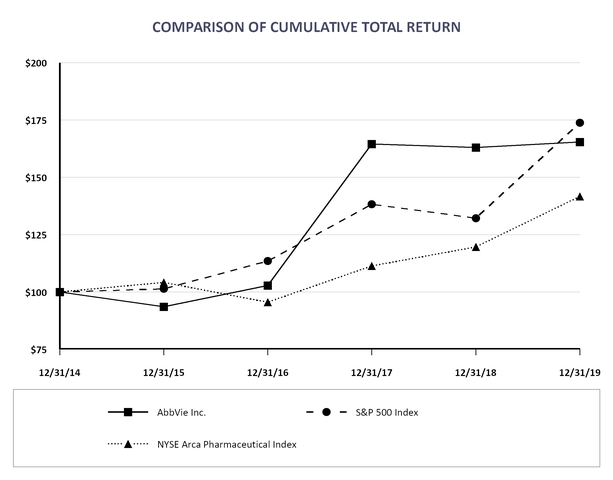
This performance graph is furnished and shall not be deemed "filed" with the SEC or subject to Section 18 of the Securities Exchange Act of 1934, nor shall it be deemed incorporated by reference in any of AbbVie's filings under the Securities Act of 1933, as amended.
| 2019 Form 10-K | 23 |
Dividends
On November 1, 2019, AbbVie's board of directors declared an increase in the quarterly cash dividend from $1.07 per share to $1.18 per share, payable on February 14, 2020 to stockholders of record as of January 15, 2020. The timing, declaration, amount of and payment of any dividends by AbbVie in the future is within the discretion of its board of directors and will depend upon many factors, including AbbVie's financial condition, earnings, capital requirements of its operating subsidiaries, covenants associated with certain of AbbVie's debt service obligations, legal requirements, regulatory constraints, industry practice, ability to access capital markets and other factors deemed relevant by its board of directors. Moreover, if AbbVie determines to pay any dividend in the future, there can be no assurance that it will continue to pay such dividends or the amount of such dividends.
Issuer Purchases of Equity Securities
| Period | (a) Total Number of Shares (or Units) Purchased | (b) Average Price Paid per Share (or Unit) | (c) Total Number of Shares (or Units) Purchased as Part of Publicly Announced Plans or Programs | (d) Maximum Number (or Approximate Dollar Value) of Shares (or Units) that May Yet Be Purchased Under the Plans or Programs | ||||||||||
| October 1, 2019 - October 31, 2019 | 4,293 | (1) | $ | 77.19 | (1) | — | $ | 3,950,021,071 | ||||||
| November 1, 2019 - November 30, 2019 | 1,086 | (1) | $ | 80.53 | (1) | — | $ | 3,950,021,071 | ||||||
| December 1, 2019 - December 31, 2019 | 1,016 | (1) | $ | 87.39 | (1) | — | $ | 3,950,021,071 | ||||||
| Total | 6,395 | (1) | $ | 79.38 | (1) | — | $ | 3,950,021,071 |
| 1. | In addition to AbbVie shares repurchased on the open market under a publicly announced program, if any, these shares also included the shares purchased on the open market for the benefit of participants in the AbbVie Employee Stock Purchase Plan – 4,293 in October; 1,086 in November; and 1,016 in December. |
These shares do not include the shares surrendered to AbbVie to satisfy minimum tax withholding obligations in connection with the vesting or exercise of stock-based awards.
| 24 | 2019 Form 10-K |
Item 6. SELECTED FINANCIAL DATA
The selected financial information should be read in conjunction with the financial statements and accompanying notes included under Item 8, "Financial Statements and Supplementary Data" and Item 7, "Management's Discussion and Analysis of Financial Condition and Results of Operations."
| as of and for the years ended December 31 (in millions, except per share data) | 2019 | 2018 | 2017 | 2016 | 2015 | ||||||||||||||
| Statement of earnings data | |||||||||||||||||||
| Net revenues | $ | 33,266 | $ | 32,753 | $ | 28,216 | $ | 25,638 | $ | 22,859 | |||||||||
| Net earnings | 7,882 | 5,687 | 5,309 | 5,953 | 5,144 | ||||||||||||||
| Basic earnings per share | $ | 5.30 | $ | 3.67 | $ | 3.31 | $ | 3.65 | $ | 3.15 | |||||||||
| Diluted earnings per share | $ | 5.28 | $ | 3.66 | $ | 3.30 | $ | 3.63 | $ | 3.13 | |||||||||
| Cash dividends declared per common share | $ | 4.39 | $ | 3.95 | $ | 2.63 | $ | 2.35 | $ | 2.10 | |||||||||
| Weighted-average basic shares outstanding | 1,481 | 1,541 | 1,596 | 1,622 | 1,625 | ||||||||||||||
| Weighted-average diluted shares outstanding | 1,484 | 1,546 | 1,603 | 1,631 | 1,637 | ||||||||||||||
| Balance sheet data | |||||||||||||||||||
| Total assets (a) | $ | 89,115 | $ | 59,352 | $ | 70,786 | $ | 66,099 | $ | 53,050 | |||||||||
| Long-term debt and finance lease obligations (a)(b) | 66,728 | 36,611 | 36,968 | 36,465 | 31,265 |
| (a) | In November 2019, AbbVie issued $30.0 billion aggregate principal amount of floating rate and fixed rate unsecured senior notes at maturities ranging from 18 months to 30 years. AbbVie expects to use the net proceeds to fund a portion of the aggregate cash consideration due to Allergan shareholders in connection with the proposed acquisition and to pay related fees and expenses. See Note 5 to the Consolidated Financial Statements for information regarding the proposed acquisition and Note 10 for information on the senior notes. |
| (b) | Includes current portion of both long-term debt and finance lease obligations. |
| 2019 Form 10-K | 25 |
Item 7. MANAGEMENT'S DISCUSSION AND ANALYSIS OF FINANCIAL CONDITION AND RESULTS OF OPERATIONS
The following is a discussion and analysis of the financial condition of AbbVie Inc. (AbbVie or the company) as of December 31, 2019 and 2018 and results of operations for each of the three years in the period ended December 31, 2019. This commentary should be read in conjunction with the consolidated financial statements and accompanying notes appearing in Item 8, "Financial Statements and Supplementary Data."
EXECUTIVE OVERVIEW
Company Overview
AbbVie is a global, research-based biopharmaceutical company formed in 2013 following separation from Abbott Laboratories (Abbott). AbbVie uses its expertise, dedicated people and unique approach to innovation to develop and market advanced therapies that address some of the world's most complex and serious diseases. AbbVie's products are focused on treating conditions such as chronic autoimmune diseases in rheumatology, gastroenterology and dermatology; oncology, including blood cancers; virology, including hepatitis C virus (HCV) and human immunodeficiency virus (HIV); neurological disorders, such as Parkinson's disease; metabolic diseases, including thyroid disease and complications associated with cystic fibrosis; pain associated with endometriosis; as well as other serious health conditions. AbbVie also has a pipeline of promising new medicines in clinical development across such important medical specialties as immunology, oncology and neuroscience, with additional targeted investment in cystic fibrosis and women's health.
AbbVie's products are generally sold worldwide directly to wholesalers, distributors, government agencies, health care facilities, specialty pharmacies and independent retailers from AbbVie-owned distribution centers and public warehouses. In the United States, AbbVie distributes pharmaceutical products principally through independent wholesale distributors, with some sales directly to pharmacies and patients. Outside the United States, AbbVie sells products primarily to customers or through distributors, depending on the market served. Certain products are co-marketed or co-promoted with other companies. AbbVie has approximately 30,000 employees. AbbVie operates in one business segment—pharmaceutical products.
On June 25, 2019, AbbVie announced that it entered into a definitive transaction agreement under which AbbVie will acquire Allergan plc (Allergan). See Note 5 to the Consolidated Financial Statements for additional information regarding the proposed acquisition.
2019 Financial Results
AbbVie's strategy has focused on delivering strong financial results, advancing and investing in its pipeline and returning value to shareholders while ensuring a strong, sustainable growth business over the long term. The company's financial performance in 2019 included delivering worldwide net revenues of $33.3 billion, operating earnings of $13.0 billion, diluted earnings per share of $5.28 and cash flows from operations of $13.3 billion. Worldwide net revenues grew by 3% on a constant currency basis, primarily driven by revenue growth related to IMBRUVICA and VENCLEXTA as well as the continued strength of HUMIRA in the U.S. and newly launched immunology assets SKYRIZI and RINVOQ, offset by international HUMIRA biosimilar competition.
Diluted earnings per share in 2019 was $5.28 and included the following after-tax costs: (i) $3.2 billion for the change in fair value of contingent consideration liabilities; (ii) $1.3 billion related to the amortization of intangible assets; (iii) a Stemcentrx-related impairment charge of $823 million net of the related fair value adjustment to contingent consideration liabilities; (iv) $364 million for acquired in-process research and development (IPR&D); and (v) $338 million of expenses related to the proposed Allergan acquisition. These costs were partially offset by the following after-tax benefits: (i) $414 million from litigation matters primarily due to the settlement of an intellectual property dispute with a third party; (ii) $400 million due to the favorable resolution of various tax positions; and (iii) $297 million from an amended and restated license agreement between AbbVie and Reata Pharmaceuticals, Inc. (Reata). Additionally, financial results reflected continued funding to support all stages of AbbVie’s emerging pipeline assets and continued investment in AbbVie’s on-market brands.
In November 2019, AbbVie's board of directors declared a quarterly cash dividend of $1.18 per share of common stock payable in February 2020. This reflects an increase of approximately 10.3% over the previous quarterly dividend of $1.07 per share of common stock.
| 26 | 2019 Form 10-K |
2020 Strategic Objectives
AbbVie's mission is to be an innovation-driven, patient-focused specialty biopharmaceutical company capable of achieving top-tier financial performance through outstanding execution and a consistent stream of innovative new medicines. AbbVie intends to continue to advance its mission in a number of ways, including: (i) growing revenues by diversifying revenue streams, ensuring strong commercial execution of new product launches and driving late-stage pipeline assets to the market; (ii) continuing to invest and expand its pipeline in support of opportunities in immunology, oncology and neuroscience, with additional targeted investment in cystic fibrosis and women's health as well as continued investment in key on-market products; (iii) expanding operating margins; and (iv) returning cash to shareholders via a strong and growing dividend while also reducing incremental debt. In addition, AbbVie anticipates several regulatory submissions and key data readouts from key clinical trials in the next 12 months.
AbbVie expects to achieve its strategic objectives through:
| • | Completion and successful integration of the proposed Allergan acquisition. |
| • | Hematologic oncology revenue growth from both IMBRUVICA and VENCLEXTA. |
| • | Immunology revenue growth driven by successful commercial launches of SKYRIZI and RINVOQ, as well as HUMIRA U.S. sales growth. |
| • | Effective management of HUMIRA international biosimilar erosion. |
| • | The favorable impact of pipeline products and indications recently approved or currently under regulatory review where approval is expected in 2020. These products are described in greater detail in the section labeled "Research and Development" included as part of this Item 7. |
AbbVie remains committed to driving continued expansion of operating margins and expects to achieve this objective through continued leverage from revenue growth, productivity initiatives in supply chain and ongoing efficiency programs to optimize manufacturing, commercial infrastructure, administrative costs and general corporate expenses.
The combination of AbbVie and Allergan will create a diverse entity with leadership positions across immunology, hematologic oncology, aesthetics, neuroscience, women's health, eye care and virology. AbbVie's existing product portfolio and pipeline will be enhanced with numerous Allergan assets and Allergan's product portfolio will benefit from AbbVie's commercial strength, expertise and international infrastructure.
Research and Development
Research and innovation are the cornerstones of AbbVie's business as a global biopharmaceutical company. AbbVie's long-term success depends to a great extent on its ability to continue to discover and develop innovative pharmaceutical products and acquire or collaborate on compounds currently in development by other biotechnology or pharmaceutical companies.
AbbVie's pipeline currently includes approximately 60 compounds or indications in clini
Showing the first 8K of 76K characters. Open the full section
Item 7A. QUANTITATIVE AND QUALITATIVE DISCLOSURES ABOUT MARKET RISK
The company is exposed to risk that its earnings, cash flows and equity could be adversely impacted by changes in foreign exchange rates and interest rates. Certain derivative instruments are used when available on a cost-effective basis to hedge the company's underlying economic exposures. See Note 11 to the Consolidated Financial Statements for additional information regarding the company's financial instruments and hedging strategies.
Foreign Currency Risk
AbbVie's primary net foreign currency exposures are the Euro, Japanese yen, Canadian dollar and British pound. The following table reflects the total foreign currency forward exchange contracts outstanding at December 31, 2019 and 2018:
| 2019 | 2018 | ||||||||||||||||||||
| (in millions) | Contract amount | Weighted average exchange rate | Fair and carrying value receivable/(payable) | Contract amount | Weighted average exchange rate | Fair and carrying value receivable/(payable) | |||||||||||||||
| Receive primarily U.S. dollars in exchange for the following currencies: | |||||||||||||||||||||
| Euro | $ | 6,217 | 1.116 | $ | (12 | ) | $ | 6,660 | 1.157 | $ | 68 | ||||||||||
| Japanese yen | 820 | 108.7 | — | 1,076 | 111.5 | (12 | ) | ||||||||||||||
| Canadian dollar | 504 | 1.324 | (6 | ) | 406 | 1.314 | 14 | ||||||||||||||
| British pound | 427 | 1.305 | (6 | ) | 499 | 1.328 | 21 | ||||||||||||||
| All other currencies | 1,508 | n/a | (10 | ) | 1,370 | n/a | 15 | ||||||||||||||
| Total | $ | 9,476 | $ | (34 | ) | $ | 10,011 | $ | 106 |
The company estimates that a 10% appreciation in the underlying currencies being hedged from their levels against the U.S. dollar, with all other variables held constant, would decrease the fair value of foreign exchange forward contracts by $942 million at December 31, 2019. If realized, this appreciation would negatively affect earnings over the remaining life of the contracts. However, gains and losses on the hedging instruments offset losses and gains on the hedged transactions and reduce the earnings and stockholders' equity volatility relating to foreign exchange. A 10% appreciation is believed to be a reasonably possible near-term change in foreign currencies.
As of December 31, 2019, the company has €3.6 billion aggregate principal amount of unsecured senior Euro notes outstanding, which are exposed to foreign currency risk. The company designated these foreign currency denominated notes as hedges of its net investments in certain foreign subsidiaries and affiliates. As a result, any foreign currency translation gains or losses related to the Euro notes will be included in accumulated other comprehensive income. See Note 10 to the Consolidated Financial Statements for additional information regarding to the senior Euro notes and Note 11 to the Consolidated Financial Statements for additional information regarding to the net investment hedging program.
Interest Rate Risk
The company estimates that an increase in interest rates of 100 basis points would adversely impact the fair value of AbbVie's interest rate swap contracts by approximately $280 million at December 31, 2019. If realized, the fair value reduction would affect earnings over the remaining life of the contracts. The company estimates that an increase of 100 basis points in long-term interest rates would decrease the fair value of long-term debt by $5.0 billion at December 31, 2019. A 100 basis point change is believed to be a reasonably possible near-term change in interest rates.
| 42 | 2019 Form 10-K |
Item 8. FINANCIAL STATEMENTS AND SUPPLEMENTARY DATA
| 2019 Form 10-K | 43 |
AbbVie Inc. and Subsidiaries
Consolidated Statements of Earnings
| years ended December 31 (in millions, except per share data) | 2019 | 2018 | 2017 | ||||||||
| Net revenues | $ | 33,266 | $ | 32,753 | $ | 28,216 | |||||
| Cost of products sold | 7,439 | 7,718 | 7,042 | ||||||||
| Selling, general and administrative | 6,942 | 7,399 | 6,295 | ||||||||
| Research and development | 6,407 | 10,329 | 5,007 | ||||||||
| Acquired in-process research and development | 385 | 424 | 327 | ||||||||
| Other operating expense (income) | (890 | ) | 500 | — | |||||||
| Total operating costs and expenses | 20,283 | 26,370 | 18,671 | ||||||||
| Operating earnings | 12,983 | 6,383 | 9,545 | ||||||||
| Interest expense, net | 1,509 | 1,144 | 1,004 | ||||||||
| Net foreign exchange loss | 42 | 24 | 348 | ||||||||
| Other expense, net | 3,006 | 18 | 466 | ||||||||
| Earnings before income tax | 8,426 | 5,197 | 7,727 | ||||||||
| Income tax expense (benefit) | 544 | (490 | ) | 2,418 | |||||||
| Net earnings | $ | 7,882 | $ | 5,687 | $ | 5,309 | |||||
| Per share data | |||||||||||
| Basic earnings per share | $ | 5.30 | $ | 3.67 | $ | 3.31 | |||||
| Diluted earnings per share | $ | 5.28 | $ | 3.66 | $ | 3.30 | |||||
| Weighted-average basic shares outstanding | 1,481 | 1,541 | 1,596 | ||||||||
| Weighted-average diluted shares outstanding | 1,484 | 1,546 | 1,603 |
The accompanying notes are an integral part of these consolidated financial statements.
| 44 | 2019 Form 10-K |
AbbVie Inc. and Subsidiaries
Consolidated Statements of Comprehensive Income
| years ended December 31 (in millions) | 2019 | 2018 | 2017 | ||||||||
| Net earnings | $ | 7,882 | $ | 5,687 | $ | 5,309 | |||||
| Foreign currency translation adjustments, net of tax expense (benefit) of $(4) in 2019, $(18) in 2018 and $34 in 2017 | (98 | ) | (391 | ) | 996 | ||||||
| Net investment hedging activities, net of tax expense (benefit) of $22 in 2019, $40 in 2018 and $(194) in 2017 | 74 | 138 | (343 | ) | |||||||
| Pension and post-employment benefits, net of tax expense (benefit) of $(323) in 2019, $35 in 2018 and $(94) in 2017 | (1,243 | ) | 197 | (406 | ) | ||||||
| Marketable security activities, net of tax expense (benefit) of $— in 2019, $— in 2018 and $(8) in 2017 | 10 | (10 | ) | (46 | ) | ||||||
| Cash flow hedging activities, net of tax expense (benefit) of $70 in 2019, $23 in 2018 and $(26) in 2017 | 141 | 313 | (342 | ) | |||||||
| Other comprehensive income (loss) | (1,116 | ) | 247 | (141 | ) | ||||||
| Comprehensive income | $ | 6,766 | $ | 5,934 | $ | 5,168 |
The accompanying notes are an integral part of these consolidated financial statements.
| 2019 Form 10-K | 45 |
AbbVie Inc. and Subsidiaries
Consolidated Balance Sheets
| as of December 31 (in millions, except share data) | 2019 | 2018 | |||||
| Assets | |||||||
| Current assets | |||||||
| Cash and equivalents | $ | 39,924 | $ | 7,289 | |||
| Short-term investments | — | 772 | |||||
| Accounts receivable, net | 5,428 | 5,384 | |||||
| Inventories | 1,813 | 1,605 | |||||
| Prepaid expenses and other | 2,354 | 1,895 | |||||
| Total current assets | 49,519 | 16,945 | |||||
| Investments | 93 | 1,420 | |||||
| Property and equipment, net | 2,962 | 2,883 | |||||
| Intangible assets, net | 18,649 | 21,233 | |||||
| Goodwill | 15,604 | 15,663 | |||||
| Other assets | 2,288 | 1,208 | |||||
| Total assets | $ | 89,115 | $ | 59,352 | |||
| Liabilities and Equity | |||||||
| Current liabilities | |||||||
| Short-term borrowings | $ | — | $ | 3,699 | |||
| Current portion of long-term debt and finance lease obligations | 3,753 | 1,609 | |||||
| Accounts payable and accrued liabilities | 11,832 | 11,931 | |||||
| Total current liabilities | 15,585 | 17,239 | |||||
| Long-term debt and finance lease obligations | 62,975 | 35,002 | |||||
| Deferred income taxes | 1,130 | 1,067 | |||||
| Other long-term liabilities | 17,597 | 14,490 | |||||
| Commitments and contingencies | |||||||
| Stockholders’ equity (deficit) | |||||||
| Common stock, $0.01 par value, 4,000,000,000 shares authorized, 1,781,582,608 shares issued as of December 31, 2019 and 1,776,510,871 as of December 31, 2018 | 18 | 18 | |||||
| Common stock held in treasury, at cost, 302,671,146 shares as of December 31, 2019 and 297,686,473 as of December 31, 2018 | (24,504 | ) | (24,108 | ) | |||
| Additional paid-in capital | 15,193 | 14,756 | |||||
| Retained earnings | 4,717 | 3,368 | |||||
| Accumulated other comprehensive loss | (3,596 | ) | (2,480 | ) | |||
| Total stockholders’ equity (deficit) | (8,172 | ) | (8,446 | ) | |||
| Total liabilities and equity | $ | 89,115 | $ | 59,352 |
The accompanying notes are an integral part of these consolidated financial statements.
| 46  under the Securities Exchange Act of 1934) that have materially affected, or are reasonably likely to materially affect, AbbVie's internal control over financial reporting during the quarter ended December 31, 2019.
Inherent limitations on effectiveness of controls. AbbVie's management, including its Chief Executive Officer and its Chief Financial Officer, do not expect that AbbVie's disclosure controls or internal control over financial reporting will prevent or detect all errors and all fraud. A control system, no matter how well designed and operated, can provide only reasonable, not absolute, assurance that the control system's objectives will be met. The design of a control system must reflect the fact that there are resource constraints, and the benefits of controls must be considered relative to their costs. Further, because of the inherent limitations in all control systems, no evaluation of controls can provide absolute assurance that misstatements due to error or fraud will not occur or that all control issues and instances of fraud, if any, have been detected. These inherent limitations include the realities that judgments in decision-making can be faulty and that breakdowns can occur because of simple error or mistake. Controls can also be circumvented by the individual acts of some persons, by collusion of two or more people, or by management override of the controls.
The design of any system of controls is based in part on certain assumptions about the likelihood of future events, and there can be no assurance that any design will succeed in achieving its stated goals under all potential future conditions. Projections of any evaluation of controls effectiveness to future periods are subject to risks. Over time, controls may become inadequate because of changes in conditions or deterioration in the degree of compliance with policies or procedures.
Management's annual report on internal control over financial reporting. Management of AbbVie is responsible for establishing and maintaining adequate internal control over financial reporting, as such term is defined in Rule 13a-15(f) under the Securities Exchange Act of 1934. AbbVie's internal control over financial reporting is designed to provide reasonable assurance regarding the reliability of financial reporting and the preparation of financial statements for external purposes in accordance with generally accepted accounting principles in the United States. However, all internal control systems, no matter how well designed, have inherent limitations. Therefore, even those systems determined to be effective can provide only reasonable assurance with respect to financial statement preparation and reporting.
Management assessed the effectiveness of AbbVie's internal control over financial reporting as of December 31, 2019. In making this assessment, management used the criteria set forth by the Committee of Sponsoring Organizations of the Treadway Commission (COSO) in Internal Control-Integrated Framework (2013 framework). Based on that assessment, management concluded that AbbVie maintained effective internal control over financial reporting as of December 31, 2019, based on the COSO criteria.
The effectiveness of AbbVie's internal control over financial reporting as of December 31, 2019 has been audited by Ernst & Young LLP, an independent registered public accounting firm, as stated in their attestation report below, which expresses an unqualified opinion on the effectiveness of AbbVie's internal control over financial reporting as of December 31, 2019.
| 2019 Form 10-K | 91 |
Report of independent registered public accounting firm. The report of AbbVie's independent registered public accounting firm related to its assessment of the effectiveness of internal control over financial reporting is included below.
| 92 | 2019 Form 10-K |
Report of Independent Registered Public Accounting Firm
To the Stockholders and the Board of Directors of AbbVie Inc.
Opinion on Internal Control over Financial Reporting
We have audited AbbVie Inc. and subsidiaries' internal control over financial reporting as of December 31, 2019, based on criteria established in Internal Control—Integrated Framework issued by the Committee of Sponsoring Organizations of the Treadway Commission (2013 framework) (the COSO criteria). In our opinion, AbbVie Inc. and subsidiaries (the Company) maintained, in all material respects, effective internal control over financial reporting as of December 31, 2019, based on the COSO criteria.
We also have audited, in accordance with the standards of the Public Company Accounting Oversight Board (United States) (PCAOB), the consolidated balance sheets of AbbVie Inc. and subsidiaries as of December 31, 2019 and 2018, and the related consolidated statements of earnings, comprehensive income, equity and cash flows for each of the three years in the period ended December 31, 2019, and the related notes and our report dated February 21, 2020 expressed an unqualified opinion thereon.
Basis for Opinion
The Company's management is responsible for maintaining effective internal control over financial reporting and for its assessment of the effectiveness of internal control over financial reporting included in the accompanying Management's Annual Report on Internal Control over Financial Reporting. Our responsibility is to express an opinion on the Company's internal control over financial reporting based on our audit. We are a public accounting firm registered with the PCAOB and are required to be independent with respect to the Company in accordance with the U.S. federal securities laws and the applicable rules and regulations of the Securities and Exchange Commission and the PCAOB.
We conducted our audit in accordance with the standards of the PCAOB. Those standards require that we plan and perform the audit to obtain reasonable assurance about whether effective internal control over financial reporting was maintained in all material respects.
Our audit included obtaining an understanding of internal control over financial reporting, assessing the risk that a material weakness exists, testing and evaluating the design and operating effectiveness of internal control based on the assessed risk, and performing such other procedures as we considered necessary in the circumstances. We believe that our audit provides a reasonable basis for our opinion.
Definition and Limitations on Internal Control Over Financial Reporting
A company's internal control over financial reporting is a process designed to provide reasonable assurance regarding the reliability of financial reporting and the preparation of financial statements for external purposes in accordance with generally accepted accounting principles. A company's internal control over financial reporting includes those policies and procedures that (1) pertain to the maintenance of records that, in reasonable detail, accurately and fairly reflect the transactions and dispositions of the assets of the company; (2) provide reasonable assurance that transactions are recorded as necessary to permit preparation of financial statements in accordance with generally accepted accounting principles, and that receipts and expenditures of the company are being made only in accordance with authorizations of management and directors of the company; and (3) provide reasonable assurance regarding prevention or timely detection of unauthorized acquisition, use, or disposition of the company's assets that could have a material effect on the financial statements.
Because of its inherent limitations, internal control over financial reporting may not prevent or detect misstatements. Also, projections of any evaluation of effectiveness to future periods are subject to the risk that controls may become inadequate because of changes in conditions, or that the degree of compliance with the policies or procedures may deteriorate.
/s/ Ernst & Young LLP
Chicago, Illinois
February 21, 2020
| 2019 Form 10-K | 93 |
Item 9B. OTHER INFORMATION
None.
| 94 | 2019 Form 10-K |
PART III
Item 10. DIRECTORS, EXECUTIVE OFFICERS AND CORPORATE GOVERNANCE
Incorporated herein by reference are "Information Concerning Director Nominees," "The Board of Directors and its Committees—Committees of the Board of Directors," and "Procedure for Recommendation and Nomination of Directors and Transaction of Business at Annual Meeting" to be included in the 2020 AbbVie Inc. Proxy Statement. The 2020 Definitive Proxy Statement will be filed on or about March 19, 2020. Also incorporated herein by reference is the text found in this Form 10-K under the caption, "Information about Our Executive Officers."
AbbVie's code of business conduct requires all its business activities to be conducted in compliance with all applicable laws, regulations and ethical principles and values. All directors, officers and employees of AbbVie are required to read, understand and abide by the requirements of the code of business conduct applicable to them. AbbVie's code of business conduct is available in the corporate governance section of AbbVie's investor relations website at www.abbvieinvestor.com.
Any waiver of the code of business conduct for directors or executive officers may be made only by AbbVie's audit committee. AbbVie will disclose any amendment to, or waiver from, a provision of the code of conduct for the principal executive officer, principal financial officer, principal accounting officer or controller, or persons performing similar functions, on its website within four business days following the date of the amendment or waiver. In addition, AbbVie will disclose any waiver from the code of business conduct for the other executive officers and for directors on the website.
AbbVie has a chief ethics and compliance officer who reports to the Vice Chairman, External Affairs and Chief Legal Officer and to the public policy committee. The chief ethics and compliance officer is responsible for overseeing, administering and monitoring AbbVie's compliance program.
Item 11. EXECUTIVE COMPENSATION
The material to be included in the 2020 AbbVie Inc. Proxy Statement under the headings "Director Compensation," "Executive Compensation," and "Compensation Committee Report" is incorporated herein by reference. The 2020 Definitive Proxy Statement will be filed on or about March 19, 2020.
| 2019 Form 10-K | 95 |
Item 12. SECURITY OWNERSHIP OF CERTAIN BENEFICIAL OWNERS AND MANAGEMENT AND RELATED STOCKHOLDER MATTERS
(a) Equity Compensation Plan Information.
The following table presents information as of December 31, 2019 about AbbVie's equity compensation plans under which AbbVie common stock has been authorized for issuance:
| Plan Category | (a) Number of securities to be issued upon exercise of outstanding options, warrants and rights (1) | (b) Weighted- average exercise price of outstanding options, warrants and rights (2) | (c) Number of securities remaining available for future issuance under equity compensation plans (excluding securities reflected in column (a)) (3) | ||||||
| Equity compensation plans approved by security holders | 16,991,269 | $ | 60.39 | 62,161,107 | |||||
| Equity compensation plans not approved by security holders | — | — | — | ||||||
| Total | 16,991,269 | $ | 60.39 | 62,161,107 |
| (1) | Includes 837,960 shares issuable under AbbVie's Incentive Stock Program pursuant to awards granted by Abbott and adjusted into AbbVie awards in connection with AbbVie's separation from Abbott. |
| (2) | The weighted-average exercise price does not include outstanding restricted stock units, restricted stock awards and performance shares that have no exercise price. |
| (3) | Excludes shares issuable upon the exercise of stock options and pursuant to other rights granted under the Stemcentrx 2011 Equity Incentive Plan, which was assumed by AbbVie upon the consummation of its acquisition of Stemcentrx, Inc. As of December 31, 2019, 103,874 options remained outstanding under this plan. The options have a weighted-average exercise price of $16.36. No further awards will be granted under this plan. |
| (b) | Information Concerning Security Ownership. Incorporated herein by reference is the material under the heading "Securities Ownership—Securities Ownership of Executive Officers and Directors" in the 2020 AbbVie Inc. Proxy Statement. The 2020 Definitive Proxy Statement will be filed on or about March 19, 2020. |
Item 13. CERTAIN RELATIONSHIPS AND RELATED TRANSACTIONS, AND DIRECTOR INDEPENDENCE
The material to be included in the 2020 AbbVie Inc. Proxy Statement under the headings "The Board of Directors and its Committees," "Corporate Governance Materials," and "Procedures for Approval of Related Person Transactions" is incorporated herein by reference. The 2020 Definitive Proxy Statement will be filed on or about March 19, 2020.
Item 14. PRINCIPAL ACCOUNTING FEES AND SERVICES
The material to be included in the 2020 AbbVie Inc. Proxy Statement under the headings "Audit Fees and Non-Audit Fees" and "Policy on Audit Committee Pre-Approval of Audit and Permissible Non-Audit Services of the Independent Registered Public Accounting Firm" is incorporated herein by reference. The 2020 Definitive Proxy Statement will be filed on or about March 19, 2020.
| 96 | 2019 Form 10-K |
PART IV
Item 15. EXHIBITS, FINANCIAL STATEMENT SCHEDULES
| (a) | Documents filed as part of this Form 10-K. |
| (1) | Financial Statements: See Item 8, "Financial Statements and Supplementary Data," on page 43 hereof, for a list of financial statements. |
| (2) | Financial Statement Schedules: All schedules omitted are inapplicable or the information required is shown in the consolidated financial statements or notes thereto. |
| (3) | Exhibits Required by Item 601 of Regulation S-K: The information called for by this paragraph is set forth in Item 15(b) below. |
| (b) | Exhibits: |
| 2019 Form 10-K | 97 |
| 98 | 2019 Form 10-K |
| 2019 Form 10-K | 99 |
| Exhibit Number | Exhibit Description | ||
| 101 | The following financial statements and notes from the AbbVie Inc. Annual Report on Form 10-K for the year ended December 31, 2019 filed on February 21, 2020, formatted in Inline XBRL (eXtensible Business Reporting Language): (i) Consolidated Statements of Earnings; (ii) Consolidated Statements of Comprehensive Income; (iii) Consolidated Balance Sheets; (iv) Consolidated Statements of Equity; (v) Consolidated Statements of Cash Flows; and (vi) the Notes to Consolidated Financial Statements. | ||
| 104 | Cover Page Interactive Data File (the cover page from the AbbVie Inc. Annual Report on Form 10-K formatted as Inline XBRL and contained in Exhibit 101). | ||
| The AbbVie Inc. 2020 Definitive Proxy Statement will be filed with the Securities and Exchange Commission under separate cover on or about March 19, 2020. |
| * | Incorporated herein by reference. Commission file number 001-35565. |
| ** | Denotes management contract or compensatory plan or arrangement required to be filed as an exhibit hereto. |
Exhibits 32.1 and 32.2, above, are furnished herewith and should not be deemed to be "filed" under the Securities Exchange Act of 1934. AbbVie will furnish copies of any of the above exhibits to a stockholder upon written request to the Secretary, AbbVie Inc., 1 North Waukegan Road, North Chicago, Illinois 60064.
| 100 | 2019 Form 10-K |
Item 16. FORM 10-K SUMMARY
None.
| 2019 Form 10-K | 101 |
SIGNATURES
Pursuant to the requirements of Section 13 or 15(d) of the Securities Exchange Act of 1934, AbbVie Inc. has duly caused this report to be signed on its behalf by the undersigned, thereunto duly authorized.
| AbbVie Inc. | ||||
| By: | /s/ RICHARD A. GONZALEZ | |||
| Name: | Richard A. Gonzalez | |||
| Title: | Chairman of the Board and Chief Executive Officer | |||
| Date: | February 21, 2020 |
Pursuant to the requirements of the Securities Exchange Act of 1934, this report has been signed below by the following persons on behalf of AbbVie Inc. on February 21, 2020 in the capacities indicated below.
| /s/ RICHARD A. GONZALEZ | /s/ ROBERT A. MICHAEL | |
| Richard A. Gonzalez Chairman of the Board and Chief Executive Officer (Principal Executive Officer) | Robert A. Michael Executive Vice President, Chief Financial Officer (Principal Financial Officer) | |
| /s/ BRIAN L. DURKIN | ||
| Brian L. Durkin Vice President, Controller (Principal Accounting Officer) | ||
| /s/ ROBERT J. ALPERN, M.D. | /s/ ROXANNE S. AUSTIN | |
| Robert J. Alpern, M.D. Director of AbbVie Inc. | Roxanne S. Austin Director of AbbVie Inc. | |
| /s/ WILLIAM H.L. BURNSIDE | /s/ BRETT J. HART | |
| William H.L. Burnside Director of AbbVie Inc. | Brett J. Hart Director of AbbVie Inc. | |
| /s/ EDWARD M. LIDDY | /s/ MELODY B. MEYER | |
| Edward M. Liddy Director of AbbVie Inc. | Melody B. Meyer Director of AbbVie Inc. | |
| /s/ EDWARD J. RAPP | /s/ REBECCA B. ROBERTS | |
| Edward J. Rapp Director of AbbVie Inc. | Rebecca B. Roberts Director of AbbVie Inc. | |
| /s/ GLENN F. TILTON | /s/ FREDERICK H. WADDELL | |
| Glenn F. Tilton Director of AbbVie Inc. | Frederick H. Waddell Director of AbbVie Inc. |
| 102 | 2019 Form 10-K |