 filings.tools
Analog Devices 10-K 2020-10-31
Filed 2020-11-24. 21 sections, 502K characters. Original on sec.gov · Markdown · JSON
Cover and table of contents
UNITED STATES
SECURITIES AND EXCHANGE COMMISSION
Washington, D.C. 20549
Form 10-K
(Mark One)
| ☑ | ANNUAL REPORT PURSUANT TO SECTION 13 OR 15(d) OF THE SECURITIES EXCHANGE ACT OF 1934 |
For the fiscal year ended October 31, 2020
OR
| ☐ | TRANSITION REPORT PURSUANT TO SECTION 13 OR 15(d) OF THE SECURITIES EXCHANGE ACT OF 1934 |
For the transition period from to
Commission File No. 1-7819
Analog Devices, Inc.
(Exact name of registrant as specified in its charter)
| Massachusetts | 04-2348234 | |||||||||||||
| (State or other jurisdiction of incorporation or organization) | (I.R.S. Employer Identification No.) | |||||||||||||
| One Analog Way, | Wilmington, | MA | 01887 | |||||||||||
| (Address of principal executive offices) | (Zip Code) |
(781) 329-4700
(Registrant’s telephone number, including area code)
Securities registered pursuant to Section 12(b) of the Act:
| Title of each class | Trading Symbol(s) | Name of each exchange on which registered | ||||||
| Common Stock $0.16 2/3 par value per share | ADI | Nasdaq Global Select Market |
Securities registered pursuant to Section 12(g) of the Act:
None
Title of Class
Indicate by check mark if the registrant is a well-known seasoned issuer, as defined in Rule 405 of the Securities Act. Yes ☑ No ☐
Indicate by check mark if the registrant is not required to file reports pursuant to Section 13 or Section 15(d) of the Act. Yes ☐ No ☑
Indicate by check mark whether the registrant (1) has filed all reports required to be filed by Section 13 or 15(d) of the Securities Exchange Act of 1934 during the preceding 12 months (or for such shorter period that the registrant was required to file such reports), and (2) has been subject to such filing requirements for the past 90 days. Yes ☑ No ☐
Indicate by check mark whether the registrant has submitted electronically every Interactive Data File required to be submitted pursuant to Rule 405 of Regulation S-T (Sec. 232.405 of this chapter) during the preceding 12 months (or for such shorter period that the registrant was required to submit such files). Yes ☑ No ☐
Indicate by check mark whether the registrant is a large accelerated filer, an accelerated filer, a non-accelerated filer, a smaller reporting company or an emerging growth company. See the definitions of “large accelerated filer,” “accelerated filer,” “smaller reporting company” and "emerging growth company" in Rule 12b-2 of the Exchange Act.
| Large accelerated filer | ☑ | Accelerated filer | ☐ | |||||||||||||||||
| Non-accelerated filer | ☐ | Smaller reporting company | ☐ | |||||||||||||||||
| Emerging growth company | ☐ |
If an emerging growth company, indicate by check mark if the registrant has elected not to use the extended transition period for complying with any new or revised financial accounting standards provided pursuant to Section 13(a) if the Exchange Act. ☐
Indicate by check mark whether the registrant has filed a report on and attestation to its management’s assessment of the effectiveness of its internal control over financial reporting under Section 404(b) of the Sarbanes-Oxley Act (15 U.S.C. 7262(b)) by the registered public accounting firm that prepared or issued its audit report. ☑
Indicate by check mark whether the registrant is a shell company (as defined in Rule 12b-2 of the Act). Yes ☐ No ☑
The aggregate market value of the voting and non-voting common equity held by non-affiliates of the registrant was approximately $29,650,000,000 based on the last reported sale of the Common Stock on The Nasdaq Global Select Market on May 1, 2020. Shares of voting and non-voting stock beneficially owned by executive officers, directors and holders of more than 5% of the outstanding stock have been excluded from this calculation because such persons or institutions may be deemed affiliates. This determination of affiliate status is not a conclusive determination for other purposes.
As of October 31, 2020, there were 369,484,899 shares of Common Stock, $0.16 2/3 par value per share, outstanding.
Documents Incorporated by Reference
| Document Description | Form 10-K Part | |||||||
| Portions of the Registrant’s Proxy Statement for the Annual Meeting of Shareholders to be held March 10, 2021 | III | |||||||
TABLE OF CONTENTS
Note About Forward-Looking Statements
This Annual Report on Form 10-K, including “Management’s Discussion and Analysis of Financial Condition and Results of Operations,” contains forward-looking statements regarding future events and our future results that are subject to the safe harbor created under the Private Securities Litigation Reform Act of 1995 and other safe harbors under the Securities Act of 1933 and the Securities Exchange Act of 1934. All statements other than statements of historical fact are statements that could be deemed forward-looking statements. These statements are based on current expectations, estimates, forecasts, and projections about the industries in which we operate and the beliefs and assumptions of our management. Words such as “expects,” “anticipates,” “targets,” “goals,” “projects,” “intends,” “plans,” “believes,” “seeks,” “estimates,” “continues,” “may,” “could” and “will,” and variations of such words and similar expressions are intended to identify such forward-looking statements. In addition, any statements that refer to projections regarding our future financial performance; the proposed acquisition of Maxim Integrated Products, Inc.; our anticipated growth and trends in our businesses; our future liquidity, capital needs and capital expenditures; the impact of the COVID-19 pandemic on our business, financial condition and results of operations; our future market position and expected competitive changes in the marketplace for our products; our ability to pay dividends or repurchase stock; our ability to service our outstanding debt; our expected tax rate; the effect of changes in or the application of new or revised tax laws; expected cost savings; the effect of new accounting pronouncements; our ability to successfully integrate acquired businesses and technologies; and other characterizations of future events or circumstances are forward-looking statements. Readers are cautioned that these forward-looking statements are only predictions and are subject to risks, uncertainties, and assumptions that are difficult to predict, including those identified in Part I, Item 1A. "Risk Factors" and elsewhere in this Annual Report on Form 10-K. Therefore, actual results may differ materially and adversely from those expressed in any forward-looking statements. We undertake no obligation to revise or update any forward-looking statements, including to reflect events or circumstances occurring after the date of the filing of this report, except to the extent required by law.
PART I
Item 1. BUSINESS
Company Overview, Strategy and Mission
Analog Devices, Inc. (we, Analog Devices or the Company) is a leading global high-performance analog technology company dedicated to solving our customers' most complex engineering challenges. We play a critical role at the intersection of the physical and digital world by providing the building blocks to sense, measure, interpret, connect and power. We design, manufacture, test and market a broad portfolio of solutions, including integrated circuits (ICs), software and subsystems that leverage high-performance analog, mixed-signal and digital signal processing technologies. Our comprehensive product portfolio, deep domain expertise and advanced manufacturing capabilities extend across high-performance precision and high-speed mixed-signal, power management and processing technologies – including data converters, amplifiers, power management, radio frequency (RF) ICs, digital signal processors (DSP) and other sensors.
The Third Wave of Information and Communications Technology, as we refer to it at Analog Devices, is characterized by ubiquitous sensing, hyper-scale and edge computing and pervasive connectivity. These technological trends are driving a continuous evolution of new generations of applications that are increasing the demand for Analog Devices’ high-performance analog, mixed-signal, power and RF ICs. We have positioned our business to capitalize on the secular growth opportunities across our markets and to deliver innovative solutions. Central to our strategy is our focus on challenges that our customers have across the most impactful application areas. That is built around the following three key priorities, which will continue to drive our long-term success:
-
Efficient use of capital.** Research and development (R&D) is critical to continue our cycle of innovation-driven success. We target the most attractive opportunities, particularly across our business-to-business (B2B) markets including Industrial, Automotive and Communications. We are also deeply committed to extracting value from our recent acquisitions to complement our R&D and drive long-term value creation. Through the development of cutting-edge innovations and our ability to solve difficult problems across a broad array of applications, we generate significant cash flow and are deeply committed to delivering strong shareholder returns.
-
Deepening customer-centricity.** We possess a broad range of product portfolios, applications expertise, and manufacturing capabilities in high-performance power management and precision and high-speed signal processing technologies. At the same time, our engineering talent continues to be an important competitive differentiator in the semiconductor space. We strive to be the destination for the world's best engineering talent with a team of more than 7,600 engineers. Together, our products and our engineering talent enable us to partner with our customers, leveraging our analog domain expertise and receiving the full benefit of our technology capabilities to develop complete and innovative solutions.
-
Capitalizing on secular trends.** We are positioned to capitalize on important secular growth trends, including Industry 4.0, 5G communications networks, data center connectivity, electric vehicles, in-cabin experience, digital healthcare and space, as we are well-aligned with the key B2B markets driving this increase in data and we will continue to be a critical partner in the collection, creation and communication of our customers’ edge data.
In addition to driving organic growth, our strategy involves expansion through the acquisition of businesses, assets or technologies that allow us to complement our existing product offerings, expand our market coverage, increase our engineering talent or enhance our technological capabilities. For example, we have executed on this strategy through:
-
the acquisition of Hittite Microwave Corporation in the fiscal year ended November 1, 2014, which strengthened our market leadership in high-performance RF and broadened our portfolio across the entire frequency spectrum from DC to 100 gigahertz; and
-
the acquisition of Linear Technology Corporation (Linear) in the fiscal year ended October 28, 2017, which added high-performance power management and additional precision signal processing to our portfolio, expanding and diversifying our offerings to deliver more complete solutions.
In the fiscal year ended October 31, 2020 (fiscal 2020), we announced the proposed acquisition of Maxim Integrated Products, Inc. (Maxim), which, if completed, will strengthen Analog Devices as an analog semiconductor leader. Specifically, the combination would increase our global scale and enhance our depth of domain expertise and engineering capabilities, enabling us to offer more complete solutions, serve more customers and capture a larger share of an estimated $60 billion total addressable market.
As a global company, we are also passionately driven to be a leading corporate citizen, creating a better tomorrow for all our stakeholders. We believe we have a responsibility to engineer a more sustainable future and we strive to make a positive
impact on our society and our planet. We are focused on reducing our carbon footprint and our impact on the environment today, while striving to deliver a positive environmental impact for the future. Our goal is to make meaningful progress on environmental regeneration efforts and partner with our customers to help them solve their sustainability challenges. We leverage our expertise to develop new solutions to help restore natural resources, regenerate the quality of our biosphere and reduce carbon emissions. We are also committed to helping our employees thrive by building programs within our company that enhance our diverse and accepting workplace culture, while also broadening the availability of education, training and employment opportunities to communities across the globe. The Company also maintains an active role in developing solutions and participating in efforts that address serious climate and societal problems that impact our employees, our communities and our planet. In addition, in fiscal 2020, we established the Analog Devices Foundation to formalize our philanthropy and charitable giving.
We were incorporated in Massachusetts in 1965 with corporate headquarters in the Boston, Massachusetts area. In 2020, we moved our corporate headquarters from our facility in Norwood, Massachusetts to Wilmington, Massachusetts. The expanded facility in Wilmington features state of the art laboratories, design and manufacturing and cross-functional group collaboration space, while maintaining our commitment to environmental sustainability through the use of green building materials and solar panels, among other things. In addition, we have manufacturing facilities primarily in the United States, Ireland and Southeast Asia. Our common stock is listed on the Nasdaq Global Select Market under the symbol ADI and is included in the Standard & Poor’s 500 Index.
Available Information
We maintain a website with the address www.analog.com. We are not including the information contained on our website as a part of, or incorporating it by reference into, this Annual Report on Form 10-K. We make available free of charge through our website our Annual Reports on Form 10-K, Quarterly Reports on Form 10-Q and Current Reports on Form 8-K (including exhibits), and amendments to these reports, as soon as reasonably practicable after we electronically file such material with, or furnish such material to, the Securities and Exchange Commission (SEC). We also make available on our website our by-laws, corporate governance guidelines, the charters for our audit committee, compensation committee, and nominating and corporate governance committee, our equity award granting policies, our code of business conduct and ethics which applies to our directors, officers and employees, and our related person transaction policy, and such information is available in print and free of charge to any shareholder of Analog Devices who requests it. In addition, we intend to disclose on our website any amendments to, or waivers from, our code of business conduct and ethics that are required to be publicly disclosed pursuant to rules of the SEC or Nasdaq.
Products
Semiconductor components are the building blocks used in electronic systems and equipment. These components are classified as either discrete devices, such as individual transistors, or as ICs, in which a number of transistors and other elements are combined to form a more complicated electronic circuit.
Our ICs are designed to address a wide range of real-world signal processing applications. We sell our ICs to more than 125,000 end customers worldwide, many of whom use products spanning our core technologies in a wide range of applications. Our IC product portfolio includes both general-purpose products used by a broad range of customers and applications, as well as application-specific products designed for specific target markets. By using readily available, high-performance, general-purpose products in their systems, our customers can reduce the time they need to bring new products to market. Given the high cost of developing more customized ICs, our standard products often provide a cost-effective solution for many low to medium volume applications. More specifically, our analog ICs monitor, condition, amplify or transform continuous analog signals associated with physical properties, such as temperature, pressure, weight, light, sound or motion, and play an important role in bridging real world phenomena to a variety of electronic systems. Analog ICs also provide voltage regulation and power control to electronic systems.
We also focus on working with leading customers to design application-specific solutions. We begin with our existing core technologies, which leverage our data conversion, amplification, RF and microwave, microelectromechanical systems (MEMS), power management and DSP capabilities, and devise solutions that more closely meet the needs of a specific customer or group of customers. Because we have already developed the core technology platform for our general-purpose products, we can create application-specific solutions quickly and efficiently.
Our analog and mixed-signal IC technology has been the foundation of our business for over five decades, and we are one of the world’s largest suppliers of high-performance analog ICs. Our analog signal processing ICs are primarily high-performance devices, offering higher dynamic range, greater bandwidth, and other enhanced features. We believe that the principal advantages these products have as compared to competitors’ products include higher accuracy, higher speed, lower cost per function, smaller size, lower power consumption and fewer components, resulting in improved performance and reliability. Our product portfolio includes several thousand analog ICs, many of which can have several hundred end customers.
Our analog ICs typically have long product life cycles. Our analog IC customers include original equipment manufacturers (OEMs) and customers who build electronic subsystems for integration into larger systems.
Our product offerings include more than 45,000 SKUs that can be aggregated into the following general categories:
-
Converters—We are a leading supplier of data converter products. Data converters translate real-world analog signals into digital data and also translate digital data into analog signals. Data converters remain our largest and most diverse product family and an area where we are continuously innovating to enable our customers to redefine and differentiate their products. Our converter products combine sampling rates and accuracy with the low noise, power, price and small package size required by industrial, automotive, consumer, and communications electronics.
-
Amplifiers/Radio Frequency (RF) and Microwave—We are also a leading supplier of high-performance amplifiers which are used to condition analog signals. High performance amplifiers emphasize the performance dimensions of speed and precision. Within this product portfolio we provide precision, instrumentation, high speed, intermediate frequency/RF/microwave, broadband, and other amplifiers. Our analog product line also includes a broad portfolio of high-performance RF and microwave ICs covering the entire RF signal chain. Our high-performance RF and microwave ICs support the high-performance requirements of cellular infrastructure and a broad range of applications in our target markets, including instrumentation, aerospace and automotive.
-
Power Management & Reference—Power management and reference products, which include functions such as power conversion, driver monitoring, sequencing and energy management, provide efficient solutions for power management and conversion applications in the automotive, communications, industrial and high-end consumer markets. Our high-performance power ICs include powerful performance, integration and software design simulation tools to provide fast and accurate power supply designs.
-
Sensors & Actuators—Our analog technology portfolio is comprised of sensor and actuator products, including products based on MEMS technology. MEMS technology enables us to build extremely small sensors that incorporate an electromechanical structure and the supporting analog circuitry for conditioning signals obtained from the sensing element. Our MEMS product portfolio includes accelerometers used to sense acceleration, gyroscopes used to sense rotation, inertial measurement units used to sense multiple degrees of freedom combining multiple sensing types along multiple axes, and broadband switches suitable for radio and instrument systems. We offer other high-performance sensors, from temperature to magnetic fields, that are deployed in a variety of systems. In addition to sensor products, our other analog product category includes isolators that enable designers to implement isolation in designs without the cost, size, power, performance, and reliability constraints found with optocouplers.
-
Digital Signal Processing and System Products (DSPs)— DSPs are optimized for high-speed numeric calculations, which are essential for instantaneous, or real-time, processing of digital data generated, in most cases, from analog to digital signal conversion. Our DSPs are designed to be fully programmable and to efficiently execute specialized software programs, or algorithms, associated with processing digitized real-time, real-world data. Programmable DSPs are designed to provide the flexibility to modify the device’s function quickly and inexpensively using software. Our general-purpose DSP IC customers typically write their own algorithms using software development tools provided by us and third-party suppliers. Our DSPs are designed in families of products that share common architectures and therefore can execute the same software across a range of products.
Sales Channel
We sell our products globally to more than 125,000 end customers through a direct sales force, third-party distributors, independent sales representatives and via our website. We have direct sales offices, sales representatives and/or distributors in over 50 countries outside North America. We support our worldwide sales efforts through our website and with extensive promotional programs that include editorial coverage and paid advertising in online and printed trade publications, webinars, social media and communities, promotional and training videos, direct mail programs, technical seminars and participation in trade shows. We publish, share and distribute technical content such as data sheets, application guides and catalogs. We maintain a staff of field application engineers who aid customers in incorporating our products into their products. In addition, we offer a variety of web-based tools that ease product selection and aid in the design process for our customers.
We believe distributors provide a cost-effective means of reaching a broad range of customers while providing efficient logistics services. From time to time, we may add or terminate distributors in specific geographies, or move customers to a direct support or fulfillment model as we deem appropriate given our strategies, the level of distributor business activity and distributor performance and financial condition.
These distributors typically maintain an inventory of our products. Some of them also sell products that compete with our products, including those for which we are an alternate source. We make sales to distributors under agreements that allow certain distributors to receive price adjustment credits and to return qualifying products for credit, as determined by us, in order
to reduce the amounts of slow-moving, discontinued or obsolete product from their inventory. These agreements limit such returns to a certain percentage of our shipments to that distributor during the prior quarter. In addition, certain distributors are allowed to return unsold products if we terminate the relationship with the distributor. Additional information relating to our revenue and customer concentration is set forth in Note 2l, Concentrations of Risk; Note 2n, Revenue Recognition; and Note 4, Industry, Segment and Geographic Information, of the Notes to Consolidated Financial Statements contained in Part II, Item 8 of this Annual Report on Form 10-K.
We typically do not have long-term sales contracts with our customers. In some of our markets where end-user demand may be particularly volatile and difficult to predict, some customers place orders that require us to manufacture product and have it available for shipment, even though the customer is unwilling to make a binding commitment to purchase all, or even any, of the product. In other instances, we manufacture product based on forecasts of customer demand. As a result, we may incur inventory and manufacturing costs in advance of anticipated sales and are subject to the risk of cancellation of orders leading to a sharp reduction of sales and backlog. Further, those orders or forecasts may be for products that meet the customer’s unique requirements so that those canceled orders would, in addition, result in an inventory of unsaleable products, resulting in potential inventory write-offs. As a result of lengthy manufacturing cycles for some of our products that are subject to these uncertainties, the amount of unsaleable product could be substantial.
Markets
The breakdown of our annual revenue by end market is set out in the table below:
| End Market* | Percent of Fiscal 2020 Revenue | Percent of Fiscal 2019 Revenue | Percent of Fiscal 2018 Revenue | |||||||||||||||||
| Industrial | 53% | 50 | % | 51 | % | |||||||||||||||
| Communications | 21% | 22 | % | 19 | % | |||||||||||||||
| Automotive | 14% | 16 | % | 16 | % | |||||||||||||||
| Consumer | 11% | 13 | % | 15 | % |
*The sum of the individual percentages may not equal 100% due to rounding.
The following describes some of the characteristics of, and customer products within, our major end markets of Industrial, Communications, Automotive and Consumer:
Industrial — Our industrial market includes the following sectors:
Industrial Automation and Instrumentation — Advances in automation and instrumentation are driving significant enhancements in efficiency and productivity. We provide solutions that enable greater flexibility, automation and digitization of manufacturing and other industrial settings. Our industrial automation applications generally require ICs that offer performance greater than that available from commodity-level ICs but generally do not have production volumes that warrant custom ICs. There is a trend towards development of products focused on particular sub-applications, which incorporate combinations of analog, mixed-signal, and DSP ICs to achieve the necessary functionality. Our automation and instrumentation customers are differentiated through the use of the highest performance analog and mixed-signal ICs available. Our automation and instrumentation market includes applications such as:
| • Process control systems | • Oscilloscopes | |||||||
| • Connected motion and robotics | • Lab, chemical, and environmental analyzers | |||||||
| • Environmental control systems | • Weigh scales |
Defense/Aerospace — The defense, commercial avionics and space markets all require high-performance ICs that meet rigorous environmental and reliability specifications. Many of our analog ICs can be supplied in versions that meet these standards. In addition, many products can be supplied to meet the standards required for broadcast satellites and other commercial space applications. Most of our products sold in this market are specially tested versions of products derived from our standard product offering. As end systems are becoming more complex, many of our customers in this market also look for us to provide higher levels of integration in order to minimize size, weight and power and to improve ease-of-use. As such, we also sell products in the form of SiPs (system in package), printed circuit board assemblies, modules, and subsystems. Customer products include applications such as:
| • Navigation systems | • Radar systems | |||||||
| • Space and satellite communications | • Security devices | |||||||
| • Communication systems | • Electronic surveillance and countermeasures |
Healthcare — The healthcare market is evolving in response to the need for increased access to better and more affordable care, as well as a growing focus on preventative healthcare and the need to better manage chronic conditions. To help achieve this, we are collaborating with customers and partners on innovative solutions that are designed to achieve better outcomes for patients and physicians at reduced costs for all. Our offerings include both standard and application-specific products and are used in applications such as:
| • Ultrasound systems | • Anesthesia equipment | |||||||
| • X-Ray equipment (CT and DR) | • Lab diagnostic equipment | |||||||
| • Image guided therapy | • Surgical tools and instruments | |||||||
| • Multi-parameter vital signs monitors | • Blood analyzers | |||||||
| • Disease management, e.g. hypertension and diabetes | • Point-of-care diagnostics |
Energy Management — The global drive towards improved energy efficiency, conservation, reliability and cleanliness is driving investments in electrification across many different application areas, including electric vehicle charging infrastructure, renewable energy, power transmission and distribution systems, electric meters and other innovative areas. The common characteristic behind these efforts is the addition of sensing, measurement and communication technologies to electrical infrastructure. Our offerings include both standard and application-specific products and are used in applications such as:
| • Utility meters | • Wind turbines | |||||||
| • Electric vehicle charging infrastructure | • Solar inverters | |||||||
| • Substation relays and automation equipment | • Building energy automation/control |
Communications — The development of broadband, wireless and internet infrastructures around the world has created an important market for our communications products. Communications technology involves the processing of signals that are converted from analog to digital and digital to analog form during the process of transmitting and receiving data. The need for higher speed and reduced power consumption, coupled with more reliable, bandwidth-efficient communications, creates demand for our products, which are used in the full spectrum of signal processing for data, video, voice and machine-to-machine communications. In wireless and wireline communication applications, our products are incorporated into:
| • Cellular base station equipment | • Optical and cable networking equipment for data center and carrier providers | |||||||
| • Microwave backhaul systems | • Satellite and terrestrial broadband access equipment |
Automotive - We develop differentiated high-performance signal processing solutions, which enable sophisticated transportation systems that span Infotainment, Electrification and Autonomous applications. Through collaboration with manufacturers worldwide, we have developed a broad portfolio of analog, digital, power and sensor ICs that address the emerging needs of this evolving industry. Our focus is on audio/video applications that lead to a more enriching in-cabin experience, electrification applications that improve vehicle range and reduce emissions, and mission-critical perception and navigation applications that enable vehicles to more clearly sense the external environment. Specifically, we have developed products used in applications such as:
| • | Car audio, voice processing and connectivity | • | Inertial MEMS solutions for mission critical navigation, stability and safety systems | |||||||||||||||||||||||||||||
| • | Video processing and connectivity | • | Battery monitoring and management systems |
Consumer — To address the market demand for state of the art personal and professional entertainment systems and the consumer demand for high quality user interfaces, music, movies and photographs, we have developed analog, digital and mixed-signal solutions that meet the rigorous cost and time-to-market requirements of the consumer electronics market. The emergence of high-performance, feature-rich consumer products has created a market for our high-performance ICs with a high level of specific functionality that enables best in class user experience. These products include:
| • Portable devices (smart phones, tablets and wearable devices) for media and vital signs motoring applications | • Prosumer audio/video equipment |
See Note 4, Industry, Segment and Geographic Information, of the Notes to Consolidated Financial Statements contained in Part II, Item 8 of this Annual Report on Form 10-K for further information about our products by end market.
Competition
We believe that competitive performance in the marketplace for signal processing products depends upon multiple factors, including technological innovation, strength of brand, diversity of product portfolio, product performance, technical support, delivery capabilities, customer service quality, reliability and price, with the relative importance of these factors varying among products, markets, and customers. We compete with a number of semiconductor companies in markets that are highly competitive. Many companies have sufficient financial, manufacturing, technical, sales and marketing resources to develop and market products that compete with our products. Some of our competitors may have more advantageous supply or development relationships with our current and potential customers or suppliers. Our competitors also include both emerging companies selling specialized products in markets we serve and companies outside of the U.S., including entities associated with well-funded efforts by foreign governments to create indigenous semiconductor industries.
Our competitors include but are not limited to:
| • Broadcom Inc. | • Monolithic Power Systems, Inc. | |||||||
| • Infineon Technologies AG | • NXP Semiconductors N.V. | |||||||
| • Maxim Integrated Products, Inc. | • Texas Instruments Inc. | |||||||
| • Microchip Technology Inc. | ||||||||
We believe that our technical innovation emphasizing product performance and reliability, supported by our commitment to strong customer service and technical support, enables us to make a fundamental difference to our customers’ competitiveness in our chosen markets.
Seasonality
Our sales are subject to a varying degree of seasonality. Historically, sales to customers during our first fiscal quarter may be lower than other quarters due to plant shutdowns at some of our customers during the holiday season. In general, the seasonality for any specific period of time has not had a material impact on our results of operations. In addition, as explained in our risk factors contained in Item 1A of this Annual Report on Form 10-K, our revenue is more likely to be influenced on a quarter to quarter basis by cyclicality in the semiconductor industry.
We believe that a number of factors should be used to assess future customer demand, including backlog, macroeconomic trends, customer insights and current customer bookings as compared to billings (book-to-bill) ratio. We define backlog to mean firm orders from a customer or distributor with a requested delivery date within thirteen weeks. However, backlog may be impacted by the tendency of customers to rely on shorter lead times available from suppliers, including us, in periods of depressed demand. In periods of increased demand, there is a tendency towards longer lead times that has the effect of increasing backlog and, in some instances, we may not have manufacturing capacity sufficient to fulfill all orders. In addition, as is customary in the semiconductor industry, we allow most orders to be canceled or deliveries to be delayed by customers without significant penalty, while also allowing certain distributors to receive price adjustment credits and to return qualifying products for credit, as determined by us, in order to reduce the amounts of slow-moving, discontinued or obsolete product from their inventory.
Production Resources
Monolithic IC components are manufactured in a sequence of semiconductor production steps that include wafer fabrication, wafer testing, dicing the wafer into individual “chips,” or dice, assembly of the dice into packages and electrical testing of the devices in final packaged form. The raw materials used to manufacture these devices include silicon wafers, processing chemicals (including liquefied gases), precious metals laminates, ceramic and plastic used for packaging. We utilize, develop and employ a wide variety of manufacturing processes, primarily based on bipolar and complementary metal-oxide semiconductor (CMOS) transistors, which are specifically tailored for use in fabricating high-performance analog, DSP and mixed-signal ICs. Devices such as MEMS, iCoupler® isolators and various sensors are fabricated using specialized processes, which typically use substantially similar equipment as bipolar and CMOS processes.
Our IC products are fabricated on proprietary processes at our internal production facilities in Wilmington, Massachusetts; Milpitas, California; Camas, Washington; and Limerick, Ireland and also on a mix of proprietary and non-proprietary processes at third-party wafer fabricators. We currently source approximately half of our wafer requirements annually internally and the other half from third-party wafer fabrication foundries, such as Taiwan Semiconductor Manufacturing Company (TSMC) and others, typically where deep-submicron lithography capabilities and/or large manufacturing capacity is required. In addition, we operate an assembly and wafer sort facility in Penang, Malaysia, and test facilities in the Philippines and Singapore. We also make extensive use of third-party subcontractors for the assembly and testing of our products.
Our products require a wide variety of components, raw materials and external foundry services, most of which we purchase from third-party suppliers. We have multiple sources for many of the components and materials that we purchase and incorporate into our products. If any of our key suppliers are unable or unwilling to manufacture and deliver sufficient quantities of components to us on the time schedule and of the quality that we require, we may be forced to seek to engage additional or replacement suppliers, which could result in significant expenses and disruptions or delays in manufacturing, product development and shipment of product to our customers. Although we have experienced shortages of components, materials and external foundry services from time to time, these items have generally been available to us as needed.
Patents and Intellectual Property Rights
We seek to establish and maintain our proprietary rights in our technology and products through the use of patents, copyrights, mask works, trademarks and trade secrets. We have a program to file applications for and obtain patents, copyrights, mask works and trademarks in the United States and in selected foreign countries where we believe filing for such protection is appropriate. We also seek to maintain our trade secrets and confidential information by nondisclosure policies and through the use of appropriate confidentiality agreements. We have obtained a substantial number of patents and trademarks in the United States and in other countries. As of October 31, 2020, we held approximately 3,629 U.S. patents and approximately 693 non-provisional pending U.S. patent applications with expiration dates ranging from 2020 through 2040. There can be no assurance, however, that the rights obtained can be successfully enforced against infringing products in every jurisdiction. While our patents, copyrights, mask works, trademarks and trade secrets provide some advantage and protection, we believe our competitive position and future success is largely determined by such factors as the system and application knowledge, innovative skills, technological expertise and management ability and experience of our personnel; the range and success of new products being developed by us; our market brand recognition and ongoing marketing efforts; and customer service and technical support. It is generally our policy to seek patent protection for significant inventions that may be patented, though we may elect, in certain cases, not to seek patent protection even for significant inventions, if we determine other protection, such as maintaining the invention as a trade secret, to be more advantageous. We also have trademarks that are used in the conduct of our business to distinguish genuine Analog Devices products, and we maintain cooperative advertising programs to promote our brands and identify products containing genuine Analog Devices components.
Environmental, Health and Safety Compliance
We are committed to protecting the environment and the health and safety of our employees, customers and the public. We endeavor to adhere to applicable environmental, health and safety (EHS) regulatory and industry standards across all of our facilities, and to encourage pollution prevention, reduce our water and energy consumption, reduce waste generation, and strive towards continual improvement. We strive to achieve excellence in EHS management practices as an integral part of our total quality management system.
Our EHS management systems in all of our facilities are certified to ISO 14001:2015 for environmental management, and all of our facilities conform to ISO 45001 for occupational health and safety. Our industrial hygiene surveillance program minimizes and prevents exposures in the workplace and reduces the risk of specific diseases. We use two industry standard metrics to assess injury performance and trends worldwide. All legacy Analog Devices' sites have ISO 45001 health and safety certification, while sites acquired as part of our acquisition of Linear are working towards certification to the same standard.
Our manufacturing facilities are subject to numerous and increasingly strict federal, state, local and foreign EHS laws and regulations, particularly with respect to the transportation, storage, handling, use, emission, discharge and disposal of certain chemicals used or produced in the semiconductor manufacturing process. Our products are subject to increasingly stringent regulations regarding substance content in jurisdictions where we sell products, including the Restriction of Hazardous Substances (RoHS) directive in the European Union and China and the Registration, Evaluation, Authorization and Restriction of Chemicals (REACH) directive in the European Union. Contracts with many of our customers reflect these and additional EHS compliance standards. Compliance with these laws and regulations has not had a material impact on our capital expenditures, earnings, financial condition or competitive position. There can be no assurance, however, that current or future environmental laws and regulations will not impose costly requirements upon us. Any failure by us to comply with applicable environmental laws, regulations and contractual obligations could result in fines, suspension of production, the need to alter manufacturing processes and legal liability.
We are a member of the Responsible Business Alliance, which was formerly known as the Electronic Industry Citizenship Coalition. Our Corporate Responsibility Report (CRR) states our commitment to reducing Greenhouse gas emissions, conserving resources by consuming less energy and water, complying with our code of business conduct and ethics, and applying fair labor standards, among other things. We are not including the information contained in our CRR in, or incorporating it by reference into, this Annual Report on Form 10-K. The CRR is available on our website at www.analog.com/sustainability.
Human Capital and Empowerment
Our company was founded on the principle that people are our greatest asset. Our future success depends in large part on the continued service of our key technical and senior management personnel, and on our ability to continue to attract, retain and motivate qualified employees, particularly highly-skilled engineers involved in the design, development, support and manufacture of new and existing products and processes. In order for us to attract the best talent, we aim to offer challenging work in an environment that enables our employees to learn, grow and reach their full potential.
Core to our empowerment strategy is embracing diversity and building a culture of inclusion across the organization. We are working to achieve this by expanding the diversity of our workforce, creating growth and development opportunities for our employees, embracing different perspectives and fostering an inclusive work environment for all. As noted in "Environmental, Health and Safety Compliance" above, we published our annual CRR which details our sustainability efforts, operations efficiency, employee engagement, and governance, and also provides a look at the state of our organization and overview of some of the initiatives we have launched to drive continuous improvements across diversity and inclusion.
As of October 31, 2020, we had approximately 15,900 full-time employees, of whom approximately 7,600 are in engineering roles where our employees share a passion for solving customers' most complex problems. Approximately 58% of our workforce is male and 42% female. Our senior leadership team is 84% male and 16% female, while manager roles are approximately 79% male and 21% female. For fiscal 2020 our voluntary employee turnover rate was approximately 4.1%.
Our human capital resource objectives include identifying, recruiting, retaining, incentivizing and integrating our existing and future employees. We strive to attract and retain the most talented employees in the industry and across the globe by offering competitive compensation and benefits that support their health, financial and emotional well-being. Our compensation philosophy is based on rewarding each employee’s individual contributions and striving to achieve equal pay for equal work regardless of gender, race or ethnicity. We use a combination of fixed and variable pay including base salary, bonuses, performance awards and stock-based compensation. The principal purposes of our equity incentive plans are to attract, retain and motivate selected employees and directors through the granting of stock-based compensation awards. We offer employees benefits that vary by country and are designed to meet or exceed local laws and to be competitive in the marketplace. Examples of benefits offered in the U.S. include a 401(k) plan with employer contributions; health benefits; life, business travel and disability insurance; additional voluntary insurance; paid time off and parental leave; education assistance; paid counseling assistance; backup child and adult care; adoption support; and family college planning. For further information concerning our equity incentive plans, see Note 3, Stock-based Compensation and Shareholders' Equity, of the Notes to Consolidated Financial Statements contained in Part II, Item 8 of this Annual Report on Form 10-K.
We conduct annual assessments that review department goals to identify talent needs, assess how each division is positioned from a talent perspective, review the current state of talent vitality for each division, review key talent segments and prioritize actions to identify and develop talent. We encourage all employees to never stop learning through the 70-20-10 philosophy. We believe that by employees growing through career experiences (70%), learning from others (20%) and education (10%), they can continue to further their own growth and development. We offer employees access to various internal and external formal training and development courses to support individual development. We regularly review succession plans and focus on promoting internal talent to help grow our employees' careers.
In order to ensure that we are meeting our human capital objectives we frequently utilize employee surveys to understand the effectiveness of our employee and compensation programs and where we can improve across the company. Our latest survey completed in fiscal 2020 had a participation rate of over 80% of all our employees and the survey results indicated that we excel in areas including initiative, empowerment, opportunities to learn and grow and overall culture. Our dual focus of being a great place to work and providing industry-leading benefits and work culture has led to strong employee satisfaction and pride that has been recognized across the globe, as evidenced with the following awards: Forbes America’s Best Employers List (2019, 2018), Forbes Global 2000: World’s Best Employer List (2019, 2018) and The Boston Globe’s Top Places to Work (2019, 2018, 2017).
Item 1A. RISK FACTORS
Set forth below and elsewhere in this report and in other documents we file with the Securities and Exchange Commission (SEC) are descriptions of certain risks and uncertainties that could cause our actual results to differ materially from the results contemplated by the forward-looking statements in this report.
Risks Related to the Proposed Acquisition of Maxim Integrated Products, Inc.
Our ability to complete the acquisition of Maxim Integrated Products, Inc. (Maxim) is subject to various closing conditions, including the receipt of consents and approvals from governmental authorities, which may impose conditions that could adversely affect us or cause the acquisition not to be completed.
On July 12, 2020, we entered into a definitive agreement (the Merger Agreement) to acquire Maxim, an independent manufacturer of innovative analog and mixed-signal products and technologies. The merger is subject to a number of conditions to closing as specified in the Merger Agreement. These closing conditions include, among others, the receipt of required approvals under certain foreign competition laws, and the absence of governmental restraints or prohibitions preventing the consummation of the merger. No assurance can be given that the required governmental and regulatory consents and approvals will be obtained or that the required conditions to closing will be satisfied, and, if all required consents and approvals are obtained and the required conditions are satisfied, no assurance can be given as to the terms, conditions and timing of such consents and approvals. Any delay in completing the merger could cause the combined company not to realize, or to be delayed in realizing, some or all of the benefits that we and Maxim expect to achieve if the merger is successfully completed within its expected time frame.
Additionally, either we or Maxim may terminate the Merger Agreement under certain circumstances, including, among other reasons, if the merger is not completed by July 12, 2021 (which date may be extended under certain circumstances). Under certain circumstances, including if the proposed merger is terminated due to a failure to obtain the required regulatory clearances, we may be required to pay Maxim a termination fee of $830.0 million.
We can provide no assurance that the various closing conditions will be satisfied and that the necessary approvals will be obtained, or that any required conditions will not materially adversely affect the combined company following the acquisition. In addition, we can provide no assurance that these conditions will not result in the abandonment or delay of the acquisition. The occurrence of any of these events individually or in combination could have a material adverse effect on our results of operations and the trading price of our common stock.
The termination of the Merger Agreement could negatively impact our business.
If the merger is not completed for any reason, our ongoing business may be adversely affected and, without realizing any of the expected benefits of having completed the merger, we would be subject to a number of risks, including the following:
-
we may experience negative reactions from the financial markets, including negative impacts on our stock price;
-
we may experience negative reactions from our customers, suppliers, distributors and employees;
-
we will be required to pay our costs relating to the merger, such as financial advisory, legal, financing and accounting costs and associated fees and expenses, whether or not the merger is completed;
-
the Merger Agreement places certain restrictions on the conduct of our business prior to completion of the merger and such restrictions, the waiver of which is subject to Maxim’s consent (not to be unreasonably withheld, conditioned or delayed), may prevent us from taking certain actions during the pendency of the merger; and
-
matters relating to the merger (including integration planning) require substantial commitments of time and resources by our management, which could otherwise have been devoted to day-to-day operations or to other opportunities that may have been beneficial to our business.
In addition, we could be subject to time-consuming and costly litigation related to the merger. For example, as previously disclosed, in August and September 2020, three lawsuits were filed against the Company in connection with our proposed acquisition of Maxim. Two of the lawsuits were brought by purported shareholders against the Company and the members of our board of directors and the third lawsuit was brought by a purported shareholder of Maxim against Maxim, the members of Maxim’s board of directors, the Company and a subsidiary of the Company. In exchange for certain disclosures that we and Maxim voluntarily made in Current Reports on Form 8-K filed on September 30, 2020, plaintiffs in each of the lawsuits voluntarily dismissed their actions in their entirety, with prejudice as to the named plaintiffs only and without prejudice to any other members of any putative class.
From and after the date of the Merger Agreement and prior to completion of the merger, the Merger Agreement restricts us from taking specified actions without Maxim’s consent and requires that our business be conducted in the ordinary course in
all material respects. These restrictions may prevent us from making appropriate changes to our business or organizational structure or from pursuing attractive business opportunities that may arise prior to the completion of the merger, and could have the effect of delaying or preventing other strategic transactions. Adverse effects arising from these restrictions during the pendency of the merger could be exacerbated by any delays in consummation of the merger or termination of the Merger Agreement.
Whether or not the merger is completed, the announcement and pendency of the merger could cause disruptions in our business, which could have an adverse effect on our business and financial results.
Whether or not the merger is completed, the announcement and pendency of the merger could cause disruptions in our business. Specifically*:*
-
our and Maxim’s current and prospective employees will experience uncertainty about their future roles with the combined company, which might adversely affect the two companies’ abilities to retain key managers and other employees;
-
uncertainty regarding the completion of the merger may cause our and Maxim’s customers, suppliers, distributors, vendors, strategic partners or others that deal with us or Maxim to delay or defer entering into contracts with us or Maxim, make other decisions concerning us or Maxim, or seek to change or cancel existing business relationships with us or Maxim, which could negatively affect our respective businesses;
-
the Merger Agreement restricts us and our subsidiaries from taking specified actions during the pendency of the merger without Maxim’s consent, which may prevent us from pursuing attractive business opportunities or strategic transactions that may arise prior to the completion of the merger; and
-
the attention of our and Maxim’s management may be directed toward the completion of the merger.
We have diverted significant management resources in an effort to complete the merger and are subject to restrictions contained in the Merger Agreement on the conduct of our business. If the merger is not completed, we will have incurred significant costs, including the diversion of management resources, for which we will have received little or no benefit.
We will incur significant acquisition-related costs in connection with the Maxim acquisition, and the combined company could incur substantial expenses related to the integration of Maxim.
We have incurred and expect to incur a number of non-recurring costs associated with combining the operations of the two companies, as well as transaction fees and other costs related to the merger. Thes
Showing the first 8K of 72K characters. Open the full section
Item 1B. UNRESOLVED STAFF COMMENTS
None.
Item 2. PROPERTIES
Manufacturing and other operations are conducted in several locations worldwide. The following tables provide certain information about our significant general offices and manufacturing facilities:
| Properties | Approximate | |||||||||||||
| Owned: | Use | Total Sq. Ft. | ||||||||||||
| Cavite, Philippines | Wafer probe and testing, warehouse, engineering and administrative offices | 832,000 sq. ft. | ||||||||||||
| Wilmington, MA | Corporate headquarters, wafer fabrication, testing, engineering, sales, marketing and administrative offices | 818,000 sq. ft. | ||||||||||||
| Limerick, Ireland | Wafer fabrication, wafer probe and testing, warehouse and distribution, engineering and administrative offices | 632,000 sq. ft. | ||||||||||||
| Milpitas, CA | Wafer fabrication, test and assembly; warehouse and distribution; engineering, sales, marketing and administrative offices | 427,000 sq. ft. | ||||||||||||
| Singapore (1) | Wafer test and packaging, warehouse and distribution, engineering, sales and administrative offices | 384,000 sq. ft. | ||||||||||||
| Penang, Malaysia (2) | Assembly and engineering offices, employee parking | 350,000 sq. ft. | ||||||||||||
| Chelmsford, MA | Final assembly of certain module and subsystem-level products, testing, engineering and administrative offices | 174,000 sq. ft. | ||||||||||||
| Camas, WA | Wafer fabrication | 105,000 sq. ft. | ||||||||||||
| Greensboro, NC | Product testing, engineering and administrative offices | 99,000 sq. ft. | ||||||||||||
(1)We are planning to transition testing operations currently handled in our Singapore facility to our facilities in Penang, Malaysia and the Philippines and also to our outsourced assembly and test partners. As a result, this property is classified as held for sale as of October 31, 2020. Leases on the land used for this facility will also be transferred as part of the sale. For further information concerning our held for sale assets, see Note 2e, Property, Plant and Equipment, of the Notes to Consolidated Financial Statements contained in Part II, Item 8 of this Annual Report on Form 10-K.
(2)Leases on the land used for this facility expire in 2054 through 2057.
| Lease | ||||||||||||||||||||||||||
| Properties | Approximate | Termination | ||||||||||||||||||||||||
| Leased: | Use | Total Sq. Ft. | (fiscal year) | Renewals | ||||||||||||||||||||||
| Santa Clara, CA | Engineering, sales, marketing and administrative offices | 445,000 sq. ft. | 2030 | 2, five-yr. periods | ||||||||||||||||||||||
| Bangalore, India | Engineering and administrative offices | 175,000 sq. ft. | 2027 | 1, five-yr. period | ||||||||||||||||||||||
| Norwood, MA | Engineering, sales, marketing and administrative offices | 130,000 sq. ft. | 2022 | 2, five-yr. periods | ||||||||||||||||||||||
| Greensboro, NC | Engineering and administrative offices | 51,000 sq. ft. | 2024 | 1, five-yr. period | ||||||||||||||||||||||
| Shanghai, China | Engineering, sales and administrative offices | 59,000 sq. ft. | 2021 | 1, three-yr. period | ||||||||||||||||||||||
| Beijing, China | Engineering and sales offices | 58,000 sq. ft. | 2021 | 3, one- to three-yr. periods |
In addition to the properties listed in the above tables, we also own or lease a number of other facilities in various locations in the United States and internationally that are used for manufacturing, engineering, sales and marketing and administration activities. Leases for these leased facilities expire at various dates through the year 2030. We do not anticipate experiencing significant difficulty in retaining occupancy of any of our facilities through lease renewals prior to expiration or through month-to-month occupancy, or in replacing them with equivalent facilities. For information concerning our obligations under all operating leases, see Note 9, Leases, of the Notes to Consolidated Financial Statements contained in Part II, Item 8 of this Annual Report on Form 10-K.
Item 3. LEGAL PROCEEDINGS
From time to time in the ordinary course of our business, various claims, charges and litigation are asserted or commenced against us arising from, or related to, among other things, contractual matters, patents, trademarks, personal injury, environmental matters, product liability, insurance coverage, employment or employee benefits. As to such claims and litigation, we can give no assurance that we will prevail. We do not believe that any current legal matters will have a material adverse effect on our financial position, results of operations or cash flows.
Item 4. MINE SAFETY DISCLOSURES
Not Applicable.
INFORMATION ABOUT OUR EXECUTIVE OFFICERS
The following table sets forth (i) the name, age and position of each of our executive officers as of November 24, 2020 and (ii) the business experience of each person named in the table during at least the past five years. There is no family relationship among any of our executive officers.
| Executive Officer | Age | Position(s) | Business Experience | |||||||||||||||||
| Vincent Roche | 60 | President and Chief Executive Officer | President and Chief Executive Officer since May 2013; President since November 2012; Vice President, Strategic Segments Group and Global Sales from October 2009 to November 2012; Vice President, Worldwide Sales from March 2001 to October 2009; Vice President and General Manager, Silicon Valley Business Units and Computer & Networking from 1999 to March 2001; Product Line Director from 1995 to 1999; and Product Marketing Manager from 1988 to 1995. | |||||||||||||||||
| Prashanth Mahendra-Rajah | 50 | Senior Vice President, Finance and Chief Financial Officer | Senior Vice President, Finance and Chief Financial Officer since September 2017; Chief Financial Officer of WABCO Holdings Inc., a supplier of commercial vehicle technologies, from June 2014 to September 2017; Corporate Vice President and Segment CFO of the Silicon Systems Group of Applied Materials Inc., a provider of manufacturing equipment, services and software to the global semiconductor industry, from April 2012 to June 2014. | |||||||||||||||||
| Martin Cotter | 55 | Senior Vice President, Worldwide Sales and Digital Marketing | Senior Vice President, Worldwide Sales and Digital Marketing since September 2016; Vice President Internet of Things (IoT), Healthcare, and Consumer Business Units, from November 2015 to September 2016; Vice President, Healthcare and Consumer Business Groups from November 2014 to November 2015; and VP, Communications Infrastructure Business Unit from October 2012 to November 2014. | |||||||||||||||||
| Joseph (John) Hassett | 62 | Senior Vice President, Industrial and Consumer | Senior Vice President, Industrial and Consumer since December 2019; Interim Senior Vice President, Industrial, Healthcare, and Consumer from June 2019 to December 2019; Senior Vice President, Global Operations and Technology from May 2015 to June 2019; Vice President Assembly and Test Worldwide Manufacturing from 1994 to May 2015; and Director Assembly Operations Worldwide Manufacturing from 1990 to 1994. | |||||||||||||||||
| Gregory Henderson | 52 | Senior Vice President, Automotive, Communications and Aerospace and Defense | Senior Vice President, Automotive, Communications and Aerospace and Defense since June 2017; Vice President, RF and Microwave Business Unit from July 2014 to June 2017; Vice President of the RF and Microwave Business Unit of Hittite Microwave Corporation, a maker of chips and related components, from October 2013 to July 2014; and Director Product Management of Harris Corporation, a defense contractor and technology provider of communications, electronic, and space and intelligence systems, from 2011 to October 2013. | |||||||||||||||||
| Steve Pietkiewicz | 61 | Senior Vice President, Power Products | Senior Vice President, Power Products since June 2017; Vice President and General Manager of S Power Products from March 2017 to June 2017; Vice President and General Manager of S Power Products at Linear Technology Corporation, a manufacturer of high performance linear integrated circuits, from July 2007 to March 2017; General Manager, S Power Products at Linear Technology Corporation from April 2005 to July 2007; and Design Manager at Linear Technology Corporation from April 1995 to April 2005. | |||||||||||||||||
PART II
Item 5. MARKET FOR REGISTRANT’S COMMON EQUITY, RELATED STOCKHOLDER MATTERS AND ISSUER PURCHASES OF EQUITY SECURITIES
Our common stock is listed on The Nasdaq Global Select Market under the symbol ADI. The number of holders of record of our common stock at November 20, 2020 was 2,019. This number does not include shareholders for whom shares are held in a “nominee” or “street” name. On October 30, 2020, the last reported sales price of our common stock on The Nasdaq Global Select Market was $118.53 per share.
On November 23, 2020, our Board of Directors declared a cash dividend of $0.62 per outstanding share of common stock. The dividend will be paid on December 15, 2020 to all shareholders of record at the close of business on December 4, 2020 and is expected to total approximately $229.1 million. We currently expect quarterly dividends to continue in future periods, although they remain subject to determination and declaration by our Board of Directors. The payment of future dividends, if any, will be based on several factors, including our financial performance, outlook and liquidity.
Information regarding our equity compensation plans and the securities authorized for issuance thereunder is set forth in Item 12 of this Annual Report on Form 10-K.
Issuer Purchases of Equity Securities
The table below summarizes the activity related to stock repurchases for the three months ended October 31, 2020. In March 2020, we temporarily suspended our share repurchase program as a result of the global macroeconomic environment. That suspension continued through the fourth quarter of fiscal 2020 given the planned acquisition of Maxim Integrated Products, Inc. We reinstated the common stock repurchase program effective November 2020 (fiscal 2021). Future repurchases of common stock will be dependent upon our financial position, results of operations, outlook, liquidity, and other factors we deem relevant.
| Period | Total Number of Shares Purchased (1) | Average Price Paid Per Share (2) | Total Number of Shares Purchased as Part of Publicly Announced Plans or Programs (3) | Approximate Dollar Value of Shares that May Yet Be Purchased Under the Plans or Programs | ||||||||||||||||||||||
| August 2, 2020 through August 29, 2020 | 9,671 | $ | 117.38 | — | $ | 1,893,079,550 | ||||||||||||||||||||
| August 30, 2020 through September 26, 2020 | 4,702 | $ | 114.52 | — | $ | 1,893,079,550 | ||||||||||||||||||||
| September 27, 2020 through October 31, 2020 | 44,794 | $ | 123.86 | — | $ | 1,893,079,550 | ||||||||||||||||||||
| Total | 59,167 | $ | 122.06 | — | $ | 1,893,079,550 |
(1)All shares repurchased related to shares withheld by us from employees to satisfy employee tax obligations upon vesting of restricted stock units/awards granted to our employees under our equity compensation plans.
(2)The average price paid for shares in connection with vesting of restricted stock units/awards are averages of the closing stock price at the vesting date which is used to calculate the number of shares to be withheld.
(3)Shares repurchased pursuant to the stock repurchase program publicly announced on August 12, 2004. On August 21, 2018, the Board of Directors approved an increase to the current authorization for the stock repurchase program by an additional $2.0 billion to $8.2 billion in the aggregate. Under the repurchase program, we may repurchase outstanding shares of our common stock from time to time in the open market and through privately negotiated transactions. Unless terminated earlier by resolution of our Board of Directors, the repurchase program will expire when we have repurchased all shares authorized for repurchase under the repurchase program.
Comparative Stock Performance Graph
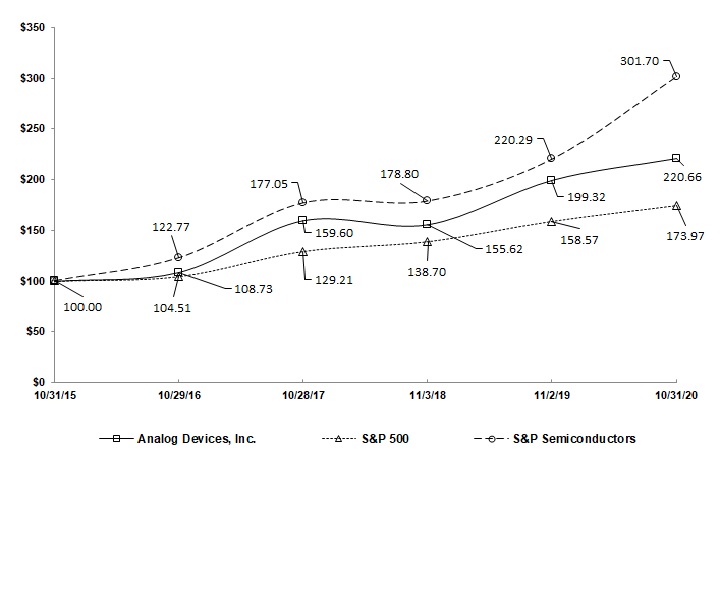
The following graph compares cumulative total shareholder return on our common stock since October 31, 2015 with the cumulative total return of the Standard & Poor’s (S&P) 500 Index and the S&P Semiconductors Index. This graph assumes the investment of $100 on October 31, 2015 in our common stock, the S&P 500 Index and the S&P Semiconductors Index and assumes all dividends are reinvested. Measurement points are the last trading day for each respective fiscal year.
Item 6. SELECTED FINANCIAL DATA
The following selected financial information has been derived from the Company's historical audited consolidated financial statements and should be read in conjunction with the Consolidated Financial Statements and the accompanying notes for the corresponding fiscal years. The following are noteworthy when comparing year to year:
-
The Company’s fiscal year is the 52-week or 53-week period ending on the Saturday closest to the last day in October. Fiscal 2020, 2019, 2017, and 2016 were 52-week fiscal years. Fiscal 2018 was a 53-week fiscal year. The additional week in fiscal 2018 was included in the first quarter ended February 3, 2018. Therefore, fiscal 2018 included an additional week of operations as compared to other periods presented;
-
Balances for fiscal 2018 and fiscal 2017 have been restated to reflect the adoption during fiscal 2019 of Accounting Standards Update (ASU) 2014-09, Revenue from Contracts with Customers (ASU 2014-09). Therefore, balances from fiscal 2016 may not be comparable to other periods presented; and
-
Fiscal 2017 includes the results of operations from the acquisition of Linear Technology Corporation from March 10, 2017.
| (thousands, except per share amounts) | 2020 | 2019 | 2018 | 2017 | 2016 | ||||||||||||||||||||||||
| Statement of Income data: | |||||||||||||||||||||||||||||
| Revenue | $ | 5,603,056 | $ | 5,991,065 | $ | 6,224,689 | $ | 5,246,354 | $ | 3,421,409 | |||||||||||||||||||
| Net income | $ | 1,220,761 | $ | 1,363,011 | $ | 1,506,980 | $ | 805,379 | $ | 861,664 | |||||||||||||||||||
| Net income per common share | |||||||||||||||||||||||||||||
| Basic | $ | 3.31 | $ | 3.68 | $ | 4.05 | $ | 2.32 | $ | 2.79 | |||||||||||||||||||
| Diluted | $ | 3.28 | $ | 3.65 | $ | 4.00 | $ | 2.29 | $ | 2.76 | |||||||||||||||||||
| Dividends declared per common share | $ | 2.40 | $ | 2.10 | $ | 1.89 | $ | 1.77 | $ | 1.66 | |||||||||||||||||||
| Balance Sheet data: | |||||||||||||||||||||||||||||
| Total assets | $ | 21,468,603 | $ | 21,392,641 | $ | 20,438,366 | $ | 21,118,283 | $ | 7,970,278 | |||||||||||||||||||
| Debt | $ | 5,145,102 | $ | 5,491,919 | $ | 6,332,674 | $ | 7,851,084 | $ | 1,732,177 |
ITEM 7. MANAGEMENT’S DISCUSSION AND ANALYSIS OF FINANCIAL CONDITION AND RESULTS OF OPERATIONS (all tabular amounts in thousands except per share amounts)
The following discussion includes a comparison of our Results of Operations and Liquidity and Capital Resources for the fiscal years ended October 31, 2020 (fiscal 2020), the fiscal year ended November 2, 2019 (fiscal 2019) and the fiscal year ended November 3, 2018 (fiscal 2018). Our fiscal year is the 52-week or 53-week period ending on the Saturday closest to the last day in October. Fiscal 2020 and fiscal 2019 were 52-week fiscal periods, while fiscal 2018 was a 53-week period. The additional week in fiscal 2018 was included in the first quarter ended February 3, 2018. Therefore, fiscal 2018 included an additional week of operations as compared to fiscal 2020 and fiscal 2019.
Impact of COVID-19 on our Business
The pandemic caused by the novel strain of the coronavirus (COVID-19) has resulted in government authorities implementing numerous measures to try to contain the virus, such as travel bans and restrictions, quarantines, shelter in place orders and shutdowns. These measures have impacted and likely will continue to impact our workforce and operations, the operations of our customers and those of our respective vendors and suppliers. We have significant operations worldwide, including in the United States, the Philippines, Ireland, Singapore, Malaysia, China and India. Each of these countries has been affected by the pandemic and taken measures to try to contain it, resulting in disruptions at some of our manufacturing operations and facilities. Since the beginning of the third quarter of fiscal 2020, our manufacturing operations and supply chain generally stabilized at normal levels, but that could change in the future given that the COVID-19 situation remains dynamic.
The spread of COVID-19 has caused us to modify our business practices (including restricting employee travel, modifying employee work locations and cancelling physical participation in meetings, events and conferences) and we may take further actions as may be required by government authorities or that we determine are in the best interests of our employees, customers, partners, suppliers and shareholders.
While we are confident that our strategy and long-term contingency planning have positioned us well to weather the current uncertainty, we cannot at this time fully quantify or forecast the impact of COVID-19 on our business. The degree to which COVID-19 impacts our business, financial condition and results of operations will depend on future developments, which are highly uncertain, and we cannot provide assurance as to the duration and spread of the pandemic, its severity, the actions to contain the virus or treat its impact, or how quickly and to what extent normal economic and operating conditions can resume.
Proposed Acquisition of Maxim Integrated Products, Inc.
On July 12, 2020, we entered into a definitive agreement (the Merger Agreement) to acquire Maxim Integrated Products, Inc. (Maxim), an independent manufacturer of innovative analog and mixed-signal products and technologies. Under the terms of the Merger Agreement, Maxim stockholders will receive, for each outstanding share of Maxim common stock, 0.630 of a share of our common stock. The estimated merger consideration is approximately $23.0 billion based on the closing price of our common stock on November 20, 2020. Following the recent approval of Maxim stockholders and our shareholders, as well as the expiration of the waiting-period applicable to U.S. regulatory approval, the transaction is subject to customary closing conditions, including receipt of certain non-U.S. regulatory approvals. See Note 6, Acquisitions, of the Notes to Consolidated Financial Statements contained in Item 8 of this Annual Report on Form 10-K for further information.
Results of Operations
A discussion of changes in our results of operations from fiscal 2018 to fiscal 2019 has been omitted from this Form 10-K, but may be found in “Item 7. Management’s Discussion and Analysis of Financial Condition and Results of Operations” of our Form 10-K for fiscal 2019 filed with the Securities and Exchange Commission on November 26, 2019.
Overview
| | | | | | | | | | | | | | | | | | | | | | | | | | | | | | | | | | | | | | | | | | | | --- | --- | --- | --- | --- | --- | --- | --- | --- | --- | --- | --- | --- | --- | --- | --- | --- | --- | --- | --- | --- | --- | -
Showing the first 8K of 79K characters. Open the full section
Item 7A. QUANTITATIVE AND QUALITATIVE DISCLOSURES ABOUT MARKET RISK
Interest Rate Exposure
Our interest income and expense are sensitive to changes in the general level of interest rates. In this regard, changes in interest rates affect the interest earned or paid on our marketable securities and debt, as well as the fair value of our investments and debt.
Based on the $925.0 million of our floating rate debt outstanding as of October 31, 2020, our annual interest expense would change by approximately $9.3 million for each 100 basis point increase in interest rates.
In certain instances we utilize interest rate derivatives to manage interest rate exposure on both outstanding debt as well as future issuances. As of October 31, 2020 and November 2, 2019, for each 100 basis point decrease in the ten-year U.S. Treasury rate, the fair value of our outstanding derivative instruments would change by approximately $102.0 million and $100.0 million, respectively.
Based on our marketable securities outstanding as of October 31, 2020 and November 2, 2019, our annual interest income would change by approximately $10.6 million and $6.5 million, respectively, for each 100 basis point increase in interest rates.
To provide a meaningful assessment of the interest rate risk associated with our investment portfolio, we performed a sensitivity analysis to determine the impact a change in interest rates would have on the value of our investment portfolio assuming a 100 basis point parallel shift in the yield curve. Based on investment positions as of October 31, 2020 and November 2, 2019, a hypothetical 100 basis point increase in interest rates across all maturities would not materially impact the fair market value of the portfolio in either period. If significant, such losses would only be realized if we sold the investments prior to maturity.
As of October 31, 2020, we had $4.3 billion in principal amount of senior unsecured notes outstanding, with a fair value of $4.8 billion. The fair value of our notes is subject to interest rate risk, market risk, and other factors. Generally, the fair value of our notes will increase as interest rates fall and decrease as interest rates rise. The fair values of our notes as of October 31, 2020 and November 2, 2019, assuming a hypothetical 100 basis point increase in market interest rates, are as follows:
| October 31, 2020 | November 2, 2019 | ||||||||||||||||||||||||||||||||||
| (thousands) | Principal Amount Outstanding | Fair Value | Fair Value given an increase in interest rates of 100 basis points | Principal Amount Outstanding | Fair Value | Fair Value given an increase in interest rates of 100 basis points | |||||||||||||||||||||||||||||
| 2020 Notes, due March 2020 | $ | — | $ | — | $ | — | $ | 300,000 | $ | 300,872 | $ | 299,793 | |||||||||||||||||||||||
| 2021 Notes, due January 2021 | — | — | — | 450,000 | 454,634 | 449,354 | |||||||||||||||||||||||||||||
| 2021 Notes, due December 2021 | 400,000 | 408,565 | 404,170 | 400,000 | 402,591 | 394,524 | |||||||||||||||||||||||||||||
| 2023 Notes, due June 2023 | 500,000 | 526,855 | 513,874 | 500,000 | 511,190 | 494,186 | |||||||||||||||||||||||||||||
| 2023 Notes, due December 2023 | 550,000 | 590,177 | 572,965 | 550,000 | 567,159 | 545,897 | |||||||||||||||||||||||||||||
| 2025 Notes, due April 2025 | 400,000 | 434,919 | 417,225 | — | — | — | |||||||||||||||||||||||||||||
| 2025 Notes, due December 2025 | 850,000 | 969,033 | 924,695 | 850,000 | 914,567 | 866,162 | |||||||||||||||||||||||||||||
| 2026 Notes, due December 2026 | 900,000 | 1,017,505 | 962,821 | 900,000 | 940,192 | 883,276 | |||||||||||||||||||||||||||||
| 2036 Notes, due December 2036 | 250,000 | 298,153 | 265,210 | 250,000 | 270,891 | 240,492 | |||||||||||||||||||||||||||||
| 2045 Notes, due December 2045 | 400,000 | 538,788 | 463,425 | 400,000 | 491,439 | 423,591 |
Foreign Currency Exposure
As more fully described in Note 2i, Derivative and Hedging Agreements, of the Notes to Consolidated Financial Statements contained in Item 8 of this Annual Report on Form 10-K, we regularly hedge our non-U.S. dollar-based exposures by entering into forward foreign currency exchange contracts. The terms of these contracts are for periods matching the duration of the underlying exposure and generally range from one to twelve months. Currently, our largest foreign currency exposure is the Euro, primarily because our European operations have the highest proportion of our local currency denominated expenses. Relative to foreign currency exposures existing at October 31, 2020 and November 2, 2019, a 10% unfavorable movement in foreign currency exchange rates over the course of the year would result in approximately $18.5 million of losses and $12.1 million of losses, respectively, in changes in earnings or cash flows.
The market risk associated with our derivative instruments results from currency exchange rates that are expected to offset the market risk of the underlying transactions, assets and liabilities being hedged. The counterparties to the agreements relating to our foreign exchange instruments consist of a number of major international financial institutions with high credit ratings. Based on the credit ratings of our counterparties as of October 31, 2020, we do not believe that there is significant risk of nonperformance by them. While the contract or notional amounts of derivative financial instruments provide one measure of the volume of these transactions, they do not represent the amount of our exposure to credit risk. The amounts potentially subject to credit risk (arising from the possible inability of counterparties to meet the terms of their contracts) are generally limited to the amounts, if any, by which the counterparties’ obligations under the contracts exceed our obligations to the counterparties.
The following table illustrates the effect that a 10% unfavorable or favorable movement in foreign currency exchange rates, relative to the U.S. dollar, would have on the fair value of our forward exchange contracts as of October 31, 2020 and November 2, 2019:
| October 31, 2020 | November 2, 2019 | ||||||||||
| Fair value of forward exchange contracts assets | $ | 5,427 | $ | — | |||||||
| Fair value of forward exchange contracts after a 10% unfavorable movement in foreign currency exchange rates asset | $ | 21,859 | $ | 20,810 | |||||||
| Fair value of forward exchange contracts after a 10% favorable movement in foreign currency exchange rates liability | $ | (20,276) | $ | (19,269) |
The calculation assumes that each exchange rate would change in the same direction relative to the U.S. dollar. In addition to the direct effects of changes in exchange rates, such changes typically affect the volume of sales or the foreign currency sales price as competitors’ products become more or less attractive. Our sensitivity analysis of the effects of changes in foreign currency exchange rates does not factor in a potential change in sales levels or local currency selling prices.
REPORT OF INDEPENDENT REGISTERED PUBLIC ACCOUNTING FIRM
The Board of Directors and Shareholders
Analog Devices, Inc.
Opinion on the Financial Statements
We have audited the accompanying consolidated balance sheets of Analog Devices, Inc. (the Company) as of October 31, 2020 and November 2, 2019, the related consolidated statements of income, comprehensive income, shareholders' equity and cash flows for each of the three years in the period ended October 31, 2020, and the related notes and financial statement schedule listed in the Index at Item 15(a)(2) (collectively referred to as the “consolidated financial statements”). In our opinion, the consolidated financial statements present fairly, in all material respects, the financial position of the Company at October 31, 2020 and November 2, 2019, and the results of its operations and its cash flows for each of the three years in the period ended October 31, 2020, in conformity with U.S. generally accepted accounting principles.
We also have audited, in accordance with the standards of the Public Company Accounting Oversight Board (United States) (PCAOB), the Company's internal control over financial reporting as of October 31, 2020, based on criteria established in Internal Control-Integrated Framework issued by the Committee of Sponsoring Organizations of the Treadway Commission (2013 framework), and our report dated November 24, 2020 expressed an unqualified opinion thereon.
Adoption of ASU No. 2016-02
As discussed in Note 2 to the consolidated financial statements, the Company changed its method of accounting for leases in the year ended October 31, 2020 due to the adoption of Accounting Standards Update (ASU) No. 2016-02, Leases (Topic 842), and the related amendments.
Adoption of ASU No. 2016-16
As discussed in Note 12 to the consolidated financial statements, the Company changed its method of accounting for the income tax consequences of intra-entity transfers, other than inventory, in the year ended November 2, 2019 due to the adoption of ASU No. 2016-16, Income Taxes (Topic 740): Intra-Entity Transfers of Assets Other Than Inventory.
Basis for Opinion
These financial statements are the responsibility of the Company's management. Our responsibility is to express an opinion on the Company’s financial statements based on our audits. We are a public accounting firm registered with the PCAOB and are required to be independent with respect to the Company in accordance with the U.S. federal securities laws and the applicable rules and regulations of the Securities and Exchange Commission and the PCAOB.
We conducted our audits in accordance with the standards of the PCAOB. Those standards require that we plan and perform the audit to obtain reasonable assurance about whether the financial statements are free of material misstatement, whether due to error or fraud. Our audits included performing procedures to assess the risks of material misstatement of the financial statements, whether due to error or fraud, and performing procedures that respond to those risks. Such procedures included examining, on a test basis, evidence regarding the amounts and disclosures in the financial statements. Our audits also included evaluating the accounting principles used and significant estimates made by management, as well as evaluating the overall presentation of the financial statements. We believe that our audits provide a reasonable basis for our opinion.
Critical Audit Matters
The critical audit matters communicated below are matters arising from the current period audit of the financial statements that were communicated or required to be communicated to the audit committee and that: (1) relate to accounts or disclosures that are material to the financial statements and (2) involved our especially challenging, subjective or complex judgments. The communication of critical audit matters does not alter in any way our opinion on the consolidated financial statements, taken as a whole, and we are not, by communicating the critical audit matters below, providing separate opinions on the critical audit matters or on the accounts or disclosures to which they relate.
| Revenue Recognition – Measuring Variable Consideration | |||||
| Description of the Matter | As described in Note 2 to the consolidated financial statements, the Company's sales contracts provide certain distributors with credits for price protection and rights of return, which results in variable consideration. During 2020, sales to distributors were $3.2 billion net of expected price protection discounts and rights of return for which the liability balance as of October 31, 2020 was $229.8 million. Auditing the Company's measurement of variable consideration under distributor contracts involved especially challenging judgment because the calculation involves subjective management assumptions about estimates of expected price protection discounts and returns. For example, estimated variable consideration included in the transaction price reflects management's evaluation of contractual terms, historical experience and assumptions about future economic conditions. Changes in those assumptions can have a material effect on the amount of variable consideration recognized. | ||||
| How We Addressed the Matter in Our Audit | We obtained an understanding, evaluated the design and tested the operating effectiveness of controls over the Company's process to calculate the variable consideration. For example, we tested controls over the appropriateness of assumptions management used as well as controls over the completeness and accuracy of the data underlying estimates of expected price protection discounts and returns. Our audit procedures included, among others, inspecting contractual terms in distributor agreements and testing the underlying data used in management’s calculation for completeness and accuracy as well as evaluating the significant assumptions used in the estimation of variable consideration. We evaluated the Company’s methods and assumptions used in the estimates, which included comparing the assumptions to historical trends. We inspected and tested the results of the Company's retrospective review analysis of actual returns and price protection discounts claimed by distributors, evaluated the estimates made based on historical experience and performed sensitivity analyses of the Company’s significant assumptions to assess the impact on the variable consideration. We also evaluated whether the Company appropriately considered new information that could significantly change the estimated future price protection discounts or returns. | ||||
| Goodwill – Quantitative Impairment Assessment | |||||
| Description of the Matter | The Company’s consolidated goodwill balance was $12.3 billion as of October 31, 2020. As described in Note 2 to the consolidated financial statements, the Company evaluates goodwill for impairment at the reporting unit level annually and performed a quantitative goodwill impairment assessment for each of its eight reporting units. The quantitative impairment assessment involves the comparison of the fair value of each reporting unit to its respective carrying amount. The Company used a weighting of the income and market approaches to determine the fair value of each reporting unit. Auditing management's quantitative goodwill impairment test involved a high degree of auditor judgment due to the significant estimation required to determine the fair value of each reporting unit. In particular, the fair value estimate for one of the eight reporting units was sensitive to significant assumptions, such as forecasted revenues, gross profit margins, operating income margins, long-term discount rate, perpetual growth rate, identification of comparable publicly traded companies and estimated valuation multiples, which led to a high degree of auditor judgment, subjectivity and effort in performing procedures and evaluating management’s significant assumptions as outlined above, used in determining the fair value of this reporting unit. | ||||
| How We Addressed the Matter in Our Audit | We obtained an understanding, evaluated the design and tested the operating effectiveness of controls over the Company's quantitative goodwill impairment assessment process. For example, we tested controls over management's review of the valuation model and the significant assumptions used. To test the estimated fair value of the reporting unit, our audit procedures included, among others, assessing methodologies and testing the significant assumptions discussed above and the underlying data used by the Company in its analysis. We tested significant assumptions by comparing them to current and forecasted industry and economic trends, analyst reports, and forecasted peer company information. We evaluated management’s ability to accurately forecast by comparing actual results to historical forecasts. We also performed sensitivity analyses of certain assumptions to evaluate changes in the fair value that would result from changes in the assumptions. With the assistance of our valuation specialists, we evaluated the selection of the long-term discount rate and perpetual growth rate, including testing the underlying source information and the mathematical accuracy of the calculations by developing a range of independent estimates and comparing those to the rates selected by management. We also involved our valuation specialists to evaluate the market approach, including evaluating the reasonableness of the selected comparable publicly traded companies and the resulting market multiples calculation. |
/s/ Ernst & Young LLP
We have served as the Company’s auditor since 1967.
Boston, Massachusetts
November 24, 2020
Item 8. FINANCIAL STATEMENTS AND SUPPLEMENTARY DATA
ANALOG DEVICES, INC.
CONSOLIDATED STATEMENTS OF INCOME
Years ended October 31, 2020, November 2, 2019 and November 3, 2018
| (thousands, except per share amounts) | 2020 | 2019 | 2018 (1) | ||||||||||||||
| Revenue | |||||||||||||||||
| Revenue | $ | 5,603,056 | $ | 5,991,065 | $ | 6,224,689 | |||||||||||
| Costs and Expenses | |||||||||||||||||
| Cost of sales | 1,912,578 | 1,977,315 | 1,974,293 | ||||||||||||||
| Gross margin | 3,690,478 | 4,013,750 | 4,250,396 | ||||||||||||||
| Operating expenses: | |||||||||||||||||
| Research and development | 1,050,519 | 1,130,348 | 1,165,047 | ||||||||||||||
| Selling, marketing, general and administrative | 659,923 | 648,094 | 695,540 | ||||||||||||||
| Amortization of intangibles | 429,455 | 429,041 | 428,902 | ||||||||||||||
| Special charges | 52,337 | 95,659 | 61,318 | ||||||||||||||
| 2,192,234 | 2,303,142 | 2,350,807 | |||||||||||||||
| Operating income: | 1,498,244 | 1,710,608 | 1,899,589 | ||||||||||||||
| Nonoperating expense (income): | |||||||||||||||||
| Interest expense | 193,305 | 229,075 | 253,589 | ||||||||||||||
| Interest income | (4,305) | (10,229) | (9,383) | ||||||||||||||
| Other, net | (2,373) | 6,034 | 69 | ||||||||||||||
| 186,627 | 224,880 | 244,275 | |||||||||||||||
| Earnings | |||||||||||||||||
| Income before income taxes | 1,311,617 | 1,485,728 | 1,655,314 | ||||||||||||||
| Provision for income taxes | 90,856 | 122,717 | 148,334 | ||||||||||||||
| Net income | $ | 1,220,761 | $ | 1,363,011 | $ | 1,506,980 | |||||||||||
| Shares used to compute earnings per common share — basic | 368,633 | 369,133 | 370,430 | ||||||||||||||
| Shares used to compute earnings per common share — diluted | 371,973 | 372,871 | 374,938 | ||||||||||||||
| Basic earnings per common share | $ | 3.31 | $ | 3.68 | $ | 4.05 | |||||||||||
| Diluted earnings per common share | $ | 3.28 | $ | 3.65 | $ | 4.00 | |||||||||||
| _______________________________________ (1) Balances have been restated to reflect the adoption of Accounting Standards Update (ASU) 2014-09, Revenue from Contracts with Customers (ASU 2014-09). See Note 2a, Principles of Consolidation, of the Notes to Consolidated Financial Statements. |
See accompanying Notes.
ANALOG DEVICES, INC.
CONSOLIDATED STATEMENTS OF COMPREHENSIVE INCOME
Years ended October 31, 2020, November 2, 2019 and November 3, 2018
| (thousands) | 2020 | 2019 | 2018 (1) | ||||||||||||||
| Net income | $ | 1,220,761 | $ | 1,363,011 | $ | 1,506,980 | |||||||||||
| Foreign currency translation adjustment | 3,224 | (1,365) | (6,222) | ||||||||||||||
| Change in fair value of available-for-sale securities | — | 10 | (10) | ||||||||||||||
| Change in unrecognized gains/losses on derivative instruments designated as cash flow hedges: | |||||||||||||||||
| Changes in fair value of derivatives (net of tax of $17,468 in 2020, $29,401 in 2019 and $416 in 2018) | (51,437) | (111,327) | (1,863) | ||||||||||||||
| Adjustment for realized gain/loss reclassified into earnings (net of tax of $158 in 2020, $1,518 in 2019 and $94 in 2018) | (839) | 7,667 | (1,613) | ||||||||||||||
| Total change in derivative instruments designated as cash flow hedges, net of tax | (52,276) | (103,660) | (3,476) | ||||||||||||||
| Changes in accumulated other comprehensive loss — pension plans: | |||||||||||||||||
| Change in transition asset | — | — | 10 | ||||||||||||||
| Change in actuarial loss/gain (net of tax of $5,167 in 2020, $5,734 in 2019 and $2,363 in 2018) | (10,231) | (24,344) | 12,616 | ||||||||||||||
| Change in prior service cost/income | — | — | 1 | ||||||||||||||
| Total change in accumulated other comprehensive loss — pension plans, net of tax | (10,231) | (24,344) | 12,627 | ||||||||||||||
| Other comprehensive (loss) income | (59,283) | (129,359) | 2,919 | ||||||||||||||
| Comprehensive income | $ | 1,161,478 | $ | 1,233,652 | $ | 1,509,899 | |||||||||||
| _______________________________________ (1) Balances have been restated to reflect the adoption of Accounting Standards Update (ASU) 2014-09, Revenue from Contracts with Customers (ASU 2014-09). See Note 2a, Principles of Consolidation, of the Notes to Consolidated Financial Statements. |
See accompanying Notes.
ANALOG DEVICES, INC.
CONSOLIDATED BALANCE SHEETS
October 31, 2020 and November 2, 2019
| (thousands, except per share amounts) | 2020 | 2019 | |||||||||
| ASSETS | |||||||||||
| Current Assets | |||||||||||
| Cash and cash equivalents | $ | 1,055,860 | $ | 648,322 | |||||||
| Accounts receivable less allowances of $4,350 ($8,387 in 2019) | 737,536 | 635,136 | |||||||||
| Inventories | 608,260 | 609,886 | |||||||||
| Prepaid expenses and other current assets | 116,032 | 91,782 | |||||||||
| Total current assets | 2,517,688 | 1,985,126 | |||||||||
| Property, Plant and Equipment, at Cost | |||||||||||
| Land and buildings | 974,604 | 956,099 | |||||||||
| Machinery and equipment | 2,667,846 | 2,609,493 | |||||||||
| Office equipment | 85,291 | 85,490 | |||||||||
| Leasehold improvements | 157,915 | 160,175 | |||||||||
| 3,885,656 | 3,811,257 | ||||||||||
| Less accumulated depreciation and amortization | 2,765,095 | 2,591,268 | |||||||||
| Net property, plant and equipment | 1,120,561 |
Showing the first 8K of 214K characters. Open the full section
Item 9. CHANGES IN AND DISAGREEMENTS WITH ACCOUNTANTS ON ACCOUNTING AND FINANCIAL DISCLOSURE
Not applicable.
Item 9A. CONTROLS AND PROCEDURES
(a) Evaluation of Disclosure Controls and Procedures. Our management, with the participation of our Chief Executive Officer and Chief Financial Officer, evaluated the effectiveness of Analog’s disclosure controls and procedures as of October 31, 2020. The term “disclosure controls and procedures,” as defined in Rules 13a-15(e) and 15d-15(e) under the Securities Exchange Act of 1934, as amended (the “Exchange Act”), means controls and other procedures of a company that are designed to ensure that information required to be disclosed by a company in the reports that it files or submits under the Exchange Act is recorded, processed, summarized and reported, within the time periods specified in the SEC’s rules and forms. Disclosure controls and procedures include, without limitation, controls and procedures designed to ensure that information required to be disclosed by a company in the reports that it files or submits under the Exchange Act is accumulated and communicated to the company’s management, including its principal executive and principal financial officers, as appropriate to allow timely decisions regarding required disclosure. Management recognizes that any controls and procedures, no matter how well designed and operated, can provide only reasonable assurance of achieving their objectives and management necessarily applies its judgment in evaluating the cost-benefit relationship of possible controls and procedures. Based on the evaluation of our disclosure controls and procedures as of October 31, 2020, our Chief Executive Officer and Chief Financial Officer concluded that, as of such date, our disclosure controls and procedures were effective at the reasonable assurance level.
(b) Management’s Report on Internal Control Over Financial Reporting.
Management’s Report on Internal Control Over Financial Reporting
Our management is responsible for establishing and maintaining adequate internal control over financial reporting. Internal control over financial reporting is defined in Rule 13a-15(f) or 15d-15(f) promulgated under the Securities Exchange Act of 1934 as a process designed by, or under the supervision of, the company’s principal executive and principal financial officers and effected by the company’s board of directors, management and other personnel, to provide reasonable assurance regarding the reliability of financial reporting and the preparation of financial statements for external purposes in accordance with generally accepted accounting principles and includes those policies and procedures that:
-
Pertain to the maintenance of records that in reasonable detail accurately and fairly reflect the transactions and dispositions of the assets of the company;
-
Provide reasonable assurance that transactions are recorded as necessary to permit preparation of financial statements in accordance with generally accepted accounting principles, and that receipts and expenditures of the company are being made only in accordance with authorizations of management and directors of the company; and
-
Provide reasonable assurance regarding prevention or timely detection of unauthorized acquisition, use or disposition of the company’s assets that could have a material effect on the financial statements.
Because of its inherent limitations, internal control over financial reporting may not prevent or detect misstatements. Projections of any evaluation of effectiveness to future periods are subject to the risk that controls may become inadequate because of changes in conditions, or that the degree of compliance with the policies or procedures may deteriorate.
Our management assessed the effectiveness of our internal control over financial reporting as of October 31, 2020. In making this assessment, the company’s management used the criteria set forth by the Committee of Sponsoring Organizations of the Treadway Commission (COSO) in Internal Control-Integrated 2013 Framework.
Based on this assessment, our management concluded that, as of October 31, 2020, our internal control over financial reporting is effective based on those criteria.
Our independent registered public accounting firm that audited the financial statements included in this annual report has issued an attestation report on our internal control over financial reporting. This report appears below.
(c) Attestation Report of the Registered Public Accounting Firm
REPORT OF INDEPENDENT REGISTERED PUBLIC ACCOUNTING FIRM
The Board of Directors and Shareholders
Analog Devices, Inc.
Opinion on Internal Control over Financial Reporting
We have audited Analog Devices, Inc.’s internal control over financial reporting as of October 31, 2020, based on criteria established in Internal Control—Integrated Framework issued by the Committee of Sponsoring Organizations of the Treadway Commission (2013 framework) (the COSO criteria). In our opinion, Analog Devices, Inc. (the Company) maintained, in all material respects, effective internal control over financial reporting as of October 31, 2020, based on the COSO criteria.
We also have audited, in accordance with the standards of the Public Company Accounting Oversight Board (United States) (PCAOB), the consolidated balance sheets of Analog Devices, Inc. as of October 31, 2020 and November 2, 2019, the related consolidated statements of income, comprehensive income, shareholders’ equity and cash flows for each of the three years in the period ended October 31, 2020, and the related notes and financial statement schedule listed in the Index at Item 15(a)(2) and our report dated November 24, 2020 expressed an unqualified opinion thereon.
Basis for Opinion
The Company’s management is responsible for maintaining effective internal control over financial reporting and for its assessment of the effectiveness of internal control over financial reporting included in the accompanying Management’s Report on Internal Control Over Financial Reporting. Our responsibility is to express an opinion on the Company’s internal control over financial reporting based on our audit. We are a public accounting firm registered with the PCAOB and are required to be independent with respect to the Company in accordance with the U.S. federal securities laws and the applicable rules and regulations of the Securities and Exchange Commission and the PCAOB.
We conducted our audit in accordance with the standards of the PCAOB. Those standards require that we plan and perform the audit to obtain reasonable assurance about whether effective internal control over financial reporting was maintained in all material respects.
Our audit included obtaining an understanding of internal control over financial reporting, assessing the risk that a material weakness exists, testing and evaluating the design and operating effectiveness of internal control based on the assessed risk, and performing such other procedures as we considered necessary in the circumstances. We believe that our audit provides a reasonable basis for our opinion.
Definition and Limitations of Internal Control Over Financial Reporting
A company’s internal control over financial reporting is a process designed to provide reasonable assurance regarding the reliability of financial reporting and the preparation of financial statements for external purposes in accordance with generally accepted accounting principles. A company’s internal control over financial reporting includes those policies and procedures that (1) pertain to the maintenance of records that, in reasonable detail, accurately and fairly reflect the transactions and dispositions of the assets of the company; (2) provide reasonable assurance that transactions are recorded as necessary to permit preparation of financial statements in accordance with generally accepted accounting principles, and that receipts and expenditures of the company are being made only in accordance with authorizations of management and directors of the company; and (3) provide reasonable assurance regarding prevention or timely detection of unauthorized acquisition, use, or disposition of the company’s assets that could have a material effect on the financial statements.
Because of its inherent limitations, internal control over financial reporting may not prevent or detect misstatements. Also, projections of any evaluation of effectiveness to future periods are subject to the risk that controls may become inadequate because of changes in conditions, or that the degree of compliance with the policies or procedures may deteriorate.
/s/ Ernst & Young LLP
Boston, Massachusetts
November 24, 2020
(d) Changes in Internal Controls over Financial Reporting. No change in our internal control over financial reporting (as defined in Rules 13a-15(f) and 15d-15(f) under the Securities Exchange Act) occurred during the fiscal quarter ended October 31, 2020 that has materially affected, or is reasonably likely to materially affect, our internal control over financial reporting.
Item 9B. OTHER INFORMATION
Not applicable.
PART III
Item 10. DIRECTORS, EXECUTIVE OFFICERS AND CORPORATE GOVERNANCE
Information required by this item relating to our directors and nominees is contained under the caption “Proposal 1 — Election of Directors” contained in our 2021 proxy statement to be filed with the U.S. Securities and Exchange Commission (the SEC) within 120 days after October 31, 2020 and is incorporated herein by reference. Information required by this item relating to our executive officers is contained under the caption “INFORMATION ABOUT OUR EXECUTIVE OFFICERS” in Part I of this Annual Report on Form 10-K and is incorporated herein by reference. If applicable, information required by this item relating to compliance with Section 16(a) of the Securities Exchange Act of 1934 will be contained under the caption “Delinquent Section 16(a) Reports” in our 2021 proxy statement to be filed with the SEC within 120 days after October 31, 2020 and is incorporated herein by reference.
We have adopted a written code of business conduct and ethics that applies to our principal executive officer, principal financial officer, principal accounting officer or controller, or persons performing similar functions and have posted it in the Corporate Governance section of our website which is located at www.analog.com. To the extent permitted by Nasdaq and SEC regulations, we intend to satisfy any disclosure requirement under Item 5.05 of Form 8-K regarding any amendments to, or waivers from, our code of business conduct and ethics by posting such information on our website which is located at www.analog.com.
During fiscal 2020, we made no material change to the procedures by which shareholders may recommend nominees to our Board of Directors, as described in our 2020 proxy statement.
Information required by this item relating to the audit committee of our Board of Directors is contained under the caption “Corporate Governance — Board of Directors Meetings and Committees — Audit Committee” in our 2021 proxy statement to be filed with the SEC within 120 days after October 31, 2020 and is incorporated herein by reference.
Item 11. EXECUTIVE COMPENSATION
Information required by this item is contained under the captions “Corporate Governance — Director Compensation” and “Information About Executive Compensation” in our 2021 proxy statement to be filed with the SEC within 120 days after October 31, 2020 and is incorporated herein by reference.
Item 12. SECURITY OWNERSHIP OF CERTAIN BENEFICIAL OWNERS AND MANAGEMENT AND RELATED STOCKHOLDER MATTERS
Information required by this item relating to security ownership of certain beneficial owners and management is contained under the caption “Security Ownership of Certain Beneficial Owners and Management” in our 2021 proxy statement to be filed with the SEC within 120 days after October 31, 2020 and is incorporated herein by reference. Information required by this item relating to securities authorized for issuance under equity compensation plans is contained under the caption “Information About Executive Compensation — Securities Authorized for Issuance Under Equity Compensation Plans” in our 2021 proxy statement to be filed with the SEC within 120 days after October 31, 2020 and is incorporated herein by reference.
Item 13. CERTAIN RELATIONSHIPS AND RELATED TRANSACTIONS, AND DIRECTOR INDEPENDENCE
Information required by this item relating to transactions with related persons is contained under the caption “Corporate Governance — Certain Relationships and Related Transactions” in our 2021 proxy statement to be filed with the SEC within 120 days after October 31, 2020 and is incorporated herein by reference. Information required by this item relating to director independence is contained under the caption “Corporate Governance — Determination of Independence” in our 2021 proxy statement to be filed with the SEC within 120 days after October 31, 2020 and is incorporated herein by reference.
Item 14. PRINCIPAL ACCOUNTING FEES AND SERVICES
Information required by this item is contained under the caption “Corporate Governance — Independent Registered Public Accounting Firm Fees and Other Matters” in our 2021 proxy statement to be filed with the SEC within 120 days after October 31, 2020 and is incorporated herein by reference.
PART IV
Item 15. EXHIBITS, FINANCIAL STATEMENT SCHEDULES
(a) The following are filed as part of this Annual Report on Form 10-K:
| 1. | Financial Statements |
The following consolidated financial statements are included in Item 8 of this Annual Report on Form 10-K:
| — | Consolidated Statements of Income for the years ended October 31, 2020, November 2, 2019 and November 3, 2018 | |||||||
| — | Consolidated Statements of Comprehensive Income for the years ended October 31, 2020, November 2, 2019 and November 3, 2018 | |||||||
| — | Consolidated Balance Sheets as of October 31, 2020 and November 2, 2019 | |||||||
| — | Consolidated Statements of Shareholders’ Equity for the years ended October 31, 2020, November 2, 2019 and November 3, 2018 | |||||||
| — | Consolidated Statements of Cash Flows for the years ended October 31, 2020, November 2, 2019 and November 3, 2018 |
2. Financial Statement Schedules
Schedule II — Valuation and Qualifying Accounts
All other schedules have been omitted since the required information is not present, or not present in amounts sufficient to require submission of the schedule or because the information required is included in the Consolidated Financial Statements or the Notes thereto.
3. Exhibits
| Exhibit No. | Description | |||||||
| 2.1 | Agreement and Plan of Merger, dated as of July 26, 2016, by and among Analog Devices, Inc., Linear Technology Corporation and Agreement and Plan of Merger, dated as of July 26, 2016, by and among Analog Devices, Inc., Linear Technology Corporation and Tahoe Acquisition Corp. Acquisition Corp., filed as exhibit 2.1 to the Company’s Current Report on Form 8-K (File No. 1-7819) as filed with the Commission on July 29, 2016 and incorporated herein by reference. | |||||||
| 2.2 | Agreement and Plan of Merger, dated as of July 12, 2020, by and among Analog Devices, Inc., Maxim Integrated Products, Inc. and Magneto Corp., filed as exhibit 2.1 to the Company’s Current Report on Form 8-K (File No. 1-7819) as filed with the Commission on July 15, 2020 and incorporated herein by reference. | |||||||
| 3.1 | Restated Articles of Organization of Analog Devices, Inc., as amended, filed as exhibit 3.1 to the Company's Quarterly Report on Form 10-Q for the fiscal quarter ended May 3, 2008 (File No. 1-7819) as filed with the Commission on May 20, 2008 and incorporated herein by reference. | |||||||
| 3.2 | Amendment to Restated Articles of Organization of Analog Devices, Inc., filed as exhibit 3.1 to the Company's Current Report on Form 8-K (File No. 1-7819) as filed with the Commission on December 8, 2008 and incorporated herein by reference. | |||||||
| 3.3 | Amended and Restated By-Laws of Analog Devices, Inc., filed as exhibit 3.1 to the Company's Current Report on Form 8-K (File No. 1-7819) as filed with the Commission on December 17, 2018 and incorporated herein by reference. | |||||||
| 4.1 | Indenture, dated as of June 3, 2013, by and between Analog Devices, Inc. and The Bank of New York Mellon Trust Company, N.A., as trustee, filed as exhibit 4.1 to the Company's Current Report on Form 8-K (File No. 1-7819) as filed with the Commission on June 3, 2013 and incorporated herein by reference. | |||||||
| 4.2 | Supplemental Indenture, dated as of June 3, 2013, by and between Analog Devices, Inc. and The Bank of New York Mellon Trust Company, N.A., as trustee, filed as exhibit 4.2 to the Company's Current Report on Form 8-K (File No. 1-7819) as filed with the Commission on June 3, 2013 and incorporated herein by reference. | |||||||
| 4.3 | Supplemental Indenture, dated December 14, 2015, between Analog Devices, Inc. and The Bank of New York Mellon Trust Company, N.A., as trustee, filed as exhibit 4.2 to the Company's Current Report on Form 8-K (File No. 1-7819) as filed with the Commission on December 14, 2015 and incorporated herein by reference. | |||||||
| 4.4 | Supplemental Indenture, dated December 5, 2016, between Analog Devices, Inc. and The Bank of New York Mellon Trust Company, N.A., as trustee, filed as exhibit 4.2 to the Company's Current Report on Form 8-K (File No. 1-7819) as filed with the Commission on December 5, 2016 and incorporated herein by reference. |
| Exhibit No. | Description | |||||||
| 4.5 | Supplemental Indenture, dated March 12, 2018, between Analog Devices, Inc. and The Bank of New York Mellon Trust Company, N.A., as trustee, filed as exhibit 4.2 to the Company's Current Report on Form 8-K (File No. 1-7819) as filed with the Commission on March 12, 2018 and incorporated herein by reference. | |||||||
| 4.6 | Supplemental Indenture, dated April 8, 2020, between Analog Devices and The Bank of New York Mellon Trust Company, N.A., as trustee (including the form of note contained therein), filed as exhibit 4.2 to the Company’s Current Report on Form 8-K (File No. 1-7819) as filed with the Commission on April 8, 2020 and incorporated herein by reference. | |||||||
| 4.7 | Description of Registrant's Securities, filed as exhibit 4.6 to the Company's Annual Report on Form 10-K for the fiscal year ended November 2, 2019 (File No. 1-7819) as filed with the Commission on November 26, 2019 and incorporated herein by reference. | |||||||
| *10.1 | Analog Devices, Inc. Amended and Restated Deferred Compensation Plan, filed as exhibit 10.1 to the Company's Current Report on Form 8-K as filed with the Commission on December 8, 2008 (File No. 1-7819) and incorporated herein by reference. | |||||||
| *10.2 | First Amendment to the Analog Devices, Inc. Amended and Restated Deferred Compensation Plan, filed as exhibit 10.1 to the Company's Quarterly Report on Form 10-Q for the fiscal quarter ended July 30, 2011 (File No. 1-7819) as filed with the Commission on August 16, 2011 and incorporated herein by reference. | |||||||
| *10.3 | Second Amendment to the Analog Devices, Inc. Amended and Restated Deferred Compensation Plan, filed as exhibit 10.1 to the Company's Quarterly Report on Form 10-Q for the fiscal quarter ended August 1, 2015 (File No. 1-7819) as filed with the Commission on August 18, 2015 and incorporated herein by reference. | |||||||
| *10.4 | Third Amendment to the Analog Devices, Inc. Amended and Restated Deferred Compensation Plan, filed as exhibit 10.6 to the Company's Quarterly Report on Form 10-Q for the fiscal quarter ended July 29, 2017 (File No. 1-7819) as filed with the Commission on August 30, 2017 and incorporated herein by reference. | |||||||
| *10.5 | Fourth Amendment to the Analog Devices, Inc. Amended and Restated Deferred Compensation Plan, filed as exhibit 10.5 to the Company's Annual Report on Form 10-K for the fiscal year ended November 2, 2019 (File No. 1-7819) as filed with the Commission on November 26, 2019 and incorporated herein by reference. | |||||||
| *10.6 | Trust Agreement for Deferred Compensation Plan dated as of October 1, 2003 between Analog Devices, Inc. and Fidelity Management Trust Company, filed as exhibit 10.28 to the Company's Annual Report on Form 10-K for the fiscal year ended November 1, 2003 (File No. 1-7819) as filed with the Commission on December 23, 2003 and incorporated herein by reference. | |||||||
| *10.7 | First Amendment to Trust Agreement for Deferred Compensation Plan between Analog Devices, Inc. and Fidelity Management Trust Company dated as of January 1, 2005, filed as exhibit 10.3 to the Company's Annual Report on Form 10-K for the fiscal year ended October 28, 2006 (File No. 1-7819) as filed with the Commission on November 20, 2006 and incorporated herein by reference. | |||||||
| *10.8 | Second Amendment to Trust Agreement for Deferred Compensation Plan between Analog Devices, Inc. and Fidelity Management Trust Company dated as of December 10, 2007, filed as exhibit 10.41 to the Company's Annual Report on Form 10-K for the fiscal year ended November 1, 2008 (File No. 1-7819) as filed with the Commission on November 25, 2008 and incorporated herein by reference. | |||||||
| *10.9 | Amended and Restated 2006 Stock Incentive Plan of Analog Devices, Inc., filed as exhibit 10.1 to the Company's Quarterly Report on Form 10-Q for the fiscal quarter ended February 1, 2014 (File No. 1-7819) as filed with the Commission on February 18, 2014 and incorporated herein by reference. | |||||||
| *10.10 | Linear Technology Corporation Amended and Restated 2005 Equity Incentive Plan, filed as Exhibit 4.1 to the Post-Effective Amendment No. 1 on Form S-8 to the Company's Registration Statement on Form S-4 (File No. 333-213454) as filed with the Commission on March 15, 2017 and incorporated herein by reference. | |||||||
| *10.11 | Analog Devices, Inc. Amended and Restated 2010 Equity Incentive Plan, filed as Exhibit 4.2 to the Post-Effective Amendment No. 1 on Form S-8 to the Company's Registration Statement on Form S-4 (File No. 333-213454) as filed with the Commission on March 15, 2017 and incorporated herein by reference. | |||||||
| *10.12 | Form of Global Non-Qualified Stock Option Agreement for Employees for usage under the Company's Amended and Restated 2006 Stock Incentive Plan, filed as exhibit 10.1 to the Company's Quarterly Report on Form 10-Q for the fiscal quarter ended February 2, 2019 (File No. 1-7819) as filed with the Commission on February 20, 2019 and incorporated herein by reference. | |||||||
| *10.13 | Form of Non-Qualified Stock Option Agreement for Directors for usage under the Company's Amended and Restated 2006 Stock Incentive Plan, filed as exhibit 10.4 to the Company's Quarterly Report on Form 10-Q for the fiscal quarter ended January 28, 2017 (File No. 1-7819) as filed with the Commission on February 15, 2017 and incorporated herein by reference. | |||||||
| *10.14 | Form of Global Restricted Stock Unit Agreement for Employees for usage under the Company's Amended and Restated 2006 Stock Incentive Plan, filed as exhibit 10.2 to the Company's Quarterly Report on Form 10-Q for the fiscal quarter ended February 2, 2019 (File No. 1-7819) as filed with the Commission on February 20, 2019 and incorporated herein by reference. |
| Exhibit No. | Description | |||||||
| *10.15 | Form of Performance Restricted Stock Unit Agreement for Employees for usage under the Company's Amended and Restated 2006 Stock Incentive Plan, filed as exhibit 10.7 to the Company's Quarterly Report on Form 10-Q for the fiscal quarter ended February 3, 2018 (File No. 1-7819) as filed with the Commission on February 28, 2018 and incorporated herein by reference. | |||||||
| *10.16 | Form of Relative TSR Performance Restricted Stock Unit Agreement for Employees for usage under the Company's Amended and Restated 2006 Stock Incentive Plan, filed as exhibit 10.1 to the Company's Quarterly Report on Form 10-Q for the fiscal quarter ended May 4, 2019 (File No. 1-7819) as filed with the Commission on May 22, 2019 and incorporated herein by reference. | |||||||
| *10.17 | Form of Financial Key Metric Performance Restricted Stock Unit Agreement for Employees for usage under the Company's Amended and Restated 2006 Stock Incentive Plan, filed as Exhibit 10.2 to the Company's Quarterly Report on Form 10-Q for the fiscal quarter ended May 4, 2019 (File No. 1-7819) as filed with the Commission on May 22, 2019 and incorporated herein by reference. | |||||||
| *10.18 | Form of Restricted Stock Unit Agreement for Directors for usage under the Company's Amended and Restated 2006 Stock Incentive Plan, filed as exhibit 10.3 to the Company's Quarterly Report on Form 10-Q for the fiscal quarter ended February 2, 2019 (File No. 1-7819) as filed with the Commission on February 20, 2019 and incorporated herein by reference. | |||||||
| *10.19 | Form of Analog Devices, Inc. Equity Award Conversion Notice to Linear employees, filed as exhibit 10.1 to the Company's Quarterly Report on Form 10-Q for the fiscal quarter ended April 29, 2017 (File No. 1-7819) as filed with the Commission on May 31, 2017 and incorporated herein by reference. | |||||||
| *10.20 | Form of Linear Integration Performance Restricted Stock Unit Agreement for Employees for usage under the Analog Devices, Inc. Amended and Restated 2006 Stock Incentive Plan, filed as Exhibit 10.1 to the Company's Current Report on Form 8-K (File No. 1-7819) as filed with the Commission on July 11, 2017 and incorporated by reference herein. | |||||||
| *10.21 | Analog Devices, Inc. 2020 Equity Incentive Plan, filed as Appendix B to the Company’s Definitive Proxy Statement on Schedule 14A (File No. 1-7819), as filed with the Commission on January 24, 2020 and incorporated herein by reference. | |||||||
| *10.22 | Form of Financial Metric Performance Restricted Stock Unit Agreement for Employees for usage under the Company's 2020 Equity Incentive Plan, filed as exhibit 10.1 to the Company’s Quarterly Report on Form 10-Q for the fiscal quarter ended February 1, 2020 (File No. 1-7819) as filed with the Commission on February 19, 2020 and incorporated herein by reference. | |||||||
| *10.23 | Form of Global Non-Qualified Stock Option Agreement for Employees for usage under the Company's 2020 Equity Incentive Plan, filed as exhibit 10.2 to the Company’s Quarterly Report on Form 10-Q for the fiscal quarter ended February 1, 2020 (File No. 1-7819) as filed with the Commission on February 19, 2020 and incorporated herein by reference. | |||||||
| *10.24 | Form of Global Restricted Stock Unit Agreement for Employees for usage under the Company's 2020 Equity Incentive Plan, filed as exhibit 10.3 to the Company’s Quarterly Report on Form 10-Q for the fiscal quarter ended February 1, 2020 (File No. 1-7819) as filed with the Commission on February 19, 2020 and incorporated herein by reference. | |||||||
| *10.25 | Form of Restricted Stock Unit Agreement for Directors for usage under the Company's 2020 Equity Incentive Plan, filed as exhibit 10.4 to the Company’s Quarterly Report on Form 10-Q for the fiscal quarter ended February 1, 2020 (File No. 1-7819) as filed with the Commission on February 19, 2020 and incorporated herein by reference. | |||||||
| *10.26 | Form of Relative Total Shareholder Return Performance Restricted Stock Unit Agreement for Employees for usage under the Company's 2020 Equity Incentive Plan, filed as exhibit 10.5 to the Company’s Quarterly Report on Form 10-Q for the fiscal quarter ended February 1, 2020 (File No. 1-7819) as filed with the Commission on February 19, 2020 and incorporated herein by reference. | |||||||
| *10.27 | 2020 Executive Performance Incentive Plan, filed as exhibit 10.22 to the Company's Annual Report on Form 10-K for the fiscal year ended November 2, 2019 (File No. 1-7819) as filed with the Commission on November 26, 2019 and incorporated herein by reference. | |||||||
| †*10.28 | 2021 Executive Performance Incentive Plan. | |||||||
| *10.29 | Form of Employee Retention Agreement, filed as exhibit 10.1 to the Company's Quarterly Report on Form 10-Q for the fiscal quarter ended May 5, 2012 (File No. 1-7819) as filed with the Commission on May 22, 2012 and incorporated herein by reference. | |||||||
| *10.30 | Employee Change in Control Severance Policy of Analog Devices, Inc., as amended, filed as exhibit 10.20 to the Company's Annual Report on Form 10-K for the fiscal year ended October 30, 1999 (File No. 1-7819) as filed with the Commission on January 28, 2000 and incorporated herein by reference. | |||||||
| *10.31 | Senior Management Change in Control Severance Policy of Analog Devices, Inc., as amended, filed as exhibit 10.21 to the Company's Annual Report on Form 10-K for the fiscal year ended October 30, 1999 (File No. 1-7819) as filed with the Commission on January 28, 2000 and incorporated herein by reference. |
| Exhibit No. | Description | |||||||
| *10.32 | Offer Letter for Prashanth Mahendra-Rajah, dated August 4, 2017, filed as exhibit 10.28 to the Company's Annual Report on Form 10-K for the fiscal year ended October 28, 2017 (File No. 1-7819) as filed with the Commission on November 22, 2017 and incorporated herein by reference. | |||||||
| *10.33 | Form of Indemnification Agreement for Directors and Officers, filed as exhibit 10.30 to the Company's Annual Report on Form 10-K for the fiscal year ended November 1, 2008 (File No. 1-7819) as filed with the Commission on November 25, 2008 and incorporated herein by reference. | |||||||
| *10.34 | Credit Agreement, dated as of June 28, 2019, among Analog Devices, Inc., as Borrower, JPMorgan Chase Bank, N.A. as Administrative Agent and each lender from time to time party thereto, filed as exhibit 10.1 to the Company's Current Report on Form 8-K (File No. 1-7819) as filed with the Commission on July 1, 2019 and incorporated herein by reference. | |||||||
| *10.35 | Second Amended and Restated Credit Agreement, dated as of June 28, 2019, among Analog Devices, Inc., as Borrower, Bank of America, N.A. as Administrative Agent, Swing Line Lender and L/C Issuer and each lender from time to time party thereto, filed as exhibit 10.2 to the Company's Current Report on Form 8-K (File No. 1-7819) as filed with the Commission on July 1, 2019 and incorporated herein by reference. | |||||||
| †21 | Subsidiaries of the Company. | |||||||
| †23 | Consent of Ernst & Young LLP, Independent Registered Public Accounting Firm. | |||||||
| †31.1 | Certification Pursuant to Rule 13a-14(a) and 15d-14(a) of the Exchange Act, as Adopted Pursuant to Section 302 of the Sarbanes-Oxley Act of 2002 (Chief Executive Officer). | |||||||
| †31.2 | Certification Pursuant to Rule 13a-14(a) and 15d-14(a) of the Exchange Act, as Adopted Pursuant to Section 302 of the Sarbanes-Oxley Act of 2002 (Chief Financial Officer). | |||||||
| †32.1 | Certification Pursuant to 18 U.S.C. Section 1350 (Chief Executive Officer). | |||||||
| †32.2 | Certification Pursuant to 18 U.S.C. Section 1350 (Chief Financial Officer). | |||||||
| 101. INS | The instance document does not appear in the Interactive Data File because its XBRL tags are embedded within the inline XBRL document.** | |||||||
| 101. SCH | Inline XBRL Schema Document.** | |||||||
| 101. CAL | Inline XBRL Calculation Linkbase Document.** | |||||||
| 101. LAB | Inline XBRL Labels Linkbase Document.** | |||||||
| 101. PRE | Inline XBRL Presentation Linkbase Document.** | |||||||
| 101. DEF | Inline XBRL Definition Linkbase Document** | |||||||
| 104 | Cover page Interactive Data File (formatted as inline XBRL with applicable taxonomy extension information contained in Exhibits 101). |
| † | Filed herewith. | |||||||
| * | Management contracts and compensatory plan or arrangements required to be filed as an Exhibit pursuant to Item 15(b) of Form 10-K. | |||||||
| ** | Submitted electronically herewith. |
Attached as Exhibit 101 to this report are the following formatted in iXBRL (Inline Extensible Business Reporting Language): (i) Consolidated Statements of Income for the years ended October 31, 2020, November 2, 2019 and November 3, 2018, (ii) Consolidated Balance Sheets as of October 31, 2020 and November 2, 2019, (iii) Consolidated Statements of Shareholders’ Equity for the years ended October 31, 2020, November 2, 2019 and November 3, 2018, (iv) Consolidated Statements of Comprehensive Income for the years ended October 31, 2020, November 2, 2019 and November 3, 2018, (v) Consolidated Statements of Cash Flows for the years ended October 31, 2020, November 2, 2019 and November 3, 2018, (vi) Notes to Consolidated Financial Statements for the years ended October 31, 2020, November 2, 2019 and November 3, 2018.
ANALOG DEVICES, INC.
ANNUAL REPORT ON FORM 10-K
YEAR ENDED OCTOBER 31, 2020
FINANCIAL STATEMENT SCHEDULE
ANALOG DEVICES, INC.
SCHEDULE II — VALUATION AND QUALIFYING ACCOUNTS
Years ended October 31, 2020, November 2, 2019 and November 3, 2018
(dollar amounts in thousands)
| Description | Balance at Beginning of Period | Additions (Reductions) Charged to Income Statement | Other | Deductions | Balance at End of Period | |||||||||||||||||||||||||||
| Accounts Receivable Reserves and Allowances: | ||||||||||||||||||||||||||||||||
| Year ended November 3, 2018 | $ | 7,213 | $ | 2,313 | $ | — | $ | 7,242 | $ | 2,284 | ||||||||||||||||||||||
| Year ended November 2, 2019 | $ | 2,284 | $ | 13,979 | $ | — | $ | 7,876 | $ | 8,387 | ||||||||||||||||||||||
| Year ended October 31, 2020 | $ | 8,387 | $ | 1,318 | $ | — | $ | 5,355 | $ | 4,350 | ||||||||||||||||||||||
| Valuation Allowance for Deferred Tax Asset: | ||||||||||||||||||||||||||||||||
| Year ended November 3, 2018 | $ | 53,787 | $ | 30,254 | $ | (1,761) | $ | — | $ | 82,280 | ||||||||||||||||||||||
| Year ended November 2, 2019 | $ | 82,280 | $ | 34,069 | $ | — | $ | — | $ | 116,349 | ||||||||||||||||||||||
| Year ended October 31, 2020 | $ | 116,349 | $ | 37,622 | $ | 159 | $ | — | $ | 154,130 |
Item 16. FORM 10-K SUMMARY
None.
SIGNATURES
Pursuant to the requirements of Section 13 or 15(d) of the Securities Exchange Act of 1934, the registrant has duly caused this report to be signed on its behalf by the undersigned, thereunto duly authorized.
| ANALOG DEVICES, INC. | |||||
| By: | /s/ Vincent Roche | ||||
| Vincent Roche President and Chief Executive Officer (Principal Executive Officer) |
Date: November 24, 2020
Pursuant to the requirements of the Securities and Exchange Act of 1934, this report has been signed below by the following persons on behalf of the registrant and in the capacities and on the dates indicated.
| Name | Title | Date | ||||||||||||
| /s/ Ray Stata | Chairman of the Board | November 24, 2020 | ||||||||||||
| Ray Stata | ||||||||||||||
| /s/ Vincent Roche | President and Chief Executive Officer and Director (Principal Executive Officer) | November 24, 2020 | ||||||||||||
| Vincent Roche | ||||||||||||||
| /s/ Prashanth Mahendra-Rajah | Senior Vice President, Finance and Chief Financial Officer (Principal Financial Officer) | November 24, 2020 | ||||||||||||
| Prashanth Mahendra-Rajah | ||||||||||||||
| /s/ Michael Sondel | Chief Accounting Officer (Principal Accounting Officer) | November 24, 2020 | ||||||||||||
| Michael Sondel | ||||||||||||||
| /s/ James A. Champy | Director | November 24, 2020 | ||||||||||||
| James A. Champy | ||||||||||||||
| /s/ Anantha P. Chandrakasan | Director | November 24, 2020 | ||||||||||||
| Anantha P. Chandrakasan | ||||||||||||||
| /s/ Bruce R. Evans | Director | November 24, 2020 | ||||||||||||
| Bruce R. Evans | ||||||||||||||
| /s/ Edward H. Frank | Director | November 24, 2020 | ||||||||||||
| Edward H. Frank | ||||||||||||||
| /s/ Dr. Laurie H. Glimcher | Director | November 24, 2020 | ||||||||||||
| Dr. Laurie H. Glimcher | ||||||||||||||
| /s/ Karen Golz | Director | November 24, 2020 | ||||||||||||
| Karen Golz | ||||||||||||||
| /s/ Mark M. Little | Director | November 24, 2020 | ||||||||||||
| Mark M. Little | ||||||||||||||
| /s/ Kenton J. Sicchitano | Director | November 24, 2020 | ||||||||||||
| Kenton J. Sicchitano | ||||||||||||||
| /s/ Susie Wee | Director | November 24, 2020 | ||||||||||||
| Susie Wee |