 filings.tools
Archer-Daniels-Midland 10-K 2020-12-31
Filed 2021-02-18. 22 sections, 555K characters. Original on sec.gov · Markdown · JSON
Cover and table of contents
UNITED STATES
SECURITIES AND EXCHANGE COMMISSION
WASHINGTON, D. C. 20549
FORM 10-K
| ☒ | ANNUAL REPORT PURSUANT TO SECTION 13 OR 15(d) OF THE SECURITIES EXCHANGE ACT OF 1934 |
For the fiscal year ended December 31, 2020
OR
| ☐ | TRANSITION REPORT PURSUANT TO SECTION 13 OR 15(d) OF THE SECURITIES EXCHANGE ACT OF 1934 |
For the transition period from _________________ to _________________
Commission file number 1-44
ARCHER-DANIELS-MIDLAND COMPANY
(Exact name of registrant as specified in its charter)
| DE | 41-0129150 | ||||||||||
| (State or other jurisdiction of incorporation or organization) | (I. R. S. Employer Identification No.) | ||||||||||
| 77 West Wacker Drive, Suite 4600 | |||||||||||
| Chicago, | IL | 60601 | |||||||||
| (Address of principal executive offices) | (Zip Code) | ||||||||||
(312) 634-8100
(Registrant’s telephone number, including area code)
Securities registered pursuant to Section 12(b) of the Act:
| Title of each class | Trading Symbol(s) | Name of each exchange on which registered | ||||||
| Common Stock, no par value | ADM | NYSE | ||||||
| 1.000% Notes due 2025 | NYSE |
Securities registered pursuant to Section 12(g) of the Act: None
Indicate by check mark if the registrant is a well-known seasoned issuer, as defined in Rule 405 of the Securities Act. Yes x
No ¨
Indicate by check mark if the registrant is not required to file reports pursuant to Section 13 or 15(d) of the Act. Yes ¨ No x
Indicate by check mark whether the registrant (1) has filed all reports required to be filed by Section 13 or 15(d) of the Securities Exchange Act of 1934 during the preceding 12 months (or for such shorter period that the registrant was required to file such reports), and (2) has been subject to such filing requirements for the past 90 days. Yes x No ¨
Indicate by check mark whether the registrant has submitted electronically every Interactive Data File required to be submitted pursuant to Rule 405 of Regulation S-T (§232.405 of this chapter) during the preceding 12 months (or for such shorter period that the registrant was required to submit such files). Yes x No ¨
Indicate by check mark whether the registrant is a large accelerated filer, an accelerated filer, a non-accelerated filer, a smaller reporting company, or an emerging growth company. See the definitions of “large accelerated filer”, “accelerated filer”, “smaller reporting company”, and “emerging growth company” in Rule 12b-2 of the Exchange Act.
Large accelerated filer ☒ Accelerated Filer ☐
Non-accelerated filer ☐ Smaller reporting company ☐
Emerging growth company ☐
If an emerging growth company, indicate by check mark if the registrant has elected not to use the extended transition period for complying with any new or revised financial accounting standards provided pursuant to Section 13(a) of the Exchange Act. ☐
Indicate by check mark whether the registrant has filed a report on and attestation to its management’s assessment of the effectiveness of its internal control over financial reporting under Section 404(b) of the Sarbanes-Oxley Act (15 U.S.C. 7262(b)) by the registered public accounting firm that prepared or issued its audit report. ☒
Indicate by check mark whether the registrant is a shell company (as defined in Rule 12b-2 of the Exchange Act). Yes ☐ No ☒
State the aggregate market value of the voting and non-voting common equity held by non-affiliates computed by reference to the price at which the common equity was last sold, or the average bid and asked price of such common equity, as of the last business day of the registrant’s most recently completed second fiscal quarter.
Common Stock, no par value—$22.0 billion
(Based on the closing sale price of Common Stock as reported on the New York Stock Exchange
as of June 30, 2020)
Indicate the number of shares outstanding of each of the registrant’s classes of common stock, as of the latest practicable date.
Common Stock, no par value—558,414,074 shares
(February 17, 2021)
DOCUMENTS INCORPORATED BY REFERENCE
Portions of the Registrant’s definitive proxy statement relating to its 2021 annual meeting of stockholders are incorporated by reference into Part III of this Annual Report on Form 10-K where indicated. Such proxy statement will be filed with the U.S. Securities and Exchange Commission within 120 days after the end of the fiscal year to which this report relates.
SAFE HARBOR STATEMENT
This Annual Report on Form 10-K contains forward-looking information within the meaning of the Private Securities Litigation Reform Act of 1995 that is subject to certain risks and uncertainties that could cause actual results to differ materially from those projected, expressed, or implied by such forward-looking information. Risks and uncertainties that could cause or contribute to such differences include, but are not limited to, those discussed in Item 1A, "Risk Factors" included in this Annual Report on Form 10-K, as may be updated in our subsequent Quarterly Reports on Form 10-Q. To the extent permitted under applicable law, Archer-Daniels- Midland Company assumes no obligation to update any forward-looking statements as a result of new information or future events.
Table of Contents
PART I
| Item 1. BUSINESS |
Company Overview
Archer-Daniels-Midland Company (the Company or ADM) unlocks the power of nature to provide access to nutrition worldwide. The Company is a global leader in human and animal nutrition and the world’s premier agricultural origination and processing company. ADM’s breadth, depth, insights, facilities and logistical expertise give the Company unparalleled capabilities to meet needs for food, beverages, health and wellness, and more. From the seed of the idea to the outcome of the solution, ADM enriches the quality of life the world over.
The Company transforms natural products into staple foods, sustainable, renewable industrial products, and an expansive pantry of food and beverage ingredients and solutions for foods and beverages, supplements, nutrition for pets and livestock and more. And with an array of unparalleled capabilities across every part of the global food chain, ADM gives its customers an edge in solving global challenges of today and tomorrow. At ADM, sustainable practices and a focus on environmental responsibility are not separate from its primary business: they are integral to the work the Company does every day to serve customers and create value for shareholders. The Company is one of the world’s leading producers of ingredients for human and animal nutrition, and other products made from nature.
ADM owns and operates an extensive global grain elevator and transportation network to procure, store, clean, and transport agricultural raw materials, such as oilseeds, corn, wheat, milo, oats, and barley, as well as products derived from those inputs. ADM’s production facilities around the world turn natural products into a wide array of food, beverage, health and wellness, feed, and other ingredients. In addition, ADM has significant investments and joint ventures that aim to expand or enhance the market for its products or offer other benefits including, but not limited to, geographic or product-line expansion.
ADM works with growers, supporting them with personalized services and innovative technologies; partnering with them to develop and enhance sustainable practices; and transforming their bounty into products for consumers around the globe. From plant-based proteins to probiotics, the Company is growing nutrition trends, working closely with customers to create custom, delicious solutions from nature to meet consumer preferences. ADM does the same with animal nutrition products. Today, more people want to feed their pets the same kind of clean, healthy products they eat themselves and consumers expect livestock and poultry to be fed and raised humanely and sustainably. The Company’s innovation and expertise are helping people live healthier lives. Around the world, ADM’s food scientists, flavorists, chefs and more offer innovative solutions for consumers seeking foods, beverages and supplements to support health and wellness. The Company’s global footprint combines with local insights to give ADM the capabilities few other companies have – ensuring that it gets the very best ingredients from around the globe to its customers, wherever they may be.
Segment Descriptions
The Company’s operations are organized, managed, and classified into three reportable business segments: Ag Services and Oilseeds, Carbohydrate Solutions, and Nutrition. Each of these segments is organized based upon the nature of products and services offered. The Company’s remaining operations are not reportable business segments, as defined by the applicable accounting standard, and are classified as Other Business. Financial information with respect to the Company’s reportable business segments is set forth in Note 17 of “Notes to Consolidated Financial Statements” included in Item 8 herein, “Financial Statements and Supplementary Data” (Item 8).
| Item 1. BUSINESS (Continued) |
Ag Services and Oilseeds
The Ag Services and Oilseeds segment includes global activities related to the origination, merchandising, transportation, and storage of agricultural raw materials, and the crushing and further processing of oilseeds such as soybeans and soft seeds (cottonseed, sunflower seed, canola, rapeseed, and flaxseed) into vegetable oils and protein meals. Oilseeds products produced and marketed by the segment include ingredients for food, feed, energy, and industrial customers. Crude vegetable oils produced by the segment’s crushing activities are sold “as is” to manufacturers of renewable green diesel and other customers or are further processed by refining, blending, bleaching, and deodorizing into salad oils. Salad oils are sold “as is” or are further processed by hydrogenating and/or interesterifying into margarine, shortening, and other food products. Partially refined oils are used to produce biodiesel and glycols or are sold to other manufacturers for use in chemicals, paints, and other industrial products. Oilseed protein meals are principally sold to third parties to be used as ingredients in commercial livestock and poultry feeds. The Ag Services and Oilseeds segment is also a major supplier of peanuts and peanut-derived ingredients to both the U.S. and export markets. In North America, cotton cellulose pulp is manufactured and sold to the chemical, paper, and other industrial markets. The Ag Services and Oilseeds segment’s grain sourcing, handling, and transportation network (including barge, ocean-going vessel, truck, rail, and container freight services) provides reliable and efficient services to the Company’s customers and agricultural processing operations. The Ag Services and Oilseeds segment also includes agricultural commodity and feed product import, export, and global distribution, and structured trade finance activities.
The Company has a 32.2% interest in Pacificor (formerly Kalama Export Company LLC). Pacificor owns and operates a grain export elevator in Kalama, Washington and a grain export elevator in Portland, Oregon.
In August 2020, the Company sold a portion of its shares in Wilmar International Limited (Wilmar), a Singapore publicly listed company, as part of a capital allocation action, decreasing its ownership interest from 24.8% to 22.2%. Wilmar is a leading global agribusiness group headquartered in Asia engaged in the businesses of packaged oils and packaged foods, oil palm cultivation, oilseeds crushing, edible oils refining, sugar milling and refining, specialty fats, oleo chemicals, biodiesel and fertilizers manufacturing, and grains processing.
The Company has a 50.0% interest in Stratas Foods LLC, a joint venture between ADM and ACH Jupiter, LLC, a subsidiary of Associated British Foods, that procures, packages, and sells edible oils in North America.
The Company has a 50.0% interest in Edible Oils Limited, a joint venture between ADM and Princes Limited to procure, package, and sell edible oils in the United Kingdom. The Company also formed a joint venture with Princes Limited in Poland to procure, package, and sell edible oils in Poland, the Czech Republic, Slovakia, Hungary, and Austria.
The Company has a 37.5% interest in Olenex Sarl (Olenex), a joint venture between ADM and Wilmar that produces and sells a comprehensive portfolio of edible oils and fats to customers around the globe. In addition, Olenex markets refined oils and fats from the Company’s plants in the Czech Republic, Germany, the Netherlands, Poland, and the U.K.
The Company has a 50.0% interest in SoyVen, a joint venture between ADM and Cargill to provide soybean meal and oil for customers in Egypt.
The Company is a major supplier of raw materials to Wilmar, Stratas Foods LLC, Edible Oils Limited, SoyVen, and Olenex.
Carbohydrate Solutions
The Carbohydrate Solutions segment is engaged in corn and wheat wet and dry milling and other activities. The Carbohydrate Solutions segment converts corn and wheat into products and ingredients used in the food and beverage industry including sweeteners, corn and wheat starches, syrup, glucose, wheat flour, and dextrose. Dextrose and starch are used by the Carbohydrate Solutions segment as feedstocks in other downstream processes. By fermentation of dextrose, the Carbohydrate Solutions segment produces alcohol and other food and animal feed ingredients. Ethyl alcohol is produced by the Company for industrial use in products such as hand sanitizers, as ethanol, or as beverage grade. Ethanol, in gasoline, increases octane and is used as an extender and oxygenate. Corn gluten feed and meal, as well as distillers’ grains, are produced for use as animal feed ingredients. Corn germ, a by-product of the wet milling process, is further processed into vegetable oil and protein meal. Other Carbohydrate Solutions products include citric acids which are used in various food and industrial products.
| Item 1. BUSINESS (Continued) |
Effective January 1, 2020, the Company started reporting its newly created dry mill ethanol subsidiary, Vantage Corn Processors (VCP), as a sub-segment within the Carbohydrate Solutions segment. VCP replaces the Bioproducts sub-segment which included the combined results of the Company’s corn dry and wet mill ethanol operations. The wet mill ethanol operations that were previously reported in Bioproducts are now included in the Starches and Sweeteners sub-segment. In addition to dry mill ethanol production, VCP sells/brokers ADM’s wet mill ethanol production as the sole marketer of ethanol produced at the Company’s facilities. The change does not have an impact on the total results of the Carbohydrate Solutions segment.
The Company has a 50.0% interest in Hungrana Ltd. which operates a wet corn milling plant in Hungary.
The Company has a 50.0% interest in Almidones Mexicanos S.A. which operates a wet corn milling plant in Mexico.
The Company has a 40.0% interest in Red Star Yeast Company, LLC, a joint venture between ADM and Lesaffre that produces and sells fresh and dry yeast in the United States and Canada.
The Company has a 50.0% interest in Aston Foods and Food Ingredients, a Russian-based sweeteners and starches business.
Nutrition
The Nutrition segment serves various end markets including food, beverages, nutritional supplements, and feed and premix for livestock, aquaculture, and pet food. The segment engages in the manufacturing, sale, and distribution of a wide array of ingredients and solutions including plant-based proteins, natural flavors, flavor systems, natural colors, emulsifiers, soluble fiber, polyols, hydrocolloids, probiotics, prebiotics, enzymes, botanical extracts, and other specialty food and feed ingredients. The Nutrition segment includes the activities related to the procurement, processing, and distribution of edible beans. The segment also includes activities related to the processing and distribution of formula feeds and animal health and nutrition products and the manufacture of contract and private label pet treats and foods. In January 2020, ADM acquired Yerbalatina, a natural plant-based extracts and ingredients manufacturer. In October 2020, the Company formally launched PlantPlus Foods, a 30% joint venture with Marfrig, one of the world’s leading beef producers and the world’s largest beef patty producer, that will offer a wide range of finished plant-based food products across North and South America, and entered into an agreement with Spiber Inc. (Spiber) to expand the production of Spiber’s innovative Brewed Protein™ polymers for use in apparel and other consumer products.
Other Business
Other Business includes the Company’s remaining operations as described below.
ADM Investor Services, Inc., a wholly owned subsidiary of the Company, is a registered futures commission merchant and a clearing member of all principal commodities exchanges in the U.S. ADM Investor Services International, Limited, a member of several derivative and commodity exchanges and clearing houses in Europe, ADMIS Singapore Pte. Limited, a clearing member of the Singapore exchange, and ADMIS Hong Kong Limited, are wholly owned subsidiaries of ADM offering brokerage services in Europe and Asia.
Insurance activities include Agrinational Insurance Company (Agrinational) and its subsidiaries. Agrinational, a wholly owned subsidiary of ADM, provides insurance coverage for certain property, casualty, marine, credit, and other miscellaneous risks of the Company. Agrinational also participates in certain third-party reinsurance arrangements.
Corporate
Corporate includes the results of early-stage start-up companies within ADM Ventures, which was launched by the Company in 2016. In addition to identifying companies to invest in, ADM Ventures also works on select high-potential, new product development projects and alternative business models. Prior to 2020, Corporate also included the Company’s share of the results of its 43.7% equity interest in Compagnie Industrielle et Financiere des Produits Amylaces SA (Luxembourg) and affiliates (CIP), a joint venture that targets investments in food, feed ingredients, and bioproducts businesses, which was sold in December 2019.
| Item 1. BUSINESS (Continued) |
Methods of Distribution
The Company’s products are distributed mainly in bulk from processing plants or storage facilities directly to customers’ facilities. The Company has developed a comprehensive transportation capability to efficiently move both commodities and processed products virtually anywhere in the world. The Company owns or leases a significant portion of the trucks, trailers, railroad tank and hopper cars, river barges, towboats, and ocean-going vessels used to transport the Company’s products to its customers.
Concentration of Revenues by Product
The following products accounted for 10% or more of revenues for the following periods:
| % of Revenues | |||||||||||||||||
| Year Ended December 31 | |||||||||||||||||
| 2020 | 2019 | 2018 | |||||||||||||||
| Soybeans | 18% | 16% | 16% | ||||||||||||||
| Soybean Meal | 14% | 13% | 14% | ||||||||||||||
| Corn | 12% | 12% | 12% |
Status of New Products
The Company continues to expand the size and global reach of its business through the development of new products. Acquisitions, especially in the Nutrition segment, expand the Company’s ability to unlock the potential of nature and serve customers’ evolving and expanding nutritional needs through its offering of natural flavor and ingredient products. The Company does not expect any individual new product to have a significant impact on the Company’s revenues in 2021.
Source and Availability of Raw Materials
A significant majority of the Company’s raw materials are agricultural commodities. In addition, the Company sources specific fruits, vegetables, and nuts for extracts to make flavors and colors. In any single year, the availability and price of these commodities are subject to factors such as changes in weather conditions, plantings, government programs and policies, competition, changes in global demand, changes in standards of living, and global production of similar and competitive crops. The Company’s raw materials are procured from thousands of growers, grain elevators, and wholesale merchants in North America, South America, Europe, Middle East, and Africa (EMEA), Asia, and Australia, pursuant primarily to short-term (less than one year) agreements or on a spot basis. The Company is not dependent upon any particular grower, elevator, or merchant as a source for its raw materials.
ADM has established several key social and environmental policies that collectively outline expectations for its employees, business partners and contractors, and the Company as a whole with respect to its sourcing operations. These policies set the standards that govern the Company’s approach to raw material sourcing, environmental stewardship, and employee conduct, among other areas, and outline ADM’s positions on issues of widespread public interest. These standards are included in the Company’s Code of Conduct, Environmental Policy, Human Rights Policy, Commitment to No-Deforestation, Statement on Genetically Modified Organisms, Statement on Animal Testing, Commitment to Anti-Corruption Compliance, and ADM Supplier Expectations, all of which are available on the Company’s website (see Item 1, Business - Available Information).
Trademarks, Brands, Recipes, and other Intellectual Property
The Company owns trademarks, brands, recipes, and other intellectual property including patents, with a net book value of $903 million as of December 31, 2020. The Company does not consider any segment of its business to be dependent upon any single or group of trademarks, brands, recipes, or other intellectual property.
| Item 1. BUSINESS (Continued) |
Seasonality, Working Capital Needs, and Significant Customers
Since the Company is widely diversified in global agribusiness markets, there are no material seasonal fluctuations in overall global processing volumes and the sale and distribution of its products and services. There is a degree of seasonality in the growing cycles, procurement, and transportation of the Company’s principal raw materials: oilseeds, corn, wheat, and other grains.
The prices of agricultural commodities, which may fluctuate significantly and change quickly, directly affect the Company’s working capital requirements. Because the Company has a higher portion of its operations in the northern hemisphere, principally North America and Europe, relative to the southern hemisphere, primarily South America, inventory levels typically peak after the northern hemisphere fall harvest and are generally lower during the northern hemisphere summer months. Working capital requirements have historically trended with inventory levels. No material part of the Company’s business is dependent upon a single customer or very few customers. The Company has seasonal financing arrangements with farmers in certain countries around the world. Typically, advances on these financing arrangements occur during the planting season and are repaid at harvest.
Competition
The Company has significant competition in the markets in which it operates based principally on price, foreign exchange rates, quality, global supply, and alternative products, some of which are made from different raw materials than those utilized by the Company. Given the commodity-based nature of many of its businesses, the Company, on an ongoing basis, focuses on managing unit costs and improving efficiency through technology improvements, productivity enhancements, and regular evaluation of the Company’s asset portfolio.
Research and Development
Research and development expense during the year ended December 31, 2020, net of reimbursements of government grants, was $160 million.
The Company’s laboratories and technical innovation centers around the world enhance its ability to interact with customers globally, not only to provide flavors, but also to support the sales of other food ingredients. The 2014 acquisition of Wild Flavors approximately doubled the number of scientists and technicians in research and development. Since that time, additional laboratories have been added, including food & beverages applications laboratories in Fort Collins, Colorado, and Bergamo, Italy as well as expanded laboratories in Decatur, Illinois and Shanghai, China.
The Company expanded its human health and nutrition portfolio in 2017 with the acquisition of a controlling interest in Biopolis SL (Biopolis), a leading provider of probiotics and genomic services. Biopolis provides genomic sequencing capabilities for the Company’s customers as well as for its internal use. Biopolis also has high through-put biological functionality testing capabilities that can be used to discover new probiotics and nutraceuticals. In January 2018, the Company announced a joint development agreement with Vland Biotech to develop and commercialize enzymes for animal feed. In April 2018, the Company opened its new enzyme development laboratory in Davis, California to advance the research and development of feed enzyme as well as enzymes for internal use. In August 2018, the Company further expanded its probiotics business with the acquisition of Probiotics International Limited. With the acquisition of Neovia in early 2019, ADM further expanded its research and development capabilities in Animal Nutrition, globally. In December 2019, the Company opened a new Animal Nutrition Technology Center in Decatur, Illinois, to further expand its animal nutrition capabilities to support customer innovation in pet and aqua food production in North America.
ADM Ventures continues to select high-potential, new product development projects from within its business units. The first internal venture funded project, a new sweetener, has been fully commercialized and is being sold in the United States by ADM’s Carbohydrate Solutions business unit. The team has also launched a new distribution platform for the Company to sell several of its ingredients. ADM Ventures further expanded its equity investments and now has seven promising, early-stage start-up companies in its portfolio including Perfect Day, Nature's Fynd, Geltor, and Air Protein, and is looking at several others in which ADM may choose to invest. These investments also allow for collaboration opportunities for which the team is aggressively pursuing.
| Item 1. BUSINESS (Continued) |
The Company is continuing to invest in research to develop a broad range of sustainable materials with an objective to produce key intermediate materials that serve as a platform for producing a variety of sustainable packaging products. Conversion technologies include utilizing expertise in both fermentation and catalysis. The Company’s current portfolio includes products that are in the early development phase and those that are close to pilot plant demonstration. In 2019, the Company announced a joint venture with LG Chem, Ltd. to develop biobased acrylic acid using ingredients from the Company’s corn processing. Acrylic acid is a key element required in the manufacture of superabsorbent polymers used in a range of hygiene products, including diapers. The Company has a memorandum of understanding with P2 Science to evaluate product opportunities in plant-based, renewable chemicals and materials. In October 2020, the Company announced a long-term agreement with Spiber, Inc. (Spiber) to expand the production of Spiber’s innovative brewed protein polymers for use in apparel and other consumer products. The Company also announced in 2020 its plans to collaborate with InnovaFeed on the construction and operation of the world’s largest insect protein production site, collocated with ADM’s corn processing complex in Decatur, Illinois.
Environmental and Social Responsibility
The Company knows that the health of our natural resources is critical to our future, and that its commitments to sustainable practices will result in a stronger ADM and a better world. ADM is committed to meeting its environmental obligations, while pursuing ways to continually improve the Company’s efforts in both protecting the environment and enhancing environmental sustainability.
ADM has a large industrial footprint and believes it is important to reduce greenhouse gas (GHG) emissions related to its business activities and the entire agricultural supply chain. The Company continues to use internal and external resources to identify opportunities and take action to reduce its GHG emissions globally to meet its continued commitment to mitigate the effects of climate change.
In 2012, the Company established the “15x20” plan, in which the Company set as goals per-unit improvements in energy use, GHG emissions, water and waste to landfill by 2020. After meeting those goals ahead of schedule, ADM engaged a leading engineering professional services firm to conduct an in-depth feasibility carbon reduction study to help shape a new set of goals to combat climate change. In 2020, ADM announced new environmental goals, collectively called “Strive 35” – an ambitious plan to, by 2035, reduce absolute GHG emissions by 25 percent, reduce energy intensity by 15 percent, reduce water intensity by 10 percent, and achieve a 90 percent landfill diversion rate, as part of an aggressive plan to continue to reduce the Company’s environmental footprint.
The Company has also committed to develop a global strategy focused on improving community wellbeing in priority watersheds, including water-stressed areas, by 2025.
During the year ended December 31, 2020, the Company spent $52 million specifically to improve equipment, facilities, and programs for pollution control and compliance with the requirements of various environmental agencies.
There have been no material effects upon the earnings and competitive position of the Company resulting from compliance with applicable laws or regulations enacted or adopted relating to the protection of the environment.
A number of jurisdictions where the Company has operations have implemented or are in the process of implementing carbon pricing programs or regulations to reduce greenhouse gas emissions including, but not limited to, the U.S., Canada, Mexico, the E.U. and its member states, and China. The Company’s operations located in countries with effective and applicable carbon pricing and regulatory programs currently meet their obligations in this regard with no significant impact on the earnings and competitive position of the Company. It is difficult at this time to estimate the likelihood of passage, or predict the potential impact, of any additional legislation, regulations or agreements. Potential consequences of new obligations could include increased energy, transportation, raw material, and administrative costs, and may require the Company to make additional investments in its facilities and equipment.
The United Nations Development Programme created the Sustainable Development Goals (SDG) blueprint as a universal call to action to end poverty, protect the planet, and ensure that all people enjoy peace and prosperity. ADM focuses its efforts toward goals that align with its business objectives and allow the Company to make the greatest contribution towards the achievement of the SDG, specifically Zero Hunger, Clean Water and Sanitation, Decent Work and Economic Growth, Climate Action, and Life On Land.
Item 1. BUSINESS (Continued)
ADM’s corporate social investment program, ADM Cares, aligns the Company’s corporate giving with its business strategies and sustainability objectives. Through the program, ADM works to sustain and strengthen its commitment to communities where ADM colleagues work, live, and operate by directing funding to initiatives and organizations driving meaningful social, economic, and environmental progress. The ADM Cares team evaluates potential projects submitted for funding to ensure they meet eligibility criteria, such as initiatives that support education, food security and hunger relief, or safe, responsible, and environmentally sound agricultural practices in critical growing regions around the world.
Human Capital and Diversity and Inclusion
ADM’s purpose of unlocking the power of nature to enrich the quality of life highlights the significant role ADM plays within an essential industry and the critical job each employee has within the Company.
ADM has long maintained its Code of Conduct to help the Company achieve the right results, the right way. The code establishes high standards of honesty and integrity for all ADM colleagues and business partners and sets forth specific policies to help ensure that the Company always conducts business fairly and ethically everywhere it operates.
The Company’s culture is focused on Integrity, Performance, Innovation, and Inclusion. ADM is a truly global company of approximately 39,000 employees working together to achieve extraordinary results. Talented colleagues can be found in a wide variety of roles – from front-line production workers, supply chain experts who deliver to customers all over the world, engineering teams who continuously improve the Company's operations, sales and commercial teams who work closely with customers, finance professionals, and so many more. ADM continues to develop its workforce to remain relevant and deliver on the Company’s growth aspirations with a strong focus on sustainability.
The following tables set forth information about the Company’s employees as of December 31, 2020.
Number of Employees by Contract and Region
| Salaried | Hourly | Part-Time/ Seasonal | Total | ||||||||||||||||||||
| North America | 8,196 | 10,227 | 270 | 18,693 | |||||||||||||||||||
| EMEA | 4,586 | 4,847 | 564 | 9,997 | |||||||||||||||||||
| South America | 2,543 | 4,476 | 659 | 7,678 | |||||||||||||||||||
| Asia Pacific | 1,648 | 717 | 12 | 2,377 | |||||||||||||||||||
| Central America/Caribbean | 190 | 145 | 8 | 343 | |||||||||||||||||||
| Total | 17,163 | 20,412 | 1,513 | 39,088 |
Number of Employees by Type and Gender
| Male | % | Female | % | Total | % | |||||||||||||||||||||
| Full-time | 29,538 | 79 | % | 8,037 | 21 | % | 37,575 | 100 | % | |||||||||||||||||
| Part-time | 689 | 46 | % | 824 | 54 | % | 1,513 | 100 | % | |||||||||||||||||
| Total | 30,227 | 77 | % | 8,861 | 23 | % | 39,088 | 100 | % |
Percentage of Employees by Level and Gender
| Percentage | |||||||||||||||||||||||||||||||||||
| 2020 | 2019 | ||||||||||||||||||||||||||||||||||
| Male | Female | Total | Male | Female | Total | ||||||||||||||||||||||||||||||
| Executive Council | 72 | % | 28 | % | 100 | % | 87 | % | 13 | % | 100 | % | |||||||||||||||||||||||
| Senior Leadership | 73 | % | 27 | % | 100 | % | 74 | % | 26 | % | 100 | % | |||||||||||||||||||||||
| Salaried Colleagues | 64 | % | 36 | % | 100 | % | 65 | % | 35 | % | 100 | % |
| Item 1. BUSINESS (Continued) |
Part of ADM’s vision is to continuously strengthen its culture with a diverse and inclusive workforce where all colleagues feel they belong and make meaningful contributions to the success of each other and the Company. ADM brings together colleagues with many different backgrounds, perspectives, and experiences. These global teams drive innovative thinking, creating growth opportunities through diversity of thought. The Company’s comprehensive diversity and inclusion strategy includes four focus areas: Leadership Engagement & Communication, Recruitment, Advancement & Retention, and Networks & Sponsorships. ADM has made a commitment through Paradigm for Parity to achieve gender parity in its senior leadership team by 2030. Since making this commitment in 2018, the Company has improved its gender diversity from 21% to currently 27%. ADM is proud of its achievements to date, and the Company will continue to strengthen diversity within middle management and entry-level hiring so the progress at the senior leadership level is sustainable over the long-term. This is a key cultural strategic priority that will continue to strengthen our ability to innovate and drive profitable growth. At the industry level, ADM has been a key partner in the establishment of Together We Grow, a consortium of agricultural industry leaders united in a shared belief that American agriculture’s best days are yet to come. Emphasizing diversity and inclusion, Together We Grow works to build a modern workforce with the skills, experience, and capabilities needed to keep pace with the growing world.
The Company believes diversity and inclusion are key business priorities that will enable ADM to continue innovating, driving growth through customer focus, and delivering outstanding performance for shareholders.
Compensation and Benefits
ADM offers market-competitive pay, benefits, and services that help meet the needs of its employees. The Company’s global rewards package includes base pay, short-term incentive plans, long-term equity grants, paid time-off, employee assistance programs, and benefits that meet the country-specific competitive markets in which ADM operates. ADM’s global bonus plan has clearly defined metrics and objectives which are the same for all eligible employees – creating a strong team spirit and fostering collaboration among colleagues.
Employee Development
All ADM employees participate annually in training and development that further increases knowledge, skills, and awareness on current and important topics. In addition, ADM offers many voluntary training opportunities that have largely moved to virtual and on-demand learning.
ADM prides itself in offering career opportunities that include global assignments for its high potential talent, internal career growth for those who wish to learn more, and experiential learning through projects, mentorships, and on-the-job development.
ADM’s annual voluntary employee turnover rate in 2020 of 7.9% was down from the turnover rate in 2019 of 9.5%, which excluded turnover related to the enhanced early retirement offer in 2019.
| December 31, 2020 | December 31, 2019 | ||||||||||
| Average Years of Service | 8.4 | 7.5 | |||||||||
| Annual Voluntary Attrition | 7.9 | % | 9.5 | % |
Workplace Safety
ADM is committed to providing a safe working environment for all of its employees and contractors. For the last several years, the Company has been on a journey to a goal of zero injuries – building a safety culture so everyone will go home safely to their families and the things that are most important to them.
After almost two years without a fatality, ADM lost five colleagues in 2020. While the Company has made enormous progress in recent years, it continues to take steps to further enhance the safety of its workplaces and maintains a goal of zero fatalities.
In 2020, more than 80% of ADM’s sites completed the year without recordable injuries, and more than 90% without lost workday injuries. The Company’s Total Recordable Incident Rate increased from 0.72 in 2019 to 0.77 in 2020 while its Lost Workday Incident Rate increased from 0.16 in 2019 to 0.17 in 2020.
| Item 1. BUSINESS (Continued) |
In late 2019, ADM restructured its environmental, health, and safety organization to address areas of opportunity which resulted in an enhanced focus on transportation and maritime safety. The Company also launched two efforts to address occupational safety:
–A cross-functional safety culture team to drive improvement through simplification with an initial focus on higher-risk activities.
–A coaching and mentoring program to provide leadership engagement and targeted performance improvement plans at underachieving facilities.
Through these actions, ADM aims to achieve continuous improvement in 2021, including a 10% reduction in injuries compared to 2020.
Available Information
The Company’s website is http://www.adm.com. ADM’s annual reports on Form 10-K; quarterly reports on Form 10-Q; current reports on Form 8-K; directors’ and officers’ Forms 3, 4, and 5; and amendments to those reports, if any, are available, free of charge, through its website, as soon as reasonably practicable after electronically filing such materials with, or furnishing them to, the Securities and Exchange Commission (SEC).
The Company’s Code of Conduct, Corporate Governance Guidelines, and the written charters of the Audit, Compensation/Succession, Nominating/Corporate Governance, Sustainability and Corporate Responsibility, and Executive Committees are also available through its website.
References to the Company’s website address in this report are provided as a convenience and do not constitute, and should not be viewed as, an incorporation by reference of the information contained on, or available through, the website. Therefore, such information should not be considered part of this report.
The SEC maintains a website which contains reports, proxy and information statements, and other information regarding issuers that file information electronically with the SEC. The SEC’s website is http://www.sec.gov.
| Item 1A. RISK FACTORS |
The Company faces risks in the normal course of business as it executes its strategy while demonstrating strong corporate responsibility. Global, regional, and local events could have an adverse impact on its reputation, operations, and financial performance.
Management directs a Company-wide Enterprise Risk Management (ERM) Program, with oversight from the Company’s Board of Directors. The Company’s Audit Committee has the delegated risk management oversight responsibility and receives updates on the risk management processes and key risk factors on a quarterly basis.
The Company, through its business unit, functional, and corporate teams, continually updates, assesses, monitors, and mitigates these and other business and compliance risks in accordance with the ERM Program as monitored by the ERM Program team and Chief Risk Officer.
The risk factors that follow are the main risks that the ERM Program focuses on to protect and enhance shareholder value and promote socially responsible behaviors through intentional risk mitigation plans based on management-defined risk limits. The areas of risk mitigation emphasis include operational efficiencies, cyber threat prevention, strategy, environmental, social, and governance solutions, economic factors, and food safety.
Item 1A. RISK FACTORS (Continued)
Global Operations Risks
The Company faces risks related to health epidemics, pandemics, and similar outbreaks.
ADM is monitoring the novel coronavirus (COVID-19) global pandemic and taking steps to mitigate the potential risks posed by its spread, including working with its customers, employees, suppliers, local communities, and other stakeholders. COVID-19 or other health epidemics, pandemics, or similar outbreaks could impact the Company’s operations if significant portions of its workforce are unable to work effectively, including because of illness, quarantines, lockdowns, government actions, facility closures, or other restrictions. Additionally, third party service providers, suppliers, joint ventures, customers, and other business partners may not be able fulfill their commitments creating additional disruptions for the Company. In such circumstances, ADM may be unable to perform fully on its contractual obligations, critical global supply chain and logistical networks may be affected, and costs and working capital may increase. These cost increases may not be fully recoverable or adequately covered by insurance. In addition, demand for certain products that ADM produces, particularly biofuels and ingredients that go into food and beverages that support the food services channels, may be materially impacted from a prolonged outbreak of COVID-19 or significant local resurgences of the virus, leading to additional government-imposed lockdowns, quarantines, or other restrictions. The Company cannot at this time predict the impact of the COVID-19 pandemic on its future financial or operational results, but the impact could potentially be material over time.
The Company’s information technology (IT) systems, processes, and sites may suffer interruptions, security breaches, or failures which may affect the Company’s ability to conduct its business.
The Company’s operations rely on certain key IT systems, some of which are dependent on services provided by third parties, to provide critical data connectivity, information, and services for internal and external users. These interactions include, but are not limited to: ordering and managing materials from suppliers; risk management activities; converting raw materials to finished products; inventory management; shipping products to customers; processing transactions; summarizing and reporting financial results of operations; human resources benefits and payroll management; and complying with regulatory, legal or tax requirements. The Company is implementing a new enterprise resource planning (ERP) system and integrating with various third party service providers on a worldwide basis as part of its ongoing business transformation program, which is expected to improve the efficiency and effectiveness of certain financial and business transaction processes and the underlying systems environment. This will help the Company in mitigating the risk of instability in aging legacy systems and manual processes. Increased IT security and social engineering threats and more sophisticated computer crime, including advanced persistent threats, pose a potential risk to the security of the Company’s IT systems, networks, and services, as well as the confidentiality, availability, and integrity of the Company’s third party data. The Company is subject to a variety of laws and regulations in the United States and other jurisdictions regarding privacy, data protection, and data security, including those related to the collection, storage, handling, use, disclosure, transfer, and security of personal data. Compliance with and interpretation of various data privacy regulations continue to evolve and any violation could subject the Company to legal claims, regulatory penalties, and damage to its reputation. The Company has put in place security measures to prevent, detect, and mitigate cyber-based attacks, and has instituted control procedures for cybersecurity incident responses and disaster recovery plans for its critical systems. In addition, the Company monitors this risk on an ongoing basis to detect and correct any breaches, and reports metrics on the quality of the Company’s data security efforts and control environment to the highest level of management and to the Board of Directors. However, if the Company’s IT systems are breached, damaged, or cease to function properly due to any number of causes, such as catastrophic events, power outages, security breaches, or cyber-based attacks, and the Company’s disaster recovery plans do not effectively mitigate the risks on a timely basis, the Company may suffer significant interruptions in its ability to manage its operations, loss of valuable data, actual or threatened legal actions, and damage to its reputation, which may adversely impact the Company’s revenues, operating results, and financial condition.
| Item 1A. RISK FACTORS (Continued) |
The Company is exposed to potential business disruption including, but not limited to, disruption of transportation services, disruption in the supply of non-commodity raw materials used in its processing operations, and other impacts resulting from acts of terrorism or war, natural disasters, pandemics, severe weather conditions, and accidents which could adversely affect the Company’s operating results.
The Company’s operations rely on dependable and efficient transportation services the disruption of which could result in difficulties supplying materials to the Company’s facilities and impair the Company’s ability to deliver products to its customers in a timely manner. The Company relies on access to navigable rivers and waterways in order to fulfill its transportation obligations more effectively. In addition, if certain non-agricultural commodity raw materials, such as water or certain chemicals used in the Company’s processing operations, are not available, the Company’s business could be disrupted. Any major lack of available water for use in certain of the Company’s processing operations could have a material adverse impact on operating results. Certain factors which may impact the availability of non-agricultural commodity raw materials are out of the Company’s control including, but not limited to, disruptions resulting from weather, high river water conditions, economic conditions, manufacturing delays or disruptions at suppliers, shortage of materials, interruption of energy supply, and unavailable or poor supplier credit conditions.
The assets and operations of the Company could be subject to extensive property damage and business disruption from various events which include, but are not limited to, acts of terrorism (for example, purposeful adulteration of the Company’s products), war, natural disasters, pandemics, severe weather conditions, accidents, explosions, and fires. The Company is continuing to enhance and deploy additional food safety and security procedures and controls to appropriately mitigate the risks of any adulteration of the Company’s products in the supply chain and finished products in production and distribution networks. In addition, the Company conforms to management systems, such as International Organization for Standardization (ISO) or other recognized global standards.
The Company’s risk management strategies may not be effective.
The Company has a Chief Risk Officer who oversees the ERM Program and regularly reports to the Board of Directors on the myriad of risks facing the Company and the Company’s strategies for mitigating those risks. The Company’s business is affected by fluctuations in agricultural commodity cash prices and derivative prices, transportation costs, energy prices, interest rates, foreign currency exchange rates, and equity markets. The Company monitors position limits and counterparty risks and engages in other strategies and controls to manage these risks. The Company regularly reports its aggregate commodity risk exposures to the Board of Directors through the ERM process. The Company has an established commodity merchandising governance process that ensures proper position reporting and monitoring, limits approvals, and executes training on trade compliance, commodity regulatory reporting controls, and other policies. The Company’s risk monitoring efforts may not be successful at detecting a significant risk exposure. If these controls and strategies are not successful in mitigating the Company’s exposure to these fluctuations, it could adversely affect the Company’s operating results.
The Company has limited control over and may not realize the expected benefits of its equity investments and joint ventures.
The Company has $4.9 billion invested in or advanced to joint ventures and investments over which the Company has limited control as to governance and management activities. Net sales to unconsolidated affiliates during the year ended December 31, 2020 were $4.7 billion. Risks related to these investments may include: the financial strength of the investment partner; loss of revenues and cash flows to the investment partner and related gross profit; the inability to implement beneficial management strategies, including risk management and compliance monitoring, with respect to the investment’s activities; and the risk that the Company may not be able to resolve disputes with the partners. The Company may encounter unanticipated operating issues, financial results, or compliance and reputational risks related to these investments. The Company mitigates this risk using controls and policies related to joint venture formation, governance (including board of directors’ representation), merger and acquisition integration management, and harmonization of joint venture policies with the Company’s policies and controls.
| Item 1A. RISK FACTORS (Continued) |
Legal Regulations and Compliance Risks
The Company is subject to numerous laws, regulations, and mandates globally which could adversely affect the Company’s operating results and forward strategy.
The Company does business globally, connecting crops and markets in 200 countries, and is required to comply with laws and regulations administered by the United States federal government as well as state, local, and non-U.S. governmental authorities in numerous areas including: accounting and income taxes, anti-corruption, anti-bribery, global trade, trade sanctions, environmental, product safety, and handling and production of regulated substances. The Company frequently faces challenges from U.S. and foreign tax authorities regarding the amount of taxes due including questions regarding the timing, amount of deductions, and the allocation of income among various tax jurisdictions. Any failure to comply with applicable laws and regulations or appropriately resolve these challenges could subject the Company to administrative, civil, and criminal remedies, including fines, penalties, disgorgement, injunctions, and recalls of its products, and damage to its reputation.
The production of the Company’s products uses materials that can create emissions of certain regulated substances, including greenhouse gas emissions. The Company has programs and policies in place (e.g., Corporate Sustainability Program, No-Deforestation Policy, Environmental Policy, Strive 35 environmental goals, etc.) to expand responsible practices while reducing its environmental footprint and to help ensure compliance with laws and regulations. Implementation of these programs and policies sometimes requires the acquisition of technology or capital investments at a cost to the Company. Failure to comply with the laws and regulations can have serious consequences, including civil, administrative, and criminal penalties as well as a negative impact on the Company’s reputation, business, cash flows, and results of operations.
In addition, changes to regulations or implementation of additional regulations - for example, the imposition of regulatory restrictions on greenhouse gases or regulatory modernization of food safety laws - may require the Company to modify existing processing facilities and/or processes which could significantly increase operating costs and adversely affect operating results.
Government policies, mandates, and regulations specifically affecting the agricultural sector and related industries; regulatory policies or matters that affect a variety of businesses; taxation polices; and political instability could adversely affect the Company’s operating results.
Agricultural production and trade flows are subject to government policies, mandates, regulations, and trade agreements, including taxes, tariffs, duties, subsidies, incentives, foreign exchange rates, and import and export restrictions, including policies related to genetically modified organisms, traceability standards, sustainable practices, product safety and labeling, renewable fuels, and low carbon fuel mandates. These policies can influence the planting of certain crops; the location and size of crop production; whether unprocessed or processed commodity products are traded; the volume and types of imports and exports; the availability and competitiveness of feedstocks as raw materials; the viability and volume of production of certain of the Company’s products; and industry profitability. For example, changes in government policies or regulations of ethanol and biodiesel including, but not limited to, changes in the Renewable Fuel Standard program under the Energy Independence and Security Act of 2007 in the United States, including the treatment of small refinery exemptions, can have an impact on the Company’s operating results. International trade regulations can adversely affect agricultural commodity trade flows by limiting or disrupting trade between countries or regions. Regulations of financial markets and instruments, including the Dodd-Frank Act, Consumer Protection Act, and the European Market Infrastructure Regulation, create uncertainty and may lead to additional risks and costs, and could adversely affect the Company’s futures commission merchant business and its agricultural commodity risk management practices. Future government policies may adversely affect the supply of, demand for, and prices of the Company’s products; adversely affect the Company’s ability to deploy adequate hedging programs; restrict the Company’s ability to do business in its existing and target markets; and adversely affect the Company’s revenues and operating results.
| Item 1A. RISK FACTORS (Continued) |
The Company’s operating results could be affected by political instability and by changes in monetary, fiscal, trade, and environmental policies, laws, regulations, and acquisition approvals, creating risks including, but not limited to: changes in a country’s or region’s economic or political conditions (e.g. Brexit), local labor conditions and regulations, and safety and environmental regulations; reduced protection of intellectual property rights; changes in the regulatory or legal environment; restrictions on currency exchange activities; currency exchange fluctuations; burdensome taxes and tariffs; enforceability of legal agreements and judgments; adverse tax, administrative agency or judicial outcomes; and regulation or taxation of greenhouse gases. International risks and uncertainties, including changing social and economic conditions as well as terrorism, political hostilities, and war, could limit the Company’s ability to transact business in these markets. There has been a recent increase in populism and nationalism in various countries around the world and the concept and benefits of free trade are being challenged. The Company has benefited from the free flow of agricultural and food and feed ingredient products from the U.S. and other sources to markets around the world. Increases in tariff and restrictive trade activities around the world (e.g., the U.S.-China trade relations dispute, Iran sanctions) could negatively impact the Company’s ability to enter certain markets or the price of products may become less competitive in those markets.
The Company’s strategy involves expanding the volume and diversity of crops it merchandises and processes, expanding the global reach of its core model, and expanding its value-added product portfolio. Government policies including, but not limited to, antitrust and competition law, trade restrictions, food safety regulations, sustainability requirements, and traceability, can impact the Company’s ability to execute this strategy successfully.
Credit and Liquidity Risk - The Company’s business is capital-intensive in nature and the Company relies on cash generated from its operations and external financing to fund its growth and ongoing capital needs. Limitations on access to external financing could adversely affect the Company’s operating results.
The Company requires significant capital, including continuing access to credit markets, to operate its current business and fund its growth strategy. The Company’s working capital requirements, including margin requirements on open positions on futures exchanges, are directly affected by the price of agricultural commodities, which may fluctuate significantly and change quickly. The Company also requires substantial capital to maintain and upgrade its extensive network of storage facilities, processing plants, refineries, mills, ports, transportation assets, and other facilities to keep pace with competitive developments, technological advances, regulations, and changing safety standards in the industry. Moreover, the expansion of the Company’s business and pursuit of acquisitions or other business opportunities may require significant amounts of capital. Access to credit markets and pricing of the Company’s capital is dependent upon maintaining sufficient credit ratings from credit rating agencies. Sufficient credit ratings allow the Company to access cost competitive tier one commercial paper markets. If the Company is unable to maintain sufficiently high credit ratings, access to these commercial paper and other debt markets and costs of borrowings could be adversely affected. If the Company is unable to generate sufficient cash flow or maintain access to adequate external financing, including as a result of significant disruptions in the global credit markets, it could restrict the Company’s current operations and its growth opportunities. The Company manages this risk with constant monitoring of credit/liquidity metrics, cash forecasting, and routine communications with credit rating agencies regarding risk management practices.
LIBOR (London Interbank Offered rate) has been the subject of recent proposals for international reform and it is anticipated LIBOR will be discontinued or modified by June 2023. The Company’s variable rate debt, credit facilities, certain derivative agreements, and commercial agreements may use LIBOR as a benchmark for establishing interest rates. While it is not possible to predict the consequences of discontinuation or modification of LIBOR at this time, the Company’s financing costs could be adversely or positively impacted. Although the Company does not expect that a transition from LIBOR will have a material adverse impact on its financing costs, the Company continues to monitor developments.
| Item 1A. RISK FACTORS (Continued) |
Business Environment and Competition Risks
The availability and prices of the agricultural commodities and agricultural commodity products the Company procures, transports, stores, processes, and merchandises can be affected by climate change, weather conditions, disease, government programs, competition, and various other factors beyond the Company’s control and could adversely affect the Company’s operating results.
The availability and prices of agricultural commodities are subject to wide fluctuations, including impacts from factors outside the Company’s control such as changes in weather conditions, climate change, rising sea levels, crop disease, plantings, government programs and policies, competition, and changes in global demand, which could adversely affect the Company’s operating results. The Company uses a global network of procurement, processing, and transportation assets, as well as robust communications between global commodity merchandiser teams, to continually assess price and basis opportunities. Management-established limits (including a corporate wide value-at-risk metric), with robust internal reporting, help to manage risks in pursuit of driving performance. Additionally, the Company depends globally on agricultural producers to ensure an adequate supply of the agricultural commodities.
Reduced supply of agricultural commodities could adversely affect the Company’s profitability by increasing the cost of raw materials and/or limiting the Company’s ability to procure, transport, store, process, and merchandise agricultural commodities in an efficient manner. High and volatile commodity prices can place more pressures on short-term working capital funding. Conversely, if supplies are abundant and crop production globally outpaces demand for more than one or two crop cycles, price volatility is somewhat diminished. This could result in reduced operating results due to the lack of supply chain dislocations and reduced market spread and basis opportunities.
The Company has certain finished products, such as ethanol and biodiesel, which are closely related to, or may be substituted for, petroleum products, or in the case of ethanol, blended into gasoline to increase octane content. Therefore, the selling prices of ethanol and biodiesel can be impacted by the selling prices of gasoline, diesel fuel, and other octane enhancers. A significant decrease in the price of gasoline, diesel fuel, or other octane enhancers could result in a significant decrease in the selling price of the Company’s ethanol and biodiesel. The Company uses derivative contracts as anticipatory hedges for both purchases of commodity inputs and sales of energy-based products in order to protect itself in the near term against these price trends and to protect and maximize processing margins.
Advances in technology, such as seed and crop protection, farming techniques, storage and logistics, and speed of information flow, may reduce the significance of dislocations and arbitrage opportunities in the agricultural global markets, which may reduce the earnings potential of agricultural merchandisers and processors.
Fluctuations in energy prices could adversely affect the Company’s operating results.
The Company’s operating costs and the selling prices of certain finished products are sensitive to changes in energy prices. The Company’s processing plants are powered principally by electricity, natural gas, and coal. The Company’s transportation operations are dependent upon diesel fuel and other petroleum-based products. Significant increases in the cost of these items, including any consequences of regulation or taxation of greenhouse gases, could adversely affect the Company’s production costs and operating results. The Company continues to use internal and external resources to identify opportunities and take action to reduce its energy intensity globally to meet its continued commitment to mitigate the effects of climate change.
| Item 1A. RISK FACTORS (Continued) |
The Company has significant competition in the markets in which it operates.
The Company faces significant competition in each of its businesses and has numerous competitors, who can be different depending upon each of the business segments in which it participates. The Company competes for the acquisition of inputs such as raw materials, transportation services, and other materials and supplies, as well as for workforce and talent. Competition impacts the Company’s ability to generate and increase its gross profit as a result of the following factors: Pricing of the Company’s products is partly dependent upon industry processing capacity, which is impacted by competitor actions to bring idled capacity on-line, build new production capacity or execute aggressive consolidation; many of the products bought and sold by the Company are global commodities or are derived from global commodities that are highly price competitive and, in many cases, subject to substitution; significant changes in exchange rates of foreign currencies versus the U.S. dollar, particularly the currencies of major crop growing countries, could also make goods and products of these countries more competitive than U.S. products; improved yields in different crop growing regions may reduce the reliance on origination territories in which the Company has a significant presence; and continued merger and acquisition activities resulting in further consolidations could result in greater cost competitiveness and global scale of certain players in the industry, especially when acquirers are state-owned and/or backed by public funds and have profit and return objectives that may differ from publicly traded enterprises. To compete effectively, the Company focuses on safely improving efficiency in its production and distribution operations, developing and maintaining appropriate market presence, maintaining a high level of product safety and quality, supporting socially responsible and sustainable practices, promoting environmental responsibility, and working with customers to develop new products and tailored solutions.
In the case of the nutrition business, while maintaining efficient and cost-effective operations are important, the ability to drive innovation and develop quality nutritional and wellness solutions for human and animal needs are key factors to remain competitive in the nutrition market.
The Company is subject to economic downturns and regional economic volatilities, which could adversely affect the Company’s operating results.
The Company conducts its business and has substantial assets located in many countries and geographic areas. While 45 percent of the Company’s processing plants and 61 percent of its procurement facilities are located in the United States, the Company also has significant operations in both developed areas (such as Western Europe, Canada, and Brazil) and emerging market areas. One of the Company’s strategies is to expand the global reach of its core model, which may include expanding or developing its business in emerging market areas. Both developed and emerging market areas are subject to impacts of economic downturns, including decreased demand for the Company’s products, and reduced availability of credit, or declining credit quality of the Company’s suppliers, customers, and other counterparties. In addition, emerging market areas could be subject to more volatile operating conditions including, but not limited to, logistics limitations or delays, labor-related challenges, epidemic outbreaks and economic recovery, limitations or regulations affecting trade flows, local currency concerns, and other economic and political instability. Political fiscal instability could generate intrusive regulations in emerging markets, potentially creating unanticipated assessments of taxes, fees, increased risks of corruption, etc. Economic downturns and volatile market conditions could adversely affect the Company’s operating results and ability to execute its long-term business strategies, although the nature of many of the Company’s products (i.e. food and feed ingredients) is less sensitive to demand reductions in any economic downcycles. The Company mitigates this risk in many ways, including country risk and exposure analysis, government relations and tax compliance activities, and robust ethics compliance training requirements.
| Item 1A. RISK FACTORS (Continued) |
The Company may fail to realize the benefits of or experience delays in the execution of its growth strategy, which encompasses organic and inorganic initiatives, including those outside the U.S. and in businesses where the Company does not currently have a large presence.
As the Company executes its growth strategy, through both organic and inorganic growth, it may encounter risks which could result in increased costs, decreased revenues, and delayed synergies. Growth in new geographies outside the U.S. can expose the Company to volatile economic, political, and regulatory risks that may negatively impact its operations and ability to achieve its growth strategy. Expanding businesses where the Company has limited presence may expose the Company to risks related to the inability to identify an appropriate partner or target and favorable terms, inability to retain/hire strategic talent, or integration risks that may require significant management resources that would have otherwise been available for ongoing growth or operational initiatives. Acquisitions may involve unanticipated delays, costs, and other problems. Due diligence performed prior to an acquisition may not identify a material liability or issue that could impact the Company's reputation or adversely affect results of operations resulting in a reduction of the anticipated acquisition benefits. Additionally, acquisitions may involve integration risks such as: internal control effectiveness, system integration risks, the risk of impairment charges related to goodwill and other intangibles, ability to retain acquired employees, and other unanticipated risks.
The Company is subject to industry-specific risks which could adversely affect the Company’s operating results.
The Company is subject to industry-specific risks which include, but are not limited to, product safety and quality; launch of new products by other industries that can replace the functionalities of the Company’s production; shifting consumer preferences; federal, state, and local regulations on manufacturing or labeling; socially acceptable and sustainable farming practices; environmental, health, and safety regulations; and customer product liability claims. The liability which could result from certain of these risks may not always be covered by, or could exceed liability insurance related to product liability and food safety matters maintained by the Company. The Company has a particularly strong capability and culture around occupational health and safety and food safety; however, risks to the Company’s reputation may exist due to potential negative publicity caused by product liability, food safety, occupational health and safety, workforce diversity, and environmental matters.
Certain of the Company’s merchandised commodities and finished products are used as ingredients in livestock and poultry feed. The Company is subject to risks associated with economic, product quality, feed safety or other factors which may adversely affect the livestock and poultry businesses, including the outbreak of disease in livestock and poultry, for example African swine fever, which could adversely affect demand for the Company’s products used as ingredients in feed. In addition, as the Company increases its investment in flavors and ingredients businesses, it is exposed to increased risks related to rapidly changing consumer preferences and the impacts these changes could have on the success of certain of the Company's customers.
Item 1B. UNRESOLVED STAFF COMMENTS
The Company has no unresolved staff comments.
| Item 2. PROPERTIES |
The Company owns or leases, under operating leases, the following processing plants and procurement facilities:
| Processing Plants | Procurement Facilities | ||||||||||||||||||||||||||||||||||
| Owned | Leased | Total | Owned | Leased | Total | ||||||||||||||||||||||||||||||
| U.S. | 140 | 4 | 144 | 225 | 47 | 272 | |||||||||||||||||||||||||||||
| International | 157 | 20 | 177 | 83 | 94 | 177 | |||||||||||||||||||||||||||||
| 297 | 24 | 321 | 308 | 141 | 449 |
The Company’s operations are such that most products are efficiently processed near the source of raw materials. Consequently, the Company has many plants strategically located in agricultural commodity producing areas. The annual volume of commodities processed will vary depending upon availability of raw materials and demand for finished products. The Company also owns approximately 170 warehouses and terminals primarily used as bulk storage facilities and has 61 innovation centers. Warehouses, terminals, corporate, and sales offices are not included in the tables above. Processing plants and procurement facilities owned or leased by unconsolidated joint ventures are also not included in the tables above.
To enhance the efficiency of transporting large quantities of raw materials and finished products between the Company’s procurement facilities and processing plants and also the final delivery of products to its customers around the world, the Company owns approximately 1,800 barges, 11,500 rail cars, 350 trucks, 1,300 trailers, 110 boats, and 3 oceangoing vessels; and leases, under operating leases, approximately 780 barges, 16,700 rail cars, 330 trucks, 330 trailers, 44 boats, and 29 oceangoing vessels.
| Item 2. PROPERTIES (Continued) |
| Ag Services and Oilseeds Processing Facilities | |||||||||||||||||||||||||||||
| Owned | Leased | ||||||||||||||||||||||||||||
| Refined | Refined | ||||||||||||||||||||||||||||
| Ag | Products | Ag | Products | ||||||||||||||||||||||||||
| Services | Crushing | and Other | Total | Services | Crushing | and Other | Total | ||||||||||||||||||||||
| North America | |||||||||||||||||||||||||||||
| U.S.* | 1 | 25 | 27 | 53 | — | — | 2 | 2 | |||||||||||||||||||||
| Canada | — | 3 | 4 | 7 | — | — | — | — | |||||||||||||||||||||
| Mexico | — | 1 | — | 1 | — | — | — | — | |||||||||||||||||||||
| Total | 1 | 29 | 31 | 61 | — | — | 2 | 2 | |||||||||||||||||||||
| Daily capacity | |||||||||||||||||||||||||||||
| Metric tons (in 1,000’s) | 1 | 60 | 21 | 82 | — | — | — | — | |||||||||||||||||||||
| South America | |||||||||||||||||||||||||||||
| Argentina | — | — | 1 | 1 | — | — | — | — | |||||||||||||||||||||
| Brazil | — | 7 | 12 | 19 | — | 1 | — | 1 | |||||||||||||||||||||
| Paraguay | — | 1 | — | 1 | — | — | — | — | |||||||||||||||||||||
| Peru | — | — | 1 | 1 | — | — | — | — | |||||||||||||||||||||
| Total | — | 8 | 14 | 22 | — | 1 | — | 1 | |||||||||||||||||||||
| Daily capacity | |||||||||||||||||||||||||||||
| Metric tons (in 1,000’s) | — | 19 | 6 | 25 | — | 1 | — | 1 | |||||||||||||||||||||
| Europe | |||||||||||||||||||||||||||||
| Belgium | — | — | 1 | 1 | — | — | — | — | |||||||||||||||||||||
| Czech Republic | — | 1 | 1 | 2 | — | — | — | — | |||||||||||||||||||||
| Germany | — | 4 | 8 | 12 | — | — | — | — | |||||||||||||||||||||
| Netherlands | — | 1 | 1 | 2 | — | — | — | — | |||||||||||||||||||||
| Poland | — | 2 | 5 | 7 | — | — | — | — | |||||||||||||||||||||
| Ukraine | — | 1 | — | 1 | — | — | — | — | |||||||||||||||||||||
| United Kingdom | — | 1 | 3 | 4 | — | — | — | — | |||||||||||||||||||||
| Total | — | 10 | 19 | 29 | — | — | — | — | |||||||||||||||||||||
| Daily capacity | |||||||||||||||||||||||||||||
| Metric tons (in 1,000’s) | — | 36 | 12 | 48 | — | — | — | — | |||||||||||||||||||||
| Australia | |||||||||||||||||||||||||||||
| Australia | — | — | — | — | 1 | — | — | 1 | |||||||||||||||||||||
| Total | — | — | — | — | 1 | — | — | 1 | |||||||||||||||||||||
| Daily capacity | |||||||||||||||||||||||||||||
| Metric tons (in 1,000’s) | — | — | — | — | — | — | — | — | |||||||||||||||||||||
| Asia | |||||||||||||||||||||||||||||
| India | — | — | 2 | 2 | — | — | 1 | 1 | |||||||||||||||||||||
| Total | — | — | 2 | 2 | — | — | 1 | 1 | |||||||||||||||||||||
| Daily capacity | |||||||||||||||||||||||||||||
| Metric tons (in 1,000’s) | — | — | 1 | 1 | — | — | 1 | 1 | |||||||||||||||||||||
| Grand Total | 1 | 47 | 66 | 114 | 1 | 1 | 3 | 5 | |||||||||||||||||||||
| Total daily capacity | |||||||||||||||||||||||||||||
| Metric tons (in 1,000’s) | 1 | 115 | 40 | 156 | — | 1 | 1 | 2 |
*The U.S. processing plants are located in Alabama, California, Georgia, Illinois, Indiana, Iowa, Kansas, Minnesota, Missouri, Nebraska, North Dakota, Ohio, South Carolina, Tennessee, and Texas.
| Item 2. PROPERTIES (Continued) |
| Ag Services and Oilseeds Procurement Facilities | |||||||||||||||||||||||||||||
| Owned | Leased | ||||||||||||||||||||||||||||
| Refined | Refined | ||||||||||||||||||||||||||||
| Ag | Products | Ag | Products | ||||||||||||||||||||||||||
| Services | Crushing | and Other | Total | Services | Crushing | and Other | Total | ||||||||||||||||||||||
| North America | |||||||||||||||||||||||||||||
| U.S.* | 136 | 5 | 55 | 196 | 12 | — | 34 | 46 | |||||||||||||||||||||
| Canada | 2 | 2 | — | 4 | — | — | — | — | |||||||||||||||||||||
| Dominican Republic | 1 | — | — | 1 | — | — | — | — | |||||||||||||||||||||
| Mexico | — | 1 | — | 1 | — | — | — | — | |||||||||||||||||||||
| Total | 139 | 8 | 55 | 202 | 12 | — | 34 | 46 | |||||||||||||||||||||
| Storage capacity | |||||||||||||||||||||||||||||
| Metric tons (in 1,000’s) | 11,199 | 154 | 893 | 12,246 | 396 | — | 196 | 592 | |||||||||||||||||||||
| South America | |||||||||||||||||||||||||||||
| Argentina | 3 | — | — | 3 | — | — | — | — | |||||||||||||||||||||
| Brazil | 37 | 2 | — | 39 | 2 | — | — | 2 | |||||||||||||||||||||
| Colombia | — | — | — | — | 8 | — | — | 8 | |||||||||||||||||||||
| Ecuador | — | — | — | — | 2 | — | — | 2 | |||||||||||||||||||||
| Paraguay | 12 | — | — | 12 | — | — | — | — | |||||||||||||||||||||
| Uruguay | 1 | — | — | 1 | — | — | — | — | |||||||||||||||||||||
| Total | 53 | 2 | — | 55 | 12 | — | — | 12 | |||||||||||||||||||||
| Storage capacity | |||||||||||||||||||||||||||||
| Metric tons (in 1,000’s) | 2,374 | 74 | — | 2,448 | 409 | — | — | 409 | |||||||||||||||||||||
| Europe | |||||||||||||||||||||||||||||
| Bulgaria | — | — | — | — | 2 | — | — | 2 | |||||||||||||||||||||
| Germany | 1 | — | — | 1 | — | — | — | — | |||||||||||||||||||||
| Hungary | — | — | — | — | 7 | — | — | 7 | |||||||||||||||||||||
| Ireland | — | — | — | — | 1 | — | — | 1 | |||||||||||||||||||||
| Netherlands | — | 1 | — | 1 | 1 | — | — | 1 | |||||||||||||||||||||
| Poland | — | 3 | 1 | 4 | 1 | 3 | — | 4 | |||||||||||||||||||||
| Romania | 9 | — | — | 9 | 1 | — | — | 1 | |||||||||||||||||||||
| Russian Federation | — | — | — | — | 14 | — | — | 14 | |||||||||||||||||||||
| Spain | — | — | — | — | 4 | — | — | 4 | |||||||||||||||||||||
| Ukraine | 4 | — | — | 4 | 6 | — | — | 6 | |||||||||||||||||||||
| United Kingdom | — | 1 | 2 | 3 | — | — | — | — | |||||||||||||||||||||
| Total | 14 | 5 | 3 | 22 | 37 | 3 | — | 40 | |||||||||||||||||||||
| Storage capacity | |||||||||||||||||||||||||||||
| Metric tons (in 1,000’s) | 1,123 | 211 | — | 1,334 | 343 | 10 | — | 353 | |||||||||||||||||||||
| Asia | |||||||||||||||||||||||||||||
| China | — | — | — | — | 2 | — | 1 | 3 | |||||||||||||||||||||
| Korea | — | — | — | — | 1 | — | — | 1 | |||||||||||||||||||||
| India | — | — | — | — | 1 | 50 | — | 51 | |||||||||||||||||||||
| Total | — | — | — | — | 4 | 50 | 1 | 55 | |||||||||||||||||||||
| Storage capacity | |||||||||||||||||||||||||||||
| Metric tons (in 1,000’s) | — | — | — | — | 60 | 80 | 35 | 175 | |||||||||||||||||||||
| Item 2. PROPERTIES (Continued) |
| Ag Services and Oilseeds Procurement Facilities | |||||||||||||||||||||||||||||
| Owned | Leased | ||||||||||||||||||||||||||||
| Refined | Refined | ||||||||||||||||||||||||||||
| Ag | Products | Ag | Products | ||||||||||||||||||||||||||
| Services | Crushing | and Other | Total | Services | Crushing | and Other | Total | ||||||||||||||||||||||
| Africa | |||||||||||||||||||||||||||||
| Egypt | — | — | — | — | 1 | — | — | 1 | |||||||||||||||||||||
| Total | — | — | — | — | 1 | — | — | 1 | |||||||||||||||||||||
| Storage capacity | |||||||||||||||||||||||||||||
| Metric tons (in 1,000’s) | — | — | — | — | 30 | — | — | 30 | |||||||||||||||||||||
| Grand Total | 206 | 15 | 58 | 279 | 66 | 53 | 35 | 154 | |||||||||||||||||||||
| Total storage capacity | |||||||||||||||||||||||||||||
| Metric tons (in 1,000’s) | 14,696 | 439 | 893 | 16,028 | 1,238 | 90 | 231 | 1,559 |
*The U.S. procurement facilities are located in Alabama, Arkansas, Florida, Georgia, Idaho, Illinois, Indiana, Iowa, Kansas, Kentucky, Louisiana, Michigan, Minnesota, Mississippi, Missouri, Nebraska, North Carolina, North Dakota, Ohio, Oklahoma, South Carolina, South Dakota, Tennessee, Texas, and Wisconsin.
| Item 2. PROPERTIES (Continued) |
| Carbohydrate Solutions Processing Plants | ||||||||||||||||||||||||||||||||
| Owned | Leased | |||||||||||||||||||||||||||||||
| Starches & Sweeteners | VCP | Total | Starches & Sweeteners | |||||||||||||||||||||||||||||
| North America | ||||||||||||||||||||||||||||||||
| U.S.* | 35 | 3 | 38 | — | ||||||||||||||||||||||||||||
| Canada | 8 | — | 8 | — | ||||||||||||||||||||||||||||
| Barbados | 1 | — | 1 | — | ||||||||||||||||||||||||||||
| Belize | 1 | — | 1 | — | ||||||||||||||||||||||||||||
| Grenada | 1 | — | 1 | — | ||||||||||||||||||||||||||||
| Jamaica | 1 | — | 1 | — | ||||||||||||||||||||||||||||
| Total | 47 | 3 | 50 | — | ||||||||||||||||||||||||||||
| Daily capacity | ||||||||||||||||||||||||||||||||
| Metric tons (in 1,000’s) | 77 | 24 | 101 | — | ||||||||||||||||||||||||||||
| Europe | ||||||||||||||||||||||||||||||||
| Bulgaria | 1 | — | 1 | — | ||||||||||||||||||||||||||||
| France | 2 | — | 2 | — | ||||||||||||||||||||||||||||
| Turkey | 1 | — | 1 | — | ||||||||||||||||||||||||||||
| United Kingdom | 3 | — | 3 | 4 | ||||||||||||||||||||||||||||
| Total | 7 | — | 7 | 4 | ||||||||||||||||||||||||||||
| Daily capacity | ||||||||||||||||||||||||||||||||
| Metric tons (in 1,000’s) | 5 | — | 5 | 1 | ||||||||||||||||||||||||||||
| Asia | ||||||||||||||||||||||||||||||||
| China | 1 | — | 1 | — | ||||||||||||||||||||||||||||
| Total | 1 | — | 1 | — | ||||||||||||||||||||||||||||
| Daily capacity | ||||||||||||||||||||||||||||||||
| Metric tons (in 1,000’s) | — | — | — | — | ||||||||||||||||||||||||||||
| Africa | ||||||||||||||||||||||||||||||||
| Morocco | 1 | — | 1 | — | ||||||||||||||||||||||||||||
| Total | 1 | — | 1 | — | ||||||||||||||||||||||||||||
| Daily capacity | ||||||||||||||||||||||||||||||||
| Metric tons (in 1,000’s) | — | — | — | — | ||||||||||||||||||||||||||||
| Grand Total | 56 | 3 | 59 | 4 | ||||||||||||||||||||||||||||
| Total daily capacity | ||||||||||||||||||||||||||||||||
| Metric tons (in 1,000’s) | 82 | 24 | 1 | 106 | 1 |
*The U.S. processing plants are located in California, Illinois, Indiana, Iowa, Kansas, Minnesota, Missouri, Nebraska, New York, North Carolina, Oklahoma, Pennsylvania, Tennessee, Texas, Washington and Wisconsin.
1 Includes 16,000 metric tons in temporarily idled daily capacity.
Item 2. PROPERTIES (Continued)
| Carbohydrate Solutions Procurement Facilities | ||||||||||||||||||||||||||||||||||||||||||||
| Owned | Leased | |||||||||||||||||||||||||||||||||||||||||||
| Starches & Sweeteners | VCP | Total | Starches & Sweeteners | VCP | Total | |||||||||||||||||||||||||||||||||||||||
| North America | ||||||||||||||||||||||||||||||||||||||||||||
| U.S.* | 5 | — | 5 | — | — | — | ||||||||||||||||||||||||||||||||||||||
| Total | 5 | — | 5 | — | — | — | ||||||||||||||||||||||||||||||||||||||
| Storage capacity | ||||||||||||||||||||||||||||||||||||||||||||
| Metric tons (in 1,000’s) | 381 | — | 381 | — | — | — | ||||||||||||||||||||||||||||||||||||||
| Grand Total | 5 | — | 5 | — | — | — | ||||||||||||||||||||||||||||||||||||||
| Total storage capacity | ||||||||||||||||||||||||||||||||||||||||||||
| Metric tons (in 1,000’s) | 381 | — | 381 | — | — | — |
*The U.S. procurement facilities are located in Iowa and Minnesota.
| Nutrition Processing Plants | |||||||||||||||||||||||||||||||||||
| Owned | Leased | ||||||||||||||||||||||||||||||||||
| Human Nutrition | Animal Nutrition | Total | Human Nutrition | Animal Nutrition | Total | ||||||||||||||||||||||||||||||
| North America | |||||||||||||||||||||||||||||||||||
| U.S.* | 25 | 24 | 49 | 1 | 1 | 2 | |||||||||||||||||||||||||||||
| Canada | 1 | 4 | 5 | — | — | — | |||||||||||||||||||||||||||||
| Mexico | — | 10 | 10 | — | — | — | |||||||||||||||||||||||||||||
| Puerto Rico | — | 2 | 2 | — | — | — | |||||||||||||||||||||||||||||
| Trinidad & Tobago | — | 1 | 1 | — | — | — | |||||||||||||||||||||||||||||
| Total | 26 | 41 | 67 | 1 | 1 | 2 | |||||||||||||||||||||||||||||
| Daily capacity | |||||||||||||||||||||||||||||||||||
| Metric tons (in 1,000’s) | 83 | 7 | 90 | — | — | — | |||||||||||||||||||||||||||||
| South America | |||||||||||||||||||||||||||||||||||
| Brazil | 1 | 10 | 11 | 1 | 2 | 3 | |||||||||||||||||||||||||||||
| Colombia | — | 1 | 1 | — | — | — | |||||||||||||||||||||||||||||
| Ecuador | — | 1 | 1 | — | — | — | |||||||||||||||||||||||||||||
| Total | 1 | 12 | 13 | 1 | 2 | 3 | |||||||||||||||||||||||||||||
| Daily capacity | |||||||||||||||||||||||||||||||||||
| Metric tons (in 1,000’s) | — | 4 | 4 | — | — | — | |||||||||||||||||||||||||||||
| Grand Total | 27 | 53 | 80 | 2 | 3 | 5 | |||||||||||||||||||||||||||||
| Total daily capacity | |||||||||||||||||||||||||||||||||||
| Metric tons (in 1,000’s) | 83 | 11 | 94 | — | — | — | |||||||||||||||||||||||||||||
| Item 2. PROPERTIES (Continued) |
| Nutrition Processing Plants | |||||||||||||||||||||||||||||||||||
| Owned | Leased | ||||||||||||||||||||||||||||||||||
| Human Nutrition | Animal Nutrition | Total | Human Nutrition | Animal Nutrition | Total | ||||||||||||||||||||||||||||||
| Europe | |||||||||||||||||||||||||||||||||||
| Belgium | — | 1 | 1 | — | — | — | |||||||||||||||||||||||||||||
| Germany | 4 | — | 4 | 1 | — | 1 | |||||||||||||||||||||||||||||
| France | 1 | 11 | 12 | — | 1 | 1 | |||||||||||||||||||||||||||||
| Italy | — | 1 | 1 | — | — | — | |||||||||||||||||||||||||||||
| Netherlands | — | 1 | 1 | 1 | — | 1 | |||||||||||||||||||||||||||||
| Poland | 1 | 1 | 2 | — | — | — | |||||||||||||||||||||||||||||
| Portugal | — | 1 | 1 | — | — | — | |||||||||||||||||||||||||||||
| Spain | 3 | 1 | 4 | — | — | — | |||||||||||||||||||||||||||||
| Switzerland | — | 1 | 1 | — | — | — | |||||||||||||||||||||||||||||
| Turkey | — | — | — | 1 | — | 1 | |||||||||||||||||||||||||||||
| United Kingdom | 1 | — | 1 | — | — | — | |||||||||||||||||||||||||||||
| Total | 10 | 18 | 28 | 3 | 1 | 4 | |||||||||||||||||||||||||||||
| Daily capacity | |||||||||||||||||||||||||||||||||||
| Metric tons (in 1,000’s) | 4 | 8 | 12 | 1 | — | 1 | |||||||||||||||||||||||||||||
| Africa | |||||||||||||||||||||||||||||||||||
| Algeria | — | 1 | 1 | — | — | — | |||||||||||||||||||||||||||||
| Madagascar | 2 | — | 2 | — | — | — | |||||||||||||||||||||||||||||
| Nigeria | — | 1 | 1 | — | — | — | |||||||||||||||||||||||||||||
| South Africa | — | 1 | 1 | — | 1 | 1 | |||||||||||||||||||||||||||||
| Total | 2 | 3 | 5 | — | 1 | 1 | |||||||||||||||||||||||||||||
| Daily capacity | |||||||||||||||||||||||||||||||||||
| Metric tons (in 1,000’s) | — | — | — | — | — | — | |||||||||||||||||||||||||||||
| Asia | |||||||||||||||||||||||||||||||||||
| China | — | 6 | 6 | 1 | 1 | 2 | |||||||||||||||||||||||||||||
| India | — | 1 | 1 | 1 | — | 1 | |||||||||||||||||||||||||||||
| Philippines | — | — | — | — | 2 | 2 | |||||||||||||||||||||||||||||
| Vietnam | — | 4 | 4 | — | — | — | |||||||||||||||||||||||||||||
| Total | — | 11 | 11 | 2 | 3 | 5 | |||||||||||||||||||||||||||||
| Daily capacity | |||||||||||||||||||||||||||||||||||
| Metric tons (in 1,000’s) | — | 3 | 3 | 2 | 10 | 12 | |||||||||||||||||||||||||||||
| Grand Total | 39 | 85 | 124 | 7 | 8 | 15 | |||||||||||||||||||||||||||||
| Total daily capacity | |||||||||||||||||||||||||||||||||||
| Metric tons (in 1,000’s) | 87 | 22 | 109 | 3 | 10 | 13 |
*The U.S. processing plants are located in Colorado, Florida, Georgia, Illinois, Indiana, Iowa, Kansas, Kentucky, Michigan, Minnesota, Missouri, Nebraska, New Jersey, North Dakota, Ohio, Pennsylvania, Texas, and Washington.
| Item 2. PROPERTIES (Continued) |
| Nutrition Procurement Facilities | |||||||||||||||||||||||
| Owned | Leased | ||||||||||||||||||||||
| Human Nutrition | Animal Nutrition | Total | Human Nutrition | ||||||||||||||||||||
| North America | |||||||||||||||||||||||
| U.S.* | 22 | 2 | 24 | 1 | |||||||||||||||||||
| Total | 22 | 2 | 24 | 1 | |||||||||||||||||||
| Storage capacity | |||||||||||||||||||||||
| Metric tons (in 1,000’s) | 335 | — | 335 | 2 | |||||||||||||||||||
| Grand Total | 22 | 2 | 24 | 1 | |||||||||||||||||||
| Total storage capacity | |||||||||||||||||||||||
| Metric tons (in 1,000’s) | 335 | — | 335 | 2 |
*The U.S. procurement facilities are located in California, Idaho, Kentucky, Michigan, Minnesota, Missouri, North Dakota, and Wyoming.
Item 3. LEGAL PROCEEDINGS
The Company is routinely involved in a number of actual or threatened legal actions, including those involving alleged personal injuries, employment law, product liability, intellectual property, environmental issues, alleged tax liability (see Note 13 in Item 8 for information on income tax matters), and class actions. The Company also routinely receives inquiries from regulators and other government authorities relating to various aspects of its business, and at any given time, the Company has matters at various stages of resolution. The outcomes of these matters are not within the Company’s complete control and may not be known for prolonged periods of time. In some actions, claimants seek damages, as well as other relief, including injunctive relief, that could require significant expenditures or result in lost revenues. In accordance with applicable accounting standards, the Company records a liability in its consolidated financial statements for material loss contingencies when a loss is known or considered probable and the amount can be reasonably estimated. If the reasonable estimate of a known or probable loss is a range, and no amount within the range is a better estimate than any other, the minimum amount of the range is accrued. If a material loss contingency is reasonably possible but not known or probable, and can be reasonably estimated, the estimated loss or range of loss is disclosed in the notes to the consolidated financial statements. When determining the estimated loss or range of loss, significant judgment is required to estimate the amount and timing of a loss to be recorded. Estimates of probable losses resulting from litigation and governmental proceedings involving the Company are inherently difficult to predict, particularly when the matters are in early procedural stages, with incomplete facts or legal discovery; involve unsubstantiated or indeterminate claims for damages; potentially involve penalties, fines, disgorgement, or punitive damages; or could result in a change in business practice. See Note 20 in Item 8 for information on the Company’s legal proceedings.
Item 4. MINE SAFETY DISCLOSURES
None.
PART II
Item 5. MARKET FOR REGISTRANT’S COMMON EQUITY, RELATED STOCKHOLDER MATTERS, AND ISSUER PURCHASES OF EQUITY SECURITIES
Common Stock Market
The Company’s common stock is listed and traded on the New York Stock Exchange under the trading symbol “ADM”.
The number of registered stockholders of the Company’s common stock at December 31, 2020, was 8,858.
Issuer Purchases of Equity Securities
| Period | Total Number of Shares Purchased (1) | Average Price Paid per Share | Total Number of Shares Purchased as Part of Publicly Announced Program (2) | Number of Shares Remaining to be Purchased Under the Program (2) | ||||||||||||||||||||||
| October 1, 2020 to October 31, 2020 | 20,899 | $ | 49.737 | 24 | 104,855,025 | |||||||||||||||||||||
| November 1, 2020 to November 30, 2020 | 347,835 | 48.202 | 347,816 | 104,507,209 | ||||||||||||||||||||||
| December 1, 2020 to December 31, 2020 | 775 | 49.584 | 197 | 104,507,012 | ||||||||||||||||||||||
| Total | 369,509 | $ | 48.292 | 348,037 | 104,507,012 |
(1) Total shares purchased represent those shares purchased in the open market as part of the Company’s publicly announced stock repurchase program described below, shares received as payment for the exercise price of stock option exercises, and shares received as payment for the withholding taxes on vested restricted stock awards. During the three-month period ended December 31, 2020, there were 21,472 shares received as payments for the exercise price of stock option exercises and withholding taxes on vested restricted stock awards.
(2) On November 5, 2014, the Company’s Board of Directors approved a stock repurchase program authorizing the Company to repurchase up to 100,000,000 shares of the Company’s common stock during the period commencing January 1, 2015 and ending December 31, 2019. On August 7, 2019, the Company’s Board of Directors approved the extension of the stock repurchase program through December 31, 2024 and the repurchase of up to an additional 100,000,000 shares under the extended program.
| Item 5. MARKET FOR REGISTRANT’S COMMON EQUITY, RELATED STOCKHOLDER MATTERS, AND ISSUER PURCHASES OF EQUITY SECURITIES (Continued) |
Performance Graph
The graph below compares the Company’s common stock with those of the S&P 500 Index and the S&P Consumer Staples Index. The graph assumes an initial investment of $100 on December 31, 2015 and assumes all dividends have been reinvested through December 31, 2020.
COMPARISON OF 60 MONTH CUMULATIVE TOTAL RETURN
Among Archer Daniels Midland Company (ADM), the S&P 500 Index, and the S&P Consumer Staples Index
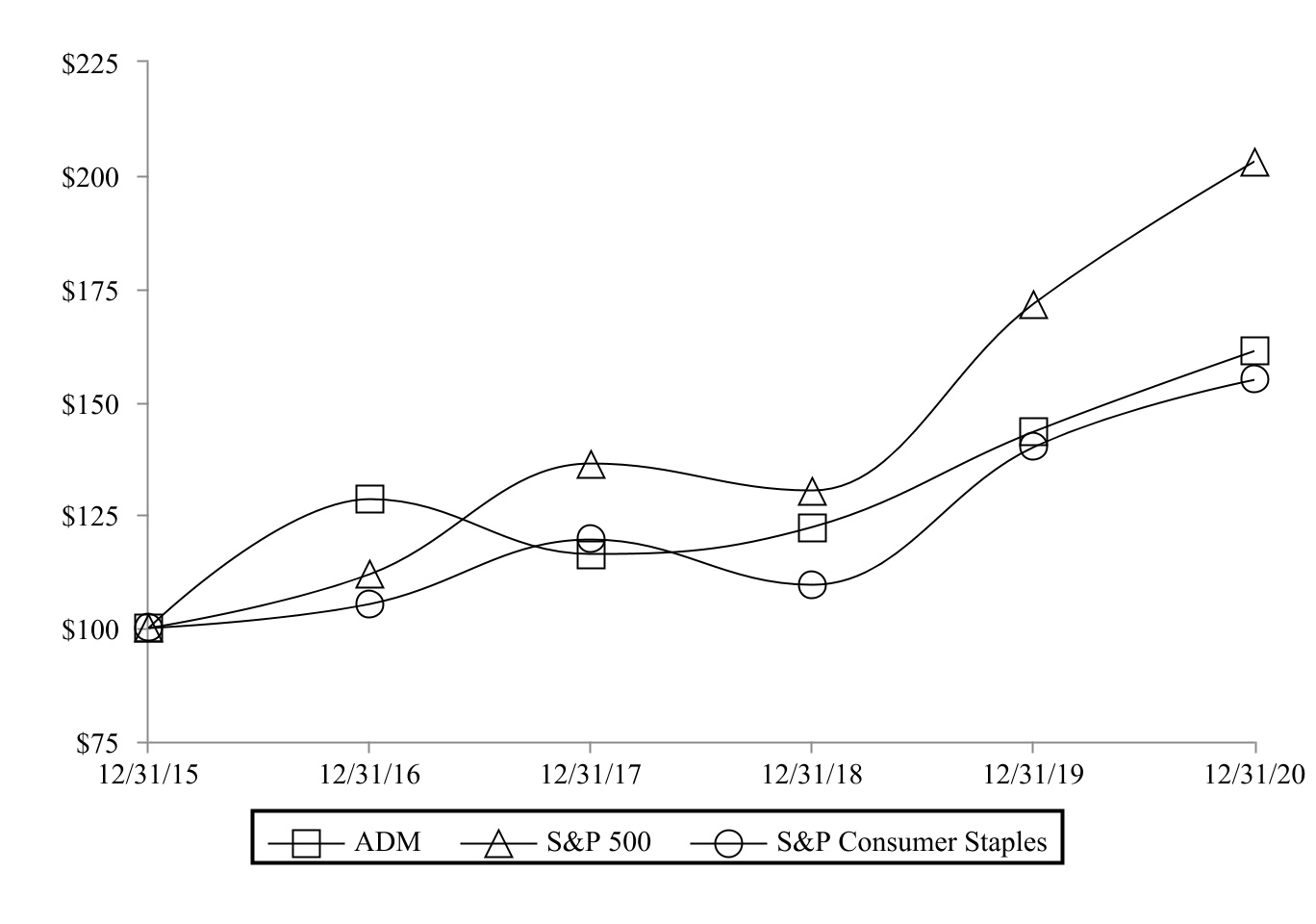
Index Data: Copyright© Standard and Poor’s, Inc.
Item 6. SELECTED FINANCIAL DATA
Selected Financial Data
(In millions, except ratio and per share data)
| Years Ended | |||||||||||||||||||||||||||||
| December 31 | |||||||||||||||||||||||||||||
| 2020 | 2019 | 2018 | 2017 | 2016 | |||||||||||||||||||||||||
| Revenues | $ | 64,355 | $ | 64,656 | $ | 64,341 | $ | 60,828 | $ | 62,346 | |||||||||||||||||||
| Depreciation | 803 | 827 | 812 | 802 | 787 | ||||||||||||||||||||||||
| Net earnings attributable to controlling interests | 1,772 | 1,379 | 1,810 | 1,595 | 1,279 | ||||||||||||||||||||||||
| Basic earnings per common share | 3.16 | 2.45 | 3.21 | 2.80 | 2.18 | ||||||||||||||||||||||||
| Diluted earnings per common share | 3.15 | 2.44 | 3.19 | 2.79 | 2.16 | ||||||||||||||||||||||||
| Cash dividends | 809 | 789 | 758 | 730 | 701 | ||||||||||||||||||||||||
| Per common share | 1.44 | 1.40 | 1.34 | 1.28 | 1.20 | ||||||||||||||||||||||||
| Working capital | 9,104 | 7,613 | 8,812 | 7,355 | 7,872 | ||||||||||||||||||||||||
| Current ratio | 1.5 | 1.6 | 1.7 | 1.6 | 1.6 | ||||||||||||||||||||||||
| Inventories | 11,713 | 9,170 | 8,813 | 9,173 | 8,831 | ||||||||||||||||||||||||
| Net property, plant, and equipment | 9,951 | 10,106 | 9,953 | 10,138 | 9,758 | ||||||||||||||||||||||||
| Gross additions to property, plant, and equipment | 817 | 817 | 845 | 1,100 | 882 | ||||||||||||||||||||||||
| Total assets | 49,719 | 43,997 | 40,833 | 39,963 | 39,769 | ||||||||||||||||||||||||
| Long-term debt, excluding current maturities | 7,885 | 7,672 | 7,698 | 6,623 | 6,504 | ||||||||||||||||||||||||
| Shareholders’ equity | 20,022 | 19,225 | 18,996 | 18,322 | 17,181 | ||||||||||||||||||||||||
| Per common share | 36.01 | 34.52 | 33.98 | 32.89 | 29.98 | ||||||||||||||||||||||||
| Weighted average shares outstanding-basic | 561 | 563 | 564 | 569 | 588 | ||||||||||||||||||||||||
| Weighted average shares outstanding-diluted | 563 | 565 | 567 | 572 | 591 |
Significant items affecting the comparability of the financial data shown above are as follows:
-
Net earnings attributable to controlling interests for the year ended December 31, 2020 included a credit of $91 million ($69 million after tax, equal to $0.12 per share) related to the elimination of the LIFO reserve in connection with the accounting change effective January 1, 2020; gains of $90 million ($80 million after tax, equal to $0.14 per share) primarily related to the sale of a portion of the Company’s shares in Wilmar and certain other assets; charges of $92 million ($69 million after tax, equal to $0.12 per share) related to the impairment of certain assets, restructuring, and settlement; charges of $409 million ($310 million after tax, equal to $0.55 per share) related to the early repurchase of certain of the Company’s debentures; charges of $17 million ($17 million after tax, equal to $0.03 per share) related to the mark-to-market adjustment of the conversion option of the exchangeable bonds issued in August 2020; expenses of $4 million ($3 million after tax, equal to $0.01 per share) related to a target acquisition; and a net tax benefit adjustment related to certain discrete items totaling $3 million (equal to $0.01 per share).
-
Net earnings attributable to controlling interests for the year ended December 31, 2019 included a net loss of $89 million ($124 million after tax, equal to $0.22 per share) related to the loss on sale of an equity investment partially offset by gains on sale of certain assets and a step-up gain on an equity investment; charges of $305 million ($249 million after tax, equal to $0.44 per share) consisting of restructuring and pension settlement and remeasurement charges primarily related to early retirement and reorganization initiatives in Corporate and impairments related to certain long-lived assets; expenses of $17 million ($11 million after tax, equal to $0.02 per share) primarily related to the Neovia acquisition; and tax expense adjustments related to certain discrete items totaling $39 million (equal to $0.07 per share).
| Item 6. SELECTED FINANCIAL DATA (Continued) |
-
Net earnings attributable to controlling interests for the year ended December 31, 2018 included net gains totaling $13 million ($13 million after tax, equal to $0.02 per share) related to the sale of businesses and assets; charges of $292 million ($226 million after tax, equal to $0.40 per share) consisting of a non-cash pension settlement charge related to the purchase of a group annuity contract that irrevocably transferred the future benefit obligations and annuity administration for certain retirees under the Company's ADM Retirement Plan, charges related to a discontinued software project, a long-term receivable, an equity investment, certain long-lived assets, and several individually insignificant asset impairment charges, restructuring charges in Corporate primarily related to the reorganization of IT services and several individually insignificant restructuring charges, and other settlement charges; charges of $8 million ($6 million after tax, equal to $0.01 per share) related to acquisition expenses and net losses on foreign currency derivative contracts to economically hedge certain acquisitions; and net tax benefits due to changes in the provisional transition tax amount related to the enactment of the Tax Cuts and Jobs Act and certain discrete items totaling $33 million (equal to $0.06 per share).
-
Net earnings attributable to controlling interests for the year ended December 31, 2017 included gains totaling $22 million ($10 million after tax loss, equal to $0.02 per share) primarily related to the sale of the crop risk services business partially offset by an adjustment of the proceeds of the 2015 sale of the cocoa business; charges of $214 million ($144 million after tax, equal to $0.25 per share) consisting of asset impairments related to the reconfiguration of the Company’s Peoria, Illinois ethanol complex, restructuring charges related to the reduction of certain positions within the Company’s global workforce, several individually insignificant asset impairments and restructuring charges, and provisions for contingent losses related to certain settlement items; a debt extinguishment charge of $11 million ($7 million after tax, equal to $0.01 per share) related to the early redemption of the Company’s $559 million notes due on March 15, 2018; and net tax benefits related to the Tax Cuts and Jobs Act and certain discrete tax adjustments totaling $366 million (eq
Showing the first 8K of 77K characters. Open the full section
Item 7. MANAGEMENT’S DISCUSSION AND ANALYSIS OF FINANCIAL CONDITION AND RESULTS OF OPERATIONS (Continued)
Liquidity and Capital Resources
A Company objective is to have sufficient liquidity, balance sheet strength, and financial flexibility to fund the operating and capital requirements of a capital intensive agricultural commodity-based business. The Company depends on access to credit markets, which can be impacted by its credit rating and factors outside of ADM’s control, to fund its working capital needs and capital expenditures. The primary source of funds to finance ADM’s operations, capital expenditures, and advancement of its growth strategy is cash generated by operations and lines of credit, including a commercial paper borrowing facility and accounts receivable securitization programs. In addition, the Company believes it has access to funds from public and private equity and debt capital markets in both U.S. and international markets.
Cash used in operating activities was $2.4 billion in 2020 compared to $5.5 billion in 2019. Working capital changes as described below, including the impact of deferred consideration, decreased cash by $5.5 billion in the current year compared to $7.7 billion in the prior year.
Trade receivables increased $0.1 billion primarily due to lower receivables sold. Inventories increased $2.4 billion primarily due to higher inventory prices. Other current assets and accrued expenses and other payables increased $2.1 billion and $1.3 billion, respectively, primarily due to increases in contracts and futures gains and losses. Trade payables increased $0.7 billion principally reflecting seasonal cash payments for North American harvest-related grain purchases. Payables to brokerage customers increased $1.4 billion due to increased customer trading activity in the Company’s futures commission and brokerage business.
Deferred consideration in securitized receivables of $4.6 billion and $7.7 billion in 2020 and 2019, respectively, was offset by the same amounts of net consideration received for beneficial interest obtained for selling trade receivables.
Cash provided by investing activities was $4.5 billion this year compared to $5.3 billion last year. Capital expenditures of $0.8 billion in the current year were comparable to last year. Net assets of businesses acquired were $15 million this year compared to $1.9 billion last year due to the acquisition of Neovia in 2019. Proceeds from sales of business and assets of $0.7 billion in the current year related to the sale of a portion of the Company shares in Wilmar and certain other assets compared to $0.3 billion in the prior year. Net consideration received for beneficial interest obtained for selling trade receivables was $4.6 billion and $7.7 billion in 2020 and 2019, respectively.
Cash used in financing activities was $0.4 billion this year compared to $0.7 billion last year. Long-term debt borrowings in the current year of $1.8 billion consisted of the $0.5 billion and $1.0 billion aggregate principal amounts of 2.75% Notes due in 2025 and 3.25% Notes due in 2030, respectively, issued on March 27, 2020 and the $0.3 billion aggregate principal amount of zero coupon exchangeable bonds due in 2023 issued on August 26, 2020. Proceeds from the borrowings in the current year were used for general corporate purposes, including the reduction of short-term debt. Commercial paper net borrowings were $0.8 billion in the current year compared to $0.9 billion in the prior year. Long-term debt payments in the current year of $2.1 billion related primarily to the early redemption of the $0.5 billion and $0.4 billion aggregate principal amounts of 4.479% debentures due in 2021 and 3.375% debentures due in 2022, respectively, the repurchase of $0.7 billion aggregate principal amount of certain outstanding notes and debentures, and the redemption of $0.2 billion aggregate principal amount of private placement notes due in 2021 and 2024. Long-term debt payments of $0.6 billion in the prior year related to the €500 million Floating Rate Notes that matured in June 2019. Share repurchases in the current year were $0.1 billion compared to $0.2 billion in the prior year. Dividends paid in the current year of $0.8 billion were comparable to the prior year.
At December 31, 2020, ADM had $0.7 billion of cash, cash equivalents, and short-term marketable securities and a current ratio, defined as current assets divided by current liabilities, of 1.5 to 1. Included in working capital is $7.9 billion of readily marketable commodity inventories. At December 31, 2020, the Company’s capital resources included shareholders’ equity of $20.0 billion and lines of credit, including the accounts receivable securitization programs described below, totaling $10.2 billion, of which $6.6 billion was unused. ADM’s ratio of long-term debt to total capital (the sum of long-term debt and shareholders’ equity) was 28% and 29% at December 31, 2020 and 2019, respectively. The Company uses this ratio as a measure of ADM’s long-term indebtedness and an indicator of financial flexibility. The Company’s ratio of net debt (the sum of short-term debt, current maturities of long-term debt, and long-term debt less the sum of cash and cash equivalents and short-term marketable securities) to capital (the sum of net debt and shareholders’ equity) was 32% and 29% at December 31, 2020 and 2019, respectively. Of the Company’s total lines of credit, $5.0 billion supported the commercial paper borrowing programs, against which there was $1.7 billion of commercial paper outstanding at December 31, 2020.
| Item 7. MANAGEMENT’S DISCUSSION AND ANALYSIS OF FINANCIAL CONDITION AND RESULTS OF OPERATIONS (Continued) |
COVID-19 has not significantly impacted ADM’s capital and financial resources, and pricing on its revolving credit facility remains unchanged. However, in line with the overall markets, COVID-19 created dislocations in the credit markets during certain periods in the first half of 2020 with corporate spreads increasing, partially offset by a decline in benchmark yields. The Company has utilized its diversified sources of liquidity, including its inventory financing and bilateral bank facilities, to ensure it has ample cash and is prepared for possible unexpected credit market disruptions. Additionally, ADM has been accepted into the Federal Reserve’s Commercial Paper Financing Facility and the Bank of England’s COVID Corporate Financing Facility ensuring uninterrupted access to both the U.S. and European commercial paper markets. The Federal Reserve’s Commercial Paper Financing Facility and the Bank of England’s COVID Corporate Financing Facility expire in March and June 2021, respectively, unless renewed. To date, the Company has not utilized these facilities.
During the second half of 2020, the global credit market stabilized with corporate credit spreads below pre-pandemic levels. Continued actions by central banks provided additional support in both the short-term and long-term funding markets further stabilizing corporate credit markets. Low benchmark yields and favorable credit spreads coupled with continued strong cash flow generation during the second half of the year presented opportunities for ADM to re-balance the company’s liability portfolio to pre-pandemic levels. Starting in June 2020, ADM began a series of liability management transactions including multiple early debt redemptions and the $0.7 billion debt tender in September 2020 to capitalize on all-time low interest rates.
As of December 31, 2020, the Company had $0.7 billion of cash and cash equivalents, $0.3 billion of which is cash held by foreign subsidiaries whose undistributed earnings are considered indefinitely reinvested. Based on the Company’s historical ability to generate sufficient cash flows from its U.S. operations and unused and available U.S. credit capacity of $4.0 billion, the Company has asserted that these funds are indefinitely reinvested outside the U.S.
The Company has accounts receivable securitization programs (the “Programs”) with certain commercial paper conduit purchasers and committed purchasers. The Programs provide the Company with up to $1.8 billion in funding against accounts receivable transferred into the Programs and expand the Company’s access to liquidity through efficient use of its balance sheet assets (see Note 19 in Item 8 for more information and disclosures on the Programs). As of December 31, 2020, the Company utilized $1.6 billion of its facility under the Programs.
On November 5, 2014, the Company’s Board of Directors approved a stock repurchase program authorizing the Company to repurchase up to 100,000,000 shares of the Company’s common stock during the period commencing January 1, 2015 and ending December 31, 2019. On August 7, 2019, the Company’s Board of Directors approved the extension of the stock repurchase program through December 31, 2024 and the repurchase of up to an additional 100,000,000 shares under the extended program. The Company has acquired approximately 95.5 million shares under this program as of December 31, 2020.
In 2021, the Company expects capital expenditures of $0.9 billion to $1.0 billion, and additional cash outlays of approximately $0.8 billion in dividends and up to $0.5 billion in share repurchases, subject to other strategic uses of capital.
The Company’s credit facilities and certain debentures require the Company to comply with specified financial and non-financial covenants including maintenance of minimum tangible net worth as well as limitations related to incurring liens, secured debt, and certain other financing arrangements. The Company was in compliance with these covenants as of December 31, 2020.
The three major credit rating agencies have maintained the Company’s credit ratings at solid investment grade levels with stable outlooks.
| Item 7. MANAGEMENT’S DISCUSSION AND ANALYSIS OF FINANCIAL CONDITION AND RESULTS OF OPERATIONS (Continued) |
Contractual Obligations
In the normal course of business, the Company enters into contracts and commitments which obligate the Company to make payments in the future. The following table sets forth the Company’s significant future obligations by time period. Purchases include commodity-based contracts entered into in the normal course of business, which are further described in Item 7A, “Quantitative and Qualitative Disclosures About Market Risk,” energy-related purchase contracts entered into in the normal course of business, and other purchase obligations related to the Company’s normal business activities. The following table does not include unrecognized income tax benefits of $151 million as of December 31, 2020 as the Company is unable to reasonably estimate the timing of settlement. Where applicable, information included in the Company’s consolidated financial statements and notes is cross-referenced in this table.
| Payments Due by Period | ||||||||||||||||||||||||||||||||
| Item 8. | ||||||||||||||||||||||||||||||||
| Contractual Obligations and | Note | Less than | 1 - 3 | 3 - 5 | More than | |||||||||||||||||||||||||||
| Other Commitments | Reference | Total | 1 Year | Years | Years | 5 Years | ||||||||||||||||||||||||||
| (In millions) | ||||||||||||||||||||||||||||||||
| Purchases | ||||||||||||||||||||||||||||||||
| Inventories | $ | 18,220 | $ | 17,915 | $ | 301 | $ | 4 | $ | — | ||||||||||||||||||||||
| Energy | 537 | 184 | 166 | 187 | — | |||||||||||||||||||||||||||
| Other | 940 | 553 | 158 | 41 | 188 | |||||||||||||||||||||||||||
| Total purchases | 19,697 | 18,652 | 625 | 232 | 188 | |||||||||||||||||||||||||||
| Short-term debt | 2,042 | 2,042 | — | — | — | |||||||||||||||||||||||||||
| Long-term debt | Note 10 | 7,887 | 2 | 1,061 | 1 | 6,823 | ||||||||||||||||||||||||||
| Estimated interest payments | 5,370 | 319 | 632 | 598 | 3,821 | |||||||||||||||||||||||||||
| One-time transition tax | Note 13 | 164 | 25 | 56 | 83 | — | ||||||||||||||||||||||||||
| Operating leases | Note 14 | 1,299 | 302 | 486 | 251 | 260 | ||||||||||||||||||||||||||
| Estimated pension and other postretirement plan contributions (1) | Note 15 | 151 | 45 | 29 | 27 | 50 | ||||||||||||||||||||||||||
| Total | $ | 36,610 | $ | 21,387 | $ | 2,889 | $ | 1,192 | $ | 11,142 |
(1) Includes pension contributions of $29 million for fiscal 2021. The Company is unable to estimate the amount of pension contributions beyond fiscal year 2021. For more information concerning the Company’s pension and other postretirement plans, see Note 15 in Item 8.
At December 31, 2020, the Company estimates it will spend approximately $1.7 billion through fiscal year 2025 to complete currently approved capital projects which are not included in the table above.
The Company also has outstanding letters of credit and surety bonds of $1.2 billion at December 31, 2020 which are not included in the table above.
The Company has entered into agreements, primarily debt guarantee agreements related to equity-method investees, which could obligate the Company to make future payments. The Company’s liability under these agreements is immaterial and arises only if the primary entity fails to perform its contractual obligation. The Company has collateral for a portion of these contingent obligations.
| Item 7. MANAGEMENT’S DISCUSSION AND ANALYSIS OF FINANCIAL CONDITION AND RESULTS OF OPERATIONS (Continued) |
Off Balance Sheet Arrangements
Accounts Receivable Securitization Programs
On April 1, 2020 and October 1, 2020, the Company restructured its accounts receivable securitization programs (Programs) from a deferred purchase price to a pledge structure. Under the new structure, ADM Ireland Receivables and ADM Receivables transfer a portion of the purchased accounts receivable together with an equally proportional interest in all of its right, title and interest in the remaining purchased accounts receivable to each of the commercial paper conduit purchasers and committed purchasers. In exchange, ADM Ireland Receivables and ADM Receivables receive a cash payment for the accounts receivables transferred. See Note 19 of “Notes to Consolidated Financial Statements” included in Item 8 herein, “Financial Statements and Supplementary Data” for more information and disclosures on the Programs
There were no other material changes in the Company’s off balance sheet arrangements during the year.
Critical Accounting Policies
The process of preparing financial statements requires management to make estimates and judgments that affect the carrying values of the Company’s assets and liabilities as well as the recognition of revenues and expenses. These estimates and judgments are based on the Company’s historical experience and management’s knowledge and understanding of current facts and circumstances. Certain of the Company’s accounting policies are considered critical, as these policies are important to the depiction of the Company’s financial statements and require significant or complex judgment by management. Management has discussed with the Company’s Audit Committee the development, selection, disclosure, and application of these critical accounting policies. Following are the accounting policies management considers critical to the Company’s financial statements.
Fair Value Measurements - Inventories and Commodity Derivatives
Certain of the Company’s inventory and commodity derivative assets and liabilities as of December 31, 2020 are valued at estimated fair values, including $7.9 billion of merchandisable agricultural commodity inventories, $2.8 billion of commodity derivative assets, $2.0 billion of commodity derivative liabilities, and $0.5 billion of inventory-related payables. Commodity derivative assets and liabilities include forward fixed-price purchase and sale contracts for agricultural commodities. Merchandisable agricultural commodities are freely traded, have quoted market prices, and may be sold without significant additional processing. Management estimates fair value for its commodity-related assets and liabilities based on exchange-quoted prices, adjusted for differences in local markets. The Company’s inventory and derivative commodity fair value measurements are mainly based on observable market quotations without significant adjustments and are therefore reported as Level 2 within the fair value hierarchy. Level 3 fair value measurements of approximately $3.0 billion of assets and $0.9 billion of liabilities represent fair value estimates where unobservable price components represent 10% or more of the total fair value price. For more information concerning amounts reported as Level 3, see Note 4 in Item 8. Changes in the market values of these inventories and commodity contracts are recognized in the statement of earnings as a component of cost of products sold. If management used different methods or factors to estimate market value, amounts reported as inventories and cost of products sold could differ materially. Additionally, if market conditions change subsequent to year-end, amounts reported in future periods as inventories and cost of products sold could differ materially.
Derivatives – Designated Hedging Activities
The Company, from time to time, uses derivative contracts designated as cash flow hedges to hedge the purchase or sales price of anticipated volumes of commodities to be purchased and processed in a future month. Assuming normal market conditions, the change in the market value of such derivative contracts has historically been, and is expected to continue to be, highly effective at offsetting changes in price movements of the hedged item. Gains and losses arising from open and closed hedging transactions are deferred in accumulated other comprehensive income, net of applicable income taxes, and recognized as a component of cost of products sold and revenues in the statement of earnings when the hedged item is recognized in earnings. If it is determined that the derivative instruments used are no longer effective at offsetting changes in the price of the hedged item, then the changes in the market value of these exchange-traded futures and exchange-traded and over-the-counter option contracts would be recorded immediately in the statement of earnings as a component of revenues and/or cost of products sold. See Note 5 in Item 8 for additional information.
| Item 7. MANAGEMENT’S DISCUSSION AND ANALYSIS OF FINANCIAL CONDITION AND RESULTS OF OPERATIONS (Continued) |
Investments in Affiliates
The Company applies the equity method of accounting for investments over which the Company has the ability to exercise significant influence. These investments are carried at cost plus equity in undistributed earnings and are adjusted, where appropriate, for amortizable basis differences between the investment balance and the underlying net assets of the investee. Generally, the minimum ownership threshold for asserting significant influence is 20% ownership of the investee. However, the Company considers all relevant factors in determining its ability to assert significant influence including, but not limited to, ownership percentage, board membership, customer and vendor relationships, and other arrangements. If management used a different accounting method for these investments, then the amount of earnings from affiliates the Company recognizes may materially differ.
Income Taxes
The Company accounts for income taxes in accordance with the applicable accounting standards. These standards prescribe a minimum threshold a tax position is required to meet before being recognized in the consolidated financial statements. The Company recognizes in its consolidated financial statements tax positions determined more likely than not to be sustained upon examination, based on the technical merits of the position. The Company faces challenges from U.S. and foreign tax authorities regarding the amount of taxes due. These challenges include questions regarding the timing and amount of deductions and the allocation of income among various tax jurisdictions. In evaluating the exposure associated with various tax filing positions, the Company records reserves for estimates of potential additional tax owed by the Company. For example, the Company has received tax assessments from tax authorities in Argentina and the Netherlands, challenging income tax positions taken by subsidiaries of the Company. The Company evaluated its tax positions for these matters and concluded, based in part upon advice from legal counsel, that it was appropriate to recognize the tax benefits of these positions (see Note 13 in Item 8 for additional information).
Deferred tax assets represent items to be used as tax deductions or credits in future tax returns where the related tax benefit has already been recognized in the Company’s income statement. The realization of the Company’s deferred tax assets is dependent upon future taxable income in specific tax jurisdictions, the timing and amount of which are uncertain. The Company evaluates all available positive and negative evidence including estimated future reversals of existing temporary differences, projected future taxable income, tax planning strategies, and recent financial results. Valuation allowances related to these deferred tax assets have been established to the extent the realization of the tax benefit is not likely. During 2020, the Company increased valuation allowances by approximately $14 million primarily related to capital loss carryforwards. To the extent the Company were to favorably resolve matters for which valuation allowances have been established or be required to pay amounts in excess of the aforementioned valuation allowances, the Company’s effective tax rate in a given financial statement period may be impacted.
Undistributed earnings of the Company’s foreign subsidiaries and corporate joint ventures amounting to approximately $12.5 billion at December 31, 2020, are considered to be indefinitely reinvested.
The Company has a responsibility to ensure that all ADM businesses within the Company follow responsible tax practices. ADM manages its tax affairs based upon the following key principles:
–a commitment to paying tax in compliance with all applicable laws and regulations in the jurisdictions in which the Company operates;
–a commitment to the effective, sustainable, and active management of the Company's tax affairs; and
–developing and sustaining open and honest relationships with the governments and jurisdictions in which the Company operates regarding the formulation of tax laws.
| Item 7. MANAGEMENT’S DISCUSSION AND ANALYSIS OF FINANCIAL CONDITION AND RESULTS OF OPERATIONS (Continued) |
Property, Plant, and Equipment and Asset Abandonments and Write-Downs
The Company is principally engaged in the business of procuring, transporting, storing, processing, and merchandising agricultural commodities and products. This business is global in nature and is highly capital-intensive. Both the availability of the Company’s raw materials and the demand for the Company’s finished products are driven by factors such as weather, plantings, government programs and policies, changes in global demand, changes in standards of living, and global production of similar and competitive crops. These aforementioned factors may cause a shift in the supply/demand dynamics for the Company’s raw materials and finished products. Any such shift will cause management to evaluate the efficiency and cash flows of the Company’s assets in terms of geographic location, size, and age of its facilities. The Company, from time to time, will also invest in equipment, technology, and companies related to new, value-added products produced from agricultural commodities and products. These new products are not always successful from either a commercial production or marketing perspective. Management evaluates the Company’s property, plant, and equipment for impairment whenever indicators of impairment exist. In addition, assets are written down to fair value after consideration of the ability to utilize the assets for their intended purpose or to employ the assets in alternative uses or sell the assets to recover the carrying value. If management used different estimates and assumptions in its evaluation of these assets, then the Company could recognize different amounts of expense over future periods. During 2020, the Company temporarily idled certain of its corn processing assets where ethanol is produced and performed a quantitative impairment assessment of those assets, resulting in no impairment charges. The total carrying value of the temporarily idled assets as of December 31, 2020 was immaterial. During the years ended December 31, 2020, 2019, and 2018, asset abandonment and impairment charges for property, plant, and equipment were $28 million, $131 million, and $100 million, respectively.
Business Combinations
The Company’s acquisitions are accounted for in accordance with Accounting Standards Codification (ASC) Topic 805, Business Combinations, as amended*.* The consideration transferred is allocated to various assets acquired and liabilities assumed at their estimated fair values as of the acquisition date with the residual allocated to goodwill. Fair values allocated to assets acquired and liabilities assumed in business combinations require management to make significant judgments, estimates, and assumptions, especially with respect to intangible assets. Management makes estimates of fair values based upon assumptions it believes to be reasonable. These estimates are based upon historical experience and information obtained from the management of the acquired companies and are inherently uncertain. The estimated fair values related to intangible assets primarily consist of customer relationships, trademarks, and developed technology which are determined primarily using discounted cash flow models. Estimates in the discounted cash flow models include, but are not limited to, certain assumptions that form the basis of the forecasted results (e.g. revenue growth rates, customer attrition rates, and royalty rates). These significant assumptions are forward looking and could be affected by future economic and market conditions. During the measurement period, which may take up to one year from the acquisition date, adjustments due to changes in the estimated fair value of assets acquired and liabilities assumed may be recorded as adjustments to the consideration transferred and related allocations. Upon the conclusion of the measurement period or the final determination of the values of assets acquired and liabilities assumed, whichever comes first, any such adjustments are charged to the consolidated statements of earnings.
| Item 7. MANAGEMENT’S DISCUSSION AND ANALYSIS OF FINANCIAL CONDITION AND RESULTS OF OPERATIONS (Continued) |
Goodwill and Other Intangible Assets
Goodwill and intangible assets deemed to have indefinite lives are not amortized but are subject to annual impairment tests. The Company evaluates goodwill for impairment at the reporting unit level annually on October 1 or whenever there are indicators that the carrying value may not be fully recoverable. The Company adopted the provisions of ASC 350, Intangibles - Goodwill and Other, which permits, but does not require, a company to qualitatively assess indicators of a reporting unit’s fair value. If after completing the qualitative assessment, a company believes it is likely that a reporting unit is impaired, a discounted cash flow analysis is prepared to estimate fair value. Critical estimates in the determination of the fair value of each reporting unit include, but are not limited to, future expected cash flows and discount rates. During the year ended December 31, 2020, the Company evaluated goodwill for impairment using a qualitative assessment in six reporting units and using a quantitative assessment in one reporting unit. The estimated fair value of the reporting unit evaluated for impairment using a quantitative assessment was substantially in excess of its carrying value. Definite-lived intangible assets, including capitalized expenses related to the Company’s 1ADM program, are amortized over their estimated useful lives of 1 to 50 years and are reviewed for impairment whenever there are indicators that the carrying values may not be fully recoverable. The Company recorded impairment charges totaling $26 million related to customer lists, $11 million related to goodwill and intangibles, and $9 million related customer lists during the years ended December 31, 2020, 2019, and 2018, respectively (see Note 18 in Item 8 for more information). If management used different estimates and assumptions in its impairment tests, then the Company could recognize different amounts of expense over future periods.
Employee Benefit Plans
The Company provides substantially all U.S. employees and employees at certain international subsidiaries with retirement benefits including defined benefit pension plans and defined contribution plans. The Company provides certain eligible U.S. employees who retire under qualifying conditions with subsidized postretirement health care coverage or Health Care Reimbursement Accounts.
In order to measure the expense and funded status of these employee benefit plans, management makes several estimates and assumptions, including interest rates used to discount certain liabilities, rates of return on assets set aside to fund these plans, rates of compensation increases, employee turnover rates, anticipated mortality rates, and anticipated future health care costs. These estimates and assumptions are based on the Company’s historical experience combined with management’s knowledge and understanding of current facts and circumstances. Management also uses third-party actuaries to assist in measuring the expense and funded status of these employee benefit plans. If management used different estimates and assumptions regarding these plans, the funded status of the plans could vary significantly, and the Company could recognize different amounts of expense over future periods.
The Company uses the corridor approach when amortizing actuarial losses. Under the corridor approach, net unrecognized actuarial losses in excess of 10% of the greater of the projected benefit obligation or the market related value of plan assets are amortized over future periods. For plans with little to no active participants, the amortization period is the remaining average life expectancy of the participants. For plans with active participants, the amortization period is the remaining average service period of the active participants. The amortization periods range from 2 to 36 years for the Company’s defined benefit pension plans and from 6 to 24 years for the Company’s postretirement benefit plans.
| Item 7A. QUANTITATIVE AND QUALITATIVE DISCLOSURES ABOUT MARKET RISK |
The market risk inherent in the Company’s market risk sensitive instruments and positions is the potential loss arising from adverse changes in: commodity market prices as they relate to the Company’s net commodity position, foreign currency exchange rates, and interest rates as described below.
Commodities
The availability and prices of agricultural commodities are subject to wide fluctuations due to factors such as changes in weather conditions, crop disease, plantings, government programs and policies, competition, changes in global demand, changes in customer preferences and standards of living, and global production of similar and competitive crops.
Item 7A. QUANTITATIVE AND QUALITATIVE DISCLOSURES ABOUT MARKET RISK (Continued)
The Company manages its exposure to adverse price movements of agricultural commodities used for, and produced in, its business operations, by entering into derivative and non-derivative contracts which reduce the Company’s overall short or long commodity position. Additionally, the Company uses exchange-traded futures and exchange-traded and over-the-counter option contracts as components of merchandising strategies designed to enhance margins. The results of these strategies can be significantly impacted by factors such as the correlation between the value of exchange-traded commodities futures contracts and the cash prices of the underlying commodities, counterparty contract defaults, and volatility of freight markets. In addition, the Company, from time-to-time, enters into derivative contracts which are designated as hedges of specific volumes of commodities that will be purchased and processed, or sold, in a future month. The changes in the market value of such futures contracts have historically been, and are expected to continue to be, highly effective at offsetting changes in price movements of the hedged item. Gains and losses arising from open and closed designated hedging transactions are deferred in other comprehensive income, net of applicable taxes, and recognized as a component of cost of products sold or revenues in the statement of earnings when the hedged item is recognized.
The Company’s commodity position consists of merchandisable agricultural commodity inventories, related purchase and sales contracts, energy and freight contracts, and exchange-traded futures and exchange-traded and over-the-counter option contracts including contracts used to hedge portions of production requirements, net of sales.
The fair value of the Company’s commodity position is a summation of the fair values calculated for each commodity by valuing all of the commodity positions at quoted market prices for the period, where available, or utilizing a close proxy. The Company has established metrics to monitor the amount of market risk exposure, which consist of volumetric limits, and value-at-risk (VaR) limits. VaR measures the potential loss, at a 95% confidence level, that could be incurred over a one year period. Volumetric limits are monitored daily and VaR calculations and sensitivity analysis are monitored weekly.
In addition to measuring the hypothetical loss resulting from an adverse two standard deviation move in market prices (assuming no correlations) over a one year period using VaR, sensitivity analysis is performed measuring the potential loss in fair value resulting from a hypothetical 10% adverse change in market prices. The highest, lowest, and average weekly position for the years ended December 31, 2020 and 2019 together with the market risk from a hypothetical 10% adverse price change is as follows:
| December 31, 2020 | December 31, 2019 | |||||||||||||||||||||||||
| Long/(Short) | Fair Value | Market Risk | Fair Value | Market Risk | ||||||||||||||||||||||
| (In millions) | ||||||||||||||||||||||||||
| Highest position | $ | 966 | $ | 97 | $ | 576 | $ | 58 | ||||||||||||||||||
| Lowest position | (842) | (84) | (83) | (8) | ||||||||||||||||||||||
| Average position | 111 | 11 | 280 | 28 |
The change in fair value of the average position was principally the result of a decrease in quantities.
Currencies
The Company has consolidated subsidiaries in more than 70 countries. For the majority of the Company’s subsidiaries located outside the United States, the local currency is the functional currency except certain significant subsidiaries in Switzerland where Euro is the functional currency, and Brazil and Argentina where U.S. dollar is the functional currency. To reduce the risks associated with foreign currency exchange rate fluctuations, the Company enters into currency exchange contracts to minimize its foreign currency position related to transactions denominated primarily in Euro, British pound, Canadian dollar, and Brazilian real currencies. These currencies represent the major functional or local currencies in which recurring business transactions occur. The Company also uses currency exchange contracts as hedges against amounts indefinitely invested in foreign subsidiaries and affiliates. The currency exchange contracts used are forward contracts, swaps with banks, exchange-traded futures contracts, and over-the-counter options. The changes in market value of such contracts have a high correlation to the price changes in the currency of the related transactions. The potential loss in fair value for such net currency position resulting from a hypothetical 10% adverse change in foreign currency exchange rates is not material.
| Item 7A. QUANTITATIVE AND QUALITATIVE DISCLOSURES ABOUT MARKET RISK (Continued) |
The amount the Company considers indefinitely invested in foreign subsidiaries and corporate joint ventures translated into dollars using the year-end exchange rates is $10.5 billion and $9.6 billion ($12.5 billion and $11.6 billion at historical rates) at December 31, 2020 and 2019, respectively. The increase is due to the increase in retained earnings of the foreign subsidiaries of $1.0 billion. The potential loss in fair value, which would principally be recognized in Other Comprehensive Income, resulting from a hypothetical 10% adverse change in quoted foreign currency exchange rates is $1.3 billion and $1.2 billion for December 31, 2020 and 2019, respectively. Actual results may differ.
Interest
The fair value of the Company’s long-term debt is estimated using quoted market prices, where available, and discounted future cash flows based on the Company’s current incremental borrowing rates for similar types of borrowing arrangements. Such fair value exceeded the long-term debt carrying value. Market risk is estimated as the potential increase in fair value resulting from a hypothetical 50 basis points decrease in interest rates. Actual results may differ.
| December 31, 2020 | December 31, 2019 | ||||||||||
| (In millions) | |||||||||||
| Fair value of long-term debt | $ | 9,487 | $ | 9,211 | |||||||
| Excess of fair value over carrying value | 1,602 | 1,540 | |||||||||
| Market risk | 441 | 420 |
The increase in the fair value of long-term debt at December 31, 2020 is primarily due to decreased interest rates and increased borrowings.
Item 8. FINANCIAL STATEMENTS AND SUPPLEMENTARY DATA
| Financial Statements | Page No. | ||||
| Consolidated Statements of Earnings | 58 | ||||
| Consolidated Statements of Comprehensive Income (Loss) | 59 | ||||
| Consolidated Balance Sheets | 60 | ||||
| Consolidated Statements of Cash Flows | 61 | ||||
| Consolidated Statements of Shareholders’ Equity | 62 | ||||
| Notes to Consolidated Financial Statements | 63 | ||||
| Reports of Independent Registered Public Accounting Firm | 119 |
Archer-Daniels-Midland Company
Consolidated Statements of Earnings
| Year Ended | |||||||||||||||||
| (In millions, except per share amounts) | December 31 | ||||||||||||||||
| 2020 | 2019 | 2018 | |||||||||||||||
| Revenues | $ | 64,355 | $ | 64,656 | $ | 64,341 | |||||||||||
| Cost of products sold | 59,902 | 60,509 | 60,160 | ||||||||||||||
| Gross Profit | 4,453 | 4,147 | 4,181 | ||||||||||||||
| Selling, general and administrative expenses | 2,687 | 2,493 | 2,165 | ||||||||||||||
| Asset impairment, exit, and restructuring costs | 80 | 303 | 171 | ||||||||||||||
| Interest expense | 339 | 402 | 364 | ||||||||||||||
| Equity in earnings of unconsolidated affiliates | (579) | (454) | (518) | ||||||||||||||
| Loss on debt extinguishment | 409 | — | — | ||||||||||||||
| Interest income | (88) | (192) | (162) | ||||||||||||||
| Other (income) expense - net | (278) | 7 | 101 | ||||||||||||||
| Earnings Before Income Taxes | 1,883 | 1,588 | 2,060 | ||||||||||||||
| Income tax expense | 101 | 209 | 245 | ||||||||||||||
| Net Earnings Including Noncontrolling Interests | 1,782 | 1,379 | 1,815 | ||||||||||||||
| Less: Net earnings (losses) attributable to noncontrolling interests | 10 | — | 5 | ||||||||||||||
| Net Earnings Attributable to Controlling Interests | $ | 1,772 | $ | 1,379 | $ | 1,810 | |||||||||||
| Average number of shares outstanding – basic | 561 | 563 | 564 | ||||||||||||||
| Average number of shares outstanding – diluted | 563 | 565 | 567 | ||||||||||||||
| Basic earnings per common share | $ | 3.16 | $ | 2.45 | $ | 3.21 | |||||||||||
| Diluted earnings per common share | $ | 3.15 | $ | 2.44 | $ | 3.19 |
See notes to consolidated financial statements.
Archer-Daniels-Midland Company
Consolidated Statements of Comprehensive Income (Loss)
| Year Ended | |||||||||||||||||
| (In millions) | December 31 | ||||||||||||||||
| 2020 | 2019 | 2018 | |||||||||||||||
| Net earnings including noncontrolling interests | $ | 1,782 | $ | 1,379 | $ | 1,815 | |||||||||||
| Other comprehensive income (loss): | |||||||||||||||||
| Foreign currency translation adjustment | (362) | (176) | (581) | ||||||||||||||
| Tax effect | 97 | (12) | (28) | ||||||||||||||
| Net of tax amount | (265) | (188) | (609) | ||||||||||||||
| Pension and other postretirement benefit liabilities adjustment | (113) | (98) | 156 | ||||||||||||||
| Tax effect | 16 | 50 | (55) | ||||||||||||||
| Net of tax amount | (97) | (48) | 101 | ||||||||||||||
| Deferred gain (loss) on hedging activities | 254 | (91) | 57 | ||||||||||||||
| Tax effect | (57) | 18 | (13) | ||||||||||||||
| Net of tax effect | 197 | (73) | 44 | ||||||||||||||
| Unrealized gain (loss) on investments | (27) | 13 | (4) | ||||||||||||||
| Tax effect | — | (1) | (1) | ||||||||||||||
| Net of tax effect | (27) | 12 | (5) | ||||||||||||||
| Other comprehensive income (loss) | (192) | (297) | (469) | ||||||||||||||
| Comprehensive income (loss) | 1,590 | 1,082 | 1,346 | ||||||||||||||
| Less: Comprehensive income (loss) attributable to noncontrolling interests | 17 | 2 | 5 | ||||||||||||||
| Comprehensive income (loss) attributable to controlling interests | $ | 1,573 | $ | 1,080 | $ | 1,341 |
See notes to consolidated financial statements.
Archer-Daniels-Midland Company
Consolidated Balance Sheets
| (In millions) | December 31, 2020 | December 31, 2019 | |||||||||
| Assets | |||||||||||
| Current Assets | |||||||||||
| Cash and cash equivalents | $ | 666 | $ | 852 | |||||||
| Segregated cash and investments | 5,890 | 4,458 | |||||||||
| Trade receivables - net | 2,793 | 2,267 | |||||||||
| Inventories | 11,713 | 9,170 | |||||||||
| Other current assets | 6,224 | 4,600 | |||||||||
| Total Current Assets | 27,286 | 21,347 | |||||||||
| Investments and Other Assets | |||||||||||
| Investments in and advances to affiliates | 4,913 | 5,132 | |||||||||
| Good |
Showing the first 8K of 267K characters. Open the full section
Item 9. CHANGES IN AND DISAGREEMENTS WITH ACCOUNTANTS ON ACCOUNTING AND FINANCIAL DISCLOSURE
None.
Item 9A. CONTROLS AND PROCEDURES
As of December 31, 2020, an evaluation was performed under the supervision and with the participation of the Company’s management, including the Chief Executive Officer and Chief Financial Officer, of the effectiveness of the design and operation of the Company’s “disclosure controls and procedures” (as defined in Rules 13a-15(e) and 15d-15(e) under the Securities Exchange Act of 1934 (the “Exchange Act”)). Based on that evaluation, the Company’s management, including the Chief Executive Officer and Chief Financial Officer, concluded the Company’s disclosure controls and procedures were effective to ensure that information required to be disclosed by the Company in reports that it files or submits under the Exchange Act is (i) recorded, processed, summarized and reported within the time periods specified in Securities and Exchange Commission rules and forms and (ii) accumulated and communicated to the Company’s management, including the Chief Executive Officer and Chief Financial Officer, to allow timely decisions regarding required disclosure.
During 2018, the Company launched Readiness to drive new efficiencies and improve the customer experience in the Company’s existing businesses through a combination of data analytics, process simplification and standardization, and behavioral and cultural change, building upon its earlier 1ADM and operational excellence programs. As part of this transformation, the Company is implementing a new enterprise resource planning (“ERP”) system on a worldwide basis, which is expected to occur in phases over the next several years. The Company continues to consider these changes in its design of and testing for effectiveness of internal controls over financial reporting and concluded, as part of the evaluation described in the above paragraph, that the implementation of the new ERP in these circumstances has not materially affected its internal control over financial reporting.
MANAGEMENT’S REPORT ON INTERNAL CONTROL OVER FINANCIAL REPORTING
Archer-Daniels-Midland Company’s management is responsible for establishing and maintaining adequate internal control over financial reporting, as such term is defined in Exchange Act Rules 13a-15(f). The Company’s internal control system is designed to provide reasonable assurance regarding the reliability of financial reporting and the preparation of financial statements in accordance with generally accepted accounting principles.
Under the supervision and with the participation of management, including its Chief Executive Officer and Chief Financial Officer, the Company’s management assessed the design and operating effectiveness of internal control over financial reporting as of December 31, 2020 based on the framework set forth in Internal Control-Integrated Framework issued by the Committee of Sponsoring Organizations of the Treadway Commission (2013 Framework). Based on this assessment, management concluded that the Company’s internal control over financial reporting was effective as of December 31, 2020.
Ernst & Young LLP, an independent registered public accounting firm, has issued an attestation report on the Company’s internal control over financial reporting as of December 31, 2020. That report is included herein.
| /s/ Juan R. Luciano Juan R. Luciano Chairman, Chief Executive Officer, and President | /s/ Ray G. Young Ray G. Young Executive Vice President and Chief Financial Officer |
Item 9B. OTHER INFORMATION
None.
PART III
Item 10. DIRECTORS, EXECUTIVE OFFICERS AND CORPORATE GOVERNANCE
Information with respect to directors, code of conduct, audit committee and audit committee financial experts of the Company, and Section 16(a) beneficial ownership reporting compliance is set forth in “Proposal No. 1 - Election of Directors for a One-Year Term,” “Director Experiences, Qualifications, Attributes, and Skills; Board Diversity,” “Code of Conduct,” “Information Concerning Committees and Meetings – Audit Committee,” and “Report of the Audit Committee,” of the definitive proxy statement for the Company’s annual meeting of stockholders to be filed on or before April 30, 2021 and is incorporated herein by reference.
Officers of the Company are elected by the Board of Directors for terms of one year and until their successors are duly elected and qualified.
Information with respect to executive officers and certain significant employees of the Company is set forth below. Except as otherwise indicated, all positions are with the Company.
| Name | Titles | Age | |||||||||||||||
| Benjamin I. Bard | Global Chief Compliance Officer since January 2014. | 47 | |||||||||||||||
| Camille Batiste | President, Global Supply Chain since January 2020. President, Nutrition Optimization since June 2019. Vice President, Global Procurement from March 2017 to June 2019. Vice President, Sourcing Operations & Compliance at Honeywell Aerospace from March 2015 to March 2017. | 49 | |||||||||||||||
| Veronica L. Braker | Senior Vice President, Global Operations since April 2019. Executive Champion of Global Safety since January 2020. Vice President of Operations - Performance Materials at BASF from April 2017 to March 2019. Head of Operations for North America - Performance Materials at BASF from January 2014 to April 2017. | 53 | |||||||||||||||
| Christopher M. Cuddy | Senior Vice President of the Company since May 2015. President, Carbohydrate Solutions business unit since March 2015. | 47 | |||||||||||||||
| Pierre-Christophe Duprat | President, Animal Nutrition since August 2018. President, ADM Europe, Middle East, and Africa (EMEA) from June 2016 to August 2018. President, ADM Corn EMEA and Asia since November 2015. | 53 | |||||||||||||||
| D. Cameron Findlay | Senior Vice President, General Counsel, and Secretary since July 2013. | 61 | |||||||||||||||
| Kristy Folkwein | Senior Vice President of the Company since March 2018. Chief Technology Officer since January 2020. Chief Information Officer from March 2018 to January 2020. Vice President and Chief Information Officer from June 2016 to March 2018. Senior Vice President and Chief Information Officer, Global Business Services at Dow Corning from June 2010 to June 2016. | 58 | |||||||||||||||
| Leticia Goncalves | President, Global Specialty Ingredients since January 2020. Senior Vice President and U.S. Division Head at Bayer from September 2018 to January 2020. President, Europe and Middle East at Monsanto from August 2014 to August 2018. | 46 | |||||||||||||||
| Shannon Herzfeld | Vice President of the Company since February 2005, with responsibility for the Company’s Government Affairs function. | 68 | |||||||||||||||
| Domingo Lastra | President, South America since July 2017. Vice President, Integration and Strategy from March 2016 to July 2017. Managing Director, Agricultural Services International from June 2014 to February 2016. | 52 | |||||||||||||||
| Patricia L. Logan | Chief Audit Executive since August 2014. | 61 | |||||||||||||||
| Juan R. Luciano | Chairman of the Board of Directors since January 2016. Chief Executive Officer and President since January 2015. | 59 | |||||||||||||||
| Item 10. DIRECTORS, EXECUTIVE OFFICERS AND CORPORATE GOVERNANCE (Continued) |
| Vikram Luthar | Senior Vice President of the Company since March 2015. Chief Financial Officer, Nutrition since January 2020. President, Health & Wellness from March 2018 to January 2020. President, Bioactives from February 2017 to March 2018. President, Enzymes from December 2015 to February 2017. CFO, Corn Processing business unit from March 2014 to February 2017. | 54 | |||||||||||||||
| Vincent F. Macciocchi | Senior Vice President of the Company and President, Nutrition business unit since May 2015. Chief Sales and Marketing Officer since January 2020. | 55 | |||||||||||||||
| Gregory A. Morris | Senior Vice President of the Company since November 2014. President, Ag Services & Oilseeds business unit since July 2019. President, Global Oilseeds Processing business unit from May 2015 to June 2019. | 49 | |||||||||||||||
| Ian Pinner | Senior Vice President of the Company since January 2020. Chief Strategy and Innovation Officer and President, Health and Wellness since January 2020. Vice President, Growth and Strategy from August 2018 to January 2020. Chief Growth Officer from July 2017 to August 2018. President, Southeast Asia and Global Destination Marketing from December 2015 to July 2017. | 48 | |||||||||||||||
| Ismael Roig | Senior Vice President of the Company since December 2015. President, ADM Europe, Middle East, and Africa (EMEA) since August 2018. Chief Strategy Officer from December 2015 to August 2018. Chief Sustainability Officer from May 2015 to March 2017. | 53 | |||||||||||||||
| John P. Stott | Group Vice President, Finance and Corporate Controller since August 2014. | 53 | |||||||||||||||
| Joseph D. Taets | Senior Vice President of the Company since August 2011. Executive Champion for Quality and Food Safety since January 2020. President, Global Business Readiness since March 2018. President, Agricultural business unit from August 2011 to March 2018. President, ADM Europe, Middle East, and Africa (EMEA) from August 2013 to June 2016. | 55 | |||||||||||||||
| Thuy-Nga T. Vo | Chief Counsel, Corporate, Securities, and Mergers and Acquisitions and Assistant Secretary since January 2017. Chief Counsel, Mergers and Acquisitions from May 2013 to January 2017. | 56 | |||||||||||||||
| Jennifer L. Weber | Senior Vice President and Chief Human Resources Officer since August 2020. Executive Vice President - Human Resources at Lowe’s Companies, Inc. from March 2016 to April 2020. Executive Vice President & Chief Human Resources Officer at Duke Energy from November 2008 to February 2016. | 54 | |||||||||||||||
| Todd Werpy | Senior Vice President and Chief Science Officer since January 2020. Senior Vice President and Chief Technology Officer from March 2015 to January 2020. | 58 | |||||||||||||||
| Ray G. Young | Executive Vice President of the Company since March 2015. Chief Financial Officer since December 2010. | 59 |
Item 11. EXECUTIVE COMPENSATION
Information responsive to this Item is set forth in “Compensation Discussion and Analysis,” “Compensation/Succession Committee Report,” “Compensation/Succession Committee Interlocks and Insider Participation,” “Summary Compensation Table,” “Grants of Plan-Based Awards During Fiscal Year 2020,” “Outstanding Equity Awards at Fiscal Year 2020 Year-End,” “Option Exercises and Stock Vested During Fiscal Year 2020,” “Pension Benefits,” “Nonqualified Deferred Compensation,” “Termination of Employment and Change-in-Control Arrangements,” “CEO Pay Ratio,” and “Director Compensation” of the definitive proxy statement for the Company’s annual meeting of stockholders to be filed on or before April 30, 2021, and is incorporated herein by reference.
Item 12. SECURITY OWNERSHIP OF CERTAIN BENEFICIAL OWNERS AND MANAGEMENT AND RELATED STOCKHOLDER MATTERS
Information responsive to this Item is set forth in “Principal Holders of Voting Securities,” “Proposal No. 1 - Election of Directors for a One-Year Term,” “Executive Officer Stock Ownership,” and “Equity Compensation Plan Information at December 31, 2020” of the definitive proxy statement for the Company’s annual meeting of stockholders to be filed on or before April 30, 2021, and is incorporated herein by reference.
Item 13. CERTAIN RELATIONSHIPS AND RELATED TRANSACTIONS, AND DIRECTOR INDEPENDENCE
Information responsive to this Item is set forth in “Certain Relationships and Related Transactions,” “Review and Approval of Certain Relationships and Related Transactions,” and “Independence of Directors” of the definitive proxy statement for the Company’s annual meeting of stockholders to be filed on or before April 30, 2021, and is incorporated herein by reference.
Item 14. PRINCIPAL ACCOUNTING FEES AND SERVICES
Information responsive to this Item is set forth in “Fees Paid to Independent Auditors” and “Audit Committee Pre-Approval Policies” of the definitive proxy statement for the Company’s annual meeting of stockholders to be filed on or before April 30, 2021, and is incorporated herein by reference.
PART IV
| Item 15. EXHIBITS AND FINANCIAL STATEMENT SCHEDULES |
| (a)(1) | See Item 8, “Financial Statements and Supplementary Data,” for a list of financial statements. |
| (a)(2) | Financial statement schedules |
| SCHEDULE II - VALUATION AND QUALIFYING ACCOUNTS AND RESERVES | |||||||||||||||||||||||||||||
| Beginning of | End of | ||||||||||||||||||||||||||||
| (In millions) | Year Balance | Additions | Deductions (1) | Other (2) | Year Balance | ||||||||||||||||||||||||
| Allowance for doubtful accounts | |||||||||||||||||||||||||||||
| December 31, 2018 | $ | 73 | 44 | (26) | (7) | $ | 84 | ||||||||||||||||||||||
| December 31, 2019 | $ | 84 | 26 | (19) | 19 | $ | 110 | ||||||||||||||||||||||
| December 31, 2020 | $ | 110 | 47 | (66) | 9 | $ | 100 | ||||||||||||||||||||||
| (1) Uncollectible accounts written off | |||||||||||||||||||||||||||||
| (2) Impact of reclassifications, foreign exchange translation, and other adjustments |
All other schedules are either not required, not applicable, or the information is otherwise included.
| (a)(3) | List of exhibits |
(3i)Composite Certificate of Incorporation, as amended (incorporated by reference to Exhibit (3)(i) to the Company’s Form 10-Q for the quarter ended September 30, 2001).
(3ii)Bylaws, as amended through May 1, 2019 (incorporated by reference to Exhibit 3.ii to the Company’s Form 8-K filed on May 7, 2019).
(4)Instruments defining the rights of security holders, including:
(i)Description of Securities of Registrant
(ii)Indenture, dated as of June 1, 1986, by and between the Company and The Bank of New York Mellon (successor to JPMorgan Chase, The Chase Manhattan Bank, Chemical Bank, and Manufacturers Hanover Trust Company), as Trustee (incorporated by reference to Exhibit 4(a) to the Company’s Registration Statement on Form S-3 (File No. 33-6721)), as amended and supplemented by Supplemental Indenture, dated as of August 1, 1989, by and between the Company and The Bank of New York Mellon (successor to JPMorgan Chase, The Chase Manhattan Bank, Chemical Bank and Manufacturers Hanover Trust Company), as Trustee (incorporated by reference to Exhibit 4(c) to Post Effective Amendment No. 3 to the Company's Registration Statement on Form S-3 (No. 33-6721)), relating to:
the $350,000,000 – 7 1/2% Debentures due March 15, 2027,
the $200,000,000 – 6 3/4% Debentures due December 15, 2027,
the $300,000,000 – 6 5/8% Debentures due May 1, 2029,
the $400,000,000 – 7% Debentures due February 1, 2031,
the $500,000,000 – 5.935% Debentures due October 1, 2032,
the $600,000,000 – 5.375% Debentures due September 15, 2035, and
the $250,000,000 – 6.95% Debentures due December 15, 2097.
| Item 15. EXHIBITS AND FINANCIAL STATEMENT SCHEDULES (Continued) |
(iii)Indenture, dated as of September 20, 2006, by and between the Company and The Bank of New York Mellon, as successor to JPMorgan Chase Bank, N.A., as Trustee (incorporated by reference to Exhibit 4 to the Company’s Registration Statement on Form S-3), as amended and supplemented by First Supplemental Indenture, dated as of June 3, 2008, by and between the Company and The Bank of New York Mellon (formerly known as The Bank of New York) (incorporated by reference to Exhibit 4.6 to the Company’s Current Report on Form 8-K filed on June 3, 2008), Second Supplemental Indenture, dated as of November 29, 2010, by and between the Company and The Bank of New York Mellon (incorporated by reference to Exhibit 4.3 to the Company’s Current Report on Form 8-K filed on November 30, 2010), and Third Supplemental Indenture, dated as of April 4, 2011, between the Company and The Bank of New York Mellon (incorporated by reference to Exhibit 4.4 to the Company’s Current Report on Form 8-K filed on April 8, 2011), relating to:
the $500,000,000 – 6.45% Debentures due January 15, 2038,
the $750,000,000 – 4.479% Notes due March 1, 2021,
the $1,000,000,000 – 5.765% Debentures due March 1, 2041, and
the $527,688,000 – 4.535% Debentures due March 26, 2042.
(iv)Indenture, dated as of October 16, 2012, by and between the Company and The Bank of New York Mellon, as Trustee (incorporated by reference to Exhibit 4.1 to the Company’s Current Report on Form 8-K filed on October 17, 2012), relating to:
the $570,425,000 – 4.016% Debentures due April 16, 2043,
the €600,000,000 – 1.750% Notes due June 23, 2023,
the $1,000,000,000 – 2.500% Notes due August 11, 2026,
the $500,000,000 – 3.750% Notes due September 15, 2047,
the €650,000,000 – 1.00% Notes due September 12, 2025,
the $400,000,000 – 3.375% Notes due March 15, 2022,
the $600,000,000 – 4.500% Notes due March 15, 2049,
the $500,000,000 – 2.750% Notes due March 27, 2025, and
the $1,000,000,000 – 3.250% Notes due March 27, 2030.
(v)Copies of constituent instruments defining rights of holders of long-term debt of the Company and its Subsidiaries, other than the indentures specified herein, are not filed herewith, pursuant to Instruction (b)(4)(iii)(A) to Item 601 of Regulation S-K, because the total amount of securities authorized under any such instrument does not exceed 10% of the total assets of the Company and Subsidiaries on a consolidated basis. The Company hereby agrees that it will, upon request by the SEC, furnish to the SEC a copy of each such instrument.
(10)Copies of the Company’s equity compensation plans, deferred compensation plans and agreements with executive officers are incorporated herein by reference pursuant to Instruction (b)(10)(iii)(A) to Item 601 of Regulation S-K, each of which is a management contract or compensation plan or arrangement required to be filed as an exhibit pursuant to Item 15(b) of Form 10-K, as follows:
(i)The Archer-Daniels-Midland Company Deferred Compensation Plan for Selected Management Employees I, as amended (incorporated by reference to Exhibit 10(iii) to the Company’s Annual Report on Form 10-K for the year ended June 30, 2010).
(ii)The Archer-Daniels-Midland Company Deferred Compensation Plan for Selected Management Employees II, as amended and restated (incorporated by reference to Exhibit 10(ii) to the Company’s Annual Report on Form 10-K for the year ended December 31, 2013).
(iii)The Archer-Daniels-Midland Company Supplemental Retirement Plan, as amended and restated (incorporated by reference to Exhibit 10(vi) to the Company’s Annual Report on Form 10-K for the year ended June 30, 2010).
| Item 15. EXHIBITS AND FINANCIAL STATEMENT SCHEDULES (Continued) |
(iv)Second Amendment to ADM Supplemental Retirement Plan (incorporated by reference to Exhibit 10.1 to the Company’s Quarterly Report on Form 10-Q for the quarter ended December 31, 2010).
(v)The Archer-Daniels-Midland Company Amended and Restated Stock Unit Plan for Nonemployee Directors, as amended (incorporated by reference to Exhibit 10(v) to the Company’s Annual Report on Form 10-K for the year ended December 31, 2016).
(vi)The Archer-Daniels-Midland 2002 Incentive Compensation Plan (incorporated by reference to Exhibit A to the Company’s Definitive Proxy Statement filed on September 25, 2002).
(vii)Form of Stock Option Agreement under the Company’s 2002 Incentive Compensation Plan (incorporated by reference to Exhibit 10.2 to the Company’s Quarterly Report on Form 10-Q for the quarter ended March 31, 2005).
(viii)Form of Restricted Stock Agreement under the Company’s 2002 Incentive Compensation Plan (incorporated by reference to Exhibit 10.3 to the Company’s Quarterly Report on Form 10-Q for the quarter ended March 31, 2005).
(ix)Form of Performance Share Unit Award Agreement under the Company’s 2002 Incentive Compensative Plan (incorporated by reference to Exhibit 10(xii) to the Company’s Annual Report on Form 10-K for the year ended June 30, 2010).
(x)Form of Restricted Stock Unit Award Agreement under the Company’s 2002 Incentive Compensation Plan (incorporated by reference to Exhibit 10(xiii) to the Company’s Annual Report on Form 10-K for the year ended June 30, 2010).
(xi)The Archer-Daniels-Midland Company 2009 Incentive Compensation Plan (incorporated by reference to Exhibit A to the Company’s Definitive Proxy Statement filed on September 25, 2009).
(xii)Form of Stock Option Agreement for U.S. Employees under the Company’s 2009 Incentive Compensation Plan (incorporated by reference to Exhibit 10(i) to the Company’s Quarterly Report on Form 10-Q for the quarter ended March 31, 2013).
(xiii)Form of Restricted Stock Unit Award Agreement for U.S. Employees under the Company’s 2009 Incentive Compensation Plan (incorporated by reference to Exhibit 10(ii) to the Company’s Quarterly Report on Form 10-Q for the quarter ended March 31, 2013).
(xiv)Form of Stock Option Agreement for Named Executive Officers under the Company’s 2009 Incentive Compensation Plan (incorporated by reference to Exhibit 10(iii) to the Company’s Quarterly Report on Form 10-Q for the quarter ended March 31, 2013).
(xv)Form of Restricted Stock Unit Award Agreement for Named Executive Officers under the Company’s 2009 Incentive Compensation Plan (incorporated by reference to Exhibit 10(iv) to the Company’s Quarterly Report on Form 10-Q for the quarter ended March 31, 2013).
(xvi)Form of Stock Option Agreement for International Employees under the Company’s 2009 Incentive Compensation Plan (incorporated by reference to Exhibit 10(v) to the Company’s Quarterly Report on Form 10-Q for the quarter ended March 31, 2013).
(xvii)Form of Restricted Stock Unit Award Agreement for International Employees under the Company’s 2009 Incentive Compensation Plan (incorporated by reference to Exhibit 10(vi) to the Company’s Quarterly Report on Form 10-Q for the quarter ended March 31, 2013).
Item 15. EXHIBITS AND FINANCIAL STATEMENT SCHEDULES (Continued)
(xviii)Form of Performance Share Unit Award Agreement under the Company’s 2009 Incentive Compensation Plan (incorporated by reference to Exhibit 10(vii) to the Company’s Quarterly Report on Form 10-Q for the quarter ended March 31, 2013).
(xix)Form of Performance Share Unit Award Agreement under the Company’s 2009 Incentive Compensation Plan for grant to J. Luciano (incorporated by reference to Exhibit 10.1 to the Company’s Current Report on Form 8-K filed on March 25, 2011).
(xx)Form of Nonqualified Stock Option Award Agreement for Executive Officers under the Company’s 2009 Incentive Compensation Plan (incorporated by reference to Exhibit 10.1 to the Company’s Quarterly Report on Form 10-Q for the quarter ended September 30, 2016).
(xxi)Form of Nonqualified Stock Option Award Agreement for U.S. Employees under the Company’s 2009 Incentive Compensation Plan (incorporated by reference to Exhibit 10.2 to the Company’s Quarterly Report on Form 10-Q for the quarter ended September 30, 2016).
(xxii)Form of Restricted Stock Unit Award Agreement for Executive Officers under the Company’s 2009 Incentive Compensation Plan (incorporated by reference to Exhibit 10.3 to the Company’s Quarterly Report on Form 10-Q for the quarter ended September 30, 2016).
(xxiii)Form of Restricted Stock Unit Award Agreement for U.S. Employees under the Company’s 2009 Incentive Compensation Plan (incorporated by reference to Exhibit 10.4 to the Company’s Quarterly Report on Form 10-Q for the quarter ended September 30, 2016).
(xxiv)Form of Restricted Stock Unit Award Agreement under the Company’s 2009 Incentive Compensation Plan (incorporated by reference to Exhibit 10.1 to the Company’s Quarterly Report on Form 10-Q for the quarter ended March 31, 2017).
(xxv)Form of Performance Share Unit Award Agreement under the Company’s 2009 Incentive Compensation Plan (incorporated by reference to Exhibit 10.2 to the Company’s Quarterly Report on Form 10-Q for the quarter ended March 31, 2017).
(xxvi)ADM Employee Stock Purchase Plan (incorporated by reference to Exhibit 4.3 to the Company’s Registration Statement on Form S-8 filed on May 15, 2018).
(xxvii)Archer-Daniels-Midland Company 2020 Incentive Compensation Plan (incorporated by reference to Annex B to the Company’s Definitive Proxy Statement filed on March 25, 2020).
(xxviii)Form of Performance Share Unit Award Agreement under the Company’s 2020 Incentive Plan (incorporated by reference to Exhibit 10.1 to the Company’s Quarterly Report on Form 10-Q for the quarter ended June 30, 2020).
(21)Subsidiaries of the Company.
(23)Consent of Independent Registered Public Accounting Firm.
| Item 15. EXHIBITS AND FINANCIAL STATEMENT SCHEDULES (Continued) |
(101)Interactive Data File.
(104)Cover Page Interactive Data File (formatted as Inline XBRL and incorporated by reference to Exhibit 101)
Item 16. Form 10-K Summary
Not Applicable.
SIGNATURES
Pursuant to the requirements of Section 13 of the Securities Exchange Act of 1934, the Registrant has duly caused this report to be signed on its behalf by the undersigned, thereunto duly authorized.
Date: February 18, 2021
ARCHER-DANIELS-MIDLAND COMPANY
By: /s/ D. C. Findlay
D. C. Findlay
Senior Vice President, General Counsel
and Secretary
Pursuant to the requirements of the Securities Exchange Act of 1934, this report has been signed below on February 18, 2021, by the following persons on behalf of the Registrant and in the capacities indicated.
| /s/ J. R. Luciano | /s/ D. E. Felsinger | /s/ D. C. Findlay | ||||||
| J. R. Luciano*, | D. E. Felsinger*, | D. C. Findlay | ||||||
| Chairman, Chief Executive Officer, | Director | Attorney-in-Fact | ||||||
| President, and Director | ||||||||
| (Principal Executive Officer) | /s/ S. F. Harrison | |||||||
| S. F. Harrison*, | ||||||||
| /s/ R. G. Young | Director | |||||||
| R. G. Young | ||||||||
| Executive Vice President and | /s/ P. J. Moore | |||||||
| Chief Financial Officer | P. J. Moore*, | |||||||
| (Principal Financial Officer) | Director | |||||||
| /s/ J. P. Stott | /s/ F. J. Sanchez | |||||||
| J. P. Stott | F. J. Sanchez*, | |||||||
| Group Vice President, Finance and | Director | |||||||
| Corporate Controller | ||||||||
| (Principal Accounting Officer) | /s/ D. A. Sandler | |||||||
| D. A. Sandler*, | ||||||||
| /s/ M.S. Burke | Director | |||||||
| M. S. Burke*, | ||||||||
| Director | /s/ L. Z. Schlitz | |||||||
| L. Z. Schlitz*, | ||||||||
| /s/ T. K. Crews | Director | |||||||
| T. K. Crews*, | ||||||||
| Director | /s/ K. R. Westbrook | |||||||
| K. R. Westbrook*, | ||||||||
| /s/ P. Dufour | Director | |||||||
| P. Dufour*, | ||||||||
| Director |
*Powers of Attorney authorizing R. G. Young, J. P. Stott, and D. C. Findlay, and each of them, to sign the Form 10-K on behalf of the above-named officers and directors of the Company, copies of which are being filed with the Securities and Exchange Commission.