 filings.tools
Automatic Data Processing 10-K 2018-06-30
Filed 2018-08-03. 21 sections, 375K characters. Original on sec.gov · Markdown · JSON
Cover and table of contents
10-K 1 q4fy1810k.htm 10-K
UNITED STATES
SECURITIES AND EXCHANGE COMMISSION
Washington, D.C. 20549
FORM 10-K
| [X] | ANNUAL REPORT PURSUANT TO SECTION 13 OR 15(d) OF THE | |
| SECURITIES EXCHANGE ACT OF 1934 | ||
| For the fiscal year ended June 30, 2018 | ||
| OR | ||
| [ ] | TRANSITION REPORT PURSUANT TO SECTION 13 OR 15(d) OF THE | |
| SECURITIES EXCHANGE ACT OF 1934 | ||
| Commission File Number 1-5397 |
AUTOMATIC DATA PROCESSING, INC.
(Exact name of registrant as specified in its charter)
| Delaware | 22-1467904 |
| (State or other jurisdiction of incorporation or organization) | (IRS Employer Identification No.) |
| One ADP Boulevard, Roseland, New Jersey | 07068 |
| (Address of principal executive offices) | (Zip Code) |
| Registrant's telephone number, including area code: 973-974-5000 | |
| Securities registered pursuant to Section 12(b) of the Act: | |
| Title of each class | Name of each exchange on which registered |
| Common Stock, $0.10 Par Value (voting) | NASDAQ Global Select Market |
Securities registered pursuant to Section 12(g) of the Act: None
Indicate by check mark if the Registrant is a well-known seasoned issuer, as defined in Rule 405 of the Securities Act. Yes [x] No [ ]
Indicate by check mark if the Registrant is not required to file reports pursuant to Section 13 or 15(d) of the Act. Yes [ ] No [x]
Indicate by check mark whether the Registrant (1) has filed all reports required to be filed by Section 13 or 15(d) of the Securities Exchange Act of 1934 during the preceding 12 months (or for such shorter period that the Registrant was required to file such reports), and (2) has been subject to the filing requirements for the past 90 days. Yes [x] No [ ]
Indicate by check mark whether the registrant has submitted electronically and posted on its corporate Web site, if any, every Interactive Data File required to be submitted and posted pursuant to Rule 405 of Regulation S-T (§232.405 of this chapter) during the preceding 12 months (or for such shorter period that the registrant was required to submit and post such files). Yes [x] No [ ]
Indicate by check mark if disclosure of delinquent filers pursuant to Item 405 of Regulation S-K (§229.405) is not contained herein and will not be contained, to the best of Registrant's knowledge, in definitive proxy or information statements incorporated by reference in Part III of this Form 10-K or any amendment to this Form 10-K. [x]
Indicate by check mark whether the Registrant is a large accelerated filer, an accelerated filer, a non-accelerated filer, smaller reporting company, or an emerging growth company. See the definitions of “large accelerated filer,” “accelerated filer,” “smaller reporting company,” and "emerging growth company" in Rule 12b-2 of the Exchange Act.
| Large accelerated filer [x] | Accelerated filer [ ] | |
| Non-accelerated filer [ ] | (Do not check if a smaller reporting company) | Smaller reporting company [ ] |
| Emerging growth company [ ] |
If an emerging growth company, indicate by check mark if the registrant has elected not to use the extended transition period for complying with any new or revised financial accounting standards provided pursuant to Section 13(a) of the Exchange Act. [ ]
Indicate by check mark whether the Registrant is a shell company (as defined in Rule 12b-2 of the Act). Yes [ ] No [x]
The aggregate market value of the voting and non-voting common equity held by non-affiliates of the Registrant as of the last business day of the Registrant’s most recently completed second fiscal quarter was approximately $51,688,560,196. On July 31, 2018 there were 438,082,756 shares of Common Stock outstanding.
DOCUMENTS INCORPORATED BY REFERENCE
| Portions of the Registrant's Proxy Statement for its 2018 Annual Meeting of Stockholders. | Part III |
Table of Contents
| Page | ||
| Part I | ||
| Item 1. | Business | 3 |
| Item 1A. | Risk Factors | 10 |
| Item 1B. | Unresolved Staff Comments | 16 |
| Item 2. | Properties | 16 |
| Item 3. | Legal Proceedings | 16 |
| Item 4. | Mine Safety Disclosures | 16 |
| Part II | ||
| Item 5. | Market for Registrant's Common Equity, Related Stockholder Matters, and Issuer Purchases of Equity Securities | 17 |
| Item 6. | Selected Financial Data | 20 |
| Item 7. | Management's Discussion and Analysis of Financial Condition and Results of Operations | 23 |
| Item 7A. | Quantitative and Qualitative Disclosures About Market Risk | 41 |
| Item 8. | Financial Statements and Supplementary Data | 42 |
| Item 9. | Changes in and Disagreements with Accountants on Accounting and Financial Disclosure | 82 |
| Item 9A. | Controls and Procedures | 82 |
| Item 9B. | Other Information | 86 |
| Part III | ||
| Item 10. | Directors, Executive Officers and Corporate Governance | 87 |
| Item 11. | Executive Compensation | 89 |
| Item 12. | Security Ownership of Certain Beneficial Owners and Management and Related Stockholder Matters | 89 |
| Item 13. | Certain Relationships and Related Transactions, and Director Independence | 89 |
| Item 14. | Principal Accounting Fees and Services | 89 |
| Part IV. | ||
| Item 15. | Exhibits, Financial Statement Schedules | 89 |
| Signatures | 94 | |
Part I
Item 1. Business
CORPORATE BACKGROUND
General
ADP was founded in 1949 on an innovative idea: to help business owners focus on core business activities by relieving them of certain non-core tasks such as payroll. Automatic Data Processing, Inc. was incorporated in the State of Delaware in June 1961 and completed its initial public offering in September 1961. A pioneer in business process outsourcing, today we are one of the world’s leading providers of cloud-based human capital management (“HCM”) solutions to employers, offering solutions to businesses of all sizes, whether they have simple or complex needs. We serve over 740,000 clients in more than 110 countries and territories. Our common stock is listed on the NASDAQ Global Select Market® under the symbol “ADP.”
When we refer to “we,” “us,” “our,” “ADP,” or the “Company” in this Annual Report on Form 10-K, we mean Automatic Data Processing, Inc. and its consolidated subsidiaries.
Available Information
Our corporate website, www.adp.com, provides materials for investors and information about our solutions and services. ADP’s Annual Reports on Form 10-K, Quarterly Reports on Form 10-Q, Current Reports on Form 8-K, all amendments to those reports, and the Proxy Statements for our Annual Meetings of Stockholders are made available, free of charge, on our corporate website as soon as reasonably practicable after such reports have been filed with or furnished to the Securities and Exchange Commission (“SEC”), and are also available on the SEC’s website at www.sec.gov. The content on any website referenced in this filing is not incorporated by reference into this filing unless expressly noted otherwise.
BUSINESS OVERVIEW
ADP’s Mission and Strategy
ADP’s mission is to power organizations with insightful solutions for clients and their employees, as digital technology, globalization and new business models reshape the way people work. As the world of work evolves, our technology, expertise and data insights deliver measurable results, peace-of-mind and an enabled, productive workforce. Our leading technology and commitment to service excellence is at the core of our relationship with each one of our clients, whether it's a small, mid-sized or large organization operating in one or multiple countries around the world. We are constantly innovating to help our clients leverage HCM solutions in order to streamline and simplify their human resources (“HR”) processes, drive better business results and manage their most important investment – their people.
Our business strategy is based on the following three strategic pillars, which are designed to position ADP as the global market leader in HCM technology and services:
| • | Grow a complete suite of cloud-based HCM solutions; |
| • | Grow and scale our market-leading HR Outsourcing (“HRO”) solutions by leveraging our platforms and processes; and |
| • | Leverage our global presence to offer clients HCM solutions where ever they do business. |
Reportable Segments
ADP’s two reportable business segments are Employer Services and Professional Employer Organization (“PEO”) Services. For financial data by segment and by geographic area, see Note 15 to the “Consolidated Financial Statements” contained in this Annual Report on Form 10-K.
Employer Services. Our Employer Services segment serves clients ranging from single-employee small businesses to large enterprises with tens of thousands of employees around the world, offering a comprehensive range of HRO and technology-based HCM solutions, including our strategic, cloud-based platforms. These solutions address critical client needs and include:
| • | Payroll Services |
| • | Benefits Administration |
| • | Talent Management |
| • | HR Management |
| • | Time and Attendance Management |
| • | Insurance Services |
| • | Retirement Services |
| • | Compliance Services |
Professional Employer Organization Services. ADP’s PEO business, called ADP TotalSource®, serves more than 12,000 clients with comprehensive employment administration outsourcing solutions through a relationship in which employees who work for a client (referred to as “worksite employees”) are co-employed by us and the client. ADP TotalSource is the largest PEO in the United States based on the number of worksite employees, serving more than 530,000 worksite employees in all 50 states, and operates as a Certified Professional Employer Organization under the United States Internal Revenue Code.
PRODUCTS AND SERVICES
Employer Services’ Products and Services
Human Capital Management. In order to serve the unique needs of diverse types of businesses and workforce models, ADP provides a range of solutions which businesses of all types and sizes can use to activate talent and lead organizational change as they recruit, pay, manage, and retain their workforce. We serve more than 630,000 clients via ADP’s cloud-based strategic software as a service (“SaaS”) offerings, which reduce complexity through simplicity, scale and flexibility. As a leader in the growing HR Outsourcing market, we offer seamless solutions that enable our clients to outsource their HR, time and attendance, payroll, benefits administration and talent management functions to ADP.
Through innovative offerings like the ADP® DataCloud we provide clients with in-depth, workforce and business insights driven by big data. Through the ADP DataCloud, we also provide clients with a workforce intelligence engine that enables critical HR decisions that power workforce and business productivity, performance and alignment. For example, ADP’s Pay Equity Explorer combines analytics and benchmarking to help employers gain a better understanding of potential gender or race pay gaps and provide them with real, aggregated and anonymized market data to understand how their compensation for a particular job compares to other employers.
Our innovative payment offerings support employers’ need for flexible payment solutions due to macro trends, including the rise of the contingent workforce or “gig economy,” that are reshaping the employment landscape. Wisely by ADP™ is our latest advancement in the future of pay. Following our acquisition of Global Cash Card, we launched the Wisely Pay by ADP payroll card, a network-branded payroll card and digital account that enables employers to disburse payroll to their employees, and enables employees to access their payroll funds immediately, including via a network member bank or an ATM, make purchases or pay bills, load additional funds onto the card, such as tax refunds and military pensions, and transfer funds to a bank account in the United States. We also launched Wisely Direct by ADP, a network-branded general purpose reloadable card and digital account, that offers similar features and functionality as Wisely Pay by ADP but is offered directly to consumers. Our digital card offerings are true banking alternatives that feature innovative services such as savings, digital wallet and other financial management features.
Through our acquisition of WorkMarket®, a cloud-based workforce management solutions provider, ADP became the first HCM provider with robust freelancer management functionality and reporting insights, enabling clients to effectively manage their extended workforce.
In addition, our mobile applications enable businesses to process their payroll, and give approximately 17 million of our clients’ employees and freelancers convenient access to their payroll and HR information through a variety of mobile device platforms, around the world and in more than 27 languages. ADP has also opened access for developers and system integrators to certain of our platforms’ Application Programming Interface libraries through the ADP Marketplace. With ADP Marketplace, clients can integrate employee data from ADP core services across their other business systems, providers or platforms. This access enables the exchange of client data housed in ADP's databases, and creates a unified HCM ecosystem for clients informed by a single, comprehensive repository of their workforce data.
Integrated HCM Solutions. Our premier suite of HCM products offers complete solutions that assist employers of all types and sizes in all stages of the employment cycle, from recruitment to retirement:
| • | RUN Powered by ADP® is used by more than 570,000 small businesses in the United States. It combines a software platform for managing small business payroll, HR management and tax compliance administration, with 24/7 service and support from our team of small business experts. RUN Powered by ADP also integrates with other ADP solutions, such as time and attendance management, workers’ compensation insurance premium payment plans, and retirement plan administration systems. |
| • | ADP Workforce Now® is a flexible HCM solution used by more than 60,000 mid-sized and large businesses in North America to manage their employees. More businesses use ADP Workforce Now than any other HCM solution designed for both mid-sized and large businesses. |
| • | ADP Vantage HCM® is a solution for large enterprises in the United States. It offers a comprehensive set of HCM capabilities within a single solution that unifies the five major areas of HCM: HR management, benefits administration, payroll services, time and attendance management, and talent management. |
| • | ADP GlobalView® HCM is a solution for multinational organizations of all sizes. As an integrated and flexible infrastructure supported by a team of experts, ADP GlobalView HCM allows companies of all sizes – from those with small and mid-sized operations to the largest multinational corporations – to standardize their HCM strategies globally (including payroll, HR, talent, time and labor, and benefits management) and adapt to changing local needs, while helping to drive overall organizational agility and engagement. |
| • | Outside the United States, ADP offers comprehensive HCM solutions on local, country-specific platforms. These suites of services offer various combinations of payroll services, HR management, time and attendance management, talent management and benefits management, depending on the country in which the solution is provided. |
Payroll Services. ADP pays approximately 26 million (approximately 1 out of every 6) workers in the United States, and approximately 14 million workers outside the United States. ADP provides flexible payroll services to employers of all sizes, including the preparation of employee paychecks, pay statements, supporting journals, summaries, and management reports. ADP provides employers with a wide range of payroll options, including entering their payroll data online with an Internet-based solution, using a mobile device or outsourcing their entire payroll process to ADP. ADP also enables its clients to connect their major enterprise resource planning (“ERP”) applications with ADP’s payroll services. Employers can choose a variety of payroll payment options including ADP’s electronic wage payment and, in the United States, payroll card solutions and digital accounts. On behalf of our clients in the United States, ADP prepares and files federal, state and local payroll tax returns and quarterly and annual Social Security, Medicare, and federal, state and local income tax withholding reports, and prepares and files similar reports internationally. In addition, as part of our global payroll services, ADP supplies year-end regulatory and legislative tax statements and other forms to our clients’ employees. For clients in the United States who choose to process payroll in-house, ADP also offers our Compliance Solutions described below.
Benefits Administration. In the United States, ADP provides flexible solutions for employee benefits administration. These options include health and welfare administration, leave administration services, insurance carrier enrollment services, employee communication services, and dependent verification services. In addition, ADP benefits administration solutions offer employers an efficient cloud-based eligibility and enrollment system that provides their employees with tools, communications, and other resources they need to understand their benefits options and make informed choices.
Talent Management. ADP’s Talent Management solutions simplify and improve the talent acquisition, management, and activation process from recruitment to ongoing employee engagement and development. ADP’s talent acquisition solutions help employers recruit, screen and on-board talent quickly and cost effectively. Employers can also meet their hiring needs by outsourcing their internal recruitment function to ADP. ADP’s talent management solutions provide performance, learning, succession and compensation management tools that help employers align goals to outcomes, while enabling managers to identify and mitigate potential retention risks. ADP’s talent activation solutions include tools, such as ADP’s StandOut® and Compass™ solutions, which provide team leaders with data and insights to drive employee engagement and leadership development, which in turn help clients drive employee performance while reliably measuring the impact in relation to business outcomes.
Human Resources Management. Commonly referred to as Human Resource Information Systems, ADP’s Human Resources Management Solutions provide employers with a single system of record to support the entry, validation, maintenance, and reporting of data required for effective HR management, including employee names, addresses, job types, salary grades, employment history, and educational background. ADP’s Human Resources Management Solutions can also be combined with ADP’s Talent Management Solutions and other HCM offerings.
Time and Attendance Management. ADP offers multiple options for employers of all sizes to collect employee time and attendance information, including electronic timesheets, badge cards, biometric and touch-screen time clocks, telephone/interactive voice response, and mobile smartphones and tablets. ADP’s time and attendance tracking tools simplify employee scheduling and automate the calculation and reporting of hours worked, helping employers consistently enforce leave and attendance policies, control overtime, and manage compliance with wage and hour regulations.
Insurance Services. ADP’s Insurance Services business, in conjunction with our licensed insurance agency, Automatic Data Processing Insurance Agency, Inc., facilitates access in the United States to workers’ compensation and group health insurance for small and mid-sized clients through a variety of insurance carriers. ADP’s automated Pay-by-Pay® premium payment program calculates and collects workers’ compensation premium payments each pay period simplifying this task for employers.
Retirement Services. ADP Retirement Services helps employers in the United States administer various types of retirement plans, such as 401(k) (including “safe harbor” 401(k) and Roth 401(k)), profit sharing (including new comparability), SIMPLE IRA, SEP IRA, and executive deferred compensation plans. ADP Retirement Services offers a full service 401(k) plan program which provides recordkeeping and administrative services, combined with an investment platform offered through ADP Broker-Dealer, Inc. that gives our clients’ employees access to a wide range of non-proprietary investment options and online tools to monitor the performance of their investments. In addition, ADP Retirement Services offers investment management services to retirement plans through ADP Strategic Plan Services, LLC, a registered investment adviser under the Investment Advisers Act of 1940 (the “Advisers Act”). ADP Retirement Services also offers trustee services through a third party.
Compliance Services. ADP’s Compliance Services provides industry-leading expertise in payment compliance and employment-related tax matters that complement the payroll, HR and ERP systems of its clients.
ADP SmartCompliance. In the United States, ADP SmartCompliance® integrates client data delivered from ADP's integrated HCM platforms or third-party payroll, HR and financial systems into a single, cloud-based solution. ADP’s specialized teams use the data to work with clients to help them manage changing regulatory landscapes and improve business processes. ADP SmartCompliance includes service capabilities for several HCM-related compliance processes, including employment tax, wage payments, tax credits, health compliance, wage garnishments, employment verifications, and unemployment claims.
ADP SmartCompliance Employment Tax. As part of ADP’s full service employment tax services in the United States, ADP prepares and files employment tax returns on our clients’ behalf and, in connection with these services, collects employment taxes from clients and remits these taxes, as appropriate, to more than 7,100 federal, state, and local tax agencies. In our fiscal year ended June 30, 2018, ADP in the United States processed and delivered approximately 64 million employee year-end tax statements, and moved more than $1.85 trillion in client funds to taxing and other agencies and to our clients’ employees and other payees.
ADP SmartCompliance Wage Payments. In the United States, ADP offers compliant pay solutions for the modern workforce, including electronic payroll disbursement options such as payroll cards, digital accounts and direct deposit, as well as traditional payroll check offerings, that can be integrated with clients’ ERP and payroll systems.
ADP SmartCompliance - Other ADP Solutions. Our other ADP SmartCompliance solutions include:
| • | Tax Credits. ADP helps clients in the United States take advantage of tax credit and incentive opportunities as they hire new employees. |
| • | Health Compliance. ADP helps businesses manage crucial employer-related elements of the U.S. Patient Protection and Affordable Care Act (the "Affordable Care Act"). |
| • | Wage Garnishments. ADP offers an integrated solution to help our clients manage the wage garnishment process through integration with their payroll systems. |
| • | Employment Verification. ADP offers an automated solution to securely verify employment and income. |
| • | Unemployment Claims. ADP offers a single-source solution to help manage the entire unemployment claims process in the United States. |
Professional Employer Organization Services’ Products and Services
ADP TotalSource, ADP’s PEO business, offers small and mid-sized businesses a comprehensive HR outsourcing solution through a co-employment model. In 2017, ADP TotalSource became one of the first PEOs certified by the Internal Revenue Service as meeting the requirements to operate as a Certified Professional Employer Organization under the Internal Revenue Code. As a PEO, ADP TotalSource provides complete HR management services while the client continues to direct the day-to-day job-related duties of the employees. ADP TotalSource combines key HR management and employee benefits functions, including HR administration, employee benefits, and employer liability management, into a single-source solution:
HR Administration. ADP TotalSource offers a variety of comprehensive HR administration services, such as:
| • | employee recruitment |
| • | payroll and tax administration |
| • | time and attendance management |
| • | benefits administration |
| • | employee training and development |
| • | online HR management tools |
| • | employee leave administration |
Employee Benefits. Through the co-employment model, ADP TotalSource provides eligible worksite employees with access to:
| • | group health, dental and vision coverage |
| • | a 401(k) retirement savings plan |
| • | health savings accounts |
| • | flexible spending accounts |
| • | group term life and disability coverage |
| • | an employee assistance program |
Employer Liability Management. ADP TotalSource helps clients manage and limit employment-related risks and related costs by providing:
| • | a workers’ compensation program |
| • | unemployment claims management |
| • | safety compliance guidance and access to safety training |
| • | access to employment practices liability insurance |
| • | guidance on compliance with U.S. federal, state and local employment laws and regulations |
The scale of ADP TotalSource allows us to deliver a variety of benefits and services with efficiency and value typically out of reach to small and mid-sized businesses. ADP TotalSource serves approximately 12,000 clients and more than 530,000 worksite employees in all 50 states.
MARKETS AND SALES
Employer Services’ HCM solutions are offered in more than 110 countries and territories. The most material markets for our HCM solutions are the United States, Canada and Europe. In each market, we have both country-specific solutions and multi-country solutions, for employers of all sizes and complexities. The major components of our HCM offerings throughout these geographies are payroll, HR outsourcing and time and attendance management. In addition, we offer wage and tax collection and remittance services in the United States, Canada, the United Kingdom, the Netherlands, France, Australia, India, and China. PEO Services offers services exclusively in the United States.
We market our solutions primarily through our direct sales force. Employer Services also markets its solutions through indirect sales channels, such as marketing relationships with certified public accountants and banks, among others. None of ADP’s major business groups has a single homogeneous client base or market. While concentrations of clients exist in specific industries, no one client, industry or industry group is material to ADP’s overall revenues. ADP enjoys a leadership position in each of its major service offerings and does not believe any major service or major business unit of ADP is subject to unique market risk.
COMPETITION
The industries in which ADP operates are highly competitive. ADP knows of no reliable statistics by which it can determine the number of its competitors, but it believes that it is one of the largest providers of HCM solutions in the world. Employer Services competes with other business outsourcing companies, companies providing ERP services, providers of cloud-based HCM solutions and financial institutions. PEO Services competes with other PEOs providing similar services, as well as business outsourcing companies, companies providing ERP services and providers of cloud-based HCM solutions. Other competitive factors include a company’s in-house function, whereby a company installs and operates its own HCM system.
Competition for business outsourcing solutions is primarily based on product and service quality, reputation, ease of use and accessibility of technology, breadth of offerings, and price. We believe that ADP is competitive in each of these areas and that our leading-edge technology, together with our commitment to service excellence, distinguishes us from our competitors.
INDUSTRY REGULATION
Our business is subject to a wide range of complex U.S. and foreign laws and regulations. In addition, many of our solutions are designed to assist clients with their compliance with certain U.S. and foreign laws and regulations that apply to them. We have, and continue to enhance, compliance programs and policies to monitor and address the legal and regulatory requirements applicable to our operations and client solutions, including dedicated compliance personnel and training programs.
As one of the world’s largest providers of HCM solutions, our systems contain a significant amount of sensitive data related to clients, employees of our clients, vendors and our employees. We are, therefore, subject to compliance obligations under federal, state and foreign privacy, data protection and cybersecurity-related laws, including federal, state and foreign security breach notification laws with respect to both our own employee data and client employee data. The changing nature of these laws in the United States, Europe and elsewhere, including the adoption by the European Union (the “EU”) of the General Data Protection Regulation (the "GDPR"), will impact our processing of personal information of our employees and on behalf of our clients. The GDPR, which became effective in May 2018, imposes stricter and more comprehensive requirements on us as both a data controller and data processor. As part of our overall data protection compliance program, including with respect to data protection laws in the EU, in February 2018 we obtained approval from all 28 EU Data Protection Authorities to implement Binding Corporate Rules (“BCRs”). Compliance with our BCRs will permit us to process and transfer personal data across borders in accordance with GDPR and other data protection laws in the EU. In addition, in the United States, the Health Insurance Portability and Accountability Act of 1996 applies to our insurance services businesses and ADP TotalSource.
As part of our payroll and payroll tax management services, we move client funds to taxing authorities, our clients’ employees, and other payees via electronic transfer, direct deposit, prepaid access and ADPCheck. Some elements of our U.S. money transmission activities, including our electronic payment and prepaid access (payroll pay card) offerings, are subject to certain licensing requirements. In addition, our U.S. prepaid access offering is subject to the anti-money laundering and reporting provisions of The Bank Secrecy Act of 1970, as amended by the USA PATRIOT Act of 2000 (the “BSA”). Elements of our money transmission activities outside of the United States are subject to similar licensing and anti-money laundering and reporting laws and requirements in the countries in which we provide such services. Our employee screening and selection services business offers background checking services that are subject to the Fair Credit Reporting Act. ADP TotalSource is subject to various state licensing requirements and maintains certifications with the Internal Revenue Service. Because ADP TotalSource is a co-employer with respect to its clients’ worksite employees, we may be subject to limited obligations and responsibilities of an employer under federal and state tax, insurance and employment laws. In April 2017, we formed a registered investment adviser that provides certain investment management and advisory services to retirement plan administrators under a heightened “fiduciary” standard and is regulated by the SEC and the U.S. Department of Labor.
In addition, many of our businesses offer solutions that assist our clients in complying with certain U.S. and foreign laws and regulations that apply to them. Although these laws and regulations apply to our clients and not to ADP, changes in such laws or regulations may affect our operations, products and services. For example, our payroll services are designed to facilitate compliance with state laws and regulations applicable to the payment of wages. In addition, our HCM solutions help clients manage their compliance with certain requirements of the Affordable Care Act in the United States. Similarly, our Tax Credit Services business, which helps clients in the United States take advantage of tax credit opportunities in connection with the hiring of new employees and certain other activities, is based on federal, state, or local tax laws and regulations allowing for tax credits, which are subject to renewal, amendment or rescission.
The foregoing description does not include an exhaustive list of the laws and regulations governing or impacting our business. See the discussion contained in the “Risk Factors” section in Part I, Item 1A of this Annual Report on Form 10-K for information regarding changes in laws and regulations that could have a materially adverse effect on our reputation, results of operations or financial condition or have other adverse consequences.
CLIENTS AND CLIENT CONTRACTS
ADP provides its services to more than 740,000 clients. In fiscal 2018, no single client or group of affiliated clients accounted for revenues in excess of 2% of ADP’s annual consolidated revenues.
ADP is continuously in the process of performing implementation services for new clients. Depending on the service agreement and/or the size of the client, the installation or conversion period for new clients can vary from a short period of time for a small Employer Services client (as little as 24 hours) to a longer period for a large Employer Services client with multiple deliverables (generally six to nine months). In some cases, the period may exceed two years for a large, multi-country GlobalView client or other large, complicated implementation. Although we monitor sales that have not yet been installed, we do not view this metric as material to an understanding of our overall business in light of the recurring nature of our business. This metric is not a reported number, but it is used by management as a planning tool to allocate resources needed to install services, and as a means of assessing our performance against the expectations of our clients. In addition, some of our products and services are sold under longer term contracts with initial terms ranging from two to seven years. However, this anticipated future revenue under contract is not a significant portion of ADP’s expected future revenue, is not a meaningful indicator of our future performance and is not material to management's estimate of ADP’s future revenue.
Our business is typically characterized by long-term client relationships that result in recurring revenue. Our services are provided under written price quotations or service agreements having varying terms and conditions. No one price quotation or service agreement is material to ADP. ADP’s client retention is estimated at approximately 10 years in Employer Services, and approximately 7 years in PEO Services, and has not varied significantly from period to period.
PRODUCT DEVELOPMENT
ADP continually upgrades, enhances, and expands its solutions and services. In general, new solutions and services supplement rather than replace our existing solutions and services and, given our recurring revenue model, do not have a material and immediate effect on ADP's revenues. ADP believes that our strategic solutions and services have significant remaining life cycles.
SYSTEMS DEVELOPMENT AND PROGRAMMING
During the fiscal years ended June 30, 2018, 2017, and 2016, ADP invested approximately $1 billion, $859 million, and $818 million, respectively, from continuing operations, in systems development and programming, which includes expenses for activities such as client migrations to our new strategic platforms, the development of new products and maintenance of our existing technologies, including purchases of new software and software licenses.
LICENSES
ADP is the licensee under a number of agreements for computer programs and databases. ADP’s business is not dependent upon a single license or group of licenses. Third-party licenses, patents, trademarks, and franchises are not material to ADP’s business as a whole.
NUMBER OF EMPLOYEES
ADP employed approximately 57,000 persons as of June 30, 2018.
Item 1A. Risk Factors
Our businesses routinely encounter and address risks, some of which may cause our future results to be different than we currently anticipate. The risk factors described below represent our current view of some of the most important risks facing our businesses and are important to understanding our business. The following information should be read in conjunction with Management’s Discussion and Analysis of Financial Condition and Results of Operations, Quantitative and Qualitative Disclosures About Market Risk and the consolidated financial statements and related notes included in this Annual Report on Form 10-K. This discussion includes a number of forward-looking statements. You should refer to the description of the qualifications and limitations on forward-looking statements in the first paragraph under Management’s Discussion and Analysis of Financial Condition and Results of Operations included in this Annual Report on Form 10-K. The level of importance of each of the following risks may vary from time to time, and any of these risks may have a materially adverse effect on our business, results of operations or financial condition.
Failure to comply with, or changes in, laws and regulations applicable to our businesses could have a materially adverse effect on our reputation, results of operations or financial condition, or have other adverse consequences
Our business is subject to a wide range of complex U.S. and foreign laws and regulations, including, but not limited to, the laws and regulations described in the “Industry Regulation” section in Part I, Item 1 of this Annual Report on Form 10-K. Failure to comply with laws and regulations applicable to our operations or client solutions and services could result in the suspension or revocation of licenses or registrations, the limitation, suspension or termination of services, and the imposition of consent orders or civil and criminal penalties, including fines, that could damage our reputation and have a materially adverse effect on our results of operation or financial condition.
In addition, changes in laws or regulations, or changes in the interpretation of laws or regulations by a regulatory authority, may decrease our revenues and earnings and may require us to change the manner in which we conduct some aspects of our business. For example, a change in regulations either decreasing the amount of taxes to be withheld or allowing less time to remit taxes to government authorities would adversely impact average client balances and, thereby adversely impact interest income from investing client funds before such funds are remitted to the applicable taxing authorities. Changes in taxation regulations could adversely affect our effective tax rate and our net income. Changes in laws that govern the co-employment arrangement between a professional employer organization and its worksite employees may require us to change the manner in which we conduct some aspects of our PEO business. Health care reform under the Affordable Care Act, related state laws, and the regulations thereunder, as well as the uncertainty surrounding the Affordable Care Act, have the potential to further impact the health insurance market for our PEO business and the demand for our health care compliance solutions. We are unable to determine the additional impact that any of this will have on our PEO business, our ability to attract and retain PEO clients or demand for our health care compliance solutions.
Amendments to money transmitter statutes have required us to obtain licenses in some jurisdictions. The adoption of new money transmitter statutes in other jurisdictions, changes in regulators’ interpretation of existing state and federal money transmitter or money services business statutes or regulations, or disagreement by a regulatory authority with our interpretation of such statutes or regulations, could require additional registration or licensing, limit certain of our business activities until they are appropriately licensed, and expose us to financial penalties. These occurrences could also require changes to the manner in which we conduct some aspects of our money movement business or client funds investment strategy, which could adversely impact interest income from investing client funds before such funds are remitted.
Failure to comply with anti-corruption laws and regulations, anti-money laundering laws and regulations, economic and trade sanctions, and similar laws could have a materially adverse effect on our reputation, results of operations or financial condition, or have other adverse consequences
Regulators worldwide are exercising heightened scrutiny with respect to anti-corruption, economic and trade sanctions, and anti-money laundering laws and regulations. Such heightened scrutiny has resulted in more aggressive investigations and enforcement of such laws and more burdensome regulations, any of which could adversely impact our business. We operate our business around the world, including in numerous developing economies where companies and government officials are more likely to engage in business practices that are prohibited by domestic and foreign laws and regulations, including the United States Foreign Corrupt Practices Act and the U.K. Bribery Act. Such laws generally prohibit improper payments or offers of payments to foreign government officials and leaders of political parties, and in some cases, to other persons, for the purpose of obtaining or retaining business. We are also subject to economic and trade sanctions programs, including those administered by the U.S. Treasury Department’s Office of Foreign Assets Control, which prohibit or restrict transactions or dealings with specified countries, their governments, and in certain circumstances, their nationals, and with individuals and entities that are specially designated, including narcotics traffickers and terrorists or terrorist organizations, among others. In addition, some of our businesses in the U.S. and a number of countries in which we operate are subject to anti-money laundering laws and regulations, including, for example, The Bank Secrecy Act of 1970, as amended by the USA PATRIOT Act of 2000 (the “BSA”). Among other things, the BSA requires certain financial institutions, including banks and money services businesses (such as money transmitters and providers of prepaid access), to develop and implement risk-based anti-money laundering programs, report large cash transactions and suspicious activity, and maintain transaction records. We have registered our payroll card business with the Treasury Department’s Financial Crimes Enforcement Network (“FinCEN”) as a provider of prepaid access pursuant to a FinCEN regulation.
We have implemented policies and procedures to monitor and address compliance with applicable anti-corruption, economic and trade sanctions and anti-money laundering laws and regulations, and we are continuously in the process of reviewing, upgrading and enhancing certain of our policies and procedures. However, there can be no assurance that our employees, consultants or agents will not take actions in violation of our policies for which we may be ultimately responsible, or that our policies and procedures will be adequate or will be determined to be adequate by regulators. Any violations of applicable anti-corruption, economic and trade sanctions or anti-money laundering laws or regulations could limit certain of our
business activities until they are satisfactorily remediated and could result in civil and criminal penalties, including fines, which could damage our reputation and have a materially adverse effect on our results of operation or financial condition. Further, bank regulators are imposing additional and stricter requirements on banks to ensure they are meeting their BSA obligations, and banks are increasingly viewing money services businesses, as a class, to be higher risk customers for money laundering. As a result, our banking partners may limit the scope of services they provide to us or may impose additional requirements on us. These regulatory restrictions on banks and changes to banks’ internal risk-based policies and procedures may result in a decrease in the number of banks that may do business with us, may require us to change the manner in which we conduct some aspects of our business, may decrease our revenues and earnings and could have a materially adverse effect on our results of operation or financial condition.
Failure to comply with privacy, data protection and cyber security laws and regulations could have a materially adverse effect on our reputation, results of operations or financial condition, or have other adverse consequences
The collection, hosting, transfer, disclosure, use, storage and security of personal information required to provide our services is subject to federal, state and foreign privacy, data protection and cyber security laws. These laws, which are not uniform, do one or more of the following: regulate the collection, transfer (including in some cases, the transfer outside the country of collection), processing, storage, security, use, disclosure and disposal of personal information; require notice to individuals of privacy practices; give individuals certain access and correction rights with respect to their personal information; and prevent the use or disclosure of personal information for secondary purposes such as marketing. Under certain circumstances, some of these laws require us to provide notification to affected individuals, clients, data protection authorities and/or other regulators in the event of a data breach. In many cases, these laws apply not only to third-party transactions, but also to transfers of information among the Company and its subsidiaries. The European Union (the “EU”) General Data Protection Regulation (the “GDPR”), which became effective in May 2018, is one of the most comprehensive of these laws. As part of our overall data protection compliance program, in February 2018 we obtained approval from all 28 EU Data Protection Authorities to implement Binding Corporate Rules (“BCRs”) as both a data processor and data controller, which permits us to process and transfer personal data across borders in compliance with EU data protection laws. Complying with these laws and requirements, including the enhanced obligations imposed by the GDPR and our BCRs, may result in significant costs to our business and require us to amend certain of our business practices. Further, enforcement actions and investigations by regulatory authorities related to data security incidents and privacy violations continue to increase. The future enactment of more restrictive laws, rules or regulations and/or future enforcement actions or investigations could have a materially adverse impact on us through increased costs or restrictions on our businesses and noncompliance could result in significant regulatory penalties and legal liability.
Our businesses collect, host, transfer, disclose, use, store and secure personal and business information, and collect, store and transmit client funds, and a security or privacy breach may damage or disrupt our businesses, result in the disclosure of confidential information, damage our reputation, increase our costs, cause losses and adversely affect our results of operations
In connection with our business, we collect, host, transfer, disclose, use, store and secure large amounts of personal and business information about our clients, employees of our clients, our vendors and our employees, contractors and temporary staff, including payroll information, health care information, personal and business financial data, social security numbers and their foreign equivalents, bank account numbers, tax information and other sensitive personal and business information. We also collect and transmit significant amounts of funds from the accounts of our clients to their employees, taxing authorities and others.
We are focused on ensuring that we safeguard and protect personal and business information and client funds, and we devote significant resources to maintain and regularly update our systems and processes. Nonetheless, globally, attacks on information technology systems continue to grow in frequency, complexity and sophistication, and we are regularly targeted by unauthorized parties using malicious tactics, code and viruses. Although this is a global problem, it may affect our businesses more than other businesses because malevolent third parties may focus on the amount and type of personal and business information that our businesses collect, host, use, transmit and store, and the clients funds that we collect and transmit.
We have programs in place to prevent, detect and respond to data or cyber security incidents. However, because the techniques used to obtain unauthorized access, disable or degrade service, or sabotage systems change frequently, are increasingly more complex and sophisticated and may be difficult to detect for long periods of time, we may be unable or fail to anticipate these techniques or implement adequate or timely preventive or responsive measures. In addition, hardware, software or applications we develop or procure from third parties may contain defects in design or manufacture or other
problems that could compromise the confidentiality, integrity or availability of data or our systems. Unauthorized parties may also attempt to gain access to our systems or facilities, or those of third parties with whom we do business, through fraud, trickery, or other methods of deceiving these third parties or our employees, contractors, and temporary staff. As these threats continue to evolve and increase, we may be required to invest significant additional resources to modify and enhance our information security and controls and to investigate and remediate any security vulnerabilities. In addition, while our operating environments are designed to safeguard and protect personal and business information, we do not have the ability to monitor the implementation or effectiveness of any safeguards by our clients, vendors or partners, and, in any event, third parties may be able to circumvent those security measures. Information obtained by malevolent parties resulting from successful attacks against our clients, vendors, partners or other third parties may, in turn, be used to attack our information technology systems.
Any cyberattack, unauthorized intrusion, malicious software infiltration, network disruption, denial of service, corruption of data, theft of non-public or other sensitive information, or similar act by a malevolent party, or inadvertent acts or inactions by our employees, contractors or temporary staff, could result in the disclosure or misuse of confidential personal or business information or the theft of client funds, and could have a materially adverse effect on our business or results of operations, or that of our clients, result in liability, litigation, regulatory investigations and sanctions or a loss of confidence in our ability to serve clients, or cause current or potential clients to choose another service provider.
Although we believe that we maintain a robust program of information security and controls and none of the data or cyber security incidents that we have encountered to date have materially impacted us, a data or cyber security incident could have a materially adverse effect on our business, results of operations, financial condition and reputation. While ADP maintains insurance coverage that, subject to policy terms and conditions and a significant self-insured retention, is designed to address losses or claims that may arise in connection with certain aspects of data and cyber risks, such insurance coverage may be insufficient to cover all losses or all types of claims that may arise in the continually evolving area of data and cyber risk.
Our systems may be subject to disruptions that could have a materially adverse effect on our business and reputation
Many of our businesses are highly dependent on our ability to process, on a daily basis, a large number of complicated transactions. We rely heavily on our payroll, financial, accounting, and other data processing systems. If any of these systems fails to operate properly or becomes disabled even for a brief period of time, we could suffer financial loss, a disruption of our businesses, liability to clients, loss of clients, regulatory intervention, or damage to our reputation, any of which could have a materially adverse effect on our results of operation or financial condition. We have disaster recovery, business continuity, and crisis management plans and procedures designed to protect our businesses against a multitude of events, including natural disasters, military or terrorist actions, power or communication failures, or similar events. Despite our preparations, our plans may not be successful in preventing or mitigating the loss of client data, service interruptions, disruptions to our operations, or damage to our important facilities.
A disruption of our data centers could have a materially adverse effect on our business
We host our applications and serve our clients from data centers that we operate and from data centers operated by third-party vendors. If any of our or our third-party vendors' data centers fail or become disabled, even for a limited period of time, our businesses could be disrupted and we could suffer financial loss, liability to clients, loss of clients, regulatory intervention, or damage to our reputation, any of which could have a material adverse effect on our results of operation or financial condition. In addition, our third-party vendors may cease providing data center facilities or services, elect to not renew their agreements with us on commercially reasonable terms or at all, breach their agreements with us or fail to satisfy our expectations, which could disrupt our operations and require us to incur costs which could materially adversely affect our results of operation or financial condition.
If we fail to protect our intellectual property rights, it could materially adversely affect our business and our brand
Our ability to compete and success depend, in part, upon our intellectual property. We rely on patent, copyright, trade secret and trademark laws, and confidentiality or license agreements with our employees, customers, vendors, partners and others to protect our intellectual property rights. We may need to devote significant resources, including cybersecurity resources, to monitoring our intellectual property rights. In addition, the steps we take to protect our intellectual property rights may be inadequate or ineffective, or may not provide us with a significant competitive advantage. Our intellectual property could be wrongfully acquired as a result of a cyber-attack or other wrongful conduct by employees or third parties. Litigation brought to protect and enforce our intellectual property rights could be costly and time-consuming. Furthermore, our efforts to enforce our intellectual property rights may be met with defenses, counterclaims, and countersuits attacking the validity and enforceability of our intellectual property rights which may be successful.
We may be sued by third parties for infringement of their proprietary rights
There is considerable intellectual property development activity in our industry. Third parties, including our competitors, may own or claim to own intellectual property relating to our products or services and may claim that we are infringing their intellectual property rights. We may be found to be infringing upon such rights, even if we are unaware of their intellectual property rights. Any claims or litigation could cause us to incur significant expenses and, if successfully asserted against us, could require that we pay substantial damages or ongoing royalty payments, obtain licenses, modify applications, prevent us from offering our services, or require that we comply with other unfavorable terms. We may also be obligated to indemnify our customers, vendors or partners in connection with any such claim or litigation. Even if we were to prevail in such a dispute, any litigation regarding our intellectual property could be costly and time-consuming.
If we fail to upgrade, enhance and expand our technology and services to meet client needs and preferences, the demand for our solutions and services may diminish
Our businesses operate in industries that are subject to rapid technological advances and changing client needs and preferences. In order to remain competitive and responsive to client demands, we continually upgrade, enhance, and expand our existing solutions and services. If we fail to respond successfully to technology challenges and client needs and preferences, the demand for our solutions and services may diminish.
We may not realize the expected benefits from our business transformation initiatives, and these efforts could have a materially adverse effect on our business, operations, financial results and competitive position
We have been and will be undertaking certain transformation initiatives, which are designed to streamline our organization, extend our world-class distribution and strengthen our talent and culture, while supporting our revenue growth, margin improvement and productivity. If we do not successfully manage and execute these initiatives, or if they are inadequate or ineffective, we may fail to meet our financial goals and achieve anticipated benefits, improvements may be delayed or not realized and our business, operations and competitive position could be adversely affected. These initiatives, or our failure to successfully manage them, could result in unintended consequences or unforeseen costs, including distraction of our management and employees, attrition, inability to attract or retain key personnel, and reduced employee productivity, which could adversely affect our business, financial condition, and results of operations.
Political and economic factors may adversely affect our business and financial results
Trade, monetary and fiscal policies, and political and economic conditions may substantially change, and credit markets may experience periods of constriction and volatility. When there is a slowdown in the economy, employment levels and interest rates may decrease with a corresponding impact on our businesses. Clients may react to worsening conditions by reducing their spending on HCM services or renegotiating their contracts with us, which may adversely affect our business and financial results.
We invest our client funds in liquid, investment-grade marketable securities, money market securities, and other cash equivalents. Nevertheless, our client fund assets are subject to general market, interest rate, credit, and liquidity risks. These risks may be exacerbated, individually or in unison, during periods of unusual financial market volatility. In addition, as part of our client funds investment strategy, we extend the maturities of our investment portfolio for client funds and utilize short-term financing arrangements to satisfy our short-term funding requirements related to client funds obligations. In order to satisfy these short-term funding requirements, we maintain access to various sources of liquidity, including borrowings under our commercial paper program and our committed credit facilities, our ability to execute reverse repurchase transactions and corporate cash balances. A reduction in the availability of any such financing during periods of disruption in the financial markets or otherwise may require us to sell client fund assets to satisfy our short-term funding requirements, which may result in the recognition of losses and adversely impact our results of operations, financial condition and cash flow.
We are dependent upon various large banks to execute electronic payments and wire transfers as part of our client payroll, tax and other money movement services. While we have contingency plans in place for bank failures, a systemic shutdown of the banking industry would impede our ability to process funds on behalf of our payroll, tax and other money movement services clients and could have an adverse impact on our financial results and liquidity.
We derive a significant portion of our revenues and operating income outside of the United States and, as a result, we are exposed to market risk from changes in foreign currency exchange rates that could impact our results of operations, financial position and cash flows.
Our business could be negatively impacted as a result of actions by activist stockholders or others
We may be subject to actions or proposals from activist stockholders or others that may not align with our business strategies or the interests of our other stockholders. Responding to such actions could be costly and time-consuming, disrupt our business and operations, and divert the attention of our Board of Directors and senior management from the pursuit of our business strategies. Activist stockholders may create perceived uncertainties as to the future direction of our business or strategy which may be exploited by our competitors and may make it more difficult to attract and retain qualified personnel, potential customers and business partners and may affect our relationships with current customers, vendors, investors and other third parties. In addition, actions of activist stockholders may cause periods of fluctuation in our stock price based on temporary or speculative market perceptions or other factors that do not necessarily reflect the underlying fundamentals and prospects of our business.
Change in our credit ratings could adversely impact our operations and lower our profitability
The major credit rating agencies periodically evaluate our creditworthiness and have given us very strong, investment-grade long-term debt ratings and the highest commercial paper ratings. Failure to maintain high credit ratings on long-term and short-term debt could increase our cost of borrowing, reduce our ability to obtain intra-day borrowing required by our Employer Services business, and adversely impact our results of operations.
If the distribution of CDK Global® common stock to ADP’s stockholders does not qualify as a tax-free spinoff, we could incur substantial liabilities and may not be fully indemnified for such liabilities
On September 30, 2014, the Company completed the tax-free spinoff of its former Dealer Services business through the distribution of all of the issued and outstanding common stock of CDK Global, Inc. (“CDK Global”) to ADP’s stockholders. CDK Global was formed to hold ADP’s former Dealer Services business and, as a result of the distribution, became an independent public company trading under the symbol “CDK” on the NASDAQ Global Select Market. Prior to completing the spinoff of CDK Global, ADP received an opinion from Paul, Weiss, Rifkind, Wharton & Garrison LLP, its counsel, to the effect that, based on certain facts, assumptions, representations and undertakings set forth in the opinion, the distribution qualified as a transaction that is tax-free under Section 355 and other related provisions of the Internal Revenue Code. ADP also received a private letter ruling from the IRS with respect to certain discrete and significant issues arising in connection with the transactions effected in connection with the separation and distribution. The opinion and the ruling were based upon various factual representations and assumptions, as well as certain undertakings made by ADP and CDK Global. If any of those factual representations or assumptions was untrue or incomplete in any material respect, any undertaking is not complied with, or the facts upon which the opinion and the ruling were based were materially different from the facts at the time of the distribution, the distribution may not qualify for tax-free treatment. Although a private letter ruling from the IRS generally is binding on the IRS, the IRS did not rule that the distribution satisfies every requirement for a tax-free distribution. Opinions of counsel are not binding on the IRS or the courts. As a result, the conclusions expressed in an opinion of counsel could be challenged by the IRS, and if the IRS prevails in such challenge, the tax consequences to ADP’s stockholders that received CDK Global common stock pursuant to the distribution could be materially less favorable.
If the distribution were determined not to qualify as a tax-free transaction under Section 355 of the Code, each United States holder of ADP common stock that received CDK Global common stock pursuant to the distribution generally would be treated as receiving a distribution taxable as a dividend in an amount equal to the fair market value of the shares of CDK Global common stock received by such holder. In addition, ADP generally would recognize gain with respect to the distribution and certain related transactions, and CDK Global could be required to indemnify ADP for any resulting taxes and related expenses, which could be material. The distribution and certain related transactions could be taxable to ADP if CDK Global or its stockholders were to engage in certain transactions after the distribution. In such cases, ADP or its stockholders that received CDK Global common stock pursuant to the spinoff could incur significant U.S. federal income tax liabilities, and CDK Global could be required to indemnify ADP for any resulting taxes and related expenses, which could be material. CDK Global may be unable to indemnify us fully for any such taxes and related expenses.
We may be unable to attract and retain qualified personnel
Our ability to grow and provide our clients with competitive services is partially dependent on our ability to attract and retain highly motivated people with the skills to serve our clients. Competition for skilled employees in the outsourcing and other markets in which we operate is intense and, if we are unable to attract and retain highly skilled and motivated personnel, results of our operations may suffer.
Item 1B. Unresolved Staff Comments
None.
Item 2. Properties
ADP owns 8 of its processing/print centers, and 18 other operational offices, sales offices, and its corporate headquarters in Roseland, New Jersey, which aggregate approximately 3,512,155 square feet. None of ADP's owned facilities is subject to any material encumbrances. ADP leases space for some of its processing centers, other operational offices, and sales offices. All of these leases, which aggregate approximately 6,401,280 square feet worldwide, expire at various times up to the year 2029. ADP believes its facilities are currently adequate for their intended purposes and are adequately maintained.
Item 3. Legal Proceedings
In the normal course of business, ADP is subject to various claims and litigation. While the outcome of any litigation is inherently unpredictable, ADP believes that it has valid defenses with respect to the legal matters pending against it and that the ultimate resolution of these matters will not have a materially adverse impact on its financial condition, results of operations, or cash flows.
Item 4. Mine Safety Disclosures
Not applicable.
Part II
Item 5. Market for Registrant's Common Equity, Related Stockholder Matters and Issuer Purchases of Equity Securities
Market for Registrant's Common Equity
The principal market for the Company’s common stock is the NASDAQ Global Select Market under the symbol ADP. The following table sets forth the reported high and low sales prices of the Company’s common stock reported on the NASDAQ Global Select Market and the cash dividends per share of common stock declared during each quarter for the two most recent fiscal years. As of June 30, 2018, there were 39,613 holders of record of the Company’s common stock. As of such date, 562,262 additional holders held their common stock in “street name.”
| Price Per Share | Dividends | ||||
| High | Low | Per Share | |||
| Fiscal 2018 quarter ended | |||||
| June 30 | $141.52 | $111.78 | $0.690 | ||
| March 31 | $125.24 | $107.61 | $0.630 | ||
| December 31 | $119.39 | $108.53 | $0.630 | ||
| September 30 | $121.77 | $100.51 | $0.570 | ||
| Fiscal 2017 quarter ended | |||||
| June 30 | $105.68 | $95.50 | $0.570 | ||
| March 31 | $104.61 | $93.07 | $0.570 | ||
| December 31 | $102.73 | $84.03 | $0.570 | ||
| September 30 | $93.82 | $84.75 | $0.530 |
Issuer Purchases of Equity Securities
| Period | Total Number of Shares Purchased (1) | Average Price Paid per Share | Total Number of Shares Purchased as Part of the Publicly Announced Common Stock Repurchase Plan (2) | Maximum Number of Shares that may yet be Purchased under the Common Stock Repurchase Plan (2) |
| April 1, 2018 to April 30, 2018 | 1,263,686 | $116.50 | 1,262,037 | 18,346,131 |
| May 1, 2018 to May 31, 2018 | 1,048,326 | $126.92 | 1,048,045 | 17,298,086 |
| June 1, 2018 to June 30, 2018 | 828,868 | $135.98 | 816,211 | 16,481,875 |
| Total | 3,140,880 | 3,126,293 |
| (1) | Pursuant to the terms of the Company’s restricted stock program, the Company purchased 14,587 shares at the then market value of the shares in connection with the exercise by employees of their option under such program to satisfy certain tax withholding requirements through the delivery of shares to the Company instead of cash. | |
| (2) | The Company received the Board of Directors' approval to repurchase shares of the Company's common stock as follows: |
| Date of Approval | Shares | |
| August 2015 | 25 million |
There is no expiration date for the common stock repurchase plan.
Performance Graph
The following graph compares the cumulative return on the Company’s common stock(a) for the most recent five years with the cumulative return on the S&P 500 Index and the Peer Group Index,(b) assuming an initial investment of $100 on June 30, 2013, with all dividends reinvested. The stock price performance shown on this graph may not be indicative of future performance.
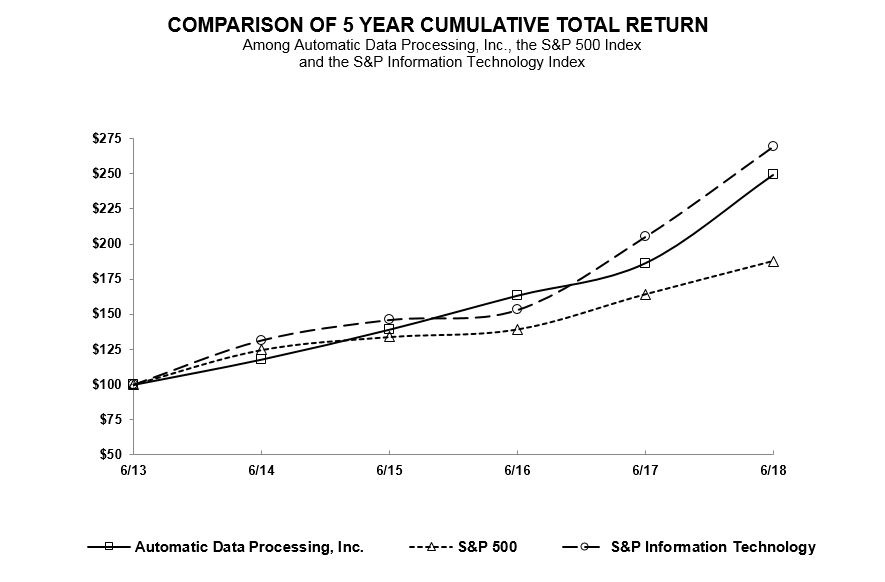
| (a) | On September 30, 2014, the Company completed the spinoff of its former Dealer Services business into an independent publicly traded company called CDK Global, Inc. The cumulative returns of the Company’s common stock have been adjusted to reflect the spinoff. |
| (b) | We use the S&P 500 Information Technology Index as our Peer Group Index. The S&P 500 Information Technology Index is a broad index that includes the Company and several competitors. |
Item 6. Selected Financial Data
The following selected financial data is derived from our Consolidated Financial Statements and should be read in conjunction with the Consolidated Financial Statements and related notes, Management's Discussion and Analysis of Financial Condition and Results of Operations, and Quantitative and Qualitative Disclosures About Market Risk included in this Annual Report on Form 10-K. The Company uses certain non-GAAP financial measures that we believe better reflect the underlying operations of our business model, allow investors to assess our performance in a manner similar to the method used by management, and improve our ability to understand and assess our operating performance against prior periods. Refer to (A) below for additional information about our non-GAAP financial measures and our reconciliations to reported results. Additionally, prior period amounts have been adjusted to exclude discontinued operations.
| (Dollars and shares in millions, except per share amounts) | ||||||||||||||||||||
| Years ended June 30, | 2018 | 2017 | 2016 | 2015 | 2014 | |||||||||||||||
| Total revenues | $ | 13,325.8 | $ | 12,379.8 | $ | 11,667.8 | $ | 10,938.5 | $ | 10,226.4 | ||||||||||
| Total costs of revenues | $ | 7,842.6 | $ | 7,269.8 | $ | 6,840.3 | $ | 6,427.6 | $ | 6,041.0 | ||||||||||
| Earnings from continuing operations before income taxes | $ | 2,171.1 | $ | 2,531.1 | $ | 2,234.7 | $ | 2,070.7 | $ | 1,879.2 | ||||||||||
| Net earnings from continuing operations | $ | 1,620.8 | $ | 1,733.4 | $ | 1,493.4 | $ | 1,376.5 | $ | 1,242.6 | ||||||||||
| Adjusted earnings from continuing operations before interest and income taxes (A) | $ | 2,643.1 | $ | 2,447.6 | $ | 2,274.2 | $ | 2,061.5 | $ | 1,870.3 | ||||||||||
| Adjusted net earnings from continuing operations (A) | $ | 1,928.1 | $ | 1,665.0 | $ | 1,494.8 | $ | 1,376.5 | $ | 1,242.6 | ||||||||||
| Basic earnings per share from continuing operations | $ | 3.68 | $ | 3.87 | $ | 3.27 | $ | 2.91 | $ | 2.59 | ||||||||||
| Diluted earnings per share from continuing operations | $ | 3.66 | $ | 3.85 | $ | 3.25 | $ | 2.89 | $ | 2.57 | ||||||||||
| Adjusted diluted earnings per share from continuing operations (A) | $ | 4.35 | $ | 3.70 | $ | 3.26 | $ | 2.89 | $ | 2.57 | ||||||||||
| Basic weighted average shares outstanding | 440.6 | 447.8 | 457.0 | 472.6 | 478.9 | |||||||||||||||
| Diluted weighted average shares outstanding | 443.3 | 450.3 | 459.1 | 475.8 | 483.1 | |||||||||||||||
| Cash dividends declared per share | $ | 2.52 | $ | 2.24 | $ | 2.08 | $ | 1.95 | $ | 1.88 | ||||||||||
| At year end: | ||||||||||||||||||||
| Cash, cash equivalents and marketable securities of continuing operations | $ | 2,180.5 | $ | 2,791.2 | $ | 3,222.4 | $ | 1,694.8 | $ | 3,670.3 | ||||||||||
| Total assets of continuing operations | $ | 37,088.7 | $ | 37,180.0 | $ | 43,670.0 | $ | 33,110.5 | $ | 29,629.6 | ||||||||||
| Total assets | $ | 37,088.7 | $ | 37,180.0 | $ | 43,670.0 | $ | 33,110.5 | $ | 32,059.8 | ||||||||||
| Obligations under commercial paper borrowings | $ | — | $ | — | $ | — | $ | — | $ | 2,173.0 | ||||||||||
| Long-term debt | $ | 2,002.4 | $ | 2,002.4 | $ | 2,007.7 | $ | 9.2 | $ | 11.5 | ||||||||||
| Stockholders’ equity | $ | 3,459.6 | $ | 3,977.0 | $ | 4,481.6 | $ | 4,808.5 | $ | 6,670.2 |
(A) Non-GAAP Financial Measures
In addition to our GAAP results, we use the adjusted results and other non-GAAP metrics set forth in the table below to evaluate our operating performance in the absence of certain items and for planning and forecasting of future periods:
| Adjusted Financial Measure | U.S. GAAP Measures | Adjustments/Explanation - as applicable in the periods |
| Adjusted EBIT from continuing operations | Net earnings from continuing operations | - Provision for income taxes - Gains/losses on sales of businesses and assets - All other interest expense and income - Transformation initiatives - Non-operational costs related to proxy contest matters See footnotes (a), (b), and (c) |
| Adjusted net earnings from continuing operations | Net earnings from continuing operations | Pre-tax and tax impacts of: - Gains/losses on sales of businesses and assets - Transformation initiatives - Non-operational costs related to proxy contest matters - Tax Cuts and Jobs Act See footnotes (b), (c), (d), (e) and (f) |
| Adjusted provision for income taxes | Provision for income taxes | Tax impacts of: - Gains/losses on sales of businesses and assets - Transformation initiatives - Non-operational costs related to proxy contest matters - Tax Cuts and Jobs Act See footnotes (c), (d), (e), and (f) |
| Adjusted diluted earnings per share from continuing operations | Diluted earnings per share | EPS impacts of: - Gains/losses on sales of businesses and assets - Transformation initiatives - Non-operational costs related to proxy contest matters - Tax Cuts and Jobs Act See footnotes (b), (c), and (f) |
| Adjusted effective tax rate | Effective tax rate | See footnote (g) |
| Constant Currency Basis | U.S. GAAP P&L line items | See footnote (h) |
We believe that the exclusion of the identified items helps us reflect the fundamentals of our underlying business model and analyze results against our expectations, against prior period, and to plan for future periods by focusing on our underlying operations. We believe that the adjusted results provide relevant and useful information for investors because it allows investors to view performance in a manner similar to the method used by management and improves their ability to understand and assess our operating performance. The nature of these exclusions are for specific items that are not fundamental to our underlying business operations. Since these adjusted financial measures and other non-GAAP metrics are not measures of performance calculated in accordance with U.S. GAAP, they should not be considered in isolation from, as a substitute for, or superior to their U.S. GAAP measures, and they may not be comparable to similarly titled measures at other companies.
| (Dollars and shares in millions, except per share amounts) | ||||||||||||||||||||
| Years ended June 30, | 2018 | 2017 | 2016 | 2015 | 2014 | |||||||||||||||
| Net earnings from continuing operations | $ | 1,620.8 | $ | 1,733.4 | $ | 1,493.4 | $ | 1,376.5 | $ | 1,242.6 | ||||||||||
| Adjustments: | ||||||||||||||||||||
| Provision for income taxes | 550.3 | 797.7 | 741.3 | 694.2 | 636.6 | |||||||||||||||
| All other interest expense (a) | 59.4 | 59.3 | 47.9 | 1.5 | 1.6 | |||||||||||||||
| All other interest income (a) | (25.5 | ) | (22.4 | ) | (13.6 | ) | (10.7 | ) | (10.5 | ) | ||||||||||
| Gain on sale of businesses | — | (205.4 | ) | (29.1 | ) | — | — | |||||||||||||
| Gain on sale of assets | — | — | (13.9 | ) | — | — | ||||||||||||||
| Transformation initiatives (b) | 404.8 | 85.0 | 48.2 | — | — | |||||||||||||||
| Proxy contest matters (c) | 33.3 | — | — | — | — | |||||||||||||||
| Adjusted EBIT from continuing operations | $ | 2,643.1 | $ | 2,447.6 | $ | 2,274.2 | $ | 2,061.5 | $ | 1,870.3 | ||||||||||
| Net earnings from continuing operations | $ | 1,620.8 | $ | 1,733.4 | $ | 1,493.4 | $ | 1,376.5 | $ | 1,242.6 | ||||||||||
| Adjustments: | ||||||||||||||||||||
| Gain on sale of businesses | — | (205.4 | ) | (29.1 | ) | — | — | |||||||||||||
| Provision for income taxes on gain on sale of business (d) | — | 84.0 | 7.3 | — | — | |||||||||||||||
| Gain on sale of assets | — | — | (13.9 | ) | — | — | ||||||||||||||
| Provision for income taxes on gain on sale of assets (e) | — | — | 5.3 | — | — | |||||||||||||||
| Transformation initiatives (b) | 404.8 | 85.0 | 48.2 | — | — | |||||||||||||||
| Income tax benefit for transformation initiatives (e) | (122.1 | ) | (32.0 | ) | (16.4 | ) | — | — | ||||||||||||
| Proxy contest matters (c) | 33.3 | — | — | — | — | |||||||||||||||
| Income tax benefit for proxy contest matters (e) | (10.4 | ) | — | — | — | — | ||||||||||||||
| Tax Cuts and Jobs Act (f) | 1.7 | — | — | — | — | |||||||||||||||
| Adjusted net earnings from continuing operations | $ | 1,928.1 | $ | 1,665.0 | $ | 1,494.8 | $ | 1,376.5 | $ | 1,242.6 | ||||||||||
| Diluted earnings per share from continuing operations | $ | 3.66 | $ | 3.85 | $ | 3.25 | $ | 2.89 | $ | 2.57 | ||||||||||
| Adjustments: | ||||||||||||||||||||
| Gain on sale of businesses | — | (0.27 | ) | (0.05 | ) | — | — | |||||||||||||
| Gain on sale of assets | — | — | (0.02 | ) | — | — | ||||||||||||||
| Transformation initiatives (b) | 0.64 | 0.12 | 0.07 | — | — | |||||||||||||||
| Proxy contest matters (c) | 0.05 | — | — | — | — | |||||||||||||||
| Tax Cuts and Jobs Act (f) | — | — | — | — | — | |||||||||||||||
| Adjusted diluted earnings per share from continuing operations | $ | 4.35 | $ | 3.70 | $ | 3.26 | $ | 2.89 | $ | 2.57 |
(a) Our Adjusted EBIT from continuing operations continues to include the interest income earned on investments associated with our client funds extended investment strategy and interest expense on borrowings related to our client funds extended investment strategy as we believe these amounts to be fundamental to the underlying operations of our business model. The adjustments in the table above represent the interest income and interest expense that is not related to our client funds extended investment strategy and are labeled as "All other interest expense" and "All other interest income."
(b) The charges within transformation initiatives in fiscal 2018 includes $319.6 million related to the special termination benefit charges and $17.5 million of other charges related to our Voluntary Early Retirement Program ("VERP"), severance charges related to our Service Alignment Initiative of $20.5 million, and other transformation initiatives of $47.2 million which primarily consist of severance charges totaling $41.9 million. Charges for transformation initiatives for periods prior to fiscal 2018 primarily represent severance charges related to our Service Alignment Initiative and Workforce Optimization Effort. Unlike severance charges in prior periods, which are not included as an adjustment to get to adjusted results, these specific charges relate to actions that are part of our broad-based, company-wide transformation initiative. Refer to Note 11 of the Consolidated Financial Statements for a description of charges associated with the VERP.
(c) Represents non-operational costs relating to proxy contest matters.
(d) The taxes on the gains on the sale of the businesses were calculated based on the annualized marginal rate in effect during the quarter of the adjustment. The tax amount was adjusted for a book vs. tax basis difference for the year ended June 30, 2017
due to the derecognition of goodwill upon the sale of the business and for the year ended June 30, 2016 due to a previously recorded non tax-deductible goodwill impairment charge.
(e) The tax benefit/provision on the transformation initiatives, the gain on the sale of the assets, and non-operational charges related to proxy contest matters was calculated based on the annualized marginal rate in effect during the quarter of the adjustment.
(f) The one-time net provision from the enactment of the Tax Cuts and Jobs Act is comprised of a one-time transition tax on the earnings and profits of our foreign subsidiaries, accrued foreign withholding taxes on future distributions of earning and profit that may no longer be utilizable as foreign tax credits, and the recording of a valuation allowance against our foreign tax credits which may not be realized offset by the application of the newly enacted U.S. corporate tax rates to our U.S. deferred tax balances. We are still analyzing certain aspects of the Act and refining calculations, which could potentially result in the re-measurement of these balances or potentially give rise to future adjustments.
Item 7. Management's Discussion and Analysis of Financial Condition and Results of Operations
FORWARD-LOOKING STATEMENTS
This document and other written or oral statements made from time to time by ADP may contain “forward-looking statements” within the meaning of the Private Securities Litigation Reform Act of 1995. Statements that are not historical in nature and which may be identified by the use of words like “expects,” “assumes,” “projects,” “anticipates,” “estimates,” “we believe,” “could” “is designed to” and other words of similar meaning, are forward-looking statements. These statements are based on management’s expectations and assumptions and depend upon or refer to future events or conditions and are subject to risks and uncertainties that may cause actual results to differ materially from those expressed. Factors that could cause actual results to differ materially from those contemplated by the forward-looking statements or that could contribute to such difference include: ADP's success in obtaining, and retaining clients, and selling additional services to clients; the pricing of products and services; the success of our new solutions; compliance with existing or new legislation or regulations; changes in, or interpretations of, existing legislation or regulations; overall market, political and economic conditions, including interest rate and foreign currency trends; competitive conditions; our ability to maintain our current credit ratings and the impact on our funding costs and profitability; security or cyber breaches, fraudulent acts, and system interruptions and failures; employment and wage levels; changes in technology; availability of skilled technical associates; the impact of new acquisitions and divestitures; and the adequacy, effectiveness and success of our business transformation initiatives. ADP disclaims any obligation to update any forward-looking statements, whether as a result of new information, future events or otherwise, except as required by law. These risks and uncertainties, along with the risk factors discussed under “Item 1A. Risk Factors,” and in other written or oral statements made from time to time by ADP, should be considered in evaluating any forward-looking statements contained herein.
EXECUTIVE OVERVIEW
We are one of the largest providers of cloud-based Human Capital Management ("HCM") technology solutions - including payroll, talent management, Human Resources and benefits administration, and time and attendance management - to employers around the world. As a leader in this industry, we deliver on our global HCM strategy and make investments in highly strategic areas and technology in order to strengthen our underlying business model and prospects for continued growth.
Highlights from the year ended June 30, 2018 ("fiscal 2018") include:
| • | Worldwide new business bookings increased 8% to $1.8 billion |
| • | Revenue grew 8% in fiscal 2018; Diluted earnings per share ("EPS") decreased 5% to $3.66, while adjusted diluted EPS increased 18% to $4.35 |
| • | Our shareholder friendly actions continued as we raised our quarterly declared cash dividend by 21% and returned approximately $2.1 billion to shareholders via dividends and share repurchases |
| • | Completed migrations of our mid-market clients to latest version of Workforce Now |
| • | Executed on a VERP and created a Transformation Office to continue driving broad-based transformation initiatives |
At ADP we innovate by anticipating how the world of work is transforming and how trends, such as the rising of the gig economy, impact the needs of our clients and the evolving workforce. We are reshaping the HCM industry through organic innovative development such as our next-gen platforms and our strategic acquisitions such as Global Cash Card, WorkMarket, and more recently, Celergo, Inc., a leading provider of international payroll management services. With these investments we are enhancing our position as the only global HCM provider that can help businesses address the entire worker spectrum from full-time to freelancer and hire to retire. As the payroll market continues to rapidly evolve, we continue to be focused on staying ahead of the curve. Through our investments in technology, service, and distribution, we intend to continue to build on our momentum heading into fiscal 2019.
Our new business bookings increased 8% during fiscal 2018, as compared to fiscal 2017, validating the renewed momentum in our sales force following fiscal 2017. We are confident that the investments in our sales force and products will continue to drive solid results. We remain optimistic in our ability to deliver innovative and competitive products, as well as our sales force's ability to distribute our products heading into the year ending June 30, 2019 ("fiscal 2019").
During fiscal 2018, we continued to migrate clients to our strategic platforms while making investments in R&D to provide best-in-class cloud-based HCM technology solutions to our clients. Employer Services retention was positively impacted by our focus on improving the client experience and was positively impacted by the loss of a large client within our former Consumer Health Spending Account ("CHSA") business during the fiscal year ended June 30, 2017 ("fiscal 2017"). This focus translated into strong retention on our strategic platforms and as a result, we saw Employer Services revenue retention improve 50 basis points during fiscal 2018 as compared to fiscal 2017.
Simultaneously, we continue to streamline our service organization. We remain focused on delivering results and executing on our strategy to transform our business for continued success within the competitive global HCM environment. During fiscal 2018, we incurred $20.5 million in charges for a previously announced multi-year Service Alignment Initiative intended to align our client service operations to our strategic platforms. Building upon our Service Alignment Initiative in support of our transformation goals, we are executing upon a voluntary early retirement program and have also identified additional operational improvement initiatives through the formation of our Transformation Office. These transformation initiatives support ADP’s ongoing strategy which is aimed at streamlining our operations and extending our world class distribution while leveraging our talent and culture.
We have a strong business model and operate in a growing global market. We continue to maintain a high percentage of recurring revenues and healthy margins, and retain our ability to generate consistent healthy cash flows. Our financial condition and balance sheet remain solid at June 30, 2018, with cash and cash equivalents and marketable securities of approximately $2.2 billion. We have benefited from the Tax Cuts and Jobs Act (the "Act") signed into law in late December 2017. With this increased operating cash flow and greater access to our cash worldwide, we will continue our disciplined approach to capital allocation decisions, including assessing reinvestments into the business, potential acquisitions, and/or returning cash to shareholders through dividends and share buybacks, among other potential uses.
RESULTS OF OPERATIONS
ANALYSIS OF CONSOLIDATED OPERATIONS
Prior period amounts have been adjusted to exclude discontinued operations (refer to Note 1 of our Consolidated Financial Statements for additional information).
(In millions, except per share amounts)
| Years Ended | % Change | |||||||||||||||||||||||
| June 30, | As Repo |
Showing the first 8K of 87K characters. Open the full section
Item 7A. Quantitative and Qualitative Disclosures About Market Risk
The information called for by this item is provided under the caption “Quantitative and Qualitative Disclosures About Market Risk” under “Item 7 - Management’s Discussion and Analysis of Financial Condition and Results of Operation.”
Item 8. Financial Statements and Supplementary Data
REPORT OF INDEPENDENT REGISTERED PUBLIC ACCOUNTING FIRM
To the Board of Directors and Stockholders of
Automatic Data Processing, Inc.
Roseland, New Jersey
Opinion on the Financial Statements
We have audited the accompanying consolidated balance sheets of Automatic Data Processing, Inc. and subsidiaries (the "Company") as of June 30, 2018 and 2017, and the related consolidated statements of income, comprehensive income, stockholders' equity, and cash flows for each of the three years in the period ended June 30, 2018, and the related notes and the schedule listed in the Index at Item 15(a) 2 (collectively referred to as the “financial statements”). In our opinion, the financial statements present fairly, in all material respects, the financial position of the Company as of June 30, 2018 and 2017, and the results of its operations and its cash flows for each of the three years in the period ended June 30, 2018, in conformity with accounting principles generally accepted in the United States of America.
We have also audited, in accordance with the standards of the Public Company Accounting Oversight Board (United States) (PCAOB), the Company’s internal control over financial reporting as of June 30, 2018, based on criteria established in Internal Control - Integrated Framework (2013) issued by the Committee of Sponsoring Organizations of the Treadway Commission and our report dated August 3, 2018, expressed an unqualified opinion on the Company’s internal control over financial reporting.
Basis for Opinion
These financial statements are the responsibility of the Company's management. Our responsibility is to express an opinion on the financial statements based on our audits. We are a public accounting firm registered with the PCAOB and are required to be independent with respect to the Company in accordance with the U.S. federal securities laws and the applicable rules and regulations of the Securities and Exchange Commission and the PCAOB.
We conducted our audits in accordance with the standards of the PCAOB. Those standards require that we plan and perform the audit to obtain reasonable assurance about whether the financial statements are free of material misstatement, whether due to error or fraud. Our audits included performing procedures to assess the risks of material misstatement of the financial statements, whether due to error or fraud, and performing procedures that respond to those risks. Such procedures included examining, on a test basis, evidence regarding the amounts and disclosures in the financial statements. Our audits also included evaluating the accounting principles used and significant estimates made by management, as well as evaluating the overall presentation of the financial statements. We believe that our audits provide a reasonable basis for our opinion.
| /s/ Deloitte & Touche LLP |
Parsippany, New Jersey
August 3, 2018
We have served as the Company’s auditor since 1968.
Statements of Consolidated Earnings
(In millions, except per share amounts)
| Years ended June 30, | 2018 | 2017 | 2016 | |||||||||
| REVENUES: | ||||||||||||
| Revenues, other than interest on funds held for clients and PEO revenues | $ | 8,985.2 | $ | 8,518.1 | $ | 8,234.0 | ||||||
| Interest on funds held for clients | 466.5 | 397.4 | 377.3 | |||||||||
| PEO revenues (A) | 3,874.1 | 3,464.3 | 3,056.5 | |||||||||
| TOTAL REVENUES | 13,325.8 | 12,379.8 | 11,667.8 | |||||||||
| EXPENSES: | ||||||||||||
| Costs of revenues: | ||||||||||||
| Operating expenses | 6,937.9 | 6,416.1 | 6,025.0 | |||||||||
| Systems development and programming costs | 630.2 | 627.5 | 603.7 | |||||||||
| Depreciation and amortization | 274.5 | 226.2 | 211.6 | |||||||||
| TOTAL COSTS OF REVENUES | 7,842.6 | 7,269.8 | 6,840.3 | |||||||||
| Selling, general, and administrative expenses | 2,971.5 | 2,783.2 | 2,637.0 | |||||||||
| Interest expense | 102.7 | 80.0 | 56.2 | |||||||||
| TOTAL EXPENSES | 10,916.8 | 10,133.0 | 9,533.5 | |||||||||
| Other expense/(income), net | 237.9 | (284.3 | ) | (100.4 | ) | |||||||
| EARNINGS FROM CONTINUING OPERATIONS BEFORE INCOME TAXES | 2,171.1 | 2,531.1 | 2,234.7 | |||||||||
| Provision for income taxes | 550.3 | 797.7 | 741.3 | |||||||||
| NET EARNINGS FROM CONTINUING OPERATIONS | $ | 1,620.8 | $ | 1,733.4 | $ | 1,493.4 | ||||||
| LOSSES FROM DISCONTINUED OPERATIONS BEFORE INCOME TAXES | — | — | (1.4 | ) | ||||||||
| Provision for income taxes | — | — | (0.5 | ) | ||||||||
| NET LOSS FROM DISCONTINUED OPERATIONS | $ | — | $ | — | $ | (0.9 | ) | |||||
| NET EARNINGS | $ | 1,620.8 | $ | 1,733.4 | $ | 1,492.5 | ||||||
| Basic Earnings Per Share from Continuing Operations | $ | 3.68 | $ | 3.87 | $ | 3.27 | ||||||
| Basic Earnings Per Share from Discontinued Operations | — | — | — | |||||||||
| BASIC EARNINGS PER SHARE | $ | 3.68 | $ | 3.87 | $ | 3.27 | ||||||
| Diluted Earnings Per Share from Continuing Operations | $ | 3.66 | $ | 3.85 | $ | 3.25 | ||||||
| Diluted Earnings Per Share from Discontinued Operations | — | — | — | |||||||||
| DILUTED EARNINGS PER SHARE | $ | 3.66 | $ | 3.85 | $ | 3.25 | ||||||
| Basic weighted average shares outstanding | 440.6 | 447.8 | 457.0 | |||||||||
| Diluted weighted average shares outstanding | 443.3 | 450.3 | 459.1 |
(A) For the years ended June 30, 2018 ("fiscal 2018"), June 30, 2017 ("fiscal 2017"), and June 30, 2016 ("fiscal 2016"), Professional Employer Organization ("PEO") revenues are net of direct pass-through costs, primarily consisting of payroll wages and payroll taxes, of $39,140.9 million, $34,567.4 million, and $30,928.6 million, respectively.
See notes to the Consolidated Financial Statements.
Statements of Consolidated Comprehensive Income
(In millions)
| Years ended June 30, | 2018 | 2017 | 2016 | |||||||||
| Net earnings | $ | 1,620.8 | $ | 1,733.4 | $ | 1,492.5 | ||||||
| Other comprehensive income/loss: | ||||||||||||
| Currency translation adjustments | 2.8 | 23.0 | (25.5 | ) | ||||||||
| Unrealized net (losses)/gains on available-for-sale securities | (460.7 | ) | (405.7 | ) | 288.8 | |||||||
| Tax effect | 123.4 | 141.6 | (102.2 | ) | ||||||||
| Reclassification of net losses/(gains) on available-for-sale securities to net earnings | 2.7 | (2.2 | ) | 5.0 | ||||||||
| Tax effect | (0.6 | ) | 0.8 | (1.7 | ) | |||||||
| Pension net gains/(losses) arising during the year | 87.0 | 109.6 | (199.4 | ) | ||||||||
| Tax ef |
Showing the first 8K of 160K characters. Open the full section
Item 9. Changes in and Disagreements with Accountants on Accounting and Financial Disclosure
None.
Item 9A. Controls and Procedures
Attached as Exhibits 31.1 and 31.2 to this Annual Report on Form 10-K are certifications of ADP's Chief Executive Officer and Chief Financial Officer, which are required by Rule 13a-14(a) of the Securities Exchange Act of 1934, as amended (the “Exchange Act”). This “Controls and Procedures” section should be read in conjunction with the report of Deloitte & Touche LLP that appears in this Annual Report on Form 10-K and is hereby incorporated herein by reference.
Management's Evaluation of Disclosure Controls and Procedures
The Company carried out an evaluation (the “evaluation”), under the supervision and with the participation of the Company's management, including its Chief Executive Officer and Chief Financial Officer, of the effectiveness of the Company's disclosure controls and procedures, as defined in Rules 13a-15(e) and 15d-15(e) under the Exchange Act. Disclosure controls and procedures include, without limitation, controls and procedures designed to ensure that information required to be disclosed by the Company in the reports that it files or submits under the Exchange Act is accumulated and communicated to the Company's management, including its Chief Executive Officer and Chief Financial Officer, or persons performing similar functions, as appropriate to allow timely decisions regarding required disclosure. Based on the evaluation, the Company's Chief Executive Officer and Chief Financial Officer have concluded that the Company's disclosure controls and procedures were effective as of June 30, 2018 in ensuring that (i) information required to be disclosed by the Company in reports that it files or submits under the Exchange Act is accumulated and communicated to the Company's management, including its Chief Executive Officer and Chief Financial Officer, to allow timely decisions regarding required disclosure and (ii) such information is recorded, processed, summarized and reported within the time periods specified in the Securities and Exchange Commission's rules and forms.
Management's Report on Internal Control over Financial Reporting
It is the responsibility of Automatic Data Processing, Inc.'s (“ADP”) management to establish and maintain effective internal control over financial reporting (as defined in Rule 13a-15(f) under the Exchange Act). Internal control over financial reporting is designed to provide reasonable assurance to ADP's management and board of directors regarding the preparation of reliable financial statements for external purposes in accordance with generally accepted accounting principles.
ADP's internal control over financial reporting includes those policies and procedures that: (i) pertain to the maintenance of records that, in reasonable detail, accurately and fairly reflect the transactions and dispositions of the assets of ADP; (ii) provide reasonable assurance that transactions are recorded as necessary to permit preparation of financial statements in accordance with generally accepted accounting principles, and that receipts and expenditures of ADP are being made only in accordance with authorizations of management and directors of ADP; and (iii) provide reasonable assurance regarding the prevention or timely detection of unauthorized acquisition, use or disposition of ADP's assets that could have a material effect on the financial statements of ADP.
Because of its inherent limitations, internal control over financial reporting may not prevent or detect misstatements. Therefore, even those systems determined to be effective can provide only reasonable assurance with respect to financial statement preparation and presentation.
Management has performed an assessment of the effectiveness of ADP’s internal control over financial reporting as of June 30, 2018 based upon criteria set forth in Internal Control - Integrated Framework (2013) issued by the Committee of Sponsoring Organizations of the Treadway Commission. Based on this assessment, management determined that ADP’s internal control over financial reporting was effective as of June 30, 2018.
Deloitte & Touche LLP, the independent registered public accounting firm that audited and reported on the consolidated financial statements of ADP included in this Annual Report on Form 10-K, has issued an attestation report on the operating effectiveness of ADP's internal control over financial reporting. The Deloitte & Touche LLP attestation report is set forth below.
| /s/ Carlos A. Rodriguez |
| Carlos A. Rodriguez |
| President and Chief Executive Officer |
| /s/ Jan Siegmund |
| Jan Siegmund |
| Chief Financial Officer |
Roseland, New Jersey
August 3, 2018
Changes in Internal Control over Financial Reporting
There were no changes in ADP's internal control over financial reporting that occurred during the quarter ended June 30, 2018 that have materially affected, or are reasonably likely to materially affect, ADP's internal control over financial reporting.
REPORT OF INDEPENDENT REGISTERED PUBLIC ACCOUNTING FIRM
To the Board of Directors and Stockholders of
Automatic Data Processing, Inc.
Roseland, New Jersey
Opinion on Internal Control over Financial Reporting
We have audited the internal control over financial reporting of Automatic Data Processing, Inc. and subsidiaries (the "Company") as of June 30, 2018, based on criteria established in Internal Control - Integrated Framework (2013) issued by the Committee of Sponsoring Organizations of the Treadway Commission (COSO). In our opinion, the Company maintained, in all material respects, effective internal control over financial reporting as of June 30, 2018, based on criteria established in Internal Control - Integrated Framework (2013) issued by COSO.
We have also audited, in accordance with the standards of the Public Company Accounting Oversight Board (United States) (PCAOB), the consolidated financial statements as of and for the year ended June 30, 2018, of the Company and our report dated August 3, 2018, expressed an unqualified opinion on those financial statements.
Basis for Opinion
The Company's management is responsible for maintaining effective internal control over financial reporting and for its assessment of the effectiveness of internal control over financial reporting, included in the accompanying Management’s Report on Internal Control over Financial Reporting. Our responsibility is to express an opinion on the Company's internal control over financial reporting based on our audit. We are a public accounting firm registered with the PCAOB and are required to be independent with respect to the Company in accordance with the U.S. federal securities laws and the applicable rules and regulations of the Securities and Exchange Commission and the PCAOB.
We conducted our audit in accordance with the standards of the PCAOB. Those standards require that we plan and perform the audit to obtain reasonable assurance about whether effective internal control over financial reporting was maintained in all material respects. Our audit included obtaining an understanding of internal control over financial reporting, assessing the risk that a material weakness exists, testing and evaluating the design and operating effectiveness of internal control based on the assessed risk, and performing such other procedures as we considered necessary in the circumstances. We believe that our audit provides a reasonable basis for our opinion.
Definition and Limitations of Internal Control over Financial Reporting
A company's internal control over financial reporting is a process designed to provide reasonable assurance regarding the reliability of financial reporting and the preparation of financial statements for external purposes in accordance with generally accepted accounting principles. A company's internal control over financial reporting includes those policies and procedures that (1) pertain to the maintenance of records that, in reasonable detail, accurately and fairly reflect the transactions and dispositions of the assets of the company; (2) provide reasonable assurance that transactions are recorded as necessary to permit preparation of financial statements in accordance with generally accepted accounting principles, and that receipts and expenditures of the company are being made only in accordance with authorizations of management and directors of the company; and (3) provide reasonable assurance regarding prevention or timely detection of unauthorized acquisition, use, or disposition of the company's assets that could have a material effect on the financial statements.
Because of its inherent limitations, internal control over financial reporting may not prevent or detect misstatements. Also, projections of any evaluation of effectiveness to future periods are subject to the risk that controls may become inadequate because of changes in conditions, or that the degree of compliance with the policies or procedures may deteriorate.
| /s/ Deloitte & Touche LLP |
| Parsippany, New Jersey |
August 3, 2018
Item 9B. Other Information
None.
Part III
Item 10. Directors, Executive Officers and Corporate Governance
The executive officers of the Company, their ages, positions, and the period during which they have been employed by ADP are as follows:
| Employed by | ||||||
| Name | Age | Position | ADP Since | |||
| Brock Albinson | 43 | Corporate Controller and Principal Accounting Officer | 2007 | |||
| John Ayala | 51 | President, Major Account Services and ADP Canada | 2002 | |||
| Maria Black | 44 | President, Small Business Solutions and Human Resources | 1996 | |||
| Outsourcing | ||||||
| Michael A. Bonarti | 52 | Corporate Vice President, General Counsel and Secretary | 1997 | |||
| Deborah L. Dyson | 52 | President, National Accounts Services | 1988 | |||
| Michael C. Eberhard | 56 | Vice President and Treasurer | 1998 | |||
| Sreeni Kutam | 48 | Chief Human Resources Officer | 2014 | |||
| Don McGuire | 58 | President, Employer Services International | 1998 | |||
| Dermot J. O'Brien | 52 | Chief Transformation Officer | 2012 | |||
| Thomas Perrotti | 49 | President, Worldwide Sales and Marketing | 1993 | |||
| Douglas Politi | 56 | President, Compliance Solutions | 1992 | |||
| Carlos A. Rodriguez | 54 | President and Chief Executive Officer | 1999 | |||
| Stuart Sackman | 57 | Corporate Vice President, Global Shared Services | 1992 | |||
| Jan Siegmund | 54 | Chief Financial Officer | 1999 | |||
| Donald Weinstein | 49 | Corporate Vice President, Global Product and Technology | 2006 |
Brock Albinson joined ADP in 2007. Prior to his appointment as Corporate Controller and Principal Accounting Officer in March 2015, he served as Assistant Corporate Controller from December 2011 to February 2015, as Vice President, Corporate Finance from January 2011 to December 2011, and as Vice President, Financial Policy from March 2007 to January 2011.
John Ayala joined ADP in 2002. Prior to his appointment as President, Major Account Services and ADP Canada in January 2017, he served as President, Small Business Services, Retirement Services and Insurance Services from July 2014 to December 2016, as Vice President, Client Experience and Continuous Improvement from November 2012 to June 2014, as Senior Vice President, Services and Operations - Small Business Services from February 2012 to October 2012, as President, TotalSource from July 2011 to January 2012, and as Senior Vice President, Service and Operations, TotalSource from June 2008 to June 2011.
Maria Black joined ADP in 1996. Prior to her appointment as President, Small Business Solutions and Human Resources Outsourcing in January 2017, she served as President, ADP TotalSource from July 2014 to December 2016, as General Manager, ADP United Kingdom from April 2013 to June 2014, and as General Manager, Employer Services - TotalSource Western Central Region from January 2008 to March 2013.
Michael A. Bonarti joined ADP in 1997. He has served as Corporate Vice President, General Counsel and Secretary since July 2010.
Deborah L. Dyson joined ADP in 1988. Prior to her appointment as President, National Accounts Services in August 2017, she served as Corporate Vice President, Client Experience and Continuous Improvement from July 2014 to June 2018, as Division Vice President / General Manager, Employer Services - Major Account Services South Service Center from July 2012 to June 2014, and as Division Vice President / General Manager, Employer Services - Major Account Services Northwest Service Center from July 2006 to June 2012.
Michael C. Eberhard joined ADP in 1998. He has served as Vice President and Treasurer since November 2009.
Sreeni Kutam joined ADP in 2014. Prior to his appointment as Chief Human Resources Officer in June 2018, he served as Interim Chief Human Resources Officer from January 2018 to June 2018, as Division Vice President, Human Resources, Major Account Services from May 2016 to January 2018, and as Vice President, HR Strategy and Planning from January 2014 to April 2016. Prior to joining ADP, he was an HR consultant.
Don McGuire joined ADP in 1998. Prior to his appointment as President, Employer Services International in June 2018, he served as President, Global Enterprise Solutions EMEA/Streamline from July 2016 to June 2018, as Senior Vice President, General Manager, Asia Pacific Region from December 2012 to June 2016, and as General Manager, ADP United Kingdom/Ireland from September 2007 to December 2012.
Dermot J. O’Brien joined ADP in 2012. Prior to his appointment as Chief Transformation Officer in January 2018, he served as Chief Human Resources Officer from April 2012 to January 2018.
Thomas Perrotti joined ADP in 1993. Prior to his appointment as President, Worldwide Sales and Marketing in January 2017, he served as President, Major Account Services and ADP Canada from July 2015 to December 2016, as Corporate Vice President and Senior Vice President, Service and Operations, Major Account Services from July 2014 to June 2015, as Senior Vice President, Service & Operations, Small Business Services from April 2013 to June 2014, as Senior Vice President, Sales, Small Business Services from April 2011 to March 2013, and as Division Vice President, Global Sales Operations, Employer Services from November 2009 to March 2011.
Douglas Politi joined ADP in 1992. Prior to his appointment as President, Compliance Solutions in February 2013, he served as Senior Vice President, CFO Suite (AVS) from October 2011 to January 2013, and as Senior Vice President, Retirement Services from September 2006 to September 2011.
Carlos A. Rodriguez joined ADP in 1999. Prior to his appointment in November 2011 to President and Chief Executive Officer, he served as President and Chief Operating Officer from May 2011 to November 2011, and as President, Employer Services International - National Account Services, ADP Canada, and GlobalView and Employer Services International, from March 2010 to May 2011.
Stuart Sackman joined ADP in 1992. Prior to his appointment as Corporate Vice President, Global Shared Services in July 2018, he served as Corporate Vice President, Global Product and Technology from March 2015 to June 2018, as Corporate Vice President and General Manager of Multinational Corporations Services from June 2012 to February 2015, and as Division Vice President and General Manager of the National Account Services’ East National Service Center from February 2008 to May 2012.
Jan Siegmund joined ADP in 1999. Prior to his appointment as Chief Financial Officer in November 2012, he served as President, Added Value Services and Chief Strategy Officer from April 2009 to October 2012.
Donald Weinstein joined ADP in 2006. Prior to his appointment as Corporate Vice President, Global Product and Technology in July 2018, he served as Chief Strategy Officer from December 2015 to June 2018, as Senior Vice President, Product Management from October 2010 to November 2015, and as Division Vice President, Strategy & Marketing from September 2007 to September 2010.
Directors
See “Election of Directors” in the Proxy Statement for the Company’s 2018 Annual Meeting of Stockholders, which information is incorporated herein by reference.
Section 16(a) Beneficial Ownership Reporting Compliance
See “Section 16(a) Beneficial Ownership Reporting Compliance” in the Proxy Statement for the Company’s 2018 Annual Meeting of Stockholders, which information is incorporated herein by reference.
Code of Ethics
ADP has adopted a code of ethics that applies to its principal executive officer, principal financial officer, principal accounting officer and persons performing similar functions. The code of ethics may be viewed online on ADP’s website at www.adp.com under “Investor Relations” in the “Corporate Governance” section. Any amendment to or waivers from the code of ethics will be disclosed on our website within four business days following the date of the amendment or waiver.
Audit Committee; Audit Committee Financial Expert
See “Corporate Governance - Committees of the Board of Directors” and “Audit Committee Report” in the Proxy Statement for the Company’s 2018 Annual Meeting of Stockholders, which information is incorporated herein by reference.
Item 11. Executive Compensation
See “Corporate Governance,” “Compensation Discussion and Analysis,” “Compensation Committee Report,” “Compensation of Executive Officers” and “Compensation of Non-Employee Directors” in the Proxy Statement for the Company’s 2018 Annual Meeting of Stockholders, which information is incorporated herein by reference.
Item 12. Security Ownership of Certain Beneficial Owners and Management and Related Stockholder Matters
See “Security Ownership of Certain Beneficial Owners and Managers” and “Equity Compensation Plan Information” in the Proxy Statement for the Company’s 2018 Annual Meeting of Stockholders, which information is incorporated herein by reference.
Item 13. Certain Relationships and Related Transactions, and Director Independence
See “Election of Directors” and “Corporate Governance” in the Proxy Statement for the Company’s 2018 Annual Meeting of Stockholders, which information is incorporated herein by reference.
Item 14. Principal Accounting Fees and Services
See “Independent Registered Public Accounting Firm's Fees” in the Proxy Statement for the Company's 2018 Annual Meeting of Stockholders, which information is incorporated herein by reference.
Part IV
Item 15. Exhibits, Financial Statement Schedules
(a) Financial Statements and Financial Statement Schedules
- Financial Statements
The following report and Consolidated Financial Statements of the Company are contained in Part II, Item 8 hereof:
Report of Independent Registered Public Accounting Firm
Statements of Consolidated Earnings - years ended June 30, 2018, 2017 and 2016
Statements of Consolidated Comprehensive Income - years ended June 30, 2018, 2017 and 2016
Consolidated Balance Sheets - June 30, 2018 and 2017
Statements of Consolidated Stockholders' Equity - years ended June 30, 2018, 2017 and 2016
Statements of Consolidated Cash Flows - years ended June 30, 2018, 2017 and 2016
Notes to Consolidated Financial Statements
- Financial Statement Schedules
| Page in Form 10-K | |||
| Schedule II - Valuation and Qualifying Accounts | 93 |
All other Schedules have been omitted because they are inapplicable, are not required or the information is included elsewhere in the financial statements or notes thereto.
(b) Exhibits
The following exhibits are filed with this Annual Report on Form 10-K or incorporated herein by reference to the document set forth next to the exhibit in the list below:
| 3.1 | Amended and Restated Certificate of Incorporation dated November 11, 1998 - incorporated by reference to Exhibit 3.1 to the Company's Registration Statement No. 333-72023 on Form S-4 filed with the Commission on February 9, 1999 |
| 3.2 | Amended and Restated By-laws of the Company - incorporated by reference to Exhibit 3.1 to the Company's Current Report on Form 8-K dated August 3, 2016 |
| 4.1 | Form of Indenture between the Company and Wells Fargo Bank, National Association, as trustee - incorporated by reference to Exhibit 4.3 to the Company's Registration Statement on Form S-3 (No. 333-206631), filed on August 28, 2015 |
| 4.2 | Form of First Supplemental Indenture between Automatic Data Processing, Inc. and Wells Fargo Bank, National Association, as trustee - incorporated by reference to Exhibit 4.1 to the Company's Current Report on Form 8-K dated September 15, 2015 |
| 4.3 | Form of 2.250% Senior Note due 2020 - incorporated by reference to Exhibit A to Exhibit 4.1 to the Company's Current Report on Form 8-K dated September 15, 2015 |
| 4.4 | Form of 3.375% Senior Note due 2025 - incorporated by reference to Exhibit B to Exhibit 4.1 to the Company's Current Report on Form 8-K dated September 15, 2015 |
| 10.1 | 364-Day Credit Agreement, dated as of June 13, 2018, among Automatic Data Processing, Inc., the Lenders party thereto, JPMorgan Chase Bank, N.A., as Administrative Agent, Bank of America, N.A., BNP Paribas, Wells Fargo Bank, N.A., Citibank, N.A. and MUFG Bank, Ltd., as Syndication Agents, and Deutsche Bank Securities Inc. and Barclays Bank PLC, as Documentation Agents - incorporated by reference to Exhibit 10.1 to the Company’s Current Report on Form 8-K dated June 13, 2018 |
| 10.2 | Five-Year Credit Agreement, dated as of June 14, 2017, among Automatic Data Processing, Inc., the Lenders party thereto, JPMorgan Chase Bank, N.A., as Administrative Agent, Bank of America, N.A., BNP Paribas, Wells Fargo Bank, N.A., Citibank, N.A. and The Bank of Tokyo-Mitsubishi UFJ, Ltd., as Syndication Agents, and Deutsche Bank Securities Inc. and Barclays Bank PLC, as Documentation Agents - incorporated by reference to Exhibit 10.2 to the Company’s Current Report on Form 8-K dated June 14, 2017 |
| 10.3 | Five-Year Credit Agreement, dated as of June 13, 2018, among Automatic Data Processing, Inc., the Lenders Party thereto, JPMorgan Chase Bank, N.A., as Administrative Agent, Bank of America, N.A., BNP Paribas, Wells Fargo Bank, N.A., Citibank, N.A. and MUFG Bank, Ltd., as Syndication Agents, and Deutsche Bank Securities Inc. and Barclays Bank PLC, as Documentation Agents - incorporated by reference to Exhibit 10.2 to the Company’s Current Report on Form 8-K dated June 13, 2018 |
| 10.4 | Separation and Distribution Agreement, dated September 29, 2014, by and between Automatic Data Processing, Inc. and CDK Global Holdings, LLC - incorporated by reference to Exhibit 10.1 to the Company’s Current Report on Form 8-K dated October 1, 2014 |
| 10.5 | Amended and Restated Supplemental Officers Retirement Plan - incorporated by reference to Exhibit 10.8 to the Company's Annual Report on Form 10-K for the fiscal year ended June 30, 2017 (Management Compensatory Plan) |
| 10.6 | Automatic Data Processing, Inc. Deferred Compensation Plan, as Amended and Restated Effective September 15, 2016 - incorporated by reference to Exhibit 10.10 to the Company’s Quarterly Report on Form 10-Q for the fiscal quarter ended September 30, 2016 (Management Compensatory Plan) |
| 10.7 | Automatic Data Processing, Inc. Change in Control Severance Plan for Corporate Officers, as amended - incorporated by reference to Exhibit 10.8 to the Company’s Annual Report on Form 10-K for the fiscal year ended June 30, 2014 (Management Compensatory Plan) |
| 10.8 | Automatic Data Processing, Inc. Amended and Restated Employees’ Savings-Stock Purchase Plan - incorporated by reference to Exhibit 10.11 to the Company’s Annual Report on Form 10-K for the fiscal year ended June 30, 2014 (Management Compensatory Plan) |
| 10.9 | Automatic Data Processing, Inc. Executive Retirement Plan - incorporated by reference to Exhibit 10.1 to the Company’s Quarterly Report on Form 10-Q for the fiscal quarter ended March 31, 2015 (Management Compensatory Plan) |
| 10.10 | Automatic Data Processing, Inc. Retirement and Savings Restoration Plan - incorporated by reference to Exhibit 10.2 to the Company’s Quarterly Report on Form 10-Q for the fiscal quarter ended March 31, 2015 (Management Compensatory Plan) |
| 10.11 | Automatic Data Processing, Inc. Corporate Officer Severance Plan - incorporated by reference to Exhibit 10.3 to the Company’s Quarterly Report on Form 10-Q for the fiscal quarter ended March 31, 2015 (Management Compensatory Plan) |
| 10.12 | Automatic Data Processing, Inc. Amended and Restated 2008 Omnibus Award Plan (the "2008 Omnibus Award Plan") - incorporated by reference to Exhibit 10.1 to the Company’s Quarterly Report on Form 10-Q for the fiscal quarter ended March 31, 2018 (Management Compensatory Plan) |
| 10.13 | French Sub Plan under the 2008 Omnibus Award Plan effective as of January 26, 2012 - incorporated by reference to Exhibit 10.2 to the Company’s Quarterly Report on Form 10-Q for the fiscal quarter ended March 31, 2012 (Management Compensatory Plan) |
| 10.14 | Amended French Sub Plan under the 2008 Omnibus Award Plan effective as of April 6, 2016 (Management Compensatory Plan) - incorporated by reference to Exhibit 10.22 to the Company’s Annual Report on Form 10-K for the fiscal year ended June 30, 2016 (Management Compensatory Plan) |
| 10.15 | Form of Stock Option Grant Agreement under the 2008 Omnibus Award Plan (Form for Non- Employee Directors) for grants prior to November 12, 2008 - incorporated by reference to Exhibit 10.27 to the Company’s Quarterly Report on Form 10-Q for the fiscal quarter ended December 31, 2008 (Management Compensatory Plan) |
| 10.16 | Form of Deferred Stock Unit Award Agreement under the 2008 Omnibus Award Plan - incorporated by reference to Exhibit 10.33 to the Company’s Annual Report on Form 10-K for the fiscal year ended June 30, 2012 (Management Compensatory Plan) |
| 10.17 | Form of Stock Option Grant Agreement under the 2008 Omnibus Award Plan (Form for Non- Employee Directors) for grants beginning November 12, 2008 - incorporated by reference to Exhibit 10.28 to the Company’s Annual Report on Form 10-K for the fiscal year ended June 30, 2014 (Management Compensatory Plan) |
| 10.18 | Form of Stock Option Grant Agreement under the 2008 Omnibus Award Plan (Form for Employees) - incorporated by reference to Exhibit 10.29 to the Company’s Annual Report on Form 10-K for the fiscal year ended June 30, 2014 (Management Compensatory Plan) |
| 10.19 | Form of Performance Stock Unit Award Agreement under the 2008 Omnibus Award Plan - incorporated by reference to Exhibit 10.30 to the Company's Annual Report on Form 10-K for the fiscal year ended June 30, 2013 (Management Compensatory Plan) |
| 10.20 | Form of Performance Stock Unit Award Agreement under the 2008 Omnibus Award Plan (Form for Corporate Officers) - incorporated by reference to Exhibit 10.4 to the Company’s Quarterly Report on Form 10-Q for the fiscal quarter ended March 31, 2015 (Management Compensatory Plan) |
| 10.21 | Form of Restricted Stock Award Agreement under the 2008 Omnibus Award Plan (Form for Corporate Officers) - incorporated by reference to Exhibit 10.5 to the Company’s Quarterly Report on Form 10-Q for the fiscal quarter ended March 31, 2015 (Management Compensatory Plan) |
| 10.22 | Form of Stock Option Grant under the 2008 Omnibus Award Plan (Form for Corporate Officers) - incorporated by reference to Exhibit 10.6 to the Company’s Quarterly Report on Form 10-Q for the fiscal quarter ended March 31, 2015 (Management Compensatory Plan) |
| 10.23 | Form of Performance-Based Restricted Stock Unit Award Agreement under the 2008 Omnibus Award Plan - incorporated by reference to Exhibit 10.32 to the Company's Annual Report on Form 10-K for the fiscal year ended June 30, 2015 (Management Compensatory Plan) |
| 10.24 | Form of Performance Stock Unit Award Agreement under the 2008 Omnibus Award Plan (Form for Corporate Officers) - incorporated by reference to Exhibit 10.33 to the Company's Annual Report on Form 10-K for the fiscal year ended June 30, 2016 (Management Compensatory Plan) |
| 10.25 | Form of Stock Option Grant Agreement under the 2008 Omnibus Award Plan (Form for Corporate Officers) - incorporated by reference to Exhibit 10.34 to the Company's Annual Report on Form 10-K for the fiscal year ended June 30, 2016 (Management Compensatory Plan) |
| 10.26 | Form of Performance-Based Restricted Stock Unit Award Agreement under the 2008 Omnibus Award Plan - incorporated by reference to Exhibit 10.35 to the Company's Annual Report on Form 10-K for the fiscal year ended June 30, 2016 (Management Compensatory Plan) |
| 10.27 | Form of Performance Stock Unit Award Agreement under the 2008 Omnibus Award Plan for grants beginning September 1, 2017 (Management Compensatory Plan) - incorporated by reference to Exhibit 10.33 to the Company's Annual Report on Form 10-K for the fiscal year ended June 30, 2017 (Management Compensatory Plan) |
| 10.28 | Form of Stock Option Grant Agreement under the 2008 Omnibus Award Plan for grants beginning September 1, 2017 (Management Compensatory Plan) - incorporated by reference to Exhibit 10.34 to the Company's Annual Report on Form 10-K for the fiscal year ended June 30, 2017 (Management Compensatory Plan) |
| 10.29 | Form of Restricted Stock and Restricted Stock Unit Award Agreement under the 2008 Omnibus Award Plan for grants beginning September 1, 2017 (Management Compensatory Plan) - incorporated by reference to Exhibit 10.35 to the Company's Annual Report on Form 10-K for the fiscal year ended June 30, 2017 (Management Compensatory Plan) |
| 10.30 | Form of Restricted Stock and Restricted Stock Unit Award Agreement under the 2008 Omnibus Award Plan for grants beginning September 1, 2018 (Management Compensatory Plan) |
| 10.31 | Separation Agreement and Release, dated June 13, 2018, by and between Ed Flynn and Automatic Data Processing, Inc. |
| 21 | Subsidiaries of the Company |
| 23 | Consent of Independent Registered Public Accounting Firm |
| 31.1 | Certification by Carlos A. Rodriguez pursuant to Rule 13a-14(a) of the Securities Exchange Act of 1934 |
| 31.2 | Certification by Jan Siegmund pursuant to Rule 13a-14(a) of the Securities Exchange Act of 1934 |
| 32.1 | Certification by Carlos A. Rodriguez pursuant to 18 U.S.C. Section 1350, as adopted pursuant to Section 906 of the Sarbanes-Oxley Act of 2002 |
| 32.2 | Certification by Jan Siegmund pursuant to 18 U.S.C. Section 1350, as adopted pursuant to Section 906 of the Sarbanes-Oxley Act of 2002 |
| 101.INS | XBRL instance document |
| 101.SCH | XBRL taxonomy extension schema document |
| 101.CAL | XBRL taxonomy extension calculation linkbase document |
| 101.LAB | XBRL taxonomy label linkbase document |
| 101.PRE | XBRL taxonomy extension presentation linkbase document |
| 101.DEF | XBRL taxonomy extension definition linkbase document |
AUTOMATIC DATA PROCESSING, INC.
AND SUBSIDIARIES
SCHEDULE II - VALUATION AND QUALIFYING ACCOUNTS
(In thousands)
| Column A | Column B | Column C | Column D | Column E | |||||||||||||||||
| Additions | |||||||||||||||||||||
| (1) | (2) | ||||||||||||||||||||
| Balance at beginning of period | Charged to costs and expenses | Charged to other accounts (A) | Deductions | Balance at end of period | |||||||||||||||||
| Year ended June 30, 2018: | |||||||||||||||||||||
| Allowance for doubtful accounts: | |||||||||||||||||||||
| Current | $ | 49,561 | $ | 21,443 | $ | 5,546 | $ | (25,208 | ) | (B) | $ | 51,342 | |||||||||
| Long-term | $ | 803 | $ | — | $ | (293 | ) | $ | — | (B) | $ | 510 | |||||||||
| Deferred tax valuation allowance | $ | 9,406 | $ | 38,937 | $ | (325 | ) | $ | (2,013 | ) | $ | 46,006 | |||||||||
| Year ended June 30, 2017: | |||||||||||||||||||||
| Allowance for doubtful accounts: | |||||||||||||||||||||
| Current | $ | 38,111 | $ | 27,660 | $ | 1,692 | $ | (17,901 | ) | (B) | $ | 49,561 | |||||||||
| Long-term | $ | 547 | $ | 260 | $ | 89 | $ | (93 | ) | (B) | $ | 803 | |||||||||
| Deferred tax valuation allowance | $ | 15,369 | $ | 892 | $ | (1,754 | ) | $ | (5,101 | ) | $ | 9,406 | |||||||||
| Year ended June 30, 2016: | |||||||||||||||||||||
| Allowance for doubtful accounts: | |||||||||||||||||||||
| Current | $ | 35,493 | $ | 18,626 | $ | (265 | ) | $ | (15,743 | ) | (B) | $ | 38,111 | ||||||||
| Long-term | $ | 634 | $ | 216 | $ | 93 | $ | (395 | ) | (B) | $ | 547 | |||||||||
| Deferred tax valuation allowance | $ | 23,707 | $ | 1,364 | $ | (1,022 | ) | $ | (8,680 | ) | $ | 15,369 |
(A) Includes amounts related to foreign exchange fluctuation.
(B) Doubtful accounts written off, less recoveries on accounts previously written off.
SIGNATURES
Pursuant to the requirements of Section 13 or 15(d) of the Securities Exchange Act of 1934, the Registrant has duly caused this report to be signed on its behalf by the undersigned, thereunto duly authorized.
| AUTOMATIC DATA PROCESSING, INC. | |||
| (Registrant) | |||
| August 3, 2018 | By | /s/ Carlos A. Rodriguez | |
| Carlos A. Rodriguez | |||
| President and Chief Executive Officer |
Pursuant to the requirements of the Securities Exchange Act of 1934, this report has been signed below by the following persons on behalf of the Registrant in the capacities and on the dates indicated.
| Signature | Title | Date | ||
| /s/ Carlos A. Rodriguez | President and Chief Executive | August 3, 2018 | ||
| (Carlos A. Rodriguez) | Officer, Director | |||
| (Principal Executive Officer) | ||||
| /s/ Jan Siegmund | Chief Financial Officer | August 3, 2018 | ||
| (Jan Siegmund) | (Principal Financial Officer) | |||
| /s/ Brock Albinson | Corporate Controller | August 3, 2018 | ||
| (Brock Albinson) | (Principal Accounting Officer) | |||
| /s/ Peter Bisson | Director | August 3, 2018 | ||
| (Peter Bisson) | ||||
| /s/ Richard T. Clark | Director | August 3, 2018 | ||
| (Richard T. Clark) | ||||
| /s/ Eric C. Fast | Director | August 3, 2018 | ||
| (Eric C. Fast) | ||||
| /s/ Linda R. Gooden | Director | August 3, 2018 | ||
| (Linda R. Gooden) | ||||
| /s/ Michael P. Gregoire | Director | August 3, 2018 | ||
| (Michael P. Gregoire) |
| /s/ R. Glenn Hubbard | Director | August 3, 2018 | ||
| (R. Glenn Hubbard) | ||||
| /s/ John P. Jones | Director | August 3, 2018 | ||
| (John P. Jones) | ||||
| /s/ Thomas J. Lynch | Director | August 3, 2018 | ||
| (Thomas J. Lynch) | ||||
| /s/ Scott F. Powers | Director | August 3, 2018 | ||
| (Scott F. Powers) | ||||
| /s/ William J. Ready | Director | August 3, 2018 | ||
| (William J. Ready) | ||||
| /s/ Sandra S. Wijnberg | Director | August 3, 2018 | ||
| (Sandra S. Wijnberg) |