 filings.tools
Autodesk 10-K 2021-01-31
Filed 2021-03-19. 22 sections, 502K characters. Original on sec.gov · Markdown · JSON
Cover and table of contents
UNITED STATES
SECURITIES AND EXCHANGE COMMISSION
Washington, D.C. 20549
_____________________________________________________________
FORM 10-K
| ☒ | ANNUAL REPORT PURSUANT TO SECTION 13 OR 15(D) OF THE SECURITIES EXCHANGE ACT OF 1934 |
For the fiscal year ended January 31, 2021
or
| ☐ | TRANSITION REPORT PURSUANT TO SECTION 13 OR 15(D) OF THE SECURITIES EXCHANGE ACT OF 1934 |
For the transition period from to
Commission File Number: 0-14338
_____________________________________________________________
AUTODESK, INC.
(Exact name of registrant as specified in its charter)
| Delaware | 94-2819853 | ||||||||||
| (State or other jurisdiction of incorporation or organization) | (I.R.S. employer Identification No.) | ||||||||||
| 111 McInnis Parkway, | |||||||||||
| San Rafael, | California | 94903 | |||||||||
| (Address of principal executive offices) | (Zip Code) |
Registrant’s telephone number, including area code: (415) 507-5000
_____________________________________________________________
Securities registered pursuant to Section 12(b) of the Act:
| Title of each class | Trading Symbol(s) | Name of each exchange on which registered | ||||||||||||
| Common Stock, $0.01 Par Value | ADSK | The Nasdaq Global Select Market |
Securities registered pursuant to Section 12(g) of the Act: None
_____________________________________________________________
Indicate by check mark if the registrant is a well-known seasoned issuer, as defined in Rule 405 of the Securities Act. Yes ☒ No ☐
Indicate by check mark if the registrant is not required to file reports pursuant to Section 13 or Section 15(d) of the Securities Exchange Act of 1934 (“Exchange Act”). Yes ☐ No ☒
Indicate by check mark whether the registrant (1) has filed all reports required to be filed by Section 13 or 15(d) of the Exchange Act during the preceding 12 months (or for such shorter period that the registrant was required to file such reports), and (2) has been subject to such filing requirements for the past 90 days. Yes ☒ No ☐
Indicate by check mark whether the registrant has submitted electronically every Interactive Data File required to be submitted pursuant to Rule 405 of Regulation S-T (§232.405 of this chapter) during the preceding 12 months (or for such shorter period that the registrant was required to submit and post such files). Yes ☒ No ☐
Indicate by check mark whether the registrant is a large accelerated filer, an accelerated filer, a non-accelerated filer, a smaller reporting company or an emerging growth company. See the definitions of “large accelerated filer,” “accelerated filer,” “smaller reporting company” and “emerging growth company” in Rule 12b-2 of the Exchange Act.
| Large accelerated filer | x | Accelerated filer | ☐ | Non-accelerated filer | ☐ | Smaller reporting company | ☐ | Emerging growth company | ☐ |
If an emerging growth company, indicate by check mark if the registrant has elected not to use the extended transition period for complying with any new or revised financial accounting standards provided pursuant to Section 13(a) of the Exchange Act. ☐
Indicate by check mark whether the registrant has filed a report on and attestation to its management’s assessment of the effectiveness of its internal control over financial reporting under Section 404(b) of the Sarbanes-Oxley Act (15 U.S.C. 7262(b)) by the registered public accounting firm that prepared or issued its audit report. ☒
Indicate by check mark whether the registrant is a shell company (as defined by Rule 12b-2 of the Exchange Act). Yes ☐ No ☒
As of July 31, 2020, the last business day of the registrant’s most recently completed second fiscal quarter, there were approximately 219.0 million shares of the registrant’s common stock outstanding that were held by non-affiliates, and the aggregate market value of such shares held by non-affiliates of the registrant (based on the closing sale price of such shares on the Nasdaq Global Select Market on July 31, 2020) was approximately $51.8 billion. Shares of the registrant’s common stock held by each executive officer and director have been excluded in that such persons may be deemed to be affiliates. This determination of affiliate status is not necessarily a conclusive determination for other purposes.
As of March 12, 2021, the registrant had outstanding 219,592,294 shares of common stock.
DOCUMENTS INCORPORATED BY REFERENCE
Portions of the Proxy Statement for registrant’s Annual Meeting of Stockholders (the “Proxy Statement”), are incorporated by reference in Part III of this Form 10-K to the extent stated herein. The Proxy Statement will be filed within 120 days of the registrant’s fiscal year ended January 31, 2021.
AUTODESK, INC. FORM 10-K
TABLE OF CONTENTS
FORWARD-LOOKING INFORMATION
The discussion in this Annual Report on Form 10-K contains trend analyses and other forward-looking statements within the meaning of Section 27A of the Securities Act of 1933 and Section 21E of the Securities Exchange Act of 1934. Forward-looking statements may appear throughout this Form 10-K, including the following sections: “Business” (Part I, Item 1), “Risk Factors” (Part I, Item 1A), and “Management’s Discussion and Analysis of Financial Condition and Results of Operations” (Part II, Item 7). Forward-looking statements are any statements that look to future events and consist of, among other things, our business strategies; future financial results (by product type and geography) and subscriptions; the effectiveness of our efforts to successfully manage transitions to new markets; expectations for recurring revenue, net revenue retention rate, operating expenses, cash flow, remaining performance obligations, our subscription base, and other financial and operational metrics; the effects of global economic and political conditions, including the impact of economic volatility and geopolitical activities in certain countries; t**he impact of the coronavirus (COVID-19) pandemic on our business and results of operations; the impact of past and planned acquisitions and investment activities; expected market trends and market opportunities; our ability to successfully expand adoption of our products; our ability to gain market acceptance of new businesses and sales initiatives; cybersecurity and privacy issues or incidents; the effect of competition; the effect of unemployment; the availability of credit; the effects of revenue recognition; the effects of newly recently issued accounting standards; expected trends in certain financial metrics, including expenses; expectations regarding our cash needs and expenditures; the effects of fluctuations in exchange rates and our hedging activities on our financial results; the effect of laws and regulations that we are subject to; the timing and amount of purchases under our stock repurchase plan; and the effects of potential non-cash charges on our financial results and the resulting effect on our financial results. In addition, forward-looking statements also consist of statements involving expectations regarding product capability and acceptance, statements regarding our liquidity and short-term and long-term cash requirements, as well as statements involving trend analyses and statements including such words as “may,” “believe,” “could,” “anticipate,” “would,” “might,” “plan,” “expect,” and similar expressions or the negative of these terms or other comparable terminology. These forward-looking statements speak only as of the date of this Annual Report on Form 10-K and are subject to business and economic risks. As such, our actual results could differ materially from those set forth in the forward-looking statements as a result of a number of factors, including those set forth below in Item 1A, “Risk Factors,” and in our other reports filed with the U.S. Securities and Exchange Commission. We assume no obligation to update the forward-looking statements to reflect events that occur or circumstances that exist after the date on which they were made, except as required by law.
PART I
Item 1. BUSINESS
Note: A glossary of terms used in this Form 10-K appears at the end of this Item 1.
GENERAL
We are a global leader in 3D design, engineering, and entertainment software and services, offering customers productive business solutions through powerful technology products and services. We serve customers in architecture, engineering, and construction; product design and manufacturing; and digital media and entertainment industries. Our customers design, fabricate, manufacture, and build anything by visualizing, simulating, and analyzing real-world performance early in the design process. These capabilities allow our customers to foster innovation, optimize their designs, streamline their manufacturing and construction processes, save time and money, improve quality, deliver more sustainable outcomes, communicate plans, and collaborate with others. Our professional software products are sold globally, both directly to customers and through a network of resellers and distributors.
Corporate Information
Our internet address is www.autodesk.com. The information posted on our website is not incorporated into this Annual Report on Form 10-K. Our Annual Report on Form 10-K, Quarterly Reports on Form 10-Q, Current Reports on Form 8-K, and amendments to reports filed or furnished pursuant to Sections 13(a) and 15(d) of the Securities Exchange Act of 1934, as amended, are available free of charge on the Investor Relations portion of our website at www.autodesk.com as soon as reasonably practicable after we electronically file such material with, or furnish it to, the SEC.
PRODUCTS
Our architecture, engineering, and construction products improve the way building, infrastructure, and industrial projects are designed, built, and operated. Our product development and manufacturing software provides manufacturers in automotive, transportation, industrial machinery, consumer products, and building product industries with comprehensive digital design, engineering, manufacturing, and production solutions. These technologies bring together data from all phases of the product development and production life cycle, creating a digital pipeline that supports greater productivity, accuracy through process automation, and insights that enable more sustainable outcomes. Our digital media and entertainment products provide tools for digital sculpting, modeling, animation, effects, rendering, and compositing for design visualization, visual effects, and games production. Our portfolio of products and services enables our customers to foster innovation, optimize and improve their designs, save time and money, improve quality, communicate plans, and collaborate with others. A summary of our revenue by geographic area and product family is found in Note 2, “Revenue Recognition,” in the Notes to Consolidated Financial Statements.
Autodesk’s product offerings, sold through a subscription, include:
Architecture, Engineering and Construction (“AEC”)
*•*AutoCAD Civil 3D
AutoCAD Civil 3D solution provides a surveying, design, analysis, and documentation solution for civil engineering, including land development, transportation, and environmental projects. Using a model-centric approach that automatically updates documentation as design changes are made, AutoCAD Civil 3D enables civil engineers, designers, drafters, and surveyors to significantly boost productivity and deliver higher-quality designs and construction documentation faster. With AutoCAD Civil 3D, the entire project team works from the same consistent, up-to-date model so they stay coordinated throughout all project phases.
*•*BIM 360
BIM 360 construction management cloud-based software enables almost anytime, anywhere access to project data throughout the building construction lifecycle. BIM 360 empowers those in the field to better anticipate and act, and those in the back office to optimize and manage all aspects of construction performance.
*•*Industry Collections
The AEC Collection, including AutoCAD, AutoCAD Civil3D, and Revit, aims to help our customers design, engineer, and construct higher quality, more predictable building and civil infrastructure projects, commonly used by AEC industry experts.
*•*PlanGrid
PlanGrid cloud-based field collaboration software provides general contractors, subcontractors, owners, and architects access to construction information in real time. With PlanGrid technology, any construction team member can manage and update blueprints, specs, photos, requests for information (RFIs), field reports, punchlists, and other critical jobsite data. The data collected within PlanGrid software acts as a digital trail during the building process, allowing for easy turnover to the owner for operations and maintenance after construction is complete. PlanGrid mobile-first technology is accessible on modern desktop, laptop, or mobile devices, including native iOS, Android, and Windows.
*•*Revit
Revit software is built for Building Information Modeling (“BIM”) to help professionals design, build, and maintain higher-quality, more energy-efficient buildings. Using the information-rich models created with Revit, architects, engineers, and construction firms can collaborate to make better-informed decisions earlier in the design process to deliver projects with greater efficiency. Revit includes features for architectural, mechanical, electrical, and plumbing design as well as structural engineering and construction, providing a comprehensive solution for the entire building project team.
AutoCAD and AutoCAD LT
*•*AutoCAD
AutoCAD software is a customizable and extensible CAD application for professional design, drafting, detailing, and visualization. AutoCAD software provides digital tools that can be used independently and in conjunction with other specific applications in fields ranging from construction and civil engineering to manufacturing and plant design.
*•*AutoCAD LT
AutoCAD LT software is purpose built for professional drafting and detailing. AutoCAD LT includes document sharing capability without the need for software customization or certain advanced functionality found in AutoCAD. Users can share all design data with team members who use AutoCAD or other Autodesk products built on AutoCAD.
Manufacturing (“MFG”)
*•*CAM Solutions
Our computer-aided manufacturing (“CAM”) software offers industry-leading solutions for computer numerical control (“CNC”) machining, inspection, and modeling for manufacturing. A comprehensive line-up of expert products, including PowerMill, FeatureCAM, PowerInspect, PowerShare, and others, help our customers manufacture complex, innovative products and components with maximum quality, control, and production efficiency.
*•*Fusion 360
Fusion 360 is the first 3D CAD, CAM, and computer-aided engineering (“CAE”) tool of its kind. It connects the entire product development process on a single cloud-based platform.
*•*Industry Collections
The Product Design & Manufacturing Collection offers connected, professional-grade tools that help our customers make great products today and compete in the changing manufacturing landscape of the future. The collection offers access to a wide range of our products, including AutoCAD, Fusion 360, Vault, and Inventor.
*•*Inventor
Inventor enables manufacturers to go beyond 3D design to digital prototyping by giving engineers a comprehensive and flexible set of tools for 3D mechanical design, simulation, analysis, tooling, visualization, and documentation. Engineers can integrate AutoCAD drawings and model-based design data into a single digital model, creating a virtual representation of a final product that enables them to validate the form, fit, and function of the product before it is ever built.
*•*Vault
Vault data management software makes it easier to manage data in one central location, accelerate design processes, and streamline internal/external collaboration. Vault integrates with more than 30 Autodesk design applications, provides powerful revisioning and access control capabilities, and enables customers to share product data securely to improve engineering cycle time and reduce manufacturing errors.
Media and Entertainment (“M&E”)
*•*Industry Collections
The M&E Collection provides end-to-end creative tools for entertainment creation. This collection enables animators, modelers, and visual effects artists to access the tools they need, including Maya and 3ds Max, to create compelling effects, 3D characters, and digital worlds.
*•*Maya
Maya software provides 3D modeling, animation, effects, rendering, and compositing solutions that enable film and video artists, game developers, and design visualization professionals to digitally create engaging, lifelike images, realistic animations and simulations, extraordinary visual effects, and full-length animated feature films.
*•*Shotgun
Shotgun is cloud-based software for review and production tracking in the M&E industry. Creative companies use the Shotgun platform to provide essential business tools for managers and visual collaboration tools for artists and supervisors, who often work globally with distributed teams.
*•*3ds Max
3ds Max software provides 3D modeling, animation, and rendering solutions that enable game developers, design visualization professionals, and visual effects artists to digitally create realistic images, animations, and complex scenes and to digitally communicate abstract or complex mechanical, architectural, engineering, and construction concepts.
PRODUCT DEVELOPMENT AND INTRODUCTION
The technology industry is characterized by rapid technological change in computer hardware, operating systems, and software. In addition, our customers’ requirements and preferences rapidly evolve, as do their expectations of the performance of our software and services. To keep pace with these changes, we maintain a vigorous program of new product development to address demands in the marketplace for our products, such as enabling more flexibility and sustainable outcomes.
The software industry has undergone a transition from developing and selling perpetual licenses and on-premises products to subscriptions and cloud-enabled technologies. To address this shift, Autodesk made a strategic decision to shift its business model from selling perpetual licenses to selling subscriptions. Subscription plan offerings are designed to give our customers increased flexibility with how they use our products and service offerings and to attract a broader range of customers such as project-based users and small businesses. Subscriptions represent a combined hybrid offering of desktop software and cloud functionality which provides a device-independent, collaborative design workflow for designers and their stakeholders. In 2017, we commenced a program to incentivize maintenance plan customers to move to subscription plan offerings, maintenance-to-subscription (“M2S”), while at the same time increasing maintenance plan pricing over time for customers that remain on maintenance plans. As a result of this shift, a substantial majority of our customers have converted to subscription plan offerings and we will be retiring all remaining maintenance plan offerings as of May 7, 2021. Additionally, in order to
offer better service to our customers, we are transitioning our existing customers from serial numbers to named users. We completed the migration of our single-user subscriptions from serial numbers in fiscal 2021 and are transitioning multi-user subscriptions to named users through August 2023.
We dedicate considerable technical and financial resources to research and development to deliver additional automation and insights to our customers through artificial intelligence, machine learning, and generative design, which increase efficiency and sustainability and reduce waste. These investments further enhance our existing products and create new solutions and technologies which connect the workflows and data of our customers across the ecosystem of their projects and expand our market opportunity. Our tools connect and automate the phases of design and creation, enabling greater collaboration and the seamless flow of data for individuals and teams across all phases.
Our software is primarily developed internally; however, we also use independent firms and contractors to perform some of our product development activities. Additionally, we acquire products or technology developed by others by purchasing or licensing products and technology from third parties. We continually review these investments to ensure that we are generating sufficient revenue or gaining a competitive advantage to justify their costs.
The majority of our research and product development is performed in the United States, China, Singapore, Canada, and the United Kingdom. However, we employ experienced software developers in many of our other locations. Translation and localization of our products are performed in several local markets, principally Singapore and Ireland. We generally localize and translate our products into German, French, Italian, Spanish, Russian, Japanese, Korean, and simplified and traditional Chinese.
We plan to continue managing significant product development operations internationally over the next several years. We believe that our ability to conduct research and development at various locations throughout the world allows us to optimize product development, lower costs, and integrate local market knowledge into our development activities. We continually assess the significant costs and challenges, including intellectual property protection, against the benefits of our international development activities.
For further discussion regarding risks from our product development and introduction efforts, see Item 1A, “Risk Factors.”
MARKETING AND SALES
We sell our products and services globally, primarily through indirect channels consisting of distributors and resellers. To a lesser extent we also transact directly with our enterprise and named account customers and with customers through our online Autodesk branded store. Our indirect channel model includes both a two-tiered distribution structure, where distributors sell to resellers, and a one-tiered structure, where Autodesk sells directly to resellers. We have a network of approximately 1,700 resellers and distributors worldwide. For fiscal 2021, approximately 69% of our revenue was derived from indirect channel sales through distributors and resellers.
We anticipate that our channel mix will continue to change, particularly as we scale our online Autodesk branded store business and our largest accounts shift towards direct-only business models. Importantly, we expect that the majority of our revenue will continue to be derived from indirect channel sales in the near future. We employ a variety of incentive programs and promotions to align our reseller channel with our business strategies. Our ability to effectively distribute our products depends in part upon the financial and business condition of our distributor and reseller networks. The loss of, or a significant reduction in, business with any one of our major distributors or large resellers could harm our business. See Item 1A, “Risk Factors,” for further discussion.
Sales through our largest distributor, Tech Data Corporation and its global affiliates (collectively, “Tech Data”), accounted for 37% of our net revenue for the fiscal year ended January 31, 2021, and 35% of our net revenue for both fiscal years ended January 31, 2020 and 2019. Ingram Micro Inc. (“Ingram Micro”), our second-largest distributor, accounted for 10% of Autodesk's total net revenue for both fiscal years ended January 31, 2021 and 2020, and 11% of Autodesk's total net revenue for fiscal year ended January 31, 2019. We believe our business is not substantially dependent on either Tech Data or Ingram Micro. Should any of the agreements between us and Tech Data or Ingram Micro be terminated for any reason, we believe the resellers and end users who currently purchase our products through Tech Data or Ingram Micro would be able to continue to do so under substantially the same terms from one of our many other distributors without substantial disruption to our revenue. No other distributor, reseller, or direct customer accounted for 10% or more of our revenue.
Our customer-related operations are divided into three geographic regions: the Americas; Europe, Middle East, and Africa (“EMEA”); and Asia Pacific (“APAC”). Each geographic region is supported by global marketing and sales organizations. These organizations develop and manage overall marketing and sales programs and work closely with a network of domestic and international sales offices. We believe that international sales will continue to comprise the majority of our total net revenue. Adverse economic conditions and currency exchange rates in the countries that contribute a significant portion of our net revenue, including emerging economies, may have an adverse effect on our business in those countries and our overall financial performance. Our international operations and sales subject us to a variety of risks. See Item 1A, “Risk Factors,” for further discussion.
We also work directly with reseller and distributor sales organizations, computer manufacturers, other software developers, and peripherals manufacturers in cooperative advertising, promotions, and trade-show presentations. We employ mass-marketing techniques such as webcasts, seminars, telemarketing, direct mailings, sponsorships, advertising in business and trade journals, and social media. We have a worldwide user group organization and we have created online user communities dedicated to the exchange of information related to the use of our products and services.
We generate revenue primarily through various offerings that provide recurring revenue. Under our subscription plan, customers can use our software anytime, anywhere, and get access to the latest updates to previous versions through term-based product subscriptions, cloud service offerings, and enterprise business agreements (“EBAs”). Historically, we have had increased EBAs sale activity in our fourth fiscal quarter. This seasonality may not have an immediate impact on our revenue as we recognize subscription revenue over the term of the contract. This seasonality may also affect the relative value of our billings, RPO, and collections in the fourth and first fiscal quarters. With the discontinuation of the sale of perpetual licenses, we have transitioned away from selling a mix of perpetual licenses and maintenance plans in favor of a consolidated subscription model. However, our customers who have previously purchased a perpetual use license for the most recent version of the underlying product are able to renew a previously purchased maintenance plan, until maintenance offerings are retired as of May 7, 2021, that provides them with unspecified upgrades when and if available, and receive online support during the term of their maintenance contract.
CUSTOMER AND RESELLER SUPPORT
We provide technical support and training to customers through a multi-tiered support model, augmented by direct programs designed to address certain specific customer needs. Most of our customers receive support and training from the resellers and distributors from which they purchased subscriptions or licenses for our products or services, with Autodesk in turn providing second-tier support to the resellers and distributors. Other customers are supported directly via self-service using the Autodesk Knowledge Network, which guides customers to answers in our online support assets, support forums, or webinars, or to support representatives using different modalities such as social media, phone, email, and webchat. We also support our resellers and distributors through technical product training, sales training classes, webinars, and other knowledge-sharing programs.
ENVIRONMENTAL, SOCIAL, AND GOVERNANCE PROGRAMS
Impact at Autodesk
To help our customers imagine, design, and make a better world, we focus our environmental, social, and governance efforts on the outcomes where we can drive the greatest positive impact; partnering with our customers and enabling their sustainable practices through our products, catalyzing industry action by delivering free learning and training resources and providing software grants and support to qualifying nonprofits and entrepreneurs, and leading by example with our business practices and with our employees. Through our products and services, we partner with our customers to help them better understand and improve the environmental, energy, and materials performance of everything they make, help them make products, buildings, and entire cities that foster healthy and resilient communities, and help them adapt, grow, and prosper alongside increasing levels of automation.
Education
Autodesk is committed to helping fuel a lifelong passion for design and making among students of all ages, both within and outside the classroom. We offer free educational licenses of Autodesk’s professional software to students, educators, and accredited educational institutions worldwide. We inspire and support beginners with Tinkercad, a simple online 3D design and 3D printing tool. Through Autodesk Design Academy, we provide secondary and post-secondary schools hundreds of
standards-aligned class projects to support design-based disciplines in Science, Technology, Engineering, Digital Arts, and Math (STEAM) using Autodesk’s professional-grade design, engineering, and entertainment software. Autodesk Design Academy curricula is also syndicated on iTunes U and Udemy, where millions of students go to learn online. Classes and projects are available on our Instructables website for anyone looking to expand their “making” skills. In November 2020, we launched a credential program, which empowers current and future Autodesk customers to learn in-demand toolsets, skillsets, and mindsets, while earning credentials that demonstrate their job readiness. We offer self-paced, modular learning through a range of skill levels, roles, and career ambitions, helping professionals demonstrate and apply relevant knowledge, step into emerging roles, and stay at the forefront of their industry. Our intention is to make Autodesk software ubiquitous and the design and making software of choice for those poised to become the next generation of professional users.
Sustainability
Climate Change
In addressing the global challenges posed by climate change, we make it possible for our customers to innovate and respond to associated changes in regulation, building code, physical climate parameters, and other climate-related developments. This effort can directly and indirectly create more demand for existing and new Autodesk products and services in the short and long-term. Furthermore, our leadership is committed to taking climate action and that commitment goes hand in hand with our values and reputation in the marketplace.
Climate Change Management Actions
To drive continued progress and meet growing demand, we continue to expand the solutions, education, and support we offer, helping customers secure a competitive advantage for a low-carbon future by designing high-performance buildings, resilient cities and infrastructure, and more efficient transportation and products. To continue to grow this market, we provide software and support to early-stage entrepreneurs, nonprofit organizations, and start-up companies who are designing clean technologies. We are expanding these offerings based upon demand and opportunity in response to challenges posed by climate change.
Internally, we are investing in best practices to mitigate our greenhouse gas emissions and climate change risk through investments in renewable energy, energy efficiency, and disaster management and recovery strategies. In fiscal 2020, we attained our science-based greenhouse gas reduction target of 43% emissions reduced since fiscal 2009 and we have announced a new commitment to being net-zero emissions by the end of fiscal 2021. Our assured results on this new commitment will be published in our fiscal 2021 impact report.
Emissions Performance & Other Key Performance Indicators
By end of fiscal 2020, Autodesk had reduced its net greenhouse gas emissions for its operational boundary by 43% from our fiscal year 2009 baseline to 172,000 metric tons of carbon dioxide equivalent. This reduction was accomplished through increased investment in renewable energy and energy efficiency in our global real estate portfolio and investments with our customers to create carbon avoidance projects that generate verified emission reduction credits. More information about our sustainability commitment can be found in our annual impact reports, which we have published on our website since 2008. Our fiscal 2021 impact report will be published in the second quarter of fiscal 2022.
Philanthropy
The Autodesk Foundation (the “Foundation”), a privately funded 501(c)(3) charity organization established and solely funded by us, leads our philanthropic efforts. The purpose of the Foundation is twofold: to support employees to create a better world at work, at home, and in the community by matching employees’ volunteer time and/or donations to nonprofit organizations; and to support organizations and individuals using design to drive positive social and environmental impact. In the latter case, we use grant funding, software donations, and training to accomplish this goal, selecting the most impactful and innovative organizations around the world, thus leading to a better future for our planet. On our behalf, the Foundation also administers a discounted software donation program to nonprofit organizations, social and environmental entrepreneurs, and others who are developing design solutions that will shape a more sustainable future. In fiscal 2020, Autodesk committed to target 1% of annual operating margin for the long-term support of the Autodesk Foundation.
DEVELOPER PROGRAMS
Our business and our customers benefit from our relationships with an extensive developer network. These developers create and sell their own interoperable products that further enhance the range of integrated solutions available to our customers. One of our key strategies is to maintain an open-architecture design of our software products to facilitate third-party development of complementary products and industry-specific software solutions. This approach enables customers and third parties to customize solutions for a wide variety of highly specific uses. We offer several programs that provide strategic investment funding, technological platforms, user communities, technical support, forums, and events to developers who develop add-on applications for our products. For example, we created a web services platform, Autodesk Forge, which includes web services that enable software developers to rapidly develop the next generation of applications and experiences that will power the future of making things. Forge facilitates the development of a single connected ecosystem for integrating Autodesk applications with other enterprise, web, and mobile solutions.
COMPETITION
The markets for our products are highly competitive, are subject to rapid change, and can have complex interdependencies between many of the larger businesses. We strive to increase our competitive separation by investing in research and development, allowing us to bring new products to market and create exciting new versions of existing products that offer compelling efficiencies for our customers. We also compete through investments in marketing and sales to more effectively reach new customers and better serve existing customers.
Our competitors include large, global, publicly traded companies; small, geographically focused firms; startup firms; and solutions produced in-house by their users. Our primary global competitors include Adobe Systems Incorporated, AVEVA Group plc, Bentley Systems, Inc., Dassault Systèmes S.A. and its subsidiary Dassault Systèmes SolidWorks Corp., Intergraph Corporation, a wholly owned subsidiary of Hexagon AB, MSC Software Corporation, Nemetschek AG, Oracle Corporation, Procore Technologies, Inc., PTC Inc., 3D Systems Corporation, Siemens PLM, and Trimble Navigation Limited, among others.
The software industry has limited barriers to entry, and the availability of computing power with continually expanding performance at progressively lower prices contributes to the ease of market entry. The industry continues to undergo a platform shift from the personal computer to cloud and mobile computing. This shift further lowers barriers to entry and poses a disruptive challenge to established software companies. The design software market is characterized by vigorous competition in each of the vertical markets in which we compete, both from existing competitors and by entry of new competitors with innovative technologies. Competition is increasingly enhanced by consolidation of companies with complementary products and technologies and the possibility that competitors in one vertical segment may enter other vertical segments that we serve. In addition, some of our competitors in certain markets have greater financial, technical, sales and marketing, and other resources than we do. Because of these and other factors, competitive conditions in these industries are likely to continue to intensify in the future. Increased competition could result in price reductions, reduced net revenue and profit margins, and loss of market share, any of which could harm our business. See Item 1A, “Risk Factors,” for further discussion of risks regarding competition.
We believe that our future results depend largely upon our ability to better serve customers by offering new products, including cloud and mobile computing products, whether by internal development or acquisition, and to continue to provide existing product offerings that compete favorably with respect to ease of use, reliability, performance, range of useful features, continuing product enhancements, reputation, price, and training.
INTELLECTUAL PROPERTY AND LICENSES
We maintain an active program to legally protect our investment in technology through intellectual property rights. We protect our intellectual property through a combination of patent, copyright, trademark, and trade secret protections, confidentiality procedures, and contractual provisions. The nature and extent of legal protection associated with each such intellectual property right depends on, among other things, the type of intellectual property right and the given jurisdiction in which such right arises. We believe that our intellectual property rights are valuable and important to our business.
Nonetheless, our intellectual property rights may not be successfully asserted in the future or may be invalidated, circumvented, or challenged. In addition, the laws and enforcement of the laws of various foreign countries where our products are distributed do not protect our intellectual property rights to the same extent as U.S. laws. Enforcement of intellectual
property rights against alleged infringers can sometimes lead to costly litigation and counterclaims. Our inability to protect our proprietary information could harm our business.
From time to time, we receive claims alleging infringement of a third party’s intellectual property rights, including patents. Disputes involving our intellectual property rights or those of another party have in the past and may in the future lead to, among other things, costly litigation or product shipment delays, which could harm our business.
We retain ownership of software we develop. Our combined hybrid offerings include both desktop software and cloud functionality. Desktop software is licensed to users pursuant to ‘click through’ or signed license agreements containing restrictions on duplication, disclosure, and transfer. Cloud software and associated services are provided to users pursuant to online or signed terms of service agreements containing restrictions on access and use.
We believe that because of the limitations of laws protecting our intellectual property and the rapid, ongoing technological changes in both the computer hardware and software industries, we must rely principally upon software engineering and marketing skills to continually maintain and enhance our competitive market position.
While we have recovered some revenue resulting from the unauthorized use of our software solutions, we are unable to measure the full extent to which unauthorized use of our software products exists. We believe, however, that unauthorized use of our software is and can be expected to be a persistent problem that negatively impacts our revenue and financial results. We believe that our transition from perpetual use software licenses to a subscription-based business model combined with the change from desktop to cloud-based computing will shift the incentives and means by which software is used without authorization.
In addition, through various licensing arrangements, we receive certain rights to intellectual property of others. We expect to maintain current licensing arrangements and to secure licensing arrangements in the future, as needed and to the extent available on reasonable terms and conditions, to support continued development and sales of our products and services. Some of these licensing arrangements require or may require royalty payments and other licensing fees. The amount of these payments and fees may depend on various factors, including but not limited to: the structure of royalty payments, offsetting considerations, if any, and the degree of use of the licensed technology.
See Item 1A, “Risk Factors,” for further discussion of risks related to protecting our intellectual property.
PRODUCTION AND SUPPLIERS
The production of our software products and services involves duplication or hosting of software media. The way that we deliver software has evolved during our business model transition. For certain cloud-based products, we use a combination of co-located hosting facilities and increasingly Amazon Web Services and to a lesser degree other infrastructure-as-a-service providers. We offer customers an electronic software download option for both initial product fulfillment and subsequent product updates. Customers who choose electronic fulfillment receive the latest version of the software from our vendor’s secure servers. Customers may also obtain our software through media such as DVDs and USB flash drives available from multiple sources. The purchase of media and the transfer of the software programs onto media for distribution to customers are performed by us and by licensed subcontractors. Packaging materials are produced to our specifications by outside sources. Production is performed in leased facilities operated by independent third-party contractors. To date, we have not experienced any material difficulties or delays in the production of our software and documentation.
TALENT
Our employees play a central role in the success of our long-term strategy. Autodesk’s Culture Code defines values and behaviors that support our commitment to being a customer company, where each employee takes responsibility for understanding our customers’ needs, expectations, and experiences. As of January 31, 2021, we employed approximately 11,500 people, an increase from approximately 10,100 employees as of the end of fiscal year 2020. None of our employees in the United States are represented by a labor union. In certain foreign countries, our employees are represented by trade unions or work councils. We have never experienced any work stoppages and believe our employee relations are good. Reliance upon employees in other countries entails various risks and changes in these foreign countries, such as government instability or regulation unfavorable to foreign-owned businesses, which could negatively impact our business in the future.
Diversity and Belonging
Autodesk is committed to building and maintaining a diverse workforce and a culture of belonging that welcomes people from all backgrounds, perspectives, and beliefs. We have developed a holistic, updated global Diversity and Belonging (“D&B”) strategy, which began with inviting employees representing all levels, regions, organizations, and a rich mix of demographics, to join focus groups to share their feedback, ideas, and experiences. Our D&B strategy includes a variety of activities, such as inclusive leadership training for all people managers and senior employees, hiring manager and interview classes that include training on mitigating bias and inclusive practices, and a D&B speaker series featuring leaders from a range of disciplines.
To help us build a more diverse workforce, we have continued to invest in our diversity partnerships. We partner with educational institutions such as Hispanic-Serving Institutions and Historically Black Colleges and Universities, and professional organizations around the globe supporting underrepresented groups in technology. We provide a variety of scholarships, internship programs, mentoring and development partnerships, and program support to organizations focused on women and underrepresented groups.
We also have an Emerging Leaders Program which is focused on developing a diverse cohort of leaders through professional development, mentoring, and networking opportunities. In addition, we provide ongoing development opportunities, such as the Autodesk Mentorship Program, which provides one-on-one mentorship relationships. Autodesk has seven employee resource groups (“ERGs”), which are employee-led groups that bring employees together based on common backgrounds or diversity characteristics, to foster a sense of belonging and connection.
Additional information on our D&B program, initiatives, and metrics can be found on our website at https://www.autodesk.com/company/diversity-and-inclusion.
Professional Development and Employee Impact
We believe career development plays an important role in keeping our employees engaged and to provide additional opportunities to grow and build their careers. Autodesk offers extensive professional and technical development opportunities for our employees. These include self-service online modules and personalized learning paths, professional and management development programs, and a tuition reimbursement program.
We also encourage our employees to advance our vision for a better world and support their professional development by participating in our pro bono consulting program, using paid time to volunteer, and have their charitable giving matched by the Autodesk Foundation.
Total Rewards
To attract, retain, and support our highly qualified employees, we offer competitive compensation and benefits, which include an element of choice to meet the needs of our diverse and global population. In addition to base pay and opportunities to receive short- and long-term incentives, we have an employee stock purchase plan, and retirement and other financial support. In addition to comprehensive health insurance and wellness benefits, we have a generous time off program, including sabbatical, financial tools and education, and an employee assistance program. This past fiscal year, we made changes to our equity strategy, expanding our grant program eligibility for new hires and existing employees. As part of this strategy, we made a one-time equity grant to all regular employees with no unvested equity to align all employees to the long-term success of the company and encourage an owner mindset.
COVID-19
In response to the COVID-19 pandemic, we supported our employees by adopting remote work and providing reimbursements to employees to equip their home offices, unlimited videoconferencing access to gather virtually with friends and family, and additional company holidays in recognition of the unusual demands of the working environment during the pandemic. The Autodesk Foundation encouraged employee impact through an expanded 2:1 match for all eligible COVID-19-related donations.
ACQUISITIONS
Over the past three fiscal years, we acquired new technology or supplemented our existing technology by purchasing businesses or technology related assets focused in specific markets or industries. For the fiscal years ended January 31, 2021, 2020, and 2019, we acquired companies accounted for as business combinations. The following were significant acquisitions for fiscal years 2021, 2020, and 2019:
| Date of closing | Company | Details | ||||||||||||
| November 2020 | Spacemaker AS ("Spacemaker") | The acquisition of Spacemaker strengthened and enabled Autodesk’s early-stage design and outcome-based design capabilities. | ||||||||||||
| January 2019 | BuildingConnected, Inc. ("BuildingConnected") | The acquisition of BuildingConnected enabled Autodesk to add bid-management capabilities to its construction portfolio. | ||||||||||||
| December 2018 | PlanGrid, Inc. ("PlanGrid") | The acquisition of PlanGrid enabled Autodesk to offer a more comprehensive, cloud-based construction platform. | ||||||||||||
| July 2018 | Assemble Systems, Inc. ("Assemble Systems") | The acquisition of Assemble Systems enabled Autodesk's customers to influence, query and connect BIM data to key workflows across bid management, estimating, scheduling, site management and finance. |
We acquire technology-related assets that are complementary to or otherwise enhance our existing technologies. We also make investments in privately held companies that develop technology that is complementary to or provide strategic value and expand opportunities for our technologies.
REGULATION
We are subject to various regulations, particularly those involving privacy and import/export controls. See Item 1A, “Risk Factors—Risks Relating to Laws and Regulations,” for further discussion.
GLOSSARY OF TERMS
Billings: Total revenue plus the net change in deferred revenue from the beginning to the end of the period.
Cloud Service Offerings: Represents individual term-based offerings deployed through web browser technologies or in a hybrid software and cloud configuration. Cloud service offerings that are bundled with other product offerings are not captured as a separate cloud service offering.
Constant Currency (CC) Growth Rates: We attempt to represent the changes in the underlying business operations by eliminating fluctuations caused by changes in foreign currency exchange rates as well as eliminating hedge gains or losses recorded within the current and comparative periods. We calculate constant currency growth rates by (i) applying the applicable prior period exchange rates to current period results and (ii) excluding any gains or losses from foreign currency hedge contracts that are reported in the current and comparative periods.
Design Business: Represents the combination of maintenance, product subscriptions, and all EBAs. Main products include, but are not limited to, AutoCAD, AutoCAD LT, Industry Collections, Revit, Inventor, Maya, and 3ds Max. Certain products, such as our computer aided manufacturing solutions, incorporate both Design and Make functionality and are classified as Design.
Enterprise Business Agreements (EBAs): Represents programs providing enterprise customers with token-based access to a broad pool of Autodesk products over a defined contract term.
Free Cash Flow: Cash flow from operating activities minus capital expenditures.
Industry Collections: Autodesk Industry Collections are a combination of products and services that target a specific user objective and support a set of workflows for that objective. Our Industry Collections consist of: Autodesk Architecture, Engineering and Construction Collection, Autodesk Product Design & Manufacturing Collection, and Autodesk Media and Entertainment Collection.
Maintenance Plan: Our maintenance plans provide our customers with a cost effective and predictable budgetary option to obtain the productivity benefits of our new releases and enhancements when and if released during the term of their contracts. Under our maintenance plans, customers are eligible to receive unspecified upgrades when and if available, and technical support. We recognize maintenance revenue over the term of the agreements, generally one year.
Make Business: Represents certain cloud-based product subscriptions. Main products include, but are not limited to, Assemble, BIM 360, BuildingConnected, PlanGrid, Fusion 360, and Shotgun. Certain products, such as Fusion 360, incorporate both Design and Make functionality and are classified as Make.
Net Revenue Retention Rate (NR3): Measures the year-over-year change in subscription and maintenance revenue for the population of customers that existed one year ago (“base customers”). Net revenue retention rate is calculated by dividing the current quarter subscription and maintenance revenue related to base customers by the total corresponding quarter subscription and maintenance revenue from one year ago. Subscription and maintenance revenue is based on USD reported revenue, and fluctuations caused by changes in foreign currency exchange rates and hedge gains or losses have not been eliminated. Subscription and maintenance revenue related to acquired companies, one year after acquisition, has been captured as existing customers until such data conforms to the calculation methodology. This may cause variability in the comparison. Beginning with the first quarter of fiscal 2021, Autodesk modified its definition of NR3 to the definition above. The effect of this change is not material for the periods presented.
Other Revenue: Consists of revenue from consulting, training, and other products and services, and is recognized as the products are delivered and services are performed.
Product Subscription: Provides customers a flexible, cost-effective way to access and manage 3D design, engineering, and entertainment software tools. Our product subscriptions currently represent a hybrid of desktop and cloud functionality, which provides a device-independent, collaborative design workflow for designers and their stakeholders.
Recurring Revenue: Consists of the revenue for the period from our traditional maintenance plans and revenue from our subscription plan offerings. It excludes subscription revenue related to consumer product offerings, select Creative Finishing product offerings, education offerings, and third-party products. Recurring revenue acquired with the acquisition of a business is captured when total subscriptions are captured in our systems and may cause variability in the comparison of this calculation.
Remaining Performance Obligations: The sum of total short-term, long-term, and unbilled deferred revenue. Current remaining performance obligations is the amount of revenue we expect to recognize in the next twelve months.
Spend: The sum of cost of revenue and operating expenses.
Subscription Plan: Comprises our term-based product subscriptions, cloud service offerings, and EBAs. Subscriptions represent a combined hybrid offering of desktop software and cloud functionality which provides a device-independent, collaborative design workflow for designers and their stakeholders. With subscription, customers can use our software anytime, anywhere, and get access to the latest updates to previous versions.
Subscription Revenue: Includes our term-based product subscriptions, cloud service offerings, and flexible EBAs.
Unbilled Deferred Revenue: Unbilled deferred revenue represents contractually stated or committed orders under early renewal and multi-year billing plans for subscription, services, and maintenance for which the associated deferred revenue has not been recognized. Under FASB Accounting Standards Codification (“ASC”) Topic 606, unbilled deferred revenue is not included as a receivable or deferred revenue on our Condensed Consolidated Balance Sheet.
Item 1A. RISK FACTORS
We operate in a rapidly changing environment that involves significant risks, a number of which are beyond our control. In addition to the other information contained in this Form 10-K, the following discussion highlights some of these risks and the possible impact of these factors on our business, financial condition, and future results of operations. If any of the following risks actually occur, our business, financial condition, or results of operations may be adversely impacted, causing the trading price of our common stock to decline. In addition, these risks and uncertainties may impact the forward-looking statements described elsewhere in this Form 10-K and in the documents incorporated herein by reference. They could affect our actual results of operations, causing them to differ materially from those expressed in forward-looking statements.
Summary of Risk Factors
Our business is subject to numerous risks and uncertainties that you should consider before investing in our securities. These risks are described more fully below and include, but are not limited to, risks relating to the following:
-
Our strategy to develop and introduce new products and services, exposing us to risks such as limited customer acceptance, costs related to product defects, and large expenditures.
-
The effects of the COVID-19 pandemic and related public health measures.
-
Global economic and political conditions.
-
Costs and challenges associated with strategic acquisitions and investments.
-
Dependency on international revenue and operations, exposing us to significant international regulatory, economic, intellectual property, collections, currency exchange rate, taxation, political, and other risks.
-
Inability to predict subscription renewal rates and their impact on our future revenue and operating results.
-
Existing and increased competition and rapidly evolving technological changes.
-
Fluctuation of our financial results, key metrics and other operating metrics.
-
Deriving a substantial portion of our net revenue from a small number of solutions, including our AutoCAD-based software products and collections.
-
Any failure to successfully execute and manage initiatives to realign or introduce new business and sales initiatives.
-
Net revenue, billings, earnings, cash flow, or subscriptions shortfalls or volatility of the market causing the market price of our stock to decline.
-
Social and ethical issues relating to the use of artificial intelligence in our offerings.
-
Security incidents compromising the integrity of our or our customers’ offerings, services, data, or intellectual property.
-
Reliance on third parties to provide us with a number of operational and technical services as well as software.
-
Our highly complex software, which may contain undetected errors, defects, or vulnerabilities.
-
Increasing regulatory focus on privacy issues and expanding laws.
-
Governmental export and import controls that could impair our ability to compete in international markets or subject us to liability if we violate the controls.
-
Protection of our intellectual property rights and intellectual property infringement claims from others.
-
The government procurement process.
-
Fluctuations in currency exchange rates.
-
Our debt service obligations.
-
Our investment portfolio consisting of a variety of investment vehicles that are subject to interest rate trends, market volatility, and other economic factors.
Risks Relating to Our Business and Strategy
Our strategy to develop and introduce new products and services exposes us to risks such as limited customer acceptance, costs related to product defects, and large expenditures, each of which may result in no additional net revenue or decreased net revenue.
The software industry is characterized by rapid technological changes as well as changes in customer requirements and preferences. In recent years, the industry has undergone a transition from developing and selling perpetual licenses and on-premises products to subscriptions and cloud-enabled technologies. Customers are also reconsidering how they purchase software products, which requires us to constantly evaluate our business model and strategy. In response, we are focused on providing solutions to enable our customers to be more agile and collaborative on their projects. We devote significant resources to the development of new technologies. In addition, we frequently introduce new business models or methods that require a considerable investment of technical and financial resources, such as our introduction of flexible subscription and service offerings and our transition of multi-subscription plans to named-user plans. It is uncertain whether these strategies, including our product and pricing changes, will accurately reflect customer demand or be successful, or whether we will be able to develop the necessary infrastructure and business models more quickly than our competitors. We make such investments through further development and enhancement of our existing products and services, as well as through acquisitions. Such investments may not result in sufficient revenue generation to justify their costs and could result in decreased net revenue or profitability. If we are not able to meet customer requirements, either with respect to our software or the manner in which we provide such products, or if we are not able to adapt our business model to meet our customers’ requirements, our business, financial condition, or results of operations may be adversely impacted.
In particular, a critical component of our growth strategy is to have customers of our AutoCAD and AutoCAD LT products, as well as other individual Autodesk products, expand their portfolios to include our other offerings and cloud-based functionality, and we are taking steps to accelerate this migration. At times, sales of our AutoCAD and AutoCAD LT or individual Autodesk flagship products have decreased without a corresponding increase in Industry Collections or cloud-based functionality revenue, or without purchases of customer seats to our Industry Collections. Should this continue, our results of operations will be adversely affected.
Our executive management team must continuously act quickly and with vision, given the rapidly changing customer expectations and technology advancements inherent in the software industry, the extensive and complex efforts required to create useful and widely accepted products, and the rapid evolution of cloud computing, mobile devices, new computing platforms, and other technologies, such as consumer products. Although we have articulated a strategy that we believe will fulfill these challenges, if we fail to execute properly on that strategy or adapt the strategy as market conditions evolve, we may fail to meet our customers’ expectations, be unable to compete with our competitors' products and technology, and lose the confidence of our channel partners and employees. This in turn could adversely affect our business and financial performance.
The effects of the COVID-19 pandemic and related public health measures have affected how we and our customers are operating our respective businesses, and the extent of the impact on our business and results of operations remains uncertain.
We are continuing to conduct business during the COVID-19 pandemic with substantial modifications to employee travel and work locations, as well as virtualization, postponement, or cancellation of certain sales and marketing events, among other changes. We have observed other companies as well as governments taking precautionary measures to address COVID-19. We continue to actively monitor the situation and may take further actions to alter our business operations as may be required by federal, state, or local authorities, or that we determine are in the best interests of our employees, customers, partners, suppliers, and stockholders. The ext
Showing the first 8K of 85K characters. Open the full section
Item 1B. UNRESOLVED STAFF COMMENTS
None.
Item 2. PROPERTIES
We lease approximately 2,100,000 square feet of office space in 100 locations in the United States and internationally through our foreign subsidiaries. Our executive offices are in leased office space in San Francisco, California, and our corporate headquarters are in leased office space in San Rafael, California. Our San Rafael facilities consist of approximately 162,000 square feet under leases that have expiration dates ranging from December 2021 to December 2024. Our San Francisco facilities consist of approximately 284,000 square feet under leases that have expiration dates ranging from December 2022 to June 2026. We and our foreign subsidiaries lease additional space in various locations throughout the world for local sales, product development, and technical support personnel.
All facilities are in good condition. Our facilities are operating at capacities averaging 87% occupancy worldwide as of January 31, 2021. We believe that our existing facilities and offices are adequate to meet our requirements for the foreseeable future. See Note 9, “Leases,” in the Notes to Consolidated Financial Statements for more information about our lease commitments.
Item 3. LEGAL PROCEEDINGS
We are involved in a variety of claims, suits, investigations, inquiries, and proceedings in the normal course of business activities including claims of alleged infringement of intellectual property rights, commercial, employment, tax, prosecution of unauthorized use, business practices, and other matters. In our opinion, resolution of pending matters is not expected to have a material adverse impact on our consolidated results of operations, cash flows, or financial position. Given the unpredictable nature of legal proceedings, there is a reasonable possibility that an unfavorable resolution of one or more such proceedings could in the future materially affect our results of operations, cash flows, or financial position in a particular period, however, based on the information known by us as of the date of this filing and the rules and regulations applicable to the preparation of
our financial statements, any such amount is either immaterial or it is not possible to provide an estimated amount of any such potential loss.
Item 4. MINE SAFETY DISCLOSURES
Not applicable.
PART II
Item 5. MARKET FOR REGISTRANT’S COMMON EQUITY, RELATED STOCKHOLDER MATTERS AND ISSUER PURCHASES OF EQUITY SECURITIES
MARKET INFORMATION FOR COMMON STOCK
Our common stock is traded on the Nasdaq Global Select Market under the symbol ADSK.
DIVIDEND POLICY
We anticipate that, for the foreseeable future, we will not pay any cash or stock dividends.
STOCKHOLDERS
As of January 31, 2021, the number of common stockholders of record was 331. Because many of our shares of common stock are held by brokers or other institutions on behalf of stockholders, we are unable to estimate the total number of stockholders represented by the record holders.
ISSUER PURCHASES OF EQUITY SECURITIES
Autodesk’s stock repurchase program provides Autodesk with the ability to offset the dilution from the issuance of stock under our employee stock plans and reduce shares outstanding over time, and has the effect of returning excess cash generated from our business to stockholders. Under the share repurchase program, Autodesk may repurchase shares from time to time in open market transactions, privately negotiated transactions, accelerated share repurchase programs, tender offers, or by other means. The share repurchase program does not have an expiration date and the pace and timing of repurchases will depend on factors such as cash generation from operations, available surplus, the volume of employee stock plan activity, remaining shares available in the authorized pool, cash requirements for acquisitions, economic and market conditions, stock price, and legal and regulatory requirements.
The following table provides information about the repurchase of common stock in open-market transactions during the quarter ended January 31, 2021:
| (Shares in thousands) | Total Number of Shares Purchased | Average Price Paid per Share | Total Number of Shares Purchased as Part of Publicly Announced Plans or Programs(1) | Maximum Number of Shares that May Yet Be Purchased Under the Plans or Programs(2) | |||||||||||||||||||
| November 1 - November 30 | 82.0 | $ | 250.26 | 82.0 | 12,523.0 | ||||||||||||||||||
| December 1 - December 31 | 95.0 | 300.31 | 95.0 | 12,428.0 | |||||||||||||||||||
| January 1 - January 31 | 353.0 | 304.02 | 353.0 | 12,075.0 | |||||||||||||||||||
| Total | 530.0 | $ | 295.06 | 530.0 |
(1)Represents shares purchased in open-market transactions under the stock repurchase program approved by the Board of Directors.
(2)These amounts correspond to the plan publicly announced and approved by the Board of Directors in September 2016 that authorizes the repurchase of 30.0 million shares. The plan does not have a fixed expiration date.
SALES OF UNREGISTERED SECURITIES
In connection with an acquisition completed in November 2020, we issued 147,264 shares of restricted stock as partial consideration for the acquisition. These shares were issued in a private placement exempt from the registration requirements of the Securities Act of 1933, as amended (the “Securities Act”), in reliance on the exemptions set forth in Section 4(a)(2) of the Securities Act and Rule 506 under Regulation D.
COMPANY STOCK PERFORMANCE
The following graph shows a five-year comparison of cumulative total return (equal to dividends plus stock appreciation) for our common stock, the Standard & Poor’s 500 Stock Index, and the Dow Jones U.S. Software Index. The following graph and related information will not be deemed to be “soliciting material” or to be “filed” with the SEC, nor will such information be incorporated by reference into any filing pursuant to the Securities Act of 1933 or the Securities Exchange Act of 1934, except to the extent that we specifically incorporate it by reference into such filing.
Comparison of Five Year Cumulative Total Stockholder Return (1)
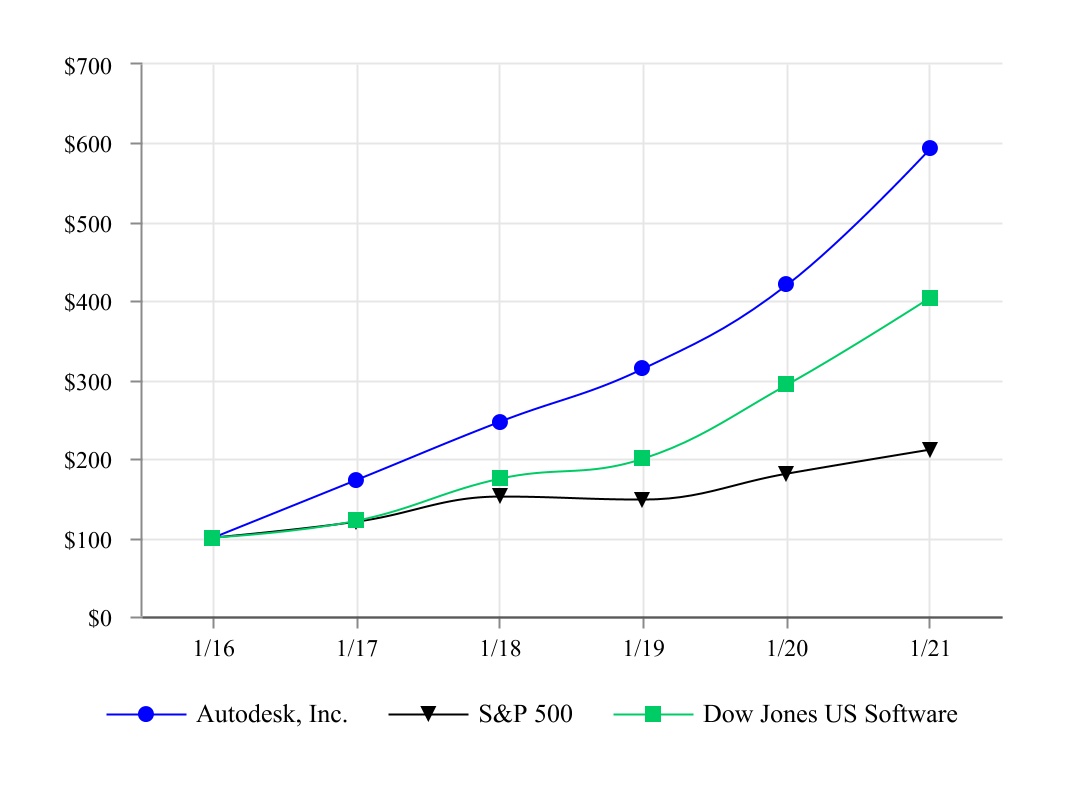
(1)Assumes $100 invested on January 31, 2016, in Autodesk’s stock, the Standard & Poor’s 500 Stock Index, and the Dow Jones U.S. Software Index, with reinvestment of all dividends. Total stockholder returns for prior periods are not an indication of future investment returns.
Item 6. SELECTED FINANCIAL DATA
The following selected consolidated financial data is not necessarily indicative of results of future operations, and should be read in conjunction with Item 7, “Management's Discussion and Analysis of Financial Condition and Results of Operations,” and the consolidated financial statements and related notes thereto included in Item 8 of this Form 10-K to fully understand factors that may affect the comparability of the information presented below. The financial data for the fiscal years ended January 31, 2021 and 2020, are derived from, and are qualified by reference to, the audited consolidated financial statements that are included in this Form 10-K. The Consolidated Statements of Operations and the Consolidated Statements of Cash Flows data for the fiscal year ended January 31, 2019, are derived from, and are qualified by reference to, the audited consolidated financial statements that are included in this Form 10-K. The Consolidated Balance Sheet data for the fiscal year ended January 31, 2019, and the remaining financial data for the fiscal years ended January 31, 2018 and 2017, are derived from audited consolidated financial statements which are not included in this Form 10-K.
| Fiscal Year Ended January 31, | |||||||||||||||||||||||||||||
| 2021 | 2020 (1) | 2019 (2) | 2018 | 2017 | |||||||||||||||||||||||||
| (In millions, except per share data) | |||||||||||||||||||||||||||||
| Net revenue | $ | 3,790.4 | $ | 3,274.3 | $ | 2,569.8 | $ | 2,056.6 | $ | 2,031.0 | |||||||||||||||||||
| Income (loss) from operations | 629.1 | 343.0 | (25.0) | (509.1) | (499.6) | ||||||||||||||||||||||||
| Net income (loss) (3) | 1,208.2 | 214.5 | (80.8) | (566.9) | (582.1) | ||||||||||||||||||||||||
| Cash flow from operations | $ | 1,437.2 | $ | 1,415.1 | $ | 377.1 | $ | 0.9 | $ | 169.7 | |||||||||||||||||||
| Common stock data: | |||||||||||||||||||||||||||||
| Basic net income (loss) per share | $ | 5.51 | $ | 0.98 | $ | (0.37) | $ | (2.58) | $ | (2.61) | |||||||||||||||||||
| Diluted net income (loss) per share | $ | 5.44 | $ | 0.96 | $ | (0.37) | $ | (2.58) | $ | (2.61) | |||||||||||||||||||
| Balance sheet data: | |||||||||||||||||||||||||||||
| Total assets | $ | 7,279.8 | $ | 6,179.3 | $ | 4,729.2 | $ | 4,113.6 | $ | 4,798.1 | |||||||||||||||||||
| Long-term liabilities | 3,059.6 | 3,099.2 | 2,638.9 | 2,246.4 | 1,879.1 | ||||||||||||||||||||||||
| Stockholders’ equity (deficit) | $ | 965.5 | $ | (139.1) | $ | (210.9) | $ | (256.0) | $ | 733.6 |
(1)Reflects the impact of the adoption of a new accounting standard in fiscal year 2020, Accounting Standards Codification ("ASC") Topic 842. Prior periods were not adjusted.
(2)Reflects the impact of the adoption of new accounting standards in fiscal year 2019 related to ASC Topic 606 and ASC Topic 340. Prior periods were not adjusted.
(3)Includes income tax benefit of $661.5 million primarily due to the U.S. valuation allowance release of $679.0 million in fiscal year 2021.
Item 7. MANAGEMENT’S DISCUSSION AND ANALYSIS OF FINANCIAL CONDITION AND RESULTS OF OPERATIONS
The following discussion and analysis of our financial condition and results of operations should be read in conjunction with our consolidated financial statements and related notes appearing in Part II, Item 8 of this Annual Report on Form 10-K. This discussion contains forward-looking statements based upon current expectations that involve risks and uncertainties. Our actual results may differ materially from those anticipated in these forward-looking statements as a result of several factors, including those set forth above in Part I, Item 1A, "Risk Factors," and elsewhere in this report. See “Forward-Looking Information” immediately preceding Part I.
STRATEGY
Autodesk makes software for people who make things. If you have ever driven a high-performance car, admired a towering skyscraper, used a smartphone, or watched a great film, chances are you have experienced what millions of Autodesk customers are doing with our software. We empower innovators to achieve the new possible - enabling them to discover first-in-kind solutions to complex design challenges, deliver tangible outcomes in record time, and make data-powered decisions for sustainable outcomes.
Our strategy is to build enduring relationships with customers, delivering innovative technology that provides valuable automation and insight into their design and make process. To drive execution of our strategy, we are focused on three strategic priorities: delivering on the promise of subscription, digitizing the company, and reimagining construction, manufacturing, and production.
We equip and inspire our users with the tailored tools, services, and access they need for success today and tomorrow. At every step, we help users harness the power of data to build upon their ideas and explore new ways of imagining, collaborating, and creating to achieve better outcomes for their customers, for society, and for the world. And because creativity can’t flourish in silos, we connect what matters - from steps in a project to collaborators on a unified platform.
Autodesk was founded during the platform transition from mainframe computers and engineering workstations to personal computers. We have developed and sustained a compelling value proposition based upon desktop software for the personal computer. Just as the transition from mainframes to personal computers transformed the industry over 30 years ago, the software industry has undergone a transition from developing and selling perpetual licenses and on-premises products to subscriptions and cloud-enabled technologies.
Product Evolution
We offer subscriptions for individual products and Industry Collections, enterprise business arrangements (“EBAs”), and cloud service offerings (collectively referred to as “subscription plan”). Subscription plans are designed to give our customers more flexibility with how they use our offerings and to attract a broader range of customers, such as project-based users and small businesses.
Our subscription plans currently represent a hybrid of desktop software and cloud functionality, which provides a device-independent, collaborative design workflow for designers and their stakeholders. Our cloud offerings, for example, BIM 360, Shotgun, AutoCAD web app, and AutoCAD mobile app, provide tools, including mobile and collaboration capabilities, to streamline design, collaboration, building and manufacturing, and data management processes. We believe that customer adoption of these latest offerings will continue to grow as customers across a range of industries begin to take advantage of the scalable computing power and flexibility provided through these services.
Industry Collections provide our customers with access to a broader selection of Autodesk solutions and services, simplifying the customers’ ability to benefit from a complete set of tools for their industry.
We discontinued the sale of new commercial licenses of most individual software products in fiscal 2016. Additionally, in fiscal 2018, we commenced a program to incentivize maintenance plan customers to move to subscription plan offerings, maintenance-to-subscription (“M2S”), while at the same time increasing maintenance plan pricing over time for customers that remain on maintenance plans. Since launching the program, a substantial majority of maintenance plan customers have converted to subscription plan offerings. We will be retiring maintenance plan offerings as of May 7, 2021 and will allow customers to convert their remaining maintenance seats to subscription plan offerings prior to this date.
To support our strategic priority of re-imagining AEC, we are strengthening the foundation of our AEC solutions with both organic and inorganic investments. In fiscal 2021, we acquired Spacemaker which uses cloud-based, artificial intelligence (AI), and generative design to help architects, urban designers, and real estate developers make faster and more informed early-stage design decisions which can help maximize the long-term sustainability and return from property investments. Other acquisitions in fiscal 2021 included solutions that use artificial intelligence and machine learning to extract and process data from project plans and specifications allowing general contractors, subcontractors, and owners to automate workflows such as submittals and project closeout, as well as a leading provider of post-processing and machine simulation solutions in manufacturing.
As part of our strategy in manufacturing, we continue to attract both global manufacturing leaders and disruptive startups with our generative design and cloud-based Fusion 360 technology enhancements.
Our strategy includes improving our product functionality and expanding our product offerings through internal development as well as through the acquisition of products, technology, and businesses. Acquisitions often increase the speed at which we can deliver product functionality to our customers; however, they entail cost and integration challenges and may, in certain instances, negatively impact our operating margins. We continually review these factors in making decisions regarding acquisitions. We currently anticipate that we will continue to acquire products, technology, and businesses as compelling opportunities become available.
Global Reach
We sell our products and services globally, through a combination of indirect and direct channels. Our indirect channels include value added resellers, direct market resellers, distributors, computer manufacturers, and other software developers. Our direct channels include internal sales resources dedicated to selling in our largest accounts, our highly specialized solutions, and business transacted through our online Autodesk branded store. See Note 2, "Revenue Recognition" in the Notes to the Consolidated Financial Statements for further detail on the results of our indirect and direct channel sales for the fiscal years ended January 31, 2021, 2020, and 2019.
We anticipate that our channel mix will continue to change as we scale our online Autodesk branded store business and our largest accounts shift towards direct-only business models. However, we expect our indirect channel will continue to transact and support the majority of our customers and revenue. We employ a variety of incentive programs and promotions to align our direct and indirect channels with our business strategies. In addition, we have a worldwide user group organization and we have created online user communities dedicated to the exchange of information related to the use of our products.
One of our key strategies is to maintain an open-architecture design of our software products to facilitate third-party development of complementary products and industry-specific software solutions. This approach enables customers and third parties to customize solutions for a wide variety of highly specific uses. We offer several programs that provide strategic inves
Showing the first 8K of 114K characters. Open the full section
Item 7A. QUANTITATIVE AND QUALITATIVE DISCLOSURES ABOUT MARKET RISK
FOREIGN CURRENCY EXCHANGE RISK
Our revenue, earnings, cash flows, receivables, and payables are subject to fluctuations due to changes in foreign currency exchange rates. Our risk management strategy utilizes foreign currency contracts to manage our exposure to foreign currency volatility that exists as part of our ongoing business operations. We utilize cash flow hedge contracts to reduce the exchange rate impact on a portion of the net revenue or operating expense of certain anticipated transactions. In addition, we use balance sheet hedge contracts to reduce the exchange rate risk associated primarily with foreign currency denominated receivables and payables. As of January 31, 2021 and 2020, we had open cash flow and balance sheet hedge contracts with future settlements generally within one to 12 months. Contracts were primarily denominated in euros, Japanese yen, British pounds, Canadian dollars, Australian dollars, Singapore dollars, Swiss francs, Swedish krona, and Czech koruna. We do not enter into foreign exchange derivative instruments for trading or speculative purposes. The notional amount of our option and forward contracts was $1.57 billion and $1.72 billion at January 31, 2021 and 2020, respectively.
We use foreign currency contracts to reduce the exchange rate impact on the net revenue and operating expenses of certain anticipated transactions. A sensitivity analysis performed on our hedging portfolio as of January 31, 2021, indicated that a hypothetical 10% appreciation of the U.S. dollar from its value at January 31, 2021 and 2020, would increase the fair value of our foreign currency contracts by $118.6 million and $158.8 million, respectively. A hypothetical 10% depreciation of the dollar from its value at January 31, 2021 and 2020, would decrease the fair value of our foreign currency contracts by $149.2 million and $119.2 million, respectively.
INTEREST RATE RISK
Interest rate movements affect both the interest income we earn on our short-term investments and the market value of certain longer term securities. At January 31, 2021, we had $812.3 million of cash equivalents and marketable securities, including $85.0 million classified as short-term marketable securities. If interest rates were to move up by 50 or 100 basis points over a 12-month period, the market value change of our marketable securities would not have a material impact on our results of operations.
OTHER MARKET RISK
From time to time we make direct investments in privately held companies. Privately held company investments generally are considered inherently risky. The technologies and products these companies have under development are typically in the early stages and may never materialize, which could result in a loss of all or a substantial part of our initial investment in these companies. The evaluation of privately held companies is based on information that we request from these companies, which is not subject to the same disclosure regulations as U.S. publicly traded companies, and as such, the basis for these evaluations is subject to the timing and accuracy of the data received from these companies. See Part II, Item 8, Note 3, “Financial Instruments” in the Notes to Consolidated Financial Statements for further discussion regarding these strategic investments.
For information about exposure to counter-party credit-related losses, see Part II, Item 8, Note 1, “Business and Summary of Significant Accounting Policies - Concentration of Credit Risk."
Item 8. FINANCIAL STATEMENTS AND SUPPLEMENTARY DATA
AUTODESK, INC.
CONSOLIDATED STATEMENTS OF OPERATIONS
(In millions, except per share data)
| Fiscal year ended January 31, | |||||||||||||||||
| 2021 | 2020 | 2019 | |||||||||||||||
| Net revenue: | |||||||||||||||||
| Subscription | $ | 3,478.9 | $ | 2,751.9 | $ | 1,802.3 | |||||||||||
| Maintenance | 183.3 | 386.6 | 635.1 | ||||||||||||||
| Total subscription and maintenance revenue | 3,662.2 | 3,138.5 | 2,437.4 | ||||||||||||||
| Other | 128.2 | 135.8 | 132.4 | ||||||||||||||
| Total net revenue | 3,790.4 | 3,274.3 | 2,569.8 | ||||||||||||||
| Cost of revenue: | |||||||||||||||||
| Cost of subscription and maintenance revenue | 242.1 | 223.9 | 216.0 | ||||||||||||||
| Cost of other revenue | 64.1 | 66.5 | 54.4 | ||||||||||||||
| Amortization of developed technologies | 30.9 | 34.5 | 15.5 | ||||||||||||||
| Total cost of revenue | 337.1 | 324.9 | 285.9 | ||||||||||||||
| Gross profit | 3,453.3 | 2,949.4 | 2,283.9 | ||||||||||||||
| Operating expenses: | |||||||||||||||||
| Marketing and sales | 1,440.3 | 1,310.3 | 1,183.9 | ||||||||||||||
| Research and development | 932.5 | 851.1 | 725.0 | ||||||||||||||
| General and administrative | 413.9 | 405.6 | 340.1 | ||||||||||||||
| Amortization of purchased intangibles | 37.5 | 38.9 | 18.0 | ||||||||||||||
| Restructuring and other exit costs, net | — | 0.5 | 41.9 | ||||||||||||||
| Total operating expenses | 2,824.2 | 2,606.4 | 2,308.9 | ||||||||||||||
| Income (loss) from operations | 629.1 | 343.0 | (25.0) | ||||||||||||||
| Interest and other expense, net | (82.4) | (48.2) | (17.7) | ||||||||||||||
| Income (loss) before income taxes | 546.7 | 294.8 | (42.7) | ||||||||||||||
| Benefit (provision) for income taxes | 661.5 | (80.3) | (38.1) | ||||||||||||||
| Net income (loss) | $ | 1,208.2 | $ | 214.5 | $ | (80.8) | |||||||||||
| Basic net income (loss) per share | $ | 5.51 | $ | 0.98 | $ | (0.37) | |||||||||||
| Diluted net income (loss) per share | $ | 5.44 | $ | 0.96 | $ | (0.37) | |||||||||||
| Weighted average shares used in computing basic net income (loss) per share | 219.4 | 219.7 | 218.9 | ||||||||||||||
| Weighted average shares used in computing diluted net income (loss) per share | 222.1 | 222.5 | 218.9 |
See accompanying Notes to Consolidated Financial Statements.
AUTODESK, INC.
CONSOLIDATED STATEMENTS OF COMPREHENSIVE INCOME (LOSS)
(In millions)
| Fiscal year ended January 31, | |||||||||||||||||
| 2021 | 2020 | 2019 | |||||||||||||||
| Net income (loss) | $ | 1,208.2 | $ | 214.5 | $ | (80.8) | |||||||||||
| Other comprehensive income (loss), net of reclassifications: | |||||||||||||||||
| Net (loss) gain on derivative instruments (net of tax effect of $5.0, ($1.1), and ($1.1)) | (32.5) | (6.6) | 31.6 | ||||||||||||||
| Change in net unrealized gain on available-for-sale securities (net of tax effect of $0.1, ($0.4), and $0.0) | 1.7 | 1.4 | 2.0 | ||||||||||||||
| Change in defined benefit pension items (net of tax effect of ($0.3), $1.6, and ($2.0)) | 1.5 | (6.5) | 13.0 | ||||||||||||||
| Net change in cumulative foreign currency translation gain (loss) (net of tax effect of ($0.6), $0.1, and $0.5) | 63.7 | (13.6) | (57.8) | ||||||||||||||
| Total other comprehensive income (loss) | 34.4 | (25.3) | (11.2) | ||||||||||||||
| Total comprehensive income (loss) | $ | 1,242.6 | $ | 189.2 | $ | (92.0) |
See accompanying Notes to Consolidated Financial Statements.
AUTODESK, INC.
CONSOLIDATED BALANCE SHEETS
(In millions, except per share data)
| January 31, 2021 | January 31, 2020 | ||||||||||
| ASSETS | |||||||||||
| Current assets: | |||||||||||
| Cash and cash equivalents | $ | 1,772.2 | $ | 1,774.7 | |||||||
| Marketable securities | 85.0 | 69.0 | |||||||||
| Accounts receivable, net | 643.1 | 652.3 | |||||||||
| Prepaid expenses and other current assets | 198.9 | 163.3 | |||||||||
| Total current assets | 2,699.2 | 2,659.3 | |||||||||
| Computer equipment, software, furniture, and leasehold improvements, net | 192.8 | 161.7 | |||||||||
| Operating lease right-of-use assets | 416.7 | 438.8 | |||||||||
| Developed technologies, net | 88.6 | 70.9 | |||||||||
| Goodwill | 2,706.5 | 2,445.0 | |||||||||
| Deferred income taxes, net | 763.1 | 56.4 | |||||||||
| Long-term other assets | 412.9 | 347.2 | |||||||||
| Total assets | $ | 7,279.8 | $ | 6,179.3 | |||||||
| LIABILITIES AND STOCKHOLDERS’ EQUITY (DEFICIT) | |||||||||||
| Current liabilities: | |||||||||||
| Accounts payable | $ | 122.5 | $ | 83.7 | |||||||
| Accrued compensation | 322.6 | 272.1 | |||||||||
| Accrued income taxes | 42.6 | 21.2 | |||||||||
| Deferred revenue | 2,500.9 | 2,176.1 | |||||||||
| Operating lease liabilities | 71.4 | 48.1 | |||||||||
| Current portion of long-term notes payable, net | — | 449.7 | |||||||||
| Other accrued liabilities | 194.7 | 168.3 | |||||||||
| Total current liabilities | 3,254.7 | 3,219.2 | |||||||||
| Long-term deferred revenue | 859.3 | 831.0 | |||||||||
| Long-term operating lease liabilities | 396.0 | 411.7 | |||||||||
| Long-term income taxes payable | 15.9 | 19.1 | |||||||||
| Long-term deferred income taxes | 11.4 | 82.5 | |||||||||
| Long-term notes payable, net | 1,637.2 | 1,635.1 | |||||||||
| Long-term other liabilities | 139.8 | 119.8 | |||||||||
| Commitments and contingencies | |||||||||||
| Stockholders’ equity (deficit): | |||||||||||
| Preferred stock, $0.01 par value; shares authorized 2.0; none issued or outstanding at January 31, 2021 and 2020 | — | — | |||||||||
| Common stock and additional paid-in capital, $ |
Showing the first 8K of 196K characters. Open the full section
Item 9. CHANGES IN AND DISAGREEMENTS WITH ACCOUNTANTS ON ACCOUNTING AND FINANCIAL DISCLOSURE
None.
Item 9A. CONTROLS AND PROCEDURES
EVALUATION OF DISCLOSURE CONTROLS AND PROCEDURES
We maintain “disclosure controls and procedures,” as defined in Rule 13a-15(e) and 15d-15(e) under the Securities Exchange Act of 1934, as amended (the “Exchange Act”). Our disclosure controls and procedures are designed to ensure that information required to be disclosed in our Exchange Act reports is (i) recorded, processed, summarized, and reported within the time periods specified in the rules of the Securities and Exchange Commission (“SEC”), and (ii) accumulated and communicated to Autodesk management, including our Chief Executive Officer and Chief Financial Officer, to allow timely decisions regarding required disclosure. We conducted an evaluation, under the supervision and with the participation of our Chief Executive Officer and Chief Financial Officer, of the effectiveness of the design and operation of our disclosure controls and procedures as of the end of the period covered by this Annual Report on Form 10-K. Based upon this evaluation, our Chief Executive Officer and Chief Financial Officer have concluded that our disclosure controls and procedures are effective as of January 31, 2021.
MANAGEMENT'S REPORT ON INTERNAL CONTROL OVER FINANCIAL REPORTING
Our management is responsible for establishing and maintaining adequate internal control over financial reporting (as defined in Rule 13a-15(f) under the Securities Exchange Act of 1934, as amended). Our management assessed the effectiveness of our internal control over financial reporting as of January 31, 2021. In making this assessment, our management used the criteria set forth by the Committee of Sponsoring Organizations of the Treadway Commission (“COSO”) in the 2013 Internal Control—Integrated Framework. Our management, including our Chief Executive Officer and Chief Financial Officer, does not expect that our disclosure controls and procedures or our internal control over financial reporting will necessarily prevent all errors and all fraud. A control system, no matter how well conceived and operated, can provide only reasonable, not absolute, assurance that the objectives of the control system are met. Further, the design of a control system must reflect the fact that there are resource constraints, and the benefits of controls must be considered relative to their costs. Because of the inherent limitations in all control systems, no evaluation of controls can provide absolute assurance that all control issues and instances of fraud, if any, within Autodesk have been detected.
Our management has concluded that, as of January 31, 2021, our internal control over financial reporting was effective to provide reasonable assurance regarding the reliability of financial reporting and the preparation of financial statements for external purposes in accordance with generally accepted accounting principles. Our independent registered public accounting firm, Ernst & Young LLP, has issued an audit report on our internal control over financial reporting, which is included in Item 8 herein.
CHANGES IN INTERNAL CONTROL OVER FINANCIAL REPORTING
There were no changes in our internal control over financial reporting (as such term is defined in Rules 13a-15(f) and 15d-15(f) under the Securities Exchange Act of 1934) during the three months ended January 31, 2021, that have materially affected, or are reasonably likely to materially affect, our internal control over financial reporting.
Item 9B. OTHER INFORMATION
None.
PART III
Certain information required by Part III is omitted from this Annual Report because we intend to file a definitive proxy statement pursuant to Regulation 14A for our Annual Meeting of Stockholders not later than 120 days after the end of the fiscal year covered by this Annual Report (the “Proxy Statement”) and certain information included therein is incorporated herein by reference. Only those sections of the Proxy Statement that specifically address the items set forth herein are incorporated by reference.
Item 10. DIRECTORS, EXECUTIVE OFFICERS AND CORPORATE GOVERNANCE
The information required by this Item is incorporated herein by reference to the sections entitled “Proposal One—Election of Directors,” “Section 16(a) Beneficial Ownership Reporting Compliance,” and “Corporate Governance” in our Proxy Statement.
INFORMATION ABOUT OUR EXECUTIVE OFFICERS
The following sets forth certain information as of March 19, 2021, regarding our executive officers.
| Name | Age | Position | |||||||||
| Andrew Anagnost | 56 | President and Chief Executive Officer | |||||||||
| Deborah L. Clifford | 46 | EVP and Chief Financial Officer | |||||||||
| Steve M. Blum | 56 | Chief Revenue Officer | |||||||||
| Pascal W. Di Fronzo | 56 | EVP, Corporate Affairs, Chief Legal Officer & Secretary |
Andrew Anagnost joined Autodesk in September 1997 and has served as President and Chief Executive Officer since June 2017. He also served as Interim Chief Financial Officer from January 2021 to March 2021. Dr. Anagnost served as Co-CEO from February 2017 to June 2017, Chief Marketing Officer from December 2016 to June 2017 and as the Company’s Senior Vice President, Business Strategy & Marketing, from March 2012 to June 2017. From December 2009 to March 2012, Dr. Anagnost was Vice President, Product Suites and Web Services of the Company. Prior to this position, Dr. Anagnost served as Vice President of CAD/CAE products for the manufacturing division of the Company from March 2007 to December 2009. Previously, Dr. Anagnost held other senior management positions at the Company. Prior to joining the Company, Dr. Anagnost held various engineering, sales, marketing and product management positions at Lockheed Aeronautical Systems Company and EXA Corporation. He also served as an NRC post-doctoral fellow at NASA Ames Research Center.
Deborah L. Clifford joined Autodesk as Executive Vice President and Chief Financial Officer in March 2021. Ms. Clifford previously served as Chief Financial Officer of SVMK Inc. (“SurveyMonkey”), an online survey development company, since July 2019. Prior to joining SurveyMonkey, Ms. Clifford served as Vice President of Financial Planning and Analysis at Autodesk from January 2018 to July 2019, and had served in various finance positions at Autodesk since September 2005, including as Vice President, Division Finance from July 2014 to December 2017.
Steven M. Blum joined Autodesk in January 2003 and has served as Chief Revenue Officer since August 2020. He previously served as Senior Vice President, Worldwide Field Operations since September 2017. Mr. Blum served as Senior Vice President, Worldwide Sales and Services from February 2011 to September 2017. From January 2003 to February 2011, he served as Senior Vice President of Americas Sales. Prior to this position, Blum was Executive Vice President of Sales and Account Management for Parago, Inc. Blum also held positions at Mentor Graphics, most recently serving as Vice President of America's sales. Before joining Mentor Graphics, he held engineering and sales positions at NCR Corporation and Advanced Micro Devices.
Pascal W. Di Fronzo joined Autodesk in June 1998 and has served as Executive Vice President, Corporate Affairs, Chief Legal Officer & Secretary since December 2016. Mr. Di Fronzo served as Senior Vice President, General Counsel and Secretary from March 2007 to December 2016. From March 2006 to March 2007, Mr. Di Fronzo served as Vice President, General Counsel and Secretary, and served as Vice President, Assistant General Counsel and Assistant Secretary from March 2005 through March 2006. Previously, Mr. Di Fronzo served in other business and legal capacities in our Legal Department. Prior to joining Autodesk, he advised high technology and emerging growth companies on business and intellectual property transactions and litigation while in private practice.
There is no family relationship among any of our directors or executive officers.
Item 11. EXECUTIVE COMPENSATION
The information required by this Item is incorporated herein by reference to the sections entitled “Corporate Governance” and “Executive Compensation” in our Proxy Statement.
Item 12. SECURITY OWNERSHIP OF CERTAIN BENEFICIAL OWNERS AND MANAGEMENT AND RELATED STOCKHOLDER MATTERS
The information required by this Item is incorporated herein by reference to the sections entitled “Security Ownership of Certain Beneficial Owners and Management” and “Executive Compensation—Equity Compensation Plan Information” in our Proxy Statement.
Item 13. CERTAIN RELATIONSHIPS AND RELATED TRANSACTIONS, AND DIRECTOR INDEPENDENCE
The information required by this Item is incorporated herein by reference to the sections entitled “Certain Relationships and Related Party Transactions” and “Corporate Governance—Independence of the Board” in our Proxy Statement.
Item 14. PRINCIPAL ACCOUNTING FEES AND SERVICES
The information required by this Item is incorporated herein by reference to the sections entitled “Proposal Two—Ratification of the Appointment of Independent Registered Public Accounting Firm” in our Proxy Statement.
PART IV
**ITEM 15.**EXHIBITS AND FINANCIAL STATEMENT SCHEDULES
(a) The following documents are filed as part of this Report:
*1.*Financial Statements: The information concerning Autodesk’s financial statements, and the Report of Ernst & Young LLP, Independent Registered Public Accounting Firm required by this Item is incorporated by reference herein to the section of this Report in Item 8, entitled “Financial Statements and Supplementary Data.”
*2.*Financial Statement Schedule: The following financial statement schedule of Autodesk, Inc., for the fiscal years ended January 31, 2021, 2020, and 2019, is filed as part of this Report and should be read in conjunction with the Consolidated Financial Statements of Autodesk, Inc.:
Schedule II Valuation and Qualifying Accounts
Schedules not listed above have been omitted because they are not applicable or are not required or the information required to be set forth therein is included in the Consolidated Financial Statements or Notes thereto.
*3.*Exhibits: See Item 15(b) below. We have filed, or incorporated into this Report by reference, the exhibits listed on the accompanying Index to Exhibits immediately prior to the signature page of this Form 10-K.
(b) Exhibits:
We have filed, or incorporated into this Report by reference, the exhibits listed on the accompanying Index to Exhibits immediately prior to the signature page of this Form 10-K.
(c) Financial Statement Schedules: See Item 15(a), above.
Item 15. (A)(2)FINANCIAL STATEMENT SCHEDULE
SCHEDULE II: VALUATION AND QUALIFYING ACCOUNTS
(in millions)
| Description | Balance at Beginning of Fiscal Year | Additions Charged to Costs and Expenses or Revenues | Deductions and Write-Offs | Balance at End of Fiscal Year | |||||||||||||||||||
| (in millions) | |||||||||||||||||||||||
| Fiscal Year Ended January 31, 2021 | |||||||||||||||||||||||
| Partner Program reserves (1) | $ | 60.4 | 491.9 | 488.3 | $ | 64.0 | |||||||||||||||||
| Fiscal Year Ended January 31, 2020 | |||||||||||||||||||||||
| Partner Program reserves (1) | $ | 51.7 | 453.7 | 445.0 | $ | 60.4 | |||||||||||||||||
| Restructuring and other facility exit costs | $ | 2.1 | 0.3 | 2.4 | $ | — | |||||||||||||||||
| Fiscal Year Ended January 31, 2019 | |||||||||||||||||||||||
| Partner Program reserves (1) | $ | 36.5 | 294.7 | 279.5 | $ | 51.7 | |||||||||||||||||
| Restructuring and other facility exit costs | $ | 57.2 | 41.9 | 97.0 | $ | 2.1 |
(1)The partner program reserves balance impacts "Accounts receivable, net" and "Accounts payable" on the accompanying Consolidated Balance Sheets.
Item 16. FORM 10-K SUMMARY
None.
Index to Exhibits
- Denotes a management contract or compensatory plan or arrangement.
† The certifications attached as Exhibit 32.1 that accompany this Annual Report on Form 10-K are not deemed filed with the Securities and Exchange Commission and are not to be incorporated by reference into any filing of Autodesk, Inc. under the Securities Act of 1933, as amended, or the Securities Exchange Act of 1934, as amended, whether made before or after the date of this Form 10-K, irrespective of any general incorporation language contained in such filing.
†† The financial information contained in these XBRL documents is unaudited.
SIGNATURES
Pursuant to the requirements of Section 13 or 15(d) of the Securities Exchange Act of 1934, the Registrant has duly caused this Report to be signed on its behalf by the undersigned, thereunto duly authorized.
| AUTODESK, INC. | |||||||||||
| By: | /s/ ANDREW ANAGNOST | ||||||||||
| Andrew Anagnost | |||||||||||
| President and Chief Executive Officer | |||||||||||
| Dated: | March 19, 2021 |
POWER OF ATTORNEY
KNOW ALL PERSONS BY THESE PRESENTS, that each person whose signature appears below constitutes and appoints Andrew Anagnost and Deborah L. Clifford each as his or her attorney-in-fact, each with the power of substitution, for him or her in any and all capacities, to sign any amendments to this Report on Form 10-K, and to file the same, with exhibits thereto and other documents in connection therewith, with the Securities and Exchange Commission, hereby ratifying and confirming all that each of said attorneys-in-fact, or his substitute or substitutes, may do or cause to be done by virtue hereof.
Pursuant to the requirements of the Securities Exchange Act of 1934, this Report has been signed below by the following persons on behalf of the Registrant and in the capacities as of March 19, 2021.
| Signature | Title | |||||||
| /s/ ANDREW ANAGNOST | President and Chief Executive Officer, Director (Principal Executive Officer) | |||||||
| Andrew Anagnost | ||||||||
| /s/ DEBORAH L. CLIFFORD | Executive Vice President and Chief Financial Officer (Principal Financial Officer) | |||||||
| Deborah L. Clifford | ||||||||
| /s/ STEPHEN W. HOPE | Vice President and Chief Accounting Officer (Principal Accounting Officer) | |||||||
| Stephen W. Hope | ||||||||
| /s/ STACY J. SMITH | Director (Non-executive Chairman of the Board) | |||||||
| Stacy J. Smith | ||||||||
| /s/ KAREN BLASING | Director | |||||||
| Karen Blasing | ||||||||
| /s/ REID FRENCH | Director | |||||||
| Reid French | ||||||||
| /s/ AYANNA HOWARD | Director | |||||||
| Ayanna Howard | ||||||||
| /s/ MARY T. MCDOWELL | Director | |||||||
| Mary T. McDowell | ||||||||
| /s/ BLAKE J. IRVING | Director | |||||||
| Blake J. Irving | ||||||||
| /s/ STEPHEN D. MILLIGAN | Director | |||||||
| Stephen D. Milligan | ||||||||
| /s/ LORRIE M. NORRINGTON | Director | |||||||
| Lorrie M. Norrington | ||||||||
| /s/ ELIZABETH RAFAEL | Director | |||||||
| Elizabeth Rafael |