 filings.tools
Item 1. BUSINESS
64K characters. Original on sec.gov · Markdown
Item 1. BUSINESS
GENERAL
Ameren, formed in 1997 and headquartered in St. Louis, Missouri, is a public utility holding company whose primary assets are its equity interests in its subsidiaries. Ameren’s subsidiaries are separate, independent legal entities with separate businesses, assets, and liabilities. Dividends on Ameren’s common stock and the payment of expenses by Ameren depend on distributions made to it by its subsidiaries.
Below is a summary description of Ameren’s principal subsidiaries, including Ameren Missouri, Ameren Illinois, and ATXI. Ameren also has other subsidiaries that conduct other activities, such as the provision of shared services. Ameren evaluates competitive electric transmission investment opportunities as they arise. A more detailed description can be found in Note 1 – Summary of Significant Accounting Policies under Part II, Item 8, of this report.
| • | Ameren Missouri operates a rate-regulated electric generation, transmission, and distribution business and a rate-regulated natural gas distribution business in Missouri. |
| • | Ameren Illinois operates rate-regulated electric transmission, electric distribution, and natural gas distribution businesses in Illinois. |
| • | ATXI operates a FERC rate-regulated electric transmission business. ATXI is developing MISO-approved electric transmission projects, including the Illinois Rivers and Mark Twain projects, and placed the Spoon River project in service in February 2018. |
The following table presents our total employees at December 31, 2017:
| Ameren Missouri | 3,639 | |
| Ameren Illinois | 3,423 | |
| Ameren Services | 1,553 | |
| Ameren | 8,615 |
Labor unions at subsidiaries consist of the International Brotherhood of Electrical Workers, the International Union of Operating Engineers, the Laborer’s International Union of North America, the United Association of Plumbers and Pipefitters, and the United Government Security Officers of America. At December 31, 2017, these labor unions collectively represented about 52% of Ameren’s total employees. They represented 62% and 57% of the employees at Ameren Missouri and Ameren Illinois, respectively. The collective bargaining agreements expire between 2018 and 2020.
For additional information about the development of our businesses, our business operations, and factors affecting our results of operations, financial position, and liquidity, see Management’s Discussion and Analysis of Financial Condition and Results of Operations under Part II, Item 7, of this report and Note 1 – Summary of Significant Accounting Policies under Part II, Item 8, of this report.
BUSINESS SEGMENTS
Ameren has four segments: Ameren Missouri, Ameren Illinois Electric Distribution, Ameren Illinois Natural Gas, and Ameren Transmission. The Ameren Missouri segment includes all of the operations of Ameren Missouri. Ameren Illinois Electric Distribution consists of the electric distribution business of Ameren Illinois. Ameren Illinois Natural Gas consists of the natural gas business of Ameren Illinois. Ameren Transmission is primarily composed of the aggregated electric transmission businesses of Ameren Illinois and ATXI.
Ameren Missouri has one segment. Ameren Illinois has three segments: Ameren Illinois Electric Distribution, Ameren Illinois Natural Gas, and Ameren Illinois Transmission.
An illustration of Ameren and Ameren Illinois’ reporting structures is provided below. For additional information on financial reporting segments, see Note 1 – Summary of Significant Accounting Policies and Note 15 – Segment Information under Part II, Item 8, of this report.
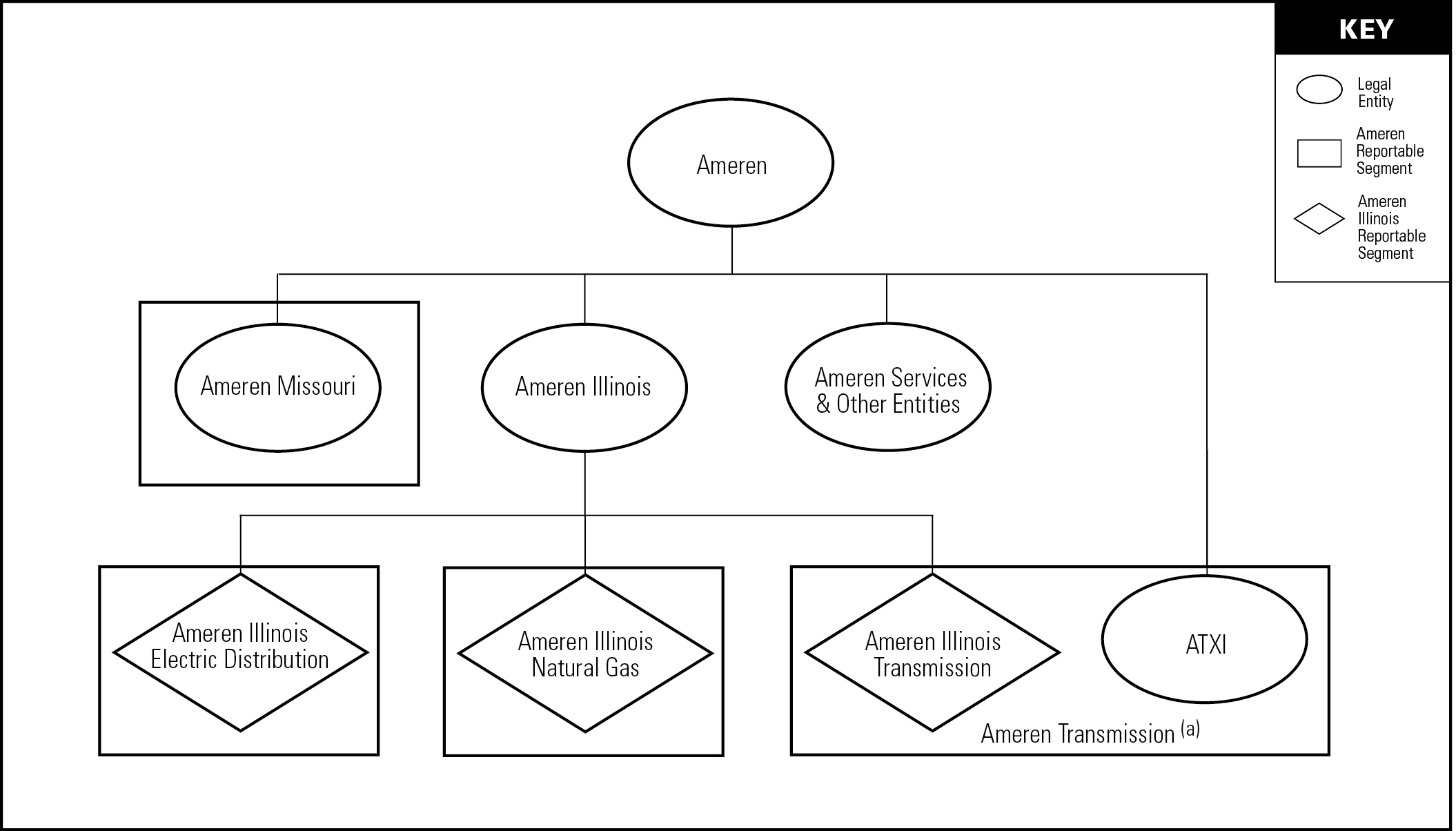
| (a) | Ameren Transmission segment includes associated Ameren (parent) interest charges, Ameren Transmission Company, LLC, ATX East, LLC, and ATX Southwest, LLC. |
RATES AND REGULATION
Rates
The rates that Ameren Missouri, Ameren Illinois, and ATXI are allowed to charge for their utility services significantly influence the results of operations, financial position, and liquidity of these companies and Ameren. The electric and natural gas utility industry is highly regulated. The utility rates charged to customers are determined by governmental entities, including the MoPSC, the ICC, and the FERC. Decisions by these entities are influenced by many factors, including the cost of providing service, the prudency of expenditures, the quality of service, regulatory staff knowledge and experience, customer intervention, and economic conditions, as well as social and political views. Decisions made by these governmental entities regarding rates are largely outside of our control. These decisions, as well as the regulatory lag involved in the process of getting new rates approved, could have a material adverse effect on the results of operations, financial position, and liquidity of the Ameren Companies. The extent of the regulatory lag varies for each of Ameren’s electric and natural gas jurisdictions, with the Ameren Transmission and Ameren Illinois Electric Distribution businesses experiencing the least amount of regulatory lag. Depending on the jurisdiction, the effects of regulatory lag are mitigated by various means, including the use of a future test year, the implementation of trackers and riders, the level and timing of expenditures, and regulatory frameworks that include annual revenue requirement reconciliations and decoupling of revenues from sales volumes.
The MoPSC regulates rates and other matters for Ameren Missouri. The ICC regulates rates and other matters for Ameren Illinois. The MoPSC and the ICC regulate non-rate utility matters for ATXI. ATXI does not have retail distribution customers; therefore, the MoPSC and the ICC do not have authority to regulate ATXI’s rates. The FERC regulates Ameren Missouri’s, Ameren Illinois’, and ATXI’s cost-based rates for the wholesale transmission and distribution of energy in interstate commerce and various other matters discussed below under General Regulatory Matters.
The following table summarizes the key terms of the rate orders in effect for customer billings for each of Ameren’s rate-regulated utilities as of January 1, 2018:
| Rate Regulator | Allowed Return on Equity | Percent of Common Equity | Rate Base (in billions) | Portion of Ameren’s 2017 Operating Revenues(a) | |
| Ameren Missouri | |||||
| Electric service(b) | MoPSC | 9.2% - 9.7%(c) | (c) | (c) | 54% |
| Natural gas delivery service | MoPSC | (d) | (d) | (d) | 2% |
| Ameren Illinois | |||||
| Electric distribution delivery service(e) | ICC | 8.40% | 50.0% | $2.7 | 25% |
| Natural gas delivery service(f) | ICC | 9.60% | 50.0% | $1.2 | 12% |
| Electric transmission service(g) | FERC | 10.82% | 51.6% | $1.6 | 4% |
| ATXI | |||||
| Electric transmission service(g) | FERC | 10.82% | 56.2% | $1.3 | 3% |
| (a) | Includes pass-through costs recovered from customers, such as purchased power for electric distribution delivery service and natural gas purchased for resale for natural gas delivery service, and intercompany eliminations. |
| (b) | Ameren Missouri’s electric generation, transmission, and delivery service rates are bundled together and charged to retail customers under a combined electric service rate. |
| (c) | Based on the MoPSC’s March 2017 rate order. This rate order specified that an implicit return on equity was within a range of 9.2% to 9.7%. The rate order did not specify a percent of common equity or rate base. The return on equity used for allowance for equity funds used during construction is 9.53%. |
| (d) | Based on the MoPSC’s January 2011 rate order. This rate order did not specify the allowed return on equity, the percent of common equity, or rate base. It includes the impacts on rate base and operating revenues relating to the ISRS for investments after the January 2011 rate order. |
| (e) | Based on the ICC’s December 2017 rate order. Ameren Illinois electric distribution delivery service rates are updated annually and become effective each January. The December 2017 rate order was based on 2016 recoverable costs, expected net plant additions for 2017, and the monthly yields during 2016 of the 30-year United States Treasury bonds plus 580 basis points. Ameren Illinois’ 2018 electric distribution delivery service revenues will be based on its 2018 actual recoverable costs, rate base, common equity percentage, and return on common equity, as calculated under the IEIMA’s performance-based formula ratemaking framework. |
| (f) | Based on the ICC’s December 2015 rate order. The rate order was based on a 2016 future test year. |
| (g) | Transmission rates are updated annually and become effective each January. They are determined by a company-specific, forward-looking formula ratemaking based on each year’s forecasted information. The 10.82% return, which includes the 50 basis points incentive adder for participation in an RTO, could be lowered by a FERC complaint proceeding filed in February 2015 that challenged the allowed return on common equity for MISO transmission owners and will require customer refunds if the FERC approves a return on equity lower than that previously collected through rates. |
Ameren Missouri
Ameren Missouri’s electric operating revenues are subject to regulation by the MoPSC. If certain criteria are met, Ameren Missouri’s electric rates may be adjusted without a traditional rate proceeding. For example, Ameren Missouri’s MEEIA customer energy-efficiency program costs, net shared benefits or throughput disincentive, and any performance incentive are recoverable through a rider that may be adjusted without a traditional rate proceeding, subject to MoPSC prudence reviews. Likewise, the FAC permits Ameren Missouri to recover or refund, through customer rates, 95% of the variance in net energy costs from the amount set in base rates without a traditional rate proceeding, subject to MoPSC prudence reviews.
In addition to the FAC and the MEEIA recovery mechanisms, Ameren Missouri employs other cost recovery mechanisms, including a pension and postretirement benefit cost tracker, an uncertain tax position tracker, a renewable energy standards cost tracker, and a solar rebate program tracker. Each of these trackers allows Ameren Missouri to defer the difference between actual costs incurred and the costs included in customer rates as a regulatory asset or regulatory liability. The difference will be included in base rates in a subsequent MoPSC rate order.
Ameren Missouri is a member of MISO, and its transmission rate is calculated in accordance with the MISO OATT. The FERC regulates the rates charged and the terms and conditions for wholesale electric transmission service. The transmission rate update each June is based on Ameren Missouri’s filings with the FERC. This rate is not directly charged to Missouri retail customers because, in Missouri, bundled retail rates include an amount for transmission-related costs and revenues.
Ameren Missouri’s natural gas operating revenues are subject to regulation by the MoPSC. If certain criteria are met, Ameren Missouri’s natural gas rates may be adjusted without a traditional rate proceeding. PGA clauses permit prudently incurred natural gas supply costs to be passed directly to customers. The ISRS also permits certain prudently incurred natural gas infrastructure replacement costs to be recovered from customers on a more timely basis between regulatory rate reviews. Ameren Missouri is not currently recovering any infrastructure replacement costs under the ISRS.
Ameren Illinois
Ameren Illinois Electric Distribution
Ameren Illinois’ electric distribution delivery service operating revenues are regulated by the ICC. In 2017, Ameren Illinois’ electric distribution delivery service revenues accounted for 88% of Ameren Illinois’ total electric operating revenues.
Ameren Illinois participates in the performance-based formula ratemaking framework established pursuant to the IEIMA and the FEJA. The IEIMA provides for the recovery of actual costs of electric delivery service that are prudently incurred and the use of the utility’s actual regulated capital structure through a formula for calculating the return on equity component of the cost of capital. The return on equity component of the formula rate is equal to the calendar year average of the monthly yields of the 30-year United States Treasury bonds plus 580 basis points. The IEIMA provides for an annual reconciliation of the revenue requirement necessary to reflect the actual costs incurred in a given year with the revenue requirement included in customer rates for that year, including an allowed return on equity. This annual revenue requirement reconciliation adjustment will be collected from, or refunded to, customers within two years.
The FEJA revised certain portions of the IEIMA, extending the IEIMA formula ratemaking framework through 2022, and clarifying that a common equity ratio up to and including 50% is prudent. Beginning in 2017, the FEJA allowed Ameren Illinois to recover, within the following two years, its electric distribution revenue requirement for a given year, independent of actual sales volumes. Prior to the FEJA, Ameren Illinois’ revenues were affected by the timing of sales volumes due to seasonal rates and changes in volumes resulting from, among other things, weather and energy efficiency. This portion of the law extends beyond the end of the IEIMA in 2022. Through 2022, revenue differences will be included in the annual IEIMA revenue requirement reconciliation. Additionally, this law implemented a customer surcharge relating to certain nuclear energy centers located in Illinois. The surcharge, like the cost of power purchased by Ameren Illinois on behalf of its customers, will be passed through to electric distribution customers with no effect on Ameren Illinois’ earnings.
Pursuant to the FEJA, and consistent with the energy-efficiency plan for 2018 through 2021 approved by the ICC, Ameren Illinois plans to invest up to $99 million in electric energy-efficiency programs per year. Ameren Illinois plans to make additional investments of a similar level in electric energy-efficiency programs per year that will earn a return through 2030. The electric energy-efficiency program investments and the return on those investments will be collected from customers through a rider; they will not be included in the IEIMA formula ratemaking framework.
Ameren Illinois is also subject to performance standards. Failure to achieve the standards would result in a reduction in the company’s allowed return on equity calculated under the formulas. The performance standards applicable to electric distribution service include improvements in service reliability to reduce both the frequency and duration of outages, a reduction in the number of estimated bills, a reduction of consumption from inactive meters, and a reduction in bad debt expense. The regulatory framework applicable to electric
distribution service provides for return on equity penalties up to 34 basis points in 2018, and up to 38 basis points in each year from 2019 through 2022, if these performance standards are not met. Beginning in 2018, the regulatory framework applicable to electric energy-efficiency investments provides for increases or decreases of up to 200 basis points to the return on equity. Any adjustments to the return on equity for energy-efficiency investments will depend on annual performance of a historical period relative to energy savings goals.
Under the IEIMA, Ameren Illinois is also subject to minimum capital spending levels. Between 2012 and 2021, Ameren Illinois is required to invest a minimum of $625 million in capital projects to modernize its distribution system incremental to its average annual electric distribution service capital projects of $228 million for calendar years 2008 through 2010. From 2012 through 2017, Ameren Illinois invested $508 million in IEIMA capital projects toward its $625 million requirement.
Ameren Illinois employs cost recovery mechanisms for power procurement, customer energy-efficiency program costs incurred before June 2017, and certain environmental costs as well as bad debt expense and the costs of certain asbestos-related claims not recovered in base rates.
Ameren Illinois Natural Gas
Ameren Illinois’ natural gas operating revenues are regulated by the ICC. In December 2015, the ICC issued a rate order that approved an increase in revenues for Ameren Illinois’ natural gas delivery service, based on a 2016 future test year. The rate order also approved the VBA for residential and small nonresidential customers. In January 2018, Ameren Illinois filed a request with the ICC seeking approval to increase its annual revenues for natural gas delivery service by $49 million, which included an estimated $42 million of annual revenues that would otherwise be recovered under a QIP rider, as explained in more detail below. The request was based on a 10.3% return on common equity, a capital structure composed of 50% common equity, and a rate base of $1.6 billion. If certain criteria are met, Ameren Illinois’ natural gas rates may be adjusted without a traditional rate proceeding, as PGA clauses permit prudently incurred natural gas costs to be passed directly to customers. Also, Ameren Illinois employs cost recovery mechanisms for customer energy-efficiency program costs, certain environmental costs, and bad debt expenses not recovered in base rates.
Illinois has a law that encourages natural gas utilities to accelerate modernization of the state’s natural gas infrastructure through a QIP rider. Without legislative action, the QIP rider will expire in December 2023. Ameren Illinois’ QIP rider allows a surcharge to be added to customers’ bills to recover depreciation expenses and to earn a return on qualifying natural gas investments that were not previously included in base rates. Recovery begins two months after the natural gas investments are placed in service and continues until the investments are included in base rates in a future natural gas rate order. Ameren Illinois’ QIP rider is subject to a rate impact limitation of a cumulative 4% per year since the most recent delivery service rate order, with no single year exceeding 5.5%. Upon issuance of the natural gas rate order, QIP recoveries will be included in base rates and the QIP rider will be reset to zero, which mitigates the risk that the QIP rider will exceed its statutory limitations in future years and ensures timely recovery of capital investment.
Ameren Illinois Transmission
Ameren Illinois’ transmission operating revenues are regulated by the FERC. In 2017, Ameren Illinois’ transmission service operating revenues accounted for 12% of Ameren Illinois’ electric operating revenues. See Ameren Transmission below for additional information regarding Ameren Illinois’ transmission business.
Ameren Transmission
Ameren Transmission is primarily composed of the aggregated electric transmission businesses of Ameren Illinois and ATXI. Both Ameren Illinois and ATXI are members of MISO, and their transmission rates are calculated in accordance with the MISO OATT. Ameren Illinois and ATXI have received FERC approval to use a company-specific, forward-looking formula ratemaking framework in setting their transmission rates. These forward-looking rates are updated each January with forecasted information. A reconciliation at the end of the year, which adjusts for the actual revenue requirement and for actual sales volumes, is used to adjust billing rates in a subsequent year. Ameren Illinois Transmission earns revenue from transmission service provided to Ameren Illinois Electric Distribution and wholesale customers. The transmission expense for Illinois customers who have elected to purchase their power from Ameren Illinois is recovered through a cost recovery mechanism with no net effect on Ameren Illinois Electric Distribution earnings, as costs are offset by corresponding revenues. Transmission revenues from these transactions are reflected in Ameren Transmission’s and Ameren Illinois Transmission’s operating revenues.
The FERC-allowed return on common equity for MISO transmission owners of 12.38% was challenged by customer groups in two complaint cases filed in November 2013 and in February 2015. As a result of a FERC order issued in the November 2013 complaint case, a 10.82% total allowed return on common equity has been reflected in rates since September 2016, inclusive of the 50 basis point adder for participation in an RTO. In June 2016, an administrative law judge issued an initial decision in the February 2015 complaint case. If approved by the FERC, it would lower the allowed base return on common equity for the 15-month period of February 2015 to May 2016 to 9.70%, or a 10.20% total allowed return on equity with the inclusion of a 50 basis point incentive adder for participation in an RTO. It would also require
customer refunds, with interest, for that 15-month period. A final FERC order would also establish the allowed return on common equity that will apply prospectively from the effective date of such order, replacing the current 10.82% total return on common equity. In September 2017, MISO transmission owners, including Ameren Missouri, Ameren Illinois, and ATXI, filed a motion to dismiss the February 2015 complaint case with the FERC. The FERC is under no deadline to issue a final order in the February 2015 complaint case.
ATXI has three MISO-approved multi-value projects, the Illinois Rivers, Spoon River, and Mark Twain projects. As of December 31, 2017, ATXI’s expected remaining investment in all three projects was approximately $300 million, with the total investment expected to be more than $1.6 billion. The Illinois Rivers project involves the construction of a 345-kilovolt line from eastern Missouri across Illinois to western Indiana. ATXI has obtained a certificate of public convenience and necessity and project approvals from the ICC and the MoPSC for each state’s portion of the Illinois Rivers project. The last line segment of this project is expected to be completed by the end of 2019; however, delays associated with property acquisition could delay the completion date. As of December 31, 2017, all 10 substations and seven of the nine line segments for Illinois Rivers were complete and in-service. The Spoon River project is located in northwest Illinois. ATXI placed the Spoon River project in service in February 2018. The Mark Twain project is located in northeast Missouri and connects Iowa to the Illinois Rivers project. In January 2018, the MoPSC granted ATXI a certificate of convenience and necessity for the Mark Twain project. ATXI plans to complete the Mark Twain project by the end of 2019.
The FERC has approved transmission rate incentives relating to the three MISO-approved multi-value projects, which allow construction work in progress to be included in rate base, thereby improving the timeliness of cash recovery.
For additional information on Ameren Missouri, Ameren Illinois, and ATXI rate matters, including the FERC complaint case challenging the allowed return on common equity for MISO transmission owners, see Results of Operations and Outlook in Management’s Discussion and Analysis of Financial Condition and Results of Operations under Part II, Item 7, Quantitative and Qualitative Disclosures About Market Risk under Part II, Item 7A, and Note 2 – Rate and Regulatory Matters under Part II, Item 8, of this report.
General Regulatory Matters
Ameren Missouri, Ameren Illinois, and ATXI must receive FERC approval to enter into various transactions, such as issuing short-term debt securities and conducting certain acquisitions, mergers, and consolidations involving electric utility holding companies. In addition, Ameren Missouri, Ameren Illinois, and ATXI must receive authorization from the applicable state public utility regulatory agency to issue stock and long-term debt securities (with maturities of more than 12 months) and to conduct mergers, affiliate transactions, and various other activities.
Ameren Missouri, Ameren Illinois, and ATXI are also subject to mandatory reliability standards, including cybersecurity standards adopted by the FERC, to ensure the reliability of the bulk electric power system. These standards are developed and enforced by the NERC pursuant to authority delegated to it by the FERC. If any of Ameren Missouri, Ameren Illinois or ATXI is found not to be in compliance with these mandatory reliability standards, it could incur substantial monetary penalties and other sanctions.
Under PUHCA 2005, the FERC and any state public utility regulatory agency may access books and records of Ameren and its subsidiaries that are found to be relevant to costs incurred by Ameren’s rate-regulated subsidiaries that may affect jurisdictional rates. PUHCA 2005 also permits the MoPSC and the ICC to request that the FERC review cost allocations by Ameren Services to other Ameren companies.
Operation of Ameren Missouri’s Callaway energy center is subject to regulation by the NRC. The license for the Callaway energy center expires in 2044. Ameren Missouri’s Osage hydroelectric energy center and Taum Sauk pumped-storage hydroelectric energy center, as licensed projects under the Federal Power Act, are subject to FERC regulations affecting, among other aspects, the general operation and maintenance of the projects. The licenses for the Osage hydroelectric energy center and the Taum Sauk pumped-storage hydroelectric energy center expire in 2047 and 2044, respectively. Ameren Missouri’s Keokuk energy center and its dam in the Mississippi River between Hamilton, Illinois, and Keokuk, Iowa, are operated under authority granted by an Act of Congress in 1905.
For additional information on regulatory matters, see Note 2 – Rate and Regulatory Matters, Note 9 – Callaway Energy Center, and Note 14 – Commitments and Contingencies under Part II, Item 8, of this report.
Environmental Matters
Certain of our operations are subject to federal, state, and local environmental statutes and regulations relating to the protection of the safety and health of our personnel, the public, and the environment. These environmental statutes and regulations include requirements relating to identification, generation, storage, handling, transportation, disposal, recordkeeping, labeling, reporting, and emergency response in connection with hazardous and toxic materials; safety and health standards; and environmental protection requirements, including standards and limitations relating to the discharge of air and water pollutants and the management of waste and byproduct materials. Failure to comply with these statutes or regulations could have material adverse effects on us. We could be subject to criminal or civil penalties by
regulatory agencies, or we could be ordered by the courts to pay private parties. Except as indicated in this report, we believe that we are in material compliance with existing statutes and regulations that currently apply to our operations.
The EPA has promulgated environmental regulations that have a significant impact on the electric utility industry. Over time, compliance with these regulations could be costly for Ameren Missouri, which operates coal-fired power plants. As of December 31, 2017, Ameren Missouri’s fossil fuel-fired energy centers represented 17% and 33% of Ameren’s and Ameren Missouri’s rate base, respectively. Regulations that apply to air emissions from the electric utility industry include the NSPS, the CSAPR, the MATS, and the revised National Ambient Air Quality Standards, which are subject to periodic review for certain pollutants. Collectively, these regulations cover a variety of pollutants, such as SO2, particulate matter, NOx, mercury, toxic metals, and acid gases, and CO2 emissions from new power plants. Water intake and discharges from power plants are regulated under the Clean Water Act. Such regulation could require modifications to water intake structures or more stringent limitations on wastewater discharges at Ameren Missouri’s energy centers, either of which could result in significant capital expenditures. The management and disposal of coal ash is regulated under the CCR rule, which will require the closure of surface impoundments and the installations of dry ash handling systems at several of Ameren Missouri’s energy centers. The individual or combined effects of existing environmental regulations could result in significant capital expenditures, increased operating costs, or the closure or alteration of operations at some of Ameren Missouri’s energy centers. Ameren and Ameren Missouri expect that such compliance costs would be recoverable through rates, subject to MoPSC prudence review, but the timing of costs and their recovery could be subject to regulatory lag. These environmental regulations could also affect the availability of, the cost of, and the demand for power and natural gas that is acquired for Ameren Missouri’s natural gas customers and Ameren Illinois’ electric and natural gas customers. Federal, state, and local authorities continually revise these regulations, which adds uncertainty to our planning process and to the ultimate implementation of these or other new or revised regulations.
For additional discussion of environmental matters, including NOx and SO2 emission reduction requirements, regulation of CO2 emissions, wastewater discharge standards, remediation efforts, CCR management regulations, and a discussion of the EPA’s allegations of violations of the Clean Air Act and Missouri law in connection with projects at Ameren Missouri’s Rush Island energy center, see Note 14 – Commitments and Contingencies under Part II, Item 8, of this report.
TRANSMISSION
Ameren owns an integrated transmission system that is composed of the transmission assets of Ameren Missouri, Ameren Illinois, and ATXI. Ameren also operates two balancing authority areas: AMMO and AMIL. During 2017, the peak demand was 7,814 megawatts in AMMO and 8,877 megawatts in AMIL. The Ameren transmission system directly connects with 15 other balancing authority areas for the exchange of electric energy.
Ameren Missouri, Ameren Illinois, and ATXI are transmission-owning members of MISO. Ameren Missouri is authorized by the MoPSC to participate in MISO through May 2020. The previously required cost-benefit study related to Ameren Missouri’s continued participation in MISO, as required periodically by the MoPSC and originally expected to be filed in 2017, was deferred upon approval of the MoPSC. Ameren Missouri expects to file the periodic cost-benefit study in 2020, based on the deferral granted by the MoPSC.
Ameren Missouri, Ameren Illinois, and ATXI are members of the SERC. The SERC is responsible for ensuring the reliable operation of the bulk electric power system in all or portions of 16 central and southeastern states. The Ameren Companies, like all owners and operators of the bulk electric power system, are subject to mandatory reliability standards that are promulgated by the NERC and its regional entities, such as the SERC, and are enforced by the FERC.
SUPPLY OF ELECTRIC POWER
Ameren Missouri
Ameren Missouri’s electric supply is primarily generated from its energy centers. Factors that could cause Ameren Missouri to purchase power include, among other things, energy center outages, the fulfillment of renewable energy portfolio requirements, the failure of suppliers to meet their power supply obligations, extreme weather conditions, the availability of power at a cost lower than its generation cost, and absence of sufficient owned generation.
Ameren Missouri files a nonbinding 20-year integrated resource plan with the MoPSC every three years. The most recent integrated resource plan, filed in September 2017, includes Ameren Missouri’s preferred approach for meeting customers’ projected long-term energy needs in a cost-effective manner while maintaining system reliability. The plan targets cleaner and more diverse sources of energy generation, including solar, wind, natural gas, hydro, and nuclear power. It also includes expanding renewable generation by adding at least 700 megawatts of wind generation by 2020 in Missouri and neighboring states, adding 100 megawatts of solar generation over the next 10 years, retiring coal-fired energy centers as they reach the end of their useful lives, expanding customer energy-efficiency programs, and adding cost-effective demand response programs.
Ameren Missouri continues to evaluate its longer-term needs for new generating capacity. The need for a new energy center is dependent on several key factors, including continuation of and customer participation in energy-efficiency programs and distributed generation, load growth, technological advancements, costs of generation alternatives, environmental regulation of coal-fired power plants, and state renewable portfolio standards, which could lead to the retirement of current baseload assets before the end of their useful lives or alterations in the way those assets operate. Because of the significant time required to plan, acquire permits for, and build a baseload energy center, Ameren Missouri continues to study alternatives and to take steps to preserve options to meet future demand. Steps include evaluating the potential for further diversification of Ameren Missouri’s generation portfolio through renewable energy generation, including wind and solar generation, additional customer energy-efficiency and demand response programs, distributed energy resources, and energy storage.
See also Outlook in Management’s Discussion and Analysis of Financial Condition and Results of Operations under Part II, Item 7, Note 2 – Rate and Regulatory Matters, Note 9 – Callaway Energy Center, and Note 14 – Commitments and Contingencies under Part II, Item 8, of this report.
Ameren Illinois
In Illinois, while electric transmission and distribution service rates are regulated, power supply prices are not. Although electric customers are allowed to purchase power from an alternative retail electric supplier, Ameren Illinois is required to be the provider of last resort for its electric distribution customers. In 2017, 2016, and 2015, Ameren Illinois procured power on behalf of its customers for 23%, 23%, and 26%, respectively, of its total kilowatthour sales. Power purchased by Ameren Illinois for its electric distribution customers who do not elect to purchase their power from an alternative retail electric supplier comes either through procurement processes conducted by the IPA or through markets operated by MISO. The IPA administers an RFP process through which Ameren Illinois procures its expected supply. The power and related procurement costs incurred by Ameren Illinois are passed directly to its electric distribution customers through a cost recovery mechanism. The costs are reflected in Ameren Illinois Electric Distribution’s results of operations, but do not affect Ameren Illinois Electric Distribution’s earnings, because these costs are offset by corresponding revenues. Ameren Illinois charges transmission and distribution service rates to electric distribution customers who purchase electricity from alternative retail electric suppliers, which does affect Ameren Illinois Electric Distribution’s earnings.
See Note 13 – Related-party Transactions and Note 14 – Commitments and Contingencies under Part II, Item 8, of this report for additional information on power procurement in Illinois.
POWER GENERATION
Ameren Missouri owns energy centers that rely on a diverse fuel portfolio, including coal (Ameren Missouri’s primary fuel source), nuclear, and natural gas, as well as renewable sources of generation, which include hydroelectric, methane gas, and solar. All of Ameren Missouri’s coal-fired energy centers were constructed prior to 1978. The Callaway nuclear energy center began operation in 1984 and is licensed to operate until 2044. As of December 31, 2017, Ameren Missouri’s fossil fuel-fired energy centers represented 17% and 33% of Ameren’s and Ameren Missouri’s rate base, respectively. See Item 2 – Properties under Part I of this report for information regarding Ameren Missouri’s electric generation energy centers.
Coal
Ameren Missouri has an ongoing need for coal as fuel for generation, and pursues a price-hedging strategy consistent with this requirement. Ameren Missouri has agreements in place to purchase and transport coal to its energy centers. As of December 31, 2017, Ameren Missouri had price-hedged 88% of its expected coal supply and 99% of its coal transportation requirements for generation in 2018. Ameren Missouri has additional coal supply under contract through 2021. The coal transport agreements that Ameren Missouri has with Union Pacific Railroad and Burlington Northern Santa Fe Railway are currently set to expire at the end of 2019. Ameren Missouri burned approximately 18.6 million tons of coal in 2017.
About 97% of Ameren Missouri’s coal is purchased from the Powder River Basin in Wyoming. The remaining coal is typically purchased from the Illinois Basin. Inventories may be adjusted because of generation levels or uncertainties of supply due to potential work stoppages, delays in coal deliveries, equipment breakdowns, and other factors. Deliveries from the Powder River Basin have occasionally been restricted because of rail congestion and maintenance, derailments, and weather. As of December 31, 2017, coal inventories for Ameren Missouri were near targeted levels. Disruptions in coal deliveries could cause Ameren Missouri to pursue a strategy that could include reducing sales of power during low-margin periods, buying higher-cost fuels to generate required electricity, and purchasing power from other sources.
Nuclear
The production of nuclear fuel involves the mining and milling of uranium ore to produce uranium concentrates, the conversion of uranium concentrates to uranium hexafluoride gas, the enrichment of that gas, the conversion of the enriched uranium hexafluoride gas into uranium dioxide fuel pellets, and the fabrication into fuel assemblies. Ameren Missouri has entered into uranium, uranium conversion, uranium enrichment, and fabrication contracts to procure the fuel supply for its Callaway energy center.
The Callaway energy center requires refueling at 18-month intervals. The last refueling was completed in December 2017. The next refueling is scheduled for the spring of 2019. As of December 31, 2017, Ameren Missouri had agreements or inventories to price-hedge all of Callaway’s spring 2019 refueling requirements. Ameren Missouri has inventories and supply contracts sufficient to meet all of its uranium (concentrate and hexafluoride), conversion, and enrichment requirements at least through the 2022 refueling. Ameren Missouri has fuel fabrication service contracts through at least 2022.
Natural Gas Supply for Generation
To maintain deliveries to its natural-gas-fired energy centers throughout the year, especially during the summer peak demand, Ameren Missouri’s portfolio of natural gas supply resources includes firm transportation capacity and firm no-notice storage capacity leased from interstate pipelines. Ameren Missouri primarily uses the interstate pipeline systems of Panhandle Eastern Pipe Line Company, Trunkline Gas Company, Natural Gas Pipeline Company of America, and Mississippi River Transmission Corporation to transport natural gas to energy centers. In addition to physical transactions, Ameren Missouri uses financial instruments, including some in the NYMEX futures market and some in the OTC financial markets, to hedge the price paid for natural gas.
Ameren Missouri’s natural gas procurement strategy is designed to ensure reliable and immediate delivery of natural gas to its energy centers. This strategy is accomplished by optimizing transportation and storage options and by minimizing cost and price risk through various supply and price-hedging agreements that allow access to multiple natural gas pools, supply basins, and storage services. As of December 31, 2017, Ameren Missouri had price-hedged about 73% of its expected natural gas supply requirements for generation in 2018.
Renewable Energy
Missouri and Illinois laws require electric utilities to include renewable energy resources in their portfolios.
In Missouri, utilities are required to purchase or generate electricity equal to at least 5% of native load sales from renewable energy sources beginning in 2017. That percentage will increase to at least 15% by 2021, subject to an average 1% annual increase on customer rates over any 10-year period. At least 2% of each renewable energy portfolio requirement must be derived from solar energy. In 2017, Ameren Missouri met its renewable energy requirements. Ameren Missouri expects to satisfy the nonsolar requirement in 2018 with its Keokuk energy center and its Maryland Heights energy center, and through a 102-megawatt power purchase agreement with a wind farm operator. The Maryland Heights energy center generates electricity by burning methane gas collected from a landfill. Ameren Missouri is meeting the solar energy requirement by purchasing solar-generated renewable energy credits from customer-installed systems and by generating its own solar energy at the O’Fallon energy center and at its headquarters building. See Supply of Electric Power above for renewable energy plans incorporated in Ameren Missouri’s integrated resource plan, filed with the MoPSC in September 2017.
State law required renewable energy resources to equal or exceed 13% of the total electricity that Ameren Illinois supplied to its eligible retail customers for the twelve months ended June 1, 2017. For the 2017 plan year, Ameren Illinois met the renewable energy requirement. Starting June 1, 2017, Ameren Illinois is required to procure renewable energy resources for all of its electric distribution customers, even if an alternative retail electric supplier provides power to the customer. The FEJA requires Ameren Illinois to procure zero-emission credits in an amount equal to approximately 16% of the actual amount of electricity delivered by Ameren Illinois to retail customers in Illinois during calendar year 2014. The zero-emission credit cost recovery mechanism, effective June 1, 2017, fully recovers or refunds, through customer rates, the variance in actual zero-emission credit costs incurred and the amounts collected from customers. Ameren Illinois defers the variance as a regulatory asset or liability, respectively. These requirements were, and will continue to be, satisfied through ongoing IPA procurement events.
State law requires Ameren Illinois to offer rebates for certain net metering customers. The cost of the rebates are deferred as a regulatory asset. It will be included in rate base and earn a return based on the utility’s weighted-average cost of capital. Customers that receive these rebates will be allowed to net their supply service charges, but not their distribution service charges. Beginning in 2017, the FEJA decoupled the electric distribution revenues established in a rate proceeding from the actual sales volumes, which ensures that Ameren Illinois’ electric distribution earnings will not be affected by any reduction in sales volumes.
Energy Efficiency
Ameren Missouri and Ameren Illinois have implemented energy-efficiency programs to educate and to help their customers become more efficient users of energy. In Missouri, the MEEIA established a regulatory framework that, among other things, allows electric utilities to
recover costs with respect to MoPSC-approved customer energy-efficiency programs. The law requires the MoPSC to ensure that a utility’s financial incentives are aligned to help customers use energy more efficiently, to provide timely cost recovery, and to provide earnings opportunities associated with cost-effective energy-efficiency programs. Missouri does not have a law mandating energy-efficiency standards.
In February 2016, the MoPSC issued an order approving Ameren Missouri’s MEEIA 2016 plan. That plan included a portfolio of customer energy-efficiency programs along with a rider to collect the program costs, the throughput disincentive, and a performance incentive from customers. The throughput disincentive recovery replaced the net shared benefits that were collected under the MEEIA 2013 plan. The MEEIA rider allows Ameren Missouri to collect the throughput disincentive without a traditional rate proceeding until lower volumes resulting from the MEEIA programs are reflected in base rates. Customer rates, based upon both forecasted program costs and throughput disincentive, are reconciled annually to actual results. Ameren Missouri intends to invest $158 million in MEEIA 2016 customer energy-efficiency programs. In addition, similar to the MEEIA 2013 plan, the MoPSC’s order included a performance incentive that provides for additional revenues if certain MEEIA 2016 customer energy-efficiency goals are achieved, including $27 million if 100% of the goals are achieved during the three-year period. Ameren Missouri must achieve at least 25% of its energy efficiency-goals to be eligible for a MEEIA 2016 performance incentive, and can earn more if its energy savings exceed those goals.
State law requires Ameren Illinois to offer customer energy-efficiency programs. In September 2017, the ICC issued an order approving Ameren Illinois’ electric and natural gas energy-efficiency plans, as well as mechanisms by which program costs can be recovered from customers. The order authorized electric and natural gas energy-efficiency program expenditures of $394 million and $62 million, respectively, for the period 2018 through 2021. Additionally, as part of its IEIMA capital project investments, Ameren Illinois expects to invest $439 million in smart-grid infrastructure from 2012 to 2021, including smart meters that enable customers to improve their energy efficiency.
Historically, Ameren Illinois has recovered the cost of its energy-efficiency programs as they were incurred. Since June 2017, the FEJA has allowed Ameren Illinois to earn a return on its electric energy-efficiency program investments. Ameren Illinois’ electric energy-efficiency investments are deferred as a regulatory asset, and such investments will earn a return at the company’s weighted-average cost of capital, with the equity return based on the monthly average yield of the 30-year United States Treasury bonds plus 580 basis points. The equity portion of Ameren Illinois’ return on electric energy-efficiency investments can be increased or decreased by up to 200 basis points, depending on the achievement of annual energy savings goals. The FEJA also increased the level of electric energy-efficiency saving targets through 2030. Ameren Illinois plans to invest up to $99 million per year in electric energy-efficiency programs from 2018 through 2021. Ameren Illinois plans to make similar yearly investments in electric energy-efficiency programs through 2030. The ICC can lower the electric energy-efficiency saving goals if sufficient cost-effective measures are not available. The electric energy-efficiency program investments and the return on those investments will be recovered through a rider; they will not be included in the IEIMA formula rate process.
NATURAL GAS SUPPLY FOR DISTRIBUTION
Ameren Missouri and Ameren Illinois are responsible for the purchase and delivery of natural gas to their customers. Ameren Missouri and Ameren Illinois each develop and manage a portfolio of natural gas supply resources. These resources include firm natural gas supply through agreements with producers, interstate and intrastate firm transportation capacity, firm no-notice storage capacity leased from interstate pipelines, and on-system storage facilities to maintain natural gas deliveries to customers throughout the year and especially during peak demand periods. Ameren Missouri and Ameren Illinois primarily use Panhandle Eastern Pipe Line Company, Trunkline Gas Company, Natural Gas Pipeline Company of America, Mississippi River Transmission Corporation, Northern Border Pipeline Company, and Texas Eastern Transmission Corporation interstate pipeline systems to transport natural gas to their systems. In addition to transactions requiring physical delivery, certain financial instruments, including those entered into in the NYMEX futures market and in the OTC financial markets, are used to hedge the price paid for natural gas. Natural gas purchase costs are passed on to customers of Ameren Missouri and Ameren Illinois under PGA clauses, subject to prudence reviews by the MoPSC and the ICC. As of December 31, 2017, Ameren Missouri and Ameren Illinois had price-hedged 66% and 75%, respectively, of their expected 2018 natural gas supply requirements.
For additional information on our fuel and purchased power supply, see Results of Operations and Liquidity and Capital Resources in Management’s Discussion and Analysis of Financial Condition and Results of Operations under Part II, Item 7, of this report. Also see Note 1 – Summary of Significant Accounting Policies, Note 7 – Derivative Financial Instruments, Note 13 – Related-party Transactions, and Note 14 – Commitments and Contingencies under Part II, Item 8 of this report.
INDUSTRY ISSUES
We are facing issues common to the electric and natural gas utility industry. These issues include:
| • | political, regulatory, and customer resistance to higher rates; |
| • | the potential for changes in laws, regulations, enforcement efforts, and policies at the state and federal levels; |
| • | changes to corporate income tax law as a result of the enactment of the TCJA, as well as additional interpretations, regulations, amendments, or technical corrections related to the federal income tax code, and any state income tax reform; |
| • | cybersecurity risks, including loss of operational control of energy centers and electric and natural gas transmission and distribution systems and/or theft or inappropriate release of certain types of information, including sensitive customer, employee, financial, and operating system information; |
| • | the potential for more intense competition in generation, supply, and distribution, including new technologies and their declining costs; |
| • | net metering rules and other changes in existing regulatory frameworks and recovery mechanisms to address the allocation of costs to customers who own generation resources that enable them both to sell power to us and to purchase power from us through the use of our transmission and distribution assets; |
| • | legislation or programs to encourage or mandate energy efficiency and renewable sources of power, such as solar, and the lack of consensus as to who should pay for those programs; |
| • | pressure on customer growth and usage in light of economic conditions and energy-efficiency initiatives; |
| • | changes in the structure of the industry as a result of changes in federal and state laws, including the formation and growth of independent transmission entities; |
| • | a further reduction in the allowed return on common equity on FERC-regulated electric transmission assets; |
| • | the availability of fuel and fluctuations in fuel prices; |
| • | the availability of a skilled work force, including retaining the specialized skills of those who are nearing retirement; |
| • | regulatory lag; |
| • | the influence of macroeconomic factors on yields of United States Treasury securities, and on allowed rates of return on equity provided by regulators; |
| • | higher levels of infrastructure and technology investments and adjustments to customer rates associated with the TCJA that are expected to result in negative or decreased free cash flow, which is defined as cash flows from operating activities less cash flows from investing activities and dividends paid; |
| • | public concerns about the siting of new facilities; |
| • | complex new and proposed environmental laws, regulations, and requirements, including air and water quality standards, mercury emissions standards, CCR management requirements, and potential CO2 limitations, which may reduce the frequency at which electric generating units are dispatched based upon their CO2 emissions; |
| • | public concerns about the potential environmental impacts from the combustion of fossil fuels and some investors’ concerns about investing in energy companies that have fossil fuel-fired generation assets; |
| • | aging infrastructure and the need to construct new power generation, transmission, and distribution facilities, which have long time frames for completion, with limited long-term ability to predict power and commodity prices, and regulatory requirements; |
| • | public concerns about nuclear generation, decommissioning and the disposal of nuclear waste; and |
| • | consolidation of electric and natural gas utility companies. |
We are monitoring all these issues. Except as otherwise noted in this report, we are unable to predict what impact, if any, these issues will have on our results of operations, financial position, or liquidity. For additional information, see Risk Factors under Part I, Item 1A, Outlook in Management’s Discussion and Analysis of Financial Condition and Results of Operations under Part II, Item 7, Note 2 – Rate and Regulatory Matters, Note 9 – Callaway Energy Center, and Note 14 – Commitments and Contingencies under Part II, Item 8, of this report.
OPERATING STATISTICS
The following tables present key electric and natural gas operating statistics for Ameren for the past three years:
| Electric Operating Statistics – Year Ended December 31, | 2017 | 2016 | 2015 | ||||||||
| Electric Sales – kilowatthours (in millions): | |||||||||||
| Ameren Missouri: | |||||||||||
| Residential | 12,653 | 13,245 | 12,903 | ||||||||
| Commercial | 14,384 | 14,712 | 14,574 | ||||||||
| Industrial | 4,469 | 4,790 | 8,273 | ||||||||
| Street lighting and public authority | 117 | 125 | 126 | ||||||||
| Ameren Missouri retail load subtotal | 31,623 | 32,872 | 35,876 | ||||||||
| Off-system | 10,640 | 7,125 | 7,380 | ||||||||
| Ameren Missouri total | 42,263 | 39,997 | 43,256 | ||||||||
| Ameren Illinois Electric Distribution(a): | |||||||||||
| Residential | 10,985 | 11,512 | 11,554 | ||||||||
| Commercial | 12,382 | 12,583 | 12,280 | ||||||||
| Industrial | 11,359 | 11,738 | 11,863 | ||||||||
| Street lighting and public authority | 515 | 521 | 524 | ||||||||
| Ameren Illinois Electric Distribution total | 35,241 | 36,354 | 36,221 | ||||||||
| Eliminate affiliate sales | (440 | ) | (520 | ) | (385 | ) | |||||
| Ameren total | 77,064 | 75,831 | 79,092 | ||||||||
| Electric Operating Revenues (in millions): | |||||||||||
| Ameren Missouri: | |||||||||||
| Residential | $ | 1,416 | $ | 1,421 | $ | 1,464 | |||||
| Commercial | 1,207 | 1,223 | 1,258 | ||||||||
| Industrial | 305 | 315 | 469 | ||||||||
| Other, including street lighting and public authority | 115 | 102 | 84 | ||||||||
| Ameren Missouri retail load subtotal | $ | 3,043 | $ | 3,061 | $ | 3,275 | |||||
| Off-system | 370 | 333 | 195 | ||||||||
| Ameren Missouri total | $ | 3,413 | $ | 3,394 | $ | 3,470 | |||||
| Ameren Illinois Electric Distribution: | |||||||||||
| Residential | $ | 870 | $ | 894 | $ | 858 | |||||
| Commercial | 527 | 518 | 474 | ||||||||
| Industrial | 113 | 96 | 124 | ||||||||
| Other, including street lighting and public authority | 58 | 41 | 76 | ||||||||
| Ameren Illinois Electric Distribution total | $ | 1,568 | $ | 1,549 | $ | 1,532 | |||||
| Ameren Transmission: | |||||||||||
| Ameren Illinois Transmission(b) | $ | 258 | $ | 232 | $ | 189 | |||||
| ATXI | 168 | 123 | 70 | ||||||||
| Ameren Transmission total | $ | 426 | $ | 355 | $ | 259 | |||||
| Other and intersegment eliminations | (97 | ) | (102 | ) | (81 | ) | |||||
| Ameren total | $ | 5,310 | $ | 5,196 | $ | 5,180 |
| (a) | Sales for which power was supplied by Ameren Illinois as well as alternative retail electric suppliers. In 2017, 2016, and 2015, Ameren Illinois procured power on behalf of its customers for 23%, 23%, and 26%, respectively, of its total kilowatthour sales. |
| (b) | Includes $42 million, $45 million, and $38 million in 2017, 2016, and 2015, respectively, of electric operating revenues from transmission services provided to Ameren Illinois Electric Distribution. |
| Electric Operating Statistics – Year Ended December 31, | 2017 | 2016 | 2015 | |||||
| Source of Ameren Missouri energy supply: | ||||||||
| Coal | 70.9 | % | 66.2 | % | 67.1 | % | ||
| Nuclear | 19.0 | 22.8 | 23.3 | |||||
| Hydroelectric | 3.4 | 3.3 | 3.6 | |||||
| Natural gas | 0.7 | 0.7 | 0.3 | |||||
| Methane gas and solar | 0.1 | 0.1 | 0.2 | |||||
| Purchased – Wind | 0.7 | 0.8 | 0.7 | |||||
| Purchased – Other | 5.2 | 6.1 | 4.8 | |||||
| Ameren Missouri total | 100.0 | % | 100.0 | % | 100.0 | % |
| Natural Gas Operating Statistics – Year Ended December 31, | 2017 | 2016 | 2015 | ||||||||
| Natural Gas Sales – dekatherms (in millions): | |||||||||||
| Ameren Missouri: | |||||||||||
| Residential | 6 | 6 | 7 | ||||||||
| Commercial | 3 | 3 | 3 | ||||||||
| Industrial | 1 | 1 | 1 | ||||||||
| Transport | 8 | 8 | 7 | ||||||||
| Ameren Missouri total | 18 | 18 | 18 | ||||||||
| Ameren Illinois Natural Gas: | |||||||||||
| Residential | 50 | 52 | 55 | ||||||||
| Commercial | 15 | 17 | 18 | ||||||||
| Industrial | 3 | 3 | 3 | ||||||||
| Transport | 98 | 94 | 89 | ||||||||
| Ameren Illinois Natural Gas total | 166 | 166 | 165 | ||||||||
| Ameren total | 184 | 184 | 183 | ||||||||
| Natural Gas Operating Revenues (in millions): | |||||||||||
| Ameren Missouri: | |||||||||||
| Residential | $ | 77 | $ | 77 | $ | 84 | |||||
| Commercial | 31 | 30 | 34 | ||||||||
| Industrial | 4 | 4 | 5 | ||||||||
| Transport and other | 14 | 17 | 14 | ||||||||
| Ameren Missouri total | $ | 126 | $ | 128 | $ | 137 | |||||
| Ameren Illinois Natural Gas: | |||||||||||
| Residential | $ | 532 | $ | 531 | $ | 550 | |||||
| Commercial | 146 | 153 | 163 | ||||||||
| Industrial | 14 | 12 | 13 | ||||||||
| Transport and other | 51 | 58 | 57 | ||||||||
| Ameren Illinois Natural Gas total | $ | 743 | $ | 754 | $ | 783 | |||||
| Other and intercompany eliminations | (2 | ) | (2 | ) | (2 | ) | |||||
| Ameren total | $ | 867 | $ | 880 | $ | 918 | |||||
| Rate Base Statistics – At December 31, | 2017 | 2016 | 2015 | ||||||||
| Rate Base (in billions): | |||||||||||
| Coal generation | $ | 2.0 | $ | 2.0 | $ | 2.0 | |||||
| Natural gas generation | 0.4 | 0.4 | 0.5 | ||||||||
| Nuclear and renewables generation | 1.9 | 1.8 | 1.7 | ||||||||
| Electric and natural gas transmission and distribution | 10.1 | 9.4 | 8.2 | ||||||||
| Rate base total | $ | 14.4 | $ | 13.6 | $ | 12.4 |
AVAILABLE INFORMATION
The Ameren Companies make available free of charge through Ameren’s website (www.ameren.com) their annual reports on Form 10-K, quarterly reports on Form 10-Q, current reports on Form 8-K, eXtensible Business Reporting Language (XBRL) documents, and any amendments to those reports filed with or furnished to the SEC pursuant to Sections 13(a) or 15(d) of the Exchange Act as soon as reasonably possible after such reports are electronically filed with, or furnished to, the SEC. These documents are also available through a website maintained by the SEC (www.sec.gov). Ameren’s own website is our channel of distribution for material information about the Ameren Companies. Financial and other material information is routinely posted to, and accessible at, Ameren’s website.
The Ameren Companies also make available free of charge through Ameren’s website the charters of Ameren’s board of directors’ audit and risk committee, human resources committee, nominating and corporate governance committee, finance committee, and nuclear and operations committee; the corporate governance guidelines; a policy regarding communications to the board of directors; a policy and procedures document with respect to related-person transactions; a code of ethics for principal executive and senior financial officers; a code of business conduct applicable to all directors, officers and employees; and a director nomination policy that applies to the Ameren Companies. The information on Ameren’s website, or any other website referenced in this report, is not incorporated by reference into this report.
Previous: Cover and table of contents · Next: Item 1A. RISK FACTORS