 filings.tools
Ameren 10-K 2018-12-31
Filed 2019-02-26. 22 sections, 813K characters. Original on sec.gov · Markdown · JSON
Cover and table of contents
10-K 1 aee201810-k.htm 10-K
UNITED STATES
SECURITIES AND EXCHANGE COMMISSION
Washington, D.C. 20549
FORM 10-K
| (X) | Annual report pursuant to Section 13 or 15(d) of the Securities Exchange Act of 1934 for the fiscal year ended December 31, 2018. | |
| OR | ||
| ( ) | Transition report pursuant to Section 13 or 15(d) of the Securities Exchange Act of 1934 for the transition period from to . |
 |  |  |
| Commission File Number | Exact name of registrant as specified in its charter; State of Incorporation; Address and Telephone Number | IRS Employer Identification No. | ||
| 1-14756 | Ameren Corporation | 43-1723446 | ||
| (Missouri Corporation) | ||||
| 1901 Chouteau Avenue | ||||
| St. Louis, Missouri 63103 | ||||
| (314) 621-3222 | ||||
| 1-2967 | Union Electric Company | 43-0559760 | ||
| (Missouri Corporation) | ||||
| 1901 Chouteau Avenue | ||||
| St. Louis, Missouri 63103 | ||||
| (314) 621-3222 | ||||
| 1-3672 | Ameren Illinois Company | 37-0211380 | ||
| (Illinois Corporation) | ||||
| 10 Executive Drive | ||||
| Collinsville, Illinois 62234 | ||||
| (618) 343-8150 |
Securities Registered Pursuant to Section 12(b) of the Act:
The following security is registered pursuant to Section 12(b) of the Securities Exchange Act of 1934 and is listed on the New York Stock Exchange:
| Registrant | Title of each class | ||
| Ameren Corporation | Common Stock, $0.01 par value per share |
Securities Registered Pursuant to Section 12(g) of the Act:
| Registrant | Title of each class | ||
| Union Electric Company | Preferred Stock, cumulative, no par value, stated value $100 per share | ||
| Ameren Illinois Company | Preferred Stock, cumulative, $100 par value per share Depositary Shares, each representing one-fourth of a share of 6.625% Preferred Stock, cumulative, $100 par value per share |
Indicate by checkmark if each registrant is a well-known seasoned issuer, as defined in Rule 405 of the Securities Act.
| Ameren Corporation | Yes | ý | No | ¨ |
| Union Electric Company | Yes | ¨ | No | ý |
| Ameren Illinois Company | Yes | ¨ | No | ý |
Indicate by checkmark if each registrant is not required to file reports pursuant to Section 13 or Section 15(d) of the Act.
| Ameren Corporation | Yes | ¨ | No | ý |
| Union Electric Company | Yes | ¨ | No | ý |
| Ameren Illinois Company | Yes | ¨ | No | ý |
Indicate by checkmark whether the registrants: (1) have filed all reports required to be filed by Section 13 or 15(d) of the Securities Exchange Act of 1934 during the preceding 12 months (or for such shorter period that the registrant was required to file such reports), and (2) have been subject to such filing requirements for the past 90 days.
| Ameren Corporation | Yes | ý | No | ¨ |
| Union Electric Company | Yes | ý | No | ¨ |
| Ameren Illinois Company | Yes | ý | No | ¨ |
Indicate by checkmark whether each registrant has submitted electronically every Interactive Data File required to be submitted pursuant to Rule 405 of Regulation S-T (§ 232.405 of this chapter) during the preceding 12 months (or for such shorter period that the registrant was required to submit such files).
| Ameren Corporation | Yes | ý | No | ¨ |
| Union Electric Company | Yes | ý | No | ¨ |
| Ameren Illinois Company | Yes | ý | No | ¨ |
Indicate by checkmark if disclosure of delinquent filers pursuant to Item 405 of Regulation S-K (§ 229.405 of this chapter) is not contained herein, and will not be contained, to the best of each registrant’s knowledge, in definitive proxy or information statements incorporated by reference in Part III of this Form 10-K or any amendment to this Form 10-K.
| Ameren Corporation | ý | |
| Union Electric Company | ý | |
| Ameren Illinois Company | ý |
Indicate by checkmark whether each registrant is a large accelerated filer, an accelerated filer, a non-accelerated filer, smaller reporting company, or an emerging growth company. See definitions of “large accelerated filer,” “accelerated filer,” “smaller reporting company,” and “emerging growth company” in Rule 12b-2 of the Exchange Act.
| Large Accelerated Filer | Accelerated Filer | Non-accelerated Filer | Smaller Reporting Company | Emerging Growth Company | ||||||
| Ameren Corporation | ý | ¨ | ¨ | ¨ | ¨ | |||||
| Union Electric Company | ¨ | ¨ | ý | ¨ | ¨ | |||||
| Ameren Illinois Company | ¨ | ¨ | ý | ¨ | ¨ |
If an emerging growth company, indicate by check mark if the registrant has elected not to use the extended transition period for complying with any new or revised financial accounting standards provided pursuant to Section 13(a) of the Exchange Act.
| Ameren Corporation | ¨ | |
| Union Electric Company | ¨ | |
| Ameren Illinois Company | ¨ |
Indicate by checkmark whether each registrant is a shell company (as defined in Rule 12b-2 of the Act).
| Ameren Corporation | Yes | ¨ | No | ý |
| Union Electric Company | Yes | ¨ | No | ý |
| Ameren Illinois Company | Yes | ¨ | No | ý |
As of June 29, 2018, the aggregate market value of Ameren Corporation’s common stock, $0.01 par value, (based upon the closing price of the common stock on the New York Stock Exchange on June 29, 2018) held by nonaffiliates was $14,783,320,074. All of the shares of common stock of the other registrants were held by Ameren Corporation as of June 29, 2018.
The number of shares outstanding of each registrant’s classes of common stock as of January 31, 2019, were as follows:
| Ameren Corporation | Common stock, $0.01 par value per share: 244,638,879 |
| Union Electric Company | Common stock, $5 par value per share, held by Ameren Corporation (parent company of the registrant): 102,123,834 |
| Ameren Illinois Company | Common stock, no par value, held by Ameren Corporation (parent company of the registrant): 25,452,373 |
DOCUMENTS INCORPORATED BY REFERENCE
Portions of the definitive proxy statement of Ameren Corporation and portions of the definitive information statements of Union Electric Company and Ameren Illinois Company for the 2019 annual meetings of shareholders are incorporated by reference into Part III of this Form 10-K.
This combined Form 10-K is separately filed by Ameren Corporation, Union Electric Company, and Ameren Illinois Company. Each registrant hereto is filing on its own behalf all of the information contained in this annual report that relates to such registrant. Each registrant hereto is not filing any information that does not relate to such registrant, and therefore makes no representation as to any such information.
TABLE OF CONTENTS
This report contains “forward-looking” statements within the meaning of Section 21E of the Securities Exchange Act of 1934, as amended. Forward-looking statements should be read with the cautionary statements and important factors under the heading “Forward-looking Statements.” Forward-looking statements are all statements other than statements of historical fact, including those statements that are identified by the use of the words “anticipates,” “estimates,” “expects,” “intends,” “plans,” “predicts,” “projects,” and similar expressions.
GLOSSARY OF TERMS AND ABBREVIATIONS
We use the words “our,” “we” or “us” with respect to certain information that relates to Ameren, Ameren Missouri, and Ameren Illinois, collectively. When appropriate, subsidiaries of Ameren Corporation are named specifically as their various business activities are discussed.
2014 Incentive Plan – The 2014 Omnibus Incentive Compensation Plan, which provides for compensatory stock-based awards to eligible employees and directors.
2017 IRP – Integrated Resource Plan, a 20-year nonbinding plan Ameren Missouri filed with the MoPSC in September 2017, which includes Ameren Missouri’s preferred approach for meeting customers’ projected long-term energy needs in a cost-effective manner while maintaining system reliability.
Ameren – Ameren Corporation and its subsidiaries on a consolidated basis. In references to financing activities, acquisition activities, or liquidity arrangements, Ameren is defined as Ameren Corporation, the parent.
Ameren Companies – Ameren Corporation, Ameren Missouri, and Ameren Illinois, collectively, which are individual registrants within the Ameren consolidated group.
Ameren Illinois Electric Distribution – An Ameren Corporation and Ameren Illinois financial reporting segment consisting of the rate-regulated electric distribution business of Ameren Illinois.
Ameren Illinois Transmission – An Ameren Illinois financial reporting segment consisting of the rate-regulated electric transmission business of Ameren Illinois.
Ameren Illinois Natural Gas – An Ameren Corporation and Ameren Illinois financial reporting segment consisting of the rate-regulated natural gas distribution business of Ameren Illinois.
Ameren Illinois – Ameren Illinois Company, an Ameren Corporation subsidiary that operates rate-regulated electric transmission, electric distribution, and natural gas distribution businesses in Illinois, doing business as Ameren Illinois.
Ameren Missouri – Union Electric Company, an Ameren Corporation subsidiary that operates a rate-regulated electric generation, transmission, and distribution business and a rate-regulated natural gas distribution business in Missouri, doing business as Ameren Missouri. Ameren Missouri is also defined as a financial reporting segment of Ameren.
Ameren Services – Ameren Services Company, an Ameren Corporation subsidiary that provides support services, such as accounting, legal, treasury, and asset management services, to Ameren (parent) and its subsidiaries.
Ameren Transmission – An Ameren Corporation financial reporting segment primarily consisting of the aggregated electric transmission businesses of Ameren Illinois and ATXI.
AMIL – A MISO balancing authority area operated by Ameren, which includes the load of Ameren Illinois and ATXI.
AMMO – A MISO balancing authority area operated by Ameren, which includes the load and energy centers of Ameren Missouri.
ARO – Asset retirement obligations.
ATXI – Ameren Transmission Company of Illinois, an Ameren Corporation subsidiary that is engaged in the construction and operation of electric transmission assets.
Baseload – The minimum amount of electric power delivered or required over a given period of time at a steady rate.
Btu – British thermal unit, a standard unit for measuring the quantity of heat energy required to raise the temperature of one pound of water by one degree Fahrenheit.
CCR – Coal combustion residuals, which include fly ash, bottom ash, boiler slag, and flue gas desulfurization materials generated from burning coal to generate electricity.
CCR Rule – Coal Combustion Residuals Rule, a rule promulgated by the EPA that established regulations for the disposal of CCR in landfills and surface impoundments.
CILCO – Central Illinois Light Company, a former Ameren Corporation subsidiary that was merged with CIPS and IP to form Ameren Illinois.
CIPS – Central Illinois Public Service Company, a predecessor to Ameren Illinois.
Clean Power Plan – “Carbon Pollution Emission Guidelines for Existing Stationary Sources: Electric Utility Generating Units,” an EPA rule, which would have established emission guidelines for states to follow in developing plans to reduce CO2 emissions from existing fossil-fuel-fired electric generating units. In August 2018, the EPA proposed to repeal and replace the Clean Power Plan with a proposed new rule known as the Affordable Clean Energy Rule.
CO2 – Carbon dioxide.
Cooling degree days – The summation of positive differences between the average daily temperature and a 65-degree Fahrenheit base. This statistic is useful as an indicator of electricity demand by residential and commercial customers for summer cooling.
Credit Agreements – The Illinois Credit Agreement and the Missouri Credit Agreement, collectively.
CSAPR – Cross-State Air Pollution Rule, an EPA rule that requires states that contribute to air pollution in downwind states to limit air emissions from fossil-fuel-fired electric generating units.
CT – Combustion turbine, used primarily for peaking electric generation capacity.
Dekatherm – A standard unit of energy equivalent to approximately one million Btus.
DOE – Department of Energy, a United States government agency.
DRPlus – Ameren Corporation’s dividend reinvestment and direct stock purchase plan.
Electric margins – Electric revenues less fuel and purchased power costs.
EMANI – European Mutual Association for Nuclear Insurance.
EPA – Environmental Protection Agency, a United States government agency.
ERISA – Employee Retirement Income Security Act of 1974, as amended.
Excess deferred taxes – The amount of income taxes previously collected from customers that will be returned to customers over periods of time determined by our regulators.
Exchange Act – Securities Exchange Act of 1934, as amended.
FAC – Fuel adjustment clause, a fuel and purchased power cost recovery mechanism that allows Ameren Missouri to recover or refund, through customer rates, 95% of the variance in net energy costs from the amount set in base rates without a traditional rate proceeding, subject to MoPSC prudence reviews.
FASB – Financial Accounting Standards Board, a rulemaking organization that establishes financial accounting and reporting standards in the United States.
FEJA – Future Energy Jobs Act, a 2016 Illinois law affecting electric distribution utilities. This law allows Ameren Illinois to earn a return on its electric energy-efficiency investments, decouples electric distribution revenues from sales volumes, offers customer rebates for installing distributed generation, and includes extensions and modifications of certain IEIMA performance-based framework provisions, among other things.
FERC – Federal Energy Regulatory Commission, a United States government agency.
FTR – Financial transmission right, a financial instrument that specifies whether the holder shall pay or receive compensation for certain congestion-related transmission charges between two designated points.
GAAP – Generally accepted accounting principles in the United States.
Heating degree days – The summation of negative differences between the average daily temperature and a 65-degree Fahrenheit base. This statistic is useful as an indicator of demand for electricity and natural gas for winter heating by residential and commercial customers.
ICC – Illinois Commerce Commission, a state agency that regulates Illinois utility businesses, including Ameren Illinois and ATXI.
IEIMA – Illinois Energy Infrastructure Modernization Act, an Illinois law that established a performance-based formula process for determining electric distribution service rates. The formula ratemaking process expires in 2022, unless extended.
Illinois Credit Agreement – Ameren’s and Ameren Illinois’ $1.1 billion senior unsecured credit agreement, which expires in December 2022, unless extended.
IP – Illinois Power Company, a former Ameren Corporation subsidiary that merged with CIPS and CILCO to form Ameren Illinois.
IPA – Illinois Power Agency, a state government agency that has broad authority to assist in the procurement of electric power for residential and small commercial customers.
IRS – Internal Revenue Service, a United States government agency.
ISRS – Infrastructure system replacement surcharge, a cost recovery mechanism that allows Ameren Missouri to recover natural gas infrastructure replacement costs from customers without a traditional rate proceeding.
Kilowatthour – A measure of electricity consumption equivalent to the use of 1,000 watts of power over one hour.
MATS – Mercury and Air Toxics Standards, an EPA rule that limits emissions of mercury and other air toxics from coal- and oil-fired electric generating units.
MEEIA – Missouri Energy Efficiency Investment Act, a Missouri law that allows electric utilities to recover costs related to MoPSC-approved customer energy-efficiency programs.
MEEIA 2013 – Ameren Missouri’s portfolio of customer energy-efficiency programs, recovery of lost electric margins, and performance incentive for 2013 through 2015, pursuant to the MEEIA, as approved by the MoPSC in August 2012.
MEEIA 2016 – Ameren Missouri’s portfolio of customer energy-efficiency programs, recovery of lost electric margins, and performance incentive for March 2016 through February 2019, pursuant to the MEEIA, as approved by the MoPSC in February 2016.
MEEIA 2019 – Ameren Missouri’s portfolio of customer energy-efficiency programs, recovery of lost electric margins, and performance incentive for March 2019 through December 2024, pursuant to the MEEIA, as approved by the MoPSC in December 2018.
Megawatthour or MWh – One thousand kilowatthours.
MGP – Manufactured gas plant.
MISO – Midcontinent Independent System Operator, Inc., an RTO.
Missouri Credit Agreement – Ameren’s and Ameren Missouri’s $1 billion senior unsecured credit agreement, which expires in December 2022, unless extended.
Missouri Environmental Authority – Environmental Improvement and Energy Resources Authority of the state of Missouri, a governmental body authorized to finance environmental projects by issuing tax-exempt bonds and notes.
Missouri Senate Bill 564 – A 2018 Missouri law that resulted in certain changes to the regulation of Ameren Missouri’s electric service business. These changes include a reduction of customer rates to pass through the effect of the reduction in the federal statutory corporate income tax rate enacted under the TCJA and, at each electric utility's election, the use of PISA, among other things.
Mmbtu – One million Btus.
Money pool – Borrowing agreements among Ameren and its subsidiaries to coordinate and provide for certain short-term cash and working capital requirements.
Moody’s – Moody’s Investors Service, Inc., a credit rating agency.
MoOPC – Missouri Office of Public Counsel, a state agency.
MoPSC – Missouri Public Service Commission, a state agency that regulates Missouri utility businesses, including Ameren Missouri.
MTM – Mark-to-market.
MW – Megawatt.
Native load – End-use retail customers whom we are obligated to serve by statute, franchise, contract, or other regulatory requirement.
Natural gas margins – Natural gas revenues less natural gas purchased for resale.
NAV – Net asset value per share.
NEIL – Nuclear Electric Insurance Limited, which includes all of its affiliated companies.
NERC – North American Electric Reliability Corporation.
Net energy costs – Net energy costs, as defined in the FAC, which include fuel and purchased power costs, including transportation, net of off-system sales and capacity revenues. Substantially all transmission revenues and charges are excluded from net energy costs.
Net metering – Net metering allows customers who generate their own electricity or subscribe to receive output from eligible facilities to feed electricity they do not use back into the grid. The customers receive a credit for the energy they add to the grid.
New Madrid Smelter – A former aluminum smelter located in southeast Missouri.
NOx – Nitrogen oxides.
NPNS – Normal purchases and normal sales.
NRC – Nuclear Regulatory Commission, a United States government agency.
NSPS – New Source Performance Standards, provisions under the Clean Air Act.
NSR – New Source Review provisions of the Clean Air Act, which include Nonattainment New Source Review and Prevention of Significant Deterioration regulations.
NWPA – Nuclear Waste Policy Act of 1982, as amended.
NYMEX – New York Mercantile Exchange.
NYSE – New York Stock Exchange, Inc.
OCI – Other comprehensive income (loss) as defined by GAAP.
Off-system sales revenues – Revenues from other than native load sales, including wholesale sales.
PGA – Purchased Gas Adjustment tariffs, which permit prudently incurred natural gas costs to be recovered directly from utility customers without a traditional rate proceeding.
PISA – Plant-in-service accounting, an election under Missouri Senate Bill 564 that permits electric utilities to defer and recover 85% of the depreciation expense and a weighted-average cost of capital return on rate base on certain property, plant, and equipment placed in service after the PISA election date. The rate base on which the return is calculated incorporates qualifying capital expenditures since the PISA election date as well as changes in total accumulated depreciation excluding retirements and plant-related deferred income taxes. Accumulated PISA deferrals earn carrying costs at the weighted-average cost of capital. PISA was elected by Ameren Missouri, effective September 1, 2018.
QIP – Qualifying infrastructure plant, which provides Ameren Illinois’ natural gas business with recovery of, and a weighted-average cost of capital return on, qualifying infrastructure plant investments that are placed in service between regulatory rate reviews.
Rate base – The basis on which a public utility is permitted to earn an allowed rate of return. This basis is the net investment in assets used to provide utility service, which generally consists of in-service property, plant, and equipment, net of accumulated depreciation and accumulated deferred income taxes, inventories, and, depending on jurisdiction, construction work in progress.
Regulatory lag – The exposure to differences in costs incurred and actual sales volume levels as compared with the associated amounts included in customer rates. Rate increase requests in traditional regulatory rate reviews can take up to 11 months to be acted upon by the MoPSC and the ICC. As a result, revenue increases authorized by regulators will lag behind changing costs and sales volume levels when based on historical periods.
RESRAM – Renewable energy standard rate adjustment mechanism, a cost recovery mechanism allowed under state law that enables Ameren Missouri to recover costs relating to compliance with Missouri's renewable energy standard, including recovery of investments in wind generation and other renewables, and earn a return on those investments not already provided for in customer rates or any other recovery mechanism by adjusting customer rates on an annual basis without a traditional regulatory rate review, subject to MoPSC prudence reviews. RESRAM regulatory assets will earn carrying costs at short-term interest rates.
Revenue requirement – The cost of providing utility service to customers, which is calculated as the sum of a utility’s recoverable operating expenses and an allowed return on rate base, which includes a return on invested capital, both debt and equity, and an amount for income taxes.
RFP – Request for proposal.
RTO – Regional transmission organization.
S&P – S&P Global Ratings, a credit rating agency.
SEC – Securities and Exchange Commission, a United States government agency.
SERC – SERC Reliability Corporation, one of the regional electric reliability councils organized for coordinating the planning and operation of the nation’s bulk power supply.
Smart Energy Plan – Ameren Missouri's plan to upgrade Missouri’s electric grid through 2023. Upgrades include investments to improve reliability and accommodate more renewable energy.
SO2 – Sulfur dioxide.
TCJA – The Tax Cuts and Jobs Act of 2017, federal income tax legislation enacted in December 2017, which significantly changed the tax laws applicable to business entities. The TCJA includes specific provisions related to regulated public utilities. Substantially all of the provisions of the TCJA affecting the Ameren Companies, other than certain transition depreciation rules, were effective for taxable years beginning after December 31, 2017.
Test year – The selected period of time, typically a 12-month period, for which a utility’s historical or forecasted operating results are used to determine the appropriate revenue requirement.
VBA – A volume balancing adjustment for Ameren Illinois’ natural gas business. As a result of this adjustment, revenues from residential and small nonresidential customers will increase or decrease as billing determinants differ from filed amounts. This adjustment ensures that changes in sales volumes, including deviations from normal weather conditions, do not result in an over- or under-collection of natural gas revenues for these rate classes.
Zero emission credit – A credit that represents the environmental attributes of one MWh of energy produced from certain zero emissions nuclear-powered generation facilities, which certain Illinois utilities are required to purchase pursuant to the FEJA.
FORWARD-LOOKING STATEMENTS
Statements in this report not based on historical facts are considered “forward-looking” and, accordingly, involve risks and uncertainties that could cause actual results to differ materially from those discussed. Although such forward-looking statements have been made in good faith and are based on reasonable assumptions, there is no assurance that the expected results will be achieved. These statements include (without limitation) statements as to future expectations, beliefs, plans, strategies, objectives, events, conditions, and financial performance. In connection with the “safe harbor” provisions of the Private Securities Litigation Reform Act of 1995, we are providing this cautionary statement to identify important factors that could cause actual results to differ materially from those anticipated. The following factors, in addition to those discussed within Risk Factors under Part I, Item 1A, of this report, and elsewhere in this report and in our other filings with the SEC, could cause actual results to differ materially from management expectations suggested in such forward-looking statements:
| • | regulatory, judicial, or legislative actions, and any changes in regulatory policies and ratemaking determinations, such as those that may result from a potential change in the allowed base return on common equity under the MISO tariff from either the complaint case filed in February 2015 with the FERC or a new methodology proposed by the FERC in November 2018, Ameren Missouri’s requested certificate of convenience and necessity for a wind generation facility filed with the MoPSC in October 2018, Ameren Missouri’s natural gas regulatory rate review filed with the MoPSC in December 2018, an appeal filed by the MoOPC in January 2019 in Ameren Missouri’s RESRAM case, and future regulatory, judicial, or legislative actions that change regulatory recovery mechanisms; |
| • | the effect of Ameren Illinois’ participation in performance-based formula ratemaking frameworks under the IEIMA and the FEJA, including the direct relationship between Ameren Illinois' return on common equity and the 30-year United States Treasury bond yields, and the related financial commitments; |
| • | the effect of Missouri Senate Bill 564 on Ameren Missouri, including as a result of Ameren Missouri’s election to use PISA and the resulting customer rate caps; |
| • | the effects of changes in federal, state, or local laws and other governmental actions, including monetary, fiscal, and energy policies; |
| • | the effects of changes in federal, state, or local tax laws, regulations, interpretations, or rates, amendments or technical corrections to the TCJA, and challenges to the tax positions taken by the Ameren Companies, if any; |
| • | the effects on demand for our services resulting from technological advances, including advances in customer energy efficiency, energy storage, and private generation sources, which generate electricity at the site of consumption and are becoming more cost-competitive; |
| • | the effectiveness of Ameren Missouri’s customer energy-efficiency programs and the related revenues and performance incentives earned under its MEEIA programs; |
| • | Ameren Illinois’ ability to achieve the FEJA electric customer energy-efficiency goals and the resulting impact on its allowed return on program investments; |
| • | our ability to align overall spending, both operating and capital, with frameworks established by our regulators and to recover these costs in a timely manner in our attempt to earn our allowed returns on equity; |
| • | the cost and availability of fuel, such as ultra-low-sulfur coal, natural gas, and enriched uranium, used to produce electricity; the cost and availability of purchased power, zero emission credits, renewable energy credits, and natural gas for distribution; and the level and volatility of future market prices for such commodities and credits, including our ability to recover the costs for such commodities and credits and our customers’ tolerance for any related price increases; |
| • | disruptions in the delivery of fuel, failure of our fuel suppliers to provide adequate quantities or quality of fuel, or lack of adequate inventories of fuel, including nuclear fuel assemblies from the one NRC-licensed supplier of Ameren Missouri's Callaway energy center’s assemblies; |
| • | the cost and availability of transmission capacity for the energy generated by Ameren Missouri's energy centers or required to satisfy Ameren Missouri’s energy sales; |
| • | the effectiveness of our risk management strategies and our use of financial and derivative instruments; |
| • | the ability to obtain sufficient insurance, including insurance for Ameren Missouri’s Callaway energy center, or, in the absence of insurance, the ability to recover uninsured losses from our customers; |
| • | the impact of cyberattacks on us or our suppliers, which could, among other things, result in the loss of operational control of energy centers and electric and natural gas transmission and distribution systems and/or the loss of data, such as customer, employee, financial, and operating system information; |
| • | business and economic conditions, including their impact on interest rates, collection of our receivable balances, and demand for our products; |
| • | disruptions of the capital markets, deterioration in credit metrics of the Ameren Companies, including as a result of the implementation of the TCJA, or other events that may have an adverse effect on the cost or availability of capital, including short-term credit and liquidity; |
| • | the actions of credit rating agencies and the effects of such actions; |
| • | the inability of our counterparties to meet their obligations with respect to contracts, credit agreements, and financial instruments; |
| • | the impact of weather conditions and other natural phenomena on us and our customers, including the impact of system outages; |
| • | the construction, installation, performance, and cost recovery of generation, transmission, and distribution assets; |
| • | the effects of breakdowns or failures of equipment in the operation of natural gas transmission and distribution systems and storage facilities, such as leaks, explosions, and mechanical problems, and compliance with natural gas safety regulations; |
| • | the effects of breakdowns or failures of electric generation, transmission, or distribution equipment or facilities, which could result in unanticipated liabilities or unplanned outages; |
| • | the operation of Ameren Missouri’s Callaway energy center, including planned and unplanned outages, and decommissioning costs; |
| • | the impact of current environmental laws and new, more stringent, or changing requirements, including those related to CO2 and the proposed repeal and replacement of the Clean Power Plan and potential adoption and implementation of the Affordable Clean Energy Rule, other emissions and discharges, cooling water intake structures, CCR, and energy efficiency, that could limit or terminate the operation of certain of Ameren Missouri’s energy centers, increase our operating costs or investment requirements, result in an impairment of our assets, cause us to sell our assets, reduce our customers’ demand for electricity or natural gas, or otherwise have a negative financial effect; |
| • | the impact of complying with renewable energy requirements in Missouri and Illinois and with the zero emission standard in Illinois; |
| • | Ameren Missouri’s ability to acquire wind and other renewable generation facilities and recover its cost of investment and related return in a timely manner, which is affected by the ability to obtain all necessary project approvals; the availability of federal production and investment tax credits related to renewable energy and Ameren Missouri’s ability to use such credits; the cost of wind and solar generation technologies; and Ameren Missouri’s ability to obtain timely interconnection agreements with MISO or other RTOs, including the costs of such interconnections; |
| • | labor disputes, work force reductions, changes in future wage and employee benefits costs, including those resulting from changes in discount rates, mortality tables, returns on benefit plan assets, and other assumptions; |
| • | the impact of negative opinions of us or our utility services that our customers, legislators, or regulators may have or develop, which could result from a variety of factors, including failures in system reliability, failure to implement our investment plans or to protect sensitive customer information, increases in rates, or negative media coverage; |
| • | the impact of adopting new accounting guidance; |
| • | the effects of strategic initiatives, including mergers, acquisitions, and divestitures; |
| • | legal and administrative proceedings; and |
| • | acts of sabotage, war, terrorism, or other intentionally disruptive acts. |
New factors emerge from time to time, and it is not possible for management to predict all of such factors, nor can it assess the impact of each such factor on the business or the extent to which any factor, or combination of factors, may cause actual results to differ materially from those contained or implied in any forward-looking statement. Given these uncertainties, undue reliance should not be placed on these forward-looking statements. Except to the extent required by the federal securities laws, we undertake no obligation to update or revise publicly any forward-looking statements to reflect new information or future events.
PART I
Item 1. BUSINESS
GENERAL
Ameren, formed in 1997 and headquartered in St. Louis, Missouri, is a public utility holding company whose primary assets are its equity interests in its subsidiaries. Ameren’s subsidiaries are separate, independent legal entities with separate businesses, assets, and liabilities. Dividends on Ameren’s common stock and the payment of expenses by Ameren depend on distributions made to it by its subsidiaries.
Below is a summary description of Ameren’s principal subsidiaries, which includes Ameren Missouri, Ameren Illinois, and ATXI. Ameren also has other subsidiaries that conduct other activities, such as providing shared services. A more detailed description can be found in Note 1 – Summary of Significant Accounting Policies under Part II, Item 8, of this report.
| • | Ameren Missouri operates a rate-regulated electric generation, transmission, and distribution business and a rate-regulated natural gas distribution business in Missouri. |
| • | Ameren Illinois operates rate-regulated electric transmission, electric distribution, and natural gas distribution businesses in Illinois. |
| • | ATXI operates a FERC rate-regulated electric transmission business. ATXI is constructing MISO-approved electric transmission projects, including the Illinois Rivers and Mark Twain projects, and operates the Spoon River project, which was placed in service in February 2018. Ameren also evaluates competitive electric transmission investment opportunities as they arise. |
The following table presents our total employees at December 31, 2018:
| Ameren Missouri | 3,798 | |
| Ameren Illinois | 3,458 | |
| Ameren Services | 1,582 | |
| Ameren | 8,838 |
Labor unions at Ameren’s subsidiaries consist of the International Brotherhood of Electrical Workers, the International Union of Operating Engineers, the Laborer’s International Union of North America, the United Association of Plumbers and Pipefitters, and the United Government Security Officers of America. At December 31, 2018, these labor unions collectively represented about 51% of Ameren’s total employees. They represented 61% and 57% of the employees at Ameren Missouri and Ameren Illinois, respectively. The collective bargaining agreements expire between 2019 and 2021.
For additional information about the development of our businesses, our business operations, and factors affecting our results of operations, financial position, and liquidity, see Management’s Discussion and Analysis of Financial Condition and Results of Operations under Part II, Item 7, of this report and Note 1 – Summary of Significant Accounting Policies under Part II, Item 8, of this report.
BUSINESS SEGMENTS
Ameren has four segments: Ameren Missouri, Ameren Illinois Electric Distribution, Ameren Illinois Natural Gas, and Ameren Transmission. The Ameren Missouri segment includes all of the operations of Ameren Missouri. Ameren Illinois Electric Distribution consists of the electric distribution business of Ameren Illinois. Ameren Illinois Natural Gas consists of the natural gas business of Ameren Illinois. Ameren Transmission primarily consists of the aggregated electric transmission businesses of Ameren Illinois and ATXI.
Ameren Missouri has one segment. Ameren Illinois has three segments: Ameren Illinois Electric Distribution, Ameren Illinois Natural Gas, and Ameren Illinois Transmission.
An illustration of the Ameren Companies’ reporting structures is provided below.
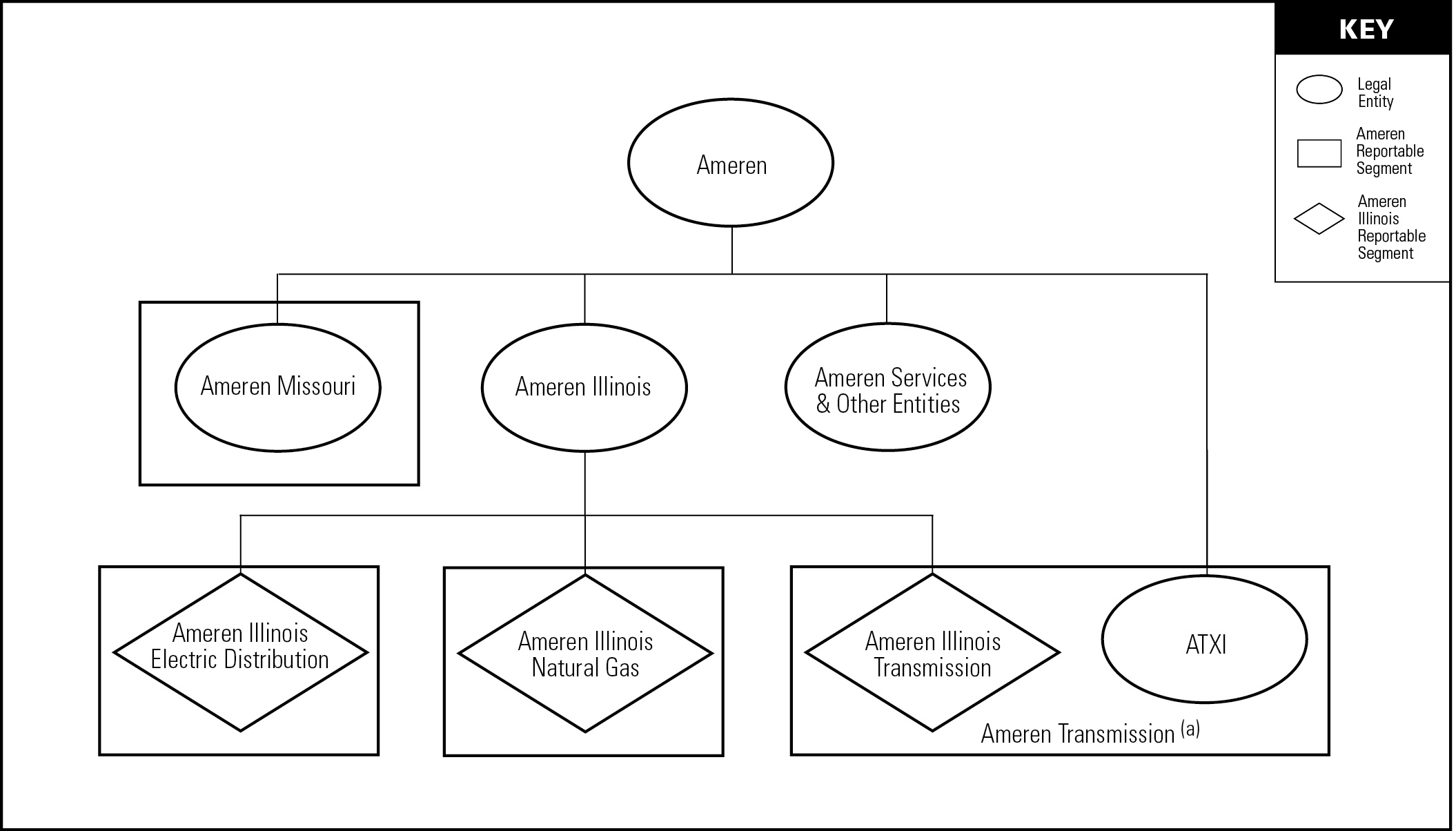
| (a) | The Ameren Transmission segment also includes allocated Ameren (parent) interest charges, Ameren Transmission Company, LLC, ATX East, LLC, and ATX Southwest, LLC. |
RATES AND REGULATION
Rates
The rates that Ameren Missouri, Ameren Illinois, and ATXI are allowed to charge for their utility services significantly influence the results of operations, financial position, and liquidity of these companies and Ameren. The electric and natural gas utility industry is highly regulated. The utility rates charged to customers are determined by governmental entities, including the MoPSC, the ICC, and the FERC. Decisions by these entities are influenced by many factors, including the cost of providing service, the prudency of expenditures, the quality of service, regulatory staff knowledge and experience, customer intervention, and economic conditions, as well as social and political views. Decisions made by these governmental entities regarding rates are largely outside of our control. These decisions, as well as the regulatory lag involved in the process of getting new rates approved, could have a material adverse effect on the results of operations, financial position, and liquidity of the Ameren Companies. The extent of the regulatory lag varies for each of Ameren’s electric and natural gas jurisdictions, with the Ameren Transmission and Ameren Illinois Electric Distribution businesses experiencing the least amount of regulatory lag. Depending on the jurisdiction, the effects of regulatory lag are mitigated by various means, including the use of a future test year, the use of trackers and riders, the level and timing of expenditures, annual revenue requirement reconciliations, the decoupling of revenues from sales volumes, and the recovery of certain capital investments under PISA, the RESRAM, and the QIP rider.
The MoPSC regulates rates and other matters for Ameren Missouri. The ICC regulates rates and other matters for Ameren Illinois. The MoPSC and the ICC regulate non-rate utility matters for ATXI. ATXI does not have retail distribution customers; therefore, the MoPSC and the ICC do not have authority to regulate ATXI’s rates. The FERC regulates Ameren Missouri’s, Ameren Illinois’, and ATXI’s cost-based rates for the wholesale transmission and distribution of energy in interstate commerce and various other matters discussed below under General Regulatory Matters.
The following table summarizes the key terms of the rate orders in effect for customer billings for each of Ameren’s rate-regulated utilities as of January 1, 2019:
| Rate Regulator | Allowed Return on Equity | Percent of Common Equity | Rate Base (in billions) | Portion of Ameren’s 2018 Operating Revenues(a) | |
| Ameren Missouri | |||||
| Electric service(b) | MoPSC | 9.2% – 9.7%(c) | (c) | (c) | 54% |
| Natural gas delivery service | MoPSC | (d) | (d) | (d) | 2% |
| Ameren Illinois | |||||
| Electric distribution delivery service(e) | ICC | 8.69% | 50.0% | $3.0 | 25% |
| Natural gas delivery service(f) | ICC | 9.87% | 50.0% | $1.6 | 13% |
| Electric transmission service(g) | FERC | 10.82% | 52.0% | $1.9 | 3% |
| ATXI | |||||
| Electric transmission service(g) | FERC | 10.82% | 56.1% | $1.3 | 3% |
| (a) | Includes pass-through costs recovered from customers, such as purchased power for electric distribution delivery service and natural gas purchased for resale for natural gas delivery service, and intercompany eliminations. |
| (b) | Ameren Missouri’s electric generation, transmission, and delivery service rates are bundled together and charged to retail customers under a combined electric service rate. |
| (c) | Based on the MoPSC’s March 2017 rate order. This rate order specified that an implicit return on equity was within a range of 9.2% to 9.7%. The rate order did not specify a percent of common equity or rate base. The return on equity used for allowance for equity funds used during construction is 9.53%. |
| (d) | Based on the MoPSC’s January 2011 rate order. This rate order did not specify the allowed return on equity, the |
Showing the first 8K of 68K characters. Open the full section
Item 1A. RISK FACTORS
Investors should review carefully the following material risk factors and the other information contained in this report. The risks that the Ameren Companies face are not limited to those in this section. There may be further risks and uncertainties that are not presently known or that are not currently believed to be material that may adversely affect the results of operations, financial position, and liquidity of the Ameren Companies.
REGULATORY AND LEGISLATIVE RISKS
We are subject to extensive regulation of our businesses, which could adversely affect our results of operations, financial position, and liquidity.
We are subject to federal, state, and local regulation. Our extensive regulatory frameworks, some of which are more specifically identified in the following risk factors, regulate, among other matters, the electric and natural gas utility industries; the rate and cost structure of utilities; the operation of nuclear power plants; the construction and operation of generation, transmission, and distribution facilities; the acquisition, disposal, depreciation and amortization of assets and facilities; the electric transmission system reliability; and wholesale and retail competition. In the planning and management of our operations, we must address the effects of existing and proposed laws and regulations and potential changes in our regulatory frameworks, including initiatives by federal and state legislatures, RTOs, utility regulators, and taxing authorities. Significant changes in the nature of the regulation of our businesses could require changes to our business planning and management of our businesses and could adversely affect our results of operations, financial position, and liquidity. Failure to obtain adequate rates or regulatory approvals in a timely manner; failure to obtain necessary licenses or permits from regulatory authorities; the impact of new or modified laws, regulations, standards, interpretations, or other legal requirements; or increased compliance costs could adversely affect our results of operations, financial position, and liquidity.
The electric and natural gas rates that we are allowed to charge are determined through regulatory proceedings, which are subject to intervention and appeal. Rates are also subject to legislative actions, which are largely outside of our control. Any events that prevent us from recovering our costs in a timely manner or from earning adequate returns on our investments could adversely affect our results of operations, financial position, and liquidity.
The rates that we are allowed to charge for our utility services significantly influence our results of operations, financial position, and liquidity. The electric and natural gas utility industry is highly regulated. The utility rates charged to customers are determined by governmental entities, including the MoPSC, the ICC, and the FERC. Decisions by these entities are influenced by many factors, including the cost of providing service, the prudency of expenditures, the quality of service, regulatory staff knowledge and experience, customer intervention, and economic conditions, as well as social and political views. Decisions made by these governmental entities regarding rates are largely outside of our control. We are exposed to regulatory lag and cost disallowances to varying degrees by jurisdiction, which, if unmitigated, could adversely affect our results of operations, financial position, and liquidity. Rate orders are also subject to appeal, which creates additional uncertainty as to the rates that we will ultimately be allowed to charge for our services. From time to time, our regulators may approve trackers, riders, or other mechanisms that allow electric or natural gas rates to be adjusted without a traditional rate proceeding. These mechanisms could be changed or terminated.
Ameren Missouri’s electric and natural gas utility rates and Ameren Illinois’ natural gas utility rates are typically established in regulatory proceedings that take up to 11 months to complete. Ameren Missouri’s rates established in those proceedings are primarily based on
historical costs and revenues. Ameren Illinois’ natural gas rates established in those proceedings are based on estimated future costs and revenues. Thus, the rates that we are allowed to charge for utility services may not match our actual costs at any given time.
Rates include an allowed rate of return on investments established by the regulator, including a return on invested capital, both debt and equity, and an amount for income taxes. Although rate regulation is premised on providing an opportunity to earn a reasonable rate of return on invested capital, there can be no assurance that the regulator will determine that our costs were prudently incurred or that the regulatory process will result in rates that will produce full recovery of such costs or provide for an opportunity to earn a reasonable return on those investments. Ameren Missouri and Ameren Illinois, and the utility industry generally, have an increased need for cost recovery, primarily driven by capital investments, which is likely to continue in the future. The resulting increase to the revenue requirement needed to recover such costs and earn a return on investments could result in more frequent regulatory rate reviews and requests for cost recovery mechanisms. Additionally, increasing rates could result in regulatory or legislative actions, as well as competitive or political pressures, all of which could adversely affect our results of operations, financial position, and liquidity.
As a result of its participation in performance-based formula ratemaking, Ameren Illinois’ return on equity for its electric distribution service and its electric energy-efficiency investments is directly correlated to yields on United States Treasury bonds. Additionally, Ameren Illinois is required to achieve certain performance standards. Failure to meet these requirements could adversely affect Ameren’s and Ameren Illinois’ results of operations, financial position, and liquidity.
Ameren Illinois participates in a performance-based formula ratemaking framework established pursuant to the IEIMA for its electric distribution service. Ameren Illinois is allowed to recover its electric distribution revenue requirement for a given year, independent of actual sales volumes. Ameren Illinois also has an electric energy-efficiency program rider, which includes a return on its program investments that is subject to performance-based formula ratemaking. The ICC annually reviews Ameren Illinois’ rate filings for reasonableness and prudency. If the ICC were to conclude that Ameren Illinois’ costs were not prudently incurred, the ICC would disallow recovery of such costs. The electric distribution service performance-based formula ratemaking framework expires at the end of 2022, while the decoupling provisions extend beyond the end of formula ratemaking by law. Ameren Illinois would then be required to establish future rates through a traditional rate proceeding with the ICC, which might result in rates that do not produce a full or timely recovery of costs or provide for an adequate return on investments and would expose Ameren Illinois’ electric distribution business to the risks described in the immediately preceding risk factor.
The return on equity component under both formula ratemaking recovery mechanisms is equal to the annual average of the monthly yields of the 30-year United States Treasury bonds plus 580 basis points. Therefore, Ameren Illinois’ annual return on equity for its electric distribution business is directly correlated to the yields on such bonds, which are outside of Ameren Illinois’ control. With respect to electric distribution service, a 50 basis point change in the annual average of the monthly yields of the 30-year United States Treasury bonds would result in an estimated $8 million change in Ameren’s and Ameren Illinois’ net income, based on its 2019 projected rate base.
Ameren Illinois is also subject to performance standards. Failure to achieve the standards would result in a reduction in the company’s allowed return on equity calculated under the ratemaking formulas. The performance standards applicable to electric distribution service include improvements in service reliability to reduce both the frequency and duration of outages, a reduction in the number of estimated bills, a reduction of consumption from inactive meters, and a reduction in bad debt expense. The electric distribution service regulatory framework provides for return on equity penalties up to 38 basis points in each year from 2019 through 2022, if these performance standards are not met. Beginning in 2018, the rider for electric energy-efficiency investments provides for increases or decreases of up to 200 basis points to the return on equity. Any adjustments to the return on equity for energy-efficiency investments will depend on annual performance of a historical period relative to energy savings goals. In 2018, there were no performance-related basis point adjustments.
Ameren Illinois plans to invest approximately $100 million per year in electric energy-efficiency programs through 2023, consistent with targets established by the FEJA. The ICC has the ability to reduce electric energy-efficiency savings goals if there are insufficient cost-effective programs available or if the savings goals would require investment levels that exceed amounts allowed by legislation.
As a result of PISA, Ameren Missouri’s electric rates are subject to a rate cap. Failure to align capital investments and expenses under the rate cap will adversely affect Ameren’s and Ameren Missouri’s results of operations, financial position, and liquidity.
As a result of Ameren Missouri’s decision to participate in PISA, its rate increases are limited to a 2.85% compound annual growth rate in the average overall customer rate per kilowatthour, based on the electric rates that became effective in April 2017, less half of the annual savings from the TCJA that was passed on to customers as approved in the July 2018 MoPSC order. Additionally, Ameren Missouri’s electric base rates, as determined in the July 2018 MoPSC order, are frozen until April 1, 2020. Customer rates under the MEEIA, the FAC, and the RESRAM riders have not been frozen. If rate changes from the FAC or the RESRAM riders would cause rates to temporarily exceed the 2.85% rate cap, the overage would be deferred for future recovery in the next regulatory rate review; however, rates established in such regulatory rate review will be subject to the rate cap. Any deferred overages approved for recovery will be recovered in a manner consistent with costs recovered under PISA. Increased capital investments and operating costs could cause customer rates to exceed the rate cap. Excluding customer rates under the MEEIA rider, which are not subject to the rate cap, Ameren Missouri would incur a penalty equal to the
amount of deferred overage that would cause customer rates to exceed the 2.85% rate cap. A penalty incurred as the result of exceeding the rate cap could adversely affect Ameren’s and Ameren Missouri’s results of operations, financial position, and liquidity.
Both the rate cap and PISA election are effective through December 2023, unless Ameren Missouri requests and receives MoPSC approval of an extension through December 2028.
Ameren and Ameren Illinois may not realize the expected return on their electric transmission investments, which could adversely affect their results of operations, financial position, and liquidity.
Ameren, through ATXI and Ameren Illinois, is investing significant capital resources in electric transmission. These investments are based on the FERC’s regulatory framework and a rate of return on common equity that is currently higher than that allowed by our state commissions. However, the FERC regulatory framework and rate of return are subject to change, including change as a result of existing and future third-party complaints and challenges at the FERC and the new methodology for determining the base return on common equity proposed by the FERC in November 2018. Accordingly, the regulatory framework may be less favorable or the rate of return may be lower in the future, compared with the current regulatory environment and rate of return, all of which may adversely affect Ameren’s and Ameren Illinois’ results of operations, financial position, and liquidity. A pending complaint case filed with the FERC in February 2015 could reduce the allowed return on common equity and could require customer refunds. A 50 basis point reduction in the FERC-allowed return on common equity would reduce Ameren’s and Ameren Illinois’ earnings by an estimated $9 million and $5 million, respectively, based on each company’s 2019 projected rate base.
We are subject to various environmental laws. Significant capital expenditures are required to achieve and to maintain compliance with these environmental laws. Failure to comply with these laws could result in the closing of facilities, alterations to the manner in which these facilities operate, increased operating costs, or exposure to fines and liabilities.
We are subject to various environmental laws, including statutes and regulations, enforced by federal, state, and local authorities. The development and operation of electric generation, transmission, and distribution facilities and natural gas storage, transmission, and distribution facilities can trigger compliance obligations with respect to environmental laws. These laws address emissions, discharges to water, water intake, impacts to air, land, and water, and chemical and waste handling. Complex and lengthy processes are required to obtain and renew approvals, permits, and licenses for new, existing or modified facilities. Additionally, the use and handling of various chemicals or hazardous materials require release prevention plans and emergency response procedures. Ameren is also subject to risks from changing or conflicting interpretations of existing laws.
We are also subject to liability under environmental laws that address the remediation of environmental contamination on property currently or formerly owned by us or by our predecessors, as well as property contaminated by hazardous substances that we generated. Such properties include MGP sites and third-party sites, such as landfills. Additionally, private individuals may seek to enforce environmental laws against us. They could allege injury from exposure to hazardous materials, allege a failure to comply with environmental laws, seek to compel remediation of environmental contamination, or seek to recover damages resulting from that contamination.
The EPA has promulgated environmental regulations that have a significant impact on the electric utility industry. Over time, compliance with these regulations could be costly for Ameren Missouri, which operates coal-fired power plants. As of December 31, 2018, Ameren Missouri’s fossil fuel-fired energy centers represented 16% and 32% of Ameren’s and Ameren Missouri’s rate base, respectively. Regulations that apply to air emissions from the electric utility industry include the NSPS, the CSAPR, the MATS, and the National Ambient Air Quality Standards, which are subject to periodic review for certain pollutants. Collectively, these regulations cover a variety of pollutants, such as SO2, particulate matter, NOx, mercury, toxic metals, and acid gases, and CO2 emissions from new power plants. Water intake and discharges from power plants are regulated under the Clean Water Act. Such regulation could require modifications to water intake structures or more stringent limitations on wastewater discharges at Ameren Missouri’s energy centers, either of which could result in significant capital expenditures. The management and disposal of coal ash is regulated under the CCR rule, which will require the closure of surface impoundments and the installations of dry ash handling systems at several of Ameren Missouri’s energy centers. The individual or combined effects of existing environmental regulations could result in significant capital expenditures, increased operating costs, or the closure or alteration of operations at some of Ameren Missouri’s energy centers.
In January 2011, the Department of Justice, on behalf of the EPA, filed a complaint against Ameren Missouri in the United States District Court for the Eastern District of Missouri. The complaint, as amended in October 2013, alleged that in performing projects at its Rush Island coal-fired energy center in 2007 and 2010, Ameren Missouri violated provisions of the Clean Air Act and Missouri law. The litigation has been divided into two phases: liability and remedy. In the first phase, in January 2017, the district court issued a liability ruling that the projects violated provisions of the Clean Air Act and Missouri law. In the second phase, the district court will determine the actions required to remedy the violations found in the liability phase. The EPA previously withdrew all claims for penalties and fines. Hearings on remedy-related issues are scheduled for April 2019. The ultimate resolution of this matter could have a material adverse effect on the results of operations, financial position, and liquidity of Ameren and Ameren Missouri. Among other things and subject to economic and regulatory considerations, resolution
of this matter could result in increased capital expenditures for the installation of pollution control equipment, as well as increased operations and maintenance expenses.
In 2015, the EPA issued the Clean Power Plan, which would have established CO2 emissions standards applicable to existing power plants. The United States Supreme Court stayed the rule in February 2016, pending various legal challenges. In August 2018, the EPA proposed to repeal and replace the Clean Power Plan with a proposed new rule known as the Affordable Clean Energy Rule, which establishes emission guidelines for states to follow in developing plans to limit CO2 emissions from power plants. The EPA proposes to use certain efficiency measures as the best system of emission reduction for coal-fired power plants. We cannot predict the outcome of the EPA’s future rulemaking or the outcome of any legal challenges relating to such future rulemakings, any of which could have an adverse effect on our results of operations, financial position, and liquidity.
Ameren and Ameren Missouri have incurred and expect to incur significant costs with respect to environmental compliance and site remediation. New or revised environmental regulations, enforcement initiatives, or legislation could result in a significant increase in capital expenditures and operating costs, decreased revenues, increased financing requirements, penalties or fines, or reduced operations of some of Ameren Missouri’s coal-fired energy centers, which, in turn, could lead to increased liquidity needs and higher financing costs. Actions required to ensure that Ameren Missouri’s facilities and operations are in compliance with environmental laws could be prohibitively expensive for Ameren Missouri if the costs are not fully recovered through rates. Environmental laws could require Ameren Missouri to close or to alter significantly the operations of its energy centers. If Ameren Missouri requests recovery of capital expenditures and costs for environmental compliance through rates, the MoPSC could deny recovery of all or a portion of these costs, prevent timely recovery, or make changes to the regulatory framework in an effort to minimize rate volatility and customer rate increases. Capital expenditures and costs to comply with future legislation or regulations might result in Ameren Missouri closing coal-fired energy centers earlier than planned. If these costs are not recoverable through rates, it could lead to an impairment of assets and reduced revenues. Any of the foregoing could have an adverse effect on our results of operations, financial positions, and liquidity.
Customers’, legislators’, and regulators’ opinions of us are affected by many factors, including system reliability, implementation of our investment plans, protection of customer information, rates, and media coverage. To the extent that customers, legislators, or regulators have or develop a negative opinion of us, our results of operations, financial position, and liquidity could be adversely affected.
Service interruptions can occur due to failures of equipment as a result of severe or destructive weather or other causes. The ability of Ameren Missouri and Ameren Illinois to respond promptly to such failures can affect customer satisfaction. In addition to system reliability issues, the success of modernization efforts, our ability to safeguard sensitive customer information and protect our systems from cyber attacks, and other actions can affect customer satisfaction. The level of rates, the timing and magnitude of rate increases, and the volatility of rates can also affect customer satisfaction. Customers’, legislators’, and regulators’ opinions of us can also be affected by media coverage, including social media, which may include information, whether factual or not, that damages our brand and reputation.
If customers, legislators, or regulators have or develop a negative opinion of us and our utility services, this could result in increased costs associated with regulatory oversight and could affect the returns on common equity we are allowed to earn. Additionally, negative opinions about us could make it more difficult for our utilities to achieve favorable legislative or regulatory outcomes. Negative opinions could also result in sales volume reductions or increased use of distributed generation by our customers. Any of these consequences could adversely affect our results of operations, financial position, and liquidity.
We are subject to federal regulatory compliance and proceedings, which exposes us to the potential for regulatory penalties and other sanctions.
The FERC can impose civil penalties of approximately $1.3 million per violation per day for violation of its regulations, rules, and orders, including mandatory NERC reliability standards. As owners and operators of bulk power transmission systems and electric energy centers, we are subject to mandatory NERC reliability standards, including cybersecurity standards. Compliance with these mandatory reliability standards may subject us to higher operating costs and may result in increased capital expenditures. If we were found not to be in compliance with these mandatory reliability standards, FERC regulations, rules, and orders, we could incur substantial monetary penalties and other sanctions, which could adversely affect our results of operations, financial position, and liquidity. The FERC also conducts audits and reviews of Ameren Missouri’s, Ameren Illinois’, and ATXI’s accounting records to assess the accuracy of its formula ratemaking process, and it can require refunds to customers for previously billed amounts, with interest.
OPERATIONAL RISKS
The construction and acquisition of, and capital improvements to, electric and natural gas utility infrastructure involve substantial risks. These risks include escalating costs, unsatisfactory performance by the projects when completed, the inability to complete projects as scheduled, cost disallowances by regulators, and the inability to earn an adequate return on invested capital, any of which could result in higher costs and facility closures.
We expect to make significant capital expenditures to maintain and improve our electric and natural gas utility infrastructure and to comply with existing environmental regulations. We estimate that we will invest up to $13.9 billion (Ameren Missouri – up to $7.1 billion; Ameren Illinois – up to $6.6 billion; ATXI – up to $0.2 billion) of capital expenditures from 2019 through 2023. These estimates include allowance for equity funds used during construction, but do not include any additional wind generation investments by Ameren Missouri beyond the two facilities that Ameren Missouri has agreed to acquire after construction. Investments in Ameren’s rate-regulated operations are expected to be recoverable from customers, but they are subject to prudence reviews and are exposed to regulatory lag of varying degrees by jurisdiction.
Our ability to complete construction projects successfully within projected estimates and to acquire wind generation facilities after they are constructed is contingent upon many variables and subject to substantial risks. These variables include, but are not limited to, project management expertise, escalating costs for labor and materials, including changes to tariffs on materials, reliance on third parties, the ability to obtain required project approvals, and the ability to obtain necessary rights-of-way, easements, and transmission connections. Delays in obtaining permits or regulatory approvals, shortages in materials and qualified labor, suppliers and contractors who do not perform as required under their contracts, changes in the scope and timing of projects, the inability to raise capital on reasonable terms, or other events beyond our control could affect the schedule, cost, and performance of these projects. There is a risk that an energy center might not be permitted to continue to operate if pollution control equipment is not installed by prescribed deadlines or does not perform as expected. Should any such pollution control equipment not be installed on time or not perform as expected, Ameren Missouri could be subject to additional costs and to the loss of its investment in the project or facility. All of these project and construction risks could adversely affect our results of operations, financial position, and liquidity.
Our electric generation, transmission, and distribution facilities are subject to operational risks that could adversely affect our results of operations, financial position, and liquidity.
Our financial performance depends on the successful operation of electric generation, transmission, and distribution facilities. Operation of electric generation, transmission, and distribution facilities involves many risks, including:
| • | facility shutdowns due to operator error, or a failure of equipment or processes; |
| • | longer-than-anticipated maintenance outages; |
| • | failures of equipment that can result in unanticipated liabilities or unplanned outages; |
| • | aging infrastructure that may require significant expenditures to operate and maintain; |
| • | disruptions in the delivery of fuel, failure of our fuel suppliers to provide adequate quantities or quality of fuel, or lack of adequate inventories of fuel, including ultra-low-sulfur coal used by Ameren Missouri to comply with environmental regulations; |
| • | lack of adequate water required for cooling plant operations; |
| • | labor disputes; |
| • | disruptions in the delivery of electricity to our customers; |
| • | suppliers and contractors who do not perform as required under their contracts; |
| • | failure of other operators’ facilities and the effect of that failure on our electric system and customers; |
| • | inability to comply with regulatory or permit requirements, including those relating to environmental laws; |
| • | handling, storage, and disposition of CCR; |
| • | unusual or adverse weather conditions or other natural disasters, including severe storms, droughts, floods, tornadoes, earthquakes, solar flares, and electromagnetic pulses; |
| • | the occurrence of catastrophic events such as fires, explosions, acts of sabotage or terrorism, pandemic health events, or other similar events; |
| • | accidents that might result in injury or loss of life, extensive property damage, or environmental damage; |
| • | ineffective vegetation management programs; |
| • | cybersecurity risks, including loss of operational control of Ameren Missouri’s energy centers and our transmission and distribution systems and loss of data, including sensitive customer, employee, financial, and operating system information, through insider or outsider actions; |
| • | limitations on amounts of insurance available to cover losses that might arise in connection with operating our electric generation, transmission, and distribution facilities; |
| • | inability to implement or maintain information systems; |
| • | failure to keep pace with and the ability to adapt to rapid technological change; and |
| • | other unanticipated operations and maintenance expenses and liabilities. |
The foregoing risks could affect the controls and operations of our facilities or impede our ability to meet regulatory requirements, which could increase operating costs, increase our capital requirements and costs, reduce our revenues or have an adverse effect on our liquidity.
Ameren Missouri’s ownership and operation of a nuclear energy center creates business, financial, and waste disposal risks.
Ameren Missouri’s ownership of the Callaway energy center subjects it to risks associated with nuclear generation, including:
| • | potential harmful effects on the environment and human health resulting from radiological releases associated with the operation of nuclear facilities and the storage, handling, and disposal of radioactive materials; |
| • | continued uncertainty regarding the federal government’s plan to permanently store spent nuclear fuel and, as a result, the need to provide for long-term storage of spent nuclear fuel at the Callaway energy center; |
| • | limitations on the amounts and types of insurance available to cover losses that might arise in connection with the Callaway energy center or other United States nuclear facilities; |
| • | uncertainties about contingencies and retrospective premium assessments relating to claims at the Callaway energy center or any other United States nuclear facilities; |
| • | public and governmental concerns about the safety and adequacy of security at nuclear facilities; |
| • | limited availability of fuel supply and our reliance on licensed fuel assemblies from the one NRC-licensed supplier of Callaway energy center’s assemblies; |
| • | costly and extended outages for scheduled or unscheduled maintenance and refueling; |
| • | uncertainties about the technological and financial aspects of decommissioning nuclear facilities at the end of their licensed lives; |
| • | the adverse effect of poor market performance and other economic factors on the asset values of nuclear decommissioning trust funds and the corresponding increase, upon MoPSC approval, in customer rates to fund the estimated decommissioning costs; and |
| • | potential adverse effects of a natural disaster, acts of sabotage or terrorism, including cyber attack, or any accident leading to a radiological release. |
The NRC has broad authority under federal law to impose licensing and safety requirements for nuclear facilities. In the event of noncompliance, the NRC has the authority to impose fines or to shut down a unit, or both, depending upon its assessment of the severity of the situation, until compliance is achieved. Revised safety requirements promulgated from time to time by the NRC could necessitate substantial capital expenditures at the Callaway energy center. In addition, if a serious nuclear incident were to occur, it could adversely affect Ameren’s and Ameren Missouri’s results of operations, financial condition, and liquidity. A major incident at a nuclear facility anywhere in the world could cause the NRC to limit or prohibit the operation of any domestic nuclear unit and could also cause the NRC to impose additional conditions or requirements on the industry, which could increase costs and result in additional capital expenditures. NRC standards relating to seismic risk require Ameren Missouri to further evaluate the impact of an earthquake on its Callaway energy center due to its proximity to a fault line, which could require the installation of additional capital equipment.
Our natural gas distribution and storage activities involve numerous risks that may result in accidents and increased operating costs.
Inherent in our natural gas distribution and storage activities are a variety of hazards and operating risks, such as leaks, explosions, mechanical problems and cybersecurity risks, which could cause substantial financial losses. In addition, these hazards could result in serious injury, loss of human life, significant damage to property, environmental impacts, and impairment of our operations, which in turn could lead us to incur substantial losses. The location of distribution mains and storage facilities near populated areas, including residential areas, business centers, industrial sites, and other public gathering places, could increase the level of damages resulting from these risks. A major domestic incident involving natural gas systems could lead to additional capital expenditures, increased regulation, and fines and penalties on natural gas utilities. The occurrence of any of these events could adversely affect our results of operations, financial position, and liquidity.
Significant portions of our electric generation, transmission, and distribution facilities and natural gas transmission and distribution facilities are aging. This aging infrastructure may require significant additional maintenance or replacement that could adversely affect our results of operations, financial position, and liquidity. Additionally, Ameren Missouri’s results of operations, financial position, and liquidity could be adversely affected if an energy center’s costs or decommissioning costs associated with an energy center’s retirement are not fully recovered.
Our aging infrastructure may pose risks to system reliability and expose us to expedited or unplanned significant capital expenditures and operating costs. All of Ameren Missouri’s coal-fired energy centers were constructed prior to 1978, and the Callaway energy center began operating in 1984. The age of these energy centers increases the risks of unplanned outages, reduced generation output, and higher maintenance expense. If, at the end of its life, an energy center’s cost has not been fully recovered, Ameren Missouri may be adversely affected if the MoPSC does not allow such cost to be recovered in rates. Ameren Missouri may also be adversely affected if the MoPSC does
not allow full or timely recovery of decommissioning costs associated with the retirement of an energy center. Aging transmission and distribution facilities are more prone to failure than new facilities, which results in higher maintenance expense and the need to replace these facilities with new infrastructure. Even if the system is properly maintained, its reliability may ultimately deteriorate and negatively affect our ability to serve our customers, which could result in increased costs associated with regulatory oversight. The frequency and duration of customer outages are among the IEIMA performance standards. Any failure to achieve these standards will result in a reduction in Ameren Illinois’ allowed return on equity on electric distribution assets. The higher maintenance costs associated with aging infrastructure and capital expenditures for new or replacement infrastructure could cause additional rate volatility for our customers, resistance by our regulators to allow customer rate increases, and/or regulatory lag in some of our jurisdictions, any of which could adversely affect our results of operations, financial position, and liquidity.
Energy conservation, energy efficiency, distributed generation, energy storage, technological advances, and other factors could reduce energy demand from Ameren Missouri’s customers.
Without a regulatory mechanism to ensure recovery, declines in energy usage could result in an under-recovery of Ameren Missouri’s revenue requirement, which could adversely affect Ameren and Ameren Missouri’s results of operations, financial position, and liquidity. Such declines could occur due to a number of factors:
| • | Conservation and energy-efficiency programs. Missouri allows for conservation and energy-efficiency programs that are designed to reduce energy demand. |
| • | Distributed generation and other energy-efficiency efforts. Ameren Missouri is exposed to declining usage from energy-efficiency efforts not related to its energy-efficiency programs, as well as from distributed generation sources, such as solar panels and other technologies. Ameren Missouri generates power at utility-scale energy centers to achieve economies of scale and to produce power at a competitive cost. Some distributed generation technologies have become more cost-competitive, with decreasing costs expected in the future. The costs of these distributed generation technologies may decline over time to a level that is competitive with that of Ameren Missouri’s energy centers. Additionally, technological advances in energy storage may be coupled with distributed generation to reduce the demand for our electric utility services. Increased adoption of these technologies by customers could decrease our revenues if customers cease to use our generation, transmission, and distribution services at current levels. Ameren Missouri might incur stranded costs, which ultimately might not be recovered through rates. |
| • | Macroeconomic factors. Macroeconomic factors resulting in low economic growth or contraction within Ameren Missouri’s service territories could reduce energy demand. |
We are subject to employee work force factors that could adversely affect our operations.
Our businesses depend upon our ability to employ and retain key officers and other skilled professional and technical employees. A significant portion of our work force is nearing retirement, including many employees with specialized skills, such as maintaining and servicing our electric and natural gas infrastructure and operating our energy centers. We are also party to collective bargaining agreements that collectively represent about 51% of Ameren’s total employees. Any work stoppage experienced in connection with negotiations of collective bargaining agreements could adversely affect our operations.
Our operations are subject to acts of terrorism, cyber attacks, and other intentionally disruptive acts.
Like other electric and natural gas utilities, our energy centers, fuel storage facilities, transmission and distribution facilities, and information systems may be affected by terrorist activities and other intentionally disruptive acts, including cyber attacks, which could disrupt our ability to produce or distribute our energy products. Within our industry, there have been attacks on energy infrastructure, such as substations and related assets, in the past, and there may be more attacks in the future. Any such incident could limit our ability to generate, purchase, or transmit power or natural gas and could have significant regional economic consequences. Any such disruption could result in a significant decrease in revenues, a significant increase in costs including those for repair, or adversely affect economic activity in our service territory which, in turn, could adversely affect our results of operations, financial position, and liquidity.
There has been an increase in the number and sophistication of cyber attacks across all industries worldwide. A security breach at our physical assets or in our information systems could affect the reliability of the transmission and distribution system, disrupt electric generation, including nuclear generation, and/or subject us to financial harm resulting from theft or the inappropriate release of certain types of information, including sensitive customer, employee, financial, and operating system information. Many of our suppliers, vendors, contractors, and information technology providers have access to systems that support our operations and maintain customer and employee data. A breach of these third-party systems could adversely affect our business as if it was a breach of our own system. If a significant breach occurred, our reputation could be adversely affected, customer confidence could be diminished, and/or we could be subject to increased costs associated with regulatory oversight, fines or legal claims, any of which could result in a significant decrease in revenues or significant costs for remedying the impacts of such a breach. Our generation, transmission, and distribution systems are part of an interconnected system. Therefore, a disruption caused by a cyber incident at another utility, electric generator, RTO, or commodity supplier could also adversely affect our businesses. Insurance might not be adequate to cover losses that arise in connection with these events. In addition, new
regulations could require changes in our security measures and result in increased costs. The occurrence of any of these events could adversely affect our results of operations, financial position, and liquidity.
FINANCIAL, ECONOMIC, AND MARKET RISKS
Our businesses are dependent on our ability to access the capital markets successfully. We might not have access to sufficient capital in the amounts and at the times needed.
We rely on the issuance of short-term and long-term debt as significant sources of liquidity and funding for capital requirements not satisfied by our operating cash flow, as well as to refinance existing long-term debt. The inability to raise debt or equity capital at reasonable terms, or at all, could negatively affect our ability to maintain and to expand our businesses. Events beyond our control, such as depressed economic conditions or extreme volatility in the debt, equity, or credit markets, might create uncertainty that could increase our cost of capital or impair or eliminate our ability to access the debt, equity, or credit markets, including our ability to draw on bank credit facilities. The unfavorable near-term impacts of the TCJA on our operating cash flows may adversely affect our credit ratings. Any adverse change in our credit ratings could reduce access to capital and trigger collateral postings and prepayments. Such changes could also increase the cost of borrowing and the costs of fuel, power, and natural gas supply, among other things, which could adversely affect our results of operations, financial position, and liquidity.
Ameren’s holding company structure could limit its ability to pay common stock dividends and to service its debt obligations.
Ameren is a holding company; therefore, its primary assets are its investments in the common stock of its subsidiaries, including Ameren Missouri, Ameren Illinois, and ATXI. As a result, Ameren’s ability to pay dividends on its common stock depends on the earnings of its subsidiaries and the ability of its subsidiaries to pay dividends or otherwise transfer funds to Ameren. Similarly, Ameren’s ability to service its debt obligations is dependent upon the earnings of its operating subsidiaries and the distribution of those earnings and other payments, including payments of principal and interest under affiliate indebtedness. The payment of dividends to Ameren by its subsidiaries in turn depends on their results of operations, and other items affecting retained earnings, and available cash. Ameren’s subsidiaries are separate and distinct legal entities and have no obligation, contingent or otherwise, to pay any dividends or make any other distributions (except for payments required pursuant to the terms of affiliate borrowing arrangements and cash payments under the tax allocation agreement) to Ameren. Certain financing agreements, corporate organizational documents, and certain statutory and regulatory requirements may impose restrictions on the ability of Ameren Missouri, Ameren Illinois, and ATXI to transfer funds to Ameren in the form of cash dividends, loans, or advances.
Increasing costs associated with our defined benefit retirement and postretirement plans, health care plans, and other employee benefits could adversely affect our financial position and liquidity.
Ameren offers defined benefit pension and postretirement benefit plans covering substantially all of its union employees. Ameren offers defined benefit pension plans covering substantially all of its non-union employees and postretirement benefit plans covering non-union employees hired before October 2015. Assumptions related to future costs, returns on investments, interest rates, timing of employee retirements, and mortality, as well as other actuarial matters, have a significant impact on our customers’ rates and our plan funding requirements. Ameren’s total unfunded obligation under its pension and postretirement benefit plans was $481 million as of December 31, 2018. Ameren expects to fund its pension plans at a level equal to the greater of the pension cost or the legally required minimum contribution. Based on Ameren’s assumptions at December 31, 2018, its investment performance in 2018, and its pension funding policy, Ameren expects to make annual contributions of approximately $20 million to $70 million in each of the next five years, with aggregate estimated contributions of $200 million. Ameren Missouri’s and Ameren Illinois’ portions of the future funding requirements are estimated to be 30% and 60%, respectively. These estimates may change with actual investment performance, changes in interest rates, changes in our assumptions, changes in government regulations, and any voluntary contributions.
In addition to the costs of our pension plans, the costs of providing health care benefits to our employees and retirees have increased in recent years. We believe that our employee benefit costs, including costs of health care plans for our employees and former employees, will continue to rise. Future legislative changes related to health care could also significantly change our benefit programs and costs. The increasing costs and funding requirements associated with our defined benefit retirement plans, health care plans, and other employee benefits could increase our financing needs and otherwise adversely affect our financial position and liquidity.
Item 1B. UNRESOLVED STAFF COMMENTS
None.
Item 2. PROPERTIES
For information on our principal properties, see the energy center table below. See also Liquidity and Capital Resources and Regulatory Matters in Management’s Discussion and Analysis of Financial Condition and Results of Operations under Part II, Item 7, of this report for a discussion of planned additions, replacements, or transfers. See also Note 5 – Long-term Debt and Equity Financings and Note 14 – Commitments and Contingencies under Part II, Item 8, of this report.
The following table shows the anticipated capability of Ameren Missouri’s energy centers at the time of Ameren Missouri’s expected 2019 peak summer electrical demand:
| Primary Fuel Source | Energy Center | Location | Net Kilowatt Capability(a) | |
| Coal | Labadie | Franklin County, Missouri | 2,372,000 | |
| Rush Island | Jefferson County, Missouri | 1,178,000 | ||
| Sioux | St. Charles County, Missouri | 972,000 | ||
| Meramec(b) | St. Louis County, Missouri | 591,000 | ||
| Total coal | 5,113,000 | |||
| Nuclear | Callaway | Callaway County, Missouri | 1,194,000 | |
| Hydroelectric | Osage | Lakeside, Missouri | 235,000 | |
| Keokuk | Keokuk, Iowa | 144,000 | ||
| Total hydroelectric | 379,000 | |||
| Pumped-storage | Taum Sauk | Reynolds County, Missouri | 440,000 | |
| Natural gas (CTs) | Audrain(c) | Audrain County, Missouri | 608,000 | |
| Venice(d) | Venice, Illinois | 492,000 | ||
| Goose Creek | Piatt County, Illinois | 438,000 | ||
| Pinckneyville | Pinckneyville, Illinois | 316,000 | ||
| Raccoon Creek | Clay County, Illinois | 304,000 | ||
| Meramec(b)(d)(e) | St. Louis County, Missouri | 282,000 | ||
| Kinmundy(d) | Kinmundy, Illinois | 210,000 | ||
| Peno Creek(c)(d) | Bowling Green, Missouri | 192,000 | ||
| Total natural gas | 2,842,000 | |||
| Oil (CTs) | Fairgrounds | Jefferson City, Missouri | 55,000 | |
| Meramec | St. Louis County, Missouri | 55,000 | ||
| Mexico | Mexico, Missouri | 54,000 | ||
| Moberly | Moberly, Missouri | 54,000 | ||
| Moreau | Jefferson City, Missouri | 54,000 | ||
| Total oil | 272,000 | |||
| Methane gas (CT) | Maryland Heights | Maryland Heights, Missouri | 8,000 | |
| Solar | O’Fallon | O’Fallon, Missouri | 3,000 | |
| Total Ameren and Ameren Missouri | 10,251,000 |
| (a) | Net kilowatt capability is the generating capacity available for dispatch from the energy center into the electric transmission grid. |
| (b) | All coal-fueled kilowatts and 236,000 natural-gas-fueled kilowatts at the Meramec energy center are scheduled for retirement in 2022. |
| (c) | There are economic development arrangements applicable to these CTs. |
| (d) | These CTs have the capability to operate on either oil or natural gas (dual fuel). |
| (e) | Two of its three units are steam-powered. |
The following table presents in-service electric and natural gas utility-related properties for Ameren Missouri and Ameren Illinois as of December 31, 2018:
| Ameren Missouri | Ameren Illinois | ||||
| Circuit miles of electric transmission lines(a) | 2,971 | 4,639 | |||
| Circuit miles of electric distribution lines | 33,517 | 45,878 | |||
| Percentage of circuit miles of electric distribution lines underground | 24 | % | 16 | % | |
| Miles of natural gas transmission and distribution mains | 3,422 | 18,417 | |||
| Underground natural gas storage fields | — | 12 | |||
| Total working capacity of underground natural gas storage fields in billion cubic feet | — | 24 |
| (a) | ATXI owns 408 miles of transmission lines not reflected in this table. |
Our other properties include office buildings, warehouses, garages, and repair shops.
With only a few exceptions, we have fee title to all principal energy centers and other units of property material to the operation of our businesses, and to the real property on which such facilities are located (subject to mortgage liens securing our outstanding first mortgage bonds and to certain permitted liens and judgment liens). The exceptions are as follows:
| • | A portion of Ameren Missouri’s Osage energy center reservoir, certain facilities at Ameren Missouri’s Sioux energy center, most of Ameren Missouri’s Peno Creek and Audrain CT energy centers, Ameren Missouri’s Maryland Heights energy center, certain substations, and most transmission and distribution lines and natural gas mains are situated on lands occupied under leases, easements, franchises, licenses, or permits. The United States or the state of Missouri may own or may have paramount rights with respect to certain lands lying in the bed of the Osage River or located between the inner and outer harbor lines of the Mississippi River on which certain of Ameren Missouri’s energy centers and other properties are located. |
| • | The United States, the state of Illinois, the state of Iowa, or the city of Keokuk, Iowa, may own or may have paramount rights with respect to certain lands lying in the bed of the Mississippi River on which a portion of Ameren Missouri’s Keokuk energy center is located. |
Substantially all of the properties and plant of Ameren Missouri and Ameren Illinois are subject to the liens of the indentures securing their mortgage bonds.
Ameren Missouri has conveyed most of its Peno Creek CT energy center to the city of Bowling Green, Missouri through 2022. Ameren Missouri has rights and obligations as the operator of the energy center under a long-term agreement with the city of Bowling Green. Under the terms of this agreement, Ameren Missouri is responsible for all operation and maintenance for the energy center. Ownership of the energy center will transfer to Ameren Missouri at the expiration of the agreement, at which time the property, plant, and equipment will become subject to the lien of the Ameren Missouri first mortgage bond indenture.
Ameren Missouri operates a CT energy center located in Audrain County, Missouri. Ameren Missouri has rights and obligations as the operator of the energy center under a long-term agreement with Audrain County. Under the terms of this agreement, Ameren Missouri is responsible for all operation and maintenance for the energy center. The agreement will expire in December 2023. Ownership of the energy center will transfer to Ameren Missouri at the expiration of the agreement, at which time the property, plant, and equipment will become subject to the lien of the Ameren Missouri first mortgage bond indenture.
In 2018, Ameren Missouri entered into build-transfer agreements to purchase up to 557 megawatts of wind generation. For additional information on these agreements, see Note 2 – Rate and Regulatory Matters under Part II, Item 8 of this report.
Item 3. LEGAL PROCEEDINGS
We are involved in legal and administrative proceedings before various courts and agencies with respect to matters that arise in the ordinary course of business, some of which involve substantial amounts of money. We believe that the final disposition of these proceedings, except as otherwise disclosed in this report, will not have a material adverse effect on our results of operations, financial position, or liquidity. Risk of loss is mitigated, in some cases, by insurance or contractual or statutory indemnification. We believe that we have established appropriate reserves for potential losses. Material legal and administrative proceedings, which are discussed in Note 2 – Rate and Regulatory Matters, Note 9 – Callaway Energy Center, and Note 14 – Commitments and Contingencies under Part II, Item 8, of this report and are incorporated herein by reference, include the following:
| • | the February 2015 complaint case filed with the FERC seeking a reduction in the allowed base return on common equity under the MISO tariff; |
| • | the November 2018 FERC order requesting briefs regarding a new methodology for determining the base return on common equity under the MISO tariff and how to apply the new methodology to the February 2015 complaint case and the September 2016 order related to the November 2015 complaint case; |
| • | the January 2019 appeal filed by the MoOPC challenging the MoPSC’s December 2018 order in the RESRAM case; |
| • | litigation against Ameren Missouri with respect to the EPA Clean Air Act; and |
| • | remediation matters associated with former MGP and waste disposal sites of the Ameren Companies. |
Item 4. MINE SAFETY DISCLOSURES
Not applicable.
EXECUTIVE OFFICERS OF THE REGISTRANTS (ITEM 401(b) OF REGULATION S-K):
The executive officers of the Ameren Companies, including major subsidiaries, are listed below, along with their ages as of December 31, 2018, all their positions and offices held with the Ameren Companies as of February 14, 2019, their tenures as officers, and their business backgrounds for at least the last five years. Some executive officers hold multiple positions within the Ameren Companies; their titles are given in the description of their business experience.
AMEREN CORPORATION:
| Name | Age | Positions and Offices Held | ||
| Warner L. Baxter | 57 | Chairman, President and Chief Executive Officer, and Director | ||
| Baxter joined Ameren Missouri in 1995. He was elected to the positions of executive vice president and chief financial officer of Ameren, Ameren Missouri, Ameren Illinois, and Ameren Services in 2003. He was elected chairman, president, chief executive officer, and chief financial officer of Ameren Services in 2007. In 2009, he was elected chairman, president, and chief executive officer of Ameren Missouri. In 2014, he was elected chairman, president, and chief executive officer of Ameren, and relinquished his positions at Ameren Missouri. | ||||
| Martin J. Lyons, Jr. | 52 | Executive Vice President and Chief Financial Officer | ||
| Lyons joined Ameren Services in 2001. In 2008, he was elected senior vice president and chief accounting officer of the Ameren Companies. In 2009, he was also elected chief financial officer of the Ameren Companies. In 2013, he was elected executive vice president and chief financial officer of the Ameren Companies, and relinquished his duties as chief accounting officer. In 2016, he was elected chairman and president of Ameren Services. | ||||
| Gregory L. Nelson | 61 | Senior Vice President, General Counsel, and Secretary | ||
| Nelson joined Ameren Missouri in 1995. He was elected vice president and tax counsel of Ameren Services in 1999 and vice president of Ameren Missouri and Ameren Illinois in 2003. In 2010, he was elected vice president, tax and deputy general counsel of Ameren Services. He remained vice president of Ameren Missouri and Ameren Illinois. In 2011, he was elected senior vice president, general counsel and secretary of the Ameren Companies. Nelson has notified Ameren of his intention to retire, effective August 1, 2019. Chonda J. Nwamu, senior vice president and deputy general counsel, will succeed Nelson as senior vice president, general counsel, and secretary, effective upon his retirement. | ||||
| Bruce A. Steinke | 57 | Senior Vice President, Finance, and Chief Accounting Officer | ||
| Steinke joined Ameren Services in 2002. In 2008, he was elected vice president and controller of Ameren, Ameren Illinois, and Ameren Services. In 2009, he relinquished his positions at Ameren Illinois. In 2013, he was elected senior vice president, finance, and chief accounting officer of the Ameren Companies. |
SUBSIDIARIES:
| Name | Age | Positions and Offices Held | ||
| Bhavani Amirthalingam | 43 | Senior Vice President and Chief Digital Information Officer (Ameren Services) | ||
| Amirthalingam joined Ameren Services in March 2018 as senior vice president and chief digital information officer. She served as the chief information officer and vice president North America for Schneider Electric SE, an energy management and automation solutions company, from January 2015 to March 2018 and in various roles at World Wide Technology Inc., a technology solution provider, from November 1999 to January 2015, most recently serving as vice president of customer solutions and innovation from September 2013 to January 2015. | ||||
| Mark C. Birk | 54 | Senior Vice President, Customer and Power Operations (Ameren Missouri) | ||
| Birk joined Ameren Missouri in 1986. In 2005, he was elected vice president, power operations, of Ameren Missouri. In 2012, he was elected senior vice president, corporate planning, of Ameren Services. In 2014, he was also elected senior vice president, oversight, of Ameren Services, and in 2015, he was elected senior vice president, corporate safety, planning and operations oversight. In January 2017, he was elected senior vice president, customer operations, at Ameren Missouri and relinquished his positions at Ameren Services. In October 2017, he was elected senior vice president, customer and power operations, at Ameren Missouri. | ||||
| Fadi M. Diya | 56 | Senior Vice President and Chief Nuclear Officer (Ameren Missouri) | ||
| Diya joined Ameren Missouri in 2005. In 2008, he was elected vice president, nuclear operations, of Ameren Missouri. In 2014, he was elected senior vice president and chief nuclear officer of Ameren Missouri. | ||||
| Mary P. Heger | 62 | Senior Vice President, Customer Experience (Ameren Illinois) | ||
| Heger joined Ameren Missouri in 1976. In 2009, she was elected vice president, information technology, of Ameren Services, and in 2012, she was also elected chief information officer of Ameren Services. In 2015, she was elected senior vice president and chief information officer of Ameren Services. In February 2019, she was elected senior vice president, customer experience, at Ameren Illinois. | ||||
| Mark C. Lindgren | 51 | Senior Vice President, Corporate Communications and Chief Human Resources Officer (Ameren Services) | ||
| Lindgren joined Ameren Services in 1998. In 2009, he was elected vice president, human resources, of Ameren Services, and in 2012, he was also elected chief human resources officer of Ameren Services. In 2015, he was elected senior vice president, corporate communications, and chief human resources officer of Ameren Services. | ||||
| Richard J. Mark | 63 | Chairman and President (Ameren Illinois) | ||
| Mark joined Ameren Services in 2002 as vice president, customer service. In 2003, he was elected vice president, governmental policy and consumer affairs, of Ameren Services. In 2005, he was elected senior vice president, customer operations, of Ameren Missouri. In 2007, he relinquished his position at Ameren Services. In 2012, he relinquished his position at Ameren Missouri and was elected chairman and president of Ameren Illinois. | ||||
| Michael L. Moehn | 49 | Chairman and President (Ameren Missouri) | ||
| Moehn joined Ameren Services in 2000. In 2004, he was elected vice president, corporate planning, of Ameren Services. In 2008, he was elected senior vice president, corporate planning and business risk management, of Ameren Services. In 2012, he was elected senior vice president, customer operations, of Ameren Missouri, and relinquished his position at Ameren Services. In 2014, he was elected chairman and president of Ameren Missouri. | ||||
| Chonda J. Nwamu | 47 | Senior Vice President and Deputy General Counsel (Ameren Services) | ||
| Nwamu joined Ameren Services in September 2016 as vice president and deputy general counsel. In January 2019, she was elected senior vice president and deputy general counsel of Ameren Services. Prior to joining Ameren Services, she served as regulatory counsel at Pacific Gas and Electric Company, a public utility, from 2000 to May 2014 and as managing counsel and senior director from June 2014 to June 2016. She will succeed Gregory L. Nelson as senior vice president, general counsel, and secretary effective upon his retirement. | ||||
| Shawn E. Schukar | 57 | Chairman and President (ATXI) | ||
| Schukar joined a predecessor company of Ameren Illinois in 1984. In 2005, he was elected vice president, commercial RTO operations, of Ameren Services. In 2013, he was elected senior vice president, transmission operations, construction and project management, of ATXI. In 2017, he was elected chairman and president of ATXI. |
Officers are generally elected or appointed annually by the respective board of directors of each company, following the election of board members at the annual meetings of shareholders. No special arrangement or understanding exists between any of the above-named executive officers and the Ameren Companies nor, to our knowledge, with any other person or persons pursuant to which any executive officer was selected as an officer. There are no family relationships among the executive officers or between any executive officers and any directors of the Ameren Companies. Except as noted, the above-named executive officers have been employed by an Ameren company for more than five years in executive or management positions.
PART II
Item 5. MARKET FOR REGISTRANTS’ COMMON EQUITY, RELATED STOCKHOLDER MATTERS, AND ISSUER PURCHASE OF EQUITY SECURITIES
Ameren’s common stock is listed on the NYSE (ticker symbol: AEE). Ameren common shareholders of record totaled 45,575 on January 31, 2019. There is no trading market for the common stock of Ameren Missouri and Ameren Illinois. Ameren holds all outstanding common stock of Ameren Missouri and Ameren Illinois.
Purchases of Equity Securities
Ameren Corporation, Ameren Missouri, and Ameren Illinois did not purchase any equity securities reportable under Item 703 of Regulation S-K during the period from October 1, 2018, to December 31, 2018.
Performance Graph
The following graph shows Ameren’s cumulative total shareholder return during the five years ended December 31, 2018. The graph also shows the cumulative total returns of the S&P 500 Index and the Edison Electric Institute Index (EEI Index), which comprises most investor-owned electric utilities in the United States. The comparison assumes that $100 was invested on December 31, 2013, in Ameren common stock and in each of the indices shown and that all of the dividends were reinvested.
Comparison of Five-Year Cumulative Return
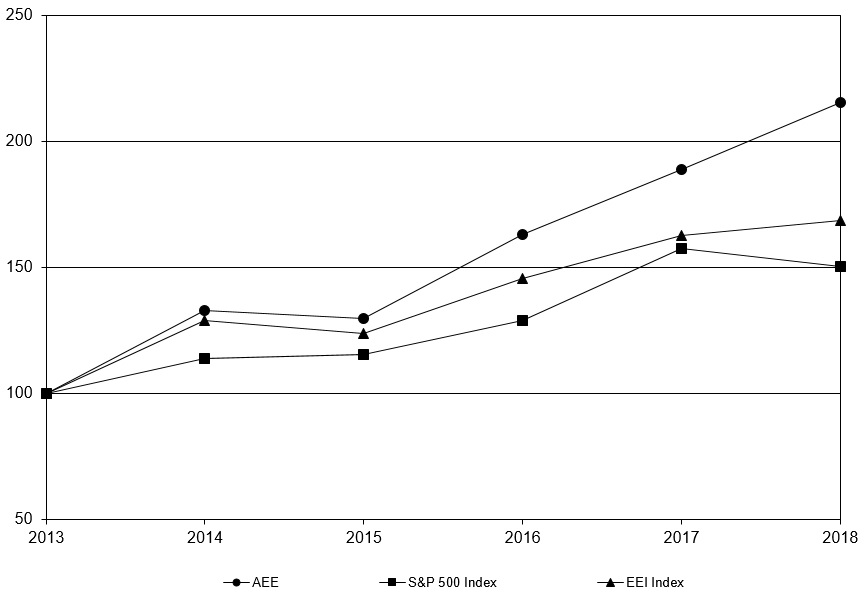
| December 31, | 2013 | 2014 | 2015 | 2016 | 2017 | 2018 | |||||||||||||||||
| Ameren (AEE) | $ | 100.00 | $ | 132.73 | $ | 129.58 | $ | 162.84 | $ | 188.82 | $ | 215.22 | |||||||||||
| S&P 500 Index | 100.00 | 113.69 | 115.26 | 129.04 | 157.21 | 150.33 | |||||||||||||||||
| EEI Index | 100.00 | 128.91 | 123.88 | 145.49 | 162.54 | 168.50 |
Ameren management cautions that the stock price performance shown above should not be considered indicative of future stock price performance.
Item 6. SELECTED FINANCIAL DATA
| 2018 | 2017 | 2016 | 2015 | 2014 | ||||||||||||||||
| Ameren: | ||||||||||||||||||||
| Operating revenues(a) | $ | 6,291 | $ | 6,174 | $ | 6,076 | $ | 6,098 | $ | 6,053 | ||||||||||
| Operating income(a)(b) | 1,357 | 1,410 | 1,322 | 1,235 | (c) | 1,226 | ||||||||||||||
| Income from continuing operations | 821 | 529 | (d) | 659 | 585 | 593 | ||||||||||||||
| Income (loss) from discontinued operations, net of taxes | — | — | — | 51 | (1 | ) | ||||||||||||||
| Net income attributable to Ameren common shareholders | 815 | 523 | 653 | 630 | 586 | |||||||||||||||
| Common stock dividends | 451 | 431 | 416 | 402 | 390 | |||||||||||||||
| Continuing operations earnings per share – basic | 3.34 | 2.16 | 2.69 | 2.39 | 2.42 | |||||||||||||||
| Continuing operations earnings per share – diluted | 3.32 | 2.14 | 2.68 | 2.38 | 2.40 | |||||||||||||||
| Common stock dividends per share | 1.8475 | 1.7775 | 1.715 | 1.655 | 1.61 | |||||||||||||||
| As of December 31: | ||||||||||||||||||||
| Total assets | $ | 27,215 | $ | 25,945 | $ | 24,699 | $ | 23,640 | $ | 22,289 | ||||||||||
| Long-term debt, excluding current maturities | 7,859 | 7,094 | 6,595 | 6,880 | 6,085 | |||||||||||||||
| Total Ameren Corporation shareholders’ equity | 7,631 | 7,184 | 7,103 | 6,946 | 6,713 | |||||||||||||||
| Ameren Missouri: | ||||||||||||||||||||
| Operating revenues(a) | $ | 3,589 | $ | 3,537 | $ | 3,524 | $ | 3,609 | $ | 3,553 | ||||||||||
| Operating income(a)(b) | 749 | 722 | 725 | 742 | (c) | 784 | ||||||||||||||
| Net income available to common shareholder | 478 | 323 | (d) | 357 | 352 | 390 | ||||||||||||||
| Dividends to parent | 375 | 362 | 355 | 575 | 340 | |||||||||||||||
| As of December 31: | ||||||||||||||||||||
| Total assets | $ | 14,291 | $ | 14,043 | $ | 14,035 | $ | 13,851 | $ | 13,474 | ||||||||||
| Long-term debt, excluding current maturities | 3,418 | 3,577 | 3,563 | 3,844 | 3,861 | |||||||||||||||
| Total shareholders’ equity | 4,229 | 4,081 | 4,090 | 4,082 | 4,052 | |||||||||||||||
| Ameren Illinois: | ||||||||||||||||||||
| Operating revenues(a) | $ | 2,576 | $ | 2,527 | $ | 2,489 | $ | 2,466 | $ | 2,498 | ||||||||||
| Operating income(a)(b) | 512 | 569 | 519 | 446 | 425 | |||||||||||||||
| Net income available to common shareholder | 304 | 268 | 252 | 214 | 201 | |||||||||||||||
| Dividends to parent | — | — | 110 | — | — | |||||||||||||||
| As of December 31: | ||||||||||||||||||||
| Total assets | $ | 11,319 | $ | 10,345 | $ | 9,474 | $ | 8,903 | $ | 8,204 | ||||||||||
| Long-term debt, excluding current maturities | 3,296 | 2,373 | 2,338 | 2,342 | 2,224 | |||||||||||||||
| Total shareholders’ equity | 3,774 | 3,310 | 3,034 | 2,897 | 2,661 |
| (a) | Amounts for 2017 and 2016 have been revised to reflect the adoption of accounting guidance on revenue from contracts with customers, effective for the Ameren Companies as of January 1, 2018. See Note 1 – Summary of Significant Accounting Policies under Part II, Item 8, of this report for additional information. The 2015 and 2014 balances are not revised for this guidance and are not comparative. |
| (b) | Amounts have been revised to reflect the adoption of accounting guidance on the presentation of net periodic pension and postretirement benefit cost, effective for the Ameren Companies as of January 1, 2018. See Note 10 – Retirement Benefits under Part II, Item 8, of this report for additional information. |
| (c) | Includes a $69 million provision recorded for all of the previously capitalized construction and operating license costs relating to the cancelled second nuclear unit at Ameren Missouri’s Callaway energy center. |
| (d) | Includes an increase to income tax expense of $154 million and $32 million as a result of the TCJA at Ameren and Ameren Missouri, respectively. See Note 12 – Income Taxes under Part II, Item 8, of this report for additional information. |
Item 7. MANAGEMENT’S DISCUSSION AND ANALYSIS OF FINANCIAL CONDITION AND RESULTS OF OPERATIONS
Ameren, headquartered in St. Louis, Missouri, is a public utility holding company whose primary assets are its equity interests in its subsidiaries. Ameren’s subsidiaries are separate, independent legal entities with separate businesses, assets, and liabilities. Dividends on Ameren’s common stock and the payment of expenses by Ameren depend on distributions made to it by its subsidiaries.
Below is a summary description of Ameren’s principal subsidiaries, which includes Ameren Missouri, Ameren Illinois, and ATXI. Ameren also has other subsidiaries that conduct other activities, such as providing shared services. A more detailed description can be found in Note 1 – Summary of Significant Accounting Policies under Part II, Item 8, of this report.
| • | Ameren Missouri operates a rate-regulated electric generation, transmission, and distribution business and a rate-regulated natural gas distribution business in Missouri. |
| • | Ameren Illinois operates rate-regulated electric transmission, electric distribution, and natural gas distribution businesses in Illinois. |
| • | ATXI operates a FERC rate-regulated electric transmission business. ATXI is constructing MISO-approved electric transmission projects, including the Illinois Rivers and Mark Twain projects, and operates the Spoon River project, which was placed in service in February 2018. Ameren also evaluates competitive electric transmission investment opportunities as they arise. |
Ameren has four segments: Ameren Missouri, Ameren Illinois Electric Distribution, Ameren Illinois Natural Gas, and Ameren Transmission. The Ameren Missouri segment includes all of the operations of Ameren Missouri. Ameren Illinois Electric Distribution consists of the electric distribution business of Ameren Illinois. Ameren Illinois Natural Gas consists of the natural gas business of Ameren Illinois. Ameren Transmission primarily consists of the aggregated electric transmission businesses of Ameren Illinois and ATXI. See Note 15 – Segment Information under Part II, Item 8, of this report for further discussion of Ameren’s, Ameren Missouri’s, and Ameren Illinois’ Segments.
Ameren’s financial statements are prepared on a consolidated basis and therefore include the accounts of its majority-owned subsidiaries. All intercompany transactions have been eliminated. Ameren Missouri and Ameren Illinois have no subsidiaries. All tabular dollar amounts are in millions, unless otherwise indicated.
In addition to presenting results of operations and earnings amounts in total, we present certain information in cents per share. These amounts reflect factors that directly affect Ameren’s earnings. We believe this per share information helps readers to understand the impact of these factors on Ameren’s earnings per share. All references in this report to earnings per share are based on average diluted common shares outstanding for the relevant period.
OVERVIEW
Ameren’s strategic plan includes investing in, and operating its utilities in, a manner consistent with existing regulatory frameworks, enhancing those frameworks, and advocating for responsible energy and economic policies, as well as creating and capitalizing on opportunities for investment for the benefit of its customers and shareholders. Ameren remains focused on disciplined cost management and strategic capital allocation. As discussed below, Ameren successfully executed on its strategic plan in 2018, with constructive outcomes received in various regulatory proceedings. With the enactment of legislation in Missouri, we believe constructive regulatory frameworks for investment exist at all of Ameren's utility businesses. In February 2019, Ameren Missouri announced its Smart Energy Plan to upgrade the electric grid and accommodate more renewable energy. In addition, Ameren Missouri advanced its transition of generation to a cleaner, more diverse portfolio by entering into two build-transfer agreements for the acquisition of up to 557 megawatts of wind generation in Missouri.
In 2018, Ameren’s utility businesses each received orders to reduce customer rates to reflect the benefits of a lower federal tax rate and, over time, to reflect the return of excess deferred taxes of over $2 billion. The return of excess deferred taxes to customers reduces operating cash flows but is expected to increase the rate base on which customer rates are established.
In June 2018, legislation was enacted in Missouri that enhanced Ameren Missouri’s electric regulatory framework. Pursuant to its PISA election, Ameren Missouri is permitted to defer and recover 85% of the depreciation expense and a weighted-average cost of capital return on rate base on certain property, plant, and equipment placed in service after September 1, 2018, and not included in base rates. Accumulated PISA deferrals earn carrying costs at the weighted-average cost of capital, and all approved PISA deferrals will be added to rate base prospectively and recovered over a period of 20 years following a regulatory rate review. PISA mitigates the impacts of regulatory lag between regulatory rate reviews. The remaining 15% of certain property, plant, and equipment placed in service and not eligible for recovery under PISA, unless eligible for recovery under the RESRAM, remain subject to regulatory lag. As a result of the PISA election, additional provisions of the new law apply to Ameren Missouri, including limitations on electric customer rate increases and an electric base rate freeze until April 2020. Both the rate increase limitation and PISA are effective through December 2023, unless Ameren Missouri requests and receives MoPSC approval of an extension through December 2028. This Missouri law maintains strong MoPSC oversight and consumer protections while supporting Ameren Missouri’s ability to strengthen and modernize Missouri’s electric grid.
In the second quarter of 2018, Ameren Missouri entered into a build-transfer agreement with a subsidiary of Terra-Gen, LLC to acquire, after construction, a 400-megawatt wind generation facility, which is expected to be located in northeastern Missouri. In October 2018, the MoPSC issued an order approving a unanimous stipulation and agreement regarding a requested certificate of convenience and necessity for the facility. In December 2018, Ameren Missouri received FERC approval to acquire the facility after construction. A transmission interconnection agreement with the MISO for this facility is expected in the fall of 2019. Also, in October 2018, Ameren Missouri entered into a build-transfer agreement with a subsidiary of EDF Renewables, Inc. to acquire, after construction, a wind generation facility of up to 157 megawatts. In February 2019, Ameren Missouri filed with the MoPSC a nonunanimous stipulation and agreement regarding a requested certificate of convenience and necessity for the facility. The up to 157-megawatt facility is expected to be located in northwestern Missouri. A transmission interconnection agreement with the MISO for this facility is expected in early 2020. Both facilities are expected to be completed by the end of 2020 and would help Ameren Missouri comply with the Missouri renewable energy standard. Each acquisition is subject to certain conditions, including entering into a MISO transmission interconnection agreement at an acceptable cost for each facility and obtaining FERC approval and the issuance of a certificate of convenience and necessity by the MoPSC for the up to 157-megawatt facility, as well as other customary contract terms and conditions. These agreements collectively represent approximately $1 billion in capital expenditures expected in 2020, which is included in Ameren Missouri’s Smart Energy Plan. As outlined in its 2017 IRP, Ameren Missouri is pursuing at least 700 megawatts of wind generation by the end of 2020. In October and December 2018, the MoPSC issued order
Showing the first 8K of 181K characters. Open the full section
Item 7A. QUANTITATIVE AND QUALITATIVE DISCLOSURES ABOUT MARKET RISK
Market risk is the risk of changes in value of a physical asset or a financial instrument, derivative or nonderivative, caused by fluctuations in market variables such as interest rates, commodity prices, and equity security prices. A derivative is a contract whose value is dependent on, or derived from, the value of some underlying asset or index. The following discussion of our risk management activities includes forward-looking statements that involve risks and uncertainties. Actual results could differ materially from those projected in the forward-looking statements. We handle market risks in accordance with established policies, which may include entering into various derivative transactions. In the normal course of business, we also face risks that are either nonfinancial or nonquantifiable. Such risks, principally business, legal, and operational risks, are not part of the following discussion.
Our risk management objectives are to optimize our physical generating assets and to pursue market opportunities within prudent risk parameters. Our risk management policies are set by a risk management steering committee, which is composed of senior-level Ameren officers, with Ameren board of directors’ oversight.
Interest Rate Risk
We are exposed to market risk through changes in interest rates associated with:
| • | long-term and short-term variable-rate debt; |
| • | fixed-rate debt; |
| • | United States Treasury bonds; and |
| • | the discount rate applicable to asset retirement obligations, goodwill, and defined pension and postretirement benefit plans. |
We manage our interest rate exposure by controlling the amount of debt instruments within our total capitalization portfolio and by monitoring the effects of market changes on interest rates. For defined pension and postretirement benefit plans, we control the duration and the portfolio mix of our plan assets. See Note 1 – Summary of Significant Accounting Policies and Note 10 – Retirement Benefits under Part II, Item 8, of this report for additional information related to asset retirement obligations, goodwill, and the defined pension and postretirement benefit plans.
The estimated increase in our annual interest expense and decrease in net income if interest rates were to increase by 100 basis points on variable-rate debt outstanding at December 31, 2018 is immaterial.
The return on equity component under Ameren Illinois’ electric distribution service and its electric energy-efficiency investments formula ratemaking recovery mechanisms is equal to the annual average of the monthly yields of the 30-year United States Treasury bonds plus 580 basis points. Therefore, Ameren Illinois’ annual return on equity for its electric distribution business is directly correlated to the yields on such bonds, which are outside of Ameren Illinois’ control. A 50 basis point change in the annual average of the monthly yields of the 30-year United States Treasury bonds would result in an estimated $8 million change in Ameren’s and Ameren Illinois’ net income, based on its 2019 projected rate base. Interest rate levels also influence the return on equity allowed by our regulators in our other ratemaking jurisdictions.
Credit Risk
Credit risk represents the loss that would be recognized if counterparties should fail to perform as contracted. Exchange-traded contracts are supported by the financial and credit quality of the clearing members of the respective exchanges and carry only a nominal credit risk. In all other transactions, we are exposed to credit risk in the event of nonperformance by the counterparties to the transaction. See Note 7 – Derivative Financial Instruments under Part II, Item 8, of this report for information on the potential loss on counterparty exposure as of December 31, 2018.
Our revenues are primarily derived from sales or delivery of electricity and natural gas to customers in Missouri and Illinois. Our physical and financial instruments are subject to credit risk consisting of trade accounts receivables and executory contracts with market risk exposures. The risk associated with trade receivables is mitigated by the large number of customers in a broad range of industry groups who make up our customer base. At December 31, 2018, no nonaffiliated customer represented more than 10% of our accounts receivable. Additionally, Ameren Illinois faces risks associated with the purchase of receivables. The Illinois Public Utilities Act requires Ameren Illinois to establish electric utility consolidated billing and purchase of receivables services. At the option of an alternative retail electric supplier, Ameren Illinois may be required to purchase the supplier’s receivables relating to Ameren Illinois’ distribution customers who elected to receive power supply from the alternative retail electric supplier. When that option is selected, Ameren Illinois produces consolidated bills for the applicable retail customers to reflect charges for electric distribution and purchased receivables. As of December 31, 2018, Ameren Illinois’ balance of purchased accounts receivable associated with the utility consolidated billing and purchase of receivables services was $33 million. The risk associated with Ameren Illinois’ electric and natural gas trade receivables is also mitigated by a rate adjustment mechanism that allows Ameren Illinois to recover the difference between its actual net bad debt write-offs under GAAP and the amount of net bad debt write-offs included in its base rates. Ameren Missouri and Ameren Illinois continue to monitor the impact of increasing rates on customer collections, as applicable. Ameren Missouri and Ameren Illinois make adjustments to their respective allowance for doubtful accounts as deemed necessary to ensure that such allowances are adequate to cover estimated uncollectible customer account balances.
Investment Price Risk
Plan assets of the pension and postretirement trusts, the nuclear decommissioning trust fund, and company-owned life insurance contracts include equity and debt securities. The equity securities are exposed to price fluctuations in equity markets. The debt securities are exposed to changes in interest rates.
Our costs for providing defined benefit retirement and postretirement benefit plans are dependent upon a number of factors, including the rate of return on plan assets. Ameren manages plan assets in accordance with the “prudent investor” guidelines contained in ERISA. Ameren’s goal is to ensure that sufficient funds are available to provide benefits at the time they are payable, while also maximizing total return on plan assets and minimizing expense volatility consistent with its tolerance for risk. Ameren delegates investment management to specialists. Where appropriate, Ameren provides the investment manager with guidelines that specify allowable and prohibited investment types. Ameren regularly monitors manager performance and compliance with investment guidelines.
The expected return on plan assets assumption is based on historical and projected rates of return for current and planned asset classes in the investment portfolio. Projected rates of return for each asset class are estimated after an analysis of historical experience, future expectations, and the volatility of the various asset classes. After considering the target asset allocation for each asset class, we adjust the overall expected rate of return for the portfolio for historical and expected experience of active portfolio management results compared with benchmark returns, and for the effect of expenses paid from plan assets. Contributions to the plans and future costs could increase materially if we do not achieve pension and postretirement asset portfolio investment returns equal to or in excess of our 2019 assumed return on plan assets of 7.00%.
Ameren Missouri also maintains a trust fund, as required by the NRC and Missouri law, to fund certain costs of nuclear plant decommissioning. As of December 31, 2018, this fund was invested in domestic equity securities (62%) and debt securities (37%). By maintaining a portfolio that includes long-term equity investments, Ameren Missouri seeks to maximize the returns to be used to fund nuclear decommissioning costs within acceptable parameters of risk. Ameren Missouri actively monitors the portfolio by benchmarking the performance of its investments against certain indices and by maintaining and periodically reviewing established target allocation percentages of the trust assets to various investment options. Ameren Missouri’s exposure to equity price market risk is in large part mitigated because Ameren Missouri is currently allowed to recover its decommissioning costs, which would include unfavorable investment results, through electric rates.
Additionally, Ameren and Ameren Illinois have company-owned life insurance contracts with net asset values of $131 million and $9 million, respectively, as of December 31, 2018. Changes in the market values of these contracts are reflected in earnings.
Commodity Price Risk
Ameren Missouri’s and Ameren Illinois’ electric and natural gas distribution businesses exposure to changing market prices for commodities is in large part mitigated by the fact that there are cost recovery mechanisms in place. These cost recovery mechanisms allow Ameren Missouri and Ameren Illinois to pass on to retail customers prudently incurred costs for fuel, purchased power, and natural gas supply.
Ameren Missouri’s and Ameren Illinois’ strategy is designed to reduce the effect of market fluctuations for their customers. The effects of price volatility cannot be eliminated. However, procurement and sales strategies involve risk management techniques and instruments, as well as the management of physical assets.
Ameren Missouri has a FAC that allows it to recover or refund, through customer rates, 95% of the variance in net energy costs from the amount set in base rates without a traditional rate proceeding, subject to MoPSC prudence reviews. Ameren Missouri remains exposed to the remaining 5% of such changes.
Ameren Illinois has cost recovery mechanisms for power purchased, capacity, and zero emission credit and renewable energy credit costs and expects full recovery of such costs. Ameren Illinois is required to serve as the provider of last resort for electric customers in its service territory who have not chosen an alternative retail electric supplier. In 2018, Ameren Illinois supplied power for 23% of its kilowatthour sales to its electric customers. Ameren Illinois purchases energy and capacity through MISO and through bilateral contracts resulting from IPA procurement events. The IPA has proposed and the ICC has approved multiple procurement events covering portions of years through 2020 for capacity and 2021 for energy. Ameren Illinois has also entered into ICC-approved contracts for zero emission credits through 2026 and for renewable energy credits with 15-year terms commencing on the date of first renewable energy credit delivery. Ameren Illinois does not generate earnings based on the resale of power or purchase of zero emission credits or renewable energy credits but rather on the delivery of the energy.
Ameren Missouri and Ameren Illinois have PGA clauses that permit costs incurred for natural gas to be recovered directly from utility customers without a traditional rate proceeding, subject to prudence review.
The following table presents, as of December 31, 2018, the percentages of the projected required supply of coal and coal transportation for Ameren Missouri's coal-fired energy centers, nuclear fuel for Ameren Missouri’s Callaway energy center, natural gas for Ameren Missouri's retail distribution and purchased power for Ameren Illinois that are price-hedged over the period 2019 through 2023. The projected required supply of these commodities could be significantly affected by changes in our assumptions about customer demand for our electric generation and our electric and natural gas distribution services, generation output, and inventory levels, among other matters.
| 2019 | 2020 | 2021 - 2023 | ||||||
| Ameren: | ||||||||
| Coal | 98 | % | 67 | % | 28 | % | ||
| Coal transportation | 100 | 99 | 97 | |||||
| Nuclear fuel | 100 | 85 | 61 | |||||
| Natural gas for distribution(a) | 74 | 33 | 13 | |||||
| Purchased power for Ameren Illinois(b) | 69 | 35 | 11 | |||||
| Ameren Missouri: | ||||||||
| Coal | 98 | % | 67 | % | 28 | % | ||
| Coal transportation | 100 | 99 | 97 | |||||
| Nuclear fuel | 100 | 85 | 61 | |||||
| Natural gas for distribution(a) | 62 | 27 | 5 | |||||
| Ameren Illinois: | ||||||||
| Natural gas for distribution(a) | 76 | % | 34 | % | 14 | % | ||
| Purchased power(b) | 69 | 35 | 11 |
| (a) | Represents the percentage of natural gas price-hedged for peak winter season of November through March. The year 2019 represents January 2019 through March 2019. The year 2020 represents November 2019 through March 2020. This continues each successive year through March 2023. |
| (b) | Represents the percentage of purchased power price-hedged for fixed-price residential and non-residential customers with less than 150 kilowatts of demand. |
Our exposure to commodity price risk for construction and maintenance activities is related to changes in market prices for metal commodities and to labor availability.
Also see Note 14 – Commitments and Contingencies under Part II, Item 8, of this report for additional information.
Commodity Supplier Risk
The use of ultra-low-sulfur coal is part of Ameren Missouri’s environmental compliance strategy. Ameren Missouri has agreements with multiple suppliers to purchase ultra-low-sulfur coal through 2022 to comply with environmental regulations. Disruptions to the deliveries of ultra-low-sulfur coal from a supplier could compromise Ameren Missouri’s ability to operate in compliance with emission standards. The suppliers of ultra-low-sulfur coal are limited, and the construction of pollution control equipment requires significant lead time. If Ameren Missouri were to experience a temporary disruption of ultra-low-sulfur coal deliveries that caused it to exhaust its existing inventory, and if other sources of ultra-low-sulfur coal were not available, Ameren Missouri would have to use its existing emission allowances, purchase emission allowances to achieve compliance with environmental regulations, or purchase power necessary to meet demand.
Currently, the Callaway energy center uses nuclear fuel assemblies of a design fabricated by only a single supplier. That supplier is currently the only NRC-licensed supplier able to provide fuel assemblies to the Callaway energy center. Ameren Missouri is pursuing a program to qualify an alternate NRC-licensed supplier, and expects to obtain NRC approval in 2021.
Fair Value of Contracts
We use derivatives principally to manage the risk of changes in market prices for natural gas and power, as well as the risk of changes in rail transportation surcharges through fuel oil hedges. The following table presents the favorable (unfavorable) changes in the fair value of all derivative contracts marked-to-market during the year ended December 31, 2018. We use various methods to determine the fair value of our contracts. In accordance with authoritative accounting guidance for fair value hierarchy levels, the sources we used to determine the fair value of these contracts were active quotes (Level 1), inputs corroborated by market data (Level 2), and other modeling and valuation methods that are not corroborated by market data (Level 3). See Note 8 – Fair Value Measurements under Part II, Item 8, of this report for additional information regarding the methods used to determine the fair value of these contracts.
| Ameren Missouri | Ameren Illinois | Ameren | |||||||||
| Fair value of contracts at beginning of year, net assets (liabilities) | $ | 8 | $ | (217 | ) | $ | (209 | ) | |||
| Contracts realized or otherwise settled during the period | (8 | ) | 25 | 17 | |||||||
| Fair value of new contracts entered into during the period | (7 | ) | 2 | (5 | ) | ||||||
| Other changes in fair value | (3 | ) | (4 | ) | (7 | ) | |||||
| Fair value of contracts outstanding at end of year, net assets (liabilities) | $ | (10 | ) | $ | (194 | ) | $ | (204 | ) |
The following table presents maturities of derivative contracts as of December 31, 2018, based on the hierarchy levels used to determine the fair value of the contracts:
| Sources of Fair Value | 2019 | 2020 – 2021 | 2022 – 2023 | 2024 and Thereafter | Total Fair Value | ||||||||||||||
| Ameren Missouri: | |||||||||||||||||||
| Level 1 | $ | — | $ | (1 | ) | $ | — | $ | — | $ | (1 | ) | |||||||
| Level 2(a) | (4 | ) | (1 | ) | — | — | (5 | ) | |||||||||||
| Level 3(b) | (1 | ) | (3 | ) | — | — | (4 | ) | |||||||||||
| Total | $ | (5 | ) | $ | (5 | ) | $ | — | $ | — | $ | (10 | ) | ||||||
| Ameren Illinois: | |||||||||||||||||||
| Level 1 | $ | — | $ | — | $ | — | $ | — | $ | — | |||||||||
| Level 2(a) | (5 | ) | (3 | ) | — | — | (8 | ) | |||||||||||
| Level 3(b) | (16 | ) | (30 | ) | (30 | ) | (110 | ) | (186 | ) | |||||||||
| Total | $ | (21 | ) | $ | (33 | ) | $ | (30 | ) | $ | (110 | ) | $ | (194 | ) | ||||
| Ameren: | |||||||||||||||||||
| Level 1 | $ | — | $ | (1 | ) | $ | — | $ | — | $ | (1 | ) | |||||||
| Level 2(a) | (9 | ) | (4 | ) | — | — | (13 | ) | |||||||||||
| Level 3(b) | (17 | ) | (33 | ) | (30 | ) | (110 | ) | (190 | ) | |||||||||
| Total | $ | (26 | ) | $ | (38 | ) | $ | (30 | ) | $ | (110 | ) | $ | (204 | ) |
| (a) | Principally fixed-price vs. floating over-the-counter power swaps, power forwards, and fixed-price vs. floating over-the-counter natural gas swaps. |
| (b) | Principally power forward contract values based on information from external sources, historical results, and our estimates. Level 3 also includes option contract values based on an option valuation model. |
Item 8. FINANCIAL STATEMENTS AND SUPPLEMENTARY DATA
Report of Independent Registered Public Accounting Firm
To the Board of Directors and Shareholders
of Ameren Corporation:
Opinions on the Financial Statements and Internal Control over Financial Reporting
We have audited the accompanying consolidated balance sheets of Ameren Corporation and its subsidiaries (the “Company”) as of December 31, 2018 and 2017, and the related consolidated statements of income and comprehensive income, of shareholders’ equity and of cash flows for each of the three years in the period ended December 31, 2018, including the related notes and financial statement schedules listed in the index appearing under Item 15(a)(2) (collectively referred to as the “consolidated financial statements”). We also have audited the Company’s internal control over financial reporting as of December 31, 2018, based on criteria established in Internal Control - Integrated Framework (2013) issued by the Committee of Sponsoring Organizations of the Treadway Commission (COSO).
In our opinion, the consolidated financial statements referred to above present fairly, in all material respects, the financial position of the Company as of December 31, 2018 and 2017, and the results of its operations and its cash flows for each of the three years in the period ended December 31, 2018, in conformity with accounting principles generally accepted in the United States of America. Also in our opinion, the Company maintained, in all material respects, effective internal control over financial reporting as of December 31, 2018, based on criteria established in Internal Control - Integrated Framework (2013) issued by the COSO.
Basis for Opinions
The Company’s management is responsible for these consolidated financial statements, for maintaining effective internal control over financial reporting, and for its assessment of the effectiveness of internal control over financial reporting, included in Management’s Report on Internal Control over Financial Reporting appearing under Item 9A. Our responsibility is to express opinions on the Company’s consolidated financial statements and on the Company’s internal control over financial reporting based on our audits. We are a public accounting firm registered with the Public Company Accounting Oversight Board (United States) (“PCAOB”) and are required to be independent with respect to the Company in accordance with the U.S. federal securities laws and the applicable rules and regulations of the Securities and Exchange Commission and the PCAOB.
We conducted our audits in accordance with the standards of the PCAOB. Those standards require that we plan and perform the audits to obtain reasonable assurance about whether the consolidated financial statements are free of material misstatement, whether due to error or fraud, and whether effective internal control over financial reporting was maintained in all material respects.
Our audits of the consolidated financial statements included performing procedures to assess the risks of material misstatement of the consolidated financial statements, whether due to error or fraud, and performing procedures that respond to those risks. Such procedures included examining, on a test basis, evidence regarding the amounts and disclosures in the consolidated financial statements. Our audits also included evaluating the accounting principles used and significant estimates made by management, as well as evaluating the overall presentation of the consolidated financial statements. Our audit of internal control over financial reporting included obtaining an understanding of internal control over financial reporting, assessing the risk that a material weakness exists, and testing and evaluating the design and operating effectiveness of internal control based on the assessed risk. Our audits also included performing such other procedures as we considered necessary in the circumstances. We believe that our audits provide a reasonable basis for our opinions.
Definition and Limitations of Internal Control over Financial Reporting
A company’s internal control over financial reporting is a process designed to provide reasonable assurance regarding the reliability of financial reporting and the preparation of financial statements for external purposes in accordance with generally accepted accounting principles. A company’s internal control over financial reporting includes those policies and procedures that (i) pertain to the maintenance of records that, in reasonable detail, accurately and fairly reflect the transactions and dispositions of the assets of the company; (ii) provide reasonable assurance that transactions are recorded as necessary to permit preparation of financial statements in accordance with generally accepted accounting principles, and that receipts and expenditures of the company are being made only in accordance with authorizations of management and directors of the company; and (iii) provide reasonable assurance regarding prevention or timely detection of unauthorized acquisition, use, or disposition of the company’s assets that could have a material effect on the financial statements.
Because of its inherent limitations, internal control over financial reporting may not prevent or detect misstatements. Also, projections of any evaluation of effectiveness to future periods are subject to the risk that controls may become inadequate because of changes in conditions, or that the degree of compliance with the policies or procedures may deteriorate.
/s/ PricewaterhouseCoopers LLP
St. Louis, Missouri
February 26, 2019
We have served as the Company’s auditor since at least 1932. We have not been able to determine the specific year we began serving as auditor of the Company.
Report of Independent Registered Public Accounting Firm
To the Board of Directors and Shareholders
of Union Electric Company:
Opinion on the Financial Statements
We have audited the accompanying balance sheets of Union Electric Company (the “Company”) as of December 31, 2018 and 2017, and the related statements of income, of shareholders’ equity and of cash flows for each of the three years in the period ended December 31, 2018, including the related notes and financial statement schedule listed in the index appearing under Item 15(a)(2) (collectively referred to as the “financial statements”). In our opinion, the financial statements present fairly, in all material respects, the financial position of the Company as of December 31, 2018 and 2017, and the results of its operations and its cash flows for each of the three years in the period ended December 31, 2018, in conformity with accounting principles generally accepted in the United States of America.
Basis for Opinion
These financial statements are the responsibility of the Company’s management. Our responsibility is to express an opinion on the Company’s financial statements based on our audits. We are a public accounting firm registered with the Public Company Accounting Oversight Board (United States) (“PCAOB”) and are required to be independent with respect to the Company in accordance with the U.S. federal securities laws and the applicable rules and regulations of the Securities and Exchange Commission and the PCAOB.
We conducted our audits of these financial statements in accordance with the standards of the PCAOB. Those standards require that we plan and perform the audit to obtain reasonable assurance about whether the financial statements are free of material misstatement, whether due to error or fraud. The Company is not required to have, nor were we engaged to perform, an audit of its internal control over financial reporting. As part of our audits we are required to obtain an understanding of internal control over financial reporting but not for the purpose of expressing an opinion on the effectiveness of the Company’s internal control over financial reporting. Accordingly, we express no such opinion.
Our audits included p
Showing the first 8K of 343K characters. Open the full section
Item 9. CHANGES IN AND DISAGREEMENTS WITH ACCOUNTANTS ON ACCOUNTING AND FINANCIAL DISCLOSURE
None.
Item 9A. CONTROLS AND PROCEDURES
| (a) | Evaluation of Disclosure Controls and Procedures |
As of December 31, 2018, evaluations were performed under the supervision and with the participation of management, including the principal executive officer and the principal financial officer of each of the Ameren Companies, of the effectiveness of the design and
operation of such registrant’s disclosure controls and procedures (as defined in Rules 13a-15(e) and 15d-15(e) of the Exchange Act). Based on those evaluations, as of December 31, 2018, the principal executive officer and the principal financial officer of each of the Ameren Companies concluded that such disclosure controls and procedures are effective to provide assurance that information required to be disclosed in such registrant’s reports filed or submitted under the Exchange Act is recorded, processed, summarized, and reported within the time periods specified in the SEC’s rules and forms, and that such information is accumulated and communicated to its management, including its principal executive and principal financial officers, to allow timely decisions regarding required disclosure.
| (b) | Management’s Report on Internal Control over Financial Reporting |
Management is responsible for establishing and maintaining adequate internal control over financial reporting, as such term is defined in Exchange Act Rules 13a-15(f) and 15d-15(f). Under the supervision of and with the participation of management, including the principal executive officer and the principal financial officer, an evaluation was conducted of the effectiveness of each of the Ameren Companies’ internal control over financial reporting based on the framework in Internal Control – Integrated Framework (2013) issued by the Committee of Sponsoring Organizations of the Treadway Commission (COSO). After making that evaluation, management concluded that each of the Ameren Companies’ internal control over financial reporting was effective as of December 31, 2018. The effectiveness of Ameren’s internal control over financial reporting as of December 31, 2018, has been audited by PricewaterhouseCoopers LLP, an independent registered public accounting firm, as stated in its report herein under Part II, Item 8. This annual report does not include an attestation report of Ameren Missouri’s or Ameren Illinois’ (the Subsidiary Registrants) independent registered public accounting firm regarding internal control over financial reporting. Management’s report for each of the Subsidiary Registrants is not subject to attestation by an independent registered public accounting firm.
Because of its inherent limitations, internal control over financial reporting may not prevent or detect misstatements. Also, projections of any evaluation of effectiveness into future periods are subject to the risk that internal controls might become inadequate because of changes in conditions, and to the risk that the degree of compliance with the policies or procedures might deteriorate.
| (c) | Change in Internal Control |
There has been no change in the Ameren Companies’ internal control over financial reporting during their most recent fiscal quarter that has materially affected, or is reasonably likely to materially affect, their internal control over financial reporting.
Item 9B. OTHER INFORMATION
The Ameren Companies have no information reportable under this item that was required to be disclosed in a report on SEC Form 8-K during the fourth quarter of 2018 that has not previously been reported on an SEC Form 8-K.
PART III
Item 10. DIRECTORS, EXECUTIVE OFFICERS, AND CORPORATE GOVERNANCE
Information required by Items 401, 405, 406 and 407(c)(3),(d)(4) and (d)(5) of SEC Regulation S-K for Ameren will be included in its definitive proxy statement for its 2019 annual meeting of shareholders filed pursuant to SEC Regulation 14A; it is incorporated herein by reference. Information required by these SEC Regulation S-K items for Ameren Missouri and Ameren Illinois will be included in each company’s definitive information statement for its 2019 annual meeting of shareholders filed pursuant to SEC Regulation 14C; it is incorporated herein by reference. Specifically, reference is made to the following sections of Ameren’s definitive proxy statement and to each of Ameren Missouri’s and Ameren Illinois’ definitive information statements: “Information Concerning Nominees to the Board of Directors,” “Section 16(a) Beneficial Ownership Reporting Compliance,” “Corporate Governance” and “Board Structure.”
Information concerning executive officers of the Ameren Companies required by Item 401 of SEC Regulation S-K is reported under a separate caption entitled “Executive Officers of the Registrants” in Part I of this report.
Ameren Missouri and Ameren Illinois do not have separately designated standing audit committees, but instead use Ameren’s audit and risk committee to perform such committee functions for their boards of directors. These companies do not have securities listed on the NYSE and therefore are not subject to the NYSE listing standards. Walter J. Galvin serves as chairman of Ameren’s audit and risk committee and Catherine S. Brune, J. Edward Coleman, Ward H. Dickson, Noelle K. Eder, and Craig S. Ivey serve as members. The board of directors of Ameren has determined that Walter J. Galvin, J. Edward Coleman, and Ward H. Dickson each qualify as an audit committee financial expert and that each is “independent” as that term is used in SEC Regulation 14A.
Also, on the same basis as reported above, the boards of directors of Ameren Missouri and Ameren Illinois use the nominating and corporate governance committee of Ameren’s board of directors to perform such committee functions. This committee is responsible for the nomination of directors and for corporate governance practices. Ameren’s nominating and corporate governance committee will consider
director nominations from shareholders in accordance with its Policy Regarding Nominations of Directors, which can be found on Ameren’s website: www.ameren.com.
To encourage ethical conduct in its financial management and reporting, Ameren has adopted a code of ethics that applies to the principal executive officer, the president, the principal financial officer, the principal accounting officer, the controller, and the treasurer of each of the Ameren Companies. Ameren has also adopted a code of business conduct that applies to the directors, officers, and employees of the Ameren Companies. It is referred to as the Principles of Business Conduct. The Ameren Companies make available free of charge through Ameren’s website (www.ameren.com) the Code of Ethics and the Principles of Business Conduct. Any amendment to the Code of Ethics or the Principles of Business Conduct and any waiver from a provision of the Code of Ethics or the Principles of Business Conduct as it relates to the principal executive officer, the president, the principal financial officer, the principal accounting officer, the controller, or the treasurer of each of the Ameren Companies will be posted on Ameren’s website within four business days following the date of the amendment or waiver.
Item 11. EXECUTIVE COMPENSATION
Information required by Items 402 and 407(e)(4) and (e)(5) of SEC Regulation S-K for Ameren will be included in its definitive proxy statement for its 2019 annual meeting of shareholders filed pursuant to SEC Regulation 14A; it is incorporated herein by reference. Information required by these SEC Regulation S-K items for Ameren Missouri and Ameren Illinois will be included in each company’s definitive information statement for its 2019 annual meeting of shareholders filed pursuant to SEC Regulation 14C; it is incorporated herein by reference. Specifically, reference is made to the following sections of Ameren’s definitive proxy statement and to each of Ameren Missouri’s and Ameren Illinois’ definitive information statements: “Executive Compensation Matters” and “Human Resources Committee Interlocks and Insider Participation.”
Item 12. SECURITY OWNERSHIP OF CERTAIN BENEFICIAL OWNERS AND MANAGEMENT AND RELATED STOCKHOLDER MATTERS
Equity Compensation Plan Information
The following table presents information as of December 31, 2018, with respect to the shares of Ameren’s common stock that may be issued under its existing equity compensation plans:
| Plan Category | Column A Number of Securities To Be Issued Upon Exercise of Outstanding Options, Warrants and Rights(a) | Column B Weighted-Average Exercise Price of Outstanding Options, Warrants and Rights | Column C Number of Securities Remaining Available for Future Issuance Equity Compensation Plans (excluding securities reflected in Column A) | ||||||
| Equity compensation plans approved by security holders(b) | 1,650,565 | (c) | 3,772,209 | ||||||
| Equity compensation plans not approved by security holders | — | — | — | ||||||
| Total | 1,650,565 | (c) | 3,772,209 |
| (a) | Pursuant to grants of performance share units (PSUs) and restricted stock units (RSUs) under the 2014 Incentive Plan, 1,393,223 of the securities represent the target number of PSUs granted but not vested and 187,314 of the securities represent the number of RSUs granted but not vested (including accrued and reinvested dividends) as of December 31, 2018 (including outstanding awards under the 2014 Incentive Plan as of December 31, 2018). The actual number of shares issued in respect of the PSUs will vary from 0% to 200% of the target level, depending upon the achievement of total shareholder return objectives established for such awards. For additional information about the PSUs and RSUs, including payout calculations, see “Compensation Discussion and Analysis – Long-Term Incentive Compensation” in Ameren’s definitive proxy statement for its 2019 annual meeting of shareholders, which will be filed pursuant to SEC Regulation 14A. Also, 70,028 of the securities represent shares that may be issued as of December 31, 2018, to satisfy obligations under the Ameren Corporation Deferred Compensation Plan for members of the board of directors. |
| (b) | Consists of the 2014 Incentive Plan. |
| (c) | No consideration is received when shares are distributed for earned PSUs, RSUs, and director awards. Accordingly, there is no weighted-average exercise price. |
Ameren Missouri and Ameren Illinois do not have separate equity compensation plans.
Security Ownership of Certain Beneficial Owners and Management
The information required by Item 403 of SEC Regulation S-K for Ameren will be included in its definitive proxy statement for its 2019 annual meeting of shareholders filed pursuant to SEC Regulation 14A; it is incorporated herein by reference. Information required by this SEC Regulation S-K item for Ameren Missouri and Ameren Illinois will be included in each company’s definitive information statement for its 2019 annual meeting of shareholders filed pursuant to SEC Regulation 14C; it is incorporated herein by reference. Specifically, reference is made to the following section of Ameren’s definitive proxy statement and each of Ameren Missouri’s and Ameren Illinois’ definitive information statement: “Security Ownership.”
Item 13. CERTAIN RELATIONSHIPS AND RELATED TRANSACTIONS AND DIRECTOR INDEPENDENCE
Information required by Items 404 and 407(a) of SEC Regulation S-K for Ameren will be included in its definitive proxy statement for its 2019 annual meeting of shareholders filed pursuant to SEC Regulation 14A; it is incorporated herein by reference. Information required by these SEC Regulation S-K items for Ameren Missouri and Ameren Illinois will be included in each company’s definitive information statement for its 2019 annual meeting of shareholders filed pursuant to SEC Regulation 14C; it is incorporated herein by reference. Specifically, reference is made to the following sections of Ameren’s definitive proxy statement and to each of Ameren Missouri’s and Ameren Illinois’ definitive information statements: “Related Person Transaction Policy” and “Director Independence.”
Item 14. PRINCIPAL ACCOUNTING FEES AND SERVICES
Information required by Item 9(e) of SEC Schedule 14A for the Ameren Companies will be included in the definitive proxy statement of Ameren and the definitive information statements of Ameren Missouri and Ameren Illinois for their 2019 annual meetings of shareholders filed pursuant to SEC Regulations 14A and 14C, respectively; it is incorporated herein by reference. Specifically, reference is made to the following section of Ameren’s definitive proxy statement and each of Ameren Missouri’s and Ameren Illinois’ definitive information statement: “Selection of Independent Registered Public Accounting Firm.”
PART IV
Item 15. EXHIBITS AND FINANCIAL STATEMENT SCHEDULES
| Page No. | |
| (a)(1) Financial Statements | |
| Ameren | |
| Report of Independent Registered Public Accounting Firm | 72 |
| Consolidated Statement of Income and Comprehensive Income – Years Ended December 31, 2018, 2017, and 2016 | 76 |
| Consolidated Balance Sheet – December 31, 2018 and 2017 | 77 |
| Consolidated Statement of Cash Flows – Years Ended December 31, 2018, 2017, and 2016 | 78 |
| Consolidated Statement of Shareholders’ Equity – Years Ended December 31, 2018, 2017, and 2016 | 79 |
| Ameren Missouri | |
| Report of Independent Registered Public Accounting Firm | 74 |
| Statement of Income – Years Ended December 31, 2018, 2017, and 2016 | 80 |
| Balance Sheet – December 31, 2018 and 2017 | 81 |
| Statement of Cash Flows – Years Ended December 31, 2018, 2017, and 2016 | 82 |
| Statement of Shareholders’ Equity – Years Ended December 31, 2018, 2017, and 2016 | 83 |
| Ameren Illinois | |
| Report of Independent Registered Public Accounting Firm | 75 |
| Statement of Income and Comprehensive Income – Years Ended December 31, 2018, 2017, and 2016 | 84 |
| Balance Sheet – December 31, 2018 and 2017 | 85 |
| Statement of Cash Flows – Years Ended December 31, 2018, 2017, and 2016 | 86 |
| Statement of Shareholders’ Equity – Years Ended December 31, 2018, 2017, and 2016 | 87 |
| (a)(2) Financial Statement Schedules | |
| Schedule I | |
| Condensed Financial Information of Parent – Ameren: | |
| Condensed Statement of Income and Comprehensive Income – Years Ended December 31, 2018, 2017, and 2016 | 152 |
| Condensed Balance Sheet – December 31, 2018 and 2017 | 153 |
| Condensed Statement of Cash Flows – Years Ended December 31, 2018, 2017, and 2016 | 154 |
| Schedule II | |
| Ameren | |
| Valuation and Qualifying Accounts for the years ended December 31, 2018, 2017, and 2016 | 156 |
| Ameren Missouri | |
| Valuation and Qualifying Accounts for the years ended December 31, 2018, 2017, and 2016 | 156 |
| Ameren Illinois | |
| Valuation and Qualifying Accounts for the years ended December 31, 2018, 2017, and 2016 | 156 |
Schedule I and II should be read in conjunction with the aforementioned financial statements. Certain schedules have been omitted because they are not applicable or because the required data is shown in the aforementioned financial statements.
| (a)(3) | Exhibits – reference is made to the Exhibit Index | 157 | |
| (b) | Exhibit Index | 157 |
| SCHEDULE I – CONDENSED FINANCIAL INFORMATION OF PARENT AMEREN CORPORATION CONDENSED STATEMENT OF INCOME AND COMPREHENSIVE INCOME For the Years Ended December 31, 2018, 2017, and 2016 | |||||||||||
| (In millions) | 2018 | 2017 | 2016 | ||||||||
| Operating revenues | $ | — | $ | — | $ | — | |||||
| Operating expenses | 11 | 15 | 19 | ||||||||
| Operating loss | (11 | ) | (15 | ) | (19 | ) | |||||
| Equity in earnings of subsidiaries | 857 | 659 | 663 | ||||||||
| Interest income from affiliates | 3 | 9 | 10 | ||||||||
| Total other income (expense), net | (12 | ) | 2 | — | |||||||
| Interest charges | 34 | 31 | 28 | ||||||||
| Income tax (benefit) | (12 | ) | 101 | (27 | ) | ||||||
| Net Income Attributable to Ameren Common Shareholders | $ | 815 | $ | 523 | $ | 653 | |||||
| Net Income Attributable to Ameren Common Shareholders | $ | 815 | $ | 523 | $ | 653 | |||||
| Other Comprehensive Income (Loss), Net of Taxes: | |||||||||||
| Pension and other postretirement benefit plan activity, net of income taxes (benefit) of $(1), $3, and $(7), respectively | (4 | ) | 5 | (20 | ) | ||||||
| Comprehensive Income Attributable to Ameren Common Shareholders | $ | 811 | $ | 528 | $ | 633 |
| SCHEDULE I – CONDENSED FINANCIAL INFORMATION OF PARENT AMEREN CORPORATION CONDENSED BALANCE SHEET | |||||||
| (In millions) | December 31, 2018 | December 31, 2017 | |||||
| Assets: | |||||||
| Cash and cash equivalents | $ | — | $ | — | |||
| Advances to money pool | 76 | 13 | |||||
| Accounts receivable – affiliates | 43 | 46 | |||||
| Other current assets | 4 | 8 | |||||
| Total current assets | 123 | 67 | |||||
| Investments in subsidiaries | 8,559 | 7,944 | |||||
| Note receivable – ATXI | 75 | 75 | |||||
| Accumulated deferred income taxes, net | 108 | 222 | |||||
| Other assets | 126 | 140 | |||||
| Total assets | $ | 8,991 | $ | 8,448 | |||
| Liabilities and Shareholders’ Equity: | |||||||
| Short-term debt | $ | 470 | $ | 383 | |||
| Borrowings from money pool | 46 | 28 | |||||
| Accounts payable – affiliates | 10 | 6 | |||||
| Other current liabilities | 12 | 27 | |||||
| Total current liabilities | 538 | 444 | |||||
| Long-term debt | 697 | 696 | |||||
| Pension and other postretirement benefits | 43 | 37 | |||||
| Other deferred credits and liabilities | 82 | 87 | |||||
| Total liabilities | 1,360 | 1,264 | |||||
| Commitments and Contingencies (Note 5) | |||||||
| Shareholders’ Equity: | |||||||
| Common stock, $.01 par value, 400.0 shares authorized – shares outstanding of 244.5 and 242.6, respectively | 2 | 2 | |||||
| Other paid-in capital, principally premium on common stock | 5,627 | 5,540 | |||||
| Retained earnings | 2,024 | 1,660 | |||||
| Accumulated other comprehensive loss | (22 | ) | (18 | ) | |||
| Total shareholders’ equity | 7,631 | 7,184 | |||||
| Total liabilities and shareholders’ equity | $ | 8,991 | $ | 8,448 |
| SCHEDULE I – CONDENSED FINANCIAL INFORMATION OF PARENT AMEREN CORPORATION CONDENSED STATEMENT OF CASH FLOWS For the Years Ended December 31, 2018, 2017, and 2016 | ||||||||||||
| (In millions) | 2018 | 2017 | 2016 | |||||||||
| Net cash flows provided by operating activities | $ | 550 | $ | 454 | $ | 483 | ||||||
| Cash flows from investing activities: | ||||||||||||
| Money pool advances, net | (63 | ) | 14 | (27 | ) | |||||||
| Notes receivable – ATXI, net | — | 275 | (60 | ) | ||||||||
| Investments in subsidiaries | (208 | ) | (151 | ) | (123 | ) | ||||||
| Other | 5 | 6 | 2 | |||||||||
| Net cash flows provided by (used in) investing activities | (266 | ) | 144 | (208 | ) | |||||||
| Cash flows from financing activities: | ||||||||||||
| Dividends on common stock | (451 | ) | (431 | ) | (416 | ) | ||||||
| Short-term debt, net | 87 | (124 | ) | 206 | ||||||||
| Money pool borrowings, net | 18 | (5 | ) | 19 | ||||||||
| Issuances of common stock | 74 | — | — | |||||||||
| Repurchases of common stock for stock-based compensation | — | (24 | ) | (51 | ) | |||||||
| Employee payroll taxes related to stock-based compensation | (19 | ) | (15 | ) | (32 | ) | ||||||
| Net cash flows used in financing activities | (291 | ) | (599 | ) | (274 | ) | ||||||
| Net change in cash, cash equivalents, and restricted cash | $ | (7 | ) | $ | (1 | ) | $ | 1 | ||||
| Cash, cash equivalents, and restricted cash at beginning of year | 8 | 9 | 8 | |||||||||
| Cash, cash equivalents, and restricted cash at end of year | $ | 1 | $ | 8 | $ | 9 | ||||||
| Cash dividends received from consolidated subsidiaries | $ | 450 | $ | 362 | $ | 465 | ||||||
| Noncash financing activity – Issuance of common stock for stock-based compensation | $ | 35 | $ | — | $ | — |
AMEREN CORPORATION (parent company only)
NOTES TO CONDENSED FINANCIAL STATEMENTS
December 31, 2018
NOTE 1 – BASIS OF PRESENTATION
Ameren Corporation (parent company only) is a public utility holding company that conducts substantially all of its business operations through its subsidiaries. Ameren Corporation (parent company only) has accounted for its subsidiaries using the equity method. These financial statements are presented on a condensed basis.
See Note 1 – Summary of Significant Accounting Policies under Part II, Item 8, of this report for additional information. See Note 13 – Related-party Transactions under Part II, Item 8, of this report for information on the tax allocation agreement between Ameren Corporation (parent company only) and its subsidiaries.
NOTE 2 – CASH AND CASH EQUIVALENTS
The following table provides a reconciliation of cash, cash equivalents, and restricted cash reported within the balance sheet as of December 31, 2018 and 2017:
| 2018 | 2017 | ||||||
| Cash and cash equivalents | $ | — | $ | — | |||
| Restricted cash included in “Other current assets” | 1 | 8 | |||||
| Total cash, cash equivalents, and restricted cash | $ | 1 | $ | 8 |
See Note 1 – Summary of Significant Accounting Policies under Part II, Item 8, of this report for additional information.
NOTE 3 – SHORT-TERM DEBT AND LIQUIDITY
Ameren, Ameren Services, and other non-state-regulated Ameren subsidiaries have the ability, subject to Ameren parent company and applicable regulatory short-term borrowing authorizations, to access funding from the Credit Agreements and the commercial paper programs through a non-state-regulated subsidiary money pool agreement. All participants may borrow from or lend to the non-state-regulated money
pool. The total amount available to pool participants from the non-state-regulated subsidiary money pool at any given time is reduced by the amount of borrowings made by participants, but is increased to the extent that the pool participants advance surplus funds to the non-state-regulated subsidiary money pool or remit funds from other external sources. The non-state-regulated subsidiary money pool was established to coordinate and to provide short-term cash and working capital for the participants. Participants receiving a loan under the non-state-regulated subsidiary money pool agreement must repay the principal amount of such loan, together with accrued interest. The rate of interest depends on the composition of internal and external funds in the non-state-regulated subsidiary money pool. Interest revenues and interest charges related to non-state-regulated money pool advances and borrowings were immaterial in 2016, 2017, and 2018.
Ameren Corporation (parent company only) had a total of $11 million in guarantees outstanding, primarily for ATXI, that were not recorded on its December 31, 2018 balance sheet. The ATXI guarantees were issued to local governments as assurance for potential remediation of damage caused by ATXI construction.
See Note 4 – Short-term Debt and Liquidity under Part II, Item 8, of this report for a description and details of short-term debt and liquidity needs of Ameren Corporation (parent company only).
NOTE 4 – LONG-TERM OBLIGATIONS
See Note 5 – Long-term Debt and Equity Financings under Part II, Item 8, of this report for additional information on Ameren Corporation’s (parent company only) long-term debt, indenture provisions, and restricted cash balance.
NOTE 5 – COMMITMENTS AND CONTINGENCIES
See Note 14 – Commitments and Contingencies under Part II, Item 8, of this report for a description of all material contingencies of Ameren Corporation (parent company only).
NOTE 6 – OTHER INCOME (EXPENSE), NET
The following table presents the components of “Other Income (Expense), Net” in the Condensed Statement of Income and Comprehensive Income for the years ended December 31, 2018, 2017, and 2016:
| 2018 | 2017 | 2016 | |||||||||
| Other Income (Expense), Net | |||||||||||
| Non-service cost components of net periodic benefit income | $ | 2 | $ | 2 | $ | 5 | |||||
| Donations | (13 | ) | — | (5 | ) | ||||||
| Other expense, net | (1 | ) | — | — | |||||||
| Total Other Income (Expense), Net | $ | (12 | ) | $ | 2 | $ | — |
Based on authoritative accounting guidance described in Note 10 - Retirement Benefits under Part II, Item 8, of this report, Ameren Corporation (parent company only) has retrospectively reclassified $2 million and $5 million of net benefit income from “Operating Expenses” to “Other Income (Expense), Net” in the Condensed Statement of Income and Comprehensive Income for the years ended December 31, 2017, and December 31, 2016, respectively.
NOTE 7 – INCOME TAXES
During the year ended December 31, 2017, Ameren (parent) recorded $110 million in income tax expense and reduction in accumulated deferred income taxes as a result of the TCJA. During the year ended December 31, 2018, Ameren (parent) updated its provisional estimate and recorded $5 million of income tax expense and reduction in accumulated deferred income taxes, primarily due to the application of proposed IRS regulations on depreciation transition rules.
| SCHEDULE II – VALUATION AND QUALIFYING ACCOUNTS FOR THE YEARS ENDED DECEMBER 31, 2018, 2017, AND 2016 | |||||||||||||||||||
| (in millions) | |||||||||||||||||||
| Column A | Column B | Column C | Column D | Column E | |||||||||||||||
| Description | Balance at Beginning of Period | (1) Charged to Costs and Expenses | (2) Charged to Other Accounts(a) | Deductions(b) | Balance at End of Period | ||||||||||||||
| Ameren: | |||||||||||||||||||
| Deducted from assets – allowance for doubtful accounts: | |||||||||||||||||||
| 2018 | $ | 19 | $ | 27 | $ | 4 | $ | 32 | $ | 18 | |||||||||
| 2017 | 19 | 26 | 7 | 33 | 19 | ||||||||||||||
| 2016 | 19 | 32 | 3 | 35 | 19 | ||||||||||||||
| Deferred tax valuation allowance: | |||||||||||||||||||
| 2018 | $ | 5 | $ | — | $ | — | $ | — | $ | 5 | |||||||||
| 2017 | 11 | (6 | ) | (c) | — | — | 5 | ||||||||||||
| 2016 | 6 | 7 | (2 | ) | — | 11 | |||||||||||||
| Ameren Missouri: | |||||||||||||||||||
| Deducted from assets – allowance for doubtful accounts: | |||||||||||||||||||
| 2018 | $ | 7 | $ | 9 | $ | — | $ | 9 | $ | 7 | |||||||||
| 2017 | 7 | 9 | — | 9 | 7 | ||||||||||||||
| 2016 | 7 | 10 | — | 10 | 7 | ||||||||||||||
| Ameren Illinois: | |||||||||||||||||||
| Deducted from assets – allowance for doubtful accounts: | |||||||||||||||||||
| 2018 | $ | 12 | $ | 18 | $ | 4 | $ | 23 | $ | 11 | |||||||||
| 2017 | 12 | 17 | 7 | 24 | 12 | ||||||||||||||
| 2016 | 12 | 22 | 3 | 25 | 12 |
| (a) | Amounts associated with the allowance for doubtful accounts relate to the uncollectible account reserve associated with receivables purchased by Ameren Illinois from alternative retail electric suppliers, as required by the Illinois Public Utilities Act. The amounts relating to the deferred tax valuation allowance are for items that have expired and were removed from both the underlying accumulated deferred income tax account as well as the offsetting valuation account. |
| (b) | Uncollectible accounts charged off, less recoveries. |
| (c) | Includes an adjustment of $3 million to Ameren (parent)’s valuation allowance for certain deferred tax assets existing at December 31, 2017, for the reduction in the income tax rate. |
Item 16. FORM 10-K SUMMARY
The Ameren Companies elected not to provide a summary of the Form 10-K.
EXHIBIT INDEX
The documents listed below are being filed or have previously been filed on behalf of the Ameren Companies and are incorporated herein by reference from the documents indicated and made a part hereof. Exhibits not identified as previously filed are filed herewith:
| Exhibit Designation | Registrant(s) | Nature of Exhibit | Previously Filed as Exhibit to: |
| Articles of Incorporation/ By-Laws | |||
| 3.1(i) | Ameren | Restated Articles of Incorporation of Ameren | Annex F to Part I of the Registration Statement on Form S-4, File No. 33-64165 |
| 3.2(i) | Ameren | Certificate of Amendment to Ameren’s Restated Articles of Incorporation filed December 14, 1998 | 1998 Form 10-K, Exhibit 3(i), File No. 1-14756 |
| 3.3(i) | Ameren | Certificate of Amendment to Ameren's Restated Articles of Incorporation filed April 21, 2011 | April 21, 2011 Form 8-K, Exhibit 3(i), File No. 1-14756 |
| 3.4(i) | Ameren | Certificate of Amendment to Ameren's Restated Articles of Incorporation filed December 18, 2012 | December 18, 2012 Form 8-K, Exhibit 3.1(i), File No. 1-14756 |
| 3.5(i) | Ameren Missouri | Restated Articles of Incorporation of Ameren Missouri | 1993 Form 10-K, Exhibit 3(i), File No. 1-2967 |
| 3.6(i) | Ameren Illinois | Restated Articles of Incorporation of Ameren Illinois | 2010 Form 10-K, Exhibit 3.4(i), File No. 1-3672 |
| 3.7(ii) | Ameren | By-Laws of Ameren, as amended February 10, 2017 | February 14, 2017 Form 8-K, Exhibit 3, File No. 1-14756 |
| 3.8(ii) | Ameren Missouri | Bylaws of Ameren Missouri, as amended December 12, 2014 | December 18, 2014 Form 8-K, Exhibit 3.1, File No. 1-2967 |
| 3.9(ii) | Ameren Illinois | Bylaws of Ameren Illinois, as amended December 12, 2014 | December 18, 2014 Form 8-K, Exhibit 3.2, File No. 1-3672 |
| Instruments Defining Rights of Security Holders, Including Indentures | |||
| 4.1 | Ameren | Indenture, dated as of December 1, 2001 from Ameren to The Bank of New York Mellon Trust Company, N.A., as successor trustee, relating to senior debt securities (Ameren Indenture) | Exhibit 4.5, File No. 333-81774 |
| 4.2 | Ameren | First Supplemental Indenture to Ameren Senior Indenture dated as of May 19, 2008 | June 30, 2008 Form 10-Q, Exhibit 4.1, File No. 1-14756 |
| 4.3 | Ameren | Ameren Indenture Company Order, dated November 24, 2015, establishing the 2.70% Senior Notes due 2020 and the 3.65% Senior Notes due 2026 (including the global notes) | November 24, 2015 Form 8-K, Exhibits 4.3, 4.4 and 4.5, File No. 1-14756 |
| 4.4 | Ameren Ameren Missouri | Indenture of Mortgage and Deed of Trust, dated June 15, 1937 (Ameren Missouri Mortgage), from Ameren Missouri to The Bank of New York Mellon, as successor trustee, as amended May 1, 1941, and Second Supplemental Indenture dated May 1, 1941 | Exhibit B-1, File No. 2-4940 |
| 4.5 | Ameren Ameren Missouri | Supplemental Indenture to the Ameren Missouri Mortgage dated as of July 1, 1956 | Exhibit 4.22, File No. 333-222108 |
| 4.6 | Ameren Ameren Missouri | Supplemental Indenture to the Ameren Missouri Mortgage dated as of April 1, 1971 | Exhibit 4.23, File No. 333-222108 |
| 4.7 | Ameren Ameren Missouri | Supplemental Indenture to the Ameren Missouri Mortgage dated as of February 1, 1974 | Exhibit 4.24, File No. 333-222108 |
| 4.8 | Ameren Ameren Missouri | Supplemental Indenture to the Ameren Missouri Mortgage dated as of July 7, 1980 | Exhibit 4.25, File No. 333-222108 |
| 4.9 | Ameren Ameren Missouri | Supplemental Indenture to the Ameren Missouri Mortgage dated as of October 1, 1993, relative to Series 2028 | 1993 Form 10-K, Exhibit 4.8, File No. 1-2967 |
| 4.10 | Ameren Ameren Missouri | Supplemental Indenture to the Ameren Missouri Mortgage dated as of February 1, 2000 | 2000 Form 10-K, Exhibit 4.1, File No. 1-2967 |
| 4.11 | Ameren Ameren Missouri | Supplemental Indenture to the Ameren Missouri Mortgage dated August 15, 2002 | August 23, 2002 Form 8-K, Exhibit 4.3, File No. 1-2967 |
| 4.12 | Ameren Ameren Missouri | Supplemental Indenture to the Ameren Missouri Mortgage dated March 5, 2003, relative to Series BB | March 11, 2003 Form 8-K, Exhibit 4.4, File No. 1-2967 |
| 4.13 | Ameren Ameren Missouri | Supplemental Indenture to the Ameren Missouri Mortgage dated February 1, 2004, relative to Series 2004A (1998A) | March 31, 2004 Form 10-Q, Exhibit 4.1, File No. 1-2967 |
| 4.14 | Ameren Ameren Missouri | Supplemental Indenture to the Ameren Missouri Mortgage dated February 1, 2004, relative to Series 2004B (1998B) | March 31, 2004 Form 10-Q, Exhibit 4.2, File No. 1-2967 |
| 31.5 | Ameren Illinois | Rule 13a-14(a)/15d-14(a) Certification of Principal Executive Officer of Ameren Illinois | |
| 31.6 | Ameren Illinois | Rule 13a-14(a)/15d-14(a) Certification of Principal Financial Officer of Ameren Illinois | |
| Section 1350 Certifications | |||
| 32.1 | Ameren | Section 1350 Certification of Principal Executive Officer and Principal Financial Officer of Ameren | |
| 32.2 | Ameren Missouri | Section 1350 Certification of Principal Executive Officer and Principal Financial Officer of Ameren Missouri | |
| 32.3 | Ameren Illinois | Section 1350 Certification of Principal Executive Officer and Principal Financial Officer of Ameren Illinois | |
| Additional Exhibits | |||
| 99.1 | Ameren Companies | Amended and Restated Tax Allocation Agreement, dated as of November 21, 2013 | 2013 Form 10-K, Exhibit 99.1, File No. 1-14756 |
| Interactive Data File | |||
| 101.INS | Ameren Companies | XBRL Instance Document | |
| 101.SCH | Ameren Companies | XBRL Taxonomy Extension Schema Document | |
| 101.CAL | Ameren Companies | XBRL Taxonomy Extension Calculation Linkbase Document | |
| 101.LAB | Ameren Companies | XBRL Taxonomy Extension Label Linkbase Document | |
| 101.PRE | Ameren Companies | XBRL Taxonomy Extension Presentation Linkbase Document | |
| 101.DEF | Ameren Companies | XBRL Taxonomy Extension Definition Document |
The file number references for the Ameren Companies’ filings with the SEC are: Ameren, 1-14756; Ameren Missouri, 1-2967; and Ameren Illinois, 1-3672.
*Compensatory plan or arrangement.
Each registrant hereby undertakes to furnish to the SEC upon request a copy of any long-term debt instrument not listed above that such registrant has not filed as an exhibit pursuant to the exemption provided by Item 601(b)(4)(iii)(A) of Regulation S-K.
SIGNATURES
Pursuant to the requirements of Section 13 or 15(d) of the Securities Exchange Act of 1934, each registrant has duly caused this report to be signed on its behalf by the undersigned, thereunto duly authorized. The signatures for each undersigned company shall be deemed to relate only to matters having reference to such company or its subsidiaries.
| AMEREN CORPORATION (registrant) | ||||
| Date: | February 26, 2019 | By | /s/ Warner L. Baxter | |
| Warner L. Baxter Chairman, President and Chief Executive Officer |
Pursuant to the requirements of the Securities Exchange Act of 1934, this report has been signed below by the following persons on behalf of the registrant and in the capacities and on the date indicated.
| /s/ Warner L. Baxter | Chairman, President and Chief Executive Officer, and Director (Principal Executive Officer) | February 26, 2019 | |||
| Warner L. Baxter | |||||
| /s/ Martin J. Lyons, Jr. | Executive Vice President and Chief Financial Officer (Principal Financial Officer) | February 26, 2019 | |||
| Martin J. Lyons, Jr. | |||||
| /s/ Bruce A. Steinke | Senior Vice President, Finance, and Chief Accounting Officer (Principal Accounting Officer) | February 26, 2019 | |||
| Bruce A. Steinke | |||||
| * | Director | February 26, 2019 | |||
| Catherine S. Brune | |||||
| * | Director | February 26, 2019 | |||
| J. Edward Coleman | |||||
| * | Director | February 26, 2019 | |||
| Ward H. Dickson | |||||
| * | Director | February 26, 2019 | |||
| Noelle K. Eder | |||||
| * | Director | February 26, 2019 | |||
| Ellen M. Fitzsimmons | |||||
| * | Director | February 26, 2019 | |||
| Rafael Flores | |||||
| * | Director | February 26, 2019 | |||
| Walter J. Galvin | |||||
| * | Director | February 26, 2019 | |||
| Richard J. Harshman | |||||
| * | Director | February 26, 2019 | |||
| Craig S. Ivey | |||||
| * | Director | February 26, 2019 | |||
| Gayle P. W. Jackson | |||||
| * | Director | February 26, 2019 | |||
| James C. Johnson | |||||
| * | Director | February 26, 2019 | |||
| Steven H. Lipstein | |||||
| * | Director | February 26, 2019 | |||
| Stephen R. Wilson | |||||
| *By | /s/ Martin J. Lyons, Jr. | February 26, 2019 | |||
| Martin J. Lyons, Jr. | |||||
| Attorney-in-Fact |
| UNION ELECTRIC COMPANY (registrant) | ||||
| Date: | February 26, 2019 | By | /s/ Michael L. Moehn | |
| Michael L. Moehn Chairman and President |
Pursuant to the requirements of the Securities Exchange Act of 1934, this report has been signed below by the following persons on behalf of the registrant and in the capacities and on the date indicated.
| /s/ Michael L. Moehn | Chairman and President, and Director (Principal Executive Officer) | February 26, 2019 | |||
| Michael L. Moehn | |||||
| /s/ Martin J. Lyons, Jr. | Executive Vice President and Chief Financial Officer, and Director (Principal Financial Officer) | February 26, 2019 | |||
| Martin J. Lyons, Jr. | |||||
| /s/ Bruce A. Steinke | Senior Vice President, Finance, and Chief Accounting Officer (Principal Accounting Officer) | February 26, 2019 | |||
| Bruce A. Steinke | |||||
| * | Director | February 26, 2019 | |||
| Mark C. Birk | |||||
| * | Director | February 26, 2019 | |||
| Fadi M. Diya | |||||
| * | Director | February 26, 2019 | |||
| Gregory L. Nelson | |||||
| * | Director | February 26, 2019 | |||
| David N. Wakeman | |||||
| *By | /s/ Martin J. Lyons, Jr. | February 26, 2019 | |||
| Martin J. Lyons, Jr. | |||||
| Attorney-in-Fact |
| AMEREN ILLINOIS COMPANY (registrant) | ||||
| Date: | February 26, 2019 | By | /s/ Richard J. Mark | |
| Richard J. Mark Chairman and President |
Pursuant to the requirements of the Securities Exchange Act of 1934, this report has been signed below by the following persons on behalf of the registrant and in the capacities and on the date indicated.
| /s/ Richard J. Mark | Chairman and President, and Director (Principal Executive Officer) | February 26, 2019 | |||
| Richard J. Mark | |||||
| /s/ Martin J. Lyons, Jr. | Executive Vice President and Chief Financial Officer, and Director (Principal Financial Officer) | February 26, 2019 | |||
| Martin J. Lyons, Jr. | |||||
| /s/ Bruce A. Steinke | Senior Vice President, Finance, and Chief Accounting Officer (Principal Accounting Officer) | February 26, 2019 | |||
| Bruce A. Steinke | |||||
| * | Director | February 26, 2019 | |||
| Craig D. Nelson | |||||
| * | Director | February 26, 2019 | |||
| Gregory L. Nelson | |||||
| * | Director | February 26, 2019 | |||
| David N. Wakeman | |||||
| *By | /s/ Martin J. Lyons, Jr. | February 26, 2019 | |||
| Martin J. Lyons, Jr. | |||||
| Attorney-in-Fact |