 filings.tools
Item 1. BUSINESS
118K characters. Original on sec.gov · Markdown
Item 1. BUSINESS
GENERAL
Overview and Description of Major Subsidiaries
AEP was incorporated under the laws of the State of New York in 1906 and reorganized in 1925. It is a public utility holding company that owns, directly or indirectly, all of the outstanding common stock of its public utility subsidiaries and varying percentages of other subsidiaries.
The service areas of AEP’s public utility subsidiaries cover portions of the states of Arkansas, Indiana, Kentucky, Louisiana, Michigan, Ohio, Oklahoma, Tennessee, Texas, Virginia and West Virginia. Transmission networks are interconnected with extensive distribution facilities in the territories served. The public utility subsidiaries of AEP have traditionally provided electric service, consisting of generation, transmission and distribution, on an integrated basis to their retail customers. Restructuring laws in Michigan, Ohio and the ERCOT area of Texas have caused AEP public utility subsidiaries in those states to unbundle previously integrated regulated rates for their retail customers.
The member companies of the AEP System have contractual, financial and other business relationships with the other member companies, such as participation in the AEP System savings and retirement plans and tax returns, sales of electricity and transportation and handling of fuel. The companies of the AEP System also obtain certain accounting, administrative, information systems, engineering, financial, legal, maintenance and other services at cost from a common provider, AEPSC.
As of December 31, 2022, the subsidiaries of AEP had a total of 16,974 employees. Because it is a holding company rather than an operating company, AEP has no employees. The material subsidiaries of AEP are as follows:
AEP Texas
Organized in Delaware in 1925, AEP Texas is engaged in the transmission and distribution of electric power to approximately 1,094,000 retail customers through REPs in west, central and southern Texas. As of December 31, 2022, AEP Texas had 1,594 employees. Among the principal industries served by AEP Texas are petroleum and coal products manufacturing, chemical manufacturing, oil and gas extraction, pipeline transportation and support activities for mining. The territory served by AEP Texas also includes several military installations. AEP Texas is a member of ERCOT. AEP Texas is part of AEP’s Transmission and Distribution Utilities segment.
AEPTCo
Organized in Delaware in 2006, AEPTCo is a holding company for the State Transcos. The State Transcos develop and own new transmission assets that are physically connected to the AEP System. Individual State Transcos (a) have obtained the approvals necessary to operate in Indiana, Kentucky, Michigan, Ohio, Oklahoma and West Virginia, subject to any applicable siting requirements, (b) are authorized to submit projects for commission approval in Virginia and (c) have been granted consent to enter into a joint license agreement that will support investment in Tennessee. Neither AEPTCo nor its subsidiaries have any employees. Instead, AEPSC and certain AEP utility subsidiaries provide services to these entities. AEPTCo is part of the AEP Transmission Holdco segment.
APCo
Organized in Virginia in 1926, APCo is engaged in the generation, transmission and distribution of electric power to approximately 965,000 retail customers in the southwestern portion of Virginia and southern West Virginia, and in supplying and marketing electric power at wholesale to other electric utility companies, municipalities and other market participants. APCo owns 6,681 MWs of generating capacity. APCo uses its generation to serve its retail and other customers. As of December 31, 2022, APCo had 1,650 employees. Among the principal industries served by APCo are coal-mining, primary metals, pipeline transportation, chemical manufacturing and paper manufacturing. APCo is a member of PJM. APCo is part of AEP’s Vertically Integrated Utilities segment.
I&M
Organized in Indiana in 1907, I&M is engaged in the generation, transmission and distribution of electric power to approximately 609,000 retail customers in northern and eastern Indiana and southwestern Michigan, and in supplying and marketing electric power at wholesale to other electric utility companies, rural electric cooperatives, municipalities and other market participants. I&M owns or leases 3,662 MWs of generating capacity, which it uses to serve its retail and other customers. In December 2022, the Rockport Plant, Unit 2 lease ended and I&M and AEGCo acquired 100% of the interests in the Rockport Plant. AEGCo’s 50% ownership share of Rockport Plant, Unit 2 is being billed to I&M under a FERC-approved UPA. I&M’s purchased power from AEGCo and I&M’s 50% ownership share of Rockport Plant, Unit 2 electricity generated represents a merchant resource for I&M until Rockport Plant, Unit 2 is retired in 2028. As of December 31, 2022, I&M had 2,016 employees. Among the principal industries served are primary metals, transportation equipment, chemical manufacturing, plastics and rubber products and fabricated metal product manufacturing. I&M is a member of PJM. I&M is part of AEP’s Vertically Integrated Utilities segment.
KPCo
Organized in Kentucky in 1919, KPCo is engaged in the generation, transmission and distribution of electric power to approximately 163,000 retail customers in eastern Kentucky, and in supplying and marketing electric power at wholesale to other electric utility companies, municipalities and other market participants. KPCo owns 1,075 MWs of generating capacity. KPCo uses its generation to serve its retail and other customers. As of December 31, 2022, KPCo had 285 employees. Among the principal industries served are petroleum and coal products manufacturing, chemical manufacturing, coal-mining, oil and gas extraction and pipeline transportation. KPCo is a member of PJM. KPCo is part of AEP’s Vertically Integrated Utilities segment. In October 2021, AEP entered into a Stock Purchase Agreement to sell KPCo to Liberty Utilities Co. The closing of the sale is subject to receipt of FERC authorization under Section 203 of the Federal Power Act and clearance under the Hart-Scott-Rodino Antitrust Improvements Act of 1976. See “Disposition of KPCo and KTCo” section of Note 7 for additional information.
KGPCo
Organized in Virginia in 1917, KGPCo provides electric service to approximately 49,000 retail customers in Kingsport and eight neighboring communities in northeastern Tennessee. KGPCo does not own any generating facilities and is a member of PJM. It purchases electric power from APCo for distribution to its customers. As of December 31, 2022, KGPCo had 53 employees. KGPCo is part of AEP’s Vertically Integrated Utilities segment.
OPCo
Organized in Ohio in 1907 and re-incorporated in 1924, OPCo is engaged in the transmission and distribution of electric power to approximately 1,521,000 retail customers in Ohio. OPCo purchases energy and capacity at auction to serve generation service customers who have not switched to a competitive generation supplier. As of December 31, 2022, OPCo had 1,713 employees. Among the principal industries served by OPCo are primary metals, petroleum and coal products manufacturing, plastics and rubber products, chemical manufacturing, pipeline transportation and data centers. OPCo is a member of PJM. OPCo is part of AEP’s Transmission and Distribution Utilities segment.
PSO
Organized in Oklahoma in 1913, PSO is engaged in the generation, transmission and distribution of electric power to approximately 575,000 retail customers in eastern and southwestern Oklahoma, and in supplying and marketing electric power at wholesale to other electric utility companies, municipalities, rural electric cooperatives and other market participants. PSO owns 4,380 MWs of generating capacity, which it uses to serve its retail and other customers. As of December 31, 2022, PSO had 1,030 employees. Among the principal industries served by PSO are paper manufacturing, oil and gas extraction, petroleum and coal products manufacturing, plastics and rubber products and pipeline transportation. PSO is a member of SPP. PSO is part of AEP’s Vertically Integrated Utilities segment.
SWEPCo
Organized in Delaware in 1912, SWEPCo is engaged in the generation, transmission and distribution of electric power to approximately 551,000 retail customers in northeastern and panhandle of Texas, northwestern Louisiana and western Arkansas, and in supplying and marketing electric power at wholesale to other electric utility companies, municipalities, rural electric cooperatives and other market participants. SWEPCo owns 5,585 MWs of generating capacity, which it uses to serve its retail and other customers. As of December 31, 2022, SWEPCo had 1,372 employees. Among the principal industries served by SWEPCo are petroleum and coal products manufacturing, food manufacturing, paper manufacturing, oil and gas extraction and chemical manufacturing. The territory served by SWEPCo includes several military installations, colleges and universities. SWEPCo also owns and operates a lignite coal-mining operation. SWEPCo is a member of SPP. SWEPCo is part of AEP’s Vertically Integrated Utilities segment.
WPCo
Organized in West Virginia in 1883 and re-incorporated in 1911, WPCo provides electric service to approximately 41,000 retail customers in northern West Virginia and in supplying and marketing electric power at wholesale to other market participants. WPCo owns 780 MWs of generating capacity which it uses to serve its retail and other customers. As of December 31, 2022, WPCo had 220 employees. Among the principal industries served by WPCo are coal-mining, primary metals, pipeline transportation, chemical manufacturing and paper manufacturing. WPCo is a member of PJM. WPCo is part of AEP’s Vertically Integrated Utilities segment.
Service Company Subsidiary
AEPSC is a service company subsidiary that provides accounting, administrative, information systems, engineering, financial, legal, maintenance and other services at cost to AEP subsidiaries. The executive officers of AEP and certain of the executive officers of its public utility subsidiaries are employees of AEPSC. As of December 31, 2022, AEPSC had 6,572 employees.
Public Utility Subsidiaries by Jurisdiction
The following table illustrates certain regulatory information with respect to the jurisdictions in which the public utility subsidiaries of AEP operate:
| Principal Jurisdiction | AEP Utility Subsidiaries Operating in that Jurisdiction | Authorized Return on Equity (a) | |||||||||||||||
| FERC | AEPTCo - PJM | 10.35 | % | (b) | |||||||||||||
| AEPTCo - SPP | 10.50 | % | |||||||||||||||
| Ohio | OPCo | 9.70 | % | ||||||||||||||
| West Virginia | APCo | 9.75 | % | ||||||||||||||
| WPCo | 9.75 | % | |||||||||||||||
| Virginia | APCo | 9.20 | % | ||||||||||||||
| Indiana | I&M | 9.70 | % | ||||||||||||||
| Michigan | I&M | 9.86 | % | ||||||||||||||
| Texas | AEP Texas | 9.40 | % | ||||||||||||||
| SWEPCo | 9.25 | % | (c) | ||||||||||||||
| Tennessee | KGPCo | 9.50 | % | ||||||||||||||
| Kentucky | KPCo | 9.30 | % | ||||||||||||||
| Louisiana | SWEPCo | 9.50 | % | ||||||||||||||
| Arkansas | SWEPCo | 9.50 | % | ||||||||||||||
| Oklahoma | PSO | 9.40 | % |
(a)Identifies the predominant current authorized ROE, and may not include other, less significant, permitted recovery. Actual ROE varies from authorized ROE.
(b)In December 2022, the FERC issued an order removing the 50 basis point RTO incentive from OHTCo transmission formula rates effective February 2022, reducing OHTCo’s authorized ROE to 9.85%.
(c)In February 2022, SWEPCo filed a motion for rehearing with the PUCT challenging several errors in the final order, which included a challenge of the approved ROE. In April 2022, the PUCT denied the motion for rehearing. In May 2022, SWEPCo filed a petition for review with the Texas District Court seeking a judicial review of the several errors challenged in the PUCT’s final order.
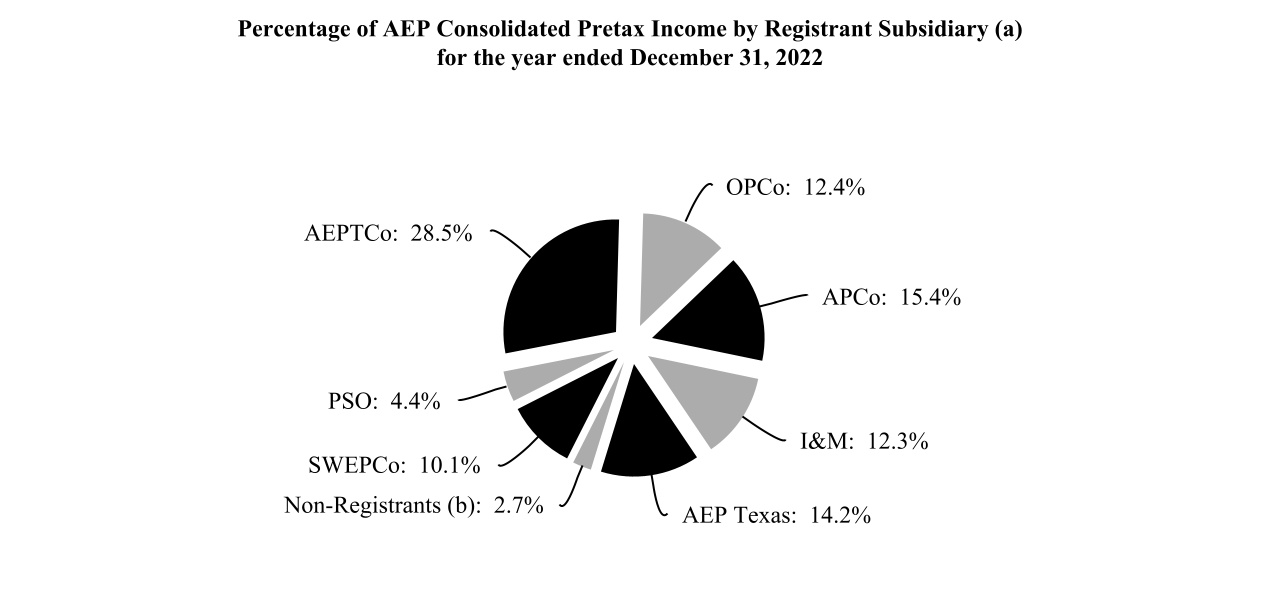
(a)Pretax income does not include intercompany eliminations.
(b)Excludes $363 million loss on expected sale of the Kentucky Operations.
CLASSES OF SERVICE
AEP and subsidiaries recognize revenues from customers for retail and wholesale electricity sales and electricity transmission and distribution delivery services. AEP’s subsidiaries within the Vertically Integrated Utilities, Transmission and Distribution Utilities, AEP Transmission Holdco and Generation & Marketing segments derive revenue from the following sources: Retail Revenues, Wholesale and Competitive Retail Revenues, Other Revenues from Contracts with Customers and Alternative Revenues. For further information relating to the sources of revenue for the Registrants, see Note 19 - Revenues from Contracts with Customers for additional information.
FINANCING
General
Companies within the AEP System generally use short-term debt to finance working capital needs. Short-term debt may also be used to finance acquisitions, construction and redemption or repurchase of outstanding securities until such needs can be financed with long-term debt. In recent history, short-term funding needs have been provided for by cash on hand, term loan issuances and AEP’s commercial paper program. Funds are made available to subsidiaries under the AEP corporate borrowing program. Certain public utility subsidiaries of AEP also sell accounts receivable to provide liquidity. See “Financial Condition” section of Management’s Discussion and Analysis of Financial Condition and Results of Operations included in the 2022 Annual Report for additional information.
AEP’s revolving credit agreement (which backstops the commercial paper program) includes covenants and events of default typical for this type of facility, including a maximum debt/capital test. In addition, the acceleration of AEP’s payment obligations, or the obligations of certain of its major subsidiaries, prior to maturity under any other agreement or instrument relating to debt outstanding in excess of $50 million, would cause an event of default under the credit agreement. As of December 31, 2022, AEP was in compliance with its debt covenants. With the exception of a voluntary bankruptcy or insolvency, any event of default has either or both a cure period or notice requirement before termination of the agreement. A voluntary bankruptcy or insolvency of AEP or one of its significant subsidiaries would be considered an immediate termination event. See “Financial Condition” section of Management’s Discussion and Analysis of Financial Condition and Results of Operations included in the 2022 Annual Report for additional information.
AEP’s subsidiaries have also utilized, and expect to continue to utilize, additional financing arrangements, such as securitization financings and leasing arrangements, including the leasing of coal transportation equipment and facilities.
ENVIRONMENTAL AND OTHER MATTERS
General
AEP subsidiaries are currently subject to regulation by federal, state and local authorities with regard to air and water-quality control and other environmental matters, and are subject to zoning and other regulation by local authorities. The environmental issues that management believes are potentially material to the AEP System are outlined below.
Clean Water Act Requirements
Operations for AEP subsidiaries are subject to the CWA, which prohibits the discharge of pollutants into waters of the United States except pursuant to appropriate permits and regulates systems that withdraw surface water for use in power plants. In 2014, the Federal EPA issued a final rule setting forth standards for water withdrawals at existing power plants that is intended to reduce mortality of aquatic organisms pinned against a plant’s cooling water intake screen (impingement) or entrained in the cooling water. The standards affect all plants withdrawing more than two million gallons of cooling water per day. A schedule for compliance with the standard is established by the permit agency and incorporated in NPDES permits.
In November 2015, the Federal EPA issued a final rule revising ELG for electricity generating facilities. The rule established limits on FGD wastewater, fly ash and bottom ash transport water and flue gas mercury control wastewater to be imposed in NPDES permits as soon as possible after November 2018 and no later than December 2023. The Federal EPA further revised the rule in August 2020 for FGD wastewater and bottom ash transport water extending the compliance date to December 2025 and establishing additional options.
In January 2020, the Federal EPA issued a final rule revising the scope of the “waters of the United States” subject to CWA regulation. In August 2021, this rule was vacated by a federal court and shortly thereafter, in December 2021, the Federal EPA proposed a rule that would roll back the definition of “waters of the United States” to the pre-2015 definition. That rule was finalized in January 2023 and becomes effective in March 2023. See “Environmental Issues - Clean Water Act Regulations” section of Management’s Discussion and Analysis of Financial Condition and Results of Operations included in the 2022 Annual Report for additional information.
Coal Ash Regulation
AEP’s operations produce a number of different coal combustion by-products, including fly ash, bottom ash, gypsum and other materials. A rule by the Federal EPA regulates the disposal and beneficial re-use of coal combustion residuals, including fly ash and bottom ash generated at coal-fired electric generating units. The rule requires certain standards for location, groundwater monitoring and dam stability to be met at landfills and certain surface impoundments at operating facilities. If existing disposal facilities cannot meet these standards, they will be required to close. In August 2020, the Federal EPA revised the CCR rule to include a requirement that unlined CCR storage ponds cease operations and initiate closure by April 11, 2021. The revised rule provides two options for seeking an extension of that date. AEP filed extension requests for seven facilities, to date, the Federal EPA has not finalized any of those requests. In July 2022, the Federal EPA proposed a conditional approval of the extension request for AEP’s Mountaineer facility, but that request has since been withdrawn. See “Environmental Issues - Coal Combustion Residual (CCR) Rule” section of Management’s Discussion and Analysis of Financial Condition and Results of Operations included in the 2022 Annual Report for additional information.
Clean Air Act Requirements
The CAA establishes a comprehensive program to protect and improve the nation’s air quality and control mobile and stationary sources of air emissions. The major CAA programs affecting AEP’s power plants are described below. The states implement and administer many of these programs and could impose additional or more stringent requirements.
The Acid Rain Program
The CAA includes a cap-and-trade emission reduction program for SO2 emissions from power plants and requirements for power plants to reduce NOx emissions through the use of available combustion controls, collectively called the Acid Rain Program. AEP continues to meet its obligations under the Acid Rain Program through the installation of controls, use of alternate fuels and participation in the emissions allowance markets.
National Ambient Air Quality Standards
The CAA requires the Federal EPA to review the available scientific data for criteria pollutants periodically and establish a concentration level in the ambient air for those substances that is adequate to protect the public health and welfare with an extra safety margin. The Federal EPA also can list additional pollutants and develop concentration levels for them. These concentration levels are known as NAAQS.
Each state identifies the areas within its boundaries that meet the NAAQS (attainment areas) and those that do not (non-attainment areas). Each state must develop a SIP to bring non-attainment areas into compliance with the NAAQS and maintain good air quality in attainment areas. All SIPs are submitted to the Federal EPA for approval. If a state fails to develop adequate plans, the Federal EPA develops and implements a plan. As the Federal EPA reviews the NAAQS and establishes new concentration levels, the attainment status of areas can change and states may be required to develop new SIPs. See “Environmental Issues - Clean Air Act Requirements” section of Management’s Discussion and Analysis of Financial Condition and Results of Operations included in the 2022 Annual Report for additional information.
Hazardous Air Pollutants (HAP)
The CAA also requires the Federal EPA to investigate HAP emissions from the electric utility sector and submit a report to Congress to determine whether those emissions should be regulated. In 2011, the Federal EPA issued a rule setting Maximum Achievable Control Technology standards for new and existing coal and oil-fired utility units and New Source Performance Standards for emissions from new and modified power plants. In 2014, the U.S. Supreme Court determined that the Federal EPA acted unreasonably in refusing to consider costs in determining if it was appropriate and necessary to regulate HAP emissions from electric generating units. The Federal EPA has engaged in additional rulemaking activity but the 2011 rule remains in effect.
Regional Haze
The CAA establishes visibility goals for certain federally designated areas, including national parks, and requires states to submit SIPs that will demonstrate reasonable progress toward preventing impairment of visibility in these protected areas. In 2005, the Federal EPA issued its Clean Air Visibility Rule, detailing how the CAA’s best available retrofit technology requirements will be applied to facilities built between 1962 and 1977 that emit more than 250 tons per year of certain pollutants in specific industrial categories, including power plants.
Cross State Air Pollution
CSAPR is a regional trading program designed to address interstate transport of emissions that contribute significantly to non-attainment and maintenance of the ozone and PM NAAQS in downwind states. CSAPR relies on SO2 and NOX allowances and individual state budgets to compel further emission reductions from electric utility generating units. Interstate trading of allowances is allowed on a restricted basis. In January 2021, the Federal EPA finalized a revised CSAPR rule, which substantially reduces the ozone season NOX budgets in 2021-2024. Several utilities and other entities potentially subject to the Federal EPA’s NOX regulations have challenged that final rule in the U.S. Court of Appeals for the District of Columbia Circuit and oral arguments were held in September 2022. Management cannot predict the outcome of that litigation, but believes it can meet the requirements of the rule in the near term, and is evaluating its compliance options for later years, when the budgets are further reduced. In addition, in February 2023, the EPA Administrator finalized the denial of 2015 Ozone NAAQS SIPs for 19 states. A FIP that further revises the ozone season NOX budgets under the existing CSAPR program in those states is expected to be finalized in the spring of 2023 and will likely take effect for the 2023 ozone season. Management is evaluating the impacts of the rule changes.
Climate Change
In October 2022, AEP announced new intermediate and long-term CO2 emission reduction goals, based on the output of AEP’s integrated resource plans. See “Corporate Governance” section for additional information.
To date, the Federal EPA has twice taken action to regulate CO2 emissions from new and existing fossil fueled electric generating units under the existing provisions of the CAA and both attempts have been struck down by the courts. The Federal EPA has announced it expects to propose a new rule in 2023. Management expects emissions to continue to decline over time as AEP diversifies generating sources and operates fewer coal units. The projected decline in coal-fired generation is due to a number of factors, including the ongoing cost of operating older units, the relative cost of coal and natural gas as fuel sources, increasing environmental regulations requiring significant capital investments and changing commodity market fundamentals.
Transforming AEP’s Generation Fleet
The electric utility industry is in the midst of an historic transformation, driven by changing customer needs, evolving public policies, stakeholder demands, demographics, competitive offerings, technologies and commodity prices. AEP is also transforming to be more agile and customer-focused as a valued provider of energy solutions. AEP’s long-term commitment to reduce CO2 emissions reflects the current direction of the company’s resource plans to meet those needs. As of December 31, 2022, the AEP System owned generating capacity of approximately 25,000 MWs. In 2022, coal represented 41% of AEP’s generating capacity compared with 70% in 2005. Transforming AEP’s generation portfolio to include, where there is regulatory support, more renewable energy and focusing on the efficient use of energy, demand response, distributed resources and technology solutions to more efficiently manage the grid over time is part of this strategy.
The graph below summarizes AEP’s generation capacity by resource type for the years 1999, 2005 and 2022:
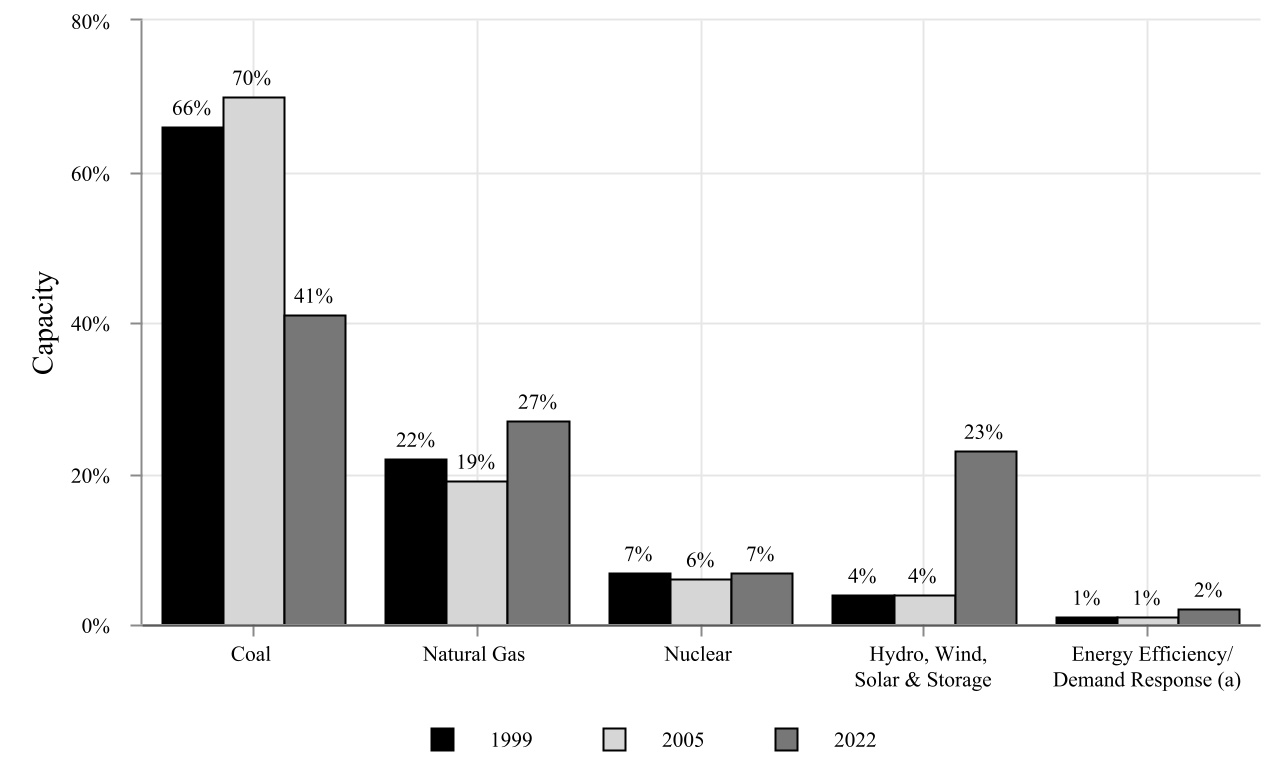
(a) Energy Efficiency/Demand Response represents avoided capacity rather than physical assets.
Renewable Sources of Energy
The states AEP serves, other than Kentucky, Oklahoma, West Virginia and Tennessee, have established mandatory or voluntary programs to increase the use of energy efficiency, alternative energy or renewable energy sources. Management actively monitors AEP’s compliance position and is on pace to meet the relevant requirements or benchmarks in each applicable jurisdiction.
As of December 31, 2022, AEP’s regulated utilities had long-term contracts for 2,750 MWs of wind, 80 MWs of hydro and 65 MWs of solar power. Additionally, AEP’s regulated utilities own and operate 1,484 MWs of wind, 805 MWs of hydro and 36 MWs of solar power delivering renewable energy to the companies’ customers.
I&M owns four solar projects that make up I&M’s 15 MW Clean Energy Solar Pilot Project and its 20 MW St. Joseph solar facility went into operation in 2021. In 2020, PSO received approval from the OCC and SWEPCo received approval from the APSC and LPSC to acquire the NCWF, comprised of three Oklahoma wind facilities totaling 1,484 MWs, on a fixed cost turn-key basis at completion. Both the APSC and LPSC approved the flex-up option, agreeing to acquire the Texas portion, which the PUCT denied. PSO owns 45.5% and SWEPCo owns 54.5% of the project, which cost approximately $2 billion. The 199 MW Sundance wind facility was acquired and placed in service in April 2021 and the 287 MW Maverick wind facility was acquired and placed in service in September 2021. The 998 MW Traverse wind facility was acquired and placed in service in March 2022.
AEP’s regulated utilities have significant plans to add new renewable generation. SWEPCo is seeking approval from state regulators to acquire three renewable energy projects totaling 999 MWs. PSO is seeking approval from its state regulator to acquire 996 MW of new renewable projects. Additionally, AEP’s regulated utilities issued RFPs in 2022 seeking additional owned renewable energy projects totaling 4,800 MWs.
The growth of AEP’s renewable generation portfolio reflects the company’s strategy to diversify generation resources to provide clean energy options to customers that meet both their energy and capacity needs. In addition to gradually reducing AEP’s reliance on coal-fueled generating units, the growth of renewables and natural gas helps AEP to maintain a diversity of generation resources.
The integrated resource plans submitted to state regulatory commissions by AEP’s regulated utility subsidiaries reflect AEP’s strategy to balance reliability and cost with customers’ desire for clean energy in a carbon-constrained world. AEP has committed significant capital investments to modernize the electric grid and integrate these new resources. Transmission assets of the AEP System interconnect approximately 22,600 MWs of renewable generation.
AEP Energy Supply, LLC is a holding company with several divisions, including AEP Renewables and AEP OnSite Partners.
AEP Renewables develops, owns and operates utility scale renewable projects backed with long-term contracts with creditworthy counterparties throughout the United States. In February 2022, AEP management announced the beginning of a process to sell all or a portion of AEP Renewables’ competitive contracted renewables portfolio. During November 2022, the 235 MW Flat Ridge 2 wind facility was sold. For more information on the pending sale of the competitive contracted renewables portfolio, see the “Contracted Renewable Generation Facilities” section of Management’s Discussion and Analysis. As of December 31, 2022, AEP Renewables owned projects operating in 11 states, including approximately 1,200 MWs of installed wind capacity and 165 MWs of installed solar capacity.
AEP OnSite Partners works directly with wholesale and large retail customers to provide tailored solutions to reduce their energy costs based upon market knowledge, innovative applications of technology and deal structuring capabilities. AEP OnSite Partners targets opportunities in distributed solar, combined heat and power, energy storage, waste heat recovery, energy efficiency, peaking generation and other energy solutions that create value for customers. AEP OnSite Partners pursues and develops behind the meter projects with creditworthy customers. As of December 31, 2022, AEP OnSite Partners owned projects located in 22 states, including approximately 168 MWs of installed solar capacity, and approximately 26 MWs of solar projects under construction.
End Use Energy Efficiency
Beginning in 2008, AEP ramped up efforts to reduce energy consumption and peak demand through the introduction of additional energy efficiency and demand response programs. These programs, commonly and collectively referred to as demand side management, were implemented in jurisdictions where appropriate cost recovery was available. Since that time, AEP operating company programs have reduced annual consumption by over 10 million MWhs and peak demand by approximately 3,313 MWs. Management estimates that its operating companies spent approximately $1.6 billion since 2008 to achieve these levels.
Energy efficiency and demand reduction programs have received regulatory support in most of the states AEP serves, and appropriate cost recovery will be essential for AEP operating companies to continue and expand these consumer offerings. Appropriate recovery of program costs, lost revenues, and an opportunity to earn a reasonable return ensures that energy efficiency programs are considered equally with supply side investments. As AEP continues to transition to a cleaner, more efficient energy future, energy efficiency and demand response programs will continue to play an important role in how the company serves its customers.
Management believes its experience providing robust energy efficiency programs in several states positions AEP to be a cost-effective provider of these programs as states develop their implementation plans.
Corporate Governance
In response to environmental issues and in connection with its assessment of AEP’s strategic plan, the Board of Directors continually reviews the risks posed by new environmental rules and requirements that could alter the retirement date of coal-fired generation assets. The Board of Directors is informed of new environmental regulations and proposed environmental regulations or legislation that would significantly affect AEP. In addition, the Board holds extended meetings twice a year to provide extra time for a more robust review of the Company’s strategy, including discussions about carbon and carbon risk. The Board’s Committee on Directors and Corporate Governance oversees AEP’s annual Corporate Sustainability Report, which includes information about AEP’s environmental, social, governance and financial performance.
AEP originally set CO2 emission reduction goals in 2018 after considering input from its annual corporate governance outreach effort with shareholders.
In October 2022, AEP announced new intermediate and long-term CO2 emission reduction goals, based on the output of the AEP’s integrated resource plans, which take into account economics, customer demand, grid reliability and resiliency, regulations and the company’s current business strategy. AEP adjusted its near-term CO2 emission reduction target from a 2000 baseline to a 2005 baseline, upgraded its 80% reduction by 2030 target to include full Scope 1 emissions and accelerated its net-zero goal by five years to 2045. AEP’s total Scope 1 GHG estimated emissions in 2022 were approximately 52.5 million metric tons, a 65% reduction from AEP’s 2005 Scope 1 GHG emissions (inclusive of emission reductions that result from plants that have been sold). AEP has made significant progress in reducing CO2 emissions from its power generation fleet and expects its emissions to continue to decline. Technological advances, including advanced energy storage, advanced nuclear reactors, hydrogen production and public policies are among the factors that will determine how quickly AEP can achieve net-zero emissions while continuing to provide reliable, affordable power for customers.
Other Environmental Issues and Matters
The Comprehensive Environmental Response, Compensation and Liability Act of 1980 imposes costs for environmental remediation upon owners and previous owners of sites, as well as transporters and generators of hazardous material disposed of at such sites. See “The Comprehensive Environmental Response Compensation and Liability Act (Superfund) and State Remediation” section of Note 6 included in the 2022 Annual Report for additional information.
Environmental Investments
Investments related to improving AEP System plants’ environmental performance and compliance with environmental quality standards during 2020, 2021 and 2022 and the current estimate for 2023 are shown below. Estimated construction expenditures are subject to periodic review and modification and may vary based on the ongoing effects of regulatory constraints, environmental regulations, business opportunities, market volatility, economic trends and the ability to access capital. In addition to the amounts set forth below, AEP expects to make investments in future years in connection with the modification and addition at generation plants’ facilities for environmental quality controls. Such future investments are needed in order to comply with environmental standards that have been adopted and have deadlines for compliance after 2022 or have been proposed and may be adopted. Future investments could be significantly greater if emissions reduction requirements are accelerated or otherwise become more stringent or in response to rules governing the beneficial use and disposal of coal combustion by-products. The cost of complying with applicable environmental laws, regulations and rules is expected to be significant to the AEP System. AEP typically recovers costs of complying with environmental standards from customers through rates in regulated jurisdictions. Failure to recover these costs could reduce future net income and cash flows and possibly harm AEP’s financial condition. See “Environmental Issues” section of Management’s Discussion and Analysis of Financial Condition and Results of Operations and Note 6 - Commitments, Guarantees and Contingencies included in the 2022 Annual Report for additional information.
| Historical and Projected Environmental Performance and Compliance Investments | ||||||||||||||||||||||||||
| 2020 | 2021 | 2022 | 2023 | |||||||||||||||||||||||
| Actual | Actual | Actual | Estimate (a) | |||||||||||||||||||||||
| (in millions) | ||||||||||||||||||||||||||
| AEP (b) | $ | 102.2 | $ | 94.3 | $ | 225.9 | $ | 150.7 | ||||||||||||||||||
| APCo | 21.3 | 60.0 | 129.0 | 65.9 | ||||||||||||||||||||||
| I&M | 31.8 | 7.2 | 5.0 | — | ||||||||||||||||||||||
| PSO | — | — | — | 0.2 | ||||||||||||||||||||||
| SWEPCo | (3.6) | 3.9 | 18.2 | 4.8 |
(a)Estimated amounts are exclusive of debt AFUDC.
(b)Includes expenditures of the subsidiaries shown and other subsidiaries not shown. The figures reflect construction expenditures, not investments in subsidiary companies.
Management currently estimates investments related to improving AEP System plants’ environmental performance and compliance with environmental quality standards will be less than $100 million annually for the years 2024 through 2026. These cost estimates could change based on: (a) potential state rules that impose more stringent standards, (b) additional rulemaking activities in response to court decisions, (c) actual performance of the pollution control technologies installed, (d) changes in costs for new pollution controls, (e) new generating technology developments, (f) total MWs of capacity retired and replaced, including the type and amount of such replacement capacity, (g) compliance with the Federal EPA’s revised coal combustion residual rules and (h) timing of implementation.
HUMAN CAPITAL MANAGEMENT
Attracting, developing and retaining high-performing employees with the skills and experience needed to serve our customers efficiently and effectively is crucial to AEP’s growth and competitiveness and is central to our long-term strategy. AEP invests in employees and continues to build a high performance and inclusive culture that inspires leadership, encourages innovative thinking and welcomes everyone.
The following table shows AEP’s number of employees by subsidiary as of December 31, 2022:
| Subsidiary | Number of Employees | |||||||
| AEPSC | 6,572 | |||||||
| AEP Texas | 1,594 | |||||||
| APCo | 1,650 | |||||||
| I&M | 2,016 | |||||||
| OPCo | 1,713 | |||||||
| PSO | 1,030 | |||||||
| SWEPCo | 1,372 | |||||||
| Other | 1,027 | |||||||
| Total AEP | 16,974 |
Of AEP’s 16,974 employees, less than 0.1% are Traditionalists (born before 1946), approximately 20% are Baby Boomers (born 1946-1964), approximately 37% are Generation X (born 1965-1980), approximately 38% are Millennials (born 1981-1996) and approximately 5% are Generation Z (born after 1996).
Safety
Achieving Zero Harm means every employee returns home at the end of their shift in the same condition as when they came to work. Zero Harm is what we value most and commit to wholeheartedly. It is hard work, as it requires full focus every moment of every day. We hold ourselves accountable and we are always striving to be better. AEP has put tools, training and processes in place to strengthen our safety-first culture and mindset. AEP’s focus is on learning from events and has proactive programs to prevent harm. One common industry safety metric utilized by AEP to track incidents is the Days Away/Restricted or Transferred (DART) rate. A DART event is an event that results in one or more lost days, one or more restricted days or results in an employee transferring to a different job within the company. The DART rate is a mathematical calculation (number of DART events multiplied by 200,000 work hours and divided by total YTD hours worked) that describes the number of recordable injuries per 100 full-time employees. In 2022, AEP’s employee DART Rate performance improved to 0.424 as compared to 0.430 in 2021.
Diversity, Equity and Inclusion (DEI)
AEP is committed to cultivating a diverse and inclusive environment that supports the development and advancement of all. We foster an inclusive workplace that encourages diversity of thought, culture and background and actively work to eliminate unconscious biases. DEI is a strategic priority for AEP and our efforts are guided by four principles:
-
Establishing leadership accountability around DEI outcomes.
-
Building and maintaining a workforce that reflects the communities we serve.
-
Promoting an inclusive culture where all employees can thrive.
-
Supporting the communities we serve so they will prosper.
We believe our workforce should generally reflect the diversity of our customers and the communities we serve so that we may better understand how to tailor our services to meet their expectations. As of December 31, 2022, women comprised approximately 20% of AEP’s workforce and 20% was represented by racially or ethnically diverse employees.
Our DEI progress is tied to enterprise, business unit and operating company annual incentive compensation objectives, which is measured through our annual employee culture survey. In addition, the Human Resources Committee of the Board of Directors provides oversight of our compensation and human resources policies and practices, including an annual review of our diversity, equity and inclusion strategy, results of our culture survey and compliance with equal opportunity laws.
AEP has taken actions to denounce all forms of racism in the wake of the racial and social unrest across the country in recent years. To accelerate our diversity and inclusion strategy, AEP facilitates “Community Conversations” for employees to discuss how race and equity issues impact the individual and the workplace and provide tools to take action; provides "Mitigating Bias in Candidate Selection" training for all supervisors with a direct report and employees involved in the interview process; created dedicated faith or meditation rooms; developed affirmative action plans for all AEP sites with more than 50 employees; and, conducts pay equity studies to identify and address pay variances for female and minority employees. We are also signatories of the CEO Action for Diversity and Inclusion pledge, Paradigm for Parity and several other local and industry DEI initiatives to demonstrate our commitment to advancing diversity and inclusion within the workplace.
In addition, we’re committed to working with the communities we serve to advance equity for our employees, customers and neighbors of color. The American Electric Power Foundation created the Delivering on the Dream grant program to help dismantle systemic racism and prejudice while prioritizing diversity, equity and inclusion. This five-year, $5 million initial investment funds organizations with programs dedicated to advancing social justice in the communities we serve.
Culture
AEP believes in doing the right thing every time for our customers, each other and our future. AEP leaders at all levels are responsible for fostering an environment that supports a positive culture and for acting in a manner that positively models it. A high-performance culture forms the foundation for long-term success. An engaged, collaborative and empowered workforce is more likely to embrace a change mindset, drive continuous improvement, accept accountability, meet expectations, take ownership, and value personal growth. AEP is committed to driving our culture forward. Employees are given an opportunity to share their perspectives by participating in the Employee Culture Survey, administered by Gallup, Inc., that measures the progress we are making in improving our culture. In addition to engagement, the survey measures well-being and inclusiveness. In 2022, 86% of our organization participated in the survey and we continued to improve our grand mean score to remain in the top decile compared to Gallup’s overall company database. Additionally, in 2022, AEP received the Gallup Exceptional Workplace Award for the third consecutive year. The award recognizes organizations with engaged workplace cultures. Company executives also have candid meetings with employees to discuss our challenges, opportunities, what is going well and what can be even better.
Employee Resource Groups
One of the best ways for AEP to demonstrate our commitment to a trusting and inclusive work environment is to empower employees to form and participate in Employee Resource Groups (ERG). The ERGs at AEP include Abled and Differently-Abled Partnering Together, the Black ERG, the Asian-American Employee Partnership ERG, the Hispanic Origin Latin American ERG, the Military Veteran ERG, the Native American Tribes Interacting, Observing and Networking ERG, the Pride Partnership and the Women at Work ERG. Our ERGs reflect the diverse makeup of our workforce and enable us to gain valuable insight into the diverse communities we serve. They also help increase engagement across AEP by providing employees with a safe space to discuss work-related issues and to develop innovative solutions. ERGs play an active role in AEP’s diversity and inclusion efforts, including recruitment of new employees.
Training and Professional Development
At AEP, we are preparing our workforce for the future by providing opportunities to learn new skills and engaging higher education institutions to better prepare the next generation with the skills that we will need. AEP has training alliances with several community colleges, universities and vocational and technical schools across our service territory. We work with these institutions to develop academic programs that will prepare employees for upward mobility opportunities and to attract external job seekers interested in careers in our industry. AEP also provides a broad range of training and assistance that supports lifelong learning and transition development. This is especially important as we move closer toward a digital future that requires a more flexible, innovative and diverse workforce. AEP has robust processes to achieve this, including ongoing performance coaching, operational skills training, resources to support our commitment to environment, safety and health, job progression training, tuition assistance, and other forms of training that help employees improve their skills and become better leaders.
In 2022, AEP employees completed more than 950,000 hours of training in programs for which we track participation. In addition, AEP invested more than $3 million in employee education, supporting approximately 1,000 employees through our tuition reimbursement program.
Compensation and Benefits
AEP cares about the wellbeing of our employees and we recognize their importance to our success. We provide market competitive compensation and benefits, including health, wellness and assistance programs to our employees and their families to help them thrive at home and work. We ensure the pay we offer is competitive in the marketplace by market pricing many of our positions using robust compensation survey information. Nearly all AEP employees participate in an annual incentive program that rewards individual performance and achievement of business goals, which fosters a high-performance culture. AEP also offers employees physical and mental health programs, including medical, dental and life insurance, along with a health and well-being program to help employees and their families stay healthy and feeling their best. Additionally, AEP’s retirement programs position our employees for financial stability in retirement.
Labor Relations
Nearly one fourth of AEP’s workforce is represented by labor unions. We value the relationships we have with our union represented employees and believe in a trusting, collaborative and respectful partnership. We continuously work to strengthen these relationships to ensure we have a culture that attracts and supports employees who can adapt to the rapid changes occurring in our company and industry. Our partnership with labor unions is critical to meeting the growing expectations of our customers and adapting to the challenges of rapidly changing technologies.
BUSINESS SEGMENTS
AEP’s Reportable Segments
AEP’s primary business is the generation, transmission and distribution of electricity. Within its Vertically Integrated Utilities segment, AEP centrally dispatches generation assets and manages its overall utility operations on an integrated basis because of the substantial impact of cost-based rates and regulatory oversight. Intersegment sales and transfers are generally based on underlying contractual arrangements and agreements. AEP’s reportable segments are as follows:
-
Vertically Integrated Utilities
-
Transmission and Distribution Utilities
-
AEP Transmission Holdco
-
Generation & Marketing
The remainder of AEP’s activities is presented as Corporate and Other, which is not considered a reportable segment. See Note 9 - Business Segments included in the 2022 Annual Report for additional information on AEP’s segments.
VERTICALLY INTEGRATED UTILITIES
GENERAL
AEP’s vertically integrated utility operations are engaged in the generation, transmission and distribution of electricity for sale to retail and wholesale customers through assets owned and operated by AEGCo, APCo, I&M, KGPCo, KPCo, PSO, SWEPCo and WPCo. AEPSC, as agent for AEP’s public utility subsidiaries, performs marketing, generation dispatch, fuel procurement and power-related risk management and trading activities on behalf of each of these subsidiaries.
ELECTRIC GENERATION
Facilities
As of December 31, 2022, AEP’s vertically integrated public utility subsidiaries owned approximately 23,500 MWs of domestic generation. See Item 2 – Properties for more information regarding the generation capacity of vertically integrated public utility subsidiaries.
Fuel Supply
The following table shows the owned and leased generation sources by type (including wind purchase agreements), on an actual net generation (MWhs) basis, used by the Vertically Integrated Utilities:
| 2022 | 2021 | 2020 | |||||||||||||||
| Coal and Lignite | 43% | 50% | 45% | ||||||||||||||
| Nuclear | 21% | 22% | 24% | ||||||||||||||
| Natural Gas | 19% | 16% | 18% | ||||||||||||||
| Renewables | 17% | 12% | 13% |
An increase/decrease in one or more generation types relative to previous years reflects the addition of renewable resources, retirement of traditional fossil fuel units and price changes in one or more fuel commodity sources relative to the pricing of other fuel commodity sources. AEP’s overall 2022 fossil fuel costs for the Vertically Integrated Utilities increased 1.1% on a dollar per MMBtu basis from 2021.
Coal and Lignite
AEP’s Vertically Integrated Utilities procure coal and lignite under a combination of purchasing arrangements including long-term contracts, affiliate operations and spot agreements with various producers, marketers and coal trading firms. Coal and lignite consumption decreased 11% in 2022 from 2021 due to a combination of the retirement of Dolet Hills Power Plant, lower amounts of lignite inventory available due to the planned retirement of the Pirkey Power Plant in March 2023 and lower generation at the coal fired power plants.
Management projects that the Vertically Integrated Utilities will be able to secure and transport coal and lignite of adequate quality and quantities to operate their coal and lignite-fired units; however, with current global dynamics and demand, supplies could be a challenge. As of December 31, 2022, through subsidiaries, AEP owns, leases or controls 3,000 railcars, 319 barges, 4 towboats and a coal handling terminal with approximately 18 million tons of annual capacity to move and store coal for use in AEP generating facilities. AEP will procure additional railcar and barge/towboat capacity as needed based on demand.
Spot coal prices strengthened significantly in the back half of 2021 and continued to increase throughout 2022 for all coal basins to all-time highs, with the exception of Powder River Basin coal which somewhat stabilized in 2022 to more historical levels. These price increases were primarily due to increases in global and domestic demand for coal. AEP’s strategy for purchasing coal includes layering in supplies over time. The price impact of this process is reflected in subsequent periods and with the current elevated prices will drive delivered coal prices up over the next few years for purchases made in 2021 and 2022. The price paid for coal and lignite delivered in 2022 increased approximately 10.6% from 2021 primarily due to the increase in coal prices from all coal basins.
The following table shows the amount of coal and lignite delivered to the Vertically Integrated Utilities’ plants during the past three years and the average delivered price of coal and lignite purchased by the Vertically Integrated Utilities:
| 2022 | 2021 | 2020 | |||||||||||||||
| Total coal and lignite delivered to the plants (in millions of tons) | 20.4 | 18.2 | 19.4 | ||||||||||||||
| Average cost per ton of coal and lignite delivered | $ | 56.16 | $ | 50.76 | $ | 53.95 |
The coal supplies at the Vertically Integrated Utilities plants vary from time to time depending on various factors, including, but not limited to, demand for electric power, unit outages, transportation infrastructure limitations, space limitations, plant coal consumption rates, availability of acceptable coals, labor issues and weather conditions, which may interrupt production or deliveries. As of December 31, 2022, the Vertically Integrated Utilities’ coal inventory was approximately 35 days of full load burn. While inventory targets vary by plant and are changed as necessary, the current coal inventory target for the Vertically Integrated Utilities is approximately 27 days of full load burn.
Natural Gas
The Vertically Integrated Utilities consumed approximately 126 billion cubic feet of natural gas during 2022 for generating power. This represents an increase of 16.5% from 2021. Several of AEP’s natural gas-fired power plants are connected to at least two pipelines which allow greater access to competitive supplies and improve delivery reliability. A portfolio of term, seasonal, monthly and daily natural gas supply agreements and term natural gas transportation agreements provide natural gas requirements for each plant, as appropriate. AEP’s natural gas supply transactions are based on market prices.
The following table shows the amount of natural gas delivered to the Vertically Integrated Utilities’ plants during the past three years and the average delivered price of natural gas purchased by the Vertically Integrated Utilities.
| 2022 | 2021 | 2020 | |||||||||||||||
| Total natural gas delivered to the plants (in billions cubic feet) | 126.0 | 108.0 | 113.1 | ||||||||||||||
| Average delivered price per MMBtu of purchased natural gas | $ | 6.94 | $ | 8.92 | $ | 2.14 |
Nuclear
I&M has made commitments to meet the current nuclear fuel requirements of the Cook Plant. I&M has made and will make purchases of uranium in various forms in the spot, short-term and mid-term markets.
For purposes of the storage of high-level radioactive waste in the form of SNF, I&M completed modifications to its SNF storage pool in the early 1990’s. I&M entered into an agreement to provide for onsite dry cask storage of SNF to permit normal operations to continue. I&M is scheduled to conduct further dry cask loading and storage projects on an ongoing periodic basis. The year of expiration of each NRC Operating License is 2034 for Unit 1 and 2037 for Unit 2. Management is currently evaluating applying for license extensions for both units.
Nuclear Waste and Decommissioning
As the owner of the Cook Plant, I&M has a significant future financial commitment to dispose of SNF and decommission and decontaminate the plant safely. The cost to decommission a nuclear plant is affected by NRC regulations and the SNF disposal program. The most recent decommissioning cost study was completed in 2021. The estimated cost of decommissioning and disposal of low-level radioactive waste for the Cook Plant was $2.2 billion in 2021 non-discounted dollars, with additional ongoing estimated costs of $7 million per year for post decommissioning storage of SNF and an eventual estimated cost of $33 million for the subsequent decommissioning of the spent fuel storage facility, also in 2021 non-discounted dollars. As of December 31, 2022 and 2021, the total decommissioning trust fund balance for the Cook Plant was approximately $3 billion and $3.5 billion, respectively. The balance of funds available to eventually decommission Cook Plant will differ based on contributions and investment returns. The ultimate cost of retiring the Cook Plant may be materially different from estimates and funding targets as a result of the:
-
Escalation of various cost elements (including, but not limited to, general inflation and the cost of energy).
-
Further development of regulatory requirements governing decommissioning.
-
Technology available at the time of decommissioning differing significantly from that assumed in studies.
-
Availability of nuclear waste disposal facilities.
-
Availability of a United States Department of Energy facility for permanent storage of SNF.
Accordingly, management is unable to provide assurance that the ultimate cost of decommissioning the Cook Plant will not be significantly different than current projections. AEP will seek recovery from customers through regulated rates if actual decommissioning costs exceed projections. See the “Nuclear Contingencies” section of Note 6 - Commitments, Guarantees and Contingencies included in the 2022 Annual Report for additional information with respect to nuclear waste and decommissioning.
Low-Level Radioactive Waste
The Low-Level Waste Policy Act of 1980 mandates that the responsibility for the disposal of low-level radioactive waste rests with the individual states. Low-level radioactive waste consists largely of ordinary refuse and other items that have come in contact with radioactive materials. Michigan does not currently have a disposal site for such waste available. I&M cannot predict when such a site may be available. However, the states of Utah and Texas have licensed low-level radioactive waste disposal sites which currently accept low-level radioactive waste from Michigan waste generators. There is currently no set date limiting I&M’s access to either of these facilities. The Cook Plant has a facility onsite designed specifically for the storage of low-level radioactive waste. In the event that low-level radioactive waste disposal facility access becomes unavailable, it can be stored onsite at this facility.
Counterparty Risk Management
The Vertically Integrated Utilities segment also sells power and enters into related energy transactions with wholesale customers and other market participants. As a result, counterparties and exchanges may require cash or cash related instruments to be deposited on transactions as margin against open positions. As of December 31, 2022, counterparties posted approximately $14 million in cash, cash equivalents or letters of credit with AEPSC for the benefit of AEP’s public utility subsidiaries (while, as of that date, AEP’s public utility subsidiaries posted approximately $207 million with counterparties and exchanges). Since open trading contracts are valued based on market prices of various commodities, exposures change daily. See the “Quantitative and Qualitative Disclosures About Market Risk” section of Management’s Discussion and Analysis of Financial Condition and Results of Operations included in the 2022 Annual Report for additional information.
Certain Power Agreements
I&M
The UPA between AEGCo and I&M, dated March 31, 1982 (the I&M Power Agreement), provides for the sale by AEGCo to I&M of all the capacity (and the energy associated therewith) available to AEGCo at the Rockport Plant. Whether or not power is available from AEGCo, I&M is obligated to pay a demand charge for the right to receive such power (and an energy charge for any associated energy taken by I&M). The I&M Power Agreement will continue in effect until the debt obligations of AEGCo secured by the Rockport Plant have been satisfied and discharged (currently expected to be December 2028).
In April 2021, AEGCo and I&M executed an agreement to purchase 100% of the interests in Rockport Plant, Unit 2 effective at the end of the lease term on December 7, 2022. Beginning December 8, 2022, AEGCo and I&M applied the joint plant accounting model to their respective 50% undivided interests in the jointly owned Rockport Plant, Unit 2 as well as any future investments made prior to the current estimated retirement date of December 2028.
Prior to the termination of the lease, I&M assigned 30% of the power to KPCo. See the “UPA between AEGCo and KPCo” section of Note 16 - Related Party Transactions for additional information. Beginning December 8, 2022, AEGCo billed 100% of its share of the Rockport Plant to I&M and ceased billing to KPCo. KPCo reached an agreement with I&M, from the end of the lease through May 2024, to buy capacity from Rockport Plant, Unit 2 through the PCA at a rate equal to PJM’s RPM clearing price.
OVEC
AEP and several nonaffiliated utility companies jointly own OVEC. The aggregate equity participation of AEP in OVEC is 43.47%. Parent owns 39.17% and OPCo owns 4.3%. Under the Inter-Company Power Agreement (ICPA), which defines the rights of the owners and sets the power participation ratio of each, the sponsoring companies are entitled to receive and are obligated to pay for all OVEC capacity (approximately 2,400 MWs) in proportion to their respective power participation ratios. The aggregate power participation ratio of APCo, I&M and OPCo is 43.47%. The ICPA terminates in June 2040. The proceeds from charges by OVEC to sponsoring companies under the ICPA based on their power participation ratios are designed to be sufficient for OVEC to meet its operating expenses and fixed costs. OVEC’s Board of Directors, as elected by AEP and nonaffiliated owners, has authorized environmental investments related to their ownership interests, with resulting expenses (including for related debt and interest thereon) included in charges under the ICPA. OVEC financed capital expenditures in excess of $1 billion in connection with flue gas desulfurization projects and the associated scrubber waste disposal landfills at its two generation plants through debt issuances, including tax-advantaged debt issuances. Both OVEC generation plants are operating with the new environmental controls in-service. See Note 17 - Variable Interest Entities and Equity Method Investments for additional information.
ELECTRIC DELIVERY
General
Other than AEGCo, AEP’s vertically integrated public utility subsidiaries own and operate transmission and distribution lines and other facilities to deliver electric power. See Item 2 – Properties for more information regarding the transmission and distribution lines. Most of the transmission and distribution services are sold to retail customers of AEP’s vertically integrated public utility subsidiaries in their service territories. These sales are made at rates approved by the state utility commissions of the states in which they operate, and in some instances, approved by the FERC. See Item 1. Business – Vertically Integrated Utilities – Regulation – Rates. The FERC regulates and approves the rates for both wholesale transmission transactions and wholesale generation contracts. The use and the recovery of costs associated with the transmission assets of the AEP vertically integrated public utility subsidiaries are subject to the rules, principles, protocols and agreements in place with PJM and SPP, and as approved by the FERC. See Item 1. Business – Vertically Integrated Utilities – Regulation – FERC. As discussed below, some transmission services also are separately sold to nonaffiliated companies.
Other than AEGCo, AEP’s vertically integrated public utility subsidiaries hold franchises or other rights to provide electric service in various municipalities and regions in their service areas. In some cases, these franchises provide the utility with the exclusive right to provide electric service within a specific territory. These franchises have varying provisions and expiration dates. In general, the operating companies consider their franchises to be adequate for the conduct of their business. For a discussion of competition in the sale of power, see Item 1. Business – Vertically Integrated Utilities – Competition.
Transmission Agreement
APCo, I&M, KGPCo, KPCo and WPCo own and operate transmission facilities that are used to provide transmission service under the PJM OATT and are parties to the TA. OPCo, which is a subsidiary in AEP’s Transmission and Distribution Utilities segment that provides transmission service under the PJM OATT, is also a party to the TA. The TA defines how the parties to the agreement share the revenues associated with their transmission facilities and the costs of transmission service provided by PJM. The TA has been approved by the FERC.
Transmission Coordination Agreement and Open Access Transmission Tariff
PSO, SWEPCo and AEPSC are parties to the TCA. Under the TCA, a coordinating committee is charged with the responsibility of: (a) overseeing the coordinated planning of the transmission facilities of the parties to the agreement, including the performance of transmission planning studies, (b) the interaction of such subsidiaries with independent system operators and other regional bodies interested in transmission planning and (c) compliance with the terms of the OATT filed with the FERC and the rules of the FERC relating to such tariff. Pursuant to the TCA, AEPSC has responsibility for monitoring the reliability of their transmission systems and administering the OATT on behalf of the other parties to the agreement. The TCA also provides for the allocation among the parties of revenues collected for transmission and ancillary services provided under the OATT. These allocations have been determined by the FERC-approved OATT for the SPP.
Regional Transmission Organizations
AEGCo, APCo, I&M, KGPCo, KPCo and WPCo are members of PJM, and PSO and SWEPCo are members of SPP (both FERC-approved RTOs). RTOs operate, plan and control utility transmission assets in a manner designed to provide open access to such assets in a way that prevents discrimination between participants owning transmission assets and those that do not.
REGULATION
General
AEP’s vertically integrated public utility subsidiaries’ retail rates and certain other matters are subject to traditional cost-based regulation by the state utility commissions. AEP’s vertically integrated public utility subsidiaries are also subject to regulation by the FERC under the Federal Power Act with respect to wholesale power and transmission service transactions. I&M is subject to regulation by the NRC under the Atomic Energy Act of 1954, as amended, with respect to the operation of the Cook Plant. AEP and its vertically integrated public utility subsidiaries are also subject to the regulatory provisions of, much of the Energy Policy Act of 2005, which is administered by the FERC.
Rates
Historically, state utility commissions have established electric service rates on a cost-of-service basis, which is designed to allow a utility an opportunity to recover its cost of providing service and to earn a reasonable return on its investment used in providing that service. A utility’s cost-of-service generally reflects its operating expenses, including operation and maintenance expense, depreciation expense and taxes. State utility commissions periodically adjust rates pursuant to a review of: (a) a utility’s adjusted revenues and expenses during a defined test period and (b) such utility’s level of investment. Absent a legal limitation, such as a law limiting the frequency of rate changes or capping rates for a period of time, a state utility commission can review and change rates on its own initiative. Some states may initiate reviews at the request of a utility, customer, governmental or other representative of a group of customers. Such parties may, however, agree with one another not to request reviews of or changes to rates for a specified period of time.
Public utilities have traditionally financed capital investments until the new asset is placed in-service. Provided the asset was found to be a prudent investment, it was then added to rate base and entitled to a return through rate recovery. Given long lead times in construction, the high costs of plant and equipment and volatile capital markets, management actively pursues strategies to accelerate rate recognition of investments and cash flow. AEP representatives continue to engage state commissioners and legislators on alternative rate-making options to reduce regulatory lag and enhance certainty in the process. These options include pre-approvals, a return on construction work in progress, rider/trackers, formula rates and the inclusion of future test-year projections into rates.
The rates of AEP’s vertically integrated public utility subsidiaries are generally based on the cost of providing traditional bundled electric service (i.e., generation, transmission and distribution service). Historically, the state regulatory frameworks in the service area of the AEP vertically integrated public utility subsidiaries reflected specified fuel costs as part of bundled (or, more recently, unbundled) rates or incorporated fuel adjustment clauses in a utility’s rates and tariffs. Fuel adjustment clauses permit periodic adjustments to fuel cost recovery from customers and therefore provide protection against exposure to fuel cost changes.
The following state-by-state analysis summarizes the regulatory environment of certain major jurisdictions in which AEP’s vertically integrated public utility subsidiaries operate. Several public utility subsidiaries operate in more than one jurisdiction. See Note 4 - Rate Matters included in the 2022 Annual Report for more information regarding pending rate matters.
Indiana
I&M provides retail electric service in Indiana at bundled rates approved by the IURC, with rates set on a forecasted cost-of-service basis. Indiana provides for timely fuel and purchased power cost recovery through a fuel cost recovery mechanism.
Oklahoma
PSO provides retail electric service in Oklahoma at bundled rates approved by the OCC. PSO’s rates are set on a cost-of-service basis. Fuel and purchased energy costs are recovered or refunded through a fuel adjustment clause.
Virginia
APCo currently provides retail electric service in Virginia at unbundled generation and distribution rates approved by the Virginia SCC. Virginia generally allows for timely recovery of fuel costs through a fuel cost recovery mechanism. In addition to base rates and fuel cost recovery, APCo is permitted to recover a variety of costs through rate adjustment clauses including transmission services provided at OATT rates based on rates established by the FERC.
West Virginia
APCo and WPCo provide retail electric service at bundled rates approved by the WVPSC, with rates set on a combined cost-of-service basis. West Virginia generally allows for timely recovery of fuel costs through the ENEC which trues-up to actual expenses. In addition to base rates and fuel cost recovery, APCo and WPCo are permitted to recover a variety of costs through surcharges.
FERC
The FERC regulates rates for interstate power sales at wholesale, transmission of electric power, accounting and other matters, including construction and operation of hydroelectric projects. The FERC regulations require AEP’s vertically integrated public utility subsidiaries to provide open access transmission service at FERC-approved rates, and AEP has approved cost-based formula transmission rates on file at the FERC. The FERC also regulates unbundled transmission service to retail customers. In addition, the FERC regulates the sale of power for resale in interstate commerce by: (a) approving contracts for wholesale sales to municipal and cooperative utilities at cost-based rates and (b) granting authority to public utilities to sell power at wholesale at market-based rates upon a showing that the seller lacks the ability to improperly influence market prices. AEP’s vertically integrated public utility subsidiaries have market-based rate authority from the FERC, under which much of their wholesale marketing activity takes place. The FERC requires each public utility that owns or controls interstate transmission facilities, directly or through an RTO, to file an open access network and point-to-point transmission tariff that offers services comparable to the utility’s own uses of its transmission system. The FERC also requires all transmitting utilities, directly or through an RTO, to establish an Open Access Same-time Information System, which electronically posts transmission information such as available capacity and prices, and requires utilities to comply with Standards of Conduct that prohibit utilities’ transmission employees from providing non-public transmission information to the utility’s marketing employees. Additionally, the vertically integrated public utility subsidiaries are subject to reliability standards promulgated by the NERC, with the approval of the FERC.
The FERC oversees RTOs, entities created to operate, plan and control utility transmission assets. AEGCo, APCo, I&M, KGPCo, KPCo and WPCo are members of PJM. PSO and SWEPCo are members of SPP.
The FERC has jurisdiction over certain issuances of securities of most of AEP’s public utility subsidiaries, the acquisition of securities of utilities, the acquisition or sale of certain utility assets and mergers with another electric utility or holding company. In addition, both the FERC and state regulators are permitted to review the books and records of any company within a holding company system.
COMPETITION
AEP’s vertically integrated public utility subsidiaries primarily generate, transmit and distribute electricity to retail customers of AEP’s vertically integrated public utility subsidiaries in their service territories. These sales are made at rates approved by the state utility commissions of the states in which they operate, and in some instances, approved by the FERC, and are not subject to competition from other vertically integrated public utilities. Other than AEGCo, AEP’s vertically integrated public utility subsidiaries hold franchises or other rights that effectively grant the exclusive ability to provide electric service in various municipalities and regions in their service areas.
AEP’s vertically integrated public utility subsidiaries compete with self-generation and with distributors of other energy sources, such as natural gas, fuel oil, renewables and coal, within their service areas. The primary factors in such competition are price, reliability of service and the capability of customers to utilize alternative sources of energy other than electric power. With respect to competing generators and self-generation, the public utility subsidiaries of AEP believe that they currently maintain a competitive position.
Changes in regulatory policies and advances in newer technologies for batteries or energy storage, fuel cells, microturbines, wind turbines and photovoltaic solar cells are reducing costs of new technology to levels that are making them competitive with some central station electricity production. The costs of photovoltaic solar cells in particular have continued to become increasingly competitive. The ability to maintain relatively low cost, efficient and reliable operations and to provide cost-effective programs and services to customers are significant determinants of AEP’s competitiveness.
SEASONALITY
The consumption of electric power is generally seasonal. In many parts of the country, demand for power peaks during the hot summer months, with market prices also peaking at that time. In other areas, power demand peaks during the winter. The pattern of this fluctuation may change due to the nature and location of AEP’s facilities and the terms of power sale contracts into which AEP enters. In addition, AEP has historically sold less power, and consequently earned less income, when weather conditions are milder. Unusually mild weather in the future could diminish AEP’s results of operations. Conversely, unusually extreme weather conditions could increase AEP’s results of operations.
TRANSMISSION AND DISTRIBUTION UTILITIES
GENERAL
This segment consists of the transmission and distribution of electricity for sale to retail and wholesale customers through assets owned and operated by AEP Texas and OPCo. OPCo is engaged in the transmission and distribution of electric power to approximately 1,521,000 retail customers in Ohio. OPCo purchases energy and capacity to serve standard service offer customers and provides transmission and distribution services for all connected load. AEP Texas is engaged in the transmission and distribution of electric power to approximately 1,094,000 retail customers through REPs in west, central and southern Texas.
AEP’s transmission and distribution utility subsidiaries own and operate transmission and distribution lines and other facilities to deliver electric power. See Item 2 – Properties, for more information regarding the transmission and distribution lines. Transmission and distribution services are sold to retail customers of AEP’s transmission and distribution utility subsidiaries in their service territories. These sales are made at rates approved by the PUCT for AEP Texas and by the PUCO and the FERC for OPCo. The FERC regulates and approves the rates for wholesale transmission transactions. As discussed below, some transmission services also are separately sold to nonaffiliated companies.
AEP’s transmission and distribution utility subsidiaries hold franchises or other rights to provide electric service in various municipalities and regions in their service areas. In some cases, these franchises provide the utility with the exclusive right to provide electric service. These franchises have varying provisions and expiration dates. In general, the operating companies consider their franchises to be adequate for the conduct of their business.
The use and the recovery of costs associated with the transmission assets of the AEP transmission and distribution utility subsidiaries are subject to the rules, protocols and agreements in place with PJM and ERCOT, and as approved by the FERC. In addition to providing transmission services in connection with power sales in their service areas, AEP’s transmission and distribution utility subsidiaries also provide transmission services for nonaffiliated companies through RTOs.
Transmission Agreement
OPCo owns and operates transmission facilities that are used to provide transmission service under the PJM OATT; OPCo is a party to the TA with other utility subsidiary affiliates. The TA defines how the parties to the agreement share the revenues associated with their transmission facilities and the costs of transmission service provided by PJM. The TA has been approved by the FERC.
Regional Transmission Organizations
OPCo is a member of PJM, a FERC-approved RTO. RTOs operate, plan and control utility transmission assets to provide open access to such assets in a way that prevents discrimination between participants owning transmission assets and those that do not. AEP Texas is a member of ERCOT.
REGULATION
OPCo provides distribution and transmission services to retail customers within its service territory at cost-based rates approved by the PUCO or by the FERC. AEP Texas sets its rates through a combination of base rate cases and interim Transmission Cost of Services (TCOS) and Distribution Cost Recovery Factor (DCRF) filings. AEP Texas may file interim TCOS filings semi-annually and DCRF filings annually to update its rates to reflect changes in its net invested capital. Transmission and distribution rates are established on a cost-of-service basis, which is designed to allow a utility an opportunity to recover its cost of providing service and to earn a reasonable return on its investment used in providing that service. The cost-of-service generally reflects operating expenses, including operation and maintenance expense, depreciation expense and taxes. Utility commissions periodically adjust rates pursuant to a review of: (a) a utility’s adjusted revenues and expenses during a defined test period and (b) such utility’s level of investment.
FERC
The FERC regulates rates for transmission of electric power, accounting and other matters. The FERC regulations require AEP to provide open access transmission service at FERC-approved rates, and it has approved cost-based formula transmission rates on file at the FERC. The FERC also regulates unbundled transmission service to retail customers. The FERC requires each public utility that owns or controls interstate transmission facilities to, directly or through an RTO, file an open access network and point-to-point transmission tariff that offers services comparable to the utility’s own uses of its transmission system. The FERC also requires all transmitting utilities, directly or through an RTO, to establish an Open Access Same-time Information System, which electronically posts transmission information such as available capacity and prices, and requires utilities to comply with Standards of Conduct that prohibit utilities’ transmission employees from providing non-public transmission information to the utility’s marketing employees. In addition, both the FERC and state regulators are permitted to review the books and records of any company within a holding company system. Additionally, the transmission and distribution utility subsidiaries are subject to reliability standards as set forth by the NERC, with the approval of the FERC.
SEASONALITY
The delivery of electric power is generally seasonal. In many parts of the country, demand for power peaks during the hot summer months. In other areas, power demand peaks during the winter months. The pattern of this fluctuation may change due to the nature and location of AEP’s transmission and distribution facilities. In addition, AEP transmission and distribution has historically delivered less power, and consequently earned less income, when weather conditions are milder. In Texas, where there is residential decoupling, unusually mild weather in the future could diminish AEP’s results of operations. Conversely, unusually extreme weather conditions could increase AEP’s results of operations.
AEP TRANSMISSION HOLDCO
GENERAL
AEPTHCo is a holding company for (a) AEPTCo, which is the direct holding company for the State Transcos and (b) AEP’s Transmission Joint Ventures.
AEPTCo
AEPTCo wholly owns the State Transcos which are independent of, but respectively overlay, the following AEP electric utility operating companies: APCo, I&M, KPCo, OPCo, PSO, SWEPCo and WPCo. The State Transcos develop, own, operate and maintain their respective transmission assets. Assets of the State Transcos interconnect to transmission facilities owned by the aforementioned operating companies and nonaffiliated transmission owners within the footprints of PJM, MISO and SPP. APTCo, IMTCo, KTCo, OHTCo and WVTCo are located within PJM. IMTCo also owns portions of the Greentown station assets located in MISO. OKTCo and SWTCo are located within SPP.
IMTCo, KTCo, OHTCo, OKTCo and WVTCo own and operate transmission assets in their respective jurisdictions. The Virginia SCC and WVPSC granted consent for APCo and APTCo to enter into a joint license agreement that will support APTCo investment in the state of Tennessee. SWTCo does not currently own or operate transmission assets.
The State Transcos are regulated for rate-making purposes exclusively by the FERC and earn revenues through tariff rates charged for the use of their electric transmission systems. The State Transcos establish transmission rates each year through formula rate filings with the FERC. The rate filings calculate the revenue requirement needed to cover the costs of operation and debt service and to earn an allowed ROE. These rates are then included in an OATT for PJM, MISO and SPP.
The State Transcos own, operate, maintain and invest in transmission infrastructure in order to maintain and enhance system integrity and grid reliability, grid security, safety, reduce transmission constraints and facilitate interconnections of new generating resources and new wholesale customers, as well as enhance competitive wholesale electricity markets. A key part of AEP’s business is replacing and upgrading transmission facilities, assets and components of the existing AEP System as needed to maintain reliability.
The State Transcos provide the capability to build, replace and upgrade existing facilities. As of December 31, 2022, the State Transcos had $12.8 billion of transmission and other assets in-service with plans to construct approximately $3.3 billion of additional transmission assets, excluding CWIP, through 2025. Additional investment in transmission infrastructure is needed within PJM and SPP to maintain the required level of grid reliability, resiliency, security and efficiency and to address an aging transmission infrastructure. Additional transmission facilities will be needed based on changes in generating resources, such as wind or solar projects, generation additions or retirements and additional new customer interconnections. The State Transcos will continue their investment to enhance physical and cyber security of assets, and are also investing in improving the telecommunication network that supports the operation and control of the grid.
In October 2021, AEP entered into a Stock Purchase Agreement to sell KTCo to Liberty Utilities. The closing of the sale is subject to receipt of FERC authorization under Section 203 of the Federal Power Act and clearance under the Hart-Scott-Rodino Antitrust Improvements Act of 1976. See “Disposition of KPCo and KTCo” section of Note 7 for additional information.
AEPTHCO JOINT VENTURE INITIATIVES
AEP has established joint ventures with other electric utility companies for the purpose of developing, building and owning transmission assets that seek to improve reliability and market efficiency and provide transmission access to remote generation sources in North America (Transmission Joint Ventures). The Transmission Joint Ventures currently include:
| Joint Venture Name | Location | Projected or Actual Completion Date | Owners (Ownership %) | Total Estimated/Actual Project Costs at Completion | Approved Return on Equity | |||||||||||||||||||||||||||||||||
| (in millions) | ||||||||||||||||||||||||||||||||||||||
| ETT | Texas | (a) | Berkshire Hathaway | $ | 4,100.0 | (a) | 9.6 | % | ||||||||||||||||||||||||||||||
| (ERCOT) | Energy (50%) | |||||||||||||||||||||||||||||||||||||
| AEP (50%) | ||||||||||||||||||||||||||||||||||||||
| Prairie Wind | Kansas | 2014 | Evergy, Inc. (50%) | 158.0 | 12.8 | % | ||||||||||||||||||||||||||||||||
| Berkshire Hathaway | ||||||||||||||||||||||||||||||||||||||
| Energy (25%) | ||||||||||||||||||||||||||||||||||||||
| AEP (25%) | ||||||||||||||||||||||||||||||||||||||
| Pioneer | Indiana | 2018 | Duke Energy (50%) | 191.0 | 10.52 | % | (b) | |||||||||||||||||||||||||||||||
| AEP (50%) | ||||||||||||||||||||||||||||||||||||||
| Transource | Missouri | 2016 | Evergy, Inc. | 310.5 | 11.1 | % | (c) | |||||||||||||||||||||||||||||||
| Missouri | (13.5%) (d) | |||||||||||||||||||||||||||||||||||||
| AEP (86.5%) (d) | ||||||||||||||||||||||||||||||||||||||
| Transource | West | 2019 | Evergy, Inc. | 86.0 | 10.5 | % | ||||||||||||||||||||||||||||||||
| West Virginia | Virginia | (13.5%) (d) | ||||||||||||||||||||||||||||||||||||
| AEP (86.5%) (d) | ||||||||||||||||||||||||||||||||||||||
| Transource | Maryland | 2023 | Evergy, Inc. | 27.6 | (e) | 10.4 | % | |||||||||||||||||||||||||||||||
| Maryland | (13.5%) (d) | |||||||||||||||||||||||||||||||||||||
| AEP (86.5%) (d) | ||||||||||||||||||||||||||||||||||||||
| Transource | Pennsylvania | 2023 | Evergy, Inc. | 243.6 | (e) | 10.4 | % | |||||||||||||||||||||||||||||||
| Pennsylvania | (13.5%) (d) | |||||||||||||||||||||||||||||||||||||
| AEP (86.5%) (d) | ||||||||||||||||||||||||||||||||||||||
| Transource | Oklahoma | 2026 | Evergy, Inc. | 111.0 | (f) | 10.0 | % | |||||||||||||||||||||||||||||||
| Oklahoma | (13.5%)(d) | |||||||||||||||||||||||||||||||||||||
| AEP (86.5%) (d) | ||||||||||||||||||||||||||||||||||||||
| Transource | Pennsylvania | 2029 | Evergy, Inc. | 76.3 | (g) | 10.4 | % | |||||||||||||||||||||||||||||||
| Energy | (13.5%) (d) | |||||||||||||||||||||||||||||||||||||
| AEP (86.5%) (d) |
(a)ETT is undertaking multiple projects and the completion dates will vary for those projects. ETT’s investment in completed and active projects in ERCOT is expected to be $4.1 billion. Future projects will be evaluated on a case-by-case basis.
(b)In May 2020, Pioneer received FERC approval authorizing an ROE of 10.02% (10.52% inclusive of the RTO incentive adder of 0.5%).
(c)The ROE represents the weighted-average approved ROE based on the costs of two projects developed by Transource Missouri; the $64 million Iatan-Nashua project (10.3%) and the $247 million Sibley-Nebraska City project (11.3%).
(d)AEP owns 86.5% of Transource Missouri, Transource West Virginia, Transource Maryland, Transource Pennsylvania and Transource Oklahoma through its ownership interest in Transource Energy, LLC (Transource). Transource is a joint venture with AEPTHCo and Evergy, Inc. formed to pursue competitive transmission projects. AEPTHCo and Evergy, Inc. own 86.5% and 13.5% of Transource, respectively.
(e)See “Independence Energy Connection Project” section of Note 4 for additional information.
(f)In 2016, Transource Kansas received approval from the FERC authorizing an ROE of 9.8% (10.3% inclusive of the RTO incentive adder of 0.5%) for future competitive transmission projects in SPP. In October 2020, Transource was awarded the Sooner-Wekiwa project by SPP and the project was assigned to Transource Kansas. In November 2020, Transource Kansas was renamed Transource Oklahoma. The project is expected to go in-service in 2026.
(g)In October 2022, Transource Energy’s North Delta A proposal was awarded by the New Jersey Board of Public Utilities. The project is expected to go in-service in 2029. The project consists of a new transmission substation with two transformers and nine breakers and will connect to existing transmission lines.
Transource Missouri, Transource West Virginia, Transource Maryland, Transource Pennsylvania and Transource Oklahoma are consolidated joint ventures by AEP. All other joint ventures in the table above are not consolidated by AEP. AEP’s joint ventures do not have employees. Business services for the joint ventures are provided by AEPSC and other AEP subsidiaries and the joint venture partners. In 2022, approximately 461 AEPSC employees and 294 operating company employees provided service to one or more joint ventures.
REGULATION
The State Transcos and the Transmission Joint Ventures located outside of ERCOT establish transmission rates annually through forward-looking formula rate filings with the FERC pursuant to FERC-approved implementation protocols. The protocols include a transparent, formal review process to ensure the updated transmission rates are prudently-incurred and reasonably calculated. The IMTCo-owned Greentown station assets acquired from Duke Energy Indiana, LLC in December 2018 are located in MISO. IMTCo utilizes a historic cost recovery model to recover MISO assets.
The State Transcos’ and the Transmission Joint Ventures’ (where applicable) rates are included in the respective OATT for PJM and SPP. An OATT is the FERC rate schedule that provides the terms and conditions for transmission and related services on a transmission provider’s transmission system. The FERC requires transmission providers such as PJM and SPP to offer transmission service to all eligible customers (for example, load-serving entities, power marketers, generators and customers) on a non-discriminatory basis.
The FERC-approved formula rates establish the annual transmission revenue requirement (ATRR) and transmission service rates for transmission owners in annual rate base filings with the FERC. The formula rates establish rates for a one-year period based on the current projects in-service and proposed projects for a defined timeframe. The formula rates also include a true-up calculation for the previous year’s billings, allowing for over/under-recovery of the transmission owner’s ATRR. PJM and SPP pay the transmission owners their ATRR for use of their facilities and bill transmission customers taking service under the PJM and SPP OATTs, based on the terms and conditions in the respective OATT for the service taken. Additionally, the State Transcos are subject to reliability standards promulgated by the NERC, with the approval of the FERC.
Management continues to monitor the FERC’s 2019 Notice of Inquiry regarding base ROE policy, the FERC’s 2020 and 2021 supplemental Notice of Proposed Rulemaking (NOPR) regarding transmission incentives policy, and various other matters pending before the FERC with the potential to affect the transmission ROE methodology.
In April 2021, the FERC issued a supplemental NOPR proposing to modify its incentive for transmission owners that join RTOs (RTO Incentive). Under the supplemental NOPR, the RTO Incentive would be modified such that a utility would only be eligible for the RTO Incentive for the first three years after the utility joins a FERC-approved Transmission Organization. This is a significant departure from a previous NOPR issued in 2020 seeking to increase the RTO Incentive from 50 basis points to 100 basis points. The supplemental NOPR also required utilities that have received the RTO Incentive for three or more years to submit, within 30 days of the effective date of a final rule, a compliance filing to eliminate the incentive from its tariff prospectively. The supplemental NOPR was subject to a 60-day comment period followed by a 30-day period for reply comments. In July 2021, AEP submitted reply comments. AEP is awaiting a final rule from the FERC.
In the annual rate base filings described above, the State Transcos in aggregate filed rate base totals of $9.9 billion, $8.4 billion and $7 billion for 2022, 2021 and 2020, respectively. The total filed transmission revenue requirements, including prior year over/under-recovery of revenue and associated carrying charges were $1.7 billion, $1.4 billion and $1.2 billion for 2022, 2021 and 2020, respectively.
The rates of ETT, which is located in ERCOT, are determined by the PUCT. ETT sets its rates through a combination of base rate cases and interim Transmission Cost of Services (TCOS) filings. ETT may file interim TCOS filings semi-annually to update its rates to reflect changes in its net invested capital.
GENERATION & MARKETING
GENERAL
The AEP Generation & Marketing segment subsidiaries consist of a wholesale energy trading and marketing business, a retail supply and energy management business and competitive generating assets.
AEP Energy Supply, LLC is a holding company with several divisions, including AEP Renewables and AEP OnSite Partners.
AEP Renewables develops, owns and operates utility scale renewable projects backed with long-term contracts with creditworthy counterparties throughout the United States. AEP Renewables works directly with stakeholders to ensure that customers have clean, sustainable renewable energy to meet their environmental goals. As of December 31, 2022, AEP Renewables owned projects operating in 11 states, including approximately 1,200 MWs of installed wind capacity and 165 MWs of installed solar capacity. In October 2019, AEP Renewables entered into an agreement to construct Flat Ridge 3, a wind farm in Kansas. The 128 MW facility was placed into service in December 2021. In November 2020, AEP Renewables signed a Purchase and Sale Agreement to acquire 75% of the Dry Lake Solar Project, a 100 MW solar facility in southern Nevada. This facility was placed into service in May 2021. In February 2022, AEP management announced the beginning of a process to sell all or a portion of AEP Renewables’ competitive contracted renewables portfolio. For more information on the pending sale of the competitive contracted renewables portfolio, see the “Contracted Renewable Generation Facilities” section of Management’s Discussion and Analysis.
AEP OnSite Partners works directly with wholesale and large retail customers to provide tailored solutions to reduce their energy costs based upon market knowledge, innovative applications of technology and deal structuring capabilities. AEP OnSite Partners targets opportunities in distributed solar, combined heat and power, energy storage, waste heat recovery, energy efficiency, peaking generation and other energy solutions that create value for customers. AEP OnSite Partners pursues and develops behind the meter projects with creditworthy customers. As of December 31, 2022, AEP OnSite Partners owned projects located in 22 states, including approximately 168 MWs of installed solar capacity, and approximately 26 MWs of solar projects under construction.
With respect to the wholesale energy trading and marketing business, AEP Generation & Marketing segment subsidiaries enter into short-term and long-term transactions to buy or sell capacity, energy and ancillary services in ERCOT, SPP, MISO and PJM. These subsidiaries sell power into the market and engage in power, natural gas and emissions allowances risk management and trading activities. These activities primarily involve the purchase-and-sale of electricity (and to a lesser extent, natural gas and emissions allowances) under forward contracts at fixed and variable prices. These contracts include physical transactions, exchange-traded futures, and to a lesser extent, OTC swaps and options. The majority of forward contracts are typically settled by entering into offsetting contracts. These transactions are executed with numerous counterparties or on exchanges.
With respect to the retail supply and energy management business, AEP Energy is a retail energy supplier that supplies electricity and/or natural gas to residential, commercial, and industrial customers. AEP Energy provides various energy solutions in Illinois, Pennsylvania, Delaware, Maryland, New Jersey, Ohio and Washington, D.C. AEP Energy had approximately 736,000 customer accounts as of December 31, 2022. AEP has initiated a strategic evaluation of its ownership in AEP Energy. Potential alternatives may include, but are not limited to, continued ownership or a sale of all or a part of AEP Energy. Management has not made a decision regarding the potential alternatives, but expects to complete the strategic evaluation in the first half of 2023.
The primary fossil generation subsidiary in the Generation & Marketing segment has historically been AGR. However, in the third quarter 2022, AGR sold the 595 MW Cardinal Plant, its last remaining fossil generation. Other subsidiaries in this segment own or have the right to receive power from additional generation assets. See Item 2 – Properties for more information regarding the generation assets of the Generation & Marketing segment.
REGULATION
AGR is a public utility under the Federal Power Act, and is subject to the FERC’s exclusive rate-making jurisdiction over wholesale sales of electricity and the transmission of electricity in interstate commerce. Under the Federal Power Act, the FERC has the authority to grant or deny market-based rates for sales of energy, capacity and ancillary services to ensure that such sales are just and reasonable. The FERC granted AGR market-based rate authority in December 2013. The FERC’s jurisdiction over rate-making also includes the authority to suspend the market-based rates of AGR and set cost-based rates if the FERC subsequently determines that it can exercise market power, create barriers to entry or engage in abusive affiliate transactions. Periodically, AGR is required to file a market power update to show that it continues to meet the FERC’s standards with respect to generation market power and other criteria used to evaluate whether it continues to qualify for market-based rates. Other matters subject to the FERC jurisdiction include, but are not limited to, review of mergers, and dispositions of jurisdictional facilities and acquisitions of securities of another public utility or an existing operational generating facility.
Specific operations of AGR are also subject to the jurisdiction of various other federal, state, regional and local agencies, including federal and state environmental protection agencies. AGR is also regulated by the PUCT for transactions inside ERCOT. Additionally, AGR is subject to mandatory reliability standards promulgated by the NERC, with the approval of the FERC.
COMPETITION
The AEP Generation & Marketing segment subsidiaries face competition for the sale of available power, capacity and ancillary services. The principal factors of impact are electricity and fuel prices, new market entrants, construction or retirement of generating assets by others and technological advances in power generation. Other factors impacting competitiveness include environmental regulation, transmission congestion or transportation constraints at or near generation facilities, inoperability or inefficiencies, outages and deactivations and retirements at generation facilities.
Technology advancements, increased demand for clean energy, changing consumer behaviors, low-priced and abundant natural gas, and regulatory and public policy reforms are among the catalysts for transformation within the industry that impact competition for AEP’s Generation & Marketing segment. AGR also competes with self-generation and with distributors of other energy sources, such as natural gas, fuel oil, renewables and coal, within their service areas. The primary factors in such competition are price, unit availability and the capability of customers to utilize sources of energy other than electric power.
Changes in regulatory policies and advances in newer technologies for batteries or energy storage, fuel cells, microturbines, wind turbines and photovoltaic solar cells are reducing costs of new technology to levels that are making them competitive with some central station electricity production. The ability to maintain relatively low cost, efficient and reliable operations and to provide cost-effective programs and services to customers are significant determinants of AGR’s competitiveness. The costs of photovoltaic solar cells in particular have continued to become increasingly competitive.
This segment’s retail operations provide competitive electricity and natural gas in deregulated retail energy markets in six states and Washington, D.C. Each such retail choice jurisdiction establishes its own laws and regulations governing its competitive market, and public utility commission communications and utility default service pricing can affect customer participation in retail competition. Sustained low natural gas and power prices, low market volatility and maturing competitive environments can adversely affect this business.
This segment also engages in procuring and selling output from renewable generation sources under long-term contracts to creditworthy counterparties. New sources are not acquired without first securing a long-term placement of such power. Existing sources do not face competitive exposure. Competitive nonaffiliated suppliers of renewable or other generation could limit opportunities for future transactions for new sources and related output contracts.
SEASONALITY
The consumption of electric power is generally seasonal. In many parts of the country, demand for power peaks during the hot summer months, with market prices also peaking at that time. In other areas, power demand peaks during the winter months. The pattern of this fluctuation may change.
Fuel Supply
The following table shows the generation sources by type, on an actual net generation (MWhs) basis, used by the Generation & Marketing segment:
| 2022 | 2021 | 2020 | |||||||||||||||
| Coal | 41% | 38% | 46% | ||||||||||||||
| Renewables | 59% | 62% | 54% |
Counterparty Risk Management
Counterparties and exchanges may require cash or cash related instruments to be deposited on these transactions as margin against open positions. As of December 31, 2022, counterparties posted approximately $498 million in cash, cash equivalents or letters of credit with AEP for the benefit of AEP’s Generation & Marketing segment subsidiaries (while, as of that date, AEP’s Generation & Marketing segment subsidiaries posted approximately $115 million with counterparties and exchanges). Since open trading contracts are valued based on market prices of various commodities, exposures change daily. See the “Quantitative and Qualitative Disclosures About Market Risk” section of Management’s Discussion and Analysis of Financial Condition and Results of Operations included in the 2022 Annual Report for additional information.
Certain Power Agreements
As of December 31, 2022, the assets utilized in this segment included approximately 1,200 MWs of company-owned domestic wind power facilities and 177 MWs of domestic wind power from long-term purchase power agreements. Additional long term purchased power agreements have been entered into for 77 MWs of wind that are operating and an additional 640 MWs of wind and 1,659 MWs of solar capacity which are all seeking permits or under construction. These agreements are all contingent on completion of construction which is expected by the end of 2025.
In March 2022, AGR entered into an Asset Purchase agreement with a nonaffiliated electric cooperative to sell Cardinal Plant, Unit 1, a competitive generation asset totaling 595 MWs. The FERC approved the sale in May 2022 and the sale closed in the third quarter of 2022. The proceeds from the sale were not material. Concurrent with the closing of the sale, AGR executed a PPA with the nonaffiliated electric cooperative for rights to Unit 1’s power and capacity through 2028. AGR also retained certain obligations related to environmental remediation.
INFORMATION ABOUT OUR EXECUTIVE OFFICERS
The following persons are executive officers of AEP. Their ages are given as of February 23, 2023. The officers are appointed annually for a one-year term by the board of directors of AEP.
Julia A. Sloat
President and Chief Executive Officer
Age 53
President since August 2022 and Chief Executive Officer since January 2023. Executive Vice President from January 2021 to August 2022, Chief Financial Officer from January 2021 to November 2022. Senior Vice President, Treasury & Risk and Treasurer from January 2019 to December 2020. President and Chief Operating Officer of OPCo from May 2016 to December 2018.
Nicholas K. Akins
Executive Chair of the Board of Directors
Age 62
Chairman of the Board from January 2014 to December 2022, President from January 2011 to August 2022 and Chief Executive Officer from November 2011 to December 2022.
Christian T. Beam
Executive Vice President - Energy Services
Age 54
Executive Vice President - Energy Services since September 2022. President and Chief Operating Officer of APCo from January 2017 to September 2022. Vice President, Projects Controls & Construction from January 2013 to December 2016.
David M. Feinberg
Executive Vice President, General Counsel and Secretary
Age 53
Executive Vice President since January 2013. General Counsel and Secretary since January 2012.
Greg B. Hall
Executive Vice President and Chief Commercial Officer
Age 50
Executive Vice President and Chief Commercial Officer since September 2022. Executive Vice President - Energy Supply from July 2021 to September 2022. President and Chief Operating Officer of AEP Energy Supply LLC since July 2021. President of AEP Energy, Inc. since May 2017. President of AEP Energy Partners, Inc. since June 2007.
Ann P. Kelly
Executive Vice President and Chief Financial Officer
Age 52
Executive Vice President and Chief Financial Officer since November 2022. Vice President - Finance and Chief Financial Officer of AmeriGas Propane, Inc., a subsidiary of UGI Corporation since February 2019. Corporate Controller and Chief Accounting Officer of UGI Corporation from March 2018 to February 2019. Assistant Treasurer of UGI Corporation from May 2016 to March 2018.
Therace M. Risch
Executive Vice President and Chief Information & Technology Officer
Age 49
Executive Vice President since July 2021. Chief Information & Technology Officer since May 2020. Senior Vice President from April 2020 to July 2021.
Peggy I. Simmons
Executive Vice President - Utilities
Age 45
Executive Vice President - Utilities since September 2022. President and Chief Operating Officer of PSO from September 2018 to September 2022.
Raja Sundararajan
Executive Vice President - External Affairs
Age 48
Executive Vice President - External Affairs since July 2022. Senior Vice President - Regulatory and Customer Solutions from July 2021 to July 2022. President and Chief Operating Officer of AEP Ohio from January 2019 to July 2021. Vice President-Regulatory Services September 2016 to December 2018.
Phillip R. Ulrich
Executive Vice President and Chief Human Resources Officer
Age 52
Executive Vice President since January 2023. Chief Human Resources Officer since August 2021. Senior Vice President from August 2021 to December 2022. Chief Human Resources Officer of Flex, LTD from May 2019 to July 2021. Senior Vice President, Human Resources, Electrical Sector of Eaton from August 2016 to May 2019.
Charles E. Zebula
Executive Vice President - Portfolio Optimization
Age 62
Executive Vice President - Portfolio Optimization since July 2021. Executive Vice President - Energy Supply from January 2013 to July 2021.
Previous: Cover and table of contents · Next: Item 1A. RISK FACTORS