 filings.tools
AES 10-K 2013-12-31
Filed 2014-02-26. 21 sections, 955K characters. Original on sec.gov · Markdown · JSON
Cover and table of contents
10-K 1 a2013form10-k.htm 10-K
UNITED STATES
SECURITIES AND EXCHANGE COMMISSION
WASHINGTON, D.C. 20549
FORM 10-K
| ý | ANNUAL REPORT PURSUANT TO SECTION 13 OR 15(d) OF THE SECURITIES EXCHANGE ACT OF 1934 |
For the Fiscal Year Ended December 31, 2013
-OR-
| ¨ | TRANSITION REPORT FILED PURSUANT TO SECTION 13 OR 15(d) OF THE SECURITIES EXCHANGE ACT OF 1934 |
| COMMISSION FILE NUMBER 1-12291 |

THE AES CORPORATION
(Exact name of registrant as specified in its charter)
| Delaware | 54 1163725 | |
| (State or other jurisdiction of incorporation or organization) | (I.R.S. Employer Identification No.) | |
| 4300 Wilson Boulevard Arlington, Virginia | 22203 | |
| (Address of principal executive offices) | (Zip Code) | |
| Registrant’s telephone number, including area code: (703) 522-1315 | ||
| Securities registered pursuant to Section 12(b) of the Act: | ||
| Title of Each Class | Name of Each Exchange on Which Registered | |
| Common Stock, par value $0.01 per share | New York Stock Exchange | |
| AES Trust III, $3.375 Trust Convertible Preferred Securities | New York Stock Exchange |
Securities registered pursuant to Section 12(g) of the Act:
None
Indicate by check mark if the Registrant is a well-known seasoned issuer, as defined in Rule 405 of the Securities Act. Yes x No o
Indicate by check mark if the Registrant is not required to file reports pursuant to Section 13 or Section 15 (d) of the Act. Yes o No x
Indicate by check mark whether the registrant (1) has filed all reports required to be filed by Section 13 or 15(d) of the Securities Exchange Act of 1934 during the preceding 12 months (or for such shorter period that the registrant was required to file such reports), and (2) has been subject to such filing requirements for the past 90 days. Yes x No o
Indicate by check mark whether the registrant has submitted electronically and posted on its corporate Web site, if any, every Interactive Data File required to be submitted and posted pursuant to Rule 405 of Regulation S-T during the preceding 12 months (or for such shorter period that the registrant was required to submit and post such files). Yes x No o
Indicate by check mark if disclosure of delinquent filers pursuant to Item 405 of Regulation S-K is not contained herein, and will not be contained, to the best of registrant’s knowledge, in definitive proxy or information statements incorporated by reference in Part III of this Form 10-K or any amendment to this Form 10-K. x
Indicate by check mark whether the registrant is a large accelerated filer, an accelerated filer, a non-accelerated filer or a smaller reporting company. See the definitions of “large accelerated filer,” “accelerated filer” and “smaller reporting company” in Rule 12b-2 of the Exchange Act. (Check one):
| Large accelerated filer x | Accelerated filer o | Non-accelerated filer o | Smaller reporting company o |
| (Do not check if a smaller reporting company) |
Indicate by check mark whether the Registrant is a shell company (as defined in Rule 12b-2 of the Exchange Act). Yes o No x
The aggregate market value of the voting and non-voting common equity held by non-affiliates on June 28, 2013, the last business day of the Registrant’s most recently completed second fiscal quarter (based on the closing sale price of $11.87 of the Registrant’s Common Stock, as reported by the New York Stock Exchange on such date) was approximately $7.36 billion.
The number of shares outstanding of Registrant’s Common Stock, par value $0.01 per share, on February 18, 2014 was 723,927,523
DOCUMENTS INCORPORATED BY REFERENCE
Portions of Registrant’s Proxy Statement for its 2013 annual meeting of stockholders are incorporated by reference in Parts II and III
THE AES CORPORATION
FISCAL YEAR 2013 FORM 10-K
TABLE OF CONTENTS
PART I
In this Annual Report the terms “AES,” “the Company,” “us,” or “we” refer to The AES Corporation and all of its subsidiaries and affiliates, collectively. The term “The AES Corporation” and “Parent Company” refers only to the parent, publicly-held holding company, The AES Corporation, excluding its subsidiaries and affiliates.
FORWARD-LOOKING INFORMATION
In this filing we make statements concerning our expectations, beliefs, plans, objectives, goals, strategies, and future events or performance. Such statements are “forward-looking statements” within the meaning of the Private Securities Litigation Reform Act of 1995. Although we believe that these forward-looking statements and the underlying assumptions are reasonable, we cannot assure you that they will prove to be correct.
Forward-looking statements involve a number of risks and uncertainties, and there are factors that could cause actual results to differ materially from those expressed or implied in our forward-looking statements. Some of those factors (in addition to others described elsewhere in this report and in subsequent securities filings) include:
| • | the economic climate, particularly the state of the economy in the areas in which we operate, including the fact that the global economy faces considerable uncertainty for the foreseeable future, which further increases many of the risks discussed in this Form 10-K; |
| • | changes in inflation, demand for power, interest rates and foreign currency exchange rates, including our ability to hedge our interest rate and foreign currency risk; |
| • | changes in the price of electricity at which our Generation businesses sell into the wholesale market and our Utility businesses purchase to distribute to their customers, and the success of our risk management practices, such as our ability to hedge our exposure to such market price risk; |
| • | changes in the prices and availability of coal, gas and other fuels (including our ability to have fuel transported to our facilities) and the success of our risk management practices, such as our ability to hedge our exposure to such market price risk, and our ability to meet credit support requirements for fuel and power supply contracts; |
| • | changes in and access to the financial markets, particularly changes affecting the availability and cost of capital in order to refinance existing debt and finance capital expenditures, acquisitions, investments and other corporate purposes; |
| • | our ability to manage liquidity and comply with covenants under our recourse and non-recourse debt, including our ability to manage our significant liquidity needs and to comply with covenants under our senior secured credit facility and other existing financing obligations; |
| • | changes in our or any of our subsidiaries’ corporate credit ratings or the ratings of our or any of our subsidiaries’ debt securities or preferred stock, and changes in the rating agencies’ ratings criteria; |
| • | our ability to purchase and sell assets at attractive prices and on other attractive terms; |
| • | our ability to compete in markets where we do business; |
| • | our ability to manage our operational and maintenance costs, the performance and reliability of our generating plants, including our ability to reduce unscheduled down-times; |
| • | our ability to locate and acquire attractive “greenfield” projects and our ability to finance, construct and begin operating our “greenfield” projects on schedule and within budget; |
| • | our ability to enter into long-term contracts, which limit volatility in our results of operations and cash flow, such as Power Purchase Agreements (“PPA”), fuel supply, and other agreements and to manage counterparty credit risks in these agreements; |
| • | variations in weather, especially mild winters and cooler summers in the areas in which we operate, low levels of wind or sunlight for our wind and solar businesses, and the occurrence of difficult hydrological conditions for our hydro-power plants, as well as hurricanes and other storms and disasters; |
| • | our ability to meet our expectations in the development, construction, operation and performance of our new facilities, whether greenfield, brownfield or investments in the expansion of existing facilities; |
| • | the success of our initiatives in other renewable energy projects, as well as greenhouse gas emissions reduction projects and energy storage projects; |
| • | our ability to keep up with advances in technology; |
| • | the potential effects of threatened or actual acts of terrorism and war; |
| • | the expropriation or nationalization of our businesses or assets by foreign governments, whether with or without adequate compensation; |
| • | our ability to achieve expected rate increases in our Utility businesses; |
| • | changes in laws, rules and regulations affecting our international businesses; |
| • | changes in laws, rules and regulations affecting our North America business, including, but not limited to, regulations which may affect competition, the ability to recover net utility assets and other potential stranded costs by our utilities; |
| • | changes in law resulting from new local, state, federal or international energy legislation and changes in political or regulatory oversight or incentives affecting our wind business, our solar joint venture, our other renewables projects and our initiatives in greenhouse gas reductions and energy storage, including tax incentives; |
| • | changes in environmental laws, including requirements for reduced emissions of sulfur, nitrogen, carbon, mercury, hazardous air pollutants and other substances, greenhouse gas legislation, regulation and/or treaties and coal ash regulation; |
| • | changes in tax laws and the effects of our strategies to reduce tax payments; |
| • | the effects of litigation and government and regulatory investigations; |
| • | our ability to maintain adequate insurance; |
| • | decreases in the value of pension plan assets, increases in pension plan expenses and our ability to fund defined benefit pension and other post-retirement plans at our subsidiaries; |
| • | losses on the sale or write-down of assets due to impairment events or changes in management intent with regard to either holding or selling certain assets; |
| • | changes in accounting standards, corporate governance and securities law requirements; |
| • | our ability to maintain effective internal controls over financial reporting; |
| • | our ability to attract and retain talented directors, management and other personnel, including, but not limited to, financial personnel in our foreign businesses that have extensive knowledge of accounting principles generally accepted in the United States; |
| • | the performance of business and asset acquisitions, including our acquisition of DPL Inc., and our ability to successfully integrate and operate acquired businesses and assets, such as DPL, and effectively realize anticipated benefits; and |
| • | information security breaches. |
These factors in addition to others described elsewhere in this Form 10-K, including those described under Item 1A.—Risk Factors, and in subsequent securities filings, should not be construed as a comprehensive listing of factors that could cause results to vary from our forward-looking information.
We undertake no obligation to publicly update or revise any forward-looking statements, whether as a result of new information, future events, or otherwise. If one or more forward-looking statements are updated, no inference should be drawn that additional updates will be made with respect to those or other forward-looking statements.
Item 1. BUSINESS
Overview
We are a diversified power generation and utility company organized into six market-oriented Strategic Business Units (“SBUs”): US (United States), Andes (Chile, Colombia, and Argentina), Brazil, MCAC (Mexico, Central America and Caribbean), EMEA (Europe, Middle East and Africa), and Asia. We were incorporated in 1981.
Item 1.—Business is an outline of our strategy and our businesses by SBU, including key financial drivers. Additional items that may have an impact on our businesses are discussed in Item 1A. – Risk Factors and Item 3.—Legal Proceedings.
Strategy
Our strategic plan intends to maximize the risk-adjusted value of our portfolio for shareholders through our efforts to execute upon the following objectives:
| • | First, we are managing our portfolio of generation and utility businesses to create value for our stakeholders, including customers and shareholders, through safe, reliable, and sustainable operations and effective cost management. |
| • | Second, we are driving our business to manage capital more effectively and to increase the amount of discretionary cash available for deployment into debt repayment, growth investments, shareholder dividends, and share buybacks. |
| • | Third, we are realigning our geographic focus. To this end, we will continue to exit markets where we do not have a competitive advantage or where we are unable to earn a fair risk-adjusted return relative to monetization alternatives. In addition, we will focus our growth investments on platform expansions or opportunities to expand our existing operations. |
| • | Finally, we are working to reduce the cash flow and earnings volatility of our businesses by proactively managing our currency, commodity and political risk exposures, mostly through contractual and regulatory mechanisms, as well as commercial hedging activities. We also will continue to limit our risk by utilizing non-recourse project financing for the majority of our businesses. |
Business Lines & Strategic Business Units
Within our six SBUs, as discussed above, we have two lines of business. The first business line is generation, where we own and/or operate power plants to generate and sell power to customers, such as utilities, industrial users, and other intermediaries. The second business line is utilities, where we own and/or operate utilities to generate or purchase, distribute, transmit and sell electricity to end-user customers in the residential, commercial, industrial and governmental sectors within a defined service area. In certain circumstances, our utilities also generate and sell electricity on the wholesale market.
For each SBU, the following table summarizes our generation and utility businesses by capacity, number of facilities, utility customers and utility GWh sold.
| SBU | Generation Capacity (Gross MW) | Generation Facilities | Utility Customers | Utility GWh | Utility Businesses | ||||||||
| US | |||||||||||||
| Generation | 6,015 | 13 | |||||||||||
| Utilities | 6,934 | 18 | 1.2 million | 35,595 | 2 | ||||||||
| Andes | |||||||||||||
| Generation | 8,075 | 33 | |||||||||||
| Brazil | |||||||||||||
| Generation | 3,298 | 13 | |||||||||||
| Utilities | 8.0 million | 55,190 | 2 | ||||||||||
| MCAC | |||||||||||||
| Generation | 3,140 | 13 | |||||||||||
| Utilities | 1.3 million | 3,655 | 4 | ||||||||||
| EMEA | |||||||||||||
| Generation | 7,513 | 23 | |||||||||||
| Utilities | 936 | 11 | 1.0 million | 3,569 | 1 | ||||||||
| Asia | |||||||||||||
| Generation | 1,248 | 3 | |||||||||||
| 37,159 | (1) | 127 | 11.5 million | 98,009 | 9 |
| (1) | 29,609 proportional MW. Proportional MW is equal to gross MW times AES’ equity ownership percentage. |
Generation
We currently own and/or operate a generation portfolio of 29,289 MW, excluding the generation capabilities of our integrated utilities. Our generation fleet is diversified by fuel type. See discussion below under Fuel Costs.
Performance drivers of our generation businesses include types of electricity sales agreements, plant reliability and flexibility, fuel costs, fixed-cost management, sourcing and competition.
Electricity Sales Contracts
Our generation businesses sell electricity under medium- or long-term contracts (“contract sales”) or under short-term agreements in competitive markets (“short-term sales”).
Contract Sales. Most of our generation fleet sells electricity under contracts. Our medium-term contract sales have a term of 2 to 5 years, while our long-term contracts have a term of more than 5 years. Across our portfolio, the average remaining contract term is 7 years.
In contract sales, our generation businesses recover variable costs including fuel and variable operations and maintenance (“O&M”) costs, either through direct or indexation-based contractual pass-throughs or tolling arrangements. When the contract does not include a fuel pass-through, we typically hedge fuel costs or enter into fuel supply agreements for a similar contract period (see discussion under “Fuel Costs”). These contracts are intended to reduce exposure to the volatility of fuel prices and electricity prices by linking the business’s revenues and costs. These contracts also help us to fund a significant portion of the total capital cost of the project through long-term non-recourse project-level financing.
Capacity Payments and Contract Sales. Most of our contract sales include a capacity payment that covers projected fixed costs of the plant, including fixed O&M expenses and a return on capital invested. In addition, most of our contracts require that the majority of the capacity payment be denominated in the currency matching our fixed costs, including debt and return on capital invested. Although our project debt may consist of both fixed and floating rate debt, we typically hedge a significant portion of our exposure to variable interest rates. For foreign exchange, we generally structure the revenue of the business to match the currency of the debt and fixed costs. Some of our contracted businesses also receive a regulated market based capacity payment, which are discussed in more detail in the Capacity Payments and Short-Term Sales section.
Thus, these contracts, or other related commercial arrangements, significantly mitigate our exposure to changes in power and fuel prices, currency fluctuations and changes in interest rates. In addition, these contracts generally provide for a recovery of our fixed operating expenses and a return on our investment, as long as we operate the plant to the reliability and efficiency standards required in the contract.
Short-Term Sales. Our other generation businesses sell power and ancillary services under short-term contracts with an average term of less than 2 years, including spot sales, directly in the short-term market, or, in some cases, at regulated prices. The short-term markets are typically administered by a system operator to coordinate dispatch. Short-term markets generally operate on merit order dispatch, where the least expensive generation facilities, based upon variable cost or bid price, are dispatched first and the most expensive facilities are dispatched last. The short-term price is typically set at the marginal cost of energy or bid price (the cost of the last plant required to meet system demand
Showing the first 8K of 216K characters. Open the full section
Item 1A. RISK FACTORS
You should consider carefully the following risks, along with the other information contained in or incorporated by reference in this Form 10-K. Additional risks and uncertainties also may adversely affect our business and operations including those discussed in Item 7.—Management’s Discussion and Analysis of Financial Condition and Results of Operations in this Form 10-K. If any of the following events actually occur, our business, financial results and financial condition could be materially adversely affected.
Risks Related to our High Level of Indebtedness
We have a significant amount of debt, a large percentage of which is secured, which could adversely affect our business and the ability to fulfill our obligations.
As of December 31, 2013, we had approximately $21.0 billion of outstanding indebtedness on a consolidated basis. All outstanding borrowings under The AES Corporation’s senior secured credit facility and certain other indebtedness are secured by certain of our assets, including the pledge of capital stock of many of The AES Corporation’s directly held subsidiaries. Most of the debt of The AES Corporation’s subsidiaries is secured by substantially all of the assets of those subsidiaries. Since we have such a high level of debt, a substantial portion of cash flow from operations must be used to make payments on this debt. Furthermore, since a significant percentage of our assets are used to secure this debt, this reduces the amount of collateral
that is available for future secured debt or credit support and reduces our flexibility in dealing with these secured assets. This high level of indebtedness and related security could have other important consequences to us and our investors, including:
| • | making it more difficult to satisfy debt service and other obligations at the holding company and/or individual subsidiaries; |
| • | increasing the likelihood of a downgrade of our debt, which could cause future debt costs and/or payments to increase under our debt and related hedging instruments and consume an even greater portion of cash flow; |
| • | increasing our vulnerability to general adverse industry conditions and economic conditions, including but not limited to adverse changes in foreign exchange rates and commodity prices; |
| • | reducing the availability of cash flow to fund other corporate purposes and grow our business; |
| • | limiting our flexibility in planning for, or reacting to, changes in our business and the industry; |
| • | placing us at a competitive disadvantage to our competitors that are not as highly leveraged; and |
| • | limiting, along with the financial and other restrictive covenants relating to such indebtedness, among other things, our ability to borrow additional funds as needed or take advantage of business opportunities as they arise, pay cash dividends or repurchase common stock. |
The agreements governing our indebtedness, including the indebtedness of our subsidiaries, limit, but do not prohibit the incurrence of additional indebtedness. To the extent we become more leveraged, the risks described above would increase. Further, our actual cash requirements in the future may be greater than expected. Accordingly, our cash flows may not be sufficient to repay at maturity all of the outstanding debt as it becomes due and, in that event, we may not be able to borrow money, sell assets, raise equity or otherwise raise funds on acceptable terms or at all to refinance our debt as it becomes due. See Note 12 – Debt included in Item 8. of this Form 10-K for a schedule of our debt maturities.
The AES Corporation is a holding company and its ability to make payments on its outstanding indebtedness, including its public debt securities, is dependent upon the receipt of funds from its subsidiaries by way of dividends, fees, interest, loans or otherwise.
The AES Corporation is a holding company with no material assets other than the stock of its subsidiaries. All of The AES Corporation’s revenue is generated through its subsidiaries. Accordingly, almost all of The AES Corporation’s cash flow is generated by the operating activities of its subsidiaries. Therefore, The AES Corporation’s ability to make payments on its indebtedness and to fund its other obligations is dependent not only on the ability of its subsidiaries to generate cash, but also on the ability of the subsidiaries to distribute cash to it in the form of dividends, fees, interest, tax sharing, loans or otherwise.
However, our subsidiaries face various restrictions in their ability to distribute cash to The AES Corporation. Most of the subsidiaries are obligated, pursuant to loan agreements, indentures or non-recourse financing arrangements, to satisfy certain restricted payment covenants or other conditions before they may make distributions to The AES Corporation. In addition, the payment of dividends or the making of loans, advances or other payments to The AES Corporation may be subject to other contractual, legal or regulatory restrictions or may be prohibited altogether. Business performance and local accounting and tax rules may limit the amount of retained earnings that may be distributed to us as a dividend. Subsidiaries in foreign countries may also be prevented from distributing funds to The AES Corporation as a result of foreign governments restricting the repatriation of funds or the conversion of currencies. Any right that The AES Corporation has to receive any assets of any of its subsidiaries upon any liquidation, dissolution, winding up, receivership, reorganization, bankruptcy, insolvency or similar proceedings (and the consequent right of the holders of The AES Corporation’s indebtedness to participate in the distribution of, or to realize proceeds from, those assets) will be effectively subordinated to the claims of any such subsidiary’s creditors (including trade creditors and holders of debt issued by such subsidiary).
The AES Corporation’s subsidiaries are separate and distinct legal entities and, unless they have expressly guaranteed any of The AES Corporation’s indebtedness, have no obligation, contingent or otherwise, to pay any amounts due pursuant to such debt or to make any funds available whether by dividends, fees, loans or other payments.
Even though The AES Corporation is a holding company, existing and potential future defaults by subsidiaries or affiliates could adversely affect The AES Corporation.
We attempt to finance our domestic and foreign projects primarily under loan agreements and related documents which, except as noted below, require the loans to be repaid solely from the project’s revenues and provide that the repayment of the loans (and interest thereon) is secured solely by the capital stock, physical assets, contracts and cash flow of that project
subsidiary or affiliate. This type of financing is usually referred to as non-recourse debt or “non-recourse financing.” In some non-recourse financings, The AES Corporation has explicitly agreed to undertake certain limited obligations and contingent liabilities, most of which by their terms will only be effective or will be terminated upon the occurrence of future events. These obligations and liabilities take the form of guarantees, indemnities, letter of credit reimbursement agreements and agreements to pay, in certain circumstances, the project lenders or other parties.
As of December 31, 2013, we had approximately $21.0 billion of outstanding indebtedness on a consolidated basis, of which approximately $5.7 billion was recourse debt of The AES Corporation and approximately $15.4 billion was non-recourse debt. In addition, we have outstanding guarantees, indemnities, letters of credit, and other credit support commitments which are further described in this Form 10-K in Item 7
Showing the first 8K of 93K characters. Open the full section
Item 1B. UNRESOLVED STAFF COMMENTS
None.
Item 2. PROPERTIES
We maintain offices in many places around the world, generally pursuant to the provisions of long—and short-term leases, none of which we believe are material. With a few exceptions, our facilities, which are described in Item 1 of this Form 10-K, are subject to mortgages or other liens or encumbrances as part of the project’s related finance facility. In addition, the majority of our facilities are located on land that is leased. However, in a few instances, no accompanying project financing exists for the facility, and in a few of these cases, the land interest may not be subject to any encumbrance and is owned outright by the subsidiary or affiliate.
Item 3. LEGAL PROCEEDINGS
The Company is involved in certain claims, suits and legal proceedings in the normal course of business. The Company has accrued for litigation and claims where it is probable that a liability has been incurred and the amount of loss can be reasonably estimated. The Company believes, based upon information it currently possesses and taking into account established reserves for estimated liabilities and its insurance coverage, that the ultimate outcome of these proceedings and actions is unlikely to have a material adverse effect on the Company’s financial statements. It is reasonably possible, however, that some matters could be decided unfavorably to the Company and could require the Company to pay damages or make expenditures in amounts that could be material but cannot be estimated as of December 31, 2013.
In 1989, Centrais Elétricas Brasileiras S.A. (“Eletrobrás”) filed suit in the Fifth District Court in the State of Rio de Janeiro (“FDC”) against Eletropaulo Eletricidade de São Paulo S.A. (“EEDSP”) relating to the methodology for calculating monetary adjustments under the parties’ financing agreement. In April 1999, the FDC found for Eletrobrás and in September 2001, Eletrobrás initiated an execution suit in the FDC to collect approximately R$1.43 billion ($605 million) from Eletropaulo (as estimated by Eletropaulo) and a lesser amount from an unrelated company, Companhia de Transmissão de Energia Elétrica Paulista (“CTEEP”) (Eletropaulo and CTEEP were spun off of EEDSP pursuant to its privatization in 1998). In November 2002, the FDC rejected Eletropaulo’s defenses in the execution suit. On appeal, the case was remanded to the FDC for further proceedings. In December 2012, the FDC issued a decision that Eletropaulo is liable for the debt. However, that decision was annulled on appeal and the case was remanded to the FDC for further proceedings. On remand at the FDC, an accounting expert will issue a report on the amount of the alleged debt and the responsibility for its payment in light of the privatization. The parties will be entitled to take discovery and present arguments on the issues to be determined by the expert. If the FDC again finds Eletropaulo liable for the debt, after the amount of the alleged debt is determined, Eletrobrás will be entitled to resume the execution suit in the FDC. If Eletrobrás does so, Eletropaulo will be required to provide security for its alleged liability. In that case, if Eletrobrás requests the seizure of such security and the FDC grants such request, Eletropaulo’s results of operations may be materially adversely affected and, in turn the Company’s results of operations could be materially adversely affected. In addition, in February 2008, CTEEP filed a lawsuit in the FDC against Eletrobrás and Eletropaulo seeking a declaration that CTEEP is not liable for any debt under the financing agreement. Eletropaulo believes it has meritorious defenses to the claims asserted against it and will defend itself vigorously in these proceedings; however, there can be no assurances that it will be successful in its efforts.
In September 1996, a public civil action was asserted against Eletropaulo and Associação Desportiva Cultural Eletropaulo (the “Associação”) relating to alleged environmental damage caused by construction of the Associação near Guarapiranga Reservoir. The initial decision that was upheld by the Appellate Court of the State of São Paulo in 2006 found that Eletropaulo should repair the alleged environmental damage by demolishing certain construction and reforesting the area, and either sponsor an environmental project which would cost approximately R$1.5 million ($635 thousand) as of December 31, 2012, or pay an indemnification amount of approximately R$15 million ($6 million). Eletropaulo has appealed this decision to the Supreme Court and the Supreme Court affirmed the decision of the Appellate Court. Following the Supreme Court’s decision, the case is being remanded to the court of first instance for further proceedings and to monitor compliance by the defendants with the terms of the decision.
In December 2001, Gridco Ltd. ("Gridco") served a notice to arbitrate pursuant to the Indian Arbitration and Conciliation Act of 1996 on the Company, AES Orissa Distribution Private Limited (“AES ODPL”), and Jyoti Structures (“Jyoti”) pursuant to the terms of the shareholders agreement between Gridco, the Company, AES ODPL, Jyoti and the Central Electricity Supply Company of Orissa Ltd. ("CESCO"), an affiliate of the Company. In the arbitration, Gridco asserted that a comfort letter issued by the Company in connection with the Company's indirect investment in CESCO obligates the Company to provide additional financial support to cover all of CESCO's financial obligations to Gridco. Gridco appeared to be seeking approximately $189 million in damages, plus undisclosed penalties and interest, but a detailed alleged damage analysis was not filed by Gridco. The Company counterclaimed against Gridco for damages. In June 2007, a 2-to-1 majority of the arbitral tribunal rendered its award rejecting Gridco’s claims and holding that none of the respondents, the Company, AES ODPL, or Jyoti, had any liability to Gridco. The respondents’ counterclaims were also rejected. A majority of the tribunal later awarded the respondents, including the Company, some of their costs relating to the arbitration. Gridco has filed challenges of the tribunal's awards with the local Indian court. Those challenges remain pending. The Company believes that it has meritorious defenses to the claims asserted against it and will defend itself vigorously in these proceedings; however, there can be no assurances that it will be successful in its efforts.
In March 2003, the office of the Federal Public Prosecutor for the State of São Paulo, Brazil (“MPF”) notified Eletropaulo that it had commenced an inquiry into the BNDES financings provided to AES Elpa and AES Transgás, the rationing loan provided to Eletropaulo, changes in the control of Eletropaulo, sales of assets by Eletropaulo, and the quality of service provided by Eletropaulo to its customers. The MPF requested various documents from Eletropaulo relating to these
matters. In July 2004, the MPF filed a public civil lawsuit in the Federal Court of São Paulo (“FCSP”) alleging that BNDES violated Law 8429/92 (the Administrative Misconduct Act) and BNDES’s internal rules by: (1) approving the AES Elpa and AES Transgás loans; (2) extending the payment terms on the AES Elpa and AES Transgás loans; (3) authorizing the sale of Eletropaulo’s preferred shares at a stock-market auction; (4) accepting Eletropaulo’s preferred shares to secure the loan provided to Eletropaulo; and (5) allowing the restructurings of Light Serviços de Eletricidade S.A. and Eletropaulo. The MPF also named AES Elpa and AES Transgás as defendants in the lawsuit because they allegedly benefited from BNDES’s alleged violations. In May 2006, the FCSP ruled that the MPF could pursue its claims based on the first, second, and fourth alleged violations noted above. The MPF subsequently filed an interlocutory appeal with the Federal Court of Appeals (“FCA”) seeking to require the FCSP to consider all five alleged violations. Also, in July 2006, AES Elpa and AES Transgás filed an interlocutory appeal with the FCA, which was subsequently consolidated with the MPF’s interlocutory appeal, seeking a transfer of venue and to enjoin the FCSP from considering any of the alleged violations. In June 2009, the FCA granted the injunction sought by AES Elpa and AES Transgás and transferred the case to the Federal Court of Rio de Janeiro. In May 2010, the MPF filed an appeal with the Superior Court of Justice (“SCJ”) challenging the transfer. In November 2012, the SCJ ruled that the lawsuit must be returned to the FCSP. AES Elpa and AES Brasiliana (the successor of AES Transgás) believe they have meritorious defenses to the allegations asserted against them and will defend themselves vigorously in these proceedings; however, there can be no assurances that they will be successful in their efforts.
Pursuant to their environmental audit, AES Sul and AES Florestal discovered 200 barrels of solid creosote waste and other contaminants at a pole factory that AES Florestal had been operating. The conclusion of the audit was that a prior operator of the pole factory, Companhia Estadual de Energia (“CEEE”), had been using those contaminants to treat the poles that were manufactured at the factory. On their initiative, AES Sul and AES Florestal communicated with Brazilian authorities and CEEE about the adoption of containment and remediation measures. In March 2008, the State Attorney of the State of Rio Grande do Sul, Brazil filed a public civil action against AES Sul, AES Florestal and CEEE seeking an order requiring the companies to recover the contaminated area located on the grounds of the pole factory and an indemnity payment (approximately R$6 million ($3 million)) to the State’s Environmental Fund. In October 2011, the State Attorney Office filed a request for an injunction ordering the defendant companies to remediate the contaminated area immediately. The court granted injunctive relief on October 18, 2011, but determined only that defendant CEEE was required to proceed with the remediation work. In May 2012, CEEE began the remediation work in compliance with the injunction. The remediation costs are estimated to be approximately R$60 million ($25 million) and the work is ongoing. The case is in the evidentiary stage awaiting the production of the court’s expert opinion on several matters, including which of the parties had utilized the products found in the area. The Company believes that it has meritorious defenses to the claims asserted against it and will defend itself vigorously in these proceedings; however, there can be no assurances that it will be successful in its efforts.
In January 2004, the Company received notice of a “Formulation of Charges” filed against the Company by the Superintendence of Electricity of the Dominican Republic. In the “Formulation of Charges,” the Superintendence asserts that the existence of three generation companies (Empresa Generadora de Electricidad Itabo, S.A. (“Itabo”), Dominican Power Partners, and AES Andres BV) and one distribution company (Empresa Distribuidora de Electricidad del Este, S.A. (“Este”)) in the Dominican Republic, violates certain cross-ownership restrictions contained in the General Electricity Law of the Dominican Republic. In February 2004, the Company filed in the First Instance Court of the National District of the Dominican Republic an action seeking injunctive relief based on several constitutional due process violations contained in the “Formulation of Charges” (“Constitutional Injunction”). In February 2004, the Court granted the Constitutional Injunction and ordered the immediate cessation of any effects of the “Formulation of Charges,” and the enactment by the Superintendence of Electricity of a special procedure to prosecute alleged antitrust complaints under the General Electricity Law. In March 2004, the Superintendence of Electricity appealed the Court’s decision. In July 2004, the Company divested any interest in Este. The Superintendence of Electricity’s appeal remains pending. The Company believes it has meritorious defenses to the claims asserted against it and will defend itself vigorously in these proceedings; however, there can be no assurances that it will be successful in its efforts.
In March 2009, AES Uruguaiana Empreendimentos S.A. (“AESU”) in Brazil initiated arbitration in the International Chamber of Commerce (“ICC”) against YPF S.A. (“YPF”) seeking damages and other relief relating to YPF’s breach of the parties’ gas supply agreement (“GSA”). Thereafter, in April 2009, YPF initiated arbitration in the ICC against AESU and two unrelated parties, Companhia de Gas do Estado do Rio Grande do Sul and Transportador de Gas del Mercosur S.A. (“TGM”), claiming that AESU wrongfully terminated the GSA and caused the termination of a transportation agreement (“TA”) between YPF and TGM (“YPF Arbitration”). YPF sought an unspecified amount of damages from AESU, a declaration that YPF’s performance was excused under the GSA due to certain alleged force majeure events, or, in the alternative, a declaration that the GSA and the TA should be terminated without a finding of liability against YPF because of the allegedly onerous obligations imposed on YPF by those agreements. In addition, in the YPF Arbitration, TGM asserted that if it was determined that AESU was responsible for the termination of the GSA, AESU was liable for TGM’s alleged losses, including losses under the TA. In April 2011, the arbitrations were consolidated into a single proceeding. The hearing on liability issues took place in
December 2011. In May 2013, the arbitral Tribunal issued a liability award in AESU's favor. YPF thereafter challenged the award in Argentine court. That challenge is pending. Also, after it issued the liability award, the arbitral Tribunal temporarily suspended the next phase of the arbitration on damages issues, but the Tribunal subsequently lifted that suspension. AESU has made its initial submission on damages. The Tribunal has advised that the final evidentiary hearing will take place in December 2014. AESU believes it has meritorious claims and defenses and will assert them vigorously; however, there can be no assurances that it will be successful in its efforts.
In April 2009, the Antimonopoly Agency in Kazakhstan initiated an investigation of the power sales of Ust-Kamenogorsk HPP (“UK HPP”) and Shulbinsk HPP, hydroelectric plants under AES concession (collectively, the “Hydros”), for the period of January-February 2009. The Antimonopoly Agency determined that the Hydros abused their market position and charged monopolistically high prices for power from January-February 2009. The Agency sought an order from the administrative court requiring UK HPP to pay an administrative fine of approximately KZT 120 million ($1 million) and to disgorge profits for the period at issue, estimated by the Antimonopoly Agency to be approximately KZT 440 million ($3 million). No fines or damages have been paid to date, however, as the proceedings in the administrative court have been suspended due to the initiation of related criminal proceedings against officials of the Hydros. In the course of criminal proceedings, the financial police have expanded the periods at issue to the entirety of 2009 in the case of UK HPP and from January-October 2009 in the case of Shulbinsk HPP, and sought increased damages of KZT 1.2 billion ($8 million) from UK HPP and KZT 1.3 billion ($8 million) from Shulbinsk HPP. The Hydros believe they have meritorious defenses and will assert them vigorously in these proceedings; however, there can be no assurances that they will be successful in their efforts.
In October 2009, AES Merida III, S. de R.L. de C.V. (AES Merida), one of our businesses in Mexico, initiated arbitration against its fuel supplier and electricity offtaker, Comisión Federal de Electricidad (“CFE”), seeking a declaration that CFE breached the parties’ power purchase agreement (“PPA”) by supplying gas that did not comply with the PPA’s specifications. Alternatively, AES Merida requested a declaration that the supply of such gas by CFE is a force majeure event under the PPA. CFE disputed the claims. Although it did not assert counterclaims, in its closing brief CFE asserted that it is entitled to a partial refund of the capacity charge payments that it made for power generated with the out-of-specification gas. In July 2012, the arbitral Tribunal issued an award in AES Merida’s favor. In December 2012, CFE initiated an action in Mexican court seeking to nullify the award. That action remains pending. AES Merida has opposed the request and asserted a counterclaim to confirm the award. AES Merida believes it has meritorious defenses in that action; however, there can be no assurances that it will be successful.
In October 2009, IPL received a Notice of Violation (“NOV”) and Finding of Violation from the EPA pursuant to the Clean Air Act (“CAA”) Section 113(a). The NOV alleges violations of the CAA at IPL’s three primarily coal-fired electric generating facilities dating back to 1986. The alleged violations primarily pertain to the Prevention of Significant Deterioration and nonattainment New Source Review requirements under the CAA. Since receiving the letter, IPL management has met with EPA staff regarding possible resolutions of the NOV. At this time, we cannot predict the ultimate resolution of this matter. However, settlements and litigated outcomes of similar cases have required companies to pay civil penalties, install additional pollution control technology on coal-fired electric generating units, retire existing generating units, and invest in additional environmental projects. A similar outcome in this case could have a material impact to IPL and could, in turn, have a material impact on the Company. IPL would seek recovery of any operating or capital expenditures related to air pollution control technology to reduce regulated air emissions; however, there can be no assurances that it would be successful in that regard.
In November 2009, April 2010, December 2010, April 2011, June 2011, August 2011, and November 2011, substantially similar personal injury lawsuits were filed by a total of 49 residents and decedent estates in the Dominican Republic against the Company, AES Atlantis, Inc., AES Puerto Rico, LP, AES Puerto Rico, Inc., and AES Puerto Rico Services, Inc., in the Superior Court for the State of Delaware. In each lawsuit, the plaintiffs allege that the coal combustion byproducts of AES Puerto Rico’s power plant were illegally placed in the Dominican Republic from October 2003 through March 2004 and subsequently caused the plaintiffs’ birth defects, other personal injuries, and/or deaths. The plaintiffs did not quantify their alleged damages, but generally alleged that they are entitled to compensatory and punitive damages. The Company is not able to estimate damages, if any, at this time. The AES defendants moved for partial dismissal of both the November 2009 and April 2010 lawsuits on various grounds. In July 2011, the Superior Court dismissed the plaintiffs’ international law and punitive damages claims, but held that the plaintiffs had stated intentional tort, negligence, and strict liability claims under Dominican law, which the Superior Court found governed the lawsuits. The Superior Court granted the plaintiffs leave to amend their complaints in accordance with its decision, and in September 2011, the plaintiffs in the November 2009 and April 2010 lawsuits did so. In November 2011, the AES defendants again moved for partial dismissal of those amended complaints, and in both lawsuits, the Superior Court dismissed the plaintiffs' claims for future medical monitoring expenses but declined to dismiss their claims under Dominican Republic Law 64-00. The AES defendants filed an answer to the November 2009 lawsuit in June 2012. The Superior Court has stayed the remaining six lawsuits, as well as any subsequently filed similar lawsuits. The Superior Court has also ordered that, for the present, discovery will proceed only in the November 2009 lawsuit and will be limited to causation
and exposure issues. The AES defendants believe they have meritorious defenses and will defend themselves vigorously; however, there can be no assurances that they will be successful in their efforts.
On December 21, 2010, AES-3C Maritza East 1 EOOD, which owns a 670 MW lignite-fired power plant in Bulgaria, made the first in a series of demands on the performance bond securing the construction Contractor’s obligations under the parties’ EPC Contract. The Contractor failed to complete the plant on schedule. The total amount demanded by Maritza under the performance bond was approximately €155 million. The Contractor obtained an injunction from a lower French court purportedly preventing the issuing bank from honoring the bond demands. However, the Versailles Court of Appeal canceled the injunction in July 2011, and therefore the issuing bank paid the bond demands in full. In addition, in December 2010, the Contractor stopped commissioning of the power plant’s two units, allegedly because of the purported characteristics of the lignite supplied to it for commissioning. In January 2011, the Contractor initiated arbitration on its lignite claim, seeking an extension of time to complete the power plant, an increase to the contract price, and other relief, including in relation to the bond demands. The Contractor later added claims relating to the alleged unavailability of the grid during commissioning. Maritza rejected the Contractor’s claims and asserted counterclaims for delay liquidated damages and other relief relating to the Contractor’s failure to complete the power plant and other breaches of the EPC Contract. Maritza also terminated the EPC Contract for cause and asserted arbitration claims against the Contractor relating to the termination. The Contractor asserted counterclaims relating to the termination. The Contractor is seeking approximately €240 million ($330 million) in the arbitration, unspecified damages for alleged injury to reputation, and other relief. The arbitral hearing took place on November 27-December 6, 2013, and on January 6-17, 2014. The parties will make final written and oral submissions later this year. Maritza believes it has meritorious claims and defenses and will assert them vigorously in these proceedings; however, there can be no assurances that it will be successful in its efforts.
On February 11, 2011, Eletropaulo received a notice of violation from São Paulo State’s Environmental Authorities for allegedly destroying 0.32119 hectares of native vegetation at the Conservation Park of Serra do Mar (“Park”), without previous authorization or license. The notice of violation asserted a fine of approximately R$1 million ($423 thousand) and the suspension of Eletropaulo activities in the Park. As a response to this administrative procedure before the São Paulo State Environmental Authorities (“São Paulo EA”), Eletropaulo timely presented its defense on February 28, 2011 seeking to vacate the notice of violation or reduce the fine. In December 2011, the São Paulo EA declined to vacate the notice of violation but recognized the possibility of 40% reduction in the fine if Eletropaulo agrees to recover the affected area with additional vegetation. Eletropaulo has not appealed the decision and is now discussing the terms of a possible settlement with the São Paulo EA, including a plan to recover the affected area by primarily planting additional trees. In March 2012, the State of São Paulo Prosecutor’s Office of São Bernardo do Campo initiated a Civil Proceeding to review the compliance by Eletropaulo with the terms of any possible settlement. Eletropaulo has had several meetings and field inspections to settle the details of the recovery project. Eletropaulo was informed by the Park Administrator that the area where the recovery project was to be located was no longer available. The Park Administrator subsequently approved a new area for the recovery project, subject to approval of the current owner, which Eletropaulo is seeking. Eletropaulo is also considering alternatives to recover the damage other than reforestation.
In February 2011, a consumer protection group, S.O.S. Consumidores (“SOSC”), filed a lawsuit in the State of São Paulo Federal Court against the Brazilian Regulatory Agency (“ANEEL”), Eletropaulo and all other distribution companies in the State of São Paulo, claiming that the distribution companies had overcharged customers for electricity. SOSC asserted that the distribution companies’ tariffs had been incorrectly calculated by ANEEL, and that the tariffs were required to be corrected from the effective dates of the relevant concession contracts. SOSC asserted that ANEEL erred in May 2010, when the agency corrected the alleged error going forward but declared that the tariff calculations made in the past were correct. Eletropaulo opposed the lawsuit on the ground that it had not wrongfully collected amounts from its customers, as its tariffs had been calculated in accordance with the concession contract with the Federal Government and ANEEL’s rules. Subsequently, the lawsuit was transferred to the Federal Court of Belo Horizonte ("FCBH"), which was presiding over similar lawsuits against other distribution companies and ANEEL. In January 2014, the FCBH dismissed the lawsuit against Eletropaulo and the other distribution companies. SOSC may appeal. Even if it does not, SOSC's lawsuit will continue against ANEEL. If SOSC ultimately prevails against the agency, it is possible that SOSC may file a lawsuit against Eletropaulo seeking refunds. Eletropaulo estimates that its liability to customers could be approximately R$855 million ($362 million). Eletropaulo believes it has meritorious defenses and will defend itself vigorously in this lawsuit; however, there can be no assurances that it will be successful in its efforts.
In June 2011, the São Paulo Municipal Tax Authority (the “Municipality”) filed 60 tax assessments in São Paulo administrative court against Eletropaulo, seeking approximately R$1.2 billion ($508 million) in services tax (“ISS”) that allegedly had not been collected on revenues for services rendered by Eletropaulo. Eletropaulo challenged the assessments on the ground that the revenues at issue were not subject to ISS. In October 2013, the First Instance Administrative Court determined that Eletropaulo is liable for approximately R$1.03 billion ($436 million) in ISS and related penalties. Eletropaulo has appealed to the Second Instance Administrative Court. Eletropaulo believes it has meritorious defenses to the assessments
and will defend itself vigorously in these proceedings; however, there can be no assurances that it will be successful in its efforts.
In January 2012, the Brazil Federal Tax Authority issued an assessment alleging that AES Tietê paid PIS and COFINS taxes from 2007 to 2010 at a lower rate than the tax authority believed was applicable. AES Tietê challenged the assessment on the ground that the tax rate was set in the applicable legislation. In April 2013, the First Instance Administrative Court determined that AES Tietê should calculate the taxes at the higher rate and that AES Tietê was liable for R$829 million ($351 million) in unpaid taxes, interest and penalties. AES Tietê has filed an appeal to the Second Instance Administrative Court and no tax is due while the appeal is pending. AES Tietê believes it has meritorious defenses to the claim and will defend itself vigorously in these proceedings; however, there can be no assurances that it will be successful in its efforts.
In August 2012, Fondo Patrimonial de las Empresas Reformadas (“FONPER”) (the Dominican instrumentality that holds the Dominican Republic’s shares in Empresa Generadora de Electricidad Itabo, S.A. (“Itabo”)) filed a criminal complaint against certain current and former employees of AES. The criminal proceedings include a related civil component initiated against Coastal Itabo, Ltd. (“Coastal”) (the AES affiliate shareholder of Itabo) and New Caribbean Investment, S.A. (“NCI”) (the AES affiliate that manages Itabo). FONPER asserts claims relating to the alleged mismanagement of Itabo and seeks approximately $270 million in damages. The Dominican District Attorney (“DA”) has admitted the criminal complaint and is investigating the allegations set forth therein. In September 2012, one of the individual defendants responded to the criminal complaint, denying the charges and seeking an immediate dismissal of same. In April 2013, the DA requested that the Dominican Camara de Cuentas ("Camara") perform an audit of the allegations in the criminal complaint. The audit is ongoing and the Camara has not issued its report to date. Further, in August 2012, Coastal and NCI initiated an international arbitration proceeding against FONPER and the Dominican Republic, seeking a declaration that Coastal and NCI have acted both lawfully and in accordance with the relevant contracts with FONPER and the Dominican Republic in relation to the management of Itabo. Coastal and NCI also seek a declaration that the criminal complaint is a breach of the relevant contracts between the parties, including the obligation to arbitrate disputes. Coastal and NCI further seek damages from FONPER and the Dominican Republic resulting from their breach of contract. FONPER and the Dominican Republic have denied the claims and challenged the jurisdiction of the arbitral tribunal. The tribunal has not yet established the procedural schedule for the arbitration. The AES defendants believe they have meritorious claims and defenses, which they will assert vigorously; however, there can be no assurance that they will be successful in their efforts.
In April 2013, the East Kazakhstan Ecology Department (“ED”) issued an order directing AES Ust-Kamenogorsk CHP ("UK CHP") to pay approximately KZT 720 million ($4.6 million) in damages (“ED's April 2013 Order”). The ED claimed that UK CHP was illegally operating without an emissions permit for 27 days in February-March 2013. In June 2013, the ED filed a lawsuit with the Specialized Interregional Economic Court (the “Economic Court”) seeking to require UK CHP to pay the assessed damages. UK CHP thereafter filed a separate lawsuit with the Economic Court challenging the ED's April 2013 Order and ED's allegations. In August 2013, the Economic Court ruled in favor of UK CHP in the lawsuit filed by UK CHP and required the ED to vacate the ED's April 2013 Order. That ruling was upheld on intermediate appeal. The ED may appeal. The Economic Court also dismissed the lawsuit filed by the ED. UK CHP believes it has meritorious claims and defenses to the claims asserted against it and will defend itself vigorously in these proceedings; however, there can be no assurance that it will be successful in its efforts.
In December 2013, AES Changuinola’s EPC Contractor initiated arbitration pursuant to the parties’ EPC Contract and related settlement agreements. The Contractor alleges, among other things, that AES Changuinola has failed to make a settlement payment, release retainage, and acknowledge completion of AES Changuinola hydropower facility. In total, the Contractor seeks approximately $41 million in damages, plus interest and costs. AES Changuinola will contest the claims. AES Changuinola believes it has meritorious defenses which it will assert vigorously; however, there can be no assurance that it will be successful in its efforts.
Item 4. MINE SAFETY DISCLOSURES
Not applicable.
PART II
Item 5. MARKET FOR REGISTRANT’S COMMON EQUITY, RELATED STOCKHOLDER MATTERS AND ISSUER PURCHASES OF EQUITY SECURITIES
Recent Sales of Unregistered Securities
None.
Purchases of Equity Securities by the Issuer and Affiliated Purchasers
Stock Repurchase Program
In December 2013 the Company’s Board of Directors approved an increase of $211 million to the stock repurchase program (the “Program”) under which the Company can repurchase AES common stock. The Board authorization permits the Company to repurchase stock through a variety of methods, including open market repurchases and/or privately negotiated transactions. There can be no assurances as to the amount, timing or prices of repurchases, which may vary based on market conditions and other factors. The Program does not have an expiration date and can be modified or terminated by the Board of Directors at any time. During the year ended December 31, 2013, shares of common stock repurchased under this plan totaled 25,297,042 at a total cost of $322 million which includes a nominal amount of commissions (average of $12.73 per share including commissions), bringing the cumulative total purchases under the program to 94,728,430 shares at a total cost of $1.1 billion which includes a nominal amount of commissions (average of $12.10 per share including commissions).
The following table presents information regarding purchases made by The AES Corporation of its common stock in the fourth quarter of 2013.
| Repurchase Period | Total Number of Shares Purchased | Average Price Paid Per Share | Total Number of Shares Repurchased as part of a Publicly Announced Purchase Plan (1) | Dollar Value of Maximum Number Of Shares To Be Purchased Under the Plan | ||||||||||
| 10/1/2013 - 10/31/13 | — | — | — | $ | 237,465,694 | |||||||||
| 11/1/2013 - 11/30/13 | — | — | — | 237,465,694 | ||||||||||
| 12/1/2013 - 12/31/13 | 20,000,000 | 12.91 | 20,000,000 | 191,479,504 | ||||||||||
| Total | 20,000,000 | $ | 12.91 | 20,000,000 |
Market Information
Our common stock is currently traded on the New York Stock Exchange (“NYSE”) under the symbol “AES.” The closing price of our common stock as reported by the NYSE on February 18, 2014, was $14.76, per share. The Company repurchased 25,297,042, 24,790,384 and 25,541,980 shares of its common stock in 2013, 2012 and 2011, respectively. The following tables set forth the high and low stock prices and cash dividends declared for the periods indicated:
| 2013 | 2012 | ||||||||||||||||||||||
| Sales Prices | Cash Dividends | Sales Prices | Cash Dividends | ||||||||||||||||||||
| High | Low | Declared | High | Low | Declared | ||||||||||||||||||
| First Quarter | $ | 12.73 | $ | 10.66 | $ | — | $ | 14.01 | $ | 11.85 | $ | — | |||||||||||
| Second Quarter | 14.00 | 11.17 | 0.08 | 13.25 | 11.64 | — | |||||||||||||||||
| Third Quarter | 13.77 | 11.62 | — | 12.94 | 10.83 | 0.04 | |||||||||||||||||
| Fourth Quarter | 15.54 | 13.16 | 0.09 | 11.25 | 9.52 | 0.04 |
Dividends
We commenced a quarterly cash dividend of $0.04 per share beginning in the fourth quarter of 2012. During the fourth quarter of 2013, the Board of Directors voted to increase the quarterly dividend to $0.05 per share. There can be no assurance that the AES Board will declare the dividend or, if declared, the amount of any dividend.
Under the terms of our senior secured credit facility, which we entered into with a commercial bank syndicate, we have limitations on our ability to pay cash dividends and/or repurchase stock. Our project subsidiaries’ ability to declare and pay cash dividends to us is subject to certain limitations contained in the project loans, governmental provisions and other agreements to which our project subsidiaries are subject. See the information contained under Item 12.—Security Ownership of
Certain Beneficial Owners and Management and Related Stockholder Matters—Securities Authorized for Issuance under Equity Compensation Plans of this Form 10-K.
Holders
As of February 18, 2014, there were approximately 5,529 record holders of our common stock.
Performance Graph
THE AES CORPORATION
PEER GROUP INDEX/STOCK PRICE PERFORMANCE
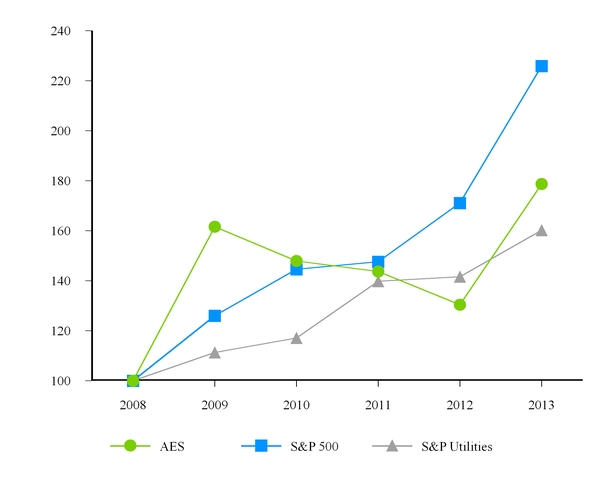
Source: Bloomberg
We have selected the Standard and Poor’s (“S&P”) 500 Utilities Index as our peer group index. The S&P 500 Utilities Index is a published sector index comprising the 31 electric and gas utilities included in the S&P 500.
The five year total return chart assumes $100 invested on December 31, 2008 in AES Common Stock, the S&P 500 Index and the S&P 500 Utilities Index. The information included under the heading “Performance Graph” shall not be considered “filed” for purposes of Section 18 of the Securities Exchange Act of 1934 or incorporated by reference in any filing under the Securities Act of 1933 or the Securities Exchange Act of 1934.
Item 6. SELECTED FINANCIAL DATA
The following table sets forth our selected financial data as of the dates and for the periods indicated. You should read this data together with Item 7.—Management’s Discussion and Analysis of Financial Condition and Results of Operations and the Consolidated Financial Statements and the notes thereto included in Item 8.—Financial Statements and Supplementary Data of this Form 10-K. The selected financial data for each of the years in the five year period ended December 31, 2013 have been derived from our audited Consolidated Financial Statements. Prior period amounts have been restated to reflect discontinued operations in all periods presented. Our historical results are not necessarily indicative of our future results.
Acquisitions, disposals, reclassifications and changes in accounting principles affect the comparability of information included in the tables below. Please refer to the Notes to the Consolidated Financial Statements included in Item 8.—Financial Statements and Supplementary Data of this Form 10-K for further explanation of the effect of such activities. Please also refer to Item 1A.—Risk Factors of this Form 10-K and Note 26—Risks and Uncertainties to the Consolidated Financial Statements included in Item 8.—Financial Statements and Supplementary Data of this Form 10-K for certain risks and uncertainties that may cause the data reflected herein not to be indicative of our future financial condition or results of operations.
SELECTED FINANCIAL DATA
| Year Ended December 31, | |||||||||||||||||||
| Statement of Operations Data | 2013 | 2012 | 2011(1) | 2010 | 2009 | ||||||||||||||
| (in millions, except per share amounts) | |||||||||||||||||||
| Revenue | $ | 15,891 | $ | 17,164 | $ | 16,098 | $ | 14,644 | $ | 12,038 | |||||||||
| Income (loss) from continuing operations(2) | 730 | (420 | ) | 1,602 | 1,420 | 1,699 | |||||||||||||
| Income (loss) from continuing operations attributable to The AES Corporation, net of tax | 284 | (960 | ) | 506 | 457 | 632 | |||||||||||||
| Discontinued operations, net of tax | (170 | ) | 48 | (448 | ) | (448 | ) | 26 | |||||||||||
| Net income (loss) attributable to The AES Corporation | $ | 114 | $ | (912 | ) | $ | 58 | $ | 9 | $ | 658 | ||||||||
| Per Common Share Data | |||||||||||||||||||
| Basic (loss) earnings per share: | |||||||||||||||||||
| Income (loss) from continuing operations attributable to The AES Corporation, net of tax | $ | 0.38 | $ | (1.27 | ) | $ | 0.65 | $ | 0.59 | $ | 0.95 | ||||||||
| Discontinued operations, net of tax | (0.23 | ) | 0.06 | (0.58 | ) | (0.58 | ) | 0.04 | |||||||||||
| Basic earnings (loss) per share | $ | 0.15 | $ | (1.21 | ) | $ | 0.07 | $ | 0.01 | $ | 0.99 | ||||||||
| Diluted (loss) earnings per share: | |||||||||||||||||||
| Income (loss) from continuing operations attributable to The AES Corporation, net of tax | $ | 0.38 | $ | (1.27 | ) | $ | 0.65 | $ | 0.59 | $ | 0.94 | ||||||||
| Discontinued operations, net of tax | (0.23 | ) | 0.06 | (0.58 | ) | (0.58 | ) | 0.04 | |||||||||||
| Diluted earnings (loss) per share | $ | 0.15 | $ | (1.21 | ) | $ | 0.07 | $ | 0.01 | $ | 0.98 | ||||||||
| Dividends Declared Per Common Share | $ | 0.17 | 0.08 | — | — | — | |||||||||||||
| December 31, | |||||||||||||||||||
| Balance Sheet Data: | 2013 | 2012 | 2011 (1) | 2010 | 2009 | ||||||||||||||
| (in millions) | |||||||||||||||||||
| Total assets | $ | 40,411 | $ | 41,830 | $ | 45,346 | $ | 40,511 | $ | 39,535 | |||||||||
| Non-recourse debt (noncurrent) | 13,318 | 12,265 | 13,261 | 10,986 | 11,454 | ||||||||||||||
| Non-recourse debt (noncurrent)—Discontinued operations | 124 | 322 | 1,369 | 1,558 | 1,410 | ||||||||||||||
| Recourse debt (noncurrent) | 5,551 | 5,951 | 6,180 | 4,149 | 5,301 | ||||||||||||||
| Cumulative preferred stock of subsidiaries | 78 | 78 | 78 | 60 | 60 | ||||||||||||||
| Retained earnings (accumulated deficit) | (150 | ) | (264 | ) | 678 | 620 | 650 | ||||||||||||
| The AES Corporation stockholders’ equity | 4,330 | 4,569 | 5,946 | 6,473 | 4,675 |
| (1) | DPL was acquired on November 28, 2011 and its results of operations have been included in AES’s consolidated results of operations from the date of acquisition. See Note 24—Acquisitions and Dispositions to the Consolidated Financial Statements included in Item 8.—Financial Statements and Supplementary Data of this Form 10-K for further information. |
| (2) | Includes pretax impairment of $467 million, $1.9 billion, $190 million, $325 million and $139 million for the years ended December 31, 2013, 2012, 2011, 2010 and 2009, respectively. See Note 10—Goodwill and Other Intangible Assets and Note 21—Asset Impairment Expense included in Item 8.—Financial Statements and Supplementary Data of this Form 10-K for further information. |
Item 7. MANAGEMENT’S DISCUSSION AND ANALYSIS OF FINANCIAL CONDITION AND RESULTS OF OPERATIONS
Overview of Our Business
We are a diversified power generation and utility company organized into six market-oriented Strategic Business Units (“SBUs”): US (United States), Andes (Chile, Colombia, and Argentina), Brazil, MCAC (Mexico, Central America and the Caribbean), EMEA (Europe, Middle East and Africa), and Asia. For additional information regarding our business, see Item 1. —Business of this Form 10-K.
Our Organization — The segment reporting structure uses the Company’s management reporting structure as its foundation to reflect how the Company manages the business internally and is organized by geographic regions which provide better socio-political-economic understanding of our business. The management reporting structure is organized along six strategic business units (“SBUs”) — led by our Chief Executive Officer (“CEO”). In 2012, the Company substantially completed its operational management and reporting restructuring. During the fourth quarter of 2013, the Company finalized its internal operational reporting and applied the accounting guidance for segment reporting. As a result, the Company has determined that its reportable segments are aligned with the six SBU's. Management’s discussion and analysis of Operating Margin, Adjusted Operating Margin and Adjusted Pre-Tax Contribution is organized according to the SBU structure as follows:
| • | US SBU |
| • | Andes SBU |
| • | Brazil SBU |
| • | MCAC SBU |
| • | EMEA SBU |
| • | Asia SBU |
Corporate and Other — The Company’s corporate operations are reported within “Corporate and Other” because they do not require separate disclosure under segment reporting accounting guidance.
Key Topics in the Management Discussion and Analysis
Our discussion covers the following:
| • | Overview of 2013 Results and Strategic Performance |
| • | Review of Consolidated Results of Operations |
| • | SBU Analysis and Non-GAAP Measures |
| • | Key Trends and Uncertainties |
| • | Capital Resources and Liquidity |
Overview of 2013 Results and Strategic Performance
In 2013, our performance was driven by very dry hydrological conditions across key markets in Latin America, our cost reductions, capital allocation decisions, including debt repayment and share repurchases, and a lower effective tax rate.
Earnings Per Share Results in 2013
| Year Ended December 31, | |||||||||||
| 2013 | 2012 | 2011 | |||||||||
| Diluted earnings per share from continuing operations | $ | 0.38 | $ | (1.27 | ) | $ | 0.65 | ||||
| Adjusted earnings per share (a non-GAAP measure)(1) | $ | 1.29 | $ | 1.21 | $ | 1.11 |
| (1) | See reconciliation and definition under Non-GAAP Measure. |
Diluted earnings per share from continuing operations increased $1.65, to $0.38, principally due to lower goodwill impairment expense, lower income tax expense, lower foreign currency losses, and lower interest expense, partially offset by lower operating margin, an increase in losses on early extinguishment of debt, lower gain on sale of investments, higher losses from disposal and impairment of discontinued businesses, and higher other than temporary impairments of our equity method investments.
Adjusted earnings per share, a non-GAAP measure, increased by 7% to $1.29 primarily due to a lower effective tax rate, lower interest expense, and lower general and administrative expenses, partially offset by lower operating margin.
Management’s Priorities
Management is focused on the following priorities:
| • | Management of our portfolio of Generation and Utility businesses to create value for our stakeholders, including customers and shareholders, through safe, reliable, and sustainable operations and effective cost management; |
| • | Driving our business to manage capital more effectively and to increase the amount of discretionary cash available for deployment into debt repayment, growth investments, shareholder dividends and share buybacks; |
| • | Realignment of our geographic focus. To this end, we will continue to exit markets where we do not have a competitive advantage or where we are unable to earn a fair risk-adjusted return relative to monetization alternatives. In addition, we will focus our growth investments on platform expansions or opportunities to expand our existing operations; and |
| • | Reduce the cash flow and earnings volatility of our businesses by proactively managing our currency, commodity and political risk exposures, mostly through contractual and regulatory mechanisms, as well as commercial hedging activities. We also will continue to limit our risk by utilizing non-recourse project financing for the majority of our businesses. |
2013 Strategic Performance
We continued to execute on our strategic objectives of safe, reliable and sustainable operations, improvement of available capital and deployment of discretionary cash and realignment of our geographic focus. Key highlights of our progress during the year ended December 31, 2013 include:
Safe, Reliable and Sustainable Operations — Our 2013 operating performance for the year was driven by the strategic management of our assets and cost reductions across our portfolio, but we also faced dry hydrological conditions across many markets in Latin America and challenges at two of our utilities in Brazil and the US.
We continue to focus on safety as our top priority. Our safety performance improved in 2013, as we lowered our lost-time incident case rates for both employees and operational contractors.
AES' strategic initiatives have resulted in both better operational availability and reliability of our generation portfolio, as measured by our Key Performance Indicators ("KPIs"). For example, our asset management program works to optimize the timing of plant maintenance by focusing on market pricing trends to minimize the costs of outages. This is evidenced by our performance in the Commercial Availability ("CA") KPI, as defined below, which improved 4%. Another strategic initiative focuses on the techniques of coal blending and using a variety of coals to improve margin. Coal blending can reduce the efficiency of certain generating units, which unfavorably affects our heat rate; however, it is offset by the financial benefits from utilizing lower-cost coal.
Our utility portfolio also recorded some improvements in KPIs for the year. Our dedication to providing reliable energy is evidenced by the improvement in our System Average Interruption Duration Index ("SAIDI") and System Average Interruption Frequency Index ("SAIFI"), which improved 15% and 24%, respectively, compared to 2012. SAIDI and SAIFI metrics benefited in 2013 from fewer significant weather events in the US and asset optimization in the US and Brazil, such as crew productivity improvement, tree-trimming, and pole replacement.
Our key performance indicators for 2013 and 2012 are as follows:
| For the Years Ended December 31, | |||||||||
| 2013 | 2012 | Variance 2012-2013 | |||||||
| Safety: Employee Lost-Time Incident Case Rate | .105 | .108 | 3% | ||||||
| Safety: Operational Contractor Lost-Time Incident Case Rate | .114 | .173 | 34% | ||||||
| Generation |
Showing the first 8K of 170K characters. Open the full section
Item 7A. QUANTITATIVE AND QUALITATIVE DISCLOSURES ABOUT MARKET RISK
Overview Regarding Market Risks
Our businesses are exposed to and proactively manage market risk. Our primary market risk exposure is to the price of commodities, particularly electricity, oil, natural gas, coal and environmental credits. We operate in multiple countries and as such are subject to volatility in exchange rates at varying degrees at the subsidiary level and between our functional currency, the U.S. Dollar, and currencies of the countries in which we operate. We are also exposed to interest rate fluctuations due to our issuance of debt and related financial instruments.
These disclosures set forth in this Item 7A are based upon a number of assumptions; actual effects may differ. The safe harbor provided in Section 27A of the Securities Act of 1933 and Section 21E of the Securities Exchange Act of 1934 shall apply to the disclosures contained in this Item 7A. For further information regarding market risk, see Item 1A. — Risk Factors, Our financial position and results of operations may fluctuate significantly due to fluctuations in currency exchange rates experienced at our foreign operations, Our businesses may incur substantial costs and liabilities and be exposed to price volatility as a result of risks associated with the wholesale electricity markets, which could have a material adverse effect on our financial performance, and We may not be adequately hedged against our exposure to changes in commodity prices or interest rates of the 2012 Form 10-K.
Commodity Price Risk
Although we prefer to hedge our exposure to the impact of market fluctuations in the price of electricity, fuels and environmental credits, some of our generation businesses operate under short-term sales or under contract sales that leave an un-hedged exposure on some of our capacity or through imperfect fuel pass-throughs. In our utility businesses, we may be exposed to commodity price movements depending on our excess or shortfall of generation relative to load obligations and sharing or pass-through mechanisms. These businesses subject our operational results to the volatility of prices for electricity, fuels and environmental credits in competitive markets. We employ risk management strategies to hedge our financial performance against the effects of fluctuations in energy commodity prices. The implementation of these strategies can involve the use of physical and financial commodity contracts, futures, swaps and options. At our generation businesses for 2014-2016, 75% to 80% of our variable margin is hedged against changes in commodity prices. At our utility businesses for 2014-2016, 85% to 90% of our variable margin is insulated from changes in commodity prices.
When hedging the output of our generation assets, we utilize contract sales that lock in the spread per MWh between variable costs and the price at which the electricity can be sold. The portion of our sales and purchases that are not subject to such agreements or contracted businesses where indexation is not perfectly matched to business drivers will be exposed to commodity price risk.
AES businesses will see changes in variable margin performance as global commodity prices shift. For 2014, we project pretax earnings exposure on a 10% move in commodity prices would be approximately $25 million for natural gas, $15 million for oil and $10 million for coal. Our estimates exclude correlation of oil with coal or natural gas. For example, a decline in oil or natural gas prices can be accompanied by a decline in coal price if commodity prices are correlated. In aggregate, the Company’s downside exposure occurs with lower oil, lower natural gas, and higher coal prices. Exposures at individual businesses will change as new contracts or financial hedges are executed, and our sensitivity to changes in commodity prices generally increases in later years with reduced hedge levels at some of our businesses.
Commodity prices affect our businesses differently depending on the local market characteristics and risk management strategies. Generation costs can be directly affected by movements in the price of natural gas, oil and coal. Spot power prices and contract indexation provisions are affected by the same commodity price movements. We have some natural offsets across our businesses such that low commodity prices may benefit certain businesses and be a cost to others. Offsets are not perfectly linear or symmetric. The sensitivities are affected by a number of non-market, or indirect market factors. Examples of these factors include hydrology, energy market supply/demand balances, regional fuel supply issues, regional competition, bidding strategies and regulatory interventions such as price caps. Operational flexibility changes the shape of our sensitivities. For instance, certain power plants may limit downside exposure by reducing dispatch in low market environments. Volume variation also affects our commodity exposure. The volume sold under contracts or retail concessions can vary based on weather and economic conditions resulting in a higher or lower volume of sales in spot markets. Thermal unit availability and hydrology can affect the generation output available for sale and can affect the marginal unit setting power prices.
In the US SBU, the generation businesses are largely contracted but may have residual risk to the extent contracts are not perfectly indexed to the business drivers. IPL sells power at wholesale once retail demand is served, so retail sales demand may affect commodity exposure. Additionally, at DPL, open access allows our retail customers to switch to alternative suppliers; falling energy prices may increase the rate at which our customers switch to alternative suppliers; DPL sells generation in excess of its retail demand under short-term sales. Given that natural gas-fired generators set power prices for many markets, higher natural gas prices expand margins. The positive impact on margins will be moderated if natural gas-fired generators set the market price only during peak periods.
In the Andes SBU, our business in Chile owns assets in the central and northern regions of the country and has a portfolio of contract sales in both. In the central region, the contract sales cover the efficient generation from our coal-fired and hydroelectric assets. Any residual spot price risk will primarily be driven by the amount of hydrological inflows. In the case of low hydroelectric generation, spot price exposure is capped by the ability to dispatch our natural gas/diesel assets. There is a small amount of coal generation in the northern region that is not covered by the portfolio of contract sales and therefore subject to spot price risk. In both regions, generators with oil or oil-linked fuel generally set power prices. In Colombia, we operate under a short-term sales strategy and have commodity exposure to un-hedged volumes. Because we own hydroelectric assets there, contracts are not indexed to fuel.
In the Brazil SBU, the hydroelectric generating facility is covered by contract sales. Under normal hydrological volatility, spot price risk is mitigated through a regulated sharing mechanism across all hydroelectric generators in the country. Under more extreme hydrological conditions, the sharing mechanism may not be sufficient to cover the business' contract position, and therefore it may have to purchase power at spot prices driven by the cost of thermal generation.
In the MCAC SBU, our businesses have commodity exposure on un-hedged volumes. Panama is largely contracted under a portfolio of fixed volume contract sales. To the extent hydrological inflows are greater than or less than the contract sales volume, the business will be sensitive to changes in spot power prices which may be driven by oil prices in some time periods. In the Dominican Republic, we own natural gas-fired assets contracted under a portfolio of contract sales and a coal-fired asset contracted with a single contract, and both contract and spot prices may move with commodity prices.
In the EMEA SBU, our Kilroot facility operates on a short-term sales strategy. To the extent that sales are un-hedged, the commodity risk at our Kilroot business is due to the dark spread -- the difference between electricity price and our coal-based variable dispatch cost. Natural gas-fired generators set power prices for many periods, so higher natural gas prices expand margins and higher coal prices reduce them. The positive impact on margins will be moderated if natural gas-fired generators set the market price only during certain peak periods. At our Ballylumford facility, the regulator has the right to terminate the contract, which would impact our commodity exposure. Our operations in Turkey are sensitive to the spread between power and natural gas prices, both of which have historically demonstrated a relationship to oil. As a result of these relationships, falling oil prices could compress margins realized at the business.
In the Asia SBU, our Masinloc business is a coal-fired generation facility which hedges its output under a portfolio of contract sales that are indexed to fuel prices, with generation in excess of contract volume sold in the spot market. Low oil prices may be a driver of margin compression since oil affects spot power sale prices.
Foreign Exchange Rate Risk
In the normal course of business, we are exposed to foreign currency risk and other foreign operations risks that arise from investments in foreign subsidiaries and affiliates. A key component of these risks stems from the fact that some of our foreign subsidiaries and affiliates utilize currencies other than our consolidated reporting currency, the U.S. Dollar. Additionally, certain of our foreign subsidiaries and affiliates have entered into monetary obligations in the U.S. Dollar or currencies other than their own functional currencies. We have varying degrees of exposure to changes in the exchange rate between the U.S. Dollar and the following currencies: Argentine Peso, Brazilian Real, British Pound, Chilean Peso, Colombian Peso, Dominican Peso, Euro, Indian Rupee, Kazakhstani Tenge, Mexican Peso and Philippine Peso. These subsidiaries and affiliates have attempted to limit potential foreign exchange exposure by entering into revenue contracts that adjust to changes in foreign exchange rates. We also use foreign currency forwards, swaps and options, where possible, to manage our risk related to certain foreign currency fluctuations.
We have entered into hedges to partially mitigate the exposure of earnings translated into the U.S. Dollar to foreign exchange volatility. The largest foreign exchange risks over a twelve-month forward-looking period are stemming from the following currencies: Argentine Peso, Brazilian Real, Colombian Peso, and Euro. As of December 31, 2013, assuming a 10% U.S. Dollar appreciation, adjusted pretax earnings attributable to foreign subsidiaries exposed to movement in the exchange rate of the Argentine Peso, Brazilian Real, Colombian Peso, and Euro relative to the U.S. Dollar are projected to be reduced by approximately $5 million, $20 million, less than $10 million and less than $10 million respectively, for 2014. These numbers have been produced by applying a one-time 10% U.S. Dollar appreciation to forecasted exposed pretax earnings for 2014
coming from the respective subsidiaries exposed to the currencies listed above, net of the impact of outstanding hedges and holding all other variables constant. The numbers presented above are net of any transactional gains/losses. These sensitivities may change in the future as new hedges are executed or existing hedges are unwound. Additionally, updates to the forecasted pretax earnings exposed to foreign exchange risk may result in further modification. The sensitivities presented do not capture the impacts of any administrative market restrictions or currency inconvertibility.
Interest Rate Risks
We are exposed to risk resulting from changes in interest rates as a result of our issuance of variable and fixed-rate debt, as well as interest rate swap, cap and floor and option agreements.
Decisions on the fixed-floating debt ratio are made to be consistent with the risk factors faced by individual businesses or plants. Depending on whether a plant’s capacity payments or revenue stream is fixed or varies with inflation, we partially hedge against interest rate fluctuations by arranging fixed-rate or variable-rate financing. In certain cases, particularly for non-recourse financing, we execute interest rate swap, cap and floor agreements to effectively fix or limit the interest rate exposure on the underlying financing. Most of our interest rate risk is related to non-recourse financings at our businesses.
As of December 31, 2013, the portfolio’s pretax earnings exposure for 2014 to a 100-basis-point increase in interest rates for our Argentine Peso, Brazilian Real, British Pound, Colombian Peso, Euro, Kazakhstani Tenge and U.S. Dollar denominated debt would be approximately $20 million based on the impact of a one time, 100-basis-point upward shift in interest rates on interest expense for the debt denominated in these currencies. The amounts do not take into account the historical correlation between these interest rates.
Item 8. FINANCIAL STATEMENTS AND SUPPLEMENTARY DATA
REPORT OF INDEPENDENT REGISTERED PUBLIC ACCOUNTING FIRM
The Board of Directors and Stockholders of The AES Corporation:
We have audited the accompanying consolidated balance sheets of The AES Corporation as of December 31, 2013 and 2012, and the related consolidated statements of operations, comprehensive income, changes in equity, and cash flows for each of the three years in the period ended December 31, 2013. Our audits also included the financial statement schedules listed in the index at Item 15(a). These financial statements and schedules are the responsibility of the Company's management. Our responsibility is to express an opinion on these financial statements based on our audits.
We conducted our audits in accordance with the standards of the Public Company Accounting Oversight Board (United States). Those standards require that we plan and perform the audit to obtain reasonable assurance about whether the financial statements are free of material misstatement. An audit also includes examining, on a test basis, evidence supporting the amounts and disclosures in the financial statements. An audit also includes assessing the accounting principles used and significant estimates made by management, as well as evaluating the overall financial statement presentation. We believe that our audits provide a reasonable basis for our opinion.
In our opinion, the financial statements referred to above present fairly, in all material respects, the consolidated financial position of The AES Corporation at December 31, 2013 and 2012, and the consolidated results of its operations and its cash flows for each of the three years in the period ended December 31, 2013, in conformity with U.S. generally accepted accounting principles. Also, in our opinion, the related financial statement schedules, when considered in relation to the basic financial statements taken as a whole, present fairly, in all material respects, the information set forth therein.
We also have audited, in accordance with the standards of the Public Company Accounting Oversight Board (United States), The AES Corporation’s internal control over financial reporting as of December 31, 2013, based on criteria established in Internal Control-Integrated Framework issued by the Committee of Sponsoring Organizations of the Treadway Commission (1992 framework) and our report dated February 25, 2014 expressed an unqualified opinion thereon.
/s/ Ernst & Young LLP
McLean, Virginia
February 25, 2014
THE AES CORPORATION
CONSOLIDATED BALANCE SHEETS
DECEMBER 31, 2013 AND 2012
| December 31, 2013 | December 31, 2012 | |||||||
| (in millions, except share and per share data) | ||||||||
| ASSETS | ||||||||
| CURRENT ASSETS | ||||||||
| Cash and cash equivalents | $ | 1,642 | $ | 1,900 | ||||
| Restricted cash | 597 | 734 | ||||||
| Short-term investments | 668 | 693 | ||||||
| Accounts receivable, net of allowance for doubtful accounts of $134 and $195, respectively | 2,363 | 2,539 | ||||||
| Inventory | 684 | 719 | ||||||
| Deferred income taxes | 166 | 199 | ||||||
| Prepaid expenses | 179 | 222 | ||||||
| Other current assets | 976 | 1,072 | ||||||
| Current assets of discontinued operations and held-for-sale assets | 464 | 387 | ||||||
| Total current assets | 7,739 | 8,465 | ||||||
| NONCURRENT ASSETS | ||||||||
| Property, Plant and Equipment: | ||||||||
| Land | 922 | 1,005 | ||||||
| Electric generation, distribution assets and other | 30,596 | 30,278 | ||||||
| Accumulated depreciation | (9,604 | ) | (9,145 | ) | ||||
| Construction in progress | 3,198 | 2,497 | ||||||
| Property, plant and equipment, net | 25,112 | 24,635 | ||||||
| Other Assets: | ||||||||
| Investments in and advances to affiliates | 1,010 | 1,196 | ||||||
| Debt service reserves and other deposits | 541 | 510 | ||||||
| Goodwill | 1,622 | 1,999 | ||||||
| Other intangible assets, net of accumulated amortization of $153 and $222, respectively | 297 | 324 | ||||||
| Deferred income taxes | 666 | 940 | ||||||
| Other noncurrent assets | 2,170 | 2,188 | ||||||
| Noncurrent assets of discontinued operations and held-for-sale assets | 1,254 | 1,573 | ||||||
| Total other assets | 7,560 | 8,730 | ||||||
| TOTAL ASSETS | $ | 40,411 | $ | 41,830 | ||||
| LIABILITIES AND EQUITY | ||||||||
| CURRENT LIABILITIES | ||||||||
| Accounts payable | $ | 2,259 | $ | 2,545 | ||||
| Accrued interest | 263 | 287 | ||||||
| Accrued and other liabilities | 2,114 | 2,347 | ||||||
| Non-recourse debt, including $267 and $275, respectively, related to variable interest entities | 2,062 | 2,494 | ||||||
| Recourse debt | 118 | 11 | ||||||
| Current liabilities of discontinued operations and held-for-sale businesses | 837 | 635 | ||||||
| Total current liabilities | 7,653 | 8,319 | ||||||
| NONCURRENT LIABILITIES | ||||||||
| Non-recourse debt, including $979 and $858, respectively, related to variable interest entities | 13,318 | 12,265 | ||||||
| Recourse debt | 5,551 | 5,951 | ||||||
| Deferred income taxes | 1,119 | 1,179 | ||||||
| Pension and other post-retirement liabilities | 1,310 | 2,418 | ||||||
| Other noncurrent liabilities | 3,299 | 3,523 | ||||||
| Noncurrent liabilities of discontinued operations and held-for-sale businesses | 432 | 583 | ||||||
| Total noncurrent liabilities | 25,029 | 25,919 | ||||||
| Contingencies and Commitments (see Notes 13 and 14) | ||||||||
| Cumulative preferred stock of subsidiaries | 78 | 78 | ||||||
| EQUITY | ||||||||
| THE AES CORPORATION STOCKHOLDERS’ EQUITY | ||||||||
| Common stock ($0.01 par value, 1,200,000,000 shares authorized; 813,316,510 issued and 722,508,342 outstanding at December 31, 2013 and 810,679,839 issued and 744,263,855 outstanding at December 31, 2012) | 8 | 8 | ||||||
| Additional paid-in capital | 8,443 | 8,525 | ||||||
| Accumulated deficit | (150 | ) | (264 | ) | ||||
| Accumulated other comprehensive loss | (2,882 | ) | (2,920 | ) | ||||
| Treasury stock, at cost (90,808,168 shares at December 31, 2013 and 66,415,984 shares at December 31, 2012) | (1,089 | ) | (780 | ) | ||||
| Total AES Corporation stockholders’ equity | 4,330 | 4,569 | ||||||
| NONCONTROLLING INTERESTS | 3,321 | 2,945 | ||||||
| Total equity | 7,651 | 7,514 | ||||||
| TOTAL LIABILITIES AND EQUITY | $ | 40,411 | $ | 41,830 |
See Accompanying Notes to Consolidated Financial Statements.
THE AES CORPORATION
CONSOLIDATED STATEMENTS OF OPERATIONS
YEARS ENDED DECEMBER 31, 2013, 2012, AND 2011
| 2013 | 2012 | 2011 | ||||||||||
| (in millions, except per share amounts) | ||||||||||||
| Revenue: | ||||||||||||
| Regulated | $ | 8,056 | $ | 8,977 | $ | 8,699 | ||||||
| Non-Regulated | 7,835 | 8,187 | 7,399 | |||||||||
| Total revenue | 15,891 | 17,164 | 16,098 | |||||||||
| Cost of Sales: | ||||||||||||
| Regulated | (6,837 | ) | (7,594 | ) | (6,325 | ) | ||||||
| Non-Regulated | (5,807 | ) | (5,987 | ) |
Showing the first 8K of 346K characters. Open the full section
Item 9. CHANGES IN AND DISAGREEMENTS WITH ACCOUNTANTS ON ACCOUNTING AND FINANCIAL DISCLOSURE
None.
Item 9A. CONTROLS AND PROCEDURES
Conclusion Regarding the Effectiveness of Disclosure Controls and Procedures
The Company maintains disclosure controls and procedures that are designed to ensure that information required to be disclosed in the reports that the Company files or submits under the Securities Exchange Act of 1934, as amended (the “Exchange Act”) is recorded, processed, summarized and reported within the time periods specified in the SEC’s rules and forms, and that such information is accumulated and communicated to the Chief Executive Officer (“CEO”) and Chief Financial Officer (“CFO”), as appropriate, to allow timely decisions regarding required disclosures.
The Company carried out the evaluation required by Rules 13a-15(b) and 15d-15(b), under the supervision and with the participation of our management, including the CEO and CFO, of the effectiveness of our “disclosure controls and procedures” (as defined in the Exchange Act Rules 13a-15(e) and 15d-15(e)). Based upon this evaluation, the CEO and CFO concluded that as of December 31, 2013, our disclosure controls and procedures were effective.
Management’s Report on Internal Control over Financial Reporting
Management of the Company is responsible for establishing and maintaining adequate internal control over financial reporting, as defined in Rule 13a-15(f) under the Exchange Act. The Company’s internal control over financial reporting is a process designed to provide reasonable assurance regarding the reliability of financial reporting and the preparation of financial statements for external purposes in accordance with GAAP and includes those policies and procedures that:
| • | pertain to the maintenance of records that in reasonable detail, accurately and fairly reflect the transactions and dispositions of the assets of the Company; |
| • | provide reasonable assurance that transactions are recorded as necessary to permit preparation of financial statements in accordance with GAAP, and that receipts and expenditures of the Company are being made only in accordance with authorizations of management and directors of the Company; and |
| • | provide reasonable assurance that unauthorized acquisition, use or disposition of the Company’s assets that could have a material effect on the financial statements are prevented or detected timely. |
Management, including our CEO and CFO, does not expect that our internal controls will prevent or detect all errors and all fraud. A control system, no matter how well designed and operated, can provide only reasonable, not absolute, assurance that the objectives of the control system are met. Further, the design of a control system must reflect the fact that there are resource constraints, and the benefits of controls must be considered relative to their costs. In addition, any evaluation of the effectiveness of controls is subject to risks that those internal controls may become inadequate in future periods because of changes in business conditions, or that the degree of compliance with the policies or procedures deteriorates.
Management assessed the effectiveness of our internal control over financial reporting as of December 31, 2013. In making this assessment, management used the criteria established in Internal Control—Integrated Framework issued by the Committee of Sponsoring Organizations (“COSO”) in 1992. Based on this assessment, management believes that the Company maintained effective internal control over financial reporting as of December 31, 2013.
The effectiveness of the Company’s internal control over financial reporting as of December 31, 2013, has been audited by Ernst & Young LLP, an independent registered public accounting firm, as stated in their report, which appears herein.
Changes in Internal Control Over Financial Reporting:
There were no changes that occurred during the quarter ended December 31, 2013 that have materially affected, or are reasonably likely to materially affect, our internal control over financial reporting.
REPORT OF INDEPENDENT REGISTERED PUBLIC ACCOUNTING FIRM
The Board of Directors and Stockholders of The AES Corporation:
We have audited The AES Corporation’s internal control over financial reporting as of December 31, 2013 based on criteria established in Internal Control-Integrated Framework issued by the Committee of Sponsoring Organizations of the Treadway Commission (1992 framework) (the COSO criteria). The AES Corporation’s management is responsible for maintaining effective internal control over financial reporting, and for its assessment of the effectiveness of internal control over financial reporting included in the accompanying Management’s Report on Internal Control over Financial Reporting. Our responsibility is to express an opinion on the Company’s internal control over financial reporting based on our audit.
We conducted our audit in accordance with the standards of the Public Company Accounting Oversight Board (United States). Those standards require that we plan and perform the audit to obtain reasonable assurance about whether effective internal control over financial reporting was maintained in all material respects. Our audit included obtaining an understanding of internal control over financial reporting, assessing the risk that a material weakness exists, testing and evaluating the design and operating effectiveness of internal control based on the assessed risk, and performing such other procedures as we considered necessary in the circumstances. We believe that our audit provides a reasonable basis for our opinion.
A company’s internal control over financial reporting is a process designed to provide reasonable assurance regarding the reliability of financial reporting and the preparation of financial statements for external purposes in accordance with generally accepted accounting principles. A company’s internal control over financial reporting includes those policies and procedures that (1) pertain to the maintenance of records that, in reasonable detail, accurately and fairly reflect the transactions and dispositions of the assets of the company; (2) provide reasonable assurance that transactions are recorded as necessary to permit preparation of financial statements in accordance with generally accepted accounting principles, and that receipts and expenditures of the company are being made only in accordance with authorizations of management and directors of the company; and (3) provide reasonable assurance regarding prevention or timely detection of unauthorized acquisition, use, or disposition of the company’s assets that could have a material effect on the financial statements.
Because of its inherent limitations, internal control over financial reporting may not prevent or detect misstatements. Also, projections of any evaluation of effectiveness to future periods are subject to the risk that controls may become inadequate because of changes in conditions, or that the degree of compliance with the policies or procedures may deteriorate.
In our opinion, The AES Corporation maintained, in all material respects, effective internal control over financial reporting as of December 31, 2013, based on the COSO criteria.
We also have audited, in accordance with the standards of the Public Company Accounting Oversight Board (United States), the consolidated balance sheets of The AES Corporation as of December 31, 2013 and 2012, and the related consolidated statements of operations, comprehensive income, changes in equity, and cash flows for each of the three years in the period ended December 31, 2013 of The AES Corporation and our report dated February 25, 2014 expressed an unqualified opinion thereon.
/s/ Ernst & Young LLP
McLean, Virginia
February 25, 2014
Item 9B. OTHER INFORMATION
None.
PART III
Item 10. DIRECTORS, EXECUTIVE OFFICERS AND CORPORATE GOVERNANCE
The following information is incorporated by reference from the Registrant’s Proxy Statement for the Registrant’s 2014 Annual Meeting of Stock Holders which the Registrant expects will be filed on or around March 4, 2014 (the “2014 Proxy Statement”):
| • | information regarding the directors required by this item found under the heading Board of Directors; |
| • | information regarding AES’s Code of Ethics found under the heading AES Code of Business Conduct and Corporate Governance Guidelines; |
| • | information regarding compliance with Section 16 of the Exchange Act required by this item found under the heading Governance Matters—Section 16(a) Beneficial Ownership Reporting Compliance; and |
| • | information regarding AES’s Financial Audit Committee found under the heading The Committees of the Board—Financial Audit Committee (the “Audit Committee”). |
Certain information regarding executive officers required by this Item is set forth as a supplementary item in Part I hereof (pursuant to Instruction 3 to Item 401(b) of Regulation S-K). The other information required by this Item, to the extent not included above, will be contained in our 2013 Proxy Statement and is herein incorporated by reference.
Item 11. EXECUTIVE COMPENSATION
The following information is contained in the 2014 Proxy Statement and is incorporated by reference: the information regarding executive compensation contained under the heading Compensation Discussion and Analysis and the Compensation Committee Report on Executive Compensation under the heading Report of the Compensation Committee.
Item 12. SECURITY OWNERSHIP OF CERTAIN BENEFICIAL OWNERS AND MANAGEMENT AND RELATED STOCKHOLDER MATTERS
| (a) | Security Ownership of Certain Beneficial Owners. |
See the information contained under the caption “Security Ownership of Certain Beneficial Owners, Directors, and Executive Officers” of the Proxy Statement for the 2014 Annual Meeting of Shareholders of the Registrant, which information is incorporated herein by reference.
| (b) | Security Ownership of Directors and Executive Officers. |
See the information contained under the caption “Security Ownership of Certain Beneficial Owners, Directors, and Executive Officers” of the Proxy Statement for the 2014 Annual Meeting of Shareholders of the Registrant, which information is incorporated herein by reference.
| (c) | Changes in Control. |
None.
| (d) | Securities Authorized for Issuance under Equity Compensation Plans. |
The following table provides information about shares of AES common stock that may be issued under AES’ equity compensation plans, as of December 31, 2013:
Securities Authorized for Issuance under Equity Compensation Plans (As of December 31, 2013)
| (a) | (b) | (c) | |||||||
| Plan category | Number of securities to be issued upon exercise of outstanding options, warrants and rights | Weighted average exercise price of outstanding options, warrants and rights | Number of securities remaining available for future issuance under equity compensation plans (excluding securities reflected in column (a)) | ||||||
| Equity compensation plans approved by security holders(1) | 15,174,730 | (2) | $ | 14.91 | 14,571,150 | ||||
| Equity compensation plans not approved by security holders | — | $ | — | — | |||||
| Total | 15,174,730 | $ | 14.91 | 14,571,150 |
| (1) | The following equity compensation plans have been approved by the Company’s Stockholders: |
| (A) | The AES Corporation 2003 Long Term Compensation Plan was adopted in 2003 and provided for 17,000,000 shares authorized for issuance thereunder. In 2008, an amendment to the Plan to provide an additional 12,000,000 shares was approved by AES’s stockholders, bringing the total authorized shares to 29,000,000. In 2010, an additional amendment to the Plan to provide an additional 9,000,000 shares was approved by AES’s stockholders, bringing the total authorized shares to 38,000,000. The weighted average exercise price of Options outstanding under this plan included in Column (b) is $14.86 (excluding PSU and RSU awards), with 14,571,150 shares available for future issuance. |
| (B) | The AES Corporation 2001 Plan for outside directors adopted in 2001 provided for 2,750,000 shares authorized for issuance. The weighted average exercise price of Options outstanding under this plan included in Column (b) is $18.62. In conjunction with the 2010 amendment to the 2003 Long Term Compensation plan, ongoing award issuance from this plan was discontinued in 2010. Any remaining shares under this plan, which are not reserved for issuance under outstanding awards, are not available for future issuance and thus the amount of 2,061,723 shares is not included in Column (c) above. |
| (C) | The AES Corporation Second Amended and Restated Deferred Compensation Plan for directors provided for 2,000,000 shares authorized for issuance. Column (b) excludes the Director stock units granted thereunder. In conjunction with the 2010 amendment to the 2003 Long Term Compensation Plan, ongoing award issuance from this plan was discontinued in 2010 as Director stock units will be issued from the 2003 Long Term Compensation Plan. Any remaining shares under this plan, which are not reserved for issuance under outstanding awards, are not available for future issuance and thus the amount of 105,341 shares is not included in Column (c) above. |
| (D) | The AES Corporation Incentive Stock Option Plan adopted in 1991 provided for 57,500,000 shares authorized for issuance. The weighted average exercise price of Options outstanding under this plan included in Column (b) is $35.44. This plan terminated on June 1, 2001, such that no additional grants may be granted under the plan after that date. Any remaining shares under this plan, which are not reserved for issuance under outstanding awards, are not available for future issuance in light of this plan’s termination and thus 24,354,930 shares are not included in Column (c) above. |
| (2) | Includes 6,958,098 (of which 2,658,412 are vested and 4,299,686 are unvested) shares underlying PSU and RSU awards (assuming performance at a maximum level), 1,351,573 shares underlying Director stock unit awards, and 6,865,059 shares issuable upon the exercise of Stock Option grants, for an aggregate number of 15,174,730 shares. |
Item 13. CERTAIN RELATIONSHIPS AND RELATED TRANSACTIONS, AND DIRECTOR INDEPENDENCE
The information regarding related party transactions required by this item is included in the 2014 Proxy Statement found under the headings Transactions with Related Persons, Proposal I: Election of Directors and The Committees of the Board and are incorporated herein by reference.
Item 14. PRINCIPAL ACCOUNTANT FEES AND SERVICES
The information concerning principal accountant fees and services included in the 2014 Proxy Statement contained under the heading Information Regarding The Independent Registered Public Accounting Firm’s Fees, Services and Independence and is incorporated herein by reference.
PART IV
Item 15. EXHIBITS AND FINANCIAL STATEMENT SCHEDULES
| (a) | Financial Statements. |
| (b) | Exhibits. |
| 3.1 | Sixth Restated Certificate of Incorporation of The AES Corporation is incorporated herein by reference to Exhibit 3.1 of the Company’s Form 10-K for the year ended December 31, 2008. | |
| 3.2 | By-Laws of The AES Corporation, as amended and incorporated herein by reference to Exhibit 3.1 of the Company’s Form 8-K filed on August 11, 2009. | |
| 4 | There are numerous instruments defining the rights of holders of long-term indebtedness of the Registrant and its consolidated subsidiaries, none of which exceeds ten percent of the total assets of the Registrant and its subsidiaries on a consolidated basis. The Registrant hereby agrees to furnish a copy of any of such agreements to the Commission upon request. Since these documents are not required filings under Item 601 of Regulation S-K, the Company has elected to file certain of these documents as Exhibits 4.(a)—4.(p). | |
| 4.(a) | Junior Subordinated Indenture, dated as of March 1, 1997, between The AES Corporation and Wells Fargo Bank, National Association, as successor to Bank One, National Association (formerly known as The First National Bank of Chicago) is incorporated herein by reference to Exhibit 4.(a) of the Company’s Form 10-K for the year ended December 31, 2008. | |
| 4.(b) | Third Supplemental Indenture, dated as of October 14, 1999, between The AES Corporation and Wells Fargo Bank, National Association, as successor to Bank One, National Association is incorporated herein by reference to Exhibit 4.(b) of the Company’s Form 10-K for the year ended December 31, 2008. | |
| 4.(c) | Senior Indenture, dated as of December 8, 1998, between The AES Corporation and Wells Fargo Bank, National Association, as successor to Bank One, National Association (formerly known as The First National Bank of Chicago) is incorporated herein by reference to Exhibit 4.01 of the Company’s Form 8-K filed on December 11, 1998 (SEC File No. 001-12291). | |
| 4.(d) | Form of Second Supplemental Indenture, dated as of June 11, 1999, between The AES Corporation and Wells Fargo Bank, National Association, as successor to Bank One, National Association (formerly known as The First National Bank of Chicago) is incorporated herein by reference to Exhibit 4.01 of the Company’s Form 8-K filed on June 11, 1999 (SEC File No. 001-12291). | |
| 4.(e) | Third Supplemental Indenture, dated as of September 12, 2000, between The AES Corporation and Wells Fargo Bank, National Association, as successor to Bank One, National Association is incorporated herein by reference to Exhibit 4.(e) of the Company’s Form 10-K for the year ended December 31, 2008. | |
| 4.(f) | Form of Fifth Supplemental Indenture, dated as of February 9, 2001, between The AES Corporation and Wells Fargo Bank, National Association, as successor to Bank One, National Association is incorporated herein by reference to Exhibit 4.1 of the Company’s Form 8-K filed on February 8, 2001 (SEC File No. 001-12291). | |
| 4.(g) | Form of Sixth Supplemental Indenture, dated as of February 22, 2001, between The AES Corporation and Wells Fargo Bank, National Association, as successor to Bank One, National Association is incorporated herein by reference to Exhibit 4.1 of the Company’s Form 8-K filed on February 21, 2001 (SEC File No. 001-12291). | |
| 4.(h) | Ninth Supplemental Indenture, dated as of April 3, 2003, between The AES Corporation and Wells Fargo Bank, National Association (as successor by consolidation to Wells Fargo Bank Minnesota, National Association) is incorporated herein by reference to Exhibit 4.6 of the Company’s Form S-4 filed on December 7, 2007. | |
| 4.(i) | Form of Tenth Supplemental Indenture, dated as of February 13, 2004, between The AES Corporation and Wells Fargo Bank, National Association (as successor by consolidation to Wells Fargo Bank Minnesota, National Association) is incorporated herein by reference to Exhibit 4.1 of the Company’s Form 8-K filed on February 13, 2004 (SEC File No. 001-12291). | |
| 4.(j) | Eleventh Supplemental Indenture, dated as of October 15, 2007, between The AES Corporation and Wells Fargo Bank, National Association is incorporated herein by reference to Exhibit 4.7 of the Company’s Form S-4 filed on December 7, 2007. | |
| 4.(k) | Twelfth Supplemental Indenture, dated as of October 15, 2007, between The AES Corporation and Wells Fargo Bank, National Association is incorporated herein by reference to Exhibit 4.8 of the Company’s Form S-4 filed on December 7, 2007. | |
| 4.(l) | Thirteenth Supplemental Indenture, dated as of May 19, 2008, between The AES Corporation and Wells Fargo Bank, National Association is incorporated herein by reference to Exhibit 4.(l) of the Company’s Form 10-K for the year ended December 31, 2008. | |
| 4.(m) | Fourteenth Supplemental Indenture, dated as of April 2, 2009, between The AES Corporation and Wells Fargo Bank, National Association is incorporated herein by reference to Exhibit 99.1 of the Company’s Form 8-K filed on April 2, 2009. | |
| 4.(n) | Fifteenth Supplemental Indenture, dated as of June 15, 2011, between The AES Corporation and Wells Fargo Bank, National Association is incorporated herein by reference to Exhibit 4.3 of the Company’s Form 8-K filed on June 15, 2011. | |
| 4.(o) | Indenture, dated October 3, 2011, between Dolphin Subsidiary II, Inc. and Wells Fargo Bank, National Association is incorporated herein by reference to Exhibit 4.1 of the Company’s Form 8-K filed on October 5, 2011. | |
| 4.(p) | Sixteenth Supplemental Indenture, dated April 30, 2013, between The AES Corporation and Wells Fargo Bank, N.A., as Trustee is incorporated herein by reference to Exhibit 4.1 of the Company's Form 8-K filed on April 30, 2013 (SEC File No. 001-12291). | |
| 10.1 | The AES Corporation Profit Sharing and Stock Ownership Plan are incorporated herein by reference to Exhibit 4(c)(1) of the Registration Statement on Form S-8 (Registration No. 33-49262) filed on July 2, 1992. | |
| 10.2 | The AES Corporation Incentive Stock Option Plan of 1991, as amended, is incorporated herein by reference to Exhibit 10.30 of the Company’s Form 10-K for the year ended December 31, 1995 (SEC File No. 00019281). | |
| 10.3 | Applied Energy Services, Inc. Incentive Stock Option Plan of 1982 is incorporated herein by reference to Exhibit 10.31 of the Registration Statement on Form S-1 (Registration No. 33-40483). | |
| 10.4 | Deferred Compensation Plan for Executive Officers, as amended, is incorporated herein by reference to Exhibit 10.32 of Amendment No. 1 to the Registration Statement on Form S-1 (Registration No. 33-40483). | |
| 10.5 | Deferred Compensation Plan for Directors, as amended and restated, on February 17, 2012 is incorporated herein by reference to Exhibit 10.5 of the Company's Form 10-K for the year ended December 31, 2012. | |
| 10.6 | The AES Corporation Stock Option Plan for Outside Directors, as amended and restated, on December 7, 2007 is incorporated herein by reference to Exhibit 10.6 of the Company's Form 10-K for the year ended December 31, 2012. | |
| 10.7 | The AES Corporation Supplemental Retirement Plan is incorporated herein by reference to Exhibit 10.63 of the Company’s Form 10-K for the year ended December 31, 1994 (SEC File No. 00019281). | |
| 10.7A | Amendment to The AES Corporation Supplemental Retirement Plan, dated March 13, 2008 is incorporated herein by reference to Exhibit 10.9.A of the Company’s Form 10-K for the year ended December 31, 2007. | |
| 10.8 | The AES Corporation 2001 Stock Option Plan is incorporated herein by reference to Exhibit 10.12 of the Company’s Form 10-K for the year ended December 31, 2000 (SEC File No. 001-12291). | |
| 10.9 | Second Amended and Restated Deferred Compensation Plan for Directors is incorporated herein by reference to Exhibit 10.13 of the Company’s Form 10-K for the year ended December 31, 2000 (SEC File No. 001-12291). | |
| 10.10 | The AES Corporation 2001 Non-Officer Stock Option Plan is incorporated herein by reference to Exhibit 10.12 of the Company’s Form 10-K for the year ended December 31, 2002 (SEC File No. 001-12291). | |
| 10.10A | Amendment to the 2001 Stock Option Plan and 2001 Non-Officer Stock Option Plan, dated March 13, 2008 is incorporated herein by reference to Exhibit 10.12.A of the Company’s Form 10-K for the year ended December 31, 2007. | |
| 10.11 | The AES Corporation 2003 Long Term Compensation Plan, as amended and restated on April 22, 2010, is incorporated herein by reference to Exhibit 10.1 of the Company’s Form 8-K filed on April 27, 2010. | |
| 10.12 | Form of AES Nonqualified Stock Option Award Agreement under The AES Corporation 2003 Long Term Compensation Plan (Outside Directors) is incorporated herein by reference to Exhibit 10.2 of the Company’s Form 8-K filed on April 27, 2010. | |
| 10.13 | Form of AES Performance Stock Unit Award Agreement under The AES Corporation 2003 Long Term Compensation Plan (filed herewith). | |
| 10.14 | Form of AES Restricted Stock Unit Award Agreement under The AES Corporation 2003 Long Term Compensation Plan (filed herewith). | |
| 10.15 | Form of AES Performance Unit Award Agreement under The AES Corporation 2003 Long Term Compensation Plan (filed herewith). | |
| 10.16 | Form of AES Nonqualified Stock Option Award Agreement under The AES Corporation 2003 Long Term Compensation Plan (filed herewith). | |
| 10.17 | The AES Corporation Restoration Supplemental Retirement Plan, as amended and restated, dated December 29, 2008 is incorporated herein by reference to Exhibit 10.15 of the Company’s Form 10-K for the year ended December 31, 2008. | |
| 10.17A | Amendment to The AES Corporation Restoration Supplemental Retirement Plan, dated December 9, 2011 is incorporated herein by reference to Exhibit 10.17A of the Company's Form 10-K for the year ended December 31, 2012. | |
| 10.18 | The AES Corporation International Retirement Plan, as amended and restated on December 29, 2008 is incorporated herein by reference to Exhibit 10.16 of the Company’s Form 10-K for the year ended December 31, 2008. | |
| 10.18A | Amendment to The AES Corporation International Retirement Plan, dated December 9, 2011 is incorporated herein by reference to Exhibit 10.18A of the Company's Form 10-K for the year ended December 31, 2012. | |
| 10.19 | The AES Corporation Severance Plan, as amended and restated on October 28, 2011 is incorporated herein by reference to Exhibit 10.19 of the Company’s Form 10-K for the year ended December 31, 2011. | |
| 10.20 | The AES Corporation Amended and Restated Executive Severance Plan dated August 1, 2012 is incorporated herein by reference to Exhibit 10.2 of the Company’s Form 10-Q for the period ended June 30, 2012. | |
| 10.21 | The AES Corporation Performance Incentive Plan, as amended and restated on April 22, 2010 is incorporated herein by reference to Exhibit 10.4 of the Company’s Form 8-K filed on April 27, 2010. | |
| 10.22 | The AES Corporation Deferred Compensation Program For Directors dated February 17, 2012 is incorporated herein by reference to Exhibit 10.22 of the Company’s Form 10-K filed on December 31, 2011. | |
| 10.23 | The AES Corporation Amended and Restated Employment Agreement with Paul Hanrahan is incorporated herein by reference to Exhibit 99.1 of the Company’s Form 8-K filed on December 31, 2008. | |
| 10.24 | The AES Corporation Amended and Restated Employment Agreement with Victoria D. Harker is incorporated herein by reference to Exhibit 99.2 of the Company’s Form 8-K filed on December 31, 2008. | |
| 10.25 | The AES Corporation Employment Agreement with Andrés Gluski is incorporated herein by reference to Exhibit 99.3 of the Company’s Form 8-K filed on December 31, 2008. | |
| 10.26 | Separation Agreement, between Paul T. Hanrahan and The AES Corporation dated September 4, 2011 is incorporated by reference to Exhibit 10.1 of the Company’s Form 10-Q for the period ended September 30, 2011. | |
| 10.27 | Mutual Agreement, between Andrés Gluski and The AES Corporation dated October 7, 2011 is incorporated herein by reference to Exhibit 10.2 of the Company’s Form 10-Q for the period ended September 30, 2011. | |
| 10.28 | Separation Agreement, dated April 27, 2012, between the Company and Victoria D. Harker is incorporated herein by reference to Exhibit 10.1 of the Company’s Form 10-Q for the period ended June 30, 2012. | |
| 10.29 | Separation Agreement, dated November 19, 2012 between the Company and Edward C. Hall, III is incorporated herein by reference to Exhibit 10.29 of the Company's Form 10-K for the year ended December 31, 2012. | |
| 10.30 | Amendment No. 3, dated as of July 26, 2013 to the Fifth Amended and Restated Credit and Reimbursement Agreement, dated as of July 29, 2010 is incorporated herein by reference to Exhibit 10.1 of the Company's Form 8-K filed on July 29, 2013. | |
| 10.30A | Sixth Amended and Restated Credit and Reimbursement Agreement dated as of July 26, 2013 among The AES Corporation, a Delaware corporation, the Banks listed on the signature pages thereof, Citibank, N.A., as Administrative Agent and Collateral Agent, Citigroup Global Markets Inc., as Lead Arranger and Book Runner, Banc of America Securities LLC, as Lead Arranger and Book Runner and Co-Syndication Agent, Barclays Capital, as Lead Arranger and Book Runner and Co-Syndication Agent, RBS Securities Inc., as Lead Arranger and Book Runner and Co-Syndication Agent and Union Bank, N.A., as Lead Arranger and Book Runner and Co-Syndication Agent is incorporated herein by reference to Exhibit 10.1.A of the Company's Form 8-K filed on July 29, 2013. | |
| 10.30B | Appendices and Exhibits to the Sixth Amended and Restated Credit and Reimbursement Agreement, dated as of July 29, 2013 is incorporated herein by reference to Exhibit 10.1.B of the Company’s Form 8-K filed on July 29, 2013. | |
| 10.31 | Collateral Trust Agreement dated as of December 12, 2002 among The AES Corporation, AES International Holdings II, Ltd., Wilmington Trust Company, as corporate trustee and Bruce L. Bisson, an individual trustee is incorporated herein by reference to Exhibit 4.2 of the Company’s Form 8-K filed on December 17, 2002 (SEC File No. 001-12291). | |
| 10.32 | Security Agreement dated as of December 12, 2002 made by The AES Corporation to Wilmington Trust Company, as corporate trustee and Bruce L. Bisson, as individual trustee is incorporated herein by reference to Exhibit 4.3 of the Company’s Form 8-K filed on December 17, 2002 (SEC File No. 001-12291). | |
| 10.33 | Charge Over Shares dated as of December 12, 2002 between AES International Holdings II, Ltd. and Wilmington Trust Company, as corporate trustee and Bruce L. Bisson, as individual trustee is incorporated herein by reference to Exhibit 4.4 of the Company’s Form 8-K filed on December 17, 2002 (SEC File No. 001-12291). | |
| 10.34 | Stock Purchase Agreement between The AES Corporation and Terrific Investment Corporation dated November 6, 2009 is incorporated herein by reference to Exhibit 10.1 of the Company’s Form 8-K filed on November 11, 2009. | |
| 10.35 | Stockholder Agreement between The AES Corporation and Terrific Investment Corporation dated March 12, 2010 is incorporated herein by reference to Exhibit 10.1 of the Company’s Form 8-K filed on March 15, 2010. | |
| 10.36 | Agreement and Plan of Merger, dated April 19, 2011, by and among The AES Corporation, DPL Inc. and Dolphin Sub, Inc. is incorporated herein by reference to Exhibit 2.1 of the Company’s Form 8-K filed on April 20, 2011. | |
| 10.37 | Credit Agreement dated as of May 27, 2011 among The AES Corporation, as borrower, the banks listed therein and Bank of America, N.A., as administrative agent is incorporated herein by reference to Exhibit 10.1 of the Company’s Form 8-K filed on June 1, 2011. | |
| 10.37A | Amendment No.1 dated February 27, 2013 to the Credit Agreement dated as of May 27, 2011 among The AES Corporation, as borrower, the banks listed therein and Bank of America N.A., as administrative agent is incorporated herein by reference to exhibit 10.1 of the Company's Form 10-Q for the period ending March 31, 2013. | |
| 10.38 | Common Stock Repurchase Agreement, dated as of December 11, 2013, by and between The AES Corporation and Terrific Investment Corporation is incorporated herein by reference to Exhibit 10.1 of the Company's Form 8-K filed on December 13, 2013. | |
| 12 | Statement of computation of ratio of earnings to fixed charges (filed herewith). | |
| 21 | Subsidiaries of The AES Corporation (filed herewith). | |
| 23.1 | Consent of Independent Registered Public Accounting Firm, Ernst & Young LLP (filed herewith). | |
| 24 | Powers of Attorney (filed herewith). | |
| 31.1 | Rule 13a-14(a)/15d-14(a) Certification of Andrés Gluski (filed herewith). | |
| 31.2 | Rule 13a-14(a)/15d-14(a) Certification of Thomas M. O’Flynn (filed herewith). | |
| 32.1 | Section 1350 Certification of Andrés Gluski (filed herewith). | |
| 32.2 | Section 1350 Certification of Thomas M. O’Flynn (filed herewith). | |
| 101.INS | XBRL Instance Document (filed herewith). | |
| 101.SCH | XBRL Taxonomy Extension Schema Document (filed herewith). | |
| 101.CAL | XBRL Taxonomy Extension Calculation Linkbase Document (filed herewith). | |
| 101.DEF | XBRL Taxonomy Extension Definition Linkbase Document (filed herewith). | |
| 101.LAB | XBRL Taxonomy Extension Label Linkbase Document (filed herewith). | |
| 101.PRE | XBRL Taxonomy Extension Presentation Linkbase Document (filed herewith). |
| (c) | Schedules |
Schedule I—Condensed Financial Information of Registrant
Schedule II—Valuation and Qualifying Accounts
SIGNATURES
Pursuant to the requirements of Section 13 or 15(d) of the Securities Exchange Act of 1934, as amended, the Company has duly caused this report to be signed on its behalf by the undersigned, thereunto duly authorized.
| THE AES CORPORATION (Company) | ||||
| Date: | February 25, 2014 | By: | /s/ ANDRÉS GLUSKI | |
| Name: | Andrés Gluski | |||
| President, Chief Executive Officer |
Pursuant to the requirements of the Securities Exchange Act of 1934, as amended, this report has been signed below by the following persons on behalf of the Company and in the capacities and on the dates indicated.
| Name | Title | Date | ||
| * | President, Chief Executive Officer (Principal Executive Officer) and Director | |||
| Andrés Gluski | February 25, 2014 | |||
| * | Director | |||
| Zhang Guobao | February 25, 2014 | |||
| * | Director | |||
| Charles L. Harrington | February 25, 2014 | |||
| * | Director | |||
| Kristina M. Johnson | February 25, 2014 | |||
| * | Director | |||
| Tarun Khanna | February 25, 2014 | |||
| * | Director | |||
| Philip Lader | February 25, 2014 | |||
| * | Director | |||
| James H. Miller | February 25, 2014 | |||
| * | Director | |||
| Sandra O. Moose | February 25, 2014 | |||
| * | Director | |||
| John B. Morse | February 25, 2014 | |||
| * | Director | |||
| Moises Naim | February 25, 2014 | |||
| * | Chairman of the Board and Lead Independent Director | |||
| Charles O. Rossotti | February 25, 2014 | |||
| * | Director | |||
| Sven Sandstrom | February 25, 2014 | |||
| /s/ THOMAS M. O’FLYNN | Executive Vice President and Chief Financial Officer (Principal Financial Officer) | |||
| Thomas M. O’Flynn | February 25, 2014 | |||
| /s/ SHARON A. VIRAG | Vice President and Controller (Principal Accounting Officer) | |||
| Sharon A. Virag | February 25, 2014 |
| *By: | /s/ BRIAN A. MILLER | February 25, 2014 | |
| Attorney-in-fact |
THE AES CORPORATION AND SUBSIDIARIES
INDEX TO FINANCIAL STATEMENT SCHEDULES
| Schedule I—Condensed Financial Information of Registrant | S-2 |
| Schedule II—Valuation and Qualifying Accounts | S-8 |
Schedules other than those listed above are omitted as the information is either not applicable, not required, or has been furnished in the financial statements or notes thereto included in Item 8 hereof.
See Notes to Schedule I
S-1
THE AES CORPORATION
SCHEDULE I CONDENSED FINANCIAL INFORMATION OF PARENT
BALANCE SHEETS
| December 31, | ||||||||
| 2013 | 2012 | |||||||
| (in millions) | ||||||||
| ASSETS | ||||||||
| Current Assets: | ||||||||
| Cash and cash equivalents | $ | 131 | $ | 305 | ||||
| Restricted cash | 177 | 227 | ||||||
| Accounts and notes receivable from subsidiaries | 708 | 594 | ||||||
| Deferred income taxes | 4 | 8 | ||||||
| Prepaid expenses and other current assets | 39 | 28 | ||||||
| Total current assets | 1,059 | 1,162 | ||||||
| Investment in and advances to subsidiaries and affiliates | 9,245 | 9,393 | ||||||
| Office Equipment: | ||||||||
| Cost | 78 | 86 | ||||||
| Accumulated depreciation | (65 | ) | (72 | ) | ||||
| Office equipment, net | 13 | 14 | ||||||
| Other Assets: | ||||||||
| Deferred financing costs (net of accumulated amortization of $71 and $58, respectively) | 75 | 76 | ||||||
| Deferred income taxes | 857 | 573 | ||||||
| Other Assets | 1 | — | ||||||
| Total other assets | 933 | 649 | ||||||
| Total | $ | 11,250 | $ | 11,218 | ||||
| LIABILITIES AND STOCKHOLDERS’ EQUITY | ||||||||
| Current Liabilities: | ||||||||
| Accounts payable | $ | 15 | $ | 15 | ||||
| Accounts and notes payable to subsidiaries | 49 | 50 | ||||||
| Accrued and other liabilities | 216 | 241 | ||||||
| Senior notes payable—current portion | 118 | 11 | ||||||
| Total current liabilities | 398 | 317 | ||||||
| Long-term Liabilities: | ||||||||
| Senior notes payable | 5,034 | 5,434 | ||||||
| Junior subordinated notes and debentures payable | 517 | 517 | ||||||
| Accounts and notes payable to subsidiaries | 859 | 242 | ||||||
| Other long-term liabilities | 112 | 139 | ||||||
| Total long-term liabilities | 6,522 | 6,332 | ||||||
| Stockholders’ equity: | ||||||||
| Common stock | 8 | 8 | ||||||
| Additional paid-in capital | 8,443 | 8,525 | ||||||
| Accumulated deficit | (150 | ) | (264 | ) | ||||
| Accumulated other comprehensive loss | (2,882 | ) | (2,920 | ) | ||||
| Treasury stock | (1,089 | ) | (780 | ) | ||||
| Total stockholders’ equity | 4,330 | 4,569 | ||||||
| Total | $ | 11,250 | $ | 11,218 |
See Notes to Schedule I.
S-2
THE AES CORPORATION
SCHEDULE I CONDENSED FINANCIAL INFORMATION OF PARENT
STATEMENTS OF OPERATIONS
| For the Years Ended December 31 | ||||||||||||
| 2013 | 2012 | 2011 | ||||||||||
| (in millions) | ||||||||||||
| Revenue from subsidiaries and affiliates | $ | 32 | $ | 20 | $ | 59 | ||||||
| Equity in earnings (loss) of subsidiaries and affiliates | 498 | (437 | ) | 352 | ||||||||
| Interest income | 66 | 119 | 158 | |||||||||
| General and administrative expenses | (171 | ) | (213 | ) | (227 | ) | ||||||
| Other Income | 14 | 99 | 4 | |||||||||
| Other Expense | (11 | ) | (15 | ) | (18 | ) | ||||||
| Loss on extinguishment of debt | (165 | ) | (4 | ) | — | |||||||
| Interest expense | (436 | ) | (502 | ) | (444 | ) | ||||||
| Income (loss) before income taxes | (173 | ) | (933 | ) | (116 | ) | ||||||
| Income tax benefit (expense) | 287 | 21 | 174 | |||||||||
| Net income (loss) | $ | 114 | $ | (912 | ) | $ | 58 |
See Notes to Schedule I.
S-3
THE AES CORPORATION
SCHEDULE I CONDENSED FINANCIAL INFORMATION OF PARENT
STATEMENTS OF COMPREHENSIVE INCOME
YEARS ENDED DECEMBER 31, 2013, 2012, AND 2011
| 2013 | 2012 | 2011 | ||||||||||
| (in millions) | ||||||||||||
| NET INCOME (LOSS) | $ | 114 | $ | (912 | ) | $ | 58 | |||||
| Available-for-sale securities activity: | ||||||||||||
| Change in fair value of available-for-sale securities, net of income tax (expense) benefit of $0, $0 and $0, respectively | (1 | ) | 1 | 1 | ||||||||
| Reclassification to earnings, net of income tax (expense) benefit of $0, $0 and $0, respectively | 1 | (1 | ) | (2 | ) | |||||||
| Total change in fair value of available-for-sale securities | — | — | (1 | ) | ||||||||
| Foreign currency translation activity: | ||||||||||||
| Foreign currency translation adjustments, net of income tax (expense) benefit of $10, $0 and $18, respectively | (263 | ) | (127 | ) | (297 | ) | ||||||
| Reclassification to earnings, net of income tax (expense) benefit of $0, $0 and $0, respectively | 36 | 37 | 154 | |||||||||
| Total foreign currency translation adjustments, net of tax | (227 | ) | (90 | ) | (143 | ) | ||||||
| Derivative activity: | ||||||||||||
| Change in derivative fair value, net of income tax (expense) benefit of $(31), $33 and $95, respectively | 46 | (108 | ) | (311 | ) | |||||||
| Reclassification to earnings, net of income tax (expense) benefit of $(32), $(51) and $(21), respectively | 128 | 161 | 121 | |||||||||
| Total change in fair value of derivatives, net of tax | 174 | 53 | (190 | ) | ||||||||
| Pension activity: | ||||||||||||
| Prior service cost for the period, net of tax | — | (1 | ) | — | ||||||||
| Net actuarial (loss) for the period, net of income tax (expense) benefit of $(42), $64 and $25, respectively | 78 | (130 | ) | (43 | ) | |||||||
| Amortization of net actuarial loss, net of income tax (expense) benefit of $(5), $(5) and $(1), respectively | 13 | 6 | 2 | |||||||||
| Total change in unfunded pension obligation | 91 | (125 | ) | (41 | ) | |||||||
| OTHER COMPREHENSIVE INCOME (LOSS) | 38 | (162 | ) | (375 | ) | |||||||
| COMPREHENSIVE INCOME (LOSS) | $ | 152 | $ | (1,074 | ) | $ | (317 | ) |
See Notes to Schedule I.
S-4
THE AES CORPORATION
SCHEDULE I CONDENSED FINANCIAL INFORMATION OF PARENT
STATEMENTS OF CASH FLOWS
| For the Years Ended December 31, | ||||||||||||
| 2013 | 2012 | 2011 | ||||||||||
| (in millions) | ||||||||||||
| Net cash provided by operating activities | $ | 418 | $ | 694 | $ | 719 | ||||||
| Investing Activities: | ||||||||||||
| Proceeds from asset sales, net of expenses | (5 | ) | — | — | ||||||||
| Investment in and net advances to subsidiaries | 201 | (168 | ) | (2,655 | ) | |||||||
| Return of capital | 230 | 660 | 304 | |||||||||
| (Increase) decrease in restricted cash | 50 | 44 | (261 | ) | ||||||||
| Additions to property, plant and equipment | (11 | ) | (24 | ) | (28 | ) | ||||||
| (Purchase) sale of short term investments, net | 1 | 1 | 2 | |||||||||
| Net cash provided by (used in) investing activities | 466 | 513 | (2,638 | ) | ||||||||
| Financing Activities: | ||||||||||||
| Borrowings (payments) under the revolver, net | — | (295 | ) | 295 | ||||||||
| Borrowings of notes payable and other coupon bearing securities | 750 | — | 2,050 | |||||||||
| Repayments of notes payable and other coupon bearing securities | (1,210 | ) | (236 | ) | (477 | ) | ||||||
| Loans (to) from subsidiaries | (152 | ) | (236 | ) | (5 | ) | ||||||
| Purchase of treasury stock | (322 | ) | (301 | ) | (279 | ) | ||||||
| Proceeds from issuance of common stock | 13 | 8 | 4 | |||||||||
| Common stock dividends paid | (119 | ) | (30 | ) | — | |||||||
| Payments for deferred financing costs | (17 | ) | (1 | ) | (75 | ) | ||||||
| Net cash (used in) provided by financing activities | (1,057 | ) | (1,091 | ) | 1,513 | |||||||
| Effect of exchange rate changes on cash | (1 | ) | — | 1 | ||||||||
| Increase (decrease) in cash and cash equivalents | (174 | ) | 116 | (405 | ) | |||||||
| Cash and cash equivalents, beginning | 305 | 189 | 594 | |||||||||
| Cash and cash equivalents, ending | $ | 131 | $ | 305 | $ | 189 | ||||||
| Supplemental Disclosures: | ||||||||||||
| Cash payments for interest, net of amounts capitalized | $ | 442 | $ | 479 | $ | 392 | ||||||
| Cash payments for income taxes, net of refunds | $ | 11 | $ | — | $ | (6 | ) |
See Notes to Schedule I.
S-5
THE AES CORPORATION
SCHEDULE I
NOTES TO SCHEDULE I
- Application of Significant Accounting Principles
The Schedule I Condensed Financial Information of the Parent includes the accounts of The AES Corporation (the “Parent Company”) and certain holding companies.
Accounting for Subsidiaries and Affiliates—The Parent Company has accounted for the earnings of its subsidiaries on the equity method in the financial information.
Income Taxes—Positions taken on the Parent Company’s income tax return which satisfy a more-likely-than-not threshold will be recognized in the financial statements. The income tax expense or benefit computed for the Parent Company reflects the tax assets and liabilities on a stand-alone basis and the effect of filing a consolidated U.S. income tax return with certain other affiliated companies.
Accounts and Notes Receivable from Subsidiaries—Amounts have been shown in current or long-term assets based on terms in agreements with subsidiaries, but payment is dependent upon meeting conditions precedent in the subsidiary loan agreements.
Reclassifications—During the current year, certain amounts that have previously been reported as part of General and administrative expenses on the Statement of Operations have been reclassified to Loss on extinguishment of debt, Other income or Other expense. The prior period amounts reported as General and administrative expenses have been reclassified to conform to current presentation.
- Debt
Senior Notes and Loans Payable
| December 31, | |||||||||||||
| Interest Rate | Maturity | 2013 | 2012 | ||||||||||
| (in millions) | |||||||||||||
| Senior Unsecured Note | 7.75% | 2014 | $ | 110 | $ | 500 | |||||||
| Senior Unsecured Note | 7.75% | 2015 | 356 | 500 | |||||||||
| Senior Unsecured Note | 9.75% | 2016 | 369 | 535 | |||||||||
| Senior Unsecured Note | 8.00% | 2017 | 1,150 | 1,500 | |||||||||
| Senior Secured Term Loan | LIBOR + 2.75% | 2018 | 799 | 807 | |||||||||
| Revolving Loan under Senior Secured Credit Facility | LIBOR + 2.25% | 2018 | — | — | |||||||||
| Senior Unsecured Note | 8.00 | % | 2020 | 625 | 625 | ||||||||
| Senior Unsecured Note | 7.38% | 2021 | 1,000 | 1,000 | |||||||||
| Senior Unsecured Note | 4.88% | 2023 | 750 | — | |||||||||
| Unamortized discounts | (7 | ) | (22 | ) | |||||||||
| SUBTOTAL | 5,152 | 5,445 | |||||||||||
| Less: Current maturities | (118 | ) | (11 | ) | |||||||||
| Total | $ | 5,034 | $ | 5,434 |
Junior Subordinated Notes Payable
| December 31, | ||||||||||||
| Interest Rate | Maturity | 2013 | 2012 | |||||||||
| (in millions) | ||||||||||||
| Term Convertible Trust Securities | 6.75% | 2029 | $ | 517 | $ | 517 |
FUTURE MATURITIES OF DEBT—Recourse debt as of December 31, 2013 is scheduled to reach maturity as set forth in the table below:
S-6
| December 31, | Annual Maturities | ||
| (in millions) | |||
| 2014 | $ | 118 | |
| 2015 | 364 | ||
| 2016 | 368 | ||
| 2017 | 1,158 | ||
| 2018 | 764 | ||
| Thereafter | 2,897 | ||
| Total debt | $ | 5,669 |
- Dividends from Subsidiaries and Affiliates
Cash dividends received from consolidated subsidiaries and from affiliates accounted for by the equity method were as follows:
| 2013 | 2012 | 2011 | ||||||||||
| (in millions) | ||||||||||||
| Subsidiaries | $ | 818 | $ | 1,140 | $ | 1,091 | ||||||
| Affiliates | — | — | — |
- Guarantees and Letters of Credit
GUARANTEES—In connection with certain of its project financing, acquisition, and power purchase agreements, the Company has expressly undertaken limited obligations and commitments, most of which will only be effective or will be terminated upon the occurrence of future events. These obligations and commitments, excluding those collateralized by letter of credit and other obligations discussed below, were limited as of December 31, 2013, by the terms of the agreements, to an aggregate of approximately $661 million representing 21 agreements with individual exposures ranging from less than $1 million up to $280 million.
LETTERS OF CREDIT—At December 31, 2013, the Company had $1 million in letters of credit outstanding under the senior unsecured credit facility representing 3 agreements with individual exposures ranging up to less than $1 million, which operate to guarantee performance relating to certain project development and construction activities and subsidiary operations. At December 31, 2013, the Company had $163 million in cash collateralized letters of credit outstanding representing 12 agreements with individual exposures ranging from less than $1 million up to $109 million, which operate to guarantee performance relating to certain project development and construction activities and subsidiary operations. During 2013, the Company paid letter of credit fees ranging from 0.2% to 3.25% per annum on the outstanding amounts.
S-7
THE AES CORPORATION
SCHEDULE II
VALUATION AND QUALIFYING ACCOUNTS
(IN MILLIONS)
| Balance at Beginning of the Period | Charged to Cost and Expense | Amounts Written off | Translation Adjustment | Balance at the End of the Period | ||||||||||||||||
| Allowance for accounts receivables | ||||||||||||||||||||
| (current and noncurrent) | ||||||||||||||||||||
| Year ended December 31, 2011 | $ | 212 | $ | 26 | $ | (41 | ) | $ | (22 | ) | $ | 175 | ||||||||
| Year ended December 31, 2012 | 175 | 114 | (79 | ) | (15 | ) | 195 | |||||||||||||
| Year ended December 31, 2013 | 195 | 38 | (77 | ) | (22 | ) | 134 |
S-8