 filings.tools
Item 1. BUSINESS
236K characters. Original on sec.gov · Markdown
Item 1. BUSINESS
Item 1. Business is an outline of our strategy and our businesses by SBU, including key financial drivers. Additional items that may have an impact on our businesses are discussed in Item 1A.—Risk Factors and Item 3.—Legal Proceedings.
Executive Summary
Incorporated in 1981, AES is a diversified power generation and utility company, providing affordable, sustainable energy through our diverse portfolio of thermal and renewable generation facilities as well as distribution businesses. Our vision is to be the world's leading sustainable power company by leveraging our unique electricity platforms and the knowledge of our people to provide the energy and infrastructure solutions our customers truly need. Our people share a passion to help meet the world's current and increasing energy needs, while providing communities and countries the opportunity for economic growth due to the availability of reliable, affordable electric power.
Future growth across our company will be heavily weighted towards less carbon-intensive wind, solar and gas generation. Growth in renewables not only provides an opportunity for direct investments in wind and solar generation, but also presents significant potential for energy storage. We are a leader in lithium ion, battery-based energy storage, with more than 400 MW in operation, under construction or in advanced development across seven countries. We believe lithium ion-based energy storage will play a critical role in an increasingly renewables-based generation mix. With our technological experience, presence in key markets and channel sales partnerships, we are positioned to capitalize on this rapidly growing market.
Additionally, we have been expanding our LNG infrastructure in Central America, where we are helping to displace oil-fired generation in favor of a cheaper and cleaner alternative. In the United States, at IPL, we recently completed a multi-year rate-base investment in environmental upgrades to our coal plants and are in the process of re-powering several units from coal to gas.
Strategic Priorities
We have made significant progress towards meeting our strategic goals to maximize value for our shareholders.
| Leveraging Our Platforms | |||||||
| Focusing our growth in markets where we already operate and have a competitive advantage to realize attractive risk-adjusted returns | |||||||
| ● | In 2016, brought on-line nine projects for a total of 2,976 MW | ||||||
| ● | 3,389 MW currently under construction | ||||||
| ○ | Represents $6.4 billion in total capital expenditures | ||||||
| ○ | Majority of AES’ $1.1 billion in equity already funded | ||||||
| ○ | Expected to come on-line through 2019 | ||||||
| ● | Will continue to advance select projects from our development pipeline | ||||||
| Reducing Complexity | |||||||
| Exiting businesses and markets where we do not have a competitive advantage, simplifying our portfolio and reducing risk | |||||||
| ● | Since 2011 | ||||||
| ○ | Sold assets to generate $3.6 billion in equity proceeds | ||||||
| ○ | Decreased total number of countries where we have operations from 28 to 17 | ||||||
| ● | In 2016, announced or closed $510 million in equity proceeds from sales or sell-downs of six businesses | ||||||
| Performance Excellence | |||||||
| Striving to be the low-cost manager of a portfolio of assets and deriving synergies and scale from our businesses | |||||||
| ● | In 2015, launched a $150 million cost reduction and revenue enhancement initiative | ||||||
| ○ | Includes overhead reductions, procurement efficiencies and operational improvements | ||||||
| ○ | Achieved $50 million in savings in 2016 and expect to ramp up to a total of $150 million in 2018 | ||||||
| Expanding Access to Capital | |||||||
| Optimizing risk-adjusted returns in existing businesses and growth projects | |||||||
| ● | Adjust our global exposure to commodity, fuel, country and other macroeconomic risks | ||||||
| ● | Building strategic partnerships at the project and business level with an aim to optimize our risk-adjusted returns in our business and growth projects. | ||||||
| Allocating Capital in a Disciplined Manner | |||||||
| Maximizing risk-adjusted returns to our shareholders by investing our free cash flow to strengthen our credit and deliver attractive growth in cash flow and earnings | |||||||
| ● | In 2016, we generated substantial cash by executing on our strategy, which we allocated in line with our capital allocation framework | ||||||
| ○ | Used $312 million to prepay and refinance Parent Company debt | ||||||
| ○ | Returned $369 million to shareholders through share repurchases and quarterly dividends | ||||||
| ■ | Increased our quarterly dividend by 9.1% to $0.12 per share beginning in the first quarter of 2017 | ||||||
| ○ | Invested $394 million in our subsidiaries | ||||||
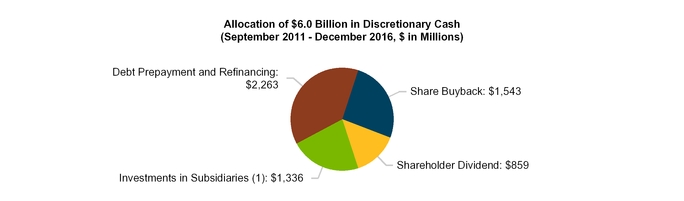
| (1) | Investments in subsidiaries excludes $2.2 billion investment in DPL. |
Segments
We are organized into six market-oriented strategic business units ("SBUs"): US (United States), Andes (Chile, Colombia, and Argentina), Brazil, MCAC (Mexico, Central America and the Caribbean), Europe, and Asia — which are led by our SBU Presidents. Within our six SBUs, we have two lines of business. The first business line is generation, where we own and/or operate power plants to generate and sell power to customers, such as utilities, industrial users, and other intermediaries. The second business line is utilities, where we own and/or operate utilities to generate or purchase, distribute, transmit and sell electricity to end-user customers in the residential, commercial, industrial and governmental sectors within a defined service area. In certain circumstances, our utilities also generate and sell electricity on the wholesale market.
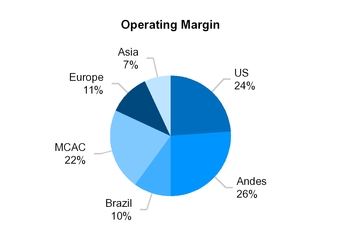
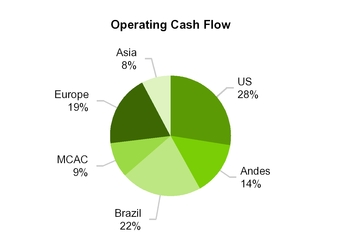
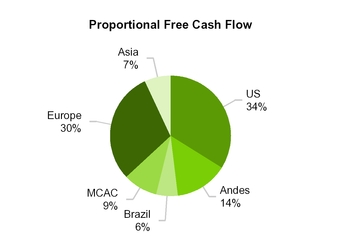
The Company measures the operating performance of its SBUs using Adjusted PTC and Proportional Free Cash Flow, both of which are non-GAAP measures. The Adjusted PTC and Proportional Free Cash Flow by SBU for the year ended December 31, 2016 are shown below. The percentages for Adjusted PTC and Proportional Free Cash Flow are the contribution by each SBU to the gross metric, i.e., the total Adjusted PTC by SBU, before deductions for Corporate. See Item 7.—Management's Discussion and Analysis SBU Performance Analysis of this Form 10-K for reconciliation and definitions of Adjusted PTC and Proportional Free Cash Flow.

The following summarizes our businesses within our six SBUs.



Overview
Generation
We currently own and/or operate a generation portfolio of 30,379 MW, excluding the generation capabilities of our integrated utilities. Our generation fleet is diversified by fuel type. See discussion below under Fuel Costs.
Performance drivers of our generation businesses include types of electricity sales agreements, plant reliability and flexibility, fuel costs, seasonality, weather variations and economic activity, fixed-cost management, and competition.
Electricity Sales Contracts — Our generation businesses sell electricity under medium- or long-term contracts ("contract sales") or under short-term agreements in competitive markets ("short-term sales").
Contract Sales — Most of our generation fleet sells electricity under contracts. Our medium-term contract sales have a term of 2 to 5 years, while our long-term contracts have a term of more than 5 years. Across our portfolio, the average remaining contract term is 6 years.
In contract sales, our generation businesses recover variable costs including fuel and variable O&M costs, either through direct or indexation-based contractual pass-throughs or tolling arrangements. When the contract does not include a fuel pass-through, we typically hedge fuel costs or enter into fuel supply agreements for a similar contract period (see discussion under the Fuel Costs section below). These contracts are intended to reduce exposure to the volatility of fuel prices and electricity prices by linking the business's revenues and costs. These contracts also help us to fund a significant portion of the total capital cost of the project through long-term non-recourse project-level financing.
Capacity Payments and Contract Sales — Most of our contract sales include a capacity payment that covers projected fixed costs of the plant, including fixed O&M expenses and a return on capital invested. In addition, most of our contracts require that the majority of the capacity payment be denominated in the currency matching our fixed costs. We generally structure our business to eliminate or reduce foreign exchange risk by matching the currency of revenue and expenses, including fixed costs and debt. Our project debt may consist of both fixed and floating rate debt for which we typically hedge a significant portion of our exposure. Some of our contracted businesses also receive a regulated market-based capacity payment, which is discussed in more detail in the Capacity Payments and Short-Term Sales section below.
Thus, these contracts, or other related commercial arrangements, significantly mitigate our exposure to changes in power and fuel prices, currency fluctuations and changes in interest rates. In addition, these contracts generally provide for a recovery of our fixed operating expenses and a return on our investment, as long as we operate the plant to the reliability and efficiency standards required in the contract.
Short-Term Sales — Our other generation businesses sell power and ancillary services under short-term contracts with an average term of less than 2 years, including spot sales, directly in the short-term market, or, in some cases, at regulated prices. The short-term markets are typically administered by a system operator to coordinate dispatch. Short-term markets generally operate on merit order dispatch, where the least expensive generation facilities, based upon variable cost or bid price, are dispatched first and the most expensive facilities are dispatched last. The short-term price is typically set at the marginal cost of energy or bid price (the cost of the last plant required to meet system demand). As a result, the cash flows and earnings associated with these businesses are more sensitive to fluctuations in the market price for electricity. In addition, many of these wholesale markets include markets for ancillary services to support the reliable operation of the transmission system. Across our portfolio, we provide a wide array of ancillary services, including voltage support, frequency regulation and spinning reserves.
In certain markets, such as Argentina and Kazakhstan, a regulator establishes the prices for electricity and fuel and adjusts them periodically for inflation, changes in fuel prices and other factors. In these cases, our businesses are particularly sensitive to changes in regulation.
Capacity Payments — Many of the markets in which we operate include regulated capacity markets. These capacity markets are intended to provide additional revenue based upon availability without reliance on the energy margin from the merit order dispatch. Capacity markets are typically priced based on the cost of a new entrant and the system capacity relative to the desired level of reserve margin (generation available in excess of peak demand). Our generating facilities selling in the short-term markets typically receive capacity payments based on their availability in the market. Our most significant capacity revenues are earned by our generation capacity in Ohio and Northern Ireland.
Plant Reliability and Flexibility — Our contract and short-term sales provide incentives to our generation plants to optimally manage availability, operating efficiency and flexibility. Capacity payments under contract sales are frequently tied to meeting minimum standards. In short-term sales, our plants must be reliable and flexible to capture peak market prices and to maximize market-based revenues. In addition, our flexibility allows us to capture ancillary service revenue while meeting local market needs.
Fuel Costs — For our thermal generation plants, fuel is a significant component of our total cost of generation. For contract sales, we often enter into fuel supply agreements to match the contract period, or we may hedge our fuel costs. Some of our contracts have periodic adjustments for changes in fuel cost indices. In those cases, we have fuel supply agreements with shorter terms to match those adjustments. For certain projects, we have tolling arrangements where the power offtaker is responsible for the supply and cost of fuel to our plants.
In short-term sales, we sell power at market prices that are generally reflective of the market cost of fuel at the time, and thus procure fuel supply on a short-term basis, generally designed to match up with our market sales profile. Since fuel price is often the primary determinant for power prices, the economics of projects with short-term sales are often subject to volatility of relative fuel prices. For further information regarding commodity price risk please see Item 7A.—Quantitative and Qualitative Disclosures about Market Risk in this Form 10-K.
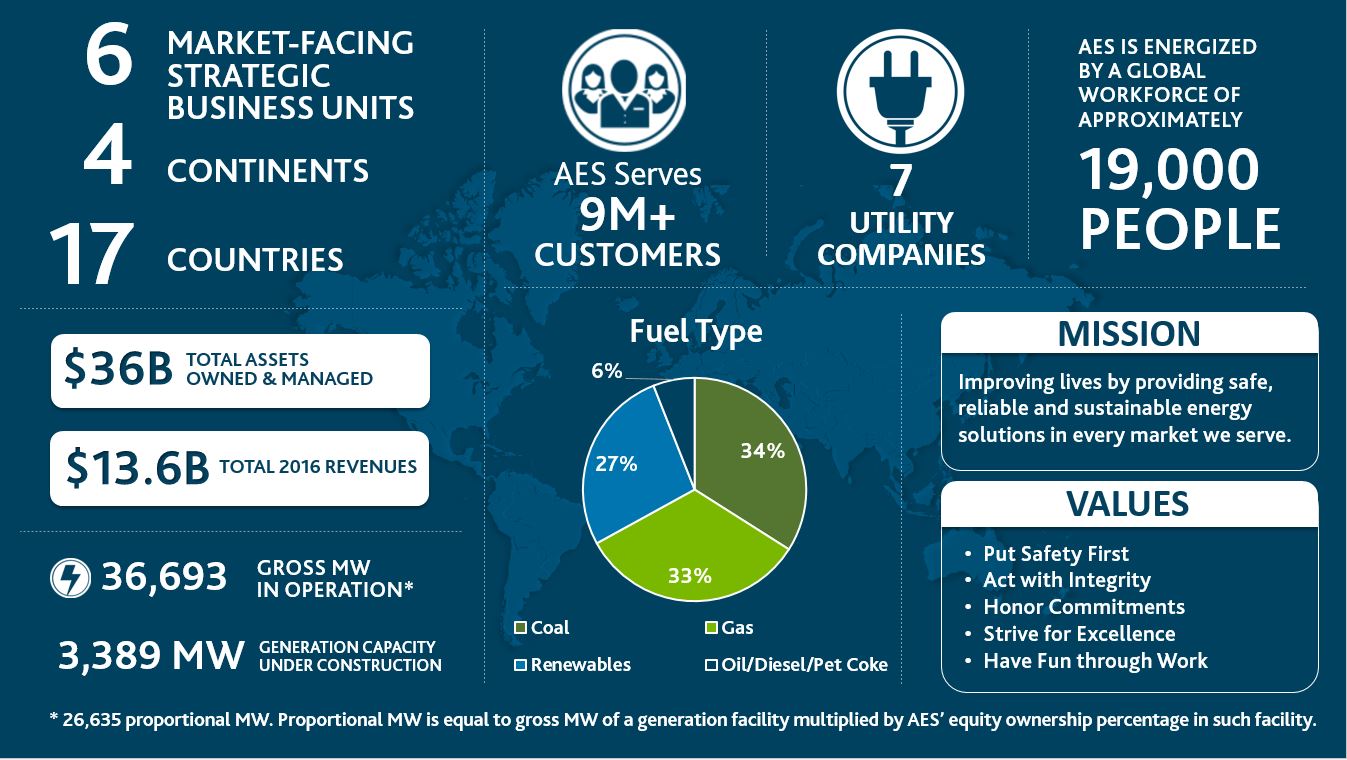
34% of the capacity of our generation fleet is coal-fired. In the U.S., most of our plants are supplied from domestic coal. At our non-U.S. generation plants, and at our plant in Hawaii, we source coal internationally. Across our fleet, we utilize our global sourcing program to maximize the purchasing power of our fuel procurement.
33% of the capacity of our generation plants are fueled by natural gas. Generally, we use gas from local suppliers in each market. A few exceptions to this are AES Gener in Chile, where we purchase imported gas from third parties, and our plants in the Dominican Republic, where we import LNG to utilize in the local market.
27% of the capacity of our generation plants are fueled by renewables, including hydro, wind and energy storage, which do not have significant fuel costs.
6% of the capacity of our generation fleet utilizes oil, diesel and petroleum coke ("pet coke") for fuel. Oil and diesel are sourced locally at prices linked to international markets, while pet coke is largely sourced from Mexico and the U.S.
Renewable Generation Facilities — We currently own and operate 8,228 MW (4,293 proportional MW) of renewable generation, including hydro, wind, energy storage, solar, biomass and landfill gas.
Seasonality, Weather Variations and Economic Activity — Our generation businesses are affected by seasonal weather patterns throughout the year and, therefore, operating margin is not generated evenly by month during the year. Additionally, weather variations, including temperature, solar and wind resources, and hydrological conditions, may also have an impact on generation output at our renewable generation facilities. In competitive markets for power, local economic activity can also have an impact on power demand and short-term prices for power.
Fixed-Cost Management — In our businesses with long-term contracts, the majority of the fixed O&M costs are recovered through the capacity payment. However, for all generation businesses, managing fixed costs and reducing them over time is a driver of business performance.
Competition — For our businesses with medium- or long-term contracts, there is limited competition during the term of the contract. For short-term sales, plant dispatch and the price of electricity are determined by market competition and local dispatch and reliability rules.
Utilities
AES' seven utility businesses distribute power to 9.4 million people in three countries. AES' two utilities in the U.S. also include generation capacity totaling 6,314 MW. The utility businesses have a variety of structures, ranging from integrated utility to pure transmission and distribution businesses.
In general, our utilities sell electricity directly to end-users, such as homes and businesses, and bill customers directly. Key performance drivers for utilities include the regulated rate of return and tariff, seasonality, weather variations, economic activity, reliability of service and competition. Revenue from utilities is classified as regulated in the Consolidated Statements of Operations.
Regulated Rate of Return and Tariff — In exchange for the exclusive right to sell or distribute electricity in a franchise area, our utility businesses are subject to government regulation. This regulation sets the prices ("tariffs") that our utilities are allowed to charge retail customers for electricity and establishes service standards that we are required to meet.
Our utilities are generally permitted to earn a regulated rate of return on assets, determined by the regulator based on the utility's allowed regulatory asset base, capital structure and cost of capital. The asset base on which the utility is permitted a return is determined by the regulator and is based on the amount of assets that are considered used and useful in serving customers. Both the allowed return and the asset base are important components of the utility's earning power. The allowed rate of return and operating expenses deemed reasonable by the regulator are recovered through the regulated tariff that the utility charges to its customers.
The tariff may be reviewed and reset by the regulator from time to time depending on local regulations, or the utility may seek a change in its tariffs. The tariff is generally based upon a certain usage level and may include a pass-through to the customer of costs that are not controlled by the utility, such as the costs of fuel (in the case of integrated utilities) and/or the costs of purchased energy. In addition to fuel and purchased energy, other types of costs may be passed through to customers via an existing mechanism, such as certain environmental expenditures that are covered under an environmental tracker at our utility in Indiana, IPL. Components of the tariff that are directly passed through to the customer are usually adjusted through a summary regulatory process or an existing formula-based mechanism. In some regulatory regimes, customers with demand above an established level are unregulated and can choose to contract with other retail energy suppliers directly and pay wheeling and other non-bypassable fees, which are fees to the distribution company for use of its distribution system.
The regulated tariff generally recognizes that our utility businesses should recover certain operating and fixed costs, as well as manage uncollectible amounts, quality of service and non-technical losses. Utilities, therefore, need to manage costs to the levels reflected in the tariff, or risk non-recovery of costs or diminished returns.
Seasonality, Weather Variations and Economic Activity — Our utility businesses are affected by seasonal weather patterns throughout the year and, therefore, the operating revenues and associated operating expenses are not generated evenly by month during the year. Additionally, weather variations may also have an impact based on the number of customers, temperature variances from normal conditions and customers' historic usage levels and patterns. The retail kWh sales, after adjustments for weather variations, are affected by changes in local economic activity, energy efficiency and distributed generation initiatives, as well as the number of retail customers.
Reliability of Service — Our utility businesses must meet certain reliability standards, such as duration and frequency of outages. Those standards may be specific with incentives or penalties for performance against these standards. In other cases, the standards are implicit and the utility must operate to meet customer expectations.
Competition — Our integrated utilities, IPL and DP&L, operate as the sole distributor of electricity within their respective jurisdictions. Our businesses own and operate all of the businesses and facilities necessary to generate, transmit and distribute electricity. Competition in the regulated electric business is primarily from the on-site generation for industrial customers; however, in Ohio, customers in our service territory have the ability to switch to alternative suppliers for their generation service. Our integrated utilities, particularly DP&L, are exposed to the volatility in wholesale prices to the extent our generating capacity exceeds the native load served under the regulated tariff and short-term contracts. See the full discussion under the US SBU.
At our pure transmission and distribution businesses, such as those in Brazil and El Salvador, we face relatively limited competition due to significant barriers to entry. At many of these businesses, large customers, as defined by the relevant regulator, have the option to both leave and return to regulated service.
Development and Construction
We develop and construct new generation facilities. For our utility businesses, new plants may be built in response to customer needs or to comply with regulatory developments and are developed subject to regulatory approval that permits recovery of our capital cost and a return on our investment. For our generation businesses, our priority for development is platform expansion opportunities, where we can add on to our existing facilities in our key platform markets where we have a competitive advantage. We make the decision to invest in new projects by evaluating the project returns and financial profile against a fair risk-adjusted return for the investment and against alternative uses of capital, including corporate debt repayment and share buybacks.
In some cases, we enter into long-term contracts for output from new facilities prior to commencing construction. To limit required equity contributions from The AES Corporation, we also seek non-recourse project debt financing and other sources of capital, including partners where it is commercially attractive. For construction, we typically contract with a third party to manage construction, although our construction management team supervises the construction work and tracks progress against the project's budget and the required safety, efficiency and productivity standards.
Segments
The segment reporting structure uses the Company's management reporting structure as its foundation to reflect how the Company manages the business internally. It is organized by geographic regions which provide a socio-political-economic understanding of our business. For financial reporting purposes, the Company's corporate activities are reported within "Corporate and Other" because they do not require separate disclosure. See Item 7.—Management's Discussion and Analysis of Financial Condition and Results of Operations and Note 16—Segment and Geographic Information included in Item 8.—Financial Statements and Supplementary Data of this Form 10-K for further discussion of the Company's segment structure.
US SBU
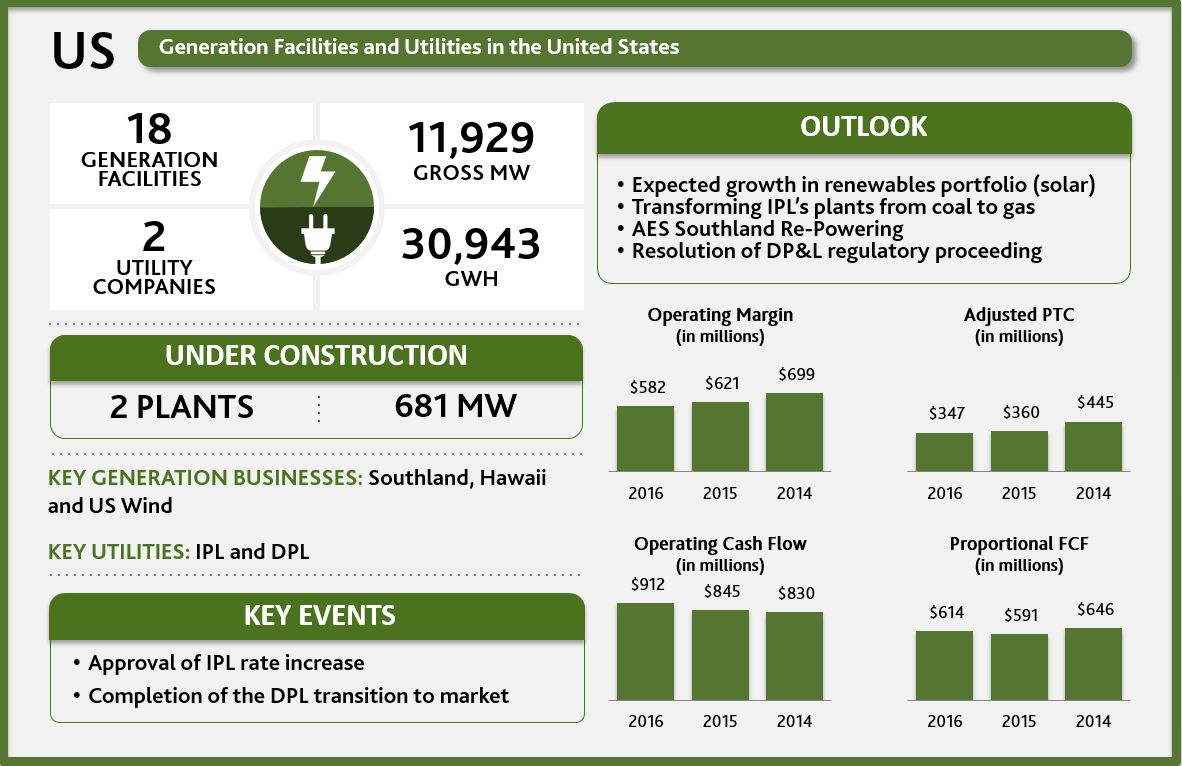
Our US SBU has 18 generation facilities and two integrated utilities in the United States.
Generation — Operating installed capacity of our US SBU totals 11,929 MW. IPL's parent, IPALCO Enterprises, Inc., and DPL Inc. are voluntary SEC registrants, and as such, follow public filing requirements of the Securities Exchange Act of 1934. The following table lists our US SBU generation facilities:
| Business | Location | Fuel | Gross MW | AES Equity Interest | Year Acquired or Began Operation | Contract Expiration Date | Customer(s) | |||||||||
| Southland—Alamitos | U.S.-CA | Gas | 2,075 | 100 | % | 1998 | 2018 | Southern California Edison | ||||||||
| Southland—Redondo Beach | U.S.-CA | Gas | 1,392 | 100 | % | 1998 | 2018 | Southern California Edison | ||||||||
| Southland—Huntington Beach | U.S.-CA | Gas | 474 | 100 | % | 1998 | 2018 | Southern California Edison | ||||||||
| Shady Point | U.S.-OK | Coal | 360 | 100 | % | 1991 | 2018 | Oklahoma Gas & Electric | ||||||||
| Buffalo Gap II (1),(2) | U.S.-TX | Wind | 233 | 100 | % | 2007 | 2017 | Direct Energy | ||||||||
| Hawaii | U.S.-HI | Coal | 206 | 100 | % | 1992 | 2022 | Hawaiian Electric Co. | ||||||||
| Warrior Run | U.S.-MD | Coal | 205 | 100 | % | 2000 | 2030 | First Energy | ||||||||
| Buffalo Gap III (1) | U.S.-TX | Wind | 170 | 100 | % | 2008 | ||||||||||
| Buffalo Gap I (1) | U.S.-TX | Wind | 119 | 100 | % | 2006 | 2021 | Direct Energy | ||||||||
| Laurel Mountain | U.S.-WV | Wind | 98 | 100 | % | 2011 | ||||||||||
| Distributed PV - Commercial & Utility (1) (3) | U.S.-Various | Solar | 89 | 100 | % | 2015-2016 | 2029-2042 | Utility, Municipality, Education, Non-Profit | ||||||||
| Mountain View I & II | U.S.-CA | Wind | 67 | 100 | % | 2008 | 2021 | Southern California Edison | ||||||||
| Mountain View IV | U.S.-CA | Wind | 49 | 100 | % | 2012 | 2032 | Southern California Edison | ||||||||
| Laurel Mountain ES | U.S.-WV | Energy Storage | 32 | 100 | % | 2011 | ||||||||||
| Tait ES | U.S.-OH | Energy Storage | 20 | 100 | % | 2013 | ||||||||||
| Distributed PV - Residential (1) (3) | U.S.-Various | Solar | 14 | 100 | % | 2015 | 2037-2040 | Residential | ||||||||
| Warrior Run ES | U.S.-MD | Energy Storage | 10 | 100 | % | 2016 | ||||||||||
| Advancion Applications Center | U.S.-PA | Energy Storage | 2 | 100 | % | 2013 | ||||||||||
| 5,615 |
| (1) | AES owns these assets together with third-party tax equity investors with variable ownership interests. The tax equity investors receive a portion of the economic attributes of the facilities, including tax attributes, that vary over the life of the projects. The proceeds from the issuance of tax equity are recorded as noncontrolling interest in the Company's Consolidated Balance Sheets. |
| (2) | Power Purchase Agreement with Direct Energy is for 80% of annual expected energy output. |
| (3) | AES operates these facilities located throughout the U.S. through management or O&M agreements as of December 31, 2016. |
Under construction — The following table lists our plants under construction in the US SBU:
| Business | Location | Fuel | Gross MW | AES Equity Interest | Expected Date of Commercial Operations | |||||||
| Eagle Valley CCGT | U.S.-IN | Gas | 671 | 70 | % | 1H 2018 | ||||||
| Distributed PV - Commercial | U.S.-Various | Solar | 10 | 100 | % | 1H 2017 | ||||||
| 681 |
Utilities — The following table lists our U.S. utilities and their generation facilities:
| Business | Location | Approximate Number of Customers Served as of 12/31/2016 | GWh Sold in 2016 | Fuel | Gross MW | AES Equity Interest | Year Acquired or Began Operation | |||||||||||
| DPL (1) | U.S.-OH | 519,000 | 16,757 | Coal/Gas/Oil | 3,066 | 100 | % | 2011 | ||||||||||
| IPL (2) | U.S.-IN | 490,000 | 14,186 | Coal/Gas/Oil | 3,248 | 70 | % | 2001 | ||||||||||
| 1,009,000 | 30,943 | 6,314 |
| (1) | DPL subsidiary DP&L has the following plants: Tait Units 1-3 and diesels, Yankee Street, Yankee Solar, Monument and Sidney. DP&L jointly owned plants: Conesville Unit 4, Killen, Miami Fort Units 7 & 8, Stuart and Zimmer. In addition to the above, DP&L also owns a 4.9% equity ownership in OVEC ("Ohio Valley Electric Corporation"), an electric generating company. OVEC has two plants in Cheshire, Ohio and Madison, Indiana with a combined generation capacity of |
approximately 2,109 MW. DP&L's share of this generation capacity is approximately 103 MW. AES Ohio Generation, LLC plants: Tait Units 4-7 and Montpelier Units 1-4.
| (2) | CDPQ owns direct and indirect interests in IPALCO which total 30%. AES owns 85% of AES US Investments and AES US Investments owns 82.35% of IPALCO. IPL plants: Georgetown, Harding Street, Petersburg and Eagle Valley (new CCGT currently under construction). 3.2 MW of IPL total is considered a transmission asset. |
The following map illustrates the location of our U.S. facilities:

U.S. Businesses
U.S. Utilities
IPALCO
Business Description — IPALCO owns all of the outstanding common stock of IPL. IPL is engaged primarily in generating, transmitting, distributing and selling electric energy to approximately 490,000 retail customers in the city of Indianapolis and neighboring areas within the state of Indiana. IPL has an exclusive right to provide electric service to those customers. IPL's service area covers about 528 square miles with an estimated population of approximately 939,000. IPL owns and operates four generating stations. IPL’s largest generating station, Petersburg, is coal-fired. The second largest station, Harding Street, has converted its coal-fired units to natural gas and uses natural gas and fuel oil to power combustion turbines. The third, Eagle Valley, retired its coal-fired units in April 2016 and their CCGT is expected to be completed in the first half of 2018. The fourth station, Georgetown, is a small peaking station that uses natural gas to power combustion turbines. As of December 31, 2016, IPL's net electric generation capacity for winter is 2,993 MW and net summer capacity is 2,878 MW.
Market Structure — IPL is one of many transmission system owner members in the MISO. MISO is a RTO, which maintains functional control over the combined transmission systems of its members and manages one of the largest energy and ancillary services markets in the U.S. IPL offers the available electricity production of each of its generation assets into the MISO day-ahead and real-time markets. MISO operates on a merit order dispatch, considering transmission constraints and other reliability issues to meet the total demand in the MISO region.
Regulatory Framework - Retail Ratemaking — In addition to the regulations referred to below in Other Regulatory Matters, IPL is subject to regulation by the IURC with respect to IPL's services and facilities; retail rates and charges; the issuance of long-term securities; and certain other matters. The regulatory power of the IURC over IPL's business is both comprehensive and typical of the traditional form of regulation generally imposed by state public utility commissions. IPL's tariff rates for electric service to retail customers consist of basic rates and charges,
which are set and approved by the IURC after public hearings. The IURC gives consideration to all allowable costs for ratemaking purposes including a fair return on the fair value of the utility property used and useful in providing service to customers. In addition, IPL's rates include various adjustment mechanisms including, but not limited to: (i) a rider to reflect changes in fuel and purchased power costs to meet IPL's retail load requirements, referred to as the FAC, and (ii) a rider for the timely recovery of costs incurred to comply with environmental laws and regulations referred to as the Environmental Compliance Cost Recovery Adjustment. These components function somewhat independently of one another, but the overall structure of IPL's rates and charges would be subject to review at the time of any review of IPL's basic rates and charges.
In March 2016, the IURC issued an order authorizing IPL to increase its basic rates and charges by approximately $31 million annually. On December 22, 2016, IPL filed a petition with the IURC for authority to increase its basic rates and charges, primarily to recover the cost of the new Eagle Valley CCGT. The Eagle Valley CCGT was previously expected to be completed in the first half of 2017, but is now expected to be completed in the first half of 2018. To address this change, on February 24, 2017, IPL filed a motion to withdraw the case without prejudice or alternatively amend the petition at a later date. No assurances can be given as to the timing or outcome of this proceeding.
Environmental Regulation — For information on compliance with environmental regulations see Item 1.—United States Environmental and Land-Use Legislation and Regulations.
Replacement Generation — IPL has several generating units that have been recently retired or refueled. These units were primarily coal-fired and represented 472 MW of net capacity in total. To replace this generation, IPL has approval to build a 644 to 685 MW CCGT at its Eagle Valley Station site in Indiana and refuel its Harding Street Station Units 5 and 6 from coal to natural gas (approximately 100 MW net capacity each) with a total budget of $649 million. The current estimated cost of these projects is $632 million. IPL was granted authority to accrue post in-service allowance for debt and equity funds used during construction, and to defer the recognition of depreciation expense of the CCGT and refueling project. These costs to build and operate the CCGT and the refueling project, other than fuel costs, will not be recoverable by IPL through rates until the conclusion of a base rate case proceeding with the IURC after the assets have been placed in service. The CCGT is expected to be completed in the first half of 2018, and the refueling project was completed in December 2015.
In July 2015 IPL received approval from the IURC for a CPN to refuel the Harding Street Station Unit 7 from coal to natural gas (about 410 MW net capacity). The Harding Street Station Unit 7 conversion was completed in the second quarter of 2016.
Key Financial Drivers — IPL's financial results are driven primarily by retail demand, weather, energy efficiency and wholesale prices. In addition, IPL's financial results are likely to be driven by many factors including but not limited to:
| • | rate case outcomes |
| • | the timely recovery of capital expenditures through base rate growth |
| • | the passage of new legislation or implementation of regulations |
Construction and Development — IPL's construction program is composed of capital expenditures necessary for prudent utility operations and compliance with environmental laws and regulations, along with discretionary investments designed to replace aging equipment or improve overall performance. Refer to the section above for a description of our major construction projects.
DPL
Business Description — DPL is an energy holding company whose principal subsidiaries include DP&L and AES Ohio Generation, LLC.
DP&L generates, transmits, distributes and sells electricity to approximately 519,000 customers in a 6,000 square mile area of West Central Ohio. DP&L, solely or through jointly owned facilities, owns 2,510 MW of generation capacity and numerous transmission facilities.
AES Ohio Generation, LLC owns peaking generation units representing 556 MW located in Ohio and Indiana.
On January 1, 2016, DPL closed on the sale of DPLER to Interstate Gas Supply, Inc. DPLER, a competitive retail marketer, sold retail electricity to more than 124,000 retail customers in Ohio and Illinois while owned by DPL. Approximately 110,000 of those customers were also distribution customers of DP&L in Ohio.
Market Structure — Since January 2001, electric customers within Ohio have been permitted to choose to purchase power under a contract with a CRES Provider or to continue to purchase power from their local utility
under SSO rates established by the tariff. DP&L and other Ohio utilities continue to have the exclusive right to provide delivery service in their state certified territories, and DP&L has the obligation to provide retail generation service to customers that did not choose an alternative supplier. Beginning in 2014, a portion of the SSO generation supply was no longer supplied by DP&L, but was provided by third parties through a competitive bid process. A total of 10%, 60% and 100% of the SSO load was sourced through competitive bid in 2014, 2015 and 2016, respectively. The PUCO maintains jurisdiction over DP&L's delivery of electricity, SSO and other retail electric services. The PUCO has issued extensive rules on how and when a customer can switch generation suppliers, how the local utility will interact with CRES Providers and customers, including for billing and collection purposes, and which elements of a utility's rates are "bypassable" (i.e., avoided by a customer that elects a CRES Provider) and which elements are "non-bypassable" (i.e., charged to all customers receiving a distribution service irrespective of what entity provides the retail generation service).
DP&L is a member of PJM. The PJM RTO operates the transmission systems owned by utilities operating in all or parts of Pennsylvania, New Jersey, Maryland, Delaware, D.C., Virginia, Ohio, West Virginia, Kentucky, North Carolina, Tennessee, Indiana and Illinois. PJM has an integrated planning process to identify potential needs for additional transmission to be built to avoid future reliability problems. PJM also runs the day-ahead and real-time energy markets, ancillary services market and forward capacity market for its members.
As a member of PJM, DP&L is also subject to charges and costs associated with PJM operations as approved by the FERC. Prior to 2015, the RPM was PJM's capacity construct. In 2015, PJM implemented a new CP program, replacing the RPM model. The CP program offers the potential for higher capacity revenues, combined with substantially increased penalties for non-performance or under-performance during certain periods identified as "capacity performance hours." This linkage between non- or under-performance during specific hours means that a generation unit that is generally performing well on an annual basis, may incur substantial penalties if it happens to be unavailable for service during some capacity performance hours. Similarly, a generation unit that is generally performing poorly on an annual basis may avoid such penalties if its outages happen to occur only during hours that are not capacity performance hours. An annual “stop-loss” provision exists that limits the size of penalties to 150% of the net cost of new entry, which is a value computed by PJM. This level is likely to be larger than the capacity price established under the CP program, so that there is potential that participation in the CP program could result in capacity penalties that exceed capacity revenues. The purpose of the RPM and CP Program is to enable PJM to obtain sufficient resources to reliably meet the needs of electric customers within the PJM footprint. PJM conducts an auction to establish the price by zone.
The PJM CP auctions are held three years in advance for a period covering 12 months starting from June 1. Auctions for the period covering June 1, 2020 through May 30, 2021 are expected to take place in May 2017. Future auction results are dependent upon various factors including the demand and supply situation, capacity additions and retirements and any changes in the current auction rules related to bidding for demand response and energy efficiency resources in the capacity auctions. For DPL-owned generation, applicable capacity prices through the auction year 2019/20 are as follows:
| Auction Year (June 01-May 31) | 2019/20 | 2018/19 | 2017/18 | 2016/17 | 2015/16 | 2014/15 | ||||||
| Capacity Clearing Price ($/MW-Day) | $100 | $165 | $152 | $134 | $136 | $126 |
The computed average capacity prices by calendar year are as follows:
| Year | 2019 | 2018 | 2017 | 2016 | 2015 | |||||
| Computed Average Capacity Price ($/MW-Day) | $127 | $159 | $145 | $135 | $132 |
The above tables reflect the capacity prices after the transitional auctions discussed earlier. Substantially all of DP&L's capacity cleared in the CP auction. The results of these auctions could have a significant effect on DP&L's revenues in the future.
Regulatory Framework - Retail Regulation and Rate Structure — DP&L is subject to regulation by the PUCO, for its distribution services and facilities, retail rates and charges, reliability of service, compliance with renewable energy portfolio, energy efficiency program requirements and certain other matters. DP&L's rates for electric service to retail customers consist of basic rates and charges that are set and approved by the PUCO after public hearings. In addition, DP&L's rates include various adjustment mechanisms including, but not limited to, the timely recovery of costs incurred to comply with alternative energy, renewables, energy efficiency, and economic development costs. These components function independently of one another, but the overall structure of DP&L's retail rates and charges are subject to the rules and regulations established by the PUCO.
Since Ohio is deregulated, and allows customers to choose retail generation providers, DP&L is required to provide retail generation service at SSO rates to any customer that has not signed a contract with a CRES provider.
SSO rates are subject to rules and regulations of the PUCO and are established based on DP&L's most recently approved ESP. DP&L's distribution rates are regulated by the PUCO and are established through a traditional cost-based rate-setting process. DP&L is permitted to recover its costs of providing distribution service as well as earn a regulated rate of return on assets, determined by the regulator, based on the utility's allowed regulated asset base, capital structure and cost of capital. DP&L's wholesale transmission rates are regulated by the FERC.
Although it had been in effect since January 2014, on June 20, 2016, the Supreme Court of Ohio ("Court") issued an opinion in the appeal of DP&L’s ESP (ESP 2) that had been approved by the PUCO for the years 2014-2016 and which, among other matters, permitted DP&L to collect a non-bypassable Service Stability Rider equal to $110 million per year from 2014-2016 and required DP&L to conduct competitive bid auctions to procure generation supply for SSO service. DP&L's own generation was phased-out of supplying SSO service over the three year period and beginning January 1, 2016 DP&L's SSO was 100% sourced through the competitive bid. In the opinion, the Court stated that the PUCO’s approval of ESP 2 was reversed. In view of that reversal, DP&L filed a motion to withdraw ESP 2 and implement rates consistent with those in effect prior to 2014 (ESP 1). Those rates will be in effect until rates consistent with DP&L’s pending February 22, 2016 ESP (ESP 3) filing are approved and effective.
DP&L originally filed its ESP 3 seeking an effective date of January 1, 2017. On October 11, 2016, DP&L amended the application requesting to recover $145 million per year for seven years supporting the alternative described in the original filing, named the Distribution Modernization Rider. This plan establishes the terms and conditions for DP&L's SSO beginning June 1, 2017 to customers that do not choose a competitive retail electric supplier. In its plan, DP&L recommends including renewable energy attributes as part of the product that is competitively bid, and seeks recovery of approximately $11 million of regulatory assets. The plan also proposes a new Distribution Investment Rider to allow DP&L to recover costs associated with future distribution equipment and infrastructure needs. Additionally, the plan establishes new riders set initially at zero, related to energy reductions from DP&L's energy efficiency programs, and certain environmental liabilities the Company may incur.
On January 30, 2017 DP&L, in conjunction with nine intervening parties, filed a settlement in the ESP 3 case, which is subject to PUCO approval. DP&L and the intervening parties agreed to a six-year settlement that provides a framework for energy rates and defines components which include, but are not limited to, the following:
| • | The establishment of a five-year Distribution Modernization Rider designed to collect $90 million in revenue per year to pay debt obligations at DPL and DP&L and position DP&L to modernize and/or maintain its transmission and distribution infrastructure; |
| • | The establishment of a Distribution Investment Rider for distribution investments, with one component designed to collect $35 million in revenue per year to enable the implementation of smart grid and advanced metering, ending after the fifth year of the term of the ESP, |
| • | A commitment by the Company to separate DP&L’s generation assets from its transmission and distribution assets (if approved by FERC); |
| • | A commitments to commence the sale process of our ownership interests in the Zimmer, Miami Fort and Conesville coal-fired generation plants and; |
| • | A commitment to develop or procure wind and/or solar energy projects in Ohio, |
| • | Restrictions on DPL making dividend or tax sharing payments, various other riders, and competitive retail market enhancements. |
A hearing on the stipulation has been scheduled for March 2017. A final decision by the PUCO is expected at the end of Q2 or early Q3 2017. If the PUCO agrees to the proposed settlement, the average residential customer in the DP&L service territory, using 1,000 kWh on DP&L's Standard Service Offer, can expect a monthly bill increase of $2.39. There can be no assurance that the ESP 3 stipulation will be approved as filed or on a timely basis, and if the final ESP provides for terms that are more adverse than those submitted in DP&L's stipulation, our results of operations, financial condition and cash flows could be materially impacted.
On November 30, 2015 DP&L filed an application to increase its distribution rate case using a 12-month test year of June 1, 2015 to May 31, 2016 to measure revenue and expenses and a date certain of September 30, 2015 to measure its asset base. The Company is seeking an increase to distribution revenues of $66 million per year. The Company has asked for recovery of certain regulatory assets as well as two new riders that would allow the Company to recover certain costs on an ongoing basis. It has proposed a modified straight-fixed variable rate design in an effort to decouple distribution revenues from electric sales. If approved as filed the rates are expected to have a total bill impact of approximately 4% on a typical residential customer.
Environmental Regulation — In relation to MATS, DPL does not expect to incur material capital expenditures to ensure compliance. For more information see Item 1.—United States Environmental and Land-Use Legislation
and Regulations.
Key Financial Drivers — DPL financial results are driven by retail demand, weather, energy efficiency and wholesale prices on financial results. In addition, DPL financial results are likely to be driven by many factors including, but not limited to:
| • | PJM capacity prices |
| • | Outcome of DP&L's pending ESP 3 case, including the amount of non-bypassable revenue |
| • | Outcome of DP&L's pending distribution rate case |
| • | Operational performance of generation facilities |
| • | Recovery in the power market, particularly as it relates to an expansion in dark spreads |
| • | Sale or transfer to a DPL affiliate of DP&L generation assets |
| • | DPL's ability to reduce its cost structure |
Construction and Development — Planned construction additions primarily relate to new investments in and upgrades to DP&L's power plant equipment and transmission and distribution system. Capital projects are subject to continuing review and are revised in light of changes in financial and economic conditions, load forecasts, legislative and regulatory developments and changing environmental standards, among other factors.
DPL is projecting to spend an estimated $414 million in capital projects for the period 2017 through 2019 with 65% attributable to Transmission and Distribution. DPL's ability to complete capital projects and the reliability of future service will be affected by its financial condition, the availability of internal funds and the reasonable cost of external funds. We expect to finance these construction additions with a combination of cash on hand, short-term financing, long-term debt and cash flows from operations.
U.S. Generation
Business Description — In the U.S., we own a diversified generation portfolio in terms of geography, technology and fuel source. The principal markets and locations where we are engaged in the generation and supply of electricity (energy and capacity) are the Western Electric Coordinating Council, PJM, Southwest Power Pool Electric Energy Network and Hawaii. AES Southland, in the Western Electric Coordinating Council, is our most significant generating business.
Many of our U.S. generation plants provide baseload operations and are required to maintain a guaranteed level of availability. Any change in availability has a direct impact on financial performance. The plants are generally eligible for availability bonuses on an annual basis if they meet certain requirements. In addition to plant availability, fuel cost is a key business driver for some of our facilities.
AES Southland
Business Description — In terms of aggregate installed capacity, AES Southland is one of the largest generation operators in California, with an installed gross capacity of 3,941 MW, accounting for approximately 5% of the state's installed capacity and 17% of the peak demand of Southern California Edison. The three coastal power plants comprising AES Southland are in areas that are critical for local reliability and play an important role in integrating the increasing amounts of renewable generation resources in California.
Market Structure — All of AES Southland's capacity is contracted through a long-term agreement (the “Tolling Agreement”), which expires in May 31, 2018. A Resource Adequacy agreement has been executed that covers the period from June 1, 2018 through 2020, but it is still subject to approval from the California Public Utilities Commission. Under the current Tolling Agreement, AES Southland's largest revenue driver is unit availability, as approximately 98% of its revenue comes from availability-related payments. Historically, AES Southland has generally met or exceeded its contractual availability requirements under the Tolling Agreement and may capture bonuses for exceeding availability requirements in peak periods.
Under the Tolling Agreement, the offtaker provides gas to the three facilities thus AES Southland is not exposed to significant fuel price risk. If the units operate better than the guaranteed efficiency, AES Southland gets credit for the gas that is not consumed. Conversely, AES Southland is responsible for the cost of fuel in excess of what would have been consumed had the guaranteed efficiency been achieved. The business is also exposed to replacement power costs for a limited period if dispatched by the offtaker and not able to meet the required generation.
AES Southland delivers electricity into the California ISO's market through its Tolling Agreement counterparty.
Environmental Regulation — For a discussion of environmental regulatory matters affecting U.S. Generation, see Item 1.—United States Environmental and Land-Use Legislation and Regulations.
Re-powering — In October 2014, AES Southland was awarded 20-year contracts by SCE to provide 1,284 MW of combined cycle gas-fired generation and 100 MW of interconnected battery-based energy storage. In addition to replacing older gas-fired plants with more efficient gas-fired capacity, SCE chose advanced energy storage as a cost effective way to ensure critical power system reliability. This new storage resource will provide operational flexibility, enabling the efficient dispatch of other generating plants, lowering cost and emissions and supporting the on-going addition of renewable power sources.
This new capacity will be built at the Company's existing power plant sites in Huntington Beach and Alamitos Beach. For the gas-fired capacity, financing agreements are expected to be completed in mid-2017 with construction expected to begin shortly thereafter, and commercial operation scheduled for 2020. For the energy storage capacity, commercial operation is scheduled for 2021.
AES is pursuing permits to build both the gas-fired and energy storage capacity and will complete the licensing process before financial close. The total cost for these projects is expected to be approximately $1.9 billion, which will be funded with a combination of non-recourse debt and AES equity.
Key Financial Drivers — AES Southland's contractual availability is the single most important driver of operations. Its units are generally required to achieve at least 86% availability in each contract year. AES Southland has historically met or exceeded its contractual availability.
Additional U.S. Generation Businesses
Business Description — Additional businesses include thermal, wind, and solar generating facilities, of which AES Hawaii, our U.S. wind generation businesses and distributed solar are the most significant.
| • | AES Hawaii — AES Hawaii receives a fuel payment from its offtaker under a PPA expiring in 2022, which is based on a fixed rate indexed to the Gross National Product - Implicit Price Deflator. Since the fuel payment is not directly linked to market prices for fuel, the risk arising from fluctuations in market prices for coal is borne by AES Hawaii. |
To mitigate the risk from such fluctuations, AES Hawaii has entered into fixed-price coal purchase commitments that end in December 2018; the business could be subject to variability in coal pricing beginning in January 2019. To mitigate fuel risk beyond December 2018, AES Hawaii plans to seek additional fuel purchase commitments on favorable terms. However, if market prices rise and AES Hawaii is unable to procure coal supply on favorable terms, the financial performance of AES Hawaii could be materially and adversely affected.
| • | U.S. Wind — AES has 736 MW of wind capacity in the U.S., located in California, Texas and West Virginia. Typically, these facilities sell under long-term PPAs. AES financed most of these projects with tax equity structures. The tax equity investors receive a portion of the economic attributes of the facilities, including tax attributes that vary over the life of the projects. Based on certain liquidation provisions of the tax equity structures, this could result in a net loss to AES consolidated results in periods in which the facilities report net income. These non cash net losses will be expected to reverse during the life of the facilities. Some of the wind projects are exposed to the volatility of energy prices and their revenue may change materially as energy prices fluctuate in their respective markets of operations. |
Buffalo Gap is located in Texas and is comprised of three wind projects with an aggregate generation capacity of 522 MW. Each wind project operates its own PPA with the exception of Buffalo Gap III. The energy price of the entire production of Buffalo Gap I is guaranteed by a PPA expiring in 2021. The PPA of Buffalo Gap II guarantees the energy price of 80% of the installed capacity while the energy price for the remaining 20% is dictated by the prices in the ERCOT market. The PPA of Buffalo Gap II expires in December 2017. Once the PPAs expire, the entire installed capacity of Buffalo Gap will be exposed to the volatility of energy prices in the ERCOT market which could adversely affect revenues.
Laurel Mountain is a wind project located in West Virginia with an installed capacity of 98 MW. Laurel Mountain does not operate under a long-term contract and sells its entire capacity and power generated into the PJM market. The volatility and fluctuations of energy prices in PJM have a direct impact in the results of Laurel Mountain.
AES manages the wind portfolio as part of its broader investments in the U.S., leveraging operational and commercial resources to supplement the experienced subject matter experts in the wind industry to achieve optimal results.
| • | AES Distributed Energy — AES has 103 MW of solar capacity in the U.S., located across multiple states. Distributed Energy's Commercial and Utility division, which comprised 89 MW of solar capacity as of December 31, 2016, sells electricity generated by photovoltaic solar energy systems to public sector, utility, and non-profit entities through power purchase agreements. AES has added 33 MW of commercial and utility capacity in 2016. A majority of this new capacity has been financed with tax equity structures. Under these tax equity structures, the tax equity investors receive a portion of the economic attributes of the facilities, including tax attributes that vary over the life of the projects. Based on certain liquidation provisions of the tax equity structures, this could result in a net loss to AES consolidated results in periods in which the facilities report net income. These non cash net losses will be expected to reverse during the life of the facilities. |
AES manages the Distributed Energy portfolio as part of its broader investments in the U.S., leveraging operational and commercial resources to supplement the experienced subject matter experts in the solar industry to achieve optimal results.
Market Structure — For the non-renewable businesses included in our additional U.S. generation facilities, coal and natural gas are used as the primary fuels. Coal has prices that are set by market factors internationally while natural gas is generally set domestically. Price variations for these fuels can change the composition of generation costs and energy prices in our generation businesses, and the prices of these fuels have been subject to volatility in recent years.
Many of these generation businesses have entered into long-term PPAs with utilities or other offtakers. Some coal-fired power plant businesses in the U.S. with PPAs have mechanisms to recover fuel costs from the offtaker, including an energy payment that is partially based on the market price of coal. In addition, these businesses often have an opportunity to increase or decrease profitability from payments under their PPAs depending on such items as plant efficiency and availability, heat rate, ability to buy coal at lower costs through AES' global sourcing program and fuel flexibility. Revenue may change materially as prices in fuel markets fluctuate, but the variable margin or profitability should not be materially changed when market price fluctuations in fuel are borne by the offtaker.
Regulatory Framework — Several of our generation businesses in the U.S. currently operate as QFs as defined under the PURPA. These businesses entered into long-term contracts with electric utilities that had a mandatory obligation under PURPA requirements to purchase power from QFs at the utility's avoided cost (i.e., the likely costs for both energy and capital investment that would have been incurred by the purchasing utility if that utility had to provide its own generating capacity or purchase it from another source). To be a QF, a cogeneration facility must produce electricity and useful thermal energy for an industrial or commercial process or heating or cooling applications in certain proportions to the facility's total energy output and meet certain efficiency standards. To be a QF, a small power production facility must generally use a renewable resource as its energy input and meet certain size criteria.
Our non-QF generation businesses in the U.S. currently operate as Exempt Wholesale Generators as defined under EPAct 1992. These businesses, subject to approval of FERC, have the right to sell power at market-based rates, either directly to the wholesale market or to a third-party offtaker such as a power marketer or utility/industrial customer. Under the FPA and FERC's regulations, approval from FERC to sell wholesale power at market-based rates is generally dependent upon a showing to FERC that the seller lacks market power in generation and transmission, that the seller and its affiliates cannot erect other barriers to market entry and that there is no opportunity for abusive transactions involving regulated affiliates of the seller. To prevent market manipulation, FERC requires sellers with market-based rate authority to file certain reports, including a triennial updated market power analysis for markets in which they control certain threshold amounts of generation.
Other Regulatory Matters — The U.S. wholesale electricity market consists of multiple distinct regional markets that are subject to both federal regulation, as implemented by the U.S. FERC, and regional regulation as defined by rules designed and implemented by the RTOs, non-profit corporations that operate the regional transmission grid and maintain organized markets for electricity. These rules for the most part govern such items as the determination of the market mechanism for setting the system marginal price for energy and the establishment of guidelines and incentives for the addition of new capacity. See Item 1A.—Risk Factors for additional discussion on U.S. regulatory matters.
Environmental Regulation — For a discussion of environmental laws and regulations affecting the U.S. business, see Item 1.—United States Environmental and Land-Use Legislation and Regulations.
Key Financial Drivers — U.S. Generation's financial results are driven by fuel costs and outages. The Company has entered into long-term fuel contracts to mitigate the risks associated with fluctuating prices. In addition, major maintenance requiring units to be off-line is performed during periods when power demand is typically lower. The financial results of U.S. Wind are primarily driven by increased production due to faster and less
turbulent wind, and reduced turbine outages. In addition, PJM and ERCOT power prices impact financial results for the wind projects that are operating without long-term contracts for all or some of their capacity.
Construction and Development — Planned capital projects include the AES Southland re-powering described above. In addition to the new construction projects, U.S. Generation performs capital projects related to major plant maintenance, repairs, and upgrades to be compliant with new environmental laws and regulations.
Andes SBU
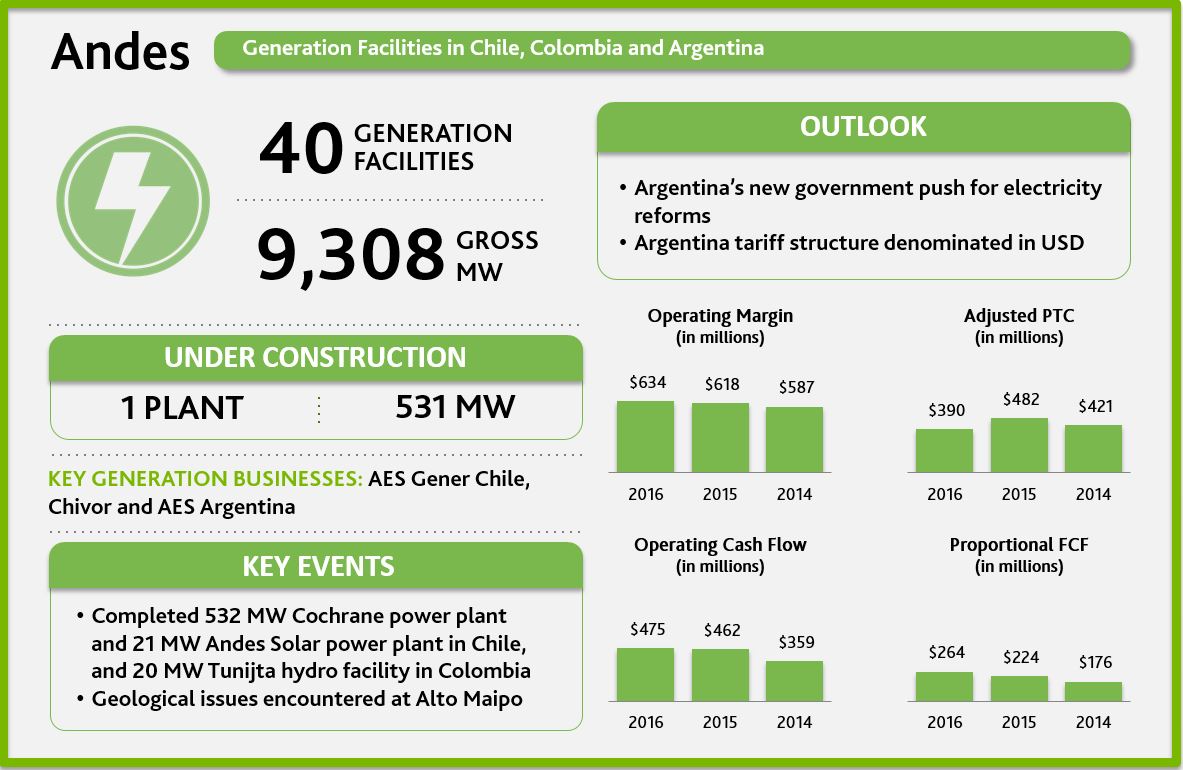
Generation — Our Andes SBU has generation facilities in three countries — Chile, Colombia and Argentina. AES Gener, which owns all of our assets in Chile, Chivor in Colombia and TermoAndes in Argentina, as detailed below, is a publicly listed company in Chile. AES has a 66.7% ownership interest in AES Gener and this business is consolidated in our financial statements.
Operating installed capacity of our Andes SBU totals 9,308 MW, of which 44%, 45% and 11% is located in Argentina, Chile and Colombia, respectively. The following table lists our Andes SBU generation facilities:
| Business | Location | Fuel | Gross MW | AES Equity Interest | Year Acquired or Began Operation | Contract Expiration Date | Customer(s) | |||||||||
| Chivor | Colombia | Hydro | 1,000 | 67 | % | 2000 | Short-term | Various | ||||||||
| Tunjita | Colombia | Hydro | 20 | 67 | % | 2016 | ||||||||||
| Colombia Subtotal | 1,020 | |||||||||||||||
| Guacolda (1) | Chile | Coal/Pet Coke | 760 | 33 | % | 2000 | 2017-2032 | Various | ||||||||
| Electrica Santiago (2) | Chile | Gas/Diesel | 750 | 67 | % | 2000 | ||||||||||
| Gener - SIC (3) | Chile | Hydro/Coal/Diesel/Biomass | 689 | 67 | % | 2000 | 2020-2037 | Various | ||||||||
| Electrica Angamos | Chile | Coal | 558 | 67 | % | 2011 | 2026-2037 | Minera Escondida, Minera Spence, Quebrada Blanca | ||||||||
| Cochrane | Chile | Coal | 532 | 40 | % | 2016 | 2030-2034 | SQM, Sierra Gorda, Quebrada Blanca | ||||||||
| Gener - SING (4) | Chile | Coal/Pet Coke | 277 | 67 | % | 2000 | 2017-2037 | Minera Escondida, Codelco, SQM, Quebrada Blanca | ||||||||
| Electrica Ventanas (5) | Chile | Coal | 272 | 67 | % | 2010 | 2025 | Gener | ||||||||
| Electrica Campiche (6) | Chile | Coal | 272 | 67 | % | 2013 | 2020 | Gener | ||||||||
| Andes Solar | Chile | Solar | 21 | 67 | % | 2016 | 2037 | Quebrada Blanca | ||||||||
| Cochrane ES | Chile | Energy Storage | 20 | 40 | % | 2016 | ||||||||||
| Electrica Angamos ES | Chile | Energy Storage | 20 | 67 | % | 2011 | ||||||||||
| Gener - Norgener ES (Los Andes) | Chile | Energy Storage | 12 | 67 | % | 2009 | ||||||||||
| Chile Subtotal | 4,183 | |||||||||||||||
| TermoAndes (7) | Argentina | Gas/Diesel | 643 | 67 | % | 2000 | Short-term | Various | ||||||||
| AES Gener Subtotal | 5,846 | |||||||||||||||
| Alicura | Argentina | Hydro | 1,050 | 100 | % | 2000 | 2017 | Various | ||||||||
| Paraná-GT | Argentina | Gas/Diesel | 845 | 100 | % | 2001 | ||||||||||
| San Nicolás | Argentina | Coal/Gas/Oil | 675 | 100 | % | 1993 | ||||||||||
| Guillermo Brown (8) | Argentina | Gas/Diesel | 576 | — | % | 2016 | ||||||||||
| Los Caracoles (8) | Argentina | Hydro | 125 | — | % | 2009 | 2019 | Energia Provincial Sociedad del Estado (EPSE) | ||||||||
| Cabra Corral | Argentina | Hydro | 102 | 100 | % | 1995 | Various | |||||||||
| Ullum | Argentina | Hydro | 45 | 100 | % | 1996 | Various | |||||||||
| Sarmiento | Argentina | Gas/Diesel | 33 | 100 | % | 1996 | ||||||||||
| El Tunal | Argentina | Hydro | 11 | 100 | % | 1995 | Various | |||||||||
| Argentina Subtotal | 3,462 | |||||||||||||||
| 9,308 |
| (1) | Guacolda plants: Guacolda 1, 2, 3, 4, and 5. Unconsolidated entities for which the results of operations are reflected in Equity in Earnings of Affiliates. The Company's ownership in Guacolda is held through AES Gener, a 67%-owned consolidated subsidiary. AES Gener owns 50% of Guacolda, resulting in an AES effective ownership in Guacolda of 33%. |
| (2) | Electrica Santiago plants: Nueva Renca, Renca, Los Vientos and Santa Lidia. |
| (3) | Gener — SIC plants: Alfalfal, Laguna Verde, Laguna Verde Turbogas, Laja, Maitenes, Queltehues, Ventanas 1, Ventanas 2 and Volcán. |
| (4) | Gener — SING plants: Norgener 1 and Norgener 2. |
| (5) | Electrica Ventanas plant: Ventanas 3. |
| (6) | Electrica Campiche plant: Ventanas 4. |
| (7) | TermoAndes is located in Argentina, but is connected to both the SING in Chile and the SADI in Argentina. |
| (8) | AES operates these facilities through management or O&M agreements and owns no equity interest in these businesses. |
Under construction — The following table lists our plants under construction in the Andes SBU:
| Business | Location | Fuel | Gross MW | AES Equity Interest | Expected Date of Commercial Operations | |||||||
| Alto Maipo | Chile | Hydro | 531 | 40 | % | 1H 2019 | ||||||
| Chile Subtotal | 531 | |||||||||||
| 531 |
The following map illustrates the location of our Andes facilities:
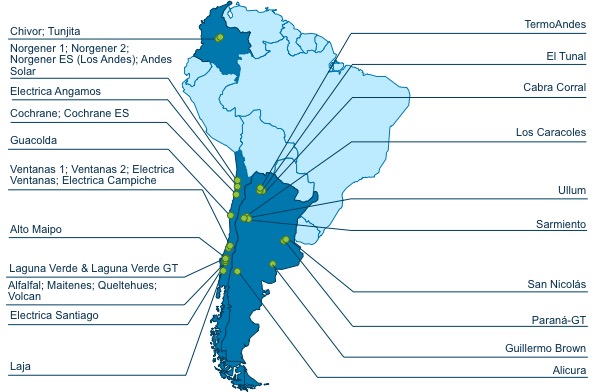
Andes Businesses
Chile
Business Description — In Chile, through AES Gener, we are engaged in the generation and supply of electricity (energy and capacity) in the two principal markets: the SIC and SING. In terms of aggregate installed capacity, AES Gener is the second largest generation operator in Chile with a calculated installed capacity of 4,131 MW, excluding energy storage and TermoAndes, and a market share of approximately 18% as of December 31, 2016.
AES Gener owns a diversified generation portfolio in Chile in terms of geography, technology, customers and fuel source. AES Gener's installed capacity is located near the principal electricity consumption centers, including Santiago, Valparaiso and Antofagasta. AES Gener's portfolio is composed of hydroelectric, coal, gas, diesel, solar photovoltaic and biomass facilities, that allows the businesses to operate under a variety of market and hydrological conditions, manage AES Gener's contractual obligations with regulated and unregulated customers and, as required, provide backup energy to the spot market.
AES Gener has experienced significant growth in recent years by responding to market opportunities. The company successfully completed a first expansion phase between 2007 and 2014 that added 6 new power plants totaling 1,677 MW. It continued to grow in Chile through its second expansion phase that will add 1,236 MW. As of the end of 2016, AES Gener has completed the construction of Guacolda Unit 5 (152 MW), Cochrane (532 MW) and Andes Solar (21 MW). Additionally, we continue to advance in the construction of the 531 MW Alto Maipo run-of-the-river hydroelectric plant in the SIC.
Our commercial policy in Chile aims to maximize margin while reducing cash flow volatility. In order to achieve this, we contract a significant portion of our baseload capacity, currently coal and hydroelectric, under long-term agreements with a diversified customer base, that includes both regulated and unregulated customers. Power plants that are not considered within our baseload capacity (higher variable cost units, mainly diesel and gas fired
units) operate during scarce system supply conditions, such as dry hydrological conditions and plant outages, selling their energy in the spot market. In Chile, sales on the spot market are made only to other generation companies (entities that are members of the Economic Load Dispatch Center - "CISEN") at the system marginal cost. In anticipation of the SIC and SING interconnection, the new Transmission Law created the CISEN, an entity that will merge both system operators into one.
AES Gener currently has long-term contracts, with an average remaining term of approximately 11 years, with regulated distribution companies and unregulated customers, such as mining and industrial companies. In general, these long-term contracts include both fixed and variable payments along with indexation mechanisms that periodically adjust prices based on the generation cost structure related to the United States Consumer Price Index, the international price of coal, and in some cases, with pass-through of fuel and regulatory costs, including changes in law.
In addition to energy payments, AES Gener also receives firm capacity payments for contributing to the system's ability to meet peak demand. These payments are added to the final electricity price paid by both unregulated and regulated customers. In each system, the CISEN annually determines the firm capacity amount allocated to each power plant. A plant's firm capacity is defined as the capacity that it can guarantee at peak hours during critical conditions, such as droughts, taking into account statistical information regarding maintenance periods and water inflows in the case of hydroelectric plants. The capacity price is fixed by the National Energy Commission in the semiannual node price report and indexed to the United States Consumer Price Index and other relevant indices.
Market Structure — Chile has two main power systems, largely as a result of its geographic shape and size. The SIC is the largest of these systems, with an installed capacity of 17,543 MW as of December 31, 2016. The SIC serves approximately 92% of the Chilean population, including the densely populated Santiago Metropolitan Region, and represents 75% of the country's electricity demand. The SING serves about 6% of the Chilean population, representing 25% of Chile's electricity consumption, and mainly supplies mining companies.
In 2016, thermoelectric generation represented 67% of the total generation in Chile. In the SIC, thermoelectric generation represents 48% of installed capacity, required to fulfill demand not satisfied by hydroelectric output and is critical to guaranteeing reliable and dependable electricity supply under dry hydrological conditions. In the SING, which includes the Atacama Desert, the driest desert in the world, thermoelectric capacity represents 92% of installed capacity. The fuels used for generation, mainly coal, diesel and LNG, are indexed to international prices.
In the SIC, where hydroelectric plants represent a large part of the system's installed capacity, hydrological conditions largely influence plant dispatch and, therefore, spot market prices, given that river inflows, snow melting and initial water levels in reservoirs largely determine the dispatch of the system's hydroelectric and thermoelectric generation plants. Rainfall and snowfall occur in Chile principally in the southern cone winter season (June to August) and during the remainder of the year precipitation is scarce. When rain is abundant, energy produced by hydroelectric plants can amount to more than 70% of total generation. In 2016 hydroelectric generation represented 36% of total energy production within the SIC, and 27% of the country’s total energy production.
Solar and wind installed capacity represents a small but growing part of the total capacity installed. In the SIC, solar accounts for 3% of the power generation and 7% of the system’s installed capacity while in the SING solar accounts for 4% of the power generation and 6% of the system’s capacity. As for wind, in the SIC, wind contributes with 4% of the power generation and 7% of the system’s capacity, while in the SING wind generation represents 1% of the power generation and with 2% of the system’s capacity.
Regulatory Framework — The government entity that has primary responsibility for the Chilean electricity system is the Ministry of Energy, acting directly or through the National Energy Commission and the Superintendency of Electricity and Fuels. The electricity sector is divided into three segments: generation, transmission and distribution. In general terms, generation and transmission expansion are subject to market competition, while transmission operation and distribution, are subject to price regulation. The transmission segment consists of companies that transmit the electricity produced by generation companies at high voltage. The individual and joint participation of companies operating in any other segment of the electricity sector cannot exceed 8% and 40%, respectively, of the total investment value of the national transmission system.
Companies in the SIC and the SING that own generation, transmission, sub-transmission or additional transmission facilities, as well as unregulated customers directly connected to transmission facilities, are coordinated through the CISEN, which minimizes the operating costs of the electricity system, while meeting all service quality and reliability requirements. The principal purpose of the CISEN is to ensure that the most efficient electricity generation available to meet demand is dispatched to customers. The CISEN dispatches plants in merit order based on their variable cost of production, allowing for electricity to be supplied at the lowest available cost.
All generators can commercialize energy through contracts with distribution companies for their regulated and unregulated customers or directly with unregulated customers. Unregulated customers are customers whose connected capacity is higher than 2MW. Customers with connected capacity between 0.5 MW and 2.0 MW can opt for a Regulated or Unregulated regime for a minimum period of four years. By law, both regulated and unregulated customers are required to purchase all of their electricity requirements under contract. Generators may also sell energy to other power generation companies on a short-term basis. Power generation companies may engage in contracted sales among themselves at negotiated prices outside the spot market. Electricity prices in Chile, under contract and on the spot market, are denominated in U.S. Dollars, although payments are made in Chilean Pesos.
In July 2016, modifications to the Transmission Law were enacted. This Law establishes that the transmission system will be completely paid for by the end-users, gradually allocating the costs on the demand side from year 2019 through 2034.
Environmental Regulation — In 2011, a regulation on air emission standards for thermoelectric power plants became effective. This regulation provides for stringent limits on emission of PM and gases produced by the combustion of solid and liquid fuels, particularly coal. For existing plants, including those currently under construction, the new limits for PM emissions went into effect at the end of 2013, and the new limits for SO2, NOx and mercury emission were in effect since mid-2016, except for those plants operating in zones declared saturated or latent zones (areas at risk of or affected by excessive air pollution), where these emission limits became effective in June 2015. In order to comply with the new emission standards, AES Gener initiated investments in Chile at its older coal facilities (Ventanas I and II and Norgener I and II, constructed between 1964 and 1997) in 2012. As of December 31, 2016, AES Gener has concluded investments of approximately $229 million in order to comply within the required time frame. Additionally, its equity method investee Guacolda started the installation of new emission control equipment during 2013, and concluded investments of approximately $209 million in order to comply within the required time frame.
On March 29, 2016, the Health Ministry enacted Supreme Decree N°43 (“DS 43”) ruling “Storage of Hazardous Materials”, modifying the current applicable rules. This regulation will become fully effective in March 2018 for structural improvements of currently authorized storage facilities. The estimated investment required to comply with DS 43 would be approximately $15 million.
During 2016, the Environmental Ministry worked on upgrading the Atmospheric Decontamination Plans for Santiago, Ventanas and Huasco areas, each of which, as of December 31, 2016, are currently under different stages of progress. Nueva Renca, Ventanas and Guacolda power plants may require an improvement of their operational practices and additional investments to meet the expected new requirements during the year following the enactment of the Decontamination Plan, which is expected for mid 2017.
Chilean law requires every electricity generator to supply a certain portion of its total contractual obligations with Non-conventional Renewable Energy ("NCREs"). In October 2013, the NCRE law was amended, increasing the NCRE requirements. The law distinguishes between energy contracts executed before and after July 1, 2013. For contracts executed between August 31, 2007 and July 1, 2013, the NCRE requirement is equal to 5% in 2014 with annual contract increases of 0.5% until reaching 10% in 2024. The NCRE requirement for contracts executed after July 1, 2013 is equal to 5% in 2013, with annual increases of 1% thereafter until reaching 12% in 2020, and subsequently annual increases of 1.5% until it is equal to 20% in 2025. Generation companies are able to meet this requirement by developing their own NCRE generation capacity (wind, solar, biomass, geothermal and small hydroelectric technology), purchasing NCREs from qualified generators or by paying the applicable fines for non-compliance. AES Gener currently fulfills the NCRE requirements by utilizing AES Gener's own solar and biomass power plants and by purchasing NCREs from other generation companies. It has sold certain water rights to companies that are developing small hydro projects, entering into power purchase agreements with these companies in order to promote development of these projects, while at the same time meeting the NCRE requirements. At present, AES Gener is in the process of negotiating additional NCRE supply contracts to meet the future requirements.
In September 2014 a new tax law was enacted. The new law introduces an emission tax, or "green tax", that assesses the emissions of PM, SO2, NOx and CO2 produced for installations with an installed capacity over 50 MW. The first annual payment shall be made in April 2018 for emissions produced in 2017. In the case of CO2, the tax will be equivalent to $5 per ton emitted. In the SING, all PPAs have "change of law" clauses, which would allow the company to transfer this cost to customers. In the SIC, costs can only be passed through to unregulated customers, as existing PPAs with distribution companies do not have change of law clauses. According to its PPAs, the company is currently discussing the pass-through mechanism with each client. Additionally, the new tax systems introduced by the new tax laws enacted in February 2016 will be effective from January 1, 2017 onwards. The statutory income tax rate for most of our Chilean businesses will increase from 25% to 25.5% in 2017 and to 27%
for 2018 and future years. See Item 7.—Management's Discussion and Analysis of Financial Condition and Results of Operations—Critical Accounting Policies and Estimates—Income Taxes for further details of the impacts of these new laws.
In June 2015, the Chilean government published Decree N°7/2015, which allows the export of energy generated by plants not dispatched in the SING to Argentina using the transmission line connecting the SING with the SADI. This transmission line is owned by AES Gener and has a capacity of approximately 600 MW, but will be operated at 200 MW according to the government permit and related technical studies. AES Gener signed an agreement with CAMMESA and Chilean generators to export electricity to Argentina. In December 2016, Decree N° 7/2015 was amended to allow the export of energy generated by plants dispatched into the SING to Argentina. During 2016, energy exported to Argentina reached 102 GWh.
Key Financial Drivers — Hedge levels at Gener provide some certainty and clarity on the underlying financial drivers. In addition, financial results are likely to be driven by many factors including, but not limited to:
| • | Dry hydrology scenarios reduce hydro generation |
| • | Forced outages may impact earnings |
| • | Changes in current regulatory rulings could alter the ability to pass through or recover certain costs |
| • | AES is exposed to the fluctuation of the Chilean peso, which may pose a risk to earnings; our hedging strategy reduces this risk, but some residual risk to earnings remains |
| • | Tax policy changes |
| • | Current legislation is trending towards promoting renewable energy and strengthening regulations on thermal generation assets, posing a risk to future coal margins |
| • | Market price risk when re-contracting |
Construction and Development — Since 2007, AES Gener has constructed and commissioned approximately 2,400 MW of new capacity, representing a significant portion of the capacity increase in the SIC and SING during the period. During 2016, AES Gener achieved important milestones related to the construction of their projects:
| • | Cochrane project began operations (Unit 2 on October 12 and Unit 1 on July 9) adding 532 MW to the SING. |
| • | Cochrane Energy Storage began operations in October 2016 adding 20 MW of batteries contributing to system stability in the SING. |
| • | Andes Solar with 21 MW began operations in May 2016 |
Additionally, in the SIC, we continue advancing in the construction of our Alto Maipo project, a 531 MW two unit run-of-river hydroelectric power plant, adjacent to our existing Alfalfal plant, located 50 km from Santiago. Alto Maipo is the largest project in construction in the SIC market and it includes 67 km of tunnel works, two caverns, 17 km of transmission lines as part of the construction, and is 90% underground. Alto Maipo has three main contractors and covers three adjacent valleys in the Chilean Andes. As of today, the project employs approximately 4,300 people and expects to reach a peak close to 4,500. The project units are scheduled to reach commercial operation in the first half of 2019.
We are expanding our business by evaluating opportunities in the desalination business line through two initiatives: i) brownfield projects, which take advantage of existing infrastructure in thermoelectric power plants (marine works, easy access to power, strategic location, permits, etc.), providing shorter development time lines and more competitive water tariffs to offtakers; and ii) greenfield projects, mainly for mining companies which either purchase industrial water through water purchase agreements, or either invite external companies to compete in a bidding process to develop a project under a build-own-operate-and-transfer scheme where the water facility along its pipeline is transferred to the mining operation at the end of a defined period. In Chile, most of the water demand comes from mining operations, either directly or indirectly (their service providers), hence negative outlooks in the mineral markets have translated in the postponement of most of the mining projects and their corresponding water demands.
Colombia
Business Description — We operate in Colombia through AES Chivor, a subsidiary of AES Gener, who owns a hydroelectric plant with an installed capacity of 1,000 MW, and Tunjita, a 20 MW run-of-river hydroelectric, both located approximately 160 km east of Bogota. As of December 31, 2016, AES Chivor's net power production in reached 4,373 GWh. AES Chivor’s installed capacity accounted for approximately 6.1% of system capacity by the end of the year. Chivor remains dependent on prevailing hydrological conditions in the region in which it operates. Hydrological conditions largely influence generation and the spot prices at which AES Chivor sells its non-
contracted generation in Colombia.
AES Chivor's commercial strategy aims to reduce margin volatility by selling a significant portion of the expected generation under short term contracts, mainly with distribution companies. These contracts are awarded in public auctions and normally last from one to three years. The remaining generation is sold on the spot market to other generation and trading companies at the system marginal cost, allowing us to maximize the operating margin. Additionally, AES Chivor receives reliability payments to compensate for the plant availability during periods of power scarcity, such as adverse hydrological conditions, in order to prevent power shortages.
Market Structure — Electricity supply in Colombia is concentrated in one main system, the SIN which encompasses one-third of Colombia's territory, providing coverage to 97% of the country's population. The SIN's installed capacity totaled 16,690 MW as of December 31, 2016, comprised of 70% hydroelectric generation, 29% thermoelectric generation and 1% other. The dominance of hydroelectric generation and the marked seasonal variations in Colombia's hydrology result in price volatility in the short-term market. In 2016, 72% of total energy demand was supplied by hydroelectric plants with the remaining supply from thermoelectric generation of 27% and cogeneration and self-generation power of 1%. From 2003 to 2016, electricity demand in the SIN has grown at a compound annual growth rate of 2.9% and the Mining and Energetic Planning Unit projects an average compound annual growth rate in electricity demand of 3.0% per year for the next 10 years.
Regulatory Framework — Since 1994, the electricity sector in Colombia has operated under a competitive market framework for the generation and sale of electricity and a regulated framework for transmission and distribution. The distinct activities of the electricity sector are governed by various laws as well as the regulations and technical standards issued by the CREG. Other government entities that play an important role in the electricity industry include the Ministry of Mines and Energy, which defines the government's policy for the energy sector; the Public Utility Superintendency of Colombia, which is in charge of overseeing and inspecting the utility companies; and the Mining and Energetic Planning Unit, which is in charge of planning the expansion of the generation and transmission network.
The generation sector is organized on a competitive basis with companies selling their generation in the wholesale market at the short-term price or under bilateral contracts with other participants, including distribution companies, generators and traders, and unregulated customers at freely negotiated prices. Generation companies must submit price bids and report the quantity of energy available on a daily basis. The National Dispatch Center dispatches generators in merit order based on bid offers in order to ensure that demand will be satisfied by the lowest cost combination of available generating units.
Regulatory Framework - Tax Regulation — On December 29, 2016, Law 1819 was enacted in Colombia, which introduced a tax reform with several changes in the Colombian tax system, and became effective on January 1, 2017. This tax reform reduced the statutory corporate tax rate of companies to 40% in 2017, 37% in 2018, and 33% in 2019 onwards. The law also created a new withholding tax on dividend distributions based on a tax rate of 5%, applicable on distribution of Colombian profits generated from the taxable year 2017 onwards.
Other Regulatory Considerations — After the phenomenon of El Niño put the energy supply at risk, regulatory agencies and the government have carried out various studies to make adjustments to the market. The subjects susceptible to revision include the following:
| • | Adjustments to the scarcity price so that it reflects a true value of thermal plants that operate in periods of crisis. |
| • | A plan to implement an option to assign firm energy obligations without the need for reliability auctions but with obligation of signing energy contracts with non-regulated demand. |
| • | Possible participation of renewable plants in the market and its effect in the formation of prices and operation of the market. |
| • | The implementation of the standardized contract market, and |
| • | The possibility of entering into the intraday markets and markets of the previous day are still being considered. |
Other topics that the regulator could analyze in 2017, but with a secondary priority are: An international interconnection scheme, review of the AGC market and analysis of other ancillary services, and possible modification of the current regulation for emergency situations.
Key Financial Drivers — Hydrological conditions largely influence Chivor's generation level. Maintaining the appropriate contract level, while working to maximize revenue, through sale of excess generation, is key to Chivor's results of operations Hedge levels at Chivor provide certainty and clarity on the underlying financial drivers, hedging the net cash flows of Chivor, up to 90%. In addition to hydrology financial results are likely to be driven by many factors including, but not limited to:
| • | Forced outages may impact earnings |
| • | AES is exposed to fluctuation of the Colombian peso, which pose a risk to earnings; our hedging strategy reduces this risk, but some residual risk to earnings remains |
| • | Chivor has exposure to the spot market as hedge levels are lower in the future |
Construction and Development — In Colombia, AES Gener completed the construction of the Tunjita project in June 2016 that added 20 MW of capacity to the Chivor plant.
Argentina
Business Description — As of December 31, 2016, AES Argentina operates 4,105 MW which represents 12% of the country's total installed capacity. The installed capacity in the SADI includes the TermoAndes plant, a subsidiary of AES Gener, which is connected both to the SADI and the Chilean SING. AES Argentina has a diversified generation portfolio of ten generation facilities, comprised of 68% thermoelectric and 32% hydroelectric capacity. All of the thermoelectric capacity has the capability to burn alternative fuels. Approximately 76% of the thermoelectric capacity can operate with natural gas or diesel oil, and the remaining 24% can operate with natural gas, fuel oil, or coal.
AES Argentina primarily sells its production to the wholesale electric market where prices are largely regulated. In 2016, approximately 94% of the energy was sold in the wholesale electric market and 6% was sold under contract, as a result of the Energy Plus sales made by TermoAndes.
All of the thermoelectric facilities not affected by the Resolution 95/2013, a regulation passed in March 2013 discussed below, including the portion of TermoAndes plant committed to Energy Plus Contracts, are able to use natural gas and receive gas supplied through contracts with Argentine producers. In recent years, gas supply restrictions in Argentina, particularly during the winter season, have affected some of the plants, such as the TermoAndes plant. The TermoAndes plant commenced operations in 2000, selling exclusively into the Chilean SING. In 2008, following requirements from the Argentine authorities, TermoAndes connected its two gas turbines to the SADI, while maintaining its steam turbine connected to the SING. However, since December 2011, TermoAndes has been selling the plant's full capacity in the SADI.
Market Structure — The SADI electricity market is managed by CAMMESA. As of December 31, 2016, the installed capacity of the SADI totaled 33,901 MW. In 2016, 66% of total energy demand was supplied by thermoelectric plants, 26% by hydroelectric plants and 8% from nuclear, wind and solar plants.
Thermoelectric generation in the SADI is principally fueled by natural gas. However, since 2004 due to natural gas shortages, in addition to increasing electricity demand, the use of alternative fuels in thermoelectric generation, such as oil and coal, has increased. Given the importance of hydroelectric facilities in the SADI, hydrological conditions determining river flow volumes and initial water levels in reservoirs largely influence hydroelectric and thermoelectric plant dispatch. Rainfall occurs principally in the southern cone winter season (June to August).
Regulatory Framework — The Argentine regulatory framework divides the electricity sector into generation, transmission and distribution. The wholesale electric market is made up of generation companies, transmission companies, distribution companies and large customers who are allowed to buy and sell electricity. Generation companies can sell their output in the short-term market or to customers in the contract market. CAMMESA is responsible for dispatch coordination and determination of short-term prices. The Electricity National Regulatory Agency is in charge of regulating public service activities and the Ministry of Federal Planning, Public Investment and Services, through the Energy Secretariat, regulates system dispatch and grants concessions or authorizations for sector activities.
Since 2001, significant modifications have been made to the electricity regulatory framework. These modifications include the freezing of tariffs, the cancellation of inflation adjustment mechanisms and the introduction of a complex pricing system in the wholesale electric market, which have materially affected electricity generators, transporters and distributors, and generated substantial price differences within the market. Since 2004, as a result of energy market reforms and overdue accounts receivables owed by the government to generators operating in Argentina, AES Argentina contributed certain accounts receivables to fund the construction of new power plants under FONINVEMEM agreements. These receivables accrue interest and are collected in monthly installments over 10 years once the related plants begin operations. At this point, three funds have been created to construct three facilities. The three plants are operating and payments are being received. AES Argentina will receive a pro rata ownership interest in these newly built plants once the accounts receivables have been paid. See Item 7.—Capital Resources and Liquidity—Long-Term Receivables and Note 7—Financing Receivables for further discussion of receivables in Argentina.
In March 2013, the Secretariat of Energy released Resolution 95/2013, which affects the remuneration of generators whose sales prices had been frozen since 2003. This regulation is applicable to generation companies with certain exceptions. It defined a compensation system based on compensating for fixed costs, non-fuel variable costs and an additional margin. Resolution 95/2013 converted the Argentine electric market to an "average cost" compensation scheme.
Thermal units must achieve an availability target, which varies by technology, in order to receive full fixed cost revenues. The Resolution also established that all fuels, except coal, are to be provided by CAMMESA. Thermoelectric natural gas plants not affected by the Resolution, such as TermoAndes, are able to purchase gas directly from the producers for Energy Plus sales.
In May 2014, the Argentine government passed Resolution No. 529/214 ("Resolution 529") which retroactively updated the prices of Resolution 95/2013 to February 1, 2014, changed target availability and added a remuneration for non-periodic maintenance. This remuneration is aimed to cover the expenses that the generator incurs when performing major maintenances in its units. Since 2014, this resolution has been updated annually, the most recent of which was issued in March 2016.
On February 2, 2017, the Ministry of Energy issued Resolution 19/2017 establishing changes to the Energia Base price framework. Effective in February 2017, the framework will maintain the current tolling agreement structure, as fuels will continue to be sourced by CAMMESA. A key change will be introduced to the tariff structure which will now have prices set in USD and also eliminates all future non-cash retention of margins.
In December 2015, the finance minister lifted foreign currency controls, allowing the peso to float under the administration of Argentinean Central Bank. The newly freed currency fell by more than 30%. Over the course of 2016, the Argentinean Peso devalued by approximately 22%. At December 31, 2016, all transactions at our businesses in Argentina were translated using the official exchange rate published by the Argentine Central Bank. See Note 7—Financing Receivables in Item 8.—Financial Statements and Supplementary Data of this Form 10-K for further information on the long-term receivables. Further weakening of the Argentine Peso and local economic activity could cause significant volatility in our results of operations, cash flows, the ability to pay dividends to the Parent Company, and the value of our assets.
Key Financial Drivers — Financial results are likely to be driven by many factors including, but not limited to:
-
Forced outages may impact earnings
-
FX exposure to fluctuations of the Argentine Peso
-
Hydrology
| • | Timely collection of FONINVEMEM installment and outstanding receivables (See Note 7—Financing Receivables in Item 8.—Financial Statements and Supplementary Data for further discussion) |
- Level of gas prices for contracted generation (Energy Plus)
Brazil SBU
Our Brazil SBU has generation and distribution businesses. Tietê and Eletropaulo are publicly listed companies in Brazil. AES has a 24% economic interest in Tietê and a 17% economic interest in Eletropaulo. These businesses are consolidated in our financial statements as we maintain control over their operations.
Generation — Operating installed capacity of our Brazil SBU totals 2,658 MW in AES Tietê plants, located in the state of São Paulo. As of December 31, 2016, Tietê represents approximately 10% of the total generation capacity in the state of São Paulo and is one of the largest generation companies in Brazil. We also have another generation plant, AES Uruguaiana, located in southern Brazil with an installed capacity of 640 MW. The following table lists our Brazil SBU generation facilities:
| Business | Location | Fuel | Gross MW | AES Equity Interest | Year Acquired or Began Operation | Contract Expiration Date | Customer(s) | |||||||||
| Tietê (1) | Brazil | Hydro | 2,658 | 24 | % | 1999 | 2029 | Various | ||||||||
| Uruguaiana | Brazil | Gas | 640 | 46 | % | 2000 | ||||||||||
| 3,298 |
| (1) | Tietê plants with installed capacity: Água Vermelha (1,396 MW), Bariri (143 MW), Barra Bonita (141 MW), Caconde (80 MW), Euclides da Cunha (109 MW), Ibitinga (132 MW), Limoeiro (32 MW), Mogi-Guaçu (7 MW), Nova Avanhandava (347 MW), Promissão (264 MW), Sao Joaquim (3 MW) and Sao Jose (4 MW). |
Utilities — Eletropaulo operates in the metropolitan area of São Paulo and adjacent regions, distributing electricity to 24 municipalities in a total area of 4,526 km2, covering a region of high demographic density and the largest concentration of GDP in the country. Serving approximately 18 million people and 7 million consumer units,
Eletropaulo is the largest power distributor in Brazil, according to the 2015 ranking of the Brazilian Association of the Distributors of Electric Energy (Abradee). On October 31, 2016, the Company completed the sale of its wholly-owned subsidiary AES Sul, a distribution business in Brazil. The following table describes our Brazil utility:
| Business | Location | Approximate Number of Customers Served as of 12/31/2016 | GWh Sold in 2016 | AES Equity Interest (% Rounded) | Year Acquired | ||||||||
| Eletropaulo | Brazil | 7,015,909 | 34,464 | 17 | % | 1998 |
The following map illustrates the location of our Brazil facilities:
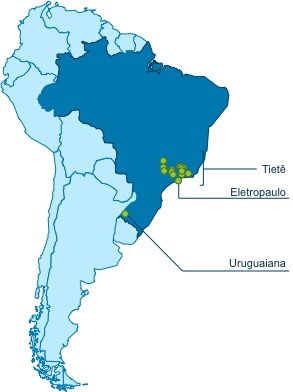
Brazil Businesses
Brazil Utility
Business Description — Eletropaulo distributes electricity to the greater São Paulo area, Brazil's main economic and financial center. AES owns 17% of the economic interest in Eletropaulo, our partner, BNDES, owns 19% and the remaining shares are publicly held or held by government-related entities. On December 30, 2016 AES purchased par shares from BNDES and increased its participation in Eletropaulo from 16% to 17%. AES is the controlling shareholder and manages and consolidates this business. Eletropaulo holds a 30-year concession that expires in 2028. In December 2016, Eletropaulo underwent a corporate restructuring which is expected to, among other things, prepare for the listing of its shares on the Novo Mercado, a segment of the Brazilian stock exchange.
Regulatory Framework — In Brazil, ANEEL, a government agency, sets the tariff for each distribution company based on a return on asset base methodology, which also benchmarks operational costs against other distribution companies. The tariff charged to regulated customers consists of two elements: (i) pass-through of non-manageable costs under a determined methodology ("Parcel A"), including energy purchase costs, sector charges and transmission and distribution system expenses; and (ii) a manageable cost component ("Parcel B"), including operation and maintenance costs (defined by ANEEL), recovery of investments and a component for a return to the distributor. The return to distributors is calculated as the net asset base multiplied by the regulatory weighted-average cost of capital, which is set for all industry participants during each tariff reset cycle. The current regulatory weighted-average cost of capital for Eletropaulo, after tax, is 8.1%.
Each year ANEEL reviews each distributor's tariff for an annual tariff adjustment. The annual tariff adjustments allow for pass-through of Parcel A costs and inflation impacts on Parcel B costs, adjusted for expected efficiency gains and quality performances. Distribution companies are required to contract between 100% and 105% of anticipated energy needs through the regulated auction market. If contracted levels fall below required levels distribution companies may be subject to limitations on the pass-through treatment of energy purchase costs as well as penalties. As the costs incurred on energy purchases made by our distribution company are passed through
to customers with adjustments on a yearly basis, working capital can be sensitive to significant increases in energy prices. In order to reduce potential working capital needs, in 2015 ANEEL established the tariff flag mechanism, which allows temporary tariff changes to customers on a monthly basis depending on energy purchase prices. The resources collected by the tariff flag mechanism are centralized in an account and shared among distribution companies in proportion to their respective exposure to the spot market.
Every four years, ANEEL resets each distributor's tariff to incorporate the revised regulatory weighted-average cost of capital and determination of the distributor's net asset base as well as operational costs. Eletropaulo's tariff reset occurs every four years and the next tariff reset will be in July 2019. The 4th Tariff Reset for AES Eletropaulo occurred on July 4, 2015, representing an average tariff increase of 15.23%.
Between the tariff reset periods, the regulator applies the annual adjustments. On July 4, 2016 ANEEL approved a negative tariff adjustment for Eletropaulo, mainly due to a decrease in energy purchase and sector charges costs. The average tariff decrease was 8.1%.
In 2013, ANEEL challenged the parameters of a tariff reset for Eletropaulo implemented in July 2012 and retroactive to 2011. ANEEL asserted that during the period between 2007 and 2011, certain assets that were included in the regulatory asset base should not have been included and that Eletropaulo should refund customers for the return on the disputed assets earned during this period. On December 17, 2013, ANEEL determined, at the administrative level, that Eletropaulo should adjust the prior 2007-2011 regulatory asset base and refund customers in the amount of $269 million over a period of up to four tariff processes beginning in July 2014. The Company recognized a regulatory liability of approximately $269 million in 2013, since ANEEL had compelled the Company to refund customers, and started reimbursing customers in July 2014. Eletropaulo filed for an administrative appeal requesting ANEEL to reconsider its decision and requested that the decision be suspended until the appeal process is completed. The injunction was granted and, although for a period was suspended, it has been restored and in effect since December 2014.
Given ANEEL's failure to suspend the injunction through the appeals process in the Brazilian courts thus far, the tariff reset resulted in management's reassessment of the probability of refunding customers these disputed amounts. Therefore, at this point, the Company considers it only reasonably possible that Eletropaulo will be required to refund these amounts to customers prior to the ultimate resolution of the pending court case. As a result, during 2015, the Company reversed the remaining regulatory liability for this contingency of $161 million. Eletropaulo believes it has meritorious arguments on this matter and will continue to pursue its objections to ANEEL's rulings vigorously, however there can be no assurance that Eletropaulo will prevail.
Key Financial Drivers — Eletropaulo's financial results is likely to be driven by many factors including, but not limited to:
| • | Hydrology, impacting quantity of energy sold and energy purchased |
| • | Brazilian economic scenario and tariff increases, impacting energy consumption growth, losses and delinquency |
| • | Quality indicators recovery plan |
| • | Ability of Eletropaulo to pass through costs via productivity gains |
| • | Ability of Eletropaulo to solve involuntary exposure |
| • | Capital structure optimization to reduce leverage and interest costs |
| • | The CTEEP Eletrobrás case (see Item 3.—Legal Proceedings for further information) |
Eletropaulo is affected by the demand for electricity, which is driven by economic activity, weather patterns and customers' consumption behavior. Operating performance is also driven by the quality of service, efficient management of operating and maintenance costs as well as the ability to control non-technical losses. Finally, annual tariff adjustments and periodic tariff resets by ANEEL impact results from operations.
Brazil Generation
Business Description — Tietê has a portfolio of 12 hydroelectric power plants with total installed capacity of 2,658 MW in the state of São Paulo. Tietê was privatized in 1999 under a 30-year concession expiring in 2029. AES owns a 24% economic interest in Tietê, our partner, the BNDES, owns 28% and the remaining shares are publicly held or held by government-related entities. AES is the controlling shareholder and manages and consolidates this business.
Tietê sold nearly 100% of its physical guarantee, approximately 11,194 GWh, to Eletropaulo under a long-term PPA, which expired in December 2015. The contract was price-adjusted annually for inflation, and as of December
31, 2015, the price was R$218/MWh. After the expiration of contract with Eletropaulo, Tietê's strategy is to contract most of its physical guarantee, as described in Regulatory Framework section below, and sell the remaining portion in the spot market. Tietê's strategy is reassessed from time to time according to changes in market conditions, hydrology and other factors. Tietê has been continuously selling its available energy from 2016 forward through medium-term bilateral contracts of three to five years.
As of December 31, 2016, Tietê's contracted portfolio position is 95% and 88% with average prices of R$157/MWh and R$159/MWh (inflation adjusted until December 2016) for 2016 and 2017, respectively. As Brazil is mostly a hydro-based country with energy prices highly tied to the hydrological situation, the deterioration of the hydrology since the beginning of 2014 caused an increase in energy prices going forward. Tietê is closely monitoring and analyzing system supply conditions to support energy commercialization decisions.
Under the concession agreement, Tietê has an obligation to increase its capacity by 15%. Tietê, as well as other concession generators, have not yet met this requirement due to regulatory, environmental, hydrological and fuel constraints. The state of São Paulo does not have a sufficient potential for wind power and only has a small remaining potential for hydro projects. As such, the capacity increases in the state will mostly be derived from thermal gas capacity projects. Due to the highly complex process to obtain an environmental license for coal projects, Tietê decided to fulfill its obligation with gas-fired projects in line with the federal government plans. Petrobras refuses to supply natural gas and to offer capacity in its pipelines and regasification terminals. Therefore, there are no regulations for natural gas swaps in place, and it is unfeasible to bring natural gas to AES Tietê. A legal case has been initiated by the state of São Paulo requiring the investment to be performed. Tietê is in the process of analyzing options to meet the obligation.
Uruguaiana is a 640 MW gas-fired combined cycle power plant located in the town of Uruguaiana in the state of Rio Grande do Sul, commissioned in December 2000. AES manages and has a 46% economic interest in the plant with the remaining interest held by BNDES. The plant's operations were suspended in April 2009 due to the unavailability of gas. AES has evaluated several alternatives to bring gas supply on a competitive basis to Uruguaiana. One of the challenges is the capacity restrictions on the Argentinean pipeline, especially during the winter season when gas demand in Argentina is very high. The plant operated on a short-term basis during February and March 2013, March through May 2014, and February through May 2015 due to the short-term supply of LNG for the facility. The plant did not operate in 2016. Uruguaiana continues to work toward securing gas on a long-term basis.
Market Structure — Brazil has installed capacity of 150,136 MW, which is 65% hydroelectric, 19% thermal and 16% renewable (biomass and wind). Brazil's national grid is divided into four subsystems. Tietê is in the Southeast and Uruguaiana is in the South subsystems of the national grid.
Regulatory Framework — In Brazil, the Ministry of Mines and Energy determines the maximum amount of energy that a plant can sell, called physical guarantee, which represents the long-term average expected energy production of the plant. Under current rules, physical guarantee can be sold to distribution companies through long-term regulated auctions or under unregulated bilateral contracts with large consumers or energy trading companies.
The National System Operator ("ONS") is responsible for coordinating and controlling the operation of the national grid. The ONS dispatches generators based on hydrological conditions, reservoir levels, electricity demand and the prices of fuel and thermal generation. Given the importance of hydro generation in the country, the ONS sometimes reduces dispatch of hydro facilities and increases dispatch of thermal facilities to protect reservoir levels in the system.
In Brazil, the system operator controls all hydroelectric generation dispatch and reservoir levels. A mechanism known as the Energy Reallocation Mechanism ("MRE") was created to share hydrological risk across MRE hydro generators. If the hydro plants generate less than the total MRE physical guarantee, the hydro generators may need to purchase energy in the short-term market to fulfill their contract obligations. When total hydro generation is higher than the total MRE physical guarantee, the surplus is proportionally shared among its participants and they are able to make extra revenue selling the excess energy on the spot market. The consequences of unfavorable hydrology are (i) thermal plants more expensive to the system being dispatched, (ii) lower hydropower generation with deficits in the MRE and (iii) high spot prices. ANEEL defines the spot price cap for electricity in the Brazilian market. The spot price caps as defined by ANEEL and average spot prices by calendar year are as follows (R$/MWh):
| Year | 2017 | 2016 | 2015 | 2014 | ||||
| Spot price cap as defined by ANEEL | 534 | 423 | 388 | 822 | ||||
| Average spot rate | 94 | 287 | 689 |
Key Financial Drivers — As the system is highly dependent on hydroelectric generation, Tietê and Uruguaiana are are affected by the hydrology in the overall sector. They are also affected by the availability of Tietê's plants and reliability of the Uruguaiana facility. The availability of gas is also a driver for continued operations at Uruguaiana. Tietê's financial results are likely to be driven by many factors including, but not limited to:
| • | Hydrology, impacting quantity of energy generated in MRE |
| • | Demand growth |
| • | Re-contracting price |
| • | Asset management and plant availability |
| • | Cost management |
| • | Ability to execute on its growth strategy |
MCAC SBU
Our MCAC SBU has a portfolio of distribution businesses and generation facilities, including renewable energy, in five countries, with a total capacity of 3,239 MW and distribution networks serving 1.4 million customers as of December 31, 2016.
Generation — The following table lists our MCAC SBU generation facilities:
| Business | Location | Fuel | Gross MW | AES Equity Interest | Year Acquired or Began Operation | Contract Expiration Date | Customer(s) | |||||||||
| Andres | Dominican Republic | Gas | 319 | 90 | % | 2003 | 2018 | Ede Este/Non-Regulated Users/Linea Clave | ||||||||
| Itabo (1) | Dominican Republic | Coal/Gas | 295 | 45 | % | 2000 | 2017 | Ede Este/Ede Sur/Ede Norte | ||||||||
| DPP (Los Mina) | Dominican Republic | Gas | 236 | 90 | % | 1996 | 2022 | CDEEE | ||||||||
| Dominican Republic Subtotal | 850 | |||||||||||||||
| AES Nejapa | El Salvador | Landfill Gas | 6 | 100 | % | 2011 | 2035 | CAESS | ||||||||
| Moncagua | El Salvador | Solar | 3 | 100 | % | 2015 | 2035 | EEO | ||||||||
| El Salvador Subtotal | 9 | |||||||||||||||
| Merida III | Mexico | Gas | 505 | 55 | % | 2000 | 2025 | Comision Federal de Electricidad | ||||||||
| Termoelectrica del Golfo (TEG) | Mexico | Pet Coke | 275 | 99 | % | 2007 | 2027 | CEMEX | ||||||||
| Termoelectrica del Penoles (TEP) | Mexico | Pet Coke | 275 | 99 | % | 2007 | 2027 | Penoles | ||||||||
| Mexico Subtotal | 1,055 | |||||||||||||||
| Bayano | Panama | Hydro | 260 | 49 | % | 1999 | 2030 | Electra Noreste/Edemet/Edechi/Other | ||||||||
| Changuinola | Panama | Hydro | 223 | 90 | % | 2011 | 2030 | AES Panama | ||||||||
| Chiriqui-Esti | Panama | Hydro | 120 | 49 | % | 2003 | 2030 | Electra Noreste/Edemet/Edechi/Other | ||||||||
| Estrella de Mar I | Panama | Heavy Fuel Oil | 72 | 49 | % | 2015 | 2020 | Electra Noreste/Edemet/Edechi/Other | ||||||||
| Chiriqui-Los Valles | Panama | Hydro | 54 | 49 | % | 1999 | 2030 | Electra Noreste/Edemet/Edechi/Other | ||||||||
| Chiriqui-La Estrella | Panama | Hydro | 48 | 49 | % | 1999 | 2030 | Electra Noreste/Edemet/Edechi/Other | ||||||||
| Panama Subtotal | 777 | |||||||||||||||
| Puerto Rico | US-PR | Coal | 524 | 100 | % | 2002 | 2027 | Puerto Rico Electric Power Authority | ||||||||
| Illumina | US-PR | Solar | 24 | 100 | % | 2012 | 2032 | Puerto Rico Electric Power Authority | ||||||||
| Puerto Rico Subtotal | 548 | |||||||||||||||
| 3,239 |
| (1) | Itabo plants: Itabo complex (two coal-fired steam turbines and one gas-fired steam turbine). |
Under construction — The following table lists our plants under construction in the MCAC SBU:
| Business | Location | Fuel | Gross MW | AES Equity Interest | Expected Date of Commercial Operations | |||||||
| DPP (Los Mina) Conversion | Dominican Republic | Gas | 122 | 90 | % | 1H 2017 | ||||||
| Dominican ES | Dominican Republic | Energy Storage | 20 | 90 | % | 1H 2017 | ||||||
| Dominican Republic Subtotal | 142 | |||||||||||
| Colón | Panama | Gas | 380 | 50 | % | 1H 2018 | ||||||
| Panama Subtotal | 380 | |||||||||||
| 522 |
Utilities — Our distribution businesses are located in El Salvador and distribute power to 1.4 million people in the country. These businesses consist of four companies, each of which operates in defined service areas. The following table lists our MCAC utilities:
| Business | Location | Approximate Number of Customers Served as of 12/31/2016 | GWh Sold in 2016 | AES Equity Interest | Year Acquired or Began Operation | ||||||||
| CAESS | El Salvador | 590,971 | 2,232 | 75 | % | 2000 | |||||||
| CLESA | El Salvador | 388,341 | 894 | 80 | % | 1998 | |||||||
| DEUSEM | El Salvador | 78,063 | 133 | 74 | % | 2000 | |||||||
| EEO | El Salvador | 298,026 | 576 | 89 | % | 2000 | |||||||
| 1,355,401 | 3,835 |
The following map illustrates the location of our MCAC facilities:
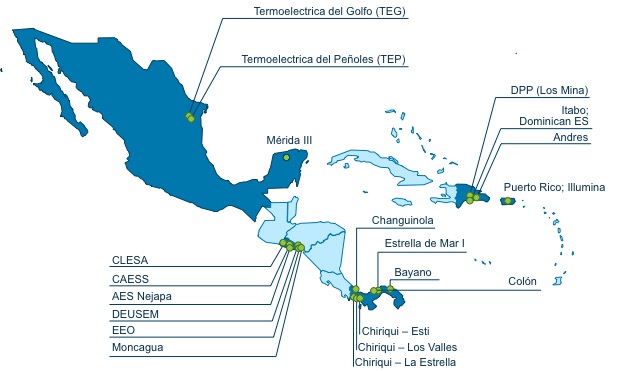
MCAC Businesses
MCAC Utilities
El Salvador
Business Description — AES is the majority owner of four of the five distribution companies operating in El Salvador. The distribution companies are operated by AES on an integrated basis under a single management team. AES El Salvador's territory covers 77% of the country. AES El Salvador accounted for 4,151 GWh of market energy purchases during 2016, or about 63% market share of the country's total energy purchases.
MCAC Generation
Dominican Republic
Business Description — AES Dominicana consists of three operating subsidiaries, Itabo, Andres and DPP. AES has 24% of the system capacity of 850 MW and supplies approximately 37% of energy demand through these generation facilities. AES has a strategic partnership with the Estrella and Linda Groups ("Estrella-Linda"), an investor group based in the Dominican Republic. Estrella-Linda is a consortium of two leading Dominican industrial groups: Estrella and Grupo Linda. The two partners manage a diversified business portfolio, including construction services, cement, agribusiness, metalwork, plastics, textiles, paints, transportation, insurance and media.
Itabo is 45% owned by AES, 5% by Estrella-Linda, 49.97% owned by FONPER, a government-owned utility and the remaining 0.03% is owned by employees. Itabo owns and operates two thermal power generation units with a total of 295 MW of installed capacity. Itabo's PPAs with government-owned distribution companies expired in July 2016 and thus two new short term contracts with Ede Sur and Ede Este were signed until new long term contracts take place. The Dominican Corporation of State Electrical Companies is sponsoring a bidding process, released in
August 2016, which is expected to be awarded in April 2017 in order to secure supply and competitive pricing for actual and future distribution energy requirements. The existing business strategy is to secure between 80% and 85% of the open position through new PPAs with distribution companies and large users. Price and PPA structure will be subject to the terms of the bidding process.
Andres and DPP are owned 90% by AES and 10% by Estrella-Linda. Andres has a combined cycle gas turbine and generation capacity of 319 MW as well as the only LNG import facility in the country, with 160,000 cubic meters of storage capacity. DPP (Los Mina) has two open cycle natural gas turbines and generation capacity of 236 MW. Both Andres and DPP have in aggregate 555 MW of installed capacity, of which 450 MW is mostly contracted until 2018 with government-owned distribution companies and large customers.
AES Dominicana has a long-term LNG purchase contract through 2023 for 33.6 trillion btu/year with a price linked to NYMEX Henry Hub. The LNG contract terms allow the diversion of the cargoes to various markets in Latin America. These plants capitalize on the competitively-priced LNG contract by selling power where the market is dominated by fuel oil-based generation. Andres has a long-term contract to sell re-gasified LNG to industrial users within the Dominican Republic using compression technology to transport it within the country thereby capturing demand from industrial and commercial customers.
Market Structure - Electricity and Natural Gas — The Dominican Republic has one main interconnected system with approximately 3,553 MW of installed capacity, composed primarily of thermal generation (80%), hydroelectric power plants (17%) and wind plants (3%).
Regulatory Framework — The regulatory framework in the Dominican Republic consists of a decentralized industry including generation, transmission and distribution, where generation companies can earn revenue through short- and long-term PPAs, ancillary services and a competitive wholesale generation market. All electric companies (generators, transmission and distributors), are subject to and regulated by the General Electricity Law.
Two main agencies are responsible for monitoring and ensuring compliance with the General Electricity Law, the National Energy Commission and the Superintendence of Electricity. The National Energy Commission is in charge of drafting and coordinating the legal framework and regulatory legislation, proposing and adopting policies and procedures to assure best practices, drafting plans to ensure the proper functioning and development of the energy sector and promoting investment. The Superintendence of Electricity's main responsibilities include monitoring and supervising compliance with legal provisions and rules, monitoring compliance with the technical procedures governing generation, transmission, distribution and commercialization of electricity and supervising electric market behavior in order to avoid monopolistic practices.
The electricity tariff applicable to regulated customers is subject to regulation within the concessions of the distribution companies. Clients with demand above 1 MW are classified as unregulated customers and their tariffs are unregulated.
Fuels and hydrocarbons are regulated by a specific law which establishes prices to end customers and a tax on consumption of fossil fuels. For natural gas there are regulations related to the procedures to be followed to grant licenses and concessions: i) distribution, including loading, transportation and compression plants; ii) the installation and operation of natural gas stations, including consumers and potential modifications of existing facilities; and iii) conversion equipment suppliers for vehicles. The regulation is administered by the Industrial and Commerce Ministry who supervises commercial and industrial activities in the Dominican Republic as well as the fuels and natural gas commercialization to the end users.
Key Financial Drivers — Financial results are likely to be driven by many factors including, but not limited to:
| • | Changes in spot prices due to fluctuations in commodity prices, (since fuel is a pass-through cost under the PPAs, any variation in oil prices will impact the spot sales for both Andres and Itabo) |
| • | Contracting levels and the extent of capacity awarded |
| • | Supply shortages in the near term (next two to three years) may provide opportunities for short term upside, but new generation is expected to come online beginning 2018 |
| • | Additional sales derived from domestic natural gas demand are expected to continue providing income and growth based on the entry of future projects and the fees from the infrastructure service. |
In addition, the financial weakness of the three state-owned distribution companies due to low collection rates and high levels of non-technical losses has led to delays in payments for the electricity supplied by generators. At times when outstanding receivable balances have accumulated, AES Dominicana has accepted payment through other means, such as government bonds, in order to reduce the balance. There can be no guarantee that alternative collection methodologies will always be an avenue available for payment options.
Construction and Development — DPP is converting its existing plant from open cycle to combined cycle. The project will recycle DPP's heat emissions and increase total power output by approximately 114 MW of gross capacity at an estimated cost of $260 million, fully financed with non-recourse debt. The EPC contract was signed on July 2, 2014, and the additional capacity is expected to become operational in the first half of 2017. Based on the increased capacity, AES Dominicana executed a PPA for 270 MW for a 6.5 year term beginning in 2017.
Panama
Business Description — AES owns and operates five hydroelectric plants and one thermoelectric power plant, Estrella del Mar I, which commenced operations in March 2015, representing 705 MW and 72 MW of hydro and thermal capacity respectively, for a total of 777 MW equivalent to 23% of the installed capacity in Panama. The majority of hydro sources in Panama are based on run-of-river technology, with the exception of the 260 MW Bayano plant.
A portion of the PPAs with distribution companies will expire in December 2018 reducing the total contracted capacity of the company from 496 MW to 430 MW. Another portion contracted through Estrella del Mar I will expire in June 2020, reducing the total contracted capacity to 350 MW until December 2030.
Market Structure — Panama's current total installed capacity is 3,350 MW, of which 52% is hydroelectric, 8% wind, 2% solar and the remaining 38% thermal generation from diesel, bunker fuel and coal.
The Panamanian power sector is composed of three distinct operating business units: generation, distribution and transmission, all of which are governed by Electric Law 6 enacted in 1997.
Generators can enter into long-term PPAs with distributors or unregulated consumers. In addition, generators can enter into alternative supply contracts with each other. Outside of the PPA market, generators may buy and sell energy in the short-term market.
The National Dispatch Center implements the economic dispatch of electricity in the wholesale market. The National Dispatch Center's objectives are to minimize the total cost of generation and maintain the reliability and security of the electric power system, taking into account the price of water, which determines the dispatch of hydro plants with reservoirs. Short-term power prices are determined on an hourly basis by the last dispatched generating unit.
In Panama, dry hydrological conditions remained until June 2016, due to the presence of the El Niño phenomenon, affecting the generation output from hydroelectric facilities compared to the prior year. AES Panama had to purchase energy on the spot market to fulfill its contract obligations as its generation output was below contract levels. The drop in the commodities prices helped to reduce the replacement cost and the financial impact of spot purchases compared to the prior year. Despite the hydrology conditions, spot prices were down to $60/MWh from $91/MWh in 2015, limiting the amount recognized through the 2014-2016 Government Compensation Agreement to $1 million out of the possible $30 million for 2016. On March 31, 2014, the government of Panama agreed to reduce the financial impact of spot electricity purchases and transmission constraints equivalent to a 70 MW reduction in contracted capacity for the period 2014-2016 by compensating AES Panama for spot purchases above the contracted price of $82.45/MWh, up to $40 million in 2014, $30 million in 2015 and $30 million in 2016.
Regulatory Framework — The SNE has the responsibilities of planning, supervising and controlling policies of the energy sector within Panama. With these responsibilities, the SNE proposes laws and regulations to the executive agencies that promote the procurement of electrical energy, hydrocarbons and alternative energy for the country.
The regulator of public services, known as the ASEP, is an autonomous agency of the government. ASEP is responsible for the control and oversight of public services including electricity and the transmission and distribution of natural gas utilities and the companies that provide such services.
Generators can only contract up to their firm capacity. Physical generation of energy is determined by the National Dispatch Center regardless of contractual arrangements.
Key Financial Drivers — Financial results are likely to be driven by many factors including, but not limited to:
| • | In the event of low hydrology, high commodity prices will increase the business exposure and the cost of replacement power to fulfill our contractual commitments, partially mitigated by additional generation from Estrella del Mar I. |
| • | Fluctuations in commodity prices, mainly oil prices, affect the thermal generation cost impacting the spot prices and the opportunity cost of water. |
| • | Constraints imposed by the capacity of the transmission line connecting the west side of the country with the load center are expected to continue until the end of 2017 keeping surplus power trapped, particularly during the wet season. |
| • | Country demand as GDP growth is expected to remain strong over the short and medium term. |
Given that most of AES' portfolio is run-of-river, hydrological conditions have an important influence on its profitability. Variations in actual hydrology can result in excess or a short energy balance relative to our contract obligations. During the low inflow period of January through May, generation tends to be lower and AES Panama may purchase energy in the short-term market to cover contractual obligations. During the remainder of the year (June to December), generation tends to be higher and energy generated in excess of contract volumes is sold to the short-term market. In addition to hydrological conditions, commodity prices affect short-term electricity prices.
Construction and Development — Continuing with the strategy to reduce reliance on hydrology started with the acquisition of the power barge, Estrella del Mar I, in August 2015 AES executed a partnership agreement with Deeplight Corporation, a minority partner, with the purpose to construct, operate and maintain a natural gas power generation plant and a liquefied natural gas terminal, in order to purchase and sell energy and capacity as well as commercialize natural gas and other ancillary activities related to natural gas. As of December 31, 2016, amounts capitalized include $254 million recorded in Construction in Progress and the project is scheduled to initiate operations in the first half of 2018.
Mexico
Business Description — AES has 1,055 MW of installed capacity in Mexico, including the 550 MW Termoeléctrica del Golfo ("TEG") and Termoeléctrica Peñoles ("TEP") facilities and Merida III ("Merida"), a 505 MW generation facility.
The TEG and TEP pet coke-fired plants, located in San Luis Potosi, supply power to their offtakers under long-term PPAs expiring in 2027 with a 90% availability guarantee. TEG and TEP secure their fuel under a long-term contract.
Merida is a CCGT, located in Merida, on Mexico's Yucatan Peninsula. Merida sells power to the Federal Commission of Electricity ("CFE") under a capacity and energy based long-term PPA through 2025. Additionally, the plant purchases natural gas and diesel fuel under a long-term contract, the cost of which is then passed through to CFE under the terms of the PPA.
In line with AES' strategy of building strategic partnerships, on January 18, 2016 the 50/50 joint venture partnership agreement with Grupo BAL was fully executed. The joint venture will co-invest in power and related infrastructure projects in Mexico.
Market Structure — Mexico has a single national electricity grid, the National Power System, covering nearly all of Mexico's territory. Mexico has an installed capacity totaling 68 GW with a generation mix of 72% thermal, 18% hydroelectric and 10% other. Electricity consumption is split between the following end users: industrial of 58%, residential of 26% and commercial and service of 16%.
Regulatory Framework — Following the constitutional changes approved in December 2013, during 2014 and 2015 the Mexican government issued a package of secondary regulations, including the Electricity Law, and operational dispositions, with the objective to start the implementation of a new regulatory framework with the following characteristics:
| • | The energy market liberalization in January 2016 through the implementation of: wholesale electricity market (day ahead and real time market), ancillary services, capacity, Clean Energy Certificates, and Financial Transmission Rights market. |
| • | CFE's, former state-owned electric monopoly, vertical and horizontal disintegration into different segments of the value chain: generation, transmission, distribution and commercialization. |
| • | CENACE as new ISO is responsible for managing the wholesale electricity market, transmission and distribution infrastructure, planning the network developments, guaranteeing open access to network infrastructure, executing competitive mechanisms to cover regulated demand, and setting transmission charges. |
| • | Implementation of annual mid and long term auctions to secure supply for the regulated demand, establishing a PPA with CFE as the Basic Supplier. |
According to the new regulatory framework, new assets developed under the new framework or assets transferred to the new regime and in operation after the approval of the Electricity Law (August 2014) are eligible to participate in the new markets. Additionally, projects developed and operated under the Electric Public Service Law
(self-supply framework) like TEG/TEP, could choose to participate. Until the new framework is further analyzed, AES will continue operating under the same conditions. Merida III and TEG/TEP will continue providing power under long-term contracts and selling any excess or surplus energy produced to CFE.
Key Financial Drivers — Financial results are likely to be driven by many factors including, but not limited to:
| • | Operational performance (as the companies are fully contracted and better performance provides additional financial benefits including performance incentives and/or excess energy sales (in the case of TEG/TEP). |
| • | The energy prices of TEG/TEP for the sales in excess over its long-term contracts are driven by the average production cost of CFE which is highly dependent on natural gas and oil. |
| • | If the average production cost of CFE is higher than the cost of generating with pet coke, our businesses in Mexico will benefit provided that they are able to sell energy in excess of their PPAs. |
Puerto Rico
Business Description — AES Puerto Rico owns and operates a coal-fired cogeneration plant and a solar plant of 524 MW and 24 MW, respectively, representing approximately 9% of the installed capacity in Puerto Rico. Both plants have long-term PPAs expiring in 2027 and 2032, respectively, with PREPA, a state-owned entity that supplies virtually all of the electric power consumed in Puerto Rico and generates, transmits and distributes electricity to 1.5 million customers. See Item 7.—Key Trends and Uncertainties—Macroeconomic and Political—Puerto Rico for further discussion of the long-term PPA with PREPA.
El Salvador
Business Description — AES El Salvador also owns AES Nejapa, a 6 MW power plant generating electricity with methane gas from a landfill, fully contracted with CAESS. During 2015, AES El Salvador began operations of a AES Moncagua, a 2.5 MW solar facility located in the East of the country, which is fully contracted with EEO.
The sector is governed by the General Electricity Law and the general and specific orders are issued by Superintendencia General de Electricidad y Telecomunicacions ("SIGET"). SIGET, jointly with the distribution companies in El Salvador, completed the tariff reset process in December 2012 and defined the tariff calculation to be applicable for the five year period 2013-2017.
Europe SBU
Generation — Our Europe SBU has generation facilities in five countries. Operating installed capacity of our Europe SBU totaled 6,619 MW. The following table lists our Europe SBU generation facilities:
| Business | Location | Fuel | Gross MW | AES Equity Interest | Year Acquired or Began Operation | Contract Expiration Date | Customer(s) | |||||||||
| Maritza | Bulgaria | Coal | 690 | 100 | % | 2011 | 2026 | Natsionalna Elektricheska | ||||||||
| St. Nikola | Bulgaria | Wind | 156 | 89 | % | 2010 | 2025 | Natsionalna Elektricheska | ||||||||
| Bulgaria Subtotal | 846 | |||||||||||||||
| Amman East | Jordan | Gas | 381 | 37 | % | 2009 | 2033-2034 | National Electric Power Company | ||||||||
| IPP4 | Jordan | Heavy Fuel Oil/Gas | 250 | 36 | % | 2014 | 2039 | National Electric Power Company | ||||||||
| Jordan Subtotal | 631 | |||||||||||||||
| Ust-Kamenogorsk CHP | Kazakhstan | Coal | 1,398 | 100 | % | 1997 | Short-term | Various | ||||||||
| Shulbinsk HPP (1) | Kazakhstan | Hydro | 702 | — | % | 1997 | 2020 | Titanium Magnesium Kombiant | ||||||||
| Sogrinsk CHP | Kazakhstan | Coal | 345 | 100 | % | 1997 | Short-term | Various | ||||||||
| Ust-Kamenogorsk HPP (1) | Kazakhstan | Hydro | 331 | — | % | 1997 | 2020 | Titanium Magnesium Kombiant | ||||||||
| Kazakhstan Subtotal | 2,776 | |||||||||||||||
| Elsta (2) | Netherlands | Gas | 630 | 50 | % | 1998 | 2018 | Dow Benelux/Delta/Nutsbedrijven/Essent Energy | ||||||||
| Netherlands ES | Netherlands | Energy Storage | 10 | 100 | % | 2015 | ||||||||||
| Netherlands Subtotal | 640 | |||||||||||||||
| Ballylumford | United Kingdom | Gas | 1,015 | 100 | % | 2010 | 2023 | Power NI/Single Electricity Market (SEM) | ||||||||
| Kilroot (3) | United Kingdom | Coal/Oil | 701 | 99 | % | 1992 | SEM | |||||||||
| Kilroot ES | United Kingdom | Energy Storage | 10 | 100 | % | 2015 | ||||||||||
| United Kingdom Subtotal | 1,726 | |||||||||||||||
| 6,619 |
| (1) | AES operates these facilities under concession agreements until 2017. |
| (2) | Unconsolidated entity, the results of operations of which are reflected in Equity in Earnings of Affiliates. |
| (3) | Includes Kilroot Open Cycle Gas Turbine ("OCGT"). |
The following map illustrates the location of our Europe facilities:
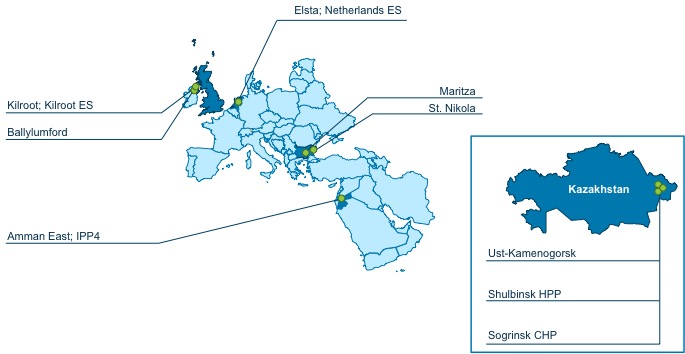
Europe Businesses
Bulgaria
Business Description — Our Maritza plant is a 690 MW lignite fuel plant that was commissioned in June 2011. Maritza is fully compliant with the European Union Industrial Emission Directive, which became effective in January 2016. Maritza's entire power output is contracted with NEK under a 15-year PPA, capacity and energy based, with a fuel pass-though, expiring in 2026. The lignite and limestone are supplied under 15-year fuel supply contracts.
AES also owns an 89% economic interest in the St. Nikola wind farm with 156 MW of installed capacity. St. Nikola was commissioned in March 2010. Its entire power output is contracted with NEK under a 15-year PPA expiring in March 2025.
Market Structure — The maximum market capacity in 2016 was approximately 13 GW. Thermal generation, which is mostly coal-fired, and nuclear power plants account for 61% of the installed capacity.
Regulatory Framework — The electricity sector in Bulgaria operates under the Energy Act of 2004 which allows the sale of electricity to take place freely at negotiated prices, at regulated prices between parties or on the organized market. In 2016 the government of Bulgaria made advances toward market liberalization and has engaged with the World Bank to develop a model for a fully liberalized electricity market in Bulgaria. The final report with recommendations from the World Bank was finalized in December 2016. The Independent Bulgarian Energy Exchange (IBEX) started commercial operation of the power exchange in January 2016 with the introduction of Day Ahead market platform. In September 2016, IBEX expanded its trading platform for bilateral forward contracts. The next step of the development of IBEX is the introduction of intra-day trading, which is expected in mid-2017.
Our investments in Bulgaria rely on long-term PPAs with NEK, the state-owned electricity public supplier and energy trading company. NEK had been facing some liquidity issues and had been delayed in making payments under the PPAs with Maritza and St. Nikola. In August 2015, the ninth amendment of Maritza's PPA was executed, under which Maritza and NEK agreed to reduce the capacity payment to Maritza by 14% through the PPA term without impacting the energy price component. In exchange, NEK paid Maritza its overdue receivables. The amendment became effective in April 2016 upon full payment of the overdue receivables by NEK. Maritza has experienced timely collection of outstanding receivables from NEK since May 2016.
The Directorate-General for Competition of the European Commission (“DG Comp”) continues to review NEK’s respective PPAs with Maritza and an unrelated generator pursuant to the European Commission’s state aid rules. Although no formal investigation has been launched by DG Comp, Maritza has met with the DG Comp case team and representatives of Bulgaria to discuss the agency’s review. Maritza expects that the parties will engage in
further discussions on the issues surrounding the review. At this time, we cannot predict the outcome of such discussions, nor can we predict how DG Comp might resolve its review if the anticipated discussions fail to result in an agreement concerning the review. Maritza believes that its PPA is legal and in compliance with all applicable laws, and it will take all actions necessary to protect its interests, whether through negotiated agreement or otherwise. However, there can be no assurances that this matter will be resolved favorably; if it is not, there could be a material adverse impact on Maritza’s and the Company’s respective financial statements.
In 2015, a number of measures were introduced to the regulation of the energy sector that significantly improved the liquidity of NEK. As a result, NEK is forecast to end the year 2016 with a $7 million net profit, more than a $102 million improvement over year 2015 and more than a $316 million improvement over year 2014. However, the financial situation of NEK remains subject to political conditions and regulatory changes in Bulgaria.
Key Financial Drivers — Both businesses, Maritza and St. Nikola, operate under PPA contracts. For the duration of the PPA, the financial results are primarily driven by, but not limited to:
| • | the availability of the operating units |
| • | the level of wind resource for St. Nikola |
| • | NEK's ability to meet the terms of the PPA contract |
United Kingdom
Business Description — AES' generation businesses in the United Kingdom are located in Northern Ireland and operate in the Irish SEM (1,726 MW). The Northern Ireland generation facilities consist of two plants within the Greater Belfast region. Our Kilroot plant is a 701 MW coal-fired plant with an additional 10 MW of energy storage facility and our Ballylumford plant is a 1,015 MW gas-fired plant. These plants provide approximately 62% of the Northern Ireland installed capacity and 16% of the combined installed capacity for the island of Ireland.
Kilroot is a merchant plant that bids into the SEM. the plant earns margin when scheduled in merit, out of merit, for capacity payments, and for ancillary services. Out of merit dispatch, through which costs are recovered, occurs when there are system constraints related to wind generation, voltage and transmission.
Ballylumford is partially contracted for 600 MW under a PPA with PPB that expires in 2023 with the remaining capacity bid into the SEM market. 310 MW of this merchant capacity has a supplemental Local Reserve Services Agreement ("LRSA") with the system operator. Ballylumford earns margin from availability payments received under the PPA, capacity payments offered through the SEM and revenues from the LRSA. Additionally, Ballylumford receives margin from out of merit dispatch through which the costs of operation are recovered as well as ancillary services.
Market Structure — The majority of the generation capacity in the SEM is represented by gas-fired power plants, which results in market sensitivity to gas prices. Wind generation capacity represents approximately 25% of the total generation capacity. The governments of Northern Ireland and the Republic of Ireland plan further increases in renewable energy sources. Market availability and liquidity of hedging products are weak, reflecting the limited size and immaturity of the market, the predominance of vertical integration and lack of forward pricing. There are essentially three products (baseload, mid-merit and peaking) which are traded between the generators and suppliers.
Regulatory Framework — The SEM is an energy market established in 2007 and is based on a gross mandatory pool within which all generators with a capacity higher than 10 MW must trade the physical delivery of power. Generators are centrally dispatched based on merit order and physical constraints of the system. The SEM structure is under review by the regulatory authorities with a new structure due to be introduced in the second quarter of 2018.
In addition, there is a capacity payment mechanism to ensure that sufficient generating capacity is offered to the market. The capacity payment is derived from a regulated Euro-based capacity payment pool, established a year ahead by the regulatory authority. Capacity payments are based on the declared availability of a unit and have a degree of volatility to reflect seasonal influences, demand and the actual out-turn of generation declared available over each trading period.
Environmental Regulation — In 2011, the European Commission adopted the Industrial Emission Directive ("IED") that establishes the Emission Limit Values ("ELV") for SO2, NOx and dust emissions effective January 1, 2016. Both Ballylumford and Kilroot are required to comply with the IED. The Ballylumford C Station is compliant without the need for investment. Both Ballylumford B Station and Kilroot required investment to be in compliance.
The IED provides for two options that may be implemented by the European Union member states other than compliance with the new ELV's the Transitional National Plan or Limited Life Time Derogation.
Kilroot has opted into the Transitional National Plan which allows the plant to operate between 2016-2020, being exempt from compliance with ELVs, but observing a ceiling set for maximum annual emissions that is based on the last 10 years average emissions and operating hours. Kilroot has invested approximately $10 million in Umbrella Selective Non Catalytic Reduction technology, which reduces the plant's NOx emissions enabling the plant to increase its capacity factor within the ceiling of NOx emissions and earn energy margin. The Transitional National Plan also established a UK wide NOx trading scheme which Kilroot avails of as required. Further technical modifications are being evaluated which could make the plant fully compliant with the IED from 2020.
Without investment, the Ballylumford B station of 540 MW did not meet the standards of the IED. In 2014, AES secured a LRSA with the Transmission System Operator ("TSO") to refurbish two of the three units to be compliant with ELVs under IED, providing at least 250 MW of capacity from 2016 to 2018 with an option to extend to 2020 by the TSO. The project was executed in 2015 with an achieved combined gross output of 310 MW.
Key Financial Drivers — For our businesses in the SEM market, the financial results will be driven by, but not limited to, the following:
| • | Regulatory changes to the market structure and payment mechanism |
| • | Availability of the operating units |
| • | Commodity prices (gas, coal and CO2) and sufficient market liquidity to hedge prices in the short-term |
| • | Electricity demand in the SEM (including impact of wind generation) |
Kazakhstan
Business Description — Our businesses account for approximately 6% of the total annual generation in Kazakhstan. Of the total capacity of 2,776 MW, 1,033 MW is hydroelectric and operates under a concession agreement until the beginning of October 2017 and 1,743 MW is coal-fired capacity which is owned outright. The thermal plants are designed to produce heat with electricity as a co- or by-product.
The Kazakhstan businesses act as merchant plants for electricity sales by entering into bilateral contracts directly with consumers for periods of generally no more than one year. There are limited opportunities for the plants to be in contracted status, as there is no central offtaker, and the few businesses that could take a whole plant's generation tend to have in-house generation capacity.
The hydroelectric plants are run-of-river and rely on river flow and precipitation, particularly snow. Due to the presence of a large multi-year storage dam upstream and a season minimum river flow rate agreement with Russia downstream, the plants are protected against significant downside risk to their volume in years with low precipitation. AES does not control water flow which impacts our generation.
Ust Kamenogorsk CHP provides heat to the city of Ust Kamenogorsk through the city heat network company (Ust Kamenogorsk Heat Nets). Ust Kamenogorsk CHP is their only source of supply.
Market Structure — The Kazakhstan electricity market totals approximately 21,307 MW, of which 17,504 MW is available. The bulk of the generating capacity in Kazakhstan is thermal with coal as the main fuel. As coal is abundantly available in Kazakhstan, most plants are designed to burn local coal. The geographical remoteness of Kazakhstan, in combination with its abundant resources, results in coal prices that are not reflective of world coal prices, current delivered cost is less than $12 per metric ton. In addition, the government closely monitors coal prices, due to their impact on the price of socially necessary heating and on electricity tariffs.
Regulatory Framework — All Kazakhstan generating companies sell electricity at or below their respective tariff-cap level. These tariff-cap levels have been fixed by the Kazakhstan government for the period 2009-2018 for each of the fifteen groups of generators. These groups were determined by the Ministry of Energy, based on a number of factors including plant type and fuel used.
In July 2012, Kazakhstan enacted an amendment to its Electricity Law requiring electricity producers to reinvest all profits generated during the years 2013-2015 as part of annual investment obligation agreements, thereby limiting the businesses ability to distribute dividends. These investment obligation agreements had to be equal to the sum of the planned annual depreciation and profit. Selection of investment projects was at the discretion of electricity producers, but the Ministry of Energy had the right to reject submitted proposals. An electricity producer without an investment obligation agreement executed by the Ministry of Energy was not allowed to charge tariffs exceeding its incremental cost of production, excluding depreciation.
In November 2015, Kazakhstan enacted amendments to its Electricity Law to eliminate the obligation for power plants to sign annual investment obligation agreements for 2016-2018, thereby allowing the businesses to distribute dividends. In addition, the amendment stated that a centrally organized capacity market will be established by 2019 and that the Kazakhstan government plans to prolong price cap regulation by fixing new caps on energy and capacity tariffs for each group of power plants.
Kazakhstan government has approved a renewable energy law which set feed-in tariffs for renewable energy and set a renewable energy target of 3% by 2020 and 10% by 2030. This renewable energy law imposes an obligation on all non-renewable power plants to purchase renewable energy at the renewable energy tariff and resell it to customers at their own, lower price cap level.
Heat production in Kazakhstan is also regulated as a natural monopoly. The heat tariffs are set on a cost-plus basis by making an application to the Committee of Natural Monopoly Regulation and Competition Protection, the regulator. Currently, tariffs are only for multi-year periods, but with some annual adjustments for fuel cost.
Key Financial Drivers — The financial results for assets in Kazakhstan are driven by many factors including, but not limited to:
| • | Availability of the operating units; |
| • | Regulated electricity tariff-cap levels and heat tariff levels |
| • | Weather conditions, |
| • | Regulatory changes to the market structure and payment mechanism |
| • | Cost of coal and Kazakhstan currency exchange rate fluctuation. |
Jordan
Business Description — In Jordan, AES has a 37% controlling interest in Amman East, a 381 MW oil/gas-fired plant fully contracted with the national utility under a 25-year PPA and a 36% controlling interest in the IPP4 plant in Jordan, a 250 MW oil/gas-fired peaker plant which commenced operations in July 2014, fully contracted with the national utility under a 25-year PPA. As we have controlling interest in these businesses, we consolidate the results in our operations.
Asia SBU
Generation — Our Asia SBU has generation facilities in three countries. Operating installed capacity totals 2,300 MW. The following table lists our Asia SBU generation facilities:
| Business | Location | Fuel | Gross MW | AES Equity Interest | Year Acquired or Began Operation | Contract Expiration Date | Customer(s) | |||||||||
| OPGC (1) | India | Coal | 420 | 49 | % | 1998 | 2026 | GRID Corporation Ltd. | ||||||||
| India Subtotal | 420 | |||||||||||||||
| Masinloc | Philippines | Coal | 630 | 51 | % | 2008 | Mid and long-term | Various | ||||||||
| Masinloc ES | Philippines | Energy Storage | 10 | 51 | % | 2016 | ||||||||||
| Philippines Subtotal | 640 | |||||||||||||||
| Mong Duong 2 | Vietnam | Coal | 1,240 | 51 | % | 2015 | 2040 | EVN | ||||||||
| Vietnam Subtotal | 1,240 | |||||||||||||||
| 2,300 |
| (1) | Unconsolidated entity for which the results of operations are reflected in Equity in Earnings of Affiliates. |
Under construction — The following table lists our plants under construction in the Asia SBU:
| Business | Location | Fuel | Gross MW | AES Equity Interest | Expected Date of Commercial Operations | |||||||
| OPGC II | India | Coal | 1,320 | 49 | % | 2H 2018 | ||||||
| India Subtotal | 1,320 | |||||||||||
| Masinloc 2 | Philippines | Coal | 335 | 51 | % | 1H 2019 | ||||||
| Philippines Subtotal | 335 | |||||||||||
| 1,655 |
The following map illustrates the location of our Asia facilities:
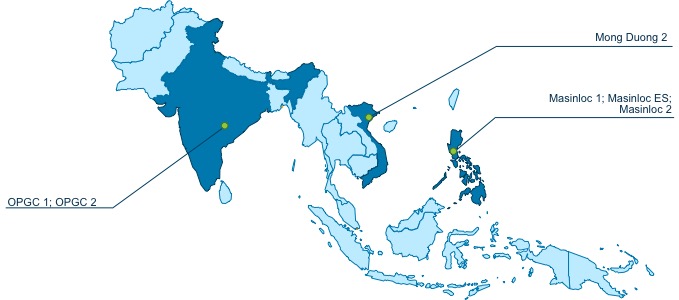
Asia Businesses
India
Business Description — OPGC is a 420 MW coal-fired generation facility located in the state of Odisha. OPGC has a 30-year PPA with GRIDCO Limited, a state utility, expiring in 2026. The PPA is composed of a capacity payment based on fixed parameters and a variable component, including a pass-through of actual fuel costs. OPGC is an unconsolidated entity and results are reported as Net Equity in Earnings of Affiliates in our Consolidated Statements of Operations.
Environmental Regulation — The Ministry of Environment, Forest and Climate Change in India has recently amended the Environment (Protection) Rules with stricter emission limits for new and existing thermal power plants via their notification issued in December 2015. All existing plants installed before December 31, 2003 are required to meet revised emission limits within two years and any new thermal power plants that will be operational from January 1, 2017 are required to operate with the revised emission limits. An FGD system needs to be installed in the existing units of OPGC for complying with SO2 emissions requirements. The business has evaluated the options and the cost implications for the operating plant including design modification and schedule implications for the expansion project. The larger impact of these amendments and requirements of substantial investments to meet the revised environmental guidelines across the power sector in India, borne by the public and private power generation companies, is still under review. We believe the cost of complying with the new environmental regulations will be a pass-through in the GRIDCO tariff for both existing and expansion units. Ministry of Power has issued a revised Tariff Policy in January 2016 to bring more regulatory certainty, attract private investment, ensure distribution efficiency and promote renewable energy.
Construction and Development — As noted above, AES has one coal-fired project under development with a total capacity of 1,320 MW which is an expansion of our existing OPGC business. The project started construction in April 2014 and is currently expected to begin operations in the second half of 2018. As of December 31, 2016, total capitalized costs at the project level were $598 million (the Company's share is $293 million as part of our investment in subsidiary). In addition, AES has capitalized $18 million in construction management costs which are not attributable to the partner. Currently, 50% of the expansion capacity is contracted with the state offtaker, GRIDCO, for a period of 25 years, with a normative after-tax rate of return of 15.5% with an opportunity to capture additional 0.5% tied to timely completion of the project. The rest of the 50% of the generation capacity is proposed to be offered to GRIDCO under a fresh regulated PPA due to restrictions on power sale under new guidelines.
In August 2014, the Supreme Court of India invalidated the allocation of captive coal blocks. The government of India has subsequently enacted new laws allowing coal block allocation to companies with limited levels of private ownership, based on which the coal blocks have been allocated to a subsidiary of OPGC, Odisha Coal and Power Ltd., which is an OPGC joint venture with another company wholly-owned by the government of Odisha. This new company meets the lower private ownership stipulations for allocation of mines.
Key Financial Drivers — Financial results are likely to be driven by many factors including, but not limited to:
| • | Operating performance of the facility |
| • | Regulatory and environmental policy changes |
Philippines
Business Description — The Masinloc power project in the Philippines is a 630 MW gross coal-fired plant located in Zambales, Philippines and is interconnected to the Luzon Grid, and is owned 51% by AES. More than 95% of Masinloc's current peak capacity is contracted through medium to long-term bilateral contracts primarily with Meralco, the largest distribution company in the Philippines, several electric cooperatives and industrial customers.
In January 2013, Masinloc entered into a new PSA with its main customer, Meralco, as the previous PSA expired in December 2012. The PSA is for seven years and included an additional three-year extension option, which the parties agreed to exercise in March 2016. Payments are primarily capacity-based. The PSA is primarily priced in U.S. dollars, aligning the revenues with the majority of variable and fixed costs (fuel, debt, insurance) and minimizing currency exchange risks. Masinloc's remaining contracts on the existing units expire between 2017 and 2026.
Market Structure — The Philippine power market is divided into three grids representing the country's three major island groups — Luzon, Visayas and Mindanao. Luzon, which includes Manila and is the country's largest island, has limited interconnection with Visayas and represents 85% of the total demand of both regions. Luzon and Visayas together have an installed capacity of 17,294 MW.
There is diversity in the mix of the Luzon — Visayas generation. For Luzon, coal accounts for 49% of generation, followed by natural gas at 32%, and the remaining 19% is comprised by oil, geothermal, and renewable resources (i.e. hydro, solar, and wind, with the latter two having priority dispatch with feed-in tariff). For Visayas, geothermal is the top energy source and accounts for 47% of generation followed by coal at 39%, and the remaining 14% comprised by oil, geothermal, and renewable resources.
The primary customers for electricity are private distribution utilities, electric cooperatives, and large contestable (industrial and commercial) customers. Over 90% of the system's total energy requirement is currently being sold/purchased through medium (three to five years) to long (six to ten years) term bilateral contracts. The remaining energy is sold through the Wholesale Electricity Spot Market ("WESM"), which is the real-time, bid-based and hourly market for energy where the sellers and the buyers adjust their differences between their production/demand and their contractual commitments.
Regulatory Framework — The Philippines has divided its power sector into generation, transmission, distribution and supply under the Electric Power Industry Reform Act of 2001. This Act primarily aims to increase private sector participation in the power sector and to privatize the Philippine government's generation and transmission assets. Generation and supply are open and competitive sectors, while transmission and distribution are regulated sectors. Sale of power is conducted primarily through medium or long-term bilateral contracts between generation companies and distribution utilities specifying the volume, price and conditions for the sale of energy and capacity, which are approved by the ERC. Power is traded in the WESM which operates under a gross pool, central dispatch and net settlement protocols. Parties to bilateral contracts settle their transactions outside of the WESM and distribution companies or electricity cooperatives buy their imbalance (i.e., power requirements not covered by bilateral contracts) from the WESM. Distribution utilities and electric cooperatives are allowed to pass on to their end-users the bilateral contract rates, including WESM purchases, approved by the ERC.
Other Regulatory Considerations — Pursuant to Electric Power Industry Reform Act of 2001, Retail Competition & Open Access ("RCOA") commenced on June 26, 2013, under which retail electricity suppliers, who are duly licensed by the ERC, may supply directly to contestable customers (end-users with an average demand of at least 1 MW), with distribution companies or electricity cooperatives providing non-discriminatory wire services. In order to ensure implementation of RCOA and stimulate transition of contestable customers, ERC issued rules implementing mandatory contestability. Under the said rules, all contestable customers are mandated to enter into power supply contracts with retail electricity suppliers by February 2017 instead of purchasing power from their local distribution utility.
Masinloc has obtained a retail electricity supplier license from the ERC and currently markets power to contestable customers. Unlike Masinloc’s contracts with distribution utilities, its contract with contestable customers do not require ERC approval to be implemented.
Environmental Regulation — To promote renewable energy, the Philippine government enacted the Renewable Energy Act of 2008 which provides incentives for the development, utilization and commercialization of
renewable energy resources such as solar, wind, small hydroelectric and biomass energies. In addition, the government also adopted a feed-in tariff scheme which was detailed under ERC Res No.16 s. 2010, where an eligible producer of renewable energy is entitled to a guaranteed payment of a fixed rate feed-in tariff for each kilowatt-hour of energy it supplies to the grid. The feed-in tariff to be approved shall be specific for each emerging renewable energy technology and shall be extended on a first-to-build basis as there is an established cap per technology on eligibility under the feed-in tariff scheme.
Other Environmental Regulation — Over the past year, the government of the Philippines has sought to reduce its environmental impact, including the country’s carbon footprint. As such, the Department of Environment and Natural Resources is promoting stricter environmental compliance, particularly on the effluent discharge standards. The new effluent standards issued in May 2016 have restricted discharge temperature limit compared to previous standards. It is yet uncertain if the new standards will be applicable to the projects under construction which received environmental clearance before the new standards were issued.
Construction and Development — AES started construction on a 335 MW gross Masinloc expansion project in March 2016. The total capitalized cost at December 31, 2016 is $133 million. An engineering, procurement and construction contract was entered into with POSCO Engineering and Construction of Korea and their wholly owned Philippine affiliate company, Ventanas Philippine Construction Incorporated, in December 2015, with full notice to proceed issued on March 2016. The project is expected to be commercially operating in 2019. Progress is advancing as planned and the project is expected to be completed on schedule and within budget. The additional capacity is targeted for sale to distribution utilities, electric cooperatives, and industrial and commercial customers in the Luzon and Visayas grids. Approximately 50% of this additional capacity has already been contracted with an expectation to have additional capacity contracted by the date of commercial operations.
Key Financial Drivers — Financial results are likely to be driven by many factors including, but not limited to:
| • | Operating performance of the facility |
| • | Demand from contracted customers |
| • | Whole sale electricity price in the market |
Vietnam
Business Description — The Mong Duong II power project is a 1,242 MW gross coal-fired plant located in Quang Ninh Province of Vietnam and was constructed under a BOT contract (the project will be transferred to Vietnamese government after 25 years). AES-VCM Mong Duong Power Company Limited ("the BOT Company") is a limited liability joint venture owned by affiliates of AES (51%), Posco Energy Corporation (30%) and China Investment Corporation (19%). This is the first and largest coal-fired BOT project using pulverized coal fired boiler technology in Vietnam. The BOT Company has entered a PPA with EVN, the national utility, and a Coal Supply Agreement with Vinacomin, a state owned entity, both with a 25 year term starting from Commercial Operation Date.
Since April 22, 2015, both units of the power facility have been in commercial operations, six months earlier than the committed schedule with the Vietnamese government. The BOT Company makes available the dependable capacity and delivers electrical energy to EVN and, in return, EVN makes payments to the BOT Company.
Market Structure — The Vietnam power market is divided into three regions (North, Central and South), with total installed capacity of approximately 41GW, an 8% increase from 2015 (38GW). The total demand in 2016 was 159.5 billion kWh with the highest demand of 76.7 billion kWh in the South and 66.5 billion kWh in the North.
The fuel mix in Vietnam is comprised of hydropower 35% (priority dispatch with low tariff), coal 36%, gas 19%, diesel and small hydro generation 4%, oil 2% (dispatched during emergencies or during peak demand), thermo-gas 1% and the remaining 3% imported from China and Lao. The government has a plan to increase thermal power capacity, primarily with coal, to reduce the dependence on hydroelectricity. According to the Master Plan VII revised in March 2016, the total targeted installed capacity for 2020 is approximately 60,000 MW, in which coal-fired power will account for 43%, hydropower and pumped storage hydropower 30%, gas-fired thermo-power 15%, renewable energy 10%, and imported power 2%.
EVN owns 57% of installed generation capacity followed by Petro Vietnam 11%, Vinacomin 4%, BOT projects 11% and others 17%. EVN is a state-owned company that is solely in charge of buying and selling electricity all over Vietnam. The government is planning to decrease EVN's ownership and increase private sector participation in the power market.
Regulatory Framework — The electricity sector is overseen by several key government entities, including the National Assembly, the Prime Minister, the Ministry of Industry and Trade and the Electricity Regulatory Agency of Vietnam, which is under the supervision of the Ministry of Industry and Trade. These entities are responsible for the issuance of laws, guidance, and implementing regulations for the sector. The Ministry of Industry and Trade, in particular, is responsible for formulating a program to restructure the power industry, develop the electricity market and promulgating electricity market regulations. The fuel supply is owned by the government through Vinacomin and Petro Vietnam. The government plans to equitize EVN-owned generation companies and separate generation, System and Market Provider and distribution into three different independent operations in order to establish the competitive power market.
Other Regulatory Considerations — According to Decision 63/2013/QD-TTG dated August 2013, the roadmap of the power market of Vietnam consists of three phases. The first phase established a competitive electricity market and was finished at the end of 2014. The second phase: (i) period of 2015-2016 for establishment of a pilot competitive wholesale electricity market; and (ii) period of 2017-2021 for implementation of a competitive wholesale electricity market. The third phase: (i) period of 2022-2023 for establishment of a pilot competitive retail electricity market; and (ii) from 2024 onward for implementation of competitive retail electricity market. EVN, a long standing monopoly in the whole chain of generation, transmission and distribution, is being restructured to allow spin-off of several subsidiaries into either independent state-owned enterprises or joint stock companies. The BOT power plants will not participate in the power market; alternatively the single buyer will bid the tariff on the power pool on their behalf.
Environmental Regulation — Mong Duong II BOT Power Plant complies strictly with environmental requirements involving local regulations and IFC Environmental, Health and Safety Guidelines for thermal power plants.
Key Financial Drivers — Financial results are likely to be driven by many factors including, but not limited to the operating performance of the facility.
Financial Data by Country
See the table with our consolidated operations for each of the three years ended December 31, 2016, 2015 and 2014, and property, plant and equipment as of December 31, 2016 and 2015, by country, in Note 16 — Segment and Geographic Information included in Item 8.— Financial Statements and Supplementary Data of this Form 10-K for further information.
Environmental and Land-Use Regulations
The Company faces certain risks and uncertainties related to numerous environmental laws and regulations, including existing and potential GHG legislation or regulations, and actual or potential laws and regulations pertaining to water discharges, waste management (including disposal of coal combustion residuals), and certain air emissions, such as SO2, NOX, PM, mercury and other hazardous air pollutants. Such risks and uncertainties could result in increased capital expenditures or other compliance costs which could have a material adverse effect on certain of our U.S. or international subsidiaries, and our consolidated results of operations. For further information about these risks, see Item 1A.—Risk Factors—Our businesses are subject to stringent environmental laws and regulations; Our businesses are subject to enforcement initiatives from environmental regulatory agencies; and Regulators, politicians, non-governmental organizations and other private parties have expressed concern about greenhouse gas, or GHG, emissions and the potential risks associated with climate change and are taking actions which could have a material adverse impact on our consolidated results of operations, financial condition and cash flows in this Form 10-K. For a discussion of the laws and regulations of individual countries within each SBU where our subsidiaries operate, see discussion within Item 1.—Business of this Form 10-K under the applicable SBUs.
Many of the countries in which the Company does business also have laws and regulations relating to the siting, construction, permitting, ownership, operation, modification, repair and decommissioning of, and power sales from, electric power generation or distribution assets. In addition, international projects funded by the International Finance Corporation, the private sector lending arm of the World Bank, or many other international lenders are subject to World Bank environmental standards or similar standards, which tend to be more stringent than local country standards. The Company often has used advanced generation technologies in order to minimize environmental impacts, such as CFB boilers and advanced gas turbines, and environmental control devices such as flue gas desulphurization for SO2 emissions and selective catalytic reduction for NOx emissions.
Environmental laws and regulations affecting electric power generation and distribution facilities are complex, change frequently and have become more stringent over time. The Company has incurred and will continue to incur capital costs and other expenditures to comply with these environmental laws and regulations. See Item 7.—Management's Discussion and Analysis of Financial Condition and Results of Operations—Environmental Capital Expenditures in this Form 10-K for more detail. The Company and its subsidiaries may be required to make significant capital or other expenditures to comply with these regulations. There can be no assurance that the businesses operated by the subsidiaries of the Company will be able to recover any of these compliance costs from their counterparties or customers such that the Company's consolidated results of operations, financial condition and cash flows would not be materially affected.
Various licenses, permits and approvals are required for our operations. Failure to comply with permits or approvals, or with environmental laws, can result in fines, penalties, capital expenditures, interruptions or changes to our operations. Certain subsidiaries of the Company are subject to litigation or regulatory action relating to environmental permits or approvals. See Item 3.—Legal Proceedings in this Form 10-K for more detail with respect to environmental litigation and regulatory action.
United States Environmental and Land-Use Legislation and Regulations
In the U.S. the CAA and various state laws and regulations regulate emissions of air pollutants, including SO2, NOX, PM, GHGs, mercury and other hazardous air pollutants. Certain applicable rules are discussed in further detail below.
CSAPR — CSAPR addresses the "good neighbor" provision of the CAA, which prohibits sources within each state from emitting any air pollutant in an amount which will contribute significantly to any other state’s nonattainment, or interference with maintenance of, any NAAQS. The CSAPR requires significant reductions in SO2 and NOX emissions from power plants in many states in which subsidiaries of the Company operate. Once fully implemented, the rule requires SO2 emission reductions of 73%, and NOX reductions of 54%, from 2005 levels. The CSAPR is implemented, in part, through a market-based program under which compliance may be achievable through the acquisition and use of emissions allowances created by the EPA. The CSAPR contemplates limited interstate and unlimited intra-state trading of emissions allowances by covered sources. Initially, the EPA issued
emissions allowances to affected power plants based on state emissions budgets established by the EPA under the CSAPR. The Company is required to comply with the CSAPR in several states, including Ohio, Indiana, Oklahoma and Maryland. The Company complies with CSAPR through operation of existing controls and purchases of allowances on the open market, as needed. While the Company's 2015 CSAPR compliance costs were immaterial, the future availability of and cost to purchase allowances to meet the emission reduction requirements is uncertain at this time.
The EPA issued an interim final rule establishing the following deadlines for implementation of the CSAPR:
| • | January 1, 2015: Phase 1 (2015 and 2016) began for annual trading programs. Existing units must have begun monitoring and reporting SO2 and NOx emissions. |
| • | May 1, 2015: Phase 1 began for ozone-season NOx trading program. Existing units must have begun monitoring and reporting NOx emissions. |
| • | December 1, 2015 (and each Dec. 1 thereafter): Date by which sources must demonstrate compliance with ozone-season NOx trading program (i.e., allowance transfer deadline). |
| • | March 1, 2016 (and each March 1 thereafter): Date by which sources must demonstrate compliance with annual trading programs (i.e., allowance transfer deadline). |
| • | January 1, 2017: Phase 2 (2017 and beyond) begins for annual trading programs. Assurance provisions in effect. |
| • | May 1, 2017: Phase 2 (2017 and beyond) begins for ozone-season NOx trading program. Assurance provisions in effect. |
On October 26, 2016, the EPA published a final rule to update the CSAPR to address the 2008 ozone NAAQS ("CSAPR Update Rule"). The CSAPR Update Rule finds that NOx ozone season emissions in 22 states (including Indiana, Maryland, Ohio and Oklahoma) affect the ability of downwind states to attain and maintain the 2008 ozone NAAQS, and, accordingly, the EPA issued federal implementation plans that both updated existing CSAPR NOx ozone season emission budgets for electric generating units within these states and implemented these budgets through modifications to the CSAPR NOx ozone season allowance trading program. Implementation will start in the 2017 ozone season (May-September 2017). Affected facilities will receive fewer ozone season NOx allowances in 2017 and later, resulting in the need to purchase additional allowances. At this time, we cannot predict what the impact will be with respect to these new standards and requirements, but it could be material if certain facilities will need to purchase additional allowances based on reduced allocations.
MATS — Pursuant to Section 112 of the CAA, the EPA published a final rule in 2012 called the MATS establishing National Emissions Standards for Hazardous Air Pollutants from coal and oil-fired electric utility steam generating units. The rule required all affected power plants to comply with the applicable MATS standards by April 2015, with the possibility of obtaining a one year extension, if needed, to complete the installation of necessary controls. All of the Company's U.S. coal-fired plants operated by the Company's subsidiaries are currently in compliance with MATS.
There currently are challenges to the EPA’s determination that it was appropriate and necessary to regulate hazardous air pollutant emissions from electric generating units - the basis for the MATS rule - proceeding in the United States Court of Appeals for the District of Columbia Circuit (the “D.C. Circuit”) but, in the meantime, the MATS rule remains in effect. We currently cannot predict the outcome of this litigation, or its impact, if any, on our MATS compliance or ultimate costs.
New Source Review ("NSR") — The NSR requirements under the CAA impose certain requirements on major emission sources, such as electric generating stations, if changes are made to the sources that result in a significant increase in air emissions. Certain projects, including power plant modifications, are excluded from these NSR requirements, if they meet the RMRR exclusion of the CAA. There is ongoing uncertainty, and significant litigation, regarding which projects fall within the RMRR exclusion. The EPA has pursued a coordinated compliance and enforcement strategy to address NSR compliance issues at the nation's coal-fired power plants. The strategy has included both the filing of suits against power plant owners and the issuance of NOVs to a number of power plant owners alleging NSR violations. See Item 3.—Legal Proceedings in this Form 10-K for more detail with respect to environmental litigation and regulatory action, including a NOV issued by the EPA against IPL concerning NSR and prevention of significant deterioration issues under the CAA.
In 2000, DP&L's Stuart Station received a NOV from the EPA alleging that certain activities undertaken in the past are outside the scope of the RMRR exclusion. Hutchings Station also received such a NOV in 2009. Additionally, generation units partially owned by DP&L but operated by other utilities have received such NOVs
relating to equipment repairs or replacements alleged to be outside the RMRR exclusion. The NOVs issued to DP&L-operated plants have not been pursued through litigation by the EPA.
If NSR requirements were imposed on any of the power plants owned by the Company's subsidiaries, the results could have a material adverse impact on the Company's business, financial condition and results of operations. In connection with the imposition of any such NSR requirements on IPL, the utility would seek recovery of any operating or capital expenditures related to air pollution control technology to reduce regulated air emissions, but not fines or penalties; however, there can be no assurances that they would be successful in that regard.
Regional Haze Rule — The EPA's "Regional Haze Rule" is intended to reduce haze and protect visibility in designated federal areas, and sets guidelines for determining BART at affected plants and how to demonstrate "reasonable progress" towards eliminating man-made haze by 2064. The Regional Haze Rule required states to consider five factors when establishing BART for sources, including the availability of emission controls, the cost of the controls and the effect of reducing emission on visibility in Class I areas (including wilderness areas, national parks and similar areas). The statute requires compliance within five years after the EPA approves the relevant SIP or issues a federal implementation plan, although individual states may impose more stringent compliance schedules.
EPA previously determined that states included in the CSAPR would not be required to make source-specific BART determinations for BART-affected electric generating units, reasoning that the emissions reductions required by the CSAPR were "better than BART." Concurrently, EPA also finalized a limited disapproval of certain states' plans — including Ohio's — that previously relied on the EPA's Clean Air Interstate Rule to improve visibility and substituted a Federal Implementation Plan that relies on the CSAPR. Environmental groups have challenged EPA's determination than the CSAPR is "better than BART." The challenge currently is proceeding in the D.C. Circuit.
The second phase of the Regional Haze Rule begins in 2019 and states must submit regional haze plans for this second implementation period in 2021, to continue to demonstrate reasonable progress towards reducing visibility impairment in Class I areas. States may need to require additional emissions controls for visibility impairing pollutants, including on BART sources, during the second implementation period. We currently cannot predict the impact of this second implementation period, if any, on any of our Company’s U.S. subsidiaries.
National Ambient Air Quality Standards ("NAAQS") — Under the CAA, the EPA sets NAAQS for six principal pollutants considered harmful to public health and the environment, including ozone, particulate matter, NOx and SO2, which result from coal combustion. Areas meeting the NAAQS are designated "attainment areas" while those that do not meet the NAAQS are considered "nonattainment areas." Each state must develop a plan to bring nonattainment areas into compliance with the NAAQS, which may include imposing operating limits on individual plants. The EPA is required to review NAAQS at five-year intervals.
Based on the current and potential future ambient standards, certain of the states in which the Company's subsidiaries operate have determined or will be required to determine whether certain areas within such states meet the NAAQS. Some of these states may be required to modify their State Implementation Plans to detail how the states will regain their attainment status. As part of this process, it is possible that the applicable state environmental regulatory agency or the EPA may require reductions of emissions from our generating stations to reach attainment status for ozone, fine particulate matter, NOx or SO2. The compliance costs of the Company's U.S. subsidiaries could be material.
On September 30, 2015, IDEM published its final rule establishing reduced SO2 limits for IPL facilities in accordance with a new one-hour standard of 75 parts per billion, for the areas in which IPL's Harding Street, Petersburg, and Eagle Valley Generating Stations operate. The compliance date for these requirements was January 1, 2017. No impact is expected for Eagle Valley or Harding Street Generating Stations because these facilities ceased coal combustion prior to the compliance date. It is expected that improvements to the existing FGDs at Petersburg will be required in order to comply. IPL estimates costs for compliance at Petersburg at approximately $29 million for measures that enhance the performance and integrity of the FGDs systems. On May 31, 2016, IPL filed its SO2 NAAQS compliance plans with the IURC. IPL is seeking approval for a CPCN for these measures at its Petersburg Generating Station. IPL expects to recover through its environmental rate adjustment mechanism any operating or capital expenditures related to compliance with these requirements. Recovery of these costs is sought through an Indiana statute that allows for 80% recovery of qualifying costs through a rate adjustment mechanism, with the remainder recorded as a regulatory asset to be considered for recovery in the next base rate case proceeding. However, there can be no assurances that IPL will be successful in that regard. In light of the uncertainties at this time, we cannot predict the impact of these permit requirements on our consolidated results of operations, cash flows, or financial condition, but it may be material.
Greenhouse Gas Emissions — In January 2011, the EPA began regulating GHG emissions from certain
stationary sources under the so-called "Tailoring Rule." The regulations are being implemented pursuant to two CAA programs: the Title V Operating Permit program and the program requiring a permit if undergoing certain new construction or major modifications, known as the PSD. Obligations relating to Title V permits include record-keeping and monitoring requirements. Sources subject to PSD can be required to implement BACT. In June 2014, the U.S. Supreme Court ruled that the EPA had exceeded its statutory authority in issuing the Tailoring Rule by regulating under the PSD program sources based solely on their GHG emissions. However, the U.S. Supreme Court also held that the EPA could impose GHG BACT requirements for sources already required to implement PSD for certain other pollutants. Therefore, if future modifications to our U.S.-based businesses' sources require PSD review for other pollutants, it may trigger GHG BACT requirements. The EPA has issued guidance on what BACT entails for the control of GHG and has now proposed NSPS for modified and reconstructed units (see below) that will serve as a floor (maximum emission rate) for future BACT requirements. Individual states are now required to determine what controls are required for facilities within their jurisdiction on a case-by-case basis. The ultimate impact of the BACT requirements applicable to us on our operations cannot be determined at this time as our U.S.-based businesses will not be required to implement BACT until one of them constructs a new major source or makes a major modification of an existing major source. However, the cost of compliance could be material.
On October 23, 2015, the EPA's rule establishing NSPS for new electric generating units became effective. The NSPS establish CO2 emissions standards of 1400 lbs/MWh for newly constructed coal-fueled electric generating plants, which reflects the partial capture and storage of CO2 emissions from the plants. The NSPS for large, newly constructed NGCC facilities is 1,000 lbs/MWh. These standards apply to any electric generating unit with construction commencing after January 8, 2014. The EPA also promulgated NSPS applicable to modified and reconstructed electric generating units, which will serve as a floor for future BACT determinations for such units. The NSPS applicable to modified and reconstructed coal-fired units will be 1,800 lbs CO2/MWh for sources with heat input greater than 2,000 MMBtu per hour. For smaller sources, below 2,000 MMBtu per hour, the standard is 2,000 lbs CO2/MWh. The NSPS could have an impact on the Company's plans to construct and/or modify or reconstruct electric generating units in some locations.
On December 22, 2015, the EPA's final CO2 emission rules for existing power plants under Clean Air Act Section 111(d) (called the CPP) also became effective. The CPP provides for interim emissions performance rates that must be achieved beginning in 2022 and final emissions performance rates that must be achieved starting in 2030. Under the CPP, states are required to meet state-wide emission rate standards or equivalent mass-based standards, with the goal being a 32% reduction in total U.S. power sector emissions from 2005 levels by 2030. The CPP requires states to submit, by 2016, implementation plans to meet the standards or a request for an extension to 2018. If a state fails to develop and submit an approvable implementation plan, the EPA will finalize a federal plan for that state. The full impact of the CPP will depend on the following:
| • | whether and how the states in which the Company's U.S. businesses operate respond to the CPP; |
| • | whether the states adopt an emissions trading regime and, if so, which trading regime; |
| • | how other states respond to the CPP, which will affect the size and robustness of any emissions trading market; and |
| • | how other companies may respond in the face of increased carbon costs. |
Several states and industry groups challenged the NSPS for CO2 in the D.C. Circuit. Oral argument on the challenges is scheduled for April 2017. We cannot predict at this time the likely outcome of these challenges but, if the NSPS is vacated, it also likely would result in the invalidation of the CPP, as EPA’s authority to issue the CPP under Section 111(d) of the Clean Air Act is triggered only be EPA’s promulgation of NSPS under Section 111(b) of the Clean Air Act.
In addition, several states and industry groups filed petitions in the D.C. Circuit challenging the CPP and requested a stay of the rule while the challenge was considered. The D.C. Circuit denied the stay and granted requests to consider the challenges on an expedited basis. As a result, the D.C. Circuit may issue an opinion on these challenges prior to the end of 2016. On February 9, 2016, the U.S. Supreme Court issued orders staying implementation of the CPP pending resolution of challenges to the rule. The challenges have been fully briefed and argued before the D.C. Circuit and could be decided by the court at any time. Challenges to the D.C. Circuit’s decision could then be filed with the Supreme Court.
The Company will likely not know the answers to the above questions regarding the CPP until 2018 or later. As the first compliance period will not end until 2025, and because we cannot predict whether the CPP will survive the legal challenges, it is too soon to determine the CPP's potential impact on our business, operations or financial condition, but any such impact could be material.
Cooling Water Intake — The Company's facilities are subject to a variety of rules governing water use and discharge. In particular, the Company's U.S. facilities are subject to the CWA Section 316(b) rule issued by the EPA that seeks to protect fish and other aquatic organisms by requiring existing steam electric generating facilities to utilize the BTA for cooling water intake structures. On August 15, 2014, the EPA published its final standards to protect fish and other aquatic organisms drawn into cooling water systems at large power plants and other industrial facilities. These standards require subject facilities that utilize at least 25% of the withdrawn water exclusively for cooling purposes and have a design intake flow of greater than two million gallons per day to choose among seven BTA options to reduce fish impingement. In addition, facilities that withdraw at least 125 million gallons per day for cooling purposes must conduct studies to assist permitting authorities to determine whether and what site-specific controls, if any, would be required to reduce entrainment of aquatic organisms. This decision-making process would include public input as part of permit renewal or permit modification. It is possible this process could result in the need to install closed-cycle cooling systems (closed-cycle cooling towers), or other technology. Finally, the standards require that new units added to an existing facility to increase generation capacity are required to reduce both impingement and entrainment that achieves one of two alternatives under national BTA standards for entrainment. It is not yet possible to predict the total impacts of this recent final rule at this time, including any challenges to such final rule and the outcome of any such challenges. However, if additional capital expenditures are necessary, they could be material.
AES Southland's current plan to comply with the California State Water Resources Board's ("SWRCB") regulations will see all once-through-cooled ("OTC") generating units retired from service by December 31, 2020. New air-cooled combined cycle gas turbine generators and battery energy storage systems will be constructed at the AES Alamitos and AES Huntington Beach generating stations and the OTC generating units at the AES Redondo Beach generating station will be retired. The execution of the Implementation Plan for compliance with the SWRCB's OTC policy is entirely dependent on the Company's ability to execute on long-term power purchase agreements to support project financing of the replacement generating units at AES Alamitos and AES Huntington Beach. The SWRCB is currently reviewing the Implementation Plan and latest update information to evaluate the impact on electrical system reliability, which could result in the extension of OTC compliance dates for specific units. The Company’s California subsidiaries have signed 20-year term power purchase agreements with Southern California Edison for the new generating capacity which have been approved by the California Public Utilities Commission. Approvals and permits to construct the new generating units are pending approval by the California Energy Commission and South Coast Air Quality Management District. Construction is scheduled to begin in June 2017 at AES Huntington Beach and July 2017 at AES Alamitos.
Power plants will be required to comply with the more stringent of state or federal requirements. At present, the California state requirements are more stringent and have earlier compliance dates than the federal EPA requirements, and are therefore applicable to the Company's California assets. Challenges to the federal EPA's rule have been consolidated in the U.S. Court of Appeals for the Second Circuit, although implementation of the rule has not been stayed while the challenges proceed. The Company anticipates once-through cooling and CWA Section 316(b) compliance regulations and costs would have a material impact on our consolidated financial condition or results of operations.
Water Discharges — Certain of the Company's U.S.-based businesses are subject to National Pollutant Discharge Elimination System permits that regulate specific industrial waste water and storm water discharges to the waters of the U.S. under the CWA. On June 29, 2015, the EPA and the U.S. Army Corps of Engineers published a final rule defining federal jurisdiction over waters of the U.S.. This rule, which became effective on August 28, 2015, may expand or otherwise change the number and types of waters or features subject to federal permitting. On October 9, 2015, the U.S. Court of Appeals for the Sixth Circuit issued an order to temporarily stay the "Waters of the U.S." rule nationwide while that court determines whether it has authority to hear the challenges to the rule. The order was in response to challenges brought by 18 states and followed an August 2015 court decision in the U.S. District Court of North Dakota to stay the rule in 13 other states. We cannot predict the duration of the nationwide or partial stay of the rule or the outcome of this litigation; however, if the rule ultimately survives the legal challenges, it could have a material impact on our business, financial condition or results of operations.
On January 7, 2013, the Ohio Environmental Protection Agency issued an NPDES permit for J.M. Stuart Station. The primary issues involve the temperature and thermal discharges from the Station including the point at which the water quality standards are applied, i.e., whether water quality standards apply at the point where the Station discharge canal discharges into the Ohio River, or whether, as the EPA alleges, the discharge canal is an extension of Little Three Mile Creek and the water quality standards apply at the point where water enters the discharge canal. In addition, there are a number of other water-related permit requirements established with respect to metals and other materials contained in the discharges from the Station. The NPDES permit establishes interim standards related to the thermal discharge for 54 months that are comparable to current levels of discharge by
Stuart Station. Permanent standards for both temperature and overall thermal discharges are established as of 55 months after the permit is effective, except that an additional transitional period of approximately 22 months is allowed if compliance with the permanent standards is to be achieved through a plan of construction and various milestones on the construction schedule are met. It is believed that compliance with the permit as written will require capital expenses that will be material to DP&L. The cost of compliance and the timing of such costs is uncertain and may vary considerably depending on a compliance plan that would need to be developed, the type of capital projects that may be necessary, and the uncertainties that may arise in the likely event that permits and approvals from other governmental entities would likely be required to construct and operate any such capital project. DP&L has appealed various aspects of the final permit to the Environmental Review Appeals Commission, although a hearing date is not currently scheduled. The compliance schedule in the final permit has been modified to accommodate the timing of the hearing. The outcome of such appeal is uncertain.
On August 28, 2012, the IDEM issued NPDES permits to the IPL Petersburg, Harding Street and Eagle Valley generating stations, which became effective in October 2012. NPDES permits regulate specific industrial wastewater and storm water discharges to the waters of Indiana under Sections 402 and 405 of the U.S. Clean Water Act. These permits set new water quality-based effluent discharge limits for the Harding Street and Petersburg facilities, as well as monitoring and other requirements designed to protect aquatic life, with full compliance required by October 2015. In April 2013, IPL received an extension to the compliance deadline through September 29, 2017 for IPL's Harding Street and Petersburg facilities through agreed orders with IDEM. IPL conducted studies to determine the operational changes and control equipment necessary to comply with the new limitations. In October 2014, IPL filed its wastewater compliance plans for its power plants with the IURC. On July 29, 2015, the IURC approved a Certificate of Public Convenience and Necessity to convert Unit 7 at the Harding Street Station from coal-fired to natural gas-fired (about 410 MW net capacity) at a cost of up to $71 million (the IURC later approved IPL’s updated cost estimate for the Harding Street Station refuels including $64 million for Unit 7), and also to install and operate wastewater treatment technologies at Harding Street Station and Petersburg Generating Station at a cost of up to $326 million. The IURC order also granted IPL authority for timely rate recovery for 80% of the costs of these projects and authority to defer the remaining 20% as a regulatory asset to be considered for recovery through IPL’s next basic rate case proceeding. However, there can be no assurances that IPL will be successful in that regard.
On November 3, 2015, the EPA published its final ELG rule to reduce toxic pollutants discharged into waters of the U.S. by power plants. These effluent limitations for existing and new sources include dry handling of fly ash, closed-loop or dry handling of bottom ash and more stringent effluent limitations for flue gas de-sulfurization wastewater. Compliance time lines for existing sources will be established by the applicable permitting authorities and will be set as soon as determined possible, but no sooner than November 1, 2018 and no later than December 31, 2023. IPL plans to install a dry bottom ash handling system in response to the CCR rule described below in advance of the ELG compliance date. As such, the impact of the ELG rule is not expected to be material. While we are still evaluating the impacts of the final rule for DP&L, we anticipate that implementation of the requirements will have a material adverse effect on our results of operations, financial condition and cash flows.
Selenium Rule — NPDES permits may be updated to include Selenium water quality based effluent limits based on a site specific evaluation process which includes determining if there is a reasonable potential to exceed the revised final Selenium water quality standards for the specific receiving water body utilizing actual and/or project discharge information for the generating facilities. As a result, it is not yet possible to predict the total impacts of this final rule at this time, including any challenges to such final rule and the outcome of any such challenges. However, if additional capital expenditures are necessary, they could be material. IPL would seek recovery of these capital expenditures; however, there is no guarantee it would be successful in this regard.
Waste Management — In the course of operations, the Company's facilities generate solid and liquid waste materials requiring eventual disposal or processing. With the exception of coal combustion residuals ("CCR"), the wastes are not usually physically disposed of on our property, but are shipped off site for final disposal, treatment or recycling. CCR, which consists of bottom ash, fly ash and air pollution control wastes, is disposed of at some of our coal-fired power generation plant sites using engineered, permitted landfills. Waste materials generated at our electric power and distribution facilities may include asbestos, CCR, oil, scrap metal, rubbish, small quantities of industrial hazardous wastes such as spent solvents, tree and land clearing wastes and PCB contaminated liquids and solids. The Company endeavors to ensure that all of its solid and liquid wastes are disposed of in accordance with applicable national, regional, state and local regulations. On October 19, 2015, an EPA rule regulating CCR under the Resource Conservation and Recovery Act as nonhazardous solid waste became effective. The rule established nationally applicable minimum criteria for the disposal of CCR in new and currently operating landfills and surface impoundments, and may impose closure and/or corrective action requirements for existing CCR landfills and impoundments under certain specified conditions. The primary enforcement mechanisms under this
regulation would be actions commenced by the states and private lawsuits. On December 16, 2016, President Obama signed into law the Water Infrastructure Improvements for the Nation Act (WIN Act), which includes provisions to implement the CCR rule through a state permitting program, or if the state chooses not to participate, a possible federal permit program.
The existing ash ponds at IPL's Petersburg Station do not meet certain structural stability requirements set forth in the CCR rule. As such, IPL would be required to cease use of the ash ponds by April 17, 2017. However, IDEM has granted IPL a variance extending that deadline to April 11, 2018. In order to handle the bottom ash material that would otherwise be sluiced to the ash ponds, IPL plans to install a dry bottom ash handling system at an estimated cost of approximately $47 million. On May 31, 2016, IPL filed its CCR compliance plans with the IURC. IPL is seeking approval for a CPCN to install the bottom ash dewatering system at its Petersburg generating station. IPL expects to recover through its environmental rate adjustment mechanism any operating or capital expenditures related to the installation of this system. Recovery of these costs is sought through an Indiana statute that allows for 80% recovery of qualifying costs through a rate adjustment mechanism with the remainder recorded as a regulatory asset to be considered for recovery in the next base rate case proceeding. However, there can be no assurances that IPL will be successful in that regard. In light of the uncertainties at this time, we cannot predict the impact of these requirements on our consolidated results of operations, cash flows, or financial condition, but it may be material.
CERCLA — The Comprehensive Environmental Response, Compensation and Liability Act of 1980 (aka "Superfund") may be the source of claims against certain of the Company's U.S. subsidiaries from time to time. There is ongoing litigation at a site known as the South Dayton Landfill where a group of companies already recognized as potentially responsible parties have sued DP&L and other unrelated entities seeking a contribution toward the costs of assessment and remediation. DP&L is actively opposing such claims. In 2003, DP&L received notice that the EPA considers DP&L to be a potentially responsible party at the Tremont City landfill Superfund site. EPA has taken no further action with respect to DP&L since 2003 regarding the Tremont City landfill. The Company is unable to determine whether there will be any liability, or the size of any liability that may ultimately be assessed against DP&L at these two sites, but any such liability could be material to DP&L.
Unit Retirement and Replacement Generation — In the second quarter of 2013, IPL retired in place five oil-fired peaking units with an average life of approximately 61 years (approximately 168 MW net capacity in total), as such units were not equipped with the advanced environmental control technologies needed to comply with existing and expected environmental regulations. Although these units represented approximately 5% of IPL's generating capacity, they were seldom dispatched by Midcontinent Independent System Operator, Inc. in recent years due to their relatively higher production cost and in some instances repairs were needed. In addition to these recently retired units, IPL has several other generating units that it expects to retire or refuel by 2017. These units are primarily coal-fired and represent 472 MW of net capacity in total. To replace this generation, in April 2013, IPL filed a petition and case-in-chief with the IURC in April 2013 seeking a CPCN to build a 550 to 725 MW CCGT at its Eagle Valley Station site in Indiana and to refuel Harding Street Station Units 5 and 6 from coal to natural gas (106 MW net capacity each). In May 2014, the IURC issued an order on the CPCN authorizing the refueling project and granting approval to build a 644 to 685 MW CCGT at a total budget of $649 million. The current estimated cost of these projects is $632 million. IPL was granted authority to accrue post in-service allowance for debt and equity funds used during construction and to defer the recognition of depreciation expense of the CCGT and refueling project until such time that IPL is allowed to collect both a return and depreciation expense on the CCGT and refueling project. The CCGT is expected to be placed into service in the first half of 2018, and the refueling project was completed in December 2015. The costs to build and operate the CCGT and for the refueling project, other than fuel costs, will not be recoverable by IPL through rates until the conclusion of a base rate case proceeding with the IURC after the assets have been placed in service. For a discussion of the retirement of AES Southland's OTC generating units due to U.S. cooling water intake regulations, please see — Cooling Water Intake, above.
International Environmental Regulations
For a discussion of the material environmental regulations applicable to the Company's businesses located outside of the U.S., see Environmental Regulation under the discussion of the various countries in which the Company's subsidiaries operate in Business—Our Organization and Segments, above.
Customers
We sell to a wide variety of customers. No individual customer accounted for 10% or more of our 2016 total revenue. In our generation business, we own and/or operate power plants to generate and sell power to wholesale customers such as utilities and other intermediaries. Our utilities sell to end-user customers in the residential, commercial, industrial and governmental sectors in a defined service area.
Executive Officers
The following individuals are our executive officers:
Michael Chilton, 57 years old, was named Senior Vice President, Construction & Engineering, for the Company in December 2014. Prior to his current role, Mr. Chilton was the Managing Director of Construction from 2009 to 2011 and Vice President, Operations Support from 2012 to 2014. Before joining AES, Mr. Chilton held various leadership roles in Kennametal and GE, including: Regional Director for Kennametal Asia (2006-2009), with GE as President & CEO of Xinhua Controls Solutions based in China (2005-2006), Managing Director for Contractual Services Asia based in Singapore (2001-2005), Quality Leader for Energy Services based in Atlanta (1999-2001), Master Black Belt for Energy Sales based in Tokyo (1998-1999) and President of Joint Conversion company in Nuclear Energy based in Wilmington (1995-1998). Mr. Chilton has a BS in Chemical Engineering from University of Missouri, a MBA from University of Arkansas and a JD from Kaplan University.
Bernerd Da Santos, 54 years old, was appointed Chief Operating Officer and Senior Vice President in December 2014. Previously, Mr. Da Santos held several positions at the Company including Chief Financial Officer, Global Finance Operations (2012-2014), Chief Financial Officer of Global Utilities (2011-2012), Chief Financial Officer of Latin America and Africa (2009-2011), Chief Financial Officer of Latin America (2007-2009), Managing Director of Finance for Latin America (2005-2007) and VP and Controller of EDC (Venezuela). Prior to joining AES in 2000, Mr. Da Santos held a number of financial leadership positions at EDC. Mr. Da Santos is a member of the Board of Directors of Companhia Brasiliana de Energia, AES Tietê, AES Eletropaulo, AES Gener, Companhia de Alumbrado Electrico de San Salvador ("CAESS"), Empresa Electrica de Oriente ("EEO"), Companhia de Alumbrado Electrico de Santa Ana, and Indianapolis Power & Light. Mr. Da Santos holds a Bachelor's degree with Cum Laude distinction in Business Administration and Public Administration from Universidad José Maria Vargas, a Bachelor's degree with Cum Laude distinction in Business Management and Finance, and an MBA with Cum Laude distinction from Universidad José Maria Vargas.
Andrés R. Gluski, 59 years old, has been President, CEO and a member of our Board of Directors since September 2011 and is Chairman of the Strategy and Investment Committee of the Board. Prior to assuming his current position, Mr. Gluski served as EVP and Chief Operating Officer ("COO") of the Company since March 2007. Prior to becoming the COO of AES, Mr. Gluski was EVP and the Regional President of Latin America from 2006 to 2007. Mr. Gluski was Senior Vice President ("SVP") for the Caribbean and Central America from 2003 to 2006, CEO of La Electricidad de Caracas ("EDC") from 2002 to 2003 and CEO of AES Gener (Chile) in 2001. Prior to joining AES in 2000, Mr. Gluski was EVP and Chief Financial Officer ("CFO") of EDC, EVP of Banco de Venezuela (Grupo Santander), Vice President ("VP") for Santander Investment, and EVP and CFO of CANTV (subsidiary of GTE). Mr. Gluski has also worked with the International Monetary Fund in the Treasury and Latin American Departments and served as Director General of the Ministry of Finance of Venezuela. From 2013-2016, Mr. Gluski served on President Obama's Export Council. Mr. Gluski currently serves on, the US-Brazil CEO Forum and the US-India CEO Forum. He is a member of the Board of Waste Management and AES Gener in Chile and AES Brasiliana in Brazil. Mr. Gluski is also Chairman of the Americas Society/Council of the Americas, and Director of the Edison Electric Institute and the US-Philippines Society. Mr. Gluski is a magna cum laude graduate of Wake Forest University and holds an M.A. and a Ph.D. in Economics from the University of Virginia.
Elizabeth Hackenson, 56 years old, was named Chief Information Officer ("CIO") and SVP of AES in October 2008. Prior to assuming her current position, Ms. Hackenson was the SVP and CIO at Alcatel-Lucent from 2006 to 2008, where she managed the development of technology programs for Applications, Operations and Infrastructure. Previously, she also served as the EVP and CIO for MCI from 2004 to 2006. Her corporate tenure has spanned several Fortune 100 companies including, British Telecom (Concert), AOL (UUNET) and EDS. She served in a variety of senior management positions, working on the management and delivery of information technology services to support business needs across a corporate-wide enterprise. Ms. Hackenson serves on the Boards of DP&L and its parent company DPL, Inc. AES Cochrane and AES Chivor. She also serves as a Director on the Greater Washington Board of Trade and Red 5 Security and is a Strategic Advisor to the Paladin Group. Ms. Hackenson earned her degree from New York State University.
Tish Mendoza, 41 years old, is Chief Human Resources Officer and Senior Vice President, Global Human Resources and Internal Communications. Prior to assuming her current position, Ms. Mendoza was the Vice President of Human Resources, Global Utilities from 2011 to 2012 and Vice President of Global Compensation, Benefits and HRIS, including Executive Compensation, from 2008 to 2011 and acted in the same capacity as the Director of the function from 2006 to 2008. In 2015, Ms. Mendoza was appointed a member of the Boards of AES Chivor S.A. and DP&L, and sits on AES' compensation and benefits committees. She is also currently serving as co-chair of Evanta Global HR, and is part of its governing body in Washington, DC. Prior to joining AES, Ms. Mendoza was Vice President of Human Resources for a product company in the Treasury Services division of JP
Morgan Chase and Vice President of Human Resources and Compensation and Benefits at Vastera, Inc, a former technology and managed services company. Ms. Mendoza earned certificates in leadership and human resource management, and a Bachelor's degree in Business Administration and Human Resources.
Brian A. Miller, 51 years old, has been EVP, General Counsel, and Corporate Secretary of the Company since 2005. Mr. Miller is responsible for the management and operation of the company's global legal and governance matters, stakeholder management and regulatory affairs, and ethics and compliance efforts. Mr. Miller joined the Company in 2001 and has served in various positions including VP, Deputy General Counsel, Corporate Secretary, Business Development, General Counsel for North America and Assistant General Counsel. He is a member of the Board of Directors for the Business Council for International Understanding, a business association established at President Eisenhower's initiative in 1955 to promote international understanding between government and business executives. He also serves on the Board of the US-Kazakhstan Business Association. He is chairman of the Boards of Directors of Dayton Power and Light, and Indianapolis Power and Light, and serves on the Advisory Boards of AES companies in Bulgaria, the Dominican Republic and the Philippines. Previously, Brian served on other international Boards of Directors, including AES Chivor, AES' affiliate in Colombia, from 2013 through 2015; AES Entek, a joint venture, from 2008 through July of 2014, which was created to develop businesses in the energy sector in Turkey; and Silver Ridge, a joint venture between AES and Riverstone Holdings LLC, from 2008 through July of 2014, which was created to develop, manage and operate solar power business in Europe, Asia, Latin America and the United States. Prior to joining AES, he was counsel in the New York office of the law firm Chadbourne & Parke, LLP. Mr. Miller received a Bachelor's degree in History and Economics from Boston College and holds a Juris Doctorate from the University of Connecticut School Of Law.
Thomas M. O'Flynn, 57 years old, has served as EVP and CFO of the Company since September 2012. Previously, Mr. O'Flynn served as Senior Advisor to the Private Equity Group of Blackstone, an investment and advisory group and held this position from 2010 to 2012. During this period, Mr. O'Flynn also served as COO and CFO of Transmission Developers, Inc., a Blackstone-controlled company that develops innovative power transmission projects in an environmentally responsible manner. From 2001 to 2009, he served as the CFO of PSEG, a New Jersey-based merchant power and utility company. He also served as President of PSEG Energy Holdings from 2007 to 2009. From 1986 to 2001, Mr. O'Flynn was in the Global Power and Utility Group of Morgan Stanley. He served as a Managing Director for his last five years and as head of the North American Power Group from 2000 to 2001. He was responsible for senior client relationships and led a number of large merger, financing, restructuring and advisory transactions. Mr. O'Flynn is the chairman of the IPALCO and AES US Investments Boards and previously served as a member of the Boards of DP&L and its parent company, DPL, Inc. Mr. O'Flynn served on the Board of Silver Ridge Power, a joint venture between AES and Riverstone Holdings LLC from September 2012 through July 2014. He is also currently on the Board of Directors of the New Jersey Performing Arts Center and was the inaugural Chairman of the Institute for Sustainability and Energy at Northwestern University, of which he is still an active Board member. Mr. O'Flynn has a BA in Economics from Northwestern University and an MBA in Finance from the University of Chicago.
How to Contact AES and Sources of Other Information
Our principal offices are located at 4300 Wilson Boulevard, Arlington, Virginia 22203. Our telephone number is (703) 522-1315. Our website address is http://www.aes.com. Our annual reports on Form 10-K, quarterly reports on Form 10-Q and current reports on Form 8-K and any amendments to such reports filed pursuant to Section 13(a) or Section 15(d) of the Securities Exchange Act of 1934 (the "Exchange Act") are posted on our website. After the reports are filed with, or furnished to the SEC, they are available from us free of charge. Material contained on our website is not part of and is not incorporated by reference in this Form 10-K. You may also read and copy any materials we file with the SEC at the SEC's Public Reference Room at 100 F Street, N.E., Washington, D.C. 20549. You may obtain information about the operation of the Public Reference Room by calling the SEC at 1-800-SEC-0330. The SEC maintains an internet website that contains the reports, proxy and information statements and other information that we file electronically with the SEC at www.sec.gov.
Our CEO and our CFO have provided certifications to the SEC as required by Section 302 of the Sarbanes-Oxley Act of 2002. These certifications are included as exhibits to this Annual Report on Form 10-K.
Our CEO provided a certification pursuant to Section 303A of the New York Stock Exchange Listed Company Manual on May 13, 2016.
Our Code of Business Conduct ("Code of Conduct") and Corporate Governance Guidelines have been adopted by our Board of Directors. The Code of Conduct is intended to govern, as a requirement of employment, the actions of everyone who works at AES, including employees of our subsidiaries and affiliates. Our Ethics and Compliance Department provides training, information, and certification programs for AES employees related to the
Code of Conduct. The Ethics and Compliance Department also has programs in place to prevent and detect criminal conduct, promote an organizational culture that encourages ethical behavior and a commitment to compliance with the law, and to monitor and enforce AES policies on corruption, bribery, money laundering and associations with terrorists groups. The Code of Conduct and the Corporate Governance Guidelines are located in their entirety on our website. Any person may obtain a copy of the Code of Conduct or the Corporate Governance Guidelines without charge by making a written request to: Corporate Secretary, The AES Corporation, 4300 Wilson Boulevard, Arlington, VA 22203. If any amendments to, or waivers from, the Code of Conduct or the Corporate Governance Guidelines are made, we will disclose such amendments or waivers on our website.
Previous: Cover and table of contents · Next: Item 1A. RISK FACTORS