 filings.tools
Item 1. BUSINESS
233K characters. Original on sec.gov · Markdown
Item 1. BUSINESS
Item 1.—Business is an outline of our strategy and our businesses by SBU, including key financial drivers. Additional items that may have an impact on our businesses are discussed in Item 1A.—Risk Factors and Item 3.—Legal Proceedings.
Executive Summary
| 5 | 2022 Annual Report |
Incorporated in 1981, AES is a global energy company accelerating the future of energy. Together with our many stakeholders, we are improving lives by delivering the greener, smarter energy solutions the world needs. Our diverse workforce is committed to continuous innovation and operational excellence, while partnering with our customers on their strategic energy transitions and continuing to meet their energy needs today.
Our Strategy
AES is an industry leader in developing and operating the solutions that will enable the transition to zero and low-carbon sources of energy and achievement of the Paris Agreement's goal of net-zero emissions by 2050.
Today we see an enormous business opportunity from the once-in-a-lifetime transformation of the electricity sector driven by decarbonization, electrification, and digitalization. There is a substantial need for more renewable energy as well as an opportunity for innovation to develop new products and solutions that help customers accomplish their individual decarbonization goals.
The focus of our strategy continues to be on partnering with large companies that are looking to transition to carbon-free sources of electricity. As an indication of our success, in 2022 we were recognized by BNEF as the #1 global clean energy developer for corporations.
In 2022, we signed long-term contracts for 5.2 GW of renewable power, bringing our backlog of projects — those with signed contracts, but which are not yet in operation — to 12.2 GW. Our backlog serves as the core component of future growth.
Central to our renewables growth strategy is a focus on customer collaboration and co-creation, which helps us develop unique solutions tailored to a specific customer's needs. This approach not only contributes to customer satisfaction and repeat business, but it also allows AES to work with key customers on a bilateral basis rather than just through participation in bid processes.
This approach has led to the co-creation of several first-of-its-kind industry innovations, including agreements to supply 24/7 carbon-free energy for global data center companies. Our unique capabilities in developing tailored energy solutions, enabled us to partner with Air Products to announce our plans to develop, build, own, and operate the largest green hydrogen production facility to date in the United States.
We are also working with some of the world's largest mining companies in their transition to renewable energy in South America, essentially reducing the emissions of major supply chains. One way in which we are serving the
| 6 | 2022 Annual Report |
mining industry is through our Green Blend offering, in which we work to integrate renewable energy with thermal power during select hours of the day, reducing overall thermal generation and lowering emissions.
With our utilities, we are working with a broad range of stakeholders to transition to lower carbon forms of energy while promoting a Just Transition for the workers and communities who may be negatively impacted by the closure of fossil fuel facilities. At AES Indiana, for example, we are working to retire its remaining coal generation by the end of 2025, while adding new renewables and natural gas to the grid.
Our renewable growth strategy includes taking steps to ensure and enable growth in future years. We massively expanded our pipeline of development projects, which grew from 55 GW in January 2022 to 64 GW as of the end of 2022, both through acquisitions and increased investment in development activities, such as securing land or advancing permitting and interconnection processes. For our projects in late-stage development, we worked to secure supplier arrangements to avoid any potential delays in relation to industry shortages, aided by our scale, supplier relationships, and advanced planning measures. A substantial portion of our expected capital expenditures through 2025 will be related to the development of renewable projects.
We are also developing and incubating new technologies that add value today and will drive our business in the future. We understand that the energy industry is changing rapidly, and aim to proactively seek solutions that will give us a continued competitive advantage. At the core of our innovation strategy is AES Next, our business and technology incubator. AES Next works to identify new and innovative technologies and business opportunities that provide or support leading-edge greener energy solutions.
2022 Strategic Highlights
*•*We signed 5,153 MW of renewables and energy storage under long-term PPAs, including 2,553 MW of solar, wind and energy storage in the United States.
-
We completed the construction or acquisition of operating projects totaling 1,943 MW in the United States, Brazil, the Dominican Republic, Chile and Colombia, primarily wind, solar and energy storage.
-
Our backlog, which includes projects with signed contracts, but which are not yet operational, is now 12,179 MW, consisting of:
◦5,453 MW under construction; and
◦6,726 MW with signed PPAs, but that are not yet under construction.
- We announced a partnership with Air Products to develop, build, own and operate the largest green hydrogen production facility to date in the United States.
◦Includes approximately 1.4 GW of wind and solar generation, along with electrolyzer capacity capable of producing over 200 metric tons per day (MT/D) of green hydrogen.
- The Company expects to announce certain internal management changes which will result in modifications to its financial reporting segments.
Overview
Generation
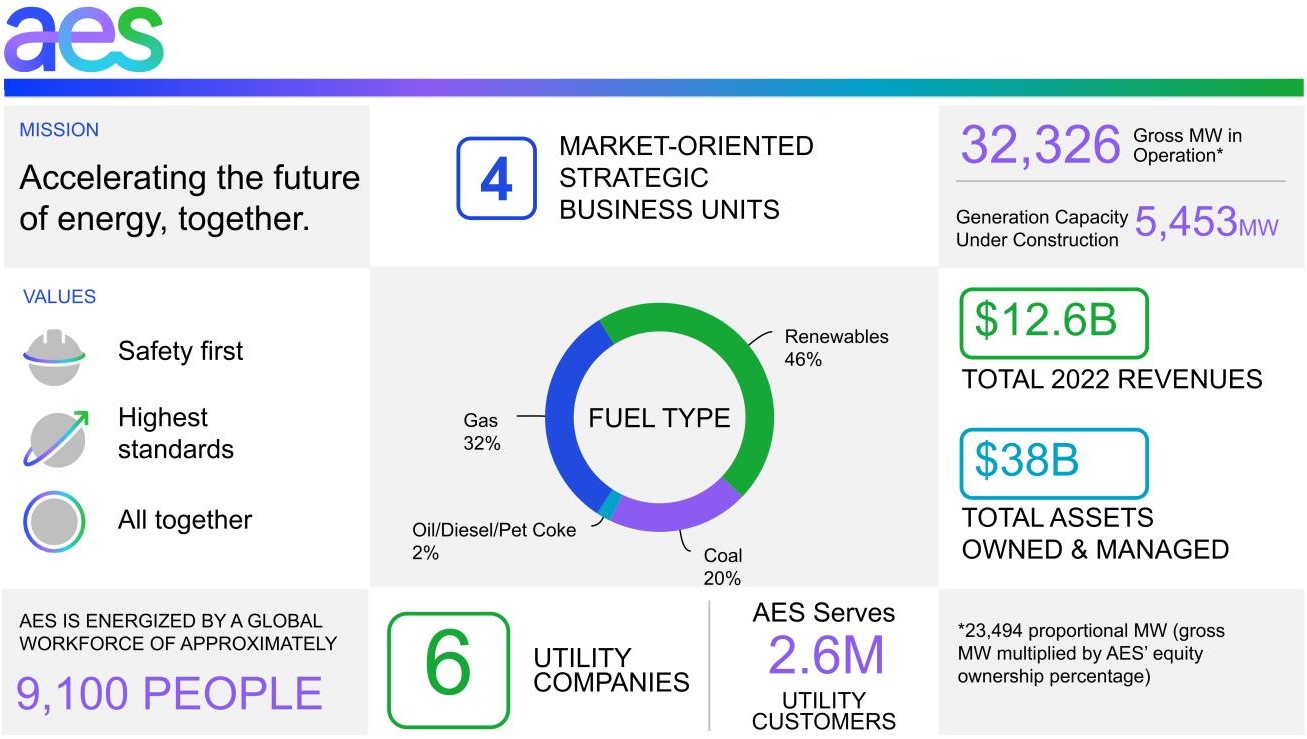
We currently own and/or operate a generation portfolio of 32,326 MW, including generation from our integrated utility, AES Indiana. Our generation fleet is diversified by fuel type. See discussion below under Fuel Costs.
Performance drivers of our generation businesses include types of electricity sales agreements, plant reliability and flexibility, availability of generation capacity to meet contracted sales, fuel costs, seasonality, weather variations, economic activity, fixed-cost management, and competition. The financial performance of our renewables business is also impacted by our ability to complete construction projects and earn U.S. renewable tax credits.
Contract Sales — Most of our generation businesses sell electricity under medium- or long-term contracts ("contract sales") or under short-term agreements in competitive markets ("short-term sales"). Our medium-term contract sales have terms of two to five years, while our long-term contracts have terms of more than five years.
Contracts requiring fuel to generate energy, such as natural gas or coal, are structured to recover variable costs, including fuel and variable O&M costs, either through direct or indexation-based contractual pass-throughs or tolling arrangements. When the contract does not include a fuel pass-through, we typically hedge fuel costs or enter into fuel or energy supply agreements for a similar contract period (see discussion below under Fuel Costs). These
| 7 | 2022 Annual Report |
contracts also help us to fund a significant portion of the total capital cost of the project through long-term non-recourse project-level financing.
Certain contracts include capacity payments that cover projected fixed costs of the plant, including fixed O&M expenses, debt service, and a return on capital invested. In addition, most of our contracts require that the majority of the capacity payments be denominated in the currency matching our fixed costs.
Contracts that do not have significant fuel cost or do not contain a capacity payment are structured based on long-term spot prices with some negotiated pass-through costs, allowing us to recover expected fixed and variable costs as well as provide a return on investment.
These contracts are intended to reduce exposure to the volatility of fuel and electricity prices by linking the business's revenues and costs. We generally structure our business to eliminate or reduce foreign exchange risk by matching the currency of revenue and expenses, including fixed costs and debt. Our project debt may consist of both fixed and floating rate debt for which we typically hedge a significant portion of our exposure. Some of our contracted businesses also receive a regulated market-based capacity payment, which is discussed in more detail in the Short-Term Sales section below.
Thus, these contracts, or other related commercial arrangements, significantly mitigate our exposure to changes in power and, as applicable, fuel prices, currency fluctuations and changes in interest rates. In addition, these contracts generally provide for a recovery of our fixed operating expenses and a return on our investment, as long as we operate the plant to the reliability and efficiency standards required in the contract.
Short-Term Sales — Our other generation businesses sell power and ancillary services under short-term contracts with average terms of less than two years, including spot sales, directly in the short-term market or at regulated prices. The short-term markets are typically administered by a system operator to coordinate dispatch. Short-term markets generally operate on merit order dispatch, where the least expensive generation facilities, based upon variable cost or bid price, are dispatched first and the most expensive facilities are dispatched last. The short-term price is typically set at the marginal cost of energy or bid price (the cost of the last plant required to meet system demand). As a result, the cash flows and earnings associated with these businesses are more sensitive to fluctuations in the market price for electricity. In addition, many of these wholesale markets include markets for ancillary services to support the reliable operation of the transmission system. Across our portfolio, we provide a wide array of ancillary services, including voltage support, frequency regulation and spinning reserves.
Many of the short-term markets in which we operate include regulated capacity markets. These capacity markets are intended to provide additional revenue based upon availability without reliance on the energy margin from the merit order dispatch. Capacity markets are typically priced based on the cost of a new entrant and the system capacity relative to the desired level of reserve margin (generation available in excess of peak demand). Our generating facilities selling in the short-term markets typically receive capacity payments based on their availability in the market.
Plant Reliability and Flexibility — Our contract and short-term sales provide incentives to our generation plants to optimally manage availability, operating efficiency and flexibility. Capacity payments under contract sales are frequently tied to meeting minimum standards. In short-term sales, our plants must be reliable and flexible to capture peak market prices and to maximize market-based revenues. In addition, our flexibility allows us to capture ancillary service revenue while meeting local market needs.
Fuel Costs — For our thermal generation plants, fuel is a significant component of our total cost of generation. For contract sales, we often enter into fuel supply agreements to match the contract period, or we may financially hedge our fuel costs. Some of our contracts include indexation for fuels. In those cases, we seek to match our fuel supply agreements to the indexation. For certain projects, we have tolling arrangements where the power offtaker is responsible for the supply and cost of fuel to our plants.
In short-term sales, we sell power at market prices that are generally reflective of the market cost of fuel at the time, and thus procure fuel supply on a short-term basis, generally designed to match up with our market sales profile. Since fuel price is often the primary determinant for power prices, the economics of projects with short-term sales are often subject to volatility of relative fuel prices. For further information regarding commodity price risk please see Item 7A.—Quantitative and Qualitative Disclosures about Market Risk in this Form 10-K.
46% of the capacity of our generation plants are fueled by renewables, including hydro, solar, wind, energy storage, biomass and landfill gas, which do not have significant fuel costs.
| 8 | 2022 Annual Report |
32% of the capacity of our generation plants are fueled by natural gas. With the exception of our plants in the Dominican Republic and Panama, where we import LNG to utilize in the local market, we use gas from local suppliers in each market.
20% of the capacity of our generation fleet is coal-fired. In the U.S., most of our coal-fired plants are supplied from domestic coal. At our non-U.S. generation plants, and at our plant in Puerto Rico, we source coal from a mix of sources from the international market and in the local jurisdictions. To the extent possible, we utilize our global sourcing program to maximize the purchasing power of our fuel procurement.
2% of the capacity of our generation fleet utilizes pet coke, diesel or oil for fuel. We source oil and diesel locally at prices linked to international markets. We largely source pet coke from Mexico and the U.S.
Seasonality, Weather Variations and Economic Activity — Our generation businesses are affected by seasonal weather patterns and, therefore, operating margin is not generated evenly throughout the year. Additionally, weather variations, including temperature, solar and wind resources, and hydrological conditions, may also have an impact on generation output at our renewable generation facilities. In competitive markets for power, local economic activity can also have an impact on power demand and short-term prices for power.
Fixed-Cost Management — In our businesses with long-term contracts, the majority of the fixed O&M costs are recovered through the capacity payment. However, for all generation businesses, managing fixed costs and reducing them over time is a driver of business performance.
Competition — For our businesses with medium- or long-term contracts, there is limited competition during the term of the contract. For short-term sales, plant dispatch and the price of electricity are determined by market competition and local dispatch and reliability rules.
Utilities
Our utility businesses consist of AES Indiana and AES Ohio in the U.S. and four utilities in El Salvador. AES' six utility businesses distribute power to 2.6 million customers and AES' two utilities in the U.S. also include generation capacity totaling 3,495 MW.
AES Indiana, our fully integrated utility, and AES Ohio, our transmission and distribution regulated utility, operate as the sole distributors of electricity within their respective jurisdictions. AES Indiana owns and operates all of the facilities necessary to generate, transmit and distribute electricity. AES Ohio owns and operates all of the facilities necessary to transmit and distribute electricity. At our distribution business in El Salvador, we face limited competition due to significant barriers to enter the market. According to El Salvador's regulation, large regulated customers have the option of becoming unregulated users and requesting service directly from generation or commercialization agents.
In general, our utilities sell electricity directly to end-users, such as homes and businesses, and bill customers directly. Key performance drivers for utilities include the regulated rate of return and tariff, seasonality, weather variations, economic activity and reliability of service. Revenue from utilities is classified as regulated on the Consolidated Statements of Operations.
Regulated Rate of Return and Tariff — In exchange for the right to sell or distribute electricity in a service territory, our utility businesses are subject to government regulation. This regulation sets the framework for the prices ("tariffs") that our utilities are allowed to charge customers for electricity and establishes service standards that we are required to meet.
Our utilities are generally permitted to earn a regulated rate of return on assets, determined by the regulator based on the utility's allowed regulatory asset base, capital structure and cost of capital. The asset base on which the utility is permitted a return is determined by the regulator, within the framework of applicable local laws, and is based on the amount of assets that are considered used and useful in serving customers. Both the allowed return and the asset base are important components of the utility's earning power. The allowed rate of return and operating expenses deemed reasonable by the regulator are recovered through the regulated tariff that the utility charges to its customers.
The tariff may be reviewed and reset by the regulator from time to time depending on local regulations, or the utility may seek a change in its tariffs. The tariff is generally based upon usage level and may include a pass-through of costs that are not controlled by the utility, such as the costs of fuel (in the case of integrated utilities) and/or the costs of purchased energy, to the customer. Components of the tariff that are directly passed through to the
| 9 | 2022 Annual Report |
customer are usually adjusted through a summary regulatory process or an existing formula-based mechanism. In some regulatory regimes, customers with demand above an established level are unregulated and can choose to contract directly with the utility or with other retail energy suppliers and pay non-bypassable fees, which are fees to the distribution company for use of its distribution system.
The regulated tariff generally recognizes that our utility businesses should recover certain operating and fixed costs, as well as manage uncollectible amounts, quality of service and technical and non-technical losses. Utilities, therefore, need to manage costs to the levels reflected in the tariff, or risk non-recovery of costs or diminished returns.
Seasonality, Weather Variations, and Economic Activity — Our utility businesses are generally affected by seasonal weather patterns and, therefore, operating margin is not generated evenly throughout the year. Additionally, weather variations may also have an impact based on the number of customers, temperature variances from normal conditions, and customers' historic usage levels and patterns. Retail sales, after adjustments for weather variations, are also affected by changes in local economic activity, energy efficiency and distributed generation initiatives, as well as the number of retail customers.
Reliability of Service — Our utility businesses must meet certain reliability standards, such as duration and frequency of outages. Those standards may be explicit, with defined performance incentives or penalties, or implicit, where the utility must operate to meet customer and/or regulator expectations.
Development and Construction
We develop and construct new generation facilities. For our utility business, new plants may be built or existing plants retrofitted in response to customer needs or to comply with regulatory developments. The projects are developed subject to regulatory approval that permits recovery of our capital cost and a return on our investment. For our generation businesses, our priority for development is in key growth markets, where we can leverage our global scale and synergies with our existing businesses by adding renewable energy. We make the decision to invest in new projects by evaluating the strategic fit, project returns and financial profile against a fair risk-adjusted return for the investment and against alternative uses of capital, including corporate debt repayment.
In some cases, we enter into long-term contracts for output from new facilities prior to commencing construction. To limit required equity contributions from The AES Corporation, we also seek non-recourse project debt financing and other sources of capital, including partners, when it is commercially attractive. We typically contract with a third party to manage construction, although our construction management team supervises the construction work and tracks progress against the project's budget and the required safety, efficiency and productivity standards.
Segments
The segment reporting structure uses the Company's management reporting structure as its foundation to reflect how the Company manages the businesses internally and is mainly organized by geographic regions which provides a socio-political-economic understanding of our business.
We are organized into four market-oriented SBUs: US and Utilities (United States, Puerto Rico and El Salvador); South America (Chile, Colombia, Argentina and Brazil); MCAC (Mexico, Central America and the Caribbean); and Eurasia (Europe and Asia) — which are led by our SBU Presidents. We have two lines of business: generation and utilities. Each of our SBUs participates in our first business line, generation, in which we own and/or operate power plants to generate and sell power to customers, such as utilities, industrial users, and other intermediaries. Our US and Utilities SBU participates in our second business line, utilities, in which we own and/or operate utilities to generate or purchase, distribute, transmit and sell electricity to end-user customers in the residential, commercial, industrial and governmental sectors within a defined service area. In certain circumstances, our utilities also generate and sell electricity on the wholesale market.
We measure the operating performance of our SBUs using Adjusted PTC, a non-GAAP measure. The Adjusted PTC by SBU for the year ended December 31, 2022 is shown below. The percentages for Adjusted PTC are the contribution by each SBU to the gross metric, i.e., the total Adjusted PTC by SBU, before deductions for Corporate. See Item 7.—Management's Discussion and Analysis of Financial Condition and Results of Operations—SBU Performance Analysis of this Form 10-K for reconciliation and definitions of Adjusted PTC.
| 10 | 2022 Annual Report |
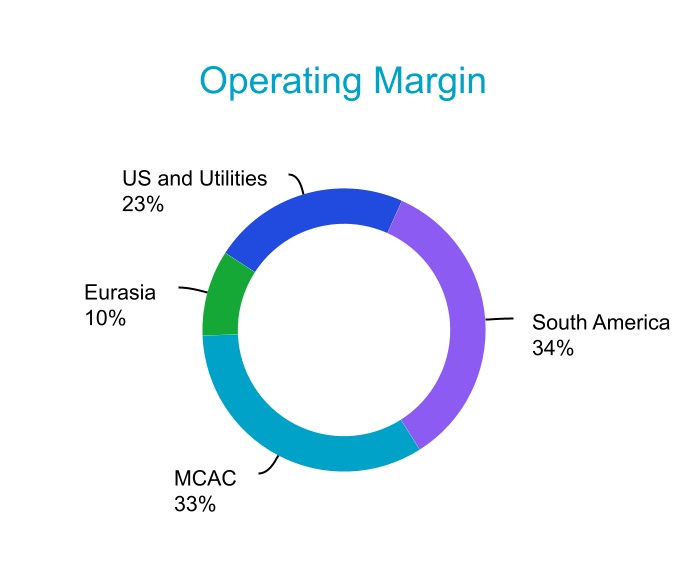
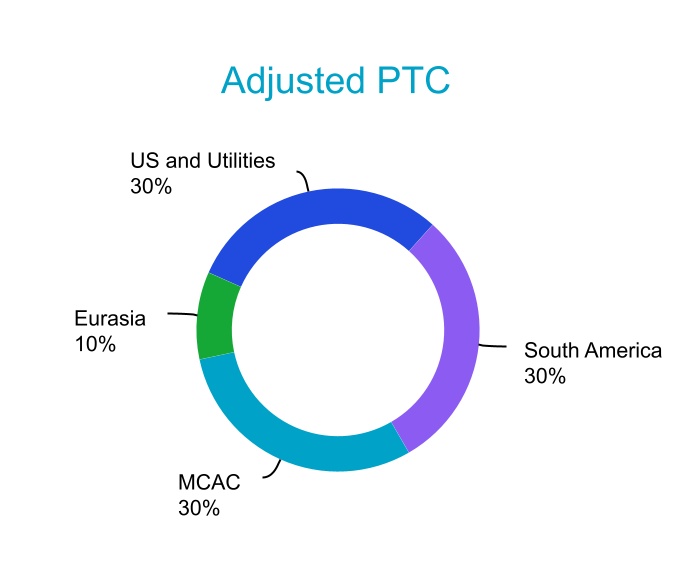
For financial reporting purposes, the Company's corporate activities and certain other investments are reported within "Corporate and Other" because they do not require separate disclosure. See Item 7.—Management's Discussion and Analysis of Financial Condition and Results of Operations and Note 18—Segment and Geographic Information included in Item 8.—Financial Statements and Supplementary Data of this Form 10-K for further discussion of the Company's segment structure.
| 11 | 2022 Annual Report |
| (1) Non-GAAP measure. See Item 7.—Management’s Discussion and Analysis of Financial Condition and Results of Operations—SBU Performance Analysis—Non-GAAP Measures for reconciliation and definition. |
| 12 | 2022 Annual Report |
US and Utilities SBU
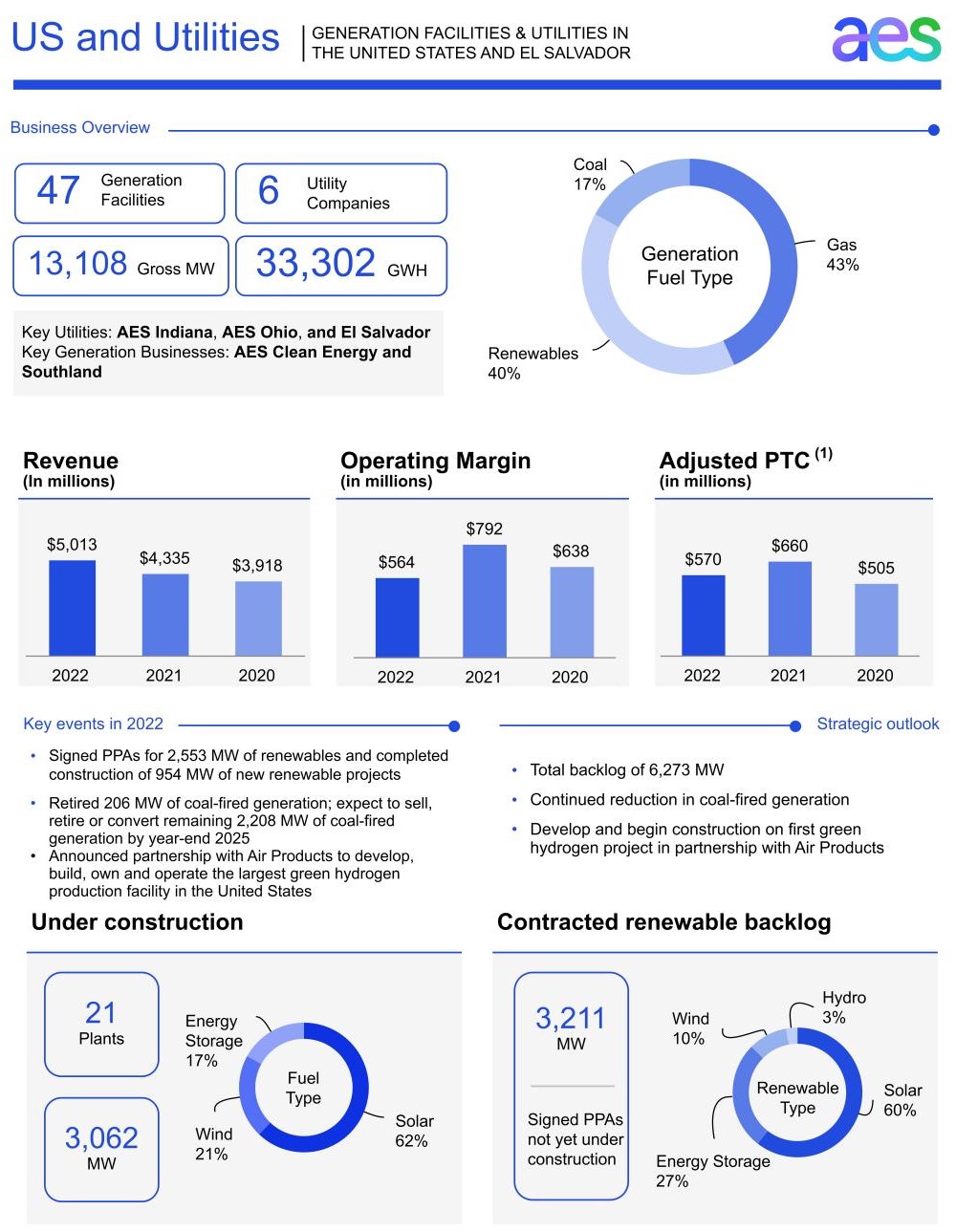
Our US and Utilities SBU has 47 generation facilities, two utilities in the United States, and four utilities in El Salvador.
Generation — Operating installed capacity of our US and Utilities SBU totals 13,108 MW. IPALCO (AES Indiana's parent), AES Ohio, and DPL Inc. (AES Ohio's parent) are all SEC registrants, and as such, follow the public filing requirements of the Securities Exchange Act of 1934. The following table lists our US and Utilities SBU generation facilities:
| Business | Location | Fuel | Gross MW | AES Equity Interest | Year Acquired or Began Operation | Contract Expiration Date | Customer(s) | |||||||||||||||||||||||||||||||||||||
| Bosforo (1) | El Salvador | Solar | 100 | 50 | % | 2018-2019 | 2043-2044 | CAESS, EEO, CLESA, DEUSEM | ||||||||||||||||||||||||||||||||||||
| Cuscatlan Solar (1) | El Salvador | Solar | 10 | 50 | % | 2021 | 2046 | CLESA | ||||||||||||||||||||||||||||||||||||
| AES Nejapa | El Salvador | Landfill Gas | 6 | 100 | % | 2011 | 2035 | CAESS | ||||||||||||||||||||||||||||||||||||
| Opico | El Salvador | Solar | 4 | 100 | % | 2020 | 2040 | CLESA | ||||||||||||||||||||||||||||||||||||
| Moncagua | El Salvador | Solar | 3 | 100 | % | 2015 | 2035 | EEO | ||||||||||||||||||||||||||||||||||||
| El Salvador Subtotal | 123 | |||||||||||||||||||||||||||||||||||||||||||
| Southland—Alamitos | US-CA | Gas | 1,200 | 100 | % | 1998 | 2023 | Various | ||||||||||||||||||||||||||||||||||||
| sPower OpCo A (1) | US-Various | Solar | 967 | 26 | % | 2017-2019 | 2028-2046 | Various | ||||||||||||||||||||||||||||||||||||
| Wind | 140 | |||||||||||||||||||||||||||||||||||||||||||
| Southland—Redondo Beach | US-CA | Gas | 876 | 100 | % | 1998 | 2023 | Various | ||||||||||||||||||||||||||||||||||||
| Southland Energy—Alamitos (5) | US-CA | Gas | 697 | 50 | % | 2020 | 2040 | Southern California Edison | ||||||||||||||||||||||||||||||||||||
| Southland Energy—Huntington Beach (5) | US-CA | Gas | 694 | 50 | % | 2020 | 2040 | Southern California Edison | ||||||||||||||||||||||||||||||||||||
| New York Wind (2) | US-NY | Wind | 612 | 75 | % | 2021 | NYISO | |||||||||||||||||||||||||||||||||||||
| AES Puerto Rico | US-PR | Coal | 524 | 100 | % | 2002 | 2027 | LUMA Energy | ||||||||||||||||||||||||||||||||||||
| AES Renewable Holdings (3) | US-Various | Solar | 400 | 100 | % | 2015-2022 | 2029-2042 | Utility, Municipality, Education, Non-Profit | ||||||||||||||||||||||||||||||||||||
| Energy Storage | 90 | |||||||||||||||||||||||||||||||||||||||||||
| Highlander (sPower OpCo B (1)) | US-VA | Solar | 485 | 50 | % | 2020 | 2035 | Apple, Akami, Etsy, Microsoft | ||||||||||||||||||||||||||||||||||||
| sPower OpCo B (1) | US-Various | Solar | 260 | 50 | % | 2019 | 2039-2044 | Various | ||||||||||||||||||||||||||||||||||||
| Southland—Huntington Beach | US-CA | Gas | 236 | 100 | % | 1998 | 2023 | Various | ||||||||||||||||||||||||||||||||||||
| Buffalo Gap II (3) | US-TX | Wind | 228 | 100 | % | 2007 | ||||||||||||||||||||||||||||||||||||||
| Warrior Run | US-MD | Coal | 205 | 100 | % | 2000 | 2030 | Potomac Edison | ||||||||||||||||||||||||||||||||||||
| Prevailing Winds (sPower OpCo B (1)) | US-SD | Wind | 200 | 50 | % | 2020 | 2050 | Prevailing Winds | ||||||||||||||||||||||||||||||||||||
| Skipjack (2) (3) | US-VA | Solar | 175 | 75 | % | 2022 | 2036 | Exelon Generation Company | ||||||||||||||||||||||||||||||||||||
| Buffalo Gap III (3) | US-TX | Wind | 170 | 100 | % | 2008 | ||||||||||||||||||||||||||||||||||||||
| Lancaster Area Battery (2) (3) | US-CA | Energy Storage | 127 | 75 | % | 2022 | ||||||||||||||||||||||||||||||||||||||
| Buffalo Gap I (3) | US-TX | Wind | 121 | 100 | % | 2006 | ||||||||||||||||||||||||||||||||||||||
| Southland Energy—Alamitos Energy Center (5) | US-CA | Energy Storage | 100 | 50 | % | 2021 | 2041 | Southern California Edison | ||||||||||||||||||||||||||||||||||||
| East Line Solar (sPower OpCo B (1)) | US-AZ | Solar | 100 | 50 | % | 2020 | 2045 | Salt River Project | ||||||||||||||||||||||||||||||||||||
| Central Line (sPower OpCo B (1)) | US-AZ | Solar | 100 | 50 | % | 2022 | 2039 | Salt River Project Agricultural Improvement & Power District | ||||||||||||||||||||||||||||||||||||
| West Line (sPower (1)) | US-AZ | Solar | 100 | 50 | % | 2022 | ||||||||||||||||||||||||||||||||||||||
| Luna (2) (3) | US-CA | Energy Storage | 100 | 75 | % | 2022 | ||||||||||||||||||||||||||||||||||||||
| Laurel Mountain Repowering (2) | US-WV | Wind | 99 | 75 | % | 2022 | 2037 | AES Solutions Management, LLC | ||||||||||||||||||||||||||||||||||||
| Clover Creek (sPower OpCo B (1)) | US-UT | Solar | 80 | 50 | % | 2021 | 2046 | UMPA | ||||||||||||||||||||||||||||||||||||
| Mountain View Repowering (2) (3) | US-CA | Wind | 71 | 75 | % | 2022 | 2042 | Southern California Edison | ||||||||||||||||||||||||||||||||||||
| Michigan Consumers (2) (3) | US-MI | Solar | 36 | 75 | % | 2022 | ||||||||||||||||||||||||||||||||||||||
| Big Island Waikoloa (3) (4) | US-HI | Solar | 25 | 100 | % | 2022 | ||||||||||||||||||||||||||||||||||||||
| Energy Storage | 30 | |||||||||||||||||||||||||||||||||||||||||||
| Mountain View IV (4) | US-CA | Wind | 49 | 100 | % | 2012 | 2032 | Southern California Edison |
| 13 | 2022 Annual Report |
| Lawa'i (3) (4) | US-HI | Solar | 20 | 100 | % | 2018 | 2043 | Kaua'i Island Utility Cooperative | ||||||||||||||||||||||||||||||||||||
| Energy Storage | 20 | |||||||||||||||||||||||||||||||||||||||||||
| sPower OpCo C (1) | US-CA | Solar | 30 | 50 | % | 2021-2022 | 2041 | Various | ||||||||||||||||||||||||||||||||||||
| Energy Storage | 2 | |||||||||||||||||||||||||||||||||||||||||||
| Kekaha (3) (4) | US-HI | Solar | 14 | 100 | % | 2019 | 2045 | Kaua'i Island Utility Cooperative | ||||||||||||||||||||||||||||||||||||
| Energy Storage | 14 | |||||||||||||||||||||||||||||||||||||||||||
| Na Pua Makani (4) | US-HI | Wind | 24 | 100 | % | 2020 | 2040 | HECO | ||||||||||||||||||||||||||||||||||||
| Ilumina | US-PR | Solar | 24 | 100 | % | 2012 | 2037 | LUMA Energy | ||||||||||||||||||||||||||||||||||||
| Laurel Mountain ES | US-WV | Energy Storage | 16 | 100 | % | 2011 | ||||||||||||||||||||||||||||||||||||||
| Community Energy (2) | US-Various | Solar | 14 | 75 | % | 2022 | 2023-2043 | Various | ||||||||||||||||||||||||||||||||||||
| Southland Energy—AES Gilbert (Salt River (5) (6)) | US-AZ | Energy Storage | 10 | 50 | % | 2019 | 2039 | Salt River Project Agricultural Improvement & Power District | ||||||||||||||||||||||||||||||||||||
| Warrior Run ES | US-MD | Energy Storage | 5 | 100 | % | 2016 | ||||||||||||||||||||||||||||||||||||||
| United States Subtotal | 9,490 | |||||||||||||||||||||||||||||||||||||||||||
| 9,613 |
(1)Unconsolidated entity, accounted for as an equity affiliate.
(2)Owned by AES Clean Energy Development ("ACED").
(3)AES owns these assets together with third-party tax equity investors with variable ownership interests. The tax equity investors receive a portion of the economic attributes of the facilities, including tax attributes, that vary over the life of the projects. The proceeds from the issuance of tax equity are recorded as Noncontrolling interest or Redeemable stock of subsidiaries in the Company's Consolidated Balance Sheets, depending on the partnership rights of the specific project.
(4)Owned by AES Renewable Holdings.
(5)On December 1, 2022, Southland Energy sold an additional 14.9% ownership interest in the Southland Energy assets. Following the sale, AES holds 50.1% of Southland Energy's interest and this business continues to be consolidated by AES.
(6)Facility experienced a fire event in April 2022 which rendered the asset currently inoperable.
Utilities — The following table lists our utilities and their generation facilities.
| Business | Location | Approximate Number of Customers Served as of 12/31/2022 | GWh Sold in 2022 | Fuel | Gross MW | AES Equity Interest | Year Acquired or Began Operation | |||||||||||||||||||||||||||||||||||||
| CAESS | El Salvador | 647,000 | 2,109 | 75 | % | 2000 | ||||||||||||||||||||||||||||||||||||||
| CLESA | El Salvador | 461,000 | 1,072 | 80 | % | 1998 | ||||||||||||||||||||||||||||||||||||||
| DEUSEM | El Salvador | 92,000 | 161 | 74 | % | 2000 | ||||||||||||||||||||||||||||||||||||||
| EEO | El Salvador | 348,000 | 700 | 89 | % | 2000 | ||||||||||||||||||||||||||||||||||||||
| El Salvador Subtotal | 1,548,000 | 4,042 | ||||||||||||||||||||||||||||||||||||||||||
| AES Ohio (1) | US-OH | 536,000 | 13,875 | 100 | % | 2011 | ||||||||||||||||||||||||||||||||||||||
| AES Indiana (2) | US-IN | 519,000 | 15,385 | Coal/Gas/Oil/Energy Storage | 3,495 | 70 | % | 2001 | ||||||||||||||||||||||||||||||||||||
| United States Subtotal | 1,055,000 | 29,260 | 3,495 | |||||||||||||||||||||||||||||||||||||||||
| 2,603,000 | 33,302 |
(1)AES Ohio's GWh sold in 2022 represent total transmission and distribution sales. AES Ohio's wholesale sales and SSO utility sales, which are sales to utility customers who use AES Ohio to source their electricity through a competitive bid process, were 4,676 GWh in 2022. AES Ohio owns a 4.9% equity ownership in OVEC, an electric generating company. OVEC has two plants in Cheshire, Ohio and Madison, Indiana with a combined generation capacity of approximately 2,109 MW. AES Ohio’s share of this generation is approximately 103 MW.
(2)CDPQ owns direct and indirect interests in IPALCO (AES Indiana's parent) which total approximately 30%. AES owns 85% of AES US Investments and AES US Investments owns 82.35% of IPALCO. AES Indiana plants: Georgetown, Harding Street, Petersburg and Eagle Valley. 20 MW of AES Indiana total is considered a transmission asset. AES Indiana retired the 230 MW Petersburg Unit 1 in May 2021 and has plans to retire the 415 MW Petersburg Unit 2 in June 2023. AES Indiana plans to convert the remaining two coal units at Petersburg to natural gas by the end of 2025. In December 2021, AES Indiana completed the acquisition of the 195 MW Hardy Hills solar project, which is expected to commence operations in 2024. In November 2021, AES Indiana received an order from the IURC approving the acquisition of a 250 MW solar and 180 MWh energy storage facility (Petersburg solar project), which is expected to be completed in 2025.
| 14 | 2022 Annual Report |
Under construction — The following table lists our plants under construction in the US and Utilities SBU:
| Business | Location | Fuel | Gross MW | AES Equity Interest | Expected Date of Commercial Operations | |||||||||||||||||||||||||||
| Cement City (1) | US-MI | Solar | 20 | 75 | % | 1H 2023 | ||||||||||||||||||||||||||
| Big Island Waikoloa (2) | US-HI | Solar | 5 | 100 | % | 1H 2023 | ||||||||||||||||||||||||||
| West Oahu Solar (2) | US-HI | Solar | 13 | 100 | % | 1H 2023 | ||||||||||||||||||||||||||
| Energy Storage | 13 | |||||||||||||||||||||||||||||||
| High Mesa (1) | US-CO | Solar | 10 | 75 | % | 1H 2023 | ||||||||||||||||||||||||||
| Energy Storage | 10 | |||||||||||||||||||||||||||||||
| Meanguera del Golfo | El Salvador | Solar | 1 | 100 | % | 1H 2023 | ||||||||||||||||||||||||||
| Energy Storage | 4 | |||||||||||||||||||||||||||||||
| AES Clean Energy Development | US-Various | Solar | 32 | 75 | % | 1H-2H 2023 | ||||||||||||||||||||||||||
| Great Cove 1&2 (1) | US-PA | Solar | 220 | 75 | % | 2H 2023 | ||||||||||||||||||||||||||
| Chevelon Butte (1) | US-AZ | Wind | 238 | 75 | % | 2H 2023 | ||||||||||||||||||||||||||
| McFarland Phase 1 (1) | US-AZ | Solar | 200 | 75 | % | 2H 2023 | ||||||||||||||||||||||||||
| Energy Storage | 100 | |||||||||||||||||||||||||||||||
| Kuihelni (2) | US-HI | Solar | 60 | 100 | % | 2H 2023 | ||||||||||||||||||||||||||
| Energy Storage | 60 | |||||||||||||||||||||||||||||||
| Oak Ridge (1) | US-LA | Solar | 200 | 75 | % | 2H 2023 | ||||||||||||||||||||||||||
| Baldy Mesa (1) | US-CA | Solar | 150 | 75 | % | 2H 2023 | ||||||||||||||||||||||||||
| Energy Storage | 75 | |||||||||||||||||||||||||||||||
| Estrella (sPower) | US-CA | Solar | 56 | 50 | % | 2H 2023 | ||||||||||||||||||||||||||
| Energy Storage | 28 | |||||||||||||||||||||||||||||||
| Cavalier (1) | US-VA | Solar | 155 | 75 | % | 2H 2023-1H 2024 | ||||||||||||||||||||||||||
| Raceway 1 (sPower) | US-CA | Solar | 125 | 50 | % | 2H 2023-1H 2024 | ||||||||||||||||||||||||||
| Energy Storage | 80 | |||||||||||||||||||||||||||||||
| Platteview (1) | US-NE | Solar | 81 | 75 | % | 1H 2024 | ||||||||||||||||||||||||||
| McFarland Phase 2 (1) | US-AZ | Solar | 300 | 75 | % | 1H 2024 | ||||||||||||||||||||||||||
| Energy Storage | 150 | |||||||||||||||||||||||||||||||
| Delta (1) | US-MS | Wind | 185 | 75 | % | 1H 2024 | ||||||||||||||||||||||||||
| Hardy Hills (AES Indiana) | US-IN | Solar | 195 | 70 | % | 1H 2024 | ||||||||||||||||||||||||||
| Cavalier Solar A2 (1) | US-VA | Solar | 81 | 75 | % | 2H 2024 | ||||||||||||||||||||||||||
| Chevelon Butte Phase II (1) | US-AZ | Wind | 216 | 50 | % | 2H 2024 | ||||||||||||||||||||||||||
| 3,062 |
(1)Owned by AES Clean Energy Development ("ACED").
(2)Owned by AES Renewable Holdings.
The majority of projects under construction have executed long-term PPAs or, as applicable, have been assigned tariffs through a regulatory process.
In July 2020, the Hawaii State Legislature passed Senate Bill 2629, which prohibited AES Hawaii from generating electricity from coal after December 31, 2022. As a result, AES retired the AES Hawaii facility in September 2022.
| 15 | 2022 Annual Report |
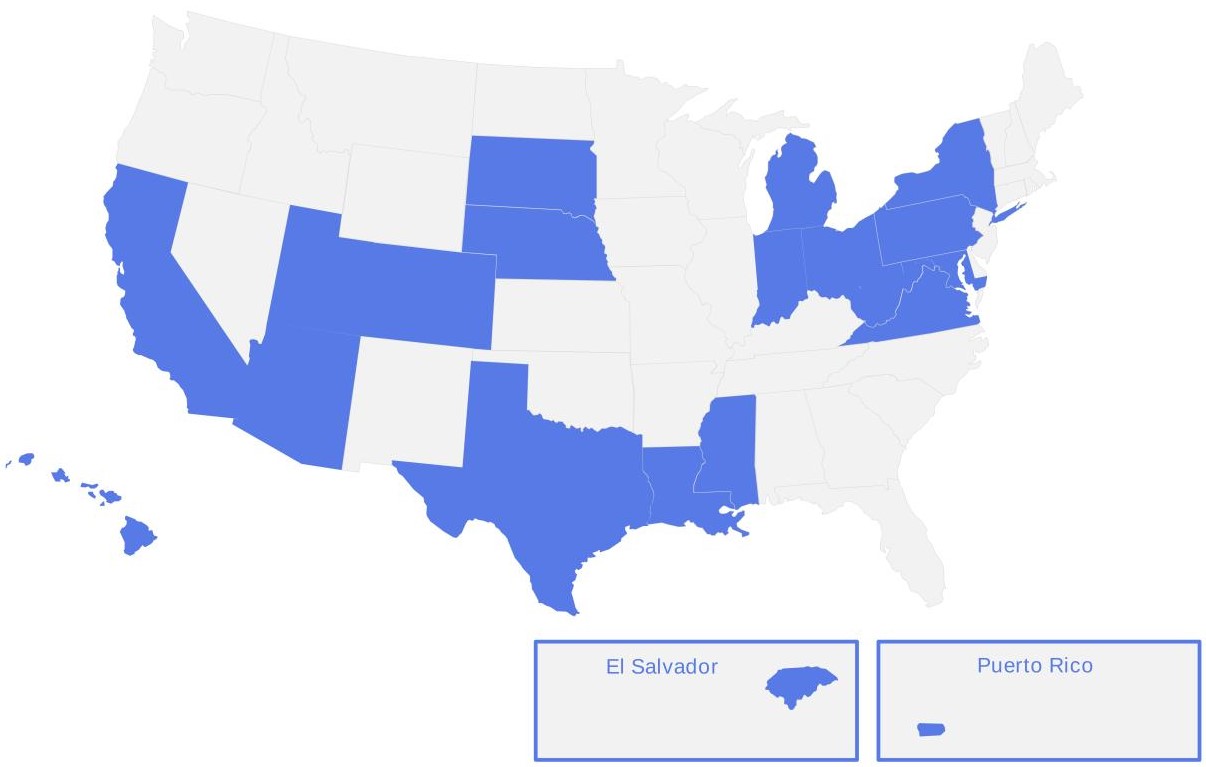
The following map illustrates the locations of our US and Utilities facilities:
US and Utilities Businesses
AES Indiana
Business Description — IPALCO is a holding company whose principal subsidiary is AES Indiana. AES Indiana is an integrated utility that is engaged primarily in generating, transmitting, distributing, and selling electric energy to retail customers in the city of Indianapolis and neighboring areas within the state of Indiana and is subject to regulatory authority—see Regulatory Framework and Market Structure below. AES Indiana has an exclusive right to provide electric service to the customers in its service area, covering about 528 square miles with an estimated population of approximately 971,000 people. AES Indiana owns and operates four generating stations, all within the state of Indiana. AES Indiana’s largest generating station, Petersburg, is coal-fired. AES Indiana retired 230 MW Petersburg Unit 1 on May 31, 2021 and has plans to retire 415 MW Petersburg Unit 2 in 2023, which would result in 630 MW of total retired economic capacity at this station. AES Indiana plans to convert the remaining two coal units at Petersburg to natural gas by the end of 2025 (see Integrated Resource Plan below). The second largest station, Harding Street, uses natural gas and fuel oil to power combustion turbines. In addition, AES Indiana operates a 20 MW battery-based energy storage unit at this location, which provides frequency response. The third station, Eagle Valley, is a CCGT natural gas plant. The fourth station, Georgetown, is a small peaking station that uses natural gas to power combustion turbines. In addition, AES Indiana helps meet its customers' energy needs with long-term contracts for the purchase of 300 MW of wind-generated electricity and 94 MW of solar-generated electricity. In July 2021, AES Indiana executed an agreement to acquire a 250 MW solar and 180 MWh energy storage facility (the "Petersburg Solar Project"). As amended in October 2022 and subject to IURC approval, the Petersburg Solar Project is now expected to be completed in 2025. In December 2021, AES Indiana completed the acquisition of Hardy Hills Solar Energy LLC, including the development of a 195 MW solar project (the "Hardy Hills Solar Project"). As amended in December 2022 and subject to IURC approval, the Hardy Hills Solar Project is now expected to be completed in 2024.
Key Financial Drivers — AES Indiana's financial results are driven primarily by retail demand, weather, and maintenance costs. In addition, AES Indiana's financial results are likely to be driven by many other factors including, but not limited to:
- regulatory outcomes and impacts;
| 16 | 2022 Annual Report |
-
the passage of new legislation, implementation of regulations, or other changes in regulation; and
-
timely recovery of capital expenditures.
Regulatory Framework and Market Structure — AES Indiana is subject to comprehensive regulation by the IURC with respect to its services and facilities, retail rates and charges, the issuance of long-term securities, and certain other matters. The regulatory authority of the IURC over AES Indiana's business is typical of regulation generally imposed by state public utility commissions. The IURC sets tariff rates for electric service provided by AES Indiana. The IURC considers all allowable costs for ratemaking purposes, including a fair return on assets used and useful to providing service to customers.
AES Indiana's tariff rates for electric service to retail customers consist of basic rates and approved charges. In addition, AES Indiana's rates include various adjustment mechanisms, including, but not limited to: (i) a rider to reflect changes in fuel and purchased power costs to meet AES Indiana's retail load requirements, referred to as the Fuel Adjustment Charge, (ii) a rider for the timely recovery of costs incurred to comply with environmental laws and regulations, including a return, (iii) a rider to reflect changes in ongoing RTO costs, (iv) riders for passing through to customers wholesale sales margins and capacity sales above and below established annual benchmarks, (v) a rider for a return on, and of, investments for eligible TDSIC improvements, and (vi) a rider for cost recovery, lost margin recoveries and performance incentives from AES Indiana's demand side management energy efficiency programs. Each of these tariff rate components function somewhat independently of one another, but the overall structure of AES Indiana's rates is subject to review at the time of any review of AES Indiana's basic rates and charges. Additionally, AES Indiana's rider recoveries are reviewed through recurring filings.
On October 31, 2018, the IURC issued an order approving an uncontested settlement agreement to increase AES Indiana's annual revenues by $44 million, or 3% (the "2018 Base Rate Order"). This revenue increase primarily includes recovery through rates of costs associated with the CCGT at Eagle Valley, completed in the first half of 2018, and other construction projects. New base rates and charges became effective on December 5, 2018. The 2018 Base Rate Order was AES Indiana's most recent base rate order and also provided customers with approximately $50 million in benefits through a rate adjustment mechanism over a two-year period.
AES Indiana is one of many transmission system owner members in MISO, an RTO which maintains functional control over the combined transmission systems of its members and manages one of the largest energy and ancillary services markets in the U.S. MISO dispatches generation assets in economic order considering transmission constraints and other reliability issues to meet the total demand in the MISO region. AES Indiana offers electricity in the MISO day-ahead and real-time markets.
Development Strategy — AES Indiana's construction program is composed of capital expenditures necessary for prudent utility operations and compliance with environmental regulations, along with discretionary investments designed to replace aging equipment or improve overall performance.
Senate Enrolled Act 560, the Transmission, Distribution, and Storage System Improvement Charge ("TDSIC") statute, provides for cost recovery outside of a base rate proceeding for new or replacement electric and gas transmission, distribution, and storage projects that a public utility undertakes for the purposes of safety, reliability, system modernization, or economic development. Provisions of the TDSIC statute require that requests for recovery include a plan of at least five years and not more than seven for eligible investments. Once a plan is approved by the IURC, eighty percent of eligible costs can be recovered using a periodic rate adjustment mechanism, referred to as a TDSIC mechanism. Recoverable costs include a return on, and of, the investment, including AFUDC, post-in-service carrying charges, operation and maintenance expenses, depreciation, and property taxes. The remaining twenty percent of recoverable costs are deferred for future recovery in the public utility’s next base rate case. The TDSIC mechanism is capped at an annual increase of two percent of total retail revenues.
On March 4, 2020, the IURC issued an order approving the projects in AES Indiana's seven-year TDSIC Plan for eligible transmission, distribution, and storage system improvements totaling $1.2 billion from 2020 through 2026. Beginning in June 2020, AES Indiana files an annual TDSIC rate adjustment for a return on, and of, investments through March 31 with rates requested to be effective each November. Annual TDSIC plan update filings are required to be staggered by six months as ordered by the IURC and are filed each December. The total amount of AES Indiana’s equipment approved for TDSIC recovery as of December 31, 2022 was $324 million.
Integrated Resource Plan — In December 2022, AES Indiana filed its Integrated Resource Plan ("IRP"), which describes AES Indiana's Preferred Resource Portfolio for meeting generation capacity needs for serving AES Indiana's retail customers over the next several years. The Preferred Resource Portfolio is AES Indiana's reasonable least cost option and provides a cleaner and more diverse generation mix for customers. The 2022 IRP
| 17 | 2022 Annual Report |
short-term action plan includes converting the two remaining coal units at Petersburg to natural gas by the end of 2025. AES Indiana has not yet filed for the necessary regulatory approvals from the IURC to convert Petersburg units 3 and 4, however, AES Indiana expects to do so at the appropriate time. Additionally, AES Indiana plans to add up to 1,300 MW of wind, solar, and battery energy storage by 2027. As new technologies, such as green hydrogen, small modular reactors and carbon capture are developed and cost effective, we will evaluate them in the future planning processes
AES Indiana's 2019 IRP included the retirement of 230 MW Petersburg Unit 1 on May 31, 2021 and plans to retire 415 MW Petersburg Unit 2 in 2023. In November 2021, AES Indiana received approval from the IURC for approvals and cost recovery associated with the Petersburg retirements, which includes: (1) AES Indiana's creation of regulatory assets for the net book value of Petersburg units 1 and 2 upon retirement; (2) a method for amortization of the regulatory assets; and (3) recovery of the regulatory assets through ongoing amortization in AES Indiana’s future rate cases. The order reserves all rights of all the parties with respect to the ratemaking treatment related to the regulatory assets, including the proper rate of return and mechanisms for recovery.
In December 2021, AES Indiana completed the acquisition of the Hardy Hills Solar Project, which is a 195 MW solar project to be developed and expected to commence operations in 2024. AES Indiana received an order from the IURC approving the project in June of 2021. In July 2021, AES Indiana executed an agreement to acquire the Petersburg Solar Project, which is a 250 MW solar and 180 MWh energy storage facility expected to commence operations in 2025. In November 2021, AES Indiana received an order from the IURC approving the project.
In December 2021 and 2022, AES Indiana received equity capital contributions of $275 million and $253 million, respectively, from AES and CDPQ on a proportional share basis to be used for funding needs related to AES Indiana’s TDSIC and replacement generation projects.
AES Ohio
Business Description — DPL is a holding company whose principal subsidiary is AES Ohio. AES Ohio is a utility company that transmits and distributes electricity to approximately 536,000 retail customers in a 6,000 square mile area of West Central Ohio and is subject to regulatory authority—see Regulatory Framework and Market Structure below. AES Ohio has the exclusive right to provide transmission and distribution services to its customers, and procures retail standard service offer ("SSO") electric service on behalf of residential, commercial, industrial, and governmental customers through a competitive bid auction process. In previous years, AES Ohio Generation was also a primary subsidiary, but DPL has systematically exited this generation business. AES Ohio Generation retired and sold its last remaining operating asset in 2020.
Key Financial Drivers — AES Ohio's financial results are driven primarily by retail demand and weather. AES Ohio's financial results are likely to be driven by other factors as well, including, but not limited to:
-
regulatory outcomes and impacts;
-
the passage of new legislation, implementation of regulations, or other changes in regulations; and
-
timely recovery of transmission and distribution expenditures.
Regulatory Framework and Market Structure — AES Ohio is regulated by the PUCO for its distribution services and facilities, retail rates and charges, reliability of service, compliance with renewable energy portfolio requirements, energy efficiency program requirements, and certain other matters. The PUCO maintains jurisdiction over the delivery of electricity, SSO, and other retail electric services.
Electric customers within Ohio are permitted to purchase power under contract from a Competitive Retail Electric Service ("CRES") provider or from their local utility under SSO rates. The SSO generation supply is provided by third parties through a competitive bid process. Ohio utilities have the exclusive right to provide transmission and distribution services in their state-certified territories. While Ohio allows customers to choose retail generation providers, AES Ohio is required to provide retail generation service at SSO rates to any customer that has not signed a contract with a CRES provider or as a provider of last resort in the event of a CRES provider default. SSO rates are subject to rules and regulations of the PUCO and are established through a competitive bid process for the supply of power to SSO customers.
AES Ohio's distribution rates are regulated by the PUCO and are established through a traditional cost-based rate-setting process. AES Ohio is permitted to recover its costs of providing distribution service as well as earn a regulated rate of return on assets, determined by the regulator, based on the utility's allowed regulated asset base, capital structure, and cost of capital. AES Ohio's retail rates include various adjustment mechanisms including, but not limited to, the timely recovery of costs incurred related to power purchased through the competitive bid process,
| 18 | 2022 Annual Report |
participation in the PJM RTO, severe storm damage, and energy efficiency. AES Ohio's transmission rates are regulated by FERC.
In March 2020, AES Ohio filed an application for a formula-based rate for its transmission service, which was approved and made effective May 3, 2020. In December 2020, an uncontested settlement was reached regarding these rates and filed with the FERC. It was approved on April 15, 2021.
AES Ohio is a member of PJM, an RTO that operates the transmission systems owned by utilities operating in all or parts of a multi-state region, including Ohio. PJM also administers the day-ahead and real-time energy markets, ancillary services market and forward capacity market for its members.
Ohio law requires utilities to file either an Electric Security Plan ("ESP") or MRO plan to establish SSO rates. On December 18, 2019, the PUCO approved AES Ohio's Notice of Withdrawal and reversion to its prior rate plan (ESP 1). Among other items, the PUCO Order approving the ESP 1 rate plan includes reinstating the non-bypassable RSC Rider, which provides annual revenues of approximately $79 million. The OCC has appealed to the Ohio Supreme Court, the Commission’s decision approving the reversion to ESP 1 as well as argued for a refund of the Rate Stabilization Charge ("RSC") revenues dating back to August 2021. A decision is pending. We are unable to predict the outcome of this appeal, but if this results in terms that are more adverse than AES Ohio's current ESP rate plan, it could have a material adverse effect on our results of operations, financial condition and cash flows.
On September 26, 2022, AES Ohio filed its latest ESP ("ESP 4") with the PUCO. ESP 4 is a comprehensive plan to enhance and upgrade its network and improve service reliability, provide greater safeguards for price stability and continue investments in local economic development. As part of this plan, AES Ohio intends to increase investments in the distribution infrastructure and deploy a proactive vegetation management program. The plan also includes proposals for new customer programs, including renewable options, electric vehicle programs and energy efficiency programs for residential and low-income customers. ESP 4 also seeks to recover outstanding regulatory assets not currently in rates. AES Ohio did not propose that the Rate Stabilization Charge would continue as part of ESP 4. The plan requires PUCO approval, which we anticipate in 2023.
On November 30, 2020, AES Ohio filed a new distribution rate case application with the PUCO to increase AES Ohio’s base rates for electric distribution service to address, in part, increased costs of materials and labor and substantial investments to improve distribution structures. On December 14, 2022, the PUCO issued an order on the application. Among other matters, the order (i) establishes a revenue increase of $76 million for AES Ohio’s base rates for electric distribution service and (ii) provides for a return on equity of 9.999% and a cost of long-term debt of 4.4% on a rate base of $783 million and based on a capital structure of 53.87% equity and 46.13% long-term debt. This increase will go into effect when AES Ohio has a new electric security plan in place, which we anticipate in 2023.
Smart Grid and Comprehensive Settlement — On October 23, 2020, AES Ohio entered into a Stipulation and Recommendation (settlement) with the staff of the PUCO and various customers, and organizations representing customers of AES Ohio and certain other parties with respect to, among other matters, AES Ohio's applications pending at the PUCO for (i) approval of AES Ohio's plan to modernize its distribution grid (the "Smart Grid Plan"), (ii) findings that AES Ohio passed the Significantly Excessive Earnings Test ("SEET") for 2018 and 2019, and (iii) findings that AES Ohio's current ESP 1 satisfies the SEET and the more favorable in the aggregate ("MFA") regulatory test. In June 2021, the PUCO issued their opinion and order accepting the stipulation as filed. With the PUCO’s issuance of their opinion and order, AES made cash contributions of $150 million in 2021 to improve AES Ohio's infrastructure and modernize its grid while maintaining liquidity. Several applications for rehearing of the PUCO's orders relating to the comprehensive settlement were filed and denied on December 1, 2021. The OCC appealed this final PUCO Order to the Ohio Supreme Court on December 6, 2021; this appeal remains pending.
Separate from the ESP process, on January 23, 2020, AES Ohio filed with the PUCO requesting approval to defer its decoupling costs consistent with the methodology approved in its Distribution Rate Case. If approved, deferral would be effective December 18, 2019 and going forward would reduce impacts of weather, energy efficiency programs, and economic changes in customer demand. An evidentiary hearing was held on this matter on May 4, 2021. These amounts were also included in the ESP 4 application and are proposed to be recovered in a new rider.
Development Strategy — Planned construction projects primarily relate to new investments in and upgrades to AES Ohio's transmission and distribution system. Capital projects are subject to continuing review and are revised in light of changes in financial and economic conditions, load forecasts, legislative and regulatory developments, and changing environmental standards, among other factors.
| 19 | 2022 Annual Report |
AES Ohio is projecting to spend an estimated $1.2 billion on capital projects from 2023 through 2025, which includes expected spending under AES Ohio's Smart Grid Plan included in the Stipulation and Recommendation entered into in October 2020 (see Regulatory Framework and Market Structure above) as well as other new transmission and distribution projects. The Smart Grid Plan, as approved, provides for a return on and recovery of up to $249 million of Phase 1 investments and recovery of operational and maintenance expenses through AES Ohio's existing Infrastructure Investment Rider for a term of four years, under an aggregate cap of $268 million on the amount of such investments and expenses that is recoverable, and an acknowledgement that AES Ohio may file a subsequent application with the PUCO within three years seeking approvals for Phase 2 of the Smart Grid Plan. AES Ohio’s spending programs are contingent on successful regulatory outcomes in pending proceedings.
AES Clean Energy
Business Description — AES' U.S. renewables portfolio, referred to as AES Clean Energy, is one of the top U.S. renewables growth platforms. AES Clean Energy aims to solve customers' energy challenges by offering an expanded portfolio of innovative solutions based on cutting-edge technologies that are designed to accelerate their energy futures. The generation capacity of the systems owned and/or operated under AES Clean Energy is 4,919 MW across the U.S., with another 2,862 MW under construction, including 1,707 MW of solar, 639 MW of wind, and 516 MW of energy storage. AES Clean Energy has a 5.2 GW backlog of projects, the majority of which are expected to come online through 2025. The adoption of the Inflation Reduction Act ("IRA") in 2022 is expected to be a significant accelerant to the growth of the U.S. renewables market and AES plans to meet this demand with its 51 GW development pipeline.
AES Clean Energy comprises AES Renewable Holdings, sPower, AES Clean Energy Development ("ACED"), and other renewable assets, as part of its broader investments in the U.S. ACED was formed on February 1, 2021, as specifically identified projects in the sPower and AES Renewable Holdings development platforms were merged. ACED serves as the development vehicle for all future renewable projects in the U.S. Following the merger, ACED expanded through the acquisitions of the Valcour Intermediate Holdings wind platform and Community Energy, a U.S. solar developer. AES Clean Energy has also grown organically at a rapid pace and now has more than 1,000 employees, in contrast to less than 500 employees at the time of its formation in 2021. During the same time period, the development pipeline has also more than doubled.
In line with AES' strategy of using partnerships to promote the effective deployment of capital, in February 2023, the Company sold 49% of its indirect interest in a 1.3 GW portfolio of sPower's operating assets ("OpCo B") that includes 17 solar projects and one wind project, located across six states, to Hannon Armstrong Sustainable Infrastructure Capital, Inc.
Key Financial Drivers — The financial results of AES Clean Energy are primarily driven by the efficient construction and operation of renewable energy facilities across the U.S. under long-term PPAs, through which the energy price on the entire production of these facilities is guaranteed. Tax credits associated with the development of U.S. renewables projects can be substantial and have increased with the adoption of the IRA. In 2022, AES recognized $246 million of pre-tax contribution related to the allocation of tax credits to tax equity partners of U.S. renewables projects. The financial results of U.S. renewable assets are primarily driven by the amount of wind or solar resource at the facilities, availability of facilities, growth in projects, and by tax credit recognition once placed in service.
A majority of solar projects under AES Clean Energy have been financed with tax equity structures. Under these tax equity structures, the tax equity investors receive a portion of the economic attributes of the facilities, including tax attributes, that vary over the life of the projects. Based on certain liquidation provisions of the tax equity structures, this could result in variability to earnings attributable to AES compared to the earnings reported at the facilities. In 2022, AES Clean Energy largely generated investment tax credits ("ITCs") from its renewable assets. We expect that the extension of the current ITCs and production tax credits ("PTCs"), as well as higher credits available for projects that satisfy wage and apprenticeship requirements under the IRA, will increase demand for our renewable products.
Laurel Mountain, Buffalo Gap I, Buffalo Gap II, and Buffalo Gap III are exposed to the volatility of energy prices and their revenue may change materially as energy prices fluctuate in their respective markets of operations. Laurel Mountain also operates 16 MW of battery energy storage that is sold into the PJM market as regulation energy. For these projects, PJM and ERCOT power prices impact financial results.
Development Strategy — As states, communities, and organizations of all types make commitments and plan to reduce their carbon footprints, renewables are the fastest-growing source of electricity generation in the U.S. AES Clean Energy works with its customers to co-create and deliver the smarter, greener energy solutions that meet
| 20 | 2022 Annual Report |
their needs, including 24/7 carbon-free energy. For example. AES has worked with several major technology companies to provide clean energy solutions to power their network of data centers.
In 2022, AES Clean Energy signed or was awarded 1,990 MW of PPAs. As of December 31, 2022, AES Clean Energy's renewable project backlog includes 5.2 GW of projects for which long-term PPAs have been signed or, as applicable, tariffs have been assigned through a regulatory process. The budget for construction of the projects currently under construction and the contracted projects is over $6 billion. The IRA includes increases, extensions, and/or new tax credits for onshore and offshore wind, solar, storage, and hydrogen projects. These changes in tax policy are supportive of our strategy to grow the AES Clean Energy business through development of our 51 GW U.S. pipeline.
To support this growth and address challenges related to a primarily foreign supply chain for solar panels, AES has spearheaded the creation of a U.S. Solar Buyer Consortium, in cooperation with other leading solar companies, with the intent to support the development of U.S. domestic solar manufacturing.
AES Clean Energy is actively developing new products and renewable sites to serve the current and future needs of its customers. To further this aim, AES Clean Energy matured its pipeline and expanded it to a total of 51 GW during 2022.
U.S. Conventional Generation
Business Description — In the U.S., we own a conventional generation portfolio. The principal markets and locations where we are engaged in the generation and supply of electricity (energy and capacity) are the California Independent System Operator ("CAISO"), PJM, and Puerto Rico. AES Southland, operating in the CAISO, is our most significant generation business. AES Hawaii previously operated a coal plant under a PPA. The PPA expired and the plant was retired in the third quarter of 2022.
Many of our non-renewable U.S. generation plants provide baseload operations and are required to maintain a guaranteed level of availability. Any change in availability has a direct impact on financial performance. Some plants are eligible for availability bonuses if they meet certain requirements. Coal and natural gas are used as the primary fuels. Coal prices are set by market factors internationally, while natural gas prices are generally set domestically. Recently we have seen international impacts on domestic gas prices (Henry Hub) due to the large amount of U.S. natural gas that can be exported through the liquefaction plants that have come online in recent years. Price variations for these fuels can change the composition of generation costs and energy prices in our generation businesses.
The generation businesses with PPAs have mechanisms to recover fuel costs from the offtaker, including an energy payment partially based on the market price of fuel. When market price fluctuations in fuel are borne by the offtaker, revenue may change as fuel prices fluctuate, but the variable margin or profitability should remain consistent. These businesses often have an opportunity to increase or decrease profitability from payments under their PPAs depending on such items as plant efficiency and availability, heat rate, and fuel flexibility.
Warrior Run currently operates as a QF, as defined under the PURPA. This business entered into a long-term contract with an electric utility that had a mandatory obligation to purchase power from QFs at the utility's avoided cost (i.e. the likely costs for both energy and capital investment that would have been incurred by the purchasing utility if that utility had to provide its own generating capacity or purchase it from another source). To be a QF, a cogeneration facility must produce electricity and useful thermal energy for an industrial or commercial process or heating or cooling application in certain proportions to the facility's total energy output and meet certain efficiency standards. To be a QF, a small power production facility must generally use a renewable resource as its energy input and meet certain size criteria or be a cogeneration facility that simultaneously generates electricity and process heat or steam.
Our non-QF generation businesses in the U.S. currently operate as Exempt Wholesale Generators as defined under the Energy Policy Act of 1992, amending the Public Utility Holding Company Act (“PUHCA”). These businesses, subject to approval of FERC, have the right to sell power at market-based rates, either directly to the wholesale market or to a third-party offtaker such as a power marketer or utility/industrial customer. Under the Energy Policy Act and FERC's regulations, approval from FERC to sell wholesale power at market-based rates is generally dependent upon a showing to FERC that the seller lacks market power in generation and transmission, that the seller and its affiliates cannot erect other barriers to market entry, and that there is no opportunity for abusive transactions involving regulated affiliates of the seller.
The U.S. wholesale electricity market consists of multiple distinct regional markets that are subject to both federal regulation, as implemented by FERC, and regional regulation as defined by rules designed and
| 21 | 2022 Annual Report |
implemented by the RTOs, non-profit corporations that operate the regional transmission grid and maintain organized markets for electricity. These rules, for the most part, govern such items as the determination of the market mechanism for setting the system marginal price for energy and the establishment of guidelines and incentives for the addition of new capacity. See Item 1A.—Risk Factors for additional discussion on U.S. regulatory matters.
AES Southland
Business Description — AES Southland is one of the largest generation operators in California by aggregate installed capacity, with an installed gross capacity of 3,799 MW at the end of 2022. The five coastal power plants comprising AES Southland are in areas that are critical for local reliability and play an important role in integrating the increasing amounts of renewable generation resources in California. AES Southland is composed of three once-through cooling ("OTC") power plants, two combined cycle gas-fired generation facilities and an interconnected battery-based energy storage facility.
Southland — Southland comprises AES Huntington Beach, LLC, AES Alamitos, LLC, and AES Redondo Beach ("Southland OTC units"). The Southland OTC units are contracted through Resource Adequacy Purchase Agreements (“RAPAs”). Under the RAPAs, as approved by the California Public Utilities Commission, these generating stations provide resource adequacy capacity, and have no obligation to produce or sell any energy to the RAPA counterparty. However, the generating stations are required to bid energy into the California ISO markets. Southland OTC units enter into commodity swap contracts to economically hedge price variability inherent in electricity sales arrangements. Compensation under these RAPAs is dependent on the availability of the Southland OTC units in the California ISO market. Failure to achieve the minimum availability target would result in an assessed penalty.
The SWRCB OTC Policy previously required the shutdown and permanent retirement of all remaining Southland OTC generating units by December 31, 2020, and there is currently no plan to replace the OTC generating units at the AES Redondo Beach generating station following the retirement. On January 23, 2020, the Statewide Advisory Committee on Cooling Water Intake Structures adopted a recommendation to present to the SWRCB to extend OTC compliance dates for the remaining Southland OTC units at AES Huntington Beach and AES Alamitos until December 31, 2023 and AES Redondo Beach until December 31, 2021. On September 1, 2020, in response to a request by the state's energy, utility, and grid operators and regulators, the SWRCB approved amendments to its OTC. The SWRCB public hearing regarding the final decision on the amendment of the OTC policy was held on October 19, 2021 and the Board voted in favor of extending the compliance date for AES Redondo Beach to December 31, 2023. On September 30, 2022, the Statewide Advisory Committee on Cooling Water Intake Structures approved a recommendation to the SWRCB to consider an extension of the OTC compliance dates for AES Huntington Beach and AES Alamitos to December 31, 2026, in support of grid reliability. The SWRCB staff released a draft OTC Policy amendment on January 31, 2023 to be heard by the SWRCB on March 7, 2023. The final decision from SWRCB is expected during the second half of 2023. See United States Environmental and Land-Use Legislation and Regulations—Cooling Water Intake for further discussion of AES Southland’s plans regarding the OTC Policy.
Southland Energy — AES Huntington Beach Energy, LLC, AES Alamitos Energy, LLC, and AES ES Alamitos, LLC (collectively "Southland Energy") each operate under 20-year tolling agreements with Southern California Edison ("SCE") to provide 1,387 MW of combined cycle gas-fired generation (through 2040) and 100 MW of interconnected battery-based energy storage (through 2041).
The contracts are RAPAs with annual energy tolling put options. If Southland Energy exercises the annual put option, all capacity, energy and ancillary services will be sold to SCE in exchange for a monthly energy and fixed capacity payment that covers fixed operating cost, debt service, and return on capital. In addition, SCE will reimburse variable costs and provide the natural gas. Southland Energy may exercise the annual put option for any contract year by delivering notice of such exercise to SCE at least one year before the start of such contract year, and no more than two years before the start of any contract year. If the annual put options are not exercised, Southland Energy is required to sell the physical output of the combined cycle gas-fired generation units to AES Integrated Energy. AES Integrated Energy is required to bid energy into the California ISO market. Southland Energy continues to receive the monthly fixed capacity payments for periods when the put option is not exercised.
Key Financial Drivers — AES Southland's availability is one of the most important drivers of operations, along with market demand and prices for gas and electricity.
| 22 | 2022 Annual Report |
Puerto Rico
Business Description — AES Puerto Rico owns and operates a 524 MW coal-fired cogeneration plant and a 24 MW solar facility representing approximately 8% of the installed capacity in Puerto Rico. Both plants are fully contracted through long-term PPAs with PREPA expiring in 2027 and 2037, respectively. AES Puerto Rico receives a capacity payment based on the plants' twelve month rolling average availability, receiving the full payment when the availability is 90% or higher. See Item 7.—Management's Discussion and Analysis of Financial Condition and Results of Operations—Key Trends and Uncertainties—Macroeconomic and Political—Puerto Rico for further discussion of the long-term PPAs with PREPA.
Key Financial Drivers — Financial results are driven by many factors, including, but not limited to, improved operational performance and plant availability.
Regulatory Framework and Market Structure — Puerto Rico has a single electric grid managed by PREPA, a state-owned entity that provides virtually all of the electric power consumed in Puerto Rico and generates, transmits, and distributes electricity to 1.5 million customers. Since June 2021, PREPA has contracted LUMA Energy to manage the transmission, distribution and commercialization activities. The Puerto Rico Energy Bureau is the main regulatory body. The bureau approves wholesale and retail rates, sets efficiency and interconnection standards, and oversees PREPA's compliance with Puerto Rico's renewable portfolio standard.
Puerto Rico's electricity is 98% produced by thermal plants (48% from petroleum, 33% from natural gas, and 17% from coal), while the remaining 2% is supplied by renewable resources (wind, solar, and hydro).
Development Strategy — Puerto Rico has clear goals of supplying its system from renewable resources, with targets of 40% from renewables by 2025 and 100% from renewables by 2050. To achieve the established targets, PREPA intends to issue six requests for proposal for generation from renewable sources in the coming years. The first request for proposal was issued on February 22, 2021. AES Puerto Rico, through AES Clean Flexible Energy, is working to deliver green energy solutions to meet the country's needs, with a long-term strategy to achieve 24/7 carbon-free energy. AES Clean Flexible Energy expects to have a portfolio of solar and storage projects participating. As applicable, tariffs will be assigned through a regulatory process. AES Clean Flexible Energy is actively developing new renewable sites to serve the future needs of Puerto Rico and its communities. On August 26, 2022, AES Clean Flexible Energy and PREPA fully executed six contracts (four power purchase and operating agreements and two energy storage service agreements) for a total installed capacity of 245 MW Solar PV and 200 MW-4h Storage. On September 28, 2022, the second auction process was launched by PREPA.
U.S. Environmental Regulation
For information on compliance with environmental regulations see Item 1.—United States Environmental and Land-Use Legislation and Regulations.
El Salvador
Business Description — AES El Salvador is the majority owner of four of the five distribution companies operating in El Salvador (CAESS, CLESA, EEO and DEUSEM). AES El Salvador's territory covers 77% of the country and accounted for 4,042 GWh of the market energy sales during 2022. AES El Salvador owns and operates two solar farms, Opico Power and Moncagua with 4 MW and 3 MW capacity, respectively; AES Nejapa, a biomass power plant with 6 MW capacity; and 50% of Bosforo and Cuscatlan Solar, solar farms with 100 MW and 10 MW capacity, respectively. The energy produced by these solar farms is fully contracted by AES' utilities in El Salvador.
In addition, AES El Salvador offers customers non-regulated services such as energy trading, electromechanical construction, O&M of electrical assets, EPC, pole rental, and tax collection for municipalities.
Key Financial Drivers — Financial results are driven by many factors, including, but not limited to:
-
improved operational performance;
-
regulatory outcomes and impacts;
-
variability in energy demand driven by weather; and
-
the impact of fuel oil prices on energy tariff prices, which affect cash flow due to a three-month delay in the pass-through of energy costs to the tariffs charged to customers.
Regulatory Framework and Market Structure — El Salvador's national electric market is composed of generation, distribution, transmission, and marketing businesses, a market and system operator, and regulatory agencies. The operation of the transmission system and the wholesale market is based on production costs with a
| 23 | 2022 Annual Report |
marginal economic model that rewards efficiency and allows investors to have guaranteed profits, while end users receive affordable rates. The energy sector is governed by the General Electricity Law, which establishes two regulatory entities responsible for monitoring its compliance:
-
The National Energy and Hydrocarbons Direction is the highest authority on energy policy and strategy, and the coordinating body for the different energy sectors. One of its main objectives is to promote investment in non-conventional renewable sources to diversify the energy matrix.
-
The General Superintendence of Electricity and Telecommunications regulates the market and sets consumer prices, and, jointly with the distribution companies in El Salvador, developed the tariff calculation applicable from 2018 until 2022. The tariff calculation was updated during 2022 and will be effective from 2023 until 2027.
AES El Salvador distribution rates are regulated by SIGET and are established through a traditional cost-based rate-setting process. AES El Salvador is permitted to recover its costs of providing distribution service as well as earn a regulated rate of return on assets, determined by the regulator, based on the utility's allowed regulated asset base, capital structure, and cost of capital. El Salvador has a national electric grid that interconnects directly with Guatemala and Honduras, allowing transactions with all Central American countries. The sector has approximately 2,250 MW of installed capacity, composed of thermal (56%), hydroelectric (25%), solar (9%), biomass (8%), and wind (2%) generation plants.
Development Strategy — In order to explore new business opportunities, AES El Salvador created AES Soluciones, an LED public lighting service provider and the main commercial and industrial solar photovoltaic EPC provider in the country. Electromobilty is also being promoted by AES Soluciones through a partnership with Blink Charger in order to design and deploy a private network of electric chargers throughout the country. AES Next, Ltda de. C.V. is the O&M services provider for the Bosforo project, as well as a developer of solar MW in El Salvador. Furthermore, the four distribution companies operated by AES El Salvador started a digitization and modernization initiative as part of the development, sustainability, and growth strategy of the business; all aspects of the initiative are on track and in line with targets.
| 24 | 2022 Annual Report |
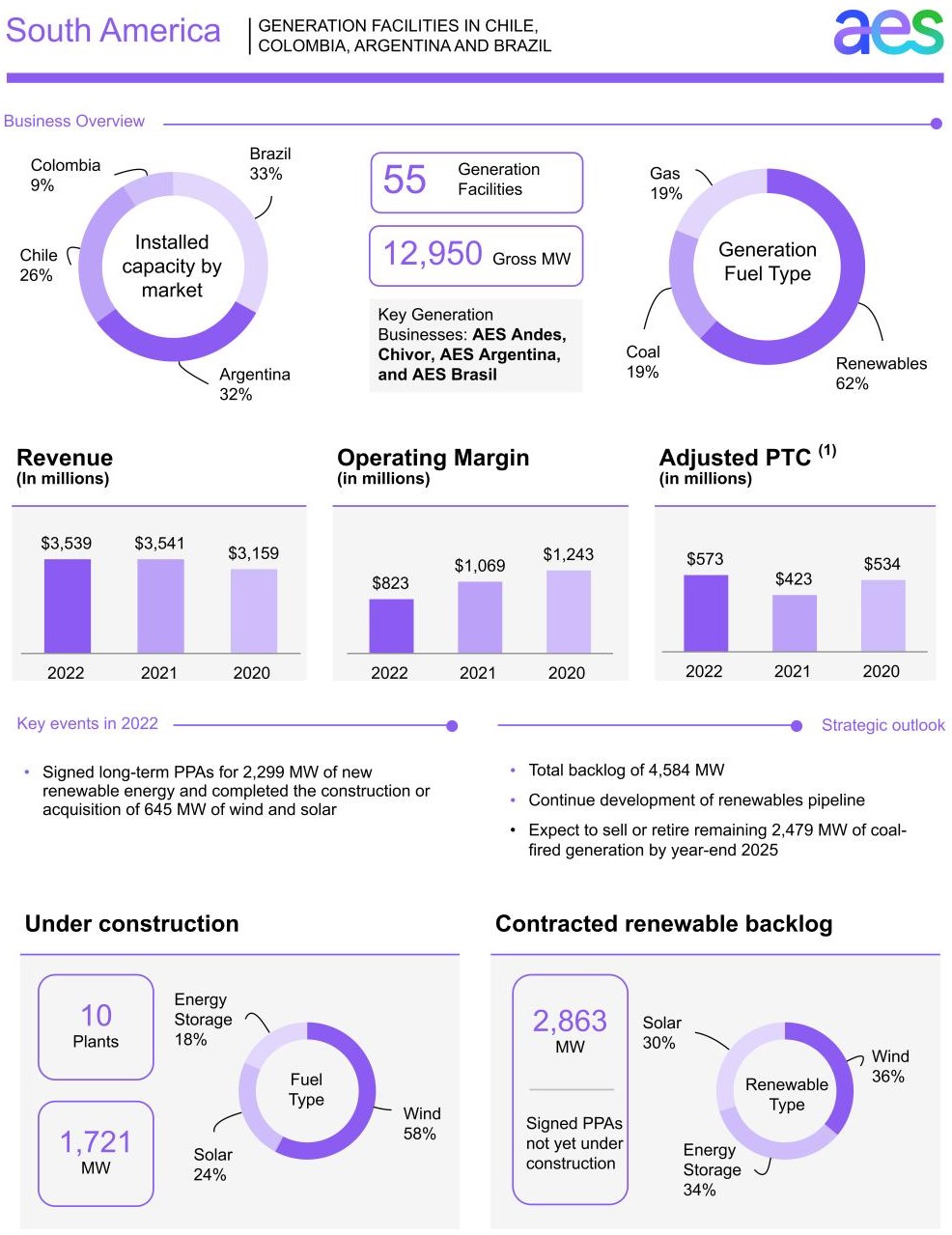
| (1) Non-GAAP measure. See Item 7.—Management’s Discussion and Analysis of Financial Condition and Results of Operations—SBU Performance Analysis—Non-GAAP Measures for reconciliation and definition. |
| 25 | 2022 Annual Report |
South America SBU
Our South America SBU has generation facilities in four countries — Chile, Colombia, Argentina, and Brazil. AES Andes is a publicly traded company in Chile and owns all of our assets in Chile and Colombia, as well as the TermoAndes in Argentina, as detailed below. AES has a 99% ownership interest in AES Andes and this business is consolidated in our financial statements. AES Brasil is a publicly traded company in Brazil. AES controls and consolidates AES Brasil through its 48% economic interest.
Operating installed capacity of our South America SBU totals 12,950 MW, of which 32%, 26%, 9%, and 33% are located in Argentina, Chile, Colombia, and Brazil, respectively. The following table lists our South America SBU generation facilities:
| 26 | 2022 Annual Report |
| Business | Location | Fuel | Gross MW | AES Equity Interest | Year Acquired or Began Operation | Contract Expiration Date | Customer(s) | |||||||||||||||||||||||||||||||||||||
| Chivor | Colombia | Hydro | 1,000 | 99 | % | 2000 | 2023-2039 | Various | ||||||||||||||||||||||||||||||||||||
| San Fernando | Colombia | Solar | 61 | 99 | % | 2021 | 2036 | Ecopetrol | ||||||||||||||||||||||||||||||||||||
| Brisas | Colombia | Solar | 27 | 99 | % | 2022 | 2037 | Ecopetrol | ||||||||||||||||||||||||||||||||||||
| Castilla | Colombia | Solar | 21 | 99 | % | 2019 | 2034 | Ecopetrol | ||||||||||||||||||||||||||||||||||||
| Tunjita | Colombia | Hydro | 20 | 99 | % | 2016 | 2023-2039 | Various | ||||||||||||||||||||||||||||||||||||
| Colombia Subtotal | 1,129 | |||||||||||||||||||||||||||||||||||||||||||
| Ventanas (1) | Chile | Coal | 745 | 99 | % | 2000, 2010, 2013 | ||||||||||||||||||||||||||||||||||||||
| Angamos | Chile | Coal | 558 | 99 | % | 2011 | Various | |||||||||||||||||||||||||||||||||||||
| Cochrane | Chile | Coal | 550 | 57 | % | 2016 | 2030-2037 | SQM, Sierra Gorda, Quebrada Blanca | ||||||||||||||||||||||||||||||||||||
| Alto Maipo (2) | Chile | Hydro | 531 | 99 | % | 2021 | 2040 | Minera Los Pelambres | ||||||||||||||||||||||||||||||||||||
| Norgener | Chile | Coal | 276 | 99 | % | 2000 | 2028 | Codelco | ||||||||||||||||||||||||||||||||||||
| Cordillera Hydro Complex (3) | Chile | Hydro | 240 | 99 | % | 2000 | 2023-2024 | Various | ||||||||||||||||||||||||||||||||||||
| Los Olmos | Chile | Wind | 110 | 51 | % | 2022 | 2032 | Google, Various | ||||||||||||||||||||||||||||||||||||
| Los Cururos | Chile | Wind | 109 | 51 | % | 2019 | Various | |||||||||||||||||||||||||||||||||||||
| Andes Solar 2a | Chile | Solar | 81 | 51 | % | 2021 | Google, Various | |||||||||||||||||||||||||||||||||||||
| Mesamavida | Chile | Wind | 63 | 99 | % | 2022 | 2038 | Google, Various | ||||||||||||||||||||||||||||||||||||
| Andes Solar 1 | Chile | Solar | 22 | 99 | % | 2016 | 2036 | Quebrada Blanca | ||||||||||||||||||||||||||||||||||||
| Cochrane ES | Chile | Energy Storage | 20 | 57 | % | 2016 | ||||||||||||||||||||||||||||||||||||||
| Angamos ES | Chile | Energy Storage | 20 | 99 | % | 2011 | ||||||||||||||||||||||||||||||||||||||
| Laja | Chile | Biomass | 13 | 99 | % | 2000 | 2023 | CMPC | ||||||||||||||||||||||||||||||||||||
| Norgener ES (Los Andes) | Chile | Energy Storage | 12 | 99 | % | 2009 | ||||||||||||||||||||||||||||||||||||||
| Alfalfal Virtual Reservoir | Chile | Energy Storage | 10 | 99 | % | 2020 | ||||||||||||||||||||||||||||||||||||||
| PFV Kaufmann | Chile | Solar | 1 | 99 | % | 2021 | 2040 | Kaufmann | ||||||||||||||||||||||||||||||||||||
| Chile Subtotal | 3,361 | |||||||||||||||||||||||||||||||||||||||||||
| TermoAndes (4) | Argentina | Gas/Diesel | 643 | 99 | % | 2000 | 2023-2024 | Various | ||||||||||||||||||||||||||||||||||||
| AES Andes Subtotal (5) | 5,133 | |||||||||||||||||||||||||||||||||||||||||||
| Alicura | Argentina | Hydro | 1,050 | 100 | % | 2000 | ||||||||||||||||||||||||||||||||||||||
| Paraná-GT | Argentina | Gas/Diesel | 870 | 100 | % | 2001 | ||||||||||||||||||||||||||||||||||||||
| San Nicolás | Argentina | Coal/Gas/Oil/Energy Storage | 691 | 100 | % | 1993 | ||||||||||||||||||||||||||||||||||||||
| Guillermo Brown (6) | Argentina | Gas/Diesel | 576 | — | % | 2016 | ||||||||||||||||||||||||||||||||||||||
| Cabra Corral | Argentina | Hydro | 102 | 100 | % | 1995 | Various | |||||||||||||||||||||||||||||||||||||
| Vientos Bonaerenses | Argentina | Wind | 100 | 100 | % | 2020 | 2024-2040 | Various | ||||||||||||||||||||||||||||||||||||
| Vientos Neuquinos | Argentina | Wind | 100 | 100 | % | 2020 | 2024-2040 | Various | ||||||||||||||||||||||||||||||||||||
| Ullum | Argentina | Hydro | 45 | 100 | % | 1996 | Various | |||||||||||||||||||||||||||||||||||||
| Sarmiento | Argentina | Gas/Diesel | 33 | 100 | % | 1996 | ||||||||||||||||||||||||||||||||||||||
| El Tunal | Argentina | Hydro | 10 | 100 | % | 1995 | Various | |||||||||||||||||||||||||||||||||||||
| Argentina Subtotal | 3,577 | |||||||||||||||||||||||||||||||||||||||||||
| AES Brasil Operações (Tietê) (7) | Brazil | Hydro | 2,658 | 48 | % | 1999 | 2032 | Various | ||||||||||||||||||||||||||||||||||||
| Cubico II | Brazil | Wind | 456 | 48 | % | 2022 | 2034-2035 | CCEE | ||||||||||||||||||||||||||||||||||||
| Alto Sertão II | Brazil | Wind | 386 | 36 | % | 2017 | 2033-2035 | Various, CCEE | ||||||||||||||||||||||||||||||||||||
| Ventus | Brazil | Wind | 187 | 36 | % | 2020 | 2034 | CCEE | ||||||||||||||||||||||||||||||||||||
| Mandacaru and Salinas | Brazil | Wind | 159 | 48 | % | 2021 | 2033-2034 | CCEE | ||||||||||||||||||||||||||||||||||||
| Guaimbê | Brazil | Solar | 150 | 36 | % | 2018 | 2037 | CCEE | ||||||||||||||||||||||||||||||||||||
| Tucano (8) | Brazil | Wind | 99 | 24 | % | 2022 | 2042 | Unipar | ||||||||||||||||||||||||||||||||||||
| AGV Solar | Brazil | Solar | 76 | 36 | % | 2019 | 2039 | Various, CCEE | ||||||||||||||||||||||||||||||||||||
| Boa Hora | Brazil | Solar | 69 | 48 | % | 2019 | 2035 | CCEE | ||||||||||||||||||||||||||||||||||||
| AES Brasil Subtotal | 4,240 | |||||||||||||||||||||||||||||||||||||||||||
| 12,950 |
(1)In December 2020, AES Andes requested the retirement of Ventanas 2 and is awaiting regulatory approval.
(2)In November 2021, Alto Maipo SpA filed a voluntary petition under Chapter 11 of the U.S. Bankruptcy Code. After Chapter 11 filing, the Company no longer has control over Alto Maipo and therefore deconsolidated the business. In May 2022, Alto Maipo emerged from bankruptcy. The restructured business is considered a VIE and the Company continues to account for the business as a deconsolidated entity.
(3)Includes: Alfalfal, Queltehues and Volcan.
(4)TermoAndes is located in Argentina, but is connected to both the SEN in Chile and the SADI in Argentina.
| 27 | 2022 Annual Report |
(5)In 2022, AES' indirect beneficial interest in AES Andes increased from 67% to 99% as result of a tender offer process.
(6)AES operates this facility through management or O&M agreements and to date owns no equity interest in the business.
(7)Tietê hydro plants: Água Vermelha, Bariri, Barra Bonita, Caconde, Euclides da Cunha, Ibitinga, Limoeiro, Mog-Guaçu, Nova Avanhandava, Promissão, Sao Joaquim, and Sao Jose.
(8)Unconsolidated entity, accounted for as an equity affiliate.
Under construction — The following table lists our plants under construction in the South America SBU:
| Business | Location | Fuel | Gross MW | AES Equity Interest | Expected Date of Commercial Operations | |||||||||||||||||||||||||||
| Mesamávida (1) | Chile | Wind | 5 | 99 | % | 1H 2023 | ||||||||||||||||||||||||||
| Andes Solar 2b (1) | Chile | Solar | 180 | 99 | % | 1H 2023 | ||||||||||||||||||||||||||
| Energy Storage | 112 | |||||||||||||||||||||||||||||||
| Campo Lindo (1) | Chile | Wind | 73 | 99 | % | 1H 2023 | ||||||||||||||||||||||||||
| Virtual Reservoir 2 | Chile | Energy Storage | 40 | 99 | % | 2H 2023 | ||||||||||||||||||||||||||
| San Matias | Chile | Wind | 82 | 99 | % | 1H 2024 | ||||||||||||||||||||||||||
| Andes Solar 4 | Chile | Solar | 238 | 99 | % | 1H 2024 | ||||||||||||||||||||||||||
| Energy Storage | 147 | |||||||||||||||||||||||||||||||
| AES Andes Subtotal | 877 | |||||||||||||||||||||||||||||||
| Tucano Phase 1 | Brazil | Wind | 56 | 24 | % | 1H 2023 | ||||||||||||||||||||||||||
| Tucano Phase 2 | Brazil | Wind | 167 | 48 | % | 1H 2023 | ||||||||||||||||||||||||||
| Cajuína | Brazil | Wind | 325 | 48 | % | 1H 2023 | ||||||||||||||||||||||||||
| Cajuína | Brazil | Wind | 296 | 36 | % | 2H 2023 | ||||||||||||||||||||||||||
| AES Brasil Subtotal | 844 | |||||||||||||||||||||||||||||||
| 1,721 |
(1)AES Andes has contracted to sell 49% ownership interest in each of these projects to Global Infrastructure Partners ("GIP") once they reach commercial operations. Subsequent to the sales, these projects will continue to be consolidated as AES Andes will retain 51% ownership interest.
The majority of projects under construction have executed mid- to long-term PPAs.
| 28 | 2022 Annual Report |
The following map illustrates the location of our South America facilities:
South America Businesses
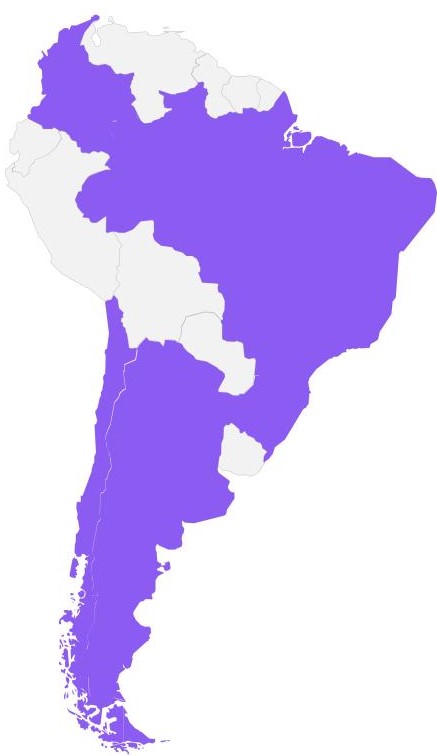
Chile
Business Description — In Chile, through AES Andes, we are engaged in the generation and supply of electricity (energy and capacity) in the SEN—see Regulatory Framework and Market Structure below. AES Andes is the third largest generation operator in Chile in terms of installed capacity with 3,299 MW, excluding energy storage, and has a market share of approximately 11% as of December 31, 2022.
AES Andes owns a diversified generation portfolio in Chile in terms of geography, technology, customers, and energy resources. AES Andes' generation plants are located near the principal electricity consumption centers, including Santiago, Valparaiso, and Antofagasta. AES Andes' diverse generation portfolio provides flexibility for the management of contractual obligations with regulated and unregulated customers, provides backup energy to the spot market and facilitates operations under a variety of market and hydrological conditions.
AES Andes' Green Blend strategy aims to reduce carbon intensity and incorporate renewable energy to extend our existing conventional PPAs. This strategy de-links company's PPAs from legacy fossil resources, grows its renewable energy portfolio, and delivers a competitive, reliable energy solution. In line with the Green Blend strategy, AES Andes has committed to not build additional coal-based power plants and to advance the development of new renewable projects, including the implementation of battery energy storage systems ("BESS") and other technological innovations that will provide greater flexibility and reliability to the system.
AES Andes currently has long-term contracts, with an average remaining term of approximately 10 years, with regulated distribution companies and unregulated customers, such as mining and industrial companies. In general, these long-term contracts include pass-through mechanisms for fuel costs along with price indexations to U.S. Consumer Price Index ("CPI").
In addition to energy payments, AES Andes also receives capacity payments to compensate for availability during periods of peak demand. The grid operator, Coordinador Electrico Nacional ("CEN"), annually determines the
| 29 | 2022 Annual Report |
capacity requirements for each power plant. The capacity price is fixed semiannually by the National Energy Commission and indexed to the CPI and other relevant indices.
Key Financial Drivers — Hedging strategies at AES Andes limit volatility to the underlying financial drivers. In addition, financial results are likely to be driven by many factors, including, but not limited to:
-
spot market prices (largely impacted by dry hydrology scenarios, forced outages and international fuel prices);
-
changes in current regulatory rulings altering the ability to pass through or recover certain costs;
-
fluctuations of the Chilean peso;
-
tax policy changes; and
-
legislation promoting renewable energy and/or more restrictive regulations on thermal generation assets.
Regulatory Framework and Market Structure — The Chilean electricity industry is divided into three business segments: generation, transmission, and distribution. Private companies operate in all three segments, and generators can enter into PPAs to sell energy to regulated and unregulated customers, as well as to other generators in the spot market.
Chile operates in a single power market, referred to as the SEN, which is managed by the grid operator CEN. The SEN has an installed capacity of 31,141 MW, and represents 99% of the installed generation capacity of the country.
CEN coordinates all generation and transmission companies in the SEN. CEN minimizes the operating costs of the electricity system, while maximizing service quality and reliability requirements. CEN dispatches plants in merit order based on their variable cost of production, allowing for electricity to be supplied at the lowest available cost. In the south-central region of the SEN, thermoelectric generation is required to fulfill demand not satisfied by hydroelectric, solar, and wind output and is critical to provide reliable and dependable electricity supply under dry hydrological conditions in the highest demand area of the SEN. In the northern region of the SEN, which includes the Atacama Desert, thermoelectric capacity represents the majority of installed capacity. The fuels used for thermoelectric generation, mainly coal, diesel, and LNG, are indexed to international prices. In 2022, the installed generation capacity in the Chilean market was composed of 42% thermoelectric, 23% hydroelectric, 20% solar, 13% wind, and 2% other fuel sources.
Hydroelectric plants represent a significant portion of the system's installed capacity. Precipitation and snow melt impact hydrological conditions in Chile. Rain occurs principally from June to August and snow melt occurs from September to December. These factors affect dispatch of the system's hydroelectric and thermoelectric generation plants, thereby influencing spot market prices.
The Ministry of Energy has primary responsibility for the Chilean electricity system directly or through the National Energy Commission and the Superintendency of Electricity and Fuels.
All generators can sell energy through contracts with regulated distribution companies or directly to unregulated customers. Unregulated customers are customers whose connected capacity is higher than 5 MW. Customers with connected capacity between 0.5 MW and 5 MW can opt for regulated or unregulated contracts for a minimum period of four years. By law, both regulated and unregulated customers are required to purchase all electricity under contracts. Generators may also sell energy to other power generation companies on a short-term basis at negotiated prices outside the spot market. Electricity prices in Chile are denominated in USD, although payments are made in Chilean pesos.
The Chilean government’s decarbonization plan includes the complete retirement of the SEN coal fleet by the end of 2040 and carbon neutrality by 2050. On December 26, 2020, the Ministry of Energy’s Supreme Decree Number 42 went into effect, allowing coal plants to enter into Strategic Reserve Status (“SRS”) and receive 60% of capacity payments for the 5-year period following its shutdown to remain connected as a backup in case of a system emergency. Following the issuance of this regulation and per the disconnection and termination agreement signed with the Chilean government in June 2019, AES Andes accelerated the retirement plans of its Ventanas 1 and Ventanas 2 coal-fired units. On July 22, 2022, AES Andes was authorized by the CEN to retire, cease operations, and definitively disconnect Ventanas 1 from the SEN as of June 30, 2022. This coal-fired unit had been in SRS since December 29, 2020. Concurrently, AES Andes requested the shutdown of Ventanas 2 as soon as possible. Ventanas 2’s shut down and transition into SRS is pending resolution of current system transmission constraints in order to guarantee system stability and ensure a responsible energy transition. The unit’s retirement
| 30 | 2022 Annual Report |
into SRS has been postponed and is expected to occur during 2023. The definitive cessation of operations of Ventanas 2 is expected by December 29, 2025 as informed by the National Energy Commission on July 22, 2022 through Exempt Resolution No. 555.
In July 2021, AES Andes committed to allow the shutdown of coal-fired operations at its Ventanas 3, Ventanas 4, Angamos 1, and Angamos 2 units as soon as January 1, 2025, once the safety, sufficiency, and competitiveness of the system allows it. These four units together have an installed capacity of 1,095 MW and each unit has publicly announced phase-out plans in line with the Company’s decarbonization strategy. In July 2021, the Company also sold its entire ownership interest in Guacolda, a 764 MW coal-fired plant located in Chile. Guacolda, Ventanas, and Angamos represent an aggregate of 2.2 GW of coal-fired capacity, or 72% of AES Andes’ legacy coal fleet. AES Andes continues to work under the Green Blend strategy to accelerate the phase-out of the remaining two coal-fired plants.
Environmental Regulation — Chilean law requires all electricity generators to supply a certain portion of their total contractual obligations with non-conventional renewable energy ("NCRE"). Generation companies are able to meet this requirement by building NCRE generation capacity (wind, solar, biomass, geothermal, and small hydroelectric technology) or purchasing NCREs from qualified generators. Non-compliance with the NCRE requirements will result in fines. AES Andes currently fulfills the NCRE requirements by utilizing AES Andes' solar, wind, and biomass power plants.
Since 2017, emissions of particulate matter, SO2, NOX, and CO2 are monitored for plants with an installed capacity over 50 MW; these emissions are taxed. In the case of CO2, the tax is equivalent to $5 per ton emitted. Certain PPAs have clauses allowing the Company to pass the green tax costs to unregulated customers, while some distribution PPAs do not allow for the pass through of these costs. During 2021, the Chilean General Water Direction, as part of the Ministry of Public Works, established the obligation to install and maintain effective monitoring systems for water withdrawal. We are currently implementing these systems in the power plants for which they are required.
During 2022, new regulations associated with monitoring requirements were published, including Law 21,455, which is the framework on climate change; the new Ventanas power plant Operational Plan; emission standards for back up generators; and recently enacted Law 21,505, which promotes electric energy storage and electromobility. A Prioritized Program of Standards was published, establishing a set of environmental regulations that will impose new obligations for projects both in operation and under construction, including the regulation of environmental noise, thermoelectric power plant emissions, industrial liquid waste, Green Tax offsets, and environmental quality regulations for the protection of marine waters and sediments of the Quintero-Puchuncaví Bay, among others.
AES Andes and its subsidiaries are undergoing administrative environmental sanctioning processes. The compliance programs associated with the Ventanas power plant and the Mesamávida wind farm are being executed, and the compliance program associated with the Cochrane power plant is under review by the authority. The Angamos power plant is currently undergoing an environmental review process of the Environmental Qualification Resolution (RCA in Chile). See Item 3.—Legal Proceedings of this Form 10-K for further discussion.
Development Strategy — AES Andes is committed to reducing the coal intensity of the Chilean power grid and plans to increase the renewable energy capacity in its portfolio. As part of this commitment, there are several projects under construction to supply agreements with its main mining customers in execution of the new Green Blend strategy by integrating renewable energy sources into its portfolio, and by providing contracting options that contain a mix of both renewable and nonrenewable solutions. In total, the pipeline currently has 4.2 GW under development at different stages and diversified geographically.
Within this portfolio, the Company has made significant progress in the development of NCRE projects that are already contracted. In the Biobío region, the Rinconada wind project (258 MW) is being developed, and in Antofagasta, a new expansion of the Andes Solar power plant is being developed, which will include a battery system to optimize solar generation (186 MW + 186 MW-5hr).
In addition, Empresa Eléctrica Angamos, a subsidiary of AES Andes, submitted for environmental processing a worldwide pioneering initiative, referred to as the Alba project, that seeks an alternative for the conversion of thermoelectric plants through the use of molten salts. This project explores the possibility of replacing the current coal-fired generation of units 1 and 2 of the Angamos thermoelectric power plant, located in Mejillones, Antofagasta region, with a molten salt system. With this technology, renewable energy is stored as heat to later be used to provide energy and emission-free capacity to the electrical system.
| 31 | 2022 Annual Report |
Empresa Eléctrica Angamos is also promoting the advancement of green hydrogen technology for mass production through the Adelaida project, which involves the installation of a low-scale green hydrogen production plant with a capacity of 1,000 kg/day of green hydrogen, equivalent to 2.5 MW of power.
Colombia
Business Description — We operate in Colombia through AES Colombia, a subsidiary of AES Andes, which owns Chivor, a hydroelectric plant with an installed capacity of 1,000 MW and Tunjita, a 20 MW run-of-river hydroelectric plant, both located approximately 160 km east of Bogota, as well as the solar facilities of Castilla, Brisas, and San Fernando, 21 MW, 27 MW, and 61 MW respectively. AES Colombia’s installed capacity accounted for approximately 6% of system capacity at the end of 2022. AES Colombia is dependent on hydrological conditions, which influence generation and spot prices of non-contracted generation in Colombia.
AES Colombia's commercial strategy aims to execute contracts with commercial and industrial customers and bid in public tenders, mainly with distribution companies, in order to reduce margin volatility with proper portfolio risk management. The remaining energy generated by our portfolio is sold to the spot market, including ancillary services. Additionally, AES Colombia receives reliability payments for maintaining the plant's availability and generating firm energy during periods of power scarcity, such as adverse hydrological conditions, in order to prevent power shortages.
Key Financial Drivers — Hydrological conditions largely influence Chivor's power generation. Maintaining the appropriate contract level, while maximizing revenue through the sale of excess generation, is key to AES Colombia's results of operations. In addition to hydrology, financial results are driven by many factors, including, but not limited to:
-
forced outages;
-
fluctuations of the Colombian peso; and
-
spot market prices.
Regulatory Framework and Market Structure — Electricity supply in Colombia is concentrated in one main system, the SIN, which encompasses one-third of Colombia's territory, providing electricity to 97% of the country's population. The SIN's installed capacity, primarily hydroelectric (67%), other renewable (3%) and thermal (30%), totaled 18,771 MW as of December 31, 2022. The marked seasonal variations in Colombia's hydrology result in price volatility in the short-term market. In 2022, 84% of total energy demand was supplied by hydroelectric plants.
The electricity sector in Colombia operates under a competitive market framework for the generation and sale of electricity, and a regulated framework for transmission and distribution of electricity. The distinct activities of the electricity sector are governed by Colombian laws and CREG, the Colombian regulating entity for energy and gas. Other government entities have a role in the electricity industry, including the Ministry of Mines and Energy, which defines the government's policy for the energy sector; the Public Utility Superintendency of Colombia, which is in charge of overseeing utility companies; and the Mining and Energy Planning Unit, which is in charge of expansion planning of the generation and transmission network.
The generation sector is organized on a competitive basis with companies selling their generation in the wholesale market at the short-term price or under bilateral contracts with other participants, including distribution companies, generators and traders, and unregulated customers at freely negotiated prices. The National Dispatch Center dispatches generators in merit order based on bid offers in order to ensure that demand will be satisfied by the lowest cost combination of available generating units.
The expansion of the system is supported by two schemes: i) reliability charge auctions where firm energy commitments are focused on conventional technology power plants, and ii) auctions of long-term energy contracts assigned for periods of 15 years aimed at non-conventional renewable resources.
Environmental Regulation — Decree 1076 of 2015 established the current Environmental Licensing Scheme that defines the scope of the National Environmental Licensing Authority ("ANLA") for granting environmental licenses. In recent years, the Ministry of the Environment has generated regulations in connection with licenses, such as the biotic compensation methodology and guidance for presentation of environmental studies in 2018, and the regulation of minor changes to environmental licenses in 2022. AES Colombia has obtained environmental licenses for 406 MW of wind projects included in its development pipeline.
Development Strategy — AES Colombia is committed to supporting its customers to diversify their energy supply and become more competitive. As part of this commitment, AES Colombia is developing a pipeline of 1.3
| 32 | 2022 Annual Report |
GW of solar and wind projects. Six wind projects totaling 1,149 MW are located in La Guajira, one of the windiest spots in the world. Of this 1,149 MW, 255 MW were awarded a 15-year PPA at the renewable auction in 2019.
Argentina
Business Description — AES operates plants in Argentina totaling 4,220 MW, representing 10% of the country's total installed capacity. AES owns a diversified generation portfolio in Argentina in terms of geography, technology, and fuel source. AES Argentina's plants are placed in strategic locations within the country in order to provide energy to the spot market and customers, making use of wind, hydro, and thermal plants.
AES primarily sells its energy in the wholesale electricity market where prices are largely regulated. In 2022, approximately 84% of the energy was sold in the wholesale electricity market and 16% was sold under contract sales made by TermoAndes, Vientos Neuquinos, and Vientos Bonaerenses power plants.
Key Financial Drivers — Financial results are driven by many factors, including, but not limited to:
-
forced outages;
-
exposure to fluctuations of the Argentine peso;
-
changes in hydrology and wind resources;
-
timely collection of FONINVEMEM installments and outstanding receivables (see Regulatory Framework and Market Structure below);
-
natural gas prices and availability for contracted generation at TermoAndes; and
-
domestic energy demand and exports.
Regulatory Framework and Market Structure — Argentina has one main power system, the SADI, which serves 96% of the country. As of December 31, 2022, the installed capacity of the SADI totaled 42,927 MW. The SADI's installed capacity is composed primarily of thermoelectric generation (59%) and hydroelectric generation (26%), as well as wind (8%), nuclear (4%), and solar (3%).
Thermoelectric generation in the SADI is primarily natural gas. However, scarcity of natural gas during winter periods (June to August) due to transport constraints result in the use of alternative fuels, such as oil and coal. The SADI is also highly reliant on hydroelectric plants. Hydrological conditions impact reservoir water levels and largely influence the dispatch of the system's hydroelectric and thermoelectric generation plants and, therefore, influence market costs. Precipitation in Argentina occurs principally from May to October.
The Argentine regulatory framework divides the electricity sector into generation, transmission, and distribution. The wholesale electric market is comprised of generation companies, transmission companies, distribution companies, and large customers who are permitted to trade electricity. Generation companies can sell their output in the spot market or under PPAs. CAMMESA manages the electricity market and is responsible for dispatch coordination. The Electricity National Regulatory Agency is in charge of regulating public service activities and the Secretariat of Energy regulates system framework and grants concessions or authorizations for sector activities. In Argentina, there is a tolling scheme in which the regulator establishes prices for electricity and defines fuel reference prices. As a result, our businesses are particularly sensitive to changes in regulation.
The Argentine electric market is an "average cost" system. Generators are compensated for fixed costs and non-fuel variable costs, under prices denominated in Argentine pesos. CAMMESA is in charge of providing the natural gas and liquid fuels required by the generation companies, except for coal.
The expansion of renewable capacity in the system is promoted by allowing the new power plants to sign contracts either with CAMMESA through the RenovAr program or directly by trading energy in the private market.
During 2022, although the government increased prices to the end user, subsidies and the system deficit also increased. By December 2022, distribution companies recovered an average 40% of the total cost of the system.
In past years, AES Argentina contributed certain accounts receivable to fund the construction of three power plants under FONINVEMEM agreements. These receivables accrue interest and are collected in monthly installments over 10 years after commercial operation date of the related plant takes place. In 2020, FONINVEMEM I and II installments were fully repaid and in 2021 the ownership interests in Termoeléctrica San Martín and Termoeléctrica Manuel Belgrano were defined after the incorporation of the National Government as majority shareholder. The transfer of the power plants to these companies has not yet occurred. FONINVEMEM III is related to Termoeléctrica Guillermo Brown, which commenced operations in April 2016, and the installments are still being collected. AES Argentina will receive a pro rata ownership interest in this plant, which shall not be greater than 30%,
| 33 | 2022 Annual Report |
once the accounts receivables have been fully repaid. See Item 7.—Management's Discussion and Analysis of Financial Condition and Results of Operations—Capital Resources and Liquidity—Long-Term Receivables and Note 7.—Financing Receivables in Item 8.—Financial Statements and Supplementary Data of this Form 10-K for further discussion of receivables in Argentina.
In 2021 and 2022, the Argentine peso devalued against the USD by approximately 18% and 42%, respectively, and Argentina’s economy continued to be highly inflationary. Since September 2019, currency controls have been established to govern the devaluation of the Argentine peso and keep Argentine central bank reserves at acceptable levels.
Environmental Regulation — Argentina has agreed to commitments made by the international community ratified in the Paris Agreement and in Law 27,270 passed in September 2016.
In October 2015, Law 27,191 was passed, seeking to create a successful framework for the development of renewable energy. This law set an objective of 8% renewable energy by 2017 and 20% by 2025 and also introduced tax exemptions for importing equipment used in the construction of renewable energy projects in addition to other tax benefits. This framework fostered AES Argentina's construction of Vientos Bonaerenses and Vientos Neuquinos power plants, which are fully contracted with national and private customers in the long term.
In December 2019, Law 27,520 established a minimum budget to grant adequate actions, instruments, and strategies to mitigate and adapt to global climate change effects in all national territories and created the National Office of Climate Change to designate private and public actors to design policies aiming to reduce greenhouse gases and to provide coordinated responses in sectors that are vulnerable to climate change impacts.
All AES Argentina plants are certified under international standards of Quality (ISO 9001), Safety and Health (ISO 45.001) and Environment (ISO 14001).
Development Strategy — Leveraging existing wind operating facilities in southern Buenos Aires and market opportunities, AES Argentina is developing 890 MW of wind greenfield projects that are in mid-to-late stages of development and could be funded locally. These projects are adjacent or nearby to AES Argentina's operating assets and will be used to participate in future private auctions for renewable PPAs.
Brazil
Business Description — AES Brasil owns a diversified generation portfolio in Brazil and its plants are placed in strategic locations within the country in order to provide energy to customers and the regulated market, making use of hydro, solar, and wind generation.
AES Brasil owns 12 hydroelectric power plants in the state of São Paulo with total installed capacity of 2,658 MW, which represents approximately 11% of the total generation capacity in the state of São Paulo and 2% of the hydropower physical guarantee of the hydrological risk sharing system (Energy Reallocation Mechanism or "MRE", as described below in the topic "Regulatory Framework and Market Structure"). These hydroelectric plants operate under a 33-year concession expiring in 2032.
Over the past three years, AES Brasil acquired and developed three solar power plants in the state of São Paulo, which are fully contracted with 20-year PPAs and together account for 295 MW of installed capacity.
AES Brasil has also invested in wind generation which is fully contracted in the regulated market and currently owns the following operational wind complexes:
-
Alto Sertão II, located in the state of Bahia with an installed capacity of 386 MW and subject to 20-year PPAs expiring between 2033 and 2035;
-
Ventus, located in the state of Rio Grande do Norte with an installed capacity of 187 MW and subject to a 20-year PPA expiring in 2034;
-
Mandacaru and Salinas, located in the states of Rio Grande do Norte and Ceará with 159 MW of installed capacity, fully sold in the regulated market for 20 years; and
-
Ventos do Araripe, Caetés, and Cassino, acquired in November 2022 and located in the states of Piaui and Pernambuco, in the northeast region of Brazil, and Rio Grande do Sul in the south region, respectively. The complexes have been operational since 2015 with 456 MW of installed capacity, sold in the regulated market for 20 years.
| 34 | 2022 Annual Report |
AES Brasil aims to contract most of its physical guarantee requirements and sell the remaining portion in the spot market. The commercial strategy is reassessed periodically according to changes in market conditions, hydrology, and other factors. AES Brasil generally sells available energy through medium-term bilateral contracts.
In the second half of 2020, AES acquired an additional 19.8% ownership in AES Brasil and on December 31, 2020 its economic interest was 44.1%. Through multiple transactions in 2021, AES acquired an additional 1.6% ownership in AES Brasil. Additionally, AES migrated AES Brasil's shares to the Novo Mercado, which is a listing segment of the Brazilian stock exchange with the highest standards of corporate governance in Brazil, requiring equity capital to be composed only of common shares. The reorganization and the exchange of shares was completed on March 26, 2021, and the shares issued by AES Brasil started trading on Novo Mercado on March 29, 2021. The Company maintained majority representation on AES Brasil’s board of directors.
In October 2021, as part of the reorganization process, AES Brasil concluded a follow-on offering for the issuance of 93 million newly issued shares to fund its renewable energy portfolio at a cost of $207 million. As a result, AES' indirect beneficial interest in AES Brasil increased 1%, from 45.7% to 46.7%.
In September 2022, AES Brasil commenced a private placement offering for its existing shareholders to subscribe for up to 116 million newly issued shares. The offering concluded on October 3, 2022 with a total of 107 million shares subscribed at a cost of $197 million. AES Holding Brazil acquired 54 million shares, thereby increasing AES’ indirect beneficial interest in AES Brasil from 46.7% to 47.4%. AES Brasil is reported in the South America SBU reportable segment.
Key Financial Drivers — The electricity market in Brazil is highly dependent on hydroelectric generation, therefore electricity pricing is driven by hydrology. Plant availability is also a significant financial driver as in times of high hydrology, AES is more exposed to the spot market. AES Brasil's financial results are driven by many factors, including, but not limited to:
-
hydrology, impacting quantity of energy generated in the MRE (see Regulatory Framework and Market Structure below for further information);
-
growth in demand for energy;
-
market price risk when re-contracting;
-
asset management;
-
cost management; and
-
ability to execute on its growth strategy.
Regulatory Framework and Market Structure — In Brazil, the Ministry of Mines and Energy determines the maximum amount of energy a generation plant can sell, called physical guarantee, representing the long-term average expected energy production of the plant. Under current rules, physical guarantee energy can be sold to distribution companies through long-term regulated auctions or under unregulated bilateral contracts with large consumers or energy trading companies.
Brazil has installed capacity of 191 GW, composed of hydroelectric (58%), thermoelectric (25%), renewable (16%), and nuclear (1%) sources. Operation is centralized and controlled by the national operator, ONS, and regulated by the Brazilian National Electric Energy Agency ("ANEEL"). The ONS dispatches generators based on their marginal cost of production and on the risk of system rationing. Key variables for the dispatch decision are forecasted hydrological conditions, reservoir levels, electricity demand, fuel prices, and thermal generation availability.
In case of unfavorable hydrology, the ONS will reduce hydroelectric dispatch to preserve reservoir levels and increase dispatch of thermal plants to meet demand. The consequences of unfavorable hydrology are (i) higher energy spot prices due to higher energy production costs at thermal plants and (ii) the need for hydro plants to purchase energy in the spot market to fulfill their contractual obligations.
A mechanism known as the MRE (Energy Reallocation Mechanism) was created under ONS to share hydrological risk across MRE hydro generators by using a generation scaling factor ("GSF") to adjust generators' physical guarantee during periods of hydrological scarcity. If the hydro plants generate less than the total MRE physical guarantee, the hydro generators may need to purchase energy in the short-term market. When total hydro generation is higher than the total MRE physical guarantee, the surplus is proportionally shared among its participants and they may sell the excess energy on the spot market.
| 35 | 2022 Annual Report |
In September 2020, Law 14.052/2020 published by ANEEL was approved by the President, establishing terms for compensation to MRE hydro generators for the incorrect application of the GSF mechanism from 2013 to 2018, which resulted in higher charges assessed to MRE hydro generators by the regulator. Under the law, compensation was in the form of an offer for a concession extension for each hydro generator in exchange for full payment of billed GSF trade payables, the amount of which was reduced in conjunction with the payment for a concession extension. On August 12, 2021, ANEEL published Resolution number 2.919/2021, establishing an extension for the end of the concession originally granted to AES Brasil's hydroelectric plants, from 2029 to 2032. On April 14, 2022, the amended term was finalized and agreed upon by ANEEL and AES.
Environmental Regulation — In Brazil, the National Environmental Council ("CONAMA") is responsible for environmental licensing procedures. Inspections are performed by authorities at federal, state and municipal levels. The programs developed by AES Brasil are designed to restore and preserve biodiversity and are in compliance with local procedures and the obligations assumed in AES Brasil's concession with the state government. AES Brasil's main environmental projects include a flora management program which guarantees the production of 1 million seedlings of native tree species, a reservoir repopulation program that aims to maintain the ichthyofauna biodiversity and guarantee continuity of fishing activity by riverside communities, a land fauna monitoring and conservation program, and a water quality monitoring program designed to further understand the structure and functioning of aquatic ecosystems.
In addition, the monitoring and control of reservoir edges is carried out through continuous inspections by the technical team of the Center of Monitoring of Reservoirs ("CMR") through a system of detection of changes, satellite images, aerophotogrammetric surveys, and field inspections.
Development Strategy — AES Brasil's strategy is to grow by adding renewable capacity to its generation platform through acquisition or greenfield projects, to focus on client satisfaction and innovation to offer new products and energy solutions, and to be recognized for excellence in asset management.
In 2021, AES Brasil acquired the Cajuína wind complexes, 1,485 MW of installed capacity of greenfield wind power projects. Cajuína is comprised of the Santa Tereza, São Ricardo, and Serra Verde complexes located in the states of Rio Grande do Norte and Ceará. In March 2022, AES Brasil won the competitive process for the acquisition of the Isolated Productive Unit Cordilheira dos Ventos, which consists of parts of the Facheiro II, Facheiro III, and Labocó projects located in the State of Rio Grande do Norte. These projects have a wind power development capacity of up to 305 MW and were added to the Cajuína wind complex pipeline. Part of Cajuína's capacity is committed under long-term PPAs and in 2022, investment agreements were closed with BRF and Unipar to develop projects of 168 MW and 91 MW, respectively, through joint venture partnerships.
In March 2022, AES Brasil acquired Sky Arinos, a solar project with installable capacity of 378 MW in the city of Arinos in the state of Minas Gerais.
In November 2022, AES Brasil acquired the Ventos do Araripe, Caetés, and Cassino wind complexes, with 456 MW of operational installed capacity located in the states of Piaui and Pernambuco, in the northeast region of Brazil, and Rio Grande do Sul, in the south region.
Under the current terms of the 2018 legal agreement in connection with AES Brasil's concession with the state government, AES Brasil is required to increase its capacity in the state of São Paulo by an additional 81 MW by October 2024. On November 30, 2021 AES Brasil acquired AGV Solar VII Geradora de Energia S.A, a special purpose entity with installable capacity of 33 MW of solar generation. AES Brasil continues to pursue new opportunities to achieve the additional capacity.
| 36 | 2022 Annual Report |
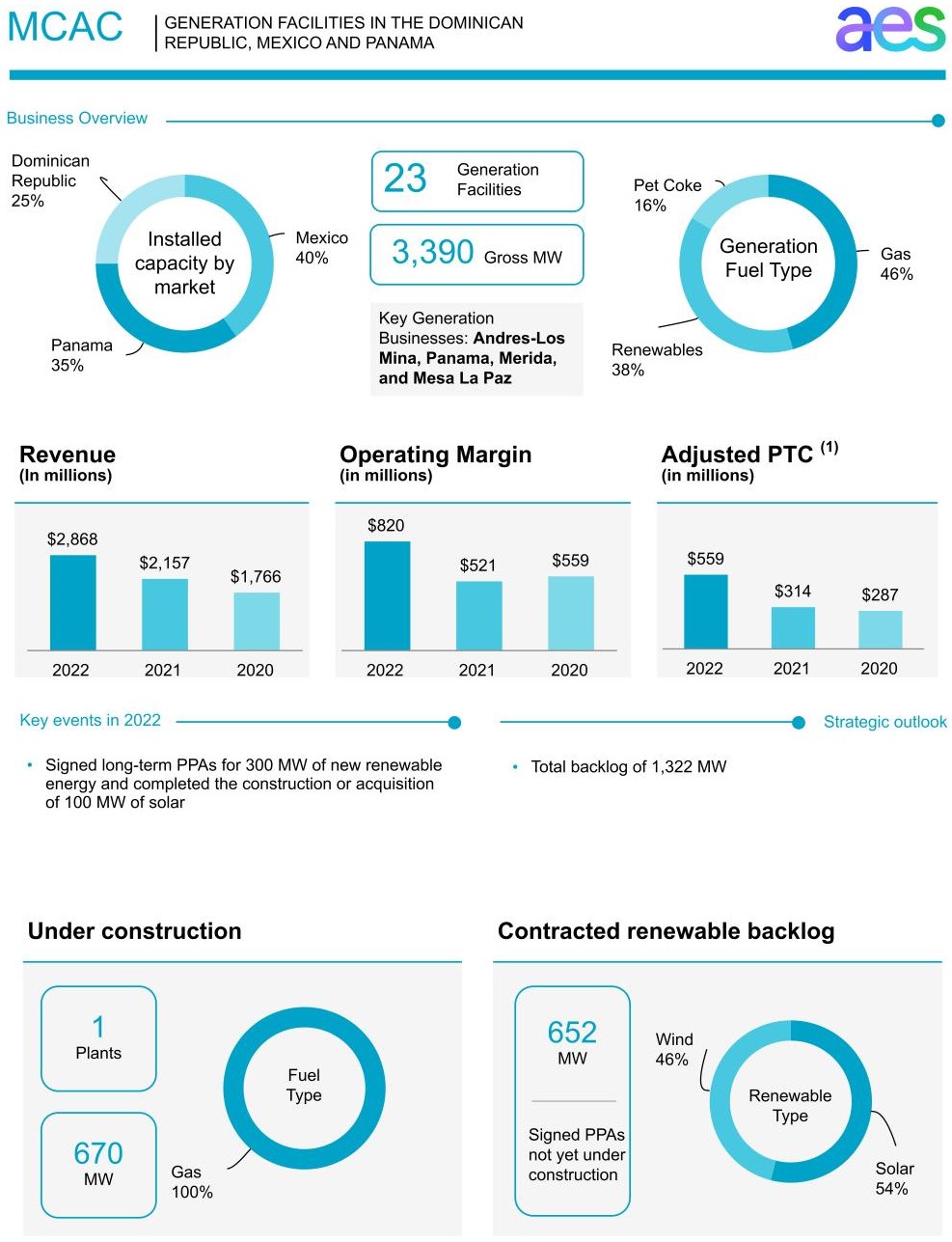
| (1) Non-GAAP measure. See Item 7.—Management’s Discussion and Analysis of Financial Condition and Results of Operations—SBU Performance Analysis—Non-GAAP Measures for reconciliation and definition. |
| 37 | 2022 Annual Report |
MCAC SBU
Our MCAC SBU has a portfolio of generation facilities, including renewable energy, in three countries, with a total capacity of 3,390 MW.
Generation — The following table lists our MCAC SBU generation facilities:
| Business | Location | Fuel | Gross MW | AES Equity Interest | Year Acquired or Began Operation | Contract Expiration Date | Customer(s) | |||||||||||||||||||||||||||||||||||||
| DPP (Los Mina) | Dominican Republic | Gas | 358 | 85 | % | 1996 | 2024 | Andres, Non-Regulated Users | ||||||||||||||||||||||||||||||||||||
| Andres (1) | Dominican Republic | Gas/Diesel | 319 | 85 | % | 2003 | 2023-2024 | Ede Norte, Ede Este, Ede Sur, Non-Regulated Users | ||||||||||||||||||||||||||||||||||||
| Bayasol | Dominican Republic | Solar | 50 | 85 | % | 2021 | 2036 | Ede Sur | ||||||||||||||||||||||||||||||||||||
| Agua Clara | Dominican Republic | Wind | 50 | 85 | % | 2022 | 2039 | Ede Norte | ||||||||||||||||||||||||||||||||||||
| Santanasol | Dominican Republic | Solar | 50 | 85 | % | 2022 | 2038 | Ede Sur | ||||||||||||||||||||||||||||||||||||
| Andres ES | Dominican Republic | Energy Storage | 10 | 85 | % | 2017 | ||||||||||||||||||||||||||||||||||||||
| Los Mina DPP ES | Dominican Republic | Energy Storage | 10 | 85 | % | 2017 | ||||||||||||||||||||||||||||||||||||||
| Dominican Republic Subtotal | 847 | |||||||||||||||||||||||||||||||||||||||||||
| Merida III | Mexico | Gas/Diesel | 505 | 75 | % | 2000 | 2025 | Comision Federal de Electricidad | ||||||||||||||||||||||||||||||||||||
| Mesa La Paz (2) | Mexico | Wind | 306 | 50 | % | 2019 | 2045 | Fuentes de Energia Peñoles | ||||||||||||||||||||||||||||||||||||
| Termoelectrica del Golfo (TEG) | Mexico | Pet Coke | 275 | 99 | % | 2007 | 2027 | CEMEX | ||||||||||||||||||||||||||||||||||||
| Termoelectrica del Penoles (TEP) | Mexico | Pet Coke | 275 | 99 | % | 2007 | 2027 | Peñoles | ||||||||||||||||||||||||||||||||||||
| Mexico Subtotal | 1,361 | |||||||||||||||||||||||||||||||||||||||||||
| Colon (3) | Panama | Gas | 381 | 100 | % | 2018 | 2028 | ENSA, Edemet, Edechi | ||||||||||||||||||||||||||||||||||||
| Bayano | Panama | Hydro | 260 | 49 | % | 1999 | 2030 | ENSA, Edemet, Edechi, Other | ||||||||||||||||||||||||||||||||||||
| Changuinola | Panama | Hydro | 223 | 90 | % | 2011 | 2030 | AES Panama | ||||||||||||||||||||||||||||||||||||
| Chiriqui-Esti | Panama | Hydro | 120 | 49 | % | 2003 | 2030 | ENSA, Edemet, Edechi, Other | ||||||||||||||||||||||||||||||||||||
| Penonome I | Panama | Wind | 55 | 49 | % | 2020 | 2023-2030 | Altenergy, ENSA, Edement, Edechi | ||||||||||||||||||||||||||||||||||||
| Chiriqui-Los Valles | Panama | Hydro | 54 | 49 | % | 1999 | 2030 | ENSA, Edemet, Edechi, Other | ||||||||||||||||||||||||||||||||||||
| Chiriqui-La Estrella | Panama | Hydro | 48 | 49 | % | 1999 | 2030 | ENSA, Edemet, Edechi, Other | ||||||||||||||||||||||||||||||||||||
| Pesé Solar | Panama | Solar | 10 | 49 | % | 2021 | 2030 | ENSA, Edemet, Edechi, Other | ||||||||||||||||||||||||||||||||||||
| Mayorca Solar | Panama | Solar | 10 | 49 | % | 2021 | 2030 | ENSA, Edemet, Edechi, Other | ||||||||||||||||||||||||||||||||||||
| Cedro | Panama | Solar | 10 | 49 | % | 2021 | 2030 | ENSA, Edemet, Edechi, Other | ||||||||||||||||||||||||||||||||||||
| Caoba | Panama | Solar | 10 | 49 | % | 2021 | 2030 | ENSA, Edemet, Edechi, Other | ||||||||||||||||||||||||||||||||||||
| 5B Costa Norte | Panama | Solar | 1 | 100 | % | 2021 | 2051 | Costa Norte LNG Terminal | ||||||||||||||||||||||||||||||||||||
| Panama Subtotal | 1,182 | |||||||||||||||||||||||||||||||||||||||||||
| 3,390 |
(1)Plant also includes an adjacent regasification facility, as well as 70 TBTU LNG storage tank, or an operating capacity of 160,000 m3.
(2)Unconsolidated entity, accounted for as an equity affiliate.
(3)Plant also includes an adjacent regasification facility, as well as an 80 TBTU LNG storage tank, or an operating capacity of 180,000 m3.
| 38 | 2022 Annual Report |
Under construction — The following table lists our plants under construction in the MCAC SBU1:
| Business | Location | Fuel | Gross MW | AES Equity Interest | Expected Date of Commercial Operations | |||||||||||||||||||||||||||
| Gatun | Panama | Gas | 670 | 49 | % | 2H 2024 | ||||||||||||||||||||||||||
| Panama Subtotal | 670 | |||||||||||||||||||||||||||||||
| 670 |
(1)Through and equity affiliate, a second LNG storage tank with 50 TBTU of capacity is under construction in the Dominican Republic and expected to come online in 1H 2023.
The following map illustrates the location of our MCAC facilities:
MCAC Businesses
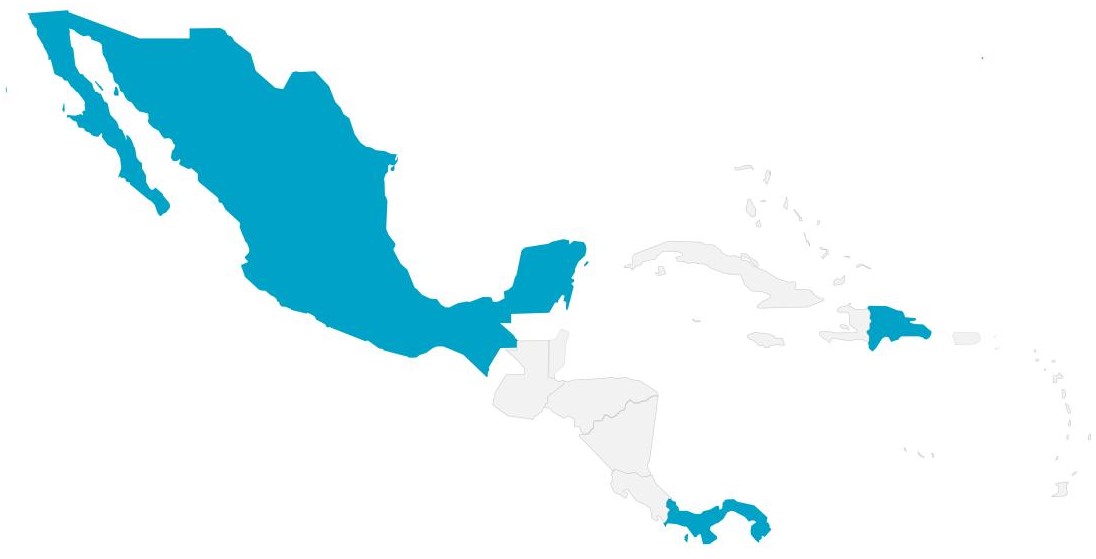
Dominican Republic
Business Description — AES Dominicana consists of five operating subsidiaries: Andres, Los Mina, Bayasol, Santanasol and Agua Clara. With a total of 847 MW of installed capacity, AES provides 16% of the country's capacity and supplies approximately 22% of the country's energy demand via these generation facilities. 668 MW was predominantly contracted until 2022 with government-owned distribution companies and large customers, and have been contracted back with the distribution companies in January 2023.
AES has a strategic partnership with the Estrella and Linda Groups ("Estrella-Linda"), a consortium of two leading Dominican industrial groups that manage a diversified business portfolio.
Andres, Los Mina, Bayasol, Santanasol and Agua Clara are owned 85% by AES. Andres owns and operates a combined cycle natural gas turbine and an energy storage facility with combined generation capacity of 329 MW, as well as the only LNG import terminal in the country, with 160,000 cubic meters of storage capacity. Los Mina owns and operates a combined cycle facility with two natural gas turbines and an energy storage facility with combined generation capacity of 368 MW. Bayasol owns and operates a 50 MW solar farm. Santanasol also operates a 50 MW solar farm. Agua Clara operates a 50 MW wind farm.
AES Dominicana has a long-term LNG purchase contract through 1H 2023 for 33.6 trillion btu/year with a price linked to NYMEX Henry Hub. AES Dominicana has entered in a new long-term LNG purchase contract through 1H 2025 to cover the expected dispatch for Andres and Los Mina. Andres has a long-term contract to sell regasified LNG to industrial users and third party power plants within the Dominican Republic, thereby capturing demand from
| 39 | 2022 Annual Report |
industrial and commercial customers and for other power generation companies that had switched their operations to natural gas.
Key Financial Drivers — Financial results are driven by many factors, including, but not limited to:
-
changes in spot prices due to fluctuations in commodity prices (since fuel is a pass-through cost under the PPAs, any variation in oil prices will impact spot sales for Andres and Los Mina);
-
expiring PPAs, lower contracting levels and the extent of capacity awarded; and
-
growth in domestic natural gas demand, supported by new infrastructure such as the Eastern Pipeline and second LNG tank.
Regulatory Framework and Market Structure — The Dominican Republic energy market is a decentralized industry consisting of generation, transmission, and distribution businesses. Generation companies can earn revenue through short- and long-term PPAs, ancillary services, and a competitive wholesale generation market. All generation, transmission, and distribution companies are subject to and regulated by the General Electricity Law.
Two main agencies are responsible for monitoring compliance with the General Electricity Law:
-
The National Energy Commission drafts and coordinates the legal framework and regulatory legislation. They propose and adopt policies and procedures to implement best practices, support the proper functioning and development of the energy sector, and promote investment.
-
The Superintendence of Electricity's main responsibilities include monitoring compliance with legal provisions, rules, and technical procedures governing generation, transmission, distribution, and commercialization of electricity. They monitor behavior in the electricity market in order to prevent monopolistic practices.
In addition to the two agencies responsible for monitoring compliance with the General Electricity Law, the Ministry of Industry and Commerce supervises commercial and industrial activities in the Dominican Republic as well as the fuels and natural gas commercialization to end users.
The Dominican Republic has one main interconnected system with 5,110 MW of installed capacity, composed of thermal (72%), hydroelectric (12%), wind (8%), and solar (8%).
Development Strategy — AES will continue to develop the commercialization of natural gas and incorporate partners directly in gas infrastructure projects. AES partnered with Energas in a joint venture which has been operating the 50 km Eastern Pipeline since February 2020. The joint venture is also developing an expanded LNG facility of 120,000 cubic meters, including additional storage, regasification, and truck loading capacity, for which the COD is expected in 2023. This will allow AES to reach new customers who have converted, or are in the process of converting, to natural gas as a fuel source, and better operational flexibility.
Panama
Business Description — AES owns and operates five hydroelectric plants totaling 705 MW of generation capacity, a natural gas-fired power plant with 381 MW of generation capacity, a wind farm of 55 MW and four solar plants of 10 MW each, which collectively represent 30% of the total installed capacity in Panama. Furthermore, AES operates an LNG regasification facility, a 180,000 cubic meter storage tank, and a truck loading facility.
The majority of our hydroelectric plants in Panama are based on run-of-the-river technology, with the exception of 223 MW Changuinola plant with regulation reservoirs and the 260 MW Bayano plant. Hydrological conditions have an important influence on profitability. Variations in hydrology can result in an excess or a shortfall in energy production relative to our contractual obligations. Hydro generation is generally in a shortfall position during the dry season from January through May, which is offset by thermal and wind generation since its behavior is opposite and complementary to hydro generation.
Our hydro and thermal assets are mainly contracted through medium to long-term PPAs with distribution companies. A small volume of our hydro plants are contracted with unregulated users. Our hydro assets in Panama have PPAs with distribution companies expiring up to December 2030 for a total contracted capacity of 377 MW. Our thermal asset in Panama has PPAs with distribution companies for a total contracted capacity of 350 MW expiring in August 2028, which matches the term of the LNG supply agreement of such thermal assets. The LNG supply contract has enough flexibility to divert volumes to the Dominican Republic, which increases the connectivity of our two onshore terminals and allows to optimize the LNG position of the portfolio. Colon LNG Marketing continues developing the LNG market in Latin America, with clients already established in Panama and Colombia.
| 40 | 2022 Annual Report |
Additional efforts deployed in Costa Rica, other Central America regions, and Caribbean islands, mainly focusing on small scale LNG logistics.
Key Financial Drivers — Financial results are driven by many factors, including, but not limited to:
-
changes in hydrology, which impacts commodity prices and exposes the business to variability in the cost of replacement power;
-
fluctuations in commodity prices, mainly oil and natural gas, which affect the cost of thermal generation and spot prices;
-
constraints imposed by the capacity of transmission lines connecting the west side of the country with the load, keeping surplus power trapped during the rainy season; and
-
country demand as GDP growth is expected to remain strong over the short and medium term.
Regulatory Framework and Market Structure — The Panamanian power sector is composed of three distinct operating business units: generation, distribution, and transmission. Generators can enter into short-term and long-term PPAs with distributors or unregulated consumers. In addition, generators can enter into backup supply contracts with each other. Outside of PPAs, generators may buy and sell energy in the short-term market. Generators can only contract up to their firm capacity.
Three main agencies are responsible for monitoring compliance with the General Electricity Law:
-
The National Secretary of Energy in Panama ("SNE") has the responsibilities of planning, supervising, and controlling policies of the energy sector within Panama. The SNE proposes laws and regulations to the executive agencies that regulate the procurement of energy and hydrocarbons for the country.
-
The National Authority of Public Services ("ASEP") is an autonomous agency of the government. ASEP is responsible for the regulations, control and oversight of public services in Panama, including electricity, the transmission and distribution of natural gas utilities, and the companies that provide such services.
-
The National Dispatch Center ("CND") is in charge of the operation of the system and the management of the electricity market. They are responsible for implementing the economic dispatch of electricity in the wholesale market. The National Dispatch Center's objectives are to minimize the total cost of generation and maintain the reliability and security of the electric power system. Short-term power prices are determined on an hourly basis by the last dispatched generating unit. Physical generation of energy is determined as a result of the optimization of the economic dispatch regardless of contractual arrangements.
Panama's current total installed capacity is 3,926 MW, composed of hydroelectric (45%), thermal (37%), wind (7%), and solar (11%) generation.
Development Strategy — Given our LNG facility’s excess capacity in Panama, the company is developing natural gas supply solutions for third parties such as power generators and industrial and commercial customers. This strategy will support a growing demand for natural gas in the region and will contribute to AES' mission by reducing CO2 emissions as a result of using LNG.
In addition to investing in LNG infrastructure, AES is investing in renewable projects within the region. This will increase complementary non-hydro renewable assets in the system and contribute to the reduction of hydrological risk in Panama.
Mexico
Business Description — AES has 1,361 MW of installed capacity in Mexico. The TEG and TEP pet coke-fired plants, located in Tamuin, San Luis Potosi, supply power to their offtakers under long-term PPAs expiring in 2027 with a 90% availability guarantee. TEG and TEP secure their fuel under a long-term contract. TEG and TEP are in the migration process from the Legacy market to the New Electric Industry law.
Merida is a CCGT located on Mexico's Yucatan Peninsula. Merida sells power to the CFE under a capacity and energy based long-term PPA through 2025. Additionally, the plant purchases natural gas and diesel fuel under a long-term contract with one of the CFE’s subsidiaries, the cost of which is then passed through to the CFE under the terms of the PPA.
Mesa La Paz is a 306 MW wind project developed under a joint venture with Grupo Bal, located in Llera, Tamaulipas. Mesa La Paz sells 82% of its power under long-term PPAs expiring up to 2045.
| 41 | 2022 Annual Report |
Key Financial Drivers — Financial results are driven by many factors, including, but not limited to:
-
contracting levels, providing additional benefits from improved operational performance, including performance incentives and/or excess energy sales;
-
changes in the methodology to calculate spot energy prices or Locational Marginal Prices, which impacts the excess energy sales to the CFE (see Regulatory Framework and Market Structure below) in (i) TEG and TEP under self-supply scheme, and (ii) Mesa La Paz under the New Market Rules; and
-
improved operational performance and plant availability.
Regulatory Framework and Market Structure — Mexico´s main electrical system is called the National Interconnected System ("SIN"), which geographically covers an area from Puerto Peñasco, Sonora to Cozumel, Quintana Roo. Mexico also has three isolated electrical systems: (1) the Baja California Interconnected System, which is interconnected with the western interconnection; (2) the Baja California Sur Interconnected System; and (3) the Mulegé Interconnected System, a very small electrical system. All three are isolated from the SIN and from each other. The Mexican power industry comprises the activities of generation, transmission, distribution, and commercialization segments, considering transmission and distribution to be exclusive state services.
In addition to the Ministry of Energy, three main agencies are responsible for regulating the market agents and their activities, monitoring compliance with the laws and regulations, and the surveillance of operational compliance and management of the wholesale electricity market:
-
The Energy Regulatory Commission is responsible for the establishment of directives, orders, methodologies, and standards to regulate the electric and fuel markets, as well as granting permits.
-
The National Center for Energy Control, as an ISO, is responsible for managing the wholesale electricity market, transmission and distribution infrastructure, planning network developments, guaranteeing open access to network infrastructure, executing competitive mechanisms to cover regulated demand, and setting transmission charges.
-
The Electricity Federal Commission ("CFE") owns the transmission and distribution grids and is also the country's basic supplier. CFE is the offtaker for IPP generators, and together with its own power units has more than 50% of the current generation market share.
Mexico has an installed capacity totaling 86 GW with a generation mix composed of thermal (64%), hydroelectric (15%), wind (8%), solar (7%), and other fuel sources (6%).
Development Strategy — AES has partnered with Grupo Bal in a joint venture to co-invest in power and related infrastructure projects in Mexico, focusing on renewable generation.
| 42 | 2022 Annual Report |
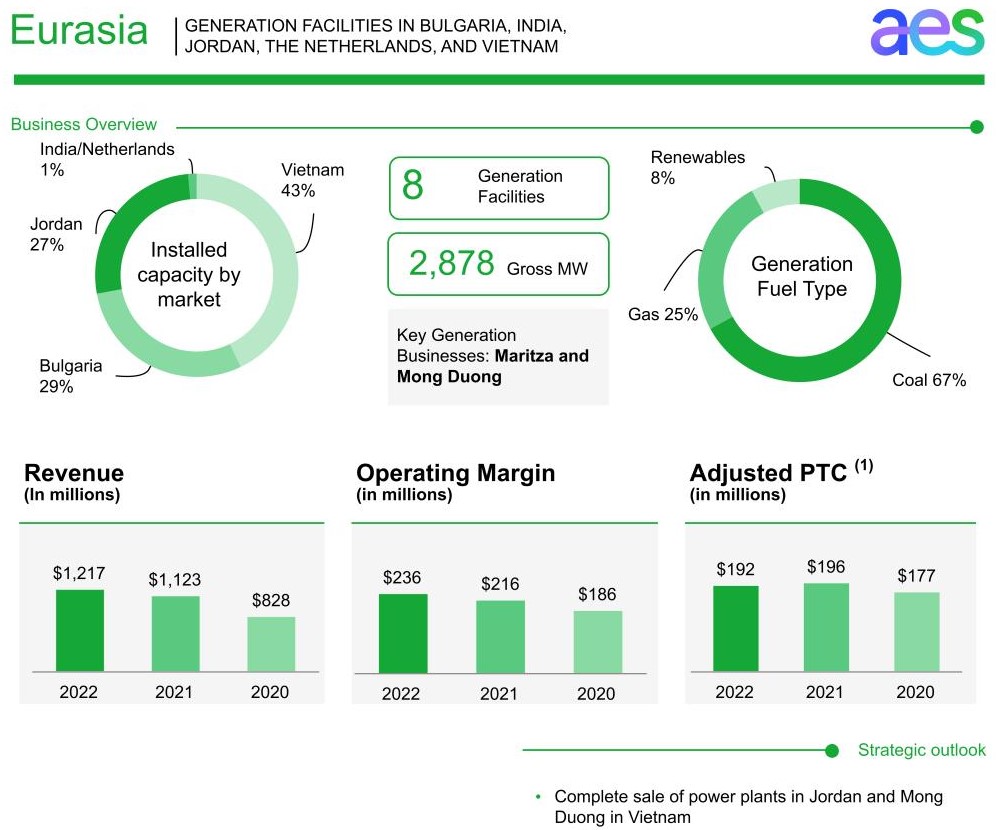
| (1) Non-GAAP measure. See Item 7.—Management’s Discussion and Analysis of Financial Condition and Results of Operations—SBU Performance Analysis—Non-GAAP Measures for reconciliation and definition. |
| 43 | 2022 Annual Report |
Eurasia SBU
Generation — Our Eurasia SBU has generation facilities in five countries with total operating installed capacity of 2,878 MW. The following table lists our Eurasia SBU generation facilities:
| Business | Location | Fuel | Gross MW | AES Equity Interest | Year Acquired or Began Operation | Contract Expiration Date | Customer(s) | |||||||||||||||||||||||||||||||||||||
| Maritza | Bulgaria | Coal | 690 | 100 | % | 2011 | 2026 | NEK | ||||||||||||||||||||||||||||||||||||
| St. Nikola | Bulgaria | Wind | 156 | 89 | % | 2010 | 2025 | Electricity Security Fund | ||||||||||||||||||||||||||||||||||||
| Bulgaria Subtotal | 846 | |||||||||||||||||||||||||||||||||||||||||||
| Delhi ES | India | Energy Storage | 10 | 60 | % | 2019 | ||||||||||||||||||||||||||||||||||||||
| India Subtotal | 10 | |||||||||||||||||||||||||||||||||||||||||||
| Amman East (1) | Jordan | Gas | 472 | 37 | % | 2009 | 2033 | National Electric Power Company | ||||||||||||||||||||||||||||||||||||
| IPP4 (1) | Jordan | Gas | 250 | 36 | % | 2014 | 2039 | National Electric Power Company | ||||||||||||||||||||||||||||||||||||
| AM Solar | Jordan | Solar | 48 | 36 | % | 2019 | 2039 | National Electric Power Company | ||||||||||||||||||||||||||||||||||||
| Jordan Subtotal | 770 | |||||||||||||||||||||||||||||||||||||||||||
| Netherlands ES | Netherlands | Energy Storage | 10 | 100 | % | 2015 | ||||||||||||||||||||||||||||||||||||||
| Netherlands Subtotal | 10 | |||||||||||||||||||||||||||||||||||||||||||
| Mong Duong 2 | Vietnam | Coal | 1,242 | 51 | % | 2015 | 2040 | EVN | ||||||||||||||||||||||||||||||||||||
| Vietnam Subtotal | 1,242 | |||||||||||||||||||||||||||||||||||||||||||
| 2,878 |
(1)Entered into an agreement to sell 26% interest in these businesses in November 2020.
| 44 | 2022 Annual Report |
The following map illustrates the location of our Eurasia facilities:
Eurasia Businesses
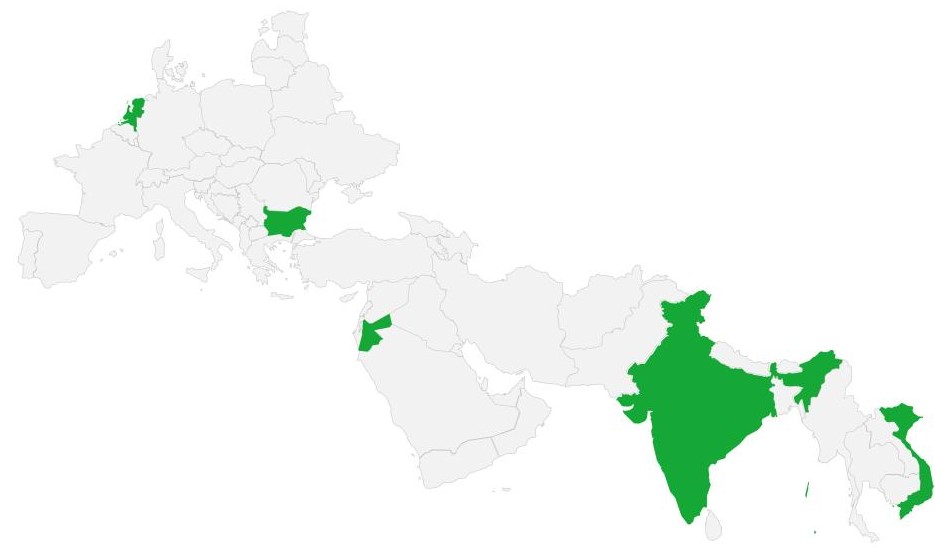
Vietnam
Business Description — Mong Duong 2 is a 1,242 MW gross coal-fired plant located in the Quang Ninh Province of Vietnam and was constructed under a BOT service concession agreement expiring in 2040. This is the first coal-fired BOT plant using pulverized coal-fired boiler technology in Vietnam. The BOT company has a PPA with EVN and a Coal Supply Agreement with Vinacomin, both expiring in 2040.
On December 31, 2020, AES executed an agreement to sell its entire 51% interest in the Mong Duong 2 plant; however, the transaction was not closed by December 31, 2022 and the agreement was terminated by the parties.
Key Financial Drivers — Financial results are driven by many factors, including, but not limited to, the operating performance and availability of the facility.
Regulatory Framework and Market Structure — The Ministry of Industry and Trade in Vietnam is primarily responsible for formulating a program to restructure the power industry, developing the electricity market, and promulgating electricity market regulations. The fuel supply is owned by the government through Vinacomin, a state-owned entity, and PetroVietnam.
The Vietnam power market is divided into three regions (North, Central, and South), with total installed capacity of approximately 79 GW. The fuel mix in Vietnam is composed primarily of coal (33%), hydropower (28%) and renewables, including solar, wind, and biomass (27%). EVN, the national utility, owns 39% of installed generation capacity.
The government is in the process of realigning EVN-owned companies into three different independent operations in order to create a competitive power market. The first stage of this realignment was the implementation of the Competitive Electricity Market, which has been in operation since 2012. The second stage was the introduction of the Electricity Wholesale Market, which has been in operation since the beginning of 2019. The third and final stage impacts the Electricity Retail Market. The reforms are currently in development and pilot implementation is expected around 2024 timeframe. BOT power plants will not directly participate in the power market; alternatively, a single buyer will bid the tariff on the power pool on their behalf.
| 45 | 2022 Annual Report |
Development Strategy — In Vietnam, we continue to advance the development of our Son My LNG terminal project, which has a design capacity of up to 9.6 million metric tonnes per annum, and the Son My 2 CCGT project, which has a capacity of about 2,250 MW. In October 2019, we received formal approval as a government-mandated investor in the Son My LNG terminal project in partnership with PetroVietnam Gas and in September 2021, we signed the joint venture agreement with PetroVietnam Gas. In April 2022, we, together with our partner PetroVietnam Gas, established Son My LNG Terminal LLC. In September 2019, we received formal approval as the government-mandated investor with 100% equity ownership in the Son My 2 CCGT project and executed a statutory memorandum of understanding with Vietnam’s Ministry of Industry and Trade in November 2019 to continue developing the Son My 2 CCGT project under Vietnam’s Build-Operate-Transfer legal framework. The Son My 2 CCGT project will utilize the Son My LNG terminal project and be its anchor customer.
Bulgaria
Business Description — Our AES Maritza plant is a 690 MW lignite fuel thermal power plant. AES Maritza's entire power output is contracted with NEK, the state-owned public electricity supplier, independent energy producer, and trading company. Maritza is contracted under a 15-year PPA that expires in May 2026. AES Maritza is collecting receivables from NEK in a timely manner. However, NEK's liquidity position is subject to political conditions and regulatory changes in Bulgaria.
The DG Comp is reviewing NEK’s PPA with AES Maritza pursuant to the European Union’s state aid rules. AES Maritza believes that its PPA is legal and in compliance with all applicable laws. For additional details see Key Trends and Uncertainties in Item 7.— Management’s Discussion and Analysis of Financial Condition and Results of Operations in this Form 10-K*.*
AES also owns an 89% economic interest in the St. Nikola wind farm ("Kavarna") with 156 MW of installed capacity. The power output of St. Nikola is sold to customers operating on the liberalized electricity market and the plant may receive additional revenue per the terms of an October 2018 Contract for Premium with the state-owned Electricity System Security Fund.
Key Financial Drivers — Financial results are driven by many factors, including, but not limited to:
-
regulatory changes in the Bulgarian power market;
-
results of the DG Comp review;
-
availability and load factor of the operating units;
-
the level of wind resources for St. Nikola;
-
spot market price volatility beyond the level of compensation through the Contract for Premium for St. Nikola; and
-
NEK's ability to meet the payment terms of the PPA contract with Maritza.
Regulatory Framework and Market Structure — The electricity sector in Bulgaria allows both regulated and competitive segments. In its capacity as the public provider of electricity, NEK acts as a single buyer and seller for all regulated transactions on the market. Electricity outside the regulated market trades on one of the platforms of the Independent Bulgarian Electricity Exchange day-ahead market, intra-day market, or bilateral contracts market.
Bulgaria’s power sector is supported by a diverse generation mix, universal access to the grid, and numerous cross-border connections with neighboring countries. In addition, it plays an important role in the energy balance in the southeast European region.
In December 2022, Bulgaria implemented Regulation 2022/1854, approved by the European Council in October 2022 as an emergency intervention aiming at limiting energy prices in Europe. The main measure of interest to AES in Bulgaria is the limitation of revenues for "infra-marginal" producers, a category that includes renewables and other technologies which are providing electricity to the grid at a cost below the price level set by the more expensive “marginal” producers. While the adoption of this regulation has no impact on Maritza power plant, it essentially captures 90% of the incremental margin of Kavarna wind farm since it is now subject to a mandatory cap of €180/MWh on revenues.
Bulgaria has 13 GW of installed capacity enabling the country to meet and exceed domestic demand and export energy. Installed capacity is primarily thermal (45%), hydro (25%), and nuclear (16%).
Environmental Regulation — In July 2020, the EU approved the Next Generation EU ("NGEU") recovery instrument, which aims at mitigating the economic and social impact of the COVID-19 pandemic and making
| 46 | 2022 Annual Report |
European economies and societies more sustainable. The main funding component of NGEU is the EU’s Recovery and Resilience Facility ("RRF"). In May 2022, the European Commission approved Bulgaria's Recovery and Resilience Plan ("RRP") that describes the reforms and investments which Bulgaria wishes to make with the support of the RRF. In its RRP, Bulgaria commits to designing a coal phase-out plan aiming at retiring coal-fired power plants by 2038.
The plan includes a 40% reduction in carbon emissions by the end of 2025 and a ceiling on carbon emissions from 2026 onwards. The mechanism to achieve the target is undefined and the potential impact to Maritza's revenues is expected to be limited.
Jordan
Business Description — In Jordan, AES has a 37% controlling interest in Amman East, a 472 MW oil/gas-fired plant fully contracted with the national utility under a 25-year PPA expiring in 2033, a 36% controlling interest in the IPP4 plant, a 250 MW oil/gas-fired peaker plant fully contracted with the national utility until 2039, and a 36% controlling interest in a 52 MW solar plant fully contracted with the national utility under a 20-year PPA expiring in 2039. We consolidate the results in our operations as we have a controlling interest in these businesses.
On November 10, 2020, AES executed a sale and purchase agreement to sell approximately 26% effective ownership interest in both the Amman East and IPP4 plants. The sale is expected to close in 2023 subject to customary approvals, including lender consents.
Regulatory Framework and Market Structure — The Jordan electricity transmission market is a single-buyer model with the state-owned National Electric Power Company ("NEPCO") responsible for transmission. NEPCO generally enters into long-term PPAs with IPPs to fulfill energy procurement requests from distribution utilities.
India
AES owns and operates a 10 MW BESS unit in Delhi city, located inside a substation of Tata Power Delhi Distribution Limited ("TPDDL"). The BESS is integrated with the TPDDL distribution system and provides frequency regulation and peak shifting services.
| 47 | 2022 Annual Report |
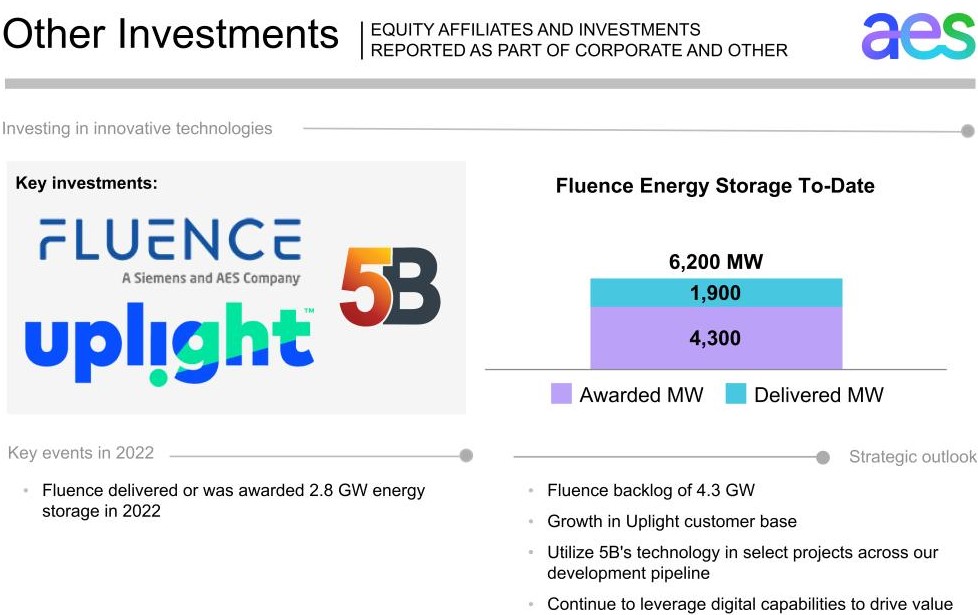
Other Investments
Fluence and Uplight are unconsolidated entities and their results are reported as Net equity in earnings of affiliates on our Consolidated Statements of Operations. 5B is accounted for using the measurement alternative and AES will record income or loss only when it receives dividends from 5B or when there is a change in the observable price or an impairment of the investment.
Fluence
Business Description — Fluence, created in 2018 as a joint venture by AES and Siemens, is a global energy storage technology and services company aligned with the AES strategy to drive decarbonization of the electric sector. Fluence is a leading global provider of energy storage products and services and artificial intelligence (AI)-enabled digital applications for renewables and storage.
On November 1, 2021, Fluence Energy, Inc. completed its IPO, generating proceeds of approximately $936 million, after expenses, and is listed on NASDAQ under the symbol "FLNC". AES owns Class B-1 common stock, entitling AES to five votes per share held, and continues to hold its economic interest in the operating subsidiary of Fluence Energy, Inc. AES' economic interest in Fluence is currently 33.5%. The Company continues to account for Fluence as an equity method investment.
Key Financial Drivers — Fluence's financial results are driven by the growth in its product revenue, an efficient cost structure that is expected to benefit from increased scale, and profit margins on customer contracts. Fluence’s pipeline of potential projects is global.
| 48 | 2022 Annual Report |
Regulatory Framework and Market Structure — The grid-connected energy storage sector is expanding rapidly. By incorporating energy storage across the electric power network, utilities and communities around the world will optimize their infrastructure investments, increase network flexibility and resiliency, and accelerate cost-effective integration of renewable electricity generation. According to the BloombergNEF Global Energy Storage Outlook published in October 2022, global annual energy storage capacity installations, excluding residential, grew from approximately 600 MW a year in 2015 to 13 GW a year in 2022 and are expected to grow to 62 GW a year by 2030. Additional growth opportunities exist in the provision of operational and maintenance services associated with energy storage products, as well as the provision of digital applications and solutions to improve performance and economic output. Fluence is positioned to be a leading participant in this growth, with 1.9 GW of energy storage assets deployed and 4.3 GW of contracted backlog, with a gross global pipeline of 9.7 GW as of December 31, 2022.
Uplight
Business Description — The Company holds an equity interest in Uplight as part of its digitization and growth strategy. Uplight offers a comprehensive digital platform for utility customer engagement. Uplight provides software and services to approximately 80 of the leading electric and gas utilities, principally in the U.S., with the mission of motivating and enabling energy users and providers to transition to a clean energy ecosystem. Uplight's solutions form a unified, end-to-end customer energy experience system that delivers innovative energy efficiency, demand response, and clean energy solutions quickly. Utility and energy company leaders rely on Uplight and its customer-focused digital energy experiences to improve customer satisfaction, reduce service costs, increase revenue, and reduce carbon emissions.
The Company holds a 29.4% ownership interest in Uplight, which continues to be accounted for as an equity method investment and is reported as part of Corporate and Other.
Key Financial Drivers — Uplight's financial results are driven by the rate of growth of new customers and the extension of additional services to existing customers. Revenue growth primarily drives its financial results, given the relative significance of fixed operating costs.
Development Strategy — AES' collaboration with Uplight is designed to create value for Uplight, AES, and their respective customers. AES Indiana and AES Ohio have implemented Uplight's consumer engagement solutions in support of energy efficiency and demand response programs, as well as piloted new solutions with Uplight.
5B
Business Description — The Company made a strategic investment in 5B, a solar technology innovator with the mission to accelerate the transformation of the world to a clean energy future. 5B's technology design enables solar projects to be installed up to three times faster, while allowing for up to two times more energy within the same footprint and can sustain higher wind speeds than traditional solar plants.
Key Financial Drivers — 5B is accounted for under the measurement alternative and AES will record income or loss only when it receives dividends from 5B or when there is a change in the observable price or an impairment of the investment. 5B is at the beginning of its growth and is expanding its ecosystem for global reach.
Development Strategy — In addition to a large global market for third party projects, we believe there is an addressable market of nearly 5 GW across our development pipeline. As of December 31, 2022, 5B has achieved sales orders of 175 MW. AES expects to utilize this technology in conjunction with ongoing automation and digital initiatives to speed up delivery time and lower costs. 5B technology has been deployed at multiple locations in AES including a 2 MW project in Panama and an 11 MW project in Chile, with future deployments expected across markets in the AES portfolio.
Environmental and Land-Use Regulations
The Company faces certain risks and uncertainties related to numerous environmental laws and regulations, including existing and potential GHG legislation or regulations, and actual or potential laws and regulations pertaining to water discharges, waste management (including disposal of coal combustion residuals), and certain air emissions, such as SO2, NOX, particulate matter, mercury, and other hazardous air pollutants. Such risks and uncertainties could result in increased capital expenditures or other compliance costs which could have a material adverse effect on certain of our U.S. or international subsidiaries, and our consolidated results of operations. For further information about these risks, see Item 1A.—Risk Factors—Our operations are subject to significant
| 49 | 2022 Annual Report |
government regulation and could be adversely affected by changes in the law or regulatory schemes; Several of our businesses are subject to potentially significant remediation expenses, enforcement initiatives, private party lawsuits and reputational risk associated with CCR; Our businesses are subject to stringent environmental laws, rules and regulations; and Concerns about GHG emissions and the potential risks associated with climate change have led to increased regulation and other actions that could impact our businesses in this Form 10-K. For a discussion of the laws and regulations of individual countries within each SBU where our subsidiaries operate, see discussion within Item 1.—Business of this Form 10-K under the applicable SBUs.
Many of the countries in which the Company does business have laws and regulations relating to the siting, construction, permitting, ownership, operation, modification, repair and decommissioning of, and power sales from electric power generation or distribution assets. In addition, international projects funded by the International Finance Corporation, the private sector lending arm of the World Bank, or many other international lenders are subject to World Bank environmental standards or similar standards, which tend to be more stringent than local country standards. The Company often has used advanced generation technologies in order to minimize environmental impacts, such as combined fluidized bed boilers and advanced gas turbines, and environmental control devices such as flue gas desulphurization for SO2 emissions and selective catalytic reduction for NOx emissions.
Environmental laws and regulations affecting electric power generation and distribution facilities are complex, change frequently, and have become more stringent over time. The Company has incurred and will continue to incur capital costs and other expenditures to comply with these environmental laws and regulations. The Company may be required to make significant capital or other expenditures to comply with these regulations. There can be no assurance that the businesses operated by the subsidiaries of the Company will be able to recover any of these compliance costs from their counterparties or customers such that the Company's consolidated results of operations, financial condition, and cash flows would not be materially affected.
Various licenses, permits, and approvals are required for our operations. Failure to comply with permits or approvals, or with environmental laws, can result in fines, penalties, capital expenditures, interruptions, or changes to our operations. Certain subsidiaries of the Company are subject to litigation or regulatory action relating to environmental permits or approvals. See Item 3.—Legal Proceedings in this Form 10-K for more detail with respect to environmental litigation and regulatory action.
United States Environmental and Land-Use Legislation and Regulations
In the United States, the CAA and various state laws and regulations regulate emissions of SO2, NOX, particulate matter, GHGs, mercury, and other hazardous air pollutants. Certain applicable rules are discussed in further detail below.
CSAPR — CSAPR addresses the "good neighbor" provision of the CAA, which prohibits sources within each state from emitting any air pollutant in an amount which will contribute significantly to any other state’s nonattainment of, or interference with maintenance of, any NAAQS. The CSAPR required significant reductions in SO2 and NOX emissions from power plants in many states in which subsidiaries of the Company operate. The Company is currently required to comply with the CSAPR in Indiana and Maryland. The CSAPR is implemented in part through a market-based program under which compliance may be achievable through the acquisition and use of emissions allowances created by the EPA. The Company complies with CSAPR through operation of existing controls and purchases of allowances on the open market, as needed.
In October 2016, the EPA published a final rule to update the CSAPR to address the 2008 ozone NAAQS ("CSAPR Update Rule"). The CSAPR Update Rule found that NOX ozone season emissions in 22 states (including Indiana and Maryland, and Ohio) affect the ability of downwind states to attain and maintain the 2008 ozone NAAQS, and, accordingly, the EPA issued federal implementation plans that both updated existing CSAPR NOX ozone season emission budgets for electric generating units within these states and implemented these budgets through modifications to the CSAPR NOX ozone season allowance trading program. Implementation began in the 2017 ozone season and affected facilities began to receive fewer ozone season NOX allowances in 2017. Following legal challenges related to the CSAPR Update Rule, on April 30, 2021, EPA issued the Revised CSAPR Update Rule. The Revised CSAPR Update Rule required affected EGUs within certain states (including Indiana and Maryland) to participate in a new trading program, the CSAPR NOx Ozone Season Group 3 trading program. These affected EGUs received fewer ozone season NOx Ozone Season allowances beginning in 2021, which may result in the need for AES affected facilitites to purchase additional allowances.
| 50 | 2022 Annual Report |
On April 6, 2022, the EPA published a proposed Federal Implementation Plan ("FIP") to address air quality impacts with respect to the 2015 Ozone NAAQS. The rule would establish a revised CSAPR NOx Ozone Season Group 3 trading program for 25 states, including Indiana and Maryland. In addition to other requirements, if finalized, EGUs in these states would begin receiving fewer allowances as soon as 2023, which may result in the need to purchase additional allowances.
While the Company's additional CSAPR compliance costs to date have been immaterial, the future availability of and cost to purchase allowances to meet the emission reduction requirements is uncertain at this time, but it could be material if certain facilities will need to purchase additional allowances based on reduced allocations.
New Source Review ("NSR") — The NSR requirements under the CAA impose certain requirements on major emission sources, such as electric generating stations, if changes are made to the sources that result in a significant increase in air emissions. Certain projects, including power plant modifications, are excluded from these NSR requirements if they meet the routine maintenance, repair, and replacement ("RMRR") exclusion of the CAA. There is ongoing uncertainty and significant litigation regarding which projects fall within the RMRR exclusion. Over the past several years, the EPA has filed suits against coal-fired power plant owners and issued NOVs to a number of power plant owners alleging NSR violations. See Item 3.—Legal Proceedings in this Form 10-K for more detail with respect to environmental litigation and regulatory action, including an NOV issued by the EPA against AES Indiana concerning NSR and prevention of significant deterioration issues under the CAA. If NSR requirements are imposed on any of the power plants owned by the Company's subsidiaries, the results could have a material adverse impact on the Company's business, financial condition, and results of operations.
Regional Haze Rule — The EPA's "Regional Haze Rule" established timelines for states to improve visibility in national parks and wilderness areas throughout the United States by establishing reasonable progress goals toward meeting a national goal of natural visibility conditions in Class I areas by the year 2064 through a series of state implementation plans (SIPs), which may result in additional emissions control requirements for electric generating units. SIPs for the first planning period (through 2018) did not result in material impact to AES facilities. For all future SIP planning periods, states must evaluate whether additional emissions reduction measures may be needed to continue making reasonable progress toward natural visibility conditions. The deadline for submittal of the SIP covering the second planning period was July 31, 2021. To date, none of the states in which we operate have submitted plans identifying potential impacts to Company facilities. However, we cannot predict the possible outcome or potential impacts of this matter at this time.
NAAQS — Under the CAA, the EPA sets NAAQS for six principal pollutants considered harmful to public health and the environment, including ozone, particulate matter, NOX, and SO2, which result from coal combustion. Areas meeting the NAAQS are designated "attainment areas" while those that do not meet the NAAQS are considered "nonattainment areas." Each state must develop a plan to bring nonattainment areas into compliance with the NAAQS, which may include imposing operating limits on individual plants. The EPA is required to review NAAQS at five-year intervals.
Based on the current and potential future ambient air standards, certain of the states in which the Company's subsidiaries operate have determined or will be required to determine whether certain areas within such states meet the NAAQS. Some of these states may be required to modify their SIPs to detail how the states will attain or maintain their attainment status. As part of this process, it is possible that the applicable state environmental regulatory agency or the EPA may require reductions of emissions from our generating stations to reach attainment status for ozone, fine particulate matter, NOX, or SO2. The compliance costs of the Company's U.S. subsidiaries could be material.
Mercury and Air Toxics Standard — In April 2012, the EPA’s rule to establish maximum achievable control technology standards for hazardous air pollutants regulated under the CAA emitted from coal and oil-fired electric utilities, known as “MATS”, became effective and AES facilities implemented measures to comply, as applicable.
In June 2015, the U.S. Supreme Court remanded MATS to the D.C. Circuit due to the EPA’s failure to consider costs before deciding to regulate power plants under Section 112 of the CAA and subsequently remanded MATS to the EPA without vacatur. On May 22, 2020, the EPA published a final finding that it is not “appropriate and necessary” to regulate hazardous air pollutant emissions from coal- and oil-fired electric generating units (EGUs) (reversing its prior 2016 finding), but that the EPA would not remove the source category from the CAA Section 112(c) list of source categories and would not change the MATS requirements. Several petitioners filed for judicial review of the final finding and the D.C. Circuit, on February 16, 2021, granted the EPA's request that the rule be held in abeyance pending the EPA's review. On February 9, 2022, the EPA published a proposed rule to revoke its
| 51 | 2022 Annual Report |
May 2020 finding and reaffirm its 2016 finding that it is appropriate and necessary to regulate these emissions. Further rulemakings and/or proceedings are possible; however, in the meantime, MATS remains in effect. We currently cannot predict the outcome of the regulatory or judicial process, or its impact, if any, on our MATS compliance planning or ultimate costs.
Greenhouse Gas Emissions — In January 2011, the EPA began regulating GHG emissions from certain stationary sources, including a pre-construction permitting program for certain new construction or major modifications, known as the Prevention of Significant Deterioration ("PSD"). If future modifications to our U.S.-based businesses' sources become subject to PSD for other pollutants, it may trigger GHG BACT requirements and the cost of compliance with such requirements may be material.
On October 23, 2015, the EPA's rule establishing NSPS for new electric generating units became effective, establishing CO2 emissions standards for newly constructed coal-fueled electric generating plants, which reflects the partial capture and storage of CO2 emissions from the plants. The EPA also promulgated NSPS applicable to modified and reconstructed electric generating units, which will serve as a floor for future BACT determinations for such units. The NSPS could have an impact on the Company's plans to construct and/or modify or reconstruct electric generating units in some locations. On December 20, 2018, the EPA published proposed revisions to the final NSPS for new, modified, and reconstructed coal-fired electric utility steam generating units proposing that the best system of emissions reduction for these units is highly efficient generation that would be equivalent to supercritical steam conditions for larger units and sub-critical steam conditions for smaller units, and not partial carbon capture and sequestration, as was finalized in the 2015 final NSPS. The EPA did not include revisions for natural-gas combined cycle or simple cycle units in the December 20, 2018 proposal. In January 2021, the EPA issued a final rule determining when standards are appropriate for GHG emissions from stationary source categories for new source but did not take final action on the 2018 proposal to revise the 2015 final NSPS. On April 5, 2021, the D.C. Circuit vacated and remanded the final January 2021 final rule. Challenges to the GHG NSPS are being held in abeyance at this time.
On August 31, 2018, the EPA published in the Federal Register proposed Emission Guidelines for Greenhouse Gas Emissions from Existing Electric Utility Generating Units, known as the Affordable Clean Energy (ACE) Rule. On July 8, 2019, the EPA published the final ACE Rule along with associated revisions to implementing regulations. The final ACE Rule established CO2 emission rules for existing power plants under CAA Section 111(d) and replaced the EPA's 2015 Clean Power Plan Rule (CPP). In accordance with the ACE Rule, the EPA determined that heat rate improvement measures are the best system of emissions reductions for existing coal-fired electric generating units. The final rule required states, including Indiana and Maryland, to develop a State Plan to establish CO2 emission limits for designated facilities, including AES Indiana Petersburg's and AES Warrior Run's coal-fired electric generating units. States had three years to develop their plans under the rule. However, on January 19, 2021, the D.C. Circuit vacated and remanded to the EPA the ACE Rule, but withheld issuance of the mandate that would effectuate its decision. On February 22, 2021, the D.C. Circuit granted EPA's unopposed motion for a partial stay of the issuance of the mandate on vacating the repeal of the CPP. On March 5, 2021, the D.C. Circuit issued the partial mandate effectuating the vacatur of the ACE Rule. In effect, the CPP did not take effect while the EPA is addressing the remand of the ACE rule by promulgating a new Section 111(d) rule to regulate greenhouse gases from existing electric generating units. On October 29, 2021, the U.S. Supreme Court granted petitions to review the decision by the D.C. Circuit to vacate the ACE Rule. On June 30, 2022, Supreme Court reversed the judgment of the D.C. Circuit Court and remanded for further proceedings consistent with its opinion. The opinion held that the “generation shifting” approach in the CPP exceeded the authority granted to EPA by Congress under Section 111(d) of the CAA. As a result of the June 30, 2022 Supreme Court decision, on October 27, 2022, the D.C. Circuit recalled its March 5, 2021 partial mandate and issued a new partial mandate holding pending challenges to the ACE Rule in abeyance while EPA develops a replacement rule. The impact of the results of further proceedings and potential future greenhouse gas emissions regulations remains uncertain, but it could be material. The impact of the results of such litigation and potential future greenhouse gas emissions regulations remains uncertain, but it could be material.
On January 20, 2021, President Biden signed and submitted an instrument for the U.S. to rejoin the Paris Agreement effective February 19, 2021. In addition, in November 2022, the international community gathered in Egypt at the 27th Conference to the Parties on the UN Framework Convention on Climate Change ("COP27"), during which multiple announcements were made, including the establishment of a loss and damage fund to support vulnerable countries dealing with the effects of climate change and certain pledges in the area of climate finance.
| 52 | 2022 Annual Report |
As such, there is some uncertainty with respect to the impact of GHG rules. The GHG BACT requirements will not apply at least until we construct a new major source or make a major modification of an existing major source, and the NSPS will not require us to comply with an emissions standard until we construct a new electric generating unit. We do not have any planned major modifications of an existing source or plans to construct a new major source at this time which are expected to be subject to these regulations. Furthermore, the EPA, states, and other utilities are still evaluating potential impacts of the GHG regulations in our industry. In light of these uncertainties, we cannot predict the impact of the EPA’s current and future GHG regulations on our consolidated results of operations, cash flows, and financial condition.
Due to the future uncertainty of these regulations and associated litigation, we cannot at this time determine the impact on our operations or consolidated financial results, but we believe the cost to comply with a new Section 111(d) Rule, should it be implemented in a prior or a substantially similar form, could be material. The GHG NSPS remains in effect at this time, and, absent further action from the EPA that rescinds or substantively revises the NSPS, it could impact any Company plans to construct and/or modify or reconstruct electric generating units in some locations, which may have a material impact on our business, financial condition, or results of operations.
Cooling Water Intake — The Company's facilities are subject to a variety of rules governing water use and discharge. In particular, the Company's U.S. facilities are subject to the CWA Section 316(b) rule issued by the EPA effective in 2014 that seeks to protect fish and other aquatic organisms drawn into cooling water systems at power plants and other facilities. These standards require affected facilities to choose among seven BTA options to reduce fish impingement. In addition, certain facilities must conduct studies to assist permitting authorities to determine whether and what site-specific controls, if any, would be required to reduce entrainment of aquatic organisms. It is possible that this process, which includes permitting and public input, could result in the need to install closed-cycle cooling systems (closed-cycle cooling towers), or other technology. Finally, the standards require that new units added to an existing facility to increase generation capacity are required to reduce both impingement and entrainment. It is not yet possible to predict the total impacts of this final rule at this time, including any challenges to such final rule and the outcome of any such challenges. However, if additional capital expenditures are necessary, they could be material.
AES Southland's current plan is to comply with the SWRCB OTC Policy by shutting down and permanently retiring all existing generating units at AES Alamitos, AES Huntington Beach, and AES Redondo Beach that utilize OTC by the compliance dates included in the OTC Policy. The SWRCB reviews the implementation plan and latest information on OTC generating unit retirement dates and new generation availability to evaluate the impact on electrical system reliability and OTC compliance dates for specific units.
The Company’s California subsidiaries have signed 20-year term PPAs with Southern California Edison for the new generating capacity, which have been approved by the California Public Utilities Commission. Construction of new generating capacity began in June 2017 at AES Huntington Beach and July 2017 at AES Alamitos. The new air-cooled combined cycle gas turbine generators and battery energy storage systems were constructed at the AES Alamitos and AES Huntington Beach generating stations. The new air-cooled combined cycle gas turbine generators at the AES Alamitos and AES Huntington Beach generating stations began commercial operation in early 2020 and there is currently no plan to replace the OTC generating units at the AES Redondo Beach generating station following the retirement. Certain OTC units were required to be retired in 2019 to provide interconnection capacity and/or emissions credits prior to startup of the new generating units, and the remaining AES OTC generating units in California will be shutdown and permanently retired by the OTC Policy compliance dates for these units. The SWRCB OTC Policy required the shutdown and permanent retirement of all remaining OTC generating units at AES Alamitos, AES Huntington Beach, and AES Redondo Beach by December 31, 2020. The initial amendment extended the deadline for shutdown and retirement of AES Alamitos and AES Huntington Beach’s remaining OTC generating units to December 31, 2023 and extended the deadline for shutdown and retirement of AES Redondo Beach’s remaining OTC generating units to December 31, 2021 (the “AES Redondo Beach Extension”). In October 2020, the cities of Redondo Beach and Hermosa Beach filed a state court lawsuit challenging the AES Redondo Beach Extension. AES opposed the action and the court granted an order dismissing the matter. The case remains open subject to the resolution of counter claims between parties other than AES. Plaintiffs have initiated an additional challenge to the permit, and the outcome of that lawsuit is unclear. On March 16, 2021 the SACCWIS released their draft 2021 report to SWRCB. The report summarizes the State of California’s current electrical grid reliability needs and recommended a two-year extension to the compliance schedule for AES Redondo Beach to address system-wide grid reliability needs. The SWRCB public hearing regarding the final decision on the amendment of the OTC policy was held on October 19, 2021 and the Board voted in favor of extending the compliance date for AES Redondo Beach to December 31, 2023. The AES Redondo Beach NPDES
| 53 | 2022 Annual Report |
permit has been administratively extended. On September 30, 2022, the Statewide Advisory Committee on Cooling Water Intake Structures approved a recommendation to the SWRCB to consider an extension of the OTC compliance dates for AES Huntington Beach, LLC and AES Alamitos, LLC, to December 31, 2026, in support of grid reliability. SWRCB released a draft OTC Policy amendment early in 2023 to be heard by the SWRCB on March 7, 2023. The final decision from SWRCB is expected during the second half of 2023.
Power plants are required to comply with the more stringent of state or federal requirements. At present, the California state requirements are more stringent and have earlier compliance dates than the federal EPA requirements, and are therefore applicable to the Company's California assets.
Challenges to the federal EPA's rule were filed and consolidated in the U.S. Court of Appeals for the Second Circuit, although implementation of the rule was not stayed while the challenges proceeded. On July 23, 2018, the U.S. Court of Appeals for the Second Circuit upheld the rule. The Second Circuit later denied a petition by environmental groups for rehearing. The Company anticipates that compliance with CWA Section 316(b) regulations and associated costs could have a material impact on our consolidated financial condition or results of operations.
Water Discharges — In June 2015, the EPA and the U.S. Army Corps of Engineers ("the agencies") published a rule defining federal jurisdiction over waters of the U.S., known as the "Waters of the U.S." (WOTUS) rule. This rule, which initially became effective in August 2015, could expand or otherwise change the number and types of waters or features subject to CWA permitting. However, after repealing the 2015 WOTUS rule on October 22, 2019, the agencies, on April 21, 2020, issued the final “Navigable Waters Protection” (NWP) rule which again revised the definition of waters of the U.S. On August 30, 2021, the U.S. District Court for the District of Arizona issued an order vacating and remanding the NWP Rule. This vacatur of the NWP Rule applies nationwide. As such, the agencies again interpreted waters of the U.S. consistent with the pre-2015 regulatory regime. On January 18, 2023, the Agencies published a final rule to define the scope of waters regulated under the CWA. The rule restores regulations defining WOTUS that were in place prior to 2015, with updates intended to be consistent with relevant Supreme Court decisions. On January 24, 2022, the U.S. Supreme Court granted certiorari on a wetlands case (Sackett v. EPA) on the limited question of: “Whether the Ninth Circuit set forth the proper test for determining whether wetlands are ‘waters of the United States’ under the Clean Water Act.” The Ninth Circuit employed Justice Kennedy’s “significant nexus” test from the 2006 Rapanos v. United States decision; the plurality opinion in Rapanos required a water body to have a "continuous surface connection" with a water of the United States in order to be considered a wetland covered by the CWA. In Sackett v. EPA, the Court may finally provide clarity on which test from the 2006 Rapanos decision controls. It is too early to determine whether the newly promulgated NWP rule or any outcome of litigation may have a material impact on our business, financial condition, or results of operations.
In November 2015, the EPA published its final ELG rule to reduce toxic pollutants discharged into waters of the U.S. by steam-electric power plants through technology applications. These effluent limitations for existing and new sources include dry handling of fly ash, closed-loop or dry handling of bottom ash, and more stringent effluent limitations for flue gas desulfurization wastewater. AES Indiana Petersburg has installed a dry bottom ash handling system in response to the CCR rule and wastewater treatment systems in response to the NPDES permits in advance of the ELG compliance date. Other U.S. businesses already include dry handling of fly ash and bottom ash and do not generate flue gas desulfurization wastewater. However, it is too early to determine whether any outcome of litigation or current or future revisions to the ELG rule might have a material impact on our business, financial condition, and results of operations.
On April 23, 2020, the U.S. Supreme Court issued a decision in the Hawaii Wildlife Fund v. County of Maui case related to whether a CWA permit is required when pollutants originate from a point source but are conveyed to navigable waters through a nonpoint source, such as groundwater. The Court held that discharges to groundwater require a permit if the addition of the pollutants through groundwater is the functional equivalent of a direct discharge from the point source into navigable waters. A number of legal cases relevant to determination of "functional equivalent" are ongoing in various jurisdictions. It is too early to determine whether the Supreme Court decision or the result of litigation to "functional equivalent" may have a material impact on our business, financial condition, or results of operations.
Selenium Rule — In June 2016, the EPA published the final national chronic aquatic life criterion for the pollutant selenium in fresh water. NPDES permits may be updated to include selenium water quality-based effluent limits based on a site-specific evaluation process, which includes determining if there is a reasonable potential to exceed the revised final selenium water quality standards for the specific receiving water body utilizing actual and/or project discharge information for the generating facilities. As a result, it is not yet possible to predict the total impacts of this final rule at this time, including any challenges to such final rule and the outcome of any such challenges.
| 54 | 2022 Annual Report |
However, if additional capital expenditures are necessary, they could be material. AES Indiana would seek recovery of these capital expenditures; however, there is no guarantee it would be successful in this regard.
Waste Management — On October 19, 2015, an EPA rule regulating CCR under the Resource Conservation and Recovery Act as nonhazardous solid waste became effective. The rule established nationally applicable minimum criteria for the disposal of CCR in new and currently operating landfills and surface impoundments, including location restrictions, design and operating criteria, groundwater monitoring, corrective action and closure requirements, and post-closure care. The 2016 Water Infrastructure Improvements for the Nation Act ("WIN Act") includes provisions to implement the CCR rule through a state permitting program, or if the state chooses not to participate, a possible federal permit program. On February 20, 2020, the EPA published a proposed rule to establish a federal CCR permit program that would operate in states without approved CCR permit programs. If this rule is finalized before Indiana or Puerto Rico establishes a state-level CCR permit program, AES CCR units in those locations could eventually be required to apply for a federal CCR permit from the EPA. On December 21, 2022, the Indiana Department of Environmental Management published in the Indiana Register a Second Notice of Comment Period for its proposed CCR rulemaking which would include regulation of CCR through a state permitting program.
The EPA has indicated that it will implement a phased approach to amending the CCR Rule, which is ongoing. On August 28, 2020, the EPA published the CCR Part A Rule, that, among other amendments, required certain CCR units to cease waste receipt and initiate closure by April 11, 2021. The CCR Part A Rule also allowed for extensions of the April 11, 2021 deadline if the EPA determines certain criteria are met. Facilities seeking such an extension were required to submit a demonstration to the EPA by November 30, 2020. On January 11, 2022, the EPA released its first in a series of proposed and final determinations regarding nine CCR Part A Rule demonstrations. On April 8, 2022, petitions for review were filed challenging these EPA actions. The petitions are consolidated in Electric Energy, Inc. v. EPA. Also on January 11, 2022,, the EPA issued four compliance-related letters notifying certain other facilities of their compliance obligations under the federal CCR regulations. The determinations and letters include interpretations regarding implementation of the CCR Rule. It is too early to determine the direct or indirect impact of these letters or any determinations that may be made.
On January 2, 2020, Puerto Rico Senate Bill 1221 was signed by the Puerto Rico Governor into law and became effective as Act 5-2020. Act 5-2020 prohibits the disposal and unencapsulated beneficial use of CCR and places restrictions on storage of CCR in Puerto Rico. Puerto Rico Department of Natural and Environmental Resources developed implementation regulations which became effective on June 10, 2021. Prior to Act 5-2020's approval, the Company had put in place arrangements to dispose or beneficially use its coal ash and combustion residual outside of Puerto Rico. It is too early to determine whether this might have a material impact on our business, financial condition, and results of operations.
The CCR rule, current or proposed amendments to the federal CCR rule or state/territory CCR regulations, the results of groundwater monitoring data, or the outcome of CCR-related litigation could have a material impact on our business, financial condition, and results of operations. AES Indiana would seek recovery of any resulting expenditures; however, there is no guarantee we would be successful in this regard.
International Environmental Regulations
For a discussion of the material environmental regulations applicable to the Company's businesses located outside of the U.S., see Environmental Regulation under the discussion of the various countries in which the Company's subsidiaries operate in Item 1.—Business, under the applicable SBUs.
Customers
We sell to a wide variety of customers. No individual customer accounted for 10% or more of our 2022 total revenue. In our generation business, we own and/or operate power plants to generate and sell power to wholesale customers such as utilities and other intermediaries. Our utilities sell to end-user customers in the residential, commercial, industrial, and governmental sectors in a defined service area.
Human Capital Management
At AES, our people are instrumental to helping us meet the world’s energy needs. Supporting our people is a foundational value for AES. All of our actions are grounded in the shared values that shape AES’ culture: Safety
| 55 | 2022 Annual Report |
First, Highest Standards, and All Together. The AES Corporation is led and managed by our Chief Executive Officer and the Executive Leadership Team with the guidance and oversight of our Board of Directors.
As of December 31, 2022, the Company and its subsidiaries had approximately 9,100 full time/permanent employees. The following chart lists our full time/permanent employees by SBU:
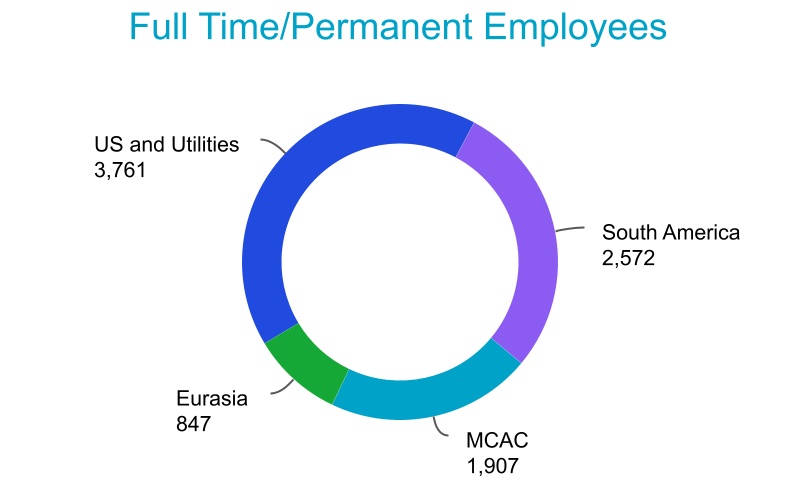
As of December 31, 2022, approximately 32% of our U.S. employees were subject to collective bargaining agreements. Collective bargaining agreements between us and these labor unions expire at various dates ranging from 2023 to 2026. In addition, certain employees in non-U.S. locations were subject to collective bargaining agreements, representing approximately 60% of the non-U.S. workforce. Management believes that the Company's employee relations are favorable.
Safety
At AES, safety is one of our core values. Conducting safe operations at our facilities around the world, so that each person can return home safely, is the cornerstone of our daily activities and decisions. Safety efforts are led by our Chief Operating Officer and supported by safety committees that operate at the local site level. Hazards in the workplace are actively identified and management tracks incidents so remedial actions can be taken to improve workplace safety.
AES has established a Safety Management System (“SMS”) Global Safety Standard that applies to all AES employees, as well as contractors working in AES facilities and construction projects. The SMS requires continuous safety performance monitoring, risk assessment, and performance of periodic integrated environmental, health, and safety audits. The SMS provides a consistent framework for all AES operational businesses and construction projects to set expectations for risk identification and reduction, measure performance, and drive continuous improvements. The SMS standard is consistent with the OHSAS 18001/ISO 45001 standard, and during 2022 approximately 52% of our locations have elected to formally certify their SMS to the OHSAS 18001/ISO 45001 international standard. AES calculates lost time incident (“LTI”) rates for our employees and contractors based on OSHA standards, based on 200,000 labor hours, which equates to 100 workers who work 40 hours per week and 50 weeks per year. In 2022, there was a 10% decrease in LTI cases. In 2022, AES’ LTI Rate was 0.162 for AES People, 0.018 for operational contractors, and 0.055 for construction contractors. In 2022, the Company had two contractor work-related fatalities.
Talent
We believe AES’ success depends on its ability to attract, develop, and retain key personnel. The skills, experience, and industry knowledge of key employees significantly benefit our operations and performance. We have a comprehensive approach to managing our talent and developing our leaders in order to ensure our people have the right skills for today and tomorrow, whether that requires us to build new business models or leverage leading technologies.
| 56 | 2022 Annual Report |
We emphasize employee development and training. To empower employees, we provide a range of development programs and opportunities, skills, and resources they need to be successful by focusing on experience and exposure, as well as formal programs including our Trainee Program.
At AES, we believe that our individual differences make us stronger. Our Diversity and Inclusion Program is led by our Diversity and Inclusion Officer. Governance and standards are guided by the Chief Human Resources Officer, with input from members of the Executive Leadership Team.
Compensation
AES’ executive compensation philosophy emphasizes pay-for-performance. Our incentive plans are designed to reward strong performance, with greater compensation paid when performance exceeds expectations and less compensation paid when performance falls below expectations. We invest significant time and resources to ensure our compensation programs are competitive and reward the performance of our people. Every year, AES people who are not part of a collective bargaining agreement are eligible for an annual merit-based salary increase. In addition, individuals are eligible for a salary increase if they receive a significant promotion. For non-collectively bargained employees at certain levels in the organization, we offer annual incentives (bonus) and long-term compensation to reinforce the alignment between AES' employees and AES.
Executive Officers
The following individuals are our executive officers:
Stephen Coughlin, 51 years old, has served as Executive Vice President and Chief Financial Officer since October 2021. Prior to assuming his current position, he led AES’ Corporate Strategy and Financial Planning teams, and served as the Chair of the Company’s Investment Committee. Prior to that role, he served as the Chief Executive Officer of Fluence. Mr. Coughlin joined AES in 2007 and spent his early years with the company leading Financial Planning & Analysis for AES’s renewables portfolio. Mr. Coughlin is a member of the boards of AES U.S. Investments, Inc., AES U.S. Generation, LLC, and IPALCO. Mr. Coughlin received a bachelor's degree in commerce and finance from the University of Virginia and a Master of Business Administration degree from the University of California at Berkeley.
Bernerd Da Santos*,* 59 years old, has served as Executive Vice President and Chief Operating Officer since December 2017. Previously, Mr. Da Santos held several positions at AES, including Chief Operating Officer and Senior Vice President from 2014 to 2017, Chief Financial Officer, Global Finance Operations from 2012 to 2014, Chief Financial Officer of Global Utilities from 2011 to 2012, Chief Financial Officer of Latin America and Africa from 2009 to 2011, Chief Financial Officer of Latin America from 2007 to 2009, Managing Director of Finance for Latin America from 2005 to 2007, and VP and Controller of La Electricidad de Caracas (“EDC”) (Venezuela). Prior to joining AES in 2000, Mr. Da Santos held a number of financial leadership positions at EDC. Mr. Da Santos is a member of the boards of AES Brasil Energia S.A., AES Mong Duong Power Co. Ltd., AES Andes, IPALCO, Son My LNG Terminal LLC, AES Renewable Holdings, LLC. Mr. Da Santos holds a bachelor’s degree with Cum Laude distinction in Business Administration and Public Administration from Universidad José Maria Vargas, a bachelor’s degree with Cum Laude distinction in Business Management and Finance, and an MBA with Cum Laude distinction from Universidad José Maria Vargas.
Paul L. Freedman, 52 years old, has served as Executive Vice President, General Counsel, and Corporate Secretary since February 2021. Prior to assuming his current position, Mr. Freedman was Senior Vice President and General Counsel from February 2018, Corporate Secretary from October 2018, Chief of Staff to the Chief Executive Officer from April 2016 to February 2018, Assistant General Counsel from 2014 to 2016, and from 2007 to 2014 he held a variety of other positions in the AES legal group. Mr. Freedman is a member of the Boards of, AES U.S. Investments, Inc., IPALCO, AES Ohio, AES Southland Energy Holdings, LLC, Business Council for International Understanding, and the Coalition for Integrity. Prior to joining AES, Mr. Freedman was Chief Counsel for credit programs at the U.S. Agency for International Development and he previously worked as an associate at the law firms of White & Case and Freshfields. Mr. Freedman received a B.A. from Columbia University and a J.D. from the Georgetown University Law Center.
Andrés R. Gluski*,* 65 years old, has been President, Chief Executive Officer and a member of our Board of Directors since September 2011 and is a member of the Innovation and Technology Committee. Under his leadership, AES has become a world leader in implementing clean technologies, including energy storage and renewable power. Prior to assuming his current position, Mr. Gluski served as Executive Vice President and Chief
| 57 | 2022 Annual Report |
Operating Officer of the Company from 2007 to 2011. Prior to that role, he served in a number of senior roles at AES, including as Regional President of Latin America and was Senior Vice President for the Caribbean and Central America. He is a member of the Board of Waste Management and serves as Chairman of the Americas Society/Council of the Americas. Mr. Gluski is a magna cum laude graduate of Wake Forest University and holds an M.A. and a Ph.D. in Economics from the University of Virginia.
Tish Mendoza, 47 years old, has served as Executive Vice President and Chief Human Resources Officer since February 2021. Prior to assuming her current position, Ms. Mendoza was Senior Vice President, Global Human Resources and Internal Communications and Chief Human Resources Officer from 2012, Vice President of Human Resources, Global Utilities from 2011 to 2012, Vice President of Global Compensation, Benefits and HRIS, including Executive Compensation, from 2008 to 2011, and acted in the same capacity as the Director of the function from 2006 to 2008. Ms. Mendoza is a member of the boards of IPALCO, Fluence Energy, Inc. and AES Ohio, and sits on AES’ compensation and benefits committees. Prior to joining AES, Ms. Mendoza was Vice President of Human Resources for a product company in the Treasury Services division of JP Morgan Chase and Vice President of Human Resources and Compensation and Benefits at Vastera, Inc, a former technology and managed services company. Ms. Mendoza earned certificates in Leadership and Human Resource Management, and a bachelor’s degree in Business Administration and Human Resources.
Juan Ignacio Rubiolo*,* 45 years old, has served as Executive Vice President and President of International Businesses since January 2022. Prior to assuming his current position, Mr. Rubiolo served as Senior Vice President and President of the MCAC SBU from March 2018 to January 2022, as the Chief Executive Officer of AES Mexico from 2014 to March 2018, and as a Vice President of the Commercial team of the MCAC SBU from 2013 to 2014. Mr. Rubiolo joined AES in 2001 and has worked in AES businesses in the Philippines, Argentina, Mexico, Panama, and the Dominican Republic. Mr. Rubiolo serves on the boards of AES Andes, AES Brasil Energia, and AES Colombia & Cia S.C.A. E.S.P. Mr. Rubiolo has a Science Degree in Business from the Universidad Austral of Argentina, a Master of Project Management from the Quebec University in Canada and has completed the executive business and leadership program at the University of Virginia.
How to Contact AES and Sources of Other Information
Our principal offices are located at 4300 Wilson Boulevard, Arlington, Virginia 22203. Our telephone number is (703) 522-1315. Our website address is http://www.aes.com. Our annual reports on Form 10-K, quarterly reports on Form 10-Q and current reports on Form 8-K and any amendments to such reports filed pursuant to Section 13(a) or Section 15(d) of the Securities Exchange Act of 1934 (the "Exchange Act") are posted on our website. After the reports are filed with, or furnished to the SEC, they are available from us free of charge. Material contained on our website is not part of and is not incorporated by reference in this Form 10-K. The SEC maintains an internet website that contains the reports, proxy and information statements and other information that we file electronically with the SEC at www.sec.gov.
Our CEO and our CFO have provided certifications to the SEC as required by Section 302 of the Sarbanes-Oxley Act of 2002. These certifications are included as exhibits to this Annual Report on Form 10-K.
Our CEO provided a certification pursuant to Section 303A of the New York Stock Exchange Listed Company Manual on April 28, 2022.
Our Code of Business Conduct ("Code of Conduct") and Corporate Governance Guidelines have been adopted by our Board of Directors. The Code of Conduct is intended to govern, as a requirement of employment, the actions of everyone who works at AES, including employees of our subsidiaries and affiliates. Our Ethics and Compliance Department provides training, information, and certification programs for AES employees related to the Code of Conduct. The Ethics and Compliance Department also has programs in place to prevent and detect criminal conduct, promote an organizational culture that encourages ethical behavior and a commitment to compliance with the law, and to monitor and enforce AES policies on corruption, bribery, money laundering and associations with terrorists groups. The Code of Conduct and the Corporate Governance Guidelines are located in their entirety on our website. Any person may obtain a copy of the Code of Conduct or the Corporate Governance Guidelines without charge by making a written request to: Corporate Secretary, The AES Corporation, 4300 Wilson Boulevard, Arlington, VA 22203. If any amendments to, or waivers from, the Code of Conduct or the Corporate Governance Guidelines are made, we will disclose such amendments or waivers on our website.
| 58 | 2022 Annual Report |
Previous: Cover and table of contents · Next: Item 1A. RISK FACTORS