 filings.tools
AES 10-K 2023-12-31
Filed 2024-02-26. 23 sections, 1072K characters. Original on sec.gov · Markdown · JSON
Cover and table of contents
UNITED STATES
SECURITIES AND EXCHANGE COMMISSION
WASHINGTON, D.C. 20549
____________________________________
FORM 10-K
| ☒ | ANNUAL REPORT PURSUANT TO SECTION 13 OR 15(d) OF THE SECURITIES EXCHANGE ACT OF 1934 |
For the Fiscal Year Ended December 31, 2023
-OR-
| ☐ | TRANSITION REPORT FILED PURSUANT TO SECTION 13 OR 15(d) OF THE SECURITIES EXCHANGE ACT OF 1934 |
Commission file number 1-12291
THE AES CORPORATION
(Exact name of registrant as specified in its charter)
| Delaware | 54-1163725 | |||||||
| (State or other jurisdiction of incorporation or organization) | (I.R.S. Employer Identification No.) |
| 4300 Wilson Boulevard | |||||||||||
| Arlington, | Virginia | 22203 | |||||||||
| (Address of principal executive offices) | (Zip Code) |
| Registrant's telephone number, including area code: | (703) | 522-1315 |
| Securities registered pursuant to Section 12(b) of the Act: | ||||||||
| Title of Each Class | Trading Symbol(s) | Name of Each Exchange on Which Registered | ||||||
| Common Stock, par value $0.01 per share | AES | New York Stock Exchange |
Securities registered pursuant to Section 12(g) of the Act: None
Indicate by check mark if the Registrant is a well-known seasoned issuer, as defined in Rule 405 of the Securities Act. Yes ☒ No ☐
Indicate by check mark if the Registrant is not required to file reports pursuant to Section 13 or Section 15(d) of the Act. Yes ☐ No ☒
Indicate by check mark whether the registrant (1) has filed all reports required to be filed by Section 13 or 15(d) of the Securities Exchange Act of 1934 during the preceding 12 months (or for such shorter period that the registrant was required to file such reports), and (2) has been subject to such filing requirements for the past 90 days. Yes ☒ No ☐
Indicate by check mark whether the registrant has submitted electronically every Interactive Data File required to be submitted pursuant to Rule 405 of Regulation S-T (§232.405 of this chapter) during the preceding 12 months (or for such shorter period that the registrant was required to submit such files). Yes ☒ No ☐
Indicate by check mark whether the registrant is a large accelerated filer, an accelerated filer, a non-accelerated filer, a smaller reporting company, or an emerging growth company. See the definitions of “large accelerated filer,” “accelerated filer,” “smaller reporting company,” and “emerging growth company” in Rule 12b-2 of the Exchange Act.
| Large accelerated filer | ☒ | Accelerated filer | ☐ | Smaller reporting company | ☐ | Emerging growth company | ☐ | Non-accelerated filer | ☐ |
If an emerging growth company, indicate by check mark if the registrant has elected not to use the extended transition period for complying with any new or revised financial accounting standards provided pursuant to Section 13(a) of the Exchange Act. ☐
Indicate by check mark whether the registrant has filed a report on and attestation to its management's assessment of the effectiveness of its internal control over financial reporting under Section 404(b) of the Sarbanes-Oxley Act (15 U.S.C. 7262(b)) by the registered public accounting firm that prepared or issued its audit report. ☒
If securities are registered pursuant to Section 12(b) of the Act, indicate by check mark whether the financial statements of the registrant included in the filing reflect the correction of an error to previously issued financial statements. ☐
Indicate by check mark whether any of those error corrections are restatement that required a recovery analysis of incentive-based compensation received by any of the registrant's executive officers during the relevant recovery period pursuant to §240.10D-1(b). ☐
Indicate by check mark whether the Registrant is a shell company (as defined in Rule 12b-2 of the Exchange Act). Yes ☐ No ☒
The aggregate market value of the voting and non-voting common equity held by non-affiliates on June 30, 2023, the last business day of the Registrant's most recently completed second fiscal quarter (based on the closing sale price of $20.73 of the Registrant's Common Stock, as reported by the New York Stock Exchange on such date) was approximately $13.88 billion.
The number of shares outstanding of Registrant's Common Stock, par value $0.01 per share, on February 22, 2024 was 710,287,083.
DOCUMENTS INCORPORATED BY REFERENCE
Portions of Registrant's Proxy Statement for its 2024 annual meeting of stockholders are incorporated by reference in Parts II and III
The AES Corporation Fiscal Year 2023 Form 10-K
Table of Contents
| 1 | 2023 Annual Report |
Glossary of Terms
The following is a list of frequently used terms and abbreviations that appear in the text of this report and have the definitions indicated below:
| ACED | AES Clean Energy Development, LLC | ||||
| Adjusted EBITDA | Adjusted earnings before interest income and expense, taxes, depreciation and amortization, a non-GAAP measure of operating performance | ||||
| Adjusted EBITDA with Tax Attributes | Adjusted earnings before interest income and expense, taxes, depreciation and amortization, adding back the pre-tax effect of Production Tax Credits, Investment Tax Credits and depreciation tax expense allocated to tax equity investors, a non-GAAP measure | ||||
| Adjusted EPS | Adjusted Earnings Per Share, a non-GAAP measure | ||||
| Adjusted PTC | Adjusted Pre-tax Contribution, a non-GAAP measure of operating performance | ||||
| AES | The Parent Company and its subsidiaries and affiliates | ||||
| AES Andes | AES Andes S.A., formerly AES Gener | ||||
| AES Brasil | AES Brasil Operações S.A., formerly branded as AES Tietê | ||||
| AES Indiana | Indianapolis Power & Light Company, formerly branded as IPL. AES Indiana is wholly-owned by IPALCO | ||||
| AES Ohio | The Dayton Power & Light Company, formerly branded as DP&L. AES Ohio is wholly-owned by DPL | ||||
| AES Renewable Holdings | AES Renewable Holdings, LLC, formerly branded as AES Distributed Energy | ||||
| AFUDC | Allowance for Funds Used During Construction | ||||
| AIMCo | Alberta Investment Management Corporation | ||||
| ANEEL | Brazilian National Electric Energy Agency | ||||
| AOCL | Accumulated Other Comprehensive Loss | ||||
| ARO | Asset Retirement Obligations | ||||
| ASC | Accounting Standards Codification | ||||
| BACT | Best Available Control Technology | ||||
| BESS | Battery energy storage system | ||||
| BOT | Build, Operate and Transfer | ||||
| CAA | U.S. Clean Air Act | ||||
| CAMMESA | Wholesale Electric Market Administrator in Argentina | ||||
| CCEE | Brazilian Chamber of Electric Energy Commercialization | ||||
| CCGT | Combined Cycle Gas Turbine | ||||
| CCR | Coal Combustion Residuals, which includes bottom ash, fly ash and air pollution control wastes generated at coal-fired generation plant sites | ||||
| CDPQ | La Caisse de dépôt et placement du Quebéc | ||||
| CECL | Current Expected Credit Loss | ||||
| CEO | Chief Executive Officer | ||||
| CFE | Federal Electricity Commission in Mexico | ||||
| CFO | Chief Financial Officer | ||||
| CO2 | Carbon Dioxide | ||||
| COD | Commercial Operation Date | ||||
| CPI | U.S. Consumer Price Index | ||||
| CSAPR | U.S. Cross-State Air Pollution Rule | ||||
| CWA | U.S. Clean Water Act | ||||
| DG Comp | Directorate-General for Competition of the European Commission | ||||
| DOJ | U.S. Department of Justice | ||||
| DPL | DPL Inc. | ||||
| DPP | Dominican Power Partners | ||||
| EBITDA | Earnings before interest income and expense, taxes, depreciation and amortization, a non-GAAP measure of operating performance | ||||
| EPA | U.S. Environmental Protection Agency | ||||
| EPC | Engineering, Procurement, and Construction | ||||
| ERCOT | Electric Reliability Council of Texas | ||||
| ESP | Electric Security Plan | ||||
| EU | European Union | ||||
| EURIBOR | Euro Inter Bank Offered Rate | ||||
| EVN | Electricity of Vietnam | ||||
| FERC | U.S. Federal Energy Regulatory Commission | ||||
| Fluence | Fluence Energy, Inc and its subsidiaries, including Fluence Energy, LLC, which was previously our joint venture with Siemens AG (Nasdaq: FLNC) | ||||
| FONINVEMEM | Fund for the Investment Needed to Increase the Supply of Electricity in the Wholesale Market in Argentina |
| 2 | 2023 Annual Report |
| FPA | U.S. Federal Power Act | ||||
| GAAP | Generally Accepted Accounting Principles in the United States | ||||
| GHG | Greenhouse Gas | ||||
| GILTI | Global Intangible Low Taxed Income | ||||
| GSF | Generation Scaling Factor | ||||
| GW | Gigawatts | ||||
| GWh | Gigawatt Hours | ||||
| HLBV | Hypothetical Liquidation Book Value | ||||
| IPALCO | IPALCO Enterprises, Inc. | ||||
| IPP | Independent Power Producers | ||||
| ISO | Independent System Operator | ||||
| ITC | Investment Tax Credit | ||||
| IURC | Indiana Utility Regulatory Commission | ||||
| LIBOR | London Inter Bank Offered Rate | ||||
| LNG | Liquefied Natural Gas | ||||
| MISO | Midcontinent Independent System Operator, Inc. | ||||
| MMBtu | Million British Thermal Units | ||||
| MRE | Energy Reallocation Mechanism | ||||
| MW | Megawatts | ||||
| MWh | Megawatt Hours | ||||
| NAAQS | U.S. National Ambient Air Quality Standards | ||||
| NCI | Noncontrolling Interest | ||||
| NEK | Natsionalna Elektricheska Kompania (state-owned electricity public supplier in Bulgaria) | ||||
| NERC | North American Electric Reliability Corporation | ||||
| NM | Not Meaningful | ||||
| NOV | Notice of Violation | ||||
| NOX | Nitrogen Dioxide | ||||
| NPDES | National Pollutant Discharge Elimination System | ||||
| NSPS | New Source Performance Standards | ||||
| O&M | Operations and Maintenance | ||||
| ONS | National System Operator in Brazil | ||||
| OTC Policy | Statewide Water Quality Control Policy on the Use of Coastal and Estuarine Waters for Power Plant Cooling | ||||
| OVEC | Ohio Valley Electric Corporation, an electric generating company in which AES Ohio has a 4.9% interest | ||||
| Parent Company | The AES Corporation | ||||
| PCU | Performance Cash Units | ||||
| Pet Coke | Petroleum Coke | ||||
| PJM | PJM Interconnection, LLC | ||||
| PM | Particulate Matter | ||||
| PPA | Power Purchase Agreement | ||||
| PREPA | Puerto Rico Electric Power Authority | ||||
| PSU | Performance Stock Unit | ||||
| PUCO | The Public Utilities Commission of Ohio | ||||
| PURPA | U.S. Public Utility Regulatory Policies Act | ||||
| QF | Qualifying Facility | ||||
| RSU | Restricted Stock Unit | ||||
| RTO | Regional Transmission Organization | ||||
| SADI | Argentine Interconnected System | ||||
| SBU | Strategic Business Unit | ||||
| SEC | U.S. Securities and Exchange Commission | ||||
| SEN | Sistema Electrico Nacional in Chile | ||||
| SIN | National Interconnected System in Colombia | ||||
| SIP | State Implementation Plan | ||||
| SO2 | Sulfur Dioxide | ||||
| SWRCB | California State Water Resources Board | ||||
| TCJA | Tax Cuts and Jobs Act | ||||
| TDSIC | Transmission, Distribution, and Storage System Improvement Charge | ||||
| U.S. | United States | ||||
| USD | United States Dollar | ||||
| VAT | Value Added Tax | ||||
| VIE | Variable Interest Entity | ||||
| Vinacomin | Vietnam National Coal-Mineral Industries Holding Corporation Ltd. | ||||
| 3 | 2023 Annual Report |
PART I
In this Annual Report the terms “AES,” “the Company,” “us,” or “we” refer to The AES Corporation and all of its subsidiaries and affiliates, collectively. The terms “The AES Corporation” and “Parent Company” refer only to the parent, publicly held holding company, The AES Corporation, excluding its subsidiaries and affiliates.
Forward-Looking Information and Risk Factor Summary
In this filing we make statements concerning our expectations, beliefs, plans, objectives, goals, strategies, and future events or performance. Such statements are “forward-looking statements” within the meaning of the Private Securities Litigation Reform Act of 1995. Although we believe that these forward-looking statements and the underlying assumptions are reasonable, we cannot assure you that they will prove to be correct.
Forward-looking statements involve a number of risks and uncertainties, and there are factors that could cause actual results to differ materially from those expressed or implied in our forward-looking statements. Some of those factors (in addition to others described elsewhere in this report and in subsequent securities filings) include:
-
the economic climate, particularly the state of the economy in the areas in which we operate, which impacts demand for electricity in many of our key markets, including the fact that the global economy faces considerable uncertainty for the foreseeable future, which further increases many of the risks discussed in this Form 10-K;
-
changes in the price of electricity at which our generation businesses sell into the wholesale market and our utility businesses purchase to distribute to their customers, and the success of our risk management practices, such as our ability to hedge our exposure to such market price risk;
-
changes in the prices and availability of coal, gas and other fuels (including our ability to have fuel transported to our facilities) and the success of our risk management practices, such as our ability to hedge our exposure to such market price risk, and our ability to meet credit support requirements for fuel and power supply contracts;
-
changes in and access to the financial markets, particularly changes affecting the availability and cost of capital in order to refinance existing debt and finance capital expenditures, acquisitions, investments and other corporate purposes;
-
changes in inflation, demand for power, interest rates and foreign currency exchange rates, including our ability to hedge our interest rate and foreign currency risk;
-
our ability to fulfill our obligations, manage liquidity and comply with covenants under our recourse and non-recourse debt, including our ability to manage our significant liquidity needs and to comply with covenants under our revolving credit facility and other existing financing obligations;
-
our ability to receive funds from our subsidiaries by way of dividends, fees, interest, loans or otherwise;
-
changes in our or any of our subsidiaries' corporate credit ratings or the ratings of our or any of our subsidiaries' debt securities or preferred stock, and changes in the rating agencies' ratings criteria;
-
our ability to purchase and sell assets at attractive prices and on other attractive terms;
-
our ability to compete in markets where we do business;
-
our ability to operate power generation, distribution and transmission facilities, including managing availability, outages and equipment failures;
-
our ability to manage our operational and maintenance costs and the performance and reliability of our generating plants, including our ability to reduce unscheduled down times;
-
our ability to enter into long-term contracts, which limit volatility in our results of operations and cash flow, such as PPAs, fuel supply, and other agreements and to manage counterparty credit risks in these agreements;
-
variations in weather, especially mild winters and cooler summers in the areas in which we operate, the occurrence of difficult hydrological conditions for our hydropower plants, as well as hurricanes and other storms and disasters, wildfires and low levels of wind or sunlight for our wind and solar facilities;
-
pandemics, or the future outbreak of any other highly infectious or contagious disease;
-
the performance of our contracts by our contract counterparties, including suppliers or customers;
-
severe weather and natural disasters;
| 4 | 2023 Annual Report |
-
our ability to manage global supply chain disruptions;
-
our ability to raise sufficient capital to fund development projects or to successfully execute our development projects;
-
the success of our initiatives in renewable energy projects and energy storage projects;
-
the availability of government incentives or policies that support the development of renewable energy generation projects;
-
our ability to execute on our strategies or achieve expectations related to environmental, social, and governance matters;
-
our ability to keep up with advances in technology;
-
changes in number of customers or in customer usage;
-
the operations of our joint ventures and equity method investments that we do not control;
-
our ability to achieve reasonable rate treatment in our utility businesses;
-
changes in laws, rules and regulations affecting our international businesses, particularly in developing countries;
-
changes in laws, rules and regulations affecting our utilities businesses, including, but not limited to, regulations which may affect competition, the ability to recover net utility assets and other potential stranded costs by our utilities;
-
changes in law resulting from new local, state, federal or international energy legislation and changes in political or regulatory oversight or incentives affecting our wind business and solar projects, our other renewables projects and our initiatives in GHG reductions and energy storage, including government policies or tax incentives;
-
changes in environmental laws, including requirements for reduced emissions, GHG legislation, regulation, and/or treaties and CCR regulation and remediation;
-
changes in tax laws, including U.S. tax reform, and challenges to our tax positions;
-
the effects of litigation and government and regulatory investigations;
-
the performance of our acquisitions;
-
our ability to maintain adequate insurance;
-
decreases in the value of pension plan assets, increases in pension plan expenses, and our ability to fund defined benefit pension and other postretirement plans at our subsidiaries;
-
losses on the sale or write-down of assets due to impairment events or changes in management intent with regard to either holding or selling certain assets;
-
changes in accounting standards, corporate governance and securities law requirements;
-
our ability to maintain effective internal controls over financial reporting;
-
our ability to attract and retain talented directors, management and other personnel;
-
cyber-attacks and information security breaches; and
-
data privacy.
These factors, in addition to others described elsewhere in this Form 10-K, including those described under Item 1A.—Risk Factors and in subsequent securities filings, should not be construed as a comprehensive listing of factors that could cause results to vary from our forward-looking information.
We undertake no obligation to publicly update or revise any forward-looking statements, whether as a result of new information, future events, or otherwise. If one or more forward-looking statements are updated, no inference should be drawn that additional updates will be made with respect to those or other forward-looking statements.
Item 1. BUSINESS
Item 1.—Business is an outline of our strategy and our businesses by SBU, including key financial drivers. Additional items that may have an impact on our businesses are discussed in Item 1A.—Risk Factors and Item 3.—Legal Proceedings.
| 5 | 2023 Annual Report |
Executive Summary
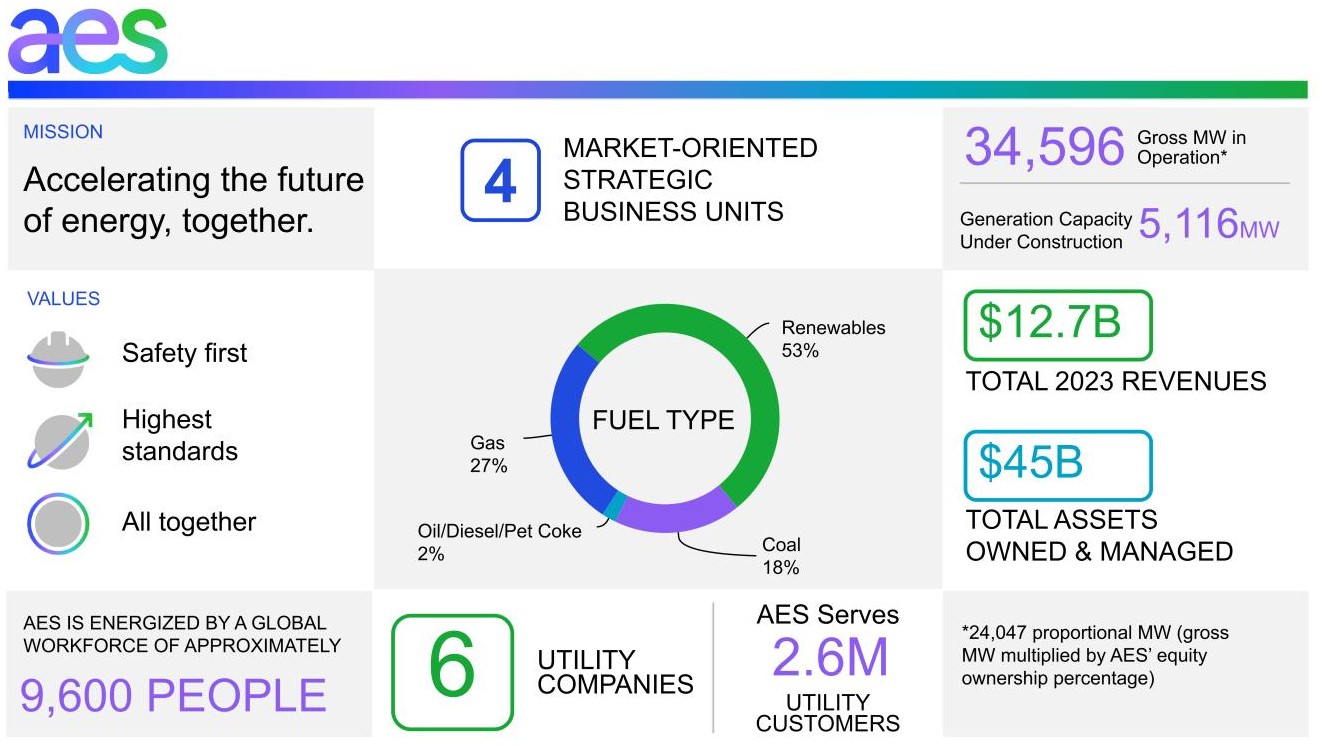
Incorporated in 1981, AES is a global energy company accelerating the future of energy. Together with our many stakeholders, we are improving lives by delivering the greener, smarter energy solutions the world needs. Our diverse workforce is committed to continuous innovation and operational excellence, while partnering with our customers on their strategic energy transitions and continuing to meet their energy needs today.
Our Strategy
AES remains an industry leader in developing and operating the innovative solutions that enable the transition to zero and low-carbon sources of energy. We continue to see an enormous opportunity from the once-in-a-lifetime transformation of the electricity sector driven by decarbonization, electrification, and digitalization.
The focus of our strategy is to partner with large corporations that are transitioning to carbon-free sources of electricity. One example of our successful execution is our collaboration with large technology companies. Specifically, demand from data centers in the U.S. is expected to nearly double in the next three years. Our well-established relationships with these customers, combined with our proven track record of delivering our projects, positions us well to take advantage of this opportunity.
In 2023, we signed long-term contracts for 5.6 GW of renewables, bringing our backlog of projects — those with signed contracts, but which are not yet in operation — to 12.3 GW. Our backlog serves as the core component of future growth. As a result, we have been consistently rated by Bloomberg New Energy Finance as one of the top two largest sellers globally of renewable power to corporate customers, with a focus on large technology/data center providers.
We are a leader in developing green hydrogen. We are partnering with Air Products to develop, build, own, and operate the largest green hydrogen production facility in the United States. We are also participating in two green hydrogen hubs in the United States, which were awarded up to $2.4 billion of grant funding from the U.S. Department of Energy.
With our utilities, we are working with a broad range of stakeholders to transition to lower carbon forms of energy. At AES Indiana, for example, we are working to retire its remaining coal generation by the end of 2025, while adding new renewables and natural gas to the grid.
We are also developing and incubating new technologies that add value today and will drive our business in
| 6 | 2023 Annual Report |
the future. We understand that the energy industry is changing rapidly, and aim to proactively seek solutions that will give us a continued competitive advantage. At the core of our innovation strategy is AES Next, our business and technology incubator. AES Next works to identify new and innovative technologies and business opportunities that provide or support leading-edge greener energy solutions.
2023 Strategic Highlights
*•*We signed 5.6 GW of renewables and energy storage under long-term PPAs.
-
We completed the construction of 3.5 GW.
-
Our backlog, which includes projects with signed contracts, but which are not yet operational, is now 12.3 GW, consisting of:
◦5.1 GW under construction; and
◦7.2 GW with signed PPAs, but that are not yet under construction.
-
AES Indiana reached a unanimous settlement agreement for its first rate case since 2018, and expects to receive approval from the IURC by the middle of 2024.
-
AES Ohio received approval from the PUCO for its Electric Security Plan (ESP4), providing the regulatory foundation necessary to enable future investments.
-
We exited or announced the sale or closure of 2.1 GW of coal generation in Vietnam, the U.S., and Chile.
-
We signed agreements for three-year extensions of 1.4 GW of gas generation at the Southland legacy units in Southern California. These extensions will help meet the State of California's grid reliability needs while supporting its decarbonization goals.
-
Awarded up to $2.4 billion of grant funding by the U.S. Department of Energy for two green hydrogen hubs with AES participation.
-
We secured $1.1 billion in asset sale proceeds, to accelerate our portfolio transformation, outpacing our target of $400 to $600 million.
Overview
Generation
We currently own and/or operate a generation portfolio of 34,596 MW, including generation from our integrated utility, AES Indiana. Our generation fleet is diversified by technologies and fuel type. See discussion below under Fuel Costs.
Performance drivers of our generation businesses include types of electricity sales agreements, plant reliability and flexibility, availability of generation capacity to meet contracted sales, fuel costs, seasonality, weather variations, economic activity, fixed-cost management, and competition. The financial performance of our renewables business is also impacted by our ability to complete construction projects and earn U.S. renewable tax credits.
Contract Sales — Most of our generation businesses sell electricity under medium- or long-term contracts in either regulated or competitive markets ("contract sales") or under short-term agreements in competitive markets ("short-term sales"). Our medium-term contract sales have terms of two to five years, while our long-term contracts have terms of more than five years.
Contracts requiring fuel to generate energy, such as natural gas or coal, are structured to recover variable costs, including fuel and variable O&M costs, either through direct or indexation-based contractual pass-throughs or tolling arrangements. When the contract does not include a fuel pass-through, we typically hedge fuel costs or enter into fuel or energy supply agreements for a similar contract period (see discussion below under Fuel Costs). These contracts also help us to fund a significant portion of the total capital cost of the project through long-term non-recourse project-level financing.
Certain contracts include capacity payments that cover projected fixed costs of the plant, including fixed O&M expenses, debt service, and a return on capital invested. In addition, most of our contracts require that the majority of the capacity payments be denominated in the currency matching our fixed costs. In some U.S. markets, the capacity payment is only for the resource adequacy or reliability benefits from the generating facility, allowing us to separately monetize the electricity produced by the facility through either contract sales or short-term sales.
| 7 | 2023 Annual Report |
Contracts that do not have significant fuel cost or do not contain a capacity payment are structured based on long-term prices and may also include negotiated pass-through costs, allowing us to recover expected fixed and variable costs as well as provide a return on investment.
Many of these contracts are intended to reduce exposure to the volatility of fuel and electricity prices by linking the business's revenues and costs. We generally structure our business to eliminate or reduce foreign exchange risk by matching the currency of revenue and expenses, including fixed costs and debt. Our project debt may consist of both fixed and floating rate debt for which we typically hedge a significant
Showing the first 8K of 235K characters. Open the full section
Item 1A. RISK FACTORS
You should consider carefully the following risks, along with the other information contained in or incorporated by reference in this Form 10-K. Additional risks and uncertainties also may adversely affect our business and operations. We routinely encounter and address risks, some of which may cause our future results to be materially different than we presently anticipate. The categories of risk we have identified in Item 1A.—Risk Factors include risks associated with our operations, governmental regulation and laws, our indebtedness and financial condition. These risk factors should be read in conjunction with Item 7*.—Management's Discussion and Analysis of Financial Condition and Results of Operations* in this Form 10-K and the Consolidated Financial Statements and related notes included elsewhere in this Form 10-K. If any of the following events actually occur, our business, financial results and financial condition could be materially adversely affected*.*
Risks Associated with our Operations
The operation of power generation, distribution and transmission facilities involves significant risks.
We are in the business of generating and distributing electricity, which involves certain risks that can adversely affect financial and operating performance, including:
-
changes in the availability of our generation facilities or distribution systems due to increases in scheduled and unscheduled plant outages, equipment failure, failure of transmission systems, labor disputes, disruptions in fuel supply, poor hydrologic and wind conditions, inability to comply with regulatory or permit requirements, or catastrophic events such as fires, floods, storms, hurricanes, earthquakes, dam failures, tsunamis, explosions, terrorist acts, vandalism, cyber-attacks or other similar occurrences; and
-
changes in our operating cost structure, including, but not limited to, increases in costs relating to gas, coal, oil and other fuel; fuel transportation; purchased electricity; operations, maintenance and repair; environmental compliance, including the cost of purchasing emissions offsets and capital expenditures to install environmental emission equipment; transmission access; and insurance.
Our businesses require reliable transportation sources (including related infrastructure such as roads, ports and rail), power sources and water sources to access and conduct operations. The availability and cost of this infrastructure affects capital and operating costs and levels of production and sales. Limitations or interruptions in this infrastructure or at the facilities of our subsidiaries, including as a result of third parties intentionally or unintentionally disrupting this infrastructure or the facilities of our subsidiaries, could impede their ability to produce electricity.
In addition, a portion of our generation facilities were constructed many years ago and may require significant capital expenditures for maintenance. The equipment at our plants requires periodic upgrading, improvement or repair and replacement equipment or parts may be difficult to obtain in circumstances where we rely on a single supplier or a small number of suppliers. The inability to obtain replacement equipment or parts, due to disruption of the supply chain or other factors, may impact the ability of our plants to perform. Breakdown or failure of one of our operating facilities may prevent the facility from performing under applicable power sales agreements which, in certain situations, could result in termination of a power purchase or other agreement or incurrence of a liability for liquidated damages and/or other penalties.
Power generation involves hazardous activities, including acquiring, transporting and unloading fuel, operating large pieces of rotating equipment and delivering electricity to transmission and distribution systems. In addition to natural risks, such as earthquakes, floods, lightning, hurricanes and wind, hazards, such as fire, explosion, collapse and machinery failure, are inherent risks in our operations which may occur as a result of inadequate internal processes, technological flaws, human error or actions of third parties or other external events. The control and management of these risks depend upon adequate development and training of personnel and on operational procedures, preventative maintenance plans, and specific programs supported by quality control systems, which may not prevent the occurrence and impact of these risks.
| 55 | 2023 Annual Report |
In addition, our battery storage operations also involve risks associated with lithium-ion batteries. On rare occasions, lithium-ion batteries can rapidly release the energy they contain by venting smoke and flames in a manner that can ignite nearby materials as well as other lithium-ion batteries. While more recent design developments for our storage projects seek to minimize the impact of such events, these events are inherent risks of our battery storage operations.
The hazards described above, along with other safety hazards associated with our operations, can cause significant personal injury or loss of life, severe damage to and destruction of property, plant and equipment, contamination of, or damage to, the environment and suspension of operations. The occurrence of any one of these events may result in our being named as a defendant in lawsuits asserting claims for substantial damages, environmental cleanup costs, personal injury and fines and/or penalties.
Furthermore, we and our affiliates are parties to material litigation and regulatory proceedings. See Item 3.— Legal Proceedings below. There can be no assurance that the outcomes of such matters will not have a material adverse effect on our consolidated financial position.
We do a significant amount of business outside the U.S., including in developing countries.
A significant amount of our revenue is generated in developing countries and we intend to expand our business in certain developing countries in which AES or its customers have an existing presence. International operations, particularly in developing countries, entail significant risks and uncertainties, including:
-
economic, social and political instability in any particular country or region;
-
adverse changes in currency exchange rates;
-
government restrictions on converting currencies or repatriating funds;
-
unexpected changes in foreign laws and regulations or in trade, monetary, fiscal or environmental policies;
-
high inflation and monetary fluctuations;
-
restrictions on imports of solar panels, wind turbines, coal, oil, gas or other raw materials;
-
threatened or consummated expropriation or nationalization of our assets by foreign governments;
-
unexpected delays in permitting and governmental approvals;
-
unexpected changes or instability affecting our strategic partners in developing countries;
-
failure to comply with the U.S. Foreign Corrupt Practices Act, or other applicable anti-bribery regulations;
-
unwillingness of governments, agencies, similar organizations or other counterparties to honor contracts;
-
unwillingness of governments, government agencies, courts or similar bodies to enforce contracts that are economically advantageous to AES and less beneficial to government or private party counterparties, against those counterparties;
-
inability to obtain access to fair and equitable political, regulatory, administrative and legal systems;
-
adverse changes in government tax policy and tax consequences of operating in multiple jurisdictions;
-
difficulties in enforcing our contractual rights or enforcing judgments or obtaining a favorable result in local jurisdictions; and
-
inability to attract and retain qualified personn
Showing the first 8K of 92K characters. Open the full section
Item 1B. UNRESOLVED STAFF COMMENTS
None.
Item 1C. CYBERSECURITY
We recognize the importance of maintaining the safety and security of our people, systems, and data and have a holistic process, supported by our management and Board of Directors, for overseeing and managing cybersecurity and related risks.
AES’ Chief Information Security Officer (“CISO”) reports to our General Counsel and is the head of the Company’s cybersecurity team. The CISO is responsible for assessing and managing our cyber risk management
| 72 | 2023 Annual Report |
program. In this role, the CISO informs senior management regarding the prevention, detection, mitigation, and remediation of cybersecurity incidents and supervises such efforts. Our CISO has extensive experience assessing and managing cybersecurity programs and cybersecurity risk. Our CISO has served in that position since 2020.
The CISO manages a global team of cybersecurity professionals with broad experience and expertise, including in cybersecurity threat assessments and detection, cloud security, mitigation technologies, cybersecurity training, incident response, cyber forensics, insider threats and regulatory compliance. We rely on threat intelligence as well as other information obtained from governmental, public, or private sources, including contracted external consultants.
The Board of Directors oversees our cybersecurity risk exposures and the steps taken by management to monitor and mitigate cybersecurity risks. The CISO briefs the Board of Directors on the effectiveness of our cyber risk management program, typically on a semi-annual basis, and provides off-cycle updates as needed.
We consider cybersecurity as part of the enterprise risk process, including organized and structured reporting protocols. The prioritization of cybersecurity risk is aligned with overall risk management processes.
In addition, the Company’s management team considers risks relating to cybersecurity, among other significant risks, and applicable mitigation plans to address such risks, at monthly performance review meetings. The Executive Leadership Team, as well as the Chief Accounting Officer, Chief Risk Officer, Vice President Global Financial Planning and Analytics, Treasurer, and Vice President Internal Audit, among others, participate in such meetings.
We have also established an Incident Response Team and associated protocol led by our CISO that governs our assessment, response, and notifications internally and externally upon the occurrence of a cybersecurity incident. Depending on the nature and severity of an incident, this protocol provides for escalating notification to our CEO and the Board (including the Chair of the Board and the Chair of the Financial Audit Committee). We regularly practice our incident response through executive tabletop exercises.
Our policies, standards, processes, and practices for assessing, identifying, and managing material risks from cybersecurity threats are integrated into our overall risk management program and are informed by frameworks established by the National Institute of Standards and Technology (“NIST”) and other applicable industry standards. Our cybersecurity program addresses threats in a prioritized manner and, in particular, focuses on the following key areas:
-
gap analysis to identify programmatic opportunities for improvement that can be incorporated into the cyber strategy;
-
policies and standards that are annually reviewed and communicated;
-
exceptions management and internal audits that support cybersecurity requirements through assessing control implementation risks; and
-
monitoring and regular reporting of cyber resilience and posture at operational and strategic levels.
We engage assessors, consultants, auditors, or other third parties in connection with any such processes, including:
-
external vulnerability assessments, including penetration tests;
-
internal audit reviews;
-
threat intelligence;
-
incident management;
-
audits of NERC-Critical Infrastructure Protection regulated environments by the NERC Registered Regional Entity; and
-
program development support, as needed.
Our risk management program for third-party service providers includes risk-based assessments of their interactions with AES data and systems. We implement monitoring and response processes for key third-party service providers.
We provide awareness training to our employees to help identify, avoid, and mitigate cybersecurity threats. Our employees participate in training, including phishing exercises, monthly safety meetings, and an annual cybersecurity awareness update. We also periodically host tabletop exercises with management and other employees to practice rapid cyber incident response.
| 73 | 2023 Annual Report |
We face cybersecurity risks in connection with our business. Although such risks have not materially affected us to date, we have, from time to time, experienced threats to and breaches of our data and systems. For more information about the cybersecurity risks we face, see Item 1A.—Risk Factors—Cyber-attacks and data security breaches could harm our business included in this Form 10-K.
Item 2. PROPERTIES
We maintain offices in many places around the world, generally pursuant to the provisions of long- and short-term leases, none of which we believe are material. With a few exceptions, our facilities, which are described in Item 1*—Business* of this Form 10-K, are subject to mortgages or other liens or encumbrances as part of the project's related finance facility. In addition, the majority of our facilities are located on land that is leased. However, in a few instances, no accompanying project financing exists for the facility, and in a few of these cases, the land interest may not be subject to any encumbrance and is owned outright by the subsidiary or affiliate.
Item 3. LEGAL PROCEEDINGS
The Company is involved in certain claims, suits and legal proceedings in the normal course of business. The Company has accrued for litigation and claims when it is probable that a liability has been incurred and the amount of loss can be reasonably estimated. The Company believes, based upon information it currently possesses and taking into account established reserves for estimated liabilities and its insurance coverage, that the ultimate outcome of these proceedings and actions is unlikely to have a material adverse effect on the Company's consolidated financial statements. It is reasonably possible, however, that some matters could be decided unfavorably to the Company and could require the Company to pay damages or make expenditures in amounts that could be material, but cannot be estimated as of December 31, 2023. Pursuant to SEC amendments Item 103 of SEC Regulation S-K, AES’ policy is to disclose environmental legal proceedings to which a governmental authority is a party if such proceedings are reasonably expected to result in monetary sanctions of greater than or equal to $1 million.
In December 2001, Grid Corporation of Odisha (“GRIDCO”) served a notice to arbitrate pursuant to the Indian Arbitration and Conciliation Act of 1996 on the Company, AES Orissa Distribution Private Limited (“AES ODPL”), and Jyoti Structures (“Jyoti”) pursuant to the terms of the shareholders agreement between GRIDCO, the Company, AES ODPL, Jyoti and the Central Electricity Supply Company of Orissa Ltd. (“CESCO”), an affiliate of the Company. In the arbitration, GRIDCO asserted that a comfort letter issued by the Company in connection with the Company's indirect investment in CESCO obligates the Company to provide additional financial support to cover all of CESCO's financial obligations to GRIDCO. GRIDCO appeared to be seeking approximately $189 million in damages, plus undisclosed penalties and interest, but a detailed alleged damage analysis was not filed by GRIDCO. The Company counterclaimed against GRIDCO for damages. In June 2007, a 2-to-1 majority of the arbitral tribunal rendered its award rejecting GRIDCO's claims and holding that none of the respondents, the Company, AES ODPL, or Jyoti, had any liability to GRIDCO. The respondents' counterclaims were also rejected. A majority of the tribunal later awarded the respondents, including the Company, some of their costs relating to the arbitration. GRIDCO filed challenges of the tribunal's awards with the local Indian court. GRIDCO's challenge of the costs award has been dismissed by the court, but its challenge of the liability award remains pending. A hearing on the liability award has not taken place to date. The Company believes that it has meritorious defenses to the claims asserted against it and will defend itself vigorously in these proceedings; however, there can be no assurances that it will be successful in its efforts.
Pursuant to their environmental audit, AES Sul and AES Florestal discovered 200 barrels of solid creosote waste and other contaminants at a pole factory that AES Florestal had been operating. The conclusion of the audit was that a prior operator of the pole factory, Companhia Estadual de Energia (“CEEE”), had been using those contaminants to treat the poles that were manufactured at the factory. On their initiative, AES Sul and AES Florestal communicated with Brazilian authorities and CEEE about the adoption of containment and remediation measures. In March 2008, the State Attorney of the state of Rio Grande do Sul, Brazil filed a public civil action against AES Sul, AES Florestal and CEEE seeking an order requiring the companies to mitigate the contaminated area located on the grounds of the pole factory and an indemnity payment of approximately R$6 million ($1 million). In October 2011, the State Attorney filed a request for an injunction ordering the defendant companies to contain and remove the contamination immediately. The court granted injunctive relief on October 18, 2011, but determined that only CEEE was required to perform the removal work. In May 2012, CEEE began the removal work in compliance with the injunction. The case is now awaiting judgment. The removal and remediation costs are estimated to be approximately R$15 million to R$60 million ($3 million to $12 million), and there could be additional costs which cannot be estimated at this time. In June 2016, the Company sold AES Sul to CPFL Energia S.A. and as part of the
| 74 | 2023 Annual Report |
sale, AES Guaiba, a holding company of AES Sul, retained the potential liability relating to this matter. The Company believes that there are meritorious defenses to the claims asserted against it and will defend itself vigorously in these proceedings; however, there can be no assurances that it will be successful in its efforts.
In September 2015, AES Southland Development, LLC and AES Redondo Beach, LLC filed a lawsuit against the California Coastal Commission (the “CCC”) over the CCC's determination that the site of AES Redondo Beach included approximately 5.93 acres of CCC-jurisdictional wetlands. The CCC has asserted that AES Redondo Beach has improperly installed and operated water pumps affecting the alleged wetlands in violation of the California Coastal Act and Redondo Beach Local Coastal Program ("LCP"). Potential outcomes of the CCC determination could include an order requiring AES Redondo Beach to perform a restoration and/or pay fines or penalties. AES Redondo Beach believes that it has meritorious arguments concerning the underlying CCC determination, but there can be no assurances that it will be successful. On March 27, 2020, AES Redondo Beach, LLC sold the site to an unaffiliated third-party purchaser that assumed the obligations contained within these proceedings. On May 26, 2020, CCC staff sent AES a NOV directing AES to discontinue any operation of the water pumps in the alleged wetlands and to submit a Coastal Development Permit (“CDP”) application for the removal of the water pumps within the alleged wetlands. The NOV also directed AES to submit technical analysis regarding additional water pumps located within onsite electrical vaults and, if necessary, a CDP application for their continued operation. With respect to the vault pumps, AES provided the CCC with the requested analysis, and the CCC has not required further action. With respect to the pumps in the alleged wetlands, AES locked out those pumps to prevent further operation and submitted the CDP to the permitting authority, the City of Redondo Beach (the "City"), with respect to AES' plans to disable or remove the pumps. On October 14, 2020, the City deemed the CDP application to be complete and indicated a public hearing will be required. AES submitted all required information and waited for the City to continue processing the application. In December 2023, the City indicated it would continue processing the CDP application. AES will vigorously defend its interests with regard to the NOV, but we cannot predict the outcome of the matter at this time. However, settlements and litigated outcomes of Coastal Act and LCP claims alleged against other companies have required them to pay significant civil penalties and undertake remedial measures.
In October 2015, AES Indiana received an NOV alleging violations of the Clean Air Act (“CAA”), the Indiana State Implementation Plan (“SIP”), and the Title V operating permit related to alleged particulate and opacity violations at Petersburg Station Unit 3. In addition, in February 2016, AES Indiana received an NOV from the EPA alleging violations of New Source Review and other CAA regulations, the Indiana SIP, and the Title V operating permit at Petersburg Station. On August 31, 2020, AES Indiana reached a settlement with the EPA, the DOJ and the Indiana Department of Environmental Management (“IDEM”), resolving these purported violations of the CAA at Petersburg Station. The settlement agreement, in the form of a proposed judicial consent decree, was approved and entered by the U.S. District Court for the Southern District of Indiana on March 23, 2021, and includes, among other items, the following requirements: annual caps on NOx and SO2 emissions and more stringent emissions limits than AES Indiana's current Title V air permit; payment of civil penalties totaling $1.5 million; a $5 million environmental mitigation project consisting of the construction and operation of a new, non-emitting source of generation at the site; expenditure of $0.3 million on a state-only environmentally beneficial project to preserve local, ecologically-significant lands; and retirement of Units 1 and 2 prior to July 1, 2023.
In December 2018, a lawsuit was filed in Dominican Republic civil court against the Company, AES Puerto Rico, and three other AES affiliates. The lawsuit purports to be brought on behalf of over 100 Dominican claimants, living and deceased, and appears to seek relief relating to CCRs that were delivered to the Dominican Republic in 2004. The lawsuit generally alleges that the CCRs caused personal injuries and deaths and demands $476 million in alleged damages. The lawsuit does not identify, or provide any supporting information concerning, the alleged injuries of the claimants individually. Nor does the lawsuit provide any information supporting the demand for damages or explaining how the quantum was derived. The relevant AES companies believe that they have meritorious defenses to the claims asserted against them and will defend themselves vigorously in this proceeding; however, there can be no assurances that they will be successful in their efforts.
In February 2019, a separate lawsuit was filed in Dominican Republic civil court against the Company, AES Puerto Rico, two other AES affiliates, and an unaffiliated company and its principal. Subsequently, the claimants withdrew the lawsuit with respect to AES Puerto Rico. The lawsuit remains pending against the other AES defendants (“AES Defendants”) and the unaffiliated defendants. The lawsuit purports to be brought on behalf of over 200 Dominican claimants, living and deceased, and appears to seek relief relating to CCRs that were delivered to the Dominican Republic in 2003 and 2004. The lawsuit generally alleges that the CCRs caused personal injuries and deaths and demands over $900 million in alleged damages. The lawsuit does not identify, or provide any supporting information concerning, the alleged injuries of the claimants individually, nor does the lawsuit provide any
| 75 | 2023 Annual Report |
information supporting the demand for damages or explaining how the quantum was derived. In August 2020, at the request of the relevant AES companies, the case was transferred to a different civil court ("Civil Court"). Preliminary hearings have taken place. The parties are awaiting the Civil Court's ruling on the AES Defendants' motions to dismiss the lawsuit. The AES Defendants believe that they have meritorious defenses to the claims asserted against them and will defend themselves vigorously in this proceeding; however, there can be no assurances that they will be successful in their efforts.
In October 2019, the Superintendency of the Environment (the "SMA") notified AES Andes of certain alleged breaches associated with the environmental permit of the Ventanas Complex, initiating a sanctioning process through Exempt Resolution N° 1 / ROL D-129-2019. The alleged charges include exceeding generation limits, failing to reduce emissions during episodes of poor air quality, exceeding limits on discharges to the sea, and exceeding noise limits. AES Andes has submitted a proposed “Compliance Program” to the SMA for the Ventanas Complex. The latest version of this Compliance Program was submitted on May 26, 2021. On December 30, 2021, the Compliance Program was approved by the SMA. However an ex officio action was brought by the SMA due to alleged exceedances of generation limits, which would require the Company to reduce SO2, NOX and PM emissions in order to achieve the emissions offset established in the Compliance Program. On January 6, 2022, AES Andes filed a reposition with the SMA seeking modification of the means for compliance with the ex officio action. On January 17, 2023, the SMA approved street paving measures, or alternatively a program providing heaters for community members, as the means to satisfy the air emissions offsets in the approved Compliance Plan. The cost of proposed Compliance Program is approximately $10.8 million USD. On April 21, 2023, the SMA notified AES Andes of a resolution alleging an additional “serious” non-compliance of the Ventanas Complex failing to reduce emissions during episodes of poor air quality. On May 24, 2023, AES Andes submitted disclaimers to the SMA in response to this resolution. AES Andes plans to vigorously defend itself through the administrative process, but there are no guarantees that it will be successful. Fines are possible if AES Andes is unsuccessful in its defense of the April 2023 resolution and/or if the SMA determines there is an unsatisfactory execution of the Compliance Program approved in connection with the October 2019 sanctioning process.
In March 2020, Mexico’s Comisión Federal de Electricidad (“CFE”) served an arbitration demand upon AES Mérida III. CFE made allegations that AES Mérida III was in breach of its obligations under a power and capacity purchase agreement (“Contract”) between the two parties, which allegations related to CFE’s own failure to provide fuel within the specifications of the Contract. CFE sought to recover approximately $200 million in payments made to AES Mérida under the Contract as well as approximately $480 million in alleged damages for having to acquire power from alternative sources in the Yucatan Peninsula. AES Mérida filed an answer denying liability to CFE and asserted a counterclaim for damages due to CFE’s breach of its obligations. The evidentiary hearing took place in November 2021. Closing arguments were heard in May 2022. In November 2022, the arbitration Tribunal issued its decision in the case, rejecting CFE’s claims for damages and granting AES Mérida a net amount of damages on AES Mérida’s counterclaims ("Award"). There are ongoing proceedings in the Mexican courts concerning AES Mérida's attempt to enforce the Award and CFE's attempt to challenge the Award. AES Mérida believes that it has meritorious claims and defenses and will assert them vigorously in this dispute; however, there can be no assurances that it will be successful in its efforts.
On May 12, 2021, the Mexican Federal Attorney for Environmental Protection (the “Authority”) initiated an environmental audit at the TEP thermal generating facility. On January 20, 2023 TEP was notified of the resolution issued by the Authority, which alleges breaches of air emission regulations, including the failure to submit reports. The resolution imposes a fine of $27,615,140 pesos (approximately USD $1.6 million). On March 3, 2023, the facility filed a nullity judgment to challenge such resolution, which has been admitted by the local judge with an injunction granted against execution of the proposed fine during the course of the underlying proceedings. However, the local tax authority rejected receiving the bond that is required to guarantee the injunction, and as a result, on September 18, 2023 TEP filed a complaint seeking to compel the tax authority to accept the bond and recognize the validity of the injunction. The Specialized Chamber has not issued a response to the complaint, and therefore on January 12, 2024, TEP filed a request for the Specialized Chamber to rule on the admission of the complaint. On February 2, 2024, TEP filed an amparo lawsuit on the basis that no resolution has been issued regarding TEP's May 2023 filing with the Chamber to inform if the Authority had submitted its response to the nullity lawsuit, and if not, to declare that the Authority's right precluded. The Company believes that it has meritorious defenses to the claims asserted against it and will defend itself vigorously in these proceedings; however, there can be no assurances that it will be successful in its efforts.
In February 2022, a lawsuit was filed in Dominican Republic civil court against the Company. The lawsuit purports to be brought on behalf of over 425 Dominican claimants, living and deceased, and appears to seek relief
| 76 | 2023 Annual Report |
relating to CCRs that were delivered to the Dominican Republic in 2003 and 2004. The lawsuit generally alleges that the CCRs caused personal injuries and deaths and demands over $600 million in alleged damages. The lawsuit does not identify or provide any supporting information concerning the alleged injuries of the claimants individually. Nor does the lawsuit provide any information supporting the demand for damages or explaining how the quantum was derived. The Company believes that it has meritorious defenses to the claims asserted against it and will defend itself vigorously in this proceeding; however, there can be no assurances that it will be successful in its efforts.
On July 25, 2022, AES Puerto Rico, LP (“AES-PR”) received from the EPA an NOV alleging certain violations of the CAA at AES-PR’s coal-fired power facility in Guayama, Puerto Rico. The NOV alleges AES-PR exceeded an emission limit and did not continuously operate certain monitoring equipment, conduct certain analyses and testing, maintain complete records, and submit certain reports as required by the EPA’s Mercury and Air Toxics Standards. The NOV further alleges AES-PR did not comply fully with the facility’s Title V operating permit. AES-PR is engaging in discussions with the EPA about the NOV. AES-PR will defend its interests, but we cannot predict the outcome of this matter at this time. However, settlements and litigated outcomes of CAA claims alleged against other coal-fired power plants have required companies to pay civil penalties and undertake remedial measures.
In April 2022, the Superintendency of the Environment (the "SMA") notified AES Andes of certain alleged breaches associated with the construction of the Mesamávida wind project, initiating a sanctioning process. The alleged charges include untimely implementation of road improvement measures and road use schedules and the failure to identify all noise receptors closest to the first construction phases of the project. On June 23, 2022, the SMA addressed the charges to Energía Eólica Mesamávida SpA. On June 28, 2022, Energía Eólica Mesamávida SpA submitted a proposed compliance program, with an estimated cost of $4.3 million, which was subsequently approved by the SMA. On November 9, 2022, opponents to the project submitted before the Third Environmental Court a judicial action challenging the approval of this compliance program. On March 7, 2023, the Third Environmental Court rejected the third-party judicial action against the Compliance Program. The deadline to appeal the decision has passed and no appeals were submitted. The Company has fulfilled the required actions of the Compliance Program; however, opponents to project have submitted claims before the SMA challenging the fulfillment of the Compliance Program. If the SMA determines there is an unsatisfactory execution of the compliance program, fines are possible.
In June 2020, the Energy Regulatory Commission of Mexico passed resolution RES/894/2020 ("Resolution 894"), which attempts to increase the wheeling tariffs that are paid by TEG and TEP to CFE. The increase for the relevant period (July 2020 through March 2024) would have been over $90 million according to current estimates. In October 2022, TEG and TEP initiated a challenge of the constitutionality of the resolution. In February 2024, the relevant First Collegiate Court of Mexico ruled in favor of TEG and TEP and determined that they do not need to pay increased wheeling tariffs under Resolution 894. If TEG and TEP are ever required to pay increased wheeling tariffs in the future, they will seek to enforce their respective contractual rights to pass-through the tariff increases to their respective offtakers.
On January 26, 2023, the SMA notified Alto Maipo SpA of four alleged charges relating to the Alto Maipo facility, all which are categorized by the SMA as “serious.” The alleged charges include untimely completion of intake works and insufficient capture by the provisional works, irrigation water outlet and canal contemplated by an agreement with local communities; non-compliance with the details of the forest management plans and intervention in unauthorized areas; construction of a road in a restricted paleontological area; and unlawful moving of fauna. On February 16, 2023, the Alto Maipo project submitted a compliance program to which the SMA provided observations. On June 6, 2023, Alto Maipo responded to the SMA's observations by submitting a revised compliance program, which is currently under consideration by the SMA. In late June and early July 2023, third-party opponents submitted observations to the compliance program, claiming that the proposal to address the intake works charges is inadequate. Alto Maipo completed its submission of responses to these third-party observations in August 2023, and subsequently, new, additional observations were submitted by opponents to the project. In December 2023, Alto Maipo submitted responses to the opponents' latest observations. Review by the SMA is still pending. The costs of any such compliance program are uncertain. If a compliance program is not approved by or executed to the satisfaction of the SMA, fines, revocation of the facility’s RCA environmental permit approved by the SMA, or closure are possible outcomes for such alleged serious violations under applicable regulations.
Item 4. MINE SAFETY DISCLOSURES
Not applicable.
| 77 | 2023 Annual Report |
PART II
Item 5. MARKET FOR REGISTRANT'S COMMON EQUITY, RELATED STOCKHOLDER MATTERS AND ISSUER PURCHASES OF EQUITY SECURITIES
Recent Sales of Unregistered Securities
None.
Purchases of Equity Securities by the Issuer and Affiliated Purchasers
Stock Repurchase Program — The Board authorization permits the Parent Company to repurchase stock through a variety of methods, including open market repurchases and/or privately negotiated transactions. There can be no assurances as to the amount, timing or prices of repurchases, which may vary based on market conditions and other factors. The Stock Repurchase Program does not have an expiration date and can be modified or terminated by the Board of Directors at any time. The cumulative repurchases from the commencement of the Stock Repurchase Program in July 2010 through December 31, 2023 totaled 154.3 million shares for a total cost of $1.9 billion, at an average price per share of $12.12 (including a nominal amount of commissions). As of December 31, 2023, $264 million remained available for repurchase under the Stock Repurchase Program. No repurchases were made by The AES Corporation of its common stock in 2023, 2022, and 2021.
Market Information
Our common stock is traded on the New York Stock Exchange under the symbol "AES."
Dividends
The Parent Company commenced a quarterly cash dividend in the fourth quarter of 2012. The Parent Company has increased this dividend annually and the quarterly per-share cash dividends for the last three years are displayed below.
| Commencing the fourth quarter of | 2023 | 2022 | 2021 | |||||||||||||||||
| Cash dividend | $0.1725 | $0.1659 | $0.1580 |
The fourth quarter 2023 cash dividend is to be paid in the first quarter of 2024. There can be no assurance the AES Board will declare a dividend in the future or, if declared, the amount of any dividend. Our ability to pay dividends will also depend on receipt of dividends from our various subsidiaries across our portfolio.
Under the terms of our revolving credit facility, which we entered into with a commercial bank syndicate, we have limitations on our ability to pay cash dividends and/or repurchase stock. Our subsidiaries' ability to declare and pay cash dividends to us is also subject to certain limitations contained in the project loans, governmental provisions and other agreements to which our subsidiaries are subject. See the information contained under Item 12.—Security Ownership of Certain Beneficial Owners and Management and Related Stockholder Matters—Securities Authorized for Issuance under Equity Compensation Plans of this Form 10-K.
Holders
As of February 22, 2024, there were approximately 3,395 record holders of our common stock.
| 78 | 2023 Annual Report |
Performance Graph
THE AES CORPORATION
PEER GROUP INDEX/STOCK PRICE PERFORMANCE
Source: Bloomberg
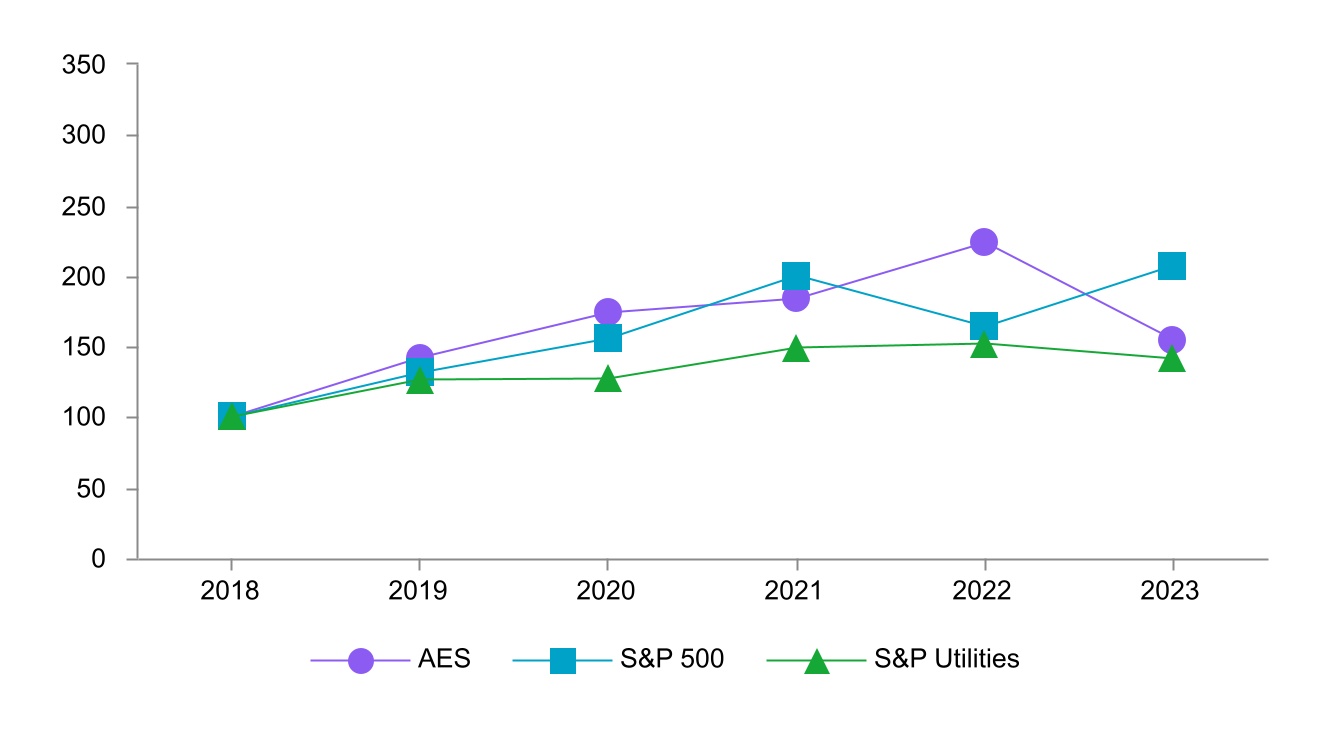
We have selected the Standard and Poor's ("S&P") 500 Utilities Index as our peer group index. The S&P 500 Utilities Index is a published sector index comprising the 30 electric and gas utilities included in the S&P 500.
The five year total return chart assumes $100 invested on December 31, 2018 in AES Common Stock, the S&P 500 Index and the S&P 500 Utilities Index. The information included under the heading Performance Graph shall not be considered "filed" for purposes of Section 18 of the Securities Exchange Act of 1934 or incorporated by reference in any filing under the Securities Act of 1933 or the Securities Exchange Act of 1934.
Item 6. [RESERVED]
| 79 | 2023 Annual Report |
Item 7. MANAGEMENT'S DISCUSSION AND ANALYSIS OF FINANCIAL CONDITION AND RESULTS OF OPERATIONS
For discussion of the Company's year ended December 31, 2022 compared to the year ended December 31, 2021, refer to Item 7.—Management's Discussion and Analysis of Financial Condition and Results of Operations in Exhibit 99.1 of the Form 8-K filed with the SEC on May 8, 2023.
Executive Summary
In 2023, AES delivered on its strategic and financial objectives. We completed construction or the acquisition of 3.5 GW of renewables and energy storage, and signed long-term PPAs for an additional 5.6 GW of new renewable energy. See Overview of our Strategy included in Item 1.—Business of this Form 10-K for further information.
Compared with last year, net loss decreased $323 million, from $505 million to $182 million primarily as a result of favorable contributions at the Utilities, New Energy Technologies, and Renewables SBUs, partially offset by lower contributions from LNG transactions versus 2022 at the Energy Infrastructure SBU.
Adjusted EBITDA, a non-GAAP measure, decreased $119 million, from $2,931 million to $2,812 million, mainly driven by favorable LNG transactions in the prior year, lower contract prices, and higher fixed costs at the Energy Infrastructure SBU; partially offset by favorable weather conditions and new businesses at the Renewables SBU, higher contributions at the Utilities SBU due to the deferral of purchased power costs, higher revenues under a PPA termination agreement at the Energy Infrastructure SBU, and lower losses from affiliates at the New Energy Technologies SBU due to improved margins on a new product line.
Adjusted EBITDA with Tax Attributes, a non-GAAP measure, increased $225 million, from $3,198 million to $3,423 million, primarily due to higher realized tax attributes driven by more renewables projects placed in service, as well as impact from the drivers above.
Compared with last year, diluted earnings per share from continuing operations increased $1.16, from a loss of $0.82 in 2022 to earnings of $0.34 in 2023. This increase is mainly driven by lower goodwill impairments in the current year, higher contributions from renewables projects placed in service in the current year, the current year gain on sale of shares in Fluence, and higher contributions at the Utilities SBU due to the deferral of purchased power costs; partially offset by lower contributions from LNG transactions versus 2022, and higher unrealized foreign currency losses at the Energy Infrastructure SBU.
Adjusted EPS, a non-GAAP measure, increased $0.09 from $1.67 to $1.76, mainly driven by higher contributions from renewables projects placed in service in the current year, higher contributions at the Utilities SBU, and lower losses of affiliates at the New Energy Technologies SBU; partially offset by lower contributions from the Energy Infrastructure SBU and higher Parent Company interest.
| 80 | 2023 Annual Report |
Review of Consolidated Results of Operations
| Years Ended December 31, | 2023 | 2022 | $ Change | % Change | |||||||||||||||||||||||||
| (in millions, except per share amounts) | |||||||||||||||||||||||||||||
| Revenue: | |||||||||||||||||||||||||||||
| Renewables SBU | $ | 2,339 | $ | 1,893 | $ | 446 | 24 | % | |||||||||||||||||||||
| Utilities SBU | 3,495 | 3,617 | (122) | -3 | % | ||||||||||||||||||||||||
| Energy Infrastructure SBU | 6,836 | 7,204 | (368) | -5 | % | ||||||||||||||||||||||||
| New Energy Technologies SBU | 76 | 3 | 73 | NM | |||||||||||||||||||||||||
| Corporate and Other | 138 | 116 | 22 | 19 | % | ||||||||||||||||||||||||
| Eliminations | (216) | (216) | — | — | % | ||||||||||||||||||||||||
| Total Revenue | 12,668 | 12,617 | 51 | — | % | ||||||||||||||||||||||||
| Operating Margin: | |||||||||||||||||||||||||||||
| Renewables SBU | 492 | 528 | (36) | -7 | % | ||||||||||||||||||||||||
| Utilities SBU | 433 | 379 | 54 | 14 | % | ||||||||||||||||||||||||
| Energy Infrastructure SBU | 1,418 | 1,535 | (117) | -8 | % | ||||||||||||||||||||||||
| New Energy Technologies SBU | (9) | (7) | (2) | 29 | % | ||||||||||||||||||||||||
| Corporate and Other | 239 | 182 | 57 | 31 | % | ||||||||||||||||||||||||
| Eliminations | (69) | (69) | — | — | % | ||||||||||||||||||||||||
| Total Operating Margin | 2,504 | 2,548 | (44) | -2 | % | ||||||||||||||||||||||||
| General and administrative expenses | (255) | (207) | (48) | 23 | % | ||||||||||||||||||||||||
| Interest expense | (1,319) | (1,117) | (202) | 18 | % | ||||||||||||||||||||||||
| Interest income | 551 | 389 | 162 | 42 | % | ||||||||||||||||||||||||
| Loss on extinguishment of debt | (63) | (15) | (48) | NM | |||||||||||||||||||||||||
| Other expense | (99) | (68) | (31) | 46 | % | ||||||||||||||||||||||||
| Other income | 89 | 102 | (13) | -13 | % | ||||||||||||||||||||||||
| Gain (loss) on disposal and sale of business interests | 134 | (9) | 143 | NM | |||||||||||||||||||||||||
| Goodwill impairment expense | (12) | (777) | 765 | -98 | % | ||||||||||||||||||||||||
| Asset impairment expense | (1,067) | (763) | (304) | 40 | % | ||||||||||||||||||||||||
| Foreign currency transaction losses | (359) | (77) | (282) | NM | |||||||||||||||||||||||||
| Other non-operating expense | — | (175) | 175 | -100 | % | ||||||||||||||||||||||||
| Income tax benefit (expense) | (261) | (265) | 4 | -2 | % | ||||||||||||||||||||||||
| Net equity in losses of affiliates | (32) | (71) | 39 | -55 | % | ||||||||||||||||||||||||
| LOSS FROM CONTINUING OPERATIONS | (189) | (505) | 316 | -63 | % | ||||||||||||||||||||||||
| Gain from disposal of discontinued businesses, net of income tax benefit (expense) of $7, $0, and $-1, respectively | 7 | — | 7 | NM | |||||||||||||||||||||||||
| NET LOSS | (182) | (505) | 323 | -64 | % | ||||||||||||||||||||||||
Showing the first 8K of 159K characters. Open the full section
Item 7A. QUANTITATIVE AND QUALITATIVE DISCLOSURES ABOUT MARKET RISK
Overview Regarding Market Risks
Our businesses are exposed to, and proactively manage market risk. Market risk is the potential loss that may result from market changes associated with AES power generation or with existing or forecasted financial or commodity transactions. Our primary market risk exposure is to the price of commodities, particularly electricity, natural gas, coal, and environmental credits. AES is also exposed to fluctuations in interest rates and foreign currency exchange rates associated primarily with outstanding and expected future issuances and borrowing, and from investments in foreign subsidiaries and affiliates. We enter into various transactions, including derivatives, in order to hedge our exposure to these market risks.
| 111 | 2023 Annual Report |
The disclosures presented in this Item 7A are based upon a number of assumptions; actual effects may differ. The safe harbor provided in Section 27A of the Securities Act of 1933 and Section 21E of the Exchange Act shall apply to the disclosures contained in this Item 7A. For further information regarding market risk, see Item 1A.—Risk Factors, Fluctuations in currency exchange rates may impact our financial results and position; Wholesale power prices may experience significant volatility in our markets which could impact our operations and opportunities for future growth; We may not be adequately hedged against our exposure to changes in commodity prices or interest rates; and Certain of our businesses are sensitive to variations in weather and hydrology of this 2023 Form 10-K.
Commodity Price Risk
Although we prefer to hedge our exposure to the impact of market fluctuations in the price of commodities, some of our generation businesses operate under short-term sales, have contracted electricity obligations greater than supply, or operate under contract sales that leave an unhedged exposure on some of our capacity or through imperfect fuel pass-throughs. These businesses subject our operational results to the volatility of prices for electricity, fuels, and environmental credits in competitive markets. In addition, our businesses are exposed to lower electricity prices due to increased competition, including from renewable sources such as wind and solar, because of lower costs of entry and lower variable costs. We employ risk management strategies to hedge our financial performance against these effects. The implementation of these strategies can involve the use of physical and financial commodity contracts, futures, swaps, and options. We have some natural offsets across our businesses such that low commodity prices may benefit certain businesses and be a cost to others. Exposures are not perfectly linear or symmetric. The sensitivities are affected by a number of local or indirect market factors. Examples of these factors include hydrology, local energy market supply/demand balances, regional fuel supply issues, regional competition, bidding strategies, and regulatory interventions such as price caps. Volume variation also affects our commodity exposure. The volume sold under contracts or retail concessions can vary based on weather and economic conditions, resulting in a higher or lower volume of sales in spot markets. Thermal unit availability and hydrology can affect the generation output available for sale and can affect the marginal unit setting power prices.
As of December 31, 2023, we project pre-tax earnings exposure on a 10% increase in commodity prices to be less than a $30 million gain for power, less than $15 million loss for gas, and less than $10 million loss for coal. The sensitivities are calculated using industry-standard valuation techniques to revalue all transactions (physical and financial commodity transactions) in the portfolio for a change in the underlying prices the transactions are exposed to and excludes correlation effects, including those due to renewable resource availability. The models reference market prices of commodities across future periods and associated volatility of these market prices. Prices and volatilities are predominantly based on observable market prices.
Exposures at individual businesses will change as new contracts or financial hedges are executed, and our sensitivity to changes in commodity prices generally increases in later years with reduced hedge levels at some of our businesses.
In the Energy Infrastructure SBU, the generation businesses are largely contracted, but may have residual risk to the extent contracts are not perfectly indexed to the business drivers. In California, our Southland once-through cooling generation units (“Legacy Assets”) in Long Beach and Huntington Beach have been extended to operate through 2026 under capacity contracts with the State as part of the Strategic Reserve program. Our facility in Redondo Beach has been retired effective January 1, 2024. Our ability to operate the Long Beach facility at full capacity through 2025 was approved under Tentative Time Schedule Order coverage in November 2023. Approval to operate Long Beach through 2026 will be subject to review with State Agencies. Our Southland combined cycle gas turbine (Southland Energy) units benefit from higher power and lower gas prices, depending on the contracted or hedge position. The AES Andes business in Chile owns assets in the central and northern regions of the country and has a portfolio of contract sales in both. A significant portion of our PPAs through 2024 include mechanisms of indexation that adjust the price of energy based on fluctuations in the price of coal, with an index defined by the National Energy Commission based on the physical coal imports for the energy system. This mechanism mitigates exposures to changes in the price of fuel. The increasing share of renewable energy in Chile's power market may reduce reliance on thermal units and impact power price volatility, which could impact our cost to serve certain unregulated PPAs. In the Dominican Republic, we own natural gas plants contracted under a portfolio of contract sales, and both contract and spot prices may move with commodity prices through 2024. Our thermal asset in Panama has PPAs with distribution companies which matches the term of the LNG supply agreement of such thermal assets. New entrants into the Panama thermal generation market could impact the dispatch of existing generation, requiring purchases in the spot market to satisfy the PPA obligations. Contract levels do not always match our generation availability or needs, and our assets may be sellers of spot prices in excess of contract levels
| 112 | 2023 Annual Report |
or a net buyer in the spot market to satisfy contract obligations, which could impact existing fuel supply commitments. Our assets operating in Vietnam and Bulgaria have minimal exposure to commodity price risk as they have no or minor merchant exposure and fuel is subject to a pass-through mechanism.
In the Renewables SBU, our businesses have commodity exposure on unhedged volumes and resource volatility and benefit from higher power prices, where generation exceeds contracted levels. In Colombia, we operate under a shorter-term sales strategy with spot market exposure for uncontracted volumes. Because we own hydroelectric assets there, contracts are not indexed to fuel. In Brazil, the majority of the hydroelectric and other renewable generating facility volumes are covered by contract sales. Under normal hydrological volatility, spot price risk is mitigated through a regulated sharing mechanism across all hydroelectric generators in the country. Under drier conditions, the sharing mechanism may not be sufficient to cover the business' contract position, and therefore it may have to purchase power at spot prices driven by the cost of thermal generation. Our Renewables businesses in Panama are highly contracted under financial and load-following PPA type structures, exposing the business to hydrology-based variance. To the extent hydrological inflows are greater than or less than the contract volumes, the business will be sensitive to changes in spot power prices which may be driven by oil and natural gas prices in some time periods.
Foreign Exchange Rate Risk
We operate in multiple countries and as such are subject to volatility in exchange rates at varying degrees at the subsidiary level and between our functional currency, the USD, and currencies of the countries in which we operate.
In the normal course of business, we are exposed to foreign currency risk and other foreign operations risks that arise from investments in foreign subsidiaries and affiliates. A key component of these risks stems from the fact that some of our foreign subsidiaries and affiliates utilize currencies other than our consolidated reporting currency, the USD. Additionally, certain of our foreign subsidiaries and affiliates have entered into monetary obligations in USD or currencies other than their own functional currencies. Certain of our foreign subsidiaries calculate and pay taxes in currencies other than their own functional currency. We have varying degrees of exposure to changes in the exchange rate between the USD and the following currencies: Argentine peso, Brazilian real, Chilean peso, Colombian peso, Dominican peso, Euro, and Mexican peso. Our exposure to certain of these currencies may be material. These subsidiaries and affiliates attempt to limit potential foreign exchange exposure by entering into revenue contracts that adjust to changes in foreign exchange rates. We also use foreign currency forwards, swaps, and options where possible to manage our risk related to certain foreign currency fluctuations.
AES enters into foreign currency hedges to protect economic value of the business and minimize the impact of foreign exchange rate fluctuations to AES' portfolio. While protecting cash flows, the hedging strategy is also designed to reduce forward-looking earnings foreign exchange volatility. Due to variation of timing and amount between cash distributions and earnings exposure, the hedge impact may not fully cover the earnings exposure on a realized basis, which could result in greater volatility in earnings.
AES has unhedged forward-looking earnings foreign exchange deterioration risk from the Argentine peso that could be material. Additionally, as of December 31, 2023, assuming a 10% USD appreciation, cash distributions attributable to foreign subsidiaries in the Brazilian real, Colombian peso, and Euro, individually, may be exposed to exchange rate movement of less than a $5 million gain. These numbers have been produced by applying a one-time 10% USD appreciation to forecasted exposed cash distributions for 2024 coming from the respective subsidiaries exposed to the currencies listed above, net of the impact of outstanding hedges and holding all other variables constant. The numbers presented above are net of any transactional gains or losses. These sensitivities may change in the future as new hedges are executed or existing hedges are unwound. Additionally, updates to the forecasted cash distributions exposed to foreign exchange risk may result in further modification. The sensitivities presented do not capture the impacts of any administrative market restrictions or currency inconvertibility.
Interest Rate Risks
We are exposed to risk resulting from changes in interest rates primarily because of our current and expected future issuance of debt and borrowing.
Decisions on the fixed-floating debt mix are made to be consistent with the risk factors faced by individual businesses or plants. Depending on whether a plant’s capacity payments or revenue stream is fixed or varies with inflation, we partially hedge against interest rate fluctuations by arranging fixed-rate or variable-rate financing. In
| 113 | 2023 Annual Report |
certain cases, particularly for non-recourse financing, we execute interest rate swap, cap, and floor agreements to effectively fix or limit the interest rate exposure on the underlying financing. Most of our interest rate risk is related to non-recourse financings at our businesses.
As of December 31, 2023, the portfolio’s pre-tax earnings exposure to a one-time 100-basis-point increase in interest rates for our Argentine peso, Brazilian real, Chilean peso, Colombian peso, Euro, and USD denominated debt would be less than $35 million on interest expense for the debt denominated in these currencies. These amounts represent 2024 full year exposure and do not take into account the historical correlation between these interest rates.
| 114 | 2023 Annual Report |
Item 8. FINANCIAL STATEMENTS AND SUPPLEMENTARY DATA
Part A — Report of Independent Registered Public Accounting Firm
Our auditors are Ernst & Young LLP, located in Tysons, Virginia. Their PCAOB ID number is 42.
Part B — Financial Statements and Supplementary Data
| 115 | 2023 Annual Report |
Report of Independent Registered Public Accounting Firm
To the Stockholders and the Board of Directors of The AES Corporation
Opinion on the Financial Statements
We have audited the accompanying consolidated balance sheets of The AES Corporation (the Company) as of December 31, 2023, and 2022, the related consolidated statements of operations, comprehensive income (loss), changes in equity and cash flows for each of the three years in the period ended December 31, 2023, and the related notes and the financial statement schedule listed in the Index at Item 15(a) (collectively referred to as the “consolidated financial statements”). In our opinion, the consolidated financial statements present fairly, in all material respects, the financial position of the Company at December 31, 2023 and 2022, and the results of its operations and its cash flows for each of the three years in the period ended December 31, 2023, in conformity with U.S. generally accepted accounting principles.
We also have audited, in accordance with the standards of the Public Company Accounting Oversight Board (United States) (PCAOB), the Company's internal control over financial reporting as of December 31, 2023, based on criteria established in Internal Control—Integrated Framework issued by the Committee of Sponsoring Organizations of the Treadway Commission (2013 framework), and our report dated February 26, 2024 expressed an unqualified opinion thereon.
Basis for Opinion
These financial statements are the responsibility of the Company's management. Our responsibility is to express an opinion on the Company’s financial statements based on our audits. We are a public accounting firm registered with the PCAOB and are required to be independent with respect to the Company in accordance with the U.S. federal securities laws and the applicable rules and regulations of the Securities and Exchange Commission and the PCAOB.
We conducted our audits in accordance with the standards of the PCAOB. Those standards require that we plan and perform the audit to obtain reasonable assurance about whether the financial statements are free of material misstatement, whether due to error or fraud. Our audits included performing procedures to assess the risks of material misstatement of the financial statements, whether due to error or fraud, and performing procedures that respond to those risks. Such procedures included examining, on a test basis, evidence regarding the amounts and disclosures in the financial statements. Our audits also included evaluating the accounting principles used and significant estimates made by management, as well as evaluating the overall presentation of the financial statements. We believe that our audits provide a reasonable basis for our opinion.
Critical Audit Matters
The critical audit matters communicated below are matters arising from the current period audit of the financial statements that were communicated or required to be communicated to the audit committee and that: (1) relate to accounts or disclosures that are material to the financial statements and (2) involved our especially challenging, subjective or complex judgments. The communication of critical audit matters does not alter in any way our opinion on the consolidated financial statements, taken as a whole, and we are not, by communicating the critical audit matters below, providing separate opinions on the critical audit matters or on the accounts or disclosures to which they relate.
| 116 | 2023 Annual Report |
| Long-lived Asset Impairments of Coal and Pet Coke-fired Generation Assets | ||||||||||||||
| Description of the Matter | At December 31, 2023, the Company's net property, plant and equipment was $29,958 million. As discussed in Note 1 to the consolidated financial statements, when circumstances indicate that the carrying amount of long-lived assets in a held-for-use asset group may not be recoverable, the Company evaluates the assets for potential impairment. Events or changes in circumstances that may necessitate a recoverability evaluation include, but are not limited to, adverse changes in the regulatory environment, unfavorable changes in power prices or fuel costs, increased competition due to additional capacity in the grid, technological advancements, declining trends in demand, or an expectation it is more likely than not that the asset will be disposed of before the end of its previously estimated useful life. If the carrying amount of the assets exceeds the undiscounted cash flows, an impairment is recognized for the amount by which the carrying amount of the asset group exceeds its fair value. As discussed in Note 22 to the consolidated financial statements, the Company recognized a total asset impairment expense of $471 million related to the Norgener, TEG, TEP, and Warrior Run asset groups, consisting of coal and pet coke generation plants included in the Energy Infrastructure SBU reportable segment in 2023. Auditing the Company's identification of impairment indicators was complex and highly judgmental because of the many geographic, regulatory, and economic environments in which the Company operates. Also, due to the wide variety of events or changes in circumstances that may indicate that an asset group is not recoverable, auditing the Company’s identification of impairment indicators involved a high degree of subjectivity, particularly given the Company’s decarbonization initiatives and shift towards clean energy platforms. In addition, auditing the Company’s impairment analyses for Norgener, TEG, TEP, and Warrior Run asset groups was complex due to the judgmental nature of the significant assumptions used to determine the fair value of the asset groups (e.g., the Company’s projections of revenue growth, discount rates, and consideration of the industry outlook and market conditions). | |||||||||||||
| How We Addressed the Matter in Our Audit | We obtained an understanding, evaluated the design and tested the operating effectiveness of the Company’s controls over the identification of impairment indicators and the fair value analysis of the Norgener, TEG, TEP, and Warrior Run asset groups. For example, we tested management’s monitoring controls over the evaluation of events or changes in circumstances that would require an asset to be tested for recoverability. We also tested management’s review controls of the valuation models used in the impairment analyses, the significant assumptions used to develop the estimates, and the completeness and accuracy of the data used in the valuations. To test the Company's identification of impairment indicators, our audit procedures included, among others, making inquiries of management, including personnel in operations, to understand changes in the businesses and management’s strategic plans, and evaluate whether management has considered any identified changes in their analysis. We evaluated the results of earnings and the projected cash flows for significant coal generation assets and assessed whether there has been a deterioration in earnings or projected losses that would represent an impairment indicator. We also evaluated conditions and trends in the industry for the underlying economie |
Showing the first 8K of 453K characters. Open the full section
Item 9. CHANGES IN AND DISAGREEMENTS WITH ACCOUNTANTS ON ACCOUNTING AND FINANCIAL DISCLOSURE
None.
Item 9A. CONTROLS AND PROCEDURES
Conclusion Regarding the Effectiveness of Disclosure Controls and Procedures
The Company maintains disclosure controls and procedures that are designed to ensure that information required to be disclosed in the reports that the Company files or submits under the Securities Exchange Act of 1934, as amended (the "Exchange Act") is recorded, processed, summarized, and reported within the time periods specified in the SEC's rules and forms, and that such information is accumulated and communicated to the CEO and CFO, as appropriate, to allow timely decisions regarding required disclosures.
The Company carried out the evaluation required by Rules 13a-15(b) and 15d-15(b), under the supervision and with the participation of our management, including the CEO and CFO, of the effectiveness of our “disclosure controls and procedures” (as defined in the Exchange Act Rules 13a-15(e) and 15d-15(e)). Based upon this evaluation, the CEO and CFO concluded that as of December 31, 2023, our disclosure controls and procedures were effective.
Management's Report on Internal Control over Financial Reporting
Management of the Company is responsible for establishing and maintaining adequate internal control over financial reporting, as defined in Rule 13a-15(f) under the Exchange Act. The Company's internal control over financial reporting is a process designed to provide reasonable assurance regarding the reliability of financial reporting and the preparation of financial statements for external purposes in accordance with GAAP and includes those policies and procedures that:
-
pertain to the maintenance of records that in reasonable detail, accurately and fairly reflect the transactions and dispositions of the assets of the Company;
-
provide reasonable assurance that transactions are recorded as necessary to permit preparation of financial statements in accordance with GAAP, and that receipts and expenditures of the Company are being made only in accordance with authorizations of management and directors of the Company; and
-
provide reasonable assurance that unauthorized acquisition, use or disposition of the Company's assets that could have a material effect on the financial statements are prevented or detected timely.
Management, including our CEO and CFO, does not expect that our internal controls will prevent or detect all errors and all fraud. A control system, no matter how well designed and operated, can provide only reasonable, not absolute, assurance that the objectives of the control system are met. Further, the design of a control system must reflect the fact that there are resource constraints, and the benefits of controls must be considered relative to their costs. In addition, any evaluation of the effectiveness of controls is subject to risks that those internal controls may become inadequate in future periods because of changes in business conditions, or that the degree of compliance with the policies or procedures deteriorates.
Management assessed the effectiveness of our internal control over financial reporting as of December 31, 2023. In making this assessment, management used the criteria established in Internal Control—Integrated Framework issued by the Committee of Sponsoring Organizations of the Treadway Commission ("COSO") in 2013. Based on this assessment, management believes that the Company maintained effective internal control over financial reporting as of December 31, 2023.
The effectiveness of the Company's internal control over financial reporting as of December 31, 2023, has been audited by Ernst & Young LLP, an independent registered public accounting firm, as stated in their report, which appears herein.
Changes in Internal Control Over Financial Reporting:
There were no changes that occurred during the quarter ended December 31, 2023 that have materially affected, or are reasonably likely to materially affect, our internal control over financial reporting.
192 | 2023 Annual Report
REPORT OF INDEPENDENT REGISTERED PUBLIC ACCOUNTING FIRM
To the Stockholders and the Board of Directors of The AES Corporation
Opinion on Internal Control over Financial Reporting
We have audited The AES Corporation’s internal control over financial reporting as of December 31, 2023, based on criteria established in Internal Control—Integrated Framework issued by the Committee of Sponsoring Organizations of the Treadway Commission (2013 framework) (the COSO criteria). In our opinion, The AES Corporation (the Company) maintained, in all material respects, effective internal control over financial reporting as of December 31, 2023, based on the COSO criteria.
We also have audited, in accordance with the standards of the Public Company Accounting Oversight Board (United States) (PCAOB), the consolidated balance sheets of the Company as of December 31, 2023 and 2022, the related consolidated statements of operations, comprehensive income (loss), changes in equity and cash flows for each of the three years in the period ended December 31, 2023, and the related notes and the financial statement schedule listed in the Index at Item 15(c) and our report dated February 26, 2024 expressed an unqualified opinion thereon.
Basis for Opinion
The Company’s management is responsible for maintaining effective internal control over financial reporting and for its assessment of the effectiveness of internal control over financial reporting included in the accompanying Management’s Report on Internal Control over Financial Reporting. Our responsibility is to express an opinion on the Company’s internal control over financial reporting based on our audit. We are a public accounting firm registered with the PCAOB and are required to be independent with respect to the Company in accordance with the U.S. federal securities laws and the applicable rules and regulations of the Securities and Exchange Commission and the PCAOB.
We conducted our audit in accordance with the standards of the PCAOB. Those standards require that we plan and perform the audit to obtain reasonable assurance about whether effective internal control over financial reporting was maintained in all material respects.
Our audit included obtaining an understanding of internal control over financial reporting, assessing the risk that a material weakness exists, testing and evaluating the design and operating effectiveness of internal control based on the assessed risk, and performing such other procedures as we considered necessary in the circumstances. We believe that our audit provides a reasonable basis for our opinion.
Definition and Limitations of Internal Control Over Financial Reporting
A company’s internal control over financial reporting is a process designed to provide reasonable assurance regarding the reliability of financial reporting and the preparation of financial statements for external purposes in accordance with generally accepted accounting principles. A company’s internal control over financial reporting includes those policies and procedures that (1) pertain to the maintenance of records that, in reasonable detail, accurately and fairly reflect the transactions and dispositions of the assets of the company; (2) provide reasonable assurance that transactions are recorded as necessary to permit preparation of financial statements in accordance with generally accepted accounting principles, and that receipts and expenditures of the company are being made only in accordance with authorizations of management and directors of the company; and (3) provide reasonable assurance regarding prevention or timely detection of unauthorized acquisition, use, or disposition of the company’s assets that could have a material effect on the financial statements.
Because of its inherent limitations, internal control over financial reporting may not prevent or detect misstatements. Also, projections of any evaluation of effectiveness to future periods are subject to the risk that controls may become inadequate because of changes in conditions, or that the degree of compliance with the policies or procedures may deteriorate.
/s/ Ernst & Young LLP
Tysons, Virginia
February 26, 2024
193 | 2023 Annual Report
Item 9B. OTHER INFORMATION
None.
Item 9C. DISCLOSURE REGARDING FOREIGN JURISDICTIONS THAT PREVENT INSPECTIONS
Not applicable.
194 | 2023 Annual Report
PART III
Item 10. DIRECTORS, EXECUTIVE OFFICERS AND CORPORATE GOVERNANCE
The following information is incorporated by reference from the Registrant's Proxy Statement for the Registrant's 2024 Annual Meeting of Stockholders which the Registrant expects will be filed on or around March 14, 2024 (the "2024 Proxy Statement"):
-
information regarding the directors required by this item found under the heading Board of Directors - Biographies;
-
information regarding AES' Code of Ethics found under the heading Corporate Governance at AES - Additional Governance Information; and
-
information regarding AES' Financial Audit Committee found under the heading Board and Committee Governance - Board Committees - Financial Audit Committee (the “Audit Committee”).
Certain information regarding executive officers required by this Item is presented as a supplementary item in Part I hereof (pursuant to Instruction 3 to Item 401(b) of Regulation S-K). The other information required by this Item, to the extent not included above, will be contained in our 2024 Proxy Statement and is herein incorporated by reference.
Item 11. EXECUTIVE COMPENSATION
The information required by Item 402 of Regulation S-K will be contained in the 2024 Proxy Statement under "Director Compensation" and "Executive Compensation" (excluding the information under the caption “Compensation Committee Report”) and is incorporated herein by reference.
The information required by Item 407(e)(5) of Regulation S-K will be contained under the caption “Compensation Committee Report” of the Proxy Statement. Such information shall not be deemed to be “filed.”
Item 12. SECURITY OWNERSHIP OF CERTAIN BENEFICIAL OWNERS AND MANAGEMENT AND RELATED STOCKHOLDER MATTERS
(a)Security Ownership of Certain Beneficial Owners and Management.
See the information contained under the heading Security Ownership of Certain Beneficial Owners, Directors, and Executive Officers of the 2024 Proxy Statement, which information is incorporated herein by reference.
(b)Securities Authorized for Issuance under Equity Compensation Plans.
The following table provides information about shares of AES common stock that may be issued under AES' equity compensation plans, as of December 31, 2023:
Securities Authorized for Issuance under Equity Compensation Plans (As of December 31, 2023)
| (a) | (b) | (c) | |||||||||||||||
| Plan category | Number of securities to be issued upon exercise of outstanding options, warrants and rights | Weighted average exercise price of outstanding options, warrants and rights | Number of securities remaining available for future issuance under equity compensation plans (excluding securities reflected in column (a)) | ||||||||||||||
| Equity compensation plans approved by security holders (1) | 5,633,037 | (2) | $ | 13.60 | 11,153,030 | ||||||||||||
| Equity compensation plans not approved by security holders | — | — | — | ||||||||||||||
| Total | 5,633,037 | $ | 13.70 | 11,153,030 |
(1)The following equity compensation plans have been approved by The AES Corporation's Stockholders:
(a)The AES Corporation 2003 Long Term Compensation Plan was adopted in 2003 and provided for 17,000,000 shares authorized for issuance thereunder. In 2008, an amendment to the Plan to provide an additional 12,000,000 shares was approved by AES' stockholders, bringing the total authorized shares to 29,000,000. In 2010, an additional amendment to the Plan to provide an additional 9,000,000 shares was approved by AES' stockholders, bringing the total authorized shares to 38,000,000. In 2015, an additional amendment to the Plan to provide an additional 7,750,000 shares was approved by AES' stockholders, bringing the total authorized shares to 45,750,000. The weighted average exercise price of Options outstanding under this plan included in Column (b) is $13.60 (excluding performance stock units, restricted stock units and director stock units), with 11,153,030 shares available for future issuance.
(b)The AES Corporation Second Amended and Restated Deferred Compensation Plan for directors provided for 2,000,000 shares authorized for issuance. Column (b) excludes the Director stock units granted thereunder. In conjunction with the 2010 amendment to the 2003 Long Term Compensation Plan, ongoing award issuance from this plan was discontinued in 2010 as Director stock units will be issued from the 2003 Long Term Compensation Plan. Any remaining shares under this plan, which are not reserved for
195 | 2023 Annual Report
issuance under outstanding awards, are not available for future issuance and thus the amount of 105,341 shares is not included in Column (c) above.
(2)Includes 3,435,116 (of which 330,522 are vested and 3,104,594 are unvested) shares underlying PSU and RSU awards (assuming 2021, 2022 and 2023 PSUs maximum performance), 1,477,308 shares underlying Director stock unit awards, and 720,613 shares issuable upon the exercise of Stock Option grants, for an aggregate number of 5,633,037 shares.
Item 13. CERTAIN RELATIONSHIPS AND RELATED PARTY TRANSACTIONS, AND DIRECTOR INDEPENDENCE
The information regarding related party transactions required by this item will be included in the 2024 Proxy Statement found under the headings Related Person Policies and Procedures and Board and Committee Governance and are incorporated herein by reference.
Item 14. PRINCIPAL ACCOUNTANT FEES AND SERVICES
The information required by this Item 14 will be included in the 2024 Proxy Statement under the headings Information Regarding The Independent Registered Public Accounting Firm, Audit Fees, Audit Related Fees, and Pre-Approval Policies and Procedures and is incorporated herein by reference.
196 | 2023 Annual Report
PART IV
Item 15. EXHIBITS AND FINANCIAL STATEMENT SCHEDULES
(a)Financial Statements.
(b)Exhibits.
197 | 2023 Annual Report
(c)Schedule
Schedule I—Financial Information of Registrant
198 | 2023 Annual Report
SIGNATURES
Pursuant to the requirements of Section 13 or 15(d) of the Securities Exchange Act of 1934, as amended, the Company has duly caused this report to be signed on its behalf by the undersigned, thereunto duly authorized.
| THE AES CORPORATION (Company) | ||||||||||||||
| Date: | February 26, 2024 | By: | /s/ ANDRÉS GLUSKI | |||||||||||
| Name: | Andrés Gluski | |||||||||||||
| President, Chief Executive Officer |
Pursuant to the requirements of the Securities Exchange Act of 1934, as amended, this report has been signed below by the following persons on behalf of the Company and in the capacities and on the dates indicated.
| Name | Title | Date | ||||||||||||
| * | President, Chief Executive Officer (Principal Executive Officer) and Director | |||||||||||||
| Andrés Gluski | February 26, 2024 | |||||||||||||
| * | Director | |||||||||||||
| Gerard M. Anderson | February 26, 2024 | |||||||||||||
| * | Director | |||||||||||||
| Inderpal S. Bhandari | February 26, 2024 | |||||||||||||
| * | Director | |||||||||||||
| Janet G. Davidson | February 26, 2024 | |||||||||||||
| * | Director | |||||||||||||
| Tarun Khanna | February 26, 2024 | |||||||||||||
| * | Director | |||||||||||||
| Holly K. Koeppel | February 26, 2024 | |||||||||||||
| * | Director | |||||||||||||
| Julia M. Laulis | February 26, 2024 | |||||||||||||
| ***** | Director | |||||||||||||
| Alain Monié | February 26, 2024 | |||||||||||||
| * | Chairman of the Board and Lead Independent Director | |||||||||||||
| John B. Morse | February 26, 2024 | |||||||||||||
| * | Director | |||||||||||||
| Moisés Naím | February 26, 2024 | |||||||||||||
| * | Director | |||||||||||||
| Teresa M. Sebastian | February 26, 2024 | |||||||||||||
| * | Director | |||||||||||||
| Maura Shaughnessy | February 26, 2024 | |||||||||||||
| /s/ STEPHEN COUGHLIN | Executive Vice President and Chief Financial Officer (Principal Financial Officer) | |||||||||||||
| Stephen Coughlin | February 26, 2024 | |||||||||||||
| /s/ SHERRY L. KOHAN | Senior Vice President and Chief Accounting Officer (Principal Accounting Officer) | |||||||||||||
| Sherry L. Kohan | February 26, 2024 |
| *By: | /s/ PAUL L. FREEDMAN | February 26, 2024 | |||||||||
| Attorney-in-fact |
S-1 | 2023 Annual Report
THE AES CORPORATION AND SUBSIDIARIES
INDEX TO FINANCIAL STATEMENT SCHEDULES
| Schedule I—Condensed Financial Information of Registrant | S-2 | ||||
Schedules other than that listed above are omitted as the information is either not applicable, not required, or has been furnished in the consolidated financial statements or notes thereto included in Item 8 hereof.
See Notes to Schedule I
S-2 | 2023 Annual Report
THE AES CORPORATION
SCHEDULE I CONDENSED FINANCIAL INFORMATION OF PARENT
BALANCE SHEETS
DECEMBER 31, 2023 AND 2022
| December 31, | ||||||||||||||
| 2023 | 2022 | |||||||||||||
| (in millions) | ||||||||||||||
| ASSETS | ||||||||||||||
| Current Assets: | ||||||||||||||
| Cash and cash equivalents | $ | 33 | $ | 24 | ||||||||||
| Accounts and notes receivable from subsidiaries | 1,248 | 169 | ||||||||||||
| Prepaid expenses and other current assets | 51 | 47 | ||||||||||||
| Total current assets | 1,332 | 240 | ||||||||||||
| Investment in and advances to subsidiaries and affiliates | 6,735 | 7,204 | ||||||||||||
| Office Equipment: | ||||||||||||||
| Cost | 14 | 16 | ||||||||||||
| Accumulated depreciation | (12) | (10) | ||||||||||||
| Office equipment, net | 2 | 6 | ||||||||||||
| Other Assets: | ||||||||||||||
| Deferred financing costs, net of accumulated amortization of $11 and $9, respectively | 6 | 8 | ||||||||||||
| Other assets | 44 | 117 | ||||||||||||
| Total other assets | 50 | 125 | ||||||||||||
| Total assets | $ | 8,119 | $ | 7,575 | ||||||||||
| LIABILITIES AND STOCKHOLDERS' EQUITY | ||||||||||||||
| Current Liabilities: | ||||||||||||||
| Accounts payable | $ | 44 | $ | 33 | ||||||||||
| Accounts and notes payable to subsidiaries | 273 | 609 | ||||||||||||
| Accrued and other liabilities | 284 | 319 | ||||||||||||
| Senior notes payable—current portion | 200 | — | ||||||||||||
| Total current liabilities | 801 | 961 | ||||||||||||
| Long-term Liabilities: | ||||||||||||||
| Debt | 4,264 | 3,894 | ||||||||||||
| Accounts and notes payable to subsidiaries | 158 | — | ||||||||||||
| Other long-term liabilities | 408 | 283 | ||||||||||||
| Total long-term liabilities | 4,830 | 4,177 | ||||||||||||
| Stockholders' equity: | ||||||||||||||
| Preferred stock | 838 | 838 | ||||||||||||
| Common stock | 8 | 8 | ||||||||||||
| Additional paid-in capital | 6,355 | 6,688 | ||||||||||||
| Accumulated deficit | (1,386) | (1,635) | ||||||||||||
| Accumulated other comprehensive loss | (1,514) | (1,640) | ||||||||||||
| Treasury stock | (1,813) | (1,822) | ||||||||||||
| Total stockholders' equity | 2,488 | 2,437 | ||||||||||||
| Total liabilities and equity | $ | 8,119 | $ | 7,575 |
See Notes to Schedule I.
S-3 | 2023 Annual Report
THE AES CORPORATION
SCHEDULE I CONDENSED FINANCIAL INFORMATION OF PARENT
STATEMENTS OF OPERATIONS
YEARS ENDED DECEMBER 31, 2023, 2022, AND 2021
| For the Years Ended December 31, | 2023 | 2022 | 2021 | |||||||||||||||||
| (in millions) | ||||||||||||||||||||
| Revenue from subsidiaries and affiliates | $ | 31 | $ | 30 | $ | 28 | ||||||||||||||
| Equity in earnings of subsidiaries and affiliates | 598 | (280) | (47) | |||||||||||||||||
| Interest income | 44 | 28 | 20 | |||||||||||||||||
| General and administrative expenses | (129) | (140) | (121) | |||||||||||||||||
| Other income | 11 | 14 | 51 | |||||||||||||||||
| Other expense | — | — | (65) | |||||||||||||||||
| Interest expense | (230) | (163) | (74) | |||||||||||||||||
| Income (loss) before income taxes | 325 | (511) | (208) | |||||||||||||||||
| Income tax expense | (76) | (35) | (201) | |||||||||||||||||
| Net income (loss) | $ | 249 | $ | (546) | $ | (409) |
See Notes to Schedule I.
S-4 | 2023 Annual Report
THE AES CORPORATION
SCHEDULE I CONDENSED FINANCIAL INFORMATION OF PARENT
STATEMENTS OF COMPREHENSIVE INCOME (LOSS)
YEARS ENDED DECEMBER 31, 2023, 2022, AND 2021
| 2023 | 2022 | 2021 | |||||||||||||||
| (in millions) | |||||||||||||||||
| NET INCOME (LOSS) | $ | 249 | $ | (546) | $ | (409) | |||||||||||
| Foreign currency translation activity: | |||||||||||||||||
| Foreign currency translation adjustments, net of $0 income tax for all periods | 136 | (37) | (86) | ||||||||||||||
| Reclassification to earnings, net of $0 income tax for all periods | — | — | 3 | ||||||||||||||
| Total foreign currency translation adjustments, net of tax | 136 | (37) | (83) | ||||||||||||||
| Derivative activity: | |||||||||||||||||
| Change in derivative fair value, net of income tax benefit (expense) of $(7), $(198) and $8, respectively | 55 | 645 | (7) | ||||||||||||||
| Reclassification to earnings, net of income tax benefit (expense) of $9, $0 and $(73), respectively | (52) | 44 | 254 | ||||||||||||||
| Total change in fair value of derivatives, net of tax | 3 | 689 | 247 | ||||||||||||||
| Pension activity: | |||||||||||||||||
| Prior service cost for the period, net of $0 income tax for all periods | 1 | — | — | ||||||||||||||
| Change in pension adjustments due to net actuarial gain (loss) for the period, net of income tax (expense) benefit of $1, $(2) and $(9), respectively | (4) | 10 | 23 | ||||||||||||||
| Reclassification of earnings, net of income tax expense of $0, $1 and $3, respectively | — | — | 1 | ||||||||||||||
| Total change in unfunded pension obligation | (3) | 10 | 24 | ||||||||||||||
| OTHER COMPREHENSIVE INCOME | 136 | 662 | 188 | ||||||||||||||
| COMPREHENSIVE INCOME (LOSS) | $ | 385 | $ | 116 | $ | (221) |
See Notes to Schedule I.
S-5 | 2023 Annual Report
THE AES CORPORATION
SCHEDULE I CONDENSED FINANCIAL INFORMATION OF PARENT
STATEMENTS OF CASH FLOWS
YEARS ENDED DECEMBER 31, 2023, 2022, AND 2021
| For the Years Ended December 31, | 2023 | 2022 | 2021 | |||||||||||||||||
| (in millions) | ||||||||||||||||||||
| Net cash provided by operating activities | $ | 608 | $ | 434 | $ | 570 | ||||||||||||||
| Investing Activities: | ||||||||||||||||||||
| Proceeds from the sale of business interests, net of expenses | 474 | 157 | 64 | |||||||||||||||||
| Investment in and net advances to subsidiaries | (2,187) | (1,716) | (2,260) | |||||||||||||||||
| Return of capital | 1,185 | 907 | 698 | |||||||||||||||||
| Additions to property, plant and equipment | (9) | (10) | (14) | |||||||||||||||||
| Net cash used in investing activities | (537) | (662) | (1,512) | |||||||||||||||||
| Financing Activities: | ||||||||||||||||||||
| (Repayments) borrowings under the revolver, net | (325) | (40) | 295 | |||||||||||||||||
| Borrowings of notes payable and other coupon bearing securities | 900 | 200 | — | |||||||||||||||||
| Loans from (repayments to) subsidiaries | (177) | 465 | — | |||||||||||||||||
| Issuance of preferred stock | — | — | 1,014 | |||||||||||||||||
| Proceeds from issuance of common stock | 1 | 15 | 8 | |||||||||||||||||
| Common stock dividends paid | (444) | (422) | (401) | |||||||||||||||||
| Payments for deferred financing costs | (14) | (4) | (4) | |||||||||||||||||
| Sales to noncontrolling interests | — | — | (1) | |||||||||||||||||
| Other financing | (3) | (2) | 1 | |||||||||||||||||
| Net cash provided by (used in) financing activities | (62) | 212 | 912 | |||||||||||||||||
| Increase (decrease) in cash and cash equivalents | 9 | (16) | (30) | |||||||||||||||||
| Cash and cash equivalents, beginning | 24 | 40 | 70 | |||||||||||||||||
| Cash and cash equivalents, ending | $ | 33 | $ | 24 | $ | 40 | ||||||||||||||
| Supplemental Disclosures: | ||||||||||||||||||||
| Cash payments for interest, net of amounts capitalized | $ | 178 | $ | 125 | $ | 79 | ||||||||||||||
| Cash payments for income taxes, net of refunds | 9 | 1 | — |
See Notes to Schedule I.
S-6 | 2023 Annual Report
THE AES CORPORATION
SCHEDULE I
NOTES TO SCHEDULE I
1. Application of Significant Accounting Principles
The Schedule I Condensed Financial Information of the Parent includes the accounts of The AES Corporation (the “Parent Company”) and certain holding companies.
ACCOUNTING FOR SUBSIDIARIES AND AFFILIATES — The Parent Company has accounted for the earnings of its subsidiaries on the equity method in the financial information.
INCOME TAXES — Positions taken on the Parent Company's income tax return which satisfy a more-likely-than-not threshold will be recognized in the financial statements. The income tax expense or benefit computed for the Parent Company reflects the tax assets and liabilities on a stand-alone basis and the effect of filing a consolidated U.S. income tax return with certain other affiliated companies.
ACCOUNTS AND NOTES RECEIVABLE FROM SUBSIDIARIES — Amounts have been shown in current or long-term assets based on terms in agreements with subsidiaries, but payment is dependent upon meeting conditions precedent in the subsidiary loan agreements.
2. Debt
Senior and Unsecured Notes and Loans Payable ($ in millions)
| December 31, | ||||||||||||||||||||||||||
| Interest Rate | Maturity | 2023 | 2022 | |||||||||||||||||||||||
| Senior Variable Rate Term Loan | SOFR + 1.125% | 2024 | $ | 200 | $ | 200 | ||||||||||||||||||||
| Senior Unsecured Note | 3.30% | 2025 | 900 | 900 | ||||||||||||||||||||||
| Senior Unsecured Note | 1.375% | 2026 | 800 | 800 | ||||||||||||||||||||||
| Drawings on revolving credit facility | SOFR + 1.75% | 2027 | — | 325 | ||||||||||||||||||||||
| Senior Unsecured Note | 5.45% | 2028 | 900 | — | ||||||||||||||||||||||
| Senior Unsecured Note | 3.95% | 2030 | 700 | 700 | ||||||||||||||||||||||
| Senior Unsecured Note | 2.45% | 2031 | 1,000 | 1,000 | ||||||||||||||||||||||
| Unamortized (discounts)/premiums & debt issuance (costs) | (36) | (31) | ||||||||||||||||||||||||
| Subtotal | $ | 4,464 | $ | 3,894 | ||||||||||||||||||||||
| Less: Current maturities | (200) | — | ||||||||||||||||||||||||
| Noncurrent maturities | $ | 4,264 | $ | 3,894 |
FUTURE MATURITIES OF RECOURSE DEBT — As of December 31, 2023 scheduled maturities are presented in the following table (in millions):
| December 31, | Annual Maturities | ||||
| 2024 | $ | 200 | |||
| 2025 | 900 | ||||
| 2026 | 800 | ||||
| 2027 | — | ||||
| 2028 | 900 | ||||
| Thereafter | 1,700 | ||||
| Unamortized (discount)/premium & debt issuance (costs), net | (36) | ||||
| Total debt | $ | 4,464 |
3. Dividends from Subsidiaries and Affiliates
Cash dividends received from consolidated subsidiaries were $1.4 billion, $832 million, and $894 million for the years ended December 31, 2023, 2022, and 2021, respectively. For the years ended December 31, 2023, 2022, and 2021, $474 million, $157 million, and $65 million, respectively, of the dividends paid to the Parent Company are derived from the sale of business interests and are classified as an investing activity for cash flow purposes. All other dividends are classified as operating activities. There were no cash dividends received from affiliates accounted for by the equity method for the years ended December 31, 2023, 2022, and 2021.
S-7 | 2023 Annual Report
4. Guarantees and Letters of Credit
GUARANTEES — In connection with certain project financing, acquisitions and dispositions, power purchases and other agreements, the Parent Company has expressly undertaken limited obligations and commitments, most of which will only be effective or will be terminated upon the occurrence of future events. These obligations and commitments, excluding those collateralized by letter of credit and other obligations discussed below, were limited as of December 31, 2023 by the terms of the agreements, to an aggregate of approximately $4 billion, representing 90 agreements with individual exposures ranging up to $970 million. These amounts exclude normal and customary representations and warranties in agreements for the sale of assets (including ownership in associated legal entities) where the associated risk is considered to be nominal.
LETTERS OF CREDIT — At December 31, 2023, the Parent Company had $124 million in letters of credit outstanding under the revolving credit facility, representing 17 agreements with individual exposures up to $40 million; $188 million in letters of credit outstanding under the unsecured credit facilities, representing 31 agreements with individual exposures ranging up to $70 million; and $235 million in letters of credit outstanding under bilateral agreements, representing 4 agreements with individual exposures ranging up to $64 million. During the year ended December 31, 2023, the Parent Company paid letter of credit fees ranging from 1% to 3% per annum on the outstanding amounts.