 filings.tools
Item 2. MANAGEMENT’S DISCUSSION AND ANALYSIS OF FINANCIAL CONDITION AND RESULTS OF OPERATIONS
155K characters. Original on sec.gov · Markdown
Item 2. MANAGEMENT’S DISCUSSION AND ANALYSIS OF FINANCIAL CONDITION AND RESULTS OF OPERATIONS
The condensed consolidated financial statements included in Item 1.—Financial Statements of this Form 10-Q and the discussions contained herein should be read in conjunction with our 2020 Form 10-K.
Forward-Looking Information
The following discussion may contain forward-looking statements regarding us, our business, prospects and our results of operations, including our expectations regarding the impact of the COVID-19 pandemic on our business, that are subject to certain risks and uncertainties posed by many factors and events that could cause our actual business, prospects and results of operations to differ materially from those that may be anticipated by such forward-looking statements. These statements include, but are not limited to, statements regarding management’s intents, beliefs, and current expectations and typically contain, but are not limited to, the terms “anticipate,” “potential,” “expect,” “forecast,” “target,” “will,” “would,” “intend,” “believe,” “project,” “estimate,” “plan,” and similar words. Forward-looking statements are not intended to be a guarantee of future results, but instead constitute current expectations based on reasonable assumptions. Factors that could cause or contribute to such differences include, but are not limited to, those described in Item 1A.—Risk Factors of this Form 10-Q, Item 1A.—Risk Factors and Item 7.—Management’s Discussion and Analysis of Financial Condition and Results of Operations of our 2020 Form 10-K and subsequent filings with the SEC.
Readers are cautioned not to place undue reliance on these forward-looking statements which speak only as of the date of this report. We undertake no obligation to revise any forward-looking statements in order to reflect events or circumstances that may subsequently arise. If we do update one or more forward-looking statements, no inference should be drawn that we will make additional updates with respect to those or other forward-looking statements. Readers are urged to carefully review and consider the various disclosures made by us in this report and in our other reports filed with the SEC that advise of the risks and factors that may affect our business.
Overview of Our Business
We are a diversified power generation and utility company organized into the following four market-oriented SBUs: US and Utilities (United States, Puerto Rico and El Salvador); South America (Chile, Colombia, Argentina and Brazil); MCAC (Mexico, Central America and the Caribbean); and Eurasia (Europe and Asia). For additional information regarding our business, see Item 1.—Business of our 2020 Form 10-K.
We have two lines of business: generation and utilities. Each of our SBUs participates in our first business line, generation, in which we own and/or operate power plants to generate and sell power to customers, such as utilities, industrial users, and other intermediaries. Our US and Utilities SBU participates in our second business line, utilities, in which we own and/or operate utilities to generate or purchase, distribute, transmit and sell electricity to end-user customers in the residential, commercial, industrial, and governmental sectors within a defined service area. In certain circumstances, our utilities also generate and sell electricity on the wholesale market.
Executive Summary
Compared with last year, third quarter diluted earnings per share from continuing operations increased $0.98 to $0.48. This increase reflects higher prior year impairments and losses on sale of businesses, and higher margins at our US and Utilities SBU at new renewables, Southland Energy, and Southland; partially offset by higher income tax expense and lower margins from our South America SBU.
Adjusted EPS, a non-GAAP measure, increased $0.08 to $0.50, mainly reflecting higher contributions from our US and Utilities SBU, including new renewables, Southland Energy, and Southland; and lower Parent Company interest expense; partially offset by lower contributions from our South America SBU and the impact of the inclusion of shares underlying the purchase contract component of our March 2021 equity units issuance.
Compared with last year, diluted earnings per share from continuing operations for the nine months ended September 30, 2021 increased $0.72 to $0.31. This increase is mainly driven by higher margins at our South America SBU largely due to net gains from early contract terminations at Angamos and higher generation at Chivor due to the life extension project completed in the prior year and better hydrology, higher margins at our US and Utilities SBU at Southland and Southland Energy, lower Parent Company interest expense due to realized gains on de-designated interest rate swaps and lower interest rates, a gain on remeasurement of our interest in sPower’s development platform, and a gain due to the issuance of new shares by Fluence, our equity method investment, which was accounted for as a partial disposition; partially offset by higher current year impairments and higher income tax expense.
37 | The AES Corporation | September 30, 2021 Form 10-Q
Adjusted EPS, a non-GAAP measure, increased $0.11 to $1.07, mainly reflecting higher contributions from our US and Utilities SBU, including new renewables and Southland Energy, higher generation at Chivor due to the life extension project completed in the prior year and better hydrology, and lower Parent Company interest expense due to realized gains on de-designated interest rate swaps and lower interest rates; partially offset by a higher adjusted tax rate and prior year impacts of a gain on sale of land in the U.S., incremental capitalized interest in Chile, recovery of previously expensed payments from customers in Chile, and the impact of the inclusion of shares underlying the purchase contract component of our March 2021 equity units issuance.
38 | The AES Corporation | September 30, 2021 Form 10-Q
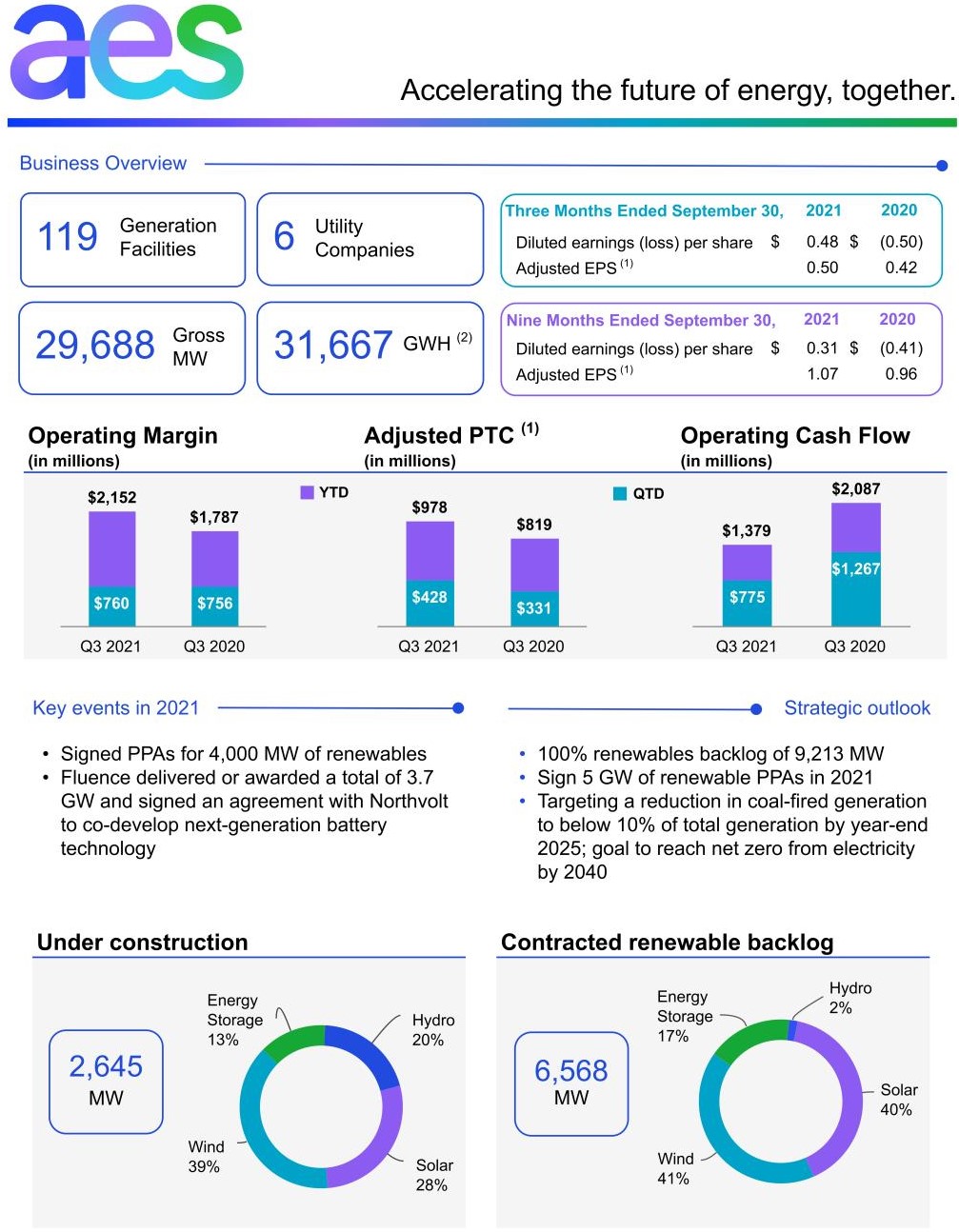
| (1) See Item 2.—Management’s Discussion and Analysis of Financial Condition and Results of Operations—SBU Performance Analysis—Non-GAAP Measures for reconciliation and definition. | |||||
| (2) GWh sold in 2020. |
39 | The AES Corporation | September 30, 2021 Form 10-Q
Overview of Strategic Performance
AES is leading the industry's transition to clean energy by investing in clean power growth and innovative technology businesses. The Company is well-positioned to benefit from very favorable trends in clean power generation, distribution, and supporting technologies.
- Year-to-date 2021, the Company completed construction or the acquisition of 643 MW of renewables and energy storage, primarily including:
◦344 MW of solar and solar plus storage in the US at AES Clean Energy;
◦159 MW Mandacaru and Salinas wind facility in Brazil;
◦59 MW San Fernando solar facility in Colombia; and
◦50 MW Bayasol solar facility in the Dominican Republic.
-
Since the Company’s second quarter 2021 earnings call in August, the Company has signed 1,088 MW of renewables and energy storage under long-term PPAs, primarily including 1,076 MW of solar, energy storage, and wind at AES Clean Energy in the US.
-
Year-to-date 2021, the Company signed or agreed to acquire 4,000 MW of renewables and energy storage under long-term PPAs, bringing the Company’s backlog to 9,213 MW expected to be completed through 2024, including:
◦2,645 MW under construction; and
- 6,568 MW of renewables signed under long-term PPAs.
40 | The AES Corporation | September 30, 2021 Form 10-Q
Review of Consolidated Results of Operations (Unaudited)
| Three Months Ended September 30, | Nine Months Ended September 30, | ||||||||||||||||||||||||||||||||||||||||||||||
| (in millions, except per share amounts) | 2021 | 2020 | $ change | % change | 2021 | 2020 | $ change | % change | |||||||||||||||||||||||||||||||||||||||
| Revenue: | |||||||||||||||||||||||||||||||||||||||||||||||
| US and Utilities SBU | $ | 1,327 | $ | 1,061 | $ | 266 | 25 | % | $ | 3,248 | $ | 2,945 | $ | 303 | 10 | % | |||||||||||||||||||||||||||||||
| South America SBU | 896 | 850 | 46 | 5 | % | 2,744 | 2,273 | 471 | 21 | % | |||||||||||||||||||||||||||||||||||||
| MCAC SBU | 559 | 442 | 117 | 26 | % | 1,584 | 1,255 | 329 | 26 | % | |||||||||||||||||||||||||||||||||||||
| Eurasia SBU | 257 | 195 | 62 | 32 | % | 804 | 634 | 170 | 27 | % | |||||||||||||||||||||||||||||||||||||
| Corporate and Other | 21 | 49 | (28) | -57 | % | 82 | 191 | (109) | -57 | % | |||||||||||||||||||||||||||||||||||||
| Eliminations | (24) | (52) | 28 | 54 | % | (91) | (198) | 107 | 54 | % | |||||||||||||||||||||||||||||||||||||
| Total Revenue | 3,036 | 2,545 | 491 | 19 | % | 8,371 | 7,100 | 1,271 | 18 | % | |||||||||||||||||||||||||||||||||||||
| Operating Margin: | |||||||||||||||||||||||||||||||||||||||||||||||
| US and Utilities SBU | 349 | 235 | 114 | 49 | % | 621 | 491 | 130 | 26 | % | |||||||||||||||||||||||||||||||||||||
| South America SBU | 199 | 337 | (138) | -41 | % | 896 | 707 | 189 | 27 | % | |||||||||||||||||||||||||||||||||||||
| MCAC SBU | 138 | 137 | 1 | 1 | % | 381 | 411 | (30) | -7 | % | |||||||||||||||||||||||||||||||||||||
| Eurasia SBU | 46 | 42 | 4 | 10 | % | 158 | 142 | 16 | 11 | % | |||||||||||||||||||||||||||||||||||||
| Corporate and Other | 31 | 23 | 8 | 35 | % | 107 | 70 | 37 | 53 | % | |||||||||||||||||||||||||||||||||||||
| Eliminations | (3) | (18) | 15 | 83 | % | (11) | (34) | 23 | 68 | % | |||||||||||||||||||||||||||||||||||||
| Total Operating Margin | 760 | 756 | 4 | 1 | % | 2,152 | 1,787 | 365 | 20 | % | |||||||||||||||||||||||||||||||||||||
| General and administrative expenses | (39) | (41) | 2 | -5 | % | (130) | (119) | (11) | 9 | % | |||||||||||||||||||||||||||||||||||||
| Interest expense | (242) | (290) | 48 | -17 | % | (669) | (741) | 72 | -10 | % | |||||||||||||||||||||||||||||||||||||
| Interest income | 71 | 64 | 7 | 11 | % | 212 | 198 | 14 | 7 | % | |||||||||||||||||||||||||||||||||||||
| Loss on extinguishment of debt | (22) | (54) | 32 | -59 | % | (41) | (95) | 54 | -57 | % | |||||||||||||||||||||||||||||||||||||
| Other expense | (12) | (20) | 8 | -40 | % | (32) | (27) | (5) | 19 | % | |||||||||||||||||||||||||||||||||||||
| Other income | 48 | 6 | 42 | NM | 274 | 60 | 214 | NM | |||||||||||||||||||||||||||||||||||||||
| Gain (loss) on disposal and sale of business interests | 22 | (90) | 112 | NM | 81 | (117) | 198 | NM | |||||||||||||||||||||||||||||||||||||||
| Asset impairment expense | (29) | (849) | 820 | -97 | % | (1,374) | (855) | (519) | 61 | % | |||||||||||||||||||||||||||||||||||||
| Foreign currency transaction gains (losses) | 29 | 2 | 27 | NM | (8) | 20 | (28) | NM | |||||||||||||||||||||||||||||||||||||||
| Other non-operating expense | — | — | — | — | % | — | (202) | 202 | -100 | % | |||||||||||||||||||||||||||||||||||||
| Income tax benefit (expense) | (126) | 147 | (273) | NM | (75) | (55) | (20) | 36 | % | ||||||||||||||||||||||||||||||||||||||
| Net equity in earnings (losses) of affiliates | 25 | (112) | 137 | NM | (15) | (106) | 91 | -86 | % | ||||||||||||||||||||||||||||||||||||||
| INCOME (LOSS) FROM CONTINUING OPERATIONS | 485 | (481) | 966 | NM | 375 | (252) | 627 | NM | |||||||||||||||||||||||||||||||||||||||
| Gain from disposal of discontinued businesses | — | — | — | — | % | 4 | 3 | 1 | 33 | % | |||||||||||||||||||||||||||||||||||||
| NET INCOME (LOSS) | 485 | (481) | 966 | NM | 379 | (249) | 628 | NM | |||||||||||||||||||||||||||||||||||||||
| Less: Loss (income) from continuing operations attributable to noncontrolling interests and redeemable stock of subsidiaries | (142) | 148 | (290) | NM | (156) | (23) | (133) | NM | |||||||||||||||||||||||||||||||||||||||
| NET INCOME (LOSS) ATTRIBUTABLE TO THE AES CORPORATION | $ | 343 | $ | (333) | $ | 676 | NM | $ | 223 | $ | (272) | $ | 495 | NM | |||||||||||||||||||||||||||||||||
| AMOUNTS ATTRIBUTABLE TO THE AES CORPORATION COMMON STOCKHOLDERS: | |||||||||||||||||||||||||||||||||||||||||||||||
| Income (loss) from continuing operations, net of tax | $ | 343 | $ | (333) | $ | 676 | NM | $ | 219 | $ | (275) | $ | 494 | NM | |||||||||||||||||||||||||||||||||
| Income from discontinued operations, net of tax | — | — | — | — | % | 4 | 3 | 1 | 33 | % | |||||||||||||||||||||||||||||||||||||
| NET INCOME (LOSS) ATTRIBUTABLE TO THE AES CORPORATION | $ | 343 | $ | (333) | $ | 676 | NM | $ | 223 | $ | (272) | $ | 495 | NM | |||||||||||||||||||||||||||||||||
| Net cash provided by operating activities | $ | 775 | $ | 1,267 | $ | (492) | -39 | % | $ | 1,379 | $ | 2,087 | $ | (708) | -34 | % |
Components of Revenue, Cost of Sales, and Operating Margin — Revenue includes revenue earned from the sale of energy from our utilities and the production and sale of energy from our generation plants, which are classified as regulated and non-regulated*,* respectively, on the Condensed Consolidated Statements of Operations. Revenue also includes the gains or losses on derivatives associated with the sale of electricity.
Cost of sales includes costs incurred directly by the businesses in the ordinary course of business. Examples include electricity and fuel purchases, operations and maintenance costs, depreciation and amortization expenses, bad debt expense and recoveries, and general administrative and support costs (including employee-related costs directly associated with the operations of the business). Cost of sales also includes the gains or losses on derivatives (including embedded derivatives other than foreign currency embedded derivatives) associated with the purchase of electricity or fuel.
Operating margin is defined as revenue less cost of sales.
41 | The AES Corporation | September 30, 2021 Form 10-Q
Consolidated Revenue and Operating Margin
Three Months Ended September 30, 2021
Revenue
(in millions)
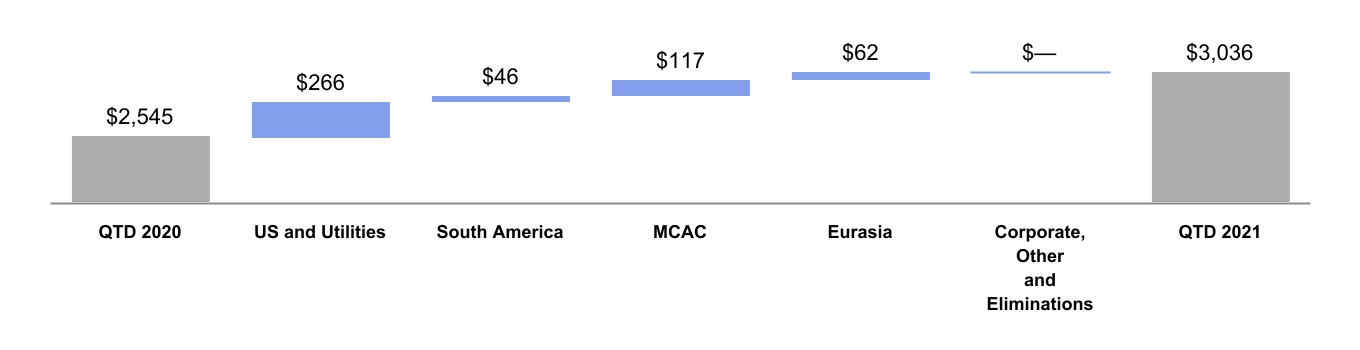
Consolidated Revenue — Revenue increased $491 million, or 19%, for the three months ended September 30, 2021, compared to the three months ended September 30, 2020, driven by:
-
$266 million in US and Utilities mainly driven by increases in capacity sales and in realized gains resulting from the commercial hedging strategy at Southland; higher demand at El Salvador due to the economic recovery from the COVID-19 impact; higher demand at AES Indiana due to favorable weather; and higher sales due to the timing of the commencement of the PPA annual put option period at Southland Energy;
-
$117 million in MCAC driven by higher LNG sales and higher contract sales in the Dominican Republic; higher pass-through fuel prices in Mexico; and higher contract sales in Panama due to increased demand; partially offset by the impact from the sale of Itabo in April 2021;
-
$62 million in Eurasia mainly driven by higher sales and generation in Bulgaria and Vietnam; and
-
$46 million in South America primarily driven by higher volume and generation at AES Brasil, partially due to the acquisition of the Ventus and Cubico wind complexes; and higher generation and prices (Resolution 440/2021) at Argentina.
Operating Margin
(in millions)
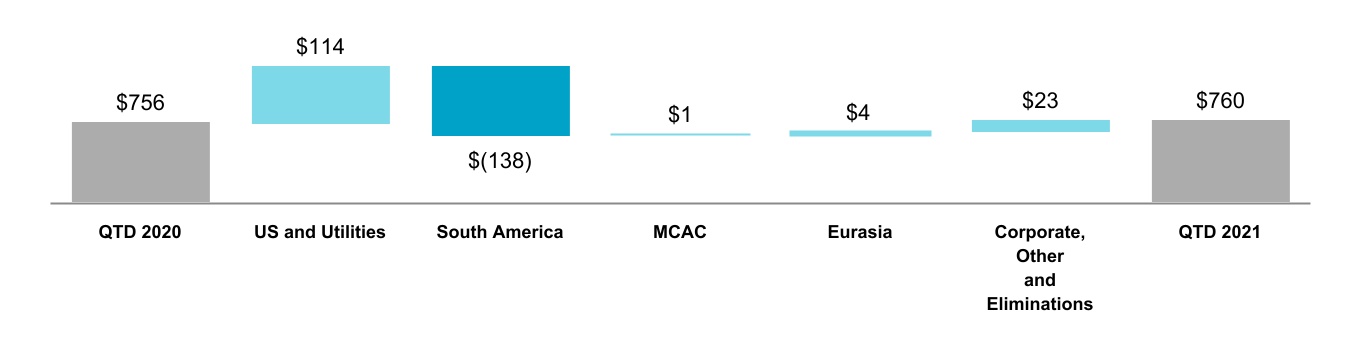
Consolidated Operating Margin — Operating margin increased $4 million, or 1%, for the three months ended September 30, 2021, compared to the three months ended September 30, 2020, driven by:
•$114 million in US and Utilities mainly driven by increases in capacity sales and in realized gains resulting from the commercial hedging strategy at Southland; higher sales due to the timing of the commencement of the PPA annual put option period at Southland Energy; and decreased maintenance costs at Puerto Rico; partially offset by increased costs associated with growing and accelerating the development pipeline at Clean Energy; and
•$23 million at Corporate and Other, mainly eliminated at consolidated level, driven by increases in IT costs reallocated to the operating segments and premiums earned by the AES self-insurance company.
These favorable impacts were partially offset by a decrease of:
42 | The AES Corporation | September 30, 2021 Form 10-Q
- $138 million in South America primarily driven by a decrease in the revenue recognized at Angamos for the early termination of contracts with Minera Escondida and Minera Spence; higher spot prices on energy purchases in Chile; higher energy purchases due to drier hydrology at Tietê; and unfavorable FX impact.
Nine Months Ended September 30, 2021
Revenue
(in millions)
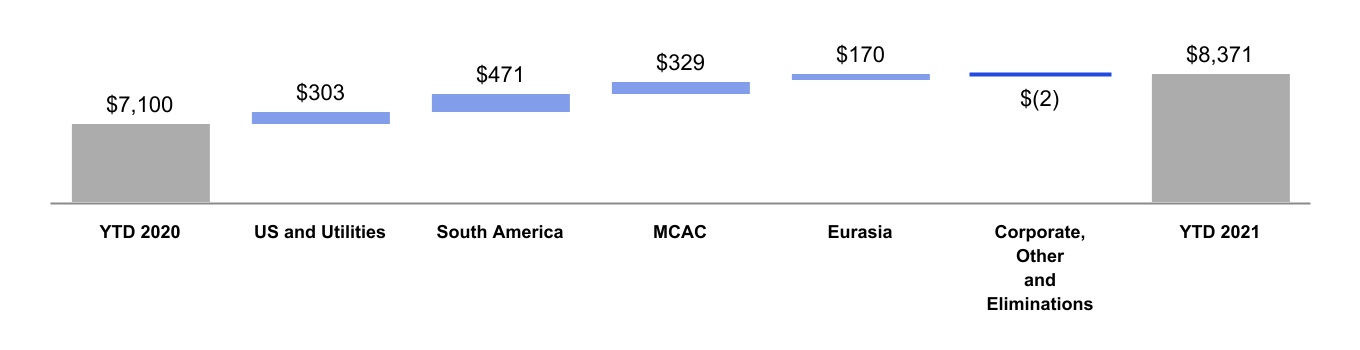
Consolidated Revenue — Revenue increased $1.3 billion, or 18%, for the nine months ended September 30, 2021, compared to the nine months ended September 30, 2020, driven by:
-
$471 million in South America primarily driven by the revenue recognized at Angamos for the early termination of contracts with Minera Escondida and Minera Spence; higher generation and prices (Resolution 440/2021) at Argentina; higher availability at Colombia from higher reservoir levels; and higher volume and generation at AES Brasil, partially due to the acquisition of the Ventus and Cubico wind complexes; partially offset by unfavorable FX impact and by the prior period recovery of previously expensed payments from customers in Chile;
-
$329 million in MCAC driven by higher LNG sales and higher contract sales in the Dominican Republic; higher pass-through fuel prices in Mexico; and higher contract sales in Panama due to increased demand; partially offset by the impact from the sale of Itabo in April 2021;
-
$303 million in US and Utilities driven by higher sales at Southland Energy due to the timing of the commencement of the PPA annual put option period; higher demand at El Salvador due to the economic recovery from the COVID-19 impact; higher demand at AES Indiana due to favorable weather; and increases in capacity sales and in realized gains resulting from the commercial hedging strategy at Southland; partially offset by decreased capacity at DPL due to its exit from the generation business; and
-
$170 million in Eurasia mainly driven by higher sales and generation in Bulgaria.
Operating Margin
(in millions)
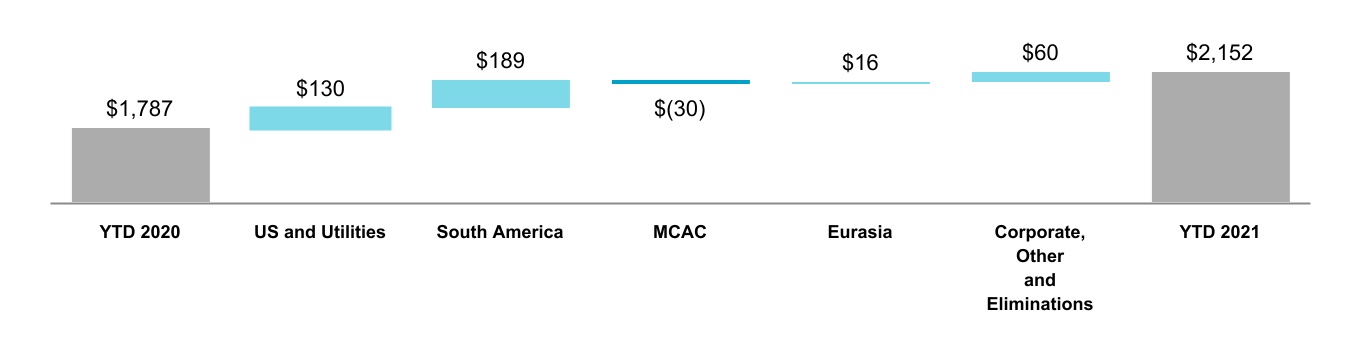
Consolidated Operating Margin — Operating margin increased $365 million, or 20%, for the nine months ended September 30, 2021, compared to the nine months ended September 30, 2020, driven by:
- $189 million in South America primarily due to the drivers discussed above; partially offset by higher energy purchases due to drier hydrology at Tietê;
43 | The AES Corporation | September 30, 2021 Form 10-Q
•$130 million in US and Utilities primarily from higher sales at Southland Energy due to the commencement of the PPA annual put option period; increases in capacity sales and in realized gains resulting from the commercial hedging strategy at Southland; and higher demand at El Salvador due to the economic recovery from the COVID-19 impact; partially offset by increased costs associated with growing and accelerating the development pipeline at Clean Energy and by higher maintenance expenses at AES Indiana;
- $60 million at Corporate and Other, mainly eliminated at consolidated level, driven by increases in IT costs reallocated to the operating segments and premiums earned by the AES self-insurance company; and
•$16 million in Eurasia mainly driven by lower fixed costs at OPGC due to its sale in December 2020 and favorable FX impact and higher energy prices in Bulgaria.
These favorable impacts were partially offset by a decrease of:
- $30 million in MCAC mainly driven by the impact from the sale of Itabo in April 2021; the disconnection of the Estrella del Mar I power barge in the prior year; and decreased availability and higher fixed costs in Mexico; partially offset by higher LNG sales in the Dominican Republic driven by the Eastern Pipeline COD in 2020 and by higher demand and better hydrology in Panama.
See Item 2.—Management’s Discussion and Analysis of Financial Condition and Results of Operations—SBU Performance Analysis of this Form 10-Q for additional discussion and analysis of operating results for each SBU.
Consolidated Results of Operations — Other
General and administrative expenses
General and administrative expenses decreased $2 million, or 5%, to $39 million for the three months ended September 30, 2021, compared to $41 million for the three months ended September 30, 2020, with no material drivers.
General and administrative expenses increased $11 million, or 9%, to $130 million for the nine months ended September 30, 2021, compared to $119 million for the nine months ended September 30, 2020, primarily due to an increase in business development activity, including costs at Clean Energy that had previously been incurred at sPower and reported within earnings from equity affiliates.
Interest expense
Interest expense decreased $48 million, or 17%, to $242 million for the three months ended September 30, 2021, compared to $290 million for the three months ended September 30, 2020. This decrease is primarily due to lower interest rates related to refinancing at the Parent Company, lower interest expense at Angamos due to debt prepayment in 2020 and lower monetary correction due to the GSF settlement in March 2021.
Interest expense decreased $72 million, or 10%, to $669 million for the nine months ended September 30, 2021, compared to $741 million for the nine months ended September 30, 2020. This decrease is primarily due to realized gains on de-designated interest rate swaps and lower interest rates related to refinancing at the Parent Company and lower interest expense at Angamos due to debt prepayment in 2020, partially offset by prior period incremental capitalized interest in Chile.
Interest income
Interest income increased $7 million, or 11%, to $71 million for the three months ended September 30, 2021, compared to $64 million for the three months ended September 30, 2020 and increased $14 million, or 7%, to $212 million for the nine months ended September 30, 2021, compared to $198 million for the nine months ended September 30, 2020, primarily due to sales-type lease receivables at AES Energy Storage Alamitos project and higher CAMMESA interest rates on receivables in Argentina, partially offset by lower loan receivable balance in Vietnam.
Loss on extinguishment of debt
Loss on extinguishment of debt decreased $32 million, or 59%, to $22 million for the three months ended September 30, 2021, compared to $54 million for the three months ended September 30, 2020, primarily due to prior year losses of $34 million at DPL and $16 million resulting from the Panama refinancing in 2020, partially offset by a loss at AES Andes of $14 million resulting from the refinancing of senior notes in July 2021.
44 | The AES Corporation | September 30, 2021 Form 10-Q
Loss on extinguishment of debt decreased $54 million, or 57%, to $41 million for the nine months ended September 30, 2021, compared to $95 million for the nine months ended September 30, 2020, primarily due to the drivers noted above as well as the loss of $37 million at the Parent Company resulting from the redemption of senior notes in 2020, partially offset by the loss of $14 million at Andres due to the refinancing in May 2021.
See Note 8—Debt included in Item 1.—Financial Statements of this Form 10-Q for further information.
Other income and expense
Other income increased $42 million to $48 million for the three months ended September 30, 2021, compared to $6 million for the three months ended September 30, 2020, primarily due to the current year gain on remeasurement of contingent consideration at Clean Energy and a gain on remeasurement of our equity interest in Gas Natural Atlántico II, S. de. R.L.’s assets to their acquisition-date fair value.
Other income increased $214 million to $274 million for the nine months ended September 30, 2021, compared to $60 million for the nine months ended September 30, 2020, primarily due to the current year gain on remeasurement of our equity interest in the sPower development platform to its acquisition-date fair value, recognized as part of the merger to form AES Clean Energy Development, partially offset by the prior year gain on sale of Redondo Beach land at Southland.
Other expense decreased $8 million to $12 million for the three months ended September 30, 2021, compared to $20 million for the three months ended September 30, 2020, primarily due to compliance with an arbitration decision in 2020.
Other expense increased $5 million to $32 million for the nine months ended September 30, 2021, compared to $27 million for the nine months ended September 30, 2020, primarily due to a current year loss recognized at commencement of a sales-type lease at AES Renewable Holdings, partially offset by compliance with an arbitration decision in 2020.
See Note 15—Other Income and Expense, Note 7—Investments in and Advances to Affiliates, and Note 19—Acquisitions included in Item 1.—Financial Statements of this Form 10-Q for further information.
Gain (loss) on disposal and sale of business interests
Gain on disposal and sale of business interests was $22 million for the three months ended September 30, 2021, primarily due to the gain on sale of Guacolda, partially offset by the loss on the partial disposition of the Company’s investment in Uplight, as compared to a loss of $90 million for the three months ended September 30, 2020, primarily due to the loss on sale of Uruguaiana.
Gain on disposal and sale of business interests was $81 million for the nine months ended September 30, 2021, primarily due the the issuance of new shares by Fluence, our equity method investment, to a new investor, which AES has accounted for as a gain on the partial disposition of its investment in Fluence, and the gain on sale of Guacolda, partially offset by the loss on the partial disposition of the Company’s investment in Uplight, as compared to a loss of $117 million for the nine months ended September 30, 2020, primarily due to the loss on sale of Uruguaiana and the settlement of arbitration related to the sale of Kazakhstan HPPs.
See Note 7—Investments in and Advances to Affiliates and Note 18—Held-For-Sale and Dispositions included in Item 1.—Financial Statements of this Form 10-Q for further information.
Asset impairment expense
Asset impairment expense decreased $820 million to $29 million for the three months ended September 30, 2021, compared to $849 million for the three months ended September 30, 2020. This decrease was primarily due to the $564 million and $213 million impairments related to the Angamos and Ventanas 1 & 2 coal-fired plants in Chile in the prior year and the $38 million impairment of the generation facility in Hawaii during 2020.
Asset impairment expense increased $519 million to $1.4 billion for the nine months ended September 30, 2021, compared to $855 million for the nine months ended September 30, 2020. This increase was primarily due to impairments of $649 million and $155 million related to AES Andes’ commitment to accelerate the retirement of the Ventanas 3 & 4 and Angamos coal-fired plants, respectively, a $475 million impairment at Puerto Rico associated with the economic costs and reputational risks of disposal of coal combustion residuals off island, and a $67 million impairment at the Mountain View I & II wind facilities related to a repowering project that will result in decommissioning the majority of the existing wind turbines in advance of their depreciable lives. The increase was partially offset by the $564 million and $213 million impairments related to the Angamos and Ventanas 1 & 2 coal-fired plants in Chile in the prior year and the $38 million impairment of the generation facility in Hawaii during 2020.
45 | The AES Corporation | September 30, 2021 Form 10-Q
See Note 16—Asset Impairment Expense included in Item 1.—Financial Statements of this Form 10-Q for further information.
Foreign currency transaction gains (losses)
| Three Months Ended September 30, | Nine Months Ended September 30, | ||||||||||||||||||||||
| (in millions) | 2021 | 2020 | 2021 | 2020 | |||||||||||||||||||
| Argentina | $ | 18 | $ | (4) | $ | (22) | $ | (11) | |||||||||||||||
| Corporate | (3) | 4 | (4) | 8 | |||||||||||||||||||
| Dominican Republic | (1) | — | (2) | 9 | |||||||||||||||||||
| Chile | 6 | 3 | 16 | 13 | |||||||||||||||||||
| Brazil | 6 | — | 2 | — | |||||||||||||||||||
| Other | 3 | (1) | 2 | 1 | |||||||||||||||||||
| Total (1) | $ | 29 | $ | 2 | $ | (8) | $ | 20 |
(1)Includes gains of $53 million and $2 million on foreign currency derivative contracts for the three months ended September 30, 2021 and 2020, respectively, and gains of $8 million and gains of $20 million on foreign currency derivative contracts for the nine months ended September 30, 2021 and 2020, respectively.
The Company recognized net foreign currency transaction gains of $29 million for the three months ended September 30, 2021, primarily due to unrealized gains on foreign currency derivatives related to government receivables in Argentina.
The Company recognized net foreign currency transaction losses of $8 million for the nine months ended September 30, 2021, primarily due to unrealized losses on foreign currency derivatives related to government receivables in Argentina, partially offset by unrealized derivative gains on foreign currency derivatives in South America due to the depreciating Colombian peso.
The Company recognized net foreign currency transaction gains of $2 million for the three months ended September 30, 2020 with no material drivers.
The Company recognized net foreign currency transaction gains of $20 million for the nine months ended September 30, 2020, primarily due to realized gains on foreign currency derivatives in South America due to the depreciating Colombian peso, gains in the Dominican Republic due to the depreciating Dominican peso, and gains at the Parent Company resulting from the appreciation of intercompany receivables denominated in Euro, partially offset by losses in Argentina due to depreciating receivables denominated in the Argentine peso.
Other non-operating expense
Other non-operating expense was $202 million for the nine months ended September 30, 2020. In March 2020, the Company recognized a $43 million other-than-temporary impairment of the OPGC equity method investment due to the economic slowdown. In June 2020, the Company agreed to sell its entire stake in the OPGC investment, resulting in an additional other-than-temporary impairment of $158 million. There were no other non-operating expenses during the three and nine months ended September 30, 2021.
See Note 7—Investments in and Advances to Affiliates included in Item 1.—Financial Statements of this Form 10-Q for further information.
Income tax benefit (expense)
Income tax expense was $126 million for the three months ended September 30, 2021, compared to income tax benefit of $147 million for the three months ended September 30, 2020. The Company’s effective tax rates were 22% and 28% for the three months ended September 30, 2021 and 2020, respectively. This net decrease in the effective tax rate was primarily due to the 2021 benefit associated with the release of valuation allowance due to a change in expected realizability of net operating loss carryforwards at one of our Brazilian subsidiaries. The third quarter 2020 effective tax rate was impacted by the tax benefit on the Company’s investment in Guacolda relating to equity losses for the impairment of long-lived assets. Partially offsetting this tax benefit was an unfavorable impact from the loss on sale of the Company’s entire interest in AES Uruguaiana in 2020.
Income tax expense increased $20 million, or 36%, to $75 million for the nine months ended September 30, 2021, compared to $55 million for the nine months ended September 30, 2020. The Company’s effective tax rates were 16% and (60)% for the nine months ended September 30, 2021 and 2020, respectively. This net change in the effective tax rate was primarily due to the impact of the aforementioned valuation allowance release benefit, as well as asset impairments in Chile and Puerto Rico recorded in 2021. The prior year effective tax rate was impacted by both the impact of the other-than-temporary impairment of the OPGC equity method investment and the loss on sale of the Company’s entire interest in AES Uruguaiana. These impacts were partially offset by the recognition of
46 | The AES Corporation | September 30, 2021 Form 10-Q
the 2020 tax benefit related to a depreciating Peso in certain of our Argentine subsidiaries, as well as the aforementioned impact of the Company’s investment in Guacolda.
See Note 16—Asset Impairment Expense included in Item 1.—Financial Statements of this Form 10-Q for details of the asset impairments and Note 7—Investments In and Advances to Affiliates included in Item 1.—Financial Statements of this Form 10-Q for further information regarding the other-than-temporary impairment. See Note 18—Held-for-Sale and Dispositions included in Item 1.—Financial Statements of this Form 10-Q for details of the sale of the Company’s entire interest in AES Uruguaiana.
Our effective tax rate reflects the tax effect of significant operations outside the U.S., which are generally taxed at rates different than the U.S. statutory rate of 21%. Furthermore, our foreign earnings may be subjected to incremental U.S. taxation under the GILTI rules. A future proportionate change in the composition of income before income taxes from foreign and domestic tax jurisdictions could impact our periodic effective tax rate.
Net equity in earnings (losses) of affiliates
Net equity in earnings of affiliates increased $137 million to $25 million for the three months ended September 30, 2021, compared to losses of $112 million for the three months ended September 30, 2020. This increase was driven by $106 million of losses at Gener in 2020 mainly due to a long-lived asset impairment at its investee, Guacolda, and the suspension of equity method accounting at Guacolda in September 2020, and a $31 million increase at sPower due to higher allocation of earnings driven by renewable projects that came online in 2021.
Net equity in losses of affiliates decreased $91 million, or 86%, to $15 million for the nine months ended September 30, 2021, compared to $106 million for the nine months ended September 30, 2020. This decrease was driven by $75 million of losses at Gener in 2020 mainly due to a long-lived asset impairment at its investee, Guacolda, and the suspension of equity method accounting at Guacolda in September 2020, and a $49 million higher allocation of earnings at sPower driven by renewable projects that came online in 2021. This decrease in losses was partially offset by an increase in losses at Fluence of $15 million due to timing, an incident in which inventory was damaged, and higher overhead costs associated with the growing business as well as a $13 million increase in losses in Mexico due to lower income tax in 2020 as a result of foreign currency devaluation.
See Note 7—Investments in and Advances to Affiliates included in Item 1.—Financial Statements of this Form 10-Q for further information.
Net income attributable to noncontrolling interests and redeemable stock of subsidiaries
Net income attributable to noncontrolling interests and redeemable stock of subsidiaries increased $290 million, to income of $142 million for the three months ended September 30, 2021, compared to a loss of $148 million for the three months ended September 30, 2020. This increase was primarily due to:
-
Higher earnings in Chile primarily due to prior year long-lived asset impairments at AES Andes;
-
Higher deferred tax benefits recorded at AES Brasil, partially offset by lower allocation of earnings due to change in NCI partner ownership;
-
Allocation of earnings at Southland Energy to noncontrolling interests;
-
Higher earnings at AES Renewable Holdings from an increase in businesses commencing operations; and
-
Higher earnings in Panama primarily due to the prior year asset impairment and loss on extinguishment of debt.
These increases were partially offset by:
-
Increased costs associated with growing and accelerating the U.S. renewables development pipeline; and
-
Lower earnings in the Dominican Republic due to the sale of Itabo in the second quarter.
Net income attributable to noncontrolling interests and redeemable stock of subsidiaries increased $133 million to $156 million for the nine months ended September 30, 2021, compared to $23 million for the nine months ended September 30, 2020. This increase was primarily due to:
-
Higher earnings in Chile due to net gains from early contract terminations at Angamos, gain on sale of Guacolda, and net higher long-lived asset impairments in the prior year;
-
Allocation of earnings at Southland Energy to noncontrolling interests;
47 | The AES Corporation | September 30, 2021 Form 10-Q
-
Higher deferred tax benefits recorded at AES Brasil, partially offset by lower allocation of earnings due to change in NCI partner ownership;
-
Higher earnings in Colombia due to the life extension project at the Chivor hydroelectric plant completed in the prior year and better hydrology; and
-
Higher earnings in Panama primarily due to the prior year asset impairment and loss on extinguishment of debt.
These increases were partially offset by:
-
Lower earnings in the Dominican Republic due to the sale of Itabo in the second quarter; and
-
Increased costs associated with growing and accelerating the U.S. renewables development pipeline.
Net income (loss) attributable to The AES Corporation
Net income attributable to The AES Corporation increased $676 million, to income of $343 million for the three months ended September 30, 2021, compared to a loss of $333 million for the three months ended September 30, 2020. This increase was primarily due to:
-
Prior year long-lived asset impairments at AES Andes, Hawaii, and Guacolda;
-
Higher margins at our US and Utilities SBU primarily due to favorable price variances under the commercial hedging strategy at Southland; and
-
Prior year loss on sale of Uruguaiana.
These increases were partially offset by:
- Higher income tax expense.
Net income attributable to The AES Corporation increased $495 million, to income of $223 million for the nine months ended September 30, 2021, compared to a loss of $272 million for the nine months ended September 30, 2020. This increase was primarily due to:
-
Higher margins at our South America SBU due to net gains from early contract terminations at Angamos;
-
Higher margins at our US and Utilities SBU primarily due to favorable price variances under the commercial hedging strategy at Southland and commencement of the PPA put option period at Southland Energy;
-
Lower Parent interest expense due to realized gains on de-designated interest rate swaps and lower interest rates;
-
Gain on remeasurement of our equity interest in the sPower development platform to acquisition-date fair value;
-
Gain due to the issuance of new shares by Fluence, which was accounted for as a partial disposition;
-
Prior year loss on sale of Uruguaiana; and
-
Prior year losses on extinguishment of debt at the Parent and DPL.
These increases were partially offset by:
-
Net higher impairments in the current year; and
-
Higher income tax expense.
SBU Performance Analysis
Non-GAAP Measures
Adjusted Operating Margin, Adjusted PTC, and Adjusted EPS are non-GAAP supplemental measures that are used by management and external users of our condensed consolidated financial statements such as investors, industry analysts, and lenders.
During the year ended December 31, 2020, the Company changed the definitions of Adjusted Operating Margin, Adjusted PTC, and Adjusted EPS to exclude net gains at Angamos, one of our businesses in the South America SBU, associated with the early contract terminations with Minera Escondida and Minera Spence. We believe the inclusion of the effects of this non-recurring transaction would result in a lack of comparability in our
48 | The AES Corporation | September 30, 2021 Form 10-Q
results of operations and would distort the metrics that our investors use to measure us.
Effective January 1, 2021, the Company changed the definitions of Adjusted Operating Margin, Adjusted PTC, and Adjusted EPS to remove the adjustment for costs directly associated with a major restructuring program, including, but not limited to, workforce reduction efforts, relocations, and office consolidation. As this adjustment was specific to the major restructuring program announced by the Company in 2018, we believe removing this adjustment from our non-GAAP definitions provides simplification and clarity for our investors.
Adjusted Operating Margin
We define Adjusted Operating Margin as Operating Margin, adjusted for the impact of NCI, excluding (a) unrealized gains or losses related to derivative transactions; (b) benefits and costs associated with dispositions and acquisitions of business interests, including early plant closures; and (c) net gains at Angamos, one of our businesses in the South America SBU, associated with the early contract terminations with Minera Escondida and Minera Spence. The allocation of HLBV earnings to noncontrolling interests is not adjusted out of Adjusted Operating Margin. See Review of Consolidated Results of Operations for the definition of Operating Margin.
The GAAP measure most comparable to Adjusted Operating Margin is Operating Margin. We believe that Adjusted Operating Margin better reflects the underlying business performance of the Company. Factors in this determination include the impact of NCI, where AES consolidates the results of a subsidiary that is not wholly owned by the Company, as well as the variability due to unrealized gains or losses related to derivative transactions and strategic decisions to dispose of or acquire business interests. Adjusted Operating Margin should not be construed as an alternative to Operating Margin, which is determined in accordance with GAAP.
| Three Months Ended September 30, | Nine Months Ended September 30, | ||||||||||||||||||||||
| Reconciliation of Adjusted Operating Margin (in millions) | 2021 | 2020 | 2021 | 2020 | |||||||||||||||||||
| Operating Margin | $ | 760 | $ | 756 | $ | 2,152 | $ | 1,787 | |||||||||||||||
| Noncontrolling interests adjustment (1) | (170) | (207) | (577) | (530) | |||||||||||||||||||
| Unrealized derivative (gains) losses | (26) | 26 | 5 | 9 | |||||||||||||||||||
| Disposition/acquisition losses | 2 | 14 | 8 | 18 | |||||||||||||||||||
| Net gains from early contract terminations at Angamos | (36) | (72) | (256) | (72) | |||||||||||||||||||
| Total Adjusted Operating Margin | $ | 530 | $ | 517 | $ | 1,332 | $ | 1,212 |
(1)The allocation of HLBV earnings to noncontrolling interests is not adjusted out of Adjusted Operating Margin.
49 | The AES Corporation | September 30, 2021 Form 10-Q
Adjusted PTC
We define Adjusted PTC as pre-tax income from continuing operations attributable to The AES Corporation excluding gains or losses of the consolidated entity due to (a) unrealized gains or losses related to derivative transactions and equity securities; (b) unrealized foreign currency gains or losses; (c) gains, losses, benefits and costs associated with dispositions and acquisitions of business interests, including early plant closures, and gains and losses recognized at commencement of sales-type leases; (d) losses due to impairments; (e) gains, losses and costs due to the early retirement of debt; and (f) net gains at Angamos, one of our businesses in the South America SBU, associated with the early contract terminations with Minera Escondida and Minera Spence. Adjusted PTC also includes net equity in earnings of affiliates on an after-tax basis adjusted for the same gains or losses excluded from consolidated entities.
Adjusted PTC reflects the impact of NCI and excludes the items specified in the definition above. In addition to the revenue and cost of sales reflected in Operating Margin, Adjusted PTC includes the other components of our income statement, such as general and administrative expenses in Corporate and Other, as well as business development costs, interest expense and interest income, other expense and other income, realized foreign currency transaction gains and losses, and net equity in earnings of affiliates.
The GAAP measure most comparable to Adjusted PTC is income from continuing operations attributable to The AES Corporation. We believe that Adjusted PTC better reflects the underlying business performance of the Company and is the most relevant measure considered in the Company’s internal evaluation of the financial performance of its segments. Factors in this determination include the variability due to unrealized gains or losses related to derivative transactions or equity securities remeasurement, unrealized foreign currency gains or losses, losses due to impairments, strategic decisions to dispose of or acquire business interests or retire debt, and the non-recurring nature of the impact of the early contract terminations at Angamos, which affect results in a given period or periods. In addition, earnings before tax represents the business performance of the Company before the application of statutory income tax rates and tax adjustments, including the effects of tax planning, corresponding to the various jurisdictions in which the Company operates. Given its large number of businesses and complexity, the Company concluded that Adjusted PTC is a more transparent measure that better assists investors in determining which businesses have the greatest impact on the Company’s results.
Adjusted PTC should not be construed as an alternative to income from continuing operations attributable to The AES Corporation, which is determined in accordance with GAAP.
50 | The AES Corporation | September 30, 2021 Form 10-Q
| Three Months Ended September 30, | Nine Months Ended September 30, | ||||||||||||||||||||||
| Reconciliation of Adjusted PTC (in millions) | 2021 | 2020 | 2021 | 2020 | |||||||||||||||||||
| Income (loss) from continuing operations, net of tax, attributable to The AES Corporation | $ | 343 | $ | (333) | $ | 219 | $ | (275) | |||||||||||||||
| Income tax expense (benefit) from continuing operations attributable to The AES Corporation | 151 | (98) | 91 | 38 | |||||||||||||||||||
| Pre-tax contribution | 494 | (431) | 310 | (237) | |||||||||||||||||||
| Unrealized derivative and equity securities losses (gains) | (53) | 26 | 24 | 24 | |||||||||||||||||||
| Unrealized foreign currency losses (gains) | 11 | (4) | 5 | (7) | |||||||||||||||||||
| Disposition/acquisition losses (gains) | (33) | 100 | (277) | 130 | |||||||||||||||||||
| Impairment losses | 18 | 657 | 1,121 | 878 | |||||||||||||||||||
| Loss on extinguishment of debt | 27 | 55 | 51 | 103 | |||||||||||||||||||
| Net gains from early contract terminations at Angamos | (36) | (72) | (256) | (72) | |||||||||||||||||||
| Total Adjusted PTC | $ | 428 | $ | 331 | $ | 978 | $ | 819 |
51 | The AES Corporation | September 30, 2021 Form 10-Q
Adjusted EPS
We define Adjusted EPS as diluted earnings per share from continuing operations excluding gains or losses of both consolidated entities and entities accounted for under the equity method due to (a) unrealized gains or losses related to derivative transactions and equity securities; (b) unrealized foreign currency gains or losses; (c) gains, losses, benefits and costs associated with dispositions and acquisitions of business interests, including early plant closures, and the tax impact from the repatriation of sales proceeds, and gains and losses recognized at commencement of sales-type leases; (d) losses due to impairments; (e) gains, losses and costs due to the early retirement of debt; (f) net gains at Angamos, one of our businesses in the South America SBU, associated with the early contract terminations with Minera Escondida and Minera Spence; and (g) tax benefit or expense related to the enactment effects of 2017 U.S. tax law reform and related regulations and any subsequent period adjustments related to enactment effects.
The GAAP measure most comparable to Adjusted EPS is diluted earnings per share from continuing operations. We believe that Adjusted EPS better reflects the underlying business performance of the Company and is considered in the Company’s internal evaluation of financial performance. Factors in this determination include the variability due to unrealized gains or losses related to derivative transactions or equity securities remeasurement, unrealized foreign currency gains or losses, losses due to impairments, strategic decisions to dispose of or acquire business interests or retire debt, the one-time impact of the 2017 U.S. tax law reform and subsequent period adjustments related to enactment effects, and the non-recurring nature of the impact of the early contract terminations at Angamos, which affect results in a given period or periods.
Adjusted EPS should not be construed as an alternative to diluted earnings per share from continuing operations, which is determined in accordance with GAAP.
| Three Months Ended September 30, | Nine Months Ended September 30, | |||||||||||||||||||||||||
| Reconciliation of Adjusted EPS | 2021 | 2020 | 2021 | 2020 | ||||||||||||||||||||||
| Diluted earnings (loss) per share from continuing operations | $ | 0.48 | $ | (0.50) | $ | 0.31 | $ | (0.41) | ||||||||||||||||||
| Unrealized derivative and equity securities losses (gains) | (0.07) | (1) | 0.04 | (2) | 0.03 | (3) | 0.04 | (2) | ||||||||||||||||||
| Unrealized foreign currency losses (gains) | 0.01 | — | 0.01 | (0.01) | ||||||||||||||||||||||
| Disposition/acquisition losses (gains) | (0.05) | (4) | 0.15 | (5) | (0.40) | (6) | 0.20 | (7) | ||||||||||||||||||
| Impairment losses | 0.03 | (8) | 0.98 | (9) | 1.61 | (10) | 1.31 | (11) | ||||||||||||||||||
| Loss on extinguishment of debt | 0.04 | (12) | 0.08 | (13) | 0.07 | (14) | 0.15 | (15) | ||||||||||||||||||
| Net gains from early contract terminations at Angamos | (0.05) | (16) | (0.11) | (17) | (0.37) | (16) | (0.11) | (17) | ||||||||||||||||||
| U.S. Tax Law Reform Impact | — | — | — | 0.02 | (18) | |||||||||||||||||||||
| Less: Net income tax expense (benefit) | 0.11 | (19) | (0.22) | (20) | (0.19) | (21) | (0.23) | (20) | ||||||||||||||||||
| Adjusted EPS | $ | 0.50 | $ | 0.42 | $ | 1.07 | $ | 0.96 |
(1)Amount primarily relates to unrealized gains on power and commodities swaps at Southland of $22 million, or $0.03 per share, and unrealized gains on foreign currency derivatives in Argentina associated with government receivables of $15 million, or $0.02 per share, and in Brazil of $11 million, or $0.02 per share.
(2)Amounts primarily relate to unrealized derivative losses at Southland of $20 million, or $0.03 per share, for the three months ended September 30, 2020, and unrealized derivative losses in Argentina mainly associated with foreign currency derivatives on government receivables of $18 million, or $0.03 per share, for the nine months ended September 30, 2020.
(3)Amount primarily relates to net unrealized derivative losses in Argentina mainly associated with foreign currency derivatives on government receivables of $26 million, or $0.04 per share.
(4)Amount primarily relates to a gain on remeasurement of contingent consideration at Clean Energy of $24 million, or $0.03 per share, and gain on sale of Guacolda of $22 million, or $0.03 per share, partially offset by loss on Uplight transaction with shareholders of $11 million, or $0.02 per share.
(5)Amount primarily relates to loss on sale of Uruguaiana of $85 million, or $0.13 per share, and advisor fees associated with the successful acquisition of additional ownership interest in AES Brasil of $9 million, or $0.01 per share.
(6)Amount primarily relates to the gain on remeasurement of our equity interest in sPower to acquisition-date fair value of $214 million, or $0.31 per share, and gain on Fluence issuance of shares of $60 million, or $0.09 per share, a gain on remeasurement of contingent consideration at Clean Energy of $24 million, or $0.03 per share, and gain on sale of Guacolda of $22 million, or $0.03 per share, partially offset by day-one loss recognized at commencement of a sales-type lease at AES Renewable Holdings of $13 million, or $0.02 per share, and loss on Uplight transaction with shareholders of $11 million, or $0.02 per share.
(7)Amount primarily relates to loss on sale of Uruguaiana of $85 million, or $0.13 per share, loss on sale of the Kazakhstan HPPs of $30 million, or $0.05 per share, as result of the final arbitration decision, and advisor fees associated with the successful acquisition of additional ownership interest in AES Brasil of $9 million, or $0.01 per share.
(8)Amount primarily relates to asset impairments at Clean Energy of $14 million, or $0.02 per share, and at Panama of $5 million, or $0.01 per share.
(9)Amount primarily relates to asset impairments at AES Andes of $523 million, or $0.78 per share, at our Guacolda equity affiliate impacting equity earnings by $81 million, or $0.12 per share, at Hawaii of $38 million, or $0.06 per share, and at Panama of $15 million, or $0.02 per share.
(10)Amount primarily relates to asset impairments at AES Andes of $540 million, or $0.77 per share, at Puerto Rico of $475 million, or $0.68 per share, at Mountain View of $67 million, or $0.10 per share, at our sPower equity affiliate, impacting equity earnings by $21 million, or $0.03 per share, and at Clean Energy of $14 million, or $0.02 per share.
(11)Amount relates to asset impairments at AES Andes of $527 million, or $0.79 per share, other-than-temporary impairment of OPGC of $201 million, or $0.30 per share, impairment at our Guacolda equity affiliate impacting equity earnings by $81 million, or $0.12 per share, impairment at Hawaii of $38 million, or $0.06 per share, impairment at Panama of $15 million, or $0.02 per share, and impairments at our sPower equity affiliate, impacting equity earnings by $16 million, or
52 | The AES Corporation | September 30, 2021 Form 10-Q
$0.02 per share.
(12)Amount relates to losses on early retirement of debt at AES Andes of $15 million, or $0.02 per share, and Argentina of $8 million, or $0.01 per share.
(13)Amount primarily relates to losses on early retirement of debt at DPL of $32 million, or $0.05 per share, Panama of $11 million, or $0.02 per share, and Angamos of $10 million, or $0.01 per share.
(14)Amount primarily relates to losses on early retirement of debt at Andres and Los Mina of $15 million, or $0.02 per share, at AES Andes of $15 million, or $0.02 per share, and at Argentina of $8 million, or $0.01 per share.
(15)Amount primarily relates to losses on early retirement of debt at the Parent Company of $37 million, or $0.06 per share, DPL of $32 million, or $0.05 per share, Panama of $11 million, or $0.02 per share, and Angamos of $10 million, or $0.02 per share.
(16)Amounts relate to net gains at Angamos associated with the early contract terminations with Minera Escondida and Minera Spence of $37 million, or $0.05 per share, and $256 million, or $0.37 per share, for the three and nine months ended September 30, 2021, respectively.
(17)Amounts relate to net gains at Angamos associated with the early contract terminations with Minera Escondida and Minera Spence of $72 million, or $0.11 per share.
(18)Amount represents adjustment to tax law reform remeasurement due to incremental deferred taxes related to DPL of $16 million, or $0.02 per share.
(19)Amount primarily relates to a reduction in the income tax benefit associated with the impairment at Puerto Rico of $44 million, or $0.06 per share, income tax expense related to the gain on sale of Guacolda of $6 million, or $0.01 per share, and income tax expense related to the gain on remeasurement of contingent consideration at Clean Energy of $6 million, or $0.01 per share.
(20)Amounts primarily relate to income tax benefits associated with the impairments at AES Andes and Guacolda of $147 million, or $0.22 per share.
(21)Amount primarily relates to income tax benefits associated with the impairments at AES Andes of $174 million, or $0.25 per share, at Puerto Rico of $70 million, or $0.10 per share, and at Mountain View of $18 million, or $0.03 per share, partially offset by income tax expense related to net gains at Angamos associated with the early contract terminations with Minera Escondida and Minera Spence of $83 million, or $0.12 per share, income tax expense related to the gain on remeasurement of our equity interest in sPower to acquisition-date fair value of $47 million, or $0.07 per share, and income tax expense related to the gain on Fluence issuance of shares of $13 million, or $0.02 per share.
US and Utilities SBU
The following table summarizes Operating Margin, Adjusted Operating Margin and Adjusted PTC (in millions) for the periods indicated:
| Three Months Ended September 30, | Nine Months Ended September 30, | ||||||||||||||||||||||||||||||||||||||||||||||
| 2021 | 2020 | $ Change | % Change | 2021 | 2020 | $ Change | % Change | ||||||||||||||||||||||||||||||||||||||||
| Operating Margin | $ | 349 | $ | 235 | $ | 114 | 49 | % | $ | 621 | $ | 491 | $ | 130 | 26 | % | |||||||||||||||||||||||||||||||
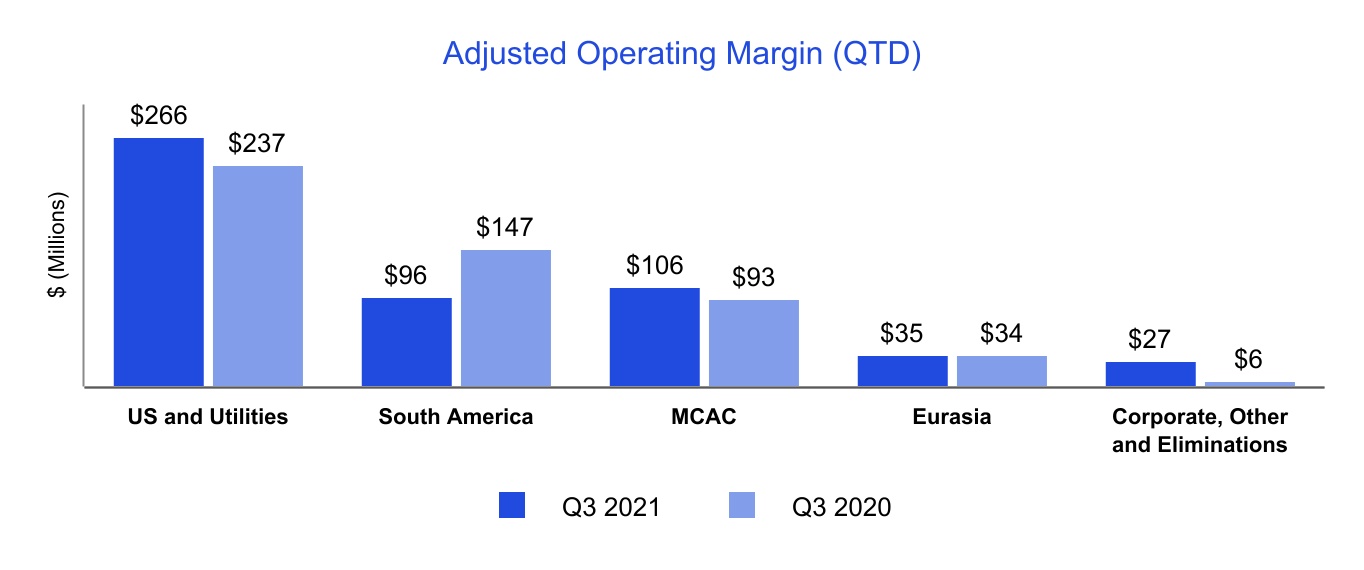
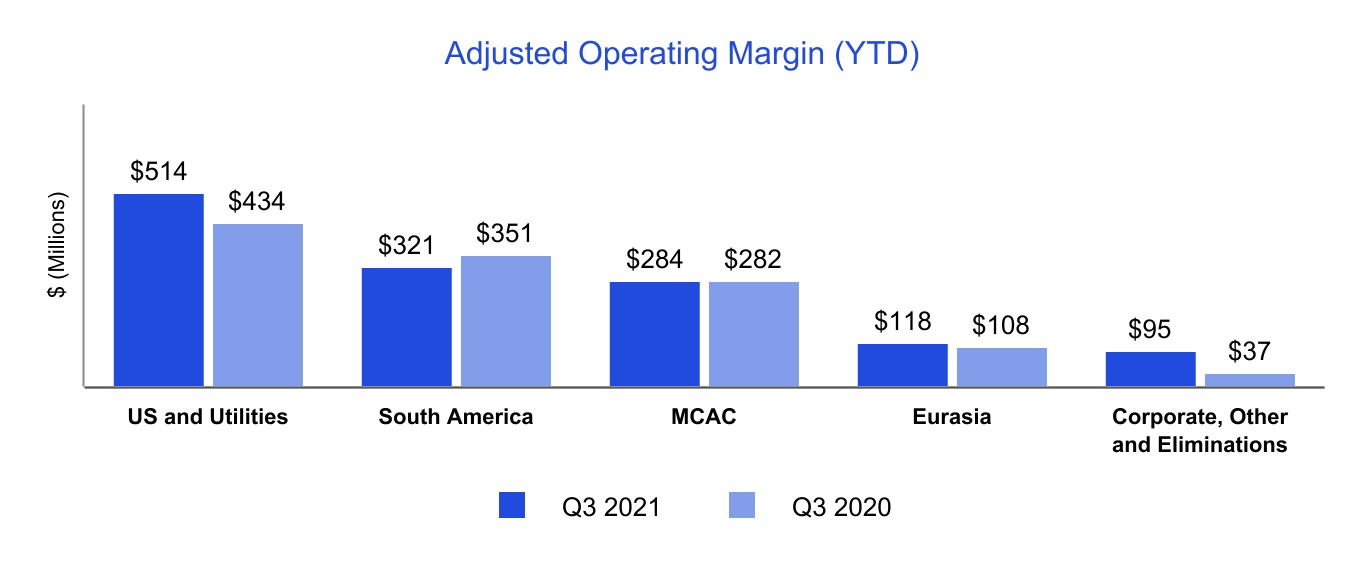
| Adjusted Operating Margin (1) | 266 | 237 | 29 | 12 | % | 514 | 434 | 80 | 18 | % | |||||||||||||||||||||||||||||||||||||
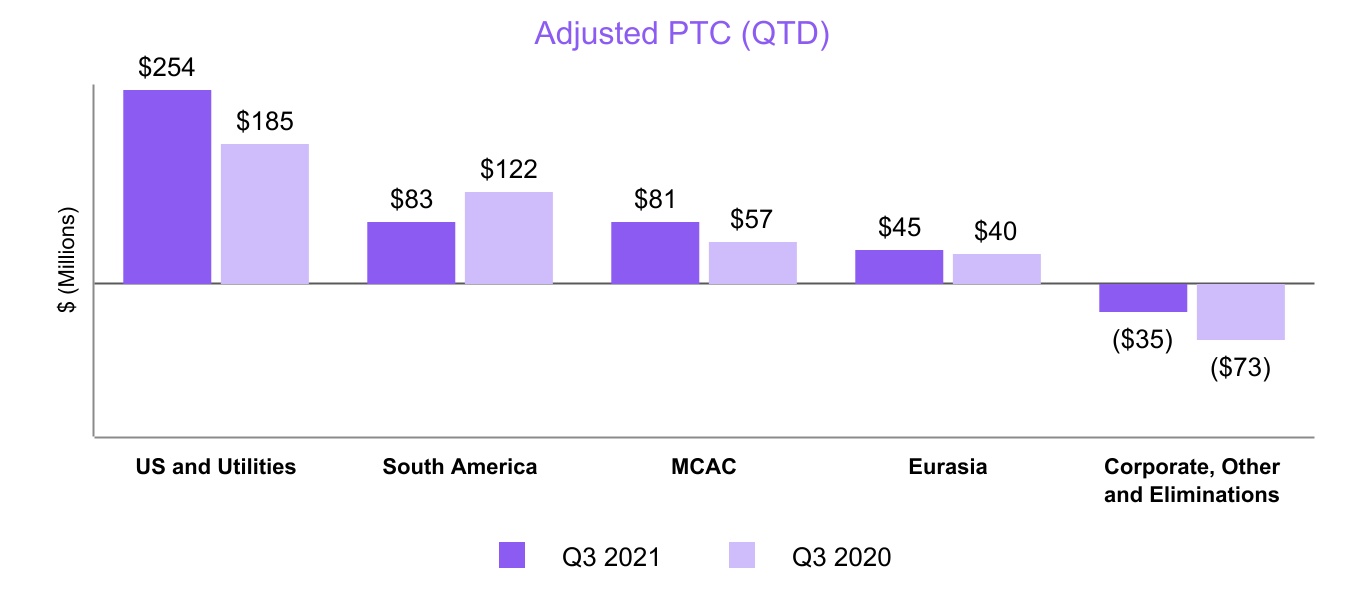
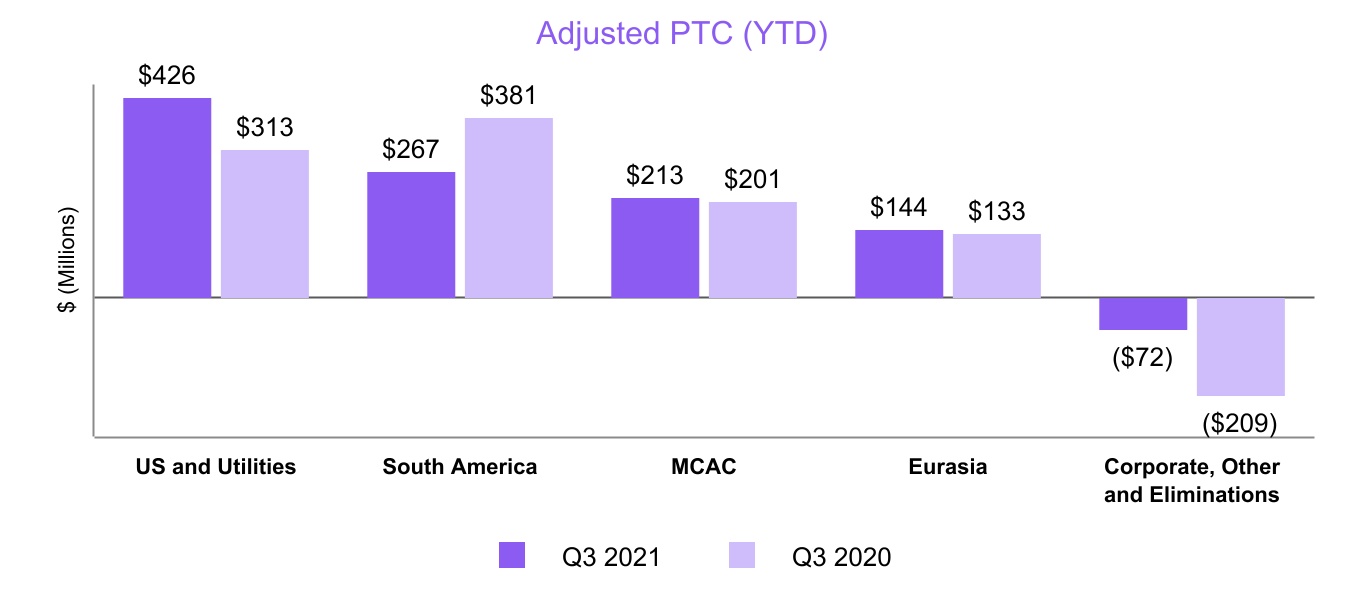
| Adjusted PTC (1) | 254 | 185 | 69 | 37 | % | 426 | 313 | 113 | 36 | % |
(1) A non-GAAP financial measure, adjusted for the impact of NCI. See SBU Performance Analysis—Non-GAAP Measures for definition and Item 1.—Business included in our 2020 Form 10-K for the respective ownership interest for key businesses.
Operating Margin for the three months ended September 30, 2021 increased $114 million, or 49%, which was driven primarily by the following (in millions):
| Increase at Southland mainly driven by favorable price variances under the commercial hedging strategy | $ | 67 | |||
| Increase at Southland Energy due to the commencement of the PPA annual put option period in the current year and higher realized and unrealized losses on derivatives in the prior year | 38 | ||||
| Increase in Puerto Rico driven by higher availability due to the timing of planned maintenance and lower depreciation expense | 14 | ||||
| Decrease at Clean Energy driven by increased costs associated with growing and accelerating the development pipeline, partially offset by higher revenue due to the Company’s agreement to supply Google’s data centers with 24/7 carbon-free energy | (8) | ||||
| Other | 3 | ||||
| Total US and Utilities SBU Operating Margin Increase | $ | 114 |
Adjusted Operating Margin increased $29 million primarily due to the drivers above, adjusted for NCI and excluding unrealized gains and losses on derivatives.
Adjusted PTC increased $69 million primarily driven by the increase in Adjusted Operating Margin described above, an increase at our U.S. renewables businesses due to contributions from newly operational projects, a higher contribution from Southland Energy as a result of the sale of noncontrolling interests in 2020, and an increase at AES Indiana due to lower pension costs.
Operating Margin for the nine months ended September 30, 2021 increased $130 million, or 26%, which was driven primarily by the following (in millions):
53 | The AES Corporation | September 30, 2021 Form 10-Q
| Increase at Southland Energy primarily due to the CCGT units operating for the full 2021 period and the commencement of the PPA annual put option period in the current year | $ | 95 | |||
| Increase at Southland mainly due to an increase in capacity sales and favorable price variances under the commercial hedging strategy, partially offset by lower energy sales driven lower volume and by energy price adjustments due to market re-settlements | 39 | ||||
| Increase in El Salvador due to higher demand mainly driven by the impact of COVID-19 in 2020 | 18 | ||||
| Increase in Puerto Rico driven by higher availability due to the timing of planned maintenance, lower depreciation expense due to an impairment recognized in Q1 2021, and lower waste residual disposal | 9 | ||||
| Decrease at Clean Energy driven by increased costs associated with growing and accelerating the development pipeline, partially offset by an increase at AES Renewable Holdings due to more projects online in 2021 and higher revenue due to the Company’s agreement to supply Google’s data centers with 24/7 carbon-free energy | (16) | ||||
| Decrease at AES Indiana primarily due to higher maintenance expense, partially offset by higher volumes from favorable weather | (13) | ||||
| Other | (2) | ||||
| Total US and Utilities SBU Operating Margin Increase | $ | 130 |
Adjusted Operating Margin increased $80 million primarily due to the drivers above, adjusted for NCI, and excluding unrealized gains and losses on derivatives.
Adjusted PTC increased $113 million, primarily driven by the increase in Adjusted Operating Margin described above, an increase at our U.S. renewables businesses due to contributions from newly operational projects, a higher contribution from Southland Energy as a result of the sale of noncontrolling interests in 2020, lower interest expense at DPL, and lower pension costs at AES Indiana, partially offset by a gain in 2020 on sale of land held by AES Redondo Beach at Southland.
South America SBU
The following table summarizes Operating Margin, Adjusted Operating Margin and Adjusted PTC (in millions) for the periods indicated:
| Three Months Ended September 30, | Nine Months Ended September 30, | ||||||||||||||||||||||||||||||||||||||||||||||
| 2021 | 2020 | $ Change | % Change | 2021 | 2020 | $ Change | % Change | ||||||||||||||||||||||||||||||||||||||||
| Operating Margin | $ | 199 | $ | 337 | $ | (138) | -41 | % | $ | 896 | $ | 707 | $ | 189 | 27 | % | |||||||||||||||||||||||||||||||
| Adjusted Operating Margin (1) | 96 | 147 | (51) | -35 | % | 321 | 351 | (30) | -9 | % | |||||||||||||||||||||||||||||||||||||
| Adjusted PTC (1) | 83 | 122 | (39) | -32 | % | 267 | 381 | (114) | -30 | % |
(1) A non-GAAP financial measure, adjusted for the impact of NCI. See SBU Performance Analysis—Non-GAAP Measures for definition and Item 1.—Business included in our 2020 Form 10-K for the respective ownership interest for key businesses.
Operating Margin for the three months ended September 30, 2021 decreased $138 million, or 41%, which was driven by the following (in millions):
| Lower revenue recognized on early contract terminations at Angamos and higher prices on coal and energy purchases, partially offset by lower depreciation of coal assets | $ | (93) | |||
| Lower margin in Brazil primarily due to higher energy purchases led by drier hydrology and higher fixed costs, partially offset by higher margin from new wind facilities | (42) | ||||
| Other | (3) | ||||
| Total South America SBU Operating Margin Decrease | $ | (138) |
Adjusted Operating Margin decreased $51 million due to the drivers above, adjusted for NCI, and net of gains on early contract terminations at Angamos.
Adjusted PTC decreased $39 million, primarily associated with the decrease in Adjusted Operating Margin mentioned above and lower equity earnings at Guacolda due to the suspension of equity method accounting in September 2020, partially offset by higher interest income at Argentina and a decrease in interest expense at Angamos primarily due to debt prepayments executed in the fourth quarter of 2020.
54 | The AES Corporation | September 30, 2021 Form 10-Q
Operating Margin for the nine months ended September 30, 2021 increased $189 million, or 27%, which was driven primarily by the following (in millions):
| Increase in Chile primarily related to revenue recognized on early contract terminations at Angamos partially offset by lower availability and higher prices on coal and energy purchases | $ | 231 | |||
| Higher margin in Colombia related to higher reservoir levels and better hydrology | 76 | ||||
| Lower margin in Brazil primarily due to higher energy purchases led by drier hydrology, local currency depreciation, and higher fixed costs, partially offset by higher margin from new wind facilities | (65) | ||||
| Recovery of previously expensed payments from customers in Chile in 2020 | (43) | ||||
| Decrease in energy and capacity tariffs in Argentina and higher fixed costs, partially offset by higher dispatch of San Nicolas and the commencement of operations of wind facilities | (9) | ||||
| Other | (1) | ||||
| Total South America SBU Operating Margin Increase | $ | 189 |
Adjusted Operating Margin decreased $30 million due to the drivers above, adjusted for NCI, and net of gains on early contract terminations at Angamos.
Adjusted PTC decreased $114 million, primarily associated with the decrease in Adjusted Operating Margin described above, incremental capitalized interest at Alto Maipo in the prior period, lower equity earnings at Guacolda due to the suspension of equity method accounting in September 2020, and higher interest expenses at Brazil.
MCAC SBU
The following table summarizes Operating Margin, Adjusted Operating Margin and Adjusted PTC (in millions) for the periods indicated:
| Three Months Ended September 30, | Nine Months Ended September 30, | ||||||||||||||||||||||||||||||||||||||||||||||
| 2021 | 2020 | $ Change | % Change | 2021 | 2020 | $ Change | % Change | ||||||||||||||||||||||||||||||||||||||||
| Operating Margin | $ | 138 | $ | 137 | $ | 1 | 1 | % | $ | 381 | $ | 411 | $ | (30) | -7 | % | |||||||||||||||||||||||||||||||
| Adjusted Operating Margin (1) | 106 | 93 | 13 | 14 | % | 284 | 282 | 2 | 1 | % | |||||||||||||||||||||||||||||||||||||
| Adjusted PTC (1) | 81 | 57 | 24 | 42 | % | 213 | 201 | 12 | 6 | % |
(1) A non-GAAP financial measure, adjusted for the impact of NCI. See SBU Performance Analysis—Non-GAAP Measures for definition and Item 1.—Business included in our 2020 Form 10-K for the respective ownership interest for key businesses.
Operating Margin for the three months ended September 30, 2021 increased $1 million, or 1%, which was driven primarily by the following (in millions):
| Increase in the Dominican Republic mainly driven by higher LNG sales, partially offset by lower availability and higher fixed costs | $ | 18 | |||
| Increase in Panama mainly driven by Panama’s demand recovery, partially offset by lower availability at Colon | 7 | ||||
| Decrease in the Dominican Republic driven by the sale of Itabo on April 8, 2021 | (23) | ||||
| Other | (1) | ||||
| Total MCAC SBU Operating Margin Increase | $ | 1 |
Adjusted Operating Margin increased $13 million due to the drivers above, adjusted for NCI.
Adjusted PTC increased $24 million, mainly driven by the increase in Adjusted Operating Margin described above and a legal settlement in Panama in 2020.
Operating Margin for the nine months ended September 30, 2021 decreased $30 million, or 7%, which was driven primarily by the following (in millions):
| Decrease in the Dominican Republic mainly driven by sale of Itabo on April 8, 2021 and lower performance in Q1 2021 caused by lower availability | $ | (47) | |||
| Decrease in Panama mainly driven by Estrella de Mar I power barge disconnection in July 2020, partially offset by the impact of the wind project acquired in Q2 2020 | (17) | ||||
| Decrease in Mexico driven by lower availability in 2021 and higher fixed costs | (16) | ||||
| Increase in Panama mainly driven by Panama’s demand recovery and better hydrology | 24 | ||||
| Increase in the Dominican Republic driven by higher LNG sales mainly due to Eastern Pipeline COD in 2020, partially offset by lower capacity due to the incorporation of new plants in the system | 22 | ||||
| Other | 4 | ||||
| Total MCAC SBU Operating Margin Decrease | $ | (30) |
Adjusted Operating Margin increased $2 million due to the drivers above, adjusted for NCI.
Adjusted PTC increased $12 million, mainly driven by the increase in Adjusted Operating Margin described
55 | The AES Corporation | September 30, 2021 Form 10-Q
above and a legal settlement in Panama in 2020.
Eurasia SBU
The following table summarizes Operating Margin, Adjusted Operating Margin and Adjusted PTC (in millions) for the periods indicated:
| Three Months Ended September 30, | Nine Months Ended September 30, | ||||||||||||||||||||||||||||||||||||||||||||||
| 2021 | 2020 | $ Change | % Change | 2021 | 2020 | $ Change | % Change | ||||||||||||||||||||||||||||||||||||||||
| Operating Margin | $ | 46 | $ | 42 | $ | 4 | 10 | % | $ | 158 | $ | 142 | $ | 16 | 11 | % | |||||||||||||||||||||||||||||||
| Adjusted Operating Margin (1) | 35 | 34 | 1 | 3 | % | 118 | 108 | 10 | 9 | % | |||||||||||||||||||||||||||||||||||||
| Adjusted PTC (1) | 45 | 40 | 5 | 13 | % | 144 | 133 | 11 | 8 | % |
(1) A non-GAAP financial measure, adjusted for the impact of NCI. See SBU Performance Analysis—Non-GAAP Measures for definition and Item 1.—Business included in our 2020 Form 10-K for the respective ownership interest for key businesses.
Operating Margin for the three months ended September 30, 2021 increased $4 million, or 10%, which was driven primarily by the following (in millions):
| Increase at Kavarna wind farm due to higher prices in the Bulgarian electricity market | $ | 3 | |||
| Other | 1 | ||||
| Total Eurasia SBU Operating Margin Increase | $ | 4 |
Adjusted Operating Margin increased $1 million mainly due to the drivers above, adjusted for NCI.
Adjusted PTC increased $5 million, mainly driven by the increase in Adjusted Operating Margin described above.
Operating Margin for the nine months ended September 30, 2021 increased $16 million, or 11%, which was driven primarily by the following (in millions):
| Euro appreciation impacting Maritza and Kavarna in Bulgaria | $ | 7 | |||
| Increase at Kavarna wind farm due to higher prices in the Bulgarian electricity market | 3 | ||||
| Other | 6 | ||||
| Total Eurasia SBU Operating Margin Increase | $ | 16 |
Adjusted Operating Margin increased $10 million due to the drivers above, adjusted for NCI.
Adjusted PTC increased $11 million, mainly driven by the increase in Adjusted Operating Margin described above.
Key Trends and Uncertainties
During the remainder of 2021 and beyond, we expect to face the following challenges at certain of our businesses. Management expects that improved operating performance at certain businesses, growth from new businesses, and global cost reduction initiatives may lessen or offset their impact. If these favorable effects do not occur, or if the challenges described below and elsewhere in this section impact us more significantly than we currently anticipate, or if volatile foreign currencies and commodities move more unfavorably, then these adverse factors (or other adverse factors unknown to us) may have a material impact on our operating margin, net income attributable to The AES Corporation, and cash flows. We continue to monitor our operations and address challenges as they arise. For the risk factors related to our business, see Item 1.—Business and Item 1A.—Risk Factors of our 2020 Form 10-K.
Operational
COVID-19 Pandemic — The COVID-19 pandemic has impacted global economic activity, including electricity and energy consumption, and caused significant volatility in financial markets. The following discussion highlights our assessment of the impacts of the pandemic on our current financial and operating status, and our financial and operational outlook based on information known as of this filing. Also see Item 1A.—Risk Factors of our 2020 Form 10-K.
Throughout the COVID-19 pandemic we have conducted our essential operations without significant disruption. We prioritize the safety of our people and continue to develop targeted strategies, in line with local requirements, to promote vaccination in our various jurisdictions.
56 | The AES Corporation | September 30, 2021 Form 10-Q
We derive approximately 85% of our total revenues from our regulated utilities and long-term sales and supply contracts or PPAs at our generation businesses, which contributes to a relatively stable revenue and cost structure at most of our businesses. In 2021, our operational locations continued to experience the impact of, and recovery from, the COVID-19 pandemic. Across our global portfolio, our utilities businesses have generally performed in line with our expectations consistent with a recovery from the COVID-19 pandemic. While we cannot predict the length and magnitude of the pandemic or how it could impact global economic conditions, a delayed or disrupted recovery with respect to demand may adversely impact our financial results for 2021.
Our credit exposures have continued in-line with historical levels and within the customary 45-60 day grace period. We have not experienced any material credit-related impacts from our PPA offtakers due to the COVID-19 pandemic.
Our supply chain management has remained robust during this challenging time and we continue to closely manage and monitor developments. We continue to experience certain minor delays in some of our development projects, primarily in permitting processes and the implementation of interconnections, due to governments and other authorities having limited capacity to perform their functions.
The Company continues to monitor the potential impact of the COVID-19 pandemic on our financial results and operations.
Operational Sensitivity to Dry Hydrological Conditions — Our hydroelectric generation facilities are sensitive to changes in the weather, particularly the level of water inflows into generation facilities. While our operations in Panama, Colombia, Brazil, and Chile have experienced challenges arising from dry hydrology from time to time, the current dry hydrological conditions in Brazil have exceeded historical levels. If these hydrological conditions continue to persist, we may need to purchase energy at higher prices to fulfill our contractual arrangements.
Trade Restrictions and Supply Chain — In recent years, increased tensions between the U.S. and China have resulted in policies that restrict or increase costs on trade, such as tariffs and import restrictions, that have impacted the renewable energy industry. While we have been able to largely mitigate any material impacts so far, China is the largest supplier of raw materials and components used in solar panels. Imports of solar panels into the U.S. from China and Southeast Asia have been delayed or challenged in certain instances. In addition, substantial shortages in shipping services and disruptions in global supply chain, recent disruptions specific to solar panel imports including the uncertainty around the application of additional tariffs on solar panel imports from Southeast Asia, and the potential detainment of panels by U.S. Customs and Border Protection has further challenged the supply chain related to renewable energy. While we have contracted and substantially secured our expected requirements for U.S. solar panels for 2021 and 2022, these disruptions may persist and impact our suppliers’ ability or willingness to meet their contractual agreements. AES will continue to monitor developments and take prudent steps towards maintaining a robust supply chain for our renewables projects.
Macroeconomic and Political
During the past few years, some countries where our subsidiaries conduct business have experienced macroeconomic and political changes. In the event these trends continue, there could be an adverse impact on our businesses.
Chile — In recent years, Chile has experienced significant social unrest, resulting in an October 2020 referendum that determined a new constitution will be drafted by a constitutional convention following further votes expected in 2022. In addition, other initiatives to address the social unrest are under consideration and could result in regulatory or policy changes that may affect our results of operations in Chile.
In November 2019, the Chilean government enacted Law 21,185 that establishes a Stabilization Fund for regulated energy prices. As discussed in Item 7—Management’s Discussion and Analysis of Financial Condition and Results of Operations—Key Trends and Uncertainties of the 2020 Form 10-K, AES Andes executed an agreement in December 2020 for the sale of the receivables generated pursuant the Tariff Stabilization Law, of which $65 million was collected in 2021.
Puerto Rico — As discussed in Item 7—Management’s Discussion and Analysis of Financial Condition and Results of Operations—Key Trends and Uncertainties of the 2020 Form 10-K, our subsidiaries in Puerto Rico have a long-term PPA with state-owned PREPA, which has been facing economic challenges that could result in a material adverse effect on our business in Puerto Rico. Despite the Title III protection, PREPA has been making substantially all of its payments to the generators in line with historical payment patterns.
57 | The AES Corporation | September 30, 2021 Form 10-Q
AES Puerto Rico and AES Ilumina’s non-recourse debt of $218 million and $29 million, respectively, continue to be in technical default and are classified as current as of September 30, 2021 as a result of PREPA’s bankruptcy filing in July 2017. The Company is in compliance with its debt payment obligations as of September 30, 2021.
New factors arose in the first quarter of 2021 associated with the economic costs and operational and reputational risks of disposal of coal combustion residuals off island. In addition, new legislative initiatives surrounding the prohibition of coal generation assets in Puerto Rico were introduced. Collectively, these factors along with management’s decision on how to best achieve our decarbonization goals resulted in an indicator of impairment at its asset group in Puerto Rico. The Company performed an impairment analysis and determined that the carrying amount of its coal-fired long-lived assets was not recoverable. As a result, the Company recognized asset impairment expense of $475 million.
Reference Rate Reform — As discussed in Item 7—Management’s Discussion and Analysis of Financial Condition and Results of Operations—Key Trends and Uncertainties of the 2020 Form 10-K, in July 2017, the UK Financial Conduct Authority announced that it intends to phase out LIBOR by the end of 2021. In the U.S., the Alternative Reference Rate Committee at the Federal Reserve identified the Secured Overnight Financing Rate (“SOFR”) as its preferred alternative rate for LIBOR; alternative reference rates in other key markets are under development. The ICE Benchmark Association ("IBA") has determined that it will cease publication of one-week and two-month LIBOR rates by December 31, 2021, and will cease publication of the one-month, three-month, six-month, and 12-month USD LIBOR rates by June 30, 2023. AES holds a substantial amount of debt and derivative contracts referencing LIBOR as an interest rate benchmark and will continue to engage with counterparties to make this transition.
Global Tax — The macroeconomic and political environments in the U.S. and some countries where our subsidiaries conduct business have changed during 2020 and 2021. This could result in significant impacts to tax law. For example, the “American Rescue Plan Act of 2021” was signed into law on March 11, 2021. The $1.9 trillion Act includes COVID-19 relief as well as broader stimulus, but also includes several revenue-raising and business tax provisions. Two corporate income tax increases partially offset the cost of the bill: the elimination of a beneficial foreign tax credit rule, set to take effect in 2021, and the expansion of executive compensation deduction limits effective in 2027.
Further, in the first quarter of 2021, President Biden announced the “American Jobs Plan”, a $2 trillion spending package that would include funding for clean energy focused infrastructure investments, and the “Made in America Tax Plan,” which seeks to increase the U.S. corporate tax rate and effect international tax reforms. Additionally, Congressional democrats introduced the “No Tax Breaks for Offshoring” and “Stop Tax Haven Abuse Acts,” both of which seek to increase U.S. taxes related to the non-U.S. activities of U.S. headquartered companies.
In the second quarter of 2021, the Treasury Department released the “General Explanations of the Administration’s Fiscal Year 2022 Revenue Proposals,” commonly referred to as the “Greenbook.” The Greenbook provided additional details on President Biden’s proposals.
Additionally, during the second quarter of 2021, the G7 countries announced alignment for a 15% global minimum tax rate. This was subsequently affirmed in July when 132 member countries of the OECD “Inclusive Framework” group released a statement announcing a coordinated framework for international tax reform. The framework would re-allocate taxing rights over the profits of multinational corporations and establish a global minimum tax at a 15% rate. Additional details on the proposals are anticipated later this year. The potential impact to the Company is not known, but may be material. Implementation of the framework would require multilateral agreement and/or country specific legislative action, including in the U.S.
In the third quarter of 2021, both the United States Senate and the United States House of Representatives passed $3.5 trillion budget resolutions as a first step to the budget reconciliation process that could include U.S. corporate and international tax reforms. As part of the reconciliation process, the House Ways and Means Committee marked up a version of the “Build Back Better Act”. The Build Back Better Act included U.S. corporate and international tax reform proposals that would increase the U.S. corporate income tax rate, modify the Global Intangible Low Taxed Income rules, create additional interest deduction limitations and provide clean energy incentives, among others. The Company believes it would benefit from the clean energy initiatives, though the tax implications may be unfavorable in the short term.
The Company and certain of its subsidiaries are currently under examination by the relevant tax authorities for various tax years. The Company regularly assesses the potential outcome of these examinations in each of the taxing jurisdictions when determining the adequacy of the amount of unrecognized tax benefit recorded. Accordingly, given recent developments in the examination of our 2017 U.S. income tax return which primarily
58 | The AES Corporation | September 30, 2021 Form 10-Q
relates to the TCJA one-time transition tax assessed on cumulative foreign earnings and profits, the Company is updating its estimate of reasonably possible changes in unrecognized tax benefits that may occur within the next twelve months. The new range is estimated to be between $0 million and $200 million, primarily relating to non-cash effective settlement and associated reversal of liabilities and increases in net operating loss carryforward balances included in the Company’s net noncurrent deferred tax liabilities.
Inflation — In the markets in which we operate, there have been higher rates of inflation in recent months. While most of our contracts in our international businesses are indexed to inflation, in general, our U.S.-based generation contracts are not indexed to inflation. If inflation continues to increase in our markets, it may increase our expenses that we may not be able to pass through to customers. It may also increase the costs of some of our development projects that could negatively impact their competitiveness. Our utility businesses do allow for recovering of operations and maintenance costs through the regulatory process, which may have timing impacts on recovery.
Alto Maipo
The Company's subsidiary, Alto Maipo, is currently constructing a hydroelectric facility near Santiago, Chile which is approximately 99% complete and is expected to begin generating energy in the fourth quarter of 2021. The Alto Maipo project (the “Project”) has experienced significant construction difficulties, which resulted in a substantial increase in project costs over the original budget and led to a series of negotiations that resulted in securing additional funding from creditors and additional equity injections from AES Andes.
On March 17, 2017, Alto Maipo completed the first financial and legal restructuring of the Project. Following this restructuring, Alto Maipo terminated a construction contract with Constructora Nuevo Maipo S.A. (“CNM”) as a result of CNM’s failure to perform. On July 3, 2017, CNM filed a claim against Alto Maipo before the International Chamber of Commerce (“ICC”) for cost overruns and contract termination. Prior to this claim, Alto Maipo had issued an arbitration request before the ICC for multiple contract breaches. See Item 1.—Legal Proceedings in this Form 10-Q for further information.
In February 2018, Alto Maipo signed an amended EPC contract with Strabag, which increased the scope of the original contract to incorporate CNM’s work and was approved by the creditors in May 2018 as part of the second restructuring of the Project.
On August 27, 2021, Alto Maipo updated its creditors with respect to the construction budget and long-term business plan for the Project, which considers different scenarios for spot prices, decarbonization initiatives, and hydrological conditions, among other significant variables. Under some of these scenarios, Alto Maipo may experience reduced future cash flows, which would limit its ability to repay debt. Alto Maipo’s management has initiated negotiations with its creditors to restructure its obligations and achieve a sustainable long-term capital structure for Alto Maipo. There can be no assurance that Alto Maipo will succeed in its efforts to reach an agreement with its creditors. Currently, through its 67% ownership interest in AES Andes, AES now has an effective 62% indirect economic interest in Alto Maipo, which is part of the strategic asset group and AES Andes reporting unit. These finance agreements are non-recourse with respect to The AES Corporation and AES Andes.
If Alto Maipo is unable to renegotiate the terms of its financial arrangements with its creditors and is unable to meet its obligations under those arrangements as they come due, the creditors may enforce their rights under these agreements, which could result in a material loss of up to $566 million, representative of the Company’s after-tax investment (net of NCI) in Alto Maipo as of September 30, 2021. The project debt at Alto Maipo is currently not in default. We do not believe that a debt covenant violation is certain to occur in the near future. Therefore, Alto Maipo’s debt continues to be classified as long-term, and management believes that the carrying value of our net investment in Alto Maipo is recoverable. These factors were not considered to be a triggering event for the asset groups or goodwill of the parent, AES Andes, under ASC 360 or ASC 350. Approximately $60 million of deferred tax assets are included in the carrying value, and management believes it is more-likely-than-not that they will be realized. However, they could be reduced if estimates of future taxable income are decreased.
Decarbonization Initiatives
Several initiatives have been announced by regulators and offtakers in recent years, with the intention of reducing GHG emissions generated by the energy industry. Our strategy of shifting towards clean energy platforms, including renewable energy, energy storage, LNG, and modernized grids is designed to position us for continued growth while reducing our carbon intensity. The shift to renewables has caused certain customers to migrate to other low-carbon energy solutions and this trend may continue. Certain of our contracts contain clauses designed to compensate for early contract terminations, but we cannot guarantee full recovery. Although the Company cannot
59 | The AES Corporation | September 30, 2021 Form 10-Q
currently estimate the financial impact of these decarbonization initiatives, new legislative or regulatory programs further restricting carbon emissions could require material capital expenditures, result in a reduction of the estimated useful life of certain coal facilities, or have other material adverse effects on our financial results. For further discussion of our strategy of shifting towards clean energy platforms see Overview of Strategic Performance.
Chilean Decarbonization Plan — The Chilean government has announced an initiative to phase out coal power plants by 2040 and achieve carbon neutrality by 2050. On June 4, 2019, AES Andes signed an agreement with the Chilean government to cease the operation of two coal units for a total of 322 MW as part of the phase-out. Under the agreement, Ventanas 1 (114 MW) will cease operation in November 2022 and Ventanas 2 (208 MW) in May 2024; however, AES Andes has announced its intention to accelerate the disconnection of these units. On December 26, 2020, the Chilean government issued Supreme Decree Number 42, which allows coal plants to remain connected to the grid in “strategic reserve status” for five years after ceasing operations, receive a reduced capacity payment, and dispatch, if necessary, to ensure the electric system’s reliability. On December 29, 2020, Ventanas 1 ceased operation and entered "strategic reserve status." Ventanas 2 is also expected to enter "strategic reserve status" on May 1, 2022. On July 6, 2021, AES Andes and the Chilean government signed an amendment to the decarbonization agreement to include the Ventanas 3 (267 MW), Ventanas 4 (272 MW), Angamos 1 (277 MW), and Angamos 2 (281 MW) plants. The plants will be available for disconnection after January 2025, subject to system reliability and sufficiency. The Company performed an impairment analysis at June 30, 2021 and determined the carrying amounts of these asset groups were not recoverable. As a result, AES Andes recognized asset impairment expense of $804 million ($540 million net of NCI).
Considering the information available as of the filing date, management believes the carrying amount of our coal-fired long-lived assets in Chile of $1.1 billion is recoverable as of September 30, 2021.
Puerto Rico Energy Public Policy Act — On April 11, 2019, the Governor of Puerto Rico signed the Puerto Rico Energy Public Policy Act (“the Act”) establishing guidelines for grid efficiency and eliminating coal as a source for electricity generation by January 1, 2028. The Act supports the accelerated deployment of renewables through the Renewable Portfolio Standard and the conversion of coal generating facilities to other fuel sources, with compliance targets of 40% by 2025, 60% by 2040, and 100% by 2050. AES Puerto Rico’s long-term PPA with PREPA expires November 30, 2027. PREPA and AES Puerto Rico have discussed various strategic alternatives, but have not reached any agreement. As described under Macroeconomic and Political above, additional factors arose in the first quarter of 2021 with respect to the disposal of coal combustion residuals, which contributed to the Company recognizing an asset impairment expense of $475 million. Considering the information available as of the filing date, management believes the carrying amount of our long-lived assets in Puerto Rico of $69 million is recoverable as of September 30, 2021.
Hawaii — In July 2020, the Hawaii State Legislature passed Senate Bill 2629 that prohibits AES Hawaii from generating electricity from coal after December 31, 2022. This bill will restrict the Company from contracting the asset beyond the expiration of its existing PPA. Considering the information available as of the filing date, management believes the carrying amount of our coal-fired long-lived assets in Hawaii of $20 million is recoverable as of September 30, 2021.
For further information about the risks associated with decarbonization initiatives, see Item 1A.—Risk Factors—Concerns about GHG emissions and the potential risks associated with climate change have led to increased regulation and other actions that could impact our businesses included in the 2020 Form 10-K.
Regulatory
AES Maritza PPA Review — DG Comp is conducting a preliminary review of whether AES Maritza’s PPA with NEK is compliant with the European Union's State Aid rules. No formal investigation has been launched by DG Comp to date. However, AES has been engaging in discussions with the DG Comp case team and the Government of Bulgaria (“GoB”) to attempt to reach a negotiated resolution of DG Comp’s review (“PPA Discussions”). Separately, earlier this year, GoB submitted its proposed plan for the reform and liberalization of its electricity market to the European Commission (the “Market Reform Plan”). The proposed Market Reform Plan concerns the introduction of a market-wide capacity remuneration mechanism in Bulgaria, which would require approval by DG Comp. The Market Reform Plan proposed a deadline of June 30, 2021 for the termination of AES Maritza’s PPA, and anticipates discussions with AES Maritza about that issue. The PPA Discussions are ongoing and the PPA
60 | The AES Corporation | September 30, 2021 Form 10-Q
continues to remain in place. However, there can be no assurance that, in the context of the PPA Discussions, the other parties will not seek a prompt termination of the PPA.
We do not believe termination of the PPA is justified. Nevertheless, the PPA Discussions will involve a range of potential outcomes, including but not limited to the termination of the PPA and payment of some level of compensation to AES Maritza. Any negotiated resolution would be subject to mutually acceptable terms, lender consent, and DG Comp approval. At this time, we cannot predict the outcome of the PPA Discussions or when those discussions will conclude. Nor can we predict how DG Comp might resolve its review if the PPA Discussions fail to result in an agreement concerning the agency’s review. AES Maritza believes that its PPA is legal and in compliance with all applicable laws, and it will take all actions necessary to protect its interests, whether through negotiated agreement or otherwise. However, there can be no assurance that this matter will be resolved favorably; if it is not, there could be a material adverse effect on the Company’s financial condition, results of operations, and cash flows.
Considering the information available as of the filing date, management believes the carrying value of our long-lived assets at Maritza of approximately $988 million is recoverable as of September 30, 2021.
AES Ohio Smart Grid and Comprehensive Settlement — On June 16, 2021, the PUCO issued an order approving without modification the Stipulation and Recommendation that AES Ohio had entered into with the staff of the PUCO and various customers, and organizations representing customers, of AES Ohio and certain other parties with respect to AES Ohio’s applications filed with the PUCO for (i) approval of AES Ohio’s plan to modernize its distribution grid (the “Smart Grid Plan”), (ii) findings that AES Ohio passed the significantly excessive earnings regulatory test (“SEET”) for 2018 and 2019, and (iii) findings that AES Ohio’s current electric security plan (“ESP 1”) satisfies the SEET and the more favorable in the aggregate (“MFA”) regulatory test. Applications for rehearing of the PUCO’s orders relating to the comprehensive settlement were filed on July 16, 2021 and remain pending.
AES Indiana Replacement Generation — AES Indiana retired 230 MW of coal-fired generation at Petersburg Unit 1 in May 2021 and has plans to retire 415 MW of coal-fired generation at Petersburg Unit 2 in 2023. As result of these retirements, AES Indiana filed a petition with the IURC in February 2021 for approvals and cost recovery associated with these retirements. In August 2021, AES Indiana filed an uncontested Stipulation and Settlement Agreement with the other parties in the case which includes: (1) AES Indiana’s creation of regulatory assets for the net book value of Petersburg units 1 and 2 upon retirement; (2) a method for amortization of the regulatory assets; and (3) recovery of the regulatory assets through ongoing amortization in AES Indiana’s future rate cases. The Settlement Agreement also reserves all rights of all parties with respect to the ratemaking treatment related to the regulatory asset’s including proper rate of return and mechanisms for recovery. Additionally, in June 2021, AES Indiana received an order from the IURC approving the acquisition of a 195 MW solar project expected to commence operations in 2023 and, in July 2021, AES Indiana filed a request for regulatory approval to acquire a 250 MW solar and 180 MWh energy storage facility expected to commence operations in 2024.
AES Indiana Excess Distributed Generation Rates — On March 1, 2021, AES Indiana filed a petition with the IURC for approval of its proposed rate for the procurement of excess distributed generation (“EDG”) and related customer EDG credit issues. The EDG rate will replace the current net metering program and will be offered beginning July 2022, when net metering is no longer available to new customers.
AES Ohio Transmission Service — In March 2020, AES Ohio filed an application for a formula-based rate for its transmission service, which was approved and made effective May 3, 2020, subject to further proceeding and potential refunds. In December 2020, a unanimous settlement was reached regarding these rates and filed with the FERC, which was approved on April 15, 2021.
Foreign Exchange Rates
We operate in multiple countries and as such are subject to volatility in exchange rates at varying degrees at the subsidiary level and between our functional currency, the USD, and currencies of the countries in which we operate. For additional information, refer to Item 3.—Quantitative and Qualitative Disclosures About Market Risk.
Impairments
Long-lived Assets — During the nine months ended September 30, 2021, the Company recognized asset impairment expense of $1.4 billion. See Note 16*—Asset Impairment Expense* included in Item 1.—Financial Statements of this Form 10-Q for further information. After recognizing this impairment expense, the carrying value of long-lived assets that were assessed for impairment totaled $147 million at September 30, 2021.
Events or changes in circumstances that may necessitate recoverability tests and potential impairments of
61 | The AES Corporation | September 30, 2021 Form 10-Q
long-lived assets or goodwill may include, but are not limited to, adverse changes in the regulatory environment, unfavorable changes in power prices or fuel costs, increased competition due to additional capacity in the grid, technological advancements, declining trends in demand, evolving industry expectations to transition away from fossil fuel sources for generation, or an expectation it is more likely than not the asset will be disposed of before the end of its estimated useful life.
Environmental
The Company is subject to numerous environmental laws and regulations in the jurisdictions in which it operates. The Company faces certain risks and uncertainties related to these environmental laws and regulations, including existing and potential GHG legislation or regulations, and actual or potential laws and regulations pertaining to water discharges, waste management (including disposal of coal combustion residuals) and certain air emissions, such as SO2, NOx, particulate matter, mercury, and other hazardous air pollutants. Such risks and uncertainties could result in increased capital expenditures or other compliance costs which could have a material adverse effect on certain of our U.S. or international subsidiaries and our consolidated results of operations. For further information about these risks, see Item 1A.—Risk Factors—Our operations are subject to significant government regulation and our business and results of operations could be adversely affected by changes in the law or regulatory schemes; Several of our businesses are subject to potentially significant remediation expenses, enforcement initiatives, private party lawsuits and reputational risk associated with CCR; Our businesses are subject to stringent environmental laws, rules and regulations; and Concerns about GHG emissions and the potential risks associated with climate change have led to increased regulation and other actions that could impact our businesses included in the 2020 Form 10-K.
CSAPR — CSAPR addresses the “good neighbor” provision of the CAA, which prohibits sources within each state from emitting any air pollutant in an amount which will contribute significantly to any other state’s nonattainment, or interference with maintenance of, any NAAQS. The CSAPR required significant reductions in SO2 and NOx emissions from power plants in many states in which subsidiaries of the Company operate. The Company is required to comply with the CSAPR in certain states, including Indiana and Maryland. The CSAPR is implemented, in part, through a market-based program under which compliance may be achievable through the acquisition and use of emissions allowances created by the EPA. The Company complies with CSAPR through operation of existing controls and purchases of allowances on the open market, as needed.
In October 2016, the EPA published a final rule to update the CSAPR to address the 2008 ozone NAAQS (“CSAPR Update Rule”). The CSAPR Update Rule found that NOx ozone season emissions in 22 states (including Indiana, Maryland, Ohio, and Pennsylvania) affected the ability of downwind states to attain and maintain the 2008 ozone NAAQS, and, accordingly, the EPA issued federal implementation plans that both updated existing CSAPR NOx ozone season emission budgets for electric generating units within these states and implemented these budgets through modifications to the CSAPR NOx ozone season allowance trading program. Implementation started in the 2017 ozone season (May-September 2017). Affected facilities receive fewer ozone season NOx allowances in 2017 and later, possibly resulting in the need to purchase additional allowances. Additionally, on September 13, 2019, the D.C. Circuit remanded a portion of October 2016 CSAPR Update Rule to the EPA. On April 30, 2021, the EPA published a final rule to address the 2020 D.C. Circuit decision. The EPA is issuing new or amended federal implementation plans for 12 states, including Indiana, Maryland, Ohio, and Pennsylvania, with revised CSAPR NOx ozone season emission budgets for electric generating units within these states via a new CSAPR NOx Ozone Season Group 3 Trading Program. Implementation began during the 2021 ozone season (May-September 2021) with an effective date of June 29, 2021. AES Indiana facilities and AES Warrior Run in Maryland will receive fewer ozone season NOx allowances for future NOx Ozone Seasons beginning in 2021 and later, possibly resulting in the need to purchase additional allowances. In addition, subject sources in these states are required to surrender an equivalent number of previously allocated 2021-2024 Group 2 allowances by deadlines expected to occur in 2021. This requirement applies inclusive of assets and allowances that have since been sold and/or retired, including former AES assets in Ohio and Pennsylvania. While AES no longer operates electric generating units subject to the revised CSAPR Update Rule in Ohio or Pennsylvania, certain prior AES sources in these states were required to surrender an equivalent number of previously allocated 2021-2024 Group 2 allowances and on July 14, 2021 the required allowances were recalled by the EPA, fulfilling this obligation.
While the Company's additional CSAPR compliance costs to date have been immaterial, the future availability of and cost to purchase allowances to meet the emission reduction requirements is uncertain at this time, but it could be material.
Climate Change Regulation — On July 8, 2019, the EPA published the final Affordable Clean Energy (“ACE”) Rule, along with associated revisions to implementing regulations, in addition to final revocation of the CPP.
62 | The AES Corporation | September 30, 2021 Form 10-Q
The ACE Rule determines that heat rate improvement measures are the Best System of Emissions Reductions for existing coal-fired electric generating units. The final rule requires states with existing coal-fired electric generating units to develop state plans to establish CO2 emission limits for designated facilities. AES Indiana Petersburg and AES Warrior Run have coal-fired electric generating units that could have been impacted by this regulation. On January 19, 2021, the D.C. Circuit vacated and remanded to the EPA the ACE Rule, although the parties have an opportunity to request a rehearing at the D.C. Circuit or seek a review of the decision by the U.S. Supreme Court. On March 5, 2021, the D.C. Circuit issued the partial mandate effectuating the vacatur of the ACE Rule. In effect, the CPP will not take effect while the EPA is addressing the remand of the ACE rule by promulgating a new Section 111(d) rule to regulate greenhouse gases from existing electric generating units. The impact of future greenhouse gas emissions regulations remains uncertain.
Cooling Water Intake — The Company's facilities are subject to a variety of rules governing water use and discharge. In particular, the Company's U.S. facilities are subject to the CWA Section 316(b) rule issued by the EPA that seeks to protect fish and other aquatic organisms by requiring existing steam electric generating facilities to utilize the best technology available (“BTA”) for cooling water intake structures. On August 15, 2014, the EPA published its final standards to protect fish and other aquatic organisms drawn into cooling water systems at large power plants. These standards require certain subject facilities to choose among seven BTA options to reduce fish impingement. In addition, facilities that withdraw at least 125 million gallons per day for cooling purposes must conduct studies to assist permitting authorities to determine which site-specific controls, if any, are required to reduce entrainment. It is possible that this decision-making process, which includes permitting and public input, could result in the need to install closed cycle cooling systems (closed-cycle cooling towers), or other technology. Finally, the standards require that new units added to an existing facility to increase generation capacity are required to reduce both impingement and entrainment. It is not yet possible to predict the total impacts of this final rule at this time, including any challenges to such final rule and the outcome of any such challenges. However, if additional capital expenditures are necessary, they could be material.
Power plants are required to comply with the more stringent of state or federal requirements. At present, the California state requirements are more stringent and have earlier compliance dates than the federal EPA requirements, and are therefore applicable to the Company's California assets. On September 1, 2020, in response to a request by the state’s energy, utility, and grid operators and regulators, the SWRCB approved amendments to its OTC Policy. The SWRCB OTC Policy previously required the shutdown and permanent retirement of all remaining OTC generating units at AES Alamitos, AES Huntington Beach, and AES Redondo Beach by December 31, 2020. The initial amendment extends the deadline for shutdown and retirement of AES Alamitos and AES Huntington Beach’s remaining OTC generating units to December 31, 2023 and extends the deadline for shutdown and retirement of AES Redondo Beach’s remaining OTC generating units to December 31, 2021 (the “AES Redondo Beach Extension”). The respective facilities’ National Pollutant Discharge Elimination System permits have been revised to allow the remaining OTC generating units at AESAL, AESHB, and AESRB to continue operation beyond December 31, 2020 and in accordance with the current OTC Policy. In October 2020, the cities of Redondo Beach and Hermosa Beach filed a state court lawsuit challenging the AES Redondo Beach Extension. The outcome of the lawsuit is unclear. On March 16, 2021 the State Advisory Committee on Cooling Water Intake Structures (SACCWIS) released their draft 2021 report to SWRCB. The report summarizes the State of California’s current electrical grid reliability needs and recommended a two-year extension to the compliance schedule for AES Redondo Beach to address system-wide grid reliability needs. The SWRCB public hearing regarding the final decision on the amendment of the OTC policy was held on October 19, 2021 and the Board voted in favor of extending the compliance date for AES Redondo Beach to December 31, 2023. The AES Redondo Beach NPDES permit has been administratively extended. The new air-cooled combined cycle gas turbine generators at the AES Alamitos and AES Huntington Beach generating stations began commercial operation in early 2020 and there is currently no plan to replace the OTC generating units at the AES Redondo Beach generating station following the retirement.
Waters of the U.S. and Navigable Waters Protection Rules — In June 2015, the USEPA and the U.S. Army Corps of Engineers ("the agencies") published a rule defining federal jurisdiction over waters of the U.S., known as the "Waters of the U.S." (WOTUS) rule. This rule, which initially became effective in August 2015, could expand or otherwise change the number and types of waters or features subject to CWA permitting. However, after repealing the 2015 WOTUS rule on October 22, 2019, the agencies, on April 21, 2020, issued the final “Navigable Waters Protection” (NWP) rule which again revised the definition of waters of the U.S. On August 30, 2021, the U.S. District Court for the District of Arizona issued an order vacating and remanding the NWP Rule. This vacatur of the NWP Rule applies nationwide. As such, the agencies are interpreting waters of the U.S. consistent with the pre-2015 regulatory regime until further notice. It is too early to determine whether any outcome of litigation or
63 | The AES Corporation | September 30, 2021 Form 10-Q
current or future revisions to rules interpreting federal jurisdiction over waters of the U.S. might have a material impact on our business, financial condition, and results of operations.
Capital Resources and Liquidity
Overview
As of September 30, 2021, the Company had unrestricted cash and cash equivalents of $1.4 billion, of which $338 million was held at the Parent Company and qualified holding companies. The Company had $170 million in short-term investments, held primarily at subsidiaries, and restricted cash and debt service reserves of $563 million. The Company also had non-recourse and recourse aggregate principal amounts of debt outstanding of $16.5 billion and $3.4 billion, respectively. Of the $1.5 billion of our current non-recourse debt, $1.2 billion was presented as such because it is due in the next twelve months and $254 million relates to debt considered in default due to covenant violations. None of the defaults are payment defaults but are instead technical defaults triggered by failure to comply with covenants or other requirements contained in the non-recourse debt documents, of which $247 million is due to the bankruptcy of the offtaker.
We expect current maturities of non-recourse debt to be repaid from net cash provided by operating activities of the subsidiary to which the debt relates, through opportunistic refinancing activity, or some combination thereof. We have $2 million of recourse debt which matures within the next twelve months. From time to time, we may elect to repurchase our outstanding debt through cash purchases, privately negotiated transactions, or otherwise when management believes that such securities are attractively priced. Such repurchases, if any, will depend on prevailing market conditions, our liquidity requirements, and other factors. The amounts involved in any such repurchases may be material.
We rely mainly on long-term debt obligations to fund our construction activities. We have, to the extent available at acceptable terms, utilized non-recourse debt to fund a significant portion of the capital expenditures and investments required to construct and acquire our electric power plants, distribution companies, and related assets. Our non-recourse financing is designed to limit cross-default risk to the Parent Company or other subsidiaries and affiliates. Our non-recourse long-term debt is a combination of fixed and variable interest rate instruments. Debt is typically denominated in the currency that matches the currency of the revenue expected to be generated from the benefiting project, thereby reducing currency risk. In certain cases, the currency is matched through the use of derivative instruments. The majority of our non-recourse debt is funded by international commercial banks, with debt capacity supplemented by multilaterals and local regional banks.
Given our long-term debt obligations, the Company is subject to interest rate risk on debt balances that accrue interest at variable rates. When possible, the Company will borrow funds at fixed interest rates or hedge its variable rate debt to fix its interest costs on such obligations. In addition, the Company has historically tried to maintain at least 70% of its consolidated long-term obligations at fixed interest rates, including fixing the interest rate through the use of interest rate swaps. These efforts apply to the notional amount of the swaps compared to the amount of related underlying debt. Presently, the Parent Company’s only material unhedged exposure to variable interest rate debt relates to drawings under its revolving credit facility. However, as of September 30, 2021, the Parent Company did not have any outstanding drawings under its revolving credit facility. On a consolidated basis, of the Company’s $20.2 billion of total gross debt outstanding as of September 30, 2021, approximately $3.2 billion bore interest at variable rates that were not subject to a derivative instrument which fixed the interest rate. Brazil holds $1.2 billion of our floating rate non-recourse exposure as variable rate instruments act as a natural hedge against inflation in Brazil.
In addition to utilizing non-recourse debt at a subsidiary level when available, the Parent Company provides a portion, or in certain instances all, of the remaining long-term financing or credit required to fund development, construction, or acquisition of a particular project. These investments have generally taken the form of equity investments or intercompany loans, which are subordinated to the project’s non-recourse loans. We generally obtain the funds for these investments from our cash flows from operations, proceeds from the sales of assets and/or the proceeds from our issuances of debt, common stock and other securities. Similarly, in certain of our businesses, the Parent Company may provide financial guarantees or other credit support for the benefit of counterparties who have entered into contracts for the purchase or sale of electricity, equipment, or other services with our subsidiaries or lenders. In such circumstances, if a business defaults on its payment or supply obligation, the Parent Company will be responsible for the business’ obligations up to the amount provided for in the relevant guarantee or other credit support. At September 30, 2021, the Parent Company had provided outstanding financial and performance-related guarantees or other credit support commitments to or for the benefit of our businesses, which were limited by the
64 | The AES Corporation | September 30, 2021 Form 10-Q
terms of the agreements, of approximately $2.1 billion in aggregate (excluding those collateralized by letters of credit and other obligations discussed below).
As a result of the Parent Company’s split rating, some counterparties may be unwilling to accept our general unsecured commitments to provide credit support. Accordingly, with respect to both new and existing commitments, the Parent Company may be required to provide some other form of assurance, such as a letter of credit, to backstop or replace our credit support. The Parent Company may not be able to provide adequate assurances to such counterparties. To the extent we are required and able to provide letters of credit or other collateral to such counterparties, this will reduce the amount of credit available to us to meet our other liquidity needs. As of September 30, 2021, we had $106 million in letters of credit outstanding provided under our unsecured credit facility and $75 million in letters of credit outstanding provided under our revolving credit facility. These letters of credit operate to guarantee performance relating to certain project development and construction activities and business operations. During the quarter ended September 30, 2021, the Company paid letter of credit fees ranging from 1% to 3% per annum on the outstanding amounts.
We expect to continue to seek, where possible, non-recourse debt financing in connection with the assets or businesses that we or our affiliates may develop, construct, or acquire. However, depending on local and global market conditions and the unique characteristics of individual businesses, non-recourse debt may not be available on economically attractive terms or at all. If we decide not to provide any additional funding or credit support to a subsidiary project that is under construction or has near-term debt payment obligations and that subsidiary is unable to obtain additional non-recourse debt, such subsidiary may become insolvent, and we may lose our investment in that subsidiary. Additionally, if any of our subsidiaries lose a significant customer, the subsidiary may need to withdraw from a project or restructure the non-recourse debt financing. If we or the subsidiary choose not to proceed with a project or are unable to successfully complete a restructuring of the non-recourse debt, we may lose our investment in that subsidiary.
Many of our subsidiaries depend on timely and continued access to capital markets to manage their liquidity needs. The inability to raise capital on favorable terms, to refinance existing indebtedness, or to fund operations and other commitments during times of political or economic uncertainty may have material adverse effects on the financial condition and results of operations of those subsidiaries. In addition, changes in the timing of tariff increases or delays in the regulatory determinations under the relevant concessions could affect the cash flows and results of operations of our businesses.
Long-Term Receivables
As of September 30, 2021, the Company had approximately $84 million of gross accounts receivable classified as Other noncurrent assets. These noncurrent receivables mostly consist of accounts receivable in Argentina and Chile that, pursuant to amended agreements or government resolutions, have collection periods that extend beyond September 30, 2022, or one year from the latest balance sheet date. The majority of Argentine receivables have been converted into long-term financing for the construction of power plants. Noncurrent receivables in Chile pertain primarily to revenues recognized on regulated energy contracts that were impacted by the Stabilization Fund created by the Chilean government. A portion relates to the extension of existing PPAs with the addition of renewable energy. See Note 6*—Financing Receivables* in Item 1.—Financial Statements and Key Trends and Uncertainties—Macroeconomic and Political—Chile in Item 2.—Management’s Discussion and Analysis of Financial Condition and Results of Operations of this Form 10-Q and Item 1.—Business—South America SBU—Argentina—Regulatory Framework and Market Structure included in our 2020 Form 10-K for further information.
As of September 30, 2021, the Company had approximately $1.3 billion of loans receivable primarily related to a facility constructed under a build, operate, and transfer contract in Vietnam. This loan receivable represents contract consideration related to the construction of the facility, which was substantially completed in 2015, and will be collected over the 25-year term of the plant’s PPA. In December 2020, Mong Duong met the held-for-sale criteria and the loan receivable balance, net of CECL reserve, was reclassified to held-for-sale assets. As of September 30, 2021, $88 million of the loan receivable balance was classified as Current held-for-sale assets and $1.2 billion was classified as Noncurrent held-for-sale assets on the Condensed Consolidated Balance Sheets. See Note 14*—Revenue* in Item 1.—Financial Statements of this Form 10-Q for further information.
Cash Sources and Uses
The primary sources of cash for the Company in the nine months ended September 30, 2021 were debt financings, cash flows from operating activities, proceeds from the issuance of Equity Units, and sales of short-term investments. The primary uses of cash in the nine months ended September 30, 2021 were repayments of debt, capital expenditures, and purchases of short-term investments.
65 | The AES Corporation | September 30, 2021 Form 10-Q
The primary sources of cash for the Company in the nine months ended September 30, 2020 were debt financings, cash flows from operating activities, and sales of short-term investments. The primary uses of cash in the nine months ended September 30, 2020 were repayments of debt, capital expenditures, and purchases of short-term investments.
A summary of cash-based activities are as follows (in millions):
| Nine Months Ended September 30, | ||||||||||||||
| Cash Sources: | 2021 | 2020 | ||||||||||||
| Net cash provided by operating activities | $ | 1,379 | $ | 2,087 | ||||||||||
| Borrowings under the revolving credit facilities | 1,251 | 2,099 | ||||||||||||
| Issuance of preferred stock | 1,014 | — | ||||||||||||
| Issuance of non-recourse debt | 978 | 4,229 | ||||||||||||
| Sale of short-term investments | 525 | 439 | ||||||||||||
| Affiliate repayments and returns of capital | 195 | 110 | ||||||||||||
| Issuance of preferred shares in subsidiaries | 151 | 113 | ||||||||||||
| Contributions from noncontrolling interests | 95 | — | ||||||||||||
| Proceeds from the sale of business interests, net of cash and restricted cash sold | 91 | 41 | ||||||||||||
| Issuance of recourse debt | 7 | 1,619 | ||||||||||||
| Other | 81 | 41 | ||||||||||||
| Total Cash Sources | $ | 5,767 | $ | 10,778 | ||||||||||
| Cash Uses: | ||||||||||||||
| Capital expenditures | $ | (1,534) | $ | (1,375) | ||||||||||
| Repayments of non-recourse debt | (1,342) | (3,451) | ||||||||||||
| Repayments under the revolving credit facilities | (1,031) | (1,515) | ||||||||||||
| Purchase of short-term investments | (372) | (546) | ||||||||||||
| Contributions and loans to equity affiliates | (321) | (286) | ||||||||||||
| Dividends paid on AES common stock | (301) | (286) | ||||||||||||
| Distributions to noncontrolling interests | (173) | (194) | ||||||||||||
| Acquisitions of business interests, net of cash and restricted cash sold | (93) | (94) | ||||||||||||
| Repayments of recourse debt | (7) | (1,596) | ||||||||||||
| Acquisitions of noncontrolling interests | (17) | (240) | ||||||||||||
| Other | (429) | (386) | ||||||||||||
| Total Cash Uses | $ | (5,620) | $ | (9,969) | ||||||||||
| Net increase in Cash, Cash Equivalents, and Restricted Cash | $ | 147 | $ | 809 |
Consolidated Cash Flows
The following table reflects the changes in operating, investing, and financing cash flows for the comparative nine month period (in millions):
| Nine Months Ended September 30, | |||||||||||||||||||||||
| Cash flows provided by (used in): | 2021 | 2020 | $ Change | ||||||||||||||||||||
| Operating activities | $ | 1,379 | $ | 2,087 | $ | (708) | |||||||||||||||||
| Investing activities | (1,728) | (1,856) | 128 | ||||||||||||||||||||
| Financing activities | 521 | 657 | (136) |
66 | The AES Corporation | September 30, 2021 Form 10-Q
Operating Activities
Net cash provided by operating activities decreased $708 million for the nine months ended September 30, 2021, compared to the nine months ended September 30, 2020.
Operating Cash Flows (1)
(in millions)
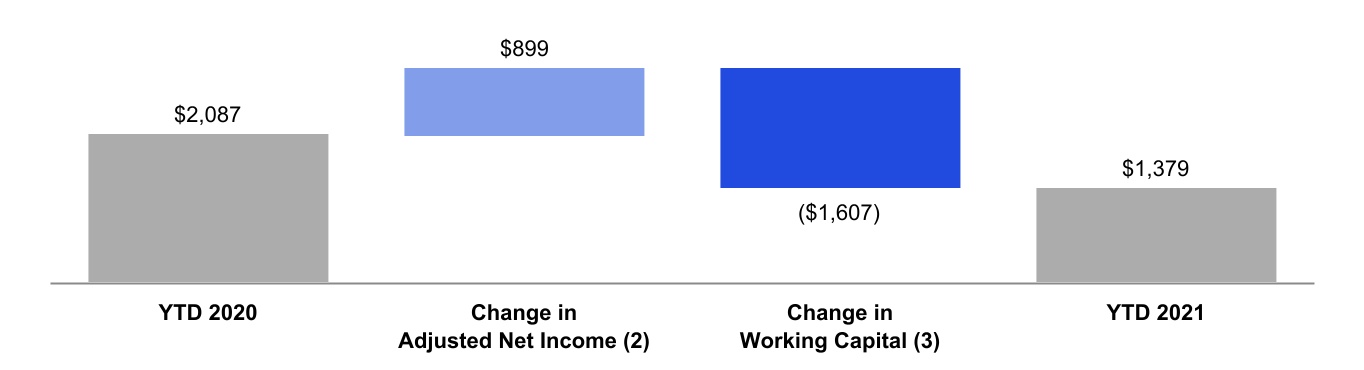
(1)Amounts included in the chart above include the results of discontinued operations, where applicable.
(2)The change in adjusted net income is defined as the variance in net income, net of the total adjustments to net income as shown on the Condensed Consolidated Statements of Cash Flows in Item 1—Financial Statements of this Form 10-Q.
(3)The change in working capital is defined as the variance in total changes in operating assets and liabilities as shown on the Condensed Consolidated Statements of Cash Flows in Item 1—Financial Statements of this Form 10-Q.
-
Adjusted net income increased $899 million primarily due to higher margins at our South America and US and Utilities SBUs, a decrease in current income tax expense at Angamos due to a timing difference in recognition of the early contract terminations with Minera Escondida and Minera Spence, and a decrease in interest expense.
-
Working capital requirements increased $1.6 billion, primarily due to a decrease in deferred income at Angamos due to revenue recognized from early contract terminations with Minera Escondida and Minera Spence in 2020, a decrease in income tax liabilities, and the timing of the GSF liability payment at Tietê.
Investing Activities
Net cash used in investing activities decreased $128 million for the nine months ended September 30, 2021, compared to the nine months ended September 30, 2020.
Investing Cash Flows
(in millions)
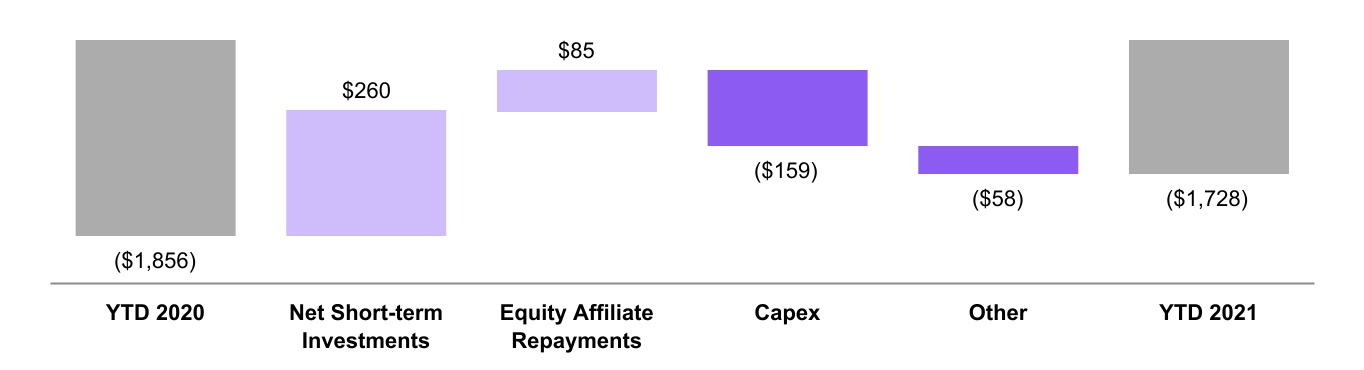
-
Proceeds from short-term investing activities increased $260 million, primarily at AES Brasil as a result of lower net short-term investment purchases in 2021.
-
Repayments from equity affiliates increased $85 million, primarily due to an increase in loan repayments from sPower and Fluence, our equity method investments.
-
Capital expenditures increased $159 million, discussed further below.
67 | The AES Corporation | September 30, 2021 Form 10-Q
Capital Expenditures
(in millions)
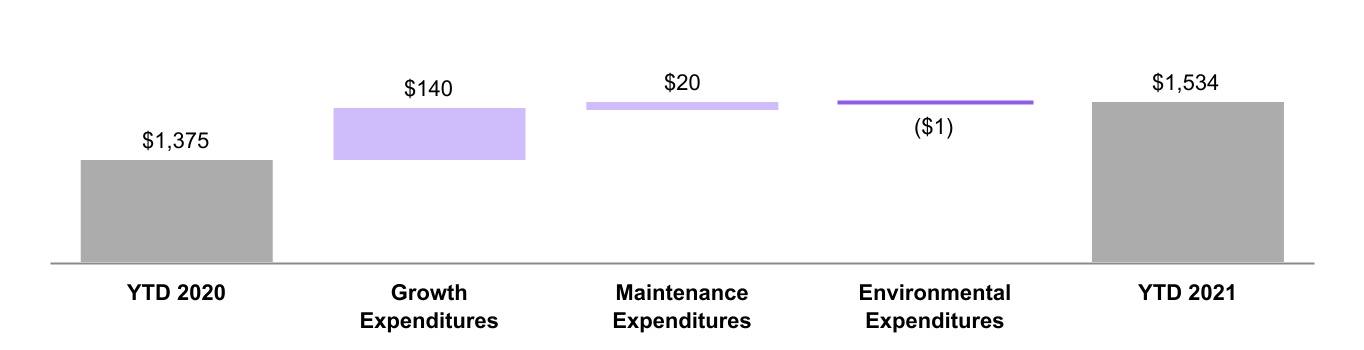
-
Growth expenditures increased $140 million, primarily driven by higher TDSIC investments at AES Ohio and AES Indiana, and renewable projects at Clean Energy, AES Brasil, and AES Andes. This impact was partially offset by the completion of renewable energy projects in Argentina and the completion of the Southland repowering project.
-
Maintenance expenditures increased $20 million, primarily due to increased expenditures at AES Andes, DPL, and El Salvador, partially offset by prior year expenditures at Andres as a result of the steam turbine lightning damage and in Panama as a result of the Changuinola tunnel lining upgrade, and a decrease in expenditures at Itabo due to its sale in the current year.
-
Environmental expenditures decreased $1 million, primarily due to the timing of payments in the prior year related to projects at AES Indiana.
Financing Activities
Net cash provided by financing activities decreased $136 million for the nine months ended September 30, 2021, compared to the nine months ended September 30, 2020.
Financing Cash Flows
(in millions)
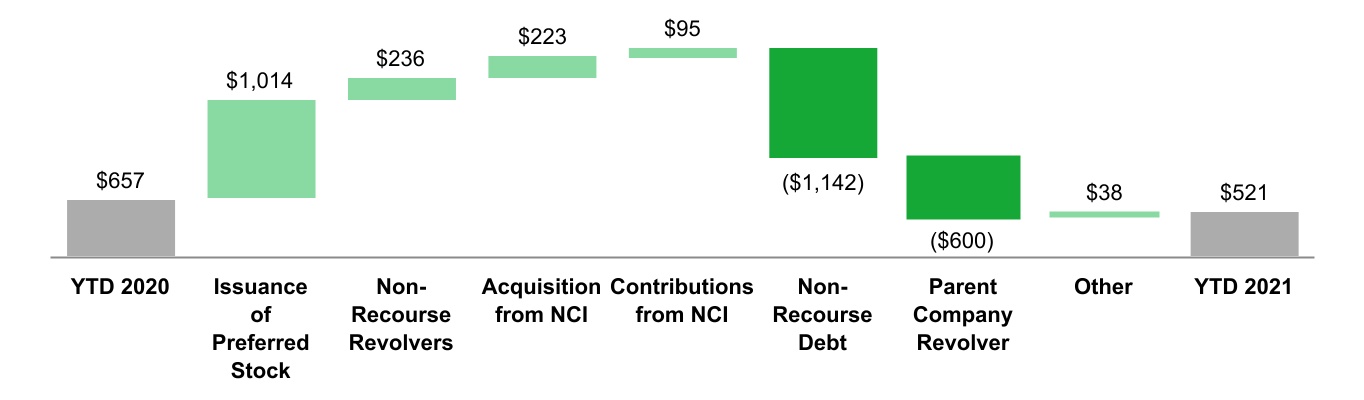
See Notes 8—Debt and 12—Equity in Item 1—Financial Statements of this Form 10-Q for more information regarding significant debt and equity transactions.
- The $1 billion impact from issuance of preferred stock is due to the issuance of Equity Units at the Parent Company.
*•*The $236 million impact from non-recourse revolver transactions is primarily due to lower net repayments at DPL and in Chile, partially offset by higher net repayments in the Dominican Republic.
*•*The $223 million impact from acquisitions of noncontrolling interests is due to the prior year acquisition of an additional 18.5% ownership interest in AES Brasil.
- The $95 million impact from contributions from noncontrolling interests is primarily due to contributions from minority interests at AES Andes due to the preemptive rights offering to fund its renewable growth program.
68 | The AES Corporation | September 30, 2021 Form 10-Q
-
The $1.1 billion impact from non-recourse debt transactions is primarily due to lower net borrowings at Panama, Southland Energy, Vietnam, and Argentina, and higher net repayments at AES Brasil, partially offset by higher net borrowings at Clean Energy.
-
The $600 million impact from Parent Company revolver transactions is primarily due to lower net borrowings in the current year.
Parent Company Liquidity
The following discussion is included as a useful measure of the liquidity available to The AES Corporation, or the Parent Company, given the non-recourse nature of most of our indebtedness. Parent Company Liquidity, as outlined below, is a non-GAAP measure and should not be construed as an alternative to Cash and cash equivalents, which is determined in accordance with GAAP. Parent Company Liquidity may differ from similarly titled measures used by other companies. The principal sources of liquidity at the Parent Company level are dividends and other distributions from our subsidiaries, including refinancing proceeds, proceeds from debt and equity financings at the Parent Company level, including availability under our revolving credit facility, and proceeds from asset sales. Cash requirements at the Parent Company level are primarily to fund interest and principal repayments of debt, construction commitments, other equity commitments, common stock repurchases, acquisitions, taxes, Parent Company overhead and development costs, and dividends on common stock.
The Company defines Parent Company Liquidity as cash available to the Parent Company, including cash at qualified holding companies, plus available borrowings under our existing credit facility. The cash held at qualified holding companies represents cash sent to subsidiaries of the Company domiciled outside of the U.S. Such subsidiaries have no contractual restrictions on their ability to send cash to the Parent Company. Parent Company Liquidity is reconciled to its most directly comparable GAAP financial measure, Cash and cash equivalents, at the periods indicated as follows (in millions):
| September 30, 2021 | December 31, 2020 | ||||||||||
| Consolidated cash and cash equivalents | $ | 1,411 | $ | 1,089 | |||||||
| Less: Cash and cash equivalents at subsidiaries | (1,073) | (1,018) | |||||||||
| Parent Company and qualified holding companies’ cash and cash equivalents | 338 | 71 | |||||||||
| Commitments under the Parent Company credit facility | 1,250 | 1,000 | |||||||||
| Less: Letters of credit under the credit facility | (75) | (77) | |||||||||
| Less: Borrowings under the credit facility | — | (70) | |||||||||
| Borrowings available under the Parent Company credit facility | 1,175 | 853 | |||||||||
| Total Parent Company Liquidity | $ | 1,513 | $ | 924 |
The Company utilizes its Parent Company credit facility for short term cash needs to bridge the timing of distributions from its subsidiaries throughout the year.
The Parent Company paid dividends of $0.1505 per outstanding share to its common stockholders during the first, second, and third quarters of 2021 for dividends declared in December 2020, February 2021, and July 2021, respectively. While we intend to continue payment of dividends, and believe we will have sufficient liquidity to do so, we can provide no assurance that we will continue to pay dividends, or if continued, the amount of such dividends.
Recourse Debt
Our total recourse debt was $3.4 billion as of September 30, 2021 and December 31, 2020. See Note 8—Debt in Item 1.—Financial Statements of this Form 10-Q and Note 11—Debt in Item 8.—Financial Statements and Supplementary Data of our 2020 Form 10-K for additional detail.
We believe that our sources of liquidity will be adequate to meet our needs for the foreseeable future. This belief is based on a number of material assumptions, including, without limitation, assumptions about our ability to access the capital markets, the operating and financial performance of our subsidiaries, currency exchange rates, power market pool prices, and the ability of our subsidiaries to pay dividends. In addition, our subsidiaries’ ability to declare and pay cash dividends to us (at the Parent Company level) is subject to certain limitations contained in loans, governmental provisions and other agreements. We can provide no assurance that these sources will be available when needed or that the actual cash requirements will not be greater than anticipated. We have met our interim needs for shorter-term and working capital financing at the Parent Company level with our revolving credit facility. See Item 1A.—Risk Factors—The AES Corporation’s ability to make payments on its outstanding indebtedness is dependent upon the receipt of funds from our subsidiaries of the Company’s 2020 Form 10-K for additional information.
Various debt instruments at the Parent Company level, including our revolving credit facility, contain certain restrictive covenants. The covenants provide for, among other items, limitations on other indebtedness, liens,
69 | The AES Corporation | September 30, 2021 Form 10-Q
investments and guarantees; limitations on dividends, stock repurchases and other equity transactions; restrictions and limitations on mergers and acquisitions, sales of assets, leases, transactions with affiliates and off-balance sheet and derivative arrangements; maintenance of certain financial ratios; and financial and other reporting requirements. As of September 30, 2021, we were in compliance with these covenants at the Parent Company level.
Non-Recourse Debt
While the lenders under our non-recourse debt financings generally do not have direct recourse to the Parent Company, defaults thereunder can still have important consequences for our results of operations and liquidity, including, without limitation:
-
reducing our cash flows as the subsidiary will typically be prohibited from distributing cash to the Parent Company during the time period of any default;
-
triggering our obligation to make payments under any financial guarantee, letter of credit, or other credit support we have provided to or on behalf of such subsidiary;
-
causing us to record a loss in the event the lender forecloses on the assets; and
-
triggering defaults in our outstanding debt at the Parent Company.
For example, our revolving credit facility and outstanding debt securities at the Parent Company include events of default for certain bankruptcy-related events involving material subsidiaries. In addition, our revolving credit agreement at the Parent Company includes events of default related to payment defaults and accelerations of outstanding debt of material subsidiaries.
Some of our subsidiaries are currently in default with respect to all or a portion of their outstanding indebtedness. The total non-recourse debt classified as current in the accompanying Condensed Consolidated Balance Sheets amounts to $1.5 billion. The portion of current debt related to such defaults was $254 million at September 30, 2021, all of which was non-recourse debt related to three subsidiaries — AES Puerto Rico, AES Ilumina, and AES Jordan Solar. None of the defaults are payment defaults, but are instead technical defaults triggered by failure to comply with other covenants or other conditions contained in the non-recourse debt documents, of which $247 million is due to the bankruptcy of the offtaker. See Note 8—Debt in Item 1.—Financial Statements of this Form 10-Q for additional detail.
None of the subsidiaries that are currently in default are subsidiaries that met the applicable definition of materiality under the Parent Company’s debt agreements as of September 30, 2021, in order for such defaults to trigger an event of default or permit acceleration under the Parent Company’s indebtedness. However, as a result of additional dispositions of assets, other significant reductions in asset carrying values or other matters in the future that may impact our financial position and results of operations or the financial position of the individual subsidiary, it is possible that one or more of these subsidiaries could fall within the definition of a “material subsidiary” and thereby trigger an event of default and possible acceleration of the indebtedness under the Parent Company’s outstanding debt securities. A material subsidiary is defined in the Parent Company’s revolving credit facility as any business that contributed 20% or more of the Parent Company’s total cash distributions from businesses for the four most recently ended fiscal quarters. As of September 30, 2021, none of the defaults listed above, individually or in the aggregate, results in or is at risk of triggering a cross-default under the recourse debt of the Parent Company.
Critical Accounting Policies and Estimates
The condensed consolidated financial statements of AES are prepared in conformity with U.S. GAAP, which requires the use of estimates, judgments, and assumptions that affect the reported amounts of assets and liabilities at the date of the financial statements and the reported amounts of revenue and expenses during the periods presented.
The Company’s significant accounting policies are described in Note 1 — General and Summary of Significant Accounting Policies of our 2020 Form 10-K. The Company’s critical accounting estimates are described in Item 7.—Management’s Discussion and Analysis of Financial Condition and Results of Operations in the 2020 Form 10-K. An accounting estimate is considered critical if the estimate requires management to make an assumption about matters that were highly uncertain at the time the estimate was made, different estimates reasonably could have been used, or if changes in the estimate that would have a material impact on the Company’s financial condition or results of operations are reasonably likely to occur from period to period. Management believes that the accounting estimates employed are appropriate and resulting balances are reasonable; however, actual results could differ from the original estimates, requiring adjustments to these balances in future periods. The Company has reviewed
70 | The AES Corporation | September 30, 2021 Form 10-Q
and determined that these remain as critical accounting policies as of and for the nine months ended September 30, 2021.
Previous: Item 1. FINANCIAL STATEMENTS · Next: Item 3. QUANTITATIVE AND QUALITATIVE DISCLOSURES ABOUT MARKET RISK