 filings.tools
Item 2. MANAGEMENT’S DISCUSSION AND ANALYSIS OF FINANCIAL CONDITION AND RESULTS OF OPERATIONS
109K characters. Original on sec.gov · Markdown
Item 2. MANAGEMENT’S DISCUSSION AND ANALYSIS OF FINANCIAL CONDITION AND RESULTS OF OPERATIONS
The condensed consolidated financial statements included in Item 1.—Financial Statements of this Form 10-Q and the discussions contained herein should be read in conjunction with our 2021 Form 10-K.
Forward-Looking Information
The following discussion may contain forward-looking statements regarding us, our business, prospects and our results of operations, including our expectations regarding the impact of the COVID-19 pandemic on our business, that are subject to certain risks and uncertainties posed by many factors and events that could cause our actual business, prospects and results of operations to differ materially from those that may be anticipated by such forward-looking statements. These statements include, but are not limited to, statements regarding management’s intents, beliefs, and current expectations and typically contain, but are not limited to, the terms “anticipate,” “potential,” “expect,” “forecast,” “target,” “will,” “would,” “intend,” “believe,” “project,” “estimate,” “plan,” and similar words. Forward-looking statements are not intended to be a guarantee of future results, but instead constitute current expectations based on reasonable assumptions. Factors that could cause or contribute to such differences include, but are not limited to, those described in Item 1A.—Risk Factors of this Form 10-Q, Item 1A.—Risk Factors and Item 7.—Management’s Discussion and Analysis of Financial Condition and Results of Operations of our 2021 Form 10-K and subsequent filings with the SEC.
Readers are cautioned not to place undue reliance on these forward-looking statements which speak only as of the date of this report. We undertake no obligation to revise any forward-looking statements in order to reflect events or circumstances that may subsequently arise. If we do update one or more forward-looking statements, no inference should be drawn that we will make additional updates with respect to those or other forward-looking statements. Readers are urged to carefully review and consider the various disclosures made by us in this report and in our other reports filed with the SEC that advise of the risks and factors that may affect our business.
Overview of Our Business
We are a diversified power generation and utility company organized into the following four market-oriented SBUs: US and Utilities (United States, Puerto Rico and El Salvador); South America (Chile, Colombia, Argentina and Brazil); MCAC (Mexico, Central America and the Caribbean); and Eurasia (Europe and Asia). For additional information regarding our business, see Item 1.—Business of our 2021 Form 10-K.
We have two lines of business: generation and utilities. Each of our SBUs participates in our first business line, generation, in which we own and/or operate power plants to generate and sell power to customers, such as utilities, industrial users, and other intermediaries. Our US and Utilities SBU participates in our second business line, utilities, in which we own and/or operate utilities to generate or purchase, distribute, transmit and sell electricity to end-user customers in the residential, commercial, industrial, and governmental sectors within a defined service area. In certain circumstances, our utilities also generate and sell electricity on the wholesale market.
Executive Summary
Compared with last year, first quarter diluted earnings per share from continuing operations increased $0.38, from a loss of $0.22 to earnings of $0.16. This increase reflects lower impairments in the current period, partially offset by prior year net gains from early contract terminations at Angamos, higher income tax expense, the prior year impact of realized gains on de-designated interest rate swaps, and the prior year gain on remeasurement of our interest in sPower’s development platform.
Adjusted EPS, a non-GAAP measure, decreased $0.07 to $0.21, mainly due to the prior year impact of realized gains on de-designated interest rate swaps and lower contributions from our MCAC SBU, partially offset by higher contributions from our South America SBU and newly operational projects at our U.S. renewables businesses.
28 | The AES Corporation | March 31, 2022 Form 10-Q

| (1) See Item 2.—Management’s Discussion and Analysis of Financial Condition and Results of Operations—SBU Performance Analysis—Non-GAAP Measures for reconciliation and definition. | |||||
| (2) GWh sold in 2021. |
29 | The AES Corporation | March 31, 2022 Form 10-Q
Overview of Strategic Performance
AES is leading the industry's transition to clean energy by investing in clean power growth and innovative technology businesses. The Company is well-positioned to benefit from very favorable trends in clean power generation, distribution, and supporting technologies.
-
In the first quarter of 2022, the Company signed or was awarded 1,087 MW of renewables and energy storage under long-term PPAs, primarily including 1,019 MW of solar and energy storage in the U.S.
-
The Company’s backlog is now 10,307 MW expected to be completed through 2025, including:
◦3,735 MW under construction; and
◦6,572 MW of renewable energy projects signed under long-term PPAs.
Review of Consolidated Results of Operations (Unaudited)
| Three Months Ended March 31, | |||||||||||||||||||||||||||||||||||||||||||||||
| (in millions, except per share amounts) | 2022 | 2021 | $ change | % change | |||||||||||||||||||||||||||||||||||||||||||
| Revenue: | |||||||||||||||||||||||||||||||||||||||||||||||
| US and Utilities SBU | $ | 1,117 | $ | 949 | $ | 168 | 18 | % | |||||||||||||||||||||||||||||||||||||||
| South America SBU | 810 | 884 | (74) | -8 | % | ||||||||||||||||||||||||||||||||||||||||||
| MCAC SBU | 566 | 535 | 31 | 6 | % | ||||||||||||||||||||||||||||||||||||||||||
| Eurasia SBU | 368 | 270 | 98 | 36 | % | ||||||||||||||||||||||||||||||||||||||||||
| Corporate and Other | 23 | 24 | (1) | -4 | % | ||||||||||||||||||||||||||||||||||||||||||
| Eliminations | (32) | (27) | (5) | -19 | % | ||||||||||||||||||||||||||||||||||||||||||
| Total Revenue | 2,852 | 2,635 | 217 | 8 | % | ||||||||||||||||||||||||||||||||||||||||||
| Operating Margin: | |||||||||||||||||||||||||||||||||||||||||||||||
| US and Utilities SBU | 130 | 107 | 23 | 21 | % | ||||||||||||||||||||||||||||||||||||||||||
| South America SBU | 204 | 352 | (148) | -42 | % | ||||||||||||||||||||||||||||||||||||||||||
| MCAC SBU | 82 | 122 | (40) | -33 | % | ||||||||||||||||||||||||||||||||||||||||||
| Eurasia SBU | 87 | 59 | 28 | 47 | % | ||||||||||||||||||||||||||||||||||||||||||
| Corporate and Other | 47 | 32 | 15 | 47 | % | ||||||||||||||||||||||||||||||||||||||||||
| Eliminations | (20) | (8) | (12) | NM | |||||||||||||||||||||||||||||||||||||||||||
| Total Operating Margin | 530 | 664 | (134) | -20 | % | ||||||||||||||||||||||||||||||||||||||||||
| General and administrative expenses | (52) | (46) | (6) | 13 | % | ||||||||||||||||||||||||||||||||||||||||||
| Interest expense | (258) | (190) | (68) | 36 | % | ||||||||||||||||||||||||||||||||||||||||||
| Interest income | 75 | 68 | 7 | 10 | % | ||||||||||||||||||||||||||||||||||||||||||
| Loss on extinguishment of debt | (6) | (1) | (5) | NM | |||||||||||||||||||||||||||||||||||||||||||
| Other expense | (12) | (16) | 4 | -25 | % | ||||||||||||||||||||||||||||||||||||||||||
| Other income | 6 | 43 | (37) | -86 | % | ||||||||||||||||||||||||||||||||||||||||||
| Gain (loss) on disposal and sale of business interests | 1 | (5) | 6 | NM | |||||||||||||||||||||||||||||||||||||||||||
| Asset impairment expense | (1) | (473) | 472 | -100 | % | ||||||||||||||||||||||||||||||||||||||||||
| Foreign currency transaction losses | (19) | (35) | 16 | -46 | % | ||||||||||||||||||||||||||||||||||||||||||
| Income tax expense | (60) | (8) | (52) | NM | |||||||||||||||||||||||||||||||||||||||||||
| Net equity in losses of affiliates | (33) | (30) | (3) | 10 | % | ||||||||||||||||||||||||||||||||||||||||||
| INCOME (LOSS) FROM CONTINUING OPERATIONS | 171 | (29) | 200 | NM | |||||||||||||||||||||||||||||||||||||||||||
| Less: Income from continuing operations attributable to noncontrolling interests and redeemable stock of subsidiaries | (56) | (119) | 63 | -53 | % | ||||||||||||||||||||||||||||||||||||||||||
| NET INCOME (LOSS) ATTRIBUTABLE TO THE AES CORPORATION | $ | 115 | $ | (148) | $ | 263 | NM | ||||||||||||||||||||||||||||||||||||||||
| Net cash provided by operating activities | $ | 457 | $ | 253 | $ | 204 | 81 | % |
Components of Revenue, Cost of Sales, and Operating Margin — Revenue includes revenue earned from the sale of energy from our utilities and the production and sale of energy from our generation plants, which are classified as regulated and non-regulated*,* respectively, on the Condensed Consolidated Statements of Operations. Revenue also includes the gains or losses on derivatives associated with the sale of electricity.
Cost of sales includes costs incurred directly by the businesses in the ordinary course of business. Examples include electricity and fuel purchases, operations and maintenance costs, depreciation and amortization expenses, bad debt expense and recoveries, and general administrative and support costs (including employee-related costs directly associated with the operations of the business). Cost of sales also includes the gains or losses on derivatives (including embedded derivatives other than foreign currency embedded derivatives) associated with the purchase of electricity or fuel.
30 | The AES Corporation | March 31, 2022 Form 10-Q
Operating margin is defined as revenue less cost of sales.
Consolidated Revenue and Operating Margin
Three Months Ended March 31, 2022
Revenue
(in millions)

Consolidated Revenue — Revenue increased $217 million, or 8%, for the three months ended March 31, 2022, compared to the three months ended March 31, 2021, driven by:
-
$168 million in US and Utilities mainly driven by higher volume at AES Indiana and AES Ohio due to increased demand and favorable weather; higher pass-through energy prices in El Salvador; a decrease in unrealized losses resulting from the commercial hedging strategy at Southland; and higher sales at AES Clean Energy due to the supply agreement with Google; partially offset by an increase in unrealized commodity derivative losses at AES Clean Energy;
-
$98 million in Eurasia mainly driven by higher energy prices and generation in Bulgaria and recognition of construction revenue at Mong Duong due to a reduction in expected completion costs for ash pond 2; partially offset by unfavorable FX impact; and
-
$31 million in MCAC driven by higher LNG prices and sales in the Dominican Republic and higher spot sales in Panama; partially offset by the impact from the sale of Itabo in April 2021.
These favorable impacts were partially offset by a decrease of $74 million in South America primarily driven by revenue recognized at Angamos in the prior year for the early termination of contracts with Minera Escondida and Minera Spence; partially offset by higher generation and prices (Resolution 440/2021) in Argentina; higher energy prices in Chile and Colombia; and higher volume and generation at AES Brasil.
Operating Margin
(in millions)
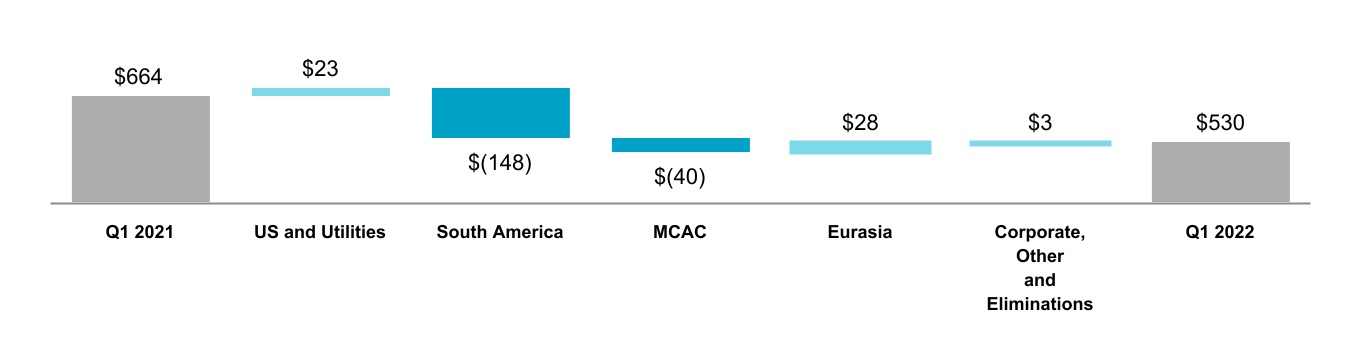
Consolidated Operating Margin — Operating margin decreased $134 million, or 20%, for the three months ended March 31, 2022, compared to the three months ended March 31, 2021, driven by:
•$148 million in South America primarily driven by revenue recognized at Angamos in the prior year for the early termination of contracts with Minera Escondida and Minera Spence; a prior period GSF settlement and higher fixed costs at Tietê; and unfavorable FX impact; partially offset by higher energy prices in Colombia and lower depreciation of coal assets in Chile; and
31 | The AES Corporation | March 31, 2022 Form 10-Q
•$40 million in MCAC primarily driven by higher net energy spot purchases due to drier hydrology in Panama; higher spot purchases in the Dominican Republic; and by the impact from the sale of Itabo in April 2021; partially offset by higher energy sales in Panama and the Dominican Republic, partially due to increased demand.
These unfavorable impacts were partially offset by a increase of:
-
$28 million in Eurasia primarily driven by recognition of construction revenue at Mong Duong due to a reduction in expected completion costs for ash pond 2, and by higher electricity prices at Kavarna in Bulgaria; and
-
$23 million in US and Utilities mainly driven by a decrease in unrealized losses resulting from the commercial hedging strategy at Southland; higher volume at AES Indiana due to increased demand and favorable weather; and higher sales at AES Clean Energy due to the supply agreement with Google; partially offset by unrealized commodity derivative losses and an increase in costs associated with growing and accelerating the development pipeline at AES Clean Energy.
See Item 2.—Management’s Discussion and Analysis of Financial Condition and Results of Operations—SBU Performance Analysis of this Form 10-Q for additional discussion and analysis of operating results for each SBU.
Consolidated Results of Operations — Other
General and administrative expenses
General and administrative expenses increased $6 million, or 13%, to $52 million for the three months ended March 31, 2022, compared to $46 million for the three months ended March 31, 2021, primarily due to increased business development activity and people costs.
Interest expense
Interest expense increased $68 million, or 36%, to $258 million for the three months ended March 31, 2022, compared to $190 million for the three months ended March 31, 2021. This increase is primarily due to the prior year impact of realized gains on de-designated interest rate swaps, lower capitalized interest in construction projects in Chile, and increased borrowings at AES Brasil.
Interest income
Interest income increased $7 million, or 10%, to $75 million for the three months ended March 31, 2022, compared to $68 million for the three months ended March 31, 2021, primarily due to an increase in short-term investments at AES Brasil.
Other income and expense
Other income decreased $37 million, or 86%, to $6 million for the three months ended March 31, 2022, compared to $43 million for the three months ended March 31, 2021, primarily due to the prior year gain on remeasurement of our equity interest in the sPower development platform to its acquisition-date fair value, recognized as part of the merger to form AES Clean Energy Development.
Other expense decreased $4 million, or 25%, to $12 million for the three months ended March 31, 2022, compared to $16 million for the three months ended March 31, 2021, primarily due to a prior year loss recognized at commencement of a sales-type lease at AES Renewable Holdings.
See Note 14—Other Income and Expense, Note 6—Investments in and Advances to Affiliates, and Note 17—Acquisitions included in Item 1.—Financial Statements of this Form 10-Q for further information.
Asset impairment expense
Asset impairment expense decreased $472 million to $1 million for the three months ended March 31, 2022, compared to $473 million for the three months ended March 31, 2021. This decrease was due to a $475 million impairment at Puerto Rico in 2021 associated with the economic costs and reputational risks of disposal of coal combustion residuals off island.
See Note 15—Asset Impairment Expense included in Item 1.—Financial Statements of this Form 10-Q for further information.
32 | The AES Corporation | March 31, 2022 Form 10-Q
Foreign currency transaction losses
| Three Months Ended March 31, | |||||||||||||||||||||||
| (in millions) | 2022 | 2021 | |||||||||||||||||||||
| Argentina | $ | (13) | $ | (41) | |||||||||||||||||||
| Chile | (10) | 8 | |||||||||||||||||||||
| Other | 4 | (2) | |||||||||||||||||||||
| Total (1) | $ | (19) | $ | (35) |
(1)Includes losses of $56 million and $19 million on foreign currency derivative contracts for the three months ended March 31, 2022 and 2021, respectively. The current year derivative losses were primarily due to unrealized losses on a foreign currency hedge on debt issued in Brazilian reais. This is an effective hedge and there is no material net impact.
The Company recognized net foreign currency transaction losses of $19 million for the three months ended March 31, 2022, primarily due to unrealized losses on foreign currency derivatives related to government receivables in Argentina, unrealized losses due to depreciating receivables denominated in the Argentine peso, and unrealized losses on foreign currency derivatives in South America due to the appreciating Colombian peso in 2022.
The Company recognized net foreign currency transaction losses of $35 million for the three months ended March 31, 2021, primarily due to unrealized losses on foreign currency derivatives related to government receivables in Argentina, partially offset by unrealized gains on foreign currency derivatives in South America due to the depreciating Colombian peso.
Income tax expense
Income tax expense was $60 million for the three months ended March 31, 2022, compared to $8 million for the three months ended March 31, 2021. The Company’s effective tax rates were 23% and 89% for the three months ended March 31, 2022 and 2021, respectively. This net decrease in the effective tax rate was primarily due to the impact of the prior year asset impairment at Puerto Rico.
See Note 15—Asset Impairment Expense included in Item 1.—Financial Statements of this Form 10-Q for details of the Puerto Rico asset impairment.
Our effective tax rate reflects the tax effect of significant operations outside the U.S., which are generally taxed at rates different than the U.S. statutory rate of 21%. Furthermore, our foreign earnings may be subjected to incremental U.S. taxation under the GILTI rules. A future proportionate change in the composition of income before income taxes from foreign and domestic tax jurisdictions could impact our periodic effective tax rate.
Net equity in losses of affiliates
Net equity in losses of affiliates increased $3 million, or 10%, to $33 million for the three months ended March 31, 2022, compared to $30 million for the three months ended March 31, 2021. This increase was driven by an increase in losses at Fluence of $30 million due to shipping issues, cost overruns and delays at projects under construction, and an increase in costs, including share-based compensation, associated with the growing business. These losses were partially offset by a $27 million increase in earnings at sPower driven by renewable projects that came online.
See Note 6—Investments in and Advances to Affiliates included in Item 1.—Financial Statements of this Form 10-Q for further information.
Net income attributable to noncontrolling interests and redeemable stock of subsidiaries
Net income attributable to noncontrolling interests and redeemable stock of subsidiaries decreased $63 million, or 53%, to $56 million for the three months ended March 31, 2022, compared to $119 million for the three months ended March 31, 2021. This decrease was primarily due to:
-
Prior year net gains from early contract terminations at Angamos;
-
Lower earnings from AES Andes due to increased AES ownership from 67% to 99% in the first quarter of 2022; and
-
Lower contributions from Panama due to drier hydrology.
These decreases were partially offset by:
- Higher earnings from Vietnam due to changes in ash pond assumptions.
33 | The AES Corporation | March 31, 2022 Form 10-Q
Net income (loss) attributable to The AES Corporation
Net income attributable to The AES Corporation increased $263 million, to income of $115 million for the three months ended March 31, 2022, compared to a loss of $148 million for the three months ended March 31, 2021. This increase was primarily due to:
- Prior year long-lived asset impairment at Puerto Rico.
This increase was partially offset by:
-
Lower margins at our South America SBU due to prior year net gains from early contract terminations at Angamos;
-
Higher income tax expense;
-
Higher Parent interest expense due to prior year realized gains on de-designated interest rate swaps; and
-
Prior year gain on remeasurement of our equity interest in the sPower development platform to acquisition-date fair value.
SBU Performance Analysis
Non-GAAP Measures
Adjusted Operating Margin, Adjusted PTC, and Adjusted EPS are non-GAAP supplemental measures that are used by management and external users of our condensed consolidated financial statements such as investors, industry analysts, and lenders.
For the year ended December 31, 2021, the Company updated the definition of Adjusted EPS item (g) tax benefit or expense related to the enactment effects of 2017 U.S. tax law reform and related regulations and any subsequent period adjustments related to enactment effects to include the 2021 tax benefit on reversal of uncertain tax positions effectively settled upon the closure of the Company's 2017 U.S. tax return exam.
Effective January 1, 2021, the Company changed the definitions of Adjusted Operating Margin, Adjusted PTC, and Adjusted EPS to remove the adjustment for costs directly associated with a major restructuring program, including, but not limited to, workforce reduction efforts, relocations, and office consolidation. As this adjustment was specific to the major restructuring program announced by the Company in 2018, we believe removing this adjustment from our non-GAAP definitions provides simplification and clarity for our investors.
Adjusted Operating Margin
We define Adjusted Operating Margin as Operating Margin, adjusted for the impact of NCI, excluding (a) unrealized gains or losses related to derivative transactions; (b) benefits and costs associated with dispositions and acquisitions of business interests, including early plant closures; and (c) net gains at Angamos, one of our businesses in the South America SBU, associated with the early contract terminations with Minera Escondida and Minera Spence. The allocation of HLBV earnings to noncontrolling interests is not adjusted out of Adjusted Operating Margin. See Review of Consolidated Results of Operations for the definition of Operating Margin.
The GAAP measure most comparable to Adjusted Operating Margin is Operating Margin. We believe that Adjusted Operating Margin better reflects the underlying business performance of the Company. Factors in this determination include the impact of NCI, where AES consolidates the results of a subsidiary that is not wholly owned by the Company, as well as the variability due to unrealized gains or losses related to derivative transactions and strategic decisions to dispose of or acquire business interests. Adjusted Operating Margin should not be construed as an alternative to Operating Margin, which is determined in accordance with GAAP.
| Three Months Ended March 31, | |||||||||||||||||||||||
| Reconciliation of Adjusted Operating Margin (in millions) | 2022 | 2021 | |||||||||||||||||||||
| Operating Margin | $ | 530 | $ | 664 | |||||||||||||||||||
| Noncontrolling interests adjustment (1) | (92) | (209) | |||||||||||||||||||||
| Unrealized derivative (gains) losses | (3) | 44 | |||||||||||||||||||||
| Disposition/acquisition losses (gains) | (1) | 2 | |||||||||||||||||||||
| Net gains from early contract terminations at Angamos | — | (110) | |||||||||||||||||||||
| Total Adjusted Operating Margin | $ | 434 | $ | 391 |
(1)The allocation of HLBV earnings to noncontrolling interests is not adjusted out of Adjusted Operating Margin.
34 | The AES Corporation | March 31, 2022 Form 10-Q
Adjusted PTC
We define Adjusted PTC as pre-tax income from continuing operations attributable to The AES Corporation excluding gains or losses of the consolidated entity due to (a) unrealized gains or losses related to derivative transactions and equity securities; (b) unrealized foreign currency gains or losses; (c) gains, losses, benefits and costs associated with dispositions and acquisitions of business interests, including early plant closures, and gains and losses recognized at commencement of sales-type leases; (d) losses due to impairments; (e) gains, losses and costs due to the early retirement of debt; and (f) net gains at Angamos, one of our businesses in the South America SBU, associated with the early contract terminations with Minera Escondida and Minera Spence. Adjusted PTC also includes net equity in earnings of affiliates on an after-tax basis adjusted for the same gains or losses excluded from consolidated entities.
Adjusted PTC reflects the impact of NCI and excludes the items specified in the definition above. In addition to the revenue and cost of sales reflected in Operating Margin, Adjusted PTC includes the other components of our income statement, such as general and administrative expenses in Corporate and Other, as well as business development costs, interest expense and interest income, other expense and other income, realized foreign currency transaction gains and losses, and net equity in earnings of affiliates.
The GAAP measure most comparable to Adjusted PTC is income from continuing operations attributable to The AES Corporation. We believe that Adjusted PTC better reflects the underlying business performance of the Company and is the most relevant measure considered in the Company’s internal evaluation of the financial performance of its segments. Factors in this determination include the variability due to unrealized gains or losses related to derivative transactions or equity securities remeasurement, unrealized foreign currency gains or losses, losses due to impairments, strategic decisions to dispose of or acquire business interests or retire debt, and the non-recurring nature of the impact of the early contract terminations at Angamos, which affect results in a given period or periods. In addition, earnings before tax represents the business performance of the Company before the application of statutory income tax rates and tax adjustments, including the effects of tax planning, corresponding to the various jurisdictions in which the Company operates. Given its large number of businesses and complexity, the Company concluded that Adjusted PTC is a more transparent measure that better assists investors in determining which businesses have the greatest impact on the Company’s results.
Adjusted PTC should not be construed as an alternative to income from continuing operations attributable to The AES Corporation, which is determined in accordance with GAAP.
35 | The AES Corporation | March 31, 2022 Form 10-Q
| Three Months Ended March 31, | |||||||||||||||||||||||
| Reconciliation of Adjusted PTC (in millions) | 2022 | 2021 | |||||||||||||||||||||
| Income (loss) from continuing operations, net of tax, attributable to The AES Corporation | $ | 115 | $ | (148) | |||||||||||||||||||
| Income tax expense (benefit) from continuing operations attributable to The AES Corporation | 50 | (36) | |||||||||||||||||||||
| Pre-tax contribution | 165 | (184) | |||||||||||||||||||||
| Unrealized derivative and equity securities losses | 41 | 69 | |||||||||||||||||||||
| Unrealized foreign currency losses (gains) | (19) | 6 | |||||||||||||||||||||
| Disposition/acquisition losses (gains) | 9 | (15) | |||||||||||||||||||||
| Impairment losses | 1 | 475 | |||||||||||||||||||||
| Loss on extinguishment of debt | 10 | 6 | |||||||||||||||||||||
| Net gains from early contract terminations at Angamos | — | (110) | |||||||||||||||||||||
| Total Adjusted PTC | $ | 207 | $ | 247 |

Adjusted EPS
We define Adjusted EPS as diluted earnings per share from continuing operations excluding gains or losses of both consolidated entities and entities accounted for under the equity method due to (a) unrealized gains or losses related to derivative transactions and equity securities; (b) unrealized foreign currency gains or losses; (c) gains, losses, benefits and costs associated with dispositions and acquisitions of business interests, including early plant closures, and the tax impact from the repatriation of sales proceeds, and gains and losses recognized at commencement of sales-type leases; (d) losses due to impairments; (e) gains, losses and costs due to the early retirement of debt; (f) net gains at Angamos, one of our businesses in the South America SBU, associated with the early contract terminations with Minera Escondida and Minera Spence; and (g) tax benefit or expense related to the enactment effects of 2017 U.S. tax law reform and related regulations and any subsequent period adjustments related to enactment effects, including the 2021 tax benefit on reversal of uncertain tax positions effectively settled upon the closure of the Company's U.S. tax return exam.
The GAAP measure most comparable to Adjusted EPS is diluted earnings per share from continuing operations. We believe that Adjusted EPS better reflects the underlying business performance of the Company and is considered in the Company’s internal evaluation of financial performance. Factors in this determination include the variability due to unrealized gains or losses related to derivative transactions or equity securities remeasurement, unrealized foreign currency gains or losses, losses due to impairments, strategic decisions to dispose of or acquire business interests or retire debt, the one-time impact of the 2017 U.S. tax law reform and subsequent period adjustments related to enactment effects, and the non-recurring nature of the impact of the early contract terminations at Angamos, which affect results in a given period or periods.
Adjusted EPS should not be construed as an alternative to diluted earnings per share from continuing operations, which is determined in accordance with GAAP.
36 | The AES Corporation | March 31, 2022 Form 10-Q
| Three Months Ended March 31, | ||||||||||||||||||||||||||
| Reconciliation of Adjusted EPS | 2022 | 2021 | ||||||||||||||||||||||||
| Diluted earnings (loss) per share from continuing operations | $ | 0.16 | $ | (0.22) | ||||||||||||||||||||||
| Unrealized derivative and equity securities losses | 0.06 | (1) | 0.10 | (2) | ||||||||||||||||||||||
| Unrealized foreign currency losses (gains) | (0.02) | (3) | 0.01 | |||||||||||||||||||||||
| Disposition/acquisition losses (gains) | 0.01 | (0.02) | (4) | |||||||||||||||||||||||
| Impairment losses | — | 0.71 | (5) | |||||||||||||||||||||||
| Loss on extinguishment of debt | 0.01 | 0.01 | ||||||||||||||||||||||||
| Net gains from early contract terminations at Angamos | — | (0.16) | (6) | |||||||||||||||||||||||
| Less: Net income tax benefit | (0.01) | (0.15) | (7) | |||||||||||||||||||||||
| Adjusted EPS | $ | 0.21 | $ | 0.28 |
(1)Amount primarily relates to unrealized commodity derivative losses at New York Wind of $20 million, or $0.03 per share, and unrealized foreign currency derivative losses in Brazil of $20 million, or $0.03 per share.
(2)Amount primarily relates to unrealized derivative losses in Argentina mainly associated with foreign currency derivatives on government receivables of $38 million, or $0.06 per share, and net unrealized derivative losses on power and commodities swaps at Southland of $33 million, or $0.05 per share.
(3)Amount primarily relates to unrealized FX gains in Brazil of $22 million, or $0.03 per share, mainly associated with debt denominated in Brazilian reais.
(4)Amount primarily relates to gain on remeasurement of our equity interest in sPower to acquisition-date fair value of $36 million, or $0.05 per share, partially offset by day-one loss recognized at commencement of a sales-type lease at AES Renewable Holdings of $13 million, or $0.02 per share.
(5)Amount primarily relates to asset impairment at Puerto Rico of $475 million, or $0.71 per share.
(6)Amount relates to net gains at Angamos associated with the early contract terminations with Minera Escondida and Minera Spence of $110 million, or $0.16 per share.
(7)Amount primarily relates to income tax benefits associated with the impairment at Puerto Rico of $119 million, or $0.18 per share, partially offset by income tax expense related to net gains at Angamos associated with the early contract terminations with Minera Escondida and Minera Spence of $28 million, or $0.04 per share.
US and Utilities SBU
The following table summarizes Operating Margin, Adjusted Operating Margin and Adjusted PTC (in millions) for the periods indicated:
| Three Months Ended March 31, | |||||||||||||||||||||||||||||||||||||||||||||||
| 2022 | 2021 | $ Change | % Change | ||||||||||||||||||||||||||||||||||||||||||||
| Operating Margin | $ | 130 | $ | 107 | $ | 23 | 21 | % | |||||||||||||||||||||||||||||||||||||||
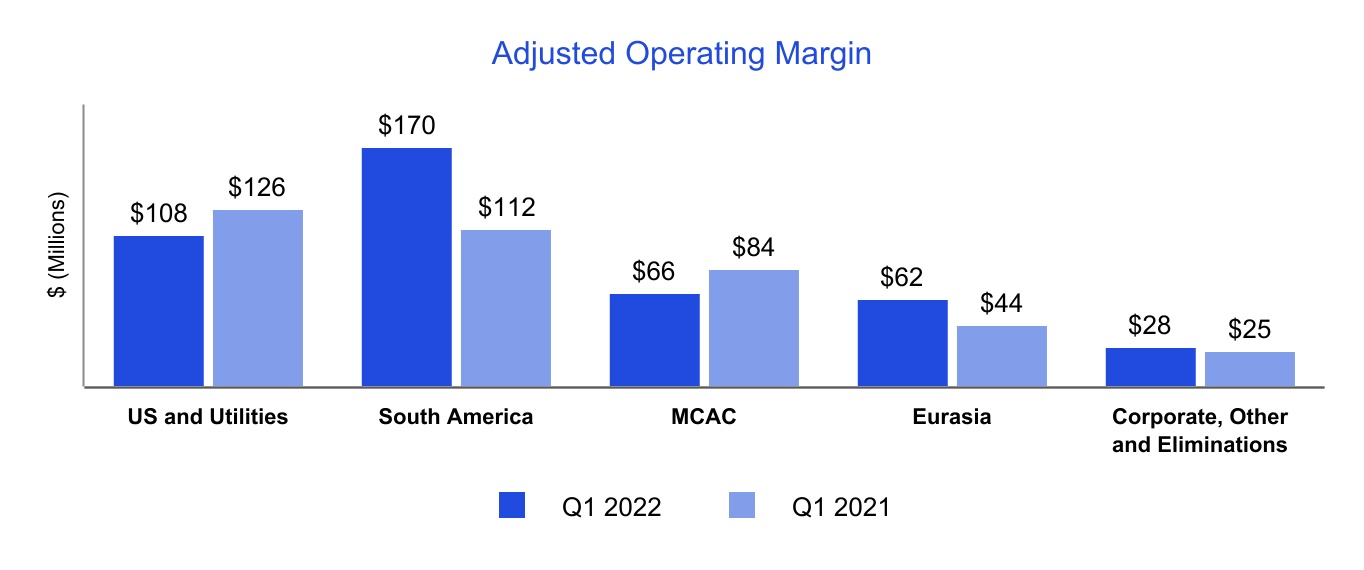
| Adjusted Operating Margin (1) | 108 | 126 | (18) | -14 | % | ||||||||||||||||||||||||||||||||||||||||||
| Adjusted PTC (1) | 57 | 44 | 13 | 30 | % |
(1) A non-GAAP financial measure, adjusted for the impact of NCI. See SBU Performance Analysis—Non-GAAP Measures for definition and Item 1.—Business included in our 2021 Form 10-K for the respective ownership interest for key businesses.
Operating Margin for the three months ended March 31, 2022 increased $23 million, or 21%, which was driven primarily by the following (in millions):
| Increase at Southland primarily due to lower unrealized losses from commodity derivatives under the commercial hedging strategy, as well as a decrease in realized derivative losses | $ | 44 | |||
| Increase at AES Indiana driven by higher volumes from increased demand and favorable weather | 10 | ||||
| Decrease at AES Clean Energy driven by unrealized commodity derivative losses and increased costs associated with growing and accelerating the development pipeline, partially offset by higher revenue due to the Company’s agreement to supply Google’s data centers with 24/7 carbon-free energy | (32) | ||||
| Other | 1 | ||||
| Total US and Utilities SBU Operating Margin Increase | $ | 23 |
Adjusted Operating Margin decreased $18 million primarily due to the drivers above, adjusted for NCI and unrealized losses on derivatives.
Adjusted PTC increased $13 million, primarily driven by an increase at our U.S. renewables businesses due to contributions from newly operational projects and a lower allocation of interest expense attributable to AES after the sale of noncontrolling interests at Southland Energy, partially offset by the decrease in Adjusted Operating Margin described above.
37 | The AES Corporation | March 31, 2022 Form 10-Q
South America SBU
The following table summarizes Operating Margin, Adjusted Operating Margin and Adjusted PTC (in millions) for the periods indicated:
| Three Months Ended March 31, | |||||||||||||||||||||||||||||||||||||||||||||||
| 2022 | 2021 | $ Change | % Change | ||||||||||||||||||||||||||||||||||||||||||||
| Operating Margin | $ | 204 | $ | 352 | $ | (148) | -42 | % | |||||||||||||||||||||||||||||||||||||||
| Adjusted Operating Margin (1) | 170 | 112 | 58 | 52 | % | ||||||||||||||||||||||||||||||||||||||||||
| Adjusted PTC (1) | 128 | 88 | 40 | 45 | % |
(1) A non-GAAP financial measure, adjusted for the impact of NCI. See SBU Performance Analysis—Non-GAAP Measures for definition and Item 1.—Business included in our 2021 Form 10-K for the respective ownership interest for key businesses. In the first quarter of 2022, AES’ indirect beneficial interest in AES Andes increased from 67% to 99%. See Note 11—Equity included in Item 1.—Financial Statements of this Form 10-Q for further information.
Operating Margin for the three months ended March 31, 2022 decreased $148 million, or 42%, which was driven primarily by the following (in millions):
| Decrease in Chile primarily driven by prior year revenue recognized on early contract terminations at Angamos, partially offset by lower depreciation of coal assets | $ | (144) | |||
| Decrease in Brazil primarily driven by prior year GSF gain and higher fixed costs | (12) | ||||
| Increase in Colombia mainly related to increase in contract prices, partially offset by depreciation of the Colombian peso | 9 | ||||
| Other | (1) | ||||
| Total South America SBU Operating Margin Decrease | $ | (148) |
Adjusted Operating Margin increased $58 million due to the drivers above, adjusted for NCI and net gains on early contract terminations at Angamos in the prior year.
Adjusted PTC increased $40 million, primarily associated with the increase in Adjusted Operating Margin described above, partially offset by lower capitalized interest at construction projects in Chile.
MCAC SBU
The following table summarizes Operating Margin, Adjusted Operating Margin and Adjusted PTC (in millions) for the periods indicated:
| Three Months Ended March 31, | |||||||||||||||||||||||||||||||||||||||||||||||
| 2022 | 2021 | $ Change | % Change | ||||||||||||||||||||||||||||||||||||||||||||
| Operating Margin | $ | 82 | $ | 122 | $ | (40) | -33 | % | |||||||||||||||||||||||||||||||||||||||
| Adjusted Operating Margin (1) | 66 | 84 | (18) | -21 | % | ||||||||||||||||||||||||||||||||||||||||||
| Adjusted PTC (1) | 37 | 61 | (24) | -39 | % |
(1) A non-GAAP financial measure, adjusted for the impact of NCI. See SBU Performance Analysis—Non-GAAP Measures for definition and Item 1.—Business included in our 2021 Form 10-K for the respective ownership interest for key businesses.
Operating Margin for the three months ended March 31, 2022 decreased $40 million, or 33%, which was driven primarily by the following (in millions):
| Decrease in Panama mainly driven by higher energy spot purchases due to drier hydrology in Q1 2022, partially offset by higher spot sales at Colon due to an increase in prices | $ | (22) | |||
| Decrease in the Dominican Republic mainly driven by the sale of Itabo on April 8, 2021 | (18) | ||||
| Decrease in Mexico driven by lower availability in 2022 | (5) | ||||
| Increase in the Dominican Republic due to unrealized gains on LNG derivatives and higher demand, partially offset by higher energy spot purchases | 7 | ||||
| Other | (2) | ||||
| Total MCAC SBU Operating Margin Decrease | $ | (40) |
Adjusted Operating Margin decreased $18 million due to the drivers above, adjusted for NCI and unrealized gains on LNG derivatives.
Adjusted PTC decreased $24 million, mainly driven by the decrease in Adjusted Operating Margin described above and a higher allocation of interest expense attributable to AES after Colon’s noncontrolling interest buyout in September 2021.
38 | The AES Corporation | March 31, 2022 Form 10-Q
Eurasia SBU
The following table summarizes Operating Margin, Adjusted Operating Margin and Adjusted PTC (in millions) for the periods indicated:
| Three Months Ended March 31, | |||||||||||||||||||||||||||||||||||||||||||||||
| 2022 | 2021 | $ Change | % Change | ||||||||||||||||||||||||||||||||||||||||||||
| Operating Margin | $ | 87 | $ | 59 | $ | 28 | 47 | % | |||||||||||||||||||||||||||||||||||||||
| Adjusted Operating Margin (1) | 62 | 44 | 18 | 41 | % | ||||||||||||||||||||||||||||||||||||||||||
| Adjusted PTC (1) | 65 | 51 | 14 | 27 | % |
(1) A non-GAAP financial measure, adjusted for the impact of NCI. See SBU Performance Analysis—Non-GAAP Measures for definition and Item 1.—Business included in our 2021 Form 10-K for the respective ownership interest for key businesses.
Operating Margin for the three months ended March 31, 2022 increased $28 million, or 47%, which was driven primarily by the following (in millions):
| Construction revenue for Mong Duong driven by a reduction in expected completion costs for ash pond 2 | $ | 19 | |||
| Higher merchant prices captured by Kavarna | 8 | ||||
| Other | 1 | ||||
| Total Eurasia SBU Operating Margin Increase | $ | 28 |
Adjusted Operating Margin increased $18 million due to the drivers above, adjusted for NCI.
Adjusted PTC increased $14 million, mainly driven by the increase in Adjusted Operating Margin described above, partially offset by higher interest expense.
Key Trends and Uncertainties
During the remainder of 2022 and beyond, we expect to face the following challenges at certain of our businesses. Management expects that improved operating performance at certain businesses, growth from new businesses, and global cost reduction initiatives may lessen or offset their impact. If these favorable effects do not occur, or if the challenges described below and elsewhere in this section impact us more significantly than we currently anticipate, or if volatile foreign currencies and commodities move more unfavorably, then these adverse factors (or other adverse factors unknown to us) may have a material impact on our operating margin, net income attributable to The AES Corporation, and cash flows. We continue to monitor our operations and address challenges as they arise. For the risk factors related to our business, see Item 1.—Business and Item 1A.—Risk Factors of our 2021 Form 10-K.
Operational
COVID-19 Pandemic — The COVID-19 pandemic has impacted global economic activity, including electricity and energy consumption, and caused significant volatility in financial markets. Throughout the COVID-19 pandemic we have conducted our essential operations without significant disruption. We derive approximately 85% of our total revenues from our regulated utilities and long-term sales and supply contracts or PPAs at our generation businesses, which contributes to a relatively stable revenue and cost structure at most of our businesses. In 2021, our operational locations continued to experience the impact of, and recovery from, the COVID-19 pandemic. Across our global portfolio, our utilities businesses have generally performed in line with our expectations consistent with a recovery from the COVID-19 pandemic. While we cannot predict the length and magnitude of the pandemic, including the impact of current or future variants, or how it could impact global economic conditions, a delayed recovery with respect to demand may adversely impact our financial results for 2022. Also see Item 1A.—Risk Factors of our 2021 Form 10-K.
We continue to monitor and manage our credit exposures in a prudent manner. Our credit exposures have continued in-line with historical levels and within the customary 45-60 day grace period. We have not experienced any material credit-related impacts from our PPA offtakers due to the COVID-19 pandemic.
Our supply chain management has remained robust during this challenging time and we continue to closely manage and monitor developments. We continue to experience certain minor delays in some of our development projects, primarily in permitting processes and the implementation of interconnections, due to governments and other authorities having limited capacity to perform their functions.
Trade Restrictions and Supply Chain — On March 29, 2022, the U.S. Department of Commerce (“Commerce”) announced the initiation of an investigation into whether imports into the U.S. of solar cells and
39 | The AES Corporation | March 31, 2022 Form 10-Q
panels imported from Cambodia, Malaysia, Thailand, and Vietnam are circumventing antidumping and countervailing duty orders on solar cells and panels from China. This investigation has resulted in significant systemic disruptions to the import of solar panels from Southeast Asia and such disruption could continue for the near-term or longer if Commerce makes a preliminary determination that circumvention has occurred.
While we have contracted and substantially secured our expected requirements for solar panels for U.S. projects targeted to achieve commercial operations in 2022, these disruptions may persist and impact our suppliers’ ability or willingness to meet their contractual agreements or to continue to supply panels into the U.S. market on terms that we deem satisfactory. The ultimate severity or duration of the solar panel supply chain disruption or its effect on AES’ U.S. solar project development and construction activities is uncertain. AES will continue to monitor developments and take prudent steps towards maintaining a robust supply chain for our renewables projects.
Macroeconomic and Political
During the past few years, some countries where our subsidiaries conduct business have experienced macroeconomic and political changes. In the event these trends continue, there could be an adverse impact on our businesses.
Puerto Rico — As discussed in Item 7—Management’s Discussion and Analysis of Financial Condition and Results of Operations—Key Trends and Uncertainties of the 2021 Form 10-K, our subsidiaries in Puerto Rico have a long-term PPA with state-owned PREPA, which has been facing economic challenges that could result in a material adverse effect on our business in Puerto Rico. Despite the Title III protection, PREPA has been making substantially all of its payments to the generators in line with historical payment patterns.
AES Puerto Rico and AES Ilumina’s non-recourse debt of $195 million and $28 million, respectively, continue to be in technical default and are classified as current as of March 31, 2022 as a result of PREPA’s bankruptcy filing in July 2017. The Company is in compliance with its debt payment obligations as of March 31, 2022.
On April 12, 2022, a mediation team was appointed to prepare the plan to resolve the PREPA Title III case and related proceedings, which is expected to conclude no later than July 2022.
Considering the information available as of the filing date, management believes the carrying amount of our long-lived assets in Puerto Rico of $85 million is recoverable as of March 31, 2022.
Reference Rate Reform — As discussed in Item 7—Management’s Discussion and Analysis of Financial Condition and Results of Operations—Key Trends and Uncertainties of the 2021 Form 10-K, in July 2017, the UK Financial Conduct Authority announced that it intends to phase out LIBOR by the end of 2021. In the U.S., the Alternative Reference Rate Committee at the Federal Reserve identified the Secured Overnight Financing Rate (“SOFR”) as its preferred alternative rate for LIBOR; alternative reference rates in other key markets are under development. The ICE Benchmark Association ("IBA") has determined that it will cease publication of one-week and two-month LIBOR rates by December 31, 2021, and will cease publication of the one-month, three-month, six-month, and 12-month USD LIBOR rates by June 30, 2023. AES holds a substantial amount of debt and derivative contracts referencing LIBOR as an interest rate benchmark. In order to facilitate an organized transition from LIBOR to alternative benchmark rate(s), AES has established a process to measure and mitigate risks associated with the cessation of LIBOR. As part of this initiative, alternative benchmark rates have been, and continue to be, assessed, and implemented for newly executed agreements. Many of AES’ existing agreements include provisions designed to facilitate an orderly transition from LIBOR, and interest rate derivatives address the LIBOR transition through the adoption of the ISDA 2020 IBOR Fallbacks Protocol and subsequent amendments. To the extent that the terms of the credit agreements and derivative instruments do not align following the cessation of LIBOR rates, AES will seek to negotiate contract amendments with counterparties or additional derivatives contracts.
Global Tax — The macroeconomic and political environments in the U.S. and in some countries where our subsidiaries conduct business have changed during 2021 and 2022. This could result in significant impacts to tax law. For example, in the first quarter of 2022, the Biden Administration released its fiscal year 2023 budget, which includes proposed U.S. corporate and international tax reform proposals that would increase the U.S. corporate income tax rate and GILTI tax rate, replace BEAT with rules in line with OECD Pillar 2 Model Rules, eliminate tax preferences for fossil fuels, among others. Additional details regarding these potential changes in law are expected to be made available later this year.
With respect to international tax reform, in the first quarter of 2022, the European Commission published an amended draft Directive on Pillar 2 which includes numerous amendments compared to the version published in the fourth quarter of 2021. The potential impact to the Company remains unknown, but may be material.
40 | The AES Corporation | March 31, 2022 Form 10-Q
Implementation of the framework would require multilateral agreement and/or country specific legislative action, including in the U.S. See Management’s Discussion and Analysis of Financial Condition and Results of Operations of our 2021 Form 10-K for further information on this proposed legislation.
Inflation — In the markets in which we operate, there have been higher rates of inflation in recent months. While most of our contracts in our international businesses are indexed to inflation, in general, our U.S.-based generation contracts are not indexed to inflation. If inflation continues to increase in our markets, it may increase our expenses that we may not be able to pass through to customers. It may also increase the costs of some of our development projects that could negatively impact their competitiveness. Our utility businesses do allow for recovering of operations and maintenance costs through the regulatory process, which may have timing impacts on recovery.
Alto Maipo
The Company's subsidiary, Alto Maipo, is currently constructing a hydroelectric facility near Santiago, Chile which is approximately 99% complete and started generating energy in the fourth quarter of 2021 as part of the commissioning process. The Alto Maipo project (the “Project”) has experienced significant construction difficulties, which resulted in a substantial increase in project costs over the original budget and led to a series of negotiations that resulted in securing additional funding from creditors and additional equity injections from AES Andes. See Item 7—Management’s Discussion and Analysis of Financial Condition and Results of Operations—Key Trends and Uncertainties of the 2021 Form 10-K for further information.
On November 17, 2021, Alto Maipo SpA commenced a reorganization proceeding in accordance with Chapter 11 of the U.S. Bankruptcy Code, through a voluntary petition. Consequently, after Chapter 11 filing, The AES Corporation is no longer considered to have control over Alto Maipo and, therefore, derecognized Alto Maipo from its Consolidated Balance Sheets and recognized an after-tax loss of approximately $1.2 billion, net of noncontrolling interests, in the Consolidated Statement of Operations in the fourth quarter of 2021, associated with the loss of control attributable to the former controlling interest.
Alto Maipo is party to a restructuring support agreement to which holders of more than 78% of the outstanding senior indebtedness are party, and which contemplates a plan of reorganization in which AES Andes will own all of the equity of the reorganized company. If Alto Maipo is unable to renegotiate the terms of its financial arrangements with its creditors and is unable to meet its obligations under those arrangements as they come due, the creditors may enforce their rights under the credit agreements. These finance agreements are non-recourse with respect to The AES Corporation.
Decarbonization Initiatives
Our strategy involves shifting towards clean energy platforms, including renewable energy, energy storage, LNG, and modernized grids. It is designed to position us for continued growth while reducing our carbon intensity and in support of our mission of accelerating the future of energy, together. In February 2022, we announced our intent to exit coal generation by year-end 2025, subject to necessary approvals.
In addition, initiatives have been announced by regulators, including in Chile, Puerto Rico, and Hawaii, and offtakers in recent years, with the intention of reducing GHG emissions generated by the energy industry. In parallel, the shift towards renewables has caused certain customers to migrate to other low-carbon energy solutions and this trend may continue.
Although we cannot currently estimate the financial impact of these decarbonization initiatives, new legislative or regulatory programs further restricting carbon emissions or other initiatives to voluntarily exit coal generation could require material capital expenditures, result in a reduction of the estimated useful life of certain coal facilities, or have other material adverse effects on our financial results.
For further information about the risks associated with decarbonization initiatives, see Item 1A.—Risk Factors—Concerns about GHG emissions and the potential risks associated with climate change have led to increased regulation and other actions that could impact our businesses included in the 2021 Form 10-K.
Regulatory
AES Maritza PPA Review — DG Comp is conducting a preliminary review of whether AES Maritza’s PPA with NEK is compliant with the European Union's State Aid rules. No formal investigation has been launched by DG Comp to date. However, AES Maritza has been engaging in discussions with the DG Comp case team and the Government of Bulgaria (“GoB”) to attempt to reach a negotiated resolution of DG Comp’s review (“PPA
41 | The AES Corporation | March 31, 2022 Form 10-Q
Discussions”). The PPA Discussions are ongoing and the PPA continues to remain in place. However, there can be no assurance that, in the context of the PPA Discussions, the other parties will not seek a prompt termination of the PPA.
We do not believe termination of the PPA is justified. Nevertheless, the PPA Discussions will involve a range of potential outcomes, including but not limited to the termination of the PPA and payment of some level of compensation to AES Maritza. Any negotiated resolution would be subject to mutually acceptable terms, lender consent, and DG Comp approval. At this time, we cannot predict the outcome of the PPA Discussions or when those discussions will conclude. Nor can we predict how DG Comp might resolve its review if the PPA Discussions fail to result in an agreement concerning the agency’s review. AES Maritza believes that its PPA is legal and in compliance with all applicable laws, and it will take all actions necessary to protect its interests, whether through negotiated agreement or otherwise. However, there can be no assurance that this matter will be resolved favorably; if it is not, there could be a material adverse effect on the Company’s financial condition, results of operations, and cash flows.
Considering the information available as of the filing date, management believes the carrying value of our long-lived assets at Maritza of approximately $916 million is recoverable as of March 31, 2022.
AES Ohio Distribution Rate Case — On November 30, 2020, AES Ohio filed a new distribution rate case with the PUCO that proposes a revenue increase of $120.8 million per year and incorporates the DIR investments that were planned and approved in the last rate case, but not yet included in distribution rates, other distribution investments since September 2015, and other investments and expenses. Certain parties that have intervened in the distribution rate case have argued that ESP 1 incorporates a distribution rate freeze. The rate case is pending a commission order and we are unable to predict the outcome at this time.
AES Indiana Integrated Resource Plan (“IRP”) — AES Indiana held its first and second public advisory meetings for the 2022 IRP in January 2022 and April 2022, respectively. Changes to its generation portfolio are evaluated and decided through the IRP. AES Indiana issued an all-source Request for Proposal on April 14, 2022, in order to competitively procure replacement capacity; such need is being evaluated in AES Indiana's 2022 IRP.
Foreign Exchange Rates
We operate in multiple countries and as such are subject to volatility in exchange rates at varying degrees at the subsidiary level and between our functional currency, the USD, and currencies of the countries in which we operate. For additional information, refer to Item 3.—Quantitative and Qualitative Disclosures About Market Risk.
Environmental
The Company is subject to numerous environmental laws and regulations in the jurisdictions in which it operates. The Company faces certain risks and uncertainties related to these environmental laws and regulations, including existing and potential GHG legislation or regulations, and actual or potential laws and regulations pertaining to water discharges, waste management (including disposal of coal combustion residuals) and certain air emissions, such as SO2, NOx, particulate matter, mercury, and other hazardous air pollutants. Such risks and uncertainties could result in increased capital expenditures or other compliance costs which could have a material adverse effect on certain of our U.S. or international subsidiaries and our consolidated results of operations. For further information about these risks, see Item 1A.—Risk Factors—Our operations are subject to significant government regulation and could be adversely affected by changes in the law or regulatory schemes; Several of our businesses are subject to potentially significant remediation expenses, enforcement initiatives, private party lawsuits and reputational risk associated with CCR; Our businesses are subject to stringent environmental laws, rules and regulations; and Concerns about GHG emissions and the potential risks associated with climate change have led to increased regulation and other actions that could impact our businesses included in the 2021 Form 10-K.
CSAPR — CSAPR addresses the “good neighbor” provision of the CAA, which prohibits sources within each state from emitting any air pollutant in an amount which will contribute significantly to any other state’s nonattainment, or interference with maintenance of, any NAAQS. The CSAPR required significant reductions in SO2 and NOx emissions from power plants in many states in which subsidiaries of the Company operate. The Company is required to comply with the CSAPR in certain states, including Indiana and Maryland. The CSAPR is implemented, in part, through a market-based program under which compliance may be achievable through the acquisition and use of emissions allowances created by the EPA. The Company complies with CSAPR through operation of existing controls and purchases of allowances on the open market, as needed.
In October 2016, the EPA published a final rule to update the CSAPR to address the 2008 ozone NAAQS
42 | The AES Corporation | March 31, 2022 Form 10-Q
(“CSAPR Update Rule”). The CSAPR Update Rule found that NOx ozone season emissions in 22 states (including Indiana, Maryland, Ohio, and Pennsylvania) affected the ability of downwind states to attain and maintain the 2008 ozone NAAQS, and, accordingly, the EPA issued federal implementation plans that both updated existing CSAPR NOx ozone season emission budgets for electric generating units within these states and implemented these budgets through modifications to the CSAPR NOx ozone season allowance trading program. Implementation started in the 2017 ozone season (May-September 2017). Affected facilities receive fewer ozone season NOx allowances in 2017 and later, possibly resulting in the need to purchase additional allowances. Additionally, on September 13, 2019, the D.C. Circuit remanded a portion of October 2016 CSAPR Update Rule to the EPA. On April 30, 2021, the EPA published a final rule to address the 2020 D.C. Circuit decision. The EPA is issuing new or amended federal implementation plans for 12 states, including Indiana, Maryland, Ohio, and Pennsylvania, with revised CSAPR NOx ozone season emission budgets for electric generating units within these states via a new CSAPR NOx Ozone Season Group 3 Trading Program. Implementation began during the 2021 ozone season (May-September 2021) with an effective date of June 29, 2021. AES Indiana facilities and AES Warrior Run in Maryland will receive fewer ozone season NOx allowances for future NOx Ozone Seasons beginning in 2021 and later, possibly resulting in the need to purchase additional allowances. In addition, subject sources in these states were required to surrender an equivalent number of previously allocated 2021-2024 Group 2 allowances by deadlines in 2021. This requirement applies inclusive of assets and allowances that have since been sold and/or retired, including former AES assets in Ohio and Pennsylvania. While AES no longer operates electric generating units subject to the revised CSAPR Update Rule in Ohio or Pennsylvania, certain prior AES sources in these states were required to surrender an equivalent number of previously allocated 2021-2024 Group 2 allowances and on July 14, 2021 the required allowances were recalled by the EPA, fulfilling this obligation.
On April 6, 2022, the EPA published a proposed Federal Implementation Plan to address air quality impacts with respect to the 2015 Ozone NAAQS. The rule would establish a revised CSAPR NOx Ozone Season Group 3 trading program of 25 states, including Indiana and Maryland. In addition to other requirements, if finalized, EGUs in these states would begin receiving fewer allowances as soon as 2023, possibly resulting in the need to purchase additional allowances.
While the Company's additional CSAPR compliance costs to date have been immaterial, the future availability of and cost to purchase allowances to meet the emission reduction requirements is uncertain at this time, but it could be material.
Climate Change Regulation — On July 8, 2019, the EPA published the final Affordable Clean Energy (“ACE”) Rule, along with associated revisions to implementing regulations, in addition to final revocation of the CPP. The ACE Rule determines that heat rate improvement measures are the Best System of Emissions Reductions for existing coal-fired electric generating units. The final rule requires states with existing coal-fired electric generating units to develop state plans to establish CO2 emission limits for designated facilities. AES Indiana Petersburg and AES Warrior Run have coal-fired electric generating units that could have been impacted by this regulation. On January 19, 2021, the D.C. Circuit vacated and remanded to the EPA the ACE Rule, although the parties had an opportunity to request a rehearing at the D.C. Circuit or seek a review of the decision by the U.S. Supreme Court. On March 5, 2021, the D.C. Circuit issued the partial mandate effectuating the vacatur of the ACE Rule. In effect, the CPP will not take effect while the EPA is addressing the remand of the ACE rule by promulgating a new Section 111(d) rule to regulate greenhouse gases from existing electric generating units. On October 29, 2021, the U.S. Supreme Court granted petitions to review the decision by the D.C. Circuit to vacate the ACE Rule. Oral arguments took place on January 28, 2022. The impact of future greenhouse gas emissions regulations remains uncertain.
Waste Management — On October 19, 2015, an EPA rule regulating CCR under the Resource Conservation and Recovery Act as nonhazardous solid waste became effective. The rule established nationally applicable minimum criteria for the disposal of CCR in new and currently operating landfills and surface impoundments, including location restrictions, design and operating criteria, groundwater monitoring, corrective action and closure requirements, and post-closure care. The primary enforcement mechanisms under this regulation would be actions commenced by the states and private lawsuits. On December 16, 2016, the Water Infrastructure Improvements for the Nation Act ("WIN Act") was signed into law. This includes provisions to implement the CCR rule through a state permitting program, or if the state chooses not to participate, a possible federal permit program. If this rule is finalized before Indiana or Puerto Rico establishes a state-level CCR permit program, AES CCR units in those locations could eventually be required to apply for a federal CCR permit from the EPA. The EPA has indicated that it will implement a phased approach to amending the CCR Rule, which is ongoing. On August 28, 2020, the EPA published final amendments to the CCR Rule titled "A Holistic Approach to Closure Part A: Deadline to Initiate Closure," that, among other amendments, required certain CCR units to cease waste receipt and initiate closure by April 11, 2021. The CCR Part A Rule also allowed for extensions of the April 11, 2021
43 | The AES Corporation | March 31, 2022 Form 10-Q
deadline if the EPA determines certain criteria are met. Facilities seeking such an extension were required to submit a demonstration to the EPA by November 30, 2020. On January 25, 2022, the EPA released proposed determinations regarding nine CCR Part A Rule demonstrations. On the same day, the EPA issued four compliance-related letters notifying certain other facilities of their compliance obligations under the federal CCR regulations. The determinations and letters include interpretations regarding implementation of the CCR Rule. On April 8, 2022, petitions for review were filed challenging these EPA actions. The petitions are consolidated in Electric Energy, Inc. v. EPA. It is too early to determine the direct or indirect impact of these letters or any determinations that may be made.
The CCR rule, current or proposed amendments to the CCR rule, the results of groundwater monitoring data, or the outcome of CCR-related litigation could have a material impact on our business, financial condition, and results of operations. AES Indiana would seek recovery of any resulting expenditures; however, there is no guarantee we would be successful in this regard.
Capital Resources and Liquidity
Overview
As of March 31, 2022, the Company had unrestricted cash and cash equivalents of $1.1 billion, of which $17 million was held at the Parent Company and qualified holding companies. The Company had $440 million in short-term investments, held primarily at subsidiaries, and restricted cash and debt service reserves of $506 million. The Company also had non-recourse and recourse aggregate principal amounts of debt outstanding of $16.1 billion and $4 billion, respectively. Of the $2.3 billion of our current non-recourse debt, $2.1 billion was presented as such because it is due in the next twelve months and $230 million relates to debt considered in default due to covenant violations. None of the defaults are payment defaults but are instead technical defaults triggered by failure to comply with covenants or other requirements contained in the non-recourse debt documents, of which $223 million is due to the bankruptcy of the offtaker.
We expect current maturities of non-recourse debt to be repaid from net cash provided by operating activities of the subsidiary to which the debt relates, through opportunistic refinancing activity, or some combination thereof. We have no recourse debt which matures within the next twelve months. From time to time, we may elect to repurchase our outstanding debt through cash purchases, privately negotiated transactions, or otherwise when management believes that such securities are attractively priced. Such repurchases, if any, will depend on prevailing market conditions, our liquidity requirements, and other factors. The amounts involved in any such repurchases may be material.
We rely mainly on long-term debt obligations to fund our construction activities. We have, to the extent available at acceptable terms, utilized non-recourse debt to fund a significant portion of the capital expenditures and investments required to construct and acquire our electric power plants, distribution companies, and related assets. Our non-recourse financing is designed to limit cross-default risk to the Parent Company or other subsidiaries and affiliates. Our non-recourse long-term debt is a combination of fixed and variable interest rate instruments. Debt is typically denominated in the currency that matches the currency of the revenue expected to be generated from the benefiting project, thereby reducing currency risk. In certain cases, the currency is matched through the use of derivative instruments. The majority of our non-recourse debt is funded by international commercial banks, with debt capacity supplemented by multilaterals and local regional banks.
Given our long-term debt obligations, the Company is subject to interest rate risk on debt balances that accrue interest at variable rates. When possible, the Company will borrow funds at fixed interest rates or hedge its variable rate debt to fix its interest costs on such obligations. In addition, the Company has historically tried to maintain at least 70% of its consolidated long-term obligations at fixed interest rates, including fixing the interest rate through the use of interest rate swaps. These efforts apply to the notional amount of the swaps compared to the amount of related underlying debt. Presently, the Parent Company’s only material unhedged exposure to variable interest rate debt relates to drawings of $615 million under its revolving credit facility. On a consolidated basis, of the Company’s $20.4 billion of total gross debt outstanding as of March 31, 2022, approximately $2.5 billion bore interest at variable rates that were not subject to a derivative instrument which fixed the interest rate. Brazil holds $1.3 billion of our floating rate non-recourse exposure as variable rate instruments act as a natural hedge against inflation in Brazil.
In addition to utilizing non-recourse debt at a subsidiary level when available, the Parent Company provides a portion, or in certain instances all, of the remaining long-term financing or credit required to fund development, construction, or acquisition of a particular project. These investments have generally taken the form of equity investments or intercompany loans, which are subordinated to the project’s non-recourse loans. We generally obtain
44 | The AES Corporation | March 31, 2022 Form 10-Q
the funds for these investments from our cash flows from operations, proceeds from the sales of assets and/or the proceeds from our issuances of debt, common stock and other securities. Similarly, in certain of our businesses, the Parent Company may provide financial guarantees or other credit support for the benefit of counterparties who have entered into contracts for the purchase or sale of electricity, equipment, or other services with our subsidiaries or lenders. In such circumstances, if a business defaults on its payment or supply obligation, the Parent Company will be responsible for the business’ obligations up to the amount provided for in the relevant guarantee or other credit support. As of March 31, 2022, the Parent Company had provided outstanding financial and performance-related guarantees or other credit support commitments to or for the benefit of our businesses, which were limited by the terms of the agreements, of approximately $2.3 billion in aggregate (excluding those collateralized by letters of credit and other obligations discussed below).
As the Parent Company has only recently been upgraded to investment grade by all three rating agencies, some counterparties may be unwilling to accept our general unsecured commitments to provide credit support. Accordingly, with respect to both new and existing commitments, the Parent Company may be required to provide some other form of assurance, such as a letter of credit, to backstop or replace our credit support. The Parent Company may not be able to provide adequate assurances to such counterparties. To the extent we are required and able to provide letters of credit or other collateral to such counterparties, this will reduce the amount of credit available to us to meet our other liquidity needs. As of March 31, 2022, we had $140 million in letters of credit outstanding provided under our unsecured credit facility and $14 million in letters of credit outstanding provided under our revolving credit facility. These letters of credit operate to guarantee performance relating to certain project development and construction activities and business operations. During the quarter ended March 31, 2022, the Company paid letter of credit fees ranging from 1% to 3% per annum on the outstanding amounts.
We expect to continue to seek, where possible, non-recourse debt financing in connection with the assets or businesses that we or our affiliates may develop, construct, or acquire. However, depending on local and global market conditions and the unique characteristics of individual businesses, non-recourse debt may not be available on economically attractive terms or at all. If we decide not to provide any additional funding or credit support to a subsidiary project that is under construction or has near-term debt payment obligations and that subsidiary is unable to obtain additional non-recourse debt, such subsidiary may become insolvent, and we may lose our investment in that subsidiary. Additionally, if any of our subsidiaries lose a significant customer, the subsidiary may need to withdraw from a project or restructure the non-recourse debt financing. If we or the subsidiary choose not to proceed with a project or are unable to successfully complete a restructuring of the non-recourse debt, we may lose our investment in that subsidiary.
Many of our subsidiaries depend on timely and continued access to capital markets to manage their liquidity needs. The inability to raise capital on favorable terms, to refinance existing indebtedness, or to fund operations and other commitments during times of political or economic uncertainty may have material adverse effects on the financial condition and results of operations of those subsidiaries. In addition, changes in the timing of tariff increases or delays in the regulatory determinations under the relevant concessions could affect the cash flows and results of operations of our businesses.
Long-Term Receivables
As of March 31, 2022, the Company had approximately $54 million of gross accounts receivable classified as Other noncurrent assets. These noncurrent receivables mostly consist of accounts receivable in Argentina and Chile that, pursuant to amended agreements or government resolutions, have collection periods that extend beyond March 31, 2023, or one year from the latest balance sheet date. The majority of Argentine receivables have been converted into long-term financing for the construction of power plants. Noncurrent receivables in Chile pertain primarily to revenues recognized on regulated energy contracts that were impacted by the Stabilization Fund created by the Chilean government. A portion relates to the extension of existing PPAs with the addition of renewable energy. See Note 5*—Financing Receivables* in Item 1.—Financial Statements and Key Trends and Uncertainties—Macroeconomic and Political—Chile in Item 2.—Management’s Discussion and Analysis of Financial Condition and Results of Operations of this Form 10-Q and Item 1.—Business—South America SBU—Argentina—Regulatory Framework and Market Structure included in our 2021 Form 10-K for further information.
As of March 31, 2022, the Company had approximately $1.2 billion of loans receivable primarily related to a facility constructed under a build, operate, and transfer contract in Vietnam. This loan receivable represents contract consideration related to the construction of the facility, which was substantially completed in 2015, and will be collected over the 25-year term of the plant’s PPA. In December 2020, Mong Duong met the held-for-sale criteria and the loan receivable balance, net of CECL reserve, was reclassified to held-for-sale assets. As of March 31, 2022, $93 million of the loan receivable balance was classified as Current held-for-sale assets and $1.1 billion was
45 | The AES Corporation | March 31, 2022 Form 10-Q
classified as Noncurrent held-for-sale assets on the Condensed Consolidated Balance Sheets. See Note 13*—Revenue* in Item 1.—Financial Statements of this Form 10-Q for further information.
Cash Sources and Uses
The primary sources of cash for the Company in the three months ended March 31, 2022 were debt financings, cash flows from operating activities, and sales of short-term investments. The primary uses of cash in the three months ended March 31, 2022 were repayments of debt, capital expenditures, acquisitions of noncontrolling interests, and purchases of short-term investments.
The primary sources of cash for the Company in the three months ended March 31, 2021 were proceeds from issuance of Equity Units, debt financings, sales of short-term investments, and cash flows from operating activities. The primary uses of cash in the three months ended March 31, 2021 were repayments of debt, capital expenditures, and purchases of short-term investments.
A summary of cash-based activities are as follows (in millions):
| Three Months Ended March 31, | ||||||||||||||
| Cash Sources: | 2022 | 2021 | ||||||||||||
| Issuance of non-recourse debt | $ | 1,710 | $ | 307 | ||||||||||
| Borrowings under the revolving credit facilities | 1,193 | 792 | ||||||||||||
| Net cash provided by operating activities | 457 | 253 | ||||||||||||
| Sale of short-term investments | 197 | 257 | ||||||||||||
| Issuance of preferred shares in subsidiaries | 60 | — | ||||||||||||
| Contributions from noncontrolling interests | 8 | 94 | ||||||||||||
| Issuance of preferred stock | — | 1,017 | ||||||||||||
| Other | 117 | 52 | ||||||||||||
| Total Cash Sources | $ | 3,742 | $ | 2,772 | ||||||||||
| Cash Uses: | ||||||||||||||
| Repayments of non-recourse debt | $ | (788) | $ | (320) | ||||||||||
| Capital expenditures | (766) | (432) | ||||||||||||
| Repayments under the revolving credit facilities | (715) | (793) | ||||||||||||
| Acquisitions of noncontrolling interests | (535) | (13) | ||||||||||||
| Purchase of short-term investments | (345) | (130) | ||||||||||||
| Purchase of emissions allowances | (136) | (31) | ||||||||||||
| Dividends paid on AES common stock | (105) | (100) | ||||||||||||
| Contributions and loans to equity affiliates | (93) | (64) | ||||||||||||
| Other | (181) | (110) | ||||||||||||
| Total Cash Uses | $ | (3,664) | $ | (1,993) | ||||||||||
| Net increase in Cash, Cash Equivalents, and Restricted Cash | $ | 78 | $ | 779 |
Consolidated Cash Flows
The following table reflects the changes in operating, investing, and financing cash flows for the comparative three month period (in millions):
| Three Months Ended March 31, | |||||||||||||||||||||||
| Cash flows provided by (used in): | 2022 | 2021 | $ Change | ||||||||||||||||||||
| Operating activities | $ | 457 | $ | 253 | $ | 204 | |||||||||||||||||
| Investing activities | (1,153) | (387) | (766) | ||||||||||||||||||||
| Financing activities | 818 | 993 | (175) |
46 | The AES Corporation | March 31, 2022 Form 10-Q
Operating Activities
Net cash provided by operating activities increased $204 million for the three months ended March 31, 2022, compared to the three months ended March 31, 2021.
Operating Cash Flows (1)
(in millions)

(1)Amounts included in the chart above include the results of discontinued operations, where applicable.
(2)The change in adjusted net income is defined as the variance in net income, net of the total adjustments to net income as shown on the Condensed Consolidated Statements of Cash Flows in Item 1—Financial Statements of this Form 10-Q.
(3)The change in working capital is defined as the variance in total changes in operating assets and liabilities as shown on the Condensed Consolidated Statements of Cash Flows in Item 1—Financial Statements of this Form 10-Q.
-
Adjusted net income decreased $194 million primarily due to lower margins at our South America and MCAC SBUs and an increase in interest expense, partially offset by higher margins at our Eurasia and US and Utilities SBUs.
-
Working capital requirements decreased $398 million, primarily due to the GSF liability payment at Tietê in the prior year and an increase in deferred income at Angamos due to revenue recognized in the prior year for the early contract terminations with Minera Escondida and Minera Spence.
Investing Activities
Net cash used in investing activities increased $766 million for the three months ended March 31, 2022, compared to the three months ended March 31, 2021.
Investing Cash Flows
(in millions)

-
Cash used for short-term investing activities increased $275 million, primarily at AES Brasil as a result of higher net short-term investment purchases in 2022.
-
Purchases of emissions allowances increased $105 million, primarily in Bulgaria as a result of increased demand and higher CO2 prices.
-
Capital expenditures increased $334 million, discussed further below.
47 | The AES Corporation | March 31, 2022 Form 10-Q
Capital Expenditures
(in millions)
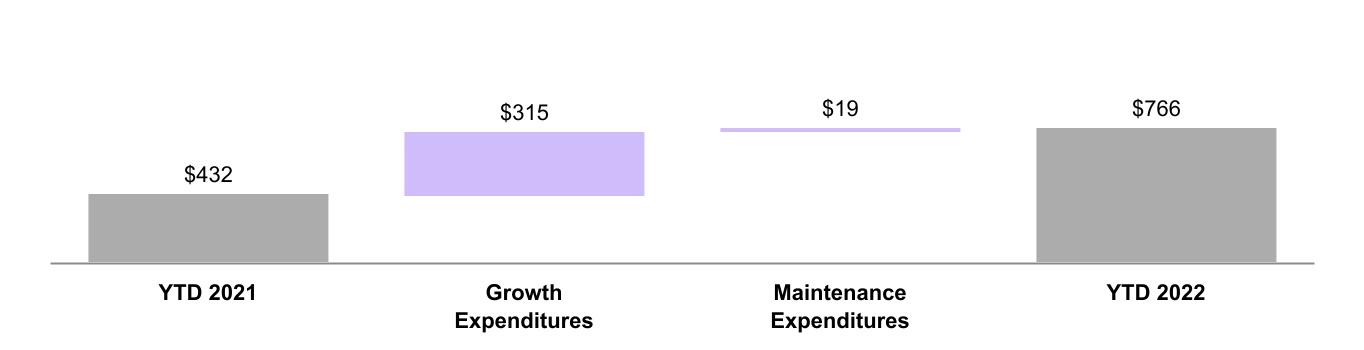
-
Growth expenditures increased $315 million, primarily driven by an increase in renewable projects at AES Clean Energy and AES Brasil and by higher TDSIC investments and the Hardy Hills Solar project at AES Indiana, partially offset by the timing of payments for the construction of the Alamitos Energy Center at Southland Energy in the prior year.
-
Maintenance expenditures increased $19 million, primarily due to the timing of payments at AES Indiana and increased expenditures in Argentina, partially due to a forced outage at TermoAndes.
Financing Activities
Net cash provided by financing activities decreased $175 million for the three months ended March 31, 2022, compared to the three months ended March 31, 2021.
Financing Cash Flows
(in millions)
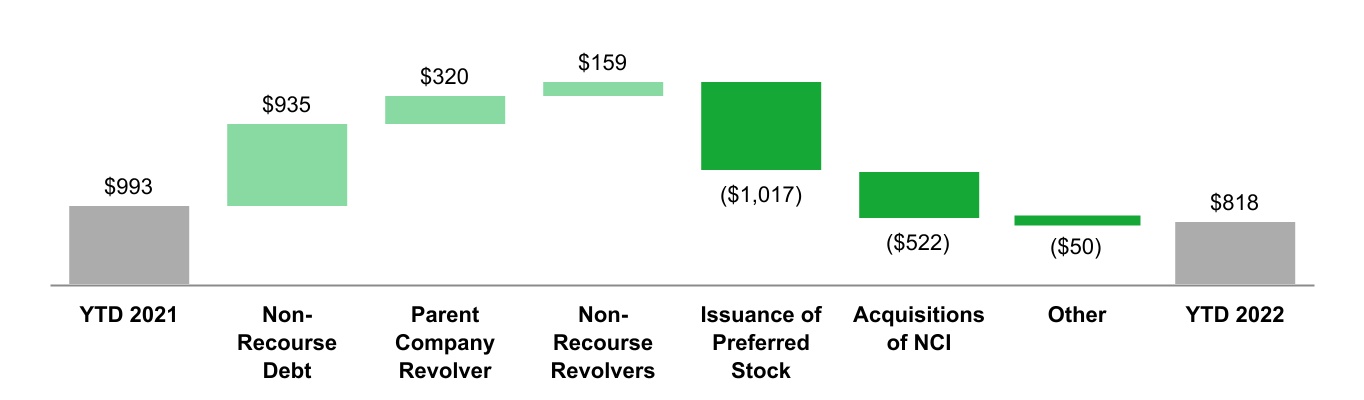
See Notes 7—Debt and 11—Equity in Item 1—Financial Statements of this Form 10-Q for more information regarding significant debt and equity transactions.
-
The $935 million impact from non-recourse debt transactions is primarily due to an increase in net borrowings in the Netherlands and Panama, the United Kingdom, AES Clean Energy and AES Andes, partially offset by a decrease in net borrowings at AES Brasil.
-
The $320 million impact from Parent Company revolver transactions is primarily due to higher net borrowings in the current year.
*•*The $159 million impact from non-recourse revolver transactions is primarily due to an increase in net borrowings at IPALCO, Argentina, and AES Andes, and a decrease in net repayments in the Dominican Republic.
- The $1 billion impact from issuance of preferred stock is due to the issuance of Equity Units at the Parent Company in the prior year.
*•*The $522 million impact from acquisitions of noncontrolling interests is mainly due to the acquisition of an additional 32% ownership interest in AES Andes.
48 | The AES Corporation | March 31, 2022 Form 10-Q
Parent Company Liquidity
The following discussion is included as a useful measure of the liquidity available to The AES Corporation, or the Parent Company, given the non-recourse nature of most of our indebtedness. Parent Company Liquidity, as outlined below, is a non-GAAP measure and should not be construed as an alternative to Cash and cash equivalents, which is determined in accordance with GAAP. Parent Company Liquidity may differ from similarly titled measures used by other companies. The principal sources of liquidity at the Parent Company level are dividends and other distributions from our subsidiaries, including refinancing proceeds, proceeds from debt and equity financings at the Parent Company level, including availability under our revolving credit facility, and proceeds from asset sales. Cash requirements at the Parent Company level are primarily to fund interest and principal repayments of debt, construction commitments, other equity commitments, acquisitions, taxes, Parent Company overhead and development costs, and dividends on common stock.
The Company defines Parent Company Liquidity as cash available to the Parent Company, including cash at qualified holding companies, plus available borrowings under our existing credit facility. The cash held at qualified holding companies represents cash sent to subsidiaries of the Company domiciled outside of the U.S. Such subsidiaries have no contractual restrictions on their ability to send cash to the Parent Company. Parent Company Liquidity is reconciled to its most directly comparable GAAP financial measure, Cash and cash equivalents, at the periods indicated as follows (in millions):
| March 31, 2022 | December 31, 2021 | ||||||||||
| Consolidated cash and cash equivalents | $ | 1,056 | $ | 943 | |||||||
| Less: Cash and cash equivalents at subsidiaries | (1,039) | (902) | |||||||||
| Parent Company and qualified holding companies’ cash and cash equivalents | 17 | 41 | |||||||||
| Commitments under the Parent Company credit facility | 1,250 | 1,250 | |||||||||
| Less: Letters of credit under the credit facility | (14) | (48) | |||||||||
| Less: Borrowings under the credit facility | (615) | (365) | |||||||||
| Borrowings available under the Parent Company credit facility | 621 | 837 | |||||||||
| Total Parent Company Liquidity | $ | 638 | $ | 878 |
The Company utilizes its Parent Company credit facility for short term cash needs to bridge the timing of distributions from its subsidiaries throughout the year.
The Parent Company paid dividends of $0.1580 per outstanding share to its common stockholders during the first quarter of 2022 for dividends declared in December 2021. While we intend to continue payment of dividends, and believe we will have sufficient liquidity to do so, we can provide no assurance that we will continue to pay dividends, or if continued, the amount of such dividends.
Recourse Debt
Our total recourse debt was $4 billion and $3.8 billion as of March 31, 2022 and December 31, 2021, respectively. See Note 7—Debt in Item 1.—Financial Statements of this Form 10-Q and Note 11—Debt in Item 8.—Financial Statements and Supplementary Data of our 2021 Form 10-K for additional detail.
We believe that our sources of liquidity will be adequate to meet our needs for the foreseeable future. This belief is based on a number of material assumptions, including, without limitation, assumptions about our ability to access the capital markets, the operating and financial performance of our subsidiaries, currency exchange rates, power market pool prices, and the ability of our subsidiaries to pay dividends. In addition, our subsidiaries’ ability to declare and pay cash dividends to us (at the Parent Company level) is subject to certain limitations contained in loans, governmental provisions and other agreements. We can provide no assurance that these sources will be available when needed or that the actual cash requirements will not be greater than anticipated. We have met our interim needs for shorter-term and working capital financing at the Parent Company level with our revolving credit facility. See Item 1A.—Risk Factors—The AES Corporation’s ability to make payments on its outstanding indebtedness is dependent upon the receipt of funds from our subsidiaries of the Company’s 2021 Form 10-K for additional information.
Various debt instruments at the Parent Company level, including our revolving credit facility, contain certain restrictive covenants. The covenants provide for, among other items, limitations on other indebtedness, liens, investments and guarantees; limitations on dividends, stock repurchases and other equity transactions; restrictions and limitations on mergers and acquisitions, sales of assets, leases, transactions with affiliates and off-balance sheet and derivative arrangements; maintenance of certain financial ratios; and financial and other reporting requirements. As of March 31, 2022, we were in compliance with these covenants at the Parent Company level.
49 | The AES Corporation | March 31, 2022 Form 10-Q
Non-Recourse Debt
While the lenders under our non-recourse debt financings generally do not have direct recourse to the Parent Company, defaults thereunder can still have important consequences for our results of operations and liquidity, including, without limitation:
-
reducing our cash flows as the subsidiary will typically be prohibited from distributing cash to the Parent Company during the time period of any default;
-
triggering our obligation to make payments under any financial guarantee, letter of credit, or other credit support we have provided to or on behalf of such subsidiary;
-
causing us to record a loss in the event the lender forecloses on the assets; and
-
triggering defaults in our outstanding debt at the Parent Company.
For example, our revolving credit facility and outstanding debt securities at the Parent Company include events of default for certain bankruptcy-related events involving material subsidiaries. In addition, our revolving credit agreement at the Parent Company includes events of default related to payment defaults and accelerations of outstanding debt of material subsidiaries.
Some of our subsidiaries are currently in default with respect to all or a portion of their outstanding indebtedness. The total non-recourse debt classified as current in the accompanying Condensed Consolidated Balance Sheets amounts to $2.3 billion. The portion of current debt related to such defaults was $230 million at March 31, 2022, all of which was non-recourse debt related to three subsidiaries — AES Puerto Rico, AES Ilumina, and AES Jordan Solar. None of the defaults are payment defaults, but are instead technical defaults triggered by failure to comply with other covenants or other conditions contained in the non-recourse debt documents, of which $223 million is due to the bankruptcy of the offtaker. See Note 7—Debt in Item 1.—Financial Statements of this Form 10-Q for additional detail.
None of the subsidiaries that are currently in default are subsidiaries that met the applicable definition of materiality under the Parent Company’s debt agreements as of March 31, 2022, in order for such defaults to trigger an event of default or permit acceleration under the Parent Company’s indebtedness. However, as a result of additional dispositions of assets, other significant reductions in asset carrying values or other matters in the future that may impact our financial position and results of operations or the financial position of the individual subsidiary, it is possible that one or more of these subsidiaries could fall within the definition of a “material subsidiary” and thereby trigger an event of default and possible acceleration of the indebtedness under the Parent Company’s outstanding debt securities. A material subsidiary is defined in the Parent Company’s revolving credit facility as any business that contributed 20% or more of the Parent Company’s total cash distributions from businesses for the four most recently ended fiscal quarters. As of March 31, 2022, none of the defaults listed above, individually or in the aggregate, results in or is at risk of triggering a cross-default under the recourse debt of the Parent Company.
Critical Accounting Policies and Estimates
The condensed consolidated financial statements of AES are prepared in conformity with U.S. GAAP, which requires the use of estimates, judgments, and assumptions that affect the reported amounts of assets and liabilities at the date of the financial statements and the reported amounts of revenue and expenses during the periods presented.
The Company’s significant accounting policies are described in Note 1 — General and Summary of Significant Accounting Policies of our 2021 Form 10-K. The Company’s critical accounting estimates are described in Item 7.—Management’s Discussion and Analysis of Financial Condition and Results of Operations in the 2021 Form 10-K. An accounting estimate is considered critical if the estimate requires management to make an assumption about matters that were highly uncertain at the time the estimate was made, different estimates reasonably could have been used, or if changes in the estimate that would have a material impact on the Company’s financial condition or results of operations are reasonably likely to occur from period to period. Management believes that the accounting estimates employed are appropriate and resulting balances are reasonable; however, actual results could differ from the original estimates, requiring adjustments to these balances in future periods. The Company has reviewed and determined that these remain as critical accounting policies as of and for the three months ended March 31, 2022.
50 | The AES Corporation | March 31, 2022 Form 10-Q
Previous: Item 1. FINANCIAL STATEMENTS · Next: Item 3. QUANTITATIVE AND QUALITATIVE DISCLOSURES ABOUT MARKET RISK