 filings.tools
AES 10-Q 2022-09-30
Filed 2022-11-04. 8 sections, 436K characters. Original on sec.gov · Markdown · JSON
Cover and table of contents
UNITED STATES
SECURITIES AND EXCHANGE COMMISSION
WASHINGTON, D.C. 20549
FORM 10-Q
(Mark One)
| ☒ | QUARTERLY REPORT PURSUANT TO SECTION 13 OR 15(d) OF THE SECURITIES EXCHANGE ACT OF 1934 |
For the Quarterly Period Ended September 30, 2022
or
| ☐ | TRANSITION REPORT PURSUANT TO SECTION 13 OR 15(d) OF THE SECURITIES EXCHANGE ACT OF 1934 |
Commission file number 1-12291
THE AES CORPORATION
(Exact name of registrant as specified in its charter)
| Delaware | 54-1163725 | |||||||
| (State or other jurisdiction of incorporation or organization) | (I.R.S. Employer Identification No.) |
| 4300 Wilson Boulevard | |||||||||||
| Arlington, | Virginia | 22203 | |||||||||
| (Address of principal executive offices) | (Zip Code) |
| Registrant's telephone number, including area code: | (703) | 522-1315 |
| Securities registered pursuant to Section 12(b) of the Act: | ||||||||
| Title of Each Class | Trading Symbol(s) | Name of Each Exchange on Which Registered | ||||||
| Common Stock, par value $0.01 per share | AES | New York Stock Exchange | ||||||
| Corporate Units | AESC | New York Stock Exchange |
Indicate by check mark whether the registrant (1) has filed all reports required to be filed by Section 13 or 15(d) of the Securities Exchange Act of 1934 during the preceding 12 months (or for such shorter period that the registrant was required to file such reports), and (2) has been subject to such filing requirements for the past 90 days. Yes ☒ No ☐
Indicate by check mark whether the registrant has submitted electronically every Interactive Data File required to be submitted pursuant to Rule 405 of Regulation S-T (§232.405 of this chapter) during the preceding 12 months (or for such shorter period that the registrant was required to submit such files). Yes ☒ No ☐
Indicate by check mark whether the registrant is a large accelerated filer, an accelerated filer, a non-accelerated filer, a smaller reporting company, or an emerging growth company. See the definitions of “large accelerated filer”, “accelerated filer”, “smaller reporting company”, and “emerging growth company” in Rule 12b-2 of the Exchange Act.
| Large accelerated filer | ☒ | Accelerated filer | ☐ | Smaller reporting company | ☐ | Emerging growth company | ☐ | Non-accelerated filer | ☐ |
If an emerging growth company, indicate by check mark if the registrant has elected not to use the extended transition period for complying with any new or revised financial accounting standards provided pursuant to Section 13(a) of the Exchange Act. ☐
Indicate by check mark whether the registrant is a shell company (as defined in Rule 12b-2 of the Exchange Act). Yes ☐ No ☒
The number of shares outstanding of Registrant’s Common Stock, par value $0.01 per share, on November 1, 2022 was 667,949,778.
The AES Corporation
Form 10-Q for the Quarterly Period ended September 30, 2022
Table of Contents
1 | The AES Corporation | September 30, 2022 Form 10-Q
Glossary of Terms
The following terms and acronyms appear in the text of this report and have the definitions indicated below:
| Adjusted EPS | Adjusted Earnings Per Share, a non-GAAP measure | ||||
| Adjusted PTC | Adjusted Pre-tax Contribution, a non-GAAP measure of operating performance | ||||
| AES | The Parent Company and its subsidiaries and affiliates | ||||
| AES Andes | AES Andes S.A., formerly AES Gener | ||||
| AES Brasil | AES Tietê Energia S.A., formerly branded as AES Tietê | ||||
| AES Clean Energy Development | AES Clean Energy Development, LLC | ||||
| AES Indiana | Indianapolis Power & Light Company, formerly branded as IPL. AES Indiana is wholly-owned by IPALCO | ||||
| AES Ohio | The Dayton Power & Light Company, formerly branded as DP&L. AES Ohio is wholly-owned by DPL | ||||
| AES Renewable Holdings | AES Renewable Holdings, LLC, formerly branded as AES Distributed Energy | ||||
| AFUDC | Allowance for Funds Used During Construction | ||||
| AIMCo | Alberta Management Investment Corporation | ||||
| ANEEL | Brazilian National Electric Energy Agency | ||||
| AOCL | Accumulated Other Comprehensive Loss | ||||
| ASC | Accounting Standards Codification | ||||
| ASU | Accounting Standards Update | ||||
| CAA | United States Clean Air Act | ||||
| CAMMESA | Wholesale Electric Market Administrator in Argentina | ||||
| CCEE | Brazilian Chamber of Electric Energy Commercialization | ||||
| CCGT | Combined Cycle Gas Turbine | ||||
| CCR | Coal Combustion Residuals, which includes bottom ash, fly ash, and air pollution control wastes generated at coal-fired generation plant sites | ||||
| CECL | Current Expected Credit Loss | ||||
| CO2 | Carbon Dioxide | ||||
| CSAPR | Cross-State Air Pollution Rule | ||||
| DG Comp | Directorate-General for Competition | ||||
| DPL | DPL Inc. | ||||
| EPA | United States Environmental Protection Agency | ||||
| EPC | Engineering, Procurement and Construction | ||||
| ESP | Electric Security Plan | ||||
| FASB | Financial Accounting Standards Board | ||||
| Fluence | Fluence Energy, Inc and its subsidiaries, including Fluence Energy, LLC, which was previously our joint venture with Siemens (NASDAQ: FLNC) | ||||
| FX | Foreign Exchange | ||||
| GAAP | Generally Accepted Accounting Principles in the United States | ||||
| GHG | Greenhouse Gas | ||||
| GILTI | Global Intangible Low Taxed Income | ||||
| GWh | Gigawatt Hours | ||||
| HLBV | Hypothetical Liquidation Book Value | ||||
| IPALCO | IPALCO Enterprises, Inc. | ||||
| LIBOR | London Interbank Offered Rate | ||||
| LNG | Liquid Natural Gas | ||||
| MMBtu | Million British Thermal Units | ||||
| MW | Megawatts | ||||
| MWh | Megawatt Hours | ||||
| NAAQS | National Ambient Air Quality Standards | ||||
| NCI | Noncontrolling Interest | ||||
| NM | Not Meaningful | ||||
| NOV | Notice of Violation | ||||
| NOX | Nitrogen Oxide | ||||
| OTC Policy | Statewide Water Quality Control Policy on the Use of Coastal and Estuarine Waters for Power Plant Cooling | ||||
| PPA | Power Purchase Agreement | ||||
| PREPA | Puerto Rico Electric Power Authority | ||||
| RSU | Restricted Stock Unit | ||||
| SBU | Strategic Business Unit | ||||
| SEC | United States Securities and Exchange Commission | ||||
| SO2 | Sulfur Dioxide | ||||
| TDSIC | Transmission, Distribution, and Storage System Improvement Charge | ||||
| U.S. | United States | ||||
| USD | United States Dollar | ||||
| VAT | Value-Added Tax | ||||
| VIE | Variable Interest Entity |
2 | The AES Corporation | September 30, 2022 Form 10-Q
PART I: FINANCIAL INFORMATION
Item 1. FINANCIAL STATEMENTS
Condensed Consolidated Balance Sheets (Unaudited)
| September 30, 2022 | December 31, 2021 | ||||||||||
| (in millions, except share and per share amounts) | |||||||||||
| ASSETS | |||||||||||
| CURRENT ASSETS | |||||||||||
| Cash and cash equivalents | $ | 1,553 | $ | 943 | |||||||
| Restricted cash | 314 | 304 | |||||||||
| Short-term investments | 671 | 232 | |||||||||
| Accounts receivable, net of allowance for doubtful accounts of $5 and $5, respectively | 1,787 | 1,418 | |||||||||
| Inventory | 998 | 604 | |||||||||
| Prepaid expenses | 149 | 142 | |||||||||
| Other current assets | 1,303 | 897 | |||||||||
| Current held-for-sale assets | 853 | 816 | |||||||||
| Total current assets | 7,628 | 5,356 | |||||||||
| NONCURRENT ASSETS | |||||||||||
| Property, Plant and Equipment: | |||||||||||
| Land | 465 | 426 | |||||||||
| Electric generation, distribution assets and other | 26,003 | 25,552 | |||||||||
| Accumulated depreciation | (8,532) | (8,486) | |||||||||
| Construction in progress | 3,661 | 2,414 | |||||||||
| Property, plant and equipment, net | 21,597 | 19,906 | |||||||||
| Other Assets: | |||||||||||
| Investments in and advances to affiliates | 1,121 | 1,080 | |||||||||
| Debt service reserves and other deposits | 167 | 237 | |||||||||
| Goodwill | 1,179 | 1,177 | |||||||||
| Other intangible assets, net of accumulated amortization of $415 and $385, respectively | 1,626 | 1,450 | |||||||||
| Deferred income taxes | 380 | 409 | |||||||||
| Other noncurrent assets, net of allowance of $57 and $23, respectively | 2,964 | 2,188 | |||||||||
| Noncurrent held-for-sale assets | 1,113 | 1,160 | |||||||||
| Total other assets | 8,550 | 7,701 | |||||||||
| TOTAL ASSETS | $ | 37,775 | $ | 32,963 | |||||||
| LIABILITIES AND EQUITY | |||||||||||
| CURRENT LIABILITIES | |||||||||||
| Accounts payable | $ | 1,688 | $ | 1,153 | |||||||
| Accrued interest | 210 | 182 | |||||||||
| Accrued non-income taxes | 244 | 266 | |||||||||
| Accrued and other liabilities | 1,212 | 1,205 | |||||||||
| Non-recourse debt, including $321 and $302, respectively, related to variable interest entities | 2,007 | 1,367 | |||||||||
| Current held-for-sale liabilities | 541 | 559 | |||||||||
| Total current liabilities | 5,902 | 4,732 | |||||||||
| NONCURRENT LIABILITIES | |||||||||||
| Recourse debt | 4,668 | 3,729 | |||||||||
| Non-recourse debt, including $2,167 and $2,223, respectively, related to variable interest entities | 15,530 | 13,603 | |||||||||
| Deferred income taxes | 1,169 | 977 | |||||||||
| Other noncurrent liabilities | 3,167 | 3,358 | |||||||||
| Noncurrent held-for-sale liabilities | 677 | 740 | |||||||||
| Total noncurrent liabilities | 25,211 | 22,407 | |||||||||
| Commitments and Contingencies (see Note 8) | |||||||||||
| Redeemable stock of subsidiaries | 1,201 | 1,257 | |||||||||
| EQUITY | |||||||||||
| THE AES CORPORATION STOCKHOLDERS’ EQUITY | |||||||||||
| Preferred stock (without par value, 50,000,000 shares authorized; 1,043,050 issued and outstanding at September 30, 2022 and December 31, 2021, respectively) | 838 | 838 | |||||||||
| Common stock ($0.01 par value, 1,200,000,000 shares authorized; 818,790,001 issued and 667,949,778 outstanding at September 30, 2022 and 818,717,043 issued and 666,793,625 outstanding at December 31, 2021) | 8 | 8 | |||||||||
| Additional paid-in capital | 6,818 | 7,106 | |||||||||
| Accumulated deficit | (732) | (1,089) | |||||||||
| Accumulated other comprehensive loss | (1,691) | (2,220) | |||||||||
| Treasury stock, at cost (150,840,223 and 151,923,418 shares at September 30, 2022 and December 31, 2021, respectively) | (1,832) | (1,845) | |||||||||
| Total AES Corporation stockholders’ equity | 3,409 | 2,798 | |||||||||
| NONCONTROLLING INTERESTS | 2,052 | 1,769 | |||||||||
| Total equity | 5,461 | 4,567 | |||||||||
| TOTAL LIABILITIES AND EQUITY | $ | 37,775 | $ | 32,963 |
See Notes to Condensed Consolidated Financial Statements.
3 | The AES Corporation
Condensed Consolidated Statements of Operations
(Unaudited)
| Three Months Ended September 30, | Nine Months Ended September 30, | ||||||||||||||||||||||
| 2022 | 2021 | 2022 | 2021 | ||||||||||||||||||||
| (in millions, except share and per share amounts) | |||||||||||||||||||||||
| Revenue: | |||||||||||||||||||||||
| Regulated | $ | 976 | $ | 768 | $ | 2,613 | $ | 2,147 | |||||||||||||||
| Non-Regulated | 2,651 | 2,268 | 6,944 | 6,224 | |||||||||||||||||||
| Total revenue | 3,627 | 3,036 | 9,557 | 8,371 | |||||||||||||||||||
| Cost of Sales: | |||||||||||||||||||||||
| Regulated | (896) | (644) | (2,335) | (1,806) | |||||||||||||||||||
| Non-Regulated | (1,839) | (1,632) | (5,237) | (4,413) | |||||||||||||||||||
| Total cost of sales | (2,735) | (2,276) | (7,572) | (6,219) | |||||||||||||||||||
| Operating margin | 892 | 760 | 1,985 | 2,152 | |||||||||||||||||||
| General and administrative expenses | (51) | (39) | (149) | (130) | |||||||||||||||||||
| Interest expense | (276) | (242) | (813) | (669) | |||||||||||||||||||
| Interest income | 100 | 71 | 270 | 212 | |||||||||||||||||||
| Loss on extinguishment of debt | (1) | (22) | (8) | (41) | |||||||||||||||||||
| Other expense | (10) | (12) | (51) | (32) | |||||||||||||||||||
| Other income | 4 | 48 | 80 | 274 | |||||||||||||||||||
| Gain on disposal and sale of business interests | 1 | 22 | — | 81 | |||||||||||||||||||
| Asset impairment expense | (50) |
Showing the first 8K of 228K characters. Open the full section
Item 2. MANAGEMENT’S DISCUSSION AND ANALYSIS OF FINANCIAL CONDITION AND RESULTS OF OPERATIONS
The condensed consolidated financial statements included in Item 1.—Financial Statements of this Form 10-Q and the discussions contained herein should be read in conjunction with our 2021 Form 10-K.
Forward-Looking Information
The following discussion may contain forward-looking statements regarding us, our business, prospects and our results of operations, including our expectations regarding the impact of the COVID-19 pandemic on our business, that are subject to certain risks and uncertainties posed by many factors and events that could cause our actual business, prospects and results of operations to differ materially from those that may be anticipated by such forward-looking statements. These statements include, but are not limited to, statements regarding management’s intents, beliefs, and current expectations and typically contain, but are not limited to, the terms “anticipate,” “potential,” “expect,” “forecast,” “target,” “will,” “would,” “intend,” “believe,” “project,” “estimate,” “plan,” and similar words. Forward-looking statements are not intended to be a guarantee of future results, but instead constitute current expectations based on reasonable assumptions. Factors that could cause or contribute to such differences include, but are not limited to, those described in Item 1A.—Risk Factors of this Form 10-Q, Item 1A.—Risk Factors and Item 7.—Management’s Discussion and Analysis of Financial Condition and Results of Operations of our 2021 Form 10-K and subsequent filings with the SEC.
Readers are cautioned not to place undue reliance on these forward-looking statements which speak only as of the date of this report. We undertake no obligation to revise any forward-looking statements in order to reflect events or circumstances that may subsequently arise. If we do update one or more forward-looking statements, no inference should be drawn that we will make additional updates with respect to those or other forward-looking statements. Readers are urged to carefully review and consider the various disclosures made by us in this report and in our other reports filed with the SEC that advise of the risks and factors that may affect our business.
Overview of Our Business
We are a diversified power generation and utility company organized into the following four market-oriented SBUs: US and Utilities (United States, Puerto Rico and El Salvador); South America (Chile, Colombia, Argentina and Brazil); MCAC (Mexico, Central America and the Caribbean); and Eurasia (Europe and Asia). For additional information regarding our business, see Item 1.—Business of our 2021 Form 10-K.
We have two lines of business: generation and utilities. Each of our SBUs participates in our first business line, generation, in which we own and/or operate power plants to generate and sell power to customers, such as utilities, industrial users, and other intermediaries. Our US and Utilities SBU participates in our second business line, utilities, in which we own and/or operate utilities to generate or purchase, distribute, transmit and sell electricity to end-user customers in the residential, commercial, industrial, and governmental sectors within a defined service area. In certain circumstances, our utilities also generate and sell electricity on the wholesale market.
Executive Summary
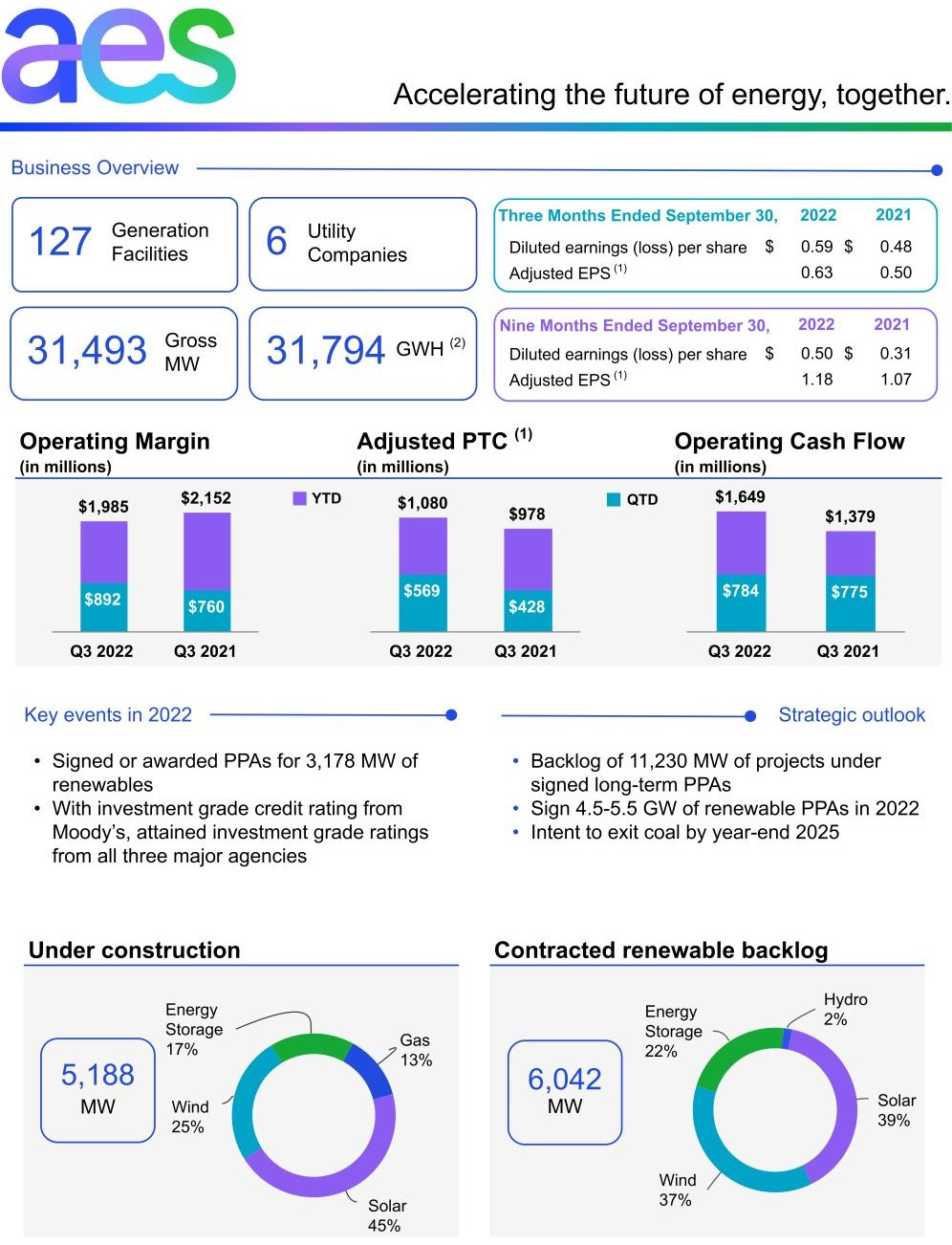
Compared with last year, third quarter diluted earnings per share from continuing operations increased $0.11, from $0.48 to $0.59. This increase is mainly driven by higher margins from our MCAC SBU due to favorable LNG transactions, partially offset by lower margins from our US and Utilities SBU primarily due to unrealized derivative losses and the recognition of previously deferred power purchase costs.
Adjusted EPS, a non-GAAP measure, increased $0.13 to $0.63, mainly driven by higher contributions from our MCAC SBU, partially offset by lower contributions from our US and Utilities SBU and a higher adjusted tax rate.
Compared with last year, diluted earnings per share from continuing operations for the nine months ended September 30, 2022 increased $0.19, from $0.31 to $0.50. This increase is mainly driven by lower impairments in the current year and higher margins from our MCAC SBU due to favorable LNG transactions, partially offset by the prior year gains on remeasurement of our interest in sPower’s development platform and on the issuance of new shares by Fluence, which was accounted for as a partial disposition, prior year net gains from early contract terminations at Angamos, lower capitalized interest at construction projects, and higher income tax expense.
Adjusted EPS, a non-GAAP measure, increased $0.11 to $1.18, mainly driven by higher contributions from our MCAC SBU due to favorable LNG transactions and from our South America SBU due to increased ownership in AES Andes, partially offset by lower contributions from our US and Utilities SBU due to the recognition of previously deferred power purchase costs and impacts of outages, and the prior year impact of realized gains on de-
36 | The AES Corporation | September 30, 2022 Form 10-Q
designated interest rate swaps at the Parent Company.
37 | The AES Corporation | September 30, 2022 Form 10-Q
| (1) See Item 2.—Management’s Discussion and Analysis of Financial Condition and Results of Operations—SBU Performance Analysis—Non-GAAP Measures for reconciliation and definition. | |||||
| (2) GWh sold in 2021. |
38 | The AES Corporation | September 30, 2022 Form 10-Q
Overview of Strategic Performance
AES is leading the industry's transition to clean energy by investing in clean power growth and innovative technology businesses. The Company is well-positioned to benefit from very favorable trends in clean power generation, distribution, and supporting technologies.
- In year-to-date 2022, the Company signed 3,178 MW of renewables and energy storage under long-term PPAs, including 1,625 MW of solar, energy storage, and wind in the U.S.
**◦**Since August 4, 2022, the Company signed 1,561 MW of renewables and energy storage under long-term PPAs.
-
In year-to-date 2022, the Company completed the construction or acquisition of 861 MW of energy storage, wind, and solar projects in the U.S., Chile, and the Dominican Republic.
-
The Company’s backlog, which includes projects with signed contracts, but which are not yet operational, is now 11,230 MW, including 5,188 MW under construction.
-
The Company signed agreements that will redirect excess LNG from the Company's business in Panama to international customers.
-
AES Ohio filed a new Electric Security Plan (ESP 4) to provide a regulatory foundation to upgrade and modernize its network and settle any outstanding regulatory proceedings.
39 | The AES Corporation | September 30, 2022 Form 10-Q
Review of Consolidated Results of Operations (Unaudited)
| Three Months Ended September 30, | Nine Months Ended September 30, | ||||||||||||||||||||||||||||||||||||||||||||||
| (in millions, except per share amounts) | 2022 | 2021 | $ change | % change | 2022 | 2021 | $ change |
Showing the first 8K of 142K characters. Open the full section
Item 3. QUANTITATIVE AND QUALITATIVE DISCLOSURES ABOUT MARKET RISK
Overview Regarding Market Risks
Our businesses are exposed to and proactively manage market risk. Our primary market risk exposure is to the price of commodities, particularly electricity, oil, natural gas, coal, and environmental credits. In addition, our businesses are exposed to lower electricity prices due to increased competition, including from renewable sources such as wind and solar, as a result of lower costs of entry and lower variable costs. We operate in multiple countries and as such, are subject to volatility in exchange rates at varying degrees at the subsidiary level and between our functional currency, the USD, and currencies of the countries in which we operate. We are also exposed to interest rate fluctuations due to our issuance of debt and related financial instruments.
The disclosures presented in this Item 3 are based upon a number of assumptions; actual effects may differ. The safe harbor provided in Section 27A of the Securities Act of 1933 and Section 21E of the Exchange Act shall apply to the disclosures contained in this Item 3. For further information regarding market risk, see Item 1A.—Risk Factors, Fluctuations in currency exchange rates may impact our financial results and position; Wholesale power prices may experience significant volatility in our markets which could impact our operations and opportunities for future growth; We may not be adequately hedged against our exposure to changes in commodity prices or interest rates; and Certain of our businesses are sensitive to variations in weather and hydrology of the 2021 Form 10-K.
Commodity Price Risk
Although we prefer to hedge our exposure to the impact of market fluctuations in the price of electricity, fuels, and environmental credits, some of our generation businesses operate under short-term sales or under contract sales that leave an unhedged exposure on some of our capacity or through imperfect fuel pass-throughs. These businesses subject our operational results to the volatility of prices for electricity, fuels, and environmental credits in competitive markets. We employ risk management strategies to hedge our financial performance against the effects of fluctuations in energy commodity prices. The implementation of these strategies can involve the use of physical and financial commodity contracts, futures, swaps, and options.
The portion of our sales and purchases that are not subject to such agreements or contracted businesses where indexation is not perfectly matched to business drivers will be exposed to commodity price risk. When hedging the output of our generation assets, we utilize contract sales that lock in the spread per MWh between variable costs and the price at which the electricity can be sold.
AES businesses will see changes in variable margin performance as global commodity prices shift. As of September 30, 2022, we project pre-tax earnings exposure on a 10% (uncorrelated) appreciation of commodity prices would be less than a $5 million gain for power and coal, less than a $5 million loss for oil and natural gas. Our estimates exclude correlation of oil with coal or natural gas. For example, a decline in oil or natural gas prices can be accompanied by a decline in coal price if commodity prices are correlated. In aggregate, the Company’s downside exposure occurs with lower power, higher oil, higher natural gas, and higher coal prices. Exposures at individual businesses will change as new contracts or financial hedges are executed, and our sensitivity to changes in commodity prices generally increases in later years with reduced hedge levels at some of our businesses.
Commodity prices affect our businesses differently depending on the local market characteristics and risk management strategies. Spot power prices, contract indexation provisions, and generation costs can be directly or indirectly affected by movements in the price of natural gas, oil, and coal. We have some natural offsets across our businesses such that low commodity prices may benefit certain businesses and be a cost to others. Exposures are not perfectly linear or symmetric. The sensitivities are affected by a number of local or indirect market factors. Examples of these factors include hydrology, local energy market supply/demand balances, regional fuel supply issues, regional competition, bidding strategies, and regulatory interventions such as price caps. Operational flexibility changes the shape of our sensitivities. For instance, certain power plants may limit downside exposure by reducing dispatch in low market environments. Volume variation also affects our commodity exposure. The volume sold under contracts or retail concessions can vary based on weather and economic conditions, resulting in a higher or lower volume of sales in spot markets. Thermal unit availability and hydrology can affect the generation output available for sale and can affect the marginal unit setting power prices.
68 | The AES Corporation | September 30, 2022 Form 10-Q
In the US and Utilities SBU, the generation businesses are largely contracted, but may have residual risk to the extent contracts are not perfectly indexed to the business drivers. At Southland, our existing once-through cooling generation units (“Legacy Assets”) have been requested to continue operating beyond their current retirement date and the OTC policy establishing retirement deadlines has been extended for between one and three years. These assets have contracts in capacity and have seen incremental value in energy revenues.
In the South America SBU, our business in Chile owns assets in the central and northern regions of the country and has a portfolio of contract sales in both. The majority of our PPAs include mechanisms of indexation that adjust the price of energy based on fluctuations in the price of coal, with the specific indices and timing varying by contract, in order to mitigate changes in the price of fuel. For the portion of our contracts not indexed to the price of coal, we have implemented a hedging strategy based on international coal financial instruments for up to three years. In Colombia, we operate under a shorter-term sales strategy with spot market exposure for uncontracted volumes. Because we own hydroelectric assets there, contracts are not indexed to fuel. Additionally, in Brazil, the hydroelectric generating facility is covered by contract sales. Under normal hydrological volatility, spot price risk is mitigated through a regulated sharing mechanism across all hydroelectric generators in the country. Under drier conditions, the sharing mechanism may not be sufficient to cover the business' contract position, and therefore it may have to purchase power at spot prices driven by the cost of thermal generation.
In the MCAC SBU, our businesses have commodity exposure on unhedged volumes. Panama is highly contracted under financial and load-following PPA type structures, exposing the business to hydrology-based variation. To the extent hydrological inflows are greater than or less than the contract volumes, the business will be sensitive to changes in spot power prices which may be driven by oil and natural gas prices in some time periods. In the Dominican Republic, we own natural gas-fired assets contracted under a portfolio of contract sales, and both contract and spot prices may move with commodity prices. Additionally, the contract levels do not always match our generation availability; as such, our assets may be selling the excess above contract levels at spot prices or buy the deficit in the spot market to satisfy contractual obligations.
In the Eurasia SBU, our assets operating in Vietnam and Bulgaria have minimal exposure to commodity price risk as it has no or minor merchant exposure and fuel is subject to a pass-through mechanism.
Foreign Exchange Rate Risk
In the normal course of business, we are exposed to foreign currency risk and other foreign operations risks that arise from investments in foreign subsidiaries and affiliates. A key component of these risks stems from the fact that some of our foreign subsidiaries and affiliates utilize currencies other than our consolidated reporting currency, the USD. Additionally, certain of our foreign subsidiaries and affiliates have entered into monetary obligations in USD or currencies other than their own functional currencies. Certain of our foreign subsidiaries calculate and pay taxes in currencies other than their own functional currency. We have varying degrees of exposure to changes in the exchange rate between the USD and the following currencies: Argentine peso, Brazilian real, Chilean peso, Colombian peso, Dominican peso, Euro, and Mexican peso. These subsidiaries and affiliates have attempted to limit potential foreign exchange exposure by entering into revenue contracts that adjust to changes in foreign exchange rates. We also use foreign currency forwards, swaps, and options, where possible, to manage our risk related to certain foreign currency fluctuations.
AES enters into foreign currency hedges to protect economic value of the business and minimize the impact of foreign exchange rate fluctuations to AES’ portfolio. While protecting cash flows, the hedging strategy is also designed to reduce forward-looking earnings foreign exchange volatility. Due to variation of timing and amount between cash distributions and earnings exposure, the hedge impact may not fully cover the earnings exposure on a realized basis, which could result in greater volatility in earnings. The largest foreign exchange risks over the remaining period of 2022 stem from the following currencies: Brazilian real, Colombian peso, and Euro. As of September 30, 2022, assuming a 10% USD appreciation, cash distributions attributable to foreign subsidiaries exposed to movement in the exchange rate of the Euro and Brazilian real are projected to be impacted by less than $5 million loss, and less than $5 million gain for Colombia peso. These numbers have been produced by applying a one-time 10% USD appreciation to forecasted exposed cash distributions for 2022 coming from the respective subsidiaries exposed to the currencies listed above, net of the impact of outstanding hedges and holding all other variables constant. The numbers presented above are net of any transactional gains or losses. These sensitivities may change in the future as new hedges are executed or existing hedges are unwound. Additionally, updates to the forecasted cash distributions exposed to foreign exchange risk may result in further modification. The sensitivities presented do not capture the impacts of any administrative market restrictions or currency inconvertibility.
Interest Rate Risks
69 | The AES Corporation | September 30, 2022 Form 10-Q
We are exposed to risk resulting from changes in interest rates as a result of our issuance of variable and fixed-rate debt, as well as interest rate swap, cap, floor, and option agreements.
Decisions on the fixed-floating debt mix are made to be consistent with the risk factors faced by individual businesses or plants. Depending on whether a plant’s capacity payments or revenue stream is fixed or varies with inflation, we partially hedge against interest rate fluctuations by arranging fixed-rate or variable-rate financing. In certain cases, particularly for non-recourse financing, we execute interest rate swap, cap, and floor agreements to effectively fix or limit the interest rate exposure on the underlying financing. Most of our interest rate risk is related to non-recourse financings at our businesses.
As of September 30, 2022, the portfolio’s pre-tax earnings exposure for 2022 to a one-time 100-basis-point increase in interest rates for our Argentine peso, Brazilian real, Chilean peso, Colombian peso, Euro, and USD denominated debt would be less than $5 million on interest expense for the debt denominated in these currencies. These amounts do not take into account the historical correlation between these interest rates.
Item 4. CONTROLS AND PROCEDURES
Evaluation of Disclosure Controls and Procedures
The Company, under the supervision and with the participation of its management, including the Company’s Chief Executive Officer (“CEO”) and Chief Financial Officer (“CFO”), evaluated the effectiveness of its “disclosure controls and procedures,” as such term is defined in Rule 13a-15(e) under the Exchange Act, as of the end of the period covered by this Quarterly Report on Form 10-Q. Based on that evaluation, our CEO and CFO have concluded that our disclosure controls and procedures were effective as of September 30, 2022, to ensure that information required to be disclosed by the Company in reports that we file or submit under the Exchange Act is recorded, processed, summarized, and reported within the time periods specified in SEC rules and forms, and include controls and procedures designed to ensure that information required to be disclosed by us in such reports is accumulated and communicated to our management, including our CEO and CFO, as appropriate, to allow timely decisions regarding required disclosures.
Changes in Internal Controls over Financial Reporting
There were no changes that occurred during the fiscal quarter covered by this Quarterly Report on Form 10-Q that have materially affected, or are reasonably likely to materially affect, our internal control over financial reporting.
70 | The AES Corporation | September 30, 2022 Form 10-Q
PART II: OTHER INFORMATION
ITEM 1. LEGAL PROCEEDINGS
The Company is involved in certain claims, suits and legal proceedings in the normal course of business. The Company has accrued for litigation and claims when it is probable that a liability has been incurred and the amount of loss can be reasonably estimated. The Company believes, based upon information it currently possesses and taking into account established reserves for estimated liabilities and its insurance coverage, that the ultimate outcome of these proceedings and actions is unlikely to have a material adverse effect on the Company's condensed consolidated financial statements. It is reasonably possible, however, that some matters could be decided unfavorably to the Company and could require the Company to pay damages or make expenditures in amounts that could be material, but cannot be estimated as of September 30, 2022.
In December 2001, Grid Corporation of Odisha (“GRIDCO”) served a notice to arbitrate pursuant to the Indian Arbitration and Conciliation Act of 1996 on the Company, AES Orissa Distribution Private Limited (“AES ODPL”), and Jyoti Structures (“Jyoti”) pursuant to the terms of the shareholders agreement between GRIDCO, the Company, AES ODPL, Jyoti and the Central Electricity Supply Company of Orissa Ltd. (“CESCO”), an affiliate of the Company. In the arbitration, GRIDCO asserted that a comfort letter issued by the Company in connection with the Company's indirect investment in CESCO obligates the Company to provide additional financial support to cover all of CESCO's financial obligations to GRIDCO. GRIDCO appeared to be seeking approximately $189 million in damages, plus undisclosed penalties and interest, but a detailed alleged damage analysis was not filed by GRIDCO. The Company counterclaimed against GRIDCO for damages. In June 2007, a 2-to-1 majority of the arbitral tribunal rendered its award rejecting GRIDCO's claims and holding that none of the respondents, the Company, AES ODPL, or Jyoti, had any liability to GRIDCO. The respondents' counterclaims were also rejected. A majority of the tribunal later awarded the respondents, including the Company, some of their costs relating to the arbitration. GRIDCO filed challenges of the tribunal's awards with the local Indian court. GRIDCO's challenge of the costs award has been dismissed by the court, but its challenge of the liability award remains pending. A hearing on the liability award has not taken place to date. The Company believes that it has meritorious defenses to the claims asserted against it and will defend itself vigorously in these proceedings; however, there can be no assurances that it will be successful in its efforts.
Pursuant to their environmental audit, AES Sul and AES Florestal discovered 200 barrels of solid creosote waste and other contaminants at a pole factory that AES Florestal had been operating. The conclusion of the audit was that a prior operator of the pole factory, Companhia Estadual de Energia (“CEEE”), had been using those contaminants to treat the poles that were manufactured at the factory. On their initiative, AES Sul and AES Florestal communicated with Brazilian authorities and CEEE about the adoption of containment and remediation measures. In March 2008, the State Attorney of the state of Rio Grande do Sul, Brazil filed a public civil action against AES Sul, AES Florestal and CEEE seeking an order requiring the companies to mitigate the contaminated area located on the grounds of the pole factory and an indemnity payment of approximately R$6 million ($1 million). In October 2011, the State Attorney filed a request for an injunction ordering the defendant companies to contain and remove the contamination immediately. The court granted injunctive relief on October 18, 2011, but determined that only CEEE was required to perform the removal work. In May 2012, CEEE began the removal work in compliance with the injunction. The case is now awaiting judgment. The removal and remediation costs are estimated to be approximately R$15 million to R$60 million ($3 million to $11 million), and there could be additional costs which cannot be estimated at this time. In June 2016, the Company sold AES Sul to CPFL Energia S.A. and as part of the sale, AES Guaiba, a holding company of AES Sul, retained the potential liability relating to this matter. The Company believes that there are meritorious defenses to the claims asserted against it and will defend itself vigorously in these proceedings; however, there can be no assurances that it will be successful in its efforts.
In September 2015, AES Southland Development, LLC and AES Redondo Beach, LLC filed a lawsuit against the California Coastal Commission (the “CCC”) over the CCC's determination that the site of AES Redondo Beach included approximately 5.93 acres of CCC-jurisdictional wetlands. The CCC has asserted that AES Redondo Beach has improperly installed and operated water pumps affecting the alleged wetlands in violation of the California Coastal Act and Redondo Beach Local Coastal Program. Potential outcomes of the CCC determination could include an order requiring AES Redondo Beach to perform a restoration and/or pay fines or penalties. AES Redondo Beach believes that it has meritorious arguments concerning the underlying CCC determination, but there can be no assurances that it will be successful. On March 27, 2020, AES Redondo Beach, LLC sold the site to an unaffiliated third-party purchaser that assumed the obligations contained within these proceedings. On May 26, 2020, CCC staff sent AES a NOV directing AES to submit a Coastal Development Permit (“CDP”) application for the removal of the water pumps within the alleged wetlands. AES has submitted the CDP to the permitting authority, the City of Redondo Beach (“the City”), with respect to AES’ plans to disable or remove the pumps. The NOV also directed AES to submit technical analysis regarding additional water pumps located within onsite electrical vaults
71 | The AES Corporation | September 30, 2022 Form 10-Q
and a CDP application for their continued operation. AES has responded to the CCC, providing the requested analysis and seeking further discussion with the agency regarding the CDP. On October 14, 2020, the City deemed the CDP application to be complete and indicated a public hearing will be required, at which time AES must present additional information and analysis on the pumps within the alleged wetlands and the onsite electrical vaults.
In October 2015, AES Indiana received an NOV alleging violations of the Clean Air Act (“CAA”), the Indiana State Implementation Plan (“SIP”), and the Title V operating permit related to alleged particulate and opacity violations at Petersburg Station Unit 3. In addition, in February 2016, AES Indiana received an NOV from the EPA alleging violations of New Source Review and other CAA regulations, the Indiana SIP, and the Title V operating permit at Petersburg Station. On August 31, 2020, AES Indiana reached a settlement with the EPA, the DOJ and the Indiana Department of Environmental Management (“IDEM”), resolving these purported violations of the CAA at Petersburg Station. The settlement agreement, in the form of a proposed judicial consent decree, was approved and entered by the U.S. District Court for the Southern District of Indiana on March 23, 2021, and includes, among other items, the following requirements: annual caps on NOx and SO2 emissions and more stringent emissions limits than AES Indiana's current Title V air permit; payment of civil penalties totaling $1.5 million; a $5 million environmental mitigation project consisting of the construction and operation of a new, non-emitting source of generation at the site; expenditure of $0.3 million on a state-only environmentally beneficial project to preserve local, ecologically-significant lands; and retirement of Units 1 and 2 prior to July 1, 2023. If AES Indiana does not meet the retirement obligation, it must install a Selective Non-Catalytic Reduction System (“SNCR”) on Unit 4.
In October 2017, the Maritime Prosecution Office from Valparaíso issued a ruling alleging responsibility by AES Andes for the presence of coal waste on Ventanas beach and proposed a fine before the Maritime Governor, of approximately $395,000. AES Andes submitted its statement of defense, denying the allegations. In May 2021, AES Andes was notified of an amended Opinion of the Maritime Prosecution Office which extends the alleged liability to a third party and reduces the proposed fine to AES Andes to approximately $372,000. On August 18, 2021, the Maritime Governor issued a resolution affirming the proposed fine, and on September 8, AES Andes filed an administrative action with the Maritime Governor requesting reconsideration of the fine. On December 28, 2021, the resolution rejecting the reinstatement appeal was notified, and on January 17, 2022, AES Andes filed an appeal against that ruling. In April 2022, Puerto Ventanas requested that the Maritime Authority join this proceeding with a parallel proceeding; however, the request was rejected. In May 2022, the General Director of the Maritime Territory and Merchant Marine of the Chilean Navy rejected AES Andes’ appeal and imposed a fine of $341,363. AES Andes will continue with administrative appeals, but the fine must be payed, as it is not suspended during the pendency of the remaining appeals. AES Andes believes that it has meritorious defenses to the allegations; however, there are no assurances it will be successful.
In December 2018, a lawsuit was filed in Dominican Republic civil court against the Company, AES Puerto Rico, and three other AES affiliates. The lawsuit purports to be brought on behalf of over 100 Dominican claimants, living and deceased, and appears to seek relief relating to CCRs that were delivered to the Dominican Republic in 2004. The lawsuit generally alleges that the CCRs caused personal injuries and deaths and demands $476 million in alleged damages. The lawsuit does not identify, or provide any supporting information concerning, the alleged injuries of the claimants individually. Nor does the lawsuit provide any information supporting the demand for damages or explaining how the quantum was derived. The relevant AES companies believe that they have meritorious defenses to the claims asserted against them and will defend themselves vigorously in this proceeding; however, there can be no assurances that they will be successful in their efforts.
In February 2019, a separate lawsuit was filed in Dominican Republic civil court against the Company, AES Puerto Rico, two other AES affiliates, and an unaffiliated company and its principal. The lawsuit purports to be brought on behalf of over 200 Dominican claimants, living and deceased, and appears to seek relief relating to CCRs that were delivered to the Dominican Republic in 2003 and 2004. The lawsuit generally alleges that the CCRs caused personal injuries and deaths and demands over $900 million in alleged damages. The lawsuit does not identify or provide any supporting information concerning the alleged injuries of the claimants individually, nor does the lawsuit provide any information supporting the demand for damages or explaining how the quantum was derived. In August 2020, at the request of the relevant AES companies, the case was transferred to a different civil court. Preliminary hearings have taken place and are ongoing. The relevant AES companies believe that they have meritorious defenses to the claims asserted against them and will defend themselves vigorously in this proceeding; however, there can be no assurances that they will be successful in their efforts.
In October 2019, the Superintendency of the Environment (the "SMA") notified AES Andes of certain alleged breaches associated with the environmental permit of the Ventanas Complex, initiating a sanctioning process through Exempt Resolution N° 1 / ROL D-129-2019. The alleged charges include exceeding generation limits, failing to reduce emissions during episodes of poor air quality, exceeding limits on discharges to the sea, and exceeding
72 | The AES Corporation | September 30, 2022 Form 10-Q
noise limits. AES Andes has submitted a proposed “Compliance Program” to the SMA for the Ventanas Complex. The latest version of this Compliance Program was submitted on May 26, 2021. On December 30, 2021, the Compliance Program was approved by the SMA. However an ex officio action was brought by the SMA due to alleged exceedances of generation limits, which would require the Company to reduce SO2, NOx and PM emissions in order to achieve the emissions offset established in the Compliance Program. On January 6, 2022, AES Andes filed a reposition with the SMA seeking modification of the means for compliance with the ex officio action. The reposition filing is currently under review by the SMA. The effects of the ex officio action are suspended until the reposition is resolved, but the SMA ruling is otherwise unaffected. Fines are possible if the SMA determines there is an unsatisfactory execution of the Compliance Program. The cost of proposed Compliance Program is approximately $10.8 million.
In March 2020, Mexico’s Comisión Federal de Electricidad (“CFE”) served an arbitration demand upon AES Mérida III. CFE makes allegations that AES Mérida III is in breach of its obligations under a power and capacity purchase agreement (“Contract”) between the two parties, which allegations related to CFE’s own failure to provide fuel within the specifications of the Contract. CFE seeks to recover approximately $200 million in payments made to AES Mérida under the Contract as well as approximately $480 million in alleged damages for having to acquire power from alternative sources in the Yucatan Peninsula. AES Mérida has filed an answer denying liability to CFE and asserting a counterclaim for damages due to CFE’s breach of its obligations. The parties submitted their respective initial briefs and supporting evidence in December 2020. After additional briefing, the evidentiary hearing took place in November 2021. Closing arguments were heard in May 2022. The parties are awaiting the decision of the arbitration Tribunal. AES Mérida believes that it has meritorious defenses and claims and will assert them vigorously in the arbitration; however, there can be no assurances that it will be successful in its efforts.
On May 12, 2021, the Federal Attorney for Environmental Protection (the “Authority”) initiated an environmental audit at the Termoelectrica del Golfo (“TEG”) and Termoelectrica del Peñoles (“TEP”) thermal generating facilities. On July 15, 2022, TEG was notified of the resolution issued by the Authority, which alleges breaches of air emission regulations, including failure to submit reports. The resolution imposes a fine of $8,467,360 pesos (approximately USD $400,000). The facility filed a nullity judgment to challenge the resolution, and on September 8, 2022, a provisional injunction was granted by the Tribunal, subject to TEG’s presentation of a warranty, which could include a corporate guaranty or bail. The provisional injunction temporarily suspends the obligation to pay the fine while the Tribunal considers a definitive injunction, and potentially, a sentence dismissing the fine. No resolution for TEP’s audit has been issued. The Company believes that it has meritorious defenses to the claims asserted against it and will defend itself vigorously in these proceedings; however, there can be no assurances that it will be successful in its efforts.
In February 2022, a lawsuit was filed in Dominican Republic civil court against the Company. The lawsuit purports to be brought on behalf of over 425 Dominican claimants, living and deceased, and appears to seek relief relating to CCRs that were delivered to the Dominican Republic in 2003 and 2004. The lawsuit generally alleges that the CCRs caused personal injuries and deaths and demands over $600 million in alleged damages. The lawsuit does not identify or provide any supporting information concerning the alleged injuries of the claimants individually. Nor does the lawsuit provide any information supporting the demand for damages or explaining how the quantum was derived. The Company believes that it has meritorious defenses to the claims asserted against it and will defend itself vigorously in this proceeding; however, there can be no assurances that it will be successful in its efforts.
On July 25, 2022, AES Puerto Rico, LP (“AES-PR”) received from the EPA an NOV alleging certain violations of the CAA at AES-PR’s coal-fired power facility in Guayama, Puerto Rico. The NOV alleges AES-PR exceeded an emission limit and did not continuously operate certain monitoring equipment, conduct certain analyses and testing, maintain complete records, and submit certain reports as required by the EPA’s Mercury and Air Toxics Standards. The NOV further alleges AES-PR did not comply fully with the facility’s Title V operating permit. AES-PR is engaging in discussions with the EPA about the NOV. AES-PR will defend its interests, but we cannot predict the outcome of this matter at this time. However, settlements and litigated outcomes of CAA claims alleged against other coal-fired power plants have required companies to pay civil penalties and undertake remedial measures.
Item 1A. RISK FACTORS
You should consider carefully the following updates to risk factors, along with the risk factors disclosed in Item 1A.—Risk Factors of our 2021 Form 10-K and other information contained in or incorporated by reference in this Form 10-Q. Additional risks and uncertainties also may adversely affect our business and operations, including those discussed in Item 2*.—Management's Discussion and Analysis of Financial Condition and Results of Operations* in this Form 10-Q. The Risk Factors section in our 2021 Form 10-K otherwise remains current in all material respects. If any of the following events actually occur, our business, financial results and financial condition
73 | The AES Corporation | September 30, 2022 Form 10-Q
could be materially adversely affected. We routinely encounter and address risks, some of which may cause our future results to be materially different than we presently anticipate.
The operation of power generation, distribution and transmission facilities involves significant risks.
We are in the business of generating and distributing electricity, which involves certain risks that can adversely affect financial and operating performance, including:
-
changes in the availability of our generation facilities or distribution systems due to increases in scheduled and unscheduled plant outages; equipment failure; failure of transmission systems; labor disputes; disruptions in fuel supply; poor hydrologic and wind conditions; inability to comply with regulatory or permit requirements; or catastrophic events such as fires, floods, storms, hurricanes, earthquakes, dam failures, tsunamis, explosions, terrorist acts, cyber-attacks or other similar occurrences; and
-
changes in our operating cost structure, including, but not limited to, increases in costs relating to gas, coal, oil and other fuel; fuel transportation; purchased electricity; operations, maintenance and repair; environmental compliance, including the cost of purchasing emissions offsets and capital expenditures to install environmental emission equipment; transmission access; and insurance.
Our businesses require reliable transportation sources (including related infrastructure such as roads, ports and rail), power sources, and water sources to access and conduct operations. The availability and cost of this infrastructure affects capital and operating costs and levels of production and sales. Limitations or interruptions in this infrastructure or at the facilities of our subsidiaries, including as a result of third parties intentionally or unintentionally disrupting this infrastructure or the facilities of our subsidiaries, could impede their ability to produce electricity.
In addition, a portion of our generation facilities were constructed many years ago and may require significant capital expenditures for maintenance. The equipment at our plants requires periodic upgrading, improvement or repair and replacement equipment or parts may be difficult to obtain in circumstances where we rely on a single supplier or a small number of suppliers. The inability to obtain replacement equipment or parts, due to disruption of the supply chain or other factors, may impact the ability of our plants to perform. Breakdown or failure of one of our operating facilities may prevent the facility from performing under applicable power sales agreements which, in certain situations, could result in termination of a power purchase or other agreement or incurrence of a liability for liquidated damages and/or other penalties.
Power generation involves hazardous activities, including acquiring, transporting and unloading fuel, operating large pieces of rotating equipment, and delivering electricity to transmission and distribution systems. In addition to natural risks, such as earthquakes, floods, lightning, hurricanes and wind, hazards, such as fire, explosion, collapse and machinery failure, are inherent risks in our operations which may occur as a result of inadequate internal processes, technological flaws, human error or actions of third parties or other external events. The control and management of these risks depend upon adequate development and training of personnel and on operational procedures, preventative maintenance plans, and specific programs supported by quality control systems, which may not prevent the occurrence and impact of these risks.
In addition, our battery storage operations also involve risks associated with lithium-ion batteries. On rare occasions, lithium-ion batteries can rapidly release the energy they contain by venting smoke and flames in a manner that can ignite nearby materials as well as other lithium-ion batteries. While more recent design developments for our storage projects seek to minimize the impact of such events, these events are inherent risks of our battery storage operations.
The hazards described above, along with other safety hazards associated with our operations, can cause significant personal injury or loss of life, severe damage to and destruction of property, plant and equipment, contamination of, or damage to, the environment and suspension of operations. The occurrence of any one of these events may result in our being named as a defendant in lawsuits asserting claims for substantial damages, environmental cleanup costs, personal injury and fines, and/or penalties.
Furthermore, we and our affiliates are parties to material litigation and regulatory proceedings. See Item 1.— Legal Proceedings above. There can be no assurance that the outcomes of such matters will not have a material adverse effect on our consolidated financial position.
74 | The AES Corporation | September 30, 2022 Form 10-Q
Our renewable energy projects and other initiatives face considerable uncertainties.
Wind, solar, and energy storage projects are subject to substantial risks. Some of these business lines are dependent upon favorable regulatory incentives to support continued investment, and there is significant uncertainty about the extent to which such favorable regulatory incentives will be available in the future. In particular, in the U.S., AES’ renewable energy generation growth strategy depends in part on federal, state and local government policies and incentives that support the development, financing, ownership, and operation of renewable energy generation projects, including investment tax credits, production tax credits, accelerated depreciation, renewable portfolio standards, feed-in-tariffs and similar programs, renewable energy credit mechanisms, and tax exemptions. If these policies and incentives are changed or eliminated, or AES is unable to use them, there could be a material adverse impact on AES’ U.S. renewable growth opportunities, including fewer future PPAs or lower prices in future PPAs, decreased revenues, reduced economic returns on certain project company investments, increased financing costs, and/or difficulty obtaining financing.
In addition, the results of the U.S. Department of Commerce’s investigation into the antidumping and countervailing duties circumvention claim on solar cells and panels supplied from Malaysia, Vietnam, Thailand, and Cambodia are uncertain. If the investigation results in additional taxes, tariffs, duties, or other assessments on renewable energy or the equipment necessary to generate or deliver it, such as antidumping and countervailing duty rates, such developments could impede the realization of our U.S. renewables strategy by resulting in, among other items, lack of a satisfactory market for the development and/or financing of our U.S. renewable energy projects, abandoning the development of certain U.S. renewable energy projects, a loss of our investments in the projects, and/or reduced project returns.
Furthermore, production levels for our wind and solar projects may be dependent upon adequate wind or sunlight, resulting in volatility in production levels and profitability. For our wind projects, wind resource estimates are based on historical experience when available and on wind resource studies conducted by an independent engineer. These wind resource estimates are not expected to reflect actual wind energy production in any given year, but long-term averages of a resource.
As a result, these types of projects face considerable risk, including that favorable regulatory regimes expire or are adversely modified. At the development or acquisition stage, our ability to predict actual performance results may be hindered and the projects may not perform as predicted. There are also risks associated with the fact that some of these projects exist in markets where long-term fixed-price contracts for the major cost and revenue components may be unavailable, which in turn may result in these projects having relatively high levels of volatility. These projects can be capital-intensive and generally are designed with a view to obtaining third-party financing, which may be difficult to obtain. As a result, these capital constraints may reduce our ability to develop or obtain third-party financing for these projects.
Any of the above factors could have a material adverse effect on our business, financial condition, results of operations and prospects.
Cyber-attacks and data security breaches could harm our business.
Our business relies on electronic systems and network technologies to operate our generation, transmission and distribution infrastructure. We also use various financial, accounting, and other infrastructure systems. Our infrastructure may be targeted by nation states, hacktivists, criminals, insiders, or terrorist groups. In particular, there has been an increased focus on the U.S. energy grid believed to be related to the Russia/Ukraine conflict. Such an attack, by hacking, malware, or other means, may interrupt our operations, cause property damage, affect our ability to control our infrastructure assets, cause the release of sensitive customer information, or limit communications with third parties. Any loss or corruption of confidential or proprietary data through a breach may:
-
impact our operations, revenue, strategic objectives, customer, and vendor relationships;
-
expose us to legal claims and/or regulatory investigations and proceedings;
-
require extensive repair and restoration costs for additional security measures to avert future attacks;
-
impair our reputation and limit our competitiveness for future opportunities; and
-
impact our financial and accounting systems and, subsequently, our ability to correctly record, process, and report financial information.
75 | The AES Corporation | September 30, 2022 Form 10-Q
We have implemented measures to help prevent unauthorized access to our systems and facilities, including certain measures to comply with mandatory regulatory reliability standards. To date, cyber-attacks have not had a material impact on our operations or financial results. We continue to assess potential threats and vulnerabilities and make investments to address them, including global monitoring of networks and systems, identifying and implementing new technology, improving user awareness through employee security training, and updating our security policies as well as those for third-party providers. We cannot guarantee the extent to which our security measures will prevent future cyber-attacks and security breaches or that our insurance coverage will adequately cover any losses we may experience. Further, we do not control certain of joint ventures or our equity method investments and cannot guarantee that their efforts will be effective.
ITEM 2. UNREGISTERED SALES OF EQUITY SECURITIES AND USE OF PROCEEDS
The Board has authorized the Company to repurchase stock through a variety of methods, including open market repurchases, purchases by contract (including, without limitation, accelerated stock repurchase programs or 10b5-1 plans), and/or privately negotiated transactions. There can be no assurances as to the amount, timing, or prices of repurchases, which may vary based on market conditions and other factors. The Program does not have an expiration date and can be modified or terminated by the Board of Directors at any time. As of September 30, 2022, $264 million remained available for repurchase under the Program. No repurchases were made by The AES Corporation of its common stock during the third quarter of 2022.
ITEM 3. DEFAULTS UPON SENIOR SECURITIES
None.
ITEM 4. MINE SAFETY DISCLOSURES
Not applicable.
Item 5. OTHER INFORMATION
Item 1.01. Entry into a Material Definitive Agreement
On November 1, 2022, each member of the Company’s Board of Directors and each of its executive officers entered into an indemnification agreement (the “Indemnification Agreement”) with the Company. The Indemnification Agreement supplements the indemnification provisions contained in the Company’s Amended and Restated By-Laws and generally provides that the Company will indemnify the Indemnitee to the fullest extent permitted by the General Corporation Law of the State of Delaware and any other applicable laws, subject to certain exceptions, against expenses, damages, losses, liabilities, judgments, fines, penalties, and other amounts paid or incurred by the Indemnitee in connection with any threatened, asserted, pending, or completed claim, demand, action, suit or proceeding in which the Indemnitee is involved by reason of the Indemnitee’s service as a director or officer of the Company.
The foregoing description of the Indemnification Agreement does not purport to be complete and is qualified in its entirety by reference to the full text of the Indemnification Agreement, the form of which is filed as Exhibit 10.30 hereto and is incorporated herein by reference.
76 | The AES Corporation | September 30, 2022 Form 10-Q
Item 6. EXHIBITS
77 | The AES Corporation | September 30, 2022 Form 10-Q
SIGNATURES
Pursuant to the requirements of the Securities Exchange Act of 1934, the registrant has duly caused this report to be signed on its behalf by the undersigned thereunto duly authorized.
| THE AES CORPORATION (Registrant) | |||||||||||||||||
| Date: | November 3, 2022 | By: | /s/ STEPHEN COUGHLIN | ||||||||||||||
| Name: | Stephen Coughlin | ||||||||||||||||
| Title: | Executive Vice President and Chief Financial Officer (Principal Financial Officer) | ||||||||||||||||
| By: | /s/ SHERRY L. KOHAN | ||||||||||||||||
| Name: | Sherry L. Kohan | ||||||||||||||||
| Title: | Senior Vice President and Chief Accounting Officer (Principal Accounting Officer) |