 filings.tools
Aflac 10-K 2016-12-31
Filed 2017-02-24. 17 sections, 771K characters. Original on sec.gov · Markdown · JSON
Cover and table of contents
10-K 1 afl12311610k.htm 10-K
UNITED STATES
SECURITIES AND EXCHANGE COMMISSION
Washington, D.C. 20549
| FORM 10-K |
(Mark One)
| ý | ANNUAL REPORT PURSUANT TO SECTION 13 OR 15(d) OF THE SECURITIES EXCHANGE ACT OF 1934 |
For the fiscal year ended December 31, 2016
or
| ¨ | TRANSITION REPORT PURSUANT TO SECTION 13 OR 15(d) OF THE SECURITIES EXCHANGE ACT OF 1934 |
For the transition period from to
Commission File Number: 001-07434
| Aflac Incorporated |
| (Exact name of registrant as specified in its charter) |
| Georgia | 58-1167100 | |
| (State or other jurisdiction of incorporation or organization) | (I.R.S. Employer Identification No.) | |
| 1932 Wynnton Road, Columbus, Georgia | 31999 | |
| (Address of principal executive offices) | (ZIP Code) |
Registrant’s telephone number, including area code: 706.323.3431
Securities registered pursuant to Section 12(b) of the Act:
| Title of each class | Name of each exchange on which registered | |
| Common Stock, $.10 Par Value | New York Stock Exchange | |
| Tokyo Stock Exchange |
Securities registered pursuant to Section 12(g) of the Act: None
Indicate by check mark if the registrant is a well-known seasoned issuer, as defined in Rule 405 of the Securities Act. þ Yes ¨ No
Indicate by check mark if the registrant is not required to file reports pursuant to Section 13 or Section 15(d) of the Act. ¨ Yes þ No
Indicate by check mark whether the registrant (1) has filed all reports required to be filed by Section 13 or 15(d) of the Securities Exchange Act of 1934 during the preceding 12 months (or for such shorter period that the registrant was required to file such reports), and (2) has been subject to such filing requirements for the past 90 days. þ Yes ¨ No
Indicate by check mark whether the registrant has submitted electronically and posted on its corporate website, if any, every Interactive Data File required to be submitted and posted pursuant to Rule 405 of Regulation S-T (Section 232.405 of this chapter) during the preceding 12 months (or for such shorter period that the registrant was required to submit and post such files). þ Yes ¨ No
Indicate by check mark if disclosure of delinquent filers pursuant to Item 405 of Regulation S-K (Section 229.405 of this chapter) is not contained herein, and will not be contained, to the best of registrant’s knowledge, in definitive proxy or information statements incorporated by reference in Part III of this Form 10-K or any amendment to this Form 10-K. þ
Indicate by check mark whether the registrant is a large accelerated filer, an accelerated filer, a non-accelerated filer, or a smaller reporting company. See the definitions of “large accelerated filer,” “accelerated filer” and “smaller reporting company” in Rule 12b-2 of the Exchange Act.
| Large accelerated filer | þ | Accelerated filer | ¨ | ||
| Non-accelerated filer | ¨ | (Do not check if smaller reporting company | Smaller reporting company | ¨ |
Indicate by check mark whether the registrant is a shell company (as defined in Rule 12b-2 of the Exchange Act). ¨ Yes þ No
The aggregate market value of the voting common stock held by non-affiliates of the registrant as of June 30, 2016, was $29,327,044,586.
The number of shares of the registrant’s common stock outstanding at February 15, 2017, with $.10 par value, was 401,426,860.
Documents Incorporated By Reference
Certain information contained in the Notice and Proxy Statement for the Company’s Annual Meeting of Shareholders to be held on May 1, 2017, is incorporated by reference into Part III hereof.
Aflac Incorporated
Annual Report on Form 10-K
For the Year Ended December 31, 2016
Table of Contents
i
As used in this report, “we,” “our,” “us” and “Registrant” refer to Aflac Incorporated.
PART I
Item 1. BUSINESS
We prepare our financial statements in accordance with U.S. generally accepted accounting principles (GAAP). This report includes certain forward-looking information that is based on current expectations and is subject to a number of risks and uncertainties. For details on forward-looking information, see Management's Discussion and Analysis of Financial Condition and Results of Operations (MD&A), Part II, Item 7, of this report.
Aflac Incorporated qualifies as a large accelerated filer within the meaning of Rule 12b-2 under the U.S. Securities Exchange Act of 1934 as amended (the Exchange Act). Our Internet address is aflac.com. The information on the Company's website is not incorporated by reference in this annual report on Form 10-K. We make available, free of charge on the Investors portion of our website, our annual report on Form 10-K, quarterly reports on Form 10-Q, current reports on Form 8-K and amendments thereto as soon as reasonably practicable after those forms have been electronically filed with or furnished to the Securities and Exchange Commission (SEC).
General Description
Aflac Incorporated (the Parent Company) was incorporated in 1973 under the laws of the state of Georgia. Aflac Incorporated is a general business holding company and acts as a management company, overseeing the operations of its subsidiaries by providing management services and making capital available. Its principal business is voluntary supplemental and life insurance, which is marketed and administered through its subsidiary, American Family Life Assurance Company of Columbus (Aflac), which operates in the United States (Aflac U.S.) and as a branch in Japan (Aflac Japan). Most of Aflac's policies are individually underwritten and marketed through independent agents. Aflac U.S. markets and administers group products through Continental American Insurance Company (CAIC), branded as Aflac Group Insurance. Our insurance operations in the United States and our branch in Japan service the two markets for our insurance business.
On December 2, 2016, we publicly announced that we will pursue the conversion of Aflac Japan from a branch structure to a subsidiary structure, with the subsidiary incorporated as a “Kabushiki Kaisha.” While the branch structure remains an acceptable legal form, the subsidiary structure has emerged as the more prevalent structure for both domestic and foreign companies operating in Japan. In addition, emerging global regulatory standards generally favor the subsidiary structure for foreign insurance and financial service companies. The adoption of this new organizational framework is expected to be tax-neutral and not to have a material impact on the daily operations of either Aflac Japan or Aflac U.S. as a result of this conversion. In addition, we expect to obtain enhanced flexibility in capital management and business development as a result of the conversion. We anticipate completion of the conversion in mid-2018.
Aflac offers voluntary insurance policies in Japan and the United States that provide a layer of financial protection against income and asset loss. We continue to diversify our product offerings in both Japan and the United States. Aflac Japan sells voluntary supplemental insurance products, including cancer plans, general medical indemnity plans, medical/sickness riders, care plans, living benefit life plans, ordinary life insurance plans and annuities. Aflac U.S. sells voluntary supplemental insurance products including products designed to protect individuals from depletion of assets (accident, cancer, critical illness/care, hospital indemnity, fixed-benefit dental, and vision care plans) and loss-of-income products (life and short-term disability plans).
We are authorized to conduct insurance business in all 50 states, the District of Columbia, several U.S. territories and Japan. Aflac Japan's revenues, including realized gains and losses on its investment portfolio, accounted for 71% of the Company's total revenues in 2016, compared with 70% in 2015 and 72% in 2014. The percentage of the Company's total assets attributable to Aflac Japan was 83% at both December 31, 2016 and 2015.
Reporting Segments
Aflac's insurance business consists of two reporting segments: Aflac Japan and Aflac U.S. Aflac Japan, which currently operates as a branch of Aflac, is the principal contributor to the Parent Company’s consolidated earnings. The conversion of Aflac Japan to a subsidiary structure is not expected to affect our segment reporting structure.
For information on our results of operations and financial information by segment, see MD&A and Note 2 of the Notes to the Consolidated Financial Statements in this report.
Foreign Currency Translation
Aflac Japan’s premiums and approximately half of its investment income are received in yen. Claims and most expenses are paid in yen, and we purchase yen-denominated assets and U.S. dollar-denominated assets, which may be hedged to yen, to support yen-denominated policy liabilities. These and other yen-denominated financial statement items are, however, translated into dollars for financial reporting purposes. For information regarding the effect of currency fluctuations on our business, see the Foreign Currency Translation and Market Risks of Financial Instruments - Currency Risk subsections of MD&A and Notes 1 and 2 of the Notes to the Consolidated Financial Statements in this report.
Insurance Premiums
The growth of earned premiums is directly affected by the change in premiums in force and by the change in weighted-average yen/dollar exchange rates. Consolidated earned premiums were $19.2 billion in 2016, $17.6 billion in 2015, and $19.1 billion in 2014. For additional information on the composition of earned premiums by segment, see Note 2 of the Notes to the Consolidated Financial Statements in this report. The following table presents the changes in annualized premiums in force for Aflac's insurance business for the years ended December 31.
| (In millions) | 2016 | 2015 | 2014 | ||||||||
| Annualized premiums in force, beginning of year | $ | 19,173 | $ | 18,894 | $ | 20,440 | |||||
| New sales, including conversions | 2,527 | 2,484 | 2,513 | ||||||||
| Change in unprocessed new sales | (46 | ) | (41 | ) | 13 | ||||||
| Premiums lapsed and surrendered | (2,102 | ) | (2,104 | ) | (2,146 | ) | |||||
| Other | (351 | ) | (56 | ) | (29 | ) | |||||
| Foreign currency translation adjustment | 483 | (4 | ) | (1,897 | ) | ||||||
| Annualized premiums in force, end of year | $ | 19,684 | $ | 19,173 | $ | 18,894 |
Japan
We translate Aflac Japan's annualized premiums in force into dollars at the respective end-of-period exchange rates. Changes in annualized premiums in force are translated at weighted-average exchange rates. The following table presents the changes in annualized premiums in force for Aflac Japan for the years ended December 31.
| In Dollars | In Yen | |||||||||||||||||||
| (In millions of dollars and billions of yen) | 2016 | 2015 | 2014 | 2016 | 2015 | 2014 | ||||||||||||||
| Annualized premiums in force, beginning of year | $ | 13,413 | $ | 13,226 | $ | 14,870 | 1,617 | 1,594 | 1,567 | |||||||||||
| New sales, including conversions | 1,045 | 997 | 1,080 | 114 | 121 | 115 | ||||||||||||||
| Change in unprocessed new sales | (46 | ) | (41 | ) | 13 | (5 | ) | (5 | ) | 1 | ||||||||||
| Premiums lapsed and surrendered | (623 | ) | (578 | ) | (695 | ) | (68 | ) | (70 | ) | (74 | ) | ||||||||
| Other | (484 | ) | (187 | ) | (145 | ) | (52 | ) | (23 | ) | (15 | ) | ||||||||
| Foreign currency translation adjustment | 483 | (4 | ) | (1,897 | ) | 0 | 0 | 0 | ||||||||||||
| Annualized premiums in force, end of year | $ | 13,788 | $ | 13,413 | $ | 13,226 | 1,606 | 1,617 | 1,594 |
For further information regarding Aflac Japan's financial results and sales, see the Aflac Japan Segment subsection of MD&A in this report.
U.S.
The following table presents the changes in annualized premiums in force for Aflac U.S. for the years ended December 31.
| (In millions) | 2016 | 2015 | 2014 | ||||||||||||||
| Annualized premiums in force, beginning of year | $ | 5,760 | $ | 5,668 | $ | 5,570 | |||||||||||
| New sales, including conversions | 1,482 | 1,487 | 1,433 | ||||||||||||||
| Premiums lapsed | (1,479 | ) | (1,526 | ) | (1,451 | ) | |||||||||||
| Other | 133 | 131 | 116 | ||||||||||||||
| Annualized premiums in force, end of year | $ | 5,896 | $ | 5,760 | $ | 5,668 |
For further information regarding Aflac's U.S. financial results and sales, see the Aflac U.S. Segment subsection of MD&A in this report.
Insurance Products
| Aflac Japan | Aflac U.S. | ||||||||
| Third Sector Insurance | Cancer | ||||||||
| Cancer | Accident | ||||||||
| Medical | Short-Term Disability | ||||||||
| Income Support | Critical Illness | ||||||||
| First Sector Insurance | Hospital Indemnity | ||||||||
| Life | Dental | ||||||||
| Protection | Vision | ||||||||
| Term | Life (Term, Whole) | ||||||||
| Whole | |||||||||
| Savings | |||||||||
| Hybrid (WAYS) | |||||||||
| Child Endowment |
Japan
Aflac Japan's insurance products are designed to help consumers pay for medical and nonmedical costs that are not reimbursed under Japan's national health insurance system. Changes in Japan's economy and an aging population have put increasing pressure on Japan's national health care system. As a result, more costs have been shifted to Japanese consumers, who in turn have become increasingly interested in insurance products that help them manage those costs. Aflac Japan has responded to this consumer need by enhancing existing products and developing new products.
The foundation of Aflac Japan's product portfolio has been, and continues to be, our third sector cancer and medical insurance products. Aflac pioneered the cancer insurance market in Japan in 1974, and we remain the number one provider of cancer insurance in Japan today. Over the years, we’ve customized our cancer insurance product to respond to, and anticipate, the needs of our consumers and the advances in medical treatments. The cancer insurance plans we offer in Japan provide a lump-sum benefit upon initial diagnosis of internal cancer and benefits for treatment received due to internal cancer such as fixed daily benefits for hospitalization, outpatient services and convalescent care, and surgical and terminal care benefits. In September 2014, Aflac Japan introduced New Cancer DAYS, a new cancer insurance product which provides enhanced coverage, including outpatient treatments and multiple cancer occurrence benefits. At the same time, premiums for this product have been lowered for most ages compared to prior plans. In October 2014, Aflac Japan introduced a unique Aflac-branded cancer insurance product for Japan's postal system, Japan Post (see the Distribution - Japan section for background information). In March 2016, we launched a cancer insurance product that offers protection to customers who have survived cancer. As the number one provider of cancer insurance in Japan, we believe these products further strengthen our brand, and most importantly, provide valuable benefits to consumers who are looking for solutions to manage cancer-related costs.
In early 2002, we introduced EVER, a stand-alone, whole-life medical insurance product which offers a basic level of hospitalization coverage with an affordable premium. Since its initial introduction, we have expanded our suite of EVER product offerings to appeal to specific types of Japanese consumers and achieve greater market penetration. In June 2015, we upgraded our EVER insurance product to include riders to be associated with three critical illnesses (cancer, heart attack, and stroke) to better respond to consumer’s needs for coverage of serious illnesses. These riders provide policyholders with a benefit upon the diagnosis for those three critical illnesses, waiver of premium payment thereafter and unlimited hospital days for such critical illnesses. Gentle EVER, our non-standard medical insurance product, is designed to meet the needs of certain consumers who cannot qualify for our base EVER plan. An upgrade to our Gentle EVER insurance product, released in July 2012, included expanded benefits and an attached advanced medical care rider. In March 2016, we made revisions to our Gentle EVER insurance product to enhance its alignment with changing customer needs.
We believe that the affordable cancer and medical insurance products Aflac Japan provides will continue to be an important part of our product portfolio. Nevertheless, as we continue our long history of product innovation, Aflac Japan's product portfolio has expanded beyond traditional health-related products.
In July 2016, we launched a new third sector product called Income Support Insurance. This product provides fixed-benefit amounts in the event that a policyholder is unable to work due to significant illness or injury and was developed to supplement the disability coverage within Japan’s social security system. This product targets young to middle-aged consumers, and by focusing our efforts on this demographic, we believe we are building relationships that lay the groundwork for the sale of our cancer and medical insurance later in life to the Income Support policyholders.
While Aflac Japan continues to offer life insurance and other first sector products, we have decreased sales of first sector savings products, such as WAYS, child endowment and annuities, in 2016 in light of the negative interest-rate environment in Japan. We continue to monitor interest rates and their effects on our first sector business. We believe that the measures taken to date, including lowering assumed interest rates or increasing premiums, are appropriate in response to interest rates and that life insurance continues to provide cross-selling opportunities for our third sector products such as cancer and medical insurance. Some of the life insurance products that we offer in Japan provide death benefits and cash surrender values. These products are available as stand-alone policies and riders, providing a mix of term and whole life coverage. Our WAYS insurance product has features that allow policyholders to convert a portion of their life insurance to medical, nursing care, or fixed annuity benefits at a predetermined age. In November 2016, we lowered the assumed interest rate for WAYS reflecting the continued low interest rate environment, consistent with our desire to de-emphasize first-sector sales and bolster profitability. Also in November 2016, Aflac Japan halted the offering of traditional fixed-income annuities. Aflac Japan's child endowment insurance product offers a death benefit until a child reaches age 18. It also pays a lump-sum benefit at the time of the child's entry into high school, as well as an educational annuity for each of the four years during his or her college education. In January 2017, we increased the premium level of this product reflecting the continued low interest rate environment.
For additional information on Aflac Japan's products and composition of sales, see the Aflac Japan Segment subsection of MD&A in this report.
U.S.
We design our U.S. insurance products to provide supplemental coverage for people who already have major medical or primary insurance coverage. Most of our U.S. policies are individually underwritten and marketed through independent agents. Additionally, we started to market and administer group insurance products in 2009.
Our individually issued policies are portable and pay benefits regardless of other insurance. Most products' benefits are paid in cash directly to policyholders; therefore, our customers have the opportunity to use this cash to help with expenses of their choosing. Our individually issued health insurance plans are typically guaranteed-renewable for the lifetime of the policyholder (to age 75 for short-term disability policies).
Aflac U.S. offers short-term disability benefits on both an individual and group basis. In 2013 and 2014, we introduced a completely redesigned group short-term disability product with enhanced benefit options and higher income replacement amounts.
Aflac U.S. offers accident coverage on both an individual and group basis. These policies are designed to protect against losses resulting from accidents. The accident portion of the policy includes lump-sum benefits for accidental death, dismemberment and specific injuries as well as fixed benefits for hospital confinement. In 2015, we introduced a new individual accident plan with new benefits for home modifications, improved wellness benefits and a new benefit that provides an additional payout for injuries related to participations in an organized sporting activity.
Aflac U.S. offers coverage for critical care on both an individual and group basis. These policies are designed to protect against losses resulting from critical illnesses such as heart attack, stroke, or cancer. On an individually underwritten basis we offer cancer plans, critical illness plans, and critical care and recovery plans (formerly called specified health event). On a group basis we offer critical illness plans. In 2015, an updated group critical illness plan was introduced that provides benefits for 30 additional conditions in addition to more consumer options.
Aflac U.S. offers hospital indemnity coverage on both an individual and group basis. Our hospital indemnity products provide policyholders fixed dollar benefits triggered by hospitalization due to accident or sickness, or just sickness alone. Indemnity benefits for inpatient and outpatient surgeries, as well as various other diagnostic events, are also available. We also offer a lump sum rider than can be added to our individual accident, short-term disability and hospital indemnity
products. This rider, where available, provides a lump sum payment for a range of critical illness events including traumatic brain injury, Type 1 diabetes, advanced Alzheimer’s disease and many more. In January 2016, a new group hospital indemnity plan was introduced that includes 11 new benefits, including telemedicine and health screening. This plan provides flexibility, allowing our clients to personalize their plan designs to complement the underlying medical coverage that is offered to employees.
Aflac U.S. offers additional coverages to those listed above, including dental, vision and life policies. Aflac U.S. offers fixed-benefit dental coverage on both an individual and group basis. Aflac U.S. offers Vision NowSM, an individually issued policy which provides benefits for serious eye health conditions and loss of sight as well as coverage for corrective eye materials and exam benefits. Aflac U.S. also offers term- and whole-life policies on both an individual and group basis.
For additional information on Aflac's U.S. products and composition of sales, see the Aflac U.S. Segment subsection of MD&A in this report.
Distribution Channels
| Aflac Japan | Aflac U.S. | |||
| Individual/ Independent Corporate Agencies | Independent Associates | |||
| Affiliated Corporate Agencies | Brokers | |||
| Banks |
Japan
The traditional channels through which we have sold our products consist of individual agents/agencies, independent corporate agencies, and affiliated corporate agencies. The individual agencies and independent corporate agencies that sell our products give us better access to workers at a vast number of small businesses in Japan. Agents' activities are primarily focused on insurance sales, with customer service support provided by the Aflac Contact Center. Affiliated corporate agencies are originally formed when companies establish subsidiary businesses to sell our insurance products to their employees as part of a benefit package, and then expand to sell our products to other parties such as suppliers and customers. These agencies help us reach employees at large worksites, and some of them are also successful in approaching customers outside their business groups. We believe that new agencies will continue to be attracted to Aflac Japan's competitive commissions, attractive products, superior customer service and strong brand image.
We have sold our products to employees of banks since our entry into Japan in 1974. However, December 2007 marked the first time it was permissible for banks to sell our type of insurance products to their customers. By the end of 2016, we had agreements with approximately 90% of the total number of banks in Japan, to sell our products. We believe we have more banks selling our supplemental health insurance products than any of our competitors. Japanese consumers rely on banks to provide traditional bank services, and also to provide insurance solutions and other services. We believe our long-standing and strong relationships within the Japanese banking sector, along with our strategic preparations, have proven to be an advantage, particularly starting when this channel opened up for our products. Our partnerships throughout the banking sector provide us with a wider demographic of potential customers than we would otherwise have been able to reach, and it also allows banks to expand their product and service offerings to consumers.
In 2005, legislation aimed at privatizing Japan's postal system (Japan Post) was enacted into law. The privatization laws split Japan Post into four operating entities that began operating in October 2007. In 2007, one of these entities selected Aflac Japan as its provider of cancer insurance to be sold through its post offices, and, in 2008, we began selling cancer insurance through these post offices. Japan Post has historically been a popular place for consumers to purchase insurance products. Legislation to reform the postal system passed Japan’s legislature, the Diet, in April 2012 and resulted in the merger of two of the postal operating entities (the one that delivers the mail and the one that runs the post offices) in October 2012. In July 2013, Aflac Japan entered into a new agreement with Japan Post Holdings to further expand the partnership that was established in 2008. At the end of June 2014, Japan Post Insurance (Kampo) received approval from Japan’s primary insurance regulator, the Financial Services Agency (FSA), to enter into an agency contract with Aflac Japan to begin distributing Aflac Japan's cancer insurance products through all of Kampo's 79 directly managed sales offices. Aflac Japan has developed a unique Aflac-branded cancer insurance product for Japan Post and Kampo that was introduced in October 2014. In the fourth quarter of 2014, the number of postal outlets selling our cancer insurance products expanded to approximately 10,000, and beginning in July 2015, Japan Post expanded the number of post offices that offer Aflac's cancer insurance products to more than 20,000 postal outlets. We believe this alliance with Japan Post, which is included in our affiliated corporate agencies distribution channel, has benefited and will further benefit our cancer insurance sales.
For additional information on Aflac Japan's distribution, see the Aflac Japan Segment subsection of MD&A in this report.
U.S.
As of December 31, 2016, our U.S. sales force was composed of sales associates and brokers who are licensed to sell accident and health insurance. Many are also licensed to sell life insurance.
Sales associates and brokers are independent contractors and are paid commissions based on first-year and renewal premiums from their sales of insurance products. In addition to receiving commissions on personal production, district and regional sales coordinators may also receive override commissions and incentive bonuses.
We believe that changes we made to our career and broker management infrastructure over the last 30 months are laying the foundation for expanded long-term growth opportunities. During 2014, Aflac U.S. implemented tactical initiatives centered around providing competitive compensation to our career agent sales hierarchy and positioning us to more effectively and consistently execute on the U.S. sales strategy across all states. These measures were designed to more effectively link sales management's success to Aflac's success. For example, we enhanced compensation through an incentive bonus for the first level of our sales management, district sales coordinators, who are primarily responsible for selling Aflac products and training new sales associates. Additionally, we eliminated the commission-based position of state sales coordinator. To better manage our state operations, we introduced the new position of market director, effective October 1, 2014. Market directors are salaried with the opportunity to earn sales-related bonuses. We believe these changes have enhanced and will continue to enhance performance management and better align compensation with new business results.
We concentrate on marketing our insurance products at the worksite. This method offers policies to individuals through employment, trade and other associations. Historically, our policies have been individually underwritten with premiums generally paid by the employee. Additionally, Aflac's individual policies are portable, meaning that individuals may retain their full insurance coverage upon separation from employment or such affiliation, generally at the same premium. We collect a major portion of premiums on such sales through payroll deduction or other forms of centralized billing. With our brokerage sales expansion and CAIC, branded as Aflac Group Insurance, we offer group voluntary insurance products desired by many large employers. These products are sold on a group basis and often have some element of guaranteed issue. Worksite marketing enables sales associates and brokers to reach a greater number of prospective policyholders and lowers distribution costs, compared with individually marketed business.
Aflac U.S. utilizes dual-channel distribution to market our insurance products to businesses of all sizes. Our career agent channel focuses on marketing Aflac to the small business market, which consists of employers with less than 100 employees. As such, we have aligned our recruiting, training, compensation, marketing and incentives for our career agents to encourage specific activity and sales of individual policies in this market. Our newest channel is the broker channel, which is a sales division of Aflac Group. The broker channel focuses on selling to the mid- and large-case market, which is comprised of employers with more than 100 employees and typically an average size of 1,000 employees or more. Since regional and national brokers have traditionally served the mid- and large-case market, the highly trained and experienced sales professionals of the broker channel are assigned a geographic market to strengthen relationships with the top brokers and sell Aflac products to their clients. As a result, we are represented on more than 80 benefit administration platforms, sometimes referred to as exchanges, of various brokers.
For additional information on Aflac's U.S. distribution, see the Aflac U.S. Segment subsection of MD&A in this report.
Competition
Japan
In 1974, Aflac was granted an operating license to sell life insurance in Japan, making Aflac the second non-Japanese life insurance company to gain direct access to the Japanese insurance market. Through 1981, we faced limited competition for cancer insurance policy sales. However, Japan has experienced two periods of deregulation since we entered the market. The first came in the early 1980s, when nine mid-sized insurers, including domestic and foreign companies, were allowed to sell cancer insurance products for the first time. The second period began in 2001 when all life and non-life insurers were allowed to sell stand-alone cancer and medical insurance products as well as other stand-alone health insurance products. As a result, the number of insurance companies offering stand-alone cancer and medical insurance has more than doubled since the market was deregulated in 2001. However, based on our growth of annualized premiums in force and agencies, we do not believe that our market-leading position has been significantly impacted by increased competition. Furthermore, we believe the continued development and maintenance of operating efficiencies will allow us to offer affordable products that appeal to consumers. Aflac is the largest life insurer in Japan in terms of cancer and medical policies in force. As of December 31, 2016, we exceeded 24 million individual policies in force in Japan.
Aflac has had substantial success selling cancer policies in Japan, with more than 15 million cancer policies in force as of December 31, 2016. Aflac continued to be the number one seller of cancer insurance policies in Japan throughout 2016. We believe we will remain a leading provider of cancer insurance coverage in Japan, principally due to our experience in the market, low-cost operations, expansive marketing system (see Distribution - Japan above) and product expertise.
We have also experienced substantial success selling medical insurance in Japan. While other companies have recognized the opportunities that we have seen in the medical insurance market and offered new products, we endeavor to make our products stand out for their value to consumers.
U.S.
Aflac competes against several voluntary supplemental insurance carriers on a national and regional basis. We believe our policies, premium rates, and sales commissions are competitive by product type. Moreover, we believe that Aflac products are distinct from competitive offerings given our product focus (including features, benefits, and our claims service model), distribution capabilities, and brand awareness. For many companies with which we compete, voluntary supplemental insurance products are sold as a secondary business. A growing number of major medical and life insurance carriers are also entering into the voluntary supplemental insurance market. For Aflac, supplemental insurance products are our primary business and are sold via a distribution network of independent sales associates and brokers (see U.S. Distribution above). Aflac's advertising campaigns have increased our name awareness and understanding by consumers and businesses of the value our products provide.
Both private and publicly-traded insurers offer major medical insurance for hospitalization and medical expenses. Much of this insurance is sold on a group basis to accounts that are both fully and self-insured. The federal and state governments also pay substantial costs of medical treatment through various programs. Major medical insurance generally covers a substantial portion of the medical expenses incurred by an insured. Aflac policies are designed to provide coverage that supplements major medical insurance by paying cash directly to the policyholder to use for expenses their major medical insurance is not designed to cover. Thus, we do not compete directly with major medical insurers except those who sell supplemental insurance products as a secondary business. Any reduction of coverage, increase in employee participation costs, or increased deductibles and copayments by major medical commercial or government insurance carriers could favorably affect our business opportunities. Since the implementation of the Affordable Care Act (ACA) beginning in 2010, some employers have shifted a larger burden of the cost of care to their employees, primarily through increases in premiums, copays, and/or deductibles. Since Aflac products provide an additional level of financial protection for policyholders, we believe the increased financial exposure some employees may face creates a favorable opportunity for our products. However, given the profitability erosion some major medical carriers are facing in their core lines of business, we have seen a more competitive landscape as they seek entry into Aflac's supplemental product segments in an effort to offset this impact.
One Day PaySM is a claims initiative that we have introduced at Aflac U.S. to process, approve and pay eligible claims in just one day. We believe that along with our brand and relevant products, this claims practice has helped Aflac stand out from competitors.
Investments and Investment Results
Net investment income was $3.3 billion in 2016, $3.1 billion in 2015 and $3.3 billion in 2014. The increase in the reported net investment income in U.S. dollar terms for 2016 compared to 2015 was primarily due to translation of yen-denominated income. In 2016, we continued to address the challenge of investing in this low-interest-rate environment by increasing our allocation to higher yielding asset classes, while still adhering to our strategic asset allocation. For further information on our investments and investment results, see the Insurance Operations and Analysis of Financial Condition sections of MD&A and Notes 3, 4 and 5 of the Notes to the Consolidated Financial Statements in this report.
Regulation
Japan
The financial and business affairs of Aflac Japan are subject to examination by Japan's FSA. Aflac Japan files annual reports and financial statements for the Japanese insurance operations based on a March 31 fiscal year end, prepared in accordance with Japanese regulatory accounting practices prescribed or permitted by the FSA. Japanese regulatory basis earnings are determined using accounting principles that differ materially from U.S. GAAP. For example, under Japanese regulatory accounting practices, policy acquisition costs are expensed immediately; policy benefit and claim reserving methods and assumptions are different; premium income is recognized on a cash basis; different consolidation criteria apply to variable interest entities (VIEs); different accounting applies to reinsurance; and investments can have a separate accounting classification and treatment referred to as policy reserve matching bonds (PRM). Capital and surplus of Aflac Japan, based on Japanese regulatory accounting practices, was $5.6 billion at December 31, 2016, compared with $4.7 billion at December 31, 2015.
The FSA maintains a solvency standard, which is used by Japanese regulators to monitor the financial strength of insurance companies. As of December 31, 2016, Aflac Japan's solvency margin ratio (SMR) was 945%, compared with 828% at December 31, 2015. Aflac Japan's SMR is sensitive to interest rate, credit spread and foreign exchange rate changes. In 2015, Aflac Japan made additional investments in yen-denominated public equity securities and in 2016 invested in U.S. dollar-denominated public equity securities, thereby adding sensitivity to equity market fluctuations. See the Capital Resources and Liquidity Section of MD&A for a discussion of measures we have taken to mitigate the sensitivity of Aflac Japan's SMR.
We typically repatriate a portion of Aflac Japan's accumulated earnings, as determined on a Japanese regulatory accounting basis, to Aflac U.S. provided that Aflac Japan has adequately protected policyholders' interests as measured by its SMR. The FSA may not allow profit repatriations to Aflac U.S. if the transfers would cause Aflac Japan to lack sufficient financial strength for the protection of Japanese policyholders. In the near term, we do not expect these requirements to adversely affect the funds available for profit repatriations, nor do we expect these requirements to adversely affect the funds available for payments of allocated expenses to Aflac U.S. and management fees to the Parent Company. Upon conversion of Aflac Japan to a subsidiary structure, which we anticipate completing in mid-2018, the new subsidiary will distribute dividends instead of internal profit repatriation. Such dividends will be subject to permitted dividend capacity under the Japan Company Law.
The Japanese insurance industry has a policyholder protection corporation that provides funds for the policyholders of insolvent insurers. For additional information regarding the policyholder protection fund, see the Policyholder Protection subsection of MD&A in this report.
In June 2013, a revision to the Financial Instruments and Exchange Act established a post-funded Orderly Resolution Regime for financial institutions to prevent a financial crisis in the event of a financial institution’s failure. This regime came into effect in March 2014 and has not had, and is not expected to have, a material impact on the Company's operations in Japan.
As a branch of our principal insurance subsidiary, Aflac Japan is also subject to regulation and supervision in the United States (see U.S. Regulation below). For additional information regarding Aflac Japan's operations and regulations, see the Aflac Japan Segment subsection of MD&A and Notes 2 and 13 of the Notes to the Consolidated Financial Statements in this report.
U.S.
General
The Parent Company and its insurance subsidiaries, Aflac (a Nebraska-domiciled insurance company), American Family Life Assurance Company of New York (Aflac New York, a New York-domiciled insurance company) and CAIC (redomiciled from South Carolina to Nebraska effective December 2016) are subject to state regulations in the United States as an insurance holding company system. Such regulations generally provide that transactions between companies within the holding company system must be fair and equitable. In addition, transfers of assets among such affiliated companies, certain dividend payments from insurance subsidiaries, and material transactions between companies within the system, including management fees, loans and advances are subject to prior notice to, or approval by, state regulatory authorities. These laws generally require, among other things, the insurance holding company and each insurance company directly owned by the holding company to register with the insurance departments of their respective domiciliary states and to furnish annually financial and other information about the operations of companies within the holding company system.
Like all U.S. insurance companies, Aflac is subject to regulation and supervision in the jurisdictions in which it does business. In general, the insurance laws of the various jurisdictions establish supervisory agencies with broad administrative powers relating to, among other things:
| • | granting and revoking licenses to transact business |
| • | regulating trade and claims practices |
| • | licensing of insurance agents and brokers |
| • | approval of policy forms and premium rates |
| • | standards of solvency and maintenance of specified policy benefit reserves and minimum loss ratio requirements |
| • | capital requirements |
| • | limitations on dividends to shareholders |
| • | the nature of and limitations on investments |
| • | deposits of securities for the benefit of policyholders |
| • | filing of financial statements prepared in accordance with statutory insurance accounting practices prescribed or permitted by regulatory authorities |
| • | periodic examinations of the market conduct, financial, and other affairs of insurance companies |
The insurance laws of Nebraska that govern Aflac's activities provide that the acquisition or change of “control” of a domestic insurer or of any person that controls a domestic insurer cannot be consummated without the prior approval of the Nebraska Department of Insurance. A person seeking to acquire control, directly or indirectly, of a domestic insurance company or of any person controlling a domestic insurance company (in the case of Aflac, the Parent Company) must generally file with the Nebraska Department of Insurance (NDOI) an application for change of control containing certain information required by statute and published regulations and provide a copy to Aflac. In Nebraska, control is generally presumed to exist if any person, directly or indirectly, acquires 10% or more of an insurance company or of any other person or entity controlling the insurance company. The 10% presumption is not conclusive and control may be found to exist at less than 10%. Similar laws apply in New York, the domiciliary jurisdiction of the Parent Company's Aflac New York insurance subsidiary.
State insurance departments conduct periodic examinations of the books and records, financial reporting, policy filings and market conduct of insurance companies domiciled in their states, generally once every three to five years. Examinations are generally carried out in cooperation with the insurance departments of other states under guidelines promulgated by the National Association of Insurance Commissioners (NAIC). In 2016, full-scope, risk-focused financial examinations were conducted by the NDOI, New York Department of Financial Services (NYDFS), and the South Carolina Department of Insurance (SCDOI) on their state domiciled insurance entities American Family Life Assurance Company of Columbus, American Family Life Assurance Company of New York, and Continental American Insurance Company, respectively. The NDOI and NYDFS exams covered a four-year period ending December 31, 2015, whereas the SCDOI exam covered a five-year period ending December 31, 2015. There were no material findings contained in the NDOI and SCDOI final exam report. The exam report from the NYDFS has not been finalized as of January 2017.
The NAIC continually reviews regulatory matters, such as risk-based capital (RBC) modernization and principles-based reserving, and recommends changes and revisions for adoption by state legislators and insurance departments. The NAIC uses a risk-based capital formula relating to insurance risk, business risk, asset risk and interest rate risk to
facilitate identification by insurance regulators of inadequately capitalized insurance companies based upon the types and mix of risk inherent in the insurer's operations. The formulas for determining the amount of risk-based capital specify various weighting factors that are applied to financial balances or various levels of activity based on the perceived degree of risk. Regulatory compliance is determined by a ratio of a company's regulatory total adjusted capital to its authorized control level risk-based capital as defined by the NAIC. Companies below specific trigger points or ratios are classified within certain levels, each of which requires specified corrective action. The levels are company action, regulatory action, authorized control, and mandatory control. Aflac's NAIC risk-based capital ratio remains high and reflects a very strong capital and surplus position. As of December 31, 2016, based on year-end statutory accounting results, Aflac's company action level RBC ratio was 894%.
Under state insurance guaranty association laws and similar laws in international jurisdictions, we are subject to assessments, based on the share of business we write in the relevant jurisdiction, for certain obligations of insolvent insurance companies to policyholders and claimants. In the United States, some states permit member insurers to recover assessments paid through full or partial premium tax offsets. The Company's policy is to accrue assessments when the entity for which the insolvency relates has met its state of domicile's statutory definition of insolvency, the amount of the loss is reasonably estimable and the related premium upon which the assessment is based is written. In most states, the definition is met with a declaration of financial insolvency by a court of competent jurisdiction. For additional information regarding state insurance guaranty assessments, see the U.S. Regulatory Environment subsection of MD&A in this report.
Reform Legislation
Federal legislation and administrative policies in several areas, including health care reform legislation, financial services reform legislation, securities regulation, pension regulation, privacy, tort reform legislation and taxation, can significantly and adversely affect insurance companies. For example, the ACA, federal health care reform legislation, gave the U.S. federal government direct regulatory authority over the business of health insurance. The reform included major changes to the U.S. health care insurance marketplace. Among other changes, the reform legislation included an individual medical insurance coverage mandate, provided for penalties on certain employers for failing to provide adequate coverage, created health insurance exchanges, and addressed coverage and exclusions as well as medical loss ratios. It also imposed an excise tax on certain high cost plans, known as the “Cadillac tax,” that is currently scheduled to begin in 2020. The legislation also included changes in government reimbursements and tax credits for individuals and employers and alters federal and state regulation of health insurers. At this time it is unclear whether implementation of the ACA will continue. While the ACA was enacted in 2010, the major elements of the law became effective on January 1, 2014. We believe that the ACA, as enacted, does not require material changes in the design of our insurance products. However, indirect consequences of the legislation and regulations could present challenges and/or opportunities that could potentially have an impact on our sales model, financial condition and results of operations.
Dodd-Frank Act
Title VII of the Dodd-Frank Act and regulations issued thereunder, in particular rules to require central clearing and collateral for certain types of derivatives, may have an impact on Aflac's derivative activity, including activity on behalf of Aflac Japan. In 2015 and 2016, six U.S. financial regulators, including the U.S. Commodity Futures Trading Commission (CFTC), issued final rules that impose greater obligations on swap dealers regarding uncleared swaps with certain counterparties, such as Aflac. Such rules, as well as similar regulations in Europe, become effective on March 1, 2017 and may result in more stringent collateral requirements or affect other aspects of Aflac's derivatives activity.
The Dodd-Frank Act also established a Federal Insurance Office (FIO) under the U.S. Treasury Department to monitor all aspects of the insurance industry and of lines of business other than certain health insurance, certain long-term care insurance and crop insurance. Traditionally, U.S. insurance companies have been regulated primarily by state insurance departments. In December 2013, the FIO released a report entitled "How To Modernize And Improve The System Of Insurance Regulation In The United States." The report was required by the Dodd-Frank Act, and included 18 recommended areas of near-term reform for the states, including addressing capital adequacy and safety/soundness issues, reform of insurer resolution practices, and reform of marketplace regulation. The report also listed nine recommended areas for direct federal involvement in insurance regulation. Some of the recommendations outlined in the FIO report released in December 2013 have been implemented. The National Association of Registered Agents and Brokers Reform Act, signed into law in January 2015, simplifies the agent and broker licensing process across state lines. The FIO has also engaged with the supervisory colleges to monitor financial stability and identify regulatory gaps for large national and internationally active insurers.
In the 115th Congress, several proposals have been introduced to reform the Dodd-Frank Act, including proposals to limit or repeal the Financial Stability Oversight Council's (the Council) ability to designate nonbank financial companies as
Systemically Important Financial Institutions (SIFI), eliminate the FIO, and increase Congressional oversight of the regulation issuing process. The new presidential administration in the United States and Congress have stated proposals to reform or repeal certain provisions of the Dodd-Frank Act. We cannot predict with any degree of certainty what impact, if any, such proposals will have on our U.S. business, financial condition, or results of operations.
Further Information
For further information concerning Aflac U.S. operations, regulation, change of control and dividend restrictions, see the Aflac U.S. Segment subsection of MD&A and Notes 2 and 13 of the Notes to the Consolidated Financial Statements in this report.
Other Operations
Our other operations include the Parent Company, results of reinsurance retrocession activities, and a printing subsidiary. For additional information on our other operations, see the Other Operations subsection of MD&A and Note 8 in the Notes to the Consolidated Financial Statements.
Employees
As of December 31, 2016, Aflac Japan had 4,958 employees, Aflac U.S. had 4,944 employees, and our other operations had 310 employees.
Executive Officers of the Registrant
| NAME | PRINCIPAL OCCUPATION(1) | AGE | |
| Daniel P. Amos | Chairman, Aflac Incorporated and Aflac, since 2001; Chief Executive Officer, Aflac Incorporated and Aflac, since 1990 | 65 | |
| Paul S. Amos II | President, Aflac, since 2007; Chief Operating Officer, U.S. Operations, Aflac, from 2006 until 2013 | 41 | |
| Koji Ariyoshi | Executive Vice President, Director of Sales and Marketing, Aflac Japan, since 2012 | 63 | |
| Kriss Cloninger III | President, Aflac Incorporated, since 2001; Chief Financial Officer, Aflac Incorporated and Aflac, from 1992 until 2015; Treasurer, Aflac Incorporated, from 2001 until 2015; Executive Vice President, Aflac, since 1993 | 69 | |
| Frederick J. Crawford | Executive Vice President, Chief Financial Officer, Aflac Incorporated, since 2015; Executive Vice President, Chief Financial Officer, CNO Financial Group from 2012 until 2015; Executive Vice President, Head of Investment and Corporate Development, Lincoln Financial Group from 2010 until 2012 | 53 | |
| J. Todd Daniels | Executive Vice President, Chief Actuary, Aflac Incorporated, since 2016; Global Chief Risk Officer, Aflac Incorporated, since 2016; Senior Vice President, Chief Actuary, Aflac, from 2015 until 2016; Global Chief Risk Officer, Aflac, from 2014 until 2016; Senior Vice President, Deputy Corporate Actuary, Aflac, from 2012 until 2014; Vice President, Financial Planning and Analysis, Aflac, from 2011 until 2012 | 46 | |
| June Howard | Chief Accounting Officer, Aflac Incorporated and Aflac, since 2010; Senior Vice President, Financial Services, Aflac Incorporated and Aflac, since 2010; Treasurer, Aflac, from 2011 until 2015 | 50 | |
| Kenneth S. Janke | Executive Vice President, Corporate Finance and Development, Treasurer, Aflac Incorporated and Aflac, since 2015; Executive Vice President, Deputy Chief Financial Officer, Aflac Incorporated, from 2010 until 2015; President, Aflac U.S., from 2013 until 2014 | 58 | |
| Eric M. Kirsch | Executive Vice President, Global Chief Investment Officer, Aflac, since 2012; First Senior Vice President, Global Chief Investment Officer, Aflac, from 2011 until 2012 | 56 | |
| Charles D. Lake II | President, Aflac International, since 2014; Chairman, Aflac Japan, since 2008 | 55 | |
| Audrey B. Tillman | Executive Vice President, General Counsel, Aflac Incorporated and Aflac, since 2014; Executive Vice President, Corporate Services, Aflac Incorporated, from 2008 until 2014 | 52 | |
| Teresa L. White | President, Aflac U.S., since 2014; Executive Vice President, Chief Operating Officer, Aflac, from 2013 until 2014; Executive Vice President, Chief Service Officer, Aflac, from 2012 until 2013; Executive Vice President, Chief Administrative Officer, Aflac, from 2008 until 2013 | 50 | |
| Robin Y. Wilkey | Senior Vice President, Investor and Rating Agency Relations, Aflac Incorporated, since 2010 | 58 | |
| Hiroshi Yamauchi | President, Chief Operating Officer, Aflac Japan, since 2015; Executive Vice President, Aflac Japan, from 2012 until 2014 | 65 |
(1)Unless specifically noted, the respective executive officer has held the occupation(s) set forth in the table for at least the last five years. Each executive officer is appointed annually by the board of directors and serves until his or her successor is chosen and qualified, or until his or her death, resignation or removal.
Item 1A. RISK FACTORS
We face a wide range of risks, and our continued success depends on our ability to identify, prioritize and appropriately manage our enterprise risk exposures. Readers should carefully consider each of the following risks and all of the other information set forth in this Form 10-K. These risks and other factors may affect forward-looking statements, including those in this document or made by the Company elsewhere, such as in earnings release webcasts, investor conference presentations or press releases. The risks and uncertainties described herein may not be the only ones facing the Company. Additional risks and uncertainties not presently known to us or that we currently believe to be immaterial may also adversely affect our business. If any of the following risks and uncertainties develops into actual events, there could be a material impact on the Company.
Difficult conditions in global capital markets and the economy could have a material adverse effect on our investments, capital position, revenue, profitability, and liquidity and harm our business.
Our results of operations are materially affected by conditions in the global capital markets and the global economy generally, including in our two primary operating markets of the United States and Japan. Weak global financial markets impact the value of our existing investment portfolio, influence opportunities for new investments, and may contribute to generally weak economic fundamentals, which can have a negative impact on our operating activities.
In recent years, global capital markets have been severely impacted by several major events. The financial crisis that began in the latter part of 2008 saw dramatic declines in investment values and weak economic conditions as the global financial system came under extreme pressure. Although U.S. markets began recovering in late 2009 and 2010, Europe continued to struggle under a severely weakened banking system and investor concerns with sovereign debt levels. Following a period of unprecedented intervention by governments and central banks, including the U.S. Federal Reserve and European Central Bank (ECB), financial conditions improved from the dire conditions of the global financial crisis, global recession, and European debt crisis. Recently, global markets have experienced materially higher levels of market volatility due to concerns including changes in the market’s perception of global growth, additional ECB intervention, a British exit from the European Union (EU) (Brexit), uncertainty surrounding Japan’s continued recovery amidst assorted policy changes, significant declines in global commodity prices including oil, divergent monetary policies in the United States versus many other developed economies, a newly elected U.S. president, and heightened concerns surrounding the Chinese economy.
As we hold a significant amount of fixed maturity and perpetual securities issued by borrowers located in many different parts of the world, including a large portion issued by banks and financial institutions, sovereigns, and other corporate borrowers in the United States and Europe, our financial results are directly influenced by global financial markets. A retrenchment of the recent improvements in overall capital market health could adversely affect our financial condition, including our capital position and our overall profitability. Market volatility and recessionary pressures could result in significant realized or unrealized losses due to severe price declines driven by increases in interest rates or credit spreads, defaults in payment of principal or interest, or credit rating downgrades.
Following the election of Shinzo Abe as Prime Minister of Japan in December 2012, the new administration adopted a new set of financial measures to stimulate the Japanese economy, including imposing negative interest rates on excess bank reserves. In a December 2014 snap-election, the ruling Liberal Democratic Party (LDP) won a landslide victory, further strengthening Mr. Abe's ability to implement economic reform and address key policy challenges. The Japanese financial markets reacted with even lower rates on Japanese Government bonds, large increases in Japanese equity market values, and a weakening of the yen relative to the U.S. dollar. More recently, as the Bank of Japan (BoJ) has signaled to hold its policy rate at zero, the Japan Government Bond (JGB) yield curve has steepened producing higher rates on longer maturity Japanese Government bonds.
Japan is the largest market for our products and we own substantial holdings in JGBs. Government actions to stimulate the economy affect the value of our existing holdings, our reinvestment rate on new investments in JGBs or other yen denominated assets, and consumer behavior relative to our suite of products. The additional government debt from fiscal stimulus actions could contribute to a weakening of the Japan sovereign credit profile and result in further rating downgrades at the credit rating agencies. This could lead to additional volatility in Japanese capital and currency markets.
Our investment portfolio owns sizeable credit positions in many other geographic areas of the world including the Middle East, Latin America, Asia, and other emerging markets. Deterioration in their underlying economies, sovereign credit worthiness, or financial market conditions could negatively impact our financial position.
While we have continued to add floating rate investments to our investment portfolio, most of our investment portfolio holdings are income-producing bonds that provide a fixed level of income. Many of our investments were made at the relatively low level of interest rates prevailing the last several years. Any increase in the market yields of our holdings due to an increase in interest rates could create substantial unrealized losses in our portfolio, as discussed further in a separate risk factor in this section of the Form 10-K.
We need liquidity to pay our operating expenses, dividends on our common stock, interest on our debt and liabilities. For a further description of our liquidity needs, including maturing indebtedness, see Item 7 of this Form 10-K - Management's Discussion and Analysis of Financial Condition and Results of Operations - Capital Resources and Liquidity. In the event our current resources do not meet our needs, we may need to seek additional financing. Our access to additional funding will depend on a variety of factors such as market conditions, the general availability of credit to the financial services industry and our credit rating.
Should investors become concerned with any of our investment holdings, including the concentration in JGBs, our access to market sources of funding could be negatively impacted. There is a possibility that lenders or debt investors may also become concerned if we incur large investment losses or if the level of our business activity decreases due to a market downturn or there are further adverse economic trends in the United States or Japan, specifically, or generally in developed markets. Similarly, our access to funds may be impaired if regulatory authorities or rating agencies take negative actions against us. See more information on recent rating actions later in this Risk Factors section.
Broad economic factors such as consumer spending, business investment, government spending, the volatility and strength of the capital markets, and inflation all affect the business and economic environment and, indirectly, the amount and profitability of our business. In an economic downturn characterized by higher unemployment, lower family income, lower corporate earnings, lower business investment and lower consumer spending, the demand for financial and insurance products could be adversely affected. This adverse effect could be particularly significant for companies such as ours that distribute supplemental, discretionary insurance products
Showing the first 8K of 78K characters. Open the full section
Item 1B. UNRESOLVED STAFF COMMENTS
Not applicable.
Item 2. PROPERTIES
In the United States, Aflac owns land and buildings that comprise two primary campuses located in Columbus, Georgia. These campuses include buildings that serve as our worldwide headquarters and house administrative support and information technology functions for our U.S. operations. Aflac leases office space in Columbia, South Carolina, which houses our CAIC subsidiary. Aflac leases office space in New York that houses our Global Investment division. Aflac leases administrative office space in Georgia, South Carolina, New York, Nebraska, and in 39 additional states throughout the United States, as well as Washington, D.C. and Puerto Rico.
In Tokyo, Japan, Aflac has three primary campuses. The first campus includes a building, owned by Aflac, for the customer call center, the claims department, information technology departments, and training facility. It also includes a leased property, which houses our policy administration and customer service departments. The second campus comprises leased space, which serves as Aflac Japan's headquarters and houses administrative and investment support
functions for the Japan branch. The third campus comprises leased space for the information technology departments. Aflac also leases additional office space in Tokyo, along with regional offices located throughout the country.
Item 3. LEGAL PROCEEDINGS
We are a defendant in various lawsuits considered to be in the normal course of business. Members of our senior legal and financial management teams review litigation on a quarterly and annual basis. The final results of any litigation cannot be predicted with certainty. Although some of this litigation is pending in states where large punitive damages, bearing little relation to the actual damages sustained by plaintiffs, have been awarded in recent years, we believe the outcome of pending litigation will not have a material adverse effect on our financial position, results of operations, or cash flows.
Item 4. MINE SAFETY DISCLOSURES
Not applicable.
PART II
Item 5. MARKET FOR REGISTRANT'S COMMON EQUITY, RELATED STOCKHOLDER MATTERS AND ISSUER
PURCHASES OF EQUITY SECURITIES
Market Information
Aflac Incorporated's common stock is principally traded on the New York Stock Exchange under the symbol AFL. Our stock is also listed on the Tokyo Stock Exchange. The quarterly high and low market prices for the Company's common stock, as reported on the New York Stock Exchange for the two years ended December 31 were as follows:
Quarterly Common Stock Prices
| 2016 | High | Low | |||||||||
| 4th Quarter | $ | 73.95 | $ | 67.50 | |||||||
| 3rd Quarter | 74.50 | 71.02 | |||||||||
| 2nd Quarter | 72.17 | 62.59 | |||||||||
| 1st Quarter | 64.33 | 54.57 |
| 2015 | High | Low | |||||||||
| 4th Quarter | $ | 66.53 | $ | 56.78 | |||||||
| 3rd Quarter | 64.99 | 51.41 | |||||||||
| 2nd Quarter | 65.10 | 61.32 | |||||||||
| 1st Quarter | 64.62 | 56.41 |
Holders
As of February 15, 2017, there were 87,228 holders of record of the Company's common stock.
Dividends
| 2016 | 2015 | ||||||||||
| 4th Quarter | $ | .43 | $ | .41 | |||||||
| 3rd Quarter | .41 | .39 | |||||||||
| 2nd Quarter | .41 | .39 | |||||||||
| 1st Quarter | .41 | .39 |
In January 2017, the board of directors declared the first quarter 2017 cash dividend of $.43 per share. The dividend is payable on March 1, 2017 to shareholders of record at the close of business on February 15, 2017. The declaration and payment of future dividends to holders of our common stock will be at the discretion of our board of directors and will depend upon many factors, including our financial condition, earnings, capital requirements of our operating subsidiaries, legal requirements, regulatory constraints and other factors as the board of directors deems relevant. There can be no assurance that we will declare and pay any additional or future dividends. For information concerning dividend restrictions, see Regulatory Restrictions in the Capital Resources and Liquidity section of MD&A and Note 13 of the Notes to the Consolidated Financial Statements presented in this report.
Stock Performance Graph
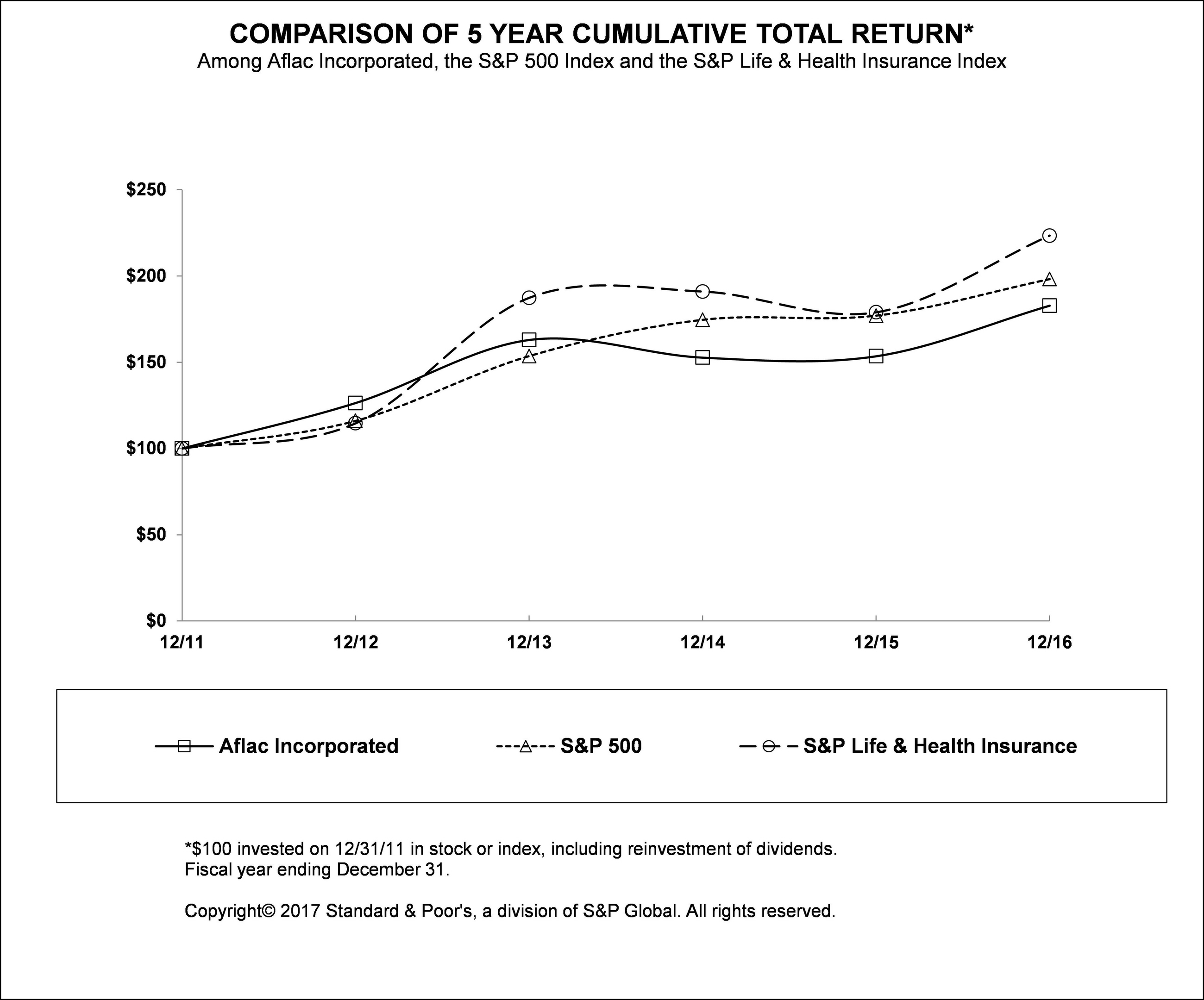
The following graph compares the five-year performance of the Company's common stock to the Standard & Poor's 500 Index (S&P 500) and the Standard & Poor's Life and Health Insurance Index (S&P Life and Health). The Standard & Poor's Life and Health Insurance Index includes: Aflac Incorporated, Lincoln National Corporation, MetLife Inc., Principal Financial Group Inc., Prudential Financial Inc., Torchmark Corporation and Unum Group.
Performance Graphic Index
December 31,
| 2011 | 2012 | 2013 | 2014 | 2015 | 2016 | ||||||||||||
| Aflac Incorporated | 100.00 | 126.36 | 162.90 | 152.66 | 153.45 | 182.78 | |||||||||||
| S&P 500 | 100.00 | 116.00 | 153.58 | 174.60 | 177.01 | 198.18 | |||||||||||
| S&P Life & Health Insurance | 100.00 | 114.59 | 187.33 | 190.98 | 178.93 | 223.41 |
Copyright© 2017 Standard & Poor’s, a division of The McGraw-Hill Companies Inc. All rights reserved. (www.researchdatagroup.com/S&P.htm)
Issuer Purchases of Equity Securities
During the year ended December 31, 2016, we repurchased shares of Aflac common stock as follows:
| Period | Total Number of Shares Purchased | Average Price Paid Per Share | Total Number of Shares Purchased as Part of Publicly Announced Plans or Programs | Maximum Number of Shares that May Yet Be Purchased Under the Plans or Programs | |||||||||||||||||
| January 1 - January 31 | 3,492,400 | $ | 57.29 | 3,492,400 | 44,879,158 | ||||||||||||||||
| February 1 - February 29 | 3,584,566 | 58.20 | 3,435,930 | 41,443,228 | |||||||||||||||||
| March 1 - March 31 | 3,229,684 | 62.07 | 3,224,000 | 38,219,228 | |||||||||||||||||
| April 1 - April 30 | 2,028,224 | 66.15 | 2,026,445 | 36,192,783 | |||||||||||||||||
| May 1 - May 31 | 1,929,098 | 68.97 | 1,929,098 | 34,263,685 | |||||||||||||||||
| June 1 - June 30 | 1,925,149 | 69.36 | 1,918,479 | 32,345,206 | |||||||||||||||||
| July 1 - July 31 | 918,411 | 72.99 | 918,300 | 31,426,906 | |||||||||||||||||
| August 1 - August 31 | 1,001,959 | 72.79 | 920,700 | 30,506,206 | |||||||||||||||||
| September 1 - September 30 | 911,184 | 72.68 | 908,600 | 29,597,606 | |||||||||||||||||
| October 1 - October 31 | 0 | 0.00 | 0 | 29,597,606 | |||||||||||||||||
| November 1 - November 30 | 1,407,600 | 71.07 | 1,407,600 | 28,190,006 | |||||||||||||||||
| December 1 - December 31 | 1,438,566 | 69.64 | 1,436,552 | 26,753,454 | |||||||||||||||||
| Total | 21,866,841 | (2) | $ | 64.77 | 21,618,104 | 26,753,454 | (1) |
(1)The total remaining shares available for purchase at December 31, 2016, consisted of 26,753,454 shares related to a 40,000,000 share repurchase authorization by the board of directors in 2015.
(2)During the year ended December 31, 2016, 248,737 shares were purchased in connection with income tax withholding obligations related to the vesting of restricted-share-based awards during the period.
Item 6. SELECTED FINANCIAL DATA
Aflac Incorporated and Subsidiaries
Years Ended December 31,
| (In millions, except for share and per-share amounts) | 2016 | 2015 | 2014 | 2013 | 2012 | ||||||||||||||
| Revenues: | |||||||||||||||||||
| Net premiums, principally supplemental health insurance | $ | 19,225 | $ | 17,570 | $ | 19,072 | $ | 20,135 | $ | 22,148 | |||||||||
| Net investment income | 3,278 | 3,135 | 3,319 | 3,293 | 3,473 | ||||||||||||||
| Realized investment gains (losses) | (123 | ) | 140 | 215 | 399 | (349 | ) | ||||||||||||
| Other income | 179 | 27 | 122 | 112 | 92 | ||||||||||||||
| Total revenues | 22,559 | 20,872 | 22,728 | 23,939 | 25,364 | ||||||||||||||
| Benefits and expenses: | |||||||||||||||||||
| Benefits and claims, net | 12,919 | 11,746 | 12,937 | 13,813 | 15,330 | ||||||||||||||
| Expenses | 5,573 | 5,264 | 5,300 | 5,310 | 5,732 | ||||||||||||||
| Total benefits and expenses | 18,492 | 17,010 | 18,237 | 19,123 | 21,062 | ||||||||||||||
| Pretax earnings | 4,067 | 3,862 | 4,491 | 4,816 | 4,302 | ||||||||||||||
| Income taxes | 1,408 | 1,329 | 1,540 | 1,658 | 1,436 | ||||||||||||||
| Net earnings | $ | 2,659 | $ | 2,533 | $ | 2,951 | $ | 3,158 | $ | 2,866 | |||||||||
| Share and Per-Share Amounts | |||||||||||||||||||
| Net earnings (basic) | $ | 6.46 | $ | 5.88 | $ | 6.54 | $ | 6.80 | $ | 6.14 | |||||||||
| Net earnings (diluted) | 6.42 | 5.85 | 6.50 | 6.76 | 6.11 | ||||||||||||||
| Cash dividends paid | 1.66 | 1.58 | 1.50 | 1.42 | 1.34 | ||||||||||||||
| Cash dividends declared | 1.66 | 1.58 | 1.50 | 1.42 | 1.34 | ||||||||||||||
| Weighted-average common shares used for basic EPS (In thousands) | 411,471 | 430,654 | 451,204 | 464,502 | 466,868 | ||||||||||||||
| Weighted-average common shares used for diluted EPS (In thousands) | 413,921 | 433,172 | 454,000 | 467,408 | 469,287 | ||||||||||||||
| Supplemental Data | |||||||||||||||||||
| Yen/dollar exchange rate at year-end (yen) | 116.49 | 120.61 | 120.55 | 105.39 | 86.58 | ||||||||||||||
| Weighted-average yen/dollar exchange rate (yen) | 108.70 | 120.99 | 105.46 | 97.54 | 79.81 |
Aflac Incorporated and Subsidiaries
December 31,
| (In millions) | 2016 | 2015 | 2014 | 2013 | 2012 | ||||||||||||||
| Assets: | |||||||||||||||||||
| Investments and cash | $ | 116,361 | $ | 105,897 | $ | 107,341 | $ | 108,459 | $ | 118,219 | |||||||||
| Other | 13,458 | 12,359 | 12,386 | 12,809 | 12,838 | ||||||||||||||
| Total assets | $ | 129,819 | $ | 118,256 | $ | 119,727 | $ | 121,268 | $ | 131,057 | |||||||||
| Liabilities and shareholders’ equity: | |||||||||||||||||||
| Policy liabilities | $ | 93,726 | $ | 87,631 | $ | 83,933 | $ | 89,402 | $ | 97,720 | |||||||||
| Income taxes | 5,387 | 4,340 | 5,293 | 3,718 | 3,858 | ||||||||||||||
| Notes payable | 5,360 | 4,971 | 5,242 | 4,858 | 4,315 | ||||||||||||||
| Other liabilities | 4,864 | 3,606 | 6,912 | 8,670 | 9,186 | ||||||||||||||
| Shareholders’ equity | 20,482 | 17,708 | 18,347 | 14,620 | 15,978 | ||||||||||||||
| Total liabilities and shareholders’ equity | $ | 129,819 | $ | 118,256 | $ | 119,727 | $ | 121,268 | $ | 131,057 |
Prior-year amounts have been adjusted for the adoption of accounting guidance on January 1, 2016 related to debt issuance costs.
Item 7. MANAGEMENT’S DISCUSSION AND ANALYSIS OF FINANCIAL CONDITION AND RESULTS OF
OPERATIONS
FORWARD-LOOKING INFORMATION
The Private Securities Litigation Reform Act of 1995 provides a “safe harbor” to encourage companies to provide prospective information, so long as those informational statements are identified as forward-looking and are accompanied by meaningful cautionary statements identifying important factors that could cause actual results to differ materially from those included in the forward-looking statements. We desire to take advantage of these provisions. This report contains cautionary statements identifying important factors that could cause actual results to differ materially from those projected herein, and in any other statements made by Company officials in communications with the financial community and contained in documents filed with the Securities and Exchange Commission (SEC). Forward-looking statements are not based on historical information and relate to future operations, strategies, financial results or other developments. Furthermore, forward-looking information is subject to numerous assumptions, risks and uncertainties. In particular, statements containing words such as “expect,” “anticipate,” “believe,” “goal,” “objective,” “may,” “should,” “estimate,” “intends,” “projects,” “will,” “assumes,” “potential,” “target”, "outlook" or similar words as well as specific projections of future results, generally qualify as forward-looking. Aflac undertakes no obligation to update such forward-looking statements.
We caution readers that the following factors, in addition to other factors mentioned from time to time, could cause actual results to differ materially from those contemplated by the forward-looking statements:
| • | difficult conditions in global capital markets and the economy |
| • | exposure to significant interest rate risk |
| • | concentration of business in Japan |
| • | foreign currency fluctuations in the yen/dollar exchange rate |
| • | failure to execute or implement the conversion of the Japan branch conversion to a legal subsidiary |
| • | limited availability of acceptable yen-denominated investments |
| • | deviations in actual experience from pricing and reserving assumptions |
| • | ability to continue to develop and implement improvements in information technology systems |
| • | governmental actions for the purpose of stabilizing the financial markets |
| • | interruption in telecommunication, information technology and other operational systems, or a failure to maintain the security, confidentiality or privacy of sensitive data residing on such systems |
| • | ongoing changes in our industry |
| • | failure to comply with restrictions on patient privacy and information security |
| • | extensive regulation and changes in law or regulation by governmental authorities |
| • | defaults and credit downgrades of investments |
| • | ability to attract and retain qualified sales associates and employees |
| • | decline in creditworthiness of other financial institutions |
| • | subsidiaries' ability to pay dividends to Aflac Incorporated |
| • | decreases in our financial strength or debt ratings |
| • | inherent limitations to risk management policies and procedures |
| • | concentration of our investments in any particular single-issuer or sector |
| • | differing judgments applied to investment valuations |
| • | ability to effectively manage key executive succession |
| • | significant valuation judgments in determination of amount of impairments taken on our investments |
| • | catastrophic events including, but not necessarily limited to, epidemics, pandemics, tornadoes, hurricanes, earthquakes, tsunamis, acts of terrorism and damage incidental to such events |
| • | changes in U.S. and/or Japanese accounting standards |
| • | loss of consumer trust resulting from events external to our operations |
| • | increased expenses and reduced profitability resulting from changes in assumptions for pension and other postretirement benefit plans |
| • | level and outcome of litigation |
| • | failure of internal controls or corporate governance policies and procedures |
MD&A OVERVIEW
Management's Discussion and Analysis of Financial Condition and Results of Operations (MD&A) is intended to inform the reader about matters affecting the financial condition and results of operations of Aflac Incorporated and its subsidiaries for the three-year period ended December 31, 2016. As a result, the following discussion should be read in conjunction with the related consolidated financial statements and notes. This MD&A is divided into the following sections:
| • | Our Business |
| • | Performance Highlights |
| • | Critical Accounting Estimates |
| • | Results of Operations, consolidated and by segment |
| • | Analysis of Financial Condition, including discussion of market risks of financial instruments |
| • | Capital Resources and Liquidity, including discussion of availability of capital and the sources and uses of cash |
OUR BUSINESS
Aflac Incorporated (the Parent Company) and its subsidiaries (collectively, the Company) primarily sell supplemental health and life insurance in the United States and Japan. The Company's insurance business is marketed and administered through American Family Life Assurance Company of Columbus (Aflac), which operates in the United States (Aflac U.S.) and as a branch in Japan (Aflac Japan). Most of Aflac's policies are individually underwritten and marketed through independent agents. Aflac U.S. also markets and administers group products through Continental American Insurance Company (CAIC), branded as Aflac Group Insurance. Our insurance operations in the United States and our branch in Japan service the two markets for our insurance business.
For more information on our business, see Business, Part I, Item 1 of this report.
PERFORMANCE HIGHLIGHTS
Yen-denominated income statement accounts are translated to U.S. dollars using a weighted-average Japanese yen/U.S. dollar foreign exchange rate, while yen-denominated balance sheet accounts are translated to U.S. dollars using a spot Japanese yen/U.S. dollar foreign exchange rate. The spot yen/dollar exchange rate at December 31, 2016 was 116.49, or 3.5% stronger than the December 31, 2015 spot yen/dollar exchange rate of 120.61. The weighted-average yen/dollar exchange rate for the year ended December 31, 2016 was 108.70, or 11.3% stronger than the weighted-average yen/dollar exchange rate of 120.99 for the same period in 2015.
Reflecting the stronger yen/dollar exchange rate, total revenues increased 8.1% to $22.6 billion in 2016, compared with $20.9 billion in 2015. Net earnings in 2016 were $2.7 billion, or $6.42 per diluted share, compared with $2.5 billion, or $5.85 per diluted share, in 2015.
Results for 2016 included pretax net realized investment losses of $123 million ($80 million after-tax), compared with net realized investment gains of $140 million ($91 million after-tax) in 2015. Net investment losses in 2016 consisted of $215 million of net gains ($140 million after-tax) from the sale or redemption of securities; $83 million ($54 million after-tax) of other-than-temporary impairment losses; and $255
Showing the first 8K of 165K characters. Open the full section
Item 7A. QUANTITATIVE AND QUALITATIVE DISCLOSURES ABOUT MARKET RISK
We are exposed primarily to three types of market risks: currency risk, interest rate risk, and credit risk. Beginning in 2015 and continuing into 2016, we increased our investment allocation to dividend focused yen-denominated and U.S. dollar-denominated public equity securities, thereby increasing our exposure to equity risk.
Currency Risk
The functional currency of Aflac Japan's insurance operations is the Japanese yen. Aflac Japan’s premiums and approximately half of its investment income are received in yen. Claims and most expenses are paid in yen, and we purchase yen-denominated assets and U.S. dollar-denominated assets, which may be hedged to yen, to support yen-denominated policy liabilities. These and other yen-denominated financial statement items are, however, translated into dollars for financial reporting purposes. Most of Aflac Japan's cash and liabilities are yen-denominated. Aflac Japan's yen-denominated investments consisted of fixed income securities of $67.3 billion, at amortized cost, and equity securities of $624 million, at cost, at December 31, 2016. However, Aflac Japan also owns U.S. dollar-denominated investments of $16.3 billion, at cost or amortized cost, whose carrying value is hedged against currency risk as well as $6.1 billion of investments, at amortized cost, that are not hedged as of December 31, 2016. Included in the hedged U.S. dollar-denominated investments are senior secured bank loans of $2.0 billion, at amortized cost, which we began hedging in the third quarter of 2016; dividend-focused U.S. public equity securities of $460 million, at cost, which we began hedging in the third quarter of 2016; U.S. dollar-denominated commercial mortgage loans of $745 million, at amortized cost and net of loan loss reserves; and U.S. dollar-denominated middle market loans of $74 million, at amortized cost and net of loan loss reserves. Yen-denominated investment income accounted for 53% of Aflac Japan's investment income in 2016, with the remainder generated by U.S. dollar-denominated investments. In addition, Aflac Incorporated has yen-denominated debt obligations.
We are exposed to currency risk as an economic event only when yen funds are actually converted into dollars. This occurs when we repatriate yen-denominated funds from Aflac Japan to Aflac U.S and with quarterly settlements of our reinsurance retrocession transactions. The exchange rates prevailing at the time of profit repatriation will differ from the exchange rates prevailing at the time the yen profits were earned. A portion of the yen repatriation may be used to service Aflac Incorporated's yen-denominated notes payable with the remainder converted into dollars. In order to economically hedge foreign exchange risk for a portion of the profit repatriation received in yen from Aflac Japan, we had foreign exchange forwards and options as part of a hedging strategy on 114.0 billion yen received in 2016. As of December 31, 2016, we had foreign exchange forwards and options to economically hedge foreign exchange risk on 122.6 billion yen of future profit repatriation from Aflac Japan.
In addition to profit repatriation and the reinsurance retrocessions, certain investment activities for Aflac Japan expose us to economic currency risk when yen are converted into dollars. As noted above, we invest a portion of our yen cash flows in U.S. dollar-denominated assets. This requires that we convert the yen cash flows to U.S. dollars before investing. As previously discussed, for certain of our U.S. dollar-denominated securities, we enter into foreign currency forward and option contracts to hedge the currency risk on the fair value of the securities. The dollar coupon or dividend payments received on these investments are not hedged and are subject to foreign exchange fluctuations, which are realized in earnings. Also, Aflac Japan has invested in reverse-dual currency securities (RDCs, or yen-denominated debt securities with dollar coupon payments), which exposes Aflac to changes in foreign exchange rates. The foreign currency effect on the yen-denominated securities is accounted for as a component of unrealized gains or losses on available-for-sale securities in accumulated other comprehensive income, while the foreign currency effect on the dollar coupons is realized in earnings. The RDCs provided a higher yield at the time of purchase than those available on Japanese government or other public corporate bonds, while still adhering to our investment standards at the time of the transaction. The yen/dollar exchange rate would have to strengthen significantly before the yield on these instruments would equal that of a comparable JGB instrument.
Aside from the activities discussed above, we generally do not convert yen into dollars; however, we do translate financial statement amounts from yen into dollars for financial reporting purposes. Therefore, reported amounts are affected by foreign currency fluctuations. We report unrealized foreign currency translation gains and losses in accumulated other comprehensive income. In periods when the yen weakens against the dollar, translating yen into dollars causes fewer dollars to be reported. When the yen strengthens, translating yen into dollars causes more dollars to be reported. The weakening of the yen relative to the dollar will generally adversely affect the value of our yen-denominated investments in dollar terms. We attempt to minimize the exposure of shareholders' equity to foreign currency. We accomplish this by investing a portion of Aflac Japan's investment portfolio in U.S. dollar-denominated securities and by the Parent Company's issuance of yen-denominated debt (for additional information, see the discussion under the Hedging Activities subsection of MD&A). As a result, the effect of currency fluctuations on our net assets is reduced.
The following table demonstrates the effect of foreign currency fluctuations by presenting the dollar values of our yen-denominated assets and liabilities, and our consolidated yen-denominated net asset exposure at selected exchange rates as of December 31.
Dollar Value of Yen-Denominated Assets and Liabilities
at Selected Exchange Rates
| (In millions) | 2016 | 2015 | ||||||||||||||||||||||
| Yen/dollar exchange rates | 101.49 | 116.49 (1) | 131.49 | 105.61 | 120.61(1) | 135.61 | ||||||||||||||||||
| Yen-denominated financial instruments: | ||||||||||||||||||||||||
| Assets: | ||||||||||||||||||||||||
| Securities available for sale: | ||||||||||||||||||||||||
| Fixed maturities(2) | $ | 41,856 | $ | 36,467 | $ | 32,306 | $ | 31,544 | $ | 27,621 | $ | 24,566 | ||||||||||||
| Fixed maturities - consolidated variable interest entities(3) | 783 | 682 | 604 | 1,016 | 890 | 792 | ||||||||||||||||||
| Perpetual securities | 1,557 | 1,357 | 1,202 | 1,883 | 1,649 | 1,466 | ||||||||||||||||||
| Perpetual securities - consolidated variable interest entities(3) | 231 | 201 | 178 | 214 | 187 | 167 | ||||||||||||||||||
| Equity securities | 155 | 136 | 120 | 408 | 357 | 318 | ||||||||||||||||||
| Equity securities - consolidated variable interest entities | 653 | 569 | 504 | 149 | 130 | 116 | ||||||||||||||||||
| Securities held to maturity: | ||||||||||||||||||||||||
| Fixed maturities | 38,279 | 33,350 | 29,545 | 38,212 | 33,459 | 29,758 | ||||||||||||||||||
| Cash and cash equivalents | 1,013 | 883 | 782 | 730 | 640 | 569 | ||||||||||||||||||
| Derivatives | 2,245 | 1,207 | 3,515 | 2,416 | 676 | 968 | ||||||||||||||||||
| Other financial instruments | 206 | 178 | 159 | 179 | 156 | 139 | ||||||||||||||||||
| Subtotal | 86,978 | 75,030 | 68,915 | 76,751 | 65,765 | 58,859 | ||||||||||||||||||
| Liabilities: | ||||||||||||||||||||||||
| Notes payable | 304 | 265 | 235 | 234 | 205 | 183 | ||||||||||||||||||
| Derivatives | 1,712 | 1,998 | 5,549 | 545 | 371 | 1,901 | ||||||||||||||||||
| Subtotal | 2,016 | 2,263 | 5,784 | 779 | 576 | 2,084 | ||||||||||||||||||
| Net yen-denominated financial instruments | 84,962 | 72,767 | 63,131 | 75,972 | 65,189 | 56,775 | ||||||||||||||||||
| Other yen-denominated assets | 8,741 | 7,616 | 6,747 | 8,195 | 7,176 | 6,382 | ||||||||||||||||||
| Other yen-denominated liabilities | 102,132 | 88,981 | 78,830 | 94,775 | 82,988 | 73,808 | ||||||||||||||||||
| Consolidated yen-denominated net assets (liabilities) subject to foreign currency fluctuation(2) | $ | (8,429 | ) | $ | (8,598 | ) | $ | (8,952 | ) | $ | (10,608 | ) | $ | (10,623 | ) | $ | (10,651 | ) |
(1) Actual period-end exchange rate
(2) Does not include the U.S. dollar-denominated corporate bonds for which we have entered into foreign currency derivatives as discussed in the Aflac Japan Investment subsection of MD&A
(3) Does not include U.S. dollar-denominated bonds that have corresponding cross-currency swaps in consolidated VIEs
We are required to consolidate certain VIEs. Some of the consolidated VIEs in Aflac Japan's portfolio use foreign currency swaps to convert foreign denominated cash flows to yen, the functional currency of Aflac Japan, in order to minimize cash flow fluctuations. Foreign currency swaps exchange an initial principal amount in two currencies, agreeing to re-exchange the currencies at a future date, at an agreed upon exchange rate. There may also be periodic exchanges of payments at specified intervals based on the agreed upon rates and notional amounts. Prior to consolidation, our beneficial interest in these VIEs was a yen-denominated available-for-sale fixed maturity security. Upon consolidation, the original yen-denominated investment was derecognized and the underlying fixed-maturity or perpetual securities and cross-currency swaps were recognized. The combination of a U.S. dollar-denominated investment and cross-currency swap economically creates a yen-denominated investment and has no impact on our net investment hedge position.
Similarly, the combination of the U.S. corporate bonds and the foreign currency forwards and options that we have entered into, as discussed in the Aflac Japan Investment subsection of MD&A, economically creates a yen-denominated investment that qualifies for inclusion as a component of our investment in Aflac Japan for net investment hedge purposes.
For additional information regarding our Aflac Japan net investment hedge, see the Hedging Activities subsection of MD&A.
Interest Rate Risk
Our primary interest rate exposure is to the impact of changes in interest rates on the fair value of our investments in debt and perpetual securities. We monitor our investment portfolio on a quarterly basis utilizing a full valuation methodology, measuring price volatility, and sensitivity of the fair values of our investments to interest rate changes on the debt and perpetual securities we own. For example, if the current duration of a debt security or perpetual security is 10 years, then the fair value of that security will increase by approximately 10% if market interest rates decrease by 100 basis points, assuming all other factors remain constant. Likewise, the fair value of the debt security or perpetual security will decrease by approximately 10% if market interest rates increase by 100 basis points, assuming all other factors remain constant.
The estimated effect of potential increases in interest rates on the fair values of debt and perpetual securities we own; derivatives, excluding credit default swaps, and notes payable as of December 31 follows:
Sensitivity of Fair Values of Financial Instruments
to Interest Rate Changes
| 2016 | 2015 | ||||||||||||||||||||
| (In millions) | Fair Value | +100 Basis Points | Fair Value | +100 Basis Points | |||||||||||||||||
| Assets: | |||||||||||||||||||||
| Debt and perpetual securities: | |||||||||||||||||||||
| Fixed-maturity securities: | |||||||||||||||||||||
| Yen-denominated | $ | 77,170 | $ | 66,636 | $ | 66,031 | $ | 57,470 | |||||||||||||
| Dollar-denominated | 36,611 | 33,611 | 36,838 | 32,364 | |||||||||||||||||
| Perpetual securities: | |||||||||||||||||||||
| Yen-denominated | 1,558 | 1,434 | 1,836 | 1,704 | |||||||||||||||||
| Dollar-denominated | 75 | 68 | 111 | 103 | |||||||||||||||||
| Total debt and perpetual securities | $ | 115,414 | $ | 101,749 | $ | 104,816 | $ | 91,641 | |||||||||||||
| Derivatives | $ | 1,205 | $ | 1,309 | $ | 675 | $ | 675 | |||||||||||||
| Liabilities: | |||||||||||||||||||||
| Notes payable(1) | $ | 5,530 | $ | 5,175 | $ | 5,256 | (2) | $ | 4,907 | (2) | |||||||||||
| Derivatives | 1,998 | 1,901 | 371 | 200 |
(1)Excludes capitalized lease obligations
(2)Amounts have been adjusted for the adoption of accounting guidance on January 1, 2016 related to debt issuance costs.
There are various factors that affect the fair value of our investment in debt and perpetual securities. Included in those factors are changes in the prevailing interest rate environment, which directly affect the balance of unrealized gains or losses for a given period in relation to a prior period. Decreases in market yields generally improve the fair value of debt and perpetual securities, while increases in market yields generally have a negative impact on the fair value of our debt and perpetual securities. However, we do not expect to realize a majority of any unrealized gains or losses because we generally have the intent and ability to hold such securities until a recovery of value, which may be maturity. For additional information on unrealized losses on debt and perpetual securities, see Note 3 of the Notes to the Consolidated Financial Statements.
We attempt to match the duration of our assets with the duration of our liabilities. The following table presents the approximate duration of Aflac Japan's yen-denominated assets and liabilities, along with premiums, as of December 31.
| (In years) | 2016 | 2015 | ||||
| Yen-denominated debt and perpetual securities | 15 | 14 | ||||
| Policy benefits and related expenses to be paid in future years | 14 | 14 | ||||
| Premiums to be received in future years on policies in force | 10 | 10 |
The following table presents the approximate duration of Aflac U.S. dollar-denominated assets and liabilities, along with premiums, as of December 31.
| (In years) | 2016 | 2015 | ||||
| Dollar-denominated debt and perpetual securities | 10 | 10 | ||||
| Policy benefits and related expenses to be paid in future years | 8 | 8 | ||||
| Premiums to be received in future years on policies in force | 6 | 6 |
The following table shows a comparison of average required interest rates for future policy benefits and investment yields, based on amortized cost, for the years ended December 31.
Comparison of Interest Rates for Future Policy Benefits
and Investment Yields
(Net of Investment Expenses)
| 2016 | 2015 | 2014 | ||||||||||||||||||||||
| U.S. | Japan | U.S. | Japan | U.S. | Japan | |||||||||||||||||||
| Policies issued during year: | ||||||||||||||||||||||||
| Required interest on policy reserves | 3.67 | % | 1.38 | % | (1) | 3.68 | % | 1.81 | % | (1) | 3.65 | % | 1.87 | % | (1) | |||||||||
| New money yield on investments | 3.81 | 1.30 | 4.37 | 2.79 | 4.16 | 2.00 | ||||||||||||||||||
| Policies in force at year-end: | ||||||||||||||||||||||||
| Required interest on policy reserves | 5.51 | 3.49 | (1) | 5.60 | 3.61 | (1) | 5.69 | 3.76 | (1) | |||||||||||||||
| Portfolio book yield, end of period | 5.52 | 2.52 | 5.69 | 2.70 | 5.73 | 2.76 |
(1)Represents investments for Aflac Japan that support policy obligations and therefore excludes Aflac Japan’s annuity products
We continue to monitor the spread between our new money yield and the required interest assumption for newly issued products in both the United States and Japan and will re-evaluate those assumptions as necessary. Over the next two years, we have yen-denominated securities that will mature with yields in excess of Aflac Japan's current net investment yield of 1.30%. These securities total $1.2 billion at amortized cost and have a weighted average yield of 3.47%. Currently, when debt and perpetual securities we own mature, the proceeds may be reinvested at a yield below that of the interest required for the accretion of policy benefit liabilities on policies issued in earlier years. Overall, adequate profit margins exist in Aflac Japan's aggregate block of business because of changes in the mix of business and favorable experience from mortality, morbidity and expenses.
Periodically, depending on general economic conditions, we may enter into derivative transactions to hedge interest rate risk.
For further information on interest rate derivatives, see Note 4 of the accompanying Notes to the Consolidated Financial Statements.
Equity Risk
Market prices for equity securities are subject to fluctuation and consequently the amount realized in the subsequent sale of an investment may significantly differ from the reported market value. Fluctuation in the market price of a security may result from the relative price of alternative investments and general market conditions. These fluctuations could impact the Company’s consolidated results of operations or financial condition. If equity prices experienced a hypothetical broad-based decline of 10%, the fair value of our equity investments would decline by approximately $130 million.
Credit Risk
A significant portion of our investment portfolio consists of debt securities or perpetual securities and loans that expose us to the credit risk of the underlying issuer or borrower. We carefully evaluate this risk on every new investment and closely monitor the credit risk of our existing investment portfolio. We incorporate the needs of our products and liabilities, the overall requirements of the business, and other factors in addition to our underwriting of the credit risk for each investment in the portfolio.
Evaluating the underlying risks in our credit portfolio involves a multitude of factors including but not limited to our assessment of the issuer's or borrower's business activities, assets, products, market position, financial condition, and future prospects. We incorporate the assessment of the NRSROs in assigning credit ratings and we incorporate the rating methodologies of our specialist external managers in assigning loan ratings to portfolio holdings. We perform extensive internal assessments of the credit risks for all our portfolio holdings and potential new investments, which includes using analyses provided by our specialist external managers. For assets managed by external asset managers, we provide investment and credit risk parameters that must be used when making investment decisions and require ongoing monitoring and reporting from the asset managers on significant changes in credit risks within the portfolio.
Investment Concentrations
Our 15 largest global investment exposures as of December 31, 2016, were as follows:
Largest Global Investment Positions
| Amortized | % of | Ratings | ||||||||||||
| (In millions) | Cost | Total | Seniority | Moody’s | S&P | Fitch | ||||||||
| Japan National Government(1) | $ | 42,931 | 42.41 | % | Senior | A1 | A+ | A | ||||||
| Japan Housing Finance Agency | 933 | .92 | Senior | — | AAA | — | ||||||||
| Republic of South Africa | 515 | .51 | Senior | Baa2 | BBB- | BBB- | ||||||||
| Bank of America NA | 386 | .38 | ||||||||||||
| Bank of America Corp. | 215 | .21 | Senior | Baa1 | BBB+ | A | ||||||||
| Bank of America Corp. | 171 | .17 | Lower Tier II | Baa3 | BBB | A- | ||||||||
| Bank of Tokyo-Mitsubishi UFJ Ltd. | 386 | .38 | ||||||||||||
| BTMU Curacao Holdings NV | 386 | .38 | Lower Tier II | A2 | — | A- | ||||||||
| Investcorp SA | 368 | .36 | ||||||||||||
| Investcorp Capital Limited | 318 | .31 | Senior | Ba2 | — | BB | ||||||||
| Investcorp Capital Limited | 50 | .05 | Senior | Ba2 | — | — | ||||||||
| JP Morgan Chase & Co. | 336 | .33 | ||||||||||||
| JPMorgan Chase & Co. (including Bear Stearns Companies Inc.) | 302 | .30 | Senior | A3 | A- | A+ | ||||||||
| JPMorgan Chase & Co. (Bank One Corp.) | 17 | .02 | Lower Tier II | Baa1 | BBB+ | A | ||||||||
| JPMorgan Chase & Co. (NBD Bank) | 11 | .01 | Lower Tier II | A1 | A- | A | ||||||||
| JPMorgan Chase & Co. (FNBC) | 6 | .00 | Senior | Aa1 | A+ | — | ||||||||
| Banobras | 318 | .31 | Senior | A3 | BBB+ | BBB+ | ||||||||
| Sultanate of Oman | 300 | .30 | Senior | Baa1 | BBB- | — | ||||||||
| Nordea Bank AB | 289 | .29 | ||||||||||||
| Nordea Bank AB | 221 | .22 | Tier I | Baa3 | BBB | — | ||||||||
| Nordea Bank Finland | 68 | .07 | Upper Tier II | Baa2 | — | — | ||||||||
| Petroleos Mexicanos (Pemex) | 283 | .28 | ||||||||||||
| Pemex Proj FDG Master TR | 258 | .25 | Senior | Baa3 | BBB+ | BBB+ | ||||||||
| Pemex Finance Ltd. | 25 | .03 | Senior | Baa3 | A | A+ | ||||||||
| AXA | 282 | .28 | ||||||||||||
| AXA-UAP | 231 | .23 | Upper Tier II | A3 | BBB+ | BBB | ||||||||
| AXA | 51 | .05 | CC FNB | A3 | BBB+ | BBB+ | ||||||||
| Deutsche Telekom AG | 279 | .28 | ||||||||||||
| Deutsche Telekom AG | 258 | .26 | Senior | Baa1 | BBB+ | BBB+ | ||||||||
| Deutsche Telekom International Finance | 21 | .02 | Senior | Baa1 | BBB+ | BBB+ | ||||||||
| CFE | 275 | .27 | Senior | Baa1 | BBB+ | BBB+ | ||||||||
| Barclays Bank PLC | 271 | .27 | ||||||||||||
| Barclays Bank PLC | 119 | .12 | Lower Tier II | Baa3 | BBB- | A- | ||||||||
| Barclays Bank PLC | 106 | .10 | Upper Tier II | Ba1 | BB | BBB | ||||||||
| Barclays Bank PLC | 39 | .04 | Tier I | Ba2 | BB | BB+ | ||||||||
| Barclay's Bank PLC | 7 | .01 | Tier I | Ba2 | BB | BB+ | ||||||||
| Subtotal | $ | 48,152 | 47.57 | % | ||||||||||
| Total debt and perpetual securities | $ | 101,219 | 100.00 | % |
(1)JGBs or JGB-backed securities
As previously disclosed, we own long-dated debt instruments in support of our long-dated policyholder obligations. Some of our largest global investment holdings are positions that were purchased many years ago and increased in size due to merger and consolidation activity among the issuing entities. In addition, many of our largest holdings are yen-denominated, therefore strengthening of the yen can increase our position in dollars, and weakening of the yen can decrease our position in dollars. Our global investment guidelines establish concentration limits for our investment portfolios.
Geographical Exposure
The following table indicates the geographic exposure of our debt and perpetual securities as of December 31.
| 2016 | 2015 | |||||||||||||
| (In millions) | Amortized Cost | % of Total | Amortized Cost | % of Total | ||||||||||
| Japan | $ | 46,977 | 46.3 | % | $ | 39,593 | 41.3 | % | ||||||
| United States and Canada (1) | 30,583 | 30.1 | 31,622 | 33.0 | ||||||||||
| United Kingdom | 2,396 | 2.5 | 2,697 | 2.8 | ||||||||||
| Germany | 2,558 | 2.6 | 2,558 | 2.7 | ||||||||||
| France | 1,741 | 1.7 | 1,755 | 1.8 | ||||||||||
| Peripheral Eurozone | 2,597 | 2.6 | 2,762 | 2.9 | ||||||||||
| Portugal | 206 | .2 | 200 | .2 | ||||||||||
| Italy | 1,567 | 1.6 | 1,514 | 1.6 | ||||||||||
| Ireland | 118 | .1 | 364 | .4 | ||||||||||
| Spain | 706 | .7 | 684 | .7 | ||||||||||
| Nordic Region | 1,728 | 1.7 | 1,906 | 1.9 | ||||||||||
| Sweden | 704 | .7 | 682 | .7 | ||||||||||
| Norway | 520 | .5 | 512 | .5 | ||||||||||
| Denmark | 258 | .3 | 332 | .3 | ||||||||||
| Finland | 246 | .2 | 380 | .4 | ||||||||||
| Other Europe | 2,295 | 2.3 | 2,502 | 2.6 | ||||||||||
| Netherlands | 1,184 | 1.2 | 1,367 | 1.4 | ||||||||||
| Switzerland | 247 | .3 | 246 | .3 | ||||||||||
| Czech Republic | 429 | .4 | 415 | .4 | ||||||||||
| Austria | 119 | .1 | 115 | .1 | ||||||||||
| Belgium | 144 | .1 | 182 | .2 | ||||||||||
| Poland | 172 | .2 | 166 | .2 | ||||||||||
| Luxembourg | 0 | .0 | 11 | .0 | ||||||||||
| Asia excluding Japan | 3,425 | 3.4 | 3,325 | 3.5 | ||||||||||
| Africa and Middle East | 2,559 | 2.5 | 2,478 | 2.6 | ||||||||||
| Latin America | 2,205 | 2.2 | 2,172 | 2.3 | ||||||||||
| Australia | 1,705 | 1.7 | 2,135 | 2.2 | ||||||||||
| All Others | 450 | .4 | 437 | .4 | ||||||||||
| Total debt and perpetual securities | $ | 101,219 | 100.0 | % | $ | 95,942 | 100.0 | % |
(1) Includes total exposure to Puerto Rico of $1 million of required deposits at December 31, 2016 and 2015, of which 100% and 72%
had principal and interest insurance as of December 31, 2016 and 2015, respectively.
The primary factor considered when determining the domicile of investment exposure is the legal country risk location of the issuer. However, other factors such as the location of the parent guarantor, the location of the company's headquarters or major business operations (including location of major assets), location of primary market (including location of revenue generation) and specific country risk publicly recognized by rating agencies can influence the assignment of the country (or geographic) risk location. When the issuer is a special financing vehicle or a branch or subsidiary of a global company, then we consider any guarantees and/or legal, regulatory and corporate relationships of the issuer relative to its ultimate parent in determining the proper assignment of country risk.
Derivative Counterparties
We are a direct counterparty to the foreign currency swaps that we have entered into in connection with certain of our senior notes and subordinated debentures; foreign currency forwards; foreign currency options; and interest rate swaptions, therefore we are exposed to credit risk in the event of nonperformance by the counterparties in those contracts. For the foreign currency and credit default swaps associated with our VIE investments for which we are the primary beneficiary, we bear the risk of foreign exchange and/or credit loss due to counterparty default even though we are not a direct counterparty to those contracts. The risk of counterparty default for our VIE and senior note and subordinated debenture swaps, foreign currency forwards and options, and swaptions is mitigated by collateral posting requirements the counterparty must meet. If collateral posting agreements are not in place, the counterparty risk associated with foreign currency forwards and foreign currency options is the risk that at expiry of the contract, the counterparty is unable to deliver the agreed upon amount of yen at the agreed upon price or delivery date, thus exposing the company to additional unhedged exposure to U.S. dollars in the Aflac Japan investment portfolio. See Note 4 of the accompanying Notes to the Consolidated Financial Statements for more information.
Item 8. FINANCIAL STATEMENTS AND SUPPLEMENTARY DATA
Management's Annual Report on Internal Control Over Financial Reporting
Management is responsible for establishing and maintaining adequate internal control over financial reporting, as such term is defined in Rule 13a-15(f) under the Exchange Act. Under the supervision and with the participation of our management, including our principal executive officer and principal financial officer, we conducted an evaluation of the effectiveness of our internal control over financial reporting based on the framework in Internal Control - Integrated Framework issued by the Committee of Sponsoring Organizations of the Treadway Commission (COSO) in 2013. Based on our evaluation under this framework, management has concluded that our internal control over financial reporting was effective as of December 31, 2016.
KPMG LLP, an independent registered public accounting firm, has issued an attestation report on the effectiveness of internal control over financial reporting as of December 31, 2016, which is included herein.
Report of Independent Registered Public Accounting Firm
The Board of Directors and Shareholders
Aflac Incorporated:
We have audited Aflac Incorporated's (the Company) internal control over financial reporting as of December 31, 2016, based on criteria established in Internal Control - Integrated Framework (2013) issued by the Committee of Sponsoring Organizations of the Treadway Commission (COSO). Aflac Incorporated's management is responsible for maintaining effective internal control over financial reporting and for its assessment of the effectiveness of internal control over financial reporting, included in the accompanying Management's Annual Report on Internal Control over Financial Reporting. Our responsibility is to express an opinion on the Company's internal control over financial reporting based on our audit.
We conducted our audit in accordance with the standards of the Public Company Accounting Oversight Board (United States). Those standards require that we plan and perform the audit to obtain reasonable assurance about whether effective internal control over financial reporting was maintained in all material respects. Our audit included obtaining an understanding of internal control over financial reporting, assessing the risk that a material weakness exists, and testing and evaluating the design and operating effectiveness of internal control based on the assessed risk. Our audit also included performing such other procedures as we considered necessary in the circumstances. We believe that our audit provides a reasonable basis for our opinion.
A company's internal control over financial reporting is a process designed to provide reasonable assurance regarding the reliability of financial reporting and the preparation of financial statements for external purposes in accordance with generally accepted accounting principles. A company's internal control over financial reporting includes those policies and procedures that (1) pertain to the maintenance of records that, in reasonable detail, accurately and fairly reflect the transactions and dispositions of the assets of the company; (2) provide reasonable assurance that transactions are recorded as necessary to permit preparation of financial statements in accordance with generally accepted accounting principles, and that receipts and expenditures of the company are being made only in accordance with authorizations of management and directors of the company; and (3) provide reasonable assurance regarding prevention or timely detection of unauthorized acquisition, use, or disposition of the company's assets that could have a material effect on the financial statements.
Because of its inherent limitations, internal control over financial reporting may not prevent or detect misstatements. Also, projections of any evaluation of effectiveness to future periods are subject to the risk that controls may become inadequate because of changes in conditions, or that the degree of compliance with the policies or procedures may deteriorate.
In our opinion, Aflac Incorporated maintained, in all material respects, effective internal control over financial reporting as of December 31, 2016, based on criteria established in Internal Control - Integrated Framework (2013) issued by the Committee of Sponsoring Organizations of the Treadway Commission (COSO).
We also have audited, in accordance with the standards of the Public Company Accounting Oversight Board (United States), the consolidated balance sheets of Aflac Incorporated and subsidiaries as of December 31, 2016 and 2015, and the related consolidated statements of earnings, comprehensive income (loss), shareholders' equity, and cash flows for each of the years in the three-year period ended December 31, 2016, and our report dated February 24, 2017 expressed an unqualified opinion on those consolidated financial statements.
| /s/ KPMG LLP |
Atlanta, Georgia
February 24, 2017
Report of Independent Registered Public Accounting Firm
The Board of Directors and Shareholders
Aflac Incorporated:
We have audited the accompanying consolidated balance sheets of Aflac Incorporated and subsidiaries (the Company) as of December 31, 2016 and 2015, and the related consolidated statements of earnings, comprehensive income (loss), shareholders' equity, and cash flows for each of the years in the three-year period ended December 31, 2016. These consolidated financial statements are the responsibility of the Company's management. Our responsibility is to express an opinion on these consolidated financial statements based on our audits.
We conducted our audits in accordance with the standards of the Public Company Accounting Oversight Board (United States). Those standards require that we plan and perform the audit to obtain reasonable assurance about whether the financial statements are free of material misstatement. An audit includes examining, on a test basis, evidence supporting the amounts and disclosures in the financial statements. An audit also includes assessing the accounting principles used and significant estimates made by management, as well as evaluating the overall financial statement presentation. We believe that our audits provide a reasonable basis for our opinion.
In our opinion, the consolidated financial statements referred to above present fairly, in all material respects, the financial position of Aflac Incorporated and subsidiaries as of December 31, 2016 and 2015, and the results of their operations and their cash flows for each of the years in the three-year period ended December 31, 2016, in conformity with U.S. generally accepted accounting principles.
We also have audited, in accordance with the standards of the Public Company Accounting Oversight Board (United States), Aflac Incorporated's internal control over financial reporting as of December 31, 2016, based on criteria established in Internal Control - Integrated Framework (2013) issued by the Committee of Sponsoring Organizations of the Treadway Commission (COSO), and our report dated February 24, 2017, expressed an unqualified opinion on the effectiveness of the Company's internal control over financial reporting.
| /s/ KPMG LLP |
Atlanta, Georgia
February 24, 2017
Aflac Incorporated and Subsidiaries
Consolidated Statements of Earnings
Years Ended December 31,
| (In millions, except for share and per-share amounts) | 2016 | 2015 | 2014 | ||||||||||||||
| Revenues: | |||||||||||||||||
| Net premiums, principally supplemental health insurance | $ | 19,225 | $ | 17,570 | $ | 19,072 | |||||||||||
| Net investment income | 3, |
Showing the first 8K of 366K characters. Open the full section
Item 9. CHANGES IN AND DISAGREEMENTS WITH ACCOUNTANTS ON ACCOUNTING AND FINANCIAL
DISCLOSURE
There have been no changes in, or disagreements with, accountants on accounting and financial disclosure matters during the years ended December 31, 2016 and 2015.
Item 9A. CONTROLS AND PROCEDURES
Disclosure Controls and Procedures
The Company's management, with the participation of the Company's Chief Executive Officer and Chief Financial Officer, has evaluated the effectiveness of the Company's disclosure controls and procedures (as such term is defined in Rules 13a-15(e) and 15d-15(e) under the Exchange Act) as of the end of the period covered by this annual report (the “Evaluation Date”). Based on such evaluation, the Company's Chief Executive Officer and Chief Financial Officer have concluded that, as of the Evaluation Date, the Company's disclosure controls and procedures are effective.
Internal Control Over Financial Reporting
(a) Management's Annual Report on Internal Control Over Financial Reporting
Management's Annual Report on Internal Control Over Financial Reporting is incorporated herein by reference from Part II, Item 8 of this report.
(b) Attestation Report of the Registered Public Accounting Firm
The Attestation Report of the Registered Public Accounting Firm on the Company's internal control over financial reporting is incorporated herein by reference from Part II, Item 8 of this report.
(c) Changes in Internal Control Over Financial Reporting
There have not been any changes in the Company's internal control over financial reporting (as such term is defined in Rules 13a-15(f) and 15d-15(f) under the Exchange Act) during the last fiscal quarter of 2016 that have materially affected, or are reasonably likely to materially affect, the Company's internal control over financial reporting.
Item 9B. OTHER INFORMATION
Not applicable.
PART III
Pursuant to General Instruction G to Form 10-K, Items 10 through 14 are incorporated by reference from the Company's definitive Notice and Proxy Statement relating to the Company's 2017 Annual Meeting of Shareholders, which will be filed with the Securities and Exchange Commission on or about March 17, 2017, pursuant to Regulation 14A under the Exchange Act. The Audit Committee Report and Compensation Committee Report to be included in such proxy statement shall be deemed to be furnished in this report and shall not be incorporated by reference into any filing under the Securities Act of 1933 as a result of such furnishing in Items 10 and 11, respectively.
| Refer to the Information Contained in the Proxy Statement under Captions (filed electronically) | ||
| Item 10. DIRECTORS, EXECUTIVE OFFICERS AND CORPORATE GOVERNANCE Executive Officers - see Part I, Item 1 herein 1. Election of Directors; Section 16(a) Beneficial Ownership Reporting Compliance; Audit and Risk Committee; Audit and Risk Committee Report; Director Nominating Process; and Code of Business Conduct and Ethics |
| Item 11. EXECUTIVE COMPENSATION Director Compensation; Compensation Committee; Compensation Committee Report; Compensation Discussion and Analysis; 2016 Summary Compensation Table; 2016 Grants of Plan-Based Awards; 2016 Outstanding Equity Awards at Fiscal Year-End; 2016 Option Exercises and Stock Vested; Pension Benefits; Nonqualified Deferred Compensation; Potential Payments Upon Termination or Change-In-Control; and Compensation Committee Interlocks and Insider Participation |
| Item 12. SECURITY OWNERSHIP OF CERTAIN BENEFICIAL OWNERS AND MANAGEMENT AND RELATED STOCKHOLDER MATTERS Principal Shareholders; Election of Directors (Proposal 1); Security Ownership of Management; and Equity Compensation Plan Information |
Item 13. CERTAIN RELATIONSHIPS AND RELATED TRANSACTIONS, AND DIRECTOR INDEPENDENCE Related Person Transactions; and Director Independence
| Item 14. PRINCIPAL ACCOUNTING FEES AND SERVICES Ratification of Appointment of Independent Registered Public Accounting Firm (Proposal 3); and Audit and Risk Committee |
PART IV
Item 15. EXHIBITS, FINANCIAL STATEMENT SCHEDULES
| (a) | 1. | FINANCIAL STATEMENTS | Page(s) | |
| Included in Part II, Item 8, of this report: | ||||
| Aflac Incorporated and Subsidiaries: | ||||
| Report of Independent Registered Public Accounting Firm | 78 | |||
| Consolidated Statements of Earnings for each of the years in the three- year period ended December 31, 2016 | 80 | |||
| Consolidated Statements of Comprehensive Income for each of the years in the three-year period ended December 31, 2016 | 81 | |||
| Consolidated Balance Sheets as of December 31, 2016 and 2015 | 82 | |||
| Consolidated Statements of Shareholders' Equity for each of the years in the three-year period ended December 31, 2016 | 84 | |||
| Consolidated Statements of Cash Flows for each of the years in the three-year period ended December 31, 2016 | 85 | |||
| Notes to the Consolidated Financial Statements | 86 | |||
| Unaudited Consolidated Quarterly Financial Data | 162 | |||
| 2. | FINANCIAL STATEMENT SCHEDULES | |||
| Included in Part IV of this report: | ||||
| Report of Independent Registered Public Accounting Firm on Financial Statement Schedules | 171 | |||
| Schedule II - | Condensed Financial Information of Registrant as of December 31, 2016 and 2015, and for each of the years in the three-year period ended December 31, 2016 | 172 | ||
| Schedule III - | Supplementary Insurance Information as of December 31, 2016 and 2015, and for each of the years in the three-year period ended December 31, 2016 | 178 | ||
| Schedule IV - | Reinsurance for each of the years in the three-year period ended December 31, 2016 | 179 | ||
| 3. | EXHIBIT INDEX | |||
| An “Exhibit Index” has been filed as part of this Report beginning on the following page and is incorporated herein by this reference. |
Schedules other than those listed above are omitted because they are not required, are not material, are not applicable, or the required information is shown in the financial statements or notes thereto.
In reviewing the agreements included as exhibits to this annual report, please remember they are included to provide you with information regarding their terms and are not intended to provide any other factual or disclosure information about the Company or the other parties to the agreements. The agreements contain representations and warranties by each of the parties to the applicable agreement. These representations and warranties have been made solely for the benefit of the other parties to the applicable agreement and:
| • | should not in all instances be treated as categorical statements of fact, but rather as a way of allocating the risk to one of the parties if those statements prove to be inaccurate; |
| • | have been qualified by disclosures that were made to the other party in connection with the negotiation of the applicable agreement, which disclosures are not necessarily reflected in the agreement; |
| • | may apply standards of materiality in a way that is different from what may be viewed as material to you or other investors; and |
| • | were made only as of the date of the applicable agreement or such other date or dates as may be specified in the agreement and are subject to more recent developments. |
Accordingly, these representations and warranties may not describe the actual state of affairs as of the date they were made or at any other time.
| (b) | EXHIBIT INDEX(1) | |||
| 3.0 | - | Articles of Incorporation, as amended – incorporated by reference from Form 10-Q for June 30, 2008, Exhibit 3.0 (File No. 001-07434). | ||
| 3.1 | - | Bylaws of the Corporation, as amended and restated – incorporated by reference from Form 8-K dated November 10, 2015, Exhibit 3.1 ( File No. 001-07434) | ||
| 4.0 | - | There are no instruments with respect to long-term debt not being registered in which the total amount of securities authorized exceeds 10% of the total assets of Aflac Incorporated and its subsidiaries on a consolidated basis. We agree to furnish a copy of any long-term debt instrument to the Securities and Exchange Commission upon request. | ||
| 4.1 | - | Indenture, dated as of May 21, 2009, between Aflac Incorporated and The Bank of New York Mellon Trust Company, N.A., as trustee – incorporated by reference from Form 8-K dated May 21, 2009, Exhibit 4.1 (File No. 001-07434). | ||
| 4.2 | - | Second Supplemental Indenture, dated as of December 17, 2009, between Aflac Incorporated and The Bank of New York Mellon Trust Company, N.A., as trustee (including the form of 6.900% Senior Note due 2039) – incorporated by reference from Form 8-K dated December 14, 2009, Exhibit 4.1 (File No. 001-07434). | ||
| 4.3 | - | Third Supplemental Indenture, dated as of August 9, 2010, between Aflac Incorporated and The Bank of New York Mellon Trust Company, N.A., as trustee (including the form of 6.45% Senior Note due 2040) - incorporated by reference from Form 8-K dated August 4, 2010, Exhibit 4.1 (File No. 001-07434). | ||
| 4.4 | - | Fifth Supplemental Indenture, dated as of February 10, 2012, between Aflac Incorporated and The Bank of New York Mellon Trust Company, N.A., as trustee (including the form of 2.65% Senior Note due 2017) - incorporated by reference from Form 8-K dated February 8, 2012, Exhibit 4.1 (File No. 001-07434). | ||
| 4.5 | - | Sixth Supplemental Indenture, dated as of February 10, 2012, between Aflac Incorporated and The Bank of New York Mellon Trust Company, N.A., as trustee (including the form of 4.00% Senior Note due 2022) - incorporated by reference from Form 8-K dated February 8, 2012, Exhibit 4.2 (File No. 001-07434). | ||
| 4.6 | - | Seventh Supplemental Indenture, dated as of July 31, 2012, between Aflac Incorporated and The Bank of New York Mellon Trust Company, N.A., as trustee (including the form of 2.65% Senior Note due 2017) - incorporated by reference from Form 8-K dated July 27, 2012, Exhibit 4.1 (File No. 001-07434). | ||
| 4.7 | - | Eighth Supplemental Indenture, dated as of June 10, 2013, between Aflac Incorporated and The Bank of New York Mellon Trust Company, N.A., as trustee (including the form of 3.625% Senior Note due 2023) - incorporated by reference from Form 8-K dated June 10, 2013, Exhibit 4.1 (File No. 001-07434). | ||
| 4.8 | - | Ninth Supplemental Indenture, dated as of November 7, 2014, between Aflac Incorporated and The Bank of New York Mellon Trust Company, N.A., as trustee (including the form of 3.625% Senior Note due 2024) - incorporated by reference from Form 8-K dated November 4, 2014, Exhibit 4.1 (File No. 001-07434). | ||
| 4.9 | - | Tenth Supplemental Indenture, dated as of March 12, 2015, between Aflac Incorporated and The Bank of New York Mellon Trust Company, N.A., as trustee (including the form of 2.40% Senior Note due 2020) - incorporated by reference from Form 8-K dated March 9, 2015, Exhibit 4.1 (File No. 001-07434). | ||
| 4.10 | - | Eleventh Supplemental Indenture, dated as of March 12, 2015, between Aflac Incorporated and The Bank of New York Mellon Trust Company, N.A., as trustee (including the form of 3.25% Senior Note due 2025) - incorporated by reference from Form 8-K dated March 9, 2015, Exhibit 4.2 (File No. 001-07434). | ||
| 4.11 | - | Twelfth Supplemental Indenture, dated as of September 19, 2016, between Aflac Incorporated and The Bank of New York Mellon Trust Company, N.A., as trustee (including the form of 2.875% Senior Note due 2026) - incorporated by reference from Form 8-K dated September 19, 2016, Exhibit 4.1 (File No. 001-07434). | ||
| 4.12 | - | Thirteenth Supplemental Indenture, dated as of September 19, 2016, between Aflac Incorporated and The Bank of New York Mellon Trust Company, N.A., as trustee (including the form of 4.000% Senior Note due 2046) – incorporated by reference from Form 8-K dated September 19, 2016, Exhibit 4.2 (File No. 001-07434). | ||
| 4.13 | - | Fourteenth Supplemental Indenture, dated as of January 25, 2017, between Aflac Incorporated and The Bank of New York Mellon Trust Company, N.A., as trustee (including the form of .932% Senior Note due 2027) – incorporated by reference from Form 8-K dated January 25, 2017, Exhibit 4.1 (File No. 001-07434). |
| 4.14 | - | Subordinated Indenture, dated as of September 26, 2012, between Aflac Incorporated and The Bank of New York Mellon Trust Company, N.A., as trustee – incorporated by reference from Form 8-K dated September 26, 2012, Exhibit 4.1 (File No. 001-07434). | ||
| 4.15 | - | First Supplemental Indenture, dated as of September 26, 2012, between Aflac Incorporated and The Bank of New York Mellon Trust Company, N.A., as trustee (including the form of 5.50% Subordinated Debenture due 2052) – incorporated by reference from Form 8-K dated September 26, 2012, Exhibit 4.2 (File No. 001-07434). | ||
| 10.0* | - | American Family Corporation Retirement Plan for Senior Officers, as amended and restated October 1, 1989 – incorporated by reference from 1993 Form 10-K, Exhibit 10.2 (File No. 001-07434). | ||
| 10.1* | - | Amendment to American Family Corporation Retirement Plan for Senior Officers, dated December 8, 2008 – incorporated by reference from 2008 Form 10-K, Exhibit 10.1 (File No. 001-07434). | ||
| 10.2* | - | Second Amendment to the American Family Corporation Retirement Plan for Senior Officers, dated November 16, 2012 – incorporated by reference from Form 10-Q for September 30, 2016, Exhibit 10.2 (File No. 001-07434). | ||
| 10.3* | - | Third Amendment to the American Family Corporation Retirement Plan for Senior Officers, dated October 18, 2016 – incorporated by reference from Form 10-Q for September 30, 2016, Exhibit 10.3 (File No. 001-07434). | ||
| 10.4* | - | Aflac Incorporated Supplemental Executive Retirement Plan, as amended and restated January 1, 2009 – incorporated by reference from 2008 Form 10-K, Exhibit 10.5 (File No. 001-07434). | ||
| 10.5* | - | First Amendment to the Aflac Incorporated Supplemental Executive Retirement Plan, as amended and restated January 1, 2009 – incorporated by reference from 2012 Form 10-K, Exhibit 10.3 (File No. 001-07434). | ||
| 10.6* | - | Second Amendment to the Aflac Incorporated Supplemental Executive Retirement Plan, as amended and restated January 1, 2009 – incorporated by reference from 2014 Form 10-K, Exhibit 10.4 (File No. 001-07434). | ||
| 10.7* | - | Aflac Incorporated Executive Deferred Compensation Plan, as amended and restated, effective September 1, 2015 – incorporated by reference from Form 10-Q for September 30, 2015, Exhibit 10.5 (File No. 001-07434). | ||
| 10.8* | - | First Amendment to the Aflac Incorporated Executive Deferred Compensation Plan, as amended and restated, effective September 1, 2015 – incorporated by reference from Form 10-Q for September 30, 2016, Exhibit 10.8 (File No. 001-07434). | ||
| 10.9* | - | Aflac Incorporated 2013 Management Incentive Plan – incorporated by reference from the 2012 Proxy Statement, Appendix B (File No. 001-07434). | ||
| 10.10* | - | 1999 Aflac Associate Stock Bonus Plan, amended and restated as of January 1, 2013 – incorporated by reference from Form 10-Q for March 31, 2013, Exhibit 10.10 (File No. 001-07434). | ||
| 10.11* | - | Aflac Incorporated 1997 Stock Option Plan – incorporated by reference from the 1997 Shareholders’ Proxy Statement, Appendix B (File No. 001-07434). | ||
| 10.12* | - | Form of Officer Stock Option Agreement (Non-Qualifying Stock Option) under the Aflac Incorporated 1997 Stock Option Plan – incorporated by reference from Form 8-K dated January 28, 2005, Exhibit 10.5 (File No. 001-07434). | ||
| 10.13* | - | Form of Officer Stock Option Agreement (Incentive Stock Option) under the Aflac Incorporated 1997 Stock Option Plan – incorporated by reference from Form 8-K dated January 28, 2005, Exhibit 10.6 (File No. 001-07434). | ||
| 10.14* | - | Notice of grant of stock options and stock option agreement to officers under the Aflac Incorporated 1997 Stock Option Plan – incorporated by reference from Form 8-K dated January 28, 2005, Exhibit 10.7 (File No. 001-07434). | ||
| 10.15* | - | 2004 Aflac Incorporated Long-Term Incentive Plan, as amended and restated March 14, 2012 – incorporated by reference from the 2012 Proxy Statement, Appendix A (File No. 001-07434). | ||
| 10.16* | - | Form of Non-Employee Director Stock Option Agreement (NQSO) under the 2004 Aflac Incorporated Long-Term Incentive Plan, as amended and restated March 14, 2012 – incorporated by reference from Form 10-Q for March 31, 2016, Exhibit 10.13 (File No. 001-07434). | ||
| 10.17* | - | Notice of grant of stock options to non-employee director under the 2004 Aflac Incorporated Long-Term Incentive Plan, as amended and restated March 14, 2012 – incorporated by reference from Form 10-Q for March 31, 2016, Exhibit 10.14 (File No. 001-07434). | ||
| 10.18* | - | Form of Non-Employee Director Restricted Stock Award Agreement under the 2004 Aflac Incorporated Long-Term Incentive Plan, as amended and restated March 14, 2012 – incorporated by reference from Form 10-Q for March 31, 2016, Exhibit 10.15 (File No. 001-07434). |
| 10.19* | - | Notice of restricted stock award to non-employee director under the 2004 Aflac Incorporated Long-Term Incentive Plan, as amended and restated March 14, 2012 – incorporated by reference from Form 10-Q for March 31, 2016, Exhibit 10.16 (File No. 001-07434). | ||
| 10.20* | - | U.S. Form of Employee Restricted Stock Award Agreement under the 2004 Aflac Incorporated Long-Term Incentive Plan, as amended and restated March 14, 2012 – incorporated by reference from Form 10-Q for March 31, 2016, Exhibit 10.17 (File No. 001-07434). | ||
| 10.21* | - | Japan Form of Employee Restricted Stock Award Agreement under the 2004 Aflac Incorporated Long-Term Incentive Plan, as amended and restated March 14, 2012 – incorporated by reference from Form 10-Q for March 31, 2016, Exhibit 10.18 (File No. 001-07434). | ||
| 10.22* | - | Notice of time based restricted stock award under the 2004 Aflac Incorporated Long-Term Incentive Plan, as amended and restated March 14, 2012 – incorporated by reference from Form 10-Q for June 30, 2013, Exhibit 10.22 (File No. 001-07434). | ||
| 10.23* | - | Notice of performance based restricted stock award under the 2004 Aflac Incorporated Long-Term Incentive Plan, as amended and restated March 14, 2012 – incorporated by reference from Form 10-Q for March 31, 2016, Exhibit 10.20 (File No. 001-07434). | ||
| 10.24* | - | U.S. Form of Employee Stock Option Agreement (Non-Qualifying Stock Option) under the 2004 Aflac Incorporated Long-Term Incentive Plan, as amended and restated March 14, 2012 – incorporated by reference from Form 10-Q for March 31, 2016, Exhibit 10.21 (File No. 001-07434). | ||
| 10.25* | - | Japan Form of Employee Stock Option Agreement (Non-Qualifying Stock Option) under the 2004 Aflac Incorporated Long-Term Incentive Plan, as amended and restated March 14, 2012 – incorporated by reference from Form 10-Q for March 31, 2016, Exhibit 10.22 (File No. 001-07434). | ||
| 10.26* | - | U.S. Form of Employee Stock Option Agreement (Incentive Stock Option) under the 2004 Aflac Incorporated Long-Term Incentive Plan, as amended and restated March 14, 2012 – incorporated by reference from Form 10-Q for March 31, 2016, Exhibit 10.23 (File No. 001-07434). | ||
| 10.27* | - | U.S. Notice of grant of stock options under the 2004 Aflac Incorporated Long-Term Incentive Plan, as amended and restated March 14, 2012 – incorporated by reference from Form 10-Q for June 30, 2013, Exhibit 10.28 (File No. 001-07434). | ||
| 10.28* | - | Japan Notice of grant of stock options under the 2004 Aflac Incorporated Long-Term Incentive Plan, as amended and restated March 14, 2012 – incorporated by reference from Form 10-Q for June 30, 2013, Exhibit 10.29 (File No. 001-07434). | ||
| 10.29* | - | Japan Form of Restricted Stock Unit Agreement under the 2004 Aflac Incorporated Long-Term Incentive Plan, as amended and restated March 14, 2012 – incorporated by reference from Form 10-Q for March 31, 2016, Exhibit 10.26 (File No. 001-07434). | ||
| 10.30* | - | Aflac Incorporated Retirement Plan for Directors Emeritus, as amended and restated, dated February 9, 2010 – incorporated by reference from 2009 Form 10-K, Exhibit 10.26 (File No. 001-07434). | ||
| 10.31* | - | Amendment to Aflac Incorporated Retirement Plan for Directors Emeritus, as amended and restated, dated August 10, 2010 – incorporated by reference from Form 10-Q for September 30, 2010, Exhibit 10.27 (File No. 001-07434). | ||
| 10.32* | - | Aflac Incorporated Employment Agreement with Daniel P. Amos, as amended and restated, dated August 20, 2015 – incorporated by reference from Form 10-Q for September 30, 2015, Exhibit 10.29 (File No. 001-07434). | ||
| 10.33* | - | Aflac Incorporated Employment Agreement with Kriss Cloninger III, as amended and restated, dated August 20, 2015 – incorporated by reference from Form 10-Q for September 30, 2015, Exhibit 10.30 (File No. 001-07434). | ||
| 10.34* | - | Aflac Employment Agreement with Paul S. Amos II, as amended and restated, dated August 19, 2015 – incorporated by reference from Form 10-Q for September 30, 2015, Exhibit 10.31 (File No. 001-07434). | ||
| 10.35* | - | Aflac Employment Agreement with Eric M. Kirsch, as amended and restated, dated December 1, 2015 – incorporated by reference from Form 8-K dated December 1, 2015, Exhibit 10.1 (File No. 001-07434). | ||
| 10.36* | - | Aflac Incorporated Employment Agreement with Frederick J. Crawford, effective June 30, 2015 – incorporated by reference from Form 8-K dated June 24, 2015, Exhibit 10.1 (File No. 001-07434). | ||
| 11 | - | Statement regarding the computation of per-share earnings for the Registrant. | ||
| 12 | - | Statement regarding the computation of ratio of earnings to fixed charges for the Registrant. | ||
| 21 | - | Subsidiaries. | ||
| 23 | - | Consent of independent registered public accounting firm, KPMG LLP, to Form S-8 Registration Statement No. 333-158969 with respect to the Aflac Incorporated 401(k) Savings and Profit Sharing Plan. |
| - | Consent of independent registered public accounting firm KPMG LLP, to Form S-8 Registration Statement No. 333-27883 with respect to the Aflac Incorporated 1997 Stock Option Plan. | |||
| - | Consent of independent registered public accounting firm, KPMG LLP, to Form S-8 Registration Statement Nos. 333-135327, 333-161269, and 333-202781 with respect to the Aflac Incorporated Executive Deferred Compensation Plan. | |||
| - | Consent of independent registered public accounting firm, KPMG LLP, to Form S-8 Registration Statement No. 333-200570 with respect to the Aflac Incorporated Market Director Deferred Compensation Plan. | |||
| - | Consent of independent registered public accounting firm, KPMG LLP, to Form S-8 Registration Statement No. 333-115105 with respect to the 2004 Aflac Incorporated Long-Term Incentive Plan. | |||
| - | Consent of independent registered public accounting firm, KPMG LLP, to Form S-3 Registration Statement No. 333-197984 with respect to the AFL Stock Plan. | |||
| - | Consent of independent registered public accounting firm, KPMG LLP, to Form S-3 Registration Statement No. 333-203839 with respect to the Aflac Incorporated shelf registration statement. | |||
| 31.1 | - | Certification of CEO dated February 24, 2017, required by Rule 13a-14(a) or Rule 15d-14(a) of the Securities Exchange Act of 1934. | ||
| 31.2 | - | Certification of CFO dated February 24, 2017, required by Rule 13a-14(a) or Rule 15d-14(a) of the Securities Exchange Act of 1934. | ||
| 32 | - | Certification of CEO and CFO dated February 24, 2017, pursuant to 18 U.S.C. Section 1350, as Adopted Pursuant to Section 906 of the Sarbanes-Oxley Act of 2002. | ||
| 101.INS | - | XBRL Instance Document.(2) | ||
| 101.SCH | - | XBRL Taxonomy Extension Schema. | ||
| 101.CAL | - | XBRL Taxonomy Extension Calculation Linkbase. | ||
| 101.DEF | - | XBRL Taxonomy Extension Definition Linkbase. | ||
| 101.LAB | - | XBRL Taxonomy Extension Label Linkbase. | ||
| 101.PRE | - | XBRL Taxonomy Extension Presentation Linkbase. | ||
| (1) | Copies of any exhibit are available upon request by calling our Investor Relations Department at 800.235.2667 - option 3 | |||
| (2) | Includes the following materials contained in this Annual Report on Form 10-K for the year ended December 31, 2016, formatted in XBRL (eXtensible Business Reporting Language): (i) Consolidated Statements of Earnings, (ii) Consolidated Statements of Comprehensive Income (Loss), (iii) Consolidated Balance Sheets, (iv) Consolidated Statements of Shareholders' Equity, (v) Consolidated Statements of Cash Flows, (vi) Notes to Consolidated Financial Statements, (vii) Financial Statement Schedules. | |||
| * | Management contract or compensatory plan or arrangement required to be filed as an exhibit pursuant to Item 15(b) of this report. |
| (c) | FINANCIAL STATEMENT SCHEDULES |
Report of Independent Registered Public Accounting Firm
The Board of Directors and Shareholders
Aflac Incorporated:
Under date of February 24, 2017, we reported on the consolidated balance sheets of Aflac Incorporated and subsidiaries (the Company) as of December 31, 2016 and 2015, and the related consolidated statements of earnings, comprehensive income (loss), shareholders' equity, and cash flows for each of the years in the three-year period ended December 31, 2016, which are included herein. In connection with our audits of the aforementioned consolidated financial statements, we also audited the related consolidated financial statement schedules as listed in Item 15. These financial statement schedules are the responsibility of the Company's management. Our responsibility is to express an opinion on these financial statement schedules based on our audits.
In our opinion, such financial statement schedules, when considered in relation to the basic consolidated financial statements taken as a whole, present fairly, in all material respects, the information set forth therein.
| /s/ KPMG LLP |
Atlanta, Georgia
February 24, 2017
SCHEDULE II
CONDENSED FINANCIAL INFORMATION OF REGISTRANT
Aflac Incorporated (Parent Only)
Condensed Statements of Earnings
| Years ended December 31, | |||||||||||||||||
| (In millions) | 2016 | 2015 | 2014 | ||||||||||||||
| Revenues: | |||||||||||||||||
| Dividends from subsidiaries(1) | $ | 2,020 | $ | 2,393 | $ | 1,483 | |||||||||||
| Management and service fees from subsidiaries(1) | 265 | 260 | 272 | ||||||||||||||
| Net investment income | 18 | 22 | 13 | ||||||||||||||
| Interest from subsidiaries(1) | 5 | 6 | 6 | ||||||||||||||
| Realized investment gains (losses) | 84 | 86 | 45 | ||||||||||||||
| Change in fair value of the cross-currency interest rate swaps | (159 | ) | (53 | ) | 314 | ||||||||||||
| Other income (loss) | 0 | 0 | (11 | ) | |||||||||||||
| Total revenues | 2,233 | 2,714 | 2,122 | ||||||||||||||
| Operating expenses: | |||||||||||||||||
| Interest expense | 213 | 231 | 243 | ||||||||||||||
| Other operating expenses | 277 | (2) | 321 | (2) | 88 | ||||||||||||
| Total operating expenses | 490 | 552 | 331 | ||||||||||||||
| Earnings before income taxes and equity in undistributed earnings of subsidiaries | 1,743 | 2,162 | 1,791 | ||||||||||||||
| Income tax expense (benefit): | |||||||||||||||||
| Current | 3 | 2 | 1 | ||||||||||||||
| Deferred | (105 | ) | (82 | ) | 120 | ||||||||||||
| Total income taxes | (102 | ) | (80 | ) | 121 | ||||||||||||
| Earnings before equity in undistributed earnings of subsidiaries | 1,845 | 2,242 | 1,670 | ||||||||||||||
| Equity in undistributed earnings of subsidiaries(1) | 814 | 291 | 1,281 | ||||||||||||||
| Net earnings | $ | 2,659 | $ | 2,533 | $ | 2,951 |
(1)Eliminated in consolidation
(2)Includes expense of $137 in 2016 and $230 in 2015 for the payments associated with the early extinguishment of debt
See the accompanying Notes to Condensed Financial Statements.
See the accompanying Report of Independent Registered Public Accounting Firm.
SCHEDULE II
CONDENSED FINANCIAL INFORMATION OF REGISTRANT
Aflac Incorporated (Parent Only)
Condensed Statements of Comprehensive Income (Loss)
| Years ended December 31, | |||||||||||||||||
| (In millions) | 2016 | 2015 | 2014 | ||||||||||||||
| Net earnings | $ | 2,659 | $ | 2,533 | $ | 2,951 | |||||||||||
| Other comprehensive income (loss) before income taxes: | |||||||||||||||||
| Foreign currency translation adjustments: | |||||||||||||||||
| Unrealized foreign currency translation gains (losses) during period - parent only | 0 | 3 | 39 | ||||||||||||||
| Equity in unrealized foreign currency translation gains (losses) of subsidiaries during period | 283 | 357 | (1,494 | ) | |||||||||||||
| Unrealized gains (losses) on investment securities: | |||||||||||||||||
| Unrealized holding gains (losses) on investment securities during period - parent only | 2 | (8 | ) | 9 | |||||||||||||
| Equity in unrealized holding gains (losses) on investment securities held by subsidiaries during period | 2,850 | (2,526 | ) | 5,938 | |||||||||||||
| Equity in reclassification adjustment for realized (gains) losses of subsidiaries included in net earnings | (53 | ) | (61 | ) | (54 | ) | |||||||||||
| Unrealized gains (losses) on derivatives during period | 3 | 0 | (17 | ) | |||||||||||||
| Pension liability adjustment during period | (45 | ) | (20 | ) | (76 | ) | |||||||||||
| Total other comprehensive income (loss) before income taxes | 3,040 | (2,255 | ) | 4,345 | |||||||||||||
| Income tax expense (benefit) related to items of other comprehensive income (loss) | 1,035 | (901 | ) | 1,803 | |||||||||||||
| Other comprehensive income (loss), net of income taxes | 2,005 | (1,354 | ) | 2,542 | |||||||||||||
| Total comprehensive income (loss) | $ | 4,664 | $ | 1,179 | $ | 5,493 |
See the accompanying Notes to Condensed Financial Statements.
See the accompanying Report of Independent Registered Public Accounting Firm.
SCHEDULE II
CONDENSED FINANCIAL INFORMATION OF REGISTRANT
Aflac Incorporated (Parent Only)
Condensed Balance Sheets
| December 31, | |||||||||||
| (In millions, except for share and per-share amounts) | 2016 | 2015 | |||||||||
| Assets: | |||||||||||
| Investments and cash: | |||||||||||
| Fixed maturity securities available for sale, at fair value (amortized cost $483 in 2016 and $481 in 2015) | $ | 496 | $ | 493 | |||||||
| Investments in subsidiaries(1) | 23,353 | 20,500 | |||||||||
| Other investments | 3 | 9 | |||||||||
| Cash and cash equivalents | 2,037 | 1,721 | |||||||||
| Total investments and cash | 25,889 | 22,723 | |||||||||
| Due from subsidiaries(1) | 75 | 113 | |||||||||
| Income taxes receivable | 103 | 0 | |||||||||
| Other assets | 497 | 542 | |||||||||
| Total assets | $ | 26,564 | $ | 23,378 | |||||||
| Liabilities and shareholders' equity: | |||||||||||
| Liabilities: | |||||||||||
| Income taxes | $ | 0 | $ | 8 | |||||||
| Employee benefit plans | 293 | 274 | |||||||||
| Notes payable | 5,339 | 4,968 | |||||||||
| Other liabilities | 450 | 420 | |||||||||
| Total liabilities | 6,082 | 5,670 | |||||||||
| Shareholders' equity: | |||||||||||
| Common stock of $.10 par value. In thousands: authorized 1,900,000 shares in 2016 and 2015; issued 671,249 shares in 2016 and 669,723 shares in 2015 | 67 | 67 | |||||||||
| Additional paid-in capital | 1,976 | 1,828 | |||||||||
| Retained earnings | 25,981 | 24,007 | |||||||||
| Accumulated other comprehensive income (loss): | |||||||||||
| Unrealized foreign currency translation gains | (1,983 | ) | (2,196 | ) | |||||||
| Unrealized gains (losses) on investment securities | 4,805 | 2,986 | |||||||||
| Unrealized gains (losses) on derivatives | (24 | ) | (26 | ) | |||||||
| Pension liability adjustment | (168 | ) | (139 | ) | |||||||
| Treasury stock, at average cost | (10,172 | ) | (8,819 | ) | |||||||
| Total shareholders' equity | 20,482 | 17,708 | |||||||||
| Total liabilities and shareholders' equity | $ | 26,564 | $ | 23,378 |
(1)Eliminated in consolidation
Prior-year amounts have been adjusted for the adoption of accounting guidance on January 1, 2016 related to debt issuance costs.
See the accompanying Notes to Condensed Financial Statements.
See the accompanying Report of Independent Registered Public Accounting Firm.
SCHEDULE II
CONDENSED FINANCIAL INFORMATION OF REGISTRANT
Aflac Incorporated (Parent Only)
Condensed Statements of Cash Flows
| Years ended December 31, | |||||||||||||||||
| (In millions) | 2016 | 2015 | 2014 | ||||||||||||||
| Cash flows from operating activities: | |||||||||||||||||
| Net earnings | $ | 2,659 | $ | 2,533 | $ | 2,951 | |||||||||||
| Adjustments to reconcile net earnings to net cash provided from operating activities: | |||||||||||||||||
| Equity in undistributed earnings of subsidiaries(1) | (814 | ) | (291 | ) | (1,281 | ) | |||||||||||
| Change in income tax liabilities | (112 | ) | 6 | 115 | |||||||||||||
| Other, net | 406 | (2) | 149 | (2) | (72 | ) | |||||||||||
| Net cash provided (used) by operating activities | 2,139 | 2,397 | 1,713 | ||||||||||||||
| Cash flows from investing activities: | |||||||||||||||||
| Fixed maturity securities sold | 225 | 121 | 38 | ||||||||||||||
| Fixed maturity securities purchased | (229 | ) | (202 | ) | (105 | ) | |||||||||||
| Other investments sold (purchased) | 6 | 14 | 291 | ||||||||||||||
| Settlement of derivatives | 0 | 147 | (1 | ) | |||||||||||||
| Additional capitalization of subsidiaries(1) | (36 | ) | (43 | ) | 0 | ||||||||||||
| Other, net | (25 | ) | 0 | 0 | |||||||||||||
| Net cash provided (used) by investing activities | (59 | ) | 37 | 223 | |||||||||||||
| Cash flows from financing activities: | |||||||||||||||||
| Purchases of treasury stock | (1,422 | ) | (1,315 | ) | (1,210 | ) | |||||||||||
| Proceeds from borrowings | 986 | 998 | 750 | ||||||||||||||
| Principal payments under debt obligations | (621 | ) | (1,272 | ) | (335 | ) | |||||||||||
| Dividends paid to shareholders | (658 | ) | (656 | ) | (654 | ) | |||||||||||
| Treasury stock reissued | 46 | 36 | 33 | ||||||||||||||
| Proceeds from exercise of stock options | 36 | 47 | 23 | ||||||||||||||
| Net change in amount due to/from subsidiaries(1) | (6 | ) | 43 | 14 | |||||||||||||
| Other, net | (125 | ) | (2) | (232 | ) | (2) | 0 | ||||||||||
| Net cash provided (used) by financing activities | (1,764 | ) | (2,351 | ) | (1,379 | ) | |||||||||||
| Net change in cash and cash equivalents | 316 | 83 | 557 | ||||||||||||||
| Cash and cash equivalents, beginning of period | 1,721 | 1,638 | 1,081 | ||||||||||||||
| Cash and cash equivalents, end of period | $ | 2,037 | $ | 1,721 | $ | 1,638 |
(1)Eliminated in consolidation
(2)Operating activities excludes and financing activities includes a cash outflow of $137 in 2016 and $230 in 2015 for the payments associated with the early extinguishment of debt
See the accompanying Notes to Condensed Financial Statements.
See the accompanying Report of Independent Registered Public Accounting Firm.
SCHEDULE II
CONDENSED FINANCIAL INFORMATION OF REGISTRANT
Aflac Incorporated (Parent Only)
Notes to Condensed Financial Statements
The accompanying condensed financial statements should be read in conjunction with the consolidated financial statements and notes thereto of Aflac Incorporated and Subsidiaries included in Part II, Item 8 of this report.
(A) Notes Payable
A summary of notes payable as of December 31 follows:
| (In millions) | 2016 | 2015 | |||||||||
| 2.65% senior notes due February 2017 | $ | 649 | $ | 651 | |||||||
| 2.40% senior notes due March 2020 | 547 | 546 | |||||||||
| 4.00% senior notes due February 2022 | 348 | 348 | |||||||||
| 3.625% senior notes due June 2023 | 696 | 696 | |||||||||
| 3.625% senior notes due November 2024 | 745 | 744 | |||||||||
| 3.25% senior notes due March 2025 | 445 | 445 | |||||||||
| 2.875% senior notes due October 2026 | 298 | 0 | |||||||||
| 6.90% senior notes due December 2039 | 220 | 393 | |||||||||
| 6.45% senior notes due August 2040 | 254 | 445 | |||||||||
| 4.00% senior notes due October 2046 | 394 | 0 | |||||||||
| 5.50% subordinated debentures due September 2052 | 486 | 486 | |||||||||
| Yen-denominated Uridashi notes: | |||||||||||
| 2.26% notes paid September 2016 (principal amount 10 billion yen) | 0 | 83 | |||||||||
| Yen-denominated Samurai notes: | |||||||||||
| 1.84% notes paid July 2016 (principal amount 15.8 billion yen) | 0 | 131 | |||||||||
| Yen-denominated loans: | |||||||||||
| Variable interest rate loan due September 2021 (.31% in 2016, principal amount 5.0 billion yen) | 43 | 0 | |||||||||
| Variable interest rate loan due September 2023 (.46% in 2016, principal amount 25.0 billion yen) | 214 | 0 | |||||||||
| Total notes payable | $ | 5,339 | $ | 4,968 |
Prior-year amounts have been adjusted for the adoption of accounting guidance on January 1, 2016 related to debt issuance costs.
Amounts in the table above are reported net of debt issuance costs and issuance premiums or discounts, if applicable, that are being amortized over the life of the notes.
During 2009, Aflac Japan bought on the open market 2.0 billion yen of yen-denominated Uridashi notes issued by the Parent Company. These notes were redeemed in September 2016. In consolidation, those notes were extinguished; however, they remained an outstanding liability for the Parent Company until their maturity date.
The aggregate contractual maturities of notes payable during each of the years after December 31, 2016, are as follows:
| (In millions) | ||||
| 2017 | $ | 650 | ||
| 2018 | 0 | |||
| 2019 | 0 | |||
| 2020 | 550 | |||
| 2021 | 43 | |||
| Thereafter | 4,145 | |||
| Total | $ | 5,388 |
For further information regarding notes payable, see Note 9 of the Notes to the Consolidated Financial Statements.
(B) Derivatives
At December 31, 2016, the Parent Company's outstanding freestanding derivative contracts were swaps associated with our notes payable, consisting of cross-currency interest rate swaps, also referred to as foreign currency swaps, associated with our senior notes due in February 2017, March 2020, February 2022, June 2023, November 2024 and March 2025, and subordinated debentures due in September 2052. We do not use derivative financial instruments for trading purposes, nor do we engage in leveraged derivative transactions. For further information regarding these derivatives, see Notes 1, 4 and 9 of the Notes to the Consolidated Financial Statements.
(C) Income Taxes
The Parent Company and its eligible U.S. subsidiaries file a consolidated U.S. federal income tax return. Income tax liabilities or benefits are recorded by each principal subsidiary based upon separate return calculations, and any difference between the consolidated provision and the aggregate amounts recorded by the subsidiaries is reflected in the Parent Company financial statements. For further information on income taxes, see Note 10 of the Notes to the Consolidated Financial Statements.
(D) Dividend Restrictions
See Note 13 of the Notes to the Consolidated Financial Statements for information regarding dividend restrictions.
(E) Supplemental Disclosures of Cash Flow Information
| (In millions) | 2016 | 2015 | 2014 | ||||||||||||||
| Interest paid | $ | 209 | $ | 235 | $ | 241 | |||||||||||
| Noncash financing activities: | |||||||||||||||||
| Treasury stock issued for shareholder dividend reinvestment | 26 | 26 | 26 |
SCHEDULE III
SUPPLEMENTARY INSURANCE INFORMATION
Aflac Incorporated and Subsidiaries
Years ended December 31,
| (In millions) | Deferred Policy Acquisition Costs | Future Policy Benefits & Unpaid Policy Claims | Unearned Premiums | Other Policyholders' Funds | |||||||||||||||||||
| 2016: | |||||||||||||||||||||||
| Aflac Japan | $ | 5,765 | $ | 70,684 | $ | 6,798 | $ | 6,659 | |||||||||||||||
| Aflac U.S. | 3,228 | 10,094 | 118 | 0 | |||||||||||||||||||
| All other | 0 | 91 | 0 | 0 | |||||||||||||||||||
| Intercompany eliminations | 0 | (718 | ) | 0 | 0 | ||||||||||||||||||
| Total | $ | 8,993 | $ | 80,151 | $ | 6,916 | $ | 6,659 | |||||||||||||||
| 2015: | |||||||||||||||||||||||
| Aflac Japan | $ | 5,370 | $ | 64,437 | $ | 7,739 | $ | 6,285 | |||||||||||||||
| Aflac U.S. | 3,141 | 9,696 | 118 | 0 | |||||||||||||||||||
| All other | 0 | 43 | 0 | 0 | |||||||||||||||||||
| Intercompany eliminations | 0 | (687 | ) | 0 | 0 | ||||||||||||||||||
| Total | $ | 8,511 | $ | 73,489 | $ | 7,857 | $ | 6,285 |
Segment amounts may not agree in total to the corresponding consolidated amounts due to rounding.
Years Ended December 31,
| (In millions) | Net Premium Revenue | Net Investment Income | Benefits and Claims, net | Amortization of Deferred Policy Acquisition Costs | Other Operating Expenses | Premiums Written | |||||||||||||||||||||||||
| 2016: | |||||||||||||||||||||||||||||||
| Aflac Japan | $ | 13,537 | $ | 2,554 | $ | 9,828 | $ | 644 | $ | 2,326 | $ | 12,762 | |||||||||||||||||||
| Aflac U.S. | 5,454 | 703 | 2,869 | 497 | 1,593 | 5,452 | |||||||||||||||||||||||||
| All other | 234 | 21 | 222 | 0 | 513 | 0 | |||||||||||||||||||||||||
| Total | $ | 19,225 | $ | 3,278 | $ | 12,919 | $ | 1,141 | $ | 4,432 | $ | 18,214 | |||||||||||||||||||
| 2015: | |||||||||||||||||||||||||||||||
| Aflac Japan | $ | 12,046 | $ | 2,436 | $ | 8,705 | $ | 578 | $ | 2,055 | $ | 11,740 | |||||||||||||||||||
| Aflac U.S. | 5,347 | 678 | 2,873 | 488 | 1,570 | 5,343 | |||||||||||||||||||||||||
| All other | 177 | 21 | 168 | 0 | 573 | 0 | |||||||||||||||||||||||||
| Total | $ | 17,570 | $ | 3,135 | $ | 11,746 | $ | 1,066 | $ | 4,198 | $ | 17,083 | |||||||||||||||||||
| 2014: | |||||||||||||||||||||||||||||||
| Aflac Japan | $ | 13,861 | $ | 2,662 | $ | 10,084 | $ | 649 | $ | 2,364 | $ | 13,352 | |||||||||||||||||||
| Aflac U.S. | 5,211 | 645 | 2,853 | 459 | 1,474 | 5,198 | |||||||||||||||||||||||||
| All other | 0 | 12 | 0 | 0 | 354 | 0 | |||||||||||||||||||||||||
| Total | $ | 19,072 | $ | 3,319 | $ | 12,937 | $ | 1,108 | $ | 4,192 | $ | 18,550 |
Segment amounts may not agree in total to the corresponding consolidated amounts due to rounding.
See the accompanying Report of Independent Registered Public Accounting Firm.
SCHEDULE IV
REINSURANCE
Aflac Incorporated and Subsidiaries
Years Ended December 31,
| (In millions) | Gross Amount | Ceded to Other Companies | Assumed from Other companies | Net Amount | Percentage of Amount Assumed to Net | |||||||||||||||||||
| 2016: | ||||||||||||||||||||||||
| Life insurance in force | $ | 151,093 | $ | 3,741 | $ | 0 | $ | 147,352 | 0 | % | ||||||||||||||
| Premiums: | ||||||||||||||||||||||||
| Health insurance | $ | 14,839 | $ | 595 | $ | 241 | $ | 14,485 | 1 | % | ||||||||||||||
| Life insurance | 4,753 | 13 | 0 | 4,740 | 0 | |||||||||||||||||||
| Total earned premiums | $ | 19,592 | $ | 608 | $ | 241 | $ | 19,225 | 1 | % | ||||||||||||||
| 2015: | ||||||||||||||||||||||||
| Life insurance in force | $ | 146,610 | $ | 3,547 | $ | 0 | $ | 143,063 | 0 | % | ||||||||||||||
| Premiums: | ||||||||||||||||||||||||
| Health insurance | $ | 13,604 | $ | 509 | $ | 186 | $ | 13,281 | 1 | % | ||||||||||||||
| Life insurance | 4,300 | 11 | 0 | 4,289 | 0 | |||||||||||||||||||
| Total earned premiums | $ | 17,904 | $ | 520 | $ | 186 | $ | 17,570 | 1 | % | ||||||||||||||
| 2014: | ||||||||||||||||||||||||
| Life insurance in force | $ | 144,374 | $ | 3,298 | $ | 0 | $ | 141,076 | 0 | % | ||||||||||||||
| Premiums: | ||||||||||||||||||||||||
| Health insurance | $ | 14,648 | $ | 339 | $ | 10 | $ | 14,319 | 0 | % | ||||||||||||||
| Life insurance | 4,764 | 11 | 0 | 4,753 | 0 | |||||||||||||||||||
| Total earned premiums | $ | 19,412 | $ | 350 | $ | 10 | $ | 19,072 | 0 | % |
Premiums by type may not agree in total to the corresponding consolidated amounts due to rounding.
See the accompanying Report of Independent Registered Public Accounting Firm.
SIGNATURES
Pursuant to the requirements of Section 13 or 15(d) of the Securities Exchange Act of 1934, the registrant has duly caused this report to be signed on its behalf by the undersigned, thereunto duly authorized.
| Aflac Incorporated | ||||
| By: | /s/ Daniel P. Amos | February 24, 2017 | ||
| (Daniel P. Amos) | ||||
| Chief Executive Officer, | ||||
| Chairman of the Board of Directors |
Pursuant to the requirements of the Securities Exchange Act of 1934, this report has been signed below by the following persons on behalf of the registrant and in the capacities and on the dates indicated.
| /s/ Daniel P. Amos | Chief Executive Officer, | February 24, 2017 | |||
| (Daniel P. Amos) | Chairman of the Board of Directors | ||||
| /s/ Frederick J. Crawford | Executive Vice President, | February 24, 2017 | |||
| (Frederick J. Crawford) | Chief Financial Officer | ||||
| /s/ June Howard | Senior Vice President, Financial Services; | February 24, 2017 | |||
| (June Howard) | Chief Accounting Officer |
| /s/ Paul S. Amos II | Director | February 24, 2017 | ||||
| (Paul S. Amos II) | ||||||
| /s/ W. Paul Bowers | Director | February 24, 2017 | ||||
| (W. Paul Bowers) | ||||||
| /s/ Kriss Cloninger III | Director | February 24, 2017 | ||||
| (Kriss Cloninger III) | ||||||
| /s/ Toshihiko Fukuzawa | Director | February 24, 2017 | ||||
| (Toshihiko Fukuzawa) | ||||||
| /s/ Elizabeth J. Hudson | Director | February 24, 2017 | ||||
| (Elizabeth J. Hudson) | ||||||
| /s/ Douglas W. Johnson | Director | February 24, 2017 | ||||
| (Douglas W. Johnson) | ||||||
| /s/ Robert B. Johnson | Director | February 24, 2017 | ||||
| (Robert B. Johnson) | ||||||
| /s/ Thomas J. Kenny | Director | February 24, 2017 | ||||
| (Thomas J. Kenny) | ||||||
| /s/ Charles B. Knapp | Director | February 24, 2017 | ||||
| (Charles B. Knapp) | ||||||
| /s/ Karole F. Lloyd | Director | February 24, 2017 | ||||
| (Karole F. Lloyd) | ||||||
| /s/ Joseph L. Moskowitz | Director | February 24, 2017 | ||||
| (Joseph L. Moskowitz) | ||||||
| /s/ Barbara K. Rimer | Director | February 24, 2017 | ||||
| (Barbara K. Rimer) | ||||||
| /s/ Melvin T. Stith | Director | February 24, 2017 | ||||
| (Melvin T. Stith) | ||||||