 filings.tools
Aflac 2018 10-K Annual Report
AFL · CIK 4977 · Form 10-K · Fiscal year ended December 31, 2018 · Filed February 25, 2019
17 sections, 881K characters. Original on sec.gov · Markdown · JSON
Risk FactorsBusinessMD&AFinancial StatementsWhat changed vs 2017
Cover and table of contents
UNITED STATES
SECURITIES AND EXCHANGE COMMISSION
Washington, D.C. 20549
FORM 10-K
(Mark One)
| ý | ANNUAL REPORT PURSUANT TO SECTION 13 OR 15(d) OF THE SECURITIES EXCHANGE ACT OF 1934 |
For the fiscal year ended December 31, 2018
or
| ¨ | TRANSITION REPORT PURSUANT TO SECTION 13 OR 15(d) OF THE SECURITIES EXCHANGE ACT OF 1934 |
For the transition period from to
Commission File Number: 001-07434

| Aflac Incorporated |
| (Exact name of registrant as specified in its charter) |
| Georgia | 58-1167100 | |
| (State or other jurisdiction of incorporation or organization) | (I.R.S. Employer Identification No.) | |
| 1932 Wynnton Road, Columbus, Georgia | 31999 | |
| (Address of principal executive offices) | (ZIP Code) |
Registrant’s telephone number, including area code: 706.323.3431
Securities registered pursuant to Section 12(b) of the Act:
| Title of each class | Name of each exchange on which registered | |
| Common Stock, $.10 Par Value | New York Stock Exchange | |
| Tokyo Stock Exchange |
Securities registered pursuant to Section 12(g) of the Act: None
Indicate by check mark if the registrant is a well-known seasoned issuer, as defined in Rule 405 of the Securities Act. þ Yes ¨ No
Indicate by check mark if the registrant is not required to file reports pursuant to Section 13 or Section 15(d) of the Act. ¨ Yes þ No
Indicate by check mark whether the registrant (1) has filed all reports required to be filed by Section 13 or 15(d) of the Securities Exchange Act of 1934 during the preceding 12 months (or for such shorter period that the registrant was required to file such reports), and (2) has been subject to such filing requirements for the past 90 days. þ Yes ¨ No
Indicate by check mark whether the registrant has submitted electronically every Interactive Data File required to be submitted pursuant to Rule 405 of Regulation S-T (Section 232.405 of this chapter) during the preceding 12 months (or for such shorter period that the registrant was required to submit such files). þ Yes ¨ No
Indicate by check mark if disclosure of delinquent filers pursuant to Item 405 of Regulation S-K (Section 229.405 of this chapter) is not contained herein, and will not be contained, to the best of registrant’s knowledge, in definitive proxy or information statements incorporated by reference in Part III of this Form 10-K or any amendment to this Form 10-K. ¨
Indicate by check mark whether the registrant is a large accelerated filer, an accelerated filer, a non-accelerated filer, smaller reporting company, or an emerging growth company. See the definitions of “large accelerated filer,” “accelerated filer,” “smaller reporting company,” and "emerging growth company" in Rule 12b-2 of the Exchange Act.
| Large accelerated filer | þ | Accelerated filer | ¨ | ||
| Non-accelerated filer | ¨ | Smaller reporting company | ¨ | ||
| Emerging growth company | ¨ |
If an emerging growth company, indicate by check mark if the registrant has elected not to use the extended transition period for complying with any new or revised financial accounting standards provided pursuant to Section 13(a) of the Exchange Act. ¨
Indicate by check mark whether the registrant is a shell company (as defined in Rule 12b-2 of the Exchange Act). ¨ Yes þ No
The aggregate market value of the voting common stock held by non-affiliates of the registrant as of June 30, 2018, was $33,002,565,252.
The number of shares of the registrant’s common stock outstanding at February 12, 2019, with $.10 par value, was 750,332,375.
Documents Incorporated By Reference
Certain information contained in the Notice and Proxy Statement for the Company’s 2019 Annual Meeting of Shareholders is incorporated by reference into Part III hereof.
Aflac Incorporated
Annual Report on Form 10-K
For the Year Ended December 31, 2018
Table of Contents
i
PART I
Item 1. BUSINESS
Aflac Incorporated (the Parent Company) and its subsidiaries (collectively, the Company) prepare financial statements in accordance with U.S. generally accepted accounting principles (GAAP). This report includes certain forward-looking information that is based on current expectations and is subject to a number of risks and uncertainties. For details on forward-looking information, see Management's Discussion and Analysis of Financial Condition and Results of Operations (MD&A), Part II, Item 7, of this report.
Aflac Incorporated qualifies as a large accelerated filer within the meaning of Rule 12b-2 under the U.S. Securities Exchange Act of 1934 as amended (the Exchange Act). The Company's Internet address is aflac.com. The information on the Company's website is not incorporated by reference in this annual report on Form 10-K. The Company makes available, free of charge on the Investors portion of its website, the Company's annual report on Form 10-K, quarterly reports on Form 10-Q, current reports on Form 8-K and amendments thereto as soon as reasonably practicable after those forms have been electronically filed with or furnished to the Securities and Exchange Commission (SEC).
General Description
Aflac Incorporated was incorporated in 1973 under the laws of the state of Georgia. Aflac Incorporated is a general business holding company and acts as a management company, overseeing the operations of its subsidiaries by providing management services and making capital available. Its principal business is voluntary supplemental and life insurance, which is marketed and administered through American Family Life Assurance Company of Columbus (Aflac) in the United States (Aflac U.S.) and, effective April 1, 2018, through Aflac Life Insurance Japan Ltd. in Japan (Aflac Japan). Prior to April 1, 2018, the Company's insurance business was marketed in Japan as a branch of Aflac. American Family Life Assurance Company of New York (Aflac New York) is a wholly owned subsidiary of Aflac. Most of Aflac's policies are individually underwritten and marketed through independent agents. Additionally, Aflac U.S. markets and administers group products through Continental American Insurance Company (CAIC), branded as Aflac Group Insurance. The Company's insurance operations in the United States and Japan service the two markets for the Company's insurance business.
Effective April 1, 2018, the Company converted Aflac Japan from a branch to a subsidiary incorporated as a Japanese stock corporation. The transaction was accounted for as tax-neutral and did not have a material impact on the daily operations of either Aflac Japan or Aflac U.S. In addition, the Company obtained and expects to continue to obtain enhanced flexibility in capital management and business development as a result of the conversion.
The Company offers voluntary insurance policies in Japan and the United States that provide a layer of financial protection against income and asset loss. The Company continues to diversify its product offerings in both Japan and the United States. Aflac Japan sells voluntary supplemental insurance products, including cancer plans, general medical indemnity plans, medical/sickness riders, care plans, living benefit life plans, ordinary life insurance plans and annuities. Aflac U.S. sells voluntary supplemental insurance products including products designed to protect individuals from depletion of assets (accident, cancer, critical illness/care, hospital indemnity, fixed-benefit dental, and vision care plans) and loss-of-income products (life and short-term disability plans).
The Company is authorized to conduct insurance business in all 50 states, the District of Columbia, several U.S. territories and Japan.
Reporting Segments
The Company's insurance business consists of two reporting segments: Aflac Japan and Aflac U.S. Aflac Japan is the principal contributor to the Parent Company’s consolidated earnings. Aflac Japan's revenues, including realized gains and losses on its investment portfolio, accounted for 70% of the Company's total revenues in 2018, compared with 70% in 2017 and 71% in 2016. The percentage of the Company's total assets attributable to Aflac Japan was 84% and 83% at December 31, 2018 and 2017, respectively. The conversion of Aflac Japan to a subsidiary structure did not affect the Company's segment reporting structure.
For information on the Company's results of operations and financial information by segment, see MD&A and Note 2 of the Notes to the Consolidated Financial Statements in this report.
Certain Performance Measures
The Company evaluates its premium growth and sales efforts using the following performance measures:
| • | Annualized premiums in force is defined as the amount of gross premium that a policyholder must pay over a full year in order to keep coverage. The growth of net premiums (defined below) is directly affected by the change in premiums in force and by the change in weighted-average yen/dollar exchange rates. |
| • | New annualized premium sales (sometimes referred to as new sales or sales) is an operating measure that is not reflected on the Company's financial statements. New annualized premium sales generally represents annual premiums on policies the Company sold and incremental increases from policy conversions, collected over a 12-month period, assuming the policies remain in force. For Aflac Japan, new annualized premium sales are determined by applications submitted during the reporting period. For Aflac U.S., new annualized premium sales are determined by applications that are issued during the reporting period. Conversions are defined as the positive difference in the annualized premium when a policy upgrades in the current reporting period. |
| • | Net premiums (sometimes referred to as net premium income or net earned premiums) is a financial measure that appears on the Company's Consolidated Statements of Earnings and in its segment reporting. This measure reflects collected or due premiums that have been earned ratably on policies in force during the reporting period, reduced by premiums that have been ceded to third parties and increased by premiums assumed through reinsurance. |
Foreign Currency Translation
Aflac Japan’s premiums and approximately half of its investment income are received in yen. Claims and most expenses are paid in yen, and the Company purchases yen-denominated assets and U.S. dollar-denominated assets, which may be hedged to yen, to support yen-denominated policy liabilities. These and other yen-denominated financial statement items are, however, translated into U.S. dollars for financial reporting purposes. For information regarding the effect of currency fluctuations on the Company's business, see the Hedging Activities subsection within the Analysis of Financial Condition section of MD&A, the Currency Risk subsection within Quantitative and Qualitative Disclosures about Market Risk, and Notes 1 and 2 of the Notes to the Consolidated Financial Statements in this report. For information regarding how the Company’s investment strategy supports management of foreign currency risk, refer to the Investments subsection below.
Insurance Products*(1)*
| Aflac Japan | Aflac U.S. | ||||||||
| Third Sector Insurance | Accident | ||||||||
| Cancer | Short-Term Disability | ||||||||
| Medical | Critical Care (2) | ||||||||
| Income Support | Hospital Indemnity | ||||||||
| First Sector Insurance | Dental | ||||||||
| Life | Vision | ||||||||
| Protection | Life (Term and Whole) |
Showing the first 8K of 69K characters. Open the full section
Item 1A. RISK FACTORS
The Company faces a wide range of risks, and its continued success depends on its ability to identify, prioritize and appropriately manage enterprise risk exposures. Readers should carefully consider each of the following risks and all of the other information set forth in this Form 10-K. These risks and other factors may affect forward-looking statements, including those in this document or made by the Company elsewhere, such as in earnings release webcasts, investor conference presentations or press releases. The risks and uncertainties described herein may not be the only ones facing the Company. Additional risks and uncertainties not presently known to the Company or that the Company currently believes to be immaterial may also adversely affect its business. If any of the following risks and uncertainties develops into actual events, there could be a material impact on the Company.
Difficult conditions in global capital markets and the economy could have a material adverse effect on the Company's investments, capital position, revenue, profitability, and liquidity and harm the Company's business.
The Company's results of operations are materially affected by conditions in the global capital markets and the global economy generally, including in its two primary operating markets of the United States and Japan. Weak global financial markets impact the value of the Company's existing investment portfolio, influence opportunities for new investments, and may contribute to generally weak economic fundamentals, which can have a negative impact on its operating activities.
In recent years, global capital markets have been severely impacted by several major events. The financial crisis that began in the latter part of 2008 saw dramatic declines in investment values and weak economic conditions as the global financial system came under extreme pressure. Although U.S. markets began recovering in late 2009 and 2010, Europe continued to struggle under a severely weakened banking system and investor concerns with sovereign debt levels. Following a period of unprecedented intervention by governments and central banks, including the U.S. Federal Reserve and European Central Bank (ECB), financial conditions improved from the dire conditions of the global financial crisis, global recession, and European debt crisis. More recently, global markets have experienced bouts of volatility due to uncertainty surrounding a British exit from the European Union, Japan’s continued recovery amidst assorted policy changes, volatility in global commodity prices including oil, divergent monetary policies in the United States versus many other developed economies, heightened concerns surrounding the Chinese economy and increasing protectionism in U.S. foreign trade policy. While capital and market conditions have been generally favorable in the last year, volatility increased in the fourth quarter and the prospect for increased volatility remains.
A recent shift in the global trading policies by the U.S. and subsequent trade conflict with China has raised concerns about a slowdown of the Chinese economy. In addition, the U.S. and Japan are engaged in discussions regarding changes to tariffs and trade agreements. While it is not expected that the Company's products would be directly impacted by tariff, any resulting economic downturn could adversely affect the Company.
Activity by the government of North Korea in 2018 was the subject of increasing focus for a number of other governments, including those of the United States and Japan. Although hostile rhetoric has decreased, such North Korean activity and related geopolitical risk could have a significant impact on financial market conditions across the world. Under certain circumstances, government actions taken in response to the North Korean situation could have a material impact on the Company's Japan and U.S. operations and financial performance, including the indirect impact of potentially severe and prolonged capital market volatility and disruption.
As the Company holds a significant amount of fixed maturity securities issued by borrowers located in many different parts of the world, including a large portion issued by banks and financial institutions, sovereigns, and other corporate borrowers in the United States and Europe, its financial results are directly influenced by global financial markets. A retrenchment of the recent strength of the capital markets could adversely affect the Company's financial condition, including its capital position and overall profitability. Market volatility and recessionary pressures could result in significant realized or unrealized losses due to severe price declines driven by increases in interest rates or credit spreads, defaults in payment of principal or interest, or credit rating downgrades.
Following the election of Shinzo Abe as Prime Minister of Japan in December 2012, the new administration adopted a new set of financial measures to stimulate the Japanese economy, including imposing negative interest rates on excess bank reserves. In December 2014 and October 2017 snap-elections, the ruling Liberal Democratic Party (LDP) won decisive victories further strengthening Mr. Abe's ability to continue with economic reforms and address key policy challenges. In September 2018, Mr. Abe won reelection to another three-year term as president of the LDP. Most recently, the Bank of Japan (BoJ) signaled to hold its policy rate at zero and to continue yield curve control to maintain a targeted
yield on the 10-year Japan Government Bond (JGB). Prime Minister Abe’s election victories may result in the continuation of current monetary policy, but there can be no guarantee that this is the case.
Japan is the largest market for the Company's products, and the Company owns substantial holdings in JGBs. Government actions to stimulate the economy affect the value of the Company's existing holdings, its reinvestment rate on new investments in JGBs or other yen-denominated assets, and consumer behavior relative to the Company's suite of products. The additional government debt from fiscal stimulus actions could adversely impact the Japan sovereign credit profile, which could in turn lead to volatility in Japanese capital and currency markets.
The Company's investment portfolio has sizeable credit positions in many other geographic areas of the world including the Middle East, Latin America, Asia, and other emerging markets. Deterioration in their underlying economies, sovereign credit worthiness, or financial market conditions could negatively impact the Company's financial position.
While the Company has continued to add floating rate investments to its investment portfolio, most of its investment portfolio holdings are income-producing bonds that provide a fixed level of income. Many of the Company's investments were made at the relatively low level of interest rates prevailing over the last decade. Any increase in the market yields of the Company's holdings due to an increase in interest rates could create substantial unrealized losses in the Company's portfolio, as discussed further in a separate risk factor in this section of the Form 10-K.
The Company needs liquidity to pay its operating expenses, dividends on its common stock, interest on its debt, and liabilities. For a further description of the Company's liquidity needs, including maturing indebtedness, see the Capital Resources and Liquidity section of MD&A in this report. In the event the Company's current resources do not meet its needs, the Company may need to seek additional financing. The Company's access to additional funding will depend on a variety of factors such as market conditions, the general availability of credit to the financial services industry and its credit rating.
Should investors become concerned with any of the Company's investment holdings
Showing the first 8K of 97K characters. Open the full section
Item 1B. UNRESOLVED STAFF COMMENTS
Not applicable.
Item 2. PROPERTIES
In the United States, Aflac owns land and buildings that comprise two primary campuses located in Columbus, Georgia. These campuses include buildings that serve as the Company's worldwide headquarters and house administrative support and information technology functions for U.S. operations. Aflac leases office space in Columbia, South Carolina, which houses the Company's CAIC subsidiary (branded as Aflac Group Insurance). Aflac leases office space in New York that houses the Company's Global Investment division. Aflac leases administrative office space in Georgia, South Carolina, New York, Nebraska, and in 39 additional states throughout the United States, as well as Washington, D.C. and Puerto Rico.
In Tokyo, Japan, Aflac has three primary campuses. The first campus includes a building, owned by Aflac, for the customer call center, the claims department, information technology departments, and training facility. It also includes a leased property, which houses Aflac Japan's policy administration and customer service departments. The second campus comprises leased space, which serves as Aflac Japan's headquarters and houses administrative and investment support functions. The third campus comprises leased space for the information technology departments. Aflac also leases additional office space in Tokyo, along with regional offices located throughout the country.
Item 3. LEGAL PROCEEDINGS
On December 14, 2017, three former independent sales contractors filed a shareholders derivative complaint in the U.S. District Court for the Southern District of New York naming the Parent Company as nominal defendant and the Parent Company’s Chairman and Chief Executive Officer, several of its directors, and a former officer and director as defendants. The complaint alleges breaches of fiduciary duty, misstatements and omissions in the Company’s public disclosures, and insider trading. The Company’s Board of Directors had previously established a special litigation committee (SLC) in July 2017 to investigate certain allegations underlying the derivative action. The SLC issued a report of its investigation in September 2017 and another report in February 2018, each of which determined that it was not in the best interests of the Company to pursue the action demanded by the shareholders. An amended complaint was filed on January 31, 2018. On February 12, 2018, this litigation was transferred to the U.S. District Court for the Middle District of Georgia. The SLC issued a third report of its investigation in May 2018 regarding certain additional allegations raised in the amended complaint, in which the SLC also determined that it was not in the best interests of the Company to pursue the action demanded by the shareholders. On August 31, 2018, the District Court granted the Company's motion and the amended complaint was dismissed. The plaintiffs have appealed the dismissal to the United States Court of Appeals for the Eleventh Circuit. The Company believes the outcome of this litigation will not have a material adverse effect on its financial position, results of operation or cash flows.
The Company is a defendant in various lawsuits considered to be in the normal course of business. Members of the Company's senior legal and financial management teams review litigation on a quarterly and annual basis. The final results of any litigation cannot be predicted with certainty. Although some of this litigation is pending in states where large punitive damages, bearing little relation to the actual damages sustained by plaintiffs, have been awarded in recent years, the Company believes the outcome of pending litigation will not have a material adverse effect on its financial position, results of operations, or cash flows.
Item 4. MINE SAFETY DISCLOSURES
Item 5. MARKET FOR REGISTRANT'S COMMON EQUITY, RELATED STOCKHOLDER MATTERS AND ISSUER
PURCHASES OF EQUITY SECURITIES
Market Information
Aflac Incorporated's common stock is principally traded on the New York Stock Exchange under the symbol AFL. Aflac Incorporated's stock is also listed on the Tokyo Stock Exchange under designator 8686.
Stock Split
On February 13, 2018, the Board of Directors of the Parent Company declared a two-for-one stock split of the Company’s common stock in the form of a 100% stock dividend payable on March 16, 2018 to shareholders of record at the close of business on March 2, 2018. The stock split was payable in the form of one additional common stock share for every share of common stock held. All equity and share-based data, including the number of shares outstanding and per share amounts, have been adjusted to reflect the stock split for all periods presented in this Annual Report on Form 10-K.
Holders
As of February 12, 2019, there were 86,621 holders of record of the Company's common stock.
Stock Performance Graph
The following graph compares the five-year performance of the Company's common stock to the Standard & Poor's 500 Index (S&P 500) and the Standard & Poor's Life and Health Insurance Index (S&P Life and Health). The Standard & Poor's Life and Health Insurance Index includes: Aflac Incorporated, Brighthouse Financial Inc., Lincoln National Corporation, MetLife Inc., Principal Financial Group Inc., Prudential Financial Inc., Torchmark Corporation and Unum Group.
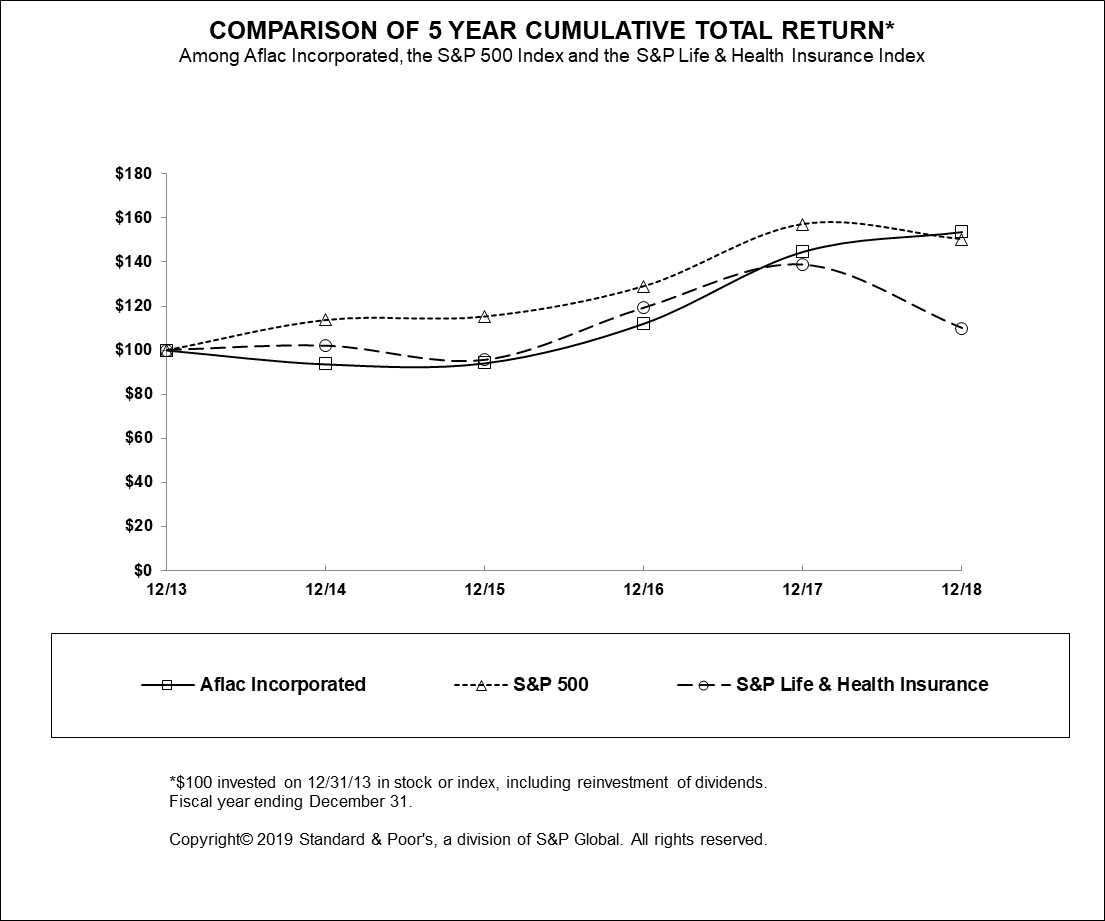
Performance Graphic Index
December 31,
| 2013 | 2014 | 2015 | 2016 | 2017 | 2018 | ||||||||||||
| Aflac Incorporated | 100.00 | 93.72 | 94.20 | 112.20 | 144.74 | 153.73 | |||||||||||
| S&P 500 | 100.00 | 113.69 | 115.26 | 129.05 | 157.22 | 150.33 | |||||||||||
| S&P Life & Health Insurance | 100.00 | 101.95 | 95.51 | 119.26 | 138.85 | 110.01 |
Copyright© 2019 Standard & Poor’s, a division of S&P Global. All rights reserved.
Issuer Purchases of Equity Securities
During the year ended December 31, 2018, we repurchased shares of Aflac common stock as follows:
| Period | Total Number of Shares Purchased | Average Price Paid Per Share | Total Number of Shares Purchased as Part of Publicly Announced Plans or Programs | Maximum Number of Shares that May Yet Be Purchased Under the Plans or Programs | |||||||||||||||||
| January 1 - January 31 | 2,370,284 | $ | 44.31 | 2,370,284 | 95,626,488 | ||||||||||||||||
| February 1 - February 28 | 2,349,600 | 44.70 | 2,349,600 | 93,276,888 | |||||||||||||||||
| March 1 - March 31 | 1,937,161 | 44.49 | 1,920,400 | 91,356,488 | |||||||||||||||||
| April 1 - April 30 | 2,082,500 | 44.62 | 2,082,500 | 89,273,988 | |||||||||||||||||
| May 1 - May 31 | 2,558,472 | 45.17 | 2,542,900 | 86,731,088 | |||||||||||||||||
| June 1 - June 30 | 2,175,100 | 44.99 | 2,175,100 | 84,555,988 | |||||||||||||||||
| July 1 - July 31 | 2,008,123 | 43.52 | 1,994,900 | 82,561,088 | |||||||||||||||||
| August 1 - August 31 | 2,358,317 | 46.64 | 2,352,500 | 80,208,588 | |||||||||||||||||
| September 1 - September 30 | 2,668,990 | 47.20 | 2,654,401 | 77,554,187 | |||||||||||||||||
| October 1 - October 31 | 2,817,600 | 44.78 | 2,817,600 | 74,736,587 | |||||||||||||||||
| November 1 - November 30 | 2,337,607 | 44.44 | 2,336,400 | 72,400,187 | |||||||||||||||||
| December 1 - December 31 | 3,382,043 | 44.03 | 3,352,300 | 69,047,887 | |||||||||||||||||
| Total | 29,045,797 | (1) | $ | 44.93 | 28,948,885 | 69,047,887 |
(1)During the year ended December 31, 2018, 96,912 shares were purchased in connection with income tax withholding obligations related to the vesting of restricted-share-based awards during the period.
As of December 31, 2018, a remaining balance of 69.0 million shares of the Company's common stock was available for purchase under share repurchase authorizations by its Board of Directors.
Item 6. SELECTED FINANCIAL DATA
Aflac Incorporated and Subsidiaries
Years Ended December 31,
| (In millions, except for share and per-share amounts) | 2018 | 2017 | 2016 | 2015 | 2014 | ||||||||||||||
| Revenues: | |||||||||||||||||||
| Net premiums, principally supplemental health insurance | $ | 18,677 | $ | 18,531 | $ | 19,225 | $ | 17,570 | $ | 19,072 | |||||||||
| Net investment income | 3,442 | 3,220 | 3,278 | 3,135 | 3,319 | ||||||||||||||
| Realized investment gains (losses) | (430 | ) | (151 | ) | (14 | ) | 106 | 282 | |||||||||||
| Other income | 69 | 67 | 70 | 61 | 55 | ||||||||||||||
| Total revenues | 21,758 | 21,667 | 22,559 | 20,872 | 22,728 | ||||||||||||||
| Benefits and expenses: | |||||||||||||||||||
| Benefits and claims, net | 12,000 | 12,181 | 12,919 | 11,746 | 12,937 | ||||||||||||||
| Expenses | 5,775 | 5,468 | 5,573 | 5,264 | 5,300 | ||||||||||||||
| Total benefits and expenses | 17,775 | 17,649 | 18,492 | 17,010 | 18,237 | ||||||||||||||
| Pretax earnings | 3,983 | 4,018 | 4,067 | 3,862 | 4,491 | ||||||||||||||
| Income taxes | 1,063 | (586 | ) | 1,408 | 1,329 | 1,540 | |||||||||||||
| Net earnings | $ | 2,920 | $ | 4,604 | $ | 2,659 | $ | 2,533 | $ | 2,951 | |||||||||
| Share and Per-Share Amounts | |||||||||||||||||||
| Net earnings (basic) | $ | 3.79 | $ | 5.81 | $ | 3.23 | $ | 2.94 | $ | 3.27 | |||||||||
| Net earnings (diluted) | 3.77 | 5.77 | 3.21 | 2.92 | 3.25 | ||||||||||||||
| Cash dividends paid | 1.04 | .87 | .83 | .79 | .75 | ||||||||||||||
| Cash dividends declared | 1.04 | .87 | .83 | .79 | .75 | ||||||||||||||
| Weighted-average common shares used for basic EPS (In thousands) | 769,588 | 792,042 | 822,942 | 861,307 | 902,408 | ||||||||||||||
| Weighted-average common shares used for diluted EPS (In thousands) | 774,650 | 797,861 | 827,841 | 866,344 | 907,999 | ||||||||||||||
| Supplemental Data | |||||||||||||||||||
| Yen/dollar exchange rate at year-end (yen) | 111.00 | 113.00 | 116.49 | 120.61 | 120.55 | ||||||||||||||
| Weighted-average yen/dollar exchange rate (yen) | 110.39 | 112.16 | 108.70 | 120.99 | 105.46 |
Prior-year amounts have been adjusted for the two*-for-one stock split of the Company’s common stock in March 2018.*
Item 6. Selected Financial Data
Aflac Incorporated and Subsidiaries
December 31,
| (In millions) | 2018 | 2017 | 2016 | 2015 | 2014 | ||||||||||||||
| Assets: | |||||||||||||||||||
| Investments and cash | $ | 126,243 | $ | 123,659 | $ | 116,361 | $ | 105,897 | $ | 107,341 | |||||||||
| Other | 14,163 | 13,558 | 13,458 | 12,359 | 12,386 | ||||||||||||||
| Total assets | $ | 140,406 | $ | 137,217 | $ | 129,819 | $ | 118,256 | $ | 119,727 | |||||||||
| Liabilities and shareholders’ equity: | |||||||||||||||||||
| Policy liabilities | $ | 103,188 | $ | 99,147 | $ | 93,726 | $ | 87,631 | $ | 83,933 | |||||||||
| Income taxes | 4,020 | 4,745 | 5,387 | 4,340 | 5,293 | ||||||||||||||
| Notes payable | 5,778 | 5,289 | 5,360 | 4,971 | 5,242 | ||||||||||||||
| Other liabilities | 3,958 | 3,438 | 4,864 | 3,606 | 6,912 | ||||||||||||||
| Shareholders’ equity | 23,462 | 24,598 | 20,482 | 17,708 | 18,347 | ||||||||||||||
| Total liabilities and shareholders’ equity | $ | 140,406 | $ | 137,217 | $ | 129,819 | $ | 118,256 | $ | 119,727 |
Prior-year amounts have been adjusted for the adoption of accounting guidance on January 1, 2016 related to debt issuance costs.
Item 7. Management's Discussion and Analysis of Financial Condition and Results of Operations
Item 7. MANAGEMENT’S DISCUSSION AND ANALYSIS OF FINANCIAL CONDITION AND RESULTS OF
OPERATIONS
FORWARD-LOOKING INFORMATION
The Private Securities Litigation Reform Act of 1995 provides a “safe harbor” to encourage companies to provide prospective information, so long as those informational statements are identified as forward-looking and are accompanied by meaningful cautionary statements identifying important factors that could cause actual results to differ materially from those included in the forward-looking statements. The Company desires to take advantage of these provisions. This report contains cautionary statements identifying important factors that could cause actual results to differ materially from those projected herein, and in any other statements made by Company officials in communications with the financial community and contained in documents filed with the Securities and Exchange Commission (SEC). Forward-looking statements are not based on historical information and relate to future operations, strategies, financial results or other developments. Furthermore, forward-looking information is subject to numerous assumptions, risks and uncertainties. In particular, statements containing words such as the following or similar words as well as specific projections of future results, generally qualify as forward-looking. Aflac undertakes no obligation to update such forward-looking statements.
| • expect | • anticipate | • believe | • goal | • objective |
| • may | • should | • estimate | • intends | • projects |
| • will | • assumes | • potential | • target | • outlook |
The Company cautions readers that the following factors, in addition to other factors mentioned from time to time, could cause actual results to differ materially from those contemplated by the forward-looking statements:
| • | difficult conditions in global capital markets and the economy |
| • | exposure to significant interest rate risk |
| • | concentration of business in Japan |
| • | foreign currency fluctuations in the yen/dollar exchange rate |
| • | limited availability of acceptable yen-denominated investments |
| • | U.S. tax audit risk related to conversion of the Japan branch to a subsidiary |
| • | deviations in actual experience from pricing and reserving assumptions |
| • | ability to continue to develop and implement improvements in information technology systems |
| • | competitive environment and ability to anticipate and respond to market trends |
| • | ability to protect the Aflac brand and the Company's reputation |
| • | ability to attract and retain qualified sales associates, brokers, employees, and distribution partners |
| • | interruption in telecommunication, information technology and other operational systems, or a failure to maintain the security, confidentiality or privacy of sensitive data residing on such systems |
| • | failure to comply with restrictions on patient privacy and information security |
| • | extensive regulation and changes in law or regulation by governmental authorities |
| • | tax rates applicable to the Company may change |
| • | defaults and credit downgrades of investments |
| • | decline in creditworthiness of other financial institutions |
| • | significant valuation judgments in determination of amount of impairments taken on the Company's investments |
| • | subsidiaries' ability to pay dividends to the Parent Company |
| • | decreases in the Company's financial strength or debt ratings |
| • | inherent limitations to risk management policies and procedures |
| • | concentration of the Company's investments in any particular single-issuer or sector |
| • | differing judgments applied to investment valuations |
| • | ability to effectively manage key executive succession |
| • | catastrophic events including, but not necessarily limited to, epidemics, pandemics, tornadoes, hurricanes, earthquakes, tsunamis, war or other military action, terrorism or other acts of violence, and damage incidental to such events |
| • | changes in accounting standards |
| • | increased expenses and reduced profitability resulting from changes in assumptions for pension and other postretirement benefit plans |
| • | level and outcome of litigation |
| • | allegations or determinations of worker misclassification in the United States |
Item 7. Management's Discussion and Analysis of Financial Condition and Results of Operations
MD&A OVERVIEW
Management's Discussion and Analysis of Financial Condition and Results of Operations (MD&A) is intended to inform the reader about matters affecting the financial condition and results of operations of Aflac Incorporated and its subsidiaries for the three-year period ended December 31, 2018. As a result, the following discussion should be read in conjunction with the related consolidated financial statements and notes. This MD&A is divided into the following sections:
| Page | |
| The Company’s Business | 40 |
| Performance Highlights | 40 |
| Critical Accounting Estimates | 42 |
| Results of Operations | 47 |
| Insurance Operations | 51 |
| Analysis of Financial Condition | 61 |
| Capital Resources and Liquidity | 70 |
THE COMPANY'S BUSINESS
Aflac Incorporated (the Parent Company) and its subsidiaries (collectively, the Company) primarily sell supplemental health and life insurance in the United States and Japan. The Company's insurance business is marketed and administered through American Family Life Assurance Company of Columbus (Aflac) in the United States (Aflac U.S.) and, effective April 1, 2018, through Aflac Life Insurance Japan Ltd. in Japan (Aflac Japan). Prior to April 1, 2018, the Company's insurance business was marketed in Japan as a branch of Aflac. (For more information about the conversion of Aflac Japan to a legal subsidiary, see the Insurance Operations subsection of this MD&A). American Family Life Assurance Company of New York (Aflac New York) is a wholly owned subsidiary of Aflac. Most of Aflac's policies are individually underwritten and marketed through independent agents. Additionally, Aflac U.S. markets and administers group products through Continental American Insurance Company (CAIC), branded as Aflac Group Insurance. The Company's insurance operations in the United States and Japan service the two markets for the Company's insurance business.
For more information on the Company's business, see Business, Part I, Item 1 of this report.
PERFORMANCE HIGHLIGHTS
Yen-denominated income statement accounts are translated to U.S. dollars using a weighted-average Japanese yen/U.S. dollar foreign exchange rate, while yen-denominated balance sheet accounts are translated to U.S. dollars using a spot Japanese yen/U.S.
Showing the first 8K of 191K characters. Open the full section
Item 7A. QUANTITATIVE AND QUALITATIVE DISCLOSURES ABOUT MARKET RISK
The Company is exposed primarily to the following types of market risks: currency risk, interest rate risk, credit risk and equity risk. Fluctuations in these factors could impact the Company’s consolidated results of operations or financial condition. The Company regularly monitors its market risks and uses a variety of strategies to manage its exposure
to these market risks.
Currency Risk
Aflac Japan
The functional currency of Aflac Japan's insurance operations is the Japanese yen. Aflac Japan’s premiums and a significant portion of its investment income are received in yen, and its claims and most expenses are paid in yen. Aflac Japan purchases yen-denominated assets and U.S. dollar-denominated assets, which may be hedged to yen, to support yen-denominated policy liabilities. These and other yen-denominated financial statement items are, however, translated into U.S. dollars for financial reporting purposes. Most of Aflac Japan's cash and liabilities are yen-denominated.
Item 7A. Quantitative and Qualitative Disclosures About Market Risk
As discussed above in the Investment subsection of Item 1, Business, the Company engages in hedging activities to mitigate certain currency risks from holding U.S. dollar-denominated investments in Aflac Japan. However, this hedging program in turn poses a countervailing long-term risk of loss on hedging currency derivatives under the long-term scenario of weakening yen, and related derivative rollover risk that could amplify hedge cost in unfavorable market conditions and significantly increase liquidity requirements to support negative derivative settlements. Additionally, as discussed in detail in the Risk Factors section titled “Lack of availability of acceptable yen-denominated investments could adversely affect the Company’s results of operations, financial position or liquidity,” there is a risk that losses realized on derivative settlements during periods of weakening yen may not be recouped through realization of the corresponding holding currency gains on the hedged U.S. dollar-denominated investments if these investments are not ultimately converted to yen. The following table details Aflac Japan's portfolio allocation by currency as of December 31.
Japan Segment Portfolio Allocation by Currency
| (In millions) | 2018 | 2017 | |||||||||||||
| Amortized Cost | Fair Value | Amortized Cost | Fair Value | ||||||||||||
| USD program | $ | 24,435 | $ | 24,258 | $ | 22,432 | $ | 23,716 | |||||||
| Fixed maturity securities - economically converted to yen | 1,679 | 2,269 | 1,650 | 2,549 | |||||||||||
| Total dollar-denominated investments | 26,114 | 26,527 | 24,082 | 26,265 | |||||||||||
| Total yen-denominated investments | 74,974 | 86,251 | 72,369 | 84,379 | |||||||||||
| Total | $ | 101,088 | $ | 112,778 | $ | 96,451 | $ | 110,644 |
As of December 31, 2018, Aflac Japan had $9.9 billion outstanding notional amounts of foreign currency forwards and $9.5 billion outstanding notional amounts of foreign currency options, of which none were in-the-money, hedging the U.S. dollar-denominated investments (USD Program). The fair value of Aflac Japan's unhedged U.S. dollar-denominated portfolio was $14.4 billion (excluding certain U.S. dollar-denominated assets shown in the table above as a result of consolidation that have been economically converted to yen using derivatives).
As noted above, in late 2017, the Company took steps to refine the strategy to mitigate currency exposure of Aflac Japan from U.S. dollar-denominated investments while balancing the consideration of the stressed economic surplus in Aflac Japan. This refinement in strategy resulted in an increased amount of the unhedged U.S. dollar-denominated investments held in Aflac Japan while at the same time mitigating hedge cost increases. Generally, Aflac Japan’s exposure to the currency risk increases when its portfolio of unhedged U.S. dollar-denominated investments increases. This increases the volatility of the SMR and FSA earnings and may result in an adverse impact on these regulatory measures when yen appreciates relatively to U.S. dollar. This in turn may reduce Aflac Japan’s dividend capacity, as well as increase the level of capital needed to support increased SMR volatility. The adverse impact on the regulatory measures could be amplified by regulatory accounting rules requiring impairment loss recognition on prolonged significant declines in U.S. dollar relative to yen. Furthermore, under the scenario where unhedged U.S. dollar-denominated investments are needed to pay Aflac Japan’s yen-denominated obligations, they would have to be converted to yen, which could force realization of the then potential currency losses. As the value of the U.S. dollar-denominated investment portfolio in Aflac Japan fluctuates and the Company’s business model evolves, the Company periodically reevaluates this size of the unhedged portfolio and may accordingly adjust up or down its currency hedging targets.
Aflac Inc.
The Company is exposed to currency risk as an economic event when yen funds are actually converted into U.S. dollars. This occurs when yen-denominated funds are paid as dividends and management fees from Aflac Japan to the Parent Company and with quarterly settlements of its reinsurance retrocession transactions. The exchange rates prevailing at the time of yen payments will differ from the exchange rates prevailing at the time the yen profits were earned. A portion of the yen dividend and management fee payments may be used to service Aflac Incorporated's yen-denominated notes payable with the remainder converted into U.S. dollars.
In addition to yen payments and the reinsurance retrocessions, certain investment activities for Aflac Japan expose the Company to economic currency risk when yen are converted into U.S. dollars. As noted above, the Company invests a portion of its yen cash flows in U.S. dollar-denominated assets. This requires that the Company convert the yen cash flows to U.S. dollars before investing. As previously discussed, for certain of its U.S. dollar-denominated securities, the Company enters into foreign currency forward and option contracts to hedge the currency risk on the fair value of hedged
Item 7A. Quantitative and Qualitative Disclosures About Market Risk
investments. In 2018, the Parent Company entered into forward contracts to accomplish a dual objective of hedging foreign currency rate risk to dividend payments by Aflac Japan, and reducing enterprise-wide hedge costs. If the markets experience a significant strengthening of yen, this could cause cash strain at the Parent Company as a result of cash collateral and potentially cash settlement requirements. Based on the timing and severity of exchange rate fluctuations combined with the level of outstanding activity in this program, the cash strain at the Parent Company could be significant.
Aside from the activities discussed above, the Company generally does not convert yen into U.S. dollars; however, it does translate financial statement amounts from yen into U.S. dollars for financial reporting purposes. Therefore, reported amounts are affected by foreign currency fluctuations. The Company reports unrealized foreign currency translation gains and losses in accumulated other comprehensive income. In periods when the yen weakens against the dollar, translating yen into dollars causes fewer dollars to be reported. When the yen strengthens, translating yen into U.S. dollars causes more U.S. dollars to be reported. The weakening of the yen relative to the U.S. dollar will generally adversely affect the value of the Company's yen-denominated investments in U.S. dollar terms. The Company also considers the stressed economic surplus in Aflac Japan and related exposure to foreign currency. The Company manages this currency risk by investing a portion of Aflac Japan's investment portfolio in U.S. dollar-denominated securities and by the Parent Company's issuance of yen-denominated debt (for additional information, see the discussion under the Investments subsection within Item 1, Business). As a result, the effect of currency fluctuations on the Company's net assets is reduced.
The following table demonstrates the effect of foreign currency fluctuations by presenting the dollar values of the Company's yen-denominated assets and liabilities, and its consolidated yen-denominated net asset exposure at selected exchange rates as of December 31.
Item 7A. Quantitative and Qualitative Disclosures About Market Risk
Dollar Value of Yen-Denominated Assets and Liabilities
at Selected Exchange Rates
| (In millions) | 2018 | 2017 | ||||||||||||||||||||||
| Yen/dollar exchange rates | 96.00 | 111.00 (1) | 126.00 | 98.00 | 113.00*(1)* | 128.00 | ||||||||||||||||||
| Yen-denominated financial instruments: | ||||||||||||||||||||||||
| Assets: | ||||||||||||||||||||||||
| Securities available for sale: | ||||||||||||||||||||||||
| Fixed maturity securities (2) | $ | 55,600 | $ | 48,086 | $ | 42,362 | $ | 51,504 | $ | 44,666 | $ | 39,433 | ||||||||||||
| Fixed maturity securities - consolidated variable interest entities (3) | 941 | 814 | 717 | 1,089 | 944 | 834 | ||||||||||||||||||
| Securities held to maturity: | ||||||||||||||||||||||||
| Fixed maturity securities | 35,055 | 30,318 | 26,709 | 36,240 | 31,430 | 27,747 | ||||||||||||||||||
| Equity securities | 742 | 641 | 565 | 126 | 109 | 96 | ||||||||||||||||||
| Equity securities - consolidated variable interest entities | 0 | 0 | 0 | 675 | 586 | 517 | ||||||||||||||||||
| Cash and cash equivalents | 988 | 855 | 753 | 222 | 193 | 170 | ||||||||||||||||||
| Derivatives | 2,712 | 417 | 949 | 1,961 | 331 | 528 | ||||||||||||||||||
| Other financial instruments | 253 | 219 | 192 | 228 | 198 | 175 | ||||||||||||||||||
| Subtotal | 96,291 | 81,350 | 72,247 | 92,045 | 78,457 | 69,500 | ||||||||||||||||||
| Liabilities: | ||||||||||||||||||||||||
| Notes payable | 2,120 | 1,831 | 1,615 | 1,535 | 1,331 | 1,175 | ||||||||||||||||||
| Derivatives | 1,318 | 387 | 2,138 | 516 | 474 | 2,177 | ||||||||||||||||||
| Subtotal | 3,438 | 2,218 | 3,753 | 2,051 | 1,805 | 3,352 | ||||||||||||||||||
| Net yen-denominated financial instruments | 92,853 | 79,132 | 68,494 | 89,994 | 76,652 | 66,148 | ||||||||||||||||||
| Other yen-denominated assets | 10,795 | 9,336 | 8,225 | 9,406 | 8,157 | 7,201 | ||||||||||||||||||
| Other yen-denominated liabilities | 113,994 | 98,590 | 86,853 | 107,761 | 93,456 | 82,504 | ||||||||||||||||||
| Consolidated yen-denominated net assets (liabilities) subject to foreign currency fluctuation*(2)* | $ | (10,346 | ) | $ | (10,122 | ) | $ | (10,134 | ) | $ | (8,361 | ) | $ | (8,647 | ) | $ | (9,155 | ) |
(1) Actual period-end exchange rate
(2) Does not include the U.S. dollar-denominated corporate bonds for which the Company has entered into foreign currency derivatives as discussed in the Aflac Japan Investment subsection of MD&A
(3) Does not include U.S. dollar-denominated bonds that have corresponding cross-currency swaps in consolidated VIEs
The Company is required to consolidate certain VIEs. Some of the consolidated VIEs in Aflac Japan's portfolio use foreign currency swaps to convert foreign denominated cash flows to yen, the functional currency of Aflac Japan, in order to minimize cash flow fluctuations. Foreign currency swaps exchange an initial principal amount in two currencies, agreeing to re-exchange the currencies at a future date, at an agreed upon exchange rate. There may also be periodic exchanges of payments at specified intervals based on the agreed upon rates and notional amounts. Prior to consolidation, the Company's beneficial interest in these VIEs was a yen-denominated available-for-sale fixed maturity security. Upon consolidation, the original yen-denominated investment was derecognized and the underlying fixed maturity securities and cross-currency swaps were recognized. The combination of a U.S. dollar-denominated investment and cross-currency swap economically creates a yen-denominated investment and has no impact on the Company's net investment hedge position.
Similarly, the combination of the U.S. corporate bonds and the foreign currency forwards and options that the Company has entered into, as discussed in the Aflac Japan Investment subsection of MD&A, economically creates a yen-denominated investment that qualifies for inclusion as a component of the Company's investment in Aflac Japan for net investment hedge purposes.
For additional information regarding the Company's Aflac Japan net investment hedge, see the Hedging Activities subsection of MD&A.
Item 7A. Quantitative and Qualitative Disclosures About Market Risk
Interest Rate Risk
The Company's primary interest rate exposure is to the impact of changes in interest rates on the fair value of its investments in debt securities. The Company monitors its investment portfolio on a quarterly basis utilizing a full valuation methodology, measuring price volatility, and sensitivity of the fair values of its investments to interest rate changes on the debt securities the Company owns. For example, if the current duration of a debt security is 10 years, then the fair value of that security will increase by approximately 10% if market interest rates decrease by 100 basis points, assuming all other factors remain constant. Likewise, the fair value of the debt security will decrease by approximately 10% if market interest rates increase by 100 basis points, assuming all other factors remain constant.
The estimated effect of potential increases in interest rates on the fair values of debt securities the Company owns; derivatives, excluding credit default swaps, and notes payable as of December 31 follows:
Sensitivity of Fair Values of Financial Instruments
to Interest Rate Changes
| 2018 | 2017 | ||||||||||||||||||||
| (In millions) | Fair Value | +100 Basis Points | Fair Value | +100 Basis Points | |||||||||||||||||
| Assets: | |||||||||||||||||||||
| Debt securities: | |||||||||||||||||||||
| Fixed maturity securities: | |||||||||||||||||||||
| Yen-denominated | $ | 85,622 | $ | 73,673 | $ | 83,682 | $ | 72,146 | |||||||||||||
| Dollar-denominated | 33,995 | 31,327 | 38,703 | 35,518 | |||||||||||||||||
| Total debt securities | $ | 119,617 | $ | 105,000 | $ | 122,385 | $ | 107,664 | |||||||||||||
| Loans and loan receivables*(1)* | $ | 6,893 | $ | 6,834 | $ | 2,987 | $ | 2,932 | |||||||||||||
| Derivatives | $ | 417 | $ | 614 | $ | 330 | $ | 533 | |||||||||||||
| Liabilities: | |||||||||||||||||||||
| Notes payable*(2)* | $ | 5,876 | $ | 5,415 | $ | 5,553 | $ | 4,900 | |||||||||||||
| Derivatives | 387 | 422 | 474 | 293 |
*(1)*Includes TREs, CMLs and MMLs, excludes policy loans
*(2)*Excludes capitalized lease obligations
There are various factors that affect the fair value of the Company's investment in debt securities. Included in those factors are changes in the prevailing interest rate environment, which directly affect the balance of unrealized gains or losses for a given period in relation to a prior period. Decreases in market yields generally improve the fair value of debt securities, while increases in market yields generally have a negative impact on the fair value of the Company's debt securities. However, the Company does not expect to realize a majority of any unrealized gains or losses. For additional information on unrealized losses on debt securities, see Note 3 of the Notes to the Consolidated Financial Statements.
The Company attempts to match the duration of its assets with the duration of its liabilities. The following table presents the approximate duration of Aflac Japan's yen-denominated assets and liabilities, along with premiums, as of December 31.
| (In years) | 2018 | 2017 | ||||
| Yen-denominated debt securities | 16 | 15 | ||||
| Policy benefits and related expenses to be paid in future years | 15 | 14 | ||||
| Premiums to be received in future years on policies in force | 10 | 10 |
Item 7A. Quantitative and Qualitative Disclosures About Market Risk
The following table presents the approximate duration of Aflac U.S. dollar-denominated assets and liabilities, along with premiums, as of December 31.
| (In years) | 2018 | 2017 | ||||
| Dollar-denominated debt securities | 9 | 10 | ||||
| Policy benefits and related expenses to be paid in future years | 8 | 8 | ||||
| Premiums to be received in future years on policies in force | 6 | 6 |
The following table shows a comparison of average required interest rates for future policy benefits and investment yields, based on amortized cost, for the years ended December 31.
Comparison of Interest Rates for Future Policy Benefits
and Investment Yields
(Net of Investment Expenses)
| 2018 | 2017 | 2016 | ||||||||||||||||||||||
| U.S. | Japan | U.S. | Japan | U.S. | Japan | |||||||||||||||||||
| Policies issued during year: | ||||||||||||||||||||||||
| Required interest on policy reserves | 3.69 | % | 1.00 | % | (1) | 3.69 | % | 1.10 | % | (1) | 3.67 | % | 1.38 | % | (1) | |||||||||
| New money yield on investments | 4.44 | 2.94 | 4.41 | 1.88 | 3.81 | 1.30 | ||||||||||||||||||
| Policies in force at year-end: | ||||||||||||||||||||||||
| Required interest on policy reserves | 5.34 | 3.29 | (1) | 5.43 | 3.38 | (1) | 5.51 | 3.49 | (1) | |||||||||||||||
| Portfolio book yield, end of period | 5.44 | 2.49 | 5.44 | 2.46 | 5.52 | 2.52 |
*(1)*Represents investments for Aflac Japan that support policy obligations and therefore excludes Aflac Japan’s annuity products
The Company continues to monitor the spread between its new money yield and the required interest assumption for newly issued products in both the United States and Japan and will re-evaluate those assumptions as necessary. Currently, when investments the Company owns mature, the proceeds may be reinvested at a yield below that of the interest required for the accretion of policy benefit liabilities on policies issued in earlier years. Overall, adequate profit margins exist in Aflac Japan's aggregate block of business because of changes in the mix of business and favorable experience from mortality, morbidity and expenses.
Periodically, the Company may enter into derivative transactions to hedge interest rate risk, depending on general economic conditions.
For further information on interest rate derivatives, see Note 4 of the accompanying Notes to the Consolidated Financial Statements.
Credit Risk
A significant portion of the Company's investment portfolio consists of debt securities and loans that expose it to the credit risk of the underlying issuer or borrower. The Company carefully evaluates this risk on every new investment and closely monitors the credit risk of its existing investment portfolio. The Company incorporates the needs of its products and liabilities, the overall requirements of the business, and other factors in addition to its underwriting of the credit risk for each investment in the portfolio.
Evaluating the underlying risks in the Company's credit portfolio involves a multitude of factors including but not limited to its assessment of the issuer's or borrower's business activities, assets, products, market position, financial condition, and future prospects. The Company incorporates the assessment of the NRSROs in assigning credit ratings and incorporates the rating methodologies of its specialist external managers in assigning loan ratings to portfolio holdings. The Company performs extensive internal assessments of the credit risks for all its portfolio holdings and potential new investments, which includes using analyses provided by the Company's specialist external managers. For assets managed by external asset managers, the Company provides investment and credit risk parameters that must be used when making investment decisions and require ongoing monitoring and reporting from the asset managers on significant changes in credit risks within the portfolio.
Item 7A. Quantitative and Qualitative Disclosures About Market Risk
Investment Concentrations
The Company's 15 largest global investment exposures were as follows:
Largest Global Investment Positions
(In millions)
December 31, 2018
| Total | % of Total | ||||||||||
| No. | Consolidated Corporate/Sovereign Exposure | Consolidated | Fixed Maturity | Credit | |||||||
| Book Value | Securities | Rating | |||||||||
| 1 | Japan National Government (1) | $ | 51,207 | 47.78 | % | A+ | |||||
| 2 | Bank of America NA | 411 | .38 | ||||||||
| Bank of America Corp. | 231 | .21 | A- | ||||||||
| Bank of America Corp. | 180 | .17 | BBB+ | ||||||||
| 3 | Bank of Tokyo-Mitsubishi UFJ Ltd. | 405 | .38 | A- | |||||||
| 4 | Investcorp SA | 383 | .36 | BB | |||||||
| 5 | Republic of South Africa | 360 | .34 | BB+ | |||||||
| 6 | Banobras | 333 | .31 | BBB+ | |||||||
| 7 | Nordea Bank AB | 302 | .28 | ||||||||
| Nordea Bank AB | 231 | .21 | A- | ||||||||
| Nordea Bank AB | 71 | .07 | BBB+ | ||||||||
| 8 | AXA | 293 | .27 | BBB+ | |||||||
| 9 | Deutsche Telekom AG | 291 | .27 | BBB+ | |||||||
| 10 | Japan Expswy Hld and Debt | 291 | .27 | A+ | |||||||
| 11 | CFE | 287 | .27 | BBB+ | |||||||
| 12 | AT&T Inc. | 281 | .27 | BBB | |||||||
| 13 | Czech Republic | 270 | .25 | A+ | |||||||
| 14 | Investor AB | 270 | .25 | AA- | |||||||
| 15 | Petroleos Mexicanos (Pemex) | 270 | .25 | BBB+ | |||||||
| Subtotal | $ | 55,654 | 51.93 | % | |||||||
| Total fixed maturity securities | $ | 107,174 | 100.00 | % |
*(1)*JGBs or JGB-backed securities
As previously disclosed, the Company owns long-dated debt instruments in support of its long-dated policyholder obligations. Some of the Company's largest global investment holdings are positions that were purchased many years ago and increased in size due to merger and consolidation activity among the issuing entities. In addition, many of the Company's largest holdings are yen-denominated, therefore strengthening of the yen can increase its position in dollars, and weakening of the yen can decrease its position in dollars. The Company's global investment guidelines establish concentration limits for its investment portfolios.
Geographical Exposure
The following table indicates the geographic exposure of the Company's debt securities as of December 31.
Item 7A. Quantitative and Qualitative Disclosures About Market Risk
| 2018 | 2017 | |||||||||||||
| (In millions) | Amortized Cost | % of Total | Amortized Cost | % of Total | ||||||||||
| Japan | $ | 55,486 | 51.8 | % | $ | 51,983 | 48.8 | % | ||||||
| United States and Canada (1) | 29,371 | 27.4 | 31,052 | 29.1 | ||||||||||
| United Kingdom | 3,038 | 2.8 | 2,603 | 2.4 | ||||||||||
| Germany | 2,179 | 2.0 | 2,323 | 2.2 | ||||||||||
| France | 2,030 | 1.9 | 1,983 | 1.9 | ||||||||||
| Peripheral Eurozone | 2,165 | 2.0 | 2,312 | 2.2 | ||||||||||
| Portugal | 215 | .2 | 211 | .2 | ||||||||||
| Italy | 1,261 | 1.2 | 1,261 | 1.2 | ||||||||||
| Ireland | 29 | .0 | 32 | .0 | ||||||||||
| Spain | 660 | .6 | 808 | .8 | ||||||||||
| Nordic Region | 1,615 | 1.6 | 1,611 | 1.5 | ||||||||||
| Sweden | 779 | .7 | 725 | .7 | ||||||||||
| Norway | 378 | .4 | 451 | .4 | ||||||||||
| Denmark | 270 | .3 | 177 | .2 | ||||||||||
| Finland | 188 | .2 | 258 | .2 | ||||||||||
| Other Europe | 2,425 | 2.3 | 2,489 | 2.3 | ||||||||||
| Netherlands | 1,206 | 1.1 | 1,183 | 1.1 | ||||||||||
| Switzerland | 258 | .2 | 307 | .3 | ||||||||||
| Czech Republic | 451 | .5 | 442 | .4 | ||||||||||
| Austria | 125 | .1 | 123 | .1 | ||||||||||
| Belgium | 178 | .2 | 168 | .1 | ||||||||||
| Poland | 180 | .2 | 177 | .2 | ||||||||||
| Luxembourg | 27 | .0 | 89 | .1 | ||||||||||
| Asia excluding Japan | 2,722 | 2.5 | 3,408 | 3.2 | ||||||||||
| Africa and Middle East | 2,018 | 1.9 | 2,460 | 2.3 | ||||||||||
| Latin America | 2,153 | 2.0 | 2,318 | 2.2 | ||||||||||
| Australia | 1,620 | 1.5 | 1,572 | 1.5 | ||||||||||
| All Others | 352 | .3 | 448 | .4 | ||||||||||
| Total fixed maturity securities | $ | 107,174 | 100.0 | % | $ | 106,562 | 100.0 | % |
(1) Includes total exposure to Puerto Rico of $1 million of required deposits at both December 31, 2018 and 2017, respectively, of which 100% had principal and interest insurance at both December 31, 2018 and 2017, respectively.
The primary factor considered when determining the domicile of investment exposure is the legal country risk location of the issuer. However, other factors such as the location of the parent guarantor, the location of the company's headquarters or major business operations (including location of major assets), location of primary market (including location of revenue generation) and specific country risk publicly recognized by rating agencies can influence the assignment of the country (or geographic) risk location. When the issuer is a special financing vehicle or a branch or subsidiary of a global company, then the Company considers any guarantees and/or legal, regulatory and corporate relationships of the issuer relative to its ultimate parent in determining the proper assignment of country risk.
Item 7A. Quantitative and Qualitative Disclosures About Market Risk
Derivative Counterparties
The Company is a direct counterparty to the foreign currency swaps that it has entered into in connection with certain of its senior notes and subordinated debentures; foreign currency forwards; foreign currency options; and interest rate swaptions, therefore the Company is exposed to credit risk in the event of nonperformance by the counterparties in those contracts. For the foreign currency and credit default swaps associated with the Company's VIE investments for which it is the primary beneficiary, the Company bears the risk of foreign exchange and/or credit loss due to counterparty default even though it is not a direct counterparty to those contracts. The risk of counterparty default for the Company's VIE and senior note and subordinated debenture swaps, foreign currency swaps, certain foreign currency forwards, foreign currency options and interest rate swaptions is mitigated by collateral posting requirements that counterparties to those transactions must meet. If collateral posting agreements are not in place, the counterparty risk associated with foreign currency forwards and foreign currency options is the risk that at expiry of the contract, the counterparty is unable to deliver the agreed upon amount of yen at the agreed upon price or delivery date, thus exposing the Company to additional unhedged exposure to U.S. dollars in the Aflac Japan investment portfolio. See Note 4 of the accompanying Notes to the Consolidated Financial Statements for more information.
Equity Risk
Market prices for equity securities are subject to fluctuation and consequently the amount realized in the subsequent sale of an investment may significantly differ from the reported market value. Fluctuation in the market price of a security may result from the relative price of alternative investments and general market conditions. If equity prices experienced a hypothetical broad-based decline of 10%, the fair value of the Company's equity investments would decline by approximately $99 million.
Item 8. FINANCIAL STATEMENTS AND SUPPLEMENTARY DATA
Management's Annual Report on Internal Control Over Financial Reporting
Management is responsible for establishing and maintaining adequate internal control over financial reporting, as such term is defined in Rule 13a-15(f) under the Exchange Act. Under the supervision and with the participation of our management, including our principal executive officer and principal financial officer, we conducted an evaluation of the effectiveness of our internal control over financial reporting based on the framework in Internal Control - Integrated Framework issued by the Committee of Sponsoring Organizations of the Treadway Commission (COSO) in 2013. Based on our evaluation under this framework, management has concluded that our internal control over financial reporting was effective as of December 31, 2018.
KPMG LLP, an independent registered public accounting firm, has issued an attestation report on the effectiveness of internal control over financial reporting as of December 31, 2018, which is included herein.
Item 8. Financial Statements and Supplementary Data
Report of Independent Registered Public Accounting Firm
To the Shareholders and Board of Directors
Aflac Incorporated:
Opinion on Internal Control Over Financial Reporting
We have audited Aflac Incorporated and subsidiaries’ (the “Company”) internal control over financial reporting as of December 31, 2018, based on criteria established in Internal Control - Integrated Framework (2013) issued by the Committee of Sponsoring Organizations of the Treadway Commission. In our opinion, the Company maintained, in all material respects, effective internal control over financial reporting as of December 31, 2018, based on criteria established in Internal Control - Integrated Framework (2013) issued by the Committee of Sponsoring Organizations of the Treadway Commission.
We also have audited, in accordance with the standards of the Public Company Accounting Oversight Board (United States) (“PCAOB”), the consolidated balance sheets of the Company as of December 31, 2018 and 2017, the related consolidated statements of earnings, comprehensive income (loss), shareholders’ equity, and cash flows for each of the years in the three-year period ended December 31, 2018, and the related notes and financial statement schedules II, III, and IV (collectively, the “consolidated financial statements”), and our report dated February 25, 2019 expressed an unqualified opinion on those consolidated financial statements.
Basis for Opinion
The Company’s management is responsible for maintaining effective internal control over financial reporting and for its assessment of the effectiveness of internal control over financial reporting, included in the accompanying Management's Annual Report on Internal Control Over Financial Reporting. Our responsibility is to express an opinion on the Company’s internal control over financial reporting based on our audit. We are a public accounting firm registered with the PCAOB and are required to be independent with respect to the Company in accordance with the U.S. federal securities laws and the applicable rules and regulations of the Securities and Exchange Commission and the PCAOB.
We conducted our audit in accordance with the standards of the PCAOB. Those standards require that we plan and perform the audit to obtain reasonable assurance about whether effective internal control over financial reporting was maintained in all material respects. Our audit of internal control over financial reporting included obtaining an understanding of internal control over financial reporting, assessing the risk that a material weakness exists, and testing and evaluating the design and operating effectiveness of internal control based on the assessed risk. Our audit also included performing such other procedures as we considered necessary in the circumstances. We believe that our audit provides a reasonable basis for our opinion.
Definition and Limitations of Internal Control Over Financial Reporting
A company’s internal control over financial reporting is a process designed to provide reasonable assurance regarding the reliability of financial reporting and the preparation of financial statements for external purposes in accordance with generally accepted accounting principles. A company’s internal control over financial reporting includes those policies and procedures that (1) pertain to the maintenance of records that, in reasonable detail, accurately and fairly reflect the transactions and dispositions of the assets of the company; (2) provide reasonable assurance that transactions are recorded as necessary to permit preparation of financial statements in accordance with generally accepted accounting principles, and that receipts and expenditures of the company are being made only in accordance with authorizations of management and directors of the company; and (3) prov
Showing the first 8K of 402K characters. Open the full section
Item 9. CHANGES IN AND DISAGREEMENTS WITH ACCOUNTANTS ON ACCOUNTING AND FINANCIAL
DISCLOSURE
There have been no changes in, or disagreements with, accountants on accounting and financial disclosure matters during the years ended December 31, 2018 and 2017.
Item 9A. CONTROLS AND PROCEDURES
Disclosure Controls and Procedures
The Company's management, with the participation of the Company's Chief Executive Officer and Chief Financial Officer, has evaluated the effectiveness of the Company's disclosure controls and procedures (as such term is defined in Rules 13a-15(e) and 15d-15(e) under the Exchange Act) as of the end of the period covered by this annual report (the “Evaluation Date”). Based on such evaluation, the Company's Chief Executive Officer and Chief Financial Officer have concluded that, as of the Evaluation Date, the Company's disclosure controls and procedures are effective.
Internal Control Over Financial Reporting
(a) Management's Annual Report on Internal Control Over Financial Reporting
Management's Annual Report on Internal Control Over Financial Reporting is incorporated herein by reference from Part II, Item 8 of this report.
(b) Attestation Report of the Registered Public Accounting Firm
The Attestation Report of the Registered Public Accounting Firm on the Company's internal control over financial reporting is incorporated herein by reference from Part II, Item 8 of this report.
(c) Changes in Internal Control Over Financial Reporting
There have not been any changes in the Company's internal control over financial reporting (as such term is defined in Rules 13a-15(f) and 15d-15(f) under the Exchange Act) during the last fiscal quarter of 2018 that have materially affected, or are reasonably likely to materially affect, the Company's internal control over financial reporting.
Item 9B. OTHER INFORMATION
Not applicable.
Item 10. Directors, Executive Officers and Corporate Governance
PART III
Pursuant to General Instruction G to Form 10-K, Items 10 through 14 are incorporated by reference from the Company's definitive Notice and Proxy Statement relating to the Company's 2019 Annual Meeting of Shareholders, which will be filed with the Securities and Exchange Commission on or about March 22, 2019, pursuant to Regulation 14A under the Exchange Act. The Audit Committee Report and Compensation Committee Report to be included in such proxy statement shall be deemed to be furnished in this report and shall not be incorporated by reference into any filing under the Securities Act of 1933 as a result of such furnishing in Items 10 and 11, respectively.
| Refer to the Information Contained in the Proxy Statement under Captions (filed electronically) | ||
| Item 10. DIRECTORS, EXECUTIVE OFFICERS AND CORPORATE GOVERNANCE Executive Officers - see Part I, Item 1 herein 1. Election of Directors; Section 16(a) Beneficial Ownership Reporting Compliance; Audit and Risk Committee; Audit and Risk Committee Report; Director Nominating Process; and Code of Business Conduct and Ethics |
| Item 11. EXECUTIVE COMPENSATION Director Compensation; Compensation Committee; Compensation Committee Report; Compensation Discussion and Analysis; 2018 Summary Compensation Table; 2018 Grants of Plan-Based Awards; 2018 Outstanding Equity Awards at Fiscal Year-End; 2018 Option Exercises and Stock Vested; Pension Benefits; Nonqualified Deferred Compensation; Potential Payments Upon Termination or Change-In-Control; and Compensation Committee Interlocks and Insider Participation |
| Item 12. SECURITY OWNERSHIP OF CERTAIN BENEFICIAL OWNERS AND MANAGEMENT AND RELATED STOCKHOLDER MATTERS Principal Shareholders; Election of Directors (Proposal 1); Security Ownership of Management; and Equity Compensation Plan Information |
Item 13. CERTAIN RELATIONSHIPS AND RELATED TRANSACTIONS, AND DIRECTOR INDEPENDENCE Related Person Transactions; and Director Independence
| Item 14. PRINCIPAL ACCOUNTING FEES AND SERVICES Ratification of Appointment of Independent Registered Public Accounting Firm (Proposal 3); and Audit and Risk Committee |
Item 15. Exhibits, Financial Statement Schedules
PART IV
Item 15. EXHIBITS, FINANCIAL STATEMENT SCHEDULES
| (a) | 1. | FINANCIAL STATEMENTS | Page(s) | |
| Included in Part II, Item 8, of this report: | ||||
| Aflac Incorporated and Subsidiaries: | ||||
| Report of Independent Registered Public Accounting Firm | 87 | |||
| Consolidated Statements of Earnings for each of the years in the three- year period ended December 31, 2018 | 89 | |||
| Consolidated Statements of Comprehensive Income for each of the years in the three-year period ended December 31, 2018 | 90 | |||
| Consolidated Balance Sheets as of December 31, 2018 and 2017 | 91 | |||
| Consolidated Statements of Shareholders' Equity for each of the years in the three-year period ended December 31, 2018 | 93 | |||
| Consolidated Statements of Cash Flows for each of the years in the three-year period ended December 31, 2018 | 94 | |||
| Notes to the Consolidated Financial Statements | 95 | |||
| Unaudited Consolidated Quarterly Financial Data | 177 | |||
| 2. | FINANCIAL STATEMENT SCHEDULES | |||
| Included in Part IV of this report: | ||||
| Schedule II - | Condensed Financial Information of Registrant as of December 31, 2018 and 2017, and for each of the years in the three-year period ended December 31, 2018 | 187 | ||
| Schedule III - | Supplementary Insurance Information as of December 31, 2018 and 2017, and for each of the years in the three-year period ended December 31, 2018 | 193 | ||
| Schedule IV - | Reinsurance for each of the years in the three-year period ended December 31, 2018 | 194 | ||
| 3. | EXHIBIT INDEX | |||
| An “Exhibit Index” has been filed as part of this Report beginning on the following page and is incorporated herein by this reference. |
Schedules other than those listed above are omitted because they are not required, are not material, are not applicable, or the required information is shown in the financial statements or notes thereto.
In reviewing the agreements included as exhibits to this annual report, please remember they are included to provide you with information regarding their terms and are not intended to provide any other factual or disclosure information about the Company or the other parties to the agreements. The agreements contain representations and warranties by each of the parties to the applicable agreement. These representations and warranties have been made solely for the benefit of the other parties to the applicable agreement and:
| • | should not in all instances be treated as categorical statements of fact, but rather as a way of allocating the risk to one of the parties if those statements prove to be inaccurate; |
| • | have been qualified by disclosures that were made to the other party in connection with the negotiation of the applicable agreement, which disclosures are not necessarily reflected in the agreement; |
| • | may apply standards of materiality in a way that is different from what may be viewed as material to you or other investors; and |
| • | were made only as of the date of the applicable agreement or such other date or dates as may be specified in the agreement and are subject to more recent developments. |
Accordingly, these representations and warranties may not describe the actual state of affairs as of the date they were made or at any other time.
| (b) | EXHIBIT INDEX*(1)* | |||
| 3.0 | - | Articles of Incorporation, as amended – incorporated by reference from Form 10-Q for June 30, 2008, Exhibit 3.0 (File No. 001-07434). | ||
| 3.1 | - | Bylaws of the Corporation, as amended and restated – incorporated by reference from Form 8-K dated November 10, 2015, Exhibit 3.1 ( File No. 001-07434) | ||
| 4.0 | - | There are no instruments with respect to long-term debt not being registered in which the total amount of securities authorized exceeds 10% of the total assets of Aflac Incorporated and its subsidiaries on a consolidated basis. We agree to furnish a copy of any long-term debt instrument to the Securities and Exchange Commission upon request. | ||
| 4.1 | - | Indenture, dated as of May 21, 2009, between Aflac Incorporated and The Bank of New York Mellon Trust Company, N.A., as trustee – incorporated by reference from Form 8-K dated May 21, 2009, Exhibit 4.1 (File No. 001-07434). | ||
| 4.2 | - | Second Supplemental Indenture, dated as of December 17, 2009, between Aflac Incorporated and The Bank of New York Mellon Trust Company, N.A., as trustee (including the form of 6.900% Senior Note due 2039) – incorporated by reference from Form 8-K dated December 14, 2009, Exhibit 4.1 (File No. 001-07434). | ||
| 4.3 | - | Third Supplemental Indenture, dated as of August 9, 2010, between Aflac Incorporated and The Bank of New York Mellon Trust Company, N.A., as trustee (including the form of 6.45% Senior Note due 2040) - incorporated by reference from Form 8-K dated August 4, 2010, Exhibit 4.1 (File No. 001-07434). | ||
| 4.4 | - | Sixth Supplemental Indenture, dated as of February 10, 2012, between Aflac Incorporated and The Bank of New York Mellon Trust Company, N.A., as trustee (including the form of 4.00% Senior Note due 2022) - incorporated by reference from Form 8-K dated February 8, 2012, Exhibit 4.2 (File No. 001-07434). | ||
| 4.5 | - | Eighth Supplemental Indenture, dated as of June 10, 2013, between Aflac Incorporated and The Bank of New York Mellon Trust Company, N.A., as trustee (including the form of 3.625% Senior Note due 2023) - incorporated by reference from Form 8-K dated June 10, 2013, Exhibit 4.1 (File No. 001-07434). | ||
| 4.6 | - | Ninth Supplemental Indenture, dated as of November 7, 2014, between Aflac Incorporated and The Bank of New York Mellon Trust Company, N.A., as trustee (including the form of 3.625% Senior Note due 2024) - incorporated by reference from Form 8-K dated November 4, 2014, Exhibit 4.1 (File No. 001-07434). | ||
| 4.7 | - | Tenth Supplemental Indenture, dated as of March 12, 2015, between Aflac Incorporated and The Bank of New York Mellon Trust Company, N.A., as trustee (including the form of 2.40% Senior Note due 2020) - incorporated by reference from Form 8-K dated March 9, 2015, Exhibit 4.1 (File No. 001-07434). | ||
| 4.8 | - | Eleventh Supplemental Indenture, dated as of March 12, 2015, between Aflac Incorporated and The Bank of New York Mellon Trust Company, N.A., as trustee (including the form of 3. |
Showing the first 8K of 62K characters. Open the full section