 filings.tools
Aflac 10-K 2022-12-31
Filed 2023-02-24. 20 sections, 1040K characters. Original on sec.gov · Markdown · JSON
Cover and table of contents
UNITED STATES
SECURITIES AND EXCHANGE COMMISSION
Washington, D.C. 20549
FORM 10-K
(Mark One)
| ☒ | ANNUAL REPORT PURSUANT TO SECTION 13 OR 15(d) OF THE SECURITIES EXCHANGE ACT OF 1934 |
For the fiscal year ended December 31, 2022
or
| ☐ | TRANSITION REPORT PURSUANT TO SECTION 13 OR 15(d) OF THE SECURITIES EXCHANGE ACT OF 1934 |
For the transition period from to
Commission File Number: 001-07434
| Aflac Incorporated | ||
| (Exact name of registrant as specified in its charter) |
| Georgia | 58-1167100 | |||||||||||||
| (State or other jurisdiction of incorporation or organization) | (I.R.S. Employer Identification No.) | |||||||||||||
| 1932 Wynnton Road | Columbus | Georgia | 31999 | |||||||||||
| (Address of principal executive offices) | (ZIP Code) |
Registrant’s telephone number, including area code: 706.323.3431
Securities registered pursuant to Section 12(b) of the Act:
| Title of each class | Trading Symbols(s) | Name of each exchange on which registered | ||||||||||||
| Common Stock, $.10 Par Value | AFL | New York Stock Exchange |
Securities registered pursuant to Section 12(g) of the Act: None
Indicate by check mark if the registrant is a well-known seasoned issuer, as defined in Rule 405 of the Securities Act. þ Yes ¨ No
Indicate by check mark if the registrant is not required to file reports pursuant to Section 13 or Section 15(d) of the Act. ¨ Yes þ No
Indicate by check mark whether the registrant (1) has filed all reports required to be filed by Section 13 or 15(d) of the Securities Exchange Act of 1934 during the preceding 12 months (or for such shorter period that the registrant was required to file such reports), and (2) has been subject to such filing requirements for the past 90 days. þ Yes ¨ No
Indicate by check mark whether the registrant has submitted electronically every Interactive Data File required to be submitted pursuant to Rule 405 of Regulation S-T (Section 232.405 of this chapter) during the preceding 12 months (or for such shorter period that the registrant was required to submit such files). þ Yes ¨ No
Indicate by check mark whether the registrant is a large accelerated filer, an accelerated filer, a non-accelerated filer, a smaller reporting company, or an emerging growth company. See the definitions of “large accelerated filer,” “accelerated filer,” “smaller reporting company,” and "emerging growth company" in Rule 12b-2 of the Exchange Act.
| Large accelerated filer | ☑ | Accelerated filer | ☐ | ||||||||||||||
| Non-accelerated filer | ☐ | Smaller reporting company | ☐ | ||||||||||||||
| Emerging growth company | ☐ |
If an emerging growth company, indicate by check mark if the registrant has elected not to use the extended transition period for complying with any new or revised financial accounting standards provided pursuant to Section 13(a) of the Exchange Act. ☐
Indicate by check mark whether the registrant has filed a report on and attestation to its management’s assessment of the effectiveness of its internal control over financial reporting under Section 404(b) of the Sarbanes-Oxley Act (15 U.S.C. 7262(b)) by the registered public accounting firm that prepared or issued its audit report. ☑
Indicate by check mark whether the registrant is a shell company (as defined in Rule 12b-2 of the Act). ☐ Yes ☑ No
The aggregate market value of the voting common stock held by non-affiliates of the registrant as of June 30, 2022, was $34,906,869,651.
The number of shares of the registrant’s common stock outstanding at February 16, 2023, with $.10 par value, was 612,208,648.
Documents Incorporated By Reference
Certain information contained in the Notice and Proxy Statement for the Company’s 2023 Annual Meeting of Shareholders is incorporated by reference into Part III hereof.
Aflac Incorporated
Annual Report on Form 10-K
For the Year Ended December 31, 2022
Table of Contents
i
PART I
FORWARD-LOOKING INFORMATION
The Private Securities Litigation Reform Act of 1995 provides a safe harbor to encourage companies to provide prospective information, so long as those informational statements are identified as forward-looking and are accompanied by meaningful cautionary statements identifying important factors that could cause actual results to differ materially from those included in the forward-looking statements. Aflac Incorporated and its subsidiaries (the Company) desire to take advantage of these provisions. This report contains cautionary statements identifying important factors that could cause actual results to differ materially from those projected herein, and in any other statements made by Company officials in communications with the financial community and contained in documents filed with the Securities and Exchange Commission (SEC). Forward-looking statements are not based on historical information and relate to future operations, strategies, financial results or other developments. Furthermore, forward-looking information is subject to numerous assumptions, risks and uncertainties. In particular, statements containing words such as the ones listed below or similar words, as well as specific projections of future results, generally qualify as forward-looking. The Company undertakes no obligation to update such forward-looking statements.
| • expect | • anticipate | • believe | • goal | • objective | ||||||||||
| • may | • should | • estimate | • intends | • projects | ||||||||||
| • will | • assumes | • potential | • target | • outlook |
The Company cautions readers that the following factors, in addition to other factors mentioned from time to time, could cause actual results to differ materially from those contemplated by the forward-looking statements:
-
difficult conditions in global capital markets and the economy, including those caused by COVID-19
-
defaults and credit downgrades of investments
-
global fluctuations in interest rates and exposure to significant interest rate risk
-
concentration of business in Japan
-
limited availability of acceptable yen-denominated investments
-
foreign currency fluctuations in the yen/dollar exchange rate
-
differing interpretations applied to investment valuations
-
significant valuation judgments in determination of expected credit losses recorded on the Company's investments
-
decreases in the Company's financial strength or debt ratings
-
decline in creditworthiness of other financial institutions
-
concentration of the Company's investments in any particular single-issuer or sector
-
major public health issues, including COVID-19 and any resulting or coincidental economic effects, on the Company's business and financial results
-
the Company's ability to attract and retain qualified sales associates, brokers, employees, and distribution partners
-
deviations in actual experience from pricing and reserving assumptions
-
ability to continue to develop and implement improvements in information technology systems and on successful execution of revenue growth and expense management initiatives
-
interruption in telecommunication, information technology and other operational systems, or a failure to maintain the security, confidentiality or privacy of sensitive data residing on such systems
-
subsidiaries' ability to pay dividends to the Parent Company
-
inherent limitations to risk management policies and procedures
-
operational risks of third party vendors
-
tax rates applicable to the Company may change
-
failure to comply with restrictions on policyholder privacy and information security
-
extensive regulation and changes in law or regulation by governmental authorities
-
competitive environment and ability to anticipate and respond to market trends
-
catastrophic events, including, but not limited to, as a result of climate change, epidemics, pandemics (such as COVID-19), tornadoes, hurricanes, earthquakes, tsunamis, war or other military action, terrorism or other acts of violence, and damage incidental to such events
-
ability to protect the Aflac brand and the Company's reputation
-
ability to effectively manage key executive succession
-
changes in accounting standards
-
level and outcome of litigation
-
allegations or determinations of worker misclassification in the United States
Item 1. BUSINESS
OVERVIEW
Aflac Incorporated (the Parent Company) was incorporated in 1973 under the laws of the state of Georgia. The Parent Company and its subsidiaries (collectively, the Company) provide financial protection to more than 50 million people worldwide. The Company’s principal business is supplemental health and life insurance products with the goal to provide customers the best value in supplemental insurance products in the United States (U.S.) and Japan. When a policyholder or insured gets sick or hurt, the Company pays cash benefits fairly and promptly for eligible claims. Throughout its 67-year history, the Company’s supplemental insurance policies have given policyholders the opportunity to focus on recovery, not financial stress.
The Company has continued to develop and expand its product offerings over time. In Japan, the Company is cultivating an innovation-driven culture to meet the rapidly changing customer and societal needs. Through acquisitions completed in 2019 and 2020, the Company expanded its U.S. product offerings to network dental and vision and employer paid group life and disability. The Company has also been investing in new distribution opportunities through acquisitions and partnerships. In recent years, the Company has pivoted to digital sales methods and accelerated related digital investments. For information on the reporting segments see the Result of Operations by Segment section of Item 7. Management Discussion and Analysis of Financial Condition and Results of Operations (MD&A).
The Company is authorized to conduct insurance business in all 50 states, the District of Columbia, several U.S. territories and Japan. The Company’s website is: www.aflac.com. Information included on the Company’s website is not incorporated by reference into this filing. The Company makes available free of charge through its website, its annual report on Form 10-K, its quarterly reports on Form 10-Q, current reports on Form 8-K, and amendments to those reports as soon as reasonably practicable after they have been electronically filed with or furnished to the Securities and Exchange Commission (SEC).
REVENUE-GENERATING ACTIVITIES
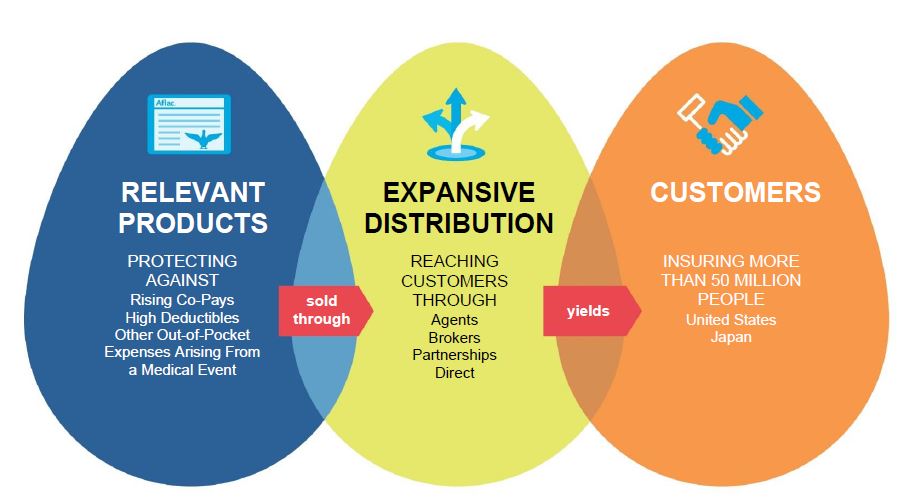
The Company's strategy for growth in the U.S. and Japan has remained straightforward and consistent for many years. The Company develops relevant supplemental health insurance products offering financial protection from the rising out-of-pocket expenses associated with medical events that are not covered by the insureds' primary coverage. The Company also offers a complement of other voluntary health and life insurance products to fit the needs of its customers. Additionally, the Company aims to obtain more customers by selling where the customer prefers to purchase protection, whether through an agent or broker, a distribution partner or directly from the Company. To help promote its insurance products, the Company’s marketing campaigns feature the Aflac Duck.
LONG-TERM GROWTH STRATEGY
In 1999, the Company had been running commercials for nearly a decade, but its brand awareness was hovering at about 10%. An innovative marketing campaign with something unique and memorable that would build brand awareness was needed. The Aflac Duck’s first commercial in the U.S., “Park Bench,” aired on January 1, 2000 and taught consumers how to pronounce “Aflac.” The Aflac Duck made his international debut in Japan in 2003. In the two decades since his U.S. debut, the Aflac Duck has become one of the most familiar advertising icons in the world, appearing in many commercials and countless print ads in both the U.S. and Japan. Today, the Aflac Duck is a helpmate who increases brand knowledge and connection.
The Company's insurance business consists of two reporting segments: Aflac Japan and Aflac U.S. The primary insurance subsidiary in the Aflac Japan segment is Aflac Life Insurance Japan Ltd. (ALIJ). Aflac U.S. includes the insurance subsidiaries American Family Life Assurance Company of Columbus (Aflac); Continental American Insurance Company (CAIC), branded as Aflac Group Insurance (AGI); American Family Life Assurance Company of New York (Aflac New York); Tier One Insurance Company (TOIC); and Aflac Benefits Solutions (ABS), formerly Argus Dental & Vision, Inc., which provides a platform for Aflac Dental and Vision in the U.S.
In November 2020, the Company, through its insurance subsidiaries Aflac and Aflac New York, acquired Zurich North America’s U.S. Corporate Life and Pensions business, which consists of group life, disability and absence management products. Aflac and Aflac New York agreed to reinsure on an indemnity basis Zurich North America’s U.S. in-force group life and disability policies with annualized earned premium of over $100 million. Aflac also acquired assets needed to support the group life and disability business, along with an absence management platform.
For information on the Company's results of operations and financial information by segment, see Item 7. MD&A and Note 2 of the Notes to the Consolidated Financial Statements in this report.
AFLAC JAPAN
Aflac Japan is the principal contributor to the Parent Company's consolidated earnings and the largest insurer in Japan in terms of cancer and medical (third sector insurance products) policies in force. For information on Aflac Japan's operating results, see the Aflac Japan Segment section of Item 7. MD&A.
Insurance Products
Aflac Japan's third sector insurance products are supplemental products designed to help consumers pay for medical and nonmedical costs that are not reimbursed under Japan's national health insurance system. Changes in Japan's economy and an aging population have put increasing pressure on Japan's national health care system. As a result, more costs have been shifted to Japanese consumers, who in turn have become increasingly interested in insurance products that help them manage those costs. In addition, since 2020, the pandemic has accelerated digitization and significantly heightened customer awareness of potential financial and health care burdens. Aflac Japan has responded to this consumer need by enhancing existing products and developing new products, such as a nursing care product introduced in 2021 and work leave insurance introduced in 2022. The focus at Aflac Japan remains on maintaining leadership in third sector insurance products that are less interest rate sensitive and have strong and stable margins. At the same time, Aflac Japan complements this core business with similarly profitable first sector protection products as outlined below.
Third Sector Insurance Products
Cancer
Cancer Insurance Aflac Japan pioneered the cancer insurance market in Japan in 1974, and remains the number one provider of cancer insurance in Japan today. Aflac Japan's cancer insurance products provide a lump-sum benefit upon initial diagnosis of cancer and fixed daily benefits for subsequent hospitalization and outpatient treatments due to cancer, as well as cancer-related surgical and convalescent care benefits.
Medical and Other Health
Medical Insurance Aflac Japan's medical insurance products provide benefits for hospitalization, surgeries and outpatient treatment of various illnesses, as well as lump sum benefits related to three critical illnesses: cancer, heart attack, and stroke.
Income Support Insurance Aflac Japan's Income Support Insurance provides fixed-benefit amounts in the event that a policyholder is unable to work due to significant illness or injury.
Other
Nursing Care Insurance Aflac Japan's Nursing Care Insurance provides coverage for out-of-pocket costs incurred when receiving public nursing care services.
Work Leave Insurance Aflac Japan’s Work Leave Insurance offers benefits for relatively short-term hospitalization and home care associated with work leave of less than a year. It is a product that meets the growing need for leave benefits, especially for employees of small and medium-sized companies.
First Sector Insurance Products
Life
Protection-Type Life Insurance
Whole Life Aflac Japan launched Prepare Smart Whole-Life Insurance in 2018, a whole life insurance product with low cash surrender value, which offers non-smoking policyholders further discounted premiums, and it provides beneficiaries, typically a designated family member, with a pre-determined benefit payment upon the death of the insured.
GIFT GIFT is a term life insurance product that provides a designated family member with a fixed amount of money every month upon a breadwinner’s death or serious disability as family support.
Savings-Type Life Insurance
WAYS and Child Endowment WAYS is an insurance product which has features that allow policyholders to convert a portion of their life insurance to medical, nursing care or fixed annuity benefits at a predetermined age. Aflac Japan's child endowment insurance product offers a death benefit until a child reaches age 18. This product also pays a lump-sum at the time of the child's entry into high school, as well as an educational annuity for each of the four years during his or her college education. In November 2022, Aflac Japan refreshed its WAYS and Child Endowment products and began to actively promote sales of these products after having curtailed sales of both products beginning in 2013.
Distribution Channels
Traditional Sales Channel This distribution channel includes individual agencies, independent corporate agencies and affiliated corporate agencies. Aflac Japan was represented by approximately 7,400 sales agencies at the end of 2022, with approximately 110,000 licensed sales associates employed by those agencies, including individual agencies.
Dai-ichi Life Aflac Japan's alliance with Dai-ichi Life was launched in 2001, and approximately 40,000 Dai-ichi Life representatives offer Aflac's cancer products. Dai-ichi Life is included in Aflac Japan's affiliated corporate agencies distribution channel.
Japan Post Group Aflac Japan's alliance with Japan Post Group, which is included in Aflac Japan's affiliated corporate agencies distribution channel, was launched in 2008. After the alliance strengthened in 2013, the number of postal outlets of Japan Post Co. Ltd. (Japan Post Co.) selling Aflac Japan's cancer product increased to more than 20,000. Japan Post Insurance Co., Ltd. (Japan Post Insurance) offers Aflac Japan cancer products through its 76 directly managed offices. Additionally, in April 2022, approximately 10,000 employees of Japan Post Co. were transferred to Japan Post Insurance. Japan Post Group has informed Aflac Japan that the transferred employees' responsibilities will include sales of Japan Post Insurance products and Aflac Japan cancer products but will not include sales of other financial products. See the "Aflac Japan Segment" subsection of MD&A for more about this alliance.
Daido Life In 2013, Aflac Japan and Daido Life Insurance entered into an agreement for Daido to sell Aflac Japan's cancer insurance products specifically to the Hojinkai market, which is an association of small businesses. Currently, Daido also sells Aflac Japan's cancer insurance products to the market in the tax payment association, which is a not-for-profit association for small businesses to support tax related matters. Daido Life is included in Aflac Japan's affiliated corporate agencies distribution channel.
Banks Consumers in Japan rely on banks to provide not only traditional bank services, but also as one key source to provide insurance solutions and other services. At December 31, 2022, Aflac Japan had agreements with approximately 90% of the total number of banks in Japan to sell its products.
Competitive Markets
The Company competes with other insurance carriers through policyholder service, price, product design and sales efforts, as the number of insurance companies offering stand-alone cancer and medical insurance has more than doubled since the deregulation of the Japan market in 2001. However, based on Aflac Japan's size of annualized premiums in force and diversified distribution network, the Company believes it is well-positioned to continue to adapt to increased competition. Furthermore, the Company believes the continued development and maintenance of operating efficiencies will allow Aflac Japan to offer affordable products that appeal to consumers. The Company believes Aflac Japan will remain a leading provider of third sector products such as cancer and medical insurance coverage in Japan, principally due to its experience in the market, well-known brand, low-cost operations, expansive marketing system and product expertise.
Government Regulation
Financial Services Agency (FSA) The financial and business affairs of Aflac Japan are subject to examination by Japan's FSA. Aflac Japan files annual and interim reports and financial statements for the Japanese insurance operations based on a March 31 fiscal year end, prepared in accordance with Japanese regulatory accounting practices prescribed or permitted by the FSA. Japanese regulatory basis earnings are determined using accounting principles that differ materially from U.S. generally accepted accounting principles (U.S. GAAP). For additional information, see Note 13 of the Notes to the Consolidated Financial Statements.
Two FSA regulations applicable to Aflac Japan are outlined below.
*▪*Privacy and Cybersecurity
With regard to personal information obtained from policyholders, the insured, or others, Aflac Japan is regulated in Japan by the Act on the Protection of Personal Information (APPI) and guidelines issued by FSA and other governmental authorities. The FSA updated its guidelines regarding cybersecurity in February 2022.
*•*FSA Solvency Standard
The FSA maintains a solvency standard, the solvency margin ratio (SMR), which is used by Japanese regulators to monitor the financial strength of insurance companies. Aflac Japan's SMR is sensitive to interest rate, credit spread and foreign exchange rate changes. See the Liquidity and Capital Resources section of Item 7. MD&A for additional information on SMR, including a discussion of measures the Company has taken to mitigate the sensitivity of Aflac Japan's SMR.
Japan Companies Act Aflac Japan dividend distributions to the Parent Company are subject to permitted dividend capacity under the Japan Companies Act.
Policyholder Protection The Japanese insurance industry has a policyholder protection corporation that provides funds for the policyholders of insolvent insurers. For additional information, see the policyholder protection section of the MD&A.
For additional information regarding Aflac Japan's operations and regulations, see the "Aflac Japan Segment" subsection of the MD&A and Notes 2 and 13 of the Notes to the Consolidated Financial Statements in this report.
AFLAC U.S.
The Company designs its U.S. insurance products to provide supplemental coverage for people who already have major medical or primary insurance coverage, as Aflac U.S. insurance policies pay benefits regardless of other insurance. Aflac U.S. products are distributed in the individual and group supplemental insurance markets. Aflac's individual policies are portable, meaning that individuals may retain their full insurance coverage upon separation from employment or affiliation with a group, generally at the same premium. Individual policies are typically guaranteed-renewable for the lifetime of the policyholder (to age 75 for short-term disability policies).
Insurance Products
Accident
Accident Insurance Aflac U.S. offers accident coverage on both an individual and group basis. These policies pay cash benefits in the event of a covered injury. The accident portion of the policy includes lump-sum benefits for accidental death, dismemberment and specific injuries as well as fixed benefits for hospital confinement. Additional benefits are also available for home modifications, wellness and increased benefits for injuries related to participation in an organized sporting activity.
Disability
Disability Insurance Aflac U.S. offers short-term disability benefits on both an individual and group basis and long-term disability benefits on a group basis.
Critical Care
Cancer Insurance Aflac U.S.'s cancer insurance products provide a lump-sum benefit upon initial diagnosis of cancer and subsequent benefits for treatment received due to cancer. Aflac U.S. offers cancer insurance on an individual basis.
Critical Illness Insurance Aflac U.S. offers coverage for critical illness plans on both an individual and group basis. These policies are designed to pay cash benefits in the event of critical illnesses such as heart attack, stroke or cancer.
Hospital Indemnity
Hospital Indemnity Insurance Aflac U.S. offers hospital indemnity coverage on both an individual and group basis. Hospital indemnity products provide policyholders fixed dollar benefits triggered by hospitalization due to accident or sickness. Indemnity benefits for inpatient and outpatient surgeries, as well as various other diagnostic events, are also available.
Dental and Vision
Dental and Vision Insurance Aflac U.S. offers network dental and vision products on a group basis and fixed-benefit coverage on both an individual and group basis. Aflac Vision NowSM is an individually issued policy which provides fixed benefits for serious eye health conditions and loss of sight as well as coverage for corrective eye materials and exam benefits.
Life
Life Insurance Aflac U.S. offers term- and whole-life policies on both an individual and group basis.
Seasonality
In recent years, new annualized premium sales are generally higher in the fourth quarter for Aflac U.S. group business due to the timing of open enrollment for many employers. As a result, approximately half of total new annualized premium sales for Aflac U.S. group business are generated in the fourth quarter, which typically results in over one third of total Aflac U.S. total sales being generated in the fourth quarter.
Distribution Channels
Independent Associates/Career Agents The career agent channel in Aflac U.S. focuses on marketing Aflac to the small business market, defined as employers of between three and 99 employees. Sales associates in the U.S. are independent contractors and are paid commissions and other variable compensation based on first-year and renewal premiums from their sales of insurance products.
Brokers The broker channel of Aflac U.S. focuses on selling to the mid- and large-case market, which is comprised of employers with 100 or more employees and typically an average size of 1,000 employees or more. Brokers in the U.S. are
independent contractors and are paid commissions based on first-year and renewal premiums from their sales of insurance products.
Consumer Markets While Aflac U.S. primarily markets its insurance products at the worksite, Aflac U.S. is also expanding its distribution strategy to directly reach consumers outside of the traditional worksite through digital lead generation.
Competitive Markets
Aflac U.S. competes against several supplemental insurance carriers on a national and regional basis. Aflac U.S. believes its policies, premium rates, platforms, value-added services and sales commissions are competitive by product type. Moreover, Aflac U.S. believes that its products are distinct from competitive offerings given its product focus (including features, benefits and claims service model), distribution capabilities and brand awareness.
Since Aflac products provide an additional level of financial protection for policyholders, the Company believes the increased financial exposure some employees may face creates a favorable opportunity for Aflac U.S. products. However, given the profitability erosion some major medical carriers are facing in their core lines of business, the Company has seen a more competitive landscape as these carriers seek entry into Aflac's supplemental product segments and leverage their core benefit offerings by bundling and discounting products in order to gain market share.
Government Regulation
State Insurance Regulation The Parent Company and its U.S. insurance subsidiaries, Aflac, CAIC, TOIC (Nebraska-domiciled insurance companies), Aflac New York (a New York-domiciled insurance company) and ABS (a licensed third party administrator in most U.S. jurisdictions and a pre-paid limited health service organization in Florida) are subject to state regulations in the U.S. as an insurance holding company system. Such regulations generally provide that certain transactions between companies within the holding company system must be fair and equitable. In addition, transfers of assets among such affiliated companies, certain dividend payments from insurance subsidiaries and certain transactions between companies within the system, including management fees, loans and advances are subject to prior notice to, or approval by, state regulatory authorities. These laws generally require, among other things, the insurance holding company and each insurance company directly owned by the holding company to register with the insurance departments of their respective domiciliary states and to furnish annually financial and other information about the operations of companies within the holding company system.
Like all U.S. insurance companies, Aflac, CAIC, TOIC and Aflac New York are subject to regulation and supervision in the jurisdictions in which they do business. In general, the insurance laws of the various jurisdictions establish supervisory agencies with broad administrative powers relating to, among other things:
-
granting and revoking licenses to transact business
-
regulating trade and claims practices
-
licensing of insurance agents and brokers
-
approval of policy forms and premium rates
-
standards of solvency and maintenance of specified policy benefit reserves and minimum loss ratio requirements
-
capital requirements
-
limitations on dividends to shareholders
-
the nature of and limitations on investments
-
deposits of securities for the benefit of policyholders
-
filing of financial statements prepared in accordance with statutory insurance accounting practices prescribed or permitted by regulatory authorities
-
periodic examinations of the market conduct, financial, and other affairs of insurance companies
The insurance laws of Nebraska that govern Aflac's activities provide that the acquisition or change of “control” of a domestic insurer or of any person that controls a domestic insurer cannot be consummated without the prior approval of the Nebraska Department of Insurance (NDOI). A person seeking to acquire control, directly or indirectly, of a domestic insurance company or of any person controlling a domestic insurance company (in the case of Aflac, CAIC and TOIC, the Parent Company) must generally file with the NDOI an application for change of control containing certain information required by statute and published regulations and provide a copy to Aflac. In Nebraska, control is generally presumed to exist if any person, directly or indirectly, acquires 10% or more of an insurance company or of any other person or entity controlling the insurance company. The 10% presumption is not conclusive and control may be found to exist at less than 10%. Similar laws apply in New York, the domiciliary jurisdiction of Aflac's New York insurance subsidiary.
State insurance departments conduct periodic examinations of the books and records, financial reporting, policy filings and market conduct of insurance companies domiciled in their states, generally once every three to five years. Examinations are generally carried out in cooperation with the insurance departments of other states under guidelines promulgated by the National Association of Insurance Commissioners (NAIC). In 2020, the NDOI and New York State Department of Financial Services (NYSDFS) conducted full-scope, risk-focused financial examinations on their respective state domiciled insurance entities. The examinations covered the reporting period January 1, 2016 – December 31, 2019. There were no material findings contained in the NDOI or NYSDFS final exam reports. In 2023, the NYSDFS will commence a routine market conduct examination on Aflac New York of the five-year period ended December 31, 2022.
NAIC Risk-Based Capital The NAIC continually reviews regulatory matters, such as risk-based capital (RBC) modernization, group capital calculations and liquidity risk assessment. The NAIC uses an RBC formula relating to insurance risk, business risk, asset risk and interest rate risk to facilitate identification by insurance regulators of inadequately capitalized insurance companies based upon the types and mix of risk inherent in the insurer's operations. The formulas for determining the amount of RBC specify various weighting factors that are applied to financial balances or various levels of activity based on the perceived degree of risk. Regulatory compliance is determined by a ratio of a company's regulatory total adjusted capital to its authorized control level RBC as defined by the NAIC. Companies below specific trigger points or ratios are classified within certain levels, each of which requires specified corrective action. The levels are company action, regulatory action, authorized control, and mandatory control. See Note 13 of the Notes to the Consolidated Financial Statements and the Liquidity and Capital Resources section of MD&A for additional information on RBC.
Guaranty Association and Similar Arrangements Under state insurance guaranty association laws and similar laws in international jurisdictions, the Company is subject to assessments, based on the share of business the Company writes in the relevant jurisdiction, for certain obligations of insolvent insurance companies to policyholders and claimants. In the U.S., some states permit member insurers to recover assessments paid through full or partial premium tax offsets. The Company's policy is to accrue assessments when the entity for which the insolvency relates has met its state of domicile's statutory definition of insolvency, the amount of the loss is reasonably estimable and the related premium upon which the assessment is based is written. In most states, the definition is met with a declaration of financial insolvency by a court of competent jurisdiction.
Federal Regulation Federal legislation and administrative policies in several areas, including health care reform legislation, financial services reform legislation, securities regulation, pension regulation, privacy, tort reform legislation and taxation, can significantly and adversely affect insurance companies. Certain federal regulations applicable to Aflac U.S. are outlined below.
*•*Patient Protection and Affordable Care Act
The Patient Protection and Affordable Care Act and the Heath Care and Education Reconciliation Act of 2010 (collectively, the ACA), federal health care reform legislation, gave the U.S. federal government direct regulatory authority over the business of health insurance. The ACA, as enacted, does not require material changes in the design of the Company's insurance products. However, indirect consequences of, or changes to, the legislation and regulations could present challenges that could potentially have an impact on the Company's sales model, financial condition and results of operations. Certain provisions of the ACA have been and may continue to be subject to challenge through litigation, the ultimate effects of which on the ACA are uncertain. See the risk factor entitled, "Extensive regulation and changes in legislation can impact profitability and growth" for more information.
*•*Dodd-Frank Act
Title VII of the Dodd-Frank Wall Street Reform and Consumer Protection Act of 2010 (Dodd-Frank) and regulations issued thereunder, in particular rules to require central clearing for certain types of derivatives, may have an impact on the Company's derivative activity, including activity on behalf of Aflac Japan.
The Dodd-Frank Act also established a Federal Insurance Office (FIO) under the U.S. Treasury Department to monitor all aspects of the insurance industry and of lines of business other than certain health insurance, certain long-term care insurance and crop insurance.
*•*Privacy and Cybersecurity
In the absence of a comprehensive federal privacy law, states are making a push towards privacy legislation. Personally identifiable information is used in support of many of the Company's business processes. For many years, the standard for protection and treatment of that data was benchmarked by privacy and security provisions of the federal Gramm-Leach-Bliley Act of 1999 (GLBA) and in the Health Insurance Portability and Accountability Act of 1996 (HIPAA). As consumers have grown more concerned about the protection of their data, as well as how their data is used by an organization, many jurisdictions within and outside of the U.S. have created legislation and issued regulations that apply or may in the future apply to aspects of Aflac U.S. operations and allow consumers the right to access, correct, delete and the right to opt out of sales or use of their data. Examples of these types of legislation include the California Consumer Privacy Act (CCPA), the California Privacy Rights Act (CPRA), the UK General Data Protection Regulation (UK GDPR), the UK Data Protection Act of 2018 (UK DPA) and most recently, going into effect in 2023, the Connecticut Data Privacy Act (CDPA), the Utah Consumer Privacy Act (UCPA), the Virginia Consumer Data Protection Act (VCDPA) and the Colorado Privacy Act (CPA).
Cybersecurity continues to be an area of evolving focus for legislation and regulatory activity. Industry regulators as well as the federal government have updated existing standards and increased their focus on enforcement. For example, the National Institute of Standards and Technology (NIST) issued enhanced security guidelines of the software supply chain and NYSDFS published increased security guidelines related to ransomware.
The Company has a cross-functional team that tracks and monitors new and emerging legislation and regulations to ensure privacy and cybersecurity programs are evaluated and comply with regulatory requirements. This includes a robust third party risk management and assessment program. Over the last several years, processes have developed to support the data subject request process required by CCPA, privacy impact assessments have been implemented as required by CPRA and a dedicated privacy and security center has been added to the Company website to provide consumers with information about the use of and protection of their data.
For further information concerning Aflac U.S. operations, see the "Aflac U.S. Segment" subsection of the MD&A and Notes 2 and 13 of the Notes to the Consolidated Financial Statements in this report.
CORPORATE AND OTHER
The Company's other operations include the Parent Company, Aflac Global Ventures LLC and its subsidiaries, asset management subsidiaries, results of reinsurance activities and a printing subsidiary.
Investments of Aflac U.S., as well as certain sub-advised assets of Aflac Japan, are managed by the Company’s U.S. asset management subsidiary, Aflac Asset Management LLC (AAM), and investments of Aflac Japan are managed pursuant to an investment advisory agreement between Aflac Japan and the Company's asset management subsidiary in Japan, Aflac Asset Management Japan Ltd. (AAMJ). AAMJ is licensed as a discretionary asset manager under the Japan Financial Instruments and Exchange Act and is subject to rules of the Japan Investment Advisors Association, a self-regulatory organization with mandatory membership for Japan investment managers. Effective January 19, 2021, AAM is registered with the SEC as an investment adviser under the Investment Advisers Act of 1940. AAM and AAMJ are reported in Corporate and Other; however, the assets that they manage are reported in the respective Aflac Japan and Aflac U.S. segments.
In 2022, the Company established Aflac Re Bermuda Ltd. (Aflac Re Bermuda), a Bermuda domiciled insurer that reinsures certain policies issued by ALIJ. Aflac Re Bermuda is subject to regulation in Bermuda, where the Bermuda Monetary Authority (BMA) has broad administrative powers relating to granting and revoking licenses to transact reinsurance business, approval of specific reinsurance transactions, capital requirements and solvency standards, limitations on dividends to shareholders, the nature of and limitations on investments, and the filing of financial statements in accordance with prescribed or permitted accounting practices.
In 2020, the Company purchased newly issued common stock of Trupanion, Inc., a provider of medical insurance for pets in the United States and Canada, resulting in the Company owning approximately 9% of the outstanding common stock of Trupanion, Inc. The shares were registered for resale and, pursuant to the Shareholder Agreement, subject to certain exceptions, the Company has agreed that it will not transfer its shares of Trupanion, Inc. common stock during a restricted period ending on November 13, 2023. The Company also entered into an alliance agreement with Trupanion, Inc. to sell pet insurance in worksites in the U.S., subject to certain exceptions, and to explore on an exclusive basis potential
distribution opportunities for pet insurance in Japan. On November 10, 2022, the Company and Trupanion announced a joint venture between ALIJ and Trupanion to provide pet insurance in Japan.
For additional information on the Company's other operations, see the "Corporate and Other" subsection of the MD&A and Note 8 in the Notes to the Consolidated Financial Statements.
HUMAN CAPITAL
The Company’s overarching human capital philosophy is, “If you take care of your employees, your employees will take care of the business.” As of December 31, 2022, Aflac Japan had 6,996 employees, Aflac U.S. had 4,839 employees, and the Company's other operations had 1,047 employees. The Company's compensation and benefit expense totaled approximately $1.9 billion in 2022, compared with approximately $2.0 billion in 2021. The Company believes its employee relations are generally satisfactory.
Talent
The Company uses internal and external resources to attract, retain and develop talent across a variety of backgrounds and demographics.
Aflac Japan seeks diverse talent through annual recruitment of new university graduates as well as mid-career recruitment of those with specialty skills or expertise. For its employees, Aflac Japan implements standard and unified training and development programs focusing on a range of business skills. For example, Aflac Japan’s Leadership Program allows select managers to participate in a comprehensive training program to learn about innovation and the global business environment. Aflac Japan implemented a human capital management system, beginning in January 2021 with managers and more senior leadership positions and in January 2022 with all other employees. Under the new system, employees have access to descriptions and necessary skills for all job positions across the Company and are able to more proactively design their careers.
Aflac U.S. recruiting efforts include partnerships with colleges and universities, including historically black colleges and universities, and civic organizations to attract diverse talent. Aflac U.S. also offers a variety of internships, co-operative opportunities and transitional programs to allow emerging talent to develop. Educational opportunities are available for self-development and growth to help employees further enhance their technical and professional skills.
Compensation
The Aflac Japan and Aflac U.S. Human Resources divisions operate as centralized internal compensation functions to provide oversight and input to the respective management teams with the objective of providing compensation that is consistent with job scope, duties and responsibilities. The compensation function evaluates new-hire job offers, promotions and compensation adjustments with the goal of consistent and equitable compensation. Defined salary structures are reviewed regularly and updated utilizing market data. Job levels and associated compensation are determined based on annually updated market data, job scope, duties and responsibilities. Employee performance reviews are conducted annually and are factored into employee bonuses and salaries.
Health and Wellness
In 2022, Aflac Japan was certified, for the fifth consecutive year, as one of the top 500 Leading Companies in Health and Productivity Management under the Certified Health & Productivity Management Outstanding Organizations Recognition Program with Japan's Ministry of Economy, Trade and Industry. This certification is awarded for best practices in employee health management, strategically focused work style and development of a socially appreciative work environment. Aflac Japan's current certification was in recognition of wide-ranging initiatives including a walking campaign, online seminars focused on improving health literacy, efforts to improve lifestyle habits such as support for smoke-free efforts, promotion of cancer screening, as well as COVID-19 control measures, including flexible working arrangements, workplace environment improvements and vaccination support.
Aflac U.S. Health and Wellness, a training and service program works to enhance organizational health, encourage healthy lifestyles among all U.S. employees, provide diverse wellness programs to meet a wide range of personal health needs, recognize employees for participating in healthier lifestyles activities, and support a positive corporate culture that is focused on celebrating and improving the quality of life for all U.S. employees.
Diversity, Equity & Inclusion
The Company’s corporate culture reflects its commitment to diversity, equity and inclusion at all levels of the Company. For example:
-
As of December 31, 2022, women account for 54% of Aflac Japan employees and 33% of those in leadership roles. Women also held 19% of senior management roles. Aflac Japan's goal is to further increase the percentage of women in line manager positions by 2025.
-
As of December 31, 2022, 49% of Aflac U.S. and the Parent Company employees located in the U.S. were people of color and 66% were women. Women also occupied 50% of leadership roles located in the U.S. and 31% of senior management roles. In 2022, 62% of new hires located in the U.S. were people of color and 69% were women.
-
Established in 2009, Aflac Heartful Services Co., Ltd. (Aflac Heartful Services), a subsidiary of Aflac Japan, promotes the hiring of employees with disabilities. Aflac Heartful Services has established a barrier-free work environment and provides, among other things, specialized training, specially-trained supervisors and development opportunities to support those with disabilities. Of Aflac Heartful Services’ 154 employees as of December 31, 2022, 124 have a disability. Aflac Heartful Services supports these employees with the assistance of advisors for long-term career support.
-
Both Aflac Japan and Aflac U.S. have created diversity councils that include employees from various levels that meet regularly to discuss activities and initiatives. The councils are designed to create avenues in which employees can communicate and appreciate one another’s cultural differences.
-
Women and people of color comprise approximately 64% of the Parent Company’s board of directors.
Employee Engagement and Culture
The Company strives to have an engaged employee culture by developing programs including career development support and programs emphasizing work life balance. Each year, Aflac Japan conducts a human capital engagement survey in which all employees answer questions about the company and their organization to measure engagement across the company and detect organizational issues. The results of the survey are reported to Aflac Japan's Human Capital Management Committee to identify issues, formulate enhancement/improvement measures and implement them. Aflac U.S. provides an employee engagement survey every other year to employees to gather their views on company culture and satisfaction, and works with its leadership to monitor continuous improvements and enhance the employee experience.
Information about the Company's Executive Officers
| NAME | PRINCIPAL OCCUPATION*(1)* | AGE | ||||||
| Daniel P. Amos | Chairman, Aflac Incorporated and Aflac, since 2001; Chief Executive Officer, Aflac Incorporated and Aflac, since 1990; President, Aflac, from 2017 until 2018; President, Aflac Incorporated, from 2018 until 2020 | 71 | ||||||
| Steven K. Beaver | Senior Vice President, Chief Financial Officer, Aflac U.S., since 2019; Senior Vice President, Financial Planning and Analysis, Aflac Incorporated, from 2018 until 2019; Senior Vice President, Global Strategic Projects, Corporate Financial Planning and Analysis, Aflac Incorporated, from 2017 until 2018 | 58 | ||||||
| Max K. Brodén | Executive Vice President, Chief Financial Officer, Aflac Incorporated, since 2020; Executive Vice President, Aflac, since 2020; Treasurer, Aflac, since 2017; Treasurer, Aflac Incorporated from 2017 until 2021; Senior Vice President, Aflac Incorporated and Aflac, from 2017 until 2020 | 44 | ||||||
| Frederick J. Crawford | President and Chief Operating Officer, Aflac Incorporated, since 2020; Executive Vice President, Chief Financial Officer, Aflac Incorporated, from 2015 until 2020 | 59 | ||||||
| J. Todd Daniels | Executive Vice President, Chief Financial Officer, Aflac Japan, since 2018; Executive Vice President, Global Chief Risk Officer and Chief Actuary, Aflac Incorporated, from 2016 until 2018 | 52 | ||||||
| Bradley E. Dyslin | Executive Vice President, Global Chief Investment Officer, Aflac, since 2023; President, Aflac Asset Management LLC, since 2023; Deputy Global Chief Investment Officer, Aflac, from 2021 until 2023; Senior Managing Director, Global Head of Credit and Strategic Investment Opportunities, Aflac, from 2017 until 2021 | 57 | ||||||
| June Howard | Chief Accounting Officer, Aflac Incorporated and Aflac, since 2010; Senior Vice President, Financial Services, Aflac Incorporated and Aflac, since 2010 | 56 | ||||||
| Masatoshi Koide | President and Representative Director, Aflac Japan, since 2018; President and Chief Operating Officer, Aflac Japan from 2017 until 2018 | 62 | ||||||
| Charles D. Lake, II | President, Aflac International, since 2014; Chairman and Representative Director, Aflac Japan, since 2018; Chairman, Aflac Japan, from 2008 until 2018 | 61 | ||||||
| Virgil R. Miller | President, Aflac U.S., since 2023; Deputy President, Aflac U.S., from 2022 until 2023; Executive Vice President, President of Group and Individual Benefits Division, Aflac U.S., from 2021 until 2022; Executive Vice President, Chief Operating Officer, Aflac U.S., from 2018 until 2021; Senior Vice President, Chief Administrative Officer, Aflac U.S., from 2016 until 2018 | 54 | ||||||
| Albert A. Riggieri | Senior Vice President, Global Chief Risk Officer and Chief Actuary, Aflac Incorporated, since 2018; Senior Vice President, Corporate Actuary, Aflac, from 2016 until 2018 | 67 | ||||||
| Audrey B. Tillman | Executive Vice President, General Counsel, Aflac Incorporated and Aflac, since 2014 | 58 |
(1) Unless specifically noted, the respective executive officer has held the occupation(s) set forth in the table for at least the last five years. Each executive officer is appointed annually by the board of directors and serves until his or her successor is chosen and qualified, or until his or her death, resignation or removal.
Item 1A. RISK FACTORS
The Company faces a wide range of risks, and its continued success depends on its ability to identify, prioritize and appropriately manage enterprise risk exposures. Readers should carefully consider each of the following risks and all of the other information set forth in this Form 10-K. These risks and other factors may affect forward-looking statements, including those in this document or made by the Company elsewhere, such as in earnings release webcasts, investor conference presentations or press releases. The risks and uncertainties described herein may not be the only ones facing the Company. Additional risks and uncertainties not presently known to the Company or that the Company currently believes to be immaterial may also adversely affect its business. If any of the following risks and uncertainties develops into actual events, there could be a material impact on the Company.
Investment and Markets Risk Factors
Difficult conditions in global capital markets and the economy, including those caused by COVID-19, could have a material adverse effect on the Company's investments, capital position, revenue, profitability, and liquidity and harm the Company's business.
The Company's results of operations are materially affected by conditions in the global capital markets and the global economy generally, including in its two primary operating markets of the U.S. and Japan. Economies globally experienced significant inflation in 2022, with inflation rates and impact varying by country. Central bank and government efforts to control inflation, through reductions in stimulus and asset purchases as well as interest rate increases, have resulted in a decline in economic activity globally. Supply chain issues remaining from the COVID-19 pandemic, as well as geopolitical events, have contributed to inflation and volatility in energy prices. Although some markets have proven resilient in the face of inflation control measures, continued weakening of global financial markets impacts the creditworthiness and value of the Company's existing investment portfolio, influences opportunities for new investments, and may contribute to generally weak economic fundamentals, which can have a negative impact on its results of operations and financial positions.
The Company's investments are vulnerable to adverse market developments such as asset price volatility, lack of market liquidity, credit rating downgrades, payment defaults, asset restructurings, increased losses, and other risks. The Company has evaluated its holdings and identified investments in areas such as commercial real estate, including mortgages, consumer discretionary spending, issuers with higher leverage, and emerging markets issuers as the most exposed to rising interest rates, an economic downturn and the continuing effects of the COVID-19 global pandemic. These investments are experiencing and may continue to experience higher credit losses, credit rating downgrades and/or defaults and the Company has examined in each case whether a reduction in size of the holding is appropriate. In addition, volatility in oil prices could have a continued adverse impact on issuers in the energy sector. While the Company has identified assets impacted or expected to be impacted by rising interest rates and economic contraction, other investments not identified to date may also be impacted. The availability of new investments in certain private market asset classes, such as middle market loans, commercial mortgages and transitional real estate, has been and may continue to be limited. While interest rates have increased in the U.S. and other regions, interest rates in Japan remain low, and the difference between U.S. and Japan rates has increased. A prolonged period of low interest rates in other countries, particularly Japan, remains a risk that could result in new investments generating lower yields than in prior periods. The Company may need to adjust its investment strategy and/or be forced to liquidate investments to pay claims. In addition, the increase in the difference between interest rates in the U.S. and Japan contributed to a weakening of the yen over 2022, which had the effect of suppressing the Company's current period results in relation to the comparable prior period. The increase in the difference between U.S. dollar and yen interest rates also contributes to increasing costs of hedging currency risk of U.S. dollar-denominated investments held by Aflac Japan. The Company is not able to predict the ultimate impact of inflation, interest rate increases, interest rate differences and other changing market conditions on the Company’s investments and hedging programs. See the risk factor below entitled, “The Company is exposed to significant interest rate risk, which may adversely affect its results of operations, financial condition and liquidity” for more information. See the “Investments” and “Results of Operations by Segment” sections of Item 7, MD&A, for more information.
As the Company holds a significant amount of fixed maturity securities issued by borrowers located in many different parts of the world, its financial results are directly influenced by global financial markets. Recent weakness in global capital markets could adversely affect the Company's financial condition, including its capital position and overall profitability. Market volatility and recessionary pressures could result in significant realized or unrealized losses due to severe price declines driven by increases in interest rates or credit spreads, defaults in payment of principal or interest, or credit rating downgrades.
Japan is the largest market for the Company's insurance products, and the Company owns substantial holdings in Japan Government Bonds (JGBs). Government actions to stimulate the economy affect the value of the Company's existing holdings, its reinvestment rate on new investments in JGBs or other yen-denominated assets, and consumer behavior relative to the Company's suite of insurance products. The additional government debt from fiscal stimulus actions could adversely impact the Japan sovereign credit profile, which could in turn lead to volatility in Japanese capital and currency markets.
Should investors become concerned with any of the Company's investment holdings, including the concentration in JGBs, its access to market sources of funding could be negatively impacted. It is possible that lenders or debt investors may also become concerned if the Company incurs large investment losses or if the level of the Company's business activity decreases due to a market downturn or there are further adverse economic trends in the U.S. or Japan, specifically, or generally in developed markets.
The Company needs liquidity to pay its operating expenses, dividends on its common stock, interest on its debt, and liabilities. See the "Liquidity and Capital Resources" Item 7, MD&A, for more information. In the event the Company's current resources do not meet its needs, the Company may need to seek additional financing. The Company's access to additional financing will depend on a variety of factors such as market conditions, the general availability of credit within the financial services industry and its credit rating. See the risk factor below entitled, “Any decrease in the Company's financial strength or debt ratings may have an adverse effect on its competitive position and access to liquidity and capital” for more information.
Broad economic factors such as consumer spending, business investment, government spending, the volatility and strength of the capital markets, inflation, and strain with the U.S. supply chain all affect the business and economic environment and, indirectly, the amount and profitability of the Company's business. In an economic downturn characterized by higher unemployment, lower family income, lower corpora
Showing the first 8K of 85K characters. Open the full section
Item 1B. UNRESOLVED STAFF COMMENTS
Not applicable.
Item 2. PROPERTIES
In Tokyo, Japan, the Company has two primary campuses. The first campus includes a building, owned by the Company, for the customer call center, the claims department, the information technology departments, and training facility. This campus also includes a leased property, which houses Aflac Japan's policy administration and customer service departments. The second campus comprises leased office space, which serves as Aflac Japan's headquarters and houses administrative and investment support functions. The Company also leases additional office space in Tokyo, along with regional offices located throughout the country.
In the U.S., the Company owns land and buildings that comprise two primary campuses located in Columbus, Georgia. These campuses include buildings that serve as the Company's worldwide headquarters and house administrative support and information technology functions for U.S. operations. The Company leases office space in Columbia, South Carolina, which houses the Company's CAIC subsidiary (branded as Aflac Group Insurance); in New York, New York, which houses the Company's Global Investment division; in Tampa, Florida, which houses the Company's ABS subsidiary; and in Farmington, Connecticut, Windsor, Connecticut and Plantation, Florida, which houses the operations of the Company's group life, disability and absence management business. The Company leases other administrative office space throughout the U.S., Puerto Rico and the United Kingdom.
The Company believes its properties are adequate and suitable for its business as currently conducted and are adequately maintained.
Item 3. LEGAL PROCEEDINGS
The Company is a defendant in various lawsuits considered to be in the normal course of business. Members of the Company's senior legal and financial management teams review litigation on a quarterly and annual basis. The final results of any litigation cannot be predicted with certainty. Although some of this litigation is pending in states where large punitive damages, bearing little relation to the actual damages sustained by plaintiffs, have been awarded in recent years, the Company believes the outcome of pending litigation will not have a material adverse effect on its financial position, results of operations, or cash flows.
Item 4. MINE SAFETY DISCLOSURES
Item 5. MARKET FOR REGISTRANT'S COMMON EQUITY, RELATED STOCKHOLDER MATTERS AND ISSUER
PURCHASES OF EQUITY SECURITIES
Market Information
Aflac Incorporated's common stock is principally traded on the New York Stock Exchange under the symbol AFL.
Holders
As of February 16, 2023, there were 84,297 holders of record of the Company's common stock.
Dividends
For a summary of dividends paid to shareholders in 2022 and 2021 and potential restrictions on the Company's ability to pay future dividends, see the Liquidity and Capital Resources section of Item 7. MD&A.
Stock Performance Graph
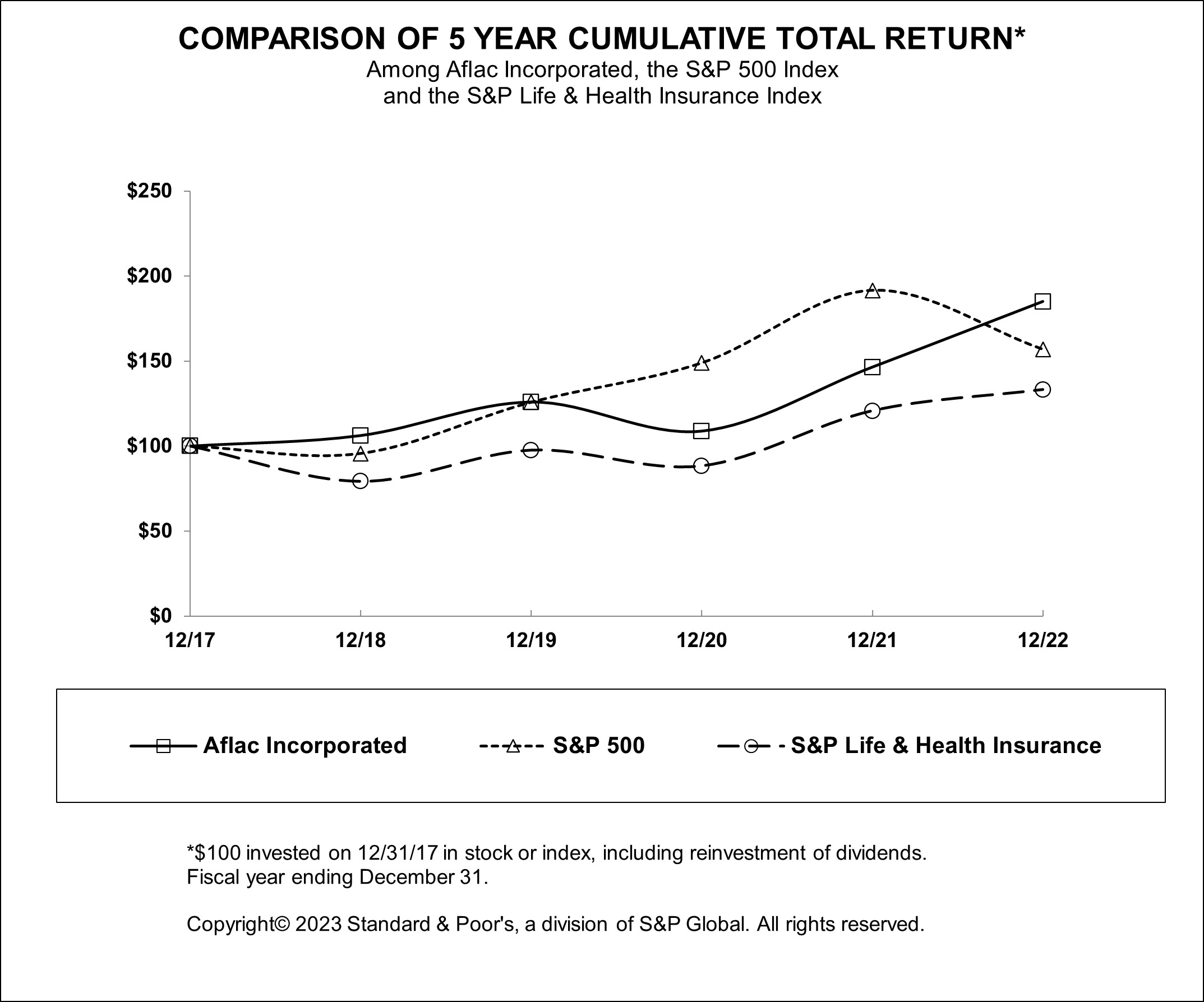
The following graph compares the five-year performance of the Company's common stock to the Standard & Poor's 500 Index (S&P 500) and the Standard & Poor's Life and Health Insurance Index (S&P Life and Health). The Standard & Poor's Life and Health Insurance Index includes: Aflac Incorporated, Globe Life Inc., Lincoln National Corporation, MetLife Inc., Principal Financial Group Inc. and Prudential Financial Inc.
Performance Graphic Index
December 31,
| 2017 | 2018 | 2019 | 2020 | 2021 | 2022 | ||||||||||||||||||||||||||||||
| Aflac Incorporated | 100.00 | 106.21 | 125.92 | 108.82 | 146.43 | 185.03 | |||||||||||||||||||||||||||||
| S&P 500 | 100.00 | 95.62 | 125.72 | 148.85 | 191.58 | 156.89 | |||||||||||||||||||||||||||||
| S&P Life & Health Insurance | 100.00 | 79.23 | 97.60 | 88.35 | 120.76 | 133.25 |
Copyright© 2023 Standard & Poor’s, a division of S&P Global. All rights reserved.
Issuer Purchases of Equity Securities
During the year ended December 31, 2022, the Parent Company repurchased shares of its common stock as follows:
| Period | Total Number of Shares Purchased | Average Price Paid Per Share | Total Number of Shares Purchased as Part of Publicly Announced Plans or Programs | Maximum Number of Shares that May Yet Be Purchased Under the Plans or Programs | ||||||||||||||||||||||||||||||||||||||||||||||
| January 1 - January 31 | 1,933,400 | $ | 61.87 | 1,933,400 | 53,895,617 | |||||||||||||||||||||||||||||||||||||||||||||
| February 1 - February 28 | 3,183,212 | 63.58 | 2,845,206 | 51,050,411 | ||||||||||||||||||||||||||||||||||||||||||||||
| March 1 - March 31 | 3,233,866 | 61.93 | 3,228,600 | 47,821,811 | ||||||||||||||||||||||||||||||||||||||||||||||
| April 1 - April 30 | 2,592,239 | 62.98 | 2,589,500 | 45,232,311 | ||||||||||||||||||||||||||||||||||||||||||||||
| May 1 - May 31 | 4,284,400 | 57.22 | 4,284,400 | 40,947,911 | ||||||||||||||||||||||||||||||||||||||||||||||
| June 1 - June 30 | 4,315,931 | 56.12 | 4,310,888 | 36,637,023 | ||||||||||||||||||||||||||||||||||||||||||||||
| July 1 - July 31 | 3,670,800 | 55.40 | 3,670,800 | 32,966,223 | ||||||||||||||||||||||||||||||||||||||||||||||
| August 1 - August 31 | 3,983,200 | 61.37 | 3,983,200 | 28,983,023 | ||||||||||||||||||||||||||||||||||||||||||||||
| September 1 - September 30 | 3,406,571 | 59.47 | 3,403,200 | 25,579,823 | ||||||||||||||||||||||||||||||||||||||||||||||
| October 1 - October 31 | 2,817,100 | 60.01 | 2,817,100 | 22,762,723 | ||||||||||||||||||||||||||||||||||||||||||||||
| November 1 - November 30 | 2,867,949 | 69.91 | 2,856,100 | 119,906,623 | ||||||||||||||||||||||||||||||||||||||||||||||
| December 1 - December 31 | 3,268,609 | 70.89 | 3,264,800 | 116,641,823 | ||||||||||||||||||||||||||||||||||||||||||||||
| Total | 39,557,277 | (1) | $ | 61.29 | 39,187,194 | 116,641,823 | (2) |
(1) During the year ended December 31, 2022, 370,083 shares were purchased in connection with income tax withholding obligations related to the vesting of restricted-share-based awards during the period.
(2) The total remaining shares available for purchase at December 31, 2022, consisted of 16,641,823 shares related to a 100,000,000 share repurchase authorization by the board of directors announced in August 2020 and 100,000,000 shares related to a 100,000,000 share repurchase authorization by the board of directors announced in November 2022.
Item 6. [RESERVED]
Item 7. MANAGEMENT’S DISCUSSION AND ANALYSIS OF FINANCIAL CONDITION AND RESULTS OF
OPERATIONS
Certain statements included in this section constitute forward-looking statements within the meaning of the U.S. Private Securities Litigation Reform Act of 1995. Forward-looking statements are made based on management’s current expectations and beliefs concerning future developments and their potential effects upon the Company. The Company’s actual results may differ, possibly materially, from expectations or estimates reflected in such forward-looking statements. Certain important factors that could cause actual results to differ, possibly materially, from expectations or estimates reflected in such forward-looking statements can be found in the “Risk Factors” and “Forward-Looking Statements” sections herein.
MD&A OVERVIEW
The following financial review provides a discussion of the Company’s results of operations and financial condition, as well as a summary of the Company’s critical accounting estimates. This section should be read in conjunction with Part I - Item 1. Business and the audited consolidated financial statements and accompanying notes included in Part II - Item 8. Financial Statements and Supplementary Data of this report. This MD&A is divided into the following sections:
The Company elected to omit discussion on the earliest of the three years covered by the consolidated financial statements presented in Item 8. Financial Statements and Supplementary Data. Readers should refer to Item 7. Management's Discussion and Analysis of Financial Condition and Results of Operations located in the Company's Annual Report on Form 10-K for the year ended December 31, 2021, filed on February 23, 2022, for reference to discussion of the year ended December 31, 2020, the earliest of the three years presented. Amounts reported in this MD&A may not foot due to rounding.
Item 7. Management's Discussion and Analysis of Financial Condition and Results of Operations
EXECUTIVE SUMMARY
Market Conditions
The impact of the COVID-19 global pandemic on the Company continues to evolve and the continued path of the global economic recovery remains uncertain given the potential longer-term impacts that have resulted from or are coincidental with the pandemic. For example, economic conditions have acted as headwinds to sales and earned premiums in 2022. Further, continued widening of the differential between U.S. and Japan interest rates has contributed to a weakening of the yen, which has the effect of suppressing the Company's current period results in relation to the comparable prior period. For additional information see the Result of Operations by Segment section of this MD&A.
Performance Highlights
For the full year of 2022, total revenues were down 11.8% to $19.5 billion, compared with $22.1 billion for the full year of 2021. Net earnings were $4.2 billion, or $6.59 per diluted share, for the full year of 2022, compared with $4.3 billion, or $6.39 per diluted share, for the full year of 2021, reflecting an income tax benefit of $452 million from the release of a deferred tax liability.
Results for 2022 included pretax net investment gains of $363 million, compared with net investment gains of $468 million in 2021. Net investment gains in 2022 included an increase in credit loss allowances of $36 million; $273 million of net gains from certain derivative and foreign currency gains or losses; $341 million of net losses on equity securities; and $467 million of net gains from sales and redemptions.
The average yen/dollar exchange rate*(1)* in 2022 was 130.17, or 15.7% weaker than the rate of 109.79 in 2021.
Adjusted earnings*(2)* for the full year of 2022 were $3.4 billion, or $5.33 per diluted share, compared with $4.0 billion, or $5.94 per diluted share, in 2021. The weaker yen/dollar exchange rate negatively impacted adjusted earnings per diluted share by $.34.
Total investments and cash at December 31, 2022 were $117.4 billion, compared with $143.0 billion at December 31, 2021. The decline in the portfolio was principally driven by the weaker yen and higher interest rates. In 2022, Aflac Incorporated repurchased $2.4 billion, or 39.2 million of its common shares. At December 31, 2022, the Company had 116.6 million remaining shares authorized for repurchase.
Shareholders’ equity was $22.4 billion, or $36.35 per share, at December 31, 2022, compared with $33.3 billion, or $50.99 per share, at December 31, 2021. Shareholders’ equity at December 31, 2022 included a net unrealized loss on investment securities and derivatives of $729 million, compared with a net unrealized gain of $9.6 billion at December 31, 2021. Shareholders’ equity at December 31, 2022 also included an unrealized foreign currency translation loss of $3.6 billion, compared with an unrealized foreign currency translation loss of $2.0 billion at December 31, 2021. The annualized return on average shareholders’ equity in 2022 was 15.1%.
Shareholders’ equity excluding accumulated other comprehensive income (AOCI) (adjusted book value)(2) was $26.8 billion, or $43.51 per share at December 31, 2022, compared with $25.9 billion, or $39.65 per share, at December 31, 2021. The annualized adjusted return on equity excluding foreign currency impact*(2)* in 2022 was 13.7%.
(1) Yen/U.S. dollar exchange rates are based on the published MUFG Bank, Ltd. telegraphic transfer middle rate (TTM).
(2) See the Results of Operations section of this MD&A for a definition of this non-U.S. GAAP financial measure.
INDUSTRY TRENDS
The Company is impacted by financial markets, economic conditions, regulatory oversight and a variety of trends that affect the industries where it competes.
Financial and Economic Environment
The Company’s business and results of operations are materially affected by conditions in the global capital markets and the economy generally. Stressed conditions, volatility and disruptions in global capital markets, particular markets, or financial asset classes can have an adverse effect on the Company, in part because the Company has a large investment portfolio and its insurance liabilities and derivatives are sensitive to changing market factors. See Item 1A. Risk Factors for the risk factor entitled, "Difficult conditions in global capital markets and the economy, including those caused by
[Item 7. Management
Showing the first 8K of 204K characters. Open the full section
Item 7A. QUANTITATIVE AND QUALITATIVE DISCLOSURES ABOUT MARKET RISK
The Company is exposed primarily to the following types of market risks: currency risk, interest rate risk, credit risk and equity risk. Fluctuations in these factors could impact the Company’s consolidated results of operations or financial
Item 7A. Quantitative and Qualitative Disclosures About Market Risk
condition. The Company regularly monitors its market risks and uses a variety of strategies to manage its exposure to these market risks.
Currency Risk
Aflac Japan
The functional currency of Aflac Japan's insurance operations is the Japanese yen. Aflac Japan’s premiums and a significant portion of its investment income are received in yen, and its claims and most expenses are paid in yen. Aflac Japan purchases yen-denominated assets and U.S. dollar-denominated assets, which may be hedged to yen, to support yen-denominated policy liabilities. These and other yen-denominated financial statement items are, however, translated into U.S. dollars for financial reporting purposes. Most of Aflac Japan's cash and liabilities are yen-denominated.
The Company engages in hedging activities to mitigate certain currency risks from holding U.S. dollar-denominated investments in Aflac Japan; however, this hedging program also has some inherent risks. There is a risk that in a scenario of long-term yen weakening there could be significant derivative losses that create corresponding liquidity requirements to support interim derivative settlements. Further, the derivatives used for hedging are shorter in duration than the hedged investments, so there is rollover risk. In unfavorable market environments, the rollover of derivatives throughout the hedging period could result in increased hedge costs. Additionally, as discussed in detail in the Risk Factors section titled “Lack of availability of acceptable yen-denominated investments could adversely affect the Company's results of operations, financial position or liquidity,” there is a risk that losses realized on derivative settlements during periods of weakening yen may not be recouped through realization of the corresponding holding currency gains on the hedged U.S. dollar-denominated investments if these investments are not ultimately sold and converted to yen.
The Company has taken steps to refine the strategy to mitigate currency exposure of Aflac Japan from U.S. dollar-denominated investments while balancing the consideration of the economic equity surplus in Aflac Japan. This refinement in strategy resulted in an increased amount of the unhedged U.S. dollar-denominated investments held in Aflac Japan while at the same time mitigating hedge cost increases. Generally, Aflac Japan’s exposure to the currency risk increases when its portfolio of unhedged U.S. dollar-denominated investments increases. As the value of the U.S. dollar-denominated investment portfolio in Aflac Japan fluctuates and the Company’s business model evolves, the Company periodically reevaluates this size of the unhedged portfolio and may accordingly adjust up or down its currency hedging targets. See additional discussion in the Risk Factors section titled "The Company is exposed to foreign currency fluctuations in the yen/dollar exchange rate."
The Parent Company
The Company is exposed to currency risk as an economic event when yen funds are actually converted into U.S. dollars. This occurs when yen-denominated funds are paid as dividends and management fees from Aflac Japan to the Parent Company and with quarterly settlements of its reinsurance retrocession transactions. The exchange rates prevailing at the time of yen payments will differ from the exchange rates prevailing at the time the yen profits were earned. The Company may use a portion of the yen dividend and management fee payments to service Aflac Incorporated's yen-denominated notes payable with the remainder converted into U.S. dollars.
In addition to yen payments and the reinsurance retrocessions, certain investment activities for Aflac Japan expose the Company to economic currency risk when yen are converted into U.S. dollars. As noted above, the Company invests a portion of its yen cash flows in U.S. dollar-denominated assets. This requires that the Company convert the yen cash flows to U.S. dollars before investing. As previously discussed, for certain of its U.S. dollar-denominated securities, the Company enters into foreign currency forward and option contracts to hedge the currency risk on the fair value of hedged investments. Additionally, the Parent Company enters into forward contracts to accomplish a dual objective of hedging foreign currency rate risk to dividend payments by Aflac Japan, and reducing enterprise-wide hedge costs. The Company also balances the volume of hedging instruments between forwards and options in an attempt to manage and balance the risks associated with collateral, hedge costs and cash settlements. If the markets experience a significant strengthening of yen, this could cause cash strain at the Parent Company as a result of cash collateral and potentially cash settlement requirements. Based on the timing and severity of exchange rate fluctuations combined with the level of outstanding activity in this program, the cash strain at the Parent Company could be significant.
Aside from the activities discussed above, the Company generally does not convert yen into U.S. dollars; however, it does translate financial statement amounts from yen into U.S. dollars for financial reporting purposes. Therefore, reported amounts are affected by foreign currency fluctuations. The Company reports unrealized foreign currency translation gains and losses in AOCI. In periods when the yen weakens against the dollar, translating yen into dollars causes fewer dollars
Item 7A. Quantitative and Qualitative Disclosures About Market Risk
to be reported. When the yen strengthens, translating yen into U.S. dollars causes more U.S. dollars to be reported. The weakening of the yen relative to the U.S. dollar will generally adversely affect the value of the Company's yen-denominated investments in U.S. dollar terms. The Company also considers the economic equity surplus in Aflac Japan and related exposure to foreign currency. The Company manages this currency risk by investing a portion of Aflac Japan's investment portfolio in U.S. dollar-denominated securities and by the Parent Company's issuance of yen-denominated debt. As a result, the effect of currency fluctuations on the Company's net assets is reduced.
The following table demonstrates the effect of foreign currency fluctuations by presenting the dollar values of the Company's yen-denominated assets and liabilities, and its consolidated yen-denominated net asset exposure at selected exchange rates as of December 31.
Dollar Value of Yen-Denominated Assets and Liabilities
at Selected Exchange Rates
| (In millions) | 2022 | 2021 | ||||||||||||||||||||||||||||||||||||
| Yen/dollar exchange rates | 117.70 | 132.70 (1) | 147.70 | 100.02 | 115.02 (1) | 130.02 | ||||||||||||||||||||||||||||||||
| Yen-denominated financial instruments: | ||||||||||||||||||||||||||||||||||||||
| Assets: | ||||||||||||||||||||||||||||||||||||||
| Securities available for sale: (2) | ||||||||||||||||||||||||||||||||||||||
| Fixed maturity securities (3) | $ | 48,591 | $ | 43,102 | $ | 38,730 | $ | 65,733 | $ | 57,160 | $ | 50,566 | ||||||||||||||||||||||||||
| Fixed maturity securities - consolidated variable interest entities (4) | 636 | 564 | 506 | 951 | 827 | 731 | ||||||||||||||||||||||||||||||||
| Securities held to maturity: (2) | ||||||||||||||||||||||||||||||||||||||
| Fixed maturity securities | 21,485 | 19,056 | 17,121 | 25,299 | 22,000 | 19,462 | ||||||||||||||||||||||||||||||||
| Equity securities | 755 | 670 | 602 | 856 | 744 | 659 | ||||||||||||||||||||||||||||||||
| Cash and cash equivalents | 1,077 | 955 | 858 | 1,239 | 1,078 | 953 | ||||||||||||||||||||||||||||||||
| Derivatives | 731 | 617 | 977 | 941 | 936 | 2,120 | ||||||||||||||||||||||||||||||||
| Other financial instruments | 247 | 219 | 196 | 261 | 227 | 200 | ||||||||||||||||||||||||||||||||
| Subtotal | 73,522 | 65,183 | 58,990 | 95,280 | 82,972 | 74,691 | ||||||||||||||||||||||||||||||||
| Liabilities: | ||||||||||||||||||||||||||||||||||||||
| Notes payable | 4,838 | 4,290 | 3,854 | 4,150 | 3,603 | 3,193 | ||||||||||||||||||||||||||||||||
| Derivatives | 1,386 | 1,698 | 2,205 | 1,125 | 1,619 | 3,035 | ||||||||||||||||||||||||||||||||
| Subtotal | 6,224 | 5,988 | 6,059 | 5,275 | 5,222 | 6,228 | ||||||||||||||||||||||||||||||||
| Net yen-denominated financial instruments | 67,298 | 59,195 | 52,931 | 90,005 | 77,750 | 68,463 | ||||||||||||||||||||||||||||||||
| Other yen-denominated assets | 7,891 | 6,999 | 6,288 | 9,268 | 8,059 | 7,130 | ||||||||||||||||||||||||||||||||
| Other yen-denominated liabilities | 94,340 | 83,680 | 75,186 | 113,564 | 98,754 | 87,361 | ||||||||||||||||||||||||||||||||
| Consolidated yen-denominated net assets (liabilities) subject to foreign currency fluctuation*(2)* | $ | (19,151) | $ | (17,486) | $ | (15,967) | $ | (14,291) | $ | (12,945) | $ | (11,768) |
(1) Actual period-end exchange rate
(2) Net of allowance for credit losses
(3) Does not include the U.S. dollar-denominated corporate bonds for which the Company has entered into foreign currency derivatives as discussed in the Aflac Japan Investment subsection of MD&A
(4) Does not include U.S. dollar-denominated bonds that have corresponding cross-currency swaps in consolidated VIEs
The Company is required to consolidate certain VIEs. Some of the consolidated VIEs in Aflac Japan's portfolio use foreign currency swaps to convert foreign denominated cash flows to yen, the functional currency of Aflac Japan, in order to minimize cash flow fluctuations. Foreign currency swaps exchange an initial principal amount in two currencies, agreeing to re-exchange the currencies at a future date, at an agreed upon exchange rate. There may also be periodic exchanges of payments at specified intervals based on the agreed upon rates and notional amounts. Prior to consolidation, the Company's beneficial interest in these VIEs was a yen-denominated available-for-sale fixed maturity security. Upon consolidation, the original yen-denominated investment was derecognized and the underlying fixed maturity securities and cross-currency swaps were recognized. The combination of a U.S. dollar-denominated investment and cross-currency swap economically creates a yen-denominated investment and has no impact on the Company's net investment hedge position.
Item 7A. Quantitative and Qualitative Disclosures About Market Risk
Similarly, the combination of the U.S. corporate bonds and the foreign currency forwards and options that the Company has entered into, as discussed in the Aflac Japan Investment subsection of MD&A, economically creates a yen-denominated investment that qualifies for inclusion as a component of the Company's investment in Aflac Japan for net investment hedge purposes.
For additional information regarding the Company's Aflac Japan net investment hedge, see the Hedging Activities subsection of MD&A.
Interest Rate Risk
The Company's primary interest rate exposure is to the impact of changes in interest rates on the fair value of its investments in debt securities. Significant increases in interest rates could cause declines in the values of the Company's investment portfolio which will also have a secondary impact on the Company's overall evaluation of its deferred tax asset position. The Company monitors its investment portfolio on a quarterly basis utilizing a full valuation methodology, measuring price volatility, and sensitivity of the fair values of its investments to interest rate changes on the debt securities the Company owns. For example, if the current duration of a debt security is 10 years, then the fair value of that security will increase by approximately 10% if market interest rates decrease by 100 basis points, assuming all other factors remain constant. Likewise, the fair value of the debt security will decrease by approximately 10% if market interest rates increase by 100 basis points, assuming all other factors remain constant.
The estimated effect of potential increases in interest rates on the fair values of debt securities the Company owns; derivatives, excluding credit default swaps, and notes payable as of December 31 follows:
Sensitivity of Fair Values of Financial Instruments
to Interest Rate Changes
| 2022 | 2021 | ||||||||||||||||||||||||||||||||||||||||
| (In millions) | Fair Value | +100 Basis Points | Fair Value | +100 Basis Points | |||||||||||||||||||||||||||||||||||||
| Assets: | |||||||||||||||||||||||||||||||||||||||||
| Debt securities: | |||||||||||||||||||||||||||||||||||||||||
| Fixed maturity securities: | |||||||||||||||||||||||||||||||||||||||||
| Yen-denominated | $ | 64,876 | $ | 57,535 | $ | 84,856 | $ | 74,186 | |||||||||||||||||||||||||||||||||
| Dollar-denominated | 32,075 | 29,551 | 40,709 | 37,168 | |||||||||||||||||||||||||||||||||||||
| Total debt securities | $ | 96,951 | $ | 87,086 | $ | 125,565 | $ | 111,354 | |||||||||||||||||||||||||||||||||
| Commercial mortgage and other loans | $ | 13,212 | $ | 13,136 | $ | 11,996 | $ | 11,881 | |||||||||||||||||||||||||||||||||
| Derivatives | $ | 617 | $ | 669 | $ | 936 | $ | 958 | |||||||||||||||||||||||||||||||||
| Liabilities: | |||||||||||||||||||||||||||||||||||||||||
| Notes payable (1) | $ | 6,826 | $ | 6,368 | $ | 8,539 | $ | 7,882 | |||||||||||||||||||||||||||||||||
| Derivatives | 1,698 | 1,542 | 1,619 | 1,419 |
(1) Excludes lease obligations
There are various factors that affect the fair value of the Company's investment in debt securities. Included in those factors are changes in the prevailing interest rate environment, which directly affect the balance of unrealized gains or losses for a given period in relation to a prior period. Decreases in market yields generally improve the fair value of debt securities, while increases in market yields generally have a negative impact on the fair value of the Company's debt securities. However, the Company does not expect to realize a majority of any unrealized gains or losses. For additional information on unrealized losses on debt securities, see Note 3 of the Notes to the Consolidated Financial Statements.
The Company attempts to match the duration of its assets with the duration of its liabilities. The following table presents the approximate duration of Aflac Japan's yen-denominated assets and liabilities, along with premiums, as of December 31.
Item 7A. Quantitative and Qualitative Disclosures About Market Risk
| (In years) | 2022 | 2021 | ||||||||||||
| Yen-denominated debt securities | 13 | 14 | ||||||||||||
| Policy benefits and related expenses to be paid in future years | 14 | 14 | ||||||||||||
| Premiums to be received in future years on policies in force | 10 | 10 |
The following table presents the approximate duration of Aflac U.S. dollar-denominated assets and liabilities, along with premiums, as of December 31.
| (In years) | 2022 | 2021 | ||||||||||||
| Dollar-denominated debt securities | 7 | 8 | ||||||||||||
| Policy benefits and related expenses to be paid in future years | 8 | 8 | ||||||||||||
| Premiums to be received in future years on policies in force | 7 | 7 |
The following table shows a comparison of average required interest rates for future policy benefits and investment yields, based on amortized cost, for the years ended December 31.
Comparison of Interest Rates for Future Policy Benefits
and Investment Yields
(Net of Investment Expenses)
| 2022 | 2021 | |||||||||||||||||||||||||||||||||||||||||||||||||||||||
| U.S. | Japan | U.S. | Japan | |||||||||||||||||||||||||||||||||||||||||||||||||||||
| Policies issued during year: | ||||||||||||||||||||||||||||||||||||||||||||||||||||||||
| Required interest on policy reserves | 3.00 | % | 1.22 | % | (1) | 3.00 | % | .96 | % | (1) | ||||||||||||||||||||||||||||||||||||||||||||||
| New money yield on investments | 4.92 | 4.29 | 3.19 | 3.34 | ||||||||||||||||||||||||||||||||||||||||||||||||||||
| Policies in force at year-end: | ||||||||||||||||||||||||||||||||||||||||||||||||||||||||
| Required interest on policy reserves | 4.99 | 2.98 | (1) | 5.10 | 3.05 | (1) | ||||||||||||||||||||||||||||||||||||||||||||||||||
| Portfolio book yield, end of period | 5.15 | 2.87 | 4.72 | 2.44 |
*(1)*Represents investments for Aflac Japan that support policy obligations and therefore excludes Aflac Japan’s annuity products
Aflac Japan investment yields above includes U.S. dollar-denominated investment yields prior to factoring in amortized hedge costs. The Company continues to monitor the spread between its new money yield and the required interest assumption for newly issued products in both the U.S. and Japan and will re-evaluate those assumptions as necessary. Currently, when investments the Company owns mature, the proceeds may be reinvested at a yield below that of the interest required for the accretion of policy benefit liabilities on policies issued in earlier years. Overall, adequate profit margins exist in Aflac Japan's aggregate block of business because of changes in the mix of business and favorable experience from mortality, morbidity and expenses.
The Company holds investments and has issued debt with interest rates based on USD LIBOR, and also holds derivatives that reference USD LIBOR. The upcoming cessation of USD LIBOR as an interest rate benchmark may create uncertainty in the valuation of USD LIBOR-based loans, as well as for other USD LIBOR-based derivatives and assets. This may adversely impact both pricing and liquidity in such instruments. The Company has prepared for the expected discontinuation of USD LIBOR by identifying, assessing and monitoring risks associated with USD LIBOR transition. Preparation included taking steps to update operational processes (including to support alternative reference rates) and models, as well as evaluating legacy contracts for any changes that may be required, including the determination of applicable fallbacks.
Periodically, the Company may enter into derivative transactions to hedge interest rate risk, depending on general economic conditions. In 2022, the Company expanded the use of interest rate swaps in its hedging strategy, which is designed to help manage the Company's sensitivity to interest rates. For additional information on interest rate derivatives, see the Hedging Activities subsection of MD&A and Note 4 of the accompanying Notes to the Consolidated Financial Statements.
Item 7A. Quantitative and Qualitative Disclosures About Market Risk
Credit Risk
A significant portion of the Company's investment portfolio consists of debt securities and loans that expose it to the credit risk of the underlying issuer or borrower. The Company carefully evaluates this risk on every new investment and closely monitors the credit risk of its existing investment portfolio. The Company incorporates the needs of its products and liabilities, the overall requirements of the business, and other factors in addition to its underwriting of the credit risk for each investment in the portfolio.
Evaluating the underlying risks in the Company's credit portfolio involves a multitude of factors including but not limited to its assessment of the issuer's or borrower's business activities, assets, products, market position, financial condition, and future prospects, including sustainability of the issuer’s or borrower’s business and the impact of environmental, social and governance-related factors. The Company incorporates the assessment of the NRSROs in assigning credit ratings and incorporates the rating methodologies of its external managers in assigning loan ratings to portfolio holdings. The Company performs extensive internal assessments of the credit risks for all its portfolio holdings and potential new investments, which includes using analyses provided by the Company's specialist external managers. For assets managed by external asset managers, the Company provides investment and credit risk parameters that must be used when making investment decisions and requires ongoing monitoring and reporting from the asset managers on significant changes in credit risks within the portfolio.
Investment Concentrations
The Company's 15 largest fixed-maturity security global investment exposures were as follows:
Largest Global Fixed Maturity Security Investment Positions
(In millions)
December 31, 2022
| Total | % of Total | |||||||||||||||||||||||||||||||
| No. | Consolidated Corporate/Sovereign Exposure | Consolidated | Fixed Maturity | Credit | ||||||||||||||||||||||||||||
| Book Value | Securities | Rating | ||||||||||||||||||||||||||||||
| 1 | Japan National Government (1) | $ | 42,618 | 45.09 | % | A+ | ||||||||||||||||||||||||||
| 2 | Bank of America NA | 339 | .36 | |||||||||||||||||||||||||||||
| MUFG Bank, Ltd. | 226 | .24 | A | |||||||||||||||||||||||||||||
| MUFG Bank, Ltd. | 113 | .12 | A- | |||||||||||||||||||||||||||||
| 3 | MUFG Bank, Ltd. | 339 | .36 | |||||||||||||||||||||||||||||
| Bank Of America Corp | 188 | .20 | A | |||||||||||||||||||||||||||||
| Bank Of America Corp | 151 | .16 | BBB+ | |||||||||||||||||||||||||||||
| 4 | Investcorp SA | 329 | .35 | BB | ||||||||||||||||||||||||||||
| 5 | E.On International Finance Bv | 320 | .34 | BBB | ||||||||||||||||||||||||||||
| 6 | Banobras | 279 | .30 | BBB- | ||||||||||||||||||||||||||||
| 7 | Nordea Bank AB | 258 | .27 | A- | ||||||||||||||||||||||||||||
| 8 | AXA | 252 | .27 | A | ||||||||||||||||||||||||||||
| 9 | Walt Disney Co. | 246 | .26 | A- | ||||||||||||||||||||||||||||
| 10 | Deutsche Telekom AG | 246 | .26 | BBB+ | ||||||||||||||||||||||||||||
| 11 | CFE | 240 | .25 | BBB | ||||||||||||||||||||||||||||
| 12 | Japan Expressway Holding and Debt | 240 | .25 | A+ | ||||||||||||||||||||||||||||
| 13 | AT&T Inc. | 239 | .25 | BBB | ||||||||||||||||||||||||||||
| 14 | Petroleos Mexicanos (Pemex) | 226 | .24 | BB- | ||||||||||||||||||||||||||||
| 15 | Czech (Republic Of) | 226 | .24 | AA- | ||||||||||||||||||||||||||||
| Subtotal | $ | 46,397 | 49.08 | % | ||||||||||||||||||||||||||||
| Total fixed maturity securities | $ | 94,525 | 100.00 | % |
*(1)*JGBs or JGB-backed securities
Item 7A. Quantitative and Qualitative Disclosures About Market Risk
As previously disclosed, the Company owns long-dated debt instruments in support of its long-dated policyholder obligations. Some of the Company's largest global investment holdings are positions that were purchased many years ago and increased in size due to merger and consolidation activity among the issuing entities. In addition, many of the Company's largest holdings are yen-denominated, therefore strengthening of the yen can increase its position in dollars, and weakening of the yen can decrease its position in dollars. The Company's global investment guidelines establish concentration limits for its investment portfolios.
Geographical Exposure
The following table indicates the geographic exposure of the Company's debt securities as of December 31.
| 2022 | 2021 | |||||||||||||||||||||||||
| (In millions) | Amortized Cost | % of Total | Amortized Cost | % of Total | ||||||||||||||||||||||
| Japan | $ | 46,539 | 49.2 | % | $ | 54,701 | 50.9 | % | ||||||||||||||||||
| United States and Canada | 28,547 | 30.2 | 30,971 | 28.8 | ||||||||||||||||||||||
| United Kingdom | 3,014 | 3.2 | 3,473 | 3.2 | ||||||||||||||||||||||
| Germany | 2,074 | 2.0 | 2,448 | 2.3 | ||||||||||||||||||||||
| France | 1,870 | 2.0 | 2,112 | 2.0 | ||||||||||||||||||||||
| Peripheral Eurozone | 1,788 | 1.9 | 1,916 | 1.8 | ||||||||||||||||||||||
| Portugal | 75 | .1 | 87 | .1 | ||||||||||||||||||||||
| Italy | 997 | 1.1 | 1,090 | 1.0 | ||||||||||||||||||||||
| Ireland | 118 | .1 | 99 | .1 | ||||||||||||||||||||||
| Spain | 598 | .6 | 640 | .6 | ||||||||||||||||||||||
| Nordic Region | 1,670 | 1.8 | 1,770 | 1.6 | ||||||||||||||||||||||
| Sweden | 914 | 1.0 | 905 | .8 | ||||||||||||||||||||||
| Norway | 322 | .3 | 366 | .3 | ||||||||||||||||||||||
| Denmark | 276 | .3 | 317 | .3 | ||||||||||||||||||||||
| Finland | 158 | .2 | 182 | .2 | ||||||||||||||||||||||
| Other Europe | 2,519 | 2.8 | 2,728 | 2.6 | ||||||||||||||||||||||
| Netherlands | 1,125 | 1.3 | 1,259 | 1.2 | ||||||||||||||||||||||
| Switzerland | 578 | .6 | 532 | .5 | ||||||||||||||||||||||
| Czech Republic | 399 | .4 | 461 | .4 | ||||||||||||||||||||||
| Austria | 106 | .1 | 122 | .1 | ||||||||||||||||||||||
| Belgium | 160 | .2 | 180 | .2 | ||||||||||||||||||||||
| Poland | 151 | .2 | 174 | .2 | ||||||||||||||||||||||
| Asia excluding Japan | 1,895 | 2.0 | 2,198 | 2.0 | ||||||||||||||||||||||
| Africa and Middle East | 1,002 | 1.1 | 1,134 | 1.1 | ||||||||||||||||||||||
| Latin America | 1,935 | 2.0 | 2,056 | 1.9 | ||||||||||||||||||||||
| Australia | 1,417 | 1.5 | 1,578 | 1.5 | ||||||||||||||||||||||
| All Others | 261 | .3 | 292 | .3 | ||||||||||||||||||||||
| Total fixed maturity securities | $ | 94,531 | 100.0 | % | $ | 107,377 | 100.0 | % |
The primary factor considered when determining the domicile of investment exposure is the legal country risk location of the issuer. However, other factors such as the location of the parent guarantor, the location of the company's headquarters or major business operations (including location of major assets), location of primary market (including location of revenue generation) and specific country risk publicly recognized by rating agencies can influence the assignment of the country (or geographic) risk location. When the issuer is a special financing vehicle or a branch or subsidiary of a global company, then the Company considers any guarantees and/or legal, regulatory and corporate relationships of the issuer relative to its ultimate parent in determining the proper assignment of country risk.
Item 7A. Quantitative and Qualitative Disclosures About Market Risk
Derivative Counterparties
The Company is a direct counterparty to the majority of derivative instruments and is exposed to credit risk in the event of nonperformance by the counterparties in those contracts. For the foreign currency swaps associated with the Company's VIE investments for which it is the primary beneficiary, the Company bears the risk of foreign exchange and/or credit loss due to counterparty default even though it is not a direct counterparty to those contracts. The risk of counterparty default for the Company's VIE and senior note and subordinated debenture swaps, foreign currency swaps, certain foreign currency forwards, foreign currency options and interest rate swaptions is mitigated by collateral posting requirements that counterparties to those transactions must meet. If collateral posting agreements are not in place, the counterparty risk associated with foreign currency forwards and foreign currency options is the risk that at expiry of the contract, the counterparty is unable to deliver the agreed upon amount of yen at the agreed upon price or delivery date, thus exposing the Company to additional unhedged exposure to U.S. dollars in the Aflac Japan investment portfolio. See Note 4 of the accompanying Notes to the Consolidated Financial Statements for more information.
Equity Risk
Market prices for equity securities are subject to fluctuation and consequently the amount realized in the subsequent sale of an investment may significantly differ from the reported market value. Fluctuation in the market price of a security may result from the relative price of alternative investments and general market conditions. The Company’s largest equity exposure as of December 31, 2022 is the investment in Trupanion, Inc., which has a cost basis of $200 million and a fair value of $173 million. Excluding Trupanion Inc., the Company's three largest equity exposures had a fair value of $240 million or approximately 24% of its total investment in equity securities as of December 31, 2022. If equity prices experienced a hypothetical broad-based decline of 10%, the fair value of the Company's equity investments would decline by approximately $109 million.
Item 8. FINANCIAL STATEMENTS AND SUPPLEMENTARY DATA
Management's Annual Report on Internal Control Over Financial Reporting
Management is responsible for establishing and maintaining adequate internal control over financial reporting, as such term is defined in Rule 13a-15(f) under the Exchange Act. Under the supervision and with the participation of the Company's management, including its principal executive officer and principal financial officer, the Company conducted an evaluation of the effectiveness of its internal control over financial reporting based on the framework in Internal Control – Integrated Framework (2013) issued by the Committee of Sponsoring Organizations of the Treadway Commission (COSO). Based on the Company's evaluation under this framework, management has concluded that the Company's internal control over financial reporting was effective as of December 31, 2022.
KPMG LLP (PCAOB Firm ID 185), an independent registered public accounting firm, has issued an attestation report from the firm's location in Atlanta, Georgia on the effectiveness of internal control over the Company's financial reporting as of December 31, 2022, which is included herein.
Item 8. Financial Statements and Supplementary Data
Report of Independent Registered Public Accounting Firm
To the Shareholders and Board of Directors
Aflac Incorporated:
Opinion on Internal Control Over Financial Reporting
We have audited Aflac Incorporated and subsidiaries’ (the Company) internal control over financial reporting as of December 31, 2022, based on criteria established in Internal Control – Integrated Framework (2013) issued by the Committee of Sponsoring Organizations of the Treadway Commission (COSO). In our opinion, the Company maintained, in all material respects, effective internal control over financial reporting as of December 31, 2022, based on criteria established in Internal Control – Integrated Framework (2013) issued by the Committee of Sponsoring Organizations of the Treadway Commission (COSO).
We also have audited, in accordance with the standards of the Public Company Accounting Oversight Board (United States) (PCAOB), the consolidated balance sheets of the Company as of December 31, 2022 and 2021, the related consolidated statements of earnings, comprehensive income (loss), shareholders’ equity, and cash flows for each of the years in the three-year period ended December 31, 2022, and the related notes and financial statement schedules II, III, and IV (collectively, the consolidated financial statements), and our report dated February 23, 2023 expressed an unqualified opinion on those consolidated financial statements.
Basis for Opinion
The Company’s management is responsible for maintaining effective internal control over financial reporting and for its assessment of the effectiveness of internal control over financial reporting, included in the accompanying Management's Annual Report on Internal Control Over Financial Reporting. Our responsibility is to express an opinion on the Company’s internal control over financial reporting based on our audit. We are a public accounting firm registered with the PCAOB and are required to be independent with respect to the Company in accordance with the U.S. federal securities laws and the applicable rules and regulations of the Securities and Exchange Commission and the PCAOB.
We conducted our audit in accordance with the standards of the PCAOB. Those standards require that we plan and perform the audit to obtain reasonable assurance about whether effective internal control over financial reporting was maintained in all material respects. Our audit of internal control over financial reporting included obtaining an understanding of internal control over financial reporting, assessing the risk that a material weakness exists, and testing and evaluating the design and operating effectiveness of internal control based on the assessed risk. Our audit also included performing such other procedures as we considered necessary in the circumstances. We believe that our audit provides a reasonable basis for our opinion.
Definition and Limitations of Internal Control Over Financial Reporting
A company’s internal control over financial reporting is a process designed to provide reasonable assurance regarding the reliability of financial reporting and the preparation of financial statements for external purposes in accordance with generally a
Showing the first 8K of 545K characters. Open the full section
Item 9. CHANGES IN AND DISAGREEMENTS WITH ACCOUNTANTS ON ACCOUNTING AND FINANCIAL
DISCLOSURE
There have been no changes in, or disagreements with, accountants on accounting and financial disclosure matters during the years ended December 31, 2022 and 2021.
Item 9A. CONTROLS AND PROCEDURES
Disclosure Controls and Procedures
The Company's management, with the participation of the Company's Chief Executive Officer and Chief Financial Officer, has evaluated the effectiveness of the Company's disclosure controls and procedures (as such term is defined in Rules 13a-15(e) and 15d-15(e) under the Exchange Act) as of the end of the period covered by this annual report (the “Evaluation Date”). Based on such evaluation, the Company's Chief Executive Officer and Chief Financial Officer have concluded that, as of the Evaluation Date, the Company's disclosure controls and procedures are effective.
Internal Control Over Financial Reporting
(a) Management's Annual Report on Internal Control Over Financial Reporting
Management's Annual Report on Internal Control Over Financial Reporting is incorporated herein by reference from Part II, Item 8 of this report.
(b) Attestation Report of the Registered Public Accounting Firm
The Attestation Report of the Registered Public Accounting Firm on the Company's internal control over financial reporting is incorporated herein by reference from Part II, Item 8 of this report.
(c) Changes in Internal Control Over Financial Reporting
During 2022, the Company executed internal controls associated with new processes supporting the implementation of Accounting Standards Update (ASU) 2018-12 for long-duration insurance contracts (LDTI). These controls provide assurance over the reasonableness of the estimated impact to the Company's accumulated other comprehensive income and retained earnings that is expected at the transition date of January 1, 2021 and the adjusted 2022 and 2021 amounts expected upon adoption of LDTI on January 1, 2023, as disclosed in Note 1 of the Notes to the Consolidated Financial Statements. The Company will continue to refine and maturate the internal controls associated with LDTI. Except for the change in controls over the Company's implementation of LDTI, there have not been any changes in the Company's internal control over financial reporting (as such term is defined in Rules 13a-15(f) and 15d-15(f) under the Exchange Act) during the last fiscal quarter of 2022 that have materially affected, or are reasonably likely to materially affect, the Company's internal control over financial reporting.
Item 9B. OTHER INFORMATION
Not applicable.
Item 9C. DISCLOSURE REGARDING FOREIGN JURISDICTIONS THAT PREVENT INSPECTIONS
Not applicable.
Item 10. Directors, Executive Officers and Corporate Governance
PART III
Pursuant to General Instruction G to Form 10-K, Items 10 through 14 are incorporated by reference from the Company's definitive Notice and Proxy Statement relating to the Company's 2023 Annual Meeting of Shareholders, which will be filed with the Securities and Exchange Commission on or about March 16, 2023, pursuant to Regulation 14A under the Exchange Act. The Audit Committee Report and Compensation Committee Report to be included in such proxy statement shall be deemed to be furnished in this report and shall not be incorporated by reference into any filing under the Securities Act of 1933 as a result of such furnishing in Items 10 and 11, respectively.
| Refer to the Information Contained in the Proxy Statement under Captions (filed electronically) | ||||||||
| Item 10. DIRECTORS, EXECUTIVE OFFICERS AND CORPORATE GOVERNANCE Information about the Company's Executive Officers -see Part I, Item 1 herein Proposal 1 Election of Directors; Delinquent Section 16(a) Reports; Audit and Risk Committee; Audit and Risk Committee Report; Director Nominating Process; and Code of Business Conduct and Ethics |
| Item 11. EXECUTIVE COMPENSATION Director Compensation; Compensation Committee; Compensation Committee Report; Compensation Discussion and Analysis; 2022 Summary Compensation Table; 2022 Grants of Plan-Based Awards; 2022 Outstanding Equity Awards at Fiscal Year-End; 2022 Option Exercises and Stock Vested; Pension Benefits; Nonqualified Deferred Compensation; Potential Payments Upon Termination or Change-In-Control; and Compensation Committee Interlocks and Insider Participation |
| Item 12. SECURITY OWNERSHIP OF CERTAIN BENEFICIAL OWNERS AND MANAGEMENT AND RELATED STOCKHOLDER MATTERS Beneficial Ownership of the Company's Securities; Security Ownership of Directors; Proposal 1 Election of Directors; Security Ownership of Management; and Equity Compensation Plan Information |
Item 13. CERTAIN RELATIONSHIPS AND RELATED TRANSACTIONS, AND DIRECTOR INDEPENDENCE Related Person Transactions; and Director Independence
Item 14. PRINCIPAL ACCOUNTING FEES AND SERVICES Proposal 4 Ratification of Auditors; and Audit and Risk Committee
Item 15. EXHIBITS, FINANCIAL STATEMENT SCHEDULES
| (a) | 1. | FINANCIAL STATEMENTS | Page(s) | |||||||||||
| Included in Part II, Item 8, of this report: | ||||||||||||||
| Aflac Incorporated and Subsidiaries: | ||||||||||||||
| Report of Independent Registered Public Accounting Firm | 79 | |||||||||||||
| Consolidated Statements of Earnings for each of the years in the three- year period ended December 31, 2022 | 83 | |||||||||||||
| Consolidated Statements of Comprehensive Income (Loss) for each of the years in the three-year period ended December 31, 2022 | 84 | |||||||||||||
| Consolidated Balance Sheets as of December 31, 2022 and 2021 | 85 | |||||||||||||
| Consolidated Statements of Shareholders' Equity for each of the years in the three-year period ended December 31, 2022 | 86 | |||||||||||||
| Consolidated Statements of Cash Flows for each of the years in the three-year period ended December 31, 2022 | 88 | |||||||||||||
| Notes to the Consolidated Financial Statements | 89 | |||||||||||||
| 2. | FINANCIAL STATEMENT SCHEDULES | |||||||||||||
| Included in Part IV of this report: | ||||||||||||||
| Schedule II - | Condensed Financial Information of Registrant as of December 31, 2022 and 2021, and for each of the years in the three-year period ended December 31, 2022 | 184 | ||||||||||||
| Schedule III - | Supplementary Insurance Information as of December 31, 2022 and 2021, and for each of the years in the three-year period ended December 31, 2022 | 191 | ||||||||||||
| Schedule IV - | Reinsurance for each of the years in the three-year period ended December 31, 2022 | 192 | ||||||||||||
| 3. | EXHIBIT INDEX | |||||||||||||
| An “Exhibit Index” has been filed as part of this Report beginning on the following page and is incorporated herein by this reference. |
Schedules other than those listed above are omitted because they are not required, are not material, are not applicable, or the required information is shown in the financial statements or notes thereto.
In reviewing the agreements included as exhibits to this annual report, please remember they are included to provide you with information regarding their terms and are not intended to provide any other factual or disclosure information about the Company or the other parties to the agreements. The agreements contain representations and warranties by each of the parties to the applicable agreement. These representations and warranties have been made solely for the benefit of the other parties to the applicable agreement and:
-
should not in all instances be treated as categorical statements of fact, but rather as a way of allocating the risk to one of the parties if those statements prove to be inaccurate;
-
have been qualified by disclosures that were made to the other party in connection with the negotiation of the applicable agreement, which disclosures are not necessarily reflected in the agreement;
-
may apply standards of materiality in a way that is different from what may be viewed as material to you or other investors; and
-
were made only as of the date of the applicable agreement or such other date or dates as may be specified in the agreement and are subject to more recent developments.
Accordingly, these representations and warranties may not describe the actual state of affairs as of the date they were made or at any other time.
| (b) | EXHIBIT INDEX*(1)* | |||||||||||||
| 3.0 | - | Articles of Incorporation, as amended – incorporated by reference from Form 10-Q for June 30, 2008, Exhibit 3.0. | ||||||||||||
| 3.1 | - | Bylaws of the Corporation, as amended and restated – incorporated by reference from Form 8-K dated February 11, 2022, Exhibit 3.1. | ||||||||||||
| 4.0 | - | There are no instruments with respect to long-term debt not being registered in which the total amount of securities authorized exceeds 10% of the total assets of Aflac Incorporated and its subsidiaries on a consolidated basis. The Company agrees to furnish a copy of any long-term debt instrument to the Securities and Exchange Commission upon request. | ||||||||||||
| 4.1 | - | Description of common stock securities registered pursuant to Section 12 of the Securities Exchange Act of 1934 – incorporated by reference from 2019 Form 10-K, Exhibit 4.1. | ||||||||||||
| 4.2 | - | Indenture, dated as of May 21, 2009, between Aflac Incorporated and The Bank of New York Mellon Trust Company, N.A., as trustee – incorporated by reference from Form 8-K dated May 21, 2009, Exhibit 4.1. | ||||||||||||
| 4.3 | - | Second Supplemental Indenture, dated as of December 17, 2009, between Aflac Incorporated and The Bank of New York Mellon Trust Company, N.A., as trustee (including the form of 6.900% Senior Note due 2039) – incorporated by reference from Form 8-K dated December 14, 2009, Exhibit 4.1. | ||||||||||||
| 4.4 | - | Third Supplemental Indenture, dated as of August 9, 2010, between Aflac Incorporated and The Bank of New York Mellon Trust Company, N.A., as trustee (including the form of 6.45% Senior Note due 2040) - incorporated by reference from Form 8-K dated August 4, 2010, Exhibit 4.1. | ||||||||||||
| 4.5 | - | Ninth Supplemental Indenture, dated as of November 7, 2014, between Aflac Incorporated and The Bank of New York Mellon Trust Company, N.A., as trustee (including the form of 3.625% Senior Note due 2024) - incorporated by reference from Form 8-K dated November 4, 2014, Exhibit 4.1. | ||||||||||||
| 4.6 | - | Eleventh Supplemental Indenture, dated as of March 12, 2015, between Aflac Incorporated and The Bank of New York Mellon Trust Company, N.A., as trustee (including the form of 3.25% Senior Note due 2025) - incorporated by reference from Form 8-K dated March 9, 2015, Exhibit 4.2. | ||||||||||||
Showing the first 8K of 80K characters. Open the full section
Item 16. FORM 10-K SUMMARY
Not applicable.
Glossary of Selected Terms
Throughout this Annual Report on Form 10-K, the Company may use certain performance metrics and other terms which are defined below.
Adjusted Net Investment Income - Net Investment Income adjusted for i) amortized hedge cost/income related to foreign currency exposure management strategies and certain derivative activity and ii) net interest cash flows from foreign currency and interest rate derivatives associated with certain investment strategies, which are reclassified from net investment gains and (losses) to net investment income. The Company considers adjusted net investment income important because it provides a more comprehensive understanding of the costs and income associated with the Company's investments and related hedging strategies. The metric is used in segment reporting as a component of segment profitability.
Affiliated Corporate Agency – Agency in Japan directly affiliated with a specific corporation that sells insurance policies primarily to its employees.
Annualized Premiums in Force – The amount of gross premium that a policyholder must pay over a full year in order to keep coverage. The growth of net earned premiums (defined below) is directly affected by the change in premiums in force and by the change in weighted-average yen/dollar exchange rates.
Average Weekly Producer – The total number of writing associates who have produced greater than $0.00 during the production week - excluding any manual adjustments divided by the number of weeks in the time period. The Company believes this metric allows sales management to monitor progress and needs, as well as serve as a leading indicator of future production capacity.
Capital Buffer – Established dollar amount of liquidity at the Parent Company reserved for injecting capital into the insurance entities or general liquidity support for general expenses at the Parent Company. Currently, the capital buffer is $1.0 billion and is part of $2.0 billion minimum balance at the Parent Company.
Earnings Per Basic Share – Net earnings divided by weighted-average number of shares outstanding for the period.
Earnings Per Diluted Share – Net earnings divided by the weighted-average number of shares outstanding for the period plus the weighted-average shares for the dilutive effect of share-based awards outstanding.
Group Insurance – Insurance issued to a group, such as an employer or trade association, that covers
employees or association members and their dependents through certificates of coverage.
Individual Insurance – Insurance issued to an individual with the policy designed to cover that person and his or her dependents.
In-force Policies – A count of policies that are active contracts at the end of a period.
Liquidity Support – Internally defined and established dollar amount of liquidity reserved for supporting potential collateral and settlements of derivatives at the Parent Company. Currently, the liquidity support is $1.0 billion and is part of the $2.0 billion minimum balance at the Parent Company.
Net Investment Income – The income derived from interest and dividends on invested assets, after deducting investment expenses.
Net Earned Premiums – is a financial measure that appears on the Company's Consolidated Statements of Earnings and in its segment reporting. This measure reflects collected or due premiums that have been earned ratably on policies in force during the reporting period, reduced by premiums that have been ceded to third parties and increased by premiums assumed through reinsurance.
New Annualized Premium Sales – (sometimes referred to as new sales or sales) An operating measure that is not reflected on the Company's financial statements. New annualized premium sales generally represent annual premiums on policies and riders the Company sold and incremental increases from policy conversions that would be collected over a 12-month period assuming the policies remain in force for that entire period. For Aflac Japan, new annualized premium sales are determined by applications submitted during the reporting period. For Aflac U.S., new annualized premium sales are determined by applications. that are issued during the reporting period. Policy conversions are defined as the positive difference in the annualized premium when a policy upgrades in the current reporting period.
New Money Yield – Gross yields earned on purchases of fixed maturities, loan receivables, and equities. Purchases exclude capitalized interest, securities lending/repurchase agreements, short-term/cash activity, and alternatives. New money yield for equities is based on the assumed dividend yield at the time of purchase. The new money yield for Aflac Japan excludes the impact of any derivatives and associated amortized hedge costs associated with USD-denominated investments. Management uses this metric as a leading indicator of future investment earning potential.
Operating Ratios – Used to evaluate the Company's financial condition and profitability. Examples include: (1) Ratios to total adjusted revenues, which present expenses as a percentage of total revenues and (2) Ratios to total premium, including benefit ratio.
Persistency – Percentage of premiums remaining in force at the end of a period, usually one year. For example, 95% persistency would mean that 95% of the premiums in force at the beginning of the period were still in force at the end of the period.
Pretax Adjusted Earnings – Earnings as adjusted earnings before the application of income taxes. This measure is used in the Company's segment reporting.
Pretax Adjusted Profit Margin – Adjusted earnings divided by adjusted revenues, before taxes are applied. This measure is used in the Company's segment reporting.
Return on Average Invested Assets – Net investment income as a percentage of average invested assets during the period. Management uses this metric to demonstrate how the Company's actual net investment income results represent an overall return on the portfolio to provide a more comparative metric as the size of the Company's investment portfolio changes over time.
Risk-based Capital (RBC) Ratio – Statutory adjusted capital divided by statutory required capital. This insurance ratio is based on rules prescribed by the National Association of Insurance Commissioners (NAIC) and provides an indication of the amount of statutory capital the insurance company maintains, relative to the inherent risks in the insurer’s operations.
Solvency Margin Ratio (SMR) – Solvency margin total divided by one half of the risk total. This insurance ratio is prescribed by the Japan Financial Services Agency (FSA) and is used for all life insurance companies in Japan to measure the adequacy of the company’s ability to pay policyholder claims in the event actual risks exceed expected levels.
Statutory Earnings – Earnings determined according to accounting rules prescribed by the National Association of Insurance Commissioners (NAIC), as modified by the insurance department in the insurance company’s state of domicile. These statutory accounting rules are different from U.S. GAAP and are intended to emphasize policyholder protection and company solvency.
Total Return to Shareholders – Appreciation of a shareholder’s investment over a period of time, including reinvested cash dividends paid during that time.
Weighted-Average Foreign Currency Exchange Rate – Japan segment operating earnings for the period
(excluding hedge costs) in yen divided by Japan segment operating earnings for the period (excluding hedge costs) in dollars. Management uses this metric to evaluate and determine consolidated results on foreign currency effective basis.
SIGNATURES
Pursuant to the requirements of Section 13 or 15(d) of the Securities Exchange Act of 1934, the registrant has duly caused this report to be signed on its behalf by the undersigned, thereunto duly authorized.
| Aflac Incorporated | ||||||||||||||
| By: | /s/ Daniel P. Amos | February 23, 2023 | ||||||||||||
| (Daniel P. Amos) | ||||||||||||||
| Chief Executive Officer, | ||||||||||||||
| Chairman of the Board of Directors |
Pursuant to the requirements of the Securities Exchange Act of 1934, this report has been signed below by the following persons on behalf of the registrant and in the capacities and on the dates indicated.
| /s/ Daniel P. Amos | Chief Executive Officer, | February 23, 2023 | |||||||||||||||
| (Daniel P. Amos) | Chairman of the Board of Directors | ||||||||||||||||
| /s/ Max K. Brodén | Executive Vice President, | February 23, 2023 | |||||||||||||||
| (Max K. Brodén) | Chief Financial Officer | ||||||||||||||||
| /s/ June Howard | Senior Vice President, Financial Services; | February 23, 2023 | |||||||||||||||
| (June Howard) | Chief Accounting Officer |
| /s/ W. Paul Bowers | Director | February 23, 2023 | ||||||||||||||||||
| (W. Paul Bowers) | ||||||||||||||||||||
| /s/ Arthur R. Collins | Director | February 23, 2023 | ||||||||||||||||||
| (Arthur R. Collins) | ||||||||||||||||||||
| /s/ Toshihiko Fukuzawa | Director | February 23, 2023 | ||||||||||||||||||
| (Toshihiko Fukuzawa) | ||||||||||||||||||||
| /s/ Thomas J. Kenny | Director | February 23, 2023 | ||||||||||||||||||
| (Thomas J. Kenny) | ||||||||||||||||||||
| /s/ Georgette D. Kiser | Director | February 23, 2023 | ||||||||||||||||||
| (Georgette D. Kiser) | ||||||||||||||||||||
| /s/ Karole F. Lloyd | Director | February 23, 2023 | ||||||||||||||||||
| (Karole F. Lloyd) | ||||||||||||||||||||
| /s/ Nobuchika Mori | Director | February 23, 2023 | ||||||||||||||||||
| (Nobuchika Mori) | ||||||||||||||||||||
| /s/ Joseph L. Moskowitz | Director | February 23, 2023 | ||||||||||||||||||
| (Joseph L. Moskowitz) | ||||||||||||||||||||
| /s/ Barbara K. Rimer | Director | February 23, 2023 | ||||||||||||||||||
| (Barbara K. Rimer) | ||||||||||||||||||||
| /s/ Katherine T. Rohrer | Director | February 23, 2023 | ||||||||||||||||||
| (Katherine T. Rohrer) | ||||||||||||||||||||