 filings.tools
Assurant 10-K 2017-12-31
Filed 2018-02-14. 22 sections, 744K characters. Original on sec.gov · Markdown · JSON
Cover and table of contents
UNITED STATES
SECURITIES AND EXCHANGE COMMISSION
WASHINGTON, DC 20549
| FORM 10-K |
| x | ANNUAL REPORT PURSUANT TO SECTION 13 OR 15(d) OF THE SECURITIES EXCHANGE ACT OF 1934 |
For the fiscal year ended December 31, 2017
OR
| ¨ | TRANSITION REPORT PURSUANT TO SECTION 13 OR 15(d) OF THE SECURITIES EXCHANGE ACT OF 1934 |
For the transition period from to
Commission file number 001-31978
| Assurant, Inc. (Exact name of registrant as specified in its charter) |
| Delaware | 39-1126612 | |
| (State or Other Jurisdiction of Incorporation or Organization) | (I.R.S. Employer Identification No.) | |
| 28 Liberty Street, 41st Floor New York, New York | 10005 | |
| (Address of Principal Executive Offices) | (Zip Code) |
Registrant’s telephone number, including area code:
(212) 859-7000
Securities registered pursuant to Section 12(b) of the Act:
| Title of Each Class | Name of Each Exchange on Which Registered | |
| Common Stock, $0.01 Par Value | New York Stock Exchange |
Securities registered pursuant to Section 12(g) of the Act:
None
Indicate by check mark if the registrant is a well-known seasoned issuer, as defined in Rule 405 of the Securities Act. Yes x No ¨
Indicate by check mark if the registrant is not required to file reports pursuant to Section 13 or Section 15(d) of the Act. Yes ¨ No x
Note – Checking the box above will not relieve any registrant required to file reports pursuant to Section 13 or 15(d) of the Exchange Act from their obligations under those Sections.
Indicate by check mark whether the registrant (1) has filed all reports required to be filed by Section 13 or 15(d) of the Securities Exchange Act of 1934 during the preceding 12 months (or for such shorter period that the registrant was required to file such reports), and (2) has been subject to such filing requirements for the past 90 days. Yes x No ¨
Indicate by check mark whether the registrant has submitted electronically and posted on its corporate Website, if any, every Interactive Data File required to be submitted and posted pursuant to Rule 405 of Regulation S-T (§ 232.405 of this chapter) during the preceding 12 months (or for such shorter period that the registrant was required to submit and post such files). Yes x No ¨
Indicate by check mark if disclosure of delinquent filers pursuant to Item 405 of Regulation S-K (§ 229.405 of this chapter) is not contained herein, and will not be contained, to the best of the registrant’s knowledge, in definitive proxy or information statements incorporated by reference in Part III of this Form 10-K or any amendment to this Form 10-K. x
Indicate by check mark whether the registrant is a large accelerated filer, an accelerated filer, a non-accelerated filer, or smaller reporting company. See the definitions of “large accelerated filer,” “accelerated filer” and “smaller reporting company” in Rule 12b-2 of the Exchange Act. (Check one):
| Large accelerated filer | x | Accelerated filer | ¨ | |||
| Non-accelerated filer | ¨ (Do not check if a smaller reporting company) | Smaller reporting company | ¨ | |||
| Emerging growth company | ¨ |
If an emerging growth company, indicate by check mark if the registrant has elected not to use the extended transition period for complying with any new or revised financial accounting standards provided pursuant to Section 13(a) of the Exchange Act. ¨
Indicate by check mark whether the registrant is a shell company (as defined in Rule 12b-2 of the Act). Yes ¨ No x
The aggregate market value of the Common Stock held by non-affiliates of the registrant was $5.56 billion at June 30, 2017 based on the closing sale price of $103.69 per share for the common stock on such date as traded on the New York Stock Exchange.
The number of shares of the registrant’s Common Stock outstanding at February 8, 2018 was 52,475,408.
Documents Incorporated by Reference
Certain information contained in the definitive proxy statement for the Company's 2018 annual meeting of stockholders is incorporated by reference into Part III hereof.
ASSURANT, INC.
ANNUAL REPORT ON FORM 10-K
For the Fiscal Year Ended December 31, 2017
TABLE OF CONTENTS
Amounts are presented in United States of America (“U.S.”) dollars and all amounts are in millions, except for number of shares, per share amounts, registered holders, number of employees, beneficial owners, number of securities in an unrealized loss position and number of loans.
FORWARD-LOOKING STATEMENTS
Some statements under “Business,” “Management’s Discussion and Analysis of Financial Condition and Results of Operations” and elsewhere in this Annual Report on Form 10-K (this "Report"), particularly those anticipating future financial performance, business prospects, growth and operating strategies and similar matters, including with respect to estimated reportable catastrophes and the pending transaction, are forward-looking statements within the meaning of the U.S. Private Securities Litigation Reform Act of 1995. You can identify these statements by the use of words such as “will,” “may,” “can,” “anticipates,” “expects,” “estimates,” “projects,” “intends,” “plans,” “believes,” “targets,” “forecasts,” “potential,” “approximately,” or the negative version of those words and other words and terms with a similar meaning. Any forward-looking statements contained in this report are based upon our historical performance and on current plans, estimates and expectations. The inclusion of this forward looking information should not be regarded as a representation by us or any other person that the future plans, estimates or expectations contemplated by us will be achieved. Our actual results might differ materially from those projected in the forward-looking statements. Assurant, Inc. ("the Company" or "Assurant") undertakes no obligation to update or review any forward-looking statement, whether as a result of new information, future events or other developments. For a discussion of the risk factors that could affect our actual results, please refer to “Critical Factors Affecting Results” in Item 7 and “Risk Factors” in Item 1A of this Report.
PART I
Unless the context otherwise requires, references to the terms “Assurant,” the “Company,” “we,” “us” and “our” refer to our consolidated operations.
Item 1. Business
Assurant, Inc. was incorporated as a Delaware corporation in 2004.
Assurant is a global provider of risk management solutions in the housing and lifestyle markets, protecting where people live and the goods they buy. Assurant operates in North America, Latin America, Europe and Asia Pacific through three operating segments: Global Housing, Global Lifestyle, and Global Preneed. Assurant partners with clients who are leaders in their industries to provide consumers a diverse range of protection products and services. Through its Global Housing segment, Assurant provides lender-placed homeowners, manufactured housing and flood insurance; renters insurance and related products (referred to as our “multi-family housing” business); and valuation and field services (referred to as our “mortgage solutions” business). Through its Global Lifestyle segment, Assurant provides mobile device protection products and related services and extended service products and related services for consumer electronics and appliances (referred to as our “Connected Living” business); vehicle protection services; and credit insurance. Global Preneed provides pre-funded funeral insurance and annuity products.
Our Competitive Strengths
Our financial strength and our core capabilities across our businesses create competitive advantages that we believe allow us to support our clients and our profitable growth over the long term.
Our financial strength. We believe we have a strong balance sheet with a low leverage ratio. As of December 31, 2017, we had $31.84 billion in assets and our debt to total capital was 20.0%. In addition, our Global Housing, Global Lifestyle and Global Preneed segments generate significant amounts of cash flow, which provides us with the flexibility to make appropriate investments in strategic capabilities, and enter into partnerships with our clients.
Client and consumer insights support product innovation. During our long business tenure, we have developed a comprehensive understanding of our clients and the consumer markets we serve. We seek to leverage consumer insights, together with deep market knowledge and capabilities, to anticipate and identify the specific needs of our clients and consumers they serve. We intend to continue to capitalize on our client and consumer insights to introduce new and innovative products and services and to adapt those products and services to address emerging issues.
Value chain integration. We own or manage multiple pieces of the value chain, which enables us to create products and service offerings based on specific client needs and provide a more seamless experience for consumers. Offering end-to-end solutions allows us to adapt more quickly and efficiently to client and consumer needs. Visibility across the value chain helps us collect and share insights to improve the consumer experience and our offerings.
Our Strategy for Profitable Growth
Our vision is to be the premier provider of risk management solutions in our addressable markets within the housing and lifestyle markets globally. To achieve this vision, we recently underwent a multi-year transformation to position ourselves for long-term profitable growth by:
Growing our portfolio of market leading businesses. We leverage our competitive strengths to focus on niche businesses where we can maintain or reach market leading positions and achieve attractive returns. We periodically assess our business portfolio to ensure we align resources with the best opportunities within the housing and lifestyle markets and, currently, we have identified connected living, multi-family housing and vehicle protection services as key businesses targeted for growth. We are focused on growing our businesses by continuing to invest in niche capabilities, further expanding our offerings and diversifying our distribution channels.
Providing integrated risk management offerings. We provide an array of services that are complementary to our risk-based products. As we adapt our business portfolio to respond to client and consumer needs, our mix of business will continue to evolve. In 2017, fee-based, capital-light businesses accounted for $2.78 billion, or 48%, of net earned premiums, fees and other income for Global Housing, Global Lifestyle and Global Preneed, compared to 52% in 2016. This business mix shift will diversify our revenue and earnings.
Implementing a more agile and efficient operating model. We expect that the implementation of our global operating model, including a more integrated organizational structure across our global operations, will achieve efficiencies to support our profitable growth long-term. We reorganized our global business operating structure to increase competitive agility and deliver
superior customer experience and centralizing key support functions to reduce overall expenditures over time and benefit from economies of scale.
Deploying our capital strategically. We deploy capital to invest in and grow our businesses, repurchase shares and pay dividends. Our approach to mergers, acquisitions and other growth opportunities reflects our prudent and disciplined approach to managing our capital. We target new business and capabilities that complement or support our business model, which is focused on expanding capabilities and distribution in targeted growth businesses globally.
2017 Highlights
Assurant largely completed its multi-year transformation in 2017. We made considerable progress in advancing our position as a leading provider of risk management solutions. In October 2017, we announced our agreement to acquire The Warranty Group, a premier provider of extended service contracts, for $2.50 billion from TPG Capital. In January 2018, we amended the transaction structure following the enactment of the U.S. Tax Cuts and Jobs Act ("TCJA"). The proposed acquisition will help enhance our position as a leading lifestyle provider, specifically within the vehicle protection business, with significant operating synergies and deepened global footprint. The transaction is expected to close in the second quarter of 2018, subject to regulatory approvals and other customary closing conditions. Integration planning between both companies has begun and will continue through the close of the transaction and thereafter.
Throughout 2017, we managed our capital prudently. At year-end, Assurant fulfilled its two-year commitment to return $1.50 billion to shareholders by the end of 2017. The goal was intended to return a majority of the proceeds from the 2016 sale of our Assurant Employee Benefits business and dividends from our wind down of Assurant's health business to shareholders through share repurchases and common stock dividends.
In addition, the Company continued to move to a more integrated global organizational structure for its business operations and key support functions. We created an enterprise global procurement function to realize expense savings from third-party providers, which in turn can fund ongoing investments in our businesses. During the year we invested in digital and data analytics areas and also established capability centers for enterprise strategic account management, customer experience, robotics and artificial intelligence. We will continue to focus on strengthening our competitive advantage as we look to maximize shareholder value.
Segments
The composition of our reportable segments match how we view and manage our business. For additional information on our segments, see “Item 7. Management’s Discussion and Analysis of Financial Condition and Results of Operations – Results of Operations” and Note 3 to the Consolidated Financial Statements included elsewhere in this Report.
Global Housing
| For the Years Ended |
Showing the first 8K of 64K characters. Open the full section
Item 1A. Risk Factors
Certain factors may have a material adverse effect on our business, financial condition and results of operations. You should carefully consider them, along with the other information presented in this report. It is not possible to predict or identify all such factors.
Risks Related to Our Transaction with The Warranty Group
We may not be able to successfully or timely complete the pending transaction with The Warranty Group (“TWG”).
The completion of the pending transaction with TWG is subject to the satisfaction of certain conditions set forth in the Amended and Restated Agreement and Plan of Merger dated as of January 8, 2018 (the “A&R Merger Agreement”), including the expiration or termination of applicable waiting periods under antitrust laws, the receipt of certain regulatory and governmental approvals, there being no material adverse effect on the Company or TWG prior to the closing of the transaction and other customary conditions. The Company will be unable to complete the proposed transaction until each of the conditions to closing is either satisfied or waived.
In deciding whether to grant certain of the government approvals, the relevant governmental entity may impose certain requirements or obligations as conditions for its approval or in connection with its review. The Company can provide no assurance that it will obtain the necessary approvals or that any required conditions will not have an adverse effect on the Company following the completion of the transaction. In addition, the Company can provide no assurance that these conditions will not result in the abandonment of the pending transaction.
The A&R Merger Agreement may be terminated prior to closing under certain circumstances. For example, if at the time when the closing conditions have been met, the Company Pre-Closing Stock Price (as defined in the A&R Merger Agreement) has decreased or increased more than 20% from $95.4762, TWG or the Company, respectively, will have the right to terminate the A&R Merger Agreement unless the other party elects to adjust the consideration pursuant to the A&R Merger Agreement. The A&R Merger Agreement may also be terminated by either party if the closing has not occurred by December 17, 2018.
Matters relating to the transaction (including integration planning) have required and will continue to require substantial commitments of time and resources, which could otherwise have been devoted to other opportunities. The Company may be required to pay significant costs relating to the transaction, whether or not the transaction is consummated. In addition, in certain circumstances, the Company may be required to pay a termination fee or reimburse TWG’s expenses in connection with a termination of the A&R Merger Agreement. For these and other reasons, our failure to complete the pending transaction could adversely affect our business, operating results and financial condition.
If we are unable to integrate TWG effectively we may not realize the anticipated benefits of the pending transaction.
Strategic transactions like the TWG transaction create numerous uncertainties and risks and require significant effort and expenditures. We will need to effectively manage the integration of TWG and its personnel as well as changes in operations and systems. We may encounter unexpected difficulties or incur unexpected costs, including diversion of management’s attention to integration of operations and corporate and administrative infrastructures; difficulties in achieving anticipated business opportunities and growth prospects from combining the businesses of TWG with that of Assurant; difficulties in the integration of operations and systems; difficulties in the assimilation of employees and corporate cultures; and challenges in keeping existing customers and obtaining new customers.
If any of these factors impairs our ability to integrate our operations with those of TWG successfully or on a timely basis, we may not be able to realize the anticipated operating synergies and efficiencies, anticipated revenues, earnings and profitable growth and other expected benefits from combining the businesses. In addition, we may be required to spend additional time or money on integration that otherwise would be spent on the development and expansion of our business.
The market price of our common stock may decline following the closing of the transaction if the integration of TWG is unsuccessful, takes longer than expected or fails to achieve financial benefits to the extent anticipated by financial analysts or investors, or the effect of the business combination on the financial results of the combined company is otherwise not consistent with the expectations of financial analysts or investors.
We expect to incur significant additional indebtedness to finance our acquisition of TWG, which could affect our financial position.
We expect to finance our proposed acquisition of TWG with a combination of external financing, which is expected to include additional indebtedness, as well as cash on hand. Incurring additional indebtedness may have a number of consequences for us. In particular, it will require us to use cash to pay the principal of and interest on such indebtedness, thereby reducing the amount of cash that may be available for capital expenditures, acquisitions, stock repurchases, dividends or other purposes. It may limit our ability to obtain additional financing in the future on favorable terms. It may also increase our vulnerability to downturns or adverse changes in general economic, industry or competitive conditions, and limit our flexibility to plan for or react to competitive challenges in our business or market conditions.
Following the announcement of our proposed acquisition of TWG, in October 2017, S&P placed the Company’s debt ratings on Creditwatch Negative and Moody’s placed the Company’s debt and financial strength ratings under review for downgrade. Please see “-Risks Related to the Company-Financial Risks--A credit rating agency downgrade of our corporate senior debt rating could significantly impact our business.”
Risks Related to the Company
Business and Competitive Risks
Our revenues and profits may decline if we are unable to maintain relationships with significant clients, distributors and other parties important to the success of our business, or renew contracts with them on favorable terms, or if those parties face financial, reputational or regulatory issues.
The success of our business depends largely on our relationships and contractual arrangements with significant clients, including mortgage servicers, lenders, mobile device carriers, retailers, OEMs, agents and other parties. Many of these arrangements are exclusive and some rely on preferred provider or similar relationships. If our key clients, intermediaries or other parties terminate important business arrangements with us, or renew contracts on terms less favorable to us, our cash flows, results of operations and financial condition could be materially adversely affected. In addition, each of our Global Lifestyle, Global Housing and Global Preneed segments receives a substantial portion of its revenue from a few clients. A reduction in business with or the loss of one or more of our significant clients could have a material adverse effect on the results of operations and cash flows of individual segments or of the Company. Examples of important business arrangements
include, at Global Lifestyle, relationships with mobile device carriers, retailers, OEMs and financial and other institutions through which we distribute our products and services. At Global Preneed, we have an exclusive distribution relationship with SCI relating to the distribution of our preneed insurance policies. At Global Housing, we have exclusive and non-exclusive relationships with certain mortgage lenders and manufactured housing lenders and property managers, a
Showing the first 8K of 94K characters. Open the full section
Item 1B. Unresolved Staff Comments
None.
Item 2. Properties
We own six properties, including three buildings whose locations serve as headquarters for our operating segments and two buildings that serve as operation centers for Global Housing. Global Lifestyle and Global Housing share headquarters buildings located in Miami, Florida and Atlanta, Georgia. Global Housing has operations centers located in Florence, South Carolina and Springfield, Ohio. Global Preneed has a headquarters building in Rapid City, South Dakota. We also own a building in Milwaukee, Wisconsin that used to be the headquarters of a business placed into runoff. We lease office space for various offices and service centers located throughout the U.S. and internationally, including our New York, New York corporate office and our data center in Woodbury, Minnesota. Our leases have terms ranging from month-to-month to twenty years. We believe that our owned and leased properties are adequate for our current business operations.
Item 3. Legal Proceedings
The Company is involved in litigation in the ordinary course of business, both as a defendant and as a plaintiff and may from time to time be subject to a variety of legal and regulatory actions relating to our current and past business operations, including regulatory examinations, investigations and inquiries. See Note 25 to the Consolidated Financial Statements for a description of certain matters, which description is incorporated herein by reference. Although the Company cannot predict the outcome of any litigation, regulatory examinations or investigations, it is possible that the outcome of such matters could have a material adverse effect on the Company’s consolidated results of operations or cash flows for an individual reporting period. However, based on currently available information, management does not believe that any pending matter is likely to have a material adverse effect, individually or in the aggregate, on the Company’s financial condition.
Item 4. Mine Safety Disclosures
Not applicable.
PART II
Item 5. Market for Registrant’s Common Equity, Related Stockholder Matters and Issuer Purchases of Equity Securities
Stock Performance Graph
The following chart compares the total stockholder returns (stock price increase plus dividends paid) on our common stock from December 31, 2012 through December 31, 2017 with the total stockholder returns for the S&P 400 MidCap Index and the S&P 500 Index, as the broad equity market indexes, and the S&P 400 Multi-line Insurance Index and the S&P 500 Multi-line Insurance Index, as the published industry indexes. The graph assumes that the value of the investment in the common stock and each index was $100 on December 31, 2012 and that all dividends were reinvested.
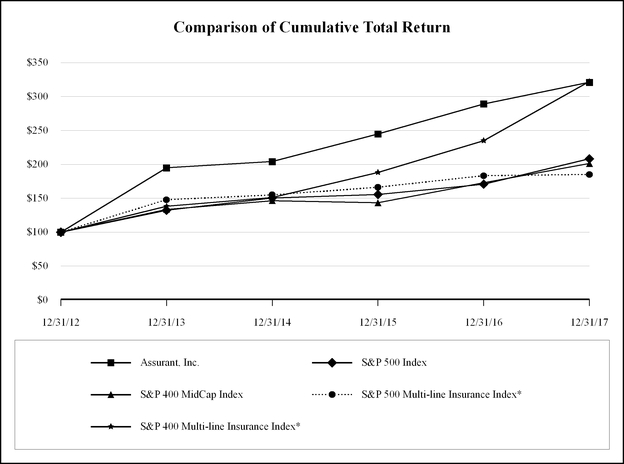
Total Values/Return to Stockholders
(Includes reinvestment of dividends)
| Base Period 12/31/12 | INDEXED VALUES Years Ending | ||||||||||||||||||||||
| Company / Index | 12/31/13 | 12/31/14 | 12/31/15 | 12/31/16 | 12/31/17 | ||||||||||||||||||
| Assurant, Inc. | $ | 100 | $ | 194.85 | $ | 204.10 | $ | 244.77 | $ | 289.19 | $ | 320.97 | |||||||||||
| S&P 500 Index | 100 | 132.39 | 150.51 | 155.59 | 170.84 | 208.14 | |||||||||||||||||
| S&P 400 MidCap Index | 100 | 133.50 | 146.54 | 143.35 | 173.08 | 201.20 | |||||||||||||||||
| S&P 500 Multi-line Insurance Index* | 100 | 147.90 | 154.95 | 166.17 | 183.24 | 185.13 | |||||||||||||||||
| S&P 400 Multi-line Insurance Index* | 100 | 138.21 | 151.16 | 188.15 | 234.99 | 322.19 | |||||||||||||||||
| ANNUAL RETURN PERCENTAGE Years Ending | |||||||||||||||||||||||
| Company / Index | 12/31/13 | 12/31/14 | 12/31/15 | 12/31/16 | 12/31/17 | ||||||||||||||||||
| Assurant, Inc. | 94.85 | % | 4.75 | % | 19.93 | % | 18.14 | % | 10.99 | % | |||||||||||||
| S&P 500 Index | 32.39 | 13.69 | 1.38 | 11.96 | 21.83 | ||||||||||||||||||
| S&P 400 MidCap Index | 33.50 | 9.77 | (2.18 | ) | 20.74 | 16.24 | |||||||||||||||||
| S&P 500 Multi-line Insurance Index* | 47.90 | 4.77 | 7.24 | 10.27 | 1.03 | ||||||||||||||||||
| S&P 400 Multi-line Insurance Index* | 38.21 | 9.37 | 24.47 | 24.90 | 37.11 |
| * | S&P 400 Multi-line Insurance Index is comprised of mid-cap companies, while the S&P 500 Multi-line Insurance Index is comprised of large-cap companies. |
Common Stock Price
Our common stock is listed on the NYSE under the symbol “AIZ.” The following table sets forth the high and low intraday sales prices per share of our common stock as reported by the NYSE and dividends per share of common stock declared by our Board of Directors for the periods indicated.
| Year Ended December 31, 2017 | High | Low | Dividends | ||||||||
| First Quarter | $ | 100.85 | $ | 90.45 | $ | 0.53 | |||||
| Second Quarter | $ | 105.30 | $ | 92.68 | $ | 0.53 | |||||
| Third Quarter | $ | 106.27 | $ | 87.74 | $ | 0.53 | |||||
| Fourth Quarter | $ | 101.80 | $ | 95.29 | $ | 0.56 | |||||
| Year Ended December 31, 2016 | High | Low | Dividends | ||||||||
| First Quarter | $ | 81.31 | $ | 66.23 | $ | 0.50 | |||||
| Second Quarter | $ | 88.67 | $ | 77.09 | $ | 0.50 | |||||
| Third Quarter | $ | 92.25 | $ | 83.01 | $ | 0.50 | |||||
| Fourth Quarter | $ | 93.74 | $ | 78.72 | $ | 0.53 |
Holders
On February 8, 2018, there were approximately 185 registered holders of record of our common stock. The closing price of our common stock on the NYSE on February 8, 2018 was $85.16.
Please see Item 12 of this Report for information about securities authorized for issuance under our equity compensation plans.
Shares Repurchased
| Period in 2017 | Total Number of Shares Purchased | Average Price Paid Per Share | Total Number of Shares Purchased as Part of Publicly Announced Programs (1) | Approximate Dollar Value of Shares that May Yet be Repurchased Under the Programs (1) | |||||||||
| January 1 – January 31 | 378,136 | $ | 95.59 | 378,136 | $ | 646.8 | |||||||
| February 1 – February 28 | 248,000 | 96.58 | 248,000 | 622.8 | |||||||||
| March 1 – March 31 | 457,000 | 97.80 | 457,000 | 578.1 | |||||||||
| Total first quarter | 1,083,136 | 96.75 | 1,083,136 | 578.1 | |||||||||
| April 1 – April 30 | 398,600 | 95.09 | 398,600 | 540.3 | |||||||||
| May 1 – May 31 | 375,900 | 100.73 | 375,900 | 502.4 | |||||||||
| June 1 – June 30 | 352,000 | 101.68 | 352,000 | 466.6 | |||||||||
| Total second quarter | 1,126,500 | 99.03 | 1,126,500 | 466.6 | |||||||||
| July 1 – July 31 | 246,821 | 105.11 | 246,821 | 440.7 | |||||||||
| August 1 – August 31 | 79,000 | 104.25 | 79,000 | 432.4 | |||||||||
| September 1 – September 30 | — | — | — | 432.4 | |||||||||
| Total third quarter | 325,821 | 104.90 | 325,821 | 432.4 | |||||||||
| October 1 – October 31 | — | — | — | 432.4 | |||||||||
| November 1 – November 30 | 639,415 | 99.05 | 639,415 | 369.1 | |||||||||
| December 1 – December 31 | 758,337 | 99.78 | 758,337 | 293.4 | |||||||||
| Total fourth quarter | 1,397,752 | 99.45 | 1,397,752 | 293.4 | |||||||||
| Total January 1 through December 31 | 3,933,209 | $ | 99.04 | 3,933,209 | $ | 293.4 |
| (1) | Shares purchased pursuant to the November 14, 2016 publicly announced share repurchase authorization of up to $600.0 of outstanding common stock. |
Dividend Policy
On January 19, 2018, our Board of Directors declared a quarterly dividend of $0.56 per common share payable on March 19, 2018 to stockholders of record as of February 26, 2018. We paid dividends of $0.56 per common share on December 18, 2017, and $0.53 per common share on September 19, 2017, June 20, 2017 and March 20, 2017. We paid dividends of $0.53 per common share on December 12, 2016, and $0.50 on September 13, 2016, June 14, 2016 and March 14, 2016. Any determination to pay future dividends will be at the discretion of our Board of Directors and will be dependent upon: our subsidiaries’ payment of dividends and/or other statutorily permissible payments to us; our results of operations and cash flows; our financial position and capital requirements; general business conditions; any legal, tax, regulatory and contractual restrictions on the payment of dividends; and any other factors our Board of Directors deems relevant.
Assurant, Inc. is a holding company and, therefore, its ability to pay dividends, service its debt and meet its other obligations depends primarily on the ability of its regulated U.S. domiciled insurance subsidiaries to pay dividends and make other statutorily permissible payments to the holding company. Our insurance subsidiaries are subject to significant regulatory and contractual restrictions limiting their ability to declare and pay dividends. See “Item 1A – Risk Factors – Risks Relating to the Company – The inability of our subsidiaries to pay sufficient dividends to the holding company could prevent us from meeting our obligations and paying future stockholder dividends.” For the calendar year 2018, the maximum amount of dividends our regulated U.S. domiciled insurance subsidiaries could pay us, under applicable laws and regulations without prior regulatory approval, is approximately $300.0 million. Dividends or returns of capital paid by our subsidiaries, net of infusions and excluding amounts used for acquisitions, was approximately $374.0 million in 2017.
We may seek approval of regulators to pay dividends in excess of any amounts that would be permitted without such approval. However, there can be no assurance that we would obtain such approval if sought.
Payments of dividends on shares of common stock are subject to the preferential rights of preferred stock that our Board of Directors may create from time to time. There is no preferred stock issued and outstanding as of December 31, 2017. For more information regarding restrictions on the payment of dividends by us and our insurance subsidiaries, including those pursuant to the terms of our revolving credit facilities, see “Item 7 – Management’s Discussion and Analysis of Financial Condition and Results of Operations – Liquidity and Capital Resources.”
In addition, our $450.0 million 2017 credit facility and $350.0 million term loan facility restrict payments of dividends if an event of default under the facility has occurred or if a proposed dividend payment would cause an event of default under the facility.
Item 6. Selected Financial Data
Assurant, Inc.
Five-Year Summary of Selected Financial Data
| As of and for the years ended December 31, | |||||||||||||||||||
| 2017 | 2016 | 2015 | 2014 | 2013 | |||||||||||||||
| Consolidated Statement of Operations Data: | |||||||||||||||||||
| Revenues | |||||||||||||||||||
| Net earned premiums (1) (2) | $ | 4,404.1 | $ | 5,007.3 | $ | 8,351.0 | $ | 8,632.1 | $ | 7,759.8 | |||||||||
| Fees and other income | 1,383.1 | 1,422.5 | 1,303.5 | 1,033.8 | 586.7 | ||||||||||||||
| Net investment income | 493.8 | 515.7 | 626.2 | 656.4 | 650.3 | ||||||||||||||
| Net realized gains on investments (3) | 30.1 | 162.2 | 31.8 | 60.8 | 34.5 | ||||||||||||||
| Amortization of deferred gains and gains on disposal of businesses | 103.9 | 394.5 | 13.0 | (1.5 | ) | 16.3 | |||||||||||||
| Gain on pension plan curtailment | — | 29.6 | — | — | — | ||||||||||||||
| Total revenues | 6,415.0 | 7,531.8 | 10,325.5 | 10,381.6 | 9,047.6 | ||||||||||||||
| Benefits, losses and expenses | |||||||||||||||||||
| Policyholder benefits | 1,870.6 | 1,808.5 | 4,742.5 | 4,405.3 | 3,675.5 | ||||||||||||||
| Amortization of deferred acquisition costs and value of businesses acquired | 1,340.0 | 1,351.3 | 1,402.6 | 1,485.6 | 1,470.3 | ||||||||||||||
| Underwriting, general and administrative expenses (2) | 2,710.4 | 3,442.8 | 3,924.1 | 3,688.2 | 3,034.4 | ||||||||||||||
| Interest expense | 49.5 | 57.6 | 55.1 | 58.4 | 77.7 | ||||||||||||||
| Loss on extinguishment of debt | — | 23.0 | — | — | — | ||||||||||||||
| Total benefits, losses and expenses | 5,970.5 | 6,683.2 | 10,124.3 | 9,637.5 | 8,257.9 | ||||||||||||||
| Income before provision for income taxes (4) | 444.5 | 848.6 | 201.2 | 744.1 | 789.7 | ||||||||||||||
| (Benefit) provision for income taxes (5) | (75.1 | ) | 283.2 | 59.6 | 273.2 | 300.8 | |||||||||||||
| Net income | $ | 519.6 | $ | 565.4 | $ | 141.6 | $ | 470.9 | $ | 488.9 | |||||||||
| Earnings per share: | |||||||||||||||||||
| Basic | $ | 9.45 | $ | 9.23 | $ | 2.08 | $ | 6.52 | $ | 6.38 | |||||||||
| Diluted | $ | 9.39 | $ | 9.13 | $ | 2.05 | $ | 6.44 | $ | 6.30 | |||||||||
| Dividends per share | $ | 2.15 | $ | 2.03 | $ | 1.37 | $ | 1.06 | $ | 0.96 | |||||||||
| Share data: | |||||||||||||||||||
| Weighted average shares outstanding used in basic per share calculations | 54,986,654 | 61,261,288 | 68,163,825 | 72,181,447 | 76,648,688 | ||||||||||||||
| Plus: Dilutive securities | 324,378 | 673,486 | 853,384 | 970,563 | 1,006,076 | ||||||||||||||
| Weighted average shares used in diluted per share calculations | 55,311,032 | 61,934,774 | 69,017,209 | 73,152,010 | 77,654,764 | ||||||||||||||
| Selected Consolidated Balance Sheet Data: | |||||||||||||||||||
| Cash and cash equivalents and investments | $ | 12,550.3 | $ | 12,511.0 | $ | 14,283.1 | $ | 15,450.1 | $ | 15,961.2 | |||||||||
| Total assets | $ | 31,843.0 | $ | 29,709.1 | $ | 30,036.4 | $ | 31,554.9 | $ | 29,706.3 | |||||||||
| Policy liabilities (6) | $ | 21,218.2 | $ | 20,040.6 | $ | 19,787.1 | $ | 19,711.9 | $ | 18,698.6 | |||||||||
| Debt | $ | 1,068.2 | $ | 1,067.0 | $ | 1,164.7 | $ | 1,163.5 | $ | 1,629.7 | |||||||||
| Total Assurant, Inc. stockholders’ equity | $ | 4,270.6 | $ | 4,098.1 | $ | 4,524.0 | $ | 5,181.3 | $ | 4,833.5 | |||||||||
| Per share data: | |||||||||||||||||||
| Total book value per basic share (7) | $ | 80.46 | $ | 72.33 | $ | 67.92 | $ | 73.73 | $ | 66.23 |
| (1) | The decline in 2016 primarily relates to the Assurant Health wind-down and the sale of our Assurant Employee Benefits segment. |
| (2) | Amounts in 2017 are lower due to a change in program structure impacting the accounting for revenues on a net instead of gross basis for a large client in global connected living. The change in program structure had no impact on net income. |
| (3) | Included in net realized gains are other-than-temporary impairments of $0.9 million, $6.9 million, $5.0 million, less than $0.1 million and $4.4 million for 2017, 2016, 2015, 2014 and 2013, respectively. |
| (4) | 2017 includes $295.7 million of reportable catastrophes (reportable catastrophe losses, net of reinsurance and client profit sharing adjustments, and including reinstatement and other premiums), primarily related to Hurricanes Harvey, Irma and Maria. The comparable reportable catastrophes in 2016, 2015, 2014 and 2013 were $157.4 million, $19.3 million, $18.5 million and $19.2 million, respectively. Reportable catastrophe losses include only |
individual catastrophic events that generated losses to the Company in excess of $5.0 million, pre-tax and net of reinsurance. The decline in 2016 primarily relates to lower losses from Assurant Health and only two months of results of Assurant Employee Benefits prior to its sale on March 1, 2016. 2015 includes higher loss experience and adverse claim development on 2015 individual major medical policies associated with Assurant Health.
| (5) | 2017 includes a $177.0 million one-time benefit from the reduction of net deferred tax liabilities following the enactment of the U.S. Tax Cuts and Jobs Act. The reduction in net deferred tax liabilities was recorded at the reportable segment level using our best estimate of deferred tax balances as of the December 22, 2017 enactment date. |
| (6) | Policy liabilities include future policy benefits and expenses, unearned premiums and claims and benefits payable. |
| (7) | Total stockholders’ equity divided by the basic shares outstanding for book value per basic share calculation. At December 31, 2017, 2016, 2015, 2014, and 2013 there were 53,078,396, 56,660,642, 66,606,258, 70,276,896 and 72,982,023 shares, respectively, outstanding. |
Item 7. Management’s Discussion and Analysis of Financial Condition and Results of Operations.
The following discussion and analysis of our financial condition and results of operations should be read in conjunction with our Consolidated Financial Statements and accompanying notes which appear elsewhere in this Report. It contains forward-looking statements that involve risks and uncertainties. Our actual results may differ materially from those anticipated in these forward-looking statements as a result of various factors, including those discussed below and elsewhere in this Report, particularly under the headings “Item 1A – Risk Factors” and “Forward-Looking Statements.”
General
We report our results through four segments: Global Housing, Global Lifestyle, Global Preneed and Total Corporate and Other. Total Corporate and Other includes activities of the holding company, financing and interest expenses, net realized gains (losses) on investments, interest income earned from short-term investments held and income (expenses) primarily related to the Company's frozen benefit plans. Total Corporate and Other also includes the amortization of deferred gains and gains associated with the sales of Fortis Financial Group ("FFG"), our Long Term Care ("LTC') and the Assurant Employee Benefits businesses through reinsurance agreements, integration and transaction expenses related to the pending acquisition of The Warranty Group (see below) and other unusual or infrequent items. Additionally, the Total Corporate and Other segment includes amounts related to the runoff of the Assurant Health business. As Assurant Health was a reportable segment in prior years, these amounts are disclosed for comparability. In addition, Assurant Employee Benefits was a separate segment in 2016 and primarily includes the results of operations for the periods prior to its sale on March 1, 2016. See Note 4 for more information.
The following discussion covers the year ended December 31, 2017 (“Twelve Months 2017”), year ended December 31, 2016 (“Twelve Months 2016”) and year ended December 31, 2015 (“Twelve Months 2015”). Please see the discussion that follows, for each of these segments, for a more detailed comparative analysis.
Executive Summary
On January 8, 2018, the Company entered into an Amended and Restated Agreement and Plan of Merger (the “A&R Merger Agreement”), with TWG Holdings Limited, a Bermuda limited company (“TWG Holdings,” and together with its subsidiaries, “TWG”), TWG Re, Ltd., a corporation incorporated in the Cayman Islands (“TWG Re”), Arbor Merger Sub, Inc., a Delaware corporation and a direct wholly owned subsidiary of TWG Holdings (“TWG Merger Sub”) and Spartan Merger Sub, Ltd., a Bermuda exempted limited company and a direct wholly owned subsidiary of Assurant (“Merger Sub”). Under the terms of the A&R Merger Agreement and subject to the satisfaction or waiver of the conditions therein, Assurant will acquire TWG through a transaction in which Merger Sub will merge with and into TWG, with TWG continuing as the surviving corporation and as a wholly owned subsidiary of Assurant. TWG is a global provider of protection plans and related programs and a portfolio company of TPG Capital, a private equity company. For more information regarding the pending transaction, see Note 27 to the Consolidated Financial Statements, included elsewhere in this Report.
Consolidated net income decreased $45.8 million, or 8%, to $519.6 million for Twelve Months 2017 from $565.4 million for Twelve Months 2016. The decrease includes a $266.5 million reduction in after-tax net gains from the 2016 sale of Assurant Employee Benefits (including net realized gains on investments and amortization of deferred gains in connection with the transaction) and a $90.1 million after-tax increase in reportable catastrophes (reportable catastrophe losses, net of reinsurance and client profit sharing adjustments, and including reinstatement and other premiums), mainly due to Hurricanes Harvey, Irma and Maria. These items were partially offset by a one-time $177.0 million tax benefit from the reduction of net deferred tax liabilities following the enactment of the U.S. Tax Cuts and Jobs Act.
Global Housing net income decreased $91.2 million, or 48%, to $97.4 million for Twelve Months 2017 from $188.6 million for Twelve Months 2016, primarily due to an $88.1 million after-tax increase in reportable catastrophes mainly from Hurricanes Harvey, Irma and Maria. Excluding reportable catastrophes, the decrease in net income was due to higher non-catastrophe loss experience and a reduction from our lender placed insurance business due to the ongoing normalization of placement rates. These decreases were partially offset by a reduction of lender placed regulatory expenses and profitable growth from our multifamily housing business.
Net earned premiums and fees decreased $113.8 million to $2.18 billion for Twelve Months 2017 compared with Twelve Months 2016, primarily due to lower placement rates in lender-placed insurance as well as the impact of reinstatement and other premiums from reportable catastrophes. Reduced demand for originations and field services, along with lower client volumes, in our mortgage solutions business also contributed to the decline. The decrease was partially offset by revenue growth in our multi-family housing business.
For 2018, we anticipate Global Housing net income, excluding reportable catastrophes, to be down before taking into account recently enacted tax reform. Further declines in lender-placed insurance are expected as the housing market continues to improve. We expect declines to be partially offset by continued growth in multi-family housing and improved performance in mortgage solutions. Additional savings from ongoing expense management efforts are expected to be realized towards the end of 2018 and into 2019. Net operating income is expected to increase after reflecting a lower effective tax rate of approximately 20%, with a portion of the tax savings to be reinvested for future growth. Revenue expected to approximate 2017 levels as declines in lender-placed are offset by growth in multi-family housing and mortgage solutions.
Global Lifestyle net income increased $23.6 million, or 15%, to $178.0 million for Twelve Months 2017 from $154.4 million for Twelve Months 2016. The increase was primarily driven by our global connected living business due to higher contributions from extended service contracts from original equipment manufacturer clients and other distribution channels as well as an increase in contract recoverables and growth in our mobile business, partially offset by lower volume from our domestic repair and logistics business. The increase was also driven by growth in our domestic vehicle protection business.
Twelve Months 2017 net earned premiums, fees and other income decreased $309.9 million to $3.40 billion compared with Twelve Months 2016, primarily due to the change in program structure in fourth quarter 2016 for a large service contract client in global connected living. Excluding this program structure change, net earned premiums, fees and other income increased $193.1 million mainly due to growth in global connected living, that was mostly driven by global mobile, as well as growth from our domestic vehicle protection services and international credit businesses.
In 2018, we expect Global Lifestyle net income to increase, before taking into account recently enacted tax reform. Profitable growth is expected to be driven primarily by newly launched mobile programs and vehicle protection offerings and ongoing expense management efforts, partially offset by ongoing declines in credit insurance. Mobile trade-in activity is expected to vary based on the timing and availability of new smartphone introductions and carrier promotional activity. Results are expected to benefit from a lower effective tax rate of approximately 22%, with a portion of the tax savings to be reinvested for future growth. Revenue is expected to increa
Showing the first 8K of 123K characters. Open the full section
Item 7A. Quantitative and Qualitative Disclosures About Market Risk
As a provider of insurance products, effective risk management is fundamental to our ability to protect both our customers’ and stockholders’ interests. We are exposed to potential loss from various market risks, in particular interest rate risk and credit risk. Additionally, we are exposed to inflation risk and to a lesser extent foreign currency risk.
Interest rate risk is the possibility that the fair value of liabilities will change more or less than the market value of investments in response to changes in interest rates, including changes in investment yields and changes in spreads due to credit risks and other factors.
Credit risk is the possibility that counterparties may not be able to meet payment obligations when they become due. We assume counterparty credit risk in many forms. A counterparty is any person or entity from which cash or other forms of consideration are expected to extinguish a liability or obligation to us. Primarily, our credit risk exposure is concentrated in our fixed maturity investment portfolio and, to a lesser extent, in our reinsurance recoverables.
Inflation risk is the possibility that a change in domestic price levels produces an adverse effect on earnings. This typically happens when either invested assets or liabilities, but not both is indexed to inflation.
Foreign exchange risk is the possibility that changes in exchange rates produce an adverse effect on earnings and equity when measured in domestic currency. This risk is largest when assets backing liabilities payable in one currency are invested in financial instruments of another currency. Our general principle is to invest in assets that match the currency in which we expect the liabilities to be paid.
Interest Rate Risk
Interest rate risk arises as we invest substantial funds in interest-sensitive fixed income assets, such as fixed maturity securities, mortgage-backed and asset-backed securities and commercial mortgage loans, primarily in the U.S. and Canada. There are two forms of interest rate risk – price risk and reinvestment risk. Price risk occurs when fluctuations in interest rates have a direct impact on the market valuation of these investments. As interest rates rise, the market value of these investments falls, and conversely, as interest rates fall, the market value of these investments rise. Reinvestment risk is primarily associated with the need to reinvest cash flows (primarily coupons and maturities) in an unfavorable lower interest rate environment. In addition, for securities with embedded options such as callable bonds, mortgage-backed securities, and certain asset-backed securities, reinvestment risk occurs when fluctuations in interest rates have a direct impact on expected cash flows. As interest rates fall, an increase in prepayments on these assets results in earlier than expected receipt of cash flows forcing us to reinvest the proceeds in an unfavorable lower interest rate environment. Conversely, as interest rates rise, a decrease in prepayments on these assets results in later than expected receipt of cash flows forcing us to forgo reinvesting in a favorable higher interest rate environment.
We manage interest rate risk by selecting investments with characteristics such as duration, yield, currency and liquidity tailored to the anticipated cash outflow characteristics of our insurance and reinsurance liabilities.
Our group long-term disability and group term life waiver of premium reserves are also sensitive to interest rates. These reserves are discounted to the valuation date at the valuation interest rate. The valuation interest rate is determined by taking into consideration actual and expected earned rates on our asset portfolio.
The interest rate sensitivity relating to price risk of our fixed maturity securities is assessed using hypothetical scenarios that assume several positive and negative parallel shifts of the yield curves. We have assumed that the U.S. and Canadian yield curve shifts are of equal direction and magnitude. The individual securities are repriced under each scenario using a valuation model. For investments such as callable bonds and mortgage-backed and asset-backed securities, a prepayment model is used in conjunction with a valuation model. Our actual experience may differ from the results noted below particularly due to assumptions utilized or if events occur that were not included in the methodology. The following tables summarize the results
of this analysis for bonds, mortgage-backed and asset-backed securities held in our investment portfolio as of the dates indicated:
| Interest Rate Movement Analysis of Market Value of Fixed Maturity Securities Investment Portfolio | ||||||||||||||||||||
| As of December 31, 2017 | ||||||||||||||||||||
| -100 | -50 | 0 | 50 | 100 | ||||||||||||||||
| Total market value | $ | 10,477.8 | $ | 10,058.5 | $ | 9,662.6 | $ | 9,287.9 | $ | 8,934.1 | ||||||||||
| % Change in market value from base case | 8.44 | % | 4.10 | % | — | % | (3.88 | )% | (7.54 | )% | ||||||||||
| $ Change in market value from base case | $ | 815.2 | $ | 395.9 | $ | — | $ | (374.7 | ) | $ | (728.5 | ) | ||||||||
| As of December 31, 2016 | ||||||||||||||||||||
| -100 | -50 | 0 | 50 | 100 | ||||||||||||||||
| Total market value | $ | 10,324.7 | $ | 9,939.9 | $ | 9,572.1 | $ | 9,222.9 | $ | 8,892.2 | ||||||||||
| % Change in market value from base case | 7.86 | % | 3.84 | % | — | % | (3.65 | )% | (7.10 | )% | ||||||||||
| $ Change in market value from base case | $ | 752.6 | $ | 367.8 | $ | — | $ | (349.2 | ) | $ | (679.9 | ) |
The interest rate sensitivity relating to reinvestment risk of our fixed maturity securities is assessed using hypothetical scenarios that assume purchases in the primary market and considers the effects of interest rates on sales. The effects of embedded options including call or put features are not considered. Our actual results may differ from the results noted below particularly due to assumptions utilized or if events occur that were not included in the methodology.
The following tables summarize the results of this analysis on our reported portfolio yield as of the dates indicated:
| Interest Rate Movement Analysis of Portfolio Yield of Fixed Maturity Securities Investment Portfolio | ||||||||||||||
| As of December 31, 2017 | ||||||||||||||
| -100 | -50 | 0 | 50 | 100 | ||||||||||
| Portfolio yield* | 4.50 | % | 4.58 | % | 4.67 | % | 4.76 | % | 4.84 | % | ||||
| Basis point change in portfolio yield | (0.17 | )% | (0.09 | )% | — | % | 0.09 | % | 0.17 | % | ||||
| As of December 31, 2016 | ||||||||||||||
| -100 | -50 | 0 | 50 | 100 | ||||||||||
| Portfolio yield* | 4.40 | % | 4.48 | % | 4.57 | % | 4.66 | % | 4.74 | % | ||||
| Basis point change in portfolio yield | (0.17 | )% | (0.09 | )% | — | % | 0.09 | % | 0.17 | % |
***** Includes investment income from real estate joint venture partnerships.
Credit Risk
We have exposure to credit risk primarily from customers, as a holder of fixed maturity securities and by entering into reinsurance cessions.
Our risk management strategy and investment policy is to invest in debt instruments of high credit quality issuers and to limit the amount of credit exposure with respect to any one issuer. We attempt to limit our credit exposure by imposing fixed maturity portfolio limits on individual issuers based upon credit quality. Currently our portfolio limits are 1.5% for issuers rated AA- and above, 1% for issuers rated A- to A+, 0.75% for issuers rated BBB- to BBB+, 0.38% for issuers rated BB- to BB+ and 0.25% for issuers rated B and below. These portfolio limits are further reduced for certain issuers with whom we have credit exposure on reinsurance agreements. We use the lower of Moody’s or S&P’s ratings to determine an issuer’s rating.
The following table presents our fixed maturity investment portfolio by ratings of the nationally recognized securities rating organizations as of the dates indicated:
| December 31, 2017 | December 31, 2016 | ||||||||||||
| Rating | Fair Value | Percentage of Total | Fair Value | Percentage of Total | |||||||||
| Aaa/Aa/A | $ | 6,155.4 | 64 | % | $ | 6,000.7 | 63 | % | |||||
| Baa | 2,982.5 | 31 | % | 2,903.8 | 30 | % | |||||||
| Ba | 400.8 | 4 | % | 435.2 | 5 | % | |||||||
| B and lower | 123.9 | 1 | % | 232.4 | 2 | % | |||||||
| Total | $ | 9,662.6 | 100 | % | $ | 9,572.1 | 100 | % |
We are also exposed to the credit risk of our reinsurers. When we reinsure, we are still liable to our insureds regardless of whether we get reimbursed by our reinsurer. As part of our overall risk and capacity management strategy, we purchase reinsurance for certain risks underwritten by our various business segments as described above under “Item 7 – Management’s Discussion and Analysis of Financial Condition and Results of Operations – Reinsurance.”
We had $9.79 billion and $9.08 billion of reinsurance recoverables as of December 31, 2017 and 2016, respectively, the majority of which are protected from credit risk by various types of risk mitigation mechanisms such as trusts, letters of credit or by withholding the assets in a modified coinsurance or co-funds-withheld arrangement. For example, reserves of $889.8 million, as of December 31, 2017 and $1.08 billion as of December 31, 2016, relating to a coinsurance agreement with Sun Life, and reserves of $1.01 billion and $4.19 billion as of December 31, 2017 and $1.03 billion and $4.18 billion as of December 31, 2016, relating to coinsurance arrangements with The Hartford and John Hancock (a subsidiary of Manulife Financial Corporation), respectively, related to sales of businesses are backed by trusts. If the value of the assets in these trusts falls below the value of the associated liabilities, Sun Life, The Hartford and John Hancock, as the case may be, will be required to put more assets in the trusts. We may be dependent on the financial condition of Sun Life, John Hancock and The Hartford, whose A.M. Best ratings are currently A+, A+ and B++, respectively. A.M. Best currently maintains a stable outlook on the financial strength ratings of Sun Life and John Hancock. The A.M. Best financial strength ratings of The Hartford are currently under review with developing implications. For recoverables that are not protected by these mechanisms, we are dependent solely on the credit of the reinsurer. See “Item 1A – Risk Factors – Risks Related to the Company – Reinsurance may not be available or adequate to protect us against losses, and we are subject to the credit risk of reinsurers” and “– Through reinsurance, we have sold businesses that could again become our direct financial and administrative responsibility if the reinsurers become insolvent.” A majority of our reinsurance exposure has been ceded to companies rated A- or better by A.M. Best.
Inflation Risk
Inflation risk arises as we invest in assets, which are not indexed to the level of inflation, whereas the corresponding liabilities are indexed to the level of inflation. Approximately 4% and 5% of Assurant preneed insurance policies, with reserves of $229.9 million and $240.2 million as of December 31, 2017 and 2016, respectively, have death benefits that are guaranteed to grow with the CPI. In times of rapidly rising inflation, the credited death benefit growth on these liabilities increases relative to the investment income earned on the nominal assets resulting in an adverse impact on earnings. We have partially mitigated this risk by purchasing derivative contracts with payments tied to the CPI. See “– Derivatives.”
In addition, we have inflation risk in our individual and small employer group health insurance businesses to the extent that medical costs increase with inflation, and we have not been able to increase premiums to keep pace with inflation.
Foreign Exchange Risk
We are exposed to foreign exchange risk arising from our international operations, mainly in Canada. We also have foreign exchange risk exposure to the British pound, Brazilian Real, Euro, Mexican Peso and Argentine Peso. Total invested assets denominated in currencies other than the Canadian dollar were approximately 3% and 2% of our total invested assets at December 31, 2017 and 2016, respectively.
Foreign exchange risk is mitigated by matching our liabilities under insurance policies that are payable in foreign currencies with investments that are denominated in such currency. We have entered into forward contracts to hedge certain exposures denominated in the Euro and British pound.
The foreign exchange risk sensitivity of our fixed maturity securities denominated in Canadian dollars, whose balance was $1.80 billion and $1.56 billion of the total as of December 31, 2017 and 2016, respectively, on our entire fixed maturity portfolio is summarized in the following tables:
| Foreign Exchange Movement Analysis of Market Value of Fixed Maturity Securities Assets | ||||||||||||||||||||
| As of December 31, 2017 | ||||||||||||||||||||
| Foreign exchange spot rate at December 31, 2017, US Dollar to Canadian Dollar | -10% | -5% | 0 | 5% | 10% | |||||||||||||||
| Total market value | $ | 9,482.2 | $ | 9,572.4 | $ | 9,662.6 | $ | 9,752.8 | $ | 9,843.0 | ||||||||||
| % change of market value from base case | (1.87 | )% | (0.93 | )% | — | % | 0.93 | % | 1.87 | % | ||||||||||
| $ change of market value from base case | $ | (180.4 | ) | $ | (90.2 | ) | $ | — | $ | 90.2 | $ | 180.4 | ||||||||
| As of December 31, 2016 | ||||||||||||||||||||
| Foreign exchange spot rate at December 31, 2016, US Dollar to Canadian Dollar | -10% | -5% | 0 | 5% | 10% | |||||||||||||||
| Total market value | $ | 9,415.8 | $ | 9,493.9 | $ | 9,572.1 | $ | 9,650.3 | $ | 9,728.4 | ||||||||||
| % change of market value from base case | (1.63 | )% | (0.82 | )% | — | % | 0.82 | % | 1.63 | % | ||||||||||
| $ change of market value from base case | $ | (156.3 | ) | $ | (78.2 | ) | $ | — | $ | 78.2 | $ | 156.3 |
The foreign exchange risk sensitivity of our consolidated net income is assessed using hypothetical test scenarios that assume earnings in Canadian dollars are recognized evenly throughout a period. Our actual results may differ from the results noted below particularly due to assumptions utilized or if events occur that were not included in the methodology. For more information on this risk, please see “Item 1A – Risk Factors-Risks Related to the Company.” Fluctuations in the exchange rate of the U.S. dollar and other foreign currencies may materially and adversely affect our results of operations. The following tables summarize the results of this analysis on our reported net income as of the dates indicated:
| Foreign Exchange Movement Analysis of Net Income | ||||||||||||||||||||
| As of December 31, 2017 | ||||||||||||||||||||
| Foreign exchange daily average rate for the year ended December 31, 2017, US Dollar to Canadian Dollar | -10% | -5% | 0 | 5% | 10% | |||||||||||||||
| Net Income | $ | 517.0 | $ | 518.3 | $ | 519.6 | $ | 520.9 | $ | 522.2 | ||||||||||
| % change of net income from base case | (0.50 | )% | (0.25 | )% | — | % | 0.25 | % | 0.50 | % | ||||||||||
| $ change of net income from base case | $ | (2.6 | ) | $ | (1.3 | ) | $ | — | $ | 1.3 | $ | 2.6 | ||||||||
| As of December 31, 2016 | ||||||||||||||||||||
| Foreign exchange daily average rate for the year ended December 31, 2016, US Dollar to Canadian Dollar | -10% | -5% | 0 | 5% | 10% | |||||||||||||||
| Net income | $ | 563.4 | $ | 564.4 | $ | 565.4 | $ | 566.4 | $ | 567.4 | ||||||||||
| % change of net income from base case | (0.35 | )% | (0.18 | )% | — | % | 0.18 | % | 0.35 | % | ||||||||||
| $ change of net income from base case | $ | (2.0 | ) | $ | (1.0 | ) | $ | — | $ | 1.0 | $ | 2.0 |
Derivatives
Derivatives are financial instruments whose values are derived from interest rates, foreign exchange rates, financial indices or the prices of securities or commodities. Derivative financial instruments may be exchange-traded or contracted in the over-the-counter market and include swaps, futures, options and forward contracts.
Under insurance statutes, our insurance companies may use derivative financial instruments to hedge actual or anticipated changes in their assets or liabilities, to replicate cash market instruments or for certain income-generating activities. These statutes generally prohibit the use of derivatives for speculative purposes. We generally do not use derivative financial instruments.
We have purchased contracts to cap the inflation risk exposure inherent in some of our preneed insurance policies.
In accordance with the guidance on embedded derivatives, we have bifurcated the modified coinsurance agreement with The Hartford into its debt host and embedded derivative (total return swap) and recorded the embedded derivative at fair value in the consolidated balance sheets. The invested assets related to this modified coinsurance agreement are included in other investments in the consolidated balance sheets.
Item 8. Financial Statements and Supplementary Data
The Consolidated Financial Statements and Financial Statement Schedules in Part IV, Item 15(a) 1 and 2 of this Report are incorporated by reference into this Item 8.
Item 9. Changes in and Disagreements with Accountants on Accounting and Financial Disclosure
There have been no disagreements with accountants on accounting and financial disclosure.
Item 9A. Controls and Procedures
Evaluation of Disclosure Controls and Procedures
The Company’s Chief Executive Officer and Chief Financial Officer have evaluated the effectiveness of the Company’s disclosure controls and procedures pursuant to Rule 13a-15(e) or 15d-15(e) under the Securities Exchange Act of 1934, as amended (the “Exchange Act”) as of December 31, 2017. They have concluded that the Company’s disclosure controls and procedures are effective, and provide reasonable assurance that information the Company is required to disclose in its reports under the Exchange Act is recorded, processed, summarized and reported accurately. They also have concluded that information that the Company is required to disclose is accumulated and communicated to the Company’s management as appropriate to allow timely decisions regarding required disclosure.
Management’s Annual Report on Internal Control Over Financial Reporting
The management of the Company is responsible for establishing and maintaining adequate internal control over financial reporting for the Company as defined in Rule 13a-15(f) or 15d-15(f) under the Exchange Act.
A company’s internal control over financial reporting is a process designed to provide reasonable assurance regarding the reliability of financial reporting and the preparation of financial statements for external purposes in accordance with accounting principles generally accepted in the U.S. A company’s internal control over financial reporting includes policies and procedures that (1) pertain to the maintenance of records that in reasonable detail accurately and fairly reflect the transactions and dispositions of the assets of the company; (2) provide reasonable assurance that transactions are recorded as necessary to permit preparation of financial statements in accordance with accounting principles generally accepted in the U.S., and that receipts and expenditures of the company are being made only in accordance with authorizations of management and directors of the company; and (3) provide reasonable assurance regarding prevention or timely detection of unauthorized acquisition, use or disposition of the company’s assets that could have a material effect on the financial statements. Because of its inherent limitations, internal control over financial reporting may not prevent or detect misstatements. Also, projections of any evaluation of effectiveness to future periods are subject to the risk that controls may become inadequate because of changes in conditions, or that the degree of compliance with the policies or procedures may deteriorate.
The Company’s management assessed its internal control over financial reporting as of December 31, 2017 using criteria established in Internal Control – Integrated Framework (2013) issued by the Committee of Sponsoring Organizations of the Treadway Commission (COSO).
Management, including the Company’s Chief Executive Officer and its Chief Financial Officer, based on their evaluation of the Company’s internal control over financial reporting (as defined in Exchange Act Rule 13a-15(f) or 15d-15(f)), have concluded that the Company’s internal control over financial reporting was effective as of December 31, 2017.
The effectiveness of the Company’s internal control over financial reporting as of December 31, 2017 has been audited by PricewaterhouseCoopers LLP, an independent registered public accounting firm, as stated in their report which appears herein.
Changes in Internal Control Over Financial Reporting
There have been no changes in the Company’s internal control over financial reporting that occurred during the Company’s fourth fiscal quarter in 2017 that have materially affected, or are reasonably likely to materially affect, the Company’s internal control over financial reporting.
Item 9B. Other Information
None.
PART III
Item 10. Directors, Executive Officers and Corporate Governance
The information regarding executive officers in our upcoming 2018 Proxy Statement (“2018 Proxy Statement”) under the caption “Executive Officers” is incorporated herein by reference. The information regarding directors in the 2018 Proxy Statement, under the caption "Proposal One-Election of Directors,” is incorporated herein by reference. The information regarding compliance with Section 16(a) of the Exchange Act in the 2018 Proxy Statement, under the caption “Section 16(a) Beneficial Ownership Reporting Compliance” is incorporated herein by reference. The information regarding the Nominating and Corporate Governance Committee and the Audit Committee in the 2018 Proxy Statement under the captions “Corporate Governance-Nominating and Corporate Governance Committee” and “Corporate Governance-Audit Committee” is incorporated herein by reference. The information regarding the Company’s Code of Ethics in the 2018 Proxy Statement, under the caption "Corporate Governance-Code of Ethics".
Item 11. Executive Compensation
The information in the 2018 Proxy Statement under the captions “Compensation Discussion and Analysis,” “Executive Officer Compensation” and “Director Compensation” is incorporated herein by reference. The information in the 2018 Proxy Statement regarding the Compensation Committee under the captions “Compensation Committee,” “Compensation Committee Interlocks and Insider Participation” and “Compensation Committee Report” in “Corporate Governance” is incorporated herein by reference.
Item 12. Security Ownership of Certain Beneficial Owners and Management and Related Stockholder Matters
The information in the 2018 Proxy Statement under the captions “Security Ownership of Certain Beneficial Owners” and “Security Ownership of Directors and Executive Officers” is incorporated herein by reference.
Item 13. Certain Relationships and Related Transactions, and Director Independence
The information in the 2018 Proxy Statement under the captions “Transactions with Related Persons” and “Director Independence” in “Corporate Governance” is incorporated herein by reference.
Item 14. Principal Accounting Fees and Services
The information in the 2018 Proxy Statement under the caption “Fees of Principal Accountants” in “Audit Committee Matters” is incorporated herein by reference.
PART IV
Item 15. Exhibits and Financial Statement Schedules
(a)1. Consolidated Financial Statements
The following Consolidated Financial Statements of Assurant, Inc., incorporated by reference into Item 8, are attached hereto:
(a)2. Consolidated Financial Statement Schedules
The following Consolidated Financial Statement Schedules of Assurant, Inc. are attached hereto:
| * | All other schedules are omitted because they are not applicable, not required, or the information is included in the financial statements or the notes thereto. |
(a)3. Exhibits
Pursuant to the rules and regulations of the SEC, the Company has filed or incorporated by reference certain agreements as exhibits to this Annual Report on Form 10-K. These agreements may contain representations and warranties by the parties. These representations and warranties have been made solely for the benefit of the other party or parties to such agreements and (i) may have been qualified by disclosures made to such other party or parties, (ii) were made only as of the date of such agreements or such other date(s) as may be specified in such agreements and are subject to more recent developments, which may not be fully reflected in the Company’s public disclosure, (iii) may reflect the allocation of risk among the parties to such agreements and (iv) may apply materiality standards different from what may be viewed as material to investors. Accordingly, these representations and warranties may not describe the Company’s actual state of affairs at the date hereof and should not be relied upon.
The following exhibits either (a) are filed with this report or (b) have previously been filed with the SEC and are incorporated herein by reference to those prior filings. Exhibits are available upon request at the investor relations section of our website, located at www.assurant.com*.*
*Management contract or compensatory plans
Item 16. Form 10-K Summary
Not applicable.
SIGNATURES
Pursuant to the requirements of Section 13 or 15(d) of the Securities Exchange Act of 1934, as amended, the registrant has duly caused this Report to be signed on its behalf by the undersigned, thereunto duly authorized on February 14, 2018.
| ASSURANT, INC. | ||
| By: | /S/ ALAN B. COLBERG | |
| Name: | Alan B. Colberg | |
| Title: | Chief Executive Officer |
Pursuant to the requirements of the Securities Exchange Act of 1934, as amended, this Report has been signed below by the following persons on behalf of the registrant in the capacities indicated on February 14, 2018.
| Signature | Title | |
| /S/ ALAN B. COLBERG | President, Chief Executive Officer and Director (Principal Executive Officer) | |
| Alan B. Colberg | ||
| /S/ RICHARD S. DZIADZIO | Executive Vice President, Chief Financial Officer and Treasurer (Principal Financial Officer) | |
| Richard S. Dziadzio | ||
| /S/ DANIEL A. PACICCO | Senior Vice President, Chief Accounting Officer and Controller (Principal Accounting Officer) | |
| Daniel A. Pacicco | ||
| * | Non-Executive Board Chair | |
| Elaine D. Rosen | ||
| * | Director | |
| Howard L. Carver | ||
| * | Director | |
| Juan N. Cento | ||
| * | Director | |
| Elyse Douglas | ||
| * | Director | |
| Harriet Edelman | ||
| * | Director | |
| Lawrence V. Jackson | ||
| * | Director | |
| Charles J. Koch | ||
| * | Director | |
| Jean-Paul L. Montupet | ||
| * | Director | |
| Debra J. Perry | ||
| ***** | Director | |
| Paul J. Reilly | ||
| * | Director | |
| Robert W. Stein |
| *By: | /S/ RICHARD S. DZIADZIO | |
| Name: | Richard S. Dziadzio | |
| Attorney-in-Fact |
Report of Independent Registered Public Accounting Firm
To the Board of Directors and Stockholders of Assurant, Inc.:
Opinions on the Financial Statements and Internal Control over Financial Reporting
We have audited the accompanying consolidated balance sheets of Assurant, Inc. and its subsidiaries as of December 31, 2017 and 2016, and the related consolidated statements of operations, comprehensive income, changes in stockholders’ equity and cash flows for each of the three years in the period ended December 31, 2017, including the related notes and financial statement schedules listed in the index appearing under Item 15(a)2 (collectively referred to as the “consolidated financial statements”). We also have audited the Company's internal control over financial reporting as of December 31, 2017, based on criteria established in Internal Control - Integrated Framework (2013) issued by the Committee of Sponsoring Organizations of the Treadway Commission (COSO).
In our opinion, the consolidated financial statements referred to above present fairly, in all material respects, the financial position of the Company as of December 31, 2017 and 2016**,** and the results of their operations and their cash flows for each of the three years in the period ended December 31, 2017 in conformity with accounting principles generally accepted in the United States of America. Also in our opinion, the Company maintained, in all material respects, effective internal control over financial reporting as of December 31, 2017, based on criteria established in Internal Control - Integrated Framework (2013) issued by the COSO.
Basis for Opinions
The Company's management is responsible for these consolidated financial statements, for maintaining effective internal control over financial reporting, and for its assessment of the effectiveness of internal control over financial reporting, included in Management's Annual Report on Internal Control over Financial Reporting appearing under Item 9A. Our responsibility is to express opinions on the Company’s consolidated financial statements and on the Company's internal control over financial reporting based on our audits. We are a public accounting firm registered with the Public Company Accounting Oversight Board (United States) ("PCAOB") and are required to be independent with respect to the Company in accordance with the U.S. federal securities laws and the applicable rules and regulations of the Securities and Exchange Commission and the PCAOB.
We conducted our audits in accordance with the standards of the PCAOB. Those standards require that we plan and perform the audits to obtain reasonable assurance about whether the consolidated financial statements are free of material misstatement, whether due to error or fraud, and whether effective internal control over financial reporting was maintained in all material respects.
Our audits of the consolidated financial statements included performing procedures to assess the risks of material misstatement of the consolidated financial statements, whether due to error or fraud, and performing procedures that respond to those risks. Such procedures included examining, on a test basis, evidence regarding the amounts and disclosures in the consolidated financial statements. Our audits also included evaluating the accounting principles used and significant estimates made by management, as well as evaluating the overall presentation of the consolidated financial statements. Our audit of internal control over financial reporting included obtaining an understanding of internal control over financial reporting, assessing the risk that a material weakness exists, and testing and evaluating the design and operating effectiveness of internal control based on the assessed risk. Our audits also included performing such other procedures as we considered necessary in the circumstances. We believe that our audits provide a reasonable basis for our opinions.
Definition and Limitations of Internal Control over Financial Reporting
A company’s internal control over financial reporting is a process designed to provide reasonable assurance regarding the reliability of financial reporting and the preparation of financial statements for external purposes in accordance with generally accepted accounting principles. A company’s internal control over financial reporting includes those policies and procedures that (i) pertain to the maintenance of records that, in reasonable detail, accurately and fairly reflect the transactions and dispositions of the assets of the company; (ii) provide reasonable assurance that transactions are recorded as necessary to permit preparation of financial statements in accordance with generally accepted accounting principles, and that receipts and expenditures of the company are being made only in accordance with authorizations of management and directors of the company; and (iii) provide reasonable assurance regarding prevention or timely detection of unauthorized acquisition, use, or disposition of the company’s assets that could have a material effect on the financial statements.
Because of its inherent limitations, internal control over financial reporting may not prevent or detect misstatements. Also, projections of any evaluation of effectiveness to future periods are subject to the risk that controls may become inadequate because of changes in conditions, or that the degree of compliance with the policies or procedures may deteriorate.
F-1
/s/ PricewaterhouseCoopers LLP
New York, New York
February 14, 2018
We have served as the Company’s auditor since 2000.
F-2
Assurant, Inc.
Consolidated Balance Sheets
As of December 31, 2017 and 2016
| **December 31 |
Showing the first 8K of 378K characters. Open the full section