 filings.tools
Albemarle 10-K 2019-12-31
Filed 2020-02-26. 22 sections, 569K characters. Original on sec.gov · Markdown · JSON
Cover and table of contents
UNITED STATES
SECURITIES AND EXCHANGE COMMISSION
Washington, D.C. 20549
FORM 10-K
| ☒ | Annual Report Pursuant to Section 13 or 15(d) of the Securities Exchange Act of 1934 |
For the fiscal year ended December 31, 2019
or
| ☐ | Transition Report Pursuant to Section 13 or 15(d) of the Securities Exchange Act of 1934 |
For the transition period from to
Commission file number 001-12658
ALBEMARLE CORPORATION
(Exact name of registrant as specified in its charter)
| Virginia | 54-1692118 | |
| (State or other jurisdiction of incorporation or organization) | (I.R.S. Employer Identification No.) |
4250 Congress Street, Suite 900
Charlotte**,** North Carolina 28209
(Address of principal executive offices) (Zip Code)
**Registrant’s telephone number, including area code: (**980) - 299-5700
Securities registered pursuant to Section 12(b) of the Act:
| Title of each class | Trading Symbol | Name of each exchange on which registered | ||
| COMMON STOCK, $.01 Par Value | ALB | New York Stock Exchange |
Indicate by check mark if the registrant is a well-known seasoned issuer, as defined in Rule 405 of the Securities Act. Yes ☒ No ☐
Indicate by check mark if the registrant is not required to file reports pursuant to Section 13 or Section 15(d) of the Act. Yes ☐ No ☒
Indicate by check mark whether the registrant (1) has filed all reports required to be filed by Section 13 or 15(d) of the Securities Exchange Act of 1934 during the preceding 12 months (or for such shorter period that the registrant was required to file such reports), and (2) has been subject to such filing requirements for at least the past 90 days. Yes ☒ No ☐
Indicate by check mark whether the registrant has submitted electronically every Interactive Data File required to be submitted pursuant to Rule 405 of Regulation S-T (§232.405 of this chapter) during the preceding 12 months (or for such shorter period that the registrant was required to submit and post such files). Yes ☒ No ☐
Indicate by check mark whether the registrant is a large accelerated filer, an accelerated filer, a non-accelerated filer, smaller reporting company, or an emerging growth company. See the definitions of “large accelerated filer,” “accelerated filer,” “smaller reporting company,” and “emerging growth company” in Rule 12b-2 of the Exchange Act. (Check one):
| Large accelerated filer | ☒ | Accelerated filer | ☐ | |||
| Non-accelerated filer | ☐ | Smaller reporting company | ☐ | |||
| Emerging growth company | ☐ |
If an emerging growth company, indicate by check mark if the registrant has elected not to use the extended transition period for complying with any new or revised financial accounting standards provided pursuant to Section 13(a) of the Exchange Act. ☐
Indicate by check mark whether the registrant is a shell company (as defined in Rule 12b-2 of the Exchange Act). Yes ☐ No ☒
The aggregate market value of the voting and non-voting common equity stock held by non-affiliates of the registrant was approximately $7.5 billion based on the last reported sale price of common stock on June 30, 2019, the last business day of the registrant’s most recently completed second quarter.
Number of shares of common stock outstanding as of February 18, 2020: 106,206,157
Documents Incorporated by Reference
Portions of Albemarle Corporation’s definitive Proxy Statement for its 2020 Annual Meeting of Shareholders to be filed with the U.S. Securities and Exchange Commission pursuant to Regulation 14A under the Securities Exchange Act of 1934, as amended, are incorporated by reference into Part III of this Form 10-K.
| Albemarle Corporation and Subsidiaries | ||
Index to Form 10-K
Year Ended December 31, 2019
| Albemarle Corporation and Subsidiaries | ||
PART I
Item 1. Business.
Albemarle Corporation was incorporated in Virginia in 1993. Our principal executive offices are located at 4250 Congress Street, Suite 900, Charlotte, North Carolina 28209. Unless the context otherwise indicates, the terms “Albemarle,” “we,” “us,” “our” or “the Company” mean Albemarle Corporation and its consolidated subsidiaries.
We are a leading global developer, manufacturer and marketer of highly-engineered specialty chemicals that are designed to meet our customers’ needs across a diverse range of end markets. We believe our purpose is making the world safe and sustainable by powering the potential of people. The end markets we serve include energy storage, petroleum refining, consumer electronics, construction, automotive, lubricants, pharmaceuticals, crop protection and custom chemistry services. We believe that our commercial and geographic diversity, technical expertise, innovative capability, flexible, low-cost global manufacturing base, experienced management team and strategic focus on our core base technologies will enable us to maintain leading positions in those areas of the specialty chemicals industry in which we operate.
We and our joint ventures currently operate 29 production and research and development (“R&D”) facilities, as well as a number of administrative and sales offices, around the world. As of December 31, 2019, we served approximately 2,400 customers, none of which individually represents more than 10% of net sales of the Company, in approximately 75 countries. For information regarding our unconsolidated joint ventures see Note 10, “Investments,” to our consolidated financial statements included in Part II, Item 8 of this report.
On February 5, 2020, the Company announced that Chairman and Chief Executive Officer Luke Kissam had advised the Board of Directors that he will retire from his roles as an officer and director of Albemarle effective June 2020, for health reasons. The Board of Directors will be conducting a comprehensive search process, which will include internal and external candidates.
Business Segments
During 2019, we managed and reported our operations under three reportable segments: Lithium, Bromine Specialties and Catalysts. Each segment has a dedicated team of sales, research and development, process engineering, manufacturing and sourcing, and business strategy personnel and has full accountability for improving execution through greater asset efficiency, market focus, agility and responsiveness. Financial results and discussion about our segments included in this Annual Report on Form 10-K are organized according to these categories except where noted.
For financial information regarding our reportable segments and geographic area information, see Note 25, “Segment and Geographic Area Information,” to our consolidated financial statements included in Part II, Item 8 of this report.
Lithium Segment
Our Lithium business develops lithium-based materials for a wide range of industries and end markets. We are a low-cost producer of one of the most diverse product portfolios of lithium derivatives in the industry.
We develop and manufacture a broad range of basic lithium compounds, including lithium carbonate, lithium hydroxide, lithium chloride, and value-added lithium specialties and reagents, including butyllithium and lithium aluminum hydride. Lithium is a key component in products and processes used in a variety of applications and industries, which include lithium batteries used in consumer electronics and electric vehicles, high performance greases, thermoplastic elastomers for car tires, rubber soles and plastic bottles, catalysts for chemical reactions, organic synthesis processes in the areas of steroid chemistry and vitamins, various life science applications, as well as intermediates in the pharmaceutical industry, among other applications. We also develop and manufacture cesium products for the chemical and pharmaceutical industries, and zirconium, barium and titanium products for various pyrotechnical applications, including airbag initiators.
In addition to developing and supplying lithium compounds, we provide technical services, including the handling and use of reactive lithium products. We also offer our customers recycling services for lithium-containing by-products resulting from synthesis with organolithium products, lithium metal and other reagents. We plan to continue to focus on the development of new products and applications.
Competition
The global lithium market consists of producers primarily located in the Americas, Asia and Australia. Major competitors in lithium compounds include Sociedad Quimica y Minera de Chile S.A., Sichuan Tianqi Lithium, Jiangxi Ganfeng Lithium and Livent Corporation. In the cesium and other specialty metal business, key competitors include Sinomine and Sigma-Aldrich
| Albemarle Corporation and Subsidiaries | ||
Corporation. Competition in the global lithium market is largely based on product quality, product diversity, reliability of supply and customer service.
Raw Materials and Significant Supply Contracts
We obtain lithium through solar evaporation of our ponds at the Salar de Atacama, in Chile, and in Silver Peak, Nevada. After we obtain the lithium brine from the Salar de Atacama, we process it into lithium carbonate and lithium chloride at a plant in nearby La Negra, Chile. The lithium brine from our Silver Peak site is processed into lithium carbonate at our plant in Silver Peak. Subsequently, in other locations in the United States (“U.S.”), Germany, France and Taiwan, we further process the materials into various derivatives, depending on the markets we serve. In addition, we own undeveloped land with access to a lithium resource in Antofalla, within the Catamarca Province of Argentina. If necessary, we can also obtain lithium from other sources.
Our mineral rights with respect to the Salar de Atacama in Chile consist exclusively of our right to access lithium brine, covering an area of approximately 16,700 hectares, pursuant to a long-term contract with the Chilean government, originally entered into in January 1975 by one of our predecessors and subsequently amended and restated. The amended agreement provides us with sufficient lithium to produce over 80,000 metric tons annually of technical and battery-grade lithium salts over the next 24 years at our expanding battery-grade manufacturing facilities in La Negra, Chile. In addition, the amended agreement provides for commission payments to the Chilean government based on sales price/metric ton, our support of research and development in Chile in lithium applications and solar energy, and our support of local communities in Northern Chile.
Our mineral rights in Silver Peak, Nevada consist of our right to access lithium brine pursuant to our permitted and certified senior water rights, a settlement agreement with the U.S. government, originally entered into in June 1991, and our patented and unpatented land claims. Pursuant to the 1991 agreement, our water rights and our land claims, we have rights to all lithium that we can remove economically from the Clayton Valley Basin in Nevada. We have been operating at the Silver Peak site since 1966. Our Silver Peak site covers a surface of over 13,500 acres, 10,826 acres of which we own through a subsidiary. The remaining acres are owned by the U.S. government from whom we lease the land pursuant to unpatented land claims that are renewed annually. Based on our 2019 production levels, we believe that the amount of lithium brine we can economically obtain from our Silver Peak, Nevada site pursuant to our rights could support the current levels of lithium carbonate production for approximately 20 years. Assuming certain operating conditions are satisfied, our annual lithium carbonate production capacity is estimated to be at least 6,000 metric tons at our Silver Peak facility. However, no assurance can be given that the indicated levels of production of lithium carbonate at either Silver Peak or La Negra will be realized.
We also obtain lithium through hard rock mining via our 49% interest in Windfield Holdings Pty. Ltd., which directly owns 100% of the equity of Talison Lithium Pty. Ltd., a company incorporated in Australia (“Talison”). Talison, through its wholly-owned subsidiaries, owns and operates a lithium mine in Greenbushes, Western Australia and mines lithium ore, which is then milled and processed to separate lithium concentrate from the rest of the ore. Talison currently sells the lithium concentrate only to its shareholders. Talison has a leading position in two categories of lithium concentrates: (i) technical-grade lithium concentrates which have low iron content for use in the manufacture of glass, ceramics and heat-proof cookware; and (ii) a high-yielding chemical-grade lithium concentrate, used to produce lithium chemicals which form the basis for the manufacture of lithium-ion batteries for laptop computers, mobile phones, electric bicycles and electric vehicles. Albemarle’s share of the chemical-grade lithium concentrate is processed into battery-grade lithium hydroxide at our Jiangxi and Sichuan, China facilities, and lithium carbonate and lithium hydroxide at our tolling partners in China. Following the completion of a chemical-grade concentrate expansion in 2019, Talison’s annual lithium carbonate equivalent production capacity is approximately 160,000 metric tons, along with annual production capacity for 10,000 metric tons of technical-grade lithium concentrate, of which Albemarle’s production share is 50 percent. However, no assurance can be given that the indicated levels of production of lithium concentrate at Talison will be realized.
On October 31, 2019, we completed the acquisition of a 60% interest in Mineral Resources Limited’s (“MRL”) Wodgina hard rock lithium mine project (“Wodgina Project”) in Western Australia and formed an unincorporated joint venture with MRL, named MARBL Lithium Joint Venture, for the exploration, development, mining, processing and production of lithium and other minerals (other than iron ore and tantalum) from the Wodgina Project and for the operation of the Kemerton lithium hydroxide conversion assets. Based on current market conditions, MARBL Lithium Joint Venture will idle production of spodumene until market demand supports bringing the mine back into production. The Kemerton plant is currently scheduled to be commissioned in stages during the first half of 2021, with an initial lithium hydroxide conversion capacity of 50,000 metric tons.
| Albemarle Corporation and Subsidiaries | ||
Bromine Specialties Segment
Our bromine and bromine-based business includes products used in fire safety solutions and other specialty chemicals applications. Our fire safety technology enables the use of plastics in high performance, high heat applications by enhancing the flame resistant properties of these materials. End market products that benefit from our fire safety technology include plastic enclosures for consumer electronics, printed circuit boards, wire and cable products, electrical connectors, textiles and foam insulation. Our bromine-based business also includes specialty chemicals products such as elemental bromine, alkyl bromides, inorganic bromides, brominated powdered activated carbon and a number of bromine fine chemicals. These specialty products are used in chemical synthesis, oil and gas well drilling and completion fluids, mercury control, water purification, beef and poultry processing and various other industrial applications. Other specialty chemicals that we produce include tertiary amines for surfactants, biocides, and disinfectants and sanitizers. A number of customers of our bromine business operate in cyclical industries, including the consumer electronics and oil field industries. As a result, demand from our customers in such industries is also cyclical.
Competition
Our bromine business serves markets in the Americas, Asia, Europe and the Middle East, each of which is highly competitive. Product performance and quality, price and contract terms are the primary factors in determining which qualified supplier is awarded a contract. Research and development, product and process improvements, specialized customer services, the ability to attract and retain skilled personnel and maintenance of a good safety record have also been important factors to compete effectively in the marketplace. Our most significant competitors are Lanxess AG and Israel Chemicals Ltd.
Raw Materials and Significant Supply Contracts
The bromine we use is sourced from two locations: Arkansas and the Dead Sea. Our bromine production operations in Arkansas are supported by an active brine rights leasing program. We estimate that, at current production levels, we will be able to produce bromine in Arkansas for decades. In addition, through our 50% interest in Jordan Bromine Company Limited (“JBC”), a consolidated joint venture with operations in Safi, Jordan, we source bromine from the Dead Sea, which is believed to have indefinite quantities of brine.
Catalysts Segment
Our three main product lines in this segment are (i) Clean Fuels Technologies (“CFT”), which is primarily composed of hydroprocessing catalysts (“HPC”) together with isomerization and akylation catalysts; (ii) fluidized catalytic cracking (“FCC”) catalysts and additives; and (iii) performance catalyst solutions (“PCS”), which is primarily composed of organometallics and curatives.
We offer a wide range of HPC products, which are applied throughout the oil refining industry. Their application enables the upgrading of oil fractions to clean fuels and other usable oil feedstocks and products by removing sulfur, nitrogen and other impurities from the feedstock. In addition, they improve product properties by adding hydrogen and in some cases improve the performance of downstream catalysts and processes. We continuously seek to add more value to refinery operations by offering HPC products that meet our customers’ requirements for profitability and performance in the very demanding refining market.
We provide our customers with customized FCC catalyst systems. FCC catalysts assist in the high yield cracking of refinery petroleum streams into derivative, higher-value products such as transportation fuels and petrochemical feedstocks like propylene. Our FCC additives are used to reduce emissions of sulfur dioxide and nitrogen oxide in FCC units and to increase liquefied petroleum gas olefins yield, such as propylene, and to boost octane in gasoline. Albemarle offers unique refinery catalysts to crack and treat the lightest to the heaviest feedstocks while meeting refinery yield and product needs.
Within our PCS product line, we manufacture organometallic co-catalysts (e.g., aluminum, magnesium and zinc alkyls) used in the manufacture of alpha-olefins (i.e., hexene, octene, decene), polyolefins (polyethylene and polypropylene) and electronics. Our curatives include a range of curing agents used in polyurethanes, epoxies and other engineered resins.
There were more than 600 refineries world-wide in 2019. Over the long-term, we expect to see some smaller refineries shutting down and being replaced by larger scale and more complex refineries, with growth concentrated in the Middle East and Asia. Oil refining has again increased moderately compared to the previous year. We estimate that there are currently approximately 600 FCC units being operated globally, each of which requires a constant supply of FCC catalysts. In addition, we estimate that there are approximately 3,000 HPC units being operated globally, or a capacity of approximately 46 million barrels per day, each of which typically requires replacement HPC catalysts once every one to four years.
| Albemarle Corporation and Subsidiaries | ||
Competition
Our Catalysts segment serves the global market including the Americas, Asia, Europe and the Middle East, each of which is highly competitive. Competition in these markets is driven by a variety factors. Product performance and quality, price and contract terms, product and process improvements, specialized customer services, the ability to attract and retain skilled personnel, and the maintenance of a good safety record are the primary factors to compete effectively in the catalysts marketplace. In addition, through our research and development programs, we strive to differentiate our business by developing value-added products and products based on proprietary technologies.
Our major competitors in the CFT catalysts market include Shell Catalysts & Technologies, Advanced Refining Technologies and Haldor Topsoe. Our major competitors in the FCC catalysts market include W.R. Grace & Co., BASF Corporation and China Petrochemical Corporation (Sinopec). In the PCS market, our major competitors include Nouryon, Lanxess AG and Lonza.
Raw Materials and Significant Supply Contracts
The major raw materials we use in our Catalysts operations include sodium silicate, sodium aluminate, kaolin, aluminum, ethylene, alpha-olefins, isobutylene, toluene and rare earths and metals, such as lanthanum, molybdenum, nickel and cobalt, most of which are readily available from numerous independent suppliers and are purchased or provided under contracts at prices we believe are competitive. The cost of raw materials is generally based on market prices, although we may use contracts with price caps or other tools, as appropriate, to mitigate price volatility.
Sales, Marketing and Distribution
We have an international strategic account program that uses cross-functional teams to serve large global customers. This program emphasizes creative strategies to improve and strengthen strategic customer relationships with emphasis on creating value for customers and promoting post-sale service. Complementing this program are regional Albemarle sales and technical personnel around the world who serve numerous additional customers globally. We also utilize commissioned sales representatives and specialists in specific market areas when necessary or required by law.
Research and Development
We believe that in order to generate revenue growth, maintain our margins and remain competitive, we must continually invest in research and development, product and process improvements and specialized customer services. Our research and development efforts support each of our business segments. The objective of our research and development efforts is to develop innovative chemistries and technologies with applications relevant within targeted key markets through both process and new product development. Through research and development, we continue to seek increased margins by introducing value-added products and proprietary processes and innovative green chemistry technologies. Our green chemistry efforts focus on the development of products in a manner that minimizes waste and the use of raw materials and energy, avoids the use of toxic reagents and solvents and utilizes safe, environmentally friendly manufacturing processes. Green chemistry is encouraged with our researchers through periodic focus group discussions and special rewards and recognition for outstanding new green developments.
Intellectual Property
Our intellectual property, including our patents, licenses and trade names, is an important component of our business. As of December 31, 2019, we owned approximately 2,100 active patents and approximately 550 pending patent applications in key strategic markets worldwide. We also have acquired rights under patents and inventions of others through licenses, and we license certain patents and inventions to third parties.
Regulation
Our business is subject to a broad array of employee health and safety laws and regulations, including those under the Occupational Safety and Health Act (“OSHA”). We also are subject to similar state laws and regulations as well as local laws and regulations for our non-U.S. operations. We devote significant resources and have developed and implemented comprehensive programs to promote the health and safety of our employees and we maintain an active health, safety and environmental program. We finished 2019 with an OSHA occupational injury and illness incident rate of 0.35 for Albemarle employees and nested contractors, compared to 0.58 in 2018.
Our business and our customers are subject to significant requirements under the European Community Regulation for the Registration, Evaluation, Authorization and Restriction of Chemicals (“REACH”). REACH imposes obligations on European Union manufacturers and importers of chemicals and other products into the European Union to compile and file comprehensive reports, including testing data, on each chemical substance, and perform chemical safety assessments.
| Albemarle Corporation and Subsidiaries | ||
Additionally, substances of high concern, as defined under REACH, are subject to an authorization process. Authorization may result in restrictions in the use of products by application or even banning the product. REACH regulations impose significant additional responsibilities on chemical producers, importers, downstream users of chemical substances and preparations, and the entire supply chain. Our significant manufacturing presence and sales activities in the European Union require significant compliance costs and may result in increases in the costs of raw materials we purchase and the products we sell. Increases in the costs of our products could result in a decrease in their overall demand; additionally, customers may seek products that are not regulated by REACH, which could also result in a decrease in the demand of certain products subject to the REACH regulations.
The Toxic Substances Control Act (“TSCA”), as amended in June 2016, requires chemicals to be assessed against a risk-based safety standard and calling for the elimination of unreasonable risks identified during risk evaluation. This regulation and other pending initiatives at the U.S. state level, as well as initiatives in Canada, Asia and other regions, will potentially require toxicological testing and risk assessments of a wide variety of chemicals, including chemicals used or produced by us. These assessments may result in heightened concerns about the chemicals involved and additional requirements being placed on the production, handling, labeling or use of the subject chemicals. Such concerns and additional requirements could also increase the cost incurred by our customers to use our chemical products and otherwise limit the use of these products, which could lead to a decrease in demand for these products.
Historically, there has been scrutiny of certain brominated flame retardants by regulatory authorities, legislative bodies and environmental interest groups in various countries. We manufacture a broad range of brominated flame retardant products, which are used in a variety of applications. Concern about the impact of some of our products on human health or the environment may lead to regulation or reaction in our markets independent of regulation.
Environmental Regulation
We are subject to numerous foreign, federal, state and local environmental laws and regulations, including those governing the discharge of pollutants into the air and water, the management and disposal of hazardous substances and wastes and the cleanup of contaminated properties. Ongoing compliance with such laws and regulations is an important consideration for us. Key aspects of our operations are subject to these laws and regulations. In addition, we incur substantial capital and operating costs in our efforts to comply with them.
We use and generate hazardous substances and wastes in our operations and may become subject to claims for personal injury and/or property damage relating to the release of such substances into the environment. In addition, some of our current properties are, or have been, used for industrial purposes, which could contain currently unknown contamination that could expose us to governmental requirements or claims relating to environmental remediation, personal injury and/or property damage. Liabilities associated with the investigation and cleanup of hazardous substances, as well as personal injury, property damages or natural resource damages arising from the release of, or exposure to, such hazardous substances, may be imposed in many situations without regard to violations of laws or regulations or other fault, and may also be imposed jointly and severally (so that a responsible party may be held liable for more than its share of the losses involved, or even the entire loss). Such liabilities also may be imposed on many different entities with a relationship to the hazardous substances at issue, including, for example, entities that formerly owned or operated the property affected by the hazardous substances and entities that arranged for the disposal of the hazardous substances at the affected property, as well as entities that currently own or operate such property. We are subject to such laws, including the federal Comprehensive Environmental Response, Compensation and Liability Act, commonly known as CERCLA or Superfund, in the U.S., and similar foreign and state laws. We may have liability as a potentially responsible party (“PRP”) with respect to active off-site locations under CERCLA or state equivalents. We have sought to resolve our liability as a PRP at these sites through indemnification by third parties and settlements, which would provide for payment of our allocable share of remediation costs. Because the cleanup costs are estimates and are subject to revision as more information becomes available about the extent of remediation required, and in some cases we have asserted a defense to any liability, our estimates could change. Moreover, liability under CERCLA and equivalent state statutes may be joint and several, which could require us to pay in excess of our pro rata share of remediation costs. Our understanding of the financial strength of other PRPs has been considered, where appropriate, in estimating our liabilities. Accruals for these matters are included in the environmental reserve. Our management is actively involved in evaluating environmental matters and, based on information currently available to us, we have concluded that our outstanding environmental liabilities for unresolved waste sites currently known to us should not have a material effect on our operations.
See “Safety and Environmental Matters” in Item 7. Management’s Discussion and Analysis of Financial Condition and Results of Operations for further details.
| Albemarle Corporation and Subsidiaries | ||
Climate Change
The growing concerns about climate change and the related increasingly stringent regulations may provide us with new or expanded business opportunities. We provide solutions to companies pursuing alternative fuel products and technologies (such as renewable fuels), emission control technologies (including mercury emissions), alternative transportation vehicles and energy storage technologies and other similar solutions. As demand for, and legislation mandating or incentivizing the use of, alternative fuel technologies that limit or eliminate greenhouse gas emissions increase, we continue to monitor the market and offer solutions where we have appropriate technology and believe we are well positioned to take advantage of opportunities that may arise from such demand or legislation.
Recent Acquisitions, Joint Ventures and Divestitures
During recent years, we have devoted resources to acquisitions and joint ventures, including the subsequent integration of acquired businesses. These acquisitions and joint ventures have expanded our base business, provided our customers with a wider array of products and presented new alternatives for discovery through additional chemistries. In addition, we have pursued opportunities to divest businesses which do not fit our high priority business growth profile. Following is a summary of our significant acquisitions, joint ventures and divestitures over the last three years.
On October 31, 2019, we completed the acquisition of a 60% interest in MRL’s Wodgina Project in Western Australia and formed an unincorporated joint venture with MRL for the exploration, development, mining, processing and production of lithium and other minerals (other than iron ore and tantalum) from the Wodgina Project and for the operation of the Kemerton assets, for a total purchase price of approximately $1.3 billion, subject to certain adjustments capped at $22.5 million. As part of this acquisition, MARBL Lithium Operations Pty. Ltd. (the “Manager”), an incorporated joint venture, was formed to manage the Wodgina Project.
On April 3, 2018, we completed the sale of the polyolefin catalysts and components portion of the PCS business (“Polyolefin Catalysts Divestiture”) to W.R. Grace & Co. for net cash proceeds of approximately $413.6 million. The transaction included Albemarle’s Product Development Center located in Baton Rouge, Louisiana, and operations at our Yeosu, South Korea site. The sale did not include the organometallics or curatives portion of the PCS business.
These transactions reflect our commitment to investing in future growth of our high priority businesses, maintaining leverage flexibility and returning capital to our shareholders.
Employees
As of December 31, 2019, we had approximately 6,000 employees, including employees of our consolidated joint ventures, of whom 2,800, or 47%, are employed in the U.S. and Latin America; 1,500, or 25%, are employed in Europe; 1,200, or 20%, are employed in Asia and 500, or 8%, are employed in the Middle East or other areas. Approximately 22% of these employees are represented by unions or works councils. We believe that we generally have a good relationship with our employees, and with those unions and works councils.
Available Information
Our website address is www.albemarle.com. We make available free of charge through our website our Annual Report on Form 10-K, Quarterly Reports on Form 10-Q, Current Reports on Form 8-K and amendments to those reports filed or furnished pursuant to Section 13(a) or 15(d) of the Securities Exchange Act of 1934, as amended (“Exchange Act”), as well as beneficial ownership reports on Forms 3, 4 and 5 filed pursuant to Section 16 of the Exchange Act, as soon as reasonably practicable after such documents are electronically filed with, or furnished to, the Securities and Exchange Commission (“SEC”). The information on our website is not, and shall not be deemed to be, a part of this report or incorporated into any other filings we make with the SEC. The SEC also maintains a website at www.sec.gov that contains reports, proxy statements and other information regarding SEC registrants, including Albemarle.
Our Corporate Governance Guidelines, Code of Conduct and the charters of the Audit and Finance, Health, Safety and Environment, Executive Compensation, and Nominating and Governance Committees of our Board of Directors are also available on our website and are available in print to any shareholder upon request by writing to Investor Relations, 4250 Congress Street, Suite 900, Charlotte, North Carolina 28209, or by calling (980) 299-5700.
| Albemarle Corporation and Subsidiaries | ||
Item 1A. Risk Factors.
You should consider carefully the following risks when reading the information, including the financial information, contained in this Annual Report on Form 10-K.
Risks Related to Our Business
Our substantial international operations subject us to risks of doing business in foreign countries, which could adversely affect our business, financial condition and results of operations.
We conduct a substantial portion of our business outside the U.S., with approximately 76% of our sales to foreign countries. We operate and/or sell our products to customers in approximately 75 countries. We currently have many production facilities, research and development and administrative facilities, as well as sales offices located outside the U.S., as detailed in Item 2. Properties. Accordingly, our business is subject to risks related to the differing legal, political, social and regulatory requirements and economic conditions of many jurisdictions. Risks inherent in international operations include the following:
| • | fluctuations in foreign currency exchange rates may affect product demand and may adversely affect the profitability in U.S. dollars of products and services we provide in international markets where payment for our products and services is made in the local currency; |
| • | transportation and other shipping costs may increase, or transportation may be inhibited; |
| • | increased cost or decreased availability of raw materials; |
| • | changes in foreign laws and tax rates or U.S. laws and tax rates with respect to foreign income may unexpectedly increase the rate at which our income is taxed, impose new and additional taxes on remittances, repatriation or other payments by subsidiaries, or cause the loss of previously recorded tax benefits; |
| • | foreign countries in which we do business may adopt other restrictions on foreign trade or investment, including currency exchange controls; |
| • | trade sanctions by or against these countries could result in our losing access to customers and suppliers in those countries; |
| • | unexpected adverse changes in foreign laws or regulatory requirements may occur; |
| • | our agreements with counterparties in foreign countries may be difficult for us to enforce and related receivables may be difficult for us to collect; |
| • | compliance with the variety of foreign laws and regulations may be unduly burdensome; |
| • | compliance with anti-bribery and anti-corruption laws (such as the Foreign Corrupt Practices Act) as well as anti-money-laundering laws may be costly; |
| • | unexpected adverse changes in export duties, quotas and tariffs and difficulties in obtaining export licenses may occur; |
| • | general economic conditions in the countries in which we operate could have an adverse effect on our earnings from operations in those countries; |
| • | our foreign operations may experience staffing difficulties and labor disputes; |
| • | termination or substantial modification of international trade agreements may adversely affect our access to raw materials and to markets for our products outside the U.S.; |
| • | foreign governments may nationalize or expropriate private enterprises; |
| • | increased sovereign risk (such as default by or deterioration in the economies and credit worthiness of local governments) may occur; and |
| • | political or economic repercussions from terrorist activities, including the possibility of hyperinflationary conditions and political instability, may occur in certain countries in which we do business. |
In addition, certain of our operations, and we have ongoing capital projects, in regions of the world such as the Middle East and South America, that are of high risk due to significant civil, political and security instability. Unanticipated events, such as geopolitical changes, could result in a write-down of our investment in the affected joint venture or a delay or cause cancellation of those capital projects, which could negatively impact our future growth and profitability. Our success as a global business will depend, in part, upon our ability to succeed in differing legal, regulatory, economic, social and political conditions by developing, implementing and maintaining policies and strategies that are effective in each location where we and our joint ventures do business.
| Albemarle Corporation and Subsidiaries | ||
Furthermore, we are subject to rules and regulations related to anti-bribery and anti-trust prohibitions of the U.S. and other countries, as well as export controls and economic embargoes, violations of which may carry substantial penalties. For example, export control and economic embargo regulations limit the ability of our subsidiaries to market, sell, distribute or otherwise transfer their products or technology to prohibited countries or persons. Failure to comply with these regulations could subject our subsidiaries to fines, enforcement actions and/or have an adverse effect on our reputation and the value of our common stock.
Our inability to secure key raw materials, or to pass through increases in costs and expenses for other raw materials and energy, on a timely basis or at all, could have an adverse effect on the margins of our products and our results of operations.
The long-term profitability of our operations will, in part, depend on our ability to continue to economically obtain resources, including energy and raw materials. For example, our lithium and bromine businesses rely upon our continued ability to produce, or otherwise obtain, lithium and bromine of sufficient quality and in adequate amounts to meet our customers’ demand. If we fail to secure and retain the rights to continue to access these key raw materials, we may have to restrict or suspend our operations that rely upon these key resources, which could harm our business, results of operations and financial condition. In addition, in some cases access to these raw materials by us and our competitors is subject to decisions or actions by governmental authorities, which could adversely impact us. Furthermore, other raw material and energy costs account for a significant percentage of our total costs of products sold, even if they can be obtained on commercially reasonable terms. Our raw material and energy costs can be volatile and may increase significantly. Increases are primarily driven by tightening of market conditions and major increases in the pricing of key constituent materials for our products such as crude oil, chlorine and metals (including molybdenum and rare earths which are used in the refinery catalysts business). We generally attempt to pass through changes in the prices of raw materials and energy to our customers, but we may be unable to do so (or may be delayed in doing so). In addition, raising prices we charge to our customers in order to offset increases in the prices we pay for raw materials could cause us to suffer a loss of sales volumes. Our inability to efficiently and effectively pass through price increases, or inventory impacts resulting from price volatility, could adversely affect our margins.
Competition within our industry may place downward pressure on the prices and margins of our products and may adversely affect our businesses and results of operations.
We compete against a number of highly competitive global specialty chemical producers. Competition is based on several key criteria, including product performance and quality, product price, product availability and se
Showing the first 8K of 80K characters. Open the full section
Item 1B. Unresolved Staff Comments.
NONE
Item 2. Properties.
We operate globally, with our principal executive offices located in Charlotte, NC, our corporate office located in Baton Rouge, LA and regional shared services offices located in Budapest, Hungary and Dalian, China. All of these properties are leased. We and our affiliates also operate regional sales and administrative offices in various locations throughout the world, which are generally leased.
We believe that our production facilities, research and development facilities, and sales and administrative offices are generally well maintained, effectively used and are adequate to operate our business. During 2019, the Company’s manufacturing plants operated at approximately 80% capacity, in the aggregate.
Set forth below is information regarding our significant production facilities operated by us and our affiliates:
| Location | Business Segment | Principal Use | Owned/Leased | |||
| Amsterdam, the Netherlands | Catalysts | Production of refinery catalysts, research and product development activities | Owned | |||
| Baton Rouge, Louisiana | Bromine Specialties | Research and product development activities, and production of flame retardants | Leased | |||
| Bitterfeld, Germany | Catalysts | Refinery catalyst regeneration, rejuvenation, and sulfiding | Owned by Eurecat S.A., a joint venture owned 50% by each of Axens Group and us | |||
| Greenbushes, Australia | Lithium | Production of lithium spodumene minerals and lithium concentrate | Owned by Windfield Holdings Pty Ltd, a joint venture in which we own 49%, and Sichuan Tianqi Lithium Industries Inc. which owns the remaining interest | |||
| Jubail, Saudi Arabia | Catalysts | Manufacturing and marketing of organometallics | Owned by Saudi Organometallic Chemicals Company LLC, a joint venture owned 50% by each of Saudi Specialty Chemicals Company (a SABIC affiliate) and us | |||
| Kings Mountain, North Carolina | Lithium | Production of technical and battery-grade lithium hydroxide, lithium salts and battery-grade lithium metal products | Owned | |||
| La Negra, Chile | Lithium | Production of lithium carbonate and lithium chloride | Owned | |||
| Langelsheim, Germany | Lithium | Production of butyllithium, lithium chloride, specialty products, lithium hydrides, cesium and special metals | Owned | |||
| Louvain-la-Neuve, Belgium | Lithium; Bromine Specialties; Catalysts; All Other | Regional offices and research and customer technical service activities | Owned | |||
| La Voulte, France | Catalysts | Refinery catalysts regeneration and treatment, research and development activities | Owned by Eurecat S.A., a joint venture owned 50% by each of Axens Group and us | |||
| Magnolia, Arkansas | Bromine Specialties | Production of flame retardants, bromine, inorganic bromides, agricultural intermediates and tertiary amines | Owned | |||
| McAlester, Oklahoma | Catalysts | Refinery catalyst regeneration, rejuvenation, pre-reclaim burn off, as well as specialty zeolites and additives marketing activities | Owned by Eurecat S.A., a joint venture owned 50% by each of Axens Group and us | |||
| Meishan, China | Lithium | Production of lithium carbonate and lithium hydroxide | Owned | |||
| Albemarle Corporation and Subsidiaries | ||
| Location | Business Segment | Principal Use | Owned/Leased | |||
| Mobile, Alabama | Catalysts | Production of tin stabilizers | Owned by PMC Group, Inc. which operates the plant for Stannica LLC, a joint venture owned 50% by each of PMC Group Inc. and us | |||
| New Johnsonville, Tennessee | Lithium | Production of specialty products | Owned | |||
| Niihama, Japan | Catalysts | Production of refinery catalysts | Leased by Nippon Ketjen Company Limited, a joint venture owned 50% by each of Sumitomo Metal Mining Company Limited and us | |||
| Pasadena, Texas | Catalysts; All Other | Production of aluminum alkyls, orthoalkylated anilines, and other specialty chemicals | Owned | |||
| Pasadena, Texas | Catalysts | Production of refinery catalysts, research and development activities | Owned | |||
| Pasadena, Texas | Catalysts | Refinery catalysts regeneration services | Owned by Eurecat U.S. Incorporated, a joint venture in which we own a 57.5% interest and a consortium of entities in various proportions owns the remaining interest | |||
| Safi, Jordan | Bromine Specialties | Production of bromine and derivatives and flame retardants | Owned and leased by JBC, a joint venture owned 50% by each of Arab Potash Company Limited and us | |||
| Salar de Atacama, Chile | Lithium | Production of lithium brine and potash | Owned; however ownership will revert to the Chilean government once we have sold all remaining amounts under our contract with the Chilean government pursuant to which we obtain lithium brine in Chile | |||
| Santa Cruz, Brazil | Catalysts | Production of catalysts, research and product development activities | Owned by Fábrica Carioca de Catalisadores S.A, a joint venture owned 50% by each of Petrobras Química S.A.—PETROQUISA and us | |||
| Silver Peak, Nevada | Lithium | Production of lithium brine and lithium carbonate | Owned | |||
| South Haven, Michigan | All Other | Production of custom fine chemistry products including pharmaceutical actives | Owned | |||
| Taichung, Taiwan | Lithium | Production of butyllithium | Owned | |||
| Takaishi City, Osaka, Japan | Catalysts | Production of aluminum alkyls | Owned by Nippon Aluminum Alkys, a joint venture owned 50% by each of Mitsui Chemicals, Inc. and us | |||
| Twinsburg, Ohio | Bromine Specialties | Production of bromine-activated carbon | Leased | |||
| Tyrone, Pennsylvania | All Other | Production of custom fine chemistry products, agricultural intermediates, performance polymer products and research and development activities | Owned | |||
| Wodgina, Australia(a) | Lithium | Production of lithium spodumene minerals | Owned 60% via an undivided interest, with MRL, our co-participant in the MARBL joint venture, owning the remaining 40% | |||
| Albemarle Corporation and Subsidiaries | ||
| Location | Business Segment | Principal Use | Owned/Leased | |||
| Xinyu, China | Lithium | Production of lithium carbonate and lithium hydroxide | Owned |
| (a) | Based on current market conditions, the Wodgina mine has idled production of spodumene until market demand supports bringing the mine back into production. |
Item 3. Legal Proceedings.
We are involved in litigation incidental to our business and are a party to a number of legal actions and claims, various governmental proceedings and private civil lawsuits, including, but not limited to, those related to environmental and hazardous material exposure matters, product liability, and breach of contract. Some of the legal proceedings include claims for compensatory as well as punitive damages. While the final outcome of these matters cannot be predicted with certainty, considering, among other things, the legal defenses available and liabilities that have been recorded along with applicable insurance, it is currently the opinion of management that none of these pending items will have a material adverse effect on our financial condition, results of operations or liquidity.
As previously reported in 2018, following receipt of information regarding potential improper payments being made by third party sales representatives of our Refining Solutions business, within our Catalysts segment, we promptly retained outside counsel and forensic accountants to investigate potential violations of the Company’s Code of Conduct, the FCPA, and other potentially applicable laws. Based on this internal investigation, we have voluntarily self-reported potential issues relating to the use of third party sales representatives in our Refining Solutions business, within our Catalysts segment, to the DOJ, the SEC, and DPP, and are cooperating with the DOJ, the SEC, and DPP in their review of these matters. In connection with our internal investigation, we have implemented, and are continuing to implement, appropriate remedial measures.
At this time, we are unable to predict the duration, scope, result or related costs associated with the investigations by the DOJ, the SEC, or DPP. We also are unable to predict what, if any, action may be taken by the DOJ, the SEC or DPP, or what penalties or remedial actions they may seek to impose. Any determination that our operations or activities are not in compliance with existing laws or regulations could result in the imposition of fines, penalties, disgorgement, equitable relief, or other losses. We do not believe, however, that any such fines, penalties, disgorgement, equitable relief or other losses would have a material adverse effect on our financial condition or liquidity.
An unexpected adverse resolution of one or more of these items, however, could have a material adverse effect on our financial condition, results of operations or liquidity in that particular period.
Item 4. Mine Safety Disclosures.
Not applicable.
Executive Officers of the Registrant.
The names, ages and biographies of our executive officers, as of February 18, 2020, are set forth below. The term of office of each officer is until the meeting of the Board of Directors following the next annual shareholders’ meeting (May 5, 2020).
| Name | Age | Position | ||
| Luther C. Kissam IV | 55 | Chairman, President and Chief Executive Officer | ||
| Karen G. Narwold | 60 | Executive Vice President, Chief Administrative Officer, Corporate Secretary | ||
| Scott A. Tozier | 54 | Executive Vice President, Chief Financial Officer | ||
| John C. Barichivich III | 52 | Vice President, Corporate Controller, Chief Accounting Officer | ||
| Raphael Crawford | 44 | President, Catalysts Global Business Unit | ||
| Netha Johnson | 49 | President, Bromine Specialties Global Business Unit | ||
| DeeAnne Marlow | 54 | Senior Vice President, Chief Human Resources Officer | ||
| Eric Norris | 53 | President, Lithium Global Business Unit | ||
| David Ryan | 50 | Vice President, Corporate Strategy and Investor Relations |
Luther C. Kissam IV was elected as Chairman of the Board of Directors in November 2016. Mr. Kissam was first elected to our Board of Directors effective November 2011. He was elected as Chief Executive Officer effective September
| Albemarle Corporation and Subsidiaries | ||
2011 and as our President effective March 2010. Previously, Mr. Kissam served as Executive Vice President, Manufacturing, Law and HS&E from May 2009 until March 2010, and as Senior Vice President, Manufacturing and Law and Corporate Secretary from January 2008 until May 2009. Mr. Kissam joined us in October 2003 and served as Vice President, General Counsel and Corporate Secretary from that time until December 2005, when he was promoted to Senior Vice President, General Counsel and Corporate Secretary. Before joining us, Mr. Kissam served as Vice President, General Counsel and Secretary of Merisant Company (manufacturer and marketer of sweetener and consumer food products), having previously served as Associate General Counsel of Monsanto Company (provider of agricultural products and solutions). Mr. Kissam joined the Specialty Products Advisory Committee in April 2018 and has served as an ex-officio member of the DowDuPont Board since that time. Mr. Kissam was appointed to the Board of Directors of DuPont in June 2019. On February 4, 2020, Mr. Kissam advised the Board of Directors that he will retire from his roles as an officer and director of Albemarle effective June 2020, for health reasons.
Karen G. Narwold joined us in September of 2010 and currently serves as Executive Vice President, Chief Administrative Officer, General Counsel and Corporate Secretary. Ms. Narwold has over 25 years of legal, management and business experience with global industrial and chemical companies. After five years in private practice, she served as Vice President, General Counsel, Human Resources and Secretary of GrafTech International Ltd., a global graphite and carbon manufacturer and former subsidiary of Union Carbide. She then served as Vice President and Strategic Counsel of Barzel Industries, a North American steel processor and distributor. Ms. Narwold resigned from Barzel in November 2009, after Barzel reached an agreement to sell substantially all of its assets in a planned transaction that was consummated in a sale pursuant to Section 363 of the U.S. Bankruptcy Code. Prior to joining Albemarle, Ms. Narwold served as Special Counsel with Kelley Drye & Warren LLP and with Symmetry Advisors where she worked in the areas of strategic, financial and capital structure planning and restructuring for public and private companies. Ms. Narwold was appointed as a member of the Board of Directors of Ingevity Corporation on February 20, 2019.
Scott A. Tozier was elected as our Executive Vice President and Chief Financial Officer effective January 2011. Mr. Tozier also served as our Chief Accounting Officer from January 2013 until February 2014. Mr. Tozier has over 25 years of diversified international financial management experience. Following four years of assurance services with the international firm Ernst & Young, LLP, Mr. Tozier joined Honeywell International, Inc., where his 16 year career spanned senior financial positions in the U.S., Australia and Europe. His roles of increasing responsibilities included management of financial planning, analysis and reporting, global credit and treasury services and Chief Financial Officer of Honeywell’s Transportation Systems, Turbo Technologies and Building Solutions divisions. Most recently, Mr. Tozier served as Vice President of Finance, Operations and Transformation of Honeywell International, Inc. Mr. Tozier has served as a member of the board of directors of Garrett Motion Inc. since October 2018.
John C. Barichivich III was elected Vice President, Corporate Controller and Chief Accounting Officer effective November 2019. Mr. Barichivich has worked for the Company for over 12 years holding various staff and leadership positions of increasing responsibility. Most recently, Mr. Barichivich served as Chief Financial Officer Vice President Finance, Purchasing, and S&OP Catalysts GBU since February 2019. Between January 2016 and February 2019, Mr. Barichivich acted as Vice President - Finance, Bromine Specialties global business unit, and he previously served as Vice President of Finance, Catalysts global business unit from September 2012 until December 2015. Mr. Barichivich was also the Director of Finance for the Albemarle shared service centers and he started his career with Albemarle as the Operations Controller for the Polymer Solutions business. Prior to Albemarle, Mr. Barichivich held a number of positions, including Director of Finance at the Home Depot, CFO Sensors SBE at PerkinElmer, and Manager of FP&A at General Electric. Mr. Barichivich began his 27 year career at Georgia Pacific, where he worked as an internal auditor and was a financial analyst supporting the restructuring of the Distribution Division.
Raphael Crawford was appointed President, Catalysts Global Business Unit in 2018. Mr. Crawford joined Albemarle in 2012 as Vice President of the Performance Catalysts Solutions unit, and the additional responsibility of Managing Director for Rockwood Lithium GbmH after the Rockwood acquisition. In 2015, Mr. Crawford was appointed President of the Bromine Specialties business unit until being named to his current role. Prior to Albemarle, Mr. Crawford served as the Director of Global Marketing and Business Development for Dow Coating Materials, a global business unit of The Dow Chemical Company. He also served as the Global Commercial Director and Global Asset Director for Dow Water and Process Solutions, following the acquisition of Rohm and Haas Company. Previously, Crawford held various strategic marketing and commercial roles at Rohm and Haas. Prior to Rohm and Haas, Mr. Crawford worked at Campbell Soup Company as a Marketing Manager. He began his career at SNET Telecommunications where he served in several capacities including new ventures, finance and marketing. Mr. Crawford currently serves on the Association of American Fuel & Petrochemical Manufacturers (AFPM) Board of Directors, where he has served as chairman of the Petrochemical Members Committee and has been elected to a member of the Executive Committee starting in 2020.
| Albemarle Corporation and Subsidiaries | ||
Netha Johnson joined Albemarle as President, Bromine Global Business Unit in 2018. Mr. Johnson has more than 20 years of diverse leadership experience, both domestically and internationally, including having worked extensively in Singapore, Malaysia, Taiwan, Japan and Germany. Prior to joining Albemarle, Mr. Johnson served in several progressive leadership roles with 3M Company. Most recently, he served as Vice President and General Manager, Electrical Markets Division, where he was directly responsible for 3M’s electrical and renewable energy solutions. Prior to that, he served as 3M’s Vice President, Advanced Materials Division. In this role, he was responsible for three distinct businesses comprising the Advanced Material division, which provided world-leading, innovative solutions in fluoropolymer chemicals, advanced ceramics and light-weighting materials. Preceding his business career, Mr. Johnson served as a U.S. Naval Officer.
DeeAnne Marlow joined Albemarle in 2018 as Senior Vice President, Chief Human Resources Officer. In this role, she is responsible for leading the execution of the Human Resources’ strategic plan and key initiatives with an emphasis on business partnerships, talent acquisition and development, compensation and benefits, inclusion and diversity programs, and HR operations. Prior to joining Albemarle, Ms. Marlow served as Senior Vice President, Chief Human Resources Officer, at Greif, Inc., a leader in industrial packaging solutions. Previously, she spent seven years with Cummins, Inc., where she led Human Resources for the Turbo Technologies business and then for the Global Power Generation business segment. In addition, she had responsibility for all Cummins operations in Central America and the Middle East including multiple manufacturing facilities, sales, engineering technical centers and general management / support. She was also responsible for marketing and sales capability development and succession across Cummins. Prior to Cummins, Ms. Marlow held progressive leadership roles with GE, SC Johnson, and Principal Financial, where she gained experience in consumer products, financial services, diversified industrials and healthcare.
Eric Norris was appointed President, Lithium Global Business Unit in August 2018. Mr. Norris joined Albemarle in January 2018 as Chief Strategy Officer. In this role, he managed the company’s strategic planning, M&A, and corporate business development programs as well as its investor relations efforts. Prior to joining Albemarle, Mr. Norris served as President of Health and Nutrition for FMC Corporation. Following FMC’s announcement to acquire DuPont Agricultural Chemical assets, he led the divestiture of FMC Health and Nutrition to DuPont. Previously, Mr. Norris served as Vice President and Global Business Director for FMC Health and Nutrition, and Vice President and Global Business Director for FMC Lithium. During his 16-year FMC career, he served in additional leadership roles including Investor Relations, Corporate Development and Director of FMC Healthcare Ventures. Prior to FMC, Mr. Norris founded and led an internet-based firm offering formulation and design tools to the chemical industry. Previously, he served in a variety of roles for Rohm and Haas Company including sales, marketing, strategic planning and investor relations.
David Ryan was appointed Vice President, Corporate Strategy and Investor Relations in 2018. In this role, he manages the company’s strategic planning, M&A, and corporate business development programs, as well as its investor relations efforts. Ryan joined Albemarle in April 2016 as Vice President and Treasurer after a 25-year career with West Rock Company where he held several progressive leadership roles. At WestRock, Ryan served as Vice President, Special Projects, responsible for leading the spin-off of the Specialty Chemicals Division into a standalone, publicly traded company. Prior to that, he served in a wide range of strategic finance roles at WestRock including, Chief Financial Officer of the Packaging Platform and the Specialty Chemicals divisions. While with Specialty Chemicals, Ryan also served as Chief Strategy Officer and General Manager of the Industrial Air Purification business. He also held several positions in the Beverage Packaging, Consumer Products, and Electronic Publishing businesses.
PART II
Item 5. Market for the Registrant’s Common Equity, Related Stockholder Matters and Issuer Purchases of Equity Securities.
Our common stock trades on the New York Stock Exchange (“NYSE”) under the symbol “ALB.” There were 106,206,157 shares of common stock held by 2,349 shareholders of record as of February 18, 2020. We expect to continue to declare and pay dividends to our shareholders in the future, however, dividends are declared solely at the discretion of our Board of Directors and there is no guarantee that the Board of Directors will continue to declare dividends in the future.
Stock Performance Graph
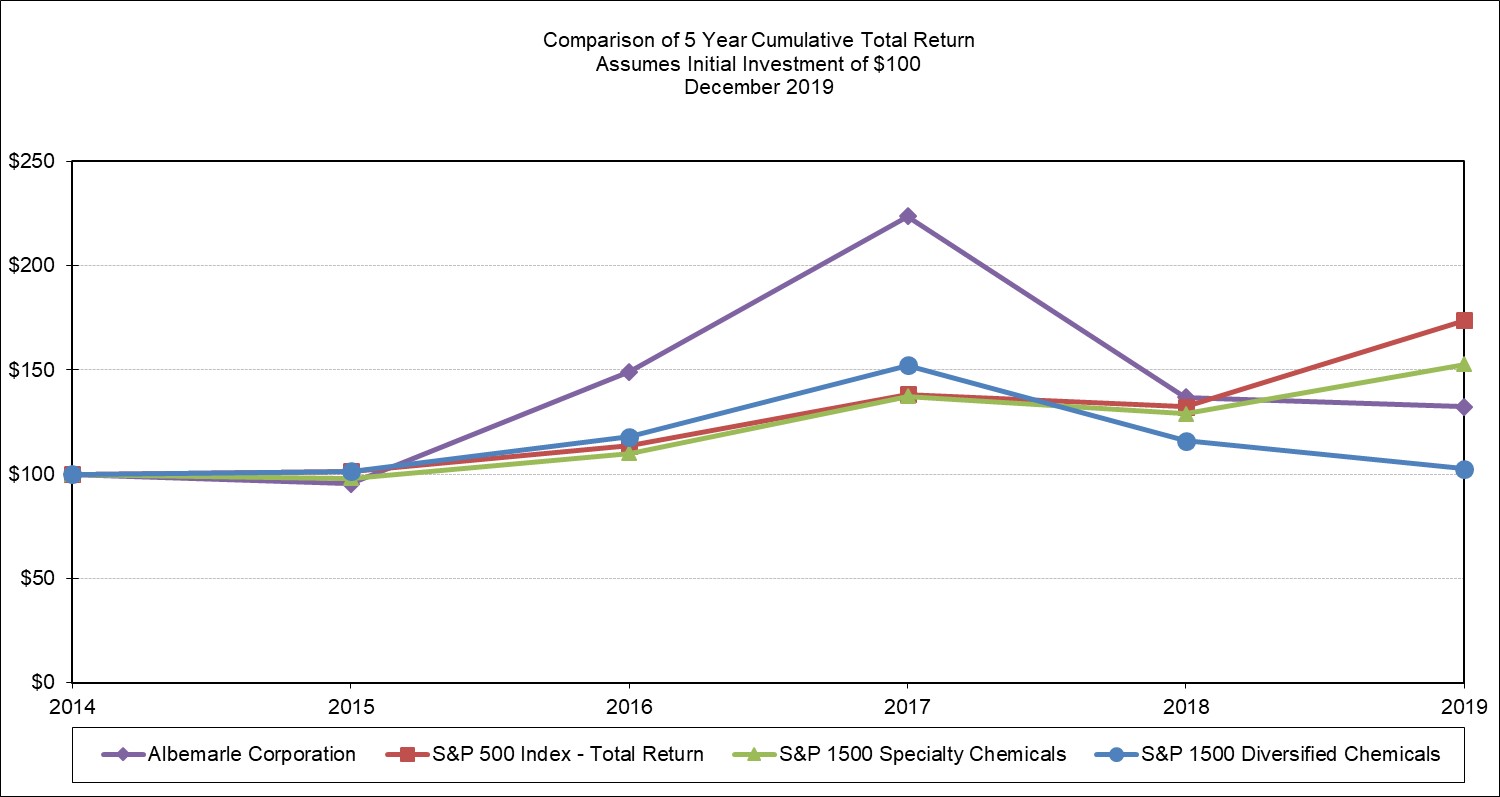
The graph below shows the cumulative total shareholder return assuming the investment of $100 in our common stock on December 31, 2014 and the reinvestment of all dividends thereafter. The information contained in the graph below is furnished and therefore not to be considered “filed” with the SEC, and is not incorporated by reference into any document that incorporates this Annual Report on Form 10-K by reference.
| Albemarle Corporation and Subsidiaries | ||
Item 6. Selected Financial Data.
The information for the five years ended December 31, 2019, is contained in the “Five-Year Summary” included in Part IV, Item 15, Exhibit 99.1 and incorporated herein by reference.
Item 7. Management’s Discussion and Analysis of Financial Condition and Results of Operations.
Forward-looking Statements
Some of the information presented in this Annual Report on Form 10-K, including the documents incorporated by reference, may constitute forward-looking statements within the meaning of the Private Securities Litigation Reform Act of 1995. Such forward-looking statements are based on our current expectations, which are in turn based on assumptions that we believe are reasonable based on our current knowledge of our business and operations. We have used words such as “anticipate,” “believe,” “could,” “estimate,” “expect,” “intend,” “may,” “should,” “would,” “will” and variations of such words and similar expressions to identify such forward-looking statements.
These forward-looking statements are not guarantees of future performance and involve certain risks, uncertainties and assumptions, which are difficult to predict and many of which are beyond our control. There can be no assurance that our actual results will not differ materially from the results and expectations expressed or implied in the forward-looking statements. Factors that could cause actual results to differ materially from the outlook expressed or implied in any forward-looking statement include, without limitation, information related to:
| • | changes in economic and business conditions; |
| • | changes in financial and operating performance of our major customers and industries and markets served by us; |
| • | the timing of orders received from customers; |
| • | the gain or loss of significant customers; |
| • | competition from other manufacturers; |
| • | changes in the demand for our products or the end-user markets in which our products are sold; |
| • | limitations or prohibitions on the manufacture and sale of our products; |
| • | availability of raw materials; |
| • | increases in the cost of raw materials and energy, and our ability to pass through such increases to our customers; |
| • | changes in our markets in general; |
| • | fluctuations in foreign currencies; |
| Albemarle Corporation and Subsidiaries | ||
| • | changes in laws and government regulation impacting our operations or our products; |
| • | the occurrence of regulatory actions, proceedings, claims or litigation; |
| • | the occurrence of cyber-security breaches, terrorist attacks, industrial accidents, natural disasters or climate change; |
| • | hazards associated with chemicals manufacturing; |
| • | the inability to maintain current levels of product or premises liability insurance or the denial of such coverage; |
| • | political unrest affecting the global economy, including adverse effects from terrorism or hostilities; |
| • | political instability affecting our manufacturing operations or joint ventures; |
| • | changes in accounting standards; |
| • | the inability to achieve results from our global manufacturing cost reduction initiatives as well as our ongoing continuous improvement and rationalization programs; |
| • | changes in the jurisdictional mix of our earnings and changes in tax laws and rates; |
| • | changes in monetary policies, inflation or interest rates that may impact our ability to raise capital or increase our cost of funds, impact the performance of our pension fund investments and increase our pension expense and funding obligations; |
| • | volatility and uncertainties in the debt and equity markets; |
| • | technology or intellectual property infringement, including through cyber-security breaches, and other innovation risks; |
| • | decisions we may make in the future; |
| • | the ability to successfully execute, operate and integrate acquisitions and divestitures; and |
| • | the other factors detailed from time to time in the reports we file with the SEC. |
We assume no obligation to provide revisions to any forward-looking statements should circumstances change, except as otherwise required by securities and other applicable laws. The following discussion should be read together with our consolidated financial statements and related notes included in this Annual Report on Form 10-K.
The following is a discussion and analysis of our results of operations for the years ended December 31, 2019, 2018 and 2017. A discussion of our consolidated financial condition and sources of additional capital is included under a separate heading “Financial Condition and Liquidity.”
Overview
We are a leading global developer, manufacturer and marketer of highly-engineered specialty chemicals that are designed to meet our customers’ needs across a diverse range of end markets. The end markets we serve include energy storage, petroleum refining, consumer electronics, construction, automotive, lubricants, pharmaceuticals, crop protection and custom chemistry services. We believe that our commercial and geographic diversity, technical expertise, innovative capability, flexible, low-cost global manufacturing base, experienced management team and strategic focus on our core base technologies will enable us to maintain leading market positions in those areas of the specialty chemicals industry in which we operate.
Secular trends favorably impacting demand within the end markets that we serve combined with our diverse product portfolio, broad geographic presence and customer-focused solutions will continue to be key drivers of our future earnings growth. We continue to build upon our existing green solutions portfolio and our ongoing mission to provide innovative, yet commercially viable, clean energy products and services to the marketplace to contribute to our sustainable revenue. For example, our Lithium business contributes to the growth of clean miles driven with electric miles and more efficient use of renewable energy through grid storage; Bromine Specialties enables the prevention of fires starting in electronic equipment, greater fuel efficiency from rubber tires and the reduction of emissions from coal fired power plants; and the Catalysts business creates efficiency of natural resources through more usable products from a single barrel of oil, enables safer, greener production of alkylates used to produce more environmentally-friendly fuels, and reduced emissions through cleaner transportation fuels. We believe our disciplined cost reduction efforts and ongoing productivity improvements, among other factors, position us well to take advantage of strengthening economic conditions as they occur, while softening the negative impact of the current challenging global economic environment.
2019 Highlights
| • | In the first quarter, we increased our quarterly dividend for the 25th consecutive year, to $0.3675 per share. As a result, in February 2020, we were recognized by being named to the S&P 500 Dividend Aristocrats Index. |
| Albemarle Corporation and Subsidiaries | ||
| • | On August 14, 2019, the Company entered into a $1.2 billion unsecured credit facility with several banks and other financial institutions. Borrowings under this facility bear interest at variable rates based on an average London inter-bank offered rate (“LIBOR”), plus an applicable margin that depends on certain credit ratings of the Company. Upon the closing of the credit facility, the applicabl |
Showing the first 8K of 117K characters. Open the full section
Item 7A. Quantitative and Qualitative Disclosures About Market Risk.
The primary currencies to which we have foreign currency exchange rate exposure are the Euro, Japanese Yen, Chinese Renminbi, Australian Dollar and Chilean Peso. In response to greater fluctuations in foreign currency exchange rates in recent periods, we have increased the degree of exposure risk management activities to minimize the potential impact on earnings.
We manage our foreign currency exposures by balancing certain assets and liabilities denominated in foreign currencies and through the use, from time to time, of foreign currency forward contracts. The principal objective of such contracts is to
| Albemarle Corporation and Subsidiaries | ||
minimize the financial impact of changes in foreign currency exchange rates. The counterparties to these contractual agreements are major financial institutions with which we generally have other financial relationships. We are exposed to credit loss in the event of nonperformance by these counterparties. However, we do not anticipate nonperformance by the counterparties. We do not utilize financial instruments for trading or other speculative purposes.
The primary method we use to reduce foreign currency exposure is to identify natural hedges, in which the operating activities denominated in respective currencies across various subsidiaries balance in respect to timing and the underlying exposures. In the event a natural hedge is not available, we may employ a forward contract to reduce exposure, generally expiring within one year. While these contracts are subject to fluctuations in value, such fluctuations are intended to offset the changes in the value of the underlying exposures being hedged. In the fourth quarter of 2019, we entered into a foreign currency forward contract to hedge the cash flow exposure of non-functional currency purchases during the construction of the Kemerton plant in Australia. This contract has been designated as an effective hedging instrument, and beginning the date of designation, gains or losses on the revaluation of this contract to our reporting currency have been and will be recorded in Accumulated other comprehensive loss. All other gains and losses on foreign currency forward contracts not designated as an effective hedging instrument are recognized in Other expenses, net, and generally do not have a significant impact on results of operations.
At December 31, 2019, our financial instruments subject to foreign currency exchange risk consisted of foreign currency forward contracts with an aggregate notional value of $1.63 billion and with a fair value representing a net asset position of $3.8 million. Fluctuations in the value of these contracts are intended to offset the changes in the value of the underlying exposures being hedged. We conducted a sensitivity analysis on the fair value of our foreign currency hedge portfolio assuming an instantaneous 10% change in select foreign currency exchange rates from their levels as of December 31, 2019, with all other variables held constant. A 10% appreciation of the U.S. Dollar against foreign currencies that we hedge would result in a decrease of approximately $35.4 million in the fair value of our foreign currency forward contracts. A 10% depreciation of the U.S. Dollar against these foreign currencies would result in an increase of approximately $43.8 million in the fair value of our foreign currency forward contracts. The sensitivity of the fair value of our foreign currency hedge portfolio represents changes in fair values estimated based on market conditions as of December 31, 2019, without reflecting the effects of underlying anticipated transactions. When those anticipated transactions are realized, actual effects of changing foreign currency exchange rates could have a material impact on our earnings and cash flows in future periods.
On December 18, 2014, the carrying value of our 1.875% Euro-denominated senior notes was designated as an effective hedge of our net investment in foreign subsidiaries where the Euro serves as the functional currency, and beginning on the date of designation, gains or losses on the revaluation of these senior notes to our reporting currency have been and will be recorded in Accumulated other comprehensive loss. In January 2017, we repaid €307.0 million of these senior notes using proceeds from the sale of the Chemetall Surface Treatment business. This repayment did not impair the designated hedge of our net investment in foreign subsidiaries where the Euro serves as the functional currency.
We are exposed to changes in interest rates that could impact our results of operations and financial condition. We manage global interest rate and foreign exchange exposure as part of our regular operational and financing strategies. We had variable interest rate borrowings of $394.0 million and $313.8 million outstanding at December 31, 2019 and 2018, respectively. These borrowings represented 13% and 18% of total outstanding debt and bore average interest rates of 2.46% and 2.85% at December 31, 2019 and 2018, respectively. A hypothetical 10% increase (approximately 25 basis points) in the average interest rate applicable to these borrowings would change our annualized interest expense by approximately $1.0 million as of December 31, 2019. We may enter into interest rate swaps, collars or similar instruments with the objective of reducing interest rate volatility relating to our borrowing costs.
Our raw materials are subject to price volatility caused by weather, supply conditions, political and economic variables and other unpredictable factors. Historically, we have not used futures, options or swap contracts to manage the volatility related to the above exposures. However, the refinery catalysts business has used financing arrangements to provide long-term protection against changes in metals prices. We seek to limit our exposure by entering into long-term contracts when available, and we seek price increase limitations through contracts. These contracts do not have a significant impact on our results of operations.
| Albemarle Corporation and Subsidiaries | ||
Item 8. Financial Statements and Supplementary Data.
MANAGEMENT’S REPORT ON INTERNAL CONTROL OVER FINANCIAL REPORTING
Our management is responsible for establishing and maintaining adequate internal control over financial reporting as defined in Exchange Act Rule 13a-15(f) and 15d-15(f). Our internal control over financial reporting is a process designed to provide reasonable assurance regarding the reliability of financial reporting and the preparation of financial statements for external purposes in accordance with accounting principles generally accepted in the United States. Our internal control over financial reporting includes those policies and procedures that (i) pertain to the maintenance of records that, in reasonable detail, accurately and fairly reflect the transactions and dispositions of assets; (ii) provide reasonable assurance that transactions are recorded as necessary to permit preparation of financial statements in accordance with accounting principles generally accepted in the United States, and that receipts and expenditures of the Company are being made only in accordance with management’s and our directors’ authorizations; and (iii) provide reasonable assurance regarding prevention or timely detection of unauthorized acquisition, use, or disposition of our assets that could have a material effect on the financial statements.
Under the supervision and with the participation of our management, including our principal executive officer and principal financial officer, we conducted an evaluation of the effectiveness of our internal control over financial reporting as of December 31, 2019. In making this assessment, management used the criteria for effective internal control over financial reporting described in the Internal Control—Integrated Framework 2013 set forth by the Committee of Sponsoring Organizations of the Treadway Commission (COSO). Based on the assessment, management concluded that, as of December 31, 2019, our internal control over financial reporting was effective to provide reasonable assurance regarding the reliability of financial reporting and the preparation of financial statements for external purposes in accordance with generally accepted accounting principles in the United States. The concept of reasonable assurance is based on the recognition that there are inherent limitations in all systems of internal control. Because of its inherent limitations, internal control over financial reporting may not prevent or detect misstatements. Also, projections of any evaluation of effectiveness to future periods are subject to the risk that controls may become inadequate because of changes in conditions, or that the degree of compliance with the policies or procedures may deteriorate.
Our management's assessment of internal control over financial reporting as of December 31, 2019 excludes the 60% ownership interest in the MARBL Lithium Joint Venture because it was formed as part of a purchase business combination of 60% ownership interest in Mineral Resources Limited’s (“MRL”) Wodgina hard rock lithium mine project (“Wodgina Project”) during 2019. The MARBL Lithium Joint Venture is consolidated at our proportionate share, whose proportionate assets represent 18% of the related consolidated financial statement amounts as of December 31, 2019.
The effectiveness of our internal control over financial reporting as of December 31, 2019 has been audited by PricewaterhouseCoopers LLP, an independent registered public accounting firm, as stated in their report which is included herein.
| /S/ LUTHER C. KISSAM IV |
| Luther C. Kissam IV |
| Chairman, President and Chief Executive Officer |
| (principal executive officer) |
| February 26, 2020 |
| Albemarle Corporation and Subsidiaries | ||
Report of Independent Registered Public Accounting Firm
To the Board of Directors and Shareholders of Albemarle Corporation:
Opinions on the Financial Statements and Internal Control over Financial Reporting
We have audited the accompanying consolidated balance sheets of Albemarle Corporation and its subsidiaries (the “Company”) as of December 31, 2019 and 2018, and the related consolidated statements of income, comprehensive income, changes in equity and cash flows for each of the three years in the period ended December 31, 2019, including the related notes (collectively referred to as the “consolidated financial statements”). We also have audited the Company’s internal control over financial reporting as of December 31, 2019, based on criteria established in Internal Control—Integrated Framework (2013) issued by the Committee of Sponsoring Organizations of the Treadway Commission (COSO).
In our opinion, the consolidated financial statements referred to above present fairly, in all material respects, the financial position of the Company as of December 31, 2019 and 2018, and the results of its operations and its cash flows for each of the three years in the period ended December 31, 2019 in conformity with accounting principles generally accepted in the United States of America. Also in our opinion, the Company maintained, in all material respects, effective internal control over financial reporting as of December 31, 2019, based on criteria established in Internal Control—Integrated Framework (2013) issued by the COSO.
Change in Accounting Principle
As discussed in Note 1 to the consolidated financial statements, the Company changed the manner in which it accounts for leases in 2019 and the manner in which it accounts for revenues with contracts from customers in 2018.
Basis for Opinions
The Company’s management is responsible for these consolidated financial statements, for maintaining effective internal control over financial reporting, and for its assessment of the effectiveness of internal control over financial reporting, included in the accompanying Management’s Report on Internal Control over Financial Reporting. Our responsibility is to express opinions on the Company’s consolidated financial statements and on the Company’s internal control over financial reporting based on our audits. We are a public accounting firm registered with the Public Company Accounting Oversight Board (United States) (PCAOB) and are required to be independent with respect to the Company in accordance with the U.S. federal securities laws and the applicable rules and regulations of the Securities and Exchange Commission and the PCAOB.
We conducted our audits in accordance with the standards of the PCAOB. Those standards require that we plan and perform the audits to obtain reasonable assurance about whether the consolidated financial statements are free of material misstatement, whether due to error or fraud, and whether effective internal control over financial reporting was maintained in all material respects.
Our audits of the consolidated financial statements included performing procedures to assess the risks of material misstatement of the consolidated financial statements, whether due to error or fraud, and performing procedures that respond to those risks. Such procedures included examining, on a test basis, evidence regarding the amounts and disclosures in the consolidated financial statements. Our audits also included evaluating the accounting principles used and significant estimates made by management, as well as evaluating the overall presentation of the consolidated financial statements. Our audit of internal control over financial reporting included obtaining an understanding of internal control over financial reporting, assessing the risk that a material weakness exists, and testing and evaluating the design and operating effectiveness of internal control based on the assessed risk. Our audits also included performing such other procedures as we considered necessary in the circumstances. We believe that our audits provide a reasonable basis for our opinions.
As de
Showing the first 8K of 255K characters. Open the full section
Item 9. Changes in and Disagreements with Accountants on Accounting and Financial Disclosure.
NONE
Item 9A. Controls and Procedures.
Evaluation of Disclosure Controls and Procedures
Under the supervision and with the participation of our management, including our principal executive officer and principal financial officer, we conducted an evaluation of the effectiveness of the design and operation of our disclosure controls and procedures (as defined in Rules 13a-15(e) and 15d-15(e) under the Securities Exchange Act of 1934, as amended, or the Exchange Act), as of the end of the period covered by this report. Based on this evaluation, our principal executive officer and principal financial officer concluded that, as of the end of the period covered by this report, our disclosure controls and procedures are effective to ensure that information required to be disclosed by us in the reports that we file or submit under the Exchange Act, is recorded, processed, summarized and reported within the time periods specified in the SEC’s rules and forms, and that such information is accumulated and communicated to our management, including our principal executive officer and principal financial officer, as appropriate, to allow timely decisions regarding required disclosure.
Design and Evaluation of Internal Control over Financial Reporting
Our management is responsible for establishing and maintaining adequate internal control over financial reporting as defined in Exchange Act Rule 13a-15(f) and 15d-15(f). Our management assessed the effectiveness of our internal control over financial reporting as of December 31, 2019. In making this assessment, management used the criteria for effective internal control over financial reporting described in the “Internal Control-Integrated Framework” (2013) set forth by the Committee of Sponsoring Organizations of the Treadway Commission (COSO). Based on the assessment, management concluded that, as of December 31, 2019, our internal control over financial reporting was effective based on those criteria.
The effectiveness of our internal control over financial reporting as of December 31, 2019 has been audited by PricewaterhouseCoopers LLP, an independent registered public accounting firm, as stated in their report, which is included herein. Management’s report and the independent registered public accounting firm’s report are included in Item 8 under the captions entitled “Management’s Report on Internal Control over Financial Reporting” and “Report of Independent Registered Public Accounting Firm” and are incorporated herein by reference.
Changes in Internal Control over Financial Reporting
The Company has begun the implementation of a new enterprise resource platform system to increase the overall efficiency and productivity of our processes, which has resulted in changes in our internal control over financial reporting (as such term is defined in Exchange Act Rule 13a-15(f)) throughout the implementation process in 2019. No other changes in our internal control over financial reporting (as such term is defined in Exchange Act Rule 13a-15(f)) occurred during the fiscal quarter ended December 31, 2019 that materially affected, or is reasonably likely to materially affect, our internal control over financial reporting.
Item 9B. Other Information.
NONE
| Albemarle Corporation and Subsidiaries |
PART III
Item 10. Directors, Executive Officers and Corporate Governance.
The information required by this Item 10 will be contained in the Proxy Statement and is incorporated herein by reference. In addition, the information in “Executive Officers of the Registrant” appearing after Item 4 in Part I of this Annual Report, is incorporated herein by reference.
Code of Conduct
We have adopted a code of conduct and ethics for directors, officers and employees, known as the Albemarle Code of Conduct. The Albemarle Code of Conduct is available on our website, www.albemarle.com. Shareholders may also request a free copy of the Albemarle Code of Conduct from: Albemarle Corporation, Attention: Investor Relations, 4250 Congress Street, Suite 900, Charlotte, North Carolina 28209. We will disclose any amendments to, or waivers from, a provision of our Code of Conduct that applies to the principal executive officer, principal financial officer, principal accounting officer or controller, or persons performing similar functions that relates to any element of the Code of Conduct as defined in Item 406 of Regulation S-K by posting such information on our website.
New York Stock Exchange Certifications
Because our common stock is listed on the New York Stock Exchange (“NYSE”), our Chief Executive Officer is required to make, and he has made, an annual certification to the NYSE stating that he was not aware of any violation by us of the corporate governance listing standards of the NYSE. Our Chief Executive Officer made his annual certification to that effect to the NYSE as of June 3, 2019. In addition, we have filed, as exhibits to this Annual Report on Form 10-K, the certifications of our principal executive officer and principal financial officer required under Sections 906 and 302 of the Sarbanes-Oxley Act of 2002 to be filed with the Securities and Exchange Commission regarding the quality of our public disclosure.
Additional information will be contained in the Proxy Statement and is incorporated herein by reference.
Item 11. Executive Compensation.
The information required by this Item 11 will be contained in the Proxy Statement and is incorporated herein by reference.
Item 12. Security Ownership of Certain Beneficial Owners and Management and Related Stockholder Matters.
The information required by this Item 12 will be contained in the Proxy Statement and is incorporated herein by reference.
Item 13. Certain Relationships and Related Transactions, and Director Independence.
The information required by this Item 13 will be contained in the Proxy Statement and is incorporated herein by reference.
Item 14. Principal Accountant Fees and Services.
The information required by this Item 14 will be contained in the Proxy Statement and is incorporated herein by reference.
PART IV
Item 15. Exhibits and Financial Statement Schedules.
(a)(1) The following consolidated financial and informational statements of the registrant are included in Part II Item 8 on pages 51 to 106:
Management’s Report on Internal Control Over Financial Reporting
Report of Independent Registered Public Accounting Firm
Consolidated Balance Sheets as of December 31, 2019 and 2018
| Albemarle Corporation and Subsidiaries | ||
Consolidated Statements of Income, Comprehensive Income, Changes in Equity and Cash Flows for the years ended December 31, 2019, 2018 and 2017
Notes to the Consolidated Financial Statements
(a)(2) No Financial Statement Schedules are provided in accordance with Item 15(a)(2) as the information is either not applicable, not required or has been furnished in the Consolidated Financial Statements or Notes thereto.
| Albemarle Corporation and Subsidiaries | ||
| Albemarle Corporation and Subsidiaries | ||
| Albemarle Corporation and Subsidiaries | ||
| Albemarle Corporation and Subsidiaries | ||
| Albemarle Corporation and Subsidiaries | ||
| *32.2 | Certification of Chief Financial Officer pursuant to 18 U.S.C. 1350, as adopted pursuant to Section 906 of the Sarbanes-Oxley Act of 2002. | |
| *99.1 | Five-Year Summary. | |
| *101 | Interactive Data Files (Annual Report on Form 10-K, for the fiscal year ended December 31, 2019, furnished in XBRL (eXtensible Business Reporting Language)). | |
| Attached as Exhibit 101 to this report are the following documents formatted in XBRL: (i) the Consolidated Statements of Income for the fiscal years ended December 31, 2019, 2018 and 2017, (ii) the Consolidated Statements of Comprehensive Income for the fiscal years ended December 31, 2019, 2018 and 2017, (iii) the Consolidated Balance Sheets at December 31, 2019 and 2018, (iv) the Consolidated Statements of Changes in Equity for the fiscal years ended December 31, 2019, 2018 and 2017, (v) the Consolidated Statements of Cash Flows for the fiscal years ended December 31, 2019, 2018 and 2017 and (vi) the Notes to Consolidated Financial Statements. |
| # | Management contract or compensatory plan or arrangement. |
| * | Included with this filing. |
(c) In accordance with Regulation S-X Rule 3-09, the audited financial statements of Windfield Holdings Pty. Ltd. (“Windfield”) for the year ended December 31, 2019, Windfield’s fiscal year end, will be filed by amendment to this Annual Report on Form 10-K on or before June 30, 2020.
Item 16. Form 10-K Summary.
NONE
| Albemarle Corporation and Subsidiaries | ||
SIGNATURES
Pursuant to the requirements of Section 13 or 15(d) of the Securities Exchange Act of 1934, the registrant has duly caused this report to be signed on its behalf by the undersigned thereunto duly authorized.
| ALBEMARLE CORPORATION (Registrant) | ||
| By: | /S/ LUTHER C. KISSAM IV | |
| (Luther C. Kissam IV) | ||
| Chairman, President and Chief Executive Officer |
Dated: February 26, 2020
Pursuant to the requirements of the Securities Exchange Act of 1934, this report has been signed below by the following persons on behalf of the registrant and in the capacities indicated as of February 26, 2020.
| Signature | Title | |
| /S/ LUTHER C. KISSAM IV | Chairman, President and Chief Executive Officer (principal executive | |
| (Luther C. Kissam IV) | officer) | |
| /S/ SCOTT A. TOZIER | Executive Vice President, Chief Financial Officer (principal financial | |
| (Scott A. Tozier) | officer) | |
| /S/ JOHN BARICHIVICH | Vice President, Corporate Controller and Chief Accounting Officer (principal accounting officer) | |
| (John Barichivich) | ||
| /S/ LAURIE BRLAS | Director | |
| (Laurie Brlas) | ||
| /S/ WILLIAM H. HERNANDEZ | Director | |
| (William H. Hernandez) | ||
| /S/ DOUGLAS L. MAINE | Director | |
| (Douglas L. Maine) | ||
| /S/ J. KENT MASTERS | Director | |
| (J. Kent Masters) | ||
| /S/ GLENDA MINOR | Director | |
| (Glenda Minor) | ||
| /S/ JAMES J. O’BRIEN | Director | |
| (James J. O’Brien) | ||
| /S/ DIARMUID B. O’CONNELL | Director | |
| (Diarmuid B. O’Connell) | ||
| /S/ DEAN L. SEAVERS | Director | |
| (Dean L. Seavers) | ||
| /S/ GERALD A. STEINER | Director | |
| (Gerald A. Steiner) | ||
| /S/ HARRIETT TEE TAGGART | Director | |
| (Harriett Tee Taggart) | ||
| /S/ HOLLY VAN DEURSEN | Director | |
| (Holly Van Deursen) |
| Albemarle Corporation and Subsidiaries | ||
| /S/ ALEJANDRO D. WOLFF | Director | |
| (Alejandro D. Wolff) |