 filings.tools
Align Technology 10-K 2018-12-31
Filed 2019-02-28. 22 sections, 426K characters. Original on sec.gov · Markdown · JSON
Cover and table of contents
10-K 1 algn-20181231x10k.htm 10-K
UNITED STATES
SECURITIES AND EXCHANGE COMMISSION
Washington, D.C. 20549
FORM 10-K
(Mark One)
| ý | ANNUAL REPORT PURSUANT TO SECTION 13 OR 15(d) OF THE SECURITIES EXCHANGE ACT OF 1934 |
For the fiscal year ended December 31, 2018
OR
| ¨ | TRANSITION REPORT PURSUANT TO SECTION 13 OR 15(d) OF THE SECURITIES EXCHANGE ACT OF 1934 |
For the transition period from to
Commission file number: 0-32259
ALIGN TECHNOLOGY, INC.
(Exact name of registrant as specified in its charter)
| Delaware | 94-3267295 | |
| (State or other jurisdiction of incorporation or organization) | (I.R.S. Employer Identification Number) |
2820 Orchard Parkway
San Jose, California 95134
(Address of principal executive offices)
(408) 470-1000
(Registrant’s telephone number, including area code)
Securities registered pursuant to Section 12(b) of the Act:
| Title of each class | Name of each exchange on which registered | |
| Common Stock, $0.0001 par value | The NASDAQ Stock Market LLC (NASDAQ Global Market) |
Securities registered pursuant to Section 12(g) of the Act:
None
Indicate by check mark if the registrant is a well-known seasoned issuer, as defined in Rule 405 of the Securities Act. Yes ý No ¨
Indicate by check mark if the registrant is not required to file reports pursuant to Section 13 or Section 15(d) of the Exchange Act. Yes ¨ No ý
Indicate by check mark whether the registrant (1) has filed all reports required to be filed by Section 13 or 15(d) of the Securities Exchange Act of 1934 during the preceding 12 months (or for such shorter period that the registrant was required to file such reports), and (2) has been subject to such filing requirements for the past 90 days. Yes ý No ¨
Indicate by check mark whether the registrant has submitted electronically every Interactive Data File required to be submitted pursuant to Rule 405 of Regulation S-T (§232.405 of this chapter) during the preceding 12 months (or for such shorter period that the registrant was required to submit such files). Yes ý No ¨
Indicate by check mark if disclosure of delinquent filers pursuant to Item 405 of Regulation S-K is not contained herein, and will not be contained, to the best of registrant’s knowledge, in definitive proxy or information statements incorporated by reference in Part III of this Form 10-K or any amendment to this Form 10-K. ý
Indicate by check mark whether the registrant is a large accelerated filer, an accelerated filer, a non-accelerated filer, or a smaller reporting company. See definitions of “large accelerated filer,” “accelerated filer,” and “smaller reporting company” in Rule 12b-2 of the Exchange Act. (Check one):
| Large accelerated filer x | Accelerated filer o | |
| Non-accelerated filer o | Smaller reporting company o | |
| Emerging growth company o | ||
| If an emerging growth company, indicate by check mark if the registrant has elected not to use the extended transition period for complying with any new or revised financial accounting standards provided pursuant to Section 7(a)(2)(B) of the Securities Act. |
Indicate by check mark whether the registrant is a shell company (as defined in Rule 12b-2 of the Exchange Act). Yes ¨ No ý
The aggregate market value of the registrant’s common stock held by non-affiliates of the registrant was $22,262,043,858 as of June 29, 2018 based on the closing sale price of the registrant’s common stock on the NASDAQ Global Market on such date. Shares held by persons who may be deemed affiliates have been excluded. This determination of affiliate status is not necessarily a conclusive determination for other purposes.
On February 22, 2019, 79,989,347 shares of the registrant’s common stock were outstanding.
DOCUMENTS INCORPORATED BY REFERENCE
Portions of the registrant’s definitive Proxy Statement relating to its 2019 Annual Stockholders’ Meeting to be filed pursuant to Regulation 14A within 120 days after the registrant’s fiscal year end of December 31, 2018 are incorporated by reference into Part III of this Annual Report on Form 10-K.
ALIGN TECHNOLOGY, INC.
FORM 10-K
For the Year Ended December 31, 2018
TABLE OF CONTENTS
| Page | ||
| PART I | 3 | |
| Item 1. | Business | 3 |
| Executive Officers of the Registrant | 13 | |
| Item 1A. | Risk Factors | 15 |
| Item 1B. | Unresolved Staff Comments | 28 |
| Item 2. | Properties | 28 |
| Item 3. | Legal Proceedings | 29 |
| Item 4. | Mine Safety Disclosures | 30 |
| PART II | 31 | |
| Item 5. | Market for Registrant’s Common Equity, Related Stockholder Matters and Issuer Purchases of Equity Securities | 31 |
| Item 6. | Selected Consolidated Financial Data | 33 |
| Item 7. | Management’s Discussion and Analysis of Financial Condition and Results of Operations | 34 |
| Item 7A. | Quantitative and Qualitative Disclosures About Market Risk | 51 |
| Item 8. | Consolidated Financial Statements and Supplementary Data | 52 |
| Item 9. | Changes in and Disagreements with Accountants on Accounting and Financial Disclosure | 94 |
| Item 9A. | Controls and Procedures | 95 |
| Item 9B. | Other Information | 95 |
| PART III | 95 | |
| Item 10. | Directors, Executive Officers and Corporate Governance | 95 |
| Item 11. | Executive Compensation | 95 |
| Item 12. | Security Ownership of Certain Beneficial Owners and Management and Related Stockholder Matters | 96 |
| Item 13. | Certain Relationships and Related Transactions and Director Independence | 96 |
| Item 14. | Principal Accounting Fees and Services | 96 |
| PART IV | 97 | |
| Item 15. | Exhibits, Financial Statement Schedules | 97 |
| Item 16. | Form 10-K Summary | 99 |
| Signatures | 100 |
Invisalign, Align, the Invisalign logo, ClinCheck, Made to Move, Invisalign Assist, Invisalign Teen, Invisalign Go, Vivera, SmartForce, SmartTrack, SmartStage, iTero, iTero Element, Orthocad, iCast and iRecord, among others, are trademarks and/or service marks of Align Technology, Inc. or one of its subsidiaries or affiliated companies and may be registered in the United States and/or other countries.
In addition to historical information, this annual report on Form 10-K contains forward-looking statements within the meaning of Section 27A of the Securities Act of 1933 and Section 21E of the Securities Exchange Act of 1934. These statements include, among other things, our expectations regarding the anticipated impact of our new products and product enhancements will have on doctor utilization and our market share, our expectations regarding product mix and product adoption, our expectations regarding the existence and impact of seasonality, our expectations regarding the sales growth of our intra-oral scanner sales in international markets, our expectations regarding the financial and strategic benefits of establishing regional order acquisition, treatment planning and manufacturing facilities, our intention to hire more sales representatives in 2019 and their expected impact on our sales, our expectations regarding the continued expansion of our international markets, the anticipated impact of the Invisalign Experience program on demand creation, our expectation to incur additional costs related to the planned corporate structure reorganization, the level of our operating expenses and gross margins and other factors beyond our control, as well as other statements regarding our future operations, financial condition and prospects and business strategies. These statements may contain words such as “expects,” “anticipates,” “intends,” “plans,” “believes,” “estimates,” or other words indicating future results. These forward-looking statements are subject to certain risks and uncertainties that could cause actual results to differ materially from those reflected in the forward-looking statements. Factors that could cause or contribute to such differences include, but are not limited to, those discussed in Item 2 “Management’s Discussion and Analysis of Financial Condition and Results of Operations,” and in particular, the risks discussed below in Part I, Item 1A “Risk Factors.” We undertake no obligation to revise or update these forward-looking statements. Given these risks and uncertainties, readers are cautioned not to place undue reliance on such forward-looking statements.
PART I
Item 1. BUSINESS
Our Company
Align Technology, Inc (“We”, “Our”, “Align”) is a global medical device company engaged in the design, manufacture and marketing of Invisalign® clear aligners and iTero® intraoral scanners and services for orthodontics, and restorative and aesthetic dentistry. Align’s products are intended primarily for the treatment of malocclusion or the misalignment of teeth and are designed to help dental professionals achieve the clinical outcomes that they expect. Align Technology was founded in March 1997 and incorporated in Delaware in April 1997. Our corporate headquarters is located at 2820 Orchard Parkway, San Jose, California, U.S.A., 95134, and our telephone number is 408-470-1000. Our internet address is www.aligntech.com. Our Americas regional headquarters is located in Raleigh, North Carolina; our European regional headquarters is located in Amsterdam, the Netherlands; and our Asia Pacific regional headquarters is located in Singapore.
We have two operating segments: (1) Clear Aligner and (2) Scanners and Services ("Scanner"). For the year ended December 31, 2018, Clear Aligner net revenues represent approximately 86% of worldwide net revenues, while Scanner net revenues represent the remaining 14% of worldwide net revenues. We sell the vast majority of our products directly to our customers: orthodontists and general practitioner dentists ("GPs"), as well as to restorative and aesthetic dentists, including prosthodontists, periodontists, and oral surgeons. In addition, we sell directly to Dental Support Organizations (DSOs) who contract with dental practices to provide critical business management and support including non-clinical operations, and we sell directly to dental laboratories who manufacture or customize a variety of products to assist in the provision of oral health care by a licensed dentist. Our Clear Aligner operating segment includes revenues from non-Invisalign aligners supplied to SmileDirectClub, LLC ("SDC"). Refer to "Supply Agreement with SmileDirectClub, LLC" section.
We received 510(k) clearance from the United States Food and Drug Administration (“FDA”) to market the Invisalign System in 1998. The Invisalign System is regulated by the FDA as a Class II medical device. In order to provide Invisalign treatment to their patients, orthodontists and GPs must initially complete an Invisalign training course. The Invisalign System is sold primarily through a direct sales force in North America, Asia Pacific ("APAC"), Europe, Middle East and Africa (EMEA) and Latin America. To date, over 6.1 million people worldwide have been treated with our Invisalign System.
Our iTero scanner is used by dental professionals and/or labs and service providers for restorative and orthodontic digital procedures as well as Invisalign case submission. We received 510(k) clearance from the FDA to market iTero software for expanded indications in 2013. Scanners and computer-aided design/computer-aided manufacturing ("CAD/CAM") services are primarily sold through our direct sales force and a few distributors in North America, Europe and certain Asia Pacific countries, and through distribution partners in smaller non-core international country markets.
Clear Aligner Segment
Malocclusion and Traditional Orthodontic Treatment
Malocclusion, or the misalignment of teeth, is one of the most prevalent clinical dental conditions, affecting billions of people, or approximately 60% to 75% of the population. Annually, approximately 12 million people in major developed countries elect treatment by orthodontists worldwide. Most orthodontic patients are treated with the use of traditional methods such as metal arch wires and brackets, referred to as braces, and may be augmented with elastics, metal expanders, headgear or functional appliances, and other ancillary devices as needed. Upon completion of the treatment, the dental professional may, at his or her discretion, have the patient use a retainer appliance. Of the 12 million annual orthodontic cases started, approximately 75% or 8.4 million are applicable to Invisalign treatment our served market. In addition, approximately 300 million people with malocclusion could benefit from straightening their teeth but are unlikely to seek treatment through a doctor’s office. This represents an incremental opportunity for us as we expand the market for orthodontics by educating more consumers about the benefits of straighter teeth using Invisalign clear aligners and connect them with an Invisalign doctor of their choice.
The Invisalign System
The Invisalign System is a proprietary method for treating malocclusion based on a proprietary computer-simulated virtual treatment plan and a series of doctor-prescribed, custom manufactured, clear plastic, removable aligners. The Invisalign System offers a range of treatment options, specialized services, and proprietary software for treatment visualization and is comprised of the following phases:
Orthodontic diagnosis and transmission of treatment data to us. The Invisalign-trained dental professional prepares and sends us a patient’s treatment data package which consists of a prescription form, a digital scan or a polyvinyl-siloxane (or "PVS") impression of the relevant dental arches, photographs of the patient and, at the dental professional’s election, x-rays of the patient’s dentition. Intraoral digital scans may be submitted through either Align's iTero scanner or a few qualified third-party scanners. See "Third Party Scanners and Digital scans for Invisalign treatment submission." More than 63% of Invisalign case submissions are submitted via digital scan instead of a physical PVS impression.
Preparation of computer-simulated treatment plan. Using propriety software which we do not sell, we generate a proposed custom, three-dimensional treatment plan, called a ClinCheck treatment plan. The ClinCheck treatment plan simulates appropriate tooth movement in stages and details timing and placement of any features or attachments that will be used during treatment. Attachments are tooth-colored “buttons” that are sometimes used to increase the biomechanical force on a specific tooth or teeth in order to effect the desired movement(s).
Review and approval of the treatment plan by an Invisalign-trained doctor. The patient’s ClinCheck treatment plan is then made available to the prescribing dental professional via the Invisalign Doctor Site which enables the dental professional to project tooth movement with a level of accuracy not previously possible with metal arch wires and brackets. By reviewing, modifying as needed and approving the treatment plan, the dental professional retains control over the treatment plan.
Manufacture of custom aligners. Upon the dental professional’s approval of the ClinCheck treatment plan, we use the data underlying the simulation, in conjunction with stereolithography technology (a form of 3D printing technology), to construct a series of molds depicting the future position of the patient’s teeth. Each mold is a replica of the patient’s teeth at each stage of the simulated course of treatment. From these molds, aligners are fabricated by pressure-forming polymeric sheets over each mold. Aligners are thin, clear plastic, removable dental appliances that are custom manufactured in a series to correspond to each stage of the ClinCheck treatment plan.
Shipment to the dental professional and patient aligner wear. All the aligners for a patient are shipped directly to the dental professional, who then dispenses them to the patient at regular check-up intervals throughout the treatment. Aligners are generally worn for a period of time which correspond to the stages of the approved ClinCheck treatment plan. The patient replaces the aligners with the next pair in the series when prescribed, advancing tooth movement with each aligner stage. Throughout treatment, the doctor may place attachments or use other auxiliaries to achieve desired to
Showing the first 8K of 61K characters. Open the full section
Item 1A. RISK FACTORS
We depend on the sale of the Invisalign System for the vast majority of our net revenues, and any decline in sales of Invisalign treatment for any reason, or a decline in average selling prices would adversely affect net revenues, gross margin and net income.
We expect that net revenues from the sale of the Invisalign System, primarily our comprehensive products, will continue to account for the vast majority of our total net revenues for the foreseeable future. Continued and widespread market acceptance of Invisalign by orthodontists, GPs and consumers is critical to our future success. If orthodontists and GPs experience a reduction in consumer demand for orthodontic services, if consumers prove unwilling to adopt Invisalign as rapidly as we anticipate or in the volume that we anticipate, if orthodontists or GPs choose to use a competitive product rather than Invisalign or if the average selling price of our product declines for any reason, including as a result of a shift in product mix towards lower priced products, our operating results would be harmed.
Competition in the markets for our products is increasing and we expect aggressive competition from existing competitors and other companies that may introduce new technologies in the future.
Currently, our products compete directly against products manufactured and distributed by various companies, both within and outside the U.S. Although the number of competitors varies by segment, geography and customer, we encounter a wide variety of competitors, including well-established regional competitors in certain foreign markets, as well as larger companies or divisions of larger companies with substantial sales, marketing, research and financial capabilities. Due in part to the expiration of certain key patents owned by us beginning in 2017, we are facing increased competition in the clear aligner market as a result of the entry of new, large companies into certain markets who have the ability to leverage their existing channels in the dental market to compete directly with us. In addition, corresponding foreign patents started to expire in 2018 and will likely result in increased competition in some of the markets outside the U.S. Large consumer product companies may also enter the orthodontic supply market. Furthermore, we also face competition from companies that now offer clear aligners directly to the consumer and do not require the consumer to see a doctor before or during orthodontic treatment. Unlike these direct to consumer competitors, we are committed to a doctor in the core of everything we do, and Invisalign Treatment requires a doctor's prescription and an in person physical examination of the patients dentition before treatment can begin. In addition, we may also face competition in the future from new companies that may introduce new technologies. We may be unable to compete with these competitors and one or more of these competitors may render our technology obsolete or economically unattractive. If we are unable to compete effectively with existing products or respond effectively to any products developed by new or existing competitors, our business could be harmed. Increased competition has resulted in the past and may in the future result in volume discounting and price reductions, reduced gross margins, reduced profitability and loss of market share, and reduce dental professionals’ efforts and commitment to expand their use of our products, any of which could have a material adverse effect on our net revenues, volume growth, net income and stock price. We cannot assure that we will be able to compete successfully against our current or future competitors or that competitive pressures will not have a material adverse effect on our business, results of operations and financial condition.
We are dependent on our international operations, which exposes us to foreign operational, political and other risks that may harm our business.
Our key production steps are performed in operations located outside of the U.S. Technicians use a sophisticated, internally developed computer-modeling program to prepare digital treatment plans, which are then transmitted electronically to our aligner fabrication facilities. These digital files form the basis of the ClinCheck treatment plan and are used to manufacture aligner molds and aligners. Our digital treatment planning and aligner fabrication are performed in multiple international locations. We will continue to establish treatment planning and aligner fabrication facilities closer to our international customers in order to improve our operational efficiency. In addition to the research and development efforts conducted in our North America facilities, we also carry out research and development in Moscow, Russia. We also have operations in Israel where we design and assemble wands,
and our intraoral scanner is manufactured. Our reliance on international operations exposes us to risks and uncertainties that may affect our business or results of operation, including:
| • | difficulties in hiring and retaining employees generally, as well as difficulties in hiring and retaining employees with the necessary skills to perform the more technical aspects of our operations; |
| • | difficulties in managing international operations, including any travel restrictions to or from our facilities; |
| • | fluctuations in currency exchange rates; |
| • | import and export controls, license requirements and restrictions; |
| • | controlling production volume and quality of the manufacturing process; |
| • | political, social and economic instability, including increased levels of violence in Juarez, Mexico or the Middle East. We cannot predict the effect on us of any future armed conflict, political instability or violence in these regions. In addition, some of our employees in Israel are obligated to perform annual reserve duty in the Israeli military and are subject to being called for additional active duty under emergency circumstances. We cannot predict the full impact of these conditions on us in the future, particularly if emergency circumstances or an escalation in the political situation occurs. If many of our employees are called for active duty, our operations in Israel and our business may not be able to function at full capacity; |
| • | acts of terrorism and acts of war; |
| • | general geopolitical instability and the responses to it, such as the possibility of additional sanctions against China and Russia which continue to bring uncertainty to these regions; |
| • | interruptions and limitations in telecommunication services; |
| • | product or material transportation delays or disruption, including as a result of customs clearance, increased levels of violence, acts of terrorism, acts of war or health epidemics restricting travel to and from our international locations or as a result of natural disasters, such as earthquakes or volcanic eruptions; |
| • | burdens of complying with a wide variety of local country and regional laws, including the risks associated with the Foreign Corrupt Practices Act and local anti-bribery compliance; |
| • | trade restrictions and changes in tariffs, including the recent tariffs imposed by the U.S. and China and the possibility of additional tariffs or other trade restrictions related to trade between the two countries; and |
| • | potential adverse tax consequences. |
If any of these risks materialize in the future, we could experience production delays and lost or delayed revenue.
We earn an increasingly larger portion of our total revenues from international sales and face risks attendant to those operati
Showing the first 8K of 72K characters. Open the full section
Item 1B. UNRESOLVED STAFF COMMENTS
None.
Item 2. PROPERTIES
We occupy several leased and owned facilities. At December 31, 2018, the significant facilities occupied were as follows:
| Location | Lease/Own | Primary Use | Expiration of Lease |
| San Jose, California | Own | Office for corporate headquarters, research & development and administrative personnel | N/A |
| Juarez, Mexico | Own | Manufacturing and office for administrative personnel | N/A |
| San Jose, Costa Rica | Own | Office for administrative personnel, treatment personnel, and customer care | N/A |
| Or Yehuda, Israel | Lease | Manufacturing and office for research & development and administrative personnel | February 2022 |
| Amsterdam, The Netherlands | Lease | Office for European headquarters, sales and marketing and administrative personnel | March 2020 |
| Moscow, Russia | Lease | Office for research & development | March 2024 |
| Raleigh, North Carolina | Lease | Office for research & development and administrative personnel | March 2026 |
| Ziyang, China | Lease | Manufacturing and office for administrative personnel | May 2021 |
Item 3. LEGAL PROCEEDINGS
Securities Class Action Lawsuit
On November 5, 2018, a class action lawsuit against Align, and three of our executive officers, was filed in the U.S. District Court for the Northern District of California on behalf of a purported class of purchasers of our common stock between July 25, 2018 and October 24, 2018. The complaint generally alleges claims under the federal securities laws and seeks monetary damages in an unspecified amount and costs and expenses incurred in the litigation. On December 12, 2018, a similar lawsuit was filed in the same court on behalf of a purported class of purchasers of our common stock between April 25, 2018 and October 24, 2018 (together with the first lawsuit, the “Securities Actions”). Motions for appointment as lead plaintiff were filed on January 4, 2019. Align believes the plaintiffs’ claims are without merit and intends to vigorously defend itself. Align is currently unable to predict the outcome of these lawsuits and therefore cannot determine the likelihood of loss nor estimate a range of possible loss.
Shareholder Derivative Lawsuit
In January 2019, three derivative lawsuits were also filed in the U.S. District Court for the Northern District of California, purportedly on behalf of Align, naming as defendants the members of our Board of Directors along with certain of our executive officers. The allegations in the complaints are similar to those presented in the Securities Action, but the complaints assert various state law causes of action, including for breaches of fiduciary duty, insider trading, and unjust enrichment, among others. The complaints seek unspecified monetary damages on behalf of Align, which is named solely as a nominal defendant against whom no recovery is sought, as well as disgorgement and the costs and expenses associated with the litigation, including attorneys’ fees. Align is currently unable to predict the outcome of these lawsuits and therefore cannot determine the likelihood of loss nor estimate a range of possible loss.
Patent Infringement and Related Lawsuits
On November 14, 2017, Align filed six patent infringement lawsuits asserting 26 patents against 3Shape, a Danish corporation, and a related U.S. corporate entity, asserting that 3Shape’s Trios intraoral scanning system and Dental System software infringe Align patents. Align filed two Section 337 complaints with the U.S. International Trade Commission (“ITC”) alleging that 3Shape violates U.S. trade laws by selling for importation and importing its infringing Trios intraoral scanning system and Dental System software. Align’s ITC complaints seek cease and desist orders and exclusion orders prohibiting the importation of 3Shape’s Trios scanning system and Dental System software products into the U.S. Align also filed four separate complaints in the U.S. District Court for the District of Delaware alleging patent infringement by 3Shape’s Trios intraoral scanning system and Dental System software.
On May 9, 2018, 3Shape filed a complaint in the U.S. District Court for the District of Delaware alleging patent infringement by Align’s iTero Element scanner of a single 3Shape patent. On June 14, 2018, 3Shape filed another complaint in the U.S. District Court for the District of Delaware alleging patent infringement by Align’s iTero Element scanner of a single 3Shape patent.
On August 28, 2018, 3Shape filed a complaint against Align in the U.S. District Court for the District of Delaware alleging antitrust violations and seeking monetary damages and injunctive relief relating to Align’s market activities, including Align’s assertion of its patent portfolio, in the clear aligner and intraoral scanning markets.
On December 10, 2018, Align filed three additional patent infringement lawsuits asserting 10 additional patents against 3Shape. Align filed one Section 337 complaint with the ITC alleging that 3Shape violates U.S. trade laws through unfair competition by selling for importation and importing the infringing TRIOS intraoral scanning system, Trios Lab Scanners and TRIOS software, TRIOS Module software, Dental System software, and Ortho System Software. On December 11, 2018, Align filed two separate complaints in the U.S. District Court for the District of Delaware alleging patent infringement by 3Shape's Trios intraoral scanning system, Lab Scanners and Dental and Ortho System Software.
Except for 3Shape’s antitrust complaint, each of the District Court complaints seek monetary damages and injunctive relief against further infringement. We are currently unable to predict the outcome of this dispute and therefore cannot determine the likelihood of loss, if any, nor estimate a range of possible loss.
SDC Dispute
In February 2018, we received a communication on behalf of SDC Financial LLC, SmileDirectClub LLC, and the Members of SDC Financial LLC other than the Company (collectively, the SDC Entities) alleging that the launch and operation of the
Invisalign locations pilot program constitutes a breach of non-compete provisions applicable to the members of SDC Financial LLC, including Align. As a result of this alleged breach, SDC Financial LLC notified us that its members (other than Align) seek to exercise a right to repurchase all of Align's SDC Financial LLC membership interests for a purchase price equal to the current capital account balance. The SDC Entities’ communication also alleged that we breached confidentiality provisions applicable to the SDC Financial LLC members and demanded that we cease all activities related to the Invisalign pilot project, close existing Invisalign locations and cease using SDC’s confidential information. In April 2018, the SDC Entities served a Demand for Arbitration alleging that we breached the non-compete clause and confidentiality clause, misused the SDC Entities’ alleged trade secrets, and violated fiduciary duties to SDC Financial LLC. The SDC Entities seek through the arbitration the rights to repurchase all of Align’s SDC Financial LLC membership interests for a purchase price equal to the current capital account balance as defined by the Internal Revenue Service which likely is significantly below the current fair market value of such investment, an injunction requiring us to close our Invisalign locations and to cease using the SDC Entities’ confidential information, and financial damages in an unspecified amount. We filed a response in which we denied the SDC Entities’ allegations and denied that the SDC Entities are entitled to any relief. In April 2018 the SDC Entities also filed a motion for preliminary injunction in the Tennessee Court of Chancery seeking to enjoin Align from opening additional Invisalign locations until the arbitration is completed. In June 2018, the Tennessee court denied the SDC Entities’ motion for a preliminary injunction. In December 2018, the parties participated in binding arbitration proceedings and presented closing arguments on January 23, 2019. The arbitrator’s decision is due on or before March 4, 2019. This dispute does not impact Align’s existing supply agreement with SDC which remains in place through 2019. We do not intend to renew this agreement. We are currently unable to predict the outcome of this dispute and therefore cannot determine the likelihood of loss, if any, nor estimate a range of possible loss.
In addition, in the course of Align’s operations, Align is involved in a variety of claims, suits, investigations, and proceedings, including actions with respect to intellectual property claims, patent infringement claims, government investigations, labor and employment claims, breach of contract claims, tax, and other matters. Regardless of the outcome, these proceedings can have an adverse impact on us because of defense costs, diversion of management resources, and other factors. Although the results of complex legal proceedings are difficult to predict and Align’s view of these matters may change in the future as litigation and events related thereto unfold; Align currently does not believe that these matters, individually or in the aggregate, will materially affect Align’s financial position, results of operations or cash flows (Refer to Note 8 “Legal Proceedings” of the Notes to the Consolidated Financial Statements for details on legal proceedings).
Item 4. MINE SAFETY DISCLOSURES
Not applicable.
PART II
Item 5. MARKET FOR REGISTRANT’S COMMON EQUITY, RELATED STOCKHOLDER MATTERS AND ISSUER PURCHASES OF EQUITY SECURITIES
Market Information
Our common stock trades on the NASDAQ Global Market under the symbol "ALGN". As of February 22, 2019, there were approximately 73 holders of record of our common stock. Because the majority of our shares of outstanding common stock are held by brokers and other institutions on behalf of stockholders, we are unable to estimate the total number of stockholders represented by these record holders.
Performance Graph
Notwithstanding any statement to the contrary in any of our previous or future filings with the SEC, the following information relating to the price performance of our common stock shall not be deemed “filed” with the SEC or “Soliciting Material” under the Securities Exchange Act of 1934, as amended, or subject to Regulation 14A or 14C, or to liabilities of Section 18 of the Exchange Act except to the extent we specifically request that such information be treated as soliciting material or to the extent we specifically incorporate this information by reference.
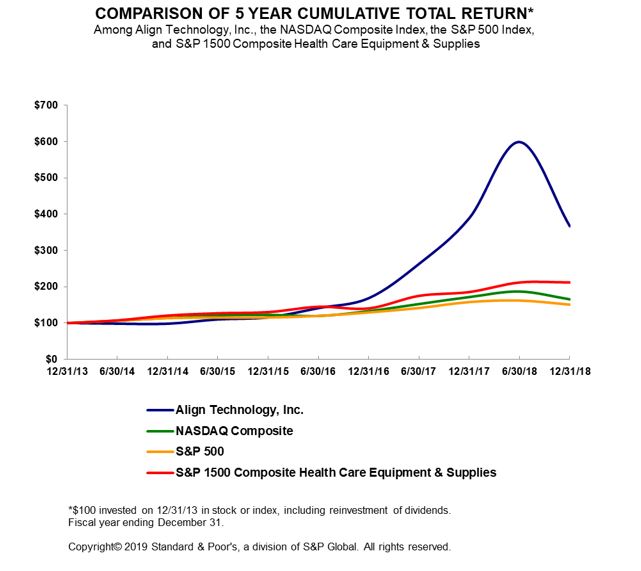
The graph below matches our cumulative 5-year total shareholder return on common stock with the cumulative total returns of the NASDAQ Composite index, the S&P 500 and the S&P 1500 Composite Health Care Equipment & Supplies index. The graph tracks the performance of a $100 investment in our common stock, in the peer group, and the index (with the reinvestment of all dividends) from December 31, 2013 to December 31, 2018.
UNREGISTERED SALES OF EQUITY SECURITIES AND USE OF PROCEEDS
Following is a summary of stock repurchases for the three months ended December 31, 2018:
| Period | Total Number of Shares Repurchased | Average Price Paid per Share | Total Number of Shares Repurchased as Part of Publicly Announced Program | Approximate Dollar Value of Shares that May Yet Be Repurchased Under the Program (1) | ||||||||||
| October 1, 2018 through October 31, 2018 | — | $ | — | — | $ | 550,000,000 | ||||||||
| November 1, 2018 through November 30, 2018 | 142,677 | $ | 245.31 | 142,677 | $ | 500,000,000 | ||||||||
| December 1, 2018 through December 31, 2018 | 91,865 | $ | 163.28 | 91,865 | $ | 500,000,000 |
(1) Stock Repurchase Program
| ◦ | May 2018 Repurchase Program. In May 2018, we announced that our Board of Directors had authorized a plan to repurchase up to $600.0 million of our common stock. In August 2018, we repurchased $50.0 million of our common stock on the open market. In November 2018, we entered into an accelerated share repurchase ("2018 ASR") to repurchase $50.0 million of our common stock which was completed in December 2018. As of December 31, 2018, we have $500.0 million remaining under the May 2018 Repurchase Program (Refer to Note 11 "Common Stock Repurchase Programs" of the Notes to Consolidated Financial Statements for details on common stock repurchase programs). |
Item 6. SELECTED CONSOLIDATED FINANCIAL DATA
The following tables set forth the selected consolidated financial data for each of the years in the five-year period ended December 31, 2018. The selected consolidated financial data should be read in conjunction with the consolidated financial statements and accompanying notes and Management’s Discussion and Analysis of Financial Condition and Results of Operations.
SELECTED CONSOLIDATED FINANCIAL DATA
(in thousands, except per share data)
| Year Ended December 31, | |||||||||||||||||||
| 2018 | 2017 | 2016 | 2015 | 2014 | |||||||||||||||
| Consolidated Statements of Operations Data: | |||||||||||||||||||
| Net revenues | $ | 1,966,492 | $ | 1,473,413 | $ | 1,079,874 | $ | 845,486 | $ | 761,653 | |||||||||
| Gross profit | $ | 1,447,867 | $ | 1,116,947 | $ | 815,294 | $ | 640,110 | $ | 578,443 | |||||||||
| Income from operations | 466,564 | 353,611 | 248,921 | 188,634 | 193,576 | ||||||||||||||
| Interest income | 8,576 | 6,948 | 4,213 | 2,938 | 1,818 | ||||||||||||||
| Other income (expense), net | (8,489 | ) | 4,240 | (10,568 | ) | (5,471 | ) | (5,025 | ) | ||||||||||
| Net income before provision for income taxes and equity in losses of investee | 466,651 | 364,799 | 242,566 | 186,101 | 190,369 | ||||||||||||||
| Provision for income taxes | 57,723 | 130,162 | 51,200 | 42,081 | 44,537 | ||||||||||||||
| Equity in losses of investee, net of tax | 8,693 | 3,219 | 1,684 | — | — | ||||||||||||||
| Net income | $ | 400,235 | $ | 231,418 | $ | 189,682 | $ | 144,020 | $ | 145,832 | |||||||||
| Net income per share: | |||||||||||||||||||
| Basic | $ | 5.00 | $ | 2.89 | $ | 2.38 | $ | 1.80 | $ | 1.81 | |||||||||
| Diluted | $ | 4.92 | $ | 2.83 | $ | 2.33 | $ | 1.77 | $ | 1.77 | |||||||||
| Shares used in computing net income per share: | |||||||||||||||||||
| Basic | 80,064 | 80,085 | 79,856 | 79,998 | 80,754 | ||||||||||||||
| Diluted | 81,357 | 81,832 | 81,484 | 81,521 | 82,283 | ||||||||||||||
| December 31, | |||||||||||||||||||
| 2018 | 2017 (2) | 2016 (2) | 2015 | 2014 | |||||||||||||||
| Consolidated Balance Sheet Data: | |||||||||||||||||||
| Working capital (1) | $ | 610,406 | $ | 658,316 | $ | 597,772 | $ | 460,338 | $ | 455,349 | |||||||||
| Total assets | 2,052,458 | 1,784,009 | 1,402,305 | 1,158,633 | 987,997 | ||||||||||||||
| Total long-term liabilities | 107,494 | 129,670 | 46,427 | 39,035 | 33,415 | ||||||||||||||
| Stockholders’ equity | $ | 1,252,891 | $ | 1,154,288 | $ | 999,307 | $ | 847,926 | $ | 752,771 |
| (1) | Working capital is calculated as the difference between total current assets and total current liabilities. |
| (2) | Balances have been recast to reflect the adoption of new revenue accounting standard (Refer to Note 1 "Summary of Significant Accounting Policies" of the Notes to Consolidated Financial Statements for details). |
Item 7. MANAGEMENT’S DISCUSSION AND ANALYSIS OF FINANCIAL CONDITION AND RESULTS OF OPERATIONS
The following discussion and analysis of our financial condition and results of operations should be read together with “Selected Consolidated Financial Data” and our consolidated financial statements and related notes included elsewhere in this Annual Report on Form 10-K.
Overview
Our goal is to establish Invisalign clear aligners as the standard method for treating malocclusion and to establish the iTero intraoral scanner as the preferred scanning device for 3D digital scans, ultimately driving increased product adoption by dental professionals. We intend to achieve this by continued focus and execution of our strategic growth drivers set forth in the Business Strategy section in this Annual Report on Form 10-K.
The successful execution of our business strategy in 2019 and beyond may be affected by a number of other factors including:
| • | New Invisalign Product Portfolio and Pricing. In July 2018, we launched a new expanded Invisalign product portfolio which includes new options and greater flexibility to treat a broader range of patients. The new Invisalign product portfolio offers doctors more choices by extending desirable features across the entire portfolio and creating new Invisalign treatment packages, as well as new options to treat young patients with early mixed dentition (with a mixture of primary/baby and permanent teeth). The new end-to-end Invisalign product portfolio includes clear aligner product offerings for almost every patient age group and case complexity to make it easier for our doctors to tailor treatment planning to the needs of each patient. Pricing and availability for the new Invisalign product offerings and the associated terms and conditions vary by region. |
| • | New Invisalign Products and Feature Enhancements. Product innovation drives greater treatment predictability, clinical applicability and ease of use for our customers which supports adoption of Invisalign treatment in their practices. Our focus is to develop solutions and features to treat a wide range of cases from simple to complex. |
| ◦ | In March 2017, we announced Invisalign treatment with Mandibular Advancement, the first clear aligner solution for Class II correction in growing tween and teen patients. This offering combines the benefits of our clear aligner system with features for moving the lower jaw forward while simultaneously aligning the teeth. Invisalign treatment with Mandibular Advancement is available in Canada, select Europe, Middle East and Africa (“EMEA”), Asia Pacific (“APAC”) and Latin America (“LATAM”) countries and, in the U.S. starting November 2018 as we received 510(k) clearance from the United States (“U.S.”) Food and Drug Administration in October 2018. |
| ◦ | Beginning July 2018, Invisalign First clear aligners, a treatment option designed with features specifically for younger patients with early mixed dentition, are available to Invisalign-trained doctors in the U.S., Canada, Australia, New Zealand, Japan, and the EMEA region. Invisalign First clear aligners are designed specifically to address a broad range of younger patients’ malocclusions, including shorter clinical crowns, management of erupting dentition and predictable dental arch expansion. Phase 1 treatment is an early interceptive orthodontic treatment for young patients, traditionally done through arch expanders, or partial metal braces, before all permanent teeth have erupted, typically at ages seven through ten years. |
| ◦ | In April 2018, we announced a new Invisalign Go product with more user-friendly iTero digital chairside experience and greater flexibility to treat a wider range of mild to moderate cases, such as crowded or gap teeth that require teeth straightening prior to restorative treatments. Invisalign Go is available to Invisalign-trained doctors in the U.S., the majority of European countries as well as in select APAC markets. Invisalign Go also incorporates new data-driven clinical protocols for predictable tooth movement and automated case assessments that leverages our Invisalign patients treated to date. These improvements make it easier for general practitioner dentists to tailor their treatment plans to the individual needs of each patient. |
| • | New iTero Products and Technology Innovation. The iTero scanner is an important component to our customer experience and is central to a digital approach as well as overall customer utilization of Invisalign. |
| ◦ | In April 2018, we expanded the iTero Element portfolio with the launch of the iTero Element 2 and the iTero Element Flex scanners, building on the existing high precision, full-color imaging and fast scan times of the |
iTero Element portfolio while streamlining orthodontic and restorative workflows. The next-generation iTero Element 2 is designed for greater performance with 2X faster start-up and 25% faster scan processing time compared to the iTero Element. The new iTero Element Flex wand-only configuration is a portable scanner for easy transport from office to office. iTero Element 2 and iTero Element Flex scanners are available in the U.S., Canada, the majority of European countries as well as in select APAC markets. The existing iTero Element scanner continues to be available in all markets.
| ◦ | In April 2018, we announced that we received market approval for the iTero Element intra-oral scanner from the China Food and Drug Administration, and we began offering this scanner in China. The iTero Element scanner launch in China not only supports growth of our base Invisalign clear aligner business but also represents a major milestone for digital dentistry in China. As we continue to expand into markets where we sell our intra-oral scanners, we expect continued growth for the foreseeable future due to the size of the market opportunities and our relatively low market penetration in these regions. |
We believe that over the long-term, clinical solutions and treatment tools will increase adoption of Invisalign and increase sales of our intraoral scanners; however, it is difficult to predict the rate of adoption which may vary by region and channel.
The use of iTero and other digital scanners for Invisalign case submission in place of PVS impressions continues to grow and remains a positive catalyst for Invisalign utilization. For the fourth quarter of 2018, total Invisalign cases submitted with a digital scanner in the Americas increased to 72.6%, up from 71.0% in the third quarter of 2018. International scans increased to 57.5%, up from 53.9% in the third quarter of 2018. In China, Invisalign cases submitted using a digital scanner increased to 45.9% from close to 0% in only one year. We believe that over the long-term, technology innovation and added features and functionality of our iTero scanners will increase adoption of Invisalign and increase sales of our intraoral scanners; however, it is difficult to predict the rate of adoption which may vary by region and channel.
| • | Invisalign Adoption. Our goal is to establish Invisalign as the treatment of choice for treating malocclusion ultimately driving increased product adoption and frequency of use by dental professionals, also known as "utilization rates." Our annual utilization rates for the last three fiscal years are as follows: |
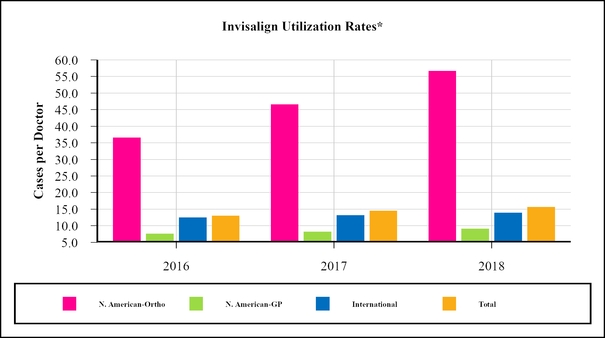
- Invisalign utilization rates = # of cases shipped divided by # of doctors cases were shipped to. Beginning in the first quarter of 2018, we report International region to include EMEA and APAC. LATAM is excluded from above chart as it is not material. Our historical utilization numbers have been recast to reflect this new classification.
| | | |
Showing the first 8K of 79K characters. Open the full section
Item 7A. QUANTITATIVE AND QUALITATIVE DISCLOSURES ABOUT MARKET RISK
In the normal course of business, we are exposed to foreign currency exchange rate and interest rate risks that could impact our financial position and results of operations.
Interest Rate Risk
Changes in interest rates could impact our anticipated interest income on our cash equivalents and investments in marketable securities. Our investments include fixed-rate short-term and long-term securities. Fixed-rate securities may have their fair market value adversely impacted due to a rise in interest rates, and, as a result, our future investment income may fall short of expectations due to changes in interest rates or we may suffer losses in principal if forced to sell securities which have declined in market value due to changes in interest rates. As of December 31, 2018, we had approximately $107.6 million invested in available-for-sale marketable securities. An immediate 10% change in interest rates would not have a material adverse impact on our future operating results and cash flows.
We do not enter into investments for trading or speculative purposes and have not used any derivative financial instruments to manage our interest rate risk exposure. We do not have material interest bearing liabilities as of December 31, 2018, and, therefore, we are not subject to risks from immediate interest rate increases.
Currency Rate Risk
As a result of our international business activities, our financial results could be affected by factors such as changes in foreign currency exchange rates or economic conditions in foreign markets, and there is no assurance that exchange rate fluctuations will
not harm our business in the future. We generally sell our products in the local currency of the respective countries. This provides some natural hedging because most of the subsidiaries’ operating expenses are generally denominated in their local currencies. Regardless of this natural hedging, our results of operations may be adversely impacted by exchange rate fluctuations.
In March 2018, we started entering into foreign currency forward contracts to minimize the short-term impact of foreign currency exchange rate fluctuations on cash and certain trade and intercompany receivables and payables. These forward contracts are not designated as hedging instruments and do not subject us to material balance sheet risk due to fluctuations in foreign currency exchange rates. The gains and losses on these forward contracts are intended to offset the gains and losses in the underlying foreign currency denominated monetary assets and liabilities being economically hedged. These instruments are marked to market through earnings every period and generally are one month in original maturity. We do not enter into foreign currency forward contracts for trading or speculative purposes. As our international operations grow, we will continue to reassess our approach to managing the risks relating to fluctuations in currency rates. It is difficult to predict the impact forward contracts could have on our results of operations. The fair value of foreign exchange forward contracts outstanding as of December 31, 2018 was not material.
Although we will continue to monitor our exposure to currency fluctuations, and, where appropriate, may use forward contracts to minimize the effect of these fluctuations, the impact of an aggregate change of 10% in foreign currency exchange rates relative to the U.S. dollar on our results of operations and financial position could be material.
Item 8. CONSOLIDATED FINANCIAL STATEMENTS AND SUPPLEMENTARY DATA
Quarterly Results of Operations
| Three Months Ended | |||||||||||||||||||||||||||||||
| 2018 | 2017 | ||||||||||||||||||||||||||||||
| December 31, 2018 | September 30, 2018 | June 30, 2018 | March 31, 2018 | December 31, 2017 | September 30, 2017 | June 30, 2017 | March 31, 2017 | ||||||||||||||||||||||||
| (in thousands, except per share data) (unaudited ) | |||||||||||||||||||||||||||||||
| Net revenues | $ | 534,020 | $ | 505,289 | $ | 490,259 | $ | 436,924 | $ | 421,323 | $ | 385,267 | $ | 356,482 | $ | 310,341 | |||||||||||||||
| Gross profit | 383,096 | 371,781 | 365,582 | 327,408 | 317,917 | 292,488 | 270,917 | 235,625 | |||||||||||||||||||||||
| Income from operations | 120,473 | 125,208 | 122,691 | 98,192 | 109,606 | 98,763 | 83,569 | 61,673 | |||||||||||||||||||||||
| Net income | 97,392 | 100,872 | 106,105 | 95,866 | 10,264 | 82,555 | 69,179 | 69,420 | |||||||||||||||||||||||
| Net income per share: | |||||||||||||||||||||||||||||||
| Basic | $ | 1.22 | $ | 1.26 | $ | 1.32 | $ | 1.20 | $ | 0.13 | $ | 1.03 | $ | 0.86 | $ | 0.87 | |||||||||||||||
| Diluted | $ | 1.20 | $ | 1.24 | $ | 1.30 | $ | 1.17 | $ | 0.13 | $ | 1.01 | $ | 0.85 | $ | 0.85 | |||||||||||||||
| Shares used in computing net income per share: | |||||||||||||||||||||||||||||||
| Basic | 79,891 | 80,111 | 80,216 | 80,036 | 80,080 | 80,163 | 80,188 | 79,904 | |||||||||||||||||||||||
| Diluted | 80,943 | 81,359 | 81,471 | 81,628 | 81,863 | 81,789 | 81,631 | 81,534 |
INDEX TO CONSOLIDATED FINANCIAL STATEMENTS
| Page | |
| Report of Management on Internal Control over Financial Reporting | 54 |
| Report of Independent Registered Public Accounting Firm | 55 |
| Consolidated Statements of Operations for the year ended December 31, 2018, 2017 and 2016 | 57 |
| Consolidated Statements of Comprehensive Income for the year ended December 31, 2018, 2017 and 2016 | 58 |
| Consolidated Balance Sheets as of December 31, 2018 and 2017 | 59 |
| Consolidated Statements of Stockholders’ Equity for the year ended December 31, 2018, 2017 and 2016 | 60 |
| Consolidated Statements of Cash Flows for the year ended December 31, 2018, 2017 and 2016 | 61 |
| Notes to Consolidated Financial Statements | 62 |
REPORT OF MANAGEMENT ON INTERNAL CONTROL OVER FINANCIAL REPORTING
Management of Align is responsible for establishing and maintaining adequate internal control over financial reporting as defined in Rules 13a-15(f) and 15d-15(f) under the Securities Exchange Act of 1934. Our internal control over financial reporting is designed by, or under supervision of, our CEO and CFO, and effected by the board of directors, management and other personnel to provide reasonable assurance regarding the reliability of financial reporting and the preparation of financial statements for external purposes in accordance with generally accepted accounting principles. Internal control over financial reporting includes those policies and procedures that:
| • | pertain to the maintenance of records that, in reasonable detail, accurately and fairly reflect the transactions and dispositions of the assets of Align; |
| • | provide reasonable assurance that transactions are recorded as necessary to permit preparation of financial statements in accordance with generally accepted accounting principles, and that receipts and expenditures of Align are being made only in accordance with authorizations of management and directors of Align; and |
| • | provide reasonable assurance regarding prevention or timely detection of unauthorized acquisition, use or disposition of Align's assets that could have a material effect on the financial statements. |
Because of its inherent limitations, internal control over financial reporting may not prevent or detect misstatements. In addition, projections of any evaluation of effectiveness to future periods are subject to the risk that controls may become inadequate because of changes in conditions or that the degree of compliance with the policies or procedures may deteriorate.
Management assessed the effectiveness of our internal control over financial reporting as of December 31, 2018. In making this assessment, management used the criteria set forth in Internal Control-Integrated Framework (2013) issued by the Committee of Sponsoring Organizations of the Treadway Commission (COSO).
Based on our assessment, management has concluded that, as of December 31, 2018, our internal control over financial reporting was effective based on criteria in Internal Control - Integrated Framework (2013) issued by the COSO.
The effectiveness of our internal control over financial reporting as of December 31, 2018 has been audited by PricewaterhouseCoopers LLP, an independent registered public accounting firm, as stated in their report which is included herein.
| /S/ JOSEPH M. HOGAN |
| Joseph M. Hogan |
| President and Chief Executive Officer |
| February 28, 2019 |
| /S/ JOHN F. MORICI |
| John F. Morici |
| Chief Financial Officer and Senior Vice President, Global Finance |
| February 28, 2019 |
Report of Independent Registered Public Accounting Firm
To the Board of Directors and Stockholders of Align Technology, Inc.
Opinions on the Financial Statements and Internal Control over Financial Reporting
We have audited the accompanying consolidated balance sheets of Align Technology, Inc. and its subsidiaries (the “Company”) as of December 31, 2018 and 2017, and the related consolidated statements of operations, comprehensive income, stockholders’ equity, and cash flows for each of the three years in the period ended December 31, 2018, including the related notes and financial statement schedule listed in the index appearing under Item 15(a)(2) (collectively referred to as the “consolidated financial statements”). We also have audited the Company's internal control over financial reporting as of December 31, 2018, based on criteria established in Internal Control - Integrated Framework (2013) issued by the Committee of Sponsoring Organizations of the Treadway Commission (COSO).
In our opinion, the consolidated financial statements referred to above present fairly, in all material respects, the financial position of the Company as of December 31, 2018 and 2017, and the results of its operations and its cash flows for each of the three years in the period ended December 31, 2018 in conformity with accounting principles generally accepted in the United States of America. Also in our opinion, the Company maintained,
Showing the first 8K of 159K characters. Open the full section
Item 9. CHANGES IN AND DISAGREEMENTS WITH ACCOUNTANTS ON ACCOUNTING AND FINANCIAL DISCLOSURE
None
Item 9A. CONTROLS AND PROCEDURES
Evaluation of disclosure controls and procedures.
Under the supervision and with the participation of our management, including our Chief Executive Officer and our Chief Financial Officer, we have evaluated the effectiveness of the design and operation of our disclosure controls and procedures (as defined in Rules 13a-15(e) and 15d-15(e) under the Exchange Act). Based upon that evaluation, our Chief Executive Officer and our Chief Financial Officer have concluded that our disclosure controls and procedures are effective as of December 31, 2018 to provide reasonable assurance that information required to be disclosed by us in the reports that we file or submit under the Exchange Act is accumulated and communicated to our management, including our Chief Executive Officer and our Chief Financial Officer, as appropriate, to allow timely decisions regarding required disclosure, and that such information is recorded, processed, summarized and reported within the time periods specified in the Securities and Exchange Commission rules and forms.
Management's annual report on internal control over financial reporting.
See “Report of Management on Internal Control over Financial Reporting” of this Annual Report on Form 10-K.
Changes in internal control over financial reporting.
There have been no changes in our internal control over financial reporting during the quarter ended December 31, 2018 that have materially affected, or are reasonably likely to materially affect, our internal control over financial reporting.
Item 9B. OTHER INFORMATION
None.
PART III
Certain information required by Part III is omitted from this Form 10-K because we intend to file a definitive Proxy Statement for our 2018 Annual Meeting of Stockholders (the “Proxy Statement”) not later than 120 days after the end of the fiscal year covered by this Annual Report on Form 10-K, and certain information to be included therein is incorporated herein by reference.
Item 10. DIRECTORS, EXECUTIVE OFFICERS AND CORPORATE GOVERNANCE
The information required by Item 401 of Regulation S-K concerning our directors is incorporated by reference to the Proxy Statement under the section captioned “Election of Directors.” The information required by Item 401 of Regulation S-K concerning our executive officers is set forth in Item 1— “Business” of this Annual Report on Form 10-K. The information required by Item 405 of Regulation S-K is incorporated by reference to the section entitled “Section 16(a) Beneficial Ownership Reporting Compliance” contained in the Proxy Statement. The information required by Item 407(c)(3), 407(d)(4) and 407(d)(5) of Regulation S-K is incorporated by reference to the Proxy Statement under the section entitled “Corporate Governance”.
Code of Ethics
We have a code of ethics that applies to all of our employees, including our principal executive officer, principal financial officer and principal accounting officer. This code of ethics is posted on our Internet website. The Internet address for our website is www.aligntech.com, and the code of ethics may be found on the “Corporate Governance” section of our “Investor Relations” webpage.
We intend to satisfy the disclosure requirement under Item 5.05 of Form 8-K regarding an amendment to, or waiver from, a provision of this code of ethics by posting such information on our website, at the address and location specified above, or as otherwise required by the NASDAQ Global Market.
Item 11. EXECUTIVE COMPENSATION
The information required by Item 402 of Regulation S-K is incorporated by reference to the Proxy Statement under the section captioned “Executive Compensation.” The information required by Items 407(e)(4) and (e)(5) is incorporated by reference to the Proxy Statement under the section captioned “Corporate Governance—Compensation Committee Interlocks” and “Compensation Committee Report,” respectively.
Item 12. SECURITY OWNERSHIP OF CERTAIN BENEFICIAL OWNERS AND MANAGEMENT AND RELATED STOCKHOLDER MATTERS
The information required by Item 403 of Regulation S-K is incorporated by reference to the Proxy Statement under the section captioned “Security Ownership of Certain Beneficial Owners and Management.”
Equity Compensation Plan Information
The following table provides information as of December 31, 2018 about our common stock that may be issued upon the exercise of options and awards granted to employees, consultants or members of our Board of Directors under all existing equity compensation plans, including the 2005 Incentive Plan and the Employee Stock Purchase Plan ("ESPP"), each as amended, and certain individual arrangements (Refer to Note 10“Stockholders’ Equity” of the Notes to Consolidated Financial Statements for a description of our equity compensation plans).
| Plan Category | Number of securities to be issued upon exercise of outstanding options and restricted stock units(a) | Weighted average exercise price of outstanding options(b) | Number of securities remaining available for future issuance under equity compensation plans (excluding securities reflected in column(a)) | ||||||||
| Equity compensation plans approved by security holders | 1,263,246 | 1 | $ | 8.07 | 6,632,043 | 2, 3 | |||||
| Equity compensation plans not approved by security holders | — | — | — | ||||||||
| Total | 1,263,246 | $ | 8.07 | 6,632,043 |
| 1 | Includes 930,859 restricted stock units and 324,200 market-performance based restricted stock units at target, which have an exercise price of zero. |
| 2 | Includes 571,778 shares available for issuance under our ESPP. We are unable to ascertain with specificity the number of securities to be issued upon exercise of outstanding rights or the weighted average exercise price of outstanding rights under the ESPP. |
| 3 | Includes 648,185 of potentially issuable MSUs if performance targets are achieved at maximum payout. |
Item 13. CERTAIN RELATIONSHIPS AND RELATED TRANSACTIONS, AND DIRECTOR INDEPENDENCE
The information required by Item 404 and Item 407 of Regulation S-K is incorporated by reference to the Proxy Statement under the sections captioned “Certain Relationships and Related Party Transactions” and “Corporate Governance—Director Independence,” respectively.
Item 14. PRINCIPAL ACCOUNTING FEES AND SERVICES
The information required by Item 9(e) of Schedule 14A of the Securities Act of 1934, as amended, is incorporated by reference to the Proxy Statement under the section captioned “Ratification of Appointment of Independent Registered Public Accountants.”
PART IV
Item 15. EXHIBITS, FINANCIAL STATEMENT SCHEDULES
| (a) | Financial Statements |
| 1. | Consolidated financial statements |
The following documents are filed as part of this Annual Report on Form 10-K:
| Report of Independent Registered Public Accounting Firm | 55 |
| Consolidated Statements of Operations for the year ended December 31, 2018, 2017 and 2016 | 57 |
| Consolidated Statements of Comprehensive Income for the year ended December 31, 2018, 2017 and 2016 | 58 |
| Consolidated Balance Sheets as of December 31, 2018 and 2017 | 59 |
| Consolidated Statements of Stockholders’ Equity for the year ended December 31, 2018, 2017 and 2016 | 60 |
| Consolidated Statements of Cash Flows for the year ended December 31, 2018, 2017 and 2016 | 61 |
| Notes to Consolidated Financial Statements | 62 |
| 2. | The following financial statement schedule is filed as part of this Annual Report on Form 10-K: |
Schedule II—Valuation and Qualifying Accounts and Reserves For the Year Ended December 31, 2018, 2017 and 2016
All other schedules have been omitted as they are not required, not applicable, or the required information is otherwise included.
SCHEDULE II: VALUATION AND QUALIFYING ACCOUNTS AND RESERVES
| Balance at Beginning of Period | Additions (Reductions) to Costs and Expenses | Write Offs | Balance at End of Period | ||||||||||||
| (in thousands) | |||||||||||||||
| Allowance for doubtful accounts(1): | |||||||||||||||
| Year Ended December 31, 2016 | $ | 1,108 | $ | 8,585 | $ | (6,747 | ) | $ | 2,946 | ||||||
| Year Ended December 31, 2017 | $ | 2,946 | $ | 9,948 | $ | (7,080 | ) | $ | 5,814 | ||||||
| Year Ended December 31, 2018 | $ | 5,814 | $ | 12,321 | $ | (15,757 | ) | $ | 2,378 | ||||||
| Valuation allowance for deferred tax assets: | |||||||||||||||
| Year Ended December 31, 2016 | $ | 31,685 | $ | (31,429 | ) | $ | — | $ | 256 | ||||||
| Year Ended December 31, 2017 | $ | 256 | $ | 22 | $ | — | $ | 278 | |||||||
| Year Ended December 31, 2018 | $ | 278 | $ | (27 | ) | $ | — | $ | 251 |
| (1) | Balances have been recast to reflect the adoption of new revenue accounting standard (Refer to Note 1 "Summary of Significant Accounting Policies" of the Notes to Consolidated Financial Statements for details). |
| (b) | The following Exhibits are included in this Annual Report on Form 10-K: |
| † | Management contract or compensatory plan or arrangement filed as an Exhibit to this form pursuant to Items 14(a) and 14(c) of Form 10-K. |
| †† | Portions of the exhibit have been omitted pursuant to a request for confidential treatment. The confidential portions have been filed with the SEC. |
Item 16. FORM 10-K SUMMARY
Not applicable.
SIGNATURES
Pursuant to the requirements of Section 13 or 15(d) of the Securities Exchange Act of 1934, the Registrant has duly caused this report to be signed on its behalf by the undersigned, thereunto duly authorized, on February 28, 2019.
| ALIGN TECHNOLOGY, INC. | |
| By: | /S/ JOSEPH M. HOGAN |
| Joseph M. Hogan | |
| President and Chief Executive Officer |
Each person whose signature appears below constitutes and appoints Joseph M. Hogan or John F. Morici, his or her attorney-in-fact, with the power of substitution, for him or her in any and all capacities, to sign any amendments to this Report on Form 10-K and to file the same, with exhibits thereto and other documents in connection therewith, with the Securities and Exchange Commission, hereby ratifying and confirming all that each of said attorneys-in-fact, or his or her substitute or substitutes, may do or cause to be done by virtue hereof.
Pursuant to the requirements of the Securities Exchange Act of 1934, this report has been signed below by the following persons on behalf of the Registrant and in the capacities and on the dates indicated.
| Signature | Title | Date | ||
| /S/ JOSEPH M. HOGAN | President and Chief Executive Officer (Principal Executive Officer) | February 28, 2019 | ||
| Joseph M. Hogan | ||||
| /S/ JOHN F. MORICI | Chief Financial Officer and Senior Vice President, Global Finance (Principal Financial Officer and Principal Accounting Officer) | February 28, 2019 | ||
| John F. Morici | ||||
| /S/ JOSEPH LACOB | Director | February 28, 2019 | ||
| Joseph Lacob | ||||
| /S/ C. RAYMOND LARKIN, JR. | Director | February 28, 2019 | ||
| C. Raymond Larkin, Jr. | ||||
| /S/ GEORGE J. MORROW | Director | February 28, 2019 | ||
| George J. Morrow | ||||
| /S/ ANDREA L. SAIA | Director | February 28, 2019 | ||
| Andrea L. Saia | ||||
| /S/ GREG J. SANTORA | Director | February 28, 2019 | ||
| Greg J. Santora | ||||
| /S/ THOMAS M. PRESCOTT | Director | February 28, 2019 | ||
| Thomas M. Prescott | ||||
| /S/ WARREN S. THALER | Director | February 28, 2019 | ||
| Warren S. Thaler | ||||
| /S/ SUSAN E. SIEGEL | Director | February 28, 2019 | ||
| Susan E. Siegel |
| /S/ KEVIN J. DALLAS | Director | February 28, 2019 | ||
| Kevin J. Dallas |