 filings.tools
Item 1. Business 2019 Form 10-K
80K characters. Original on sec.gov · Markdown
Item 1. Business 2019 Form 10-K
Allstate Life Segment
Strategy
Our Allstate Life segment accounted for 4.4% of Allstate’s 2019 consolidated total revenue and 1.3% of Allstate’s December 31, 2019 PIF. Our overall strategy is to broaden Allstate’s customer relationships and value proposition. We also distribute non-proprietary retirement products offered by third-party providers. Our target customers are middle market consumers with family and financial protection needs.
Our product positioning provides solutions to help meet customer needs during various phases of life. Term and whole life insurance products offer basic life protection solutions while universal life and retirement products cover more advanced needs. Many Allstate exclusive agencies partner with exclusive financial specialists to deliver life and retirement solutions to their customers. These specialists have expertise with advanced life and retirement cases and other more complex customer needs. Successful partnerships assist agencies with building stronger and deeper customer relationships. Improvements in sales education and technology are being made to ensure agencies have the tools and information needed to help customers meet their needs and build personal relationships.
The operating model is being modernized through investments in data and analytics and technology capabilities, tailoring distribution support, product innovation and enhancing the underwriting process.
Products and distribution
| Insurance products | ||
| Term life | Interest-sensitive life | |
| Whole life | Variable life |
| Distribution channel |
| Allstate exclusive agencies and exclusive financial specialists. |
Allstate exclusive agencies and exclusive financial specialists also sell certain non-proprietary products, including mutual funds, fixed and variable annuities, disability insurance, and long-term care insurance to provide a broad suite of protection and retirement products. As of December 31, 2019, Allstate agencies had approximately $16.5 billion of non-proprietary mutual funds and fixed and variable annuity account balances under management. New and additional deposits into these non-proprietary products were $2.4 billion in 2019.
Competition
We compete on a variety of factors, including product offerings, brand recognition, financial strength and ratings, price, distribution and customer service. The market for life insurance continues to be highly fragmented and competitive. As of December 31, 2018, there were approximately 350 groups of life insurance companies in the United States.
Geographic markets
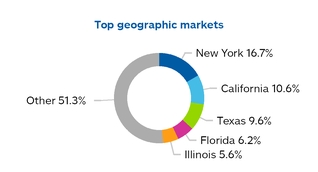
We primarily operate in the U.S. (all 50 states and D.C.). Our top geographic markets based on 2019 statutory direct premiums are reflected below.
The Allstate Corporation 11
2019 Form 10-K Item 1. Business
Allstate Benefits Segment
Strategy
Our Allstate Benefits segment accounted for 2.8% of Allstate’s 2019 consolidated total revenue and 2.9% of Allstate’s December 31, 2019 PIF. The Allstate Benefits segment provides consumers with financial protection against the risk of accidents, illness and mortality. We are among the industry leaders in the growing voluntary benefits market, offering a broad range of products through workplace enrollment. Our life insurance portfolio includes individual and group permanent life solutions. Target customers are middle market consumers with family and financial protection needs employed by small, medium and large sized firms. Allstate Benefits is well represented in all market segments and is a leader in the large and mega (over 10,000 employees) market segments.
Our products are offered through independent agents, benefits brokers and Allstate exclusive agencies. Allstate Benefits is differentiated through its broad product portfolio, flexible enrollment solutions, strong national accounts team and well-recognized brand.
Our strategy for growth is to deliver substantially more value through innovative products and technology, tailored solutions and exceptional service. Initiatives are focused on expanding into non-traditional products and becoming an integrated digital enterprise through investments in future-state technologies and data and analytics capabilities.
Products and distribution
| Voluntary benefits products | ||
| Life | Short-term disability | |
| Accident | Other health | |
| Critical illness |
| Distribution channels |
| 4,960 workplace enrolling independent agents and benefits brokers. |
| Allstate exclusive agencies, focusing on small employers. |
Competition
We compete on a wide variety of factors, including product offerings, brand recognition, financial strength and ratings, price, distribution and customer service.
The market for voluntary benefits is growing as these products help employees fill the increasing gaps associated with continued medical cost inflation and the shifting of costs from employers to employees to cover co-pays and deductibles. Favorable industry and economic trends have increased competitive pressure and attracted new traditional and non-traditional entrants to the voluntary benefits market. Recent entrants, including large group medical, life and disability insurance carriers, are leveraging core benefit capabilities by bundling and discounting to capture voluntary market share.
Geographic markets
We primarily operate in the U.S. (all 50 states and D.C.) and Canada. The top geographic markets based on 2019 statutory direct premiums are reflected below. 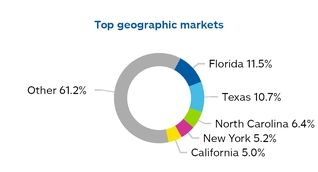
2019 Form 10-K Item 1. Business
Allstate Annuities Segment
Strategy
Our Allstate Annuities segment accounted for 2.9% of Allstate’s 2019 consolidated total revenue and 0.1% of Allstate’s December 31, 2019 PIF. The Allstate Annuities segment consists primarily of deferred fixed annuities and immediate fixed annuities (including standard and sub-standard structured settlements). The segment is in run-off and is focused on increasing lifetime economic value. Both the deferred and immediate annuity businesses have been adversely impacted by the historically low interest rate environment. Our immediate annuity business has also been impacted by medical advancements that have resulted in annuitants living longer than anticipated when many of these contracts were originated.
Allstate Annuities focuses on the distinct risk and return profiles of the specific products when developing investment and liability management strategies. The level of legacy deferred annuities in force has been significantly reduced and the investment portfolio and crediting rates are proactively managed to improve profitability of the business while providing appropriate levels of liquidity.
The investment portfolio supporting our immediate annuities is managed to ensure the assets match the characteristics of the liabilities and provide the long-term returns needed to support this business. To better match the long-term nature of our immediate annuities, we use performance-based investments (primarily limited partnership investments) in which we have ownership interests and a greater proportion of return is derived from idiosyncratic asset or operating performance.
We continue to review strategic options to reduce exposure and improve returns of the business. As a result, we may take additional operational and financial actions that offer return improvement and risk reduction opportunities.
Products and distribution
We previously offered and continue to have in force deferred fixed annuities and immediate fixed annuities. We discontinued the sale of proprietary annuities over an eight-year period from 2006 to 2014, reflecting our expectations of declining returns. In 2006, we disposed of substantially all of the variable annuity business through reinsurance agreements. For discussion of non-proprietary retirement and investment products sold through our Allstate exclusive agencies and exclusive financial specialists, see Part I, Item 1. Allstate Life Segment of this report.
Other Business Segments
Discontinued Lines and Coverages Segment
The Discontinued Lines and Coverages segment includes results from property and casualty insurance coverage that primarily relates to policies written during the 1960s through the mid-1980s.
Strategy Management of this segment has been assigned to a designated group of professionals with expertise in claims handling, policy coverage interpretation, exposure identification, litigation and reinsurance collection. As part of its responsibilities, this group pursues settlement agreements including policy buybacks on direct excess commercial business when appropriate to improve the certainty of the liabilities. At the end of 2019, 72.2% of the direct excess gross case reserves were attributable to settlement agreements. This group also manages other direct commercial and assumed reinsurance business in runoff and engages in reinsurance ceded and assumed commutations as required or when considered economically advantageous.
Changes in the reserves established for asbestos, environmental and other discontinued lines losses have occurred and may continue. Reserve changes can be caused by new information relating to new and additional claims, new exposures or the impact of resolving unsettled claims based on unanticipated events such as arbitrations, litigation, legislative, judicial or regulatory actions. Environmental losses may also increase as the result of additional funding for environmental site clean-up.
Challenges related to the concentration of insurance and reinsurance claims from companies who specialize in this business continue to be addressed.
Corporate and Other Segment
Our Corporate and Other segment is comprised of holding company activities and certain non-insurance operations.
2019 Form 10-K Item 1. Business
Regulation
Allstate is subject to extensive regulation, primarily at the state level. The method, extent and substance of such regulation vary by state but generally have their source in statutes that establish standards and requirements for conducting the business of insurance and that also delegate regulatory authority to a state agency. These rules have a substantial effect on our business and relate to a wide variety of matters, including insurer solvency and statutory surplus sufficiency, reserve adequacy, insurance company licensing and examination, agent and adjuster licensing, agent and broker compensation, policy forms, rate setting, the nature and amount of investments, claims practices, participation in shared markets and guaranty funds, transactions with affiliates, the payment of dividends, underwriting standards, statutory accounting methods, trade practices, privacy regulation and data security, corporate governance and risk management. In addition, state legislators and insurance regulators continue to examine the appropriate nature and scope of state insurance regulation. For a discussion of statutory financial information, see Note 16 of the consolidated financial statements.
 For a discussion of regulatory contingencies, see Note 14 of the consolidated financial statements. Notes 14 and 16 are incorporated in this Part I, Item 1 by reference.
As part of an effort to strengthen the regulation of the financial services market, the Dodd-Frank Wall Street Reform and Consumer Protection Act (“Dodd-Frank”) was enacted in 2010. Dodd-Frank created the Federal Insurance Office (“FIO”) within the U.S. Department of the Treasury (“Treasury”). The FIO monitors the insurance industry, provides advice to the Financial Stability Oversight Council (“FSOC”), represents the U.S. on international insurance matters, and studies the current regulatory system.
Additional regulations or new requirements may emerge from the activities of various regulatory entities, including the Federal Reserve Board, FIO, FSOC, the National Association of Insurance Commissioners (“NAIC”), and the International Association of Insurance Supervisors (“IAIS”), that are evaluating solvency and capital standards for insurance company groups. In addition, the NAIC has adopted amendments to its model holding company law that have been adopted by some jurisdictions. The outcome of these actions is uncertain; however, these actions may result in an increase in the level of capital and liquidity required by insurance holding companies.
We cannot predict whether any specific state or federal measures will be adopted to change the nature or scope of the regulation of insurance or what effect any such measures would have on Allstate. We are working for changes in the regulatory environment to make insurance more available and affordable for customers, encourage market innovation, improve driving safety, strengthen cybersecurity, promote better catastrophe preparedness and loss mitigation
and advocate for appropriate long-term capital standards to support optimal risk adjusted returns.
Limitations on Dividends by Insurance Subsidiaries. As a holding company with no significant business operations of its own, The Allstate Corporation relies on dividends from Allstate Insurance Company as one of the principal sources of cash to pay dividends and to meet its obligations, including the payment of principal and interest on debt or to fund non-insurance-related businesses. Allstate Insurance Company is regulated as an insurance company in Illinois, and its ability to pay dividends is restricted by Illinois law. The laws of the other jurisdictions that generally govern our other insurance subsidiaries contain similar limitations on the payment of dividends. However, such laws in some jurisdictions may be more restrictive.
For additional information regarding limitations, see Part II, Item 7 - Management’s Discussion and Analysis of Financial Condition and Results of Operations of this report.
In addition, the NAIC has formed a working group for the development of a group capital calculation covering all entities of the insurance company group for use in solvency monitoring activities. The calculation is intended to provide analytical information and we do not expect potential revisions to impact our current dividend plans, any increase in the amount of capital or reserves our insurance subsidiaries are required to hold could reduce the amount of future dividends such subsidiaries are able to distribute to the holding company. Any reduction in the RBC ratios of our insurance subsidiaries could also adversely affect their financial strength ratings as determined by statistical rating agencies.
Insurance Holding Company Regulation – Change of Control. The Allstate Corporation and Allstate Insurance Company are insurance holding companies subject to regulation in the jurisdictions in which their insurance subsidiaries do business. In the U.S., these subsidiaries are organized under the insurance codes of Florida, Illinois, Massachusetts, New Jersey, New York, Texas, and Wisconsin. Additionally, some of these subsidiaries are considered commercially domiciled in California and Florida.
Generally, the insurance codes in these states provide that the acquisition or change of “control” of a domestic or commercially domiciled insurer or of any person that controls such an insurer cannot be consummated without the prior approval of the relevant insurance regulator. In general, a presumption of “control” arises from the ownership, control, possession with the power to vote, or possession of proxies with respect to ten percent or more of the voting securities of an insurer or of a person who controls an insurer. In addition, certain state insurance laws require pre-acquisition notification to state agencies of a change in control with respect to a non-domestic insurance company licensed to do business in that state. While such pre-acquisition notification
Item 1. Business 2019 Form 10-K
statutes do not authorize the state agency to disapprove the change of control, such statutes do authorize certain remedies, including the issuance of a cease-and-desist order with respect to the non-domestic insurer if certain conditions exist, such as undue market concentration.
Thus, any transaction involving the acquisition of ten percent or more of The Allstate Corporation’s common stock would generally require prior approval by the state insurance departments in California, Florida, Illinois, Massachusetts, New Jersey, New York, Texas and Wisconsin. Moreover, notification would be required in those other states that have adopted pre-acquisition notification provisions and where the insurance subsidiaries are admitted to transact business. Such approval requirements may deter, delay or prevent certain transactions affecting the ownership of The Allstate Corporation’s common stock.
Rate Regulation. Nearly all states have insurance laws requiring personal property and casualty insurers to file rating plans, policy or coverage forms, and other information with the state’s regulatory authority. In many cases, such rating plans, policy forms, or both must be approved prior to use.
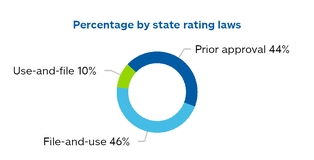
The speed with which an insurer can change rates in response to competition or increasing costs depends on the state rating laws, which include the following categories:
| • | Prior approval — Regulators must approve a rate before the insurer may use it |
| • | File-and-use — Insurers do not have to wait for the regulator’s approval to use a rate, but the rate must be filed with the regulatory authority prior to being used |
| • | Use-and-file — Requires an insurer to file rates within a certain period of time after the insurer begins using them |
| • | No approval — One state, representing less than 1% of 2019 statutory direct written premiums, does not impose a rate filing requirement |
Under these rating laws, the regulator has the authority to disapprove a rate filing. The percentage of 2019 statutory direct written premiums based on state rating laws are reflected below.
An insurer’s ability to adjust its rates in response to competition or to changing costs is dependent on an insurer’s ability to demonstrate to the regulator that its rates or proposed rating plan meets the requirements of the rating laws. In those states that significantly restrict an insurer’s discretion in selecting the business
that it wants to underwrite, an insurer can manage its risk of loss by charging a rate that reflects the cost and expense of providing the insurance. In those states that significantly restrict an insurer’s ability to charge a rate that reflects the cost and expense of providing the insurance, the insurer can manage its risk of loss by being more selective in the type of business it underwrites. When a state significantly restricts both underwriting and pricing, it becomes more difficult for an insurer to maintain its profitability.
From time to time, the personal lines insurance industry comes under pressure from state regulators, legislators, and special-interest groups to reduce, freeze, or set rates at levels that do not correspond with our analysis of underlying costs, catastrophe loss exposure, and expenses. We expect this kind of pressure to persist. Allstate and other insurers are using increasingly sophisticated pricing models and rating plans that are reviewed by regulators and special-interest groups. State regulators may interpret existing law or rely on future legislation or regulations to impose new restrictions that adversely affect profitability or growth. We cannot predict the impact on our business of possible future legislative and regulatory measures regarding insurance rates.
Involuntary Markets. As a condition of maintaining our licenses to write personal property and casualty insurance in various states, we are required to participate in assigned risk plans, reinsurance facilities, and joint underwriting associations that provide various types of insurance coverage to individuals or entities that otherwise are unable to purchase such coverage from private insurers. Underwriting results related to these arrangements, which tend to be adverse, have been immaterial to our results of operations.
For a discussion of these items see Note 14 of the consolidated financial statements. Note 14 is incorporated in this Part I, Item 1 by reference.
Indemnification Programs. We are a participant in state-based industry pools, facilities or associations, mandating participation by insurers offering certain coverage in their state, including the Michigan Catastrophic Claims Association (“MCCA”), the New Jersey Property-Liability Insurance Guaranty Association, the North Carolina Reinsurance Facility and the Florida Hurricane Catastrophe Fund. We also participate in the Federal Government National Flood Insurance Program.
Recent regulatory changes have occurred related to the MCCA. At this time, we are unable to determine whether, or to what extent, these changes will have on our claims and claims expense reserves and corresponding MCCA indemnification recoverables.
| • | On May 17, 2018, member companies of the MCCA were notified of the ratification of amendments to the MCCA’s Plan of Operation. The amendments were designed to clarify the MCCA’s preapproval requirements for certain actions and activities involving benefits provided to covered claimants, including the preapproval of any agreement that sets attendant care rates or residential care facility |
The Allstate Corporation 15
2019 Form 10-K Item 1. Business
rates and the preapproval of all non-emergency medical flights.
| • | On May 30, 2019, the Governor of Michigan signed new legislation to reform Michigan’s no-fault auto insurance system. The reform includes: |
| – | Allowing insureds to choose levels of personal injury protection coverage, including the option to opt-out of personal injury protection coverage in certain circumstances. |
| – | Implementing mandated rate reductions that correspond to the level of personal injury protection coverage chosen by insureds, which go into effect July 2, 2020. |
| – | Setting fee schedules for personal injury protection claims at 200% of Medicare rates in 2021, declining to 195% in 2022 and 190% in 2023, for any providers other than certain unique categories of providers and applying to treatment on existing and new claims beginning after July 1, 2021. |
| – | Implementing or creating new processes for reviewing claims, assessing allowable expenses and setting limits on certain allowable expenses. |
| • | Other legislative proposals to change the MCCA operation in the future are put forth periodically. |
For a discussion of these items see Note 10 of the consolidated financial statements. Note 10 is incorporated in this Part I, Item 1 by reference.
Guaranty Funds. Under state insurance guaranty fund laws, insurers doing business in a state can be assessed, up to prescribed limits, in order to cover certain obligations of insolvent insurance companies. We do not anticipate any material adverse financial impact on Allstate from these assessments.
Investment Regulation. Our insurance subsidiaries are subject to state regulation that specifies the types of investments that can be made and concentration limits of invested assets. Failure to comply with these rules leads to the treatment of non-conforming investments as non-admitted assets for purposes of measuring statutory surplus. Further, in some instances, these rules require divestiture of non-conforming investments.
Exiting Geographic Markets; Canceling and Non-Renewing Policies. Most states regulate an insurer’s ability to exit a market. For example, states may limit, to varying degrees, an insurer’s ability to cancel and non-renew policies. Some states restrict or prohibit an insurer from withdrawing one or more types of insurance business from the state, except pursuant to a plan that is approved by the state insurance department. Regulations that limit cancellation and non-renewal and that subject withdrawal plans to prior approval requirements may restrict an insurer’s ability to exit unprofitable markets.
Variable Life Insurance and Registered Fixed Annuities. The sale and administration of variable life insurance and registered fixed annuities with market value adjustment features are subject to extensive
regulatory oversight at the federal and state level, including regulation and supervision by the Securities and Exchange Commission (“SEC”) and the Financial Industry Regulatory Authority (“FINRA”).
Broker-Dealers, Investment Advisors and Investment Companies. The Allstate entities that operate as broker-dealers, registered investment advisors, and investment companies are subject to regulation and supervision by the SEC, FINRA and/or, in some cases, state securities administrators. The SEC has adopted a best interest standard that has a compliance effective date of June 30, 2020 and applies to recommendations of securities products to retail customers. Certain other state and federal regulators are considering or have implemented best interest or fiduciary standards. Such standards could impact products provided by Allstate agencies and Allstate’s broker-dealers, their sales processes, sales volume, and producer compensation arrangements.
Dodd-Frank: Covered Agreement. The Secretary of the Treasury (operating through FIO) and the Office of the U.S. Trade Representative (“USTR”) are jointly authorized, pursuant to the Dodd-Frank, to negotiate Covered Agreements. A Covered Agreement is a bilateral or multilateral agreement that “relates to the recognition of prudential measures with respect to the business of insurance or reinsurance that achieves a level of protection for insurance or reinsurance consumers that is substantially equivalent to the level of protection achieved under State insurance or reinsurance regulation.”
On September 22, 2017, the U.S. and European Union (“EU”) signed a Covered Agreement. In addition to signing the Covered Agreement, Treasury and the USTR jointly issued a policy statement clarifying how the U.S. views implementation of certain provisions of the Covered Agreement. The policy statement affirms the U.S. system of insurance regulation, including the role of state insurance regulators as the primary supervisors of the business of insurance and addresses several other key provisions of the Covered Agreement for which constituents sought clarity, including prospective application to reinsurance agreements and an affirmation that the Covered Agreement does not require development of a group capital standard or group capital requirement in the U.S.
The U.S. has five years from the date of signing to amend its credit for reinsurance laws and regulations to conform with the requirements of the Covered Agreement or face federal preemption determinations by the FIO. To address the requirements of the Covered Agreement, the NAIC has formally adopted revisions to its existing credit for reinsurance model law and model regulation to conform with the requirements of the Covered Agreement with the expectation that states will adopt and implement the modified model law and regulation by September 2022.
On December 19, 2018, the U.S. and the United Kingdom (“UK”) signed a separate Covered Agreement consistent with the U.S.-EU Covered Agreement to coordinate regulation of the insurance industry doing business in the U.S. and UK in the event the UK leaves
Item 1. Business 2019 Form 10-K
the EU. Consistent with the U.S.-EU Covered Agreement (the “Agreement”) signed in 2017, Treasury and the USTR also issued a policy statement regarding implementation of the Agreement affirming the role that state insurance regulators play as the primary supervisors of the U.S. insurance industry. The Agreement will become effective once U.S. and UK governments exchange written notifications that they have completed all domestic internal requirements and procedures. This is anticipated to occur when the UK is no longer covered by the Agreement following the UK withdrawal from the EU.
Division Statute. On November 27, 2018, the Illinois General Assembly passed legislation authorizing a statute that makes available a process by which a domestic insurance company may divide into two or more domestic insurance companies. The statute, which became effective January 1, 2019, can be used to divide continuing blocks of insurance business from insurance business no longer marketed, or otherwise has been discontinued, into separate companies with separate capital. The statute can also be used for sale to a third party or to manage risks associated with indemnification programs. Before a plan of division can be effected it must be approved according to the organizational documents of the dividing insurer and submitted for approval by the Illinois Department of Insurance.
Privacy Regulation and Data Security. Federal law and the laws of many states require financial institutions to protect the security and confidentiality of consumer information and to notify consumers about their policies and practices relating to collection, use, and disclosure of consumer information and their policies relating to protecting the security and confidentiality of that information. Federal law and the laws of many states also regulate disclosures and disposal of consumer information. Congress, state legislatures, and regulatory authorities are expected to consider additional regulation relating to privacy and other aspects of consumer information.
For example, the European Commission adopted the General Data Protection Regulation, which greatly increases the jurisdictional reach of its laws and adds a broad array of requirements for handling personal data, such as the public disclosure of significant data breaches, privacy impact assessments, data portability and the appointment of data protection officers. The California Consumer Privacy Act, which took effect in January 2020, adopted similar compliance requirements for businesses that collect personal information on California residents. Additional states are likely to adopt similarly themed privacy requirements in the future. Further, the New York State Department of Financial Services has issued cybersecurity regulations for financial services institutions, including banking and insurance entities, that impose a variety of detailed security measures on covered entities. The NAIC has also adopted the Insurance Data Security Model Law, which, if adopted as state legislation, would establish standards for data security and for the investigation of and notification to insurance commissioners of cybersecurity events. We cannot predict the impact on our business of possible
future legislative measures regarding privacy or cybersecurity.
Asbestos. Congress has repeatedly considered legislation to address asbestos claims and litigation in the past. We cannot predict the impact on our business of possible future legislative measures regarding asbestos.
Environmental. Environmental pollution and clean-up of polluted waste sites is the subject of federal and state regulation. The Comprehensive Environmental Response Compensation and Liability Act of 1980 (the “Superfund”) and comparable state statutes (the “mini-Superfunds”) govern the clean-up and restoration of waste sites by Potentially Responsible Parties (“PRPs”). The Superfund and the mini-Superfunds (collectively, the “Environmental Clean-up Laws” or “ECLs”) establish a mechanism to assign liability to PRPs or to fund the clean-up of waste sites if PRPs fail to do so. The extent of liability to be allocated to a PRP depends on a variety of factors. The insurance industry is involved in extensive litigation regarding coverage issues arising out of the clean-up of waste sites by insured PRPs and the insured parties’ alleged liability to third parties responsible for the clean-up. The insurance industry, including Allstate, has disputed and is disputing many such claims. Key coverage issues include whether the Superfund response, investigation, and clean-up costs are considered damages under the policies; whether coverage has been triggered; whether any pollution exclusion applies; whether there has been proper notice of claims; whether administrative liability triggers the duty to defend; whether there is an appropriate allocation of liability among potentially responsible insurers; and whether the liability in question falls within the definition of an “occurrence.” Identical coverage issues exist for clean-up and waste sites not covered under the Superfund. To date, courts have been inconsistent in their rulings on these issues.
Allstate’s exposure to liability with regard to its insureds that have been, or may be, named as PRPs is uncertain. While comprehensive Superfund reform proposals have been introduced in Congress, only modest reform measures have been enacted. In May 2017, the Environmental Protection Agency created a Superfund Task Force that issued proposed reforms in a July 2018 report. These recommendations address expediting clean-up and remediation processes, reducing the financial burden of the clean-up process, encouraging private investment, promoting redevelopment and community revitalization, and building and strengthening partnerships. We cannot predict which, if any, of these reforms will be enacted.
Developments in the insurance and reinsurance industries have fostered a movement to segregate asbestos, environmental and other discontinued lines exposures into separate legal entities with dedicated capital. Regulatory bodies in certain cases have supported these actions. We are unable to determine the impact, if any, that these developments will have on the collectability of reinsurance recoverables in the future.
The Allstate Corporation 17
2019 Form 10-K Item 1. Business
Website
Our website is allstate.com. The Allstate Corporation’s annual reports on Form 10-K, quarterly reports on Form 10-Q, current reports on Form 8-K and any amendments to such reports that we file or furnish pursuant to Section 13(a) of the Securities Exchange Act of 1934 are available on the Investor Relations section of our website (www.allstateinvestors.com), free of charge, as soon as reasonably practicable after they are electronically filed or furnished to the SEC. In addition, our Corporate Governance Guidelines, our Global Code of Business Conduct, and the charters of our Audit Committee, Compensation and Succession Committee, Executive Committee, Nominating and Governance Committee, and Risk and Return Committee are available on the Investor Relations section of our website and in print to any stockholder who requests copies by contacting Investor Relations, The Allstate Corporation, 2775 Sanders Road, Northbrook, Illinois 60062-6127, 1-847-402-2800. The information found on our website is not incorporated by reference into this Annual Report on Form 10-K or in any other report or document filed with the SEC.
Other Information About Allstate
| • | As of December 31, 2019, Allstate had approximately 45,780 full-time employees and 510 part-time employees. |
| • | Allstate’s seven reportable segments use shared services, including human resources, investment, finance, information technology and legal services, provided by Allstate Insurance Company and other affiliates. |
| • | Although the insurance business generally is not seasonal, claims and claims expense for the Allstate Protection segment tend to be higher for periods of severe or inclement weather. |
| • | “Allstate®” is a very well-recognized brand name in the United States. We use the “Allstate®,” “Esurance®,” “Encompass®” and “Answer Financial®” brands extensively in our business. We also provide additional protection products and services through “AllstateSM Protection Plans”, “Allstate Dealer Services®”, “Allstate Roadside Services®”, “Arity®”, “AllstateSM Identity Protection” and “Allstate Benefits®”. These brands, products and services are supported with the related service marks, logos, and slogans. Our rights in the United States to these names, service marks, logos and slogans continue as long as we continue to use them in commerce. Many service marks used by Allstate are the subject of renewable U.S. and/or foreign service mark registrations. We believe that these service marks are important to our business and we intend to maintain our rights to them. |
Item 1. Business 2019 Form 10-K
Information about our Executive Officers
The following table sets forth the names of our executive officers, their ages as of February 1, 2020, their positions, business experience, and the years of their first election as officers. “AIC” refers to Allstate Insurance Company. Each of the officers named below may be removed from office at any time, with or without cause, by the board of directors of the relevant company.
| Name | Age | Position with Allstate and Business Experience | Year First Elected Officer | |||
| Thomas J. Wilson | 62 | Chair of the Board (May 2008 to present), President (June 2005 to January 2015 and February 2018 to present), and Chief Executive Officer (January 2007 to present) of The Allstate Corporation and AIC. | 1995 | |||
| Carolyn D. Blair | 51 | Executive Vice President and Chief Human Resources Officer of AIC (October 2019 to present); President of Tartan Advisory Group, Inc. (November 2018 to October 2019); Executive Vice President, Chief Human Resources & Communications Officer of Sun Life Financial (April 2014 to June 2018). | 2019 | |||
| Elizabeth A. Brady | 55 | Executive Vice President and Chief Marketing, Customer and Communications Officer of AIC (January 2020 to present); Executive Vice President and Chief Marketing, Innovation and Corporate Relations Officer of AIC (August 2018 to January 2020); Senior Vice President, Global Brand Management of Kohler Co. (November 2013 to July 2018). | 2018 | |||
| Don Civgin | 58 | Chief Executive Officer, Protection Products and Services of AIC (January 2020 to present); President, Service Businesses of AIC (January 2018 to January 2020); President, Emerging Businesses of AIC (February 2015 to January 2018); President and Chief Executive Officer, Allstate Financial of AIC (March 2012 to February 2015). | 2008 | |||
| John E. Dugenske | 53 | President, Investments and Financial Products of AIC (January 2020 to present); Executive Vice President and Chief Investment and Corporate Strategy Officer of AIC (January 2018 to January 2020); Executive Vice President and Chief Investment Officer of AIC (March 2017 to January 2018); Group Managing Director and Global Head of Fixed Income at UBS Global Asset Management (December 2008 to February 2017). | 2017 | |||
| Mary Jane Fortin | 55 | President, Financial Products of AIC (January 2020 to present); President, Allstate Financial Businesses of AIC (February 2017 to January 2020); President, Allstate Life and Retirement of AIC (October 2015 to February 2017); Executive Vice President and Chief Financial Officer, Global Consumer Insurance of AIG (April 2012 to September 2015). | 2015 | |||
| Suren Gupta | 58 | Executive Vice President, Chief Information Technology and Enterprise Services Officer of AIC (January 2020 to present); Executive Vice President, Enterprise Technology and Strategic Ventures of AIC (February 2015 to January 2020); Executive Vice President, Allstate Technology and Operations of AIC (April 2011 to February 2015). | 2011 | |||
| Susan L. Lees | 62 | Executive Vice President, Chief Legal Officer, General Counsel, and Secretary of The Allstate Corporation and AIC (January 2020 to present); Executive Vice President, General Counsel, and Secretary of The Allstate Corporation (May 2013 to January 2020) and of AIC (June 2013 to January 2020); Executive Vice President and General Counsel of The Allstate Corporation (June 2012 to May 2013) and of AIC (June 2012 to June 2013). | 2008 | |||
| Jesse E. Merten | 45 | Executive Vice President and Chief Risk Officer of AIC (December 2017 to present); Treasurer of The Allstate Corporation (January 2015 to April 2019) and of AIC (February 2015 to May 2019); Senior Vice President and Chief Financial Officer, Allstate Financial of AIC (January 2012 to February 2015). | 2012 | |||
| John C. Pintozzi | 54 | Senior Vice President, Controller, and Chief Accounting Officer of The Allstate Corporation (August 2019 to present) and of AIC (September 2019 to present); Senior Vice President and Chief Financial Officer, Allstate Investments (May 2012 to August 2019) | 2005 | |||
| Mario Rizzo | 53 | Executive Vice President and Chief Financial Officer of The Allstate Corporation and AIC (January 2018 to present); Senior Vice President and Chief Financial Officer, Allstate Personal Lines of AIC (February 2015 to January 2018); Senior Vice President and Treasurer of The Allstate Corporation (November 2010 to January 2015) and of AIC (November 2010 to February 2015). | 2010 | |||
| Glenn T. Shapiro | 54 | President, Personal Property-Liability of AIC (January 2020 to present); President, Allstate Personal Lines of AIC (January 2018 to January 2020); Executive Vice President, Claims of AIC (April 2016 to January 2018); Executive Vice President and Chief Claims Officer of Liberty Mutual Commercial Insurance (May 2011 to March 2016). | 2016 | |||
| Steven E. Shebik | 63 | Vice Chair of The Allstate Corporation and AIC (January 2018 to present); Executive Vice President and Chief Financial Officer of The Allstate Corporation (February 2012 to January 2018) and of AIC (March 2012 to January 2018). | 1999 |
The Allstate Corporation 19
2019 Form 10-K Item 1. Business
Forward-Looking Statements
This report contains “forward-looking statements” that anticipate results based on our estimates, assumptions and plans that are subject to uncertainty. These statements are made subject to the safe-harbor provisions of the Private Securities Litigation Reform Act of 1995. Forward-looking statements do not relate strictly to historical or current facts and may be identified by their use of words like “plans,” “seeks,” “expects,” “will,” “should,” “anticipates,” “estimates,” “intends,” “believes,” “likely,” “targets” and other words with similar meanings. These statements may address, among other things, our strategy for growth, catastrophe exposure management, product development, investment results, regulatory approvals, market position, expenses, financial results, litigation and reserves. We believe that these statements are based on reasonable estimates, assumptions and plans. Forward-looking statements speak only as of the date on which they are made, and we assume no obligation to update any forward-looking statements as a result of new information or future events or developments. In addition, forward-looking statements are subject to certain risks or uncertainties that could cause actual results to differ materially from those communicated in these forward-looking statements. These risks and uncertainties include, but are not limited to, those described in Part 1, “Item 1A. Risk Factors” and elsewhere in this report and those described from time to time in our other reports filed with the Securities and Exchange Commission.
Part I - Item 1A. Risk Factors and Other Disclosures 2019 Form 10-K
Item 1A. Risk Factors
Summary Risks are categorized by (1) insurance and financial services, (2) business, strategy and operations and (3) macro, regulatory and risk environment. Many risks may affect more than one category and are included where the impact is most significant. The table below includes examples of risks from each category.
 | Insurance and financial services |  | Business, strategy and operations |  | Macro, regulatory and risk environment | ||
| Risks that are unique to the insurance and financial services industries | Risks that are unique to Allstate’s business and operating model | Risks that impact most companies | |||||
| • Claim frequency and severity volatility • Catastrophes and severe weather • Loss cost estimates are complex and losses are unknown at the time policies are sold • Investment results are subject to volatility and valuation judgments • Large-scale pandemic events | • Highly competitive industry, impacted by new and changing technologies • Operating model effectiveness in light of changing customer preferences • Ability to maintain catastrophe reinsurance programs and limits • Fluctuations in financial strength and ratings | • Adverse changes in economic and capital market conditions • Cybersecurity controls and privacy • Regulatory and political changes • Loss of key business relationships • Ability to attract, develop and retain talent |
Allstate manages these risks through an Enterprise Risk and Return Management framework on an integrated basis following our risk and return principles.
See Management’s Discussion and Analysis (“MD&A”), Enterprise Risk and Return Management for further details.
Consider these cautionary statements carefully together with other factors discussed elsewhere in this document, in filings with the Securities and Exchange Commission (“SEC”) or in materials incorporated therein by reference.
 | Insurance and financial services |
Unexpected increases in the frequency or severity of property and casualty claims may adversely affect our results of operations and financial condition
A significant increase in claim frequency could adversely affect our results of operations and financial condition. Changes in mix of business, miles driven, weather, distracted driving or other factors can lead to changes in auto claim frequency. We may experience volatility in claim frequency, and short-term trends may not be predictive of future losses over the longer term.
Increases in claim severity can arise from numerous causes that are inherently difficult to predict. The following factors may impact claim severity for auto bodily injury, property damage and homeowners coverages:
| • | Bodily injury — inflation in medical costs, litigation trends and precedents and regulation |
| • | Vehicle property damage — inflation in repair costs, including parts and labor rates, mix of total losses declared, costs associated with repairing sophisticated newer vehicles, model year and used-car values |
| • | Homeowners — inflation in the construction industry, building materials and home furnishings, changes in the mix of loss type, and other economic and environmental factors, including short-term supply imbalances for services and supplies in areas affected by catastrophes |
Catastrophes and severe weather events may subject us to significant losses
Catastrophic events could adversely affect operating results and cause them to vary significantly from one period to the next. Also, our liquidity could be constrained by a catastrophe, or multiple catastrophes, which could result in extraordinary losses, sales of investments or a downgrade of our debt and/or financial strength ratings.
Catastrophic losses are caused by wind and hail, wildfires, tornadoes, hurricanes, tropical storms, earthquakes, volcanic eruptions, terrorism and industrial accidents and other such events.
Our personal property insurance business may incur catastrophe losses greater than:
| • | Those experienced in prior years |
| • | The average expected level used in pricing |
| • | Current reinsurance coverage limits |
| • | Loss estimates from hurricane and earthquake models at various levels of probability |
Property and casualty businesses are subject to claims arising from severe weather events such as winter storms, rain, hail and high winds. The incidence and severity of weather conditions resulting in claims are unpredictable.
The total number of policyholders affected by the event, the severity of the event and the coverage provided contribute to catastrophe and severe weather losses. Increases in the insured values of covered property, geographic concentration and the number of policyholders exposed to certain events
The Allstate Corporation 21
2019 Form 10-K Part I - Item 1A. Risk Factors and Other Disclosures
could increase the severity of claims from catastrophic and severe weather events.
Limitations in analytical models used to assess and predict the exposure to catastrophe losses may adversely affect our results of operations and financial condition
We use internally developed and third-party vendor models along with our own historical data to assess exposure to catastrophe losses. The models assume various conditions and probability scenarios and may not accurately predict future losses or measure losses currently incurred.
Price competition and changes in underwriting standards in property and casualty businesses may adversely affect our results of operations and financial condition
The personal property-liability market is highly competitive with carriers competing through underwriting, advertising, price, customer service, innovation and distribution. Companies can alter underwriting standards, lower prices and increase advertising, which could result in lower growth or profitability for Allstate. A decline in the growth or profitability of the property and casualty businesses could have a material effect on our results of operations and financial condition.
Property and casualty actual claims costs may exceed current reserves established for claims due to changes in the inflationary, regulatory and litigation environment
| • | Estimating claim reserves is an inherently uncertain and complex process as expected losses are unknown at the time policies are sold. We continually refine our best estimates of losses after considering known facts and interpretations of the circumstances. |
| • | Our reserving methodology may be impacted by the following: |
| • | Models that rely on the assumption that past loss development patterns will persist into the future |
| • | Internal factors including experience with similar cases, actual claims paid, historical trends involving claim payment patterns, pending levels of unpaid claims, loss management programs, product mix, contractual terms and changes in claim reporting and settlement practices |
| • | External factors such as inflation, court decisions, changes in law or litigation imposing unintended coverage, regulatory requirements and economic conditions |
| • | The ultimate cost of losses may vary materially from recorded reserves and such variance may adversely affect our results of operations and financial condition as the reserves and amounts due from reinsurers are reestimated. |
See MD&A, Application of Critical Accounting Estimates for further details.
Our investment portfolios are subject to market risk and declines in quality which may adversely affect investment income and cause realized and unrealized losses
We continually evaluate investment management strategies since we are subject to risk of loss due to adverse changes in interest rates, credit spreads, equity prices, real estate values, currency exchange rates and liquidity. Adverse changes may occur due to changes in monetary and fiscal policy and the economic climate, liquidity of a market or market segment, investor return expectations and/or risk tolerance, insolvency or financial distress of key market makers or participants, or changes in market perceptions of credit worthiness. Adverse changes in market conditions could cause the value of our investments to decrease significantly and impact our results of operations and financial condition.
Our investments are subject to risks associated with economic and capital market conditions and factors that may be unique to our portfolio, including:
| • | General weakening of the economy, which is typically reflected through higher credit spreads and lower equity valuations |
| • | Declines in credit quality |
| • | Declines in market interest rates, credit spreads or sustained low interest rates could lead to further declines in portfolio yields and investment income |
| • | Increases in market interest rates, credit spreads or a decrease in liquidity could have an adverse effect on the value of our fixed income securities that form a substantial majority of our investment portfolios |
| • | Weak performance of general partners and underlying investments unrelated to general market or economic conditions could lead to declines in investment income and cause realized losses in our limited partnership interests |
| • | Concentration in any particular issuer, industry, collateral type, group of related industries, geographic sector or risk type |
The amount and timing of net investment income, capital contributions and distributions from our performance-based investments, which primarily includes limited partnership interests, can fluctuate significantly due to the underlying investments’ performance or changes in market or economic conditions. Additionally, these investments are less liquid than similar, publicly-traded investments and a decline in market liquidity could impact our ability to sell them at their current carrying values.
Declining equity markets and/or increases in interest rates or credit spreads could cause the value of the investments in our pension plans to decrease. Declines in interest rates could cause the funding ratio to decline and the value of the obligations for our pension and postretirement plans to increase. These factors could decrease the funded status of our pension and postretirement plans, increasing the likelihood or magnitude of future benefit expense and contributions.
Part I - Item 1A. Risk Factors and Other Disclosures 2019 Form 10-K
Determination of the fair value and the amount of realized capital losses recorded for impairments of investments includes subjective judgments and could materially impact our results of operations and financial condition
The valuation of the portfolio is subjective, and the value of assets may differ from the actual amount received upon the sale of an asset. The degree of judgment required in determining fair values increases when:
| • | Market observable information is less readily available |
| • | The use of different valuation assumptions may have a material effect on the assets’ fair values |
| • | Changing market conditions could materially affect the fair value of investments |
The determination of the amount of realized capital losses recorded for impairments varies by investment type and is based on ongoing evaluation and assessment of known and inherent risks associated with the respective asset class or investment.
Such evaluations and assessments are highly judgmental and are revised as conditions change and new information becomes available.
We update our evaluations regularly and reflect changes in other-than-temporary impairments in our results of operations. Our conclusions may ultimately prove to be incorrect as assumptions, facts and circumstances change. Historical trends may not be indicative of future impairments and additional impairments may need to be recorded in the future.
Changes in market interest rates or performance-based investment returns may lead to a significant decrease in the profitability of our annuity business
Spread-based products, such as fixed annuities, are dependent upon maintaining profitable spreads between investment returns and interest crediting rates. When market interest rates decrease or remain at low levels, investment income may decline. Lowering interest crediting rates on some products in such an environment can partially offset decreases in investment yield. However, these changes could be limited by regulatory minimum rates or contractual minimum rate guarantees on many contracts and may not match the timing or magnitude of changes in investment yields.
Increases in market interest rates can lead to increased surrenders at a time when fixed income investment asset values are lower due to the increase in interest rates. Liquidating investments to fund surrenders could result in a loss that would adversely impact results of operations.
Changes in reserve estimates and amortization of deferred acquisition costs (“DAC”) could materially affect results of operations and financial condition of our life, voluntary benefits and annuity businesses
We use long-term assumptions, including future investment yields, mortality, morbidity, persistency and expenses in pricing and valuation. If experience differs significantly from assumptions, adjustments to reserves and amortization of DAC may be required that could have a material adverse effect on our results of operations and financial condition.
See MD&A, Application of Critical Accounting Estimates and Note 2 of the consolidated financial statements for further details.
Our participation in indemnification programs subjects us to the risk that reimbursement for qualifying claims and claims expenses may not be received
Participation in state-based industry pools, facilities and associations as well as the National Flood Insurance Program may have a material, adverse effect on our results of operations and financial condition. Our largest exposure is associated with the Michigan Catastrophic Claim Association (“MCCA”), a state-mandated indemnification mechanism for qualified personal injury protection losses that exceed a specified level. To the extent the MCCA’s current and future assessments are insufficient to reimburse its ultimate obligation on existing claims to member companies, our ability to obtain the 100% indemnification of ultimate loss could be impaired.
For further discussion of these items, see Regulation section, Indemnification Programs and Note 10 of the consolidated financial statements.
We may not be able to mitigate the capital impact associated with statutory reserving and capital requirements
Regulatory capital and reserving requirements affect the amount of capital required to be maintained by our subsidiary insurance companies. Changes to capital or reserving requirements or regulatory interpretations may result in additional capital held in our insurance companies and could require us to increase prices, reduce our sales of certain products, and/or accept a return on equity below original levels assumed in pricing.
A downgrade in financial strength ratings may have an adverse effect on our business
Financial strength ratings are important factors in establishing the competitive position of insurance companies and their access to capital markets. Rating agencies could downgrade or change the outlook on our ratings due to:
| • | Changes in the financial profile of one of our insurance companies |
| • | Changes in a rating agency’s determination of the amount of capital required to maintain a particular rating |
The Allstate Corporation 23
2019 Form 10-K Part I - Item 1A. Risk Factors and Other Disclosures
| • | Increases in the perceived risk of our investment portfolio, a reduced confidence in management or our business strategy, as well as other considerations that may or may not be under our control |
A downgrade in our ratings could have a material effect on our sales, competitiveness, customer retention, the marketability of our product offerings, liquidity, access to and cost of borrowing, results of operations and financial condition.
Changes in tax laws may adversely affect the sales and profitability of life insurance products
Changes in taxation of life insurance products could reduce sales and result in the surrender of some existing contracts and policies, which may have a material effect on our profitability and financial condition.
 | Business, strategy and operations |
We operate in markets that are highly competitive and may be impacted by new or changing technologies
Markets in which we operate are highly competitive, and we must continually allocate resources to refine and improve products and services to remain competitive. If we are unsuccessful in generating new business, retaining customers or renewing contracts, our ability to maintain or increase premiums written or the ability to sell our products could be adversely impacted.
Determining competitive position is complicated in the auto and homeowners insurance business as companies use different underwriting standards to accept new customers and quotes and close rates can fluctuate across companies and locations. Pricing of products is driven by multiple factors, including expense structure and dissimilar profitability and return targets. Additionally, sophisticated pricing algorithms make it difficult to determine what price potential customers would pay across competitors.
There is also significant competition for producers such as exclusive and independent agents and their licensed sales professionals. Growth and retention may be materially affected if we are unable to attract and retain effective producers or if those producers are unable to attract and retain their licensed sales professionals or customers. Similarly, growth and retention may be impacted if customer preferences change, including customer demand for direct distribution channels or an increase in point-of-sale distribution channels.
Our business could also be affected by technological changes, such as autonomous or partially autonomous vehicles or technologies that facilitate ride, car or home sharing. Such changes could disrupt the demand for products from current customers, create coverage issues, impact the frequency or severity of losses, or reduce the size of the automobile insurance market causing our auto insurance business to decline. Since auto insurance constitutes a significant portion of our overall business, we may be more sensitive than other insurers and more adversely affected by trends that could decrease auto insurance rates or reduce demand for auto insurance over time.
Technological advancements and innovation are occurring in distribution, underwriting, claims and operations at a rapid pace that may continue to accelerate. Innovations must be implemented in compliance with applicable insurance regulations and may require extensive modifications to our systems and processes and extensive coordination with and reliance on the systems of third parties. If we are unable to adapt to or bring such advancements and innovations to market, the quality of our products, our relationships with customers and agents, competitive position and business prospects may be materially affected. Changes in technology related to collection and analysis of data regarding customers could expose us to regulatory or legal actions and may have a material adverse effect on our business, reputation, results of operations and financial condition.
Technological changes may also impact the ways in which we interact and do business with our customers. For example, changing customer preferences for direct distribution channels may drive a need to redesign our products or distribution model and the way we interact with customers. We may not be able to respond effectively to these changes, which could have a material effect on our results of operations and financial condition.
Our ability to adequately and effectively price our products and services is affected by the evolving nature of consumer needs and preferences, market dynamics, broader use of telematics-based rate segmentation and potential reduction in consumer demand.
Many voluntary benefits contracts are renewed annually. There is a risk that employers may be able to obtain more favorable terms from competitors than they could by renewing coverage with us. These competitive pressures may adversely affect the renewal of these contracts, as well as our ability to sell products.
 Transformative Growth Plan may not be effectively implemented
Our Transformative Growth Plan is intended to accelerate profitable growth by expanding customer access, improving customer value, increasing marketing and technology investments and reducing operating expenses. This strategy involves several interdependent components. If components are not implemented effectively and/or on a timely basis, our customer and growth objectives could be adversely impacted or there may be unintended adverse impacts on other parts of our business. Lost business opportunities may result due to slower than anticipated speed to market. External forces including competitor actions or regulatory changes may also have an adverse effect on the value generated from the transformation.
Part I - Item 1A. Risk Factors and Other Disclosures 2019 Form 10-K
Our catastrophe management strategy may adversely affect premium growth
Catastrophe risk management actions have negatively impacted the size of our homeowners business and customer retention, including customers with auto and other personal lines products and may negatively impact future sales if further actions are taken. Adjustments to our business structure, size and underwriting practices in markets with significant severe weather and catastrophe risk exposure could adversely impact premium growth rates and retention.
The ability of our subsidiaries to pay dividends may affect our liquidity and ability to meet our obligations
The Allstate Corporation is a holding company with no significant operations. Its principal assets are the stock of its subsidiaries and its directly held cash and investment portfolios. Its liabilities include debt and pension and other postretirement benefit obligations related to Allstate Insurance Company employees. State insurance regulatory authorities limit the payment of dividends by insurance subsidiaries, as described in Note 16 of the consolidated financial statements. The limitations are based on statutory income and surplus. In addition, competitive pressures generally require the subsidiaries to maintain insurance financial strength ratings. These restrictions and other regulatory requirements may affect the ability of subsidiaries to make dividend payments. Limits on the ability of the subsidiaries to pay dividends could adversely affect holding company liquidity, including the ability to pay dividends to shareholders, service debt or complete share repurchase programs as planned.
Changes in regulatory capital requirements could decrease deployable capital and potentially reduce future dividends paid by our insurance companies.
For a discussion of capital requirements, including a potential change to a group capital calculation, see Regulation section, Limitations on Dividends by Insurance Subsidiaries.
Our ability to pay dividends or repurchase stock is subject to limitations under terms of certain of our securities
The terms of the outstanding subordinated debentures prohibit us from declaring or paying any dividends or distributions on our common or preferred stock or redeeming, purchasing, acquiring or making liquidation payments on our common stock or preferred stock if we have elected to defer interest payments on the subordinated debentures, subject to certain limited exceptions.
We are prohibited from declaring or paying dividends on our Series G preferred stock if we fail to meet specified capital adequacy, net income or shareholders’ equity levels. The prohibition is subject to an exception permitting us to declare dividends out of the net proceeds of common stock issued by us during the 90 days before the date of declaration even if we fail to meet such levels.
If the full preferred stock dividends for all preceding dividend periods have not been declared and paid, we generally may not repurchase or pay dividends on common stock during any dividend period while our preferred stock is outstanding.
See Note 12 of the consolidated financial statements.
Reinsurance may be unavailable at current levels and prices, which may limit our ability to write new business
Market conditions beyond our control impact the availability and cost of the reinsurance we purchase. Reinsurance may not remain continuously available to us to the same extent and on the same terms and rates as is currently available. Our ability to economically justify reinsurance to reduce our catastrophe risk in designated areas may depend on our ability to adjust premium rates to fully or partially recover cost. If we cannot maintain our current level of reinsurance or purchase new reinsurance protection in amounts we consider sufficient at acceptable prices, we would have to either accept an increase in our catastrophe exposure, reduce our insurance exposure or seek other alternatives.
Reinsurance subjects us to counterparty risk and may not be adequate to protect us against losses arising from ceded insurance
Collecting from reinsurers is subject to uncertainty arising from factors, including:
| • | Whether reinsurers, their affiliates or certain indemnitors have the financial capacity and willingness to make payments under the terms of a reinsurance treaty or contract |
| • | Whether insured losses meet the qualifying conditions of the reinsurance contract |
Our inability to recover from a reinsurer could have a material effect on our results of operations and financial condition.
Disruption, volatility or uncertainty in the insurance linked securities market may decrease our ability to access such market on favorable terms or at all.
Acquisitions or divestitures of businesses may not produce anticipated benefits, resulting in operating difficulties, unforeseen liabilities or asset impairments
The ability to achieve certain anticipated financial benefits from the acquisition of businesses depends in part on our ability to successfully grow and integrate the businesses consistent with our anticipated acquisition economics. Financial results could be adversely affected by unanticipated performance issues, unforeseen liabilities, transaction-related charges, diversion of management time and resources to acquisition integration challenges or growth strategies, loss of key employees, amortization of expenses related to intangibles, charges for impairment of long-term assets or goodwill and indemnifications.
Acquired businesses may not perform as projected, cost savings anticipated from the acquisition may not materialize, and costs associated
The Allstate Corporation 25
2019 Form 10-K Part I - Item 1A. Risk Factors and Other Disclosures
with the integration may be greater than anticipated. As a result, if we do not manage these transitions effectively and bring innovations to market with the requisite speed, the quality of our products as well as our relationships with customers and retail partners for our protection plans business may result in the company not achieving returns on its investment at the level projected at acquisition.
We also may divest businesses from time to time. These transactions may result in continued financial involvement in the divested businesses, such as through reinsurance, guarantees or other financial arrangements, following the transaction. If the acquiring companies do not perform under the arrangements, our financial results could be negatively impacted.
We may be subject to the risks and costs associated with intellectual property infringement, misappropriation and third-party claims
We rely on a combination of contractual rights and copyright, trademark, patent and trade secret laws to establish and protect our intellectual property. Third parties may infringe or misappropriate our intellectual property. We may have to litigate to enforce and protect intellectual property and to determine its scope, validity or enforceability, which could divert significant resources and prove unsuccessful. An inability to protect intellectual property or an inability to successfully defend against a claim of intellectual property infringement could have a material effect on our business.
We may be subject to claims by third parties for patent, trademark or copyright infringement or breach of usage rights. Any such claims and any resulting litigation could result in significant expense and liability. If third-party providers or we are found to have infringed a third-party intellectual property right, either of us could be enjoined from providing certain products or services or from utilizing and benefiting from certain methods, processes, copyrights, trademarks, trade secrets or licenses. Alternatively, we could be required to enter into costly licensing arrangements with third parties or implement a costly work-around. Any of these scenarios could have a material effect on our business and results of operations.
 | Macro, regulatory and risk environment |
Conditions in the global economy and capital markets could adversely affect our business and results of operations
Global economic and capital market conditions could adversely impact demand for our products, returns on our investment portfolio and results of operations. The conditions that would have the largest impact on our business include:
| • | Low or negative economic growth |
| • | Sustained low interest rates |
| • | Rising inflation increasing claims and claims expense |
| • | Substantial increases in delinquencies or defaults on debt |
| • | Significant downturns in the market value or liquidity of our investment portfolio |
| • | Reduced consumer spending and business investment |
Stressed conditions, volatility and disruptions in global capital markets or financial asset classes could adversely affect our investment portfolio.
Adverse capital and credit market conditions may significantly affect our ability to meet liquidity needs or obtain credit on acceptable terms
In periods of extreme volatility and disruption in the capital and credit markets, liquidity and credit capacity may be severely restricted. Our access to additional financing depends on a variety of factors such as market conditions, the general availability of credit, the overall availability of credit to our industry, our credit ratings and credit capacity, as well as lenders’ perception of our long- or short-term financial prospects. In such circumstances, our ability to obtain capital to fund operating expenses, financing costs, capital expenditures or acquisitions may be limited, and the cost of any such capital may be significant.
A large-scale pandemic, the occurrence of terrorism or military actions may have an adverse effect on our business
A large-scale pandemic, the occurrence of terrorism or military and other actions, may result in loss of life, property damage, and disruptions to commerce and reduced economic activity. Some of the assets in our investment portfolio may be adversely affected by declines in the equity markets, changes in interest rates, reduced liquidity and economic activity caused by a large-scale pandemic. Additionally, a large-scale pandemic or terrorist act could have a material effect on sales, liquidity and operating results.
The failure in cyber or other information security controls, as well as the occurrence of events unanticipated in our disaster recovery processes and business continuity planning, could result in a loss or disclosure of confidential information, damage to our reputation, additional costs and impair our ability to conduct business effectively
We depend heavily on computer systems, mathematical algorithms and data to perform necessary business functions. There are threats that could impact our ability to protect our data and systems; if the threats are successful, they could impact confidentiality, integrity and availability:
| • | Confidentiality — protecting our data from disclosure to unauthorized parties |
| • | Integrity — ensuring data is not changed accidentally or without authorization and is accurate |
| • | Availability — ensuring our data and systems are accessible to meet our business needs |
Previous: Cover and table of contents · Next: Item 1A. Risk Factors and Other Disclosures 2019 Form 10-K