 filings.tools
Allstate 10-K 2020-12-31
Filed 2021-02-22. 22 sections, 1280K characters. Original on sec.gov · Markdown · JSON
Cover and table of contents
UNITED STATES
SECURITIES AND EXCHANGE COMMISSION
Washington, D.C. 20549
FORM 10-K
☒ ANNUAL REPORT PURSUANT TO SECTION 13 OR 15(d) OF THE SECURITIES EXCHANGE ACT OF 1934
For the fiscal year ended December 31, 2020
OR
☐ TRANSITION REPORT PURSUANT TO SECTION 13 OR 15(d) OF THE SECURITIES EXCHANGE ACT OF 1934
For the transition period from to
Commission file number 1-11840

THE ALLSTATE CORPORATION
(Exact name of registrant as specified in its charter)
| Delaware | 36-3871531 | |||||||
| (State or Other Jurisdiction of Incorporation or Organization) | (I.R.S. Employer Identification No.) |
2775 Sanders Road, Northbrook, Illinois 60062
(Address of principal executive offices) (Zip Code)
Registrant’s telephone number, including area code: (847) 402-5000
Securities registered pursuant to Section 12(b) of the Act:
| Title of each class | Trading Symbols | Name of each exchange on which registered | ||||||
| Common Stock, par value $0.01 per share | ALL | New York Stock Exchange Chicago Stock Exchange | ||||||
| 5.100% Fixed-to-Floating Rate Subordinated Debentures due 2053 | ALL.PR.B | New York Stock Exchange | ||||||
| Depositary Shares represent 1/1,000th of a share of 5.625% Noncumulative Preferred Stock, Series G | ALL PR G | New York Stock Exchange | ||||||
| Depositary Shares represent 1/1,000th of a share of 5.100% Noncumulative Preferred Stock, Series H | ALL PR H | New York Stock Exchange | ||||||
| Depositary Shares represent 1/1,000th of a share of 4.750% Noncumulative Preferred Stock, Series I | ALL PR I | New York Stock Exchange |
Securities registered pursuant to Section 12(g) of the Act: None
Indicate by check mark if the registrant is a well-known seasoned issuer, as defined in Rule 405 of the Securities Act. Yes ☒ No ☐
Indicate by check mark if the registrant is not required to file reports pursuant to Section 13 or Section 15(d) of the Act. Yes ☐ No ☒
Indicate by check mark whether the registrant (1) has filed all reports required to be filed by Section 13 or 15(d) of the Securities Exchange Act of 1934 during the preceding 12 months (or for such shorter period that the registrant was required to file such reports), and (2) has been subject to such filing requirements for the past 90 days. Yes ☒ No ☐
Indicate by check mark whether the registrant has submitted electronically every Interactive Data File required to be submitted pursuant to Rule 405 of Regulation S-T (§ 232.405 of this chapter) during the preceding 12 months (or for such shorter period that the registrant was required to submit such files). Yes ☒ No ☐
Indicate by check mark whether the registrant is a large accelerated filer, an accelerated filer, a non-accelerated filer, a smaller reporting company, or an emerging growth company. See the definitions of “large accelerated filer,” “accelerated filer,” “smaller reporting company,” and “emerging growth company” in Rule 12b-2 of the Exchange Act.
| Large accelerated filer | ☒ | Accelerated filer | ☐ | ||||||||
| Non-accelerated filer | ☐ | Smaller reporting company | ☐ | ||||||||
| Emerging growth company | ☐ |
If an emerging growth company, indicate by check mark if the registrant has elected not to use the extended transition period for complying with any new or revised financial accounting standards provided pursuant to Section 13(a) of the Exchange Act. ☐
Indicate by check mark whether the registrant has filed a report on and attestation to its management’s assessment of the effectiveness of its internal control over financial reporting under Section 404(b) of the Sarbanes-Oxley Act (15 U.S.C. 7262(b)) by the registered public accounting firm that prepared or issued its audit report. ☒
Indicate by check mark whether the registrant is a shell company (as defined in Rule 12b-2 of the Exchange Act). Yes ☐ No ☒
The aggregate market value of the common stock held by non-affiliates of the registrant, computed by reference to the closing price as of the last business day of the registrant’s most recently completed second fiscal quarter, June 30, 2020, was approximately $29.94 billion.
As of January 29, 2021, the registrant had 302,873,426 shares of common stock outstanding.
Documents Incorporated By Reference
Portions of the following documents are incorporated herein by reference as follows:
Part III of this Form 10-K incorporates by reference certain information from the registrant’s definitive proxy statement for its annual stockholders meeting to be held on May 25, 2021, (the “Proxy Statement”) to be filed not later than 120 days after the end of the fiscal year covered by this Form 10-K.
Table of Contents
2020 Form 10-K Item 1. Business
Part I
Item 1. Business
The Allstate Corporation was incorporated under the laws of the State of Delaware on November 5, 1992, to serve as the holding company for Allstate Insurance Company. Its business is conducted principally through Allstate Insurance Company, Allstate Life Insurance Company and other subsidiaries (collectively, including The Allstate Corporation, “Allstate”).
Allstate protects people from life’s uncertainties with a wide array of protection for autos, homes, electronic devices and identity theft. Allstate is primarily engaged in the property and casualty insurance business in the United States and Canada. Additionally, Allstate provides customers other protection solutions such as life, accident and health insurance and protection plans that cover electronic devices and personal identities.
The Allstate Corporation is one of the largest publicly held personal lines insurers in the United States. Allstate’s personal property-liability strategy is to increase market share by offering consumers a broad suite of personal lines solutions and a competitive value proposition across distribution channels. The Allstate brand is widely known through the “You’re In Good Hands With Allstate®” slogan. Allstate is the fourth largest personal property and casualty insurer in the United States on the basis of 2019 statutory direct premiums written according to A.M. Best.
Allstate also has strong market positions in other protection solutions. Allstate Benefits provides accident, health and life insurance through employers and is one of the top voluntary benefits carriers in the market based on a 2019 voluntary/worksite industry survey. Allstate Protection Plans provides protection plans on a wide variety of consumer goods such as cell phones, tablets, computers, furniture and appliances, and has a leading position in distribution through major retailers. Allstate Identity Protection, which provides identity protection, has a leading position in worksite distribution. In total, Allstate had 175.9 million policies in force (“PIF”) as of December 31, 2020.
In this Annual Report on Form 10-K, we occasionally refer to statutory financial information. All domestic United States insurance companies are required to prepare statutory-basis financial statements. As a result, industry data is available that enables comparisons between insurance companies, including competitors that are not required to prepare financial statements in conformity with accounting principles generally accepted in the United States of America (“GAAP”). We frequently use industry publications containing statutory financial information to assess our competitive position.
Subsequent event On January 26, 2021, Allstate announced an agreement to sell Allstate Life Insurance Company (“ALIC”) and certain affiliates for $2.8 billion to Antelope US Holdings Company, an affiliate of an investment fund associated with The Blackstone Group Inc. Allstate will retain ownership of Allstate Life Insurance Company of New York (“ALNY”) while pursuing alternatives to sell or otherwise transfer risk to a third party. ALIC and certain affiliates represent approximately 80% of Allstate Life and Allstate Annuity reserves for life-contingent contract benefits and contractholder funds as of December 31, 2020 and generated net income of approximately $290 million and $470 million in 2020 and 2019, respectively. A loss on disposition estimated at $3 billion, after-tax, will be recorded in the first quarter of 2021. The ultimate amount of the loss on sale will be impacted by purchase price adjustments associated with certain pre-close transactions specified in the stock purchase agreement, changes in statutory capital and surplus prior to the closing date and the closing date equity of ALIC determined under GAAP, excluding unrealized gains and losses. The transaction is expected to close in the second half of 2021, subject to regulatory approvals and other customary closing conditions.
On January 4, 2021, Allstate completed the acquisition of National General Holdings Corp. (“National General”), expanding its independent agent channel business.
For additional information, see Part II, Item 8 - Note 3 of the consolidated financial statements of this report.
The Allstate Corporation 1
2020 Form 10-K Item 1. Business
Strategy, Transformative Growth, Our Shared Purpose and Segment Information
Our strategy has two components: increase personal property-liability market share (see Allstate Protection segment) and expand protection offerings by leveraging the Allstate brand, customer base and capabilities.
Transformative Growth is about creating a business model, capabilities and culture that continually transform to deliver market share. This is done by focusing on the customer by expanding access and improving value. The ultimate objective is to create continuous transformative growth in all businesses by delivering affordable, simple and connected protection solutions.
We are expanding protection businesses utilizing enterprise capabilities and resources such as distribution, analytics, claims, investment expertise, talent and capital. Using innovative growth platforms (such as telematics and identity protection) and broad distribution including: Allstate exclusive agents, independent agents, contact centers, online, retailers, workplace benefits brokers, auto dealers, original equipment manufacturers and telecom providers further enhance our customer value proposition.
Allstate has thrived for 89 years by adapting to better serve customers. Our two-part strategy builds on this success by leveraging the Allstate brand, people and technology to improve our long-term competitive position and accelerate growth.
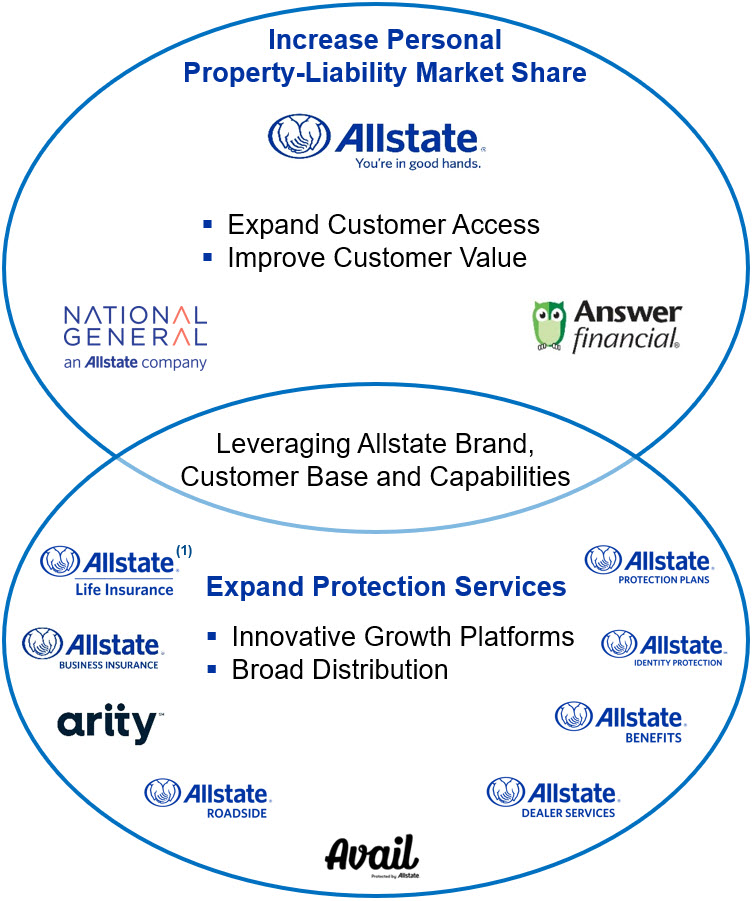
(1)ALIC and certain affiliates to be divested and we will broaden non-proprietary product distribution to include life insurance.
2020 Form 10-K Item 1. Business
| Our Shared Purpose | |||||||||||||||||||||||
| As the good hands... | our values | our operating standards | our behaviors | ||||||||||||||||||||
| •We empower customers with protection to help them achieve their hopes and dreams. •We provide affordable, simple and connected protection solutions. •We create opportunity for our team, economic value for our shareholders and improve communities. | •Integrity is non-negotiable. •Inclusive Diversity & Equity values and leverages unique identities with equitable opportunity and rewards. •Collective Success is achieved through empathy and prioritizing enterprise outcomes ahead of individuals. | •Focus on Customers by anticipating and exceeding service expectations at low costs. •Be the Best at protecting customers, developing talent and running our businesses. •Be Bold with original ideas using speed and conviction to beat the competition. •Earn Attractive Returns by providing customer value, proactively accepting risk and using analytics. | •Collaborate early and often to develop and implement comprehensive solutions and share learnings. •Challenge Ideas to leverage collective expertise, evaluate multiple alternatives and create the best path forward. •Provide Clarity for expected outcomes, decision authority and accountability. •Provide Feedback that is candid, actionable, independent of hierarchy and safe. |
| Reportable segments |
Showing the first 8K of 106K characters. Open the full section
Item 1A. Risk Factors and Other Disclosures 2020 Form 10-K
our business strategy, or other considerations that may or may not be under our control
A downgrade in our ratings could have a material effect on our sales, competitiveness, customer retention, the marketability of our product offerings, liquidity, access to and cost of borrowing, results of operations and financial condition.
Changes in tax laws may adversely affect the sales and profitability of life insurance products
Changes in taxation of life insurance products could reduce sales and result in the surrender of some existing contracts and policies, which may have a material effect on our profitability and financial condition.
 | Business, strategy and operations |
We operate in markets that are highly competitive and may be impacted by new or changing technologies
Markets in which we operate are highly competitive, and we must continually allocate resources to refine and improve products and services to remain competitive. If we are unsuccessful in generating new business, retaining customers or renewing contracts, our ability to maintain or increase premiums written or the ability to sell our products could be adversely impacted.
Determining competitive position is complicated in the auto and homeowners insurance business as companies use different underwriting standards to accept new customers and quotes and close rates can fluctuate across companies and locations. Pricing of products is driven by multiple factors, including loss expectations, expense structure and dissimilar return targets. Additionally, sophisticated pricing algorithms make it difficult to determine what price potential customers would pay across competitors.
There is also significant competition for producers, such as exclusive and independent agents and their licensed sales professionals. Growth and retention may be materially affected if we are unable to attract and retain effective producers or if those producers are unable to attract and retain their licensed sales professionals or customers. Similarly, growth and retention may be impacted if customer preferences change and we are unable to effectively adapt our business model and processes.
Our business could also be affected by technological changes, such as autonomous or partially autonomous vehicles or technologies that facilitate ride, car or home sharing. Such changes could disrupt the demand for products from current customers, create coverage issues, impact the frequency or severity of losses, or reduce the size of the automobile insurance market causing our auto insurance business to decline. Since auto insurance constitutes a significant portion of our overall business, we may be more sensitive than other insurers and more adversely affected by trends that could decrease auto insurance rates or reduce demand for auto insurance over time.
Technological advancements and innovation are occurring in distribution, underwriting, claims and operations at a rapid pace that may continue to accelerate. Nontraditional competitors could enter the insurance market and further accelerate these trends. Innovations must be implemented in compliance with applicable insurance regulations and may require extensive modifications to our systems and processes and extensive coordination with and reliance on the systems of third parties. If we are unable to adapt to or bring such advancements and innovations to market, the quality of our products, our relationships with customers and agents, competitive position and business prospects may be materially affected. Changes in technology related to collection and analysis of data regarding customers could expose us to regulatory or legal actions and may have a material adverse effect on our business, reputation, results of operations and financial condition.
Technology and customer preference changes may impact the ways in which we interact, do business with our customers and design our products. We may not be able to respond effectively to these changes, which could have a material effect on our results of operations and financial condition.
Our ability to adequately and effectively price our products and services is affected by the evolving nature of consumer needs and preferences, market and regulatory dynamics, broader use of telematics-based rate segmentation and potential reduction in consumer demand.
Many voluntary benefits contracts are renewed annually. There is a risk that employers may be able to obtain more favorable terms from competitors than they could by renewing coverage with us. These competitive pressures may adversely affect the renewal of these contracts, as well as our ability to sell products.
Transformative Growth may not be effectively implemented
Transformative Growth is intended to accelerate growth by expanding customer access, improving customer value and investing in marketing and technology. The strategy encompasses all aspects of Allstate’s customer experience and business model, spanning product distribution and sales, operations and servicing, and claims processing. If the strategy is not implemented effectively, customer retention and policy growth objectives could be adversely impacted. Lost business opportunities may result due to slower than anticipated speed to market. External forces including competitor actions or regulatory changes may also have an adverse effect on the value generated from the transformation.
Our catastrophe management strategy may adversely affect premium growth
Catastrophe risk management actions have negatively impacted the size of our homeowners business and customer retention, including customers with auto and other personal lines products and may negatively impact future sales if further actions are
The Allstate Corporation 25
2020 Form 10-K Part I - Item 1A. Risk Factors and Other Disclosures
taken. Adjustments to our business structure, size and underwriting practices in markets with significant severe weather and catastrophe risk exposure could adversely impact premium growth rates and retention.
The ability of our subsidiaries to pay dividends may affect our liquidity and ability to meet our obligations
The Allstate Corporation is a holding company with no significant operations. Its principal assets are the stock of its subsidiaries and its directly held cash and investment portfolios. Its liabilities include debt and pension and other postretirement benefit obligations related to Allstate Insurance Company employees. State insurance regulatory authorities limit the payment of dividends by insurance subsidiaries, as described in Note 16 of the consolidated financial statements. The limitations are based on statutory income and surplus. In addition, competitive pressures generally require the subsidiaries to maintain insurance financial strength ratings. These restrictions and other regulatory requirements may affect the ability of subsidiaries to make dividend payments. Limits on the ability of the subsidiaries to pay dividends could adversely affect holding company liquidity, including the ability to pay dividends to shareholders, service debt or complete share repurchase programs as planned.
Changes in regulatory capital requirements could decrease deployable capital and potentially reduce future dividends paid by our insurance companies.
 For a discussion of capital requirements, including a potential change to a group capital calculation, see Regulation section, Limitations on Dividends by Insurance Subsidiaries.
Our ability to pay dividends or repurchase stock is subject to limitations under terms of certain of our securities
The terms of the outstanding subordinated debentures prohibit us from declaring or paying any dividends or distributions on our common or preferred stock or redeeming, purchasing, acquiring or making liquidation payments on our common stock or preferred stock if we have elected to defer interest payments on the subordinated debentures, subject to certain limited exceptions.
We are prohibited from declaring or paying dividends on our Series G preferred stock if we fail to meet specified capital adequacy, net income or shareholders’ equity levels. The prohibition is subject to an exception permitting us to declare dividends out of the net proceeds of common stock issued by us during the 90 days before the date of declaration even if we fail to meet such levels.
If the full preferred stock dividends for all preceding dividend periods have not been declared and paid, we generally may not repurchase or pay dividends on common stock during any dividend period while our preferred stock is outstanding.
See Note 12 of the consolidated financial statements.
Reinsurance may be unavailable at current levels and prices, which may limit our ability to write new business
Market conditions beyond our control impact the availability and cost of the reinsurance we purchase. Reinsurance may not remain continuously available to us to the same extent and on the same terms and rates as is currently available. Our ability to economically justify reinsurance to reduce our catastrophe risk in designated areas may depend on our ability to adjust premium rates to fully or partially recover cost. If we cannot maintain our current level of reinsurance or purchase new reinsurance protection in amounts we consider sufficient at acceptable prices, we would have to either accept an increase in our catastrophe exposure, reduce our insurance exposure or seek other alternatives.
Reinsurance subjects us to counterparty risk and may not be adequate to protect us against losses arising from ceded insurance
Collecting from reinsurers is subject to uncertainty arising from factors that include:
-
Whether reinsurers, their affiliates or certain indemnitors have the financial capacity and willingness to make payments under the terms of a reinsurance treaty or contract
-
Whether insured losses meet the qualifying conditions of the reinsurance contract
Our inability to recover from a reinsurer could have a material effect on our results of operations and financial condition.
Disruption, volatility or uncertainty in the insurance linked securities market may decrease our ability to access such market on favorable terms or at all.
Acquisitions or divestitures of businesses may not produce anticipated benefits, resulting in operating difficulties, unforeseen liabilities or asset impairments
The ability to achieve certain anticipated financial benefits from the acquisition of National General or other businesses depends in part on our ability to successfully grow and integrate the businesses consistent with our anticipated acquisition economics. Financial results could be adversely affected by unanticipated performance issues, unforeseen liabilities, transaction-related charges, diversion of management time and resources to acquisition integration challenges or growth strategies, loss of key employees, challenges in integrating information technology systems of acquired companies with our own, amortization of expenses related to intangibles, charges for impairment of long-term assets or goodwill and indemnifications.
Acquired businesses may not perform as projected, cost savings anticipated from the acquisition may not materialize, and costs associated with the integration may be greater than anticipated. As a result, if we do not manage these transitions effectively, the quality of our products as well as our relationships with customers and partners may result in the company not achieving returns on its investment at the level projected at acquisition.
Part I - Item 1A. Risk Factors and Other Disclosures 2020 Form 10-K
We also may divest businesses from time to time, including the pending sale of ALIC and certain affiliates. These transactions may result in continued financial involvement in the divested businesses, such as through reinsurance, guarantees or other financial arrangements, following the transaction. If the acquiring companies do not perform under the arrangements, our financial results could be negatively impacted.
We may be subject to the risks and costs associated with intellectual property infringement, misappropriation and third-party claims
We rely on a combination of contractual rights and copyright, trademark, patent and trade secret laws to establish and protect our intellectual property. Third parties may infringe or misappropriate our intellectual property. We may have to litigate to enforce and protect intellectual property and to determine its scope, validity or enforceability, which could divert significant resources and prove unsuccessful. An inability to protect intellectual property or an inability to successfully defend against a claim of intellectual property infringement could have a material effect on our business.
We may be subject to claims by third parties for patent, trademark or copyright infringement or breach of usage rights. Any such claims and any resulting litigation could result in significant expense and liability. If third-party providers or we are found to have infringed a third-party intellectual property right, either of us could be enjoined from providing certain products or services or from utilizing and benefiting from certain methods, processes, copyrights, trademarks, trade secrets or licenses. Alternatively, we could be required to enter into costly licensing arrangements with third parties or implement costly work-arounds. Any of these scenarios could have a material effect on our business and results of operations.
 | Macro, regulatory and risk environment |
Conditions in the global economy and capital markets could adversely affect our business and results of operations
Global economic and capital market conditions could adversely impact demand for our products, returns on our investment portfolio and results of operations. The conditions that would have the largest impact on our business include:
-
Low or negative economic growth
-
Sustained low interest rates
-
Rising inflation increasing claims and claims expense
-
Substantial increases in delinquencies or defaults on debt
-
Significant downturns in the market value or liquidity of our investment portfolio
-
Reduced consumer spending and business investment
Stressed conditions, volatility and disruptions in global capital markets or financial asset classes could adversely affect our investment portfolio.
Adverse capital and credit market conditions may significantly affect our ability to meet liquidity needs or obtain credit on acceptable terms
In periods of extreme volatility and disruption in the capital and credit markets, liquidity and credit capacity may be severely restricted. Our access to additional financing depends on a variety of factors such as market conditions, the general availability of credit, the overall availability of credit to our industry, our credit ratings and credit capacity, as well as lenders’ perception of our long- or short-term financial prospects. In such circumstances, our ability to obtain capital to fund operating expenses, financing costs, capital expenditures or acquisitions may be limited, and the cost of any such capital may be significant.
A large-scale pandemic, the occurrence of terrorism, military actions, social unrest or other actions may have an adverse effect on our business
A large-scale pandemic, such as the Coronavirus and its impacts, the occurrence of terrorism, military actions, social unrest or other actions, may result in loss of life, property damage, and disruptions to commerce and reduced economic activity. Some of the assets in our investment portfolio may be adversely affected by declines in the equity markets, changes in interest rates, reduced liquidity and economic activity caused by a large-scale pandemic. Additionally, a large-scale pandemic or terrorist act could have a material effect on sales, liquidity and operating results.
The Coronavirus resulted in governments worldwide enacting emergency measures to combat the spread of the virus. These measures, which have included the implementation of travel restrictions, government-imposed shelter-in-place orders, quarantine periods, social distancing, and restrictions on large gatherings, have caused material disruption to businesses globally, resulting in increased unemployment, a recession and increased economic uncertainty. Additionally, there is no way of predicting with certainty how long the pandemic might last, including the potential for restrictions being restored or new restrictions being implemented that could result in further economic volatility.
The Coronavirus has affected our operations and depending on its length and severity may continue to significantly affect our results of operations, financial condition and liquidity, including:
-
Sales of new and retention of existing policies
-
Shared economy demand
-
Claim severity costs, driving behavior and auto accident frequency
-
Life insurance mortality, hospital and outpatient claim costs and annuity reserves
-
Investment valuations and returns
-
Bad debt and credit allowance exposure
The Allstate Corporation 27
2020 Form 10-K Part I - Item 1A. Risk Factors and Other Disclosures
See MD&A, Highlights for a summary of the impacts of the Coronavirus on our operations, each of our segments and investments that may continue, emerge, evolve or accelerate into 2021.
The failure in cyber or other information security controls, as well as the occurrence of events unanticipated in our disaster recovery processes and business continuity planning, could result in a loss or disclosure of confidential information, damage to our reputation, additional costs and impair our ability to conduct business effectively
We depend heavily on computer systems, mathematical algorithms and data to perform necessary business functions. There are threats that could impact our ability to protect our data and systems; if the threats are successful, they could impact confidentiality, integrity and availability:
-
Confidentiality — protecting our data from disclosure to unauthorized parties
-
Integrity — ensuring data is not changed accidentally or without authorization and is accurate
-
Availability — ensuring our data and systems are accessible to meet our business needs
We collect, use, store or transmit a large amount of confidential, proprietary and other information (including personal information of customers, claimants or employees) in connection with the operation of our business. Systems are subject to increased attempted cyberattacks and unauthorized access, such as physical and electronic break-ins or unauthorized tampering.
We constantly defend against threats to our data and systems, including malware and computer virus attacks, unauthorized access, system failures and disruptions. Events like these could jeopardize the information processed and stored in, and transmitted through, our computer systems and networks, or otherwise cause interruptions or malfunctions in our operations, which could result in damage to our reputation, financial losses, litigation, increased costs, regulatory penalties or customer dissatisfaction.
These risks may increase in the future as threats become more sophisticated and we continue to expand internet and mobile strategies, develop additional remote connectivity solutions to serve our employees and customers, develop and expand products and services designed to protect customers’ digital footprint, and build and maintain an integrated digital enterprise.
Our increased use of third-party services (e.g., cloud technology and software as a service) can make it more difficult to identify and respond to cyberattacks in any of the above situations. Although we may review and assess third-party vendor cyber security controls, our efforts may not be successful in preventing or mitigating the effects of such events. Third parties to whom we outsource certain functions are also subject to cybersecurity risks.
Personal information is subject to an increasing number of federal, state, local and international laws and regulations regarding privacy and data security, as well as contractual commitments. Any failure or perceived failure by us to comply with such obligations may result in governmental enforcement actions and fines, litigation or public statements against us by consumer advocacy groups or others and could cause our employees and customers to lose trust in us, which could have an adverse effect on our reputation and business.
See the Regulation section, Privacy Regulation and Data Security, for additional information.
The occurrence of a disaster, such as a natural catastrophe, pandemic, industrial accident, blackout, terrorist attack, war, cyberattack, computer virus, insider threat, unanticipated problems with our disaster recovery processes, or a support failure from external providers, could have an adverse effect on our ability to conduct business and on our results of operations and financial condition, particularly if those events affect our computer-based data processing, transmission, storage, and retrieval systems or destroy data. If a significant number of employees were unavailable in the event of a disaster, our ability to effectively conduct business could be severely compromised. Our systems are also subject to compromise from internal threats.
Losses from changing climate and weather conditions may adversely affect our financial condition, profitability or cash flows
Climate change may affect the occurrence of certain natural events, such as an increase in the frequency or severity of wind, tornado, hailstorm and thunderstorm events due to increased convection in the atmosphere. There could also be more frequent wildfires in certain geographies, more flooding and the potential for increased severity of hurricanes due to higher sea surface temperatures. As a result, incurred losses from such events and the demand, price and availability of reinsurance coverages for automobile and homeowners insurance may be affected.
Climate change may also impact insurability by impairing our ability to identify and quantify potential hazards that will result in losses and offer our customers products at an affordable price. Our investment portfolio is also subject to the effects of climate change as economic shifts alter the return dynamic of long-term investments and reduce valuations.
Due to significant variability associated with future changing climate conditions, we are unable to predict the impact climate change will have on our businesses.
We are subject to extensive regulation, and potential further restrictive regulation may increase operating costs and limit growth
Many of our affiliates operate in the highly regulated insurance and broader financial services sector and are subject to extensive laws and regulations that are complex and subject to change.
Part I - Item 1A. Risk Factors and Other Disclosures 2020 Form 10-K
Changes may lead to additional expenses, increased legal exposure, or increased reserve or capital requirements limiting our ability to grow or to achieve targeted profitability. Moreover, laws and regulations are administered and enforced by governmental authorities that exercise interpretive latitude, including:
-
State insurance regulators
-
State securities administrators
-
State attorneys general
-
Federal agencies including the SEC, the Financial Industry Regulatory Authority, the Department of Labor, the U.S. Department of Justice and the National Labor Relations Board
Consequently, compliance with one regulator’s or enforcement authority’s interpretation of a legal issue may not result in compliance with another’s interpretation of the same issue.
In addition, there is risk that one regulator’s or enforcement authority’s interpretation of a legal issue may change to our detriment. There is also a risk that changes in the overall legal environment may cause us to change our views regarding the actions we need to take from a legal risk management perspective. This could necessitate changes to our practices that may adversely impact our business. In some cases, state insurance laws and regulations are generally intended to protect or benefit purchasers or users of insurance products, not holders of securities that we issue. These laws and regulations may limit our ability to grow or to improve the profitability of our business.
A regulatory environment that requires rate increases to be approved, can dictate underwriting practices and mandate participation in loss sharing arrangements may adversely affect results of operations and financial condition
Political events and positions can affect the insurance market, including efforts to suppress rates to a level that may not allow us to reach targeted levels of profitability. Regulatory challenges to rate increases may restrict rate changes that may be required to achieve targeted levels of profitability and returns on equity. If we are unsuccessful, our results of operations could be negatively impacted.
In addition, certain states have enacted laws that require an insurer conducting business in that state to participate in assigned risk plans, reinsurance facilities and joint underwriting associations. Certain states also require the insurer to offer coverage to all consumers, often restricting an insurer’s ability to charge the price it might otherwise charge for the risk acceptance. In these markets, we may be compelled to underwrite significant amounts of business at lower-than-desired rates, possibly leading to an unacceptable return on equity. Alternatively, as the facilities recognize a financial deficit, they could have the ability to assess participating insurers, adversely affecting our results of operations and financial condition. Laws and regulations of many states also limit an insurer’s ability to withdraw from one or more lines of insurance, except pursuant to a plan that is approved by the state
insurance department. Certain states require an insurer to participate in guaranty funds for impaired or insolvent insurance companies. These funds periodically assess losses against all insurance companies doing business in the state. Our results of operations and financial condition could be adversely affected by any of these factors.
Regulatory reforms, and the more stringent application of existing regulations, may make it more expensive for us to conduct our business
The federal government has enacted comprehensive regulatory reforms for financial services entities. As part of a larger effort to strengthen the regulation of the financial services market, certain reforms are applicable to the insurance industry.
The Federal Insurance Office (“FIO”) and Financial Stability Oversight Council have been established, and the federal government may enact reforms that affect the state insurance regulatory framework. The potential impact of state or federal measures that change the nature or scope of insurance and financial regulation is uncertain but may make it more expensive for us to conduct business and limit our ability to grow or achieve profitability.
We have business process and information technology operations in Canada, India and the United Kingdom that are subject to operating, regulatory and political risks in those countries. We may incur substantial costs and other negative consequences if any of these occur, including an adverse effect on our business, results of operations and financial condition.
Losses from legal and regulatory actions may be material to our results of operations, cash flows and financial condition
We are involved in various legal actions, including class-action litigation challenging a range of company practices and coverage provided by our insurance products, some of which involve claims for substantial or indeterminate amounts. We are also involved in various regulatory actions and inquiries, including market conduct exams by state insurance regulatory agencies. In the event of an unfavorable outcome in any of these matters, the ultimate liability may be more than amounts currently accrued or disclosed in our reasonably possible loss range and may be material to our results of operations, cash flows and financial condition.
See Note 14 of the consolidated financial statements.
Changes in or the application of accounting standards issued by standard-setting bodies and changes in tax laws may adversely affect our results of operations and financial condition
Our financial statements are subject to the application of accounting principles generally accepted in the United States of America, which are periodically revised, interpreted or expanded. Accordingly, we may be required to adopt new guidance or interpretations, which may have a material effect on our results of
The Allstate Corporation 29
2020 Form 10-K Part I - Item 1A. Risk Factors and Other Disclosures
operations and financial condition and could adversely impact financial strength ratings.
-
Market declines, changes in business strategies or other events impacting the fair value of goodwill or purchased intangible assets could result in an impairment charge to income
-
Pending changes to accounting for long-duration insurance contracts such as traditional life, life-contingent immediate annuities and certain voluntary accident and health insurance products will have a material effect on reserves and shareholders’ equity and could adversely impact financial strength ratings
-
Realization of our deferred tax assets assumes that we can fully utilize the deductions recognized for tax purposes; we may recognize additional tax expense if these assets are not fully utilized
-
New tax legislative initiatives may be enacted that may impact our effective tax rate and could adversely affect our tax positions or tax liabilities
See MD&A, Application of Critical Accounting Estimates and Note 2 of the consolidated financial statements for further details.
Loss of key vendor relationships or failure of a vendor to protect our data, confidential and proprietary information, or personal information of our customers, claimants or employees could adversely affect our operations
We rely on services and products provided by many vendors in the U.S. and abroad. These include vendors of computer hardware, software, cloud technology and software as a service, as well as vendors or outsourcing of services such as:
-
Claim adjustment or call center services
-
Human resource benefits management
-
Information technology support
-
Investment management services
If any vendor becomes unable to continue to provide products or services, or fails to protect our confidential, proprietary, and other information, we may suffer operational impairments and financial losses.
Our ability to attract, develop, and retain talent to maintain appropriate staffing levels and establish a successful work culture is critical to our success
Competition from within the insurance industry and from other industries, including the technology sector, for qualified employees with highly specialized knowledge in areas such as underwriting, data and analytics, technology and e-commerce, has often been intense and we have experienced increased competition in hiring and retaining employees.
Factors that affect our ability to attract and retain such employees include:
-
Compensation and benefits
-
Training and re-skilling programs
-
Reputation as a successful business with a culture
of fair hiring, and of training and promoting qualified employees
- Recognition of and response to changing trends and other circumstances that affect employees
The unexpected loss of key personnel could have a material adverse impact on our business because of the loss of their skills, knowledge of our products and offerings and years of industry experience and, in some cases, the difficulty of promptly finding qualified replacement personnel.
Misconduct or fraudulent acts by employees, agents and third parties may expose us to financial loss, disruption of business, regulatory assessments and reputational harm
The company and the insurance industry are inherently susceptible to past and future misconduct or fraudulent activities by employees, representative agents, vendors, customers and other third parties. These activities could include:
-
Fraud against the company, its employees and its customers through illegal or prohibited activities
-
Unauthorized acts or representations, unauthorized use or disclosure of personal or proprietary information, deception, and misappropriation of funds or other benefits
Item 1B. Unresolved Staff Comments
None.
Item 2. Properties
Our home office complex is owned and located in Northbrook, Illinois. As of December 31, 2020, the home office complex consists of several buildings totaling 1.9 million square feet of office space on a 186-acre site.
We also operate from approximately 415 administrative, data processing, claims handling and other support facilities in North America. In addition to our home office facilities, 825 thousand square feet are owned and 5.8 million square feet are leased.
Outside North America, we own one and lease three properties in Northern Ireland comprising approximately 223 thousand square feet. We also have three leased facilities in India for approximately 600 thousand square feet and two leased facilities in London for 7,182 square feet.
The locations where Allstate exclusive agencies operate in the U.S. are normally leased by the agencies.
Item 3. Legal Proceedings
Information required for Item 3 is incorporated by reference to the discussion under the heading “Regulation and compliance” and under the heading “Legal and regulatory proceedings and inquiries” in Note 14 of the consolidated financial statements.
Item 4. Mine Safety Disclosures
Item 5. Market for Registrant’s Common Equity, Related Stockholder Matters and Issuer Purchases of Equity Securities
As of January 29, 2021, there were 64,567 holders of record of The Allstate Corporation’s common stock. The principal market for the common stock is the New York Stock Exchange, where our common stock trades under the trading symbol “ALL”. Our common stock is also listed on the Chicago Stock Exchange.
Common stock performance graph
The following performance graph compares the cumulative total shareholder return on Allstate common stock for a five-year period (December 31, 2015 to December 31, 2020) with the cumulative total return of the S&P Property and Casualty Insurance Index (S&P P/C) and the S&P’s 500 stock index.
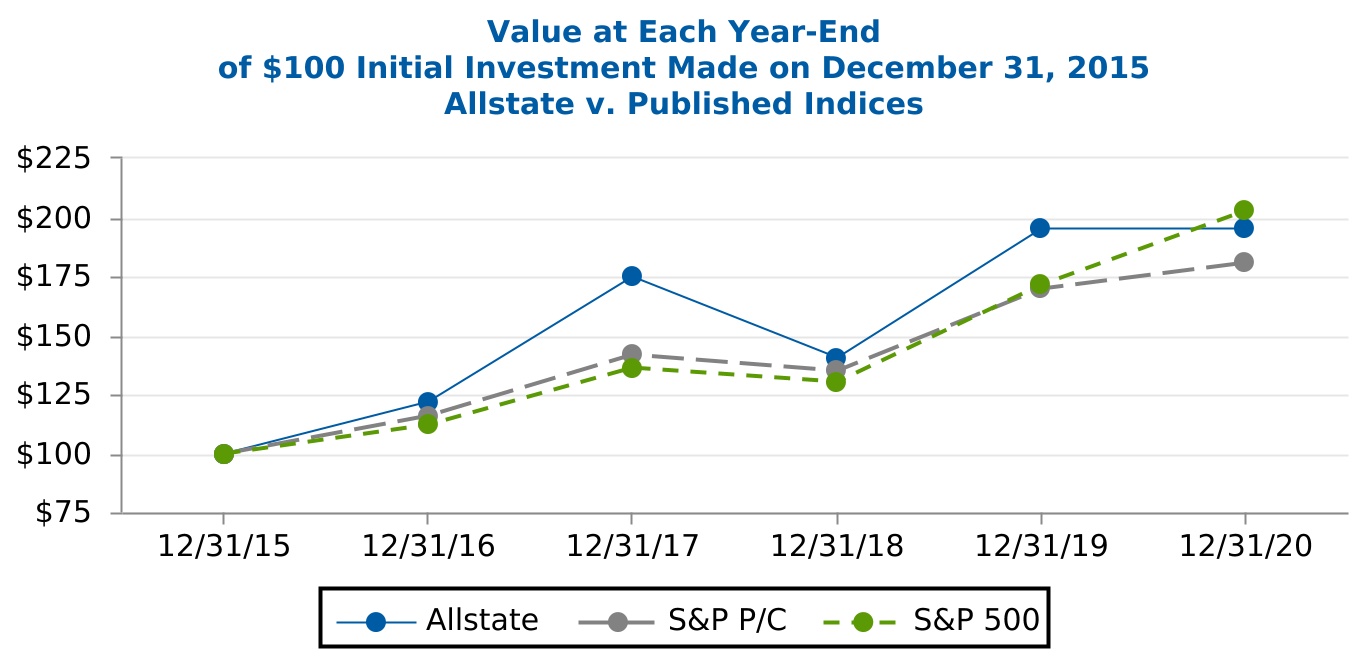
| Value at each year-end of $100 initial investment made on December 31, 2015 | ||||||||||||||||||||||||||||||||||||||
| 12/31/2015 | 12/31/2016 | 12/31/2017 | 12/31/2018 | 12/31/2019 | 12/31/2020 | |||||||||||||||||||||||||||||||||
| Allstate | $ | 100.00 | $ | 121.71 | $ | 174.80 | $ | 140.67 | $ | 195.28 | $ | 195.05 | ||||||||||||||||||||||||||
| S&P P/C | $ | 100.00 | $ | 115.71 | $ | 141.61 | $ | 134.96 | $ | 169.88 | $ | 180.63 | ||||||||||||||||||||||||||
| S&P 500 | $ | 100.00 | $ | 111.95 | $ | 136.38 | $ | 130.39 | $ | 171.44 | $ | 202.96 |
The Allstate Corporation 31
2020 Form 10-K
Issuer Purchases of Equity Securities
| Period | Total number of shares (or units) purchased (1) | Average price paid per share (or unit) | Total number of shares (or units) purchased as part of publicly announced plans or programs | Maximum number (or approximate dollar value) of shares (or units) that may yet be purchased under the plans or programs (3) | ||||||||||||||||||||||
| October 1, 2020 - October 31, 2020 | ||||||||||||||||||||||||||
| Open Market Purchases | 288 | $ | 93.02 | — | ||||||||||||||||||||||
| November 1, 2020 - November 30, 2020 | ||||||||||||||||||||||||||
| Open Market Purchases | 703 | $ | 90.90 | — | ||||||||||||||||||||||
| December 1, 2020 - December 31, 2020 | ||||||||||||||||||||||||||
| Open Market Purchases | 162 | $ | 104.36 | — | ||||||||||||||||||||||
| Total (2) | 1,153 | $ | 93.32 | — | $ | 1.56 | billion |
(1)In accordance with the terms of its equity compensation plans, Allstate acquired the following shares in connection with the vesting of restricted stock units and performance stock awards and the exercise of stock options held by employees or directors. The shares were acquired in satisfaction of withholding taxes due upon exercise or vesting and in payment of the exercise price of the options.
October: 288
November: 703
December: 162
(2)On September 18, 2020, Allstate entered into an accelerated share repurchase agreement (“ASR agreement”) with Goldman Sachs & Co. LLC (“Goldman Sachs”), to purchase $750 million of our outstanding shares of common stock. In exchange for an upfront payment of $750 million, Goldman Sachs initially delivered 7.0 million shares to Allstate. The ASR agreement settled on January 12, 2021, and we repurchased a total of 7.8 million shares at an average price of $96.21.
(3)In February 2020, we announced the approval of a common share repurchase program for $3 billion that is expected to be completed by the end of 2021.
Item 6. None.
Item 7. Management’s Discussion and Analysis of Financial Condition and Results of Operations
| Page | |||||||||||
| 2020 Highlights | 34 | ||||||||||
| Property-Liability Operations | 40 | ||||||||||
| Allstate Protection | 43 | ||||||||||
| – Allstate brand | 51 | ||||||||||
| – Encompass brand | 56 | ||||||||||
| Discontinued Lines and Coverages | 59 | ||||||||||
| Protection Services (previously Service Businesses) | 62 | ||||||||||
| Claims and Claims Expense Reserves | 64 | ||||||||||
| Allstate Life | 71 | ||||||||||
| Allstate Benefits | 76 | ||||||||||
| Allstate Annuities | 79 | ||||||||||
| Investments | 83 | ||||||||||
| Market Risk | 94 | ||||||||||
| Capital Resources and Liquidity | 98 | ||||||||||
| Enterprise Risk and Return Management | 104 | ||||||||||
| Application of Critical Accounting Estimates | 107 | ||||||||||
| Regulation and Legal Proceedings | 121 | ||||||||||
| Pending Accounting Standards | 121 |
The Allstate Corporation 33
2020 Form 10-K
2020 Highlights
Overview
The following discussion highlights significant factors influencing the consolidated financial position and results of operations of The Allstate Corporation (referred to in this document as “we,” “our,” “us,” the “Company” or “Allstate”). It should be read in conjunction with the consolidated financial statements and related notes found under Item 8. contained herein.
A discussion of strategy, including updates to the multi-year Transformative Growth initiative, can be found in Part 1, Item 1. Business.
This section of this Form 10-K generally discusses 2020 and 2019 results and year-to-year comparisons between 2020 and 2019. Discussions of 2018 results and year-to-year comparisons between 2019 and 2018 that are not included in this Form 10-K can be found in Management’s Discussion and Analysis (“MD&A”) in Part II, Item 7 of our annual report on Form 10-K for 2019, filed February 21, 2020.
The most important factors we monitor to evaluate the financial condition and performance for our reportable segments and the Company include:
*•*Allstate Protection: premium, policies in force (“PIF”), new business sales, policy retention, price changes, claim frequency and severity, catastrophes, loss ratio, expenses, underwriting results, and relative competitive position.
*•*Protection Services: revenues, premium written, PIF, adjusted net income and net income.
*•*Allstate Life: premiums and contract charges, new business sales, PIF, benefit spread, investment spread, expenses, adjusted net income and net income.
*•*Allstate Benefits: premiums, new business sales, PIF, benefit ratio, expenses, adjusted net income and net income.
*•*Allstate Annuities: investment spread, asset-liability matching, contract benefits, expenses, adjusted net income, net income and invested assets.
*•*Investments: exposure to market risk, asset allocation, credit quality/experience, total return, net investment income, cash flows, realized capital gains and losses, unrealized capital gains and losses, long-term returns, and asset and liability duration.
*•*Financial condition: liquidity, parent holding company deployable assets, financial strength ratings, operating leverage, debt levels, book value per share and return on equity.
Measuring segment profit or loss
The measure of segment profit or loss used in evaluating performance is underwriting income for the Allstate Protection and Discontinued Lines and Coverages segments and adjusted net income for the Protection Services, Allstate Life, Allstate Benefits, Allstate Annuities, and Corporate and Other segments.
Underwriting income is calculated as premiums earned and other revenue, less claims and claims expense (“losses”), Shelter-in-Place Payback expense, amortization of deferred policy acquisition costs (“DAC”), operating costs and expenses, restructuring and related charges and amortization or impairment of purchased intangibles, as determined using accounting principles generally accepted in the United States of America (“GAAP”). We use this measure in our evaluation of results of operations to analyze the profitability of the Property-Liability insurance operations separately from investment results. Underwriting income is reconciled to net income applicable to common shareholders in the Property-Liability Operations section of MD&A.
Adjusted net income is net income applicable to common shareholders, excluding:
| • Realized capital gains and losses, after-tax, except for periodic settlements and accruals on non-hedge derivative instruments, which are reported with realized capital gains and losses but included in adjusted net income | ||
| • Pension and other postretirement remeasurement gains and losses, after-tax | ||
| • Valuation changes on embedded derivatives that are not hedged, after-tax | ||
| • Amortization of DAC and deferred sales inducement costs (“DSI”), to the extent they resulted from the recognition of certain realized capital gains and losses or valuation changes on embedded derivatives that are not hedged, after-tax | ||
| • Business combination expenses and the amortization or impairment of purchased intangible assets, after-tax | ||
| • Gain (loss) on disposition of operations, after-tax | ||
| • Adjustments for other significant non-recurring, infrequent or unusual items, when (a) the nature of the charge or gain is such that it is reasonably unlikely to recur within two years, or (b) there has been no similar charge or gain within the prior two years |
Adjusted net income is reconciled to net income applicable to common shareholders in the Protection Services, Allstate Life, Allstate Benefits and Allstate Annuities Segment sections of MD&A.
2020 Form 10-K
Subsequent event
On January 26, 2021, Allstate announced an agreement to sell Allstate Life Insurance Company (“ALIC”) and certain affiliates for $2.8 billion to Antelope US Holdings Company, an affiliate of an investment fund associated with The Blackston
Showing the first 8K of 489K characters. Open the full section
Item 7A. Quantitative and Qualitative Disclosures About Market Risk
Information required for Item 7A is incorporated by reference to the material under the caption “Market Risk” in Part II, Item 7 of this report.
The Allstate Corporation 121
2020 Form 10-K
Item 8. Financial Statements and Supplementary Data
| Consolidated Financial Statements | Page | ||||||||||
| Consolidated Statements of Operations | 123 | ||||||||||
| Consolidated Statements of Comprehensive Income | 124 | ||||||||||
| Consolidated Statements of Financial Position | 125 | ||||||||||
| Consolidated Statements of Shareholders’ Equity | 126 | ||||||||||
| Consolidated Statements of Cash Flows | 127 | ||||||||||
| Notes to Consolidated Financial Statements | |||||||||||
| Note 1 | General | 128 | |||||||||
| Note 2 | Summary of Significant Accounting Policies | 129 | |||||||||
| Note 3 | Acquisitions and Disposition | 142 | |||||||||
| Note 4 | Reportable Segments | 142 | |||||||||
| Note 5 | Investments | 147 | |||||||||
| Note 6 | Fair Value of Assets and Liabilities | 156 | |||||||||
| Note 7 | Derivative Financial Instruments and Off-balance Sheet Financial Instruments | 163 | |||||||||
| Note 8 | Reserve for Property and Casualty Insurance Claims and Claims Expense | 170 | |||||||||
| Note 9 | Reserve for Life-Contingent Contract Benefits and Contractholder Funds | 177 | |||||||||
| Note 10 | Reinsurance and Indemnification | 181 | |||||||||
| Note 11 | Deferred Policy Acquisition and Sales Inducement Costs | 186 | |||||||||
| Note 12 | Capital Structure | 187 | |||||||||
| Note 13 | Company Restructuring | 190 | |||||||||
| Note 14 | Commitments, Guarantees and Contingent Liabilities | 191 | |||||||||
| Note 15 | Income Taxes | 198 | |||||||||
| Note 16 | Statutory Financial Information and Dividend Limitations | 200 | |||||||||
| Note 17 | Benefit Plans | 201 | |||||||||
| Note 18 | Equity Incentive Plans | 208 | |||||||||
| Note 19 | Supplemental Cash Flow Information | 210 | |||||||||
| Note 20 | Other Comprehensive Income | 211 | |||||||||
| Note 21 | Quarterly Results (unaudited) | 211 | |||||||||
| Report of Independent Registered Public Accounting Firm | 212 |
122 www.allstate.com
Financial Statements 2020 Form 10-K
The Allstate Corporation and Subsidiaries
Consolidated Statements of Operations
| Years Ended December 31, | ||||||||||||||||||||
| ($ in millions, except per share data) | 2020 | 2019 | 2018 | |||||||||||||||||
| Revenues | ||||||||||||||||||||
| Property and casualty insurance premiums (net of reinsurance ceded and indemnification programs of $1,141, $1,122 and $1,016) | $ | 37,073 | $ | 36,076 | $ | 34,048 | ||||||||||||||
| Life premiums and contract charges (net of reinsurance ceded of $242, $285 and $290) | 2,444 | 2,501 | 2,465 | |||||||||||||||||
| Other revenue | 1,065 | 1,054 | 939 | |||||||||||||||||
| Net investment income | 2,853 | 3,159 | 3,240 | |||||||||||||||||
| Realized capital gains (losses) | 1,356 | 1,885 | (877) | |||||||||||||||||
| Total revenues | 44,791 | 44,675 | 39,815 | |||||||||||||||||
| Costs and expenses | ||||||||||||||||||||
| Property and casualty insurance claims and claims expense (net of reinsurance ceded and indemnification programs of $530, $524 and $1,378) | 22,001 | 23,976 | 22,778 | |||||||||||||||||
| Shelter-in-Place Payback expense | 948 | — | — | |||||||||||||||||
| Life contract benefits (net of reinsurance ceded of $155, $165 and $240) | 2,243 | 2,039 | 1,973 | |||||||||||||||||
| Interest credited to contractholder funds (net of reinsurance ceded of $27, $20 and $24) | 638 | 640 | 654 | |||||||||||||||||
| Amortization of deferred policy acquisition costs | 5,630 | 5,533 | 5,222 | |||||||||||||||||
| Operating costs and expenses | 5,732 | 5,690 | 5,594 | |||||||||||||||||
| Pension and other postretirement remeasurement (gains) losses | (51) | 114 | 468 | |||||||||||||||||
| Restructuring and related charges | 259 | 41 | 67 | |||||||||||||||||
| Amortization of purchased intangibles | 118 | 126 | 105 | |||||||||||||||||
| Impairment of purchased intangibles | — | 106 | — | |||||||||||||||||
| Interest expense | 318 | 327 | 332 | |||||||||||||||||
| Total costs and expenses | 37,836 | 38,592 | 37,193 | |||||||||||||||||
| Gain on disposition of operations | 4 | 6 | 6 | |||||||||||||||||
| Income from operations before income tax expense | 6,959 | 6,089 | 2,628 | |||||||||||||||||
| Income tax expense | 1,383 | 1,242 | 468 | |||||||||||||||||
| Net income | 5,576 | 4,847 | 2,160 | |||||||||||||||||
Showing the first 8K of 557K characters. Open the full section
Item 9. Changes in and Disagreements with Accountants on Accounting and Financial Disclosure
None.
Item 9A. Controls and Procedures
Evaluation of Disclosure Controls and Procedures. We maintain disclosure controls and procedures as defined in Rule 13a-15(e) under the Securities Exchange Act of 1934. Under the supervision and with the participation of our management, including our principal executive officer and principal financial officer, we conducted an evaluation of the effectiveness of our disclosure controls and procedures as of the end of the period covered by this report. Based upon this evaluation, the principal executive officer and the principal financial officer concluded that our disclosure controls and procedures are effective in providing reasonable assurance that material information required to be disclosed in our reports filed with or submitted to the Securities and Exchange Commission under the Securities Exchange Act is recorded, processed, summarized and reported within the time periods specified by the Securities Exchange Act and made known to management, including the principal executive officer and the principal financial officer, as appropriate to allow timely decisions regarding required disclosure.
Management’s Report on Internal Control over Financial Reporting. Management is responsible for establishing and maintaining adequate internal control over financial reporting as defined in Rule 13a-15(f) under the Securities Exchange Act of 1934.
Under the supervision and with the participation of our management, including our principal executive officer and principal financial officer, we conducted an evaluation of the effectiveness of our internal control over financial reporting as of December 31, 2020 based on the criteria related to internal control over financial reporting described in “Internal Control – Integrated Framework (2013)” issued by the Committee of Sponsoring Organizations of the Treadway Commission. Based on our evaluation, management concluded that our internal control over financial reporting was effective as of December 31, 2020.
Deloitte & Touche LLP, the independent registered public accounting firm that audited the consolidated financial statements included in this Form 10-K, has issued their attestation report on the Company’s internal control over financial reporting, which is included herein.
Changes in Internal Control over Financial Reporting. During the fiscal quarter ended December 31, 2020, there have been no changes in our internal control over financial reporting that have materially affected, or are reasonably likely to materially affect, our internal control over financial reporting.
Item 9B. Other Information
None.
The Allstate Corporation 215
2020 Form 10-K
Part III
Item 10. Directors, Executive Officers and Corporate Governance
Information regarding directors of The Allstate Corporation standing for election at the 2021 annual stockholders meeting is incorporated in this Item 10 by reference to the descriptions in the Proxy Statement under the caption “Corporate Governance – Director Nominees.”
Information regarding our audit committee and audit committee financial experts is incorporated in this Item 10 by reference to the information under the caption “Corporate Governance – Board Meetings and Committees” in the Proxy Statement.
Information regarding executive officers of The Allstate Corporation is incorporated in this Item 10 by reference to Part I, Item 1 of this report under the caption “Information about our Executive Officers.”
We have adopted a Global Code of Business Conduct that applies to all of our directors and employees, including our principal executive officer, principal financial officer and controller and principal accounting officer. The text of our Global Code of Business Conduct is posted on our website, www.allstateinvestors.com. We intend to satisfy the disclosure requirements, regarding amendments to, and waiver from, the provisions of our Global Code of Business Conduct by posting such information on the same website pursuant to applicable NYSE and SEC rules.
Item 11. Executive Compensation
Information required for Item 11 is incorporated by reference to the sections of the Proxy Statement with the following captions:
-
Corporate Governance – Director Compensation
-
Executive Compensation
216 www.allstate.com
2020 Form 10-K
Item 12. Security Ownership of Certain Beneficial Owners and Management and Related Stockholder Matters
Information regarding security ownership of certain beneficial owners and management is incorporated in this Item 12 by reference to the sections of the Proxy Statement with the following captions:
-
Stock Ownership Information – Security Ownership of Directors and Executive Officers
-
Stock Ownership Information – Security Ownership of Certain Beneficial Owners
| Equity compensation plan information | |||||||||||||||||||||||
| The following table includes information as of December 31, 2020, with respect to The Allstate Corporation’s equity compensation plans: | |||||||||||||||||||||||
| Plan Category | Number of Securities to be Issued upon Exercise of Outstanding Options, Warrants and Rights | Weighted-Average Exercise Price of Outstanding Options, Warrants and Rights | Number of Securities Remaining Available for Future Issuance under Equity Compensation Plans (Excluding Securities Reflected in Column (a)) | ||||||||||||||||||||
| (a) | (b) | (c) | |||||||||||||||||||||
| Equity Compensation Plans Approved by Security Holders (1) | 13,467,667 | (2) | $ | 83.65 | (3) | 18,860,595 | (4) | ||||||||||||||||
| Total | 13,467,667 | (2) | $ | 83.65 | (3) | 18,860,595 | (4) |
(1)Consists of the 2019 Equity Incentive Plan, which amended and restated the 2013 Equity Incentive Plan; the 2017 Equity Compensation Plan for Non-Employee Directors; the 2006 Equity Compensation Plan for Non-Employee Directors; and the Equity Incentive Plan for Non-Employee Directors (the equity plan for non-employee directors prior to 2006). The Corporation does not maintain any equity compensation plans not approved by stockholders.
(2)As of December 31, 2020, 948,256 restricted stock units (“RSUs”) and 1,902,902 performance stock awards (“PSAs”) were outstanding. PSAs are reported at the maximum potential amount awarded for incomplete performance periods and the amount earned for the 2018 PSA grant, reduced for forfeitures. For incomplete performance periods, the actual number of shares earned may be less and are based upon measures achieved at the end of the three-year performance period for those PSAs granted in 2019 and 2020.
(3)The weighted-average exercise price of outstanding options, warrants, and rights does not take into account RSUs and PSAs, which have no exercise price.
(4)Includes 18,527,692 shares that may be issued in the form of stock options, unrestricted stock, restricted stock, restricted stock units, stock appreciation rights, performance units, performance stock, and stock in lieu of cash under the 2019 Equity Incentive Plan; and 332,903 shares that may be issued in the form of stock options, unrestricted stock, restricted stock, restricted stock units, and stock in lieu of cash compensation under the 2017 Equity Compensation Plan for Non-Employee Directors.
Asset managers, such as those that manage mutual funds and exchange traded funds, principally on behalf of third-party investors, at times acquire sufficient voting ownership interests in Allstate to require disclosure. State Street Corp. manages an investment portfolio of $3.87 billion on behalf of participants in Allstate’s 401(k) Savings Plan and $2.32 billion on behalf of the Allstate domestic qualified pension plan. The terms of these arrangements are customary, and the aggregate related fees are not material.
Item 13. Certain Relationships and Related Transactions, and Director Independence
Information required for Item 13 is incorporated by reference to the material in the Proxy Statement under the captions “Corporate Governance – Board Independence and Related Person Transactions - Nominee Independence Determinations," “Corporate Governance – Board Independence and Related Person Transactions - Related Person Transactions” and “Other Information - Appendix B – Categorical Standards of Independence.”
Item 14. Principal Accounting Fees and Services
Information required for Item 14 is incorporated by reference to the material in the Proxy Statement under
the caption “Audit Committee Matters – Proposal 3 Ratification of Deloitte & Touche LLP as the Independent Registered Public Accountant for 2021.”
The Allstate Corporation 217
2020 Form 10-K
Part IV
Item 15. (a) (1) Exhibits and Financial Statement Schedules.
The following consolidated financial statements, notes thereto and related information of The Allstate Corporation (the “Company”) are included in Item 8.
-
Consolidated Statements of Operations
-
Consolidated Statements of Comprehensive Income
-
Consolidated Statements of Financial Position
-
Consolidated Statements of Shareholders’ Equity
-
Consolidated Statements of Cash Flows
-
Notes to the Consolidated Financial Statements
-
Report of Independent Registered Public Accounting Firm
Item 15. (a) (2)
The following additional financial statement schedules are furnished herewith pursuant to the requirements of Form 10-K.
| The Allstate Corporation | Page | |||||||||||||
| Schedules required to be filed under the provisions of Regulation S-X Article 7: | ||||||||||||||
| Schedule I | Summary of Investments – Other than Investments in Related Parties | S-1 | ||||||||||||
| Schedule II | Condensed Financial Information of Registrant (The Allstate Corporation) | S-2 | ||||||||||||
| Schedule III | Supplementary Insurance Information | S-6 | ||||||||||||
| Schedule IV | Reinsurance | S-7 | ||||||||||||
| Schedule V | Valuation Allowances and Qualifying Accounts | S-8 | ||||||||||||
All other schedules are omitted because they are not applicable, or not required, or because the required information is included in the Consolidated Financial Statements or notes thereto.
Item 15. (a) (3)
The following is a list of the exhibits filed as part of this Form 10-K. The exhibit numbers followed by an asterisk (*) indicate exhibits that are management contracts or compensatory plans or arrangements.
218 www.allstate.com
2020 Form 10-K
The Allstate Corporation 219
2020 Form 10-K
220 www.allstate.com
2020 Form 10-K
Item 15. (b)
The exhibits are listed in Item 15. (a)(3) above.
Item 15. (c)
The financial statement schedules are listed in Item 15. (a)(2) above.
Item 16. None.
None.
The Allstate Corporation 221
2020 Form 10-K
Signatures
Pursuant to the requirements of Section 13 or 15(d) of the Securities Exchange Act of 1934, the registrant has duly caused this report to be signed on its behalf by the undersigned, thereunto duly authorized.
| The Allstate Corporation (Registrant) | ||||||||
| /s/ John C. Pintozzi | ||||||||
| By: John C. Pintozzi | ||||||||
| Senior Vice President, Controller and Chief Accounting Officer | ||||||||
| (Principal Accounting Officer) | ||||||||
| February 19, 2021 |
Pursuant to the requirements of the Securities Exchange Act of 1934, this report has been signed below by the following persons on behalf of the registrant and in the capacities and on the dates indicated.
| Signature | Title | Date | ||||||||||||
| /s/ Thomas J. Wilson | Chairman of the Board, President, Chief Executive Officer and a Director (Principal Executive Officer) | February 19, 2021 | ||||||||||||
| Thomas J. Wilson | ||||||||||||||
| /s/ Mario Rizzo | Executive Vice President and Chief Financial Officer (Principal Financial Officer) | February 19, 2021 | ||||||||||||
| Mario Rizzo | ||||||||||||||
| /s/ John C. Pintozzi | Senior Vice President, Controller and Chief Accounting Officer (Principal Accounting Officer) | February 19, 2021 | ||||||||||||
| John C. Pintozzi | ||||||||||||||
| /s/ Donald E. Brown | Director | February 19, 2021 | ||||||||||||
| Donald E. Brown | ||||||||||||||
| /s/ Kermit R. Crawford | Director | February 19, 2021 | ||||||||||||
| Kermit R. Crawford | ||||||||||||||
| /s/ Michael L. Eskew | Director | February 19, 2021 | ||||||||||||
| Michael L. Eskew | ||||||||||||||
| /s/ Richard T. Hume | Director | February 19, 2021 | ||||||||||||
| Richard T. Hume | ||||||||||||||
| /s/ Margaret M. Keane | Director | February 19, 2021 | ||||||||||||
| Margaret M. Keane | ||||||||||||||
| /s/ Siddharth N. Mehta | Director | February 19, 2021 | ||||||||||||
| Siddharth N. Mehta | ||||||||||||||
| /s/ Jacques P. Perold | Director | February 19, 2021 | ||||||||||||
| Jacques P. Perold | ||||||||||||||
| /s/ Andrea Redmond | Director | February 19, 2021 | ||||||||||||
| Andrea Redmond | ||||||||||||||
| /s/ Gregg M. Sherrill | Director | February 19, 2021 | ||||||||||||
| Gregg M. Sherrill | ||||||||||||||
| /s/ Judith A. Sprieser | Lead Director | February 19, 2021 | ||||||||||||
| Judith A. Sprieser | ||||||||||||||
| /s/ Perry M. Traquina | Director | February 19, 2021 | ||||||||||||
| Perry M. Traquina |
222 www.allstate.com
2020 Form 10-K
The Allstate Corporation and Subsidiaries
Schedule I — Summary of Investments Other than Investments in Related Parties
| As of December 31, 2020 | ||||||||||||||||||||
| ($ in millions) | Cost/amortized cost, net | Fair value (if applicable) | Amount shown in the Balance Sheet | |||||||||||||||||
| Type of investment | ||||||||||||||||||||
| Fixed maturities: | ||||||||||||||||||||
| Bonds: | ||||||||||||||||||||
| United States government, government agencies and authorities | $ | 3,129 | $ | 3,222 | $ | 3,222 | ||||||||||||||
| States, municipalities and political subdivisions | 8,752 | 9,587 | 9,587 | |||||||||||||||||
| Foreign governments | 1,013 | 1,055 | 1,055 | |||||||||||||||||
| Public utilities | 5,948 | 6,564 | 6,564 | |||||||||||||||||
| All other corporate bonds | 41,278 | 44,578 | 44,578 | |||||||||||||||||
| Asset-backed securities | 1,260 | 1,270 | 1,270 | |||||||||||||||||
| Mortgage-backed securities | 71 | 78 | 78 | |||||||||||||||||
| Total fixed maturities | 61,451 | 66,354 | 66,354 | |||||||||||||||||
| Equity securities: | ||||||||||||||||||||
| Common stocks: | ||||||||||||||||||||
| Public utilities | 34 | 46 | 46 | |||||||||||||||||
| Banks, trusts and insurance companies | 174 | 255 | 255 | |||||||||||||||||
| Industrial, miscellaneous and all other | 3,393 | 4,087 | 4,087 | |||||||||||||||||
| Nonredeemable preferred stocks | 252 | 322 | 322 | |||||||||||||||||
| Total equity securities | 3,853 | 4,710 | 4,710 | |||||||||||||||||
| Mortgage loans on real estate | 4,075 | 4,348 | 4,075 | |||||||||||||||||
| Real estate (none acquired in satisfaction of debt) | 974 | 974 | ||||||||||||||||||
| Policy loans | 754 | 754 | ||||||||||||||||||
| Derivative instruments | 204 | 204 | 204 | |||||||||||||||||
| Limited partnership interests | 7,609 | 7,609 | ||||||||||||||||||
| Other long-term investments | 1,757 | 1,757 | ||||||||||||||||||
| Short-term investments | 7,800 | 7,800 | 7,800 | |||||||||||||||||
| Total investments | $ | 88,477 | $ | 94,237 |
S-1 www.allstate.com
2020 Form 10-K
The Allstate Corporation and Subsidiaries
Schedule II — Condensed Financial Information of Registrant Statement of Operations
| Year Ended December 31, | ||||||||||||||||||||
| ($ in millions) | 2020 | 2019 | 2018 | |||||||||||||||||
| Revenues | ||||||||||||||||||||
| Investment income, less investment expense | $ | 12 | $ | 35 | $ | 25 | ||||||||||||||
| Realized capital gains (losses) | 33 | 9 | (10) | |||||||||||||||||
| Other income | — | 41 | 3 | |||||||||||||||||
| Total revenues | 45 | 85 | 18 | |||||||||||||||||
| Expenses | ||||||||||||||||||||
| Interest expense | 328 | 355 | 337 | |||||||||||||||||
| Pension and other postretirement remeasurement (gains) losses | (73) | 103 | 454 | |||||||||||||||||
| Pension and other postretirement benefit | (168) | (122) | (116) | |||||||||||||||||
| Other operating expenses | 73 | 49 | 50 | |||||||||||||||||
| Total expenses | 160 | 385 | 725 | |||||||||||||||||
| Loss from operations before income tax benefit and equity in net income of subsidiaries | (115) | (300) | (707) | |||||||||||||||||
| Income tax benefit | (26) | (75) | (136) | |||||||||||||||||
| Loss before equity in net income of subsidiaries | (89) | (225) | (571) | |||||||||||||||||
| Equity in net income of subsidiaries | 5,665 | 5,072 | 2,731 | |||||||||||||||||
| Net income | 5,576 | 4,847 | 2,160 | |||||||||||||||||
| Preferred stock dividends | 115 | 169 | 148 | |||||||||||||||||
| Net income applicable to common shareholders | 5,461 | 4,678 | 2,012 | |||||||||||||||||
| Other comprehensive income (loss), after-tax | ||||||||||||||||||||
| Changes in: | ||||||||||||||||||||
| Unrealized net capital gains and losses | 1,293 | 1,889 | (754) | |||||||||||||||||
| Unrealized foreign currency translation adjustments | 52 | (10) | (48) | |||||||||||||||||
| Unamortized pension and other postretirement prior service credit | 9 | (47) | (59) | |||||||||||||||||
| Other comprehensive income (loss), after-tax | 1,354 | 1,832 | (861) | |||||||||||||||||
| Comprehensive income | $ | 6,930 | $ | 6,679 | $ | 1,299 |
See accompanying notes to condensed financial information and notes to consolidated financial statements.
The Allstate Corporation S-2
2020 Form 10-K
The Allstate Corporation and Subsidiaries
Schedule II (Continued) — Condensed Financial Information of Registrant Statement of Financial Position
| December 31, | ||||||||||||||
| ($ in millions, except par value data) | 2020 | 2019 | ||||||||||||
| Assets | ||||||||||||||
| Investments in subsidiaries | $ | 35,603 | $ | 33,428 | ||||||||||
| Fixed income securities, at fair value (amortized cost, net zero and $458) | — | 466 | ||||||||||||
| Short-term investments, at fair value (amortized cost, net $4,479 and $702) | 4,479 | 702 | ||||||||||||
| Cash | — | 2 | ||||||||||||
| Receivable from subsidiaries | 524 | 448 | ||||||||||||
| Deferred income taxes | 187 | 230 | ||||||||||||
| Other assets | 87 | 86 | ||||||||||||
| Total assets | $ | 40,880 | $ | 35,362 | ||||||||||
| Liabilities | ||||||||||||||
| Long-term debt | $ | 7,825 | $ | 6,631 | ||||||||||
| Pension and other postretirement benefit obligations | 874 | 1,081 | ||||||||||||
| Deferred compensation | 351 | 327 | ||||||||||||
| Payable to subsidiaries | — | 14 | ||||||||||||
| Notes due to subsidiaries | 1,250 | 1,000 | ||||||||||||
| Dividends payable to shareholders | 201 | 199 | ||||||||||||
| Other liabilities | 162 | 112 | ||||||||||||
| Total liabilities | 10,663 | 9,364 | ||||||||||||
| Shareholders’ equity | ||||||||||||||
| Preferred stock and additional capital paid-in, $1 par value, 25 million shares authorized, 81.0 thousand and 92.5 thousand shares issued and outstanding, $2,025 and $2,313 aggregate liquidation preference | 1,970 | 2,248 | ||||||||||||
| Common stock, $.01 par value, 2.0 billion shares authorized and 900 million issued, 304 million and 319 million shares outstanding | 9 | 9 | ||||||||||||
| Additional capital paid-in | 3,498 | 3,463 | ||||||||||||
| Retained income | 52,767 | 48,074 | ||||||||||||
| Treasury stock, at cost (596 million and 581 million shares) | (31,331) | (29,746) | ||||||||||||
| Accumulated other comprehensive income: | ||||||||||||||
| Unrealized net capital gains and losses | 3,180 | 1,887 | ||||||||||||
| Unrealized foreign currency translation adjustments | (7) | (59) | ||||||||||||
| Unamortized pension and other postretirement prior service credit | 131 | 122 | ||||||||||||
| Total accumulated other comprehensive income | 3,304 | 1,950 | ||||||||||||
| Total shareholders’ equity | 30,217 | 25,998 | ||||||||||||
| Total liabilities and shareholders’ equity | $ | 40,880 | $ | 35,362 |
See accompanying notes to condensed financial information and notes to consolidated financial statements.
S-3 www.allstate.com
2020 Form 10-K
The Allstate Corporation and Subsidiaries
Schedule II (Continued) — Condensed Financial Information of Registrant Statement of Cash Flows
| Years Ended December 31, | ||||||||||||||||||||
| ($ in millions) | 2020 | 2019 | 2018 | |||||||||||||||||
| Cash flows from operating activities | ||||||||||||||||||||
| Net income | $ | 5,576 | $ | 4,847 | $ | 2,160 | ||||||||||||||
| Adjustments to reconcile net income to net cash provided by operating activities: | ||||||||||||||||||||
| Equity in net income of subsidiaries | (5,665) | (5,072) | (2,731) | |||||||||||||||||
| Dividends received from subsidiaries | 4,157 | 2,434 | 2,059 | |||||||||||||||||
| Realized capital (gains) losses | (33) | (9) | 10 | |||||||||||||||||
| Pension and other postretirement remeasurement (gains) losses | (73) | 103 | 454 | |||||||||||||||||
| Changes in: | ||||||||||||||||||||
| Pension and other postretirement benefits | (168) | (122) | (116) | |||||||||||||||||
| Income taxes | 54 | 13 | (28) | |||||||||||||||||
| Operating assets and liabilities | 110 | 111 | 160 | |||||||||||||||||
| Net cash provided by operating activities | 3,958 | 2,305 | 1,968 | |||||||||||||||||
| Cash flows from investing activities | ||||||||||||||||||||
| Proceeds from sales of investments | 1,251 | 1,094 | 1,370 | |||||||||||||||||
| Proceeds from sales of investments to subsidiaries | — | — | 390 | |||||||||||||||||
| Investment purchases | (402) | (892) | (1,037) | |||||||||||||||||
| Investment collections | 16 | 65 | 108 | |||||||||||||||||
| Capital contribution or return of capital from subsidiaries | 251 | 43 | (975) | |||||||||||||||||
| Change in short-term investments, net | (3,777) | (417) | (115) | |||||||||||||||||
| Net cash used in investing activities | (2,661) | (107) | (259) | |||||||||||||||||
| Cash flows from financing activities | ||||||||||||||||||||
| Proceeds from borrowings from subsidiaries | 1,250 | 1,000 | 1,250 | |||||||||||||||||
| Repayment of notes due to subsidiaries | (1,000) | (1,250) | (250) | |||||||||||||||||
| Proceeds from issuance of long-term debt | 1,189 | 491 | 498 | |||||||||||||||||
| Redemption of preferred stock | (288) | (1,132) | (385) | |||||||||||||||||
| Redemption and repayment of long-term debt | — | (317) | (400) | |||||||||||||||||
| Proceeds from issuance of preferred stock | — | 1,414 | 557 | |||||||||||||||||
| Dividends paid on common stock | (668) | (653) | (614) | |||||||||||||||||
| Dividends paid on preferred stock | (108) | (134) | (134) | |||||||||||||||||
| Treasury stock purchases | (1,737) | (1,735) | (2,303) | |||||||||||||||||
| Shares reissued under equity incentive plans, net | 63 | 120 | 73 | |||||||||||||||||
| Other | — | — | (1) | |||||||||||||||||
| Net cash used in financing activities | (1,299) | (2,196) | (1,709) | |||||||||||||||||
| Net (decrease) increase in cash | (2) | 2 | — | |||||||||||||||||
| Cash at beginning of year | 2 | — | — | |||||||||||||||||
| Cash at end of year | $ | — | $ | 2 | $ | — |
See accompanying notes to condensed financial information and notes to consolidated financial statements.
The Allstate Corporation S-4
2020 Form 10-K
The Allstate Corporation and Subsidiaries
Schedule II (Continued) — Condensed Financial Information of Registrant
Notes to Condensed Financial Information
1. General
Pursuant to rules and regulations of the SEC, the unconsolidated condensed financial statements of the Parent Company do not reflect all of the information and notes normally included with financial statements prepared in accordance with GAAP. Therefore, these condensed financial statements of the Registrant should be read in conjunction with the consolidated financial statements and notes thereto included in Item 8.
The long-term debt presented in Note 12 “Capital Structure” are direct obligations of the Registrant. A majority of the pension and other postretirement benefits plans presented in Note 17 “Benefit Plans” are direct obligations of the Registrant.
Participating subsidiaries fund the pension plans contributions under a master services cost sharing agreement. In addition, as a result of joint and several pension liability rules under the Internal Revenue Code and the Employee Retirement Income Security Act of 1974, as amended, many liabilities that arise in connection with pension plans are joint and several across all members of a controlled group of entities.
2. Notes due to subsidiaries
On June 18, 2020 and December 29, 2020, the Registrant issued $1.00 billion and $250 million notes, with rates of 0.43% and 0.33%, due on June 18, 2021 and December 29, 2021, respectively, to Kennett Capital Inc. The proceeds of these issuances were used for cash management purposes.
On June 19, 2019, the Registrant issued a $1.00 billion note, with a rate of 2.63% due on June 19, 2020 to Kennett Capital Inc. The proceeds of this issuance were used for cash management purposes. On June 18, 2020, the Registrant repaid $1.00 billion to Kennett Capital Inc.
3. Supplemental Disclosures of Cash Flow Information
The Registrant paid $311 million, $312 million and $330 million of interest on debt in 2020, 2019 and 2018, respectively.
S-5 www.allstate.com
2020 Form 10-K
The Allstate Corporation and Subsidiaries
Schedule III — Supplementary Insurance Information
| ($ in millions) | As of December 31, | For the years ended December 31, | ||||||||||||||||||||||||||||||||||||||||||||||||||||||
| Segment | Deferred policy acquisition costs | Reserves for claims and claims expense, contract benefits and contractholder funds | Unearned premiums | Premium revenue and contract charges | Net investment income (1) | Claims and claims expense, contract benefits and interest credited to contractholders | Amortization of deferred policy acquisition costs | Other operating costs and expenses | Premiums written (excluding life) | |||||||||||||||||||||||||||||||||||||||||||||||
| 2020 | ||||||||||||||||||||||||||||||||||||||||||||||||||||||||
| Property-Liability | ||||||||||||||||||||||||||||||||||||||||||||||||||||||||
| Allstate Protection | $ | 1,608 | $ | 25,679 | $ | 12,772 | $ | 35,580 | $ | 21,485 | $ | 4,642 | $ | 5,623 | $ | 35,768 | ||||||||||||||||||||||||||||||||||||||||
| Discontinued Lines and Coverages | — | 1,888 | — | — | 141 | — | 3 | — | ||||||||||||||||||||||||||||||||||||||||||||||||
| Total Property-Liability | 1,608 | 27,567 | 12,772 | 35,580 | $ | 1,421 | 21,626 | 4,642 | 5,626 | 35,768 | ||||||||||||||||||||||||||||||||||||||||||||||
| Protection Services (2) | 1,696 | 43 | 3,167 | 1,640 | 44 | 386 | 658 | 760 | 1,890 | |||||||||||||||||||||||||||||||||||||||||||||||
| Allstate Life | 909 | 10,768 | 3 | 1,340 | 502 | 1,293 | 149 | 335 | — | |||||||||||||||||||||||||||||||||||||||||||||||
| Allstate Benefits | 470 | 1,885 | 7 | 1,094 | 78 | 549 | 177 | 323 | 926 | |||||||||||||||||||||||||||||||||||||||||||||||
| Allstate Annuities | 17 | 17,328 | — | 10 | 761 | 1,039 | 4 | 27 | — | |||||||||||||||||||||||||||||||||||||||||||||||
| Corporate and Other | — | — | — | — | 47 | — | — | 389 | — | |||||||||||||||||||||||||||||||||||||||||||||||
| Intersegment Eliminations (2) | — | — | — | (147) | — | (11) | — | (136) | — | |||||||||||||||||||||||||||||||||||||||||||||||
| Total | $ | 4,700 | $ | 57,591 | $ | 15,949 | $ | 39,517 | $ | 2,853 | $ | 24,882 | $ | 5,630 | $ | 7,324 | $ | 38,584 | ||||||||||||||||||||||||||||||||||||||
| 2019 | ||||||||||||||||||||||||||||||||||||||||||||||||||||||||
| Property-Liability | ||||||||||||||||||||||||||||||||||||||||||||||||||||||||
| Allstate Protection | $ | 1,624 | $ | 25,843 | $ | 12,567 | $ | 34,843 | $ | 23,517 | $ | 4,649 | $ | 4,506 | $ | 35,419 | ||||||||||||||||||||||||||||||||||||||||
| Discontinued Lines and Coverages | — | 1,818 | — | — | 105 | — | 3 | — | ||||||||||||||||||||||||||||||||||||||||||||||||
| Total Property-Liability | 1,624 | 27,661 | 12,567 | 34,843 | $ | 1,533 | 23,622 | 4,649 | 4,509 | 35,419 | ||||||||||||||||||||||||||||||||||||||||||||||
| Protection Services (2) | 1,449 | 51 | 2,765 | 1,387 | 42 | 363 | 543 | 838 | 1,535 | |||||||||||||||||||||||||||||||||||||||||||||||
| Allstate Life | 1,079 | 10,541 | 3 | 1,343 | 514 | 1,154 | 173 | 356 | — | |||||||||||||||||||||||||||||||||||||||||||||||
| Allstate Benefits | 527 | 1,950 | 8 | 1,145 | 83 | 635 | 161 | 285 | 988 | |||||||||||||||||||||||||||||||||||||||||||||||
| Allstate Annuities | 20 | 17,501 | — | 13 | 917 | 890 | 7 | 30 | — | |||||||||||||||||||||||||||||||||||||||||||||||
| Corporate and Other | — | — | — | — | 70 | — | — | 531 | — | |||||||||||||||||||||||||||||||||||||||||||||||
| Intersegment Eliminations (2) | — | — | — | (154) | — | (9) | — | (145) | — | |||||||||||||||||||||||||||||||||||||||||||||||
| Total | $ | 4,699 | $ | 57,704 | $ | 15,343 | $ | 38,577 | $ | 3,159 | $ | 26,655 | $ | 5,533 | $ | 6,404 | $ | 37,942 | ||||||||||||||||||||||||||||||||||||||
| 2018 | ||||||||||||||||||||||||||||||||||||||||||||||||||||||||
| Property-Liability | ||||||||||||||||||||||||||||||||||||||||||||||||||||||||
| Allstate Protection | $ | 1,618 | $ | 25,495 | $ | 11,953 | $ | 32,950 | $ | 22,348 | $ | 4,475 | $ | 4,522 | $ | 33,555 | ||||||||||||||||||||||||||||||||||||||||
| Discontinued Lines and Coverages | — | 1,864 | — | — | 87 | — | 3 | — | ||||||||||||||||||||||||||||||||||||||||||||||||
| Total Property-Liability | 1,618 | 27,359 | 11,953 | 32,950 | $ | 1,464 | 22,435 | 4,475 | 4,525 | 33,555 | ||||||||||||||||||||||||||||||||||||||||||||||
| Protection Services (2) | 1,290 | 64 | 2,546 | 1,220 | 27 | 350 | 463 | 603 | 1,431 | |||||||||||||||||||||||||||||||||||||||||||||||
| Allstate Life | 1,300 | 10,333 | 3 | 1,315 | 505 | 1,094 | 132 | 364 | — | |||||||||||||||||||||||||||||||||||||||||||||||
| Allstate Benefits | 549 | 1,905 | 8 | 1,135 | 77 | 630 | 145 | 278 | 980 | |||||||||||||||||||||||||||||||||||||||||||||||
| Allstate Annuities | 27 | 18,341 | — | 15 | 1,096 | 903 | 7 | 31 | — | |||||||||||||||||||||||||||||||||||||||||||||||
| Corporate and Other | — | — | — | — | 71 | — | — | 880 | — | |||||||||||||||||||||||||||||||||||||||||||||||
| Intersegment Eliminations (2) | — | — | — | (122) | — | (7) | — | (115) | — | |||||||||||||||||||||||||||||||||||||||||||||||
| Total | $ | 4,784 | $ | 58,002 | $ | 14,510 | $ | 36,513 | $ | 3,240 | $ | 25,405 | $ | 5,222 | $ | 6,566 | $ | 35,966 |
(1)A single investment portfolio supports both Allstate Protection and Discontinued Lines and Coverages segments.
(2)Includes intersegment premiums and service fees and the related incurred losses and expenses that are eliminated in the consolidated financial statements.
The Allstate Corporation S-6
2020 Form 10-K
The Allstate Corporation and Subsidiaries
Schedule IV — Reinsurance
| ($ in millions) | Gross amount | Ceded to other companies (1) | Assumed from other companies | Net amount | Percentage of amount assumed to net | |||||||||||||||||||||||||||
| Year ended December 31, 2020 | ||||||||||||||||||||||||||||||||
| Life insurance in force | $ | 208,417 | $ | 67,319 | $ | 217,020 | $ | 358,118 | 60.6 | % | ||||||||||||||||||||||
| Premiums and contract charges: | ||||||||||||||||||||||||||||||||
| Life insurance | $ | 1,053 | $ | 222 | $ | 685 | $ | 1,516 | 45.2 | % | ||||||||||||||||||||||
| Accident and health insurance | 948 | 20 | — | 928 | — | % | ||||||||||||||||||||||||||
| Property and casualty insurance | 38,115 | 1,141 | 99 | 37,073 | 0.3 | % | ||||||||||||||||||||||||||
| Total premiums and contract charges | $ | 40,116 | $ | 1,383 | $ | 784 | $ | 39,517 | 2.0 | % | ||||||||||||||||||||||
| Year ended December 31, 2019 | ||||||||||||||||||||||||||||||||
| Life insurance in force | $ | 219,785 | $ | 74,021 | $ | 229,419 | $ | 375,183 | 61.1 | % | ||||||||||||||||||||||
| Premiums and contract charges: | ||||||||||||||||||||||||||||||||
| Life insurance | $ | 1,062 | $ | 262 | $ | 712 | $ | 1,512 | 47.1 | % | ||||||||||||||||||||||
| Accident and health insurance | 1,012 | 23 | — | 989 | — | % | ||||||||||||||||||||||||||
| Property and casualty insurance | 37,104 | 1,122 | 94 | 36,076 | 0.3 | % | ||||||||||||||||||||||||||
| Total premiums and contract charges | $ | 39,178 | $ | 1,407 | $ | 806 | $ | 38,577 | 2.1 | % | ||||||||||||||||||||||
| Year ended December 31, 2018 | ||||||||||||||||||||||||||||||||
| Life insurance in force | $ | 207,434 | $ | 81,186 | $ | 243,161 | $ | 369,409 | 65.8 | % | ||||||||||||||||||||||
| Premiums and contract charges: | ||||||||||||||||||||||||||||||||
| Life insurance | $ | 994 | $ | 266 | $ | 754 | $ | 1,482 | 50.9 | % | ||||||||||||||||||||||
| Accident and health insurance | 1,007 | 24 | — | 983 | — | % | ||||||||||||||||||||||||||
| Property and casualty insurance | 34,977 | 1,016 | 87 | 34,048 | 0.3 | % | ||||||||||||||||||||||||||
| Total premiums and contract charges | $ | 36,978 | $ | 1,306 | $ | 841 | $ | 36,513 | 2.3 | % |
(1)No reinsurance or coinsurance income was netted against premium ceded in 2020, 2019 or 2018.
S-7 www.allstate.com
2020 Form 10-K
The Allstate Corporation and Subsidiaries
Schedule V — Valuation Allowances and Qualifying Accounts
| ($ in millions) | Additions | |||||||||||||||||||||||||||||||
| Description | Balance as of beginning of period (1) | Charged to costs and expenses | Other additions | Deductions | Balance as of end of period | |||||||||||||||||||||||||||
| Year ended December 31, 2020 | ||||||||||||||||||||||||||||||||
| Fixed income securities | $ | — | $ | 5 | $ | — | $ | 2 | $ | 3 | ||||||||||||||||||||||
| Mortgage loans | 45 | 39 | — | 17 | 67 | |||||||||||||||||||||||||||
| Other investments | ||||||||||||||||||||||||||||||||
| Bank loans | 53 | 28 | — | 14 | 67 | |||||||||||||||||||||||||||
| Agent loans | 5 | — | — | — | 5 | |||||||||||||||||||||||||||
| Investments | 103 | 72 | — | 33 | 142 | |||||||||||||||||||||||||||
| Premium installment receivable | 91 | 223 | — | 161 | 153 | |||||||||||||||||||||||||||
| Reinsurance recoverables | 74 | — | — | — | 74 | |||||||||||||||||||||||||||
| Other assets | 18 | 5 | — | — | 23 | |||||||||||||||||||||||||||
| Assets | 286 | 300 | — | 194 | 392 | |||||||||||||||||||||||||||
| Commitments to fund mortgage loans, bank loans and agent loans | 3 | — | — | 2 | 1 | |||||||||||||||||||||||||||
| Liabilities | 3 | — | — | 2 | 1 | |||||||||||||||||||||||||||
| Total | $ | 289 | $ | 300 | $ | — | $ | 196 | $ | 393 | ||||||||||||||||||||||
| Year ended December 31, 2019 | ||||||||||||||||||||||||||||||||
| Reinsurance recoverables | $ | 65 | $ | (2) | $ | — | $ | — | $ | 63 | ||||||||||||||||||||||
| Premium installment receivable | 77 | 137 | — | 124 | 90 | |||||||||||||||||||||||||||
| Deferred tax assets | — | — | — | — | — | |||||||||||||||||||||||||||
| Mortgage loans | 3 | — | — | — | 3 | |||||||||||||||||||||||||||
| Agent loans | 2 | 1 | — | — | 3 | |||||||||||||||||||||||||||
| Year ended December 31, 2018 | ||||||||||||||||||||||||||||||||
| Reinsurance recoverables | $ | 70 | $ | (5) | $ | — | $ | — | $ | 65 | ||||||||||||||||||||||
| Premium installment receivable | 77 | 118 | — | 118 | 77 | |||||||||||||||||||||||||||
| Deferred tax assets | — | — | — | — | — | |||||||||||||||||||||||||||
| Mortgage loans | 3 | — | — | — | 3 | |||||||||||||||||||||||||||
| Agent loans | 2 | — | — | — | 2 |
(1)Effective January 1, 2020, the Company adopted the measurement of credit losses on financial instruments accounting standard that primarily affected mortgage loans, bank loans and reinsurance recoverables. After consideration of existing valuation allowances maintained prior to adopting the new guidance, the Company increased its valuation allowances for credit losses at January 1, 2020 to conform to the new requirements.
S-8 www.allstate.com