 filings.tools
Item 1. Business 2022 Form 10-K
53K characters. Original on sec.gov · Markdown
Item 1. Business 2022 Form 10-K
statutes do not authorize the state agency to disapprove the change of control, such statutes do authorize certain remedies, including the issuance of a cease-and-desist order with respect to the non-domestic insurer if certain conditions exist, such as undue market concentration.
Thus, any transaction involving the acquisition of ten percent or more of The Allstate Corporation’s common stock would generally require prior approval by the state insurance departments in Alabama (where the threshold is five percent or more of The Allstate Corporation’s common stock), California, Florida, Illinois, Indiana, Massachusetts, Michigan, Mississippi, Missouri, New Jersey, New York, North Carolina, Ohio, South Carolina and Texas. Moreover, notification would be required in those other states that have adopted pre-acquisition notification provisions and where the insurance subsidiaries are admitted to transact business. Such approval requirements may deter, delay or prevent certain transactions affecting the ownership of The Allstate Corporation’s common stock.
Rate Regulation Nearly all states have insurance laws requiring personal property and casualty insurers to file rating plans, policy or coverage forms, and other information with the state’s regulatory authority. In many cases, such rating plans, policy forms, or both must be approved prior to use.
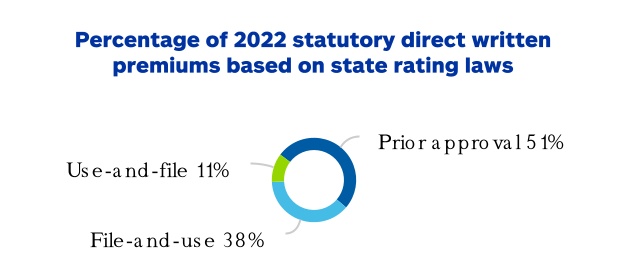
The speed with which an insurer can change rates in response to competition or increasing costs depends on the state rating laws, which include the following categories:
-
Prior approval — Regulators must approve a rate before the insurer may use it (21 states)
-
File-and-use — Insurers do not have to wait for the regulator’s approval to use a rate, but the rate must be filed with the regulatory authority prior to being used (20 states)
-
Use-and-file — Requires an insurer to file rates within a certain period of time after the insurer begins using them (9 states)
-
No approval — One state, with an immaterial amount of written premiums, does not require a filing to be submitted
Under these rating laws, the regulator has the authority to disapprove a rate filing.
An insurer’s ability to adjust its rates in response to competition or to changing costs is dependent on an insurer’s ability to demonstrate to the regulator that its rates or proposed rating plan meets the requirements of the rating laws. In those states that significantly restrict an insurer’s discretion in selecting the business
that it wants to underwrite, an insurer can manage its risk of loss by charging a rate that reflects the cost and expense of providing the insurance. In those states that significantly restrict an insurer’s ability to charge a rate that reflects the cost and expense of providing the insurance, the insurer may be able to manage its risk of loss by being more selective in the type of business it underwrites. When a state significantly restricts both underwriting and pricing, it becomes more difficult for an insurer to maintain its targeted level of profitability.
From time to time, the personal lines insurance industry comes under pressure from state regulators, legislators, and special-interest groups to reduce, freeze, or set rates at levels that do not correspond with our analysis of underlying costs, catastrophe loss exposure, and expenses. We expect this kind of pressure to persist. Allstate and other insurers are using increasingly sophisticated pricing models and rating plans that are reviewed by regulators and special-interest groups. States may limit the ability of insurers to include variables in their rating plans even though they are indicative of risk. State regulators may interpret existing law or rely on future legislation or regulations to impose new restrictions that adversely affect profitability or growth. We cannot predict the impact on our business of possible future legislative and regulatory measures regarding insurance rates.
Involuntary Markets As a condition of maintaining our licenses to write personal property and casualty insurance in various states, we are required to participate in assigned risk plans, reinsurance facilities, and joint underwriting associations that provide various types of insurance coverage to individuals or entities that otherwise are unable to purchase such coverage from private insurers. Underwriting results related to these arrangements, which tend to be adverse, have been immaterial to our results of operations.
 For a discussion of these items see Note 15 of the consolidated financial statements. Note 15 is incorporated in this Part I, Item 1 by reference.
Indemnification Programs We are a participant in state-based industry pools, facilities or associations, mandating participation by insurers offering certain coverage in their state, including the Michigan Catastrophic Claims Association (“MCCA”), the New Jersey Property-Liability Insurance Guaranty Association, the North Carolina Reinsurance Facility and the Florida Hurricane Catastrophe Fund. We also participate in the Federal Government National Flood Insurance Program.
Recent regulatory changes have occurred related to the MCCA.
- On August 6, 2020, member companies of the MCCA were notified of the ratification of amendments to the MCCA’s Plan of Operation. The amendments were designed to align the Plan of Operation with Public Acts 21 and 22, which passed in 2019.
The Allstate Corporation 13
2022 Form 10-K Item 1. Business
- On July 2, 2020, portions of Public Acts 21 and 22 went into effect. The changes under those laws include:
–Allowing insureds to choose levels of personal injury protection coverage, including the option to opt-out of personal injury protection coverage in certain circumstances.
–Implementing mandated rate reductions that correspond to the level of personal injury protection coverage chosen by insureds.
–Implementing or creating new processes for reviewing claims, assessing allowable expenses and setting limits on certain allowable expenses.
-
On July 2, 2021, legislation passed in 2019 became effective, setting fee schedules for personal injury protection claims. Such fee schedules were set at 200% of Medicare rates in 2021, declining to 195% in 2022 and 190% in 2023, for any providers other than certain unique categories of providers and applying to treatment on existing and new claims.
-
Other legislative proposals to change the MCCA operation in the future and to adjust Public Acts 21 and 22 are put forth periodically.
For a discussion of these items see Note 11 of the consolidated financial statements. Note 11 is incorporated in this Part I, Item 1 by reference.
Guaranty Funds Under state insurance guaranty fund laws, insurers doing business in a state can be assessed, up to prescribed limits, in order to cover certain obligations of insolvent insurance companies. We do not anticipate any material adverse financial impact on Allstate from these assessments.
Investment Regulation Our insurance subsidiaries are subject to state regulation that specifies the types of investments that can be made and concentration limits of invested assets. Failure to comply with these rules leads to the treatment of non-conforming investments as non-admitted assets for purposes of measuring statutory surplus. Further, in some instances, these rules require divestiture of non-conforming investments.
Exiting Geographic Markets; Canceling and Non-Renewing Policies Most states regulate an insurer’s ability to exit a market. For example, states may limit, to varying degrees, an insurer’s ability to cancel and non-renew policies. Some states restrict or prohibit an insurer from withdrawing one or more types of insurance business from the state, except pursuant to a plan that is approved by the state insurance department. Regulations that limit cancellation and non-renewal and that subject withdrawal plans to prior approval requirements may restrict an insurer’s ability to exit unprofitable markets.
Broker-Dealer and Investment Advisers The Allstate entities that operate as a broker-dealer and registered investment advisers are subject to regulation and supervision by the Securities and Exchange Commission (“SEC”), Financial Institution
Regulatory Authority and/or, in some cases, state securities administrators. Certain state and federal regulators are considering or have implemented best interest or fiduciary standards. Such standards could impact products provided by Allstate agents and Allstate’s broker-dealer, their sales processes, sales volume, and producer compensation arrangements.
Inflation Reduction Act of 2022 The Inflation Reduction Act of 2022 (“Act”), which contains several tax-related provisions, was signed into law in August 2022. The Act creates a 15% corporate alternative minimum tax (“CAMT”) on certain large corporations and an excise tax of 1% on stock repurchases by publicly traded U.S. corporations, both effective after December 31, 2022. The excise tax on common stock repurchases will be classified as an additional cost of the stock acquired included in treasury stock in shareholders' equity. The Company has determined that it is considered an “applicable corporation” under the rules of CAMT, and as such, it is expected to perform the CAMT computation starting January 1, 2023; however, a reasonable estimate cannot be made as of the filing date.
Climate disclosures In March 2022, the SEC released its climate-related proposed regulation, requiring registrants to provide certain climate-related information in their registration statements and annual reports. The proposed rule would require information about a registrant’s climate-related risks that are reasonably likely to have a material impact on its business, results of operations, or financial condition. The required information about climate-related risks would also include disclosure of a registrant’s greenhouse gas emissions, which have become a commonly used metric to assess a registrant’s exposure to such risks. In addition, under the proposed rule, certain climate-related financial metrics would be required in a registrant’s audited financial statements. The Company is evaluating the anticipated impacts of the proposed guidance to its disclosures.
Cybersecurity risk management The SEC issued a proposed rule in March 2022 to mandate cybersecurity disclosures, including information such as: management's and the board’s role and oversight of cybersecurity risks, policies and procedures and how risks and incidents are likely to impact the financial statements. Additionally, certain incidents would have mandatory reporting on a Form 8-K. The Company is evaluating the anticipated impacts of the proposed guidance to its disclosures.
Dodd-Frank: Covered Agreement The Secretary of the Treasury (operating through FIO) and the Office of the U.S. Trade Representative (“USTR”) are jointly authorized, pursuant to Dodd-Frank, to negotiate Covered Agreements. A Covered Agreement is a bilateral or multilateral agreement that “relates to the recognition of prudential measures with respect to the business of insurance or reinsurance that achieves a level of protection for insurance or reinsurance consumers that is substantially equivalent to the level of protection achieved under State insurance or reinsurance regulation.”
Item 1. Business 2022 Form 10-K
On September 22, 2017, the U.S. and European Union (“EU”) signed a Covered Agreement. In addition to signing the Covered Agreement, Treasury and the USTR jointly issued a policy statement clarifying how the U.S. views implementation of certain provisions of the Covered Agreement. The policy statement affirms the U.S. system of insurance regulation, including the role of state insurance regulators as the primary supervisors of the business of insurance and addresses several other key provisions of the Covered Agreement for which constituents sought clarity, including prospective application to reinsurance agreements and an affirmation that the Covered Agreement does not require development of a group capital standard or group capital requirement in the U.S.
The U.S. had five years from the date of signing to amend its credit for reinsurance laws and regulations to conform with the requirements of the Covered Agreement or face federal preemption determinations by the FIO. To address the requirements of the Covered Agreement, the NAIC formally adopted revisions to its existing credit for reinsurance model law and model regulation to conform with the requirements of the Covered Agreement with the expectation that states would adopt and implement the modified model law and regulation by September 2022. A sufficient number of states adopted the model and/or regulation to avoid federal preemption.
Division Statute On November 27, 2018, the Illinois General Assembly passed legislation authorizing a statute that makes available a process by which a domestic insurance company may divide into two or more domestic insurance companies. The statute, which became effective January 1, 2019, can be used to divide continuing blocks of insurance business from insurance business no longer marketed, or otherwise has been discontinued, into separate companies with separate capital. The statute can also be used for sale to a third party or to manage risks associated with indemnification programs. Before a plan of division can be effected it must be approved according to the organizational documents of the dividing insurer and submitted for approval by the Illinois Department of Insurance. Allstate Insurance Company and certain affiliate insurance companies utilized the division statute to form three Illinois domiciled insurance companies that retained assets and liabilities for certain Michigan automobile insurance policies with catastrophic personal injury claims that are ceded to the MCCA.
Privacy Regulation and Data Security Federal law and the laws of many states require financial institutions to protect the security and confidentiality of consumer information and to notify consumers about their policies and practices relating to collection, use, and disclosure of consumer information and their policies relating to protecting the security and confidentiality of that information. Federal law and the laws of many states also regulate disclosures and disposal of consumer information. Congress, state legislatures, and regulatory authorities are currently considering additional regulation relating to privacy and other aspects of consumer information.
For example, the California Consumer Privacy Act, which took effect in January 2020, as amended by the California Privacy Rights Act, which took effect in January 2023, as well as similar laws in Virginia and Connecticut, adopted significant compliance requirements for businesses in those states. Among other things, the California Privacy Rights Act expanded consumer privacy rights and established a new privacy regulatory agency. In another example, the New York State Department of Financial Services cybersecurity regulation and the NAIC Insurance Data Security Model Law, which has been adopted in some form by several states, establish standards for data security, including the investigation of and notification to insurance commissioners of cybersecurity events. Additional states are also likely to adopt similarly themed cybersecurity requirements in the future. We cannot predict the impact on our business of possible future legislative or regulatory measures regarding privacy or cybersecurity.
Asbestos Congress has repeatedly considered legislation to address asbestos claims and litigation in the past. We cannot predict the impact on our business of possible future legislative measures regarding asbestos.
Environmental Environmental pollution and clean-up of polluted waste sites is the subject of federal and state regulation. The Comprehensive Environmental Response Compensation and Liability Act of 1980 (the “Superfund”) and comparable state statutes (the “mini-Superfunds”) govern the clean-up and restoration of waste sites by Potentially Responsible Parties (“PRPs”). The Superfund and the mini-Superfunds (collectively, the “Environmental Clean-up Laws” or “ECLs”) establish a mechanism to assign liability to PRPs or to fund the clean-up of waste sites if PRPs fail to do so. The extent of liability to be allocated to a PRP depends on a variety of factors. The insurance industry is involved in extensive litigation regarding coverage issues arising out of the clean-up of waste sites by insured PRPs and the insured parties’ alleged liability to third parties responsible for the clean-up. The insurance industry, including Allstate, has disputed and is disputing many such claims. Key coverage issues include whether the Superfund response, investigation, and clean-up costs are considered damages under the policies; whether coverage has been triggered; whether any pollution exclusion applies; whether there has been proper notice of claims; whether administrative liability triggers the duty to defend; whether there is an appropriate allocation of liability among potentially responsible insurers; and whether the liability in question falls within the definition of an “occurrence.” Identical coverage issues exist for clean-up and waste sites not covered under the Superfund. To date, courts have been inconsistent in their rulings on these issues.
Allstate’s exposure to liability with regard to its insureds that have been, or may be, named as PRPs is uncertain. While comprehensive Superfund reform proposals have been introduced in Congress, only modest reform measures have been enacted. In May 2017, the Environmental Protection Agency created a Superfund Task Force that issued proposed reforms in
The Allstate Corporation 15
2022 Form 10-K Item 1. Business
its 2019 final report. These recommendations address expediting clean-up and remediation processes, reducing the financial burden of the clean-up process, encouraging private investment, promoting redevelopment and community revitalization, and building and strengthening partnerships. We cannot predict which, if any, of these reforms will be enacted or, if enacted, what their impact may be.
Developments in the insurance and reinsurance industries have fostered a movement to segregate asbestos, environmental and other run-off lines exposures into separate legal entities with dedicated capital. Regulatory bodies in certain cases have supported these actions. We are unable to determine the impact, if any, that these developments will have on the collectability of reinsurance recoverables in the future.
Item 1. Business 2022 Form 10-K
Human Capital
Allstate’s success is highly dependent on human capital. The wellbeing of our employees is a key priority, and Allstate strives to promote a dynamic and welcoming workplace that promotes inclusive diversity and equity, fosters collaboration, and encourages employees to bring their best ideas to work every day. As of December 31, 2022, Allstate had approximately 54,000 full-time employees and 500 part-time employees.
Allstate’s human capital management focuses on the following priorities:
Inclusive Diversity and Equity (“IDE”) We strive for a workforce where the breadth of our diversity makes us a better company. IDE is one of Allstate’s core values and serves as a foundation of Our Shared Purpose.
| U.S. workforce diversity as of December 31, 2022 | ||||||||
| Women | 58% | |||||||
| Racially and ethnically diverse | 42% |
-
We track our workforce composition data over time to determine if we are making appropriate progress in advancing gender and racial representation in our employee population and we disclose our progress. In our Sustainability Report, we provide, among other things, five years of workforce composition data that shows a breakdown of salaried, hourly and management employees by gender and race. Beginning in 2021, we also disclose our EEO-1 data.
-
As part of our commitment to fair and equitable compensation practices, we complete an annual pay equity analysis. We partner with external law and data analytics firms to provide a more detailed analysis to identify potential pay gaps across substantially similar employee groups as well as identify policies, practices or systematic issues that may contribute to pay gaps now or over time. The external analyses found that Allstate’s results compared well to benchmarks for companies of similar size and scope.
-
Allstate’s Employee Impact Groups (“EIG”) help advance IDE.
–In 2022, Allstate rebranded “Employee Resource Groups” to “Employee Impact Groups” to focus on impact and integration into the business. Allstate supports and funds ten EIGs.
–EIGs are diverse communities that enhance the employee experience through engagement, development and collaboration. They bring value to participants and impact Allstate through cultural education and awareness, market and community outreach, professional development, recruiting, retention, and customer engagement.
–Officers from across the enterprise leverage their time, networks and resources to support the EIGs and positively impact employee engagement and feelings of belonging at Allstate.
-
In 2022, employees completed more than 31,000 IDE courses.
-
Allstate continues to look for ways to build awareness and drive action to be a differentiated leader in IDE. In 2022, we:
–Continued to drive skills-based hiring without 4-year degree requirements on job postings.
–As a member of the OneTen Initiative, launched Apprenticeship Program, Internship Program and Entry Level Rotational Program.
–Launched a new education strategy with offerings to build intercultural competence and an inclusive culture, and established metrics to measure the impact of course offerings on employees and the business.
–Implemented an IDE Talent Scorecard to drive leadership accountability for developing a workforce that mirrors the diversity of the communities and customers Allstate serves.
–Launched Allstate IDE A.C.T. (Accountability, Clarity, Transparency) Framework, integrating IDE strategy, goals, and collaboration across Allstate. This model drives accountability and reduces complexity by clarifying roles.
Employee Wellbeing and Safety We take seriously our responsibility to care for employees’ well-being, devoting resources to employee health and safety.
-
Allstate utilized strong guiding principles to drive our response to the pandemic. These principles included complying with regulations, relying on expert medical advice, adapting our approach to individual circumstances, and keeping our employees, agents, and customers safe.
-
We conduct wellbeing assessments to solicit employee feedback about physical, emotional, mental and financial wellbeing. Completing the assessment lowers the cost of benefits to employees.
-
We offer resilience and stress management programs, including Energy for Life, designed to help employees articulate and pursue their individual purpose and embrace new challenges with ease. Over 40,000 employees have taken this wellness workshop since 2010.
-
The EIGs provided multiple forums in 2022 to share wellness resources and support for their members.
-
Wellbeing Champions promote Allstate’s health and wellness resources across the enterprise, including yoga and meditation classes.
The Allstate Corporation 17
2022 Form 10-K Item 1. Business
Talent Recruitment and Management We seek to provide employees with rewarding work, professional growth and educational opportunities.
-
Our flexible work and equal opportunity policies support talent attraction and retention. This has enabled us to recruit a more geographically dispersed and diverse talent pool, as well as to reduce our facilities footprint.
-
Performance review and development takes place throughout the year. Allstate invests in training and re-skilling opportunities, with most of our learning experiences offered virtually to support our remote and global workforce.
-
In 2022:
–Employees completed over 1.1 million hours in formal learning opportunities.
–Over 700 employees participated in Allstate’s tuition reimbursement program, with $2.6 million paid in tuition reimbursement.
–40% of open positions were filled with internal applicants.
Organizational Culture At Allstate, we believe that when your passion fuels your purpose, you can achieve anything. We expect all employees to be leaders and dedicate extensive resources to developing leaders at all levels.
-
Allstate defines culture as a self-sustaining system of shared values, priorities and principles that shape beliefs and drive behaviors and decision-making within an organization.
-
In 2022, we continued to focus on further embedding Our Shared Purpose into the employee experience, including in our recruiting and hiring practices, performance management, learning and development offerings, leadership development and employee feedback and measurement.
For additional information, please see the section titled “Our Key ESG Priorities-People” in our Proxy Statement.
In addition to the above discussion of our employees, please see information about Allstate agents under the caption “Allstate Protection Segment - Products and Distribution” in Part I, Item 1 of this report.
Item 1. Business 2022 Form 10-K
Website
Our website is allstate.com. The Allstate Corporation’s annual reports on Form 10-K, quarterly reports on Form 10-Q, current reports on Form 8-K and any amendments to such reports that we file or furnish pursuant to Section 13(a) of the Securities Exchange Act of 1934 are available on the Investor Relations section of our website (www.allstateinvestors.com), free of charge, as soon as reasonably practicable after they are electronically filed or furnished to the SEC. In addition, our Corporate Governance Guidelines, our Global Code of Business Conduct, and the charters of our Audit Committee, Compensation and Human Capital Committee, Executive Committee, Nominating, Governance and Social Responsibility Committee and Risk and Return Committee are available on the Investor Relations section of our website. The information found on our website is not incorporated by reference into this Annual Report on Form 10-K or in any other report or document filed with the SEC.
Other Information About Allstate
-
Allstate’s five reportable segments use shared services, including human resources, investment, finance, information technology and legal services, provided by Allstate Insurance Company and other affiliates.
-
Although the insurance business generally is not seasonal, claims and claims expense for the Allstate Protection segment tend to be higher for periods of severe or inclement weather.
-
“Allstate®” is a very well-recognized brand name in the United States. We use the “Allstate®”, “National General®” and “Answer Financial®” brands extensively in our business. We also provide additional protection products and services through “AllstateSM Protection Plans”, “Allstate Dealer Services®”, “Allstate® Roadside”, “Arity®”, “AllstateSM Identity Protection” “Allstate® Benefits” and “Allstate® Health Solutions”, among others. These brands, products and services are supported with the related service marks, logos, and slogans. Our rights in the United States to these names, service marks, logos and slogans continue as long as we continue to use them in commerce. Many service marks used by Allstate are the subject of renewable U.S. and/or foreign service mark registrations. We believe that these service marks are important to our business and we intend to maintain our rights to them.
The Allstate Corporation 19
2022 Form 10-K Item 1. Business
Information about our Executive Officers
The following table sets forth the names of our executive officers as of February 1, 2023, their ages, positions, business experience, and the years of their first election as officers. “AIC” refers to Allstate Insurance Company. Each of the officers named below may be removed from office at any time, with or without cause, by the board of directors of the relevant company.
| Name | Age | Position with Allstate and Business Experience | Year First Elected Officer | |||||||||||||||||
| Thomas J. Wilson | 65 | Chairman of the Board (May 2008 to present), President (June 2005 to January 2015 and February 2018 to present), and Chief Executive Officer (January 2007 to present) of The Allstate Corporation and AIC. | 1995 | |||||||||||||||||
| Elizabeth A. Brady | 58 | Executive Vice President, Chief Marketing, Customer and Communications Officer of AIC (January 2020 to present); Executive Vice President and Chief Marketing, Innovation and Corporate Relations Officer of AIC (August 2018 to January 2020); Senior Vice President, Global Brand Management of Kohler Co. (November 2013 to July 2018). | 2018 | |||||||||||||||||
| Christine M. DeBiase | 54 | Executive Vice President, Chief Legal Officer, General Counsel and Corporate Secretary of The Allstate Corporation and AIC (January 2023 to present); Executive Vice President, Chief Administrative Officer and General Counsel of Brighthouse Financial (February 2018 to December 2022); Executive Vice President, General Counsel and Corporate Secretary of Brighthouse Financial (August 2017 to February 2018). | 2023 | |||||||||||||||||
| John E. Dugenske | 56 | President, Investments and Corporate Strategy of AIC (September 2022 to present); President, Investments and Financial Products of AIC (January 2020 to September 2022); Executive Vice President and Chief Investment and Corporate Strategy Officer of AIC (January 2018 to January 2020); Executive Vice President and Chief Investment Officer of AIC (March 2017 to January 2018). | 2017 | |||||||||||||||||
| Suren Gupta | 61 | President, Enterprise Services (October 2022 to present); Executive Vice President, Chief Information Technology and Enterprise Services Officer of AIC (January 2020 to October 2022); Executive Vice President, Enterprise Technology and Strategic Ventures of AIC (February 2015 to January 2020). | 2011 | |||||||||||||||||
| Jesse E. Merten | 48 | Executive Vice President and Chief Financial Officer of The Allstate Corporation and AIC (September 2022 to present); President, Financial Products of AIC (May 2020 to September 2022); Executive Vice President and Chief Risk Officer of AIC (December 2017 to May 2020); Treasurer of The Allstate Corporation (January 2015 to April 2019) and of AIC (February 2015 to May 2019). | 2012 | |||||||||||||||||
| John C. Pintozzi | 57 | Senior Vice President, Controller and Chief Accounting Officer of The Allstate Corporation and AIC (September 2019 to present); Senior Vice President and Chief Financial Officer, Allstate Investments (May 2012 to August 2019). | 2005 | |||||||||||||||||
| Mark Q. Prindiville | 55 | Executive Vice President and Chief Risk Officer of AIC (May 2020 to present); Senior Vice President of AIC (September 2016 to May 2020). | 2016 | |||||||||||||||||
| Mario Rizzo | 56 | President, Property Liability of AIC (September 2022 to present); Executive Vice President and Chief Financial Officer of The Allstate Corporation and AIC (January 2018 to September 2022); Senior Vice President and Chief Financial Officer, Allstate Personal Lines of AIC (February 2015 to January 2018). | 2010 | |||||||||||||||||
| Robert Toohey | 55 | Executive Vice President and Chief Human Resources Officer of AIC (March 2022 to present); Self-Employed Talent and Operations Advisor/Consultant (August 2021 to March 2022); President of Pymetrics (May 2019 to August 2021); Chief People Officer of Verizon Media (August 2016 to September 2018). | 2022 | |||||||||||||||||
| Terrance Williams | 54 | President, Protection Products and Services of AIC (May 2022 to present); Executive Vice President, Allstate Sales and Distribution of AIC (November 2021 to May 2022); General Manager, Allstate Agency (January 2020 to November 2021); President of Emerging Businesses and EVP, Chief Marketing Officer of Nationwide Mutual Insurance Company (May 2017 to October 2019). | 2020 |
Item 1. Business 2022 Form 10-K
Forward-Looking Statements
This report contains “forward-looking statements” that anticipate results based on our estimates, assumptions and plans that are subject to uncertainty. These statements are made subject to the safe-harbor provisions of the Private Securities Litigation Reform Act of 1995. Forward-looking statements do not relate strictly to historical or current facts and may be identified by their use of words like “plans,” “seeks,” “expects,” “will,” “should,” “anticipates,” “estimates,” “intends,” “believes,” “likely,” “targets” and other words with similar meanings. These statements may address, among other things, our strategy for growth, catastrophe exposure management, product development, investment results, regulatory approvals, market position, expenses, financial results, litigation and reserves. We believe that these statements are based on reasonable estimates, assumptions and plans. Forward-looking statements speak only as of the date on which they are made, and we assume no obligation to update any forward-looking statements as a result of new information or future events or developments. In addition, forward-looking statements are subject to certain risks or uncertainties that could cause actual results to differ materially from those communicated in these forward-looking statements. These risks and uncertainties include, but are not limited to, those described in Part 1, “Item 1A. Risk Factors” and elsewhere in this report and those described from time to time in our other reports filed with the Securities and Exchange Commission.
The Allstate Corporation 21
2022 Form 10-K Part I - Item 1A. Risk Factors and Other Disclosures
Item 1A. Risk Factors
Summary Risks are categorized by (1) insurance and financial services, (2) business, strategy and operations and (3) macro, regulatory and risk environment. Many risks may affect more than one category and are included where the impact is most significant. If some of these risk factors occur, they may cause the emergence of or exacerbate the impact of other risk factors, which could materially increase the severity of the impact of these risks on our business, results of operations, financial condition or liquidity. The table below includes examples of risks from each category.
 | Insurance and financial services |  | Business, strategy and operations |  | Macro, regulatory and risk environment | ||||||||||||||||||
| Risks related to the insurance and financial services industries | Risks related to Allstate’s business and operating model | Risks that impact most companies | |||||||||||||||||||||
| • Claim frequency and severity volatility • Catastrophes and severe weather • Loss cost estimates are complex and losses are unknown at the time policies are sold • Investment results are subject to market volatility and valuation judgments | • Highly competitive industry, impacted by new and changing technologies • Operating model effectiveness in light of changing customer preferences • Ability to maintain catastrophe reinsurance programs and limits • Fluctuations in financial strength and ratings | • Adverse changes in economic and capital market conditions • Large-scale pandemic events • Cybersecurity and privacy events • Changing climate conditions • Evolving environmental, social and governance expectations and standards • Regulatory and political changes • Loss of key business relationships • Ability to attract, develop and retain talent |
The Allstate Corporation Board of Directors (“Allstate Board”) has overall responsibility for oversight of Management’s design and implementation of our Enterprise Risk and Return Management (“ERRM”) framework that manages the business on an integrated basis following our risk and return principles. The Risk and Return Committee of the Allstate Board oversees effectiveness of the ERRM program, governance structure and risk-related decision-making, while focusing on the Company’s overall risk profile.
See Management’s Discussion and Analysis (“MD&A”), Enterprise Risk and Return Management for further details.
Consider these cautionary statements carefully together with other factors discussed elsewhere in this document, in filings with the Securities and Exchange Commission (“SEC”) or in materials incorporated therein by reference.
| Insurance and financial services |
Unexpected increases in the frequency or severity of property and casualty claims may adversely affect our results of operations and financial condition
A significant increase in claim frequency could adversely affect our results of operations and financial condition. Changes in mix of business, miles driven, weather, driving behaviors or other factors can lead to changes in claim frequency. We may experience volatility in claim frequency, and short-term trends may not be predictive of future losses over the longer term.
Increases in claim severity can arise from numerous causes that are inherently difficult to predict. The following factors have and may continue to impact claim severity for auto bodily injury, auto physical damage (including collision and property damage) and homeowners coverages:
-
Bodily injury — increased claims with attorney representation, litigation costs and higher medical inflation
-
Vehicle physical damage — inflation and supply chain shortages impacting used vehicle and parts prices, labor rates, length of claim resolution and delays in the receipt of third-party carrier claims
-
Homeowners — inflation in the construction industry, building materials and home furnishings, changes in the mix of loss type, and other economic and environmental factors, including short-term supply imbalances for services and supplies in areas affected by catastrophes
Catastrophes and severe weather events may subject us to significant losses
Catastrophic events could adversely affect operating results and cause them to vary significantly from one period to the next. Also, our liquidity could be constrained by a catastrophe, or multiple catastrophes, which could result in extraordinary losses, sales of investments or a downgrade of our debt or financial strength ratings.
Catastrophic losses are caused by wind and hail, wildfires, tornadoes, hurricanes, tropical storms, earthquakes, severe freeze events, volcanic eruptions, terrorism, cyber-attacks, civil unrest, industrial accidents and other such events.
Part I - Item 1A. Risk Factors and Other Disclosures 2022 Form 10-K
Our personal property insurance business may incur catastrophe losses greater than:
-
Those experienced in prior years
-
The average expected level used in pricing
-
Current reinsurance coverage limits
-
Loss estimates from hurricane and earthquake models at various levels of probability
Property and casualty businesses are subject to claims arising from severe weather events such as winter storms, rain, hail and high winds. The incidence and severity of weather conditions resulting in claims are extremely volatile.
The total number of policyholders affected by the event, the severity of the event and the coverage provided contribute to catastrophe and severe weather losses. Increases in the insured values of covered property, geographic concentration and the number of policyholders exposed to certain events could increase the severity of claims from catastrophic and severe weather events.
Limitations in analytical models used to assess and predict the exposure to catastrophe losses may adversely affect our results of operations and financial condition
We use internally developed and third-party vendor models along with our own historical data to assess exposure to catastrophe losses. The models assume various conditions and probability scenarios and may not accurately predict future losses or measure losses currently incurred.
Price competition and changes in regulation and underwriting standards in property and casualty businesses may adversely affect our results of operations and financial condition
The personal property-liability market is highly competitive with carriers competing through underwriting, advertising, price, customer service, innovation and distribution. Changes in regulatory standards regarding underwriting and rates could also affect the ability to predict future losses and could impact profitability. Competitors can alter underwriting standards, lower prices and increase advertising, which could result in lower growth or profitability for Allstate. A decline in the growth or profitability of the property and casualty businesses could have a material effect on our results of operations and financial condition.
Property and casualty actual claim costs may exceed current reserves established for claims due to changes in the inflationary, regulatory and litigation environment
Estimating claim reserves is an inherently uncertain and complex process. We continually refine our best estimates of losses after considering known facts and interpretations of the circumstances.
Our reserving methodology may be impacted by the following:
-
Models that rely on the assumption that past loss development patterns will persist into the future
-
Internal factors including experience with similar cases, actual claims paid, historical trends involving claim payment patterns, pending levels of unpaid claims, loss management programs, product mix, contractual terms and changes in claim reporting and settlement practices
-
External factors such as inflation, court decisions, changes in law or litigation imposing unintended coverage, regulatory requirements, changes in driving patterns, delays in reporting of claims and economic conditions
-
Supply chain disruptions and labor shortages could increase the cost of settling claims
-
The ultimate cost of losses, or our current estimates, have and may continue to vary materially from recorded reserves and such variance may adversely affect our results of operations and financial condition as the reserves and amounts due from reinsurers are reestimated
See MD&A, Application of Critical Accounting Estimates for further details.
Our investment portfolios are subject to market risk and declines in credit quality which may adversely affect or create volatility in our investment income and cause realized and unrealized losses
We continually evaluate investment management strategies since we are subject to risk of loss due to adverse changes in interest rates, credit spreads, equity prices, real estate values, currency exchange rates and liquidity. Adverse changes have and may continue to occur due to changes in monetary and fiscal policy, inflation and the economic climate, liquidity of a market or market segment, investor return expectations or risk tolerance, insolvency or financial distress of key market makers or participants, or changes in market perceptions of credit worthiness.
Inflation has and continues to remain elevated, which has led to higher interest rates and a widening of credit spreads reflecting ongoing recession concerns. The U.S. Federal Reserve and other central banks have begun to respond to inflationary pressure, generally through more restrictive monetary policy, including increasing target interest rates. These actions and other ongoing impacts from the pandemic could create significant economic uncertainty. Market volatility resulting from these factors has and may continue to impact our investment valuations and returns and impact our results of operations and financial condition.
Our investments are subject to risks associated with economic and capital market conditions and factors that may be unique to our portfolio, including:
-
General weakening of the economy, which is typically reflected through higher credit spreads and lower equity and real estate valuations
-
Declines in credit quality
-
Declines in interest rates, credit spreads or sustained low interest rates could lead to declines in portfolio yields and investment income
The Allstate Corporation 23
2022 Form 10-K Part I - Item 1A. Risk Factors and Other Disclosures
-
Increases in market interest rates, credit spreads or a decrease in liquidity could have an adverse effect on the value of our fixed income securities that form a substantial majority of our investment portfolios
-
Supply chain disruptions, labor shortages and other factors have and may continue to increase inflation, which could have an adverse impact on investment valuations and returns
-
Weak performance of general and joint venture partners and underlying investments unrelated to general market or economic conditions could lead to declines in investment income and cause realized losses in our limited partnership interests
-
Concentration in any particular issuer, industry, collateral type, group of related industries, geographic sector or risk type
The amount and timing of net investment income, capital contributions and distributions from our performance-based investments, which primarily include limited partnership interests that are recorded on a lag, can fluctuate significantly due to the underlying investments’ performance or changes in market or economic conditions. Additionally, these investments are less liquid than similar, publicly-traded investments and a decline in market liquidity could impact our ability to sell them at their current carrying values.
Declining equity markets or increases in interest rates or credit spreads could cause the value of the investments in our pension plans to decrease. Declines in interest rates could cause the funding ratio to decline and the value of the obligations for our pension and postretirement plans to increase. These factors could decrease the funded status of our pension and postretirement plans, increasing the likelihood or magnitude of future benefit expense and contributions.
Determination of the fair value and amount of credit losses for investments includes subjective judgments and could materially impact our results of operations and financial condition
The valuation of the portfolio is subjective, and the value of assets may differ from the actual amount received upon the sale of an asset. The degree of judgment required in determining fair values increases when:
-
Market observable information is less readily available
-
The use of different valuation assumptions may have a material effect on the assets’ fair values
-
Changing market conditions could materially affect the fair value of investments
The determination of the amount of credit losses varies by investment type and is based on ongoing evaluation and assessment of known and inherent risks associated with the respective asset class or investment.
Such evaluations and assessments are highly judgmental and are revised as conditions change and new information becomes available.
We update our evaluations regularly and reflect changes in credit losses in our results of operations. Our conclusions may ultimately prove to be incorrect as assumptions, facts and circumstances change. When estimating credit loss allowances, historical loss trends, consideration of current conditions, and forecasts may not be indicative of future changes in credit losses and additional amounts may need to be recorded in the future.
Our participation in indemnification programs subjects us to the risk that reimbursement for qualifying claims and claims expenses may not be received
Participation in state-based industry pools, facilities and associations may have a material, adverse effect on our results of operations and financial condition. Our largest exposure is associated with the Michigan Catastrophic Claim Association (“MCCA”), a state-mandated indemnification mechanism for qualified personal injury protection losses that exceed a specified level. To the extent the MCCA’s current and future assessments are insufficient to reimburse its ultimate obligation on existing claims to member companies, our ability to obtain the 100% indemnification of ultimate loss could be impaired. We also participate in the Federal Government National Flood Insurance Program.
For further discussion of these items, see Regulation section, Indemnification Programs and Note 11 of the consolidated financial statements.
We may not be able to mitigate the impact associated with changes in capital requirements
Regulatory requirements affect the amount of capital to be maintained by our subsidiary insurance companies. Changes to requirements or regulatory interpretations may result in additional capital held in our insurance companies and could require us to increase prices, reduce our sales of certain products, or accept a return on equity below original levels assumed in pricing.
A downgrade in financial strength ratings may have an adverse effect on our business
Financial strength ratings are important factors in establishing the competitive position of insurance companies and their access to capital markets. Rating agencies could downgrade or change the outlook on our ratings due to:
-
Changes in the financial profile of one of our insurance companies
-
Changes in a rating agency’s determination of the amount of capital required to maintain a particular rating
-
Increases in the perceived risk of our investment portfolio, a reduced confidence in management or our business strategy, or other considerations that may or may not be under our control
Previous: Cover and table of contents · Next: Item 1A. Risk Factors and Other Disclosures 2022 Form 10-K