 filings.tools
Item 1. Business
81K characters. Original on sec.gov · Markdown
Item 1. Business
The Allstate Corporation was incorporated under the laws of the State of Delaware on November 5, 1992, to serve as the holding company for Allstate Insurance Company. Its business is conducted principally through Allstate Insurance Company and other subsidiaries (collectively, including The Allstate Corporation, “Allstate”).
Allstate protects people from life’s uncertainties with a wide array of protection for autos, homes and personal property. Allstate is primarily engaged in the property and casualty insurance business in the United States and Canada. Additionally, Allstate provides customers other protection solutions such as protection plans that cover consumer electronics, mobile phones and appliances, personal identity protection and accident and health insurance. On November 1, 2023, we announced that we are pursuing the sale of the Health and Benefits business.
The Allstate Corporation is one of the largest publicly held personal lines insurers in the United States. Allstate’s personal property-liability strategy is to increase market share by offering consumers a broad suite of protection solutions and a competitive value proposition across distribution channels. The Allstate brand is widely known through the “You’re In Good Hands With Allstate®” slogan. Allstate is the second largest personal property and casualty insurer in the United States on the basis of 2022 statutory direct premiums written according to A.M. Best.
Allstate also has strong market positions in other protection solutions. Allstate Protection Plans provides protection on a wide variety of consumer goods such as cell phones, tablets, computers, furniture and appliances, and has a leading position in distribution through major retailers. Allstate Identity Protection has a leading position in identity protection through workplace benefit programs. In total, Allstate had 194 million policies in force (“PIF”) as of December 31, 2023. Allstate Health and Benefits provides accident, health and life insurance through employers, independent agents and direct-to-consumer, and is one of the top voluntary benefits carriers in the market.
In this Annual Report on Form 10-K, we occasionally refer to statutory financial information. All domestic United States insurance companies are required to prepare statutory-basis financial statements. As a result, industry data is available that enables comparisons between insurance companies, including competitors that are not required to prepare financial statements in conformity with accounting principles generally accepted in the United States of America (“GAAP”). We frequently use industry publications containing statutory financial information to assess our competitive position.
The Allstate Corporation 1
2023 Form 10-K Item 1. Business
Strategy, Transformative Growth, Our Shared Purpose and Segment Information
Our strategy has two components: increase personal property-liability market share (see Allstate Protection segment) and expand protection offerings by leveraging the Allstate brand, customer base and capabilities.
We are expanding protection services businesses utilizing enterprise capabilities and resources such as the Allstate brand, distribution, analytics, claims, investment expertise, talent and capital. Using innovative growth platforms (such as telematics and identity protection) and broad distribution including: Allstate exclusive agents, independent agents, contact centers, online, retailers, workplace benefits brokers, auto dealers, original equipment manufacturers and telecom providers further enhance our customer value proposition.
Transformative Growth is about creating a business model, capabilities and culture that continually transform to better serve customers. This is done by providing affordable, simple and connected protection through multiple distribution channels. The ultimate objective is to enhance customer value to drive growth in all businesses.

2023 Form 10-K Item 1. Business
| Our Shared Purpose | |||||||||||||||||||||||
| As the good hands... | our values | our operating standards | our behaviors | ||||||||||||||||||||
| •We empower customers with protection to help them achieve their hopes and dreams. •We provide affordable, simple and connected protection solutions. •We create opportunity for our team, economic value for our shareholders and improve communities. | •Integrity is non-negotiable. •Inclusive Diversity & Equity values and leverages unique identities with equitable opportunity and rewards. •Collective Success is achieved through empathy and prioritizing enterprise outcomes ahead of individuals. | •Focus on Customers by anticipating and exceeding service expectations at low costs. •Be the Best at protecting customers, developing talent and running our businesses. •Be Bold with original ideas using speed and conviction to beat the competition. •Earn Attractive Returns by providing customer value, proactively accepting risk and using analytics. | •Collaborate early and often to develop and implement comprehensive solutions and share learnings. •Challenge Ideas to leverage collective expertise, evaluate multiple alternatives and create the best path forward. •Provide Clarity for expected outcomes, decision authority and accountability. •Provide Feedback that is candid, actionable, independent of hierarchy and safe. |
| Reportable segments | ||||||||
| Allstate Protection (1) | Includes the Allstate brand, National General and Answer Financial. Offers private passenger auto, homeowners, other personal lines and commercial insurance through agents, contact centers and online. | |||||||
| Protection Services | Includes Allstate Protection Plans, Allstate Dealer Services, Allstate Roadside, Arity and Allstate Identity Protection, which offer a broad range of solutions and services that expand and enhance our customer value propositions. | |||||||
| Allstate Health and Benefits | Offers voluntary benefits and individual life and health products, including life, accident, critical illness, short-term disability and other health insurance products sold through independent agents, benefits brokers and Allstate exclusive agents. Also provides stop-loss and fully insured group health products to employers and short-term medical and medicare supplement insurance to individuals. | |||||||
| Run-off Property-Liability (1) | Relates to property and casualty insurance policies written during the 1960s through the mid-1980s with exposure to asbestos, environmental and other claims in run-off. | |||||||
| Corporate and Other | Includes debt service, holding company activities and certain non-insurance operations. |
(1)Allstate Protection and Run-off Property-Liability segments comprise Property-Liability.
The Allstate Corporation 3
2023 Form 10-K Item 1. Business
Allstate Protection Segment
Our Allstate Protection segment accounted for 92.2% of Allstate’s 2023 consolidated insurance premiums and contract charges and 19.4% of Allstate’s December 31, 2023 PIF. This segment includes private passenger auto, homeowners, other personal lines and commercial insurance products offered through agents and directly through contact centers and online. Our strategy is to offer products that allow customers to interact with us when, where and how they want with affordable, simple and connected protection products.
Strategy Allstate Protection’s strategy is to increase personal lines market share through Transformative Growth focusing on:
-
Improving customer value by making it easier to do business with us, providing competitive prices and differentiated products and experiences
-
Expanding customer access to Allstate and National General products and services through the methods of interaction customers want
-
Increasing sophistication and investment in customer acquisition
-
Deploying new technology ecosystems that are more flexible and enable an enhanced customer experience
-
Driving organizational transformation
We have three market-facing property-liability businesses, Allstate brand, National General and Answer Financial with products and services that cater to different customer needs and distribution preferences.

We serve our customers using differentiated products, analytical expertise, telematics, claims capabilities and an integrated digital enterprise that leverages data and technology to execute processes with a focus on greater effectiveness and efficiency.
| Transformative Growth | |||||||||||||||||
| Improve Customer Value | Improving the competitive prices of products through lower costs, increased pricing sophistication and telematics | ||||||||||||||||
| Expanding the use of telematics and broadening the benefits of being connected with the Allstate Mobile app | |||||||||||||||||
| Providing additional protection solutions that enable simpler consumer-friendly experiences | |||||||||||||||||
| Expand Customer Access | Transforming our Allstate agent sales system to enable more growth at a lower cost, while expanding our distribution capacity through new agent models | ||||||||||||||||
| Increasing direct channel distribution through improved online experience and data-driven insights to enhance call center sales | |||||||||||||||||
| Growing National General by leveraging Allstate brand capabilities and data to expand product offerings and fully utilize our independent agency relationships | |||||||||||||||||
| Increase Sophistication and Investment in Customer Acquisition | Improving the effectiveness of customer acquisition by expanding lead management, building data capabilities and utilizing household insights | ||||||||||||||||
| Deploy New Technology Ecosystem | Deploying a new technology ecosystem to deliver affordable, simple, and connected experiences and products at a lower cost. This effort will also lead to the retirement of legacy systems | ||||||||||||||||
| Drive Organizational Transformation | Deliver an exceptional customer experience enabled by enhanced human resource tools and technology, an engaged and high performing global workforce, and organizational designs for efficiency |
2023 Form 10-K Item 1. Business
Additional Information and Strategy Updates
Allstate Protection pricing and risk management strategies Our pricing and underwriting strategies and decisions are designed to generate sustainable profitable growth.
A proprietary database of underwriting and loss experience enables sophisticated pricing algorithms and methodologies to more accurately price risks while also seeking to attract and retain customers in multiple risk segments.
-
For auto insurance, risk evaluation factors can include, but are not limited to: vehicle make, model and year; driver age and marital status; territory; years licensed; loss history; years insured with prior carrier; prior liability limits; prior lapse in coverage; and insurance scoring utilizing telematics data and other consumer information.
-
For property insurance, risk evaluation factors can include, but are not limited to: the amount of insurance purchased; geographic location of the property; loss history; age, condition and construction characteristics of the property; and insurance scoring utilizing other consumer information.
A combination of underwriting information, pricing and discounts are also used to achieve a more competitive position and growth. The pricing strategy involves local marketplace pricing and underwriting decisions based on risk evaluation factors to the extent permissible by applicable law and an evaluation of competitors.
Pricing of property products is intended to generate risk-adjusted returns that are acceptable over a long-term period. Rate increases are pursued to keep pace with loss cost trends, including losses from catastrophic events and those that are weather-related (such as wind, hail, lightning and freeze not meeting our criteria to be declared a catastrophe). We also take into consideration potential customer disruption, the impact on our ability to market our products, regulatory limitations, our competitive position and profitability.
In any reporting period, loss experience from catastrophic events and weather-related losses may contribute to negative or positive underwriting performance relative to the expectations incorporated into product pricing.
Property catastrophe exposure is managed with the goal of providing shareholders an acceptable return on the risks assumed in the property business, and reducing variability of earnings, while providing protection to our customers. Catastrophe exposure management includes purchasing reinsurance to provide coverage for known exposure to hurricanes, earthquakes and fires following earthquakes, wildfires and other catastrophes.
Our current catastrophe reinsurance program supports the Company’s risk and return framework which incorporates our robust economic capital model and is informed by catastrophe risk models including
hurricanes, earthquakes and wildfires and adjusts based on premium and insured value growth. These reinsurance agreements are part of our capital models and our catastrophe risk management framework. As of December 31, 2023, the modeled 1-in-100 probable maximum loss for hurricane, wildfire and earthquake perils is approximately $2.5 billion, net of reinsurance. We continually review our aggregate risk appetite and the cost and availability of reinsurance to optimize the risk and return profile of this exposure.
The use of different assumptions and updates to industry models and to our risk transfer program could materially change the projected loss. Growth strategies include areas where we believe diversification can be enhanced and an appropriate return can be earned for the risk. As a result, our modeled exposure may increase. In addition, we have exposure to other severe weather events, which impact catastrophe losses.
We are promoting measures to prevent and mitigate losses that are increasing due to climate change and increased severe weather including making homes and communities more resilient, enforcement of stronger building codes, adoption of sensible land use policies, expanded disaster response capabilities and creation of public risk sharing mechanisms.
Independent agent strategy The acquisition of National General significantly enhanced our strategic position in the independent agency channel. The transaction increased our total personal property-liability market share by over one percentage point and has enhanced our independent agent-facing technology. It also expanded our distribution footprint, and led us to be a top five personal lines carrier in the independent agency distribution channel.
National General provides personal and commercial automobile, homeowners, umbrella, recreational vehicle and motorcycle insurance, lender-placed products and other niche insurance products. Auto insurance represents approximately 70% of premium with a significant presence in the non-standard risk auto market. Allstate’s capabilities are being leveraged to create additional auto and homeowners insurance products to better serve middle market customers through independent agents.
As part of the acquisition, Allstate Independent Agency and Encompass organizations are being integrated into National General by:
-
Migrating Encompass policyholders and business operations to National General and retiring the Encompass technology infrastructure
-
Transitioning Encompass and Allstate-branded Independent Agent new business to National General as auto and homeowners insurance products roll out
The Allstate Corporation 5
2023 Form 10-K Item 1. Business
Commercial lines strategy The Allstate brand commercial insurance strategy is being advanced through an equity investment and commercial partnership with NEXT Insurance, a high-growth, digital platform for small business insurance. This partnership will expand the availability of our commercial lines offerings via the NEXT product portfolio, which complements the Allstate commercial auto product suite, across a wider distribution network.
Profit improvement actions continue for our Allstate brand traditional legacy commercial lines insurance products, emphasizing pricing, claims, operational improvements and non-renewal of policies where we are unable to meet our profit target. In 2023, Allstate brand began exiting traditional commercial insurance in five states, which is expected to be completed by mid-year 2025. These five states combined made up 36% of 2022 Allstate brand
commercial net written premium. Additionally, as of the fourth quarter of 2022, coverage is no longer offered to transportation network companies unless the contracts utilize telematics-based pricing. National General commercial auto product lines are expected to continue organic growth as well as expand to new geographies.
Answer Financial strategy Answer Financial is an insurance agency that sells other insurance companies’ products directly to customers. Our strategy as a technology-enabled insurance agency is to provide comparison shopping and related services for businesses, offering customers choice, convenience and ease of use.
Products and distribution
Allstate Protection differentiates itself by offering a comprehensive range of affordable, simple and connected protection solutions across distribution channels for specific consumer segments.
| Protection Products | ||||||||||||||
| Insurance products (1) |  | Auto | ||||||||||||
 | Homeowners | |||||||||||||
 | Specialty auto (motorcycle, trailer, motor home and off-road vehicle) | |||||||||||||
 | Other personal lines (renters, condominium, landlord, boat, umbrella, manufactured home and scheduled personal property) | |||||||||||||
 | Commercial lines | |||||||||||||
| Answer Financial |  | Comparison quotes and sales of non-proprietary auto, homeowners and other personal lines (condominium, renters, motorcycle, recreational vehicle and boat) |
(1)Insurance products are primarily offered by the Allstate and National General brands.
| Distribution | |||||
| Allstate brand | In the U.S., we offer products through over 6,400 Allstate exclusive agents operating in approximately 7,100 locations, supported by 20,200 licensed sales professionals and 700 exclusive financial specialists. We also offer products through approximately 400 market sales associates, 7,900 independent agents, 500 direct auto representatives, 600 sales representatives in contact centers and online. In Canada, we offer Allstate brand products through approximately 500 employee sales agents. | ||||
| National General (including Encompass) | Distributed through over 43,000 independent agent locations, approximately 520 retail stores, contact centers and online. | ||||
| Answer Financial | Comparison quotes and sales offered to customers online or through contact centers. |
Allstate exclusive agents also support the Protection Services segment through offering roadside assistance and consumer protection plans. We also sell a range of non-proprietary life and annuity insurance products offered by third-party providers.
Exclusive agent compensation structure The compensation structure for Allstate exclusive agents rewards them for delivering high value to customers and achieving certain business outcomes such as profitable growth and household penetration. Allstate
exclusive agent remuneration comprises a base commission, variable compensation and a bonus.
-
Agents receive a monthly base commission payment as a percentage of their total eligible written premium.
-
Variable compensation rewards agents for acquiring new customers by exceeding a base production goal.
2023 Form 10-K Item 1. Business
- Bonus compensation is based on a percentage of premiums and can be earned by agents who are meeting certain sales goals and selling additional policies to meet customer needs profitably.
We are addressing a challenging economic environment with modifications to agent compensation by reducing the emphasis on new business growth in select geographies. Allstate exclusive agent remuneration in select geographies comprises a base commission and renewal bonus for eligible agents that can be earned by profitably retaining customers.
When an Allstate product is not available, agents have the ability to earn commissions and additional bonuses on non-proprietary products provided to customers through Ivantage, a leading provider of property and casualty brokerage services, and arrangements with other companies, agencies, and brokers. As of December 31, 2023, Ivantage had $2.19 billion non-proprietary premiums under management, consisting of approximately $1.93 billion
of personal insurance premiums primarily related to property business in hurricane exposed areas, and approximately $259 million of commercial insurance premiums.
Additionally, we offer a homeowners product through our excess and surplus lines carrier, North Light Specialty Insurance Company, in certain areas with higher risk of catastrophes or where customers do not meet the Allstate brand standard underwriting profile.
Allstate agents and exclusive financial specialists receive commissions for non-proprietary life and retirement sales and are eligible for a quarterly bonus based on the volume of non-proprietary sales.
Independent agent remuneration for National General comprises a base commission and a bonus that can be earned by agents who achieve sales goals and a target loss ratio.
| Innovative product offerings and features | |||||||||||
| Market-leading solutions | |||||||||||
| Allstate brand | Your Choice Auto® | Qualified customers choose from a variety of options, such as Accident Forgiveness, Deductible Rewards®, Safe Driving Bonus® and New Car Replacement. | |||||||||
| Allstate House and Home® | Featured options include Claim RateGuard®, Claim-Free Bonus, Deductible Rewards® and flexibility in options and coverages, including graduated roof coverage and pricing based on roof type and age for damage related to wind and hail events. | ||||||||||
| Bundling Benefits | Auto customers with a qualifying property policy are provided an auto renewal guarantee and a deductible waiver (when the same event, with the same covered cause of loss, damages both auto and property). Offered in 47 states and District of Columbia (“D.C.”) as of December 31, 2023. | ||||||||||
| Auto Replacement Protection | Replaces a qualifying customer’s vehicle involved in a total loss accident with a newer vehicle with fewer miles. Offered in 48 states and D.C. as of December 31, 2023. | ||||||||||
| New experience and product suite | Reimagined insurance experience and products, making them affordable, simple and connected. Examples include fewer questions for customers to answer before getting a quote, easy-to-understand coverage descriptions and an industry-leading rating plan. Offered through the web and direct to consumers in seven states for auto and 17 states for renters as of December 31, 2023. | ||||||||||
| National General | Custom360SM | Endorsements and coverage amounts can be scaled up or down to create a custom, needs-based insurance solution for customers at all stages in life. Offered in 16 states as of December 31, 2023. | |||||||||
| Telematics solutions | |||||||||||
| Allstate brand | Drivewise® | Telematics-based program, available in 48 states and D.C. as of December 31, 2023, that uses a mobile application or an in-vehicle device to capture driving behaviors and encourage safe driving. It provides customers with information, tools and more accurate individual pricing. | |||||||||
| Milewise® | Usage-based insurance product, available in 17 states as of December 31, 2023, that gives customers flexibility to customize their insurance and pay based on the number of miles they drive. | ||||||||||
| National General | DynamicDriveSM | Mobile-based telematics application, available in 40 states as of December 31, 2023, used to capture driving behaviors and to more accurately rate customers. | |||||||||
The Allstate Corporation 7
2023 Form 10-K Item 1. Business
Competition
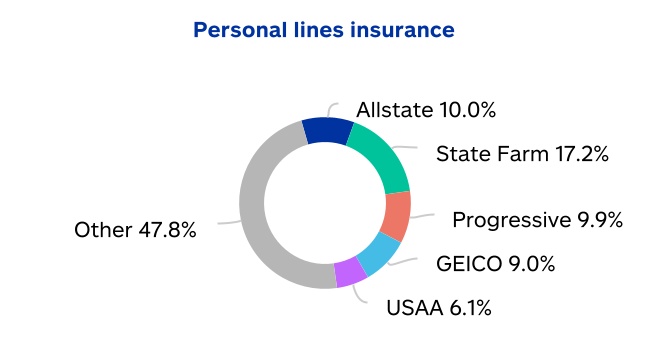
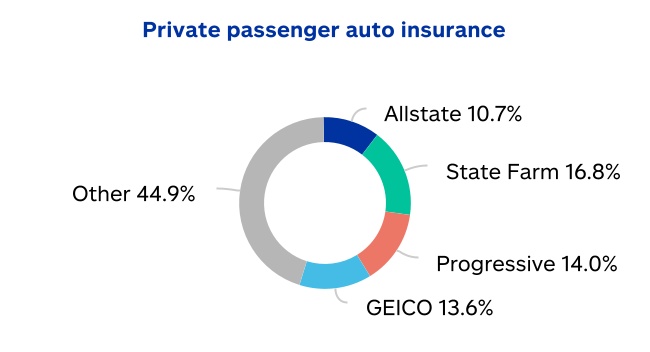
The personal lines insurance markets, including private passenger auto and homeowners insurance, are highly competitive. The following charts provide Allstate Protection’s combined market share compared to our principal U.S. competitors using statutory direct written premium for the year ended December 31, 2022, according to A.M. Best.

Geographic markets
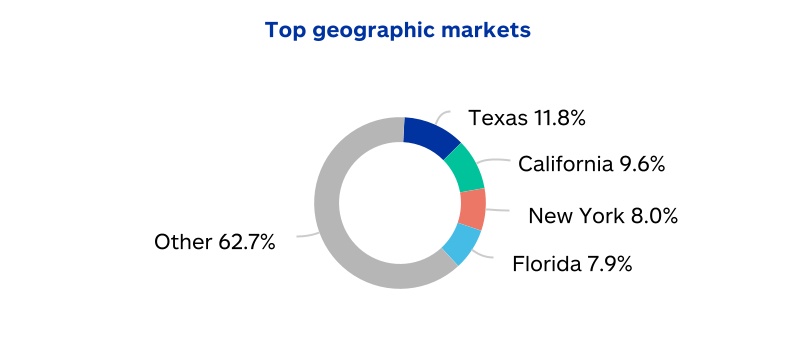
We primarily operate in the U.S. (all 50 states and D.C.) and Canada. Our top geographic markets based on 2023 statutory direct premiums are reflected below.
2023 Form 10-K Item 1. Business
Protection Services Segment
Our Protection Services segment accounted for 4.6% of Allstate’s 2023 consolidated total revenue and 78.5% of Allstate’s December 31, 2023 PIF. Protection Services includes Allstate Protection Plans, Allstate Dealer Services, Allstate Roadside, Arity and Allstate Identity Protection, which offer a broad range of products and services that expand and enhance customer value propositions.
Strategy - Protection Services’ strategy is to innovate new products and services, expand distribution and provide affordable, simple and connected protection solutions.
| Allstate Protection Plans | Expand distribution and product breadth of consumer protection plans through new and existing retailers and mobile operators across North America, Europe, Asia and Australia. | |||||||
| Allstate Dealer Services | Expand distribution of Allstate branded protection and insurance products through auto dealerships, business partnerships and direct to consumer. | |||||||
| Allstate Roadside | Modernize the roadside assistance business through technology and enhance capabilities to deliver a superior customer experience. | |||||||
| Arity | Provide industry leading telematics and mobility insights to insurance companies, the transportation industry and location-enabled consumer apps. Services include: telematics-enabled mobility insights for consumers and businesses, driving behavior data and scores (Arity IQ) to deliver personalized insurance pricing, and marketing services including lead generation and advertising technology integrations to optimize advertising investments. | |||||||
| Allstate Identity Protection | Create a leading position in the identity protection market, offering full-service identity protection and expand partnership and direct to consumer distribution channels. |
Products and distribution
| Products and services | ||||||||
| Allstate Protection Plans | Provides consumer protection plans and related technical support for mobile phones, consumer electronics, furniture and appliances which provide customers protection from mechanical or electrical failure, and in certain cases, accidental damage. | |||||||
| Allstate Dealer Services | Offers protection and insurance products, including vehicle service contracts, guaranteed asset protection waivers, road hazard tire and wheel protection, and paint and fabric protection. | |||||||
| Allstate Roadside | Offers towing, jump-start, lockout, fuel delivery and tire change services to retail customers and customers of our wholesale partners. | |||||||
| Arity | Provides insights and services created from data collected, normalized and analyzed by the Arity platform, including automotive telematics information. Product suite includes on-demand risk scoring, lead generation, digital advertising, data integration, traditional telematics, and data-as-a-service solutions. | |||||||
| Allstate Identity Protection | Provides identity, consumer cybersecurity, privacy and family digital safety protection. |
| Distribution channels | ||||||||
| Allstate Protection Plans | Retailers and mobile operators, in-store or online. | |||||||
| Allstate Dealer Services | Independent agents selling through auto dealerships in the U.S. in conjunction with the purchase of a new or used vehicle, through business partnerships and direct to consumer. | |||||||
| Allstate Roadside | Allstate exclusive agents, direct to consumer, wholesale partners, affinity groups and on-demand mobile application service. | |||||||
| Arity | Sells directly to affiliate and non-affiliate customers and through strategic partners. | |||||||
| Allstate Identity Protection | Primarily through workplace benefit programs with growth in partnerships and direct to consumer delivered through enterprise partnerships, online and mobile application sales. |
Geographic markets
Protection Services primarily operates in the U.S. and Canada, with Allstate Protection Plans also offering services in Europe, Australia and Asia.
Competition
We compete on a variety of factors, including product offerings, brand recognition, financial strength, price and customer experience. The market for these services is highly competitive.
The Allstate Corporation 9
2023 Form 10-K Item 1. Business
Allstate Health and Benefits Segment
Strategy
Allstate Health and Benefits segment accounted for 4.2% of Allstate’s 2023 consolidated total revenue and 2.1% of Allstate’s December 31, 2023 PIF. The Allstate Health and Benefits segment provides consumers with financial protection against the risk of accidents, illness and mortality. We are among the industry leaders in the growing and highly competitive voluntary benefits market, offering a broad range of accident, health and life products through workplace enrollment. Our life insurance portfolio includes individual and group permanent life solutions. We also provide stop-loss and fully insured group health products to employers and short-term medical and medicare supplement insurance to individuals. Target customers are consumers with family and financial protection needs. Allstate Health and Benefits is well represented in all market segments and is a leader in the large and mega (over 10,000 employees) market segments.
Allstate Health and Benefits is differentiated through its broad product portfolio, flexible enrollment solutions, strong national accounts team and well-recognized brand.
Our strategy for growth is to deliver substantially more value through innovative products and technology, tailored solutions and exceptional service through investments in future-state technologies and data and analytics capabilities.
On November 1, 2023, we announced that we are pursuing the sale of the Health and Benefits business.
Products and distribution
| Health and benefits products | ||||||||
| Employer voluntary benefits | ||||||||
| Group health | ||||||||
| Individual health |
| Distribution channels | ||
| Over 8,000 independent agents and benefits brokers and Allstate exclusive agents, focusing on workplace benefits for small employers, specifically employer voluntary benefits and group health | ||
| Over 33,000 independent agents, in-house agencies, direct-to-consumer marketing, wholesaling, worksite marketing and the internet for individual health |
Competition
We compete on a wide variety of factors, including product offerings, brand recognition, financial strength and ratings, price, distribution and customer service.
The market for voluntary benefits is growing as these products help employees fill the increasing gaps associated with continued medical cost inflation and the shifting of costs from employers to employees. Favorable industry and economic trends have increased competitive pressure and attracted new traditional and non-traditional entrants to the voluntary benefits market. Recent entrants, including large group medical, life and disability insurance carriers, are leveraging core benefit capabilities by bundling and discounting to capture voluntary market share. We also compete with large group medical carriers in our stop-loss, fully insured group health insurance, short-term medical and medicare supplement insurance offerings.
Geographic markets
We primarily operate in the U.S. (all 50 states and D.C.) and Canada. The top geographic markets based on 2023 statutory direct premiums are reflected below. 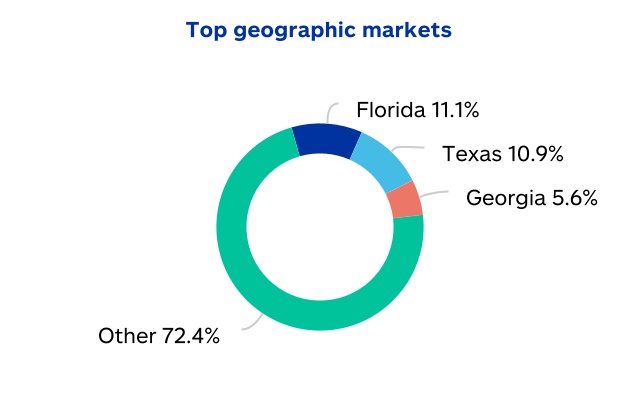
2023 Form 10-K Item 1. Business
Other Business Segments
Run-off Property-Liability Segment
The Run-off Property-Liability segment includes results from property and casualty insurance coverage that primarily relates to policies written during the 1960s through the mid-1980s.
Strategy Management of this segment has been assigned to a designated group of professionals with expertise in claims handling, policy coverage interpretation, exposure identification, litigation and reinsurance collection. We may pursue settlement agreements including policy buybacks on direct excess commercial business when appropriate to improve the certainty of the liabilities. Settlement agreements are negotiated contracts between Allstate and third parties that generally set forth the rights and obligations of the parties, including terms of payment for claims. At the end of 2023, 68% of the gross case reserves, excluding incurred but not reported, on the run-off direct excess commercial business were attributable to settlement agreements. This group also manages other direct commercial and assumed reinsurance business in runoff and engages in reinsurance ceded and assumed commutations as required or when considered economically advantageous.
Changes in the reserves established for asbestos, environmental and other run-off lines losses have occurred and may continue. Reserve changes can be caused by new information relating to new and additional claims, new exposures or the impact of resolving unsettled claims based on unanticipated events such as arbitrations, litigation, legislative, judicial or regulatory actions. Environmental losses may also increase as the result of additional funding for environmental site clean-up.
Challenges related to the concentration of insurance and reinsurance claims from companies who specialize in this business continue to be addressed.
Corporate and Other Segment
Our Corporate and Other segment is comprised of debt service, holding company activities and certain non-insurance operations, including expenses associated with strategic initiatives, such as our Avail peer-to-peer car-sharing initiative.
The Allstate Corporation 11
2023 Form 10-K Item 1. Business
Regulation
Allstate is subject to extensive regulation, primarily at the state level. The method, extent and substance of such regulation vary by state but generally have their source in statutes that establish standards and requirements for conducting the business of insurance and that also delegate regulatory authority to a state agency. These rules have a substantial effect on our business and relate to a wide variety of matters, including insurer solvency and statutory surplus sufficiency, reserve adequacy, insurance company licensing and examination, agent and adjuster licensing, agent and broker compensation, policy forms, rate setting, the nature and amount of investments, claims practices, participation in shared markets and guaranty funds, transactions with affiliates, the payment of dividends, underwriting standards, statutory accounting methods, trade practices, privacy regulation and data security, corporate governance and risk management. In addition, state legislators and insurance regulators continue to examine the appropriate nature and scope of state insurance regulation. For a discussion of statutory financial information, see Note 17 of the consolidated financial statements.
 For a discussion of regulatory contingencies, see Note 15 of the consolidated financial statements. Note 15 and Note 17 are incorporated in this Part I, Item 1 by reference.
The Dodd-Frank Wall Street Reform and Consumer Protection Act (“Dodd-Frank”) created the Federal Insurance Office (“FIO”) within the U.S. Department of the Treasury (“Treasury”). The FIO monitors the insurance industry, provides advice to the Financial Stability Oversight Council (“FSOC”), represents the U.S. on international insurance matters, and studies the current regulatory system.
Additional regulations or new requirements may emerge from the activities of various regulatory entities, including the Federal Reserve Board, FIO, FSOC, the National Association of Insurance Commissioners (“NAIC”), and the International Association of Insurance Supervisors, that are evaluating solvency and capital standards for insurance company groups. In addition, the NAIC has adopted amendments to its model holding company law that have been adopted by some jurisdictions. The outcome of these actions is uncertain; however, these actions may impact the business models and profitability of insurance holding companies.
We cannot predict whether any specific state or federal measures will be adopted to change the nature or scope of the regulation of insurance or what effect any such measures would have on Allstate. We are working for changes in the regulatory environment to make insurance more available and affordable for customers, encourage market innovation, improve driving safety, strengthen cybersecurity and promote better catastrophe preparedness and loss mitigation.
Limitations on Dividends by Insurance Subsidiaries As a holding company with most business operations conducted by subsidiaries, The Allstate Corporation relies on dividends from Allstate Insurance Company as one of the principal sources of cash to pay dividends and to meet its obligations, including the payment of principal and interest on debt or to fund non-insurance-related businesses. Allstate Insurance Company is regulated as an insurance company in Illinois, and its ability to pay dividends is restricted by Illinois law. The laws of the other jurisdictions that generally govern our other insurance subsidiaries contain similar limitations on the payment of dividends. However, such laws in some jurisdictions may be more restrictive.
For additional information regarding limitations, see Part II, Item 7 - Management’s Discussion and Analysis of Financial Condition and Results of Operations of this report.
In addition, the NAIC adopted a group capital calculation covering all entities of the insurance company group for use in solvency monitoring activities by regulators. Any increase in the amount of capital or reserves our insurance subsidiaries are required to hold could reduce the amount of future dividends such subsidiaries are able to distribute to the holding company. Any reduction in the risk-based capital (“RBC”) ratios of our insurance subsidiaries could also adversely affect their financial strength ratings as determined by statistical rating agencies. We have not experienced, and we do not expect to experience, any impact from the group capital calculation on our current dividend plans.
Insurance Holding Company Regulation – Change of Control The Allstate Corporation is a holding company and its insurance subsidiaries are subject to regulation in the jurisdictions in which they write business. In the U.S., these subsidiaries are organized under the insurance codes of Alabama, California, Florida, Illinois, Indiana, Massachusetts, Michigan, Mississippi, Missouri, New Jersey, New York, North Carolina, Ohio, South Carolina and Texas. Additionally, some of these subsidiaries are considered commercially domiciled in California, Florida, and Texas.
Generally, the insurance codes in these states provide that the acquisition or change of “control” of a domestic or commercially domiciled insurer or of any person that controls such an insurer cannot be consummated without the prior approval of the relevant insurance regulator. In general, a presumption of “control” arises from the ownership, control, possession with the power to vote, or possession of proxies with respect to ten percent or more of the voting securities of an insurer or of a person who controls an insurer. In addition, certain state insurance laws require pre-acquisition notification to state agencies of a change in control with respect to a non-domestic insurance company licensed to do business in that state. While such pre-acquisition notification
2023 Form 10-K Item 1. Business
statutes do not authorize the state agency to disapprove the change of control, such statutes do authorize certain remedies, including the issuance of a cease-and-desist order with respect to the non-domestic insurer if certain conditions exist, such as undue market concentration.
Thus, any transaction involving the acquisition of ten percent or more of The Allstate Corporation’s common stock would generally require prior approval by the state insurance departments in Alabama (where the threshold is five percent or more of The Allstate Corporation’s common stock), California, Florida, Illinois, Indiana, Massachusetts, Michigan, Mississippi, Missouri, New Jersey, New York, North Carolina, Ohio, South Carolina and Texas. Moreover, notification would be required in those other states that have adopted pre-acquisition notification provisions and where the insurance subsidiaries are admitted to transact business. Such approval requirements may deter, delay or prevent certain transactions affecting the ownership of The Allstate Corporation’s common stock.
Rate Regulation Nearly all states have insurance laws requiring personal property and casualty insurers to file rating plans, policy or coverage forms, and other information with the state’s regulatory authority. In many cases, such rating plans, policy forms, or both must be approved prior to use.
The speed with which an insurer can change rates in response to competition or increasing costs depends on the state rating laws, which include the following categories:
-
Prior approval — Regulators must approve a rate before the insurer may use it (21 states)
-
File-and-use — Insurers do not have to wait for the regulator’s approval to use a rate, but the rate must be filed with the regulatory authority prior to being used (20 states)
-
Use-and-file — Requires an insurer to file rates within a certain period of time after the insurer begins using them (9 states)
-
No filing or approval — One state, with an immaterial amount of written premiums, does not require a filing to be submitted
Under these rating laws, the regulator has the authority to disapprove a rate filing.

An insurer’s ability to adjust its rates in response to competition or to changing costs is dependent on an insurer’s ability to demonstrate to the regulator that its rates or proposed rating plan meets the requirements of the rating laws. In those states that significantly restrict an insurer’s discretion in selecting the business that it wants to underwrite, an insurer can manage its risk of loss by charging a rate that reflects the cost and expense of providing the insurance. In those states that significantly restrict an insurer’s ability to charge a rate that reflects the cost and expense of providing the insurance, the insurer may be able to manage its risk of loss by being more selective in the type of business it underwrites. When a state significantly restricts both underwriting and pricing, it becomes more difficult for an insurer to maintain its targeted level of profitability.
From time to time, the personal lines insurance industry comes under pressure from state regulators, legislators, and special-interest groups to reduce, freeze, or set rates at levels that do not correspond with our analysis of underlying costs, catastrophe loss exposure, and expenses. We expect this kind of pressure to persist. Allstate and other insurers are using increasingly sophisticated pricing models and rating plans that are reviewed by regulators and special-interest groups. States may limit the ability of insurers to include variables in their rating plans even though they are indicative of risk. State regulators may interpret existing law or rely on future legislation or regulations to impose new restrictions that adversely affect profitability or growth. We cannot predict the impact on our business of possible future legislative and regulatory measures regarding insurance rates.
Involuntary Markets As a condition of maintaining our licenses to write personal property and casualty insurance in various states, we are required to participate in assigned risk plans, reinsurance facilities, and joint underwriting associations that provide various types of insurance coverage to individuals or entities that otherwise are unable to purchase such coverage from private insurers. Underwriting results related to these arrangements, which tend to be adverse, have been immaterial to our results of operations.
For a discussion of these items see Note 15 of the consolidated financial statements. Note 15 is incorporated in this Part I, Item 1 by reference.
Indemnification Programs We are a participant in state-based industry pools, facilities or associations, mandating participation by insurers offering certain coverage in their state, including the Michigan Catastrophic Claims Association (“MCCA”), the New Jersey Property-Liability Insurance Guaranty Association, the North Carolina Reinsurance Facility and the Florida Hurricane Catastrophe Fund. We also participate in the Federal Government National Flood Insurance Program.
The Allstate Corporation 13
2023 Form 10-K Item 1. Business
Recent regulatory changes have occurred related to the MCCA.
-
On July 2, 2021, Public Acts 21 and 22, which passed in 2019, became effective, setting fee schedules for personal injury protection claims. Such fee schedules were set at 200% of Medicare rates in 2021, declining to 195% in 2022 and 190% in 2023, for any providers other than certain unique categories of providers and applying to treatment on existing and new claims.
-
Other legislative proposals to change the MCCA operation in the future and to adjust Public Acts 21 and 22 are put forth periodically, as well as a recent Michigan Supreme Court decision that found that the reimbursement rates described above applied only to motor vehicle accidents occurring in 2019 or later.
For a discussion of these items see Note 11 of the consolidated financial statements. Note 11 is incorporated in this Part I, Item 1 by reference.
Guaranty Funds Under state insurance guaranty fund laws, insurers doing business in a state can be assessed, up to prescribed limits, in order to cover certain obligations of insolvent insurance companies. We do not anticipate any material adverse financial impact on Allstate from these assessments.
Investment Regulation Our insurance subsidiaries are subject to state regulation that specifies the types of investments that can be made and concentration limits of invested assets. Failure to comply with these rules leads to the treatment of non-conforming investments as non-admitted assets for purposes of measuring statutory surplus. Further, in some instances, these rules require divestiture of non-conforming investments.
Exiting Geographic Markets; Canceling and Non-Renewing Policies Most states regulate an insurer’s ability to exit a market. For example, states may limit, to varying degrees, an insurer’s ability to cancel and non-renew policies. Some states restrict or prohibit an insurer from withdrawing one or more types of insurance business from the state, except pursuant to a plan that is approved by the state insurance department. Regulations that limit cancellation and non-renewal and that subject withdrawal plans to prior approval requirements may restrict an insurer’s ability to exit unprofitable markets.
Broker-Dealer and Investment Advisers The Allstate entities that operate as a broker-dealer and registered investment advisers are subject to regulation and supervision by the Securities and Exchange Commission (“SEC”), Financial Institution Regulatory Authority and/or, in some cases, state securities administrators. The SEC has proposed rules and amendments related to cybersecurity risk management and cybersecurity-related disclosure for broker-dealers, registered investment advisers, registered investment companies, and business development companies. Certain state and federal regulators are considering or have implemented best
interest or fiduciary standards. Such standards could impact products provided by Allstate agents and Allstate’s broker-dealer, their sales processes, sales volume, and producer compensation arrangements.
Inflation Reduction Act of 2022 The Inflation Reduction Act of 2022, which contains several tax-related provisions, was signed into law in August 2022. The law creates a 15% corporate alternative minimum tax (“CAMT”) on certain large corporations and an excise tax of 1% on stock repurchases by publicly traded U.S. corporations, both effective after December 31, 2022. The excise tax on common stock repurchases is classified as an additional cost of the stock acquired included in treasury stock in shareholders' equity. The Company has determined that it is considered an “applicable corporation” under the rules of CAMT.
15% Global Minimum Tax The Organization for Economic Cooperation and Development (“OECD”) secured agreement from nearly 140 countries to address how corporate profits are taxed for multinational enterprises (“MNEs”). OECD has released Pillar Two Model Rules, a 15% minimum effective tax rate (also known as the Global Anti-Base Erosion “GloBE” Rules), designed to ensure that large MNEs pay a minimum level of tax on the income arising in each jurisdiction where they operate and mandates sharing of certain company information with taxing authorities on a local and global basis.
Certain jurisdictions have enacted, and others have proposed, legislation to implement certain provisions of Pillar Two for fiscal years beginning on or after December 31, 2023. We are continuing to monitor the implications resulting from the potential enactment of Pillar Two rules in the jurisdictions where we operate.
Climate disclosures In March 2022, the SEC released its climate-related proposed regulation, requiring registrants to provide certain climate-related information in their registration statements and annual reports. The proposed rule would require information about a registrant’s climate-related risks that are reasonably likely to have a material impact on its business, results of operations, or financial condition. The required information about climate-related risks would also include disclosure of a registrant’s greenhouse gas emissions, which have become a commonly used metric to assess a registrant’s exposure to such risks. In addition, under the proposed rule, certain climate-related financial metrics would be required in a registrant’s audited financial statements. The Company is evaluating the anticipated impacts of the proposed guidance to its disclosures.
In October 2023, California enacted several climate disclosure bills. One of these is the Climate Corporate Data Accountability Act (Senate Bill 253), which requires disclosure and assurance over greenhouse gas emissions using a phased reporting approach. The law requires the California Air Resources Board to develop and adopt implementing regulations no later than January 1, 2025. Allstate has publicly reported its greenhouse gas inventory since 2010. We will continue
2023 Form 10-K Item 1. Business
evaluating the anticipated impacts and scope of the new laws on our reporting and disclosures.
Dodd-Frank: Covered Agreement On September 22, 2017, the U.S. and European Union signed a Covered Agreement, a bilateral agreement that “relates to the recognition of prudential measures with respect to the business of insurance or reinsurance that achieves a level of protection for insurance or reinsurance consumers that is substantially equivalent to the level of protection achieved under State insurance or reinsurance regulation.”
The U.S. had five years from the date of signing to amend its credit for reinsurance laws and regulations to conform with the requirements of the Covered Agreement or face federal preemption determinations by the FIO. To address the requirements of the Covered Agreement, the NAIC formally adopted revisions to its existing credit for reinsurance model law and model regulation, with the expectation that states would adopt and implement the modified model law and regulation by September 2022. A sufficient number of states have adopted the model law and/or regulation to avoid federal preemption.
Division Statute On November 27, 2018, the Illinois General Assembly passed legislation authorizing a statute that makes available a process by which a domestic insurance company may divide into two or more domestic insurance companies. The statute, which became effective January 1, 2019, can be used to divide continuing blocks of insurance business from insurance business no longer marketed, or otherwise discontinued into separate companies with separate capital. The statute can also be used for sale to a third party or to manage risks associated with indemnification programs. Before a plan of division can be effected it must be approved according to the organizational documents of the dividing insurer and submitted for approval by the Illinois Department of Insurance. In 2021, Allstate Insurance Company and certain affiliate insurance companies utilized the division statute to form three Illinois domiciled insurance companies that retained assets and liabilities for certain Michigan automobile insurance policies with catastrophic personal injury claims that are ceded to the MCCA.
Privacy Regulation and Data Security Federal law and the laws of many states require financial institutions to protect the security and confidentiality of consumer information and to notify consumers about their policies and practices relating to collection, use, disclosure, and protection of consumer information. Federal law and the laws of many states also regulate disclosures and disposal of consumer information. Congress, state legislatures, and regulatory authorities are currently considering additional regulation relating to privacy of personal information.
For example, the California Consumer Privacy Act, as amended by the California Privacy Rights Act, which took effect in January 2023, as well as similar laws in Virginia, Connecticut, and approximately nine other states (with various effective dates), impose significant compliance requirements for certain businesses in those states. Among other things, these privacy laws provide consumers with privacy rights such as the right to request access to or deletion of their personal information. The California Privacy Rights Act established a new privacy regulatory agency. In November 2023, the New York State Department of Financial Services amended its cybersecurity regulation, including both new and heightened requirements. The NAIC created an Insurance Data Security Model Law, which several states have adopted in some form, establishing standards for data security, including the investigation of and notification to insurance commissioners of cybersecurity events. Additional states are also likely to adopt similarly themed cybersecurity requirements in the future. We cannot predict the impact on our business of possible future legislative or regulatory measures regarding privacy or cybersecurity.
Asbestos Congress has repeatedly considered legislation to address asbestos claims and litigation in the past. We cannot predict the impact on our business of possible future legislative measures regarding asbestos.
Environmental Environmental pollution and clean-up of polluted waste sites is the subject of federal and state regulation. The Comprehensive Environmental Response Compensation and Liability Act of 1980 (the “Superfund”) and comparable state statutes (the “mini-Superfunds”) govern the clean-up and restoration of waste sites by Potentially Responsible Parties (“PRPs”). The Superfund and the mini-Superfunds (collectively, the “Environmental Clean-up Laws” or “ECLs”) establish a mechanism to assign liability to PRPs or to fund the clean-up of waste sites if PRPs fail to do so. The extent of liability to be allocated to a PRP depends on a variety of factors. The insurance industry is involved in extensive litigation regarding coverage issues arising out of the clean-up of waste sites by insured PRPs and the insured parties’ alleged liability to third parties responsible for the clean-up. The insurance industry, including Allstate, has disputed and is disputing many such claims. Key coverage issues include whether the Superfund response, investigation, and clean-up costs are considered damages under the policies; whether coverage has been triggered; whether any pollution exclusion applies; whether there has been proper notice of claims; whether administrative liability triggers the duty to defend; whether there is an appropriate allocation of liability among potentially responsible insurers; and whether the liability in question falls within the definition of an “occurrence.” Identical coverage issues exist for clean-up and waste sites not covered under the Superfund. To date, courts have been inconsistent in their rulings on these issues.
The Allstate Corporation 15
2023 Form 10-K Item 1. Business
Allstate’s exposure to liability with regard to its insureds that have been, or may be, named as PRPs is uncertain. While comprehensive Superfund reform proposals have been introduced in Congress, only modest reform measures have been enacted. In May 2017, the Environmental Protection Agency created a Superfund Task Force that issued proposed reforms in its 2019 final report. These recommendations address expediting clean-up and remediation processes, reducing the financial burden of the clean-up process, encouraging private investment, promoting redevelopment and community revitalization, and building and strengthening partnerships. We cannot predict which, if any, of these reforms will be enacted or, if enacted, what their impact may be.
Developments in the insurance and reinsurance industries have fostered a movement to segregate asbestos, environmental and other run-off lines exposures into separate legal entities with dedicated capital. Regulatory bodies in certain cases have supported these actions. We are unable to determine the impact, if any, that these developments will have on the collectability of reinsurance recoverables in the future.
2023 Form 10-K Item 1. Business
Human Capital
Allstate’s success is highly dependent on human capital. The wellbeing of our employees is a key priority, and Allstate strives to promote a dynamic and welcoming workplace that promotes inclusive diversity and equity, fosters collaboration, and encourages employees to be fully engaged in their work every day. As of December 31, 2023, Allstate had approximately 53,000 full-time employees and 400 part-time employees.
Allstate’s human capital management focuses on the following priorities:
Talent Recruitment and Management We seek to provide employees with rewarding work, professional growth and educational opportunities.
-
Our flexible work and equal opportunity policies support talent attraction and retention. This has enabled us to recruit a more geographically dispersed and diverse talent pool, as well as to reduce our facilities footprint.
-
Performance review and development takes place throughout the year, with a renewed focus on driving performance through ongoing feedback and coaching. Allstate invests in training and re-skilling opportunities, with most of our learning experiences offered virtually to support our remote and global workforce.
-
In 2023, Allstate:
–Introduced a new education benefit provider, Guild. Guild expands support and access to over 80 tuition-free professional degrees, certificates and bootcamps to all U.S. based employees at more than 25 schools.
–Completed more than 450 thousand hours of voluntary continued learning from external and internal providers
–Delivered over 400 virtually facilitated workshops focused on technical upskilling, well-being, on-boarding, Inclusive Diversity and Equity (“IDE”), and leadership development, totaling close to 800 hours of learning for over 10,000 participants
–Invested over $2.4 million towards the cost of the degrees of almost 700 U.S. employees.
–Filled over 28% of open U.S. positions with internal applicants.
Inclusive Diversity and Equity We strive for a workforce where the breadth of our diversity makes us a better company. IDE is one of Allstate’s core values of Our Shared Purpose.
| U.S. workforce diversity as of December 31, 2023 | |||||||||||
| Women | 55% | ||||||||||
| Racially and ethnically diverse | 40% |
-
Talent acquisition, development, retention, and mobility practices support employees in achieving their career aspirations. We work to create a diverse talent pipeline.
-
As part of our commitment to fair and equitable compensation practices, we complete pay equity analyses. Annually, we identify potential pay gaps across substantially similar employee groups as well as identify policies, practices or systematic issues that may contribute to pay gaps. The external analyses found that Allstate’s results compared well to benchmarks for companies of similar size and scope.
-
Allstate supports and funds Employee Impact Groups (“EIGs”) and Business Impact Groups (“BIGs”) to help advance IDE and create opportunities for employees to work together to create business solutions.
–EIGs are voluntary employee-led communities that enhance the employee experience through engagement, development and collaboration. They bring value to participants and impact Allstate through cultural education and awareness, market and community outreach, professional development, recruiting, retention, and customer engagement. EIGs are required to interact with at least two other EIGs annually.
–BIGs, voluntary employee-led groups that focus on creating business impact and serve as an incubator for innovation, collaboration and professional development.
–Officers from across the enterprise leverage their time, networks and resources to support the EIGs and BIGs, and positively impact employee engagement and feelings of belonging at Allstate.
- Allstate continues to make significant progress on our IDE strategy while aligning it to Allstate’s global talent strategy. In 2023, we:
–Improved representation by attracting more qualified candidates with remote work options. We’ve seen an increase in applicants since we announced our permanent flexible work environment, including an increase in diverse candidates.
–Since the Allstate IDE A.C.T. (Accountability, Clarity, Transparency) Framework rolled out in 2022, every business unit now has either an IDE Inclusion Council or an IDE Business Lead that partners with Human Resources on their business area-based action plans to achieve our corporate IDE strategy.
–Incorporated IDE behavior questions into structured interviews for executive candidates.
The Allstate Corporation 17
2023 Form 10-K Item 1. Business
Employee Well-being and Safety We believe in a culture of well-being and take our responsibility to care for employees’ well-being seriously, devoting resources to employee health and safety.
-
Allstate created a workplace well-being strategy based on employee feedback, including providing greater flexibility in how, when, and where work is done.
-
Allstate hosts enterprise-wide talks with subject matter experts sharing personal stories and fact-based best practices to provide tangible ways employees can support their individual journey. EIGs promote sessions that are relevant to their networks to build a sense of community.
-
Communications and voluntary courses facilitated by internal performance coaches on well-being themes of mind, body, wallet and community are shared so employees can engage in content that matters most to them.
-
Well-being assessments are offered to understand employee needs and wants to support their well-being. Completing the assessment lowers the cost of benefits to employees and allows Allstate to provide holistic programs based on personalized interests.
-
Our Wellbeing Champion community connects their teams and leaders with Allstate’s health and wellness resources and promotes opportunities to engage in programs, including virtual yoga and meditation classes offered four times a week.
Organizational Culture Allstate defines culture as a self-sustaining system of shared values, priorities and principles that shape beliefs and drive behaviors and decision-making within an organization. Allstate encourages employees to proactively manage their career so it is integrated into their personal purpose. This includes investing in and holding management accountable for employee development and maintaining a culture aligned with Our Shared Purpose at all levels.
-
We have a strong culture built on shared purpose, values, standards, and behaviors and are transforming to become the lowest cost protection provider with an affordable, simple, connected experience.
-
We focus on Integrity & Ethics, Belonging, Meaningful Work, Performance Standards, Career Development, Employee Listening, Distributed Work and Well-being to make Allstate a place talent loves.
-
Allstate continues to commit to leadership development, now with the introduction of the Leading at Allstate program. This initiative, focusing on leading change, performance and growth, leadership styles, and leading distributed teams, saw a successful fourth quarter early adopter pilot. Notably, over 250 leaders completed live sessions, with feedback indicating a 95% willingness to recommend the learning and 97% employee satisfaction with the content.
-
Allstate, driven by a leadership-instilled commitment to Inclusive Diversity and Equity, launched a tool that helps learners discover their work-style preference, integrating it into the Degreed learning system. This initiative breaks barriers and fosters inclusion through IDE resources, accessible via both traditional classroom training and the Degreed Learning Hub. Over 3,300 individuals accessed the work-style preferences tool.
For additional information, please see the section titled “Our Key Sustainability Priorities-People” in our Proxy Statement.
In addition to the above discussion of our employees, please see information about Allstate agents under the caption “Allstate Protection Segment - Products and Distribution” in Part I, Item 1 of this report.
2023 Form 10-K Item 1. Business
Website
Our website is allstate.com. The Allstate Corporation’s annual reports on Form 10-K, quarterly reports on Form 10-Q, current reports on Form 8-K and any amendments to such reports that we file or furnish pursuant to Section 13(a) of the Securities Exchange Act of 1934 are available on the Investor Relations section of our website (www.allstateinvestors.com), free of charge, as soon as reasonably practicable after they are electronically filed or furnished to the SEC and available at www.sec.gov. In addition, our Corporate Governance Guidelines, our Global Code of Business Conduct, and the charters of our Audit Committee, Compensation and Human Capital Committee, Executive Committee, Nominating, Governance and Social Responsibility Committee and Risk and Return Committee are available on the Investor Relations section of our website. The information found on our website is not incorporated by reference into this Annual Report on Form 10-K or in any other report or document filed with the SEC.
Other Information About Allstate
-
Allstate’s five reportable segments use shared services, including human resources, investment, finance, information technology and legal services, provided by Allstate Insurance Company and other affiliates.
-
Although the insurance business generally is not seasonal, claims and claims expense for the Allstate Protection segment tend to be higher for periods of severe or inclement weather.
-
“Allstate®” is a very well-recognized brand name in the United States. We use the “Allstate®”, “National General®” and “Answer Financial®” brands extensively in our business. We also provide additional protection products and services through “Allstate® Protection Plans”, “Allstate® Dealer Services®”, “Allstate® Roadside”, “Arity®”, “Allstate® Identity Protection” “Allstate® Benefits” and “Allstate® Health Solutions”, among others. These brands, products and services are supported with the related service marks, logos, and slogans. Our rights in the United States to these names, service marks, logos and slogans continue as long as we continue to use them in commerce. Many service marks used by Allstate are the subject of renewable U.S. and/or foreign service mark registrations. We believe that these service marks are important to our business and we intend to maintain our rights to them.
The Allstate Corporation 19
2023 Form 10-K Item 1. Business
Information about our Executive Officers
The following table sets forth the names of our executive officers as of February 1, 2024, their ages, positions, business experience, and the years of their first election as officers. “AIC” refers to Allstate Insurance Company. Each of the officers named below may be removed from office at any time, with or without cause, by the board of directors of the relevant company.
| Name | Age | Position with Allstate and Business Experience | Year First Elected Officer | |||||||||||||||||
| Thomas J. Wilson | 66 | Chairman of the Board (May 2008 to present), President (June 2005 to January 2015 and February 2018 to present), and Chief Executive Officer (January 2007 to present) of The Allstate Corporation and AIC. | 1995 | |||||||||||||||||
| Elizabeth A. Brady | 59 | Executive Vice President, Chief Marketing, Customer and Communications Officer of AIC (January 2020 to present); Executive Vice President and Chief Marketing, Innovation and Corporate Relations Officer of AIC (August 2018 to January 2020). | 2018 | |||||||||||||||||
| Christine M. DeBiase | 55 | Executive Vice President, Chief Legal Officer, General Counsel and Corporate Secretary of The Allstate Corporation and AIC (January 2023 to present); Executive Vice President, Chief Administrative Officer and General Counsel of Brighthouse Financial (February 2018 to December 2022). | 2023 | |||||||||||||||||
| John E. Dugenske | 57 | President, Investments and Corporate Strategy of AIC (September 2022 to present); President, Investments and Financial Products of AIC (January 2020 to September 2022); Executive Vice President and Chief Investment and Corporate Strategy Officer of AIC (January 2018 to January 2020). | 2017 | |||||||||||||||||
| Suren Gupta | 62 | President, Protection Products & Enterprise Services (August 2023 to present); President, Enterprise Services (October 2022 to August 2023); Executive Vice President, Chief Information Technology and Enterprise Services Officer of AIC (January 2020 to October 2022); Executive Vice President, Enterprise Technology and Strategic Ventures of AIC (February 2015 to January 2020). | 2011 | |||||||||||||||||
| Zulfikar Jeevanjee | 59 | Executive Vice President, Chief Information Officer of AIC (October 2022 to present); Senior Vice President, Chief Technology Officer, CVS Health (February 2021 to September 2022); Senior Vice President, Chief Enterprise Architect of AIC (November 2018 to February 2021); Senior Vice President, Group Technology Manager, Wells Fargo (December 2008 to October 2018). | 2022 | |||||||||||||||||
| Jesse E. Merten | 49 | Executive Vice President and Chief Financial Officer of The Allstate Corporation and AIC (September 2022 to present); President, Financial Products of AIC (May 2020 to September 2022); Executive Vice President and Chief Risk Officer of AIC (December 2017 to May 2020); Treasurer of The Allstate Corporation (January 2015 to April 2019) and of AIC (February 2015 to May 2019). | 2012 | |||||||||||||||||
| John C. Pintozzi | 58 | Senior Vice President, Controller and Chief Accounting Officer of The Allstate Corporation and AIC (September 2019 to present); Senior Vice President and Chief Financial Officer, Allstate Investments (May 2012 to August 2019). | 2005 | |||||||||||||||||
| Mark Q. Prindiville | 56 | Executive Vice President and Chief Risk Officer of AIC (May 2020 to present); Senior Vice President of AIC (September 2016 to May 2020). | 2016 | |||||||||||||||||
| Mario Rizzo | 57 | President, Property-Liability of AIC (September 2022 to present); Executive Vice President and Chief Financial Officer of The Allstate Corporation and AIC (January 2018 to September 2022). | 2010 | |||||||||||||||||
| Robert Toohey | 56 | Executive Vice President and Chief Human Resources Officer of AIC (March 2022 to present); Self-Employed Talent and Operations Advisor/Consultant (August 2021 to March 2022); President of Pymetrics (May 2019 to August 2021). | 2022 |
2023 Form 10-K Item 1. Business
Forward-Looking Statements
This report contains “forward-looking statements” that anticipate results based on our estimates, assumptions and plans that are subject to uncertainty. These statements are made subject to the safe-harbor provisions of the Private Securities Litigation Reform Act of 1995. Forward-looking statements do not relate strictly to historical or current facts and may be identified by their use of words like “plans,” “seeks,” “expects,” “will,” “should,” “anticipates,” “estimates,” “intends,” “believes,” “likely,” “targets” and other words with similar meanings. These statements may address, among other things, our strategy for growth, catastrophe exposure management, product development, investment results, regulatory approvals, market position, expenses, financial results, litigation and reserves. We believe that these statements are based on reasonable estimates, assumptions and plans. Forward-looking statements speak only as of the date on which they are made, and we assume no obligation to update any forward-looking statements as a result of new information or future events or developments. In addition, forward-looking statements are subject to certain risks or uncertainties that could cause actual results to differ materially from those communicated in these forward-looking statements. These risks and uncertainties include, but are not limited to, those described in Part 1, “Item 1A. Risk Factors” and elsewhere in this report and those described from time to time in our other reports filed with the Securities and Exchange Commission.
The Allstate Corporation 21
2023 Form 10-K Part I - Item 1A. Risk Factors and Other Disclosures
Previous: Cover and table of contents · Next: Item 1A. Risk Factors