 filings.tools
Allegion 10-K 2017-12-31
Filed 2018-02-20. 22 sections, 411K characters. Original on sec.gov · Markdown · JSON
Cover and table of contents
10-K 1 alle10k12312017doc.htm 10-K DATED FEBRUARY 20, 2018
UNITED STATES SECURITIES AND EXCHANGE COMMISSION
Washington, D.C. 20549
FORM 10-K
(Mark One)
| X | ANNUAL REPORT PURSUANT TO SECTION 13 OR 15(d) OF THE SECURITIES EXCHANGE ACT OF 1934 |
For the fiscal year ended December 31, 2017
or
| — | TRANSITION REPORT PURSUANT TO SECTION 13 OR 15(d) OF THE SECURITIES EXCHANGE ACT OF 1934 |
For the transition period from to
Commission File No. 001-35971

ALLEGION PUBLIC LIMITED COMPANY
(Exact name of registrant as specified in its charter)
| Ireland | 98-1108930 | |
| (State or other jurisdiction of incorporation or organization) | (I.R.S. Employer Identification No.) |
Block D
Iveagh Court
Harcourt Road
Dublin 2, Ireland
(Address of principal executive offices)
Registrant’s telephone number, including area code: +(353) (1) 2546200
Securities registered pursuant to Section 12(b) of the Act:
| Title of each class | Name of each exchange on which registered | |
| Ordinary Shares, | New York Stock Exchange | |
| Par Value $0.01 per Share |
Securities registered pursuant to Section 12(g) of the Act: None
Indicate by check mark if the registrant is a well-known seasoned issuer, as defined in Rule 405 of the Securities Act. YES x NO ¨
Indicate by check mark if the registrant is not required to file reports pursuant to Section 13 or Section 15(d) of the Act. YES ¨ NO x
Indicate by check mark whether the registrant (1) has filed all reports required to be filed by Section 13 or 15(d) of the Securities Exchange Act of 1934 during the preceding 12 months (or for such shorter period that the registrant was required to file such reports), and (2) has been subject to such filing requirements for the past 90 days. YES x NO ¨
Indicate by check mark whether the registrant has submitted electronically and posted on its corporate Web site, if any, every Interactive Data File required to be submitted and posted pursuant to Rule 405 of Regulation S-T (§232.405 of this chapter) during the preceding 12 months (or for such shorter period that the registrant was required to submit and post such files). YES x NO ¨
Indicate by check mark if disclosure of delinquent filers pursuant to Item 405 of Regulation S-K (§229.405 of this chapter) is not contained herein, and will not be contained, to the best of registrant’s knowledge, in definitive proxy or information statements incorporated by reference in Part III of this Form 10-K or any amendment to this Form 10-K. YES x NO ¨
Indicate by check mark whether the registrant is a large accelerated filer, an accelerated filer, a non-accelerated filer, or a smaller reporting company. See the definitions of "large accelerated filer," "accelerated filer" and "smaller reporting company" in Rule 12b-2 of the Exchange Act.:
| Large accelerated filer | x | Accelerated filer | ¨ |
| Non-accelerated filer | ¨ | Smaller reporting company | ¨ |
| (Do not check if a smaller reporting company) | |||
| Emerging growth company | ¨ |
If an emerging growth company, indicate by check mark if the registrant has elected not to use the extended transition period for complying with any new or revised financial accounting standards provided pursuant to Section 13(a) of the Exchange Act. ¨
Indicate by check mark whether the registrant is a shell company (as defined in Rule 12b-2 of the Act). YES ¨ NO x
The aggregate market value of ordinary shares held by non-affiliates on June 30, 2017 was approximately $7.7 billion based on the closing price of such stock on the New York Stock Exchange.
The number of ordinary shares outstanding as of February 16, 2018 was 95,185,418.
DOCUMENTS INCORPORATED BY REFERENCE
Portions of the registrant’s definitive proxy statement to be filed within 120 days of the close of the registrant’s fiscal year in connection with the registrant’s Annual General Meeting of Shareholders to be held June 5, 2018 (the "Proxy Statement") are incorporated by reference into Part II and Part III of this Form 10-K.
ALLEGION PLC
Form 10-K
For the Fiscal Year Ended December 31, 2017
TABLE OF CONTENTS
CAUTIONARY STATEMENT FOR FORWARD LOOKING STATEMENTS
Certain statements in this report, other than purely historical information, are "forward-looking statements" within the meaning of the Private Securities Litigation Reform Act of 1995, Section 27A of the Securities Act of 1933 and Section 21E of the Securities Exchange Act of 1934. These forward-looking statements generally are identified by the words "believe," "project," "expect," "anticipate," "estimate," "forecast," "outlook," "intend," "strategy," "plan," "may," "should," "will," "would," "will be," "will continue," "will likely result," or the negative thereof or variations thereon or similar terminology generally intended to identify forward-looking statements.
Forward-looking statements may relate to such matters as projections of revenue, margins, expenses, tax provisions, earnings, cash flows, benefit obligations, dividends, share purchases or other financial items; any statements of the plans, strategies and objectives of management for future operations, including those relating to any statements concerning expected development, performance or market share relating to our products and services; any statements regarding future economic conditions or our performance; any statements regarding pending investigations, claims or disputes; any statements of expectation or belief; and any statements of assumptions underlying any of the foregoing. These statements are based on currently available information and our current assumptions, expectations and projections about future events. While we believe that our assumptions, expectations and projections are reasonable in view of the currently available information, you are cautioned not to place undue reliance on our forward-looking statements. You are advised to review any further disclosures we make on related subjects in materials we file with or furnish to the SEC. Forward-looking statements speak only as of the date they are made and are not guarantees of future performance. They are subject to future events, risks and uncertainties - many of which are beyond our control - as well as potentially inaccurate assumptions, that could cause actual results to differ materially from our expectations and projections. We do not undertake to update any forward-looking statements.
Factors that might affect our forward-looking statements include, among other things:
| • | economic, political and business conditions in the markets in which we operate; |
| • | the demand for our products and services; |
| • | competitive factors in the industry in which we compete; |
| • | the ability to protect and use intellectual property; |
| • | fluctuations in currency exchange rates; |
| • | the ability to complete and integrate any acquisitions; |
| • | our ability to operate efficiently and productively; |
| • | our ability to manage risks related to our information technology and cyber-security; |
| • | changes in tax requirements (including tax rate changes, new tax laws and revised tax law interpretations); |
| • | the outcome of any litigation, governmental investigations or proceedings; |
| • | interest rate fluctuations and other changes in borrowing costs; |
| • | other capital market conditions, including availability of funding sources and currency exchange rate fluctuations; |
| • | availability of and fluctuations in the prices of key commodities and the impact of higher energy prices; |
| • | potential further impairment of our goodwill, indefinite-lived intangible assets and/or our long-lived assets; |
| • | the possible effects on us of future legislation or interpretations in the U.S. that may limit or eliminate potential U.S. tax benefits resulting from our incorporation in a non-U.S. jurisdiction, such as Ireland, or deny U.S. government contracts to us based upon our incorporation in such non-U.S. jurisdiction; and |
| • | the impact our outstanding indebtedness may have on our business and operations. |
Some of the significant risks and uncertainties that could cause actual results to differ materially from our expectations and projections are described more fully in Item 1A "Risk Factors." You should read that information in conjunction with "Management's Discussion and Analysis of Financial Condition and Results of Operations" in Item 7 of this report and our Consolidated Financial Statements and related notes in Item 8 of this report. We note such information for investors as permitted by the Private Securities Litigation Reform Act of 1995.
PART I
Item 1. BUSINESS
Overview
Allegion plc ("Allegion," "we," "us" or "the Company") is a leading global provider of security products and solutions that keep people safe, secure and productive. We make the world safer as a company of experts, securing the places where people thrive, and we create peace of mind by pioneering safety and security. We offer an extensive and versatile portfolio of mechanical and electronic security products across a range of market-leading brands. Our experts across the globe deliver high-quality security products, services and systems, and we use our deep expertise to serve as trusted partners to end-users who seek customized solutions to their security needs.
| Allegion Principal Products | |
| Door closers and controls | Doors and door systems |
| Electronic security products | Electronic and biometric access control systems |
| Exit devices | Locks, locksets, portable locks and key systems |
| Time, attendance and workforce productivity systems | Other accessories |
Access control security products and solutions are critical elements in every building and home. Many door openings are configured to maximize a room’s particular form and function while also meeting local and national building and safety code requirements and end-user security needs. Most buildings have multiple door openings, each serving its own purpose and requiring different specific access-control solutions. Each door must fit exactly within its frame, be prepared precisely for its hinges, synchronize with its specific lockset and corresponding latch and align with a specific key to secure the door. Moreover, security products are increasingly linked electronically, creating additional functionality and complexity.
We believe our ability to deliver a wide range of solutions that can be custom-configured to meet end-users’ security needs is a key driver of our success. We accomplish this with:
| • | Our extensive and versatile product portfolio, combined with our deep expertise, which enables us to deliver the right products and solutions to meet diverse security and functional specifications; |
| • | Our consultative approach and expertise, which enables us to develop the most efficient and appropriate building security and access-control specifications to fulfill the unique needs of our end-users and their partners, including architects, contractors, home-builders and engineers; |
| • | Our access to and management of key channels in the market, which is critical to delivering our products in an efficient and consistent manner; and |
| • | Our enterprise excellence capabilities, including our global manufacturing operations and agile supply chain, which facilitate our ability to deliver specific product and system configurations to end-users worldwide, quickly and efficiently. |
We believe that the security products industry is growing and will continue to benefit from several global macroeconomic and long-term demographic trends, including:
| • | stabilization of construction markets in key North American markets; |
| • | the convergence of mechanical and electronic security products; |
| • | heightened awareness of security requirements; |
| • | increased global urbanization; and |
| • | the shift to a digital, interconnected environment. |
We believe the security products industry will also benefit from continued growth in institutional, commercial, and residential end-markets. We also expect growth in the global electronic product categories we serve to outperform the security products industry as end-users adopt newer technologies in their facilities.
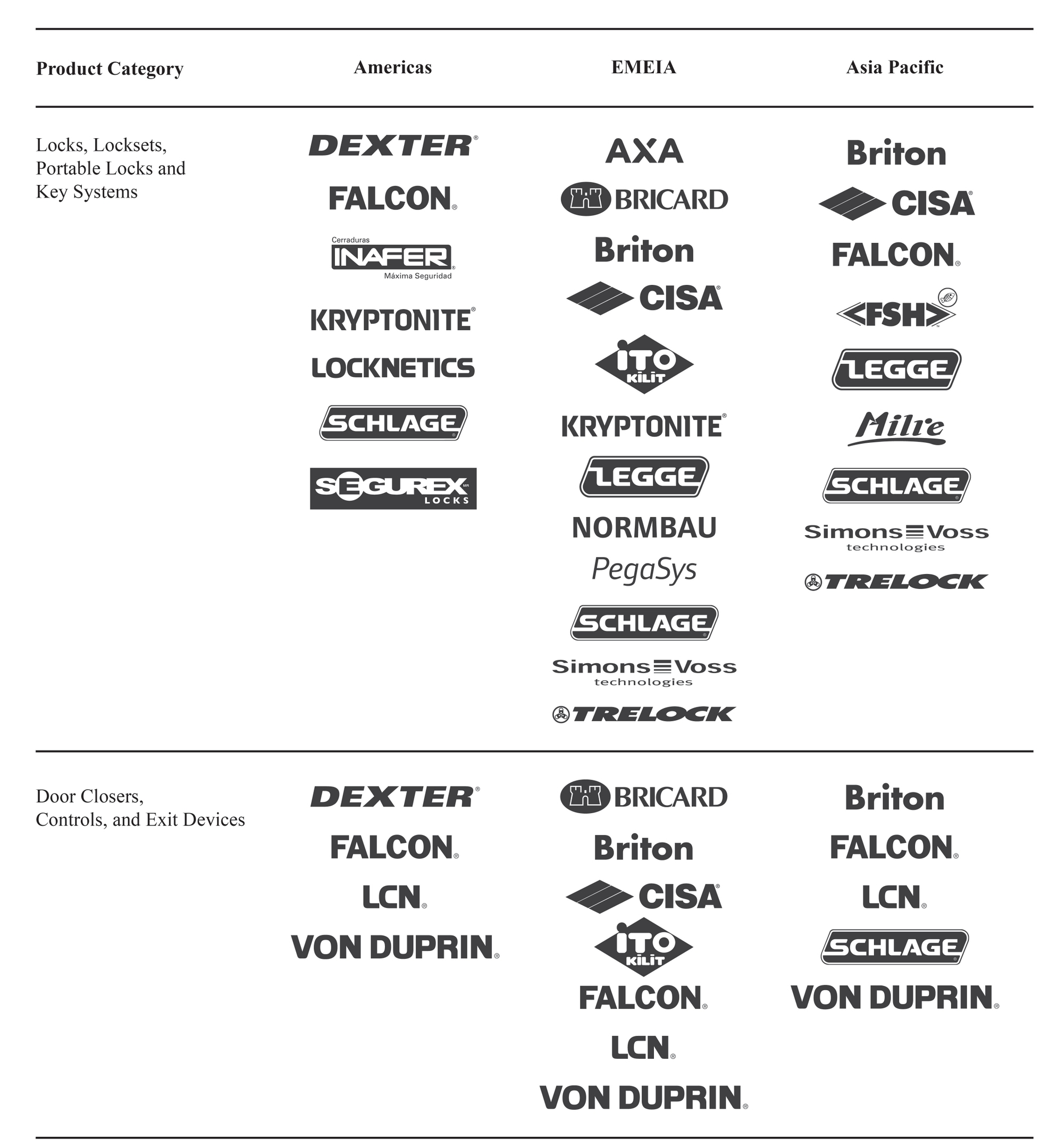
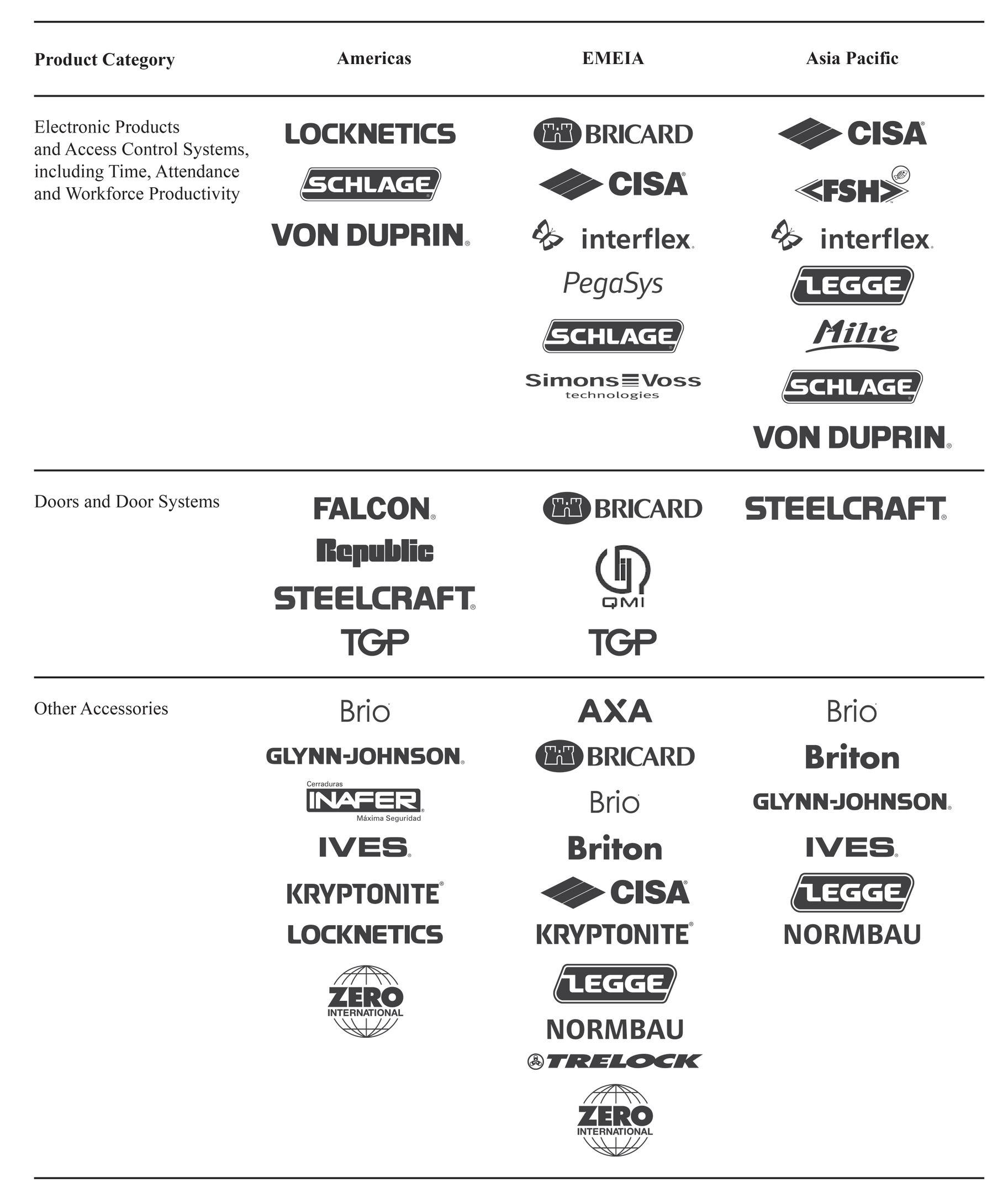
We operate in three geographic regions: Americas; Europe, Middle East, India and Africa ("EMEIA"); and Asia Pacific. We sell our products and solutions under the following brands:
| Allegion Brands | |||
| (listed for each region) | |||
 |
 |
We sell a wide range of security products and solutions for end-users in commercial, institutional and residential facilities worldwide, including into the education, healthcare, government, hospitality, commercial office and single and multi-family residential markets. Our corporate brands are CISA®, Interflex®, LCN®, Schlage®, SimonsVoss®, and Von Duprin®. We believe LCN, Schlage, and Von Duprin hold the No. 1 position in their primary product categories in North America and CISA, Interflex, and SimonVoss hold the No.1 or No. 2 position in their primary product categories in certain European markets.
For the year ended December 31, 2017, we generated revenues of $2,408.2 million and operating income of $488.2 million.
History and Developments
We were incorporated in Ireland on May 9, 2013, to hold the commercial and residential security businesses of Ingersoll Rand plc ("Ingersoll Rand"). On December 1, 2013, we became a stand-alone public company after Ingersoll Rand completed the separation of these businesses from the rest of Ingersoll Rand via the transfer of these businesses from Ingersoll Rand to us and the issuance by us of ordinary shares directly to Ingersoll Rand’s shareholders (the "Spin-off"). Our security businesses have long and distinguished operating histories. Several of our brands were established more than 75 years ago and many of our brands originally created their categories:
| • | Von Duprin, established in 1908, was awarded the first exit device patent; |
| • | Schlage, established in 1920, was awarded the first patents granted for the cylindrical lock and the push button lock; |
| • | LCN, established in 1926, created the first door closer; |
| • | CISA, established in 1926, devised the first electronically controlled lock; and |
| • | SimonsVoss, established in 1995, created the first keyless digital transponder. |
We have built upon these founding legacies since our entry into the security products market through the acquisition of Schlage, Von Duprin and LCN in 1974. Today, we continue to develop and introduce innovative and market-leading products. Recent examples of successful product launches are illustrated in the table below:
| Product | Brands | Year | Innovation | |||
| Residential Locks and Levers | Schlage Touch, Connect, Sense, Control, SEL, Custom | 2015/2016/ 2017 | New single and multi-family residential electronic locking platforms that provide for keyless entry (Touch), connected locking (Connect), integration with the Internet of Things (IoT) and Apple HomeKit, Amazon Alexa, Google Assistant and Android platforms (Sense), multi-family interconnected locking (Control), 4-in-1 locks, fingerprint sensors, and smart card or code access (SEL). A new range with universal functionality (Custom) allows homeowners to change from a doorknob to a lever and convert a non-locking door to lockable in minutes. | |||
| Commercial Locks and Electronic Access Platforms | Schlage, CISA, SimonsVoss | 2015/2016/ 2017 | Access control platforms and proximity readers and smart credentials upgraded for improved strength and durability (Schlage). Comprehensive offerings featuring mechanical, wired electrified and wireless electronic solutions for common aesthetic and consistent user experience throughout a building. Wireless locks able to be managed with ENGAGE™ web and mobile apps or with our Software Alliance Member (SAM) systems (Schlage LE and NDE). Multipoint locking line (CISA) designed for high security European applications, correcting for heat distortion. MobileKey (SimonsVoss) provides facility managers highly secure and sophisticated access control with mobile phone technology. | |||
| Closers | LCN, Briton, CISA, ITO Kilit | 2015/2016/ 2017 | Cast Aluminum Series closers (LCN) were specially designed to deliver consistent, dependable and long-term performance. New closers (Briton, CISA, ITO Kilit) significantly expanded the European standard portfolio in 2017, offering affordable quality and specialty applications. | |||
| Exit Devices | Von Duprin, CISA | 2016/2017 | Concealed vertical cables (Von Duprin) give doors aesthetics, strength and security in an exit device system that is easy to install and maintain. e-Fast motorized push bars (CISA) now include lighting features. | |||
| Bike Lighting and Portable Locking Solutions | AXA, Kryptonite, Trelock | 2017 | Innovation in bike safety and security from each of our Global Portable Security brands (AXA, Kryptonite and Trelock), ranging from compact dynamo lights and e-bike lights to USB and battery powered lights, as well as new lines of folding locks, integrated chains and electronic ring locks and mobile applications for bikes and motorcycles. |
Industry and Competition
The global markets we serve encompass commercial, institutional and residential construction markets throughout North America, Europe, the Middle East and Asia-Pacific. In recent years, growth in electronic security products and solutions continues to outperform the industry as a whole as end-users adopt newer technologies in their facilities. We expect the security products industry will benefit from favorable long-term demographic trends such as continued urbanization of the global population, increased concerns about safety and security and technology-driven innovation.
The security products markets are highly competitive and fragmented throughout the world, with a number of large multi-national companies and thousands of smaller regional and local companies. This high fragmentation primarily reflects local regulatory requirements and highly variable end-user needs. We believe our principal global competitors are Assa Abloy AB and dorma+kaba Group. We also face competition in various markets and product categories throughout the world, including from Spectrum Brands Holdings, Inc. in the North American residential market. As we move into more technologically-advanced product categories, we may also compete against new, more specialized competitors.
Our success depends on a variety of factors, including brand and reputation, product breadth, quality and delivery capabilities, price and service capabilities. As many of our businesses sell through wholesale distribution, our success also depends on building and partnering with a strong channel network. Although price often serves as an important customer decision criterion, we also compete based on the breadth and quality of our products and solutions, our ability to custom-configure solutions to meet individual end-user requirements and our global supply chain.
Our Reporting Segments
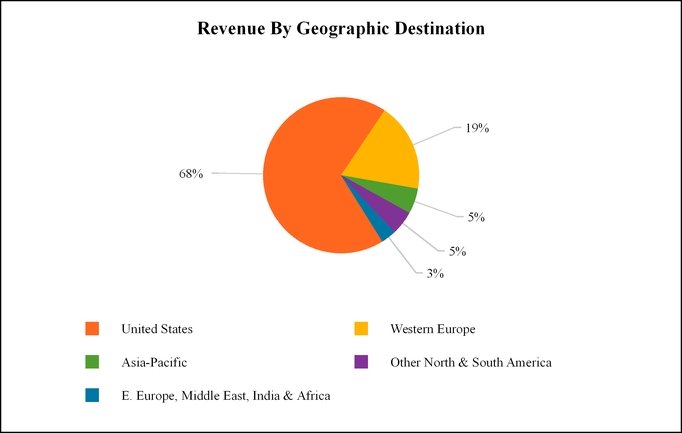
We manufacture and sell mechanical and electronic security products and solutions in approximately 130 countries. Approximately 96% of our 2017 revenues were to customers in the North America, Western Europe and the Asia-Pacific regions.
The following table presents the relative percentages of total segment revenue attributable to each reporting segment for each of the last three fiscal years. See Note 20, "Business Segment Information," to our annual consolidated financial statements for information regarding net revenues, operating income, and total assets by reportable segment:
| For the Years Ended December 31 | |||||
| 2017 | 2016 | 2015 | |||
| Americas | 73% | 74% | 75% | ||
| EMEIA | 22% | 21% | 19% | ||
| Asia Pacific | 5% | 5% | 6% |
Our Americas segment provides security products and solutions in approximately 30 countries throughout North America, Central America, the Caribbean and South America. The segment offers a broad range of products and solutions including locks, locksets, portable locks, key systems, door closers, exit devices, doors and door systems, electronic products, and access control and time and attendance systems to end-users in the commercial, institutional and residential markets, including into the education, healthcare, government, commercial office and single and multi-family residential markets. This segment’s primary brands are LCN, Schlage, and Von Duprin.
Our EMEIA segment provides security products and solutions in approximately 85 countries throughout Europe, the Middle East, India and Africa. The segment offers the same portfolio of products as the Americas segment, as well as workforce productivity solutions. This segment’s primary brands are AXA, Bricard, CISA, Interflex and SimonsVoss. This segment also resells North American LCN, Schlage, and Von Duprin products, primarily in the Middle East.
Our Asia Pacific segment provides security products and solutions in approximately 15 countries throughout Asia Pacific. The segment offers the same portfolio of products as the Americas segment. This segment’s primary brands are Brio, FSH, Legge, Milre, and Schlage.
Products and Services
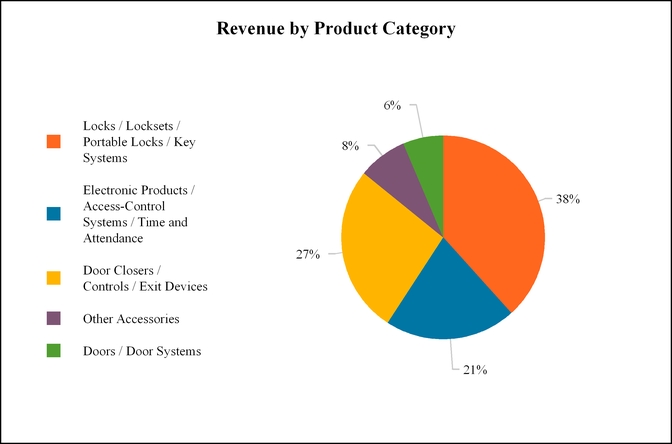
We offer an extensive and versatile portfolio of mechanical and electronic security products across a range of market-leading brands:
| • | Locks, locksets, portable locks and key systems: A broad array of cylindrical and mortise door locksets, security levers, and master key systems that are used to protect and control access. We also offer a range of portable security products, including bicycle, small vehicle and travel locks. |
| • | Door closers and exit devices: An extensive portfolio of life-safety products generally installed on fire doors and facility entrances and exits. Door closers are devices that automatically close doors after they are opened. Exit devices are generally horizontal attachments to doors and enable rapid egress. |
| • | Electronic security products and access control systems: A broad range of electrified locks, access control systems, biometric hand reader systems, key card and reader systems and accessories, including Internet of Things (IoT) and cloud-based solutions. |
| • | Time, attendance and workforce productivity systems: Products and services designed to help business customers manage and monitor workforce access control parameters, attendance and employee scheduling. We offer ongoing aftermarket services in addition to design and installation offerings. |
| • | Doors and door systems: A portfolio of hollow metal, glass, wood, and specialty doors and door systems. |
| • | Other accessories: A variety of additional security and product components, including hinges, door levers, door stops, lights, louvers, weather stripping, thresholds, and other accessories, as well as certain bathroom fittings. |
Customers
We sell most of our products and solutions through distribution and retail channels, ranging from specialty distribution to wholesalers. We have built a network of channel partners that help our customers choose the right solution to meet their security needs and help commercial and institutional end-users fulfill and install orders. We also sell through a variety of retail channels, ranging from large do-it-yourself home improvement centers to small, specialty showroom outlets. We work with our retail partners on developing marketing and merchandising strategies to maximize their sales per square foot of shelf space. Through our Interflex business and Global Portable Security brands, we also provide products and solutions directly to end-users.
Our 10 largest customers represented approximately 25% of our total revenues in 2017. No single customer represented 10% or more of our total revenues in 2017.
Sales and Marketing
In markets where we sell through commercial and institutional distribution channels, we employ sales professionals around the world who work with a combination of end-users, security professionals, architects, contractors, engineers and distribution partners to develop specific custom-configured solutions for our end-users’ needs. Our field sales professionals are assisted by specification writers who work with architects, engineers and consultants to help design door openings and security systems to meet end-users’ functional, aesthetic and regulatory requirements. Both groups are supported by dedicated customer care and technical sales-support specialists worldwide. We also support our sales efforts with a variety of marketing efforts, including trade-specific advertising, cooperative distributor merchandising, digital marketing, and marketing at a variety of industry trade shows.
In markets in which we sell through retail and home-builder distribution channels, we have teams of sales, merchandising and marketing professionals who help drive brand and product awareness through our channel partners and to consumers. We utilize a variety of advertising and marketing strategies, including traditional consumer media, retail merchandising, digital marketing, retail promotions, and builder and consumer trade shows, to support these teams.
We also work actively with several industry bodies around the world to help promote effective and consistent safety and security standards. For example, we are members of Builders Hardware Manufacturers Association (BHMA), Security Industry Association, Smart Card Alliance, American Society of Healthcare Engineering, American Institute of Architects, Construction Specification Institute, ASSOFERMA (Italy), BHE (Germany) and UNIQ (France). We also have established the Safety and Security Institute in China, which helps to educate government officials, architects and builders and advocates for consistent building codes and standards that address end-users’ safety and security.
Production and Distribution
We manufacture our products in our geographic markets around the world. We operate 31 production and assembly facilities, including 14 in the Americas region, 12 in EMEIA and 5 in Asia Pacific. We own 15 of these facilities and lease the others. Our
strategy is to produce in the region of use, wherever appropriate, to allow us to be closer to the end-user and increase efficiency and timely product delivery. Much of our United States (U.S.) based residential portfolio is manufactured in the Baja Region of Mexico under a NAFTA Maquiladora.
In managing our network of production facilities, we focus on eliminating excess capacity, reducing cycle time through productivity, and harmonizing production practices and safety procedures.
We distribute our products through a broad network of channel partners. In addition, third-party logistics providers perform storage and distribution services for us to support certain parts of our distribution network.
Raw Materials
We support our region-of-use production strategy with corresponding region-of-use supplier partners, where available. Our global and regional commodity teams work with production leadership, product management and materials management teams to ensure adequate materials are available for production.
We purchase a wide range of raw materials, including steel, zinc, brass and other non-ferrous metals, to support our production facilities. Where appropriate, we may enter into fixed-cost contracts to lower overall costs.
Intellectual Property
Intellectual property, inclusive of certain patents, trademarks, copyrights, know-how, trade secrets and other proprietary rights, is important to our business. We create, protect and enforce our intellectual property investments in a variety of ways. We work actively in the U.S. and internationally to try to ensure the protection and enforcement of our intellectual property rights. We use trademarks on nearly all of our products and believe that such distinctive marks are an important factor in creating a market for our goods, in identifying us and in distinguishing our products from others. We consider our Schlage, Von Duprin, LCN, CISA, SimonsVoss, Interflex and other associated trademarks to be among our most valuable assets, and we have registered these trademarks in a number of countries. Although certain proprietary intellectual property rights are important to our success, we do not believe we are materially dependent on any particular patent or license, or any particular group of patents or licenses.
Facilities
We operate through a broad network of sales offices, engineering centers, 31 production facilities and several distribution centers throughout the world. Our active properties represent approximately 7.0 million square feet, of which approximately 47% is leased.
The following table shows the location of our worldwide production facilities:
| Production Facilities | ||||
| Americas | EMEIA | Asia Pacific | ||
| Blue Ash, Ohio | Clamecy, France | Auckland, New Zealand | ||
| Bogota, Colombia | Dubai, United Arab Emirates | Bucheon, South Korea | ||
| Chino, California | Durchhausen, Germany | Jinshan, China | ||
| Ensenada, Mexico | Duzce, Turkey | Melbourne, Australia | ||
| Indianapolis, Indiana | Faenza, Italy | Sydney, Australia | ||
| Irving, Texas | Feuquieres, France | |||
| McKenzie, Tennessee | Monsampolo, Italy | |||
| Perrysburg, Ohio | Muenster, Germany | |||
| Princeton, Illinois | Osterfeld, Germany | |||
| Security, Colorado | Renchen, Germany | |||
| Snoqualmie, Washington | Siewierz, Poland | |||
| Tecate, Mexico | Veenendaal, Netherlands | |||
| Tijuana, Mexico | ||||
| Toronto, Ontario |
Research and Development
We are committed to investing in highly productive research and development capabilities, particularly in electro-mechanical systems. Our research and development ("R&D") expenditures were approximately $48.3 million, $47.3 million and $45.2 million for the years ended December 31, 2017, 2016 and 2015, respectively.
We concentrate on developing technology innovations that will deliver growth through the introduction of new products and solutions, and also on driving continuous improvements in product cost, quality, safety and sustainability.
We manage our R&D team as a global group with an emphasis on a global collaborative approach to identify and develop new technologies and worldwide product platforms. We are organized on a regional basis to leverage expertise in local standards and configurations. In addition to regional engineering centers in each geographic region, we also operate a global engineering center of excellence in Bangalore, India.
Seasonality
Our business experiences seasonality that varies by product line. Because more construction and do-it-yourself projects occur during the second and third calendar quarters of each year in the Northern Hemisphere, our security product sales, typically, are higher in those quarters than in the first and fourth calendar quarters. However, our Interflex business typically experiences higher sales in the fourth calendar quarter due to project timing. Revenue by quarter for the years ended December 31, 2017, 2016 and 2015 are as follows:
| First Quarter | Second Quarter | Third Quarter | Fourth Quarter | |
| 2017 | 23% | 26% | 25% | 26% |
| 2016 | 22% | 26% | 26% | 26% |
| 2015 | 22% | 25% | 26% | 27% |
Employees
We currently have approximately 10,000 employees.
Environmental Regulation
We have a dedicated environmental program that is designed to reduce the utilization and generation of hazardous materials during the manufacturing process as well as to remediate identified environmental concerns. As to the latter, we are currently engaged in site investigations and remediation activities to address environmental cleanup from past operations at current and former production facilities. The Company regularly evaluates its remediation programs and considers alternative remediation methods that are in addition to, or in replacement of, those currently utilized by the Company based upon enhanced technology and regulatory changes.
We are sometimes a party to environmental lawsuits and claims and have received notices of potential violations of environmental laws and regulations from the U.S. Environmental Protection Agency (the "EPA") and similar state authorities. We have also been identified as a potentially responsible party ("PRP") for cleanup costs associated with off-site waste disposal at federal Superfund and state remediation sites. For all such sites, there are other PRPs and, in most instances, our involvement is minimal.
In estimating our liability, we have assumed that we will not bear the entire cost of remediation of any site to the exclusion of other PRPs who may be jointly and severally liable. The ability of other PRPs to participate has been taken into account, based on our understanding of the parties’ financial condition and probable contributions on a per site basis. Additional lawsuits and claims involving environmental matters are likely to arise from time to time in the future.
We incurred $3.2 million, $23.3 million, and $4.4 million of expenses during the years ended December 31, 2017, 2016, and 2015, respectively, for environmental remediation at sites presently or formerly owned or leased by us. As of December 31, 2017 and 2016, we have recorded reserves for environmental matters of $28.9 million and $30.6 million. Of these amounts $8.9 million and $9.6 million, respectively, relate to remediation of sites previously disposed by us. Given the evolving nature of environmental laws, regulations and technology, the ultimate cost of future compliance is uncertain.
Available Information
We are required to file annual, quarterly, and current reports, proxy statements, and other documents with the U.S. Securities and Exchange Commission ("SEC"). The public may read and copy any materials filed with the SEC at the SEC’s Public Reference Room at 100 F Street, N.E., Washington, D.C. 20549. The public may obtain information on the operation of the Public Reference Room by calling the SEC at 1-800-SEC-0330. Also, the SEC maintains an Internet website that contains reports, proxy and information statements, and other information regarding issuers that file electronically with the SEC. The public can obtain any documents that are filed by us at http://www.sec.gov.
In addition, this Annual Report on Form 10-K, as well as future quarterly reports on Form 10-Q, current reports on Form 8-K and any amendments to all of the foregoing reports, are made available free of charge on our Internet website (http://www.allegion.com) as soon as reasonably practicable after such reports are electronically filed with or furnished to the SEC. The contents of our website are not incorporated by reference in this report.
Item 1A. RISK FACTORS
You should carefully consider the risks below, together with all the other information included in this Form 10-K, in evaluating us, our ordinary shares and our senior notes. If any of the risks below actually occurs, our business, financial conditions, results of operations and cash flows could be materially and adversely affected. Any such adverse effect may cause the trading price of our ordinary shares to decline, and as a result, you could lose all or part of your investment in us. Our business may also be adversely affected by risks and uncertainties not known to us or risks that we currently believe to be immaterial.
Risks Related to Our Business
Our global operations subject us to economic risks.
We are incorporated in Ireland and operate in countries worldwide. Our global operations depend on products manufactured, purchased and sold in the U.S. and internationally, including in Australia, China, Europe, Korea, Mexico, New Zealand and Turkey. The political, economic and regulatory environments in which we operate are becoming increasingly volatile and uncertain. Accordingly, we are subject to risks that are inherent in operating globally, including:
| • | changes in laws and regulations or imposition of currency restrictions and other restraints in various jurisdictions; |
| • | limitation of ownership rights, including expropriation of assets by a local government, and limitation on the ability to repatriate earnings; |
| • | sovereign debt crises and currency instability in developed and developing countries; |
| • | changes in applicable tax regulations and interpretations; |
| • | imposition of burdensome tariffs and quotas; |
| • | difficulty in staffing and managing global operations; |
| • | difficulty in enforcing agreements, collecting receivables and protecting assets through non-U.S. legal systems; |
| • | political unrest, national and international conflict, including war, civil disturbances and terrorist acts; and |
| • | economic downturns and social and political instability. |
These risks could increase our cost of doing business in the U.S. and internationally, increase our counterparty risk, disrupt our operations, disrupt the ability of suppliers and customers to fulfill their obligations, increase our effective tax rate, increase the cost of our products, limit our ability to sell products in certain markets, reduce our operating margin and negatively impact our ability to compete.
Our business relies on the commercial and residential construction and remodeling markets.
We primarily rely on the commercial and residential construction and remodeling markets, which are marked by cyclicality based on overall economic conditions. Weakness or instability in these markets may cause current and potential customers to delay or choose not to make purchases, which could negatively impact the demand for our products and services.
Increased competition, including from technical developments, could adversely affect our business.
The markets in which we operate include a large number of participants, including multi-national companies, regional companies and small local companies. We primarily compete on the basis of quality, innovation, expertise, breadth of product offering and price. We may be unable to effectively compete on all these bases. If we are unable to anticipate evolving trends in the market or the timing and scale of our competitors’ activities and initiatives, the demand for our products and services could be negatively impacted.
In addition, we compete in a market that is experiencing the convergence of the mechanical, electronic, and digital products. Technology and innovation play significant roles in the competitive landscape. Our success depends, in part, upon the research, development, and implementation of new technologies and products. Securing key partnerships and alliances as well as employee talent, including having access to technologies, services, intellectual property, and solutions developed by others will play a significant role in our ability to effectively compete. The continual development of new technologies by existing and new competitors, including non-traditional competitors with significant resources, could adversely affect our ability to sustain operating margins and desirable levels of sales volumes. To remain competitive, we must develop new products and respond to new technologies in a timely manner.
Our growth is dependent, in part, on the development, commercialization and acceptance of new products and services.
We must develop and commercialize new products and services in order to remain competitive in our current and future markets and in order to continue to grow our business. We cannot provide any assurance that any new product or service will be successfully commercialized in a timely manner, if ever, or, if commercialized, will result in returns greater than our investment. Investment in a product or service could divert our attention and resources from other projects that become more commercially viable in the market. We also cannot provide any assurance that any new product or service will be accepted by the market.
Changes in customer preferences and the inability to maintain beneficial relationships with large customers could adversely affect our business.
We have significant customers, particularly major retailers, although no one customer represented 10% or more of our total revenues in any of the past three fiscal years. The loss or material reduction of business, the lack of success of sales initiatives or changes in customer preferences or loyalties for our products related to any such significant customer could have a material adverse impact on our business. In addition, major customers who are volume purchasers are much larger than us and have strong bargaining power with suppliers. This limits our ability to recover cost increases through higher selling prices. Furthermore, unanticipated inventory adjustments by these customers can have a negative impact on sales.
Our brands are important assets of our businesses and violation of our trademark rights by imitators could negatively impact revenues and brand reputation.
Our brands and trademarks enjoy a reputation for quality and value and are important to our success and competitive position. Unauthorized use of our trademarks may not only erode sales of our products, but may also cause significant damage to our brand name and reputation, interfere with relationships with our customers and increase litigation costs. There can be no assurance that our on-going effort to protect our brand and trademark rights will prevent all violations.
Currency exchange rate fluctuations may adversely affect our results.
We are exposed to a variety of market risks, including the effects of changes in currency exchange rates. See "Management’s Discussion and Analysis of Financial Condition and Results of Operations - Quantitative and Qualitative Disclosure About Market Risk."
Approximately 30% of our 2017 net revenues were derived outside the U.S., and we expect sales to non-U.S. customers to continue to represent a significant portion of our consolidated net revenues. Although we may enter into currency exchange contracts to reduce our risk related to currency exchange fluctuations, changes in the relative fair values of currencies occur from time to time and may, in some instances, have a material impact on our results of operations. Because we do not hedge against all of our currency exposure our business will continue to be susceptible to currency fluctuations.
We also translate assets, liabilities, revenues and expenses denominated in non-U.S. dollar currencies into U.S. dollars for our consolidated financial statements based on applicable exchange rates. Consequently, fluctuations in the value of the U.S. dollar compared to other currencies will have a material impact on the value of these items in our consolidated financial statements, even if their value has not changed in their original currency.
Our business strategy includes making acquisitions and investments that complement our existing business. These acquisitions and investments could be unsuccessful or consume significant resources, which could adversely affect our operating results.
We will continue to analyze and evaluate the acquisition of strategic businesses or product lines with the potential to strengthen our industry position or enhance our existing set of products and services offerings. We cannot assure you that we will identify or successfully complete transactions with suitable acquisition candidates in the future, nor can we assure you that completed acquisitions will be successful.
Some of the businesses we may seek to acquire or invest in may be marginally profitable or unprofitable. For these businesses to achieve acceptable levels of profitability, we must improve their management, operations, products and market penetration. We may not be successful in this regard and we may encounter other difficulties in integrating acquired businesses into our existing operations.
Acquisitions and investments may involve significant cash expenditures, debt incurrence, operating losses and expenses. Acquisitions involve numerous other risks, including:
| • | diversion of management time and attention from daily operations; |
| • | difficulties integrating acquired businesses, technologies and personnel into our business; |
| • | difficulties realizing synergies expected to result from acquisitions; |
| • | difficulties in obtaining and verifying the financial statements and other business information of acquired businesses; |
| • | inability to obtain regulatory approvals and/or required financing on favorable terms; |
| • | potential loss of key employees, key contractual relationships or key customers of acquired companies or of us; |
| • | assumption of the liabilities and exposure to unforeseen liabilities of acquired companies; |
| • | dilution of interests of holders of our ordinary shares through the issuance of equity securities or equity-linked securities; and |
| • | difficulty in integrating financial reporting systems and implementing controls, procedures and policies, including disclosure controls and procedures and internal control over financial reporting, appropriate for public companies of our size at companies that, prior the acquisition, had lacked such controls, procedures and policies. |
We continually look to expand our services and products into international markets. As we expand into new international markets, we will have only limited experience in marketing and operating services and products in such markets. In other instances, we may rely on the efforts and abilities of foreign business partners in such markets. Certain international markets may be slower than domestic markets in adopting our services and products, and our operations in international markets may not develop at a rate that supports our level of investment. In addition to the risks outlined above, expansion into international markets may require us to compete with local businesses with greater knowledge of the market, including the tastes and preferences of customers, and businesses with dominant market shares.
It may be difficult for us to complete transactions quickly, integrate acquired operations efficiently into our current business operations or effectively compete in new markets we enter. Any acquisitions or investments may ultimately harm our business or financial condition, as such acquisitions may not be successful and may ultimately result in impairment charges.
We may pursue business opportunities that diverge from core business.
We may pursue business opportunities that diverge from our core business, including expanding our products or service offerings, investing in new and unproven technologies, and forming new alliances with companies to distribute our products and services. We can offer no assurance that any such business opportunities will prove to be successful. Among other negative effects, our investment in new business opportunities may exceed the returns we realize. Additionally, any new investments could have higher cost structures than our current business, which could reduce operating margins and require more working capital. In the event that working capital requirements exceed operating cash flow, we may be required to draw on our revolving credit facility or pursue other external financing, which may not be readily available.
Our enterprise excellence efforts may not achieve the improvements we expect.
We utilize a number of tools to improve efficiency and productivity. Implementation of new processes to our operations could cause disruptions and there is no assurance that all of our planned enterprise excellence projects will be fully implemented, or if implemented will realize the expected improvements.
Our periodic restructuring plans may not be successful.
We have in the past restructured or made other adjustments to our workforce and manufacturing footprint in response to market changes, product changes, performance issues, change in strategies, acquisitions, and other internal and external considerations. Historically, these types of restructuring have resulted in increased restructuring costs and temporary reduced productivity. In addition, we may not achieve or sustain the expected growth or cost savings benefits of these restructurings, or do so within the expected timeframe. These effects could recur in connection with future acquisitions and other restructurings and our revenues and other results of operations could be negatively affected.
Material adverse legal judgments, fines, penalties or settlements could adversely affect our business.
We are currently and may in the future become involved in legal proceedings and disputes incidental to the operation of our business. Our business may be adversely affected by the outcome of these proceedings and other contingencies (including, without limitation, environmental matters) that cannot be predicted with certainty. As required by U.S. generally accepted accounting principles ("GAAP"), we establish reserves based on our assessment of contingencies. Subsequent developments in legal
proceedings and other contingencies may affect our assessment and estimates of the loss contingency recorded as a reserve and we may be required to make additional material payments.
Allegations that we have infringed the intellectual property rights of third parties could negatively affect us.
We may be subject to claims of infringement of intellectual property rights by third parties. In particular, we often compete in areas having extensive intellectual property rights owned by others and we have become subject to claims alleging infringement of intellectual property rights of others. In general, if it is determined that one or more of our technologies, products or services infringes the intellectual property rights owned by others, we may be required to cease marketing those services, to obtain licenses from the holders of the intellectual property at a material cost or to take other actions to avoid infringing the intellectual property rights. The litigation process is costly and subject to inherent uncertainties, and we may not prevail in litigation matters regardless of the merits of our position. Adverse intellectual property litigation or claims of infringement against us may become extremely disruptive if the plaintiffs succeed in blocking the trade of our products and services and may have a material adverse effect on our business.
Our reputation, ability to do business and results of operations could be impaired by improper conduct by any of our employees, agents or business partners.
We are subject to regulation under a variety of U.S. federal and state and non-U.S. laws, regulations and policies including laws related to anti-corruption, export and import compliance, anti-trust and money laundering, due to our global operations. We cannot provide assurance our internal controls will always protect us from the improper conduct of our employees, agents and business partners. Any improper conduct could damage our reputation and subject us to, among other things, civil and criminal penalties, material fines, equitable remedies (including profit disgorgement and injunctions on future conduct), securities litigation and a general loss of investor confidence.
Disruptions in our global supply chain, including product manufacturing and logistical services provided by outsourcing partners, may negatively impact our business.
Our ability to meet our customers' needs and achieve cost targets depends on our ability to maintain key manufacturing and supply arrangements, including execution of supply chain optimizations and certain sole supplier or sole manufacturing arrangements. The loss or disruption of such manufacturing and supply arrangements could interrupt product supply and, if not effectively managed and remedied, have an adverse impact on our business.
We outsource certain manufacturing and logistical services to partners located throughout the world. Our reliance on these third parties reduces our control over the manufacturing and delivery process, exposing us to risks, including reduced control over quality assurance, product costs, product supply and delivery delays. If we are unable to manage these relationships, or if these third parties experience delays, disruptions, capacity constraints, regulatory issues or quality control problems in their operations or fail to meet our future requirements for timely delivery, our ability to ship and deliver certain of our hardware products to our customers could be impaired and our hardware business could be harmed.
We may be subject to risks relating to our information technology systems.
We rely extensively on information technology systems to manage and operate our business. There can be no assurance that our current information technology systems will function properly. We have invested and will continue to invest in improving our information technology systems. Some of these investments are significant and impact many important operational processes and procedures. There is no assurance that any newly implemented information technology systems will improve our current systems, will improve our operations, or will yield the expected returns on the investments. In addition, the implementation of new information technology systems may cause disruptions in our operations and, if not properly implemented, negatively impact our business. If our information technology systems cease to function properly or if these systems do not provide the anticipated benefits, our ability to manage our operations could be impaired.
We currently rely on a single vendor for many of the critical elements of our global information technology infrastructure and its failure to provide effective support for such infrastructure could negatively impact our business and financial results.
We have outsourced many of the critical elements of our global information technology infrastructure to a third-party service provider in order to achieve efficiencies. If the service provider does not perform or does not perform effectively, we may not be able to achieve the expected efficiencies and may have to incur additional costs to address failures in providing service by the service provider. Depending on the function involved, such non-performance, ineffective performance or failures of service may lead to business disruptions, processing inefficiencies or security breaches.
Disruptions or breaches of our information systems could adversely affect us.
Despite our implementation of network security measures, which have focused on prevention, mitigation, resilience, and recovery, our network and products may be vulnerable to cybersecurity attacks, computer viruses, break-ins and similar disruptions. Cybersecurity attacks and intrusion efforts are continuous and evolving, and in certain cases they have been successful at the most robust institutions. The scope and severity of risks that cyber threats present have increased dramatically, and include, but are not limited to, malicious software, attempts to gain unauthorized access to data, exploiting weaknesses related to vendors or other third parties that could be exploited to attack our systems, denials of service, and other electronic security breaches that could lead to disruptions in systems, unauthorized release of confidential or otherwise protected information and corruption of data. Any such event could have a material adverse effect on our business, operating results and financial condition, as we face regulatory, reputational and litigation risks resulting from potential cyber incidents, as well as the potential of incurring significant remediation costs.
Our daily business operations also require us to retain sensitive data such as intellectual property, proprietary business information and data related to customers, suppliers and business partners within our networking infrastructure. The loss or breach of such information could result in wide reaching negative impacts to our business, and as such, the ongoing maintenance and security of this information is pertinent to the success of our business operations and our strategic goals.
Our networking infrastructure and related assets may be subject to unauthorized access by hackers, employee errors, or other unforeseen activities. Such issues could result in the disruption of business processes, network degradation and system downtime, along with the potential that a third party will exploit our critical assets such as intellectual property, proprietary business information and data related to our customers, suppliers and business partners. To the extent that such disruptions occur, they may cause delays in the manufacture or shipment of our products and the cancellation of customer orders and, as a result, our business operating results and financial condition could be materially and adversely affected resulting in a possible loss of business or brand reputation.
Commodity shortages, price increases and higher energy prices could negatively affect our financial results.
We rely on suppliers to secure commodities, including steel, zinc, brass and other non-ferrous metals, required for the manufacture of our products. A disruption of deliveries from our suppliers or decreased availability of commodities could have an adverse effect on our ability to meet our commitments to customers or increase our operating costs. We believe that available sources of supply will generally be sufficient for our needs for the foreseeable future. Nonetheless, the unavailability of some commodities could have a material adverse impact on our business.
Volatility in the prices of these commodities could increase the costs of our products and services, and we may not be able to pass on these costs to our customers. We do not currently use financial derivatives to hedge against this volatility, however, we utilize firm purchase commitments to mitigate risk. The pricing of some commodities we use is based on market prices. To mitigate this exposure, we may use annual price contracts to minimize the impact of inflation and to benefit from deflation.
Additionally, we are exposed to fluctuations in energy prices due to the instability of current market prices. Higher energy costs increase our operating costs and the cost of shipping our products and supplying services to our customers around the world. Consequently, sharp price increases, the imposition of taxes or an interruption of supply, could cause us to lose the ability to effectively manage the risk of rising energy prices and may have an adverse impact on our results of operations and cash flows.
We may be required to recognize impairment charges for our goodwill and other indefinite-lived intangible assets.
At December 31, 2017, the net carrying value of our goodwill and other indefinite-lived intangible assets totaled approximately $761.2 million and $75.4 million, respectively. Pursuant to GAAP, we are required to annually assess our goodwill, indefinite-lived intangibles and other long-lived assets to determine if they are impaired. In addition, interim assessments must be performed whenever events or changes in circumstances indicate that impairment may have occurred. If the testing performed indicates that impairment has occurred, we are required to record a non-cash impairment charge for the difference between the carrying value
of the goodwill or other intangible assets and the fair value of the goodwill or other intangible assets in the period the determination is made. Disruptions to our business, end market conditions and protracted economic weakness, unexpected significant declines in operating results of reporting units, divestitures and market capitalization declines may result in additional charges for goodwill and other asset impairments. We have significant intangible assets, including goodwill with an indefinite life, which are susceptible to valuation adjustments as a result of changes in such factors and conditions.
The basis of the fair value for our impairment assessments is determined by projecting future cash flows using assumptions concerning future operating performance and economic conditions that may differ from actual cash flows. The financial and credit market volatility directly impacts our fair value measurement through our weighted average cost of capital that we use to determine our discount rate and through our stock price that we use to determine our market capitalization. Although our last analysis regarding the fair values of the goodwill and indefinite-lived intangible assets for our reporting units indicates that they exceed their respective carrying values, materially different assumptions regarding the future performance of our businesses or significant declines in our stock price could result in additional goodwill and intangible impairment losses. Specifically, an unanticipated deterioration in net revenues and operating margins generated by our EMEIA and/or Asia Pacific segments could trigger future impairment in those segments. While we currently believe that our projected results will not result in future impairment, a deterioration in results or other factors could trigger a future impairment.
Successful sales and marketing efforts depend on our ability to recruit and retain qualified employees.
Our ability to successfully grow our business depends on the contributions and abilities of key executives, our sales force and other personnel, including the ability of our sales force to adapt to any changes made in the sales organization and achieve adequate customer coverage. We must therefore continue to sufficiently recruit, retain and motivate management, sales and other personnel to maintain our current business and support our projected growth. A shortage of these key employees might jeopardize our ability to grow and expand our business.
Our operations are subject to regulatory risks.
Our U.S. and non-U.S. operations are subject to a number of laws and regulations, including fire and building codes and standards, environmental and health and safety. We have incurred, and will be required to continue to incur, significant expenditures to comply with these laws and regulations. Changes to, or changes in interpretations of, current laws and regulations could require us to increase our compliance expenditures, cause us to significantly alter or discontinue offering existing products and services or cause us to develop new products and services. Altering current products and services or developing new products and services to comply with changes in the applicable laws and regulations could require significant research and development investments, increase the cost of providing the products and services and adversely affect the demand for our products and services.
We may not have been, or we may not at all times be, in full compliance with these laws and regulations. In the event a regulatory authority concludes that we are not or have not at all times been in full compliance with these laws, we could be fined, criminally charged or otherwise sanctioned.
Certain environmental laws assess liability on current or previous owners of real property or operators of manufacturing facilities for the costs of investigation, removal or remediation of hazardous substances or materials at such properties or at properties at which parties have disposed of hazardous substances. Liability for investigative, removal and remedial costs under certain U.S. federal and state laws and certain non-U.S. laws are retroactive, strict and joint and several. In addition to cleanup actions brought by governmental authorities, private parties could bring personal injury or other claims due to the presence of, or exposure to, hazardous substances. We have received notification from U.S. and non-U.S. governmental agencies, including the EPA and similar state environmental agencies, that conditions at a number of current and formerly owned sites where we and others have disposed of hazardous substances require investigation, cleanup and other possible remedial action. These agencies may require that we reimburse the government for its costs incurred at these sites or otherwise pay for the costs of investigation and cleanup of these sites, including by providing compensation for natural resource damage claims from such sites. For more information, see "Business - Environmental Regulation."
While we have planned for future capital and operating expenditures to maintain compliance with environmental laws and have accrued for costs related to current remedial efforts, our costs of compliance, or our liabilities arising from past or future releases of, or exposures to, hazardous substances may exceed our estimates. We may also be subject to additional environmental claims for personal injury or cost recovery actions for remediation of facilities in the future based on our past, present or future business activities.
The capital and credit markets are important to our business.
Instability in U.S. and global capital and credit markets, including market disruptions, limited liquidity and interest rate volatility, or reductions in the credit ratings assigned to us by independent ratings agencies could reduce our access to capital markets or increase the cost of funding our short and long term credit requirements. In particular, if we are unable to access capital and credit markets on terms that are acceptable to us, we may not be able to make certain investments or fully execute our business plans and strategy.
Our suppliers and customers are also dependent upon the capital and credit markets. Limitations on the ability of customers, suppliers or financial counterparties to access credit could lead to insolvencies of key suppliers and customers, limit or prevent customers from obtaining credit to finance purchases of our products and services and cause delays in the delivery of key products from suppliers.
As a global business, we have a relatively complex tax structure, and there is a risk that tax authorities will disagree with our tax positions.
Since we conduct operations worldwide through our subsidiaries, we are subject to complex transfer pricing regulations in the countries in which we operate. Transfer pricing regulations generally require that, for tax purposes, transactions between us and our affiliates be priced on a basis that would be comparable to an arm's length transaction and that contemporaneous documentation be maintained to support the tax allocation. Although uniform transfer pricing standards are emerging in many of the countries in which we operate, there is still a relatively high degree of uncertainty and inherent subjectivity in complying with these rules. To the extent that any tax authority disagrees with our transfer pricing policies, we could become subject to significant tax liabilities and penalties. Our tax returns are subject to review by taxing authorities in the jurisdictions in which we operate. Although we believe that we have provided for all tax exposures, the ultimate outcome of a tax review could differ materially from our provisions.
Changes in our effective income tax rate may have an adverse effect on our results of operations.
We are subject to taxes in Ireland, the U.S. and numerous other jurisdictions. Due to economic and political conditions, tax rates in various jurisdictions may be subject to significant change.
Our future effective tax rate may be adversely affected by a number of additional factors including:
| • | the jurisdictions in which profits are determined to be earned and taxed; |
| • | the resolution of issues arising from tax audits with various tax authorities; |
| • | changes in the enforcement environment; |
| • | changes in the valuation of our deferred tax assets and liabilities; |
| • | changes in jurisdictional mix of profits; |
| • | changes in tax laws or the interpretation of such tax laws and changes in generally accepted accounting principles; |
| • | changes in foreign tax rates or agreed upon foreign taxable base; and/or |
| • | the repatriation of earnings from outside Ireland for which we have not previously provided for taxes. |
There are risks associated with our outstanding and future indebtedness
We have approximately $1.5 billion of outstanding indebtedness at December 31, 2017. In addition, we have a senior unsecured revolving credit facility that permits borrowings of up to an additional $500 million. Volatility in the credit markets could adversely impact our ability to obtain favorable terms on financing in the future. A substantial portion of our cash flows from operations is dedicated to the payment of principal and interest on our indebtedness and will not be available for other purposes, including our operations, capital expenditures, payment of dividends, share repurchase programs and future business opportunities.
Our ability to make scheduled payments or to refinance our debt obligations depends on our financial and operating performance, which is subject to prevailing economic and competitive conditions and to certain financial, business and other factors beyond our control. If our cash flows and capital resources are insufficient to fund our debt service obligations, we may be forced to reduce or delay capital expenditures, reduce or eliminate the payment of dividends, sell assets, seek additional capital or seek to restructure or refinance our indebtedness. These alternative measures may not be successful and may not permit us to meet our scheduled debt service obligations. In the absence of such operating results and resources, we could face substantial liquidity problems and might be required to sell material assets or operations to attempt to meet our debt service and other obligations.
Additionally, a portion of our borrowings at December 31, 2017 include a term loan with a variable rate of interest which exposes us to interest rate risk. We are exposed to the risk of rising interest rates to the extent that we fund our operations with short-term
or variable-rate borrowings. At December 31, 2017, our $1.5 billion of aggregate debt outstanding includes $691 million of floating-rate term loans and $800 million of our fixed-rate senior notes. We have the ability to incur up to $500 million of additional floating-rate debt under our senior unsecured revolving credit facility. We have entered into interest rate swaps for $250 million of our floating-rate term loans to manage our interest rate risk. A 100 basis point increase in LIBOR would have resulted in incremental 2017 interest expense of approximately $5.6 million. If the LIBOR or other applicable base rates under our senior unsecured credit facilities increase in the future then the interest on floating-rate debt could have a material effect on our interest expense.
Risks Relating to the Spin-off
In connection with the Spin-off, Ingersoll Rand indemnified us for certain liabilities and we indemnified Ingersoll Rand for certain liabilities. If we are required to act on these indemnities to Ingersoll Rand, we may need to divert cash to meet those obligations and our financial results could be negatively impacted. The Ingersoll Rand indemnity may not be sufficient to insure us against the full amount of liabilities for which it will be allocated responsibility, and Ingersoll Rand may not be able to satisfy its indemnification obligations in the future.
Pursuant to the Separation and Distribution Agreement, the Employee Matters Agreement and the Tax Matters Agreement with Ingersoll Rand, Ingersoll Rand agreed to indemnify us for certain liabilities, and we agreed to indemnify Ingersoll Rand for certain liabilities, in each case for uncapped amounts. Such indemnities may be significant and could negatively impact our business, particularly indemnities relating to our actions that could impact the tax-free nature of the Spin-off. Third parties could also seek to hold us responsible for any of the liabilities that Ingersoll Rand retained. Further, the indemnity from Ingersoll Rand may not be sufficient to protect us against the full amount of such liabilities, and Ingersoll Rand may not be able to fully satisfy its indemnification obligations. Moreover, even if we ultimately succeed in recovering from Ingersoll Rand any amounts for which we are held liable, we may be temporarily required to bear these losses ourselves.
If the distribution or certain internal transactions undertaken in anticipation of the spin-off are determined to be taxable for U.S. federal income tax purposes, we, our shareholders that are subject to U.S. federal income tax and/or Ingersoll Rand could incur significant U.S. federal income tax liabilities and, in certain circumstances, we could be required to indemnify Ingersoll Rand for material taxes pursuant to indemnification obligations under the Tax Matters Agreement.
Ingersoll Rand has received an IRS ruling substantially to the effect that, among other things, the distribution of our ordinary shares, together with certain related transactions, qualify under Sections 355 and 368(a) of the Internal Revenue Code ("the Code"), with the result that Ingersoll Rand and Ingersoll Rand’s shareholders will not recognize any taxable income, gain or loss for U.S. federal income tax purposes as a result of the Spin-off, except to the extent of cash received in lieu of fractional shares (the "IRS Ruling"). The IRS Ruling also provided that certain internal transactions undertaken in anticipation of the distribution qualify for favorable treatment under the Code. In addition to obtaining the IRS Ruling, Ingersoll Rand received opinions from the law firm of Simpson Thacher & Bartlett LLP substantially to the effect that certain requirements, including certain requirements that the IRS did not rule on, necessary to obtain tax-free treatment have been satisfied, such that the distribution for U.S. federal income tax purposes and certain other matters relating to the distribution, including certain internal transactions undertaken in anticipation of the distribution, received tax-free treatment under Section 355 of the Code. The receipt and effectiveness of the IRS Ruling and the opinions were conditions to the distribution that were satisfied or waived by Ingersoll Rand. The IRS Ruling and the opinions rely on certain facts and assumptions and certain representations and undertakings from us and Ingersoll Rand regarding the past and future conduct of our respective businesses and other matters. Notwithstanding the IRS Ruling and the opinions, the IRS could determine on audit that the distribution or the internal transactions should be treated as taxable transactions if it determines that any of these facts, assumptions, representations or undertakings is not correct or has been violated, or that the distribution or the internal transactions should be taxable for other reasons, including as a result of significant changes in shares or asset ownership after the distribution. A legal opinion represents the tax adviser’s best legal judgment, is not binding on the IRS or the courts, and the IRS or the courts may not agree with the opinion. In addition, the opinion will be based on then current law, and cannot be relied upon if current law changes with retroactive effect. If the distribution is determined to be taxable, the distribution could be treated as a taxable dividend or capital gain for U.S. federal income tax purposes, and our shareholders could incur significant U.S. federal income tax liabilities. In addition, we or Ingersoll Rand could incur significant U.S. federal income tax liabilities if it is ultimately determined that certain internal transactions undertaken in anticipation of the distribution are taxable.
In addition, under the terms of the Tax Matters Agreement, in the event the distribution or the internal transactions were determined to be taxable as a result of actions taken after the distribution by us or Ingersoll Rand, the party responsible for such failure would be responsible for all taxes imposed on us or Ingersoll Rand as a result thereof. If such failure is not the result of actions taken after the distribution by us or Ingersoll Rand, then we would be responsible for any taxes imposed on us or Ingersoll Rand as a result of such determination. Such tax amounts could be significant.
If the distribution is determined to be taxable for Irish tax purposes, significant Irish tax liabilities may arise.
Ingersoll Rand has received an opinion of the Irish Revenue regarding the Irish tax consequences of the distribution to the effect that certain reliefs and exemptions for corporate reorganizations apply. In addition to obtaining the opinion from Irish Revenue, Ingersoll Rand received an opinion from the law firm of Arthur Cox confirming the applicability of the relevant exemptions and reliefs to the distribution and that certain internal transactions will not trigger tax costs. These opinions rely on certain facts and assumptions and certain representations and undertakings from us and Ingersoll Rand regarding the past and future conduct of our respective businesses and other matters. Notwithstanding the opinions, Irish Revenue could determine on audit that the distribution or the internal transactions do not qualify for the relevant exemptions or reliefs if it determines that any of these facts, assumptions, representations or undertakings is not correct or has been violated. A legal opinion represents the tax adviser’s best legal judgment, is not binding on Irish Revenue or the courts and Irish Revenue or the courts may not agree with the legal opinion. In addition, the legal opinion was based on then current law, and cannot be relied upon if current law changes with retroactive effect. If the distribution ultimately is determined not to fall within certain exemptions or reliefs, the distribution could result in our shareholders having an Irish tax liability as a result of the distribution (if a shareholder is an Irish resident or holds shares in Ingersoll Rand in an Irish branch or agency), or we or Ingersoll Rand could incur Irish tax liabilities.
In addition, under the terms of the Tax Matters Agreement, in the event the distribution does not qualify for certain reliefs or exemptions, then we would be responsible for any taxes imposed on us or Ingersoll Rand as a result of such determination. Such tax amounts could be significant.
Risks Related to Our Incorporation in Ireland
Irish law differs from the laws in effect in the United States and may afford less protection to holders of our securities.
The United States currently does not have a treaty with Ireland providing for the reciprocal recognition and enforcement of judgments in civil and commercial matters. As such, there is some uncertainty as to whether the courts of Ireland would recognize or enforce judgments of U.S. courts obtained against us or our directors or officers based on U.S. federal or state civil liability laws, including the civil liability provisions of the U.S. federal or state securities laws, or hear actions against us or those persons based on those laws.
As an Irish company, we are governed by the Irish Companies Act, which differs in some material respects from laws generally applicable to U.S. corporations and shareholders, including, among others, differences relating to interested director and officer transactions and shareholder lawsuits. Likewise, the duties of directors and officers of an Irish company generally are owed to the company only. Shareholders of Irish companies generally do not have a personal right of action against directors or officers of the company and may exercise such rights of action on behalf of the company only in limited circumstances. Accordingly, holders of our securities may have more difficulty protecting their interests than would holders of securities of a corporation incorporated in a jurisdiction of the United States.
In addition, Irish law allows shareholders to authorize share capital which then can be issued by a board of directors without shareholder approval. Also, subject to specified exceptions, Irish law grants statutory preemptive rights to existing shareholders to subscribe for new issuances of shares for cash. However, we have opted out of these preemption rights in our Articles of Association as permitted under Irish company law. Irish law provides that this opt-out expires after five years unless renewed by a special resolution of the shareholders. These authorizations must be renewed by the shareholders every five years and we cannot guarantee that these authorizations will always be approved.
Changes in tax laws, regulations or treaties, changes in our status under the tax laws of many jurisdictions or adverse determinations by taxing authorities could increase our tax burden or otherwise affect our financial condition or operating results, as well as subject our shareholders to additional taxes.
The realization of any tax benefit related to our incorporation and tax residence in Ireland could be impacted by changes in tax laws, tax treaties or tax regulations or the interpretation or enforcement thereof by the tax authorities of many jurisdictions. From time to time, proposals have been made and/or legislation has been introduced to change the tax laws of various jurisdictions or limit tax treaty benefits that if enacted could materially increase our tax burden and/or effective tax rate. For instance, recent U.S. legislative proposals could modify or eliminate the tax deductibility of various currently deductible payments, which could materially and adversely affect our effective tax rate and cash tax position. Moreover, other U.S. legislative proposals could have a material adverse impact on us by overriding certain tax treaties and limiting the treaty benefits on certain payments by our U.S. subsidiaries to our non-U.S. affiliates, which could increase our tax liability. We cannot predict the outcome of any specific legislation in any jurisdiction.
While we monitor proposals that would materially impact our tax burden and/or effective tax rate and investigate our options, we could still be subject to increased taxation on a going forward basis no matter what action we undertake if certain legislative proposals are enacted, certain tax treaties are amended and/or our interpretation of applicable tax law is challenged and determined to be incorrect. In particular, any changes and/or differing interpretations of applicable tax law that have the effect of disregarding our incorporation in Ireland, limiting our ability to take advantage of tax treaties between jurisdictions, modifying or eliminating the deductibility of various currently deductible payments, or increasing the tax burden of operating or being resident in a particular country, could subject us to increased taxation.
Dividends received by our shareholders may be subject to Irish dividend withholding tax.
In certain circumstances, we are required to deduct Irish dividend withholding tax (currently at the rate of 20%) from dividends paid to our shareholders. In the majority of cases, shareholders residing in the United States will not be subject to Irish withholding tax, and shareholders resident in a number of other countries will not be subject to Irish withholding tax provided that they complete certain Irish dividend withholding tax forms. However, some shareholders may be subject to withholding tax, which could discourage the investment in our stock and adversely impact the price of our shares.
Dividends received by our shareholders could be subject to Irish income tax.
Dividends paid in respect of our shares generally are not subject to Irish income tax where the beneficial owner of these dividends is exempt from Irish dividend withholding tax, unless the beneficial owner of the dividend has some connection with Ireland other than his or her shareholding in Allegion.
Our shareholders who receive their dividends subject to Irish dividend withholding tax will generally have no further liability to Irish income tax on the dividends unless the beneficial owner of the dividend has some connection with Ireland other than his or her shareholding in Allegion.
Certain provisions in our Articles of Association, among other things, could prevent or delay an acquisition of us, which could decrease the trading price of our ordinary shares.
Our Memorandum and Articles of Association contain provisions to deter takeover practices, inadequate takeover bids and unsolicited offers. These provisions include, amongst others:
| • | a provision of our Articles of Association which generally prohibits us from engaging in a business combination with an interested shareholder (being (i) the beneficial owner of the relevant percentage of our voting shares or (ii) an affiliate or associate of us that has at any time within the last five years been the beneficial owner of the relevant percentage of our voting shares), subject to certain exceptions; |
| • | rules regarding how shareholders may present proposals or nominate directors for election at shareholder meetings; |
| • | the right of our Board of Directors to issue preferred shares without shareholder approval in certain circumstances, subject to applicable law; and |
| • | the ability of our Board of Directors to set the number of directors and to fill vacancies on our Board of Directors in certain circumstances. |
We believe these provisions will provide some protection to our shareholders from coercive or otherwise unfair takeover tactics. These provisions are not intended to make us immune from takeovers. However, these provisions will apply even if the offer may be considered beneficial by some shareholders and could delay or prevent an acquisition that our Board of Directors determines is in our best interests and our shareholders' best interests. These provisions may also prevent or discourage attempts to remove and replace incumbent directors.
In addition, several mandatory provisions of Irish law could prevent or delay an acquisition of us. For example, Irish law does not permit shareholders of an Irish public limited company to take action by written consent with less than unanimous consent. We also will be subject to various provisions of Irish law relating to mandatory bids, voluntary bids, requirements to make a cash offer and minimum price requirements, as well as substantial acquisition rules and rules requiring the disclosure of interests in our shares in certain circumstances. Also, Irish companies, including us, may alter their Memorandum of Association and Articles of Association only with the approval of at least 75% of the votes of the company’s shareholders cast in person or by proxy at a general meeting of the company.
The agreements that we entered into with Ingersoll Rand in connection with the spin-off generally require Ingersoll Rand’s consent to any assignment by us of our rights and obligations under the agreements. The consent and termination rights set forth in these agreements might discourage, delay or prevent a change of control that shareholders may consider favorable.
Item 1B. UNRESOLVED STAFF COMMENTS
None.
Item 2. PROPERTIES
We operate through a broad network of sales offices, engineering centers, 31 production facilities and several distribution centers throughout the world. Our active properties represent about 7.0 million square feet, of which approximately 47% is leased.
The majority of our plant facilities are owned by us with the remainder under long-term lease arrangements. We believe that our plants have been well maintained, are generally in good condition and are suitable for the conduct of our business.
Item 3. LEGAL PROCEEDINGS
In the normal course of business, we are involved in a variety of lawsuits, claims and legal proceedings, including commercial and contract disputes, employment matters, product liability claims, environmental liabilities, intellectual property disputes, and tax-related matters. In our opinion, pending legal matters are not expected to have a material adverse impact on our results of operations, financial condition, liquidity or cash flows.
Executive Officers of the Registrant
The following is a list of executive officers of the Company as of February 20, 2018.
David D. Petratis, age 60, is our Chairman, President and Chief Executive Officer. Mr. Petratis served as the Chairman, President and Chief Executive Officer of Quanex Building Products Corporation (a manufacturer of engineered material and components for the building products markets) from 2008 to July 2013.
Patrick S. Shannon, age 55, is our Senior Vice President and Chief Financial Officer. Mr. Shannon served as the Vice President and Treasurer of Ingersoll-Rand plc (a global diversified company) from 2012 to October 2013.
Jeffrey N. Braun, age 58, is our Senior Vice President and General Counsel. Mr. Braun served as our Deputy General Counsel and Chief Compliance Officer from September 2013 to June 2014. Mr. Braun previously served as General Counsel of General Motors China, a subsidiary of General Motors Company (a global automotive company) from 2010 to 2013.
Timothy P. Eckersley, age 56, is our Senior Vice President - Americas. Mr. Eckersley served as Ingersoll Rand’s President, Security Technologies - Americas from 2007 to November 2013.
Todd V. Graves, age 51, is our Senior Vice President - Engineering and Technology. Mr. Graves served as our Vice President - Technology and Engineering from 2013 to January 2016. Mr. Graves served as Ingersoll Rand's Vice President - Technology and Engineering, Security Technologies, from 2012 to 2013.
Tracy L. Kemp, age 49, is our Senior Vice President and Chief Information Officer. Ms. Kemp served as our Vice President and Chief Information Officer from 2013 to February 2015. Prior to that, Ms. Kemp served as Ingersoll Rand’s Vice President - Chief Information Officer, Security Technologies and Residential Solutions sectors from 2011 to 2013.
Shelley A. Meador, age 46, is our Senior Vice President - Human Resources and Communications. Ms. Meador served as our Vice President - Tax from 2013 to August 2016. Ms. Meador previously served as Vice President - Tax at Hillenbrand, Inc. (a global diversified industrial company) from 2011 to 2013.
Lucia Veiga Moretti, age 53, is our Senior Vice President - EMEIA. Ms. Moretti previously served as Senior Vice President and President, Delphi Product and Service Solutions for Delphi Automotive (a supplier of automotive technologies) from 2011 to February 2014.
Chris E. Muhlenkamp, age 60, is our Senior Vice President - Global Operations and Integrated Supply Chain. Mr. Muhlenkamp served as our Vice President - Global Operations and Integrated Supply Chain from 2013 to February 2014. Mr. Muhlenkamp served as Ingersoll Rand's Vice President - Operations and Global Integrated Supply Chain, Security Technologies, from 2011 to 2013.
Douglas P. Ranck, age 59, is our Vice President, Controller and Chief Accounting Officer. Mr. Ranck served as Ingersoll Rand’s Global Controller and Financial Planning and Analysis Leader - Climate Solutions from 2008 to October 2013.
Jeffrey M. Wood, age 47, is our Senior Vice President - Asia Pacific. Mr. Wood previously served as our Vice President, Global Supply Management from 2013 to January 2017. Mr. Wood also served as Senior Vice President, Supply Chain for the Buildings division of Schneider Electric SE (an energy management and automation company) from 2011 to 2013.
No family relationship exists between any of the above-listed executive officers of the Company. All officers are elected to hold office for one year or until their successors are elected and qualified.
Item 4. MINE SAFETY DISCLOSURES
Not applicable.
PART II
Item 5. MARKET FOR REGISTRANT’S COMMON EQUITY, RELATED STOCKHOLDER MATTERS AND
ISSUER PURCHASES OF EQUITY SECURITIES
Information regarding the principal market for our ordinary shares and related shareholder matters is as follows:
Our ordinary shares are traded on the NYSE under the symbol ALLE. As of February 16, 2018, the number of record holders of ordinary shares was 3,010. The high and low sales price per share and the dividend declared per share for the following periods were as follows:
| Ordinary shares | ||||||||||||
| 2017 | High | Low | Dividend | |||||||||
| First quarter | $ | 76.29 | $ | 63.81 | $ | 0.16 | ||||||
| Second quarter | 82.77 | 73.93 | 0.16 | |||||||||
| Third quarter | 86.89 | 76.79 | 0.16 | |||||||||
| Fourth quarter | $ | 89.81 | $ | 78.63 | $ | 0.16 | ||||||
| 2016 | High | Low | Dividend | |||||||||
| First quarter | $ | 65.40 | $ | 52.95 | $ | 0.12 | ||||||
| Second quarter | 69.69 | 63.08 | 0.12 | |||||||||
| Third quarter | 73.49 | 65.83 | 0.12 | |||||||||
| Fourth quarter | $ | 69.95 | $ | 61.47 | $ | 0.12 |
Information regarding equity compensation plans required to be disclosed pursuant to this Item is incorporated by reference from our Proxy Statement.
Dividend Policy
Our Board of Directors declared dividends of $0.16 per ordinary share on February 2, 2017, April 5, 2017, September 6, 2017 and December 6, 2017. On February 7, 2018, our Board of Directors declared a dividend of $0.21 per ordinary share payable March 29, 2018. We paid a total of $60.9 million in cash for dividends to ordinary shareholders during the year ended December 31, 2017. Future dividends on our ordinary shares, if any, will be at the discretion of our Board of Directors and will depend on, among other things, our results of operations, cash requirements and surplus, financial condition, contractual restrictions and other factors that the Board of Directors may deem relevant, as well as our ability to pay dividends in compliance with the Irish Companies Act. Under the Irish Companies Act, dividends and distributions may only be made from distributable reserves. Distributable reserves, broadly, means the accumulated realized profits of Allegion plc (ALLE-Ireland). In addition, no distribution or dividend may be made unless the net assets of ALLE-Ireland are equal to, or in excess of, the aggregate of ALLE-Ireland’s called up share capital plus undistributable reserves and the distribution does not reduce ALLE-Ireland’s net assets below such aggregate.
Issuer Purchases of Equity Securities
In February 2017, our Board of Directors approved a new stock repurchase authorization of up to $500 million of the Company's ordinary shares ("2017 Share Repurchase Authorization"). The 2017 Share Repurchase Authorization does not have a prescribed expiration date. We paid a total of $60.0 million to repurchase 0.8 million ordinary shares during the year ended December 31, 2017 and $85.1 million to repurchase 1.3 million ordinary shares during the year ended December 31, 2016 under the previous authorized share repurchase plan that was established in 2014. At December 31, 2017, we have approximately $440.0 million available under the 2017 Share Repurchase Authorization.
Performance Graph
The annual changes for the period shown December 1, 2013 (when our ordinary shares began trading) to December 31, 2017 in the graph on this page are based on the assumption that $100 had been invested in Allegion plc ordinary shares, the Standard & Poor’s 500 Stock Index ("S&P 500") and the Standard & Poor's 400 Capital Goods Index ("S&P 400 Capital Goods") on December 1, 2013, and that all quarterly dividends were reinvested. The total cumulative dollar returns shown on the graph represent the value that such investments would have had on December 31, 2017.

| December 1, 2013 | December 31, 2013 | December 31, 2014 | December 31, 2015 | December 31, 2016 | December 31, 2017 | |||||||
| Allegion plc | 100.00 | 102.20 | 129.03 | 154.37 | 150.97 | 189.19 | ||||||
| S&P 500 | 100.00 | 102.53 | 116.57 | 118.18 | 132.31 | 161.20 | ||||||
| S&P 400 Capital Goods | 100.00 | 104.58 | 104.84 | 99.07 | 130.70 | 162.97 |
Item 6. SELECTED FINANCIAL DATA (1)
In millions, except per share amounts:
| At and for the years ended December 31, | 2017 | 2016 | 2015 | 2014 | 2013 | ||||||||||||||||
| Net revenues | $ | 2,408.2 | $ | 2,238.0 | $ | 2,068.1 | $ | 2,118.3 | $ | 2,069.6 | |||||||||||
| Net earnings (loss) attributable to Allegion plc ordinary shareholders: | |||||||||||||||||||||
| Continuing operations | 273.3 | (a) | 229.1 | (b) | 154.3 | (c) | 186.3 | (d) | 35.9 | (e), (f) | |||||||||||
| Discontinued operations | — | — | (0.4 | ) | (11.1 | ) | (3.6 | ) | |||||||||||||
| Total assets | 2,542.0 | 2,247.4 | 2,263.0 | 2,015.9 | 2,000.6 | ||||||||||||||||
| Total debt | 1,477.3 | 1,463.8 | 1,523.1 | 1,264.6 | 1,343.9 | ||||||||||||||||
| Total Allegion plc shareholders’ equity (deficit) | 401.6 | 113.3 | 25.6 | (4.8 | ) | (66.1 | ) | ||||||||||||||
| Earnings (loss) per share attributable to Allegion plc ordinary shareholders: | |||||||||||||||||||||
| Basic: | |||||||||||||||||||||
| Continuing operations | $ | 2.87 | $ | 2.39 | $ | 1.61 | $ | 1.94 | $ | 0.37 | |||||||||||
| Discontinued operations | — | — | (0.01 | ) | (0.12 | ) | (0.03 | ) | |||||||||||||
| Diluted: | |||||||||||||||||||||
| Continuing operations | $ | 2.85 | $ | 2.36 | $ | 1.59 | $ | 1.92 | $ | 0.37 | |||||||||||
| Discontinued operations | — | — | — | (0.12 | ) | (0.03 | ) | ||||||||||||||
| Dividends declared per ordinary share | $ | 0.64 | $ | 0.48 | $ | 0.40 | $ | 0.32 | $ | — |
| (a) | Net earnings from continuing operations for the year ended December 31, 2017 includes $44.7 million of costs related to the refinancing of our credit facilities and senior notes and a net tax charge of $53.5 million related to the U.S. Tax Reform Act. |
| (b) | Net earnings from continuing operations for the year ended December 31, 2016 includes $84.4 million of losses related to our previously divested systems integration business. |
| (c) | Net earnings from continuing operations for the year ended December 31, 2015 includes $104.2 million of losses related to the divestitures of our Venezuelan operations and our majority stake in our systems integration business. |
| (d) | Net earnings from continuing operations for the year ended December 31, 2014 includes an after-tax, non-cash inventory impairment charge of $18.7 million and a $9.1 million after-tax, non-cash charge related to the devaluation of the Venezuelan bolivar. |
| (e) | Net earnings from continuing operations for the year ended December 31, 2013 includes an after-tax, non-cash goodwill impairment charge of $131.2 million and $44.8 million of discrete tax adjustments consisting of $31.5 million of expense related to valuation allowances on deferred tax assets that are no longer expected to be utilized and $13.3 million of net tax expense resulting primarily from transactions occurring to effect the Spin-off. |
| (f) | Net earnings from continuing operations includes $174.5 million of centrally managed service costs and corporate allocations from Ingersoll Rand for the year ended December 31, 2013. |
(1) The Company has not restated 2015, 2014, or 2013 for the impact of the adoption of ASU 2016-09 in the fourth quarter of 2016. The Company has not restated 2014 or 2013 for the impact of the adoption of ASU 2015-17 and ASU 2015-03 as of December 31, 2015. The impact of excluding the above standards in prior period presentation is not material.
Item 7. MANAGEMENT’S DISCUSSION AND ANALYSIS OF FINANCIAL CONDITION AND RESULTS OF OPERATIONS
The following Management’s Discussion and Analysis of Financial Condition and Results of Operations contains forward-looking statements that involve risks and uncertainties. Our actual results may differ materially from the results discussed in the forward-looking statements. Factors that might cause a difference include, but are not limited to, those discussed under Item 1A. Risk Factors in this Annual Report on Form 10-K. The following section is qualified in its entirety by the more detailed information, including our consolidated financial statements and the notes thereto, which appears elsewhere in this Annual Report.
Overview
Organization
We are a leading global provider of security products and solutions operating in three geographic regions: Americas, EMEIA, and Asia Pacific. We sell a wide range of security products and solutions for end-users in commercial, institutional and residential markets worldwide, including into the education, healthcare, government, commercial office and single and multi-family residential markets. Our corporate brands include Schlage, Von Duprin, LCN, CISA, SimonsVoss and Interflex.
Trends and Economic Events
Current market conditions have improved over the past few years, and we believe the security products industry will also benefit from continued growth in institutional, commercial, and residential end-markets. We also expect the security products industry will benefit from favorable long-term demographic trends such as continued urbanization of the global population, increased concerns about safety and security and technology-driven innovation.
In recent years, growth in electronic security products and solutions continues to outperform the industry, and we expect growth in the global electronic product categories we serve to continue to outperform the security products industry as a whole as end-users adopt newer technologies in their facilities. Our recent acquisitions have been made to capitalize on this trend.
The economic conditions discussed above and a number of other challenges and uncertainties that could affect our business are described under "Risk Factors."
2017 and 2016 Significant Events
Acquisitions
We completed one business acquisition in both 2017 and 2016:
| Acquisitions | |
| Business | Month |
| Trelock | June 2016 |
| Republic | January 2017 |
The incremental impact of the acquisitions for the twelve months ended December 31, 2017 was a net increase in revenues of approximately $32.3 million and a net decrease to operating income of approximately $0.6 million compared to the same period in the prior year. The incremental impact of the acquisitions and divestitures for the twelve months ended December 31, 2016 was a net increase in revenues of approximately $63.6 million and a net increase in operating income of approximately $7.3 million compared to the same period in the prior year.
During the year ended December 31, 2017, we incurred $4.7 million of due diligence and acquisition and integration costs. Acquisition related costs were not material to the 2016 Consolidated Statement of Comprehensive Income.
2017 Dividends
We paid quarterly dividends of $0.16 per ordinary share to shareholders on record as of March 13, 2017, June 13, 2017, September 15, 2017, and December 15, 2017. We paid a total of $60.9 million in cash for dividends to ordinary shareholders during the year ended December 31, 2017.
Restructuring charges
In conjunction with ongoing restructuring actions throughout the year primarily related to workforce reductions and the closure and consolidation of manufacturing facilities in an effort to increase efficiencies, we incurred charges of $12.3 million for the year ended December 31, 2017.
We also incurred $1.5 million of other non-qualified restructuring charges during the year ended December 31, 2017 related to costs directly attributable to restructuring activities, but do not fall into the severance, exit, or disposal category.
Financing activities
We entered into a new $1.2 billion unsecured credit agreement (the "Credit Agreement"), consisting of a $700.0 million term loan facility (the “Term Facility”) and a $500.0 million revolving credit facility (the “Revolving Facility”, and together with the Term Facility, the “Credit Facilities”). The initial proceeds of $700.0 million from the Term Facility, along with initial borrowings of $165.0 million under the Revolving Facility, were used primarily to repay in full our previously outstanding secured credit facility, the Second Amended and Restated Credit Agreement, dated as of September 30, 2015. All obligations under the Second Amended and Restated Credit Agreement were satisfied, all commitments thereunder were terminated, and all guarantees and security interests that had been granted in connection therewith were released.
On October 2, 2017, we issued $400.0 million of 3.200% Senior Notes due 2024 (the “3.200% Senior Notes”) and $400.0 million of 3.550% Senior Notes due 2027 (the “3.550% Senior Notes” and, together with the 3.200% Senior Notes, the “Notes”). On October 3, 2017 we used the net proceeds from the Notes to redeem in full the $300.0 million Senior Notes due 2021 and the $300.0 million Senior Notes due 2023, as well as to repay in full the $165.0 million of borrowings under the Revolving Facility and other costs associated with the refinancing.
Results of Operations - For the years ended December 31
| Dollar amounts in millions, except per share data | 2017 | % of Revenues | 2016 | % of Revenues | 2015 | % of Revenues | |||||||||||||||
| Net revenues | $ | 2,408.2 | $ | 2,238.0 | $ | 2,068.1 | |||||||||||||||
| Cost of goods sold | 1,337.5 | 55.5 | % | 1,252.7 | 56.0 | % | 1,199.0 | 58.0 | % | ||||||||||||
| Selling and administrative expenses | 582.5 | 24.2 | % | 559.8 | 25.0 | % | 510.5 | 24.7 | % | ||||||||||||
| Operating income | 488.2 | 20.3 | % | 425.5 | 19.0 | % | 358.6 | 17.3 | % | ||||||||||||
| Interest expense | 105.7 | 64.3 | 52.9 | ||||||||||||||||||
| Loss on divestitures | — | 84.4 | 104.2 | ||||||||||||||||||
| Other income, net | (13.2 | ) | (18.2 | ) | (7.8 | ) | |||||||||||||||
| Earnings before income taxes | 395.7 | 295.0 | 209.3 | ||||||||||||||||||
| Provision for income taxes | 119.0 | 63.8 | 54.6 | ||||||||||||||||||
| Earnings from continuing operations | 276.7 | 231.2 | 154.7 | ||||||||||||||||||
| Discontinued operations, net of tax | — | — | (0.4 | ) | |||||||||||||||||
| Net earnings | 276.7 | 231.2 | 154.3 | ||||||||||||||||||
| Less: Net earnings attributable to noncontrolling interests | 3.4 | 2.1 | 0.4 | ||||||||||||||||||
| Net earnings attributable to Allegion plc | $ | 273.3 | $ | 229.1 | $ | 153.9 | |||||||||||||||
| Diluted net earnings per ordinary share attributable to Allegion plc ordinary shareholders: | |||||||||||||||||||||
| Continuing operations | $ | 2.85 | $ | 2.36 | $ | 1.59 | |||||||||||||||
| Discontinued operations | — | — | — | ||||||||||||||||||
| Net earnings | $ | 2.85 | $ | 2.36 | $ | 1.59 |
Net Revenues
Net revenues for the yea
Showing the first 8K of 72K characters. Open the full section
Item 7A. QUANTITATIVE AND QUALITATIVE DISCLOSURE ABOUT MARKET RISK
We are exposed to fluctuations in currency exchange rates, interest rates and commodity prices which could impact our results of operations and financial condition.
Foreign Currency Exposures
We have operations throughout the world that manufacture and sell products in various international markets. As a result, we are exposed to movements in exchange rates of various currencies against the U.S. dollar as well as against other currencies throughout the world. We actively manage material currency exposures that are associated with purchases and sales and other assets and liabilities at the legal entity level, however we do not hedge currency translation risk. We attempt to hedge exposures that cannot be naturally offset to an insignificant amount with foreign currency derivatives. Derivative instruments utilized by us in our hedging activities are viewed as risk management tools, involve little complexity and are not used for trading or speculative purposes. To minimize the risk of counter party non-performance, derivative instrument agreements are made only through major financial institutions with significant experience in such derivative instruments.
We evaluate our exposure to changes in currency exchange rates on our foreign currency derivatives using a sensitivity analysis. The sensitivity analysis is a measurement of the potential loss in fair value based on a percentage change in exchange rates. Based on the firmly committed currency derivative instruments in place at December 31, 2017, a hypothetical change in fair value of those derivative instruments assuming a 10% adverse change in exchange rates would result in an additional unrealized loss of approximately $7.4 million. This amount, when realized, would be partially offset by changes in the fair value of the underlying transactions.
Commodity Price Exposures
We are exposed to volatility in the prices of commodities used in some of our products and we use fixed price contracts to manage this exposure. We do not have committed commodity derivative instruments in place at December 31, 2017.
Interest Rate Exposure
Outstanding borrowings under our unsecured Credit Facilities accrue interest, at the option of the Company, at a per annum rate of (i) a LIBOR rate plus the applicable margin or (ii) a base rate plus the applicable margin. The applicable margin for borrowings under the Credit Facilities is subject to a ratings-based pricing grid with the margin ranging from 1.125% to 1.500% depending on the Company's credit ratings. Outstanding borrowings under the Term Facility as of December 31, 2017, accrue interest at LIBOR plus an applicable margin and expose us to interest rate risks.
The Company has entered into interest rate swaps to fix the interest rate paid during the contract period for $250 million of the Company's variable rate Term Facility. These swaps expire in September 2020. A 100 basis point increase in LIBOR would have resulted in incremental 2017 interest expense of approximately $5.6 million. If the base interest rate in our credit facilities increases in the future, our floating-rate debt could have a material effect on our interest expense.
Item 8. FINANCIAL STATEMENTS AND SUPPLEMENTARY DATA
| (a) | The following Consolidated Financial Statements and Financial Statement Schedule and the report thereon of PricewaterhouseCoopers LLP dated February 20, 2018, are presented following Item 15 of this Annual Report on Form 10-K. |
Consolidated Financial Statements:
Report of independent registered public accounting firm
Consolidated statements of comprehensive income for the years ended December 31, 2017, 2016 and 2015
Consolidated balance sheets at December 31, 2017 and 2016
For the years ended December 31, 2017, 2016 and 2015:
Consolidated statements of equity
Consolidated statements of cash flows
Notes to Consolidated Financial Statements
Financial Statement Schedule:
Schedule II – Valuation and Qualifying Accounts for the years ended December 31, 2017, 2016 and 2015
| (b) | The unaudited selected quarterly financial data for the two years ended December 31, is as follows: |
| In millions, except per share amounts | 2017 | |||||||||||||||
| First Quarter | Second Quarter | Third Quarter | Fourth Quarter | |||||||||||||
| Net revenues | $ | 548.8 | $ | 627.0 | $ | 609.4 | $ | 623.0 | ||||||||
| Cost of goods sold | 308.0 | 346.0 | 335.5 | 348.0 | ||||||||||||
| Operating income | 98.8 | 134.1 | 126.1 | 129.2 | ||||||||||||
| Net earnings | 68.7 | 105.8 | 90.1 | 12.1 | ||||||||||||
| Net earnings attributable to Allegion plc | 68.4 | 105.5 | 89.8 | 9.6 | ||||||||||||
| Earnings per share attributable to Allegion plc ordinary shareholders: | ||||||||||||||||
| Basic | $ | 0.72 | $ | 1.11 | $ | 0.95 | $ | 0.10 | ||||||||
| Diluted | $ | 0.71 | $ | 1.10 | $ | 0.94 | $ | 0.10 | ||||||||
| In millions, except per share amounts | 2016 | |||||||||||||||
| First Quarter | Second Quarter | Third Quarter | Fourth Quarter | |||||||||||||
| Net revenues | $ | 502.3 | $ | 584.9 | $ | 581.1 | $ | 569.7 | ||||||||
| Cost of goods sold | 286.0 | 317.5 | 317.6 | 331.6 | ||||||||||||
| Operating income | 82.5 | 124.3 | 121.5 | 97.2 | ||||||||||||
| Net earnings | 58.8 | 95.4 | 2.0 | 75.0 | ||||||||||||
| Net earnings attributable to Allegion plc | 57.7 | 95.0 | 1.6 | 74.8 | ||||||||||||
| Earnings per share attributable to Allegion plc ordinary shareholders: | ||||||||||||||||
| Basic | $ | 0.60 | $ | 0.99 | $ | 0.02 | $ | 0.78 | ||||||||
| Diluted | $ | 0.60 | $ | 0.98 | $ | 0.02 | $ | 0.77 | ||||||||
Net earnings from the fourth quarter of 2017 includes a $41.3 million charge related to the refinancing of our senior notes and a net tax charge of $53.5 million related to the U.S. Tax Reform Act.
Net earnings from the third quarter of 2016 includes an after tax $84.4 million loss on divestiture related to the write-down of the carrying value of consideration receivable related to the 2015 divestiture of our systems integration business in China.
Item 9. CHANGES IN AND DISAGREEMENTS WITH ACCOUNTANTS ON ACCOUNTING AND FINANCIAL
DISCLOSURE
None.
Item 9A. CONTROLS AND PROCEDURES
| (a) | Evaluation of Disclosure Controls and Procedures |
The Company's management, including its Chief Executive Officer and Chief Financial Officer, have conducted an evaluation of the effectiveness of the Company's disclosure controls and procedures (as such term is defined in Rules 13a-15(e) and 15d-15(e) under the Securities Exchange Act of 1934, as amended (the Exchange Act)), as of the end of the period covered by this Annual Report on Form 10-K. Based on that evaluation, the Chief Executive Officer and Chief Financial Officer concluded as of December 31, 2017, that the Company's disclosure controls and procedures were effective in ensuring that information required to be disclosed by the Company in reports that it files or submits under the Exchange Act has been recorded, processed, summarized and reported, within the time periods specified in the Commission's rules and forms, and that such information has been accumulated and communicated to the Company's management including its Chief Executive Officer and Chief Financial Officer, as appropriate, to allow timely decisions regarding required disclosure.
| (b) | Management's Report on Internal Control Over Financial Reporting |
Our management is responsible for establishing and maintaining adequate internal control over financial reporting, as defined under Exchange Act Rules 13a-15(f) and 15d-15(f). Our internal control over financial reporting is a process designed to provide reasonable assurance regarding the reliability of financial reporting and the preparation of financial statements for external purposes in accordance with generally accepted accounting principles. Internal control over financial reporting includes those policies and procedures that:
| • | pertain to the maintenance of records that, in reasonable detail, accurately and fairly reflect the transactions and dispositions of the Company’s assets; |
| • | provide reasonable assurance that transactions are recorded as necessary to permit preparation of financial statements in accordance with generally accepted accounting principles, and that the Company’s receipts and expenditures are being made only in accordance with authorizations of the Company’s management and directors; and |
| • | provide reasonable assurance regarding prevention or timely detection of unauthorized acquisition, use, or disposition of the Company’s assets that could have a material effect on the financial statements. |
Because of its inherent limitations, internal control over financial reporting may not prevent or detect misstatements. Also, projections of any evaluation of effectiveness to future periods are subject to the risk that controls may become inadequate because of changes in conditions, or that the degree of compliance with the policies or procedures may deteriorate.
Management assessed the effectiveness of our internal control over financial reporting as of December 31, 2017. In making this assessment, management used the criteria set forth by the Committee of Sponsoring Organizations of the Treadway Commission (COSO) in Internal Control-Integrated Framework (2013). We concluded that our internal control over financial reporting was effective as of December 31, 2017.
The effectiveness of our internal control over financial reporting has been audited by PricewaterhouseCoopers LLP, the independent registered public accounting firm, as stated in their report herein.
| (c) | Changes in Internal Control Over Financial Reporting |
There were no changes in the Company's internal control over financial reporting that occurred during the quarter ended December 31, 2017 that have materially affected, or are reasonably likely to materially affect, our internal control over financial reporting.
Item 9B. OTHER INFORMATION
None.
PART III
Item 10. DIRECTORS, EXECUTIVE OFFICERS AND CORPORATE GOVERNANCE
The information regarding our executive officers is included in Part I under the caption "Executive Officers of Registrant."
The other information required by this item is incorporated herein by reference to the information contained under the headings "Item 1. Election of Directors", "Section 16(a) Beneficial Ownership Reporting Compliance" and "Corporate Governance" in Proxy Statement.
Item 11. EXECUTIVE COMPENSATION
The other information required by this item is incorporated herein by reference to the information contained under the headings "Compensation Discussion and Analysis", "Executive Compensation" and "Compensation Committee Report" in our Proxy Statement.
Item 12. SECURITY OWNERSHIP OF CERTAIN BENEFICIAL OWNERS AND MANAGEMENT AND RELATED
STOCKHOLDER MATTERS
The other information required by this item is incorporated herein by reference to the information contained under the headings "Security Ownership of Certain Beneficial Owners and Management" and "Equity Compensation Plan Information" of our Proxy Statement.
Item 13. CERTAIN RELATIONSHIPS AND RELATED TRANSACTIONS, AND DIRECTOR INDEPENDENCE
The other information required by this item is incorporated herein by reference to the information contained under the headings "Corporate Governance" and "Certain Relationships and Related Person Transactions" of our Proxy Statement.
Item 14. PRINCIPAL ACCOUNTANT FEES AND SERVICES
The information required by this item is incorporated herein by reference to the information contained under the caption "Fees of the Independent Auditors" in our Proxy Statement.
PART IV
Item 15. EXHIBITS AND FINANCIAL STATEMENT SCHEDULES
| (a) 1. and 2. | Financial statements and financial statement schedule See Item 8. |
| 3. | Exhibits |
| The exhibits listed on the accompanying index to exhibits are filed as part of this Annual Report on Form 10-K. |
ALLEGION PLC
INDEX TO EXHIBITS
(Item 15(a))
Description
Pursuant to the rules and regulations of the SEC, we have filed certain agreements as exhibits to this Annual Report on Form 10-K. These agreements may contain representations and warranties by the parties. These representations and warranties have been made solely for the benefit of the other party or parties to such agreements and (i) may have been qualified by disclosures made to such other party or parties, (ii) were made only as of the date of such agreements or such other date(s) as may be specified in such agreements and are subject to more recent developments, which may not be fully reflected in our public disclosure, (iii) may reflect the allocation of risk among the parties to such agreements and (iv) may apply materiality standards different from what may be viewed as material to investors. Accordingly, these representations and warranties may not describe our actual state of affairs at the date hereof and should not be relied upon.
(a) Exhibits
| Exhibit Number | Exhibit Description | Method of Filing | |||
| 2.1 | Separation and Distribution Agreement between Ingersoll-Rand plc and Allegion plc, dated November 29, 2013. | Incorporated by reference to Exhibit 2.1 to the Company’s Form 8-K filed with the SEC on December 2, 2013 (File No. 001-35971). | |||
| 4.1 | Amended and Restated Memorandum and Articles of Association of Allegion plc | Incorporated by reference to Exhibit 3.1 to the Company’s Form 8-K filed with the SEC on June 13, 2016 (File No. 001-35971). | |||
| 4.2 | Certificate of Incorporation of Allegion plc | Incorporated by reference to Exhibit 3.2 to the Company’s Registration Statement on Form 10 filed with the SEC on June 17, 2013, as amended (File No. 001-35971). | |||
| 4.1 | Indenture, dated as of October 2, 2017, among Allegion US Holding Company Inc., Allegion plc and Wells Fargo Bank, National Association. | Incorporated by reference to Exhibit 4.1 of Allegion plc's Current Report on Form 8-K filed October 2, 2017. | |||
| 4.2 | First Supplemental Indenture, dated as of October 2, 2017, among Allegion US Holding Company Inc., Allegion plc and Wells Fargo Bank, National Association. | Incorporated by reference to Exhibit 4.2 of Allegion plc's Current Report on Form 8-K filed October 2, 2017. | |||
| 4.3 | Form of Global Note representing the 3.200% Senior Notes due 2024. | Incorporated by reference to Exhibit 4.3 of Allegion plc's Current Report on Form 8-K filed October 2, 2017 (included in Exhibit 4.2). | |||
| 4.4 | Second Supplemental Indenture, dated as of October 2, 2017, among Allegion US Holding Company Inc., Allegion plc and Wells Fargo Bank, National Association. | Incorporated by reference to Exhibit 4.4 of Allegion plc's Current Report on Form 8-K filed October 2, 2017. | |||
| 4.5 | Form of Global Note representing the 3.550% Senior Notes due 2027. | Incorporated by reference to Exhibit 4.5 of Allegion plc's Current Report on Form 8-K filed October 2, 2017 (included in Exhibit 4.4). | |||
| 10.1 | Tax Matters Agreement between Ingersoll-Rand plc and Allegion plc | Incorporated by reference to Exhibit 10.1 to the Company’s Form 8-K filed with the SEC on December 2, 2013 (File No. 001-35971). | |||
| 10.1 | Credit Agreement, dated as of September 12, 2017. | Incorporated by reference to Exhibit 10.1 of Allegion plc's Current Report on Form 8-K filed September 15, 2017. | |||
| 10.2 | Employee Matters Agreement between Ingersoll-Rand plc and Allegion plc | Incorporated by reference to Exhibit 10.2 to the Company’s Form 8-K filed with the SEC on December 2, 2013 (File No. 001-35971). | |||
| 10.4 | 2013 Incentive Stock Plan | Incorporated by reference to Exhibit 10.5 to the Company’s Registration Statement on Form 10 filed with the SEC on June 17, 2013, as amended (File No. 001-35971). | |||
| 10.5 | Executive Deferred Compensation Plan | Incorporated by reference to Exhibit 10.6 to the Company’s Registration Statement on Form 10 filed with the SEC on June 17, 2013, as amended (File No. 001-35971). | |||
| 10.6 | Supplemental Employee Savings Plan | Incorporated by reference to Exhibit 10.7 to the Company’s Registration Statement on Form 10 filed with the SEC on June 17, 2013, as amended (File No. 001-35971). | |||
| 10.7 | Elected Officer Supplemental Program | Incorporated by reference to Exhibit 10.8 to the Company’s Registration Statement on Form 10 filed with the SEC on June 17, 2013, as amended (File No. 001-35971). | |||
| 10.8 | Key Management Supplemental Program | Incorporated by reference to Exhibit 10.9 to the Company’s Registration Statement on Form 10 filed with the SEC on June 17, 2013, as amended (File No. 001-35971). | |||
| 10.9 | Supplemental Pension Plan | Incorporated by reference to Exhibit 10.10 to the Company’s Registration Statement on Form 10 filed with the SEC on June 17, 2013, as amended (File No. 001-35971). | |||
| 10.10 | Senior Executive Performance Plan | Incorporated by reference to Exhibit 10.11 to the Company’s Registration Statement on Form 10 filed with the SEC on June 17, 2013, as amended (File No. 001-35971). | |||
| 10.11 | David D. Petratis Offer Letter, dated June 19, 2013 | Incorporated by reference to Exhibit 10.14 to the Company’s Registration Statement on Form 10 filed with the SEC on June 17, 2013, as amended (File No. 001-35971). | |||
| 10.12 | Patrick S. Shannon Offer Letter, dated April 9, 2013 | Incorporated by reference to Exhibit 10.15 to the Company’s Registration Statement on Form 10 filed with the SEC on June 17, 2013, as amended (File No. 001-35971). | |||
| 10.13 | Timothy P. Eckersley Offer Letter, dated October 3, 2013 | Incorporated by reference to Exhibit 10.16 to the Company’s Registration Statement on Form 10 filed with the SEC on June 17, 2013, as amended (File No. 001-35971). | |||
| 10.14 | Lucia V. Moretti, Offer Letter, dated February 19, 2014 | Incorporated by reference to Exhibit 10.1 to the Company's Form 10-K filed with the SEC on February 26, 2016 (File No. 001-35971). | |||
| 10.15 | Jeffrey N. Braun Offer Letter, dated June 13, 2014 | Incorporated by reference to Exhibit 10.15 to the Company's Form 10-K filed with the SEC on February 17, 2017 (File No. 001-35971). | |||
| 10.16 | Form of Allegion plc Deed Poll Indemnity | Incorporated by reference to Exhibit 10.21 to the Company’s Registration Statement on Form 10 filed with the SEC on June 17, 2013, as amended (File No. 001-35971). | |||
| 10.17 | Form of Allegion US Holding Company, Inc. Deed Poll Indemnity | Incorporated by reference to Exhibit 10.22 to the Company’s Registration Statement on Form 10 filed with the SEC on June 17, 2013, as amended (File No. 001-35971). | |||
| 10.18 | Form of Allegion Irish Holding Company Limited Deed Poll Indemnity | Incorporated by reference to Exhibit 10.23 to the Company’s Registration Statement on Form 10 filed with the SEC on June 17, 2013, as amended (File No. 001-35971). | |||
| 10.19 | Annual Incentive Plan | Incorporated by reference to Exhibit 10.1 to the Company's Form 10-K filed with the SEC on March 10, 2014 (File No. 001-35971). | |||
| 10.20 | Change in Control Severance Plan | Incorporated by reference to Exhibit 10.2 to the Company's Form 10-K filed with the SEC on March 10, 2014 (File No. 001-35971). | |||
| 10.22 | Form of Restricted Stock Unit Award Agreement | Filed herewith | |||
| 10.23 | Form of Stock Option Award Agreement | Filed herewith | |||
| 10.24 | Form of Performance Share Unit Award Agreement | Filed herewith | |||
| 10.25 | Form of Special Restricted Stock Unit Award Agreement | Incorporated by reference to Exhibit 10.4 to the Company's Form 8-K filed with the SEC on February 9, 2016 (File No. 001-35971). | |||
| 10.26 | Form of Non-Employee Director Restricted Stock Unit Award Agreement | Incorporated by reference to Exhibit 10.1 to the Company's Form 10-Q filed with the SEC on April 30, 2015 (File No. 001-35971). | |||
| 10.27 | Share Purchase Agreement dated June 26, 2015 between SimonsVoss Luxco S.à r.l., SimonsVoss Co-Invest GmbH & Co. KG, Mr Frank Rövekamp and Allegion Luxembourg Holding & Financing S.à r.l. | Incorporated by reference to Exhibit 10.1 to the Company's Form 10-Q filed with the SEC on July 30, 2015 (File No. 001-35971). | |||
| 12.1 | Ratio of Earnings to Fixed Charges | Filed herewith | |||
| 21.1 | List of subsidiaries of Allegion plc | Filed herewith | |||
| 23.1 | Consent of Independent Registered Public Accounting Firm | Filed herewith | |||
| 31.1 | Certification of Chief Executive Officer Pursuant to Rule 13a-14(a) or Rule 15d-14(a), as Adopted Pursuant to Section 302 of the Sarbanes-Oxley Act of 2002. | Filed herewith | |||
| 31.2 | Certification of Chief Financial Officer Pursuant to Rule 13a-14(a) or Rule 15d-14(a), as Adopted Pursuant to Section 302 of the Sarbanes-Oxley Act of 2002. | Filed herewith | |||
| 32.1 | Certifications of Chief Executive Officer and Chief Financial Officer Pursuant to Rule 13a-14(b) or Rule 15d-14(b) and 18U.S.C. Section 1350, as Adopted Pursuant to Section 906 of the Sarbanes-Oxley Act of 2002. | Furnished herewith | |||
| 101 | The following materials from the Company’s Annual Report on Form 10-K for the year ended December 31, 2017, formatted in XBRL (Extensible Business Reporting Language): (i) the Consolidated Statements of Comprehensive Income, (ii) the Consolidated Balance Sheets, (iii) the Consolidated Statement of Cash Flows, (iv) the Consolidated Statements of Equity and (v) Notes to Consolidated Financial Statements. | Filed herewith |
Item 16. FORM 10-K SUMMARY
Not applicable.
SIGNATURES
Pursuant to the requirements of Section 13 or 15(d) of the Securities Exchange Act of 1934, the registrant has duly caused this report to be signed on its behalf by the undersigned, thereunto duly authorized.
ALLEGION PLC
(Registrant)
| By: | /s/ David D. Petratis | |
| David D. Petratis | ||
| Chief Executive Officer | ||
| Date: | February 20, 2018 |
Pursuant to the requirement of the Securities Exchange Act of 1934, this report has been signed by the following persons on behalf of the registrant and in the capacities and on the dates indicated.
| Signature | Title | Date | ||
| /s/ David D. Petratis | Chairman of the Board, President and Chief Executive Officer (Principal Executive Officer) | February 20, 2018 | ||
| (David D. Petratis) | ||||
| /s/ Patrick S. Shannon | Senior Vice President and Chief Financial Officer (Principal Financial Officer) | February 20, 2018 | ||
| (Patrick S. Shannon) | ||||
| /s/ Douglas P. Ranck | Vice President, Controller and Chief Accounting Officer (Principal Accounting Officer) | February 20, 2018 | ||
| (Douglas P. Ranck) | ||||
| /s/ Carla Cico | Director | February 20, 2018 | ||
| (Carla Cico) | ||||
| /s/ Kirk S. Hachigian | Director | February 20, 2018 | ||
| (Kirk S. Hachigian) | ||||
| /s/ Nicole Parent Haughey | Director | February 20, 2018 | ||
| (Nicole Parent Haughey) | ||||
| /s/ Dean Schaffer | Director | February 20, 2018 | ||
| (Dean Schaffer) | ||||
| /s/ Martin E. Welch III | Director | February 20, 2018 | ||
| (Martin E. Welch III) | ||||
ALLEGION PLC
Index to Consolidated Financial Statements
Report of Independent Registered Public Accounting Firm
To the Shareholders and Board of Directors of Allegion plc:
Opinions on the Financial Statements and Internal Control over Financial Reporting
We have audited the accompanying consolidated balance sheets of Allegion plc and its subsidiaries as of December 31, 2017 and 2016, and the related consolidated statements of comprehensive income, of equity and of cash flows for each of the three years in the period ended December 31, 2017, including the related notes and financial statement schedule listed in the accompanying index (collectively referred to as the “consolidated financial statements”). We also have audited the Company's internal control over financial reporting as of December 31, 2017, based on criteria established in Internal Control - Integrated Framework (2013) issued by the Committee of Sponsoring Organizations of the Treadway Commission (COSO).
In our opinion, the consolidated financial statements referred to above present fairly, in all material respects, the financial position of the Company as of December 31, 2017 and 2016, and the results of their operations and their cash flows for each of the three years in the period ended December 31, 2017 in conformity with accounting principles generally accepted in the United States of America. Also in our opinion, the Company maintained, in all material respects, effective internal control over financial reporting as of December 31, 2017, based on criteria established in Internal Control - Integrated Framework (2013) issued by the COSO.
Basis for Opinions
The Company's management is responsible for these consolidated financial statements, for maintaining effective internal control over financial reporting, and for its assessment of the effectiveness of internal control over financial reporting, included in Management's Report on Internal Control Over Financial Reporting appearing under Item 9A. Our responsibility is to express opinions on the Company’s consolidated financial statements and on the Company's internal control over financial reporting based on our audits. We are a public accounting firm registered with the Public Company Accounting Oversight Board (United States) ("PCAOB") and are required to be independent with respect to the Company in accordance with the U.S. federal securities laws and the applicable rules and regulations of the Securities and Exchange Commission and the PCAOB.
We conducted our audits in accordance with the standards of the PCAOB. Those standards require that we plan and perform the audits to obtain reasonable assurance about whether the consolidated financial statements are free of material misstatement, whether due to error or fraud, and whether effective internal control over financial reporting was maintained in all material respects.
Our audits of the consolidated financial statements included performing procedures to assess the risks of material misstatement of the consolidated financial statements, whether due to error or fraud, and performing procedures that respond to those risks. Such procedures included examining, on a test basis, evidence regarding the amounts and disclosures in the consolidated financial statements. Our audits also included evaluating the accounting principles used and significant estimates made by management, as well as evaluating the overall presentation of the consolidated financial statements. Our audit of internal control over financial reporting included obtaining an understanding of internal control over financial reporting, assessing the risk that a material weakness exists, and testing and evaluating the design and operating effectiveness of internal control based on the assessed risk. Our audits also included performing such other procedures as we considered necessary in the circumstances. We believe that our audits provide a reasonable basis for our opinions.
Definition and Limitations of Internal Control over Financial Reporting
A company’s internal control over financial reporting is a process designed to provide reasonable assurance regarding the reliability of financial reporting and the preparation of financial statements for external purposes in accordance with generally accepted accounting principles. A company’s internal control over financial reporting includes those policies and procedures that (i) pertain to the maintenance of records that, in reasonable detail, accurately and fairly reflect the transactions and dispositions of the assets of the company; (ii) provide reasonable assurance that transactions are recorded as necessary to permit preparation of financial statements in accordance with generally accepted accounting principles, and that receipts and expenditures of the company are being made only in accordance with authorizations of management and directors of the company; and (iii) provide reasonable assurance regarding prevention or timely detection of unauthorized
Showing the first 8K of 204K characters. Open the full section