 filings.tools
Applied Materials 10-K 2021-10-31
Filed 2021-12-17. 22 sections, 458K characters. Original on sec.gov · Markdown · JSON
Cover and table of contents
UNITED STATES SECURITIES AND EXCHANGE COMMISSION
Washington, D.C. 20549
Form 10-K
(Mark one)
| ☑ | ANNUAL REPORT PURSUANT TO SECTION 13 OR 15(d) OF THE SECURITIES EXCHANGE ACT OF 1934 |
For the fiscal year ended October 31, 2021
or
| ☐ | TRANSITION REPORT PURSUANT TO SECTION 13 OR 15(d) OF THE SECURITIES EXCHANGE ACT OF 1934 |
For the transition period from to
Commission file number 000-06920
Applied Materials, Inc.
(Exact name of registrant as specified in its charter)
| Delaware | 94-1655526 | ||||
| (State or other jurisdiction of incorporation or organization) | (I.R.S. Employer Identification No.) |
3050 Bowers Avenue
P.O. Box 58039
Santa Clara, California 95052-8039
(Address of principal executive offices)
(408) 727-5555
(Registrant’s telephone number, including area code)
Securities registered pursuant to Section 12(b) of the Act:
| Title of Each Class | Trading Symbol | Name of Each Exchange on Which Registered | ||||||
| Common Stock, par value $.01 per share | AMAT | The NASDAQ Stock Market LLC |
Securities registered pursuant to Section 12(g) of the Act: None
Indicate by check mark if the registrant is a well-known seasoned issuer, as defined in Rule 405 of the Securities Act. Yes ☑ No ☐
Indicate by check mark if the registrant is not required to file reports pursuant to Section 13 or Section 15(d) of the Act. Yes ☐ No ☑
Indicate by check mark whether the registrant (1) has filed all reports required to be filed by Section 13 or 15(d) of the Securities Exchange Act of 1934 during the preceding 12 months (or for such shorter period that the registrant was required to file such reports), and (2) has been subject to such filing requirements for the past 90 days. Yes ☑ No ☐
Indicate by check mark whether the registrant has submitted electronically every Interactive Data File required to be submitted pursuant to Rule 405 of Regulation S-T (§232.405 of this chapter) during the preceding 12 months (or for such shorter period that the registrant was required to submit). Yes ☑ No ☐
Indicate by check mark whether the registrant is a large accelerated filer, an accelerated filer, a non-accelerated filer, a smaller reporting company or an emerging growth company. See definitions of “large accelerated filer,” “accelerated filer,” “smaller reporting company” and “emerging growth company” in Rule 12b-2 of the Exchange Act.
| Large accelerated filer | ☑ | Accelerated filer | ☐ | |||||||||||
| Non-accelerated filer | ☐ | Smaller reporting company | ☐ | |||||||||||
| Emerging growth company | ☐ |
If an emerging growth company, indicate by check mark if the registrant has elected not to use the extended transition period for complying with any new or revised financial accounting standards provided pursuant to Section 13(a) of the Exchange Act. ☐
Indicate by check mark whether the registrant has filed a report on and attestation to its management’s assessment of the effectiveness of its internal control over financial reporting under Section 404(b) of the Sarbanes-Oxley Act (15 U.S.C.7262(b)) by the registered public accounting firm that prepared or issued its audit report. ☑
Indicate by check mark whether the registrant is a shell company (as defined in Rule 12b-2 of the Act). Yes ☐ No ☑
Aggregate market value of the voting stock held by non-affiliates of the registrant as of May 2, 2021, based upon the closing sale price reported by the NASDAQ Global Select Market on that date: $120,888,771,285
Number of shares outstanding of the registrant’s Common Stock, $.01 par value, as of December 10, 2021: 888,513,248
DOCUMENTS INCORPORATED BY REFERENCE:
Portions of Part III will be provided in accordance with Instruction G(3) to Form 10-K no later than February 28, 2022.
Caution Regarding Forward-Looking Statements
This Annual Report on Form 10-K of Applied Materials, Inc. and its subsidiaries, including “Management’s Discussion and Analysis of Financial Condition and Results of Operations” in Item 7, contains forward-looking statements that involve a number of risks and uncertainties.
This report contains forward-looking statements that involve a number of risks and uncertainties. Examples of forward-looking statements include those regarding Applied’s future financial or operating results, customer demand and spending, end-user demand, Applied’s and market and industry trends and outlooks, the impact of the ongoing COVID-19 pandemic and responses thereto on Applied’s operations and financial results, cash flows and cash deployment strategies, declaration of dividends, share repurchases, business strategies and priorities, costs and cost controls, products, competitive positions, management’s plans and objectives for future operations, research and development, acquisitions, investments and divestitures, growth opportunities, restructuring and severance activities, backlog, working capital, liquidity, investment portfolio and policies, taxes, supply chain, manufacturing, properties, legal proceedings and claims, and other statements that are not historical facts, as well as their underlying assumptions. Forward-looking statements may contain words such as “may,” “will,” “should,” “could,” “would,” “expect,” “plan,” “anticipate,” “believe,” “estimate,” “intend,” “potential” and “continue,” the negative of these terms, or other comparable terminology. All forward-looking statements are subject to risks and uncertainties and other important factors, including those discussed in Part I, Item 1A, “Risk Factors,” below and elsewhere in this report. These and many other factors could affect Applied’s future financial condition and operating results and could cause actual results to differ materially from expectations based on forward-looking statements made in this document or elsewhere by Applied or on its behalf. Forward-looking statements are based on management’s estimates, projections and expectations as of the date hereof, and Applied undertakes no obligation to revise or update any such statements.
The following information should be read in conjunction with the Consolidated Financial Statements and the accompanying Notes to Consolidated Financial Statements included in this report.
APPLIED MATERIALS, INC.
FORM 10-K FOR THE FISCAL YEAR ENDED OCTOBER 31, 2021
TABLE OF CONTENTS
PART I
Item 1. Business
Incorporated in 1967, Applied Materials, Inc. (Applied) is a Delaware corporation. A global company with a broad set of capabilities in materials engineering, Applied provides manufacturing equipment, services and software to the semiconductor, display and related industries. With its diverse technology capabilities, Applied delivers products and services that improve device performance, yield and cost. Applied’s customers include manufacturers of semiconductor chips, liquid crystal and organic light-emitting diode (OLED) displays, and other electronic devices. These customers may use what they manufacture in their own end products or sell the items to other companies for use in advanced electronic components. Applied’s fiscal year ends on the last Sunday in October.
Applied operates in three reportable segments: Semiconductor Systems, Applied Global Services, and Display and Adjacent Markets. A summary of financial information for each reportable segment is found in Note 18 of Notes to Consolidated Financial Statements. A discussion of factors that could affect operations is set forth under “Risk Factors” in Item 1A, which is incorporated herein by reference.
Semiconductor Systems
Applied’s Semiconductor Systems segment develops, manufactures and sells a wide range of manufacturing equipment used to fabricate semiconductor chips, also referred to as integrated circuits (ICs). The Semiconductor Systems segment includes semiconductor capital equipment used for many steps of the chip making process including the transfer of patterns into device structures, transistor and interconnect fabrication, metrology, inspection and review, and packaging technologies for connecting finished IC die. Applied’s patterning systems and technologies address challenges resulting from shrinking pattern dimensions and the growing complexity in vertical stacking found in today’s most advanced semiconductor devices. Applied’s transistor and interconnect products and technologies enable continued power and performance improvements of 3D transistors. Applied’s metrology, inspection and review systems’ imaging capabilities and algorithms employ optical and e-beam technologies to meet the most advanced technical demands in areas including self-aligned double and quad patterning, extreme ultraviolet layers, measurement-intensive optimal proximity correction mask qualification, and new 3D architectures. Applied’s packaging technologies address challenges resulting from the increasing heterogeneous integration of multiple IC dies in a single package. Applied delivers leading-edge capabilities that enable chipmakers to establish accurate statistical process control, ramp up production runs rapidly, and achieve consistently high production yields. Applied’s new equipment is sold to integrated device manufacturers and foundries worldwide.
| Technologies | Product(s) | |||||||
| Epitaxy Epitaxy (or epi) is a technique for growing silicon (e.g. silicon with another element) as a uniform crystalline structure on a wafer to form high quality material for the device circuity. Epi technology is used in device transistors to enhance chip speed. | Centura RP Epi | |||||||
| Ion Implant Ion implantation is a key technology for forming transistors and is used many times during chip fabrication. During ion implantation, wafers are bombarded by a beam of electrically-charged ions, called dopants, which can change the electrical properties of the exposed semiconductor material. | VIISta Systems | |||||||
| Oxidation/Nitridation Applied’s systems provide critical oxidation steps - like memory gate oxide, shallow trench isolation and liner oxide - for advanced device scaling. | Vantage, Radiance and Centura Systems | |||||||
| Rapid Thermal Processing (RTP) RTP is used primarily for annealing, which modifies the properties of deposited films. Applied’s single-wafer RTP systems are also used for growing high quality oxide and oxynitride films. | Vantage Systems | |||||||
| Physical Vapor Deposition (PVD) PVD is used to deposit high quality metal films. Applications include metal gate, silicides, contact liner/barrier, interconnect copper barrier seed and metal hard mask. | Endura, Charger and Axcela Systems | |||||||
| Chemical Vapor Deposition (CVD) CVD is used to deposit dielectric and metal films on a wafer. During the CVD process, gases that contain atoms of the material to be deposited react on the wafer surface, forming a thin film of solid material. | Endura, Centura and Producer Systems | |||||||
| Chemical Mechanical Planarization (CMP) CMP is used to planarize a wafer surface, a process that allows subsequent photolithography patterning and material deposition steps to occur with greater accuracy, resulting in more uniform film layers with minimal thickness variations. | Reflexion and Mirra Systems | |||||||
| Electrochemical Deposition (ECD) ECD is a process by which metal atoms from a chemical fluid (an electrolyte) are deposited on the surface of an immersed object. | Raider and Nokota Platforms | |||||||
| Atomic Layer Deposition (ALD) ALD technology enables ultra thin film growth of either a conducting or insulating material with uniform coverage in nanometer-sized structures. | Olympia System | |||||||
| Etch Etching is used many times throughout the IC manufacturing process to selectively remove material from the surface of a wafer. Applied offers systems for etching dielectric, metal, and silicon films to meet the requirements of advanced processing. | Centris and Producer Systems | |||||||
| Selective Processing (Deposition and Removal) Selective processing uses specially co-designed chemical and materials interactions to enable delicate and precise deposition and removal of target materials. | Endura and Producer Systems | |||||||
| Metrology and Inspection Metrology and inspection tools are used to locate, measure, and analyze defects and features on the wafer during various stages of the fabrication processes. Applied enables customers to characterize and control critical dimension (CD) and defect issues, especially at advanced generation technology nodes. | SEMVision eBeam Review PROVision eBeam Metrology and Inspection Enlight Optical Inspection UVision Optical Inspection VeritySEM CD-SEM Metrology Aera Mask Inspection |
Applied Global Services
The Applied Global Services® (AGS) segment provides integrated solutions to optimize equipment and fab performance and productivity, including spares, upgrades, services, remanufactured earlier generation equipment and factory automation software for semiconductor, display and other products. Customer demand for products and services is fulfilled through a global distribution system in more than 170 locations and trained service engineers located in close proximity to customer sites to support over 45,900 installed Applied semiconductor, display and other manufacturing systems worldwide. Applied offers the following general types of services and products under the Applied Global Services segment.
| AGS Solutions and Technology | ||
| Technology-Enabled Services® A comprehensive service product portfolio that combines service technology and tool specific performance commitments in order to optimize customer factory productivity. | ||
| Fab Consulting Experts using advanced analytical tools to solve production problems that have the greatest impact on customer fab productivity. | ||
| Supply Chain Assurance Programs Spare parts product portfolio offers options to balance inventory, cost and risk to efficiently meet fab requirements. | ||
| Subfab Equipment Applied SubFab solutions lower costs, save energy, reduce environmental impact, and meet Environmental Protection Agency reporting regulations for greenhouse gas emissions. | ||
| Legacy Equipment Comprehensive 200mm equipment and upgrades portfolio to address a full spectrum of production needs and extend tool lifetime. Applied 200mm equipment supports market inflections and new technology for a broad variety of devices including analog, power, and MEMS. | ||
| Automation Software Applied SmartFactory® automation software portfolio coordinates and streamlines every aspect of a factory-the processes, equipment and people-to provide competitive advantage to customers. |
Display and Adjacent Markets
The Display and Adjacent Markets segment is comprised of products for manufacturing liquid crystal displays (LCDs), organic light-emitting diodes (OLEDs), and other display technologies for TVs, monitors, laptops, personal computers (PCs), electronic tablets, smart phones, and other consumer-oriented devices. While similarities exist between the technologies utilized in semiconductor and display fabrication, the most significant differences are in the size and composition of the substrate. Substrates used to manufacture display panels and other devices are typically glass, although newer flexible materials are entering the market. Display and Adjacent Markets industry growth depends primarily on consumer demand for increasingly larger and more advanced TVs and high-resolution displays for mobile devices as well as new form factors, including thin, light, curved and flexible displays, and new applications such as augmented and virtual reality. The Display and Adjacent Markets segment offers a variety of technologies and products, including:
| Display and Adjacent Markets Technologies | Product(s) | |||||||
| Array Test LCD display substrates are inspected at many stages of production to maximize yield, minimize scrap, optimize equipment utilization, and monitor manufacturing processes. At the completion of the array stage, the performance of the millions of individual pixels on each display is tested. | Electron Beam Array Tester | |||||||
| Defect Review Defects are identified during inspection steps and reviewed by a scanning electron microscope and other analyses to determine defect root cause and composition. | Electron Beam Review (EBR) | |||||||
| Chemical Vapor Deposition (CVD) During CVD processing, gases containing atoms or molecules are introduced into the process chamber. The gases form reactive radicals or ions, which undergo chemical reactions to form thin films on the heated substrate. | AKT PECVD Systems | |||||||
| Physical Vapor Deposition (PVD) PVD is used to deposit high quality films of metals, alloys, transparent conductors and semiconductors. In Display, these films are used for contact, interconnect, transparent electrodes and transistor materials in TFT-LCD and OLED display backplanes, as well as for transparent electrodes in color filters and touch panels. | AKT Aristo and PiVot Systems |
Backlog
Applied manufactures systems to meet demand represented by order backlog and customer commitments. Backlog consisted of: (1) orders for which written authorizations have been accepted, or shipment has occurred but revenue has not been recognized; and (2) contractual service revenue and maintenance fees.
Backlog by reportable segment as of October 31, 2021 and October 25, 2020 was as follows:
| 2021 | 2020 | |||||||||||||||||||||||||||||||||||||
| (In millions, except percentages) | ||||||||||||||||||||||||||||||||||||||
| Semiconductor Systems | $ | 6,679 | 57 | % | $ | 2,880 | 43 | % | ||||||||||||||||||||||||||||||
| Applied Global Services | 4,335 | 37 | % | 2,607 | 39 | % | ||||||||||||||||||||||||||||||||
| Display and Adjacent Markets | 735 | 6 | % | 1,115 | 17 | % | ||||||||||||||||||||||||||||||||
| Corporate and Other | 9 | — | % | 54 | 1 | % | ||||||||||||||||||||||||||||||||
| Total | $ | 11,758 | 100 | % | $ | 6,656 | 100 | % |
Of the total backlog as of October 31, 2021, approximately 21% is not reasonably expected to be filled within the next 12 months.
Applied’s backlog on any particular date is not necessarily indicative of actual sales for any future periods, due to the potential for customer changes in delivery schedules or order cancellations. Customers may delay delivery of products or cancel orders prior to shipment, subject to possible cancellation penalties. Delays in delivery schedules or a reduction of backlog during any particular period could have a material adverse effect on Applied’s business and results of operations.
Manufacturing, Raw Materials and Supplies
Applied’s worldwide manufacturing activities consist primarily of assembly, integration and test of various proprietary and commercial parts, components and subassemblies that are used to manufacture systems. Applied has implemented a distributed manufacturing model under which manufacturing and supply chain activities are conducted in various countries, including Germany, Israel, Singapore, Taiwan, the United States and other countries in Asia. Applied uses qualified vendors, including contract manufacturers, to supply parts, services and product support. Applied’s supply chain strategy adheres to ethical labor practices, responsible minerals sourcing, Responsible Business Alliance and SEMI guidelines, and the Applied Materials Standards of Business Conduct as defined in Applied’s Environmental, Social and Governance (ESG) commitment.
Although Applied makes reasonable efforts to assure that parts are available from multiple qualified suppliers, this is not always possible. Accordingly, some key parts may be obtained from only a qualified single supplier or a limited group of qualified suppliers. Applied seeks to reduce costs and to lower the risks of manufacturing and service interruptions by selecting and qualifying alternate suppliers for parts; monitoring the financial condition of key suppliers; maintaining appropriate inventories of parts; qualifying new parts on a timely basis; and ensuring quality and performance of parts.
Research, Development and Engineering
Applied’s long-term growth strategy requires continued development of new materials engineering capabilities, including products and platforms that enable expansion into new and adjacent markets. Applied’s significant investments in research, development and engineering (RD&E) must generally enable it to deliver new products and technologies before the emergence of strong demand, thus allowing customers to incorporate these products into their manufacturing plans during early-stage technology selection. Applied works closely with its global customers and ecosystem partners to design systems and processes that meet planned technical and production requirements.
Applied’s product development and engineering organizations are located primarily in the United States, as well as in China, Europe, India, Israel, Singapore and Taiwan. In addition, certain outsourced RD&E activities, process support and customer demonstrations are performed in the United States, India, China, Singapore and Taiwan.
Marketing and Sales
Because of the highly technical nature of its products, Applied markets and sells products worldwide almost entirely through a direct sales force.
Applied has operations in many countries, with some of its business activities concentrated in certain geographic areas, and global and regional economic conditions can impact the company’s business and financial results. Applied’s business is based on capital equipment investments by major semiconductor, display and other manufacturers, and is subject to significant variability in customer demand for Applied’s products. Customers’ expenditures depend on many factors, including: general economic conditions; anticipated market demand and pricing for semiconductors, display technologies and other electronic devices; the development of new technologies; customers’ factory utilization; capital resources and financing; and government policies and incentives. In addition, a significant driver in the semiconductor and display industries has been end-demand for mobile consumer products, which has been characterized by seasonality that impacts the timing of customer investments in manufacturing equipment and, in turn, Applied’s business.
Information on net sales to unaffiliated customers and long-lived assets attributable to Applied’s geographic regions is included in Note 18 of Notes to Consolidated Financial Statements. The following companies accounted for at least 10 percent of Applied’s net sales in each fiscal year, which were for products and services in multiple reportable segments.
| 2021 | 2020 | 2019 | |||||||||||||||
| Samsung Electronics Co., Ltd. | 20% | 18% | * | ||||||||||||||
| Taiwan Semiconductor Manufacturing Company Limited | 15% | 18% | 14% | ||||||||||||||
| Intel Corporation | * | * | 12% |
- Less than 10%
Competition
The industries in which Applied operates are highly competitive and characterized by rapid technological change. Applied’s ability to compete generally depends on its ability to commercialize its technology in a timely manner, continually improve its products, and develop new products that meet constantly evolving customer requirements. Significant competitive factors include technical capability and differentiation, productivity, cost-effectiveness and the ability to support a global customer base. The importance of these factors varies according to customers’ needs, including product mix and respective product requirements, applications, and the timing and circumstances of purchasing decisions. Substantial competition exists in all areas of Applied’s business. Competitors range from small companies that compete in a single region, which may benefit from policies and regulations that favor domestic companies, to global, diversified companies. Applied’s ability to compete requires a high level of investment in RD&E, marketing and sales, and global customer support activities. Management believes that many of Applied’s products have strong competitive positions.
The competitive environment for each segment is described below.
The semiconductor industry is driven by demand for advanced electronic products, including smartphones and other mobile devices, servers, personal computers, automotive electronics, storage, and other products. The growth of data and emerging end-market drivers such as artificial intelligence, the Internet of Things, 5G networks, smart vehicles and augmented and virtual reality are also creating the next wave of growth for the industry. As a result, products within the Semiconductor Systems segment are subject to significant changes in customer requirements, including transitions to smaller dimensions, increasingly complex chip architectures, new materials and an increasing number of applications. While certain existing technologies may be adapted to new requirements, some applications create the need for an entirely different technological approach. The rapid pace of technological change can quickly diminish the value of current technologies and products and create opportunities for existing and new competitors. Applied offers a variety of differentiated products that must continuously evolve to satisfy customers’ requirements to compete effectively in the marketplace. Applied allocates resources among its numerous product offerings and therefore may decide not to invest in an individual product depending on market requirements. There are a number of competitors serving the semiconductor manufacturing equipment industry, which has experienced increasing consolidation. Some of these competitors offer a single product line and others offer multiple product lines, and range from serving a single region to global, diversified companies.
Products and services within the Applied Global Services segment complement Semiconductor Systems and Display and Adjacent Markets segments’ products in markets that are characterized by demanding worldwide service requirements and a diverse group of numerous competitors. To compete effectively, Applied offers products and services to improve tool performance, lower overall cost of ownership, and increase yields and productivity of customers’ fab operations. Significant competitive factors include productivity, cost-effectiveness, and the level of technical service and support. The importance of these factors varies according to customers’ needs and the type of products or services offered.
Products in the Display and Adjacent Markets segment are generally subject to strong competition from a number of major competitors primarily in Asia. Applied holds established market positions with its technically-differentiated LCD and OLED manufacturing solutions for PECVD, color filter PVD, PVD array, PVD touch panel, and TFT array testing, although its market position could change quickly due to customers’ evolving requirements. Important factors affecting the competitive position of Applied’s Display and Adjacent Markets products include: industry trends, Applied’s ability to innovate and develop new products, and the extent to which Applied’s products are technically-differentiated, as well as which customers within a highly concentrated customer base are making capital equipment investments and Applied’s existing position at these customers.
Patents and Licenses
Applied’s competitive position significantly depends upon its research, development, engineering, manufacturing and marketing capabilities, as well as its patent position. Protection of Applied’s technology assets through enforcement of its intellectual property rights, including patents, is important. Applied’s practice is to file patent applications in the United States and other countries for inventions that it considers significant. Applied has approximately 15,700 patents in the United States and other countries, and additional applications are pending for new inventions. Although Applied does not consider its business materially dependent upon any one patent, the rights of Applied and the products made and sold under its patents, taken as a whole, are a significant element of its business. In addition to its patents, Applied possesses other intellectual property, including trademarks, know-how, trade secrets, and copyrights.
Applied enters into patent and technology licensing agreements with other companies when it is determined to be in its best interest. Applied pays royalties under existing patent license agreements for the use, in several of its products, of certain patented technologies. Applied also receives royalties from licenses granted to third parties. Royalties received from or paid to third parties have not been material to Applied’s consolidated results of operations.
In the normal course of business, Applied periodically receives and makes inquiries regarding possible patent infringement. In responding to such inquiries, it may become necessary or useful for Applied to obtain or grant licenses or other rights. However, there can be no assurance that such licenses or rights will be available to Applied on commercially reasonable terms, or at all. If Applied is not able to resolve or settle claims, obtain necessary licenses on commercially reasonable terms, or successfully prosecute or defend its position, Applied’s business, financial condition and results of operations could be materially and adversely affected.
Governmental Regulation
As a public company with global operations, Applied is subject to the laws and regulations of the United States and multiple foreign jurisdictions. These regulations, which differ among jurisdictions, include those related to financial and other disclosures, accounting standards, corporate governance, intellectual property, tax, trade, including import, export and customs, antitrust, environment, employment, immigration and travel regulations, privacy, data protection and localization, and anti-corruption. See “Risk Factors – Risks Related to Legal and Compliance – Applied is exposed to various risks related to the global regulatory environment” for further details.
With respect to environmental, health and safety regulations, Applied maintains a number of programs that are primarily preventative in nature and regularly monitors ongoing compliance with applicable laws and regulations. In addition, Applied has trained personnel to conduct investigations of any environmental, health, or safety incidents, including, but not limited to, spills, releases, or possible contamination. See also “Risk Factors – Risks Related to Legal and Compliance - Applied is subject to risks associated with environmental, health and safety regulations and sustainability requirements” for further details.
Applied is subject to income taxes in the United States and foreign jurisdictions. Applied’s provision for income taxes and effective tax rate could be affected by numerous factors, including changes in applicable tax laws, interpretations of applicable tax laws, amount and composition of pre-tax income in jurisdictions with differing tax rates, and valuation of deferred tax assets. There have been a number of proposed changes in the tax laws that could increase Applied’s tax liability. See “Risk Factors – Risks Related to Applied’s Business, Finance and Operations – Applied is exposed to risks associated with operating in jurisdictions with complex and changing tax laws” for further details. For additional discussions regarding the impact of compliance with income tax laws and regulations on Applied’s business and operations, see also “Management’s Discussion and Analysis of Financial Condition and Results of Operations– Results of Operations – Income Taxes” and “Note 16 of the Notes to the Consolidated Financial Statements”.
Additionally, Applied is regulated under various international laws regarding the purchase and sale of goods and related items, including but not limited to those related to imposition of tariffs and other taxes, requirements for import/export licenses and limitations on transfer of intellectual property. See “Risk Factors – Risks Associated with Operating a Global Business – International trade disputes could result in increase in tariffs and other trade restrictions and protectionist measures that could adversely impact our operations and reduce the competitiveness of our products relative to local and global competitors” for further details.
Applied’s People
Applied’s commitment to innovation begins with the commitment to creating an environment in which Applied’s employees can do their best work. Applied’s ability to create differentiated value in the marketplace is driven by the capability of the Company’s people to anticipate technology inflections and integrate customer requirements. To achieve this level of value creation, Applied believes it must attract, hire, develop and retain a world-class global workforce. The Company invests in its employees by providing quality training and learning opportunities; promoting inclusion, equity and diversity; and upholding a high standard of ethics and respect for human rights.
As of October 31, 2021, Applied employed approximately 27,000 regular full-time employees, of whom approximately 46%, 42% and 12% resided in the Asia-Pacific region, North America, and Europe, Middle East and Africa, respectively. Applied’s team spans 19 countries, reflecting various cultures, backgrounds, race, color, national origin, religion, sex, sexual orientation, gender identity, ages, and disability, veteran and military status.
Diversity, Equity and Inclusion
Applied values great talent and different perspectives, knowing that diversity is one of its greatest strengths. The Company therefore strives to provide fair and equal opportunity for career development and advancement to all its employees and incorporates respect for diverse backgrounds and perspectives into the Company’s culture at every level – from strategy and policy down to everyday interactions.
Applied expects that its commitment to strengthening the Company’s culture of inclusion will broaden the diversity of its workplace and help Applied build a culture that benefits everyone. In recent years, Applied continued to make progress in its culture of inclusion journey, including, among other things, expanding gender diversity on the Company’s Board to 40% female membership, increasing female representation in the U.S. and global workforce, and increasing U.S. underrepresented minority representation. As of October 31, 2021, Applied’s global workforce was 81.9% male and 18.1% female, and 16.4% of Applied’s workforce in the United States was composed of underrepresented minorities.
Additionally, Applied is investing in inclusion learning experiences. For example, the Company is implementing programs to further develop its leaders to lead even more inclusively and further deepen engagement with employees.
Talent Acquisition and Retention
Applied believes that its future success is highly dependent upon the Company’s continued ability to attract, develop, retain and engage employees. As part of the Company’s effort to attract and retain employees, Applied offers competitive rewards, compensation and benefits, including an Employee Stock Purchase Plan, healthcare and retirement benefits, parental and family leave, adoption credits, holiday and paid time off, and tuition assistance.
Employee Learning & Development
Applied believes continuous learning by its people feeds the Company’s pipeline of innovation and pays off in employee retention. Applied’s business units maintain an independent strategy for skill-building, using content that is owned, supervised, developed, and managed by each unit’s learning team. At the same time, these skill-building programs are aligned around a common set of objectives and framework focused on compliance, technical, professional and management development. For example, the Company’s Environmental, Health & Safety (EHS) and Sustainability organization leads employee training and awareness on EHS management issues and the certification processes for safety and skills related to technical manufacturing and engineering work. In addition, all employees have opportunities for training on a wide range of general professional skills that are designed to help them to be more effective in their current and future roles. There is an expectation that every employee has a development goal as a part of individual performance objectives. Historically more than 85% of employees have had development objectives.
Employee Engagement, Organizational Health and Pandemic Response
Applied has historically managed and measured organizational health with a view to gaining insight into employees’ experiences, levels of workplace satisfaction, and feelings of engagement and inclusion. The Company has used McKinsey & Company’s Organizational Health Index (OHI) and employee engagement pulse surveys to measure its organizational health and employee experiences. Insights from the Company’s surveys are used to develop both company-wide and business unit level organizational and talent development plans.
Since the onset of the COVID-19 pandemic, Applied’s top priority remains protecting the health and safety of its employees and their families, customers, suppliers and community. This includes an understanding of its employees’ engagement and experiences during the pandemic and developing a return to work and future of work strategy. In fiscal 2020 and fiscal 2021, Applied conducted surveys focused on employee engagement and productivity and on the future of work. Applied continues to support workplace flexibility such as remote working where possible, and follow enhanced safety and health protocols—including screenings, social distancing, and use of personal protective equipment.
Additional information regarding Applied’s activities related to its people and sustainability, as well as its workforce diversity data, can be found in Applied’s latest Sustainability Report and Annex thereto, which are located on its website at https://www.appliedmaterials.com/company/corporate-responsibility. The Sustainability Report and the Annex thereto are updated annually. This website address is intended to be an inactive textual reference only. None of the information on, or accessible through, Applied’s website is part of this Form 10-K or is incorporated by reference herein.
Information about our Executive Officers
The following table and notes set forth information about Applied’s executive officers:
| Name of Individual | Position | ||||
| Gary E. Dickerson(1) | President, Chief Executive Officer | ||||
| Ginetto Addiego(2) | Senior Vice President, Semiconductor Global Operations and Corporate Quality | ||||
| Robert J. Halliday(3) | Senior Vice President, Chief Financial Officer | ||||
| Teri Little(4) | Senior Vice President, Chief Legal Officer and Corporate Secretary | ||||
| Omkaram Nalamasu(5) | Senior Vice President, Chief Technology Officer | ||||
| Prabu Raja(6) | Senior Vice President, Semiconductor Products Group | ||||
| Ali Salehpour(7) | Senior Vice President, Services, Display and Flexible Technology | ||||
| Charles Read(8) | Corporate Vice President, Corporate Controller and Chief Accounting Officer |
(1)Mr. Dickerson, age 64, was named President of Applied in June 2012 and appointed Chief Executive Officer and a member of the Board of Directors in September 2013. Before joining Applied, he served as Chief Executive Officer and a director of Varian Semiconductor Equipment Associates, Inc. (Varian) from 2004 until its acquisition by Applied in November 2011. Prior to Varian, Mr. Dickerson served 18 years with KLA-Tencor Corporation (KLA-Tencor), a supplier of process control and yield management solutions for the semiconductor and related industries, where he held a variety of operations and product development roles, including President and Chief Operating Officer. Mr. Dickerson started his semiconductor career in manufacturing and engineering management at General Motors’ Delco Electronics Division and then AT&T Technologies.
(2)Dr. Addiego, age 62, has been Senior Vice President, Semiconductor Global Operations and Corporate Quality since June 2015. He served as Senior Vice President, Engineering from March 2014 to June 2019. He previously worked at Applied from 1996 to 2005, leading various product groups as well as global organizations, including Global Operations, Facilities and Real Estate, Foundation Engineering, and Information Technology. From March 2011 to March 2014, Dr. Addiego was President and Chief Operating Officer of Ultra Clean Technology Corp., a public company listed on Nasdaq and a supplier of critical subsystems for the semiconductor capital equipment, medical device, energy, research, and flat panel industries. From February 2005 to March 2011, Dr. Addiego worked at Novellus Systems, Inc., a provider of advanced process equipment for the semiconductor industry, where he served as Executive Vice President of Corporate Global Operations responsible for Central Engineering, Facilities, Real Estate, Human Resources and Information Technology, and as Chief Administrative Officer.
(3)Mr. Halliday, age 67, has been Senior Vice President and Chief Financial Officer since September 2021. Mr. Halliday previously served as Corporate Vice President and advisor to Applied in areas such as business development and government affairs since September 2017, and prior to that was Applied’s Chief Financial Officer from February 2013 to August 2017. Prior to that he served as Group Vice President and General Manager of the Silicon Systems segment following the completion of Applied’s acquisition of Varian in November 2011. Mr. Halliday had served as Chief Financial Officer of Varian since 2001 and as an Executive Vice President of Varian since 2004. He was Varian’s Treasurer from November 2002 to October 2006 and from February 2009 to February 2010.
(4)Ms. Little, age 57, joined Applied as Senior Vice President, Chief Legal Officer and Corporate Secretary in June 2020. Prior to joining Applied, Ms. Little served as Executive Vice President, Chief Legal Officer and Corporate Secretary at KLA Corporation from August 2017 to June 2020. Prior to that she was Senior Vice President, General Counsel and Corporate Secretary of KLA Corporation from October 2015 until August 2017, and prior to that she held various other positions at KLA Corporation since 2002. Prior to joining KLA Corporation, she was a Senior Corporate Associate at Wilson Sonsini Goodrich & Rosati, and a Litigation Associate at Heller Ehrman White & McAuliffe.
(5)Dr. Nalamasu, age 63, has been Senior Vice President, Chief Technology Officer since June 2013, and President of Applied Ventures, LLC, Applied’s venture capital arm, since November 2013. He had served as Group Vice President, Chief Technology Officer from January 2012 to June 2013, and as Corporate Vice President, Chief Technology Officer from January 2011 to January 2012. Upon joining Applied in June 2006 until January 2011, Dr. Nalamasu was an Appointed Vice President of Research and served as Deputy Chief Technology Officer and General Manager for the Advanced Technologies Group. From 2002 to 2006, Dr. Nalamasu was a NYSTAR distinguished professor of Materials Science and Engineering at Rensselaer Polytechnic Institute, where he also served as Vice President of Research from 2005 to 2006. Prior to Rensselaer, Dr. Nalamasu served in several leadership roles at Bell Laboratories.
(6)Dr. Raja, age 59, has been Senior Vice President, Semiconductor Products Group of Applied since November 2017. He previously served in various senior management, product development and operational roles since joining Applied in 1995, including Group Vice President and General Manager of the Patterning and Packaging Group.
(7)Mr. Salehpour, age 60, has been Senior Vice President, Services, Display and Flexible Technology since September 2013. He previously served as Group Vice President, General Manager Energy and Environmental Solutions and Display Business Groups, since joining Applied in November 2012. Prior to Applied, Mr. Salehpour worked at KLA-Tencor for 16 years, where he served as a Senior Vice President and General Manager, and worked for 10 years in senior management positions at Schlumberger Test Systems.
(8)Mr. Read, age 55, has been Corporate Vice President, Corporate Controller and Chief Accounting Officer of Applied since joining the Company in September 2013. Prior to Applied, Mr. Read worked at Brocade Communications Systems, Inc., a provider of semiconductor and software-based network solutions, since October 2002, where he most recently served as Vice President, Corporate Controller. Prior to Brocade, Mr. Read worked at KPMG LLP, an audit, tax and advisory firm, from 1996 to 2002.
Available Information
Applied’s website is http://www.appliedmaterials.com. Applied makes available free of charge, on or through its website, its annual, quarterly and current reports, and any amendments to those reports, as soon as reasonably practicable after electronically filing such reports with, or furnishing them to, the SEC. The SEC’s website, www.sec.gov, contains reports, proxy and information statements, and other information regarding issuers that file electronically with the SEC. These website addresses are intended to be an inactive textual references only. None of the information on, or accessible through, these websites is part of this Form 10-K or is incorporated by reference herein.
Item 1A. Risk Factors
The following risk factors could materially and adversely affect Applied’s business, financial condition or results of operations and cause reputational harm, and should be carefully considered in evaluating the Company and its business, in addition to other information presented elsewhere in this report.
Risks Related to the COVID-19 Pandemic
The ongoing COVID-19 pandemic and global measures taken in response thereto have adversely impacted, and may continue to adversely impact, Applied’s operations and financial results.
The ongoing COVID-19 pandemic and measures taken in response by governments and businesses worldwide to contain its spread have adversely impacted and are expected to continue to adversely impact Applied’s supply chain, manufacturing, logistics, workforce and operations, as well as the operations of Applied’s customers, suppliers and partners globally. There is considerable uncertainty regarding the duration, scope and severity of the pandemic and the impacts on our business and the global economy from the effects of the ongoing pandemic and response measures. Travel and logistics restrictions, shelter-in-place orders and other measures, including working remotely, social distancing and other policies implemented in foreign and domestic sites, have resulted in, and are expected to continue to result in, transportation disruptions (such as reduced availability of air transport, port closures, and increased border controls or closures), production delays and capacity limitations at Applied and some of its customers, suppliers and partners, as well as reduced workforce availability or productivity at Applied and customer sites, and additional data, information and cyber security risks associated with an extensive workforce now working remotely full-time.
While economic activity and business operations in certain regions continue to recover, there may be periods of significant or sudden increases in demand for Applied’s products, as well as worldwide demand for electronic products. Significant or sudden demand increases may result in a shortage of parts, materials or services needed to manufacture Applied’s products or may cause shipment delays due to transportation interruptions or capacity constraints. Such shortages or delays could adversely impact our suppliers’ ability to meet our demand requirements and our ability to meet our customer demand. There can be no assurance that Applied or its suppliers will be able to maintain manufacturing operations at current levels or at increased levels that may be necessary to address demand for Applied products. In addition, the pandemic and global measures taken in response thereto have had, and may continue to have a significant adverse impact on the global economic activity and could also result in a reduced demand for our products, delayed deliveries or installation, cancelled orders or increase in logistics and operating costs, and materially and adversely affect Applied’s business, financial condition and results of operations.
The degree to which the ongoing pandemic ultimately impacts Applied’s business, financial condition and results of operations and the global economy will depend on future developments beyond our control, which are highly uncertain and difficult to predict, including the severity, duration and any resurgence of the pandemic, the extent and effectiveness of containment actions, the availability, public adoption and efficacy of COVID vaccines, effectiveness of government stimulus programs, how quickly and to what extent normal economic and operating activity can resume, and the severity and duration of the global economic volatility that results from the ongoing pandemic. Additionally, Applied has a multi-phase plan to return to working on-site, which gradually allows additional workers to return onsite while practicing social distancing and other safety measures. However, there is no assurance that such plan and safety measures will be effective in preventing the inadvertent transmission of COVID-19 within the workplace. Further, implementation of such plan could adversely impact Applied’s operations.
Risks Associated with Operating a Global Business
Applied is exposed to the risks of operating a global business.
Applied has product development, engineering, manufacturing, sales and other operations distributed throughout many countries, and some of its business activities are concentrated in certain geographic areas. Moreover, in fiscal 2021, approximately 91% of Applied’s net sales were to customers in regions outside the United States. As a result of the global nature of its operations, Applied’s business performance and results of operations may be adversely affected by a number of factors, including:
-
uncertain global economic and political business conditions and demands;
-
political and social attitudes, laws, rules, regulations and policies within countries that favor domestic companies over non-domestic companies, including customer- or government-supported efforts to promote the development and growth of local competitors;
-
direct and indirect global trade issues and changes in and uncertainties with respect to trade policies, trade sanctions, tariffs, and international trade disputes, including the rules and interpretations promulgated by the U.S. Department of Commerce expanding export license requirements for certain products sold to certain entities in China;
-
customer- or government-supported efforts to influence Applied to conduct more of its operations and sourcing in a particular country, such as Korea and China;
-
variations among, and changes in, local, regional, national or international laws and regulations, including contract, intellectual property, cybersecurity, data privacy, labor, tax, and import/export laws, and the interpretation and application of such laws and regulations;
-
ineffective or inadequate legal protection of intellectual property rights in certain countries;
-
positions taken by governmental agencies regarding possible national commercial and/or security issues posed by international business operations;
-
fluctuating raw material, commodity, energy and shipping costs;
-
delays or restrictions in shipping materials or finished products between and within countries;
-
geographically diverse operations and projects, and our ability to maintain appropriate business processes, procedures and internal controls, and comply with environmental, health and safety, anti-corruption and other regulatory requirements;
-
supply chain interruptions, and service interruptions from utilities, transportation, data hosting or telecommunications providers, or other events beyond our control;
-
failure to effectively manage a diverse workforce with different experience levels, languages, cultures, customs, business practices and worker expectations, and differing employment practices and labor issues;
-
variations in the ability to develop relationships with local customers, suppliers and governments;
-
fluctuations in interest rates and currency exchange rates, including the relative strength or weakness of the U.S. dollar against the Japanese yen, Israeli shekel, euro, Taiwanese dollar, Singapore dollar, Chinese yuan or Korean won;
-
the need to provide sufficient levels of technical support in different locations around the world;
-
performance of third-party providers of outsourced functions, including certain engineering, software development, manufacturing, information technology and other activities;
-
political instability, natural disasters, regional or global health epidemics, social unrest, terrorism or acts of war in locations where Applied has operations, suppliers or sales, or that may influence the value chain of the industries that Applied serves;
-
impacts of climate change on the operations of Applied, its customers and suppliers;
-
challenges in hiring and integration of an incr
Showing the first 8K of 67K characters. Open the full section
Item 1B. Unresolved Staff Comments
None.
Item 2. Properties
Information concerning Applied’s properties is set forth below:
| (Square feet in thousands) | United States | Other Countries | Total | ||||||||||||||
| Owned | 4,855 | 2,472 | 7,327 | ||||||||||||||
| Leased | 1,912 | 1,800 | 3,712 | ||||||||||||||
| Total | 6,767 | 4,272 | 11,039 |
Because of the interrelation of Applied’s operations, properties within a country may be shared by the segments operating within that country. The Company’s headquarters offices are in Santa Clara, California. Products in Semiconductor Systems are manufactured in Santa Clara, California; Austin, Texas; Gloucester, Massachusetts; Kalispell, Montana; Rehovot, Israel; and Singapore. Remanufactured equipment products in the Applied Global Services segment are produced primarily in Austin, Texas. Products in the Display and Adjacent Markets segment are manufactured in Alzenau, Germany and Tainan, Taiwan.
Applied also owns and leases offices, plants and warehouse locations in many locations throughout the world, including in Europe, Japan, North America (principally the United States), Israel, China, India, Korea, Southeast Asia and Taiwan. These facilities are principally used for manufacturing; research, development and engineering; and marketing, sales and customer support.
Applied also owns a total of approximately 269 acres of buildable land in Montana, Texas, California, Israel and Italy that could accommodate additional building space.
Applied considers the properties that it owns or leases as adequate to meet its current and future requirements. Applied regularly assesses the size, capability and location of its global infrastructure and periodically makes adjustments based on these assessments.
Item 3. Legal Proceedings
The information set forth under “Legal Matters” in Note 17 of Notes to Consolidated Financial Statements is incorporated herein by reference. See also “Risk Factors – Risks Related to Legal and Compliance.”
Item 4. Mine Safety Disclosures
None.
PART II
Item 5. Market for Registrant’s Common Equity, Related Stockholder Matters and Issuer Purchases of Equity Securities
Market Information
Applied’s common stock is traded on the NASDAQ Global Select Market under the symbol AMAT. As of December 10, 2021, there were 2,833 registered holders of Applied common stock. Information regarding quarterly cash dividends declared on Applied Materials’s common stock during fiscal 2021, 2020 and 2019 may be found under “Management’s Discussion and Analysis of Financial Condition and Results of Operations - Financial Condition, Liquidity and Capital Resources”.
Performance Graph
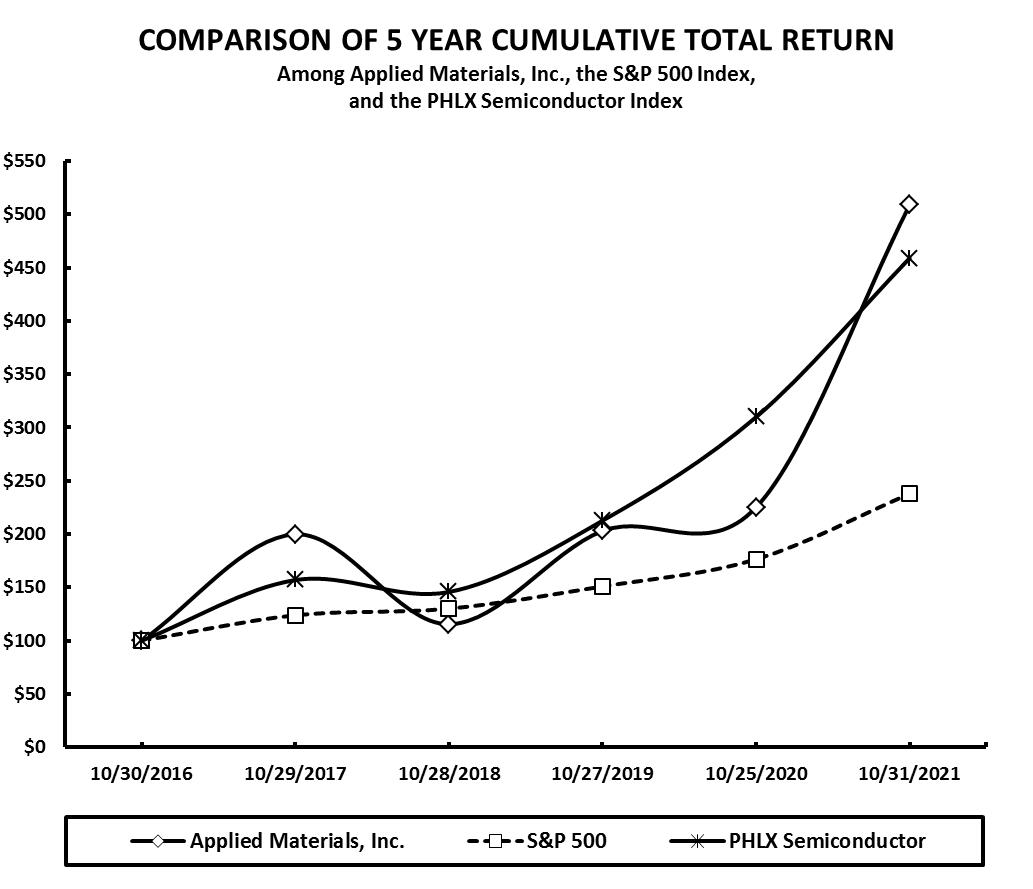
The performance graph below shows the five-year cumulative total stockholder return on Applied common stock during the period from October 30, 2016 through October 31, 2021. This is compared with the cumulative total return of the Standard & Poor’s 500 Stock Index and the PHLX Semiconductor Index over the same period. The comparison assumes $100 was invested on October 30, 2016 in Applied common stock and in each of the foregoing indices and assumes reinvestment of dividends, if any. Dollar amounts in the graph are rounded to the nearest whole dollar. The performance shown in the graph represents past performance and should not be considered an indication of future performance.
*Assumes $100 invested on 10/30/16 in stock or 10/31/16 in index, including reinvestment of dividends.
Indexes calculated on month-end basis.
Copyright© 2021 Standard & Poor’s, a division of S&P global. All rights reserved.
| 10/30/2016 | 10/29/2017 | 10/28/2018 | 10/27/2019 | 10/25/2020 | 10/31/2021 | ||||||||||||||||||||||||||||||
| Applied Materials | 100.00 | 199.87 | 115.48 | 202.95 | 225.12 | 508.89 | |||||||||||||||||||||||||||||
| S&P 500 Index | 100.00 | 123.88 | 130.09 | 150.94 | 176.35 | 237.87 | |||||||||||||||||||||||||||||
| PHLX Semiconductor Index | 100.00 | 156.93 | 145.72 | 212.64 | 309.77 | 458.88 |
Issuer Purchases of Equity Securities
In March 2021, Applied’s Board of Directors approved a common stock repurchase program authorizing $7.5 billion in repurchases, which supplemented the previously existing $6.0 billion authorization approved in February 2018.
The following table provides information as of October 31, 2021 with respect to the shares of common stock repurchased by Applied during the fourth quarter of fiscal 2021 pursuant to the foregoing Board authorization.
| Period | Total Number of Shares Purchased | Average Price Paid per Share | Aggregate Price Paid | Total Number of Shares Purchased as Part of Publicly Announced Programs | Maximum Dollar Value of Shares That May Yet be Purchased Under the Programs | ||||||||||||||||||||||||
| (In millions, except per share amounts) | |||||||||||||||||||||||||||||
| Month #1 | |||||||||||||||||||||||||||||
| (August 2, 2021 to August 29, 2021) | 3.5 | $ | 134.64 | $ | 466 | 3.5 | $ | 6,059 | |||||||||||||||||||||
| Month #2 | |||||||||||||||||||||||||||||
| (August 30, 2021 to September 26, 2021) | 3.2 | $ | 137.35 | 443 | 3.2 | $ | 5,616 | ||||||||||||||||||||||
| Month #3 | |||||||||||||||||||||||||||||
| (September 27, 2021 to October 31, 2021) | 4.5 | $ | 131.23 | 591 | 4.5 | $ | 5,025 | ||||||||||||||||||||||
| Total | 11.2 | $ | 134.05 | $ | 1,500 | 11.2 |
Item 6. [Reserved]
Item 7. Management’s Discussion and Analysis of Financial Condition and Results of Operations
Introduction
Management’s Discussion and Analysis of Financial Condition and Results of Operations (MD&A) is intended to facilitate an understanding of Applied’s business and results of operations. This MD&A should be read in conjunction with Applied’s Consolidated Financial Statements and the accompanying Notes to Consolidated Financial Statements included elsewhere in this Form 10-K. The following discussion contains forward-looking statements and should also be read in conjunction with the cautionary statement set forth at the beginning of this Form 10-K. MD&A consists of the following sections:
*•*Applied's Pandemic Response
*•*Overview: a summary of Applied’s business and measurements
-
Results of Operations: a discussion of operating results
-
Segment Information: a discussion of segment operating results
*•*Recent Accounting Pronouncements: a discussion of new accounting pronouncements and its impact to Applied’s consolidated financial statements
-
Financial Condition, Liquidity and Capital Resources: an analysis of cash flows, sources and uses of cash
-
Off-Balance Sheet Arrangements and Contractual Obligations
-
Critical Accounting Policies and Estimates: a discussion of critical accounting policies that require the exercise of judgments and estimates
-
Non-GAAP Adjusted Results: a presentation of results reconciling GAAP to non-GAAP adjusted measures
Applied’s Pandemic Response
As the COVID-19 pandemic emerged in 2020, Applied Materials responded quickly to put in place precautionary measures to keep its workplaces healthy and safe, while ensuring compliance with orders and restrictions imposed by government authorities, everywhere Applied operates in the world.
Applied’s top priority during the ongoing COVID-19 pandemic remains protecting the health and safety of its employees and their families, customers, suppliers and community. Applied continues to support workplace flexibility such as remote working where possible and follow enhanced safety and health protocols—including screenings, social distancing, and use of personal protective equipment. Applied is keeping its labs and operations active and continuing to support customers.
Applied has implemented a multi-phase plan to return to working on-site, which takes into consideration factors such as Applied’s business and employee needs, local government regulations, community case trends, and recommendations from public health officials. The plan involves multiple phases that gradually allow additional workers to return onsite while practicing social distancing and other safety measures.
Applied will continue to monitor and evaluate the ongoing COVID-19 pandemic and will work to respond appropriately to the impact of COVID-19 on its business, its customers’ and suppliers’ businesses and its communities.
Overview
Applied provides manufacturing equipment, services and software to the semiconductor, display, and related industries. Applied’s customers include manufacturers of semiconductor wafers and chips, liquid crystal and organic light-emitting diode (OLED) displays, and other electronic devices. These customers may use what they manufacture in their own end products or sell the items to other companies for use in advanced electronic components. Each of Applied’s businesses is subject to variable industry conditions, as demand for manufacturing equipment and services can change depending on supply and demand for chips, display technologies, and other electronic devices, as well as other factors, such as global economic and market conditions, and the nature and timing of technological advances in fabrication processes.
Applied operates in three reportable segments: Semiconductor Systems, Applied Global Services, and Display and Adjacent Markets. A summary of financial information for each reportable segment is found in Note 18 of Notes to Consolidated Financial Statements. A discussion of factors that could affect Applied’s operations is set forth under “Risk Factors” in Part I, Item 1A, which is incorporated herein by reference. Product development and manufacturing activities occur primarily in the United States, Europe, Israel, and Asia. Applied’s broad range of equipment and service products are highly technical and are sold primarily through a direct sales force.
Applied’s results are driven primarily by customer spending on capital equipment and services to support key technology transitions or to increase production volume in response to worldwide demand for semiconductors and displays. Spending by semiconductor customers, which include companies that operate in the foundry, logic and memory markets, is driven by demand for advanced electronic products, including smartphones and other mobile devices, servers, personal computers, automotive devices, storage, and other products. The growth of data and emerging end-market drivers such as artificial intelligence, the Internet of Things, 5G networks, smart vehicles and augmented and virtual reality are also creating the next wave of growth for the industry. As a result, products within the Semiconductor Systems segment are subject to significant changes in customer requirements, including transitions to smaller dimensions, increasingly complex chip architectures, new materials and an increasing number of applications. Demand for display manufacturing equipment spending depends primarily on consumer demand for increasingly larger and more advanced TVs as well as larger and higher resolution displays for next-generation mobile devices, and investments in new types of display technologies. While certain existing technologies may be adapted to new requirements, some applications create the need for an entirely different technological approach. The timing of customer investment in manufacturing equipment is also affected by the timing of next-generation process development and the timing of capacity expansion to meet end-market demand. In light of these conditions, Applied’s results can vary significantly year-over-year, as well as quarter-over-quarter.
Applied’s strategic priorities include developing products that help solve customers’ challenges at technology inflections; expanding its served market opportunities in the semiconductor and display industries; and growing its services business. Applied’s long-term growth strategy requires continued development of new materials engineering capabilities, including products and platforms that enable expansion into new and adjacent markets. Applied’s significant investments in research, development and engineering must generally enable it to deliver new products and technologies before the emergence of strong demand, thus allowing customers to incorporate these products into their manufacturing plans during early-stage technology selection. Applied works closely with its global customers to design systems and processes that meet their planned technical and production requirements.
The following table presents certain significant measurements for the past three fiscal years:
| Change | |||||||||||||||||||||||||||||
| 2021 | 2020 | 2019 | 2021 over 2020 | 2020 over 2019 | |||||||||||||||||||||||||
| (In millions, except per share amounts and percentages) | |||||||||||||||||||||||||||||
| Net sales | $ |
Showing the first 8K of 106K characters. Open the full section
Item 7A. Quantitative and Qualitative Disclosures About Market Risk
Applied is exposed to financial market risks, including fluctuations in interest rate and foreign currency exchange rates.
Interest Rate Risk
Available-for-sale Debt Securities. The market value of Applied's investments in available-for-sales securities was approximately $1.8 billion at October 31, 2021. An immediate hypothetical 100 basis point increase in interest rates would result in a decrease in the fair value of investments as of October 31, 2021 of approximately $26 million.
Debt. At October 31, 2021, the aggregate principal of long-term senior unsecured notes issued by Applied was $5.5 billion with an estimated fair value of $6.4 billion. A hypothetical decrease in interest rates of 100 basis points would result in an increase in the fair value of Applied’s long-term senior notes issuances of approximately $731 million at October 31, 2021. From time to time Applied uses interest rate swaps or rate lock agreements to mitigate the potential impact of changes in benchmark interest rates on interest expense and cash flows.
Foreign Currency Risk
Certain operations of Applied are conducted in foreign currencies, such as Japanese yen, Israeli shekel, euro and Taiwanese dollar. Hedges are used to reduce, but not eliminate, the impact of foreign currency exchange rate movements on the consolidated balance sheet, statement of operations, and statement of cash flows.
Applied uses primarily foreign currency forward contracts to offset the impact of foreign exchange movements on non-U.S. dollar denominated monetary assets and liabilities. The foreign exchange gains and losses on the assets and liabilities are recorded in interest and other income (net) and are offset by the gains and losses on the hedges.
Applied uses foreign currency forward and option contracts to hedge a portion of anticipated non-U.S. dollar denominated revenues and expenses expected to occur within the next 24 months. Gains and losses on these hedging contracts generally mitigate the effect of currency movements on Applied’s net sales, cost of products sold, and operating expenses. A hypothetical 10% adverse change in foreign currency exchange rates relative to the U.S. Dollar would result in a decrease in the fair value of these hedging contracts of $177 million at October 31, 2021.
Applied does not use foreign currency forward or option contracts for trading or speculative purposes.
Item 8. Financial Statements and Supplementary Data
The consolidated financial statements required by this Item are set forth on the pages indicated at Item 15(a).
Item 9. Changes in and Disagreements with Accountants on Accounting and Financial Disclosure
None.
Item 9A. Controls and Procedures
Disclosure Controls and Procedures
As of the end of the period covered by this report, management of Applied conducted an evaluation, under the supervision and with the participation of Applied’s Chief Executive Officer and Chief Financial Officer, of the effectiveness of Applied’s disclosure controls and procedures, as such term is defined in Rule 13a-15(e) of the Securities Exchange Act of 1934 (the Exchange Act). Based upon that evaluation, Applied’s Chief Executive Officer and Chief Financial Officer concluded that Applied’s disclosure controls and procedures were effective as of the end of the period covered by this report in ensuring that information required to be disclosed was recorded, processed, summarized and reported within the time periods specified in the SEC’s rules and forms, and to provide reasonable assurance that information required to be disclosed by Applied in such reports is accumulated and communicated to the Company’s management, including its Chief Executive Officer and Chief Financial Officer, as appropriate to allow timely decisions regarding required disclosure.
Management’s Report on Internal Control over Financial Reporting
Applied’s management is responsible for establishing and maintaining adequate internal control over financial reporting, as such term is defined in Rule 13a-15(f) of the Exchange Act. Under the supervision and with the participation of Applied’s Chief Executive Officer and Chief Financial Officer, management of Applied conducted an evaluation of the effectiveness of Applied’s internal control over financial reporting based upon the framework in “Internal Control — Integrated Framework (2013)” issued by the Committee of Sponsoring Organizations of the Treadway Commission. Based on that evaluation, Applied’s management concluded that Applied’s internal control over financial reporting was effective as of October 31, 2021.
KPMG LLP, an independent registered public accounting firm, has audited the consolidated financial statements included in this Form 10-K and, as part of the audit, has issued a report, included herein, on the effectiveness of Applied’s internal control over financial reporting as of October 31, 2021.
Changes in Internal Control over Financial Reporting
Due to the ongoing COVID-19 pandemic, Applied continues to support workplace flexibility such as remote work where possible. Business continuity plans are in effect in order to mitigate potential impact on Applied’s control environment and its operating and disclosure controls and procedures. The design of business continuity plans, which include remote access to secure data when needed, allow for remote and reliable execution of Applied’s operating and disclosure controls and procedures.
Applied evaluated the impact of the ongoing COVID-19 pandemic on its internal control over financial reporting. During the fourth quarter of fiscal 2021, there were no changes in the internal control over financial reporting that materially affected, or are reasonably likely to materially affect, Applied’s internal control over financial reporting.
Inherent Limitations of Disclosure Controls and Procedures and Internal Control over Financial Reporting
It should be noted that any system of controls, however well designed and operated, can provide only reasonable, and not absolute, assurance that the objectives of the system will be met. In addition, the design of any control system is based in part upon certain assumptions about the likelihood of future events.
Item 9B. Other Information
None
PART III
Item 10. Directors, Executive Officers and Corporate Governance
Except for the information regarding executive officers required by Item 401 of Regulation S-K (which is included in Part I, Item 1 of this Annual Report on Form 10-K, under “Information about our Executive Officers”) and code of ethics (which is set forth below), the information required by this item will be provided in accordance with Instruction G(3) to Form 10-K no later than February 28, 2022.
Applied has implemented the Standards of Business Conduct, a code of ethics with which every person who works for Applied and every member of the Board of Directors is expected to comply. If any substantive amendments are made to the Standards of Business Conduct or any waiver is granted, including any implicit waiver, from a provision of the code to Applied’s Chief Executive Officer, Chief Financial Officer or Chief Accounting Officer, Applied will disclose the nature of such amendment or waiver on its website or in a report on Form 8-K. The above information, including the Standards of Business Conduct, is available on Applied’s website under the Corporate Governance section at http://www.appliedmaterials.com/company/investor-relations/governance. This website address is intended to be an inactive, textual reference only. None of the materials on, or accessible through, this website is part of this report or is incorporated by reference herein.
Item 11. Executive Compensation
The information required by this Item will be provided in accordance with Instruction G(3) to Form 10-K no later than February 28, 2022.
Item 12. Security Ownership of Certain Beneficial Owners and Management and Related Stockholder Matters
Except for the information regarding securities authorized for issuance under equity compensation plans (which is set forth below), the information required by this Item will be provided in accordance with Instruction G(3) to Form 10-K no later than February 28, 2022.
The following table summarizes information with respect to equity awards under Applied’s equity compensation plans as of October 31, 2021:
Equity Compensation Plan Information
| Plan Category | (a) Number of Securities to be Issued Upon Exercise of Outstanding Options, Warrants and Rights(1) | (b) Weighted Average Exercise Price of Outstanding Options, Warrants and Rights(2) | (c) Number of Securities Available for Future Issuance Under Equity Compensation Plans (Excluding Securities Reflected in Column(a)) | ||||||||||||||||||||
| (In millions, except prices) | |||||||||||||||||||||||
| Equity compensation plans approved by security holders | 13 | $ | — | 51 | (3) | ||||||||||||||||||
| Total | 13 | $ | — | 51 |
(1)Includes only restricted stock units and performance shares outstanding under Applied’s equity compensation plans, as no options, stock warrants or other rights were outstanding as of October 31, 2021.
(2)The weighted average exercise price calculation does not take into account any restricted stock units or performance shares.
(3)Includes 16 million shares of Applied common stock available for future issuance under the Applied Materials, Inc. Omnibus Employees’ Stock Purchase Plan. Of these 16 million shares, 1 million are subject to purchase during the purchase period in effect as of October 31, 2021.
Prior to September 1, 2021, Applied had two Employee Stock Purchase Plans, one generally for United States employees (U.S. ESPP) and a second for employees of international subsidiaries (Offshore ESPP), which enable eligible employees to purchase Applied common stock. On March 11, 2021, Applied’s shareholders approved an amendment and restatement of the U.S. ESPP (as amended, the Omnibus ESPP). The Omnibus ESPP became effective on September 1, 2021 (the Effective Date) in accordance with its terms, and amended the U.S. ESPP to, among other changes, (i) incorporate the Offshore ESPP as a sub-plan, and (ii) add 11.3 million shares to the number of shares of Applied common stock authorized for issuance. The Offshore ESPP was terminated as an independent plan on the Effective Date.
Applied has the following equity compensation plan that has not been approved by stockholders:
Applied Materials Profit Sharing Scheme. The Applied Materials Profit Sharing Scheme was adopted effective July 3, 1996 to enable employees of Applied Materials Ireland Limited and its participating subsidiaries to purchase Applied common stock at 100% of fair market value on the purchase date. Under this plan, eligible employees may elect to forego a certain portion of their base salary and certain bonuses they have earned and that otherwise would be payable in cash to purchase shares of Applied common stock at full fair market value. Since the eligible employees pay full fair market value for the shares, there is no reserved amount of shares under this plan and, accordingly, the table above does not include any set number of shares available for future issuance under the plan.
Item 13. Certain Relationships and Related Transactions, and Director Independence
The information required by this Item will be provided in accordance with Instruction G(3) to Form 10-K no later than February 28, 2022.
Item 14. Principal Accounting Fees and Services
The information required by this Item will be provided in accordance with Instruction G(3) to Form 10-K no later than February 28, 2022.
PART IV
Item 15. Exhibits, Financial Statement Schedules
(a) The following documents are filed as part of this Annual Report on Form 10-K:
All other schedules are omitted because they are not applicable or the required information is shown in the Consolidated Financial Statements or Notes thereto.
Item 16. Form 10-K Summary
None.
REPORT OF INDEPENDENT REGISTERED PUBLIC ACCOUNTING FIRM
To the Stockholders and Board of Directors
Applied Materials, Inc.:
Opinion on the Consolidated Financial Statements
We have audited the accompanying consolidated balance sheets of Applied Materials, Inc. and subsidiaries (the Company) as of October 31, 2021 and October 25, 2020, the related consolidated statements of operations, comprehensive income, stockholders’ equity, and cash flows for each of the years in the three-year period ended October 31, 2021, and the related notes (collectively, the consolidated financial statements). In our opinion, the consolidated financial statements present fairly, in all material respects, the financial position of the Company as of October 31, 2021 and October 25, 2020, and the results of its operations and its cash flows for each of the years in the three-year period ended October 31, 2021, in conformity with U.S. generally accepted accounting principles.
We also have audited, in accordance with the standards of the Public Company Accounting Oversight Board (United States) (PCAOB), the Company’s internal control over financial reporting as of October 31, 2021, based on criteria established in Internal Control - Integrated Framework (2013) issued by the Committee of Sponsoring Organizations of the Treadway Commission, and our report dated December 17, 2021 expressed an unqualified opinion on the effectiveness of the Company’s internal control over financial reporting.
Changes in Accounting Principles
As discussed in note 1 to the consolidated financial statements, the Company changed its method of accounting for leases as of October 28, 2019 due to the adoption of Accounting Standards Codification Topic 842, Leases. As discussed in note 16 to the consolidated financial statements, the Company changed its method of accounting for intra-entity transfers of assets other than inventory as of October 29, 2018 due to the adoption of Accounting Standards Update No. 2016-16, Income Taxes: Intra-Entity Transfers of Assets Other Than Inventory.
Basis for Opinion
These consolidated financial statements are the responsibility of the Company’s management. Our responsibility is to express an opinion on these consolidated financial statements based on our audits. We are a public accounting firm registered with the PCAOB and are required to be independent with respect to the Company in accordance with the U.S. federal securities laws and the applicable rules and regulations of the Securities and Exchange Commission and the PCAOB.
We conducted our audits in accordance with the standards of the PCAOB. Those standards require that we plan and perform the audit to obtain reasonable assurance about whether the consolidated financial statements are free of material misstatement, whether due to error or fraud. Our audits included performing procedures to assess the risks of material misstatement of the consolidated financial statements, whether due to error or fraud, and performing procedures that respond to those risks. Such procedures included examining, on a test basis, evidence regarding the amounts and disclosures in the consolidated financial statements. Our audits also included evaluating the accounting principles used and significant estimates made by management, as well as evaluating the overall presentation of the consolidated financial statements. We believe that our audits provide a reasonable basis for our opinion.
Critical Audit Matter
The critical audit matter communicated below is a matter arising from the current period audit of the consolidated financial statements that was communicated or required to be communicated to the audit committee and that: (1) relates to accounts or disclosures that are material to the consolidated financial statements and (2) involved our especially challenging, subjective, or complex judgments. The communication of a critical audit matter does not alter in any way our opinion on the consolidated financial statements, taken as a whole, and we are not, by communicating the critical audit matter below, providing a separate opinion on the critical audit matter or on the accounts or disclosures to which it relates.
Evaluation of net realizable value adjustments to inventories for excess or obsolescence
As discussed in notes 1 and 8 to the consolidated financial statements, the Company has inventories with a carrying value of $4,309 million as of October 31, 2021. The Company adjusts inventory carrying value for estimated excess or obsolescence equal to the difference between cost of inventory and the estimated net realizable value based upon assumptions about future demand and market conditions. If actual demand were to be substantially lower than estimated, there could be a significant adverse impact on the carrying value of inventories and results of operations.
We identified the evaluation of net realizable value adjustments to inventories for excess or obsolescence as a critical audit matter. Evaluation of the Company’s estimates regarding forecasted sales and inventory consumption involved a high degree of auditor judgment.
The following are the primary procedures we performed to address this critical audit matter. We evaluated the design and tested the operating effectiveness of certain internal controls over the Company’s process for determining net realizable value adjustments for inventory excess or obsolescence, including controls related to estimating forecasted sales and inventory consumption. We evaluated certain inventories for excess or obsolescence by comparing the Company’s sales and inventory consumption forecast to historical sales, historical inventory usage, known customer orders, and industry outlook reports. In addition, for certain inventories, we compared the Company’s historical estimates of net realizable value adjustments for excess and obsolescence to the actual physical inventory disposals to evaluate the Company’s ability to accurately estimate the net realizable value adjustments.
| /S/ KPMG LLP | ||
| KPMG LLP |
We have served as the Company’s auditor since 2004.
Santa Clara, California
December 17, 2021
REPORT OF INDEPENDENT REGISTERED PUBLIC ACCOUNTING FIRM
To the Stockholders and Board of Directors
Applied Materials, Inc.:
Opinion on Internal Control Over Financial Reporting
We have audited Applied Materials, Inc. and subsidiaries’ (the Company) internal control over financial reporting as of October 31, 2021, based on criteria established in Internal Control - Integrated Framework (2013) issued by the Committee of Sponsoring Organizations of the Treadway Commission. In our opinion, the Company maintained, in all material respects, effective internal control over financial reporting as of October 31, 2021, based on criteria established in Internal Control - Integrated Framework (2013) issued by the Committee of Sponsoring Organizations of the Treadway Commission.
We also have audited, in accordance with the standards of the Public Company Accounting Oversight Board (United States) (PCAOB), the consolidated balance sheets of the Company as of October 31, 2021 and October 25, 2020, the related consolidated statements of operations, comprehensive income, stockholders’ equity, and cash flows for each of the years in the three-year period ended October 31, 2021, and the related notes (collectively, the consolidated financial statements), and our report dated December 17, 2021 expressed an unqualified opinion on those consolidated financial statements.
Basis for Opinion
The Company’s management is responsible for maintaining effective internal control over financial reporting and for its assessment of the effectiveness of internal control over financial reporting, included in the accompanying Management’s Report on Internal Control over Financial Reporting. Our responsibility is to express an opinion
Showing the first 8K of 212K characters. Open the full section