 filings.tools
Amcor 10-K 2023-06-30
Filed 2023-08-17. 22 sections, 453K characters. Original on sec.gov · Markdown · JSON
Cover and table of contents
UNITED STATES
SECURITIES AND EXCHANGE COMMISSION
Washington, D.C. 20549
FORM 10-K
☒ ANNUAL REPORT PURSUANT TO SECTION 13 OR 15(d) OF THE SECURITIES EXCHANGE ACT OF 1934
For the fiscal year ended June 30, 2023
or
☐ TRANSITION REPORT PURSUANT TO SECTION 13 OR 15(d) OF THE SECURITIES EXCHANGE ACT OF 1934
For the transition period from __________ to __________
Commission File Number 001-38932
AMCOR PLC
(Exact name of registrant as specified in its charter)
| Jersey | 98-1455367 | |||||||
| (State or other jurisdiction of incorporation or organization) | (I.R.S. Employer Identification No.) | |||||||
| 83 Tower Road North | ||||||||
| Warmley, Bristol | ||||||||
| United Kingdom | BS30 8XP | |||||||
| (Address of principal executive offices) | (Zip Code) |
Registrant’s telephone number, including area code: +44 117 9753200
Securities registered pursuant to Section 12(b) of the Act:
| Title of each class | Trading symbol(s) | Name of each exchange on which registered | ||||||
| Ordinary Shares, par value $0.01 per share | AMCR | New York Stock Exchange | ||||||
| 1.125% Guaranteed Senior Notes Due 2027 | AUKF/27 | New York Stock Exchange |
Securities registered pursuant to section 12(g) of the Act: None
Indicate by check mark if the Registrant is a well-known seasoned issuer, as defined in Rule 405 of the Securities Act. Yes ☒ No ☐
Indicate by check mark if the Registrant is not required to file reports pursuant to Section 13 or Section 15(d) of the Act. Yes ☐ No ☒
Indicate by check mark whether the registrant: (1) has filed all reports required to be filed by Section 13 or 15(d) of the Securities Exchange Act of 1934 during the preceding 12 months (or for such shorter period that the registrant was required to file such reports), and (2) has been subject to such filing requirements for the past 90 days. Yes ☒ No ☐
Indicate by check mark whether the registrant has submitted electronically every Interactive Data File required to be submitted pursuant to Rule 405 of Regulation S-T (§232.405 of this chapter) during the preceding 12 months (or for such shorter period that the registrant was required to submit such files). Yes ☒ No ☐
Indicate by check mark whether the registrant is a large accelerated filer, an accelerated filer, a non-accelerated filer, a smaller reporting company, or an emerging growth company. See the definitions of "large accelerated filer," "accelerated filer," "smaller reporting company," and "emerging growth company" in Rule 12b-2 of the Exchange Act. (Check one):
| Large Accelerated Filer | ☒ | Smaller Reporting Company | ☐ | |||||||||||
| Accelerated Filer | ☐ | Emerging Growth Company | ☐ | |||||||||||
| Non-Accelerated Filer | ☐ |
If an emerging growth company, indicate by check mark if the registrant has elected not to use the extended transition period for complying with any new or revised financial accounting standards provided pursuant to Section 13(a) of the Exchange Act. ☐
Indicate by check mark whether the registrant has filed a report on and attestation to its management’s assessment of the effectiveness of its internal control over financial reporting under Section 404(b) of the Sarbanes-Oxley Act (15 U.S.C. 7262(b)) by the registered public accounting firm that prepared or issued its audit report. ☒
If securities are registered pursuant to Section 12(b) of the Act, indicate by check mark whether the financial statements of the registrant included in the filing reflect the correction of an error to previously issued financial statements. ☐
Indicate by check mark whether any of those error corrections are restatements that required a recovery analysis of incentive-based compensation received by any of the registrant’s executive officers during the relevant recovery period pursuant to §240.10D-1(b). ☐
Indicate by check mark whether the registrant is a shell company (as defined in Rule 12b-2 of the Exchange Act). Yes ☐ No ☒
The aggregate market value of the ordinary shares held by non-affiliates of the registrant, computed by reference to the closing price of such shares as of the last business day of the registrant’s most recently completed second quarter, was $17.3 billion.
As of August 15, 2023, the Registrant had 1,448,493,870 shares issued and outstanding.
DOCUMENTS INCORPORATED BY REFERENCE
Certain information required for Part III of this Annual Report on Form 10-K is incorporated by reference to the Amcor plc definitive Proxy Statement for its 2023 Annual Shareholder Meeting, which will be filed with the Securities and Exchange Commission pursuant to Regulation 14A of the Securities Exchange Act of 1934, as amended, within 120 days of Amcor plc’s fiscal year end.
Amcor plc
Annual Report on Form 10-K
Table of Contents
Forward-Looking Statements
Unless otherwise indicated, references to "Amcor," the "Company," "we," "our," and "us" in this Annual Report on Form 10-K refer to Amcor plc and its consolidated subsidiaries.
This Annual Report on Form 10-K contains certain statements that are "forward-looking statements" within the meaning of the safe harbor provisions of the U.S. Private Securities Litigation Reform Act of 1995. Forward-looking statements are generally identified with words like "believe," "expect," "target," "project," "may," "could," "would," "approximately," "possible," "will," "should," "intend," "plan," "anticipate," "commit," "estimate," "potential," "ambitions," "outlook," or "continue," the negative of these words, other terms of similar meaning, or the use of future dates. Such statements are based on the current expectations of the management of Amcor and are qualified by the inherent risks and uncertainties surrounding future expectations generally. Actual results could differ materially from those currently anticipated due to a number of risks and uncertainties. None of Amcor or any of its respective directors, executive officers, or advisors, provide any representation, assurance, or guarantee that the occurrence of the events expressed or implied in any forward-looking statements will actually occur. Risks and uncertainties that could cause actual results to differ from expectations include, but are not limited to:
-
Changes in consumer demand patterns and customer requirements in numerous industries;
-
the loss of key customers, a reduction in their production requirements, or consolidation among key customers;
-
significant competition in the industries and regions in which we operate;
-
an inability to expand our current business effectively through either organic growth, including product innovation, investments, or acquisitions;
-
challenging current and future global economic conditions, including the Russia-Ukraine conflict and inflation;
-
impacts of operating internationally;
-
price fluctuations or shortages in the availability of raw materials, energy and other inputs, which could adversely affect our business;
-
production, supply, and other commercial risks, including counterparty credit risks, which may be exacerbated in times of economic volatility;
-
pandemics, epidemics, or other disease outbreaks;
-
an inability to attract and retain our global executive management team and our skilled workforce;
-
costs and liabilities related to environment, health, and safety ("EHS") laws and regulations, as well as changes in the global climate;
-
labor disputes and an inability to renew collective bargaining agreements at acceptable terms;
-
risks related to climate change;
-
cybersecurity risks, which could disrupt our operations or risk of loss of our sensitive business information;
-
failures or disruptions in our information technology systems which could disrupt our operations, compromise customer, employee, supplier, and other data;
-
rising interest rates that increase our borrowing costs on our variable rate indebtedness and could have other negative impacts;
-
a significant increase in our indebtedness or a downgrade in our credit rating could reduce our operating flexibility and increase our borrowing costs and negatively affect our financial condition and results of operations;
-
foreign exchange rate risk;
-
a significant write-down of goodwill and/or other intangible assets;
-
failure to maintain an effective system of internal control over financial reporting;
-
an inability of our insurance policies, including our use of a captive insurance company, to provide adequate protection against all of the risks we face;
-
an inability to defend our intellectual property rights or intellectual property infringement claims against us;
-
litigation, including product liability claims, or regulatory developments;
-
increasing scrutiny and changing expectations from investors, customers, and governments with respect to our Environmental, Social, and Governance ("ESG") practices and commitments resulting in additional costs or exposure to additional risks;
-
changing government regulations in environmental, health, and safety matters, including climate change; and
-
changes in tax laws or changes in our geographic mix of earnings.
Additional factors that could cause actual results to differ from those expected are discussed in this Annual Report on Form 10-K, including in the sections entitled "Item 1A. - Risk Factors" and "Item 7. - Management’s Discussion and Analysis of Financial Condition and Results of Operations," and in Amcor’s subsequent filings with the Securities and Exchange Commission.
Forward-looking statements made in this Annual Report on Form 10-K relate only to events as of the date on which the statements are made. Amcor assumes no obligation, and disclaims any obligation, to update the information contained in this report. All forward-looking statements in this Annual Report on Form 10-K are qualified in their entirety by this cautionary statement.
PART I
Item 1. - Business
The Company
Amcor plc (ARBN 630 385 278) is a public limited company incorporated under the Laws of the Bailiwick of Jersey. Our history dates back more than 150 years, with origins in both Australia and the USA. Today, we are a global leader in developing and producing responsible packaging for food, beverage, pharmaceutical, medical, home and personal-care, and other products. Our innovation excellence and global packaging expertise enables us to solve packaging challenges around the world every day, producing packaging that is more functional, appealing, and cost effective for our customers and their consumers and importantly, more sustainable for the environment.
Sustainability
Sustainability is central to our business and one of our most exciting opportunities for growth. Working daily to embed sustainability deeper into everything we do, Amcor has been a leader in the industry in promoting sustainability. We aspire to improve the quality of lives, protect ecosystems, and preserve natural resources for future generations by offering a unique range of responsible packaging solutions, leveraging our global scale, reach, and expertise to meet our customers’ growing sustainability expectations. In January 2018, we became the world’s first packaging company to pledge that all our packaging would be designed to be recycled, compostable, or reusable by 2025 and also committed to increasing the amount of recycled content we use. We are delivering against these commitments and continue to lead in the development of a responsible packaging value chain through our innovations and partnerships. We have identified a clear path to meeting our sustainability ambitions and those of our customers by focusing on the three elements of responsible packaging – product innovation, consumer participation, and infrastructure development.
Differentiated Solutions
Our product portfolio is diverse and dynamic due to our constant innovation and close partnerships with our customers. Behind every one of our products stands a unique combination of technical know-how, business experience, and expertise. We work closely with our customers to identify feasible, high-performance, responsible packaging solutions based on their unique needs. Where solutions do not currently exist, we work to innovate new ones. We invest approximately $100 million every year in our industry-leading research and development capabilities, bringing together the best in packaging design, science, manufacturing, and people.
Expertise across Packaging Materials
We believe that we are uniquely positioned to offer a variety of packaging solutions with a wide, differentiated portfolio of products. Our packaging expertise covers all main packaging materials including paper, metal, plastic, recycled, and bio-based materials and the sustainable use of recyclable plastics. Our expertise and track record translate across many innovative solutions that customers can explore with ease and convenience to meet their growing packaging needs, while improving environmental impact.
Business Strategy
Strategy
Our business strategy consists of three components: a focused portfolio, differentiated capabilities, and our aspiration to be THE leading global packaging company. To fulfill our aspiration, we are determined to win for our customers, employees, shareholders, and the environment.
Focused portfolio
Our portfolio of businesses share certain important characteristics:
-
A focus on primary packaging for fast-moving consumer goods,
-
good industry structure,
-
attractive relative growth, and
-
multiple paths for us to win through our leadership position, scale, and ability to differentiate our product offering through innovation.
These criteria have led us to the focused portfolio of strong businesses we have today across: flexible and rigid packaging, specialty cartons, and closures.
Differentiated capabilities
**"**The Amcor Way" describes the capabilities deployed consistently across Amcor that enable us to get leverage across our portfolio: Talent, Commercial Excellence, Operational Leadership, Innovation, and Cash and Capital Discipline. Our values of Safety, Integrity, Collaboration, Accountability, and Results and Outperformance guide our behavior, driving our winning aspiration to be THE leading global packaging company.
Shareholder value creation
Through our portfolio of focused businesses and differentiated capabilities, we generate strong cash flow and redeploy cash to consistently create superior value for shareholders. The nature of our consumer and healthcare end markets means that year-to-year volatility should be relatively low, measured on a constant currency basis. Over time, value creation has been strong and consistent and has reflected a combination of dividends, organic growth in the base business, and using free cash flow to pursue targeted acquisitions and/or returning cash to shareholders via share buybacks.
Segment Information
Accounting Standards Codification ("ASC") 280, "Segment Reporting," establishes the standards for reporting information about segments in financial statements. In applying the criteria set forth in ASC 280, we have determined we have two reportable segments, Flexibles and Rigid Packaging. The reportable segments produce flexible packaging, rigid packaging, specialty cartons, and closure products, which are sold to customers participating in a range of attractive end use areas throughout Europe, North America, Latin America, Africa, and the Asia Pacific regions. Refer to Note 21, "Segments," of the notes to consolidated financial statements for financial information about reportable segments.
Flexibles Segment
Our Flexibles Segment develops and supplies flexible packaging globally. With approximately 35,000 employees at 166 significant manufacturing and support facilities in 37 countries as of June 30, 2023, the Flexibles Segment is one of the world's largest suppliers of plastic, aluminum, and fiber based flexible packaging. In fiscal year 2023, Flexibles accounted for approximately 76% of consolidated net sales.
Rigid Packaging Segment
Our Rigid Packaging Segment manufactures rigid packaging containers and related products in the Americas. As of June 30, 2023, the Rigid Packaging Segment employed approximately 5,000 employees at 52 significant manufacturing and support facilities in 11 countries. In fiscal year 2023, Rigid Packaging accounted for approximately 24% of consolidated net sales.
Marketing, Distribution, and Competition
Our sales are made through a variety of distribution channels, but primarily through our direct sales force. Sales offices and plants are located throughout Europe, North America, Latin America, Africa, and Asia-Pacific regions to provide prompt and economical service to thousands of customers. Our technically trained sales force is supported by product development engineers, design technicians, field service technicians, and customer service teams.
We did not have sales to a single customer that exceeded 10% of consolidated net sales in the last three fiscal years.
The major markets in which we sell our products historically have been, and continue to be, highly competitive. Areas of competition include service, sustainability, innovation, quality, and price. Competitors include AptarGroup, Inc., Ball Corporation, Berry Global Group, Inc, CCL Industries Inc., Crown Holdings, Inc., Graphic Packaging Holding Company, Huhtamaki Oyj, International Paper Company, Mayr-Melnhof Karton AG, O-I Glass, Inc., Sealed Air Corporation, Silgan Holdings Inc., Sonoco Products Company, and WestRock Company, and a variety of privately held companies.
We consider ourselves to be a significant participant in the markets in which we operate; however, due to the diversity of our business, our precise competitive position in these markets is not reasonably determinable.
Backlog
Working capital fluctuates throughout the year in relation to business volume and other marketplace conditions. We maintain inventory levels that provide a reasonable balance between obtaining raw materials at favorable prices and maintaining adequate inventory levels to enable us to fulfill our commitment to promptly fill customer orders. Manufacturing backlogs are not a significant factor in the markets in which we operate.
Raw Materials
Polymer resins and films, paper, inks, solvents, adhesives, aluminum, and chemicals constitute the major raw materials we use. These are purchased from a variety of global industry sources, and we are not significantly dependent on any one supplier for our raw materials. While we have experienced industry-wide shortages of certain raw materials in the past, we have been able to manage supply disruptions by working closely with our suppliers and customers. Supply shortages, along with other factors, can lead and have in the past led to increased raw material price volatility. Increases in the price of raw materials are generally able to be passed on to customers through contractual price mechanisms over time and other means. We manage the risks associated with our supply chain and have generally been able to maintain adequate raw materials through relationship management, inventory management and evaluation of alternative sources when practical. For more information, see "Item 1A.
- Raw Materials — Price fluctuations or shortages in the availability of raw materials, energy and other inputs could adversely affect our business.”
Intellectual Property
We are the owner or licensee of more than a thousand United States and other country patents and patent applications that relate to our products, manufacturing processes, and equipment. We have a number of trademarks and trademark registrations in the United States and in other countries. We also keep certain technology and processes as trade secrets. Our patents, licenses, and trademarks collectively provide a competitive advantage. However, the loss of any single patent or license alone would not have a material adverse effect on our results of operations as a whole or those of our reportable segments. Patents, patent applications, and license agreements will expire or terminate over time by operation of law, in accordance with their terms, or otherwise.
Sustainability and Innovation
Sustainability is comprehensively embedded across our business, from the investments we are making in packaging innovation and design, to our global collaboration strategy, to the work we undertake within our own operations and with our upstream and downstream partners to develop a more responsible packaging value chain.
We believe there will always be a role for the primary packaging we produce to preserve food, beverages, and healthcare products, protect consumers, and promote brands. Consumers also want cost effective, convenient, and easy to use packaging with a reduced environmental footprint and a responsible end of life solution. We have identified a clear path to provide food, beverages, and healthcare products to people around the world in a more sustainable way and meet our sustainability ambitions and those of our customers, by focusing on three key elements of responsible packaging: product innovation, consumer participation, and waste management infrastructure. We believe our commitment to responsible packaging is integral to our success. Our responsible packaging solutions address both how the product is made, as well as what happens after the consumer uses it, offering a wide variety of options to advance sustainability while meeting our customers’ specific packaging needs.
Innovation is central to Amcor’s approach to sustainability and we spend approximately $100 million a year on research and development ("R&D"), not including ongoing investment in incremental continuous improvements. We are highly regarded for our innovation capabilities and have more than 1,000 active patents, as well as a global network of Innovation Centers focused on bringing advanced packaging technologies and more sustainable material science to our markets around the world. We solve packaging challenges, developing differentiated products, services, and processes to protect our customers' products and fulfil the needs of the consumers who rely on them. Drawing on unrivaled heritage in design, science, and manufacturing, our more than 1,000 R&D professionals and engineers are constantly innovating across new materials, formats, functions, and technologies.
We collaborate with like-minded partners, including customers and suppliers, in pursuit of innovative solutions to address some of the world’s most urgent challenges, including increasing recycling and reuse and reducing our environmental impacts. We also partner with non-governmental organizations, promising startups, and cross-industry initiatives and bodies. These partnerships enable us to learn, experience other perspectives, share our expertise, and expand our innovation. With our partners, we advocate for sound global design standards, better waste management infrastructure, and higher levels of consumer participation in recycling that will be required to develop a true circular economy for packaging.
We believe that our environmental footprint goes well beyond the products we create. We also strive to continuously reduce the environmental impacts of our operations. For more than a decade, our EnviroAction program has helped us significantly improve how we manage energy, water, and waste in every one of our manufacturing locations. In January 2022, we further increased our efforts by committing to set science-based targets to reduce greenhouse gas emissions and achieve net zero emissions by 2050. These new commitments have been recognized by the Science Based Targets initiative (SBTi) and build on years of progress under our EnviroAction program. In June 2023, we took the next step forward in our science-based targets journey by submitting our proposed targets to the SBTi for review.
With our global scale, deep industry experience, and strong capabilities, we believe that we are uniquely positioned to lead the way in the design and development of more sustainable packaging, and this is one of the most important growth opportunities for Amcor.
Governmental Laws and Regulations
Our operations and the real property we own, or lease, are subject to broad governmental laws and regulations, including environmental laws and regulations by multiple jurisdictions. These laws and regulations pertain to employee health
and safety, the discharge of certain materials into the environment, handling and disposition of waste, cleanup of contaminated soil and ground water, other rules to control pollution and manage natural resources, and other government regulations. We believe that we are in substantial compliance with applicable health and safety laws, environmental laws and regulations based on the execution of our Environmental, Health, and Safety Management System and regular audits of those processes and systems. However, we cannot predict with certainty that we will not, in the future, incur liability with respect to noncompliance with health and safety laws, environmental laws and regulations due to contamination of sites formerly or currently owned or operated by us (including contamination caused by prior owners and operators of such sites) or the off-site disposal of regulated materials, or other broad government regulations which could be significant. In addition, these laws and regulations are constantly changing, and we cannot always anticipate these changes. Refer to Note 20, "Contingencies and Legal Proceedings," of the notes to consolidated financial statements for information about legal proceedings. For a more detailed description of the various laws and regulations that affect our business, see "Item 1A. - Risk Factors."
Seasonal Factors
Our business and operations of each of the reportable segments is not seasonal to any material extent.
Historically, cash flow from operations has been lower in the first half of the fiscal year, and higher in the second half of the fiscal year, due to working capital management and the timing of certain cash payments made in the first half of the year, including incentive compensation.
Research and Development
Refer to section "Sustainability and Innovation" within "Item 1. - Business" of this Annual Report on Form 10-K, and to Note 2, "Significant Accounting Policies," of the notes to consolidated financial statements, for further information about our research and development activities, expenditures, and policies.
Human Capital Management
Overview
Amcor’s aspiration is to be ‘THE leading global packaging company'. Our people are core to the achievement of our aspiration. We believe we are winning for our people when they feel safe, engaged, and are developing as part of a high-performing, global team. We strive to build an outperformance culture in which we consistently deliver results and strive to surpass expectations. At Amcor, we are stronger because of the diverse strengths, styles, cultures, and experiences of our people. We aim to create inclusive working environments to ensure each colleague feels valued, treated with respect, encouraged to speak, and empowered to be their best.
As of June 30, 2023, we had approximately 41,000 employees, including part-time and temporary workers, worldwide, with approximately 30% located in North America, 30% located in Europe, 20% located in Latin America, and 20% located in the Asia Pacific region. Collective bargaining agreements cover approximately 45% of our workforce. As of June 30, 2023, approximately 3% of our employees were working under expired contracts and approximately 17% were covered under collective bargaining agreements that expire within one year.
Health and Safety
Safety is a core value at Amcor. We take care of ourselves and each other, so everyone returns home safely every day. Across every level of our organization, we role model and recognize safe and responsible behavior as we strive to achieve an injury-free Amcor. All our facilities abide by global Environment, Health, and Safety ("EHS") standards for safety and environmental management. Our Board of Directors receives monthly reports on safety performance and compliance with our global EHS standards. During fiscal year 2023, we reduced the number of injuries by 31% and 69% of our sites were injury free.
Developing Talent
At Amcor, we are dedicated to attracting, developing, engaging, and retaining the best talent to deliver our 'Winning Aspiration' and ensure a strong succession pipeline for the future. Our fiscal years 2023-2027 Human Capital Strategy is focused on ensuring that we have the right people in the right jobs at the right time to drive our growth agenda.
Our approach to talent is guided by the understanding that by creating a truly differentiated, industry-leading pool of talent which can be deployed consistently across our business, we will better enable Amcor’s success. Amcor is dedicated to attracting, developing, engaging, and retaining the best talent and strengthening our succession pipeline for the future. We have a range of executive development, leadership training, education, and awareness programs to help employees progress across all functions and experience levels.
We deploy systems and processes to ensure our people have clear goals and are empowered to achieve them. Through performance management, we align these goals to business targets, providing line of sight so each employee understands how they contribute to our success. Through formal reviews, performance coaching, and feedback, our leaders implement a rigorous cycle to foster talent.
Learning & Development
We have implemented training and education programs to help our employees progress across functions and experience levels. Examples of these programs include a Leading to Outperform program ("LTO") to further advance high-potential talent, a Senior Leader Development program ("SLDP") focusing on developing strategic management skills and inclusive leadership.
In fiscal year 2023, we introduced a new aspect to our Executive Development program ("EDP"). This annual program targets our most senior leaders and provides them an immersive experience in Strategy Development and leading Talent. For fiscal year 2023, we selected a handful of the organization's most high potential leaders and kicked off our EDP 2.0 experience where we seek to expand the participants' capabilities. In each of these programs, we partner with leading academic and executive education institutions from around the world.
Recognizing the importance of the learning journey, our employees can also access our "Masterclass" program which delivers an annual series of executive education briefings on topics of functional excellence and business initiatives. Our focus
this year has been on Accelerating Growth with showcase presentations from Marketing, R&D, Product Branding, and Innovation Leaders.
Diversity, Equity & Inclusion
At Amcor, we’re committed to providing an inclusive environment that empowers us to achieve our full potential. Becoming THE leading global packaging company requires us to create a culture in which everyone feels encouraged to speak and compelled to listen.
Amcor values the diverse experience, strengths, styles, nationalities, and cultures of all our people. Our diversity, equity and inclusion strategy is focused on three main areas: (1) building awareness through training and education to help our leaders be more inclusive, (2) diversifying our global talent pool by removing bias from talent attraction and development, and (3) by sharing best practices and learning across the organization.
Amcor believes that with different perspectives come different solutions that enable us to win for our stakeholders. We are one global team in which everyone has a voice and can make a difference. With this in mind, we work to create a team environment that develops inclusive leaders, where we learn from our people, and where listening, trust, and respect are key behaviors that form the foundation of our interactions and foster mutual understanding.
We focus on strengthening 'talent through diversity' and progress is reported to our Board annually. We continually review opportunities to strengthen our diversity transparency practices while adhering to privacy legislation in certain regions where we operate. The Board receives an annual report on our progress towards its diversity, equity, and inclusion efforts.
Engagement
At Amcor, we believe strongly in Engagement being a key driver of performance and so we track the engagement of our employees in every region and across multiple dimensions, including against other global manufacturing companies through engagement surveys. Our engagement surveys provide employees with an opportunity to share anonymous and confidential feedback on a variety of topics and provide management with insight on areas we can focus on to improve our employees' experience and effect positive change.
Ethics
Good corporate governance and transparency are fundamental to achieving our aspirations. Our employees are expected to act with integrity and objectivity and to always strive to enhance our reputation and performance.
We maintain a Code of Business Conduct and Ethics Policy which is signed by every Amcor employee and provides our framework for making ethical business decisions. We provide targeted training across the globe to reinforce our commitment to ethics and drive adherence to the national laws in each country in which we operate.
Information about our Executive Officers
The following sets forth the name, age, and business experience for at least the last five years of our executive officers. Unless otherwise indicated, positions shown are with Amcor.
| Name (Age) | Positions Held | Period the Position was Held | ||||||||||||
| Ronald Delia (52) | Managing Director and Chief Executive Officer | 2015 to present | ||||||||||||
| Executive VP, Finance and Chief Financial Officer | 2011 to 2015 | |||||||||||||
| VP and General Manager, Amcor Rigid Packaging Latin America | 2008 to 2011 | |||||||||||||
| Michael Casamento (52) | Executive VP, Finance and Chief Financial Officer | 2015 to present | ||||||||||||
| VP, Corporate Finance | 2014 to 2015 | |||||||||||||
| Susana Suarez Gonzalez (54) | Executive VP and Chief Human Resources Officer | 2022 to present | ||||||||||||
| Executive VP, Chief Human Resources and Diversity & Inclusion Officer, International Flavors and Fragrances | 2016 to 2022 | |||||||||||||
| Deborah Rasin (56) | Executive VP and General Counsel | 2022 to present | ||||||||||||
| Senior VP, Chief Legal Officer and Secretary, Hill-Rom Holdings | 2016 to 2022 | |||||||||||||
| Eric Roegner (53) | President, Amcor Rigid Packaging | 2018 to present | ||||||||||||
| Executive Leadership Roles, Arconic, Inc. (f/k/a Alcoa Inc.) | 2006 to 2018 | |||||||||||||
| Fred Stephan (58) | President, Amcor Flexibles North America | 2019 to present | ||||||||||||
| President, Bemis North America | 2017 to 2019 | |||||||||||||
| Senior VP and General Manager of the Insulation Systems - Johns Manville | 2011 to 2017 | |||||||||||||
| Ian Wilson (65) | Executive VP, Strategy and Development | 2000 to present | ||||||||||||
| Michael Zacka (56) | President, Amcor Flexibles Europe, Middle East and Africa | 2021 to present | ||||||||||||
| President, Amcor Flexibles Asia Pacific and Chief Commercial Officer | 2017 to 2021 | |||||||||||||
| Tetra Pak Global Leadership Team | 1996 to 2017 |
Available Information
We are a large accelerated filer (as defined in the Securities Exchange Act of 1934, as amended (the “Exchange Act”) Rule 12b-2) and we are also an electronic filer. Electronically filed reports (Forms 4, 8-K, 10-K, 10-Q, S-3, S-8, etc.) can be accessed at the SEC's website (http://www.sec.gov). We make available free of charge (other than an investor’s own Internet access charges) through the Investor Relations section of our website (http://www.amcor.com/investors), under "Financial Information" and then "SEC Filings," our Annual Report on Form 10-K, Quarterly Reports on Form 10-Q, Current Reports on Form 8-K, and if applicable, amendments to those reports filed or furnished pursuant to Section 13(a) or 15(d) of the Exchange Act as soon as reasonably practicable after we electronically file such material with, or furnish it to, the SEC. You may also obtain these reports by writing to us, Attention: Investor Relations, Amcor plc, Level 11, 60 City Road, Southbank, VIC, 3006, Australia. We are not including the information contained on our website as part of, or incorporating it by reference into, this Annual Report on Form 10-K.
Item 1A. - Risk Factors
The following factors, as well as factors described elsewhere in this Annual Report on Form 10-K, or in other filings by us with the Securities and Exchange Commission, could have a material adverse effect on our business, financial condition, results of operations, or cash flows. Other factors not presently known to us or that we presently believe are not material could also affect our business operations and financial results.
Strategic Risks
Changes in Consumer Demand — We are exposed to changes in consumer demand patterns and customer requirements in numerous industries.
Sales of our products and services depend heavily on the volume of sales made by our customers to consumers. Alternative consumer preferences for products in the industries that we serve or the packaging formats in which such products are delivered, whether as a result of changes in cost, economic environments, regulatory developments (including end user taxes), convenience or health, environmental, and social concerns, and perceptions, such as pressure to reduce packaging waste and the use of petrochemical components, may result in a decline in the demand for certain of our products or the obsolescence of some of our existing products. Any new products we produce may fail to meet sales or margin expectations due to various factors, including our or our customers' inability to accurately predict customer demand, end user preferences or movements in industry standards, or to develop products that meet consumer demand in a timely and cost-effective manner.
Changing preferences for products and packaging formats may result in increased demand for other products we produce. However, if changing preferences are not offset by demand for new or alternative products, changes in consumer preferences could have a material adverse effect on our business, financial condition, results of operations, or cash flows.
Key Customers and Customer Consolidation — The loss of key customers, a reduction in their production requirements or consolidation among key customers could have a significant adverse impact on our sales revenue and profitability.
Relationships with our customers are fundamental to our success, particularly given the nature of the packaging industry and other supply choices available to customers. While we do not have a single customer accounting for more than 10% of our net sales, customer concentration can be more pronounced within certain businesses. Consequently, the loss of any of our key customers or any significant reduction in their production requirements, or an adverse change in the terms of our supply agreements with them, could reduce our sales revenue and net profit. In addition, acts of war and terrorism can impact local demand for our products. Although we have been largely successful in retaining customer relationships in the past, there is no assurance that existing customer relationships will be renewed at existing volume, product mix, or price levels, or at all.
Customers with operations subject to physical risks, including those caused by climate change, may relocate production to less affected areas, which could be beyond the range of Amcor's production sites. Supplying such relocated facilities may lead to additional costs. New regulations can also affect our relationships with customers. Any loss, change, or other adverse event related to our key customer relationships could have a material adverse effect on our business, financial condition, results of operations, or cash flows.
Furthermore, in recent years, some of our customers have acquired companies with similar or complementary product lines. This consolidation has increased the concentration of our business with these customers. Such consolidation may be accompanied by pressure from customers for lower prices, reflecting the increase in the total volume of products purchased or the elimination of a price differential between the acquiring customer and the acquired company. While we have generally been successful in managing customer consolidations, increased pricing pressures from our customers could have a material adverse effect on our results of operations.
Competition — We face significant competition in the industries and regions in which we operate, which could adversely affect our business.
We operate in highly competitive geographies and end use areas, each with varying barriers to entry, industry structures, and competitive behavior. We regularly bid for new and continuing business in the industries and regions in which we operate, and we continually adapt to changes in consumer demand. While we cannot predict with certainty the changes that may impact our competitiveness, the main methods of competition in the general packaging industry include price, innovation, sustainability, service, and quality.
The loss of business from our larger customers, or the renewal of business on less favorable terms, may have a significant impact on our operating results. Additionally, our competitors may develop disruptive technologies or other technological innovations that could increase their ability to compete for our current or potential customers. We cannot guarantee that the actions of established or potential competitors will not materially adversely affect our ability to implement our plans and our business, financial condition, results of operations, or cash flows.
Expanding Our Current Business — We may be unable to expand our current business effectively through either organic growth, including product innovation, investments, or acquisitions.
Our business strategy includes both organic expansion of our existing operations, particularly through efforts to strengthen and expand relationships with customers in emerging markets, product innovation (including to address changes in the industry or regulatory environments) and expansion through investments and acquisitions. However, we may not be able to execute our strategy effectively for reasons within and outside our control. Our ability to grow organically may be limited by, among other things, extensive saturation in the locations in which we operate or a change or reduction in our customers’ growth plans due to changing economic conditions, strategic priorities, or otherwise. For many of our businesses, organic growth depends on product innovation, new product development, and timely responses to changing consumer demands and preferences. Consequently, failure to develop new or improved products in response to changing consumer preferences in a timely manner may hinder our growth potential, impact our competitive position, and adversely affect our business and results of operations.
Additionally, over the past decade, we have pursued growth through acquisitions, and there can be no assurance that we will be able to identify suitable acquisition targets in the right geographic regions and with the right participation strategy in the future, or to complete such acquisitions on acceptable terms or at all. If we are unable to identify acquisition targets that meet our investment criteria and close such transactions on acceptable terms, our potential for growth by way of acquisition may be restricted, which could have a material adverse effect on the achievement of our strategy and the resulting expected financial benefits.
We have also invested in companies which we do not control through our corporate venturing function. Our investment partners or other parties that hold the remaining ownership interests in companies we do not control may not have interests that are aligned with our goals. We have recognized impairment losses in the past in connection with our investments and we may be required to do so again in the future.
We also may face challenges in integrating acquisitions with our existing operations. These challenges could include difficulties in integrating or consolidating business processes and systems
Showing the first 8K of 60K characters. Open the full section
Item 1B. - Unresolved Staff Comments
None.
Item 2. - Properties
We consider our plants and other physical properties, whether owned or leased, to be suitable, adequate, and of sufficient productive capacity to meet the requirements of our business. Our manufacturing plants operate at varying levels of utilization depending on the type of operation and market conditions. The breakdown of our significant manufacturing and support facilities at June 30, 2023, were as follows:
Flexibles Segment
This segment has 166 significant manufacturing and support facilities located in 37 countries, of which 114 are owned directly by us and 52 are leased from outside parties. Initial building lease terms typically provide for minimum terms in a range of two to 36 years and have one or more renewal options.
Rigid Packaging Segment
This segment has 52 significant manufacturing and support facilities located in 11 countries, of which 12 are owned directly by us and 40 are leased from outside parties. Initial building lease terms typically provide for minimum terms in a range of two to 20 years and have one or more renewal options.
Corporate and General
Our primary executive offices are located in Zurich, Switzerland.
Item 3. - Legal Proceedings
Refer to Note 20, "Contingencies and Legal Proceedings," of the notes to consolidated financial statements for information about legal proceedings.
Item 4. - Mine Safety Disclosures
Not applicable.
PART II
Item 5. - Market for Registrant's Equity, Related Stockholder Matters and Issuer Purchases of Equity Securities
Our ordinary shares are traded on the New York Stock Exchange (the "NYSE") under the symbol AMCR, and our CHESS Depositary Instruments ("CDIs") are traded on the Australian Securities Exchange (the "ASX") under the symbol AMC. As of June 30, 2023, there were 104,752 registered holders of record of our ordinary shares and CDIs.
Share Repurchases
Share repurchase activity during the three months ended June 30, 2023, was as follows (in millions, except number of shares, which are reflected in thousands, and per share amounts, which are expressed in U.S. dollars):
| Period | Total Number of Shares Purchased (1) | Average Price Paid Per Share (1)(2) | Total Number of Shares Purchased as Part of Publicly Announced Plans or Programs | Approximate Dollar Value of Shares That May Yet Be Purchased Under the Programs (3) | ||||||||||||||||||||||
| April 1 - 30, 2023 | — | $ | — | — | $ | 300 | ||||||||||||||||||||
| May 1 - 31, 2023 | 13,356 | 10.21 | 13,356 | 164 | ||||||||||||||||||||||
| June 1 - 30, 2023 | 9,641 | 9.89 | 9,594 | 69 | ||||||||||||||||||||||
| Total | 22,997 | $ | 10.08 | 22,950 |
(1)Includes shares purchased on the open market to satisfy the vesting and exercises of share-based compensation awards.
(2)Average price paid per share excludes costs associated with the repurchases.
(3)On August 17, 2022, our Board of Directors approved a buyback of $400 million of ordinary shares and/or CHESS Depositary Instruments ("CDIs") during the following twelve months. Further, on February 7, 2023, our Board of Directors approved an additional buyback of up to $100 million of ordinary shares and CDIs during the next twelve months. The timing, volume, and nature of share repurchases may be amended, suspended, or discontinued at any time.
Shareholder Return Performance
The information under this caption "Shareholder Return Performance" in this Item 5 of this Annual Report on Form 10-K is not deemed to be "soliciting material" or to be "filed" with the SEC or subject to Regulation 14A or 14C under the Exchange Act, or to the liabilities of Section 18 of the Exchange Act and will not be deemed to be incorporated by reference into any filing under the Securities Act of 1933, as amended, or the Exchange Act, except to the extent we specifically incorporate it by reference into such a filing.
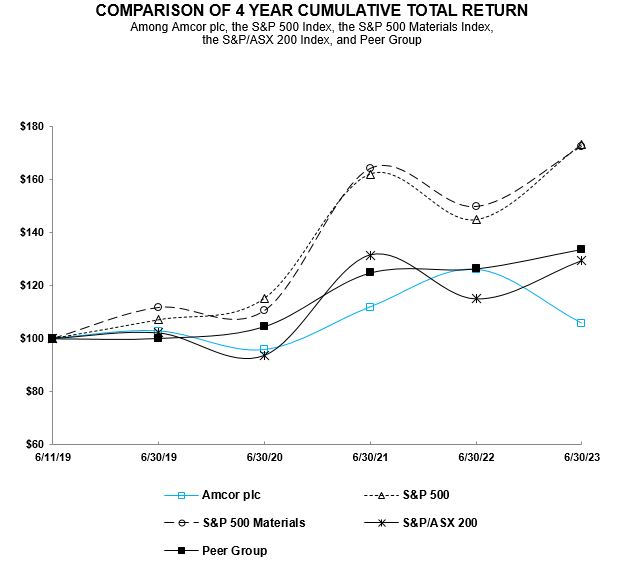
The line graph below illustrates our cumulative total shareholder return on our ordinary shares as compared with the cumulative total return of our Peer Group, the S&P 500 Index, the S&P 500 Materials Index, and the ASX 200 Index for the period beginning June 11, 2019. The graph assumes $100 was invested on June 11, 2019, and that all dividends were reinvested.
| June 11, 2019 | June 30, 2019 | June 30, 2020 | June 30, 2021 | June 30, 2022 | June 30, 2023 | |||||||||||||||||||||||||||||||||
| Amcor plc | $ | 100.00 | $ | 102.77 | $ | 95.68 | $ | 111.82 | $ | 126.13 | $ | 105.72 | ||||||||||||||||||||||||||
| S&P 500 | $ | 100.00 | $ | 107.05 | $ | 115.08 | $ | 162.03 | $ | 144.83 | $ | 173.21 | ||||||||||||||||||||||||||
| S&P 500 Materials | $ | 100.00 | $ | 111.71 | $ | 110.47 | $ | 164.06 | $ | 149.75 | $ | 172.39 | ||||||||||||||||||||||||||
| S&P/ASX 200 | $ | 100.00 | $ | 102.08 | $ | 93.59 | $ | 131.41 | $ | 114.86 | $ | 129.24 | ||||||||||||||||||||||||||
| Peer Group | $ | 100.00 | $ | 100.12 | $ | 104.54 | $ | 124.79 | $ | 126.34 | $ | 133.70 |
The Peer Group consists of Ansell Limited, AptarGroup, Inc., Avery Dennison Corporation, Ball Corporation, Berry Global Group, Inc., Brambles Limited, Coles Group Limited, Conagra Brands Inc., Crown Holdings, Inc., Danone SA, General Mills Inc., Graphic Packaging Holding Co, Huhtamaki Oyj, International Paper Company, Johnson & Johnson, The Kraft Heinz Company, Mondelez International, Inc., Nestlé S.A., O-I Glass, Inc., Orora Limited, Pepsico, Inc., The Procter & Gamble Company, Sealed Air Corporation, Silgan Holdings Inc., Sonoco Products Company, Treasury Wine Estates Limited, Unilever PLC, Wesfarmers Limited, WestRock Company, and Woolworths Group Limited.
Item 7. - Management's Discussion and Analysis of Financial Condition and Results of Operations
Management’s Discussion and Analysis should be read in conjunction with the Consolidated Financial Statements and related Notes included in Item 8 of this Annual Report on Form 10-K.
The following is a discussion and analysis of changes in the results of operations for fiscal year 2023 compared to fiscal year 2022. A discussion and analysis regarding our results of operations for fiscal year 2022, compared to fiscal year 2021 that are not included in this Annual Report on Form 10-K can be found in Part II, Item 7 of our Annual Report on Form 10-K for the fiscal year ended June 30, 2022, filed with the SEC on August 18, 2022 and incorporated by reference.
Two Year Review of Results
| (in millions) | 2023 | 2022 | ||||||||||||||||||||||||
| Net sales | $ | 14,694 | 100.0 | % | $ | 14,544 | 100.0 | % | ||||||||||||||||||
| Cost of sales | (11,969) | (81.5) | (11,724) | (80.6) | ||||||||||||||||||||||
| Gross profit | 2,725 | 18.5 | 2,820 | 19.4 | ||||||||||||||||||||||
| Operating expenses: | ||||||||||||||||||||||||||
| Selling, general, and administrative expenses | (1,246) | (8.5) | (1,284) | (8.8) | ||||||||||||||||||||||
| Research and development expenses | (101) | (0.7) | (96) | (0.7) | ||||||||||||||||||||||
| Restructuring, impairment, and other related activities, net | 104 | 0.7 | (234) | (1.6) | ||||||||||||||||||||||
| Other income, net | 26 | 0.2 | 33 | 0.2 | ||||||||||||||||||||||
| Operating income | 1,508 | 10.3 | 1,239 | 8.5 | ||||||||||||||||||||||
| Interest income | 31 | 0.2 | 24 | 0.2 | ||||||||||||||||||||||
| Interest expense | (290) | (2.0) | (159) | (1.1) | ||||||||||||||||||||||
| Other non-operating income, net | 2 | — | 11 | 0.1 | ||||||||||||||||||||||
| Income before income taxes | 1,251 | 8.5 | 1,115 | 7.7 | ||||||||||||||||||||||
| Income tax expense | (193) | (1.3) | (300) | (2.1) | ||||||||||||||||||||||
| Net income | $ | 1,058 | 7.2 | % | $ | 815 | 5.6 | % | ||||||||||||||||||
| Net income attributable to non-controlling interests | (10) | (0.1) | (10) | (0.1) | ||||||||||||||||||||||
| Net income attributable to Amcor plc | $ | 1,048 | 7.1 | % | $ | 805 | 5.5 | % |
Overview
Amcor is a global leader in developing and producing responsible packaging for food, beverage, pharmaceutical, medical, home and personal-care, and other products. We work with leading companies around the world to protect their products and the people who rely on them, differentiate brands, and improve supply chains through a range of flexible and rigid packaging, specialty cartons, closures, and services. We are focused on making packaging that is increasingly light-weighted, recyclable and reusable, and made using an increasing amount of recycled content. During fiscal year 2023, Amcor generated $14.7 billion in sales from operations that spanned 218 locations in over 40 countries.
Significant Developments Affecting the Periods Presented
Economic and Market Conditions
During fiscal year 2023, we have continued to experience intermittent supply shortages and price volatility of certain resins and raw materials as a result of market dynamics, especially in the first half of fiscal year 2023, and higher rates of inflation impacting energy, fuel, and labor costs. In addition, higher inflation, especially in Europe and the United States, has led central banks to rapidly raise interest rates to dampen inflation which results in higher interest expense on our variable rate debt particularly U.S. dollar and Euro denominated debt. The underlying causes for the continued volatility can be attributed to a variety of factors, such as the Russia-Ukraine conflict and higher inflation in many economies, which has resulted in increased volatility in energy and food markets and impacted global economies. This has led to reduced consumer demand for certain of our products and customer destocking in fiscal year 2023.
We will continue to work closely with our suppliers and customers, leveraging our global capabilities and expertise to work through supply chain disruptions and other resulting issues. In addition, we are focused on driving costs out of our business in this challenging environment and recovering higher raw material costs to help mitigate inflation. However, there could be a time lag between recognizing the benefit of our mitigating actions and when the inflation occurs, and there is no assurance that measures taken will be able to fully mitigate the impact of ongoing inflation. While we expect customer destocking to abate in the short-term and consumer demand to improve incrementally throughout fiscal year 2024, there is no assurance that demand will rebound.
Russia-Ukraine Conflict / 2023 Restructuring Plan
Russia's invasion of Ukraine that began in February 2022 continues as of the date of the filing of this annual report. In advance of the invasion, we proactively suspended operations at our small manufacturing site in Ukraine. We also operated three manufacturing facilities in Russia ("Russian business") until their sale on December 23, 2022, for net cash proceeds of $365 million. In addition, we repatriated approximately $65 million in cash held in Russia as part of the transaction. We recorded a pre-tax net gain on sale of $215 million. The carrying value of the Russian business had previously been impaired by $90 million in the quarter ended June 30, 2022.
On February 7, 2023, we announced that we expect to invest $110 million to $130 million of the sale proceeds from the Russian business in various cost savings initiatives to partly offset divested earnings from the Russian business (the "2023 Restructuring Plan" or the "Plan"). We expect total Plan cash and non-cash
Showing the first 8K of 64K characters. Open the full section
Item 7A. - Quantitative and Qualitative Disclosures About Market Risk
Overview
Our activities expose us to a variety of market risks and financial risks. Our overall risk management program seeks to minimize potential adverse effects of these risks on Amcor's financial performance. From time to time, we enter into various derivative financial instruments, such as foreign exchange contracts, commodity fixed price swaps (on behalf of customers), and interest rate swaps to manage these risks. Our hedging activities are conducted on a centralized basis through standard operating procedures and delegated authorities, which provide guidelines for control, counterparty risk, and ongoing reporting. These derivative instruments are designed to reduce the economic risk associated with movements in foreign exchange rates, raw material prices, and to fixed and variable interest rates, but may not have been designated or qualify for hedge accounting under U.S. GAAP and hence may increase income statement volatility. However, we do not trade in derivative financial instruments for speculative purposes. In addition, we may enter into loan agreements in currencies other than the respective legal entity's functional currency to economically hedge foreign exchange risk in net investments in our non-U.S. subsidiaries, which do not qualify for hedge accounting under U.S. GAAP and hence may increase income statement volatility.
There have been no material changes in the risks described below, other than increased volatility in connection with the Russia-Ukraine conflict and the COVID-19 pandemic, for fiscal years 2023 and 2022, related to interest rate risk, foreign exchange risk, raw material and commodity price risk, and credit risk.
Interest Rate Risk
Our policy is to manage exposure to interest rate risk by maintaining a mixture of fixed-rate and variable-rate debt, monitoring global interest rates and, where appropriate, hedging floating interest rate exposure or debt at fixed interest rates through the use of various interest rate derivative instruments including, but not limited to, interest rate swaps, cross-currency interest rate swaps, and interest rate locks.
An increase of 1% in the floating rate on the relevant interest rate yield curve applicable to both derivative and non-derivative instruments denominated in U.S. dollars and Euros, the currencies with the largest interest rate sensitivity, outstanding as of June 30, 2023, would have resulted in an adverse impact on income before income taxes and equity in income of affiliated companies of $20 million expense for the fiscal year ended June 30, 2023.
Foreign Exchange Risk
We operate in over 40 countries across the world and, as a result, we are exposed to movements in foreign currency exchange rates.
For the year ended June 30, 2023, a hypothetical but reasonably possible adverse change of 1% in the underlying average foreign currency exchange rate for the Euro would have resulted in an adverse impact on our net sales of $26 million.
During fiscal years 2023 and 2022, 52% and 49% of our net sales, respectively, were effectively generated in U.S. dollar functional currency entities. During fiscal year 2023 and 2022, 18% and 17%, respectively, of net sales were generated in Euro functional currency entities with the remaining 30% and 34% of net sales, respectively, being generated in entities with functional currencies other than U.S. dollars and Euros. The impact of translating Euro and other non-U.S. dollar net sales and operating expenses into U.S. dollar for reporting purposes will vary depending on the movement of those currencies from period to period.
Raw Material and Commodity Price Risk
The primary raw materials for our products are resins, film, chemicals, and aluminum. We have market risk primarily in connection with the pricing of our products and are exposed to commodity price risk from a number of commodities and certain other raw materials and energy price risk.
Changes in prices of our primary raw materials may result in a temporary or permanent reduction in income before income taxes and equity in income of affiliated companies depending on the level of recovery by material type. The level of recovery depends both on the type of material and the market in which we operate. Across our business, we have a number of contractual provisions that allow for passing on of raw material price fluctuations to customers within predefined periods.
A 1% increase on average prices for resins, film, chemicals, and aluminum, not passed on to the customer by way of a price adjustment, would have resulted in an increase in cost of sales and hence an adverse impact on income before income taxes and equity in income of affiliated companies of $67 million for fiscal year 2023.
Credit Risk
Credit risk refers to the risk that a counterparty will default on its contractual obligations, resulting in financial loss. We are exposed to credit risk arising from financing activities including deposits with banks and financial institutions, foreign exchange transactions and other financial instruments, as well as from over-the-counter raw material and commodity related derivative instruments.
We manage our credit risk from balances with financial institutions through our counterparty risk policy, which provides guidelines on setting limits to minimize the concentration of risks and therefore mitigating financial loss through potential counterparty failure and on dealing and settlement procedures. The investment of surplus funds is made only with approved counterparties and within credit limits assigned to each specific counterparty. Financial derivative instruments can only be entered into with high credit quality approved financial institutions. As of June 30, 2023, and 2022, we did not have a significant concentration of credit risk in relation to derivatives entered into in accordance with our hedging and risk management activities.
Item 8. - Financial Statements and Supplementary Data
Report of Independent Registered Public Accounting Firm
To the Board of Directors and Shareholders of Amcor plc
Opinions on the Financial Statements and Internal Control over Financial Reporting
We have audited the accompanying consolidated balance sheets of Amcor plc and its subsidiaries (the “Company”) as of June 30, 2023 and 2022, and the related consolidated statements of income, comprehensive income, equity and cash flows for each of the three years in the period ended June 30, 2023, including the related notes and schedule of valuation and qualifying accounts and reserves for each of the three years in the period ended June 30, 2023 appearing under Item 15(a)(2) (collectively referred to as the “consolidated financial statements”). We also have audited the Company's internal control over financial reporting as of June 30, 2023, based on criteria established in Internal Control - Integrated Framework (2013) issued by the Committee of Sponsoring Organizations of the Treadway Commission (COSO).
In our opinion, the consolidated financial statements referred to above present fairly, in all material respects, the financial position of the Company as of June 30, 2023 and 2022, and the results of its operations and its cash flows for each of the three years in the period ended June 30, 2023 in conformity with accounting principles generally accepted in the United States of America. Also in our opinion, the Company maintained, in all material respects, effective internal control over financial reporting as of June 30, 2023, based on criteria established in Internal Control - Integrated Framework (2013) issued by the COSO.
Basis for Opinions
The Company's management is responsible for these consolidated financial statements, for maintaining effective internal control over financial reporting, and for its assessment of the effectiveness of internal control over financial reporting, included in Management’s Report on Internal Control Over Financial Reporting appearing under Item 9A. Our responsibility is to express opinions on the Company’s consolidated financial statements and on the Company's internal control over financial reporting based on our audits. We are a public accounting firm registered with the Public Company Accounting Oversight Board (United States) (PCAOB) and are required to be independent with respect to the Company in accordance with the U.S. federal securities laws and the applicable rules and regulations of the Securities and Exchange Commission and the PCAOB.
We conducted our audits in accordance with the standards of the PCAOB. Those standards require that we plan and perform the audits to obtain reasonable assurance about whether the consolidated financial statements are free of material misstatement, whether due to error or fraud, and whether effective internal control over financial reporting was maintained in all material respects.
Our audits of the consolidated financial statements included performing procedures to assess the risks of material misstatement of the consolidated financial statements, whether due to error or fraud, and performing procedures that respond to those risks. Such procedures included examining, on a test basis, evidence regarding the amounts and disclosures in the consolidated financial statements. Our audits also included evaluating the accounting principles used and significant estimates made by management, as well as evaluating the overall presentation of the consolidated financial statements. Our audit of internal control over financial reporting included obtaining an understanding of internal control over financial reporting, assessing the risk that a material weakness exists, and testing and evaluating the design and operating effectiveness of internal control based on the assessed risk. Our audits also included performing such other procedures as we considered necessary in the circumstances. We believe that our audits provide a reasonable basis for our opinions.
Definition and Limitations of Internal Control over Financial Reporting
A company’s internal control over financial reporting is a process designed to provide reasonable assurance regarding the reliability of financial reporting and the preparation of financial statements for external purposes in accordance with generally accepted accounting principles. A company’s internal control over financial reporting includes those policies and procedures that (i) pertain to the maintenance of records that, in reasonable detail, accurately and fairly reflect the transactions and dispositions of the assets of the company; (ii) provide reasonable assurance that transactions are recorded as necessary to permit preparation of financial statements in accordance with generally accepted accounting principles, and that receipts and expenditures of the company are being made only in accordance with authorizations of management and directors of the company; and (iii) provide reasonable assurance regarding prevention or timely detection of unauthorized acquisition, use, or disposition of the company’s assets that could have a material effect on the financial statements.
Because of its inherent limitations, internal control over financial reporting may not prevent or detect misstatements. Also, projections of any evaluation of effectiveness to future periods are subject to the risk that controls may become inadequate because of changes in conditions, or that the degree of compliance with the policies or procedures may deteriorate.
Critical Audit Matters
The critical audit matter communicated below is a matter arising from the current period audit of the consolidated financial statements that was communicated or required to be communicated to the audit committee and that (i) relates to accounts or disclosures that are material to the consolidated financial statements and (ii) involved our especially challenging, subjective, or complex judgments. The communication of critical audit matters does not alter in any way our opinion on the consolidated financial statements, taken as a whole, and we are not, by communicating the critical audit matter below, providing a separate opinion on the critical audit matter or on the accounts or disclosures to which it relates.
Goodwill Impairment Assessment – Flexibles Latin America Reporting Unit within the Flexibles Segment
As described in Notes 2 and 10 to the consolidated financial statements, the Company’s consolidated goodwill balance was $5,366 million as of June 30, 2023, and the goodwill associated with the Flexibles Segment was $4,391 million, which includes goodwill associated with the Flexibles Latin America reporting unit. Management conducts an impairment analysis in the fourth quarter of each year, or whenever events and circumstances indicate an impairment may have occurred during the year. Management’s quantitative assessment utilizes discounted cash flow models to determine the fair value of the reporting unit. As disclosed by management, if the carrying value of a reporting unit exceeds its fair value, management would recognize an impairment loss equal to the difference between the carrying value and estimated fair value of the reporting unit, adjusted for any tax benefits, limited to the amount of the carrying value of goodwill. Management’s projected future cash flows for the Flexibles Latin America reporting unit included key assumptions relating to revenue growth, projected operating income growth, market multiples, terminal values, and the discount rate.
The principal considerations for our determination that performing procedures relating to the goodwill impairment assessment of the Flexibles Latin America reporting unit within the Flexibles Segment is a critical audit matter are (i) the significant judgment by management when developing the fair value of the reporting unit; (ii) a high degree of auditor judgment, subjectivity, and effort in performing procedures
Showing the first 8K of 236K characters. Open the full section
Item 9. - Changes in and Disagreements with Accountants on Accounting and Financial Disclosure
None.
Item 9A. - Controls and Procedures
Evaluation of Disclosure Controls and Procedures
Our management, with the participation of our Chief Executive Officer and Chief Financial Officer, has evaluated the effectiveness of our disclosure controls and procedures as of June 30, 2023. The term "disclosure controls and procedures," as defined in Rules 13a-15(e) and 15d-15(e) under the Securities Exchange Act of 1934, as amended (the “Exchange Act”), means controls and other procedures of a company that are designed to ensure that information required to be disclosed by a company in the reports that it files or submits under the Exchange Act is recorded, processed, summarized, and reported, within the time periods specified in the SEC's rules and forms. Disclosure controls and procedures include, without limitation, controls and procedures designed to ensure that information required to be disclosed by a company in the reports that it files or submits under the Exchange Act is accumulated and communicated to our management, including its principal executive and financial officers, as appropriate, to allow timely decisions regarding required disclosure.
Management recognizes that any controls and procedures, no matter how well designed and operated, can provide only reasonable assurance of achieving their objectives and management necessarily applies its judgment in evaluating the cost-benefit relationship of possible controls and procedures. Based on this evaluation, the Chief Executive Officer and Chief Financial Officer have concluded that our disclosure controls and procedures were effective as of June 30, 2023.
Management's Report on Internal Control Over Financial Reporting
Our management is responsible for establishing and maintaining adequate internal control over financial reporting. Internal control over financial reporting is defined in Rules 13a-15(f) and 15d-15(f) under the Exchange Act. Our internal control over financial reporting is designed to provide reasonable assurance regarding the reliability of financial reporting and the preparation of financial statements for external purposes in accordance with generally accepted accounting principles. Our management evaluated the design and operating effectiveness of our internal control over financial reporting based on the criteria established in the Internal Control-Integrated Framework (2013) issued by the Committee of Sponsoring Organizations of the Treadway Commission (the "COSO framework" (2013)). All internal control systems, no matter how well designed, have inherent limitations. Accordingly, even effective internal controls and procedures can provide only reasonable assurance with respect to financial statement preparation and presentation.
Under the supervision and with the participation of our management, including our Chief Executive Officer and Chief Financial Officer, we conducted an evaluation of the effectiveness of our internal control over financial reporting as of June 30, 2023. Based on this evaluation, our management concluded that we maintained effective internal control over financial reporting as of June 30, 2023.
The effectiveness of our internal control over financial reporting as of June 30, 2023, has been audited by PricewaterhouseCoopers AG, an independent registered public accounting firm, as stated in their report, which appears on "Item 8. - Financial Statements and Supplementary Data" of this Annual Report on Form 10-K.
Changes in Internal Control Over Financial Reporting
There were no changes in our internal control over financial reporting (as defined in Rules 13a-15(f) and 15d-15(f) under the Exchange Act) that occurred during the fourth quarter of fiscal year 2023 that have materially affected, or are reasonably likely to materially affect, our internal control over financial reporting.
Item 9B. - Other Information
During the three months ended June 30, 2023, no director or Section 16 officer of the Company adopted or terminated a “Rule 10b5-1 trading arrangement” or “non-Rule 10b5-1 trading arrangement,” as each term is defined in Item 408(a) of Regulation S-K.
Item 9C. - Disclosure Regarding Foreign Jurisdictions that Prevent Inspections
Not applicable.
PART III
Item 10. - Directors, Executive Officers and Corporate Governance
The information required to be submitted in response to this item is omitted because a definitive proxy statement containing such information will be filed with the Securities and Exchange Commission pursuant to Regulation 14A within 120 days after June 30, 2023, and such information is expressly incorporated herein by reference. Information with respect to our executive officers appears in Part I of this Annual Report on Form 10-K.
Our Board Committee Charters, Corporate Governance Guidelines, and our Code of Conduct & Ethics Policy can be electronically accessed at our website (http://www.amcor.com/investors) under "Corporate Governance" or, free of charge, by writing directly to us, Attention: Corporate Secretary. Our Board of Directors has adopted a Code of Conduct that applies to our principal executive officer, principal financial officer, principal accounting officer, and other persons performing similar functions. We intend to satisfy the disclosure requirements under Item 5.05 of Form 8-K regarding amendments to or waivers from our Code of Conduct by posting such information on the Investor Relations section of our website promptly following the date of such amendment or waiver.
We are not including the information contained on our website as part of, or incorporating it by reference into, this report.
Item 11. - Executive Compensation
Information required to be submitted in response to this item is omitted because a definitive proxy statement containing such information will be filed with the Securities and Exchange Commission pursuant to Regulation 14A within 120 days after June 30, 2023, and such information is expressly incorporated herein by reference.
Item 12. - Security Ownership of Certain Beneficial Owners and Management and Related Shareholder Matters
Equity compensation plans as of June 30, 2023, were as follows:
| Number of securities to be issued upon exercise of outstanding options, warrants, and rights | Weighted-average exercise price of outstanding options, warrants, and rights | Number of securities remaining available for future issuance under equity compensation plans (excluding securities reflected in column (a)) | |||||||||||||||||||||
| Plan Category | (a) | (b) | (c) | ||||||||||||||||||||
| Equity compensation plans approved by security holders | 48,930,014 | (1) | $ | 11.29 | (2) | 41,225,174 | (3) | ||||||||||||||||
| Equity compensation plans not approved by security holders | — | — | — | ||||||||||||||||||||
| Total | 48,930,014 | (1) | $ | 11.29 | (2) | 41,225,174 | (3) |
(1)Includes outstanding option awards of 32,764,410, which have a weighted-average exercise price of $11.29, 11,391,222 awards of ordinary shares issuable upon vesting of performance shares/rights, 3,734,538 awards of ordinary shares issuable upon vesting of share rights, and 1,039,845 restricted shares issued under the share retention plan.
(2)Performance shares/rights, share rights, restricted share units, and non-executive director share plans are excluded when determining the weighted-average exercise price of outstanding options.
(3)May be issued as options, performance shares/rights, share rights, or restricted share units.
The additional information required to be submitted in response to this item is omitted because a definitive proxy statement containing such information will be filed with the Securities and Exchange Commission pursuant to Regulation 14A within 120 days after June 30, 2023, and such information is expressly incorporated herein by reference.
Item 13. - Certain Relationships and Related Transactions, and Director Independence
The information required to be submitted in response to this item is omitted because a definitive proxy statement containing such information will be filed with the Securities and Exchange Commission pursuant to Regulation 14A within 120 days after June 30, 2023, and such information is expressly incorporated herein by reference.
Item 14. - Principal Accountant Fees and Services
The information required to be submitted in response to this item is omitted because a definitive proxy statement containing such information will be filed with the Securities and Exchange Commission pursuant to Regulation 14A within 120 days after June 30, 2023, and such information is expressly incorporated herein by reference.
PART IV
Item 15. - Exhibits and Financial Statement Schedules
| Pages in Form 10-K | ||||||||
| (a) Financial Statements, Financial Statement Schedule, and Exhibits | ||||||||
| (1) Financial Statements | ||||||||
| Report of Independent Registered Public Accounting Firm (PCAOB ID 1358) | 48 | |||||||
| Consolidated Statements of Income | 50 | |||||||
| Consolidated Statements of Comprehensive Income | 51 | |||||||
| Consolidated Balance Sheets | 52 | |||||||
| Consolidated Statements of Cash Flows | 53 | |||||||
| Consolidated Statements of Equity | 54 | |||||||
| Notes to Consolidated Financial Statements | 55 | |||||||
| (2) Financial Statement Schedule | ||||||||
| Schedule II - Valuation and Qualifying Accounts and Reserves | 117 | |||||||
| All other schedules are omitted because they are not applicable, or the required information is shown in the financial statements or notes thereto. | ||||||||
| (3) Exhibits |
- This exhibit is a management contract or compensatory plan or arrangement.
Item 16. - Form 10-K Summary
None.
Signatures
Pursuant to the requirements of Section 13 or 15(d) of the Securities Exchange Act of 1934, the Registrant has duly caused this report to be signed on its behalf by the undersigned, thereunto duly authorized.
| AMCOR PLC | ||||||||||||||
| By | /s/ Michael Casamento | By | /s/ Julie Sorrells | |||||||||||
| Michael Casamento, Executive Vice President and Chief Financial Officer (Principal Financial Officer) | Julie Sorrells, Vice President & Corporate Controller (Principal Accounting Officer) | |||||||||||||
| August 17, 2023 | August 17, 2023 |
Pursuant to the requirements of the Securities Exchange Act of 1934, this report has been signed below by the following persons on behalf of the Registrant and in the capacities and on the dates indicated.
| /s/ Michael Casamento | /s/ Julie Sorrells | |||||||
| Michael Casamento, Executive Vice President and Chief Financial Officer (Principal Financial Officer) | Julie Sorrells, Vice President & Corporate Controller (Principal Accounting Officer) | |||||||
| August 17, 2023 | August 17, 2023 | |||||||
| /s/ Ronald Delia | /s/ Armin Meyer | |||||||
| Ronald Delia, Managing Director and Chief Executive Officer | Armin Meyer, Director and Deputy Chairman | |||||||
| August 17, 2023 | August 17, 2023 | |||||||
| /s/ Graeme Liebelt | /s/ Andrea Bertone | |||||||
| Graeme Liebelt, Director and Chairman | Andrea Bertone, Director | |||||||
| August 17, 2023 | August 17, 2023 | |||||||
| /s/ Nicholas (Tom) Long | /s/ Karen Guerra | |||||||
| Nicholas (Tom) Long, Director | Karen Guerra, Director | |||||||
| August 17, 2023 | August 17, 2023 | |||||||
| /s/ Arun Nayar | /s/ Susan Carter | |||||||
| Arun Nayar, Director | Susan Carter, Director | |||||||
| August 17, 2023 | August 17, 2023 | |||||||
| /s/ Achal Agarwal | /s/ David Szczupak | |||||||
| Achal Agarwal, Director | David Szczupak, Director | |||||||
| August 17, 2023 | August 17, 2023 | |||||||
Schedule II - Valuation and Qualifying Accounts and Reserves
(in millions)
Reserves for Credit Losses, Sales Returns, Discounts, and Allowances:
| Year ended June 30, | Balance at Beginning of the Year (1) | Additions Charged to Profit and Loss | Write-offs | Foreign Currency Impact and Other (2) | Balance at End of the Year | |||||||||||||||||||||||||||
| 2023 | $ | 25 | $ | 3 | $ | (8) | $ | 1 | $ | 21 | ||||||||||||||||||||||
| 2022 | 28 | 2 | (3) | (2) | 25 | |||||||||||||||||||||||||||
| 2021 | 42 | (4) | (11) | 1 | 28 |
(1)Beginning balance for fiscal year 2021 includes $7 million addition due to the adoption of ASC 326 ("CECL").
(2)Foreign Currency Impact and Other includes reserve accruals related to acquisitions.