 filings.tools
Advanced Micro Devices (AMD) 10-K risk factor changes: FY2018 vs FY2017
The 2018-12-29 10-K against the 2017-12-30 one, compared heading by heading and sentence by sentence. One of these filings carries no fiscal year tag, so its year is the calendar year of the period end.
Item 1A123 rewritten33 added36 removed389 unchanged
All filing items960 rewritten612 added838 removed2,200 unchanged
Summary
counted, not written
- Item 1A headings could not be compared: only 0 carried over between the two years, which usually means one filing was read wrongly, so none is reported as new or removed.
- Sentence by sentence, 612 added, 838 removed, 960 rewritten and 2,200 unchanged across 18 items that differ.
Sentences by item
22 items, with every count and a link to each item that changed
Underlined words on a shaded ground are new in FY2018; struck-through words were in FY2017. Sentences that are wholly new or wholly gone are labelled rather than marked.
Item 1A. RISK FACTORS
123 rewritten, 33 added, 36 removed, 389 unchanged
Intel also dominates the computer system platform, which includes core logic chipsets, graphics chips, [removed: motherboards] [added: networking devices (wired] and [added: wireless), non-volatile storage and] other components necessary to assemble a computer system.
[removed: | • |] [added: -] product mix and introduction schedules; [removed: |]
[removed: | • |] [added: -] product bundling, marketing and merchandising strategies; [removed: |]
[removed: | • |] [added: -] exclusivity payments to its current and potential customers, retailers and channel partners; [removed: |]
| • | de facto control over industry standards, and heavy influence on PC manufacturers and other PC industry participants, including motherboard, memory, chipset and basic input/output [removed: system, or BIOS,] [added: system (BIOS)] suppliers and software companies as well as the graphics interface for Intel platforms; and |
[removed: Also, Intel recently announced that it is developing their own high-end discrete GPUs.Intel’s] [added: Intel’s] position in the microprocessor market and integrated graphics chipset market, its introduction of competitive new products, its existing relationships with top-tier [removed: OEMs] [added: OEMs,] and its aggressive marketing and pricing strategies could result in lower unit sales and a lower average selling price for our products, which could have a material adverse effect on us.
We have a wafer supply agreement with GF with obligations to purchase all of our microprocessor and APU product requirements, and a certain portion of our GPU product requirements [added: manufactured at process nodes larger than 7 nanometer] from GF, with limited exceptions.
The [removed: WSA] [added: wafer supply agreement (WSA)] governs the terms by which we purchase products manufactured by GF.
Pursuant to the WSA, we are required to purchase all of our microprocessor and APU product requirements, and a portion of our GPU product requirements from GF [added: manufactured at process nodes larger than 7 nanometer (nm),] with limited exceptions.
If GF is unable to achieve anticipated manufacturing yields, [removed: remain competitive using or implementing advanced leading-edge process technologies needed to] manufacture [removed: future generations of] our [removed: products, manufacture our] products on a timely basis at competitive prices or meet our capacity requirements, then we may experience [removed: delays in product launches,] supply shortages for certain products or increased costs and our business could be materially adversely affected.
[removed: In August 2016, we entered into the sixth amendment to the WSA with GF (Sixth Amendment) pursuant to which we agreed to certain annual wafer purchase targets through 2020, and if] [added: If] we fail to meet the agreed wafer purchase target during a calendar year we will be required to pay to GF a portion of the difference between our actual wafer purchases and the applicable annual purchase target.
If Mubadala Tech fails to adequately fund GF on a timely basis, or at all, [added: and if GF is not otherwise able to adequately fund its operations,] GF’s ability to manufacture products for us could be materially adversely affected.
[added: We are party to two ATMP joint ventures (collectively, the JVs) with Tongfu Fujitsu Microelectronics Co., Ltd.] The majority of our ATMP services [removed: will be] [added: are] provided by the JVs and there is no guarantee that the JVs will be able to fulfill our long-term ATMP requirements.
We cannot be certain that our third-party foundries will be able to develop, obtain or successfully implement leading-edge process technologies needed to manufacture future generations of our products profitably or on a timely basis or that our competitors will not develop new technologies, products [removed: or processes earlier.]
Our ability to take advantage of the opportunities within [removed: the areas of] Computing and Graphics is based on foreseeing those changes and making timely investments in the form factors that serve those [removed: areas.][added: growing sub-segments.]
As consumers [removed: adopt new form factors,] have new product feature preferences or have different requirements than those consumers in the PC market, PC sales could be negatively impacted, which could adversely impact our business.
We cannot assure you that our efforts to execute our product roadmap [removed: and address markets beyond our core PC market] will result in innovative products and technologies that provide value to our customers.
If new competitors, technological advances by existing [removed: competitors] [added: competitors,] or other competitive factors require us to invest significantly greater resources [added: than anticipated in our research and development efforts, our operating expenses would increase.]
Credit agency downgrades or concerns regarding our credit worthiness may impact relationships with our suppliers, who may [removed: limit our credit lines.]
We [added: depend on a small number of customers for a substantial portion of our business and we] expect that a small number of customers will continue to account for a [removed: substantial] [added: significant] part of [removed: revenue of] our [removed: businesses] [added: revenue] in the future.
We also are subject to claims and litigation related to [removed: the recently disclosed] side-channel exploits, such as Spectre, and may face additional claims or litigation for future vulnerabilities.
Global economic [added: and market] uncertainty may adversely impact our business and operating results.
Moreover, our key suppliers may reduce their output or become insolvent, thereby adversely impacting [added: our ability to manufacture our products.]
Our ability to make payments on and to refinance our debt will depend on our financial and operating performance, which may fluctuate significantly from quarter to quarter, and is subject to prevailing [removed: economic conditions] [added: economic, financial] and [removed: financial,] business [removed: and] [added: conditions along with] other factors, many of which are beyond our control.
Our total debt as of December [removed: 30, 2017] [added: 29, 2018] was [removed: $1.4] [added: $1.3] billion, net of unamortized debt issuance costs and unamortized debt discount associated with the 2.125% Notes.
[removed: | • |] [added: -] require us to use a substantial portion of our cash flow from operations to make debt service payments; [removed: |]
[removed: | • |] [added: -] place us at a competitive disadvantage compared to our competitors with relatively less debt; and [removed: |]
[removed: | • |] [added: -] increase our vulnerability to the impact of adverse economic and industry conditions. [removed: |]
We enter into sale and factoring arrangements from time to time with respect to certain [removed: of our] accounts receivables, which arrangements are non-recourse to us in the event that an account debtor fails to pay for credit-related reasons, and are not included in our indebtedness.
[removed: | • |] [added: -] incur additional indebtedness; [removed: |]
[removed: | • |] [added: -] pay dividends and make other restricted payments; [removed: |]
[removed: | • |] [added: -] make certain investments, including investments in our unrestricted subsidiaries; [removed: |]
[removed: | • |] [added: -] create or permit certain liens; [removed: |]
[removed: | • |] [added: -] use the proceeds from sales of assets; [removed: |]
[removed: | • |] [added: -] enter into certain types of transactions with affiliates; and [removed: |]
[removed: | • |] [added: -] consolidate or merge or sell our assets as an entirety or substantially as an entirety. [removed: |]
| • | create liens upon any of the Loan Parties’ property (other than customary permitted liens and liens in respect of up to $1.5 billion of secured credit facilities [removed: debt (which] [added: debt, which] amount includes our Secured Revolving Line of Credit); |
[removed: | • |] [added: -] declare or make cash distributions; [removed: |]
[removed: | • |] [added: -] create any encumbrance on the ability of a subsidiary to make any upstream payments; [removed: |]
[removed: | • |] [added: -] enter into any non-arm’s-length transaction with an affiliate (except for certain customary exceptions). [removed: |]
Also, Intel recently announced that it is developing their own high-end discrete GPUs.
In January 2019, we entered into the seventh amendment to the WSA with GF (the Seventh Amendment).
The Seventh Amendment modifies certain purchase commitments, pricing and other terms of the WSA applicable to wafer purchases at the 12 nm technology node and above by us for the period commencing January 1, 2019 and continuing through March 1, 2024.
or processes earlier.
For example, we are presently focusing our 7nm product portfolio on Taiwan Semiconductor Co., Ltd.’s (TSMC) 7nm process.
If TSMC is not able to manufacture our products on 7nm in sufficient quantities to meet customer demand, it could have a material adverse effect on our business.
Our product roadmap includes our next generation AMD Ryzen, AMD Radeon and AMD EPYC processors using 7 nm process technology.
We also depend on the success and timing of our customers’ platform launches.
If our customers delay their product launches or if our customers do not effectively market their platforms with our products, it could result in a delay in bringing our products to market and cause us to miss a cycle in the demand of end-users, which could materially adversely affect our business.
limit our credit lines.
- compliance with external regulations.
The profile of our sales may be weighted differently during the year.
For example,
In addition, Intel Corporation has announced that it plans to expand its position in integrated graphics for the PC market with high-end discrete graphics solutions for a broad range of computing segments, which may negatively impact our ability to compete in these computing segments.
Also, the European Union’s General Data Protection Regulation imposes significant new requirements on how we collect, process and transfer personal data, as well as significant fines for non-compliance.
The United States administration has announced tariffs on certain products imported into the United States with China as the country of origin, and we are taking steps to mitigate the impact of these tariffs on our business and AMD processor-based products.
There is also a possibility of future tariffs imposed by the United States, China or other countries that could have a material adverse effect on our business.
On February 5, 2019, WCH sold approximately 34.9 million shares of our common stock and notified us it would exercise its warrant to purchase 75 million shares of our common stock at a purchase price of $5.98 per share for a total amount of $448.5 million.
We expect to receive proceeds of $448.5 million upon the exercise of the warrant and issue the 75 million shares of our common stock to WCH in accordance with the terms of the Warrant Agreement.
The 2.125% Notes will mature on September 1, 2026, unless earlier redeemed or repurchased by us or converted.
For example, during the fourth quarter of 2018, the sale price for conversion was satisfied as of the end of December 31, 2018 and as a result, the 2.125% Notes are eligible for conversion during the first calendar quarter of 2019.
Demand for cryptocurrency has changed and is likely to continue to change quickly.
In addition, if we are unable to collect accounts receivable from our significant distributors and/
or AIB partners, it could have a material adverse effect on our business.
We license certain third-party technologies and tools for the design and production of our products.
We report the value of those licenses as intangible assets on the balance sheet and we periodically evaluate the carrying value of those licenses based on their future economic benefit to us.
Factors such as the life of the assets, changes in competing technologies, and changes to the business strategy may represent an indicator of impairment.
The occurrence of any of these events may require us to record future technology license impairment charges.
For example, during the fourth quarter of 2018, we recorded an impairment charge in Cost of sales of $45 million on technology licenses related to products that are no longer being used.
attacks, data breaches and computer system or network failures, exposing us to significant cost, reputational harm and disruption or damage to our business.
of these products.
The Company is subject to income tax, indirect tax or other tax claims by tax agencies in jurisdictions in which it conducts business.
Although we believe our tax estimates are reasonable, we cannot assure that the final
For example, Intel has introduced microprocessors for low-cost notebooks, similar to products that we offer for low-cost notebooks.
| | |
| --- | --- |
Moreover, if GF is unable to satisfy our manufacturing requirements and we are unable to secure from GF
additional exceptions allowing us to contract with another wafer foundry to satisfy those requirements, then our business could be materially adversely affected.
In April 2016, we consummated a transaction with Tongfu Fujitsu Microelectronics Co., Ltd. (formerly, Nantong Fujitsu Microelectronics Co., Ltd.) (TFME), under which we sold to TFME 85% of the equity interests in our ATMP facilities consisting of Suzhou TF-AMD Semiconductor Co., Ltd. (formerly AMD Technologies (China) Co., Ltd.) and TF-AMD Microelectronics (Penang) Sdn.
Bhd.
(formerly Advanced Micro Devices Export Sdn.
Bhd.) thereby forming two joint ventures (collectively, the JVs).
For example, a large portion of our Computing and Graphics revenue is focused on consumer desktop PC and notebook.
Our product roadmap includes AMD Ryzen™ and AMD EPYC™ processors based on our new x86 processor core codenamed “Zen” to help drive our re-entry into high-performance and server computing.
than anticipated in our research and development efforts, our operating expenses would increase.
Collectively, Sony Interactive Entertainment LLC, Microsoft Corporation and HP Inc. accounted for approximately 44% of our consolidated net revenue for the year ended December 30, 2017.
Sales to Sony and Microsoft consisted of products from our Enterprise, Embedded and Semi-Custom segment and sales to HP consisted primarily of products from our Computing and Graphics segment.
our ability to manufacture our products.
All of the 2.125% Notes were convertible at the option of their holders prior to their scheduled term from October 1, 2017 until December 31, 2017.
The cryptocurrency market is unstable and demand could change quickly.
If the value of such stock awards does not appreciate as measured by the performance of the price of our common
While the overall growth in these segments is stabilizing, the sub-segments of these markets are changing.
Our ability to take advantage of the growth in these sub-segments is based on foreseeing those changes and making timely investments in the form factors that serve those growing sub-segments.
which could adversely affect our results of operations.
In 2016, we consummated the transaction with TFME, under which we sold to TFME 85% of the equity interests in our JVs.
Going forward, we expect the majority of our ATMP services will be provided by the JVs and there is no guarantee that the JVs will be able to fulfill our long-term ATMP requirements.
The primary purpose of the THATIC JV is to support our expansion into the server and workstation product market in China.
We also licensed certain of our intellectual property (Licensed IP) to the THATIC JV for license fees payable over several years contingent upon achievement of certain milestones.
We also expect to receive a royalty based on the sales of the THATIC JV’s products to be developed on the basis of such Licensed IP.
Cyber-attacks on
Following the adoption of the new revenue recognition standard (ASC 606) effective in the first quarter of 2018, we expect our seasonality trends to be affected as we will recognize certain revenue earlier than prior to the adoption of the new revenue recognition standard.
For example, we expect our second and third quarter sales to be higher than first and fourth quarter sales for our semi-custom SoC products for game consoles.
We cannot predict the impact, if any, of the policies adopted by the new administration will have on our business.
Until we know what changes are enacted, we will not know whether in total we benefit from, or are negatively affected by, the changes.
our reputation.
We are subject to income taxes in the United States, Canada and other foreign jurisdictions.
We recorded preliminary estimates of the impact of the Tax Reform Act in accordance with Staff Accounting Bulletin No.118 (SAB 118).
These estimates are subject to further analysis and review which may result in material adjustments in 2018.
responsible for, the release of such hazardous substances.
An excerpt. Shown here: 40 of 123 rewritten, all 33 added and all 36 removed. The counts are complete. For every sentence, read Item 1A. RISK FACTORS in the FY2018 filing and the FY2017 filing.
Item 7. MANAGEMENT’S DISCUSSION AND ANALYSIS OF FINANCIAL CONDITION AND RESULTS OF OPERATIONS
109 rewritten, 72 added, 290 removed, 168 unchanged
The following discussion should be read in conjunction with the consolidated financial statements as of December [removed: 30, 2017] [added: 29, 2018] and December [removed: 31, 2016] [added: 30, 2017] and for each of the three years in the period ended December [removed: 30, 2017] [added: 29, 2018] and related notes, which are included in this Annual Report on Form 10-K as well as with the other sections of this Annual Report on Form 10-K, including “Part I, Item 1: Business,” “Part II, Item 6: Selected Financial Data” and “Part II, Item 8: Financial Statements and Supplementary Data.”
In this [removed: management 's] [added: management’s] discussion and analysis (MD&A), we will describe the results of operations and the financial condition for us and our consolidated subsidiaries, including a discussion of our results of operations for [removed: 2017] [added: 2018] compared to [removed: 2016] [added: 2017] and [removed: 2016] [added: 2017] compared to [removed: 2015,] [added: 2016,] an analysis of changes in our financial condition and a discussion of our contractual obligations and off balance sheet arrangements.
Net revenue for [removed: 2017] [added: 2018] was [removed: $5.3] [added: $6.5] billion, an increase of [removed: 25%] [added: 23%] compared to [removed: 2016.][added: 2017 net revenue of $5.3 billion.]
Our operating income for [removed: 2017] [added: 2018] improved to [removed: $204] [added: $451] million compared to [removed: an] operating [removed: loss] [added: income] of [removed: $372] [added: $127] million for [removed: 2016.][added: 2017.]
Our net income for [removed: 2017] [added: 2018] improved to [removed: $43] [added: $337] million compared to a net loss of [removed: $497] [added: $33] million in the prior year.
Principal amount of total debt as of December [removed: 30, 2017] [added: 29, 2018] was [removed: $1.70] [added: $1.53] billion, compared to [removed: $1.77] [added: $1.70] billion as of December [removed: 31, 2016.][added: 30, 2017.]
[removed: Although actual results have historically been reasonably consistent with] management’s expectations, the actual results may differ from these estimates or our estimates may be affected by different assumptions or conditions.
[removed: In assessing impairment of goodwill prior to our adoption of ASU 2017-04,] [added: If] we [removed: first analyzed qualitative factors to determine whether] [added: conclude] it is more likely than not that the fair value of a reporting unit [removed: is less than] [added: exceeds] its carrying [removed: amount as a basis for determining whether it is necessary] [added: amount, we do not proceed] to perform [removed: the two-step goodwill] [added: a quantitative] impairment test.
[removed: The qualitative] [added: Qualitative] factors [removed: we assessed included long-term prospects of our] [added: include industry and market consideration, overall financial] performance, share price [removed: trends,] [added: trends and] market capitalization and [removed: company-specific] [added: Company-specific] events.
If we [removed: concluded] [added: conclude] it [removed: was] [added: is] more likely than not that the fair value of [removed: a] [added: the] reporting unit [removed: exceeded] [added: is less than] its carrying [removed: amount, we needed not perform the two-step] [added: value, a quantitative goodwill] impairment [removed: test.][added: test will be performed by comparing the fair value of each reporting unit to its carrying value.]
[removed: We] [added: As a result, we] have recognized the provisional tax impacts related to deemed repatriated earnings and the revaluation of deferred tax assets and liabilities [removed: and included these amounts] in our consolidated financial statements for the year ended December 30, 2017.
[removed: Because of the complexity of the new provisions, we are continuing to evaluate how the provisions will be accounted for under U.S. GAAP wherein] [added: The guidance allows] companies [removed: are allowed] to make an accounting policy election [removed: of] [added: to] either (i) account for GILTI as a component of tax expense in the period in which [removed: we] [added: they] are subject to the rules (the period cost method), or (ii) account for GILTI in the Company’s measurement of deferred taxes (the deferred method).
The following table provides a summary of net revenue and operating income (loss) by segment for [removed: 2017, 2016] [added: 2018, 2017] and [removed: 2015.][added: 2016.]
| | [removed: 2017] [added: 2018] | | | | [removed: 2016] [added: 2017] | | | | [removed: 2015] [added: 2016] | | |
| Enterprise, Embedded and Semi-Custom | [removed: 2,300] [added: 2,350] | | | | [removed: 2,305] [added: 2,276] | | | | [removed: 2,186] [added: 2,331] | | |
| Enterprise, Embedded and Semi-Custom | [removed: 154] [added: 163] | | | | [removed: 283] [added: 132] | | | | [removed: 215] [added: 287] | | |
| All Other | [removed: (97] [added: (182] | | ) | | [removed: (417] [added: (97] | | ) | | [removed: (194] [added: (417] | | ) |
| Total operating income (loss) | $ | [removed: 204] [added: 451] | | | $ | [removed: (372] [added: 127] | [removed: )] | | $ | [removed: (481] [added: (373] | ) |
Computing and Graphics net revenue of $3.0 billion in 2017 increased by [removed: 54%] [added: 50%,] compared to $2.0 billion in 2016 as a result of a [removed: 47%] [added: 38%] increase in average selling price and a [removed: 2%] [added: 1%] increase in unit shipments.
The increase in the average selling price was primarily [removed: due to a favorable shift in product mix as we transitioned to our new Radeon™ GPU and Ryzen™] [added: driven by Ryzen] desktop processor [removed: products.][added: and Radeon graphics products sales.]
The increase in unit shipments was primarily attributable to higher demand for our [removed: GPU] [added: Radeon graphics] products.
Computing and Graphics net revenue of [removed: $2.0] [added: $4.1] billion in [removed: 2016] [added: 2018] increased by [removed: 9%] [added: 39%,] compared to [removed: $1.8] [added: $3.0] billion in [removed: 2015] [added: 2017, primarily] as a result of a [removed: 9%] [added: 15%] increase in [removed: unit shipments, offset by a 2% decrease in] average selling [removed: price.][added: price and a 17% increase in unit shipments.]
The increase in [removed: unit shipments] [added: net revenue] was primarily [removed: attributable] [added: due] to higher [removed: unit shipments] [added: sales] of our [removed: GPU] [added: EPYC™ server] products, partially offset by lower [removed: unit shipments of our microprocessor products.][added: semi-custom revenue.]
The increase [removed: of] [added: in average selling price and] unit shipments [removed: of our GPU products] was primarily driven by [added: higher] demand for our [removed: Polaris architecture-based GPU products.][added: Ryzen™ processors.]
Computing and Graphics operating income was [removed: $147] [added: $92] million in [removed: 2017] [added: 2017,] compared to an operating loss of [removed: $238] [added: $243] million in 2016.
The improvement in operating results was primarily due to the increase in net revenue referenced above, partially offset by the related increase in cost of sales and [removed: an $84 million increase in] operating expenses.
Computing and Graphics operating [removed: loss] [added: income] was [removed: $238] [added: $470] million in [removed: 2016] [added: 2018] compared to [removed: an] operating [removed: loss] [added: income] of [removed: $502] [added: $92] million in [removed: 2015.][added: 2017.]
Operating expenses [removed: decreased] [added: increased] for the reasons set forth under “Expenses” below.
Enterprise, Embedded and Semi-Custom net revenue of [removed: $2.3] [added: $2.28] billion in 2017 [removed: was flat] [added: decreased by 2%] compared to [added: net revenue of $2.33 billion in] 2016.
IP related revenue and sales of our [removed: AMD EPYC™] [added: EPYC] datacenter processors, which were launched in June of 2017, were mostly offset by a decrease in non-recurring engineering (NRE) revenue and lower sales of our semi-custom SoC products.
Enterprise, Embedded and Semi-Custom net revenue of [removed: $2.3] [added: $2.4] billion in [removed: 2016] [added: 2018] increased by [removed: 5%] [added: 3%] compared to net revenue of [removed: $2.2] [added: $2.3] billion [removed: in 2015.][added: 2017.]
Enterprise, Embedded and Semi-Custom operating income was [removed: $154] [added: $132] million in 2017 compared to operating income of [removed: $283] [added: $287] million in 2016.
Enterprise, Embedded and Semi-Custom operating income was [removed: $283] [added: $163] million in [removed: 2016] [added: 2018] compared to operating income of [removed: $215] [added: $132] million in [removed: 2015.][added: 2017.]
All Other operating loss of $417 million in 2016 included a charge of $340 million, which was comprised of the $100 million payment under the Sixth Amendment and the $240 million value of the warrant under the Warrant [removed: Agreement,] [added: Agreement with WCH,] and stock-based compensation expense of $86 million, partially offset by restructuring reversals of $10 million.
All Other operating loss of [removed: $194] [added: $182] million in [removed: 2015] [added: 2018] included [removed: restructuring and other special charges, net of $129 million and] stock-based compensation expense of [removed: $63] [added: $137 million and an impairment of technology licenses of $45] million.
The following is a summary of certain consolidated statement of operations data for [removed: 2017, 2016] [added: 2018, 2017] and [removed: 2015:][added: 2016:]
| Gross margin percentage | [removed: 34] [added: 38] | | % | | [removed: 23] [added: 34] | | % | | [removed: 27] [added: 23] | | % |
| Research and development | [removed: 1,160] [added: 1,434] | | | | [removed: 1,008] [added: 1,196] | | | | [removed: 947] [added: 1,008] | | |
| Marketing, general and administrative | [removed: 511] [added: 562] | | | | [removed: 460] [added: 516] | | | | [removed: 482] [added: 466] | | |
| Restructuring and other special charges, net | — | | | | [removed: (10] [added: —] | | [removed: )] | | [removed: 129] [added: (10] | | [added: )] |
Our 2018 financial results demonstrate the success of our strong product roadmap execution.
Customers continued to adopt our high performance products as new products accounted for over 65% of our annual 2018 revenue.
Gross margin, as a percentage of net revenue for 2018, was 38%, a 4% increase compared to 34% in 2017.
We significantly expanded our desktop processor offerings in 2018 with the launch of our second-generation AMD Ryzen and high-end AMD Ryzen Threadripper™ WX processors for gamers, creators and hardware enthusiasts.
We announced the availability of our first desktop consumer and commercial Ryzen and Ryzen PRO APUs that combine our high-performance “Zen” CPU and Radeon “Vega” graphics cores into a single chip.
We also introduced the first entry-level processors based on our “Zen” CPU and “Vega” GPU cores for the consumer and commercial desktop PC market with the AMD Athlon™ and AMD PRO processors.
In the notebook market, multiple customers launched premium consumer and commercial PCs featuring our mobile AMD Ryzen APUs, including our first enterprise-class notebooks powered by our new AMD Ryzen PRO APUs.
For the high-performance embedded markets, we introduced the AMD EPYC™ Embedded 3000 processor and AMD Ryzen Embedded V1000 processor families that bring new levels of computing and graphics performance to the thin client, digital signage, and infrastructure markets.
Cash, cash equivalents and marketable securities as of December 29, 2018 were $1.16 billion, down from $1.18 billion at the end of 2017.
Although actual results have historically been reasonably consistent with
Revenue recognition.
In accordance with the adoption of the new revenue standard effective the beginning of the first quarter of 2018, we now recognize revenue upon the shipment of the product to our distributors (sell-in), rather than upon the resale of the product by our distributors to their customers (sell-through).
Accordingly, we have established provisions for rights of return and price protection on unsold product held by our distributors.
We perform our goodwill impairment analysis as of the first day of the fourth quarter of each year and, if certain events or circumstances indicate that an impairment loss may have been incurred, on a more frequent basis.
The analysis may include both qualitative and quantitative factors to assess the likelihood of an impairment.
We first analyze qualitative factors.
A quantitative impairment analysis, if necessary, considers the income approach, which requires estimates of the present value of expected future cash flows to determine a reporting unit’s fair value.
Significant estimates include revenue growth rates and operating margins used to calculate projected future cash flows, discount rates, and future economic and market conditions.
A goodwill impairment charge is recognized for the amount by which the reporting unit’s fair value is less than its carrying value.
Any loss recognized should not exceed the total amount of goodwill allocated to that reporting unit.
More specifically, SAB 118 allowed companies to record provisional amounts during a measurement period that is similar to the measurement period used when accounting for business combinations.
During 2018, we finalized our computation of the impact of the Tax Reform Act.
After completing the analysis of the GILTI provisions, we elected to account for GILTI using the period cost method.
We report our financial performance based on the following two reportable segments:the Computing and Graphics segment and the Enterprise, Embedded and Semi-Custom segment.
Additional information on our reportable segments is contained in Note 15: Segment Reporting of the Notes to Financial Statements (Part II, Item 8 of this Form 10-K).
Our operating results tend to vary seasonally.
Historically, first quarter PC product sales were generally lower than fourth quarter sales and with respect to our semi-custom SoC products for game consoles our sales pattern usually reflects higher sales in the second and third quarters compared to the first and fourth quarters.
| Computing and Graphics | $ | 4,125 | | | $ | 2,977 | | | $ | 1,988 | |
| Total net revenue | $ | 6,475 | | | $ | 5,253 | | | $ | 4,319 | |
| Computing and Graphics | $ | 470 | | | $ | 92 | | | $ | (243 | ) |
The improvement in operating income was primarily driven by higher demand for Ryzen and Radeon products as customers continued to adopt our new products, partially offset by a $195 million increase in operating expenses.
The improvement in operating income was due primarily to richer server and semi-custom product mix, partially offset by a $50 million increase in operating expenses and lower IP-related revenue.
In 2017, operating income also included a licensing gain of $52 million.
The decline in operating results was primarily due to an increase in operating expenses driven primarily by datacenter-related expenses and lower licensing gain recorded in 2017 related to the licensed IP to the THATIC JV compared to 2016.
| | 2018 | | | | 2017 | | | | 2016 | | |
| Gross margin | 2,447 | | | | 1,787 | | | | 1,003 | | |
The improvement in gross margin was primarily driven by the ramp of new products with higher gross margin than the corporate average.
The increase was primarily driven by a $168 million increase in product engineering and design related costs attributable to both segments, and higher annual employee incentives driven by improved financial performance.
Marketing, general and administrative expenses of $562 million in 2018 increased by $46 million, or 9%, compared to $516 million in 2017.
The increase was primarily due to a $29 million increase in sales and marketing activities attributable to both segments and higher annual employee incentives driven by our improved financial performance.
| | |
| --- | --- |
2017 was an important year for AMD as we launched a number of new high-performance products that re-shaped our product portfolio and improved our technology competitiveness.
We launched more than 40 new high-performance CPUs and GPUs and experienced strong customer acceptance of our new products.
We launched our first-generation AMD Ryzen™ desktop CPUs based on our entirely new “Zen” x86 CPU core architecture.
We released our AMD Ryzen™ 7 desktop processors designed for PC gamers, creators and the enthusiast market.
We also launched our high performance AMD Ryzen™ 5 desktop processors at a variety of price points with up to 6 cores and 12 threads of CPU processing in April 2017.
We released our AMD Ryzen™ 3 desktop processors in July 2017 designed to bring “Zen” processing power to mainstream price points.
In August 2017, we launched the Ryzen™ Threadripper™ family of high-end desktop processors.
For the commercial market, we launched AMD Ryzen™ PRO desktop processors, based on the same “Zen” x86 core architecture.
In October 2017, we announced AMD Ryzen 7 2700U and AMD Ryzen 5 2500U, our first mobile processors with Radeon™ Vega graphics, previously codenamed the “Raven Ridge” mobile APUs, for premium 2-in-1s, convertibles and ultra-thin notebook computers.
AMD Ryzen 7 2700U and AMD Ryzen5 2500U processors combine the “Zen” x86 core architecture with Radeon™ Vega graphics in an SoC design.
We also expanded our consumer and professional graphics offerings with new graphics solutions.
We introduced the Radeon™ RX 500 series in April 2017, a new line of graphics cards based on second-generation “Polaris” architecture that provides additional performance.
We also announced the “Polaris” architecture-based Radeon™ Pro Duo card designed for media and entertainment, broadcast, and design and manufacturing workflows.
We launched our new “Vega” GPU architecture for the high-end gaming, professional, and datacenter markets.
We introduced our Radeon™ RX Vega family of GPUs for enthusiast gamers, Radeon™ Pro SSG for up to 8K video production, and Radeon™ Instinct MI25 for machine intelligence and datacenter markets.
We also focused on improving our competitive position in the server and datacenter markets.
In June 2017, we launched the AMD EPYC™ 7000 Series of high performance processors that have up to 32 high-performance “Zen” compute cores and are designed to support a full range of integer, floating point, memory bandwidth and I/O workloads.
Customer engagement with our EPYC™ processors continued to grow during the year.
In October 2017, we announced the AMD Embedded Radeon™ E9170 Series GPU.
The new processor is the first “Polaris” architecture-based AMD Embedded discrete GPU available in multi-chip module (MCM) format with integrated memory for smaller, power-efficient custom designs.
Our financial results improved in 2017 compared to 2016 primarily as the demand for our Computing and Graphics segment products increased.
Cash and cash equivalents as of December 30, 2017 were
$1.18 billion, down from $1.26 billion at the end of 2016.
Goodwill represents the excess of the purchase price over the fair value of net tangible and identifiable intangible assets acquired.
Goodwill is not amortized, but rather is tested for impairment at least annually, or more frequently if there are indicators of impairment present.
We perform an annual goodwill impairment analysis as of the first day of the fourth quarter of each year.
In the third fiscal quarter of 2017, we adopted ASU 2017-04, Intangibles - Goodwill and Other: Topic 350 Simplifying the Test for Goodwill Impairment.
We therefore applied a different impairment analysis for 2017 than was performed in 2016 and 2015.
If based on that assessment we believed it was more likely than not that the fair value of the reporting units was less than its carrying value, a two-step goodwill impairment test would be performed.
The first step of the two-step test measures for impairment by applying fair value-based tests at the reporting unit level.
We evaluate whether goodwill has been impaired at the reporting unit level by first determining whether the estimated fair value of the reporting unit is less than its carrying value and, if so, by determining whether the implied fair value of goodwill within the reporting unit is less than the carrying value.
The implied fair value of a reporting unit is determined through the application of
one or more valuation models common to our industry including income, market and cost approaches.
While market valuation data for comparable companies is gathered and analyzed, we believe that there has not been sufficient comparability between the peer groups and the specific reporting units to allow for the derivation of reliable indications of value using the market approach.
Therefore, we have ultimately employed the income approach which requires estimates of present value of estimated future cash flows.
Cash flow projections are based on management’s estimates of revenue growth rates and operating margins taking into consideration industry and market condition.
The discount rate used is based on the weighted-average cost of capital adjusted for the relevant risk associated with business-specific characteristics and the uncertainty related to the reporting unit’s ability to execute on the projected cash flows.
A variance in the discount rate could have a significant impact on the amount of the goodwill impairment charge recorded, if any.
An excerpt. Shown here: 40 of 109 rewritten, 40 of 72 added and 40 of 290 removed. The counts are complete. For every sentence, read Item 7. MANAGEMENT’S DISCUSSION AND ANALYSIS OF FINANCIAL CONDITION AND RESULTS OF OPERATIONS in the FY2018 filing and the FY2017 filing.
Item 7A. QUANTITATIVE AND QUALITATIVE DISCLOSURE ABOUT MARKET RISK
25 rewritten, 7 added, 3 removed, 40 unchanged
As of December [removed: 30, 2017,] [added: 29, 2018,] our investment portfolio consisted primarily of commercial paper.
As of December [removed: 30, 2017,] [added: 29, 2018,] all of our outstanding long term debt had fixed interest rates.
Our portfolio includes investments in [removed: debt and] marketable [removed: equity] [added: debt] securities with active secondary or resale markets to ensure portfolio liquidity.
As of December [removed: 30, 2017,] [added: 29, 2018,] substantially all of our investments in debt securities were A-rated by at least one of the rating agencies.
There were no significant sales of available-for-sale securities during [removed: 2017.][added: 2018.]
The following table presents the cost basis, fair value and related weighted-average interest rates by year of maturity for our investment portfolio and debt obligations as of December [removed: 30, 2017:][added: 29, 2018:]
| | [removed: 2018 | | | |] 2019 | | | | 2020 | | | | 2021 | | | | 2022 | | | | 2023 [added: | | | | 2024] and thereafter | | | | Total | | | | [removed: 2017] [added: 2018] Fair Value | | |
| Fixed rate amounts | $ | [removed: 682] [added: 78] | | | $ | — | | | $ | — | | | $ | — | | | $ | — | | | $ | — | | | $ | [removed: 682] [added: 78] | | | $ | [removed: 682] [added: 78] | |
| Weighted-average rate | [removed: 1.47] [added: 2.45] | | % | | — | | | | — | | | | — | | | | — | | | | — | | | | [removed: 1.47] [added: 2.45] | | % | | [removed: 1.47] | | [removed: %] |
| Variable rate amounts | $ | [removed: 395] [added: 70] | | | $ | — | | | $ | — | | | $ | — | | | $ | — | | | $ | — | | | $ | [removed: 395] [added: 70] | | | $ | [removed: 395] [added: 70] | |
| Weighted-average rate | [removed: 1.19] [added: 2.29] | | % | | — | | | | — | | | | — | | | | — | | | | — | | | | [removed: 1.19] [added: 2.29] | | % | | [removed: 1.19] | | [removed: %] |
| Total Investment Portfolio | $ | [removed: 1,077] [added: 878] | | | $ | — | | | $ | — | | | $ | — | | | $ | — | | | $ | — | | | $ | [removed: 1,077] [added: 878] | | | $ | [removed: 1,077] [added: 878] | |
| Weighted-average effective interest rate | [removed: —] [added: 6.75] | | % | | [removed: 6.75] [added: —] | | % | | — | | % | | [removed: —] [added: 7.50] | | % | | [removed: 7.00] [added: —] | | % | | [removed: 3.48] [added: 3.28] | | % | | [removed: 4.67] [added: 4.41] | | % | | [removed: —] | | [removed: %] |
| Variable rate amounts | $ | [removed: —] [added: 312] | | | $ | — | | | $ | — | | | $ | — | | | $ | — | | | $ | — | | | $ | [removed: —] [added: 312] | | | $ | [removed: —] [added: 312] | |
| Weighted-average effective interest rate | [removed: —] [added: 6.00] | | % | | — | | % | | — | | % | | — | | % | | — | | % | | — | | % | | [removed: —] [added: 6.00] | | % | | [removed: —] | | [removed: %] |
We designate these contracts as cash flow hedges of forecasted expenses to the extent eligible [removed: under the accounting rules and evaluate hedge effectiveness prospectively and retrospectively.]
As such, the effective portion of the gain or loss on these contracts is reported as a component of accumulated other comprehensive income (loss) and reclassified [added: to earnings in the same line item as the associated forecasted transaction and in the same period during which the hedged transaction affects earnings.]
The following table provides information about our foreign currency forward contracts as of December [removed: 30, 2017] [added: 29, 2018] and December [removed: 31, 2016.][added: 30, 2017.]
| | December [removed: 30, 2017] [added: 29, 2018] | | | | | | | | | | | December [removed: 31, 2016] [added: 30, 2017] | | | | | | | | | |
| Canadian Dollar | $ | [removed: 111] [added: 110] | | | [removed: 1.2751] [added: 1.3007] | | | $ | [removed: 2] [added: (5] | [added: )] | | $ | [removed: 77] [added: 111] | | | [removed: 1.3189] [added: 1.2751] | | | $ | [removed: (1] [added: 2] | [removed: )] |
| Indian Rupee | [removed: 33] [added: 45] | | | | [removed: 66.1548] [added: 72.2338] | | | [removed: 1] [added: —] | | | | [removed: 25] [added: 33] | | | | [removed: 69.8639] [added: 66.1548] | | | [removed: —] [added: 1] | | |
| Singapore Dollar | [removed: 23] [added: 26] | | | | [removed: 1.3553] [added: 1.3478] | | | — | | | | [removed: 18] [added: 23] | | | | [removed: 1.3740] [added: 1.3553] | | | [removed: (1] [added: —] | | [removed: )] |
| Taiwan Dollar | [removed: 18] [added: 21] | | | | [removed: 29.6586] [added: 29.6490] | | | — | | | | [removed: 16] [added: 18] | | | | [removed: 31.9829] [added: 29.6586] | | | — | | |
| Chinese Renminbi | [removed: 115] [added: 182] | | | | [removed: 6.7972] [added: 6.5733] | | | [removed: 4] [added: (3] | | [added: )] | | [removed: 2] [added: 115] | | | | [removed: 6.9904] [added: 6.7972] | | | [removed: —] [added: 4] | | |
| Total | $ | [removed: 300] [added: 396] | | | | | | $ | [removed: 7] [added: (8] | [added: )] | | $ | [removed: 138] [added: 300] | | | | | | $ | [removed: (2] [added: 7] | [removed: )] |
| Fixed rate amounts | $ | 488 | | | $ | — | | | $ | — | | | $ | — | | | $ | — | | | $ | — | | | $ | 488 | | | $ | 488 | |
| Marketable securities | | | | | | | | | | | | | | | | | | | | | | | | | | | | | | | |
| Weighted-average rate | 2.77 | | % | | — | | | | — | | | | — | | | | — | | | | — | | | | 2.77 | | % | | | | |
| Fixed rate amounts | $ | 66 | | | $ | — | | | $ | — | | | $ | 337 | | | $ | — | | | $ | 1,055 | | | $ | 1,458 | | | $ | 2,494 | |
| Total Debt Obligations | $ | 136 | | | $ | — | | | $ | — | | | $ | 337 | | | $ | — | | | $ | 1,055 | | | $ | 1,528 | | | $ | 2,564 | |
under the accounting rules and evaluate hedge effectiveness prospectively and retrospectively.
| Malaysian Ringgit | 12 | | | | 4.1775 | | | — | | | | — | | | | — | | | — | | |
| Fixed rate amounts | $ | — | | | $ | 166 | | | $ | — | | | $ | — | | | $ | 347 | | | $ | 1,116 | | | $ | 1,629 | | | $ | — | |
| Total Debt Obligations | $ | — | | | $ | 166 | | | $ | — | | | $ | — | | | $ | 347 | | | $ | 1,116 | | | $ | 1,629 | | | $ | — | |
to earnings in the same line item as the associated forecasted transaction and in the same period during which the hedged transaction affects earnings.
Item 1. BUSINESS
74 rewritten, 62 added, 80 removed, 246 unchanged
The forward-looking statements relate to, among other things: [added: possible impact of future accounting rules on AMD’s consolidated financial statements;] demand for AMD’s products; the growth, change and competitive landscape of the markets in which AMD participates; [removed: future restructuring activities;] the nature and extent of AMD’s future payments to GLOBALFOUNDRIES Inc. (GF) and the materiality of these payments; the materiality of AMD’s future purchases from GF; [removed: future patent filings; seasonal trends of our business; the timing of] [added: AMD’s ability to meet its wafer purchase target;] the [removed: completion of accounting related] [added: expected amounts] to [added: be received by AMD under] the [removed: Tax Cuts] [added: IP licensing agreement] and [removed: Jobs Act] [added: AMD’s expected royalty payments from future product sales] of [removed: 2017 (Tax Reform Act); AMD's unrecognized tax benefits over] [added: China JVs’ products to be developed on] the [removed: next 12 months;] [added: basis of such licensed IP; sales patterns of AMD’s PC products and semi-custom System-on-Chip (SoC) products for game consoles;] the level of international sales as compared to total sales; [removed: AMD's dependence on a small number of customers for] [added: international sales will continue to be] a [removed: substantial part of its revenue; receipt] [added: significant portion] of [removed: license fees relating to the joint ventures between AMD and Tianjin Haiguang Advanced Technology Investment Co., Ltd. (THATIC) (the THATIC JV); expected royalties from future product] [added: total] sales [removed: of] [added: in] the [removed: THATIC JV; AMD's expectation] [added: foreseeable future;] that [removed: based on the information presently known to management, the potential liability from current litigation] [added: other unrecognized tax benefits] will not [removed: have a material adverse effect on its financial condition, cash flows or results of operations;] [added: materially change in the next 12 months;] that AMD’s cash and cash equivalents balances [removed: and] [added: together with] the [added: availability under that certain] secured revolving line of credit (Secured Revolving Line of Credit) [added: made available to AMD and certain of its subsidiaries under the Amended and Restated Loan Agreement,] will be sufficient to fund AMD’s operations including capital expenditures over the next 12 months; AMD’s ability to obtain sufficient external financing on favorable [removed: terms; timing of receipt of unbilled accounts receivables; its expenditures] [added: terms, or at all; AMD’s expectation that based on the information presently known to management, the potential liability] related to [removed: environmental compliance; expected impact] [added: AMD’s current litigation will not have a material adverse effect on its financial condition, cash flows or results] of [removed: new and] [added: operations; any amounts in addition to what has been already accrued by AMD for] future [removed: accounting standards] [added: remediation costs under clean-up orders will not be material; we expect to file future patent applications in both the United States and abroad] on [removed: AMD's business;] [added: significant inventions, as we deem appropriate; anticipated increase in costs related to enhancing, implementing] and [removed: AMD does not] [added: monitoring information security controls, remediating any data security breaches and addressing related litigation, mitigating reputational harm and compliance with external regulations related to our IT assets; we] expect to [removed: pay dividends] [added: receive $448.5 million upon the exercise of a warrant by West Coast Hitech L.P. (WCH) and issue 75 million shares of our common stock to WCH; revenue allocated to remaining performance obligations that are unsatisfied which will be recognized over the next 12 months; and a small number of customers will continue to account for a substantial part of AMD’s revenue] in the future.
Material factors that could cause actual results to differ materially from current expectations include, without limitation, the following: Intel Corporation’s dominance of the microprocessor market and its aggressive business practices may limit AMD’s ability to compete effectively; AMD has a wafer supply agreement with GF with obligations to purchase all of its microprocessor and APU product requirements, and a certain portion of its GPU product [removed: requirements] [added: requirements, manufactured at process nodes larger than 7 nanometer (nm)] from GF with limited exceptions.
If GF is not able to satisfy AMD’s manufacturing requirements, [removed: AMD's] [added: AMD’s] business could be adversely impacted; AMD relies on third parties to manufacture its products, and if they are unable to do so on a timely basis in sufficient quantities and using competitive technologies, AMD’s business could be materially adversely affected; failure to achieve expected manufacturing yields for AMD’s products could negatively impact its financial results; the success of AMD’s business is dependent upon its ability to introduce products on a timely basis with features and performance levels that provide value to its customers while supporting and coinciding with significant industry transitions; if AMD cannot generate sufficient revenue and operating cash flow or obtain external financing, it may face a cash shortfall and be unable to make all of its planned investments in research and development or other strategic investments; the loss of a significant customer may have a material adverse effect on AMD; AMD’s receipt of revenue from its semi-custom SoC products is dependent upon its technology being designed into third-party products and the success of those products; [removed: AMD's] [added: global economic and market uncertainty may adversely impact AMD’s business and operating results; AMD’s] products may be subject to security vulnerabilities that could have a material adverse effect on AMD; [removed: global economic uncertainty may adversely impact] [added: IT outages, data loss, data breaches and cyber-attacks could compromise] AMD’s [removed: business] [added: intellectual property or other sensitive information, be costly to remediate] and [added: cause significant damage to its business, reputation and operations; AMD’s] operating [removed: results;] [added: results are subject to quarterly and seasonal sales patterns;] AMD may not be able to generate sufficient cash to service its debt obligations or meet its working capital requirements; AMD has a large amount of indebtedness which could adversely affect its financial position and prevent it from implementing its strategy or fulfilling its contractual obligations; the agreements governing AMD’s notes and the Secured Revolving Line of Credit impose restrictions on AMD that may adversely affect [removed: AMD's ability to operate its business; the markets in which] AMD’s [removed: products are sold are highly competitive; AMD's issuance to West Coast Hitech L.P. (WCH) of warrants to purchase 75 million shares of its common stock, if and when exercised, will dilute the ownership interests of AMD's existing stockholders, and the conversion of the 2.125% Convertible Senior Notes due 2026 (2.125% Notes) may dilute the ownership interest of AMD's existing stockholders, or may otherwise depress the price of its common stock; uncertainties involving the ordering and shipment of AMD’s products could materially adversely affect it; the demand for AMD’s products depends in part on the market conditions in the industries into which they are sold.][added: ability]
[added: Fluctuations in demand for AMD’s products or a market decline in any of these industries could have a material adverse effect on] its [added: results of operations; AMD’s ability to design and introduce new] products [added: in a timely manner is dependent upon third-party intellectual property; AMD depends on third-party companies for the design, manufacture and supply of motherboards, software and other computer platform components to support its business; if AMD loses Microsoft Corporation’s support for its products or other software vendors do not design and develop software to run on AMD’s products, its ability to sell its products] could be materially adversely affected; AMD’s reliance on third-party distributors and [removed: AIB] [added: add-in-board (AIB)] partners subjects it to certain risks; [added: AMD may incur future impairments of goodwill and technology license purchases;] AMD’s inability to continue to attract and retain qualified personnel may hinder its business; in the event of a change of control, AMD may not be able to repurchase its outstanding debt as required by the applicable indentures and its Secured Revolving Line of Credit, which would result in a default under the indentures and its Secured Revolving Line of Credit; the semiconductor industry is highly cyclical and has experienced severe downturns that have materially adversely affected, and may continue to materially adversely affect its business in the future; acquisitions, divestitures and/or joint ventures could disrupt its business, harm its financial condition and operating results or dilute, or adversely affect the price of, its common stock; AMD’s business is dependent upon the proper functioning of its internal business processes and information systems and modification or interruption of such systems may disrupt its business, processes and internal controls; [removed: data breaches and cyber-attacks could compromise AMD’s intellectual property or other sensitive information, be costly to remediate and cause significant damage to its business and reputation; AMD’s operating results are subject to quarterly and seasonal sales patterns;] if essential equipment, materials or manufacturing processes are not available to manufacture its products, AMD could be materially adversely affected; if AMD’s products are not compatible with some or all industry-standard software and hardware, it could be materially adversely affected; costs related to defective products could have a material adverse effect on AMD; if AMD fails to maintain the efficiency of its supply chain as it responds to changes in customer demand for its products, its business could be materially adversely affected; AMD outsources to third parties certain supply-chain logistics functions, including portions of its product distribution, transportation management and information technology support services; [removed: AMD may incur future impairments of goodwill; AMD's] [added: AMD’s] stock price is subject to volatility; [removed: AMD’s] worldwide [removed: operations are subject to political, legal and economic risks and natural disasters, which could have a material adverse effect on it; worldwide] political conditions may adversely affect demand for AMD’s products; unfavorable currency exchange rate fluctuations could adversely affect AMD; AMD’s inability to effectively control the sales of its products on the gray market could have a material adverse effect on it; if AMD cannot adequately protect its technology or other intellectual property in the United States and abroad, through patents, copyrights, trade secrets, trademarks and other measures, it may lose a competitive advantage and incur significant expenses; AMD is a party to litigation and may become a party to other claims or litigation that could cause it to incur substantial costs or pay substantial damages or prohibit it from selling its products; AMD’s business is subject to potential tax liabilities; and AMD is subject to environmental laws, conflict minerals-related provisions of the Dodd-Frank Wall Street Reform and Consumer Protection Act as well as a variety of other laws or regulations that could result in additional costs and liabilities.
For a discussion of the factors that could cause actual results to differ materially from the forward-looking statements, see “Part I, Item 1A-Risk Factors” and the “Financial Condition” section set forth in “Part II, Item 7-Management’s Discussion and Analysis of Financial Condition and Results of Operations,” or MD&A, [removed: beginning on page 37 below] and such other risks and uncertainties as set forth below in this report or detailed in our other Securities and Exchange Commission (SEC) reports and filings.
For financial information about geographic areas and for segment information with respect to revenues and operating results, refer to the information set forth in Note [removed: 13] [added: 15] of our consolidated financial [removed: statements, beginning on page 88 below.][added: statements.]
The years ended December [added: 29, 2018, December] 30, [removed: 2017,] [added: 2017 and] December 31, 2016 [removed: and December 26, 2015] included 52 weeks, [removed: 53] [added: 52] weeks and [removed: 52] [added: 53] weeks, respectively.
References in this report to [removed: 2017, 2016] [added: 2018, 2017] and [removed: 2015] [added: 2016] refer to the fiscal year unless explicitly stated otherwise.
Our common stock is currently listed on The NASDAQ [removed: Capital] [added: Global Select] Market (NASDAQ) under the symbol “AMD”.
Our mailing address and executive offices are located at 2485 Augustine Drive, Santa Clara, California [added: 95054, and our telephone number is (408) 749-4000.]
AMD, the AMD Arrow logo, [removed: AMD] Athlon, [removed: AMD Geode, AMD Opteron, AMD Phenom,] EPYC, FirePro, FreeSync, [added: Geode,] LiquidVR, [added: Opteron,] Radeon, Ryzen, [removed: Sempron,] Threadripper, [removed: Turion,] and combinations thereof are trademarks of Advanced Micro Devices, Inc. Microsoft, Windows, Direct X, Xbox 360 and Xbox One are trademarks or registered trademarks of Microsoft Corporation in the United States [removed: and/or] [added: and] other jurisdictions.
PlayStation is a registered trademark of Sony Interactive [removed: Entertainment LLC.][added: Entertainment, Inc..]
Wii and Wii U are registered trademarks of Nintendo of America, Inc. ARM is a registered trademark of ARM Limited [removed: (or its subsidiaries)] in the [removed: UK] [added: EU] and other countries.
Vulkan and the Vulkan logo are [added: registered] trademarks of Khronos Group Inc.
You can also obtain copies of these documents by writing to us at: Corporate Secretary, AMD, 7171 Southwest Parkway, M/S [removed: B100.2,] [added: B100.T,] Austin, Texas 78735, or emailing us at: Corporate.Secretary@amd.com.
Other factors impacting microprocessor performance include the process technology used in its manufacture, the number and type of cores, the [removed: bit size] [added: ability] of [removed: its instruction set (e.g., 32-bit vs 16-bit), memory size and data access speed.][added: the cores to process multi-thread or process multiple]
Businesses and consumers also require computer systems with improved power management technology, which helps them to reduce the power consumption of their computer systems, enables smaller and more portable form factors, and [removed: lowers] [added: can lower] the total cost of ownership.
The more sophisticated the GPU, the higher the resolution and the faster and smoother moving objects can be displayed on video display or in a virtual environment (virtual [added: reality (VR)] and augmented [removed: realities).][added: reality (AR)).]
In addition to graphics processing, GPUs are used to perform parallel operations on multiple sets of data and are increasingly used to perform vector processing for non-graphics applications that require repetitive computations such as supercomputing, deep learning, artificial and machine intelligence, [added: blockchain] and various other applications (e.g., cryptocurrency [removed: mining).][added: mining, autonomous driving).]
Chipsets [added: can] perform essential logic functions, [removed: balance a system’s performance] and [removed: provide] [added: operate in concert with the microprocessor to manage] system control and power management [removed: functions.][added: functions of all the devices in the system.]
In addition, we believe our customers also benefit from an all-AMD platform (consisting of an APU or CPU, a discrete GPU, and an AMD Fusion Controller Hub chip when needed), as we are able to optimize interoperability, provide our customers a single [removed: point of contact for the key platform components and enable them to bring the platforms to market faster in a variety of client and server system form factors.]
We currently base our microprocessors and chipsets on the x86 instruction set architecture and the AMD [removed: Direct Connect Architecture,] [added: Infinity Fabric,] which connects an on-chip memory controller and input/output (I/O) channels directly to one or more microprocessor cores.
Some of our microprocessors have additional levels of cache such as L2, or second-level cache, and L3, or third-level cache, to enable [removed: faster] [added: fast] data access and [removed: higher] [added: high] performance.
[removed: AMD Ryzen 7 2700U and AMD Ryzen5 2500U] [added: These desktop] processors combine [removed: the “Zen”] [added: our] x86 [added: “Zen”] core [removed: architecture with Radeon™ Vega] [added: and “Vega”] graphics [removed: in] [added: architectures on] an [removed: SoC] [added: SOC] design.
[removed: We] [added: In addition to the Ryzen™ Mobile family, we] also continue to offer AMD A-Series APUs [removed: and AMD E-Series APUs] based on previous generation CPU and graphics architectures, primarily targeting the value and mainstream segments.
[removed: During 2017, we launched] [added: We offer] a full suite of chipset products, the [removed: X370,] [added: X470,] the [removed: B350] [added: B450] and the A320 [removed: chipsets,] [added: chipset,] that are combined with AMD [removed: Ryzen™] [added: Ryzen] processors for the AM4 desktop platform.
The [removed: X370] [added: X470] chipset is designed for enthusiast desktop platforms while the [removed: B350] [added: B450] is targeted for the performance segment and the A320 is focused on affordable mainstream platforms.
We also [removed: launched] [added: have] the X300 and A300 chipsets designed for small form factors.
We [removed: launched] [added: offer] the X399 chipset, which pairs with our Ryzen Threadripper product line for High-End Desktops (HEDT) using the all-new socket TR4 platform.
We offer enterprise-class desktop and notebook PC solutions sold as AMD PRO [added: Mobile and AMD PRO desktop processors with Radeon Vega Graphics] for the commercial client market.
[removed: AMD PRO] [added: These] solutions are designed to provide commercial-grade quality, platform longevity and extended image stability, and also include security and manageability features for enterprise customers.
In turn, these trends have contributed to higher consumer demand for performance graphics solutions and to [added: manufacturers designing computing devices with these capabilities.]
Our discrete GPUs for desktop and notebook PCs support current generation application program interface (APIs) like DirectX® 12 and Vulkan™, support new displays using Radeon™ FreeSync™ and Radeon™ FreeSync [removed: 2™ technology,] [added: HDR™ technologies,] and are designed to support [removed: virtual reality (VR)] [added: VR] in PC platforms.
AMD Radeon Pro graphics cards are designed for demanding use cases such as Design and Manufacturing for [removed: computer assisted design (CAD)] [added: CAD] and [removed: Digital Content Creation (DCC)] [added: Media and Entertainment] for broadcast and animation pipelines.
AMD Radeon Pro supports end users utilizing [removed: VR and augmented reality (AR) for professional use cases such as] [added: GPU accelerated] visualization for construction, architecture and mechanical [removed: design.][added: design through gaming and visualization engines on high resolution displays or with VR and AR.]
[added: Combined with our open-source software, Radeon Open Ecosystem (ROCm), we can deliver acceleration platforms to address intensive] predictive data analytics challenges while minimizing power and space needs in the datacenter.
We also provide the AMD [removed: FirePro] [added: FirePro™] S-Series GPU products for the server market, which target HPC primarily focused on artificial and machine intelligence, deep neutral networks (DNN), geosciences, biosciences, academic and government workloads, and virtual desktop infrastructure (VDI) use cases primarily focused on workstation-class virtualization, remote desktop and content streaming workloads.
A server is a computer system that performs services for connected [removed: customers] [added: customer businesses] as part of a client-server architecture.
In this market, semiconductor suppliers work alongside system designers and manufacturers to enhance [removed: the performance and overall user experience for semi-custom customers.]
Our microprocessors for server platforms currently include the AMD EPYC™ Series processors and AMD Opteron™ [removed: Series] [added: X and A-Series] processors.
to operate its business; the markets in which AMD’s products are sold are highly competitive; AMD’s worldwide operations are subject to political, legal and economic risks and natural disasters, which could have a material adverse effect on it; AMD’s issuance to West Coast Hitech L.P. (WCH) of warrants to purchase 75 million shares of its common stock, if and when exercised, will dilute the ownership interests of AMD’s existing stockholders, and the conversion of the 2.125% Convertible Senior Notes due 2026 (2.125% Notes) may dilute the ownership interest of AMD’s existing stockholders, or may otherwise depress the price of its common stock; uncertainties involving the ordering and shipment of AMD’s products could materially adversely affect it; the demand for AMD’s products depends in part on the market conditions in the industries into which they are sold.
The SEC's website, www.sec.gov, contains reports, proxy and information statements, and other information regarding issuers that file electronically with the SEC.
instructions simultaneously, the bit size of its instruction set (e.g., 32-bit vs 16-bit), memory size and data access speed.
A chipset is a generic term referring to a device or a collection of devices that allow the microprocessor to connect to a wider range of peripheral devices in the system (such as storage, optical drives, and Universal Serial Bus (USB) peripherals).
Chipsets are most often found in larger form factor systems, typically desktop systems or larger notebook platforms, which require the expanded peripheral selection that is enabled by the chipset.
Typical notebook platforms and small form factor desktop platforms typically do not utilize a chipset and instead rely on the capabilities of the APU to connect to all the required devices on the platform.
point of contact for the key platform components and enable them to bring the platforms to market quickly in a variety of PC and server system form factors.
In February 2018, we introduced two AMD Ryzen™ desktop processors with built-in Radeon™ Vega graphics models.
AMD Ryzen 5 2400G and AMD Ryzen 3 2200G processors combine four of the latest “Zen” CPU cores with advanced Radeon “Vega” architecture on a single chip.
In April 2018, we announced the global availability of our second generation Ryzen desktop processors which include four models: Ryzen 7 2700X, Ryzen 7 2700, Ryzen 5 2600X, and Ryzen 5 2600 processors that are optimized for gamers, creators, and hardware enthusiasts.
These four models use 12nm process technology to offer high gaming performance and multiprocessing performance.
In August 2018, we announced the availability of our second generation AMD Ryzen™ Threadripper™ 2990WX processor with 32 cores and 64 threads and the Ryzen Threadripper 2950X with 16 cores and 32 threads.
In September 2018, we launched a reimagined family of AMD Athlon™ desktop processors with Radeon™ Vega graphics: AMD Athlon 200GE, Athlon 220GE, and Athlon 240GE.
They are designed to offer responsive and reliable computing for web-browsing and video streaming.
In October 2018, we launched two additional second generation AMD Ryzen Threadripper processor models, the Ryzen 2970WX with 24 cores and 48 threads and the Ryzen Threadripper 2920X with 12 cores and 24 threads.
The Ryzen Threadripper WX series focuses on computational power for heavy workloads and the Ryzen Threadripper X series provides enthusiasts, gamers and streamers high performance and a smooth gaming experience.
In 2018, we introduced the Ryzen 7 2700U Mobile processor with Radeon RX Vega 10 Graphics, the Ryzen 5 2500U Mobile Processor with Radeon Vega 8 Graphics, the Ryzen 3 2300U Mobile Processor with Radeon Vega 6 Graphics, and the Ryzen 3 2200U Mobile Processor with Radeon Vega 3 Graphics.
In January 2019, we announced our mobility line-up encompassing all notebook segments: second generation AMD Ryzen 3000 Series Mobile Processors, powering ultrathin and gaming notebooks; AMD Athlon 300 Series Mobile Processors, powering mainstream notebooks with the “Zen” core; and optimized seventh generation A-Series processors, elevating performance for mainstream Chromebooks.
In May 2018, we announced the availability of our commercial-grade Ryzen™ PRO mobile processors with Radeon Vega graphics for high performance and energy efficient notebook platforms, including the Ryzen 7 PRO Mobile 2700U with Radeon Vega 10 Graphics, Ryzen 5 PRO Mobile 2500U with Radeon Vega 8 Graphics, and Ryzen 3 PRO Mobile 2300U with Radeon Vega 6 Graphics.
In September 2018, we announced the availability of our commercial-grade Athlon™ PRO 200GE desktop processor, along with three 2nd generation Ryzen™ PRO desktop processor
models for commercial, enterprise and the public sector: the Ryzen 7 PRO 2700X, Ryzen 7 PRO 2700, and Ryzen™ 5 PRO 2600 processors.
Industries that utilize computer assisted design (CAD), that develop content for media and entertainment markets and that generate professional visualizations and renderings can benefit greatly from graphics solutions optimized for the professional graphics market.
Another area of the market for graphics compute is blockchain technology, which is a decentralized digital ledger used to securely store, transmit and process sensitive and valuable data.
Currently, the most well-known use case of blockchain is cryptocurrency; however, the number of applications and the potential impact of blockchain technology goes much further.
Blockchain applications are typically performed using specifically designed application-specific integrated circuits (ASICs) or a general purpose CPU or GPU.
In June 2018, we introduced the Radeon™ RX Vega56 Nano Edition bringing Vega graphics to small form factor PCs.
In October 2018, we introduced new AMD Radeon Vega Mobile graphics processors for next generation notebooks powered by the AMD “Vega” architecture for cool and quiet operation.
In November 2018, we introduced the Radeon RX 590 graphics card built upon 12 nm process technology.
The Radeon RX 590 pairs with the advanced AMD Radeon FreeSync gaming display technology to deliver an exceptional gaming experience.
In December 2018, we announced AMD Radeon™ Software Adrenalin 2019 Edition, the next generation of our software suite for AMD Radeon GPUs that provides gamers, creators and enthusiasts with new
immersive features for visual experiences.
It provides high performance and enables streaming of PC-based games and video to mobile devices as well as to standalone VR headsets.
In January 2019, we introduced the AMD Radeon™ VII, a premium graphics card for gamers, creators and enthusiasts.
It is built on 7nm process technology and has 16GB of HBM2 memory and 1 TB/s memory bandwidth.
In August 2018, we announced the AMD Radeon™ Pro WX 8200 graphics card for high-end workstation graphics performance.
Also in August 2018, we announced the Radeon™ Pro V340 graphics card, a high-performance dual-GPU Virtual Desktop Infrastructure (VDI) solution purpose-built to power and accelerate datacenter visualization workloads, including CAD, design, Desktop as a Service (DaaS) and rendering.
The AMD Radeon Pro V340 graphics card is a dual-GPU solution based on the advanced AMD “Vega” architecture.
In November 2018, we announced AMD Radeon Instinct™ MI60 and MI50 accelerators, 7nm datacenter GPUs, designed to deliver the compute performance required for next-generation deep learning, HPC, cloud computing and rendering applications.
The AMD Radeon Instinct MI60 and MI50 accelerators feature flexible mixed-precision capabilities, powered by high-performance compute units that expand the types of workloads these accelerators can address, including a range of HPC and deep learning applications.
the performance and overall user experience for semi-custom customers.
Fluctuations in demand for AMD’s products or a market decline in any of these industries could have a material adverse effect on its results of operations; AMD’s ability to design and introduce new products in a timely manner is dependent upon third-party intellectual property; AMD depends on third-party companies for the design, manufacture and supply of motherboards, software and other computer platform components to support its business; if AMD loses Microsoft Corporation’s support for its products or other software vendors do not design and develop software to run on AMD’s products, its ability to sell
95054, and our telephone number is (408) 749-4000.
Heterogeneous System Architecture (HSA) describes an industry standard that is an overarching design for having combinations of CPU and GPU processor cores that operate as a unified, integrated engine that shares system responsibilities and resources.
AMD is a founding member of the HSA Foundation, a non-profit organization established to define and promote this open standards-based approach to heterogeneous computing.
Heterogeneous computing allows for the elevation of the GPU to the same level of the CPU for memory access, queuing and execution.
This capability allows software programmers to develop applications to more fully utilize GPU capabilities.
A chipset is a generic term referring to a collection of system level components that manage data flow among a microprocessor or microprocessors, memory and peripherals (such as CD ROM drives, DVD drives and USB peripherals).
Some chipsets have graphics capabilities by including an integrated graphics processor (IGP) within the chipset.
A chipset with an IGP is known as an IGP chipset.
IGP chipsets can offer a lower cost, reduced power alternative to a discrete GPU, and are often also used in smaller form factors.
Systems that are powered by an APU or by a CPU and discrete GPU combination often do not have a chipset and instead use an AMD Controller Hub chip to perform the functions of a chipset.
As a result, we believe that either an APU and AMD Controller Hub chip combination or an SoC, which already includes a chipset, will eventually replace the market for IGP chipsets.
In 2017, we launched our first-generation AMD Ryzen™ desktop CPUs based on our new “Zen” x86 CPU core architecture.
Our family of Ryzen processors are built on 14-nm Fin-FET process technology and they utilize our AM4 desktop platform.
In March 2017, we released three 8-core, 16-thread models of our AMD Ryzen™ 7 desktop processors designed for PC Gamers, creators and enthusiasts.
In April 2017, we launched all four models of our high performance AMD Ryzen™ 5 desktop processors at a variety of price points with up to 6 cores and 12 threads of CPU processing.
We released two models of our AMD Ryzen™ 3 desktop processors in July 2017, both of which have 4 cores and 4 threads and are designed to bring “Zen” processing power to mainstream price points.
In August 2017, we launched the Ryzen™ Threadripper™ family of high-end desktop processors.
Ryzen Threadripper is also built around the “Zen” x86 core architecture, delivers up to 16 CPU cores and utilizes the Socket TR4 platform for greatly expanded I/O capabilities for enthusiasts and workstations.
In July 2017, we also launched the 7th Generation AMD A-Series APU for desktops, using the same AM4 platform as the Ryzen processor family.
The 7th Generation APUs are based on the previous generation “Excavator” CPU core combined with Graphics Core Next (GCN) graphics.
We also released the AMD Athlon™ X4 CPU for socket AM4, an entry-level processor solution for this desktop platform.
We continue to offer AMD FX™ CPUs based on the “Piledriver” x86 multi-core architecture and AMD A-Series APUs utilizing previous generation platform architectures.
In October 2017, we announced AMD Ryzen 7 2700U and AMD Ryzen 5 2500U, our first mobile processors with Radeon™ Vega graphics, previously codenamed the “Raven Ridge” mobile APUs, for premium 2-in-1s, convertibles and ultra-thin notebook computers.
In June 2017, we launched AMD Ryzen™ PRO desktop processors, based on the same “Zen” x86 core architecture used in consumer desktops.
manufacturers designing computing devices with these capabilities.
We believe that the rise of cryptocurrency prices and introduction of new cryptocurrencies created a demand for our GPUs in 2017.
The cryptocurrency market has existed for several years and their prices and popularity increased in 2017.
The mining operation of cryptocurrencies are typically performed using specifically designed application-specific integrated circuits (ASICs); however, the introduction of new cryptocurrencies (e.g. Ethereum) have made mining on GPUs more efficient, providing a higher rate of return for the end user.
In January 2017, we announced Radeon FreeSync 2 technology to deliver smooth gameplay and advanced pixel integrity to gamers.
Radeon FreeSync 2 harnesses low-latency, high brightness pixels, black levels and a wide color gamut to display High Dynamic Range (HDR).
In April 2017, we introduced the Radeon™ RX 500 series, a new line of graphics cards based on 2nd generation “Polaris” architecture and addressing additional performance, power and cost segments.
The Radeon RX 500 series was designed specifically for system upgrades.
In June 2017, we launched Radeon™ Vega Frontier Edition powered by our “Vega” GPU architecture that expands the capacity of traditional GPU memory to 256TB allowing users to tackle massive datasets.
We also launched the Radeon™ RX Vega family of GPUs.
There are three variants of Radeon RX Vega cards: Radeon RX Vega64 Liquid Cooling Edition; Radeon RX Vega64 with air cooling; and Radeon RX Vega56.
Combined with our open software, Radeon Open Ecosystem Compute Platform (ROCm), we believe are delivering acceleration platforms to address intensive
In April 2017, we announced a dual-GPU graphics card designed for professionals: the “Polaris” architecture-based Radeon™ Pro Duo card designed for media and entertainment, broadcast, and design and manufacturing workflows.
In June 2017, we introduced Radeon™ Pro 500 Series graphics with up to 5.5 TFLOPS of performance and using “Polaris” GPU architecture.
In July 2017, we introduced our new professional graphics cards, Radeon™ Pro WX 9100 and Radeon™ Pro SSG, based on the “Vega”GPU architecture.
An excerpt. Shown here: 40 of 74 rewritten, 40 of 62 added and 40 of 80 removed. The counts are complete. For every sentence, read Item 1. BUSINESS in the FY2018 filing and the FY2017 filing.
Item 3. LEGAL PROCEEDINGS
18 rewritten, 52 added, 27 removed, 53 unchanged
AMD, et al., C.A. No. 3:14-cv-00226 [removed: (the Hatamian Lawsuit) was] filed against us in the United States District Court for the Northern District of [removed: California.][added: California (the Hatamian Lawsuit).]
The complaint purports to assert claims against us and certain individual officers for alleged violations of [removed: Section] [added: Sections] 10(b) [added: and 20(a)] of the [removed: Securities] Exchange [removed: Act of 1934, as amended (the Exchange Act),] [added: Act,] and Rule 10b-5 of the Exchange Act.
The complaint seeks damages allegedly caused by alleged materially misleading statements and/or material omissions by us and the individual [added: directors and] officers regarding [removed: our 32nm technology and “Llano” product,] [added: Spectre,] which statements and omissions, the plaintiffs claim, allegedly operated to artificially inflate the price paid for our common stock during the period.
On October 9, 2017, the parties signed a definitive settlement agreement resolving [removed: this matter] [added: the Hatamian Lawsuit] and submitted it to the Court for approval.
Under the terms of this agreement, the settlement [removed: will be] [added: was] funded entirely by certain of [removed: AMD’s] [added: our] insurance carriers and the defendants [removed: will continue] [added: continued] to deny any liability or wrongdoing.
Shareholder Derivative Lawsuits [added: (Wessels, Hamilton and Ha)]
The case was transferred to the judge handling the [removed: Hatamian] [added: Hamilton] Lawsuit and is now Case No. [removed: 4:15-cv-01890.][added: 4:15-cv-04485.]
The Wessels, [removed: Hamilton,] [added: Hamilton] and Ha shareholder derivative lawsuits were stayed pending resolution of [removed: the] [added: a class action lawsuit captioned] Hatamian [removed: Lawsuit.][added: v.]
On February 2, 2018, the Ha plaintiff [added: also] filed [removed: his] [added: an] amended complaint.
[removed: The plaintiffs] [added: Plaintiffs] allege that we misled consumers by using the term [removed: "eight cores"] [added: “eight cores”] in connection with the marketing of certain AMD FX CPUs that are based on our “Bulldozer” core architecture.
The [removed: putative] class definition does not encompass our [removed: Ryzen™] [added: RyzenTM] or [removed: EPYC™] [added: EPYCTM] processors.
The complaint purports to assert claims against us and certain individual [added: directors and] officers for [removed: alleged violations of Sections 10(b) and 20(a) of the Exchange Act , and Rule 10b-5] [added: breach] of [removed: the Exchange Act.]
[removed: Hauck] Litigation
AMD, [removed: Inc.,] [added: et al.,] Case No. [removed: 5:18-cv-0047 was] [added: 3:18-cv-00321] filed against us in the United States District Court for the Northern District of California.
AMD, [removed: Inc.,] [added: et al.,] Case No. [removed: 5:18-cv-0744 was] [added: 3:18-cv-00321] filed against us in the United States District Court for the Northern District of California.
[removed: Specifically, the plaintiff alleges] [added: Plaintiffs further allege] that [removed: AMD's] [added: our] processors [removed: are subject] [added: cannot perform at their advertised processing speeds without exposing consumers] to [removed: the Spectre security vulnerability,] [added: Spectre,] and that any [removed: "patches"] [added: “patches”] to remedy this security vulnerability will result in degradation of processor performance.
[removed: On] [added: AMD, Inc., Case No. 5:18-cv-0744, filed on] February [removed: 9, 2018, a putative class action complaint captioned] [added: 4, 2018; and (3)] Nathan Barnes and Jonathan Caskey-Medina, et al.
The plaintiffs seek [removed: to obtain] damages under several causes of action [removed: for] [added: on behalf of] a nationwide class [added: and four state subclasses (California, Florida, Massachusetts, Louisiana)] of consumers who [removed: allegedly were misled into purchasing or leasing AMD] [added: purchased our] processors [removed: (and] [added: and/or] devices containing AMD [removed: processors), as well as attorneys' fees, equitable relief, and restitution.][added: processors.]
The Hatamian Lawsuit asserted claims against us and certain of our officers for alleged violations of Section 10(b) of the Exchange Act of 1934, as amended (the Exchange Act), and SEC Rule 10b-5 concerning certain statements regarding our 32nm technology and “Llano” products.
On March 2, 2018, the court approved the settlement and entered a final judgment in the Hatamian Lawsuit.
On April 2, 2018, we filed a demurrer seeking to dismiss the Wessels amended complaint.
On July 23, 2018, the Santa Clara Superior Court sustained our demurrer in the Wessels case, dismissing all claims in that matter with prejudice.
The Wessels plaintiff filed a Notice of Appeal on September 27, 2018.
On October 4, 2018, the Federal Court issued an order dismissing the Hamilton and Ha amended complaints.
The Hamilton plaintiffs filed a Notice of Appeal on October 8, 2018, and the Ha plaintiffs filed a Notice of Appeal on October 15, 2018.
The Wessels, Hamilton, and Ha appeals are currently pending; the plaintiffs have not yet filed their opening briefs in any of the three matters.
On November 19, 2018, the Hamilton and Ha plaintiffs filed a motion seeking summary reversal of the order dismissing their claims.
We opposed this motion on December 13, 2018, and it remains pending.
On August 3, 2018, plaintiffs filed an amended complaint with similar allegations and shortening the class period to June 29, 2017 through January 11, 2018.
We filed a motion to dismiss plaintiffs’ claims on September 25, 2018, and plaintiffs filed an opposition to our motion to dismiss on November 14, 2018.
Hauck et al.
Since January 19, 2018, three putative class action complaints have been filed against us in the United States District Court for the Northern District of California: (1) Diana Hauck et al.
AMD, Inc., Case No. 5:18-cv-0047, filed on January 19, 2018; (2) Brian Speck et al.
AMD, Inc., Case No. 5:18-cv-00883, filed on February 9, 2018.
On April 9, 2018, the court consolidated these cases and ordered that Diana Hauck et al.
AMD, Inc. serve as the lead case.
On June 13, 2018, six plaintiffs (from California, Louisiana, Florida, and Massachusetts) filed a consolidated amended complaint alleging that we failed to disclose our processors’ alleged vulnerability to Spectre.
The plaintiffs also seek attorneys’ fees, equitable relief, and restitution.
Pursuant to the court’s order directing the parties to litigate only eight of the causes of action in the consolidated amended complaint initially, we filed a motion to dismiss on July 13, 2018.
On October 29, 2018, after the plaintiffs voluntarily dismissed one of their claims, the court granted our motion and dismissed six causes of action with leave to amend.
The plaintiffs filed their amended consolidated complaint on December 6, 2018.
On January 3, 2019, we again moved to dismiss the subset of claims currently at issue.
Quarterhill Inc. Litigation
On July 2, 2018, three entities named Aquila Innovations, Inc. (Aquila), Collabo Innovations, Inc. (Collabo), and Polaris Innovations, Ltd. (Polaris), filed separate patent infringement complaints against us in the United States District Court for the Western District of Texas.
Aquila alleges that we infringe two patents (6,239,614 and 6,895,519) relating to power management; Collabo alleges that we infringe one patent (7,930,575) related to power management; and Polaris alleges that we infringe two patents (6,728,144 and 8,117,526) relating to control or use of dynamic random-access memory, or DRAM.
Each of the three complaints seeks unspecified monetary damages, interest, fees, expenses, and costs against us; Aquila and Collabo also seek enhanced damages.
Aquila, Collabo, and Polaris each appear to be related to a patent assertion entity named Quarterhill Inc. (formerly WiLAN Inc.).
On November 16, 2018, AMD filed answers in the Collabo and Aquila cases and filed a motion to dismiss in the Polaris case.
On January 25, 2019, we filed amended answers and counterclaims in the Collabo and Aquila cases.
Zeng Shareholder Derivative Lawsuit
On March 8, 2018, a purported shareholder derivative lawsuit captioned Zeng v.
Su, et al., Case No. 18CIV01192 was filed against us (as a nominal defendant only) and certain of our directors and officers in the San Mateo County Superior Court of the State of California.
fiduciary duty, unjust enrichment, abuse of control, gross mismanagement and waste of corporate assets.
On April 26, 2018, the lawsuit was transferred to Santa Clara County and assigned a new case number, 18CV327692.
On August 14, 2018, the Court stayed this lawsuit pending a decision on the motion to dismiss in Kim et al.
v.
In re Advanced Micro Devices, Inc. Shareholder Derivative Litigation
Two purported shareholder derivative lawsuits were filed against us (as a nominal defendant only) and certain of our directors and officers in the United States District Court, Northern District of California: (1) Jacqueline Dolby, derivatively on behalf of AMD, Inc. v.
Hatamian Securities Litigation
On January 15, 2014, a class action lawsuit captioned Hatamian v.
The plaintiffs seek to represent a proposed class of all persons who purchased or otherwise acquired our common stock during the period April 4, 2011 through October 18,
2012.
The complaint seeks unspecified compensatory damages, attorneys’ fees and costs.
On July 7, 2014, we filed a motion to dismiss plaintiffs’ claims.
On March 31, 2015, the Court denied the motion to dismiss.
On May 14, 2015, we filed our answer to plaintiffs’ corrected amended complaint.
On September 4, 2015, plaintiffs filed their motion for class certification, and on March 16, 2016, the Court granted plaintiffs’ motion.
A court-ordered mediation held in January 2016 did not result in a settlement of the lawsuit.
The discovery process was concluded.
The plaintiffs and defendants filed cross-motions for summary judgment, and briefing on those motions was completed in July 2017.
The final settlement hearing is scheduled for February 27, 2018.
The case was transferred to the judge handling the Hatamian Lawsuit and is now Case No. 4:15-cv-04485.
Discovery is underway.
On January 19, 2018, a putative class action complaint captioned Diana Hauck et al.
The plaintiff alleges that we misled consumers in connection with the marketing of AMD processors.
Specifically, the plaintiff alleges that AMD’s processors cannot perform at their advertised processing speeds without exposing consumers to the Spectre security vulnerability.
The plaintiff seeks to obtain damages under several causes of action for a nationwide class of consumers who allegedly were misled into purchasing or leasing AMD processors (and devices containing AMD processors), as well as attorneys’ fees, punitive damages, and restitution.
Speck Litigation
On February 4, 2018, a putative class action complaint captioned Brian Speck et al.
The plaintiff alleges that we misled consumers in connection with the design and marketing of AMD processors.
The plaintiff seeks to obtain damages under several causes of action for a nationwide class of consumers and a subclass of Ohio residents who allegedly were misled into purchasing AMD processors (and devices containing AMD processors), as well as attorneys' fees, equitable relief, and restitution.
Barnes and Caskey-Medina Litigation
AMD, Inc., Case No. 5:18-cv-00883, was filed against us in the United States District Court for the Northern District of California.
The plaintiffs allege that we misled consumers in connection with the marketing of AMD processors.
Specifically, the plaintiffs allege that AMD touted the speed and reliability of its processors even though these processors are subject to the Spectre security vulnerability.
An excerpt. Shown here: all 18 rewritten, 40 of 52 added and all 27 removed. The counts are complete. For every sentence, read Item 3. LEGAL PROCEEDINGS in the FY2018 filing and the FY2017 filing.
Cover and table of contents
31 rewritten, 6 added, 5 removed, 82 unchanged
| | For the fiscal year ended December [removed: 30, 2017] [added: 29, 2018] |
| Common Stock $0.01 par value per share | The NASDAQ [removed: Capital] [added: Global Select] Market |
Indicate by check mark whether the registrant has submitted electronically [removed: and posted on its corporate web site, if any,] every Interactive Data File required to be submitted [removed: and posted] pursuant to Rule 405 of Regulation S-T during the preceding 12 months (or for such shorter period that the registrant was required to submit [removed: and post] such files): Yes ý No ¨
| Non-accelerated filer | ¨ [removed: (Do not check if a smaller reporting company)] | Smaller reporting company | ¨ |
As of [removed: July 1, 2017,] [added: June 30, 2018,] the aggregate market value of the registrant’s common stock held by non-affiliates of the registrant was approximately [removed: $12.0] [added: $14.5] billion based on the reported closing sale price of [removed: $12.48] [added: $14.99] per share as reported on The NASDAQ [removed: Capital] [added: Global Select] Market (NASDAQ) on June [removed: 30, 2017,] [added: 29, 2018,] which was the last business day of the registrant’s most recently completed second fiscal quarter.
Indicate the number of shares outstanding of each of the registrant’s classes of common stock, as of the latest practicable date: [removed: 969,110,191] [added: 1,005,298,882] shares of common stock, $0.01 par value per share, as of February [removed: 23, 2018.][added: 1, 2019.]
Portions of the registrant’s proxy statement for the [removed: 2018] [added: 2019] Annual Meeting of Stockholders [removed: (2018] [added: (2019] Proxy Statement) are incorporated into Part III hereof.
The [removed: 2018] [added: 2019] Proxy Statement will be filed with the U.S. Securities and Exchange Commission within 120 days after the registrant’s fiscal year ended December [removed: 30, 2017.][added: 29, 2018.]
For The Fiscal Year Ended December [removed: 30, 2017][added: 29, 2018]
| [ITEM [removed: 1.](#sB86D85BD6BBB036D85C1BCFAE77C7093)] [added: 1.](#s33CDBE7707C085DF25F1FAE4F8AC4535)] | [removed: [Business](#sB86D85BD6BBB036D85C1BCFAE77C7093)] [added: [Business](#s33CDBE7707C085DF25F1FAE4F8AC4535)] | [removed: [1](#sB86D85BD6BBB036D85C1BCFAE77C7093)] [added: [1](#s33CDBE7707C085DF25F1FAE4F8AC4535)] |
| [ITEM [removed: 1A.](#sCADA8B6228BB7ED66812BCFAE7C041EA)] [added: 1A.](#sD0818717488C3F129BC7FAE4F94C381E)] | [Risk [removed: Factors](#sCADA8B6228BB7ED66812BCFAE7C041EA)] [added: Factors](#sD0818717488C3F129BC7FAE4F94C381E)] | [removed: [14](#sCADA8B6228BB7ED66812BCFAE7C041EA)] [added: [14](#sD0818717488C3F129BC7FAE4F94C381E)] |
| [ITEM [removed: 1B.](#sAC29AA4C705DF6715663BCFAE815F781)] [added: 1B.](#s5487DB040D25EFA154BCFAE4F9B1690C)] | [Unresolved Staff [removed: Comments](#sAC29AA4C705DF6715663BCFAE815F781)] [added: Comments](#s5487DB040D25EFA154BCFAE4F9B1690C)] | [removed: [29](#sAC29AA4C705DF6715663BCFAE815F781)] [added: [29](#s5487DB040D25EFA154BCFAE4F9B1690C)] |
| [ITEM [removed: 2.](#s070D8D10FEEDEF440497BCFAE8235FEC)] [added: 2.](#sD8138E47937CEDA698EAFAE4F9B920B1)] | [removed: [Properties](#s070D8D10FEEDEF440497BCFAE8235FEC)] [added: [Properties](#sD8138E47937CEDA698EAFAE4F9B920B1)] | [removed: [29](#s070D8D10FEEDEF440497BCFAE8235FEC)] [added: [29](#sD8138E47937CEDA698EAFAE4F9B920B1)] |
| [ITEM [removed: 3.](#s712C94A38E15F546D66ABCFAE833DC94)] [added: 3.](#s3D1AF476F36120EFDFB9FAE4F9C9C510)] | [Legal [removed: Proceedings](#s712C94A38E15F546D66ABCFAE833DC94)] [added: Proceedings](#s3D1AF476F36120EFDFB9FAE4F9C9C510)] | [removed: [29](#s712C94A38E15F546D66ABCFAE833DC94)] [added: [29](#s3D1AF476F36120EFDFB9FAE4F9C9C510)] |
| [ITEM [removed: 4.](#s52088872133C34182092BCFAE847AA3D)] [added: 4.](#s8DDFE4D9F10966092D28FAE4F9ED6941)] | [Mine Safety [removed: Disclosures](#s52088872133C34182092BCFAE847AA3D)] [added: Disclosures](#s8DDFE4D9F10966092D28FAE4F9ED6941)] | [removed: [32](#s52088872133C34182092BCFAE847AA3D)] [added: [32](#s8DDFE4D9F10966092D28FAE4F9ED6941)] |
| [ITEM [removed: 5.](#s895A23086E8977F8715CBCFAE89279BC)] [added: 5.](#sCB2FF62A585C531674F3FAE4FA3BDFE2)] | [Market for Registrant’s Common Equity, Related Stockholder Matters and Issuer Purchases of Equity [removed: Securities](#s895A23086E8977F8715CBCFAE89279BC)] [added: Securities](#sCB2FF62A585C531674F3FAE4FA3BDFE2)] | [removed: [33](#s895A23086E8977F8715CBCFAE89279BC)] [added: [33](#sCB2FF62A585C531674F3FAE4FA3BDFE2)] |
| [ITEM [removed: 6.](#sD8C852BB7954AD63719BBCFAE8C21919)] [added: 6.](#sC595EB160903F7392DF3FAE4FA7FBE9C)] | [Selected Financial [removed: Data](#sD8C852BB7954AD63719BBCFAE8C21919)] [added: Data](#sC595EB160903F7392DF3FAE4FA7FBE9C)] | [removed: [35](#sD8C852BB7954AD63719BBCFAE8C21919)] [added: [35](#sC595EB160903F7392DF3FAE4FA7FBE9C)] |
| [ITEM [removed: 7.](#sA8B6915B57BDF1D94E96BCFAE91A7E71)] [added: 7.](#s2EE0B4A8E46C8EDE690EFAE4FB11873F)] | [Management’s Discussion and Analysis of Financial Condition and Results of [removed: Operations](#sA8B6915B57BDF1D94E96BCFAE91A7E71)] [added: Operations](#s2EE0B4A8E46C8EDE690EFAE4FB11873F)] | [removed: [37](#sA8B6915B57BDF1D94E96BCFAE91A7E71)] [added: [36](#s2EE0B4A8E46C8EDE690EFAE4FB11873F)] |
| [ITEM [removed: 7A.](#s546F2AA916CF270B05D2BCFAEE4AB6B9)] [added: 7A.](#s095924F0D913A5C3BFC9FAE501647669)] | [Quantitative and Qualitative Disclosure About Market [removed: Risk](#s546F2AA916CF270B05D2BCFAEE4AB6B9)] [added: Risk](#s095924F0D913A5C3BFC9FAE501647669)] | [removed: [55](#s546F2AA916CF270B05D2BCFAEE4AB6B9)] [added: [46](#s095924F0D913A5C3BFC9FAE501647669)] |
| [ITEM [removed: 8.](#sCFB8F210052F739CE758BCFAEEF605C6)] [added: 8.](#s2BDE5806292590FB1AF3FAE5029BA6A4)] | [Financial Statements and Supplementary [removed: Data](#sCFB8F210052F739CE758BCFAEEF605C6)] [added: Data](#s2BDE5806292590FB1AF3FAE5029BA6A4)] | [removed: [57](#sCFB8F210052F739CE758BCFAEEF605C6)] [added: [48](#s2BDE5806292590FB1AF3FAE5029BA6A4)] |
| [ITEM [removed: 9.](#sE445EF59D79D8E0EE2A0BCFAF7314EC4)] [added: 9.](#s00826A3C862A6EA03465FAE516467B2D)] | [Changes in and Disagreements with Accountants on Accounting and Financial [removed: Disclosure](#sE445EF59D79D8E0EE2A0BCFAF7314EC4)] [added: Disclosure](#s00826A3C862A6EA03465FAE516467B2D)] | [removed: [104](#sE445EF59D79D8E0EE2A0BCFAF7314EC4)] [added: [92](#s00826A3C862A6EA03465FAE516467B2D)] |
| [ITEM [removed: 9A.](#sA09D0BD0F68194A45727BCFAF73E15B4)] [added: 9A.](#sCC9B17038D9F78C26F0EFAE5166C5ECD)] | [Controls and [removed: Procedures](#sA09D0BD0F68194A45727BCFAF73E15B4)] [added: Procedures](#sCC9B17038D9F78C26F0EFAE5166C5ECD)] | [removed: [104](#sA09D0BD0F68194A45727BCFAF73E15B4)] [added: [92](#sCC9B17038D9F78C26F0EFAE5166C5ECD)] |
| [ITEM [removed: 9B.](#sA3606CD10C9139AFA105BCFAF76865B6)] [added: 9B.](#sEB28B44ED0BD970C50DEFAE5168F3688)] | [Other [removed: Information](#sA3606CD10C9139AFA105BCFAF76865B6)] [added: Information](#sEB28B44ED0BD970C50DEFAE5168F3688)] | [removed: [105](#sA3606CD10C9139AFA105BCFAF76865B6)] [added: [93](#sEB28B44ED0BD970C50DEFAE5168F3688)] |
| [PART [removed: III](#sA2C35B407273F69DFED6BCFAF78A791A)] [added: III](#sB376A09C0210D41173F9FAE516C0B7EF)] | | [removed: [106](#sA2C35B407273F69DFED6BCFAF78A791A)] [added: [94](#sB376A09C0210D41173F9FAE516C0B7EF)] |
| [ITEM [removed: 10.](#sC35F9B9126C8A82D2F54BCFAF7BC623E)] [added: 10.](#s213CDD6BD5FC929167A3FAE516E0858F)] | [Directors, Executive Officers and Corporate [removed: Governance](#sC35F9B9126C8A82D2F54BCFAF7BC623E)] [added: Governance](#s213CDD6BD5FC929167A3FAE516E0858F)] | [removed: [106](#sC35F9B9126C8A82D2F54BCFAF7BC623E)] [added: [94](#s213CDD6BD5FC929167A3FAE516E0858F)] |
| [ITEM [removed: 11.](#sF36967F0B3FA978A0AFDBCFAF7DC62E0)] [added: 11.](#sB1AB0A3C37D2BED88778FAE51712A424)] | [Executive [removed: Compensation](#sF36967F0B3FA978A0AFDBCFAF7DC62E0)] [added: Compensation](#sB1AB0A3C37D2BED88778FAE51712A424)] | [removed: [106](#sF36967F0B3FA978A0AFDBCFAF7DC62E0)] [added: [94](#sB1AB0A3C37D2BED88778FAE51712A424)] |
| [ITEM [removed: 12.](#s79F3406E1CE507AED570BCFAF80EFE9A)] [added: 12.](#s3B4B185851F832CFE402FAE51733EA97)] | [Security Ownership of Certain Beneficial Owners and Management and Related Stockholder [removed: Matters](#s79F3406E1CE507AED570BCFAF80EFE9A)] [added: Matters](#s3B4B185851F832CFE402FAE51733EA97)] | [removed: [106](#s79F3406E1CE507AED570BCFAF80EFE9A)] [added: [94](#s3B4B185851F832CFE402FAE51733EA97)] |
| [ITEM [removed: 13.](#sDD2832DA96BF31B19892BCFAF8303818)] [added: 13.](#s8F8B562A48453161F3F9FAE517665B83)] | [Certain Relationships and Related Transactions and Director [removed: Independence](#sDD2832DA96BF31B19892BCFAF8303818)] [added: Independence](#s8F8B562A48453161F3F9FAE517665B83)] | [removed: [106](#sDD2832DA96BF31B19892BCFAF8303818)] [added: [94](#s8F8B562A48453161F3F9FAE517665B83)] |
| [ITEM [removed: 14.](#sE73E1A65022A332AC833BCFAF863EDD1)] [added: 14.](#sA324046DE7C9431DE233FAE517881639)] | [Principal Accounting Fees and [removed: Services](#sE73E1A65022A332AC833BCFAF863EDD1)] [added: Services](#sA324046DE7C9431DE233FAE517881639)] | [removed: [106](#sE73E1A65022A332AC833BCFAF863EDD1)] [added: [94](#sA324046DE7C9431DE233FAE517881639)] |
| [ITEM [removed: 15.](#s038BA802F61AD6244D7ABCFAF8B5FBFA)] [added: 15.](#s43FB66753D1ADDB109FCFAE517D98FF7)] | [Exhibits, Financial Statements [removed: Schedules](#s038BA802F61AD6244D7ABCFAF8B5FBFA)] [added: Schedules](#s43FB66753D1ADDB109FCFAE517D98FF7)] | [removed: [107](#s038BA802F61AD6244D7ABCFAF8B5FBFA)] [added: [95](#s43FB66753D1ADDB109FCFAE517D98FF7)] |
| [ITEM [removed: 16.](#sa3075de7355c4c97ac16d6fae92000da)] [added: 16.](#s832A812CDB69D17608CBFAE518751B46)] | [Form 10-K [removed: Summary](#sa3075de7355c4c97ac16d6fae92000da)] [added: Summary](#s832A812CDB69D17608CBFAE518751B46)] | [removed: [116](#sa3075de7355c4c97ac16d6fae92000da)] [added: [104](#s832A812CDB69D17608CBFAE518751B46)] |
10-K 1 amd-12292018x10k.htm 10-K
If an emerging growth company, indicate by check mark if the registrant has elected not to use the extended transition period for complying with any new or revised financial accounting standards provided pursuant to Section 13(a) of the Exchange Act.
| [PART I](#sDA189775E5A8A28F2984FAE4F89C5AB5) | | [1](#sDA189775E5A8A28F2984FAE4F89C5AB5) |
| [PART II](#s07FD3DD2B2AC6070A72CFAE4FA198B6B) | | [33](#s07FD3DD2B2AC6070A72CFAE4FA198B6B) |
| [PART IV](#sF62557838CB1264C18C5FAE517BA5E6F) | | [95](#sF62557838CB1264C18C5FAE517BA5E6F) |
| [SIGNATURES](#sEDCE8BA94B26B3DC272BFAE4A9884082). | | [104](#sEDCE8BA94B26B3DC272BFAE4A9884082) |
10-K 1 amd-12302017x10k.htm 10-K
| [PART I](#sF804973C9099FDF2218ABCFAE7716FCF) | | [1](#sF804973C9099FDF2218ABCFAE7716FCF) |
| [PART II](#sA515A92A2088DED4D972BCFAE86FE563) | | [33](#sA515A92A2088DED4D972BCFAE86FE563) |
| [PART IV](#s9EEF3C20EF8532DD90E0BCFAF8841477) | | [107](#s9EEF3C20EF8532DD90E0BCFAF8841477) |
| [SIGNATURES](#s3E0D9FB8874DA3B22875BCFAF92BD555). | | [116](#s3E0D9FB8874DA3B22875BCFAF92BD555) |
Item 2. PROPERTIES
2 rewritten, 1 added, 2 removed, 5 unchanged
As of December [removed: 30, 2017,] [added: 29, 2018,] we leased approximately [removed: 2.42] [added: 2.47] million square feet of space for research and development, engineering, administrative and warehouse use, including our headquarters in Santa Clara, California, our principal administrative facilities in Austin, Texas, our main facility with respect to graphics and chipset products located in Markham, Ontario, Canada and a number of smaller regional sales offices located in commercial centers near customers, principally in the United States, Latin America, Europe and Asia.
The [removed: lease] [added: leases] for our facilities in Markham, Ontario, Canada [removed: expires] [added: expire] in February 2028, and [removed: provides] [added: provide] for one 5-year optional [removed: renewal.][added: renewals.]
We occupy 220,000 square feet of space in our headquarters in Santa Clara, California under a 10-year operating lease which commenced in August 2017.
During the third quarter of 2016, we entered into a 10-year operating lease to occupy 220,156 square feet of our new headquarters in Santa Clara, California.
The lease commenced in August 2017.
Item 5. MARKET FOR REGISTRANT’S COMMON EQUITY, RELATED STOCKHOLDER MATTERS AND ISSUER PURCHASES OF EQUITY SECURITIES
6 rewritten, 8 added, 23 removed, 10 unchanged
Our common stock is listed on The NASDAQ [removed: Capital] [added: Global Select] Market (NASDAQ) under the symbol “AMD”.
On February [removed: 23, 2018,] [added: 1, 2019,] there were [removed: 5,962] [added: 4,614] registered holders of our common stock, and the closing price of our common stock was [removed: $12.07] [added: $24.51] per share as reported on NASDAQ.
Advanced Micro Devices, S&P 500 [removed: and 400 Indicies] [added: Index] and S&P 500 [removed: and 400] Semiconductor [removed: Indices][added: Index]
The following graph shows a five-year comparison of cumulative total return on our common stock, the S&P 500 [removed: and 400 Indicies] [added: Index] and the S&P 500 [removed: and 400] Semiconductor [removed: Indices] [added: Index] from December [removed: 29, 2012] [added: 28, 2013] through December [removed: 30, 2017.][added: 29, 2018.]
[removed: 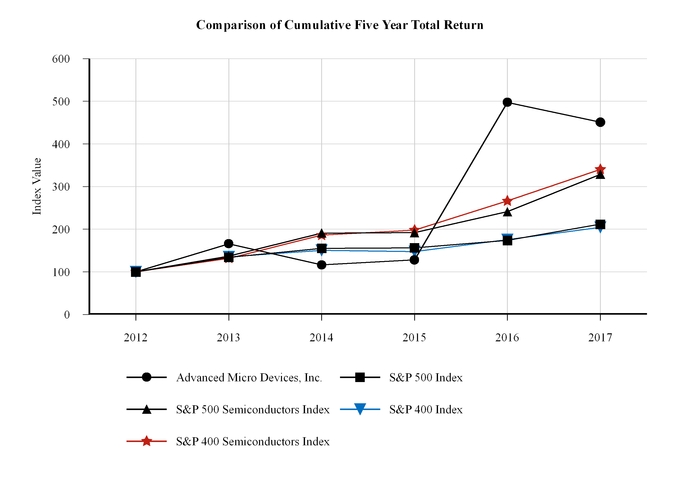][added: ]
| Company / Index | [removed: 12/29/2012 |] 12/28/2013 | 12/27/2014 | 12/26/2015 | 12/31/2016 | 12/30/2017 | [added: 12/29/2018 |]
| Advanced Micro Devices, Inc. | 100 | 70.11 | 77.25 | 300.00 | 271.96 | 471.43 |
| S&P 500 Index | 100 | 115.76 | 116.64 | 129.55 | 157.84 | 150.92 |
| S&P 500 Semiconductors Index | 100 | 139.35 | 140.00 | 175.90 | 239.79 | 224.48 |
Unregistered Sales of Equity Securities
On December 26, 2018, we issued warrants to purchase 127,435 shares of our common stock to a commercial partner pursuant to a strategic arrangement with such partner.
The warrants have an exercise price of $20.0423 per share and expire on December 26, 2021.
The warrants were issued pursuant to Section 4(a)(2) of the Securities Act of 1933, as amended.
During the fourth quarter of 2018, we settled $35 million in aggregate principal amount of our 7.00% Senior Notes due 2024 (7.00% Notes) with 1,789,751 treasury shares.
The following table sets forth on a per share basis the high and low intra-day sales prices on NASDAQ for our common stock for the periods indicated:
| | | | | | | | |
| --- | --- | --- | --- | --- | --- | --- | --- |
| | High | | | | Low | | |
| Fiscal Year 2017 Quarters Ended: | | | | | | | |
| April 1, 2017 | $ | 15.55 | | | $ | 9.42 | |
| July 1, 2017 | $ | 14.74 | | | $ | 9.85 | |
| September 30, 2017 | $ | 15.65 | | | $ | 11.86 | |
| December 30, 2017 | $ | 14.41 | | | $ | 9.70 | |
| Fiscal Year 2016 Quarters Ended: | | | | | | | |
| March 26, 2016 | $ | 3.06 | | | $ | 1.75 | |
| June 25, 2016 | $ | 5.52 | | | $ | 2.60 | |
| September 24, 2016 | $ | 8.00 | | | $ | 4.65 | |
| December 31, 2016 | $ | 12.42 | | | $ | 6.22 | |
Currently, we do not have any plans to pay dividends on our common stock.
Under the terms of our indentures for our 6.75% Senior Notes due 2019 (6.75% Notes), 7.50% Senior Notes due 2022 (7.50% Notes) and 7.00% Senior Notes due 2024 (7.00% Notes), we are prohibited from paying cash dividends if the aggregate amount of dividends and other restricted payments made by us since entering into each indenture would exceed the sum of specified financial measures including fifty percent of consolidated net income as that term is defined in the indentures.
We are prohibited from paying cash dividends on our common stock when certain payment conditions (Payment Conditions) are not satisfied.
The Payment Conditions include that (i) no default or event of default exists and (ii) at all times during the 45 consecutive days immediately prior to such transaction, event or payment and on a pro forma basis after giving effect to such transaction, event or payment and any incurrence or repayment of indebtedness in connection therewith, the Loan Parties’(as defined in the Amended and Restated Loan Agreement) excess available cash is greater than the greater of 20% of the total commitment amount and $100 million.
| Advanced Micro Devices, Inc. | 100 | 165.79 | 116.23 | 128.07 | 497.37 | 450.88 |
| S&P 500 Index | 100 | 134.11 | 155.24 | 156.43 | 173.74 | 211.67 |
| S&P 500 Semiconductors Index | 100 | 137.05 | 190.98 | 191.87 | 241.07 | 328.63 |
| S&P 400 Index | 100 | 134.98 | 150.40 | 147.40 | 175.86 | 204.43 |
| S&P 400 Semiconductors Index | 100 | 131.78 | 185.99 | 198.09 | 266.20 | 340.33 |
Item 6. SELECTED FINANCIAL DATA
15 rewritten, 3 added, 6 removed, 26 unchanged
| | [removed: 2017(1)] [added: 2018(1)] | | | | [removed: 2016(1)] [added: 2017(1)(2)] | | | | [removed: 2015(1)] [added: 2016(1)(2)] | | | | [removed: 2014(1)] [added: 2015(1)] | | | | [removed: 2013(1)] [added: 2014(1)] | | |
| Net revenue | $ | [removed: 5,329] [added: 6,475] | | | $ | [removed: 4,272] [added: 5,253] | | | $ | [removed: 3,991] [added: 4,319] | | | $ | [removed: 5,506] [added: 3,991] | | | $ | [removed: 5,299] [added: 5,506] | |
| Net income (loss) [removed: (2)(3)(4)(5)(6)(7)(8)] [added: (3)(4)(5)(6)(7)] | [removed: 43] [added: 337] | | | | [removed: (497] [added: (33] | | ) | | [removed: (660] [added: (498] | | ) | | [removed: (403] [added: (660] | | ) | | [removed: (83] [added: (403] | | ) |
| Earnings (loss) per [removed: common] share | | | | | | | | | | | | | | | | | | | |
| Basic | $ | [removed: 0.04] [added: 0.34] | | | $ | [removed: (0.60] [added: (0.03] | ) | | $ | [removed: (0.84] [added: (0.60] | ) | | $ | [removed: (0.53] [added: (0.84] | ) | | $ | [removed: (0.11] [added: (0.53] | ) |
| Diluted | $ | [removed: 0.04] [added: 0.32] | | | $ | [removed: (0.60] [added: (0.03] | ) | | $ | [removed: (0.84] [added: (0.60] | ) | | $ | [removed: (0.53] [added: (0.84] | ) | | $ | [removed: (0.11] [added: (0.53] | ) |
| Basic | [removed: 952] [added: 982] | | | | [removed: 835] [added: 952] | | | | [removed: 783] [added: 835] | | | | [removed: 768] [added: 783] | | | | [removed: 754] [added: 768] | | |
| Diluted | [removed: 1,039] [added: 1,064] | | | | [removed: 835] [added: 952] | | | | [removed: 783] [added: 835] | | | | [removed: 768] [added: 783] | | | | [removed: 754] [added: 768] | | |
| Long-term debt, net and other long term liabilities [removed: (9)(10)] [added: (8)(9)] | $ | [removed: 1,443] [added: 1,306] | | | $ | [removed: 1,559] [added: 1,443] | | | $ | [removed: 2,093] [added: 1,559] | | | $ | [removed: 2,110] [added: 2,093] | | | $ | [removed: 2,153] [added: 2,110] | |
| Total assets [removed: (10)] [added: (9)] | $ | [removed: 3,540] [added: 4,556] | | | $ | [removed: 3,321] [added: 3,552] | | | $ | [removed: 3,084] [added: 3,328] | | | $ | [removed: 3,737] [added: 3,084] | | | $ | [removed: 4,315] [added: 3,737] | |
| (1) | [added: 2018,] 2017, [removed: 2015, 2014] [added: 2015] and [removed: 2013] [added: 2014] each consisted of 52 weeks, whereas 2016 consisted of 53 weeks. |
| (4) | In [removed: 2015, 2014] [added: 2015] and [removed: 2012,] [added: 2014,] we implemented restructuring plans and incurred net charges of $53 [removed: million, $58] million and [removed: $6] [added: $58] million in [removed: 2015, 2014] [added: 2015] and [removed: 2013,] [added: 2014,] respectively, which primarily consisted of severance and related employee benefits. |
| (5) | In 2015, we exited the dense server systems business, formerly SeaMicro resulting in a charge of $76 million in restructuring and other special charges, net. In 2014, we incurred other special charges of $13 million primarily related to the departure of a former CEO. [removed: In 2013, we sold and leased back buildings in various locations and land in Austin, Texas, for which we recorded a net charge of $24 million in other special charges.] |
| [removed: (9)] [added: (8)] | Total long-term debt and other long term liabilities decreased by [removed: $116 million from 2016 to 2017, primarily due to $110 million decrease in the long term debt mainly due to principal debt reduction from debt buyback. Total long-term debt and other long term liabilities decreased by] $534 million from 2015 to 2016, primarily due to $1,048 million of net debt [removed: reduction,] [added: repayment,] partially offset by the issuance of $805 million in principal amount of 2.125% Notes net of unamortized discount of $308 million and unamortized financing cost of $14 million, and $38 million increase in other long-term liabilities mainly due to higher technology licenses payable. [removed: See Note 11 of our consolidated financial statements and Senior Notes section of Management's Discussion and Analysis for additional information.] |
| [removed: (10)] [added: (9)] | Amounts retrospectively reflected adoption of [removed: Financial Accounting Standards Board (FASB) Accounting Standards Update (ASU)] [added: FASB ASU] 2015-03, Simplifying the Presentation of Debt Issuance Costs beginning in the first quarter of 2016. We reclassified debt issuance costs from long-term assets to long-term debt, net by $25 [removed: million, $30] million and [removed: $22] [added: $30] million for [removed: 2015, 2014] [added: 2015] and [removed: 2013,] [added: 2014,] respectively, on our consolidated balance sheets. |
| (2) | 2017 and 2016 amounts adjusted to reflect the retrospective application of Financial Accounting Standards Board (FASB) Accounting Standards Update (ASU) 2014-09, Revenue from Contracts with Customers. Refer to Note 2 Summary of Significant Accounting Policies. |
| (3) | During the third quarter of 2016, we agreed to pay GF $100 million in installments related to the Sixth Amendment with GF starting in the fourth fiscal quarter of 2016 through the third quarter of 2017. As of December 30, 2017, we paid GF $100 million in aggregate. In addition, in 2016 we recorded a charge of $340 million in Cost of sales, consisting of the $100 million payment under the Sixth Amendment and the $240 million value of the warrant under the Warrant Agreement issued in consideration of the Sixth Amendment. |
| (7) | In 2016, we recorded a cumulative pre-tax gain on the sale of our 85% equity interest in ATMP JV of $146 million which was recognized in Other income (expense) on our consolidated statements of operations. |
| | |
| --- | --- |
| (2) | In 2013, we entered into licenses and settlements regarding patent-related matters. Pursuant to these licenses and settlements, we received in aggregate, $48 million, net, which we recorded within net legal settlements in 2013. |
| (3) | During the third quarter of 2016, we entered into a Sixth Amendment to the WSA with GLOBALFOUNDRIES (GF) to modify certain terms of the WSA applicable to wafers for our microprocessor, graphics processor and semi-custom products for a five-year period from January 1, 2016 to December 31, 2020. Pursuant to the Sixth Amendment to the WSA, GF agreed to provide us a limited waiver with rights to contract with another wafer foundry with respect to certain products in the 14nm and 7nm technology nodes and gives us greater flexibility in sourcing foundry services across our product portfolio. In consideration for these rights, we agreed to pay GF $100 million in installments starting in the fourth fiscal quarter of 2016 through the third fiscal quarter of 2017. As of December 30, 2017, the Company had paid GF $100 million in aggregate. Starting in 2017 and continuing through 2020, the Company agreed to make quarterly payments to GF based on the volume of certain wafers purchased from another wafer foundry. In addition, in consideration for the limited waiver and rights under the sixth amendment, we entered into a warrant agreement (the Warrant Agreement) with West Coast Hitech L.P. (WCH), a wholly-owned subsidiary of Mubadala Investment Company PJSC (Mubadala). Accordingly, in 2016, we recorded a charge of $340 million in Cost of sales, consisting of the $100 million payment under the sixth amendment and the $240 million value of the warrant under the Warrant Agreement issued in consideration of the sixth amendment. |
| (7) | In 2016, we and certain of our subsidiaries completed the sale of a majority of the equity interests in Suzhou TF-AMD Semiconductor Co., Ltd., (formerly AMD Technologies (China) Co., Ltd.), and TF AMD Microelectronics (Penang) Sdn. Bhd. (formerly Advanced Micro Devices Export Sdn. Bhd.), to affiliates of Tongfu Microelectronics Co., Ltd. (formerly Nantong Fujitsu Microelectronics Co., Ltd.) (TFME), a Chinese joint stock company, to form two joint ventures (collectively, the ATMP JV). As a result of the sale, TFME’s affiliates own 85% of the equity interests in each ATMP JV while certain of our subsidiaries own the remaining 15%. We have no obligations to fund the ATMP JV. As the result of the transaction, we recorded a cumulative pre-tax gain on the sale of our 85% equity interest in ATMP JV of $146 million which was recognized in Other income (expense), net on our consolidated statements of operations. In addition, during 2017 and 2016, we recorded $7 million and $10 million, respectively, of Equity loss in investee on our consolidated statements of operations, which includes certain expenses incurred by us on behalf of the ATMP JV. During 2017, we recorded a $3 million pre-tax gain for final settlement related to the sale of 85% of the equity interest in ATMP facilities in Other income (expense), net on our consolidated statements of operations. |
| (8) | In 2017 and 2016, we recognized $52 million and $88 million, respectively, of licensing gain related to the licensing of certain of our intellectual property (Licensed IP) to two joint ventures formed with Tianjin Haiguang Advanced Technology Investment Co., Ltd. (collectively, the THATIC JV). |
Item 8. FINANCIAL STATEMENTS AND SUPPLEMENTARY DATA
525 rewritten, 350 added, 362 removed, 809 unchanged
Consolidated Statements of Operations [added: (1)]
| | December [removed: 30, 2017] [added: 29, 2018] | | | | December [removed: 31, 2016] [added: 30, 2017] | | | | December [removed: 26, 2015] [added: 31, 2016] | | |
| Cost of sales | [removed: 3,506] [added: $] | [added: 4] | | | [removed: 3,274] [added: $] | [added: 2] | | | [removed: 2,911] [added: $] | [added: 2] | |
| Research and development | [removed: 1,160] [added: 1,434] | | | | [removed: 1,008] [added: 1,196] | | | | [removed: 947] [added: 1,008] | | |
| Marketing, [removed: general] [added: general,] and administrative | [removed: 511] [added: 42] | | | | [removed: 460] [added: 38] | | | | [removed: 482] [added: 35] | | |
| Restructuring and other special charges, net | — | | | | [removed: (10] [added: —] | | [removed: )] | | [removed: 129] [added: (10] | | [added: )] |
| Licensing gain | [removed: (52] [added: —] | | [removed: )] | | [removed: (88] [added: (52] | | ) | | [removed: —] [added: (88] | | [added: )] |
| Interest expense | [removed: (126] [added: (121] | | ) | | [removed: (156] [added: (126] | | ) | | [removed: (160] [added: (156] | | ) |
| Other income (expense), net | [removed: (9] [added: —] | | [removed: )] | | [removed: 80] [added: (9] | | [added: )] | | [removed: (5] [added: 80] | | [removed: )] |
| Income (loss) before [removed: equity loss and] income taxes [added: and equity loss] | [removed: 69] [added: 330] | | | | [removed: (448] [added: (8] | | ) | | [removed: (646] [added: (449] | | ) |
| Provision [added: (benefit)] for income taxes | [removed: 19] [added: (9] | | [added: )] | | [removed: 39] [added: 18] | | | | [removed: 14] [added: 39] | | |
| Equity loss in investee | [removed: (7] [added: (2] | | ) | | [removed: (10] [added: (7] | | ) | | [removed: —] [added: (10] | | [added: )] |
| Net income (loss) | $ | [removed: 43] [added: 337] | | | $ | [removed: (497] [added: (33] | ) | | $ | [removed: (660] [added: (498] | ) |
| Basic | [removed: 952] [added: 982] | | | | [removed: 835] [added: 952] | | | | [removed: 783] [added: 835] | | |
Consolidated Statements of Comprehensive Income (Loss) [added: (1)]
| Unrealized gains (losses) arising during period, net of tax effects of $0, [removed: $1, and] $0 [added: and $1] | [removed: 1] [added: —] | | | | [removed: —] [added: 1] | | | | [removed: (2] [added: —] | | [removed: )] |
| Unrealized gains (losses) arising during period, net of tax effects of $0, [removed: $2, and] $0 [added: and $2] | [removed: 17] [added: (19] | | [added: )] | | [removed: 1] [added: 17] | | | | [removed: (22] [added: 1] | | [removed: )] |
| Reclassification adjustment for (gains) losses realized and included in net income (loss), net of tax effect of [removed: $1,] $0, [added: $1] and $0 | [removed: (7] [added: 5] | | [removed: )] | | [removed: 2] [added: (7] | | [added: )] | | [removed: 21] [added: 2] | | |
| Total change in unrealized gains (losses) on cash flow hedges, net of tax | [removed: 10] [added: (14] | | [added: )] | | [removed: 3] [added: 10] | | | | [removed: (1] [added: 3] | | [removed: )] |
| Total other comprehensive income (loss) | [removed: 11] [added: (14] | | [added: )] | | [removed: 3] [added: 11] | | | | [removed: (3] [added: 3] | | [removed: )] |
| Total [added: other] comprehensive income (loss) | [removed: $] [added: —] | [removed: 54] | | | [removed: $] [added: (14] | [removed: (494] | ) | | [removed: $] [added: (14] | [removed: (663] | ) | [added: | 1 | | | | 10 | | | | 11 | | |]
Consolidated Balance Sheets (1) [removed: (2)]
| | December [added: 29, 2018 | | | | December] 30, 2017 | | | | December 31, 2016 | | |
| Cash and cash equivalents | $ | [added: 1,078 | | | $ |] 1,185 | | | $ | 1,264 | |
[removed: |] Accounts [removed: receivable,] [added: Receivable,] net [removed: | 400 | | | | 311 | | |]
[removed: |] Inventories, net [removed: | 739 | | | | 751 | | |]
| Prepayment and [removed: other] receivables - related parties | [removed: 33] [added: 52] | | | | [removed: 32] [added: 33] | | |
| Prepaid expenses | [removed: 77] [added: 57] | | | | [removed: 63] [added: 77] | | |
| Other current assets | [removed: 188] [added: 195] | | | | [removed: 109] [added: 191] | | |
| Total current assets | [removed: 2,622] [added: 3,540] | | | | [removed: 2,530] [added: 2,634] | | |
| [removed: Property, plant] [added: Property] and equipment, net | [removed: 261] [added: 348] | | | | [removed: 164] [added: 261] | | |
| Investment: equity method | 58 | | | | [removed: 59] [added: 58] | | |
| Other assets | [removed: 310] [added: 321] | | | | [removed: 279] [added: 310] | | |
| Total [added: other] assets | $ | [removed: 3,540] [added: 321] | | | $ | [removed: 3,321] [added: 310] | |
| Short-term debt | $ | [removed: 70] [added: 136] | | | $ | [removed: —] [added: 70] | |
| Accounts payable | [removed: 384] [added: 528] | | | | [removed: 440] [added: 384] | | |
| Payables to related parties | [removed: 412] [added: 533] | | | | [removed: 383] [added: 412] | | |
| Other current liabilities | [removed: 57] [added: 24] | | | | [removed: 69] [added: 92] | | |
| Deferred income [removed: on shipments to distributors] [added: taxes] | [removed: 22] [added: (4] | | [added: )] | | [removed: 63] [added: —] | | | [added: | 11 | | |]
| Total [added: other] current liabilities | [removed: 1,486] [added: $] | [added: 24] | | | [removed: 1,346] [added: $] | [added: 92] | |
| Net revenue | $ | 6,475 | | | $ | 5,253 | | | $ | 4,319 | |
| Gross margin | 2,447 | | | | 1,787 | | | | 1,003 | | |
| Operating income (loss) | 451 | | | | 127 | | | | (373 | | ) |
| Basic | $ | 0.34 | | | $ | (0.03 | ) | | $ | (0.60 | ) |
| Diluted | $ | 0.32 | | | $ | (0.03 | ) | | $ | (0.60 | ) |
| Diluted | 1,064 | | | | 952 | | | | 835 | | |
| | | | | |
| --- | --- | --- | --- | --- |
| | | | | |
| (1) Prior year amounts adjusted to reflect the retrospective application of ASU 2014-09, Revenue from Contracts with Customers. Refer to Note 2. | | | | |
| Cumulative-effect adjustment to accumulated deficit related to the adoption of ASU 2016-01, Financial Instruments | 2 | | | | — | | | | — | | |
| | | | | |
| --- | --- | --- | --- | --- |
| | | | | |
| (1) Prior year amounts adjusted to reflect the retrospective application of ASU 2014-09, Revenue from Contracts with Customers. Refer to Note 2. | | | | |
| Marketable securities | 78 | | | | — | | |
| Inventories, net | 845 | | | | 694 | | |
| Total assets | $ | 4,556 | | | $ | 3,552 | |
| Accrued liabilities | 763 | | | | 555 | | |
| Total current liabilities | 1,984 | | | | 1,513 | | |
| Accumulated deficit | (7,436 | | ) | | (7,775 | | ) |
| (1) Prior year amounts adjusted to reflect the retrospective application of ASU 2014-09, Revenue from Contracts with Customers. Refer to Note 2. |
| Issuance of treasury stock to partially settle the 6.75% notes, 7.5% notes and the 7.00% notes | 7 | | | — | | | | 78 | | | | 64 | | | | — | | | | — | | | | 142 | | |
| Cumulative-effect adjustment to accumulated deficit related to the adoption of ASU 2016-01, Financial Instruments | — | | | — | | | | — | | | | — | | | | 2 | | | | — | | | | 2 | | |
| December 29, 2018 | 1,005 | | | $ | 10 | | | $ | 8,750 | | | $ | (50 | ) | | $ | (7,436 | ) | | $ | (8 | ) | | $ | 1,266 | |
| | | | | |
| --- | --- | --- | --- | --- |
| | | | | |
| (1) The cumulative-effect adjustment to Accumulated deficit related to the adoption of ASU No. 2014-09, Revenue from Contracts with Customers as of December 26, 2015 was $62 million. Refer to Note 2. | | | | |
| Net income (loss) | $ | 337 | | | $ | (33 | ) | | $ | (498 | ) |
| Net loss on disposal of property and equipment | 27 | | | | — | | | | 1 | | |
| Impairment of technology licenses | 45 | | | | — | | | | — | | |
| Accounts receivable | (806 | | ) | | (103 | | ) | | 178 | | |
| Collection of deferred proceeds on sale of receivables | 71 | | | | 60 | | | | 10 | | |
| Cash, cash equivalents, and restricted cash at end of year | $ | 1,083 | | | $ | 1,191 | | | $ | 1,266 | |
| | Year Ended | | | | | | | | | | |
| Deferred proceeds on sale of receivables | $ | 25 | | | $ | 21 | | | $ | 15 | |
| Restricted cash included in Other current assets | $ | 5 | | | $ | 3 | | | $ | 2 | |
| Restricted cash included in Other assets | $ | — | | | $ | 3 | | | $ | — | |
| Total cash, cash equivalents, and restricted cash | $ | 1,083 | | | $ | 1,191 | | | $ | 1,266 | |
| Net revenue | $ | 5,329 | | | $ | 4,272 | | | $ | 3,991 | |
| Gross margin | 1,823 | | | | 998 | | | | 1,080 | | |
| Amortization of acquired intangible assets | — | | | | — | | | | 3 | | |
| Operating income (loss) | 204 | | | | (372 | | ) | | (481 | | ) |
| Basic | $ | 0.04 | | | $ | (0.60 | ) | | $ | (0.84 | ) |
| Diluted | $ | 0.04 | | | $ | (0.60 | ) | | $ | (0.84 | ) |
| Diluted | 1,039 | | | | 835 | | | | 783 | | |
| Accrued liabilities | 541 | | | | 391 | | |
| Accumulated deficit | (7,760 | | ) | | (7,803 | | ) |
| (1) Amounts reflected adoption of FASB ASU 2015-17, Balance Sheet Classification of Deferred Taxes beginning in the first quarter of 2016. |
| (2) Amounts reflected adoption of FASB ASU 2015-03, Simplifying the Presentation of Debt Issuance Costs beginning in the first quarter of 2016. |
| December 27, 2014 | 776 | | | $ | 8 | | | $ | 6,949 | | | $ | (119 | ) | | $ | (6,646 | ) | | $ | (5 | ) | | $ | 187 | |
| Accounts receivable | (89 | | ) | | 222 | | | | 280 | | |
| Proceeds from sale of property, plant and equipment | — | | | | — | | | | 8 | | |
| | |
| --- | --- |
Revenue Recognition.
The Company recognizes revenue from products sold directly to customers, including original equipment manufacturers (OEMs), when persuasive evidence of an arrangement exists, the price is fixed or determinable, delivery has occurred and collectability is reasonably assured.
Estimates of product returns, allowances and future price reductions based on actual historical experience and other known or anticipated trends and factors are recorded at the time revenue is recognized.
The distributor agreements, which may be canceled by either party upon specified notice, generally contain a provision for the return of those of the Company’s products that the Company has removed from its price book and that are not more than 12 months older than the manufacturing code date.
In addition, some agreements with distributors may contain standard stock rotation provisions permitting limited levels of product returns.
Consequently, the Company is unable to readily estimate the product returns and pricing when the product is sold to the distributors.
Accordingly, the Company defers the gross margin resulting from the deferral of both revenue and related product costs from sales to distributors with agreements that have the aforementioned terms until the merchandise is resold by the distributors and reports such deferred amounts as Deferred income on shipments to distributors on its consolidated balance sheet.
Products are sold to distributors at standard published prices that are contained in price books that are broadly provided to the Company’s various distributors.
The Company records allowances for price protection given to distributors and customer rebates in the period of distributor re-sale.
The Company determines these allowances based on specific contractual terms with its distributors.
Price reductions generally do not result in sales prices that are less than the Company’s product cost.
Deferred income on shipments to distributors is revalued at the end of each period based on the change in inventory units at distributors, on the latest published prices and on the latest product costs.
Deferred revenue and related product costs were as follows:
| Deferred revenue | $ | 55 | | | $ | 124 | |
| Deferred cost of sales | (33 | | ) | | (61 | | ) |
| Deferred income on shipments to distributors | $ | 22 | | | $ | 63 | |
Goodwill represents the excess of the purchase price over the fair value of net tangible and identifiable intangible assets acquired.
In accordance with Accounting Standards Codification (ASC) 350, “Goodwill and Other Intangible Assets”, goodwill is not amortized, but rather is tested for impairment at least annually or more frequently if indicators of impairment are present.
The Company adopted ASU 2017-04, "Intangibles - Goodwill and Other: Topic 350: Simplifying the Test for Goodwill Impairment", which eliminated step two from the goodwill impairment test.
If based on that assessment, the Company believes it is more likely than not that the fair value of the reporting unit is less than its carrying value, a quantitative goodwill impairment test will be performed by comparing the fair value of each reporting unit to its carrying value.
Changes in required reserves could increase or decrease the Company’s earnings in the period the changes are made (See Notes 16 and 17).
Restructuring Charges.
Restructuring charges are primarily comprised of severance costs, contract and program termination costs, asset impairments and costs of facility consolidation and closure.
Restructuring charges are recorded upon approval of a formal management plan and are included in the operating results of the period in which such plan is approved and the expense becomes estimable.
An excerpt. Shown here: 40 of 525 rewritten, 40 of 350 added and 40 of 362 removed. The counts are complete. For every sentence, read Item 8. FINANCIAL STATEMENTS AND SUPPLEMENTARY DATA in the FY2018 filing and the FY2017 filing.
Item 9A. CONTROLS AND PROCEDURES
3 rewritten, 0 added, 0 removed, 24 unchanged
As of December [removed: 30, 2017,] [added: 29, 2018,] the end of the period covered by this report, we carried out an evaluation, under the supervision and with the participation of our management, including our Chief Executive Officer and Chief Financial Officer, of the effectiveness of the design and operation of our disclosure controls and procedures pursuant to Exchange Act Rules 13a-15(e) and 15d-15(e).
Management has concluded that the Company’s internal control over financial reporting was effective as of December [removed: 30, 2017] [added: 29, 2018] at the reasonable assurance level.
Our independent registered public accounting firm, Ernst & Young LLP, has issued an attestation report on the Company’s internal control over financial reporting as of December [removed: 30, 2017,] [added: 29, 2018,] which is included in Part II, Item 8, above.
Item 10. DIRECTORS, EXECUTIVE OFFICERS AND CORPORATE GOVERNANCE
1 rewritten, 0 added, 0 removed, 4 unchanged
The information under the captions “Item 1—Election of Directors” (including “Consideration of Stockholder Nominees for Director”), “Corporate Governance,” “Meetings and Committees of the Board of Directors,” “Executive Officers” and “Section 16(a) Beneficial Ownership Reporting Compliance” in our proxy statement for our [removed: 2018] [added: 2019] annual meeting of stockholders (our [removed: 2018] [added: 2019] Proxy Statement) is incorporated herein by reference.
Item 11. EXECUTIVE COMPENSATION
1 rewritten, 0 added, 0 removed, 2 unchanged
The information under the captions “Directors’ Compensation and Benefits” (including [removed: “2017] [added: “2018] Non-Employee Director Compensation”), “Compensation Discussion and Analysis,” “Compensation Policies and Practices,” “Executive Compensation” (including [removed: “2017] [added: “2018] Summary Compensation Table,” [removed: “2017] [added: “2018] Nonqualified Deferred Compensation,” “Outstanding Equity Awards at [removed: 2017] [added: 2018] Fiscal Year-End,” “Grants of Plan-Based Awards in [removed: 2017”] [added: 2018”] and “Option Exercises and Stock Vested in [removed: 2017”)] [added: 2018”)] and “Severance and Change in Control Arrangements” in our [removed: 2018] [added: 2019] Proxy Statement is incorporated herein by reference.
Item 12. SECURITY OWNERSHIP OF CERTAIN BENEFICIAL OWNERS AND MANAGEMENT AND RELATED STOCKHOLDER MATTERS
1 rewritten, 0 added, 0 removed, 2 unchanged
The information under the captions “Principal Stockholders,” “Security Ownership of Directors and Executive Officers” and “Equity Compensation Plan Information” in our [removed: 2018] [added: 2019] Proxy Statement is incorporated herein by reference.
Item 13. CERTAIN RELATIONSHIPS AND RELATED TRANSACTIONS AND DIRECTOR INDEPENDENCE
1 rewritten, 0 added, 0 removed, 2 unchanged
The information under the captions “Corporate Governance—Independence of Directors” and “Certain Relationships and Related Transactions” in our [removed: 2018] [added: 2019] Proxy Statement is incorporated herein by reference.
Item 14. PRINCIPAL ACCOUNTING FEES AND SERVICES
3 rewritten, 0 added, 0 removed, 3 unchanged
The information under the captions “Item 2—Ratification of Appointment of Independent Registered Public Accounting Firm—Independent Registered Public Accounting Firm’s Fees” in our [removed: 2018] [added: 2019] Proxy Statement is incorporated herein by reference.
With the exception of the information specifically incorporated by reference in Part III of this Annual Report on Form 10-K from our [removed: 2018] [added: 2019] Proxy Statement, our [removed: 2018] [added: 2019] Proxy Statement will not be deemed to be filed as part of this report.
Without limiting the foregoing, the information under the captions “Compensation Committee Report” and “Audit Committee Report” in our [removed: 2018] [added: 2019] Proxy Statement is not incorporated by reference in this Annual Report on Form 10-K.
Item 15. EXHIBITS, FINANCIAL STATEMENT SCHEDULES
14 rewritten, 12 added, 1 removed, 280 unchanged
| | | 3.1 | | | [Amended and Restated Certificate of Incorporation of Advanced Micro Devices, Inc., dated May [removed: 8, 2007,] [added: 2, 2018,] filed as Exhibit 3.1 to AMD’s Quarterly Report on Form 10-Q for the period ended [removed: March 31, 2007,] [added: June 30, 2018,] is hereby incorporated by [removed: reference.](http://www.sec.gov/Archives/edgar/data/2488/000119312507108224/dex31.htm)] [added: reference.](http://www.sec.gov/Archives/edgar/data/2488/000000248818000128/exh31amendedrestatedcertof.htm)] |
| | *10.94 | | | [removed: [2017] [added: [Amended and Restated 2017] Employee Stock Purchase [removed: Plan,] [added: Plan dated August 23, 2018,] filed as Exhibit [removed: 10.2] [added: 10.1] to [removed: AMD’s Registration Statement] [added: AMD's Quarterly Report] on Form [removed: S-8 filed with] [added: 10-Q for] the [removed: SEC on May 8, 2017,] [added: fiscal quarter ended September 29, 2018,] is hereby incorporated by [removed: reference.](http://www.sec.gov/Archives/edgar/data/2488/000000248817000109/exhibit102amdemployeestock.htm)] [added: reference.](http://www.sec.gov/Archives/edgar/data/2488/000000248818000189/exh101amd-esppx82318final.htm)] |
| | 10.97 | | | [Seventh Amendment to Amended and Restated Loan and Security Agreement, dated as of November 14, 2017, among Advanced Micro Devices, Inc., AMD International Sales & Service, Ltd., ATI Technologies ULC, and Bank of America, [removed: N.A.](https://www.sec.gov/Archives/edgar/data/2488/000000248818000042/ex1097-10kfy17.htm)] [added: N.A., filed as Exhibit 10.97 to AMD's Annual Report on Form 10-K for the fiscal year ended December 30, 2017, is hereby incorporated by reference.](http://www.sec.gov/Archives/edgar/data/2488/000000248818000042/ex1097-10kfy17.htm)] |
| | *10.98 | | | [2017 Employee Stock Purchase Plan, as amended and restated October 12, [removed: 2017.](https://www.sec.gov/Archives/edgar/data/2488/000000248818000042/ex1098-10kfy17.htm)] [added: 2017, filed as Exhibit 10.98 to AMD's Annual Report on Form 10-K for the fiscal year ended December 30, 2017, is hereby incorporated by reference.](http://www.sec.gov/Archives/edgar/data/2488/000000248818000042/ex1098-10kfy17.htm)] |
| | [removed: *10.99] [added: *10.103] | | | [Form of Stock Option Agreement for Senior Vice Presidents and Above under the 2004 Equity Incentive [removed: Plan.](https://www.sec.gov/Archives/edgar/data/2488/000000248818000042/ex1099-10kfy17.htm)] [added: plan.](https://www.sec.gov/Archives/edgar/data/2488/000000248819000011/ex10103-10kfy18.htm)] |
| | [removed: *10.100] [added: *10.105] | | | [Form of Restricted Stock Unit [removed: Award] Agreement for Senior Vice Presidents and Above under the 2004 Equity Incentive [removed: Plan.](https://www.sec.gov/Archives/edgar/data/2488/000000248818000042/ex10100-10kfy17.htm)] [added: Plan.](https://www.sec.gov/Archives/edgar/data/2488/000000248819000011/ex10105-10kfy18.htm)] |
| | [removed: *10.101] [added: *10.104] | | | [Form of [removed: Performance-Based] [added: Performance-based] Restricted Stock Unit Agreement for Senior Vice Presidents and Above under the 2004 Equity Incentive [removed: Plan.](https://www.sec.gov/Archives/edgar/data/2488/000000248818000042/ex10101-10kfy17.htm)] [added: Plan.](https://www.sec.gov/Archives/edgar/data/2488/000000248819000011/ex10104-10kfy18.htm)] |
| | 21 | | | [List of AMD [removed: subsidiaries.](https://www.sec.gov/Archives/edgar/data/2488/000000248818000042/ex21-10kfy17.htm)] [added: subsidiaries.](https://www.sec.gov/Archives/edgar/data/2488/000000248819000011/ex21-10kfy18.htm)] |
| | 23 | | | [Consent of [removed: Ernst & Young LLP, independent registered public accounting firm](https://www.sec.gov/Archives/edgar/data/2488/000000248818000042/ex23-10kfy17.htm)] [added: Independent Registered Public Accounting Firm](https://www.sec.gov/Archives/edgar/data/2488/000000248819000011/ex23-10kfy18.htm)] |
| | 24 | | | [Power of [removed: Attorney.](https://www.sec.gov/Archives/edgar/data/2488/000000248818000042/ex24-10kfy17.htm)] [added: Attorney.](https://www.sec.gov/Archives/edgar/data/2488/000000248819000011/ex24-10kfy18.htm)] |
| | 31.1 | | | [Certification of the Chief Executive Officer pursuant to Section 302 of the Sarbanes-Oxley Act of [removed: 2002.](https://www.sec.gov/Archives/edgar/data/2488/000000248818000042/ex311-10kfy17.htm)] [added: 2002.](https://www.sec.gov/Archives/edgar/data/2488/000000248819000011/ex311-10kfy18.htm)] |
| | 31.2 | | | [Certification of the Chief Financial Officer pursuant to Section 302 of the Sarbanes-Oxley Act of [removed: 2002.](https://www.sec.gov/Archives/edgar/data/2488/000000248818000042/ex312-10kfy17.htm)] [added: 2002.](https://www.sec.gov/Archives/edgar/data/2488/000000248819000011/ex312-10kfy18.htm)] |
| | 32.1 | | | [Certification of the Principal Executive Officer pursuant to Section 906 of the Sarbanes-Oxley Act of [removed: 2002.](https://www.sec.gov/Archives/edgar/data/2488/000000248818000042/ex321-10kfy17.htm)] [added: 2002.](https://www.sec.gov/Archives/edgar/data/2488/000000248819000011/ex321-10kfy18.htm)] |
| | 32.2 | | | [Certification of the Principal Financial Officer pursuant to Section 906 of the Sarbanes-Oxley Act of [removed: 2002.](https://www.sec.gov/Archives/edgar/data/2488/000000248818000042/ex322-10kfy17.htm)] [added: 2002.](https://www.sec.gov/Archives/edgar/data/2488/000000248819000011/ex322-10kfy18.htm)] |
| | *10.99 | | | [Form of Stock Option Agreement for Senior Vice Presidents and Above under the 2004 Equity Incentive Plan, filed as Exhibit 10.99 to AMD's Annual Report on Form 10-K for the fiscal year ended December 30, 2017, is hereby incorporated by reference.](http://www.sec.gov/Archives/edgar/data/2488/000000248818000042/ex1099-10kfy17.htm) |
| | *10.100 | | | [Form of Restricted Stock Unit Award Agreement for Senior Vice Presidents and Above under the 2004 Equity Incentive Plan, filed as Exhibit 10.100 to AMD's Annual Report on Form 10-K for the fiscal year ended December 30, 2017, is hereby incorporated by reference.](http://www.sec.gov/Archives/edgar/data/2488/000000248818000042/ex10100-10kfy17.htm) |
| | *10.101 | | | [Form of Performance-Based Restricted Stock Unit Agreement for Senior Vice Presidents and Above under the 2004 Equity Incentive Plan filed as Exhibit 10.101 to AMD's Annual Report on Form 10-K for the fiscal year ended December 30, 2017, is hereby incorporated by reference.](http://www.sec.gov/Archives/edgar/data/2488/000000248818000042/ex10101-10kfy17.htm) |
| | *10.102 | | | [Amendment to Advanced Micro Devices, Inc. Executive Incentive Plan dated as of February 8, 2018, filed as Exhibit 10.1 to AMD's Quarterly Report on Form 10-Q for the fiscal quarter ended March 31, 2018, is hereby incorporated by reference.](http://www.sec.gov/Archives/edgar/data/2488/000000248818000068/exh101eip-amend02082018.htm) |
| | | | | |
| --- | --- | --- | --- | --- |
| | | | | |
| | | | | |
| | | | | |
| | | | | |
| | | | | |
| | | | | |
| | | | | | |
Item 16. FORM 10-K SUMMARY
8 rewritten, 6 added, 3 removed, 41 unchanged
| February [removed: 27, 2018] [added: 8, 2019] | ADVANCED MICRO DEVICES, INC. | |
| | By: | [removed: /s/ Devinder] [added: /s/Devinder] Kumar |
| /s/Lisa T. Su | | President and Chief Executive Officer (Principal Executive Officer), Director | | February [removed: 27, 2018] [added: 8, 2019] |
| /s/Devinder Kumar | | Senior Vice President, Chief Financial Officer and Treasurer (Principal Financial Officer) | | February [removed: 27, 2018] [added: 8, 2019] |
| /s/Darla Smith | | Corporate Vice President, Chief Accounting Officer (Principal Accounting Officer) | | February [removed: 27, 2018] [added: 8, 2019] |
| * | | Director, Chairman of the Board | | February [removed: 27, 2018] [added: 8, 2019] |
| * | | Director | | February [removed: 27, 2018] [added: 8, 2019] |
| Mark Durcan | | [removed: Director] | [removed: |] February [removed: 27, 2018] [added: 8, 2019] | [added: |]
| * | | Director | | |
| * | | Director | | February 8, 2019 |
| * | | Director | | February 8, 2019 |
| * | | Director | | February 8, 2019 |
| * | | Director | | February 8, 2019 |
| * | | Director | | February 8, 2019 |
| | | | | |
| Nicolas M. Donofrio | | | | |
| * | | | | |