 filings.tools
Advanced Micro Devices 10-K 2019-12-28
Filed 2020-02-04. 22 sections, 406K characters. Original on sec.gov · Markdown · JSON
Cover and table of contents
UNITED STATES
SECURITIES AND EXCHANGE COMMISSION
Washington, D.C. 20549
FORM 10-K
(Mark One)
| ☒ | ANNUAL REPORT PURSUANT TO SECTION 13 OR 15(d) OF THE SECURITIES EXCHANGE ACT OF 1934. |
| For the fiscal year ended | |
| December 28, 2019 | |
| OR | |
| ☐ | TRANSITION REPORT PURSUANT TO SECTION 13 OR 15(d) OF THE SECURITIES EXCHANGE ACT OF 1934. |
| For the transition period from to |
Commission File Number 001-07882
ADVANCED MICRO DEVICES, INC.
(Exact name of registrant as specified in its charter)
| Delaware | 94-1692300 |
| (State or other jurisdiction of incorporation or organization) | (I.R.S. Employer Identification No.) |
| 2485 Augustine Drive | |
| Santa Clara, | |
| California | 95054 |
| (Address of principal executive offices) | (Zip Code) |
(408) 749-4000
(Registrant’s telephone number, including area code)
Securities registered pursuant to Section 12(b) of the Act:
| (Title of each class) | (Trading symbol) | (Name of each exchange on which registered) |
| Common Stock, $0.01 par value per share | AMD | The NASDAQ Global Select Market |
Securities registered pursuant to Section 12(g) of the Act:
None
Indicate by check mark if the registrant is a well-known seasoned issuer, as defined in Rule 405 of the Securities Act. Yes ý No ¨
Indicate by check mark if the registrant is not required to file reports pursuant to Section 13 or Section 15(d) of the Exchange Act. Yes ¨ No ý
Indicate by check mark whether the registrant (1) has filed all reports required to be filed by Section 13 or 15(d) of the Securities Exchange Act of 1934 during the preceding 12 months (or for such shorter period that the registrant was required to file such reports), and (2) has been subject to such filing requirements for the past 90 days. Yes ý No ¨
Indicate by check mark whether the registrant has submitted electronically every Interactive Data File required to be submitted pursuant to Rule 405 of Regulation S-T during the preceding 12 months (or for such shorter period that the registrant was required to submit such files): Yes ý No ¨
Indicate by check mark whether the registrant is a large accelerated filer, an accelerated filer, a non-accelerated filer, a smaller reporting company, or an emerging growth company. See definition of “large accelerated filer,” “accelerated filer,” “smaller reporting company,” and “emerging growth company” in Rule 12b-2 of the Exchange Act (check one):
| Large accelerated filer | ý | Accelerated filer | ¨ |
| Non-accelerated filer | ¨ | Smaller reporting company | ☐ |
| Emerging growth company | ☐ |
If an emerging growth company, indicate by check mark if the registrant has elected not to use the extended transition period for complying with any new or revised financial accounting standards provided pursuant to Section 13(a) of the Exchange Act. ☐
Indicate by check mark whether the registrant is a shell company (as defined by Rule 12b-2 of the Exchange Act). Yes ☐ No ý
As of June 29, 2019, the aggregate market value of the registrant’s common stock held by non-affiliates of the registrant was approximately $32.8 billion based on the reported closing sale price of $30.37 per share as reported on The NASDAQ Global Select Market (NASDAQ) on June 28, 2019, which was the last business day of the registrant’s most recently completed second fiscal quarter.
Indicate the number of shares outstanding of each of the registrant’s classes of common stock, as of the latest practicable date: 1,169,661,536 shares of common stock, $0.01 par value per share, as of January 31, 2020.
DOCUMENTS INCORPORATED BY REFERENCE
Portions of the registrant’s proxy statement for the 2020 Annual Meeting of Stockholders (2020 Proxy Statement) are incorporated into Part III hereof. The 2020 Proxy Statement will be filed with the U.S. Securities and Exchange Commission within 120 days after the registrant’s fiscal year ended December 28, 2019.
Advanced Micro Devices, Inc.
FORM 10-K
For The Fiscal Year Ended December 28, 2019
INDEX
PART I
Item 1. BUSINESS
Cautionary Statement Regarding Forward-Looking Statements
The statements in this report include forward-looking statements within the meaning of the Private Securities Litigation Reform Act of 1995. These forward-looking statements are based on current expectations and beliefs and involve numerous risks and uncertainties that could cause actual results to differ materially from expectations. These forward-looking statements speak only as of the date hereof or as of the dates indicated in the statements and should not be relied upon as predictions of future events, as we cannot assure you that the events or circumstances reflected in these statements will be achieved or will occur. You can identify forward-looking statements by the use of forward-looking terminology including “believes,” “expects,” “may,” “will,” “should,” “seeks,” “intends,” “plans,” “pro forma,” “estimates,” “anticipates,” or the negative of these words and phrases, other variations of these words and phrases or comparable terminology. The forward-looking statements relate to, among other things: possible impact of future accounting rules on AMD’s consolidated financial statements; demand for AMD’s products; the growth, change and competitive landscape of the markets in which AMD participates; the expected amounts to be received by AMD under the IP licensing agreement and AMD’s expected royalty payments from future product sales of China JVs’ products to be developed on the basis of such licensed IP; sales patterns of AMD’s PC products and semi-custom System-on-Chip (SoC) products for game consoles; international sales will continue to be a significant portion of total sales in the foreseeable future; the balance of the uncertain tax benefits in the next 12 months; that AMD’s cash, cash equivalents and marketable securities balances together with the availability under that certain revolving credit facility (Secured Revolving Facility) made available to AMD and certain of its subsidiaries under the Credit Agreement, will be sufficient to fund AMD’s operations including capital expenditures over the next 12 months; AMD’s ability to obtain sufficient external financing on favorable terms, or at all; AMD’s expectation that based on the information presently known to management, the potential liability related to AMD’s current litigation will not have a material adverse effect on its financial condition, cash flows or results of operations; any amounts in addition to what has been already accrued by AMD for future remediation costs under clean-up orders will not be material; we expect to file future patent applications in both the United States and abroad on significant inventions as we deem appropriate; anticipated ongoing and increased in costs related to enhancing and implementing information security controls; revenue allocated to remaining performance obligations that are unsatisfied which will be recognized over the next 12 months; all unbilled accounts receivables are expected to be billed and collected within 12 months; and a small number of customers will continue to account for a substantial part of AMD’s revenue in the future. For a discussion of the factors that could cause actual results to differ materially from the forward-looking statements, see “Part I, Item 1A-Risk Factors” and the “Financial Condition” section set forth in “Part II, Item 7-Management’s Discussion and Analysis of Financial Condition and Results of Operations,” or MD&A, and such other risks and uncertainties as set forth below in this report or detailed in our other Securities and Exchange Commission (SEC) reports and filings. We assume no obligation to update forward-looking statements.
General
We are a global semiconductor company primarily offering:
-
x86 microprocessors, as standalone devices or as incorporated into an accelerated processing unit (APU), chipsets, discrete and integrated graphics processing units (GPUs), data center and professional GPUs, and development services; and
-
server and embedded processors, semi-custom System-on-Chip (SoC) products, development services and technology for game consoles.
We also license portions of our intellectual property (IP) portfolio.
For financial information about geographic areas and for segment information with respect to revenues and operating results, refer to the information set forth in Note 15 of our consolidated financial statements.
We use a 52 or 53 week fiscal year ending on the last Saturday in December. References in this report to 2019, 2018 and 2017 refer to the fiscal year unless explicitly stated otherwise.
Additional Information
Advanced Micro Devices, Inc. (AMD) was incorporated under the laws of Delaware on May 1, 1969 and became a publicly held company in 1972. Our common stock is currently listed on The NASDAQ Global Select Market (NASDAQ) under the symbol “AMD”. Our mailing address and executive offices are located at 2485 Augustine Drive, Santa Clara, California 95054, and our telephone number is (408) 749-4000. The SEC’s website, www.sec.gov, contains reports, proxy and information statements, and other information regarding issuers that file electronically with the SEC.
References in this Annual Report on Form 10-K to “AMD,” “we,” “us,” “management,” “our” or the “Company” mean Advanced Micro Devices, Inc. and our consolidated subsidiaries.
AMD, the AMD Arrow logo, Athlon, EPYC, FirePro, FreeSync, Geode, Opteron, Radeon, Ryzen, Threadripper, Infinity Fabric, and combinations thereof are trademarks of Advanced Micro Devices, Inc.
Microsoft, Windows, DirectX, Xbox 360 and Xbox One are either registered trademarks or trademarks of Microsoft Corporation in the United States and/or other countries. PCIe is a registered trademark of PCI-SIG Corporation. Chromebook and Stadia are trademarks of Google Inc. Cray is a trademark of Cray Inc. and is registered in the United States and other countries. Linux is the registered trademark of Linus Torvalds in the United States and other countries. PlayStation is a registered trademark or trademark of Sony Interactive Entertainment, Inc.. Arm is a registered trademark of ARM Limited (or its subsidiaries) in the US and/or elsewhere. Vulkan and the Vulkan logo are registered trademarks of Khronos Group Inc.
Other names are for informational purposes only and are used to identify companies and products and may be trademarks of their respective owners.
Website Access to Our SEC Filings and Corporate Governance Documents
On the Investor Relations pages of our Website, http://ir.amd.com, we post links to our filings with the SEC, our Principles of Corporate Governance, our Code of Ethics for our executive officers, all other senior finance executives and certain representatives from legal and internal audit, our Worldwide Standards of Business Conduct, which applies to our Board of Directors and all of our employees, and the charters of the Audit and Finance, Compensation and Leadership Resources, Nominating and Corporate Governance and Innovation and Technology committees of our Board of Directors. Our filings with the SEC are posted as soon as reasonably practical after they are electronically filed with, or furnished to, the SEC. You can also obtain copies of these documents by writing to us at: Corporate Secretary, AMD, 7171 Southwest Parkway, M/S B100.T, Austin, Texas 78735, or emailing us at: Corporate.Secretary@amd.com. All of these documents and filings are available free of charge.
If we make substantive amendments to our Code of Ethics or grant any waiver, including any implicit waiver, to our principal executive officer, principal financial officer, principal accounting officer, controller or persons performing similar functions, we intend to disclose the nature of such amendment or waiver on our Website.
The information contained on our Website is not incorporated by reference in, or considered to be a part of, this report.
Our Industry
We ar
Showing the first 8K of 62K characters. Open the full section
Item 1A. RISK FACTORS
The risks and uncertainties described below are not the only ones we face. If any of the following risks actually occurs, our business, financial condition or results of operations could be materially adversely affected. In addition, you should consider the interrelationship and compounding effects of two or more risks occurring simultaneously.
Intel Corporation’s dominance of the microprocessor market and its aggressive business practices may limit our ability to compete effectively.
Intel Corporation has been the market share leader for microprocessors for many years. Intel’s market share, margins and significant financial resources enable it to market its products aggressively, to target our customers and our channel partners with special incentives and to influence customers who do business with us. These aggressive activities have in the past resulted in lower unit sales and a lower average selling price for many of our products and adversely affect our margins and profitability.
Intel exerts substantial influence over computer manufacturers and their channels of distribution through various brand and other marketing programs. As a result of Intel’s position in the microprocessor market, Intel has been able to control x86 microprocessor and computer system standards and benchmarks and to dictate the type of products the microprocessor market requires of us. Intel also dominates the computer system platform, which includes core logic chipsets, graphics chips, networking devices (wired and wireless), non-volatile storage and other components necessary to assemble a computer system. Additionally, Intel is able to drive de facto standards and specifications for x86 microprocessors that could cause us and other companies to have delayed access to such standards.
Intel has substantially greater financial resources than we do and accordingly spends substantially greater amounts on marketing and research and development than we do. We expect Intel to continue to invest heavily in marketing, research and development, new manufacturing facilities and other technology companies. To the extent Intel manufactures a significantly larger portion of its microprocessor products using more advanced process technologies, or introduces competitive new products into the market before we do, we may be more vulnerable to Intel’s aggressive marketing and pricing strategies for microprocessor products.
As long as Intel remains in this dominant position, we may be materially adversely affected by Intel’s business practices, including rebating and allocation strategies and pricing actions, designed to limit our market share and margins; product mix and introduction schedules; product bundling, marketing and merchandising strategies; exclusivity payments to its current and potential customers, retailers and channel partners; de facto control over industry standards, and heavy influence on PC manufacturers and other PC industry participants, including motherboard, memory, chipset and basic input/output system (BIOS) suppliers and software companies as well as the graphics interface for Intel platforms; and marketing and advertising expenditures in support of positioning the Intel brand over the brand of its original equipment manufacturer OEM customers and retailers.
Intel could also take actions that place our discrete graphics processing units (GPUs) at a competitive disadvantage, including giving one or more of our competitors in the graphics market, such as Nvidia Corporation, preferential access to its proprietary graphics interface or other useful information. Also, Intel has announced that it is developing their own high-end discrete GPUs. Intel’s position in the microprocessor market and integrated graphics chipset market, its introduction of competitive new products, its existing relationships with top-tier OEMs, and its aggressive marketing and pricing strategies could result in lower unit sales and lower average selling prices for our products, which could have a material adverse effect on us.
We rely on third parties to manufacture our products, and if they are unable to do so on a timely basis in sufficient quantities and using competitive technologies, our business could be materially adversely affected.
We rely on third-party wafer foundries to fabricate the silicon wafers for all of our products. We also rely on third-party manufacturers to assemble, test, mark and pack (ATMP) our products. It is important to have reliable relationships with all of these third-party manufacturing suppliers to ensure adequate product supply to respond to customer demand.
We cannot guarantee that these manufacturers or our other third-party manufacturing suppliers will be able to meet our near-term or long-term manufacturing requirements. If we experience supply constraints from our third-party manufacturing suppliers, we may be required to allocate the affected products amongst our customers, which could have a material adverse effect on our relationships with these customers and on our financial condition. In addition, if we are unable to meet customer demand due to fluctuating or late supply from our manufacturing suppliers, it could result in lost sales and have a material adverse effect on our business.
We do not have long-term commitment contracts with some of our third-party manufacturing suppliers. We obtain some of these manufacturing services on a purchase order basis and these manufacturers are not required to provide us with any specified minimum quantity of product beyond the quantities in an existing purchase order. Accordingly, we depend on these suppliers to
allocate to us a portion of their manufacturing capacity sufficient to meet our needs, to produce products of acceptable quality and at acceptable manufacturing yields and to deliver those products to us on a timely basis and at acceptable prices. The manufacturers we use also fabricate wafers and ATMP products for other companies, including certain of our competitors. They could choose to prioritize capacity for other customers, increase the prices that they charge us on short notice or reduce or eliminate deliveries to us, which could have a material adverse effect on our business.
Other risks associated with our dependence on third-party manufacturers include limited control over delivery schedules and quality assurance, lack of capacity in periods of excess demand, misappropriation of our intellectual property, dependence on several small undercapitalized subcontractors and limited ability to manage inventory and parts. Moreover, if any of our third-party manufacturers suffer any damage to facilities, lose benefits under material agreements, experience power outages, lack sufficient capacity to manufacture our products, encounter financial difficulties, are unable to secure necessary raw materials from their suppliers or suffer any other disruption or reduction in efficiency, we may encounter supply delays or disruptions. If we are unable to secure sufficient or reliable supplies of products, our ability to meet customer demand may be adversely affected and this could materially affect our business.
If we transition the production of some of our products to new manufacturers, we may experience delayed product introductions, lower yields or poorer performance of our products. If we experience problems with product quality or are unable to secure sufficient capacity from a particular third-party manufacturer, or if we for other reasons cease utilizing one of those suppliers, we may be unable to secure an alternative supply for any specific product in a short time frame. We could experience significant delays in the shipment of our products if we are required to find alternative third-party manufacturers, which could have a material adverse effect on our business.
We are party to two ATMP joint ventures (collectively, the ATMP JVs) with Tongfu Microelectronics Co., Ltd. The majori
Showing the first 8K of 89K characters. Open the full section
Item 1B. UNRESOLVED STAFF COMMENTS
None.
Item 2. PROPERTIES
As of December 28, 2019, we leased approximately 2.35 million square feet of space for research and development, engineering, administrative and warehouse use, including our headquarters in Santa Clara, California, our principal administrative facilities in Austin, Texas, our design center in Shanghai, China, our main facility with respect to graphics and chipset products located in Markham, Ontario, Canada and a number of smaller regional sales offices located in commercial centers near customers,
principally in the United States, Europe, Asia and Latin America. These leases expire at varying dates through 2028, although some of these leases include optional renewals. We occupy 220,000 square feet of space in our headquarters in Santa Clara, California under a 10-year operating lease which commenced in August 2017 and expires in July 2027. We have the option to extend the term of the lease for two additional 5-year periods. The lease for our principal administrative facilities in Austin, Texas expires in March 2025, and provides for one 10-year optional renewal. The leases for our facilities in Markham, Ontario, Canada expire in February 2028, and provide for one 5-year optional renewals. We occupy approximately 265,000 square feet of space in our design center in Shanghai, China under a 10-year operating lease, which expires in March 2028.
We currently do not anticipate difficulty in either retaining occupancy of any of our facilities through lease renewals prior to expiration or through month-to-month occupancy or replacing them with equivalent facilities.
We believe that our existing facilities are suitable and adequate for our present purposes and that the productive capacity of such facilities is substantially being utilized or we have plans to utilize such capacity.
Item 3. LEGAL PROCEEDINGS
Shareholder Derivative Lawsuits (Wessels, Hamilton and Ha)
On March 20, 2014, a purported shareholder derivative lawsuit captioned Wessels v. Read, et al., Case No. 1:14 cv-262486 (Wessels) was filed against us (as a nominal defendant only) and certain of our directors and officers in the Santa Clara County Superior Court of the State of California. The complaint purports to assert claims against us and certain individual directors and officers for breach of fiduciary duty, waste of corporate assets and unjust enrichment. The complaint seeks damages allegedly caused by alleged materially misleading statements and/or material omissions by us and the individual directors and officers regarding our 32nm technology and “Llano” product, which statements and omissions, the plaintiffs claim, allegedly operated to artificially inflate the price paid for our common stock during the period. On April 27, 2015, a similar purported shareholder derivative lawsuit captioned Christopher Hamilton and David Hamilton v. Barnes, et al., Case No. 5:15-cv-01890 (Hamilton) was filed against us (as a nominal defendant only) and certain of our directors and officers in the United States District Court for the Northern District of California.
On September 29, 2015, a similar purported shareholder derivative lawsuit captioned Jake Ha v Caldwell, et al., Case No. 3:15-cv-04485 (Ha) was filed against us (as a nominal defendant only) and certain of our directors and officers in the United States District Court for the Northern District of California. The lawsuit also seeks a court order voiding the stockholder vote on our 2015 proxy. The case was transferred to the judge handling the Hamilton Lawsuit and is now Case No. 4:15-cv-04485. The Wessels, Hamilton and Ha shareholder derivative lawsuits were stayed pending resolution of a class action lawsuit captioned Hatamian v. AMD, et al., C.A. No. 3:14-cv-00226 filed against us in the United States District Court for the Northern District of California (the Hatamian Lawsuit). The Hatamian Lawsuit asserted claims against us and certain of our officers for alleged violations of Section 10(b) of the Exchange Act of 1934, as amended (the Exchange Act), and SEC Rule 10b-5 concerning certain statements regarding our 32nm technology and “Llano” products. On October 9, 2017, the parties signed a definitive settlement agreement resolving the Hatamian Lawsuit and submitted it to the Court for approval. Under the terms of this agreement, the settlement was funded entirely by certain of our insurance carriers and the defendants continued to deny any liability or wrongdoing. On March 2, 2018, the court approved the settlement and entered a final judgment in the Hatamian Lawsuit.
On January 30, 2018, the Wessels and Hamilton plaintiffs amended their complaints. On February 2, 2018, the Ha plaintiff also filed an amended complaint. On February 22, 2018, we filed motions to dismiss the Hamilton and Ha plaintiffs’ amended complaints. On April 2, 2018, we filed a demurrer seeking to dismiss the Wessels amended complaint. On July 23, 2018, the Santa Clara Superior Court sustained our demurrer in the Wessels case, dismissing all claims in that matter with prejudice. The Wessels plaintiff filed a Notice of Appeal on September 27, 2018. On October 4, 2018, the Federal Court issued an order dismissing the Hamilton and Ha amended complaints. The Hamilton plaintiffs filed a Notice of Appeal on October 8, 2018, and the Ha plaintiffs filed a Notice of Appeal on October 15, 2018. On November 19, 2018, the Hamilton and Ha plaintiffs filed a motion seeking summary reversal of the order dismissing their claims. We opposed this motion on December 13, 2018, and the Court denied it on February 25, 2019. The Wessels, Hamilton, and Ha appeals are currently pending. Briefing has completed in each appeal.
Based upon information presently known to management, we believe that the potential liability, if any, will not have a material adverse effect on our financial condition, cash flows or results of operations.
Hauck et al. Litigation
Since January 19, 2018, three putative class action complaints have been filed against us in the United States District Court for the Northern District of California: (1) Diana Hauck et al. v. AMD, Inc., Case No. 5:18-cv-0047, filed on January 19, 2018; (2) Brian Speck et al. v. AMD, Inc., Case No. 5:18-cv-0744, filed on February 4, 2018; and (3) Nathan Barnes and Jonathan Caskey-Medina, et al. v. AMD, Inc., Case No. 5:18-cv-00883, filed on February 9, 2018. On April 9, 2018, the court consolidated
these cases and ordered that Diana Hauck et al. v. AMD, Inc. serve as the lead case. On June 13, 2018, six plaintiffs (from California, Louisiana, Florida, and Massachusetts) filed a consolidated amended complaint alleging that we failed to disclose our processors’ alleged vulnerability to Spectre. Plaintiffs further allege that our processors cannot perform at their advertised processing speeds without exposing consumers to Spectre, and that any “patches” to remedy this security vulnerability will result in degradation of processor performance. The plaintiffs seek damages under several causes of action on behalf of a nationwide class and four state subclasses (California, Florida, Massachusetts, Louisiana) of consumers who purchased our processors and/or devices containing AMD processors. The plaintiffs also seek attorneys’ fees, equitable relief, and restitution. Pursuant to the court’s order directing the parties to litigate only eight of the causes of action in the consolidated amended complaint initially, we filed a motion to dismiss on July 13, 2018. On October 29, 2018, after the plaintiffs voluntarily dismissed one of their claims, the court granted our motion and dismissed six causes of action with leave to amend. The plaintiffs filed their amended consolidated complaint on December 6, 2018. On January 3, 2019, we again moved to dismiss the subset of claims currently at issue. On April 4, 2019, the court granted our motion and dismissed all claims currently at issue with prejudice. On May 6, 2019, the court granted the parties’ stipulation and request under Fed. R. Civ. P. 54(b) to enter a partial final judgment and certify for appeal the court’s April 4, 2019 dismissal order, and on that same date, the plaintiffs voluntarily dismissed without prejudice their remaining claims pursuant to an agreement whereby, subject to certain terms and conditions, we agreed to toll the statute of limitations and/or statute of repose. On May 30, 2019, the plaintiffs filed a Notice of Appeal with the U.S. Court of Appeals for the Ninth Circuit. Briefing has completed for the appeal.
Based upon information presently known to management, we believe that the potential liability, if any, will not have a material adverse effect on our financial condition, cash flows or results of operations.
Quarterhill Inc. Litigation
On July 2, 2018, three entities named Aquila Innovations, Inc. (Aquila), Collabo Innovations, Inc. (Collabo), and Polaris Innovations, Ltd. (Polaris), filed separate patent infringement complaints against us in the United States District Court for the Western District of Texas. Aquila alleges that we infringe two patents (6,239,614 and 6,895,519) relating to power management; Collabo alleges that we infringe one patent (7,930,575) related to power management; and Polaris alleges that we infringe two patents (6,728,144 and 8,117,526) relating to control or use of dynamic random-access memory, or DRAM. Each of the three complaints seeks unspecified monetary damages, interest, fees, expenses, and costs against us; Aquila and Collabo also seek enhanced damages. Aquila, Collabo, and Polaris each appear to be related to a patent assertion entity named Quarterhill Inc. (formerly WiLAN Inc.). On November 16, 2018, AMD filed answers in the Collabo and Aquila cases and filed a motion to dismiss in the Polaris case. On January 25, 2019, we filed amended answers and counterclaims in the Collabo and Aquila cases. On July 22, 2019, our motion to dismiss in the Polaris case was denied. On August 23, 2019, the Court held a claim construction hearing in each case.
Based upon information presently known to management, we believe that the potential liability, if any, will not have a material adverse effect on our financial condition, cash flows or results of operations.
Dickey Litigation
On October 26, 2015, a putative class action complaint captioned Dickey et al. v. AMD, No. 15-cv-04922 was filed against us in the United States District Court for the Northern District of California. Plaintiffs allege that we misled consumers by using the term “eight cores” in connection with the marketing of certain AMD FX CPUs that are based on our “Bulldozer” core architecture. The plaintiffs allege these products cannot perform eight calculations simultaneously, without restriction. The plaintiffs seek to obtain damages under several causes of action for a nationwide class of consumers who allegedly were deceived into purchasing certain Bulldozer-based CPUs that were marketed as containing eight cores. The plaintiffs also seek attorneys’ fees. On December 21, 2015, we filed a motion to dismiss the complaint, which was granted on April 7, 2016. The plaintiffs then filed an amended complaint with a narrowed putative class definition, which the Court dismissed upon our motion on October 31, 2016. The plaintiffs subsequently filed a second amended complaint, and we filed a motion to dismiss the second amended complaint. On June 14, 2017, the Court issued an order granting in part and denying in part our motion to dismiss, and allowing the plaintiffs to move forward with a portion of their complaint. On March 27, 2018, plaintiffs filed their motion for class certification. On January 17, 2019, the Court granted plaintiffs’ motion for class certification. The class definition does not encompass our Ryzen or EPYC processors. On January 31, 2019, we filed a petition in the Ninth Circuit Court of Appeals seeking review of certain aspects of the January 17, 2019 class certification order. On May 9, 2019, the parties attended mediation and reached a tentative settlement. On June 3, 2019, the Ninth Circuit Court of Appeals denied our petition seeking appellate review of the January 17, 2019, class certification order. On August 9, 2019, the parties executed a formal settlement agreement. On August 23, 2019, plaintiffs filed their motion for preliminary approval of the settlement agreement. On October 4, 2019, the Court granted the motion for preliminary approval of the settlement agreement.
Based upon information presently known to management, we believe that the settlement will not have a material adverse effect on our financial condition, cash flows or results of operations.
Monterey Research Litigation
On November 15, 2019, Monterey Research, LLC filed a patent infringement complaint against us in the United States District Court for the District of Delaware. Monterey Research alleges that we infringe six U.S. patents: 6,534,805 (related to SRAM cell design); 6,629,226 (related to read interface protocols); 6,651,134 (related to memory devices); 6,765,407 (related to programmable digital circuits); 6,961,807 (related to integrated circuits and associated memory systems); and 8,373,455 (related to output buffer circuits). Monterey Research seeks unspecified monetary damages, enhanced damages, interest, fees, expenses, costs, and injunctive relief against us. On January 22, 2020, we filed a motion to dismiss part of Monterey Research’s complaint.
Based upon information presently known to management, we believe that the potential liability, if any, will not have a material adverse effect on our financial condition, cash flows or results of operations.
Environmental Matters
We are named as a responsible party on Superfund clean-up orders for three sites in Sunnyvale, California that are on the National Priorities List. Since 1981, we have discovered hazardous material releases to the groundwater from former underground tanks and proceeded to investigate and conduct remediation at these three sites. The chemicals released into the groundwater were commonly used in the semiconductor industry in the United States in the wafer fabrication process prior to 1979.
In 1991, we received Final Site Clean-up Requirements Orders from the California Regional Water Quality Control Board relating to the three sites. We have entered into settlement agreements with other responsible parties on two of the orders. During the term of such agreements, other parties have agreed to assume most of the foreseeable costs as well as the primary role in conducting remediation activities under the orders. We remain responsible for additional costs beyond the scope of the agreements as well as all remaining costs in the event that the other parties do not fulfill their obligations under the settlement agreements.
To address anticipated future remediation costs under the orders, we have computed and recorded an estimated environmental liability of approximately $3 million and have not recorded any potential insurance recoveries in determining the estimated costs of the cleanup. Costs could also increase as a result of additional test and remediation obligations imposed by the Environmental Protection Agency or California Regional Water Quality Control Board. The progress of future remediation efforts cannot be predicted with certainty and these costs may change. We believe that the potential liability, if any, in excess of amounts already accrued, will not have a material adverse effect on our financial condition, cash flows or results of operations.
Other Matters
We are a defendant or plaintiff in various actions that arose in the normal course of business. With respect to these matters, based on our management’s current knowledge, we believe that the amount or range of reasonably possible loss, if any, will not, either individually or in the aggregate, have a material adverse effect on our business, financial position, results of operations or cash flows.
Item 4. MINE SAFETY DISCLOSURES
Not Applicable.
PART II
Item 5. MARKET FOR REGISTRANT’S COMMON EQUITY, RELATED STOCKHOLDER MATTERS AND ISSUER PURCHASES OF EQUITY SECURITIES
Our common stock is listed on The NASDAQ Global Select Market (NASDAQ) under the symbol “AMD”. On January 31, 2020, there were 4,364 registered holders of our common stock, and the closing price of our common stock was $47.00 per share as reported on NASDAQ.
For information about our equity compensation plans, see Part III, Item 11, below.
Performance Graph
Comparison of Five-Year Cumulative Total Returns
Advanced Micro Devices, S&P 500 Index and S&P 500 Semiconductor Index
The following graph shows a five-year comparison of cumulative total return on our common stock, the S&P 500 Index and the S&P 500 Semiconductor Index from December 27, 2014 through December 28, 2019. The past performance of our common stock is no indication of future performance.
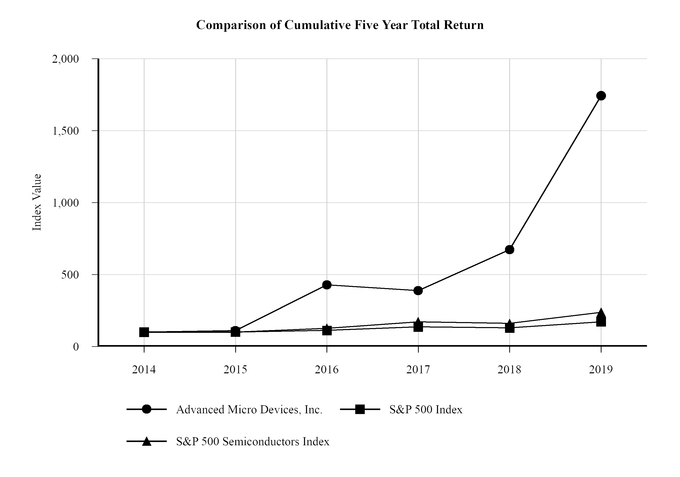
| Base Period | Years Ending | ||||||||||
| Company / Index | 12/27/2014 | 12/26/2015 | 12/31/2016 | 12/30/2017 | 12/29/2018 | 12/28/2019 | |||||
| Advanced Micro Devices, Inc. | 100 | 110.19 | 427.92 | 387.92 | 672.45 | 1,742.64 | |||||
| S&P 500 Index | 100 | 100.77 | 111.92 | 136.35 | 129.26 | 171.64 | |||||
| S&P 500 Semiconductors Index | 100 | 100.47 | 126.23 | 172.07 | 160.39 | 237.49 |
Unregistered Sales of Equity Securities
We issued warrants dated December 30, 2019 to purchase 40,162 shares of our common stock to a commercial partner pursuant to a strategic arrangement with such partner. The warrants have an exercise price of $25.4994 per share and expire on December 30, 2022. The warrants were issued pursuant to Section 4(a)(2) of the Securities Act of 1933, as amended.
Item 6. SELECTED FINANCIAL DATA
| 2019**(1)** | 2018**(1)** | 2017**(1)(2)** | 2016**(1)(2)** | 2015**(1)** | |||||||||||||||
| In millions except per share amounts | |||||||||||||||||||
| Net revenue | $ | 6,731 | $ | 6,475 | $ | 5,253 | $ | 4,319 | $ | 3,991 | |||||||||
| Net income (loss) (3)(4) | $ | 341 | $ | 337 | $ | (33 | ) | $ | (498 | ) | $ | (660 | ) | ||||||
| Earnings (loss) per share | |||||||||||||||||||
| Basic | $ | 0.31 | $ | 0.34 | $ | (0.03 | ) | $ | (0.60 | ) | $ | (0.84 | ) | ||||||
| Diluted | $ | 0.30 | $ | 0.32 | $ | (0.03 | ) | $ | (0.60 | ) | $ | (0.84 | ) | ||||||
| Shares used in per share calculation | |||||||||||||||||||
| Basic | 1,091 | 982 | 952 | 835 | 783 | ||||||||||||||
| Diluted | 1,120 | 1,064 | 952 | 835 | 783 | ||||||||||||||
| Long-term debt, net and other long-term liabilities (5) | $ | 643 | $ | 1,306 | $ | 1,443 | $ | 1,559 | $ | 2,093 | |||||||||
| Total assets | $ | 6,028 | $ | 4,556 | $ | 3,552 | $ | 3,328 | $ | 3,084 |
| (1) | 2019, 2018, 2017, and 2015 each consisted of 52 weeks, whereas 2016 consisted of 53 weeks. | |
| (2) | 2017 and 2016 amounts adjusted to reflect the retrospective application of Financial Accounting Standards Board (FASB) Accounting Standards Update (ASU) 2014-09, Revenue from Contracts with Customers. | |
| (3) | In 2016, we recorded a charge of $340 million in Cost of sales, consisting of the $240 million value of the warrant under a warrant agreement and the $100 million payment, which were both associated with the sixth amendment to the WSA. In addition, we recorded a cumulative pre-tax gain of $146 million on the sale of our 85% equity interest in the ATMP JV. | |
| (4) | In 2015, we implemented restructuring plans and incurred net charges of $53 million, which primarily consisted of severance and related employee benefits. In addition, we exited the dense server systems business, formerly Sea Micro, Inc., resulting in a charge of $76 million in restructuring and other special charges, net. Also, we recorded an inventory write-down of $65 million, which was primarily the result of lower anticipated demand for older-generation APUs, and a technology node transition charge of $33 million. | |
| (5) | In 2019, we reduced our long-term debt, net and other long term liabilities by $663 million, primarily due to $628 million of net debt conversion and repayment. In 2016, we reduced our long-term debt, net and other long term liabilities by $534 million, primarily due to $1,048 million of net debt repayment, partially offset by the issuance of $805 million in principal amount of 2.125% Notes net of unamortized discount of $308 million and unamortized issuance cost of $14 million. |
Item 7. MANAGEMENT’S DISCUSSION AND ANALYSIS OF FINANCIAL CONDITION AND RESULTS OF OPERATIONS
The following discussion should be read in conjunction with the consolidated financial statements as of December 28, 2019 and December 29, 2018 and for each of the three years in the period ended December 28, 2019 and related notes, which are included in this Annual Report on Form 10-K as well as with the other sections of this Annual Report on Form 10-K, including “Part I, Item 1: Business,” “Part II, Item 6: Selected Financial Data” and “Part II, Item 8: Financial Statements and Supplementary Data.”
Introduction
In this section, we will describe the general financial condition and the results of operations of Advanced Micro Devices, Inc. and its wholly-owned subsidiaries (collectively, “us,” “our” or “AMD”), including a discussion of our results of operations for 2019 compared to 2018, an analysis of changes in our financial condition and a discussion of our contractual obligations and off-balance sheet arrangements. Discussions of 2017 items and year-to-year comparisons between 2018 and 2017 that are not included in this Form 10-K can be found in “Management’s Discussion and Analysis of Financial Condition and Results of Operations” in Part II, Item 7 of our Annual Report on Form 10-K for the fiscal year ended December 29, 2018.
Overview
2019 marked a milestone in our multi-year journey with the launch of our 7 nanometer (nm) product portfolio. We executed our product roadmap and introduced a number of high-performance products in 2019. For the PC market, we introduced the 3rd Gen AMD Ryzen™ desktop processor family based on the new Zen 2 core architecture with AMD chiplet design approach. In addition to our mainstream PC product family, we introduced the next generation of the Ryzen™ Threadripper™ product line designed for the high-end desktop segment for creators and enthusiasts. We announced our second-generation AMD Ryzen™ 3000 Series notebook processors, powering ultrathin, commercial and gaming notebooks.
A number of high-performance graphics products were also launched in 2019. We introduced the AMD Radeon™ VII, a premium graphics card for gamers, creators and enthusiasts. We also announced the availability of the AMD Radeon™ RX 5700-series gaming graphics card family, the AMD Radeon™ RX 5500 series that will be available in desktop PCs from major PC manufacturers as well as the Radeon™ 5500M GPU for notebook PCs. Our AMD Radeon™ Pro Vega II GPU is designed to power demanding professional applications. We also announced the AMD Radeon™ Pro W5700, a 7nm professional PC workstation graphics card that enables 3D professionals to visualize and interact with their designs in real time.
For the server market, we introduced the 2nd Gen AMD EPYC™ family of processors that feature up to 64 “Zen 2” cores in 7nm process technology for performance and are designed to reduce total cost of ownership (TOC) by up to 50%.
Net revenue for 2019 was $6.7 billion, an increase of 4% compared to 2018 net revenue of $6.5 billion. Gross margin, as a percentage of net revenue for 2019, was 43%, compared to 38% in 2018. Our operating income for 2019 improved to $631 million compared to operating income of $451 million for 2018. Our net income for 2019 improved to $341 million compared to $337 million in the prior year.
Cash, cash equivalents and marketable securities as of December 28, 2019 were $1.5 billion, up from $1.2 billion at the end of 2018. We made significant progress towards improving our balance sheet in 2019 as we reduced our debt. Principal amount of total debt as of December 28, 2019 was $563 million, compared to $1.5 billion as of December 29, 2018.
We intend the discussion of our financial condition and results of operations that follows to provide information that will assist in understanding our financial statements, the changes in certain key items in those financial statements from period to period, the primary factors that resulted in those changes, and how certain accounting principles, policies and estimates affect our financial statements.
Critical Accounting Estimates
Our discussion and analysis of our financial condition and results of operations are based upon our consolidated financial statements, which have been prepared in accordance with U.S. generally accepted accounting principles (U.S. GAAP). The preparation of our financial statements requires us to make estimates and judgments that affect the reported amounts in our consolidated financial statements. We evaluate our estimates on an on-going basis, including those related to our revenue, inventories, goodwill impairments and income taxes. We base our estimates on historical experience and on various other assumptions that we believe to be reasonable under the circumstances, the results of which form the basis for making judgments about the carrying values of assets and liabilities. Although actual results have historically been reasonably consistent with management’s expectations, the actual results may differ from these estimates or our estimates may be affected by different assumptions or conditions.
Management believes the following critical accounting estimates are the most significant to the presentation of our financial statements and require the most difficult, subjective and complex judgments.
Revenue recognition. We recognize revenue upon the shipment of the product to our distributors (sell-in), rather than upon the resale of the product by our distributors to their customers (sell-through). Accordingly, we have established provisions for rights of return and price protection on unsold product held by our distributors.
Revenue Allowances. We record a provision for estimated sales returns and allowances on product sales for estimated future price reductions and other customer incentives in the same period that the related revenues are recorded. We base these estimates on actual historical sales returns, historical allowances, historical price reductions, market activity and other known or anticipated trends and factors. These estimates are subject to management’s judgment and actual provisions could be different from our estimates and current provisions, resulting in future adjustments to our revenue and operating results.
Inventory Valuation. At each balance sheet date, we evaluate our ending inventories for excess quantities and obsolescence based on projected sales outlook. This evaluation includes analysis of historical sales levels by product and projections of future demand. These projections assist us in determining the carrying value of our inventory. In addition, we write off inventories that we consider obsolete. We adjust the remaining specific inventory balances to approximate the lower of our actual cost or estimated net realizable value. Among other factors, management considers recent historical activity as well as anticipated or forecasted demand, estimates of future selling prices, competitiveness of product offerings, market and industry conditions, customer requirements and product life cycles when determining excess, obsolescence and net realizable value in relation to the inventory on hand. If in any period we anticipate future demand or market conditions to be less favorable than our previous estimates, additional inventory write-downs may be required and would be reflected in cost of sales in the period the revision is made. This would have a negative impact on our gross margin in that period. If in any period we are able to sell inventories that were not valued or that had been written down in a previous period, related revenues would be recorded without any offsetting charge to cost of sales resulting in a net benefit to our gross margin in that period.
Goodwill. We perform our goodwill impairment analysis as of the first day of the fourth quarter of each year and, if certain events or circumstances indicate that an impairment loss may have been incurred, on a more frequent basis. The analysis may include both qualitative and quantitative factors to assess the likelihood of an impairment.
Qualitative factors include industry and market consideration, overall financial performance, share price trends and market capitalization and Company-specific events. We first analyze qualitative factors. If we conclude it is more likely than not that the fair value of a reporting unit exceeds its carrying amount, we do not proceed to perform a quantitative impairment test.
If we conclude it is more likely than not that the fair value of the reporting unit is less than its carrying value, a quantitative goodwill impairment test will be performed by comparing the fair value of each reporting unit to its carrying value. A quantitative impairment analysis, if necessary, considers the income approach, which requires estimates of the present value of expected future cash flows to determine a reporting unit’s fair value. Significant estimates include revenue growth rates and operating margins used to calculate projected future cash flows, discount rates, and future economic and market conditions.
A goodwill impairment charge is recognized for the amount by which the reporting unit’s fair value is less than its carrying value. Any loss recognized should not exceed the total amount of goodwill allocated to that reporting unit.
Income Taxes. In determining taxable income for financial statement reporting purposes, we must make certain estimates and judgments. These estimates and judgments are applied in the calculation of certain tax liabilities and in the determination of the recoverability of deferred tax assets which arise from temporary differences between the recognition of assets and liabilities for tax and financial statement reporting purposes.
We must assess the likelihood that we will be able to recover our deferred tax assets. Unless recovery is considered more-likely-than-not (a probability level of more than 50%), we will record a charge to income tax expense in the form of a valuation allowance for the deferred tax assets that we estimate will not ultimately be recoverable or maintain the valuation allowance recorded in prior periods. In determining the need to establish or maintain a valuation allowance, we consider multiple factors including past performance, the reversal of deferred tax liabilities, tax planning strategies, and future expected taxable income. When considering all available evidence, if it is determined we can more-likely-than-not realize our deferred tax assets, we will reverse the existing valuation allowance, which would result in a credit to income tax expense and the establishment of an asset in the period of reversal.
In addition, the calculation of our tax liabilities involves dealing with uncertainties in the application of complex tax rules and the potential for future adjustment of our uncertain tax positions by the Internal Revenue Service or other taxing authorities. If our estimates of these taxes are greater or less than actual results, an additional tax benefit or charge will result. We recognize the interest and penalties related to unrecognized tax benefits as interest expense and income tax expense, respectively.
Results of Operations
We report our financial performance based on the following two reportable segments: the Computing and Graphics segment and the Enterprise, Embedded and Semi-Custom segment.
Additional information on our reportable segments is contained in Note 15: Segment Reporting of the Notes to Financial Statements (Part II, Item 8 of this Form 10-K).
Our operating results tend to vary seasonally. Historically, our net revenue has been generally higher in the second half of the year than in the first half of the year, although market conditions and product transitions could impact these trends.
The following table provides a summary of net revenue and operating income (loss) by segment for 2019, 2018 and 2017.
| 2019 | 2018 | 2017 | |||||||||
| (In millions) | |||||||||||
| Net revenue: | |||||||||||
| Computing and Graphics | $ | 4,709 | $ | 4,125 | $ | 2,977 | |||||
| Enterprise, Embedded and Semi-Custom | 2,022 | 2,350 | 2,276 | ||||||||
| Total net revenue | $ | 6,731 | $ | 6,475 | $ | 5,253 | |||||
| Operating income (loss): | |||||||||||
| Computing and Graphics | $ | 577 | $ | 470 | $ | 92 | |||||
| Enterprise, Embedded and Semi-Custom | 263 | 163 | 132 | ||||||||
| All Other | (209 | ) | (182 | ) | (97 | ) | |||||
| Total operating income | $ | 631 | $ | 451 | $ | 127 |
Computing and Graphics
Computing and Graphics net revenue of $4.7 billion in 2019 increased by 14%, compared to $4.1 billion in 2018, primarily as a result of a 22% increase in average selling price and a 4% increase in unit shipments. The increase in average selling price was primarily driven by a richer mix of client processors due to strong demand of our Ryzen processors. The increase in unit shipments was primarily due to higher demand for our Ryzen processors, partially offset by lower demand for our Radeon graphics products.
Computing and Graphics operating income was $577 million in 2019 compared to operating income of $470 million in 2018. The increase in operating income was primarily driven by higher sales, partially offset by a $194 million increase in operating expenses. Operating expenses increased for the reasons outlined under “Expenses” below.
Enterprise, Embedded and Semi-Custom
Enterprise, Embedded and Semi-Custom net revenue of $2.0 billion in 2019 decreased by 14% compared to net revenue of $2.4 billion in 2018, primarily as a result of lower semi-custom product revenue, partially offset by higher sales of our EPYC server processors.
Enterprise, Embedded and Semi-Custom operating income was $263 million in 2019 compared to operating income of $163 million in 2018. The increase in operating income was due primarily to higher sales of our EPYC server processor and a licensing
gain of $60 million recognized in the first quarter of 2019, partially offset by lower semi-custom product revenue and a $37 million increase in operating expenses. Operating expenses increased for the reasons outlined under “Expenses” below.
All Other
All Other operating loss of $209 million in 2019 included $197 million of stock-based compensation expense and a $12 million contingent loss accrual on a legal matter.
All Other operating loss of $182 million in 2018 included $137 million of stock-based compensation expense and an impairment of technology licenses of $45 million.
Comparison of Gross Margin, Expenses, Licensing Gain, Interest Expense, Other Expense and Income Taxes
The following is a summary of certain consolidated statement of operations data for 2019, 2018 and 2017:
| 2019 | 2018 | 2017 | |||||||||
| (In millions, except for percentages) | |||||||||||
| Cost of sales | $ | 3,863 | $ | 4,028 | $ | 3,466 | |||||
| Gross profit | 2,868 | 2,447 | 1,787 | ||||||||
| Gross margin percentage | 43 | % | 38 | % | 34 | % | |||||
| Research and development | 1,547 | 1,434 | 1,196 | ||||||||
| Marketing, general and administrative | 750 | 562 | 516 | ||||||||
| Licensing gain | (60 | ) | — | (52 | ) | ||||||
| Interest expense | (94 | ) | (121 | ) | (126 | ) | |||||
| Other expense, net | (165 | ) | — | (9 | ) | ||||||
| Provision for (benefit from) income taxes | 31 | (9 | ) | 18 |
Gross Margin
Gross margin as a percentage of net revenue was 43% in 2019 compared to 38% in 2018. The improvement in gross margin was primarily driven by higher sales of Ryzen and EPYC processors, which have a higher gross margin than the corporate average.
Expenses
Research and Development Expenses
Research and development expenses of $1.5 billion in 2019 increased by $113 million, or 8%, compared to $1.4 billion in 2018. The increase was primarily due to an increase in product development costs in both the Computing and Graphics and Enterprise, Embedded and Semi-Custom segments as well as an increase in stock-based compensation expense.
Marketing, General and Administrative Expenses
Marketing, general and administrative expenses of $750 million in 2019 increased by $188 million, or 33%, compared to $562 million in 2018. The increase was primarily due to an increase in go-to-market activities in both the Computing and Graphics and Enterprise, Embedded and Semi-Custom segments, as well as an increase in stock-based compensation expense.
Licensing Gain
During 2019, we recognized $60 million as licensing gain associated with the licensed IP to THATIC JV. See Note 4 of “Notes to Consolidated Financial Statements” for additional information.
Interest Expense
Interest expense of $94 million in 2019 decreased by $27 million compared to $121 million in 2018, primarily due to lower debt balances.
Other Expense, Net
Other expense, net increased in 2019 by $165 million from net of zero in 2018. The change from 2018 to 2019 was primarily due to $176 million of loss on redemption, repurchases and conversions of debt in 2019.
Provision For (Benefit From) Income Taxes
We recorded an income tax provision of $31 million in 2019 and income tax benefit of $9 million in 2018.
The income tax provision in 2019 was primarily due to $22 million of withholding taxes related to cross-border transactions and $22 million of foreign income taxes in profitable locations partially offset by a $13 million benefit for a reduction of U.S. income taxes accrued in the prior year.
The income tax benefit in 2018 was primarily due to a $36 million refund of withholding tax from a foreign jurisdiction related to a legal settlement from 2010, offset by $13 million of U.S. income taxes resulting from the Tax Reform Act, $7 million tax provision in foreign locations and $7 million of withholding taxes on cross-border transactions.
As we continue to make progress in our business resulting in improved financial results, our future reassessment could possibly result in a determination that a valuation allowance is no longer required. The impact of the determination would result in the release of the valuation allowance and significant financial impact in a future reporting period with a material non-cash income tax benefit and the recording of additional deferred tax assets on our consolidated balance sheet.
International Sales
International sales as a percentage of net revenue were 74% in 2019 and 80% in 2018. We expect that international sales will continue to be a significant portion of total sales in the foreseeable future. Substantially all of our sales transactions are denominated in U.S. dollars.
FINANCIAL CONDITION
Liquidity and Capital Resources
As of December 28, 2019, our cash, cash equivalents and marketable securities were $1.5 billion compared to $1.2 billion as of December 29, 2018. The percentage of cash and cash equivalents held domestically was 90% as of December 28, 2019, and 88% as of December 29, 2018. Our operating, investing and financing activities for fiscal 2019, 2018 and 2017 were as follows:
| 2019 | 2018 | 2017 | |||||||||
| (In millions) | |||||||||||
| Net cash provided by (used in): | |||||||||||
| Operating activities | $ | 493 | $ | 34 | $ | 12 | |||||
| Investing activities | (149 | ) | (170 | ) | (54 | ) | |||||
| Financing activities | 43 | 28 | (33 | ) | |||||||
| Net increase (decrease) in cash and cash equivalents, and restricted cash | $ | 387 | $ | (108 | ) | $ | (75 | ) |
Our aggregate principal debt obligations were $0.6 billion and $1.5 billion as of December 28, 2019 and December 29, 2018, respectively.
We believe our cash, cash equivalents and marketable securities balance along with our Secured Revolving Facility entered into in June 2019 (refer to Note 7 of “Notes to Consolidated Financial Statements for additional information) will be sufficient to fund operations, including capital expenditures, over the next 12 months. We believe we will be able to access the capital markets should we require additional funds. However, we cannot assure that such funds will be available on favorable terms, or at all.
Operating Activities
Net cash provided by operating activities was $493 million in 2019 compared to net cash provided by operating activities of $34 million in 2018. The increase in net cash provided by operating activities was primarily due to changes in working capital, largely driven by higher cash collections, partially offset by timing of accounts payable payments and higher wafer purchases and payroll.
Investing Activities
Net cash used in investing activities was $149 million in 2019, which primarily consisted of $217 million for purchases of property and equipment, partially offset by a net cash inflow from purchases and maturities of available-for-sale debt securities of $41 million.
Net cash used in investing activities was $170 million in 2018, which primarily consisted of $163 million for purchases of property and equipment and a net cash outflow from purchases and maturities of available-for-sale debt securities of $78 million.
Financing Activities
Net cash provided by financing activities was $43 million in 2019, which primarily consisted of a cash inflow of $449 million from the warrant exercised by West Coast Hitech L.P. (WCH) and $74 million from the issuance of common stock under our stock-based compensation equity plans, partially offset by $473 million of cash used for debt reduction activities during the year.
Net cash provided by financing activities was $28 million in 2018, which consisted of a net cash inflow of $70 million from the issuance of common stock through employee equity incentive plans, partially offset by $41 million of cash used for debt reduction activities in 2018.
Contractual Obligations
The following table summarizes our consolidated principal contractual cash obligations, as of December 28, 2019, and is supplemented by the discussion following the table:
| Payment due by period | |||||||||||||||||||||||||||
| (In millions) | Total | 2020 | 2021 | 2022 | 2023 | 2024 | 2025 and thereafter | ||||||||||||||||||||
| Term debt | $ | 563 | $ | — | $ | — | $ | 312 | $ | — | $ | — | $ | 251 | |||||||||||||
| Aggregate interest obligation (1) | 102 | 30 | 30 | 21 | 6 | 6 | 9 | ||||||||||||||||||||
| Other long-term liabilities (2) | 155 | 54 | 50 | 48 | 1 | — | 2 | ||||||||||||||||||||
| Operating leases | 287 | 54 | 48 | 44 | 37 | 33 | 71 | ||||||||||||||||||||
| Purchase obligations (3) | 2,290 | 1,677 | 592 | 10 | 4 | 2 | 5 | ||||||||||||||||||||
| Total contractual obligations (4) | $ | 3,397 | $ | 1,815 | $ | 720 | $ | 435 | $ | 48 | $ | 41 | $ | 338 |
| (1) | Represents interest obligations, payable in cash, for our outstanding debt. | |
| (2) | Amounts primarily represent future fixed and non-cancellable cash payments associated with software technology and licenses and IP licenses, including the payments due within the next 12 months. | |
| (3) | Represents purchase obligations for goods and services where payments are based, in part, on the volume or type of services we acquire. In those cases, we only included the minimum volume of purchase obligations in the table above. Purchase orders for goods and services that are cancellable upon notice and without significant penalties are not included in the amounts above. | |
| (4) | Total amount excludes contractual obligations already recorded on our consolidated balance sheets except for debt obligations and other liabilities related to software and technology licenses and IP licenses. |
The expected timing of payments of the obligations in the preceding table is estimated based on current information. Timing of payments and actual amounts paid may be different, depending on the timing of receipt of goods or services, or changes to agreed-upon amounts for some obligations.
Term Debt
7.50% Senior Notes Due 2022
On August 15, 2012, we issued $500 million of the 7.50% Senior Notes due 2022 (7.50% Notes). The 7.50% Notes are our general unsecured senior obligations. Interest is payable on February 15 and August 15 of each year beginning February 15, 2013 until the maturity date of August 15, 2022. The 7.50% Notes are governed by the terms of an indenture (the 7.50% Indenture) dated August 15, 2012 between us and Wells Fargo Bank, N.A., as trustee.
In 2014, we repurchased $25 million in aggregate principal amount of the 7.50% Notes in open market transactions for $24 million. In 2016, we repurchased $125 million in aggregate principal amount of the 7.50% Notes pursuant to a partial tender offer for $135 million. In 2017, we settled $3 million in aggregate principal amount of the 7.50% Notes in treasury stock. In 2018, we settled $10 million in aggregate principal amount of the 7.50% Notes in treasury stock at a weighted-average cost of $9.01 per share. During 2019, we repurchased $25 million in aggregate principal amount of the 7.50% Notes in cash. As of December 28, 2019, the outstanding aggregate principal amount of the 7.50% Notes was $312 million.
2.125% Convertible Senior Notes Due 2026
In September 2016, we issued $805 million in aggregate principal amount of 2.125% Convertible Senior Notes due 2026 (2.125% Notes). The 2.125% Notes are our general unsecured senior obligations. The interest is payable semi-annually in March and September of each year, commencing in March 2017.
The 2.125% Notes mature on September 1, 2026. However, as outlined in the indenture governing the 2.125% Notes, holders of the 2.125% Notes may convert them at their option during certain time periods and upon the occurrence of one of the following circumstances:
(1) during any calendar quarter commencing after the calendar quarter ending on September 30, 2016 (and only during such calendar quarter), if the last reported sale price of our common stock for at least 20 trading days (whether or not consecutive) during a period of 30 consecutive trading days ending on the last trading day of the immediately preceding calendar quarter is greater than or equal to 130% of the conversion price on each applicable trading day (equivalent to an initial conversion price of approximately $8.00 per share of common stock);
(2) during the five business day period after any ten consecutive trading day period (the “measurement period”) in which the trading price per $1,000 principal amount of notes for each trading day of the measurement period was less than 98% of the product of the last reported sale price of our common stock and the conversion rate on each such trading day; or
(3) upon the occurrence of specified corporate events.
On or after June 1, 2026 and until the close of business on the business day immediately preceding the maturity date, holders may convert their notes at any time regardless of the foregoing circumstances. Upon conversion, we will pay or deliver, as the case may be, cash, shares of our common stock or a combination of cash and shares of our common stock at our election.
The event described in (1) above was met during the fourth calendar quarter of 2019 and, as a result, the 2.125% Notes are convertible at the option of the holder from January 1, 2020 and remain convertible until March 31, 2020.
During 2019, we converted $554 million principal amount of the 2.125% Notes through the issuance of approximately 69 million shares of our common stock at the conversion price of $8.00 per share and an aggregate cash payment of $56 million. As of December 28, 2019, we had $251 million principal of 2.125% Notes outstanding.
See Note 7 of “Notes to Consolidated Financial Statements” below for additional information regarding our 7.50% Notes and 2.125% Notes.
Operating Leases
We lease certain of our facilities under non-cancellable lease agreements that expire at various dates through 2028. In addition, we lease certain office equipment for terms ranging from one to five years. Total future non-cancellable lease obligations as of December 28, 2019 were $287 million, including future lease payments related to leases in Santa Clara, California; Austin, Texas; Markham, Canada and Shanghai, China.
Off-Balance Sheet Arrangements
As of December 28, 2019, we had no off-balance sheet arrangements.
Item 7A. QUANTITATIVE AND QUALITATIVE DISCLOSURE ABOUT MARKET RISK
Interest Rate Risk. Our exposure to market risk for changes in interest rates relates primarily to our investment portfolio and long-term debt. We usually invest our cash in investments with short maturities or with frequent interest reset terms. Accordingly, our interest income fluctuates with short-term market conditions. As of December 28, 2019, our investment portfolio consisted primarily of commercial paper. These investments were highly liquid. Due to the relatively short, weighted-average maturity of our investment portfolio and the current low interest rate environment, our exposure to interest rate risk is minimal.
As of December 28, 2019, all of our outstanding long-term debt had fixed interest rates. Consequently, our exposure to market risk for changes in interest rates on reported interest expense and corresponding cash flows is minimal.
We will continue to monitor our exposure to interest rate risk.
Default Risk. We mitigate default risk in our investment portfolio by investing in only high credit quality securities and by constantly positioning our portfolio to respond to a significant reduction in a credit rating of any investment issuer or guarantor. Our portfolio includes investments in marketable debt securities with active secondary or resale markets to ensure portfolio liquidity. We are averse to principal loss and strive to preserve our invested funds by limiting default risk and market risk.
We actively monitor market conditions and developments specific to the securities and security classes in which we invest. We believe that we take a conservative approach to investing our funds in that we invest only in highly-rated debt securities with relatively short maturities and do not invest in securities which we believe involve a higher degree of risk. As of December 28, 2019, substantially all of our investments in debt securities were A-rated by at least one of the rating agencies. While we believe we take prudent measures to mitigate investment-related risks, such risks cannot be fully eliminated as there are circumstances outside of our control.
The following table presents certain information for our investment portfolio and debt obligations as of December 28, 2019:
| 2020 | 2021 | 2022 | 2023 | 2024 | 2025 and thereafter | Total (1) | 2019 Fair Value (2) | ||||||||||||||||||||||||
| (In millions, except for percentages) | |||||||||||||||||||||||||||||||
| Investment Portfolio | |||||||||||||||||||||||||||||||
| Cash equivalents: | |||||||||||||||||||||||||||||||
| Variable rate amounts | $ | 1,425 | $ | — | $ | — | $ | — | $ | — | $ | — | $ | 1,425 | $ | 1,425 | |||||||||||||||
| Weighted-average rate | 1.83 | % | — | % | — | % | — | % | — | % | — | % | 1.83 | % | |||||||||||||||||
| Marketable securities | |||||||||||||||||||||||||||||||
| Fixed rate amounts | $ | 37 | $ | — | $ | — | $ | — | $ | — | $ | — | $ | 37 | $ | 37 | |||||||||||||||
| Weighted-average rate | 2.13 | % | — | % | — | % | — | % | — | % | — | % | 2.13 | % | |||||||||||||||||
| Total Investment Portfolio | $ | 1,462 | $ | — | $ | — | $ | — | $ | — | $ | — | $ | 1,462 | $ | 1,462 | |||||||||||||||
| Debt Obligations | |||||||||||||||||||||||||||||||
| Fixed rate amounts | $ | — | $ | — | $ | 312 | $ | — | $ | — | $ | 251 | $ | 563 | $ | 1,823 | |||||||||||||||
| Weighted-average effective interest rate | — | % | — | % | 7.50 | % | — | % | — | % | 2.125 | % | 5.10 | % | |||||||||||||||||
| Total Debt Obligations | $ | — | $ | — | $ | 312 | $ | — | $ | — | $ | 251 | $ | 563 | $ | 1,823 |
| (1) | The dollar amounts represent the cost basis of our investment portfolio and the remaining principal of our debt obligations. | |
| (2) | Our 2.125% Notes, included in debt obligations above, were convertible at the option of the holder as of December 28, 2019. The estimated fair value of the 2.125% Notes takes into account the value of our stock price of $46.18 as of December 28, 2019 and the initial conversion price of approximately $8.00 per share of common stock. |
Foreign Exchange Risk. As a result of our foreign operations, we incur costs and we carry assets and liabilities that are denominated in foreign currencies, while sales of products are primarily denominated in U.S. dollars.
We maintain a foreign currency hedging strategy which uses derivative financial instruments to mitigate the risks associated with changes in foreign currency exchange rates. This strategy takes into consideration all of our exposures. We do not use derivative financial instruments for trading or speculative purposes.
In applying our strategy, from time to time we use foreign currency forward contracts to hedge certain forecasted expenses denominated in foreign currencies. We designate these contracts as cash flow hedges of forecasted expenses to the extent eligible under the accounting rules and evaluate hedge effectiveness prospectively and retrospectively. To the extent such hedges are effective, the gain or loss on these contracts is recorded as a component of accumulated other comprehensive income (loss) and
reclassified to earnings in the same line item as the associated forecasted transaction and in the same period during which the hedged transaction affects earnings.
We also use, from time to time, foreign currency forward contracts to economically hedge recognized foreign currency exposures on the balance sheets of various subsidiaries. We do not designate these forward contracts as hedging instruments. Accordingly, the gain or loss associated with these contracts is immediately recorded in earnings.
The following table provides information about our foreign currency forward contracts as of December 28, 2019 and December 29, 2018. All of our foreign currency forward contracts mature within 12 months.
| December 28, 2019 | December 29, 2018 | ||||||||||||||||||||
| Notional Amount | Average Contract Rate | Estimated Fair Value Gain (Loss) | Notional Amount | Average Contract Rate | Estimated Fair Value Gain (Loss) | ||||||||||||||||
| (In millions except contract rates) | |||||||||||||||||||||
| Foreign currency forward contracts: | |||||||||||||||||||||
| Chinese Renminbi | $ | 277 | 6.9890 | $ | (1 | ) | $ | 182 | 6.5733 | $ | (3 | ) | |||||||||
| Canadian Dollar | 249 | 1.3183 | 2 | 110 | 1.3007 | (5 | ) | ||||||||||||||
| Indian Rupee | 76 | 72.9476 | — | 45 | 72.2338 | — | |||||||||||||||
| Singapore Dollar | 50 | 1.3597 | — | 26 | 1.3478 | — | |||||||||||||||
| Euro | 48 | 0.8927 | 1 | — | — | — | |||||||||||||||
| Taiwan Dollar | 38 | 30.1873 | — | 21 | 29.6490 | — | |||||||||||||||
| Pound Sterling | 1 | 0.7614 | — | — | — | — | |||||||||||||||
| Malaysian Ringgit | — | 4.0889 | — | 12 | 4.1775 | — | |||||||||||||||
| Total | $ | 739 | $ | 2 | $ | 396 | $ | (8 | ) |
Item 8. FINANCIAL STATEMENTS AND SUPPLEMENTARY DATA
Advanced Micro Devices, Inc.
Consolidated Statements of Operations
| Year Ended | |||||||||||
| December 28, 2019 | December 29, 2018 | December 30, 2017 | |||||||||
| (In millions, except per share amounts) | |||||||||||
| Net revenue | $ | 6,731 | $ | 6,475 | $ | 5,253 | |||||
| Cost of sales | 3,863 | 4,028 | 3,466 | ||||||||
| Gross profit | 2,868 | 2,447 | 1,787 | ||||||||
| Research and development | 1,547 | 1,434 | 1,196 | ||||||||
| Marketing, general and administrative | 750 | 562 | 516 | ||||||||
| Licensing gain | (60 | ) | — | (52 | ) | ||||||
| Operating income | 631 | 451 | 127 | ||||||||
| Interest expense | (94 | ) | (121 | ) | (126 | ) | |||||
| Other expense, net | (165 | ) | — | (9 | ) | ||||||
| Income (loss) before income taxes and equity loss | 372 | 330 | (8 | ) | |||||||
| Provision for (benefit from) income taxes | 31 | (9 | ) | 18 | |||||||
| Equity loss in investee | — | (2 | ) | (7 | ) | ||||||
| Net income (loss) | $ | 341 | $ | 337 | $ | (33 | ) | ||||
| Earnings (loss) per share | |||||||||||
| Basic | $ | 0.31 | $ | 0.34 | $ | (0.03 | ) | ||||
| Diluted | $ | 0.30 | $ | 0.32 | $ | (0.03 | ) | ||||
| Shares used in per share calculation | |||||||||||
| Basic | 1,091 | 982 | 952 | ||||||||
| Diluted | 1,120 | 1,064 | 952 |
See accompanying notes to consolidated financial statements.
Advanced Micro Devices, Inc.
Consolidated Statements of Comprehensive Income (Loss)
| Year Ended | |||||||||||
| December 28, 2019 | December 29, 2018 | December 30, 2017 | |||||||||
| (In millions) | |||||||||||
| Net income (loss) | $ | 341 | $ | 337 | $ | (33 | ) | ||||
| Other comprehensive income (loss), net of tax of zero: | |||||||||||
| Unrealized gains (losses) on available-for-sale securities: | |||||||||||
| Unrealized gains arising during period | — | — | 1 | ||||||||
| Unrealized gains (losses) on cash flow hedges: | |||||||||||
| Unrealized gains (losses) arising during period | 2 | (19 | ) | 17 | |||||||
| Reclassification adjustment for (gains) losses realized and included in net income (loss) | 6 | 5 | (7 | ) | |||||||
| Total change in unrealized gains (losses) on cash flow hedges | 8 | (14 | ) | 10 | |||||||
| Cumulative-effect adjustment to accumulated deficit related to the adoption of ASU 2016-01, Financial Instruments | — | 2 | — | ||||||||
| Total comprehensive income (loss) | $ | 349 | $ | 325 | $ | (22 | ) |
See accompanying notes to consolidated financial statements.
Advanced Micro Devices, Inc.
Consolidated Balance Sheets
| December 28, 2019 | December 29, 2018 | ||||||
| (In millions, except par value amounts) | |||||||
| ASSETS | |||||||
| Current assets: | |||||||
| Cash and cash equivalents | $ | 1,466 | $ | 1,078 | |||
| Marketable securities | 37 | 78 | |||||
| Accounts receivable, net | 1,859 | 1,235 | |||||
| Inventories, net | 982 | 845 | |||||
| Prepayment and receivables—related parties | 20 | 34 | |||||
| Prepaid expenses and other current assets | 233 | 270 | |||||
| Total current assets | 4,597 | 3,540 | |||||
| Property and equipment, net | 500 | 348 | |||||
| Operating lease right-of-use assets | 205 | — | |||||
| Goodwill | 289 | 289 | |||||
| Investment: equity method | 58 | 58 | |||||
| Other assets | 379 | 321 | |||||
| Total assets | $ | 6,028 | $ | 4,556 | |||
| LIABILITIES AND STOCKHOLDERS’ EQUITY | |||||||
| Current liabilities: | |||||||
| Short-term debt, net | $ | — | $ | 136 | |||
| Accounts payable | 988 | 834 | |||||
| Payables to related parties | 213 | 207 | |||||
| Accrued liabilities | 1,084 | 783 | |||||
| Other current liabilities | 74 | 24 | |||||
| Total current liabilities | 2,359 | 1,984 | |||||
| Long-term debt, net | 486 | 1,114 | |||||
| Long-term operating lease liabilities | 199 | — | |||||
| Other long-term liabilities | 157 | 192 | |||||
| Commitments and contingencies (see Notes 17 and 18) | |||||||
| Stockholders’ equity: | |||||||
| Capital stock: | |||||||
| Common stock, par value $0.01; 2,250 shares authorized, 1,175 shares issued and 1,170 shares outstanding as of December 28, 2019; 2,250 shares authorized, 1,010 shares issued and 1,005 shares outstanding as of December 29, 2018 | 12 | 10 | |||||
| Additional paid-in capital | 9,963 | 8,750 | |||||
| Treasury stock, at cost (5 shares as of December 28, 2019 and December 29, 2018) | (53 | ) | (50 | ) | |||
| Accumulated deficit | (7,095 | ) | (7,436 | ) | |||
| Accumulated other comprehensive income (loss) | — | (8 | ) | ||||
| Total stockholders’ equity | 2,827 | 1,266 | |||||
| Total liabilities and stockholders’ equity | $ | 6,028 | $ | 4,556 |
See accompanying notes to consolidated financial statements.
Advanced Micro Devices, Inc.
Consolidated Statements of Stockholders’ Equity
| Year Ended | |||||||||||
| December 28, 2019 | December 29, 2018 | December 30, 2017 | |||||||||
| (In millions) | |||||||||||
| Capital stock | |||||||||||
| Common stock | |||||||||||
| Balance, beginning of period | $ | 10 | $ | 9 | $ | 9 | |||||
| Common stock issued under employee equity incentive plans, net of tax withholding | — | 1 | — | ||||||||
| Issuance of common stock upon warrant exercise | 1 | — | — | ||||||||
| Issuance of common stock to partially settle convertible debt | 1 | — | — | ||||||||
| Balance, end of period | $ | 12 | $ | 10 | $ | 9 | |||||
| Additional paid-in capital | |||||||||||
| Balance, beginning of period | $ | 8,750 | $ | 8,464 | $ | 8,334 | |||||
| Common stock issued under employee equity incentive plans, net of tax withholding | 74 | 71 | 20 | ||||||||
| Stock-based compensation | 197 | 137 | 97 | ||||||||
| Issuance of common stock upon warrant exercise | 448 | — | — | ||||||||
| Issuance of common stock to partially settle convertible debt, net | 485 | — | — | ||||||||
| Issuance of treasury stock to partially settle debt | 4 | 78 | 13 | ||||||||
| Issuance of warrants | 5 | — | — | ||||||||
| Balance, end of period | $ | 9,963 | $ | 8,750 | $ | 8,464 | |||||
| Treasury stock | |||||||||||
| Balance, beginning of period | $ | (50 | ) | $ | (108 | ) | $ | (119 | ) | ||
| Purchase of treasury st |
Showing the first 8K of 148K characters. Open the full section
Item 9. CHANGES IN AND DISAGREEMENTS WITH ACCOUNTANTS ON ACCOUNTING AND FINANCIAL DISCLOSURE
None.
Item 9A. CONTROLS AND PROCEDURES
Disclosure Controls and Procedures
We maintain disclosure controls and procedures that are designed with the objective of providing reasonable assurance that information required to be disclosed in our reports filed under the Exchange Act, such as this Annual Report on Form 10-K is recorded, processed, summarized and reported within the time periods specified in the SEC’s rules and forms, and that such information is accumulated and communicated to our management, including our Chief Executive Officer and Chief Financial Officer, as appropriate, to allow timely decisions regarding required disclosure. In designing and evaluating our disclosure controls and procedures, our management recognizes that any controls and procedures, no matter how well designed and operated, can provide only reasonable assurance of achieving the desired control objectives, and our management is required to apply its judgment in evaluating the cost-benefit relationship of possible controls and procedures.
As of December 28, 2019, the end of the period covered by this report, we carried out an evaluation, under the supervision and with the participation of our management, including our Chief Executive Officer and Chief Financial Officer, of the effectiveness of the design and operation of our disclosure controls and procedures pursuant to Exchange Act Rules 13a-15(e) and 15d-15(e). This type of evaluation is performed on a quarterly basis so that conclusions of management, including our Chief Executive Officer and Chief Financial Officer, concerning the effectiveness of the disclosure controls can be reported in our periodic reports on Form 10-Q and Form 10-K. The overall goals of these evaluation activities are to monitor our disclosure controls and to modify them as necessary. We intend to maintain the disclosure controls as dynamic systems that we adjust as circumstances merit. Based on the foregoing, our Chief Executive Officer and Chief Financial Officer concluded that our disclosure controls and procedures were effective at the reasonable assurance level as of the end of the period covered by this report.
Management’s Report on Internal Control over Financial Reporting
Internal control over financial reporting refers to the process designed by, or under the supervision of, our Chief Executive Officer and Chief Financial Officer, and effected by our Board of Directors, management and other personnel, to provide reasonable assurance regarding the reliability of financial reporting and the preparation of financial statements for external purposes in accordance with U.S. generally accepted accounting principles, and includes those policies and procedures that:
(1) Pertain to the maintenance of records that in reasonable detail accurately and fairly reflect the transactions and dispositions of the assets of the Company;
(2) Provide reasonable assurance that transactions are recorded as necessary to permit preparation of financial statements in accordance with U.S. generally accepted accounting principles, and that receipts and expenditures of the Company are being made only in accordance with authorizations of management and directors of the Company; and
(3) Provide reasonable assurance regarding prevention or timely detection of unauthorized acquisition, use or disposition of the Company’s assets that could have a material effect on the financial statements.
Internal control over financial reporting cannot provide absolute assurance of achieving financial reporting objectives because of its inherent limitations. Internal control over financial reporting is a process that involves human diligence and compliance and is subject to lapses in judgment and breakdowns resulting from human failures. Internal control over financial reporting also can be circumvented by collusion or improper management override. Because of such limitations, there is a risk that material misstatements may not be prevented or detected on a timely basis by internal control over financial reporting. However, these inherent limitations are known features of the financial reporting process. Therefore, it is possible to design into the process safeguards to reduce, though not eliminate, this risk. Management is responsible for establishing and maintaining adequate internal control over financial reporting for the Company.
Management has used the 2013 framework set forth in the report entitled “Internal Control—Integrated Framework” published by the Committee of Sponsoring Organizations of the Treadway Commission to evaluate the effectiveness of the Company’s internal control over financial reporting. Management has concluded that the Company’s internal control over financial reporting was effective as of December 28, 2019 at the reasonable assurance level. Our independent registered public accounting firm, Ernst & Young LLP, has issued an attestation report on the Company’s internal control over financial reporting as of December 28, 2019, which is included in Part II, Item 8, above.
Changes in Internal Control over Financial Reporting
There has been no change in our internal controls over financial reporting during our most recently completed fiscal quarter that has materially affected, or is reasonably likely to materially affect, our internal controls over financial reporting.
Item 9B. OTHER INFORMATION
None.
PART III
Item 10. DIRECTORS, EXECUTIVE OFFICERS AND CORPORATE GOVERNANCE
The information under the captions “Item 1—Election of Directors” (including “Consideration of Stockholder Nominees for Director”), “Corporate Governance,” “Meetings and Committees of the Board of Directors,” “Executive Officers” and “Section 16(a) Beneficial Ownership Reporting Compliance” in our proxy statement for our 2020 annual meeting of stockholders (our 2020 Proxy Statement) is incorporated herein by reference. There were no material changes to the procedures by which stockholders may recommend nominees to our board of directors. See also, “Part 1, Item 1-Website Access to Company Reports and Corporate Governance Documents,” above.
Item 11. EXECUTIVE COMPENSATION
The information under the captions “Directors’ Compensation and Benefits” (including “2019 Non-Employee Director Compensation”), “Compensation Discussion and Analysis,” “Compensation Policies and Practices,” “Executive Compensation” (including “2019 Summary Compensation Table,” “2019 Nonqualified Deferred Compensation,” “Outstanding Equity Awards at 2019 Fiscal Year-End,” “Grants of Plan-Based Awards in 2019” and “Option Exercises and Stock Vested in 2019”) and “Severance and Change in Control Arrangements” in our 2020 Proxy Statement is incorporated herein by reference.
Item 12. SECURITY OWNERSHIP OF CERTAIN BENEFICIAL OWNERS AND MANAGEMENT AND RELATED STOCKHOLDER MATTERS
The information under the captions “Principal Stockholders,” “Security Ownership of Directors and Executive Officers” and “Equity Compensation Plan Information” in our 2020 Proxy Statement is incorporated herein by reference.
Item 13. CERTAIN RELATIONSHIPS AND RELATED TRANSACTIONS AND DIRECTOR INDEPENDENCE
The information under the captions “Corporate Governance—Independence of Directors” and “Certain Relationships and Related Transactions” in our 2020 Proxy Statement is incorporated herein by reference.
Item 14. PRINCIPAL ACCOUNTING FEES AND SERVICES
The information under the captions “Item 2—Ratification of Appointment of Independent Registered Public Accounting Firm—Independent Registered Public Accounting Firm’s Fees” in our 2020 Proxy Statement is incorporated herein by reference.
With the exception of the information specifically incorporated by reference in Part III of this Annual Report on Form 10-K from our 2020 Proxy Statement, our 2020 Proxy Statement will not be deemed to be filed as part of this report. Without limiting the foregoing, the information under the captions “Compensation Committee Report” and “Audit Committee Report” in our 2020 Proxy Statement is not incorporated by reference in this Annual Report on Form 10-K.
PART IV
Item 15. EXHIBITS, FINANCIAL STATEMENT SCHEDULES
1. Financial Statements
The financial statements of AMD are set forth in Item 8 of this Annual Report on Form 10-K.
All schedules have been omitted because the required information is not present or is not present in amounts sufficient to require submission of the schedules or because the information required is included in the Consolidated Financial Statements or related notes.
2. Exhibits
The exhibits listed in the accompanying Index to Exhibits are filed as part of, or incorporated by reference into, this Annual Report on Form 10-K. The following is a list of such Exhibits:
- Management contracts and compensatory plans or arrangements.
** Portions of this exhibit have been omitted pursuant to a request for confidential treatment, which has been granted. These portions have been filed separately with the SEC.
AMD will furnish a copy of any exhibit on request and payment of AMD’s reasonable expenses of furnishing such exhibit.
Item 16. FORM 10-K SUMMARY
Not applicable.
SIGNATURES
Pursuant to the requirements of Section 13 or 15(d) of the Securities Exchange Act of 1934, the registrant has duly caused this report to be signed on its behalf by the undersigned, thereunto duly authorized.
| February 4, 2020 | ADVANCED MICRO DEVICES, INC. | |
| By: | */s/*Devinder Kumar | |
| Devinder Kumar | ||
| Senior Vice President, Chief Financial Officer, and Treasurer |
Pursuant to the requirements of the Securities Exchange Act of 1934, this report has been signed below by the following persons, on behalf of the registrant and in the capacities and on the dates indicated.
| Signature | Title | Date | ||
| /s/Lisa T. Su | President and Chief Executive Officer (Principal Executive Officer), Director | February 4, 2020 | ||
| Lisa T. Su | ||||
| /s/Devinder Kumar | Senior Vice President, Chief Financial Officer and Treasurer (Principal Financial Officer) | February 4, 2020 | ||
| Devinder Kumar | ||||
| /s/Darla Smith | Corporate Vice President, Chief Accounting Officer (Principal Accounting Officer) | February 4, 2020 | ||
| Darla Smith | ||||
| * | Director, Chairman of the Board | February 4, 2020 | ||
| John E. Caldwell | ||||
| * | Director | February 4, 2020 | ||
| Nora M. Denzel | ||||
| * | Director | |||
| Dermot Mark Durcan | February 4, 2020 | |||
| * | Director | February 4, 2020 | ||
| Michael P. Gregoire | ||||
| * | Director | February 4, 2020 | ||
| Joseph A. Householder | ||||
| * | Director | February 4, 2020 | ||
| John W. Marren | ||||
| * | Director | February 4, 2020 | ||
| Abhi Y. Talwalkar | ||||
| *By: | /s/Devinder Kumar |
| Devinder Kumar, Attorney-in-Fact |