 filings.tools
Amgen 10-K 2019-12-31
Filed 2020-02-12. 22 sections, 601K characters. Original on sec.gov · Markdown · JSON
Cover and table of contents
UNITED STATES
SECURITIES AND EXCHANGE COMMISSION
Washington, D.C. 20549
Form 10-K
(Mark One)
| ☒ | ANNUAL REPORT PURSUANT TO SECTION 13 OR 15(d) OF THE SECURITIES EXCHANGE ACT OF 1934 |
For the fiscal year ended December 31, 2019
or
| ☐ | TRANSITION REPORT PURSUANT TO SECTION 13 OR 15(d) OF THE SECURITIES EXCHANGE ACT OF 1934 |
Commission file number 001-37702
Amgen Inc.
(Exact name of registrant as specified in its charter)
| Delaware | 95-3540776 | |
| (State or other jurisdiction of incorporation or organization) | (I.R.S. Employer Identification No.) | |
| One Amgen Center Drive | 91320-1799 | |
| Thousand Oaks | ||
| California | ||
| (Address of principal executive offices) | (Zip Code) |
(805) 447-1000
(Registrant’s telephone number, including area code)
Securities registered pursuant to Section 12(b) of the Act:
| Title of each class | Trading Symbol (s) | Name of each exchange on which registered |
| Common stock, $0.0001 par value | AMGN | The NASDAQ Global Select Market |
| 1.250% Senior Notes Due 2022 | AMGN22 | New York Stock Exchange |
| 2.00% Senior Notes Due 2026 | AMGN26 | New York Stock Exchange |
Securities registered pursuant to Section 12(g) of the Act: None
Indicate by check mark if the registrant is a well-known seasoned issuer, as defined in Rule 405 of the Securities Act. Yes ý No ¨
Indicate by check mark if the registrant is not required to file reports pursuant to Section 13 or Section 15(d) of the Act. Yes ¨ No ý
Indicate by check mark whether the registrant (1) has filed all reports required to be filed by Section 13 or Section 15(d) of the Securities Exchange Act of 1934 during the preceding 12 months (or for such shorter period that the registrant was required to file such reports), and (2) has been subject to such filing requirements for the past 90 days. Yes ý No ¨
Indicate by check mark whether the registrant has submitted electronically every Interactive Data File required to be submitted pursuant to Rule 405 of Regulation S-T (§ 232.405 of this chapter) during the preceding 12 months (or for such shorter period that the registrant was required to submit such files). Yes ý No ¨
Indicate by check mark whether the registrant is a large accelerated filer, an accelerated filer, a non-accelerated filer, a smaller reporting company, or an emerging growth company. See the definitions of “large accelerated filer,” “accelerated filer,” “smaller reporting company,” and “emerging growth company” in Rule 12b-2 of the Exchange Act.
| Large accelerated filer | Accelerated filer | Non-accelerated filer | Smaller reporting company | Emerging growth company |
| ☒ | ☐ | ☐ | ☐ | ☐ |
If an emerging growth company, indicate by check mark if the registrant has elected not to use the extended transition period for complying with any new or revised financial accounting standards provided pursuant to Section 13(a) of the Exchange Act. ¨
Indicate by check mark whether the registrant is a shell company (as defined in Rule 12b-2 of the Act) Yes ☐ No ý
The approximate aggregate market value of voting and non-voting stock held by non-affiliates of the registrant was $110,809,019,075 as of June 30, 2019.(A)
| (A) | Excludes 744,928 shares of common stock held by directors and executive officers, and any stockholders whose ownership exceeds ten percent of the shares outstanding, at June 30, 2019. Exclusion of shares held by any person should not be construed to indicate that such person possesses the power, directly or indirectly, to direct or cause the direction of the management or policies of the registrant, or that such person is controlled by or under common control with the registrant. |
589,806,819
(Number of shares of common stock outstanding as of February 6, 2020)
DOCUMENTS INCORPORATED BY REFERENCE
Specified portions of the registrant’s Proxy Statement with respect to the 2020 Annual Meeting of Stockholders to be held May 19, 2020, are incorporated by reference into Part III of this annual report.
INDEX
i
PART I
Item 1. BUSINESS
Amgen Inc. (including its subsidiaries, referred to as “Amgen,” “the Company,” “we,” “our” or “us”) is committed to unlocking the potential of biology for patients suffering from serious illnesses by discovering, developing, manufacturing and delivering innovative human therapeutics. This approach begins by using tools like advanced human genetics to unravel the complexities of disease and understand the fundamentals of human biology.
Amgen focuses on areas of high unmet medical need and leverages its expertise to strive for solutions that improve health outcomes and dramatically improve people’s lives. A biotechnology pioneer, Amgen has grown to be one of the world’s leading independent biotechnology companies, has reached millions of patients around the world and is developing a pipeline of medicines with breakaway potential.
Amgen was incorporated in California in 1980 and became a Delaware corporation in 1987. We have a presence in approximately 100 countries worldwide. Amgen operates in one business segment: human therapeutics.
Significant Developments
Following is a summary of significant developments affecting our business that have occurred and that we have reported since the filing of our Annual Report on Form 10-K for the year ended December 31, 2018.
Products/Pipeline
Oncology/Hematology
*KANJINTITM (trastuzumab-anns)
| • | In June 2019, the U.S. Food and Drug Administration (FDA) approved KANJINTITM for all approved indications of the reference product Herceptin® (trastuzumab) for the treatment of HER2-overexpressing adjuvant and metastatic breast cancer and HER2-overexpressing metastatic gastric or gastroesophageal junction adenocarcinoma. In July 2019, we and Allergan plc (Allergan) launched KANJINTITM in the United States. |
For a discussion of litigation related to KANJINTITM, see Part IV—Note 19, Contingencies and commitments, to the Consolidated Financial Statements.
KYPROLIS*®* (carfilzomib)
| • | In September 2019, we announced that the phase 3 CANDOR (Carfilzomib, Daratumumab and Dexamethasone for Patients With Relapsed and/or Refractory Multiple Myeloma) study evaluating KYPROLIS® in combination with dexamethasone and DARZALEX® (daratumumab) compared to KYPROLIS® and dexamethasone alone in patients with relapsed multiple myeloma met its primary endpoint of progression-free survival (PFS). |
| • | In January 2020, a supplemental New Drug Application (sNDA) was submitted to the FDA to expand the Prescribing Information to include KYPROLIS® in combination with dexamethasone and DARZALEX® for patients with relapsed or refractory multiple myeloma based on data from the phase 3 CANDOR study. |
| • | In January 2020, our Marketing Authorization Application (MAA) was accepted by the China National Medical Products Administration for the use of KYPROLIS® and dexamethasone for the treatment of relapsed or refractory multiple myeloma. |
*MVASITM (bevacizumab-awwb)
| • | In July 2019, we and Allergan launched MVASITM in the United States. |
For a discussion of litigation related to MVASITM, see Part IV—Note 19, Contingencies and commitments, to the Consolidated Financial Statements.
- Registered in the United States.
Collaboration with BeiGene, Ltd.
| • | In January 2020, we entered into a strategic collaboration with BeiGene, Ltd. (BeiGene) to support our oncology pipeline and expand our oncology presence in China. As part of the agreement we acquired a 20.5% stake in BeiGene for $2.8 billion in cash. |
AMG 510
| • | In October 2019, the FDA granted AMG 510 fast track designation for the treatment of patients with previously treated metastatic non-small cell lung cancer (NSCLC) with Kirsten rat sarcoma viral oncogene homolog (KRAS) G12C mutation. AMG 510 is a small molecule inhibitor of KRAS G12C. |
ABP 798 (biosimilar rituximab)
| • | In August 2019, we and Allergan announced positive top-line results from a comparative clinical study evaluating the efficacy and safety of ABP 798, a biosimilar candidate to Rituxan® (rituximab), compared to Rituxan® in patients with CD20-positive B-cell non-Hodgkin’s lymphoma. The primary endpoint, an assessment of overall response rate by week 28, was within the prespecified margin for ABP 798 compared to Rituxan®, showing clinical equivalence. Safety and immunogenicity of ABP 798 were comparable to Rituxan®. |
| • | In December 2019, we and Allergan submitted a Biologics License Application (BLA) to the FDA for ABP 798. |
Cardiovascular
Repatha*®* (evolocumab)
| • | In August 2019, the U.S. District Court for the District of Delaware overturned a unanimous jury verdict upholding the validity of two of our patents related to proprotein convertase subtilisin/kexin type 9 (PCSK9) antibodies in our infringement action against Sanofi, Sanofi-Aventis U.S. LLC, Aventisub LLC and Regeneron Pharmaceuticals, Inc. See Part IV—Note 19, Contingencies and commitments, to the Consolidated Financial Statements. |
Inflammation
AVSOLA**TM (infliximab-axxq/formerly ABP 710)
| • | In December 2019, the FDA approved AVSOLATM for all approved indications of the reference product REMICADE® (infliximab). |
Enbrel*®* (etanercept)
| • | In August 2019, the U.S. District Court for the District of New Jersey ruled in Amgen’s favor on validity of the two patents that describe and claim ENBREL and methods for making it. See Part IV—Note 19, Contingencies and commitments, to the Consolidated Financial Statements. |
Acquisition of Otezla*®* (apremilast)
| • | In November 2019, we completed our acquisition of the worldwide rights to Otezla®, the only oral, non-biologic treatment for psoriasis and psoriatic arthritis from Celgene Corporation (Celgene). Otezla®, along with certain related assets and liabilities, was acquired for $13.4 billion in cash. |
Bone health
EVENITY*®* (romosozumab-aqqg)
| • | In April 2019, the FDA approved EVENITY® for the treatment of osteoporosis in postmenopausal women at high risk for fracture. |
| • | In December 2019, the European Commission (EC) granted marketing authorization for EVENITY*®* for the treatment of severe osteoporosis in postmenopausal women at high risk of fracture. |
Neuroscience
AMG 520/CNP520
| • | In July 2019, we and Novartis AG (Novartis) discontinued investigating AMG 520/CNP520, a small molecule inhibitor of beta-site amyloid precursor protein-cleaving enzyme-1 (BACE), for the prevention of Alzheimer’s disease. |
Marketing, Distribution and Selected Marketed Products
The largest concentration of our sales and marketing forces is based in the United States and Europe. In addition, we continue to expand the commercialization and marketing of our products into other geographic territories, including parts of Latin America, the Middle East and Asia. This expansion is occurring by establishing our own affiliates, by acquiring existing third-party businesses or product rights or by partnering with third parties. Whether we use our own sales and marketing forces or a third party’s varies across these markets. Such use typically depends on several factors, including the nature of entry into the new market, the size of an opportunity and operational capabilities. Together with our partners, we market our products to healthcare providers, including physicians or their clinics, dialysis centers, hospitals and pharmacies.
In the United States, we sell primarily to pharmaceutical wholesale distributors, which are the principal means of distributing our products to healthcare providers. We also market certain products through direct-to-consumer
Showing the first 8K of 88K characters. Open the full section
Item 1A. RISK FACTORS
This report and other documents we file with the SEC contain forward-looking statements that are based on current expectations, estimates, forecasts and projections about us, our future performance, our business, our beliefs and our management’s assumptions. These statements are not guarantees of future performance and involve certain risks, uncertainties and assumptions that are difficult to predict. You should carefully consider the risks and uncertainties our business faces. The risks described below are not the only ones we face. Our business is also subject to the risks that affect many other companies, such as employment relations, general economic conditions, geopolitical events and international operations. Further, additional risks not currently known to us or that we currently believe are immaterial may in the future materially and adversely affect our business, operations, liquidity and stock price.
Our sales depend on coverage and reimbursement from third-party payers, and pricing and reimbursement pressures may affect our profitability.
Sales of our products depend on the availability and extent of coverage and reimbursement from third-party payers, including government healthcare programs and private insurance plans. Governments and private payers continue to pursue initiatives to manage drug utilization and contain costs. These payers are increasingly focused on the effectiveness, benefits and costs of similar treatments, which could result for our products in lower reimbursement rates or narrower populations for whom payers will reimburse. Continued intense public scrutiny of the price of drugs and other healthcare costs, together with payer dynamics, may limit our ability to set or adjust the price of our products based on their value, which could have a material adverse effect on our business. In the United States, a number of legislative and regulatory proposals have been introduced in an attempt to lower drug prices. These include proposals that would, for example, allow the U.S. government to negotiate directly on drug prices, limit drug prices based on prices abroad or permit importation of drugs from Canada. Proposals addressing drug pricing are likely to continue to be introduced and may be adopted and implemented in some form.
—Changing U.S. federal coverage and reimbursement policies and practices have affected and may continue to affect access to and sales of our products
A substantial portion of our U.S. business relies on reimbursement from federal government healthcare programs and commercial insurance plans regulated by federal and state governments. See Item 1. Business—Reimbursement. Our business has and will continue to be affected by legislative actions changing U.S. federal reimbursement policy. For example, beginning in 2019, legislation requiring biopharmaceutical manufacturers to provide greater discounts on products dispensed to patients in the coverage gap between the initial coverage limit of Medicare Part D and the program’s catastrophic-coverage threshold has, and will continue to, reduce our net product sales relating to such patients. Further, following the change of party control of the U.S. House of Representatives in November 2018, Congressional focus on drug pricing has increased, placing our industry under greater Congressional scrutiny. For example, in January 2019, the chair of the House Oversight and Reform Committee sent letters to twelve different biopharmaceutical manufacturers, including Amgen, seeking documents and detailed information about such companies’ drug-pricing practices. A number of other Congressional committees have also held hearings and evaluated proposed legislation on drug-pricing and payment policy. For example, in July 2019, the Senate Finance Committee advanced a bill that would, among other things, penalize pharmaceutical manufacturers for raising prices on drugs covered by Medicare Parts B and
D faster than the rate of inflation, cap out-of-pocket expenses for Medicare Part D beneficiaries and require higher/additional manufacturer discounts in Medicare Part D. In December 2019, a drug-pricing bill, H.R. 3, passed the House of Representatives, which would, among other things, enable direct price negotiations by the federal government on certain drugs (with the maximum price paid by Medicare capped based on an international index), include a penalty for failing to reach agreement with the government and require that manufacturers offer these negotiated prices to other payers. Additional legislative or regulatory proposals have been introduced by members of Congress or the Administration that, if enacted and implemented, could also affect access to and sales of our products, including but not limited to proposals to overhaul provisions of the ACA, to allow importation of prescription medications from Canada or other countries and to base Medicare payment rates on an international index price. We expect continued significant focus on health care and drug-pricing legislation through 2020 leading up to the November U.S. presidential election and beyond.
Also, our business has been, and is expected to continue to be, affected by changes in U.S. federal reimbursement policy resulting from executive actions, federal regulations and federal demonstration projects. For example, the Administration’s drug-pricing blueprint released in May 2018 contains an array of policy ideas intended to increase competition, improve the negotiating power of the federal government, reduce drug prices and lower patient out-of-pocket costs with the potential to significantly affect, whether individually or collectively, our industry. Such policy ideas include, but are not limited to, moving coverage and reimbursement for Medicare Part B drugs into Medicare Part D and instituting a competitive acquisition program for Part B drugs in which competing third-party vendors take on the financial risk of acquiring drugs and billing Medicare.
Since the release of the Administration’s drug-pricing blueprint, the Administration and federal agencies, including the CMS, have announced a number of demonstration projects, recommendations, policies and proposals to implement various elements of the blueprint. CMS is the federal agency responsible for administering Medicare and overseeing state Medicaid programs and Health Insurance Marketplaces and has substantial power to implement policy changes or demonstration projects that can quickly and significantly affect how drugs, including our products, are covered and reimbursed. For example, in late 2018, CMS began evaluating a pilot program that would initially, among other things, include fifty percent of Medicare Part B single source drugs and set payment amounts to more closely align with international drug prices, and in June 2019, Administration officials announced that the Office of Management and Budget was in the process of reviewing a draft proposed rule to implement this model. CMS has also issued guidance to allow certain Medicare plans offered by private insurance companies to require that patients receiving Medicare Part B drugs first try a drug preferred by the plan before covering another therapy (Step Therapy) and lowered reimbursement rates for new Medicare Part B drugs. Congress is also interested in exploring solutions that may move biopharmaceutical manufacturers from back-end rebate agreements with PBMs to front-end discounts. In December 2019, the Administration released a proposed rule to allow states (or other non-federal government entities) to submit proposals to the FDA allowing for the importation of certain prescription drugs from Canada. Such a rule could subject some of our product to importation.
Separate from the drug-pricing blueprint, CMS policy changes and demonstration projects to test new care, delivery and payment models can significantly affect how drugs, including our products, are covered and reimbursed. In ESRD,
Showing the first 8K of 114K characters. Open the full section
Item 1B. UNRESOLVED STAFF COMMENTS
None.
Item 2. PROPERTIES
As of December 31, 2019, we owned or leased approximately 190 properties. The locations and primary functions of significant properties are summarized in the following tables:
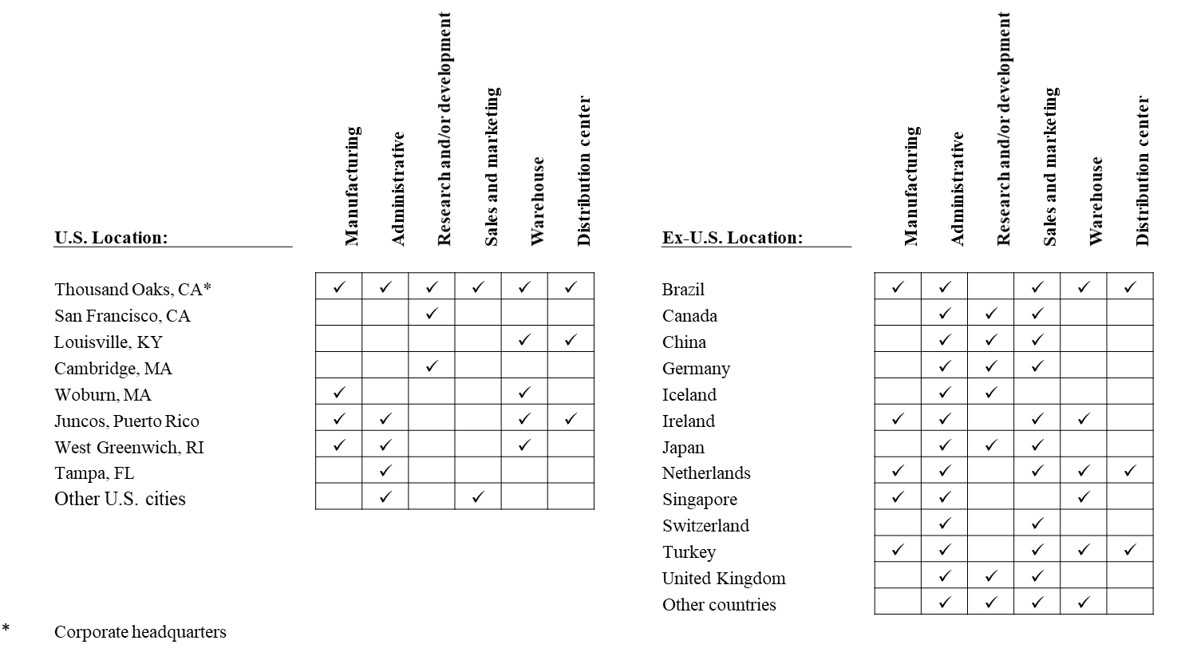
Excluded from the information above are (i) undeveloped land and leased properties that have been abandoned and (ii) certain buildings that we still own but are no longer used in our business. There are no material encumbrances on our owned properties.
We believe that our facilities are suitable for their intended uses and, in conjunction with our third-party contracting manufacturing agreements, provide adequate capacity and are sufficient to meet our expected needs. See Item 1A. Risk Factors for a discussion of the factors that could adversely impact our manufacturing operations and the global supply of our products.
See Item 1. Business—Manufacturing, Distribution and Raw Materials.
Item 3. LEGAL PROCEEDINGS
Certain of the legal proceedings in which we are involved are discussed in Part IV—Note 19, Contingencies and commitments, to the Consolidated Financial Statements, and are hereby incorporated by reference.
Item 4. MINE SAFETY DISCLOSURES
Not applicable.
PART II
Item 5. MARKET FOR REGISTRANT’S COMMON EQUITY, RELATED STOCKHOLDER MATTERS AND ISSUER PURCHASES OF EQUITY SECURITIES
Common stock
Our common stock trades on the NASDAQ Global Select Market under the symbol AMGN. As of February 6, 2020, there were approximately 5,493 holders of record of our common stock.
Performance graph
The following graph shows the value of an investment of $100 on December 31, 2014, in each of Amgen common stock, the Amex Biotech Index, the Amex Pharmaceutical Index and Standard & Poor’s 500 Index (S&P 500). All values assume reinvestment of the pretax value of dividends and are calculated as of December 31 of each year. The historical stock price performance of the Company’s common stock shown in the performance graph is not necessarily indicative of future stock price performance.

| 12/31/2014 | 12/31/2015 | 12/31/2016 | 12/31/2017 | 12/31/2018 | 12/31/2019 | ||||||
| Amgen (AMGN) | $100.00 | $103.97 | $96.12 | $117.57 | $135.31 | $172.68 | |||||
| Amex Biotech (BTK) | $100.00 | $111.39 | $90.06 | $124.11 | $124.44 | $149.87 | |||||
| Amex Pharmaceutical (DRG) | $100.00 | $104.18 | $95.49 | $111.37 | $119.66 | $141.66 | |||||
| S&P 500 (SPX) | $100.00 | $101.37 | $113.49 | $138.33 | $132.29 | $173.93 |
The material in this performance graph is not soliciting material, is not deemed filed with the SEC and is not incorporated by reference in any filing of the Company under the Securities Act or the Exchange Act, whether made on, before or after the date of this filing and irrespective of any general incorporation language in such filing.
Stock repurchase program
During the three months and year ended December 31, 2019, we had one outstanding stock repurchase program, under which the repurchasing activity was as follows:
| Total number of shares purchased | Average price paid per share**(1)** | Total number of shares purchased as part of publicly announced program | Maximum dollar value that may yet be purchased under the program**(2)** | |||||||||||
| October 1 - October 31 | 2,500,729 | $ | 199.94 | 2,500,729 | $ | 3,064,464,667 | ||||||||
| November 1 - November 30 | 1,349,900 | $ | 222.55 | 1,349,900 | $ | 2,764,044,387 | ||||||||
| December 1 - December 31 | 1,218,800 | $ | 237.95 | 1,218,800 | $ | 6,474,033,251 | ||||||||
| 5,069,429 | $ | 215.10 | 5,069,429 | |||||||||||
| January 1 - December 31 | 40,244,414 | $ | 189.85 | 40,244,414 |
| (1) | Average price paid per share includes related expenses. |
| (2) | In May 2019 and December 2019, our Board of Directors increased the amount authorized under our stock repurchase program by an additional $5.0 billion and $4.0 billion, respectively. |
Dividends
For the years ended December 31, 2019 and 2018, we paid quarterly dividends. We expect to continue to pay quarterly dividends, although the amount and timing of any future dividends are subject to approval by our Board of Directors. Additional information required by this item is incorporated herein by reference to Part IV—Note 16, Stockholders’ equity, to the Consolidated Financial Statements.
Securities Authorized for Issuance Under Existing Equity Compensation Plans
Information about securities authorized for issuance under existing equity compensation plans is incorporated by reference from Item 12—Securities Authorized for Issuance Under Existing Equity Compensation Plans.
Item 6. SELECTED FINANCIAL DATA
| Years ended December 31, | |||||||||||||||||||
| Consolidated Statements of Income Data: | 2019 | 2018 | 2017 | 2016 | 2015 | ||||||||||||||
| (In millions, except per-share data) | |||||||||||||||||||
| Revenues: | |||||||||||||||||||
| Product sales | $ | 22,204 | $ | 22,533 | $ | 21,795 | $ | 21,892 | $ | 20,944 | |||||||||
| Other revenues | 1,158 | 1,214 | 1,054 | 1,099 | 718 | ||||||||||||||
| Total revenues | $ | 23,362 | $ | 23,747 | $ | 22,849 | $ | 22,991 | $ | 21,662 | |||||||||
| Operating expenses: | |||||||||||||||||||
| Cost of sales | $ | 4,356 | $ | 4,101 | $ | 4,069 | $ | 4,162 | $ | 4,227 | |||||||||
| Research and development | $ | 4,116 | $ | 3,737 | $ | 3,562 | $ | 3,840 | $ | 4,070 | |||||||||
| Selling, general and administrative | $ | 5,150 | $ | 5,332 | $ | 4,870 | $ | 5,062 | $ | 4,846 | |||||||||
| Net income(1) | $ | 7,842 | $ | 8,394 | $ | 1,979 | $ | 7,722 | $ | 6,939 | |||||||||
| Diluted earnings per share(1) | $ | 12.88 | $ | 12.62 | $ | 2.69 | $ | 10.24 | $ | 9.06 | |||||||||
| Dividends paid per share | $ | 5.80 | $ | 5.28 | $ | 4.60 | $ | 4.00 | $ | 3.16 | |||||||||
| As of December 31, | |||||||||||||||||||
| Consolidated Balance Sheets Data: | 2019 | 2018 | 2017 | 2016 | 2015 | ||||||||||||||
| (In millions) | |||||||||||||||||||
| Total assets | $ | 59,707 | $ | 66,416 | $ | 79,954 | $ | 77,626 | $ | 71,449 | |||||||||
| Total debt(2) | $ | 29,903 | $ | 33,929 | $ | 35,342 | $ | 34,596 | $ | 31,429 | |||||||||
| Total stockholders’ equity(3) | $ | 9,673 | $ | 12,500 | $ | 25,241 | $ | 29,875 | $ | 28,083 |
In addition to the following notes, see Item 7. Management’s Discussion and Analysis of Financial Condition and Results of Operations, Part IV—Consolidated Financial Statements and accompanying notes and previously filed Annual Reports on Form 10-K for further information regarding our consolidated results of operations and financial position for periods reported therein and for known factors that will affect the comparability of future results. Also see Part IV—Note 16, Stockholders’ equity, to the Consolidated Financial Statements, for information regarding cash dividends declared per share of common stock for each of the four quarters of 2019, 2018 and 2017. In addition, our Board of Directors declared dividends per share of $1.00 and $0.79 that were paid in each of the four quarters of 2016 and 2015, respectively.
| (1) | In 2017, we recorded a net charge of $6.1 billion as a result of the 2017 Tax Act. See Part IV—Note 6, Income taxes, to the Consolidated Financial Statements. |
| (2) | See Part IV—Note 15, Financing arrangements, to the Consolidated Financial Statements, for discussion of our financing arrangements. In 2016, we issued $7.3 billion of debt and repaid $3.7 billion of debt. In 2015, we issued $3.5 billion of debt and repaid $2.4 billion of debt. |
| (3) | Throughout the five years ended December 31, 2019, we had a stock repurchase program authorized by the Board of Directors, through which we repurchased $7.6 billion, $17.9 billion, $3.1 billion, $3.0 billion and $1.9 billion, respectively, of Amgen common stock. |
Item 7. MANAGEMENT’S DISCUSSION AND ANALYSIS OF FINANCIAL CONDITION AND RESULTS OF OPERATIONS
The following management’s discussion and analysis (MD&A) is intended to assist the reader in understanding Amgen’s business. MD&A is provided as a supplement to, and should be read in conjunction with, our consolidated financial statements and accompanying notes. Our results of operations discussed in MD&A are presented in conformity with U.S. generally accepted accounting principles (GAAP). Amgen operates in one business segment: human therapeutics. Therefore, our results of operations are discussed on a consolidated basis.
Forward-looking statements
This report and other documents we file with the SEC contain forward-looking statements that are based on current expectations, estimates, forecasts and projections about us, our future performance, our business, our beliefs and our management’s assumptions. In addition, we, or others on our behalf, may make forward-looking statements in press releases, written statements or our communications and discussions with investors and analysts in the normal course of business through meetings, webcasts, phone calls and conference calls. Such words as “expect,” “anticipate,” “outlook,” “could,” “target,” “project,” “intend,” “plan,” “believe,” “seek,” “estimate,” “should,” “may,” “assume” and “continue” as well as variations of such words and similar expressions are intended to identify such forward-looking statements. These statements are not guarantees of future performance and they involve certain risks, uncertainties and assumptions that are difficult to predict. We describe our respective risks, uncertainties and assumptions that could affect the outcome or results of operations in Part I, Item 1A. Risk Factors. We have based our forward-looking statements on our management’s beliefs and assumptions based on information available to our management at the time the statements are made. We caution you that actual outcomes and results may differ materially from what is expressed, implied or forecasted by our forward-looking statements. Reference is made in particular to forward-looking statements regarding product sales, regulatory activities, clinical trial results, reimbursement, expenses, earnings per share (EPS), liquidity and capital resources, trends, planned dividends, stock repurchases and restructuring plans. Except as required under the federal securities laws and the rules and regulations of the SEC, we do not have any intention or obligation to update publicly any forward-looking statements after the distribution of this report, whether as a result of new information, future events, changes in assumptions or otherwise.
Overview
Amgen is a biotechnology company committed to unlocking the potential of biology for patients suffering from serious illnesses. A biotechnology pioneer since 1980, Amgen has grown to be one of the world’s leading independent biotechnology companies, has reached millions of patients around the world and is developing a pipeline of medicines with breakaway potential. In 2020, we celebrate our 40th anniversary, continuing our history of focusing on innovative medicines that have the potential to be first-in-class molecules and that have a large-effect size on serious diseases.
Our principal products—those with the most significant annual commercial sales—are ENBREL, Neulasta®, Prolia®, XGEVA®, Aranesp®, KYPROLIS®, EPOGEN® and our recently acquired product Otezla®. We also market a number of other products, including Nplate®, Vectibix®, Repatha®, Parsabiv®, Sensipar®/Mimpara®, BLINCYTO®, Aimovig®, NEUPOGEN®, KANJINTITM, AMGEVITATM, EVENITY®, MVASITM, IMLYGIC® and Corlanor®. For additional information about our products, see Part I, Item 1. Business—Marketing, Distribution and Selected Marketed Products.
Our strategy includes integrated activities intended to maintain and strengthen our competitive position in the industry. We focus on six commercial areas: inflammation, oncology/hematology, bone health, cardiovascular disease, nephrology and neuroscience and conduct discovery research primarily in three therapeutic areas: inflammation, oncology/hematology and cardiovascular/metabolic diseases. In 2019, we advanced our innovative pipeline, launched branded biosimilar programs, built our global geographic reach and expanded our next generation manufacturing capabilities, while returning capital to shareholders.
During the year we delivered strong financial results while facing competition from biosimilars and generics. Total product sales decreased 1% as lower net selling prices were offset partially by volume growth. Product sales decreased 5% in the United States and grew 11% in the rest of the world. Total operating expenses increased 2% as we invested in our innovative R&D pipeline, including our early oncology assets.
We continued to advance our pipeline, including AMG 510, which was granted fast track designation from the FDA for the treatment of patients with previously treated metastatic NSCLC with KRAS G12C mutation. We launched EVENITY® in the United States and Japan, and it was granted marketing authorization in Europe; and the United States label for KYPROLIS® was expanded. We also continued to advance our biosimilar program with the launches of KANJINTITM and MVASITM in the United States and the approval of AVSOLATM for all approved indications of the reference product REMICADE® (infliximab) in the United States. Lastly, we made a regulatory submission for ABP 798 in the United States.
We have also continued to invest in external opportunities to augment our internal programs and products. We completed our acquisition of worldwide rights to Otezla®, the only oral, non-biologic treatment for psoriasis and psoriatic arthritis. We strengthened our international footprint with the announcement of a strategic collaboration with BeiGene to expand our oncology presence in China. In addition, we expanded our human genetics capabilities, by entering into a collaboration with a regional healthcare system in the United States and joining a consortium to perform whole genome sequencing of approximately 500,000 participants from the United Kingdom. Our human genetics capabilities allow us to identify new development targets in our chosen areas of therapeutic focus.
Cash flows from operating activities were $9.2 billion, enabling us to invest in our business while returning capital to shareholders through the payment of cash dividends and stock repurchases. For 2019, we increased our quarterly cash dividend by 10% to $1.45 per share of common stock. In December 2019, we declared a cash dividend of $1.60 per share of common stock for the first quarter of 2020, an increase of 10% for this period, to be paid in March 2020. We also repurchased 40.2 million shares of our common stock throughout 2019 at an aggregate cost of $7.6 billion.
Our long-term success depends, to a great extent, on our ability to continue to discover, develop and commercialize innovative products and acquire or collaborate on therapies currently in development by other companies. We must develop new products to achieve revenue growth and to offset revenue losses when products lose their exclusivity or when competing products are launched. Certain of our products face increasing pressure from competition, including biosimilars and generics. For additional information, including information on the expirations of patents for various products, see Part I, Item 1. Business—Marketing, Distribution and Selected Marketed Products—Patents, and Part I, Item 1. Business—Marketing, Distribution and Selected Marketed Products—Competition. We devote considerable resources to R&D activities, but successful product development in the biotechnology industry is highly uncertain and we also are facing increasing regulatory scrutiny of safety and efficacy both before and after products launch.
Rising healthcare costs and economic conditions also continue to pose challenges to our business, including continued pr
Showing the first 8K of 76K characters. Open the full section
Item 7A. QUANTITATIVE AND QUALITATIVE DISCLOSURES ABOUT MARKET RISK
We are exposed to market risks that may result from changes in interest rates, foreign currency exchange rates and prices of equity instruments as well as changes in general economic conditions in the countries where we conduct business. To reduce certain of these risks, we enter into various types of foreign currency and interest rate derivative hedging transactions as part of our risk management program. We do not use derivatives for speculative trading purposes.
In the discussion that follows, we have assumed a hypothetical change in interest rates of 100 basis points from those as of December 31, 2019 and 2018. Except as noted below, we have also assumed a hypothetical 20% change in foreign currency exchange rates against the U.S. dollar based on its position relative to other currencies as of December 31, 2019 and 2018.
Interest-rate-sensitive financial instruments
Our portfolio of available-for-sale investments as of December 31, 2019 and 2018, was composed of U.S. Treasury securities, corporate debt securities, residential-mortgage-backed and other mortgage- and asset-backed securities, money market mutual funds and other short-term interest-bearing securities composed principally of commercial paper, and with respect to investments as of December 31, 2018, other government-related securities. The fair values of our available-for-sale investments were $8.2 billion and $28.7 billion as of December 31, 2019 and 2018, respectively. Duration is a sensitivity measure that can be used to approximate the change in the value of a security that will result from a 100 basis point change in interest rates. Applying a duration model, a hypothetical 100 basis point increase in interest rates as of December 31, 2019, would not have resulted in a material reduction in the fair value of these securities, and with respect to available-for-sale securities as of December 31, 2018, would have resulted in a reduction of approximately $360 million in fair value. In addition, a hypothetical 100 basis point decrease in interest rates as of December 31, 2019 and 2018, would not result in a material effect on income in the respective ensuing year.
As of December 31, 2019, we had outstanding debt with a carrying value of $29.9 billion and a fair value of $33.7 billion. As of December 31, 2018, we had outstanding debt with a carrying value of $33.9 billion and a fair value of $35.0 billion. Our outstanding debt was composed primarily of debt with fixed interest rates, with variable-rate debt having carrying values of $300 million and $850 million as of December 31, 2019 and 2018, respectively. Changes in interest rates do not affect interest expense on fixed-rate debt. Changes in interest rates would, however, affect the fair values of fixed-rate debt. A hypothetical 100 basis
point decrease in interest rates relative to interest rates as of December 31, 2019 and 2018, would have resulted in increases of $3.0 billion and $2.6 billion, respectively, in the aggregate fair value of our outstanding debt on each of these dates. Analysis of the debt does not consider the impact that hypothetical changes in interest rates would have on the related interest rate swap contracts and cross-currency swap contracts, discussed below.
To achieve a desired mix of fixed-rate and floating-rate debt, we entered into interest rate swap contracts that qualified and were designated for accounting purposes as fair value hedges for certain of our fixed-rate debt. These interest rate swap contracts effectively converted a fixed-rate interest coupon to a floating-rate LIBOR-based coupon over the life of the respective note. Interest rate swap contracts with aggregate notional amounts of $9.6 billion and $11.0 billion were outstanding as of December 31, 2019 and 2018, respectively. A hypothetical 100 basis point increase in interest rates relative to interest rates as of December 31, 2019 and 2018, would have resulted in reductions in fair values of approximately $380 million and $460 million, respectively, on our interest rate swap contracts on these dates and would not result in a material effect on the related income in the respective ensuing years. Analysis of the interest rate swap contracts does not consider the impact that hypothetical changes in interest rates would have on the related fair values of debt that these interest-rate-sensitive instruments were designed to offset.
As of December 31, 2019 and 2018, we had outstanding cross-currency swap contracts with aggregate notional amounts of $4.8 billion and $5.6 billion, respectively, that hedge our foreign-currency-denominated debt and related interest payments. These contracts effectively convert interest payments and principal repayment of this debt to U.S. dollars from euros, pounds sterling and Swiss francs and are designated for accounting purposes as cash flow hedges. A hypothetical 100 basis point adverse movement in interest rates relative to interest rates as of December 31, 2019 and 2018, would have resulted in reductions in the fair values of our cross-currency swap contracts of approximately $280 million and $320 million, respectively.
Foreign-currency-sensitive financial instruments
Our international operations are affected by fluctuations in the value of the U.S. dollar as compared to foreign currencies, predominantly the euro. Increases and decreases in our international product sales from movements in foreign currency exchange rates are offset partially by the corresponding increases or decreases in our international operating expenses. Increases and decreases in our foreign-currency-denominated assets from movements in foreign currency exchange rates are offset partially by the corresponding increases or decreases in our foreign-currency-denominated liabilities. To further reduce our net exposure to foreign currency exchange rate fluctuations on our results of operations, we enter into foreign currency forward, option and cross-currency swap contracts.
As of December 31, 2019, we had outstanding euro-, pound-sterling- and Swiss-franc-denominated debt with a principal carrying value and a fair value of $4.5 billion and $5.0 billion, respectively. As of December 31, 2018, we had outstanding euro-, pound-sterling- and Swiss-franc-denominated debt with a principal carrying value and a fair value of $5.3 billion and $5.6 billion, respectively. A hypothetical 20% adverse movement in foreign currency exchange rates compared with the U.S. dollar relative to exchange rates as of December 31, 2019, would have resulted in an increase in fair value of this debt of $1.0 billion on this date and a reduction in income in the ensuing year of $0.9 billion. A hypothetical 20% adverse movement in foreign currency exchange rates compared with the U.S. dollar relative to exchange rates as of December 31, 2018, would have resulted in an increase in fair value of this debt of $1.1 billion on this date and a reduction in income in the ensuing year of $1.1 billion. The impact on income from these hypothetical changes in foreign currency exchange rates would be substantially offset by the impact such changes would have on related cross-currency swap contracts, which are in place for the related foreign-currency-denominated debt.
We have cross-currency swap contracts that are designated as cash flow hedges of our debt denominated in euros, pounds sterling and Swiss francs with aggregate notional amounts of $4.8 billion and $5.6 billion as of December 31, 2019 and 2018, respectively. A hypothetical 20% adverse movement in foreign currency exchange rates compared with the U.S. dollar relative to exchange rates on these dates would have resulted in reductions in the fair values of these contracts of $1.0 billion and $1.2 billion on these dates, respectively. The impact of this hypothetical adverse movement in foreign currency exchange rates on ensuing years’ income from these contracts would be fully offset by the corresponding hypothetical changes in the carrying amounts of the related hedged debt.
We enter into foreign currency forward and options contracts that are designated for accounting purposes as cash flow hedges of certain anticipated foreign currency transactions. As of December 31, 2019, we had primarily euro based open foreign currency forward contracts with notional amounts of $5.0 billion. As of December 31, 2018, we had primarily euro based open foreign currency forward and option contracts with notional amounts of $4.5 billion and $21 million, respectively. As of December 31, 2019, the fair values of these contracts were a $223 million asset and a $31 million liability. As of December 31, 2018, the fair values of these contracts were a $181 million asset and a $26 million liability. With regard to foreign currency forward and option contracts that were open as of December 31, 2019, a hypothetical 20% adverse movement in foreign currency exchange rates compared with the U.S. dollar relative to exchange rates as of December 31, 2019, would have resulted in a reduction in fair value of these contracts of approximately $930 million on this date and, in the ensuing year, a reduction in income of approximately $400 million. With regard to contracts that were open as of December 31, 2018, a hypothetical 20% adverse movement in foreign
currency exchange rates compared with the U.S. dollar relative to exchange rates as of December 31, 2018, would have resulted in a reduction in fair value of these contracts of $810 million on this date and, in the ensuing year, a reduction in income of $380 million. The analysis does not consider the impact that hypothetical changes in foreign currency exchange rates would have on anticipated transactions that these foreign-currency-sensitive instruments were designed to offset.
As of December 31, 2019 and 2018, we had open short-duration foreign currency forward contracts that mature in less than one month with notional amounts of $1.2 billion and $737 million, respectively, that hedged fluctuations of certain assets and liabilities denominated in foreign currencies but were not designated as hedges for accounting purposes. These contracts had no material net unrealized gains or losses as of December 31, 2019 and 2018. With regard to these foreign currency forward contracts that were open as of December 31, 2019 and 2018, a hypothetical 5% adverse movement in foreign currency exchange rates compared with the U.S. dollar relative to exchange rates on these dates would not have a material effect on the fair values of these contracts or related income in the respective ensuing years. The analysis does not consider the impact that hypothetical changes in foreign currency exchange rates would have on assets and liabilities that these foreign-currency-sensitive instruments were designed to offset.
Market-price-sensitive financial instruments
As of December 31, 2019 and 2018, we were exposed to price risk on equity securities included in our portfolio of investments, which were acquired primarily for the promotion of business and strategic objectives. These investments are generally in small-capitalization stocks in the biotechnology industry sector. Price risk relative to our equity investment portfolio as of December 31, 2019 and 2018, was not material.
Counterparty credit risks
Our financial instruments, including derivatives, are subject to counterparty credit risk, which we consider as part of the overall fair value measurement. Our financial risk management policy limits derivative transactions by requiring that transactions be made only with institutions with minimum credit ratings of A– or equivalent by S&P, Moody’s or Fitch; and it requires placing exposure limits on the amount with any individual counterparty. In addition, we have an investment policy that limits investments to certain types of debt and money market instruments issued by institutions primarily with investment-grade credit ratings and places restriction on maturities and concentrations by asset class and issuer.
Item 8. FINANCIAL STATEMENTS AND SUPPLEMENTARY DATA
The information required by this item is incorporated herein by reference to the financial statements and schedule listed in Item 15(a)1 and (a)2 of Part IV and included in this Annual Report on Form 10-K.
Item 9. CHANGES IN AND DISAGREEMENTS WITH ACCOUNTANTS ON ACCOUNTING AND FINANCIAL DISCLOSURE
None.
Item 9A. CONTROLS AND PROCEDURES
We maintain “disclosure controls and procedures,” as such term is defined under the Securities Exchange Act Rule 13a-15(e), that are designed to ensure that information required to be disclosed in Amgen’s Exchange Act reports is recorded, processed, summarized and reported within the time periods specified in the SEC’s rules and forms, and that such information is accumulated and communicated to Amgen’s management, including its Chief Executive Officer and Chief Financial Officer, as appropriate, to allow timely decisions regarding required disclosures. In designing and evaluating the disclosure controls and procedures, Amgen’s management recognized that any controls and procedures, no matter how well designed and operated, can provide only reasonable assurance of achieving the desired control objectives and in reaching a reasonable level of assurance Amgen’s management necessarily was required to apply its judgment in evaluating the cost-benefit relationship of possible controls and procedures. We have carried out an evaluation under the supervision and with the participation of our management, including Amgen’s Chief Executive Officer and Chief Financial Officer, of the effectiveness of the design and operation of Amgen’s disclosure controls and procedures. Based upon their evaluation and subject to the foregoing, the Chief Executive Officer and Chief Financial Officer concluded that our disclosure controls and procedures were effective as of December 31, 2019.
Management determined that, as of December 31, 2019, there were no changes in our internal control over financial reporting that occurred during the fiscal quarter then ended that have materially affected, or are reasonably likely to materially affect, our internal control over financial reporting.
Management’s Report on Internal Control over Financial Reporting
Management of the Company is responsible for establishing and maintaining adequate internal control over financial reporting, as such term is defined in Rule 13a-15(f) under the Securities Exchange Act of 1934. The Company’s internal control over financial reporting is designed to provide reasonable assurance regarding the reliability of financial reporting and the preparation of financial statements for external purposes in accordance with generally accepted accounting principles in the United States. However, all internal control systems, no matter how well designed, have inherent limitations. Therefore, even those systems determined to be effective can provide only reasonable assurance with respect to financial statement preparation and reporting.
Management assessed the effectiveness of the Company’s internal control over financial reporting as of December 31, 2019. In making this assessment, management used the criteria set forth by the Committee of Sponsoring Organizations of the Treadway Commission (COSO) in Internal Control-Integrated Framework (2013 framework). Based on our assessment, management believes that the Company maintained effective internal control over financial reporting as of December 31, 2019, based on the COSO criteria.
Management excluded Otezla®, which was acquired by us on November 21, 2019, from its assessment of internal control over financial reporting as of December 31, 2019. Total assets and revenues of Otezla® excluded from our assessment of internal control over financial reporting were approximately 0.6% of total assets and 0.8% of total revenues as of and for the period ended December 31, 2019.
The effectiveness of the Company’s internal control over financial reporting has been audited by Ernst & Young LLP, an independent registered public accounting firm, as stated in their attestation report appearing below, which expresses an unqualified opinion on the effectiveness of the Company’s internal control over financial reporting as of December 31, 2019.
Report of Independent Registered Public Accounting Firm
To the Shareholders and the Board of Directors of Amgen Inc.
Opinion on Internal Control Over Financial Reporting
We have audited Amgen Inc.’s internal control over financial reporting as of December 31, 2019, based on criteria established in Internal Control-Integrated Framework issued by the Committee of Sponsoring Organizations of the Treadway Commission (2013 framework) (the COSO criteria). In our opinion, Amgen Inc. (the Company) maintained, in all material respects, effective internal control over financial reporting as of December 31, 2019, based on the COSO criteria.
As indicated in the accompanying Management’s Report on Internal Control over Financial Reporting, management’s assessment of and conclusion on the effectiveness of internal control over financial reporting did not include the internal controls of the worldwide rights to Otezla® acquired from Celgene Corporation, which is included in the 2019 consolidated financial statements of the Company and constituted 0.6% of total assets, as of December 31, 2019 and 0.8% of revenues, for the year then ended. Our audit of internal control over financial reporting of the Company also did not include an evaluation of the internal control over financial reporting of the worldwide rights to Otezla® acquired from Celgene Corporation.
We also have audited, in accordance with the standards of the Public Company Accounting Oversight Board (United States) (PCAOB), the consolidated balance sheets of the Company as of December 31, 2019 and 2018, the related consolidated statements of income, comprehensive income, shareholders’ equity and cash flows for each of the three years in the period ended December 31, 2019, and the related notes and schedule and our report dated February 12, 2020 expressed an unqualified opinion thereon.
Basis for Opinion
The Company’s management is responsible for maintaining effective internal control over financial reporting and for its assessment of the effectiveness of internal control over financial reporting included in the accompanying Management’s Report on Internal Control over Financial Reporting. Our responsibility is to express an opinion on the Company’s internal control over financial reporting based on our audit. We are a public accounting firm registered with the PCAOB and are required to be independent with respect to the Company in accordance with the U.S. federal securities laws and the applicable rules and regulations of the Securities and Exchange Commission and the PCAOB.
We conducted our audit in accordance with the standards of the PCAOB. Those standards require that we plan and perform the audit to obtain reasonable assurance about whether effective internal control over financial reporting was maintained in all material respects.
Our audit included obtaining an understanding of internal control over financial reporting, assessing the risk that a material weakness exists, testing and evaluating the design and operating effectiveness of internal control based on the assessed risk, and performing such other procedures as we considered necessary in the circumstances. We believe that our audit provides a reasonable basis for our opinion.
Definition and Limitations of Internal Control Over Financial Reporting
A company’s internal control over financial reporting is a process designed to provide reasonable assurance regarding the reliability of financial reporting and the preparation of financial statements for external purposes in accordance with generally accepted accounting principles. A company’s internal control over financial reporting includes those policies and procedures that (1) pertain to the maintenance of records that, in reasonable detail, accurately and fairly reflect the transactions and dispositions of the assets of the company; (2) provide reasonable assurance that transactions are recorded as necessary to permit preparation of financial statements in accordance with generally accepted accounting principles, and that receipts and expenditures of the company are being made only in accordance with authorizations of management and directors of the company; and (3) provide reasonable assurance regarding prevention or timely detection of unauthorized acquisition, use, or disposition of the company’s assets that could have a material effect on the financial statements.
Because of its inherent limitations, internal control over financial reporting may not prevent or detect misstatements. Also, projections of any evaluation of effectiveness to future periods are subject to the risk that controls may become inadequate because of changes in conditions, or that the degree of compliance with the policies or procedures may deteriorate.
/s/ Ernst & Young LLP
Los Angeles, California
February 12, 2020
Item 9B. OTHER INFORMATION
Not applicable.
PART III
Item 10. DIRECTORS, EXECUTIVE OFFICERS AND CORPORATE GOVERNANCE
Information about our Directors is incorporated by reference from the section entitled ITEM 1—ELECTION OF DIRECTORS in our Proxy Statement for the 2020 Annual Meeting of Stockholders to be filed with the SEC within 120 days of December 31, 2019 (the Proxy Statement). Information about the procedures by which stockholders may recommend nominees for the Board of Directors is incorporated by reference from APPENDIX A—AMGEN INC. BOARD OF DIRECTORS GUIDELINES FOR DIRECTOR QUALIFICATIONS AND EVALUATIONS and OTHER MATTERS—Stockholder Proposals for the 2021 Annual Meeting in our Proxy Statement. Information about our Audit Committee, members of the committee and our Audit Committee financial experts is incorporated by reference from the section entitled CORPORATE GOVERNANCE—Audit Committee in our Proxy Statement. Information about our executive officers is contained in the discussion entitled Part I—Item 1. Business—Information about our Executive Officers.
Code of Ethics
We maintain a Code of Ethics for the Chief Executive Officer and Senior Financial Officers applicable to our principal executive officer, principal financial officer, principal accounting officer or controller, and other persons performing similar functions. To view this code of ethics free of charge, please visit our website at www.amgen.com. (This website address is not intended to function as a hyperlink, and the information contained in our website is not intended to be a part of this filing.) We intend to satisfy the disclosure requirements under Item 5.05 of Form 8-K regarding an amendment to, or waiver from, a provision of this code of ethics, if any, by posting such information on our website as set forth above.
Item 11. EXECUTIVE COMPENSATION
Information about director and executive compensation is incorporated by reference from the section entitled EXECUTIVE COMPENSATION in our Proxy Statement. Information about compensation committee matters is incorporated by reference from the sections entitled CORPORATE GOVERNANCE—Compensation and Management Development Committee and CORPORATE GOVERNANCE—Compensation Committee Report in our Proxy Statement.
Item 12. SECURITY OWNERSHIP OF CERTAIN BENEFICIAL OWNERS AND MANAGEMENT AND RELATED STOCKHOLDER MATTERS
Securities Authorized for Issuance Under Existing Equity Compensation Plans
The following table sets forth certain information as of December 31, 2019, concerning the shares of our common stock that may be issued under any form of award granted under our equity compensation plans in effect as of December 31, 2019 (including upon the exercise of options, upon the vesting of awards of restricted stock units (RSUs) or when performance units are earned and related dividend equivalents have been granted).
| (a) | (b) | (c) | ||||||||
| Plan category | Number of securities to be issued upon exercise of outstanding options and rights | Weighted-average exercise price of outstanding options and rights | Number of securities remaining available for future issuance under equity compensation plans (excluding securities reflected in column (a)) | |||||||
| Equity compensation plans approved by Amgen security holders: | ||||||||||
| Amended and Restated 2009 Equity Incentive Plan(1) | 10,233,680 | $ | 157.00 | 27,552,603 | ||||||
| Amended and Restated 1991 Equity Incentive Plan(2) | 13,439 | — | — | |||||||
| Amended and Restated Employee Stock Purchase Plan | — | — | 4,506,117 | |||||||
| Total approved plans | 10,247,119 | 157.00 | 32,058,720 | |||||||
| Equity compensation plan not approved by Amgen security holders: | ||||||||||
| Amgen Profit Sharing Plan for Employees in Ireland(3) | — | — | 78,057 | |||||||
| Total unapproved plans | — | — | 78,057 | |||||||
| Total all plans | 10,247,119 | $ | 157.00 | 32,136,777 |
| (1) | The Amended and Restated 2009 Equity Incentive Plan employs a fungible share-counting formula for determining the number of shares available for issuance under the plan. In accordance with this formula, each option or stock appreciation right counts as one share, while each restricted stock unit, performance unit or dividend equivalent counts as 1.9 shares. The number under column (a) represents the actual number of shares issuable under our outstanding awards without giving effect to the fungible share-counting formula. The number under column (c) represents the number of shares available for issuance under this plan based on each such available share counting as one share. Commencing with the grants made in April 2012, RSUs and performance units accrue dividend equivalents that are payable in shares only to the extent and when the underlying RSUs vest or underlying performance units have been earned and the related shares are issued to the grantee. The performance units granted under this plan are earned based on the accomplishment of specified performance goals at the end of their respective three-year performance periods; the number of performance units granted represent target performance, and the maximum number of units that could be earned based on our performance is 200% of the performance units granted in 2017, 2018 and 2019. |
As of December 31, 2019, the number of outstanding awards under column (a) includes (i) 4,823,162 shares issuable upon the exercise of outstanding options with a weighted-average exercise price of $157.00; (ii) 3,324,005 shares issuable upon the vesting of outstanding RSUs (including 180,878 related dividend equivalents); and (iii) 2,086,513 shares subject to outstanding 2017, 2018 and 2019 performance units (including 97,836 related dividend equivalents). The weighted-average exercise price shown in column (b) is for the outstanding options only. The number of available shares under column (c) represents the number of shares that remain available for future issuance under this plan as of December 31, 2019, employing the fungible share formula and presumes the issuance of target shares under the performance units granted in 2017, 2018 and 2019 and related dividend equivalents. The numbers under columns (a) and (c) do not give effect to the additional shares that could be issuable in the event above target performance on the performance goals under these outstanding performance units is achieved. Maximum performance under these goals could result in 200% of target shares being awarded for performance units granted in 2017, 2018 and 2019.
| (2) | This plan has terminated as to future grants. The number under column (a) with respect to this plan includes 13,439 shares issuable upon the settlement of deferred RSUs (including 2,357 related dividend equivalents). |
| (3) | The Amgen Profit Sharing Plan for Employees in Ireland (the Profit Sharing Plan) was approved by the Board of Directors on July 28, 2011. The Profit Sharing Plan permits eligible employees of the Company’s subsidiaries located in Ireland who participate in the Profit Sharing Plan to apply a portion of their qualifying bonus and salary to the purchase the Company’s common stock on the open market at the market price by a third-party trustee as described in the Profit Sharing Plan. |
Security Ownership of Directors and Executive Officers and Certain Beneficial Owners
Information about security ownership of certain beneficial owners and management is incorporated by reference from the sections entitled SECURITY OWNERSHIP OF DIRECTORS AND EXECUTIVE OFFICERS and SECURITY OWNERSHIP OF CERTAIN BENEFICIAL OWNERS in our Proxy Statement.
Item 13. CERTAIN RELATIONSHIPS AND RELATED TRANSACTIONS AND DIRECTOR INDEPENDENCE
Information about certain relationships and related transactions and director independence is incorporated by reference from the sections entitled CERTAIN RELATIONSHIPS AND RELATED TRANSACTIONS and CORPORATE GOVERNANCE—Director Independence in our Proxy Statement.
Item 14. PRINCIPAL ACCOUNTING FEES AND SERVICES
Information about the fees for professional services rendered by our independent registered public accountants is incorporated by reference from the section entitled AUDIT MATTERS—Independent Registered Public Accountants in our Proxy Statement.
PART IV
Item 15. EXHIBITS, FINANCIAL STATEMENT SCHEDULES
| (a)1. | Index to Financial Statements |
The following Consolidated Financial Statements are included herein:
| Page number | |
| Report of Independent Registered Public Accounting Firm | F-1 |
| Consolidated Statements of Income for each of the three years in the period ended December 31, 2019 | F-4 |
| Consolidated Statements of Comprehensive Income for each of the three years in the period ended December 31, 2019 | F-5 |
| Consolidated Balance Sheets as of December 31, 2019 and 2018 | F-6 |
| Consolidated Statements of Stockholders’ Equity for each of the three years in the period ended December 31, 2019 | F-7 |
| Consolidated Statements of Cash Flows for each of the three years in the period ended December 31, 2019 | F-8 |
| Notes to Consolidated Financial Statements | F-9 |
| (a)2. | Index to Financial Statement Schedules |
The following Schedule is filed as part of this Annual Report on Form 10-K:
| Page number | |
| II. Valuation and Qualifying Accounts | F-60 |
All other schedules are omitted because they are not applicable, not required or because the required information is included in the consolidated financial statements or notes thereto.
| (a)3. | Exhibits |
| 10.32 | Settlement Agreement and Release, dated October 11, 2011, by and between Bayer Corporation, Bayer AG, Bayer HealthCare LLC and Bayer Pharma AG and Onyx Pharmaceuticals, Inc. (Filed as an exhibit to Form 10-K for the year ended December 31, 2011 by Onyx Pharmaceuticals, Inc. on February 27, 2012 and incorporated herein by reference.) | |
| 10.33 | Fourth Amendment to Collaboration Agreement, dated October 11, 2011, by and between Bayer Corporation and Onyx Pharmaceuticals, Inc. (Filed as an exhibit to Form 10-K for the year ended December 31, 2011 by Onyx Pharmaceuticals, Inc. on February 27, 2012 and incorporated herein by reference.) | |
| 10.34 | Side Letter Regarding Collaboration Agreement, dated May 29, 2015, by and between Bayer HealthCare LLC and Onyx Pharmaceuticals, Inc. (Filed as an exhibit to Form 10-Q for the quarter ended June 30, 2015 on August 5, 2015 and incorporated herein by reference.) | |
| 10.35 | Sourcing and Supply Agreement, dated January 6, 2017, by and between Amgen USA Inc., a wholly owned subsidiary of Amgen Inc., and DaVita Inc. (portions of the exhibit have been omitted pursuant to a request for confidential treatment). (Filed as an exhibit to Form 10-Q for the quarter ended March 31, 2017 on April 27, 2017 and incorporated herein by reference.) | |
| 10.36 | Exclusive License and Collaboration Agreement, dated August 28, 2015, by and between Amgen Inc. and Novartis Pharma AG (portions of the exhibit have been omitted pursuant to a request for confidential treatment). (Filed as an exhibit to Form 10-Q for the quarter ended June 30, 2017 on July 26, 2017 and incorporated herein by reference.) | |
| 10.37 | Amendment No. 1 to the Exclusive License and Collaboration Agreement, dated April 21, 2017, by and between Amgen Inc. and Novartis Pharma AG (portions of the exhibit have been omitted pursuant to a request for confidential treatment). (Filed as an exhibit to Form 10-Q for the quarter ended June 30, 2017 on July 26, 2017 and incorporated herein by reference.) | |
| 10.38 | Amendment No. 2 to the Exclusive License and Collaboration Agreement, dated April 21, 2017, by and between Amgen Inc. and Novartis Pharma AG (portions of the exhibit have been omitted pursuant to a request for confidential treatment). (Filed as an exhibit to Form 10-Q for the quarter ended June 30, 2017 on July 26, 2017 and incorporated herein by reference.) | |
| 10.39 | Collaboration Agreement, dated April 21, 2017, by and between Amgen Inc. and Novartis Pharma AG (portions of the exhibit have been omitted pursuant to a request for confidential treatment). (Filed as an exhibit to Form 10-Q for the quarter ended June 30, 2017 on July 26, 2017 and incorporated herein by reference.) | |
| 10.40 | Amendment No. 1 to the Collaboration Agreement, dated March 20, 2018, by and between Novartis Pharma AG and Amgen Inc. (portions of the exhibit have been omitted pursuant to a request for confidential treatment). (Filed as an exhibit to Form 10-Q for the quarter ended March 31, 2018 on April 25, 2018 and incorporated herein by reference.) | |
| 10.41* | Collaboration Agreement, dated October 31, 2019, by and between Amgen Inc. and BeiGene Switzerland GmbH, a wholly-owned subsidiary of BeiGene, Ltd. (portions of the exhibit have been omitted because they are both (i) not material and (ii) would be competitively harmful if publicly disclosed). | |
| 10.42* | Guarantee, dated as of October 31, 2019, made by and among BeiGene, Ltd. and Amgen Inc. | |
| 10.43 | Share Purchase Agreement, dated October 31, 2019, by and between Amgen Inc. and BeiGene, Ltd. (portions of the exhibit have been omitted because they are both (i) not material and (ii) would be competitively harmful if publicly disclosed). (Filed as an exhibit to Schedule 13D on January 8, 2020 and incorporated herein by reference.) | |
| 10.44 | Amendment No. 1 to Share Purchase Agreement, dated December 6, 2019, by and among BeiGene, Ltd. and Amgen Inc. (Filed as an exhibit to Schedule 13D on January 8, 2020 and incorporated herein by reference.) | |
| 21* | Subsidiaries of the Company. | |
| 23 | Consent of the Independent Registered Public Accounting Firm. The consent is set forth on page 77 of this Annual Report on the 10-K. | |
| 24 | Power of Attorney. The Power of Attorney is set forth on page 78 of this Annual Report on Form 10-K. | |
| 31* | Rule 13a-14(a) Certifications. | |
| 32** | Section 1350 Certifications. | |
| 101.INS | Inline XBRL Instance Document - the instance document does not appear in the interactive data file because its XBRL tags are embedded within the Inline XBRL document. | |
| 101.SCH* | Inline XBRL Taxonomy Extension Schema Document. | |
| 101.CAL* | Inline XBRL Taxonomy Extension Calculation Linkbase Document. | |
| 101.DEF* | Inline XBRL Taxonomy Extension Definition Linkbase Document. | |
| 101.LAB* | Inline XBRL Taxonomy Extension Label Linkbase Document. | |
| 101.PRE* | Inline XBRL Taxonomy Extension Presentation Linkbase Document. | |
| 104 | Cover Page Interactive Data File (formatted as Inline XBRL and contained in Exhibit 101). |
(* = filed herewith)
(** = furnished herewith and not “filed” for purposes of Section 18 of the Securities Exchange Act of 1934, as amended)
(+ = management contract or compensatory plan or arrangement)
Item 16. FORM 10-K SUMMARY
Not applicable.
SIGNATURES
Pursuant to the requirements of the Securities Exchange Act of 1934, the registrant has duly caused this Annual Report to be signed on its behalf by the undersigned, thereunto duly authorized.
| AMGEN INC. | ||||
| (Registrant) | ||||
| Date: | February 12, 2020 | By: | /S/ PETER H. GRIFFITH | |
| Peter H. Griffith | ||||
| Executive Vice President and Chief Financial Officer | ||||
| (Principal Financial and Accounting Officer) |
EXHIBIT 23
CONSENT OF INDEPENDENT REGISTERED PUBLIC ACCOUNTING FIRM
We consent to the incorporation by reference in the following Registration Statements:
| • | Registration Statement (Form S-3 No. 333-236351) of Amgen Inc., |
| • | Registration Statement (Form S-8 No. 333-159377) pertaining to the Amgen Inc. 2009 Equity Incentive Plan, |
| • | Registration Statement (Form S-8 No. 33-39183) pertaining to the Amended and Restated Employee Stock Purchase Plan, |
| • | Registration Statements (Form S-8 No. 33-39104, as amended by Form S-8 Nos. 333-144581 and 333-216719) pertaining to the Amended and Restated Amgen Retirement and Savings Plan (formerly known as the Amgen Retirement and Savings Plan), |
| • | Registration Statements (Form S-8 Nos. 33-47605, 333-144580 and 333-216715) pertaining to the Retirement and Savings Plan for Amgen Manufacturing, Limited (formerly known as the Retirement and Savings Plan for Amgen Manufacturing, Inc.), |
| • | Registration Statements (Form S-8 Nos. 333-81284, 333-177868 and 333-216723) pertaining to the Amgen Nonqualified Deferred Compensation Plan, and |
| • | Registration Statement (Form S-8 No. 333-176240) pertaining to the Amgen Profit Sharing Plan for Employees in Ireland; |
of our reports dated February 12, 2020, with respect to the consolidated financial statements and schedule of Amgen Inc. and the effectiveness of internal control over financial reporting of Amgen Inc. included in this Annual Report (Form 10-K) of Amgen Inc. for the year ended December 31, 2019.
/s/ Ernst & Young LLP
Los Angeles, California
February 12, 2020
EXHIBIT 24
POWER OF ATTORNEY
KNOW ALL MEN AND WOMEN BY THESE PRESENTS, that each person whose signature appears below constitutes and appoints Peter H. Griffith, his or her attorney-in-fact, with the power of substitution, for him or her in any and all capacities, to sign any amendments to this Report, and to file the same, with exhibits thereto and other documents in connection therewith, with the Securities and Exchange Commission, hereby ratifying and confirming that said attorney-in-fact, or his or her substitute or substitutes, may do or cause to be done by virtue hereof.
Pursuant to the requirements of the Securities Exchange Act of 1934, this report has been signed below by the following persons on behalf of the registrant and in the capacities and on the dates indicated:
| Signature | Title | Date | ||
| /S/ ROBERT A. BRADWAY | Chairman of the Board, Chief Executive Officer and President, and Director (Principal Executive Officer) | 2/12/2020 | ||
| Robert A. Bradway | ||||
| /S/ PETER H. GRIFFITH | Executive Vice President and Chief Financial Officer (Principal Financial and Accounting Officer) | 2/12/2020 | ||
| Peter H. Griffith | ||||
| /S/ WANDA M. AUSTIN | Director | 2/12/2020 | ||
| Wanda M. Austin | ||||
| /S/ BRIAN J. DRUKER | Director | 2/12/2020 | ||
| Brian J. Druker | ||||
| /S/ ROBERT A. ECKERT | Director | 2/12/2020 | ||
| Robert A. Eckert | ||||
| /S/ GREG C. GARLAND | Director | 2/12/2020 | ||
| Greg C. Garland | ||||
| /S/ FRED HASSAN | Director | 2/12/2020 | ||
| Fred Hassan | ||||
| /S/ REBECCA M. HENDERSON | Director | 2/12/2020 | ||
| Rebecca M. Henderson | ||||
| /S/ CHARLES M. HOLLEY, JR. | Director | 2/12/2020 | ||
| Charles M. Holley, Jr. | ||||
| /S/ TYLER JACKS | Director | 2/12/2020 | ||
| Tyler Jacks | ||||
| /S/ ELLEN J. KULLMAN | Director | 2/12/2020 | ||
| Ellen J. Kullman | ||||
| /S/ RONALD D. SUGAR | Director | 2/12/2020 | ||
| Ronald D. Sugar | ||||
| /S/ R. SANDERS WILLIAMS | Director | 2/12/2020 | ||
| R. Sanders Williams |
Report of Independent Registered Public Accounting Firm
To the Board of Directors and Stockholders of Amgen Inc.
Opinion on the Financial Statements
We have audited the accompanying consolidated balance sheets of Amgen Inc. (the Company) as of December 31, 2019 and 2018, the related consolidated statements of income, comprehensive income, stockholders’ equity and cash flows for each of the three years in the period ended December 31, 2019, and the related notes and the financial statement schedule listed in the Index at Item 15(a)2 (collectively referred to as the “consolidated financial statements”). In our opinion, the consolidated financial statements present fairly, in all material respects, the financial position of the Company at December 31, 2019 and 2018, and the results of its operations and its cash flows for each of the three years in the period ended December 31, 2019, in conformity with U.S. generally accepted accounting principles.
We also have audited, in accordance with the standards of the Public Company Accounting Oversight Board (United States) (PCAOB), the Company’s internal control over financial reporting as of December 31, 2019, based on criteria established in Internal Control-Integrated Framework issued by the Committee of Sponsoring Organizations of the Treadway Commission (2013 framework) and our report dated February 12, 2020 expressed an unqualified opinion thereon.
Basis for Opinion
These financial statements are the responsibility of the Company’s management. Our responsibility is to express an opinion on the Company’s financial statements based on our audits. We are a public accounting firm registered with the PCAOB and are required to be independent with respect to the Company in accordance with the U.S. federal securities laws and the applicable rules and regulations of the Securities and Exchange Commission and the PCAOB.
We conducted our audits in accordance with the standards of the PCAOB. Those standards require that we plan and perform the audit to obtain reasonable assurance about whether the financial statements are free of material misstatement, whether due to error or fraud. Our audits included performing procedures to assess the risks of material misstatement of the financial statements, whether due to error or fraud, and performing procedures that respond to those risks. Such procedures included examining, on a test basis, evidence regarding the amounts and disclosures in the financial statements. Our audits also included evaluating the accounting principles used and significant estimates made by management, as well as evaluating the overall presentation of the financial statements. We believe that our audits provide a reasonable basis for our opinion.
Critical Audit Matters
The critical audit matters communicated below are matters arising from the current period audit of the financial statements that were communicated or required to be communicated to the audit committee and that: (1) relate to accounts or disclosures that are material to the financial statements and (2) involved our e
Showing the first 8K of 243K characters. Open the full section