 filings.tools
American Tower 10-K 2017-12-31
Filed 2018-02-28. 20 sections, 573K characters. Original on sec.gov · Markdown · JSON
Cover and table of contents
10-K 1 amt1231201710k.htm 10-K
UNITED STATES
SECURITIES AND EXCHANGE COMMISSION
Washington, D.C. 20549
FORM 10-K
(Mark One):
| ý | Annual report pursuant to Section 13 or 15(d) of the Securities Exchange Act of 1934. |
For the fiscal year ended December 31, 2017
| ¨ | Transition report pursuant to Section 13 or 15(d) of the Securities Exchange Act of 1934. |
For the transition period from to
Commission File Number: 001-14195
American Tower Corporation
(Exact name of registrant as specified in its charter)
| Delaware | 65-0723837 | |
| (State or other jurisdiction of Incorporation or Organization) | (I.R.S. Employer Identification No.) |
116 Huntington Avenue
Boston, Massachusetts 02116
(Address of principal executive offices)
Telephone Number (617) 375-7500
(Registrant’s telephone number, including area code)
Securities registered pursuant to Section 12(b) of the Act:
| Title of each Class | Name of exchange on which registered | |
| Common Stock, $0.01 par value | New York Stock Exchange | |
| Depositary Shares, each representing a 1/10th ownership interest in a share of 5.50% Mandatory Convertible Preferred Stock, Series B, $0.01 par value | New York Stock Exchange | |
| 1.375% Senior Notes due 2025 | New York Stock Exchange |
Securities registered pursuant to Section 12(g) of the Act:
None
Indicate by check mark if the registrant is a well known seasoned issuer, as defined in Rule 405 of the Securities Act: Yes ý No ¨
Indicate by check mark if the registrant is not required to file reports pursuant to Section 13 or Section 15(d) of the Act: Yes ¨ No ý
Indicate by check mark whether the registrant (1) has filed all reports required to be filed by Section 13 or 15(d) of the Securities Exchange Act of 1934 during the preceding 12 months (or for such shorter period that the registrant was required to file such reports), and (2) has been subject to such filing requirements for the past 90 days: Yes ý No ¨
Indicate by check mark whether the registrant has submitted electronically and posted on its corporate Web site, if any, every Interactive Data File required to be submitted and posted pursuant to Rule 405 of Regulation S-T during the preceding 12 months (or for such shorter period that the registrant was required to submit and post such files). Yes ý No ¨
Indicate by check mark if disclosure of delinquent filers pursuant to Item 405 of Regulation S-K is not contained herein, and will not be contained, to the best of registrant’s knowledge, in definitive proxy or information statements incorporated by reference in Part III of the Form 10-K or any amendment to this Form 10-K. ý
Indicate by check mark whether the registrant is a large accelerated filer, an accelerated filer, a non-accelerated filer, smaller reporting company, or an emerging growth company. See the definitions of “large accelerated filer,” “accelerated filer,” “smaller reporting company,” and “emerging growth company” in Rule 12b-2 of the Exchange Act. (Check One):
| Large accelerated filer | x | Accelerated filer | o | |||
| Non-accelerated filer | o | Smaller reporting company | o | |||
| Emerging growth company | o |
If an emerging growth company, indicate by check mark if the registrant has elected not to use the extended transition period for complying with any new or revised financial accounting standards provided pursuant to Section 13(a) of the Exchange Act. ¨
Indicate by check mark whether the registrant is a shell company (as defined in Rule 12b-2 of the Act): Yes ¨ No ý
The aggregate market value of the voting and non-voting common stock held by non-affiliates of the registrant as of June 30, 2017 was $56.3 billion, based on the closing price of the registrant’s common stock as reported on the New York Stock Exchange as of the last business day of the registrant’s most recently completed second quarter.
As of February 20, 2018, there were 440,851,771 shares of common stock outstanding.
DOCUMENTS INCORPORATED BY REFERENCE
Portions of the definitive proxy statement (the “Definitive Proxy Statement”) to be filed with the Securities and Exchange Commission relative to the registrant’s 2018 Annual Meeting of Stockholders are incorporated by reference into Part III of this Report.
AMERICAN TOWER CORPORATION
TABLE OF CONTENTS
FORM 10-K ANNUAL REPORT
FISCAL YEAR ENDED DECEMBER 31, 2017
i
AMERICAN TOWER CORPORATION
TABLE OF CONTENTS—(Continued)
FORM 10-K ANNUAL REPORT
FISCAL YEAR ENDED DECEMBER 31, 2017
SPECIAL NOTE REGARDING FORWARD-LOOKING STATEMENTS
This Annual Report on Form 10-K (this “Annual Report”) contains statements about future events and expectations, or forward-looking statements, all of which are inherently uncertain. We have based those forward-looking statements on our current expectations and projections about future results. When we use words such as “anticipates,” “intends,” “plans,” “believes,” “estimates,” “expects” or similar expressions, we do so to identify forward-looking statements. Examples of forward-looking statements include, but are not limited to, statements we make regarding future prospects of growth in the communications site leasing industry, the level of future expenditures by companies in this industry and other trends in this industry, the effects of consolidation among companies in our industry and among our tenants and other competitive and financial pressures, changes in zoning, tax and other laws and regulations, economic, political and other events, particularly those relating to our international operations, our future capital expenditure levels, our plans to fund our future liquidity needs, our substantial leverage and debt service obligations, our future financing transactions, our ability to maintain or increase our market share, our future operating results, our ability to remain qualified for taxation as a real estate investment trust (REIT), the amount and timing of any future distributions including those we are required to make as a REIT, natural disasters and similar events and our ability to protect our rights to the land under our towers. These statements are based on our management’s beliefs and assumptions, which in turn are based on currently available information. These assumptions could prove inaccurate. These forward-looking statements may be found under the captions “Business” and “Management’s Discussion and Analysis of Financial Condition and Results of Operations,” as well as in this Annual Report generally.
ii
You should keep in mind that any forward-looking statement we make in this Annual Report or elsewhere speaks only as of the date on which we make it. New risks and uncertainties arise from time to time, and it is impossible for us to predict these events or how they may affect us. In any event, these and other important factors, including those set forth in Item 1A of this Annual Report under the caption “Risk Factors,” may cause actual results to differ materially from those indicated by our forward-looking statements. We have no duty, and do not intend, to update or revise the forward-looking statements we make in this Annual Report, except as may be required by law. In light of these risks and uncertainties, you should keep in mind that the future events or circumstances described in any forward-looking statement we make in this Annual Report or elsewhere might not occur. References in this Annual Report to “we,” “our” and the “Company” refer to American Tower Corporation and its predecessor, as applicable, individually and collectively with its subsidiaries as the context requires.
iii
PART I
| ITEM 1. BUSINESS |
Overview
We are one of the largest global real estate investment trusts and a leading independent owner, operator and developer of multitenant communications real estate. Our primary business is the leasing of space on communications sites to wireless service providers, radio and television broadcast companies, wireless data providers, government agencies and municipalities and tenants in a number of other industries. We refer to this business as our property operations, which accounted for 99% of our total revenues for the year ended December 31, 2017. We also offer tower-related services in the United States, which we refer to as our services operations. These services include site acquisition, zoning and permitting and structural analysis, which primarily support our site leasing business, including the addition of new tenants and equipment on our sites.
American Tower Corporation was originally created as a subsidiary of American Radio Systems Corporation in 1995 and was spun off into a free-standing public company in 1998. We are a holding company and conduct our operations through our directly and indirectly owned subsidiaries and our joint ventures. Our principal domestic operating subsidiaries are American Towers LLC and SpectraSite Communications, LLC. We conduct our international operations primarily through our subsidiary, American Tower International, Inc., which in turn conducts operations through its various international holding and operating subsidiaries and joint ventures.
Since inception, we have grown our communications real estate portfolio through acquisitions, long-term lease arrangements and site development. Our portfolio primarily consists of towers that we own and towers that we operate pursuant to long-term lease arrangements, as well as distributed antenna system (“DAS”) networks, which provide seamless coverage solutions in certain in-building and certain outdoor wireless environments. In addition to the communications sites in our portfolio, we manage rooftop and tower sites for property owners under various contractual arrangements. We also hold other telecommunications infrastructure, fiber and property interests that we lease to communications service providers and third-party tower operators.
In 2017, we launched operations in two new markets through our acquisitions of FPS Towers, which owned or operated nearly 2,500 wireless tower sites in France, (the “FPS Acquisition”) and communications sites in Paraguay from Tigo Paraguay. We also acquired urban telecommunications assets in Mexico, including more than 50,000 concrete poles and approximately 2,100 route miles of fiber. As of December 31, 2017, our communications real estate portfolio of 150,181 communications sites included 40,618 communications sites in the U.S., 58,034 communications sites in Asia, 15,611 communications sites in Europe, Middle East and Africa (“EMEA”) and 35,918 communications sites in Latin America, as well as urban telecommunications assets in Mexico, Argentina and South Africa.
Additionally, in November 2017, we entered into definitive agreements with (i) Idea Cellular Limited (“Idea”) and Idea's subsidiary, Idea Cellular Infrastructure Services Limited (“ICISL”), a telecommunications company that owns and operates approximately 9,900 communications sites in India, to acquire 100% of the outstanding shares of ICISL and (ii) Vodafone India Limited and Vodafone Mobile Services Limited (together, “Vodafone”) to acquire an aggregate of approximately 10,235 communications sites from their telecommunications businesses in India. Subject to customary closing conditions and regulatory approval, we expect these transactions to close in the first half of 2018.
We operate as a real estate investment trust for U.S. federal income tax purposes (“REIT”). Accordingly, we generally are not subject to U.S. federal income taxes on income generated by our REIT operations, including the income derived from leasing space on our towers, as we receive a dividends paid deduction for distributions to stockholders that generally offsets our REIT income and gains. However, we remain obligated to pay U.S. federal income taxes on earnings from our domestic taxable REIT subsidiaries (“TRSs”). In addition, our international assets and operations, regardless of their designation for U.S. tax purposes, continue to be subject to taxation in the foreign jurisdictions where those assets are held or those operations are conducted.
The use of TRSs enables us to continue to engage in certain businesses while complying with REIT qualification requirements. We may, from time to time, change the election of previously designated TRSs to be included as part of the REIT. As of December 31, 2017, our REIT qualified businesses included our U.S. tower leasing business, most of our operations in Costa Rica and Mexico, a majority of our operations in Germany and a majority of our indoor DAS networks business and services segment. As of January 1, 2018, our operations in Nigeria are also REIT qualified.
We report our results in five segments – U.S. property, Asia property, EMEA property, Latin America property and services.
For more information about our business segments, as well as financial information about the geographic areas in which we operate, see Item 7 of this Annual Report under the caption “Management’s Discussion and Analysis of Financial Condition and Results of Operations” and note 20 to our consolidated financial statements included in this Annual Report.
Products and Services
Property Operations
Our property operations accounted for 99%, 99% and 98% of our total revenues for the years ended December 31, 2017, 2016 and 2015, respectively. Our revenue is primarily generated from tenant leases. Our tenants lease space on our communications real estate, where they install and maintain their equipment. Rental payments vary considerably depending upon numerous factors, including, but not limited to, tower location, amount, type and position of tenant equipment on the tower, ground space required by the tenant and remaining tower capacity. Our costs typically include ground rent (which is primarily fixed under long-term lease agreements with annual cost escalations) and power and fuel costs, some or all of which may be passed through to our tenants, as well as property taxes and repairs and maintenance expenses. Our property operations have generated consistent incremental growth in revenue and typically have low cash flow volatility due to the following characteristics:
| • | Long-term tenant leases with contractual rent escalations. In general, a tenant lease has an initial non-cancellable term of ten years with multiple renewal terms, with provisions that periodically increase the rent due under the lease, typically annually, based on a fixed escalation percentage (averaging approximately 3% in the United States) or an inflationary index in our international markets, or a combination of both. Based upon foreign currency exchange rates and the tenant leases in place as of December 31, 2017, we expect to generate over $32 billion of non-cancellable tenant lease revenue over future periods, absent the impact of straight-line lease accounting. |
| • | Consistent demand for our sites. As a result of rapidly growing usage of wireless services and the corresponding wireless industry capital spending trends in the markets we serve, we anticipate consistent demand for our communications sites. We believe that our global asset base positions us well to benefit from the increasing proliferation of advanced wireless devices and the increasing usage of high bandwidth applications on those devices. We have the ability to add new tenants and new equipment for existing tenants on our sites, which typically results in incremental revenue and modest incremental costs. Our site portfolio and our established tenant base provide us with a solid platform for new business opportunities, which has historically resulted in consistent and predictable organic revenue growth. |
| • | High lease renewal rates. Our tenants tend to renew leases because suitable alternative sites may not exist or be available and repositioning a site in their network may be expensive and may adversely affect the quality of their network. Historically, churn has averaged approximately 1% to 2% of total property revenue per year. We define churn as tenant billings lost when a tenant cancels or does not renew its lease or, in limited circumstances, when the lease rates on existing leases are reduced. We derive our churn rate for a given year by dividing our tenants billings lost on this basis by our prior year tenant billings. |
| • | High operating margins. Incremental operating costs associated with adding new tenants to an existing communications site are relatively minimal. Therefore, as tenants are added, the substantial majority of incremental revenue flows through to gross margin and operating profit. In addition, in many of our international markets certain expenses, such as ground rent or power and/or fuel costs, are reimbursed or shared by our tenant base. |
| • | Low maintenance capital expenditures. On average, we require relatively low amounts of annual capital expenditures to maintain our communications sites. |
Our property business includes the operation of communications sites and managed networks, the leasing of property interests, the operation of fiber and the provision of backup power through shared generators. Our presence in a number of markets at different relative stages of wireless development provides us with significant diversification and long-term growth potential. Our property segments accounted for the following percentage of total revenue for the years ended December 31,:
| 2017 | 2016 | 2015 | ||||||
| U.S. | 55 | % | 59 | % | 66 | % | ||
| Asia | 17 | % | 14 | % | 5 | % | ||
| EMEA | 9 | % | 9 | % | 8 | % | ||
| Latin America | 18 | % | 17 | % | 19 | % |
Communications Sites. Approximately 97%, 95% and 95% of revenue in our property segments was attributable to our communications sites for the years ended December 31, 2017, 2016 and 2015, respectively.
We lease space on our communications sites to tenants providing a diverse range of communications services, including cellular voice and data, broadcasting, mobile video and a number of other applications. In addition, in many of our international markets, we receive additional pass-through revenue from our tenants to cover certain costs, including power and fuel costs and ground rent. Our top tenants by revenue for each region are as follows for the year ended December 31, 2017:
| • | U.S.: Verizon Wireless, AT&T, Sprint and T-Mobile US accounted for an aggregate of 88% of U.S. property segment revenue. |
| • | Asia: Bharti Airtel Limited (“Airtel”) / Tata Teleservices Limited (“Tata Teleservices”), Idea / Vodafone and Reliance Jio accounted for an aggregate of 75% of Asia property segment revenue. |
| • | EMEA: MTN Group Limited and Airtel accounted for an aggregate of 63% of EMEA property segment revenue. |
| • | Latin America: Telefónica, AT&T, Telecom Italia and Nextel International accounted for an aggregate of 69% of Latin America property segment revenue. |
Accordingly, we are subject to certain risks, as set forth in Item 1A of this Annual Report under the caption “Risk Factors—A substantial portion of our revenue is derived from a small number of tenants, and we are sensitive to changes in the creditworthiness and financial strength of our tenants.” In addition, we are subject to risks related to our international operations, as set forth under the caption “Risk Factors—Our foreign operations are subject to economic, political and other risks that could materially and adversely affect our revenues or financial position, including risks associated with fluctuations in foreign currency exchange rates.”
Managed Networks, Property Interests, Fiber and Shared Generators. In addition to our communications sites, we also own and operate several types of managed network solutions, provide communications site management services to third parties, manage and lease property interests under carrier or other third-party communications sites, lease fiber and provide back-up power sources to tenants at our sites.
| • | Managed Networks. We own and operate DAS networks in the United States and certain international markets. We obtain rights from property owners to install and operate in-building DAS networks, and we grant rights to wireless service providers to attach their equipment to our installations. We also offer outdoor DAS networks as a complementary shared infrastructure solution for our tenants in the United States and in certain international markets. Typically, we design, build and operate our outdoor DAS networks in areas in which zoning restrictions or other barriers may prevent or delay deployment of more traditional wireless communications sites. We also hold lease rights and easement interests on rooftops capable of hosting communications equipment in locations where towers are generally not a viable solution based on area characteristics. In addition, we provide management services to property owners in the United States who elect to retain full rights to their property while simultaneously marketing the rooftop for wireless communications equipment installation. As the demand for advanced wireless services in urban markets evolves, we continue to evaluate a variety of infrastructure solutions, including small cells and other network architectures, including integration with existing local infrastructure, that may support our tenants’ networks in these areas. |
| • | Property Interests. We own a portfolio of property interests in the United States under carrier or other third-party communications sites, which provides recurring cash flow under complementary leasing arrangements. |
| • | Fiber. We own and operate fiber in Argentina, Mexico and South Africa, which we currently lease to communications and internet service providers and third-party operators to support their urban telecommunications infrastructure. We expect to continue to selectively invest in and lease these and other similar assets to providers and operators in the future for additional fourth generation (4G) and fifth generation (5G) deployments. |
| • | Shared Generators. We have contracts with certain of our tenants in the United States pursuant to which we provide access to shared backup power generators. |
Services Operations
We offer tower-related services, including site acquisition, zoning and permitting and structural analysis services. Our services operations primarily support our site leasing business, including through the addition of new tenants and equipment on our sites. This segment accounted for 1%, 1% and 2% of our total revenue for the years ended December 31, 2017, 2016 and 2015, respectively.
Site Acquisition, Zoning and Permitting. We engage in site acquisition services on our own behalf in connection with our tower development projects, as well as on behalf of our tenants. We typically work with our tenants’ engineers to determine the geographic areas where new communications sites will best address the tenants’ needs and meet their coverage objectives. Once a new site is identified, we acquire the rights to the land or structure on which the site will be constructed, and we manage the permitting process to ensure all necessary approvals are obtained to construct and operate the communications site.
Structural Analysis. We offer structural analysis services to wireless carriers in connection with the installation of their communications equipment on our towers. Our team of engineers can evaluate whether a tower structure can support the additional burden of the new equipment or if an upgrade is needed, which enables our tenants to better assess potential sites before making an installation decision. Our structural analysis capabilities enable us to provide higher quality service to our existing tenants by, among other things, reducing the time required to achieve on-air readiness, while also providing opportunities to offer structural analysis services to third parties.
Strategy
Operational Strategy
As the use of wireless services on handsets, tablets and other advanced mobile devices grows and evolves, there is a corresponding increase in demand for the communications infrastructure required to deploy current and future generations of wireless communications technologies. To capture this demand, our primary operational focus is to (i) increase the occupancy of our existing communications real estate portfolio to support global connectivity, (ii) invest in and selectively grow our communications real estate portfolio, (iii) further improve upon our operational performance and efficiency, including through innovation, and (iv) maintain a strong balance sheet. We believe these efforts to meet our tenants’ needs will support and enhance our ability to capitalize on the growth in demand for wireless infrastructure. In addition, we expect to explore new opportunities to enhance or extend our shared communications infrastructure businesses, including those that may make our assets incrementally more attractive to new tenants, or to existing tenants for additional uses, and those that increase our operational efficiency.
| • | Increase the occupancy of our existing communications real estate portfolio to support global connectivity. We believe that our highest returns will be achieved by leasing additional space on our existing communications sites. Increasing demand for wireless services in our served markets has resulted in significant capital spending by major wireless carriers and other connectivity providers. As a result, we anticipate consistent demand for our communications sites because they are attractively located and typically have capacity available for additional tenants. In the United States, incremental carrier network activity is being driven primarily by the construction and densification of 4G networks, while in our international markets, carriers are deploying a combination of second generation (2G), third generation (3G) and, more recently, 4G networks, depending on the specific market. As of December 31, 2017, we had a global average of approximately 1.9 tenants per tower. We believe that the majority of our towers have capacity for additional tenants and that substantially all of our towers that are currently at or near full structural capacity can be upgraded or augmented to meet future tenant demand with relatively modest capital investment. Therefore, we will continue to target our sales and marketing activities to increase the utilization and return on investment of our existing communications sites. |
| • | Invest in and selectively grow our communications real estate portfolio to meet our tenants’ needs. We seek opportunities to invest in and grow our operations through our capital expenditure program, new site construction and acquisitions. We believe we can achieve attractive risk-adjusted returns by pursuing such investments. In addition, we seek to secure property interests under our communications sites to improve operating margins as we reduce our cash operating expense related to ground leases. A significant portion of our inorganic growth has been focused on properties with lower initial tenancy because we believe that over time, we can significantly increase tenancy levels, and therefore, drive strong returns on those assets. |
| • | Further improve upon our operational performance and efficiency, including through innovation. We continue to seek opportunities to improve our operational performance throughout the organization. This includes investing in our systems and people as we strive to improve efficiency and provide superior service to our tenants. To achieve this, we intend to continue to focus on customer service initiatives, such as reducing cycle times for key functions, including lease processing and tower structural analysis. We are also focused on developing and implementing renewable power solutions across our footprint to reduce our reliance on fossil fuels and help improve the overall efficiency of the communications infrastructure and wireless industries. |
| • | Maintain a strong balance sheet. We remain committed to disciplined financial policies, which we believe result in our ability to maintain a strong balance sheet and will support our overall strategy and focus on asset growth and |
operational excellence. As a result of these policies, we currently have investment grade credit ratings. We continue to focus on maintaining a robust liquidity position and, as of December 31, 2017, had $3.0 billion of available liquidity. We believe that our investment grade credit ratings provide us consistent access to the capital markets and our liquidity provides us the ability to selectively invest in our portfolio.
Capital Allocation Strategy
The objective of our capital allocation strategy is to simultaneously increase adjusted funds from operations and our return on invested capital over the long term. To maintain our qualification for taxation as a REIT, we are required annually to distribute an amount equal to at least 90% of our REIT taxable income (determined before the deduction for distributed earnings and excluding any net capital gain) to our stockholders. After complying with our REIT distribution requirements and paying dividends on our preferred stock, we plan to continue to allocate our available capital among investment alternatives that meet or exceed our return on investment criteria.
| • | Capital expenditure program. We will continue to invest in and expand our existing communications real estate portfolio through our annual capital expenditure program. This includes capital expenditures associated with site maintenance, increasing the capacity of our existing sites, and projects such as new site construction, land interest acquisitions and power solutions. |
| • | Acquisitions. We intend to pursue acquisitions of communications sites in our existing or new markets where we can meet or exceed our risk-adjusted return on investment criteria. Our risk-adjusted hurdle rates consider additional factors such as the country and counterparties involved, investment and economic climate, legal and regulatory conditions and industry risk, among others. |
| • | Return excess capital to stockholders. If we have excess capital available after funding (i) our required distributions, (ii) capital expenditures and (iii) anticipated future investments, including acquisition and select innovation opportunities, we will seek to return such excess capital to stockholders, including through our stock repurchase programs. |
International Growth Strategy
We believe that, in certain international markets, we can create substantial value by either establishing a new, or expanding our existing, communications real estate leasing business. Therefore, we expect we will continue to seek international growth opportunities where we believe our risk-adjusted return objectives can be achieved. We strive to maintain a diversified approach to our international growth strategy by operating in a geographically diverse array of markets in a variety of stages of wireless network development. Our international growth strategy includes a disciplined, individualized market evaluation, in which we conduct the following analyses, among others:
| • | Country analysis. Prior to entering a new market, we conduct an extensive review of the country’s historical and projected macroeconomic fundamentals, including inflation and foreign currency exchange rate trends, demographics, capital markets, tax regime and investment alternatives, and the general business, political and legal environments, including property rights and regulatory regime. |
| • | Wireless industry analysis. To confirm the presence of sufficient demand to support an independent tower leasing model, we analyze the competitiveness of the country’s wireless market. This includes an evaluation of the industry’s pricing environment, past and potential consolidation and the stage of its wireless network development. Characteristics that result in an attractive investment opportunity include (i) multiple competitive wireless service providers who are actively seeking to invest in deploying voice and data networks and (ii) ongoing or expected deployment of incremental spectrum from recent or anticipated auctions. |
| • | Opportunity and counterparty analysis. Once an investment opportunity is identified within a geographic area with an attractive wireless industry, we conduct a multifaceted opportunity and counterparty analysis. This includes evaluating (i) the type of transaction, (ii) its ability to meet our risk-adjusted return criteria given the country and the counterparties involved, including the anticipated anchor tenant and (iii) how the transaction fits within our long-term strategic objectives, including future potential investment and expansion within the region. |
Recent Transactions
Acquisitions
We increased our communications site portfolio by 6,887 sites in 2017, including 1,960 build-to-suits. We believe these assets will be an important component of our long-term growth. In 2017, we launched operations in France, through the FPS
Acquisition. Additionally in 2017, we acquired an aggregate of 2,453 communications sites in the United States, Brazil, Chile, Colombia, Germany, Mexico, Nigeria, Paraguay and Peru and acquired urban telecommunications assets, including concrete poles and fiber, in Mexico.
In November 2017, we entered into agreements with Idea, ICISL and Vodafone pursuant to which we expect to add an aggregate of approximately 20,000 communications sites to our existing portfolio in India. Subject to customary closing conditions and regulatory approval, we expect these transactions to close in the first half of 2018.
We continue to evaluate opportunities to acquire communications real estate portfolios that we believe we can effectively integrate into our existing business and generate returns that meet or exceed our criteria. For more information about our acquisitions, see note 6 to our consolidated financial statements included in this Annual Report.
Financing Transactions
During 2017, to complement our operational strategy to selectively invest in and grow our communications real estate portfolio while maintaining our long-term financial policies, we completed a number of key financing initiatives, which, among others, included the following:
| • | Registered public offerings of an aggregate of $2.68 billion of senior unsecured notes, the proceeds of which were used primarily to repay indebtedness due to borrowings under our existing revolving credit facilities, which were primarily used to fund acquisitions and for general corporate purposes. |
| • | Amendments to our existing revolving credit facilities and term loan to, among other things, extend each of the maturity dates by one year and reduce certain margins and fees set forth in the 2013 Credit Facility (as defined below). |
| • | Redemptions of an aggregate of $1.3 billion of senior unsecured notes. |
For more information about our financing transactions, see Item 7 of this Annual Report under the caption “Management’s Discussion and Analysis of Financial Condition and Results of Operations—Liquidity and Capital Resources” and note 8 to our consolidated financial statements included in this Annual Report.
Regulatory Matters
Towers and Antennas. Our U.S. and international tower leasing businesses are subject to national, state and local regulatory requirements with respect to the registration, siting, construction, lighting, marking and maintenance of our towers. In the United States, which accounted for 55% of our total property segment revenue for the year ended December 31, 2017, the construction of new towers or modifications to existing towers may require pre-approval by the Federal Communications Commission (“FCC”) and the Federal Aviation Administration (“FAA”), depending on factors such as tower height and proximity to public airfields. Towers requiring pre-approval must be registered with the FCC and maintained in accordance with FAA standards. Similar requirements regarding pre-approval of the construction and modification of towers are imposed by regulators in other countries. Non-compliance with applicable tower-related requirements may lead to monetary penalties or site deconstruction orders.
Certain of our international operations are subject to regulatory requirements with respect to licensing, registration, permitting and public listings. In India, each of our operating subsidiaries holds an Infrastructure Provider Category-I (“IP-I”) Registration Certificate issued by the Indian Ministry of Communications and Information Technology, which permits us to provide tower space to companies licensed as telecommunications service providers under the Indian Telegraph Act of 1885. As a condition to the IP-I, the Indian government has the right to take over telecommunications infrastructure in the case of emergency or war. Additionally, in 2018, ATC Telecom Infrastructure Private Limited (“ATC TIPL”) issued non-convertible debentures which are listed on the National Stock Exchange of India. Although the debt is held by another subsidiary of ours and is eliminated in consolidation, ATC TIPL is still subject to the listing requirements of such exchange. In Ghana, our subsidiary holds a Communications Infrastructure License, issued by the National Communications Authority (“NCA”), which permits us to establish and maintain passive telecommunications infrastructure services and DAS networks for communications service providers licensed by the NCA. In Uganda, our subsidiary holds a Public Infrastructure Service License, issued by the Uganda Communications Commission (“UCC”), which permits us to establish and maintain passive telecommunications infrastructure and DAS networks for communication service providers licensed by the UCC. In Nigeria, our subsidiary holds a license for Infrastructure Sharing and Collocation Services, issued by the Nigerian Communications Authority (“NCC”), which permits us to establish and maintain passive telecommunications infrastructure for communication service providers licensed by the NCC. In Chile, our subsidiary is classified as a Telecom Intermediate Service Provider. We have received a number of
site specific concessions and are working with the Chilean Subsecretaria de Telecommunicaciones to receive concessions on our remaining sites in Chile. Comunicaciones y Consumos, S.A. holds a telecom license for a number of services it provides and is regulated by the Ente Nacional de Comunicaciones (ENACOM) in Argentina. In many of the markets in which we operate we are required to provide tower space to service providers on a non-discriminatory basis, subject to the negotiation of mutually agreeable terms.
Our international business operations may be subject to increased licensing fees or ownership restrictions. For example, in South Africa, the Broad-Based Black Economic Empowerment Act, 2003 (the “BBBEE Act”) has established a legislative framework for the promotion of economic empowerment of South African citizens disadvantaged by Apartheid. Accordingly, the BBBEE Act and related codes measure BBBEE Act compliance and good corporate practice by the inclusion of certain ownership, management control, employment equity and other metrics for companies that do business there. In addition, certain municipalities have sought to impose permit fees based upon structural or operational requirements of towers and certain regional and other governmental bodies have sought to impose levies and/or other forms of fees. Our foreign operations may be affected if a country’s regulatory authority restricts, revokes or modifies spectrum licenses of certain wireless service providers or implements limitations on foreign ownership.
In all countries where we operate, we are subject to zoning restrictions and restrictive covenants imposed by local authorities or community organizations. While these regulations vary, they typically require tower owners or tenants to obtain approval from local authorities or community standards organizations prior to tower construction or the addition of a new antenna to an existing tower. Local zoning authorities and community residents often oppose construction in their communities, which can delay or prevent new tower construction, new antenna installation or site upgrade projects, thereby limiting our ability to respond to tenant demand. This opposition and existing or new zoning regulations can increase costs associated with new tower construction, tower modifications or additions of new antennas to a site or site upgrades, as well as adversely affect the associated timing or cost of such projects. Further, additional regulations may be adopted that cause delays or result in additional costs to us. These factors could materially and adversely affect our operations. In the United States, the Telecommunications Act of 1996 prohibits any action by state and local authorities that would discriminate between different providers of wireless services or ban altogether the construction, modification or placement of communications sites. It also prohibits state or local restrictions based on the environmental effects of radio frequency emissions to the extent the facilities comply with FCC regulations. Further, in February 2012, the United States government adopted regulations requiring that local and state governments approve modifications or colocations that qualify as eligible facilities under the regulations.
Portions of our business are subject to additional regulations, for example, in a number of states throughout the United States, certain of our subsidiaries hold Competitive Local Exchange Carrier (CLEC) or other status, in connection with the operation of our outdoor DAS networks business. In addition, we, or our tenants, may be subject to new regulatory policies in certain jurisdictions from time to time that may materially and adversely affect our business or the demand for our communications sites. For example, there are pending tower marking regulations in the United States, compliance with which may result in a substantial increase in our costs.
Environmental Matters. Our U.S. and international operations are subject to various national, state and local environmental laws and regulations, including those relating to the management, use, storage, disposal, emission and remediation of, and exposure to, hazardous and non-hazardous substances, materials and wastes and the siting of our towers. We may be required to obtain permits, pay additional property taxes, comply with regulatory requirements and make certain informational filings related to hazardous substances or devices used to provide power such as batteries, generators and fuel at our sites. Violations of these types of regulations could subject us to fines or criminal sanctions.
Additionally, in the United States and other international markets where we do business, before constructing a new tower or adding an antenna to an existing site, we must review and evaluate the impact of the action to determine whether it may significantly affect the environment and whether we must disclose any significant impacts in an environmental assessment. If a tower or new antenna might have a material adverse impact on the environment, FCC or other governmental approval of the tower or antenna could be significantly delayed.
Health and Safety. In the United States and in other countries where we operate, we are subject to various national, state and local laws regarding employee health and safety, including protection from radio frequency exposure.
Competition
Our industry is highly competitive. We compete, both for new business and for the acquisition of assets, with other public tower companies, such as Crown Castle International Corp., SBA Communications Corporation, Telesites S.A.B. de C.V. and Cellnex Telecom, S.A., wireless carrier tower consortia such as Indus Towers Limited and private tower companies, private
equity sponsored firms, carrier-affiliated tower companies, independent wireless carriers, tower owners, broadcasters and owners of non-communications sites, including rooftops, utility towers, water towers and other alternative structures. We believe that site location and capacity, network density, price, quality and speed of service have been, and will continue to be, significant competitive factors affecting owners, operators and managers of communications sites.
Our services business competes with a variety of companies offering individual, or combinations of, competing services. The field of competitors includes site acquisition consultants, zoning consultants, real estate firms, right-of-way consultants, structural engineering firms, tower owners/managers, telecommunications equipment vendors who can provide turnkey site development services through multiple subcontractors and our tenants’ personnel. We believe that our tenants base their decisions for services on various criteria, including a company’s experience, local reputation, price and time for completion of a project.
Tenant Demand
Our strategy is predicated on the belief that wireless service providers will continue to invest in the coverage, quality and capacity of their networks in both our U.S. and international markets, while also investing in next generation data networks, which will drive demand for our communications sites. To meet these network objectives, we believe wireless carriers will continue to outsource their communications site infrastructure needs as a means to accelerate network development and more efficiently use their capital, rather than construct and operate their own communications sites and maintain their own communications site operation and development capabilities. In addition, because our services operations are complementary to our property business, we believe demand for our services will continue, consistent with industry trends.
| • | U.S. wireless network investments. According to industry data, recent aggregate annual wireless capital spending in the United States has averaged approximately $30.0 billion, resulting in consistent demand for our sites. Demand for our U.S. communications sites is driven by: |
| • | Increasing wireless data usage, which continues to incentivize wireless service providers to focus on network quality and make incremental investments in the coverage and capacity of their networks; |
| • | Subscriber adoption of advanced wireless data applications, particularly mobile video, increasingly advanced devices and the corresponding deployments and densification of advanced networks by wireless service providers to satisfy this incremental demand for high-bandwidth wireless data; |
| • | Deployment of newly acquired spectrum; and |
| • | Deployment of wireless and backhaul networks by new market entrants. |
As consumer demand for and use of advanced wireless services in the United States grow, wireless service providers may be compelled to deploy new technology and equipment, further increase the cell density of their existing networks and expand their network coverage.
| • | International (Asia, EMEA and Latin America) wireless network investments. The wireless networks in most of our international markets are typically less advanced than those in our U.S. market with respect to the density of voice networks and the current technologies generally deployed for wireless services. Accordingly, demand for our international communications sites is primarily driven by: |
| • | Incumbent wireless service providers investing in existing voice networks to improve or expand their coverage and increase capacity; |
| • | In many of our international markets, increasing subscriber adoption of wireless data applications, such as email, Internet and video; |
| • | Spectrum auctions, which result in new market entrants, as well as initial and incremental data network deployments; and |
| • | The increasing availability of lower cost smartphones. |
Demand for our communications sites could be negatively impacted by a number of factors, including an increase in network sharing or consolidation among our tenants, as set forth in Item 1A of this Annual Report under the caption “Risk Factors—If our tenants consolidate their operations, or share site infrastructure to a significant degree, our growth, revenue and ability to generate positive cash flows could be materially and adversely affected.” In addition, the emergence and growth of new technologies could reduce demand for our sites, as set forth under the caption “Risk Factors—New technologies or changes in a tenant’s business model could make our tower leasing business less desirable and result in decreasing revenues and operating results.” Further, our tenants may be subject to new regulatory policies from time to time that materially and adversely affect the demand for our communications sites.
Employees
As of December 31, 2017, we employed 4,752 full-time individuals and consider our employee relations to be satisfactory.
Available Information
Our Internet website address is www.americantower.com. Information contained on our website is not incorporated by reference into this Annual Report, and you should not consider information contained on our website as part of this Annual Report. You may access, free of charge, our Annual Reports on Form 10-K, Quarterly Reports on Form 10-Q and Current Reports on Form 8-K, plus amendments to such reports as filed or furnished pursuant to Sections 13(a) or 15(d) of the Securities Exchange Act of 1934, as amended (“Exchange Act”), through the “Investor Relations” portion of our website as soon as reasonably practicable after we electronically file such material with, or furnish it to, the Securities and Exchange Commission (“SEC”).
We have adopted a written Code of Ethics and Business Conduct Policy (the “Code of Conduct”) that applies to all of our employees and directors, including, but not limited to, our principal executive officer, principal financial officer and principal accounting officer or controller or persons performing similar functions. The Code of Conduct is available on the “Corporate Responsibility” portion of our website and our Corporate Governance Guidelines and the charters of the audit, compensation and nominating and corporate governance committees of our Board of Directors are available on the “Investor Relations” portion of our website. In the event we amend the Code of Conduct, or provide any waivers of the Code of Conduct to our directors or executive officers, we will disclose these events on our website as required by the regulations of the New York Stock Exchange (the “NYSE”) and applicable law.
In addition, paper copies of these documents may be obtained free of charge by writing us at the following address: 116 Huntington Avenue, Boston, Massachusetts 02116, Attention: Investor Relations; or by calling us at (617) 375-7500.
Item 1A. RISK FACTORS
A significant decrease in leasing demand for our communications infrastructure would materially and adversely affect our business and operating results, and we cannot control that demand.
A significant reduction in leasing demand for our communications infrastructure could materially and adversely affect our business, results of operations or financial condition. Factors that may affect such demand include:
| • | increased mergers or consolidations that reduce the number of wireless service providers or use of network sharing among governments or wireless service providers; |
| • | zoning, environmental, health, tax or other government regulations or changes in the application and enforcement thereof; |
| • | the financial condition of wireless service providers; |
| • | governmental licensing of spectrum or restriction or revocation of our tenants’ spectrum licenses; |
| • | a decrease in consumer demand for wireless services, including due to general economic conditions or disruption in the financial and credit markets; |
| • | the ability and willingness of wireless service providers to maintain or increase capital expenditures on network infrastructure; |
| • | delays or changes in the deployment of next generation wireless technologies; and |
| • | technological changes. |
Increasing competition within our industry for tenants may materially and adversely affect our revenue.
Our industry is highly competitive and our tenants have numerous alternatives in leasing antenna space. Pricing competition from peers could materially and adversely affect our lease rates. We may not be able to renew existing tenant leases or enter into new tenant leases, or if we are able to renew or enter into new leases, they may be at rates lower than our current rates, resulting in a material adverse impact on our results of operations and growth rate. In addition, should inflation rates exceed our fixed escalator percentages in markets where our leases include fixed escalators, our income could be adversely affected.
If our tenants consolidate their operations, exit the telecommunications business or share site infrastructure to a significant degree, our growth, revenue and ability to generate positive cash flows could be materially and adversely affected.
Significant consolidation among our tenants could reduce demand for our communications infrastructure and may materially and adversely affect our growth and revenues. Certain combined companies have rationalized duplicative parts of their networks or modernized their networks, and these and other tenants could determine not to renew, or attempt to cancel, avoid or limit leases with us or related payments. In the event a tenant terminates its business or separately sells its spectrum,
we may experience increased churn as a result. Our ongoing contractual revenues and our future results may be negatively impacted if a significant number of these leases are terminated or not renewed. In addition, extensive sharing of site infrastructure, roaming or resale arrangements among wireless service providers as an alternative to leasing our communications sites, without compensation to us, may cause new lease activity to slow if carriers utilize shared equipment rather than deploy new equipment, or may result in the decommissioning of equipment on certain existing sites because portions of the tenants’ networks may become redundant.
Our business is subject to government and tax regulations and changes in current or future laws or regulations could restrict our ability to operate our business as we currently do.
Our business and that of our tenants are subject to federal, state, local and foreign regulations. In certain jurisdictions, these regulations could be applied or enforced retroactively, which could require that we modify or dismantle existing towers at significant cost. Zoning authorities and community organizations are often opposed to the construction of communications sites in their communities, which can delay, prevent or increase the cost of new tower construction, modifications, additions of new antennas to a site or site upgrades, thereby limiting our ability to respond to tenant demands. Existing regulatory policies may materially and adversely affect the timing or cost of construction projects associated with our communications sites and new regulations may be adopted that increase delays or result in additional costs to us, or that prevent such projects in certain locations, and noncompliance could result in the imposition of fines or an award of damages to private litigants. In certain jurisdictions, there may be changes to zoning regulations or construction laws based on site location, which may result in increased costs to modify certain of our existing towers or decreased revenue due to the removal of certain towers to ensure compliance with such changes. In addition, in certain jurisdictions, we are required to pay annual license fees, which may be subject to substantial increases by the government, or new fees may be enacted and applied retroactively. Governmental licenses may also be subject to periodic renewal. Furthermore, the tax laws, regulations and interpretations governing our business in jurisdictions where we operate may change at any time, potentially with retroactive effect. This includes potential or actual changes in tax laws or the interpretation of tax laws arising out of tax authorities. In addition, some of these changes could have a more significant impact on us as a REIT relative to other REITs due to the nature of our business and our use of TRSs. These factors could materially and adversely affect our business, results of operations or financial condition.
Our foreign operations are subject to economic, political and other risks that could materially and adversely affect our revenues or financial position, including risks associated with fluctuations in foreign currency exchange rates.
Our international business operations and our expansion into new markets in the future expose us to potential adverse financial and operational problems not typically experienced in the United States. We anticipate that revenues from our international operations will continue to grow. Accordingly, our business is subject to risks associated with doing business internationally, including:
| • | uncertain, inconsistent or changing laws, regulations, rulings or methodologies impacting our existing and anticipated international operations, fees or other requirements directed specifically at the ownership and operation of communications sites or our international acquisitions, any of which laws, fees or requirements may be applied retroactively or with significant delay, or failure to obtain an expected tax status for which we have applied; |
| • | expropriation or governmental regulation restricting foreign ownership or requiring reversion or divestiture; |
| • | laws or regulations that tax or otherwise restrict repatriation of earnings or other funds or otherwise limit distributions of capital; |
| • | changes in a specific country’s or region’s political or economic conditions, including inflation or currency devaluation; |
| • | changes to zoning regulations or construction laws, which could be applied retroactively to our existing communications sites; |
| • | actions restricting or revoking our tenants’ spectrum licenses or suspending or terminating business under prior licenses; |
| • | failure to comply with anti-bribery laws such as the Foreign Corrupt Practices Act or similar local anti-bribery laws, or the Office of Foreign Assets Control requirements; |
| • | failure to comply with data privacy laws and other protections of health and employee information; |
| • | material site issues related to security, fuel availability and reliability of electrical grids; |
| • | significant increases in, or implementation of new, license surcharges on our revenue; |
| • | loss of key personnel, including expatriates, in markets where talent is difficult or expensive to acquire; and |
| • | price-setting or other similar laws or regulations for the sharing of passive infrastructure. |
We also face risks associated with changes in foreign currency exchange rates, including those arising from our operations, investments and financing transactions related to our international business. Volatility in foreign currency exchange
rates can also affect our ability to plan, forecast and budget for our international operations and expansion efforts. Our revenues earned from our international operations are primarily denominated in their respective local currencies. We have not historically engaged in significant currency hedging activities relating to our non-U.S. Dollar operations, and a weakening of these foreign currencies against the U.S. Dollar would negatively impact our reported revenues, operating profits and income.
In addition, as we continue to invest in joint venture opportunities internationally, our partners may have business or economic goals that are inconsistent or conflict with ours, be in positions to take action contrary to our interests, policies or objectives, have competing interests in our, or other, markets that could create conflict of interest issues, withhold consents contrary to our requests or become unable or unwilling to fulfill their commitments, any of which could expose us to additional liabilities or costs, including requiring us to assume and fulfill the obligations of that joint venture or to execute buyouts of their interests.
A substantial portion of our revenue is derived from a small number of tenants, and we are sensitive to changes in the creditworthiness and financial strength of our tenants.
A substantial portion of our total operating revenues is derived from a small number of tenants. If any of these tenants is unwilling or unable to perform its obligations under their agreements with us, our revenues, results of operations, financial condition and liquidity could be materially and adversely affected. In the ordinary course of our business, we do occasionally experience disputes with our tenants, generally regarding the interpretation of terms in our leases. Historically, we have resolved these disputes in a manner that did not have a material adverse effect on us or our tenant relationships. However, it is possible that such disputes could lead to a termination of our leases with tenants, a material modification of the terms of those leases, a deterioration in our relationships with those tenants that leads to a failure to obtain new business from them, any of which could have a material adverse effect on our business, results of operations or financial condition. If we are forced to resolve any of these disputes through litigation, our relationship with the applicable tenant could be terminated or damaged, which could lead to decreased revenue or increased costs, resulting in a corresponding adverse effect on our business, results of operations or financial condition.
Due to the long-term nature of our tenant leases, we depend on the continued financial strength of our tenants. Many wireless service providers operate with substantial levels of debt. Sometimes our tenants, or their parent companies, face financial difficulty, file for bankruptcy or terminate operations. In our international operations, many of our tenants are subsidiaries of global telecommunications companies. These subsidiaries may not have the explicit or implied financial support of their parent entities.
In addition, many of our tenants and potential tenants rely on capital raising activities to fund their operations and capital expenditures, which may be more difficult or expensive in the event of downturns in the economy or disruptions in the financial and credit markets. If our tenants or potential tenants are unable to raise adequate capital to fund their business plans or face capital constraints, they may reduce their spending, which could materially and adversely affect demand for our communications sites and our services business. If, as a result of a prolonged economic downturn or otherwise, one or more of our tenants experiences financial difficulties or files for bankruptcy, it could result in uncollectible accounts receivable and an impairment of our deferred rent asset, tower asset, network location intangible asset, tenant-related intangible asset or goodwill. The loss of significant tenants, or the loss of all or a portion of our anticipated lease revenues from certain tenants, could have a material adverse effect on our business, results of operations or financial condition.
Our expansion initiatives involve a number of risks and uncertainties, including those related to integrating acquired or leased assets, that could adversely affect our operating results, disrupt our operations or expose us to additional risk.
As we continue to acquire communications sites in our existing markets and expand into new markets, we are subject to a number of risks and uncertainties, including not meeting our return on investment criteria and financial objectives, increased costs, assumed liabilities and the diversion of managerial attention due to acquisitions. Achieving the benefits of acquisitions depends in part on timely and efficient integration of operations, telecommunications infrastructure assets and personnel. Integration may be difficult and unpredictable for many reasons, including, among other things, portfolios without requisite permits, differing systems, cultural differences, and conflicting policies, procedures and operations. Significant acquisition-related integration costs, including certain nonrecurring charges such as costs associated with onboarding employees and visiting and upgrading tower sites, could materially and adversely affect our results of operations in the period in which such charges are recorded or our cash flow in the period in which any related costs are actually paid. In addition, integration may significantly burden management and internal resources, including through the potential loss or unavailability of key personnel. If we fail to successfully integrate the assets we acquire or fail to utilize such assets to their full capacity, we may not realize the benefits we expect from our acquired portfolios, and our business, financial condition and results of operations will be adversely affected. Our international expansion initiatives are subject to additional risks such as those described in the preceding risk factor.
As a result of acquisitions, we have a substantial amount of intangible assets and goodwill. In accordance with accounting principles generally accepted in the United States (“GAAP”), we are required to assess our goodwill and other intangible assets annually or more frequently in the event of circumstances indicating potential impairment to determine if they are impaired. If, as a result of the factors noted above, the testing performed indicates that an asset may not be recoverable, we are required to record a non-cash impairment charge for the difference between the carrying value of the goodwill or other intangible assets and the implied fair value of the goodwill or the estimated fair value of other intangible assets in the period the determination is made.
Our expansion initiatives may not be successful or we may be required to record impairment charges for our goodwill or for other intangible assets, which could have a material adverse effect on our business, results of operations or financial condition.
Competition for assets could adversely affect our ability to achieve our return on investment criteria.
We may experience increased competition for the acquisition of assets or contracts to build new communications sites for tenants, which could make the acquisition of high quality assets significantly more costly or prohibitive or cause us to lose contracts to build new sites. Some of our competitors are larger and may have greater financial resources than we do, while other competitors may apply less stringent investment criteria than we do. In addition, we may not anticipate increased competition entering a particular market or competing for the same assets. Higher prices for assets or the failure to add new assets to our portfolio could make it more difficult to achieve our anticipated returns on investment or future growth, which could materially and adversely affect our business, results of operations or financial condition.
New technologies or changes in a tenant’s business model could make our tower leasing business less desirable and result in decreasing revenues and operating results.
The development and implementation of new technologies designed to enhance the efficiency of wireless networks or changes in a tenant’s business model could reduce the need for tower-based wireless services, decrease demand for tower space or reduce previously obtainable lease rates. In addition, tenants may allocate less of their budgets to leasing space on our towers, as the industry is trending towards deploying increased capital to the development and implementation of new technologies. Examples of these technologies include spectrally efficient technologies, which could relieve a portion of our tenants’ network capacity needs and, as a result, could reduce the demand for tower-based antenna space. Additionally, certain small cell complementary network technologies could shift a portion of our tenants’ network investments away from the traditional tower-based networks, which may reduce the need for carriers to add more equipment at certain communications sites. Moreover, the emergence of alternative technologies could reduce the need for tower-based broadcast services transmission and reception. Further, a tenant may decide to cease outsourcing tower infrastructure or otherwise change its business model, which would result in a decrease in our revenue and operating results. Our failure to innovate in response to the development and implementation of these or other new technologies or changes in a tenant’s business model could have a material adverse effect on our business, results of operations or financial condition. Conversely, we may invest significant capital in technologies and innovation projects that may not provide expected returns or profitability, which could divert management attention and have a material adverse effect on our operating results.
Our leverage and debt service obligations may materially and adversely affect our ability to raise additional financing to fund capital expenditures, future growth and expansion initiatives and to satisfy our distribution requirements.
Our leverage and debt service obligations could have significant negative consequences to our business, results of operations or financial condition, including:
| • | requiring the dedication of a substantial portion of our cash flow from operations to service our debt, thereby reducing the amount of our cash flow available for other purposes, including capital expenditures, REIT distributions and preferred stock dividends; |
| • | impairing our ability to meet one or more of the financial ratio covenants contained in our debt agreements or to generate cash sufficient to pay interest or principal due under those agreements, which could result in an acceleration of some or all of our outstanding debt and the loss of the towers securing such debt if a default remains uncured; |
| • | limiting our ability to obtain additional debt or equity financing, thereby placing us at a possible competitive disadvantage to less leveraged competitors and competitors that may have better access to capital resources, including with respect to acquiring assets; and |
| • | limiting our flexibility in planning for, or reacting to, changes in our business and the markets in which we compete. |
We may need to raise additional capital through debt financing activities, asset sales or equity issuances, even if the then-prevailing market conditions are not favorable, to fund capital expenditures, future growth and expansion initiatives and to satisfy our distribution requirements and debt service obligations. An increase in our total leverage could lead to a downgrade of our credit rating below investment grade, which could negatively impact our ability to access credit markets or preclude us from obtaining funds on investment grade terms, rates and conditions or subject us to additional loan covenants. Further, certain of our current debt instruments limit the amount of indebtedness we and our subsidiaries may incur. Additional financing, therefore, may be unavailable, more expensive or restricted by the terms of our outstanding indebtedness.
If we fail to remain qualified for taxation as a REIT, we will be subject to tax at corporate income tax rates, which may substantially reduce funds otherwise available, and even if we qualify for taxation as a REIT, we may face tax liabilities that impact earnings and available cash flow.
Commencing with the taxable year beginning January 1, 2012, we have operated as a REIT for federal income tax purposes.
Qualification for taxation as a REIT requires the application of certain highly technical and complex provisions of the Internal Revenue Code of 1986, as amended (the “Code”), which provisions may change from time to time, to our operations as well as various factual determinations concerning matters and circumstances not entirely within our control. Further, tax legislation may adversely affect our ability to remain qualified for taxation as a REIT or the benefits or desirability of remaining so qualified. There are few judicial or administrative interpretations of the relevant provisions of the Code.
If, in any taxable year, we fail to qualify for taxation as a REIT and are not entitled to relief under the Code:
| • | we will not be allowed a deduction for distributions to stockholders in computing our taxable income; |
| • | we will be subject to federal and state income tax on our taxable income at regular corporate income tax rates; and |
| • | we will be disqualified from REIT tax treatment for the four taxable years immediately following the year during which we were so disqualified. |
On December 22, 2017, legislation commonly referred to as the Tax Cuts and Jobs Act (the “Tax Act”) was signed into law. The Tax Act makes significant changes to the Code, including a number of provisions that affect the taxation of REITs, of global corporations and of their stockholders. Among the changes made by the Tax Act are substantial changes to the taxation of international income. We believe that certain consequences of some of these changes to REITs with global operations were unintended. Nevertheless, absent legislative or administrative relief with respect to these consequences, we will recognize income on account of the activities of our foreign TRSs that will not be treated as qualifying income for purposes of the REIT gross income tests that we are required to satisfy, or we may be subject to additional income tax or operational costs as a result thereof.
We are subject to certain federal, state, local and foreign taxes on our income and assets, including taxes on any undistributed income and state, local or foreign income, franchise, property and transfer taxes. While state and local income tax regimes often parallel the U.S. federal income tax regime for REITs, many of these jurisdictions do not completely follow U.S. federal rules and some may not follow them at all. For example, some state and local jurisdictions currently or in the future may limit or eliminate a REIT’s deduction for dividends paid, which could increase our income tax expense. We are also subject to the continual examination of our income tax returns by the U.S. Internal Revenue Service and state, local and foreign tax authorities. The results of an audit and examination of previously filed tax returns and continuing assessments of our tax exposures may have an adverse effect on our provision for income taxes and cash tax liability.
Our domestic TRS assets and operations are subject, as applicable, to federal and state corporation income taxes. Our foreign operations, whether in the REIT or TRSs, are subject to foreign taxes in jurisdictions in which those assets and operations are located.
Any corporate tax liability could be substantial and would reduce the amount of cash available for other purposes. If we fail to qualify for taxation as a REIT, we may need to borrow additional funds or liquidate some investments to pay any additional tax liability. Accordingly, funds available for investment, operations and distribution would be reduced.
Furthermore, we have owned and may from time to time own direct and indirect ownership interests in subsidiary REITs. When we own interests in a subsidiary REIT, we must demonstrate that such subsidiary REIT complies with the same REIT requirements that we must satisfy, together with all other rules applicable to REITs. If the subsidiary REIT is determined to have failed to qualify as a REIT and certain relief provisions do not apply, then the subsidiary REIT would be subject to federal income tax, which tax we would economically bear along with applicable penalties and interest. In addition, our ownership of
shares in such subsidiary REIT would fail to be a qualifying asset for purposes of the asset tests applicable to REITs and any dividend income or gains derived by us from such subsidiary REIT may cease to be treated as income that qualifies for purposes of the 75% gross income test. These consequences could have a material adverse effect on our ability to comply with the REIT income and asset tests, and thus our ability to qualify as a REIT.
Complying with REIT requirements may limit our flexibility or cause us to forego otherwise attractive opportunities.
Our use of TRSs enables us to engage in non-REIT qualifying business activities. Under the Code, no more than 20% of the value of the assets of a REIT may be represented by securities of one or more TRSs and other non-qualifying assets. This limitation may hinder our ability to make certain attractive investments, including the purchase of non-qualifying assets, the expansion of non-real estate activities and investments in the businesses to be conducted by our TRSs, and to that extent limit our opportunities and our flexibility to change our business strategy.
Specifically, this limitation may affect our ability to make additional investments in our managed networks business or services segment as currently structured and operated, in other non-REIT qualifying operations or assets, or in international operations conducted through TRSs that we do not elect to bring into the REIT structure. Further, acquisition opportunities in the United States and international markets may be adversely affected if we need or require the target company to comply with certain REIT requirements prior to closing.
Further, as a REIT, we must distribute to our stockholders an amount equal to at least 90% of the REIT taxable income (determined before the deduction for distributed earnings and excluding any net capital gain). To meet our annual distribution requirements, we may be required to distribute amounts that may otherwise be used for our operations, including amounts that may otherwise be invested in future acquisitions, capital expenditures or repayment of debt. As no more than 25% of our gross income may consist of dividend income from our TRSs and other non-qualifying types of income, our ability to receive distributions from our TRSs may be limited, which may impact our ability to fund distributions to our stockholders or to use income of our TRSs to fund other investments.
In addition, the majority of our income and cash flows from our TRSs are generated from our international operations. In many cases, there are local withholding taxes and currency controls that may impact our ability or willingness to repatriate funds to the United States to help satisfy REIT distribution requirements.
Restrictive covenants in the agreements related to our securitization transactions, our credit facilities and our debt securities could materially and adversely affect our business by limiting flexibility, and we may be prohibited from paying dividends on our common stock, which may jeopardize our qualification for taxation as a REIT.
The agreements related to our securitization transactions include operating covenants and other restrictions customary for loans subject to rated securitizations. Among other things, the borrowers under the agreements are prohibited from incurring other indebtedness for borrowed money or further encumbering their assets. A failure to comply with the covenants in the agreements could prevent the borrowers from taking certain actions with respect to the secured assets and could prevent the borrowers from distributing any excess cash from the operation of such assets to us. If the borrowers were to default on any of the loans, the servicer on such loan could seek to foreclose upon or otherwise convert the ownership of the secured assets, in which case we could lose such assets and the cash flow associated with such assets. We enter into hedges for certain debt instruments. These hedges may have an adverse impact on our results to the extent that the counterparties do not perform as expected at the inception of each hedge.
The agreements for our credit facilities also contain restrictive covenants and leverage and other financial maintenance tests that could limit our ability to take various actions, including incurring additional debt, guaranteeing indebtedness or making distributions to stockholders, including our required REIT distributions, and engaging in various types of transactions, including mergers, acquisitions and sales of assets. Additionally, our debt agreements restrict our and our subsidiaries’ ability to incur liens securing our or their indebtedness. These covenants could have an adverse effect on our business by limiting our ability to take advantage of financing, new tower development, mergers and acquisitions, or other opportunities. Further, reporting and information covenants in our credit agreements and indentures require that we provide financial and operating information within certain time periods. If we are unable to provide the required information on a timely basis, we would be in breach of these covenants. For more information regarding the covenants and requirements discussed above, please see Item 7 of this Annual Report under the caption “Management’s Discussion and Analysis of Financial Condition and Results of Operations-Liquidity and Capital Resources-Factors Affecting Sources of Liquidity” and note 8 to our consolidated financial statements included in this Annual Report.
Our towers, data centers or computer systems may be affected by natural disasters and other unforeseen events for which our insurance may not provide adequate coverage.
Our towers are subject to risks associated with natural disasters, including those that may be related to climate change, such as hurricanes, ice and wind storms, tornadoes, floods, earthquakes and wild fires, as well as other unforeseen events, such as acts of terrorism. Any damage or destruction to, or inability to access, our towers or data centers may impact our ability to provide services to our tenants and lead to tenant loss, which could have a material adverse effect on our business, results of operations or financial condition.
As part of our normal business activities, we rely on information technology and other computer resources to carry out important operational, reporting and compliance activities and to maintain our business records. Our computer systems or network operation centers, or those of our cloud or Internet-based providers, could fail on their own accord and are subject to interruption or damage from power outages, computer and telecommunications failures, computer viruses, security breaches (including through cyber attack and data theft), usage errors, catastrophic events such as natural disasters and other events beyond our control. Although we and our vendors have disaster recovery programs and security measures in place, if our computer systems and our backup systems are compromised, degraded, damaged, or breached, or otherwise cease to function properly, we could suffer interruptions in our operations or unintentionally allow misappropriation of proprietary or confidential information (including information about our tenants or landlords), which could damage our reputation and require us to incur significant costs to remediate or otherwise resolve these issues.
While we maintain insurance coverage for natural disasters, business interruption and cybersecurity, we may not have adequate insurance to cover the associated costs of repair or reconstruction of sites for a major future event, lost revenue, including from new tenants that could have been added to our towers but for the event, or other costs to remediate the impact of a significant event. Further, we may be liable for damage caused by towers that collapse for any number of reasons including structural deficiencies, which could harm our reputation and require us to incur costs for which we may not have adequate insurance coverage.
Our costs could increase and our revenues could decrease due to perceived health risks from radio emissions, especially if these perceived risks are substantiated.
Public perception of possible health risks associated with cellular and other wireless communications technology could slow the growth of wireless companies, which could in turn slow our growth. In particular, negative public perception of, and regulations regarding, these perceived health risks could undermine the market acceptance of wireless communications services and increase opposition to the development and expansion of tower sites. If a scientific study, court decision or government agency ruling resulted in a finding that radio frequency emissions pose health risks to consumers, it could negatively impact our tenants and the market for wireless services, which could materially and adversely affect our business, results of operations or financial condition. We do not maintain any significant insurance with respect to these matters.
We could have liability under environmental and occupational safety and health laws.
Our operations are subject to various federal, state, local and foreign environmental and occupational safety and health laws and regulations, including those relating to the management, use, storage, disposal, emission and remediation of, and exposure to, hazardous and non-hazardous substances, materials and wastes. As the owner, lessee or operator of real property and facilities, including generators, we may be liable for substantial costs of investigation, removal or remediation of soil and groundwater contaminated by hazardous materials, and for damages and costs relating to off-site migration of hazardous materials, without regard to whether we, as the owner, lessee or operator, knew of, or were responsible for, the contamination. We may also be liable for certain costs of remediating contamination at third-party sites to which we sent waste for disposal, even if the original disposal may have complied with all legal requirements at the time. Many of these laws and regulations contain information reporting and record keeping requirements. We may not be at all times in compliance with all environmental requirements. We may be subject to potentially significant fines or penalties if we fail to comply with any of these requirements.
The requirements of the environmental and occupational safety and health laws and regulations are complex, change frequently and could become more stringent in the future. In certain jurisdictions these laws and regulations could be applied retroactively, or be broadened to cover situations or persons not currently considered. It is possible that these requirements will change or that liabilities will arise in the future in a manner that could have a material adverse effect on our business, results of operations or financial condition. While we maintain environmental and workers’ compensation insurance, we may not have adequate insurance to cover all costs, fines or penalties.
If we are unable to protect our rights to the land under our towers, it could adversely affect our business and operating results.
Our real property interests relating to our towers consist primarily of leasehold and sub-leasehold interests, fee interests, easements, licenses and rights-of-way. A loss of these interests at a particular tower site may interfere with our ability to operate
that tower site and generate revenues. For various reasons, we may not always have the ability to access, analyze and verify all information regarding titles and other issues prior to completing an acquisition of communications sites, which can affect our rights to access and operate a site. From time to time we also experience disputes with landowners regarding the terms of easements or ground agreements for land under towers, which can affect our ability to access and operate tower sites. Further, for various reasons, landowners may not want to renew their ground agreements with us, they may lose their rights to the land, or they may transfer their land interests to third parties, including ground lease aggregators, which could affect our ability to renew ground agreements on commercially viable terms. A significant number of the communications sites in our portfolio are located on land we lease pursuant to long-term operating leases. Further, for various reasons, title to property interests in some of the foreign jurisdictions in which we operate may not be as certain as title to our property interests in the United States. Our inability to protect our rights to the land under our towers may have a material adverse effect on our business, results of operations or financial condition.
If we are unable or choose not to exercise our rights to purchase towers that are subject to lease and sublease agreements at the end of the applicable period, our cash flows derived from those towers will be eliminated.
Our communications real estate portfolio includes towers that we operate pursuant to lease and sublease agreements that include a purchase option at the end of the lease period. We may not have the required available capital to exercise our right to purchase the towers at the end of the applicable period, or we may choose, for business or other reasons, not to do so. If we do not exercise these purchase rights, and are unable to extend the lease or sublease or otherwise acquire an interest that would allow us to continue to operate these towers after the applicable period, we will lose the cash flows derived from the towers. If we decide to exercise these purchase rights, the benefits of acquiring a significant number of towers may not exceed the associated acquisition, compliance and integration costs, which could have a material adverse effect on our business, results of operations or financial condition.
Item 1B. UNRESOLVED STAFF COMMENTS
None.
Item 2. PROPERTIES
Details of each of our principal offices as of December 31, 2017 are provided below:
| Location | Function | Size (approximate square feet) | Property Interest | ||||
| U.S. | |||||||
| Boston, MA | Corporate Headquarters | 39,800 | Leased | ||||
| Miami, FL | Latin America Operations Center | 6,300 | Leased | ||||
| Atlanta, GA | Network Operations and Program Management Office Field Personnel | 21,400 | Leased | ||||
| Marlborough, MA | Information Technology Headquarters | 24,000 | Leased | ||||
| Woburn, MA | U.S. Tower Division Headquarters, Accounting, Lease Administration, Site Leasing Management, Broadcast Division and Managed Site Headquarters | 163,200 | Owned | ||||
| Cary, NC | U.S. Tower Division, Network Operations Center and Engineering Services Headquarters | 44,300 | Owned (1) | ||||
| Asia | |||||||
| Delhi, India | India Headquarters | 7,200 | Leased | ||||
| Gurgaon, India | India Operations Center | 78,800 | Leased | ||||
| Singapore | Asia Finance and Administration | 90 | Leased | ||||
| EMEA | |||||||
| Malakoff, France | France Headquarters | 16,600 | Leased (2) | ||||
| Ratingen, Germany | Germany Headquarters | 12,500 | Leased (3) | ||||
| Accra, Ghana | Ghana Headquarters | 18,500 | Leased | ||||
| Amsterdam, Netherlands | American Tower International Headquarters | 2,400 | Leased | ||||
| Lagos, Nigeria | Nigeria Headquarters | 13,400 | Leased | ||||
| Johannesburg, South Africa | South Africa Headquarters | 19,100 | Leased (4) | ||||
| Kampala, Uganda | Uganda Headquarters | 8,800 | Leased | ||||
| Latin America | |||||||
| Buenos Aires, Argentina | Argentina Headquarters | 24,500 | Leased | ||||
| Sao Paulo, Brazil | Brazil Headquarters | 38,400 | Leased | ||||
| Santiago, Chile | Chile Headquarters | 6,900 | Leased | ||||
| Bogota, Colombia | Colombia Headquarters | 13,800 | Leased | ||||
| San Jose, Costa Rica | Costa Rica Headquarters | 2,400 | Leased | ||||
| Mexico City, Mexico | Mexico Headquarters | 32,700 | Leased | ||||
| Asunción, Paraguay | Paraguay Headquarters | 730 | Leased | ||||
| Lima, Peru | Peru Headquarters | 3,700 | Leased |
| (1) | The Cary facility is approximately 48,300 square feet. Currently, our offices occupy approximately 44,300 square feet. We lease the remaining space to an unaffiliated tenant. |
| (2) | We lease two office spaces that together occupy an aggregate of approximately 16,600 square feet. |
| (3) | We lease two office spaces that together occupy an aggregate of approximately 12,500 square feet. |
| (4) | We lease two office spaces that together occupy an aggregate of approximately 19,100 square feet. |
In addition to the principal offices set forth above, we maintain offices in the geographic areas we serve through which we operate our tower leasing and services businesses. We believe that our owned and leased facilities are suitable and adequate to meet our anticipated needs.
As of December 31, 2017, we owned and operated a portfolio of 150,181 communications sites. See the table in Item 7 of this Annual Report, under the caption “Management’s Discussion and Analysis of Financial Condition and Results of Operations—Executive Overview” for more detailed information on the geographic locations of our communications sites. In
addition, we own property interests that we lease to communications service providers and third-party tower operators in the United States, which are included in our U.S. property segment.
Our interests in our communications sites are comprised of a variety of ownership interests, including leases created by long-term ground lease agreements, easements, licenses or rights-of-way granted by government entities.
A typical tower site consists of a compound enclosing the tower site, a tower structure and one or more equipment shelters that house a variety of transmitting, receiving and switching equipment. In addition, many of our international sites typically include backup or auxiliary power generators and batteries. The principal types of our towers are guyed, self-supporting lattice and monopole, and rooftops in our international markets.
| • | A guyed tower includes a series of cables attaching separate levels of the tower to anchor foundations in the ground and can reach heights of up to 2,000 feet. A guyed tower site for a typical broadcast tower can consist of a tract of land of up to 20 acres. |
| • | A self-supporting lattice tower typically tapers from the bottom up and usually has three or four legs. A lattice tower can reach heights of up to 1,000 feet. Depending on the height of the tower, a lattice tower site for a typical wireless communications tower can consist of a tract of land of 10,000 square feet for a rural site or fewer than 2,500 square feet for a metropolitan site. |
| • | A monopole tower is a tubular structure that is used primarily to address space constraints or aesthetic concerns. Monopoles typically have heights ranging from 50 to 200 feet. A monopole tower site used in metropolitan areas for a typical wireless communications tower can consist of a tract of land of fewer than 2,500 square feet. |
| • | Rooftop towers are primarily used in metropolitan areas in our Asia, EMEA and Latin America markets, where locations for traditional tower structures are unavailable. Rooftop towers typically have heights ranging from 10 to 100 feet. |
U.S. Property Segment Encumbered Sites. As of December 31, 2017, the loan underlying the securitization transaction completed in March 2013 (the “2013 Securitization”) is secured by mortgages, deeds of trust and deeds to secure the loan on substantially all of the 5,178 towers owned by the borrowers (the “2013 Secured Towers”) and the secured revenue notes issued in a private transaction completed in May 2015 (the “2015 Securitization”) are secured by mortgages, deeds of trust and deeds to secure debt on substantially all of the 3,583 communications sites owned by subsidiaries of the issuer (the “2015 Secured Sites”).
Asia Property Segment Encumbered Sites. Certain of the outstanding indebtedness is secured by ATC TIPL’s short-term and long-term assets, including an aggregate of 41,306 towers.
EMEA Property Segment Encumbered Sites. Our outstanding indebtedness in South Africa is secured by an aggregate of 1,899 towers.
Latin America Property Segment Encumbered Sites. In Brazil, the debentures issued by BR Towers S.A. (“BR Towers”) are secured by an aggregate of 1,912 towers and the Brazil credit facility is secured by an aggregate of 145 towers. Our outstanding indebtedness in Colombia is secured by an aggregate of 3,563 towers.
Ground Leases. Of the 149,246 towers in our portfolio as of December 31, 2017, 90% were located on land we lease. Typically, we seek to enter long-term ground leases, which have initial terms of approximately five to ten years with one or more automatic or exercisable renewal periods. As a result, 50% of the ground agreements for our sites have a final expiration date of 2027 and beyond.
Tenants. Our tenants are primarily wireless service providers, broadcasters and other companies in a variety of industries. As of December 31, 2017, our top four tenants by total revenue were AT&T (19%), Verizon Wireless (16%), Sprint (9%) and T-Mobile (9%). Across most of our markets, our tenant leases have an initial non-cancellable term of at least ten years, with multiple renewal terms. As a result, approximately 50% of our current tenant leases have a renewal date of 2023 or beyond.
Item 3. LEGAL PROCEEDINGS
We periodically become involved in various claims and lawsuits that are incidental to our business. In the opinion of management, after consultation with counsel, there are no matters currently pending that would, in the event of an adverse outcome, have a material impact on our consolidated financial position, results of operations or liquidity.
Item 4. MINE SAFETY DISCLOSURES
N/A.
PART II
Item 5. MARKET FOR REGISTRANT’S COMMON EQUITY, RELATED STOCKHOLDER MATTERS AND ISSUER PURCHASES OF EQUITY SECURITIES
The following table presents reported quarterly high and low per share sale prices of our common stock on the NYSE for the years 2017 and 2016.
| 2017 | High | Low | ||||||
| Quarter ended March 31 | $121.85 | $102.51 | ||||||
| Quarter ended June 30 | 137.12 | 120.44 | ||||||
| Quarter ended September 30 | 148.71 | 130.82 | ||||||
| Quarter ended December 31 | 155.28 | 135.66 | ||||||
| 2016 | High | Low | ||||||
| Quarter ended March 31 | $102.93 | $83.07 | ||||||
| Quarter ended June 30 | 113.63 | 101.87 | ||||||
| Quarter ended September 30 | 118.26 | 107.57 | ||||||
| Quarter ended December 31 | 118.09 | 99.72 |
On February 20, 2018, the closing price of our common stock was $139.24 per share as reported on the NYSE. As of February 20, 2018, we had 440,851,771 outstanding shares of common stock and 150 registered holders.
Dividends
As a REIT, we must annually distribute to our stockholders an amount equal to at least 90% of our REIT taxable income (determined before the deduction for distributed earnings and excluding any net capital gain). Generally, we have distributed and expect to continue to distribute all or substantially all of our REIT taxable income after taking into consideration our utilization of net operating losses (“NOLs”).
We had two series of preferred stock, the 5.25% Mandatory Convertible Preferred Stock, Series A (the “Series A Preferred Stock”), issued in May 2014, with a dividend rate of 5.25%, and the 5.50% Mandatory Convertible Preferred Stock, Series B (the “Series B Preferred Stock”), issued in March 2015, with a dividend rate of 5.50%. Dividends were payable quarterly in arrears, subject to declaration by our Board of Directors.
As of May 15, 2017, all shares of the Series A Preferred Stock converted into shares of our common stock. On May 15, 2017, we paid the final dividend of $7.9 million to holders of record of the Series A Preferred Stock at the close of business on May 1, 2017. As of February 15, 2018, all shares of the Series B Preferred Stock converted into shares of our common stock. On February 15, 2018, we paid the final dividend of $18.9 million to holders of record of the Series B Preferred Stock at the close of business on February 1, 2018.
The amount, timing and frequency of future distributions will be at the sole discretion of our Board of Directors and will depend upon various factors, a number of which may be beyond our control, including our financial condition and operating cash flows, the amount required to maintain our qualification for taxation as a REIT and reduce any income and excise taxes that we otherwise would be required to pay, limitations on distributions in our existing and future debt and preferred equity instruments, our ability to utilize NOLs to offset our distribution requirements, limitations on our ability to fund distributions using cash generated through our TRSs and other factors that our Board of Directors may deem relevant.
We have distributed an aggregate of approximately $4.3 billion to our common stockholders, including the dividend paid in January 2018.
During the year ended December 31, 2017, we declared the following cash distributions:
| Declaration Date | Payment Date | Record Date | Distribution per share | Aggregate Payment Amount (in millions) (1) | ||||||||
| Common Stock | ||||||||||||
| March 9, 2017 | April 28, 2017 | April 12, 2017 | $ | 0.62 | $ | 264.3 | ||||||
| June 1, 2017 | July 14, 2017 | June 19, 2017 | $ | 0.64 | $ | 274.7 | ||||||
| September 11, 2017 | October 17, 2017 | September 29, 2017 | $ | 0.66 | $ | 283.3 | ||||||
| December 6, 2017 | January 16, 2018 | December 28, 2017 | $ | 0.70 | $ | 300.2 | ||||||
| Series A Preferred Stock | ||||||||||||
| January 13, 2017 | February 15, 2017 | February 1, 2017 | $ | 1.3125 | $ | 7.9 | ||||||
| April 13, 2017 | May 15, 2017 | May 1, 2017 | $ | 1.3125 | $ | 7.9 | ||||||
| Series B Preferred Stock | ||||||||||||
| January 13, 2017 | February 15, 2017 | February 1, 2017 | $ | 13.75 | $ | 18.9 | ||||||
| April 13, 2017 | May 15, 2017 | May 1, 2017 | $ | 13.75 | $ | 18.9 | ||||||
| July 14, 2017 | August 15, 2017 | August 1, 2017 | $ | 13.75 | $ | 18.9 | ||||||
| October 19, 2017 | November 15, 2017 | November 1, 2017 | $ | 13.75 | $ | 18.9 |
(1) For common stock, aggregate payment does not include amounts accrued for distributions payable related to unvested restricted stock units.
During the year ended December 31, 2016, we declared the following cash distributions:
| Declaration Date | Payment Date | Record Date | Distribution per share | Aggregate Payment Amount (in millions) (1) | ||||||||
| Common Stock | ||||||||||||
| March 9, 2016 | April 28, 2016 | April 12, 2016 | $ | 0.51 | $ | 216.5 | ||||||
| June 2, 2016 | July 15, 2016 | June 17, 2016 | 0.53 | 225.4 | ||||||||
| September 16, 2016 | October 17, 2016 | September 30, 2016 | 0.55 | 234.1 | ||||||||
| December 14, 2016 | January 13, 2017 | December 28, 2016 | 0.58 | 247.7 | ||||||||
| Series A Preferred Stock | ||||||||||||
| January 14, 2016 | February 16, 2016 | February 1, 2016 | $ | 1.3125 | $ | 7.9 | ||||||
| April 16, 2016 | May 16, 2016 | May 1, 2016 | 1.3125 | 7.9 | ||||||||
| July 22, 2016 | August 15, 2016 | August 1, 2016 | 1.3125 | 7.9 | ||||||||
| October 15, 2016 | November 15, 2016 | November 1, 2016 | 1.3125 | 7.9 | ||||||||
| Series B Preferred Stock | ||||||||||||
| January 14, 2016 | February 16, 2016 | February 1, 2016 | $ | 13.75 | $ | 18.9 | ||||||
| April 16, 2016 | May 16, 2016 | May 1, 2016 | 13.75 | 18.9 | ||||||||
| July 22, 2016 | August 15, 2016 | August 1, 2016 | 13.75 | 18.9 | ||||||||
| October 15, 2016 | November 15, 2016 | November 1, 2016 | 13.75 | 18.9 |
(1) For common stock, aggregate payment does not include amounts accrued for distributions payable related to unvested restricted stock units.
Performance Graph
This performance graph is furnished and shall not be deemed ‘‘filed’’ with the SEC or subject to Section 18 of the Exchange Act, nor shall it be deemed incorporated by reference in any of our filings under the Securities Act of 1933, as amended.
The following graph compares the cumulative total stockholder return on our common stock with the cumulative total return of the S&P 500 Index, the Dow Jones U.S. Telecommunications Equipment Index and the FTSE Nareit All Equity REITs Index. The performance graph assumes that on December 31, 2012, $100 was invested in each of our common stock, the S&P 500 Index, the Dow Jones U.S. Telecommunications Equipment Index and the FTSE Nareit All Equity REITs Index. The
cumulative return shown in the graph assumes reinvestment of all dividends. The performance of our common stock reflected below is not necessarily indicative of future performance.
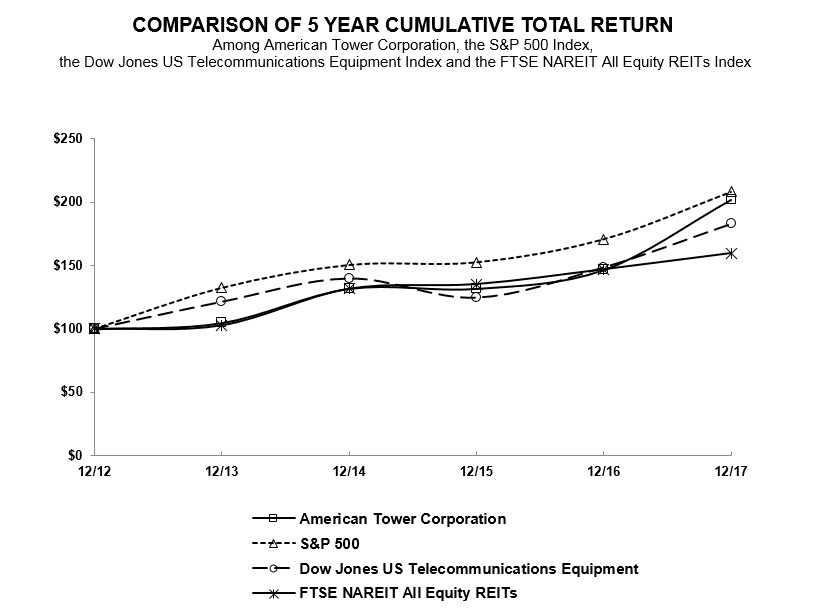
| Cumulative Total Returns | ||||||||||||||||||||||||
| 12/12 | 12/13 | 12/14 | 12/15 | 12/16 | 12/17 | |||||||||||||||||||
| American Tower Corporation | $ | 100.00 | $ | 104.79 | $ | 131.78 | $ | 131.78 | $ | 146.56 | $ | 201.79 | ||||||||||||
| S&P 500 Index | 100.00 | 132.39 | 150.51 | 152.59 | 170.84 | 208.14 | ||||||||||||||||||
| Dow Jones U.S. Telecommunications Equipment Index | 100.00 | 121.43 | 139.90 | 124.79 | 148.67 | 182.95 | ||||||||||||||||||
| FTSE Nareit All Equity REITs Index | 100.00 | 102.86 | 131.68 | 135.40 | 147.09 | 159.85 |
Issuer Purchases of Equity Securities
In March 2011, our Board of Directors approved a stock repurchase program, pursuant to which we are authorized to repurchase up to $1.5 billion of our common stock (the “2011 Buyback”). In addition to the 2011 Buyback, in December 2017, our Board of Directors approved an additional stock repurchase program, pursuant to which we are authorized to repurchase up to $2.0 billion of our common stock (the “2017 Buyback”).
During the three months ended December 31, 2017, we repurchased a total of 642,612 shares of our common stock for an aggregate of $89.4 million, including commissions and fees, pursuant to the 2011 Buyback. We had no repurchases under the 2017 Buyback. The table below sets forth details of our repurchases under the 2011 Buyback during the three months ended December 31, 2017.
| Period | Total Number of Shares Purchased (1) | Average Price Paid per Share (2) | Total Number of Shares Purchased as Part of Publicly Announced Plans or Programs | Approximate Dollar Value of Shares that May Yet be Purchased Under the Plans or Programs | ||||||||||
| (in millions) | ||||||||||||||
| October 1, 2017 - October 31, 2017 | 568,712 | $ | 138.67 | 568,712 | $ | 355.3 | ||||||||
| November 1, 2017 - November 30, 2017 | 73,900 | $ | 141.92 | 73,900 | $ | 344.8 | ||||||||
| December 1, 2017 - December 31, 2017 | — | $ | — | — | $ | 344.8 | ||||||||
| Total Fourth Quarter | 642,612 | $ | 139.04 | 642,612 | $ | 344.8 |
| (1) | Repurchases made pursuant to the 2011 Buyback. Under this program, our management is authorized to purchase shares from time to time through open market purchases or privately negotiated transactions at prevailing prices as permitted by securities laws and other legal requirements, and subject to market conditions and other factors. To facilitate repurchases, we make purchases pursuant to trading plans under Rule 10b5-1 of the Exchange Act, which allows us to repurchase shares during periods when we otherwise might be prevented from doing so under insider trading laws or because of self-imposed trading blackout periods. This program may be discontinued at any time. |
| (2) | Average price paid per share is a weighted average calculation using the aggregate price, excluding commissions and fees. |
We have repurchased a total of 12.4 million shares of our common stock under the 2011 Buyback for an aggregate of $1.2 billion, including commissions and fees. We expect to continue to manage the pacing of the remaining $344.8 million under the 2011 Buyback in response to general market conditions and other relevant factors. We expect to fund any further repurchases of our common stock through a combination of cash on hand, cash generated by operations and borrowings under our credit facilities. Purchases under the 2011 Buyback are subject to our having available cash to fund repurchases.
Item 6. SELECTED FINANCIAL DATA
The selected financial data should be read in conjunction with our “Management’s Discussion and Analysis of Financial Condition and Results of Operations,” and our audited consolidated financial statements and the related notes to those consolidated financial statements included in this Annual Report.
Year-over-year comparisons are significantly affected by our acquisitions, dispositions and construction of towers. Our acquisition of MIP Tower Holdings LLC (“MIPT”), our transaction with Verizon Communications Inc. (“Verizon” and the transaction, the “Verizon Transaction”) and the acquisition of a 51% controlling ownership interest in Viom Networks Limited (“Viom” and the acquisition, the “Viom Acquisition”), which closed in October 2013, March 2015 and April 2016, respectively, significantly impact the comparability of reported results between periods. Our principal acquisitions are described in note 6 to our consolidated financial statements included in this Annual Report.
We have converted our disclosure from thousands to millions and, as a result, any necessary rounding adjustments have been made to prior year amounts disclosed in the table below.
| Year Ended December 31, | ||||||||||||||||||||
| 2017 | 2016 | 2015 | 2014 | 2013 | ||||||||||||||||
| (In millions, except share and per share data) | ||||||||||||||||||||
| Statements of Operations Data: | ||||||||||||||||||||
| Revenues: | ||||||||||||||||||||
| Property | $ | 6,565.9 | $ | 5,713.1 | $ | 4,680.4 | $ | 4,006.9 | $ | 3,287.1 | ||||||||||
| Services | 98.0 | 72.6 | 91.1 | 93.1 | 74.3 | |||||||||||||||
| Total operating revenues | 6,663.9 | 5,785.7 | 4,771.5 | 4,100.0 | 3,361.4 | |||||||||||||||
| Operating expenses: | ||||||||||||||||||||
| Cost of operations (exclusive of items shown separately below) | ||||||||||||||||||||
| Property | 2,022.0 | 1,762.7 | 1,275.4 | 1,056.2 | 828.7 | |||||||||||||||
| Services | 34.6 | 27.7 | 33.4 | 38.1 | 31.1 | |||||||||||||||
| Depreciation, amortization and accretion | 1,715.9 | 1,525.6 | 1,285.3 | 1,003.8 | 800.1 | |||||||||||||||
| Selling, general, administrative and development expense | 637.0 | 543.4 | 497.8 | 446.5 | 415.5 | |||||||||||||||
| Other operating expenses | 256.0 | 73.3 | 66.8 | 68.5 | 71.7 | |||||||||||||||
| Total operating expenses | 4,665.5 | 3,932.7 | 3,158.7 | 2,613.1 | 2,147.1 | |||||||||||||||
| Operating income | 1,998.4 | 1,853.0 | 1,612.8 | 1,486.9 | 1,214.3 | |||||||||||||||
| Interest income, TV Azteca, net | 10.8 | 10.9 | 11.2 | 10.5 | 22.2 | |||||||||||||||
| Interest income | 35.4 | 25.6 | 16.5 | 14.0 | 9.7 | |||||||||||||||
| Interest expense | (749.6 | ) | (717.1 | ) | (595.9 | ) | (580.2 | ) | (458.3 | ) | ||||||||||
| (Loss) gain on retirement of long-term obligations | (70.2 | ) | 1.2 | (79.6 | ) | (3.5 | ) | (38.7 | ) | |||||||||||
| Other income (expense) (1) | 31.3 | (47.7 | ) | (135.0 | ) | (62.0 | ) | (207.5 | ) | |||||||||||
| Income from continuing operations before income taxes and income on equity method investments | 1,256.1 | 1,125.9 | 830.0 | 865.7 | 541.7 | |||||||||||||||
| Income tax provision | (30.7 | ) | (155.5 | ) | (158.0 | ) | (62.5 | ) | (59.5 | ) | ||||||||||
| Net income | 1,225.4 | 970.4 | 672.0 | 803.2 | 482.2 | |||||||||||||||
| Net loss (income) attributable to noncontrolling interests | 13.5 | (14.0 | ) | 13.1 | 21.7 | 69.1 | ||||||||||||||
| Net income attributable to American Tower Corporation stockholders | 1,238.9 | 956.4 | 685.1 | 824.9 | 551.3 | |||||||||||||||
| Dividends on preferred stock | (87.4 | ) | (107.1 | ) | (90.2 | ) | (23.9 | ) | — | |||||||||||
| Net income attributable to American Tower Corporation common stockholders | $ | 1,151.5 | $ | 849.3 | $ | 594.9 | $ | 801.0 | $ | 551.3 | ||||||||||
| Net income per common share amounts: | ||||||||||||||||||||
| Basic net income attributable to American Tower Corporation common stockholders | $ | 2.69 | $ | 2.00 | $ | 1.42 | $ | 2.02 | $ | 1.40 | ||||||||||
| Diluted net income attributable to American Tower Corporation common stockholders | $ | 2.67 | $ | 1.98 | $ | 1.41 | $ | 2.00 | $ | 1.38 | ||||||||||
| Weighted average common shares outstanding (in thousands): | ||||||||||||||||||||
| Basic | 428,181 | 425,143 | 418,907 | 395,958 | 395,040 | |||||||||||||||
| Diluted | 431,688 | 429,283 | 423,015 | 400,086 | 399,146 | |||||||||||||||
| Distribution declared per common share | $ | 2.62 | $ | 2.17 | $ | 1.81 | $ | 1.40 | $ | 1.10 | ||||||||||
| Distribution declared per preferred share, Series A | $ | 2.63 | $ | 5.25 | $ | 3.94 | $ | 3.98 | $ | — | ||||||||||
| Distribution declared per preferred share, Series B | $ | 55.00 | $ | 55.00 | $ | 38.65 | $ | — | $ | — | ||||||||||
| Other Operating Data: | ||||||||||||||||||||
| Ratio of earnings to fixed charges (2) | 2.14x | 2.11x | 1.99x | 2.11x | 1.89x | |||||||||||||||
| Ratio of earnings to combined fixed charges and preferred stock dividends (2) | 1.98x | 1.91x | 1.80x | 2.05x | 1.89x |
| As of December 31, | ||||||||||||||||||||
| 2017 | 2016 | 2015 | 2014 (3) | 2013 (3) | ||||||||||||||||
| (In millions) | ||||||||||||||||||||
| Balance Sheet Data: (4) | ||||||||||||||||||||
| Cash and cash equivalents (including restricted cash) (5) | $ | 954.9 | $ | 936.5 | $ | 462.9 | $ | 473.7 | $ | 446.5 | ||||||||||
| Property and equipment, net | 11,101.0 | 10,517.3 | 9,866.4 | 7,590.1 | 7,177.7 | |||||||||||||||
| Total assets | 33,214.3 | 30,879.2 | 26,904.3 | 21,263.6 | 20,213.9 | |||||||||||||||
| Long-term obligations, including current portion | 20,205.1 | 18,533.5 | 17,119.0 | 14,540.3 | 14,408.6 | |||||||||||||||
| Redeemable noncontrolling interest | 1,126.2 | 1,091.3 | — | — | — | |||||||||||||||
| Total American Tower Corporation equity | 6,241.5 | 6,763.9 | 6,651.7 | 3,953.6 | 3,534.2 |
| (1) | For the years ended December 31, 2017, 2016, 2015, 2014 and 2013, amount includes unrealized foreign currency gains (losses) of $26.5 million, $(23.4) million, $(71.5) million, $(49.3) million and $(211.7) million, respectively. |
| (2) | For the purpose of this calculation, “earnings” consists of income from continuing operations before income taxes and income on equity method investments, as well as fixed charges (excluding interest capitalized and amortization of interest capitalized). “Fixed charges” consists of interest expensed and capitalized, amortization of debt discounts, premiums and related issuance costs and the component of rental expense associated with operating leases believed by management to be representative of the interest factor thereon. |
| (3) | Balances have been revised to reflect debt issuance cost adjustments. |
| (4) | Balances have been revised to reflect purchase accounting measurement period adjustments for the years ended December 31, 2014 and 2013. |
| (5) | As of December 31, 2017, 2016, 2015, 2014 and 2013, amount includes $152.8 million, $149.3 million, $142.2 million, $160.2 million and $152.9 million, respectively, of restricted funds pledged as collateral to secure obligations and cash, the use of which is otherwise limited by contractual provisions. |
Item 7. MANAGEMENT’S DISCUSSION AND ANALYSIS OF FINANCIAL CONDITION AND RESULTS OF OPERATIONS
The discussion and analysis of our financial condition and results of operations that follow are based upon our consolidated financial statements, which have been prepared in accordance with GAAP. The preparation of our financial statements requires us to make estimates and assumptions that affect the reported amounts of assets and liabilities, revenues and expenses and the related disclosure of contingent assets and liabilities at the date of our financial statements. Actual results may differ from these estimates and such differences could be material to the financial statements. This discussion should be read in conjunction with our consolidated financial statements included in this Annual Report and the accompanying notes, and the information set forth under the caption “Critical Accounting Policies and Estimates” below.
We report our results in five segments: U.S. property, Asia property, EMEA property, Latin America property and Services. In evaluating financial performance in each business segment, management uses, among other factors, segment gross margin and segment operating profit (see note 20 to our consolidated financial statements included in this Annual Report).
Executive Overview
We are one of the largest global REITs and a leading independent owner, operator and developer of multitenant communications real estate. Our primary business is the leasing of space on communications sites to wireless service providers, radio and television broadcast companies, wireless data providers, government agencies and municipalities and tenants in a number of other industries. In addition to the communications sites in our portfolio, we manage rooftop and tower sites for property owners under various contractual arrangements. We also hold other telecommunications infrastructure and property interests that we lease to communications service providers and third-party tower operators. We refer to this business as our property operations, which accounted for 99% of our total revenues for the year ended December 31, 2017 and includes our U.S. property segment, Asia property segment, EMEA property segment and Latin America property segment.
We also offer tower-related services in the United States, including site acquisition, zoning and permitting and structural analysis, which primarily support our site leasing business, including the addition of new tenants and equipment on our sites.
The following table details the number of communications sites, excluding managed sites, that we owned or operated as of December 31, 2017:
| Number of Owned Towers | Number of Operated Towers (1) | Number of Owned DAS Sites | |||||||
| Domestic: | |||||||||
| United States | 24,231 | 16,009 | 378 | ||||||
| Asia: | |||||||||
| India | 57,681 | — | 353 | ||||||
| EMEA: | |||||||||
| France | 2,168 | 307 | 9 | ||||||
| Germany | 2,208 | — | — | ||||||
| Ghana | 2,178 | — | 23 | ||||||
| Nigeria | 4,757 | — | — | ||||||
| South Africa (2) | 2,530 | — | — | ||||||
| Uganda | 1,431 | — | — | ||||||
| EMEA total | 15,272 | 307 | 32 | ||||||
| Latin America: | |||||||||
| Argentina (3) | 7 | — | 1 | ||||||
| Brazil | 16,551 | 2,257 | 81 | ||||||
| Chile | 1,295 | — | 9 | ||||||
| Colombia | 3,706 | 777 | 1 | ||||||
| Costa Rica | 492 | — | 2 | ||||||
| Mexico (4) | 8,862 | 199 | 78 | ||||||
| Paraguay | 836 | — | — | ||||||
| Peru | 637 | 127 | — | ||||||
| Latin America total | 32,386 | 3,360 | 172 |
| (1) | Approximately 98% of the operated towers are held pursuant to long-term capital leases, including those subject to purchase options. |
| (2) | In South Africa, we also own fiber. |
| (3) | In Argentina, we also own or operate urban telecommunications assets, fiber and the rights to utilize certain existing utility infrastructure for future telecommunications equipment installation. |
| (4) | In Mexico, we also own or operate urban telecommunications assets, including fiber, concrete poles and other infrastructure. |
In most of our markets, our tenant leases with wireless carriers have an initial non-cancellable term of at least ten years, with multiple renewal terms. Accordingly, the vast majority of the revenue generated by our property operations during the year ended December 31, 2017 was recurring revenue that we should continue to receive in future periods. Based upon foreign currency exchange rates and the tenant leases in place as of December 31, 2017, we expect to generate over $32 billion of non-cancellable tenant lease revenue over future periods, before the impact of straight-line lease accounting. Most of our tenant leases have provisions that periodically increase the rent due under the lease, typically based on an annual fixed escalation (averaging approximately 3% in the United States) or an inflationary index in our international markets, or a combination of both. In addition, certain of our tenant leases provide for additional revenue primarily to cover costs, such as ground rent or power and fuel costs.
The revenues generated by our property operations may be affected by cancellations of existing tenant leases. As discussed above, most of our tenant leases with wireless carriers and broadcasters are multiyear contracts, which typically are non-cancellable; however, in some instances, a lease may be cancelled upon the payment of a termination fee.
Revenue lost from either cancellations or the non-renewal of leases or rent renegotiations historically has not had a material adverse effect on the revenues generated by our property operations. This was again the case during the year ended December 31, 2017, in which loss of tenant billings from tenant lease cancellations, non-renewal or renegotiations represented approximately 2% of our tenant billings. We do anticipate an increase in revenue lost from cancellations or non-renewals in 2018 primarily due to carrier consolidation-driven churn in Asia, which is likely to result in a modestly higher impact on our revenues, including tenant billings, as compared to the historical average.
Property Operations Revenue Growth. Due to our diversified communications site portfolio, our tenant lease rates vary considerably depending upon numerous factors, including, but not limited to, amount, type and position of tenant equipment on the tower, remaining tower capacity and tower location. We measure the remaining tower capacity by assessing several factors, including tower height, tower type, environmental conditions, existing equipment on the tower and zoning and permitting regulations in effect in the jurisdiction where the tower is located. In many instances, tower capacity can be increased with relatively modest tower augmentation expenditures.
The primary factors affecting the revenue growth of our property segments are:
| • | Growth in tenant billings, including: |
| • | New revenue attributable to leases in place on day one on sites acquired or constructed since the beginning of the prior-year period; |
| • | New revenue attributable to leasing additional space on our sites (“colocations”) and lease amendments; and |
| • | Contractual rent escalations on existing tenant leases, net of churn. |
| • | Revenue growth from other items, including additional tenant payments primarily to cover costs, such as ground rent or power and fuel costs included in certain tenant leases (“pass-th |
Showing the first 8K of 131K characters. Open the full section
Item 7A. QUANTITATIVE AND QUALITATIVE DISCLOSURES ABOUT MARKET RISK
The following table provides information as of December 31, 2017 about our market risk exposure associated with changing interest rates. For long-term debt obligations, the table presents principal cash flows by maturity date and average interest rates related to outstanding obligations. For interest rate swaps, the table presents notional principal amounts and weighted-average interest rates (in millions, except percentages). For more information, see Item 7 of this Annual Report under the caption “Management’s Discussion and Analysis of Financial Condition and Results of Operations—Liquidity and Capital Resources” and note 8 to our consolidated financial statements included in this Annual Report.
| Long-Term Debt | 2018 | 2019 | 2020 | 2021 | 2022 | Thereafter | Total | Fair Value | ||||||||||||||||||||||||
| Fixed Rate Debt (a) | $ | 721.1 | $ | 1,143.5 | $ | 1,981.6 | $ | 1,946.0 | $ | 1,343.5 | $ | 9,395.6 | $ | 16,531.3 | $ | 16,827.9 | ||||||||||||||||
| Weighted-Average Interest Rate (a) | 4.17 | % | 5.24 | % | 4.14 | % | 4.17 | % | 3.77 | % | 3.58 | % | ||||||||||||||||||||
| Variable Rate Debt (b) | $ | 53.9 | $ | 49.1 | $ | 52.4 | $ | 2,105.2 | $ | 45.2 | $ | 1,512.5 | $ | 3,818.3 | $ | 3,818.3 | ||||||||||||||||
| Weighted-Average Interest Rate (b)(c) | 8.58 | % | 8.44 | % | 8.45 | % | 2.72 | % | 8.24 | % | 2.85 | % | ||||||||||||||||||||
| Interest Rate Swaps | ||||||||||||||||||||||||||||||||
| Hedged Variable-Rate Notional Amount | $ | 5.0 | $ | 5.0 | $ | 6.7 | $ | 6.8 | $ | — | $ | — | $ | 23.5 | $ | — | (d) | |||||||||||||||
| Fixed Rate Debt Rate (e) | 9.74 | % | ||||||||||||||||||||||||||||||
| Hedged Fixed-Rate Notional Amount | $ | — | $ | — | $ | — | $ | — | $ | — | $ | 1,100.0 | $ | 1,100.0 | $ | 29.0 | (f) | |||||||||||||||
| Variable Rate Debt Rate (g) | 1.99 | % |
| (a) | Fixed rate debt consisted of: Securities issued in the 2013 Securitization; the 3.40% senior notes due 2019; Securities issued in the 2015 Securitization; the 2.800% senior notes due 2020; the 5.050% senior notes due 2020; the 3.300% senior notes due 2021; the 3.450% senior notes due 2021; the 5.900% senior notes due 2021; the 2.250% senior notes due 2022 (the “2.250% Notes”); the 4.70% senior notes due 2022; the 3.50% senior notes due 2023; the 3.000% Notes; the 5.00% senior notes due 2024; the 1.375% Notes; the 4.000% senior notes due 2025; the 4.400% senior notes due 2026; the 3.375% senior notes due 2026; the 3.125% senior notes due 2027; the 3.55% Notes; the 3.600% Notes; the Ghana loan which matures December 31, 2019; the Uganda loan which matures on December 31, 2023; the India indebtedness, with maturity dates ranging from January 24, 2018 to November 30, 2024; and other debt including capital leases. |
| (b) | Variable rate debt consisted of: the Term Loan, which matures on January 31, 2023; the 2014 Credit Facility, which matures on January 31, 2023; the 2013 Credit Facility, which matures on June 28, 2021; the BR Towers debentures, which amortize through October 15, 2023, the South African credit facility, which amortizes through December 17, 2020; the Colombian credit facility, which amortizes through April 24, 2021; and the Brazil credit facility, which matures on January 15, 2022. |
| (c) | Based on rates effective as of December 31, 2017. |
| (d) | As of December 31, 2017, the interest rate swap agreement in Colombia was included in Other non-current liabilities on the consolidated balance sheet. |
| (e) | Represents the fixed rate of interest based on contractual notional amount as a percentage of the total notional amount. The interest rate is comprised of fixed interest of 5.74%, per the interest rate agreement, and a fixed margin of 4.00%, per the loan agreement for the Colombian credit facility. |
| (f) | As of December 31, 2017, the interest rate swap agreements in the U.S. were included in Other non-current liabilities on the consolidated balance sheet. |
| (g) | Represents the weighted average variable rate of interest based on contractual notional amount as a percentage of total notional amounts. |
Interest Rate Risk
As of December 31, 2017, we have one interest rate swap agreement related to debt in Colombia. This swap has been designated as a cash flow hedge, has a notional amount of $23.5 million and an interest rate of 5.74% and expires in April 2021. We have three interest rate swap agreements related to the 2.250% Notes. These swaps have been designated as fair value hedges, have an aggregate notional amount of $600.0 million and an interest rate of one-month LIBOR plus applicable spreads and expire in January 2022. In addition, we have three interest rate swap agreements related to a portion of the 3.000% Notes. These swaps have been designated as fair value hedges, have an aggregate notional amount of $500.0 million and an interest rate of one-month LIBOR plus applicable spreads and expire in June 2023.
Changes in interest rates can cause interest charges to fluctuate on our variable rate debt. Variable rate debt as of December 31, 2017 consisted of $495.0 million under the 2014 Credit Facility, $2,075.6 million under the 2013 Credit Facility, $1,000.0 million under the Term Loan, $600.0 million under the interest rate swap agreements related to the 2.250% Notes, $500.0 million under the interest rate swap agreements related to the 3.000% Notes, $70.5 million under the South African credit facility, $23.5 million under the Colombian credit facility after giving effect to our interest rate swap agreements, $92.7 million under the BR Towers debentures and $37.6 million under the Brazil credit facility. A 10% increase in current interest rates would result in an additional $13.7 million of interest expense for the year ended December 31, 2017.
Foreign Currency Risk
We are exposed to market risk from changes in foreign currency exchange rates primarily in connection with our foreign subsidiaries and joint ventures internationally. Any transaction denominated in a currency other than the U.S. Dollar is reported in U.S. Dollars at the applicable exchange rate. All assets and liabilities are translated into U.S. Dollars at exchange rates in effect at the end of the applicable fiscal reporting period and all revenues and expenses are translated at average rates for the period. The cumulative translation effect is included in equity as a component of Accumulated other comprehensive loss. We may enter into additional foreign currency financial instruments in anticipation of future transactions to minimize the impact of foreign currency fluctuations. For the year ended December 31, 2017, 44% of our revenues and 51% of our total operating expenses were denominated in foreign currencies.
As of December 31, 2017, we have incurred intercompany debt that is not considered to be permanently reinvested, and similar unaffiliated balances that were denominated in a currency other than the functional currency of the subsidiary in which it is recorded. As this debt had not been designated as being a long-term investment in nature, any changes in the foreign currency exchange rates will result in unrealized gains or losses, which will be included in our determination of net income. An adverse change of 10% in the underlying exchange rates of our unsettled intercompany debt and similar unaffiliated balances would result in $90.2 million of unrealized losses that would be included in Other expense in our consolidated statements of operations for the year ended December 31, 2017.
Item 8. FINANCIAL STATEMENTS AND SUPPLEMENTARY DATA
See Item 15 (a).
Item 9. CHANGES IN AND DISAGREEMENTS WITH ACCOUNTANTS ON ACCOUNTING AND FINANCIAL DISCLOSURE
None.
Item 9A. CONTROLS AND PROCEDURES
Disclosure Controls and Procedures
We have established disclosure controls and procedures designed to ensure that material information relating to us, including our consolidated subsidiaries, is made known to the officers who certify our financial reports and to other members of senior management and the Board of Directors.
Our management, with the participation of our principal executive officer and principal financial officer, evaluated the effectiveness of the design and operation of our disclosure controls and procedures (as defined in Rules 13a-15(e) and 15d-15(e) under the Exchange Act) as of the end of the period covered by this Annual Report. Based on this evaluation, our principal executive officer and principal financial officer concluded that these disclosure controls and procedures were effective as of December 31, 2017 and designed to ensure that the information required to be disclosed in our reports filed or submitted under the Exchange Act is recorded, processed, summarized and reported within the requisite time periods specified in the applicable rules and forms, and that it is accumulated and communicated to our management, including our principal executive officer and principal financial officer, as appropriate, to allow timely decisions regarding required disclosure.
Management’s Annual Report on Internal Control over Financial Reporting
Our management, with the participation of our principal executive officer and principal financial officer, is responsible for establishing and maintaining adequate internal control over financial reporting as defined in Rules 13a-15(f) and 15d-15(f) under the Exchange Act. Our internal control system is designed to provide reasonable assurance to our management and Board of Directors regarding the preparation and fair presentation of published financial statements.
Our management assessed the effectiveness of our internal control over financial reporting as of December 31, 2017.
In making its assessment of internal control over financial reporting, our management used the criteria set forth by the Committee of Sponsoring Organizations of the Treadway Commission in Internal Control—Integrated Framework (2013). Based on this assessment, management concluded that, as of December 31, 2017, our internal control over financial reporting is effective.
Deloitte & Touche LLP, an independent registered public accounting firm that audited our financial statements included in this Annual Report, has issued an attestation report on management’s internal control over financial reporting, which is included in this Item 9A under the caption “Report of Independent Registered Public Accounting Firm.”
Changes in Internal Control over Financial Reporting
There have been no changes in our internal control over financial reporting (as defined in Rule 13a-15(f) under the Exchange Act) during the fiscal quarter ended December 31, 2017 that have materially affected, or are reasonably likely to materially affect, our internal control over financial reporting.
REPORT OF INDEPENDENT REGISTERED PUBLIC ACCOUNTING FIRM
To the Stockholders and the Board of Directors of American Tower Corporation
Opinion on Internal Control over Financial Reporting
We have audited the internal control over financial reporting of American Tower Corporation and subsidiaries (the “Company”) as of December 31, 2017, based on criteria established in Internal Control - Integrated Framework (2013) issued by the Committee of Sponsoring Organizations of the Treadway Commission (COSO). In our opinion, the Company maintained, in all material respects, effective internal control over financial reporting as of December 31, 2017, based on criteria established in Internal Control - Integrated Framework (2013) issued by COSO.
We have also audited, in accordance with the standards of the Public Company Accounting Oversight Board (United States) (PCAOB), the consolidated financial statements as of and for the year ended December 31, 2017, of the Company and our report dated February 27, 2018, expressed an unqualified opinion on those financial statements.
Basis for Opinion
The Company’s management is responsible for maintaining effective internal control over financial reporting and for its assessment of the effectiveness of internal control over financial reporting, included in the accompanying Management’s Annual Report on Internal Control over Financial Reporting. Our responsibility is to express an opinion on the Company’s internal control over financial reporting based on our audit. We are a public accounting firm registered with the PCAOB and are required to be independent with respect to the Company in accordance with the U.S. federal securities laws and the applicable rules and regulations of the Securities and Exchange Commission and the PCAOB.
We conducted our audit in accordance with the standards of the PCAOB. Those standards require that we plan and perform the audit to obtain reasonable assurance about whether effective internal control over financial reporting was maintained in all material respects. Our audit included obtaining an understanding of internal control over financial reporting, assessing the risk that a material weakness exists, testing and evaluating the design and operating effectiveness of internal control based on the assessed risk, and performing such other procedures as we considered necessary in the circumstances. We believe that our audit provides a reasonable basis for our opinion.
Definition and Limitations of Internal Control over Financial Reporting
A company’s internal control over financial reporting is a process designed to provide reasonable assurance regarding the reliability of financial reporting and the preparation of financial statements for external purposes in accordance with generally accepted accounting principles. A company’s internal control over financial reporting includes those policies and procedures that (1) pertain to the maintenance of records that, in reasonable detail, accurately and fairly reflect the transactions and dispositions of the assets of the company; (2) provide reasonable assurance that transactions are recorded as necessary to permit preparation of financial statements in accordance with generally accepted accounting principles, and that receipts and expenditures of the company are being made only in accordance with authorizations of management and directors of the company; and (3) provide reasonable assurance regarding prevention or timely detection of unauthorized acquisition, use, or disposition of the company’s assets that could have a material effect on the financial statements.
Because of its inherent limitations, internal control over financial reporting may not prevent or detect misstatements. Also, projections of any evaluation of effectiveness to future periods are subject to the risk that controls may become inadequate because of changes in conditions, or that the degree of compliance with the policies or procedures may deteriorate.
/s/ Deloitte & Touche LLP
Boston, Massachusetts
February 27, 2018
PART III
Item 10. DIRECTORS, EXECUTIVE OFFICERS AND CORPORATE GOVERNANCE
Our executive officers and their respective ages and positions as of February 20, 2018 are set forth below:
| James D. Taiclet, Jr. | 57 | Chairman, President and Chief Executive Officer | |||
| Thomas A. Bartlett | 59 | Executive Vice President, Chief Financial Officer and Treasurer | |||
| Edmund DiSanto | 65 | Executive Vice President, Chief Administrative Officer, General Counsel and Secretary | |||
| William H. Hess | 54 | Executive Vice President, International Operations and President, Latin America and EMEA | |||
| Steven C. Marshall | 56 | Executive Vice President and President, U.S. Tower Division | |||
| Robert J. Meyer, Jr. | 54 | Senior Vice President, Finance and Corporate Controller | |||
| Amit Sharma | 67 | Executive Vice President and President, Asia |
James D. Taiclet, Jr. is our Chairman, President and Chief Executive Officer. Mr. Taiclet was appointed President and Chief Operating Officer in September 2001, was named Chief Executive Officer in October 2003 and was selected as Chairman of the Board in February 2004. Prior to joining us, Mr. Taiclet served as President of Honeywell Aerospace Services, a unit of Honeywell International, and prior to that as Vice President, Engine Services at Pratt & Whitney, a unit of United Technologies Corporation. He was also previously a consultant at McKinsey & Company, specializing in telecommunications and aerospace strategy and operations. Mr. Taiclet began his career as a United States Air Force officer and pilot and served in the Gulf War. He holds a Master in Public Affairs degree from Princeton University, where he was awarded a Fellowship at the Woodrow Wilson School, and is a Distinguished Graduate of the United States Air Force Academy with majors in Engineering and International Relations. Mr. Taiclet is a member of the Council on Foreign Relations, the Business Roundtable and the Commercial Club of Boston. He is also a member of the Digital Communications Governors Community of the World Economic Forum (Davos). He also serves as a member of the Executive Board of The National Association of Real Estate Investment Trusts (Nareit), the Board of Trustees of Brigham and Women's Health Care, Inc., the Advisory Council for the Princeton University Woodrow Wilson School of Public and International Affairs, and the board of directors of Lockheed Martin Corporation. In August 2015, Mr. Taiclet was appointed to the U.S.-India CEO Forum by the U.S. Department of Commerce.
Thomas A. Bartlett is our Executive Vice President, Chief Financial Officer and Treasurer. Mr. Bartlett joined us in April 2009 as Executive Vice President and Chief Financial Officer and assumed the role of Treasurer in July 2017, having previously served in that role from February 2012 until December 2013. Prior to joining us, Mr. Bartlett served as Senior Vice President and Corporate Controller with Verizon Communications, Inc. from November 2005 to March 2009. In this role, he was responsible for corporate-wide accounting, tax planning and compliance, SEC financial reporting, budget reporting and analysis and capital expenditures planning functions. Mr. Bartlett previously held the roles of Senior Vice President and Treasurer, as well as Senior Vice President Investor Relations. During his twenty-five year career with Verizon Communications and its predecessor companies and affiliates, he served in numerous operations and business development roles, including as the President and Chief Executive Officer of Bell Atlantic International Wireless from 1995 through 2000, where he was responsible for wireless activities in North America, Latin America, Europe and Asia, and was also an area President in Verizon’s U.S. wireless business responsible for all operational aspects in both the Northeast and Mid-Atlantic states. Mr. Bartlett began his career at Deloitte, Haskins & Sells. Mr. Bartlett currently serves on the board of directors of Equinix, Inc. Mr. Bartlett earned an M.B.A. from Rutgers University, a Bachelor of Science in Engineering from Lehigh University and became a Certified Public Accountant.
Edmund DiSanto is our Executive Vice President, Chief Administrative Officer, General Counsel and Secretary. Prior to joining us in April 2007, Mr. DiSanto was with Pratt & Whitney, a unit of United Technologies Corporation. Mr. DiSanto started with United Technologies in 1989, where he first served as Assistant General Counsel of its Carrier subsidiary, then corporate Executive Assistant to the Chairman and Chief Executive Officer of United Technologies. From 1997, he held various legal and business roles at its Pratt & Whitney unit, including Deputy General Counsel and most recently, Vice President, Global Service Partners, Business Development. Prior to joining United Technologies, Mr. DiSanto served in a number of legal and related positions at United Dominion Industries and New England Electric Systems. Mr. DiSanto earned a J.D. from Boston College Law School and a Bachelor of Science from Northeastern University. In 2013, Mr. DiSanto became a member of the board of directors of the Business Council for International Understanding.
William H. Hess is our Executive Vice President, International Operations and President, Latin America and EMEA. Mr. Hess joined us in March 2001 as Chief Financial Officer of American Tower International and was appointed Executive Vice President in June 2001. Mr. Hess was appointed Executive Vice President, General Counsel in September 2002, and in February 2007, Mr. Hess was appointed Executive Vice President, International Operations. Mr. Hess relinquished the position of General Counsel in April 2007 when he was named President of our Latin American operations. In March 2009, Mr. Hess also became responsible for the Europe, Middle East and Africa (EMEA) territory. Prior to joining us, Mr. Hess had been a partner in the corporate and finance practice group of the law firm of King & Spalding LLP, which he joined in 1990. Prior to attending law school, Mr. Hess practiced as a Certified Public Accountant with Arthur Young & Co. Mr. Hess received a J.D. from Vanderbilt University School of Law and is a graduate of Harding University. Mr. Hess is on the Board of Trustees of the U.S.-Africa Business Center for the U.S. Chamber of Commerce and a participant of the World Economic Forum.
Steven C. Marshall is our Executive Vice President and President, U.S. Tower Division. Mr. Marshall served as our Executive Vice President, International Business Development from November 2007 through March 2009, at which time he was appointed to his current position. Prior to joining us, Mr. Marshall was with National Grid Plc, where he served in a number of leadership and business development positions since 1997. Between 2003 and 2007, Mr. Marshall was Chief Executive Officer, National Grid Wireless, where he led National Grid’s wireless tower infrastructure business in the United States and United Kingdom, and held directorships with Digital UK and FreeView during this period. In addition, while at National Grid, as well as during earlier tenures at Costain Group Plc and Tootal Group Plc, he led operational and business development efforts in Latin America, India, Southeast Asia, Africa and the Middle East. Mr. Marshall has served as director for WIA - The Wireless Infrastructure Association, formerly known as PCIA, since October 2010 and as its chairperson since June 2017, as a director of CTIA - the Wireless Association since January 2017 and as director of the Federated Wireless Board since September 2017. Mr. Marshall previously served as director of the Competitive Carriers Association, formerly known as the Rural Cellular Association, from April 2011 to October 2017. Mr. Marshall earned an M.B.A. from Manchester Business School in Manchester, England and a Bachelor of Science with honors in Building and Civil Engineering from the Victoria University of Manchester, England.
Robert J. Meyer, Jr. is our Senior Vice President, Finance and Corporate Controller. Mr. Meyer joined us in August 2008. Prior to joining us, Mr. Meyer was with Bright Horizons Family Solutions since 1998, a provider of child care, early education and work/life consulting services, where he most recently served as Chief Accounting Officer. Mr. Meyer also served as Corporate Controller and Vice President of Finance while at Bright Horizons. Prior to that, from 1997 to 1998, Mr. Meyer served as Director of Financial Planning and Analysis at First Security Services Corp. Mr. Meyer earned a Masters in Finance from Bentley University and a Bachelor of Science in Accounting from Marquette University, and is also a Certified Public Accountant.
Amit Sharma is our Executive Vice President and President, Asia. Mr. Sharma joined us in September 2007. Prior to joining us, since 1992, Mr. Sharma worked at Motorola, where he led country teams in India and Southeast Asia, including as Country President, India and as Head of Strategy, Asia-Pacific. Mr. Sharma also served on Motorola’s Asia-Pacific Board and was a member of its senior leadership team. Mr. Sharma also worked at GE Capital, serving as Vice President, Strategy and Business Development, and prior to that, with McKinsey, New York, serving as a core member of the firm's Electronics and Marketing Practices. Mr. Sharma earned an M.B.A. in International Business from the Wharton School, University of Pennsylvania, where he was on the Dean’s List and the Director’s Honors List. Mr. Sharma also holds a Master of Science in Computer Science from the Moore School, University of Pennsylvania, and a Bachelor of Technology in Mechanical Engineering from the Indian Institute of Technology.
The information under “Election of Directors” and “Section 16(a) Beneficial Ownership Reporting Compliance” from the Definitive Proxy Statement is incorporated herein by reference. Information required by this item pursuant to Item 407(c)(3) of SEC Regulation S-K relating to our procedures by which security holders may recommend nominees to our Board of Directors, and pursuant to Item 407(d)(4) and 407(d)(5) of SEC Regulation S-K relating to our audit committee financial experts and identification of the audit committee of our Board of Directors, is contained in the Definitive Proxy Statement under “Corporate Governance” and is incorporated herein by reference.
Information regarding our Code of Conduct applicable to our principal executive officer, our principal financial officer, our controller and other senior financial officers appears in Item 1 of this Annual Report under the caption “Business—Available Information.”
Item 11. EXECUTIVE COMPENSATION
The information under “Compensation and Other Information Concerning Directors and Officers” from the Definitive Proxy Statement is incorporated herein by reference.
Item 12. SECURITY OWNERSHIP OF CERTAIN BENEFICIAL OWNERS AND MANAGEMENT AND RELATED STOCKHOLDER MATTERS
The information under “Security Ownership of Certain Beneficial Owners and Management” and “Securities Authorized for Issuance Under Equity Compensation Plans” from the Definitive Proxy Statement is incorporated herein by reference.
Item 13. CERTAIN RELATIONSHIPS AND RELATED TRANSACTIONS, AND DIRECTOR INDEPENDENCE
Information required by this item pursuant to Item 404 of SEC Regulation S-K relating to approval of related party transactions is contained in the Definitive Proxy Statement under “Corporate Governance” and is incorporated herein by reference.
Information required by this item pursuant to Item 407(a) of SEC Regulation S-K relating to director independence is contained in the Definitive Proxy Statement under “Corporate Governance” and is incorporated herein by reference.
Item 14. PRINCIPAL ACCOUNTING FEES AND SERVICES
The information under “Independent Auditor Fees and Other Matters” from the Definitive Proxy Statement is incorporated herein by reference.
PART IV
Item 15. EXHIBITS, FINANCIAL STATEMENT SCHEDULES
(a) The following documents are filed as a part of this report:
-
Financial Statements. See Index to Consolidated Financial Statements, which appears on page F-1 hereof. The financial statements listed in the accompanying Index to Consolidated Financial Statements are filed herewith in response to this Item.
-
Financial Statement Schedules. American Tower Corporation and Subsidiaries Schedule III – Schedule of Real Estate and Accumulated Depreciation is filed herewith in response to this Item.
-
Exhibits. See Index to Exhibits.
INDEX TO EXHIBITS
Pursuant to the rules and regulations of the SEC, the Company has filed certain agreements as exhibits to this Annual Report on Form 10-K. These agreements may contain representations and warranties by the parties. These representations and warranties have been made solely for the benefit of the other party or parties to such agreements and (i) may have been qualified by disclosures made to such other party or parties, (ii) were made only as of the date of such agreements or such other date(s) as may be specified in such agreements and are subject to more recent developments, which may not be fully reflected in the Company’s public disclosure, (iii) may reflect the allocation of risk among the parties to such agreements and (iv) may apply materiality standards different from what may be viewed as material to investors. Accordingly, these representations and warranties may not describe the Company’s actual state of affairs at the date hereof and should not be relied upon.
The exhibits below are included, either by being filed herewith or by incorporation by reference, as part of this Annual Report on Form 10-K. Exhibits are identified according to the number assigned to them in Item 601 of SEC Regulation S-K. Documents that are incorporated by reference are identified by their Exhibit number as set forth in the filing from which they are incorporated by reference. The filings of the Registrant from which various exhibits are incorporated by reference into this Annual Report are indicated by parenthetical numbering which corresponds to the following key:
| (1 | ) | Annual Report on Form 10-K (File No. 001-14195) filed on April 2, 2001; | |
| (2 | ) | Annual Report on Form 10-K (File No. 001-14195) filed on March 15, 2006; | |
| (3 | ) | Tender Offer Statement on Schedule TO (File No. 005-55211) filed on November 29, 2006; | |
| (4 | ) | Definitive Proxy Statement on Schedule 14A (File No. 001-14195) filed on March 22, 2007; | |
| (5 | ) | Quarterly Report on Form 10-Q (File No. 001-14195) filed on August 6, 2008; | |
| (6 | ) | Current Report on Form 8-K (File No. 001-14195) filed on March 5, 2009; | |
| (7 | ) | Quarterly Report on Form 10-Q (File No. 001-14195) filed on May 8, 2009; | |
| (8 | ) | Annual Report on Form 10-K (File No. 001-14195) filed on March 1, 2010; | |
| (9 | ) | Registration Statement on Form S-3ASR (File No. 333-166805) filed on May 13, 2010; | |
| (10 | ) | Quarterly Report on Form 10-Q (File No. 001-14195) filed on November 5, 2010; | |
| (11 | ) | Current Report on Form 8-K (File No. 001-14195) filed on August 25, 2011; | |
| (12 | ) | Current Report on Form 8-K (File No. 001-14195) filed on October 6, 2011; | |
| (13 | ) | Current Report on Form 8-K (File No. 001-14195) filed on January 3, 2012; | |
| (14 | ) | Current Report on Form 8-K (File No. 001-14195) filed on March 12, 2012; | |
| (15 | ) | Current Report on Form 8-K (File No. 001-14195) filed on January 8, 2013; | |
| (16 | ) | Annual Report on Form 10-K (File No. 001-14195) filed on February 27, 2013; | |
| (17 | ) | Quarterly Report on Form 10-Q (File No. 001-14195) filed on May 1, 2013; | |
| (18 | ) | Registration Statement on Form S-3ASR (File No. 333-188812) filed on May 23, 2013; | |
| (19 | ) | Quarterly Report on Form 10-Q (File No. 001-14195) filed on July 31, 2013; | |
| (20 | ) | Current Report on Form 8-K (File No. 001-14195) filed on August 19, 2013; | |
| (21 | ) | Quarterly Report on Form 10-Q (File No. 001-14195) filed on October 30, 2013; | |
| (22 | ) | Current Report on Form 8-K (File No. 001-14195) filed on May 12, 2014; | |
| (23 | ) | Current Report on Form 8-K (File No. 001-14195) filed on August 7, 2014; | |
| (24 | ) | Quarterly Report on Form 10-Q (File No. 001-14195) filed on October 30, 2014; | |
| (25 | ) | Current Report on Form 8-K (File No. 001-14195) filed on February 23, 2015; | |
| (26 | ) | Annual Report on Form 10-K (File No. 001-14195) filed on February 24, 2015; | |
| (27 | ) | Current Report on Form 8-K (File No. 001-14195) filed on March 3, 2015; | |
| (28 | ) | Quarterly Report on Form 10-Q (File No. 001-14195) filed on April 30, 2015; | |
| (29 | ) | Current Report on Form 8-K (File No. 001-14195) filed on May 7, 2015; | |
| (30 | ) | Quarterly Report on Form 10-Q (File No. 001-14195) filed on July 29, 2015; | |
| (31 | ) | Current Report on Form 8-K (File No. 001-14195) filed on January 12, 2016; | |
| (32 | ) | Current Report on Form 8-K (File No. 001-14195) filed on February 16, 2016; | |
| (33 | ) | Annual Report on Form 10-K (File No. 001-14195) filed on February 26, 2016; | |
| (34 | ) | Current Report on Form 8-K (File No. 001-14195) filed on March 9, 2016; | |
| (35 | ) | Current Report on Form 8-K (File No. 001-14195) filed on May 13, 2016; | |
| (36 | ) | Current Report on Form 8-K (File No. 001-14195) filed on September 30, 2016; | |
| (37 | ) | Annual Report on Form 10-K (File No. 001-14195) filed on February 27, 2017; | |
| (38 | ) | Current Report on Form 8-K (File No. 001-14195) filed on March 14, 2017; | |
| (39 | ) | Current Report on Form 8-K (File No. 001-14195) filed on April 6, 2017; | |
| (40 | ) | Current Report on Form 8-K (File No. 001-14195) filed on June 30, 2017; and | |
| (41 | ) | Current Report on Form 8-K (File No. 001-14195) filed on December 8, 2017. |
| * | Management contracts and compensatory plans and arrangements required to be filed as exhibits to this Form 10-K pursuant to Item 15(a)(3). |
| ** | The exhibit has been filed separately with the Commission pursuant to an application for confidential treatment. The confidential portions of the exhibit have been omitted and are marked by an asterisk. |
Item 16. FORM 10-K SUMMARY
None.
SIGNATURES
Pursuant to the requirements of Section 13 or 15(d) of the Securities Exchange Act of 1934, the Registrant has duly caused this report to be signed on its behalf by the undersigned, thereunto duly authorized on the 27th day of February, 2018.
| AMERICAN TOWER CORPORATION | ||||
| By: | /S/ JAMES D. TAICLET, JR. | |||
| James D. Taiclet, Jr. Chairman, President and Chief Executive Officer |
Pursuant to the requirements of the Securities Exchange Act of 1934, this report has been duly signed below by the following persons on behalf of the Registrant and in the capacities and on the dates indicated.
| Signature | Title | Date | ||
| /S/ JAMES D. TAICLET, JR. | Chairman, President and Chief Executive Officer (Principal Executive Officer) | February 27, 2018 | ||
| James D. Taiclet, Jr. | ||||
| /S/ THOMAS A. BARTLETT | Executive Vice President, Chief Financial Officer and Treasurer (Principal Financial Officer) | February 27, 2018 | ||
| Thomas A. Bartlett | ||||
| /S/ ROBERT J. MEYER, JR | Senior Vice President, Finance and Corporate Controller (Principal Accounting Officer) | February 27, 2018 | ||
| Robert J. Meyer, Jr. | ||||
| /S/ RAYMOND P. DOLAN | Director | February 27, 2018 | ||
| Raymond P. Dolan | ||||
| /S/ ROBERT D. HORMATS | Director | February 27, 2018 | ||
| Robert D. Hormats | ||||
| /S/ GUSTAVO LARA CANTU | Director | February 27, 2018 | ||
| Gustavo Lara Cantu | ||||
| /S/ GRACE D. LIEBLEIN | Director | February 27, 2018 | ||
| Grace D. Lieblein | ||||
| /S/ CRAIG MACNAB | Director | February 27, 2018 | ||
| Craig Macnab | ||||
| /S/ JOANN A. REED | Director | February 27, 2018 | ||
| JoAnn A. Reed | ||||
| /S/ PAMELA D. A. REEVE | Director | February 27, 2018 | ||
| Pamela D. A. Reeve | ||||
| /S/ DAVID E. SHARBUTT | Director | February 27, 2018 | ||
| David E. Sharbutt | ||||
| /S/ SAMME L. THOMPSON | Director | February 27, 2018 | ||
| Samme L. Thompson |
AMERICAN TOWER CORPORATION AND SUBSIDIARIES
INDEX TO CONSOLIDATED FINANCIAL STATEMENTS
F-1
REPORT OF INDEPENDENT REGISTERED PUBLIC ACCOUNTING FIRM
To the Stockholders and the Board of Directors of American Tower Corporation
Opinion on the Financial Statements
We have audited the accompanying consolidated balance sheets of American Tower Corporation and subsidiaries (the "Company") as of December 31, 2017 and 2016, the related consolidated statements of operations, comprehensive income (loss), equity, and cash flows for each of the three years in the period ended December 31, 2017, and the related notes and the schedule listed in the Index at Item 15 (collectively referred to as the "financial statements"). In our opinion, the financial statements present fairly, in all material respects, the financial position of the Company as of December 31, 2017 and 2016, and the results of its operations and its cash flows for each of the three years in the period ended December 31, 2017, in conformity with accounting principles generally accepted in the United States of America.
We have also audited, in accordance with the standards of the Public Company Accounting Oversight Board (United States) (PCAOB), the Company's internal control over financial reporting as of December 31, 2017, based on criteria established in Internal Control - Integrated Framework (2013) issued by the Committee of Sponsoring Organizations of the Treadway Commission and our report dated February 27, 2018, expressed an unqualified opinion on the Company's internal control over financial reporting.
Basis for Opinion
These financial statements are the responsibility of the Company's management. Our responsibility is to express an opinion on the Company's financial statements based on our audits. We are a public accounting firm registered with the PCAOB and are required to be independent with respect to the Company in accordance with the U.S. federal securities laws and the applicable rules and regulations of the Securities and Exchange Commission and the PCAOB.
We conducted our audits in accordance with the standards of the PCAOB. Those standards require that we plan and perform the audit to obtain reasonable assurance about whether the financial statements are free of material misstatement, whether due to error or fraud. Our audits included performing procedures to assess the risks of material misstatement of the financial statements, whether due to error or fraud, and performing procedures that respond to those risks. Such procedures included examining, on a test basis, evidence regarding the amounts and disclosures in the financial statements. Our audits also included evaluating the accounting principles used and significant estimates made by management, as well as evaluating the overall presentation of the financial statements. We believe that our audits provide a reasonable basis for our opinion.
/s/ Deloitte & Touche LLP
Boston, Massachusetts
February 27, 2018
We have served as the Company's auditor since 1997.
F-2
AMERICAN TOWER CORPORATION AND SUBSIDIARIES
CONSOLIDATED BALANCE SHEETS
(in millions, except share data)
| December 31, 2017 | December 31, 2016 | |||||||
| ASSETS | ||||||||
| CURRENT ASSETS: | ||||||||
| Cash and cash equivalents | $ | 802.1 | $ | 787.2 | ||||
| Restricted cash | 152.8 | 149.3 | ||||||
| Short-term investments | 1.0 | 4.0 | ||||||
| Accounts receivable, net | 513.6 | 308.4 | ||||||
| Prepaid and other current assets | 568.6 | 441.0 | ||||||
| Total current assets | 2,038.1 | 1,689.9 | ||||||
| PROPERTY AND EQUIPMENT, net | 11,101.0 | 10,517.3 | ||||||
| GOODWILL | 5,638.4 | 5,070.7 | ||||||
| OTHER INTANGIBLE ASSETS, net | 11,783.3 | 11,274.6 | ||||||
| DEFERRED TAX ASSET | 204.4 | 195.7 | ||||||
| DEFERRED RENT ASSET | 1,499.0 | 1,289.5 | ||||||
| NOTES RECEIVABLE AND OTHER NON-CURRENT ASSETS | 950.1 | 841.5 | ||||||
| TOTAL | $ | 33,214.3 | $ | 30,879.2 | ||||
| LIABILITIES |
Showing the first 8K of 248K characters. Open the full section