 filings.tools
American Tower 10-K 2022-12-31
Filed 2023-02-23. 23 sections, 679K characters. Original on sec.gov · Markdown · JSON
Cover and table of contents
UNITED STATES
SECURITIES AND EXCHANGE COMMISSION
Washington, D.C. 20549
FORM 10-K
(Mark One):
| ☒ | Annual report pursuant to Section 13 or 15(d) of the Securities Exchange Act of 1934. |
For the fiscal year ended December 31, 2022
| ☐ | Transition report pursuant to Section 13 or 15(d) of the Securities Exchange Act of 1934. |
For the transition period from to
Commission File Number: 001-14195
American Tower Corporation
(Exact name of registrant as specified in its charter)
| Delaware | 65-0723837 | |||||||
| (State or other jurisdiction of Incorporation or Organization) | (I.R.S. Employer Identification No.) |
11****6 Huntington Avenue
Boston, Massachusetts 02116
(Address of principal executive offices)
Telephone Number (617) 375-7500
(Registrant’s telephone number, including area code)
Securities registered pursuant to Section 12(b) of the Act:
| Title of each Class | Trading Symbol(s) | Name of exchange on which registered | ||||||
| Common Stock, $0.01 par value | AMT | New York Stock Exchange | ||||||
| 1.375% Senior Notes due 2025 | AMT 25A | New York Stock Exchange | ||||||
| 1.950% Senior Notes due 2026 | AMT 26B | New York Stock Exchange | ||||||
| 0.450% Senior Notes due 2027 | AMT 27C | New York Stock Exchange | ||||||
| 0.400% Senior Notes due 2027 | AMT 27D | New York Stock Exchange | ||||||
| 0.500% Senior Notes due 2028 | AMT 28A | New York Stock Exchange | ||||||
| 0.875% Senior Notes due 2029 | AMT 29B | New York Stock Exchange | ||||||
| 0.950% Senior Notes due 2030 | AMT 30C | New York Stock Exchange | ||||||
| 1.000% Senior Notes due 2032 | AMT 32 | New York Stock Exchange | ||||||
| 1.250% Senior Notes due 2033 | AMT 33 | New York Stock Exchange |
Securities registered pursuant to Section 12(g) of the Act:
None
Indicate by check mark if the registrant is a well known seasoned issuer, as defined in Rule 405 of the Securities Act: Yes ☒ No ☐
Indicate by check mark if the registrant is not required to file reports pursuant to Section 13 or Section 15(d) of the Act: Yes ☐ No ☒
Indicate by check mark whether the registrant (1) has filed all reports required to be filed by Section 13 or 15(d) of the Securities Exchange Act of 1934 during the preceding 12 months (or for such shorter period that the registrant was required to file such reports), and (2) has been subject to such filing requirements for the past 90 days: Yes ☒ No ☐
Indicate by check mark whether the registrant has submitted electronically every Interactive Data File required to be submitted pursuant to Rule 405 of Regulation S-T during the preceding 12 months (or for such shorter period that the registrant was required to submit such files). Yes ☒ No ☐
Indicate by check mark whether the registrant is a large accelerated filer, an accelerated filer, a non-accelerated filer, smaller reporting company, or an emerging growth company. See the definitions of “large accelerated filer,” “accelerated filer,” “smaller reporting company,” and “emerging growth company” in Rule 12b-2 of the Exchange Act. (Check One):
| Large accelerated filer | ☒ | Accelerated filer | ☐ | |||||||||||||||||
| Non-accelerated filer | ☐ | Smaller reporting company | ☐ | |||||||||||||||||
| Emerging growth company | ☐ |
If an emerging growth company, indicate by check mark if the registrant has elected not to use the extended transition period for complying with any new or revised financial accounting standards provided pursuant to Section 13(a) of the Exchange Act. ☐
Indicate by check mark whether the registrant has filed a report on and attestation to its management’s assessment of the effectiveness of its internal control over financial reporting under Section 404(b) of the Sarbanes-Oxley Act (§15 U.S.C. 7262(b)) by the registered public accounting firm that prepared or issued its audit report. ☒
Indicate by check mark whether the registrant is a shell company (as defined in Rule 12b-2 of the Act): Yes ☐ No ☒
If securities are registered pursuant to Section 12(b) of the Exchange Act, indicate by check mark whether the financial statements of the registrant included in the filing reflect the correction of an error to previously issued financial statements. ☐
Indicate by check mark whether any of those error corrections are restatements that required a recovery analysis of incentive-based compensation received by any of the registrant’s executive officers during the relevant recovery period pursuant to §240.10D-1(b). ☐
The aggregate market value of the voting and non-voting common stock held by non-affiliates of the registrant as of June 30, 2022 was $118.7 billion, based on the closing price of the registrant’s common stock as reported on the New York Stock Exchange as of the last business day of the registrant’s most recently completed second quarter.
As of February 16, 2023, there were 465,646,055 shares of common stock outstanding.
DOCUMENTS INCORPORATED BY REFERENCE
Portions of the definitive proxy statement (the “Definitive Proxy Statement”) to be filed with the Securities and Exchange Commission relative to the registrant’s 2023 Annual Meeting of Stockholders are incorporated by reference into Part III of this Report.
AMERICAN TOWER CORPORATION
TABLE OF CONTENTS
FORM 10-K ANNUAL REPORT
FISCAL YEAR ENDED DECEMBER 31, 2022
i
AMERICAN TOWER CORPORATION
TABLE OF CONTENTS—(Continued)
FORM 10-K ANNUAL REPORT
FISCAL YEAR ENDED DECEMBER 31, 2022
ii
SPECIAL NOTE REGARDING FORWARD-LOOKING STATEMENTS
This Annual Report on Form 10-K (this “Annual Report”) contains statements about future events and expectations, or forward-looking statements, all of which are inherently uncertain. We have based those forward-looking statements on our current expectations and projections about future results. When we use words such as “anticipates,” “intends,” “plans,” “believes,” “estimates,” “expects” or similar expressions, we are making forward-looking statements. Examples of forward-looking statements include, but are not limited to, future prospects of growth in the communications infrastructure leasing industry, the creditworthiness and financial strength of our customers, including the expected impacts of payment shortfalls by Vodafone Idea Limited (“VIL”) on our business and our operating results, the effects of consolidation among companies in our industry and among our customers and other competitive and financial pressures, our ability to maintain or increase our market share, our plans to fund our future liquidity needs, our substantial leverage and debt service obligations, our future financing transactions, our future operating results, the level of future expenditures by companies in this industry and other trends in this industry, changes in zoning, tax and other laws and regulations and administrative and judicial decisions, economic, political and other events, particularly those relating to our international operations, our future capital expenditure levels, the impact of technology changes on our industry and our business, our ability to remain qualified for taxation as a real estate investment trust (“REIT”), the amount and timing of any future distributions including those we are required to make as a REIT, natural disasters and similar events, technology failures, including cybersecurity and data privacy incidents, and our ability to protect our rights to the land under our towers and buildings in which our data centers are located. These statements are based on our management’s beliefs and assumptions, which in turn are based on currently available information. These assumptions could prove inaccurate. These forward-looking statements may be found under the captions “Business” and “Management’s Discussion and Analysis of Financial Condition and Results of Operations,” as well as in this Annual Report generally.
You should keep in mind that any forward-looking statement we make in this Annual Report or elsewhere speaks only as of the date on which we make it. New risks and uncertainties arise from time to time, and it is impossible for us to predict these events or how they may affect us. In any event, these and other important factors, including those set forth in Item 1A of this Annual Report under the caption “Risk Factors,” may cause actual results to differ materially from those indicated by our forward-looking statements. We have no duty, and do not intend, to update or revise the forward-looking statements we make in this Annual Report, except as may be required by law. In light of these risks and uncertainties, you should keep in mind that the future events or circumstances described in any forward-looking statement we make in this Annual Report or elsewhere might not occur. References in this Annual Report to “we,” “our” and the “Company” refer to American Tower Corporation and its predecessor, as applicable, individually and collectively with its subsidiaries as the context requires.
iii
PART I
Item 1. BUSINESS
Overview
We are one of the largest global real estate investment trusts and a leading independent owner, operator and developer of multitenant communications real estate. Our primary business is the leasing of space on communications sites to wireless service providers, radio and television broadcast companies, wireless data providers, government agencies and municipalities and tenants in a number of other industries. We refer to this business as our property operations, which accounted for 98% of our total revenues for the year ended December 31, 2022. We also offer tower-related services in the United States, which we refer to as our services operations. These services include site application, zoning and permitting, structural analysis and construction management, which primarily support our site leasing business, including the addition of new tenants and equipment on our sites. Our customers include our tenants, licensees and other payers.
Since inception, we have grown our communications real estate portfolio through acquisitions, long-term lease arrangements and site development. Our portfolio primarily consists of towers that we own and towers that we operate pursuant to long-term lease arrangements, as well as distributed antenna system (“DAS”) networks, which provide seamless coverage solutions in certain in-building and outdoor wireless environments. In addition to the communications sites in our portfolio, we manage rooftop and tower sites for property owners under various contractual arrangements. We also hold other telecommunications infrastructure, fiber and property interests that we lease primarily to communications service providers and third-party tower operators, and, as discussed further below, we hold a portfolio of highly interconnected data center facilities and related assets in the United States that we lease primarily to enterprises, network operators, cloud providers and supporting service providers.
In 2022, we launched operations in New Zealand through the acquisition of land under carrier or other third-party communications sites from Clearspan Pty Ltd for total consideration of approximately 50.1 million New Zealand Dollars (approximately $28.7 million at the date of closing). As of December 31, 2022, our communications real estate portfolio of 224,768 communications sites included 43,275 communications sites in the U.S. & Canada, 78,469 communications sites in Asia-Pacific, 23,755 communications sites in Africa, 30,721 communications sites in Europe and 48,548 communications sites in Latin America, as well as (i) urban telecommunications assets, including fiber, in Argentina, Brazil, Colombia, India, Mexico, South Africa and Spain, (ii) other property interests in Australia, Canada, New Zealand and the United States and (iii) 28 data center facilities across ten United States markets.
In December 2021, we completed the acquisition of CoreSite Realty Corporation (“CoreSite”), consisting of over 20 data center facilities and related assets in eight United States markets, for total consideration of $10.4 billion, including the assumption and repayment of CoreSite’s existing debt (the “CoreSite Acquisition”).
In 2022, in connection with the funding of the CoreSite Acquisition, we entered into agreements with certain investment vehicles affiliated with Stonepeak Partners LP (such investment vehicles, collectively, “Stonepeak”) for Stonepeak to acquire a noncontrolling ownership interest in our U.S. data center business for total aggregate consideration of approximately $3.1 billion, through an investment in common equity and mandatorily convertible preferred equity (the “Stonepeak Transaction”). As of December 31, 2022, we hold a common equity interest of approximately 72% in our U.S. data center business, with Stonepeak holding approximately 28% of the outstanding common equity and 100% of the outstanding mandatorily convertible preferred equity. On a fully converted basis, which is expected to occur four years from the date of the initial closing in August 2022, and on the basis of the currently outstanding equity, we will hold a controlling ownership interest in our U.S. data center business of approximately 64%, with Stonepeak holding approximately 36%.
We operate as a real estate investment trust for U.S. federal income tax purposes (“REIT”). Accordingly, we generally are not required to pay U.S. federal income taxes on income generated by our REIT operations, including the income derived from leasing space on our towers and in our data centers, as we receive a dividends paid deduction for distributions to stockholders that generally offsets our REIT income and gains. However, we remain obligated to pay U.S. federal income taxes on earnings from our domestic taxable REIT subsidiaries (“TRSs”). In addition, our international assets and operations, regardless of their classification for U.S. tax purposes, continue to be subject to taxation in the jurisdictions where those assets are held or those operations are conducted.
The use of TRSs enables us to continue to engage in certain businesses and jurisdictions while complying with REIT qualification requirements. We may, from time to time, change the election of previously designated TRSs to be included as part of the REIT. As of December 31, 2022, our REIT-qualified businesses included our U.S. tower leasing business, a majority of our U.S. indoor DAS networks business, our Services and Data Centers segments, as well as most of our operations in Canada, Costa Rica, France, Germany, Ghana, Kenya, Mexico, Nigeria, South Africa and Uganda.
We report our results in seven segments – U.S. & Canada property (which includes all assets in the United States and Canada, other than our data center facilities and related assets), Asia-Pacific property, Africa property, Europe property, Latin America property, Data Centers and Services.
Products and Services
Property Operations
Our property operations accounted for 98%, 97% and 99% of our total revenues for the years ended December 31, 2022, 2021 and 2020, respectively. Our revenue is primarily generated from tenant leases. Within our tower leasing operations, our tenants lease space on our communications real estate, where they install and maintain their equipment. Rental payments vary considerably depending upon numerous factors, including, but not limited to, amount, type and position of tenant equipment on the tower, remaining tower capacity and tower location. Our costs typically include ground rent (which is primarily fixed under long-term lease agreements with annual cost escalations) and power and fuel costs, some or all of which may be passed through to our tenants, as well as property taxes and repair and maintenance expenses. Our property operations have generated consistent growth in revenue and typically have low cash flow volatility due to the following characteristics:
-
Long-term tenant leases with contractual rent escalations.** In general, our tenant leases for our communications sites with wireless carriers have initial non-cancellable terms of five to ten years with multiple renewal terms, with provisions that periodically increase the rent due under the lease, typically annually, based on a fixed escalation percentage (averaging approximately 3% in the United States) or an inflationary index in most of our international markets, or a combination of both. Based upon foreign currency exchange rates and the tenant leases in place as of December 31, 2022, we expect to generate over $62 billion of non-cancellable tenant lease revenue over future periods, before the impact of straight-line lease accounting.
-
Consistent demand for our sites.** As a result of rapidly growing usage of mobile data and other wireless services and the corresponding wireless industry capital spending trends in the markets we serve, we anticipate consistent demand for our communications sites. We believe that our global asset base positions us well to benefit from the increasing proliferation of advanced wireless devices and the increasing usage of high bandwidth applications on those devices. We have the ability to add new tenants and new equipment for existing tenants on our sites, which typically results in incremental revenue and modest incremental costs. Our site portfolio and our established tenant base provide us with a solid platform for new business opportunities, which has historically resulted in consistent and predictable organic revenue growth.
-
High lease renewal rates.** Our tenants tend to renew leases because suitable alternative sites may not exist or be available and repositioning a site in their network may be expensive and may adversely affect network quality. We define churn as tenant billings lost when a tenant cancels or does not renew its lease or, in limited circumstances, when the lease rates on existing leases are reduced. We derive our churn rate for a given year by dividing our tenant billings lost on this basis by our prior-year tenant billings. Historically, churn has averaged approximately 1% to 2% of tenant billings per year. During the year ended December 31, 2022, churn was approximately 5% of our tenant billings, primarily driven by churn in our U.S. & Canada property segment. We expect that our churn rate in our U.S. & Canada property segment will continue to be elevated for a period of several years through 2025 due to contractual lease cancellations and non-renewals by T-Mobile US, Inc. (“T-Mobile”), including legacy Sprint Corporation leases, pursuant to the terms of our master lease agreement with T-Mobile (the “T-Mobile MLA”) entered into in September 2020.
-
High operating margins.** Incremental operating costs associated with adding new tenants or equipment to an existing communications site are relatively minimal. Therefore, as tenants or equipment are added, the substantial majority of incremental revenue flows through to gross margin and operating profit. In addition, in many of our international markets, certain expenses, such as ground rent or power and fuel costs, are reimbursed or shared by our tenant base.
-
Low maintenance capital expenditures.** On average, we require relatively low amounts of annual capital expenditures to maintain our communications sites.
Our property business includes the operation of communications sites and managed networks, the leasing of property interests and, in select markets, the operation of fiber, the operation of data centers and the provision of backup power through shared generators. Our presence in a number of markets at different relative stages of wireless development provides us with significant diversification and long-term growth potential. Our property segments accounted for the following percentage of
consolidated total revenue for the years ended December 31,:
| 2022 | 2021 | 2020 | |||||||||||||||
| U.S. & Canada | 47 | % | 52 | % | 56 | % | |||||||||||
| Asia-Pacific | 10 | % | 13 | % | 14 | % | |||||||||||
| Africa | 11 | % | 11 | % | 11 | % | |||||||||||
| Europe | 7 | % | 5 | % | 2 | % | |||||||||||
| Latin America | 16 | % | 16 | % | 16 | % | |||||||||||
| Data Centers | 7 | % | 0 | % | — | % |
Communications Sites. Approximately 89%, 95% and 95% of revenue in our property segments was attributable to our communications sites, excluding DAS networks, for the years ended December 31, 2022, 2021 and 2020, respectively.
We lease space on our communications sites to tenants providing a diverse range of communications services, including cellular voice and data, broadcasting, mobile video and a number of other applications. In addition, in many of our international markets, we receive pass-through revenue from our tenants to cover certain costs, including power and fuel costs and ground rent. Our top tenants by revenue for each property segment are as follows for the year ended December 31, 2022:
-
U.S. & Canada:** AT&T Inc. (“AT&T”); T-Mobile; and Verizon Wireless accounted for an aggregate of 88% of U.S. & Canada property segment revenue.
-
Asia-Pacific:** Bharti Airtel Limited (“Airtel”); Reliance Jio; and VIL accounted for an aggregate of 90% of Asia-Pacific property segment revenue.
-
Africa:** Airtel; and MTN Group Limited (“MTN”) accounted for an aggregate of 78% of Africa property segment revenue.
-
Europe:** Telefónica S.A. (“Telefónica”) accounted for an aggregate of 71% of Europe property segment revenue.
-
Latin America:** América Móvil; AT&T; Telefónica; and TIM S.p.A. accounted for an aggregate of 74% of Latin America property segment revenue.
Accordingly, we are subject to certain risks, as set forth in Item 1A of this Annual Report under the caption “Risk Factors—A substantial portion of our current and projected revenue is derived from a small number of customers, and we are sensitive to adverse changes in the creditworthiness and financial strength of our customers.”
As further discussed in Item 7 of this Annual Report under the caption “Management’s Discussion and Analysis of Financial Condition and Results of Operations—Executive Overview” and “—Critical Accounting Policies and Estimates,” in the third quarter of 2022, VIL communicated that it would make partial payments of its contractual amounts owed to us and indicated that it would continue to make partial payments for the remainder of 2022 (the “VIL Shortfall”). In late 2022, VIL had communicated its intent to resume payments in full under its contractual obligations owed to us beginning on January 1, 2023. However, in early 2023, VIL communicated that it would not be able to resume payments in full of its contractual obligations owed to us, and that it would instead continue to make partial payments. We considered these recent developments and the uncertainty with respect to amounts owed under our tenant leases when conducting our annual impairment assessments for long-lived assets and goodwill in India and, as a result, we determined that certain fixed and intangible assets had been impaired.
As a result of the challenging business environment in India, we are exploring various strategic alternatives aimed at potentially reducing our exposure there, including the sale of an equity interest in our India operations to one or more private investors. Any such completed transaction could have a material impact on our financial statements and on our results of operations in the period in which any such transaction occurred. There can be no assurance that any such strategic alternative will be implemented and, if so implemented, as to the timing thereof, and any such proposed transaction would be subject to conditions, including regulatory approvals in India.
In addition, we are subject to risks related to our international operations, as set forth under the caption “Risk Factors—Our foreign operations are subject to economic, political and other risks that could materially and adversely affect our revenues or financial position, including risks associated with fluctuations in foreign currency exchange rates.”
Managed Networks, Fiber and Related Assets, Data Centers and Related Assets, Property Interests and Shared Generators. In addition to our communications sites, we also own and operate several types of managed network solutions, provide communications site management services to third parties, manage and lease property interests under carrier or other third-party communications sites, provide the right to use fiber, operate data center facilities and provide back-up power sources to tenants at our sites. The balance of our property segment revenue not attributable to our communications sites was attributable to these items.
*•*Managed Networks. We own and operate DAS networks in the United States and certain international markets. We obtain rights from property owners to install and operate in-building DAS networks, and we grant rights to wireless service providers to attach their equipment to our installations. We also offer a small portfolio of outdoor DAS networks as a complementary shared infrastructure solution for our tenants in the United States and in certain international markets. Typically, we have designed, built and operated our outdoor DAS networks in areas in which zoning restrictions or other barriers may prevent or delay deployment of more traditional wireless communications sites, such as macro tower sites. We also hold lease rights and easement interests on rooftops capable of hosting communications equipment in locations where towers are generally not a viable solution based on area characteristics. In addition, we provide management services to property owners in the United States who elect to retain full rights to their property while simultaneously marketing the rooftop for wireless communications equipment installation. As the demand for advanced wireless services in urban markets evolves, we continue to evaluate a variety of infrastructure solutions, including small cells and other network architectures that may support our tenants’ networks in these areas.
*•*Fiber and Related Assets. We own and operate fiber and related assets in certain international markets. We currently provide the right to use such fiber and related assets to communications and internet service providers and third-party operators to support their telecommunications infrastructure. We expect to continue to evaluate opportunities to invest selectively in and expand these and other similar assets in the future as part of advanced network deployments.
-
Data Centers and Related Assets.** As a result of our recent data center acquisitions, we own and operate data center facilities and related assets in the United States, which consist of specialized and secure buildings that house networking, storage and communications technology infrastructure, including servers, storage devices, switches, routers and fiber optic transmission equipment. These buildings are designed to provide the power, cooling and network connectivity necessary to efficiently operate this equipment. Data centers located at points where many communications networks converge can also function as interconnection hubs where customers are able to connect to multiple networks, cloud companies and other service providers to exchange traffic and interoperate with each other.
-
Property Interests**.** We own portfolios of property interests in Australia, Canada, New Zealand and the United States, including land under carrier or other third-party communications sites, which provide recurring cash flow under complementary leasing arrangements.
•Shared Generators.** We have contracts with certain of our tenants in the United States pursuant to which we provide access to shared backup power generators.
Services Operations
We offer tower-related services in the United States, including site application, zoning and permitting, structural analysis and construction management services. Our services operations primarily support our site leasing business, including through the addition of new tenants and equipment on our sites. This segment accounted for 2%, 3% and 1% of our total revenue for the years ended December 31, 2022, 2021 and 2020, respectively.
Site Application, Zoning and Permitting. We engage in site application services on our own behalf in connection with our tower development projects, as well as on behalf of our tenants. We typically work with our tenants’ engineers to determine the geographic areas where new communications sites will best address the tenants’ needs and meet their coverage objectives. Once a new site is identified, we acquire the rights to the land or structure on which the site will be constructed, and we manage the permitting process to ensure all necessary approvals are obtained to construct and operate the communications site.
Structural Analysis. We offer structural analysis services to wireless carriers in connection with the installation of their communications equipment on our towers. Our team of engineers can evaluate whether a tower structure can support the additional burden of the new equipment or if an upgrade is needed, which enables our tenants to better assess potential sites before making an installation decision. Our structural analysis capabilities enable us to provide higher quality service to our existing tenants by, among other things, reducing the time required to achieve on-air readiness, while also providing opportunities to offer structural analysis services to third parties.
Construction Management. We offer construction management services to wireless carriers in connection with the deployment of their networks on our tower sites. Our construction management team oversees construction activities such as contractor sourcing, contractor selection and management, materials management, on-site quality control and closeout documentation for new installations or modifications. Our construction management capabilities enable us to provide efficient deployment to the carriers while ensuring that the construction work meets our quality control standards.
Strategy
Operational Strategy
As wireless communications technologies advance and the use of wireless services on handsets, tablets and other advanced mobile devices grows, there is a corresponding increase in demand for the communications infrastructure required to facilitate ever growing network demand. To capture this demand, our primary operational focus is to (i) increase the occupancy of our existing communications real estate portfolio to support global connectivity, (ii) invest in, and selectively grow, our communications real estate portfolio and service offerings, including through platform expansion initiatives, (iii) further improve our operational performance and efficiency and (iv) maintain a strong balance sheet. We believe these efforts to meet our customers’ needs will support and enhance our ability to capitalize on the growth in demand for wireless infrastructure. In addition, we expect to explore new opportunities to enhance or extend our shared communications infrastructure businesses, including those that may make our assets incrementally more attractive to new customers, or to existing customers for new uses, and those that increase our operational efficiency.
-
Increase the occupancy of our existing communications real estate portfolio to support global connectivity.** We believe that our highest incremental returns will be achieved by leasing additional space on our existing communications sites. Increasing demand for wireless services in our served markets has resulted in significant capital spending by major wireless carriers and other connectivity providers. As a result, we anticipate growing demand for our communications sites because they are attractively located and typically have capacity available for additional tenants and equipment. In the United States, incremental carrier network activity is being driven by ongoing network densification initiatives as well as the early stages of multiple concurrent 5G network deployments. In our international markets, carriers are increasingly deploying more advanced network technologies such as 4G and, in the case of our international markets with more mature network technology, 5G, while continuing to selectively augment legacy networks. We believe that the majority of our towers have capacity for additional tenants and that substantially all of our towers that are currently at or near full structural capacity can be upgraded or augmented to meet future tenant demand with relatively modest capital investment. Therefore, we will continue to target our sales and marketing activities to increase the utilization and return on investment of our existing communications sites.
-
Invest in and selectively grow our communications real estate portfolio to meet our customers’ needs.** We seek opportunities to invest in and grow our operations through our capital expenditure program, acquisitions and platform expansion initiatives. A significant portion of our inorganic growth has been focused on properties with lower initial tenancy because we believe that over time we can significantly increase tenancy levels, and therefore, drive strong returns on those assets. More recently, we have invested in strategic data center assets, including through the CoreSite Acquisition, which we believe can drive strong, recurring growth and also meaningfully enhance the value of our existing communications tower real estate through emerging edge compute opportunities in the future. We also expect to explore additional ways to use our platform expansion initiatives to enhance the efficiency of our operations over time.
-
Further improve our operational performance and efficiency.** We continue to seek opportunities to improve our operational performance throughout the organization. This includes investing in our systems and people as we strive to improve efficiency and provide superior service to our customers. To achieve this, we intend to continue to focus on customer service initiatives, such as reducing cycle times for key functions, including lease processing and tower structural analysis. We are also focused on developing and implementing renewable power solutions across our footprint to reduce our reliance on fossil fuels and help improve the overall efficiency of the communications infrastructure and wireless industries through our sustainability and power as a service (PaaS) initiatives.
-
Maintain a strong balance sheet.** We remain committed to disciplined financial policies, which we believe result in our ability to maintain a strong balance sheet and will support our overall strategy and focus on asset growth and operational excellence. As a result of these policies, we currently have investment grade credit ratings. We continue to focus on maintaining a robust liquidity position and, as of December 31, 2022, had $7.1 billion of available liquidity. We believe that our investment grade credit ratings provide us consistent access to the capital markets and our liquidity provides us the ability to continue to invest in growing and augmenting our business.
Capital Allocation Strategy
The objective of our capital allocation strategy is to simultaneously increase adjusted funds from operations per share and our return on invested capital over the long term. To maintain our qualification for taxation as a REIT, we are required annually to distribute an amount equal to at least 90% of our REIT taxable income (determined before the deduction for distributed earnings and excluding any net capital gain) to our stockholders. After complying with our REIT distribution requirements, we plan to continue to allocate our available capital among investment alternatives that meet or exceed our return on investment criteria, while taking into account the repayment of debt consistent with our financial policies.
-
Capital expenditure program.** We expect to continue to invest in and expand our existing communications real estate portfolio through our capital expenditure program. This includes capital expenditures associated with site maintenance, increasing the capacity of our existing sites and projects such as new site and data center facility construction, land interest acquisitions and power solutions.
-
Acquisitions.** We intend to continue to pursue acquisitions of communications sites and other telecommunications infrastructure in our existing or new markets where we can meet or exceed our risk-adjusted return on investment criteria. The risk-adjusted hurdle rates used to evaluate acquisition opportunities consider additional factors such as the country and counterparties involved, investment and economic climate, legal and regulatory conditions and industry risk, among others.
-
Return excess capital to stockholders**. If we have excess capital available after funding (i) our required distributions, (ii) capital expenditures, (iii) the repayment of debt consistent with our financial policies and (iv) anticipated future investments, including acquisition and select platform expansion opportunities, we will seek to return such excess capital to stockholders, including through our stock repurchase programs.
International Growth Strategy
We believe that, in certain international markets, we can create substantial value by either establishing a new, or expanding our existing, communications real estate leasing business. Therefore, we expect we will continue to seek international growth opportunities where we believe our risk-adjusted return objectives can be achieved. We strive to maintain a diversified approach to our international growth strategy by operating in a geographically diverse array of markets in a variety of stages of wireless network development. Our international growth strategy includes a disciplined, individualized market evaluation, in which we conduct the following analyses, among others:
-
Country analysis. Prior to entering a new market, we conduct an extensive review of the country’s historical and projected macroeconomic fundamentals, including inflation and foreign currency exchange rate trends, demographics, capital markets, tax regime and investment alternatives, and the general business, political and legal environments, including property rights and regulatory regime.
-
Wireless industry analysis.** To confirm the presence of sufficient demand to support an independent tower leasing model, we analyze the competitiveness of the country’s wireless market. This includes an evaluation of the industry’s pricing environment, past and potential consolidation and the stage of its wireless network development. Characteristics that result in an attractive investment opportunity include (i) multiple competitive wireless service providers who are actively seeking to invest in deploying voice and data networks and (ii) ongoing or expected deployment of incremental spectrum from recent or anticipated auctions.
-
Opportunity and counterparty analysis.** Once an investment opportunity is identified within a geographic area with an attractive wireless industry, we conduct a multifaceted opportunity and counterparty analysis. This includes evaluating (i) the type of transaction, (ii) its ability to meet our risk-adjusted return criteria given the country and the counterparties involved, including the anticipated anchor tenant and (iii) how the transaction fits within our long-term strategic objectives, including future potential investment and expansion within the region.
Regulatory Matters
Towers, Antennas and Fiber. Our U.S. and international tower leasing businesses are subject to national, state and local regulatory requirements with respect to the registration, siting, construction, lighting, marking and maintenance of our towers. In the United States, the construction of new towers or modifications to existing towers may require pre-approval by the Federal Communications Commission (“FCC”) and the Federal Aviation Administration (“FAA”), depending on factors such as tower height and proximity to public airfields. Towers requiring pre-approval must be registered with the FCC and maintained in accordance with FAA standards. Similar requirements regarding pre-approval of the construction and modification of towers are imposed by regulators in other countries. Non-compliance with applicable tower-related requirements may lead to monetary penalties or site deconstruction orders.
Certain of our international operations are subject to regulatory requirements with respect to licensing, registration, permitting and public listings. In India, our subsidiary, ATC Telecom Infrastructure Private Limited (“ATC TIPL”), holds an Infrastructure Provider Category-I (“IP-I”) Registration Certificate issued by the Indian Ministry of Communications and Information Technology, which permits us to provide tower space to companies licensed as telecommunications service providers under the Indian Telegraph Act of 1885. As a condition to the IP-I, the Indian government has the right to take over telecommunications infrastructure in the case of emergency or war. Additionally, in 2018, ATC TIPL issued non-convertible debentures, which are listed on the National Stock Exchange of India. Although the debt is held by another subsidiary of ours and is eliminated in consolidation, ATC TIPL is still subject to the listing requirements of such exchange.
In Asia-Pacific, our subsidiaries in the Philippines and Bangladesh are required to hold a registration or license in order to establish, manage and operate passive telecommunications infrastructure services.
Our subsidiaries in New Zealand are required to satisfy certain investment and reporting requirements. Specifically, our subsidiaries are required to invest $10 million in the aggregate in additional land interests under telecommunications assets in New Zealand by September 30, 2027, of which $5 million must be invested by September 30, 2025. Quarterly reporting for all acquisitions and dispositions is required to be provided to the Overseas Investment Office.
In Africa, our subsidiaries in Burkina Faso, Ghana, Kenya, Niger, Nigeria and Uganda are required to hold a license in order to establish and maintain passive telecommunications infrastructure services and DAS networks for communications service providers. Additionally, in Uganda, our subsidiary is subject to review for three years commencing in 2020 by a monitoring trustee regarding compliance with certain conditions of approval of our acquisition in 2019 of Eaton Towers Holdings Limited.
In Latin America, our subsidiary in Chile holds a concession of intermediate telecommunications services and our subsidiary in Argentina holds an information and communications technology service license. In Peru, our subsidiaries are registered as infrastructure providers at the Ministry of Transport and Communications and in Colombia, our subsidiaries have a general authorization certificate for the provision of telecommunications networks and/or services. The subsidiaries that hold our fiber business in Mexico and Brazil are also licensed and regulated as concession holders and permit holders authorized to provide telecommunications services. In many of the markets in which we operate, we are required to provide tower space to service providers on a non-discriminatory basis, subject to the negotiation of mutually agreeable terms. Additionally, in 2023, one of our Brazilian subsidiaries, American Tower do Brasil – Cessao de Infraestruturas S.A. (“ATC Brazil”) issued non-convertible debentures, which are listed on the Brazilian stock exchange. Although the non-convertible debentures are held by another subsidiary of ours and are eliminated in consolidation, ATC Brazil is still subject to the listing requirements of such exchange.
Our international business operations may be subject to increased licensing fees or ownership restrictions. For example, in South Africa, the Broad-Based Black Economic Empowerment Act, 2003 (the “BBBEE Act”) has established a legislative framework for the promotion of economic empowerment of South African citizens disadvantaged by Apartheid. Accordingly, the BBBEE Act and related codes measure BBBEE Act compliance and good corporate practice by the inclusion of certain ownership, management control, employment equity and other metrics for companies that do business there. In Kenya, our regulator requires all holders of a commercial license to issue at least 30% of their shares to Kenyans within three years of receiving the license unless a waiver is obtained to extend such period of compliance by a year. In addition, certain municipalities have sought to impose permit fees based upon structural or operational requirements of towers and certain regional and other governmental bodies have sought to impose levies or other forms of fees. Our foreign operations may be affected if a country’s regulatory authority restricts, revokes or modifies spectrum licenses of certain wireless service providers or implements limitations on foreign ownership.
In all countries where we operate, we are subject to zoning restrictions and restrictive covenants imposed by local authorities or community organizations. While these regulations vary, they typically require tower owners or tenants to obtain approval from local authorities or community standards organizations prior to tower construction or the addition of a new antenna to an existing tower. Local zoning authorities and community residents often oppose construction in their communities, which can delay or prevent new tower construction, new antenna installation or site upgrade projects, thereby limiting our ability to respond to tenant demand. This opposition and existing or new zoning regulations can increase costs associated with new tower construction, tower modifications or additions of new antennas to a site or site upgrades, as well as adversely affect the associated timing or cost of such projects. Further, additional regulations may be adopted that cause delays or result in additional costs to us or changes in the competitive landscape that may negatively affect our business. These factors could materially and adversely affect our operations. In the United States, the Telecommunications Act of 1996 prohibits any action by state and local authorities that would discriminate between different providers of wireless services or ban altogether the construction, modification or placement of communications sites. It also prohibits state or local restrictions based on the environmental effects of radio frequency emissions to the extent the facilities comply with FCC regulations. Further, in February 2012, the United States government adopted regulations requiring that local and state governments approve modifications or colocations that qualify as eligible facilities under the regulations.
Portions of our business are subject to additional regulations, for example, in a number of states throughout the United States, certain of our subsidiaries hold Competitive Local Exchange Carrier (CLEC) or other status, in connection with the operation of our outdoor DAS networks business. In addition, we, or our customers, may be subject to new regulatory policies in certain jurisdictions from time to time that may materially and adversely affect our business or the demand for our communications sites.
Data Centers. Our U.S. data center facilities and related assets are subject to various federal, state and local regulations, such as state and local fire and life safety regulations and Americans with Disabilities Act (“ADA”) federal requirements. If one of our properties is not in compliance with these regulations, we may be required to make significant unanticipated expenditures in order to comply with such regulations and/or pay fines or civil damage awards. Existing regulations may subsequently change
or future regulations may be enacted, either of which could have a similar impact as described above, and could materially and adversely affect our operations.
Environmental Matters. Our U.S. and international operations are subject to various national, state and local environmental laws and regulations, including those relating to the management, use, storage, disposal, emission and remediation of, and exposure to, hazardous and non-hazardous substances, materials and wastes, the siting of our towers and the maintenance of our data center facilities. We may be required to obtain permits, pay additional property taxes, comply with regulatory requirements and make certain informational filings related to hazardous substances or devices used to provide power such as batteries, generators and fuel at our tower sites and/or data center facilities. When a site is decommissioned, we are required to follow applicable regulatory requirements, including by following decommissioning procedures and environmental management plans. With respect to our data center facilities, the presence of contamination, asbestos, mold or other air quality issues or the failure to remediate contamination, asbestos, mold or other air quality issues at our facilities may expose us to third-party liability or materially adversely affect our ability to sell, lease or develop the real estate or to borrow using the real estate as collateral. Violations of these types of regulations could subject us to fines or criminal sanctions.
Additionally, in the United States and in other countries where we operate, before constructing a new tower or adding an antenna to an existing site, we must review and evaluate the impact of the action to determine whether it may significantly affect the environment and whether we must disclose any significant impacts in an environmental assessment. If a tower or new antenna might have a material adverse impact on the environment, FCC or other governmental approval of the tower or antenna could be significantly delayed or modifications to the site construction plans may be necessary.
The U.S. Environmental Protection Agency, or EPA, some of the states and localities in which we operate and the governments of other countries in which we operate have also enacted certain climate change laws and regulations and/or have begun regulating carbon footprints and greenhouse gas emissions and may adopt new regulations related to the use of fossil fuels or requiring the use of alternative fuel or renewable energy sources to power energy resources that serve our data centers. Efforts to support and enhance renewable electricity generation may increase our costs of electricity above those that would be incurred through procurement of conventional electricity. Our data centers require and consume significant amounts of power, including electricity generated by the burning of fossil fuels. These laws, regulations and stakeholder requests could limit our ability to develop new facilities or result in substantial compliance, maintenance, repair, retrofit and construction costs, including capital expenditures for environmental control facilities and other new equipment. Changes in regulations that affect electric power providers, such as regulations related to the control of greenhouse gas emissions or other climate change-related matters, could adversely affect the costs of electric power and increase our operating costs, which could adversely affect our business, financial condition and results of operations or those of our customers.
Health and Safety. In the United States and in other countries where we operate, we are subject to various national, state and local laws regarding employee health and safety, including protection from radio frequency exposure and air quality issues. Additionally, and in response to various national, state and local laws and guidance enacted in response to the ongoing coronavirus (“COVID-19”) pandemic, we implemented work-from-home arrangements and travel restrictions for our employees where practicable, as well as and other modifications to our business practices.
Competition
Our industry is highly competitive. We compete, both for new business and for the acquisition of assets, with other public tower companies, such as Crown Castle International Corp., SBA Communications Corporation, Telesites S.A.B. de C.V. and Cellnex Telecom, S.A., wireless carrier tower consortia such as Indus Towers Limited and private tower companies, private equity sponsored firms, carrier-affiliated tower companies, independent wireless carriers, tower owners, broadcasters and owners of non-communications sites, including rooftops, utility towers, water towers and other alternative structures. Our data center business also competes with a variety of companies offering similar data center solutions and services, including space, power, interconnection and development services. We believe that location and capacity, network and/or interconnection density, price, quality and speed of service have been, and will continue to be, significant competitive factors affecting owners, operators and managers of communications sites and data center facilities.
Our services business competes with a variety of companies offering individual, or combinations of, competing services. The field of competitors includes site application consultants, zoning consultants, real estate firms, right-of-way consultants, structural engineering firms, construction management firms, tower owners/managers, telecommunications equipment vendors who can provide turnkey site development services through multiple subcontractors and our tenants’ personnel. We believe that our tenants base their decisions for services on various criteria, including a company’s experience, local reputation, price and time for completion of a project.
For more information on demand trends in our industry, see Item 7 of this Annual Report under the caption “Management’s Discussion and Analysis of Financial Condition and Results of Operations—Executive Overview.”
Human Capital Resources
As of December 31, 2022, we employed 6,391 full-time individuals, including 2,375 employees based in the United States and 4,016 employees based internationally. Our teams in our nearly 30 countries around the world are our most important assets and fundamental to our success. Aligned with our business strategy, our human capital management strategy focuses on developing and delivering solutions to attract, develop, engage and retain top diverse talent in each of the countries where we operate. We consider our employee relations to be good. Our Chief Sustainability Officer and Chief Human Resources Officer regularly report to the Nominating and Corporate Governance Committee and the Compensation Committee of our Board of Directors, respectively, on our initiatives related to human capital management.
Employee Engagement. In 2022, our employees participated in several surveys related to our company-wide sustainability efforts, our internal communications and how we measure up against our targeted values. We also solicited, and responded to, feedback from our employees regarding our return-to-office policies. Across the globe, most of our employees now work on a hybrid schedule.
Diversity, Equity and Inclusion. Diversity, equity and inclusion are fundamental considerations and values for us in conducting business. A critical factor in our success is ensuring that each of these remains at the core of our business culture, infusing fresh ideas, helping us remain connected to our customers in a dynamic global market and ensuring mutual respect guides us in our interactions both internally and externally. We have adopted a Global Human Rights Statement, which can be found on our website.
Our Board of Directors is a diverse group with respect to traditional diversity metrics such as gender, race and national origin, as well as professional background and skills, with five members of our board identifying as female and four identifying as part of a minority group. We are also committed to ensuring diverse representation among our employees. In 2022, 35% of all employees promoted globally were female, which is greater than the female representation in our workforce of 29%. And as of December 31, 2022, nearly 35% of management-level positions in the United States were also held by women. The U.S. Equal Employment Opportunity Commission (the “EEOC”) requires employers to submit an EEO-1 report on an annual basis. The report breaks down an employer’s workforce by race, ethnicity and gender across job categories established by the EEOC. We publish the EEO-1 reports on our website, which provides transparency for our stakeholders to better understand our diversity and workforce practices, and helps us identify areas for growth as we continue strengthening our diversity efforts and initiatives.
Additionally, we have implemented several initiatives designed to help address social injustice and enhance our diversity. These include pledges from the American Tower Foundation of (i) $1.0 million for grants to organizations around the globe, recommended by our Social Justice Committee, supporting charitable organizations that are promoting racial equity and enhancing the American Tower Foundation’s work on social justice and (ii) a total of $1.0 million for scholarship funds at two Historically Black Colleges and Universities. In 2022, our Chief Diversity, Equity and Inclusion Officer continued to lead our diversity, equity and inclusion strategy by introducing new initiatives and best practices, including working with each region to develop relevant representation, development and recruitment goals and updating employees on a company-wide resource center. With the oversight of our Chief Diversity, Equity and Inclusion Officer, we developed our first employee resource group, Women and Allies of American Tower Climb Higher (“WAATCH”), in our U.S. and Latin America offices, to promote better employee connection and collaboration. WAATCH focuses on mentorship, networking and working with the local communities on charitable initiatives.
Talent Development and Recruitment. As a critical investment in our capacity to provide our customers with outstanding support and customer service, we offer a variety of development opportunities unique to each market to cultivate our talent throughout our global organization. For individual contributors, we have 9,600 resources in up to five languages that focus on job-specific training and general topics, such as productivity, collaboration and project management. We create and customize courses to meet regional needs and update these courses regularly to address changing marketplace dynamics and employee interests.
Developing our managers is critical to our success, and over 39,000 resources and tools are provided to all levels of management. For example, our management development programs provide continuous learning opportunities through training led by American Tower leaders. Managers learn tools and best practices that enable both management and team success, and that build and strengthen competencies to better respond to the needs of a growing and increasingly complex organization. Our annual Advanced Leadership Development program, in collaboration with the INSEAD executive education program, provides
our next generation leaders in Latin America, Europe, the U.S. and Africa with a twelve-week intensive workshop to enhance management and leadership skills. The Leadership Excellence at American Tower program supports global senior leaders’ development through its partnership with the Massachusetts Institute of Technology. Participants learn from leading experts on topics like global strategy and leading in uncertain times. For our U.S. employees in underrepresented groups who are considered emerging leaders, we offer The Power of Choice program. This development opportunity, which is a blend of in-person and virtual sessions, is designed to support these employees through a career path journey. We also have a comprehensive talent-management review process to develop future leaders and ensure effective succession planning.
Our recruiting efforts consistently include strategies to build diverse candidate pipelines and promote a culture that supports a diverse team of global employees. We are proud of our Leadership Development Program, which provides a recruitment opportunity for business school students, who are able to learn about different aspects of our business through regular rotational assignments. Further, with respect to our Leadership Development Program, as of December 31, 2022, 56% of our hires identified as part of a minority group and 44% identified as female. We have also continued our recruiting efforts with Historically Black Colleges and Universities as well as other recruiting efforts to build a diverse talent pipeline.
Our Compensation Committee also approved a shared human capital management goal for the entire executive team for 2022, which focuses on developing talent, with a particular focus on underrepresented groups.
Workplace Safety. We are committed to the safety of our employees and surrounding communities. Depending on the role, team members are required to pass and complete regular safety training courses and follow specific tower and site safety protocols with the support of operational manuals. A key component of our culture is a strong commitment to incident reporting and corrective actions, as well as a comprehensive program for ensuring vendor compliance with safety standards and certifications. Our strict adherence to the rigorous standards set forth by the relevant government agencies and other authorities, such as the Telecommunications Infrastructure Registered Apprenticeship Program and Telecommunications Industry Association, is critical to ensuring our towers are structurally safe for field personnel, vendors, customers and communities. In 2022, our Chief Security Officer implemented several employee safety and security protocols. In 2022, our Chief Security Officer led the production of enhanced security standards to better protect our people and assets worldwide. These include global standards for the security of international travelers and personnel ground movements. We also implemented a traveler assistance program that allows us to better monitor international travel and provide employees with relevant trip advice and 24/7 assistance services.
Health and Wellness. We offer medical and parental leave benefits to full-time employees across all markets, with some local variation. As a result of the ongoing effects of the COVID-19 pandemic, we conduct wellness check-ins and offer resources to support our employees’ mental health and well-being, including access to a free Employee Assistance Program, which offers confidential assistance on a wide range of issues. We also offer market competitive benefits in all locations and, in 2022, continued our behavioral health benefit in the United States to support employees’ mental well-being.
Executive Officers
For information about our Executive Officers, see Item 10 of this Annual Report under the caption “Directors, Executive Officers and Corporate Governance.”
Available Information
Our internet website address is www.americantower.com. Information contained on our website is not incorporated by reference into this Annual Report, and you should not consider information contained on our website as part of this Annual Report. You may access, free of charge, our Annual Reports on Form 10-K, Quarterly Reports on Form 10-Q and Current Reports on Form 8-K, plus amendments to such reports as filed or furnished pursuant to Sections 13(a) or 15(d) of the Securities Exchange Act of 1934, as amended (“Exchange Act”), through the “Investor Relations” portion of our website as soon as reasonably practicable after we electronically file such material with, or furnish it to, the Securities and Exchange Commission (the “SEC”).
We have adopted a written Code of Ethics and Business Conduct Policy (the “Code of Conduct”) that applies to all of our employees and directors, including, but not limited to, our principal executive officer, principal financial officer and principal accounting officer or controller or persons performing similar functions. The Code of Conduct is available on the “Corporate Responsibility” portion of our website and our Corporate Governance Guidelines and the charters of the audit, compensation and nominating and corporate governance committees of our Board of Directors are available on the “Investor Relations” portion of our website. In the event we amend the Code of Conduct, or provide any waivers of the Code of Conduct to our directors or executive officers, we will disclose these events on our website as required by the regulations of the New York Stock Exchange (the “NYSE”) and applicable law.
In addition, paper copies of these documents may be obtained free of charge by writing us at the following address: 116 Huntington Avenue, Boston, Massachusetts 02116, Attention: Investor Relations; or by calling us at (617) 375-7500.
Item 1A. RISK FACTORS
Risks Related to Our Business Strategy
A significant decrease in leasing demand for our communications infrastructure would materially and adversely affect our business and operating results, and we cannot control that demand.
A significant reduction in leasing demand for our communications infrastructure would materially and adversely affect our business, results of operations or financial condition. Factors that may affect such demand include:
-
increased mergers, consolidations or exits that reduce the number of communications service providers or increased use of network sharing among governments or communications service providers;
-
the financial condition of communications service providers;
-
zoning, environmental, health, tax or other government regulations or changes in the application and enforcement thereof;
-
governmental licensing of spectrum or restriction or revocation of our customers’ spectrum licenses;
-
a decrease in demand for wireless or colocation services, including due to general economic conditions, disruption in the financial and credit markets or global social, political or health crises, such as the material adverse effect of the COVID-19 pandemic on the global economy and markets, inflation, slowing growth, rising interest rates or recession;
-
the ability and willingness of wireless and cloud service providers to maintain or increase capital expenditures on network infrastructure;
-
delays or changes in the deployment of next generation wireless technologies; and
-
technological changes.
A substantial portion of our current and projected future revenue is derived from a small number of customers, and we are sensitive to adverse changes in the creditworthiness and financial strength of our customers.
A substantial portion of our total operating revenues is derived from a small number of customers. If any of these customers are unwilling or unable to perform their obligations under their agreements with us, our revenues, results of operations, financial condition and liquidity could be materially and adversely affected. In addition, our growth projections are based on future revenue from a small number of customers, and such projections could be adversely impacted by adverse changes in the creditworthiness and financial strength of our customers.
One or more of our customers, or their parent companies, may experience financial difficulties, file for bankruptcy or reduce or terminate operations as a result of a prolonged economic downturn, economic difficulties (including those from the imposition of taxes, fees, regulations or judicial interpretations of regulations, and any associated penalties or interest, which may be substantial) or otherwise. The current inflationary and high interest rate environment could materially and adversely affect our customers through disruptions of, among other things, their ability to procure their equipment through their supply chains, their ability to procure power and fuel and their ability to maintain liquidity and deploy network capital, with potential decreases in consumer spending contributing to liquidity risks. Such financial difficulties could result in uncollectible accounts receivable and an impairment of our deferred rent asset, tower asset, network location intangible asset, tenant-related intangible asset or goodwill. The loss of significant customers, or the loss of all or a portion of our anticipated lease revenues from certain customers, could have a material adverse effect on our business, results of operations or financial condition.
Our largest customer in India is VIL, which represented approximately 3.2% of our total revenue for the year ended December 31, 2022. In the third quarter of 2022, VIL communicated that it would make partial payments of its contractual amounts owed to us and indicated that it would continue to make partial payments for the remainder of 2022. In late 2022, VIL had communicated its intent to resume payments in full under its contractual obligations owed to us beginning on January 1, 2023. However, in early 2023, VIL communicated that it would not be able to resume payments in full of its contractual obligations owed to us, and that it would instead continue to make partial payments. We considered these recent developments and the uncertainty with respect to amounts owed under our tenant leases when conducting our annual impairment assessments for long-lived assets and goodwill in India. As a result, we determined that certain fixed and intangible assets had been impaired during the year ended December 31, 2022. An impairment of $97.0 million was taken on tower and network location intangible assets in India. We also impaired the tenant-related intangible assets for VIL, which resulted in an impairment of $411.6 million. For more information on impairments in India, please see the information under the caption “Management’s Discussion and Analysis of Financial Condition and Results of Operations—Critical Accounting Policies and Estimates”
included in this Annual Report. For more information on revenue reserves related to the VIL Shortfall, please see the information under the caption "Management's Discussion and Analysis of Financial Condition and Results of Operation—Results of Operation" included in this Annual Report. Continued partial payments from VIL could have further negative effects on our fixed assets, intangible assets or goodwill, could result in additional impairments and could have a material adverse effect on our business, results of operations or financial condition.
In October 2022, and as subsequently amended in February 2023, ATC TIPL and VIL notified the stock exchange of India that both parties have board approvals in relation to an issuance of convertible debentures pursuant to which, in exchange for VIL’s payment of certain amounts towards accounts receivables, ATC TIPL shall pay equivalent amounts towards subscription to convertible debentures issued by VIL. The convertible debentures are to be repaid by VIL with interest and ATC TIPL has the option to convert the debentures into equity of VIL. The issuance of the debentures is subject to certain conditions precedent, which may not be met. VIL may not be able to meet its operating obligations, including making payments to us in the future, which may result in us incurring additional impairment expenses or other similar charges, and which could have a material adverse effect on our business and results of operations.
Due to the long-term nature of our customer leases, we depend on the continued financial strength of our customers. Many communications service providers operate with substantial levels of debt. In our international operations, many of our customers are subsidiaries of global telecommunications companies. These subsidiaries may not have the explicit or implied financial support of their parent entities.
In addition, many of our customers and potential customers rely on capital raising activities to fund their operations and capital expenditures, which may be more difficult or expensive in the event of downturns in the economy or disruptions in the financial and credit markets, such as the current environment driven by the significant disruptions caused by factors such as inflation, rising interest rates and supply chain disruptions. If our customers or potential customers are unable to raise adequate capital to fund their business plans or face capital constraints, they may reduce their spending, file for bankruptcy or reduce or terminate operations, which could materially and adversely affect demand for our communications infrastructure and our services business.
In the ordinary course of our business, we do occasionally experience disputes with our customers, generally regarding the interpretation of terms in our leases. Historically, we have resolved these disputes in a manner that did not have a material adverse effect on
Showing the first 8K of 63K characters. Open the full section
Item 1B. UNRESOLVED STAFF COMMENTS
None.
Item 2. PROPERTIES
As of December 31, 2022, we owned and operated a portfolio of 224,768 communications sites, including 1,713 DAS networks. See the table in Item 7 of this Annual Report, under the caption “Management’s Discussion and Analysis of Financial Condition and Results of Operations—Executive Overview” for more detailed information on the geographic locations of our communications sites. In addition, we own property interests that we lease to communications service providers and third-party tower operators in Canada and the United States, which are included in our U.S. & Canada property segment, and in Australia and New Zealand, which are included in our Asia-Pacific property segment, and also own and operate data center facilities and related assets in the United States, which are included in our Data Centers segment.
Our interests in our communications sites consist of a variety of ownership interests, including leases created by long-term ground lease agreements, easements, licenses or rights-of-way granted by government entities.
A typical tower site consists of a compound enclosing the tower site, a tower structure and, in some cases, one or more equipment shelters that house a variety of transmitting, receiving and switching equipment. In addition, many of our international sites typically include power generators and batteries, which are often used for primary power in lieu of an electric grid connection in select markets. The principal types of our towers are guyed, self-supporting lattice and monopole, and rooftop towers in our international markets.
-
A guyed tower includes a series of cables attaching separate levels of the tower to anchor foundations in the ground and can reach heights of up to 2,000 feet. A typical guyed broadcast tower can be located a tract of land of up to 20 acres.
-
A self-supporting lattice tower typically tapers from the bottom up and usually has three or four legs. A lattice tower can reach heights of up to 1,000 feet, although most lattice structures are between 200 and 400 feet. Depending on the height of the tower, a lattice tower site can be located on a tract of land of 10,000 square feet for a rural site or fewer than 2,500 square feet for a metropolitan site.
-
A monopole tower is a tubular structure that is used primarily to address space constraints or aesthetic concerns. Monopoles typically have heights ranging from 50 to 200 feet. A monopole tower site used in metropolitan areas for a typical wireless communications tower can be located on a tract of land of fewer than 2,500 square feet.
-
Rooftop towers are primarily used in metropolitan areas in our Asia-Pacific, Africa, Europe and Latin America markets, where locations for traditional tower structures are unavailable. Rooftop towers typically have heights ranging from 10 to 100 feet.
U.S. & Canada Property Segment Encumbered Sites. As of December 31, 2022, the loan underlying the securitization transactions completed in March 2013 and March 2018 (the “2013 Securitization” and the “2018 Securitization”, respectively, and together, the “Trust Securitizations”) is secured by mortgages, deeds of trust and deeds to secure the loan on substantially all of the 5,102 broadcast and wireless communications towers and related assets owned by the borrowers (the “Trust Sites”) and the secured revenue notes issued in a private transaction completed in May 2015 (the “2015 Securitization”) are secured by mortgages, deeds of trust and deeds to secure debt on substantially all of the 3,516 communications sites owned by subsidiaries of the issuer (the “2015 Secured Sites”).
There are no encumbered sites in our Asia-Pacific, Africa, Europe or Latin America property segments or in our Data Centers segment.
Ground Leases. Of the 223,055 towers in our portfolio as of December 31, 2022, approximately 90% were located on land we lease. Typically, we seek to enter long-term ground leases, which have initial terms of approximately five to ten years with one or more automatic or exercisable renewal periods. As a result, 43% of the ground leases for our sites have a final expiration date of 2032 and beyond.
Customers. Our customers are primarily wireless service providers, broadcasters and other companies in a variety of industries. For the year ended December 31, 2022, our top three customers by total revenue were T-Mobile (18%), AT&T (17%) and Verizon Wireless (11%).
Across most of our markets, our tenant leases for our communications sites with wireless carriers have initial non-cancellable terms of five to ten years with multiple renewal terms. As a result, approximately 56% of our current tenant leases have a renewal date of 2028 or beyond.
Data Centers. We own and operate data center facilities and related assets, and as of December 31, 2022, our data center portfolio consisted of 28 data center facilities across ten United States markets, including the assets acquired as part of the CoreSite Acquisition, across 3.1 million net rentable square feet (“NRSF”).
Offices. Our principal corporate headquarters is leased and located in Boston, Massachusetts, where we currently lease approximately 40,000 square feet of office space. We also own or have entered into long-term leases for the majority of our
facilities in international and regional locations for the management and operation of our property and services businesses, including offices in each of our U.S. & Canada, Asia-Pacific, Africa, Europe, Latin America and Data Centers segments. Our international headquarters is leased and located in Amsterdam, Netherlands. We believe that our owned and leased facilities are suitable and adequate to meet our anticipated needs.
Item 3. LEGAL PROCEEDINGS
We periodically become involved in various claims and lawsuits that are incidental to our business. In the opinion of management, after consultation with counsel, there are no matters currently pending that would, in the event of an adverse outcome, have a material impact on our consolidated financial position, results of operations or liquidity.
Item 4. MINE SAFETY DISCLOSURES
N/A.
PART II
Item 5. MARKET FOR REGISTRANT’S COMMON EQUITY, RELATED STOCKHOLDER MATTERS AND ISSUER PURCHASES OF EQUITY SECURITIES
Our common stock is listed on the NYSE under the ticker symbol AMT. As of February 16, 2023, we had 465,646,055 outstanding shares of common stock and 137 holders of record.
Dividends
As a REIT, we must annually distribute to our stockholders an amount equal to at least 90% of our REIT taxable income (determined before the deduction for distributed earnings and excluding any net capital gain). Generally, we have distributed and expect to continue to distribute all or substantially all of our REIT taxable income after taking into consideration our utilization of net operating losses (“NOLs”).
The amount, timing and frequency of future distributions will be at the sole discretion of our Board of Directors and will depend upon various factors, a number of which may be beyond our control, including our financial condition and operating cash flows, the amount required to maintain our qualification for taxation as a REIT and reduce any income and excise taxes that we otherwise would be required to pay, limitations on distributions in our existing and future debt and preferred equity instruments, our ability to utilize NOLs to offset our distribution requirements, limitations on our ability to fund distributions using cash generated through our TRSs and other factors that our Board of Directors may deem relevant.
Performance Graph
This performance graph is furnished and shall not be deemed ‘‘filed’’ with the SEC or subject to Section 18 of the Exchange Act, nor shall it be deemed incorporated by reference in any of our filings under the Securities Act of 1933, as amended.
The following graph compares the cumulative total stockholder return on our common stock with the cumulative total return of the S&P 500 Index, the Dow Jones U.S. Telecommunications Equipment Index and the FTSE Nareit All Equity REITs Index. The performance graph assumes that on December 31, 2017, $100 was invested in each of our common stock, the S&P 500 Index, the Dow Jones U.S. Telecommunications Equipment Index and the FTSE Nareit All Equity REITs Index. The cumulative return shown in the graph assumes reinvestment of all dividends. The performance of our common stock reflected below is not necessarily indicative of future performance.
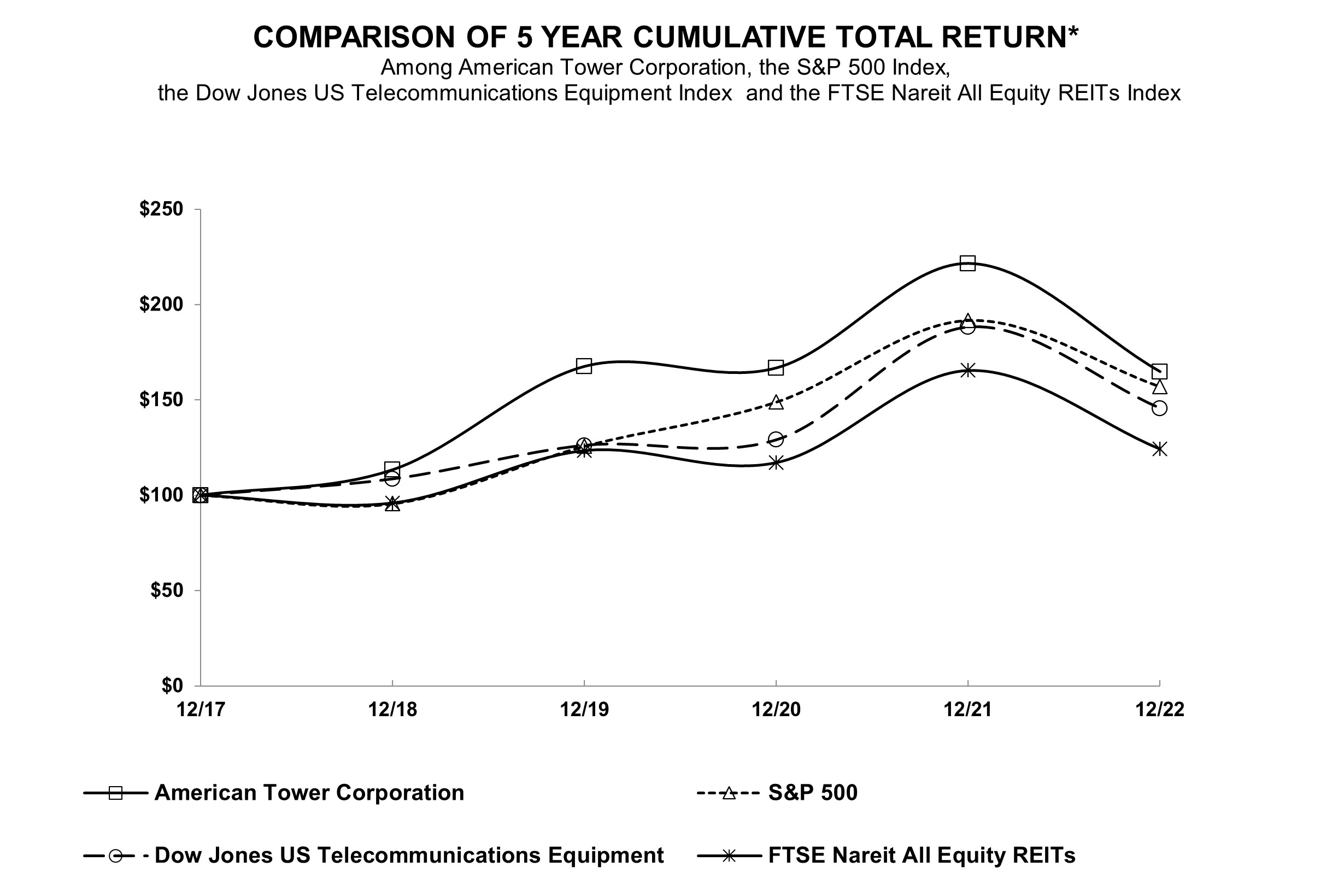
| Cumulative Total Returns | ||||||||||||||||||||||||||||||||||||||
| 12/17 | 12/18 | 12/19 | 12/20 | 12/21 | 12/22 | |||||||||||||||||||||||||||||||||
| American Tower Corporation | $ | 100.00 | $ | 113.32 | $ | 167.55 | $ | 166.75 | $ | 221.59 | $ | 164.80 | ||||||||||||||||||||||||||
| S&P 500 Index | 100.00 | 95.62 | 125.72 | 148.85 | 191.58 | 156.89 | ||||||||||||||||||||||||||||||||
| Dow Jones U.S. Telecommunications Equipment Index | 100.00 | 108.53 | 126.16 | 129.08 | 188.28 | 145.66 | ||||||||||||||||||||||||||||||||
| FTSE Nareit All Equity REITs Index | 100.00 | 95.96 | 123.46 | 117.14 | 165.51 | 124.22 |
Issuer Purchases of Equity Securities
In March 2011, our Board of Directors approved a stock repurchase program, pursuant to which we are authorized to repurchase up to $1.5 billion of our common stock (the “2011 Buyback”). In December 2017, our Board of Directors approved an additional stock repurchase program, pursuant to which we are authorized to repurchase up to $2.0 billion of our common stock (the “2017 Buyback”, and together with the 2011 Buyback the “Buyback Programs”).
During the three months ended December 31, 2022, we repurchased a total of 90,042 shares of our common stock for an aggregate of $18.8 million, including commissions and fees, pursuant to the 2011 Buyback. There were no repurchases under the 2017 Buyback. The table below sets forth details of our repurchases under the 2011 Buyback during the three months ended December 31, 2022.
| Period | Total Number of Shares Purchased (1) | Average Price Paid per Share (2) | Total Number of Shares Purchased as Part of Publicly Announced Plans or Programs | Approximate Dollar Value of Shares that May Yet be Purchased Under the Plans or Programs (3) | ||||||||||||||||||||||
| (in millions) | ||||||||||||||||||||||||||
| October 1, 2022 - October 31, 2022 | — | $ | — | — | $ | 36.4 | ||||||||||||||||||||
| November 1, 2022 - November 30, 2022 | 65,319 | $ | 206.33 | 65,319 | $ | 22.9 | ||||||||||||||||||||
| December 1, 2022 - December 31, 2022 | 24,723 | $ | 212.97 | 24,723 | $ | 17.6 | ||||||||||||||||||||
| Total Fourth Quarter | 90,042 | $ | 208.15 | 90,042 | $ | 17.6 |
(1) Repurchases made pursuant to the 2011 Buyback.
(2) Average price paid per share is a weighted average calculation using the aggregate price, excluding commissions and fees.
(3) Remaining under the 2011 Buyback.
We have repurchased a total of 14,451,325 shares of our common stock under the 2011 Buyback for an aggregate of $1.5 billion, including commissions and fees. We expect to continue to manage the pacing of the remaining $2.0 billion under the Buyback Programs in response to general market conditions and other relevant factors. We expect to fund any further repurchases of our common stock through a combination of cash on hand, cash generated by operations and borrowings under our credit facilities. Purchases under the Buyback Programs are subject to our having available cash to fund repurchases.
Under the Buyback Programs, our management is authorized to purchase shares from time to time through open market purchases or in privately negotiated transactions not to exceed market prices and subject to market conditions and other factors. With respect to open market purchases, we may use plans adopted in accordance with Rule 10b5-1 under the Exchange Act in accordance with securities laws and other legal requirements, which allows us to repurchase shares during periods when we otherwise might be prevented from doing so under insider trading laws or because of self-imposed trading blackout periods. These programs may be discontinued at any time.
Item 6. [RESERVED]
N/A.
Item 7. MANAGEMENT’S DISCUSSION AND ANALYSIS OF FINANCIAL CONDITION AND RESULTS OF OPERATIONS
The discussion and analysis of our financial condition and results of operations that follow are based upon our consolidated financial statements, which have been prepared in accordance with GAAP. The preparation of our financial statements requires us to make estimates and assumptions that affect the reported amounts of assets and liabilities, revenues and expenses and the related disclosure of contingent assets and liabilities at the date of our financial statements. Actual results may differ from these estimates and such differences could be material to the financial statements. This discussion should be read in conjunction with our consolidated financial statements included in this Annual Report and the accompanying notes, and the information set forth under the caption “Critical Accounting Policies and Estimates” below.
We report our results in seven segments – U.S. & Canada property (which includes all assets in the United States and Canada, other than our data center facilities and related assets), Asia-Pacific property, Africa property, Europe property, Latin America property, Data Centers and Services. In evaluating financial performance in each business segment, management uses, among other factors, segment gross margin and segment operating profit (see note 20 to our consolidated financial statements included in this Annual Report).
Executive Overview
We are one of the largest global REITs and a leading independent owner, operator and developer of multitenant communications real estate. Our primary business is the leasing of space on communications sites to wireless service providers, radio and television broadcast companies, wireless data providers, government agencies and municipalities and tenants in a number of other industries. In addition to the communications sites in our portfolio, we manage rooftop and tower sites for property owners under various contractual arrangements. We also hold other telecommunications infrastructure, fiber and property interests that we lease primarily to communications service providers and third-party tower operators, and, as discussed further below, we hold a portfolio of highly interconnected data center facilities and related assets in the United States. Our customers include our tenants, licensees and other payers. We refer to the business encompassing the above as our property operations, which accounted for 98% of our total revenues for the year ended December 31, 2022 and includes our U.S. & Canada property, Asia-Pacific property, Africa property, Europe property and Latin America property segments and Data Centers segment.
We also offer tower-related services in the United States, including site application, zoning and permitting, structural analysis and construction management, which primarily support our site leasing business, including the addition of new tenants and equipment on our sites.
The following table details the number of communications sites, excluding managed sites, that we owned or operated as of December 31, 2022:
| Number of Owned Towers | Number of Operated Towers (1) | Number of Owned DAS Sites | ||||||||||||||||||
| U.S. & Canada: | ||||||||||||||||||||
| Canada | 221 | — | — | |||||||||||||||||
| United States | 27,413 | 15,187 | 454 | |||||||||||||||||
| U.S. & Canada total | 27,634 | 15,187 | 454 | |||||||||||||||||
| Asia-Pacific: (2) | ||||||||||||||||||||
| Bangladesh | 481 | — | — | |||||||||||||||||
| India | 76,826 | — | 822 | |||||||||||||||||
| Philippines | 340 | — | — | |||||||||||||||||
| Asia-Pacific total | 77,647 | — | 822 | |||||||||||||||||
| Africa: | ||||||||||||||||||||
| Burkina Faso | 726 | — | — | |||||||||||||||||
| Ghana | 3,503 | 657 | 36 | |||||||||||||||||
| Kenya | 3,416 | — | 9 | |||||||||||||||||
| Niger | 860 | — | — | |||||||||||||||||
| Nigeria | 7,562 | — | — | |||||||||||||||||
| South Africa | 2,994 | — | — | |||||||||||||||||
| Uganda | 3,980 | — | 12 | |||||||||||||||||
| Africa total | 23,041 | 657 | 57 | |||||||||||||||||
| Europe: | ||||||||||||||||||||
| France | 3,943 | 303 | 8 | |||||||||||||||||
| Germany | 14,799 | — | — | |||||||||||||||||
| Poland | 57 | — | — | |||||||||||||||||
| Spain | 11,610 | — | 1 | |||||||||||||||||
| Europe total | 30,409 | 303 | 9 | |||||||||||||||||
| Latin America: | ||||||||||||||||||||
| Argentina | 497 | — | 11 | |||||||||||||||||
| Brazil | 20,644 | 2,043 | 121 | |||||||||||||||||
| Chile | 3,728 | — | 138 | |||||||||||||||||
| Colombia | 4,974 | — | 6 | |||||||||||||||||
| Costa Rica | 700 | — | 2 | |||||||||||||||||
| Mexico | 9,560 | 186 | 92 | |||||||||||||||||
| Paraguay | 1,447 | — | — | |||||||||||||||||
| Peru | 3,948 | 450 | 1 | |||||||||||||||||
| Latin America total | 45,498 | 2,679 | 371 |
(1)Approximately 95% of the operated towers are held pursuant to long-term finance leases, including those subject to purchase options.
(2)We also control land under carrier or other third-party communications sites in Australia and New Zealand, which provide recurring cash flows through tenant leasing arrangements.
As of December 31, 2022, our property portfolio included 28 operating data center facilities across ten markets in the United States that collectively comprise approximately 3.1 million NRSF of data center space, as detailed below:
| Number of Data Centers | Total NRSF (1) | |||||||||||||
| (in thousands) | ||||||||||||||
| San Francisco Bay, CA | 8 | 940 | ||||||||||||
| Los Angeles, CA | 3 | 670 | ||||||||||||
| Northern Virginia, VA | 5 | 536 | ||||||||||||
| New York, NY | 2 | 250 | ||||||||||||
| Chicago, IL | 2 | 216 | ||||||||||||
| Boston, MA | 1 | 143 | ||||||||||||
| Denver, CO | 2 | 35 | ||||||||||||
| Miami, FL | 2 | 47 | ||||||||||||
| Orlando, FL | 1 | 126 | ||||||||||||
| Atlanta, GA | 2 | 95 | ||||||||||||
| Total | 28 | 3,058 |
(1)Excludes approximately 0.4 million of office and light-industrial NRSF acquired as part of the CoreSite Acquisition.
In most of our marke
Showing the first 8K of 137K characters. Open the full section
Item 7A. QUANTITATIVE AND QUALITATIVE DISCLOSURES ABOUT MARKET RISK
The following table provides information as of December 31, 2022 about our market risk exposure associated with changing interest rates. For long-term debt obligations, the table presents principal cash flows by maturity date and average interest rates related to outstanding obligations. For interest rate swaps, the table presents notional principal amounts and weighted-average interest rates (in millions, except percentages). For more information, see Item 7 of this Annual Report under the caption “Management’s Discussion and Analysis of Financial Condition and Results of Operations—Liquidity and Capital Resources” and note 8 to our consolidated financial statements included in this Annual Report.
| Long-Term Debt | 2023 | 2024 | 2025 | 2026 | 2027 | Thereafter | Total | Fair Value | ||||||||||||||||||||||||||||||||||||||||||
| Fixed Rate Debt (a) | $ | 2,298.0 | $ | 2,155.4 | $ | 3,712.6 | $ | 3,336.6 | $ | 3,889.2 | $ | 14,541.9 | $ | 29,933.7 | $ | 26,131.6 | ||||||||||||||||||||||||||||||||||
| Weighted-Average Interest Rate (a) | 3.26 | % | 3.49 | % | 2.68 | % | 2.58 | % | 2.30 | % | 2.54 | % | ||||||||||||||||||||||||||||||||||||||
| Variable Rate Debt (b) | $ | 2,216.2 | $ | 883.2 | $ | 3,788.7 | $ | — | $ | 2,080.0 | $ | — | $ | 8,968.1 | $ | 8,961.8 | ||||||||||||||||||||||||||||||||||
| Weighted-Average Interest Rate (b)(c) | 4.71 | % | 2.73 | % | 4.68 | % | — | % | 5.46 | % | — | % | ||||||||||||||||||||||||||||||||||||||
| Interest Rate Swaps | ||||||||||||||||||||||||||||||||||||||||||||||||||
| Hedged Fixed-Rate Notional Amount | $ | 500.0 | $ | — | $ | — | $ | — | $ | — | $ | — | $ | 500.0 | $ | (6.2) | (d) | |||||||||||||||||||||||||||||||||
| Variable Rate Debt Rate (e) | 5.18 | % |
(a) Fixed rate debt consisted of: Securities issued in the Trust Securitizations; Securities issued in the 2015-2 Securitization; our senior unsecured notes (see note 8 to our consolidated financial statements included in this Annual Report for a detailed description of all such senior unsecured notes), excluding the 3.000% Notes (as defined below); and other debt including finance leases.
(b) Variable rate debt consisted of: the 2021 Multicurrency Credit Facility, which matures on June 30, 2025; the 2021 Credit Facility, which matures on January 31, 2027; the 2021 Term Loan, which matures on January 31, 2027; the 2021 EUR Three Year Delayed Draw Term Loan, which matures on May 28, 2024; the 2021 USD Two Year Delayed Draw Term Loan, which matures on December 28, 2023; the 3.000% Notes; and other debt including the Nigeria Letters of Credit.
(c) Based on rates effective as of December 31, 2022.
(d) As of December 31, 2022, the interest rate swap agreements in the United States were included in Accrued expenses on the consolidated balance sheet.
(e) Represents the weighted average variable rate of interest based on contractual notional amount as a percentage of total notional amounts.
Interest Rate Risk
As of December 31, 2022, we had three interest rate swap agreements related to a portion of our 3.000% senior unsecured notes due 2023 (the “3.000% Notes”). These swaps have been designated as fair value hedges, have an aggregate notional amount of $500.0 million, have an interest rate of one-month LIBOR plus applicable spreads and expire in June 2023.
Changes in interest rates can cause interest charges to fluctuate on our variable rate debt. Variable rate debt as of December 31, 2022 consisted of $3.8 billion under the 2021 Multicurrency Credit Facility, $1.1 billion under the 2021 Credit Facility, $1.0
billion under the 2021 Term Loan, $883.2 million under the 2021 EUR Three Year Delayed Draw Term Loan, $1.5 billion under the 2021 USD Two Year Delayed Draw Term Loan, $500.0 million under the interest rate swap agreements related to the 3.000% Notes and $16.2 million under the Nigeria Letters of Credit. A 10% increase in current interest rates would result in an additional $42.4 million of interest expense for the year ended December 31, 2022.
Foreign Currency Risk
We are exposed to market risk from changes in foreign currency exchange rates primarily in connection with our foreign subsidiaries and joint ventures internationally. Any transaction denominated in a currency other than the U.S. Dollar is reported in U.S. Dollars at the applicable exchange rate. All assets and liabilities are translated into U.S. Dollars at exchange rates in effect at the end of the applicable fiscal reporting period and all revenues and expenses are translated at average rates for the period. The cumulative translation effect is included in equity as a component of Accumulated other comprehensive loss. We may enter into additional foreign currency financial instruments in anticipation of future transactions to minimize the impact of foreign currency fluctuations. For the year ended December 31, 2022, 43% of our revenues and 52% of our total operating expenses were denominated in foreign currencies.
As of December 31, 2022, we have incurred intercompany debt that is not considered to be permanently reinvested, and similar unaffiliated balances that were denominated in a currency other than the functional currency of the subsidiary in which it is recorded. As this debt had not been designated as being a long-term investment in nature, any changes in the foreign currency exchange rates will result in unrealized gains or losses, which will be included in our determination of net income. An adverse change of 10% in the underlying exchange rates of our unsettled intercompany debt and similar unaffiliated balances would result in $40.5 million of unrealized losses that would be included in Other expense in our consolidated statements of operations for the year ended December 31, 2022. As of December 31, 2022, we have 7.3 billion EUR (approximately $7.8 billion) denominated debt outstanding. An adverse change of 10% in the underlying exchange rates of our outstanding EUR debt would result in $0.9 billion of foreign currency losses that would be included in Other expense in our consolidated statements of operations for the year ended December 31, 2022.
Item 8. FINANCIAL STATEMENTS AND SUPPLEMENTARY DATA
See Item 15 (a).
Item 9. CHANGES IN AND DISAGREEMENTS WITH ACCOUNTANTS ON ACCOUNTING AND FINANCIAL DISCLOSURE
None.
Item 9A. CONTROLS AND PROCEDURES
Disclosure Controls and Procedures
We have established disclosure controls and procedures designed to ensure that material information relating to us, including our consolidated subsidiaries, is made known to the officers who certify our financial reports and to other members of senior management and the Board of Directors.
Our management, with the participation of our principal executive officer and principal financial officer, evaluated the effectiveness of the design and operation of our disclosure controls and procedures (as defined in Rules 13a-15(e) and 15d-15(e) under the Exchange Act) as of the end of the period covered by this Annual Report. Based on this evaluation, our principal executive officer and principal financial officer concluded that these disclosure controls and procedures were effective as of December 31, 2022 and designed to ensure that the information required to be disclosed in our reports filed or submitted under the Exchange Act is recorded, processed, summarized and reported within the requisite time periods specified in the applicable rules and forms, and that it is accumulated and communicated to our management, including our principal executive officer and principal financial officer, as appropriate, to allow timely decisions regarding required disclosure.
Management’s Annual Report on Internal Control over Financial Reporting
Our management, with the participation of our principal executive officer and principal financial officer, is responsible for establishing and maintaining adequate internal control over financial reporting as defined in Rules 13a-15(f) and 15d-15(f) under the Exchange Act. Our internal control system is designed to provide reasonable assurance to our management and Board of Directors regarding the preparation and fair presentation of published financial statements.
Our management assessed the effectiveness of our internal control over financial reporting as of December 31, 2022.
In making its assessment of internal control over financial reporting, our management used the criteria set forth by the Committee of Sponsoring Organizations of the Treadway Commission in Internal Control—Integrated Framework (2013). Based on this assessment, management concluded that, as of December 31, 2022, our internal control over financial reporting is effective.
Deloitte & Touche LLP, an independent registered public accounting firm that audited our financial statements included in this Annual Report, has issued an attestation report on management’s internal control over financial reporting, which is included in this Item 9A under the caption “Report of Independent Registered Public Accounting Firm.”
Changes in Internal Control over Financial Reporting
There have been no changes in our internal control over financial reporting (as defined in Rule 13a-15(f) under the Exchange Act) during the fiscal quarter ended December 31, 2022 that have materially affected, or are reasonably likely to materially affect, our internal control over financial reporting.
REPORT OF INDEPENDENT REGISTERED PUBLIC ACCOUNTING FIRM
To the Stockholders and the Board of Directors of American Tower Corporation
Opinion on Internal Control over Financial Reporting
We have audited the internal control over financial reporting of American Tower Corporation and subsidiaries (the “Company”) as of December 31, 2022, based on criteria established in Internal Control — Integrated Framework (2013) issued by the Committee of Sponsoring Organizations of the Treadway Commission (COSO). In our opinion, the Company maintained, in all material respects, effective internal control over financial reporting as of December 31, 2022, based on criteria established in Internal Control — Integrated Framework (2013) issued by COSO.
We have also audited, in accordance with the standards of the Public Company Accounting Oversight Board (United States) (PCAOB), the consolidated financial statements as of and for the year ended December 31, 2022, of the Company and our report dated February 23, 2023, expressed an unqualified opinion on those financial statements.
Basis for Opinion
The Company’s management is responsible for maintaining effective internal control over financial reporting and for its assessment of the effectiveness of internal control over financial reporting, included in the accompanying Management’s Annual Report on Internal Control over Financial Reporting. Our responsibility is to express an opinion on the Company’s internal control over financial reporting based on our audit. We are a public accounting firm registered with the PCAOB and are required to be independent with respect to the Company in accordance with the U.S. federal securities laws and the applicable rules and regulations of the Securities and Exchange Commission and the PCAOB.
We conducted our audit in accordance with the standards of the PCAOB. Those standards require that we plan and perform the audit to obtain reasonable assurance about whether effective internal control over financial reporting was maintained in all material respects. Our audit included obtaining an understanding of internal control over financial reporting, assessing the risk that a material weakness exists, testing and evaluating the design and operating effectiveness of internal control based on the assessed risk, and performing such other procedures as we considered necessary in the circumstances. We believe that our audit provides a reasonable basis for our opinion.
Definition and Limitations of Internal Control over Financial Reporting
A company’s internal control over financial reporting is a process designed to provide reasonable assurance regarding the reliability of financial reporting and the preparation of financial statements for external purposes in accordance with generally accepted accounting principles. A company’s internal control over financial reporting includes those policies and procedures that (1) pertain to the maintenance of records that, in reasonable detail, accurately and fairly reflect the transactions and dispositions of the assets of the company; (2) provide reasonable assurance that transactions are recorded as necessary to permit preparation of financial statements in accordance with generally accepted accounting principles, and that receipts and expenditures of the company are being made only in accordance with authorizations of management and directors of the company; and (3) provide reasonable assurance regarding prevention or timely detection of unauthorized acquisition, use, or disposition of the company’s assets that could have a material effect on the financial statements.
Because of its inherent limitations, internal control over financial reporting may not prevent or detect misstatements. Also, projections of any evaluation of effectiveness to future periods are subject to the risk that controls may become inadequate because of changes in conditions, or that the degree of compliance with the policies or procedures may deteriorate.
/s/ Deloitte & Touche LLP
Boston, Massachusetts
February 23, 2023
Item 9B. OTHER INFORMATION.
Not applicable.
Item 9C. DISCLOSURE REGARDING FOREIGN JURISDICTIONS THAT PREVENT INSPECTIONS.
Not applicable.
PART III
Item 10. DIRECTORS, EXECUTIVE OFFICERS AND CORPORATE GOVERNANCE
Our executive officers and their respective ages and positions as of February 16, 2023 are set forth below:
| Thomas A. Bartlett | 64 | President and Chief Executive Officer | ||||||||||||
| Rodney M. Smith | 57 | Executive Vice President, Chief Financial Officer and Treasurer | ||||||||||||
| Edmund DiSanto | 70 | Executive Vice President, Special Advisor and Counsel to the Chief Executive Officer | ||||||||||||
| Ruth T. Dowling | 53 | Executive Vice President, Chief Administrative Officer, General Counsel and Secretary | ||||||||||||
| Robert J. Meyer | 59 | Senior Vice President and Chief Accounting Officer | ||||||||||||
| Olivier Puech | 55 | Executive Vice President and President, Latin America and EMEA | ||||||||||||
| Sanjay Goel | 55 | Executive Vice President and President, Asia-Pacific | ||||||||||||
| Steven O. Vondran | 52 | Executive Vice President and President, U.S. Tower Division |
Thomas A. Bartlett is our President and Chief Executive Officer. Mr. Bartlett joined us in April 2009 as Executive Vice President and Chief Financial Officer and served in that role until March 2020 when he was appointed to his current position. Mr. Bartlett served as our Treasurer from February 2012 to December 2013, and again from July 2017 to August 2018. Prior to joining us, Mr. Bartlett served as Senior Vice President and Corporate Controller with Verizon Communications. During his 25-year career with Verizon Communications and its predecessor companies and affiliates, he served in numerous operations and business development roles, including as President and Chief Executive Officer of Bell Atlantic International Wireless from 1995 through 2000, where he was responsible for wireless activities in certain regions of North America, Latin America, Europe and Asia. In addition, Mr. Bartlett served as CEO of Iusacell, a publicly traded, nationwide cellular company in Mexico, CEO of Verizon's Global Solutions Inc., a global connectivity business providing lit and dark fiber services primarily to global enterprises, and as an Area President for Verizon’s U.S. wireless business, where he was responsible for all operational aspects of the business in the Northeast and Mid-Atlantic states. He began his career at Deloitte, Haskins & Sells. Mr. Bartlett is a member of the World Economic Forum’s Information and Communications Technologies (ICT) Board of Governors, the National Association of Real Estate Investment Trust (NAREIT) Executive Committee and the Business Roundtable. He currently sits on the Samaritans advisory council, is on the Board of Advisors of the Rutgers Business School and is on the Massachusetts Institute of Technology Presidential CEO Advisory Board. He earned an M.B.A. from Rutgers University and a Bachelor of Science degree in Industrial Engineering from Lehigh University.
Rodney M. Smith is our Executive Vice President, Chief Financial Officer and Treasurer. Mr. Smith joined us in October 2009, and previously held the roles of Senior Vice President, Corporate Finance and Treasurer and Senior Vice President and Chief Financial Officer of American Tower's U.S. Tower Division. Prior to joining us, Mr. Smith served as Executive Vice President, Chief Financial Officer and as a general Board Member of Lightower, a private equity backed wireless infrastructure company. Prior to Lightower, he served as Chief Financial Officer and Treasurer (and earlier as Vice President and Controller) for RoweCom, a publicly traded company with operations in eight countries. Early in his career, Mr. Smith held several leadership positions at Nextel Communications, including Director of Finance and General Manager of one of the Company's Northeast markets. Mr. Smith earned his M.B.A from Suffolk University, a Certificate of Accountancy from Bentley University and a Bachelor of Science in Finance from Merrimack College. He also serves as co-Executive Sponsor of American Tower’s employee resource group for women, WAATCH.
Edmund DiSanto is our Executive Vice President, Special Advisor and Counsel to the Chief Executive Officer. Prior to his current role, he served as our Executive Vice President, Chief Administrative Officer, General Counsel and Secretary for over 15 years. Prior to joining us in April 2007, Mr. DiSanto was with Pratt & Whitney, a unit of United Technologies Corporation. Mr. DiSanto started with United Technologies in 1989, where he first served as Assistant General Counsel of its Carrier subsidiary, then as corporate Executive Assistant to the Chairman and Chief Executive Officer of United Technologies. From 1997, he held various legal and business roles at its Pratt & Whitney unit, including Deputy General Counsel and most recently, Vice President, Global Service Partners, Business Development. Prior to joining United Technologies, Mr. DiSanto served in a number of legal and related positions at United Dominion Industries and New England Electric Systems. Mr. DiSanto earned a J.D. from Boston College Law School and a Bachelor of Science from Northeastern University. In 2013, Mr. DiSanto became a member of the Board of Directors of the Business Council for International Understanding. Mr. DiSanto also serves as the Strategic Officer for the Company at the World Economic Forum. In 2019, Mr. DiSanto was admitted to the bar of the United States Supreme Court and in 2020, Mr. DiSanto was named to the Board of the U.S.-India Business Council.
Ruth T. Dowling is our Executive Vice President, Chief Administrative Officer, General Counsel and Secretary. She is also a member of the Board of Directors for ATC Europe and CoreSite. Since joining us in 2011, Ms. Dowling has served as Senior
Vice President, Corporate Legal, and, most recently, as Senior Vice President and General Counsel for the EMEA and Latin America regions. In addition, she led American Tower’s Global Remobilization Project Team to care for the safety and well-being of employees during the pandemic. Prior to joining American Tower, Ms. Dowling was a partner and co-chair of the 150-member litigation department at Edwards Angell Palmer & Dodge LLP and clerked for the Honorable Fred I. Parker of the United States Second Circuit Court of Appeals. Ms. Dowling earned her law degree from Duke University School of Law and a Bachelor of Arts from the University of North Carolina Chapel Hill. She also serves as co-Executive Sponsor of American Tower’s employee resource group for women, WAATCH.
Robert J. Meyer is our Senior Vice President and Chief Accounting Officer. Mr. Meyer joined us in August 2008 as our Senior Vice President, Finance and Corporate Controller and served in that role until January 2020 when he was appointed to his current position. Prior to joining us, Mr. Meyer was with Bright Horizons Family Solutions since 1998, a provider of child care, early education and work/life consulting services, where he most recently served as Chief Accounting Officer. Mr. Meyer also served as Corporate Controller and Vice President of Finance while at Bright Horizons. Prior to that, from 1997 to 1998, Mr. Meyer served as Director of Financial Planning and Analysis at First Security Services Corp. Mr. Meyer earned a Masters in Finance from Bentley University and a Bachelor of Science in Accounting from Marquette University, and is a Certified Public Accountant.
Olivier Puech is our Executive Vice President and President, Latin America and EMEA. Mr. Puech joined us in 2013 as Senior Vice President and CEO of Latin America and served in that role until October 2018 when he was appointed to his current position. Prior to joining us, Mr. Puech spent 25 years as a senior executive in the telecom and internet sectors of international organizations. Most recently, he was with Nokia where he held various leadership roles including Senior Vice President Americas, Senior Vice President Asia Pacific and Vice President Latin America. Before Nokia, Mr. Puech spent 12 years at Gemalto, where he last held the position of Vice President, Sales and Marketing with responsibility for South Europe, Eastern Europe and Latin America. Mr. Puech holds a Bachelor’s degree in International Business Administration from Ecole Supérieure De Commerce in Marseille, in France. He is fluent in English, French, Spanish, Italian and Portuguese.
Sanjay Goel is our Executive Vice President and President, Asia-Pacific. Mr. Goel joined us in March 2021. Prior to joining us, Mr. Goel was with Nokia, where he started in the mobile networks division in 2001. During his time at Nokia, he held various sales and business management positions, including Head of the Managed Services Business Line for Asia Pacific, Japan and India and Vice President of the Global Services Business Unit, APAC and Japan. Mr. Goel also led Nokia’s Global Services business across Asia, the Middle East and Africa, and created a new sales and business development division within Global Services, based in Finland. Most recently, he served as President of the Global Services business group and Nokia Operations. Mr. Goel began his career at ABB and IBM, prior to joining Nokia. He holds a Bachelor’s degree in Engineering with specialization in Electronics and Communications from Manipal Institute of Technology.
Steven O. Vondran is our Executive Vice President and President, U.S. Tower Division. Mr. Vondran joined us in 2000 as a member of our corporate legal team and served in a variety of positions until August 2004 when he was appointed Senior Vice President of our U.S. Leasing Operations. In August 2010, Mr. Vondran was appointed Senior Vice President, General Counsel of our U.S. Tower Division and served in that role until August 2018, when he was appointed to his current position. Mr. Vondran joined the Cellular Telecommunications Industry Association (CTIA) Board in September 2018, and, in October 2018, he joined the Board of Directors for the Wireless Infrastructure Association (WIA). Prior to joining us, Mr. Vondran was an associate at the law firm of Lewellen & Frazier LLP, served as a telecommunications consultant with the firm of Young & Associates, Inc., and was a Law Clerk to the Hon. John Stroud on the Arkansas Court of Appeals. He received his J.D. with high honors from the University of Arkansas at Little Rock School of Law and a Bachelor of Arts in Economics and Business from Hendrix College.
The information under “Election of Directors” and “Delinquent Section 16(a) Reports,” if applicable, from the Definitive Proxy Statement is incorporated herein by reference. Information required by this item pursuant to Item 407(c)(3) of SEC Regulation S-K relating to our procedures by which security holders may recommend nominees to our Board of Directors, and pursuant to Item 407(d)(4) and 407(d)(5) of SEC Regulation S-K relating to our audit committee financial experts and identification of the audit committee of our Board of Directors, is contained in the Definitive Proxy Statement under “Corporate Governance” and is incorporated herein by reference.
Information regarding our Code of Conduct applicable to our principal executive officer, our principal financial officer, our controller and other senior financial officers appears in Item 1 of this Annual Report under the caption “Business—Available Information.”
Item 11. EXECUTIVE COMPENSATION
The information under “Compensation and Other Information Concerning Directors and Officers” from the Definitive Proxy Statement, except as to information required pursuant to Item 402(v) of SEC Regulation S-K relating to pay versus performance, is incorporated herein by reference.
Item 12. SECURITY OWNERSHIP OF CERTAIN BENEFICIAL OWNERS AND MANAGEMENT AND RELATED STOCKHOLDER MATTERS
The information under “Security Ownership of Certain Beneficial Owners and Management” and “Securities Authorized for Issuance Under Equity Compensation Plans” from the Definitive Proxy Statement is incorporated herein by reference.
Item 13. CERTAIN RELATIONSHIPS AND RELATED TRANSACTIONS, AND DIRECTOR INDEPENDENCE
Information required by this item pursuant to Item 404 of SEC Regulation S-K relating to approval of related party transactions is contained in the Definitive Proxy Statement under “Corporate Governance” and is incorporated herein by reference.
Information required by this item pursuant to Item 407(a) of SEC Regulation S-K relating to director independence is contained in the Definitive Proxy Statement under “Corporate Governance” and is incorporated herein by reference.
Item 14. PRINCIPAL ACCOUNTING FEES AND SERVICES
The information under “Independent Auditor Fees and Other Matters” from the Definitive Proxy Statement is incorporated herein by reference.
PART IV
Item 15. EXHIBITS, FINANCIAL STATEMENT SCHEDULES
(a) The following documents are filed as a part of this report:
-
Financial Statements. See Index to Consolidated Financial Statements, which appears on page F-1 hereof. The financial statements listed in the accompanying Index to Consolidated Financial Statements are filed herewith in response to this Item.
-
Financial Statement Schedules. American Tower Corporation and Subsidiaries Schedule III – Schedule of Real Estate and Accumulated Depreciation is filed herewith in response to this Item.
-
Exhibits.
Pursuant to the rules and regulations of the SEC, the Company has filed certain agreements as exhibits to this Annual Report on Form 10-K. These agreements may contain representations and warranties by the parties. These representations and warranties have been made solely for the benefit of the other party or parties to such agreements and (i) may have been qualified by disclosures made to such other party or parties, (ii) were made only as of the date of such agreements or such other date(s) as may be specified in such agreements and are subject to more recent developments, which may not be fully reflected in the Company’s public disclosure, (iii) may reflect the allocation of risk among the parties to such agreements and (iv) may apply materiality standards different from what may be viewed as material to investors. Accordingly, these representations and warranties may not describe the Company’s actual state of affairs at the date hereof and should not be relied upon.
The exhibits below are included, either by being filed herewith or by incorporation by reference, as part of this Annual Report on Form 10-K. Exhibits are identified according to the number assigned to them in Item 601 of SEC Regulation S-K. Documents that are incorporated by reference are identified by their Exhibit number as set forth in the filing from which they are incorporated by reference.
| Incorporated By Reference | ||||||||||||||||||||||||||||||||
| Exhibit No. | Description of Document | Form | File No. | Date of Filing | Exhibit No. | |||||||||||||||||||||||||||
| 31.2 | Certification of Chief Financial Officer pursuant to Section 302 of the Sarbanes-Oxley Act of 2002 | Filed herewith as Exhibit 31.2 | — | — | — | |||||||||||||||||||||||||||
| 32 | Certifications filed pursuant to 18. U.S.C. Section 1350 | Filed herewith as Exhibit 32 | — | — | — | |||||||||||||||||||||||||||
| 101 | The following materials from American Tower Corporation’s Annual Report on Form 10-K for the year ended December 31, 2020, formatted in XBRL (Extensible Business Reporting Language): 101.SCH—Inline XBRL Taxonomy Extension Schema Document 101.CAL—Inline XBRL Taxonomy Extension Calculation Linkbase Document 101.LAB—Inline XBRL Taxonomy Extension Label Linkbase Document 101.PRE—Inline XBRL Taxonomy Extension Presentation Linkbase Document 101.DEF—Inline XBRL Taxonomy Extension Definition | Filed herewith as Exhibit 101 | — | — | — | |||||||||||||||||||||||||||
| 104 | Cover Page Interactive Data File (formatted as Inline XBRL and contained in Exhibit 101) | — | — | — | — |
| * | Management contracts and compensatory plans and arrangements required to be filed as exhibits to this Form 10-K pursuant to Item 15(a)(3). |
| ** | The exhibit has been filed separately with the Commission pursuant to an application for confidential treatment. The confidential portions of the exhibit have been omitted and are marked by an asterisk. |
Item 16. FORM 10-K SUMMARY
None.
SIGNATURES
Pursuant to the requirements of Section 13 or 15(d) of the Securities Exchange Act of 1934, the Registrant has duly caused this report to be signed on its behalf by the undersigned, thereunto duly authorized on the 23rd day of February, 2023.
| AMERICAN TOWER CORPORATION | ||||||||||||||
| By: | /S/ THOMAS A. BARTLETT | |||||||||||||
| Thomas A. Bartlett President and Chief Executive Officer |
Pursuant to the requirements of the Securities Exchange Act of 1934, this report has been duly signed below by the following persons on behalf of the Registrant and in the capacities and on the dates indicated.
| Signature | Title | Date | ||||||||||||
| /S/ THOMAS A. BARTLETT | President and Chief Executive Officer (Principal Executive Officer), Director | February 23, 2023 | ||||||||||||
| Thomas A. Bartlett | ||||||||||||||
| /S/ RODNEY M. SMITH | Executive Vice President, Chief Financial Officer and Treasurer (Principal Financial Officer) | February 23, 2023 | ||||||||||||
| Rodney M. Smith | ||||||||||||||
| /S/ ROBERT J. MEYER | Senior Vice President and Chief Accounting Officer (Principal Accounting Officer) | February 23, 2023 | ||||||||||||
| Robert J. Meyer | ||||||||||||||
| /S/ KELLY C. CHAMBLISS | Director | February 23, 2023 | ||||||||||||
| Kelly C. Chambliss | ||||||||||||||
| /S/ TERESA H. CLARKE | Director | February 23, 2023 | ||||||||||||
| Teresa H. Clarke | ||||||||||||||
| /S/ RAYMOND P. DOLAN | Director | February 23, 2023 | ||||||||||||
| Raymond P. Dolan | ||||||||||||||
| /S/ KENNETH R. FRANK | Director | February 23, 2023 | ||||||||||||
| Kenneth R. Frank | ||||||||||||||
| /S/ ROBERT D. HORMATS | Director | February 23, 2023 | ||||||||||||
| Robert D. Hormats | ||||||||||||||
| /S/ GRACE D. LIEBLEIN | Director | February 23, 2023 | ||||||||||||
| Grace D. Lieblein | ||||||||||||||
| /S/ CRAIG MACNAB | Director | February 23, 2023 | ||||||||||||
| Craig Macnab | ||||||||||||||
| /S/ JOANN A. REED | Director | February 23, 2023 | ||||||||||||
| JoAnn A. Reed | ||||||||||||||
| /S/ PAMELA D. A. REEVE | Chair of the Board, Director | February 23, 2023 | ||||||||||||
| Pamela D. A. Reeve | ||||||||||||||
| /S/ DAVID E. SHARBUTT | Director | February 23, 2023 | ||||||||||||
| David E. Sharbutt | ||||||||||||||
| /S/ BRUCE L. TANNER | Director | February 23, 2023 | ||||||||||||
| Bruce L. Tanner | ||||||||||||||
| /S/ SAMME L. THOMPSON | Director | February 23, 2023 | ||||||||||||
| Samme L. Thompson |
AMERICAN TOWER CORPORATION AND SUBSIDIARIES
INDEX TO CONSOLIDATED FINANCIAL STATEMENTS
F-1
REPORT OF INDEPENDENT REGISTERED PUBLIC ACCOUNTING FIRM
To the Stockholders and the Board of Directors of American Tower Corporation
Opinion on the Financial Statements
We have audited the accompanying consolidated balance sheets of American Tower Corporation and subsidiaries (the “Company”) as of December 31, 2022 and 2021, the related consolidated statements of operations, comprehensive income, equity, and cash flows, for each of the three years in the period ended December 31, 2022, and the related notes and the schedule listed in the Index at Item 15 (collectively referred to as the “financial statements”). In our opinion, the financial statements present fairly, in all material respects, the financial position of the Company as of December 31, 2022 and 2021, and the results of its operations and its cash flows for each of the three years in the period ended December 31, 2022, in conformity with accounting principles generally accepted in the United States of America.
We have also audited, in accordance with the standards of the Public Company Accounting Oversight Board (United States) (PCAOB), the Company's internal control over financial reporting as of December 31, 2022, based on criteria established in Internal Control — Integrated Framework (2013) issued by the Committee of Sponsoring Organizations of the Treadway Commission and our report dated February 23, 2023, expressed an unqualified opinion on the Company's internal control over financial reporting.
Basis for Opinion
These financial statements are the responsibility of the Company’s management. Our responsibility is to express an opinion on the Company's financial statements based on our audits. We are a public accounting firm registered
Showing the first 8K of 312K characters. Open the full section