 filings.tools
Arista Networks 10-K 2024-12-31
Filed 2025-02-19. 24 sections, 524K characters. Original on sec.gov · Markdown · JSON
Cover and table of contents
UNITED STATES
SECURITIES AND EXCHANGE COMMISSION
Washington, D.C. 20549
FORM 10-K
(Mark One)
| ☒ | ANNUAL REPORT PURSUANT TO SECTION 13 OR 15(d) OF THE SECURITIES EXCHANGE ACT OF 1934 |
For the fiscal year ended December 31, 2024
Or
| ☐ | TRANSITION REPORT PURSUANT TO SECTION 13 OR 15(d) OF THE SECURITIES EXCHANGE ACT OF 1934 |
For the transition period from to
Commission file number: 001-36468
ARISTA NETWORKS, INC.
(Exact name of registrant as specified in its charter)
| Delaware | 20-1751121 | |||||||
| (State or other jurisdiction of incorporation or organization) | (I.R.S. Employer Identification Number) |
5453 Great America Parkway
Santa Clara, California 95054
(Address of principal executive offices)
(408) 547-5500
(Registrant’s telephone number, including area code)
Securities registered pursuant to Section 12(b) of the Act:
| Title of each class | Trading Symbol(s) | Name of each exchange on which registered | ||||||
| Common Stock, $0.0001 par value | ANET | New York Stock Exchange |
Securities registered pursuant to Section 12(g) of the Act: None
Indicate by check mark if the registrant is a well-known seasoned issuer, as defined in Rule 405 of the Securities Act. Yes ☒ No ☐
Indicate by check mark if the registrant is not required to file reports pursuant to Section 13 or Section 15(d) of the Exchange Act. Yes ☐ No ☒
Indicate by check mark whether the registrant (1) has filed all reports required to be filed by Section 13 or 15(d) of the Securities Exchange Act of 1934 during the preceding 12 months (or for such shorter period that the registrant was required to file such reports), and (2) has been subject to such filing requirements for the past 90 days. Yes ☒ No ☐
Indicate by check mark whether the registrant has submitted electronically every Interactive Data File required to be submitted pursuant to Rule 405 of Regulation S-T (§232.405 of this chapter) during the preceding 12 months (or for such shorter period that the registrant was required to submit such files). Yes ☒ No ☐
Indicate by check mark whether the registrant is a large accelerated filer, an accelerated filer, a non-accelerated filer, a smaller reporting company, or an emerging growth company. See the definitions of “large accelerated filer,” “accelerated filer,” “smaller reporting company” and “emerging growth company” in Rule 12b-2 of the Exchange Act.
| Large accelerated filer | ☒ | Accelerated filer | ☐ | ||||||||||||||
| Non-accelerated filer | ☐ | Smaller reporting company | ☐ | ||||||||||||||
| Emerging growth company | ☐ |
If an emerging growth company, indicate by check mark if the registrant has elected not to use the extended transition period for complying with any new or revised financial accounting standards provided pursuant to Section 13(a) of the Exchange Act. ☐
Indicate by check mark whether the registrant has filed a report on and attestation to its management's assessment of the effectiveness of its internal control over financial reporting under Section 404(b) of the Sarbanes-Oxley Act (15 U.S.C. 7262(b)) by the registered public accounting firm that prepared or issued its audit report. ☒
If securities are registered pursuant to Section 12(b) of the Act, indicate by check mark whether the financial statements of the registrant included in the filing reflect the correction of an error to previously issued financial statements. ☐
Indicate by check mark whether any of those error corrections are restatements that required a recovery analysis of incentive-based compensation received by any of the registrant’s executive officers during the relevant recovery period pursuant to §240.10D-1(b). ☐
Indicate by check mark whether the registrant is a shell company (as defined in Rule 12b-2 of the Exchange Act). Yes ☐ No ☒
The aggregate market value of the voting and non-voting common equity held by non-affiliates of the registrant was approximately $90.2 billion as of June 28, 2024 (the last business day of the registrant's most recently completed second fiscal quarter) based on the closing price of the registrant’s common stock on the New York Stock Exchange on such date. Shares held by persons who may be deemed affiliates have been excluded. This determination of affiliate status is not necessarily a conclusive determination for other purposes.
On February 12, 2025, 1,261,122,596 shares of the registrant’s common stock were outstanding.
DOCUMENTS INCORPORATED BY REFERENCE
Portions of the registrant’s definitive Proxy Statement relating to its 2025 Annual Meeting of Stockholders to be filed pursuant to Regulation 14A within 120 days after the registrant’s fiscal year end of December 31, 2024 are incorporated by reference into Part III of this Annual Report on Form 10-K.
ARISTA NETWORKS, INC.
TABLE OF CONTENTS
SPECIAL NOTE REGARDING FORWARD-LOOKING STATEMENTS
This Annual Report on Form 10-K, including the sections entitled “Business,” “Risk Factors,” and “Management’s Discussion and Analysis of Financial Condition and Results of Operations,” contains forward-looking statements within the meaning of Section 27A of the Securities Act of 1933, as amended, and Section 21E of the Securities Exchange Act of 1934, as amended, which statements involve substantial risks and uncertainties. The words “believe,” “may,” “will,” “potentially,” "likely" “estimate,” “continue,” “anticipate,” “intend,” “could,” “would,” "should", “project,” “plan,” “predict,” “expect”, the negative of any of these words and similar expressions that convey uncertainty of future events or outcomes are intended to identify forward-looking statements.
These forward-looking statements include, but are not limited to, statements concerning the following:
-
our ability to maintain an adequate rate of revenue growth and our future financial performance, including our expectations regarding our revenue, cost of revenue, gross profit or gross margin and operating expenses;
-
our belief that the networking market is rapidly evolving and has a significant potential opportunity for growth;
-
our business plan and our ability to effectively manage our growth;
-
our ability to expand our leadership position in the networking industry and to develop new products and expand our business into new markets such as the AI Ethernet switching, campus workspace, enterprise data center and security markets;
-
our ability to satisfy the requirements for networking solutions and to successfully anticipate technological shifts and market needs, including the impact of artificial intelligence, innovate new products, rapidly develop new features and applications, and bring them to market in a timely manner;
-
our ability to fulfill our customers’ orders despite supply chain delays, issues with access to key commodities or technologies or geopolitical events that impact our manufacturers or their suppliers such as the escalating tariff and non-tariff-related international trade measures, the Russia-Ukraine and Israel-Hamas conflicts, the Houthi attacks on marine vessels in the Red Sea or the impact of global pandemics such as the global coronavirus ("COVID-19") pandemic;
-
our expectations related to our inventory and purchase commitments;
-
our ability to identify, complete and realize the benefits of recent and future acquisitions of, or investments in, complementary companies, products, services or technologies;
-
costs associated with defending intellectual property infringement and other claims and the potential outcomes of such disputes, such as any claims discussed in “Legal Proceedings”;
-
our ability to retain and increase sales to existing customers and attract new customers, including large customers;
-
our ability to expand our business domestically and internationally;
-
the effects of increased competition in our market and our ability to compete effectively;
-
the budgeting cycles and purchasing practices of customers, including large customers who may receive lower pricing terms due to volume discounts or who may elect to re-assign allocations to multiple vendors based upon specific network roles or projects;
-
the growth and buying patterns of our large customers and resulting volatility in our customer concentration in which large bulk purchases may or may not occur in certain quarters or may be deferred into future quarters or cancelled due to adjustments in their capital expenditure forecasts;
-
the deferral or cancellation of orders by customers, warranty returns or delays in acceptance of our products;
-
our ability to further penetrate our existing customer base and sell more complex and higher-performance configurations of our products;
-
our belief that increasing channel leverage will extend and improve our engagement with a broad set of customers;
-
our plans to continue to expand our sales force, marketing activities and relationships with channel, technology and system-level partners;
-
our ability to scale our operational and manufacturing capacity;
-
our plans to invest in our research and development;
-
our ability to timely and effectively scale and adapt our existing technology;
-
the benefits realized by our customers in their use of our products and services including lower total cost of ownership;
-
our ability to detect breaches of our cybersecurity systems or other security breaches;
-
the effects of seasonal and cyclical trends on our results of operations;
-
our relationships with and expectations concerning third parties, including, but not limited to our large customers, suppliers, distributors, systems integrators, channel partners and value-added resellers;
-
the attraction and retention of qualified employees and key personnel;
-
our ability to maintain, protect and enhance our brand and intellectual property;
-
economic and industry trends;
-
estimates and estimate methodologies used in preparing our financial statements;
-
future trading prices of our common stock;
-
our belief that we have adequately reserved for uncertain tax positions;
-
the impact of global economic and political conditions that introduce instability into the U.S. and other economies;
-
the impact of climate change and natural disasters;
-
the impact of global and domestic tax reform;
-
the impact of tariffs or other changes in international trade policies imposed by the U.S. on goods from other countries and tariffs imposed by other countries on U.S. goods; and
-
our belief that our existing cash and cash equivalents together with cash flow from operations will be sufficient to meet our working capital requirements and our growth strategies for the foreseeable future.
These forward-looking statements are subject to a number of risks, uncertainties and assumptions, including those described in the section titled “Risk Factors” and elsewhere in this Annual Report on Form 10-K. Moreover, we operate in a very competitive and rapidly changing environment, and new risks emerge from time to time. It is not possible for our management to predict all risks, nor can we assess the impact of all factors on our business or the extent to which any factor, or combination of factors, may cause actual results to differ materially from those contained in any forward-looking statements we may make. In light of these risks, uncertainties and assumptions, the forward-looking events and circumstances discussed in this Annual Report on Form 10-K may not occur and actual results could differ materially and adversely from those anticipated or implied in the forward-looking statements. You should not rely upon forward-looking statements as predictions of future events.
The forward-looking statements made in this Annual Report on Form 10-K relate only to events as of the date on which the statements are made. We undertake no obligation to update any forward-looking statements made in this Annual Report on Form 10-K to reflect events or circumstances after the date of this Annual Report on Form 10-K or to reflect new information or the occurrence of unanticipated events, except as required by law. We may not actually achieve the plans, intentions or expectations disclosed in our forward-looking statements and you should not place undue reliance on our forward-looking statements. Our forward-looking statements do not reflect the potential impact of any future acquisitions, mergers, dispositions, joint ventures or investments we may make.
PART I
Item 1. Business
Arista Networks is an industry leader in data-driven, client-to-cloud networking for large AI, data center, campus and routing environments. Arista’s platforms deliver availability, agility, automation, analytics, and security through an advanced network operating stack. Since Arista’s inception, our founders have reimagined cloud networks for performance, scale and programmability with a focus on differentiating in three ways: uncompromising reliability built on the foundation of robust quality assurance capabilities with a suite of automated diagnostics, advanced open and standards-based technology and intelligent automation to decrease the manual workload on the operator.
At the core of Arista’s platform is Arista’s Extensible Operating System ("EOS®"), a modernized publish-subscribe state-sharing networking operating system. Arista EOS, combined with a set of network applications and our Ethernet switching and routing platforms using best of breed merchant silicon, provides customers with a highly competitive and diversified portfolio of products with improved price/performance and time to market.
Our current portfolio of products, services and technologies are grouped into the following categories: Core (Data Center, Cloud and AI Networking), Cognitive Adjacencies (Campus and Routing), and Cognitive Network (Software and Services). Our customers include companies of all sizes and span a range of industries and geographies and are grouped into the following categories: Cloud and AI Titans, Enterprise and Providers. Since we began shipping our products in 2008, we have experienced rapid growth, and, according to market research in 2024, we have achieved the leadership position in overall data center Ethernet switch ports and revenue and continue to lead the market in higher speed Ethernet port shipments of 100G and above. We have been profitable and cash flow positive since 2010.
Our Market Opportunity
We sell our products through both a direct sales force and channel partners, competing primarily in the high-speed data center Ethernet switching markets for 10 Gigabit Ethernet ("GbE") and above, including the Cloud and AI Ethernet switching markets, Enterprise Data Center switching/routing market, the cloud-grade and enterprise routing markets, and the campus wired and wireless markets. We also participate in the Network Monitoring, Network Detection and Response ("NDR") and Network Access Control security markets through both acquisition and organic development.
Our Customers
Our customers include large cloud customers or Cloud and AI Titans, other internet and service providers, including specialty and AI Neoclouds, and a wide breadth of enterprise customers, including financial services organizations and government agencies. We continue to diversify the types of enterprise customers we sell to and have continued to expand our presence across a wide spectrum of industries including media and entertainment, healthcare, oil and gas, education, manufacturing, industrial, and more. Meta Platforms and Microsoft, two of our Cloud and AI Titan end customers, each accounted for more than 10% of our total revenue for the years ended December 31, 2024, and December 31, 2023.
Market Drivers
Digital Transformation
Digital transformation is fundamentally changing the way technology is integrated into business operations and as a result how IT infrastructure is built, and applications are delivered across cloud and end-customer environments. The expanded dependency of business operations on the network has increased the complexity of the network and heightened the importance of network availability, predictable performance, open programmability, security, and operational simplicity.
Public cloud leaders pioneered the development of large-scale cloud data centers to meet these growing demands from their users, including business customers. Enterprises now have the option to move applications to the cloud as cloud services are generally easier and more cost effective to deploy, scale and operate than traditional applications. These cloud metrics have become the baseline for performance, cost and efficiency of IT infrastructure investments. Enterprises and service providers around the world are also now adopting cloud computing technologies and principles to their own non-cloud or hybrid operations in order to achieve similar performance, operational efficiencies and cost reductions.
Arista addresses our customers' requirements through our approach to network architecture, our platforms and our software. Our comprehensive R-series, X-series and Etherlink switching and routing portfolios running the highly programmable EOS, transform networks with simplified and scalable architectures across multiple use-cases.
Artificial Intelligence (AI)
The expansion of generative AI computing and distributed applications is further pushing the boundary of predictable scale and performance in the network. A common characteristic of these AI workloads is that they are both data and compute intensive. A typical AI workload involves large sparse matrix computations, distributed across hundreds or thousands of processors (CPU, GPU, TPU, etc.) with intense computations for a period of time and requires a high-bandwidth, scalable, lossless network in order to service these workloads. With the exponential growth of AI applications, the need for standardized transport like Ethernet becomes paramount, enabling a power-efficient interconnect while overcoming the complexities of traditional approaches.
Arista's AI strategy is based on achieving two key objectives. Arista provides network switching products intended to provide a robust interconnect that seamlessly links GPUs, compute and storage to deliver fast job completion time for training and generative AI workloads. Arista also offers customers the Arista Autonomous Virtual Assist ("AVATM") which uses natural processing language to provide AI-assisted outcomes for network operations, security and observability.
An overview of our AI enabled solutions is shown below:

As a proud founding member, Arista is committed to leading the Ultra Ethernet Consortium ("UEC") to achieve scalable and efficient remote memory access, implemented with enhanced packet spraying, flexible ordering, and modern congestion control algorithms.
Hybrid Work
In the post-pandemic world, the traditional “campus” has been redefined and the boundaries between the office, home, teleworker and user have converged. At the same time, the proliferation and sophistication of devices that connect the campus, such as smart devices, security cameras and Internet of Things ("IoT"), has grown dramatically. The challenge lies in successfully transitioning the existing siloed campus into a data-driven, distributed campus model with a common experience, while addressing the growing security and availability needs.
Arista’s campus portfolio was driven by customers desiring the same quality and operational efficiency available from EOS and CloudVision® throughout their entire enterprise network. We entered the campus market with a diverse portfolio of modular and fixed form factor Campus spine switches, Power-over-Ethernet ("PoE") leaf switches based on EOS and Wi-Fi
access points managed through CloudVision. We continue to expand our campus portfolio to offer the advantages of EOS across the entire enterprise network. Most recently, we have added incremental Enterprise WAN products as well as embedded NDR security sensors into our campus switches to address more of the security challenges that face campus administrators.
Zero Trust Networking Security
Zero trust architectures attempt to mitigate risk associated with cyber threats by eliminating implicit trust in a device simply because it is on the “internal” network. However, this is easier said than done, given today’s changing definition of the network that spans campus, data center, cloud, and more. Adding multiple network security layers such as firewalls, network access control, and threat detection, among others, comes with tremendous cost, complexity, and brittleness, whereas the benefits are often hard to quantify.
Arista offers a full suite of security solutions built on the foundations of our unified operating system in EOS® and the common management plane in CloudVision™. These solutions map to the Cybersecurity and Infrastructure Security Agency’s Zero Trust Maturity Model and help organizations accelerate their journey toward optimal zero trust maturity. Moreover, these network security controls can help compensate for gaps in the organization’s zero trust posture in domains such as identity, devices, workload, and data.
Limitations of Traditional Enterprise Data Center and Campus Networks
The introduction of large scale, highly complex, public cloud environments and the digital transformation of customer business models meant that the traditional ways of building networks were no longer adequate to meet the needs of customers for the deployment and provision of cloud applications and more recently generative AI applications. New innovations were needed to push network performance forward.
Historically, most common network designs were rigidly hierarchical, based on a 3-tiered model developed in the early days of the internet for sparse north/south traffic patterns. This model was limited in the number of devices that could be connected to a network and introduced many points of congestion as customers tried to scale the solution. As more applications move to the cloud, network connections must scale, and the increased east/west traffic must be managed without congestion.
In addition, the switches and routers used to build these tiered networks were based on proprietary, application-specific integrated circuits ("ASICs") that historically underperformed when measured against Moore’s Law, and operating systems that lacked the openness and programmability necessary to automate and effectively manage these networks. As demand for scale and performance increased, the end-user experience was degraded, operational costs increased, and the host cost-per-connection increased.
Similarly, traditional enterprise networks have been mired in complexity, proprietary features and architectures, custom ASICs, siloed designs, and fragile software offerings built up over the previous three decades. Because of this, operating a legacy network is riddled with challenges; critical outages that cause risk-averse behaviors, labor-intensive rollouts that impede business initiatives, limited visibility that prevent problem detection and isolation, and overall lack of automation and uniformity that results in inefficiency. In addition, there had historically been little or no attempt to address the needs of building and operating a network infrastructure at massive, cloud scale. As a result, as enterprises moved applications to the cloud and implemented hybrid and multi-cloud strategies, there have been insufficient solutions that could configure, deploy, automate, and manage these scaled and dispersed resources.
In the post-pandemic world, enterprise campus wired and wireless networks must cope with an ever increasing number of endpoint IoT devices and remote work locations that require users to be connected from virtually anywhere. Campus administrators have sought to address the resulting increased network complexities and bottlenecks through the adoption of a myriad of platforms, operating systems, proprietary features and network management tools. Coupled with the explosive growth of IoT and the requirement for remote workloads, the operational costs of managing these complexities have become prohibitive.
Visibility is a critical component to a more efficient cloud-like network. Being able to capture what a network is ‘thinking’ or ‘doing’ is the basis for true network automation and analytics. Legacy networking has long suffered from limitations in network visibility largely due to inefficient polling mechanisms that only provide a limited subset of data. As a result, the operators of legacy networks have been essentially blinded when it comes to true network insight.
Our Data-Driven Cloud Networking Solutions
The core of our cloud networking platform is our data-driven operating system, EOS, which runs on top of standard Linux and offers programmability at all layers of the stack. System state and data are stored in EOS and maintained in a highly efficient, centralized system database where data is accessed via an automated publish/subscribe model. This distinct design principle provides module independence, self-healing resiliency, and multi-process software stability. EOS is packaged as a perpetual license on Arista hardware platforms, virtualized EOS (vEOS) and CloudEOS for production or simulations use cases with flexible platform support including third-party hardware.
Our cloud networking innovations started with pioneering Arista EOS, which provides switching, routing, state-streaming and telemetry functions across all Arista platforms. EOS established a new standard in networking for large-scale cloud operators, opened the door to the widespread adoption of merchant silicon hardware in networks, and provided dramatic decreases in deployment and operating costs while delivering high reliability for cloud customers, service providers, enterprises, and more.
The Arista EOS network stack architecture provides a foundation for consolidation of streamed device state, telemetry, packet, flow, alert, sensor and third-party data into an aggregated Network Data Lake (Arista NetDL™). Arista NetDL consolidates diverse datasets required for effectively applying AI/Machine Learning (ML) methods by Arista AVA for Network Operations (NetOps) and Security Operations (SecOps) use cases. NetDL also presents a single application programming interface ("API") surface for access to network and network-related data for enhancing Arista and third-party applications.
An overview of our cloud networking solutions is shown below:
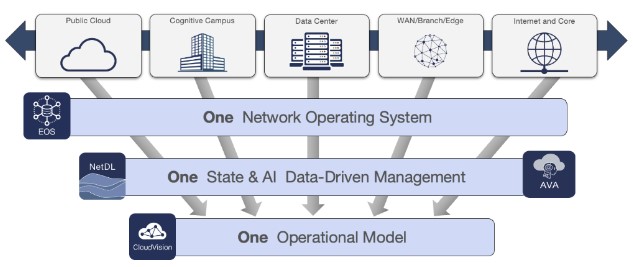
The key benefits of our cloud networking solutions are as follows:
Capacity, Performance and Scale
Our data-driven cloud networking platforms enable data center networks to scale to hundreds of thousands of physical servers and millions of virtual machines with the least number of switching tiers. We achieve this by leveraging standard protocols, non-blocking switch architectures and EOS to meet the scale requirements of cloud computing. We architect active-active Layer 2 and Layer 3 network topologies to enable customers to build extremely large and resilient networks.
Emerging capabilities including recent developments related to AI will continue to place increased demands on networking infrastructure. Arista’s strategic commitment to using merchant silicon is also a key competitive differentiator for Arista in addressing these capacity demands. Merchant silicon not only provides the best price/performance available but allows Arista to bring next generation platforms to market early, allowing customers to benefit from Moore’s Law.
Availability
Networks are only useful when they are available. Arista’s modular EOS architecture and software testing innovations provide features and network designs that keep the network available even during maintenance and upgrades. EOS publish-subscribe architecture provides self-healing resiliency through live patching, upgrades, fault isolation and containment and graceful process restart to reduce maintenance windows and allow for intelligent insertion and removal of network elements.
Openness and Programmability
Customers demand open, standards-based networking that avoids vendor lock-in and enables third-party integration to support best in-class technology ecosystems. Arista EOS, built on Linux, features open standard protocols, such as Border Gateway Protocol ("BGP") and Ethernet VPN ("EVPN"), offering interoperable solutions. Our well-structured set of APIs and EOS Software Development Kit ("SDK") as well as multiple DevOps integrations, enable enterprises to automate networking provisioning without manual intervention. EOS also natively supports Ansible, CFEngine, Chef, Puppet, virtual network orchestration applications and third-party management tools.
Visibility
Monitoring network performance in real time is a core need for current and next-generation architectures to run dependably. Arista EOS and CloudVision bring a modern approach to network telemetry and a replacement for legacy polling mechanisms. CloudVision analytics engines and CloudVision telemetry apps leverage the state streaming infrastructure of EOS and NetDL to give Arista customers an unprecedented level of visibility into their network operations.
Arista EOS also supports multiple telemetry tracers that bring deeper workload-level visibility by integrating with distributed applications like big data, cloud, container and virtualized environments.
Security
Arista focuses on building security into the networking layers through features native to EOS, such as segmentation and encryption, and network access control and NDR powered by AI. Most importantly, Arista’s integrated security toolset uses the underlying network infrastructure from switches to WAN routers to deliver key security capabilities and integrates seamlessly with the organization’s existing security program and tools.
Operational Efficiency
Automation is critical to delivering operational efficiency and Arista has taken the lessons learned from building large public clouds and engineered network automation into our CloudVision management platform. CloudVision eliminates burdensome manual tasks so organizations can become more agile in making changes to network infrastructure. Fewer manual configurations enable faster time to service and improved availability for our customers. Our open APIs enable standards-based integration with third-party tools as well, supporting additional automation capabilities.
Total Cost of Ownership
We believe our programmable, scalable leaf-spine architectures, combined with our applications, significantly reduce networking costs when compared to legacy network designs, enabling faster time to service and improved availability. Our automation tools reduce the operational costs of provisioning, managing and monitoring a data center network and speed up service delivery. Our tools provide visibility into complex network environments without the need for additional data collection equipment.
Cognitive Campus Solutions
Arista’s Cognitive Campus is based on a data driven architecture and offers consistent, unified management across the campus edge for wired and wireless networks as well as integrated security & proactive network assurance. Our Cognitive Campus networking solutions are based on three pillars:
Universal Networking - Customers want a network that minimizes planned and unplanned downtime. Arista delivers that through capabilities such as smart software upgrades that can update a switch to a new version of code without taking an outage. Moreover, Arista’s standards-based offerings minimize the learning curve for operators both in the wired and the wireless space.
Zero Touch Operations - Arista’s solutions are designed from the ground up for real-time telemetry, automation, and AI for networking based on our unified network data lake architecture. As a result, customers can achieve faster deployment to new locations and lower their cost of network operations.
Zero Trust Network - Arista delivers a combination of capabilities that help customers secure their campus networks, from controlling who can get on the network via network access control ("CloudVision AGNI") to detecting threats using network detection and response ("Arista NDR") or wireless intrusion prevention. Arista also provides identity-based micro segmentation ("Arista MSS") to ensure the zero trust posture extends to every critical asset within the organization.
Our Competitive Strengths
We believe the following strengths will allow us to maintain and extend our technology leadership position in data-driven cloud networking and next-generation data center and campus workspace Ethernet products:
Purpose-Built Cloud Networking Platform
We have developed a highly scalable cloud networking platform that uses software to address the needs of large-scale cloud companies, cloud service providers, and large enterprises, including AI, virtualization, big data and low-latency applications. As a result, our cloud networking platform does not have the inherent limitations of legacy network architectures.
Broad and Differentiated Portfolio
Using multiple merchant silicon architectures, we deliver switches, capable of routing, with industry-leading capacity, low latency, port density and power efficiency, and have innovated in areas such as deep packet buffers, highly available modular hardware, and reversible cooling options. Our broad portfolio has allowed us to offer customers products that best match their specific requirements.
Single Binary Image Software
The single binary image of EOS software allows us to maintain feature consistency across our entire product portfolio and enables us to introduce new software innovations into the market that become available to our entire installed base without a “forklift upgrade” (i.e., a broad upgrade of the data center infrastructure).
Rapid Development of New Features and Applications
Our highly modular EOS software has allowed us to rapidly deliver new features and applications while preserving the structural integrity and quality of our network operating system. We believe our ability to deliver new features and capabilities more quickly than legacy switch/router operators provides us with a strategic advantage given that the requirements in cloud and next-generation data center and campus networking continue to evolve rapidly.
Deep Understanding of Customer Requirements
We have developed close working partnerships with many of our largest customers that provide us with insights into their needs and future requirements. This has allowed us to develop and deliver products to the market that meet customer demands and expectations as well as to rapidly grow sales to existing customers.
Strong Management and Engineering Team with Significant Data Center Networking Expertise
Our management and engineering team consists of networking veterans with extensive data center and campus networking expertise. Our Chief Executive Officer and Chairperson, Jayshree Ullal, has over 40 years of networking expertise from silicon to systems companies, and Kenneth Duda, our Founder, Chief Technology Officer and Director, leads our software development team including EOS. Our technical team also includes highly experienced leaders such as Hugh Holbrook, our Chief Development Officer, who leads our platform driven software engineering, and Andy Bechtolsheim, our Founder and Chief Architect, who was previously a founder and chief system architect at Sun Microsystems.
Significant Technology Lead
We believe that our networking technology represents a fundamental advance in networking software. Our EOS software is a key cloud networking software stack that is state-driven and a result of tremendous research and development efforts.
Our Products and Services
Our portfolio of products and services are grouped into the following three categories:
Core Data center/Cloud/AI
Arista offers one of the broadest product portfolios of data-driven, high-speed, cloud and data center Ethernet switches. Built on top of the superior quality and openness of Arista EOS, we deliver high performance, industry-leading capacity, ultra-low latency, rich features, and powerful efficient solutions to meet our customers’ demand for capacity and network speeds for both front-end and back-end storage, compute and AI zones. Our core switching portfolio contains both fixed and modular form factors, varying port configurations and densities, and options in power delivery all driven by customer requirements.
The Arista Etherlink AI portfolio of 800G switches, coupled with Arista's EOS innovations such as AI Analyzer along with optimal load balancing solutions, offer compelling solutions for contemporary AI applications and deployment. Arista also continues to be innovative in such areas as deep packet buffer architectures, virtual output queuing, non-disruptive upgrades, embedded optics and next-generation optics, reversible cooling and overall system power efficiency. The Arista 7800R AI Spine, 7060 AI Leaf and the Distributed Etherlink Switch ("DES") are designed to address the demanding scale and performance requirements driven by large-scale AI networks. Arista also provides solutions for compute, GPU and storage interconnects in driving AI/ML workloads, leveraging its IP/Ethernet switches to deliver unparalleled performance and scalability.
The Arista 7700R4 DES is an ultra-scalable, intelligent distributed system engineered to meet the rigorous demands of large-scale AI and machine learning ("ML") environments. Building upon the foundations of the 7800R4 series, the 7700R4 DES delivers strong performance and scalability for accelerated computing. The Arista 7700R4 represents a significant advancement in networking technology, offering a robust and scalable solution tailored for the most demanding AI and ML workloads. Its combination of high throughput, deterministic performance, and advanced congestion management makes it an ideal choice for organizations aiming to build or expand their AI infrastructure.
AI workloads require optimized performance and availability at all times, to minimize job completion time and thus maximize utilization of expensive XPU accelerators. The EOS-based AI Agent can reside either directly on a SmartNIC or on a server CPU, to provide local configuration management of NICs along with streaming telemetry of NIC performance fed to directly-attached Arista EOS-based switches. This ensures the QoS parameters for AI optimization are consistently applied from the NIC to the network alike, to avoid misconfigurations which might cause performance bottlenecks without an easy-to-diagnose root cause. And with telemetry data spanning the AI NICs and the AI networking platforms, the network operations team can have comprehensive visibility into the entire traffic path with immediate insight into performance and problems.
Cognitive Adjacencies
Cognitive Campus Switching - Arista’s Cognitive Campus switching products, powered by EOS, offer consistent, unified management across the campus edge for wired and wireless networks as well as integrated security & proactive network assurance. Our campus products include the Arista 7300 Series spine/Spline™, 720/750 Series POE switches, and a broad range of indoor and outdoor Cognitive Wi-Fi Access Points.
Cloud-Grade Routing - Arista’s Cloud-Grade Routing platforms, powered by EOS, combine high performance routing, high port density, deep buffers, integrated DWDM and wire speed encryption. Our 7280R3 Universal Leaf and 7500R3 and 7800R3 Universal Spine platforms serve a variety of use cases including high speed multi-cloud connect, Data Center Interconnect (DCI), controller-based traffic engineering, peering, business VPNs, core routing and Secure Enterprise edge routing.
WAN Routing- The Arista AWE-7200R Series of WAN Routing System, purpose built by Arista and powered by Arista EOS, offers high performance and scale to meet enterprise modern WAN edge and aggregation requirements. We believe the Arista AWE-7200R Series sets the standard for aggregation and critical site interconnect by supporting 1/10/100GbE interfaces and flexible network modules. It delivers from 1Gb to over 50Gb of bidirectional AES256 encrypted traffic with high VRF and tunnel scale.
Networking Software and Services
Our software and services are based on subscription-based models and include the following offerings:
CloudVision - CloudVision is Arista’s modern, multi-domain management platform that leverages cloud networking principles to deliver a simplified end-to-end network operations experience for our Enterprise market. Unlike traditional domain-specific management solutions, CloudVision enables consistent zero touch network operations across data center, campus wired and wireless, routing interconnect and multi-cloud networks helping to break down the complexity of siloed management approaches.
CloudVision is built on Arista’s NetDL architecture and leverages real-time network state to provide an abstraction of the physical network to a broader, network-wide perspective allowing for a more efficient approach for several operational and network telemetry capabilities.
Arista A-Care Services - We have designed our customer support offerings, Arista A-Care Services, to provide our customers with high levels of support. Our global team of support engineers engages directly with client IT teams and is always available over e-mail, by phone or through our website.
We offer multiple service options that allow our customers to select the product replacement service level that best meets their needs. We stock spare parts in over 200 locations around the world through our third-party logistics suppliers. All our service options include unlimited access to bug-fixes, new-feature-releases, online case management and our community forums.
DANZ Monitoring Fabric (DMF) - DANZ Monitoring Fabric ("DMF") is a next-generation network packet broker (NPB) architected for pervasive, organization-wide visibility and security, delivering multi-tenant monitoring-as-a-service. Leveraging Arista's high-performance and versatile Ethernet switch platforms with DMF, IT operators can pervasively monitor all user, device/IoT and application traffic (north-south and east-west) by gaining complete visibility into physical, virtual and container environments. Deep hop-by-hop visibility, predictive analytics, contextual insights and scale-out packet capture, integrated through a single dashboard, enables simplified network performance monitoring ("NPM") and SecMon workflows for real-time and historical context across production data centers, enterprise campus/branch and 4G/5G mobile networks.
Arista Guardian Network Identity (AGNI) - To overcome the new security challenges and the explosion of clients in today’s perimeter-less enterprise networks, Arista delivers a novel AI-driven network Identity service, Arista Guardian for Network Identity (AGNI) to connect the network, users, and devices across remote and geographically dispersed locations. Based on Arista’s flagship CloudVision, the new AGNI platform brings scale, simplicity, and security across users, their associated endpoints, and IoT devices. AGNI integrates with Arista NDR and other third-party XDR and EDR solutions for post-admission control functionality.
Arista's AI-driven Network Detection and Response (NDR) - An AI-driven Security Platform, powered by AVATM, Arista NDR analyzes billions of network communications to autonomously discover, profile and classify every device, user, and application across perimeter, core, IoT, and cloud networks. Based on this deep understanding of the attack surface, the platform then detects threats to and from these entities, while providing the context necessary to respond rapidly.
CloudEOS™ - CloudEOS is Arista’s multi-cloud and cloud-native networking solution supporting autonomic operation to deliver an enterprise-class, highly secure, and reliable networking experience for any cloud. As part of the Arista EOS and CloudVision product family, it delivers consistent segmentation, automation, telemetry, provisioning and troubleshooting for the enterprise edge, WAN, campus, data center and multiple public and private clouds. To provide a scalable and automated network experience, CloudEOS integrates with Arista CloudVision to simplify the operator's experience of interconnecting and managing multi-cloud, cloud-native and on-premises enterprise networks.
CloudEOS is designed for consumption on Amazon AWS, Microsoft Azure, and Google public clouds via their marketplace and service catalogs.
Sales and Marketing
We market and sell our products through our direct sales force and in partnership with our channel partners, including distributors, value-added resellers, systems integrators and original equipment manufacturer ("OEM") partners. We also sell in conjunction with various technology partners. To facilitate channel coordination and increase productivity, we have created a partner program, the Arista Partner Program, to engage partners who provide value-added services and extend our reach into the marketplace. Authorized training partners perform technical training of our channel partners and end customers. Our partners commonly receive an order from an end customer prior to placing an order with us, and we confirm the identification of the end customer prior to accepting such orders. Our partners generally do not stock inventory received from us.
Our sales organization is supported by systems engineers with deep technical expertise and responsibility for pre-sales technical support and solutions engineering for our customers, systems integrators, OEMs, and channel partners. In general, the personnel in our sales organization are formed into teams, and each team is responsible for a geographical territory, has responsibility for a number of major direct end-customer accounts or has assigned accounts in a specific vertical market. A pool of shared channel sales and marketing representatives also supports these teams.
Our marketing activities consist primarily of technology conferences, webinars, web marketing, trade shows, product demonstrations, seminars and events, public relations, analyst relations, demand generation and direct marketing to build our brand, increase end-customer awareness, communicate our product advantages and generate qualified leads for our field sales force and channel partners.
Seasonality
We operate on a December 31st year end and typically have lower sequential quarter over quarter revenue growth in the first quarter of each fiscal year, often followed by stronger sequential revenue growth in the ensuing quarters. We believe that this seasonality results from a number of factors, including the procurement, budgeting and deployment cycles of many of our customers. The effects of recent supply chain disruptions and our rapid growth may have reduced the impact of seasonal or cyclical factors that might otherwise have influenced our business and broader industry performance. If our growth rates slow, seasonal or cyclical variations in our operations may become more pronounced over time and may materially affect our business, financial condition, results of operations and prospects. In addition, any supply chain shortages and manufacturing disruptions that result in extended lead times may impact our ability to manufacture and ship products to our customers in a timely manner, which may disrupt typical seasonal trends.
Research and Development
Our success relies on the timely enhancement of existing products and the development of new solutions and features to address changing customer needs and technological advancements. Our in-house engineering personnel are responsible for the development, testing, documentation, support and release of our products. We have a highly skilled team of software and hardware engineers with extensive experience in wired and wireless networking technologies, network protocols, network security, operating systems, programming languages, compilers, databases, hardware system design, Field-Programmable Gate Array programming, high-speed signal integrity, and other related technologies.
Our research and development strategy focuses on advancing our core products and expanding into new markets while maintaining high product quality. We are focusing research and development efforts in (1) adapting EOS for new and existing silicon architectures, especially to support the unique requirements of AI workloads; (2) adding or enhancing EOS control plane and management plane functionality; (3) expanding our CloudVision management stack with enhanced automation, provisioning, monitoring, and security capabilities; (4) building related services, such as NDR and Network Access Control (NAC); (5) improving the security and scalability of our software development infrastructure and software supply chain; and (6) maintaining high product quality throughout. We have dedicated significant time and resources in test automation, ensuring high test pass rates, and working with our support group whenever customers experience technical defects in our products. Collaboration with customers and other industry leaders is integral to our approach, though uncertainties persist regarding the successful development and market acceptance of emerging technologies. Looking ahead, we plan to continue to invest in resources to conduct our research and development efforts to evolve and extend our portfolio's capabilities, ensuring our products continue to address dynamic market needs and solidify our industry leadership.
Manufacturing
We subcontract the manufacturing of the majority of our products to various contract manufacturers. Our primary manufacturing partners are Jabil Inc., Sanmina Corporation, Flex Ltd. and Foxconn Hon Hai. These partners manufacture our products internationally in Malaysia, Vietnam, Mexico and other countries. We require all our manufacturing locations to be ISO-9001 certified. After manufacturing and testing, the products are shipped to direct fulfillment facilities in the United States, the Netherlands and Singapore for further transformation as needed and distribution. We have four direct fulfillment facilities worldwide to hold finished goods inventory and perform final product configuration and shipping to customers and partners. After distribution, our products are installed by the customers or by third-party service providers such as system integrators or value-added resellers on their behalf.
Our contract manufacturing partners procure components needed to build our products and assemble our products according to our design specifications. This allows us to leverage the purchasing power of our contract manufacturing partners. We retain complete control over the bill of materials, qualified component suppliers, test procedures and quality assurance programs. Our personnel work closely with our partners and review on an ongoing basis forecasts, inventory levels, processes, capacity, yields and overall quality. Our contract manufacturing partners procure components and assemble our products based on our demand forecasts. These forecasts represent our estimates of future demand for our products based upon historical trends and analyses from our sales and product management functions as adjusted for overall market conditions. For example, when industry-wide supply chain shortages resulted in extended lead times for components, we were required to extend the time horizon of our demand forecasts and increase our purchase commitments for long lead time components.
Our products rely on key components, including merchant silicon, integrated circuit components and power supplies purchased from a limited number of suppliers, including certain sole source providers. We may also see increased consolidation among our component suppliers. In particular, we are primarily reliant upon our predominant merchant silicon vendor,
Broadcom, for our switching chips. Generally, neither we nor our contract manufacturers have a written agreement with these component providers to guarantee the supply of the key components used in our products, nor do we have exclusive rights to such key components, and our suppliers could suffer shortages, delay shipments, prioritize shipments to other vendors, increase prices or cease manufacturing such products or selling them to us at any time. The supply of components may also be adversely affected by geopolitical conditions such as escalating tariff and non-tariff trade measures imposed by the U.S., Mexico, China and other countries present in our supply chain.
Our product development efforts also depend upon continued collaboration with our key suppliers such as Broadcom. As we develop our product roadmap and continue to expand our relationships with these and other merchant silicon vendors, it is critical that we work in tandem with our key merchant silicon vendors to ensure that their silicon includes improved features and that our products take advantage of such improved features. This enables us to focus our development resources on software core competencies and to leverage the investments made by merchant silicon vendors to achieve cost-effective solutions.
Competition
The markets in which we compete are highly competitive and characterized by rapidly changing technology, changing end-customer needs, evolving industry standards, frequent introductions of new products and services and industry consolidation. We expect competition to intensify in the future as the market for cloud and AI networking expands and existing competitors and new market entrants introduce new products or enhance existing products.
The data center and campus networking markets have been historically dominated by Cisco, with competition also coming from other large network equipment and system vendors, including Dell/EMC, Extreme Networks, Hewlett Packard Enterprise, Huawei, Juniper Networks, Nvidia, and white box networking vendors utilizing open-source operating systems. Most of our competitors and some strategic alliance partners have made acquisitions and/or have entered into or extended partnerships or other strategic relationships to offer more comprehensive product lines, including cloud networking solutions. For example, Broadcom has acquired VMware and Hewlett Packard Enterprises has entered into an agreement to acquire Juniper Networks.
With the emergence of AI networking, new competitive technologies may enter the market to address the requirements of AI clusters. Ethernet, today, faces competition from both InfiniBand ("IB") and NV Link interconnects for back-end AI networking clusters. IB has traditionally been used in supercomputer clusters due to its high reliability, low latency and high bandwidth. Both IB and NV Link are often sold as part of a vertical solution along with the GPUs from Nvidia.
We also face competition from other companies and new market entrants, current technology partners and customers who may acquire or develop network switches and cloud service solutions for internal use and/or to broaden their portfolio of products to market and sell to customers. Some of these competitors are developing "white box" networking products based on open-source network operating systems that may be provided for free and off-the-shelf or commoditized hardware technology, or “white box” hardware, while other competitors may adopt a disaggregated approach to the procurement of hardware and their proprietary software. The entrance of new competitors into our markets or the increased adoption of these new technology solutions or consumption models may cause downward pricing pressures, result in lost sales or otherwise have a material adverse effect on our business, prospects, financial condition and operating results.
In the NDR market, our Arista NDR offerings compete with other network security vendors including Cisco, Darktrace, and ExtraHop. In the network packet broker ("NPB") market, Arista DANZ Monitoring Fabric ("DMF") competes with Cisco, Gigamon, Keysight, Netscout and other network monitoring software providers.
Our relationships with our strategic alliance partners or suppliers may also shift as industry dynamics change. If strategic alliance partners acquire or develop competitive products or services, our relationship with those partners may be adversely impacted, which could lead to more variability to our results of operations and impact the pricing of our solutions.
The principal competitive factors applicable to our products include:
-
breadth of product offerings and features;
-
reliability and product quality;
-
ease of use;
-
pricing;
-
total cost of ownership, including automation, monitoring and integration costs;
-
performance and scale;
-
programmability and extensibility;
-
interoperability with other products;
-
ability to be bundled with other vendor offerings;
-
product availability and shipment lead times; and
-
quality of service, support and fulfillment.
We believe our products compete favorably with respect to these factors. Our EOS software offers high reliability, integrates with existing network protocols and is open and programmable. We believe the combination of EOS, a set of network applications and our 1/2.5/5/10/25/40/50/100/200/400/800 Gigabit Ethernet platforms make our offering highly competitive for both cloud and enterprise data centers. However, many of our competitors have greater name recognition, longer operating histories, larger sales and marketing budgets and resources, broader distribution and established relationships with channel partners and end customers, greater access to larger customer bases, greater customer support resources, greater manufacturing resources, the ability to leverage their sales efforts across a broader portfolio of products, the ability to leverage purchasing power when purchasing subcomponents, the ability to bundle competitive offerings with other products and services, the ability to develop their own silicon chips, the ability to set more aggressive pricing policies, lower labor and development costs, greater resources to make acquisitions, larger intellectual property portfolios and substantially greater financial, technical, research and development or other resources.
Intellectual Property
Our success and ability to compete depend substantially upon our core technology and intellectual property. We rely on patent, trademark and copyright laws, trade secret protection and confidentiality agreements with our employees, customers, resellers, systems integrators, manufacturers, and others to protect our intellectual property rights. We file U.S and foreign patent applications to protect our intellectual property and believe that the duration of our issued patents is adequate relative to the expected lives of our products. Patents generally have a duration of twenty years from filing. The remaining duration on the individual patents in our patent portfolio varies.
We cannot assure that any of our patent applications will result in the issuance of a patent or whether the examination process will result in patents of valuable breadth or applicability. In addition, any patents that may be issued may be contested, circumvented, found unenforceable or invalidated, and we may not be able to prevent third parties from infringing upon them. We also license software from third parties for integration into our products, including open-source software and other software available on commercially reasonable terms. We own a number of trademarks in the U.S. and other jurisdictions, and Arista, EOS, and CloudVision are among our core trademarks.
We control access to and use of our software, technology and other proprietary information through internal and external controls, including contractual protections with employees, contractors, customers and partners. Our software is protected by U.S. and international copyright, patent and trade secret laws. Despite our efforts to protect our software, technology and other proprietary information, unauthorized parties may still copy or otherwise obtain and use our software, technology and other proprietary information. In addition, we intend to expand our international operations, and effective patent, copyright, trademark and trade secret protection may not be available or may be limited in foreign countries.
Our industry is characterized by the existence of a large number of patents and frequent claims and related litigation regarding patent and other intellectual property rights. If we become more successful, we believe that competitors will be more likely to try to develop products that are similar to ours and that may infringe our proprietary rights. It may also be more likely that competitors or other third parties will claim that our products infringe their proprietary rights. In particular, large and established companies in our industry have extensive patent portfolios and are regularly involved in both offensive and defensive litigation. From time to time, third parties, including certain large companies and non-practicing entities, may assert patent, copyright, trademark and other intellectual property rights against us, our channel partners or our end customers, whom our standard license and other agreements obligate us to indemnify against such claims.
Successful claims of infringement by a third-party, if any, could prevent us from distributing certain products or performing certain services, require us to spend time and money to develop non-infringing solutions or force us to pay
substantial damages, royalties or other fees. We cannot assure that we do not currently infringe, or that we will not in the future infringe, upon any third-party patents or other proprietary rights.
Human Capital Management
At Arista, we seek to maintain an environment that is open, diverse and inclusive, and where our people feel valued, included and accountable. One of our key principles is always doing the right thing for our employees. We are committed to maintaining the highest level of professional and ethical standards in the conduct of our business around the world. As of December 31, 2024, we employed approximately 4,412 full-time employees worldwide. None of our employees are represented by unions. We consider our relationship with our employees to be good and have not experienced significant interruptions of operations due to labor disagreements.
Arista is proud to have been recognized in November 2024 by Forbes magazine as one of America’s Best Companies to Work & Invest For as well as by Time Magazine as one of the World’s Best Companies.
Inclusion, Diversity and Equal Employment
We seek to maintain an environment that is open, diverse and inclusive, and where our employees feel valued. We believe that diverse and inclusive teams enhance individual and company performance and help us attract and retain talent. We strive to build an inclusive culture that encourages, supports and celebrates the diverse voices of our employees. As part of the Arista way, we believe in treating peers with respect, mentoring individuals and developing teams for overall success.
We are proud to be one of a few S&P 500 companies with both a female CEO and CFO. We were also recognized by Comparably in 2024 amongst the best large companies for culture, happiness, leadership and career growth as well as compensation. 50% of our board of directors are women or underrepresented minorities. Arista also supports inclusion through mentorship opportunities for our employees which are offered through Women@Arista, one of our employee resource groups; support of numerous under-represented employee affinity organizations; and active recruiting from historically black colleges and universities, women’s colleges and Hispanic/Latinx and African-American professional societies and job fairs.
We affirm the principle of equal employment opportunity without regard to any protected characteristic, including but not limited to race, religion, national origin, color, gender, age, disability, pregnancy, marital status, ancestry, military status or sexual orientation. We practice and promote such policies in all locations as appropriate under applicable law. We affirm this principle of freedom from discrimination in all aspects of the employment relationship from recruitment and hiring, through performance evaluations, compensation and promotions. At Arista, we believe that all employees should be treated with dignity and respect.
Health and Safety
Arista is committed to protecting the health and safety of our employees, visitors, and the public. Our health and safety policy is to maintain our facilities and run our business operations in a manner that does not jeopardize the occupational health and safety of employees. We have implemented our injury and illness prevention program to protect employees from occupational risks of injury or illness.
Compensation and Benefits
We provide competitive and comprehensive benefit packages that are designed to help and empower employees to make the best decisions for themselves, their family and their lifestyle. In the United States, we offer our employees an employee stock purchase plan, healthcare and retirement benefits, paid time off and family leave, flexible time away, family planning benefits, backup resources for childcare and elder care, and other employee assistance programs including behavioral health and emotional support assistance. In addition to base salary and benefits, Arista’s employees participate in stock and bonus incentive plans that support our organizational philosophy of allowing employees to share in our performance and success. We are committed to paying our employees fairly and equitably and regularly and work with a third party to identify and resolve any gaps. Our executive compensation program is designed to attract, retain, and reward performance and align incentives with the achievement of Arista’s strategic plan and both short- and long-term operating objectives. Our compensation committee provides an oversight of our compensation policies, plans, benefit programs and overall compensation philosophy.
Along with our traditional healthcare benefits, Arista offers a broad variety of physical and mental wellness offerings to our global employees in a virtual as well as on-demand format, including fitness classes, webinars on practical wellness takeaways, strategies for stress reduction, financial planning and education, career development and social activities. We also
host periodic wellness weeks, whose purpose is to raise awareness on health issues, increase education on preventive medicine and available services and shift employee behavior through interactive activities and live presentations. We proudly support an active community employee engagement program, which provides opportunities for our employees to engage in volunteering and community service in support of the communities they live, work, and thrive in. We employ a hybrid work model for designated roles, giving our employees the flexibility to work offsite or onsite and regularly survey our employees to gain valuable feedback and suggestions on improvements to our culture and strategy. Arista was recognized in 2024 by Most Loved Workplace as a Most Loved Workplace for Wellness and Volunteering.
Employee Training, Development and Upskilling
Our employees receive regular periodic training on numerous subjects, including our Code of Ethics and Business Conduct, information security, data privacy, intellectual property, insider trading, and anticorruption. In addition, Arista provides extensive training and accreditation opportunities to employees in Sales, Customer Engineering and Software Research and Development roles including our Arista Certified Engineering ("ACE") certification program as well as mentorship programs sponsored by our Women@Arista employee resource group. Additional career development content including management and AI training is available through our E-Learning portal to facilitate a culture of lifelong learning and allow employees to personalize their development. Our Technical employees can further upskill through our internal Arista PREP Training Program, technical summits, and participation in industry conferences or associations.
Available Information
Our website is located at www.arista.com and our investor relations website is located at investors.arista.com. Our Annual Reports on Form 10-K, Quarterly Reports on Form 10-Q, Current Reports on Form 8-K and amendments to reports filed or furnished pursuant to Sections 13(a) and 15(d) of the Securities Exchange Act of 1934, as amended (“Exchange Act”), are available free of charge on the Investors portion of our website as soon as reasonably practicable after we electronically file such material with, or furnish it to, the Securities and Exchange Commission ("SEC"). The SEC maintains an Internet site that contains reports, proxy and information statements, and other information regarding issuers that file electronically with the SEC at www.sec.gov.
Webcasts of our earnings calls and certain events we participate in or host with members of the investment community are on our investor relations website. Additionally, we announce investor information, including news and commentary about our business and financial performance, SEC filings, notices of investor events, and our press and earnings releases, on our investor relations website. Investors and others can receive notifications of new information posted on our investor relations website in real time by signing up for email alerts and RSS feeds. Further corporate governance information, including our corporate governance guidelines, board committee charters, and code of conduct, is also available on our investor relations website under the heading “Governance.” The contents of our websites, or information that can be accessed through our websites, are not incorporated by reference into this Annual Report on Form 10-K or in any other report or document we file with the SEC, and any references to our websites are intended to be inactive textual references only.
Item 1A. Risk Factors
You should consider carefully the risks and uncertainties described below, together with all of the other information in this Annual Report on Form 10-K, which could materially affect our business, financial condition, results of operations and prospects. The risks described below are not the only risks facing us. Risks and uncertainties not currently known to us or that we currently deem to be immaterial may also materially affect our business, financial condition, results of operations and prospects.
Risk Factors Summary
Our business is subject to numerous risks and uncertainties. These risks include, but are not limited to, the following:
Risks Related to Our Business and Industry
-
large purchases by a limited number of customers represent a substantial portion of our revenue;
-
adverse economic conditions, continuing uncertain economic conditions or reduced information technology and network infrastructure spending may adversely affect our business;
-
some key components in our products come from sole or limited sources of supply and increases the risk of supply shortages, extended lead times or supply changes;
-
our revenue and revenue growth rates are volatile and may decline or not meet our or our investor's expectations;
-
our results of operations may vary significantly from period to period and can be unpredictable;
-
the networking market is rapidly evolving;
-
failure to successfully carry out new product and service offerings and expand into adjacent markets could adversely impact our business;
-
we expect our gross margins to vary over time and may be adversely affected by numerous factors;
-
we face intense competition and industry consolidation;
-
we are subject to risks associated with the expansion of our international sales and operations;
-
we face risks associated with the investments in and acquisitions of complementary companies, products or technologies;
-
seasonality and industry cyclicality may cause fluctuations in our revenue;
-
fluctuations in currency exchange rates could adversely affect our business;
-
failure to raise additional capital on favorable terms could harm our business.
Risks Related to Customers and Sales
-
inability to attract new large customers or sell additional products and services to our existing customers could adversely affect our revenue growth;
-
sales of our switches generate most of our product revenue;
-
large customers require more favorable terms;
-
inability to increase market awareness or acceptance of our new products and services may adversely affect our revenue;
-
sales prices of our products and services may decrease;
-
sales cycles can be long and unpredictable;
-
inability to offer high quality support and services could adversely affect our business;
-
declines in maintenance renewals by customers could harm our business;
-
indemnification provisions under our standard sales contracts could expose us to losses;
-
we rely on distributors, systems integrators and value-added resellers to sell our products;
-
sales to government entities are subject to a number of challenges and risks;
-
we are exposed to the credit risk of our channel partners and some of our end customers.
Risks Related to Products and Services
-
product quality problems, defects, errors or vulnerabilities could harm our business;
-
failure to anticipate technological shifts could harm our business;
-
our products must interoperate with operating systems, software applications and hardware that is developed by others.
Risks Related to Supply Chain and Manufacturing
-
managing the supply of our products and product components is complex;
-
primarily reliant upon a predominant merchant silicon vendor;
-
we depend on third-party manufacturers to build our products;
-
future sales forecasts may materially change, which could result in incorrect levels of inventory and purchase commitments;
-
shipment interruptions or delays could cause our revenue to fall.
Risks Related to Intellectual Property and Other Proprietary Rights
-
assertions by third parties of intellectual property rights infringement, misappropriation or other violation could harm our business;
-
failure or inability to protect or assert our intellectual property rights could harm our competitive position;
-
we rely on the availability of licenses to third-party software and other intellectual property;
-
failure to comply with licenses to software and other technology could restrict our ability to sell our products;
-
our competitors could develop products that are similar to or better than ours because we provide access to our software and selected source code to certain partners.
Risks Related to Litigation
- we may become involved in litigation that may materially adversely affect us.
Risks Related to Cybersecurity and Data Privacy
-
defects, errors or vulnerabilities in our products, failure of our products to detect security breaches or incidents, misuse of our products or risks of product liability could harm our business;
-
breaches of our cybersecurity systems or other security breaches could degrade our ability to conduct our business operations and deliver products and services to our customers, cause vulnerabilities in our products and services or subject us to regulatory enforcement actions and or fines or liabilities for damages incurred by our customers or partners.
Risks Related to Accounting, Compliance, Regulation and Tax
-
failure to maintain effective internal control over financial reporting could adversely affect the accuracy and timing of our financial reporting;
-
if our critical accounting policies are based on incorrect assumptions, our results of operations could fall below analyst and investor expectations and result in a decline in the market price of our common stock;
-
enhanced U.S. tax, tariff, import/export restrictions, Chinese regulations or other trade barriers may negatively affect our business;
-
changes in our income taxes, effective tax rate or tax laws could adversely affect our results;
-
failure to comply with government laws and regulations could harm our business;
-
issues in the development and use of artificial intelligence, combined with an uncertain regulatory environment, may result in reputational harm, liability, or other adverse consequences to our business operations;
-
we are subject to governmental export and import controls that could impair our ability to compete in international markets or subject us to liability for violations.
-
failure to comply with anti-bribery and anti-corruption laws and anti-money laundering laws, and similar laws, could subject us to penalties and other adverse consequences.
Risks Related to Ownership of Our Common Stock
-
the trading price of our common stock has been and may continue to be volatile and the value of your investment could decline;
-
any future decisions to reduce or discontinue repurchasing our common stock pursuant to our stock repurchase program could cause the market price of our common stock to decline;
-
sales of substantial amounts of our common stock could reduce the market price of our common stock;
-
insiders have substantial control over us;
-
our charter documents and Delaware law could discourage takeover attempts and lead to management entrenchment.
General Risks
-
inability to hire, retain, train and motivate qualified personnel and senior management could cause our business to suffer;
-
earthquakes, fire, power outages, floods, health epidemics and other catastrophic events could harm our business;
-
we have not paid dividends in the past and do not intend to pay dividends for the foreseeable future.
Risks Related to Our Business and Industry
**We expect large purchases by a limited number of customers to continue to represent a substantial p****ortion of our revenue, and any loss, delay, decline or other change in expec
Showing the first 8K of 202K characters. Open the full section
Item 1B. Unresolved Staff Comments
Not applicable.
Item 1C. Cybersecurity
Cybersecurity Risk Management and Strategy
We have developed and implemented a cybersecurity risk management program intended to protect the confidentiality, integrity, and availability of our critical systems and information. In addition, our Legal and Information Technology (IT)/Information Security (IS) teams work together to oversee our compliance with applicable laws and regulations and coordinate with subject matter experts throughout our business to identify, monitor and mitigate risk including information security risk management and cyber defense programs.
Our cybersecurity risk management program is aligned with our overall enterprise risk management programs and shares common methodologies, reporting channels and governance processes that apply across the enterprise risk management programs to other legal, compliance, strategic, operational, and financial risk areas.
Our cybersecurity risk management program includes:
-
an information security management systems policy, including a business continuity policy, acceptable use and physical security policies, and an incident response policy and plan for responding to cybersecurity incidents, among others;
-
risk assessments designed to help identify material cybersecurity risks to our critical systems, information, products, services, and our broader enterprise IT environment;
-
a security team principally responsible for managing (1) our cybersecurity risk assessment processes, (2) our security controls, and (3) our response to cybersecurity incidents;
-
the use of internal audit teams and external service providers, where appropriate, to assess, test or otherwise assist with aspects of our security controls;
-
cybersecurity awareness, data protection, and privacy training of our employees, incident response personnel, and senior management; and
-
a vetting and management process for third party service providers, suppliers, and vendors
Through this program, our IT/IS team identifies and executes improvements based upon its own assessments, public cybersecurity events and the identification of new risks by third parties, including our external cybersecurity consultants. As part of these continuous improvement efforts, there may be times when the IT/IS team prioritizes certain cybersecurity fixes or program improvements over other measures, which could lead to new known or unknown risks being identified on an ongoing basis. Cybersecurity threat actors are often highly sophisticated and nimble in their attacks. Despite these efforts, we cannot guarantee that our priorities and efforts will prevent any cybersecurity incident from happening.
We also engage in periodic testing programs, using both internal assets and external consultants, including penetration testing, and incorporate multiple layers of physical, logical and written controls into our cybersecurity risk management program. Our IT/IS team leverages centralized identity management, encryption configurations and technologies on the systems, devices, and third-party connections used in our operations.
We also maintain cyber liability insurance coverage. While we currently hold such coverage, we cannot be certain that our insurance coverage will be adequate for liabilities actually incurred, that insurance will continue to be available to us on economically reasonable terms, or at all, or that any future claim will not be excluded or otherwise be denied coverage by any insurer.
As of the date of this report, we have not identified any risks from cybersecurity threats, including as a result of any previous cybersecurity incidents, that we believe have, or are likely to, materially affect us, our business strategy, results of operations, or financial condition. For additional information concerning risks from cybersecurity threats, please refer to Item 1A, “Risk Factors,” in this annual report on Form 10-K, including the risk factors in the category entitled, “Risks Related to Cybersecurity and Data Privacy”.
Cybersecurity Governance
Our Board considers cybersecurity risk as part of its risk oversight function and has delegated to the Audit Committee (Committee) oversight of cybersecurity and other information technology risks. The Committee oversees management’s implementation of our cybersecurity risk management program. The Committee receives quarterly reports from our Vice
President and Chief Information Security Officer (CISO), in conjunction with other senior managers, on cybersecurity risks. In addition, these managers update the Committee, as necessary, regarding any material cybersecurity incidents, as well as incidents with lesser impact potential. The Committee reports to the full Board on cybersecurity no less frequently than once annually. The full Board also receives briefings from management on our cyber risk management program on a periodic basis.
Our cybersecurity program includes an annual funding and forecast process, and we have further established processes to secure additional funding in response to emerging risks, threats and identified improvement opportunities. Our IS team, led by one of our Vice Presidents who also serves as our CISO, is responsible for assessing and managing risks from cybersecurity threats. The IS team has primary responsibility for our overall cybersecurity risk management program and supervises both our internal cybersecurity personnel and our external cybersecurity consultants.
Our CISO has over 20 years of experience in the cybersecurity industry and has been instrumental in building several key security technologies, viz. Network Intrusion Prevention Systems (NIPS), Host Intrusion Prevention Systems (HIPS), Web Application Firewalls (WAF), Whitelisting, Endpoint/Server Host Monitoring (EDR) and Virtualization Based Security (VBS). Previously, our CISO served in senior executive and technical leadership roles in several security companies. In addition, our CISO has experience as a pen-tester and has in-depth knowledge of operating system, networking and security products. Our CISO holds a bachelor’s degree in computer science and a master’s degree in software systems. In addition, our IS team includes over 20 members each with experience in network security related roles, with the two IS leads reporting to our CISO each having more than 20 years of security experience.
Our management team, including our CISO in consultation with our Chief Technology Officer and Chief Financial Officer, supervises efforts to prevent, detect, mitigate, and remediate cybersecurity risks and incidents, which may include: briefings from internal security personnel; threat intelligence and other information obtained from governmental, public or private sources, including external cybersecurity consultants; and alerts and reports produced by security tools deployed in our IT environment. However, as indicated above, we cannot guarantee that our efforts will prevent any cybersecurity incident from occurring.
As part of our IT security program, our Cybersecurity Executive Committee and Information Security Steering Committee meet throughout the year to monitor and assess information security risks. In addition, we perform an enterprise risk assessment that is reviewed by the Committee and our Board of Directors on an annual basis and monitored on a quarterly basis by the Committee. The enterprise risk assessment is an assessment of key risks, including information security risks, data privacy, supply chain, human capital, and other risks.
Item 2. Properties
Our corporate headquarters are located in Santa Clara, California where we lease approximately 180,000 square feet of space under a lease agreement that expires in September 2026. During the year ended December 31, 2021, we purchased land and the improvements thereon in Santa Clara, California to construct a building for office, lab and data center space. In addition, we lease office spaces for data centers, operations, sales personnel and research and development in locations throughout the U.S. and various international locations, including Ireland, Canada, India, and Australia. We also lease data centers in the U.S., Ireland and Australia. We believe that our current facilities are adequate to meet our current needs and are being utilized by our business.
Item 3. Legal Proceedings
The information set forth under the “Legal Proceedings” in Note 5. Commitments and Contingencies of the Notes to Consolidated Financial Statements included in Part II, Item 8, of this Annual Report on Form 10-K is incorporated herein by reference.
Item 4. Mine Safety Disclosures
Not applicable.
PART II
Item 5. Market for Registrant’s Common Equity, Related Stockholder Matters, and Issuer Purchases of Equity Securities
Market Information
Our common stock is listed on the NYSE under the symbol “ANET”. As of February 12, 2025, there were 44 holders of record of our common stock. Because many of our shares of common stock are held by brokers and other institutions on behalf of stockholders, we are unable to estimate the total number of stockholders represented by these record holders.
Dividend Policy
We have never declared nor paid any cash dividends on our common stock, and we do not anticipate paying any cash dividends in the foreseeable future.
Stock Performance Graph
The following shall not be deemed “filed” for purposes of Section 18 of the Exchange Act, or incorporated by reference into any of our other filings under the Exchange Act or the Securities Act, except to the extent we specifically incorporate it by reference into such filing.
The following graph compares the cumulative total return of our common stock with the total return for the NYSE Composite Index and the Standard & Poor’s 500 Index (the “S&P 500”) from December 31, 2019 (the last trading day of the year) to December 31, 2024.
The graph assumes $100 was invested at the market close on December 31, 2019 in the Company’s common stock and in each of the aforementioned indices with the re-investment of dividends, if any. The stock price performance on the following graph is not necessarily indicative of future stock price performance.
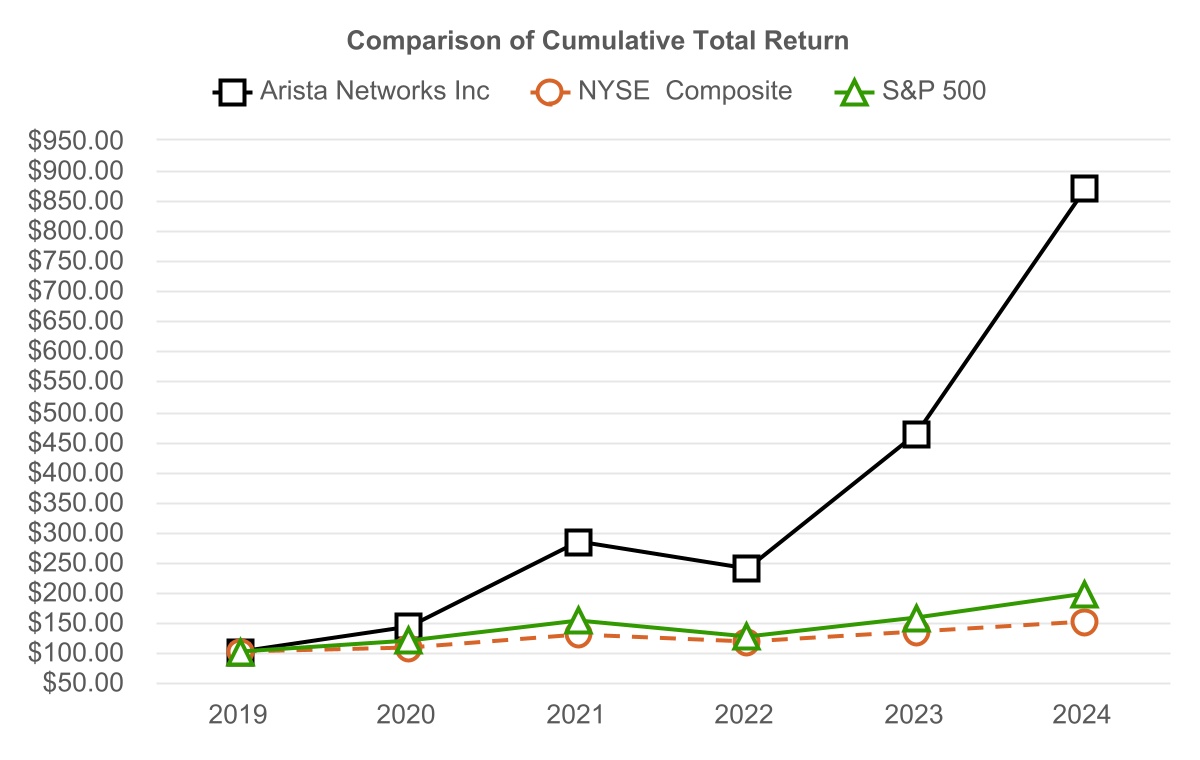
Securities Authorized for Issuance Under Equity Compensation Plans
Information about securities authorized for issuance under our equity compensation plans is provided in Note 6. Stockholders' Equity and Stock-Based Compensation of the Notes to Consolidated Financial Statements included in Part II, Item 8, of this Annual Report on Form 10-K.
Recent Sales of Unregistered Equity Securities
There were no sales of unregistered securities during fiscal year 2024.
Issuer Repurchases of Equity Securities
Under our equity incentive plans, certain participants may exercise options prior to vesting, subject to a right of repurchase by us. During the fourth quarter of 2024, there were no repurchases of unvested shares of our common stock made pursuant to our equity incentive plans as a result of us exercising our rights nor pursuant to any publicly-announced plan or program.
Stock Repurchase Program
From time to time, we repurchase shares of our common stock pursuant to the Repurchase Programs (as defined below) that are funded from working capital. In April 2024, we completed repurchases under our previous $1.0 billion stock repurchase program (the “Prior Repurchase Program”). In May 2024, our board of directors authorized and announced a new $1.2 billion stock repurchase program (the “New Repurchase Program” and together with the Prior Repurchase Program, the "Repurchase Programs"), which expires in May 2027. The Repurchase Programs do not obligate us to acquire any of our common stock, and may be suspended or discontinued by the company at any time without prior notice. During the year ended December 31, 2024, we repurchased a total of $279.0 million of our common stock under our New Repurchase Program and $144.6 million of our common stock under our Prior Repurchase Program. As of December 31, 2024, the remaining authorized amount for stock repurchases under the New Repurchase Program was approximately $921.0 million. Our repurchases for the three months ended December 31, 2024 are disclosed as below (in thousands, except per share amounts). For our repurchase activities made for the year ended December 31, 2024, please refer to Note 6. Stockholders' Equity and Stock-Based Compensation of the Notes to Consolidated Financial Statements included in Part II, Item 8, of this Annual Report on Form 10-K.
| Total Number of Shares Purchased | Average Price Paid Per Share | Total Number of Shares Purchased as Part of Publicly Announced Plans or Programs | Approximate Dollar Value of Shares That May Yet Be Purchased Under the Publicly Announced Plans or Programs | |||||||||||||||||||||||
| October 1, 2024 - October 31, 2024 | — | $ | — | — | $ | 1,044,650 | ||||||||||||||||||||
| November 1, 2024 - November 30, 2024 (1) | 1,306 | 94.80 | 1,306 | 920,854 | ||||||||||||||||||||||
| December 1, 2024 - December 31, 2024 | — | — | — | 920,854 | ||||||||||||||||||||||
| 1,306 | 1,306 |
(1) November results have been adjusted to reflect the four-for-one stock split effected in December, 2024. See Note 1,Organization and Summary of Accounting Policies, included in Part II, Item 8, of this Annual Report on Form 10-K for details.
Item 6. [Reserved]
Item 7. Management’s Discussion and Analysis of Financial Condition and Results of Operations
You should read the following discussion and analysis of our financial condition and results of operations together with the consolidated financial statements and related notes that are included elsewhere in this Annual Report on Form 10-K. This discussion contains forward-looking statements based upon current plans, expectations and beliefs that involve risks and uncertainties. Our actual results may differ materially from those anticipated in these forward-looking statements as a result of various factors, including those set forth under “Risk Factors” and elsewhere in this Annual Report on Form 10-K.
Overview
Arista Networks is an industry leader in data-driven, client to cloud networking for large AI, data center, campus and routing environments. Arista's platforms deliver availability, agility, automation, analytics and security through an advanced network operating stack. Since Arista’s inception, our founders have reimagined cloud networks for performance, scale and programmability with a focus on differentiating in three ways: uncompromising reliability built on the foundation of robust quality assurance capabilities with a suite of automated diagnostics, advanced open and standards-based technology and intelligent automation to decrease the manual workload on the operator. At the core of Arista’s platform is Arista EOS, a modernized publish-subscribe state-sharing networking operating system. Arista EOS, combined with a set of network applications and our Ethernet switching and routing platforms using best of breed merchant silicon, provides customers with a highly competitive and diversified portfolio of products with improved price/performance and time to market.
The Company’s current portfolio of products, services and technologies are grouped into the following categories: Core (Data Center, Cloud and AI Networking), Cognitive Adjacencies (Campus and Routing), and Cognitive Network (Software and Services). The percentage of revenue derived from these product categories during the current fiscal year was approximately 65% from Core, 18% from Cognitive Adjacencies, and 17% from Networking software and services. Our customers include companies of all sizes and span a range of industries and geographies and are grouped into the following categories: Cloud and AI Titans, Enterprise and Providers. The percentage of revenue derived from these customers during the current fiscal year was approximately 48% from Cloud and AI Titans, 35% from Enterprise and 17% from Providers.
Historically, large purchases by a relatively limited number of customers have accounted for a significant portion of our revenue. We have experienced unpredictability in the timing of orders from these large customers primarily due to the time it takes these customers to evaluate, test, qualify and accept our newer products, the overall complexity of these large orders and changes in demand patterns specific to these customers, including reductions in or changes in mix of capital expenditures by these customers and the impact of cost reduction and other efficiency efforts by these customers. For example, sales to our end customer Microsoft represented 20%, 18% and 16% of our total revenue for the years ended 2024, 2023 and 2022 respectively. And sales to our end customer Meta Platforms represented 15%, 21% and 26% of our total revenue, respectively for the years ended 2024, 2023 and 2022. This variability in customer concentration has been linked to the timing of new product deployments and spending cycles with these customers, and we expect continued variability in our customer concentration and timing of sales on a quarterly and annual basis. In addition, we typically provide pricing discounts to large customers, which reduces gross margins for the period in which such sales occur.
We believe an increased focus on the deployment of AI enabled solutions by our large customers has accelerated the need for advanced technology offerings including some offerings from potential new market entrants. This prioritization and acceleration of AI related infrastructure investment has at times come in conjunction with a reduction or changes in the mix of previously planned purchases and various cost reduction measures by these customers, including optimization and increased efficiency in non-AI related capital expenditures. In addition, although the focus on deployment of AI enabled solutions has driven increased demand for networking, the long-term trajectory is unknown. As such, demand estimates for our new products are difficult to forecast and can create volatility in our revenue. In some instances, such measures have had, and may continue to have, an impact on certain current or future projects and have reduced our visibility to customer demand and may result in a reduction or uncertainty in the timing of orders from these large customers and increase the risk of charges for excess and obsolete inventory. Fiscal 2024 was marked by a year of new product introductions and expanded use cases, particularly in the AI Ethernet market, and we expect this to continue into fiscal 2025. This has resulted in increased customer trials and contracts with acceptance periods, and an increase in the volatility and magnitude of our product deferred revenue balances, which in turn may create variability in our revenue results on a quarterly and annual basis. In addition, if we are not able to satisfy the requirements under customer trials or contracts with acceptance periods, we may be required to accept product returns from our customers, which would prevent us from recognizing revenue on such transactions and may result in the write-down of inventory.
We believe that cloud computing represents a fundamental shift from traditional legacy network architectures. As organizations of all sizes have moved workloads to the cloud, spending on cloud and next-generation data centers has increased rapidly, while traditional legacy IT spending has grown at a slower rate. Our cloud networking platforms are well positioned to address the growing cloud networking market, and to address increasing performance requirements driven by the growing number of connected devices, as well as the need for constant connectivity and access to data and applications.
The markets for cloud networking solutions are highly competitive and characterized by rapidly changing technology, changing end-customer needs, evolving industry standards, frequent introductions of new products and services, and industry consolidation. We expect competition to intensify in the future as the market for cloud networking expands and existing competitors and new market entrants introduce new products or enhance existing products. Our future success is dependent upon our ability to continue to evolve and adapt to our rapidly changing environment. We must also continue to develop market-leading products and software features that address the changing needs of our existing and new customers, and increase sales in the cloud, AI and enterprise data center ethernet switching/routing markets, and campus workspace markets. We intend to continue expanding our sales force and marketing activities in key geographies, as well as our relationships with channel, technology and system-level partners in order to reach new customers more effectively, increase sales to existing customers, and provide services and support. In addition, we intend to continue to invest in our research and development organization to enhance the functionality of our existing cloud networking platform, introduce new products and features, and build upon our technology leadership. We believe one of our greatest strengths lies in our ability to rapidly develop new features and applications.
Macroeconomic Update
Global economic and business activities continue to face widespread macroeconomic uncertainties, including the effects of, among other things, inflation, moneta
Showing the first 8K of 64K characters. Open the full section
Item 7A. Quantitative and Qualitative Disclosures About Market Risk
We are exposed to market risk in the ordinary course of our business. Market risk represents the risk of loss that may impact our financial position due to adverse changes in financial market prices and rates. Our market risk exposure is primarily a result of fluctuations in foreign currency exchange rates, interest rates, and strategic equity investments. Global economic and business activities continue to face widespread macroeconomic uncertainties, including the effects of, among other things, inflation, monetary policy shifts, recession risks, potential supply chain disruptions, geopolitical pressures, and escalating international trade measures, which may increase our foreign currency exchange risk and interest rate risk. For further discussion of the potential impacts on our business, operating results, and financial condition, see Risk Factors included in Part I, Item 1A of this Form 10-K.
Foreign Currency Exchange Risk
Our results of operations and cash flows are subject to fluctuations due to changes in foreign currency exchange rates. Substantially all of our revenue is denominated in U.S. dollars, and therefore, our revenue is not directly subject to foreign currency risk. However, we are indirectly exposed to foreign currency risk. A stronger U.S. dollar could make our products and services more expensive in foreign countries and therefore reduce demand. A weaker U.S. dollar could have the opposite effect. Such economic exposure to currency fluctuations is difficult to measure or predict because our sales are also influenced by many other factors.
Our expenses are generally denominated in the currencies in which our operations are located, which is primarily in the U.S. and to a lesser extent in Europe and Asia. Our results of operations and cash flows are, therefore, subject to fluctuations due to changes in foreign currency exchange rates and may be adversely affected in the future due to changes in foreign exchange rates. To date, foreign currency transaction gains and losses and exchange rate fluctuations have not been material to our financial statements. While we have not engaged in the hedging of our foreign currency transactions to date and do not enter into any hedging contracts for trading or speculative purposes, we may in the future hedge selected significant transactions denominated in currencies other than the U.S. dollar.
Interest Rate Sensitivity
As of December 31, 2024, and 2023, we had cash, cash equivalents and available-for-sale marketable securities totaling $8.3 billion and $5.0 billion, respectively. Cash equivalents and marketable securities were invested primarily in money market funds, corporate bonds, U.S. agency mortgage-backed securities, U.S. treasury securities and commercial paper. Our primary investment objectives are to preserve capital and maintain liquidity requirements. In addition, our policy limits the amount of credit exposure to any single issuer. We do not enter into investments for trading or speculative purposes and have not used any derivative financial instruments to manage our interest rate risk exposure. Our primary exposure to market risk is interest income sensitivity, which is affected by changes in the general level of the interest rates in the U.S. A decline in interest rates would reduce our interest income on our cash, cash equivalents and marketable securities. Conversely, an increase in interest rates could have a material impact to the fair market value of our investments in fixed income securities. We would incur unrealized losses on fixed income securities if there is an increase in interest rates compared to interest rates at the time of purchase. A hypothetical 100 basis point increase in market interest rates would have resulted in a decrease approximately $70.0 million and $39.0 million in the market value of our available-for-sale debt securities and cash equivalents as of December 31, 2024 and 2023. In the unlikely event we are forced to sell our marketable securities prior to maturity, we may incur realized losses in such investments. However, because of the conservative and short-term nature of the investments in our portfolio, a change in interest rates is not expected to have a material impact on our consolidated financial statements.
Strategic Equity Investments
Our non-marketable equity investments in privately-held companies are recorded in “other assets” in our consolidated balance sheets. As of December 31, 2024 and 2023, the total carrying amount of our investments in privately-held companies was $81.3 million and $62.3 million, respectively. See Note 2. Fair Value Measurements of the Notes to Consolidated Financial Statements included in Part II, Item 8, of this Annual Report on Form 10-K for details.
The privately-held companies in which we invested are in the startup or development stages. These investments are inherently risky because the markets for the technologies or products these companies are developing are typically in the early stages and may never materialize. We could lose our entire investment in these companies. Our evaluation of investments in
privately-held companies is based on the fundamentals of the businesses invested in, including among other factors, the nature of their technologies and potential for financial return.
Item 8. Financial Statements and Supplementary Data
INDEX TO CONSOLIDATED FINANCIAL STATEMENTS
Report of Independent Registered Public Accounting Firm
To the Stockholders and the Board of Directors of Arista Networks, Inc.
Opinion on the Financial Statements
We have audited the accompanying consolidated balance sheets of Arista Networks, Inc. (the Company) as of December 31, 2024 and 2023, the related consolidated statements of income, comprehensive income, stockholders’ equity and cash flows for each of the three years in the period ended December 31, 2024, and the related notes (collectively referred to as the “consolidated financial statements”). In our opinion, the consolidated financial statements present fairly, in all material respects, the financial position of the Company at December 31, 2024 and 2023, and the results of its operations and its cash flows for each of the three years in the period ended December 31, 2024, in conformity with U.S. generally accepted accounting principles.
We also have audited, in accordance with the standards of the Public Company Accounting Oversight Board (United States) (PCAOB), the Company's internal control over financial reporting as of December 31, 2024, based on criteria established in Internal Control—Integrated Framework issued by the Committee of Sponsoring Organizations of the Treadway Commission (2013 framework), and our report dated February 18, 2025 expressed an unqualified opinion thereon.
Basis for Opinion
These financial statements are the responsibility of the Company’s management. Our responsibility is to express an opinion on the Company’s financial statements based on our audits. We are a public accounting firm registered with the PCAOB and are required to be independent with respect to the Company in accordance with the U.S. federal securities laws and the applicable rules and regulations of the Securities and Exchange Commission and the PCAOB.
We conducted our audits in accordance with the standards of the PCAOB. Those standards require that we plan and perform the audit to obtain reasonable assurance about whether the financial statements are free of material misstatement, whether due to error or fraud. Our audits included performing procedures to assess the risks of material misstatement of the financial statements, whether due to error or fraud, and performing procedures that respond to those risks. Such procedures included examining, on a test basis, evidence regarding the amounts and disclosures in the financial statements. Our audits also included evaluating the accounting principles used and significant estimates made by management, as well as evaluating the overall presentation of the financial statements. We believe that our audits provide a reasonable basis for our opinion.
Critical Audit Matter
The critical audit matter communicated below is a matter arising from the current period audit of the financial statements that was communicated or required to be communicated to the audit committee and that: (1) relates to accounts or disclosures that are material to the financial statements and (2) involved our especially challenging, subjective or complex judgments. The communication of the critical audit matter does not alter in any way our opinion on the consolidated financial statements, taken as a whole, and we are not, by communicating the critical audit matter below, providing a separate opinion on the critical audit matter or on the accounts or disclosures to which it relates.
| Inventory Valuation and Contract Manufacturer/Supplier Liabilities | |||||
| Description of the Matter | As discussed in Note 1 of the consolidated financial statements, the Company’s inventories are stated at the lower of cost (computed using the first-in, first-out method) and net realizable value. The Company’s inventory balance totaled $1.8 billion on December 31, 2024. The Company records a provision when inventory is determined to be in excess of anticipated demand, or obsolete, to adjust inventory to its estimated realizable value. The Company records a contract manufacturer/supplier liability and a corresponding charge for non-cancellable, non-returnable purchase commitments with contract manufacturers or suppliers for quantities in excess of the Company’s demand forecasts, or that are considered obsolete. Auditing management’s assessment of net realizable value for inventory and contract manufacturer/supplier liabilities was complex and highly judgmental due to the assessment of management’s estimates of forecasted product demand, which can be impacted by changes in overall customer demand, changes in the timing of the introduction and customer adoption of new products, adjustments to manufacturing and engineering schedules, and overall general economic and market conditions. | ||||
| How We Addressed the Matter in Our Audit | We obtained an understanding, evaluated the design and tested the operating effectiveness of controls over the Company’s determination of the net realizable value of inventory and the contract manufacturer/supplier liability. This included controls over the preparation of the demand and production forecasts, and the evaluation of the accuracy and completeness of the inventory provision and contract manufacturer/supplier liability. To test the inventory provision and contract manufacturer/supplier liability, we performed audit procedures that included, among others, assessing the Company’s methodology over the computation of the provision and liability, testing the significant assumptions and the underlying inputs used by the Company in its analysis including historical sales trends, expectations regarding future sales, changes in the Company’s business, customer base and other relevant factors. | ||||
/s/ Ernst & Young LLP
We have served as the Company's auditor since 2008.
San Mateo, California
February 18, 2025
Report of Independent Registered Public Accounting Firm
To the Stockholders and the Board of Directors of Arista Networks, Inc.
Opinion on Internal Control Over Financial Reporting
We have audited Arista Networks, Inc.’s internal control over financial reporting as of December 31, 2024, based on criteria established in Internal Control—Integrated Framework issued by the Committee of Sponsoring Organizations of the Treadway Commission (2013 framework) (the COSO criteria). In our opinion, Arista Networks, Inc. (the Company) maintained, in all material respects, effective internal control over financial reporting as of December 31, 2024, based on the COSO criteria.
We also have audited, in accordance with the s
Showing the first 8K of 133K characters. Open the full section
Item 9. Changes in and Disagreements with Accountants on Accounting and Financial Disclosure
None.
Item 9A. Controls and Procedures
Evaluation of Disclosure Controls and Procedures
Management, with the participation of our Chief Executive Officer (“CEO”) and our Chief Financial Officer (“CFO”), evaluated the effectiveness of our disclosure controls and procedures as of December 31, 2024. The term “disclosure controls and procedures,” as defined in Rules 13a-15(e) and 15d-15(e) under the Exchange Act, means controls and other procedures of a company that are designed to ensure that information required to be disclosed by a company in the reports that it files or submits under the Exchange Act is recorded, processed, summarized and reported, within the time periods specified in the SEC’s rules and forms. Disclosure controls and procedures include, without limitation, controls and procedures designed to ensure that information required to be disclosed by a company in the reports that it files or submits under the Exchange Act is accumulated and communicated to the company’s management, including its principal executive and principal financial officers, as appropriate to allow timely decisions regarding required disclosure.
Based on the evaluation of our disclosure controls and procedures as of December 31, 2024, our CEO and CFO concluded that, as of such date, our disclosure controls and procedures are designed at a reasonable assurance level and are effective to provide reasonable assurance that information we are required to disclose in reports that we file or submit under the Exchange Act is recorded, processed, summarized, and reported within the time periods specified in Securities and Exchange Commission (SEC) rules and forms, and that such information is accumulated and communicated to our management, including our CEO and CFO, as appropriate, to allow timely decisions regarding required disclosure.
Changes in Internal Control over Financial Reporting
There were no changes in our internal control over financial reporting identified in connection with the evaluation required by Rule 13a-15(d) and 15d-15(d) of the Securities and Exchange Act of 1934, as amended, that occurred during the quarter ended December 31, 2024 that materially affected, or are reasonably likely to materially affect, our internal control over financial reporting.
Inherent Limitations of Internal Controls
Our management, including our CEO and CFO, does not expect that our disclosure controls and procedures or our internal controls over financial reporting will prevent or detect all errors and all fraud. A control system, no matter how well designed and operated, can provide only reasonable, not absolute, assurance that the objectives of the control system are met. Because of the inherent limitations in all control systems, no evaluation of controls can provide absolute assurance that all control issues and instances of fraud, if any, within the Company have been detected. These inherent limitations include the realities that judgments in decision-making can be faulty, and that breakdowns can occur because of a simple error or mistake. Additionally, controls can be circumvented by the individual acts of some persons, by collusion of two or more people, or by management override of the controls. The design of any system of controls also is based in part upon certain assumptions about the likelihood of future events, and there can be no assurance that any design will succeed in achieving its stated goals under all potential future conditions. Over time, controls may become inadequate because of changes in conditions, or the degree of compliance with the policies or procedures may deteriorate. Because of the inherent limitations in a cost-effective control system, misstatements due to error or fraud may occur and not be detected.
Management's Report on Internal Control over Financial Reporting
Our management is responsible for establishing and maintaining adequate internal control over financial reporting as defined in Rules 13a-15(f) and 15d-15(f) under the Exchange Act. Our internal control over financial reporting is a process designed under the supervision of our principal executive and principal financial officers to provide reasonable assurance regarding the reliability of financial reporting and the preparation of our financial statements for external purposes in accordance with U.S. generally accepted accounting principles.
Our internal control over financial reporting includes those policies and procedures that: (i) pertain to the maintenance of records that, in reasonable detail, accurately and fairly reflect the transactions and dispositions of our assets; (ii) provide
reasonable assurance that transactions are recorded as necessary to permit preparation of financial statements in accordance with U.S. generally accepted accounting principles, and that our receipts and expenditures are being made only in accordance with authorizations of our management and directors; and (iii) provide reasonable assurance regarding prevention or timely detection of unauthorized acquisition, use, or disposition of our assets that could have a material effect on the Consolidated Financial Statements.
Because of its inherent limitations, internal control over financial reporting may not prevent or detect misstatements. Also, projections of any evaluation of effectiveness to future periods are subject to the risk that controls may become inadequate because of changes in conditions, or that the degree of compliance with the policies or procedures may deteriorate. Management assessed the effectiveness of our internal control over financial reporting as of December 31, 2024, based on the framework set forth by the Committee of Sponsoring Organizations of the Treadway Commission (COSO) in Internal Control - Integrated Framework (2013 framework). Based on that assessment, management concluded that, as of December 31, 2024, its internal control over financial reporting was effective to provide reasonable assurance regarding the reliability of financial reporting and the preparation of financial statements in accordance with U.S. GAAP.
The effectiveness of our internal control over financial reporting, as of December 31, 2024, has been audited by Ernst & Young LLP, the independent registered public accounting firm that audits our Consolidated Financial Statements, as stated in their report included in Item 8 of this Annual Report on Form 10-K, which expresses an unqualified opinion on the effectiveness of our internal control over financial reporting as of December 31, 2024.
Item 9B. Other Information
Securities Trading Plans of Directors and Executive Officers
During our last fiscal quarter, the following directors and officer, as defined in Rule 16a-1(f), adopted a “Rule 10b5-1 trading arrangement” as defined in Regulation S-K Item 408, as follows:
On December 13, 2024, Jayshree Ullal, our Chairperson and Chief Executive Officer, adopted a Rule 10b5-1 trading arrangement providing for the sale from time to time of an aggregate of: (i) up to 7,349,668 shares of our common stock; and (ii) a number of shares of our common stock that may be earned in connection with grants of performance-based restricted stock units, which cannot be determined at this time. The trading arrangement is intended to satisfy the affirmative defense in Rule 10b5-1(c). The duration of the trading arrangement is until April 17, 2026, or earlier if all transactions under the trading arrangement are completed.
No other officers or directors, as defined in Rule 16a-1(f), adopted or terminated a “Rule 10b5-1 trading arrangement” or a “non-Rule 10b5-1 trading arrangement,” as defined in Regulation S-K Item 408, during the last fiscal quarter.
Item 9C. Disclosure Regarding Foreign Jurisdictions that Prevent Inspections
Not Applicable.
PART III
Item 10. Directors, Executive Officers, and Corporate Governance
Information required by this Item is incorporated herein by reference to our definitive proxy statement with respect to our 2025 Annual Meeting of Stockholders to be filed with the SEC within 120 days after the end of the fiscal year covered by this Annual Report on Form 10-K.
Item 11. Executive Compensation
Information required by this Item is incorporated herein by reference to our definitive proxy statement with respect to our 2025 Annual Meeting of Stockholders to be filed with the SEC within 120 days after the end of the fiscal year covered by this Annual Report on Form 10-K.
Item 12. Security Ownership of Certain Beneficial Owners and Management and Related Stockholder Matters
Information required by this Item is incorporated herein by reference to our definitive proxy statement with respect to our 2025 Annual Meeting of Stockholders to be filed with the SEC within 120 days after the end of the fiscal year covered by this Annual Report on Form 10-K.
Item 13. Certain Relationships and Related Transactions and Director Independence
Information required by this Item is incorporated herein by reference to our definitive proxy statement with respect to our 2025 Annual Meeting of Stockholders to be filed with the SEC within 120 days after the end of the fiscal year covered by this Annual Report on Form 10-K.
Item 14. Principal Accountant Fees and Services
Information required by this Item is incorporated herein by reference to our definitive proxy statement with respect to our 2025 Annual Meeting of Stockholders to be filed with the SEC within 120 days after the end of the fiscal year covered by this Annual Report on Form 10-K.
PART IV
Item 15. Exhibits and Financial Statement Schedules
Documents filed as part of this Annual Report on Form 10-K are as follows:
1.Consolidated Financial Statements
Our Consolidated Financial Statements are listed in the “Index to Consolidated Financial Statements” under Part II, Item 8 of this Annual Report on Form 10-K.
2.Financial Statement Schedules
Financial statement schedules have been omitted because they are not required, not applicable, not present in amounts sufficient to require submission of the schedule, or the required information is shown in the Consolidated Financial Statements or Notes thereto.
3.Exhibits
The exhibits listed in the following Exhibit Index are filed or incorporated by reference into this report:
EXHIBIT INDEX
______________________
† Indicates a management contract or compensatory plan or arrangement.
‡ Confidential treatment has been requested for portions of this exhibit. These portions have been omitted and have been filed separately with the Securities and Exchange Commission.
*** *** Certain information contained in this exhibit has been redacted pursuant to Item 601(a)(6) of Regulation S-K.
***** The certifications attached as Exhibit 32.1 that accompany this Annual Report on Form 10-K are not deemed filed with the Securities and Exchange Commission and are not to be incorporated by reference into any filing of Arista Networks, Inc. under the Securities Act of 1933, as amended, or the Securities Exchange Act of 1934, as amended, whether made before or after the date of this Annual Report on Form 10-K, irrespective of any general incorporation language contained in such filing.
Item 16. Form 10-K Summary
None.
SIGNATURES
Pursuant to the requirements of Section 13 or 15(d) of the Securities Exchange Act of 1934, the registrant has duly caused this report to be signed on its behalf by the undersigned, thereunto duly authorized.
| ARISTA NETWORKS, INC. | |||||||||||
| (Registrant) | |||||||||||
| Dated: | February 18, 2025 | By: | /s/ JAYSHREE ULLAL | ||||||||
| Jayshree Ullal | |||||||||||
| President, Chief Executive Officer and Chairperson of the Board | |||||||||||
| (Principal Executive Officer) |
POWER OF ATTORNEY
KNOW ALL PERSONS BY THESE PRESENTS, that each person whose signature appears below constitutes and appoints Jayshree Ullal and Chantelle Breithaupt, jointly and severally, his or her attorney-in-fact, with the power of substitution, for him or her in any and all capacities, to sign any amendments to this Annual Report on Form 10-K and to file the same, with exhibits thereto and other documents in connection therewith, with the Securities and Exchange Commission, hereby ratifying and confirming all that each of said attorneys-in-fact, or his or her substitute or substitutes, may do or cause to be done by virtue hereof.
Pursuant to the requirements of the Securities Exchange Act of 1934, this report has been signed below by the following persons on behalf of the registrant and in the capacities and on the dates indicated:
| Signature | Title | Date | ||||||||||||
| /s/ JAYSHREE ULLAL | President, Chief Executive Officer and Chairperson of the Board (Principal Executive Officer) | February 18, 2025 | ||||||||||||
| Jayshree Ullal | ||||||||||||||
| /s/ CHANTELLE BREITHAUPT | Chief Financial Officer (Senior Vice President) | February 18, 2025 | ||||||||||||
| Chantelle Breithaupt | ||||||||||||||
| /s/ KENNETH DUDA | Chief Technology Officer, Senior Vice President, Director | February 18, 2025 | ||||||||||||
| Kenneth Duda | ||||||||||||||
| /s/ KELLY BATTLES | Director | February 18, 2025 | ||||||||||||
| Kelly Battles | ||||||||||||||
| /s/ LEWIS CHEW | Director | February 18, 2025 | ||||||||||||
| Lewis Chew | ||||||||||||||
| /s/ CHARLES GIANCARLO | Director | February 18, 2025 | ||||||||||||
| Charles Giancarlo | ||||||||||||||
| /s/ DAN SCHEINMAN | Director | February 18, 2025 | ||||||||||||
| Dan Scheinman | ||||||||||||||
| /s/ MARK TEMPLETON | Director | February 18, 2025 | ||||||||||||
| Mark Templeton | ||||||||||||||
| /s/ YVONNE WASSENAAR | Director | February 18, 2025 | ||||||||||||
| Yvonne Wassenaar |