 filings.tools
Item 11. Executive Compensation.
208K characters. Original on sec.gov · Markdown
Item 11. Executive Compensation.
Compensation Discussion and Analysis
This Compensation Discussion and Analysis (“CD&A”) describes our executive compensation program for our Named Executive Officers (each an “NEO” and collectively the “NEOs”), who are listed below, for 2023. We recommend that you read this section in conjunction with the executive compensation tables and corresponding footnotes that follow, as it provides context for the amounts shown in the tables and the footnote disclosures.
| Name | Role | |
| Gregory C. Case | Chief Executive Officer | |
| Christa Davies (1) | Executive Vice President and Chief Financial Officer | |
| Eric Andersen | President | |
| Lisa Stevens | Executive Vice President and Chief People Officer | |
| Darren Zeidel | Executive Vice President, General Counsel, and Company Secretary |
(1) On April 1, 2024, Ms. Davies notified the Company of her intention to retire from the position of Chief Financial Officer. Ms. Davies is expected to serve as Chief Financial Officer into the third quarter of 2024 and is thereafter expected to serve as a senior advisor for a transition period into 2025.
Executive Summary
Who We Are
Aon exists to shape decisions for the better — to protect and enrich the lives of people around the world. Our colleagues provide our clients in over 120 countries and sovereignties with advice and solutions that give them the clarity and confidence to make better decisions to protect and grow their business.
2023 Business Highlights
In assessing our performance, we focus on our performance against four non-Generally Accepted Accounting Principles (“GAAP”) metrics that we communicate to shareholders: organic revenue growth, adjusted operating margin, adjusted diluted earnings per share, and free cash flow. Management believes that these measures are important to make meaningful period-to-period comparisons and that this supplemental information is helpful to investors. Management also uses these measures to assess operating performance and performance for compensation. These non-GAAP metrics should be viewed in addition to, not instead of, our consolidated financial statements and notes thereto. A reconciliation of these non-GAAP metrics to the most directly comparable GAAP metrics is set forth in Appendix A to this Amendment.
In 2023, we continued to deliver across these four metrics:
| • | Total revenue growth was 7% compared to 2022, reflecting organic revenue growth of 7%, driven by the ongoing strength of our Aon United strategy, and a 2% favorable impact from fiduciary investment income, partially offset by a 2% unfavorable impact from acquisitions, divestitures and other. |
|---|
| • | Operating margin was 28.3% and adjusted operating margin was 31.6%, driven by revenue growth outpacing expense growth and long-term investments. |
|---|
| • | Diluted earnings per share was $12.51 and adjusted diluted earnings per share was $14.14, reflecting strong operational performance and effective capital management, highlighted by $2.7 billion of share repurchases during 2023, partially offset by an unfavorable impact from higher non-cash pension expense and other non-operating expenses. |
|---|
Table of Contents
| • | Cash flows provided by operating activities was $3.4 billion in 2023, an increase of $216 million, or 7%, from $3.2 billion in 2022, reflecting strong operating income growth and overall working capital optimization, partially offset by higher cash tax payments and a negative impact to working capital due to temporary invoicing delays associated with the implementation of a new system. Free cash flow was $3.2 billion in 2023, an increase of $160 million, or 5%, from $3.0 billion in 2022, reflecting an increase in cash flows from operations, partially offset by a $56 million increase in capital expenditures. |
|---|
Performing at the levels described above allows us to continue to execute on our goals of strategically investing in long-term growth, improving return on invested capital over the long term, and effectively allocating capital.
During 2023, we returned nearly $3.2 billion of capital to our shareholders through share repurchases and dividends, which highlights our strong cash flow generation and effective allocation of capital. Our consistent focus on the four key metrics and our capital allocation strategy has helped drive meaningful total shareholder returns throughout the tenure of our senior management team. Specifically, during Mr. Case’s leadership, which began in April 2005, our average annual total shareholder return has been 16%, compared to the return of the benchmark Standard & Poor’s (the “S&P”) 500 of 8% and 12% for our industry peer averages (Arthur J. Gallagher & Co., Brown & Brown, Inc., Marsh & McLennan Companies, Inc., and Willis Towers Watson Public Limited Company). We believe we are well positioned to create long-term value by driving growth and operating performance, resulting in strong free cash flow generation.
We compensate our senior executives through incentive programs that measure both long-term and short-term performance. Our regular long-term incentive plan (described in this CD&A under “Long-Term Leadership Performance Program Under Our Shareholder-Approved Plan”) is based on cumulative adjusted diluted earnings per share, a measure driven by operational performance and capital management, across overlapping three-year performance periods. Our short-term incentive plan (described in this CD&A under “Annual Incentive Awards Under Our Shareholder-Approved Plan”) is primarily based on adjusted operating income, a measure driven by operating margin and organic revenue growth, as well as a people and culture component, which assesses the Company’s progress against inclusion and diversity objectives.
We achieved strong results across these metrics, which were the key performance measures under our 2021-2023 long-term and 2023 annual incentive compensation plans. Set forth below are the results across these metrics as well as the results against their GAAP comparative metrics:
| • | $30.20 cumulative diluted earnings per share for 2021-2023; $38.75 Leadership Performance Program (“LPP”) cumulative adjusted diluted earnings per share for 2021-2023, as compared to target LPP cumulative adjusted diluted earnings per share of $32.47; and |
|---|
| • | $3,785M operating income; $4,223M adjusted operating income, an increase of 10% year-over-year. |
|---|
In addition, the Company has progressed our inclusion and diversity initiatives and has advanced representations in leadership roles for women and racially diverse leaders globally and in the United States, advanced our recruitment of candidates from diverse backgrounds, and has significantly exceeded our learning goals for all colleagues on inclusion topics.
In addition, in December 2023, we entered into a definitive agreement to acquire NFP, a leading middle market property and casualty broker, benefits consultant, wealth manager, and retirement plan advisor, for an aggregate purchase price of (i) approximately $7 billion in cash and (ii) approximately 20,000,000 class A ordinary shares of the Company (“Class A Ordinary Shares”).
Features of Our Executive Compensation Program
The following table provides an overview of our compensation program elements for our NEOs. The guiding philosophy underlying our executive compensation program is to provide a fair, flexible, and market-based total compensation package that is meaningfully tied to the Company’s short- and long-term performance and aligned with the interests of our shareholders.
Table of Contents
| Element | Description | Objectives | ||||
| Fixed | Base Salary | Fixed amount of compensation for services provided during the year. | Provide our executives with a predictable level of income; determined in view of job responsibilities, experience, contractual commitments, individual performance, and market pay data. | |||
| Performance-Contingent | Annual Incentive Compensation | Performance-based annual incentive determined and paid based on achievement of specified annual corporate performance objectives and individual review of executives’ contributions to business and financial results, delivery of key strategic initiatives, and personal leadership. Annual incentives historically have been paid under the Aon plc 2011 Incentive Plan, as amended and restated (and its predecessor plans) (the “Shareholder-Approved Plan”) in a combination of cash, restricted share units that vest over a three-year period, and performance share units (“PSUs”). For 2023, annual incentives for our NEOs generally were paid in PSUs that vest over a three-year period as subsequently explained under “Annual Incentive Awards Under Our Shareholder-Approved Plan.” | Serve as a vehicle for recognizing annual results and performance, while payment in share units promotes retention and provides value tied to long-term Company performance. | |||
| Long-Term Incentive Compensation | Annual performance-based long-term incentive determined and paid under our LPP. LPP awards are issued under our Shareholder-Approved Plan in the form of PSUs that vest upon achievement of specific corporate performance objectives over a three-year performance period. From time to time, our NEOs may also receive one-time long-term performance awards, as appropriate and subject to the limits of our Shareholder-Approved Plan. | Encourage and reward long-term performance by giving executives a stake in the Company’s long-term financial success. Also intended to promote leadership continuity and/or recognize executives for exceptional performance against our key financial metrics. |
Table of Contents
| Element | Description | Objectives | ||||
| Benefit Plans | Retirement and Health and Welfare Benefits | Standard 401(k) plan and health and welfare benefits as provided to non-executive full-time employees. We also offer a nonqualified supplemental savings plan to eligible employees whose contributions would exceed statutory U.S. Internal Revenue Service (“IRS”) limits under our 401(k) plan, as well as a nonqualified plan through which eligible employees may defer receipt of their salary and/or annual incentive payments. | Provide competitive benefits to attract and retain talented employees. | |||
| Severance | Severance and Change in Control Benefits | Severance benefits payable upon certain qualifying terminations of employment without cause or with specified good reason, including in connection with a change in control. | Provide a temporary income stream following termination of employment without cause or with specified good reason and, in the case of change in control protection, to ensure continuity and objectivity of management during a change in control event. | |||
| Other | Certain Other Benefits | Certain NEOs receive housing, tax equalization, and/or various cost of living payments for agreeing to perform services primarily at the Company’s global operational headquarters in London, limited personal use of Company aircraft, annual health screenings, supplemental insurance, reimbursement for business-related club dues, relocation benefits, and/or car allowances. | Recognize and make non-resident NEOs whole for expenses incurred in performance of services primarily at the Company’s global operational headquarters in London; also intended to attract and retain committed employees and allow them to focus on job duties and wellbeing. |
Table of Contents
Our Pay for Performance Orientation and Executive Compensation Philosophy
The core principle of our executive compensation program continues to be pay for performance, as we progress toward our goal of being the leading global professional services firm focused on delivering human capital and risk capital solutions to our clients. That core principle dictates that performance-based pay elements (which constitute the bulk of our NEOs’ total direct compensation (consisting of base salary, annual incentive compensation and long-term incentive compensation, with long-term equity awards based on grant date value assuming target performance)) will not be earned or paid unless specified performance objectives are achieved. For 2023, performance-based compensation comprised approximately 93% of the total direct compensation for Mr. Case and averaged approximately 86% of the total direct compensation for our other NEOs:
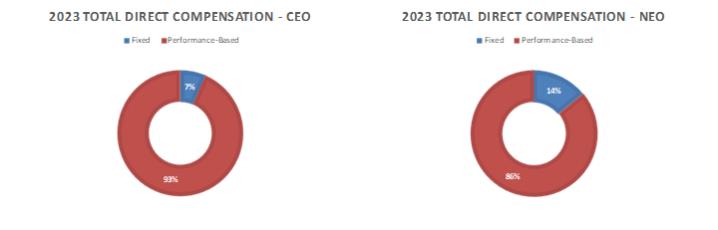
The “performance-based” pay component shown in the above graphs is the grant date fair value of equity awards granted to our NEOs during 2023, excluding the one-time performance-based awards to Ms. Davies and Mr. Andersen described below. The “fixed” pay component is the NEO’s 2023 base salary. For our NEOs other than Mr. Case, the actual performance-based percentage of total direct compensation ranged from 74% to 89%.
In addition to our focus on pay for performance, our executive compensation program is complemented by practices designed to mitigate compensation-related risk and align with the long-term interests of our shareholders:
| Officer Share Ownership Guidelines | Our officer share ownership guidelines are designed to increase executives’ equity stakes in Aon and to align executives’ interests more closely with those of our shareholders. The guidelines provide that our Chief Executive Officer should attain an investment position in Class A Ordinary Shares equal to six times his annual base salary and all other senior executives, including each of our other NEOs, should attain an investment position in Class A Ordinary Shares equal to three times his or her annual base salary. The guidelines also establish equity retention rules generally requiring that net shares received through the exercise of share options, the vesting of restricted share units, and the vesting of PSUs are retained until the required investment position is achieved. Class A Ordinary Shares counted toward these guidelines include any shares owned outright, shares owned through an Aon-sponsored savings or retirement plan, shares purchased through an Aon-sponsored employee share purchase plan, shares obtained through the exercise of share options, and shares issued upon the vesting of restricted share units or PSUs. Each of our NEOs held the requisite number of shares under the guidelines as of December 31, 2023. Mr. Case has agreed to maintain an investment position in Class A Ordinary Shares in excess of those required under our share ownership guidelines. In his employment agreement, he agreed to maintain an investment position equal to 20 times his annual base salary and was in compliance with this investment level as of December 31, 2023. |
Table of Contents
| Hedging and Pledging Policies | We have an insider trading policy which, among other things, specifically prohibits all employees, executive officers, and non-management directors from engaging in: short sales; publicly traded options; puts and calls; forward sale contracts; and other swap, hedging, and derivative transactions relating to our securities. The policy also specifically prohibits our executive officers and non-management directors from holding our securities in margin accounts or pledging our securities as collateral for a loan. | |
| Independent Compensation Consultant | The Compensation Committee retains an independent compensation consultant to provide advice and market data to bolster the Compensation Committee’s decision-making. | |
| Clawback Policy and Forfeiture Provisions | We have adopted a revised Clawback Policy, which is applicable to our Section 16 officers, to address the recovery of incentive compensation in compliance with the requirements of the Dodd-Frank Act, the final SEC rules, and final applicable listing standards. Pursuant to the Clawback Policy, the Compensation Committee will seek recoupment with respect to covered incentive compensation paid to an executive officer if (i) the Company is required to prepare an accounting restatement due to material noncompliance with any financial reporting requirement, (ii) the amount of the covered compensation is calculated based upon the achievement of financial results that were subsequently the subject of such a restatement, and (iii) the amount received would have been lower if the financial results were properly reported. In addition to the Clawback Policy, unvested equity-based awards are also subject to forfeiture in the event of a material violation of the Company’s policies or procedures or a breach of applicable restrictive covenants. Further information on the Clawback Policy can be found in the section captioned “Clawback Policy and Forfeiture Provisions”. A copy of the Clawback Policy was filed as Exhibit 97.1 to the Original Filing. |
The Executive Compensation Process
Process of Determining Executive Compensation
Management assists the Compensation Committee in developing and administering our executive compensation program. Direct responsibilities of management include, but are not limited to:
| • | Recommending executive compensation adjustments, short- and long-term incentive awards, and other benefits, where applicable, for executive officers other than our Chief Executive Officer; |
|---|
| • | Providing ongoing review of the effectiveness of our executive compensation program and alignment of the program with our business and strategic objectives; |
|---|
| • | Designing and recommending appropriate amendments to our long-term and short-term cash and equity-based incentive plans for executives; and |
|---|
| • | Designing and recommending appropriate amendments to our employee benefit plans. |
|---|
In the first quarter of 2023, our independent directors evaluated our Chief Executive Officer’s performance and compensation. At that time, the Compensation Committee also evaluated the performance and reviewed the compensation of our other executive officers. During this review, the Compensation Committee approved for each executive officer a target annual incentive for 2023 performance and the specific corporate performance metrics that our performance would be measured against for purposes of this incentive award. The Compensation Committee also approved in March 2023 a target number of PSUs to be awarded to each executive officer under the LPP.
As described in further detail below under “July 2023 Long-Term Performance-Based Awards,” on July 26, 2023, the Compensation Committee, after taking into account the recommendations of our Chief Executive Officer and the Compensation Committee’s independent compensation consultant, approved special, performance-based awards to the Company’s Executive Vice President and Chief Financial Officer and the Company’s President, in each case subject to the limits of our Shareholder-Approved Plan. These grants were designed to drive shareholder value creation and support leadership continuity, and can only be earned if we deliver significant stock price growth over the performance period while the recipients are continuously employed.
Table of Contents
In early 2024, in connection with the Compensation Committee’s annual compensation review, management presented the Compensation Committee with compensation tally sheets reporting compensation paid for the prior four years and competitive pay data. The Compensation Committee also reviewed and considered Aon’s overall performance against targets that were established for 2023. This review culminated in certain compensation decisions made by the Compensation Committee with respect to our executive officers during the first quarter of 2024, which are described in more detail below.
Engagement of Independent Compensation Consultant
The Compensation Committee retains Meridian Compensation Partners, LLC (“Meridian”) as its independent compensation consultant. Meridian is engaged by, and reports directly to, the Compensation Committee, and advises on matters covered by the Compensation Committee’s Board-approved charter, while doing no work for management. Meridian typically participates in all Compensation Committee meetings and communicates with the Chair of the Compensation Committee and management between meetings. During 2023, Meridian assisted the Compensation Committee by: advising on our compensation philosophy, objectives, and strategy; reviewing the competitiveness and effectiveness of our senior executive and Board compensation levels and program structure; identifying our peer group for executive and Board compensation and Company performance review purposes; assessing potential compensation-related risks; providing change-in-control severance calculations for our NEOs in the 2023 annual proxy disclosure; providing compensation data from our peer group based on their proxy statements and other disclosures; reporting on executive-compensation related trends, say-on-pay governance, and regulatory initiatives; and reviewing and commenting on related disclosures. Management periodically retains other consulting firms to provide pay survey data and other non-executive compensation services.
The Compensation Committee has assessed the independence of Meridian pursuant to the SEC and NYSE rules and concluded that no conflict of interest exists that would prevent Meridian from serving as an independent consultant to the Compensation Committee.
How We Determine Compensation
The Compensation Committee generally targets a competitive level and mix of total direct compensation elements using market data as a reference point. For 2023, the Compensation Committee did not use a specific formula or comparative percentile targets to determine total compensation, individual components of compensation, or the relative mix of pay components, and the establishment of compensation levels in 2023 was not a mechanical process. Rather, the Compensation Committee used its judgment and business experience. The Compensation Committee’s overall intent was to evaluate the various elements of total compensation so that the emphasis of the Company’s compensation program was on its variable components of pay in the form of long-term equity awards and annual bonus award opportunities, and the amounts earned from such awards, which vary based on Aon’s performance.
Use of Tally Sheets
The Compensation Committee regularly reviews compensation tally sheets. The tally sheets assign dollar amounts to each component of the executives’ compensation, including base salary, annual incentives (target and actual), long-term incentives granted and outstanding, employee benefits (including health care and qualified and nonqualified retirement plans), relocation benefits, including income tax equalization, perquisites, and potential change in control severance payments. The tally sheets are presented to the Compensation Committee to help ensure that it is aware of all rewards components and the value of such components when making compensation decisions.
Involvement of Mr. Case in the Compensation Process
Each year, the Compensation Committee approves all elements of compensation for our NEOs and other executive officers (other than Mr. Case). These decisions are typically made during the annual compensation review process conducted in the first quarter of the year. The Compensation Committee solicits certain recommendations from Mr. Case and our Chief People Officer.
Mr. Case recommends to the Compensation Committee the annual long-term equity awards, annual incentive payments, base salary adjustments, and special, and other one-time awards, if any, for the executive officers who report directly to him. He has direct knowledge of the contributions made to Aon by these executive officers, and he shares this knowledge with the Compensation Committee and provides feedback on the performance of his direct reports.
Table of Contents
During the annual review process, our Chief People Officer and the Chair of the Compensation Committee work together on Mr. Case’s annual evaluation report, which summarizes Mr. Case’s qualitative and quantitative performance for the year. The report is considered, along with other factors (including the Compensation Committee’s own assessment of Mr. Case’s performance, relevant market data, and Aon’s overall performance), in recommending Mr. Case’s compensation to the independent directors of the Board.
The Compensation Committee has the ultimate authority to make compensation decisions for our NEOs and other executive officers except for Mr. Case, whose compensation is approved by the independent directors of the Board. The Compensation Committee discusses its preliminary compensation decisions with independent members of the Board who do not serve on the Compensation Committee. As part of this process, these directors share their evaluations of the executives’ performance. The sharing of performance review information also aids the directors in carrying out their succession planning responsibilities. After considering input from those directors, the Compensation Committee makes its final determinations.
Mr. Case, together with our Chief People Officer and our Chief Financial Officer, makes recommendations to the Compensation Committee relating to the performance targets to be established under Aon’s annual incentive and long-term equity incentive plans. The Compensation Committee reviews such recommendations with its independent compensation consultant and reserves the ultimate authority to set such targets and to determine whether such targets were achieved.
Result of Advisory Vote by Shareholders on Our “Say-on-Pay” Proposal
The Compensation Committee considered the results of the advisory vote by shareholders on the say-on-pay proposal presented to our shareholders at our 2023 annual general meeting. Shareholders demonstrated strong support for our executive compensation program in 2023, as evidenced by the approximately 92% of shareholder votes cast at our 2023 annual general meeting in support of the compensation program offered to our NEOs for 2022, as reported in our Current Report on Form 8-K, filed with the SEC on June 22, 2023. Accordingly, the Compensation Committee has continued its philosophy and approach with respect to our executive compensation program and practices in 2023.
Following the 2023 annual general meeting, we continued our shareholder outreach and engagement efforts. In the fall of 2023, shareholders representing approximately 32% of our shares outstanding, including seven of our largest shareholders, met with members of our senior management team, and in some instances, a member of the Compensation Committee, and discussed a variety of key themes, including executive compensation and corporate governance focus areas for the Board, such as strategy, capital allocation, and risks and opportunities around data privacy and cyber security, talent, and succession. These investors were generally supportive of the rationale for the July 2023 PSU grants and their designs, and in particular suggested expanded narrative disclosure around these grants and broader executive compensation decisions (which we have considered in preparing this Amendment).
Internal Pay Relationships
In determining an executive officer’s target annual incentive or long-term performance award value, the Compensation Committee will, from time to time, consider internal pay relationships. However, the Compensation Committee has not adopted a broad internal pay equity policy pursuant to which each executive officer’s compensation, or one or more components thereof, is related to or benchmarked against the compensation of other executive officers.
Analysis of Key 2023 Compensation Decisions
Peer Group
The Compensation Committee selects our executive compensation peer group based on a process that considers objective criteria including: industry segment; revenues, market capitalization, assets, and employee headcount; business complexity; and global footprint; as well as peers of our direct peers (“peers of peers”) and proxy-advisor compensation peer groups. The Compensation Committee’s goal is to have relevant market data to inform its decisions on pay levels and practices. As such, the Compensation Committee looks for peer-group balance with larger and smaller companies in a comparable range, and to have continuity through an annual review process.
Industry-related criteria used as guidelines for identifying peers include global financial services companies and major professional services firms that we compete with for executive talent and/or financial capital. Size-related criteria used as guidelines for identifying peers include companies that are one-fourth to four times our size in average market capitalization (calculated over the most recent eight quarters to reduce volatility) and in trailing four-quarter revenues, and that have latest year total assets less than $500 billion.
Table of Contents
Our peer group members are reviewed on an annual basis with Meridian. In 2022, we reviewed our peer group and removed IHS Markit Ltd. due to its merger with S&P Global Inc. and added Equifax Inc. In 2023, we reviewed our peer group and concluded that no changes should be made to the peer group for 2024.
Our 2023 and 2024 peer group members are listed below.
| 2023 and 2024 Peer Group | ||||
| Accenture plc | Equifax Inc. | Northern Trust Corporation | ||
| A.J. Gallagher & Co. | Fidelity National Information Services, Inc. | S&P Global Inc. | ||
| Automatic Data Processing, Inc. | Fiserv, Inc. | State Street Corporation | ||
| Bank of New York Mellon Corp. | Marsh & McLennan Companies, Inc. | Willis Towers Watson plc | ||
| BlackRock, Inc. | Moody’s Corporation | |||
| Cognizant Technology Solutions Corp. | Morgan Stanley |
Base Salary
Using the peer group and executive compensation review processes outlined above, the Compensation Committee annually considers and reviews base salaries for our executive officers. Base salaries are adjusted periodically to, among other things, recognize changes in job responsibilities or bring the fixed component of an executive’s total compensation in line with his or her peers at the Company or the industry generally. Base salary adjustments generally take effect on April 1. In 2023, the Compensation Committee, consistent with the recommendations of our Chief Executive Officer, determined that no adjustments would be made to the base salary rates for our NEOs based on the above criteria.
Long-Term Leadership Performance Program under Our Shareholder-Approved Plan
The LPP is a sub-plan of our Shareholder-Approved Plan, which means that LPP awards are subject to plan terms approved by our shareholders. Each annual award granted under the LPP consists of PSUs that are eligible to vest over a three-year performance period based on achievement of cumulative adjusted diluted earnings per share targets over that period. The Compensation Committee historically has approved LPP awards for our NEOs each year. The three-year LPP performance cycles run concurrently, so we may have up to three active cycles during a given year. For example, during 2023, our NEOs held LPP 16, LPP 17, and LPP 18 awards (for the 2021-2023, 2022-2024, and 2023-2025 performance periods, respectively). This design is intended to ensure that our NEOs remain focused on long-term sustainable performance while providing the Compensation Committee with the ability to evaluate performance metrics on a regular basis. We do not pay dividends or credit dividend equivalents on PSUs.
During the first quarter of 2023, we granted PSUs to our executive officers, including each NEO, pursuant to LPP 18 (2023-2025 performance period). During the first quarter of 2024, we determined our actual levels of achievement under LPP 16 (2021-2023 performance period) and granted PSUs under LPP 19 (2024-2026 performance period).
LPP 18 Awards Granted in 2023
LPP 18 (2023 Grant for 2023-2025 Performance Period). This is our eighteenth annual three-year performance cycle for long-term incentive awards granted to our most senior leaders. The LPP is intended to further strengthen the relationship between wealth accumulation for our executives and long-term financial performance of the Company and increase in shareholder value, and the PSUs awarded under LPP 18 are payable (to the extent earned) in the form of Class A Ordinary Shares. The grant date value of the awards (at target) was determined and approved by the Compensation Committee. From that value, the number of target PSUs was calculated on the date of grant based on that day’s closing price for Class A Ordinary Shares on NYSE. The PSUs under LPP 18 will be earned and settled in a range of 0% (if the threshold level of performance is not achieved) to 200% of the target number of shares (if the maximum level of performance is achieved) based on the Company’s cumulative adjusted diluted earnings per share over the three-year performance period.
Table of Contents
The performance results for LPP 18 will be measured against the three-year publicly reported cumulative adjusted diluted earnings per share target rate, subject to limited adjustments set forth in the plan documentation at the beginning of the three-year period. The adjustments are intended to exclude the impact of material and/or significant items, to provide a target that, while challenging, eliminates the impact of certain events and circumstances outside of the control of the relevant executive officers. The Compensation Committee’s selection under LPP 18 of the three-year performance period and cumulative adjusted diluted earnings per share financial performance metric is intended to provide the award recipients a reasonable period within which to achieve and sustain what are intended to be challenging long-term growth objectives. The Compensation Committee believes adjusted diluted earnings per share is a more effective measure of Company performance for purposes of motivating executive performance than diluted earnings per share calculated in accordance with U.S. GAAP, as the adjusted measure provides a target that is more within the executives’ control and area of accountability. Further, the Company believes that adjusted diluted earnings per share provides a perspective on the Company’s ongoing core operating performance that is consistent with how shareholders measure our success and that creates transparency and clarity for participants.
In determining the individual awards under LPP 18 granted in the first quarter of 2023, the Compensation Committee considered internal pay relationships, the award recipient’s compensation mix, and total direct compensation, including the recipient’s total direct compensation for 2022 relative to similarly situated executives at our 2023 peer group members. For further information regarding individual awards under LPP 18, see footnote (1) in the Summary Compensation Table below, and also the Grants of Plan-Based Awards in Fiscal Year 2023 below.
LPP 16 Awards Earned in 2023
LPP 16 (2021 Grant for 2021-2023 Performance Period). In early 2024, we determined the actual achievement under LPP 16. The performance period for LPP 16 ended on December 31, 2023.
LPP 16 PSUs (Performance Period 1/1/2021—12/31/2023)
| Metric | Threshold (50% Payout) | Target (100% Payout) | Maximum (200% Payout) | |||||||||
| Cumulative Adjusted EPS | $ | 31.23 | $ | 32.47 | $ | 35.72 | ||||||
| Actual | $ | 38.75 |
For LPP 16, the cumulative adjusted diluted earnings per share goals from continuing operations ranged from a threshold level of $31.23, below which no payout would occur, to $35.72 or higher, which would yield shares equal to 200% of the target number. A result of $32.47 in cumulative adjusted diluted earnings per share from continuing operations would have yielded shares equal to 100% of the target number. This target performance represented a 12.3% increase over the target for LPP 15, the fifteenth cycle of our LPP established for the performance period from 2020 through 2022. Our actual cumulative adjusted diluted earnings per share from continuing operations for the three-year period of 2021-2023 was $38.75, resulting in a payout at 200% of the target number of shares awarded.
For the 2023 performance period associated with LPP 16, the Compensation Committee approved a discretionary downward adjustment to earnings per share (“EPS”) from continuing operations to remove the impact of incremental growth in fiduciary investment income over the prior year, which adjustment was permitted under the terms of the plan. Each NEO received a distribution under LPP 16.
July 2023 Long-Term Performance-Based Awards
On July 26, 2023, the Compensation Committee, taking into account the recommendations of Mr. Case and Meridian, approved special grants of PSUs (the “July 2023 PSUs”) to each of Christa Davies, the Company’s Executive Vice President and Chief Financial Officer, and Eric Andersen, the Company’s President, under our Shareholder-Approved Plan. In determining to grant the July 2023 PSUs, the Compensation Committee considered the objectives of our executive compensation program, including promoting leadership continuity, delivering against our key financial metrics, and driving significant shareholder value creation. Further, the Compensation Committee considered Ms. Davies’ continued leadership of the Company’s Aon Business Services strategy to drive efficiency, innovation, and client service across the Company, and Mr. Andersen’s performance and responsibility for driving the Company’s growth initiatives across its solution lines in approving these grants, which it viewed as “on-top” incentive opportunities. Consequently, the Compensation Committee set performance goals so that the July 2023 PSUs only would be earned and paid if commensurate exceptional, “on-top” performance is achieved. The Compensation Committee believed that the July 2023 PSUs would strengthen the Company’s Aon United strategy and promote the alignment of Ms. Davies’ and Mr. Andersen’s compensation and long-term shareholder value creation.
Table of Contents
Each of Ms. Davies and Mr. Andersen were awarded 50,000 PSUs under the July 2023 PSUs, which at target convert on a one-to-one basis to Class A Ordinary Shares, with 0% to 200% of the target PSUs eligible to vest on March 31, 2028 (the “Vesting Date”), based on the price of the Class A Ordinary Shares from July 26, 2023 (the “Grant Date”) through the Vesting Date. None of the July 2023 PSUs will vest if the average closing price of Class A Ordinary Shares for the 90 consecutive trading days ending on the Vesting Date is below $475 (the “Performance Hurdle”), which was well in excess of the average closing price of $325.08 preceding the grant. Subject to achieving the Performance Hurdle, the percentage of July 2023 PSUs to vest will be based upon the highest trading day average closing price of the Class A Ordinary Shares for any 90 consecutive trading days during the Performance Period (the “Average Share Price”), as follows: (i) entry (50%) if the Average Share Price is $475, (ii) target (100%) if the Average Share Price is $500 and (iii) stretch (200%) if the Average Share Price is at least $550. If Average Share Price is between the entry, target, and stretch levels, a proportionate number of the July 2023 PSUs between those levels will be earned.
The July 2023 PSUs will be forfeited in the event of the recipient’s retirement or voluntary resignation, including for good reason, prior to the Vesting Date. Additional information about the termination and change in control provisions of the July 2023 PSUs is set forth in the section captioned “Potential Payments and Benefits on Termination or Change in Control” contained in this Amendment under “July 2023 PSUs”.
The July 2023 PSUs are not part of Ms. Davies’ or Mr. Andersen’s regular annual compensation and will not be awarded on a recurring basis. The July 2023 PSUs have the following features that align with shareholders’ interests:
| • | Long-term – the awards have a five-year term, which is longer than our regular annual long-term incentive awards. |
|---|
| • | Performance-based – shares are only earned if and to the extent rigorous share price hurdles are met. |
|---|
| • | Reasonably-sized – the awards represent approximately 20% of Ms. Davies’ and 22% of Mr. Andersen’s total target annual compensation on an annualized basis. |
|---|
| • | Subject to conservative termination provisions – vesting is subject to continuous service and the awards will be forfeited in the event of retirement or voluntary resignation, including for good reason. |
|---|
| • | Subject to clawback – the awards are subject to forfeiture and clawback provisions. |
|---|
Annual Incentive Awards under Our Shareholder-Approved Plan
Annual Incentives. Under our Shareholder-Approved Plan, the Compensation Committee annually approves the framework for our annual incentive compensation plan, including the applicable Aon-wide performance metric and minimum achievement threshold against that performance metric. If the threshold level performance metric is not achieved, then no annual incentives are payable under our Shareholder-Approved Plan. If the minimum achievement threshold is achieved, then our Shareholder-Approved Plan allows for the payment of current-year annual incentives to each of our executive officers up to a cap of the lesser of $10 million or the maximum annual incentive otherwise established by the Compensation Committee for each executive officer. Our Chief Executive Officer retains the discretion to approve increases (up to 10%, subject to Compensation Committee consent) and decreases (up to 20%, not subject to consent) in the size of the incentive pool. However, no individual may receive an award in excess of the maximum amount established by the Compensation Committee (two times his or her target annual incentive).
Table of Contents
In the first quarter of 2023, the Compensation Committee set target 2023 annual incentive opportunities for our NEOs in the context of their total compensation opportunity considering the performance and growth of the NEOs in both capability and scope against the competitive market for top talent. For each NEO, annual incentive opportunities were set as a target percentage of the executive’s base salary at year end (and, for Ms. Davies, including her annual foreign service allowance received in connection with her relocation to London). The target annual incentives for each of our NEOs for 2023 remained unchanged from 2022, and are shown in the table below:
| NEO | 2022 Target as % of Base Salary | 2023 Target as % of Base Salary | 2023 Target Annual Incentive | |||
| Gregory C. Case | 250% | 250% | $3,750,000 | |||
| Christa Davies | 200% | 200% | $2,740,000 | |||
| Eric Andersen | 200% | 200% | $2,500,000 | |||
| Lisa Stevens | 150% | 150% | $1,500,000 | |||
| Darren Zeidel | 100% | 100% | $ 900,000 |
As explained below, for 2023, the Compensation Committee used a framework (the “Senior Executive Incentive Compensation Plan”) for determining actual annual incentives to be earned if the metric under our Shareholder-Approved Plan was achieved.
2023 Performance Metrics. In the first quarter of 2023, the Compensation Committee determined that 2023 Aon-wide performance would be measured by two components. First, 80% of the performance would be measured by the growth in our adjusted operating income (“OI”) for 2023 as compared to a 2022 baseline adjusted OI number of $3,840 million, greater than a 200-bps hurdle. The Compensation Committee retained the discretion to further adjust OI for material and/or significant items. The Compensation Committee selected OI as the primary measure to emphasize performance of Aon as a whole and link executives’ awards to Aon’s key business initiatives.
Second, 20% of the performance would be measured by the Compensation Committee’s assessment of the Company’s progress against quantitative goals in the recruitment, promotion, education, and representation strategy pillars on a firm-wide basis, as determined by the Inclusion & Wellbeing Sub-Committee and the Compensation Committee (the “People & Culture” component). This component is intended to be leveraged (0% to 200%), and success is measured by examining the number of pre-established goals met and the degree of over- or under-performance across the goals established by the Compensation Committee. This assessment is made in consultation with the Inclusion & Wellbeing Sub-Committee.
In addition, the Compensation Committee set a minimum achievement threshold at 70% of the 2022 adjusted OI, or $2,688 million. The Compensation Committee set the minimum threshold at 70% because it believed performance below that level would not create enough value for the Company’s shareholders and, therefore, should not result in annual incentive payments. If the minimum achievement threshold is satisfied, an annual incentive pool may be funded as described below under “Determining 2023 Annual Incentives.”
2023 Actual Performance. The Company’s adjusted OI for 2023 was $4,223 million for purposes of determining 2023 annual incentives, which exceeded the minimum threshold of 70% established under our Shareholder-Approved Plan. The $4,223 million of adjusted OI was 10.0% greater than 2022 adjusted OI of $3,840 million, or 8.0% greater than our 200-bps hurdle, resulting in a performance factor of 108.0% for the financial component. The Compensation Committee reviewed the Company’s progress against a robust set of goals demonstrating progress in our People & Culture component, and determined that the Company progressed on its objectives, including (1) advancing representation in senior leadership roles for women globally and for racially diverse leaders in the United States, (2) surpassing its goals with respect to promotions of racially diverse leaders in the United States, (3) advancing its recruitment of candidates from diverse backgrounds in the United States, and (4) significantly exceeding its learning goals for all colleagues on inclusion topics. Based on its assessment of progress around these goals, the Compensation Committee determined that the performance factor was 113% for the People & Culture component.
Determining 2023 Annual Incentives. In accordance with our Shareholder-Approved Plan, the Senior Executive Incentive Compensation Plan (“SEICP”) would not be funded for 2023 unless Aon achieved the minimum threshold of 70% of the 2022 baseline OI. After determining that this minimum threshold had been achieved, the Compensation Committee met in February 2024 to determine the funding status of the SEICP pool for 2023. After application of the formula guidelines described above, the total incentive pool reserved for participating members of the Company’s senior management team (including our NEOs) was determined to be approximately $14.5 million, or 109% of target. In determining annual incentives for our NEOs, the Compensation Committee (or, with respect to Mr. Case, the independent members of the Board) considered Mr. Case’s compensation recommendations for the NEOs (other than himself), business and financial results, individual delivery of key strategic initiatives and personal leadership qualities.
Table of Contents
Mr. Case. The independent directors of the Board determined that, under Mr. Case’s leadership, the Company delivered continued strong progress across the four key financial metrics that we report to shareholders: organic revenue growth, adjusted operating margin, adjusted diluted earnings per share, and free cash flow. Organic revenue growth was 7%, operating margin on an adjusted basis increased 80 basis points to 31.6%, adjusted diluted earnings per share increased 6% to $14.14, and free cash flow increased to $3.2 billion. During 2023, the firm returned nearly $3.2 billion of capital to shareholders through share repurchases and dividends. Under Mr. Case’s leadership, Aon announced its 3x3 Plan to drive our Aon United strategy, bringing together Risk Capital and Human Capital, strengthening the Aon Client Leadership model, and accelerating service delivery and innovation through Aon Business Services. His leadership was instrumental in progress made on key strategic initiatives to support the plan, including the $900 million cash restructuring charge to accelerate our Aon Business Services strategy and optimize our workforce, and a definitive agreement to acquire leading middle-market broker, NFP. Mr. Case led execution of these initiatives while continuing to navigate a dynamic external economic environment, the ongoing competitive talent market, and other challenges to achieve continued record-high colleague engagement, retention rates above pre-pandemic levels, and meaningful progress on inclusion and diversity initiatives.
Ms. Davies. The Compensation Committee determined that Ms. Davies’ individual efforts contributed substantially to the Company’s strong business and financial results in 2023, including the four key financial metrics that we report to shareholders: organic revenue growth, adjusted operating margins, adjusted diluted earnings per share, and free cash flow. Her leadership around operating income growth and working capital improvement meaningfully contributed to the firm’s $3.2 billion free cash flow and 23.8% free cash flow margin. Further, she led our disciplined approach to capital allocation, realizing the completion of $2.7 billion in share repurchase and a 33.1% return on invested capital. Ms. Davies was heavily engaged in developing the 3x3 Plan to accelerate our Aon United strategy and led key strategic initiatives including accelerating Aon Business Services and the related restructuring program, the expected acquisition of NFP, and ongoing outreach to shareholders to effectively communicate strategy and financial results. Ms. Davies continues to lead with a focus on inclusion in colleague interactions and the development of key talent, inspiring multiple senior leaders to similarly take actions.
Mr. Andersen. The Compensation Committee determined that Mr. Andersen’s individual efforts contributed substantially to the Company’s strong business and financial results in 2023, including the four key financial metrics that we report to shareholders: organic revenue growth, adjusted operating margins, adjusted diluted earnings per share, and free cash flow. Mr. Andersen’s leadership was essential to delivering impressive, double-digit organic revenue growth in two solution lines, including 10% in each of Health Solutions and Reinsurance Solutions, as well as 5% in Commercial Risk Solutions and 4% in Wealth Solutions. Mr. Andersen led ongoing development of the future Aon United strategy through the 3x3 Plan and drove ongoing progress on our Risk Capital and Human Capital strategies and the Aon Client Leadership model within the plan, as well as leading work to sign the definitive agreement to acquire NFP. Mr. Andersen’s leadership was instrumental in supporting colleague engagement and retention in a competitive talent marketplace, and in setting a standard for inclusive leadership with business leaders.
Ms. Stevens. The Compensation Committee determined that Ms. Stevens’ individual efforts contributed substantially to Company’s strong business and financial results, as well as the development of the 3x3 Plan and to the attraction, retention, and motivation of leading talent. These and other actions have allowed us to maintain record-high colleague engagement and retention in a competitive talent market, and providing enhanced support to people leaders and managers, driving exceptional results in these dimensions on our annual colleague support survey. Ms. Stevens’s contributions include strategic workforce planning, managing hiring and attrition in line with business demand, reshaping and redeploying colleagues for maximum impact and alignment with client demand, and building longer-term infrastructure around skills-based hiring and development. She has also helped introduce enhanced learning and development models, particularly for early career colleagues and high-potential leaders.
Table of Contents
Mr. Zeidel. The Compensation Committee determined that Mr. Zeidel’s individual efforts in driving legal and compliance operational initiatives, advancing the firm’s commercial initiatives, and promoting enhancements to compliance and risk management practices across the firm enabled the Company’s strong business and financial results in 2023. Mr. Zeidel enhanced the firm’s approach to negotiation and standardization of commercial terms and implemented improvements to the management of compliance risk globally, including efforts to enhance compliance and risk management practices involving privacy and other evolving and complex regulatory regimes. Mr. Zeidel also provided extraordinary effort and helped lead work to sign the definitive agreement to acquire NFP and has continued that effort and leadership as we move toward consummating the transaction. He has provided ongoing counsel and leadership with respect to our inclusion and engagement initiatives. Mr. Zeidel has been a passionate advocate for underserved communities and under his leadership, the firm’s law and compliance department has led community service and pro bono initiatives, including in the areas of criminal justice, disability law, and asylum.
Adjustment of 2023 Annual Incentives. As part of the annual review process, Mr. Case proposed to the Compensation Committee that he and the other participants in the Senior Executive Incentive Compensation Plan receive annual incentives below the target amounts for fiscal year 2023. While we achieved strong performance as highlighted above, this recommendation was made to more rigorously reflect and further align our pay-for-performance executive compensation philosophy with the high expectations for overall Company performance. Following their review of individual NEO performance, the Compensation Committee (and the Board, in the case of Mr. Case) determined that each NEO receive 68% of his or her target annual incentive, other than Mr. Zeidel, who received an annual incentive of 96% of his target. For 2023, annual incentive awards to our NEOs were paid out entirely in PSUs, vesting on similar terms as LPP 19 awards, subject to attainment of a share price hurdle, except that Mr. Zeidel received a portion ($250,000) of his earned annual incentive in cash. As we embark on the 3x3 Plan, we remain exceptionally well-positioned to deliver results in 2024 and in the future.
The following table sets forth the actual annual incentive awarded to each of our NEOs under the Senior Executive Incentive Compensation Plan for the year:
| NEO | 2023 Actual Annual Incentive | ||||
| Gregory C. Case | $ | 2,550,000 | |||
| Christa Davies | $ | 1,863,200 | |||
| Eric Andersen | $ | 1,700,000 | |||
| Lisa Stevens | $ | 1,020,000 | |||
| Darren Zeidel | $ | 862,000 |
Executive and Relocation Benefits
Executive Benefits. In addition to the broad-based employee benefit programs that are available to our employees generally (such as health coverage, 401(k) plan, etc.), each of our NEOs is eligible to participate in a deferred compensation program and a supplemental savings plan. Only Mr. Andersen participates in our defined benefit pension plan and the supplemental pension program (each of which are frozen to new participation) because each other NEO was hired after the Aon pension plan was closed to new hires in 2004. Additional information regarding these qualified and nonqualified plan benefits is set forth under the headings “Pension Benefits in Fiscal Year 2023” and “Nonqualified Deferred Compensation in Fiscal Year 2023” contained in this Amendment. We also provide an executive health screening program available to all of our NEOs and certain other members of our senior management team.
Relocation Benefits. In 2023, we continued to provide benefits to Mr. Case and Ms. Davies for their continued agreement to perform services primarily at the Company’s global operational headquarters in London. The Aon group global operational headquarters remained in London following the Company’s reorganization as a public company organized under the laws of Ireland in April 2020 term not used elsewhere, while parent company Aon plc is resident in Dublin. Relocation benefits are customary for expatriate assignments for us and other employers in our industry, and the Compensation Committee approved certain benefits for Mr. Case and Ms. Davies after consulting with its independent compensation consultant. Each relocated NEO has signed an international assignment letter with Aon that sets forth the relocation benefits available to him or her. The Compensation Committee periodically reviews the relocation packages of Mr. Case and Ms. Davies. These benefits are provided pursuant to international assignment letters with Mr. Case and Ms. Davies, which are described in more detail under the heading “International Assignment Letters.”
Table of Contents
The compensation received in the form of such benefits is reflected in the Summary Compensation Table for Fiscal Years 2023, 2022, and 2021.
Post-Termination Compensation
We believe that providing severance and change in control severance benefits is important to recruit talented employees and secure the continued employment and dedication of our existing employees. A significant number of the companies with which we compete for talent have similar arrangements in place for their senior executives. While we consider these benefits to be important, the terms of these benefits are not considered as part of the compensation strategy when the Compensation Committee annually determines the compensation for the NEOs. Additional information about post-termination compensation is set forth in the section captioned “Potential Payments and Benefits on Termination or Change in Control” contained in this Amendment.
Severance Benefits Upon Change in Control. Our NEOs, other than Mr. Case, are eligible for change in control severance benefits under our Senior Executive Combined Severance and Change in Control Plan (referred to throughout this CD&A and the accompanying compensation tables as the “Combined Severance Plan”). The Combined Severance Plan provides that covered executives would receive certain severance benefits upon qualifying terminations of employment in connection with or within two years following a change in control of Aon. Thus, the Combined Severance Plan requires a “double trigger”—a qualifying change in control of Aon and a qualifying termination of the executive’s employment—for severance benefits to become payable. Mr. Case, who is not covered under the Combined Severance Plan, is party to an individual change in control severance agreement with the Company that also provides certain severance benefits upon a qualifying termination in connection with or within two years following a change in control of Aon. Neither the Combined Severance Plan nor Mr. Case’s individual agreement provides for excise tax gross-up protection in the event the executive becomes subject to tax under Section 280G of the Internal Revenue Code of 1986, as amended (the “Code”) in connection with such change in control of Aon.
Additional information regarding the change in control arrangements for our NEOs is set forth in the section captioned “Potential Payments and Benefits on Termination or Change in Control” contained in this Amendment.
Severance Benefits Pursuant to Employment Agreements and Combined Severance Plan. We have entered into agreements with certain executive officers that provide for post-employment severance benefits and transitional compensation if the officer’s employment terminates for a qualifying event or circumstance unrelated to a change in control of Aon, such as being terminated without “cause,” as such term is defined in the applicable operative agreement.
In the case of Mr. Andersen, we entered into an employment agreement with him on July 26, 2023, pursuant to which he will continue to serve as President of the Company and Aon Corporation. Additional information about Mr. Andersen’s employment agreement is provided in the section captioned “Summary Compensation Table for Fiscal Years 2023, 2022 and 2021” in this Amendment under “Mr. Andersen’s Employment Letter and Agreement” and in the section captioned “Potential Payments and Benefits on Termination or Change in Control” under “Employment Agreement with Mr. Andersen.”
To the extent that our NEOs are not party to an individual employment agreement providing for severance benefits, those individuals are eligible to receive severance benefits under the Combined Severance Plan. During 2023, each of our NEOs had an employment agreement or letter providing for severance benefits or was eligible to receive severance benefits under the Combined Severance Plan. Additional information regarding such post-employment severance or transitional compensation for Mr. Case and the other NEOs is set forth in the section captioned “Potential Payments and Benefits on Termination or Change in Control” contained in this Amendment.
Table of Contents
Risk Assessment of Compensation Policies and Practices
We believe that we maintain an appropriate level of prudence associated with our compensation practices and will continue to do so. We engage in a process to evaluate whether our executive and broad-based compensation programs contribute to unnecessary risk-taking. This includes a detailed annual assessment by the Compensation Committee’s independent consultant. We concluded that the risks arising from these programs are not reasonably likely to have a material adverse effect on the Company. In the first quarter of 2024, Meridian independently assessed our compensation practices for 2023 and concluded that they reflect appropriate balance and incorporate appropriate policies and oversight to mitigate imprudent risk-taking.
Compensation Committee Report
The Organization and Compensation Committee of the Board has reviewed and discussed with management the Compensation Discussion and Analysis required by Item 402(b) of Regulation S-K and set forth in this Amendment.
Based on its review and discussions with management, the Organization and Compensation Committee recommended to the Board that the Compensation Discussion and Analysis be included in this Amendment and thereby incorporated into Aon’s Annual Report on Form 10-K for the year ended December 31, 2023.
The Compensation Committee’s report is provided by the Organization and Compensation Committee, which is composed entirely of the following independent directors:
| Richard C. Notebaert, Chair | Cheryl A. Francis | |
| Jin-Yong Cai | Byron O. Spruell | |
| Jeffrey C. Campbell | Carolyn Y. Woo |
Table of Contents
Executive Compensation Tables
The executive compensation disclosure contained in this section reflects compensation information for the years ended December 31, 2023, December 31, 2022, and December 31, 2021, with respect to our NEOs for all years in which each NEO served in that capacity. The following Summary Compensation Table contains compensation information for the following NEOs: (1) Mr. Case, who served as our Chief Executive Officer during 2023, (2) Ms. Davies, who served as our Chief Financial Officer during 2023, and (3) Mr. Andersen, Ms. Stevens, and Mr. Zeidel, who were our three other most highly compensated executive officers serving as of December 31, 2023.
Summary Compensation Table for Fiscal Years 2023, 2022 and 2021
| Name and Principal Position | Year | Salary ($) | Bonus ($) | Stock Awards ($)(1) | Option Awards ($) | Non-Equity Incentive Plan Awards ($)(2) | Change in Pension Value and Nonqualified Deferred Compensation Earnings ($) | All Other Compensation ($)(3) | Total ($) | ||||||||||||||||||||||||||||||||||||
| Gregory C. Case | 2023 | 1,500,000 | — | 21,487,348 | — | — | — | 674,485 | 23,661,834 | ||||||||||||||||||||||||||||||||||||
| Chief Executive Officer | 2022 | 1,500,000 | — | 17,497,455 | — | — | — | 671,530 | 19,668,985 | ||||||||||||||||||||||||||||||||||||
| 2021 | 1,500,000 | — | 15,262,436 | — | 2,437,500 | — | 668,448 | 19,868,384 | |||||||||||||||||||||||||||||||||||||
| Christa Davies | 2023 | 1,250,000 | — | 25,042,451 | — | — | — | 5,340,367 | 31,632,818 | ||||||||||||||||||||||||||||||||||||
| Executive Vice President and Chief Financial Officer | 2022 | 1,250,000 | — | 7,608,231 | — | — | — | 3,130,577 | 11,988,808 | ||||||||||||||||||||||||||||||||||||
| 2021 | 1,000,000 | — | 8,313,103 | — | 1,365,000 | — | 4,536,093 | 15,214,195 | |||||||||||||||||||||||||||||||||||||
| Eric Andersen | 2023 | 1,250,000 | — | 23,356,614 | — | — | 108,811 | 50,022 | 24,765,447 | ||||||||||||||||||||||||||||||||||||
| President | 2022 | 1,250,000 | — | 6,056,776 | — | — | — | 56,912 | 7,363,688 | ||||||||||||||||||||||||||||||||||||
| 2021 | 1,000,000 | — | 6,381,328 | — | 1,218,750 | — | 43,450 | 8,643,528 | |||||||||||||||||||||||||||||||||||||
| Lisa Stevens | 2023 | 1,000,000 | — | 5,269,440 | — | — | — | 36,446 | 6,305,886 | ||||||||||||||||||||||||||||||||||||
| Executive Vice President and Chief People Officer | 2022 | 1,000,000 | — | 3,365,712 | — | — | — | 33,147 | 4,398,859 | ||||||||||||||||||||||||||||||||||||
| 2021 | 900,000 | — | 2,106,188 | — | 780,000 | — | 34,960 | 3,821,148 | |||||||||||||||||||||||||||||||||||||
| Darren Zeidel | 2023 | 900,000 | — | 2,573,886 | — | 250,000 | — | 37,695 | 3,761,581 | ||||||||||||||||||||||||||||||||||||
| Executive Vice President, General Counsel and Company Secretary | 2022 | 900,000 | — | 1,885,973 | — | — | — | 37,140 | 2,823,113 | ||||||||||||||||||||||||||||||||||||
| 2021 | 750,000 | — | 1,534,728 | — | 585,000 | — | 29,100 | 2,898,828 |
| (1) | The amounts shown reflect the aggregate grant date fair value (determined in accordance with Financial Accounting Standards Board Accounting Standards Codification Topic 718, Compensation—Stock Compensation (“ASC Topic 718”)) of restricted share unit awards (paid in satisfaction of all or part of each NEO’s annual incentive award for the previous performance year) and performance share unit awards granted to our NEOs pursuant to our Shareholder-Approved Plan in 2023 and, where applicable, 2022, and 2021. These amounts disregard adjustments for forfeiture assumptions and do not reflect amounts actually paid to, or realized by, the NEOs in the years shown, or any prior years. |
|---|
LPP Awards. In 2021-2023, each of our NEOs received awards of PSUs under the LPP (and, in the case of Mr. Case, also in satisfaction of a portion of his annual incentive from the previous year) with grant date fair values as set forth in the table below.
Table of Contents
| Name | Year | Grant Date Fair Value of Performance Share Unit Awards Assuming Probable Outcomes Under LPP ($) | Grant Date Fair Value of Performance Share Unit Awards Assuming Achievement of Maximum Performance Levels Under LPP ($) | |||||||||||||||||
| Gregory C. Case | 2023 | 19,293,739 | 38,587,479 | |||||||||||||||||
| 2022 | 17,497,455 | 34,994,910 | ||||||||||||||||||
| 2021 | 14,054,964 | 28,109,929 | ||||||||||||||||||
| Christa Davies | 2023 | 7,839,084 | 15,678,167 | |||||||||||||||||
| 2022 | 6,873,311 | 13,746,622 | ||||||||||||||||||
| 2021 | 7,613,019 | 15,226,039 | ||||||||||||||||||
| Eric Andersen | 2023 | 6,369,181 | 12,738,362 | |||||||||||||||||
| 2022 | 5,400,548 | 10,801,096 | ||||||||||||||||||
| 2021 | 5,856,437 | 11,712,874 | ||||||||||||||||||
| Lisa Stevens | 2023 | 3,919,542 | 7,839,084 | |||||||||||||||||
| 2022 | 2,945,838 | 5,891,676 | ||||||||||||||||||
| 2021 | 1,756,260 | 3,512,521 | ||||||||||||||||||
| Darren Zeidel | 2023 | 1,763,823 | 3,527,647 | |||||||||||||||||
| 2022 | 1,570,927 | 3,141,854 | ||||||||||||||||||
| 2021 | 1,219,656 | 2,439,312 |
July 2023 PSUs. On July 26, 2023, the Compensation Committee approved special grants of PSUs to each of Ms. Davies and Mr. Andersen with grant date fair values, assuming probable outcomes, of $14,737,500 each.
For awards granted under the LPP and the July 2023 PSUs, the grant date fair value of PSUs is calculated in accordance with ASC Topic 718 based on the probable outcome of the performance conditions at the time of grant. See Note 12 “Share-Based Compensation Plans” of the Notes to Consolidated Financial Statements in Part II, Item 8 of the Original Filing for information regarding assumptions underlying the valuation of equity awards. Set forth above are the grant date fair values of the PSUs granted under the LPP and the July 2023 PSUs, calculated assuming (i) the probable outcome of the performance conditions for each program, which amount is included in the “Stock Awards” column of this Summary Compensation Table and (ii) for units granted under the LPP, achievement of the maximum levels of performance. No maximum amounts are reflected for the July 2023 PSUs because the threshold performance level has not been achieved. The amounts shown in the tables above reflect the aggregate grant date fair value for these awards computed in accordance with ASC Topic 718, and do not correspond to the actual value that will be recognized by our NEOs.
| (2) | The amounts shown in the “Non-Equity Incentive Plan Compensation” column for each of 2023, 2022, and 2021 reflect the cash portion of the annual incentive awards earned by the NEOs for performance in those years. For 2021, 65% was paid in the form of cash and 35% was paid in the form of restricted share units (reported in the “Stock Awards Column”), except that Mr. Case received 35% in the form of PSUs. For 2022, 100% was paid in the form of restricted share units, except that Mr. Case received 65% in the form of restricted share units and 35% in the form of PSUs. For 2023, other than for Mr. Zeidel, 100% was paid in the form of PSUs with terms similar to LPP 19 awards, except that such units are also subject to attainment of a share price hurdle. For Mr. Zeidel, in addition to the PSUs, he received a portion ($250,000) of his annual incentive in cash. All amounts shown in this column were actually paid or granted to the NEOs in the first quarter of the year following the relevant performance year, which, for annual awards settled in share units, causes the amounts to be reflected as stock awards in the Summary Compensation Table two years following the relevant performance year. |
|---|
| (3) | For 2023, the amounts reported as “All Other Compensation” consist of the following components: |
|---|
| Name | Company Contributions ($)(a) | Perquisites ($)(b) | Other ($)(c) | Tax Reimbursements ($)(d) | Total ($) | |||||||||||||||||||||||||
| Gregory C. Case | 31,650 | 28,322 | 614,513 | — | 674,485 | |||||||||||||||||||||||||
| Christa Davies | 31,650 | 86,260 | 527,510 | 4,694,947 | 5,340,367 | |||||||||||||||||||||||||
| Eric Andersen | 31,650 | 18,372 | — | — | 50,022 | |||||||||||||||||||||||||
| Lisa Stevens | 28,250 | 8,196 | — | — | 36,446 | |||||||||||||||||||||||||
| Darren Zeidel | 29,950 | 7,745 | — | — | 37,695 |
| (a) | The amounts shown in the “Company Contributions” column represent, for each of our NEOs, (i) a contribution by Aon of $21,450 for each of Mr. Case, Ms. Stevens, and Mr. Zeidel, and $21,150 for each of Ms. Davies and Mr. Andersen to the Aon Savings Plan, our qualified defined contribution plan; and (ii) a contribution by Aon of $10,200 for Mr. Case, $10,500 for each of Ms. Davies and Mr. Andersen, $6,800 for Ms. Stevens, and $8,500 for Mr. Zeidel to the Aon Supplemental Savings Plan, a nonqualified defined contribution plan. |
|---|
| (b) | Mr. Case and Ms. Davies have agreed to provide services primarily at Aon’s London, U.K. headquarters. They are each provided relocation packages that are intended to keep them “whole” on a total rewards basis, be transparent and equitable, and reflect competitive practices and benchmarks of industry counterparts. This column also includes amounts Aon paid to third parties for Ms. Davies’ eligible dependents’ schooling or assistance in preparing her tax returns in connection with her international assignment. |
|---|
In 2023, the Company provided perquisites to Ms. Davies related to the assignment of $54,914 for schooling assistance and $31,346 for tax preparation services.
Table of Contents
For a description of cash allowances and cash bonuses paid to our NEOs in connection with the international assignments, see footnote (c) below.
All NEOs except Ms. Davies participated in Aon’s executive health screening program in 2023. The actual cost to Aon of the NEO’s use of this program was $7,687 for Mr. Case, $5,000 for Mr. Andersen, $4,356 for Ms. Stevens, and $6,620 for Mr. Zeidel.
As part of Mr. Case’s employment agreement, Aon provides him with life insurance coverage in the amount no less than $5,000,000 during the term of his agreement. This amount reflects the cost above and beyond the cost of life insurance that is provided to a typical Aon employee. For 2023, the cost was $20,635.
Ms. Stevens received reimbursement for club dues of $3,840. Mr. Andersen received an annual car allowance of $12,000.
We maintain an arrangement with NetJets for use of chartered aircraft and associated ground travel as necessary. Infrequently, a NEO will use a NetJets flight for personal purposes, or the spouse or guests of a NEO may accompany the executive when a NetJets flight is already going to a specific destination for a business purpose. In the case of a personal flight, the cost to the Company of such flight is reimbursed to the Company by the NEO. In the case of a spouse or other guest on a business flight, this has a minimal cost to the Company and, where applicable, the variable costs associated with the additional passenger are included in determining the aggregate incremental cost to the Company. No amounts were included in the Summary Compensation Table this year with respect to such aircraft.
| (c) | In connection with their international assignment to London, U.K., Mr. Case and Ms. Davies are entitled to additional cash compensation in accordance with the terms of their international assignment letters and our relocation programs. The following table sets forth the additional compensation received by them with respect to 2023 service: |
|---|
| Name | Housing Allowance ($) | Cost of Living Allowance ($) | Foreign Service Allowance ($) | Transportation Allowance ($) | Total ($) | |||||||||||||||
| Gregory C. Case | 382,013 | 97,500 | 135,000 | — | 614,513 | |||||||||||||||
| Christa Davies | 286,510 | 97,500 | 120,000 | 23,500 | 527,510 |
| (d) | In connection with her international assignment, Ms. Davies is entitled to receive a tax equalization benefit designed to equalize the income tax paid by her so that her total income and social tax costs related to any earnings from the Company while on the international assignment (including earnings related to granting or vesting of equity-based awards) will be no more than an amount she would have paid had all of the earnings been taxable solely pursuant to U.S. income tax laws. |
|---|
The tax equalization benefit caps the executive’s total income tax exposure to what she would be taxed on earnings from the Company under the U.S. tax laws (as compared to the U.K. tax laws as in existence from time to time). This policy is designed and intended to yield neither an economic benefit nor detriment to Ms. Davies as a result of her international assignment.
For Ms. Davies, any applicable schooling assistance and allowances for foreign service, housing, cost of living, home leave, and transportation are grossed up for applicable U.S. taxes.
The amounts shown in the “All Other Compensation” table represent Aon’s calculation of the excess U.K. taxes paid above the hypothetical tax that Ms. Davies would have paid had she not been relocated to London, U.K. and the amount paid by Aon to neutralize the tax impact on Ms. Davies with respect to eligible relocation compensation.
Employment Agreements and Other Compensation Agreements
Mr. Case’s Employment Agreement
We are party to an employment agreement with Mr. Case pursuant to which he serves as our Chief Executive Officer. The current term of Mr. Case’s agreement continues through April 1, 2028, unless terminated earlier or extended. The agreement also provides that Mr. Case will be nominated for re-election as a member of the Board at each annual general meeting of shareholders during the period of his employment.
Mr. Case’s employment agreement provides for an initial base salary of $1,500,000, subject to adjustment at the discretion of the Board, and a target annual incentive bonus of not less than 200% of base salary, subject to the provisions of our Shareholder-Approved Plan. The Board retains the discretion to determine Mr. Case’s actual bonus payment. In the first quarter of 2022, the Compensation Committee performed its annual compensation review (as described above under “The Executive Compensation Process”) and adjusted Mr. Case’s target annual incentive to 250% of base salary.
Table of Contents
In addition, Mr. Case’s agreement provides that he will be provided with life insurance coverage in an amount equal to no less than $5,000,000 during the term of the agreement. Under the agreement, Mr. Case has also agreed to maintain an investment position in Class A Ordinary Shares equal to no less than 20 times his annual base salary.
Ms. Davies’s Employment Agreement
We are party to an employment agreement with Ms. Davies pursuant to which she serves as our Executive Vice President and Chief Financial Officer. The current term of Ms. Davies’s agreement continues through April 1, 2026, unless terminated earlier or extended. The agreement provides for an initial base salary and a target annual incentive bonus of her base salary and foreign service allowance. In the first quarter of 2022, the Compensation Committee performed its annual compensation review (as described above under “The Executive Compensation Process”) and adjusted Ms. Davies’s base salary to $1,250,000 and target annual incentive to 200% of base salary.
On April 1, 2024, Ms. Davies notified the Company of her intention to retire from the position of Chief Financial Officer. Ms. Davies will continue to serve as Chief Financial Officer into the third quarter of 2024 and will thereafter remain at the Company as a senior advisor for a transition period into 2025.
Mr. Andersen’s Employment Agreement and Letter
We are party to an employment agreement with Mr. Andersen, effective July 1, 2023, pursuant to which he serves as President of the Company and Aon Corporation. The current term of Mr. Andersen’s agreement continues until June 30, 2026, unless earlier terminated or extended. The employment agreement supersedes Mr. Andersen’s employment letter confirming certain terms and conditions of his at-will employment dated as of May 11, 2018. Mr. Andersen’s agreement provides for an initial base salary of no less than $1,250,000 per year, and a target annual incentive of no less than 200% of his base salary. The agreement also provides for the grant of the July 2023 PSUs.
Ms. Stevens’s Employment Letter
We have provided Ms. Stevens an employment letter pursuant to which she serves as our Executive Vice President and Chief People Officer. The letter provides that Ms. Stevens’s continued employment with us is on an at-will basis, and that she is eligible to participate in our Combined Severance Plan. Ms. Stevens’s letter also provides for an initial base salary, which has subsequently been adjusted to $1,000,000 by our Compensation Committee as permitted under the letter, a target annual bonus of 100% of her base salary, which has subsequently been adjusted to 150% by our Compensation Committee as permitted under the letter, and an initial target long-term incentive award of 150% of her base salary.
Mr. Zeidel’s Employment Letter
We have provided Mr. Zeidel an employment letter pursuant to which he serves as our Executive Vice President, General Counsel, and Company Secretary. The letter provides that Mr. Zeidel’s continued employment with us is on an at-will basis, and that he is eligible to participate in our Combined Severance Plan. Mr. Zeidel’s letter also provides for an initial base salary, which has subsequently been adjusted to $900,000 by our Compensation Committee as permitted under the letter, a target annual bonus of 100% of his base salary, and an initial target long-term incentive award of 150% of his base salary.
International Assignment Letters
In connection with their agreeing to provide services primarily at Aon’s London global operational headquarters, we entered into international assignment letters with each of Mr. Case and Ms. Davies. These letters describe the international assignments and set forth the relocation benefits to the executives, which are described below. The letters are not intended to diminish the rights of the executives under their current employment arrangements; however, the letters provide by their terms that the executives’ acceptance of their international assignments, and repatriation thereafter, will not give rise to any right to terminate for good reason (as such term is defined in the applicable executive’s employment agreement, if applicable).
Table of Contents
The letters for Mr. Case and Ms. Davies were amended and extended in July 2014 for an additional two years, in July 2016 for an additional two years, and on each July 1 of 2018 through 2023 for an additional year.
Depending on each executive’s personal circumstances, and as disclosed in the tables above, the relocation packages, as amended, generally provide some or all of the following benefits:
| • | a monthly housing allowance of approximately $31,834 for Mr. Case and $23,876 for Ms. Davies; |
|---|
| • | a monthly cost of living differential of $8,125; |
|---|
| • | a monthly foreign service allowance of $11,250 for Mr. Case, and $10,000 for Ms. Davies; |
|---|
| • | a monthly car allowance of approximately $1,958 for Ms. Davies; |
|---|
| • | eligible dependents’ schooling assistance, including tuition and application fees, for Ms. Davies; |
|---|
| • | a tax equalization benefit for Ms. Davies, designed to equalize the income tax paid by her so that her total income tax costs related to any earnings from the Company while on the international assignment (including earnings related to granting or vesting of equity-based awards) will be no more than an amount she would have paid had all of the earnings been taxable solely pursuant to the U.S. income tax laws; |
|---|
| • | a tax gross-up for Ms. Davies on schooling assistance and on allowances related to housing, cost of living, home leave, and transportation; and |
|---|
| • | enhanced tax preparation and planning and expatriate services for the tax years covered by the international assignment or for which international earnings are taxed by the U.K. or Ireland. |
|---|
All of the relocation benefits are subject to recoupment if the executive officer resigns employment with the Company within two years of commencing the international assignment, or 12 months after the end of the assignment, and becomes employed by a direct competitor of the Company.
Table of Contents
Grants of Plan-Based Awards in Fiscal Year 2023
The following table provides information on non-equity incentive plan compensation, restricted share unit awards, and PSU awards granted in 2023 to each of the NEOs.
| Name | Grant Date | Estimated Possible Payouts Under Non-Equity Incentive Plan Awards (1) | Estimated Future Payouts Under Equity Incentive Plan Awards (2) | All Other Stock Awards: Number of Shares of Stock or Units (#)(3) | All Other Option Awards: Number of Securities Underlying Options (#) | Exercise or Base Price of Option Awards ($/Sh) | Grant Date Fair Value of Stock and Option Awards ($)(4) | |||||||||||||||||||||||||||||||||
| Target ($) | Maximum ($) | Threshold (#) | Target (#) | Maximum (#) | ||||||||||||||||||||||||||||||||||||
| Gregory C. Case | 2/17/2023 | 3,750,000 | 7,500,000 | — | — | — | 7,070 | — | — | 2,193,609 | ||||||||||||||||||||||||||||||
| 3/24/2023 | — | — | 31,831 | 63,661 | 127,322 | — | — | — | 19,293,739 | |||||||||||||||||||||||||||||||
| Christa Davies | 2/16/2023 | 2,740,000 | 5,480,000 | — | — | — | 7,948 | — | — | 2,465,867 | ||||||||||||||||||||||||||||||
| 3/23/2023 | — | — | 13,202 | 26,404 | 52,808 | — | — | — | 7,839,084 | |||||||||||||||||||||||||||||||
| 7/26/2023 | — | — | 25,000 | 50,000 | 100,000 | — | — | — | 14,737,500 | |||||||||||||||||||||||||||||||
| Eric Andersen | 2/16/2023 | 2,500,000 | 5,000,000 | — | — | — | 7,252 | — | — | 2,249,933 | ||||||||||||||||||||||||||||||
| 3/23/2023 | — | — | 10,727 | 21,453 | 42,906 | — | — | — | 6,369,181 | |||||||||||||||||||||||||||||||
| 7/26/2023 | — | — | 25,000 | 50,000 | 100,000 | — | — | — | 14,737,500 | |||||||||||||||||||||||||||||||
| Lisa Stevens | 2/16/2023 | 1,500,000 | 3,000,000 | — | — | — | 4,351 | — | — | 1,349,898 | ||||||||||||||||||||||||||||||
| 3/23/2023 | — | — | 6,601 | 13,202 | 26,404 | — | — | — | 3,919,542 | |||||||||||||||||||||||||||||||
| Darren Zeidel | 2/16/2023 | 900,000 | 1,800,000 | — | — | — | 2,611 | — | — | 810,063 | ||||||||||||||||||||||||||||||
| 3/23/2023 | — | — | 2,971 | 5,941 | 11,882 | — | — | — | 1,763,823 |
| (1) | The amounts shown relate to potential annual incentive plan awards for 2023 service for each NEO under our Shareholder-Approved Plan. The amounts shown as “Target” represent the target payment level of 250% for Mr. Case, 200% for Ms. Davies and Mr. Andersen, 150% for Ms. Stevens, and 100% for Mr. Zeidel, of their respective base salaries (after giving effect to annual increases), and the amounts shown in “Maximum” reflect the maximum payment level of two times the target incentive amount, as provided by the terms of our Shareholder-Approved Plan. For Ms. Davies, the annual foreign service allowance is included with base salary in determining her bonus target. |
|---|
Our Shareholder-Approved Plan does not contain a threshold payment level for any of the NEOs. If pre-established performance measures are not met, no payments are made.
| (2) | The amounts shown in columns titled “Threshold,” “Target,” and “Maximum” represent the threshold, target, and maximum number of (a) PSUs granted to our NEOs pursuant to Aon’s LPP 18 (and, for Mr. Case, in respect of 35% of his 2022 annual incentive award) that will be earned and settled in Class A Ordinary Shares if certain performance criteria are achieved during the 2023 to 2025 performance period, and (ii) for Ms. Davies and Mr. Andersen, PSUs granted to them on July 26, 2023 (the July 2023 PSUs). As the potential payments for these units are dependent on achieving certain performance criteria, actual payouts could differ by a significant amount. For more information regarding the terms of the PSUs granted pursuant to LPP 18, see the section titled “Leadership Performance Program under Our Shareholder-Approved Plan” in the CD&A. For more information regarding the terms of the July 2023 PSUs, see the section titled “July 2023 Long-Term Performance-Based Awards” in the CD&A. |
|---|
| (3) | The amounts shown in this column represent the number of restricted share units granted to each NEO in 2023 in satisfaction of 100% of the annual incentive award earned by such NEO for 2022 performance, other than Mr. Case, who received 65% in the form of restricted share units. Within the framework of our Shareholder-Approved Plan, the target amount of each NEO’s annual incentive award for 2022 performance (calculated as a percentage of base salary and, with respect to Ms. Davies, her annual foreign service allowance) was 150% for each of Ms. Davies and Mr. Andersen, 100% for each of Ms. Stevens and Mr. Zeidel; the bonus range was capped at 300% for each of Ms. Davies and Mr. Andersen, and 200% for each of Ms. Stevens and Mr. Zeidel. The determination of the actual incentive amount payable was determined based, among other things, on Aon’s overall performance and an individual performance assessment. These restricted share units will vest in installments of 331/3% on the first through third anniversaries of the date of grant. Effective with grants in 2023 onward, dividend equivalents will accumulate and pay when the restricted share unit vests. Voting rights do not attach to any unvested restricted share units. |
|---|
| (4) | The amounts shown in this column are the grant date fair values of the restricted share units and PSUs. The grant date fair value reflects the aggregate grant date fair value computed in accordance with ASC Topic 718 and, with respect to the performance share unit awards granted under the LPP and the July 2023 PSUs, is based on the probable outcome of the performance-based conditions at the time of grant. These amounts do not correspond to the actual value (if any) that may be recognized by the NEOs. For additional information about the applicable assumptions for determining the grant date fair value of restricted share unit awards, see footnote (1) to the Summary Compensation Table. |
|---|
Table of Contents
Outstanding Equity Awards at 2023 Fiscal Year-End
The following table sets forth information regarding outstanding restricted share units and PSUs held by each of our NEOs on December 31, 2023. See “Potential Payments and Benefits on Termination or Change in Control” for information regarding the impact of certain employment termination scenarios on outstanding equity awards.
| Stock Awards | ||||||||||
| Name | Grant Date | Number of Shares or Units of Stock That Have Not Vested (#) | Market Value of Shares or Units of Stock That Have Not Vested ($) (5) | Equity Incentive Plan Awards: Number of Unearned Shares, Units or Other Rights That Have Not Vested (#) | Equity Incentive Plan Awards: Market or Payout Value of Unearned Shares, Units or Other Rights That Have Not Vested ($) (5) | |||||
| Gregory C. | 2/12/2021(1) | 1,765 | 513,650 | - | - | |||||
| Case | 3/26/2021(2) | 126,144 | 36,710,427 | - | - | |||||
| 3/25/2022(3) | - | - | 8,128 | 2,365,411 | ||||||
| 3/25/2022(3) | - | - | 102,186 | 29,738,170 | ||||||
| 2/17/2023(1) | 7,070 | 2,057,511 | - | - | ||||||
| 3/24/2023(3) | - | - | 127,322 | 37,053,248 | ||||||
| Christa | 2/11/2021(1) | 1,018 | 296,258 | - | - | |||||
| Davies | 3/25/2021(2) | 47,104 | 13,708,206 | - | - | |||||
| 8/6/2021(2) | 19,118 | 5,563,720 | - | - | ||||||
| 2/17/2022(1) | 1,744 | 507,539 | - | - | ||||||
| 3/24/2022(3) | - | - | 44,112 | 12,837,474 | ||||||
| 2/16/2023(1) | 7,948 | 2,313,027 | - | - | ||||||
| 3/23/2023(3) | - | - | 52,808 | 15,368,184 | ||||||
| 7/26/2023(4) | - | - | 25,000 | 7,275,500 | ||||||
| Eric | 2/11/2021(1) | 763 | 222,048 | - | - | |||||
| Andersen | 3/25/2021(2) | 35,550 | 10,345,761 | - | - | |||||
| 8/6/2021(2) | 15,296 | 4,451,442 | - | - | ||||||
| 2/17/2022(1) | 1,557 | 453,118 | - | - | ||||||
| 3/24/2022(3) | - | - | 34,660 | 10,086,753 | ||||||
| 2/16/2023(1) | 7,252 | 2,110,477 | - | - | ||||||
| 3/23/2023(3) | - | - | 42,906 | 12,486,504 | ||||||
| 7/26/2023(4) | - | - | 25,000 | 7,275,500 | ||||||
| Lisa | 2/22/2019(1) | 639 | 185,962 | - | - | |||||
| Stevens | 2/11/2021(1) | 509 | 148,129 | - | - | |||||
| 3/25/2021(2) | 15,998 | 4,655,738 | - | - | ||||||
| 2/17/2022(1) | 996 | 289,856 | - | - | ||||||
| 3/24/2022(3) | - | - | 18,906 | 5,502,024 |
Table of Contents
| 2/16/2023(1) | 4,351 | 1,266,228 | - | - | ||||||
| 3/23/2023(3) | - | - | 26,404 | 7,684,092 | ||||||
| Darren | 5/21/2019(1) | 44 | 12,805 | - | - | |||||
| Zeidel | 2/11/2021(1) | 458 | 133,287 | - | - | |||||
| 3/25/2021(2) | 11,110 | 3,233,232 | - | - | ||||||
| 2/17/2022(1) | 748 | 217,683 | - | - | ||||||
| 3/24/2022(3) | - | - | 10,082 | 2,934,064 | ||||||
| 2/16/2023(1) | 2,611 | 759,853 | - | - | ||||||
| 3/23/2023(3) | - | - | 11,882 | 3,457,900 |
| (1) | The vesting schedule for the restricted share units, other than PSUs, held by each NEO is as follows: |
|---|
| Vesting Date | Gregory C. Case | Christa Davies | Eric Andersen | Lisa Stevens | Darren Zeidel | |||||||||||||||||
| 2/11/2024 | 1,018 | 763 | 509 | 458 | ||||||||||||||||||
| 2/12/2024 | 1,765 | |||||||||||||||||||||
| 2/16/2024 | 2,649 | 2,417 | 1,450 | 870 | ||||||||||||||||||
| 2/17/2024 | 2,356 | 872 | 778 | 498 | 374 | |||||||||||||||||
| 2/22/2024 | 639 | |||||||||||||||||||||
| 5/21/2024 | 44 | |||||||||||||||||||||
| 2/16/2025 | 2,649 | 2,417 | 1,450 | 870 | ||||||||||||||||||
| 2/17/2025 | 2,357 | 872 | 779 | 498 | 374 | |||||||||||||||||
| 2/16/2026 | 2,650 | 2,418 | 1,451 | 871 | ||||||||||||||||||
| 2/17/2026 | 2,357 | |||||||||||||||||||||
| Total | 8,835 | 10,710 | 9,572 | 6,495 | 3,861 |
| (2) | The PSUs, to the extent earned, convert into Class A Ordinary Shares on a one-to-one basis after the conclusion of a three-year performance period. For PSUs with a March 25, 2021, March 26, 2021, or August 6, 2021 grant date, the three-year performance period ended on December 31, 2023. These PSUs were subsequently settled in Class A Ordinary Shares on February 16, 2024. |
|---|
| (3) | The PSUs, to the extent earned, convert into Class A Ordinary Shares on a one-to-one basis after the conclusion of a three-year performance period. A pre-established cumulative adjusted diluted earnings per share target as certified by the Compensation Committee in the first quarter of the year after the performance period must be met. For PSUs with a March 24, 2022 or March 25, 2022 grant date, the three-year performance period ends on December 31, 2024. For PSUs with a March 23, 2023 or March 24, 2023 grant date, the three-year performance period ends on December 31, 2025. If the minimum or threshold performance is not attained, the PSUs will be forfeited. In this table, the maximum number of PSUs is shown for outstanding awards for all LPP cycles as awards granted under these cycles are currently tracking at or above target payout levels. If Aon does not attain the maximum cumulative target over the three-year period, the number of Class A Ordinary Shares received by the NEOs upon settlement will be reduced. |
|---|
| (4) | The July 2023 PSUs, to the extent earned, convert into Class A Ordinary Shares on a one-to-one basis, with 0% to 200% of the target number of July 2023 PSUs (50,000) eligible to vest on the Vesting Date, as follows: (a) no July 2023 PSUs will vest if the average closing price of a Class A Ordinary Share for the 90 consecutive trading days ending on the Vesting Date is below the Performance Hurdle; and (b) subject to achieving the Performance Hurdle, the percentage of July 2023 PSUs to vest will be based upon the Average Share Price, as follows - (i) 50% if the Average Share Price is $475 (threshold), (ii) 100% if the Average Share Price is $500 (target), and (iii) 200% if the Average Share Price is at least $550 (max), with straight line vesting if the Average Share Price is between the threshold, target, and max levels. In this table, the threshold number of July 2023 PSUs is shown, as the share price Performance Hurdle has not been achieved due to the fact that these awards are intended to vest based on share price increases over a five-year period. |
|---|
| (5) | The market value is calculated using $291.02, the closing price of a Class A Ordinary Share on NYSE on December 29, 2023 (the last trading day of 2023). |
|---|
Table of Contents
Stock Vested in Fiscal Year 2023
The following table sets forth (1) the number of Class A Ordinary Shares acquired during 2023 by our NEOs upon the vesting of restricted share unit awards and the settlement of performance share unit awards, and (2) the value realized upon such vesting or settlement.
| Stock Awards | ||||||||
| Name | Number of Shares Acquired on Vesting (#)(1) | Value Realized on Vesting ($)(2) | ||||||
| Gregory C. Case | 200,049 | 62,076,563 | ||||||
| Christa Davies | 86,379 | 26,805,945 | ||||||
| Eric Andersen | 55,857 | 17,334,867 | ||||||
| Lisa Stevens | 16,503 | 5,124,486 | ||||||
| Darren Zeidel | 14,867 | 4,617,807 |
| (1) | Represents (a) the vesting of restricted share units granted under our Shareholder-Approved Plan and (b) the settlement of performance share unit awards granted under the LPP in March 2020 for the three-year performance period ending on December 31, 2022, which were converted into Class A Ordinary Shares on February 11, 2023. Of the amounts shown, the following aggregate number of Class A Ordinary Shares were withheld to pay taxes due in connection with the vesting: Mr. Case, 88,578 shares; Ms. Davies, 33,990 shares; Mr. Andersen, 27,998 shares; Ms. Stevens, 7,720 shares; and Mr. Zeidel, 6,588 shares. |
|---|
| (2) | Calculated by multiplying (a) the fair market value of Class A Ordinary Shares on the vesting date, which was determined using the closing price on NYSE of a Class A Ordinary Share on the vesting date or, if such day is a holiday, on the immediately preceding working day, by (b) the number of Class A Ordinary Shares acquired upon vesting. |
|---|
Pension Benefits in Fiscal Year 2023
The table below provides information regarding the benefits expected to be paid from the Company’s defined benefit pension plans, as well as a supplemental contractual arrangement, for Mr. Andersen, the only NEO who participates in these plans.
| Name | Plan Name | Number of Years of Credited Service (#) | Present Value of Accumulated Benefit ($)(1) | Payments During Last Fiscal Year ($) | ||||
| Eric Andersen | Aon Pension Plan | 12 | 371,723 | — | ||||
| Excess Benefit Plan | 12 | 540,553 | — | |||||
| Supplemental Contractual Pension | 5 | 520,874 | — |
| (1) | Reflects the actuarial present value of benefits accumulated under the respective plans from service and compensation through December 31, 2023, in accordance with the assumptions disclosed in Note 11 to the audited financial statements included in the Original Filing. |
|---|
Mr. Andersen commenced participation in the Aon Pension Plan on May 16, 1997. Under the Aon Pension Plan, a participant is generally entitled to an annual pension benefit commencing at the normal retirement age of 65, calculated based on the participant’s years of service, compensation, and Social Security benefits. Participants are fully vested after completing five years of service. Eligible compensation under the plan is subject to applicable IRS limits; accordingly, the maximum eligible compensation under the plan was $245,000 up to April 1, 2009, the date that the Aon Pension Plan was frozen. The pension formula for service after January 1, 1998, through December 31, 2006, is 1.15% of the participant’s final average earnings multiplied by years of service on or after January 1, 1998, plus 0.45% of the participant’s final average earnings in excess of covered compensation multiplied by years of service on or after January 1, 1998 (not in excess of 35 years). “Final average earnings” is the average of the participant’s base salary and certain eligible bonus payments for the five consecutive calendar years within the last 10 calendar years of employment for which the average was the highest. “Covered compensation” is the average of the Social Security Taxable Wage Base for the 35-year period prior to the participant’s normal retirement age. Effective January 1, 2007, the prior plan benefit was frozen and a career average formula of 1.15% of each year’s earnings plus 0.45% of earnings in excess of covered compensation is effective for service after December 31, 2006. The default form of benefit payment for married participants is a 50% joint and survivor pension; other actuarially equivalent payment options are also available. The Aon Pension Plan was frozen as to benefit accrual effective April 1, 2009, and was previously closed to newly hired employees effective January 1, 2004. Effective January 1, 2020, a portion of the liabilities of the Aon Pension Plan was spun-off to a mirror plan, the Aon Retirement Pension Plan, and Mr. Andersen’s pension plan participation continues under the Aon Retirement Pension Plan as of that date.
Table of Contents
The Excess Benefit Plan was established in 1989 as an unfunded deferred compensation plan for a select group of management or highly compensated employees and was intended to replace benefits lost under the Aon Pension Plan due to application of certain IRS compensation limits. To be eligible for a benefit under this plan, participants must have attained age 50 and at least 10 years of benefit accrual service. Mr. Andersen satisfied those requirements as of February 3, 2015. The benefit under this plan is determined based on amount of the monthly benefit payable under the Aon Pension Plan had such plan not applied the maximum annual benefit limitation imposed by Section 415 of the Code. Effective for the 2002 plan year and thereafter, the Excess Benefit Plan was amended to provide that earnings in excess of $500,000 would not be taken into account for purposes of calculating the plan benefit. Effective January 1, 2006, the Excess Benefit Plan was further amended to incorporate an alternative benefit formula that provides a benefit of 1% of final average compensation multiplied by total years of service, subject to a maximum annual pension benefit of $500,000. Upon retirement, a participant will receive the greater of the pension from the basic formula (1.15%/0.45%) or the 1% formula. With respect to plan benefits that were earned and vested after December 31, 2004, the form of benefit is an actuarially equivalent term certain annuity for five years, payable monthly. With respect to plan benefits earned and vested on or before December 31, 2004, the form of benefit is the same that would apply under the Aon Pension Plan (subject to certain exceptions). The Excess Benefit Plan was frozen as to benefit accrual effective April 1, 2009.
Mr. Andersen and the Company entered into a Supplemental Pension Agreement effective January 19, 2010, in connection with the Company’s decision to freeze further benefit accruals under the Aon Pension Plan and the Excess Benefit Plan in 2009. Under this supplemental agreement, Mr. Andersen is entitled to a supplemental pension benefit upon termination of employment equal to the aggregate pension benefit earned under the Aon Pension Plan and the Excess Benefit Plan for the 2008 plan year, multiplied by five (effectively giving Mr. Andersen an additional five years of pension service). Mr. Andersen became fully vested in this benefit upon his continuous employment with the Company through the later of December 31, 2014, or attainment of age 50 and completion of 10 years of benefit accrual service. This benefit is payable in the form of a 100% joint and survivor annuity commencing following termination of employment or, if later, attaining age 55.
Nonqualified Deferred Compensation in Fiscal Year 2023
The table below shows any executive contributions, contributions by Aon, earnings, withdrawals, and account balances for the NEOs with respect to our Supplemental Savings Plan. None of our NEOs participate in the Aon Deferred Compensation Plan.
See the section titled “Executive and Relocation Benefits” in the CD&A and the narratives set forth below the following table for additional information on these plans.
Nonqualified Deferred Compensation in Fiscal Year 2023
| Name | Name of Plan | Executive Contributions in Last Fiscal Year ($) | Aon Contributions in Last Fiscal Year ($)(1) | Aggregate Earnings in Last Fiscal Year ($) | Aggregate Withdrawals/ Distributions ($) | Aggregate Balance at Last Fiscal Year End ($)(2) | ||||||
| Gregory C. Case | Supplemental Savings Plan | — | 10,200 | 6,010 | — | 229,971 | ||||||
| Christa Davies | Supplemental Savings Plan | — | 10,500 | 6,504 | — | 243,496 | ||||||
| Eric Andersen | Supplemental Savings Plan | — | 10,500 | 2,916 | — | 912,238 | ||||||
| Lisa Stevens | Supplemental Savings Plan | — | 6,800 | 534 | — | 26,309 | ||||||
| Darren Zeidel | Supplemental Savings Plan | — | 8,500 | 2,753 | — | 109,159 |
| (1) | These amounts are included in “All Other Compensation” for 2023 in the Summary Compensation Table. |
|---|
| (2) | The following table provides the amount reported in the “Aggregate Balance at Last Fiscal Year End” column for each NEO that has been previously reported as compensation in the Summary Compensation Tables for 2023, 2022, and 2021. |
|---|
Table of Contents
| Name | Name of Plan | Amount Included in 2023 Compensation in Summary Compensation Table ($) | Amount Included in 2022 Compensation in Summary Compensation Table ($) | Amount Included in 2021 Compensation in Summary Compensation Table ($) | ||||
| Gregory C. Case | Supplemental Savings Plan | 10,200 | 11,700 | 12,600 | ||||
| Christa Davies | Supplemental Savings Plan | 10,500 | 12,125 | 10,900 | ||||
| Eric Andersen | Supplemental Savings Plan | 10,500 | 12,125 | 13,000 | ||||
| Lisa Stevens | Supplemental Savings Plan | 6,800 | 5,850 | 6,300 | ||||
| Darren Zeidel | Supplemental Savings Plan | 8,500 | 9,750 | 8,400 |
Aon Supplemental Savings Plan
The Aon Supplemental Savings Plan was created to provide matching and other company allocations similar to what participants in the Aon Savings Plan (our qualified 401(k) plan) would have received had the Code limits not restricted contributions under the Aon Savings Plan. Participants eligible for Aon Savings Plan company contributions who are active at the end of the plan year and who attain the IRS 401(k) contribution limit and compensation limit (or participate in the Aon Deferred Compensation Plan) receive supplemental allocations to the Supplemental Savings Plan based on their years of service and their match eligible compensation in excess of the IRS limit or Deferred Compensation Plan deferrals (to a combined plan limit of $500,000). Distributions from the Supplemental Savings Plan must begin at the earlier of retirement or age 65.
Each NEO participated in the Supplemental Savings Plan in 2023. If an executive officer contributes on a match-eligible basis to the Aon Savings Plan an amount equal to the annual contribution limit imposed by the Code ($22,500 in 2023), the Supplemental Savings Plan provides for a company allocation as a percentage of eligible compensation deferred under the Aon Deferred Compensation Plan and of eligible compensation in excess of the IRS limit ($330,000 in 2023). The combined total annual eligible compensation for the Aon Savings and Aon Supplemental Savings Plans is capped at $500,000. The percentage allocation varies by length of service. In the first four years of employment the Company allocation percentage is 3% and that percentage increases incrementally to 6% after 15 years of service.
Potential Payments and Benefits on Termination or Change in Control
During 2023, each NEO was party to either an employment agreement with Aon that addresses the payments and benefits that he or she will receive under various termination of employment scenarios or an employment letter that provides for participation in the Combined Severance Plan. Non-competition and non-solicitation covenants apply to each NEO for a period of two years following the termination of employment of such executive without regard to the reason for such termination.
Each NEO other than Mr. Case is entitled to participate in our the Combined Severance Plan, which provides certain severance benefits upon a qualifying termination of employment in connection with or during the two years following a change in control of Aon. Mr. Case is party to an individual change of control severance agreement with the Company providing certain severance benefits in connection with a qualifying termination of employment in connection with a change in control of Aon.
The tables below outline the potential payments to the NEOs upon the occurrence of various termination of employment events, including a termination in connection with a change in control of Aon. The following assumptions apply with respect to the tables below and any termination of employment of a NEO:
| • | Each NEO was terminated on December 31, 2023, and the price per Class A Ordinary Share is $291.02 per share, the closing market price per share on December 29, 2023 (the last trading day of 2023). Accordingly, the tables set forth amounts as of December 31, 2023, and include estimates of amounts that would be paid to the NEO upon the occurrence of a termination of employment event. |
|---|
| • | Each NEO is entitled to receive amounts earned during the term of his or her employment regardless of the manner of termination. These amounts include accrued base salary, accrued vacation time, and other employee benefits to which the NEO was entitled on the date of termination and are not shown in the tables below. Under each NEO’s employment agreement, other than Mr. Case’s, or by virtue of the NEO’s eligibility for the Combined Severance Plan, the NEO is entitled to 365 days’ notice in the event that the Company terminates his or her employment without cause, during which period the NEO would continue to receive base salary and remain eligible for the Company’s standard benefit plans. |
|---|
Table of Contents
| • | The specific definitions of (i) “good reason” applicable to “Involuntary—Good Reason” and (ii) “cause” applicable to “Involuntary—For Cause,” and (iii) “without cause” or “not for cause” applicable to “Involuntary—Without Cause” for each of the NEOs can be found, to the extent applicable, in their respective employment agreements or the Combined Severance Plan. In addition, the specific definitions of “qualifying termination” applicable to “Qualifying After Change in Control” can be found in the Combined Severance Plan or, with respect to Mr. Case, in his change in control severance agreement. |
|---|
| • | The definition of “retirement” applicable to “Retirement” means a voluntary termination of employment upon or after the individual’s attainment of age 55. The LPP provided in 2023 for pro rata vesting in the event of retirement on the same terms that apply to a termination “without cause” or for “good reason.” |
|---|
| Name | Termination Reason | Total Cash Payment ($)(1) | Accelerated Share Vesting ($)(2) | Welfare, Retirement and Other Benefits ($) | Severance Cutback ($)(3) | Total ($) | ||||||||||||||||
| Gregory C. Case | Retirement | — | 56,158,323 | — | — | 56,158,323 | ||||||||||||||||
| Involuntary-Good Reason | 14,250,000 | 56,158,323 | 96,000 | — | 70,504,323 | |||||||||||||||||
| Death | 3,750,000 | 73,860,003 | 5,000,000 | — | 82,610,003 | |||||||||||||||||
| Disability | 3,750,000 | 73,860,003 | — | — | 77,610,003 | |||||||||||||||||
| Involuntary-Without Cause | 14,250,000 | 56,158,323 | 96,000 | — | 70,504,323 | |||||||||||||||||
| Qualifying After Change in Control | 17,310,000 | 73,860,003 | 238,950 | — | 91,408,952 | |||||||||||||||||
| Christa Davies | Involuntary-Good Reason | 3,990,000 | 29,229,273 | — | — | 33,219,273 | ||||||||||||||||
| Death | 3,055,068 | 36,491,580 | — | — | 39,546,648 | |||||||||||||||||
| Disability | 4,555,068 | 36,491,580 | — | — | 41,046,648 | |||||||||||||||||
| Involuntary-Without Cause | 6,730,000 | 29,229,273 | — | — | 35,959,273 | |||||||||||||||||
| Qualifying After Change in Control | 4,753,333 | 36,491,580 | 90,066 | 41,334,979 | ||||||||||||||||||
| Eric Andersen | Retirement | — | 23,026,181 | — | — | 23,026,181 | ||||||||||||||||
| Involuntary-Good Reason | 9,369,863 | 23,026,181 | 65,567 | — | 32,461,612 | |||||||||||||||||
| Death | 2,500,000 | 28,869,475 | — | — | 31,369,475 | |||||||||||||||||
| Disability | 2,500,000 | 28,869,475 | — | — | 31,369,475 | |||||||||||||||||
| Involuntary-Without Cause | 9,369,863 | 28,869,475 | 65,567 | — | 38,304,905 | |||||||||||||||||
| Qualifying After Change in Control | 4,450,000 | 28,869,475 | 115,754 | (1,958,844 | ) | 31,476,385 | ||||||||||||||||
| Lisa Stevens | Involuntary-Good Reason | 1,000,000 | 9,633,538 | — | — | 10,633,538 | ||||||||||||||||
| Death | — | 13,138,971 | — | — | 13,138,971 | |||||||||||||||||
| Disability | — | 13,138,971 | — | — | 13,138,971 | |||||||||||||||||
| Involuntary-Without Cause | 1,000,000 | 9,633,538 | — | — | 10,633,538 | |||||||||||||||||
| Qualifying After Change in Control | 3,256,667 | 13,138,971 | 107,326 | — | 16,502,963 | |||||||||||||||||
| Darren Zeidel | Involuntary-Good Reason | 900,000 | 5,906,251 | — | — | 6,806,251 | ||||||||||||||||
| Death | — | 7,552,842 | — | — | 7,552,842 | |||||||||||||||||
| Disability | — | 7,552,842 | — | — | 7,552,842 | |||||||||||||||||
| Involuntary-Without Cause | 900,000 | 5,906,251 | — | — | 6,806,251 | |||||||||||||||||
| Qualifying After Change in Control | 2,775,000 | 7,552,842 | 101,154 | — | 10,428,996 |
| (1) | The Total Cash Payment is calculated in accordance with the terms of the agreements and plans described below. The components of the Total Cash Payment are set forth in the following table: |
|---|
Table of Contents
| Name | Termination Reason (a) | Base Salary ($) | Base Salary Multiple | Bonus ($) | Bonus Multiple | Average Annual Cash Bonus ($) | Total Severance ($) | Pro Rata Bonus ($) | Total Cash Payment ($) | |||||||||||||||||||||||||||||||||||||||||||||||||||
| Gregory C. Case | Death | — | — | 3,750,000 | 1x | — | 3,750,000 | — | 3,750,000 | |||||||||||||||||||||||||||||||||||||||||||||||||||
| Disability | — | — | 3,750,000 | 1x | — | 3,750,000 | — | 3,750,000 | ||||||||||||||||||||||||||||||||||||||||||||||||||||
| IV-GR | 1,500,000 | 2x | 3,750,000 | 2x | — | 10,500,000 | 3,750,000 | 14,250,000 | ||||||||||||||||||||||||||||||||||||||||||||||||||||
| I-WC | 1,500,000 | 2x | 3,750,000 | 2x | — | 10,500,000 | 3,750,000 | 14,250,000 | ||||||||||||||||||||||||||||||||||||||||||||||||||||
| C-in-C | 1,500,000 | 3x | 3,750,000 | 3x | 1,560,000 | 17,310,000 | — | 17,310,000 | ||||||||||||||||||||||||||||||||||||||||||||||||||||
| Christa Davies | Death | 315,068 | — | 2,740,000 | 1x | — | 3,055,068 | — | 3,055,068 | |||||||||||||||||||||||||||||||||||||||||||||||||||
| Disability | 1,815,068 | — | 2,740,000 | 1x | — | 4,555,068 | — | 4,555,068 | ||||||||||||||||||||||||||||||||||||||||||||||||||||
| IV-GR | 1,250,000 | 1x | 2,740,000 | 1x | — | 3,990,000 | — | 3,990,000 | ||||||||||||||||||||||||||||||||||||||||||||||||||||
| I-WC | 1,250,000 | 1x | 2,740,000 | 2x | — | 6,730,000 | — | 6,730,000 | ||||||||||||||||||||||||||||||||||||||||||||||||||||
| C-in-C | 1,250,000 | 2x | 682,500 | 2x | 888,333 | 4,753,333 | — | 4,753,333 | ||||||||||||||||||||||||||||||||||||||||||||||||||||
| Eric Andersen | Death | — | — | — | 2,500,000 | 2,500,000 | — | 2,500,000 | ||||||||||||||||||||||||||||||||||||||||||||||||||||
| Disability | — | — | — | 2,500,000 | 2,500,000 | — | 2,500,000 | |||||||||||||||||||||||||||||||||||||||||||||||||||||
| IV-GR | 3,123,288 | — | 6,246,575 | — | 9,369,863 | — | 9,369,863 | |||||||||||||||||||||||||||||||||||||||||||||||||||||
| I-WC | 3,123,288 | — | 6,246,575 | — | 9,369,863 | — | 9,369,863 | |||||||||||||||||||||||||||||||||||||||||||||||||||||
| C-in-C | 1,250,000 | 2x | 609,375 | 2x | 731,250 | 4,450,000 | — | 4,450,000 | ||||||||||||||||||||||||||||||||||||||||||||||||||||
| Lisa Stevens | Death | — | — | — | — | — | — | — | ||||||||||||||||||||||||||||||||||||||||||||||||||||
| Disability | — | — | — | — | — | — | — | |||||||||||||||||||||||||||||||||||||||||||||||||||||
| IV-GR | 1,000,000 | 1x | — | — | 1,000,000 | — | 1,000,000 | |||||||||||||||||||||||||||||||||||||||||||||||||||||
| I-WC | 1,000,000 | 1x | — | — | 1,000,000 | — | 1,000,000 | |||||||||||||||||||||||||||||||||||||||||||||||||||||
| C-in-C | 1,000,000 | 2x | 390,000 | 2x | 476,667 | 3,256,667 | — | 3,256,667 | ||||||||||||||||||||||||||||||||||||||||||||||||||||
| Darren Zeidel | Death | — | — | — | — | — | — | — | ||||||||||||||||||||||||||||||||||||||||||||||||||||
| Disability | — | — | — | — | — | — | — | |||||||||||||||||||||||||||||||||||||||||||||||||||||
| IV-GR | 900,000 | 1x | — | — | 900,000 | — | 900,000 | |||||||||||||||||||||||||||||||||||||||||||||||||||||
| I-WC | 900,000 | 1x | — | — | 900,000 | — | 900,000 | |||||||||||||||||||||||||||||||||||||||||||||||||||||
| C-in-C | 900,000 | 2x | 292,500 | 2x | 390,000 | 2,775,000 | — | 2,775,000 |
| (a) | The termination reasons are abbreviated as follows: IV-GR = Involuntary termination for good reason; I-WC = involuntary termination without cause; C-in-C = qualifying termination after change in control. |
|---|
| (2) | Amounts reflected under Accelerated Share Vesting for LPP units are calculated based on actual performance results for LPP 16 and assume payout at target for LPP 17 and LPP 18. No amounts are reflected for the July 2023 PSUs because the threshold performance level has not been achieved as of December 31, 2023. |
|---|
| (3) | The Company is not obligated to make any gross-up payments to cover any excise and related income tax liability arising under Sections 4999 and 280G of the Internal Revenue Code for any of our NEOs. Instead, the applicable plans and agreements provide for a reduction in amounts payable so that no excise tax would be imposed. Pursuant to the terms of the Combined Severance Plan, an executive’s payments and benefits are capped at the greater of: (i) the “safe harbor” amount under Section 280G of the Code, such that the payments and benefits are not deemed to be “excess parachute payments” or (ii) the amount of payments and benefits that would otherwise be provided under the agreement so long as the payments and benefits outweigh the tax consequences to them of receipt thereof. Mr. Andersen would be subject to a cutback in severance payments in accordance with such provision. |
|---|
Table of Contents
Change in Control Severance Arrangements
The Company maintains the Combined Severance Plan, under which our NEOs (other than Mr. Case) are eligible to receive certain severance benefits upon a qualifying termination of employment in connection with or within two years following a change in control of the Company. Mr. Case is party to an individual change in control severance agreement with the Company, which also provides these benefits. The protections contained in the Combined Severance Plan and Mr. Case’s individual agreement are intended to secure the continued service and to ensure the dedication and objectivity of our most senior executives in the event of an actual or potential change in control of the Company.
The Combined Severance Plan and Mr. Case’s individual agreement provide that each NEO would receive the following severance benefits upon a qualifying termination of employment in connection with or within two years following a change in control of the Company:
| • | a lump sum cash amount equal to the NEO’s prorated bonus for the year of termination, based upon the executive’s average annual incentive for the preceding three years; |
|---|
| • | for NEOs other than Mr. Case, a lump sum cash amount equal to two times the sum of: (i) the executive’s annual base salary in effect immediately prior to the date of termination; and (ii) the executive’s average annual incentive bonus over the previous two years; |
|---|
| • | with regard to Mr. Case, a lump sum cash amount equal to three times the sum of (i) his highest annual base salary in effect during the twelve-month period prior to the date of termination; and (ii) his target annual incentive bonus for the fiscal year in which the date of termination occurs; |
|---|
| • | with regard to Mr. Case, a lump sum cash amount equal to the amount forfeited under any qualified defined contribution plan as a result of his termination; |
|---|
| • | immediate vesting of all accrued benefits under the Company’s nonqualified benefit plans, which shall be calculated assuming an additional two years of age and service credits and, in the case of the Supplemental Savings Plan, two additional years of contributions (with regard to Mr. Case, assuming three additional years of age and service credit and, in the case of the Supplemental Savings Plan, three additional years of contributions); and |
|---|
| • | continued medical, dental, and life insurance benefits under the Company’s employee benefit plans, at the same cost as applicable to the NEO if he or she were an active employee, until the earlier of the executive’s eligibility to receive similar benefits under another employer’s plan or two years following separation (or, with regard to Mr. Case, three years following separation). |
|---|
In addition, pursuant to the terms of Mr. Case’s severance agreement, the Company is required to pay Mr. Case a lump sum cash amount equal to the actuarial equivalent of Mr. Case’s accrued benefits under the Company’s nonqualified benefit plans within 30 days of his termination of employment with the Company.
Qualifying terminations consist of termination by the Company other than for cause or by the executive for “CIC good reason” (as defined below), in each case in connection with or within two years following a change in control of the Company. For purposes of the Combined Severance Plan and Mr. Case’s individual agreement, “CIC good reason” means: (i) a substantial adverse change in authority, powers, functions, duties, or responsibilities; (ii) a material reduction in salary or bonus opportunity; (iii) a failure to maintain material employee benefit or compensation plans; or (iv) a reassignment of the executive to an office location more than 50 miles from the executive’s current location. For purposes of the Combined Severance Plan, “cause” means: (i) a deliberate act of dishonesty, fraud, theft, embezzlement, or misappropriation relating to the executive’s employment, or a breach of the duty of loyalty; (ii) an act of discrimination or harassment that may result in material liability or exposure to the Company; (iii) a material violation of Company policies and procedures; (iv) material non-compliance with any applicable restrictive covenants; or (v) any criminal act resulting in a criminal felony charge or conviction. For purposes of Mr. Case’s individual agreement, “cause” means: (i) a demonstrably willful and material breach of the executive’s duties and responsibilities, committed in bad faith or without reasonable belief that the breach is in the best interests of the Company and which is not remedied within a reasonable period of time after receipt of written notice thereof; (ii) gross misconduct, theft, fraud, breach of trust, or any act of dishonesty which results in material harm to the Company; or (iii) commission of a felony involving moral turpitude.
Table of Contents
A “change in control” for purposes of the Combined Severance Plan and Mr. Case’s individual agreement generally would have occurred upon any of the following: (i) an acquisition by any individual, entity or group of 30% or more of either the then outstanding Class A Ordinary Shares or the combined voting power of the outstanding securities entitled to vote in the election of directors (but excluding, generally, any acquisition from or by the Company or a Company employee benefit plan, or any acquisition that meets the requirements of clauses (a), (b), and (c) of subsection (iii) of this definition); (ii) a change in the majority of the current Board; (iii) the consummation of reorganization, merger, consolidation or other similar business combination involving the Company or its subsidiaries, or the sale or other disposition of all or substantially all of the assets of the Company and its subsidiaries (unless each of the following is applicable: (a) all or substantially all of the Company’s existing shareholders will beneficially own, directly or indirectly, as a consequence of the transaction, more than 60% of the outstanding shares of common stock and the combined voting power, respectively, of the ultimate parent company resulting from such transaction, in the same proportions relative to each shareholder as their ownership immediately prior to such transaction; (b) no person or group owns, directly or indirectly, 30% or more of the outstanding Class A Ordinary Shares or combined voting power of the surviving company; and (c) individuals who were members of the Board prior to such transaction will constitute the majority of the members of the board of directors of the resulting entity); or (iv) a complete liquidation or dissolution of the Company.
As a condition to the receipt of change in control severance payments and benefits, the executive would be required to enter into an agreement with the Company providing that the executive would not compete with the Company or solicit employees or customers of the Company for a two-year period and would not use or disclose any confidential information of the Company. In addition, the executive would be required to execute a full release of claims in connection with the payment of severance benefits.
Pursuant to the terms of the Combined Severance Plan and Mr. Case’s individual agreement, the Company is not obligated to provide a gross up payment in connection with any excise taxes imposed by Section 4999 of the Code. In addition, Mr. Case’s individual agreement provides that Mr. Case’s cash and non-equity award payments shall be capped at the “safe harbor” amount under Section 280G of the Code, such that the cash and non-equity award payments are not deemed to be “excess parachute payments” within the meaning of Section 280G of the Code. The Combined Severance Plan provides that the executive’s payments and benefits shall be capped at the greater of: (i) the “safe harbor” amount under Section 280G of the Code, such that the payments and benefits are not deemed to be “excess parachute payments” or (ii) the amount of payments and benefits that would otherwise be provided under the agreement so long as the payments and benefits outweigh the tax consequences to them of receipt thereof.
Employment Agreements and Letters
As noted in “Employment Agreements and Other Compensation Arrangements” above, each NEO has entered into an employment agreement or employment letter with the Company that was in effect during 2023. The terms of these various employment agreements that provide benefits upon a termination of employment under various scenarios are set forth below.
Employment Agreement with Mr. Case
Mr. Case’s employment agreement provides that, in the event of Mr. Case’s death or termination of employment due to disability during the term of the agreement, he (or, if applicable, his heirs, executors or the administrators of his estate) will receive: (i) any accrued base salary through and including his termination date; (ii) any annual incentive bonus earned and payable but not yet paid for the bonus year prior to the year in which termination of employment occurs; (iii) a prorated annual incentive bonus through and including his termination date; (iv) other employee benefits to which he was entitled at the time of termination in accordance with the terms of the plans and programs of the Company; and (v) accelerated vesting of the restricted share unit awards, continued vesting of the share option awards, and payment or vesting of any other long-term incentive awards, in each case granted to him pursuant to his prior employment agreement.
Table of Contents
Mr. Case’s employment agreement also provides that if the Company terminates Mr. Case’s employment for cause (as defined in the agreement), or if Mr. Case voluntarily terminates his employment without good reason (as defined in the agreement) as determined by a majority of the members of the Board (excluding Mr. Case), Mr. Case will be entitled to receive: (i) his accrued base salary through and including his date of termination; and (ii) other employee benefits to which he was entitled at the time of his termination in accordance with the terms of the plans and programs of the Company. In the event of a termination for cause, Mr. Case must immediately resign from the Board.
If the Company terminates his employment for any reason other than cause (as defined in the agreement), or if Mr. Case voluntarily terminates his employment with good reason (as defined in the agreement), Mr. Case will be entitled to receive: (i) any accrued base salary through and including his date of termination; (ii) any annual incentive bonus earned and payable but not yet paid for the bonus year prior to the year in which termination of employment occurs; (iii) a prorated annual incentive bonus through and including his date of termination, subject to the satisfaction of the specified performance goals established for the applicable bonus year; (iv) other employee benefits to which he was entitled at the time of his termination in accordance with the terms of the plans and programs of the Company, provided that the Company shall continue to provide medical, dental and vision benefits to Mr. Case, his spouse and dependent children for a period of 24 months following the date of termination, followed with immediate eligibility for coverage under the Company’s retiree medical program until Mr. Case, his spouse and dependent children become covered by the plan of another employer providing comparable benefits; (v) accelerated vesting of the restricted share unit awards, continued vesting of the share option awards and payment or vesting of any other long-term incentive awards, in each case granted to him pursuant to his prior employment agreement; (vi) a lump sum cash payment equal to two times Mr. Case’s target annual incentive bonus for the bonus year in which his employment terminates; and (vii) subject to continuing compliance with the non-competition, non-solicitation, and confidentiality covenants set forth in the agreement, an amount equal to two times Mr. Case’s base salary, payable in installment payments when the Company provides salary payments to its executives generally, through the two year non-competition period. The definition of “cause” under Mr. Case’s employment agreement is substantially similar to the definition of “cause” in the Combined Severance Plan, as described above under “Change in Control Severance Arrangements.”
If Mr. Case voluntarily terminates his employment with good reason, he will be entitled to receive the payments and benefits set forth in items (i) through (vii) of the immediately preceding paragraph. Under his employment agreement, “good reason” is defined as (i) the assignment to Mr. Case of any duties materially inconsistent with his position, authority, duties, or responsibilities contemplated by his employment agreement; (ii) the Company’s failure to comply with the provisions of his employment agreement regarding compensation; or (iii) any other material breach by the Company of his employment agreement.
Non-competition and non-solicitation covenants apply to Mr. Case for a period of two years following the termination of his employment without regard to the reason for such termination.
Employment Agreement with Ms. Davies
Ms. Davies’s employment agreement, as amended, provides that, in the event of the death of Ms. Davies during the term of the agreement, her heirs or executors or the administrators of her estate will receive: (i) any accrued base salary through and including her date of death plus any unpaid annual or long-term bonus earned for the completed year prior to her death; and (ii) a lump sum cash payment equal to her base salary at the date of death through April 1, 2026, reduced by the amount of any benefits paid under any life insurance policy maintained by the Company for her benefit. In the event of the Company’s termination of the employment of Ms. Davies by reason of disability, she will receive: (i) any accrued base salary through and including her date of termination plus any unpaid annual or long-term bonus earned for the completed year prior to her termination; and (ii) continuation of her base salary at the rate in effect at the date of termination through April 1, 2026, reduced by the amount of any benefits paid under any disability insurance policy maintained by the Company for her benefit.
Table of Contents
If the Company terminates Ms. Davies’s employment for cause (as defined in her agreement), Ms. Davies will receive: (i) any accrued base salary through her date of termination; and (ii) other employee benefits to which she was entitled at the time of termination in accordance with the terms of the plans and programs of the Company. If the Company terminates Ms. Davies’s employment for any reason, other than for cause, death or disability, the Company must give Ms. Davies 365 days’ prior written notice of termination, and she will be entitled to the following: (i) for the period of time beginning with the Company’s delivery of notice of termination to Ms. Davies and extending through the date of termination: (a) the Company will continue to pay her salary at the rate in effect on the date of delivery of notice of termination; (b) Ms. Davies will remain eligible for annual bonuses determined in accordance with the terms of the senior management incentive plan; (c) Ms. Davies will continue to be entitled to all employee benefits; and (d) Ms. Davies will continue to vest in and be eligible to earn long-term incentive awards; (ii) on the termination date, Ms. Davies shall receive a lump sum cash payment equal to any accrued but unpaid base salary; any unpaid annual or long-term bonus earned for the completed year prior to such date; and an amount equal to her target full year annual incentive award based on her base salary and target annual award percentage (or value, as applicable) as determined under the senior management incentive plan in effect for the bonus year in which the notice of termination is given; and (iii) for two years, provided that Ms. Davies complies with the non-competition, non-solicitation, and confidentiality provisions of the employment agreement, the continuation of base salary at the rate in effect on the date notice of termination is given. The definition of “cause” under Ms. Davies’s employment agreement is substantially similar to the definition of “cause” in the Combined Severance Plan, as described above under “Change in Control Severance Arrangements.”
If Ms. Davies voluntarily terminates her employment without good reason (as defined in the agreement), Ms. Davies must give the Company ninety (90) days’ prior written notice and will receive: (i) any accrued base salary through her date of termination; and (ii) other employee benefits to which she was entitled at the time of termination in accordance with the terms of the plans and programs of the Company. If Ms. Davies voluntarily terminates her employment for good reason (as defined in the agreement), Ms. Davies must give the Company thirty (30) days’ prior written notice and Ms. Davies will receive the benefits outlined in the second sentence of the immediately preceding paragraph, with the date of the delivery by Ms. Davies to the Company of notice of termination deemed to be the date of the notice of termination, and the date specified in such notice as Ms. Davies’s last day of employment with the Company as the termination date. Under her employment agreement, “good reason” is defined as (i) the assignment to Ms. Davies of any duties materially inconsistent with her position, authority, duties or responsibilities contemplated by her employment agreement; (ii) the Company’s failure to comply with the provisions of her employment agreement regarding compensation; or (iii) any other material breach by the Company of her employment agreement.
In addition, if Ms. Davies is terminated without cause, or if she voluntarily terminates her employment for good reason, the share awards and share options granted to Ms. Davies pursuant to the employment agreement will immediately vest as of the date of termination.
Non-competition and non-solicitation covenants apply to Ms. Davies for a period of two years following the termination of her employment without regard to the reason for such termination.
In connection with her retirement as described above, Ms. Davies is expected to enter into an agreement with respect to her service as a senior advisor and to receive compensation under such agreement.
Employment Agreement with Mr. Andersen
On July 26, 2023, Aon Corporation, a wholly owned subsidiary of the Company, entered into an employment agreement with Mr. Andersen, effective July 1, 2023, pursuant to which he will continue to serve as President of the Company and Aon Corporation. Mr. Andersen’s employment agreement supersedes his at-will employment letter dated as of May 11, 2018, which contained substantially similar termination provisions as described in the next section below.
In the event of Mr. Andersen’s death or termination of employment due to his incapacity or disability during the term of the employment agreement, he or his heirs, executors or the administrators of his estate (as applicable) will receive: (1) any accrued base salary through the date of his employment termination; (2) any unpaid annual bonus earned for the completed year (or other performance period) prior to termination; (3) any prorated annual incentive bonus (based on the target annual incentive for the bonus year in which his employment terminates) through the date of his employment termination; (4) other employee benefits to which he is entitled in accordance with the terms of such benefit plans and programs; and (5) payment or vesting of any long-term incentive awards that have been granted to him prior to the date of his employment termination, to the extent that such payment or vesting is provided for in the terms of the award agreements.
Table of Contents
If the Company terminates Mr. Andersen’s employment for “cause” (as defined in the employment agreement), he will be entitled to receive: (1) any accrued base salary through and including the date of his employment termination, and (2) other vested employee benefits to which he is entitled upon his termination of employment, in accordance with the terms of such benefit plans and programs. The definition of “cause” under Mr. Andersen’s employment agreement is substantially similar to the definition of “cause” in the Combined Severance Plan, as described above under “Change in Control Severance Arrangements.”
The Company may notify Mr. Andersen that his employment will be terminated upon the expiration of the employment period (as defined in the employment agreement) with a minimum of 365 days’ advance notice (“Notice”) of such termination. If the employment period expires prior to the end of the Notice period, Mr. Andersen will be converted to an at-will employee upon the expiration of the employment period and the termination will be treated as a qualifying termination under the Combined Severance Plan.
Mr. Andersen’s employment agreement also provides that, if the Company removes him from the role of President and/or reduces his substantive duties (“Company Removal”), or if Mr. Andersen notifies the Company in writing that he no longer wishes to perform the duties and responsibilities of President (“Executive Notification”), Mr. Andersen will remain employed through the employment period (with approval of the Chief Executive Officer in the case of Executive Notification) and will be entitled to receive: (1) his base salary and annual incentive target bonus through the duration of the employment period; (2) pro rata vesting of any outstanding LPP awards through the duration of the employment period or through the date of Executive Notification (as applicable); (3) continued vesting of any outstanding ISP awards; and (4) other employee benefits to which he is entitled at the date of Company Removal or Executive Notification (as applicable). In the event of Company Removal, Mr. Andersen would also be entitled to receive pro rata vesting of the July 2023 PSUs through the duration of the employment period. The removal of Mr. Andersen from his role as President, Executive Notification, and/or any reduction in his duties by the Company is deemed not to be a qualifying termination under the Combined Severance Plan.
Non-competition and non-solicitation covenants apply to Mr. Andersen for a period of two years following the termination of his employment without regard to the reason for such termination.
Employment Letters with Ms. Stevens and Mr. Zeidel
Ms. Stevens and Mr. Zeidel are parties to employment letters dated September 2019 and July 2019, respectively. The employment letters with Ms. Stevens and Mr. Zeidel contain substantially similar termination provisions and each provide that the executive is eligible to participate in the Combined Severance Plan. Under the Combined Severance Plan, if the executive experiences a “non-qualifying termination” (meaning a termination by the Company for cause, a termination by the executive without good reason, or a termination due to death or total disability), the executive will receive all base salary, benefits, and other compensation entitlements that are accrued and vested but unpaid through the date of termination. In the event of a “qualifying termination” (meaning a termination by the Company without cause or a termination by the executive for good reason), the executive is entitled to receive a cash payment equal to his or her then-current base salary, as well as all base salary, benefits, and other compensation entitlements that are accrued and vested but unpaid through the date of termination. The Company is required to provide the executive at least 365 days’ prior notice of termination without cause, and the executive is required to provide the Company at least 30 days’ prior notice of voluntary termination for any reason. Under the Combined Severance Plan, “good reason” means (i) a substantial adverse change in authority, powers, functions, duties or responsibilities, or (ii) a material reduction in salary or bonus opportunity. The definition of “cause” under the Combined Severance Plan is described above under “Change in Control Severance Arrangements.”
Table of Contents
Leadership Performance Program
The LPP is a sub-plan of our Shareholder-Approved Plan that is intended to unite senior leaders of the Company around the common objectives of growing value, driving and motivating performance, and aligning senior executives with the overall success of the Company. For purposes of the tables above, PSUs granted pursuant to the LPP performance cycles are treated as follows upon the occurrence of various termination events:
| • | If the executive’s employment is terminated voluntarily without good reason or involuntarily for cause, participation in the LPP is cancelled retroactively back to the beginning of the performance period and PSUs will be forfeited in their entirety. |
|---|
| • | Under “Death” and “Disability”: (i) if death or disability occurs in the first or second calendar years of the performance cycle, the PSUs will become immediately vested at the target award level and convert to Class A Ordinary Shares as soon as administratively feasible following such death or disability; and (ii) if death or disability occurs in the third calendar year of the performance cycle, the PSUs will become vested at the greater of: (a) the target award level; or (b) the number of units earned based on the actual achievement of cumulative earnings for the entire performance cycle. |
|---|
| • | Under “Retirement,” “Involuntary—Good Reason,” and “Involuntary—Without Cause,” a prorated amount of the outstanding PSUs convert to Class A Ordinary Shares at the end of the performance period based on the ratio of cumulative growth achieved during the NEO’s employment during the performance period over the total achieved over the performance period. For purposes of the calculation set forth in the preceding sentence only, the growth achieved during the NEO’s employment will be measured as of the last full calendar quarter preceding the termination date. The prorated amount will be based on the percentage of full participating quarters completed during the NEO’s employment during the performance period as a proportion of the total performance period. |
|---|
| • | Under “Qualifying After Change in Control,” the outstanding PSUs convert to Class A Ordinary Shares as follows: (i) if the NEO’s employment is terminated without cause following a change in control but prior to the end of the performance period, the conversion occurs at the greater of: (a) 100% of the target level; or (b) the number of shares that would have resulted from the growth rate achieved during the NEO’s period of service during the performance period, measured as of the last full calendar quarter preceding the termination date; and (ii) in the event of a termination for cause, voluntary termination, death or disability, or if the NEO’s employment continues through the end of the performance period, the treatment of PSUs described elsewhere in this section shall apply as if a change in control did not occur. In addition, amounts calculated using the methodology as described in this paragraph represent, for all grants, the payout of a prorated amount of the outstanding PSUs at current performance levels. For grants of PSUs under the LPP, in the event of a change in control, without a qualifying termination, where the successor entity does not assume and continue the respective LPP, the outstanding PSUs will immediately convert to Class A Ordinary Shares at the greater of: (i) 100% of the target level; or (ii) the number of shares that would have resulted from the growth rate achieved during the performance period measured as of the last full calendar quarter preceding the consummation of the change in control. |
|---|
July 2023 PSUs
For the July 2023 PSUs granted to Ms. Davies and Mr. Andersen (which are discussed in further detail in the section above captioned “Compensation Discussion & Analysis” contained in this Amendment under “July 2023 Long-Term Performance Based Awards”), such awards will be forfeited in the event of the recipient’s retirement or voluntary resignation, including for good reason, prior to the Vesting Date (March 31, 2028). Upon a termination of the recipient by the Company without cause or due to the recipient’s death or disability on or prior to March 31, 2026, the recipient will be eligible to earn a prorated portion of the target level of the July 2023 PSUs (based on completed days of service during the Performance Period), subject to achievement of the Performance Hurdle at the end of the performance period on March 31, 2028. If such a termination occurs after March 31, 2026, the recipient will be eligible to earn a prorated portion of the July 2023 PSUs (based on completed days of service during the Performance Period), based on the Average Share Price as of the termination date, and subject to achievement of the Performance Hurdle at the end of the performance period on March 31, 2028. Upon a change in control prior to the Vesting Date, the performance conditions of the July 2023 PSUs will be tested at the time of such change in control utilizing the price used in the transaction. To the extent the performance conditions are achieved as of the date of such change in control, the July 2023 PSUs will remain subject to their time-vesting requirements, except that if (i) the July 2023 PSUs are not assumed by the buyer in the change in control, or (ii) the July 2023 PSUs are assumed, but the recipient is terminated involuntarily without cause or resigns with good reason during the two-year period following the change in control, then the July 2023 PSUs will immediately vest.
Table of Contents
2023 Director Compensation
Director Compensation Table
The table below summarizes compensation for the Company’s Board members who are not employees of the Company for the fiscal year ended December 31, 2023. All such directors are referred to in this Amendment as “non-management directors.”
Mr. Case receives no additional compensation for his services as a member of the Board. The compensation received by Mr. Case as an employee of the Company is shown in the Summary Compensation Table for Fiscal Years 2023, 2022, and 2021 set forth in this Amendment.
The Compensation Committee periodically reviews the compensation of the Company’s non-management directors, including the compensation of the Company’s non-executive Chair.
| Name | Fees Earned or Paid in Cash ($) | Stock Awards ($)(1) | All Other Compensation ($)(2) | Total ($) | ||||||||||||
| Jin-Yong Cai | 145,000 | 210,223 | 155,409 | 510,632 | ||||||||||||
| Jeffrey C. Campbell | 175,000 | 210,223 | 42,094 | 427,317 | ||||||||||||
| Fulvio Conti | 170,000 | 210,223 | 154,800 | 535,023 | ||||||||||||
| Cheryl A. Francis | 170,000 | 210,233 | 10,000 | 390,223 | ||||||||||||
| Adriana Karaboutis | 145,000 | 210,223 | 70,552 | 425,776 | ||||||||||||
| Lester B. Knight | 170,000 | 435,013 | 111,355 | 716,368 | ||||||||||||
| J. Michael Losh | 66,342 | - | 29,691 | 96,033 | ||||||||||||
| Richard C. Notebaert | 170,000 | 210,223 | 10,000 | 390,223 | ||||||||||||
| Gloria Santona | 170,000 | 210,223 | 41,301 | 421,524 | ||||||||||||
| Sarah Smith | 103,685 | 243,490 | 63,500 | 410,676 | ||||||||||||
| Byron O. Spruell | 145,000 | 210,223 | 37,334 | 392,558 | ||||||||||||
| Carolyn Y. Woo | 145,000 | 210,223 | 10,000 | 365,223 |
(1) The amounts shown in “Stock Awards” reflect the aggregate grant date fair value computed in accordance with ASC Topic 718 of Class A Ordinary Shares granted in 2023. See Note 12 “Share-Based Compensation Plans” of the Notes to Consolidated Financial Statements in Part II, Item 8 of the Original Filing for information regarding assumptions underlying the valuation of equity awards. Additional information regarding the share awards granted to each non-management director in 2023 is contained under the heading “Elements of Director Compensation.”
(2) During 2023, the amounts reported as “All Other Compensation” consist of the following components:
| Name | Matching Contribution ($)(a) | Estimated Tax Equalization ($)(b) | Other ($)(c) | Total ($) | ||||||||||||
| Jin-Yong Cai | 10,000 | 145,409 | - | 155,409 | ||||||||||||
| Jeffrey C. Campbell | - | 42,094 | - | 42,094 | ||||||||||||
| Fulvio Conti | 10,000 | 144,800 | - | 154,800 | ||||||||||||
| Cheryl A. Francis | 10,000 | - | - | 10,000 | ||||||||||||
| Adriana Karaboutis | 10,000 | 60,552 | - | 70,552 | ||||||||||||
| Lester B. Knight | 10,000 | 101,355 | - | 111,355 | ||||||||||||
| J. Michael Losh | 10,000 | 9,691 | 10,000 | 29,691 | ||||||||||||
| Richard C. Notebaert | 10,000 | - | - | 10,000 | ||||||||||||
| Gloria Santona | - | 41,301 | - | 41,301 |
Table of Contents
| Name | Matching Contribution ($)(a) | Estimated Tax Equalization ($)(b) | Other ($)(c) | Total ($) | ||||
| Sarah Smith | 10,000 | 53,500 | - | 63,500 | ||||
| Byron O. Spruell | - | 37,334 | - | 37,334 | ||||
| Carolyn Y. Woo | 10,000 | - | - | 10,000 |
| (a) | The amounts shown in the “Matching Contribution” column consist of a matching contribution of up to $10,000 on behalf of the non-management director to various qualified organizations pursuant to the Aon Foundation Directors Matching Gift Program. |
|---|
| (b) | The amounts shown in the “Estimated Tax Equalization” column reflect payments made by Aon in 2023 towards estimated Ireland income taxes imposed on compensation received in 2023 on behalf of the non-management director under our tax equalization policy. In the case of Mr. Cai and Mr. Conti, we estimated Irish tax withholding on 100% of compensation paid. In the case of the other non-management directors, we estimated Irish tax withholding on 75% of compensation paid, as taxes may be apportioned between Ireland and a non-management director’s home country. In the case of Mr. Knight, the amount includes the estimated tax equalization payments made by Aon in 2023 ($75,949) and a net payment made by Aon in 2023 to settle prior year tax equalization amounts ($25,406). With respect to Ms. Francis, Mr. Notebaert, and Dr. Woo, the amount of estimated tax equalization payments made by Aon in 2023 on their behalf was less than the net payment received by Aon in 2023 to settle their prior year tax equalization amounts (so no amounts are reflected). Final tax equalization amounts for 2023 will not be known until the non-management director files his or her tax returns in 2024. See “Other Policies and Practices—Tax Equalization” below. |
|---|
| (c) | The amount shown in the “Other” column represents the value of a charitable donation made by Aon in honor of Mr. Losh in connection with his retirement from the Board. |
|---|
Elements of Director Compensation
Meridian independently reviewed the director compensation program on behalf of the Compensation Committee, using the same peer group as used for executive compensation comparisons. Taking into consideration Aon’s global complexity, Meridian’s independent recommendations were approved by the independent directors as set forth in the table below.
| Element | Description | 2023 Value | 2024 Changes | |||
| Cash Compensation | Cash compensation payable quarterly in arrears to each non-management director. |  $145,000 $145,000 | Increase of $5,000 in additional retainer for the Chair of each Board committee | |||
| Additional cash retainer of $25,000 for the Chair of each Board committee (other than Audit Committee)* | ||||||
| Additional cash retainer of $30,000 for Chair of Audit Committee | ||||||
| Equity Compensation | Annual grant of fully vested shares to each non-management director. The number of Class A Ordinary Shares granted is determined by dividing the grant date value by the closing price of a Class A Ordinary Share on the date of grant. |  $210,000 for each non-management director Additional $225,000 for the non-executive Chair $210,000 for each non-management director Additional $225,000 for the non-executive Chair | Increase of $15,000 in annual equity compensation for each non-management director |
| * | With respect to sub-committee Chair retainer fees, the Company has adopted the policy that any director who chairs one of the standing committees will not be entitled to receive an additional cash retainer if he or she is also the chair of any sub-committee to that standing parent committee. |
|---|
The Company applies individual limits on annual non-management director compensation. The maximum value of total cash and equity compensation that may be paid annually is $600,000 for non-management directors other than the non-executive Chair, and $900,000 for the non-executive Chair. The maximum tax equalization payment that may be paid annually is $150,000 for non-management directors other than the non-executive Chair, and $250,000 for the non-executive Chair. The maximum value of other benefits (excluding charitable contributions under the Aon Corporation Outside Director Corporate Bequest Plan) that may be provided annually is $25,000 for all non-management directors, including the non-executive Chair.
Table of Contents
Other Policies and Practices
| Tax Equalization | For compensation paid in 2023 or earlier, non-management directors are eligible to receive a tax equalization payment if the Ireland income taxes owed on their director compensation exceed the income taxes owed on such compensation in their country of residence. Without these tax equalization payments, a director may be subject to double taxation since they are already paying taxes on their director income in their country of residence. To the extent non-management director compensation is withheld to satisfy Ireland withholding requirements, we provide these tax equalization payments during the year in which the corresponding services are rendered so that the directors are tax-equalized on a current basis, with payment to us in the following year, if required, in order for them to be in the same position as if they were only taxed in their country of residence. Effective in 2024, Aon updated its tax equalization policy for non-management directors to make tax equalization payments in the event a non-management director is subject to double taxation in jurisdictions outside of Ireland where tax treaties (or lack thereof) do not provide full or partial tax credits with respect to director compensation. In such cases, the Company will withhold hypothetical and actual taxes from director compensation and transmit any required taxes to the governing authority. At tax year-end, after tax equalization calculations have been finalized, the director and the Company will settle any amounts due in order for them to be in the same position as if they were only taxed in their country of residence. We believe tax equalization is appropriate to help ensure our ability to continue to attract qualified persons who may not reside in Ireland. | |
| Matching Charitable Contributions | During 2023, Aon Foundation matched up to $10,000 of charitable contributions made to a qualified organization by any non-management director under the Aon Foundation Directors Matching Gift Program. | |
| Bequest Plan | Non-management directors elected or appointed to serve on the Board before January 1, 2006, and who have completed at least one year of service as a member of the Board, remain eligible to participate in the Aon Corporation Outside Director Corporate Bequest Plan (the “Bequest Plan”), established in 1994. Non-management directors elected or appointed to serve on the Board on or after January 1, 2006 are not eligible to participate in the Bequest Plan. | |
| The Bequest Plan was established to acknowledge the service of non-management directors, to recognize the mutual interest of Aon and our non-management directors in supporting worthy charitable institutions, and to assist us in attracting and retaining non-management directors of the highest caliber. Individual non-management directors derive no financial benefit from the Bequest Plan, as any and all insurance proceeds and tax-deductible charitable donations accrue solely to Aon. | ||
| The Bequest Plan allows each eligible non-management director to recommend total charitable contributions of up to $1,000,000 to eligible tax-exempt organizations chosen by the eligible non-management director and approved by Aon Foundation. Each eligible non-management director may designate up to five tax-qualified organizations to receive a portion of the $1,000,000 bequest amount, subject to a $100,000 minimum amount per organization. Each eligible non-management director is paired with another eligible non-management director under the Bequest Plan. The distribution of each eligible non-management director’s charitable bequest amount will begin at the later of: (i) the death of such eligible non-management director; or (ii) the death of the other eligible non-management director with whom such eligible non-management director is paired. Distributions under the Bequest Plan, once they begin, will be made to the designated tax qualified organization(s) in 10 equal annual installments. | ||
| Expense Reimbursement | Aon pays or reimburses non-management directors for reasonable travel, lodging, and related expenses in connection with their attendance at Board, Committee, or business meetings, and for other reasonable expenses related to Board service such as continuing education. |
Table of Contents
CEO Pay Ratio Disclosure
As required by the Dodd-Frank Wall Street Reform and Consumer Protection Act, we are providing the following information regarding the relationship between the annual total compensation of our median employee and the annual total compensation of our Chief Executive Officer, Mr. Case. For 2023, our last completed fiscal year, the median annual total compensation of our employees (excluding Mr. Case) was $88,009, and the annual total compensation of Mr. Case was $23,689,198 (this amount is approximately $27,000 higher than the total compensation amount reflected in the Summary Compensation Table appearing of this Amendment because it also includes the value of certain personal benefits and compensation under our non-discriminatory benefit plans, because we included these same types of benefits when calculating the median employee’s compensation). Based on this information and applicable SEC rules, our estimate of the ratio of Mr. Case’s annual total compensation to the median of the annual total compensation for all employees in 2023 was 269 to 1. Given the different methodologies that various public companies will use to determine an estimate of their pay ratio, the estimated ratio reported above should not be used as a basis for comparison between companies.
To identify the median of the annual total compensation of all our employees, we first determined that our total global employee population (including full-time, part-time, and temporary employees) as of December 1, 2023, was 52,582. As permitted by SEC rules, which allow exclusion of a de minimis number of non-US employees in certain jurisdictions, we then excluded the following number of employees in the following jurisdictions, resulting in a total employee number (after applying the exclusions) of 52,271.
| Excluded Jurisdiction | Number of Employees | |
| Barbados | 9 | |
| Estonia | 9 | |
| Greece | 85 | |
| Kazakhstan | 17 | |
| Malta | 32 | |
| Oman | 39 | |
| Papua New Guinea | 49 | |
| Puerto Rico | 71 | |
| TOTAL | 311 | |
| Percentage of Total Population Excluded | 0.59% |
To identify the median employee from this population, we determined that our compensation measure for this purpose would include: (1) an estimate of base salary, determined using the employee’s rate of pay and their work schedule (part-time or full-time), and (for permanent employees who worked part of the year) adjusted for annualization as permitted under SEC rules; and (2) actual performance-based incentives paid under our annual incentive plan during 2023. We chose to use base salary and annual incentives as our compensation measure because these two components represent the most consistently used elements of remuneration across our global workforce (unlike, for example, long-term incentive equity awards, which are only granted to roughly 10% of our employee population). Further, these two components are the most consistently recorded items in our global compensation system. A small percentage of our global employee population is employed on a seasonal or temporary basis; due to difficulties in collecting consistent data regarding periods of actual employment, we estimated the base salary and annual incentive for this group to be zero.
After identifying our median employee by applying the above-described compensation measure consistently to all employees included in the calculation, we identified and calculated the elements of that employee’s total compensation for 2023 and included the value of any personal benefits and compensation under our non-discriminatory benefit plans, as provided in applicable SEC rules. For the median employee, a substantial percentage (approximately 24%) of the total compensation amount was provided in the form of Company contributions to retirement funds and the cost of health and welfare coverage, which are in addition to the cash component of compensation.
Table of Contents
Pay vs. Performance
As described in the CD&A, Aon has a strong pay for performance philosophy that shapes how we deliver compensation to all colleagues, including the senior executives of the firm. This is evidenced by (1) the weighting of fixed vs variable compensation awarded annually, (2) the proportion of variable compensation delivered in the form of company equity instruments, and (3) the proportion of equity awards that are leveraged on performance conditions above and beyond share price.
2023 Compensation Details
Variable compensation awarded to the Chief Executive Officer (“CEO”) and other NEOs (on average) represented 93% of the total compensation awarded for 2023. To maximize shareholder alignment, over 99% of their variable compensation was delivered in the form of equity, including the annual incentive for the year. Finally, 84% and 81%, respectively, of the equity compensation for the CEO and other NEOs (on average) is comprised of PSUs under our LPP and the July 2023 PSUs that can result in a 0x – 2x payout based on performance against Adjusted EPS goals, and share price performance, respectively, which we believe closely aligns with shareholder value creation.
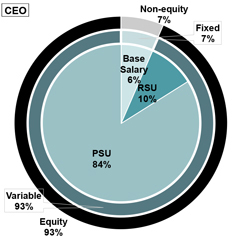 | 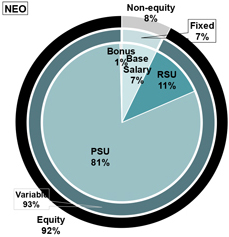 |
Table of Contents
PVP Disclosure
In accordance with rules adopted by the SEC pursuant to the Dodd-Frank Wall Street Reform and Consumer Protection Act of 2010, we provide the following disclosure regarding executive compensation covering calculations and narrative of Compensation Actually Paid (“CAP”) under new SEC Pay Versus Performance (“PVP”) disclosure requirements for our principal executive officer (“PEO”) and Non-PEO NEOs and Company performance for the fiscal years listed below. The Compensation Committee did not consider the pay versus performance disclosure below in making its pay decisions for any of the years shown.
| Year | Summary Compensation Table Total for PEO1 ($) | CAP to PEO 1,2 ($) | Average Summary Compensation Table Total for Non-PEO NEOs1 ($) | Average CAP Paid to Non-PEO NEOs1,2 ($) | Value of Initial Fixed $100 Investment based on:3 | Net Income ($ Millions) | Adjusted Earnings per Share Growth4 | |||||||||||||||||||||||||
| TSR ($) | Peer Group TSR ($) | |||||||||||||||||||||||||||||||
| 2023 | 23,661,834 | 26,595,162 | 16,616,433 | 14,770,260 | 144 | 133 | 2,564 | 6 | % | |||||||||||||||||||||||
| 2022 | 19,668,985 | 18,544,322 | 6,643,617 | 6,472,711 | 148 | 119 | 2,589 | 12 | % | |||||||||||||||||||||||
| 2021 | 19,868,384 | 101,103,407 | 7,644,425 | 25,641,567 | 147 | 133 | 1,308 | 22 | % | |||||||||||||||||||||||
| 2020 | 20,294,496 | 39,560,227 | 6,898,103 | 11,455,444 | 102 | 98 | 2,018 | 7 | % |
| 1. | The PEO for each year reflected in the table is Gregory C. Case, the Company’s CEO. The non-PEO NEOs are Christa Davies, Eric Andersen (for years 2020, 2021, 2022 and 2023 only), Lisa Stevens, Darren Zeidel (for years 2021, 2022 and 2023 only), John Bruno (for 2020 only) and Anthony Goland (for 2020 only). |
|---|
| 2. | The amounts shown for CAP have been calculated in accordance with Item 402(v) of Regulation S-K and do not reflect compensation actually earned, realized, or received by the Company’s NEOs. CAP amounts reflect the Summary Compensation Table Total with exclusions and inclusions of certain amounts for the PEO and the Non-PEO NEOs as set forth below. Equity values are calculated in accordance with FASB ASC Topic 718. Amounts in the Exclusion of Stock Awards column are the totals from the Stock Awards column set forth in the Summary Compensation Table. CAP values for 2020, 2021 and 2022 have been updated from last year’s disclosure to reflect revised guidance from the SEC related to treatment of equity upon retirement eligibility. |
|---|
PEO
| Year | Summary Compensation Table Total for PEO | Exclusion of Stock Awards for PEO | Inclusion of Equity Values for PEO | CAP to PEO | ||||||||||||
| 2023 | $23,661,834 | ($21,487,348) | $24,420,677 | $26,595,162 | ||||||||||||
| 2022 | $19,668,985 | ($17,497,455) | $16,372,792 | $18,544,322 | ||||||||||||
| 2021 | $19,868,384 | ($15,262,436) | $96,497,459 | $101,103,407 | ||||||||||||
| 2020 | $20,294,496 | ($15,880,566) | $35,146,297 | $39,560,227 |
Average Non-PEO NEOs
| Year | Average Summary Compensation Table Total for Non-PEO NEOs | Average Exclusion of Change in Pension Value for Non-PEO NEOs | Average Exclusion of Stock Awards for Non-PEO NEOs | Average Inclusion of Equity Values for Non-PEO NEOs | Average CAP for Non-PEO NEOs | |||||
| 2023 | $16,616,433 | ($27,203) | ($14,060,598) | $12,241,628 | $14,770,260 | |||||
| 2022 | $6,643,617 | $0 | ($4,729,173) | $4,558,267 | $6,472,711 | |||||
| 2021 | $7,644,425 | $0 | ($4,583,837) | $22,580,979 | $25,641,567 | |||||
| 2020 | $6,898,103 | ($76,821) | ($4,387,596) | $9,021,758 | $11,455,444 |
Table of Contents
The amounts in the Inclusion of Equity Values in the tables above are derived from the amounts set forth in the following tables:
PEO
| Year | Year-End Fair Value of Equity Awards Granted During Year That Remained Unvested as of Last Day of Year For PEO | Change in Fair Value from Last Day of Prior Year to Last Day of Year of Unvested Equity Awards for PEO | Change in Fair Value from Last Day of Prior Year to Vesting Date of Unvested Equity Awards that Vested for PEO | During Year for PEO Value of Dividends or Other Earnings Paid on Equity Awards Not Otherwise Included For PEO | Total – Inclusion of Equity Values for PEO | |||||
| 2023 | $20,584,136 | $4,938,480 | ($1,119,228) | $17,289 | $24,420,677 | |||||
| 2022 | $16,554,822 | ($54,463) | ($135,298) | $7,731 | $16,372,792 | |||||
| 2021 | $39,505,306 | $38,771,675 | $18,213,691 | $6,787 | $96,497,459 | |||||
| 2020 | $20,945,730 | $12,685,477 | $1,504,280 | $10,809 | $35,146,297 |
Average Non-PEO NEOs
| Year | Average Year-End Fair Value of Equity Awards Granted During Year That Remained Unvested as of Last Day of Year For Non-PEO NEOs | Average Change in Fair Value from Last Day of Prior Year to Last Day of Year of Unvested Equity Awards for Non-PEO NEOs | Average Change in Fair Value from Last Day of Prior Year to Vesting Date of Unvested Equity Awards that Vested for Non-PEO NEOs | Average Value of Dividends or Other Earnings Paid on Equity Awards Not Otherwise Included For Non-PEO NEOs | Total – Average Inclusion of Equity Values for Non-PEO NEOs | |||||
| 2023 | $11,342,481 | $1,190,742 | ($306,856) | $15,261 | $12,241,628 | |||||
| 2022 | $4,610,526 | ($15,910) | ($44,340) | $7,991 | $4,558,267 | |||||
| 2021 | $11,452,689 | $8,260,538 | $2,864,745 | $3,007 | $22,580,979 | |||||
| 2020 | $5,769,308 | $2,893,500 | $353,392 | $5,558 | $9,021,758 |
| 3. | The Peer Group Total Shareholder Return (“TSR”) set forth in this table utilizes the S&P 500 Financials Index, which we also utilize in the stock performance graph required by Item 201(e) of Regulation S-K included in the Original Filing. The comparison assumes $100 was invested for the period starting December 31, 2019, through the end of the listed year in the Company and in the S&P 500 Financials Index, respectively. Historical stock performance is not necessarily indicative of future stock performance. |
|---|
| 4. | We determined Adjusted EPS to be the most important financial performance measure used to link Company performance to CAP to our PEO and Non-PEO NEOs in 2022 and 2023. This performance measure may not have been the most important financial performance measure for years 2021 and 2020 and we may determine a different financial performance measure to be the most important financial performance measure in future years. |
|---|
Table of Contents
Description of Relationship Between PEO and Non-PEO NEO CAP and Company Performance
The following describes the relationship between CAP to our PEO, the average of CAP to our Non-PEO NEOs, and the Company’s Adjusted EPS Growth, Net Income and TSR performance over the three most recently completed fiscal years, in accordance with the SEC rules. However, we note that this description is not an explanation of the relationship between Company performance and our executive compensation decisions and pay outcomes, which are described in our CD&A.
Given the structure of the compensation described in our CD&A, CAP to the PEO and Non-PEO NEOs is primarily a function of the combined effects of:
| • | Achievement of our Adjusted EPS goals over overlapping three-year performance cycles, which is reasonably represented by the growth in Adjusted EPS; and |
|---|
| • | Share price appreciation, which is reasonably represented in TSR performance |
|---|
The charts below demonstrate the relationship between CAP and these performance measures.
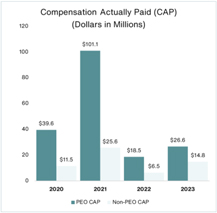 | 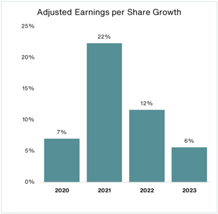 | 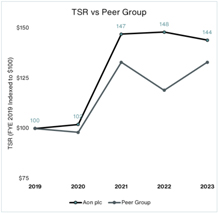 |
Of note during the period covered by this disclosure is the exceptional TSR performance and growth in our share price during 2021 coincident with very strong growth in Adjusted EPS. This resulted in attainment of the maximum performance levels and corresponding earning of 200% of the target number of shares under the LPP performance share units for more than one performance cycle, which is the primary source of equity compensation provided to our PEO and non-PEO NEOs, as described in our CD&A.
Our net income grew 27% over the 2019-2023 period reflective of strong growth and performance on our key financial metrics, including a decline of 1% for 2023. In 2023, we had adjusted operating income growth of 10%, driven by strong revenue growth, offset by expenses that were not representative of normal business operations and other non-operating expenses which resulted in a net income decline of 1% year over year. Net income performance does not have a strong relationship with the reported CAP to our PEO and Non-PEO NEOs given the lower relative weighting of this measurement of performance as compared to the others previously discussed.
Tabular List of Most Important Financial Performance Measures
The following table presents the financial performance measures that the Company considers to have been the most important in linking CAP to our PEO and Non-PEO NEOs for 2023 to Company performance. The measures in this table are not ranked.
| Adjusted Earnings Per Share Growth |
| Adjusted Operating Income Growth |
Table of Contents
Compensation Committee Interlocks and Insider Participation
No member of the Compensation Committee has been an officer or employee of the Company. None of our executive officers serves on the board of directors or compensation committee of a company that has an executive officer that serves on our Board of Directors or the Compensation Committee.
Table of Contents
Previous: Item 10. Directors, Executive Officers and Corporate Governance. · Next: Item 12. Security Ownership of Certain Beneficial Owners and Management and Related Stockholder Matters.