 filings.tools
APA 10-K 2023-12-31
Filed 2024-02-22. 22 sections, 642K characters. Original on sec.gov · Markdown · JSON
Cover and table of contents
UNITED STATES
SECURITIES AND EXCHANGE COMMISSION
Washington, D.C. 20549
FORM 10-K
(Mark One)
| ☒ | ANNUAL REPORT PURSUANT TO SECTION 13 OR 15(d) OF THE SECURITIES EXCHANGE ACT OF 1934 |
For the fiscal year ended December 31, 2023
or
| ☐ | TRANSITION REPORT PURSUANT TO SECTION 13 OR 15(d) OF THE SECURITIES EXCHANGE ACT OF 1934 |
For the transition period from to
Commission file number 1-40144
APA CORPORATION
(Exact name of registrant as specified in its charter)
| Delaware | 86-1430562 | |||||||
| (State or other jurisdiction of incorporation or organization) | (I.R.S. Employer Identification No.) |
One Post Oak Central, 2000 Post Oak Boulevard, Suite 100, Houston, Texas 77056-4400
(Address of principal executive offices) (Zip Code)
Registrant’s telephone number, including area code (713) 296-6000
Securities registered pursuant to Section 12(b) of the Act:
| Title of each class | Trading Symbol(s) | Name of each exchange on which registered | ||||||
| Common Stock, $0.625 par value | APA | Nasdaq Global Select Market |
Securities registered pursuant to section 12(g) of the Act: None
Indicate by check mark if the registrant is a well-known seasoned issuer, as defined in Rule 405 of the Securities Act. Yes ☒ No ☐
Indicate by check mark if the registrant is not required to file reports pursuant to Section 13 or Section 15(d) of the Act. Yes ☐ No ☒
Indicate by check mark whether the registrant (1) has filed all reports required to be filed by Section 13 or 15(d) of the Securities Exchange Act of 1934 during the preceding 12 months (or for such shorter period that the registrant was required to file such reports), and (2) has been subject to such filing requirements for the past 90 days. Yes ☒ No ☐
Indicate by check mark whether the registrant has submitted electronically every Interactive Data File required to be submitted pursuant to Rule 405 of Regulation S-T (§ 232.405 of this chapter) during the preceding 12 months (or for such shorter period that the registrant was required to submit such files). Yes ☒ No ☐
Indicate by check mark whether the registrant is a large accelerated filer, an accelerated filer, a non-accelerated filer, a smaller reporting company, or an emerging growth company. See the definitions of “large accelerated filer,” “accelerated filer,” “smaller reporting company,” and “emerging growth company” in Rule 12b-2 of the Exchange Act. Large accelerated filer ☒ Accelerated filer ☐ Non-accelerated filer ☐ Smaller reporting company ☐ Emerging growth company ☐
If an emerging growth company, indicate by check mark if the registrant has elected not to use the extended transition period for complying with any new or revised financial accounting standards provided pursuant to Section 13(a) of the Exchange Act. ☐
Indicate by check mark whether the registrant has filed a report on and attestation to its management’s assessment of the effectiveness of its internal control over financial reporting under Section 404(b) of the Sarbanes-Oxley Act (15 U.S.C. 7262(b)) by the registered public accounting firm that prepared or issued its audit report. ☒
If securities are registered pursuant to Section 12(b) of the Act, indicate by check mark whether the financial statements of the registrant included in the filing reflect the correction of an error to previously issued financial statements. ☐
Indicate by check mark whether any of those error corrections are restatements that required a recovery analysis of incentive-based compensation received by any of the registrant’s executive officers during the relevant recovery period pursuant to §240.10D-1(b). ☐
Indicate by check mark whether the registrant is a shell company (as defined in Rule 12b-2 of the Act): Yes ☐ No ☒
| Aggregate market value of the voting and non-voting common equity held by non-affiliates of registrant as of June 30, 2023 | $ | 10,499,243,068 | |||
| Number of shares of registrant’s common stock outstanding as of January 31, 2024 | 301,818,820 |
Documents Incorporated By Reference
Portions of the registrant’s definitive proxy statement relating to the registrant’s 2024 annual meeting of stockholders are incorporated by reference in Part II and Part III of this Annual Report on Form 10-K.
TABLE OF CONTENTS
Showing the first 8K of 106K characters. Open the full section
Item 1A. RISK FACTORS
The Company’s business activities and the value of its securities are subject to significant hazards and risks, including those described below. If any of such events should occur, the Company’s business, financial condition, liquidity, and/or results of operations could be materially harmed, and holders and purchasers of APA’s securities could lose part or all of their investments. Additional risks and uncertainties not presently known to the Company or that the Company currently considers immaterial may also adversely affect the Company.
RISKS RELATED TO PRICING, DEMAND, AND PRODUCTION FOR CRUDE OIL, NATURAL GAS, AND NGLs
Crude oil, natural gas, and NGL prices and their volatility could adversely affect the Company’s operating results and the price of APA’s common stock.
The Company’s revenues, operating results, future rate of growth, and carrying value of its oil and gas properties depend highly upon the prices it receives for its sales of crude oil, natural gas, and NGL products. Historically, the markets for these commodities have been volatile and are likely to continue to be volatile in the future. For example, the NYMEX daily settlement price for the prompt month oil contract in 2023 ranged from a high of $93.67 per barrel to a low of $66.61 per barrel, and the NYMEX daily settlement price for the prompt month natural gas contract in 2023 ranged from a high of $3.78 per MMBtu to a low of $1.74 per MMBtu. The market prices for crude oil, natural gas, and NGLs depend on factors beyond the Company’s control. These factors include demand, which fluctuates with changes in market and economic conditions, and other factors, including:
-
worldwide and domestic supplies and/or inventories of crude oil, natural gas, and NGLs and the availability of related pipeline, transportation, import/export, and refining capacity and infrastructure;
-
actions taken by foreign oil and gas producing nations, including the Organization of the Petroleum Exporting Countries (OPEC) and non-OPEC members that participate in OPEC initiatives (OPEC+);
-
political conditions and events in oil and gas producing regions, including instabilities, changes in governments, or armed conflicts, such as the Russian war in Ukraine and the armed conflict in Israel and Gaza;
-
the price, competitiveness, decision to use, and availability of alternative fuels and energy sources, including coal, biofuels, and renewables;
-
increased competitiveness of, and demand for, alternative energy sources;
-
technological advances affecting energy supply and energy consumption, including those that alter fuel choices;
-
the availability of pipeline capacity and infrastructure;
-
the availability of crude oil transportation and refining capacity;
-
weather conditions;
-
the impact of political pressure and the influence of environmental groups, investors, and other stakeholders on decisions and policies related to the oil and gas industry, including with respect to environmental, social, and governance matters;
-
domestic and foreign governmental regulations and taxes, including changes or initiatives to address the impacts of global climate change, hydraulic fracturing, methane emissions, flaring, or water disposal; and
-
the overall economic environment, including rates of growth and increasing inflationary pressure.
Low prices have previously adversely affected and could from time to time in the future adversely affect the Company’s revenues, operating income, cash flow, and proved reserves, and a prolonged period of low prices could have a material adverse impact on the Company’s results of operations and cash flows and limit its ability to fund capital expenditures. Without the ability to fund capital expenditures, the Company would be unable to replace reserves and production. Sustained low prices of crude oil, natural gas, and NGLs could also further adversely impact the Company’s business, including by weakening the Company’s financial condition and reducing its liquidity, limiting the Company’s ability to fund planned capital expenditures and operations, causing the Company to delay or postpone some of its capital projects or reallocate capital to different projects or regions, limiting the Company’s access to sources of capital, such as equity and long-term debt, or reducing the carrying value of the Company’s oil and gas properties, resulting in additional non-cash impairments.
The Company’s ability to sell crude oil, natural gas, or NGLs, receive market prices for these commodities, and/or meet volume commitments under transportation services agreements may be adversely affected by pipeline and gathering system capacity constraints, the inability to procure and resell volumes economically, and various transportation interruptions.
A portion of the Company’s crude oil, natural gas, and NGL production in any region may be interrupted, limited, or shut in from time to time for numerous reasons, including as a result of weather conditions, accidents, loss of pipeline or gathering system access, field labor issues or strikes, cyberattacks or terrorist events, or capital constraints that limit the ability of third parties to construct gathering systems, processing facilities, or interstate pipelines to transport the Company’s production. Additionally, the Company may voluntarily curtail production in response to market conditions. If a substantial amount of the Company’s production is interrupted or curtailed at the same time, it could temporarily adversely affect the Company’s cash flows. Further, if the Company is unable to procure and resell third-party volumes at or above a net price that covers the cost of transportation, the Company’s cash flows could be adversely affected.
The Company has previously not realized, and may in the future not realize, an adequate return on wells that it drills.
Drilling for oil and gas involves numerous risks, including that the Company may not encounter commercially productive oil or gas reservoirs or may not recover all or any portion of its investment in the wells it drills. Management has previously determined, and may in the future determine, that future drilling or development activities will not, or are unlikely to, occur for a well or reservoir, based on drilling results, current or future estimated commodity prices or demand for oil, natural gas, and NGLs, or other information. The costs of drilling, completing, and operating wells are often uncertain, and drilling operations are subject to a variety of risks, including unexpected drilling conditions (such as pressure or formation irregularities), equipment failures or accidents, catastrophic events, marine risks, adverse weather conditions, and increases in the cost of or shortages or delays in the availability of drilling rigs, equipment, and labor. In addition, exploratory drilling involves greater risks of dry holes or failure to find commercial quantities of hydrocarbons. Any such events could have an adverse effect on the Company’s future results of operations and financial condition. Exploration costs and dry hole expenses incurred by the Company during the reporting period are further discussed in this Annual Report on Form 10-K and reflected in the consolidated financial statements included herein.
The Company’s commodity price risk management and trading activities may prevent it from benefiting fully from price increases and may expose it to other risks.
To the extent that the Company engages in price risk management activities to protect itself from commodity price declines, the Company may be prevented from realizing the benefits of price increases. The Company’s hedging arrangements may expose it to the risk of financial loss, including when production falls short of the hedged volumes, price-basis differentials widen, a hedging counterparty defaults, or an unexpected event materially impacts commodity prices.
Global pandemics have previously, may continue to, and may in the future adversely impact the Company’s business, financial condition, and results of operations; the global economy; the demand for and prices of oil, natural gas, and NGLs; and the performance of the Company’s workforce.
Global pandemics and the actions taken by third parties, including, but not limited to, governmental authorities, businesses, and consumers, in response to such pandemics, including the COVID-19 pandemic, have previously adversely impacted and may from time to time in the future adversely impact the global economy, resulting in significant volatility in the global financial markets, and the demand for, and the prices of, oil, natural gas, and NGLs, which may materially adversely affect the Company’s business, financial condition, cash flows, and results of operations. Additionally, the Company’s operations rely on its workforce having access to its wells, platforms, structures, offices, and facilities. If a significant portion of the Company’s workforce cannot effectively perform their responsibilities, whether resulting from a lack of physical or virtual access, quarantines, illnesses, governmental actions or restrictions (including vaccine mandates and the reactions thereto), or other restrictions or adverse impacts resulting from a pandemic, the Company’s business, financial condition, cash flows, and results of operations may be materially adversely affected.
RISKS RELATED TO OPERATIONS AND DEVELOPMENT PROJECTS
The Company’s operations involve a high degree of operational risk, particularly risk of personal injury, damage to or loss of property, and environmental accidents.
The Company’s operations are subject to hazards and risks inherent in the drilling, production, and transportation of crude oil, natural gas, and NGLs, including well blowouts, explosions, fires, cratering, pipeline or other facility ruptures and spills, adverse weather conditions, including those impacting the Company’s offshore operating areas, surface spillage and
ground water contamination, and failure or loss of equipment. These events, including ineffective containment of such events, could result in property damages, personal injury, environmental pollution, and other damages for which the Company could be liable. If a significant amount of the Company’s production is interrupted, containment efforts prove to be ineffective, or litigation arises as the result of a catastrophic occurrence, the Company’s cash flows and, in turn, its results of operations could be materially and adversely affected.
Weather and climate may have a significant adverse impact on the Company’s revenues and production.
Demand for oil and natural gas are, to a significant degree, dependent on weather and climate, which impact the price the Company receives for the commodities it produces. In addition, the Company’s exploration, development, and production activities and equipment have been and can be adversely affected by severe weather, such as freezing temperatures, hurricanes in the Gulf of Mexico, or major storms in the North Sea, each of which have previously caused and may cause a loss of production from temporary cessation of activity or lost or damaged equipment. The Company’s planning for normal climatic variation, insurance programs, and emergency recovery plans may inadequately mitigate the effects of such weather conditions, and not all such effects can be predicted, eliminated, or insured against.
The Company’s insurance policies do not cover all of the risks the Company faces, which could result in significant financial exposure.
Exploration for and production of crude oil, natural gas, and NGLs involves hazards, which can result in damage to or destruction of wells or production facilities, injury to persons, loss of life, or damage to property or the environment. The Company’s international operations are also subject to political and economic risks. The insurance coverage that the Company maintains against certain losses or liabilities arising from its operations may be inadequate to cover any such resulting liability; moreover, insurance is not available to the Company against all operational risks. While certain of the Company’s insurance policies may provide coverage for such events, if the Company were to incur a significant liability for which it was not fully insured, then it could have a material adverse effect on the Company’s financial position, results of operations, and cash flows. In addition, if such an event were to occur, then the proceeds of any such insurance may not be paid in a timely manner or may not be sufficient to cover all of the Company’s losses.
A cyberattack targeting systems and infrastructure used by the Company or others in the oil and gas industry may adversely impact the Company’s operations.
There are numerous and evolving risks to the Company’s data, technology, and information systems from cyber threat actors, including criminal hackers, state-sponsored intrusions, industrial espionage, and employee malfeasance. The Company’s operations are dependent on digital technologies, including to estimate reserves, process financial and operating data, analyze drilling information, and communicate with personnel. Unauthorized access to the Company’s data, technology, and information systems could lead to operational disruption, communication interruption, disruption in access to financial reporting systems, loss, misuse, or corruption of data and proprietary information. In addition, unauthorized access to third party information systems could interrupt the oil and gas distribution and refining systems in the U.S. and abroad, which are necessary to transport and market the Company’s production. Cyberattacks directed at oil and gas distribution systems have previously and could again in the future damage critical distribution and storage assets or the environment. The potential impacts of a cyber incident could be made worse by a delay or failure to detect the occurrence, continuance, or extent of such an incident.
The Company expends significant resources to protect its digital systems and data, whether such data is housed internally or externally by third parties, against cyberattacks and may be required to expend further resources as cyber threat actors become more sophisticated and as regulations related to cyberattacks become more complex. Cyberattacks, including malicious software, data privacy breaches by employees, insiders, or others with authorized access to the Company’s systems, cyber or phishing attacks, ransomware attacks, supply chain vulnerabilities, business email compromises, other attempts to gain unauthorized access to the Company’s data and systems, and other electronic security breaches could have a material adverse effect on the Company’s business, cause it to incur a material financial loss, subject it to possible legal claims and liability, and/or damage its reputation.
While the Company has not suffered any material losses as a result of cyberattacks, there is no assurance that the Company will not suffer such losses in the future.
Material differences between the estimated and actual timing of critical events or costs may affect the completion and commencement of production from development projects.
The Company is involved in several large development projects, and the completion of these projects may be delayed beyond the Company’s anticipated completion dates. These projects may be delayed by project approvals from joint venture partners, timely issuances of permits and licenses by governmental agencies, weather conditions, manufacturing and delivery schedules of critical equipment, and other unforeseen events. Delays and differences between estimated and actual timing of critical events and development costs (including for equipment and personnel) may adversely affect the Company’s large development projects (including forcing the Company to abandon such projects) and its ability to participate in large-scale development projects in the future.
RISKS RELATED TO RESERVES AND LEASEHOLD ACREAGE
Discoveries or acquisitions of additional reserves are needed to avoid a material decline in reserves and production.
The production rate from oil and natural gas properties generally declines as reserves are depleted, while related per-unit production costs generally increase as a result of decreasing reservoir pressures and other factors. Therefore, future oil and gas production is highly dependent upon the Company’s level of success in adding reserves through exploration and development activities, identifying additional behind-pipe zones, secondary recovery reserves, or tertiary recovery reserves through engineering studies, or acquiring additional properties containing proved reserves. As oil or natural gas prices increase, the Company’s cost for additional reserves could also increase.
The Company may fail to fully identify potential problems related to acquired reserves or to properly estimate those reserves.
Although the Company performs a review of properties that it acquires, which the Company believes is consistent with industry practices, such reviews are inherently incomplete, and environmental problems, such as groundwater contamination, are not necessarily observable even when an inspection is undertaken. There are numerous uncertainties inherent in estimating quantities of proved oil and gas reserves and future production rates and costs with respect to acquired properties, and actual results may vary substantially from those assumed in the estimates. There can be no assurance that acquisitions will not adversely impact the Company’s operating results, particularly during their integration into the Company’s ongoing operations.
Crude oil, natural gas, and NGL reserves are estimates, and actual recoveries may vary significantly.
There are numerous uncertainties inherent in the process of estimating crude oil, natural gas, and NGL reserves and their value, which is highly subjective and relies on the quality of available data and the accuracy of engineering and geological interpretation. The Company’s reserves estimates are based on 12-month average prices, except where contractual arrangements exist, causing reserves quantities to change when actual prices increase or decrease. The estimates of the Company’s proved reserves and estimated future net revenues also depend on a number of factors and assumptions that may vary considerably from actual results, including historical production from the area compared with production from other areas, the results of drilling, testing, and production for a reservoir over time, the use of volumetric analysis versus production history, the effects of changes in laws (including taxes), future operating, workover, and remediation costs, and capital expenditures. Accordingly, reserves estimates may be subject to adjustment, and actual production, revenue, and expenditures with respect to the Company’s reserves likely will vary, possibly materially, from estimates. In addition, realization or recognition of proved undeveloped reserves will depend on the Company’s development schedule and plans. A change in future development plans for proved undeveloped reserves could cause the discontinuation of the classification of these reserves as proved.
Certain of the Company’s undeveloped leasehold acreage is subject to leases that will expire over the next several years unless production is established on units containing the acreage.
A sizeable portion of the Company’s acreage is currently undeveloped. Unless production in paying quantities is established on units containing certain of these leases during their terms, the leases will expire. If the leases expire, the Company will lose its right to develop the related properties. The Company’s drilling plans for these areas are subject to change based upon various factors, including drilling results, commodity prices, the availability and cost of capital, drilling and production costs, availability of drilling services and equipment, gathering system and pipeline transportation constraints, and regulatory approvals.
RISKS RELATED TO COUNTERPARTIES
The credit risk of financial institutions could adversely affect the Company and result in a significant loss.
The Company is party to numerous transactions with counterparties in the financial services industry, including commercial banks, investment banks, insurance companies, other investment funds, and other institutions, including in the form of derivative transactions in connection with any hedges and claims under the Company’s insurance policies, which expose the Company to credit risk in the event of default of the counterparty. Deterioration or volatility in the credit or financial markets, changes in commodity prices, and changes in a counterparty’s liquidity may affect the counterparties’ ability to fulfill their existing obligations to the Company. In addition, if any lender under the Company’s credit facilities is unable to fund its commitment, the Company’s liquidity may be reduced by an amount up to the aggregate amount of such lender’s commitment thereunder. Furthermore, the bankruptcy of one or more of the Company’s counterparties or some other similar proceeding or liquidity constraint might make it unlikely that the Company would be able to collect all or a significant portion of amounts owed to it by the distressed entity or entities, and the Company could incur a significant loss.
The distressed financial conditions of the Company’s partners and the purchasers of the Company’s products or assets have had and could have an adverse impact on the Company in the event they are unable to reimburse the Company for their share of costs or to pay the Company for the products or services the Company provides.
The Company is exposed to risk of financial loss from trade, joint venture, joint interest billing, and other receivables. As a result of previous severe declines in commodity prices, some of the Company’s customers and non-operating partners experienced severe financial problems. The Company cannot provide assurance that one or more of its financially distressed customers or non-operating partners will not default on their obligations to the Company (including as a result of their filing for bankruptcy or other liquidity constraints) or that such a default or defaults will not have a material adverse effect on the Company’s business, financial position, future results of operations, or future cash flows.
The Company’s liabilities, including for the decommissioning of previously owned assets, could be adversely affected in the event one or more of its transaction counterparties are financially distressed or become the subject of a bankruptcy case.
The agreements relating to the Company’s divestment of domestic and international assets generally contain provisions pursuant to which liabilities related to past and future operations (one of the most significant of which is the decommissioning of wells and facilities) are allocated between the parties by means of liability assumptions, indemnities, escrows, trusts, bonds, letters of credit, and similar arrangements. One or more of the counterparties in these transactions could fail to perform its obligations under these agreements as a result of financial distress or bankruptcy, which may force the Company to use available cash to cover the costs of such obligations, pending final resolution of any claims the Company may have against the counterparty, which could adversely impact the Company’s cash flows, operations, or financial condition.
For additional information regarding Apache’s prior Gulf of Mexico properties and the bankruptcy of the purchaser of those properties, see the information set forth under “Potential Decommissioning Obligations on Sold Properties” in Note 11—Commitments and Contingencies in the Notes to Consolidated Financial Statements set forth in Item 15 of this Annual Report on Form 10-K.
The Company does not always control decisions made under joint operating agreements or joint ventures, and the parties to such agreements or ventures may fail to meet their obligations.
The Company conducts many of its exploration and production (E&P) operations through joint operating agreements or joint ventures with other parties. The Company may not control decisions made under such agreements or ventures, either because it does not have a controlling interest in the venture or is not an operator under the agreement. The other parties to these arrangements may have economic, business, or legal interests or goals that are inconsistent with the Company’s, and, therefore, decisions may be made that the Company does not believe are in its best interest. Moreover, parties to such agreements or ventures may be unable to meet their economic or other obligations, and the Company may be required to fulfill those obligations alone. In either case, the value of the investment and the Company’s business and financial condition may be adversely affected.
RISKS RELATED TO CAPITAL MARKETS
A downgrade in the Company’s credit rating could negatively impact its cost of and ability to access capital.
The Company receives debt ratings from the major credit rating agencies in the U.S. Factors that may impact the Company’s credit ratings include its debt levels, planned asset purchases or sales, and near-term and long-term production growth opportunities. Liquidity, asset quality, cost structure, product mix, commodity pricing levels, and other factors are also considered by the rating agencies. A ratings downgrade could adversely impact the Company’s ability to access debt markets in the future and increase the cost of future debt. During 2023, Moody’s upgraded the Company’s rating to Baa3/Stable, and Standard and Poor’s affirmed the Company’s rating as BB+/Positive. Past ratings downgrades have required, and any future downgrades may require, the Company to post letters of credit or other forms of collateral for certain obligations.
Market conditions may restrict the Company’s ability to obtain funds for future development and working capital needs, which may limit its financial flexibility.
The financial markets are subject to fluctuation and are vulnerable to unpredictable swings. The Company has a significant development project inventory and an extensive exploration portfolio, which will require substantial future investment. The Company and/or its partners may need to seek financing to fund these or other future activities. The Company’s future access to capital, as well as that of its partners and contractors, could be limited if the debt or equity markets are constrained. This could significantly delay development of the Company’s property interests.
The Company’s syndicated revolving credit facilities currently mature in April 2027. There is no assurance of the terms upon which potential lenders under future agreements will make loans or other extensions of credit available to the Company or its subsidiaries or the composition of such lenders.
The Company’s ability to declare and pay dividends is subject to limitations.
The payment of future dividends on the Company’s capital stock is subject to the discretion of the Board of Directors, taking into consideration, among other factors, the Company’s operating results, available cash, overall financial condition, credit risks, capital requirements, restrictions under the Company’s indentures and other financing agreements, and restrictions under Delaware law, as well as general business and market conditions. The Board of Directors is not required to declare dividends on APA’s common stock and may decide not to declare dividends.
Actions by advocacy groups to advance climate change and energy transition initiatives, unfavorable ESG ratings, and funding limitation initiatives may lead to negative investor and public sentiment toward the Company and to the diversion of capital from companies in the oil and gas industry, which could negatively impact the Company’s access to and costs of capital or the market for the Company’s securities.
Organizations that provide information to investors on corporate governance and related matters have developed ratings for evaluating companies on their approach to ESG matters. Such ratings are used by some investors to inform and advise their investment and voting decisions. Unfavorable ESG ratings may lead to negative investor and public sentiment toward the Company, which may cause the market for the Company’s securities to be negatively impacted.
In addition, a number of advocacy groups have campaigned for governmental and private action to influence change in the business strategies of oil and gas companies, including through the investment and voting practices of investment advisers, public pension funds, universities, and other members of the investing community. These campaign efforts have resulted in the divestment of investments in the oil and gas industry and increased pressure on lenders and other financial services companies to limit or curtail activities with oil and gas companies. If investors or financial institutions shift funding away from companies in the oil and gas industry, the Company’s access to and costs of capital or the market for the Company’s securities may be negatively impacted.
RISKS RELATED TO FINANCIAL RESULTS
The Company faces strong industry competition that may have a significant negative impact on the Company’s results of operations.
Strong competition exists in all sectors of the oil and gas E&P industry. The Company competes for leases, equipment, labor, key personnel, and marketing of crude oil, natural gas, and NGL production, the prices of which impact the costs of properties and the financial resources available to pursue acquisitions. These competitive pressures may have a significant negative impact on the Company’s results of operations.
The Company’s ability to utilize net operating losses and other tax attributes to reduce future taxable income may be limited if the Company experiences an ownership change.
As described in Note 10—Income Taxes of the Notes to Consolidated Financial Statements included in Item 8 of this Annual Report on Form 10-K, the Company has substantial net operating loss carryforwards (NOLs) and other tax attributes available to potentially offset future taxable income. If the Company were to experience an “ownership change” under Section 382 of the Internal Revenue Code of 1986, as amended, which is generally defined as a greater than 50 percentage point change, by value, in the Company’s equity ownership by five-percent shareholders over a three-year period, the Company’s ability to utilize its pre-change NOLs and other pre-change tax attributes to potentially offset its post-change income or taxes may be limited. Such a limitation could materially adversely affect the Company’s operating results or cash flows.
APA is a holding company and is dependent on the operations of and distributions from its subsidiaries, including Apache.
As a holding company, APA has no business operations of its own, and its only significant assets are the outstanding equity interests of its subsidiaries, including Apache. As a result, APA relies on cash flows from its subsidiaries to pay dividends on its common stock and to meet its financial obligations, including to service any amounts outstanding under its credit agreement or commercial paper program, and any additional financial obligations that the Company may incur from time to time in the future. If the subsidiaries are limited in their ability to distribute cash to the Company, such as through legal or contractual limitations, or if the subsidiaries’ earnings or other available assets are not sufficient to pay distributions or make loans to the Company in the amounts or at the times necessary to meet the Company’s financial obligations, then the Company’s financial condition, cash flows, and reputation may be materially adversely affected.
RISKS RELATED TO GOVERNMENTAL REGULATION AND POLITICAL RISKS
The Company may incur significant costs related to environmental matters.
As an owner or lessee and operator of oil and gas properties, the Company is subject to various federal, state, local, and foreign laws and regulations relating to the discharge of materials into and protection of the environment. These laws and regulations may, among other things, impose liability on the lessee under an oil and gas lease for the cost of pollution cleanup and other remediation activities resulting from operations, subject the lessee to liability for pollution and other damages, limit or constrain operations in affected areas, require significant capital expenditures to comply with increasingly strict environmental laws and regulations, and require suspension or cessation of operations in affected areas. The Company’s efforts to limit its exposure to such liability and cost may prove inadequate and result in significant adverse effects to the Company’s results of operations and cash flows.
The Company’s U.S. operations are subject to governmental risks.
The Company’s U.S. operations have been, and at times in the future may be, affected by political developments and by federal, state, and local laws and regulations, including restrictions on production, changes in taxes and other amounts payable to governments, price or gathering rate controls, environmental protection laws and regulations, and security for plugging, abandonment, and decommissioning obligations, including in the Gulf of Mexico.
New political developments, the enactment of new or stricter laws or regulations or other governmental actions impacting the Company’s U.S. operations, and increased liability for companies operating in the oil and gas E&P industry may adversely impact the Company’s results of operations.
Proposed federal, state, or local regulation regarding hydraulic fracturing could increase the Company’s operating and capital costs.
The Company routinely uses fracturing techniques in the U.S. and other regions to expand the available space for oil and natural gas to migrate toward the wellbore, typically at substantial depths in formations with low permeability. Governmental entities have previously taken actions to regulate, and several proposals are before the U.S. Congress that, if implemented, would further regulate, hydraulic fracturing. If adopted, such regulations could impose more stringent permitting, reporting, and well construction requirements or otherwise seek to ban fracturing activities. These activities and the associated water disposal activities are under scrutiny due to their potential environmental and physical impacts, including possible water contamination and possible links to induced seismicity. Any new federal, state, or local restrictions on hydraulic fracturing could result in increased compliance costs or additional restrictions on the Company’s U.S. operations.
Changes in tax rules and regulations, or interpretations thereof, may adversely affect the Company’s business, financial condition, and results of operations.
Federal, state, and foreign income tax laws affecting oil and gas exploration, development, and extraction may be modified by administrative, legislative, or judicial interpretation at any time. For example, the U.K. enacted the Energy Profits Levy, which assesses an additional levy of 35 percent, effective for the period of January 1, 2023, through March 31, 2028, on the profits of oil and gas companies operating in the U.K. and the U.K. Continental Shelf. Additionally, in the U.S., the Inflation Reduction Act of 2022 introduced a new 15 percent corporate alternative minimum tax (Corporate AMT) for taxable years beginning after December 31, 2022, on applicable corporations with an average annual adjusted financial statement income (AFSI) that exceeds $1.0 billion for any three consecutive tax years preceding the tax year at issue. Effective January 1, 2024, the Company is subject to the Corporate AMT. Accordingly, any resulting Corporate AMT liability could adversely affect the Company’s future financial results, including earnings and cash flows.
Previous legislative proposals, if enacted into law, could make significant changes to tax laws, including the elimination of certain key U.S. federal income tax incentives currently available to oil and gas E&P companies. These changes include, but are not limited to, the repeal of the percentage depletion allowance for oil and gas properties, the elimination of current deductions for intangible drilling and development costs, and an extension of the amortization period for certain geological and geophysical expenditures. The passage or adoption of these changes, or similar changes, could eliminate or postpone certain tax deductions that are currently available with respect to oil and gas exploration and development. The Company is unable to predict whether any of these changes or other proposals will be enacted. Any such changes could adversely affect the Company’s business, financial condition, and results of operations.
RISKS RELATED TO CLIMATE CHANGE
The impacts of energy transition could adversely affect the Company’s business, operating results, and financial condition.
In recent years, increasing attention has been given to corporate activities related to climate change and energy transition. This focus, together with shifting preferences and attitudes with respect to the generation and consumption of energy, the use of hydrocarbons, and the use of products manufactured with, or powered by, hydrocarbons, may result in increased availability of, and demand for, energy sources other than oil and natural gas, including wind, solar, and hydroelectric power, and the development of, and increased demand from consumers and industries for, lower-emission products and services, including electric vehicles and renewable residential and commercial power supplies, as well as more energy-efficient products and services.
These developments could adversely impact the demand for products powered by or manufactured with hydrocarbons and the demand for, and in turn the prices the Company receives for, its crude oil, natural gas, and NGL products, which could materially and adversely affect the Company’s business and financial performance.
Changes to existing regulations related to emissions and the impact of any changes in climate could adversely impact the Company’s business.
Certain countries where the Company operates, including the U.K., either tax or assess some form of greenhouse gas (GHG) related fees on the Company’s operations. Exposure has not been material to date, although a change in existing regulations could adversely affect the Company’s cash flows and results of operations. Additionally, there has been discussion in other countries where the Company operates, including the U.S., regarding changes in legislation or heightened regulation of GHGs, including to monitor and limit existing emissions of GHGs and to restrict or eliminate future emissions. Moreover, in January 2024, the EPA announced a proposed rule to assess a charge on certain methane emissions in the oil and gas industry. The Company is currently evaluating the proposed rule and its applicability to the Company.
Additionally, various states and groups of states have adopted or are considering adopting legislation, regulations, or other regulatory initiatives that are focused on such areas as GHG cap-and-trade programs, carbon taxes, reporting and tracking programs, restriction of emissions, electric vehicle mandates, and combustion engine phaseouts.
Any such legislation, regulations, or other regulatory initiatives, if enacted, or additional or increased taxes, assessments, or GHG-related fees on the Company’s operations could lead to increased operating expenses or cause the Company to make significant capital investments for infrastructure modifications.
Enhanced focus on ESG matters could have an adverse effect on the Company’s operations.
Enhanced focus on ESG matters related to, among other things, concerns raised by advocacy groups about climate change, hydraulic fracturing, waste disposal, oil spills, and explosions of natural gas transmission pipelines may lead to increased regulatory review, which may, in turn, lead to new state and federal safety and environmental laws, regulations, guidelines, and enforcement interpretations. These actions may cause operational delays or restrictions, increased operating costs, additional regulatory burdens, increased risk of litigation, and adverse impacts on the Company’s access to capital. Moreover, governmental authorities exercise considerable discretion in the timing and scope of permit issuance and regulatory approvals. Negative public perception could cause the permits or regulatory approvals the Company requires to be withheld, delayed, or burdened by requirements that restrict the Company’s ability to profitably conduct its business.
The Company’s estimates used in various scenario planning analyses could differ materially from actual results and could expose the Company to new or additional risks.
Given the dynamic nature of the Company’s business, the Company generally performs annual scenario analyses with five-year time horizons. When analyzing longer-term scenarios, the Company relies on external analysis for demand scenarios, carbon pricing, and comparison-pricing scenarios, which are then compared to the Company’s internally prepared base-case pricing analysis averaged out to the year 2040. Given the numerous estimates that are required to run these scenarios, the Company’s estimates could differ materially from actual results. The Company publicly discloses these metrics and its related assumptions and analysis in its annual sustainability report. By electing to disclose these metrics, the Company may face increased scrutiny related to its ESG initiatives. Any harm to the Company’s reputation resulting from publicly disclosing such these metrics, expanding disclosures related to such metrics, or failing to achieve such metrics or abiding by such disclosures could adversely affect the Company’s business, financial performance, and growth.
The guidance upon which the Company’s consumptive water use reporting was modified and could be revised in the future, resulting in the over or underreporting of the Company’s consumptive water use.
In 2022, the Company modified the way it reports its water data compared to previous years and restated its data from prior years. Previously, the Company included produced water usage in its consumptive use calculations, which led to an over-reporting of consumptive water use. Based on re-evaluation of water reporting definitions and guidance, the Company determined that produced water (non-potable water released from deep underground formations and brought to the surface during oil and gas exploration and production) should not be classified as consumed in the same sense as fresh water. The Company’s revised reporting now reflects only fresh water and non-potable water from surface water or shallow groundwater that are consumed in oil and gas operations.
The treatment and disposal of produced water is becoming more highly regulated and restricted and could expose the Company to additional costs or limit certain operations.
The treatment and disposal of produced water is becoming more highly regulated and restricted. Regulators in some states, such as the Railroad Commission of Texas, have taken actions to limit disposal well activities (including orders to temporarily shut down or to curtail water injection) and to require the monitoring of seismic activity. While the Company remains focused on reusing or recycling water over disposal of water, the Company’s costs for obtaining and disposing of water could increase significantly if reusing and recycling water becomes impractical. Further, compliance with reporting and environmental regulations governing the withdrawal, storage, use, and discharge of water and restrictions related to disposal wells may increase the Company’s operating costs or capital expenses or cause the Company to limit production, which could materially and adversely affect its business, results of operations, and financial conditions.
RISKS RELATED TO INTERNATIONAL OPERATIONS
International operations have uncertain political, economic, and other risks.
The Company’s operations outside the U.S. are based primarily in Egypt and the U.K., with significant exploration and appraisal activities offshore Suriname. On a barrel equivalent basis, approximately 46 percent of the Company’s 2023 production was outside the U.S., and approximately 30 percent of the Company’s estimated proved oil and gas reserves as of December 31, 2023, were located outside the U.S. As a result, a significant portion of the Company’s production and resources are subject to the increased political and economic risks and other factors associated with international operations, including, but not limited to strikes and civil unrest; war, acts of terrorism, expropriation and resource nationalization, forced renegotiation or modification of existing contracts, including through prospective or retroactive changes in the laws and regulations applicable to such contracts; import and export regulations; taxation policies and investment restrictions; price controls;
exchange controls, currency fluctuations, devaluations, or other activities that limit or disrupt markets and restrict payments or the movement of funds; constrained oil or natural gas markets dependent on demand in a single or limited geographical area; laws and policies of the U.S. affecting foreign trade, including trade sanctions; the possibility of being subject to exclusive jurisdiction of foreign courts in connection with legal disputes relating to licenses to operate and concession rights in countries where the Company currently operates; the possible inability to subject foreign persons, especially foreign oil ministries and national oil companies, to the jurisdiction of courts in the U.S.; and difficulties in enforcing the Company’s rights against a governmental agency because of the doctrine of sovereign immunity and foreign sovereignty over international operations.
Foreign countries have occasionally asserted rights to oil and gas properties through border disputes. If a country claims superior rights to oil and gas leases or concessions granted to the Company by another country, the Company’s interests could decrease in value or be lost. Even the Company’s smaller international assets may affect its overall business and results of operations by distracting management’s attention from its more significant assets. Certain regions of the world in which the Company operates have a history of political and economic instability. This instability could result in new governments or the adoption of new policies that might result in a substantially more hostile attitude toward foreign investments such as the Company’s. In an extreme case, such a change could result in termination of contract rights and expropriation of the Company’s assets. This could adversely affect the Company’s interests and its future profitability.
The impact that future terrorist attacks or regional hostilities, as have occurred in countries and regions in which the Company operates, may have on the oil and gas industry in general and on the Company’s operations in particular is not known at this time. Uncertainty surrounding military strikes or a sustained military campaign may affect operations in unpredictable ways, including disruptions of fuel supplies and markets, particularly oil, and the possibility that infrastructure facilities, including pipelines, production facilities, processing plants, and refineries, could be direct targets or indirect casualties of an act of terror or war. The Company may be required to incur significant costs in the future to safeguard its assets against terrorist activities.
A further deterioration of conditions in Egypt or changes in the economic and political environment in Egypt could have an adverse impact on the Company’s business.
Further deterioration in the political, economic, and social conditions or other relevant policies of the Egyptian government, such as changes in laws or regulations, export restrictions, expropriation of the Company’s assets or resource nationalization, and/or forced renegotiation or modification of the Company’s existing contracts with Egyptian General Petroleum Corporation (EGPC), or threats or acts of terrorism could materially and adversely affect the Company’s business and operations. Additionally, deteriorating economic conditions in Egypt have led to a shortage of foreign currency, including U.S. dollars, resulting in a decline in the timeliness of payments from EGPC. A continuation or worsening of the currency shortage in Egypt or further deterioration of economic conditions there could lead to additional payment delays, deferrals of payment, or non-payment in the future. The Company’s operations in Egypt, excluding the impacts of a one-third noncontrolling interest, contributed 27 percent of the Company’s 2023 production and accounted for 15 percent of the Company’s year-end estimated proved reserves and 29 percent of the Company’s estimated discounted future net cash flows. If conditions continue to deteriorate in Egypt, then it could materially and adversely affect the Company’s business, financial condition, and results of operations.
The Company’s operations are sensitive to currency rate fluctuations.
The Company’s operations are sensitive to fluctuations in foreign currency exchange rates, particularly between the U.S. dollar and the British pound. The Company’s financial statements, presented in U.S. dollars, may be affected by foreign currency fluctuations through both translation risk and transaction risk. Volatility in exchange rates may adversely affect the Company’s results of operations, particularly through the weakening of the U.S. dollar relative to other currencies.
RISKS RELATED TO THE PROPOSED ACQUISITION OF CALLON PETROLEUM COMPANY (CALLON)
The merger is subject to a number of conditions to the obligations of both the Company and Callon to complete the merger, including approval of the Company and Callon stockholders and regulatory clearance, which may impose unacceptable conditions or could delay completion of the merger or result in termination of the Merger Agreement.
On January 3, 2024, the Company entered into a definitive agreement (the Merger Agreement) to acquire Callon. The respective obligations of each of the Company and Callon to consummate the merger are subject to the satisfaction at or prior to the closing of numerous conditions, including the approval of both the Company’s and Callon’s stockholders, the absence of any law or order prohibiting the consummation of the merger, and the expiration or termination of the waiting period (and any extension of such period) under the Hart-Scott-Rodino Antitrust Improvements Act of 1976, as amended. Many of the
conditions to completion of the merger are not within either the Company’s or Callon’s control, and the Company cannot predict when, or if, these conditions will be satisfied. Furthermore, the requirement for obtaining the required regulatory clearances could delay the completion of the merger for a significant period of time or prevent it from occurring. Regulators may seek to enjoin the completion of the merger, seek divestiture of substantial assets of the parties, or require the parties to license, or hold separate, assets or terminate existing relationships and contractual rights.
Failure to complete the merger could negatively impact the Company’s stock price and have a material adverse effect on the Company’s results of operations, cash flows, and financial position.
If the merger is not completed for any reason, including as a result of failure to obtain all requisite regulatory and stockholder approvals, the ongoing business of the Company may be materially adversely affected and, without realizing any of the benefits of having completed the merger, the Company would be subject to a number of risks, including the following:
-
the Company may experience negative reactions from the financial markets, including negative stock price impacts;
-
the Company may experience negative reactions from commercial and business partners;
-
the Company will still be required to pay significant costs relating to the merger, such as legal, accounting, financial advisor, and printing fees; and
-
the Company may be required to pay up to a $170 million termination fee to Callon or reimburse up to $48 million of Callon’s expenses, as required by the Merger Agreement.
The pending merger may cause a loss of key employees, disruptions in business relationships, distraction of management, and limitations on the Company’s business activities.
Whether or not the merger is completed, the announcement and pendency of the merger could cause disruptions to the Company’s business, including:
-
uncertainties associated with the merger may cause a loss of management personnel and other key employees of the Company, which could adversely affect the future business and operations of the Company following the merger;
-
the business relationships of the Company may be subject to disruption due to uncertainty associated with the merger, which could have a material adverse effect on the Company’s results of operations, cash flows, and financial position;
-
matters relating to the merger (including integration planning) require substantial commitments of time and resources by the Company’s management, which may result in the distraction of the Company’s management from ongoing business operations and pursuing other opportunities that could be beneficial to the Company; and
-
the Merger Agreement places certain restrictions on the conduct of the Company, which may delay or prevent the Company from undertaking business opportunities that, absent the Merger Agreement, may have been pursued.
The Company may fail to realize the anticipated benefits of the merger and fail to successfully integrate the businesses and operations of the companies in the expected time frame.
The success of the merger will depend on, among other things, the combined company’s ability to integrate the Company’s and Callon’s businesses in a manner that realizes anticipated synergies and benefits and meets or exceeds the forecasted stand-alone cost savings anticipated by the combined company. If the combined company is not able to successfully achieve these synergies, or the cost to achieve these synergies is greater than expected, then the anticipated benefits of the merger may not be realized fully or at all or may take longer to realize than expected. If the transaction closes, it is possible that the integration process could result in the loss of key Company employees or key Callon employees, the loss of customers, providers, vendors, or business partners, the disruption of either company’s or both companies’ ongoing businesses, inconsistencies in standards, controls, procedures, and policies, potential unknown liabilities and unforeseen expenses, delays, or regulatory conditions associated with and following completion of the merger, or higher than expected integration costs and an overall post-completion integration process that takes longer than originally anticipated.
In addition, at times the attention of certain members of the Company’s management and resources may be focused on completion of the merger and planning the integration of the businesses of the two companies and diverted from day-to-day business operations or other opportunities that may have been beneficial to the Company, which may disrupt the Company’s ongoing business and the business of the combined company.
Litigation relating to the merger could result in substantial costs to the Company.
Securities class action lawsuits and derivative lawsuits are often brought against public companies that have entered into acquisition, merger, or other business combination agreements. Even if such a lawsuit is without merit, defending against these claims can result in substantial costs and divert management time and resources. An adverse judgment could result in monetary damages, which could have a negative impact on the Company’s liquidity and financial condition.
There can be no assurance that any of the defendants will be successful in the outcome of any pending or any potential future lawsuits. The defense or settlement of any lawsuit or claim that remains unresolved at the time the merger is completed may adversely affect the Company’s business, financial condition, results of operations, and cash flows.
GENERAL RISK FACTORS
Certain anti-takeover provisions in the Company’s charter and Delaware law could delay or prevent a hostile takeover.
The Company’s charter authorizes the Board of Directors to issue preferred stock in one or more series and to determine the voting rights and dividend rights, dividend rates, liquidation preferences, conversion rights, redemption rights, including sinking fund provisions and redemption prices, and other terms and rights of each series of preferred stock. In addition, Delaware law imposes restrictions on mergers and other business combinations between the Company and any holder of 15 percent or more of APA’s outstanding common stock. These provisions may deter hostile takeover attempts that could result in an acquisition of the Company that would have been financially beneficial to APA’s shareholders.
Item 1B. UNRESOLVED STAFF COMMENTS
None.
Item 1C. CYBERSECURITY
Risk Management and Strategy
The Company maintains a cybersecurity program that establishes safeguards for protecting the confidentiality, integrity, and availability of the Company’s data, technology, and information systems, and the material risks associated with the threats identified from time to time under the cybersecurity program are incorporated into the Company’s corporate risk register. The program includes general controls for managing changes in and access to the Company’s information technology environment, cybersecurity awareness and training programs to help employees identify and mitigate against cybersecurity threats, cybersecurity incident response plans and third-party incident response retainers to help expedite the Company’s response in the event of a cybersecurity incident, and guidelines regarding system vulnerability management, third-party threat intelligence, endpoint detection and response solutions, and network security measures.
The program also establishes protocols for identifying and managing material risks related to cybersecurity threats associated with the Company’s use of third-party service providers. The Company monitors and oversees the material risks related to vulnerabilities, threats, and incidents impacting its third-party service providers via onboarding reviews, threat intelligence reports, and annual assessments. As an example of the Company’s efforts to manage third-party cybersecurity risks, when third parties are engaged to provide software-as-a-service offerings, the Company’s standard licensing terms require such third parties to utilize safeguards to protect the Company’s data, in compliance with applicable standards from the International Organization for Standardization (ISO) regarding security techniques, and to notify the Company within 24 hours of becoming aware of a cybersecurity incident impacting the Company’s data.
As of December 31, 2023, no risks from cybersecurity threats or incidents have materially affected or are reasonably likely to materially affect the Company’s business strategy, results of operations, or financial condition.
Governance
In 2023, the Company’s Board of Directors established a standing Cybersecurity Committee to assist with oversight of the Company’s cybersecurity program and the material risks associated with the threats identified under the program. Given the Cybersecurity Committee’s chair’s previous military experience in positions relevant to information security and his NACD-sponsored CERT Certificate in Cybersecurity Oversight from Carnegie Mellon University’s Software Engineering Institute, the committee benefits from his perspectives, skills, and training when reviewing and managing the Company’s exposure to cybersecurity risks.
As stated in its charter, the Cybersecurity Committee’s responsibilities include:
-
providing oversight of the Company’s cybersecurity policies, procedures, and plans, including the quality and effectiveness of the cybersecurity program;
-
reviewing the Company’s policies and procedures related to its preparation for, defense against, response to, and recovery from material cybersecurity incidents;
-
reviewing with management the plans and methodology for periodic assessments of the Company’s cybersecurity program by outside professionals, including the findings of such assessments and plans to remediate any material deficiencies identified by such assessments;
-
overseeing the Company’s management of risks related to its cybersecurity systems and processes;
-
reviewing with management any cybersecurity insurance program the Company may procure, including with respect to coverage and limits; and
-
overseeing the preparation of the Company’s disclosures in its reports filed with the Securities and Exchange Commission relating to the Company’s cybersecurity systems.
The Cybersecurity Committee also has authority to retain cybersecurity and other consultants and advisors to assist and advise the committee in its evaluation of the Company’s cybersecurity program.
The Cybersecurity Committee receives regular reports from Company management regarding the Company’s cybersecurity systems and programs, and the committee from time to time also receives updates from external cybersecurity specialists on cybersecurity trends and incidents, including those that may be particularly relevant to the Company’s industry or operations. In addition, in exercising its oversight responsibilities, the Cybersecurity Committee has full access to Company management and may inquire into any matter that it considers to be of material concern to the committee or the full Board of Directors.
The Cybersecurity Committee reports regularly to the full Board of Directors, with respect to such matters as are relevant to the committee’s discharge of its responsibilities and with respect to such recommendations as the committee deems appropriate for consideration by the Board of Directors. The Cybersecurity Committee also refers to the Audit Committee any matters that come to the attention of the Cybersecurity Committee that fall within the purview of the Audit Committee, including any matters related to the Company’s internal control over financial reporting.
APA’s Chief Information Officer (the CIO) is primarily responsible for the day-to-day operation of the Company’s cybersecurity program and for identifying, assessing, and managing the material risks associated with the cybersecurity threats and incidents identified from time to time thereunder. The CIO manages the Company’s Information Security Team, which is comprised of cybersecurity professionals responsible for managing the Company’s threat intelligence, vulnerability management, forensics, and security architecture systems and processes. The CIO has a Bachelor of Science in Computer Science and over 25 years of experience managing data and technology in the energy industry. He also receives regular updates from external cybersecurity specialists on emerging trends, threats, and technologies in the cybersecurity industry. The CIO reports directly to APA’s Executive Vice President, Administration, who, along with the CIO, presents all relevant information to the Cybersecurity Committee.
Additionally, in 2023, the Company established its CyberSmart Defender Network, which is a multi-disciplinary team that includes representatives from across the Company’s various departments, responsible for raising awareness of cybersecurity issues, sharing learnings, and gaining access to advanced cybersecurity information and training.
Under the direction of the CIO, management’s responsibilities with respect to the Company’s cybersecurity program include (i) identifying and managing cybersecurity risks, (ii) coordinating cybersecurity incident response, (iii) assessing the health and maturity of the Company’s cybersecurity policies, procedures, and plans, including the program, and (iv) reporting overall progress to the Cybersecurity Committee and to the full Board of Directors.
For additional information regarding relevant cybersecurity risks, see Item 1A―Risk Factors ― “A cyberattack targeting systems and infrastructure used by the Company or others in the oil and gas industry may adversely impact the Company’s operations.”
Item 3. LEGAL PROCEEDINGS
The information set forth under “Legal Matters” and “Environmental Matters” in Note 11—Commitments and Contingencies in the Notes to Consolidated Financial Statements set forth in Part IV, Item 15 of this Annual Report on Form 10-K is incorporated herein by reference.
Item 4. MINE SAFETY DISCLOSURES
None.
PART II
Item 5. MARKET FOR THE REGISTRANT’S COMMON EQUITY, RELATED STOCKHOLDER MATTERS, AND ISSUER PURCHASES OF EQUITY SECURITIES
APA’s common stock, par value $0.625 per share, is traded on the Nasdaq Global Select Market (Nasdaq) under the symbol “APA.” The closing price of APA’s common stock, as reported by the Nasdaq for January 31, 2024, was $31.33 per share. As of January 31, 2024, there were 301,818,820 shares of APA’s common stock outstanding held by approximately 3,000 stockholders of record and 257,000 beneficial owners.
The Company has paid cash dividends on its common stock for 59 consecutive years through December 31, 2023. During the third quarter of 2022, the Company’s Board of Directors increased the Company’s quarterly dividend from $0.125 per share to $0.25 per share, representing a return to pre-Covid-19 dividend levels. When, and if, declared by the Company’s Board of Directors, future dividend payments will depend upon the Company’s level of earnings, financial requirements, and other relevant factors.
Information concerning securities authorized for issuance under equity compensation plans is set forth under the caption “Equity Compensation Plan Information” in the proxy statement relating to the Company’s 2024 annual meeting of stockholders, which is incorporated herein by reference.
Issuer Purchases of Equity Securities
The table below sets forth information with respect to shares of common stock repurchased by APA during 2023.
| Period | Purchased | Average Price Paid per Share | Total Number of Shares Purchased as Part of Publicly Announced Plans or Programs**(1)** | Maximum Number of Shares that May Yet Be Purchased Under the Plans or Programs | ||||||||||||||||||||||
| January 1 to January 31, 2023 | 1,115,162 | $ | 45.96 | 1,115,162 | 51,515,635 | |||||||||||||||||||||
| February 1 to February 28, 2023 | — | — | — | 51,515,635 | ||||||||||||||||||||||
| March 1 to March 31, 2023 | 2,547,546 | 35.85 | 2,547,546 | 48,968,089 | ||||||||||||||||||||||
| April 1 to April 30, 2023 | — | — | — | 48,968,089 | ||||||||||||||||||||||
| May 1 to May 31, 2023 | 1,348,347 | 33.72 | 1,348,347 | 47,619,742 | ||||||||||||||||||||||
| June 1 to June 30, 2023 | — | — | — | 47,619,742 | ||||||||||||||||||||||
| July 1 to July 31, 2023 | — | — | — | 47,619,742 | ||||||||||||||||||||||
| August 1 to August 31, 2023 | — | — | — | 47,619,742 | ||||||||||||||||||||||
| September 1 to September 30, 2023 | 477,465 | 41.90 | 477,465 | 47,142,277 | ||||||||||||||||||||||
| October 1 to October 31, 2023 | 447,228 | 40.26 | 447,228 | 46,695,049 | ||||||||||||||||||||||
| November 1 to November 30, 2023 | 1,495,986 | 37.44 | 1,495,986 | 45,199,063 | ||||||||||||||||||||||
| December 1 to December 31, 2023 | 1,279,444 | 36.95 | 1,279,444 | 43,919,619 | ||||||||||||||||||||||
| Total | 8,711,178 | $ | 37.81 |
(1)During the fourth quarter of 2021, the Company's Board of Directors authorized the purchase of 40 million shares of the Company's common stock. During September of 2022, the Company's Board of Directors authorized the purchase of an additional 40 million shares of the Company's common stock. Shares may be purchased either in the open market or through privately negotiated transactions. The Company is not obligated to acquire any specific number of shares.
The following stock price performance graph is intended to allow review of stockholder returns, expressed in terms of the performance of the Company’s common stock relative to two broad-based stock performance indices. The information is included for historical comparative purposes only and should not be considered indicative of future stock performance. The graph compares the yearly percentage change in the cumulative total stockholder return on the Company’s common stock with the cumulative total return of the Standard & Poor’s 500 Index (S&P 500 Index) and of the Dow Jones U.S. Exploration & Production Index (formerly Dow Jones Secondary Oil Stock Index) from December 31, 2018, through December 31, 2023. The stock performance graph and related information shall not be deemed “soliciting material” or to be “filed” with the SEC, nor shall information be incorporated by reference into any future filing under the Securities Act or the Exchange Act, except to the extent that the Company specifically incorporates it by reference into such filing.
COMPARISON OF 5 YEAR CUMULATIVE TOTAL RETURN*
Among APA Corporation, the S&P 500 Index,
and the Dow Jones U.S. Exploration & Production Index
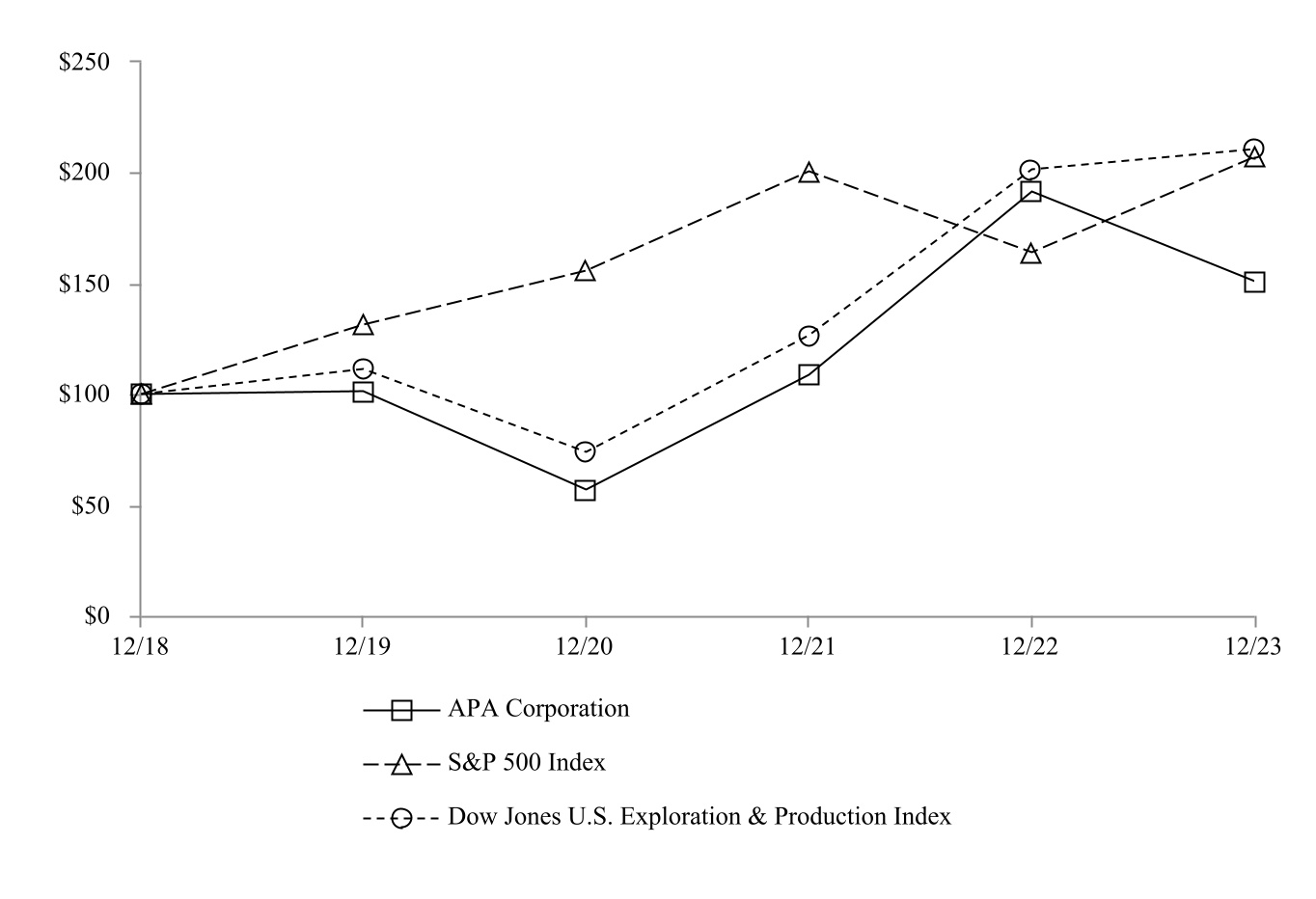
- $100 invested on 12/31/18 in stock or index, including reinvestment of dividends.
Fiscal year ending December 31.
| 2018 | 2019 | 2020 | 2021 | 2022 | 2023 | |||||||||||||||||||||||||||||||||
| APA Corporation | $ | 100.00 | $ | 101.06 | $ | 56.89 | $ | 108.53 | $ | 191.58 | $ | 150.92 | ||||||||||||||||||||||||||
| S&P 500 Index | 100.00 | 131.49 | 155.68 | 200.37 | 164.08 | 207.21 | ||||||||||||||||||||||||||||||||
| Dow Jones U.S. Exploration & Production Index | 100.00 | 111.39 | 73.91 | 126.33 | 201.59 | 210.70 |
Item 6. SELECTED FINANCIAL DATA
Omitted.
Item 7. MANAGEMENT’S DISCUSSION AND ANALYSIS OF FINANCIAL CONDITION AND RESULTS OF OPERATIONS
The following discussion relates to APA Corporation (APA or the Company) and its consolidated subsidiaries and should be read together in conjunction with the Company’s Consolidated Financial Statements and accompanying notes included in Part IV, Item 15 of this Annual Report on Form 10-K, and the risk factors and related information set forth in Part I, Item 1A and Part II, Item 7A of this Annual Report on Form 10-K. This section of this Annual Report on Form 10-K generally discusses 2023 and 2022 items and year-to-year comparisons between 2023 and 2022. Discussions of 2021 items and year-to-year comparisons between 2022 and 2021 that are not included in this Annual Report on Form 10-K are incorporated by reference to “Management’s Discussion and Analysis of Financial Condition and Results of Operations” in Part II, Item 7 of Apache Corporation’s Annual Report on Form 10-K for the fiscal year ended December 31, 2022 (filed with the SEC on February 23, 2023).
On March 1, 2021, Apache Corporation consummated a holding company reorganization (the Holding Company Reorganization), pursuant to which Apache Corporation became a direct, wholly owned subsidiary of APA Corporation, and all of Apache Corporation’s outstanding shares automatically converted into equivalent corresponding shares of APA Corporation. Pursuant to the Holding Company Reorganization, APA Corporation became the successor issuer to Apache Corporation pursuant to Rule 12g-3(a) under the Exchange Act and replaced Apache Corporation as the public company trading on the Nasdaq Global Select Market under the ticker symbol “APA.” The Holding Company Reorganization modernized the Company’s operating and legal structure to more closely align with its growing international presence, making it more consistent with other companies that have subsidiaries operating around the globe. As a holding company, APA Corporation’s primary assets are its ownership interests in its subsidiaries.
Overview
APA is an independent energy company that owns consolidated subsidiaries that explore for, develop, and produce natural gas, crude oil, and natural gas liquids (NGLs). The Company’s upstream business has oil and gas operations in three geographic areas: the U.S., Egypt, and offshore the U.K. in the North Sea (North Sea). APA also has active exploration and appraisal operations ongoing in Suriname, as well as interests in Uruguay and other international locations that may, over time, result in reportable discoveries and development opportunities. Prior to the BCP Business Combination (as defined in the Notes to the Company’s Consolidated Financial Statements set forth in Part IV, Item 15 of this Annual Report on Form 10-K), the Company’s midstream business was operated by Altus Midstream Company (ALTM) through its subsidiary Altus Midstream LP (collectively, Altus).
APA believes energy underpins global progress, and the Company wants to be a part of the solution as society works to meet growing global demand for reliable and affordable energy. APA strives to meet those challenges while creating value for all its stakeholders.
Uncertainties in the global supply chain and financial markets, including the impact of inflation and rising interest rates, and actions taken by foreign oil and gas producing nations, including OPEC+, continue to impact oil supply and demand and contribute to commodity price volatility. Despite these uncertainties, the Company remains committed to its longer-term objectives: (1) to invest for long-term returns in pursuit of moderate, sustainable production growth; (2) to strengthen the balance sheet to underpin the generation of cash flow in excess of its upstream exploration, appraisal, and development capital program that can be directed to debt reduction, share repurchases, and other return of capital to its shareholders; and (3) to responsibly manage its cost structure regardless of the oil price environment.
The Company closely monitors hydrocarbon pricing fundamentals to reallocate capital as part of its ongoing planning process. APA’s diversified asset portfolio and operational flexibility provide it the ability to timely respond to near-term price volatility and effectively manage its investment programs accordingly. For example, the Company deferred drilling and completion activity at Alpine High in the second quarter of 2023 in response to weakness in Waha natural gas and NGL prices but accelerated the completion of eight Permian Basin oil producing wells. The Company also suspended drilling activity in the North Sea during the second quarter of 2023, as increasing cost and tax burdens have impacted the competitiveness of these assets within the Company’s portfolio. Capital investment plans were then aligned across other areas of the portfolio while maintaining a focus on the Company’s capital returns framework established in 2021.
The Company remains committed to its capital return framework for equity holders to participate more directly and materially in cash returns.
-
The Company believes returning 60 percent of cash flow over capital investment creates a good balance for providing near-term cash returns to shareholders while still recognizing the importance of longer-term balance sheet strengthening.
-
The Company’s quarterly dividend was increased in the third quarter of 2022 from $0.125 per share to $0.25 per share, representing a return to pre-COVID-19 dividend levels.
*•*Beginning in the fourth quarter of 2021 and through the end of 2023, the Company has repurchased 76.1 million shares of the Company’s common stock. Subsequent to year-end 2023 and through the date of this filing on February 22, 2024, the Company repurchased 3.0 million shares, and as of February 22, 2024, the Company had remaining authorization to repurchase up to 40.9 million shares under the Company’s share repurchase programs.
Financial and Operational Highlights
During 2023, the Company reported net income attributable to common stock of $2.9 billion, or $9.25 per diluted share, compared to net income of $3.7 billion, or $11.02 per diluted share, in 2022. Net income in 2023 was primarily impacted by lower revenues attributable to significantly lower realized commodity prices compared to 2022. The lower revenues were partially offset by a release of a majority of the Company’s U.S. tax valuation allowance, resulting in a non-cash deferred income tax benefit of approximately $1.7 billion during the fourth quarter of 2023. Net income in 2022 also benefited from approximately $1.2 billion of gains from the divestiture of certain non-core mineral rights in the Delaware Basin and completion of the BCP Business Combination.
The Company generated $3.1 billion of cash from operating activities in 2023, which was $1.8 billion or 37 percent lower than 2022. APA’s lower operating cash flows for 2023 were driven by lower commodity prices and associated revenues and the timing of working capital items. The Company repurchased 8.7 million shares of its common stock for $329 million and paid $308 million in dividends to APA common stockholders during 2023.
Key operational highlights for the year include:
United States
*•*Daily boe production from the Company’s U.S. assets, which increased 2 percent from 2022, accounted for 54 percent of the Company’s worldwide production during 2023. The Company averaged five drilling rigs in the U.S. during the year, including three rigs in the Southern Midland Basin and two rigs in the Delaware Basin, and drilled and brought online 82 operated wells in 2023. The Company’s drilling was primarily focused on oil prospects, increasing oil production by approximately 12 percent in the U.S. compared to the prior year. The Company’s core Permian Basin development program continues to represent key growth areas for the U.S. assets.
- During the fourth quarter of 2023, the Company commenced an exploration program in
Showing the first 8K of 110K characters. Open the full section
Item 7A. QUANTITATIVE AND QUALITATIVE DISCLOSURES ABOUT MARKET RISK
The primary objective of the following information is to provide forward-looking quantitative and qualitative information about the Company’s exposure to market risk. The term market risk relates to the risk of loss arising from adverse changes in oil, gas, and NGL prices, interest rates, or foreign currency and adverse governmental actions. The disclosures are not meant to be precise indicators of expected future losses, but rather indicators of reasonably possible losses. The forward-looking information provides indicators of how the Company views and manages its ongoing market risk exposures.
Commodity Price Risk
The Company’s revenues, earnings, cash flow, capital investments and, ultimately, future rate of growth are highly dependent on the prices the Company receives for its crude oil, natural gas, and NGLs, which have historically been very volatile because of unpredictable events such as economic growth or retraction, weather, political climate, and global supply and demand. The Company continually monitors its market risk exposure, as oil and gas supply and demand are impacted by uncertainties in the commodity and financial markets associated with the conflict in Ukraine, the recent conflict in Israel and Gaza, actions taken by foreign oil and gas producing nations, including OPEC+, global inflation, and other current events.
The Company’s average crude oil price realizations decreased 19 percent to $80.72 per barrel in 2023 from $99.11 per barrel in 2022. The Company’s average natural gas price realizations decreased 42 percent to $2.91 per Mcf in 2023 from $4.98 per Mcf in 2022. The Company’s average NGL price realizations decreased 38 percent to $21.54 per barrel in 2023 from $34.51 per barrel in 2022. Based on average daily production for 2023, a $1.00 per barrel change in the weighted average realized oil price would have increased or decreased revenues for the year by approximately $74 million, a $0.10 per Mcf change in the weighted average realized natural gas price would have increased or decreased revenues for the year by approximately $30 million, and a $1.00 per barrel change in the weighted average realized NGL price would have increased or decreased revenues for the year by approximately $23 million.
The Company periodically enters into derivative positions on a portion of its projected crude oil and natural gas production through a variety of financial and physical arrangements intended to manage fluctuations in cash flows resulting from changes in commodity prices. Such derivative positions may include the use of futures contracts, swaps, and/or options. The Company does not hold or issue derivative instruments for trading purposes. As of December 31, 2023, the Company had open natural gas derivatives not designated as cash flow hedges in an asset position with a fair value of $6 million. A 10 percent increase in natural gas prices would decrease the asset by approximately $1 million, while a 10 percent decrease in prices would increase the asset by approximately $1 million. These fair value changes assume volatility based on prevailing market parameters as of December 31, 2023. Refer to Note 4—Derivative Instruments and Hedging Activities in the Notes to Consolidated Financial Statements set forth in Part IV, Item 15 of this Annual Report Form 10-K for notional volumes and terms with the Company’s derivative contracts.
Interest Rate Risk
At December 31, 2023, the Company had $4.8 billion, net, in outstanding notes and debentures, all of which was fixed-rate debt, with a weighted average interest rate of 5.34 percent. Although near-term changes in interest rates may affect the fair value of fixed-rate debt, such changes do not expose the Company to the risk of earnings or cash flow loss associated with that debt.
The Company is also exposed to interest rate risk related to its interest-bearing cash and cash equivalents balances and amounts outstanding under its syndicated credit facilities. As of December 31, 2023, the Company had approximately $87 million in cash and cash equivalents, approximately 85 percent of which was invested in money market funds and short-term investments with major financial institutions. As of December 31, 2023, there were $372 million of borrowings outstanding under the Company’s syndicated revolving credit facilities. Changes in the interest rate applicable to short-term investments and credit facility borrowings are expected to have an immaterial impact on earnings and cash flows but could impact interest costs associated with future debt issuances or any future borrowings.
Foreign Currency Exchange Rate Risk
The Company’s cash activities relating to certain international operations is based on the U.S. dollar equivalent of cash flows measured in foreign currencies. The Company’s North Sea production is sold under U.S. dollar contracts, while the majority of costs incurred are paid in British pounds. The Company’s Egypt production is sold under U.S. dollar contracts, and the majority of costs incurred are denominated in U.S. dollars. Transactions denominated in British pounds are converted to U.S. dollar equivalents based on the average exchange rates during the period. The Company monitors foreign currency exchange rates of countries in which it is conducting business and may, from time to time, implement measures to protect against foreign currency exchange rate risk.
Foreign currency gains and losses also arise when monetary assets and monetary liabilities denominated in foreign currencies are translated at the end of each month. Foreign currency gains and losses are included as either a component of “Other” under “Revenues and Other” or, as is the case when the Company re-measures its foreign tax liabilities, as a component of the Company’s provision for income tax expense on the statement of consolidated operations. Foreign currency net gain or loss of $3 million would result from a 10 percent weakening or strengthening, respectively, in the British pound as of December 31, 2023.
Item 8. FINANCIAL STATEMENTS AND SUPPLEMENTARY DATA
The financial statements and supplementary financial information required to be filed under this Item 8 are presented on pages F-1 through F-64 in Part IV, Item 15 of this Annual Report on Form 10-K and are incorporated herein by reference.
Item 9. CHANGES IN AND DISAGREEMENTS WITH ACCOUNTANTS ON ACCOUNTING AND FINANCIAL DISCLOSURE
The financial statements for the fiscal years ended December 31, 2023, 2022, and 2021, included in this Annual Report on Form 10-K, have been audited by Ernst & Young LLP, independent registered public accounting firm, as stated in their audit report appearing herein. There have been no changes in or disagreements with the accountants during the periods presented.
Item 9A. CONTROLS AND PROCEDURES
Disclosure Controls and Procedures
John J. Christmann IV, the Company’s Chief Executive Officer, in his capacity as principal executive officer, and Stephen J. Riney, the Company’s President and Chief Financial Officer, in his capacity as principal financial officer, evaluated the effectiveness of the Company’s disclosure controls and procedures as of December 31, 2023, the end of the period covered by this Annual Report on Form 10-K. Based on that evaluation and as of the date of that evaluation, these officers concluded that the Company’s disclosure controls and procedures were effective, providing effective means to ensure that the information the Company is required to disclose under applicable laws and regulations is recorded, processed, summarized, and reported within the time periods specified in the Commission’s rules and forms and accumulated and communicated to our management, including our principal executive officer and principal financial officer, to allow timely decisions regarding required disclosure.
The Company periodically reviews the design and effectiveness of its disclosure controls, including compliance with various laws and regulations that apply to its operations, both inside and outside the United States. The Company makes modifications to improve the design and effectiveness of our disclosure controls, and may take other corrective action, if the Company’s reviews identify deficiencies or weaknesses in its controls.
Management’s Annual Report on Internal Control Over Financial Reporting; Attestation Report of the Registered Public Accounting Firm
The management report called for by Item 308(a) of Regulation S-K is incorporated herein by reference to the “Report of Management on Internal Control Over Financial Reporting,” included on Page F-1 in Part IV, Item 15 of this Annual Report on Form 10-K.
The independent auditors attestation report called for by Item 308(b) of Regulation S-K is incorporated herein by reference to the “Report of Independent Registered Public Accounting Firm,” included on Page F-2 through F-5 in Part IV, Item 15 of this Annual Report on Form 10-K.
Changes in Internal Control over Financial Reporting
There was no change in our internal controls over financial reporting during the quarter ended December 31, 2023, that has materially affected, or is reasonably likely to materially affect, our internal controls over financial reporting.
Item 9B. OTHER INFORMATION
During the three months ended December 31, 2023, none of the Company’s directors or officers adopted, modified, or terminated a “Rule 10b5-1 trading arrangement” or a “non-Rule 10b5-1 trading arrangement” as each term is defined under Item 408 of Regulation S-K.
Item 9C. DISCLOSURE REGARDING FOREIGN JURISDICTIONS THAT PREVENT INSPECTIONS
Not applicable.
PART III
Item 10. DIRECTORS, EXECUTIVE OFFICERS AND CORPORATE GOVERNANCE
The information set forth under the captions “Nominees for Election as Directors,” “Information about Our Executive Officers,” “Securities Ownership and Principal Holders,” “Additional Information—Future Shareholder Proposals and Director Nominations,” and “Corporate Governance—Standing Committees and Meetings of the Board” in the proxy statement relating to the Company’s 2024 annual meeting of shareholders (the Proxy Statement) is incorporated herein by reference.
Code of Business Conduct
In accordance with Rule 5610 of the Nasdaq, the Company maintains a code of business conduct and ethics for its directors, officers, and employees. The Company’s Code of Business Conduct and Ethics was adopted by the Company’s Board of Directors in March 2021 and subsequently amended in September 2021 (as amended, the Code of Conduct). The Code of Conduct also meets the requirements of a code of ethics under Item 406 of Regulation S-K. You can access the Code of Conduct on the Governance page of the Company’s website at www.apacorp.com. Any shareholder who so requests may obtain a printed copy of the Code of Conduct by submitting a request to the Company’s corporate secretary at the address on the cover of this Annual Report on Form 10-K. Changes in and waivers to the Code of Conduct for the Company’s directors, chief executive officer and certain senior financial officers will be posted on the Company’s website within four business days and maintained for at least 12 months. Information on the Company’s website or any other website is not incorporated by reference into, and does not constitute a part of, this Annual Report on Form 10-K.
Item 11. EXECUTIVE COMPENSATION
The information set forth under the captions “Compensation Discussion and Analysis,” “Summary Compensation Table,” “Grants of Plan Based Awards Table,” “Outstanding Equity Awards at Fiscal Year-End Table,” “Option Exercises and Stock Vested Table,” “Non-Qualified Deferred Compensation Table,” “Potential Payments upon Termination or Change in Control,” “Director Compensation Table,” “CEO Pay Ratio,” “Compensation Committee Interlocks and Insider Participation,” “Pay versus Performance,” “Option Awards,” and “Compensation Committee Report” in the Proxy Statement is incorporated herein by reference.
Item 12. SECURITY OWNERSHIP OF CERTAIN BENEFICIAL OWNERS AND MANAGEMENT AND RELATED STOCKHOLDER MATTERS
The information set forth under the captions “Securities Ownership and Principal Holders” and “Equity Compensation Plan Information” in the Proxy Statement is incorporated herein by reference.
Item 13. CERTAIN RELATIONSHIPS AND RELATED TRANSACTIONS, AND DIRECTOR INDEPENDENCE
The information set forth under the captions “Certain Business Relationships and Transactions” and “Director Independence” in the Proxy Statement is incorporated herein by reference.
Item 14. PRINCIPAL ACCOUNTING FEES AND SERVICES
The information set forth under the caption “Ratification of Auditor Appointment” in the Proxy Statement is incorporated herein by reference.
PART IV
Item 15. EXHIBITS, FINANCIAL STATEMENT SCHEDULES
(a)Documents included in this report:
| 1. | Financial Statements |
| 2. | Financial Statement Schedules | ||||
| Financial statement schedules have been omitted because they are either not required, not applicable or the information required to be presented is included in the Company’s financial statements and related notes. |
| 3. | Exhibits |
| * Filed herewith. | ||
| ** Furnished herewith. | ||
| † Management contracts or compensatory plans or arrangements required to be filed herewith pursuant to Item 15 hereof. |
NOTE: Debt instruments of the Registrant defining the rights of long-term debt holders in principal amounts not exceeding 10 percent of the Registrant’s consolidated assets have been omitted and will be provided to the Commission upon request.
Item 16. FORM 10-K SUMMARY
None.
SIGNATURES
Pursuant to the requirements of Section 13 or 15(d) of the Securities Exchange Act of 1934, the registrant has duly caused this report to be signed on its behalf by the undersigned, thereunto duly authorized.
APA CORPORATION
/s/ John J. Christmann IV
John J. Christmann IV
Chief Executive Officer
Dated: February 22, 2024
POWER OF ATTORNEY
The officers and directors of APA Corporation, whose signatures appear below, hereby constitute and appoint John J. Christmann IV, Stephen J. Riney, and Rebecca A. Hoyt, and each of them (with full power to each of them to act alone), the true and lawful attorney-in-fact to sign and execute, on behalf of the undersigned, any amendment(s) to this report and each of the undersigned does hereby ratify and confirm all that said attorneys shall do or cause to be done by virtue thereof.
Pursuant to the requirements of the Securities Exchange Act of 1934, this report has been signed below by the following persons on behalf of the registrant and in the capacities and on the dates indicated.
| Name | Title | Date | ||||||||||||
| /s/ John J. Christmann IV John J. Christmann IV | Director and Chief Executive Officer (principal executive officer) | February 22, 2024 | ||||||||||||
| /s/ Stephen J. Riney Stephen J. Riney | President and Chief Financial Officer (principal financial officer) | February 22, 2024 | ||||||||||||
| /s/ Rebecca A. Hoyt Rebecca A. Hoyt | Senior Vice President, Chief Accounting Officer, and Controller (principal accounting officer) | February 22, 2024 | ||||||||||||
| /s/ Annell R. Bay Annell R. Bay | Director | February 22, 2024 | ||||||||||||
| /s/ Juliet S. Ellis Juliet S. Ellis | Director | February 22, 2024 | ||||||||||||
| /s/ Charles W. Hooper Charles W. Hooper | Director | February 22, 2024 | ||||||||||||
| /s/ Chansoo Joung Chansoo Joung | Director | February 22, 2024 | ||||||||||||
| /s/ H. Lamar McKay H. Lamar McKay | Independent, Non-Executive Chair of the Board and Director | February 22, 2024 | ||||||||||||
| /s/ Amy H. Nelson Amy H. Nelson | Director | February 22, 2024 | ||||||||||||
| /s/ Daniel W. Rabun Daniel W. Rabun | Director | February 22, 2024 | ||||||||||||
| /s/ Peter A. Ragauss Peter A. Ragauss | Director | February 22, 2024 | ||||||||||||
| /s/ David L. Stover David L. Stover | Director | February 22, 2024 |
REPORT OF MANAGEMENT ON INTERNAL CONTROL OVER FINANCIAL REPORTING
Management of the Company is responsible for the preparation and integrity of the consolidated financial statements appearing in this annual report on Form 10-K. The financial statements were prepared in conformity with accounting principles generally accepted in the United States and include amounts that are based on management’s best estimates and judgments.
Management of the Company is responsible for establishing and maintaining effective internal control over financial reporting as such term is defined in Rule 13a-15(f) under the Securities Exchange Act of 1934. The Company’s internal control over financial reporting is designed to provide reasonable assurance regarding the reliability of financial reporting and the preparation of the consolidated financial statements. Our internal control over financial reporting is supported by a program of internal audits and appropriate reviews by management, written policies and guidelines, careful selection and training of qualified personnel and a written code of business conduct adopted by our Company’s board of directors, applicable to all Company directors and all officers and employees of our Company and subsidiaries.
Because of its inherent limitations, internal control over financial reporting may not prevent or detect misstatements and even when determined to be effective, can only provide reasonable assurance with respect to financial statement preparation and presentation. Also, projections of any evaluation of effectiveness to future periods are subject to the risk that controls may become inadequate because of changes in conditions or that the degree of compliance with the policies or procedures may deteriorate.
Management assessed the effectiveness of the Company’s internal control over financial reporting as of December 31, 2023. In making this assessment, management used the criteria set forth by the Committee of Sponsoring Organizations of the Treadway Commission in Internal Control – Integrated Framework (2013). Based on our assessment, management believes that the Company maintained effective internal control over financial reporting as of December 31, 2023.
The Company’s independent auditors, Ernst & Young LLP, a registered public accounting firm, are appointed by the Audit Committee of the Company’s board of directors. Ernst & Young LLP have audited and reported on the consolidated financial statements of APA Corporation and subsidiaries and the effectiveness of the Company’s internal control over financial reporting. The reports of the independent auditors follow this report on pages F-2 and F-3.
| /s/ John J. Christmann IV | ||
| Chief Executive Officer | ||
| (principal executive officer) | ||
| /s/ Stephen J. Riney | ||
| President and Chief Financial Officer | ||
| (principal financial officer) | ||
| /s/ Rebecca A. Hoyt | ||
| Senior Vice President, Chief Accounting Officer and Controller | ||
| (principal accounting officer) |
Houston, Texas
February 22, 2024
F-1
REPORT OF INDEPENDENT REGISTERED PUBLIC ACCOUNTING FIRM
To the Shareholders and the Board of Directors of APA Corporation
Opinion on Internal Control Over Financial Reporting
We have audited APA Corporation and subsidiaries’ internal control over financial reporting as of December 31, 2023, based on criteria established in Internal Control — Integrated Framework issued by the Committee of Sponsoring Organizations of the Treadway Commission (2013 framework) (the COSO criteria). In our opinion, APA Corporation and subsidiaries (the Company) maintained, in all material respects, effective internal control over financial reporting as of December 31, 2023, based on the COSO criteria.
We also have audited, in accordance with the standards of the Public Company Accounting Oversight Board (United States) (PCAOB), the consolidated balance sheets of the Company as of December 31, 2023 and 2022, the related statements of consolidated operations, comprehensive income (loss), cash flows and changes in equity (deficit) and noncontrolling interest for each of the three years in the period ended December 31, 2023, and the related notes and our report dated February 22, 2024 expressed an unqualified opinion thereon.
Basis for Opinion
The Company’s management is responsible for maintaining effective internal control over financial reporting and for its assessment of the effectiveness of internal control over financial reporting included in the accompanying Report of Management on Internal Control over Financial Reporting. Our responsibility is to express an opinion on the Company’s internal control over financial reporting based on our audit. We are a public accounting firm registered with the PCAOB and are required to be independent with respect to the Company in accordance with the U.S. federal securities laws and the applicable rules and regulations of the Securities and Exchange Commission and the PCAOB.
We conducted our a
Showing the first 8K of 319K characters. Open the full section