 filings.tools
Air Products & Chemicals 10-K 2018-09-30
Filed 2018-11-20. 19 sections, 530K characters. Original on sec.gov · Markdown · JSON
Cover and table of contents
UNITED STATES
SECURITIES AND EXCHANGE COMMISSION
WASHINGTON, D.C. 20549
FORM 10-K
| x | ANNUAL REPORT PURSUANT TO SECTION 13 OR 15(d) OF THE SECURITIES EXCHANGE ACT OF 1934 For the fiscal year ended 30 September 2018 |
OR
| ¨ | TRANSITION REPORT PURSUANT TO SECTION 13 OR 15(d) OF THE SECURITIES EXCHANGE ACT OF 1934 For the transition period from to |
Commission file number 001-04534
AIR PRODUCTS AND CHEMICALS, INC.
| 7201 Hamilton Boulevard | State of incorporation: Delaware | |
| Allentown, Pennsylvania, 18195-1501 | I.R.S. identification number: 23-1274455 | |
| Tel. (610) 481-4911 |
Securities registered pursuant to Section 12(b) of the Act:
| Title of Each Class: | Registered on: | |
| Common Stock, par value $1.00 per share | New York Stock Exchange | |
| 2.0% Euro Notes due 2020 | New York Stock Exchange | |
| 0.375% Euro Notes due 2021 | New York Stock Exchange | |
| 1.0% Euro Notes due 2025 | New York Stock Exchange |
Securities registered pursuant to Section 12(g) of the Act: None
| Indicate by check mark if the registrant is a well-known seasoned issuer, as defined in Rule 405 of the Securities Act. | YES | x | NO | ¨ | ||
| Indicate by check mark if the registrant is not required to file reports pursuant to Section 13 or Section 15(d) of the Act. | YES | ¨ | NO | x | ||
| Indicate by check mark whether the registrant (1) has filed all reports required to be filed by Section 13 or 15(d) of the Securities Exchange Act of 1934 during the preceding 12 months (or for such shorter period that the registrant was required to file such reports), and (2) has been subject to such filing requirements for the past 90 days. | YES | x | NO | ¨ | ||
| Indicate by check mark whether the registrant has submitted electronically every Interactive Data File required to be submitted pursuant to Rule 405 of Regulation S-T (§232.405 of this chapter) during the preceding 12 months (or for such shorter period that the registrant was required to submit such files). | YES | x | NO | ¨ |
| Indicate by check mark if disclosure of delinquent filers pursuant to Item 405 of Regulation S-K (§ 229.405 of this chapter) is not contained herein, and will not be contained, to the best of registrant’s knowledge, in definitive proxy or information statements incorporated by reference in Part III of this Form 10-K or any amendment to this Form 10-K. | ¨ |
Indicate by check mark whether the registrant is a large accelerated filer, an accelerated filer, a non-accelerated filer, a smaller reporting company, or an emerging growth company. See the definitions of “large accelerated filer,” “accelerated filer,” “smaller reporting company,” and "emerging growth company" in Rule 12b-2 of the Exchange Act.
| Large accelerated filer x | Accelerated filer ¨ | Non-accelerated filer ¨ | Smaller reporting company ¨ | Emerging growth company ¨ |
| If an emerging growth company, indicate by check mark if the registrant has elected not to use the extended transition period for complying with any new or revised financial accounting standards provided pursuant to Section 13(a) of the Exchange Act. | ¨ |
| Indicate by check mark whether the registrant is a shell company (as defined in Rule 12b-2 of the Act). | YES | ¨ | NO | x |
The aggregate market value of the voting stock held by non-affiliates of the registrant on 31 March 2018 was approximately $34.8 billion. For purposes of the foregoing calculations, all directors and/or executive officers have been deemed to be affiliates, but the registrant disclaims that any such director and/or executive officer is an affiliate.
The number of shares of common stock outstanding as of 31 October 2018 was 219,533,532.
DOCUMENTS INCORPORATED BY REFERENCE
Portions of the registrant’s definitive Proxy Statement for the Annual Meeting of Shareholders to be held on 24 January 2019 are incorporated by reference into Part III.
AIR PRODUCTS AND CHEMICALS, INC.
ANNUAL REPORT ON FORM 10-K
For the fiscal year ended 30 September 2018
TABLE OF CONTENTS
FORWARD-LOOKING STATEMENTS
This Annual Report on Form 10-K contains “forward-looking statements” within the safe harbor provisions of the Private Securities Litigation Reform Act of 1995. Forward-looking statements include all statements that do not relate solely to historical or current facts and can generally be identified by words such as “anticipate,” “believe,” “could,” “estimate,” “expect,” “forecast,” “goal,” “intend,” “may,” “outlook,” “plan,” “positioned,” “possible,” “potential,” “project,” “should,” “target,” “will,” “would,” and similar expressions or variations thereof, or the negative thereof, but these terms are not the exclusive means of identifying such statements. Forward-looking statements are based on management’s expectations and assumptions as of the date of this report and are not guarantees of future performance. You are cautioned not to place undue reliance on our forward-looking statements.
Forward-looking statements may relate to a number of matters, including expectations regarding revenue, margins, expenses, earnings, tax provisions, cash flows, pension obligations, share repurchases or other statements regarding economic conditions or our business outlook; statements regarding plans, projects, strategies and objectives for our future operations, including our ability to win new projects and execute the projects in our backlog; and statements regarding our expectations with respect to pending legal claims or disputes. While forward-looking statements are made in good faith and based on assumptions, expectations and projections that management believes are reasonable based on currently available information, actual performance and financial results may differ materially from projections and estimates expressed in the forward-looking statements because of many factors, including, without limitation:
| • | changes in global or regional economic conditions, supply and demand dynamics in the market segments we serve, or in the financial markets; |
| • | risks associated with having extensive international operations, including political risks, risks associated with unanticipated government actions and risks of investing in developing markets; |
| • | project delays, contract terminations, customer cancellations, or postponement of projects and sales; |
| • | future financial and operating performance of major customers and joint venture partners; |
| • | our ability to develop, implement, and operate new technologies, or to execute the projects in our backlog; |
| • | tariffs, economic sanctions and regulatory activities in jurisdictions in which we and our affiliates and joint ventures operate; |
| • | the impact of environmental, tax or other legislation, as well as regulations affecting our business and related compliance requirements, including regulations related to global climate change; |
| • | changes in tax rates and other changes in tax law; |
| • | the timing, impact, and other uncertainties relating to acquisitions and divestitures, including our ability to integrate acquisitions and separate divested businesses, respectively; |
| • | risks relating to cybersecurity incidents, including risks from the interruption, failure or compromise of our information systems; |
| • | catastrophic events, such as natural disasters, acts of war, or terrorism; |
| • | the impact of price fluctuations in natural gas and disruptions in markets and the economy due to oil price volatility; |
| • | costs and outcomes of legal or regulatory proceedings and investigations; |
| • | asset impairments due to economic conditions or specific events; |
| • | significant fluctuations in interest rates and foreign currency exchange rates from those currently anticipated; |
| • | damage to facilities, pipelines or delivery systems, including those we own or operate for third parties; |
| • | availability and cost of raw materials; and |
| • | the success of productivity and operational improvement programs. |
In addition to the foregoing factors, forward-looking statements contained herein are qualified with respect to the risks disclosed elsewhere in this document, including in Item 1A, Risk Factors, Item 7, Management’s Discussion and Analysis of Financial Condition and Results of Operations, and Item 7A, Quantitative and Qualitative Disclosures About Market Risk. Any of these factors, as well as those not currently anticipated by management, could cause our results of operations, financial condition or liquidity to differ materially from what is expressed or implied by any forward-looking statement. Except as required by law, we disclaim any obligation or undertaking to update or revise any forward-looking statements contained herein to reflect any change in assumptions, beliefs, or expectations or any change in events, conditions, or circumstances upon which any such forward-looking statements are based.
PART I
Item 1. BUSINESS
Air Products and Chemicals, Inc., a Delaware corporation originally founded in 1940, serves customers globally with a unique portfolio of products, services, and solutions that include atmospheric gases, process and specialty gases, equipment, and services. The Company is the world’s largest supplier of hydrogen and has built leading positions in growth markets such as helium and natural gas liquefaction. As used in this report, unless the context indicates otherwise, the terms “we,” “our,” “us,” the “Company,” or “registrant” include controlled subsidiaries, affiliates, and predecessors of Air Products and its controlled subsidiaries and affiliates.
During its fiscal year ended 30 September 2018 (“fiscal year 2018”), the Company reported its continuing operations in five reporting segments under which it managed its operations, assessed performance, and reported earnings: Industrial Gases – Americas; Industrial Gases – EMEA (Europe, Middle East, and Africa); Industrial Gases – Asia; Industrial Gases – Global; and Corporate and other.
Except as otherwise noted, the description of the Company's business below reflects the Company's continuing operations. Refer to Management's Discussion and Analysis of Financial Condition and Results of Operations and Note 25, Business Segment and Geographic Information, and Note 3, Discontinued Operations, to the consolidated financial statements for additional details on our reportable business segments and our discontinued operations.
Industrial Gases Business
The Company’s Industrial Gases business produces atmospheric gases (oxygen, nitrogen, argon, and rare gases); process gases (hydrogen, helium, carbon dioxide, carbon monoxide, syngas, and specialty gases); and equipment for the production or processing of gases, such as air separation units and non-cryogenic generators. Atmospheric gases are produced through various air separation processes of which cryogenic is the most prevalent. Process gases are produced by methods other than air separation. For example, hydrogen, carbon monoxide and syngas are produced by steam methane reforming of natural gas and by the gasification of liquid and solid hydrocarbons. Hydrogen is also produced by purifying byproduct sources obtained from the chemical and petrochemical industries; and helium is produced as a byproduct of gases extracted from underground reservoirs, primarily natural gas, but also carbon dioxide purified before resale.
The Company’s Industrial Gases business is organized and operated regionally. The regional Industrial Gases segments (Americas, EMEA, and Asia) supply gases and related equipment in the relevant region to diversified customers in many industries, including those in refining, chemical, gasification, metals, electronics, manufacturing, and food and beverage. Hydrogen is used by refiners to facilitate the conversion of heavy crude feedstock and lower the sulfur content of gasoline and diesel fuels. The chemicals industry uses hydrogen, oxygen, nitrogen, carbon monoxide, and syngas as feedstocks in the production of many basic chemicals. The energy production industry uses nitrogen injection for enhanced recovery of oil and natural gas and oxygen for gasification. Oxygen is used in combustion and industrial heating applications, including in the gasification, steel, certain nonferrous metals, glass, and cement industries. Nitrogen applications are used in food processing for freezing and preserving flavor and nitrogen for inerting is used in various fields, including the metals, chemical, and semiconductor industries. Helium is used in laboratories and healthcare for cooling and in other industries for pressurizing, purging, and lifting. Argon is used in the metals and other industries for its unique inerting, thermal conductivity, and other properties. Industrial gases are also used in welding and providing healthcare and are utilized in various manufacturing processes to make them more efficient and to optimize performance.
We distribute gases to our customers through a variety of supply modes:
**Liquid Bulk—**Product is delivered in bulk (in liquid or gaseous form) by tanker or tube trailer and stored, usually in its liquid state, in equipment designed and installed typically by the Company at the customer’s site for vaporizing into a gaseous state as needed. Liquid bulk sales are usually governed by three- to five-year contracts.
**Packaged Gases—**Small quantities of product are delivered in either cylinders or dewars. The Company operates packaged gas businesses in Europe, Asia, and Latin America. In the United States, the Company’s packaged gas business sells products (principally helium) only for the electronics and magnetic resonance imaging industries.
**On-Site Gases—**Large quantities of hydrogen, nitrogen, oxygen, carbon monoxide, and syngas (a mixture of hydrogen and carbon monoxide) are provided to customers, principally the energy production and refining, chemical, gasification, and metals industries worldwide, that require large volumes of gases and have relatively constant demand. Gases are produced at large facilities located adjacent to customers’ facilities or by pipeline systems from centrally located production facilities and are generally governed by 15- to 20- year contracts. The Company also delivers small quantities of product through small on-site plants (cryogenic or non-cryogenic generators), typically either via a 10- to 15- year sale of gas contract or through the sale of the equipment to the customer.
Electricity is the largest cost component in the production of atmospheric gases. Steam methane reformers utilize natural gas as the primary raw material and gasifiers use liquid and solid hydrocarbons as the principal raw material for the production of hydrogen, carbon monoxide and syngas. We mitigate electricity, natural gas, and hydrocarbon price fluctuations contractually through pricing formulas, surcharges, and cost pass-through and tolling arrangements. During fiscal year 2018, no significant difficulties were encountered in obtaining adequate supplies of power and natural gas.
The Company obtains helium from a number of sources globally, including crude helium for purification from the U.S. Bureau of Land Management's helium reserve.
The regional Industrial Gases segments also include our share of the results of several joint ventures accounted for by the equity method. The largest of these joint ventures operate in Mexico, Italy, South Africa, India, Saudi Arabia, and Thailand.
Each of the regional Industrial Gases segments competes against two global industrial gas companies: Air Liquide S.A. and Linde plc (the successor to Praxair, Inc. and Linde AG, pursuant to a combination that became effective on 31 October 2018), as well as regional competitors. Competition in Industrial Gases is based primarily on price, reliability of supply, and the development of industrial gas applications. In locations where we have pipeline networks, which enable us to provide reliable and economic supply of products to larger customers, we derive a competitive advantage.
Overall regional industrial gases sales constituted approximately 94% of consolidated sales in fiscal year 2018, 90% in fiscal year 2017, and 90% in fiscal year 2016. Sales of tonnage hydrogen and related products constituted approximately 25% of consolidated sales in fiscal year 2018, 24% in fiscal year 2017, and 21% in fiscal year 2016. Sales of atmospheric gases constituted approximately 46% of consolidated sales in fiscal year 2018, 45% in fiscal year 2017, and 46% in fiscal year 2016.
Industrial Gases Equipment
The Company designs and manufactures equipment for air separation, hydrocarbon recovery and purification, natural gas liquefaction ("LNG"), and liquid helium and liquid hydrogen transport and storage. The Industrial Gases – Global segment includes activity related to cryogenic and gas processing equipment for air separation. The equipment is sold worldwide to customers in a variety of industries, including chemical and petrochemical manufacturing, oil and gas recovery and processing, and steel and primary metals processing. The Corporate and other segment includes three global equipment businesses: our LNG equipment business, our Gardner Cryogenics business fabricating helium and hydrogen transport and storage containers, and our Rotoflow business which manufactures turboexpanders and other precision rotating equipment. Steel, aluminum, and capital equipment subcomponents (compressors, etc.) are the principal raw materials in the manufacturing of equipment. Adequate raw materials for individual projects are acquired under firm purchase agreements. Equipment is produced at the Company’s manufacturing sites with certain components being procured from subcontractors and vendors. Competition in the equipment business is based primarily on technological performance, service, technical know-how, price, and performance guarantees. Sale of equipment constituted approximately 6% of consolidated sales in fiscal year 2018, 10% in fiscal year 2017, and 10% in fiscal year 2016.
The backlog of equipment orders was approximately $.2 billion on 30 September 2018 (as compared to a total backlog of approximately $.5 billion on 30 September 2017). The Company estimates that approximately 50% of the total sales backlog as of 30 September 2018 will be recognized as revenue during fiscal year 2019, dependent on execution schedules of the relevant projects.
International Operations
The Company, through subsidiaries, affiliates, and less-than-controlling interests, conducts business in 50 countries outside the United States. Its international businesses are subject to risks customarily encountered in foreign operations, including fluctuations in foreign currency exchange rates and controls; import and export controls; and other economic, political, and regulatory policies of local governments described in Item 1A, Risk Factors, below.
The Company has majority or wholly owned foreign subsidiaries that operate in Canada; 16 European countries (including the United Kingdom, the Netherlands, and Spain); eight Asian countries (including China, South Korea, and Taiwan); seven Latin American countries (including Chile and Brazil); four countries in the Middle East, and two African countries. The Company also owns less-than-controlling interests in entities operating in Europe, Asia, Africa, the Middle East, and Latin America (including Italy, Germany, China, India, Saudi Arabia, Thailand, Oman, South Africa, and Mexico).
Financial information about the Company’s foreign operations and investments is included in Note 8, Summarized Financial Information of Equity Affiliates; Note 22, Income Taxes; and Note 25, Business Segment and Geographic Information, to the consolidated financial statements included under Item 8, below. Information about foreign currency translation is included under “Foreign Currency” in Note 1, Major Accounting Policies, and information on the Company’s exposure to currency fluctuations is included in Note 13, Financial Instruments, to the consolidated financial statements, included under Item 8, below, and in “Foreign Currency Exchange Rate Risk,” included under Item 7A, below. Export sales from operations in the United States to third-party customers amounted to $33.1 million, $64.2 million, and $134.9 million in fiscal years 2018, 2017, and 2016, respectively.
Technology Development
The Company pursues a market-oriented approach to technology development through research and development, engineering, and commercial development processes. It conducts research and development principally in its laboratories located in the United States (Trexlertown, Pennsylvania), Canada (Vancouver), the United Kingdom (Basingstoke and Carrington), Spain (Barcelona), China (Shanghai), and Saudi Arabia (Dhahran). The Company also funds and cooperates in research and development programs conducted by a number of major universities and undertakes research work funded by others, principally the United States government.
The Company’s research groups are aligned with and support the research efforts of various businesses throughout the Company. Development of technology for use within the Industrial Gases business focuses primarily on new and improved processes and equipment for the production and delivery of industrial gases and new or improved applications for industrial gas products.
During fiscal year 2018, the Company owned approximately 535 United States patents, approximately 2,888 foreign patents, and was a licensee under certain patents owned by others. While the patents and licenses are considered important, the Company does not consider its business as a whole to be materially dependent upon any particular patent, patent license, or group of patents or licenses.
Environmental Controls
The Company is subject to various environmental laws and regulations in the countries in which it has operations. Compliance with these laws and regulations results in higher capital expenditures and costs. In the normal course of business, the Company is involved in legal proceedings under the Comprehensive Environmental Response, Compensation, and Liability Act (CERCLA: the federal Superfund law); Resource Conservation and Recovery Act (RCRA); and similar state and foreign environmental laws relating to the designation of certain sites for investigation or remediation. The Company’s accounting policy for environmental expenditures is discussed in Note 1, Major Accounting Policies, and environmental loss contingencies are discussed in Note 17, Commitments and Contingencies, to the consolidated financial statements, included under Item 8, below.
The amounts charged to income from continuing operations related to environmental matters totaled $12.8 million in fiscal year 2018, $11.4 million in fiscal year 2017, and $12.2 million in fiscal year 2016. These amounts represent an estimate of expenses for compliance with environmental laws and activities undertaken to meet internal Company standards. Refer to Note 17, Commitments and Contingencies, to the consolidated financial statements for additional information.
The Company estimates that we spent approximately $3 million in fiscal year 2018, $7 million in fiscal year 2017, and $3 million in fiscal year 2016 on capital projects reflected in continuing operations to control pollution. Capital expenditures to control pollution are estimated to be approximately $4 million in both fiscal years 2019 and 2020.
Employees
On 30 September 2018, the Company (including majority-owned subsidiaries) had approximately 16,300 employees, of whom approximately 16,000 were full-time employees and of whom approximately 11,800 were located outside the United States. The Company has collective bargaining agreements with unions at various locations that expire on various dates over the next four years. The Company considers relations with its employees to be satisfactory.
Available Information
All periodic and current reports, registration statements, and other filings that the Company is required to file with the Securities and Exchange Commission ("SEC"), including the Company’s annual report on Form 10-K, quarterly reports on Form 10-Q, current reports on Form 8-K, and amendments to those reports filed or furnished pursuant to Section 13(a) of the Securities Exchange Act of 1934 (the "Exchange Act"), are available free of charge through the Company’s website at www.airproducts.com. Such documents are available as soon as reasonably practicable after electronic filing of the material with the SEC. All such reports filed during the period covered by this report were available on the Company’s website on the same day as filing. In addition, our filings with the SEC are available free of charge on the SEC's website, www.sec.gov.
Seasonality
The Company’s businesses are not subject to seasonal fluctuations to any material extent.
Inventories
The Company maintains limited inventory where required to facilitate the supply of products to customers on a reasonable delivery schedule. Inventory consists primarily of crude helium, industrial gas, and specialty gas inventories supplied to customers through liquid bulk and packaged gases supply modes.
Customers
We do not have a homogeneous customer base or end market, and no single customer accounts for more than 10% of our consolidated revenues. We do have concentrations of customers in specific industries, primarily refining, chemicals, and electronics. Within each of these industries, the Company has several large-volume customers with long-term contracts. A negative trend affecting one of these industries, or the loss of one of these major customers, although not material to our consolidated revenue, could have an adverse impact on our financial results.
Governmental Contracts
Our business is not subject to a government entity’s renegotiation of profits or termination of contracts that would be material to our business as a whole.
Executive Officers of the Company
The Company’s executive officers and their respective positions and ages on 20 November 2018 follow. Information with respect to offices held is stated in fiscal years.
| Name | Age | Office |
| M. Scott Crocco | 54 | Executive Vice President and Chief Financial Officer (became Executive Vice President and Chief Financial Officer in 2016; Senior Vice President and Chief Financial Officer in 2013; and Vice President and Corporate Controller in 2008). |
| Seifi Ghasemi | 74 | Chairman, President, and Chief Executive Officer (became Chairman, President and Chief Executive Officer in 2014 and previously served as Chairman and Chief Executive Officer of Rockwood Holdings, Inc. beginning in 2001). Mr. Ghasemi is a member and Chairman of the Board of Directors and the Chairman of the Executive Committee of the Board of Directors. |
| Sean D. Major | 54 | Executive Vice President, General Counsel and Secretary (Secretary since December 2017 and Executive Vice President and General Counsel since May 2017). Previously, Mr. Major served as Executive Vice President, General Counsel and Secretary for Joy Global Inc. since 2007. From 1998 until joining Joy Global Inc. in 2007, Mr. Major was employed by Johnson Controls, Inc., serving in roles of increasing legal responsibility, including Assistant General Counsel and Assistant Secretary. |
| Dr. Samir Serhan | 57 | Executive Vice President (since December 2016). Previously, Dr. Serhan served as President, Global HyCO, since 2014 for Praxair Inc. From 2000-2014, he worked in leadership positions in the U.S. and Germany for The Linde Group, including Managing Director of Linde Engineering from 2008-2014. |
Item 1A. RISK FACTORS
Our operations are affected by various risks, many of which are beyond our control. In evaluating investment in the Company and the forward-looking information contained in this Annual Report on Form 10-K or presented elsewhere by management from time to time, you should consider the following risk factors. Any of the following risks could have a material adverse effect on our business, operating results, financial condition, and the actual outcome of matters as to which forward-looking statements are made and could adversely affect the value of an investment in our common stock as well. While we believe we have identified and discussed below the key risk factors affecting our business, there may be additional risks and uncertainties that adversely affect our business, performance, or financial condition in the future that are not presently known, are not currently believed to be significant, or are not identified below because they are common to all businesses.
Changes in global and regional economic conditions, the markets we serve, or the financial markets may adversely affect our results of operations and cash flows.
Unfavorable conditions in the global economy or regional economies, the markets we serve or financial markets may decrease the demand for our goods and services and adversely impact our revenues, operating results, and cash flows.
Demand for our products and services depends in part on the general economic conditions affecting the countries and markets in which we do business. Weak economic conditions in certain geographies and changing supply and demand balances in the markets we serve have negatively impacted demand for our products and services in the past and may do so in the future. Reduced demand for our products and services would have a negative impact on our revenues and earnings. In addition, reduced demand could depress sales, reduce our margins, constrain our operating flexibility or reduce efficient utilization of our manufacturing capacity, or result in charges which are unusual or nonrecurring. Excess capacity in our manufacturing facilities or those of our competitors could decrease our ability to maintain pricing and generate profits.
Our operating results in one or more segments may also be affected by uncertain or deteriorating economic conditions for particular customer markets within a segment. A decline in the industries served by our customers or adverse events or circumstances affecting individual customers can impair the ability of such customers to satisfy their obligations to the Company, resulting in uncollected receivables, unanticipated contract terminations, project delays, or inability to recover plant investments, any of which may negatively impact our financial results.
Weak overall demand or specific customer conditions may also cause customer shutdowns or default, or other inabilities to operate facilities profitably, and may force sale or abandonment of facilities and equipment or prevent projects from coming on-stream. These or other events associated with weak economic conditions or specific end market, product, or customer events may require us to record an impairment on tangible assets, such as facilities and equipment, or intangible assets, such as intellectual property or goodwill, which would have a negative impact on our financial results.
Our extensive international operations can be adversely impacted by operational, economic, political, security, legal, and currency translation risks that could decrease profitability.
In fiscal year 2018, over 60% of our sales were derived from customers outside the United States and many of our operations, suppliers, and employees are located outside the United States. Our operations in foreign jurisdictions may be subject to risks including exchange control regulations, import and trade restrictions, trade policy and other potentially detrimental domestic and foreign governmental practices or policies affecting U.S. companies doing business abroad. Changing economic and political conditions within foreign jurisdictions, strained relations between countries, or the imposition of tariffs or international sanctions can cause fluctuations in demand, price volatility, supply disruptions, or loss of property. The occurrence of any of these risks could have a material adverse impact on our financial condition, results of operation, and cash flows.
Our growth strategies depend in part on our ability to further penetrate markets outside the United States, particularly in higher-growth markets, and involve larger and more complex projects, including world-scale gasification projects, in regions where there is the potential for significant economic and political disruptions, including Russia, the Middle East and China. We are actively investing significant capital and other resources, in some cases through joint ventures, in developing or high growth markets, which present special risks. Our operations in these markets may be subject to greater risks than those faced by our operations in mature economies, including political and economic instability, project delay or abandonment due to unanticipated government actions, inadequate investment in infrastructure, undeveloped property rights and legal systems, unfamiliar regulatory environments, relationships with local partners, language and cultural differences and talent risks. Our contracts in these locations may be subject to cancellation without full compensation for loss. Successful operation of particular facilities or execution of projects may be disrupted by civil unrest, acts of sabotage or terrorism, and other local security concerns. Such concerns may require us to incur greater costs for security or require us to shut down operations for a period of time.
Because the majority of our revenue is generated from sales outside the United States, we are exposed to fluctuations in foreign currency exchange rates. Our business is primarily exposed to translational currency risk as the results of our foreign operations are translated into U.S. dollars at current exchange rates throughout the fiscal period. Our policy is to minimize cash flow volatility from changes in currency exchange rates. We choose not to hedge the translation of our foreign subsidiaries’ earnings into dollars. Accordingly, reported sales, net earnings, cash flows, and fair values have been, and in the future will be, affected by changes in foreign exchange rates. For a more detailed discussion of currency exposure, see Item 7A, Quantitative and Qualitative Disclosures About Market Risk, below.
Operational and project execution risks may adversely affect our operations or financial results.
Some of our projects, including some of our largest growth projects, involve challenging engineering, procurement and construction phases that may occur in more risky locations and over extended time periods, sometimes up to several years. We may encounter difficulties in engineering, delays in designs or materials provided by the customer or a third party, equipment and materials delivery delays, schedule changes, customer scope changes, delays related to obtaining regulatory permits and rights-of-way, inability to find adequate sources of labor in the locations where we are building new plants, weather-related delays, delays by customers' contractors in completing their portion of a project, technical or transportation difficulties, and other factors, some of which are beyond our control, but which may impact our ability to complete a project within the original delivery schedule. In some cases, delays and additional costs may be substantial, and we may be required to cancel a project and/or compensate the customer for the delay. We may not be able to recover any of these costs. These factors could also negatively impact our reputation or relationships with our customers, which could adversely affect our ability to secure new contracts in the future, and these risks are more significant as we take on larger and more complex projects, including gasification projects, as part of our growth strategy.
The operation of our facilities, pipelines, and delivery systems inherently entails hazards that require continuous oversight and control, such as pipeline leaks and ruptures, fire, explosions, toxic releases, mechanical failures, or vehicle accidents. If operational risks materialize, they could result in loss of life, damage to the environment, or loss of production, all of which could negatively impact our ongoing operations, reputation, financial results, and cash flows. In addition, our operating results are dependent on the continued operation of our production facilities and our ability to meet customer requirements, which depend, in part, on our ability to properly maintain and replace aging assets.
We are subject to extensive government regulation in the jurisdictions in which we do business. Regulations addressing, among other things, environmental compliance, import/export restrictions, anti-bribery and corruption, and taxes, can negatively impact our financial condition, results of operation, and cash flows.
We are subject to government regulation in the United States and in the foreign jurisdictions where we conduct business. The application of laws and regulations to our business is sometimes unclear. Compliance with laws and regulations may involve significant costs or require changes in business practices that could result in reduced profitability. If there is a determination that we have failed to comply with applicable laws or regulations, we may be subject to penalties or sanctions that could adversely impact our reputation and financial results. Compliance with changes in laws or regulations can result in increased operating costs and require additional capital expenditures. Export controls or other regulatory restrictions could prevent us from shipping our products to and from some markets or increase the cost of doing so. Changes in tax laws and regulations and international tax treaties could affect the financial results of our businesses. Increasingly aggressive enforcement of anti-bribery and anti-corruption requirements, including the U.S. Foreign Corrupt Practices Act, the United Kingdom Bribery Act and the China Anti-Unfair Competition Law, could subject us to criminal or civil sanctions if a violation is deemed to have occurred. In addition, we are subject to laws and sanctions imposed by the U.S. and other jurisdictions where we do business that may prohibit us, or certain of our affiliates, from doing business in certain countries, or restricting the kind of business that we may conduct. Such restrictions may provide a competitive advantage to competitors who are not subject to comparable restrictions or prevent us from taking advantage of growth opportunities.
Further, we cannot guarantee that our internal controls and compliance systems will always protect us from acts committed by employees, agents, business partners, or businesses that we acquire that would violate U.S. and/or non-U.S. laws, including the laws governing payments to government officials, bribery, fraud, kickbacks and false claims, pricing, sales and marketing practices, conflicts of interest, competition, export and import compliance, money laundering, and data privacy. Any such improper actions or allegations of such acts could damage our reputation and subject us to civil or criminal investigations in the United States and in other jurisdictions and related shareholder lawsuits, could lead to substantial civil and criminal, monetary and non-monetary penalties, and could cause us to incur significant legal and investigatory fees. In addition, the government may seek to hold us liable as a successor for violations committed by companies in which we invest or that we acquire.
We may be unable to successfully identify, execute or effectively integrate acquisitions, or effectively disentangle divested businesses.
Our ability to grow revenue, earnings, and cash flow at anticipated rates depends in part on our ability to identify, successfully acquire and integrate businesses and assets at appropriate prices, and realize expected growth, synergies, and operating efficiencies. We may not be able to complete transactions on favorable terms, on a timely basis or at all. In addition, our results of operations and cash flows may be adversely impacted by the failure of acquired businesses or assets to meet expected returns, the failure to integrate acquired businesses, the inability to dispose of non-core assets and businesses on satisfactory terms and conditions, and the discovery of unanticipated liabilities or other problems in acquired businesses or assets for which we lack adequate contractual protections or insurance. In addition, we may incur asset impairment charges related to acquisitions that do not meet expectations.
We continually assess the strategic fit of our existing businesses and may divest businesses that are deemed not to fit with our strategic plan or are not achieving the desired return on investment. These transactions pose risks and challenges that could negatively impact our business and financial statements. For example, when we decide to sell or otherwise dispose of a business or assets, we may be unable to do so on satisfactory terms within our anticipated time frame or at all. In addition, divestitures or other dispositions may dilute our earnings per share, have other adverse financial and accounting impacts, distract management, and give rise to disputes with buyers. In addition, we have agreed, and may in the future agree, to indemnify buyers against known and unknown contingent liabilities. Our financial results could be impacted adversely by claims under these indemnities.
The security of our information technology systems could be compromised, which could adversely affect our ability to operate.
We depend on information technology to enable us to operate efficiently and interface with customers as well as to maintain financial accuracy and efficiency. Our information technology capabilities are delivered through a combination of internal and external services and service providers. If we do not allocate and effectively manage the resources necessary to build and sustain the proper technology infrastructure, we could be subject to transaction errors, processing inefficiencies, the loss of customers, business disruptions, or the loss of or damage to our confidential business information due to a security breach. In addition, our information technology systems may be damaged, disrupted or shut down due to attacks by computer hackers, computer viruses, employee error or malfeasance, power outages, hardware failures, telecommunication or utility failures, catastrophes or other unforeseen events, and in any such circumstances our system redundancy and other disaster recovery planning may be ineffective or inadequate. Security breaches of our systems (or the systems of our customers, suppliers or other business partners) could result in the misappropriation, destruction or unauthorized disclosure of confidential information or personal data belonging to us or to our employees, partners, customers or suppliers, and may subject us to legal liability.
As with most large systems, our information technology systems have in the past been, and in the future likely will be subject to computer viruses, malicious codes, unauthorized access and other cyber-attacks, and we expect the sophistication and frequency of such attacks to continue to increase. To date, we are not aware of any significant impact on our operations or financial results from such attempts; however, unauthorized access could disrupt our business operations, result in the loss of assets, and have a material adverse effect on our business, financial condition, or results of operations. Any of the attacks, breaches or other disruptions or damage described above could: interrupt our operations at one or more sites; delay production and shipments; result in the theft of our and our customers’ intellectual property and trade secrets; damage customer and business partner relationships and our reputation; result in defective products or services, legal claims and proceedings, liability and penalties under privacy laws, or increased costs for security and remediation; or raise concerns regarding our accounting for transactions. Each of these consequences could adversely affect our business, reputation and our financial statements.
Our business involves the use, storage, and transmission of information about our employees, vendors, and customers. The protection of such information, as well as our proprietary information, is critical to us. The regulatory environment surrounding information security and privacy is increasingly demanding, with the frequent imposition of new and constantly changing requirements. We have established policies and procedures to help protect the security and privacy of this information. We also, from time to time, export sensitive customer data and technical information to recipients outside the United States. Breaches of our security measures or the accidental loss, inadvertent disclosure, or unapproved dissemination of proprietary information or sensitive or confidential data about us or our customers, including the potential loss or disclosure of such information or data as a result of fraud, trickery, or other forms of deception, could expose us, our customers, or the individuals affected to a risk of loss or misuse of this information, which could ultimately result in litigation and potential legal and financial liability. These events could also damage our reputation or otherwise harm our business.
Interruption in ordinary sources of raw material or energy supply or an inability to recover increases in energy and raw material costs from customers could result in lost sales or reduced profitability.
Hydrocarbons, including natural gas, are the primary feedstock for the production of hydrogen, carbon monoxide, and syngas. Energy, including electricity, natural gas, and diesel fuel for delivery trucks is the largest cost component of our business. Because our industrial gas facilities use substantial amounts of electricity, energy price fluctuations could materially impact our revenues and earnings. A disruption in the supply of energy, components, or raw materials, whether due to market conditions, legislative or regulatory actions, natural events, or other disruption, could prevent us from meeting our contractual commitments and harm our business and financial results.
Our supply of crude helium for purification and resale is largely dependent upon natural gas production by crude helium suppliers. Lower natural gas production resulting from natural gas pricing dynamics, supplier operating or transportation issues or other interruptions in sales from crude helium suppliers, can reduce our supplies of crude helium available for processing and resale to customers.
We typically contract to pass-through cost increases in energy and raw materials to customers, but cost variability can still have a negative impact on our results. We may be unable to raise prices as quickly as costs rise, or competitive pressures may prevent full recovery of such costs. Increases in energy or raw material costs that cannot be passed on to customers for competitive or other reasons may negatively impact our revenues and earnings. Even where costs are passed through, price increases can cause lower sales volume.
Catastrophic events could disrupt our operations or the operations of our suppliers or customers, having a negative impact on our business, financial results, and cash flows.
Our operations could be impacted by catastrophic events outside our control, including severe weather conditions such as hurricanes, floods, earthquakes, storms, epidemics, or acts of war and terrorism. Any such event could cause a serious business disruption that could affect our ability to produce and distribute products and possibly expose us to third-party liability claims. Additionally, such events could impact our suppliers or customers, which could cause energy and raw materials to be unavailable to us, or our customers to be unable to purchase or accept our products and services. Any such occurrence could have a negative impact on our operations and financial results.
New technologies create performance risks that could impact our financial results or reputation.
We are continually developing and implementing new technologies and product offerings. Existing technologies are being implemented in products and designs or at scales beyond our experience base. These technological expansions can create nontraditional performance risks to our operations. Failure of the technologies to work as predicted, or unintended consequences of new designs or uses, could lead to cost overruns, project delays, financial penalties, or damage to our reputation. Large scale gasification projects may contain processes or technologies that we have not operated at the same scale or in the same combination, and although such projects generally include technologies and processes that have been demonstrated previously by others, such technologies or processes may be new to us and may introduce new risks to our operations.
Legislative, regulatory and societal responses to global climate change create financial risk.
We are the world’s leading supplier of hydrogen, the primary use of which is the production of ultra-low sulfur transportation fuels that have significantly reduced transportation emissions and helped improve human health. To make the high volumes of hydrogen needed by our customers, we use steam methane reforming, which releases carbon dioxide. Some of our operations are within jurisdictions that have or are developing regulatory regimes governing emissions of greenhouse gases ("GHG"), including carbon dioxide. These include existing coverage under the European Union Emission Trading system, the California cap and trade schemes, Alberta’s Carbon Competitiveness Incentive Regulation, China’s Emission Trading Scheme, South Korea’s Emission Trading Scheme, nation-wide expansion of the China Emission Trading Scheme, revisions to the Alberta regulation, and Environment Canada's developing Output Based Pricing System. In addition, the U.S. Environmental Protection Agency ("EPA") requires mandatory reporting of GHG emissions and is regulating GHG emissions for new construction and major modifications to existing facilities. Some jurisdictions have various mechanisms to target the power sector to achieve emission reductions, which often result in higher power costs.
Increased public concern may result in more international, U.S. federal, and/or regional requirements to reduce or mitigate the effects of GHG. Although uncertain, these developments could increase our costs related to consumption of electric power and hydrogen production. We believe we will be able to mitigate some of the increased costs through contractual terms, but the lack of definitive legislation or regulatory requirements prevents an accurate estimate of the long-term impact these measures will have on our operations. Any legislation that limits or taxes GHG emissions could negatively impact our growth, increase our operating costs, or reduce demand for certain of our products.
Our financial results may be affected by various legal and regulatory proceedings, including those involving antitrust, tax, environmental, or other matters.
We are subject to litigation and regulatory investigations and proceedings in the normal course of business and could become subject to additional claims in the future, some of which could be material. While we seek to limit our liability in our commercial contractual arrangements, there are no guarantees that each contract will contain suitable limitations of liability or that limitations of liability will be enforceable. Also, the outcome of existing legal proceedings may differ from our expectations because the outcomes of litigation, including regulatory matters, are often difficult to predict reliably. Various factors or developments can lead us to change current estimates of liabilities and related insurance receivables, where applicable, or make such estimates for matters previously not susceptible to reasonable estimates, such as a significant judicial ruling or judgment, a significant settlement, significant regulatory developments, or changes in applicable law. A future adverse ruling, settlement, or unfavorable development could result in charges that could have a material adverse effect on our financial condition, results of operations, and cash flows in any particular period.
Costs and expenses resulting from compliance with environmental regulations may negatively impact our operations and financial results.
We are subject to extensive federal, state, local, and foreign environmental and safety laws and regulations concerning, among other things, emissions in the air; discharges to land and water; and the generation, handling, treatment, and disposal of hazardous waste and other materials. We take our environmental responsibilities very seriously, but there is a risk of environmental impact inherent in our manufacturing operations and in the transportation of our products. Future developments and more stringent environmental regulations may require us to make additional unforeseen environmental expenditures. In addition, laws and regulations may require significant expenditures for environmental protection equipment, compliance, and remediation. These additional costs may adversely affect financial results. For a more detailed description of these matters, see Item 1 - Business Environmental Controls, above.
Implementation of the United Kingdom’s (“UK”) exit from European Union (“EU”) membership could adversely affect our European Operations.
The UK’s exit from EU membership may adversely affect customer demand, our relationships with customers and suppliers and our European business. Although it is unknown what the terms of the United Kingdom’s future relationship with the EU will be, it is possible that there will be greater restrictions on imports and exports between the United Kingdom and EU members and increased regulatory complexities. Any of these factors could adversely affect customer demand, our relationships with customers and suppliers, and our European business.
Inability to compete effectively in a segment could adversely impact sales and financial performance.
We face strong competition from large global competitors and many smaller regional ones in many of our business segments. Introduction by competitors of new technologies, competing products, or additional capacity could weaken demand for or impact pricing of our products, negatively impacting financial results. In addition, competitors’ pricing policies could affect our profitability or market share.
A change of tax law in key jurisdictions could result in a material increase in our tax expense.
The multinational nature of our business subjects us to taxation in the United States and numerous foreign jurisdictions. Due to economic and political conditions, tax rates in various jurisdictions may be subject to significant change. The company’s future effective tax rates could be affected by changes in the mix of earnings in countries with differing statutory tax rates, changes in the valuation of deferred tax assets and liabilities, or changes in tax laws or their interpretation.
Changes to income tax laws and regulations in any of the jurisdictions in which we operate, or in the interpretation of such laws, could significantly increase our effective tax rate and adversely impact our financial condition, results of operations or cash flows. In December 2017, the U.S. enacted the Tax Cuts and Jobs Act ("the Tax Act"), which significantly revised the U.S. federal corporate income tax law by, among other things, lowering the corporate income tax rate, implementing a territorial tax system, and imposing a one-time tax on unremitted cumulative non-U.S. earnings of foreign subsidiaries. As a result of the Tax Act, we recorded a discrete net tax expense of $180.6 for fiscal 2018, including a reduction in the deemed repatriation tax related to the taxation of deemed foreign dividends that may be eliminated by future legislation. Various levels of government are increasingly focused on tax reform and other legislative action to increase tax revenue. Further changes in tax laws in the U.S. or foreign jurisdictions where we operate could have a material adverse effect on our business, results of operations, or financial condition.
We could incur significant liability if the distribution of Versum common stock to our stockholders is determined to be a taxable transaction.
We have received an opinion from outside tax counsel to the effect that the spin-off of Versum qualifies as a transaction that is described in Sections 355(a) and 368(a)(1)(D) of the Internal Revenue Code. The opinion relies on certain facts, assumptions, representations and undertakings from Versum and us regarding the past and future conduct of the companies’ respective businesses and other matters. If any of these facts, assumptions, representations or undertakings are incorrect or not satisfied, our shareholders and we may not be able to rely on the opinion of tax counsel and could be subject to significant tax liabilities. Notwithstanding the opinion of tax counsel we have received, the IRS could determine on audit that the spin-off is taxable if it determines that any of these facts, assumptions, representations or undertakings are not correct or have been violated or if it disagrees with the conclusions in the opinion. If the spin-off is determined to be taxable for U.S. federal income tax purposes, our shareholders that are subject to U.S. federal income tax and we could incur significant U.S. federal income tax liabilities.
Item 1B. UNRESOLVED STAFF COMMENTS
We have not received any written comments from the Commission staff that remain unresolved.
Item 2. PROPERTIES
Air Products and Chemicals, Inc. owns its principal administrative offices, which are the Company’s headquarters located in Trexlertown, Pennsylvania, Hersham, England, and Santiago, Chile. The Company leases the principal administrative office in Shanghai, China. The Company leases administrative offices in the United States, Spain, Malaysia, and China for its Global Business Support organization.
The following is a description of the properties used by our five business segments. We believe that our facilities are suitable and adequate for our current and anticipated future levels of operation.
Industrial Gases – Americas
This business segment currently operates from over 400 production and distribution facilities in North and South America (approximately one-fourth of which are located on owned property), and 10% of which are integrated sites that serve dedicated customers as well as merchant customers. The Company has sufficient property rights and permits for the ongoing operation of our pipeline systems in the Gulf Coast, California, and Arizona in the United States and Alberta and Ontario, Canada. Management and sales support is based in our Trexlertown and Santiago offices referred to above, and at 12 leased properties located throughout North and South America.
Hydrogen fueling stations built by the Company support commercial markets in California and Japan as well as demonstration projects in Europe and other parts of Asia.
Industrial Gases – EMEA
This business segment currently operates from over 180 production and distribution facilities in Europe, the Middle East, and Africa (approximately one-third of which are on owned property). The Company has sufficient property rights and permits for the ongoing operation of our pipeline systems in the Netherlands, the United Kingdom, Belgium, France, and Germany. Management and sales support for this business segment is based in Hersham, England, referred to above, Barcelona, Spain and at 16 leased regional office sites and at least 15 leased local office sites, located throughout the region.
Industrial Gases – Asia
Industrial Gases – Asia currently operates from over 170 production and distribution facilities within Asia (approximately one-fourth of which are on owned property or long duration term grants). The Company has sufficient property rights and permits for the ongoing operation of our pipeline systems in China, South Korea, Taiwan, Malaysia, Singapore, and Indonesia. Management and sales support for this business segment is based in Shanghai, China and Kuala Lumpur, Malaysia, and in 18 leased office locations throughout the region.
Industrial Gases – Global
Management, sales, and engineering support for this business segment is based in our principal administrative offices noted above, and an office in India.
Equipment is manufactured in Missouri, Pennsylvania, and China.
Research and development ("R&D") activities for this business segment are conducted at owned locations in the U.S., the United Kingdom, and Spain, and 4 leased locations in Canada, Europe, and Asia.
Helium is processed at multiple sites in the U.S. and then distributed to/from transfill sites globally.
Corporate and other
Corporate administrative functions are based in the Company’s administrative offices referred to above.
The LNG business operates a manufacturing facility in Florida in the United States with management, engineering, and sales support based in the Trexlertown offices referred to above and a nearby leased office.
The Gardner Cryogenic business operates at facilities in Pennsylvania and Kansas in the United States and in France.
The Rotoflow business operates manufacturing and service facilities in Texas and Pennsylvania in the United States with management, engineering, and sales support based in the Trexlertown offices referred to above and a nearby leased office.
Item 3. LEGAL PROCEEDINGS
In the normal course of business, the Company and its subsidiaries are involved in various legal proceedings, including contract, product liability, intellectual property, insurance, and regulatory matters. Although litigation with respect to these matters is routine and incidental to the conduct of our business, such litigation could result in large monetary awards, especially if compensatory and/or punitive damages are awarded. However, we believe that litigation currently pending to which we are a party will be resolved without any material adverse effect on our financial position, earnings, or cash flows.
From time to time, we are also involved in proceedings, investigations, and audits involving governmental authorities in connection with environmental, health, safety, competition, and tax matters.
The Company is a party to proceedings under CERCLA, the RCRA, and similar state and foreign environmental laws relating to the designation of certain sites for investigation or remediation. Presently there are 32 sites on which a final settlement has not been reached where the Company, along with others, has been designated a potentially responsible party by the Environmental Protection Agency or is otherwise engaged in investigation or remediation, including cleanup activity at certain of its current and former manufacturing sites. We do not expect that any sums we may have to pay in connection with these environmental matters would have a material adverse impact on our consolidated financial position. Additional information on the Company’s environmental exposure is included under Item 1. Business, Environmental Controls.
In September 2010, the Brazilian Administrative Council for Economic Defense ("CADE") issued a decision against our Brazilian subsidiary, Air Products Brasil Ltda., and several other Brazilian industrial gas companies for alleged anticompetitive activities. CADE imposed a civil fine of R$179.2 million (approximately $44 million at 30 September 2018) on Air Products Brasil Ltda. This fine was based on a recommendation by a unit of the Brazilian Ministry of Justice, whose investigation began in 2003, alleging violation of competition laws with respect to the sale of industrial and medical gases. The fines are based on a percentage of the Company’s total revenue in Brazil in 2003.
We have denied the allegations made by the authorities and filed an appeal in October 2010 to the Brazilian courts. On 6 May 2014, our appeal was granted and the fine against Air Products Brasil Ltda. was dismissed. CADE has appealed that ruling and the matter remains pending. The Company, with advice of its outside legal counsel, has assessed the status of this matter and has concluded that, although an adverse final judgment after exhausting all appeals is possible, such a judgment is not probable. As a result, no provision has been made in the consolidated financial statements.
Other than this matter, we do not currently believe there are any legal proceedings, individually or in the aggregate, that are reasonably possible to have a material impact on our financial condition, results of operations, or cash flows. However, a future charge for regulatory fines or damage awards could have a significant impact on our net income in the period in which it is recorded.
Item 4. MINE SAFETY DISCLOSURES
Not applicable
PART II
Item 5. MARKET FOR REGISTRANT’S COMMON EQUITY, RELATED STOCKHOLDER MATTERS,
AND ISSUER PURCHASES OF EQUITY SECURITIES
Our common stock (ticker symbol APD) is listed on the New York Stock Exchange. Our transfer agent and registrar is Broadridge Corporate Issuer Solutions, Inc., P.O. Box 1342, Brentwood, New York 11717, telephone (844) 318-0129 (U.S.) or (720) 358-3595 (all other locations); website, http://shareholder.broadridge.com/airproducts; and e-mail address, shareholder@broadridge.com. As of 31 October 2018, there were 5,391 record holders of our common stock.
Cash dividends on the Company’s common stock are paid quarterly. It is our expectation that we will continue to pay cash dividends in the future at comparable or increased levels. The Board of Directors determines whether to declare dividends and the timing and amount based on financial condition and other factors it deems relevant. Dividend information for each quarter of fiscal years 2018 and 2017 is summarized below:
| 2018 | 2017 | |||||
| First quarter | $.95 | $.86 | ||||
| Second quarter | 1.10 | .95 | ||||
| Third quarter | 1.10 | .95 | ||||
| Fourth quarter | 1.10 | .95 | ||||
| Total | $4.25 | $3.71 |
Purchases of Equity Securities by the Issuer
On 15 September 2011, the Board of Directors authorized the repurchase of up to $1.0 billion of our outstanding common stock. This program does not have a stated expiration date. We repurchase shares pursuant to Rules 10b5-1 and 10b-18 under the Securities Exchange Act of 1934, as amended, through repurchase agreements established with one or more brokers. There were no purchases of stock during fiscal year 2018. At 30 September 2018, $485.3 million in share repurchase authorization remained. Additional purchases will be completed at the Company’s discretion while maintaining sufficient funds for investing in its businesses and growth opportunities.
Performance Graph
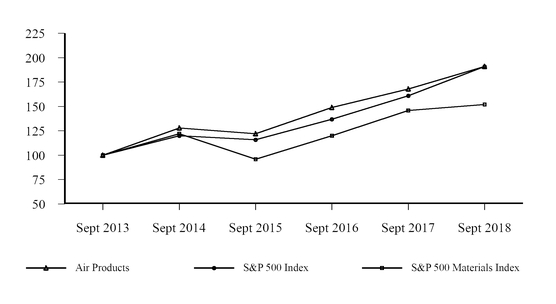
The performance graph below compares the five-year cumulative returns of the Company’s common stock with those of the Standard & Poor’s 500 Index (S&P 500 Index) and the Standard & Poor’s 500 Materials Index (S&P 500 Materials Index). The figures assume an initial investment of $100 and the reinvestment of all dividends.
COMPARISON OF FIVE YEAR CUMULATIVE SHAREHOLDER RETURN
Air Products, S&P 500 Index, and S&P 500 Materials Index
Comparative Growth of a $100 Investment
(Assumes Reinvestment of All Dividends)
| Sept 2013 | Sept 2014 | Sept 2015 | Sept 2016 | Sept 2017 | Sept 2018 | |
| Air Products | 100 | 128 | 122 | 149 | 168 | 191 |
| S&P 500 Index | 100 | 120 | 116 | 137 | 161 | 191 |
| S&P 500 Materials Index | 100 | 122 | 96 | 120 | 146 | 152 |
Item 6. SELECTED FINANCIAL DATA
Unless otherwise indicated, information presented is on a continuing operations basis.
| (Millions of dollars, except for share and per share data) | 2018**(A)** | 2017(A) | 2016(A) | 2015(A) | 2014(A) | ||||||||||
| Operating Results | |||||||||||||||
| Sales | $8,930 | $8,188 | $7,504 | $7,824 | $8,384 | ||||||||||
| Cost of sales(B) | 6,190 | 5,752 | 5,177 | 5,584 | 6,178 | ||||||||||
| Selling and administrative(B) | 761 | 714 | 684 | 765 | 876 | ||||||||||
| Research and development | 65 | 58 | 72 | 76 | 78 | ||||||||||
| Cost reduction and asset actions | — | 151 | 35 | 180 | 11 | ||||||||||
| Operating income(B) | 1,966 | 1,440 | 1,535 | 1,276 | 976 | ||||||||||
| Equity affiliates’ income(C) | 175 | 80 | 147 | 152 | 149 | ||||||||||
| Income from continuing operations attributable to Air Products | 1,456 | 1,134 | 1,100 | 933 | 697 | ||||||||||
| Net income attributable to Air Products(D) | 1,498 | 3,000 | 631 | 1,278 | 992 | ||||||||||
| Basic earnings per common share attributable to Air Products: | |||||||||||||||
| Income from continuing operations | 6.64 | 5.20 | 5.08 | 4.34 | 3.28 | ||||||||||
| Net income(D) | 6.83 | 13.76 | 2.92 | 5.95 | 4.66 | ||||||||||
| Diluted earnings per common share attributable to Air Products: | |||||||||||||||
| Income from continuing operations | 6.59 | 5.16 | 5.04 | 4.29 | 3.24 | ||||||||||
| Net income(D) | 6.78 | 13.65 | 2.89 | 5.88 | 4.61 | ||||||||||
| Year-End Financial Position | |||||||||||||||
| Plant and equipment, at cost | $21,490 | $19,548 | $18,660 | $17,999 | $18,180 | ||||||||||
| Total assets(D) | 19,178 | 18,467 | 18,029 | 17,317 | 17,648 | ||||||||||
| Working capital(D) | 2,744 | 3,388 | 1,034 | (851 | ) | 199 | |||||||||
| Total debt(E) | 3,813 | 3,963 | 5,211 | 5,856 | 6,081 | ||||||||||
| Air Products shareholders’ equity(D) | 10,858 | 10,086 | 7,080 | 7,249 | 7,366 | ||||||||||
| Total equity(D) | 11,176 | 10,186 | 7,213 | 7,381 | 7,521 | ||||||||||
| Financial Ratios | |||||||||||||||
| Return on average Air Products shareholders’ equity(F) | 13.9 | % | 13.2 | % | 15.4 | % | 12.7 | % | 9.5 | % | |||||
| Operating margin(B) | 22.0 | % | 17.6 | % | 20.5 | % | 16.3 | % | 11.6 | % | |||||
| Selling and administrative as a percentage of sales(B) | 8.5 | % | 8.7 | % | 9.1 | % | 9.8 | % | 10.4 | % | |||||
| Total debt to total capitalization(E)(G) | 25.4 | % | 28.0 | % | 41.9 | % | 44.2 | % | 43.8 | % | |||||
| Other Data | |||||||||||||||
| Income from continuing operations including noncontrolling interests | $1,491 | $1,155 | $1,122 | $966 | $691 | ||||||||||
| Adjusted EBITDA(B)(H) | 3,116 | 2,799 | 2,622 | 2,422 | 2,322 | ||||||||||
| Adjusted EBITDA margin(B) | 34.9 | % | 34.2 | % | 34.9 | % | 31.0 | % | 27.7 | % | |||||
| Depreciation and amortization | 971 | 866 | 855 | 859 | 876 | ||||||||||
| Capital expenditures on a GAAP basis(I) | 1,914 | 1,056 | 908 | 1,201 | 1,297 | ||||||||||
| Capital expenditures on a non-GAAP basis(I) | 1,934 | 1,066 | 935 | 1,575 | 1,498 | ||||||||||
| Cash provided by operating activities | 2,555 | 2,534 | 2,259 | 2,047 | 1,862 | ||||||||||
| Cash used for investing activities | (1,649 | ) | (1,418 | ) | (865 | ) | (1,147 | ) | (1,257 | ) | |||||
| Cash used for financing activities | (1,360 | ) | (2,041 | ) | (860 | ) | (960 | ) | (524 | ) | |||||
| Dividends declared per common share | 4.25 | 3.71 | 3.39 | 3.20 | 3.02 | ||||||||||
| Weighted Average Common Shares – Basic (in millions) | 219 | 218 | 216 | 215 | 213 | ||||||||||
| Weighted Average Common Shares – Diluted (in millions) | 221 | 220 | 218 | 217 | 215 | ||||||||||
| Book value per common share at year-end | $49.46 | $46.19 | $32.57 | $33.66 | $34.49 | ||||||||||
| Shareholders at year-end | 5,500 | 5,700 | 6,000 | 6,400 | 6,600 | ||||||||||
| Employees at year-end(J) | 16,300 | 15,300 | 18,600 | 19,700 | 21,200 |
| (A) | Unless otherwise stated, selected financial data is presented in accordance with U.S. generally accepted accounting principles (GAAP). The Company has presented certain financial measures on a non-GAAP (“adjusted”) basis to exclude items which management does not believe to be indicative of ongoing business trends. Refer to pages 33-39 for reconciliations of the GAAP to non-GAAP measures for fiscal years 2018, 2017, and 2016. Descriptions of the excluded items appear on pages 25-28. For fiscal year 2015, these items include: (i) a charge to operating income of $8 ($.03 per share) related to business separation costs, (ii) a charge to operating income of $180 ($133 after-tax, or $.61 per share) related to business restructuring and cost reduction actions, (iii) a gain of $18 ($11 after tax, or $.05 per share) reflected in operating income related to the gain on previously held equity interest in a liquefied atmospheric industrial gases production joint venture, (iv) a gain of $34 ($28 after tax, or $.13 per share) reflected in operating income resulting from the sale of two parcels of land, and (v) a charge to other non-operating income (expense), net related to pension settlement losses of $19 ($12 after-tax, or $.06 per share). For fiscal year 2014, these items include: (i) a charge to operating income of $11 ($7 after-tax, or $.03 per share) related to business restructuring and cost reduction actions, (ii) a charge to operating income of $310 ($275 attributable to Air Products, after-tax, or $1.27 per share) related to the impairment of goodwill and intangible assets, and (iii) a charge to other non-operating income (expense), net related to pension settlement losses of $5 ($3 after-tax, or $.02 per share). |
| (B) | Reflects adoption of guidance on presentation of net periodic pension and postretirement benefit cost on a retrospective basis during the first quarter of fiscal year 2018. Refer to Note 2, New Accounting Guidance, to the consolidated financial statements for additional information. |
| (C) | Fiscal year 2017 includes the third quarter impact of an other-than-temporary noncash impairment charge of $79.5 ($.36 per share) on our investment in Abdullah Hashim Industrial Gases & Equipment Co., Ltd. (AHG), a 25%‑owned equity affiliate in our Industrial Gases – EMEA segment. |
| (D) | Information presented on a total company basis, which includes both continuing and discontinued operations. |
| (E) | Total debt includes long-term debt, including debt to related parties, current portion of long-term debt, and short-term borrowings as of the end of the year for continuing operations. |
| (F) | Calculated using income from continuing operations attributable to Air Products and five-quarter average Air Products shareholders’ equity. |
| (G) | Total capitalization includes total debt for continuing operations plus total equity plus redeemable noncontrolling interest as of the end of the year. Redeemable noncontrolling interest was $287 as of 30 September 2014. There was no redeemable noncontrolling interest for the other periods presented. |
| (H) | A reconciliation of income from continuing operations on a GAAP basis to adjusted EBITDA is presented on pages 36-39. |
| (I) | Capital expenditures presented on a GAAP basis include additions to plant and equipment, acquisitions, less cash acquired, and investment in and advances to unconsolidated affiliates. The Company utilizes a non-GAAP measure in the computation of capital expenditures and includes spending associated with facilities accounted for as capital leases and purchases of noncontrolling interests. Refer to page 41 for a reconciliation of the GAAP to non-GAAP measures for fiscal years 2018, 2017, and 2016. In fiscal year 2015, the GAAP measure was adjusted by $96 and $278 for spending associated with facilities accounted for as capital leases and purchases of noncontrolling interests, respectively. In fiscal year 2014, the GAAP measure was adjusted by $200 for spending associated with facilities accounted for as capital leases. |
| (J) | Includes full- and part-time employees from continuing and discontinued operations. |
Item 7. MANAGEMENT’S DISCUSSION AND ANALYSIS OF FINANCIAL CONDITION AND RESULTS
OF OPERATIONS
This Management’s Discussion and Analysis contains “forward-looking statements” within the safe harbor provisions of the Private Securities Litigation Reform Act of 1995, including statements about business outlook. These forward-looking statements are based on management’s expectations and assumptions as of the date of this report and are not guarantees of future performance. Actual performance and financial results may differ materially from projections and estimates expressed in the forward-looking statements because of many factors not anticipated by management, including, without limitation, those described in our Forward-Looking Statements and Part I, Item 1A. Risk Factors, of this Annual Report on Form 10-K.
The following discussion should be read in conjunction with the consolidated financial statements and the accompanying notes contained in this report. Unless otherwise indicated, financial information is presented on a continuing operations basis. All comparisons in the discussion are to the corresponding prior year, unless otherwise stated. All amounts presented are in accordance with U.S. generally accepted accounting principles (GAAP), except as noted. All amounts are presented in millions of dollars, except for per share data, unless otherwise indicated.
Captions such as income from continuing operations attributable to Air Products, net income attributable to Air Products, and diluted earnings per share attributable to Air Products are simply referred to as “income from continuing operations,” “net income,” and “diluted earnings per share (EPS)” throughout this Management’s Discussion and Analysis, unless otherwise stated.
The discussion of results that follows includes comparisons to certain non-GAAP ("adjusted") financial measures. The presentation of non-GAAP measures is intended to provide investors, potential investors, securities analysts, and others with useful supplemental information to evaluate the performance of the business because such measures, when viewed together with our financial results computed in accordance with GAAP, provide a more complete understanding of the factors and trends affecting our historical financial performance and projected future results. The reconciliations of reported GAAP results to non-GAAP measures are presented on pages 33-39. Descriptions of the excluded items appear on pages 25-28.
BUSINESS OVERVIEW
Air Products and Chemicals, Inc. is a world-leading Industrial Gases company in operation for over 75 years. The Company’s core industrial gases business provides atmospheric, process, and specialty gases and related equipment to many industries including refining, chemical, gasification, metals, electronics, manufacturing, and food and beverage. Air Products is also the world’s leading supplier of liquefied natural gas (LNG) process technology and equipment. With operations in 50 countries, in fiscal year 2018 we had sales of $8.9 billion, assets of $19.2 billion, and a worldwide workforce of approximately 16,300 full- and part-time employees.
As of 30 September 2018, our operations were organized into five reportable business segments: Industrial Gases – Americas; Industrial Gases – EMEA (Europe, Middle East, and Africa); Industrial Gases – Asia; Industrial Gases – Global; and Corporate and other. The financial statements and analysis that follow discuss our results based on these operations. Refer to Note 25, Business Segment and Geographic Information, to the consolidated financial statements for additional details on our reportable business segments.
2018 IN SUMMARY
In fiscal year 2018, we delivered strong safety and financial results. Sales of $8.9 billion increased nine percent over the prior year primarily driven by higher volumes from base business growth and new, large industrial gas project onstreams. The higher regional volumes were partially offset by lower sale of equipment activity on our Jazan project as we near project completion. In addition, we began to execute our gasification strategy with the completion and onstream of the Lu'An acquisition and our announcements of the Jazan gasifier/power project in Jazan, Saudi Arabia, the Yankuang coal-to-syngas production facility in Yulin City, Shaanxi Province, China, and the Jiutai coal-to-syngas project in Hohhot, China.
We delivered operating margin of 22.0% and adjusted EBITDA margin of 34.9%. Diluted EPS of $6.59 increased 28% from the prior year. On a non-GAAP basis, adjusted diluted EPS of $7.45 increased 18%.
Highlights for 2018
| • | Sales of $8,930.2 increased 9%, or $742.6, from underlying sales growth of 7% and favorable currency impacts of 2%. The underlying sales growth was primarily driven by higher volumes across all regional Industrial Gases segments, partially offset by lower sale of equipment activity in the Industrial Gases – Global segment. |
| • | Operating income of $1,965.6 increased 37%, or $525.6, and operating margin of 22.0% increased 440 bp. On a non‑GAAP basis, adjusted operating income of $1,941.5 increased 9%, or $167.7, and adjusted operating margin of 21.7% was flat. |
| • | Income from continuing operations of $1,455.6 increased 28%, or $321.2, and diluted EPS of $6.59 increased 28%, or $1.43. On a non-GAAP basis, adjusted income from continuing operations of $1,644.7 increased 19%, or $258.8, and adjusted diluted EPS of $7.45 increased 18%, or $1.14. A summary table of changes in diluted earnings per share is presented on the following page. |
| • | Adjusted EBITDA of $3,115.5 increased 11%, or $316.3. Adjusted EBITDA margin of 34.9% increased 70 bp. |
| • | We completed the formation of a syngas supply joint venture with Lu'An, including the acquisition of Lu'An's gasification and syngas purification assets. |
| • | We increased our quarterly dividend by 16% from $.95 to $1.10 per share, or $4.40 per share annually, the largest increase in Company history. This represents the 36th consecutive year that we have increased our dividend payment. |
Changes in Diluted Earnings per Share Attributable to Air Products
Showing the first 8K of 147K characters. Open the full section
Item 7A. QUANTITATIVE AND QUALITATIVE DISCLOSURES ABOUT MARKET RISK
Our earnings, cash flows, and financial position are exposed to market risks relating to fluctuations in interest rates and foreign currency exchange rates. It is our policy to minimize our cash flow exposure to adverse changes in currency exchange rates and to manage the financial risks inherent in funding with debt capital.
We address these financial exposures through a controlled program of risk management that includes the use of derivative financial instruments. We have established counterparty credit guidelines and generally enter into
transactions with financial institutions of investment grade or better, thereby minimizing the risk of credit loss. All instruments are entered into for other than trading purposes. For details on the types and use of these derivative instruments and the major accounting policies, see Note 1, Major Accounting Policies, and Note 13, Financial Instruments, to the consolidated financial statements, for additional information. Additionally, we mitigate adverse energy price impacts through our cost pass-through contracts with customers and price increases.
Our derivative and other financial instruments consist of long-term debt (including current and related party portions), interest rate swaps, cross currency interest rate swaps, and foreign exchange-forward contracts. The net market value of these financial instruments combined is referred to below as the net financial instrument position and is disclosed in Note 14, Fair Value Measurements, to the consolidated financial statements. At 30 September 2018 and 2017, the net financial instrument position was a liability of $3,736.2 and $3,832.3, respectively.
The analysis below presents the sensitivity of the market value of our financial instruments to selected changes in market rates and prices. Market values are the present value of projected future cash flows based on the market rates and prices chosen. The market values for interest rate risk and foreign currency risk are calculated by us using a third-party software model that utilizes standard pricing models to determine the present value of the instruments based on market conditions (interest rates, spot and forward exchange rates, and implied volatilities) as of the valuation date.
Interest Rate Risk
Our debt portfolio as of 30 September 2018, including the effect of currency and interest rate swap agreements, was composed of 66% fixed-rate debt and 34% variable-rate debt. Our debt portfolio as of 30 September 2017, including the effect of currency and interest rate swap agreements, was composed of 65% fixed-rate debt and 35% variable-rate debt.
The sensitivity analysis related to the interest rate risk on the fixed portion of our debt portfolio assumes an instantaneous 100 bp move in interest rates from the level at 30 September 2018, with all other variables held constant. A 100 bp increase in market interest rates would result in a decrease of $96 and $112 in the net liability position of financial instruments at 30 September 2018 and 2017, respectively. A 100 bp decrease in market interest rates would result in an increase of $101 and $119 in the net liability position of financial instruments at 30 September 2018 and 2017, respectively.
Based on the variable-rate debt included in our debt portfolio, including the interest rate swap agreements, a 100 bp increase in interest rates would result in an additional $13 and $14 of interest incurred per year at the end of 30 September 2018 and 2017, respectively. A 100 bp decline in interest rates would lower interest incurred by $13 and $14 per year at 30 September 2018 and 2017, respectively.
Foreign Currency Exchange Rate Risk
The sensitivity analysis related to foreign currency exchange rates assumes an instantaneous 10% change in the foreign currency exchange rates from their levels at 30 September 2018 and 2017, with all other variables held constant. A 10% strengthening or weakening of the functional currency of an entity versus all other currencies would result in a decrease or increase, respectively, of $329 and $312 in the net liability position of financial instruments at 30 September 2018 and 2017, respectively.
The primary currency pairs for which we have exchange rate exposure are the Euro and U.S. Dollar and Chinese Renminbi and U.S. Dollar. Foreign currency debt, cross currency interest rate swaps, and foreign exchange-forward contracts are used in countries where we do business, thereby reducing our net asset exposure. Foreign exchange-forward contracts and cross currency interest rate swaps are also used to hedge our firm and highly anticipated foreign currency cash flows. Thus, there is either an asset/liability or cash flow exposure related to all of the financial instruments in the above sensitivity analysis for which the impact of a movement in exchange rates would be in the opposite direction and materially equal to the impact on the instruments in the analysis.
The majority of the Company’s sales are derived from outside of the United States and denominated in foreign currencies. Financial results therefore will be affected by changes in foreign currency rates. The Chinese Renminbi and the Euro represent the largest exposures in terms of our foreign earnings. We estimate that a 10% reduction in either the Chinese Renminbi or the Euro versus the U.S. Dollar would lower our annual operating income by approximately $30 and $25, respectively.
Item 8. FINANCIAL STATEMENTS AND SUPPLEMENTARY DATA
MANAGEMENT’S REPORT ON INTERNAL CONTROL OVER FINANCIAL REPORTING
Air Products’ management is responsible for establishing and maintaining adequate internal control over financial reporting. Our internal control over financial reporting, which is defined in the following sentences, is a process designed to provide reasonable assurance regarding the reliability of our financial reporting and the preparation of financial statements for external purposes in accordance with U.S. generally accepted accounting principles and includes those policies and procedures that:
| (i) | pertain to the maintenance of records that, in reasonable detail, accurately and fairly reflect the transactions and dispositions of the assets of the Company; |
| (ii) | provide reasonable assurance that the transactions are recorded as necessary to permit preparation of financial statements in accordance with U.S. generally accepted accounting principles, and that receipts and expenditures of the Company are being made only in accordance with authorizations of management and directors of the Company; and |
| (iii) | provide reasonable assurance regarding prevention or timely detection of unauthorized acquisition, use or disposition of the Company’s assets that could have a material effect on the financial statements. |
Because of inherent limitations, internal control over financial reporting can only provide reasonable assurance and may not prevent or detect misstatements. Further, because of changes in conditions, the effectiveness of our internal control over financial reporting may vary over time. Our processes contain self-monitoring mechanisms, and actions are taken to correct deficiencies as they are identified.
Management has evaluated the effectiveness of its internal control over financial reporting based on criteria established in Internal Control—Integrated Framework (2013) issued by the Committee of Sponsoring Organizations of the Treadway Commission (COSO). Based on this evaluation, management concluded that, as of 30 September 2018, the Company’s internal control over financial reporting was effective.
KPMG LLP, an independent registered public accounting firm, has issued its opinion on the Company’s internal control over financial reporting as of 30 September 2018 as stated in its report which appears herein.
| /s/ Seifi Ghasemi | /s/ M. Scott Crocco | |||
| Seifi Ghasemi | M. Scott Crocco | |||
| Chairman, President, and | Executive Vice President and | |||
| Chief Executive Officer | Chief Financial Officer | |||
| 20 November 2018 | 20 November 2018 |
REPORT OF INDEPENDENT REGISTERED PUBLIC ACCOUNTING FIRM
To the Shareholders and Board of Directors of Air Products and Chemicals, Inc.:
Opinions on the Consolidated Financial Statements and Internal Control Over Financial Reporting
We have audited the accompanying consolidated balance sheets of Air Products and Chemicals, Inc. and Subsidiaries (the Company) as of 30 September 2018 and 2017, the related consolidated income statements, consolidated comprehensive income statements, consolidated statements of cash flows and consolidated statements of equity for each of the years in the three-year period ended 30 September 2018, and the related notes and the financial statement schedule referred to in Item 15(a)(2) in this Form 10-K (collectively, the consolidated financial statements). We also have audited the Company’s internal control over financial reporting as of 30 September 2018, based on criteria established in Internal Control - Integrated Framework (2013) issued by the Committee of Sponsoring Organizations of the Treadway Commission.
In our opinion, the consolidated financial statements referred to above present fairly, in all material respects, the financial position of the Company as of 30 September 2018 and 2017, and the results of its operations and its cash flows for each of the years in the three-year period ended 30 September 2018, in conformity with U.S. generally accepted accounting principles. Also in our opinion, the Company maintained, in all material respects, effective internal control over financial reporting as of 30 September 2018, based on criteria established in Internal Control - Integrated Framework (2013) issued by the Committee of Sponsoring Organizations of the Treadway Commission.
Basis for Opinions
The Company’s management is responsible for these consolidated financial statements, for maintaining effective internal control over financial reporting, and for its assessment of the effectiveness of internal control over financial reporting, included in the accompanying “Management’s Report on Internal Control over Financial Reporting”. Our responsibility is to express an opinion on the Company’s consolidated financial statements and an opinion on the Company’s internal control over financial reporting based on our audits. We are a public accounting firm registered with the Public Company Accounting Oversight Board (United States) (PCAOB) and are required to be independent with respect to the Company in accordance with the U.S. federal securities laws and the applicable rules and regulations of the Securities and Exchange Commission and the PCAOB.
We conducted our audits in accordance with the standards of the PCAOB. Those standards require that we plan and perform the audits to obtain reasonable assurance about whether the consolidated financial statements are free of material misstatement, whether due to error or fraud, and whether effective internal control over financial reporting was maintained in all material respects.
Our audits of the consolidated financial statements included performing procedures to assess the risks of material misstatement of the consolidated financial statements, whether due to error or fraud, and performing procedures that respond to those risks. Such procedures included examining, on a test basis, evidence regarding the amounts and disclosures in the consolidated financial statements. Our audits also included evaluating the accounting principles used and significant estimates made by management, as well as evaluating the overall presentation of the consolidated financial statements. Our audit of internal control over financial reporting included obtaining an understanding of internal control over financial reporting, assessing the risk that a material weakness exists, and testing and evaluating the design and operating effectiveness of internal control based on the assessed risk. Our audits also included performing such other procedures as we considered necessary in the circumstances. We believe that our audits provide a reasonable basis for our opinions.
Definition and Limitations of Internal Control Over Financial Reporting
A company’s internal control over financial reporting is a process designed to provide reasonable assurance regarding the reliability of financial reporting and the preparation of financial statements for external purposes in accordance with generally accepted accounting principles. A company’s internal control over financial reporting includes those policies and procedures that (1) pertain to the maintenance of records that, in reasonable detail, accurately and fairly reflect the transactions and dispositions of the assets of the company; (2) provide reasonable assurance that transactions are recorded as necessary to permit preparation of financial statements in accordance with generally accepted accounting principles, and that receipts and expenditures of the company are being made only in accordance with authorizations of management and directors of the company; and (3) provide reasonable assurance regarding prevention or timely detection of unauthorized acquisition, use, or disposition of the company’s assets that could have a materia
Showing the first 8K of 263K characters. Open the full section
Item 9A. CONTROLS AND PROCEDURES
Disclosure Controls and Procedures
We maintain a comprehensive set of disclosure controls and procedures (as defined in Rules 13a-15 (e) and 15d-15 (e) under the Exchange Act). Under the supervision of the Chief Executive Officer and Chief Financial Officer, the Company’s management conducted an evaluation of the effectiveness of the Company’s disclosure controls and procedures as of 30 September 2018. Based on that evaluation, the Chief Executive Officer and Chief Financial Officer concluded that, as of 30 September 2018, the disclosure controls and procedures were effective.
Internal Control Over Financial Reporting
Our management is responsible for establishing and maintaining adequate internal control over financial reporting (as defined in Rules 13a-15(f) and 15d-15(f) under the Exchange Act). Management has evaluated the effectiveness of its internal control over financial reporting as of 30 September 2018 based on criteria established in Internal Control—Integrated Framework (2013) issued by the Committee of Sponsoring Organizations of the Treadway Commission (COSO). Based on that evaluation, management concluded that, as of 30 September 2018, the Company’s internal control over financial reporting was effective. Management’s Report on Internal Control over Financial Reporting is provided under Part II, Item 8, of this Form 10-K.
There was no change in the Company’s internal control over financial reporting during the fourth quarter of fiscal year 2018 that has materially affected, or is reasonably likely to materially affect, the Company’s internal control over financial reporting.
KPMG LLP, the Company’s independent registered public accounting firm, has audited the Company’s internal control over financial reporting as of 30 September 2018. The Report of the Independent Registered Public Accounting Firm is provided under Part II, Item 8, of this Form 10-K.
Item 9B. OTHER INFORMATION
On 19 November 2018, the Management Development and Compensation Committee (the “Committee”) of the Board of Directors granted Dr. Samir Serhan, Executive Vice President, a deferred stock unit retention award of $1.5 million. This award will consist of restricted stock units (“RSUs”) with a 3 December 2018 grant date. The RSUs will vest in three equal installments beginning on 3 December 2019. The Committee took this action in recognition of Dr. Serhan’s expanded scope of responsibilities in the Company’s operations, and in particular the leadership role he will play in winning and executing our largest projects and building out and integrating our global gasification technologies.
PART III
Item 10. DIRECTORS, EXECUTIVE OFFICERS AND CORPORATE GOVERNANCE
The information required by this item relating to the Company’s directors and nominees is incorporated herein by reference to the section captioned “The Board of Directors” in the Proxy Statement for the Annual Meeting of Shareholders to be held on 24 January 2019. The information required by this item relating to the Company’s executive officers is set forth in Item 1 of Part I of this report.
The information required by this item relating to the Company’s Audit and Finance Committee and its Audit and Finance Committee Financial Expert is incorporated herein by reference to the sections captioned “Standing Committees Of The Board” and “Audit and Finance Committee” in the Proxy Statement for the Annual Meeting of Shareholders to be held on 24 January 2019.
The information required by this item relating to the Company’s procedures regarding the consideration of candidates recommended by shareholders and a procedure for submission of such candidates is incorporated herein by reference to the section captioned “Selection of Directors” in the Proxy Statement for the Annual Meeting of Shareholders to be held on 24 January 2019.
The information required by the item relating to Section 16(a) Beneficial Ownership Reporting Compliance is incorporated herein by reference to the section captioned “Section 16(a) Beneficial Ownership Reporting Compliance” in the Proxy Statement for the Annual Meeting of Shareholders to be held on 24 January 2019.
The Company has adopted a Code of Conduct that applies to all employees, including the Chief Executive Officer, the Chief Financial Officer, and the Principal Accounting Officer. The Code of Conduct can be found at our website at www.airproducts.com/codeofconduct.
Item 11. EXECUTIVE COMPENSATION
The information required by this item is incorporated herein by reference to the sections captioned “Compensation of Executive Officers” and “Compensation of Directors” in the Proxy Statement for the Annual Meeting of Shareholders to be held on 24 January 2019.
| ITEM 12. | SECURITY OWNERSHIP OF CERTAIN BENEFICIAL OWNERS AND MANAGEMENT AND RELATED STOCKHOLDER MATTERS |
Securities Authorized for Issuance Under Equity Compensation Plans.
Equity Compensation Plan Information
The following table provides information as of 30 September 2018 about Company stock that may be issued upon the exercise of options, warrants, and rights granted to employees or members of the Board under the Company’s existing equity compensation plans, including plans approved by shareholders and plans that have not been approved by shareholders in reliance on the NYSE’s former treasury stock exception or other applicable exception to the Exchange’s listing requirements.
| Plan Category | Number of securities to be issued upon exercise of outstanding options, warrants, and rights | Weighted-average exercise price of outstanding options, warrants, and rights | Number of Securities remaining available for future issuance under equity compensation plans (excluding securities reflected in column (a)) | ||||||
| Equity compensation plans approved by security holders | 3,181,790 | (1) | $89.33 | 4,869,212 | (2) | ||||
| Equity compensation plans not approved by security holders | 63,060 | (3) | $— | — | |||||
| Total | 3,244,850 | $89.33 | 4,869,212 |
| (1) | Represents Long-Term Incentive Plan outstanding stock options and deferred stock units that have been granted. Deferred stock units entitle the recipient to one share of Company common stock upon vesting, which is conditioned on continued employment during a deferral period and may also be conditioned on earn-out against certain performance targets. The amount presented assumes the maximum potential payout. |
| (2) | Represents authorized shares that were available for future grants as of 30 September 2018. These shares may be used for options, deferred stock units, restricted stock, and other stock-based awards to officers, directors, and key employees. Full value awards such as restricted stock are limited to 20% of cumulative awards after 1 October 2001. |
| (3) | This number represents deferred stock units issued under the Deferred Compensation Plan, which are purchased for the fair value of the underlying shares of stock with eligible deferred compensation. |
The Deferred Compensation Plan was not approved by shareholders. It does not require shareholder approval because participants forego compensation equal to the full market value of any share units credited under the plans.
Deferred Compensation Plan—The Company’s Deferred Compensation Plan is an unfunded employee retirement benefit plan available to certain of the Company’s U.S.-based management and other highly compensated employees (and those of its subsidiaries) who receive awards under the Company’s Annual Incentive Plan, which is the annual cash bonus plan for executives and key salaried employees of the Company and its subsidiaries. Because participants forego current compensation to “purchase” deferred stock units for full value under the Plan, it is not required to be approved by shareholders under the NYSE listing standards. Under the Plan, participants may defer a portion of base salary (elective deferrals) which cannot be contributed to the Company’s Retirement Savings Plan, a 401(k) and profit-sharing plan offered to all salaried employees (RSP), because of tax limitations and earn matching contributions from the Company that they would have received if their elective deferrals had been contributed to the RSP (matching credits). In addition, participants in the Plan may defer all or a portion of their bonus awards under the Annual Incentive Plan (bonus deferrals) under the Deferred Compensation Plan. Finally, certain participants under the Plan who participate in the profit-sharing component of the RSP rather than the Company’s salaried pension plans receive contribution credits under the Plan which are a percentage ranging from 4%-6%, based on their years of service, of their salary in excess of tax limitations and their bonus awards under the Annual Incentive Plan (contribution credits). The dollar amount of elective deferrals, matching credits, bonus deferrals, and contribution credits is initially credited to an unfunded account, which earns interest credits. Participants are periodically permitted while employed by the Company to irrevocably convert all or a portion of their interest-bearing account to deferred stock units in a Company stock account. Upon conversion, the Company stock account is credited with deferred stock units based on the fair value of a share of Company stock on the date of crediting. Dividend equivalents corresponding to the number of units are credited quarterly to the interest-bearing account. Deferred stock units generally are paid after termination of employment in shares of Company stock.
The Deferred Compensation Plan was formerly known as the Supplementary Savings Plan. The name was changed in 2006 when the deferred bonus program, previously administered under the Annual Incentive Plan, was merged into this Plan.
Certain information required by this item regarding the beneficial ownership of the Company’s common stock is incorporated herein by reference to the sections captioned “Persons Owning More than 5% of Air Products Stock as of September 30, 2018” and “Air Products Stock Beneficially Owned by Officers and Directors” in the Proxy Statement for the Annual Meeting of Shareholders to be held on 24 January 2019.
| ITEM 13. | CERTAIN RELATIONSHIPS AND RELATED TRANSACTIONS, AND DIRECTOR INDEPENDENCE |
The information required by this item is incorporated herein by reference to the sections captioned “Director Independence” and “Transactions with Related Persons” in the Proxy Statement for the Annual Meeting of Shareholders to be held on 24 January 2019.
Item 14. PRINCIPAL ACCOUNTANT FEES AND SERVICES
The information required by this item is incorporated herein by reference to the section captioned “Independent Registered Public Accountant” in the Proxy Statement for the Annual Meeting of Shareholders to be held on 24 January 2019.
PART IV
Item 15. EXHIBITS AND FINANCIAL STATEMENT SCHEDULES
| (a) | The following documents are filed as a part of this report: | ||
| (1) | The Company’s 2018 consolidated financial statements and the Report of the Independent Registered Public Accounting Firm are included in Part II, Item 8. | ||
| Report of Independent Registered Public Accounting Firm dated 20 November 2018 | 58 | ||
| Consolidated Income Statements for the three fiscal years ended 30 September 2018 | 59 | ||
| Consolidated Comprehensive Income Statements for the three fiscal years ended 30 September 2018 | 60 | ||
| Consolidated Balance Sheets as of 30 September 2018 and 2017 | 61 | ||
| Consolidated Statements of Cash Flows for the three fiscal years ended 30 September 2018 | 62 | ||
| Consolidated Statements of Equity for the three fiscal years ended 30 September 2018 | 63 | ||
| (2) | Financial Statement Schedules—the following additional information should be read in conjunction with the consolidated financial statements in the Company’s 2018 consolidated financial statements. | ||
| Schedule II Valuation and Qualifying Accounts for the three fiscal years ended 30 September 2018 | 132 | ||
| All other schedules are omitted because the required matter or conditions are not present or because the information required by the Schedules is submitted as part of the consolidated financial statements and notes thereto. | |||
| (3) | Exhibits—The exhibits filed as a part of this Annual Report on Form 10-K are listed in the Index to Exhibits located on page 126 of this Report. |
Item 16. FORM 10-K SUMMARY
None
INDEX TO EXHIBITS
| Exhibit No. | Description |
| 99.1 | Description of Common Stock (Filed as Exhibit 99.1 to the Company’s Form 10-K Report for the fiscal year ended 30 September 2014.)* |
| 101.INS | XBRL Instance Document. The XBRL Instance Document does not appear in the Interactive Data File because its XBRL tags are embedded within the Inline XBRL document. |
| 101.SCH | XBRL Taxonomy Extension Schema |
| 101.CAL | XBRL Taxonomy Extension Calculation Linkbase |
| 101.LAB | XBRL Taxonomy Extension Label Linkbase |
| 101.PRE | XBRL Taxonomy Extension Presentation Linkbase |
| 101.DEF | XBRL Taxonomy Extension Definition Linkbase |
| * | Previously filed as indicated and incorporated herein by reference. Exhibits incorporated by reference are located in SEC File No. 001-04534 unless otherwise indicated. |
| † | Indicated management contract or compensatory arrangement. |
| †† | The certification attached as Exhibit 32.1 that accompanies this Annual Report on Form 10-K, is not deemed filed with the Securities and Exchange Commission and is not to be incorporated by reference into any filing of Air Products and Chemicals, Inc. under the Securities Act of 1933, as amended, or the Securities Exchange Act of 1934, as amended, whether made before or after the date of this Form 10-K, irrespective of any general incorporation language contained in such filing. |
SIGNATURES
Pursuant to the requirements of Section 13 or 15(d) of the Securities Exchange Act of 1934, the registrant has duly caused this Report to be signed on its behalf by the undersigned, thereunto duly authorized.
| AIR PRODUCTS AND CHEMICALS, INC. | |
| (Registrant) | |
| By: | /s/ M. Scott Crocco |
| M. Scott Crocco Executive Vice President and Chief Financial Officer (Principal Financial Officer) | |
| Date: | 20 November 2018 |
Pursuant to the requirements of the Securities Exchange Act of 1934, this Report has been signed below by the following persons on behalf of the registrant and in the capacities and on the dates indicated.
| Signature and Title | Date | |
| /s/ Seifi Ghasemi | 20 November 2018 | |
| (Seifi Ghasemi) Director, Chairman, President, and Chief Executive Officer (Principal Executive Officer) | ||
| /s/ Russell A. Flugel | 20 November 2018 | |
| (Russell A. Flugel) Vice President and Corporate Controller (Principal Accounting Officer) | ||
| * | 20 November 2018 | |
| (Susan K. Carter) Director | ||
| * | 20 November 2018 | |
| (Charles I. Cogut) Director | ||
| * | 20 November 2018 | |
| (Chad C. Deaton) Director | ||
| * | 20 November 2018 | |
| (David H. Y. Ho) Director | ||
| * | 20 November 2018 | |
| (Margaret G. McGlynn) Director | ||
| Signature and Title | Date | |
| * | 20 November 2018 | |
| (Edward L. Monser) Director | ||
| * | 20 November 2018 | |
| (Matthew H. Paull) Director |
| * | Sean D. Major, Executive Vice President, General Counsel and Secretary, by signing his name hereto, does sign this document on behalf of the above noted individuals, pursuant to a power of attorney duly executed by such individuals, which is filed with the Securities and Exchange Commission herewith. |
| /s/ Sean D. Major | |
| Sean D. Major | |
| Executive Vice President, General Counsel and Secretary | |
| Date: | 20 November 2018 |
AIR PRODUCTS AND CHEMICALS, INC. AND SUBSIDIARIES
SCHEDULE II–VALUATION AND QUALIFYING ACCOUNTS
For the Years Ended 30 September 2018, 2017, and 2016
| Balance at Beginning of Period | Additions Charged to Expense | Additions Charged to Other Accounts | Other Changes(A) | Balance at End of Period | |||||||||||
| Year Ended 30 September 2018 | |||||||||||||||
| Allowance for doubtful accounts | $94 | $17 | $7 | ($27 | ) | $91 | |||||||||
| Allowance for deferred tax assets | 108 | 3 | 4 | (10 | ) | 105 | |||||||||
| Year Ended 30 September 2017 | |||||||||||||||
| Allowance for doubtful accounts | $55 | $7 | $39 | ($7 | ) | $94 | |||||||||
| Allowance for deferred tax assets (B) | 165 | 6 | 7 | (70 | ) | 108 | |||||||||
| Year Ended 30 September 2016 | |||||||||||||||
| Allowance for doubtful accounts | $48 | $9 | $13 | ($15 | ) | $55 | |||||||||
| Allowance for deferred tax assets(C) | 112 | 1 | 52 | — | 165 |
| (A) | Other changes related to allowance for doubtful accounts primarily includes write-offs of uncollectible trade receivables, net of recoveries. Other Changes also includes the impact of foreign currency translation adjustments. |
| (B) | The decrease in the valuation allowance was primarily due to the utilization of federal and state loss carryforwards as a result of recognizing the gain on the sale of our PMD business. This benefit was recorded in discontinued operations. See Note 3, Discontinued Operations, for additional information. |
| (C) | The increase in the valuation allowance was primarily due to the loss recorded on the exit from the Energy-from-Waste business. These costs were recorded in discontinued operations. See Note 3, Discontinued Operations, for additional information. |