 filings.tools
Aptiv 10-K 2023-12-31
Filed 2024-02-06. 22 sections, 676K characters. Original on sec.gov · Markdown · JSON
Cover and table of contents
UNITED STATES
SECURITIES AND EXCHANGE COMMISSION
Washington, D.C. 20549
FORM 10-K
| ☒ | ANNUAL REPORT PURSUANT TO SECTION 13 OR 15(d) OF THE SECURITIES EXCHANGE ACT OF 1934 |
For the fiscal year ended December 31, 2023
OR
| ☐ | TRANSITION REPORT PURSUANT TO SECTION 13 OR 15(d) OF THE SECURITIES EXCHANGE ACT OF 1934 |
For the transition period from to .
Commission file number: 001-35346

APTIV PLC
(Exact name of registrant as specified in its charter)
| Jersey | 98-1029562 | |||||||
| (State or other jurisdiction of | (I.R.S. Employer | |||||||
| incorporation or organization) | Identification No.) |
5 Hanover Quay, Grand Canal Dock, Dublin, D02 VY79, Ireland
(Address of principal executive offices)
353-1-259-7013
(Registrant’s telephone number, including area code)
Securities registered pursuant to Section 12(b) of the Act:
| Title of each class | Trading symbol(s) | Name of each exchange on which registered | ||||||||||||
| Ordinary Shares. $0.01 par value per share | APTV | New York Stock Exchange | ||||||||||||
| 2.396% Senior Notes due 2025 | APTV | New York Stock Exchange | ||||||||||||
| 1.500% Senior Notes due 2025 | APTV | New York Stock Exchange | ||||||||||||
| 1.600% Senior Notes due 2028 | APTV | New York Stock Exchange | ||||||||||||
| 4.350% Senior Notes due 2029 | APTV | New York Stock Exchange | ||||||||||||
| 3.250% Senior Notes due 2032 | APTV | New York Stock Exchange | ||||||||||||
| 4.400% Senior Notes due 2046 | APTV | New York Stock Exchange | ||||||||||||
| 5.400% Senior Notes due 2049 | APTV | New York Stock Exchange | ||||||||||||
| 3.100% Senior Notes due 2051 | APTV | New York Stock Exchange | ||||||||||||
| 4.150% Senior Notes due 2052 | APTV | New York Stock Exchange |
Securities registered pursuant to Section 12(g) of the Act: None
Indicate by check mark if the registrant is a well-known seasoned issuer, as defined in Rule 405 of the Securities Act. Yes ☒. No ☐.
Indicate by check mark if the registrant is not required to file reports pursuant to Section 13 or Section 15(d) of the Act. Yes ☐. No ☒.
Indicate by check mark whether the registrant (1) has filed all reports required to be filed by Section 13 or 15(d) of the Securities Exchange Act of 1934 during the preceding 12 months (or for such shorter period that the registrant was required to file such reports), and (2) has been subject to such filing requirements for the past 90 days. Yes ☒. No ☐.
Indicate by check mark whether the registrant has submitted electronically every Interactive Data File required to be submitted pursuant to Rule 405 of Regulation S-T (§232.405 of this chapter) during the preceding 12 months (or for such shorter period that the registrant was required to submit such files). Yes ☒. No ☐.
Indicate by check mark whether the registrant is a large accelerated filer, an accelerated filer, a non-accelerated filer, a smaller reporting company, or an emerging growth company. See the definitions of “large accelerated filer,” “accelerated filer,” “smaller reporting company,” and “emerging growth company” in Rule 12b-2 of the Exchange Act.
| Large accelerated filer | ☒ | Accelerated filer | ☐ | |||||||||||||||||
| Non-accelerated filer | ☐ | Smaller reporting company | ☐ | |||||||||||||||||
| Emerging growth company | ☐ |
If an emerging growth company, indicate by the check mark if the registrant has elected not to use the extended transition period for complying with any new or revised financial accounting standards provided pursuant to Section 13(a) of the Exchange Act. ☐.
Indicate by check mark whether the registrant has filed a report on and attestation to its management’s assessment of the effectiveness of its internal control over financial reporting under Section 404(b) of the Sarbanes-Oxley Act (15 U.S.C. 7262(b)) by the registered public accounting firm that prepared or issued its audit report. ☒
If securities are registered pursuant to Section 12(b) of the Act, indicate by check mark whether the financial statements of the registrant included in the filing reflect the correction of an error to previously issued financial statements. ☐
Indicate by check mark whether any of those error corrections are restatements that required a recovery analysis of incentive-based compensation received by any of the registrant’s executive officers during the relevant recovery period pursuant to §240.10D-1(b). ☐
Indicate by check mark whether the registrant is a shell company (as defined in Rule 12b-2 of the Exchange Act). Yes ☐. No ☒.
The aggregate market value of the ordinary shares held by non-affiliates of the registrant as of June 30, 2023, the last business day of the registrant’s most recently completed second fiscal quarter, was $28,792,327,747 (based on the closing sale price of the registrant’s ordinary shares on that date as reported on the New York Stock Exchange).
The number of the registrant’s ordinary shares outstanding, $0.01 par value per share as of February 2, 2024, was 279,036,041.
DOCUMENTS INCORPORATED BY REFERENCE
Portions of the registrant’s definitive Proxy Statement related to the 2024 Annual General Meeting of Shareholders to be filed subsequently are incorporated by reference into Part III of this Form 10-K.
APTIV PLC
INDEX
CAUTIONARY STATEMENT REGARDING FORWARD-LOOKING INFORMATION
This Annual Report on Form 10-K, including the exhibits being filed as part of this report, as well as other statements made by Aptiv PLC (“Aptiv,” the “Company,” “we,” “us” and “our”), contain forward-looking statements that reflect, when made, the Company’s current views with respect to current events, certain investments and acquisitions and financial performance. Such forward-looking statements are subject to many risks, uncertainties and factors relating to the Company’s operations and business environment, which may cause the actual results of the Company to be materially different from any future results, express or implied, by such forward-looking statements. All statements that address future operating, financial or business performance or the Company’s strategies or expectations are forward-looking statements. In some cases, you can identify these statements by forward-looking words such as “may,” “might,” “will,” “should,” “expects,” “plans,” “intends,” “anticipates,” “believes,” “estimates,” “predicts,” “projects,” “potential,” “outlook” or “continue,” and other comparable terminology. Factors that could cause actual results to differ materially from these forward-looking statements include, but are not limited to, the following: global and regional economic conditions, including conditions affecting the credit market; global inflationary pressures; uncertainties created by the conflict between Ukraine and Russia, and its impacts to the European and global economies and our operations in each country; uncertainties created by the conflicts in the Middle East and their impacts on global economies; fluctuations in interest rates and foreign currency exchange rates; the cyclical nature of global automotive sales and production; the potential disruptions in the supply of and changes in the competitive environment for raw material and other components integral to the Company’s products, including the ongoing semiconductor supply shortage; the Company’s ability to maintain contracts that are critical to its operations; potential changes to beneficial free trade laws and regulations, such as the United States-Mexico-Canada Agreement; changes to tax laws; future significant public health crises; the ability of the Company to integrate and realize the expected benefits of recent transactions; the ability of the Company to attract, motivate and/or retain key executives; the ability of the Company to avoid or continue to operate during a strike, or partial work stoppage or slow down by any of its unionized employees or those of its principal customers; and the ability of the Company to attract and retain customers. Additional factors are discussed under the captions “Risk Factors” and “Management’s Discussion and Analysis of Financial Condition and Results of Operations” in the Company’s filings with the Securities and Exchange Commission. New risks and uncertainties arise from time to time, and it is impossible for us to predict these events or how they may affect the Company. It should be remembered that the price of the ordinary shares and any income from them can go down as well as up. Aptiv disclaims any intention or obligation to update or revise any forward-looking statements, whether as a result of new information, future events and/or otherwise, except as may be required by law.
PART I
Item 1. BUSINESS
“Aptiv,” the “Company,” “we,” “us” and “our” refer to Aptiv PLC (formerly known as Delphi Automotive PLC), a public limited company formed under the laws of Jersey on May 19, 2011, which completed an initial public offering on November 22, 2011, and its consolidated subsidiaries. The Company’s ordinary shares are publicly traded on the New York Stock Exchange under the symbol “APTV.”
Aptiv is a leading global technology and mobility architecture company primarily serving the automotive sector. We deliver end-to-end mobility solutions, enabling our customers’ transition to more electrified, software-defined vehicles. We design and manufacture vehicle components and provide electrical, electronic and active safety technology solutions to the global automotive and commercial vehicle markets, creating the software and hardware foundation for vehicle features and functionality. Our Advanced Safety and User Experience segment is focused on providing the necessary software and advanced computing platforms, and our Signal and Power Solutions segment is focused on providing the requisite networking architecture required to support the integrated systems in today’s complex vehicles. Together, our businesses develop the ‘brain’ and the ‘nervous system’ of increasingly complex vehicles, providing integration of the vehicle into its operating environment.
We are one of the largest vehicle technology suppliers and our customers include the 25 largest automotive original equipment manufacturers (“OEMs”) in the world. We operate 138 major manufacturing facilities and 11 major technical centers utilizing a regional service model that enables us to efficiently and effectively serve our global customers from best cost countries. We have a presence in 50 countries and have approximately 22,200 scientists, engineers and technicians focused on developing market relevant product solutions for our customers.
We are focused on growing and improving the profitability of our businesses, and have implemented a strategy designed to position the Company to deliver industry-leading long-term shareholder returns. This strategy includes disciplined investing in our business to grow and enhance our product offerings, strategically focusing our portfolio in high-technology, high-growth spaces in order to meet consumer preferences and leveraging an industry-leading cost structure to expand our operating margins.
Website Access to Company’s Reports
Aptiv’s website address is aptiv.com. Our Annual Reports on Form 10-K, Quarterly Reports on Form 10-Q, Current Reports on Form 8-K and amendments to those reports filed or furnished pursuant to Section 13(a) or 15(d) of the Securities Exchange Act of 1934 (the “Exchange Act”) are available free of charge through our website as soon as reasonably practicable after they are electronically filed with, or furnished to, the Securities and Exchange Commission (“SEC”).
Our Company
We believe the automotive industry is being shaped by rapidly increasing consumer demand for new mobility solutions, advanced technologies, including software-defined vehicles, and vehicle connectivity, as well as increasing government regulation related to vehicle safety, fuel efficiency and emissions control. These industry mega-trends, which we refer to as “Safe,” “Green” and “Connected,” are driving higher growth in products that address these trends than growth in the automotive industry overall. We have organized our business into two diversified segments, which enable us to develop technology solutions and manufacture highly-engineered products that enable our customers to respond to these mega-trends:
-
Signal and Power Solutions**—This segment provides complete design, manufacture and assembly of the vehicle’s electrical architecture, including engineered component products, connectors, wiring assemblies and harnesses, cable management, electrical centers and high voltage power and safety-critical data distribution systems. Our products provide the signal distribution and computing power backbone that supports increased vehicle content and electrification, reduced emissions, higher fuel economy and off-vehicle connectivity.
-
Advanced Safety and User Experience**—This segment provides critical technologies and services to enhance vehicle safety, security, comfort and convenience, including sensing and perception systems, electronic control units, multi-domain controllers, vehicle connectivity systems, cloud-native software platforms, application software, autonomous driving technologies and end-to-end DevOps tools.
Refer to Results of Operations by Segment in Item 7. Management’s Discussion and Analysis of Financial Condition and Results of Operations and Note 22. Segment Reporting to the audited consolidated financial statements for financial information about our business segments.
Our business is diversified across end-markets, regions, customers, vehicle platforms and products. Our customer base includes the 25 largest automotive OEMs in the world, and in 2023, 28% of our net sales came from the Asia Pacific region, which we have identified as a key market likely to experience substantial long-term growth. Our ten largest platforms in 2023
were with six different OEMs. In addition, in 2023 our products were found in 17 of the 20 top-selling vehicle models in the United States (“U.S.”), 16 of the 20 top-selling vehicle models in Europe and 12 of the 20 top-selling vehicle models in China.
We have established a worldwide design and manufacturing footprint with a regional service model that enables us to efficiently and effectively serve our global customers from best cost countries. This regional model is structured primarily to service the North American market from Mexico, the South American market from Brazil, the European market from Eastern Europe and North Africa, and the Asia Pacific market from China. Our global scale and regional service model enables us to engineer globally and execute regionally to serve the largest OEMs, which are seeking suppliers that can serve them on a worldwide basis. Our footprint also enables us to adapt to the regional design variations the global OEMs require while also serving key growth market OEMs.
Our Industry
The automotive technology and components industry provides critical technologies, components, systems, subsystems and modules to OEMs for the manufacture of new vehicles, as well as to the aftermarket for use as replacement parts for current production and older vehicles. In addition, the industry is increasingly progressing towards software-defined vehicles becoming critical elements of the overall automotive ecosystem. Overall, we expect long-term growth of global vehicle sales and production in the OEM market. In 2023, the industry experienced increased global customer sales and production schedules, despite various global uncertainties and global inflationary pressures. Global automotive vehicle production increased 9% (10% on an Aptiv weighted market basis, which represents global vehicle production weighted to the geographic regions in which the Company generates its revenue) from 2022 to 2023, reflecting increased vehicle production of 13% in Europe, 10% in China, 9% in North America and flat production in South America, our smallest region. Demand for automotive components in the OEM market is generally a function of the number of new vehicles produced in response to consumer demand, which is primarily driven by macro-economic factors such as credit availability, interest rates, fuel prices, consumer confidence, employment and other trends. Although OEM demand is tied to actual vehicle production, participants in the automotive technology and components industry also have the opportunity to grow through increasing product content per vehicle by further penetrating business with existing customers and in existing markets, gaining new customers and increasing their presence in global markets. We believe that evolving entrants into the global transportation industry such as mobility providers, electric vehicle developers and smart cities will provide additional markets for our advanced technologies. We believe that as a company with a global presence and advanced technology, engineering, manufacturing and customer support capabilities, we are well-positioned to benefit from these opportunities.
We believe that continuously increasing societal demands have created the three “mega-trends” that serve as the basis for the next wave of market-driven automotive technology advancement. We aim to continue developing leading edge technology focused on addressing these mega-trends, and apply that technology toward products with sustainable margins that enable our customers, both OEMs and others, to produce distinctive market-leading products. We have identified a core portfolio of products that draw on our technical strengths and align with these mega-trends where we believe we can provide differentiation to our customers.
Safe*.* The first mega-trend, “Safe,” represents technologies aimed not just at protecting vehicle occupants when a crash occurs, but those that actually proactively reduce the risk of a crash occurring. OEMs continue to focus on improving occupant and pedestrian safety in order to meet increasingly stringent regulatory requirements in various markets. As a result, suppliers are focused on developing technologies aimed at protecting vehicle occupants when a crash occurs, as well as advanced driver assistance systems that reduce driver distractions and automated safety features that proactively mitigate the risk of a crash occurring. Examples of new and alternative technologies that incorporate sophisticated detection and advanced software for collision avoidance include lane departure warning and centering systems, adaptive cruise control and traffic jam assist, and driver and cabin monitoring systems.
Green*.* The second mega-trend, “Green,” represents technologies designed to help reduce emissions, increase fuel economy and minimize the environmental impact of vehicles. Green is a key mega-trend today because of the convergence of several issues: climate change, volatility in oil prices, an increasing number of vehicles in use worldwide and recent and pending regulation in every region regarding fuel economy and greenhouse gas (“GHG”) emissions. OEMs continue to focus on improving fuel efficiency and reducing emissions in order to meet increasingly stringent regulatory requirements in various markets. On a worldwide basis, the relevant authorities in the largest markets in which we operate have already instituted regulations requiring reductions in emissions and/or increased fuel economy. In many cases, other authorities have initiated legislation or regulation that would further tighten the standards through 2024 and beyond. Based on the current regulatory environment, we believe that OEMs, including those in the U.S. and China, will be subject to requirements for even greater reductions in carbon dioxide (“CO2”) emissions over the next ten years. For example, in the U.S., the Environmental Protection Agency (the “EPA”) proposed new rules in 2023 that could require as much as 67% of all light-duty vehicles and 46% of medium-duty vehicles sold in the U.S. by model year 2032 to be all-electric, and the California Air Resources
Board approved rules in 2022, which require that all new passenger cars and light trucks sold in California be electric vehicles or other emissions-free models by 2035. In 2021, the EPA also finalized more stringent GHG emissions standards for passenger car and light trucks for model years 2023-2026. These and other standards will require meaningful innovation as OEMs and suppliers are challenged to find ways to improve engine management, electrical power consumption, vehicle weight and integration of electric vehicles and alternative technologies. As a result, suppliers are developing innovations that result in significant improvements in fuel economy, emissions and performance from internal combustion engines and electric vehicles. At the same time, suppliers are also developing and marketing new and alternative technologies that support electric vehicles, hybrid vehicles and fuel cell products to improve fuel economy and emissions. We are developing key enabling technologies in the areas of vehicle charging and vehicle power distribution and control that are essential to the introduction of our customers’ electrified vehicle platforms. We are also enabling the trend towards vehicle electrification with high voltage electrification solutions that reduce CO2 emissions and increase fuel economy, helping to make the world greener.
Connected*.* The third mega-trend, “Connected,” represents technologies designed to seamlessly integrate today’s highly complex vehicles into the electronic operating environment, and provide drivers with connectivity to the global information network. The technology content of vehicles continues to increase as consumers demand greater safety, personalization, infotainment, productivity and convenience while driving, which in turn leads to increasing demand for electrical architecture as a foundation for this content. Also with increased smart device usage in vehicles, driver distractions can be dramatically increased, which in turn results in greater risk of accidents. We are pioneering vehicle-to-vehicle (V2V) and vehicle-to-infrastructure (V2I) communication technologies which enable vehicles to detect and signal danger, reducing vehicle collisions and improving driver safety, while also maintaining connectivity to an increasing number of devices inside and outside of vehicles. We also utilize advanced connectivity solutions such as over-the-air (OTA) technology that enable vehicles to receive software updates remotely and collect market-relevant data from connected vehicles.
We expect these mega-trends to continue to create growth and opportunity for us. We believe we are well-positioned to provide solutions and products to OEMs to expand the electronic and technological content of their vehicles. We also believe electronics integration, which generally refers to products and systems that combine integrated circuits, software algorithms, sensor technologies and mechanical components within the vehicle will allow OEMs to achieve substantial reductions in weight and mechanical complexity, resulting in easier assembly, enhanced fuel economy, improved emissions control and better vehicle performance.
Convergence of Safe, Green and Connected Solutions in New Mobility and Autonomous Driving Technologies
The combination of advanced technologies being developed within these mega-trends is also contributing to increasing industry development of autonomous driving technologies, leading to a fully automated driving experience. We expect automated driving technologies will provide strong societal benefit as well as the opportunity for long-term growth for our product offerings in this space, including new potential customers such as mobility providers and smart cities that require solutions to increasing urban mobility challenges. Societal benefits of increased vehicle automation include enhanced safety (resulting from collision avoidance and improved vehicle control), environmental improvements (a reduction in CO2 emissions resulting from optimized driving behavior), labor cost savings and improved productivity (as a result of alternate uses for drive time). Growth opportunities in this space result from increased content, additional computing power and software requirements, solutions to simplify lifecycle management, enhanced connectivity systems and increased electrification and interconnects. We believe the complexity of these systems will also require ongoing software support services, as these vehicle systems will be continuously upgraded with new features and performance enhancements
As part of our strategy to harness the full potential of connected intelligent systems across industries, strengthen our capabilities in software-defined mobility and to enable advanced smart vehicle architecture changes, we acquired Wind River Systems, Inc. (“Wind River”) in December 2022. Wind River is a global leader in delivering software for the intelligent edge for multiple industries, including automotive, by leveraging mixed-criticality software products and solutions enabling customers to develop in the cloud, deploy over the air and run and manage software at the vehicle edge.
We are also continuing to develop market-leading automated driving solutions such as automated driving software, key active safety sensing and compute technologies capable of supporting safety-critical applications. We believe we are well-aligned with industry technology trends that will help to support sustainable future growth in this space and are collaborating with leaders in their respective fields to advance the pace of development and commercialization of these emerging technologies.
In March 2020, we completed a transaction with Hyundai Motor Group (“Hyundai”) to form Motional AD LLC (“Motional”), a joint venture focused on the design, development and commercialization of autonomous driving technologies. Motional began testing fully driverless systems in 2020 and began testing a production-ready autonomous driving platform available for robotaxi providers, meal delivery providers, fleet operators and automotive manufacturers at prototype scale in
2022, with initial production deployments in the fourth quarter of 2023 and commercial launch planned in the first half of 2024. In addition, Motional is involved in collaborative arrangements with mobility providers and with smart cities such as Boston, Las Vegas, Los Angeles and Singapore as solutions are developed for the evolving nature of the mobility industry.
To guide our product strategies and investments in technology with a focus on developing advanced technologies to drive growth within the Safe, Green and Connected mega-trends, we utilize and benefit from our Technology Advisory Council, a panel of prominent global technology thought leaders.
Standardization of Sourcing by OEMs
Many OEMs have adopted global vehicle platforms to increase standardization, reduce per unit cost and increase capital efficiency and profitability. As a result, OEMs select suppliers that have the capability to manufacture products on a worldwide basis as well as the flexibility to adapt to regional variations. Suppliers with global scale and strong design, engineering and manufacturing capabilities, are best positioned to benefit from this trend. OEMs are also increasingly looking to their suppliers to simplify vehicle design and assembly processes to reduce costs. As a result, suppliers that sell vehicle components directly to manufacturers (Tier I suppliers) have assumed many of the design, engineering, research and development and assembly functions traditionally performed by vehicle manufacturers. Suppliers that can provide fully engineered solutions, systems and pre-assembled combinations of component parts are positioned to leverage the trend toward system sourcing.
Shorter Product Development Cycles
As a result of government regulations and customer preferences, OEMs are requiring suppliers to respond faster with new designs and product innovations. While these trends are more prevalent in mature markets, certain key growth markets are advancing rapidly towards the regulatory standards and consumer preferences of the more mature markets. Suppliers with strong technologies, robust global engineering and development capabilities will be best positioned to meet OEM demands for rapid innovation.
Products
Our organizational structure and management reporting support the management of these core product lines:
Signal and Power Solutions. This segment provides complete design, manufacture and assembly of the vehicle’s electrical architecture, including connectors, wiring assemblies and harnesses, cable management, electrical centers and high voltage and safety-critical distribution systems. Our products provide the signal distribution and computing power backbone that supports increased vehicle content and electrification, reduced emissions, higher fuel economy and off-vehicle connectivity.
-
High quality connectors are engineered primarily for use in automotive and related markets, and also have applications in the industrial, telematics, aerospace, defense and medical sectors.
-
Electrical centers provide centralized electrical power and signal distribution and all of the associated circuit protection and switching devices, needed to support the optimization of the overall vehicle electrical system.
-
Distribution systems, including 48-volt hybrid and high voltage systems, are integrated into one optimized vehicle electrical system that can utilize smaller cable and gauge sizes and ultra-thin wall insulation (this product line makes up approximately 42%, 44% and 42% of our total revenue for the years ended December 31, 2023, 2022 and 2021, respectively).
Advanced Safety and User Experience. This segment provides critical technologies and services to enhance vehicle safety, security, comfort and convenience, including sensing and perception systems, electronic control units, multi-domain controllers, vehicle connectivity systems, cloud-native software platforms, application software, autonomous driving technologies and end-to-end DevOps tools.
-
Advanced Safety primarily consists of solutions that enable advanced safety features and vehicle automation, as well as radar, vision and other sensing technologies.
-
User Experience primarily enables in-cabin solutions around infotainment, driver interface and interior sensing solutions.
-
Smart Vehicle Compute and Software primarily consists of zone control and centralized computing platforms, as well as edge-to-cloud tools.
Competition
Although the overall number of our top competitors has decreased due to ongoing industry consolidation, the automotive technology and components industry remains extremely competitive. Furthermore, the rapidly evolving nature of the markets in which we compete has attracted, and may continue to attract, new entrants, particularly in best cost countries such as China and
in areas of evolving vehicle technologies such as intelligent systems software, automated driving and mobility solutions, which has attracted competitors from outside the traditional automotive industry. OEMs rigorously evaluate suppliers on the basis of product quality, price, reliability and timeliness of delivery, product design capability, technical expertise and development capability, new product innovation, financial viability, application of lean principles, operational flexibility, customer service and overall management. In addition, our customers generally require that we demonstrate improved efficiencies, through cost reductions and/or price improvement, on a year-over-year basis.
Our competitors in each of our operating segments are as follows:
| Segment | Competitors | ||||
| Signal and Power Solutions | • Amphenol Corporation | ||||
| • Draexlmaier Group | |||||
| • Lear Corporation | |||||
| • Leoni AG | |||||
| • Molex Inc. (a subsidiary of Koch Industries, Inc.) | |||||
| • Sumitomo Electric Industries | |||||
| • TE Connectivity, Ltd. | |||||
| • Yazaki Corporation | |||||
| Advanced Safety and User Experience | • Bosch Group | ||||
| • Continental AG | |||||
| • Denso Corporation | |||||
| • Harman International (a subsidiary of Samsung Electronics) | |||||
| • Hyundai Mobis | |||||
| • LG Electronics | |||||
| • Magna International | |||||
| • Panasonic Corporation | |||||
| • Valeo | |||||
| • Visteon Corporation | |||||
| • ZF Friedrichshafen AG |
Customers
We sell our products and services to the major global OEMs in every region of the world. Our ten largest customers accounted for approximately 54% of our total net sales for the year ended December 31, 2023, none of which individually exceeded 10%.
Supply Relationships with Our Customers
We typically supply products to our OEM customers through purchase orders, which are generally governed by general terms and conditions established by each OEM. Although the terms and conditions vary from customer to customer, they typically contemplate a relationship under which our customers place orders for their requirements of specific components supplied for particular vehicles but are not required to purchase any minimum amount of products from us. These relationships typically extend over the life of the related vehicle. Prices are negotiated with respect to each business award, which may be subject to adjustments under certain circumstances, such as commodity or foreign exchange escalation/de-escalation clauses or for cost reductions achieved by us. The terms and conditions typically provide that we are subject to a warranty on the products supplied; in most cases, the duration of such warranty is coterminous with the warranty offered by the OEM to the end-user of the vehicle. We may also be obligated to share in all or a part of recall costs if the OEM recalls its vehicles for defects attributable to our products.
Individual purchase orders are terminable for cause or non-performance and, in most cases, upon our insolvency and certain change of control events. In addition, many of our OEM customers have the option to terminate for convenience on certain programs, which permits our customers to impose pressure on pricing during the life of the vehicle program, and issue purchase contracts for less than the duration of the vehicle program, which potentially reduces our profit margins and increases the risk of our losing future sales under those purchase contracts. We manufacture and ship based on customer release schedules, normally provided on a weekly basis, which can vary due to cyclical automobile production or dealer inventory levels.
Although customer programs typically extend to future periods, and although there is an expectation that we will supply certain levels of OEM production during such future periods, customer agreements including applicable terms and conditions
do not necessarily constitute firm orders. Firm orders are generally limited to specific and authorized customer purchase order releases placed with our manufacturing and distribution centers for actual production and order fulfillment. Firm orders are typically fulfilled as promptly as possible from the conversion of available raw materials, sub-components and work-in-process inventory for OEM orders and from current on-hand finished goods inventory for aftermarket orders. The dollar amount of such purchase order releases on hand and not processed at any point in time is not believed to be significant based upon the time frame involved.
Materials
We procure our raw materials from a variety of suppliers around the world. Generally, we seek to obtain materials in the region in which our products are manufactured in order to minimize transportation and other costs. The most significant raw materials we use to manufacture our products include copper and resins. As of December 31, 2023, we have not experienced any significant shortages of raw materials, however, as a result of our customers’ recent production volatility and cancellations, our balance of productive, raw and component material inventories has increased substantially from customary levels. These changes to the production environment were primarily driven by the global supply chain disruptions that impacted the automotive industry at times during 2023 and previous years. We continue to actively monitor and manage inventory levels across all inventory types in order to maximize both supply continuity and the efficient use of working capital. Normally we do not carry inventories of such raw materials in excess of those reasonably required to meet our production and shipping schedules.
Commodity cost volatility, most notably related to copper, petroleum-based resin products and fuel, is a challenge for us and our industry. Recently, the industry has been subjected to increased pricing pressures, specifically in relation to these commodities, which have experienced significant volatility in price. We have also been impacted globally by increased overall inflation as a result of a variety of global trends. We are continually seeking to manage these and other material-related cost pressures using a combination of strategies, including working with our suppliers to mitigate costs, seeking alternative product designs and material specifications, combining our purchase requirements with our customers and/or suppliers, changing suppliers, hedging of certain commodities and other means. In the case of copper, which primarily affects our Signal and Power Solutions segment, contract clauses have enabled us to pass on some of the price increases to our customers and thereby partially offset the impact of increased commodity costs on operating income for the related products. Other than in the case of copper, our overall success in passing commodity cost increases on to our customers has been limited. However, we have negotiated, and will continue to negotiate as necessary, price increases with our customers in response to global inflationary pressures and the aforementioned global supply chain disruptions. We will continue our efforts to pass market-driven commodity cost increases to our customers in an effort to mitigate all or some of the adverse earnings impacts, including by seeking to renegotiate terms as contracts with our customers expire.
Seasonality
In general, our business is moderately seasonal, as our primary North American customers historically reduce production during the month of July and halt operations for approximately one week in December. Our European customers generally reduce production during the months of July and August and for one week in December. Our Chinese customers generally halt operations for one week during the months of February and October. Shut-down periods in the rest of the world generally vary by country. In addition, automotive production is traditionally reduced in the months of July, August and September due to the launch of component production for new vehicle models.
Human Capital Resources
As of December 31, 2023, we employed approximately 154,000 people; 31,000 salaried employees and 123,000 hourly employees. In addition, we maintain a contingent workforce of approximately 47,000 to accommodate fluctuations in customer demand. We are a global company serving every major worldwide market. As of December 31, 2023 our workforce is distributed as follows:
-
53% in North America, with our largest presence in Mexico;
-
31% in the Europe, Middle East and Africa region, with our largest presence in Morocco and Serbia;
-
12% in the Asia Pacific region, with our largest presence in China and India; and
-
4% in South America, with our largest presence in Brazil.
Certain of our employees are represented worldwide by numerous unions and works councils, including the International Union of Electronic, Electrical, Salaried, Machine and Furniture Workers - Communications Workers of America, IG Metall and the Confederacion De Trabajadores Mexicanos. We maintain collaborative and constructive labor relationships with our employee representatives in order to foster positive employee relations.
Talent Development
Our people are central to our mission of developing safer, greener and more connected solutions. We continually strive to create and maintain an environment where innovation thrives and our employees are empowered to think and act like owners. To this end, we continually provide coaching and mentoring to our employees at all levels, as well as internal job opportunities including global rotations and stretch assignments to help our employees develop and grow their careers. This dedication to employee growth and development was demonstrated by more than half of our management role openings being filled through internal promotions in 2023. We manage succession planning as part of our monthly operating cadence and senior executive leadership succession plans are reviewed with the Board of Directors annually.
Aptiv is committed to talent development and growing the next generation of leaders. Our established leadership programs provide our leaders with the tools to be effective today while preparing them for future challenges. Our people consistently complete formal leadership and management training to enhance their abilities. We also leverage Aptiv Academy, our online learning management system, across the business, using in-person, online and virtual reality learning opportunities. We continue to focus on developing great people in order to maximize organizational effectiveness.
Culture
Aptiv’s culture is a key advantage to how we do business. Our culture is based on a set of distinct values and behaviors that guide us to always do the right thing, the right way. Culture is a central pillar in our business and helps to drive consistent leadership behavior across our businesses. We routinely host culture training workshops to help newly appointed managers understand Aptiv’s values and behaviors to become better leaders. Additionally, we conduct regular employee feedback surveys to ensure our employees have the opportunity to be heard and to measure engagement, which includes assessing each employee’s commitment to our company’s goals and the overall employee experience at Aptiv. During 2023, 90% of our salaried employees responded to these surveys and our employee net promoter score increased by 8 points as compared to the previous cycle. Our management team actively utilizes feedback at all levels of our organization to continually improve how we engage with our people and improve our operations.
We recognize that sustaining a leadership culture requires continual focus and attention. Accordingly, senior executives and leaders throughout the Company commit time, resources and attention to ensure our culture continues to differentiate Aptiv as a great place to work.
Diversity and Inclusion
At Aptiv, we value each individual’s perspective and we foster an environment of respect and inclusion. Leveraging our employees’ diverse backgrounds and experiences allows us to make better decisions and supports stronger performance. Our Board of Directors reviews Aptiv’s talent evolution, inclusion and diversity efforts annually, and our Compensation & Human Resources Committee reviews employee retention, attrition and pay equity on a continual basis.
Aptiv participates in, and sponsors, numerous outreach programs around the world, which seek to promote and recruit talented and diverse candidates into science, technology, engineering and mathematical (STEM) fields. As of December 31, 2023, the percentage of our global workforce represented by women was approximately 49% and the percentage of management represented by women was 26%. As of December 31, 2023, the percentage of our U.S. based workforce represented by minorities was approximately 46% and the percentage of U.S. based management represented by minorities was approximately 30%. Aptiv is committed to continuing to increase its level of diversity, specifically in middle management, senior leadership and technology roles, over the coming years. A key accomplishment in 2023 included achieving gender pay equity among comparable roles globally.
Health and Safety
We prioritize the health, safety and well-being of all our employees by focusing on prevention, training, auditing and risk mitigation in our manufacturing plants, technical centers and offices. We routinely assess occupational health and safety risks, define controls and perform internal audits for all manufacturing sites, assessing, among other things, legal compliance, controls and key workplace safety metrics. We are a leader in workplace safety as reflected in our lost time injury frequency rate of 0.120 cases per million hours worked and our lost workday case rate per 100 employees of 0.024 for the year ended December 31, 2023. Our standard safety management system is aligned with ISO 45001 and we are committed to ensuring all of our manufacturing sites are ISO 45001 certified by 2025. As of December 31, 2023, 80% of our sites are certified under this standard.
Commitment to Environmental Sustainability
Sustainability has always been core to Aptiv’s business, values and culture. We believe this strong, foundational focus on sustainability makes Aptiv a partner of choice for our customers, a desirable place to work for our employees and a valued contributor to the communities in which we operate. While a key part of our business is to design solutions that help transition the world’s vehicles to cleaner sources of power, we are also committed to reducing our environmental footprint throughout our operations around the globe. We aim to reduce our environmental impact by decreasing our carbon footprint, reducing waste generated and consuming less water in our operations. Expenditures required to meet our environmental sustainability goals, which are described below, are included in our normal budgeting process.
Decreasing our Carbon Footprint
Aptiv has committed to the Science-Based Targets initiative (the “SBTi”) Business Ambition for 1.5℃ campaign, which requires greenhouse gas emissions to be net-zero across Aptiv’s value chain by 2050 at the latest. Our target is to reach net-zero by 2040. Aptiv’s targets were validated by the SBTi in November 2023. To achieve these commitments, we are targeting:
-
Reducing Scope 1 and 2 absolute CO2e emissions by 100% between the baseline year (2021) and 2030;
-
Reducing Scope 3 absolute CO2e emissions by 47% between the baseline year and 2030, and achieving 100% reduction by 2040;
-
Maintaining annual certification of all major manufacturing sites to the ISO 14001 standard;
-
Certifying ten of the most energy-intensive sites to the ISO 50001 certification by 2025;
-
Sourcing 100% of electricity for operations from renewable sources by 2030; and
-
Delivering only carbon-neutral products by 2039, from sourcing to disposal.
Key to achieving these goals is our global Environmental, Health and Safety and Sustainability management system, which helps to keep us aligned with stringent environmental, health and safety regulations and provides a structure for continuous improvement. This system applies to all Aptiv sites, which means that in some countries our procedures go beyond local regulations and requirements. This system is continuously updated to ensure that our procedures remain up to date.
Reducing our Water Usage and Waste Generated
While our operations are not water intensive, we include water in our environmental risk management approach. We identify locations where we operate that are water-scarce and take action to reduce our water consumption accordingly, while also striving to comply with best practices in lower-risk locations. Our goal is to reduce water consumption in high-risk (water-scarce) locations by 2% per year through 2025.
We are also committed to reducing waste, with a waste recycled target (volume of recycled waste divided by total waste volume) of 80%. We continue to strive to actively reduce and manage waste across our manufacturing operations, as well as in our offices. We are creating packaging that uses less material and we continue to strive to increase the share of waste and excess materials we divert to recycling.
Additional Sustainability Information
Additional information regarding our environmental sustainability and human capital initiatives, as well as information on our progress towards our commitments, is available in our annual Sustainability Report located on our website at www.aptiv.com/about/sustainability. Nothing on our website, including the aforementioned Sustainability Report, shall be deemed incorporated by reference into this Annual Report.
SUPPLEMENTARY ITEM. EXECUTIVE OFFICERS OF THE REGISTRANT
The name, age (as of February 1, 2024), current positions and description of business experience of each of our executive officers are listed below. Our executive officers are elected annually by the Board of Directors and hold office until their successors are elected and qualified or until the officer’s resignation or removal. Positions noted below reflect current service to Aptiv PLC and prior service to Delphi Automotive PLC and Delphi Automotive LLP.
Kevin P. Clark, 61, is chairman of Aptiv’s board of directors and chief executive officer (CEO) of the company. Mr. Clark was named president and CEO and became a member of the board in March 2015. Previously, Mr. Clark was chief operating officer (COO) from October 2014 to March 2015. Prior to the COO position, Mr. Clark was chief financial officer and executive vice president from February 2013. He was appointed vice president and chief financial officer in July 2010. Previously, Mr. Clark was a founding partner of Liberty Lane Partners, LLC, a private-equity investment firm focused on building and improving middle-market companies. Prior to Liberty Lane Partners, Mr. Clark served as the chief financial officer of Fisher-Scientific International Inc., a manufacturer, distributor and service provider to the global healthcare market. Mr. Clark served as Fisher-Scientific’s chief financial officer from the company’s initial public offering in 2001 through the completion of its merger with Thermo Electron Corporation in 2006. Prior to becoming chief financial officer, Mr. Clark served as Fisher-Scientific’s corporate controller and treasurer.
Joseph R. Massaro, 54, is Aptiv’s chief financial officer and senior vice president, business operations. Mr. Massaro joined the Company in October 2013 as vice president, Internal Audit, and in September 2014 was appointed to the position of vice president, corporate controller. In March 2016, he was named senior vice president and chief financial officer and in September 2020, also assumed the role of senior vice president, business operations. Previously, Mr. Massaro was a managing director at Liberty Lane Partners from 2008 to 2010. He also served as chief financial officer of inVentiv Health Inc. from 2010 to 2013, a Liberty Lane portfolio company. Prior to Liberty Lane, he served in a variety of finance and operational roles at Thermo Fisher Scientific from 2002 to 2007, including senior vice president of Global Business Services where his responsibilities included the global sourcing and information technology functions. Prior to the merger with Thermo Electron, he also served as vice president and corporate controller of Fisher Scientific and held several other senior finance positions.
Allan J. Brazier, 57, is vice president and chief accounting officer of Aptiv, a position he has held since February 2011. Mr. Brazier joined the Company in June 2005 as senior manager of technical accounting and reporting, and prior to his current role served as assistant controller of technical accounting and reporting. Prior to joining Aptiv, Mr. Brazier was employed for seventeen years in financial roles of increasing responsibility at various companies. Mr. Brazier is a Certified Public Accountant and began his career with the international public accounting firm of KPMG.
Matthew M. Cole, 54, is senior vice president of Aptiv and president of Advanced Safety and User Experience, effective January 2023. He joined Aptiv from Tech Transformations, where he was president and business leader from September 2021 until January 2023. He previously served as senior vice president, Global Product Development at Visteon Corporation from 2014 to July 2021. Prior to Visteon, Mr. Cole served as vice president, Product Development, Global Electronics at Johnson Controls from 2010 to 2014. Prior to joining Johnson Controls, Mr. Cole served in a variety of positions of increasing responsibility at Visteon from 1999 to 2010. He began his career at Ford Motor Company in 1992.
Obed D. Louissaint, 44, is senior vice president and chief people officer of Aptiv, effective January 2023. He joined Aptiv from IBM, where he was most recently senior vice president, Transformation and Culture from August 2020 through December 2022. He previously served as vice president, Talent, Watson Health & Employee Experience from 2019 to 2020 and vice president, Human Resources, IBM Watson, Watson Health, Research, Technical Talent & Corporate from 2015 to 2020. He began his IBM career in 2001 and held several human resources positions of increasing responsibility. Before joining IBM, Mr. Louissaint was president at Student Agencies, Inc.
Benjamin Lyon, 44, is senior vice president and chief technology officer of Aptiv, effective December 2022. He joined Aptiv from Astra Space, Inc., a provider of space products and launch services to the global space industry, where he was chief engineer and executive vice president, Operations and Engineering from February 2021 through December 2022. Prior to joining Astra, Mr. Lyon served as senior director – Special Projects Group at Apple Inc. from April 2014 to February 2021. Mr. Lyon joined Apple in 1999, and while there, held several positions of increasing responsibility.
William T. Presley, 54, is senior vice president and chief operating officer of Aptiv, a position he has held since December 2022, and president, Signal and Power Solutions, a position he has held since September 2020. Mr. Presley joined Aptiv in January 2019 as president of the Electrical Distribution Systems business unit. Prior to joining Aptiv, he was at Lear Corporation. Mr. Presley most recently served as Lear’s vice president of the Wire Harness and Component business unit from 2018 to 2019, vice president of the Component business unit in 2017 and vice president, Global Electrical Engineering from 2013 to 2017. He began his Lear career in 2008 and held several leadership positions of increasing responsibility. Before joining Lear, Mr. Presley held several positions at Chrysler Corporation. Mr. Presley also served in both the U.S. Army and the Michigan Army National Guard for a combined total of 13 years as a Field Artillery Officer.
Katherine H. Ramundo, 56, is senior vice president, chief legal officer, chief compliance officer and secretary of Aptiv, effective March 2021. Prior to joining Aptiv, Ms. Ramundo was executive vice president, chief legal officer and secretary of Howmet Aerospace Inc. (formerly Arconic Inc.), a leading global provider of advanced engineered solutions for the aerospace and transportation industries, a role she held from November 2016 to February 2021. Prior to joining Howmet Aerospace, Ms. Ramundo was executive vice president, general counsel and secretary of ANN, Inc., the owner of the Ann Taylor and LOFT brands. Previously, Ms. Ramundo served as vice president, deputy general counsel and assistant secretary of Colgate-Palmolive. Among her other positions during her 15-year tenure at Colgate, she served as general counsel of the Europe/South Pacific division, and later managed global specialty legal activities. She began her career as a litigator, practicing at major New York-based law firms, including Cravath, Swaine & Moore, and Sidley Austin.
Sophia M. Velastegui, 48, is senior vice president and chief product officer of Aptiv, effective February 2022. She joined Aptiv from Microsoft Corporation, where she served as the chief technology officer of Artificial Intelligence and product head of Power Apps Edge within their Business Application Group from February 2020 to January 2022, and previously served as general manager in the AI and Research group since December 2017. Prior to joining Microsoft, Ms. Velastegui served as chief product officer at Doppler Labs, an audio technology company, from April 2017 to September 2017. Prior to joining Doppler Labs, Ms. Velastegui worked at Nest Labs, Inc., a home automation specialist company that is part of Alphabet, Inc., from July 2014 to April 2017, initially as lead for Silicon/Architecture Roadmap, then as head of Silicon/Architecture Roadmap. She has also held a variety of technology and product development roles at Apple, ETM and Applied Materials.
Item 1A. RISK FACTORS
Set forth below are certain risks and uncertainties that could adversely affect our results of operations or financial condition and cause our actual results to differ materially from those expressed in forward-looking statements made by the Company. Also refer to the Cautionary Statement Regarding Forward-Looking Information in this Annual Report.
Risks Related to Business Environment and Economic Conditions
Disruptions in the supply of raw materials and other supplies that we and our customers use in our products may adversely affect our profitability.
We and our customers use a broad range of materials and supplies, including copper and other metals, petroleum-based resins, chemicals, electronic components and semiconductors. A significant disruption in the supply of these materials for any reason could decrease our production and shipping levels, which could materially increase our operating costs and materially decrease our profit margins.
We, as with other component manufacturers in the automotive industry, ship products to our customers’ vehicle assembly plants throughout the world so they are delivered on a “just-in-time” basis in order to maintain low inventory levels. Our suppliers also use a similar method. However, this “just-in-time” method makes the logistics supply chain in our industry very complex and very vulnerable to disruptions.
Such disruptions could be caused by any one of a myriad of potential problems, such as closures of one of our or our suppliers’ plants or critical manufacturing lines due to strikes, mechanical breakdowns or failures, electrical outages, fires, explosions, political upheaval, terrorism or war, material shortages, as well as logistical complications due to weather, global climate change, volcanic eruptions, or other natural or nuclear disasters, delayed customs processing, the spread of an infectious disease, virus or other widespread illness and more. Additionally, as we focus operations in best cost countries, the risk for such disruptions is heightened. The lack of any single subcomponent necessary to manufacture one of our products could force us to cease production, potentially for a prolonged period. Similarly, a potential quality issue could force us to halt deliveries while we validate the products. Even where products are ready to be shipped, or have been shipped, delays may arise before they reach our customer. Our customers may halt or delay their production for the same reason if one of their other suppliers fails to deliver necessary components. This may cause our customers, in turn to suspend their orders, or instruct us to suspend delivery, of our products, which may adversely affect our financial performance.
When we fail to make timely deliveries in accordance with our contractual obligations, we generally have to absorb our own costs for identifying and solving the “root cause” problem as well as expeditiously producing replacement components or products. Generally, we must also carry the costs associated with “catching up,” such as overtime and premium freight.
Additionally, if we are the cause for a customer being forced to halt production, the customer may seek to recoup all of its losses and expenses from us. These losses and expenses could be significant, and may include consequential losses such as lost profits. Any supply-chain disruption, however small, could potentially cause the complete shutdown of an assembly line of one of our customers, and any such shutdown that is due to causes that are within our control could expose us to material claims of compensation. Where a customer halts production because of another supplier failing to deliver on time, there can be no assurance we will be fully compensated, if at all.
Due to various factors that are beyond our control, there have been global supply chain disruptions at times during recent years, including a worldwide semiconductor supply shortage. The semiconductor supply shortage impacted production in automotive and other industries. We, along with most automotive component manufacturers that use semiconductors, have suffered interruptions in our production and were unable to fully meet the vehicle production demands of OEMs at times over the last several years because of events which are outside our control, including but not limited to, the COVID-19 pandemic, the global semiconductor shortage, fires in our suppliers’ facilities, unprecedented weather events and other extraordinary events. Although we work closely with suppliers and customers to minimize any supply disruptions, some of our customers have indicated that they expect us to bear at least some responsibility for their lost production and other costs. While no assurances can be made as to the ultimate outcome of these customer expectations or any other future claims, we do not currently believe a loss is probable. We will continue to actively monitor our global supply chain and will seek to aggressively mitigate and minimize the impact of any future disruptions on our business.
In addition, we are carrying critical inventory items and key components, and we continue to procure productive, raw material and non-critical inventory components in order to satisfy our customers’ vehicle production schedules. However, as a result of our customers’ recent production volatility and cancellations, our balance of productive, raw and component material inventories has increased substantially from customary levels as of both December 31, 2023 and 2022. We will continue to actively monitor and manage inventory levels across all inventory types in order to maximize both supply continuity and the efficient use of working capital.
Public health crises and other global health pandemics, epidemics and disease outbreaks and the measures taken in response thereto could adversely impact our business, financial condition, results of operations and cash flows.
A significant public health crisis, such as the COVID-19 pandemic, could adversely impact our business as well as those of our suppliers and customers. For example, the COVID-19 pandemic caused extended work stoppages, travel restrictions at our facilities and those of our customers and suppliers, decreases and volatility in consumer demand and vehicle production schedules, disruptions to our supply chain and other adverse global economic impacts. Any future significant public health crisis could adversely impact the global economy, our industry and the overall demand for our products. In addition, preventative or reactionary measures taken by governmental authorities may disrupt the ability of our employees, suppliers and other business partners to perform their respective functions and obligations relative to the conduct of our business. Our ability to predict and respond to future changes resulting from potential health crises is uncertain as are the ultimate potential impacts on our business. In 2023, our manufacturing facilities were not impacted by prolonged shutdowns directly resulting from any public health crises.
In 2022, certain of our operations in China were impacted by lockdowns imposed by governmental authorities to mitigate the spread of COVID-19, resulting in total indirect and direct adverse impacts to revenue of approximately $270 million during the year ended December 31, 2022. The extent to which the COVID-19 pandemic or similar significant health crises will impact our business in the future is uncertain. In addition, to the extent such significant health crises may adversely affect our business, financial condition, results of operations and cash flows, they may also have the effect of heightening many of the other risk factors in this section.
The cyclical nature of automotive sales and production can adversely affect our business.
Our business is directly related to automotive sales and automotive vehicle production by our customers. Automotive sales and production are highly cy
Showing the first 8K of 74K characters. Open the full section
Item 1B. UNRESOLVED STAFF COMMENTS
We have no unresolved SEC staff comments to report.
Item 1C. CYBERSECURITY
Aptiv has a risk-based cybersecurity program, dedicated to protecting our data, products and information technology systems as well as data belonging to our customers, suppliers and employees. Our ability to keep our business operating effectively depends on the functional and efficient operation of information technology capabilities, both internally and externally. Our capabilities, as well as those of our customers, suppliers, partners and service providers, are crucial to our operations and may contain confidential personal information, sensitive business-related information or intellectual property. These capabilities are also susceptible to interruptions (including those caused by systems failures, cyber-attacks and other natural or man-made incidents or disasters), which may be prolonged or go undetected.
Risk Management and Strategy
Our cross-functional cybersecurity teams are responsible for addressing both enterprise and product cybersecurity risks. These teams, which are comprised of experts both within the organization and externally, utilize a defensive cybersecurity strategy with multiple layers of cybersecurity controls to protect our data (and data of others in our possession), systems and products.
Enterprise and product cybersecurity are incorporated into the Company’s overall risk management process. On a monthly basis, the Company’s cross-functional Enterprise Risk Management Committee meets to discuss short-term and long-term enterprise-wide risks and necessary action plans to mitigate those risks. The Chief Information Security Officer (the “CISO”) regularly presents to the Company’s Enterprise Risk Management Committee on key cybersecurity risks, threats and developments, as well as the Company’s strategies to mitigate those risks.
Enterprise Cybersecurity
The Company’s Enterprise Cybersecurity team, led by the Chief Information Officer (“CIO”), is responsible for identifying, assessing the severity of, managing and remediating cybersecurity risks to the Company’s information technology infrastructure. Risks are identified through vulnerability hunting, infrastructure penetration testing, threat intelligence activities and other processes defined by the infrastructure Governance, Risk and Compliance (“GRC”) assessment program utilized by the Company. Furthermore, this team seeks to reduce cybersecurity risks through a number of activities, including annual cybersecurity training for the majority of the Company’s employees, phishing tests, compliance assessments, vulnerability and noncompliance remediation and the implementation and maintenance of new cybersecurity technology.
Third-party service providers are also utilized by the Enterprise Cybersecurity team to play a supporting role in incident response, threat intelligence, firewall management, vulnerability management and endpoint management and detection.
Aptiv is also exposed to cybersecurity risks at third-parties, such as suppliers, customers, service providers and consultants. Third-party risk to the Company is identified through an internal third-party risk management process, which involves analyzing third parties for cybersecurity risk at onboarding and throughout the duration of their relationship with the Company. For third-parties with a high cyber risk, we also utilize external firms to monitor such third-parties for threats and to provide remediation support as needed.
Product Cybersecurity
The Company’s Product Cybersecurity team, led by the Chief Technology Officer (the “CTO”), is responsible for assessing and managing the Company’s cybersecurity risk as it relates to Aptiv’s product portfolio. Risks are identified through threat intelligence, security testing, including penetration testing, audits and other processes defined by the Company’s product cybersecurity GRC program. The processes by which the Product Cybersecurity team manages automotive product security risks have been audited, assessed and certified as compliant with various applicable international regulatory standards by independent third-party auditors.
Governance
Enterprise Cybersecurity
The Company’s Enterprise Cybersecurity Security Operation’s Center (“SOC”), which is supervised by the CIO, is responsible for identifying, assessing and managing the Company’s risks from cybersecurity threats, as well as for responding to cybersecurity incidents. The SOC management team carries a diverse array of applicable cybersecurity and information technology credentials and generally has over twenty years of experience in cybersecurity. When an infrastructure cybersecurity incident occurs, the SOC initiates communications to the appropriate groups within the Company, which may include various members of the Company’s management, including the Chief Executive Officer, Chief Financial Officer, Chief Legal Officer and Chief Operating Officer.
Depending on the severity and the nature of the incident, an investigation and impact mitigation protocols may be triggered. External experts or agencies may also be engaged in accordance with the Company’s policies and procedures. Upon conclusion of the active investigation of an incident, the SOC is required to identify the cause of the incident, formally report to Company leadership, and initiate changes to protect against a recurrence of the incident, among other procedures.
Table top exercises are also held annually and are designed to practice and validate existing incident response plans, as well as to identify the plans’ respective strengths and weaknesses. These exercises test the response capabilities of both technical and executive level resources, including key vice presidents, senior company leaders and cross-functional capabilities, such as with the Product Cybersecurity team as well as with the Legal, Privacy and Sales teams.
Product Cybersecurity
The Product Security Incident Response Team (the “PSIRT”), which is supervised by the CTO, is responsible for responding to product related cybersecurity incidents, which at times involve collaborating with the Enterprise Cybersecurity SOC. The PSIRT team regularly analyzes vulnerabilities reported by threat intelligence and public vulnerability reporting databases and determines whether any of those vulnerabilities are present in the Company’s products. Vulnerabilities identified are reviewed by the Vice President of Product Security on a weekly basis with involvement from the CTO and the Company’s legal staff as necessary. For all vulnerabilities identified, the PSIRT reviews whether adequate mitigations are already in place. In situations where adequate mitigations are not present, the PSIRT works with the customer to address the concern which may involve adding additional mitigations to the product.
Board of Directors Oversight
The Company’s Board of Directors (the “Board”) takes an active role in risk oversight related to cybersecurity matters, primarily through the Audit Committee (the “AC”), which covers enterprise cybersecurity risk, and the Innovation and Technology Committee (the “ITC”), which covers product cybersecurity risk. The Board, individually and through the AC and ITC, regularly reviews relevant information technology and cybersecurity matters and receives periodic updates from information technology and cybersecurity subject matter experts as part of its risk assessment procedures, including analysis of existing and emerging risks, as well as plans and strategies to address those risks. In connection with the Board’s risk management oversight responsibility, the entire Board receives a full briefing from management annually on cybersecurity matters, as well as periodic briefings based on specific requests or current events. On a regular basis, the Board also reviews the Company’s enterprise risk management program, within which the Company’s cybersecurity processes have been integrated, as described above.
The Board and AC regularly review the identification and management of enterprise cybersecurity risks and review regular reports from management on system vulnerabilities and security measures in effect to deter or mitigate breaches or hacking activities. The AC also reviews our guidelines and policies with respect to risk assessment and management of our major financial and information technology risk exposures, including enterprise cybersecurity, along with the monitoring and mitigation of identified exposures.
The Board and ITC regularly review the identification and management of product cybersecurity risks and review regular reports from management on risks and mitigation strategies in effect to reduce product cybersecurity risk. The ITC also reviews our guidelines and policies with respect to risk assessment and management of product security risks, including both our approach toward a secure systems development lifecycle and product security incident response.
In 2023, we did not identify any cybersecurity threats that have materially affected or are reasonably likely to materially affect our business strategy, results of operations, or financial condition. However, despite our efforts, we cannot eliminate all risks from cybersecurity threats, or provide assurances that we have not experienced an undetected cybersecurity incident. For more information about these risks, please refer to Item 1A. Risk Factors of this Annual Report on Form 10-K — “We face risks related to cybersecurity for both our infrastructure and products and any cybersecurity breach or failure of one or more key information technology systems, or those of third-parties with which we do business could have a material adverse impact on our business or reputation.”
Item 2. PROPERTIES
As of December 31, 2023, we owned or leased 138 major manufacturing sites and 11 major technical centers. A manufacturing site may include multiple plants and may be wholly or partially owned or leased. We also have many smaller manufacturing sites, sales offices, warehouses, engineering centers, joint ventures and other investments strategically located throughout the world. We have a presence in 50 countries. The following table shows the regional distribution of our major manufacturing sites by the operating segment that uses such facilities:
| North America | Europe, Middle East & Africa | Asia Pacific | South America | Total | |||||||||||||||||||||||||
| Signal and Power Solutions | 46 | 40 | 36 | 5 | 127 | ||||||||||||||||||||||||
| Advanced Safety and User Experience | 2 | 5 | 4 | — | 11 | ||||||||||||||||||||||||
| Total | 48 | 45 | 40 | 5 | 138 |
In addition to these manufacturing sites, we had 11 major technical centers: four in North America; two in Europe, Middle East and Africa; and five in Asia Pacific.
Of our 138 major manufacturing sites and 11 major technical centers, which include facilities owned or leased by our consolidated subsidiaries, 66 are primarily owned and 83 are primarily leased.
We frequently review our real estate portfolio and develop footprint strategies to support our customers’ global plans, while at the same time supporting our technical needs and controlling operating expenses. We believe our evolving portfolio will meet current and anticipated future needs.
Item 3. LEGAL PROCEEDINGS
We are from time to time subject to various actions, claims, suits, government investigations, and other proceedings incidental to our business, including those arising out of alleged defects, breach of contracts, competition and antitrust matters, product warranties, intellectual property matters, personal injury claims and employment-related matters. It is our opinion that the outcome of such matters will not have a material adverse impact on our consolidated financial position, results of operations, or cash flows. With respect to warranty matters, although we cannot ensure that the future costs of warranty claims by customers will not be material, we believe our established reserves are adequate to cover potential warranty settlements. However, the final amounts required to resolve these matters could differ materially from our recorded estimates.
Item 4. MINE SAFETY DISCLOSURES
Not applicable.
PART II
Item 5. MARKET FOR REGISTRANT’S COMMON EQUITY, RELATED STOCKHOLDER MATTERS AND ISSUER PURCHASES OF EQUITY SECURITIES
The Company’s ordinary shares are publicly traded on the New York Stock Exchange under the symbol “APTV.”
As of February 2, 2024, there were 2 shareholders of record of our ordinary shares.
The following graph reflects the comparative changes in the value from December 31, 2018 through December 31, 2023, assuming an initial investment of $100 and the reinvestment of dividends, if any in (1) our ordinary shares, (2) the S&P 500 index and (3) the Automotive Peer Group. Historical performance may not be indicative of future shareholder returns.
Stock Performance Graph
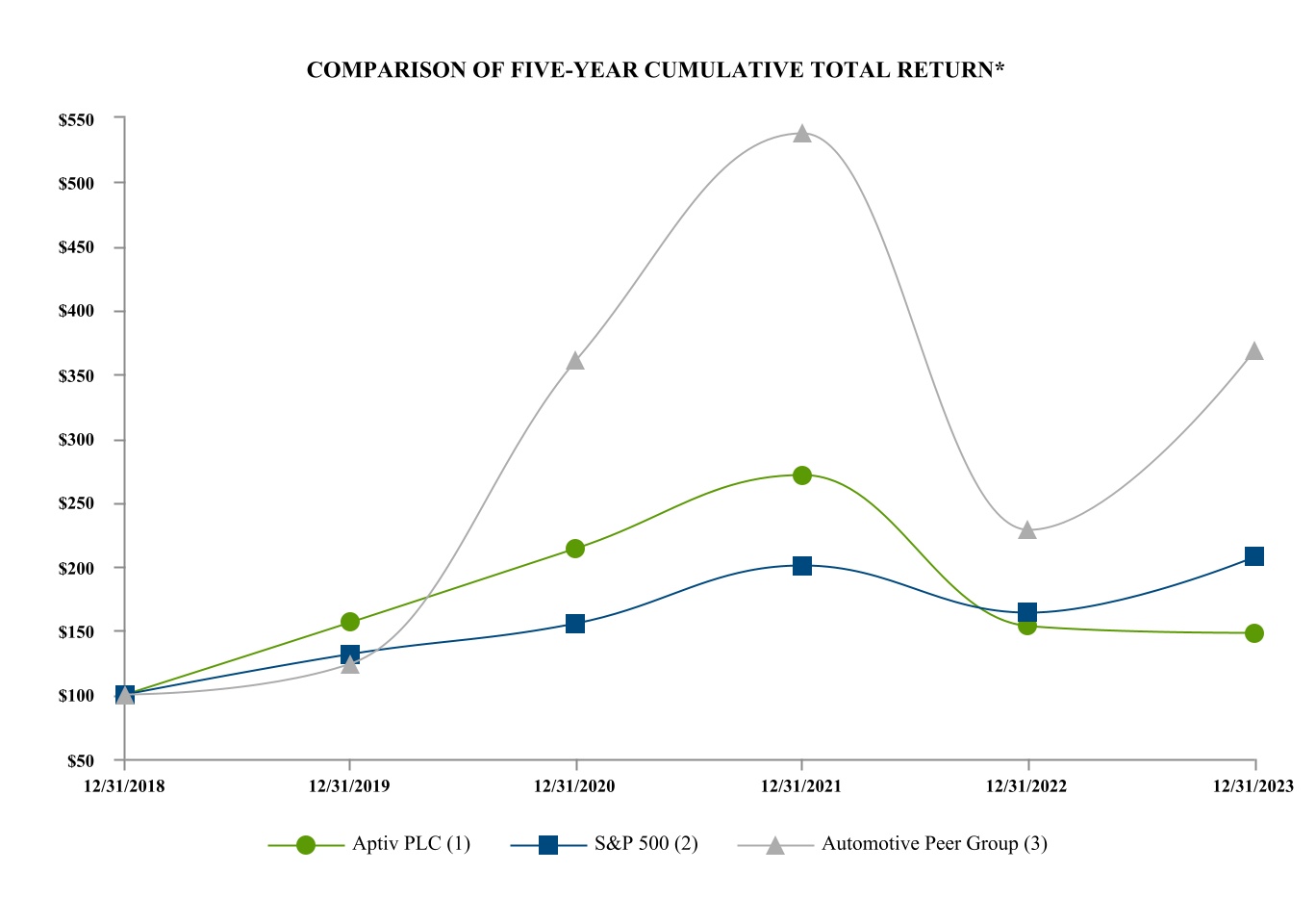
- $100 invested on December 31, 2018 in our stock or in the relevant index, including reinvestment of dividends. Fiscal year ended December 31, 2023.
(1)Aptiv PLC
(2)S&P 500 – Standard & Poor’s 500 Total Return Index
(3)Automotive Peer Group – Adient Plc, American Axle & Manufacturing Holdings Inc, Aptiv PLC, Blink Charging Co, Borgwarner Inc, CarParts.com Inc, Cooper-Standard Holdings Inc, Dana Inc, Dorman Products Inc, Driven Brands Holdings Inc, Fisker Inc, Ford Motor Co, General Motors Co, Gentex Corp, Gentherm Inc, Genuine Parts Co, Goodyear Tire & Rubber Co, Holley Inc, Luminar Technologies Inc, Lucid Group Inc, Lear Corp, Lkq Corp, Monro Inc, PHINIA Inc, QuantumScape Corporation, Rivian Automotive Inc, SES AI Corporation, Standard Motor Products Inc, Stoneridge Inc, Tesla Inc, Visteon Corp, XPEL Inc
| Company Index | December 31, 2018 | December 31, 2019 | December 31, 2020 | December 31, 2021 | December 31, 2022 | December 31, 2023 | ||||||||||||||||||||||||||||||||
| Aptiv PLC (1) | $ | 100.00 | $ | 155.88 | $ | 214.37 | $ | 271.39 | $ | 153.23 | $ | 147.62 | ||||||||||||||||||||||||||
| S&P 500 (2) | $ | 100.00 | $ | 131.49 | $ | 155.68 | $ | 200.37 | $ | 164.08 | $ | 207.21 | ||||||||||||||||||||||||||
| Automotive Peer Group (3) | $ | 100.00 | $ | 124.13 | $ | 361.12 | $ | 537.91 | $ | 228.29 | $ | 368.44 | ||||||||||||||||||||||||||
Equity Compensation Plan Information
Information as of December 31, 2023 regarding the Company’s ordinary shares that may be issued under all of its equity compensation plans is incorporated by reference to the Company’s Proxy Statement under the heading “Equity Compensation Plan Information.”
Repurchase of Equity Securities
A summary of our ordinary shares repurchased during the quarter ended December 31, 2023, is shown below:
| Period | Total Number of Shares Purchased (1) | Average Price Paid per Share (2) | Total Number of Shares Purchased as Part of Publicly Announced Plans or Programs | Approximate Dollar Value of Shares that May Yet be Purchased Under the Program (in millions) (3) | ||||||||||||||||||||||
| October 1, 2023 to October 31, 2023 | — | $ | — | — | $ | 1,915 | ||||||||||||||||||||
| November 1, 2023 to November 30, 2023 | 3,828,784 | $ | 78.34 | 3,828,784 | $ | 1,615 | ||||||||||||||||||||
| December 1, 2023 to December 31, 2023 | — | $ | — | — | $ | 1,615 | ||||||||||||||||||||
| Total | 3,828,784 | $ | 78.34 | 3,828,784 |
(1)The total number of shares purchased under the plans authorized by the Board of Directors are described below.
(2)Excluding commissions.
(3)In January 2019, the Board of Directors authorized a share repurchase program of up to $2.0 billion. This program follows the completion of the previously announced share repurchase program of $1.5 billion, which was approved by the Board of Directors in April 2016. The timing of repurchases is dependent on price, market conditions and applicable regulatory requirements.
Item 6. [RESERVED]
Not applicable.
Item 7. MANAGEMENT’S DISCUSSION AND ANALYSIS OF FINANCIAL CONDITION AND RESULTS OF OPERATIONS
The following management’s discussion and analysis of financial condition and results of operations (“MD&A”) is intended to help you understand the business operations and financial condition of the Company for the year ended December 31, 2023. This discussion should be read in conjunction with Item 8. Financial Statements and Supplementary Data. Our MD&A is presented in seven sections:
-
Executive Overview
-
Consolidated Results of Operations
-
Results of Operations by Segment
-
Liquidity and Capital Resources
-
Off-Balance Sheet Arrangements
-
Significant Accounting Policies and Critical Accounting Estimates
-
Recently Issued Accounting Pronouncements
Executive Overview
Our Business
We are a leading global technology and mobility architecture company primarily serving the automotive sector. We deliver end-to-end mobility solutions enabling our customers’ transition to more electrified, software-defined vehicles. We design and manufacture vehicle components and provide electrical, electronic and active safety technology solutions to the global automotive and commercial vehicle markets, creating the software and hardware foundation for vehicle features and functionality. Our Advanced Safety and User Experience segment is focused on providing the necessary software and advanced computing platforms, and our Signal and Power Solutions segment is focused on providing the requisite networking architecture required to support the integrated systems in today’s complex vehicles. Together, our businesses develop the ‘brain’ and the ‘nervous system’ of increasingly complex vehicles, providing integration of the vehicle into its operating environment.
We are one of the largest vehicle technology suppliers and our customers include the 25 largest automotive OEMs in the world.
Business Strategy
We believe the Company is well-positioned for growth from increasing global vehicle production volumes, as well as the industry’s accelerating transition to software-defined vehicles, the commercialization of active safety, the adoption of autonomous driving technologies, enhanced user experiences and connected services, and providing the software, advanced computing platforms and networking architecture required to do so. We have successfully created a competitive cost structure while investing in research and development to grow our product offerings, which are aligned with the high-growth industry mega-trends, and re-aligned our manufacturing footprint into an efficient, low-cost regional service model, focused on increasing our profit margins.
Our 2023 performance reflects increasing global vehicle production and our solid execution despite the global inflationary environment and North American OEM labor strikes. Our recent financial and business achievements include the following:
-
Generating record new business awards of approximately $34 billion, based on expected volumes and prices, validating our industry leading portfolio of advanced technologies tied to the accelerating megatrends in our industry
-
Delivering strong revenue growth over the prior year despite adverse impacts from the North American OEM labor strikes
-
Producing $1.6 billion of operating income or $2.1 billion of adjusted operating income and cash flow from operations of $1.9 billion, demonstrating strong operating execution in the face of the OEM labor disruptions and continuing material cost inflation
-
Opportunistically paying off the outstanding principal balance of $301 million on the Tranche A Term Loan, Aptiv’s only variable rate borrowing
◦Reducing our weighted average interest rate on total borrowings to 3.15%.
- Continuing our relentless focus on cost structure and operational optimization
◦Maximizing our operational flexibility and profitability at all points in the normal automotive business cycle, by having approximately 97% of our hourly workforce based in best cost countries, and approximately 27% of our hourly workforce composed of contingent employees.
- Enhancing our optimized full system, edge-to-cloud capabilities
◦Increasing commercial traction, including a new business award that leverages the software product offerings of Wind River Systems, Inc. (“Wind River”) integrated with Aptiv’s full system solutions to optimize advanced driver assistance systems performance.
- Meeting the sustainability-linked targets for greenhouse gas emissions and workplace safety within our Credit Agreement.
Our strategy is to build on these accomplishments and continue to develop and manufacture innovative market-relevant products for a diverse base of customers around the globe and leverage our lean and flexible cost structure to achieve strong and disciplined earnings growth and returns on invested capital. Through our culture of innovation and world class engineering capabilities we intend to employ our rigorous, forward-looking product development process to deliver new technologies that provide solutions to our customers. We are committed to creating value for our shareholders, including through the repurchase of shares. In 2023, we repurchased $398 million of ordinary shares. Our key strategic priorities include:
Commercializing the high-tech evolution of the automotive industry. The automotive industry is increasingly evolving towards the implementation of software-dependent components and solutions. In particular, the industry is focused on the development of advanced driver assistance technologies, with the goal of developing and introducing a commercially-viable, fully automated driving experience. We expect automated driving technologies will provide strong societal benefit as well as the opportunity for long-term growth for our product offerings in this space. We are focused on enabling and delivering end-to-end smart mobility solutions, enabling our customers’ transition to more electrified, software-defined vehicles, accelerating the commercialization of active safety and autonomous driving technologies and providing enhanced user experience and connected services.
As part of our strategy to harness the full potential of connected intelligent systems across industries, strengthen our capabilities in software-defined mobility and to enable advanced smart vehicle architecture changes, we acquired Wind River in December 2022. Wind River is a global leader in delivering software for the intelligent edge for multiple industries, including automotive, by leveraging mixed-criticality software products and solutions enabling customers to develop in the cloud, deploy over the air and run and manage software at the vehicle edge.
We are also continuing to develop market-leading automated driving solutions such as automated driving software, key active safety sensing and compute technologies capable of supporting safety-critical applications. We believe we are well-aligned with industry technology trends that will help to support sustainable future growth in this space and have partnered with leaders in their respective fields to advance the pace of development and commercialization of these emerging technologies.
In March 2020, we completed a transaction with Hyundai Motor Group to form Motional, AD LLC (“Motional”), a joint venture focused on the design, development and commercialization of autonomous driving technologies. Motional began testing fully driverless systems in 2020 and began testing a production-ready autonomous driving platform available for robotaxi providers, meal delivery providers, fleet operators and automotive manufacturers at prototype scale in 2022, with initial production deployments in the fourth quarter of 2023 and commercial launch planned in the first half of 2024. In addition, Motional is involved in collaborative arrangements with mobility providers and with smart cities such as Boston, Las Vegas, Los Angeles and Singapore as solutions are developed for the evolving nature of the mobility industry.
There are many risk
Showing the first 8K of 146K characters. Open the full section
Item 7A. QUANTITATIVE AND QUALITATIVE DISCLOSURES ABOUT MARKET RISK
We are exposed to market risks from changes in currency exchange rates and certain commodity prices. In order to manage these risks, we operate a centralized risk management program that consists of entering into a variety of derivative contracts with the intent of mitigating our risk to fluctuations in currency exchange rates and commodity prices. We do not enter into derivative transactions for speculative or trading purposes.
A discussion of our accounting policies for derivative instruments is included in Note 2. Significant Accounting Policies to the audited consolidated financial statements included herein and further disclosure is provided in Note 17. Derivatives and Hedging Activities to the audited consolidated financial statements included herein. We maintain risk management control systems to monitor exchange and commodity risks and related hedge positions. Positions are monitored using a variety of analytical techniques including market value and sensitivity analysis. The following analyses are based on sensitivity tests, which assume instantaneous, parallel shifts in currency exchange rates and commodity prices. For options and instruments with non-linear returns, appropriate models are utilized to determine the impact of shifts in rates and prices.
We have currency exposures related to buying, selling and financing in currencies other than the local currencies in which we operate. Historically, we have reduced our exposure through financial instruments (hedges) that provide offsets or limits to our exposures, which are opposite to the underlying transactions. We also face an inherent business risk of exposure to commodity prices risks, and have historically offset our exposure, particularly to changes in the price of various non-ferrous
metals used in our manufacturing operations, through fixed price purchase agreements, commodity swaps and option contracts. We continue to manage our exposures to changes in currency rates and commodity prices using these derivative instruments.
Currency Exchange Rate Risk
Currency exposures may impact future earnings and/or operating cash flows. We have currency exposures related to buying, selling and financing in currencies other than the local functional currencies in which we operate (“transactional exposure”). We also have currency exposures related to the translation of the financial statements of our foreign subsidiaries that use the local currency as their functional currency into U.S. dollars, the Company’s reporting currency (“translational exposure”). The impact of translational exposure is recorded within currency translation adjustment in the consolidated statements of comprehensive income. During the year ended December 31, 2023, the foreign currency translation adjustment gain of $30 million was primarily due to the impact of a weakening U.S. dollar, which decreased approximately 15% in relation to the Mexican Peso and 3% in relation to the Euro, partially offset by an increase of approximately 2% in relation to the Chinese Yuan Renminbi from December 31, 2022.
As described in Note 17. Derivatives and Hedging Activities to the audited consolidated financial statements included herein, in order to manage certain translational exposure, we have designated the 2015 Euro-denominated Senior Notes and the 2016 Euro-denominated Senior Notes as net investment hedges of the foreign currency exposure of our investments in certain Euro-denominated subsidiaries. We have also entered into forward contracts designated as net investment hedges of the foreign currency exposure of our investments in certain Chinese Yuan Renminbi-denominated subsidiaries. The effective portion of the gains or losses on instruments designated as net investment hedges are recognized within the cumulative translation adjustment component in the consolidated statements of comprehensive income to offset changes in the value of the net investment in these foreign currency-denominated operations.
In some instances, we choose to reduce our transactional exposures through financial instruments (hedges) that provide offsets or limits to our exposures. Currently, our most significant hedged currency exposures relate to the Mexican Peso, Chinese Yuan Renminbi, Polish Zloty, Euro and Hungarian Forint. As of December 31, 2023 and 2022 the net fair value liability of all financial instruments, including hedges and underlying transactions, with exposure to currency risk was approximately $507 million and $446 million, respectively. The potential change in fair value for such financial instruments from a hypothetical 10% adverse change in quoted currency exchange rates would be a gain of approximately $23 million and $17 million as of December 31, 2023 and 2022, respectively. The potential change in fair value from a hypothetical 10% favorable change in quoted currency exchange rates would be a loss of approximately $9 million and $6 million as of December 31, 2023 and 2022, respectively. The impact of a 10% change in rates on fair value differs from a 10% change in the net fair value liability due to the existence of hedges. The model assumes a parallel shift in currency exchange rates; however, currency exchange rates rarely move in the same direction. The assumption that currency exchange rates change in a parallel fashion may overstate the impact of changing currency exchange rates on assets and liabilities denominated in currencies other than the U.S. dollar.
Commodity Price Risk
Commodity swaps/average rate forward contracts are executed to offset a portion of our exposure to the potential change in prices mainly for various non-ferrous metals used in the manufacturing of automotive components, primarily copper. The net fair value of our contracts was a liability of $2 million and $35 million as of December 31, 2023 and 2022, respectively. If the price of the commodities that are being hedged by our commodity swaps/average rate forward contracts changed adversely or favorably by 10%, the fair value of our commodity swaps/average rate forward contracts would decrease or increase by $43 million and $37 million as of December 31, 2023 and 2022, respectively. A 10% change in the net fair value asset differs from a 10% change in rates on fair value due to the relative differences between the underlying commodity prices and the prices in place in our commodity swaps/average rate forward contracts. These amounts exclude the offsetting impact of the price risk inherent in the physical purchase of the underlying commodities.
Interest Rate Risk
Our exposure to market risk associated with changes in interest rates relates primarily to our debt obligations. We do not use interest rate swap or other derivative contracts to manage our exposure to fluctuations in interest rates. As of December 31, 2023, we had no floating rate debt outstanding. The Credit Agreement carries an interest rate, at our option, on Revolving Credit Facility borrowings of either (a) the ABR plus 0.06% per annum, or (b) SOFR plus 1.06% per annum, each of which include an adjustment resulting from the Company having met the sustainability-linked targets for the 2022 calendar year.
The interest rate period with respect to the SOFR interest rate option can be set at one-, three-, or six-months as selected by us in accordance with the terms of the Credit Agreement (or other period as may be agreed by the applicable lenders), but payable no less than quarterly. We may elect to change the selected interest rate option over the term of the Revolving Credit Facility in accordance with the provisions of the Credit Agreement. The applicable interest rates listed above for the Revolving Credit Facility may increase or decrease from time to time in increments of 0.01% to 0.20%, up to a maximum of 0.40% based
on changes to our corporate credit ratings or based on whether the Company achieves or fails to achieve certain sustainability-linked targets with respect to greenhouse gas emissions and workplace safety, as further discussed in Note 11. Debt to the audited consolidated financial statements included herein. Accordingly, the interest rate will fluctuate during the term of the Credit Agreement based on changes in the Alternate Base Rate, SOFR, future changes in our corporate credit ratings or the sustainability-linked targets as discussed above.
Item 8. FINANCIAL STATEMENTS AND SUPPLEMENTARY DATA
Report of Independent Registered Public Accounting Firm
To the Shareholders and the Board of Directors of APTIV PLC
Opinion on the Financial Statements
We have audited the accompanying consolidated balance sheets of APTIV PLC (the Company) as of December 31, 2023 and 2022, the related consolidated statements of operations, comprehensive income, redeemable noncontrolling interest and shareholders’ equity and cash flows for each of the three years in the period ended December 31, 2023, and the related notes and financial statement schedule listed in the Index at Item 15(a)(2) (collectively referred to as the “consolidated financial statements”). In our opinion, the consolidated financial statements present fairly, in all material respects, the financial position of the Company at December 31, 2023 and 2022, and the results of its operations and its cash flows for each of the three years in the period ended December 31, 2023, in conformity with U.S. generally accepted accounting principles.
We also have audited, in accordance with the standards of the Public Company Accounting Oversight Board (United States) (PCAOB), the Company’s internal control over financial reporting as of December 31, 2023, based on criteria established in Internal Control-Integrated Framework issued by the Committee of Sponsoring Organizations of the Treadway Commission (2013 framework), and our report dated February 6, 2024 expressed an unqualified opinion thereon.
Basis for Opinion
These financial statements are the responsibility of the Company’s management. Our responsibility is to express an opinion on the Company’s financial statements based on our audits. We are a public accounting firm registered with the PCAOB and are required to be independent with respect to the Company in accordance with the U.S. federal securities laws and the applicable rules and regulations of the Securities and Exchange Commission and the PCAOB.
We conducted our audits in accordance with the standards of the PCAOB. Those standards require that we plan and perform the audit to obtain reasonable assurance about whether the financial statements are free of material misstatement, whether due to error or fraud. Our audits included performing procedures to assess the risks of material misstatement of the financial statements, whether due to error or fraud, and performing procedures that respond to those risks. Such procedures included examining, on a test basis, evidence regarding the amounts and disclosures in the financial statements. Our audits also included evaluating the accounting principles used and significant estimates made by management, as well as evaluating the overall presentation of the financial statements. We believe that our audits provide a reasonable basis for our opinion.
Critical Audit Matters
The critical audit matters communicated below are matters arising from the current period audit of the financial statements that were communicated or required to be communicated to the audit committee and that: (1) relate to accounts or disclosures that are material to the financial statements and (2) involved our especially challenging, subjective or complex judgments. The communication of critical audit matters does not alter in any way our opinion on the consolidated financial statements, taken as a whole, and we are not, by communicating the critical audit matters below, providing separate opinions on the critical audit matters or on the accounts or disclosures to which they relate.
| Uncertain Tax Positions | |||||
| Description of the Matter | As described in Notes 2 and 14, the Company establishes reserves for uncertain tax positions for positions that are taken on their income tax returns that might not be sustained upon examination by the taxing authorities. At December 31, 2023, the Company has recorded approximately $222 million relating to uncertain tax positions. In determining whether an uncertain tax position exists, the Company determines, based solely on its technical merits, whether the tax position is more likely than not to be sustained upon examination, and if so, a tax benefit is measured on a cumulative probability basis that is more likely than not to be realized upon the ultimate settlement. The Company identifies its certain and uncertain tax positions, including those related to intercompany transfers of certain intellectual property, and then evaluates the recognition and measurement steps to determine the amount that should be recognized. The Company then evaluates uncertain tax positions in subsequent periods for recognition, de-recognition or re-measurement if changes have occurred, or when effective settlement or expiration of the statute of limitations occurs. |
| Auditing the uncertain tax positions is complex because of the judgmental nature of the tax accruals and various other tax return positions that might not be sustained upon review by taxing authorities. The Company files tax returns in multiple jurisdictions and is subject to examination by taxing authorities throughout the world due to its complex global footprint. Taxing jurisdictions significant to Aptiv include China, Germany, Ireland, Luxembourg, Mexico, South Korea, Switzerland, the U.K. and the U.S. | |||||
| How We Addressed the Matter in Our Audit | We obtained an understanding, evaluated the design, and tested the operating effectiveness of controls related to the recognition, measurement and the evaluation of changes in uncertain tax positions. This included testing controls over management’s review of the tax positions, their evaluation of whether they met the measurement threshold and then recalculating the amounts recognized based upon a cumulative probability assessment performed by management. Our audit procedures to test the Company’s uncertain tax positions included, among others, involvement of our valuation and tax professionals, including transfer pricing professionals. This included evaluating tax opinions, third-party valuations and third-party transfer pricing studies obtained by the Company and assessing the Company’s correspondence with the relevant tax authorities. We analyzed the Company’s assumptions and data used to determine the amount of tax benefit to recognize and tested the accuracy of the calculations. Our testing also included the evaluation of the ongoing positions and consideration of changes, the recording of penalties and interest and the ultimate settlement and payment of certain tax matters. | ||||
| Revenue Recognition | |||||
| Description of the Matter | As described in Notes 2 and 24, Aptiv occasionally enters into pricing agreements with its customers that provide for price reductions, some of which are conditional upon achieving certain joint cost saving targets. In addition, from time to time, Aptiv makes payments to customers in conjunction with ongoing business. Revenue is recognized based on the agreed-upon price at the time of shipment, and sales incentives, allowances and certain customer payments are recognized as a reduction to revenue at the time of the commitment to provide such incentives or make these payments. Certain other customer payments or upfront fees are considered to be a cost to obtain a contract as they are directly attributable to a contract, are incremental and management expects the payments to be recoverable. In these cases, the customer payment is capitalized and amortized to revenue based on the transfer of goods and services to the customer for which the upfront payment relates. As of December 31, 2023, Aptiv has recorded $61 million related to these capitalized upfront payments. Auditing the accounting for and completeness of arrangements containing elements such as sales incentives, allowances and customer payments |
Showing the first 8K of 335K characters. Open the full section
Item 9. CHANGES IN AND DISAGREEMENTS WITH ACCOUNTANTS ON ACCOUNTING AND FINANCIAL DISCLOSURE
None.
Item 9A. CONTROLS AND PROCEDURES
Evaluation of Disclosure Controls and Procedures
Management of the Company, under the supervision and with the participation of the Chief Executive Officer and the Chief Financial Officer, carried out an evaluation of the effectiveness of the design and operation of the Company’s disclosure controls and procedures as of December 31, 2023. As defined in Rule 13a-15(e) under the Securities Exchange Act of 1934 (the “Exchange Act”), disclosure controls and procedures are controls and procedures designed to provide reasonable assurance that information required to be disclosed in reports filed or submitted under the Exchange Act is recorded, processed, summarized and reported on a timely basis, and that such information is accumulated and communicated to management, including the Company’s Chief Executive Officer and Chief Financial Officer, as appropriate, to allow timely decisions regarding required disclosure. The Company’s disclosure controls and procedures include components of the Company’s internal control over financial reporting. Based upon this evaluation, the Chief Executive Officer and Chief Financial Officer have concluded that the Company’s disclosure controls and procedures were effective as of December 31, 2023.
Management’s Report on Internal Control Over Financial Reporting
Management is responsible for establishing and maintaining adequate internal control over financial reporting, as such term is defined in Exchange Act Rules 13a-15(f) and 15d-15(f), for the Company. Under the supervision of the Chief Executive Officer and Chief Financial Officer, management conducted an evaluation of the effectiveness of the Company’s internal control over financial reporting as of December 31, 2023 based on the framework set forth by the Committee of Sponsoring Organizations of the Treadway Commission (COSO) in “Internal Control-Integrated Framework (2013).” Based on that evaluation, management has concluded that the Company’s internal control over financial reporting was effective as of December 31, 2023.
Ernst & Young LLP has issued an attestation report which is included herein as the Report of Independent Registered Public Accounting Firm under the section headed Financial Statements and Supplementary Data for the year ended December 31, 2023.
Changes in Internal Control Over Financial Reporting
There were no material changes in the Company’s internal control over financial reporting, identified in connection with management’s evaluation of internal control over financial reporting, that occurred during the quarter and year ended December 31, 2023 that have materially affected, or are reasonably likely to materially affect, the Company’s internal control over financial reporting.
Item 9B. OTHER INFORMATION
Securities Trading Plans of Executive Officers and Directors
Transactions in our securities by our executive officers and directors are required to be made in accordance with our insider trading policy, which, among other things, requires that the transactions be in accordance with applicable U.S. federal securities laws that prohibit trading while in possession of material nonpublic information. Our insider trading policy permits our executive officers and directors to enter into trading plans in accordance with Rule 10b5-1.
The following table describes contracts, instructions or written plans for the sale or purchase of our securities adopted by our executive officers and directors during the fourth quarter of 2023, each of which is intended to satisfy the affirmative defense conditions of Rule 10b5-1(c), referred to as Rule 10b5-1 trading plans.
| Name and Title | Action | Date of Adoption of Rule 10b5-1 Trading Plan | Scheduled Expiration Date of Rule 10b5-1 Trading Plan (1) | Aggregate Number of Securities to be Purchased or Sold | ||||||||||||||||||||||
| Benjamin Lyon Senior Vice President and Chief Technology Officer | Adoption | 12/11/2023 | 3/15/2024 | Sale of 37,257 ordinary shares |
(1)In each case, a trading plan may also expire on such earlier dates as all transactions under the trading plan are completed.
During the fourth quarter of 2023, no executive officer or director of the Company adopted, modified or terminated any non-Rule 10b5-1 trading arrangement (as defined in Item 408(c) of Regulation S-K).
PART III
Item 10. DIRECTORS, EXECUTIVE OFFICERS AND CORPORATE GOVERNANCE
The information called for by Item 10, as to the audit committee and the audit committee financial expert, is incorporated by reference to the Company’s Definitive Proxy Statement to be filed with the SEC pursuant to Regulation 14A in connection with the Company’s 2024 Annual General Meeting of Shareholders (the “Proxy Statement”) under the headings “Board Practices” and “Board Committees.” The information called for by Item 10, as to executive officers, is set forth under Executive Officers of the Registrant in the Supplementary Item in Part I of this Annual Report on Form 10-K. The information called for by Item 10, as to directors, is incorporated by reference to the Company’s Proxy Statement under the headings “Election of Directors” and “Board Practices.”
The Company has adopted a code of ethics, the Code of Ethical Business Conduct, which applies to its principal executive officer, principal financial officer, principal accounting officer or controller, or persons performing similar functions, and all other employees and non-employee directors of the Company. The Code of Ethical Business Conduct is posted on the Company’s website (aptiv.com). The Company intends to satisfy the disclosure requirement under Item 5.05 of Form 8-K regarding an amendment to, or waiver from, a provision of the code of ethics that applies to the Company’s principal executive officer, principal financial officer, principal accounting officer or controller, or persons performing similar functions, by posting such information on the Company’s website, at the address specified above.
The Company’s Corporate Governance Guidelines and charters for each Committee of its Board of Directors are also available on the Company’s website. The Code of Ethical Business Conduct, Corporate Governance Guidelines and charters are also available in print to any shareholder who submits a request to: Corporate Secretary, Aptiv PLC, 5 Hanover Quay, Grand Canal Dock, Dublin, D02 VY79, Ireland.
Information on the Company’s website is not deemed to be incorporated by reference into this Annual Report on Form 10-K.
Item 11. EXECUTIVE COMPENSATION
The information called for by Item 11 is incorporated by reference to the Company’s Proxy Statement under the headings “Director Compensation,” “Compensation Discussion and Analysis” and “Compensation Committee Report.”
Item 12. SECURITY OWNERSHIP OF CERTAIN BENEFICIAL OWNERS AND MANAGEMENT AND RELATED STOCKHOLDER MATTERS
The information called for by Item 12, as to security ownership of certain beneficial owners, directors and management, and information as of December 31, 2023 about the Company’s ordinary shares that may be issued under all of its equity compensation plans is incorporated by reference to the Company’s Proxy Statement under the headings “Security Ownership of Certain Beneficial Owners” and “Security Ownership of Management.”
Item 13. CERTAIN RELATIONSHIPS AND RELATED TRANSACTIONS AND DIRECTOR INDEPENDENCE
The information called for by Item 13, as to director independence, is incorporated by reference to the Company’s Proxy Statement under the heading “Board Practices.” The information called for by Item 13, as to related person transactions, is incorporated by reference to the Company’s Proxy Statement under the heading “Relationships and Related Party Transactions.”
Item 14. PRINCIPAL ACCOUNTING FEES AND SERVICES
The information called for by Item 14 is incorporated by reference to the Company’s Proxy Statement under the heading “Independent Registered Public Accounting Firm’s Fees.”
PART IV
Item 15. EXHIBITS, FINANCIAL STATEMENT SCHEDULES
(a) The following documents are filed as part of this Form 10-K.
(1) Financial Statements:
| Page No. | |||||
| — Reports of Independent Registered Public Accounting Firm (PCAOB ID: 42) | 60 | ||||
| — Consolidated Statements of Operations for the Years Ended December 31, 2023, 2022 and 2021 | 63 | ||||
| — Consolidated Statements of Comprehensive Income for the Years Ended December 31, 2023, 2022 and 2021 | 64 | ||||
| — Consolidated Balance Sheets as of December 31, 2023 and 2022 | 65 | ||||
| — Consolidated Statements of Cash Flows for the Years Ended December 31, 2023, 2022 and 2021 | 66 | ||||
| — Consolidated Statements of Redeemable Noncontrolling Interest and Shareholders’ Equity for the Years Ended December 31, 2023, 2022 and 2021 | 68 | ||||
| — Notes to Consolidated Financial Statements | 70 |
(2) Financial Statement Schedule:
SCHEDULE II—VALUATION AND QUALIFYING ACCOUNTS AND RESERVES
| Additions | |||||||||||||||||||||||||||||
| Balance at Beginning of Period | Charged to Costs and Expenses | Deductions | Other Activity | Balance at End of Period | |||||||||||||||||||||||||
| (in millions) | |||||||||||||||||||||||||||||
| December 31, 2023: | |||||||||||||||||||||||||||||
| Allowance for doubtful accounts | $ | 52 | $ | 12 | $ | (12) | $ | — | $ | 52 | |||||||||||||||||||
| Tax valuation allowance (a) | $ | 756 | $ | 2,264 | $ | (2) | $ | 14 | $ | 3,032 | |||||||||||||||||||
| December 31, 2022: | |||||||||||||||||||||||||||||
| Allowance for doubtful accounts | $ | 37 | $ | 27 | $ | (12) | $ | — | $ | 52 | |||||||||||||||||||
| Tax valuation allowance (a) | $ | 766 | $ | 57 | $ | (83) | $ | 16 | $ | 756 | |||||||||||||||||||
| December 31, 2021: | |||||||||||||||||||||||||||||
| Allowance for doubtful accounts | $ | 40 | $ | 22 | $ | (24) | $ | (1) | $ | 37 | |||||||||||||||||||
| Tax valuation allowance (a) | $ | 832 | $ | 25 | $ | (78) | $ | (13) | $ | 766 |
(a)Additions Charged to Costs and Expenses and Deductions are primarily related to taxable losses for which the tax benefit has been reserved.
Motional AD LLC (“Motional”) was deemed a significant equity investee under Rule 3-09 of Regulation S-X for the fiscal year ended December 31, 2023. As such, separate audited financial statements of Motional are required to be filed as an amendment to this Annual Report on Form 10-K, within 90 days of December 31, 2023. Accordingly, Motional’s financial statements as of and for the three years ended December 31, 2023 will be filed via an amendment to this Annual Report on Form 10-K on or before March 30, 2024.
The other schedules have been omitted because they are not applicable, not required or the information to be set forth therein is included in the Consolidated Financial Statements or notes thereto.
(3) Exhibits: (including those incorporated by reference)
- Filed herewith.
+ Management contract or compensatory plan or arrangement.
(1) Filed with the Registration Statement on Form S-1 (File No. 333-174493) on June 30, 2011 and incorporated herein by reference.
(2) Filed with Form 10-Q for the period ended September 30, 2012 on November 1, 2012 and incorporated herein by reference.
(3) Filed with Form 10-Q for the period ended March 31, 2015 on April 30, 2015 and incorporated herein by reference.
(4) Filed with Form 10-Q for the period ended March 31, 2016 on May 4, 2016 and incorporated herein by reference.
(5) Filed with Form 10-Q for the period ended June 30, 2016 on August 3, 2016 and incorporated herein by reference.
(6) Filed with Form 10-K for the year ended December 31, 2016 on February 6, 2017 and incorporated herein by reference.
(7) Filed with Form 10-Q for the period ended March 31, 2019 on May 2, 2019 and incorporated herein by reference.
(8) Filed with Form 10-Q for the period ended June 30, 2021 on August 5, 2021 and incorporated herein by reference.
(9) Filed with Form 10-Q for the period ended March 31, 2022 on May 5, 2022 and incorporated herein by reference.
(10) Filed with Form 10-Q for the period ended March 31, 2023 on May 4, 2023 and incorporated herein by reference.
(11) Filed with Form 10-Q for the period ended June 30, 2023 on August 3, 2023 and incorporated herein by reference.
(12) Filed with Form 10-K for the year ended December 31, 2022 on February 8, 2023 and incorporated herein by reference.
Filed electronically with the Report.
SIGNATURES
Pursuant to the requirements of Section 13 or 15(d) of the Securities Exchange Act of 1934, the registrant has duly caused this report to be signed on its behalf by the undersigned, thereunto duly authorized.
| APTIV PLC | ||||||||
| /s/ Joseph R. Massaro | ||||||||
| By: Joseph R. Massaro | ||||||||
| Chief Financial Officer and Senior Vice President, Business Operations | ||||||||
Dated: February 6, 2024
POWER OF ATTORNEY
KNOW ALL PERSONS BY THESE PRESENTS, that each person whose signature appears below constitutes and appoints Kevin P. Clark, Joseph R. Massaro and Katherine R. Ramundo, and each or any one of them, his or her lawful attorneys-in-fact and agents, for such person in any and all capacities, to sign any and all amendments to this report and to file the same, with all exhibits thereto and other documents in connection therewith, with the Securities and Exchange Commission, hereby ratifying and confirming all that either of said attorneys-in-fact and agent, or substitute or substitutes, may do or cause to be done by virtue hereof.
IN WITNESS WHEREOF, each of the undersigned has executed this Power of Attorney as of February 6, 2024.
| Signature | Title | |||||||
| /s/ Kevin P. Clark | Chairman and Chief Executive Officer (Principal Executive Officer) | |||||||
| Kevin P. Clark | ||||||||
| /s/ Joseph R. Massaro | Chief Financial Officer and Senior Vice President, Business Operations (Principal Financial Officer) | |||||||
| Joseph R. Massaro | ||||||||
| /s/ Allan J. Brazier | Vice President and Chief Accounting Officer (Principal Accounting Officer) | |||||||
| Allan J. Brazier | ||||||||
| /s/ Richard L. Clemmer | Director | |||||||
| Richard L. Clemmer | ||||||||
| /s/ Nancy E. Cooper | Director | |||||||
| Nancy E. Cooper | ||||||||
| /s/ Joseph L. Hooley | Director | |||||||
| Joseph L. Hooley | ||||||||
| /s/ Merit E. Janow | Director | |||||||
| Merit E. Janow | ||||||||
| /s/ Sean O. Mahoney | Director | |||||||
| Sean O. Mahoney | ||||||||
| /s/ Paul M. Meister | Director | |||||||
| Paul M. Meister | ||||||||
| /s/ Robert K. Ortberg | Director | |||||||
| Robert K. Ortberg | ||||||||
| /s/ Colin J. Parris | Director | |||||||
| Colin J. Parris | ||||||||
| /s/ Ana G. Pinczuk | Director | |||||||
| Ana G. Pinczuk |