 filings.tools
Ares Management 10-K 2023-12-31
Filed 2024-02-27. 24 sections, 1288K characters. Original on sec.gov · Markdown · JSON
Cover and table of contents
UNITED STATES
SECURITIES AND EXCHANGE COMMISSION
Washington, D.C. 20549
FORM 10-K
| ☒ | ANNUAL REPORT PURSUANT TO SECTION 13 OR 15(d) OF THE SECURITIES EXCHANGE ACT OF 1934 |
For the fiscal year ended December 31, 2023
OR
| ☐ | TRANSITION REPORT PURSUANT TO SECTION 13 OR 15(d) OF THE SECURITIES EXCHANGE ACT OF 1934 |
For the transition period from to
Commission File No. 001-36429
ARES MANAGEMENT CORPORATION
(Exact name of Registrant as specified in its charter)
| Delaware | 80-0962035 | ||||
| (State or other jurisdiction of incorporation or organization) | (I.R.S. Employer Identification Number) |
2000 Avenue of the Stars, 12th Floor, Los Angeles, CA 90067
(Address of principal executive office) (Zip Code)
(310) 201-4100
(Registrant’s telephone number, including area code)
N/A
(Former name, former address and former fiscal year, if changed since last report)
Securities registered pursuant to Section 12(b) of the Act:
| Title of each class | Trading Symbol(s) | Name of each exchange on which registered | ||||||
| Class A common stock, par value $0.01 per share | ARES | New York Stock Exchange |
Securities registered pursuant to Section 12(g) of the Act: None
Indicate by check mark if the registrant is a well-known seasoned issuer, as defined in Rule 405 of the Securities Act. Yes x No ☐
Indicate by check mark if the registrant is not required to file reports pursuant to Section 13 or Section 15(d) of the Act. Yes ¨ No x
Indicate by check mark whether the registrant (1) has filed all reports required to be filed by Section 13 or 15(d) of the Securities Exchange Act of 1934 during the preceding 12 months (or for such shorter period that the registrant was required to file such reports), and (2) has been subject to such filing requirements for the past 90 days: Yes x No ¨
Indicate by check mark whether the registrant has submitted electronically every Interactive Data File required to be submitted pursuant to Rule 405 of Regulation S-T (§232.405 of this chapter) during the preceding 12 months (or for such shorter period that the registrant was required to submit such files). Yes x No ¨
Indicate by check mark whether the registrant is a large accelerated filer, an accelerated filer, a non-accelerated filer, a smaller reporting company, or an emerging growth company. See definitions of “large accelerated filer,” “accelerated filer,” “smaller reporting company.” and “emerging growth company” in Rule 12b-2 of the Exchange Act.
| Large Accelerated Filer | x | Accelerated Filer | ☐ | Non-Accelerated Filer | ☐ | Smaller Reporting Company | ☐ | Emerging Growth Company | ☐ |
If an emerging growth company, indicate by check mark if the registrant has elected not to use the extended transition period for complying with any new or revised financial accounting standards provided pursuant to Section 13(a) of the Exchange Act. ¨
Indicate by check mark whether the registrant has filed a report on and attestation to its management’s assessment of the effectiveness of its internal control over financial reporting under Section 404(b) of the Sarbanes-Oxley Act (15 U.S.C. 7262(b)) by the registered public accounting firm that prepared or issued its audit report. Yes x No ¨
If securities are registered pursuant to Section 12(b) of the Act, indicate by check mark whether the financial statements of the registrant included in the filing reflect the correction of an error to previously issued financial statements. o
Indicate by check mark whether any of those error corrections are restatements that required a recovery analysis of incentive-based compensation received by any of the registrant’s executive officers during the relevant recovery period pursuant to §240.10D-1(b). o
Indicate by check mark whether the registrant is a shell company (as defined in Rule 12b-2 of the Exchange Act). Yes ☐ No x
The aggregate market value of the common shares held by non-affiliates of the registrant on June 30, 2023, based on the closing price on that date of $96.35 on the New York Stock Exchange, was approximately $16,519,398,894. As of February 20, 2024 there were 189,877,592 of the registrant’s shares of Class A common stock outstanding, 3,489,911 of the registrant’s shares of non-voting common stock outstanding, 1,000 shares of the registrant’s Class B common stock outstanding, and 116,232,034 of the registrant’s Class C common stock outstanding.
DOCUMENTS INCORPORATED BY REFERENCE
Part III of this Form 10-K incorporates by reference information from the registrant’s definitive proxy statement related to the 2024 annual meeting of stockholders.
TABLE OF CONTENTS
Cautionary Note Regarding Forward-Looking Statements
This report contains forward-looking statements within the meaning of Section 27A of the Securities Act of 1933, as amended (the “Securities Act”), and Section 21E of the Securities Exchange Act of 1934, as amended (the “Exchange Act”), which reflect our current views with respect to, among other things, future events, operations and financial performance. You can identify these forward-looking statements by the use of forward-looking words such as “outlook,” “believes,” “expects,” “potential,” “continues,” “may,” “will,” “should,” “seeks,” “predicts,” “intends,” “plans,” “estimates,” “anticipates,” “foresees” or negative versions of those words, other comparable words or other statements that do not relate to historical or factual matters. The forward-looking statements are based on our beliefs, assumptions and expectations of our future performance, taking into account all information currently available to us. Such forward-looking statements are subject to various risks and uncertainties and assumptions relating to our operations, financial results, financial condition, business prospects, growth strategy and liquidity. Some of these factors are described in this Annual Report on Form 10-K for the year ended December 31, 2023, under the headings “Item 7. Management’s Discussion and Analysis of Financial Condition and Results of Operations” and “Item 1A. Risk Factors.” These factors should not be construed as exhaustive and should be read in conjunction with the risk factors and other cautionary statements that are included in this report and in our other periodic filings. If one or more of these or other risks or uncertainties materialize, or if our underlying assumptions prove to be incorrect, our actual results may vary materially from those indicated in these forward-looking statements. New risks and uncertainties arise over time, and it is not possible for us to predict those events or how they may affect us. Therefore, you should not place undue reliance on these forward-looking statements. Any forward-looking statement speaks only as of the date on which it is made. We do not undertake any obligation to publicly update or review any forward-looking statement, whether as a result of new information, future developments or otherwise, except as required by law.
References in this Annual Report on Form 10-K to the “Ares Operating Group” refer to Ares Holdings L.P. (“Ares Holdings”). References in this Annual Report on Form 10-K to an “Ares Operating Group Unit” or an “AOG Unit” refers to a partnership unit in the Ares Operating Group entity.
The use of any defined term in this report to mean more than one entities, persons, securities or other items collectively is solely for convenience of reference and in no way implies that such entities, persons, securities or other items are one indistinguishable group. For example, notwithstanding the use of the defined terms “Ares,” “we” and “our” in this report to refer to Ares Management Corporation and its subsidiaries, each subsidiary of Ares Management Corporation is a standalone legal entity that is separate and distinct from Ares Management Corporation and any of its other subsidiaries.
Under generally accepted accounting principles in the United States (“U.S.”) (“GAAP”), we are required to consolidate (i) entities other than limited partnerships and entities similar to limited partnerships in which we hold a majority voting interest or have majority ownership and control over the operational, financial and investing decisions of that entity, including Ares-affiliates and affiliated funds and co-investment vehicles, for which we are presumed to have controlling financial interests, and (ii) entities that we concluded are variable interest entities (“VIEs”), including limited partnerships and collateralized loan obligations, for which we are deemed to be the primary beneficiary. When an entity is consolidated, we reflect the assets, liabilities, revenues, expenses and cash flows of the entity in our consolidated financial statements on a gross basis, subject to eliminations from consolidation, including the elimination of the management fees, carried interest, incentive fees and other fees that we earn from the entity. However, the presentation of performance related compensation and other expenses associated with generating such revenues is not affected by the consolidation process. In addition, as a result of the consolidation process, the net income attributable to third-party investors in consolidated entities is presented as net income attributable to non-controlling interests in Consolidated Funds within Consolidated Statements of Operations. We also consolidate joint ventures that we have established with third-party investors for strategic distribution and expansion purposes. The results of these entities are reflected on a gross basis in the consolidated financial statements, subject to eliminations from consolidation, and net income attributable to third-party investors in the consolidated joint ventures is presented within net income attributable to redeemable interest and non-controlling interests in AOG entities.
In this Annual Report on Form 10-K, in addition to presenting our results on a consolidated basis in accordance with GAAP, we present revenues, expenses and other results on a: (i) “segment basis,” which deconsolidates the consolidated funds and removes the proportional results attributable to third-party investors in the consolidated joint ventures, and therefore shows the results of our operating segments without giving effect to the consolidation of these entities; and (ii) “unconsolidated reporting basis,” which shows the results of our operating segments on a combined segment basis together with our Operations Management Group. In addition to our operating segments, we have an Operations Management Group (the “OMG”). The OMG consists of shared resource groups to support our operating segments by providing infrastructure and administrative support in the areas of accounting/finance, operations, information technology, legal, compliance, human resources, strategy and relationship management and distribution. The OMG includes Ares Wealth Management Solutions, LLC (“AWMS”) that facilitates the product development, distribution, marketing and client management activities for investment offerings in the
global wealth management channel. Additionally, the OMG provides services to certain of the Company’s managed funds and vehicles, which reimburse the OMG for expenses either equal to the costs of services provided or as a percentage of invested capital. The OMG’s revenues and expenses are not allocated to our operating segments but we consider the cost structure of the OMG when evaluating our financial performance. This information constitutes non-GAAP financial information within the meaning of Regulation G, as promulgated by the SEC. Our management uses this information to assess the performance of our operating segments and the OMG, and we believe that this information enhances the ability of shareholders to analyze our performance. For more information, see “Note 14. Segment Reporting,” within our consolidated financial statements included in this Annual Report on Form 10-K.
Glossary
When used in this report, unless the context otherwise requires:
-
“American-style waterfall” generally refers to carried interest that the general partner is entitled to receive after a fund investment is realized and the investors in the fund have received distributions in excess of the capital contributed for that investment and all prior realized investments (including allocable expenses) plus a preferred return;
-
“Ares”, the “Company”, “AMC”, “we”, “us” and “our” refer to Ares Management Corporation and its subsidiaries;
-
“Ares Operating Group entities” or an "AOG Entity" refers to, collectively, Ares Holdings, L.P. (“Ares Holdings”) and any future entity designated by our board of directors in its sole discretion as an Ares Operating Group entity;
-
“Ares Operating Group Unit” or an “AOG Unit” refers to, collectively, a partnership unit in the Ares Operating Group entities including Ares Holdings and any future entity designated by our board of directors in its sole discretion as an Ares Operating Group entity;
-
“assets under management” or “AUM” generally refers to the assets we manage. For our funds other than CLOs, our AUM represents the sum of the net asset value (“NAV”) of such funds, the drawn and undrawn debt (at the fund-level including amounts subject to restrictions) and uncalled committed capital (including commitments to funds that have yet to commence their investment periods). NAV refers to the fair value of the assets of a fund less the fair value of the liabilities of the fund. For the CLOs we manage, our AUM is equal to initial principal of collateral adjusted for paydowns. AUM also includes the proceeds raised in the initial public offerings of special purpose acquisition companies (“SPACs”) sponsored by us, less any redemptions;
-
“AUM not yet paying fees” (also referred to as “shadow AUM”) refers to AUM that is not currently paying fees and is eligible to earn management fees upon deployment;
-
“available capital” (also referred to as “dry powder”) is comprised of uncalled committed capital and undrawn amounts under credit facilities and may include AUM that may be canceled or not otherwise available to invest;
-
“catch-up fees” refers to retroactive management fees that are episodic in nature and are calculated between the fee initiation date and the day prior to the period in which additional capital commitments are received and catch-up fees are measured, representing fees charged to new fund investors in subsequent closings of a fundraising period. Therefore, catch-up fees for each quarter during an annual period may not equal to the catch-up fees calculated for the same annual period;
-
“CLOs” refers to “our funds” that are structured as collateralized loan obligations;
-
“Consolidated Funds” refers collectively to certain Ares funds, co-investment vehicles, CLOs and SPACs that are required under GAAP to be consolidated in our consolidated financial statements;
-
“Credit Facility” refers to the revolving credit facility of the Ares Operating Group;
-
“effective management fee rate” represents the annualized fees divided by the average fee paying AUM for the period, excluding the impact of catch-up fees;
-
“European-style waterfall” generally refers to carried interest that the general partner is entitled to receive after the investors in a fund have received distributions in an amount equal to all prior capital contributions plus a preferred return;
-
“fee paying AUM” or “FPAUM” refers to the AUM from which we directly earn management fees. FPAUM is equal to the sum of all the individual fee bases of our funds that directly contribute to our management fees. For our funds other than CLOs, our FPAUM represents the amount of limited partner capital commitments for certain closed-end funds within the reinvestment period, the amount of limited partner invested capital for the aforementioned closed-end funds beyond the reinvestment period and the portfolio value, gross asset value or NAV. For the CLOs we manage, our FPAUM is equal to the gross amount of aggregate collateral balance, at par, adjusted for defaulted or discounted collateral;
-
“fee related earnings” or “FRE”, a non-GAAP measure, is used to assess core operating performance by determining whether recurring revenue, primarily consisting of management fees and fee related performance revenues, is sufficient to cover operating expenses and to generate profits. FRE differs from income before taxes computed in accordance with GAAP as FRE excludes net performance income, investment income from our funds and adjusts for certain other items that we believe are not indicative of our core operating performance. Fee related performance revenues, together with fee related performance compensation, is presented within FRE because it represents incentive fees from perpetual capital vehicles that are measured and eligible to be received on a recurring basis and are not dependent on realization events from the underlying investments;
-
“fee related performance revenues” refers to incentive fees from perpetual capital vehicles that are: (i) measured and eligible to be received on a recurring basis; and (ii) not dependent on realization events from the underlying investments. Certain vehicles are subject to hold back provisions that limit the amounts paid in a particular year. Such hold back amounts may be paid in subsequent years, subject to their extended performance conditions;
-
“GAAP” refers to accounting principles generally accepted in the United States of America;
-
“Holdco Members” refers to Michael Arougheti, David Kaplan, Antony Ressler, Bennett Rosenthal, Ryan Berry and R. Kipp deVeer;
-
“Incentive eligible AUM” or “IEAUM” generally refers to the AUM of our funds and other entities from which carried interest and incentive fees may be generated, regardless of whether or not they are currently generating carried interest and incentive fees. It generally represents the NAV plus uncalled equity or total assets plus uncalled debt, as applicable, of our funds for which we are entitled to receive carried interest and incentive fees, excluding capital committed by us and our professionals (from which we generally do not earn carried interest and incentive fees), as well as proceeds raised in the initial public offerings of SPACs sponsored by us, less any redemptions. With respect to Ares Capital Corporation (NASDAQ: ARCC) (“ARCC”) and Ares Strategic Income Fund’s (“ASIF”) AUM, only Part II Fees may be generated from IEAUM;
-
“Incentive generating AUM” or “IGAUM” refers to the AUM of our funds and other entities that are currently generating carried interest and incentive fees on a realized or unrealized basis. It generally represents the NAV or total assets of our funds, as applicable, for which we are entitled to receive carried interest and incentive fees, excluding capital committed by us and our professionals (from which we generally do not earn carried interest and incentive fees). ARCC and ASIF are only included in IGAUM when Part II Fees are being generated;
-
“management fees” refers to fees we earn for advisory services provided to our funds, which are generally based on a defined percentage of fair value of assets, total commitments, invested capital, net asset value, net investment income, total assets or par value of the investment portfolios managed by us. Management fees include Part I Fees, a quarterly fee based on the net investment income of certain funds;
-
“net inflows of capital” refers to net new commitments during the period, including equity and debt commitments and gross inflows into our open-ended managed accounts and sub-advised accounts, as well as new debt and equity issuances by our publicly-traded vehicles minus redemptions from our open-ended funds, managed accounts and sub-advised accounts;
-
“net performance income” refers to performance income net of related compensation that is typically payable to our professionals;
-
“our funds” refers to the funds, alternative asset companies, trusts, co-investment vehicles and other entities and accounts that are managed or co-managed by the Ares Operating Group, and which are structured to pay fees. It also includes funds managed by Ivy Hill Asset Management, L.P., a wholly owned portfolio company of ARCC and an SEC-registered investment adviser;
-
“Part I Fees” refers to a quarterly fee on the net investment income of ARCC, CION Ares Diversified Credit Fund (“CADC”) and ASIF. Such fees are classified as management fees as they are predictable and recurring in nature, not subject to contingent repayment and generally cash-settled each quarter, unless subject to a payment deferral;
-
“Part II Fees” refers to fees from ARCC and ASIF that are paid in arrears as of the end of each calendar year when the respective cumulative aggregate realized capital gains exceed the cumulative aggregate realized capital losses and aggregate unrealized capital depreciation, less the aggregate amount of respective Part II Fees paid in all prior years since inception;
-
“performance income” refers to income we earn based on the performance of a fund that is generally based on certain specific hurdle rates as defined in the fund’s investment management or partnership agreements and may be either incentive fees earned from funds with stated investment periods or carried interest;
-
“perpetual capital” refers to the AUM of: (i) our publicly-traded vehicles, including ARCC, Ares Commercial Real Estate Corporation (NYSE: ACRE) (“ACRE”) and Ares Dynamic Credit Allocation Fund, Inc. (NYSE: ARDC) (“ARDC”); (ii) our non-traded vehicles, including our non-traded real estate investment trusts (“REITs”), Ares Private Markets Fund (“APMF”), ASIF and CADC; (iii) Aspida Holdings Ltd. (together with its subsidiaries, “Aspida”); and (iv) certain other commingled funds and managed accounts that have an indefinite term, are not in liquidation, and for which there is no immediate requirement to return invested capital to investors upon the realization of investments. Perpetual Capital - Managed Accounts refers to managed accounts for single investors primarily in illiquid strategies that meet the perpetual capital criteria. Perpetual Capital - Private Commingled Funds refers to commingled funds that meet the perpetual capital criteria, not including our publicly-traded vehicles or non-traded vehicles. Perpetual capital may be withdrawn by investors under certain conditions, including through an election to redeem an investor’s fund investment or to terminate the investment management agreement, which in certain cases may be terminated on 30 days’ prior written notice. In addition, the investment management or advisory agreements of certain of our publicly-traded and non-traded vehicles have one year terms, which are subject to annual renewal by such vehicles;
-
“realized income” or “RI”, a non-GAAP measure, is an operating metric used by management to evaluate performance of the business based on operating performance and the contribution of each of the business segments to that performance, while removing the fluctuations of unrealized income and losses, which may or may not be eventually realized at the levels presented and whose realizations depend more on future outcomes than current business operations. RI differs from income before taxes by excluding: (i) operating results of our Consolidated Funds; (ii) depreciation and amortization expense; (iii) the effects of changes arising from corporate actions; and (iv) unrealized gains and losses related to carried interest, incentive fees and investment performance; and adjusts for certain other items that we believe are not indicative of our operating performance. Changes arising from corporate actions include equity-based compensation expenses, the amortization of intangible assets, transaction costs associated with mergers, acquisitions and capital activities, underwriting costs and expenses incurred in connection with corporate reorganization. Placement fee adjustment represents the net portion of either expense deferral or amortization of upfront fees to placement agents that is presented to match the timing of expense recognition with the period over which management fees are expected to be earned from the associated fund for segment purposes but have been expensed in advance in accordance with GAAP. For periods in which the amortization of upfront fees for segment purposes is higher than the GAAP expense, the placement fee adjustment is presented as a reduction to RI;
-
“SEC” refers to the Securities and Exchange Commission;
-
“2024 Senior Notes” refers to senior notes issued by a wholly owned subsidiary of Ares Holdings in October 2014 with a maturity in October 2024;
-
“2028 Senior Notes” refers to senior notes issued by the Company in November 2023 with a maturity in November 2028;
-
“2030 Senior Notes” refers to senior notes issued by a wholly owned subsidiary of Ares Holdings in June 2020 with a maturity in June 2030;
-
“2051 Subordinated Notes” refers to subordinated notes issued by a wholly owned subsidiary of Ares Holdings in June 2021 with a maturity in June 2051; and
-
“2052 Senior Notes” refers to senior notes issued by a wholly owned subsidiary of Ares Holdings in January 2022 with a maturity in February 2052.
Many of the terms used in this report, including AUM, FPAUM, FRE and RI, may not be comparable to similarly titled measures used by other companies. In addition, our definitions of AUM and FPAUM are not based on any definition of AUM or FPAUM that is set forth in the agreements governing the funds that we manage and may differ from definitions of AUM or FPAUM set forth in other agreements to which we are a party or definitions used by the SEC or other regulatory bodies. Further, FRE and RI are not measures of performance calculated in accordance with GAAP. We use FRE and RI as measures of operating performance, not as measures of liquidity. FRE and RI should not be considered in isolation or as substitutes for operating income, net income, operating cash flows, or other income or cash flow statement data prepared in accordance with GAAP. The use of FRE and RI without consideration of related GAAP measures is not adequate due to the adjustments described above. Our management compensates for these limitations by using FRE and RI as supplemental measures to our GAAP results. We present these measures to provide a more complete understanding of our performance as our management measures it.
Amounts and percentages throughout this report may reflect rounding adjustments and consequently totals may not appear to sum.
PART I
Item 1. Business
BUSINESS
Overview
Ares is a leading global alternative investment manager with $418.8 billion of assets under management and over 2,850 employees in over 35 offices in more than 15 countries. We offer our investors a range of investment strategies and seek to deliver attractive performance to an investor base that includes over 2,300 direct institutional relationships and a significant retail investor base across our publicly-traded funds, sub-advised accounts and non-traded vehicles. Since our inception in 1997, we have adhered to a disciplined investment philosophy that focuses on delivering strong risk-adjusted investment returns through market cycles. Ares believes each of its distinct but complementary investment groups in Credit, Private Equity, Real Assets and Secondaries is a market leader based on assets under management and investment performance. We believe we create value for our stakeholders not only through our investment performance, but also by expanding our product offering, enhancing our distribution channels, increasing our global presence, investing in our non-investment functions, securing strategic partnerships and completing strategic acquisitions and portfolio purchases.
Our AUM has grown to $418.8 billion as of December 31, 2023 from $74.0 billion a decade earlier. As shown in the chart below, over the past five and 10 years, our assets under management have achieved a compound annual growth rate (“CAGR”) of 26% and 19%, respectively ($ in billions):

We have an established track record of delivering strong risk-adjusted returns through market cycles. We believe our consistent and strong performance in a broad range of alternative investments has been shaped by several distinguishing features of our platform:
-
Comprehensive Multi-Asset Class Expertise and Flexible Capital: Our proficiency at evaluating every level of the capital structure, from senior debt to common equity, across companies, structured assets, real estate projects, and infrastructure and energy assets enables us to effectively assess relative value. This proficiency is complemented by our flexibility in deploying capital in a range of structures and different market environments to maximize risk-adjusted returns.
-
Differentiated Market Intelligence: Our proprietary research on over 55 industries and insights from a broad, global investment portfolio enable us to more effectively diligence and structure our products and investments.
-
Consistent Investment Approach: We believe our rigorous, credit-oriented investment approach across each of our investment groups is a key contributor to our strong investment performance and ability to expand our product offering.
-
Robust Sourcing Model: Our investment professionals’ local market presence and ability to effectively cross-source for other investment groups generates a robust pipeline of high-quality investment opportunities across our platform.
-
Talented and Committed Professionals: We attract, develop and retain highly accomplished professionals who not only demonstrate deep and broad investment and non-investment expertise but also have a strong sense of commitment to our firm.
-
Collaborative Culture: We share ideas, relationships and information across our investment groups, which enables us to more effectively source, evaluate and manage investments. We also leverage the OMG to help drive the efficiencies across the platforms and support our investment process.
Integrated Investment Platform and Process
We operate our firm as an integrated investment platform with a collaborative culture that emphasizes sharing of knowledge and expertise. We believe the exchange of information enhances our ability to analyze investments, deploy capital and improve the performance of our funds and portfolio companies. We have established deep and sophisticated independent research capabilities in over 55 industries and insights from active investments in over 1,800 companies, over 1,400 alternative credit investments, over 505 properties, over 65 infrastructure assets and over 900 limited partnership interests.
Our investment process leverages the power of the Ares platform and an extensive network of professionals across our investment areas to identify and source attractive risk adjusted return opportunities while emphasizing capital preservation. We utilize our collective market and company knowledge, proprietary internal industry and company research, third-party information and financial modeling to drive fundamental credit analysis and investment selection. We are able to invest up and down a company’s capital structure, which we believe helps us capitalize on out-performance opportunities and assess relative value for a particular investment. The investment committees of our investment groups review and evaluate investment opportunities in a framework that includes a qualitative and quantitative assessment of the key risks of each investment. We do not have a centralized investment committee and instead our investment committees are structured with overlapping membership from different investment groups to ensure consistency of approach, shared investment experience and collaboration across our platform. Our extensive network of investment professionals includes local and other individuals based in our markets with the knowledge, experience and relationships that enable them to identify and take advantage of a wide range of investment opportunities. In addition, our investment vehicles have investment policies and procedures that generally contain requirements and limitations, such as concentrations of securities, industries, and geographies in which such investment vehicles will invest, as well as other limitations required by law.
*•*Credit: Our experienced team takes a value-oriented approach which, among other factors, considers industry and market analysis, technical analysis, fundamental credit analysis and in-house research to identify investments that offer attractive value in comparison to the perceived credit risk profile. We use our longstanding relationships, considerable scale, research, industry knowledge, structuring expertise and often our self-origination capabilities to invest actively across capital structures with a focus on selecting the best risk-adjusted returns for our investors, while also seeking to provide our borrowers a valued capital solution. Each investment decision involves an intensive due diligence process that is generally focused on evaluating the target company and its current and future prospects, its management team and industry, its ability to withstand adverse conditions and its capital structure, sponsorship and structural protection, among others. Credit now includes the APAC credit platform. In connection with a merger agreement, we rebranded Ares SSG Capital Holdings Limited and its operating subsidiaries (“SSG” and subsequently rebranded as “Ares SSG”) as Ares Asia and the Ares SSG credit business as Asia credit, which was subsequently rebranded as APAC credit. APAC credit makes credit and special situations investments through its local originating presence across Asia-Pacific (“APAC”) on behalf of its institutional client base.
- Private Equity**: Our private equity professionals have demonstrated the ability to deploy capital across various market environments at attractive rates of return through control and non-control transactions. At the center of our investment process is a systematic approach that emphasizes rigorous due diligence at company and market levels in addition to assessing attractive relative value. We seek to be a private equity partner of choice and believe our partnership
mentality well-positions our investments for long-term success, whereby management teams gain access to our exp
Showing the first 8K of 113K characters. Open the full section
Item 1A. Risk Factors
Risk Factor Summary
Our businesses are subject to a number of inherent risks. We believe that the primary risks affecting our businesses and an investment in shares of our Class A common stock are:
-
difficult market and political conditions may adversely affect our businesses in many ways, including by reducing the value or hampering the performance of the investments made by our funds or reducing the ability of our funds to raise or deploy capital;
-
we operate in a complex regulatory and tax environment involving rules and regulations (both domestic and foreign), some of which are outdated relative to today’s global financial activities and some of which are subject to political influence, which could restrict or require us to adjust our operations or the operations of our funds or portfolio companies and subject us to increased compliance costs and administrative burdens, as well as restrictions on our business activities;
-
inflation has adversely affected and may continue to adversely affect our business, results of operations and financial condition of our funds and their portfolio companies;
-
if we are unable to raise capital from investors or deploy capital into investments, or if any of our management fees are waived or reduced, or if we fail to realize investments and generate carried interest or incentive fees, our revenues and cash flows would be materially reduced;
-
we are subject to risks related to our dependence on members of the Executive Management Committee, senior professionals and other key personnel as well as attracting, retaining and developing human capital in a highly competitive talent market;
-
we may experience reputational harm if we fail to appropriately address conflicts of interest or if we, our employees, our funds or their portfolio companies fail (or are alleged to have failed) to comply with applicable regulations in an increasingly complex political and regulatory environment;
-
we face intense competition in the investment management business for investment opportunities;
-
our growth strategy contemplates acquisitions and entering new lines of business and expanding into new investment strategies, geographic markets and businesses, which subject us to numerous risks, expenses and uncertainties, including related to the integration of development opportunities, acquisitions or joint ventures;
-
we derive a significant portion of our management fees from ARCC;
-
economic U.S. and foreign sanction laws may prohibit us and our affiliates from transacting with certain countries, individuals and companies;
-
our international operations subject us to numerous regulatory, operational and reputational risks and expenses;
-
we are subject to operational risks and risks in using prime brokers, custodians, counterparties, administrators and other agents;
-
the increasing demands of fund investors, including the potential for fee compression and changes to other terms, could materially adversely affect our future revenues;
-
we and our third-party service providers may be subject to cybersecurity risks and our business could be adversely affected by changes to data protection laws and regulations;
-
we may be subject to litigation and reputational risks and related liabilities or risks related to employee misconduct, fraud and other deceptive practices;
-
increases in interest rates could negatively impact the values of certain assets or investments and the ability of our funds and their portfolio companies to access the debt markets on attractive terms, which could adversely impact investment and realization opportunities;
-
the use of leverage by us and our funds exposes us to substantial risks, including related to the selection of a replacement for London Interbank Offered Rate (“LIBOR”);
-
asset valuation methodologies can be highly subjective and the value of assets may not be realized;
-
our funds may perform poorly due to market conditions, political actions or environments, monetary and fiscal policy or other conditions beyond our control;
-
third-party investors in our funds may not satisfy their contractual obligation to fund capital calls or may exercise redemption, termination or dissolution rights;
-
we are subject to risks relating to our contractual rights and obligations under our funds’ governing documents and investment management agreements;
-
a downturn in the global credit markets could adversely affect our CLO investments;
-
due to our and our funds’ investments in certain market sectors, such as power, infrastructure and energy, real estate and insurance, we are subject to risks and regulations inherent to those industries;
-
if we were deemed to be an “investment company” under the Investment Company Act, applicable restrictions could make it impractical for us to continue our businesses as contemplated;
-
due to the Holdco Members ownership and control of our shares of common stock, holders of our Class A common stock will generally have no influence over matters on which holders of our common stock vote and limited ability to influence decisions regarding our business;
-
we are subject to risks related to our categorization as a “controlled company” within the meaning of the NYSE listing standards;
-
potential conflicts of interest may arise among the holders of Class B and Class C common stock and the holders of our Class A common stock;
-
our holding company structure, Delaware law and contractual restrictions may limit our ability to pay dividends to the holders of our Class A and non-voting common stock;
-
other anti-takeover provisions in our charter documents could delay or prevent a change in control; and
-
we are subject to risks related to our tax receivable agreement (the “TRA”).
Risks Related to Our Businesses
Difficult market and political conditions may adversely affect our businesses in many ways, including by reducing the value or hampering the performance of the investments made by our funds or reducing the ability of our funds to raise or deploy capital, each of which could materially reduce our revenue, earnings and cash flow and adversely affect our financial prospects and condition.
Our businesses are materially affected by conditions in the global financial markets and economic and political conditions throughout the world, such as interest rates, the availability and cost of credit, persistent inflation, changes in laws (including laws relating to our taxation, taxation of our investors and the possibility of changes to regulations applicable to alternative asset managers), trade policies, commodity prices, tariffs, currency exchange rates and controls and national and international political circumstances (including wars and other forms of conflict, civil unrest, terrorist acts, and security operations), general economic uncertainty and catastrophic events such as fires, floods, earthquakes, tornadoes, hurricanes, other adverse weather and climate conditions and pandemics. These factors are outside of our control and may affect the level and volatility of securities prices and the liquidity and value of investments, and we may not be able to or may choose not to manage our exposure to these conditions.
Global financial markets have experienced heightened volatility in recent periods, including as a result of economic and political events in or affecting the world’s major economies, such as the conflict between Russia and Ukraine and more recently between Israel and Hamas and the ongoing instability in the Middle East region. Sanctions imposed by the U.S. and other countries in connection with hostilities between Russia and Ukraine and the tensions between China and Taiwan have caused additional financial market volatility and affected the global economy. Concerns over increasing inflation, economic recession, as well as interest rate volatility and fluctuations in oil and gas prices resulting from global production and dem
Showing the first 8K of 363K characters. Open the full section
Item 1B. Unresolved Staff Comments
None.
Item 1C. Cybersecurity
Assessment, Identification and Management of Material Risks from Cybersecurity
Our cybersecurity strategy prioritizes the detection and analysis of, and response to, known, anticipated or unexpected threats, effective management of security risks and resilience against cyber incidents. Our enterprise-wide cybersecurity program is aligned to the National Institute of Standards and Technology Cybersecurity Framework. Our cybersecurity risk management processes include technical security controls, policy enforcement mechanisms, monitoring systems, tools and related services, which include tools and services from third-party providers, and management oversight to assess, identify and manage risks from cybersecurity threats. We have implemented and continue to implement risk-based controls designed to prevent, detect and respond to information security threats and protect our information, our information systems, and the information of our investors, employees and other third parties who entrust us with their sensitive information.
Our cybersecurity program includes physical, administrative and technical safeguards, and we maintain plans and procedures designed to help us prevent and timely and effectively respond to cybersecurity threats and incidents. Through our cybersecurity risk management process, we seek to monitor cybersecurity vulnerabilities and potential attack vectors, evaluate the potential operational and financial effects of any threat and mitigate such threats. The assessment of cybersecurity risks is integrated into our Enterprise Risk Management program, which is overseen by our Enterprise Risk Committee (the “ERC”), as discussed below. In addition, we periodically engage third-party consultants and engage with key vendors to assist us in assessing, enhancing, implementing, and monitoring our cybersecurity risk management programs and responding to incidents.
Our cybersecurity risk management and awareness programs include periodic identification and testing of vulnerabilities, regular phishing simulations and annual general cybersecurity awareness and data protection training. We also have annual certification requirements for employees with respect to certain policies supporting the cybersecurity program including information security and electronic communications, data protection and privacy. We undertake periodic internal security reviews of our information systems and related controls, including systems affecting personal data and the cybersecurity risks of our critical third-party service providers and other partners. We also complete periodic external reviews of our cybersecurity program and practices, which include assessments of our data protection practices and targeted attack simulations.
In the event of a cybersecurity incident, we have developed an incident response plan that provides guidelines for responding to an incident and facilitates coordination across multiple operational functions. The incident response plan includes notification to the applicable members of cybersecurity leadership, including the Chief Information Security Officer (“CISO”), and, as appropriate, escalation to the full ERC and/or an internal ad-hoc group of senior employees, tasked with helping to manage the cybersecurity incident. Depending on their nature, incidents may also be reported to our audit committee of the board of directors and to our full board of directors, if appropriate.
Material Impact of Cybersecurity Risks
In the last three fiscal years, we have not experienced a material information security breach incident and the expenses we have incurred from information security breach incidents have been immaterial, and we are not aware of any cybersecurity risks that are reasonably likely to materially affect our business. However, future incidents could have a material impact on our business strategy, results of operations, or financial condition. For additional discussion of the risks posed by cybersecurity threats, see “Item 1A. Risk Factors—General Risk Factors—Cybersecurity failures and data security incidents could adversely affect our business by causing a disruption to our operations, a compromise or corruption of our confidential, personal or other sensitive information and/or damage to our business relationships or reputation, any of which could negatively impact our business, financial condition and operating results.”
Oversight of Cybersecurity Risks
Our cybersecurity program is managed by a dedicated internal cybersecurity team, which is responsible for enterprise-wide cybersecurity strategy, policies, standards, engineering, architecture and processes. The team is led by our CISO who has a Master’s degree in Cybersecurity from Brown University and over 25 years of experience advising on, and managing risks from cybersecurity threats as well as developing and implementing cybersecurity policies and procedures. The CISO is also a member of the ERC. The ERC is a cross-functional committee that governs and oversees our Enterprise Risk Program, including cybersecurity. The ERC includes our Chief Executive Officer, Chief Financial Officer, General Counsel, Global Chief Compliance Officer, Chief Information Officer, CISO, and Head of Enterprise Risk, who acts as chairperson of the ERC. The ERC, through regular consultation with the internal cybersecurity team, assesses, discusses, and prioritizes our approach to high-level risks, mitigating controls, and ongoing cybersecurity efforts.
The audit committee has primary responsibility for oversight and review of guidelines and policies with respect to risk assessment and risk management, including cybersecurity. Certain members of the ERC periodically report to our audit committee as well as the full board of directors, as appropriate, on cybersecurity matters, primarily through presentations by the CISO and the Head of Enterprise Risk. Such reporting includes updates on our cybersecurity program, the external threat environment, and our programs to address and mitigate the risks associated with the evolving cybersecurity threat environment. These reports also include updates on our preparedness, prevention, detection, responsiveness, and recovery with respect to cyber incidents.
Item 2. Properties
Our principal executive offices are located in leased office space at 2000 Avenue of the Stars, 12th Floor, Los Angeles, California. We also lease office space in Culver City, New York, London and other cities around the world. We do not own any real property. We consider these facilities to be suitable and adequate for the management and operation of our businesses.
Item 3. Legal Proceedings
From time to time, we, our executive officers, directors and our funds and their investment advisers, and their respective affiliates and/or any of their respective principals and employees are subject to legal proceedings in the ordinary course of business, including those arising from our management of such funds, and may, as a result, incur significant costs and expenses in connection with such legal proceedings. Legal proceedings may increase to the extent we find it necessary to foreclose or otherwise enforce remedies with respect to loans that are in default, which borrowers may seek to resist by asserting counterclaims and defenses against us. As of December 31, 2023, we were not subject to any material pending legal proceedings.
We and our funds and their investment advisers are also subject to extensive regulation, which, from time to time, results in requests for information from us or our funds and their investment advisers or regulatory proceedings or investigations against us or our funds and their investment advisers, respectively. We may incur significant costs and expenses in connection with any such information requests, proceedings or investigations.
Item 4. Mine Safety Disclosures
Not applicable.
PART II.
Item 5. Market for Registrant’s Common Equity, Related Stockholder Matters and Issuer Purchases of Equity Securities
Market Information
Our Class A common stock is traded on the NYSE under the symbol “ARES.” Our common shares began trading on the NYSE on May 2, 2014.
The number of holders of record of our Class A common stock as of February 20, 2024 was 19, which does not include the number of shareholders that hold shares in “street name” through banks or broker-dealers. Ares Management GP LLC is the sole holder of shares of our Class B common stock and Ares Voting LLC is the sole holder of shares of our Class C common stock.
Stock Performance Graph
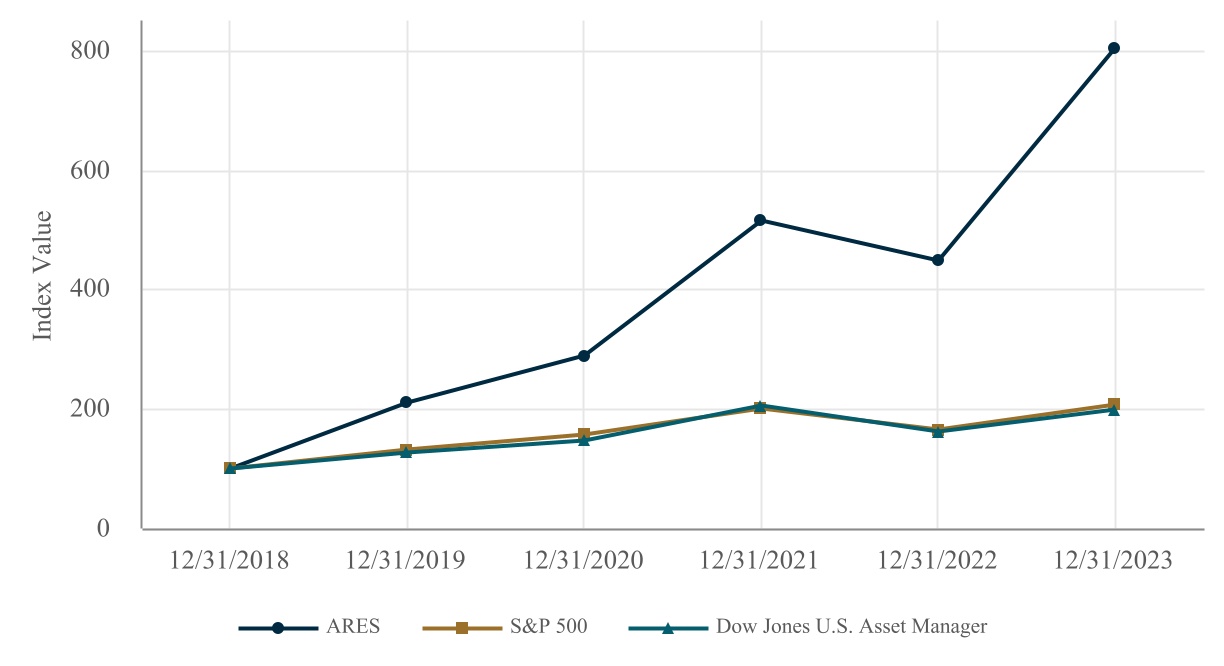
The following graph depicts the total return to holders of our Class A common stock from the closing price on December 31, 2018 through December 31, 2023, relative to the performance of the S&P 500 Index and the Dow Jones U.S. Asset Managers Index. The graph assumes $100 invested on December 31, 2018 and dividends received reinvested in the security or index.
The performance graph is not intended to be indicative of future performance. The performance graph shall not be deemed “soliciting material” or to be “filed” with the SEC for purposes of Section 18 of the Exchange Act, or otherwise subject to the liabilities under that Section, and shall not be deemed to be incorporated by reference into any of the Company’s filings under the Securities Act or the Exchange Act.
Total Return Performance Table
Issuer Purchases of Equity Securities
None.
Dividend Policy for Class A and Non-Voting Common Stock
During 2022, we declared a dividend each quarter of $0.61 (totaling $2.44 annually) per share to Class A common stockholders and non-voting common stockholders, or approximately $429.1 million. During 2023, we declared a dividend each quarter of $0.77 (totaling $3.08 annually) per share to Class A and non-voting common stockholders at the close of business on March 17, 2023, June 16, 2023, September 15, 2023, and December 15, 2023, respectively, or approximately $571.9 million.
In February 2024, the Company’s board of directors declared a quarterly dividend of $0.93 per share of Class A and non-voting common stock with respect to the first quarter of 2024 payable on March 29, 2024 to common stockholders of record at the close of business on March 15, 2024.
Our dividend policy for our Class A and non-voting common stock is more closely aligned with our core management fee business. We intend to provide a fixed quarterly dividend for each calendar year that will be based on our expected fee related earnings after an allocation of current taxes paid, with future potential changes based on the level and growth of the metric. Subject to the approval of our board of directors, we intend to pay a dividend of $0.93 per share of our Class A and non-voting common stock per quarter in 2024.
Our fixed dividend will be reassessed each year based upon the level and growth of our fee related earnings after an allocation of current taxes paid. As fee related earnings reflect the core earnings of our business and consist of management fee and fee related performance revenues less compensation and general and administrative expenses, having our dividend based on this amount removes volatility from our dividend and provides more predictability to investors on an annual basis
Our dividend policy reflects our intention to retain net performance income, which excludes our fee related performance revenues. We expect to use such retained earnings to fund future growth with the objective of accelerating our fee related earnings growth per share, as well as for potential stock repurchases. However, the declaration, payment and determination of the amount of future dividends, if any, is at the sole discretion of our board of directors, which may change our dividend policy at any time.
The payment of cash dividends is subject to compliance with DGCL. In addition, under the Credit Facility, certain subsidiaries of the Ares Operating Group are prohibited from paying dividends in certain circumstances, including if an Event of Default (as defined in the Credit Facility) has occurred and is continuing.
Because AMC is a holding company and has no material assets other than its indirect ownership of AOG Units, we fund dividends by AMC on shares of our Class A and non-voting common stock, if any, in three steps:
-
first, we cause the AOG entities to make distributions to their partners, including AMC and its direct subsidiaries. If the AOG entities make such distributions, the partners of the AOG entities will be entitled to receive equivalent distributions based on their partnership units in the Ares Operating Group (except as set forth in the following paragraph);
-
second, we cause AMC’s direct subsidiaries to distribute to AMC their share of such distributions, net of any taxes and amounts payable under the tax receivable agreement by such direct subsidiaries; and
-
third, AMC pays such distributions to our holders of our Class A and non-voting common stock, net of any taxes and amounts payable under the tax receivable agreement, on a pro rata basis.
Because we and our direct subsidiaries that are corporations for U.S. federal income tax purposes may be required to pay corporate income and franchise taxes and make payments under the tax receivable agreement, the dividend amounts ultimately paid by us to holders of our Class A and non-voting common stock are expected to be generally less, on a per share basis, than the amounts distributed by the AOG entities to their respective partners in respect of their AOG Units.
In addition, governing agreements of the AOG entities provide for cash distributions, which we refer to as “tax distributions,” to the partners of such entities if the general partners of the AOG entities determine that the taxable income of the AOG entities gives rise to taxable income for its partners. Generally, these tax distributions are computed based on our
estimate of the net taxable income of the entity multiplied by an assumed tax rate equal to the highest effective marginal combined U.S. federal, state and local income tax rate prescribed for an individual or corporate resident in Los Angeles, California or New York, New York, whichever is higher (taking into account the non-deductibility of certain expenses and the character of our income). The Ares Operating Group makes tax distributions only if and to the extent distributions from such entities for the relevant year were otherwise insufficient to cover such tax liabilities.
We expect any dividends paid out of current or accumulated earnings and profits to U.S. individuals and certain other qualifying holders of our Class A and non-voting common stock to constitute “qualified dividend” income that is generally taxed at a more favorable tax rate than the ordinary income tax rate, if the requisite holding periods have been met. If the dividend exceeds current and accumulated earnings and profits, the excess is treated as a nontaxable return of capital, reducing the stockholder’s tax basis in its shares to the extent of such shareholder’s tax basis in such shares. Any remaining excess is treated as capital gain. Because U.S. corporations are taxed on their own taxable income, and because owners of such entities are taxed on any dividends paid from such entities, there are two levels of potential tax upon income earned by such entities.
Unregistered Sales of Equity Securities and Purchases of Equity Securities
None.
Item 6. [Reserved]
Item 7. Management’s Discussion and Analysis of Financial Condition and Results of Operations
AMC is a Delaware corporation. Unless the context otherwise requires, references to “Ares,” “we,” “us,” “our,” and the “Company” are intended to mean the business and operations of AMC and its consolidated subsidiaries. The following discussion analyzes the financial condition and results of operations of the Company. “Consolidated Funds” refers collectively to certain Ares funds, co-investment vehicles, CLOs and SPACs that are required under generally accepted accounting principles in the United States (“GAAP”) to be consolidated within our consolidated financial statements included in this Annual Report on Form 10-K. Additional terms used by the Company are defined in the Glossary and throughout the Management’s Discussion and Analysis in this Annual Report on Form 10-K.
The following discussion and analysis should be read in conjunction with the consolidated financial statements of AMC and the related notes included in this Annual Report on Form 10-K.
This section of the Annual Report on Form 10-K discusses activity as of and for the years ended December 31, 2023 and 2022. For discussion on activity for the year ended December 31, 2021 and period-over-period analysis on results for the year ended December 31, 2022 to 2021, refer to Part II, “Item 7. Management’s Discussion and Analysis of Financial Condition and Results of Operations” in our Annual Report on Form 10-K for the year ended December 31, 2022.
Amounts and percentages presented throughout our discussion and analysis of financial condition and results of operations may reflect rounded results in thousands (unless otherwise indicated) and consequently, totals may not appear to sum. In addition, illustrative charts may not be presented at scale.
“NM” refers to not meaningful. Period-over-period analysis for current year compared to prior year may be deemed to be not meaningful and are designated as “NM” within the discussion and analysis of financial condition and results of operations.
Trends Affecting Our Business
We believe that our disciplined investment philosophy across our distinct but complementary investment groups contributes to the stability of our performance throughout market cycles. For the year ended December 31, 2023, approximately 95% of our management fees were derived from perpetual capital vehicles and long-dated funds. Our funds have a stable base of committed capital enabling us to invest in assets with a long-term focus over different points in a market cycle and to take advantage of market volatility. However, our results from operations, including the fair value of our AUM, are affected by a
variety of factors. Conditions in the global financial markets and economic and political environments may impact our business, particularly in the U.S., Western Europe and Asia.
The following table presents returns of selected market indices:
| Returns (%) | ||||||||||||||||||||||||||||||||
| Type of Index | Name of Index | Region | Year ended December 31, 2023 | Year ended December 31, 2022 | ||||||||||||||||||||||||||||
| High yield bonds | ICE BAML High Yield Master II Index | U.S. | 13.5 | (11.2) | ||||||||||||||||||||||||||||
| High yield bonds | ICE BAML European Currency High Yield Index | Europe | 12.2 | (11.5) | ||||||||||||||||||||||||||||
| Leveraged loans | Credit Suisse Leveraged Loan Index (“CSLLI”) | U.S. | 13.0 | (1.1) | ||||||||||||||||||||||||||||
| Leveraged loans | Credit Suisse Western European Leveraged Loan Index | Europe | 12.5 | (3.3) | ||||||||||||||||||||||||||||
| Equities | S&P 500 Index | U.S. | 26.3 | (18.1) | ||||||||||||||||||||||||||||
| Equities | MSCI All Country World Ex-U.S. Index | Non-U.S. | 15.6 | (16.0) | ||||||||||||||||||||||||||||
| Real estate equities | FTSE NAREIT All Equity REITs Index | U.S. | 11.4 | (24.9) | ||||||||||||||||||||||||||||
| Real estate equities | FTSE EPRA/NAREIT Developed Europe Index | Europe | 17.4 | (36.5) |
During 2023, global markets endured heightened volatility but finished the year positively with improving investor sentiment amid the possibility of monetary easing in 2024. Despite the macroeconomic headwinds and escalated conflicts in the Middle East and Ukraine, U.S. and European high yield bonds and leveraged loans returned positive performance. The Asian markets experienced mixed performance as the region overall continued to show growth primarily driven by resilient demand in Southeast Asia and India. India, in particular, demonstrated healthy economic growth driven by its manufacturing and services sectors. On the other hand, China’s weaker than expected economic recovery led Chinese policymakers to continue taking measures to support economic growth. Overall, reduced lending activity by banks and limited capital accessibility continued to fuel private credit growth.
Global equity markets similarly rallied during the fourth quarter to finish the year on a positive note. While the public markets ended the year positively, the private markets continued to experience challenges with downward pressure on valuations and muted the opportunities for realizations. The private equity markets also experienced a prolonged slowdown in deal activity, and we believe potential liquidity constraints from investors have increased the need for flexible capital solutions. In addition, businesses have struggled to navigate this challenging growth and inflationary environment, which we believe has heightened the need for partnerships with value-add managers. This environment underscores the importance of investing in resilient industries with long-term secular tailwinds where we have expertise. Our focus continues to be on investment opportunities in the healthcare and services sectors, with limited exposure to energy, and we continue to invest opportunistically in consumer and industrials. Asset selectivity, deliberate portfolio construction, a flexible investment mandate and a differentiated view to drive value creation through earnings growth will be instrumental in delivering attractive returns to investors.
The commercial real estate markets continued to be impacted by the macroeconomic environment throughout 2023. European and U.S. real estate deal activity remained subdued with limited transactional liquidity. Given the higher interest rate environment, property valuations remain soft, with capitalization rate yields widening further over the year. However, we believe certain of these market trends will be offset by continued strong fundamentals, such as occupancy and rental rates, in property types that include multifamily and industrial.
The current market environment has had a more pronounced negative impact on certain industries, including energy, which is an industry in which few of our funds have made investments. As of December 31, 2023, 1% of our total AUM was invested in debt and eq
Showing the first 8K of 357K characters. Open the full section
Item 7A. Quantitative and Qualitative Disclosures About Market Risk
Our primary exposure to market risk is related to our role as general partner or investment adviser to our funds and the sensitivity to movements in the fair value of their investments, including the effect on management fees, carried interest, incentive fees and investment income.
Market Risk
The market price of investments may significantly fluctuate during the period of investment. Investments may decline in value due to factors affecting securities markets generally or particular industries represented in the securities markets. The value of an investment may decline due to general market conditions, which are not specifically related to such investment, such as real or perceived adverse economic conditions, changes in the general outlook for corporate earnings, changes in interest or currency rates or adverse investor sentiment generally. It may also decline due to factors that affect a particular industry or industries, such as labor shortages or increased production costs and competitive conditions within an industry.
Our credit orientation has been a central tenet of our business across our debt and equity investment strategies. We believe the combination of high-quality proprietary information flow and a consistent, rigorous approach to managing investments across our strategies has been, and we believe will continue to be, a major driver of our strong risk-adjusted returns and the stability and predictability of our income.
Effect on Management Fees
Management fees are generally based on a defined percentage of fair value of assets, capital commitments, invested capital, NAV, net investment income, total assets or par value of the investment portfolios we manage. Management fees calculated based on fair value of assets or net investment income are affected by short-term changes in market values.
The overall impact of a short-term change in market value may be mitigated by a number of factors including, but not limited to, fee definitions that are not based on market value including invested capital and capital commitments, market value definitions that exclude the impact of realized and/or unrealized gains and losses, market value definitions based on beginning of the period values or a form of average market value including daily, monthly or quarterly averages as well monthly or quarterly payment terms.
For the year ended December 31, 2023, management fees from funds that are impacted by changes in market value and have underlying investments held in liquid strategies were approximately 3%. As such, a hypothetical 10% decrease in fair value of our managed funds’ investments as of December 31, 2023 would not have a material impact on our management fees.
Effect on Carried Interest and Incentive Fees
We earn carried interest and incentive fees from certain of our funds when such funds achieve specified performance criteria. Our carried interest and incentive fees will be impacted by changes in market risk factors. However, several major factors will influence the degree of impact, including, but not limited to, the following:
-
the performance criteria for each individual fund in relation to how that fund’s results of operations are impacted by changes in market risk factors;
-
whether such performance criteria are measured annually or over the life of the fund;
-
to the extent applicable, the prior-period performance of each fund in relation to its performance criteria; and
-
whether each funds’ performance related distributions are subject to contingent repayment.
As a result, the impact of changes in market risk factors on carried interest and incentive fees will vary widely from fund to fund. An overall increase of 10% in the general equity markets would not necessarily drive the same impact on our funds’ ability to generate income or its asset valuations, as a significant portion of our carried interest and incentive fees are from credit-based investments and are generally based on income. Additionally, as a large percentage of our carried interest and incentive fees are paid to employees as performance related compensation, the overall net impact to our income would be mitigated by lower compensation payments.
See “Note 8. Commitments and Contingencies,” within our consolidated financial statements included in this Annual Report on Form 10-K for discussion on amount of carried interest, net of tax distributions, subject to contingent repayment if we assumed all existing investments were worthless.
Effect on Investment Income
An investment gain (loss) is realized when all or a portion of our investment is returned to us. Unrealized investment gain (loss) results from changes in the fair value of the underlying investment as well as the reversal of unrealized appreciation (depreciation) at the time an investment is realized.
Changes in the fair values of our funds’ investments directly impact unrealized principal investment income and unrealized gains on investments. A hypothetical incremental 10% decrease in the fair value of our investments as of December 31, 2023 would result in declines in principal investment income and unrealized gains on investments of $124.5 million and $79.1 million, respectively.
Exchange Rate Risk
We and our funds hold investments that are denominated in foreign currencies that may be affected by movements in the rate of exchange between those currencies and the U.S. dollar. Movements in the exchange rate between currencies impact the management fees, carried interest and incentive fees earned by funds with fee paying AUM denominated in foreign currencies as well as by funds with fee paying AUM denominated in U.S. dollars that hold investments denominated in foreign currencies. Additionally, movements in the exchange rate impact operating expenses for our global offices that transact in foreign currencies and the revaluation of assets and liabilities denominated in non-functional currencies, including cash balances and investments.
We manage our exposure to exchange rate risks through our regular operating activities, wherein we utilize payments received in foreign currencies to fulfill obligations in foreign currencies, and, when appropriate, through the use of derivative financial instruments to hedge the net foreign currency exposure in: the funds that we advise; the balance sheet exposure for certain direct investments denominated in foreign currencies; and the cash flow exposure for foreign currencies.
A portion of our management fees, carried interest, incentive fees and investments are denominated in foreign currencies that may be affected by movements in the rate of exchange between currencies. We estimate that as of December 31, 2023 a hypothetical 10% decline in the rate of exchange of all foreign currencies against the U.S. dollar would not result in a material change to management fees, carried interest, incentive fees or investments for the year ended December 31, 2023, and would be largely offset by the currency conversions of the expenses denominated in foreign currencies.
Interest Rate Risk
Our Credit Facility provides a $1.325 billion revolving line of credit with the ability to upsize to $1.65 billion (subject to obtaining commitments for any such additional borrowing capacity) with a maturity date of March 31, 2027. As of December 31, 2023, we had $895.0 million borrowings outstanding under the Credit Facility. For a further discussion of our Credit Facility, see “Note 6. Debt,” within our consolidated financial statements included in this Annual Report on Form 10-K.
We estimate that in the event of a 100 basis point increase in interest rates, to the extent there is an outstanding revolver balance, we would be subject to the variable rate and would expect our interest expense to increase commensurately.
As credit-oriented investors, we are also subject to interest rate risk through the securities we hold in our Consolidated Funds. A 100 basis point increase in interest rates would be expected to negatively affect the fair value of securities that accrue interest income at fixed rates and therefore negatively impact net change in unrealized gains on investments of the Company and the Consolidated Funds. The actual impact is dependent on the average duration and the amount of such holdings. Conversely, securities that accrue interest at variable rates would be expected to benefit from a 100 basis points increase in interest rates because these securities would generate higher levels of current income. This would positively impact interest and dividend income but have an offsetting decrease in the fair value of the securities and negatively impact the net change in unrealized gains. In the cases where our funds pay management fees based on NAV, we would expect our segment management fees to experience a change in direction and magnitude corresponding to that experienced by the underlying portfolios.
Credit Risk
We are party to agreements providing for various financial services and transactions that contain an element of risk in the event that the counterparties are unable to meet the terms of such agreements. In such agreements, we depend on the counterparty to make payment or otherwise perform. We generally endeavor to minimize our risk of exposure by limiting to reputable financial institutions the counterparties with which we enter into financial transactions. In other circumstances, availability of financing from financial institutions may be uncertain due to market events, and we may not be able to access these financing markets.
In the ordinary course of business, we may extend loans to our funds or guarantee credit facilities held by our funds and could be subject to risk of loss or repayment if our funds do not perform.
Certain of our funds’ investments include lower-rated and comparable quality unrated distressed investments and other instruments. These issuers can be more sensitive to adverse market conditions, such as a recession or increasing interest rates, as compared to higher rated issuers. We seek to minimize risk exposure by subjecting each prospective investment to our rigorous, credit-oriented investment approach.
Item 8. Financial Statements and Supplementary Data
The information required by this item is incorporated by reference to the consolidated financial statements and accompanying notes set forth in the F-pages of this Annual Report on Form 10-K.
Item 9. Changes in and Disagreements with Accountants on Accounting and Financial Disclosure
None.
Item 9A. Controls and Procedures
Evaluation of Disclosure Controls and Procedures
We maintain disclosure controls and procedures (as that term is defined in Rules 13a-15(e) and 15d-15(e) under the Exchange Act) that are designed to ensure that information required to be disclosed in our reports under the Exchange Act is recorded, processed, summarized and reported within the time periods specified in the SEC’s rules and forms, and that such information is accumulated and communicated to our management, including our principal executive officer and principal financial officer, as appropriate, to allow timely decisions regarding required disclosures. Any controls and procedures, no matter how well designed and operated, can provide only reasonable assurance of achieving the desired control objectives. Our management, with the participation of our principal executive officer and principal financial officer, has evaluated the effectiveness of the design and operation of our disclosure controls and procedures as of December 31, 2023. Based upon that evaluation and subject to the foregoing, our principal executive officer and principal financial officer concluded that, as of December 31, 2023, the design and operation of our disclosure controls and procedures were effective to accomplish their objectives at the reasonable assurance level.
Changes in Internal Control over Financial Reporting
There have been no changes in our internal control over financial reporting (as defined in Rule 13a-15(f) and 15d-15(f) under the Exchange Act) during the quarter ended December 31, 2023 that have materially affected, or that are reasonably likely to materially affect, our internal control over financial reporting.
Report of Management on Internal Control Over Financial Reporting
Our management is responsible for establishing and maintaining adequate internal control over financial reporting for the Company. Internal control over financial reporting is a process to provide reasonable assurance regarding the reliability of our financial reporting for external purposes in accordance with accounting principles generally accepted in the United States of America. Internal control over financial reporting includes maintaining records that in reasonable detail accurately and fairly reflect our transactions; providing reasonable assurance that transactions are recorded as necessary for preparation of our consolidated financial statements; providing reasonable assurance that receipts and expenditures of company assets are made in accordance with management authorization; and providing reasonable assurance that unauthorized acquisition, use or disposition of company assets that could have a material effect on our consolidated financial statements would be prevented or detected on a timely basis. Because of its inherent limitations, internal control over financial reporting is not intended to provide absolute assurance that a material misstatement of our consolidated financial statements would be prevented or detected.
Management conducted an evaluation of the effectiveness of our internal control over financial reporting based on the framework in Internal Control — Integrated Framework (2013) issued by the Committee of Sponsoring Organizations of the Treadway Commission. Based on this evaluation, management concluded that the Company’s internal control over financial reporting was effective as of December 31, 2023. The Company’s independent registered public accounting firm, Ernst & Young LLP, has issued an audit report on the effectiveness of the Company’s internal control over financial reporting. Their report follows.
Report of Independent Registered Public Accounting Firm
To the Stockholders and the Board of Directors of Ares Management Corporation
Opinion on Internal Control Over Financial Reporting
We have audited Ares Management Corporation’s internal control over financial reporting as of December 31, 2023, based on criteria established in Internal Control—Integrated Framework issued by the Committee of Sponsoring Organizations of the Treadway Commission (2013 framework) (the COSO criteria). In our opinion, Ares Management Corporation (the Company) maintained, in all material respects, effective internal control over financial reporting as of December 31, 2023, based on the COSO criteria.
We also have audited, in accordance with the standards of the Public Company Accounting Oversight Board (United States) (PCAOB), the consolidated statements of financial condition of the Company as of December 31, 2023 and 2022, the related consolidated statements of operations, comprehensive income, changes in equity and cash flows for each of the three years in the period ended December 31, 2023, and the related notes and our report dated February 27, 2024 expressed an unqualified opinion thereon.
Basis for Opinion
The Company’s management is responsible for maintaining effective internal control over financial reporting and for its assessment of the effectiveness of internal control over financial reporting included in the accompanying Report of Management on Internal Control Over Financial Reporting. Our responsibility is to express an opinion on the Company’s internal control over financial reporting based on our audit. We are a public accounting firm registered with the PCAOB and are required to be independent with respect to the Company in accordance with the U.S. federal securities laws and the applicable rules and regulations of the Securities and Exchange Commission and the PCAOB.
We conducted our audit in accordance with the standards of the PCAOB. Those standards require that we plan and perform the audit to obtain reasonable assurance about whether effective internal control over financial reporting was maintained in all material respects.
Our audit included obtaining an understanding of internal control over financial reporting, assessing the risk that a material weakness exists, testing and evaluating the design and operating effectiveness of internal control based on the assessed risk, and performing such other procedures as we considered necessary in the circumstances. We believe that our audit provides a reasonable basis for our opinion.
Definition and Limitations of Internal Control Over Financial Reporting
A company’s internal control over financial reporting is a process designed to provide reasonable assurance regarding the reliability of financial reporting and the preparation of financial statements for external purposes in accordance with generally accepted accounting principles. A company’s internal control over financial reporting includes those policies and procedures that (1) pertain to the maintenance of records that, in reasonable detail, accurately and fairly reflect the transactions and dispositions of the assets of the company; (2) provide reasonable assurance that transactions are recorded as necessary to permit preparation of financial statements in accordance with generally accepted accounting principles, and that receipts and expenditures of the company are being made only in accordance with authorizations of management and directors of the company; and (3) provide reasonable assurance regarding prevention or timely detection of unauthorized acquisition, use, or disposition of the company’s assets that could have a material effect on the financial statements.
Because of its inherent limitations, internal control over financial reporting may not prevent or detect misstatements. Also, projections of any evaluation of effectiveness to future periods are subject to the risk that controls may become inadequate because of changes in conditions, or that the degree of compliance with the policies or procedures may deteriorate.
/s/ Ernst & Young LLP
Los Angeles, California
February 27, 2024
Item 9B. Other Information
Rule 10b5-1 Trading Plans
During the three months ended December 31, 2023, certain executive officers and directors of the Company or a vehicle controlled by them (each, a “Plan Participant”) entered into Rule 10b5-1 trading plan (a “Rule 10b5-1 Trading Plan”) to sell shares of the Company’s Class A common stock, in each case, subject to any applicable volume limitations.
The table below provides certain information regarding each Plan Participant’s Rule 10b5-1 Trading Plan.
| Name and Title | Plan Date | Maximum Shares That May Be Sold Under the Plan | Plan Expiration Date | |||||||||||||||||
| Bennett Rosenthal, Director, Co-Founder and Chairman of Private Equity Group | December 14, 2023 | 250,000 | December 1, 2024 | |||||||||||||||||
| David Kaplan, Director and Co-Founder | December 14, 2023 | 250,000 | December 1, 2024 | |||||||||||||||||
| Michael Arougheti, Director, Co-Founder, Chief Executive Officer & President | December 14, 2023 | 999,585 | February 1, 2025 | |||||||||||||||||
| Antony Ressler, Executive Chairman & Co-Founder | December 15, 2023 | 2,000,000 | March 1, 2025 |
A Rule 10b5-1 Trading Plan is a written document that pre-establishes the amounts, prices and dates (or formulas for determining the amounts, prices and dates) of future purchases or sales of the Company’s common stock, including, if applicable, shares issued upon exercise of stock options or vesting of restricted stock units.
Each Plan Participant’s Rule 10b5-1 Trading Plan was adopted during an authorized trading period and when such Plan Participant was not in possession of material non-public information and is intended to satisfy the affirmative defense of Rule 10b5-1(c) under the Exchange Act.
Item 9C. Disclosure Regarding Foreign Jurisdictions that Prevent Inspections
Not applicable.
PART III.
Item 10. Directors, Executive Officers and Corporate Governance
The information required by this item is incorporated by reference to our definitive Proxy Statement for the 2024 Annual Meeting of Stockholders to be filed with the Securities and Exchange Commission within 120 days of December 31, 2023.
Item 11. Executive Compensation
The information required by this item is incorporated by reference to our definitive Proxy Statement for the 2024 Annual Meeting of Stockholders to be filed with the Securities and Exchange Commission within 120 days of December 31, 2023.
Item 12. Security Ownership of Certain Beneficial Owners and Management and Related Shareholder Matters
The information required by this item is incorporated by reference to our definitive Proxy Statement for the 2024 Annual Meeting of Stockholders to be filed with the Securities and Exchange Commission within 120 days of December 31, 2023.
Item 13. Certain Relationships and Related Transactions, and Director Independence
The information required by this item is incorporated by reference to our definitive Proxy Statement for the 2024 Annual Meeting of Stockholders to be filed with the Securities and Exchange Commission within 120 days of December 31, 2023.
Item 14. Principal Accounting Fees and Services
The information required by this item is incorporated by reference to our definitive Proxy Statement for the 2024 Annual Meeting of Stockholders to be filed with the Securities and Exchange Commission within 120 days of December 31, 2023.
PART IV.
Item 15. Exhibits, Financial Statement Schedules
(a)Documents Filed with Report:
| Report of Independent Registered Public Accounting Firm (PCAOB ID: 42) | ||
| Consolidated Statements of Financial Condition as of December 31, 2023 and 2022 | ||
| Consolidated Statements of Operations for the years ended December 31, 2023, 2022 and 2021 | ||
| Consolidated Statements of Comprehensive Income for the years ended December 31, 2023, 2022 and 2021 | ||
| Consolidated Statements of Changes in Equity for the years ended December 31, 2023, 2022 and 2021 | ||
| Consolidated Statements of Cash Flows for the years ended December 31, 2023, 2022 and 2021 | ||
| Notes to Consolidated Financial Statements |
(b)Exhibits.
The following is a list of all exhibits filed or furnished as part of this report.
| Exhibit No. | Description | |||||||
| 3.1 | Second Amended and Restated Certificate of Incorporation of Ares Management Corporation (incorporated by reference to Exhibit 3.1 to the Registrant’s Quarterly Report on Form 10-Q (File No. 001-36429) filed with the SEC on November 7, 2022). | |||||||
| 3.2 | Bylaws of Ares Management Corporation (incorporated by reference to Exhibit 99.4 to the Registrant’s Current Report on Form 8-K (File No. 001-36429) filed with the SEC on November 15, 2018). | |||||||
| 4.1* | Description of Ares Management Corporation’s Securities. | |||||||
| 4.2 | Indenture dated as of October 8, 2014 among Ares Finance Co. LLC, Ares Management, L.P., Ares Holdings Inc., Ares Domestic Holdings Inc., Ares Real Estate Holdings LLC, Ares Holdings L.P., Ares Domestic Holdings L.P., Ares Investments L.P., Ares Real Estate Holdings L.P., Ares Management LLC, Ares Investments Holdings LLC and U.S. Bank National Association, as trustee (incorporated by reference to Exhibit 4.1 to the Registrant’s Current Report on Form 8-K (File No. 001-36429) filed with the SEC on October 8, 2014). | |||||||
| 4.3 | First Supplemental Indenture dated as of October 8, 2014 among Ares Finance Co. LLC, Ares Management, L.P., Ares Holdings Inc., Ares Domestic Holdings Inc., Ares Real Estate Holdings LLC, Ares Holdings L.P., Ares Domestic Holdings L.P., Ares Investments L.P., Ares Real Estate Holdings L.P., Ares Management LLC, Ares Investments Holdings LLC and U.S. Bank National Association, as trustee (incorporated by reference to Exhibit 4.2 to the Registrant’s Current Report on Form 8-K (File No. 001-36429) filed with the SEC on October 8, 2014). | |||||||
| 4.4 | First Amendment, dated as of August 7, 2015, to the First Supplemental Indenture, dated October 8, 2014, to the indenture, dated October 8, 2014, among Ares Finance Co. LLC, the guarantors party thereto and U.S. Bank National Association, as trustee (incorporated by reference to Exhibit 10.2 to the Registrant’s Current Report on Form 8-K (File No. 001-36429) filed with the SEC on August 7, 2015). | |||||||
| 4.5 | Form of 4.000% Senior Note due 2024 (incorporated by reference to Exhibit 4.2 to the Registrant’s Current Report on Form 8-K (File No. 001-36429) filed with the SEC on October 8, 2014). | |||||||
| 4.6 | Form of 7.00% Series A Preferred Stock Certificate (incorporated by reference to Exhibit 99.5 to the Registrant’s Current Report on Form 8-K (File No. 001-36429) filed with the SEC on November 15, 2018). | |||||||
| 4.7 | Indenture dated as of June 15, 2020 among Ares Finance Co. II LLC, Ares Holdings L.P., Ares Investments L.P., Ares Management LLC, Ares Investments Holdings LLC, Ares Finance Co. LLC and Ares Offshore Holdings L.P. and U.S. Bank National Association, as trustee (incorporated by reference to Exhibit 4.1 to the Registrant’s Current Report on Form 8-K (File No. 001-36429) filed with the SEC on June 15, 2020). | |||||||
| 4.8 | First Supplemental Indenture dated as of June 15, 2020 among Ares Finance Co. II LLC, Ares Holdings L.P., Ares Investments L.P., Ares Management LLC, Ares Investments Holdings LLC, Ares Finance Co. LLC and Ares Offshore Holdings L.P. and U.S. Bank National Association, as trustee (incorporated by reference to Exhibit 4.2 to the Registrant’s Current Report on Form 8-K (File No. 001-36429) filed with the SEC on June 15, 2020). | |||||||
| 4.9 | Form of 3.250% Senior Note due 2030 (incorporated by reference to Exhibit 4.2 to the Registrant’s Current Report on Form 8-K (File No. 001-36429) filed with the SEC on June 15, 2020). |
| Exhibit No. | Description | |||||||
| 4.10 | Indenture dated as of June 30, 2021 among Ares Finance Co. III LLC, Ares Holdings L.P., Ares Investments Holdings LLC, Ares Management LLC, Ares Finance Co. LLC, Ares Finance Co. II LLC and U.S. Bank National Association, as trustee (incorporated by reference to Exhibit 4.1 to the Registrant’s Current Report on 8-K (File No. 001-36429) filed with the SEC on July 1, 2021). | |||||||
| 4.11 | Form of 4.125% Fixed Rate Resettable Subordinated Notes due 2051 incorporated by reference to Exhibit 4.1 to the Registrant’s Current Report on Form 8-K (File No. 001-36429) filed with the SEC on July 1, 2021). | |||||||
| 4.12 | Indenture dated as of January 21, 2022 among Ares Finance Co. IV LLC, Ares Holdings L.P., Ares Investments Holdings LLC, Ares Management LLC, Ares Finance Co. LLC, Ares Finance Co. II LLC, Ares Finance Co. III LLC and U.S. Bank National Association, as trustee (incorporated by reference to Exhibit 4.1 to the Registrant’s Current Report on 8-K (File No. 001-36429) filed with the SEC on January 21, 2022). | |||||||
| 4.13 | First Supplemental Indenture dated as of January 21, 2022 among Ares Finance Co. IV LLC, Ares Holdings L.P., Ares Investments Holdings LLC, Ares Management LLC, Ares Finance Co. LLC, Ares Finance Co. II LLC, Ares Finance Co. III LLC and U.S. Bank National Association, as trustee (incorporated by reference to Exhibit 4.2 to the Registrant’s Current Report on Form 8-K (File No. 001-36429) filed with the SEC on January 21, 2022). | |||||||
| 4.14 | Form of 3.650% Senior Note due 2052 (incorporated by reference to Exhibit 4.2 to the Registrant’s Current Report on Form 8-K (File No. 001-36429) filed with the SEC on January 21, 2022). | |||||||
| 4.15 | Base Indenture, dated as of November 10, 2023, by and between Ares Management Corporation and U.S. Bank Trust Company, National Association, as trustee (incorporated by reference to Exhibit 4.1 to Registrant’s Current Report on Form 8-K (File No. 001-36429) filed with the SEC on November 13, 2023). | |||||||
| 4.16 | First Supplemental Indenture, dated as of November 10, 2023, by and among Ares Management Corporation, Ares Holdings L.P., Ares Management LLC, Ares Investments Holdings LLC, Ares Finance Co. LLC, Ares Finance Co. II LLC, Ares Finance Co. III LLC and Ares Finance Co. IV LLC, as the guarantors, and U.S. Bank Trust Company, National Association, as trustee (incorporated by reference to Exhibit 4.2 to Registrant’s Current Report on Form 8-K (File No. 001-36429) filed with the SEC on November 13, 2023). | |||||||
| 4.17 | Form 6.375% Senior Notes due 2028 (incorporated by reference to Exhibit 4.2 to the Registrant’s Current Report on Form 8-K (File No. 001-36429) filed with the SEC on November 13, 2023). | |||||||
| 10.1 | Fourth Amended and Restated Limited Partnership Agreement of Ares Holdings L.P., dated April 1, 2021 (incorporated by reference to Exhibit 10.1 to the Registrant’s Annual Report on Form 10-K for the year ended December 31, 2021 (File No. 001-36429) filed with the SEC on February 28, 2022). | |||||||
| 10.2 | Investor Rights Agreement, dated November 26, 2018 (incorporated by reference to Exhibit 10.2 to the Registrant’s Annual Report on Form 10-K for the year ended December 31, 2021 (File No. 001-36429) filed with the SEC on February 28, 2022). | |||||||
| 10.3# | Third Amended & Restated 2014 Equity Incentive Plan (incorporated by reference to Exhibit 10.3 to the Registrant’s Annual Report on Form 10-K for the year ended December 31, 2021 (File No. 001-36429) filed with the SEC on February 28, 2022). | |||||||
| 10.4 | Fifth Amended and Restated Exchange Agreement, dated April 1, 2021 (incorporated by reference to Exhibit 10.4 to the Registrant’s Annual Report on Form 10-K for the year ended December 31, 2021 (File No. 001-36429) filed with the SEC on February 28, 2022). | |||||||
| 10.5 | Fourth Amended and Restated Tax Receivable Agreement, dated May 1, 2023 (incorporated by reference to Exhibit 10.1 to the Registrant’s Quarterly Report on Form 10-Q (File No. 001-36429) filed with the SEC on May 8, 2023). | |||||||
| 10.6 | Sixth Amended and Restated Credit Agreement, dated as of April 21, 2014, by and among Ares Holdings LLC, Ares Domestic Holdings L.P., Ares Investments LLC, Ares Real Estate Holdings L.P., the Guarantors party thereto, the Lenders party thereto and JPMorgan Chase Bank, N.A. (incorporated by reference to Exhibit 10.10 to the Registrant’s Registration Statement on Form S-1/A (File No. 333-194919) filed with the SEC on April 28, 2014). | |||||||
| 10.7 | Amendment No. 1, dated as of July 15, 2014, to the Sixth Amended and Restated Senior Credit Agreement, dated as of April 21, 2014, by and among Ares Holdings L.P., Ares Domestic Holdings L.P., Ares Investments L.P., Ares Real Estate Holdings L.P., the Guarantors party thereto, the Lenders party thereto and JPMorgan Chase Bank, N.A. (incorporated by reference to Exhibit 10.1 to the Registrant’s Quarterly Report on Form 10‑Q (File No. 001-36429) filed with the SEC on November 12, 2014). | |||||||
| 10.8 | Amendment No. 2, dated as of September 24, 2014, to the Sixth Amended and Restated Senior Credit Agreement, dated as of April 21, 2014, by and among Ares Holdings L.P., Ares Domestic Holdings L.P., Ares Investments L.P., Ares Real Estate Holdings L.P., the Guarantors party thereto, the Lenders party thereto and JPMorgan Chase Bank, N.A. (incorporated by reference to Exhibit 10.2 to the Registrant’s Quarterly Report on Form 10‑Q (File No. 001-36429) filed with the SEC on November 12, 2014). |
| Exhibit No. | Description | |||||||
| 10.9 | Amendment No. 3, dated as of July 23, 2015, to the Sixth Amended and Restated Senior Credit Agreement, dated as of April 21, 2014, by and among Ares Holdings L.P., Ares Domestic Holdings L.P., Ares Investments L.P., Ares Real Estate Holdings L.P., the Guarantors party thereto, the Lenders party thereto and JPMorgan Chase Bank, N.A. (incorporated by reference to Exhibit 10.1 to the Registrant’s Current Report on Form 8‑K (File No. 001-36429) filed with the SEC on July 28, 2015). | |||||||
| 10.10 | Amendment No. 4, dated as of August 5, 2015, to the Sixth Amended and Restated Senior Credit Agreement, dated as of April 21, 2014, by and among Ares Holdings L.P., Ares Domestic Holdings L.P., Ares Investments L.P., Ares Real Estate Holdings L.P., the Guarantors party thereto, the Lenders party thereto and JPMorgan Chase Bank, N.A. (incorporated by reference to Exhibit 10.1 to the Registrant’s Current Report on Form 8‑K (File No. 001-36429) filed with the SEC on August 7, 2015). | |||||||
| 10.11 | Amendment No. 5, dated as of December 16, 2015, to the Sixth Amended and Restated Senior Credit Agreement, dated as of April 21, 2014, by and among Ares Holdings L.P., Ares Domestic Holdings L.P., Ares Investments L.P., Ares Real Estate Holdings L.P., the Guarantors party thereto, the Lenders party thereto and JPMorgan Chase Bank, N.A. (incorporated by reference to Exhibit 10.1 to the Registrant’s Current Report on Form 8‑K (File No. 001-36429) filed with the SEC on December 21, 2015). | |||||||
| 10.12 | Amendment No. 6, dated as of May 23, 2016, to the Sixth Amended and Restated Senior Credit Agreement, dated as of April 21, 2014, by and among Ares Holdings L.P., Ares Domestic Holdings L.P., Ares Investments L.P., Ares Real Estate Holdings L.P., the Guarantors party thereto, the Lenders party thereto and JPMorgan Chase Bank, N.A. (incorporated by reference to Exhibit 10.1 to the Registrant’s Current Report on Form 8-K (File No. 001-36429) filed with the SEC on May 26, 2016). | |||||||
| 10.13 | Amendment No. 7, dated as of February 24, 2017, to the Sixth Amended and Restated Senior Credit Agreement, dated as of April 21, 2014, by and among Ares Holdings L.P., Ares Investments L.P., the Guarantors party thereto, the Lenders party thereto and JPMorgan Chase Bank, N.A. (incorporated by reference to Exhibit 10.15 to the Registrant’s Annual Report on Form 10-K for the year ended December 31, 2016 (File No. 001-36429), filed with the SEC on February 27, 2017). | |||||||
| 10.14 | Amendment No. 8, dated as of March 21, 2019, to the Sixth Amended and Restated Senior Credit Agreement, dated as of April 21, 2014, by and among Ares Holdings L.P., Ares Investments L.P., the Guarantors party thereto, the Lenders party thereto and JPMorgan Chase Bank, N.A. (incorporated by reference to Exhibit 10.1 to the Registrant’s Current Report on Form 8-K (File No. 001-36429) filed with the SEC on March 26, 2019). | |||||||
| 10.15 | Amendment No. 9, dated as of March 30, 2020, to the Sixth Amended and Restated Senior Credit Agreement, dated as of April 21, 2014, by and among Ares Holdings L.P., Ares Investments L.P., the Guarantors party thereto, the Lenders party thereto and JPMorgan Chase Bank, N.A. (incorporated by reference to Exhibit 10.1 to the Registrant’s Current Report on Form 8-K (File No. 001-36429) filed with the SEC on April 1, 2020). | |||||||
| 10.16 | Amendment No. 10, dated as of March 31, 2021, to the Sixth Amended and Restated Senior Credit Agreement, dated as of April 21, 2014, by and among Ares Holdings L.P., Ares Investments L.P., the Guarantors party thereto, the Lenders party thereto and JPMorgan Chase Bank, N.A. (incorporated by reference to Exhibit 10.1 to the Registrant’s Current Report on Form 8-K (File No. 001-36429) filed with the SEC on April 2, 2021). | |||||||
| 10.17 | Restated Investment Advisory and Management Agreement between Ares Capital Corporation and Ares Capital Management LLC, dated as of June 6, 2011 (incorporated by reference to Exhibit 10.11 to the Registrant’s Registration Statement on Form S-1/A (File No. 333-194919) filed with the SEC on April 16, 2014). | |||||||
| 10.18 | Second Amended and Restated Investment Advisory and Management Agreement, dated June 6, 2019, between Ares Capital Corporation and Ares Capital Management LLC (incorporated by reference to exhibit 10.2 to the Registrant’s Quarterly Report on Form 10-Q (File No. 001-36429) filed with the SEC on November 6, 2019). | |||||||
| 10.19# | Form of Restricted Unit Agreement under the Second Amended & Restated 2014 Equity Incentive Plan (incorporated by reference to Exhibit 10.2 to the Registrant’s Registration Statement on Form S-8 POS (File No. 333-225271) filed with the SEC on November 26, 2018). | |||||||
| 10.20# | Form of Option Agreement under the Second Amended & Restated 2014 Equity Incentive Plan (incorporated by reference to Exhibit 10.21 to the Registrant’s Annual Report on Form 10-K for the year ended December 31, 2021 (File No. 001-36429) filed with the SEC on February 28, 2022). | |||||||
| 10.21# | Form of Phantom Unit Agreement under the Second Amended & Restated 2014 Equity Incentive Plan (incorporated by reference to Exhibit 10.22 to the Registrant’s Annual Report on Form 10-K for the year ended December 31, 2021 (File No. 001-36429) filed with the SEC on February 28, 2022). | |||||||
| 10.22 | Form of ARCC Incentive Fee Award (incorporated by reference to Exhibit 10.16 to the Registrant’s Registration Statement on Form S‑1/A (File No. 333-194919) filed with the SEC on April 11, 2014). |
| Exhibit No. | Description | |||||||
| 10.23 | Form of Amended and Restated Limited Partnership Agreement of Carry Vehicles (incorporated by reference to Exhibit 10.28 to the Registrant’s Annual Report on Form 10-K for the year ended December 31, 2015 (File No. 001-36429), filed with the SEC on February 29, 2016). | |||||||
| 10.24 | Form of Supplemental Agreement for Carried Interest (incorporated by reference to Exhibit 10.29 to the Registrant’s Annual Report on Form 10-K for the year ended December 31, 2015 (File No. 001-36429), filed with the SEC on February 29, 2016). | |||||||
| 10.25 | Form of Annual Incentive Fee Award Letter (incorporated by reference to Exhibit 10.24 to the Registrant’s Annual Report on Form 10-K for the year ended December 31, 2016 (File No. 001-36429), filed with the SEC on February 27, 2017). | |||||||
| 10.26*# | Form of Annual Incentive Fee Award Letter. | |||||||
| 10.27# | Form of Deferred Restricted Unit Agreement under the Second Amended & Restated 2014 Equity Incentive Plan (incorporated by reference to Exhibit 10.3 to the Registrant’s Registration Statement on Form S-8 POS (File No. 333-225271) filed with the SEC on November 26, 2018). | |||||||
| 10.28# | Form of Director Restricted Unit Agreement under the Second Amended & Restated 2014 Equity Incentive Plan (incorporated by reference to Exhibit 10.4 to the Registrant’s Registration Statement on Form S-8 POS (File No. 333-225271) filed with the SEC on November 26, 2018). | |||||||
| 10.29# | Restricted Unit Agreement, dated as of July 31, 2018, by and between Michael J Arougheti and Ares Management, L.P. (incorporated by reference to Exhibit 10.1 to the Registrant’s Quarterly Report on Form 10-Q (File No. 001-36429) filed with the SEC on August 6, 2018). | |||||||
| 10.30 | Stock Purchase Agreement, dated July 9, 2019, between GBIG Holdings, Inc. and Aspida Holdco, LLC (incorporated by reference to Exhibit 2.1 to the Registrant’s Current Report on Form 8-K (File 001-36429) filed with the SEC on July 9, 2019). | |||||||
| 10.31 | Share Purchase Agreement, dated March 27, 2020, between Sumitomo Mitsui Banking Corporation and Ares Management Corporation (incorporated by reference to Exhibit 10.1 to the Registrant’s Current Report on Form 8-K (File 001-36429) filed with the SEC on March 30, 2020). | |||||||
| 10.32 | Investor Rights Agreement, dated March 31, 2020, by and between Sumitomo Mitsui Banking Corporation and Ares Management Corporation (incorporated by reference to Exhibit 10.32 to the Registrant’s Annual Report on Form 10-K for the year ended December 31, 2021 (File No. 001-36429) filed with the SEC on February 28, 2022). | |||||||
| 10.33# | Form of Executive Officer Time-Based Restricted Unit Agreement under the Second Amended & Restated 2014 Equity Incentive Plan (incorporated by reference to Exhibit 10.35 to the Registrant’s Annual Report on Form 10-K for the year ended December 31, 2020 (File No. 001-36429) filed with the SEC on February 25, 2021). | |||||||
| 10.34# | Form of Executive Officer Performance-Based Restricted Unit Agreement under the Second Amended & Restated 2014 Equity Incentive Plan (incorporated by reference to Exhibit 10.36 to the Registrant’s Annual Report on Form 10-K for the year ended December 31, 2020 (File No. 001-36429) filed with the SEC on February 25, 2021). | |||||||
| 10.35# | Form of Indemnification Agreement (incorporated by reference to Exhibit 10.35 to the Registrant’s Annual Report on Form 10-K for the year ended December 31, 2021 (File No. 001-36429) filed with the SEC on February 28, 2022). | |||||||
| 10.36 | Share Purchase Agreement, dated April 5, 2021, by and between Sumitomo Mitsui Banking Corporation and Ares Management Corporation (incorporated by reference to Exhibit 1.2 to the Registrant’s Current Report on 8-K (File No. 001-36429) filed with SEC on April 8, 2021). | |||||||
| 10.37 | Nomination Agreement, dated February 23, 2022, by and between Ares Management Corporation and Ares Partners Holdco LLC (incorporated by reference to Exhibit 10.37 to the Registrant’s Annual Report on Form 10-K for the year ended December 31, 2021 (File No. 001-36429) filed with the SEC on February 28, 2022). | |||||||
| 10.38 | Amendment No. 11, dated as of March 31, 2022, to the Sixth Amended and Restated Senior Credit Agreement, dated as of April 21, 2014, by and among Ares Holdings L.P., the Guarantors party thereto, the Lenders party thereto and JPMorgan Chase Bank, N.A. (incorporated by reference to Exhibit 10.1 to the Registrant’s Current Report on Form 8-K (File No. 001-36429) filed with the SEC on April 6, 2022). | |||||||
| 10.39# | Form of Restricted Unit Agreement under the Third Amended & Restated 2014 Equity Incentive Plan. | |||||||
| 10.40# | Form of Deferred Restricted Unit Agreement under the Third Amended & Restated 2014 Equity Incentive Plan. | |||||||
| 10.41# | Ares Management Corporation 2023 Equity Incentive Plan (incorporated herein by reference to Annex B to the Registrant’s Definitive Proxy Statement (File No. 001-36429) filed with the Commission on April 28, 2023). |
| Exhibit No. | Description | |||||||
| 10.42# | Form of Restricted Unit Agreement under the 2023 Equity Incentive Plan (incorporated by reference to Exhibit 10.3 to the Registrant’s Registration Statement on Form S-8 (File No. 333-273232) filed with the SEC on July 13, 2023). | |||||||
| 10.43# | Form of Deferred Restricted Unit Agreement under the 2023 Equity Incentive Plan (incorporated by reference to Exhibit 10.4 to the Registrant’s Registration Statement on Form S-8 (File No. 333-273232) filed with the SEC on July 13, 2023). | |||||||
| 10.44# | Form of Director Restricted Unit Agreement under the 2023 Equity Incentive Plan (incorporated by reference to Exhibit 10.5 to the Registrant’s Registration Statement on Form S-8 (File No. 333-273232) filed with the SEC on July 13, 2023). | |||||||
| 10.45# | Form of Executive Officer Time-Based Restricted Unit Agreement under the 2023 Equity Incentive Plan (incorporated by reference to Exhibit 10.6 to the Registrant’s Registration Statement on Form S-8 (File No. 333-273232) filed with the SEC on July 13, 2023). | |||||||
| 10.46# | Form of Executive Officer Performance-Based Restricted Unit Agreement under the 2023 Equity Incentive Plan (incorporated by reference to Exhibit 10.7 to the Registrant’s Registration Statement on Form S-8 (File No. 333-273232) filed with the SEC on July 13, 2023). | |||||||
| 10.47*# | Form of Annual Incentive Fee Restricted Unit Agreement under the 2023 Equity Incentive Plan. | |||||||
| 10.48* | Form of Aircraft Time Sharing Agreement. | |||||||
| 21.1* | Subsidiaries of Ares Management Corporation. | |||||||
| 23.1* | Consent of Ernst and Young LLP. | |||||||
| 31.1* | Certification of the Chief Executive Officer pursuant to Rule 13a-14(a). | |||||||
| 31.2* | Certification of the Chief Financial Officer pursuant to Rule 13a-14(a). | |||||||
| 32.1** | Certification of the Chief Executive Officer and Chief Financial Officer pursuant to 18 U.S.C. Section 1350. | |||||||
| 97* | Policy Relating to Recovery of Erroneously Awarded Compensation (Clawback Policy). | |||||||
| 101.INS* | Inline XBRL Instance Document. | |||||||
| 101.SCH* | Inline XBRL Taxonomy Extension Schema Document. | |||||||
| 101.CAL* | Inline XBRL Taxonomy Extension Calculation Linkbase Document. | |||||||
| 101.DEF* | Inline XBRL Taxonomy Extension Definition Linkbase Document. | |||||||
| 101.LAB* | Inline XBRL Taxonomy Extension Label Linkbase Document. | |||||||
| 101.PRE* | Inline XBRL Taxonomy Extension Presentation Linkbase Document. | |||||||
| 104* | Cover Page Interactive Data File - the cover page interactive data file does not appear in the Interactive Data File because its XBRL tags are embedded within the Inline XBRL document. |
- Filed herewith.
** These certifications are not deemed filed by the SEC and are not to be incorporated by reference in any filing we make under the Securities Act of 1933 or the Securities Exchange Act of 1934, irrespective of any general incorporation language in any filings.
Denotes a management contract or compensation plan or arrangement.
Item 16. Form 10-K Summary
None.
SIGNATURES
Pursuant to the requirements of Section 13 or 15(d) of the Securities Exchange Act of 1934, the registrant has duly caused this report to be signed on its behalf by the undersigned, thereunto duly authorized.
| ARES MANAGEMENT CORPORATION | |||||||||||
| Dated: February 27, 2024 | By: | /s/ Michael J Arougheti | |||||||||
| Name: | Michael J Arougheti | ||||||||||
| Title: | Co-Founder, Chief Executive Officer & President (Principal Executive Officer) |
Pursuant to the requirements of the Securities Exchange Act of 1934, this report has been signed below by the following persons on behalf of the registrant and in the capacities and on the dates indicated.
| By: | /s/ Antony P. Ressler | |||||||||||||
| Name: | Antony P. Ressler | Dated: February 27, 2024 | ||||||||||||
| Title: | Executive Chairman & Co-Founder | |||||||||||||
| By: | /s/ Michael J Arougheti | |||||||||||||
| Name: | Michael J Arougheti | Dated: February 27, 2024 | ||||||||||||
| Title: | Director, Co-Founder, Chief Executive Officer & President (Principal Executive Officer) | |||||||||||||
| By: | /s/ Jarrod Phillips | |||||||||||||
| Name: | Jarrod Phillips | Dated: February 27, 2024 | ||||||||||||
| Title: | Chief Financial Officer (Principal Financial & Accounting Officer) | |||||||||||||
| By: | /s/ R. Kipp deVeer | |||||||||||||
| Name: | R. Kipp deVeer | Dated: February 27, 2024 | ||||||||||||
| Title: | Director & Head of Credit Group | |||||||||||||
| By: | /s/ David B. Kaplan | |||||||||||||
| Name: | David B. Kaplan | Dated: February 27, 2024 | ||||||||||||
| Title: | Director & Co-Founder | |||||||||||||
| By: | /s/ Bennett Rosenthal | |||||||||||||
| Name: | Bennett Rosenthal | Dated: February 27, 2024 | ||||||||||||
| Title: | Director, Co-Founder & Chairman of Private Equity Group | |||||||||||||
| By: | /s/ Ashish Bhutani | |||||||||||||
| Name: | Ashish Bhutani | Dated: February 27, 2024 | ||||||||||||
| Title: | Director | |||||||||||||
| By: | /s/ Antoinette Bush | |||||||||||||
| Name: | Antoinette Bush | Dated: February 27, 2024 | ||||||||||||
| Title: | Director | |||||||||||||
| By: | /s/ Paul G. Joubert | |||||||||||||
| Name: | Paul G. Joubert | Dated: February 27, 2024 | ||||||||||||
| Title: | Director | |||||||||||||
| By: | /s/ Michael Lynton | |||||||||||||
| Name: | Michael Lynton | Dated: February 27, 2024 | ||||||||||||
| Title: | Director | |||||||||||||
| By: | /s/ Eileen Naughton | |||||||||||||
| Name: | Eileen Naughton | Dated: February 27, 2024 | ||||||||||||
| Title: | Director | |||||||||||||
| By: | /s/ Judy D. Olian | |||||||||||||
| Name: | Dr. Judy D. Olian | Dated: February 27, 2024 | ||||||||||||
| Title: | Director | |||||||||||||
INDEX TO CONSOLIDATED FINANCIAL STATEMENTS
F-1
Report of Independent Registered Public Accounting Firm
To the Stockholders and the Board of Directors of Ares Management Corporation
Opinion on the Financial Statements
We have audited the accompanying consolidated statements of financial condition of Ares Management Corporation (the Company) as of December 31, 2023 and 2022, the related consolidated statements of operations, comprehensive income, changes in equity and cash flows for each of the three years in the period ended December 31, 2023, and the related notes (collectively referred to as the “consolidated financial statements”). In our opinion, the consolidated financial statements present fairly, in all material respects, the financial position of the Company at December 31, 2023 and 2022, and the results of its operations and its cash flows for each of the three years in the period ended December 31, 2023, in conformity with U.S. generally accepted accounting principles.
We also have audited, in accordance with the standards of the Public Company Accounting Oversight Board (United States) (PCAOB), the Company’s internal control over financial reporting as of December 31, 2023, based on criteria established in Internal Control—Integrated Framework issued by the Committee of Sponsoring Organizations of the Treadway Commission (2013 framework), and our report dated February 27, 2024 expressed an unqualified opinion thereon.
Basis for Opinion
These financial statements are the responsibility of the Company's management. Our responsibility is to express an opinion on the Company’s financial statements based on our audits. We are a public accounting firm registered with the PCAOB and are required to be independent with respect to the Company in accordance with the U.S. federal securities laws and the applicable rules and regulations of the Securities and Exchange Commission and the PCAOB.
We conducted our aud
Showing the first 8K of 349K characters. Open the full section