 filings.tools
Broadcom 10-K 2018-11-04
Filed 2018-12-21. 21 sections, 584K characters. Original on sec.gov · Markdown · JSON
Cover and table of contents
10-K 1 avgo-11042018x10k.htm 10-K
UNITED STATES SECURITIES AND EXCHANGE COMMISSION
Washington, DC 20549
Form 10-K
| (MARK ONE) | ||
| ☑ | ANNUAL REPORT PURSUANT TO SECTION 13 OR 15(d) OF THE SECURITIES EXCHANGE ACT OF 1934 | |
| For the fiscal year ended November 4, 2018 | ||
| OR | ||
| ☐ | TRANSITION REPORT PURSUANT TO SECTION 13 OR 15(d) OF THE SECURITIES EXCHANGE ACT OF 1934 | |
| For the transition period from to |
| State or Other Jurisdiction of Incorporation or Organization | Broadcom Inc. | Commission File Number | IRS Employer Identification No. | |||
| Delaware | 1320 Ridder Park Drive San Jose, California | 001-38449 | 35-2617337 | |||
| (408) 433-8000 | ||||||
| Exact Name of Registrant as Specified in Its Charter Address of Principal Executive Offices Registrant’s telephone number, including area code | ||||||
| Securities registered pursuant to Section 12(b) of the Act: |
| Title of Class | Name of Each Exchange on Which Registered | |
| Common Stock, $0.001 par value | The NASDAQ Global Select Market |
| Securities registered pursuant to Section 12(g) of the Act: None (Title of class) |
Indicate by check mark if the registrant is a well-known seasoned issuer, as defined in Rule 405 of the Securities Act. Yes ☑ No ☐
Indicate by check mark if the registrant is not required to file reports pursuant to Section 13 or Section 15(d) of the Act. Yes ☐ No ☑
Indicate by check mark whether the registrant (1) has filed all reports required to be filed by Section 13 or 15(d) of the Securities Exchange Act of 1934 during the preceding 12 months (or for such shorter period that the registrant was required to file such reports), and (2) has been subject to such filing requirements for the past 90 days. Yes ☑ No ☐
Indicate by check mark whether the registrant has submitted electronically and posted on its corporate Web site, if any, every Interactive Data File required to be submitted and posted pursuant to Rule 405 of Regulation S-T (§232.405 of this chapter) during the preceding 12 months (or for such shorter period that the registrant was required to submit and post such files). Yes ☑ No ☐
Indicate by check mark if disclosure of delinquent filers pursuant to Item 405 of Regulation S-K (§229.405 of this chapter) is not contained herein, and will not be contained, to the best of registrant’s knowledge, in definitive proxy or information statements incorporated by reference in Part III of this Form 10-K or any amendment to this Form 10-K. ☑
Indicate by check mark whether the registrant is a large accelerated filer, an accelerated filer, a non-accelerated filer, a smaller reporting company, or an emerging growth company. See the definitions of “large accelerated filer,” “accelerated filer,” “smaller reporting company,” and “emerging growth company” in Rule 12b-2 of the Exchange Act. (Check one):
| Large accelerated filer ☑ | Accelerated filer ☐ | Non-accelerated filer ☐ | Smaller reporting company ☐ | Emerging growth company ☐ |
| (Do not check if a smaller reporting company) |
If an emerging growth company, indicate by check mark if the registrant has elected not to use the extended transition period for complying with any new or revised financial accounting standards provided pursuant to Section 13(a) of the Exchange Act. ☐
Indicate by check mark whether the registrant is a shell company (as defined in Rule 12b-2 of the Exchange Act). Yes ☐ No ☑
State the aggregate market value of voting and non-voting common equity held by non-affiliates as of the last business day of the registrant’s most recently completed second fiscal quarter: As of May 6, 2018, the aggregate market value of registrant’s common stock held by non-affiliates (based upon the closing sale price of such shares on The Nasdaq Global Select Market on May 4, 2018, the last trading day prior to the registrant’s fiscal quarter end) was approximately $97.8 billion.
As of November 30, 2018, the registrant had 407,270,901 shares of its common stock, $0.001 par value per share, outstanding.
Documents Incorporated by Reference
Information required in response to Part III of this Annual Report on Form 10-K is hereby incorporated by reference from the registrant’s definitive Proxy Statement for its 2019 Annual Meeting of Stockholders. Except as expressly incorporated by reference, the registrant’s Proxy Statement shall not be deemed to be a part of this Annual Report on Form 10-K. The registrant intends to file its definitive Proxy Statement within 120 days after its fiscal year ended November 4, 2018.
BROADCOM INC.
2018 ANNUAL REPORT ON FORM 10-K
TABLE OF CONTENTS
PART I
The following discussion should be read in conjunction with the consolidated financial statements and notes thereto included elsewhere in this Annual Report on Form 10-K. This Annual Report on Form 10-K contains forward-looking statements within the meaning of the federal securities laws and particularly in Item 1: “Business,” Item 1A: “Risk Factors,” Item 3: “Legal Proceedings” and Item 7: “Management’s Discussion and Analysis of Financial Condition and Results of Operations” of this Annual Report on Form 10-K. These statements are indicated by words or phrases such as “anticipate,” “expect,” “estimate,” “seek,” “plan,” “believe,” “could,” “intend,” “will,” and similar words or phrases. These forward-looking statements may include projections of financial information; statements about historical results that may suggest trends for our business; statements of the plans, strategies, and objectives of management for future operations; statements of expectation or belief regarding future events (including any acquisitions we may make), technology developments, our products, product sales, expenses, liquidity, cash flow and growth rates, or enforceability of our intellectual property rights; and the effects of seasonality on our business. Such statements are based on current expectations, estimates, forecasts and projections of our or industry performance and macroeconomic conditions, based on management’s judgment, beliefs, current trends and market conditions, and involve risks and uncertainties that may cause actual results to differ materially from those contained in the forward-looking statements. We derive most of our forward-looking statements from our operating budgets and forecasts, which are based upon many detailed assumptions. While we believe that our assumptions are reasonable, we caution that it is very difficult to predict the impact of known factors, and it is impossible for us to anticipate all factors that could affect our actual results. Accordingly, we caution you not to place undue reliance on these statements. Important factors that could cause actual results to differ materially from our expectations are disclosed under “Risk Factors” in Part I, Item 1A of this Annual Report on Form 10-K. These factors include risks associated with: our acquisition of CA, Inc., or CA, including 1) potential difficulties in employee retention, (2) unexpected costs, charges or expenses, and (3) our ability to successfully integrate CA’s business and achieve the anticipated benefits of the transaction; any loss of our significant customers and fluctuations in the timing and volume of significant customer demand; our dependence on contract manufacturing and outsourced supply chain; our dependency on a limited number of suppliers; any acquisitions we may make, including integrating acquired companies with our existing businesses and our ability to achieve the growth prospects and synergies expected by such acquisitions; our ability to accurately estimate customers’ demand and adjust our manufacturing and supply chain accordingly; our significant indebtedness, including the additional indebtedness that we incurred in connection with the CA acquisition and the need to generate sufficient cash flows to service and repay such debt; dependence on and risks associated with distributors of our products; dependence on senior management; quarterly and annual fluctuations in our operating results; global economic conditions and concerns; the frequency of our stock repurchases; cyclicality in the semiconductor industry or in our target markets; our competitive performance and ability to continue achieving design wins with our customers, as well as the timing of any design wins; prolonged disruptions of our or our contract manufacturers' manufacturing facilities or other significant operations; our ability to improve our manufacturing efficiency and quality; our dependence on outsourced service providers for certain key business services and their ability to execute to our requirements; our ability to maintain or improve gross margin; our ability to protect our intellectual property and the unpredictability of any associated litigation expense; compatibility of our software products with operating environments, platforms or third-party products; our ability to enter into satisfactory software license agreements; sales to our government clients; availability of third party software used in our products; use of open source code sources in our products; any expense or reputational damage associated with resolving customer product warranty and indemnification claims; our ability to sell to new types of customers and to keep pace with technological advances; market acceptance of the end products into which our products are designed; our ability to protect against a breach of security systems; fluctuations in foreign exchange rates; our overall cash tax costs, legislation that may impact our overall cash tax costs and our ability to maintain tax concessions in certain jurisdictions; our redomiciliation of our ultimate parent company to the United States; and other events and trends on a national, regional and global scale, including those of a political, economic, business, competitive and regulatory nature. All of the forward-looking statements in this Annual Report on Form 10-K are qualified in their entirety by reference to the factors listed above and those discussed under the heading “Risk Factors” in Part I, Item 1A of this Annual Report on Form 10-K. We caution you that the foregoing list of important factors may not contain all of the material factors that are important to you. In addition, in light of these risks and uncertainties, the matters referred to in the forward-looking statements contained in this Annual Report on Form 10-K may not in fact occur. We undertake no intent or obligation to publicly update or revise any forward-looking statement, whether as a result of new information, future events or otherwise, except as otherwise required by law.
Financial information and results of operations presented relate to (1) Broadcom Inc. for the periods after April 4, 2018 , (2) Broadcom Limited, our predecessor, for the period from February 1, 2016 to April 4, 2018, and (3) Avago Technologies Limited, predecessor to Broadcom Limited, for periods prior to February 1, 2016. Similarly, unless stated otherwise or the context otherwise requires, references to “Broadcom,” “we,” “our” and “us” mean Broadcom Inc. and its consolidated subsidiaries after April 4, 2018 and, prior to that time, our predecessors. Our fiscal year ends on the Sunday closest to October 31 in a 52-week year and the first Sunday in November in a 53-week year. We refer to our fiscal years by the calendar year in which they end. For example, the fiscal year ended November 4, 2018 is referred to as “fiscal year 2018”, and was a 53-week year.
Item 1. BUSINESS
Overview
Broadcom Inc., or Broadcom, is the successor to Broadcom Limited, a company organized under the laws of the Republic of Singapore, or Broadcom-Singapore, as a result of our redomiciliation to the United States on April 4, 2018. We are a global technology leader that designs, develops and supplies a broad range of semiconductor and infrastructure software solutions. Our over 50-year history of innovation dates back to our diverse origins from Hewlett-Packard Company, AT&T, LSI Corporation, or LSI, Broadcom Corporation, or BRCM, Brocade Communications Systems LLC, or Brocade, and CA, Inc., or CA. Over the years, we have assembled a large team of semiconductor and software design engineers around the world. We maintain design, product and software development engineering resources at locations in the U.S., Asia, Europe and Israel, providing us with engineering expertise worldwide. We strategically focus our research and development resources to address niche opportunities in our target markets and leverage our extensive portfolio of U.S. and other patents and other intellectual property, or IP, to integrate multiple technologies and create system-on-chip, or SoC, component and software solutions that target growth opportunities. We design products and software that deliver high-performance and provide mission-critical functionality.
We develop semiconductor devices with a focus on complex digital and mixed signal complementary metal oxide semiconductor, or CMOS, based devices and analog III-V based products. We have a history of innovation in the semiconductor industry and offer thousands of products that are used in end products such as enterprise and data center networking, home connectivity, set-top boxes, broadband access, telecommunication equipment, smartphones and base stations, data center servers and storage systems, factory automation, power generation and alternative energy systems, and electronic displays. We differentiate ourselves through our high performance design and integration capabilities and focus on developing products for target markets where we believe we can earn attractive margins.
Semiconductors are made by imprinting a network of electronic components onto a semiconductor wafer. These devices are designed to perform various functions such as processing, amplifying and selectively filtering electronic signals, controlling electronic system functions and processing, and transmitting and storing data. Our digital and mixed signal products are based on silicon wafers with CMOS transistors offering fast switching speeds and low power consumption, which are both critical design factors for the markets we serve. We also offer analog products, which are based on III-V semiconductor materials that have higher electrical conductivity than silicon, and thus tend to have better performance characteristics in radio frequency, or RF, and optoelectronic applications. III-V refers to elements from the 3rd and 5th groups in the periodic table of chemical elements. Examples of these materials used in our products are gallium arsenide, or GaAs, gallium nitride, and indium phosphide, or InP. We also offer mission critical fibre channel storage area networking, or FC SAN, products and related software that we acquired with Brocade in the form of modules, switches and subsystems incorporating multiple semiconductor products.
Original equipment manufacturers, or OEMs, or their contract manufacturers, and distributors typically account for the substantial majority of our semiconductor sales. We have established strong relationships with leading OEM customers across multiple target markets. Many of our major customer relationships have been in place for many years and have often been built as a result of years of collaborative product development. This has enabled us to build our IP portfolio and develop critical expertise regarding our customers’ requirements, including substantial system level knowledge. This collaboration has provided us with key insights into our customers' businesses and has enabled us to be more efficient and productive and to better serve our target markets and customers. We have a direct sales force focused on supporting large OEMs. We also distribute a substantial portion of our products through our broad distribution network, and a significant amount of these sales are to large global electronic components distributors.
We focus on maintaining an efficient global supply chain and a variable, low-cost operating model. Accordingly, we outsource a majority of our manufacturing operations, utilizing third-party foundry and assembly and test capabilities, as well as some of our corporate infrastructure functions. We focus our internal fabrication capacity and capital expenditures on products utilizing our innovative and proprietary processes, to protect our IP and to accelerate time to market of our products, while outsourcing commodity processes such as standard CMOS. We also have a long history of operating in Asia, where approximately 38% of our employees are located and where we manufacture and source the majority of our products and materials. Our presence in Asia places us in close proximity to many of our customers’ manufacturing facilities and at the center of worldwide electronics manufacturing.
In addition, the software solutions we acquired with CA enable customers to plan, develop, automate, manage and secure applications across mainframe, distributed, mobile and cloud platforms. Many of the largest companies in the world, including most of the Fortune 500 and many government agencies, rely on CA software to help manage and secure their on-premise and hybrid cloud environments. Our portfolio of mainframe and enterprise software solutions enables customers to leverage the benefits of agility, automation, insights and security in managing business processes and technology investments.
Recent Developments
Acquisition of CA, Inc.
On November 5, 2018, we acquired CA for approximately $18.8 billion in cash, in exchange for all shares of CA common stock issued and outstanding immediately prior to the closing, and assumed $2.25 billion of outstanding unsecured bonds, or the CA Merger. In addition, we assumed all unvested CA stock options, outstanding restricted stock awards, restricted stock units and performance stock units held by continuing employees. All vested in-the-money CA stock options and director stock units were cashed out upon the completion of the CA Merger. We financed the CA Merger with $18 billion in new term loans, as well as cash on hand of the combined companies.
CA was a leading provider of information technology, or IT, management software and solutions. We acquired CA to enhance our infrastructure software capabilities to include mission critical mainframe and enterprise software solutions. The completion of the CA Merger is a key step in strategically developing our business from being predominately a semiconductor solutions provider to being a broad-based infrastructure technology provider focused on mission critical technology. As part of this development, we plan to change the CA business strategy to focus on renewing contracts for mission critical software with existing core, mainframe-centric clients, and expanding the adoption of other existing CA enterprise software offerings with these clients. We also intend to change CA’s enterprise software contracting model for core customers from a perpetual per seat license arrangement to an enterprise-wide license model. These contracts will provide for termination thereof by our customers at any time for any reason. As a result, we will recognize revenue from these contracts ratably over time.
The mainframe software solutions we acquired include solutions for the IBM Z® mainframe platform, which runs many of our largest customers’ mission critical business applications. These software products help customers improve economics by increasing throughput and lowering cost per transaction, increasing business agility through DevOps tooling and processes, increasing reliability and availability of operations through machine intelligence and automation solutions, and protecting enterprise data with security and compliance.
In addition, we acquired enterprise software solutions that enable large global organizations to transform to digital businesses by providing an end-to-end digital infrastructure management platform that delivers speed, agility and the ability to optimize for risk across multi-cloud hybrid environments and workloads. More specifically, these products offer unique solutions that help with application development, testing and deployment, operations and automation, and securing users and access to IT infrastructure and applications.
In connection with the CA Merger, we entered into a definitive agreement to sell Veracode, Inc., a wholly-owned subsidiary of CA and provider of application security testing solutions, to Thoma Bravo, LLC for an aggregate purchase price of $950 million, subject to customary closing conditions.
Redomiciliation to the United States from Singapore
After the close of market trading on April 4, 2018, Broadcom and Broadcom-Singapore completed a statutory scheme of arrangement under Singapore law pursuant to which all Broadcom-Singapore outstanding ordinary shares were exchanged on a one-for-one basis for newly issued shares of Broadcom common stock and Broadcom-Singapore became an indirect wholly-owned subsidiary of Broadcom, or the Redomiciliation Transaction.
In conjunction with the Redomiciliation Transaction, all outstanding exchangeable limited partnership units of Broadcom Cayman L.P., or the Partnership, a subsidiary of Broadcom-Singapore, were mandatorily exchanged on a one-for-one basis for newly issued shares of Broadcom common stock. As a result, all the limited partners became common stockholders of Broadcom and Broadcom-Singapore redeemed all related outstanding special preference shares. Consequently, the limited partners no longer held a noncontrolling interest in the Partnership and we subsequently deregistered the Partnership.
Acquisition of Brocade
On November 17, 2017, we acquired Brocade for approximately $5.3 billion in cash and paid $701 million to retire Brocade’s term loan, or the Brocade Merger. Brocade was a leading supplier of networking hardware, software and services, including FC SAN solutions and Internet Protocol Networking, or IP Networking, solutions. In connection with the Brocade Merger, we incurred $4.0 billion of indebtedness.
Following the Brocade Merger, on December 1, 2017, we sold Brocade’s IP Networking business, including the Ruckus Wireless and ICX Switch businesses, to ARRIS International plc for cash consideration of $800 million, before contractual working capital adjustments.
Segment Reporting
Through our fiscal year ended November 4, 2018, or fiscal year 2018, we had four reportable segments: wired infrastructure, wireless communications, enterprise storage, and industrial & other. Beginning in the fiscal year ending November 3, 2019, or fiscal year 2019, as a result of CA Merger that closed on November 5, 2018, the first day of our fiscal
year 2019, we will have three reportable segments: semiconductor solutions, infrastructure software and IP licensing. Our semiconductor solutions segment will include all our product lines discussed below under “Products and Markets”, except for those related to our FC SAN business that we acquired with Brocade. Our infrastructure software segment will include our FC SAN business and the CA mainframe and enterprise software solutions.
All discussions and information in this Annual Report on Form 10-K regarding our business and financial results relate solely to our operations prior to the CA Merger, unless otherwise indicated.
Products and Markets
Our product portfolio ranges from discrete devices to complex sub-systems that include multiple device types and may also incorporate firmware for interfacing between analog and digital systems. In some cases, our products include mechanical hardware that interfaces with optoelectronic or capacitive sensors. We focus on markets that require high quality and the technology leadership and integrated performance characteristic of our products. For fiscal year 2018, net revenue included contributions from Brocade commencing on November 17, 2017, which are primarily included in the enterprise storage segment. For the fiscal year ended October 30, 2016, or fiscal year 2016, net revenue included contributions from BRCM commencing on February 1, 2016, which are included in the wired infrastructure and wireless communications segments.
See discussion in the “Results of Operations” section included in Part II, Item 7. Management’s Discussion and Analysis of Financial Condition and Results of Operations and Note 11. “Segment Information” included in Part II, Item 8. Financial Statements and Supplementary Data, of this Annual Report on Form 10-K for additional segment information.
The table below presents the major product families and their major applications in our reportable segments during fiscal year 2018.
| Segment | Major Applications | Major Product Families | |
| Wired Infrastructure | • Set-top Box (STB) and Broadband Access | • STB SoCs | |
| • Cable, digital subscriber line (DSL) and passive optical networking (PON) central office/consumer premise equipment (CO/CPE) SoCs | |||
| • Data center, Telecom, Enterprise and Embedded Networking | • Ethernet switching and routing application specific standard product (ASSP) | ||
| • Embedded processors and controllers | |||
| • Serializer/Deserializer (SerDes), application specific integrated circuits (ASICs) | |||
| • Optical and copper, physical layer (PHYs) | |||
| • Fiber optic laser and receiver components | |||
| Wireless Communications | • Mobile handsets | • RF front end modules (FEMs), filters, power amplifiers | |
| • Wi-Fi, Bluetooth, global positioning system/global navigation satellite system (GPS/GNSS) SoCs | |||
| • Custom touch controllers | |||
| Enterprise Storage | • Servers and storage systems | • Serial attached small computer system interface (SAS) and redundant array of independent disks (RAID) controllers and adapters | |
| • Peripheral component interconnect express (PCIe) switches | |||
| • Fibre channel host bus adapters (HBA) | |||
| • Fibre channel switches | |||
| • Hard disk drives (HDD); Solid state drives (SSD) | • Read channel based SoCs; Custom flash controllers | ||
| • Preamplifiers | |||
| Industrial & Other | • Power isolation, power conversion and renewable energy systems | • Optocouplers | |
| • Factory automation, in-car infotainment and renewable energy systems | • Industrial fiber optics | ||
| • Motor controls and factory automation | • Motion control encoders and subsystems | ||
| • Displays and lighting | • Light emitting diode (LEDs) |
Wired Infrastructure Segment. We provide semiconductor solutions for enabling the STB and broadband access markets. We also provide a wide variety of semiconductor solutions which manage the movement of data in data center, telecom, enterprise and SMB/ROBO networking applications.
Set-Top Box Solutions: We offer complete SoC platform solutions for cable, satellite, Internet Protocol, over-the-top and terrestrial STBs. Our products enable global service providers to introduce new and enhanced technologies and services in STBs, including transcoding, digital video recording functionality, higher definition, increased networking capabilities, and more tuners to enable faster channel change and more simultaneous recordings. We are also enabling service providers in deploying High Efficiency Video Coding, or HEVC, a video compression format that is a successor to the H.264/MPEG-4 format. HEVC enables ultra-high definition, or Ultra HD, services by effectively doubling the capacity of existing networks to deploy new or existing content. Our families of STB solutions support the complete range of resolutions, from standard definition, to high definition, and Ultra HD.
Broadband Access Solutions: We offer complete SoC platform solutions for DSL, cable and fiber for both central office deployments and CPE. For CPE deployments, we support broadband modems, wireless local area network, routers as well as residential gateway solutions. For central office deployment, our solutions include cable modem termination systems, for cable, optical line termination, for fiber, and DSL Access Multiplexer for DSL. Our products enable global service providers to continue to deploy next generation broadband access technologies across multiple standards, including DSL, cable and fiber, to provide more bandwidth and faster speeds to consumers. Over the coming years, we expect to see global service providers moving toward new technologies, including data over cable service interface specification 3.1 for cable modem technologies, G.Fast for DSL, and deploying more fiber-based solutions to increase speeds and bandwidth for customers.
Ethernet Switching & Routing: Ethernet is a ubiquitous interconnection technology that enables high performance and cost effective networking infrastructure. We offer a broad set of Ethernet switching and routing products that are optimized for data center implementations, service provider networks, enterprise networks, and embedded networks. In the data center market, our high capacity, low latency, switching silicon supports advanced protocols around virtualization and multi-pathing. Our Ethernet switching fabric technologies provide the ability to build highly scalable flat networks supporting tens of thousands of servers. Our service provider switch portfolio enables carrier/service provider networks to support a large number of services in the wireless backhaul, access, aggregation and core of their networks. For enterprise networks and embedded ethernet applications, we offer product families that combine multi-layer switching capabilities and support lower power modes that comply with industry standards around energy efficient Ethernet.
Embedded Processors & Controllers: Our embedded processors leverage our ARM central processing unit and Ethernet switching technology to deliver SoCs for high performance embedded applications in a wide range of communication products such as voice-over-internet-protocol, telephony, point-of-sale devices and enterprise and retail access points and gateways. We offer a range of knowledge-based processors to enable high-performance decision-making for packet processing in a variety of advanced devices in the enterprise, metro, access, edge and core networking spaces. We also offer a range of Ethernet controllers for servers and workstations supporting multiple generations of Ethernet technology.
SerDes ASICs: For data center and enterprise networking, and high performance computing (HPC) applications, we supply high speed SerDes technology integrated into ASICs. These ASICs are custom products built to individual customers specifications. Our ASICs are designed on advanced CMOS process technologies, focused primarily on leading edge geometries.
Physical Layer Devices: These devices, also referred to as PHYs, are transceivers which enable the reception and transmission of Ethernet data packets over a physical medium such as copper wire or optical fibers. Our high performance Ethernet transceivers are built upon a proprietary digital signal processing communication architecture optimized for high-speed network connections and support the latest standards and advanced features, such as energy efficient Ethernet, data encryption and time synchronization. We also offer a range of automotive Ethernet products to meet growing consumer demand for in-vehicle connectivity.
Fiber Optic Components: We supply optical laser and receiver components to the Ethernet networking, storage, and access, metro- and long-haul telecommunication markets. Our optical components enable the high speed reception and transmission of data through optical fibers.
Wireless Communications Segment. We support the wireless communications industry with a broad variety of RF semiconductor devices, connectivity solutions and custom touch controllers. Devices incorporating our wireless solutions include mobile handsets and tablets.
RF Semiconductor Devices: Our RF semiconductor devices selectively filter, as well as amplify, RF signals. Filters enable modern wireless communication systems to support a large number of subscribers simultaneously by ensuring that the
multiple transmissions and receptions of voice and data streams do not interfere with each other. We were among the first to deliver commercial film bulk acoustic resonator, or FBAR, filters that offer technological advantages over competing filter technologies, to allow mobile handsets to function more efficiently in today's congested RF spectrum. FBAR technology has a significant market share within the cellular handset market. Our RF products include FEMs that incorporate multiple die into multi-function RF devices, duplexers and multiplexers, which are a combination of two or more transmit and receive filters in a single device, using our proprietary FBAR technology, discrete filters and discrete power amplifiers.
Our expertise in FBAR technology, amplifier design, and module integration enables us to offer industry-leading performance in cellular RF transceiver applications. Our proprietary GaAs wafer manufacturing processes are critical to the production of power amplifier and low noise amplifier products.
Connectivity Solutions: Our connectivity solutions include discrete and integrated Wi-Fi and Bluetooth solutions, and location (GPS/GNSS) controllers.
Wi-Fi allows devices on a local area network to communicate wirelessly, adding the convenience of mobility to the utility of high-speed data networks. We offer a family of high performance, low power Wi-Fi chipsets. Bluetooth is a low power technology that enables direct connectivity between devices. We offer a complete family of Bluetooth silicon and software solutions that enable manufacturers to easily and cost-effectively add Bluetooth functionality to virtually any device. These solutions include combination chips that offer integrated Wi-Fi and Bluetooth functionality, which provides significant performance advantages over discrete solutions.
We also offer a family of GPS, assisted-GPS (A-GPS) and GNSS semiconductor products, software and data services. These products are part of a broader location platform that leverages a broad range of communications technologies, including Wi-Fi, Bluetooth and GPS, to provide more accurate location and navigation capabilities.
Custom Touch Controllers: Our touch controllers process signals from touch screens in mobile handsets and tablets.
Enterprise Storage Segment. Our enterprise storage products enable secure movement of digital data to and from host machines such as servers, personal computers and storage systems to the underlying storage devices such as HDDs and SSDs.
Fibre Channel Switch Products: The Fibre Channel switch products we acquired in connection with our acquisition of Brocade provide interconnection, bandwidth, and high-speed switching between servers and storage devices which are in a FC SAN. FC SANs are networks dedicated to mission critical storage traffic, and enable simultaneous high speed and secure connections among multiple host computers and multiple storage arrays.
SAS, RAID & PCIe Products: We provide SAS and RAID controller and adapter solutions to server and storage system OEMs. These solutions enable secure and high speed data transmission between a host computer, such as a server, and storage peripheral devices, such as HDD, SSD and optical disk drives and disk and tape-based storage systems. Some of these solutions are delivered as stand-alone semiconductors, typically as a controller. Other solutions are delivered as circuit boards, known as adapter products, which incorporate our semiconductors onto a circuit board with other features. RAID technology is a critical part of our server storage connectivity solutions as it provides protection against the loss of critical data resulting from HDD failures.
We also provide interconnect semiconductors that support the PCI and PCIe communication standards. PCIe is the primary interconnection mechanism inside computing systems today.
Fibre Channel Products: We provide Fibre Channel HBAs, which connect host computers such as servers to FC SANs.
HDD & SSD Products: We provide read channel-based SoCs and preamplifiers to HDD OEMs. These are the critical chips required to read, write and protect data. An HDD SoC is an integrated circuit, or IC, that combines the functionality of a read channel, serial interface, memory and a hard disk controller in a small, high-performance, low-power and cost-effective package. Read channels convert analog signals that are generated by reading the stored data on the physical media into digital signals. In addition, we sell preamplifiers, which are used to amplify the initial signal to and from the drive disk heads so the signal can be processed by the read channel.
We also provide custom flash controllers to SSD OEMs. An SSD stores data in flash memory instead of on a hard disk, providing high speed access to the data. Flash controllers manage the underlying flash memory in SSDs, performing critical functions such as reading and writing data to and from the flash memory and performing error correction, wear leveling and bad block management.
Industrial & Other. We provide a broad variety of products for the general industrial and automotive markets. This segment also includes IP licensing revenue.
Optocouplers: We offer optical isolators, or optocouplers, which provide electrical insulation and signal isolation for signaling systems that are susceptible to electrical noise or interference. Optocouplers are used in a diverse set of applications,
including industrial motors, automotive systems including those used in hybrid engines, power generation and distribution systems, switching power supplies, motion sensors, telecommunications equipment, computers and office equipment, plasma displays, and military electronics.
Industrial Fiber Optics: For industrial networking, we provide fast optical transceivers using plastic optical fiber that enable quick and interoperable networking and factory automation.
Motion Encoders: For industrial motors and robotic motion control, we supply optical encoders, as well as ICs for the controller and decoder functions.
LEDs: For electronic signs and signals, we supply LED assemblies that offer high brightness and stable light output over thousands of hours, enabling us to support traffic signals, large commercial signs and other displays.
Research and Development
We are committed to continuous investment in product development, with a focus on rapidly introducing new, proprietary products. Many of our products have grown out of our own research and development efforts, and have given us competitive advantages in certain target markets due to performance differentiation. However, from time to time we also seek to enhance our capabilities through the acquisition of engineers with complementary research and development skills and complementary technologies and businesses. We focus our research and development efforts on the development of innovative, sustainable and higher value product platforms. We leverage our design capabilities in markets where we believe our innovation and reputation will allow us to earn attractive margins by developing high value-add products.
We plan to continue investing in product development, both organically and through acquisition, to drive growth in our business. We also invest in process development and fabrication capabilities to optimize processes for devices that are manufactured internally. Our field application engineers and design engineers are located in many places around the world, and in many cases near our top customers. This enhances our customer reach and our visibility into new product opportunities and enables us to support our customers in each stage of their product development cycle, from early stages of production design through to volume manufacturing and future growth. By collaborating with our customers, we have opportunities to develop high value-added, customized products for them that leverage our existing technologies. We anticipate that we will continue to make significant research and development expenditures in order to maintain our competitive position, and with a continuous flow of innovative and sustainable product platforms.
Customers, Sales and Distribution
We sell our products to a wide variety of OEMs or their contract manufacturers, distributors and end customers. Certain customers require us to contract with them directly and with specified intermediaries, such as contract manufacturers, and both they and their contract manufacturers often require time-critical delivery of our products to multiple locations around the world. Historically, a relatively small number of customers have accounted for a significant portion of our net revenue. Sales to distributors accounted for 34% and 28% of our net revenue for fiscal years 2018 and 2017, respectively. Direct sales to Foxconn Technology Group companies (including Hon Hai Precision Industries), together referred to as Foxconn, accounted for 9% and 14% of our net revenue for fiscal years 2018 and 2017, respectively. We believe our aggregate sales to our top five end customers, through all channels, accounted for more than 40% of our net revenue for each of fiscal years 2018 and 2017. We believe aggregate sales to Apple, Inc., through all channels, accounted for approximately 25% of our net revenue for fiscal year 2018 and more than 20% for fiscal year 2017. We expect to continue to experience significant customer concentration in future periods. The loss of, or significant decrease in demand from, any of our top five end customers could have a material adverse effect on our business, results of operations and financial condition.
We sell our products through our direct sales force and a select network of distributors globally. Our direct sales force is focused on supporting our large OEM customers. Our sales force has specialized product and service knowledge that enables us to sell specific offerings at key levels throughout a customer’s organization.
We have sales offices located in various countries, with a significant presence in Asia, which is a key center of the worldwide electronics supply chain. Many of our customers design products in North America or Europe that are then manufactured in Asia. We also maintain dedicated regional customer support call centers, where we address customer issues and handle logistics and other order fulfillment requirements.
We have strategically developed distributor relationships to serve thousands of customers around the world. A significant amount of our sales are to large global electronic components distributors, complemented by a number of regional distributors with customer relationships based on their respective product ranges.
We believe we are well-positioned to support our customers throughout the design, technology transfer and manufacturing stages across all geographies.
Operations
The majority of our front-end wafer manufacturing operations is outsourced to external foundries, including Taiwan Semiconductor Manufacturing Company Limited, or TSMC, primarily, as well as United Microelectronics Corporation, Semiconductor Manufacturing International Corporation, GlobalFoundries, TowerJazz and WIN Semiconductors Corp. We use third-party contract manufacturers for a significant majority of our assembly and test operations, including Advanced Semiconductor Engineering, Inc., Amkor Technology, Inc., Siliconware Precision Industries Co., Ltd., Inari Technology Sdn Bhd and Flextronics Telecom Systems, Ltd. We use our internal fabrication facilities for products utilizing our innovative and proprietary processes, to protect our IP and to accelerate time to market for our products. Examples of internally fabricated semiconductors include our FBAR filters for wireless communications and our vertical-cavity surface emitting laser and side emitting lasers-based on GaAs and InP lasers for fiber optic communications. The majority of our internal III-V semiconductor wafer fabrication is done in the U.S. and Singapore. Many of our products are designed to be manufactured in a specific process, typically at one particular foundry, either our own or with a particular contract manufacturer, and in some instances, we may only qualify one contract manufacturer to manufacture certain of our products.
We store the majority of our product inventory in our warehouse in Malaysia. However, for selected customers, we maintain finished goods inventory near or at customer manufacturing sites to support their just-in-time production.
Materials and Suppliers
Our manufacturing operations employ a wide variety of semiconductors, electromechanical components and assemblies and raw materials. We purchase materials from hundreds of suppliers on a global basis. These supply relationships are generally conducted on a purchase order basis. While we have not experienced any significant difficulty in obtaining the materials used in the conduct of our business and we believe that no single supplier is material, some of the parts are not readily available from alternate suppliers due to their unique design or the length of time necessary for re-design or qualification. Our long-term relationships with our suppliers allow us to proactively manage our technology development and product discontinuance plans, and to monitor our suppliers' financial health. Some suppliers may, nonetheless, extend their lead times, limit supplies, increase prices or cease to produce necessary parts for our products. If these are unique or highly specialized components, we may not be able to find a substitute quickly, or at all. To address the potential disruption in our supply chain, we may use a number of techniques, including, in some cases, qualifying more than one source of supply, redesigning products for alternative components and incremental, or in some cases "lifetime," purchases of affected parts for supply buffer.
Competition
The global semiconductor market is highly competitive. Our competitors range from large, international companies offering a wide range of products to smaller companies specializing in narrow markets. We compete with integrated device manufacturers, or IDMs, and fabless semiconductor companies, as well as the internal resources of large, integrated OEMs. The competitive landscape is changing as a result of a trend toward consolidation within the industry, as some of our competitors have merged with or been acquired by other competitors while others have begun collaborating with each other. We expect this consolidation trend to continue. We expect competition in the markets in which we participate to continue to increase as existing competitors improve or expand their product offerings and as new companies enter the market. Additionally, our ability to compete effectively depends on a number of factors, including: quality, technical performance, price, product features, product system compatibility, system-level design capability, engineering expertise, responsiveness to customers, new product innovation, product availability, delivery timing and reliability, and customer sales and technical support.
Our primary competitors in the wired infrastructure segment are Intel Corp., Finisar Corp., GlobalFoundries, HiSilicon Technologies Co. Ltd., Lumentum Operations LLC, MACOM Technology Solutions Holdings, Inc., Marvell Technology Group, Ltd., Mediatek Inc., Mellanox Technologies, Inc., Mitsubishi Electric Corporation, NXP Semiconductors N.V., Quantenna Communications, Inc., ST Microelectronics N.V., and Sumitomo Corporation. We compete based on the strength of our high speed proprietary design expertise, our customer relationships, and broad product portfolio.
Our primary competitors in the wireless communications segment are Murata Manufacturing Co., Ltd., Qorvo, Inc., Qualcomm Inc., Skyworks Solutions, Inc., and TDK-EPC Corporation. We compete based on our expertise in FBAR technology, amplifier design, module integration and proprietary material processes.
Our primary competitors in the enterprise storage segment include Cisco Systems, Inc., Marvell Technology Group, Ltd., Microsemi Corp., and Texas Instruments, Inc. We compete based on our expertise in multiple storage protocols and mixed-signal design.
Our primary competitors in the industrial & other segment are Analog Devices, Inc., Cree, Inc., Hamamatsu Photonics K.K., Heidenhain Corporation, Renesas Electronics Corporation and Toshiba Corporation. We compete based on our design expertise, broad product portfolio, reputation for quality products and large customer base.
Intellectual Property
Our success depends in part upon our ability to protect our IP. To accomplish this, we rely on a combination of IP rights, including patents, copyrights, trademarks, service marks, trade secrets and similar IP, as well as customary contractual protections with our customers, suppliers, employees and consultants, and through security measures to protect our trade secrets. We believe our current product expertise, key engineering talent and IP portfolio provide us with a strong platform from which to develop application specific products in key target markets.
As of November 4, 2018, we had 20,898 U.S. and other patents and 1,655 U.S. and other pending patent applications. Our research and development efforts are presently resulting in approximately 100 new patent applications per year, relating to a wide range of ASIC, isolation, encoder, LED, RF and optoelectronic components, enterprise storage products, HDD silicon, PCIe, USB and other standard I/O devices, Ethernet and Fibre-Channel connectivity and controllers, set-top box SoCs, cable modem SoCs, broadband access SoCs, wireless connectivity SoCs, switching/routing SoCs, high performance processor SoCs and associated applications. The expiration dates of our patents range from 2019 to 2037, with a small number of patents expiring in the near future, none of which are expected to be material to our IP portfolio. We are not substantially dependent on any single patent or group of related patents.
We focus our patent application program to a greater extent on those inventions and improvements that we believe are likely to be incorporated into our products, as contrasted with more basic research. However, we do not know how many of our pending patent applications will result in the issuance of patents or the extent to which the examination process could require us to narrow our claims.
We and our predecessors have also entered into a variety of IP licensing and cross-licensing arrangements that have both benefited our business and enabled some of our competitors. A portion of our revenue comes from IP licensing royalty payments and from technology claim settlements relating to such IP. We also license in third-party technologies that are incorporated into some elements of our design activities, products and manufacturing processes. Historically, licenses of the third-party technologies used by us have generally been available to us on acceptable terms.
The semiconductor industry is characterized by the existence of a large number of patents, copyrights, trademarks and trade secrets and by the vigorous pursuit, protection and enforcement of IP rights, including by patent holding companies that do not make or sell products. Many of our customer agreements require us to indemnify our customers for third-party IP infringement claims. Claims of this sort could harm our relationships with our customers and might deter future customers from doing business with us. With respect to any IP rights claims against us or our customers or distributors, we may be required to cease manufacture of the infringing product, pay damages, expend resources to develop non-infringing technology, seek a license which may not be available on commercially reasonable terms or at all, or relinquish patents or other IP rights.
Employees
As of November 4, 2018, we had approximately 15,000 employees worldwide. By geography, approximately 55% of our employees are located in North America, 38% in Asia, and 7% in Europe, the Middle East and Africa. In the U.S., none of our employees are represented by a labor union. A small number of our employees in other countries is represented by workers' councils or labor unions or are party to collective bargaining agreements.
Environmental and Other Regulation
Our research and development and manufacturing operations involve the use of hazardous substances and are regulated under international, federal, state and local laws governing health, safety and the environment. These regulations include limitations on discharge of pollutants to air, water, and soil; remediation requirements; product chemical content limitations; manufacturing chemical use and handling restrictions; pollution control requirements; waste minimization considerations; and treatment, transport, storage and disposal of solid and hazardous wastes. We are also subject to regulation by the United States Occupational Safety and Health Administration and similar health and safety laws in other jurisdictions.
We believe that our properties and operations at our facilities comply in all material respects with applicable environmental laws and worker health and safety laws. However, the risk of environmental liabilities cannot be completely eliminated and there can be no assurance that the application of environmental, health and safety laws to our business will not require us to incur significant expenditures.
We are also regulated under a number of international, federal, state and local laws regarding recycling, product packaging and product content requirements, including legislation enacted in the U.S., European Union and China, among a growing number of jurisdictions, which have placed greater restrictions on the use of lead, among other chemicals, in electronic products, which affects materials composition and semiconductor packaging. These laws are becoming more stringent and may in the future cause us to incur significant expenditures.
Backlog
Our sales are generally made pursuant to short-term purchase orders. These purchase orders are made without deposits and may be, and often are, rescheduled, canceled or modified on relatively short notice, without substantial penalty. Therefore, we believe that purchase orders or backlog are not necessarily a reliable indicator of future sales.
Seasonality
Historically, our net revenue has typically been higher in the second half of the fiscal year than in the first half, primarily due to seasonality in our wireless communications segment. This segment has historically experienced seasonality due to launches of new mobile handsets manufactured by our OEM customers. However, from time to time, typical seasonality and industry cyclicality are overshadowed by other factors such as wider macroeconomic effects, the timing of significant product transitions and launches by large OEMs, particularly in the wireless communications segment. We have a diversified business portfolio and we believe that our overall revenue is less susceptible to seasonal variations as a result of this diversification.
Other Information
Broadcom was incorporated in Delaware in January 2018 and is successor to Broadcom-Singapore. Our headquarters are in San Jose, California. The address of our headquarters is 1320 Ridder Park Drive, San Jose, California 95131, and our telephone number there is (408) 433-8000. Our common stock is listed on The Nasdaq Global Select Market under the trading symbol “AVGO”.
Broadcom is subject to the information and periodic reporting requirements of the Securities Exchange Act of 1934, or Exchange Act, and, in accordance therewith, files periodic reports, proxy statements and other information with the Securities and Exchange Commission, or SEC.
Such periodic reports, proxy statements and other information is available at the SEC’s website at http://www.sec.gov. We maintain a website at www.broadcom.com. You may access our annual reports on Form 10-K, quarterly reports on Form 10-Q, current reports on Form 8-K and other reports (and amendments thereto) filed or furnished pursuant to Section 13(a) or 15(d) of the Exchange Act with the SEC, as well as, proxy statements filed by Broadcom, free of charge at the “Investor Center — SEC Filings” section of our website at www.broadcom.com, as soon as reasonably practicable after such material is electronically filed with, or furnished to, the SEC. The reference to our website address does not constitute incorporation by reference of the information contained on or accessible through our website.
Item 1A. RISK FACTORS
As noted above, Broadcom is the successor to Broadcom-Singapore. Following the Redomiciliation Transaction, after the close of market trading on April 4, 2018, Broadcom-Singapore became an indirect wholly-owned subsidiary of Broadcom and we subsequently deregistered the Partnership.
Our business, operations and financial results are subject to various risks and uncertainties, including those described below, that could adversely affect our business, financial condition, results of operations, cash flows, and the trading price of our common stock. The following important factors, among others, could cause our actual results to differ materially from historical results and those expressed in forward-looking statements made by us or on our behalf in filings with the SEC, press releases, communications with investors and oral statements.
Risks Related to Our Business
The majority of our sales come from a small number of customers and a reduction in demand or loss of one or more of our significant customers may adversely affect our business.
We are dependent on a small number of end customers, OEMs, their respective contract manufacturers, and certain distributors for a majority of our business, revenue and results of operations. For fiscal years 2018 and 2017, sales to distributors accounted for 34% and 28% of our net revenue, respectively. Direct sales to Foxconn accounted for 9% and 14% of our net revenue for fiscal years 2018 and 2017, respectively. We believe our aggregate sales to our top five end customers, through all channels, accounted for more than 40% of our net revenue for each of fiscal years 2018 and 2017. We believe aggregate sales to Apple Inc., through all channels, accounted for approximately 25% and more than 20% of our net revenue for fiscal years 2018 and 2017, respectively. This customer concentration increases the risk of quarterly fluctuations in our operating results and our sensitivity to any material, adverse developments experienced by our significant customers.
In addition, our top customers’ purchasing power has, in some cases, given them the ability to make greater demands on us with regard to pricing and contractual terms in general. We expect this trend to continue, which may adversely affect our gross margin on certain products and, should we fail to comply with such terms, might also result in substantial liability that could harm our business, financial condition and results of operations.
Moreover, the terms and conditions under which we do business with most of our customers generally do not include commitments by those customers to purchase any specific quantities of products from us. Even in those instances where we enter into an arrangement under which a customer agrees to source an agreed portion of its product needs from us (provided that we are able to meet specified development, supply and quality commitments), the arrangement often includes pricing schedules or methodologies that apply regardless of the volume of products purchased, and those customers may not purchase the amount of product we expect. As a result, we may not generate the amount of revenue or the level of profitability we expect under such arrangements. If we do not perform under these arrangements, we could also be liable for significant monetary damages. In addition, we are selling an increasing amount of our products through a limited number of distributors, which may expose us to additional customer concentration and related credit risks.
The loss of, or any substantial reduction in sales to, any of our major customers could have a material adverse effect on our business, financial condition, results of operations and cash flows.
Dependence on contract manufacturing and suppliers of critical components within our supply chain may adversely affect our ability to bring products to market, damage our reputation and adversely affect our results of operations.
We operate a primarily outsourced manufacturing business model that principally utilizes third-party wafer foundry and module assembly and test capabilities, referred to as contract manufacturers. Our products require semiconductor wafer manufacturers with state-of-the-art fabrication equipment and techniques, and most of our products are designed to be manufactured in a specific process, typically at one particular fab or foundry, either our own or with a particular contract manufacturer.
We depend on our contract manufacturers to allocate sufficient manufacturing capacity to meet our needs, to produce products of acceptable quality at acceptable yields, and to deliver those products to us on a timely basis. Although we often have long-term contracts with our contract manufacturers, we do not generally have long-term capacity commitments. We obtain substantially all of our manufacturing services on a purchase order basis and our contract manufacturers have no obligation to provide us with any specified minimum quantities of product. Further, from time to time, our contract manufacturers will cease to, or will become unable to, manufacture a component for us. As the lead time needed to identify, qualify and establish reliable production at acceptable yields, with a new contract manufacturer is typically lengthy, there is often no readily available alternative source for the wafers or other contract manufacturing services we require, and there may be other constraints on our ability to change contract manufacturers. In addition, qualifying such contract manufacturers is often expensive, and they may not produce products as cost-effectively as our current suppliers, which would reduce our margins. In any such circumstances, we may be unable to meet our customer demand and may fail to meet our contractual
obligations. This could result in the payment of significant damages by us to our customers, and our net revenue could decline, adversely affecting our business, financial condition and results of operations.
We utilize TSMC to produce the substantial majority of our semiconductor wafers. TSMC manufactured over three-quarters of the wafers manufactured by our contract manufacturers during fiscal year 2018. Our wafer requirements represent a significant portion of the total production capacity of TSMC. However, TSMC also fabricates wafers for other companies, including certain of our competitors, and could choose to prioritize capacity for other customers or reduce or eliminate deliveries to us on short notice, or raise their prices to us, all of which could harm our business, results of operations and gross margin.
Any substantial disruption in TSMC’s supply of wafers to us, or in the other contract manufacturing services that we utilize, as a result of a natural disaster, political unrest, economic instability, equipment failure or other cause, could materially harm our business, customer relationships and results of operations.
We also depend on our contract manufacturers to timely develop new, advanced manufacturing processes, including, in the case of wafer fabrication, transitions to smaller geometry process technologies. If these new processes are not timely developed or we do not have sufficient access to them, we may be unable to maintain or increase our manufacturing efficiency to the same extent as our competitors or to deliver products to our customers, which could result in loss of revenue opportunities and damage our relationships with our customers.
We purchase a significant amount of the materials used in our products from a limited number of suppliers.
Our manufacturing processes rely on many materials, including silicon, gallium arsenide and indium phosphide wafers, copper lead frames, precious and rare earth metals, mold compound, ceramic packages and various chemicals and gases. We purchase a significant portion of our semiconductor materials, components and finished goods used in our products from a few materials providers, some of which are single sour
Showing the first 8K of 112K characters. Open the full section
Item 1B. UNRESOLVED STAFF COMMENTS
None.
Item 2. PROPERTIES
We are headquartered in San Jose, California. We conduct our administration, manufacturing, research and development, sales and marketing in both owned and leased facilities. We believe that our owned and leased facilities are adequate for our present operations. We do not identify or allocate assets by operating segment.
As of November 4, 2018, our principal facilities consisted of:
| (Square Feet) | United States | Other Countries | Total | ||||||
| Owned facilities 1 | 2,633,188 | 525,352 | 3,158,540 | ||||||
| Leased facilities 2 | 899,745 | 1,509,765 | 2,409,510 | ||||||
| Total facilities | 3,532,933 | 2,035,117 | 5,568,050 | ||||||
| _______________ | |||||||||
| 1 Includes 37,352 square feet of property owned in Singapore subject to 30-year land lease with the state authority expiring in September 2029, subject to renewal at our option. Also includes 318,000 square feet and 158,000 square feet of property owned in Malaysia subject to a 60-year land lease with the state authority expiring in May 2051 and October 2077, respectively, subject to renewal at our option. | |||||||||
| 2 Building leases expire on varying dates through August 2037 and generally include renewals at our option. |
Item 3. LEGAL PROCEEDINGS
The information set forth under Note 13. “Commitments and Contingencies” included in Part II, Item 8. of this Annual Report on Form 10-K, is incorporated herein by reference. For an additional discussion of certain risks associated with legal proceedings, see “Risk Factors” above.
Item 4. MINE SAFETY DISCLOSURES
None.
PART II
Item 5. MARKET FOR THE REGISTRANT’S COMMON EQUITY, RELATED STOCKHOLDER MATTERS AND ISSUER SALE AND PURCHASES OF EQUITY SECURITIES
Market Information
Broadcom common stock is listed on The Nasdaq Global Select Market under the symbol “AVGO”.
Holders
As of November 30, 2018, there were 645 holders of record of our common stock. A substantially greater number of stockholders are “street name” or beneficial holders, whose shares are held of record by banks, brokers and other financial institutions.
Dividends and Distributions
On December 6, 2018, we announced that our Board of Directors has declared a quarterly cash dividend of $2.65 per share, payable on December 28, 2018 to stockholders of record on December 19, 2018. Broadcom paid aggregate cash dividends and distributions of $2,998 million and $1,745 million in fiscal years 2018 and 2017, respectively.
Our Board reviews our dividend policy annually targeting a projected quarterly per share dividend amount for the full fiscal year, based on an assessment of our last fiscal year free cash flow (cash flows provided by operating activities less purchases of property, plant and equipment). However, the declaration and payment of any future cash dividends are at the discretion and approval of our Board and subject to our Board’s continuing determination that they are in our best interests. Future dividend payments will also depend upon factors such as our free cash flow, earnings level, capital requirements, contractual restrictions, cash position, overall financial condition and any other factors deemed relevant by our Board.
The payment of cash dividends on our common stock is subject to compliance with Delaware General Corporate Law. Also, because we are a holding company, our ability to pay cash dividends on our common stock may be limited by restrictions on our ability to obtain sufficient funds through dividends from subsidiaries, including restrictions under the terms of agreements governing our indebtedness.
Issuer Purchases of Equity Securities
In April 2018, our Board of Directors authorized the repurchase of up to $12 billion of our common stock from time to time on or prior to November 3, 2019, the end of our fiscal year 2019. On December 5, 2018, our Board of Directors increased our stock repurchase program authorization by $6 billion.
The following table presents details of our various repurchases during the fiscal quarter ended November 4, 2018:
| Period | Total Number of Shares Purchased | Average Price per Share | Total Number of Shares Purchased as Part of Publicly Announced Plan | Approximate Dollar Value of Shares That May Yet Be Purchased Under the Plan | ||||||||||
| (In millions, except per share data) | ||||||||||||||
| August 6, 2018 — September 2, 2018 | — | $ | — | — | $ | 6,275 | ||||||||
| September 3, 2018 — September 30, 2018 | 2 | $ | 240.84 | 2 | $ | 5,807 | ||||||||
| October 1, 2018 — November 4, 2018 | 4 | $ | 238.14 | 4 | $ | 4,742 | ||||||||
| Total | 6 | $ | 238.96 | 6 |
Repurchases under our stock repurchase program may be effected through a variety of methods, including open market or privately negotiated purchases in compliance with Rule 10b-18 promulgated under the Exchange Act, which may include purchases under plans complying with Rule 10b5-1 of the Exchange Act. The timing and number of shares of common stock repurchased will depend on a variety of factors, including price, general business and market conditions and alternative investment opportunities. We are not obligated to repurchase any specific number of shares of common stock, and we may suspend or discontinue our stock repurchase program at any time.
Stock Performance Graph
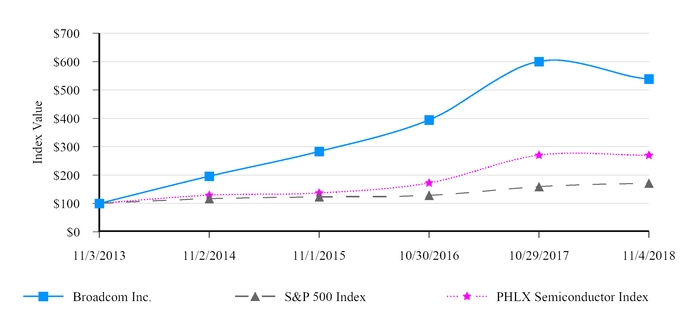
The following graph shows a comparison of cumulative total return for our common stock, the Standard & Poor’s 500 Stock Index, or S&P 500 Index, and the Philadelphia Semiconductor Index, or PHLX Semiconductor Index for the five fiscal years ended November 4, 2018. The total return graph and table assume that $100 was invested on November 1, 2013 (the last trading day of our fiscal year 2013) in each of Broadcom Inc. common stock, the S&P 500 Index and the PHLX Semiconductor Index and assume all dividends are reinvested. Indexes are calculated on a month-end basis.
The comparisons in the graph below are based on historical data and are not indicative of, or intended to forecast, the possible future performance of our common stock.
Comparison of Five Year Cumulative Total Return
Among Broadcom Inc., the S&P 500 Index and the PHLX Semiconductor Index
| November 3, 2013 | November 2, 2014 | November 1, 2015 | October 30, 2016 | October 29, 2017 | November 4, 2018 | |||||||||||||||||||
| Broadcom Inc. | $ | 100.00 | $ | 196.10 | $ | 283.46 | $ | 394.74 | $ | 600.59 | $ | 538.98 | ||||||||||||
| S&P 500 Index | $ | 100.00 | $ | 116.93 | $ | 123.01 | $ | 128.57 | $ | 159.28 | $ | 171.34 | ||||||||||||
| PHLX Semiconductor Index | $ | 100.00 | $ | 128.98 | $ | 136.60 | $ | 172.14 | $ | 270.13 | $ | 269.76 |
The graph and the table above shall not be deemed “filed” with the SEC for the purposes of Section 18 of the Exchange Act or otherwise subject to the liabilities of that section, nor shall it be deemed incorporated by reference in any filing made by us with the SEC, regardless of any general incorporation language in such filing.
Securities Authorized for Issuance Under Equity Compensation Plans
The information required by this item regarding securities authorized for issuance under equity compensation plans is incorporated herein by reference to the definitive Proxy Statement for our 2019 annual meeting of stockholders to be filed with the SEC within 120 days after the end of fiscal year 2018.
Item 6. SELECTED FINANCIAL DATA
The following table sets forth the selected consolidated financial data for Broadcom and should be read in conjunction with our annual consolidated financial statements and related notes and information included under the headings “Risk Factors” and “Management’s Discussion and Analysis of Financial Condition and Results of Operations” included elsewhere in this Annual Report on Form 10-K.
| Summary of Five Year Selected Financial Data | ||||||||||||||||||||
| Fiscal Year Ended (1) | ||||||||||||||||||||
| November 4, 2018 | October 29, 2017 | October 30, 2016 | November 1, 2015 | November 2, 2014 | ||||||||||||||||
| (In millions, except per share data) | ||||||||||||||||||||
| Statement of Operations Data: (2) | ||||||||||||||||||||
| Net revenue | $ | 20,848 | $ | 17,636 | $ | 13,240 | $ | 6,824 | $ | 4,269 | ||||||||||
| Gross margin (3) | $ | 10,733 | $ | 8,509 | $ | 5,940 | $ | 3,553 | $ | 1,877 | ||||||||||
| Operating expenses (3) (4) | $ | 5,598 | $ | 6,126 | $ | 6,349 | $ | 1,921 | $ | 1,439 | ||||||||||
| Income (loss) from continuing operations before income taxes | $ | 4,545 | $ | 1,825 | $ | (1,107 | ) | $ | 1,467 | $ | 342 | |||||||||
| Provision for (benefit from) income taxes (5) | $ | (8,084 | ) | $ | 35 | $ | 642 | $ | 76 | $ | 33 | |||||||||
| Income (loss) from continuing operations | $ | 12,629 | $ | 1,790 | $ | (1,749 | ) | $ | 1,391 | $ | 309 | |||||||||
| Net income (loss) | $ | 12,610 | $ | 1,784 | $ | (1,861 | ) | $ | 1,364 | $ | 263 | |||||||||
| Net income (loss) attributable to common stock | $ | 12,259 | $ | 1,692 | $ | (1,739 | ) | $ | 1,364 | $ | 263 | |||||||||
| Diluted income (loss) per share: | ||||||||||||||||||||
| Income (loss) per share from continuing operations | $ | 28.48 | $ | 4.03 | $ | (4.57 | ) | $ | 4.95 | $ | 1.16 | |||||||||
| Loss per share from discontinued operations | (0.04 | ) | (0.01 | ) | (0.29 | ) | (0.10 | ) | (0.17 | ) | ||||||||||
| Net income (loss) per share | $ | 28.44 | $ | 4.02 | $ | (4.86 | ) | $ | 4.85 | $ | 0.99 | |||||||||
| Cash dividends declared and paid per share | $ | 7.00 | $ | 4.08 | $ | 1.94 | $ | 1.55 | $ | 1.13 |
| November 4, 2018 | October 29, 2017 | October 30, 2016 | November 1, 2015 | November 2, 2014 | ||||||||||||||||
| (In millions) | ||||||||||||||||||||
| Balance Sheet Data: (2) | ||||||||||||||||||||
| Cash and cash equivalents | $ | 4,292 | $ | 11,204 | $ | 3,097 | $ | 1,822 | $ | 1,604 | ||||||||||
| Total assets | $ | 50,124 | $ | 54,418 | $ | 49,966 | $ | 10,515 | $ | 10,376 | ||||||||||
| Debt and capital lease obligations | $ | 17,493 | $ | 17,569 | $ | 13,642 | $ | 3,872 | $ | 5,395 | ||||||||||
| Total equity | $ | 26,657 | $ | 23,186 | $ | 21,876 | $ | 4,714 | $ | 3,243 |
| (1) | Our fiscal year ends on the Sunday closest to October 31 in a 52-week year and on the first Sunday in November in a 53-week year. Our fiscal year ended November 4, 2018 was a 53-week fiscal year. All other fiscal years presented included 52 weeks. |
| (2) | On November 17, 2017, we acquired Brocade for total consideration of approximately $6.0 billion. On February 1, 2016, we acquired BRCM for total consideration of approximately $35.7 billion. On May 5, 2015, we acquired Emulex Corporation for total consideration of approximately $587 million. On August 12, 2014, we acquired PLX Technology, Inc. for total consideration of approximately $308 million. On May 6, 2014, we acquired LSI for total consideration of approximately $6.5 billion. Our financial statements included the results of operations of the acquired companies and estimated fair value of assets acquired and liabilities assumed commencing as of their respective acquisition dates. |
| (3) | We incurred acquisition-related costs and restructuring charges which were presented as part of both cost of products sold and operating expenses. Restructuring charges primarily reflect actions taken to implement planned cost reduction and restructuring activities in connection with each acquisition. |
| (4) | In connection with our acquisition of BRCM in fiscal year 2016, amortization of acquisition-related intangible assets increased $1,624 million contributing to over 30 percent of the overall increase in operating expenses for fiscal year 2016. |
| (5) | Our benefit from income taxes for fiscal year 2018 was primarily a result of the enactment of the 2017 Tax Reform Act, the Redomiciliation Transaction and income from continuing operations. For fiscal years 2017, 2016, 2015 and 2014, our provision for income taxes fluctuated mainly due to changes in the jurisdictional mix of income. |
Item 7. MANAGEMENT’S DISCUSSION AND ANALYSIS OF FINANCIAL CONDITION AND RESULTS OF OPERATIONS
This Management’s Discussion and Analysis of Financial Condition and Results of Operations should be read in conjunction with “Selected Financial Data” and our consolidated financial statements and notes thereto which appear elsewhere in this Annual Report on Form 10-K. This discussion may contain forward-looking statements based upon current expectations that involve risks and uncertainties. Our actual results may differ materially from those anticipated in these forward-looking statements as a result of various factors, including those set forth under the caption “Risk Factors” or in other parts of this Annual Report on Form 10-K.
Overview
Broadcom Inc., or Broadcom, is a global technology leader that designs, develops and supplies a broad range of semiconductor and infrastructure software solutions.
We develop semiconductor devices with a focus on complex digital and mixed signal complementary metal oxide semiconductor based devices and analog III-V based products. We have a history of innovation and offer thousands of products that are used in end products such as enterprise and data center networking, home connectivity, set-top boxes, broadband access, telecommunication equipment, smartphones and base stations, data center servers and storage systems, factory automation, power generation and alternative energy systems, and electronic displays. Through our fiscal year ended November 4, 2018, or fiscal year 2018, we had four reportable segments: wired infrastructure, wireless communications, enterprise storage and industrial & other.
Original equipment manufacturers, or OEMs, or their contract manufacturers, and distributors typically account for the substantial majority of our semiconductor sales. We have established strong relationships with leading OEM customers across multiple target markets and we have a direct sales force focused on supporting large OEMs. We also distribute a substantial portion of our products through our broad distribution network, and a significant amount of these sales are to large global electronic components distributors.
The demand for our semiconductor products has been affected in the past, and is likely to continue to be affected in the future, by various factors, including the following:
| • | general economic and market conditions in the semiconductor industry and in our target markets; |
| • | our ability to define specifications for, develop or acquire, complete, introduce and market new products and technologies in a cost-effective and timely manner; |
| • | the timing, rescheduling or cancellation of expected customer orders; |
| • | the rate at which our present and future customers and end-users adopt our products and technologies in our target markets, and the rate at which our customers' products that include our technology are accepted in their markets; and |
| • | the qualification, availability and pricing of competing products and technologies and the resulting effects on sales and pricing of our products. |
Uncertainty in global economic conditions pose significant risks to our business. For example, customers may defer purchases in response to tighter credit and negative financial news, which would in turn adversely affect product demand and our results of operations.
Our fiscal year 2018 was a 53-week fiscal year compared to our fiscal year ended October 29, 2017, or fiscal year 2017, and our fiscal year ended October 30, 2016, or fiscal year 2016, which were 52-week fiscal years. The additional week in the first quarter of fiscal year 2018 resulted in higher net revenue, gross margin dollars, research and development expense, and selling general and administrative expense for fiscal year 2018, compared to the corresponding prior year periods.
Fiscal Year Highlights
Highlights during fiscal year 2018 include the following:
| • | We generated $8,880 million of cash from operations. |
| • | We paid $7,258 million to repurchase shares of our common stock and $2,998 million for cash dividends and distributions. |
| • | The income tax benefit of $8,084 million recognized primarily resulted from income tax benefits realized from the enactment of the U.S. Tax Cuts and Jobs Act, or the 2017 Tax Reform Act, and the impact of the Redomiciliation Transaction as defined below. |
| • | We completed Redomiciliation Transaction discussed in more detail below, which caused the publicly traded parent company of Broadcom to be a Delaware corporation. |
| • | On November 17, 2017, we completed the acquisition of Brocade Communication Systems Inc., or Brocade, for aggregate consideration of approximately $6.0 billion, or the Brocade Merger. |
Redomiciliation to the United States from Singapore
As part of the plan to cause the publicly traded parent company of the Broadcom group of companies to be a Delaware corporation, after the close of market trading on April 4, 2018, Broadcom and Broadcom Limited, or Broadcom-Singapore, completed a statutory scheme of arrangement under Singapore law pursuant to which all Broadcom-Singapore outstanding ordinary shares were exchanged on a one-for-one basis for newly issued shares of Broadcom common stock and Broadcom-Singapore became an indirect wholly-owned subsidiary of Broadcom. This transaction is referred to as the Redomiciliation Transaction.
The financial information and results of operations in this Form 10-K for periods prior to April 4, 2018 relate to our predecessors, Broadcom-Singapore and Avago Technologies Limited, for accounting and financial reporting purposes and relate to Broadcom for periods after April 4, 2018, the effective date of the Redomiciliation Transaction.
In conjunction with the Redomiciliation Transaction, all outstanding exchangeable limited partnership units, or LP Units, of Broadcom Cayman L.P., or the Partnership, a subsidiary of Broadcom-Singapore, were mandatorily exchanged on a one-for-one basis for newly issued shares of Broadcom common stock. As a result, all the limited partners became common stockholders of Broadcom and Broadcom-Singapore redeemed all related outstanding special preference shares. Consequently, the limited partners no longer hold a noncontrolling interest in the Partnership and we subsequently deregistered the Partnership.
Recent Developments
Acquisition of CA, Inc.
On November 5, 2018, or the CA Merger Date, we acquired CA, Inc., or CA, for approximately $18.8 billion in aggregate cash purchase consideration, in exchange for all shares of CA common stock issued and outstanding immediately prior to the closing and assumed $2.25 billion of outstanding unsecured bonds, or the CA Merger. In addition, we assumed all unvested CA stock options, outstanding restricted stock awards, restricted stock units, or RSUs, and performance stock units held by continuing employees. All vested in-the-money CA stock options and director stock units were cashed out upon the completion of the CA Merger. We financed the CA Merger with $18 billion from borrowings under a term A facility entered into on the CA Merger Date, as well as cash on hand of the combined companies. See Note 16. “Subsequent Events” included in Part II, Item 8. of this Annual Report on Form 10-K for further detail.
We expect our reporting segments to change beginning in the first quarter of fiscal year 2019, as a result of the CA Merger that closed on November 5, 2018, the first day of our fiscal year 2019.
In connection with the CA Merger, we entered into a definitive agreement to sell Veracode, Inc., a wholly owned subsidiary of CA and provider of application security testing solutions, to Thoma Bravo, LLC for cash consideration of $950 million.
The discussions below related to our business, reporting segments and financial resu
Showing the first 8K of 85K characters. Open the full section
Item 7A. QUANTITATIVE AND QUALITATIVE DISCLOSURES ABOUT MARKET RISK
Foreign Currency Derivative Instruments
We use foreign exchange forward contracts to hedge a portion of our exposures to changes in currency exchange rates, which result from our global operating and financing activities. Gains and losses from foreign currency transactions, as well as derivative instruments, were not significant for any period presented in the consolidated financial statements included in this Form 10-K. As of November 4, 2018, we did not have any outstanding foreign exchange forward contracts.
European Debt Exposures
We actively monitor our exposure to the European financial markets, including the impact of sovereign debt issues. We also seek to mitigate our risk by investing in fixed deposits with various financial institutions and we limit the amount we hold with any one institution. We do not have any direct investments in the sovereign debt of European countries. From time to time, we may have deposits with major European financial institutions. We also seek to mitigate collection risks from our customers by performing regular credit evaluations of our customers’ financial condition and require collateral, such as letters of credit and bank guarantees, in certain circumstances. As of November 4, 2018, we do not believe that we have any material direct or indirect exposure to the European financial markets.
Item 8. FINANCIAL STATEMENTS AND SUPPLEMENTARY DATA
BROADCOM INC.
INDEX TO CONSOLIDATED FINANCIAL STATEMENTS
REPORT OF INDEPENDENT REGISTERED PUBLIC ACCOUNTING FIRM
To the Board of Directors and Stockholders of Broadcom Inc.
Opinions on the Financial Statements and Internal Control over Financial Reporting
We have audited the accompanying consolidated balance sheets of Broadcom Inc. and its subsidiaries (the “Company”) as of November 4, 2018 and October 29, 2017, and the related consolidated statements of operations, comprehensive income (loss), cash flows and equity for each of the three years in the period ended November 4, 2018, including the related notes and financial statement schedule listed in the index appearing under Item 15(a)(2) (collectively referred to as the “consolidated financial statements”). We also have audited the Company's internal control over financial reporting as of November 4, 2018, based on criteria established in Internal Control - Integrated Framework (2013) issued by the Committee of Sponsoring Organizations of the Treadway Commission (COSO).
In our opinion, the consolidated financial statements referred to above present fairly, in all material respects, the financial position of the Company as of November 4, 2018 and October 29, 2017, and the results of its operations and its cash flows for each of the three years in the period ended November 4, 2018 in conformity with accounting principles generally accepted in the United States of America. Also in our opinion, the Company maintained, in all material respects, effective internal control over financial reporting as of November 4, 2018, based on criteria established in Internal Control - Integrated Framework (2013) issued by the COSO.
Basis for Opinions
The Company's management is responsible for these consolidated financial statements, for maintaining effective internal control over financial reporting, and for its assessment of the effectiveness of internal control over financial reporting, included in Management's Report on Internal Control over Financial Reporting appearing under Item 9A. Our responsibility is to express opinions on the Company’s consolidated financial statements and on the Company's internal control over financial reporting based on our audits. We are a public accounting firm registered with the Public Company Accounting Oversight Board (United States) (PCAOB) and are required to be independent with respect to the Company in accordance with the U.S. federal securities laws and the applicable rules and regulations of the Securities and Exchange Commission and the PCAOB.
We conducted our audits in accordance with the standards of the PCAOB. Those standards require that we plan and perform the audits to obtain reasonable assurance about whether the consolidated financial statements are free of material misstatement, whether due to error or fraud, and whether effective internal control over financial reporting was maintained in all material respects.
Our audits of the consolidated financial statements included performing procedures to assess the risks of material misstatement of the consolidated financial statements, whether due to error or fraud, and performing procedures that respond to those risks. Such procedures included examining, on a test basis, evidence regarding the amounts and disclosures in the consolidated financial statements. Our audits also included evaluating the accounting principles used and significant estimates made by management, as well as evaluating the overall presentation of the consolidated financial statements. Our audit of internal control over financial reporting included obtaining an understanding of internal control over financial reporting, assessing the risk that a material weakness exists, and testing and evaluating the design and operating effectiveness of internal control based on the assessed risk. Our audits also included performing such other procedures as we considered necessary in the circumstances. We believe that our audits provide a reasonable basis for our opinions.
Definition and Limitations of Internal Control over Financial Reporting
A company’s internal control over financial reporting is a process designed to provide reasonable assurance regarding the reliability of financial reporting and the preparation of financial statements for external purposes in accordance with generally accepted accounting principles. A company’s internal control over financial reporting includes those policies and procedures that (i) pertain to the maintenance of records that, in reasonable detail, accurately and fairly reflect the transactions and dispositions of the assets of the company; (ii) provide reasonable assurance that transactions are recorded as necessary to permit preparation of financial statements in accordance with generally accepted accounting principles, and that receipts and expenditures of the company are being made only in accordance with authorizations of management and directors of the company; and (iii) provide reasonable assurance regarding prevention or timely detection of unauthorized acquisition, use, or disposition of the company’s assets that could have a material effect on the financial statements.
Because of its inherent limitations, internal control over financial reporting may not prevent or detect misstatements. Also, projections of any evaluation of effectiveness to future periods are subject to the risk that controls may become inadequate because of changes in conditions, or that the degree of compliance with the policies or procedures may deteriorate.
/s/ PricewaterhouseCoopers LLP
San Jose, California
December 21, 2018
We have served as the Company’s auditor since 2006
BROADCOM INC.
CONSOLIDATED BALANCE SHEETS
| November 4, 2018 | October 29, 2017 | |||||||
| (In millions, except par value) | ||||||||
| ASSETS | ||||||||
| Current assets: | ||||||||
| Cash and cash equivalents | $ | 4,292 | $ | 11,204 | ||||
| Trade accounts receivable, net | 3,325 | 2,448 | ||||||
| Inventory | 1,124 | 1,447 | ||||||
| Other current assets | 366 | 724 | ||||||
| Total current assets | 9,107 | 15,823 | ||||||
| Long-term assets: | ||||||||
| Property, plant and equipment, net | 2,635 | 2,599 | ||||||
| Goodwill | 26,913 | 24,706 | ||||||
| Intangible assets, net | 10,762 | 10,832 | ||||||
| Other long-term assets | 707 | 458 | ||||||
| Total assets | $ | 50,124 | $ | 54,418 | ||||
| LIABILITIES AND EQUITY | ||||||||
| Curr |
Showing the first 8K of 257K characters. Open the full section
Item 9. CHANGES IN AND DISAGREEMENTS WITH ACCOUNTANTS ON ACCOUNTING AND FINANCIAL DISCLOSURE
Not applicable.
Item 9A. CONTROLS AND PROCEDURES
Evaluation of Disclosure Controls and Procedures.
Our management, with the participation of our Chief Executive Officer, or CEO, and Chief Financial Officer, or CFO, evaluated the effectiveness of Broadcom’s disclosure controls and procedures as of November 4, 2018. The term “disclosure controls and procedures,” as defined in Rules 13a-15(e) and 15d-15(e) under the Exchange Act, means controls and other procedures of a company that are designed to ensure that information required to be disclosed by a company in the reports that it files or submits under the Exchange Act is recorded, processed, summarized and reported within the time periods specified in the SEC’s rules and forms. Disclosure controls and procedures include, without limitation, controls and procedures designed to ensure that information required to be disclosed by a company in the reports that it files or submits under the Exchange Act is accumulated and communicated to our management, including its principal executive and principal financial officers, as appropriate to allow timely decisions regarding required disclosure. Management recognizes that any controls and procedures, no matter how well designed and operated, can provide only reasonable assurance of achieving their objectives and management necessarily applies its judgment in evaluating the cost-benefit relationship of possible controls and procedures. Based on the evaluation of our disclosure controls and procedures as of November 4, 2018, our CEO and CFO concluded that, as of such date, our disclosure controls and procedures were effective at the reasonable assurance level.
Management’s Report on Internal Control Over Financial Reporting.
Our management is responsible for establishing and maintaining adequate internal control over financial reporting. Internal control over financial reporting is defined in Rules 13a-15(f) and 15d-15(f) promulgated under the Exchange Act as a process designed by, or under the supervision of, our principal executive and principal financial officers and effected by the Board, management and other personnel, to provide reasonable assurance regarding the reliability of financial reporting and the preparation of financial statements for external purposes in accordance with GAAP and includes those policies and procedures that:
| • | pertain to the maintenance of records that in reasonable detail accurately and fairly reflect the transactions and dispositions of the assets; |
| • | provide reasonable assurance that transactions are recorded as necessary to permit preparation of financial statements in accordance with GAAP, and that receipts and expenditures of us are being made only in accordance with authorizations of management and directors; and |
| • | provide reasonable assurance regarding prevention or timely detection of unauthorized acquisition, use or disposition of our assets that could have a material effect on the financial statements. |
Because of its inherent limitations, internal control over financial reporting may not prevent or detect misstatements. Projections of any evaluation of effectiveness to future periods are subject to the risk that controls may become inadequate because of changes in conditions, or that the degree of compliance with the policies or procedures may deteriorate.
Our management assessed the effectiveness of our internal control over financial reporting as of November 4, 2018. In making this assessment, our management used the criteria set forth by the Committee of Sponsoring Organizations of the Treadway Commission (COSO) in Internal Control-Integrated Framework (2013). Based on this assessment, our management concluded that, as of November 4, 2018, our internal control over financial reporting is effective based on those criteria.
The effectiveness of our internal control over financial reporting, as of November 4, 2018 has been audited by PricewaterhouseCoopers LLP, an independent registered public accounting firm, as stated in their report which is included in Part II, Item 8. of this Annual Report on Form 10-K.
Changes in Internal Control over Financial Reporting.
No change in our internal control over financial reporting (as defined in Rules 13a-15(f) and 15d-15(f) under the Exchange Act) occurred during the fiscal quarter ended November 4, 2018 that has materially affected, or is reasonably likely to materially affect, our internal control over financial reporting.
Item 9B. OTHER INFORMATION
None.
PART III
Item 10. DIRECTORS, EXECUTIVE OFFICERS AND CORPORATE GOVERNANCE
The information regarding our directors, executive officers and compliance with Section 16(a) of the Exchange Act, set forth in the sections entitled “Proposal 1 — Election of Directors,” “Executive Officers,” “Corporate Governance” and “Section 16(a) Beneficial Ownership Reporting Compliance,” in our definitive Proxy Statement for our 2019 Annual Meeting of Stockholders to be filed with the SEC within 120 days of the end of our 2018 fiscal year pursuant to General Instruction G(3) to Form 10-K is hereby incorporated by reference in this section.
We have adopted a written Code of Ethics and Business Conduct that applies to all of our employees and directors, including our principal executive officer, principal financial officer and principal accounting officer, or persons performing similar functions and have posted it in the “Investors Center — Governance” section of our website, which is located at www.broadcom.com. We intend to satisfy any disclosure requirement under Item 5.05 of Form 8-K regarding any amendments to, or waivers from, our Code of Ethics and Business Conduct by posting such information on our website at the internet address and location above.
Item 11. EXECUTIVE COMPENSATION
The information regarding executive compensation required by this Item 11 set forth in the sections entitled “Director Compensation”, “Compensation Discussion and Analysis,” “Executive Compensation,” “Compensation Committee Report” and “Corporate Governance — Compensation Committee Interlocks and Insider Participation" in our definitive Proxy Statement for our 2019 Annual Meeting of Stockholders to be filed with the SEC within 120 days of the end of our 2018 fiscal year pursuant to General Instruction G(3) to Form 10-K is hereby incorporated by reference in this section. However, the Compensation Committee Report included in such definitive Proxy Statement shall not be deemed “filed” with the SEC for the purposes of Section 18 of the Exchange Act or otherwise subject to the liabilities of that section, nor shall it be deemed incorporated by reference in any filing made by us with the SEC, regardless of any general incorporation language in such filing.
Item 12. SECURITY OWNERSHIP OF CERTAIN BENEFICIAL OWNERS AND MANAGEMENT AND RELATED STOCKHOLDER MATTERS
The information regarding security ownership of certain beneficial owners and management and related stockholder matters required by this Item 12 set forth in the section entitled “Security Ownership of Certain Beneficial Owners, Directors and Executive Officers” and “Equity Compensation Plan Information” in our definitive Proxy Statement for our 2019 Annual Meeting of Stockholders to be filed with the SEC within 120 days of the end of our 2018 fiscal year pursuant to General Instruction G(3) to Form 10-K is hereby incorporated by reference in this section.
Item 13. CERTAIN RELATIONSHIPS AND RELATED TRANSACTIONS, AND DIRECTOR INDEPENDENCE
The information regarding certain relationships, related transactions and director independence required by this Item 13 set forth in the sections entitled “Corporate Governance” and “Certain Relationships and Related Party Transactions” in our definitive Proxy Statement for our 2019 Annual Meeting of Stockholders to be filed with the SEC within 120 days of the end of our 2018 fiscal year pursuant to General Instruction G(3) to Form 10-K is hereby incorporated by reference in this section.
Item 14. PRINCIPAL ACCOUNTING FEES AND SERVICES
The information regarding principal accounting fees and services required by this Item 14 set forth in the proposal relating to the re-appointment of our independent registered public accounting firm in our definitive Proxy Statement for our 2019 Annual Meeting of Stockholders to be filed with the SEC within 120 days of the end of our 2018 fiscal year pursuant to General Instruction G(3) to Form 10-K is hereby incorporated by reference in this section.
PART IV
Item 15. EXHIBITS, FINANCIAL STATEMENT SCHEDULES
(a) The following are filed as part of this Annual Report on Form 10-K:
- Financial Statements
The following consolidated financial statements are included in Item 8 of this Annual Report on Form 10-K:
- Financial Statement Schedules
The financial statement schedule of the Registrant and its subsidiaries for fiscal years 2018, 2017 and 2016 required by Item 15(a) (Schedule II, Valuation and Qualifying Accounts) is included in Item 8 of this Annual Report on Form 10-K:
| Page | |
| Schedule II - Valuation and Qualifying Accounts | 109 |
Schedules not filed have been omitted because they are not applicable, are not required or the information required to be set forth therein is included in the financial statements or notes thereto.
- Exhibits
The documents set forth below are filed herewith or incorporated by reference to the location indicated.
| Exhibit No. | Incorporated by Referenced Herein | Filed Herewith | ||||||
| Description | Form | Filing Date | ||||||
| 3.1 | Amended and Restated Certificate of Incorporation. | Broadcom Inc. Current Report on Form 8-K12B (Commission File No. 001-38449) | April 4, 2018 | |||||
| 3.2 | Amended and Restated Bylaws. | Broadcom Inc. Current Report on Form 8-K12B (Commission File No. 001-38449) | April 4, 2018 | |||||
| 4.1 | Form of Common Stock Certificate. | Broadcom Inc. Quarterly Report on Form 10-Q (Commission File No. 001-34889) | June 14, 2018 | |||||
| 4.2 | Indenture, dated as of January 19, 2017, by and among the Broadcom Corporation and Broadcom Cayman Finance Limited (“Co-Issuers”), the Company, Broadcom Cayman L.P., and BC Luxembourg S.à r.l. (the “Guarantors”) and Wilmington Trust, National Association, as trustee. | Broadcom Limited Current Report on Form 8-K (Commission File No. 001-37690) | January 20, 2017 | |||||
| 4.3 | Supplement Indenture to the January 2017 Indenture, dated as of April 9, 2018. | Broadcom Inc. Current Report on Form 8-K (Commission File No. 001-34889) | April 9, 2018 | |||||
| 4.4 | Form of 2.375% Senior Note due 2020 (included in Exhibit 4.2). | Broadcom Limited Current Report on Form 8-K (Commission File No. 001-37690) | January 20, 2017 | |||||
| 4.5 | Form of 3.000% Senior Note due 2022 (included in Exhibit 4.2). | Broadcom Limited Current Report on Form 8-K (Commission File No. 001-37690) | January 20, 2017 | |||||
| 4.6 | Form of 3.625% Senior Note due 2024 (included in Exhibit 4.2). | Broadcom Limited Current Report on Form 8-K (Commission File No. 001-37690) | January 20, 2017 | |||||
| 4.7 | Form of 3.875% Senior Note due 2027 (included in Exhibit 4.2). | Broadcom Limited Current Report on Form 8-K (Commission File No. 001-37690) | January 20, 2017 | |||||
| 4.8 | Indenture, dated as of October 17, 2017, by and among the Co-Issuers, the Company and Broadcom Cayman L.P., (the “October Guarantors”) and Wilmington Trust, National Association, as trustee. | Broadcom Limited Current Report on Form 8-K (Commission File No. 001-37690) | October 17, 2017 | |||||
| 4.9 | Supplement Indenture to October 2017 Indenture, dated as of April 9, 2018. | Broadcom Inc. Current Report on Form 8-K (Commission File No. 001-38449) | April 9, 2018 | |||||
| 4.10 | Form of 2.200% Senior Note due 2021 (included in Exhibit 4.8). | Broadcom Limited Current Report on Form 8-K (Commission File No. 001-37690) | October 17, 2017 | |||||
| 4.11 | Form of 2.650% Senior Note due 2023 (included in Exhibit 4.8). | Broadcom Limited Current Report on Form 8-K (Commission File No. 001-37690) | October 17, 2017 | |||||
| 4.12 | Form of 3.125% Senior Note due 2025 (included in Exhibit 4.8). | Broadcom Limited Current Report on Form 8-K (Commission File No. 001-37690) | October 17, 2017 | |||||
| 4.13 | Form of 3.500% Senior Note due 2028 (included in Exhibit 4.8). | Broadcom Limited Current Report on Form 8-K (Commission File No. 001-37690) | October 17, 2017 | |||||
| 4.14 | Voting Agreement, dated July 11, 2018, by and among Broadcom Inc., Collie Acquisition Corp., Careal Property Group AG, BigPoint Holding AG, Martin Haefner and Eva Maria Bucher-Haefner. | Broadcom Inc. Current Report on Form 8-K (Commission File No. 001-34889) | July 12, 2018 | |||||
| 10.1 | Form of Indemnification and Advancement Agreement (effective April 4, 2018). | Broadcom Inc. Current Report on Form 8-K12B (Commission File No. 001-38449) | April 4, 2018 |
Notes:
| + | Indicates a management contract or compensatory plan or arrangement. | |
| # | Schedules have been omitted pursuant to Item 601(b)(2) of Regulation S-K. Broadcom Inc. hereby undertakes to furnish supplementally copies of any omitted schedules upon request by the SEC. | |
| * | Certain information omitted pursuant to a request for confidential treatment filed with the SEC. |
SIGNATURES
Pursuant to the requirements of Section 13 or 15(d) of the Securities Exchange Act of 1934, the Registrant has duly caused this report to be signed on its behalf by the undersigned, thereunto duly authorized.
| BROADCOM INC. | |||
| By: | /s/ Hock E. Tan | ||
| Name: | Hock E. Tan | ||
| Title: | President and Chief Executive Officer |
Date: December 21, 2018
POWER OF ATTORNEY
Each person whose individual signature appears below hereby authorizes and appoints Hock E. Tan, Thomas H. Krause, Jr., Mark D. Brazeal and Kirsten M. Spears, and each of them, with full power of substitution and resubstitution and full power to act without the other, as his or her true and lawful attorney-in-fact and agent to act in his or her name, place and stead and to execute in the name and on behalf of each person, individually and in each capacity stated below, and to file any and all amendments to this Annual Report on Form 10-K, and to file the same, with all exhibits thereto, and other documents in connection therewith, with the Securities and Exchange Commission, granting unto said attorneys-in-fact and agents, and each of them, full power and authority to do and perform each and every act and thing, ratifying and confirming all that said attorneys-in-fact and agents or any of them or their or his substitute or substitutes may lawfully do or cause to be done by virtue thereof.
Pursuant to the requirements of the Securities Exchange Act of 1934, this Annual Report on Form 10-K has been signed by the following persons on behalf of the Registrant in the capacities indicated and on the dates indicated.
| Signature | Title | Date | ||
| /s/ Hock E. Tan | President and Chief Executive Officer and Director (Principal Executive Officer) | December 21, 2018 | ||
| Hock E. Tan | ||||
| /s/ Thomas H. Krause, Jr. | Chief Financial Officer (Principal Financial Officer) | December 21, 2018 | ||
| Thomas H. Krause, Jr. | ||||
| /s/ Kirsten M. Spears | Principal Accounting Officer | December 21, 2018 | ||
| Kirsten M. Spears | ||||
| /s/ Henry Samueli | Chairman of the Board of Directors | December 21, 2018 | ||
| Henry Samueli | ||||
| /s/ Eddy W. Hartenstein | Lead Independent Director | December 21, 2018 | ||
| Eddy W. Hartenstein | ||||
| /s/ Gayla J. Delly | Director | December 21, 2018 | ||
| Gayla J. Delly | ||||
| /s/ James Diller Sr. | Director | December 21, 2018 | ||
| James Diller Sr. | ||||
| /s/ Lewis C. Eggebrecht | Director | December 21, 2018 | ||
| Lewis C. Eggebrecht | ||||
| Director | ||||
| Check Kian Low | ||||
| /s/ Donald Macleod | Director | December 21, 2018 | ||
| Donald Macleod | ||||
| /s/ Peter J. Marks | Director | December 21, 2018 | ||
| Peter J. Marks | ||||