 filings.tools
American Water Works 10-K 2016-12-31
Filed 2017-02-21. 22 sections, 551K characters. Original on sec.gov · Markdown · JSON
Cover and table of contents
10-K 1 awk-10k_20161231.htm AWK-10K-20161231
UNITED STATES
SECURITIES AND EXCHANGE COMMISSION
Washington, D.C. 20549
FORM 10-K
| ☒ | ANNUAL REPORT PURSUANT TO SECTION 13 OR 15(d) OF THE SECURITIES EXCHANGE ACT OF 1934 |
|---|
For the fiscal year ended December 31, 2016
OR
| ☐ | TRANSITION REPORT PURSUANT TO SECTION 13 OR 15(d) OF THE SECURITIES EXCHANGE ACT OF 1934 |
|---|
For the transition period from to
Commission file: number 001-34028
AMERICAN WATER WORKS COMPANY, INC.
(Exact name of registrant as specified in its charter)
| Delaware | 51-0063696 | |
|---|---|---|
| (State or other jurisdiction of incorporation or organization) | (I.R.S. Employer Identification No.) | |
| 1025 Laurel Oak Road, Voorhees, NJ | 08043 | |
| (Address of principal executive offices) | (Zip Code) |
(856) 346-8200
(Registrant’s telephone number, including area code)
Securities registered pursuant to Section 12(b) of the Act:
| Title of each class | Name of each exchange on which registered | |
|---|---|---|
| Common stock, par value $0.01 per share | New York Stock Exchange, Inc. |
Securities registered pursuant to Section 12(g) of the Act:
None.
Indicate by check mark if the registrant is a well-known seasoned issuer, as defined in Rule 405 of the Securities Act. Yes ☒ No ☐
Indicate by check mark if the registrant is not required to file reports pursuant to Section 13 or Section 15(d) of the Act. Yes ☐ No ☒
Indicate by check mark whether the registrant (1) has filed all reports required to be filed by Section 13 or 15(d) of the Securities Exchange Act of 1934 during the preceding 12 months (or for such shorter period that the registrant was required to file such reports), and (2) has been subject to such filing requirements for the past 90 days. Yes ☒ No ☐
Indicate by check mark whether the registrant has submitted electronically and posted on its corporate Web site, if any, every Interactive Data File required to be submitted and posted pursuant to Rule 405 of Regulation S-T (§ 232.405 of this chapter) during the preceding 12 months (or for such shorter period that the registrant was required to submit and post such files). Yes ☒ No ☐
Indicate by check mark if disclosure of delinquent filers pursuant to Item 405 of Regulation S-K is not contained herein, and will not be contained, to the best of registrant’s knowledge, in definitive proxy or information statements incorporated by reference in Part III of this Form 10-K or any amendment to this Form 10-K. ☒
Indicate by check mark whether the registrant is a large accelerated filer, an accelerated filer, a non-accelerated filer or a smaller reporting company. See the definitions of “large accelerated filer,” “accelerated filer” and “small reporting company” in Rule 12b-2 of the Exchange Act.:
| Large accelerated filer | ☒ | Accelerated filer | ☐ | |||
|---|---|---|---|---|---|---|
| Non-accelerated filer | ☐ | Small reporting company | ☐ |
Indicate by check mark whether the registrant is a shell company (as defined in Rule 12b-2 of the Act). Yes ☐ No ☒
State the aggregate market value of the voting and non-voting common equity held by non-affiliates computed by reference to the price at which the common equity was last sold, or the average bid and asked price of such common equity, as of the last business day of the registrant’s most recently completed second fiscal quarter.
Common Stock, $0.01 par value—$13,463,200,000 as of June 30, 2016 (solely for purposes of calculating this aggregate market value, American Water has defined its affiliates to include (i) those persons who were, as of June 30, 2016, its executive officers, directors or known beneficial owners of more than 10% of its common stock, and (ii) such other persons who were deemed, as of June 30, 2016, to be controlled by, or under common control with, American Water or any of the persons described in clause (i) above).
Indicate the number of shares outstanding of each of the registrant’s classes of common stock as of the latest practicable date: Common Stock, $0.01 par value per share—178,214,748 shares as of February 16, 2017.
DOCUMENTS INCORPORATED BY REFERENCE
Portions of the American Water Works Company, Inc. definitive proxy statement for the 2017 Annual Meeting of Stockholders to be filed with the Securities and Exchange Commission within 120 days after December 31, 2016 are incorporated by reference into Part III of this report.
TABLE OF CONTENTS
FORWARD-LOOKING STATEMENTS
We have made statements in Item 1—Business, Item 1A—Risk Factors, and Item 7—Management’s Discussion and Analysis of Financial Condition and Results of Operations, and in other sections of this Annual Report on Form 10-K (“Form 10-K”), or incorporated certain statements by reference into this Form 10-K, that are forward-looking statements within the meaning of Section 27A of the Securities Act of 1933, as amended, Section 21E of the Securities Exchange Act of 1934, as amended (the “Exchange Act”), and the Private Securities Litigation Reform Act of 1995. In some cases, these forward-looking statements can be identified by words with prospective meanings such as “intend,” “plan,” “estimate,” “believe,” “anticipate,” “expect,” “predict,” “project,” “assume,” “forecast,” “outlook,” “future,” “pending,” “goal,” “objective,” “potential,” “continue,” “seek to,” “may,” “can,” “should,” “will” and “could” or the negative of such terms or other variations or similar expressions. Forward-looking statements may relate to, among other things, our future financial performance, including our operation and maintenance (“O&M”) efficiency ratio, cash flows, our growth and portfolio optimization strategies, our projected capital expenditures and related funding requirements, our ability to repay debt, our projected strategy to finance current operations and growth initiatives, the impact of legal proceedings and potential fines and penalties, business process and technology improvement initiatives, trends in our industry, regulatory, legislative, tax policy or legal developments or rate adjustments, including rate case filings, filings for infrastructure surcharges and filings to address regulatory lag.
Forward-looking statements are predictions based on our current expectations and assumptions regarding future events. They are not guarantees or assurances of any outcomes, financial results or levels of activity, performance or achievements, and you are cautioned not to place undue reliance upon them. These forward-looking statements are subject to a number of estimates and assumptions, and known and unknown risks, uncertainties and other factors. Our actual results may vary materially from those discussed in the forward-looking statements included herein as a result of the factors discussed under Item 1A—Risk Factors, and the following important factors:
| • | the decisions of governmental and regulatory bodies, including decisions to raise or lower rates; |
|---|
| • | the timeliness and outcome of regulatory commissions’ actions concerning rates, capital structure, authorized return on equity, capital investment, permitting and other decisions; |
|---|
| • | changes in customer demand for, and patterns of use of, water, such as may result from conservation efforts; |
|---|
| • | changes in laws, governmental regulations and policies, including environmental, health and safety, water quality, public utility and tax regulations and policies, and impacts resulting from U.S., state and local elections; |
|---|
| • | weather conditions, patterns, events or natural disasters, including drought or abnormally high rainfall, strong winds, coastal and intercoastal flooding, earthquakes, landslides, hurricanes, tornadoes, electrical storms and solar flares; |
|---|
| • | the outcome of litigation and government action related to the Freedom Industries chemical spill in West Virginia, including matters pertaining to the binding global agreement in principle to settle claims related to this chemical spill; |
|---|
| • | our ability to appropriately maintain current infrastructure, including our operational and information technology (IT) systems, and manage the expansion of our business; |
|---|
| • | exposure or infiltration of our critical infrastructure, operational technology and IT systems through physical or cyber attacks or other disruptions; |
|---|
| • | our ability to obtain permits and other approvals for projects; |
|---|
| • | changes in our capital requirements; |
|---|
| • | our ability to control operating expenses and to achieve efficiencies in our operations; |
|---|
| • | the intentional or unintentional actions of a third party, including contamination of our water supplies or water provided to our customers; |
|---|
| • | our ability to obtain adequate and cost-effective supplies of chemicals, electricity, fuel, water and other raw materials that are needed for our operations; |
|---|
| • | our ability to successfully meet growth projections for our business and capitalize on growth opportunities, including our ability to, among other things, acquire and integrate water and wastewater systems into our regulated operations, and enter into contracts and other agreements with, or otherwise obtain, new customers in our market-based businesses; |
|---|
| • | risks and uncertainties associated with contracting with the U.S. government, including ongoing compliance with applicable government procurement and security regulations; |
|---|
| • | cost overruns relating to improvements in or the expansion of our operations; |
|---|
| • | our ability to maintain safe work sites; |
|---|
| • | our exposure to liabilities related to environmental laws and similar matters resulting from, among other things, water and wastewater service provided to customers, including, for example, our water management solutions that are focused on customers in the natural gas exploration and production market; |
|---|
| • | changes in general economic, political, business and financial market conditions; |
|---|
| • | access to sufficient capital on satisfactory terms and when and as needed to support operations and capital expenditures; |
|---|
| • | fluctuations in interest rates; |
|---|
| • | restrictive covenants in or changes to the credit ratings on our current or future debt that could increase our financing costs or funding requirements or affect our ability to borrow, make payments on debt or pay dividends; |
|---|
| • | fluctuations in the value of benefit plan assets and liabilities that could increase our cost and funding requirements; |
|---|
| • | changes in federal or state income tax laws, including tax reform, the availability of tax credits and tax abatement programs, and our ability to utilize our U.S. and state net operating loss carryforwards; |
|---|
| • | migration of customers into or out of our service territories; |
|---|
| • | the use by municipalities of the power of eminent domain or other authority to condemn our systems; |
|---|
| • | difficulty in obtaining, or the inability to obtain, insurance at acceptable rates and on acceptable terms and conditions; |
|---|
| • | the incurrence of impairment charges related to our goodwill or other assets; |
|---|
| • | labor actions, including work stoppages and strikes; |
|---|
| • | the ability to retain and attract qualified employees; |
|---|
| • | civil disturbances or terrorist threats or acts, or public apprehension about future disturbances or terrorist threats or acts; and |
|---|
| • | the impact of new, and changes to existing, accounting standards. |
|---|
These forward-looking statements are qualified by, and should be read together with, the risks and uncertainties set forth above and the risk factors included in Item 1A—Risk Factors and other statements contained in this Form 10-K, and you should refer to such risks, uncertainties and risk factors in evaluating such forward-looking statements. Any forward-looking statements we make speak only as of the date this Form 10-K was filed with the United States Securities and Exchange Commission (“SEC”). Except as required by the federal securities laws, we do not have any obligation, and we specifically disclaim any undertaking or intention, to publicly update or revise any forward-looking statements, whether as a result of new information, future events, changed circumstances or otherwise. New factors emerge from time to time, and it is not possible for us to predict all such factors. Furthermore, it may not be possible to assess the impact of any such factor on our businesses, either viewed independently or together, or the extent to which any factor, or combination of factors, may cause results to differ materially from those contained in any forward-looking statement. The foregoing factors should not be construed as exhaustive.
PART I
Item 1. BUSINESS
| --- | --- |
Our Company
With a history dating back to 1886, American Water Works Company, Inc. is a holding company originally incorporated in Delaware in 1936. Through its subsidiaries, American Water is the largest and most geographically diverse investor-owned publicly-traded water and wastewater utility company in the United States, as measured by both operating revenues and population served. We also operate several market-based businesses that provide a broad range of related and complementary water and wastewater services. We employ approximately 6,800 professionals who provide drinking water, wastewater and other related services to an estimated 15 million people in 47 states, the District of Columbia and Ontario, Canada.
Throughout this Annual Report on Form 10-K, unless the context otherwise requires, references to “we,” “us,” “our,” the “Company,” and “American Water” mean American Water Works Company, Inc. and its subsidiaries, taken together as a whole.
Operating Segments
The largest component of the Company’s business includes rate regulated subsidiaries that provide water and wastewater services to customers in 16 states, collectively presented as our “Regulated Businesses”. We conduct the majority of our business through the Regulated Businesses segment. We also operate market-based businesses within four operating segments that individually do not meet the criteria of a reportable segment in accordance with generally accepted accounting principles in the United States (“GAAP”). These four non-reportable operating segments are collectively presented as our “Market-Based Businesses,” which is consistent with how management assesses the results of these businesses. Additional information can be found in Item 7—Management’s Discussion and Analysis of Financial Condition and Results of Operations and Note 19—Segment Information in the Notes to Consolidated Financial Statements.
Regulated Businesses
Our primary business involves the ownership of utilities that provide water and wastewater services to residential, commercial, industrial and other customers, including sale for resale and public authority customers. Our Regulated Businesses that provide these services operate in approximately 1,600 communities in 16 states in the United States and are generally subject to economic regulation by certain state utility commissions or other entities engaged in utility regulation, referred to as Public Utility Commissions (“PUCs”). Certain federal and state governments also regulate environmental, health and safety, and water quality matters. We report the results of the services provided by our utilities in our Regulated Businesses segment.
Our Regulated Businesses segment’s operating revenues were $2,871 million for 2016, $2,743 million for 2015 and $2,674 million for 2014, accounting for 86.9%, 86.8% and 88.8%, respectively, of total operating revenues for the same periods.
The following table summarizes our Regulated Businesses’ operating revenues, number of customers and estimated population served by state, each as of and for the year ended December 31, 2016:
| Operating Revenues (In millions) | % of Total | Number of Customers (In thousands) | % of Total | Estimated Population Served (In millions) | % of Total | ||||||||||||||||||
|---|---|---|---|---|---|---|---|---|---|---|---|---|---|---|---|---|---|---|---|---|---|---|---|
| New Jersey | $ | 730 | 25.4 | % | 671 | 20.3 | % | 2.7 | 22.1 | % | |||||||||||||
| Pennsylvania | 639 | 22.3 | % | 709 | 21.4 | % | 2.3 | 18.8 | % | ||||||||||||||
| Missouri | 288 | 10.0 | % | 476 | 14.4 | % | 1.5 | 12.3 | % | ||||||||||||||
| Illinois | 275 | 9.6 | % | 315 | 9.5 | % | 1.3 | 10.7 | % | ||||||||||||||
| Indiana | 212 | 7.4 | % | 300 | 9.1 | % | 1.3 | 10.7 | % | ||||||||||||||
| California | 211 | 7.4 | % | 176 | 5.3 | % | 0.7 | 5.7 | % | ||||||||||||||
| West Virginia | 142 | 4.9 | % | 169 | 5.1 | % | 0.5 | 4.1 | % | ||||||||||||||
| Subtotal (Top Seven States) | 2,497 | 87.0 | % | 2,816 | 85.0 | % | 10.3 | 84.4 | % | ||||||||||||||
| Other (a) | 374 | 13.0 | % | 496 | 15.0 | % | 1.9 | 15.6 | % | ||||||||||||||
| Total Regulated Businesses | $ | 2,871 | 100.0 | % | 3,312 | 100.0 | % | 12.2 | 100.0 | % |
| (a) | Includes data from our utilities in the following states: Georgia, Hawaii, Iowa, Kentucky, Maryland, Michigan, New York, Tennessee and Virginia. |
|---|
Water Supply and Wastewater Services
Our Regulated Businesses generally own the physical assets used to store, pump, treat and deliver water to our customers and collect, treat, transport and recycle wastewater. Typically, we do not own the water itself, which is held in public trust and is allocated to us through contracts and allocation rights granted by federal and state agencies or through the ownership of water rights pursuant to local law. We are dependent on defined sources of water supply and obtain our water supply from surface water sources such as reservoirs, lakes, rivers and streams; from ground water sources, such as wells and aquifers; and water purchased from third party water suppliers. The level of treatment we apply to the water varies significantly depending upon the quality of the water source and customer stipulations. Surface water sources typically generally require significant treatment, while groundwater sources require chemical treatment only.
The following chart depicts the sources of water supply as of December 31, 2016:
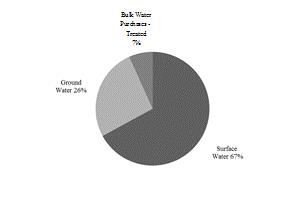
The percentages of water supply by source type for our top seven states based on our Regulated Businesses operating revenues for 2016 were as follows:
| Surface Water | Ground Water | Purchased Water | |||||||||
|---|---|---|---|---|---|---|---|---|---|---|---|
| New Jersey | 72 | % | 23 | % | 5 | % | |||||
| Pennsylvania | 91 | % | 7 | % | 2 | % | |||||
| Missouri | 80 | % | 19 | % | 1 | % | |||||
| Illinois | 53 | % | 36 | % | 11 | % | |||||
| Indiana | 44 | % | 55 | % | 1 | % | |||||
| California | — | 66 | % | 34 | % | ||||||
| West Virginia | 99 | % | — | 1 | % |
Our ability to meet the existing and future water demands of our customers depends on an adequate water supply. Drought, governmental restrictions, overuse of sources of water, the protection of threatened species or habitats, contamination, or other factors may limit the availability of ground and surface water. We employ a variety of measures in an effort to obtain adequate sources of water supply, both in the short-term and over the long-term. The geographic diversity of our service areas may mitigate some of the economic effect on the water supply associated with weather extremes we might encounter in any particular service territory. For example, in any given summer, some areas may experience drier than average weather, which may reduce the amount of source water available, while other areas we serve may experience wetter than average weather.
In our long-term planning, we evaluate quality, quantity, growth needs and alternate sources of water supply as well as transmission and distribution capacity. Water supply is seasonal in nature and weather conditions can have a pronounced effect on supply. In order to ensure that we have adequate water supply, we use long-term planning processes and maintain contingency plans to minimize the potential impact on service through a wide range of weather fluctuations. In connection with
Showing the first 8K of 61K characters. Open the full section
Item 1A. RISK FACTORS
| --- | --- |
We operate in a market and regulatory environment that involves significant risks, many of which are beyond our control. In addition to the other information included or incorporated by reference in this Form 10-K, the following factors should be considered in evaluating our business and future prospects. Any of the following risks, either alone or taken together, could materially and adversely affect our business, financial position, results of operations, cash flows and liquidity.
Risks Related to Our Industry and Business Operations
Our utility operations are subject to extensive economic regulation by state PUCs and other regulatory agencies, which significantly affects our business, financial condition, results of operations and cash flows. Our utility operations also may be subject to fines, penalties and other sanctions for the inability to meet these regulatory requirements.
Our Regulated Businesses provide water and wastewater services to our customers through subsidiaries that are subject to economic regulation by state PUCs. Economic regulation affects the rates we charge our customers and has a significant impact on our business and results of operations. Generally, the state PUCs authorize us to charge rates that they determine are sufficient to recover our prudently incurred operating expenses, including, but not limited to, operating and maintenance costs, depreciation, financing costs and taxes, and provide us the opportunity to earn an appropriate rate of return on invested capital.
Our ability to successfully implement our business plan and strategy depends on the rates authorized by the various state PUCs. We periodically file rate increase applications with state PUCs. The ensuing administrative process may be lengthy and costly. Our rate increase requests may or may not be approved, or may be partially approved, and any approval may not occur in a timely manner. Moreover, a PUC may not approve a rate request to an extent that is sufficient to:
| • | cover our expenses, including purchased water and costs of chemicals, fuel and other commodities used in our operations; |
|---|
| • | enable us to recover our investment; and |
|---|
| • | provide us with an opportunity to earn an appropriate rate of return on our investment. |
|---|
Approval of the PUCs is also required in connection with other aspects of our utilities’ operations. State PUCs are empowered to impose financial penalties, fines and other sanctions for non-compliance with applicable rules and regulations. Our utilities are also required to have numerous permits, approvals and certificates from the PUCs that regulate their businesses and authorize acquisitions. Although we believe that each utility subsidiary has obtained or sought renewal of the material permits, approvals and certificates necessary for its existing operations, we are unable to predict the impact that future regulatory activities may have on our business.
In any of these cases, our business, financial condition, results of operations, cash flows and liquidity may be adversely affected. Even if rates are sufficient, we face the risk that we will not achieve the rates of return on our invested capital to the extent permitted by state PUCs. This could occur if certain conditions exist, including but not limited to, if water usage is less than the level anticipated in establishing rates, or if our investments or expenses prove to be higher than the level estimated in establishing rates.
Our operations and the quality of water we supply are subject to extensive environmental, water quality and health and safety laws and regulations. Compliance with increasingly stringent laws and regulations could impact our operating costs; and violations of such laws and regulations could subject us to substantial liabilities and costs, as well as damage to our reputation.
Our water and wastewater operations and the operations of our Market-Based Businesses are subject to extensive federal, state and local laws and regulations and, in the case of our Canadian operations, Canadian laws and regulations that govern the protection of the environment, health and safety, the quality of the water we deliver to our customers, water allocation rights, and the manner in which we collect, treat, discharge and dispose of wastewater. These requirements include CERCLA, the Clean Water Act and the Safe Drinking Water Act, and similar state and Canadian laws and regulations. For example, CERCLA authorizes the EPA to issue orders and bring enforcement actions to compel responsible parties to investigate and take remedial actions with respect to actual or threatened releases of hazardous substances, and can impose joint and several liability, without regard to fault, on responsible parties for the costs thereof. We are also required to obtain various environmental permits from regulatory agencies for our operations.
In addition, state PUCs also set conditions and standards for the water and wastewater services we deliver. If we deliver water or wastewater services to our customers that do not comply with regulatory standards, or otherwise violate environmental laws, regulations or permits, or other health and safety and water quality regulations, we could incur substantial fines, penalties or other sanctions or costs, as well as damage to our reputation. In the most serious cases, regulators could reduce requested rate increases or force us to discontinue operations and sell our operating assets to another utility or to a municipality. Given the nature of our business which, in part, involves supplying water for human consumption, any potential non-compliance with, or violation of, environmental, water quality and health and safety laws or regulations would likely pose a more significant risk to us than to a company not similarly involved in the water and wastewater industry.
We incur substantial operating and capital costs on an ongoing basis to comply with environmental, water quality and health and safety laws and regulations. These laws and regulations, and their enforcement, generally have become more stringent over time, and new or stricter requirements could increase our costs. Although we may seek to recover ongoing compliance costs in our rates, there can be no guarantee that the various state PUCs or similar regulatory bodies that govern our Regulated Businesses would approve rate increases that would enable us to recover such costs or that such costs will not materially and adversely affect our financial condition, results of operations, cash flows and liquidity.
We may also incur liabilities if, under environmental laws and regulations, we are required to investigate and clean up environmental contamination at our properties, including potential spills of hazardous chemicals, such as chlorine, which we use to treat water, or at off-site locations where we have disposed of waste or caused an adverse environmental impact. The discovery of previously unknown conditions, or the imposition of cleanup obligations in the future, could result in significant costs and could adversely affect our financial condition, results of operations, cash flows and liquidity. Such remediation costs may not be covered by insurance and may make it difficult for us to secure insurance at acceptable rates in the future.
Attention is being given to emerging contaminants, including, without limitation, chemicals and other substances that currently do not have any regulatory standard in drinking water or have been recently created or discovered (including by means of scientific achievements in the analysis and detection of trace amounts of substances). Examples of sources of emerging contaminants include, but are not limited to, newly created chemical compounds (including, for example, perfluorinated compounds and manufactured nanomaterials); human and veterinary products; m
Showing the first 8K of 80K characters. Open the full section
Item 1B. UNRESOLVED STAFF COMMENTS
| --- | --- |
None
Item 2. PROPERTIES
| --- | --- |
Our properties consist of transmission, distribution and collection pipes, water and wastewater treatment plants, pumping wells, tanks, meters, supply lines, dams, reservoirs, buildings, vehicles, land, easements, software rights and other facilities and equipment. Our properties are used for the operation of our systems, including the collection, treatment, storage and distribution of water, and the collection and treatment of wastewater. Substantially all of our properties are owned by our subsidiaries, and a substantial portion of our property is subject to liens of our mortgage bonds. We lease our corporate offices, equipment and furniture, located in Voorhees, New Jersey from certain of our wholly owned subsidiaries. These properties are utilized by our directors, officers and staff in the conduct of the business.
The properties of our Regulated Businesses segment primarily include 80 dams and 81 surface water treatment plants along with approximately 522 groundwater treatment plants, 1,022 groundwater wells, 121 wastewater treatment facilities, 1,284 treated water storage facilities, 1,433 pumping stations, and 49,635 miles of mains and collection pipes. We have ongoing infrastructure renewal programs in all states in which our Regulated Businesses segment operate. These programs consist of both rehabilitation of existing mains and other equipment and replacement of mains and other equipment that are damaged or have reached, or are near, the end of their useful service lives. The properties of our Market-Based Businesses consist mainly of office furniture and IT equipment and are primarily located in New Jersey. Approximately 51% of all properties that we own are located in New Jersey and Pennsylvania.
We maintain property insurance against loss or damage to our properties by fire or other perils, subject to certain exceptions. For insured losses, we are self-insured to the extent that any losses are within the policy deductible or exceed the amount of insurance maintained.
We believe that our properties are generally maintained in good operating condition and in accordance with current standards of good water and wastewater industry practice.
Item 3. LEGAL PROCEEDINGS
| --- | --- |
Alternative Water Supply in Lieu of Carmel River Diversions
Under the 2009 Order, Cal Am is required, among other things, to decrease significantly its yearly diversions of water from the Carmel River according to a set reduction schedule. The 2009 Order responded to claims that Cal Am had not sufficiently implemented actions to terminate its unpermitted diversions of water from the Carmel River as required by a 1995 SWRCB order. On July 19, 2016, at the request of Cal Am and several Monterey County government agencies, the SWRCB issued an order (the “2016 Order”) approving a five-year extension of the deadline to comply with the 2009 Order, to December 31, 2021. On November 29, 2016, the Water Ratepayers Association of the Monterey Peninsula, a citizens’ advocacy group, filed an action in Sacramento County Superior Court against the SWRCB and its board members, and naming Cal Am as the real party in interest, seeking to reverse the extension of the 2009 Order, to rescind the designation by the California Public Utilities Commission (the “CPUC”) of Cal Am as the public utility water provider to the Monterey Peninsula, and to appoint a receiver to oversee Cal Am’s compliance with the 2009 Order, with ultimate transfer to a public entity. This lawsuit is pending.
Regional Desalination Project Litigation
The Regional Desalination Project (the “RDP”) involved the construction of a desalination facility in the City of Marina, north of Monterey. The RDP was intended to, among other things, eliminate unauthorized diversions from the Carmel River as required under the 2009 Order. In December 2010, the CPUC approved the RDP, which was to be implemented through a Water Purchase Agreement and ancillary agreements (collectively, the “Agreements”) among the Marina Coast Water District (“MCWD”), the MCWRA and Cal Am. In 2011, due to a conflict of interest concerning a former member of the MCWRA’s Board of Directors, MCWRA stated that the Agreements were void, and, as a result, Cal Am terminated the Agreements. In April 2015, the CPUC approved a settlement agreement among Cal Am, MCWRA and the County of Monterey to resolve these matters among the parties signing the agreement. On March 23, 2016, the Supreme Court of California granted MCWD’s petition for review of the CPUC approval. Action on the petition has been deferred pending consideration and disposition of a related issue in another case.
In October 2012, Cal Am filed a Complaint for Declaratory Relief against MCWRA and MCWD which was ultimately transferred to the San Francisco County Superior Court, seeking a determination as to whether the Agreements are void as a result of the alleged conflict of interest. In June 2015, the court entered a final judgment agreeing with Cal Am’s position that four of the five Agreements are void, and one, the credit line agreement, is not void. On November 10, 2016, the Supreme Court of California denied MCWD’s final appeal of this judgment, which allows further proceedings to determine the amount of damages that may be awarded in the proceeding.
In July 2015, Cal Am and MCWRA filed a Complaint in San Francisco County Superior Court against MCWD and RMC Water and Environment, a private engineering consulting firm (“RMC”), seeking to recover compensatory damages in excess of $10 million associated with the failure of the RDP, as well as punitive and treble damages, statutory penalties and attorneys’ fees. Shortly thereafter, complaints seeking similar damages were filed in the same court by MCWD and RMC against Cal Am and MCWRA in excess of $19 million in the aggregate. In December 2015, the court consolidated all of these complaints into a single action, which remains pending.
Monterey Peninsula Water Supply Project
The Water Supply Project is intended to reduce water diversions from the Carmel River and involves construction of a desalination plant, owned by Cal Am, and purchase of water by Cal Am from the GWR Project. Cal Am’s ability to move forward on the Water Supply Project is subject to extensive administrative review by the CPUC and other government agencies, obtaining necessary permits, and intervention from other parties. On March 17, 2016, the CPUC’s Energy Division issued a notice of further schedule delays for the Water Supply Project’s environmental review, with environmental certification currently scheduled for completion in November 2017. On January 12, 2017, the CPUC issued a Draft Environmental Impact Report/Environmental Impact Statement.
On September 15, 2016, the CPUC unanimously approved a decision to authorize Cal Am to enter into a water purchase agreement for the GWR Project and to construct a pipeline and pump station facilities and recover up to $50 million in associated costs, subject to meeting certain criteria. If construction costs exceed $50 million, Cal Am would be allowed to seek additional cost recovery.
A preliminary step to building the Water Supply Project desalination plant is the construction and operation of a test slant well to confirm the suitability of the property on which intake wells will be located to draw water from under Monterey Bay. In November 2014, the California Coastal Commission (the “Coastal Commission”) approved coastal development permits for the test slant well, enabling Cal Am to construct the portion that will be under state lands (beneath the ocean floor). In January 2015, Cal Am obtained from the California State Lands Commission (the “State Lands Commission”) a required lease as to the state lands. In October 2015, the Coastal Commission approved an amendment to Cal Am’s coastal development permits.
In December 2014, the MCWD and the Ag Land Trust, an agricultural land conservancy, filed petitions against the Coastal Commission and Cal Am, which were ultimately transferred to the Santa Cruz County Superior Court, seeking to vacate the Coastal Commission’s approval of the coastal development permit and to permanently restrain Cal Am and the Coastal Commission from constructing the test slant well pending full compliance with the California Environmental Quality Act and the California Coastal Act. The court denied these petitions, and on January 11, 2017, the Supreme Court of California denied MCWD’s petition for review of this decision. MCWD filed a similar petition in January 2015 against the State Lands Commission and Cal Am, which remains pending.
In November 2015, MCWD filed a Petition for Writ of Mandate and Complaint for Declaratory and Injunctive Relief in Santa Cruz County Superior Court against the Coastal Commission and Cal Am challenging the amendment of the coastal development permits and seeking an injunction against further test well pumping. On September 15, 2016, the court denied MCWD’s petition with respect to all claims, except claims related to those raised in the December 2014 petitions discussed above.
Based on the foregoing, Cal Am estimates that the earliest date by which the Water Supply Project desalination plant could be completed is sometime in 2019. There can be no assurance that Cal Am’s application for the Water Supply Project will be approved or that the Water Supply Project will be completed on a timely basis, if ever. Furthermore, there can be no assurance that Cal Am will be able to comply with the diversion reduction requirements and other remaining requirements under the 2009 Order and the 2016 Order, or that any such compliance will not result in material additional costs or obligations to Cal Am or the Company.
West Virginia Elk River Freedom Industries Chemical Spill
Background
On January 9, 2014, a chemical storage tank owned by Freedom Industries, Inc. leaked two substances, 4-methylcyclohexane methanol, or MCHM, and PPH/DiPPH, a mix of polyglycol ethers, into the Elk River near the WVAWC treatment plant intake in Charleston, West Virginia. After having been alerted to the leak of MCHM by the West Virginia Department of Environmental Protection, WVAWC took immediate steps to gather more information about MCHM, augment its treatment process as a precaution, and begin consultations with federal, state and local public health officials. As soon as possible after it was determined that the augmented treatment process would not fully remove the MCHM, a joint decision was reached in consultation with the West Virginia Bureau for Public Health to issue a “Do Not Use” order for all of its approximately 93,000 customer accounts in parts of nine West Virginia counties served by the Charleston treatment plant. By January 18, 2014, none of WVAWC’s customers were subject to the Do Not Use order.
Following the Freedom Industries chemical spill, numerous lawsuits were filed against WVAWC and certain other Company-affiliated entities (collectively, the “American Water Defendants”) with respect to this matter in the U.S. District Court for the Southern District of West Virginia or West Virginia Circuit Courts in Kanawha, Boone and Putnam counties, and to date, 73 cases remain pending. Four of the cases pending before the U.S. district court were consolidated for purposes of discovery, and an amended consolidated class action complaint for those cases (the “Federal action”) was filed in December 2014 by several plaintiffs. On January 28, 2016, all of the then-filed state court cases were referred to West Virginia’s Mass Litigation Panel for further proceedings, which have been stayed pending the negotiation by the parties and approval by the court in the Federal action of a global agreement to settle all of such cases, as described below. On July 7, 2016, the court in the Federal action scheduled trial to begin on October 25, 2016, but the court delayed the start of the trial pending ongoing settlement negotiations between the parties and has since granted a continuance of the trial until March 21, 2017. The Mass Litigation Panel has also stayed its proceedings until May 1, 2017.
WVAWC Binding Global Agreement in Principle to Settle Claims
On October 31, 2016, the court in the Federal action approved the preliminary binding principles, terms and conditions of the Settlement among the American Water Defendants, and all class members, putative class members, claimants and potential claimants (collectively, the “Plaintiffs”), arising out of the Freedom Industries chemical spill. The terms of the Settlement propose a global federal and state resolution of all litigation and potential claims against the American Water Defendants and their insurers. A claimant may elect to opt out of any final settlement agreement, in which case such claimant will not receive any benefit from or be bound by the terms of the Settlement. Under the terms and conditions of the Settlement and any subsequent final settlement agreement, the American Water Defendants have not admitted, and will not admit, any fault or liability for any of the allegations made by the Plaintiffs in any of the actions to be resolved.
The proposed aggregate pre-tax amount of the Settlement is $126 million, of which $65 million would be contributed by WVAWC, and the remainder would be contributed by certain of the Company’s general liability insurance carriers. The Company has general liability insurance under a series of policies underwritten by a number of individual carriers. Two of these insurance carriers, which provide an aggregate of $50 million in insurance coverage to the Company under these policies, were requested, but presently have not agreed, to participate in the Settlement. The Company and WVAWC are vigorously pursuing their rights to insurance coverage from these non-participating carriers for any contributions by WVAWC to the Settlement. In this regard, WVAWC filed a lawsuit against one of these carriers alleging that the carrier’s failure to agree to participate in the Settlement constitutes a breach of contract, and the Company is pursuing mandatory arbitration against the other non-participating carrier. Despite these efforts, the Company may not ultimately be successful in obtaining full or further reimbursement under these insurance policies for amounts that WVAWC may be required to contribute to the Settlement.
The preliminary terms of the Settlement intend to establish a two-tier settlement fund for the payment of claims, comprised of (i) a simple claim fund, which is also referred to as the “guaranteed fund,” of $76 million, of which $51 million will be contributed by WVAWC, including insurance deductibles, and $25 million would be contributed by one of the Company’s general liability insurance carriers, and (ii) an individual review claim fund of up to $50 million, of which up to $14 million would be contributed by WVAWC and $36 million would be contributed by a number of the Company’s general liability insurance carriers. Separately, up to $25 million would be contributed to the guaranteed fund by another defendant to the Settlement.
As a result of these events, the Company recorded a charge to earnings, net of insurance receivables, of $65 million ($39 million after-tax) in the third quarter of 2016. The Company intends to fund WVAWC’s contributions to the Settlement through existing sources of liquidity, although no contribution by WVAWC will be required unless and until the terms of the Settlement are finally approved by the court in the Federal action. Furthermore, under the terms of the Settlement, WVAWC has agreed that it will not seek rate recovery from the Public Service Commission of West Virginia for approximately $4 million in direct response costs expensed in 2014 by WVAWC relating to the Freedom Industries chemical spill as well as for amounts paid by WVAWC under the Settlement.
The Company’s insurance policies operate under a layered structure where coverage is generally provided in the upper layers after claims have exhausted lower layers of coverage. The $36 million to be contributed by a number of the Company’s general liability insurance carriers to the individual review claim fund, as noted above, is from higher layers of the insurance structure than the two insurance carriers that were requested, but presently have not agreed, to participate in the Settlement. Any recovery by WVAWC or the Company from the non-participating carriers would reimburse WVAWC for its contributions to the guaranteed fund.
Following the court’s October 31 approval, the parties have continued to negotiate the details of the Settlement. If preliminary approval of the Settlement is obtained, notice of the terms of the Settlement would then be provided to members of the settlement class. Following the notice period, the court in the Federal action would hold a fairness hearing to consider final approval of the Settlement. There can be no assurance that the court in the Federal action will provide its approval as to any agreement negotiated between the parties reflecting the terms of the Settlement.
The American Water Defendants believe that WVAWC has responded appropriately to, and, other than through the Settlement, has no responsibility for, the Freedom Industries chemical spill, and that the American Water Defendants have valid, meritorious defenses to the lawsuits. Nevertheless, WVAWC and the Company are unable to predict the outcome of any lawsuit against the American Water Defendants brought or maintained by a claimant that elects to opt out of the Settlement, and any such outcome or outcomes could have a material adverse effect on the Company's financial condition, results of operations, cash flows, liquidity and reputation.
Other Related Investigations
Additionally, investigations with respect to the matter have been initiated by the U.S. Chemical Safety and Hazard Investigation Board (the “CSB”), the U.S. Attorney’s Office for the Southern District of West Virginia, the West Virginia Attorney General, and the Public Service Commission of West Virginia (the “PSC”). As a result of the U.S. Attorney’s Office investigation, Freedom Industries and six former Freedom Industries employees (three of whom also were former owners of Freedom Industries), pled guilty to violations of the federal Clean Water Act.
In May 2014, the PSC issued an Order initiating a General Investigation into certain matters relating to WVAWC's response to the Freedom Industries chemical spill. Three parties intervened in the proceeding, including the Consumer Advocate Division of the PSC and two attorney-sponsored groups, including one sponsored by some of the plaintiffs’ counsel involved in the civil litigation described above. On January 26, 2017, WVAWC and the other parties agreed to resolve the General Investigation and filed a joint stipulation with the PSC containing the terms of the settlement. The parties to the joint stipulation filed a proposed order with the PSC on February 8, 2017.
The CSB is an independent investigatory agency with no regulatory mandate or ability to issue fines or citations; rather, the CSB can only issue recommendations for further action. In response to the Freedom Industries chemical spill, the CSB commenced an investigation shortly thereafter. On September 28, 2016, the CSB issued and adopted its investigation report in which it recommended that the Company conduct additional source water protection activities. The Company provided written comments to the CSB’s report suggesting that the recommendation made to the Company would be better directed to the EPA in order to promote industry-wide implementation of the CSB’s recommendation. On February 15, 2017, the Company filed its response to the CSB’s recommendation. The CSB has indicated that it may consider issuing a supplemental report on the Freedom Industries chemical spill.
WVAWC and the Company are unable to predict the outcome of the ongoing government investigations or any legislative initiatives that might affect WVAWC’s water utility operations.
General
Periodically, the Company is involved in other proceedings or litigation arising in the ordinary course of business. Other than those proceedings described in this Item 3—Legal Proceedings, the Company does not believe that the ultimate resolution of these matters will materially affect its financial position or results of operations. However, litigation and other proceedings are subject to many uncertainties, and the outcome of individual matters is not predictable with assurance. It is possible that some litigation and other proceedings could be decided unfavorably to the Company, and that any such unfavorable decisions could have a material adverse effect on its business, financial condition, results of operations, and cash flows.
Item 4. MINE SAFETY DISCLOSURES
| --- | --- |
Not applicable
PART II
Item 5. MARKET FOR REGISTRANT’S COMMON EQUITY, RELATED STOCKHOLDER MATTERS AND ISSUER PURCHASES OF EQUITY SECURITIES
| --- | --- |
Since April 23, 2008, our common stock has traded on the NYSE under the symbol “AWK.” The following table summarizes the per share range of the high and low intraday sales prices of our common stock as reported on the NYSE and the per share cash dividends paid and declared for the years ended December 31, 2016 and 2015:
| Intraday Market Prices | Per Share | Per Share | ||||||||||||||
|---|---|---|---|---|---|---|---|---|---|---|---|---|---|---|---|---|
| 2016 | High | Low | Dividends Paid | Dividends Declared | ||||||||||||
| Fourth Quarter | $ | 76.12 | $ | 69.41 | $ | 0.375 | $ | 0.75 | ||||||||
| Third Quarter | 85.24 | 72.12 | 0.375 | 0.375 | ||||||||||||
| Second Quarter | 84.54 | 68.09 | 0.375 | 0.375 | ||||||||||||
| First Quarter | 70.10 | 58.90 | 0.34 | — | ||||||||||||
| Intraday Market Prices | Per Share | Per Share | ||||||||||||||
| 2015 | High | Low | Dividends Paid | Dividends Declared | ||||||||||||
| Fourth Quarter | $ | 61.20 | $ | 54.62 | $ | 0.34 | $ | 0.68 | ||||||||
| Third Quarter | 55.63 | 48.52 | 0.34 | 0.34 | ||||||||||||
| Second Quarter | 55.67 | 48.36 | 0.34 | 0.34 | ||||||||||||
| First Quarter | 57.48 | 51.84 | 0.31 | — |
As of February 16, 2017, there were 178,214,748 shares of common stock outstanding held by approximately 2,608 record holders. Holders of our common stock are entitled to receive dividends when they are declared by the Board of Directors. When dividends on common stock are declared, they are typically paid in March, June, September and December. Future dividends are not guaranteed by the Company and will be dependent on future earnings, financial requirements, contractual provisions of debt agreements and other relevant factors. For more information regarding restrictions on the payment of dividends on our common stock, see Item 7—Management’s Discussion and Analysis of Financial Condition and Results of Operations—Liquidity and Capital Resources—Dividends.
In February 2015, the Board of Directors authorized an anti-dilutive common stock repurchase program to mitigate the dilutive effect of shares issued through our dividend reinvestment, employee stock purchase and executive compensation activities. The program allows us to purchase up to 10 million shares of our outstanding common stock over an unrestricted period of time in the open market or through privately negotiated transactions. The program is conducted in accordance with Rule 10b-18 of the Exchange Act, and to facilitate these repurchases, we enter into Rule 10b5-1 share repurchase plans with a third party broker, which allow us to repurchase shares at times when we may otherwise be prevented from doing so under insider trading laws or because of self-imposed trading blackout periods. Subject to applicable regulations, we may elect to amend or cancel the program or share repurchase parameters at our discretion to manage dilution.
From April 1, 2015, the date repurchases under the anti-dilutive stock repurchase program commenced, through December 31, 2016, the Company repurchased an aggregate of 3,250,000 shares of common stock under the program, including 1,000,000 shares repurchased during the first half of 2016. There were no repurchases of common stock in the last half of 2016.
On November 17, 2016, 19,629 shares of common stock were issued by the Company in a transaction not involving a public offering of securities, which transaction was exempt from registration under the Securities Act of 1933, as amended, pursuant to Section 4(a)(2) thereof. The shares were issued to one holder as consideration for assets acquired and liabilities assumed by Cal Am.
Item 6. SELECTED FINANCIAL DATA
| --- | --- |
| For the Years Ended December 31, | |||||||||||||||||||
|---|---|---|---|---|---|---|---|---|---|---|---|---|---|---|---|---|---|---|---|
| 2016 | 2015 | 2014 | 2013 | 2012 | |||||||||||||||
| (In millions, except per share data) | |||||||||||||||||||
| Statement of Operations Data: | |||||||||||||||||||
| Operating revenues | $ | 3,302 | $ | 3,159 | $ | 3,011 | $ | 2,879 | $ | 2,854 | |||||||||
| Income from continuing operations | $ | 468 | $ | 476 | $ | 430 | $ | 371 | $ | 374 | |||||||||
| Income from continuing operations per basic common share | $ | 2.63 | $ | 2.66 | $ | 2.40 | $ | 2.08 | $ | 2.12 | |||||||||
| Income from continuing operations per diluted common share | $ | 2.62 | $ | 2.64 | $ | 2.39 | $ | 2.07 | $ | 2.10 | |||||||||
| Balance Sheet Data: | |||||||||||||||||||
| Total assets (a) (b) | $ | 18,482 | $ | 17,241 | $ | 16,038 | $ | 15,064 | $ | 14,713 | |||||||||
| Long-term debt and redeemable preferred stock at redemption value (a) | $ | 5,759 | $ | 5,874 | $ | 5,442 | $ | 5,225 | $ | 5,203 | |||||||||
| Other Data: | |||||||||||||||||||
| Aggregate dividends declared per common share | $ | 1.50 | $ | 1.36 | $ | 1.24 | $ | 1.12 | $ | 0.98 | |||||||||
| Cash flows provided by operating activities | $ | 1,276 | $ | 1,179 | $ | 1,097 | $ | 896 | $ | 956 | |||||||||
| Capital expenditures included in cash flows used in investing activities | $ | (1,311 | ) | $ | (1,160 | ) | $ | (956 | ) | $ | (980 | ) | $ | (929 | ) |
NOTE: In November 2014, we disposed of our Class B Biosolids operating segment by selling our subsidiary, Terratec Environmental Ltd (“Terratec”) in Ontario, Canada. The results of Terratec are presented as discontinued operations and, as such, have been excluded from continuing operations for the years ended December 31, 2014, 2013 and 2012. See Note 3—Acquisitions and Divestitures in the Notes to Consolidated Financial Statements for additional details on our discontinued operations.
| (a) | The information for 2014, 2013 and 2012 has been revised to reflect the retrospective application of Accounting Standard Update 2015-15 Presentation of Debt Issuance Costs, which was adopted by the Company as of December 31, 2015. |
|---|
| (b) | The information for 2014, 2013 and 2012 has been revised to reflect the retrospective application of Accounting Standard Update 2015-17 Income Taxes, which was adopted by the Company as of December 31, 2015. |
|---|
Item 7. MANAGEMENT’S DISCUSSION AND ANALYSIS OF FINANCIAL CONDITION AND RESULTS OF OPERATIONS
| --- | --- |
The following discussion should be read together with the consolidated financial statements and the notes thereto included elsewhere in this Form 10-K. This discussion contains forward-looking statements that are based on management’s current expectations, estimates and projections about our business, operations and financial performance. The cautionary statements made in this Form 10-K should be read as applying to all related forward-looking statements whenever they appear in this Form 10-K. Our actual results may differ materially from those currently anticipated and expressed in such forward-looking statements as a result of a number of factors, including those we discuss under “Forward-Looking Statements,” Item 1A—Risk Factors and elsewhere in this Form 10-K.
Executive Overview
Through its subsidiaries, American Water is the largest and most geographically diverse investor-owned publicly-traded water and wastewater utility company in the United States, as measured by both operating revenues and population served. We employ approximately 6,800 professionals who provide drinking water, wastewater and other related services to an estimated 15 million people in 47 states, the District of Columbia and Ontario, Canada. Our primary business involves the ownership of utilities that provide water and wastewater services to residential, commercial, industrial and other customers, including sale for resale and public authority customers. Our Regulated Businesses that provide these services are generally subject to economic regulation by certain state utility commissions or other entities engaged in utility regulation. Certain federal and state governments also regulate environmental, health and safety, and water quality matters. Our Regulated Businesses provide services in 16 states and serve approximately 3.3 million customers based on the number of active service connections to our water and wastewater networks. We also operate several businesses that provide a broad range of related and complementary water and wastewater services in four operating segments that individually do not meet the criteria of a reportable segment in accordance with GAAP. These four non-reportable operating segments are collectively presented as our Market-Based Businesses, which is consistent with how management assesses the results of these businesses.
2016 Strategic Focus & Achievements
For 2016, our focus was anchored on five central strategic themes:
| • | Customer – One of our core values is putting our customers at the center of everything we do. |
|---|
| • | In 2016, we achieved a customer satisfaction rating in the top quartile among our water industry peers and achieved a service quality rating of 85%, which also placed us in the top quartile compared to our water industry peers; |
|---|
| • | We launched a comprehensive customer experience initiative designed to enhance our quality of service and make it easier for customers to do business with us; |
|---|
| • | We continued to make needed infrastructure investment while implementing operational efficiency improvements to keep customer rates affordable; and |
|---|
| • | Our drinking water system quality was 21 times better than the industry average. |
|---|
| • | Safety – The health and safety of our employees, customers and the public is both a strategy and a value. |
|---|
| • | In 2016, our focus continued on putting safety first. We finished 2016 with fewer employee injuries than in the prior year, we enhanced accident prevention and risk mitigation through our “near miss” reporting program and we achieved a stronger safety culture as measured by employee responses in the Company’s culture survey. Our safety council, consisting of management and labor employees from across the Company, continued their mission of developing and implementing recommendations to reinforce the Company’s commitment to safety. In addition, we hold our vendors accountable to the same safety standards as our Company. |
|---|
| • | People – Our employees and culture are paramount to our success. |
|---|
| • | In 2016, we continued to demonstrate our commitment to employees by providing safety and technical training throughout the Company and expanding training and development offerings for supervisors and individual employees. We enhanced and developed robust succession plans for key leadership roles across the company and we continued to provide competitive compensation and benefits to retain and attract a highly skilled and diverse workforce. |
|---|
| • | Growth – We invested $1.5 billion in 2016; a record level of annual investment since the Company went public in 2008 including: |
|---|
| • | $1.3 billion of which the majority was in our Regulated Businesses primarily to improve infrastructure; and |
|---|
| • | $199 million for completed regulated acquisitions, adding approximately 42,000 water and wastewater customers. Included was the purchase of substantially all of the wastewater collection and treatment assets of the Sewer Authority of the City of Scranton by Pennsylvania-American Water Company (“PAWC”) on December 29, 2016. This acquisition alone added approximately 31,000 wastewater customers in the City of Scranton and Dunmore Borough, Pennsylvania. |
|---|
| • | In addition to the acquisitions that closed in 2016 adding approximately 42,000 water and wastewater customers discussed above, we also entered into a number of agreements for which the closing of the transactions remain pending. These pending transactions represent the potential addition of approximately 40,000 new water and wastewater customers. The largest of the pending acquisitions include: |
|---|
| ▪ | Shorelands Water Company, New Jersey: Shorelands currently provides water service to approximately 11,000 customers in Monmouth County, New Jersey. On August 2, 2016, we agreed to acquire all of the capital stock of Shorelands Water Company (“Shorelands”) in exchange for an equivalent value of our common stock. The maximum number of shares of our common stock to be exchanged upon closing of this acquisition will be less than 500,000 and will be based upon the average price of our common stock. The closing of this acquisition is subject to the satisfaction of various conditions and compliance by the parties with certain covenants, including obtaining the approval of the New Jersey Board of Public Utilities. The Company is seeking to close the acquisition in the first half of 2017. |
|---|
| ▪ | Municipal Authority of the City of McKeesport, Pennsylvania: The system currently represents approximately 22,000 wastewater customers. On September 9, 2016, PAWC signed an asset purchase agreement to acquire substantially all of the wastewater collection and treatment system assets of the Municipal Authority of the City of McKeesport, Pennsylvania for approximately $156 million, subject to certain adjustments provided in the agreement. In connection with the execution of this agreement, a $5 million non-escrowed deposit was also paid. The closing of this acquisition is subject to the satisfaction of various conditions and covenants, including obtaining the approval of the Pennsylvania Public Utility Commission. We are seeking to close this acquisition in the second half of 2017. |
|---|
| • | Technology and Operational Efficiency – We drove continued cost savings into our businesses. |
|---|
| • | Our Regulated Businesses achieved an adjusted O&M efficiency ratio (a non-GAAP measure) of 34.9% in 2016; |
|---|
Our adjusted O&M efficiency ratio for the year ended December 31, 2016 was 34.9%, compared to 35.9% and 36.7% for the years ended December 31,
Showing the first 8K of 135K characters. Open the full section
Item 7A. QUANTITATIVE AND QUALITATIVE DISCLOSURES ABOUT MARKET RISK
| --- | --- |
We are exposed to market risk associated with changes in commodity prices, equity prices and interest rates. We are exposed to risks from changes in interest rates as a result of our issuance of variable and fixed rate debt and commercial paper. We manage our interest rate exposure by limiting our variable rate exposure and by monitoring the effects of market changes in interest rates. We also have the ability to enter into financial derivative instruments, which could include instruments such as, but not limited to, interest rate swaps, forward starting swaps, swaptions and U.S. Treasury lock agreements to manage and mitigate interest rate risk exposure. As of December 31, 2016, a hypothetical increase of interest rates by 1% associated with our short-term borrowings would result in a $9 million increase in short-term interest expense.
In July 2010, we entered into an interest rate swap agreement with a notional amount of $100 million. This agreement effectively converted the interest on $100 million of outstanding 6.085% fixed rate debt maturing 2017 to a variable rate of six-month LIBOR plus 3.422%. We entered into this interest rate swap to mitigate interest cost at the parent company relating to debt that was incurred by our prior owners and was not used in any manner to finance the cash needs of our subsidiaries. The interest rate swap reduced interest expense by $2 million for the years ended December 31, 2016, 2015 and 2014. As the swap interest rates are fixed through April 2017, a hypothetical 1% increase in the interest rates associated with the interest rate swap agreement would result in a $1 million increase in interest expense for the year ended December 31, 2016. This calculation holds all other variables constant and assumes only the discussed changes in interest rates.
The Company has four forward starting swap agreements with an aggregate notional amount of $300 million to reduce interest rate exposure on debt expected to be issued in 2017. The forward starting swap agreements terminate in December 2017 and have an average fixed rate of 2.20%. When entering into forward starting interest rate swaps, the Company is subject to market risk with respect to changes in the underlying benchmark interest rate that impacts the fair value of the forward starting interest rate swaps. We manage market risk by matching terms of the swaps with the critical terms of the expected debt issuance. The fair value of the forward starting swaps at December 31, 2016 was $27 million. A hypothetical 1.00% adverse change in interest rates would result in a decrease in the fair value of our forward starting swaps of approximately $65 million at December 31, 2016.
Our risks associated with price increases for chemicals, electricity and other commodities are reduced through contractual arrangements and the expected ability to recover price increases through rates, in the next general rate case proceeding or other regulatory mechanism, as authorized by each regulatory jurisdiction. Non-performance by these commodity suppliers could have a material adverse impact on our results of operations, financial position and cash flows.
The market price of our common stock may experience fluctuations, which may be unrelated to our operating performance. In particular, our stock price may be affected by general market movements as well as developments specifically related to the water and wastewater industry. These could include, among other things, interest rate movements, quarterly variations or changes in financial estimates by securities analysts and governmental or regulatory actions. This volatility may make it difficult for us to access the capital markets in the future through additional offerings of our common stock, regardless of our financial performance, and such difficulty may preclude us from being able to take advantage of certain business opportunities or meet business obligations.
We are exposed to credit risk through our water, wastewater and other water-related services provided by our Regulated Businesses and Market-Based Businesses. Our Regulated Businesses serve residential, commercial, industrial and other customers while our Market-Based Businesses engage in business activities with developers, government entities and other customers. Our primary credit risk is exposure to customer default on contractual obligations and the associated loss that may be incurred due to the non-payment of customer accounts receivable balances. Our credit risk is managed through established credit and collection policies which are in compliance with applicable regulatory requirements and involve monitoring of customer exposure and the use of credit risk mitigation measures such as letters of credit or prepayment arrangements. Our credit portfolio is diversified with no significant customer or industry concentrations. In addition, our Regulated Businesses are generally able to recover all prudently incurred costs including uncollectible customer accounts receivable expenses and collection costs through rates.
The Company’s retirement trust assets are exposed to the market prices of debt and equity securities. Changes to the retirement trust asset value can impact the Company’s pension and other benefits expense, funded status and future minimum funding requirements. Our risk is reduced through our ability to recover pension and other benefit costs through rates. In addition, pension and other benefits liabilities decrease as fixed income asset values decrease (fixed income yields rise) since the rate at which we discount pension and other retirement trust asset future obligations is highly correlated to fixed income yields.
We are also exposed to a potential national economic recession or deterioration in local economic conditions in the markets in which we operate. The credit quality of our customer accounts receivable is dependent on the economy and the ability of our customers to manage through unfavorable economic cycles and other market changes. In addition, as a result of the downturn in the economy and heightened sensitivity of the impact of additional rate increases on certain customers, there can be no assurances that regulators will grant sufficient rate authorizations. Therefore, our ability to fully recover operating expense, recover our investment and provide an appropriate return on invested capital made in our Regulated Businesses may be adversely impacted.
Item 8. FINANCIAL STATEMENTS AND SUPPLEMENTARY DATA
| --- | --- |
INDEX TO CONSOLIDATED FINANCIAL STATEMENTS
Report of Independent Registered Public Accounting Firm
To the Board of Directors and Shareholders of
American Water Works Company, Inc.
In our opinion, the accompanying consolidated balance sheets and the related consolidated statements of operations, of comprehensive income, of cash flows, and of changes in stockholders’ equity present fairly, in all material respects, the financial position of American Water Works Company, Inc. and Subsidiary Companies at December 31, 2016 and 2015, and the results of their operations and their cash flows for each of the three years in the period ended December 31, 2016 in conformity with accounting principles generally accepted in the United States of America. Also in our opinion, the Company maintained, in all material respects, effective internal control over financial reporting as of December 31, 2016, based on criteria established in Internal Control - Integrated Framework (2013) issued by the Committee of Sponsoring Organizations of the Treadway Commission (COSO). The Company's management is responsible for these financial statements, for maintaining effective internal control over financial reporting and for its assessment of the effectiveness of internal control over financial reporting, included in Management's Report on Internal Control over Financial Reporting appearing under Item 9A. Our responsibility is to express opinions on these financial statements and on the Company's internal control over financial reporting based on our integrated audits. We conducted our audits in accordance with the standards of the Public Company Accounting Oversight Board (United States). Those standards require that we plan and perform the audits to obtain reasonable assurance about whether the financial statements are free of material misstatement and whether effective internal control over financial reporting was maintained in all material respects. Our audits of the financial statements included examining, on a test basis, evidence supporting the amounts and disclosures in the financial statements, assessing the accounting principles used and significant estimates made by management, and evaluating the overall financial statement presentation. Our audit of internal control over financial reporting included obtaining an understanding of internal control over financial reporting, assessing the risk that a material weakness exists, and testing and evaluating the design and operating effectiveness of internal control based on the assessed risk. Our audits also included performing such other procedures as we considered necessary in the circumstances. We believe that our audits provide a reasonable basis for our opinions.
A company’s internal control over financial reporting is a process designed to provide reasonable assurance regarding the reliability of financial reporting and the preparation of financial statements for external purposes in accordance with generally accepted accounting principles. A company’s internal control over financial reporting includes those policies and procedures that (i) pertain to the maintenance of records that, in reasonable detail, accurately and fairly reflect the transactions and dispositions of the assets of the company; (ii) provide reasonable assurance that transactions are recorded as necessary to permit preparation of financial statements in accordance with generally accepted accounting principles, and that receipts and expenditures of the company are being made only in accordance with authorizations of management and directors of the company; and (iii) provide reasonable assurance regarding prevention or timely detection of unauthorized acquisition, use, or disposition of the company’s assets that could have a material effect on the financial statements.
Because of its inherent limitations, internal control over financial reporting may not prevent or detect misstatements. Also, projections of any evaluation of effectiveness to future periods are subject to the risk that controls may become inadequate because of changes in conditions, or that the degree of compliance with the policies or procedures may deteriorate.
| /s/ PricewaterhouseCoopers LLP |
| Philadelphia, Pennsylvania |
| February 21, 2017 |
American Water Works Company, Inc. and Subsidiary Companies
Consolidated Balance Sheets
(In millions, except share and per share data)
| December 31, | December 31, | ||||||
|---|---|---|---|---|---|---|---|
| 2016 | 2015 | ||||||
| ASSETS | |||||||
| Property, plant and equipment | $ | 19,954 | $ | 18,504 | |||
| Accumulated depreciation | (4,962 | ) | (4,571 | ) | |||
| Property, plant and equipment, net | 14,992 | 13,933 | |||||
| Current assets: | |||||||
| Cash and cash equivalents | 75 | 45 | |||||
| Restricted funds | 20 | 21 | |||||
| Accounts receivable, net | 269 | 255 | |||||
| Unbilled revenues | 263 | 267 | |||||
| Materials and supplies | 39 | 38 | |||||
| Other | 118 | 31 | |||||
| Total current assets | 784 | 657 | |||||
| Regulatory and other long-term assets: | |||||||
| Regulatory assets | 1,289 | 1,271 | |||||
| Goodwill | 1,345 | 1,302 | |||||
| Other | 72 | 78 | |||||
| Total regulatory and other long-term assets | 2,706 | 2,651 | |||||
| TOTAL ASSETS | $ | 18,482 | $ | 17,241 |
The accompanying notes are an integral part of these consolidated financial statements.
American Water Works Company, Inc. and Subsidiary Companies
Consolidated Balance Sheets
(In millions, except share and per share data)
| December 31, | December 31, | ||||||
|---|---|---|---|---|---|---|---|
| 2016 | 2015 | ||||||
| CAPITALIZATION AND LIABILITIES | |||||||
| Capitalization: | |||||||
| Common stock ($0.01 par value, 500,000,000 shares authorized, 181,798,555 and 180,907,483 shares issued, respectively) | $ | 2 | $ | 2 | |||
| Paid-in-capital | 6,388 | 6,351 | |||||
| Accumulated deficit | (873 | ) | (1,073 | ) | |||
| Accumulated other comprehensive loss | (86 | ) | (88 | ) | |||
| Treasury stock, at cost (3,701,867 and 2,625,112 shares respectively) | (213 | ) | (143 | ) | |||
| Total common stockholders' equity | 5,218 | 5,049 | |||||
| Long-term debt | 5,749 | 5,862 | |||||
| Redeemable preferred stock at redemption value | 10 | 12 | |||||
| Total long-term debt | 5,759 | 5,874 | |||||
| Total capitalization | 10,977 | 10,923 | |||||
| Current liabilities: | |||||||
| Short-term debt | 849 | 628 | |||||
| Current portion of long-term debt | 574 | 54 | |||||
| Accounts payable | 154 | 126 | |||||
| Accrued liabilities | 609 | 493 | |||||
| Taxes accrue |
Showing the first 8K of 192K characters. Open the full section
Item 9. CHANGES IN AND DISAGREEMENTS WITH ACCOUNTANTS ON ACCOUNTING AND FINANCIAL DISCLOSURE
| --- | --- |
None
Item 9A. CONTROLS AND PROCEDURES
| --- | --- |
Disclosure Controls and Procedures
The Company, under the supervision and with the participation of its management, including the Chief Executive Officer and the Chief Financial Officer, conducted an evaluation of the effectiveness of the design and operation of the Company’s disclosure controls and procedures as such term is defined in Rule 13a-15(e) and Rule 15d-15(e) under the Exchange Act as of the end of the period covered by this report.
Based on that evaluation, our Chief Executive Officer and Chief Financial Officer have concluded that, as of December 31, 2016, our disclosure controls and procedures were effective at a reasonable level of assurance. Our disclosure controls and procedures are designed to provide reasonable assurance that the information required to be disclosed by us in the reports we file or submit under the Exchange Act is recorded, processed, summarized and reported within the time periods specified in the SEC’s rules and forms, and that such information is accumulated and communicated to management, including the Chief Executive Officer and the Chief Financial Officer, to allow timely decisions regarding required disclosure.
Management’s Report on Internal Control over Financial Reporting
Our management is responsible for establishing and maintaining adequate internal control over financial reporting, as such term is defined in Rule 13a-15(f) of the Exchange Act. Our internal control over financial reporting is a process designed by or under the supervision of our Chief Executive Officer and Chief Financial Officer to provide reasonable assurance regarding the reliability of financial reporting and the preparation of financial statements for external purposes in accordance with generally accepted accounting principles. Our internal control over financial reporting includes those policies and procedures that: (i) pertain to the maintenance of records that in reasonable detail accurately and fairly reflect our transactions and dispositions of our assets; (ii) provide reasonable assurance that transactions are recorded as necessary to permit preparation of the financial statements in accordance with generally accepted accounting principles, and that our receipts and expenditures are being made only in accordance with authorizations of our management and our directors; and (iii) provide reasonable assurance regarding prevention or timely detection of unauthorized acquisition, use or disposition of our assets that could have a material effect on the financial statements.
Because of its inherent limitations, internal control over financial reporting may not prevent or detect misstatements. Also, projections of any evaluation of effectiveness to future periods are subject to the risk that controls may become inadequate because of changes in conditions, or that the degree of compliance with the policies or procedures may deteriorate.
Our management, including our Chief Executive Officer and Chief Financial Officer, assessed the effectiveness of our internal control over financial reporting, as of December 31, 2016, using the criteria described in Internal Control—Integrated Framework (2013) issued by the Committee of Sponsoring Organizations of the Treadway Commission (COSO).
Based on our evaluation under the framework in Internal Control—Integrated Framework (2013), our management concluded that our internal control over financial reporting was effective as of December 31, 2016.
The effectiveness of our internal control over financial reporting as of December 31, 2016 has been audited by PricewaterhouseCoopers LLP, an independent registered public accounting firm, as stated in their report appearing in Item 8—Financial Statements and Supplementary Data of this Annual Report on Form 10-K.
Changes in Internal Control over Financial Reporting
There were no changes to our internal control over financial reporting during our last fiscal quarter that have materially affected, or are reasonably likely to materially affect, our internal control over financial reporting.
Item 9B. OTHER INFORMATION
| --- | --- |
None
PART III
Item 10. DIRECTORS, EXECUTIVE OFFICERS AND CORPORATE GOVERNANCE
| --- | --- |
The information required by this item and not given below or in Item 1—Business—Executive Officers of this Form 10-K, is incorporated by reference from the Company’s Proxy Statement for the 2017 Annual Meeting of Stockholders, to be filed with the SEC within 120 days following the end of the fiscal year covered by this report, under the captions entitled “Board of Directors and Corporate Governance,” “Proposal 1—Election of Directors” and “Certain Beneficial Ownership Matters—Section 16(a) Beneficial Ownership Reporting Compliance.”
We have adopted a Code of Ethics, which applies to directors, officers and employees. The full text of the Code of Ethics is publicly available on our website at https://amwater.com. We intend to post on our website any amendments to our Code of Ethics and any waivers of such provisions granted to certain principal officers.
Item 11. EXECUTIVE COMPENSATION
| --- | --- |
Information required by this item is incorporated by reference in the Company’s Proxy Statement for the 2017 Annual Meeting of Stockholders, under the captions entitled “Executive Compensation,” “Compensation Discussion and Analysis,” “Compensation Committee Interlocks and Insider Participation,” “Compensation Committee Report,” “Proposal 1—Election of Directors—Director Compensation” and “Proposal 1—Election of Directors—Director Compensation Table.”
Item 12. SECURITY OWNERSHIP OF CERTAIN BENEFICIAL OWNERS AND MANAGEMENT AND RELATED STOCKHOLDER MATTERS
| --- | --- |
Information required by this item setting forth the security ownership of certain beneficial owners and management is incorporated by reference in the Company’s Proxy Statement for the 2017 Annual Meeting of Stockholders, under the captions entitled “Certain Beneficial Ownership Matters—Security Ownership of Management,” “Certain Beneficial Ownership Matters—Security Ownership of Certain Beneficial Owners” and “Equity Compensation Plan Information.”
Item 13. CERTAIN RELATIONSHIPS AND RELATED TRANSACTIONS, AND DIRECTOR INDEPENDENCE
| --- | --- |
Information required by this item is incorporated by reference in the Company’s Proxy Statement for the 2017 Annual Meeting of Stockholders, under the caption entitled “Proposal 1—Election of Directors—Director Independence.”
Item 14. PRINCIPAL ACCOUNTANT FEES AND SERVICES
| --- | --- |
Information required by this item is incorporated by reference in the Company’s Proxy Statement for the 2017 Annual Meeting of Stockholders, under the caption entitled “Fees Paid to Independent Registered Public Accounting Firm” and “Policy on the Approval of Services Provided by Independent Registered Public Accounting Firm.”
PART IV
Item 15. EXHIBITS AND FINANCIAL STATEMENT SCHEDULES
| --- | --- |
| (a) | The following documents have been filed as a part of this Form 10-K: |
|---|
| 1. | The financial statements listed in the “Index to Consolidated Financial Statements” contained in Item 8— “Financial Statements and Supplementary Data” of this Form 10-K are hereby incorporated by reference in response to this Item 15(a). |
|---|
| 2. | Financial statement schedules have been omitted since they are either not required or are not applicable as the information is otherwise included in the financial statements or notes thereto. |
|---|
| 3. | Exhibits. The list of documents contained in “Exhibit Index” to this Form 10-K is incorporated by reference in response to this Item 15(a). The warranties, representations and covenants contained in any of the agreements included or incorporated by reference herein or which appear as exhibits hereto should not be relied upon by buyers, sellers or holders of the Company’s or its subsidiaries’ securities and are not intended as warranties, representations or covenants to any individual or entity except as specifically set forth in such agreement. |
|---|
The responses to Items 15(b) and (c) of Form 10-K are included above in response to Item 15(a).
Item 16. FORM 10-K SUMMARY
| --- | --- |
None
SIGNATURES
Pursuant to the requirements of Section 13 or 15(d) of the Securities Exchange Act of 1934, the Registrant has duly caused this report to be signed on its behalf by the undersigned, thereunto duly authorized, on the 21st day of February, 2017.
| AMERICAN WATER WORKS COMPANY, INC. | ||
|---|---|---|
| BY: | /s/ SUSAN N. STORY | |
| Susan N. Story | ||
| President and Chief Executive Officer |
Pursuant to the requirements of the Securities Exchange Act of 1934, this Annual Report on Form 10-K has been signed on the 21st day of February, 2017, by the following persons in the capacities indicated.
| /s/ SUSAN N. STORY | /s/ JULIE A. DOBSON | |
|---|---|---|
| Susan N. Story President and Chief Executive Officer (Principal Executive Officer and Director) | Julie A. Dobson (Director) | |
| /s/ LINDA G. SULLIVAN | /s/ PAUL J. EVANSON | |
| Linda G. Sullivan Executive Vice President and Chief Financial Officer (Principal Financial Officer) | Paul J. Evanson (Director) | |
| /s/ MELISSA K. WIKLE | /s/ VERONICA M. HAGEN | |
| Melissa K. Wikle Vice President and Controller (Principal Accounting Officer) | Veronica M. Hagen (Director) | |
| /s/ GEORGE MacKENZIE | /s/ JULIA L. JOHNSON | |
| George MacKenzie (Director) | Julia L. Johnson (Director) | |
| /s/ MARTHA CLARK GOSS | /s/ KARL F. KURZ | |
| Martha Clark Goss (Director) | Karl F. Kurz (Director) |
EXHIBIT INDEX
| Exhibit Number | Exhibit Description | |
|---|---|---|
| 3.1 | Restated Certificate of Incorporation of American Water Works Company, Inc. (incorporated by reference to Exhibit 3.1 to American Water Works Company, Inc.’s Quarterly Report on Form 10-Q, File No. 001-34028, filed November 6, 2008). | |
| 3.2 | Amended and Restated Bylaws of American Water Works Company, Inc. (incorporated by reference to Exhibit 3.2 to American Water Works Company, Inc.’s Quarterly Report on Form 10-Q, File No. 001-34028, filed August 5, 2015). | |
| 4.1 | Indenture, dated as of October 22, 2007 between American Water Capital Corp. and Wells Fargo Bank, National Association (incorporated by reference to Exhibit 4.4 to American Water Capital Corp.’s Registration Statement on Form S-4, File No. 333-148284, and American Water Works Company, Inc.’s Registration Statement on Form S-4, File No. 333-148284-01, filed December 21, 2007). | |
| 4.2 | Indenture, dated as of December 4, 2009, between American Water Capital Corp. and Wells Fargo Bank, National Association (incorporated by reference to Exhibit 4.1 to American Water Works Company, Inc.’s Current Report on Form 8-K, File No. 001-34028, filed December 3, 2010). | |
| 4.3 | Officers’ Certificate, dated December 15, 2010, establishing the 6.00% Senior Monthly Notes due 2040 (incorporated by reference to Exhibit 4.1 to American Water Works Company, Inc.’s Current Report on Form 8-K, File No. 001-34028, filed December 15, 2010). | |
| 4.4 | Officers’ Certificate, dated December 17, 2012, establishing the 4.300% Senior Notes due 2042 (incorporated by reference to Exhibit 4.1 to American Water Works Company, Inc.’s Current Report on Form 8-K, File No. 001-34028, filed December 17, 2012). | |
| 4.5 | Officers’ Certificate, dated November 20, 2013, establishing the 3.850% Senior Notes due 2024 (incorporated by reference to Exhibit 4.1 to American Water Works Company, Inc.’s Current Report on Form 8-K, File No. 001-34028, filed November 20, 2013). | |
| 4.6 | Officers’ Certificate, dated August 14, 2014, establishing the 3.400% Senior Notes due 2024 (incorporated by reference to Exhibit 4.1 to American Water Works Company, Inc.’s Current Report on Form 8-K, File No. 001-34028, filed August 14, 2014). | |
| 4.7 | Officers’ Certificate, dated August 14, 2014, providing for a further issuance of the 4.300% Senior Notes 2042 (incorporated by reference to Exhibit 4.3 to American Water Works Company, Inc.’s Current Report on Form 8-K, File No. 001-34028, filed August 14, 2014). | |
| 4.8 | Officers’ Certificate, dated August 13, 2015, establishing the 4.300% Senior Notes due 2045 (incorporated by reference to Exhibit 4.1 to American Water Works Company, Inc.’s Current Report on Form 8-K, File No. 001-34028, filed August 13, 2015). | |
| 4.9 | Officers’ Certificate, dated August 13, 2015, providing for a further issuance of the 3.400% Senior Notes due 2025 (incorporated by reference to Exhibit 4.3 to American Water Works Company, Inc.’s Current Report on Form 8-K, File No. 001-34028, filed August 13, 2015). | |
| 4.10 | Officers’ Certificate, dated November 17, 2016, establishing the 3.000% Senior Notes due 2026 (incorporated by reference to Exhibit 4.1 to American Water Works Company, Inc.’s Current Report on Form 8-K, File No. 001-34028, filed November 17, 2016). | |
| 4.11 | Officers’ Certificate, dated November 17, 2016, establishing the 4.000% Senior Notes due 2046 (incorporated by reference to Exhibit 4.2 to American Water Works Company, Inc.’s Current Report on Form 8-K, File No. 001-34028, filed November 17, 2016). | |
| 4.12 | Note Purchase Agreement, as amended, dated December 21, 2006, between American Water Capital Corp. and the purchasers party thereto (incorporated by reference to Exhibit 4.2 to American Water Capital Corp.’s Registration Statement on Form S-1, File No. 333-145757-01, and American Water Works Company, Inc.’s Registration Statement on Form S-1, File No. 333-145757, filed October 11, 2007) with respect to the 5.52% Series B Senior Notes due December 21, 2016, 5.62% Series C Senior Notes due December 21, 2018 and 5.77% Series D Senior Notes due December 21, 2021. | |
| 4.13 | Note Purchase Agreement, as amended, dated March 29, 2007, between American Water Capital Corp. and the purchasers party thereto (incorporated by reference to Exhibit 4.3 to American Water Capital Corp.’s Registration Statement on Form S-1, File No. 333-145757-01, and American Water Works Company, Inc.’s Registration Statement on Form S-1, File No. 333-145757, filed October 11, 2007) with respect to 5.62% Series E Senior Notes due March 29, 2019 and 5.77% Series F Senior Notes due March 29, 2022. | |
| 4.14 | Note Purchase Agreement, dated May 15, 2008, between American Water Capital Corp. and the purchasers party thereto (incorporated by reference to Exhibit 10.1 to American Water Works Company, Inc.’s Current Report on Form 8-K, File No. 001-34028, filed May 19, 2008) with respect to the 6.25% Series G Senior Notes due May 15, 2018 and the 6.55% Series H Senior Notes due May 15, 2023. | |
| 10.1 | Amended and Restated Credit Agreement, dated as of June 30, 2015, by and among American Water Works Company, Inc., American Water Capital Corp., each of the lenders party thereto, Wells Fargo Bank, National Association, as administrative agent, JPMorgan Chase Bank, N.A., as syndication agent, and Mizuho Bank, Ltd. and PNC Bank, National Association, as co-documentation agents (incorporated by reference to Exhibit 10.1 to American Water Works Company, Inc.’s Current Report on Form 8-K, File No. 001-34028, filed on July 7, 2015). | |
| 10.2 | Support Agreement, dated June 22, 2000, together with First Amendment to Support Agreement, dated July 26, 2000, by and between American Water Works Company, Inc. and American Water Capital Corp. (incorporated by reference to Exhibit 10.3 to American Water Capital Corp.’s Registration Statement on Form S-1, File No. 333-145757-01, and American Water Works Company, Inc.’s Registration Statement on Form S-1, File No. 333-145757, filed October 11, 2007). | |
| 10.3* | Employment Letter Agreement between Linda G. Sullivan and American Water Works Company, Inc. dated March 10, 2014 (incorporated by reference to Exhibit 10.2 to American Water Works Company, Inc.’s Quarterly Report on Form 10-Q, File No. 001-34028, filed May 7, 2014). | |
| 10.4* | Amended and Restated Letter Agreement between Loyd Warnock and American Water Works Company, Inc. dated May 7, 2014 (incorporated by reference to Exhibit 10.4 to American Water Works Company, Inc.’s Annual Report on Form 10-K, File No. 001-34028, filed February 25, 2016). | |
| 10.5* | Letter, dated December 12, 2014, by and between American Water Works Company, Inc. and Brenda J. Holdnak, Ph.D. (incorporated by reference to Exhibit 10.5 to American Water Works Company, Inc.’s Quarterly Report on Form 10-Q, File No. 001-34028, filed August 5, 2015). |
| Exhibit Number | Exhibit Description | |
|---|---|---|
| 10.6* | Letter, dated February 17, 2015, by and between American Water Works Company, Inc. and Michael A. Sgro (incorporated by reference to Exhibit 10.4 to American Water Works Company, Inc.’s Quarterly Report on Form 10-Q, File No. 001-34028, filed August 5, 2015). | |
| 10.7* | Severance Agreement and General Release, dated March 27, 2015, by and between American Water Works Company, Inc. and John Bigelow (incorporated by reference to Exhibit 10.9 to American Water Works Company, Inc.’s Annual Report on Form 10-K, File No. 001-34028, filed February 25, 2016). | |
| 10.8* | Amended and Restated American Water Works Company, Inc. Executive Retirement Plan, dated as of March 1, 2007 (incorporated by reference to Exhibit 10.8 to American Water Capital Corp.’s Registration Statement on Form S-1, File No. 333-145757-01, and American Water Works Company, Inc.’s Registration Statement on Form S-1, File No. 333-145757, filed October 11, 2007). | |
| 10.9.1* | American Water Works Company, Inc. Nonqualified Employee Stock Purchase Plan (incorporated by reference to Exhibit 10.15 to American Water Works Company, Inc.’s Registration Statement on Form S-1, File No. 333-145725, filed March 31, 2008). | |
| 10.9.2* | Amendment 2010-1 to the American Water Works Company, Inc. Nonqualified Employee Stock Purchase Plan, dated as of December 10, 2010 (incorporated by reference to Exhibit 10.12 to American Water Works Company, Inc.’s Annual Report on Form 10-K, File No. 001-34028, filed February 28, 2011). | |
| 10.10* | American Water Works Company, Inc. Executive Severance Policy, dated as of December 16, 2008 (incorporated by reference to Exhibit 10.1 to American Water Works Company, Inc.’s Quarterly Report on Form 10-Q, File No. 001-34028, filed November 3, 2010). | |
| 10.11.1* | American Water Works Company, Inc. 2007 Omnibus Equity Compensation Plan, as amended (incorporated by reference to Appendix B to American Water Works Company, Inc.’s Definitive Proxy Statement, File No. 001-34028, filed March 27, 2015). | |
| 10.11.2* | American Water Works Company, Inc. 2007 Omnibus Equity Compensation Plan 2011 Nonqualified Stock Option Grant for ML1 – L5 Employees (incorporated by reference to Exhibit 10.3 to American Water Works Company, Inc.’s Quarterly Report on Form 10-Q, File No. 001-34028, filed May 4, 2011). | |
| 10.11.3* | American Water Works Company, Inc. 2007 Omnibus Equity Compensation Plan 2012 Nonqualified Stock Option Grant for ML1 – L5 Employees (incorporated by reference to Exhibit 10.2 to American Water Works Company, Inc.’s Quarterly Report on Form 10-Q, File No. 001-34028, filed May 2, 2012). | |
| 10.11.4* | American Water Works Company, Inc. 2007 Omnibus Equity Compensation Plan 2013 Nonqualified Stock Option Grant Form for ML2 – L5 (incorporated by reference to Exhibit 10.13 to American Water Works Company, Inc.’s Quarterly Report on Form 10-Q, File No. 001-34028, filed May 7, 2013). | |
| 10.11.5* | American Water Works Company, Inc. 2007 Omnibus Equity Compensation Plan 2014 Nonqualified Stock Option Grant Form for ML2 – L5 (incorporated by reference to Exhibit 10.6 to American Water Works Company, Inc.’s Quarterly Report on Form 10-Q, File No. 001-34028, filed May 7, 2014). | |
| 10.11.6* | Amendment to the American Water Works Company, Inc. 2007 Omnibus Equity Compensation Plan 2014 Nonqualified Stock Option Grant Form for ML2 – L5 (incorporated by reference to Exhibit 10.6A to American Water Works Company, Inc.’s Quarterly Report on Form 10-Q, File No. 001-34028, filed May 7, 2014). | |
| 10.11.7* | American Water Works Company, Inc. 2007 Omnibus Equity Compensation Plan May 2014 Nonqualified Stock Option Grant Form for Susan N. Story (incorporated by reference to Exhibit 10.1 to American Water Works Company, Inc.’s Quarterly Report on Form 10-Q, File No. 001-34028, filed August 6, 2014). | |
| 10.11.8* | American Water Works Company, Inc. 2007 Omnibus Equity Compensation Plan 2015 Nonqualified Stock Option Grant (incorporated by reference to Exhibit 10.13.10 to American Water Works Company, Inc.’s Annual Report on Form 10-K, File No. 001-34028, filed February 25, 2016). | |
| 10.11.9* | Amendment to American Water Works Company, Inc. 2007 Omnibus Equity Compensation Plan 2015 Nonqualified Stock Option Grant (incorporated by reference to Exhibit 10.13.11 to American Water Works Company, Inc.’s Annual Report on Form 10-K, File No. 001-34028, filed February 25, 2016). | |
| 10.11.10* | American Water Works Company, Inc. 2007 Omnibus Equity Compensation Plan 2015 Nonqualified Stock Option Grant (for certain executives) (incorporated by reference to Exhibit 10.13.12 to American Water Works Company, Inc.’s Annual Report on Form 10-K, File No. 001-34028, filed February 25, 2016). | |
| 10.11.11* | American Water Works Company, Inc. 2007 Omnibus Equity Compensation Plan 2016 Nonqualified Stock Option Grant (incorporated by reference to Exhibit 10.1.1 to American Water Works Company, Inc.’s Quarterly Report on Form 10-Q, File No. 001-34028, filed May 4, 2016). | |
| 10.11.12* | American Water Works Company, Inc. 2007 Omnibus Equity Compensation Plan 2016 Nonqualified Stock Option Grant (for certain executives) (incorporated by reference to Exhibit 10.1.2 to American Water Works Company, Inc.’s Quarterly Report on Form 10-Q, File No. 001-34028, filed May 4, 2016). | |
| 10.11.13* | American Water Works Company, Inc. 2007 Omnibus Equity Compensation Plan 2015 Restricted Stock Unit Grant (incorporated by reference to Exhibit 10.13.17 to American Water Works Company, Inc.’s Annual Report on Form 10-K, File No. 001-34028, filed February 25, 2016). | |
| 10.11.14* | American Water Works Company, Inc. 2007 Omnibus Equity Compensation Plan 2015 Restricted Stock Unit Grant (for certain executives) (incorporated by reference to Exhibit 10.13.18 to American Water Works Company, Inc.’s Annual Report on Form 10-K, File No. 001-34028, filed February 25, 2016). | |
| 10.11.15* | American Water Works Company, Inc. 2007 Omnibus Equity Compensation Plan Form of Restricted Stock Unit Grant for Brenda J. Holdnak (incorporated by reference to Exhibit 10.13.19 to American Water Works Company, Inc.’s Annual Report on Form 10-K, File No. 001-34028, filed February 25, 2016). |
| Exhibit Number | Exhibit Description | |
|---|---|---|
| 10.11.16* | American Water Works Company, Inc. 2007 Omnibus Equity Compensation Plan 2016 Restricted Stock Unit Grant (incorporated by reference to Exhibit 10.2.1 to American Water Works Company, Inc.’s Quarterly Report on Form 10-Q, File No. 001-34028, filed May 4, 2016). | |
| 10.11.17* | American Water Works Company, Inc. 2007 Omnibus Equity Compensation Plan 2016 Restricted Stock Unit Grant (for certain executives) (incorporated by reference to Exhibit 10.2.2 to American Water Works Company, Inc.’s Quarterly Report on Form 10-Q, File No. 001-34028, filed May 4, 2016). | |
| 10.11.18* | American Water Works Company, Inc. 2007 Omnibus Equity Compensation Plan 2015 Performance Stock Unit Grant Form A-1 (incorporated by reference to Exhibit 10.13.28 to American Water Works Company, Inc.’s Annual Report on Form 10-K, File No. 001-34028, filed February 25, 2016). | |
| 10.11.19* | American Water Works Company, Inc. 2007 Omnibus Equity Compensation Plan 2015 Performance Stock Unit Grant Form A-2 (incorporated by reference to Exhibit 10.13.29 to American Water Works Company, Inc.’s Annual Report on Form 10-K, File No. 001-34028, filed February 25, 2016). | |
| 10.11.20* | American Water Works Company, Inc. 2007 Omnibus Equity Compensation Plan 2015 Performance Stock Unit Grant Form B-1 (incorporated by reference to Exhibit 10.13.30 to American Water Works Company, Inc.’s Annual Report on Form 10-K, File No. 001-34028, filed February 25, 2016). | |
| 10.11.21* | American Water Works Company, Inc. 2007 Omnibus Equity Compensation Plan 2015 Performance Stock Unit Grant Form B-2 (incorporated by reference to Exhibit 10.13.31 to American Water Works Company, Inc.’s Annual Report on Form 10-K, File No. 001-34028, filed February 25, 2016). | |
| 10.11.22* | American Water Works Company, Inc. 2007 Omnibus Equity Compensation Plan 2015 Conditional Performance Stock Unit Grant Form A for certain executive officers (incorporated by reference to Exhibit 10.13.32 to American Water Works Company, Inc.’s Annual Report on Form 10-K, File No. 001-34028, filed February 25, 2016). | |
| 10.11.23* | American Water Works Company, Inc. 2007 Omnibus Equity Compensation Plan 2015 Conditional Performance Stock Unit Grant Form B for certain executive officers (incorporated by reference to Exhibit 10.13.33 to American Water Works Company, Inc.’s Annual Report on Form 10-K, File No. 001-34028, filed February 25, 2016). | |
| 10.11.24* | American Water Works Company, Inc. 2007 Omnibus Equity Compensation Plan 2016 Performance Stock Unit Grant Form A-1 (incorporated by reference to Exhibit 10.3.1 to American Water Works Company, Inc.’s Quarterly Report on Form 10-Q, File No. 001-34028, filed May 4, 2016). | |
| 10.11.25* | American Water Works Company, Inc. 2007 Omnibus Equity Compensation Plan 2016 Performance Stock Unit Grant Form A-2 (incorporated by reference to Exhibit 10.3.2 to American Water Works Company, Inc.’s Quarterly Report on Form 10-Q, File No. 001-34028, filed May 4, 2016). | |
| 10.11.26* | American Water Works Company, Inc. 2007 Omnibus Equity Compensation Plan 2016 Performance Stock Unit Grant Form B-1 (incorporated by reference to Exhibit 10.3.3 to American Water Works Company, Inc.’s Quarterly Report on Form 10-Q, File No. 001-34028, filed May 4, 2016). | |
| 10.11.27* | American Water Works Company, Inc. 2007 Omnibus Equity Compensation Plan 2016 Performance Stock Unit Grant Form B-2 (incorporated by reference to Exhibit 10.3.4 to American Water Works Company, Inc.’s Quarterly Report on Form 10-Q, File No. 001-34028, filed May 4, 2016). | |
| 10.11.28* | American Water Works Company, Inc. 2007 Omnibus Equity Compensation Plan 2010 Stock Unit Grant Form for Non-Employee Directors (incorporated by reference to Exhibit 10.3 to American Water Works Company, Inc.’s Quarterly Report on Form 10-Q, File No. 001-34028, filed August 4, 2010). | |
| 10.11.29* | American Water Works Company, Inc. 2007 Omnibus Equity Compensation Plan 2011 Stock Unit Grant Form for Non-Employee Directors (incorporated by reference to Exhibit 10.3 to American Water Works Company, Inc.’s Quarterly Report on Form 10-Q, File No. 001-34028, filed August 3, 2011). | |
| 10.11.30* | American Water Works Company, Inc. 2007 Omnibus Equity Compensation Plan 2012 Stock Unit Grant Form for Non-Employee Directors (incorporated by reference to Exhibit 10.2 to American Water Works Company, Inc.’s Quarterly Report on Form 10-Q, File No. 001-34028, filed August 2, 2012). | |
| 10.11.31* | American Water Works Company, Inc. 2007 Omnibus Equity Compensation Plan 2013 Stock Unit Grant Form for Non-Employee Directors (incorporated by reference to Exhibit 10.1 to American Water Works Company, Inc.’s Quarterly Report on Form 10-Q, File No. 001-34028, filed August 7, 2013). | |
| 10.11.32* | American Water Works Company, Inc. 2007 Omnibus Equity Compensation Plan 2014 Stock Unit Grant Form for Non-Employee Directors (incorporated by reference to Exhibit 10.5 to American Water Works Company, Inc.’s Quarterly Report on Form 10-Q, File No. 001-34028, filed August 6, 2014). | |
| 10.11.33* | American Water Works Company, Inc. 2007 Omnibus Equity Compensation Plan 2015 Stock Unit Grant Form for Non-Employee Directors (incorporated by reference to Exhibit 10.1 to American Water Works Company, Inc.’s Quarterly Report on Form 10-Q, File No. 001-34028, filed August 5, 2015). | |
| 10.11.34* | American Water Works Company, Inc. 2007 Omnibus Equity Compensation Plan 2016 Stock Unit Grant Form for Non-Employee Directors (incorporated by reference to Exhibit 10.1 to American Water Works Company, Inc.’s Quarterly Report on Form 10-Q, File No. 001-34028, filed August 3, 2016). | |
| 10.12.1* | American Water Works Company, Inc. Annual Incentive Plan (incorporated by reference to Appendix C to American Water Works Company, Inc.’s Definitive Proxy Statement, File No. 001-34028, filed March 27, 2015). | |
| 10.12.2* | Amendment 2016-1 to American Water Works Company, Inc. Annual Incentive Plan (now known as the Annual Performance Plan), effective January 1, 2016 (incorporated by reference to Exhibit 10.14.2 to American Water Works Company, Inc.’s Annual Report on Form 10-K, File No. 001-34028, filed February 25, 2016). |
| Exhibit Number | Exhibit Description | |
|---|---|---|
| 10.13* | Amended and Restated American Water Works Company, Inc. Deferred Compensation Plan, dated as of January 1, 2001 (incorporated by reference to Exhibit 10.9 to American Water Capital Corp.’s Registration Statement on Form S-1, File No. 333-145757-01, and American Water Works Company, Inc.’s Registration Statement on Form S-1, File No. 333-145757, filed October 11, 2007). | |
| 10.14* | Nonqualified Savings and Deferred Compensation Plan for Employees of American Water Works Company, Inc. and Its Designated Subsidiaries, as amended and restated, effective as of January 1, 2009 (incorporated by reference to Exhibit 10.37 to American Water Works Company, Inc.’s Registration Statement on Form S-1, File No. 333-155245, filed November 18, 2008). | |
| 10.15* | Nonqualified Deferred Compensation Plan for Non-Employee Directors of American Water Works Company, Inc., as amended and restated, effective as of January 1, 2009 (incorporated by reference to Exhibit 10.38 to American Water Works Company, Inc.’s Registration Statement on Form S-1, File No. 333-155245, filed November 18, 2008). | |
| 10.16 | Binding Global Agreement in Principle to Settle Claims Arising from the Freedom Industries, Inc. Chemical Spill, dated as of October 31, 2016 (filed herewith). | |
| 21.1 | Subsidiaries of American Water Works Company, Inc. (filed herewith). | |
| 23.1 | Consent of PricewaterhouseCoopers LLP (filed herewith). | |
| 31.1 | Certification of Susan N. Story, President and Chief Executive Officer, pursuant to Section 302 of the Sarbanes-Oxley Act (filed herewith). | |
| 31.2 | Certification of Linda G. Sullivan, Executive Vice President and Chief Financial Officer, pursuant to Section 302 of the Sarbanes-Oxley Act (filed herewith). | |
| 32.1 | Certification of Susan N. Story, President and Chief Executive Officer, pursuant to Section 906 of the Sarbanes-Oxley Act (furnished herewith). | |
| 32.2 | Certification of Linda G. Sullivan, Executive Vice President and Chief Financial Officer, pursuant to Section 906 of the Sarbanes-Oxley Act (furnished herewith). | |
| 101 | The following financial statements from American Water Works Company, Inc.’s Annual Report on Form 10-K for the period ended December 31, 2016, formatted in XBRL (eXtensible Business Reporting Language): (i) the Consolidated Balance Sheets; (ii) the Consolidated Statements of Operations; (iii) the Consolidated Statements of Comprehensive Income; (iv) the Consolidated Statements of Cash Flows; (v) the Consolidated Statements of Changes in Stockholders’ Equity; and (vi) the Notes to Consolidated Financial Statements (filed herewith). |
| * | Denotes a management contract or compensatory plan or arrangement. |
|---|
Instruments defining the rights of holders of certain issues of long-term debt of the Company and certain of its consolidated subsidiaries have not been filed as exhibits to this report because the authorized principal amount of any one of such issues does not exceed 10% of the Company’s consolidated total assets. The Company agrees to furnish a copy of each such instrument to the SEC upon request.