 filings.tools
Axon Enterprise 10-K 2017-12-31
Filed 2018-03-01. 22 sections, 402K characters. Original on sec.gov · Markdown · JSON
Cover and table of contents
10-K 1 a10kaaxn123117.htm 10-K
UNITED STATES
SECURITIES AND EXCHANGE COMMISSION
Washington, D.C. 20549
| Form 10-K |
(Mark One)
| x | ANNUAL REPORT PURSUANT TO SECTION 13 OR 15(d) OF THE SECURITIES EXCHANGE ACT OF 1934 |
For the fiscal year ended December 31, 2017
or
| ¨ | TRANSITION REPORT PURSUANT TO SECTION 13 OR 15(d) OF THE SECURITIES EXCHANGE ACT OF 1934 |
For the transition period from to
Commission File Number: 001-16391
| Axon Enterprise, Inc. (Exact name of registrant as specified in its charter) |
| Delaware | 86-0741227 | |
| (State or other jurisdiction of incorporation or organization) | (I.R.S. Employer Identification No.) | |
| 17800 North 85th Street Scottsdale, Arizona | 85255 | |
| (Address of principal executive offices) | (Zip Code) |
Registrant’s telephone number, including area code:
(480) 991-0797
Securities registered pursuant to Section 12(b) of the Act:
| Title of each class | Name of exchange on which registered | |
| Common Stock, $0.00001 par value per share | The Nasdaq Global Select Market |
Securities registered pursuant to Section 12(g) of the Act:
None
(Title of Class)
Indicate by check mark if the registrant is a well-known seasoned issuer, as defined in Rule 405 of the Securities Act. Yes ¨ No ý
Indicate by check mark if the registrant is not required to file reports pursuant to Section 13 or Section 15(d) of the Act. Yes ¨ No ý
Indicate by check mark whether the registrant (1) has filed all reports required to be filed by Section 13 or 15(d) of the Securities Exchange Act of 1934 during the preceding 12 months (or for such shorter period that the registrant was required to file such reports), and (2) has been subject to such filing requirements for the past 90 days. Yes ý No ¨
Indicate by check mark whether the registrant has submitted electronically and posted on its corporate Website, if any, every Interactive Data File required to be submitted and posted pursuant to Rule 405 of Regulation S-T (§232.405 of this chapter) during the preceding 12 months (or for such shorter period that the registrant was required to submit and post such files). Yes ý No ¨
Indicate by check mark if disclosure of delinquent filers pursuant to Item 405 of Regulation S-K (§229.405 of this chapter) is not contained herein, and will not be contained, to the best of registrant’s knowledge, in definitive proxy or information statements incorporated by reference in Part III of this Form 10-K or any amendment to this Form 10-K. ¨
Indicate by check mark whether the registrant is a large accelerated filer, an accelerated filer, a non-accelerated filer, a smaller reporting company or emerging growth company. See the definitions of “large accelerated filer,” “accelerated filer,” “smaller reporting company” and “emerging growth company” in Rule 12b-2 of the Exchange Act.
| Large accelerated filer | ý | Accelerated filer | ¨ | |||
| Non-accelerated filer | ¨ (Do not check if a smaller reporting company) | Smaller reporting company | ¨ | |||
| Emerging growth company | ¨ |
If an emerging growth company, indicate by check mark if the registrant has elected not to use the extended transition period for complying with any new or revised financial accounting standards provided pursuant to Section 13(a) of the Exchange Act. ¨
Indicate by check mark whether the registrant is a shell company (as defined in Rule 12b-2 of the Act). Yes ¨ No ý
The aggregate market value of the common stock held by non-affiliates of the registrant, based on the last sales price of the issuer’s common stock on June 30, 2017, which was the last business day of the registrant’s most recently completed second fiscal quarter, as reported by NASDAQ, was approximately $1,303,000,000. Solely for purposes of this disclosure, shares of common stock held by executive officers and directors of the registrant as of such date have been excluded because such persons may be deemed to be affiliates. This determination of executive officers and directors as affiliates is not necessarily a conclusive determination for any other purposes.
The number of shares of the registrant’s common stock outstanding as of February 15, 2018 was 53,034,299
DOCUMENTS INCORPORATED BY REFERENCE
Parts of the registrant’s definitive proxy statement for its 2018 annual meeting of stockholders to be prepared and filed with the Securities and Exchange Commission not later than 120 days after December 31, 2017 are incorporated by reference into Part III of this Form 10-K.
AXON ENTERPRISE, INC.
INDEX TO ANNUAL REPORT ON FORM 10-K
FOR THE YEAR ENDED DECEMBER 31, 2017
PART I
Statements contained in this report that are not historical are “forward-looking statements” within the meaning of Section 27A of the Securities Act of 1933, as amended (the “Securities Act”), and Section 21E of the Securities Exchange Act of 1934, as amended (the “Exchange Act”), including statements regarding our expectations, beliefs, intentions and strategies regarding the future. We intend that such forward-looking statements be subject to the safe-harbor provided by the Private Securities Litigation Reform Act of 1995. Such forward-looking statements relate to, among other things:
| • | our intentions about future development efforts and activities, including our intentions to invest in research and development as well as the development of new product and service lines and enhanced features for our existing product and service lines; |
| • | our need that customers upgrade and replace existing conducted electrical weapons (“CEW”) units and the willingness of customers to do so; |
| • | that we may have more sales denominated in foreign currencies in 2018; |
| • | our intention to increase our investment in the development of sales in the international, military and law enforcement market; |
| • | our plans to expand our sales force; |
| • | that cloud and mobile technologies are fundamentally changing the police environment; |
| • | our plan to invest in web activities and law enforcement trade shows in 2018; |
| • | our intention to not pay dividends; |
| • | that increases in marketing and sales activities will lead to an increase in sales; |
| • | our belief that the video evidence capture and management market will grow significantly in the near future and the reasons for that belief; |
| • | our intention to continue to pursue the personal security market; |
| • | our intention to grow direct sales; |
| • | the sufficiency of our facilities and our strategy to expand manufacturing capacity if needed; |
| • | that we may lease facilities from parties that specialize in handling and manufacturing of firearm materials; |
| • | that we expect to continue to depend on sales of our X2 and X26P CEW devices; |
| • | our intention to apply for and prosecute our patents; |
| • | that selling, general and administrative expense will increase in 2018; |
| • | that research and development expenses will increase in 2018; |
| • | the timing of the resolution of uncertain tax positions; |
| • | our intention to hold investments to maturity; |
| • | the effect of interest rate changes on our annual interest income; |
| • | that we may engage in currency hedging activities; |
| • | our intentions concerning, and the effectiveness of, our ongoing marketing efforts through web activities, trial programs, tech summits and law enforcement trade shows; |
| • | the benefits of our CEW products compared to other lethal and less-lethal alternatives; |
| • | the benefits of our Software and Sensors products compared to our competitors'; |
| • | our belief that customers will honor multi-year contracts despite the existence of appropriations, termination for convenience. or similar clauses; |
| • | our belief that customers will renew their Evidence.com service subscriptions at the end of the contractual term; |
| • | our insulation from competition and our competitive advantage in the weapons business; |
| • | estimates regarding the size of our target markets and our competitive position in existing markets; |
| • | the availability of alternative materials and components suppliers; |
| • | the benefits of the continued automation of our production process; |
| • | the sufficiency and availability of our liquid assets and capital resources; |
| • | our financing and growth strategies, including: our decision not to pay dividends, potential joint ventures, mergers and acquisitions, stock repurchases and hedging activities; |
| • | the safety of our products; |
| • | our litigation strategy, including the outcome of legal proceedings in which we are currently involved; |
| • | our ability to maintain secure and consistent customer data access and storage, including the use of third-party data storage providers, and the impact of a loss of customer data, a breach of security or an extended outage; |
| • | our ability to attract and retain the qualified professional services necessary to implement and maintain our business, both through employment and through other partnership arrangements; |
| • | the effect of current and future tax strategies; |
| • | the fluctuations in our effective tax rate; |
| • | the impact of the U.S. Tax Cuts and Jobs Act (the “Tax Act”); |
| • | the impact of recently adopted and future accounting standards; |
| • | the impact of Accounting Standards Update 2014-09, Revenue from Contracts with Customers (“ASU 2014-09” or “Topic 606”); |
| • | that the complaint filed by Digital Ally is frivolous; and |
| • | the ultimate resolution of financial statement items requiring critical accounting estimates. |
These statements are qualified by important factors that could cause our actual results to differ materially from those reflected by the forward-looking statements. Such factors include, but are not limited to, those factors detailed in Part I Item 1A of this Annual Report on Form 10-K entitled “Risk Factors.” The forward-looking statements included in the foregoing list are not exhaustive. Other sections of this report may include additional such statements and factors that could adversely impact our expectations and affect our business and financial performance. New risk factors emerge from time to time, and it is not possible for management to predict all such factors, nor can it assess the impact of all such risk factors or the extent to which any factor, or combination of factors, may cause actual results to differ materially from those contained in any forward-looking statements. We undertake no obligation to update or revise any forward-looking statements to reflect changed assumptions, the occurrence of unanticipated events or changes to expectations over time.
Axon, the “Axon Delta” logo, Axon network, Axon Body 2, Axon Fleet, Axon Flex 2, Axon Citizen, Axon Signal, Evidence.com, Smart Weapons, and TASER are trademarks of Axon Enterprise, Inc., some of which are registered in the U.S. and other countries. For more information, visit www.axon.com/legal. All rights reserved. The information on our website, including information about our trademarks, is not incorporated by reference into or otherwise a part of this report.
Item 1. Business
Company Background and Business Strategy
Axon Enterprise, Inc.’s (the “Company” or “Axon” or “we” or “our”) core mission is to protect life through innovative technologies that make communities safer. We are the market leader in the development, manufacture and sale of CEWs designed for use by law enforcement, corrections, military forces, private security personnel and by private individuals for personal defense. We are also the market leader in developing, manufacturing and selling connected wearable on-officer cameras as well as developing and selling cloud-based digital evidence management software. We have established a robust network that connects devices, apps and people primarily in the law enforcement vertical market. We aim to have every public safety officer in the world carry a TASER, deploy an Axon camera and be connected to the Axon network.
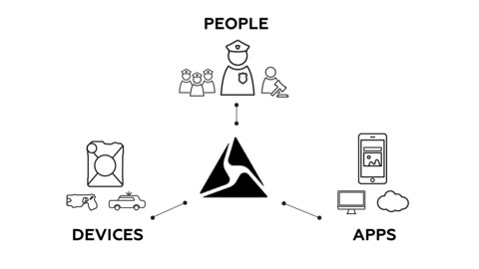
The three foundations for our growth strategy are:
| • | Devices - Our TASER CEWs are one of the few weapons that can incapacitate a person while drastically limiting the risk for death and/or serious injury. Over the past two decades, the TASER CEW has become one of the most frequently used weapons in the North American law enforcement market, with use-of-force injuries and deaths dropping dramatically as a result. Outside of weapons, we produce devices that primarily fall within three categories: on-officer cameras that capture critical digital evidence aimed at protecting truth, a range of related accessory hardware devices and an in-car camera variant called Axon Fleet. We refer to these cameras, related accessories and devices collectively as "Axon" products. We believe our CEWs and Axon cameras should be standard-issue equipment for all patrol officers domestically and internationally. We have created and are continuing to create service plans and product bundles to allow agencies to have the latest devices and technology at predictable annual costs. |
| • | Apps - Axon's Evidence.com platform is designed to help agencies securely store, manage and share all digital evidence. Our software platform features continuous improvement with regular software updates that enable our customers to always have access to the latest technology. Recent new features include secure sharing, audit trails, integration of other data sources, and transcription and redaction services. These feature sets are designed to provide our customers with valuable tools to police more efficiently and effectively while enabling greater transparency with the communities they serve. An increasing number police agencies trust Axon to host their video evidence data, which is captured via our devices, apps and software, and stored in our secure cloud and accessed via the Axon network. |
| • | People - Our TASER weapons and Axon software and sensors platforms have allowed us to build relationships with more than 20,000 public safety agencies worldwide. Axon's goal is to bring modern information technology capabilities to every law enforcement officer. Some of our customers report that police officers are spending over 60% of their time on paperwork-related tasks, rather than on value-added public safety work. We see a large opportunity to leverage our connected platform to enable a broad suite of mobile, wearable, and data management capabilities. Axon is also improving workflows throughout the public safety chain, from the incident on the scene to the court room. With our software, police officers can share evidence with prosecutors during discovery while maintaining a secure and encrypted chain of custody. Axon's cohesive ecosystem is delivering increased value to all public safety stakeholders, including state and municipal police agencies, police chiefs and other leadership, patrol officers, state patrols and officers, agency detectives, public prosecutors, district attorneys, and others in the public safety and judicial communities, as well as the public communities they serve. |
We have four strategic growth areas:
| • | Expand TASER CEW adoption: We believe we can increase the ratio of TASER CEWs to patrol officers domestically as well as continue expand into new international markets. We believe that our strategy of offering payment plans and eventually subscription hardware plans will shorten upgrade cycles and expand our immediately addressable market. Also, through continuing research and development ("R&D"), we believe that our TASER CEWs will become more capable and more connected over time, thus increasing in value and utility for our customers. |
| • | Expand Axon body camera and Evidence.com market share and increase average revenue per user ("ARPU"): Axon is the market leader in body-worn cameras and digital evidence management. Of the top 50 metropolitan areas in the U.S., 38 are on the Axon network. We believe we are well-positioned to build upon our prior success, and that our software offerings can become more valuable to our customers as we continue to expand our service offerings to better help agencies store, manage and share evidence data. |
| • | Capture in-car video market share with Axon Fleet: In the second quarter of 2017, we began shipping our in-car video offering, Axon Fleet. This is a new and adjacent market for Axon that we believe we can continue to grow through offering a superior product and service with disruptive pricing. |
| • | Expand into police agency records management systems and computer-aided dispatch software: In late 2016, we announced our intention to develop a police agency enterprise resource planning ("ERP") system, Axon Records, that would put officers back on the streets, help to solve and prosecute crime, and help to prevent crime and other incidents. Our development of Axon Records supports our strategic focus and vision of growing recurring cash flows by leveraging the data we host to unlock value-added services to our customers. |
Technological innovation is key to all four long-term growth areas. By investing in R&D, we intend to continue to develop novel, high-value solutions across our product platforms and expand our total addressable market within the law enforcement and public safety vertical markets. In 2017, we invested heavily in a new artificial intelligence (“AI”) group, Axon AI. Through two acquisitions plus additional hires, we have developed a team that is delivering AI features in our products as well as winning industry recognition. In 2017, we were named the preferred AI vendor for the Los Angeles Police Department. In early 2018, we opened an R&D office in Tampere, Finland, with 10 imaging and sensor experts who will work with our existing teams to create best-in-class smart cameras that integrate with our cloud platform. We also continue to add engineering talent to our Scottsdale headquarters and Seattle engineering and development office.
Company Organization
Axon sells its products to law enforcement worldwide through its direct sales force, distribution partners, online store and third-party resellers. The Company manages its business primarily on a geographic basis, with various sales representatives strategically located throughout the world. Domestic and international law enforcement agencies are primarily served through the Company's headquarters in Scottsdale, Arizona, and its software engineering development center located in Seattle, Washington. The Company also has subsidiaries located in the United Kingdom, Germany, the Netherlands, Australia, Vietnam and Canada.
The Company’s operations are comprised of two reportable segments: the sale of CEWs, accessories and other related products and services (the “TASER Weapons” segment); and the software and sensors business, focused on Axon devices, wearables, applications, cloud and mobile products (the "Software and Sensors" segment). Within the Software and Sensors segment, the Company includes only revenues and costs attributable to that segment which include: costs of sales for both products and services, direct labor, selling expense for the sales team, product management and marketing expenses, trade shows and related expenses, finance and accounting expenses, and research and development for products included, or to be included, within the Software and Sensors segment. All other costs are included in the TASER Weapons segment. Further information about our reportable segments and sales by geographic region is included in Notes 1 and 16 of the consolidated financial statements in Part II, Item 8 of this Annual Report on Form 10-K. We have made certain acquisitions of companies or their assets in the past two years that are described in Note 15 of our consolidated financial statements included in Part II, Item 8 of this report.
Products
TASER Weapons Products
We make CEWs for two main types of market segments: (i) the law enforcement, military, corrections and private security markets; and (ii) the consumer market. Our CEWs use our proprietary Neuro Muscular Incapacitation (“NMI”) technology to effectively neutralize suspects or threats. From a replaceable cartridge containing compressed nitrogen, two small probes that are attached to the CEW by insulated conductive wires are deployed from up to 35 feet away. Electrical pulses are transmitted along the wires and into the body, affecting the sensory and motor functions of the peripheral nervous system.
Since 2009, our CEWs have been on our Smart Weapons system, an all-digital platform that features the ability to regulate charge output, perform health checks, update firmware over the Internet, and provide analytics on device usage. Through the Company's Evidence.com platform, important records such as the event logs, which record user actions such as safety activation and trigger event durations, can be viewed and analyzed.
The benefits of using CEWs in the field have been significant. Studies have shown that TASER CEWs have prevented death or serious injury more than 178,000 times from the first deployment in 2000 to the end of 2017. The use of these devices instead of other force options has significantly reduced injuries for suspects and officers, with substantial liability and workers’ compensation savings to government agencies around the world.
The following products are core to the Company's TASER Weapons product line:
TASER X26P - The X26P is a single-shot, compact Smart Weapon designed for law enforcement and military use. It features the smallest form factor of our law enforcement models and was ergonomically designed with ease of use in mind.
TASER X2 - The X2 is a double-shot Smart Weapon designed for law enforcement and military use. In addition to the back-up shot, the X2 also features dual lasers and the warning arc, a visible electric charge that increases voluntary surrenders and de-escalates conflicts without cartridge deployment.
Consumer CEWs - The Company has two consumer CEW models, the Bolt (formerly known as the C2) and the Pulse. The two products differ in form factor but both feature the same NMI effects as the CEW models available to law enforcement and run in cycles of 30 seconds, which is intended to allow adequate time for the user to escape a threat.
Replacement Cartridges and Consumables - The Company manufactures multiple cartridge types with effective ranges from 15' to 35'. Smart cartridges communicate with the firing control system within the TASER X2 to indicate the type of cartridge loaded in each bay and its deployment status. Standard replacement cartridges are used in the TASER X26P as well as our consumer models. The Company also offers Performance Power Magazines (“PPM”), batteries that power the CEWs. PPMs are available in several options, such as Tactical (“TPPM”) or Automatic Shut-Down (“APPM”).
Axon Connected Solutions
Axon creates connected technologies to protect truth in public safety. As a company that grew from our TASER business, we are building on a history of innovation in policing. Axon is more than a collection of individual technologies; it is a cohesive ecosystem. Every product from our Smart Weapons to our body-worn cameras to our digital evidence management system integrates seamlessly with one another, and often complements the systems and processes a customer already uses. Below are the products and features that are core to the Axon platform.
Axon Hardware Products:
Axon Body 2 - Axon Body 2 builds upon the original platform by bringing officers new features such as high-definition ("HD") video, wireless fidelity ("Wi-Fi") offload capabilities, extended battery life, and additional security enhancements. The Axon Body 2 can be mounted on the officer's shirt at mid-chest level and eliminates all wires from the wearer’s body.
Axon Flex 2 - The Axon Flex 2 builds upon the original Axon Flex camera system and features a more rugged industrial design, new mounts and advanced capabilities like unlimited HD video, a 120-degree field of view, extended battery life, improved buffering and wireless activation.
Axon Fleet - Axon Fleet is a breakthrough in-car video system with advanced capabilities and a price that is significantly less than traditional systems. Axon Fleet includes automatic activation, HD video and a flexible design.
Axon Dock - With the Axon Dock, the camera charging station is also the automatic data downloader. At the end of a shift, the Axon Dock syncs video from the user's Axon Flex or Axon Body camera during routine charging. Videos are uploaded directly to Evidence.com, eliminating manual filing processes.
TASER CAM HD - The TASER CAM HD is a recording device built into a PPM battery pack for use with compatible TASER CEWs. The device can capture critical video and audio before, during and after a TASER CEW deployment.
Axon Signal - Axon Signal is a technology that enables Axon Body 2, Axon Flex 2 and Axon Fleet cameras to start recording upon certain triggering events such as the opening of a patrol car door, activation of a patrol car lightbar or the unholstering of a TASER CEW.
Signal Sidearm - Signal Sidearm is a device that is compatible with most firearm holsters. The moment an officer removes a firearm from a holster, Signal Sidearm wirelessly alerts all nearby Axon cameras to begin recording.
Axon Software and Mobile Technologies:
Evidence.com - As the sources of digital evidence expand, storage alone is not enough to keep track of the body-worn camera videos, photos, audio recordings and other data that is overwhelming agency servers and systems. Evidence.com is a robust end-to-end solution that not only allows agencies to store all that data, but also enables new workflows for managing and sharing that data. Officers and command staff can upload content from Axon and TASER devices or other systems easily, manage it with search and retrieval features, and collaborate with prosecutors by using powerful sharing features. When storage needs or users increase, the cloud-based system allows agencies to scale instantly and cost-effectively.
Evidence Sync - Evidence Sync is a desktop-based application that enables evidence in any format, from any source to be uploaded to Evidence.com. TASER Smart Weapon logs, Axon camera videos, interview room footage, photos and more can be uploaded, stored, and managed in one location. Sources new and old—from TASER devices or other brands—are equally supported. Network servers, secure digital memory cards ("SD cards"), compact discs ("CDs"), and computer folders can be synced with ease, and frequently used folders or drives can be set up to automatically sync on schedule.
Commander - Axon Commander is an on-premise application that consolidates all of a customer's digital evidence in one secure location, making it easy to manage and access while maintaining security and chain of custody. Designed to meet the evidence management needs of agencies in regions without reliable high-speed Internet access, Commander delivers many of the same features of cloud-based Evidence.com to customers using on-premise storage systems.
Axon Citizen - Axon Citizen is a mobile application that provides a public safety portal where community members can submit photos and videos of an incident they witness directly to their agency on Evidence.com.
Axon Capture - Axon Capture is a mobile application that allows officers to capture digital evidence right from the field. The app eliminates the need to carry three separate devices for photo, video, and audio recording by securely building upon the capabilities of an officer's mobile phone. Officers can add tags, titles or Global Positioning System ("GPS") coordinates to any recordings before uploading the data to Evidence.com.
Axon View - Axon View is a mobile application that wirelessly connects with an Axon camera to provide instant playback of unfolding events from the field, in the field. The app's live display ensures the camera is positioned correctly.
Axon Interview - Axon Interview is a recording system designed for the interview room. The system records crucial interviews with redundant, high-quality video and audio technology, ensuring that every moment is captured. The system is available with a 24/7 buffering option that allows agencies to capture key dialogue even after it occurs.
Markets and Distribution
Law Enforcement
Our primary target market for both our weapon and video products is federal, state and local law enforcement agencies in the U.S. and throughout the world. We estimate that in the U.S., approximately two-thirds of all law enforcement patrol officers carry a TASER CEW and internationally, approximately one out of every fifty eligible law enforcement officers carries a TASER CEW. Our goal is to have our CEWs be standard issue equipment for all domestic and international law agencies.
Other Markets
We also target military forces, private security, correctional facilities and consumer personal protection markets to provide technologies that offer a less lethal form of protection.
U.S. Distribution
The Company sells directly to law enforcement agencies in the U.S. as well as through a distribution network. Distributors are selected based upon their reputation within their respective industries, contacts and distribution network. Our regional sales managers work closely with the distributors in their territory to inform and educate the law enforcement communities. We continue to monitor our law enforcement distributors closely to help ensure that our service standards are achieved. Where appropriate, we intend to grow our direct sales over time. Distributors often allow us to penetrate regions at lower fixed costs; however, direct sales allow us greater control over the customer relationship.
Sales in the private citizen market are primarily made through our distributors and our website. We have implemented a variety of marketing initiatives to support sales of our consumer products, with a focus on web, public relations and consumer trade shows. We have consulted with professional digital media and public relations professionals to assist us in media and press events and editorial placements along with attending numerous trade shows specifically to target the consumer market.
International Distribution
We market and distribute our CEW products to foreign markets through our international subsidiaries as well as through a network of distributors. For geographical and cultural reasons, our distributors usually have a territory defined by their country’s borders. These distributors market both our law enforcement, military, and corrections products, and our consumer products where allowed by law. Our distributors work with local law enforcement, military and corrections agencies in the same manner as our domestic market distributors. For example, they may perform demonstrations, attend industry trade shows, maintain country specific websites, engage in print advertising and arrange training classes.
In order to more effectively engage customers internationally, we have also implemented direct sales teams strategically located throughout each major geographic region of the world. Having dedicated sales personnel stationed full time in these regions will allow us to better serve existing customers as well as execute our sales and marketing strategies more efficiently in order to continue to grow our customer base in new markets.
Manufacturing
We perform light manufacturing, final assembly, and final test operations at our headquarters in Scottsdale, Arizona, and own substantially all of the equipment required to develop, prototype, manufacture and assemble our finished products. This includes critical injection molds, schematics, automation equipment, test equipment and prototypes utilized by our supply chain for the conversion of raw materials into sub-assemblies. We have implemented lean/six sigma methodologies to optimize most direct and indirect resources within the organization, which has helped boost capacity for existing products, as well as provide flexibility to accommodate production of new TASER and Axon product introductions. We are currently operating one to two production shifts depending on inventory levels and demand. However, other capacity options, including the use of additional shifts, will be considered should we experience higher demand resulting from large orders of legacy or new product releases. We have continued to maintain our ISO 9001 certification and have recently attained the new ISO 9001:2015 certification.
The Company currently purchases both off-the-shelf and custom components, including finished circuit boards assemblies and injection-molded plastic components, primarily from suppliers located in the U.S., Mexico, China and Taiwan. Although the Company currently obtains many of these components from single sources of supply, the Company owns the designs as well as the injection molded component tooling and test fixtures used in production for all custom components. As a result, management believes it could obtain alternative suppliers in most cases without incurring significant production delays. The Company also strategically holds safety stock levels on custom components to further reduce this risk. For off-the-shelf components, Management believes that there are readily available alternative suppliers in most cases who can consistently meet the Company's needs for these components. The Company acquires most of its components on a purchase order basis and does not have any significant long-term contracts with suppliers.
Business Seasonality and Product Introductions
The Company has historically experienced higher net sales in its second and fourth quarters compared to other quarters in its fiscal year due primarily to municipal budget cycles. Additionally, new product introductions can significantly impact net sales, product costs and operating expenses. However, historical seasonal patterns, municipal budgets or historical patterns of product introductions should not be considered reliable indicators of the Company’s future net sales or financial performance.
Backlog
Our backlog for products and services includes all orders that have been received and are believed to be firm. As of December 31, 2017 and 2016, our backlog was $582.7 million and $384.2 million, respectively.
In the TASER Weapons segment, we define backlog as equal to deferred revenue. Deferred revenue represents amounts billed and collected from the customer for goods and services to be delivered in subsequent periods. The Company processes orders within the TASER Weapons segment quickly, and our best estimate of firm orders outstanding as of period end represents those that have been paid for but remain undelivered. The TASER weapons backlog balance was $46.7 million as of December 31, 2017. The Company expects to realize $16.7 million of this deferred revenue balance as revenue during the next 12 months. This represents cash received from customers on or prior to December 31, 2017 for products and services expected to be delivered in the next 12 months.
In the Software and Sensors segment, we define backlog as cumulative bookings, net of cancellations, less product and service revenue recognized to date. Bookings are generally realized as revenue over multiple years. The Software and Sensors backlog balance was $536.0 million as of December 31, 2017. This backlog balance includes $78.6 million of deferred revenue, $27.0 million that has been invoiced, but not yet collected, and $430.4 million that has been recorded as bookings but not yet invoiced, all as of December 31, 2017. The Company expects to realize approximately $110.0 million of the December 31, 2017 backlog balance as revenue during the next 12 months.
Backlog - Year ended December 31, 2017 (in thousands)
| TASER Weapons | Software and Sensors | Total | |||||||||
| Balance, beginning of period | $ | 33,391 | $ | 350,792 | $ | 384,183 | |||||
| Add: additions to backlog, net of cancellations | 247,806 | 291,152 | 538,958 | ||||||||
| Less: revenue recognized during period | 234,512 | 105,928 | 340,440 | ||||||||
| Balance end of period | $ | 46,685 | $ | 536,016 | $ | 582,701 |
Competition
Law Enforcement, Corrections and Private Security Markets
Law enforcement customers partner with TASER for the long-term. The primary competitive factors in the law enforcement and corrections market include a weapon’s accuracy, effectiveness, safety, cost, ease of use and an exceptional customer experience. We are aware of competitors providing competing CEW products, primarily in international markets.
We also believe our CEWs compete indirectly with a variety of other less-lethal alternatives. These alternatives include, but are not limited to, pepper spray, batons and impact weapons sold by companies such as Defense Technology. We believe our TASER brand devices’ advanced technology, versatility, portability, effectiveness, built-in accountability systems, and low injury rate enable us to compete effectively against these other less-lethal alternatives.
Private Citizen Market
CEWs have gained limited acceptance in the private citizen market. These devices primarily compete with guns, but also with other less lethal weapons such as pepper spray. The primary competitive factors in the private citizen market include a weapon’s cost, effectiveness, safety and ease of use.
Video Evidence Market
Axon is the market leader in a video evidence capture and management market that is highly fragmented and competitive. Continued evolution in the industry and technology shifts are creating opportunities for both established and new competitors. Key competitive factors include: product performance, product features, product quality and warranty, total cost of ownership, data security, data and information work flows, company reputation and financial strength, and relationships with customers.
Our digital evidence management system, Evidence.com, is a cloud-based platform. Cloud computing fundamentally changes the way local, state and federal government agencies will develop and deploy software applications. Applications used by these agencies have historically required the agency to deploy their own infrastructure of servers, storage, network devices and operating systems. With a cloud-based system, the entire storage infrastructure is managed by third-parties who specialize in infrastructure management. Agencies use Internet web browsers to access the application. Our cloud-based Evidence.com service enables
agencies to store, manage and analyze digital evidence. We believe our end-to-end solution providing a combination of both products and services is a compelling value proposition for law enforcement agencies to implement.
Regulatory Matters
U.S. Regulation
The majority of TASER CEWs, as well as the cartridges used by these devices, are subject to regulations; however, most are not considered to be “firearms” by the U.S. Bureau of Alcohol, Tobacco, Firearms and Explosives. Many states have regulations restricting the sale and use of stun guns, hand-held shock devices and electronic weapons. We believe existing stun gun laws and regulations apply to TASER CEWs.
In many cases, the law enforcement and corrections market is subject to different regulations than the private citizen market. Where different regulations exist, we assume the regulations affecting the private citizen market also apply to the private security markets, except as the applicable regulations otherwise specifically provide.
As of December 31, 2017, the possession of stun guns by the general public, including TASER CEWs, is prohibited in four states: Hawaii, Massachusetts, New York, and Rhode Island, as well as in the District of Columbia. In 2017, New Jersey ended its state ban on stun guns for civilians. Some cities and municipalities also prohibit private citizen possession or use of our CEW products.
We are also subject to environmental laws and regulations, including restrictions on the presence of certain substances in electronic products. Reference is made to Section 1A, Risk Factors under the heading “Environmental laws and regulations subject us to a number of risks and could result in significant liabilities and costs.”
Axon body worn cameras and fleet vehicle cameras are subject to regulations including 21-CFR-47 Part 15, Subpart C for Bluetooth and WiFi transmission, US-DOT/UN 38.3 for transportation of lithium batteries, and FCC KDB 447498 + IEEE 1528-2013 Specific Absorption Rate ("SAR") regulations. These regulations are also beginning to affect CEWs with signal performance power magazine ("SPPM") technology and future CEWs implementing wireless technology into the feature set.
Evidence.com is subject to government regulation of the Internet in many areas, including telecommunications, data protection, user privacy and online content.
U.S. Export Regulation
CEWs are considered a crime control product (ECCN: 0A985) by the U.S. government. Accordingly, the export of our devices is regulated under export administration regulations. As a result, we must obtain export licenses from the Department of Commerce for all shipments to foreign countries other than Canada. Most of our requests for export licenses have been granted, and the need to obtain these licenses has not caused a material delay in our shipments. Export regulations also prohibit the further shipment of our products from foreign markets in which we hold a valid export license to foreign markets in which we do not hold an export license for our products.
Export Administration Regulations ("EAR") established by the U.S. Department of Commerce restrict the export of technology used in our CEWs. These regulations apply to both the technology incorporated in our CEW systems and to the processes used to produce them. These restrictions apply to any individual that is not a U.S. Citizen, U.S. Permanent Resident, or “protected person” as defined in 8 U.S.C. 1324b(a)(3).
Foreign Regulation
Foreign regulations, which may affect our devices, and sale thereof, are numerous and often unclear. We prefer to work with a distributor who is familiar with the applicable import regulations in each of our foreign markets. Experience with foreign distributors in the past indicates that restrictions may prohibit certain sales of our products in a number of countries. However, the majority of countries permit TASER devices to be sold and used by law enforcement. We maintain strong communication channels with our distributors to ensure that we are aware of ongoing regulation of our products and of those countries where TASER CEW devices are prohibited or restricted.
Contracts
Our business is affected by numerous laws and regulations, including those related to the award, administration and performance of contracts. Governmental agencies generally have the ability to terminate our contracts, in whole or in part, for
reasons including, but not limited to, non-appropriation of funds. We monitor our policies and procedures with respect to our contracts on a regular basis to enhance consistent application under similar terms and conditions, as well as compliance with all applicable laws and regulations. We provide limited manufacturer's warranties on our CEWs and Axon devices. Further information about our warranties is included in Note 1 of the consolidated financial statements in Part II, Item 8 of this Annual Report on Form 10-K.
Intellectual Property
We protect our intellectual property with U.S. and foreign patents and trademarks. Our patents and pending patent applications relate to technology used by us in connection with our products. We also rely on international treaties, organizations and foreign laws to protect our intellectual property. As of December 31, 2017, we hold 137 U.S. patents, 63 U.S. registered trademarks, 98 foreign patents, and 278 foreign registered trademarks, and also have numerous patents and trademarks pending. We continuously assess whether and where to seek formal protection for particular innovations and technologies based on such factors as the commercial significance of our operations and our competitors’ operations in particular countries and regions, our strategic technology or product directions in different countries, and the degree to which intellectual property laws exist and are meaningfully enforced in different jurisdictions. Axon has the exclusive rights to many Internet domain names, primarily including “TASER.com”, “Axon.com”, “Axon.net”, “Evidence.com” and “Axon.io.”
Confidentiality agreements are used with employees, consultants and key suppliers to help ensure the confidentiality of our trade secrets.
Research and Development
Our R&D initiatives focus on next generation technology. We continue to develop new technologies to enhance existing products and services, and to expand the range of our offerings through R&D, licensing of intellectual property and acquisition of third-party businesses and technology. Our investment in internally funded research and development totaled $55.4 million, $30.6 million and $23.6 million in 2017, 2016, and 2015, respectively.
Within the Software and Sensors segment, the Company's team of application developers conduct R&D initiatives for cloud applications, wearable and mobile technologies in law enforcement, focused specifically on new revenue opportunities that align with our Software and Sensors product and services solutions.
Within the TASER Weapons segment, current R&D initiatives include bio-medical research and electrical, mechanical and software engineering. We expect that future CEW development projects will focus on extending the range, reducing the size, improving the functionality and developing new delivery options for our products.
Our return on investment is intended to be realized over the long-term, although new systems and technologies often can have a more immediate impact on our business.
Employees
As of December 31, 2017, we had 949 full-time employees and 146 temporary employees. The breakdown of our full-time employees by department was as follows: 354 direct manufacturing employees, 600 administrative and manufacturing support employees and 141 employees within sales, marketing, communications and training. Of the 146 temporary employees, more than 91% worked in direct manufacturing roles. Our employees are not covered by any collective bargaining agreement, and we have never experienced a work stoppage. We believe that our relations with our employees are good.
Available Information
We were incorporated in Arizona in September 1993 as ICER Corporation. We changed our name to AIR TASER, Inc. in December 1993 and to Axon Enterprise, Incorporated in April 1998. In January 2001, we reincorporated in Delaware as TASER International, Inc., and in April 2017, changed our name to Axon Enterprise, Inc.
Our Annual Report on Form 10-K, quarterly reports on Form 10-Q, current reports on Form 8-K and amendments to those reports filed or furnished pursuant to Section 13(a) or 15(d) of the Exchange Act are available free of charge on our website at http://www.axon.com as soon as reasonably practicable after we electronically file such material with, or furnish such material to, the SEC. The information on our website, including information about our trademarks, is not incorporated by reference into or otherwise a part of this report. The SEC maintains a website that contains reports, proxy and information statements and other information regarding issuers that file electronically with the SEC at http://www.sec.gov.
Item 1A. Risk Factors
Because of the following factors, as well as other variables affecting our operating results, our past financial performance may not be a reliable indicator of our future performance and historical trends should not be used to anticipate our results or trends in future periods. You should carefully consider the trends, risks and uncertainties described below and other information in this Form 10-K and subsequent reports filed with or furnished to the Securities and Exchange Commission (the “SEC”) before making any investment decision with respect to our securities. If any of the following trends, risks or uncertainties actually occurs or continues, our business, financial condition or operating results could be materially adversely affected, the trading prices of our securities could decline, and you could lose all or part of your investment. All forward-looking statements attributable to us or persons acting on our behalf are expressly qualified in their entirety by this cautionary statement.
We are materially dependent on acceptance of our products by law enforcement markets, both domestic and international. If law enforcement agencies do not continue to purchase and use our products, our revenues will be adversely affected.
At any point, due to external factors and opinions. whether or not not related to product performance, law enforcement agencies may elect to no longer purchase our CEWs or other products
We substantially depend on sales of our TASER X26P and X2 CEWs, and if these products do not continue to be widely accepted, our growth prospects will be diminished.
In the years ended December 31, 2017, 2016 and 2015, we derived our revenues predominantly from sales of TASER CEW brand devices and related cartridges, and expect to depend on sales of these products for a predominant portion of our revenue fo the foreseeable future. We are seeing a large number of customers upgrade their devices to the X2 or the new X26P device. This is a trend we expect to continue. A decrease in the selling prices of, or demand for these products, or their failure to maintain broad market acceptance, would significantly harm our growth prospects, operating results and financial condition.
The success of our Evidence.com software as a service (“SaaS”) delivery model is materially dependent on acceptance of this business model by our law enforcement customers. Delayed or lengthy time to adoption by law enforcement agencies will negatively impact our sales and profitability.
A substantial number of law enforcement agencies may be slow to adopt our Evidence.com digital data evidence management and storage solution, requiring extended periods of trial and evaluation. The hosted service delivery business model is not presently widely adopted by our law enforcement customer base. As such, the sales cycle has additional complexity with the need to educate our customers and address issues regarding agency bandwidth requirements, data retention policies, data security and chain of evidence custody. Delays in successfully securing widespread adoption of Evidence.com services could adversely affect our revenues, profitability and financial condition.
If we are unable to design, introduce and sell new products or new product features successfully, our business and financial results could be adversely affected.
Our future success will depend on our ability to develop new products or new product features that achieve market acceptance in a timely and cost-effective manner. The development of new products and new product features is complex, time consuming and expensive, and we may experience delays in completing the development and introduction of new products. We cannot provide any assurance that products that we may develop in the future will achieve market acceptance. If we fail to develop new products or new product features on a timely basis that achieve market acceptance, our business, financial results and competitive position could be adversely affected.
Delays in product development schedules may adversely affect our revenues and cash flows.
The development of CEWs, devices, sensors and software is a complex and time-consuming process. New products and enhancements to existing products can require long development and testing periods. Our increasing focus on our SaaS platform also presents new and complex development issues. Significant delays in new product or service releases or significant problems in creating new products or services could adversely affect our business, financial results and competitive position.
We face risks associated with rapid technological change and new competing products.
The technology associated with law enforcement devices is receiving significant attention and is rapidly evolving. While we have some patent protection in certain key areas of our CEW, Axon Device and SaaS technology, it is possible that new technology may result in competing products that operate outside our patents and could present significant competition for our products, which could adversely affect our business, financial results and competitive position.
Defects in our products could reduce demand for our products and result in a loss of sales, delay in market acceptance and damage to our reputation.
Complex components and assemblies used in our products may contain undetected defects that are subsequently discovered at any point in the life of the product. Defects in our products could result in a loss of sales, delay in market acceptance and damage to our reputation and increased warranty costs, which could adversely affect our business, financial results and competitive position.
If our security measures are breached and unauthorized access is obtained to customers’ data or our data, our network, data centers and service may be perceived as not being secure, customers may curtail or stop using our service and we may incur significant legal and financial exposure and liabilities.
Our service involves the storage and transmission of customers’ proprietary information, and security breaches could expose us to a risk of loss of information or the total deletion of all stored customer data, litigation and possible liability. We devote significant resources to engineer secure products and ensure security vulnerabilities are mitigated, and we require out third-party service providers to do so as well. Despite these efforts, security measures may be breached as a result of third-party action, employee error, and malfeasance or otherwise. Breaches could occur during transfer of data to data centers or at any time, and result in unauthorized access to our data or our customers’ data. Third-parties may attempt to fraudulently induce employees or customers into disclosing sensitive information such as user names, passwords or other information in order to gain access to our data or our customers’ data. Additionally, hackers may develop and deploy viruses, worms, and other malicious software programs that attack or gain access to our networks and data centers. Because the techniques used to obtain unauthorized access, or to sabotage systems, change frequently and generally are not recognized until launched against a target, we may be unable to anticipate these techniques or to implement adequate preventative measures. Moreover, our security measures and/or those of our third party service providers and/or customers may not detect such security breaches if they occur. Any security breach could result in a loss of confidence in the security of our service, damage our reputation, lead to legal liability, negatively impact our future sales and significantly harm our growth prospects, operating results and financial condition.
Interruptions or delays in service from our third-party cloud storage providers for our Evidence.com service, or the loss or corruption of digitally stored evidence, would impair the delivery of our service and harm our business.
We currently serve our Evidence.com customers from third-party cloud storage providers based in the U.S. and other countries. Interruptions in our service, or loss or corruption of digital evidence, may reduce our revenue, cause us to issue credits or pay penalties, cause customers to terminate their subscriptions and adversely affect our renewal rates and our ability to attract new customers. Our business will also be harmed if our customers and potential customers believe our service is unreliable.
Most of our end-user customers are subject to budgetary and political constraints that may delay or prevent sales.
Most of our end-user customers are government agencies. These agencies often do not set their own budgets and therefore, have limited control over the amount of money they can spend. In addition, these agencies experience political pressure that may dictate the manner in which they spend money. As a result, even if an agency wants to acquire our products, it may be unable to purchase them due to budgetary or political constraints, particularly in challenging economic environments. There can be no assurance that the economic and budgeting issues will not worsen and adversely impact sales of our products. Some government agency orders may also be canceled or substantially delayed due to budgetary, political or other scheduling delays, which frequently occur in connection with the acquisition of products by such agencies, and such cancellations may accelerate or be more severe than we have experienced historically.
We expend significant resources in anticipation of a sale due to our lengthy sales cycle and may receive no revenue in return.
Generally, law enforcement and corrections agencies consider a wide range of issues before committing to purchase our products, including product benefits, training costs, the cost to use our products in addition to, or in place of, other products, budget constraints and product reliability, safety and efficacy. The length of our sales cycle may range from a few weeks to as long as several years. Adverse publicity surrounding our products or the safety of such products has in the past, and could in the future, lengthen our sales cycle with customers. In the past, we believe that the Company’s sales were adversely impacted by negative publicity surrounding our products or the use of our products. See, for example, “Litigation - Product Litigation” in Note 9 of our consolidated financial statements included in Part II, Item 8 of this report. We may incur substantial selling costs and expend significant effort in connection with the evaluation of our products by potential customers before they place an order. If these potential customers do not purchase our products, we will have expended significant resources and received no revenue in return.
Due to municipal government funding rules, certain of our contracts are subject to appropriation, termination for convenience, or similar cancellation clauses, which could allow our customers to cancel or not exercise options to renew contracts in the future.
Although Axon has entered into contracts for the delivery of products and services in the future and anticipates the contracts will be completed, if agencies do not appropriate money in future year budgets, terminate contracts for convenience or if other cancellation clauses are invoked, revenue associated with these bookings will not ultimately be recognized, and could result in a reduction to bookings.
An increasing percentage of our revenue is derived from subscription billing arrangements which may result in delayed cash collections and may increase customer credit risk on receivables
A growing portion of our sales are derived from subscription billing arrangements and on an open credit basis. While we perform ongoing credit evaluations of our customers' financial condition, if we become aware of information related to the creditworthiness of a major customer, or if future actual default rates on receivables in general differ from those currently anticipated, we may have to adjust our allowance for doubtful accounts, which could adversely affect our business, financial condition or operating results.
Changes in civil forfeiture laws may affect our customers’ ability to purchase our products
Some of our customers use funds seized through civil forfeiture proceedings to fund the purchase of our products. Changes in state legislatures could impact our customers’ ability to seize funds or use seized funds to fund purchases. Changes in civil forfeiture statutes or regulations are outside of our control and could limit the amount of funds available to our customers, which could adversely affect the sale of our products.
SaaS revenue for Evidence.com is recognized over the terms of the contracts, which may be several years, and, as such, trends in new business may not be immediately reflected in our operating results.
Our SaaS service revenue is generally recognized ratably over the terms of the contracts, which generally range from one to five years. As a result, most of the SaaS revenue we report each quarter is the result of agreements entered into during previous quarters. Consequently, current positive or negative trends in this portion of our business may not be fully reflected in our revenue results for several periods.
We utilize multiple third-party cloud-based storage providers to host the Axon Evidence.com platform.
Utilizing and administering multiple cloud-based storage providers may result in duplication of efforts and resources, increased cost structure, and organization complexities. These complexities and additional costs could adversely affect our business, financial condition or operating results.
We may face personal injury, wrongful death and other liability claims that harm our reputation and adversely affect our sales and financial condition.
Our CEW products are often used in aggressive confrontations that may result in serious, permanent bodily injury or death to those involved. Our CEW products may be associated with these injuries. A person, or the family members of a person, injured in a confrontation or otherwise in connection with the use of our products, may bring legal action against us to recover damages on the basis of theories including wrongful death, personal injury, negligent design, defective product or inadequate warning. We are currently subject to a number of such lawsuits and we have been subject to significant adverse judgments and settlements. We may also be subject to lawsuits involving allegations of misuse of our products. If successful, wrongful death, personal injury, misuse and other claims could have a material adverse effect on our operating results and financial condition and could result in negative publicity about our products. Although we carry product liability insurance, we do incur significant legal expenses within our self-insured retention in defending these lawsuits and significant litigation could also result in a diversion of management’s attention and resources, negative publicity and a potential award of monetary damages in excess of our insurance coverage. The outcome of any litigation is inherently uncertain and there can be no assurance that our existing or any future litigation will not have a material adverse effect on our business, financial condition or operating results.
Other litigation may subject us to significant litigation costs and judgments and divert management attention from our business.
We have been or could in the future be involved in numerous other litigation matters relating to our products, contracts and business relationships, including litigation against persons whom we believe have infringed on our intellectual property, infringement litigation filed against the Company, litigation against a competitor and litigation filed by a former distributor against the Company. Such matters have resulted, and are expected to continue to result in, substantial costs to us, including in the form of attorney’s fees and costs, damages, fines or other penalties, whether pursuant to a judgment or settlement, and diversion of our management’s attention, which could adversely affect our business, financial condition or operating results. There is also a risk of adverse judgments, as the outcome of litigation is inherently uncertain.
If we are unable to protect our intellectual property, we may lose our competitive advantage or incur substantial litigation costs to protect our rights. We may be subject to intellectual property infringement claims, which could cause us to incur litigation costs and divert management attention from our business.
Our future success depends upon our proprietary technology. Our protective measures, including patents, trademarks, copyrights, trade secret protection, and Internet identity registrations, may prove inadequate to protect our proprietary rights and market advantage. The right to stop others from misusing our trademarks and service marks in commerce depends, to some extent, on our ability to show evidence of enforcement of our rights against such misuse in commerce. Our efforts to stop improper use, if insufficient, may lead to loss of trademark and service mark rights, brand loyalty and notoriety among our customers and prospective customers. The scope of any patent to which we have or may obtain rights may not prevent others from developing and selling competing products. The validity and breadth of claims covered in technology patents involve complex legal and factual questions, and the resolution of such claims may be highly uncertain, lengthy and expensive. In addition, our patents may be held invalid upon challenge, or others may claim rights in or ownership of our patents. Moreover, we are subject to litigation with parties that claim, among other matters, that we infringed their patents or other intellectual property rights. The defense and prosecution of patent and other intellectual property claims are both costly and time consuming, divert our management’s attention from our business and could result in a material adverse effect on our business, and financial position and operating results.
If our products were found to infringe a third-party’s proprietary rights, we could be forced to enter into costly royalty or licensing agreements in order to be able to sell our products or discontinue use of the protected technology. Such royalty and licensing agreements may not be available on terms acceptable to us or at all. We could also be required to pay substantial damages, fines or other penalties, indemnify customers or distributors, cease the manufacture, use, or sale of infringing products or processes, and/or expend significant resources to develop or acquire non-infringing technologies. There is no guarantee that our use of conventional technology searching and brand clearance searching will identify all potential rights holders. Rights holders may demand payment for past infringements and/or force us to accept costly license terms or discontinue use of protected technology and/or works of authorship that may include, for example, photos, videos, and software. Our current research and development focus on developing software-based products increases this risk.
In foreign countries, we can enforce patent rights only in the jurisdictions in which our patent applications have been granted.
Our U.S. patents protect us from imported infringing products coming into the U.S. from abroad. We have made applications for patents in a few foreign countries; however, these may be inadequate to protect markets for our products in other foreign countries. Each foreign patent is examined and granted according to the law of the country where it was filed independent of whether a U.S. patent on similar technology was granted. A patent in a foreign country may be subject to cancellation if the claimed invention has not been sold in that country. Meeting the requirements of working invention differs by country and ranges from sales in the country to manufacturing in the country. U.S. export law, or the laws of some foreign countries, may prohibit us from satisfying the requirements for working the invention, creating a risk that some of our foreign patents may become unenforceable.
Government regulations applied to our CEW products may affect our markets for and sales of these products.
We rely on the opinions of the U.S. Bureau of Alcohol, Tobacco, Firearms and Explosives, including the determination that a device that has projectiles propelled by the release of compressed gas in place of the expanding gases from ignited gunpowder, are not classified as firearms. Changes in statutes, regulations, and interpretation outside of our control may result in our products being classified or reclassified as firearms. Our private citizen market could be substantially reduced if consumers are required to obtain a registration to own a firearm prior to purchasing our products.
Federal regulation of sales in the U.S.: Our CEWs are not firearms regulated by the U.S. Bureau of Alcohol, Tobacco, Firearms and Explosives, but our consumer products are regulated by the U.S. Consumer Product Safety Commission. Although there are currently no Federal laws restricting sales of our core CEW products in the U.S., future Federal regulation could adversely affect sales of our products.
Federal regulation of international sales: Our CEW devices are considered a “crime control” product by the U.S. Department of Commerce (“DOC”) for export directly from the U.S. Consequently, we must obtain an export license from the DOC for the export of our CEW devices from the U.S. other than to Canada. In addition, certain of our camera and software products require classifications from the DOC before they may be shipped internationally. Our inability to obtain DOC export licenses or classifications on a timely basis for sales of our products to our international customers could significantly and adversely affect our international sales.
State and local regulation: Our CEW devices are controlled, restricted or their use prohibited by a number of state and local governments. Our CEW devices are banned from private citizen purchase or use by statute in five states: Hawaii, Massachusetts, New York, and Rhode Island, as well as in the District of Columbia. Some cities and municipalities also prohibit private citizen possession or use of our CEW products. Other jurisdictions may ban or restrict the sale of our CEW products and our product sales may be significantly affected by additional state, county and city governmental regulation.
Foreign regulation: Certain foreign jurisdictions prohibit, restrict, or require a permit for the importation, sale, possession or use of CEWs, including in some countries by law enforcement agencies, limiting our international sales opportunities.
Our CEW products are also subject to regulation by testing, safety and other standard organizations (e.g. ANSI, IEC, NIST).
Our international operations expose us to additional risks that could harm our business, operating results, and financial condition.
Our international operations are significant, and we plan to continue to grow internationally by acquiring existing entities or setting up new legal entities in new markets. In certain international markets, we have limited operating experience and may not benefit from any first-to-market advantages or otherwise succeed. In addition to risks described elsewhere in this section, our international operations expose us to other risks, including the following:
| • | Restrictions on foreign ownership and investments, and stringent foreign exchange controls that might prevent us from repatriating cash earned in countries outside the U.S. |
| • | Import and export requirements, tariffs, trade disputes and barriers, and customs classifications that may prevent us from offering products or providing services to a particular market or obtaining necessary parts and components to manufacture products, which may lead to decreased sales and may increase our operating costs. |
| • | Longer payment cycles in some countries, increased credit risk, and higher levels of payment fraud. |
| • | Uncertainty regarding liability for products and services, including uncertainty as a result of local laws and lack of legal precedent. |
| • | Different employee/employer relationships, existence of workers' councils and labor unions, and other challenges caused by distance, language, and cultural differences, making it harder to do business in certain jurisdictions. |
Additionally, changes in international local political, economic, regulatory, tax, social, and labor conditions may adversely harm our business and compliance with complex foreign and U.S. laws and regulations that apply to our international operations increases our cost of doing business. These numerous and sometimes conflicting laws and regulations include, among others, internal control and disclosure rules, privacy and data protection requirements, anti-corruption laws, such as the U.S. Foreign Corrupt Practices Act, and other local laws prohibiting corrupt payments to governmental officials, and competition regulations, among others. Violations of these laws and regulations could result in fines and penalties, criminal sanctions against us, our officers, or our employees, prohibitions on the conduct of our business and on our ability to offer our products and services in one or more countries, and could also materially affect our brand, our international growth efforts, our ability to attract and retain employees, our business, and our operating results. Although we have implemented policies and procedures designed to ensure compliance with these laws and regulations, there can be no assurance that our employees, contractors, or agents will not violate our policies.
Environmental laws and regulations subject us to a number of risks and could result in significant liabilities and costs.
We are subject to various state, federal and international laws and regulations governing the environment, including restricting the presence of certain substances in our products and making producers for those products financially responsible for the collection, treatment, recycling and disposal. Environmental legislation within the European Union (“EU”) may increase our cost of doing business internationally and impact our revenues from EU countries as we comply with and implement these requirements.
The EU has published Directives on the restriction of certain hazardous substances in electronic and electrical equipment (the “RoHS Directive”) and on electronic and electrical waste management (the “WEEE Directive”). The RoHS Directive restricts the use of a number of substances, including lead. The WEEE Directive directs members of the EU to enact laws, regulations, and administrative provisions to ensure that producers of electric and electronic equipment are financially responsible for the collection, recycling, treatment and environmentally responsible disposal of certain products sold into the EU. In addition, similar
environmental legislation has been or may be enacted in other jurisdictions, including the U.S. (under federal and state laws) and other countries, the cumulative impact of which could be significant.
We continue to monitor the impact of specific registration and compliance activities required by the RoHS and WEEE Directives. We endeavor to comply with applicable environmental laws, yet compliance with such laws could increase our operations and product costs, increase the complexities of product design, procurement, and manufacturing, limit our ability to manage excess and obsolete non-compliant inventory, limit our sales activities, and impact our future financial results. Any violation of these laws can subject us to significant liability, including fines, penalties, and prohibiting sales of our products into one or more states or countries, and result in a material adverse effect on our financial condition.
Regulations related to voice, data and communications services may impact our ability to sell our products.
The radio spectrum is required to provide wireless voice, data and video communications services. The allocation of spectrum is regulated in the U.S. and other countries and limited spectrum space is allocated to wireless services and specifically to public safety users. In the U.S., the Federal Communications Commission (“FCC”) regulates spectrum use by non-federal entities and federal entities. Similarly, countries around the world have one or more regulatory bodies that define and implement the rules for use of radio spectrum and electromagnetic interference, pursuant to their respective national laws. We manufacture and market products in spectrum bands already made available by regulatory bodies. Consequently, our results could be positively or negatively affected by the rules and regulations adopted from time to time by the FCC or regulatory agencies in other countries. Regulatory changes in current spectrum bands may also provide opportunities or may require modifications to some of our products so they can continue to be manufactured and marketed. If current products do not comply with the regulations set forth by these governing bodies, we may be unable to sell our products or could incur penalties, which could have an adverse impact on our financial condition, results of operations and cash flows.
Regulations related to conflict minerals may force us to incur additional expenses, may make our supply chain more complex and may result in damage to our reputation with customers.
The U.S. Securities and Exchange Commission ("SEC") has enacted disclosure requirements for companies that use certain minerals and metals, known as “conflict minerals,” in their products, whether or not these products are manufactured by third-parties. These requirements require companies to perform due diligence, disclose and report whether or not such minerals originate from the Democratic Republic of Congo and adjoining countries. We have incurred and will likely continue to incur costs to comply with the disclosure requirements, including costs related to determining the source of any of the relevant minerals and metals used in our products. In addition, these new requirements could adversely affect the sourcing, availability and pricing of minerals used in our products. Because our supply chain is complex, we may not be able to sufficiently verify the origins for these minerals and metals used in our products through the due diligence procedures that we implement, which may harm our reputation. In such an event, we may also face difficulties in satisfying customers who require that all of the components of our products are certified as conflict-free.
Our dependence on third-party suppliers for key components of our devices could delay shipment of our products and reduce our sales.
We depend on certain domestic and foreign suppliers for the delivery of components used in the assembly of our products. Our reliance on third-party suppliers creates risks related to our potential inability to obtain an adequate supply of components or sub-assemblies and reduced control over pricing and timing of delivery of components and sub-assemblies. Specifically, we depend on suppliers of sub-assemblies, machined parts, injection molded plastic parts, printed circuit boards, custom wire fabrications and other miscellaneous customer parts for our products. We do not have long-term agreements with any of our suppliers and there is no guarantee that supply will not be interrupted. Due to changes imposed for imports of foreign products into the U.S., as well as potential port closures and delays created by terrorist attacks or threats, public health issues, national disasters or work stoppages, we are exposed to risk of delays caused by freight carriers or customs clearance issues for our imported parts. Any interruption of supply for any material components of our products could significantly delay the shipment of our products and have a material adverse effect on our revenues, profitability and financial condition.
Component shortages could result in our inability to produce at a volume to adequately meet customer demand, which could result in a loss of sales, delay in deliveries and injury to our reputation.
Single or sole-source components used in the manufacture of our products may become unavailable or discontinued. Delays caused by industry allocations or obsolescence may take weeks or months to resolve. In some cases, parts obsolescence may require a product re-design to ensure quality replacement components. These delays could cause significant delays in manufacturing and loss of sales, leading to adverse effects significantly impacting our financial condition or results of operations and injure our reputation.
We may experience a decline in gross margins due to rising raw material and transportation costs associated with a future increase in petroleum prices.
A significant number of our raw materials are comprised of petroleum-based products, or incur some form of landed cost associated with transporting the raw materials or components to our facility. A significant rise in oil prices could adversely impact our ability to sustain current gross margins by increasing component pricing and transportation costs.
We may experience a decline in gross margins due to a shift in product sales from CEWs to Axon devices which may continue to carry a lower gross margin.
We continue to invest in the growth of the Software and Sensors segment, and this expected growth may result in a higher percentage of total revenues being comprised of Software and Sensors products and services. Gross margin as a percentage of net sales for the Software and Sensors segment is currently lower than that of the TASER Weapons segment, and may continue to be lower in the future.
To the extent demand for our products increases, our future success will be dependent upon our ability to manage our growth and to increase manufacturing production capacity, which may be accomplished by the implementation of customized manufacturing automation equipment.
To the extent demand for our products increases significantly in future periods, one of our key challenges will be to increase our production capacity to meet sales demand while maintaining product quality. Our primary strategies to accomplish this include introducing additional shifts, increasing the physical size of our assembly facilities, the hiring of additional production staff, and the implementation of additional customized automation equipment. The investments we make in this equipment may not yield the anticipated labor and material efficiencies. Our inability to meet any future increase in sales demand or effectively manage our expansion could have a material adverse effect on our revenues, financial results and financial condition.
Our future success is dependent on our ability to expand sales through distributors and direct sales and our inability to recruit new distributors or increase direct sales would negatively affect our sales.
Our distribution strategy is to pursue sales through multiple channels with an emphasis on independent distributors and direct sales. Our inability to establish relationships with and retain law enforcement equipment distributors, who we believe can successfully sell our products, would adversely affect our sales. In addition, our arrangements with our distributors are generally short-term. We are also focusing on direct sales to larger agencies through our regional sales managers and our inability to grow sales to these agencies in this manner could adversely affect our sales. If we do not competitively price our products, meet the requirements of our distributors or end-users, provide adequate marketing support, or comply with the terms of our distribution arrangements, our distributors may fail to aggressively market our products or may terminate their relationships with us. These developments would likely have a material adverse effect on our sales. Our reliance on the sales of our products by others also makes it more difficult to predict our revenues, cash flow and operating results.
The increased focus on direct sales compared to sales through distribution is dependent on our ability to sell into the states or foreign jurisdictions that have established distributor relationships.
In certain states and foreign jurisdictions we have decided to pursue sales directly with law enforcement customers, rather than working through established distribution channels. Our customers may have strong working relationships with distributors and we may face resistance to this change. If we do not overcome this resistance and effectively build a direct relationship with our customers, sales may be adversely affected.
Acquisitions and joint ventures may have an adverse effect on our business.
We may consider additional acquisitions or joint ventures as part of our long-term business strategy. These transactions involve significant challenges and risks including that the transaction does not advance our business strategy, that we do not realize a satisfactory return on our investment, or that we experience difficulty in the integration or coordination of new employees, business systems, and technology, or there is a diversion of management’s attention from our other businesses. These events could harm our operating results, financial condition or cash flows.
If our goodwill or indefinite-lived assets become impaired, we may be required to record a significant charge to earnings.
We test goodwill for impairment at least annually. If such goodwill or indefinite-lived intangible assets are deemed to be impaired, an impairment loss equal to the amount by which the carrying amount exceeds the fair value of the assets would be recognized. We review our indefinite-lived intangible assets for impairment when events or changes in circumstances indicate the carrying value may not be recoverable. Events which might indicate impairment include, but are not limited to, declines in stock price market capitalization or cash flows, adverse cost factors, deteriorating financial performance, strategic decisions made in response to economic, market and competitive conditions, the impact of the economic environment on us and our customer base, and/or relevant events such as changes in management, key personnel, litigation or customers.
We may be required to record a significant charge in our financial statements during the period in which any impairment of our goodwill or indefinite-lived intangible assets is determined, which would negatively affect our results of operations.
Catastrophic events may disrupt our business.
A disruption or failure of our systems or operations in the event of a major earthquake, weather event, fire, explosion, failure to contain hazardous materials, industrial accident, cyber-attack, terrorist attack, or other catastrophic event could cause delays in completing sales, providing services, or performing other mission-critical functions. A catastrophic event that results in the destruction or disruption of any of our critical business or information technology systems could harm our ability to conduct normal business operations and our operating results as well as expose us to claims, litigation and governmental investigations and fines.
The Company’s financial performance is subject to risks associated with changes in the value of the U.S. dollar versus local currencies.
For current and potential foreign customers whose contracts are denominated in U.S. dollars, the relative change in currency values creates fluctuations in our product pricing. These changes in foreign end-user costs may result in lost orders and reduce the competitiveness of our products in certain foreign markets.
For non-U.S. dollar denominated sales, weakening of foreign currencies relative to the U.S. dollar generally leads us to raise international pricing, potentially reducing demand for our products. Should we decide not to raise local prices to fully offset the dollar’s strengthening, or at all, the U.S. dollar value of our foreign currency denominated sales and earnings would be adversely affected. We do not currently engage in hedging activities. Fluctuations in foreign currency could result in a change in the U.S. dollar value of our foreign denominated assets and liabilities including accounts receivable. Therefore, the U.S. dollar equivalent collected on a given sale could be less than the amount invoiced causing the sale to be less profitable than contemplated.
We also import selected components which are used in the manufacturing of some of our products. Although our purchase orders are generally in U.S. dollars, weakness in the U.S. dollar could lead to price increases for the components.
Unanticipated changes in our effective tax rate and additional tax liabilities may impact our operating results
We are subject to income taxes in the United States and various jurisdictions outside of the United States. Our effective tax rate could fluctuate due to changes in the mix of earnings and losses in countries with differing statutory tax rates. Our tax expense could also be impacted by changes in non-deductible expenses, changes in excess tax benefits related to exercises and vesting of stock-based expense, changes in the valuation of deferred tax assets and liabilities and our ability to utilize them and the applicability of withholding taxes.
We are subject to tax examinations in multiple jurisdictions. While we regularly evaluate new information that may change our judgment resulting in recognition, derecognition or change in measurement of a tax position taken, there can be no assurance that the final determination of any examinations will not have an adverse effect on our operating results and financial position.
Our tax provision could also be impacted by changes in federal, state or international tax laws including fundamental tax law changes applicable to corporate multinationals.
Additionally, we may be subject to additional tax liabilities due to changes in non-income taxes resulting from changes in federal, state or international tax laws, changes in taxing jurisdictions’ administrative interpretations, decisions, policies, and positions, results of tax examinations, settlements or judicial decisions, changes in accounting principles, changes to the business operations, including acquisitions, as well as the evaluation of new information that results in a change to a tax position taken in a prior period.
The enactment of tax reform legislation, including legislation implementing changes in taxation of international business activities, could materially impact our financial position and results of operations.
Legislation or other changes in the tax laws could increase our liability and adversely affect our after-tax profitability. For example, the Tax Cuts and Jobs Act was enacted in the United States on December 22, 2017. The Tax Cuts and Jobs Act could have a significant impact on our effective tax rate, cash tax expenses and net deferred tax assets. The Tax Cuts and Jobs Act reduces the U.S. corporate statutory tax rate, eliminates or limits deduction of several expenses which were previously deductible, imposes a mandatory deemed repatriation tax on undistributed historic earnings of foreign subsidiaries, requires a minimum tax on earnings generated by foreign subsidiaries and permits a tax-free repatriation of foreign earnings through a dividends received deduction. We are evaluating the overall impact of the Tax Cuts and Jobs Act on our effective tax rate and balance sheet, but expect that the impact may be significant for fiscal year 2018 and future periods.
We maintain most of our cash balances, some of which are not insured, at four depository institutions.
We maintain the majority of its cash and cash equivalents accounts at four depository institutions. As of December 31, 2017, the aggregate balances in such accounts were $53.4 million. The Company’s balances with these institutions regularly exceed Federal Deposit Insurance Corporation (“FDIC”) insured limits for domestic deposits and various deposit insurance programs covering our deposits in the Netherlands, the United Kingdom, Australia and Germany.
We could suffer losses with respect to the uninsured balances if the depositary institutions failed and the institution’s assets were insufficient to cover its deposits and/or the governments did not take actions to support deposits in excess of existing insurance limits. Any such losses could have a material adverse effect on our liquidity, financial condition and results of operations.
We depend on our ability to attract and retain our key management, sales and technical personnel.
Our success depends upon the continued service of our key management personnel. Our success also depends on our ability to continue to attract, retain and motivate qualified technical personnel. Although we have employment agreements with certain of our officers and other members of our execute management team, the employment of such persons is “at-will” and either we or the employee can terminate the employment relationship at any time, subject to the applicable terms of the employment agreements. The competition for our key employees is intense. The loss of the service of one or more of our key personnel could adversely impact our business, prospects, financial condition and operating results.
We are highly dependent on the services of Patrick W. Smith, our Chief Executive Officer.
We are highly dependent on the services of Patrick W. Smith, our founder and Chief Executive Officer. Our future success depends upon our ability to retain executive officers, specifically Mr. Smith, and any failure to do so could adversely impact our business, prospects, financial condition and operating results.
We have identified a material weakness in our internal control over financial reporting which could, if not remediated, result in material misstatements in our financial statements.
Although we have concluded that our consolidated financial statements as of December 31, 2017, present fairly, in all material respects, the results of operations, financial position, and cash flows of our company and its subsidiaries in conformity with generally accepted accounting principles, we have identified a material weakness in internal control over financial reporting related to the monitoring controls of the Company's subsidiary, Axon Public Safety U.K. Ltd. Under standards established by the Public Company Accounting Oversight Board, a material weakness is a deficiency, or combination of deficiencies, in internal control over financial reporting, such that there is a reasonable possibility that a material misstatement of our annual or interim financial statements will not be prevented or detected and corrected on a timely basis. See Item 9A, "Controls and Procedures."
We have initiated remedial measures, but if our remedial measures are insufficient to address the material weakness, or if additional material weaknesses or significant deficiencies in our internal control over financial reporting are discovered or occur in the future, our consolidated financial statements may contain material misstatements, and we could be required to restate our financial results. In addition, if we are unable to successfully remediate this material weakness and if we are unable to produce accurate and timely financial statements, it could adversely impact our business and our stock price.
Risks Related to Ownership of Our Common Stock
The trading price of our common stock has been, and is likely to continue to be, volatile. In addition to the factors discussed in this Annual Report on Form 10-K, the trading price of our common stock may fluctuate significantly in response to numerous factors, many of which are beyond our control, including:
| • | actual or anticipated fluctuations in our revenue and other operating results; |
| • | the financial projections we may provide to the public, any changes in these projections or our failure to meet these projections; |
| • | actions of securities analysts who initiate or maintain coverage of us, changes in financial estimates by any securities analysts who follow our company, or our failure to meet these estimates or the expectations of investors; |
| • | investor sentiment with respect to our competitors, our business partners, and our industry in general; |
| • | announcements by us or our competitors of significant products or features, technical innovations, acquisitions, strategic partnerships, joint ventures, or capital commitments; |
| • | announcements by us or estimates by third-parties of actual or anticipated changes in the size of our user base, addressable market or the effectiveness of our products; |
| • | changes in operation performance and stock market valuations of technology companies in our industries, including our developers and competitors; |
| • | price and volume fluctuations in the overall stock market, including as a result of trends in the economy as a whole; |
| • | media coverage of our business and financial performance; |
| • | lawsuits threatened or filed against us; |
| • | developments in anticipated or new legislation and pending lawsuits or regulator actions, including interim or final rulings by tax, judicial or regulatory bodies; and |
| • | other events or factors, including those resulting from war or incidents of terrorism, or responses to these events. |
Our revenues and operating results may fluctuate unexpectedly from quarter-to-quarter, which may cause our stock price to decline.
Our revenues and operating results have varied significantly in the past and may vary significantly in the future due to various factors, including, but not limited to:
| • | budgetary cycles of municipal, state and federal law enforcement and corrections agencies; |
| • | market acceptance of our products and services; |
| • | the timing of large domestic and international orders; |
| • | the outcome of any existing or future litigation; |
| • | adverse publicity surrounding our products, the safety of our products, or the use of our products; |
| • | changes in our sales mix; |
| • | new product introduction costs; |
| • | increased raw material expenses; |
| • | changes in our operating expenses; |
| • | changes in foreign currency exchange rates and |
| • | regulatory changes that may affect the marketability of our products. |
As a result of these and other factors, we believe that period-to-period comparisons of our operating results may not be meaningful in the short term, and our performance in a particular period may not be indicative of our performance in any future period.
Item 1B. Unresolved Staff Comments
None.
Item 2. Properties
Our corporate headquarters and manufacturing facilities are based in a 100,000 square foot facility in Scottsdale, Arizona, which we own. We also lease premises in Scottsdale, Arizona; Seattle, Washington; Topsfield, Massachusetts; Amsterdam, Netherlands; Daventry, England; London, England; Frankfurt, Germany; Brisbane, Australia; Sydney, Australia, Ho Chi Minh City, Vietnam and Tampere, Finland. We believe our existing facilities are well maintained and in good operating condition. We also believe we have adequate manufacturing capacity for our existing product lines. To the extent that we introduce new products in the future, we will likely need to acquire additional facilities to locate the associated production lines. However, we believe we can acquire or lease such facilities on reasonable terms. The Company continues to make investments in capital equipment as needed to meet anticipated demand for its products.
Item 3. Legal Proceedings
See discussion of litigation in Note 9 to the consolidated financial statements included in Part II, Item 8 of this Annual Report on Form 10-K, which discussion is incorporated by reference herein.
Item 4. Mine Safety Disclosures
None.
PART II
Item 5. Market for Registrant’s Common Equity, Related Stockholder Matters and Issuer Purchases of Equity Securities
Market Information
Our common stock is quoted under the symbol “AAXN” on The NASDAQ Global Select Market. The following tables set forth the high and low sales prices per share for our common stock as reported by NASDAQ for each quarter of the last two fiscal years.
| High | Low | ||||||
| Year Ended December 31, 2017: | |||||||
| First quarter | $ | 27.56 | $ | 22.05 | |||
| Second quarter | 28.17 | 21.18 | |||||
| Third quarter | 26.31 | 21.25 | |||||
| Fourth quarter | 27.09 | 20.57 |
| High | Low | ||||||
| Year Ended December 31, 2016: | |||||||
| First quarter | $ | 20.69 | $ | 13.56 | |||
| Second quarter | 24.94 | 17.18 | |||||
| Third quarter | 30.15 | 24.46 | |||||
| Fourth quarter | 28.49 | 21.50 |
Holders
As of December 31, 2017, there were 255 holders of record of our common stock.
Dividends
To date, the Company has not declared or paid cash dividends on its common stock. The Company does not intend to pay cash dividends in the foreseeable future, and its revolving line of credit prohibits the payment of cash dividends.
Issuer Purchases of Equity Securities
In February 2016, the Company's Board of Directors authorized a stock repurchase program to acquire up to $50.0 million of the Company’s outstanding common stock subject to stock market conditions and corporate considerations. The stock repurchase program does not have a stated expiration date. During the year ended December 31, 2017, no common shares were purchased under the program. As of December 31, 2017 and 2016, $16.3 million remains available under the plan for future purchases. During 2016, the Company suspended its 10b-5 plan, and any future purchases would be discretionary.
Stock Performance Graph
The following stock performance graph compares the performance of our common stock to the NASDAQ Composite Index and the Russell 3000 Index. The graph covers the period from December 31, 2012 to December 31, 2017. The graph assumes that the value of the investment in our stock and in each index was $100 at December 31, 2012, and that all dividends were reinvested. We do not pay dividends on our common stock.
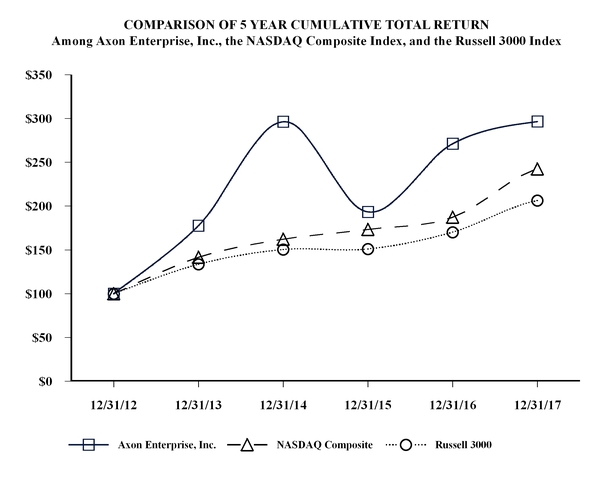
| 2012 | 2013 | 2014 | 2015 | 2016 | 2017 | ||||||||||||||||||
| Axon Enterprise, Inc. | $ | 100.00 | $ | 177.63 | $ | 296.20 | $ | 193.40 | $ | 271.14 | $ | 296.42 | |||||||||||
| NASDAQ Composite | 100.00 | 141.63 | 162.09 | 173.33 | 187.19 | 242.29 | |||||||||||||||||
| Russell 3000 | 100.00 | 133.55 | 150.32 | 151.04 | 170.28 | 206.26 |
Item 6. Selected Financial Data
The following selected financial data should be read in conjunction with our consolidated financial statements and the notes thereto, and with Item 7, “Management’s Discussion and Analysis of Financial Condition and Results of Operations.” The statement of operations data for the years ended December 31, 2017, 2016 and 2015, and the balance sheet data as of December 31, 2017 and 2016, have been derived from, and should be read in conjunction with, our audited consolidated financial statements and the notes thereto included herein. The statement of operations data for the years ended December 31, 2014 and 2013, and the balance sheet data as of December 31, 2015, 2014 and 2013, is derived from our historical audited consolidated financial statements and the notes thereto which are not included in this Annual Report on Form 10-K. Dollars are in thousands, except per share amounts.
| For the Year Ended December 31, | |||||||||||||||||||
| 2017 | 2016 | 2015 | 2014 | 2013 | |||||||||||||||
| Statements of Operations Data: | |||||||||||||||||||
| Net sales from products | $ | 285,859 | $ | 238,573 | $ | 185,230 | $ | 160,313 | $ | 136,123 | |||||||||
| Net sales from services | 57,939 | 29,672 | 12,662 | 4,212 | 1,708 | ||||||||||||||
| Net sales | 343,798 | 268,245 | 197,892 | 164,525 | 137,831 | ||||||||||||||
| Cost of product sales | 117,997 | 91,536 | 65,022 | 60,913 | 50,099 | ||||||||||||||
| Cost of service sales | 18,713 | 6,173 | 4,223 | 2,064 | 1,889 | ||||||||||||||
| Cost of sales | 136,710 | 97,709 | 69,245 | 62,977 | 51,988 | ||||||||||||||
| Gross margin | 207,088 | 170,536 | 128,647 | 101,548 | 85,843 | ||||||||||||||
| Sales, general and administrative expenses | 138,692 | 108,076 | 69,698 | 54,158 | 46,557 | ||||||||||||||
| Research and development expenses | 55,373 | 30,609 | 23,614 | 14,885 | 9,888 | ||||||||||||||
| Litigation judgments | — | — | — | — | 1,450 | ||||||||||||||
| Income from operations | 13,023 | 31,851 | 35,335 | 32,505 | 27,948 | ||||||||||||||
| Interest and other (expense) income, net | 2,738 | (354 | ) | 26 | (194 | ) | 86 | ||||||||||||
| Income before provision for income taxes | 15,761 | 31,497 | 35,361 | 32,311 | 28,034 | ||||||||||||||
| Provision for income taxes | 10,554 | 14,200 | 15,428 | 12,393 | 9,790 | ||||||||||||||
| Net income | $ | 5,207 | $ | 17,297 | $ | 19,933 | $ | 19,918 | $ | 18,244 | |||||||||
| Net income per common and common equivalent shares: | |||||||||||||||||||
| Basic | $ | 0.10 | $ | 0.33 | $ | 0.37 | $ | 0.38 | $ | 0.35 | |||||||||
| Diluted | $ | 0.10 | $ | 0.32 | $ | 0.36 | $ | 0.37 | $ | 0.34 | |||||||||
| Weighted average number of common and common equivalent shares outstanding: | |||||||||||||||||||
| Basic | 52,726 | 52,667 | 53,548 | 52,948 | 51,880 | ||||||||||||||
| Diluted | 53,898 | 53,536 | 54,638 | 54,500 | 54,152 |
| As of December 31, | |||||||||||||||||||
| 2017 | 2016 | 2015 | 2014 | 2013 | |||||||||||||||
| Balance Sheet Data: | |||||||||||||||||||
| Working capital | $ | 97,242 | $ | 99,192 | $ | 123,269 | $ | 102,669 | $ | 67,237 | |||||||||
| Total assets | 338,112 | 278,163 | 229,881 | 185,368 | 148,382 | ||||||||||||||
| Total current liabilities | 107,950 | 78,039 | 38,140 | 31,973 | 23,129 | ||||||||||||||
| Total long-term debt and capital leases, net of current portion | 41 | 118 | 81 | 29 | 67 | ||||||||||||||
| Total stockholders’ equity | 167,444 | 150,888 | 157,004 | 129,106 | 108,347 |
Item 7. Management’s Discussion and Analysis of Financial Condition and Results of Operations
Management’s Discussion and Analysis of Financial Condition and Results of Operations (“MD&A”) is designed to provide a reader of our consolidated financial statements with a narrative from the perspective of our management on our financial condition, results of operations, liquidity and certain other factors that may affect our future results. Our MD&A should be read in conjunction with the other sections of this Annual Report on Form 10-K, including Part I, Item 1A: “Risk Factors”; Part II, Item 6: “Selected Financial Data”; and Part II, Item 8: “Financial Statements and Supplementary Data.” The various sections of this MD&A contain a number of forward-looking statements, all of which are based on our current expectations and could be affected by the uncertainties and risk factors described throughout this filing. The tables in the MD&A sections below are derived from exact numbers and may have immaterial rounding differences.
Overview and Strategy
Axon Enterprise, Inc.’s (the “Company” or “Axon” or “we” or “our”) core mission is to protect life through innovative technologies that make communities safer. We are the market leader in the development, manufacture and sale of conducted electrical weapons (“CEWs”) designed for use by law enforcement, corrections, military forces, private security personnel and by private individuals for personal defense. We are also the market leader in developing, manufacturing and selling connected wearable on-officer cameras as well as developing and selling cloud-based digital evidence management software. We have established a robust network that connects devices, apps and people primarily in the law enforcement vertical. We aim to have every public safety officer in the world carry a TASER, deploy an Axon camera and be connected to the Axon network.
The three foundations for our growth strategy are:
| • | Devices - Our TASER CEWs are one of the few weapons that can incapacitate a person while drastically limiting the risk for death and/or serious injury. Over the past two decades, the TASER CEW has become one of the most frequently used weapons in the North American law enforcement market, with use-of-force injuries and deaths dropping dramatically as a result. Outside of weapons, we produce devices that primarily fall within three categories: On-officer cameras that capture critical digital evidence aimed at protecting truth, a range of related accessory hardware devices and an in-car camera variant called Axon Fleet. We believe our CEWs and Axon cameras should be standard-issue equipment for all patrol officers domestically and internationally. We have created and are continuing to create service plans and product bundles to ensure agencies have the latest devices and technology at predictable annual costs. |
| • | Apps - Axon's Evidence.com platform is designed to help agencies securely store, manage and share all digital evidence. Our software platform features continuous improvement with regular software updates that enable our customers to always have access to the latest technology. Recent new features include secure sharing, audit trails, integration of other data sources, and transcription and redaction services. These feature sets are designed to provide our customers with valuable tools to police more efficiently and effectively while enabling greater transparency with the communities they serve. More and more police agencies trust Axon to host their video evidence data, which is captured via our devices, apps and software, and stored in our secure cloud and accessed via the Axon network. |
| • | People - Our TASER weapons and Axon software and sensors platforms have allowed us to build relationships with more than 20,000 public safety agencies worldwide. Axon is bringing modern information technology capabilities to every law enforcement officer. Some of our customers report that police officers are spending over 60% of their time on paperwork-related tasks, rather than on value-added public safety work. We see a large opportunity to leverage our connected platform to enable a broad suite of mobile, wearable, and data management capabilities. Axon is also improving workflows throughout the public safety chain, from the incident on the scene to the court room. With our software, police officers can share evidence |
with prosecutors during discovery while maintaining a secure and encrypted chain of custody. Axon's cohesive ecosystem is delivering increased value to all public safety stakeholders, including state and municipal police agencies, police chiefs and other leadership, patrol officers, state patrols and officers, agency detectives, public prosecutors, district attorneys, and others in the public safety and judicial communities, as well as the public communities they serve.
Results of Operations
The following table presents data from our statements of operations as well as the percentage relationship to total net sales of items included in our statements of operations (dollars in thousands):
| Year Ended December 31, | ||||||||||||||||||||
| 2017 | 2016 | 2015 | ||||||||||||||||||
| Net sales from products | $ | 285,859 | 83.1 | % | $ | 238,573 | 88.9 | % | $ | 185,230 | 93.6 | % | ||||||||
| Net sales from services | 57,939 | 16.9 | 29,672 | 11.1 | 12,662 | 6.4 | ||||||||||||||
| Net sales | 343,798 | 100.0 | 268,245 | 100.0 | 197,892 | 100.0 | ||||||||||||||
| Cost of product sales | 117,997 | 34.3 | 91,536 | 34.1 | 65,022 | 32.9 | ||||||||||||||
| Cost of service sales | 18,713 | 5.4 | 6,173 | 2.3 | 4,223 | 2.1 | ||||||||||||||
| Cost of sales | 136,710 | 39.8 | 97,709 | 36.4 | 69,245 | 35.0 | ||||||||||||||
| Gross margin | 207,088 | 60.2 | 170,536 | 63.6 | 128,647 | 65.0 | ||||||||||||||
| Operating expenses: | ||||||||||||||||||||
| Sales, general and administrative | 138,692 | 40.3 | 108,076 | 40.3 | 69,698 | 35.2 | ||||||||||||||
| Research and development | 55,373 | 16.1 | 30,609 | 11.4 | 23,614 | 11.9 | ||||||||||||||
| Total operating expenses | 194,065 | 56.4 | 138,685 | 51.7 | 93,312 | 47.2 | ||||||||||||||
| Income from operations | 13,023 | 3.8 | 31,851 | 11.9 | 35,335 | 17.9 | ||||||||||||||
| Interest and other income (expense), net | 2,738 | 0.8 | (354 | ) | (0.1 | ) | 26 | — | ||||||||||||
| Income before provision for income taxes | 15,761 | 4.6 | 31,497 | 11.7 | 35,361 | 17.9 | ||||||||||||||
| Provision for income taxes | 10,554 | 3.1 | 14,200 | 5.3 | 15,428 | 7.8 | ||||||||||||||
| Net income | $ | 5,207 | 1.5 | % | $ | 17,297 | 6.4 | % | $ | 19,933 | 10.1 | % |
Net sales to the U.S. and other countries are summarized as follows (dollars in thousands):
| Year Ended December 31, | ||||||||||||||||||||
| 2017 | 2016 |
Showing the first 8K of 102K characters. Open the full section
Item 7A. Quantitative and Qualitative Disclosures About Market Risk
Interest Rate Risk
We typically invest in a limited number of financial instruments, consisting principally of investments in money market accounts, certificates of deposit, corporate and municipal bonds with a typical long-term debt rating of “A” or better by any nationally recognized statistical rating organization, denominated in U.S. dollars. All of our cash equivalents and investments are treated as “held-to-maturity.” Investments in fixed-rate interest-earning instruments carry a degree of interest rate risk as their market value may be adversely impacted due to a rise in interest rates. As a result, we may suffer losses in principal if we sell securities that have declined in market value due to changes in interest rates. However, because we classify our debt securities as “held-to-maturity” based on our intent and ability to hold these instruments to maturity, no gains or losses are recognized due to changes in interest rates. These securities are reported at amortized cost. Based on investment positions as of December 31, 2017, a hypothetical 100 basis point increase across all maturities would result in a $16,000 incremental decline in the fair market value of the portfolio. Such losses would only be realized if the Company sold the investments prior to maturity.
Additionally, we have access to a $10.0 million line of credit borrowing facility which bears interest at varying rates, currently at LIBOR plus 1.25% or Prime less 0.50%. Under the terms of the line of credit, available borrowings are reduced by outstanding letters of credit, which totaled $2.7 million at December 31, 2017. At December 31, 2017, there was no amount outstanding under the line of credit, and the available borrowing under the line of credit was $7.3 million. We have not borrowed any funds under the line of credit since its inception; however; should we need to do so in the future, such borrowings could be subject to adverse or favorable changes in the underlying interest rate.
Exchange Rate Risk
Our results of operations and cash flows are subject to fluctuations due to changes in foreign currency exchange rates, in each case compared to the U.S. Dollar, related to transactions by our foreign subsidiaries. The majority of our sales to international customers are transacted in U.S. dollars and therefore, are not subject to exchange rate fluctuations on these transactions. However, the cost of our products to our customers increases when the U.S. dollar strengthens against their local currency, and the Company may have more sales and expenses denominated in foreign currencies in future years which could increase its foreign exchange rate risk.
To date, we have not engaged in any currency hedging activities. However, the Company may enter into foreign currency forward and option contracts with financial institutions to protect against foreign exchange risks associated with certain existing assets and liabilities, certain firmly committed transactions, forecasted future cash flows and net investments in foreign subsidiaries. However, the Company may choose not to hedge certain foreign exchange exposures for a variety of reasons, including but not limited to the prohibitive economic cost of hedging particular exposures. As such, fluctuations in currency exchange rates could harm our business in the future.
Item 8. Financial Statements and Supplementary Data
AXON ENTERPRISE, INC.
CONSOLIDATED BALANCE SHEETS
(in thousands, except share data)
| December 31, | |||||||
| 2017 | 2016 | ||||||
| ASSETS | |||||||
| Current assets: | |||||||
| Cash and cash equivalents | $ | 75,105 | $ | 40,651 | |||
| Short-term investments | 6,862 | 48,415 | |||||
| Accounts and notes receivable, net of allowance of $754 and $443 as of December 31, 2017 and 2016, respectively | 56,064 | 39,466 | |||||
| Inventory | 45,465 | 34,841 | |||||
| Prepaid expenses and other current assets | 21,696 | 13,858 | |||||
| Total current assets | 205,192 | 177,231 | |||||
| Property and equipment, net | 31,172 | 24,004 | |||||
| Deferred income tax assets, net | 15,755 | 19,515 | |||||
| Intangible assets, net | 18,823 | 15,218 | |||||
| Goodwill | 14,927 | 10,442 | |||||
| Long-term investments | — | 234 | |||||
| Long-term accounts and notes receivable, net of current portion | 36,877 | 17,602 | |||||
| Other assets | 15,366 | 13,917 | |||||
| Total assets | $ | 338,112 | $ | 278,163 | |||
| LIABILITIES AND STOCKHOLDERS’ EQUITY | |||||||
| Current liabilities: | |||||||
| Accounts payable | $ | 8,592 | $ | 10,736 | |||
| Accrued liabilities | 23,502 | 18,248 | |||||
| Current portion of deferred revenue | 70,401 | 45,137 | |||||
| Customer deposits | 3,673 | 2,148 | |||||
| Current portion of business acquisition contingent consideration | 1,693 | 1,690 | |||||
| Other current liabilities | 89 | 80 | |||||
| Total current liabilities | 107,950 | 78,039 | |||||
| Deferred revenue, net of current portion | 54,881 | 40,054 | |||||
| Liability for unrecognized tax benefits | 1,706 | 1,896 | |||||
| Long-term deferred compensation | 3,859 | 3,362 | |||||
| Business acquisition contingent consideration, net of current portion | 1,048 | 1,635 | |||||
| Other long-term liabilities | 1,224 | 2,289 | |||||
| Total liabilities | 170,668 | 127,275 | |||||
| Commitments and contingencies (Note 9) | |||||||
| Stockholders’ equity: | |||||||
| Preferred stock, $0.00001 par value; 25,000,000 shares authorized; no shares issued and outstanding as of December 31, 2017 and 2016 | — | — | |||||
| Common stock, $0.00001 par value; 200,000,000 shares authorized; 52,969,869 and 52,325,251 shares issued and outstanding as of December 31, 2017 and 2016, respectively | 1 | 1 | |||||
| Additional paid-in capital | 201,672 | 187,656 | |||||
| Treasury stock at cost, 20,220,227 shares as of December 31, 2017 and 2016 | (155,947 | ) | (155,947 | ) | |||
| Retained earnings | 123,185 | 118,275 | |||||
| Accumulated other comprehensive income (loss) | (1,467 | ) | 903 | ||||
| Total stockholders’ equity | 167,444 | 150,888 | |||||
| Total liabilities and stockholders’ equity | $ | 338,112 | $ | 278,163 |
The accompanying notes are an integral part of these consolidated financial statements.
AXON ENTERPRISE, INC.
CONSOLIDATED STATEMENTS OF OPERATIONS AND COMPREHENSIVE INCOME
(in thousands, except per share data)
| For the Years Ended December 31, | |||||||||||
| 2017 | 2016 | 2015 | |||||||||
| Net sales from products | $ | 285,859 | $ | 238,573 | $ | 185,230 | |||||
| Net sales from services | 57,939 | 29,672 | 12,662 | ||||||||
| Net sales | 343,798 | 268,245 | 197,892 | ||||||||
| Cost of product sales | 117,997 | 91,536 | 65,022 | ||||||||
| Cost of service sales | 18,713 | 6,173 | 4,223 | ||||||||
| Cost of sales | 136,710 | 97,709 | 69,245 | ||||||||
| Gross margin | 207,088 | 170,536 | 128,647 | ||||||||
| Sales, general and administrative | 138,692 | 108,076 | 69,698 | ||||||||
| Research and development | 55,373 | 30,609 | 23,614 | ||||||||
| Total operating expenses | 194,065 | 138,685 | 93,312 | ||||||||
| Income from operations | 13,023 | 31,851 | 35,335 | ||||||||
| Interest and other income (expense), net | 2,738 | (354 | ) | 26 | |||||||
| Income before provision for income taxes | 15,761 | 31,497 | 35,361 | ||||||||
| Provision for income taxes | 10,554 | 14,200 | 15,428 | ||||||||
| Net income | $ | 5,207 | $ | 17,297 | $ | 19,933 | |||||
| Net income per common and common equivalent shares: | |||||||||||
| Basic | $ | 0.10 | $ | 0.33 | $ | 0.37 | |||||
| Diluted | $ | 0.10 | $ | 0.32 | $ | 0.36 | |||||
| Weighted average number of common and common equivalent shares outstanding: | |||||||||||
| Basic | 52,726 | 52,667 | 53,548 | ||||||||
| Diluted | 53,898 | 53,536 | 54,638 | ||||||||
| CONSOLIDATED STATEMENTS OF COMPREHENSIVE INCOME | |||||||||||
| Net income | $ | 5,207 | $ | 17,297 | $ | 19,933 | |||||
| Foreign currency translation adjustments | (2,370 | ) | 820 | 19 | |||||||
| Comprehensive income | $ | 2,837 | $ | 18,117 | $ | 19,952 |
The accompanying notes are an integral part of these consolidated financial statements.
AXON ENTERPRISE, INC.
CONSOLIDATED STATEMENTS OF STOCKHOLDERS’ EQUITY
(in thousands, except share data)
| Common Stock | Additional Paid-in Capital | Treasury Stock | Accumulated Other Comprehensive Income (Loss) | Retained Earnings | Total Stockholders’ Equity | ||||||||||||||||||||||||
| Shares | Amount | Shares | Amount | ||||||||||||||||||||||||||
| Balance, December 31, 2014 | 53,000,867 | $ | 1 | $ | 162,641 |
Showing the first 8K of 152K characters. Open the full section
Item 9. Changes in and Disagreements With Accountants on Accounting and Financial Disclosure
None.
Item 9A. Controls and Procedures
Attached as exhibits to this Form 10-K are certifications of the Chief Executive Officer (as the principal executive officer) and Chief Financial Officer (as the principal financial and accounting officer), which are required in accordance with Rule 13a-14 of the Exchange Act. This “Controls and Procedures” section includes information concerning the controls and controls evaluation referred to in the certifications. This section should be read in conjunction with the certifications and the Grant Thornton LLP attestation report for a more complete understanding of the topics presented. Grant Thornton LLP has independently assessed the effectiveness of our internal control over financial reporting and its report is included below.
Evaluation of Disclosure Controls and Procedures
Our Chief Executive Officer and Chief Financial Officer are responsible for the evaluation of the effectiveness of our disclosure controls and procedures (as defined in Rules 13a-15(e) under the Exchange Act) as of the end of the period covered by this Annual Report on Form 10-K. Our disclosure controls and procedures are designed to ensure that information we are required to disclose in reports that we file or submit under the Exchange Act is (i) recorded, processed, summarized and reported within the time periods specified in the Securities and Exchange Commission’s rules and forms and (ii) accumulated and communicated to our management, including our Chief Executive Officer and Chief Financial Officer, as appropriate to allow timely decisions regarding required disclosure. Based on that evaluation, our Chief Executive Officer and Principal Financial and Accounting Officer have concluded that because a material weakness exists in our internal control over financial reporting, as further described below, our disclosure controls and procedures were not effective as of December 31, 2017 at a level that provides reasonable assurance as of the last day of the period covered by this report.
Management Report on Internal Control over Financial Reporting
Management is responsible for establishing and maintaining adequate internal control over financial reporting (as defined in Rule 13a-15(f) under the Exchange Act). Management has assessed the effectiveness of our internal control over financial reporting as of December 31, 2017 based on criteria set forth in Internal Control - Integrated Framework issued by the Committee of Sponsoring Organizations of the Treadway Commission (2013 framework). As a result of this assessment, management concluded that, as of December 31, 2017, our internal control over financial reporting was not effective in providing reasonable assurance regarding the reliability of financial reporting and the preparation of financial statements for external purposes in accordance with generally accepted accounting principles.
During the years ended December 31, 2017 and 2016, we identified material weaknesses in our internal control over financial reporting. A material weakness is defined as a deficiency, or a combination of deficiencies, in internal control over financial reporting, such that there is a reasonable possibility that a material misstatement of our financial statements will not be prevented or detected on a timely basis.
We previously identified and disclosed in our Annual Report on Form 10-K for the year ended December 31, 2016, as well as in our Quarterly Reports on Form 10-Q for each interim period in fiscal 2017, material weaknesses in our internal control over financial reporting. Specifically, during the quarter ended March 31, 2017, we identified a material weakness over accounting for income taxes. During the year ended December 31, 2016, we identified material weaknesses in our internal controls over revenue recognition, cost of goods sold and services delivered and the reporting of deferred revenue. Further, we identified material weaknesses in our account reconciliations and monitoring processes. These material weaknesses in internal control over financial reporting resulted from a breakdown in the operation of identified preventative and detective controls which led to the Company not initially recording some transactions correctly.
To remediate the material weaknesses described above, we designed and implemented controls and enhanced and revised the design of existing controls and procedures. Specifically:
| • | we added resources to our revenue, tax and general accounting teams to ensure that we have the knowledge and resources to properly account for transactions in accordance with accounting principles generally accepted in the United States of America (“U.S. GAAP”), |
| • | we implemented additional internal reporting procedures, including those designed to add depth to our detailed review processes of sales transactions and related accounting for deferred revenue and cost of product and service sales, |
| • | we implemented additional monitoring controls that help detect data entry errors of transactional information within the Company’s general ledger system, as well as added and refined existing system reports to help isolate outliers within the Company’s transactional data for further review, and |
| • | we improved communication and coordination among our finance and accounting departments and we expanded cross-functional involvement and input into period-end accruals. |
We successfully completed the testing of these remedial controls related to the previously reported material weaknesses and concluded that they are designed and operating effectively to provide reasonable assurance regarding the reliability of our financial reporting and preparation of financial statements in accordance with generally accepted accounting principles.
During the fourth quarter of 2017, we identified a material weakness related to account reconciliations and monitoring over our U.K. subsidiary, Axon Public Safety U.K. Ltd. ("APS U.K"), which resulted from a breakdown in the operation of identified preventative and detective controls which led to the Company not initially recording some transactions correctly during 2016 and the interim periods in 2017.
To remediate the material weakness described above and related to APS U.K., we designed a specific plan to design new controls, and enhanced the design of existing controls and procedures. Specifically:
| • | during the 2017 year-end close of our accounting records we sent accounting personnel from our headquarters in Arizona to the U.K. to perform additional review procedures of the account reconciliations for APS U.K. and our corporate accounting team performed additional reviews of APS U.K. activity, |
| • | we plan for our corporate accounting team to continue to perform these additional review procedures on an ongoing basis, and |
| • | we plan to add internal reporting procedures, including those designed to add depth to our detailed review processes of inventory, sales transactions and related accounting for deferred revenue and cost of goods sold and services delivered for APS U.K. |
The material weakness specific to APS U.K. will not be considered remediated until the applicable remedial controls operate for a sufficient period of time and management has concluded, through testing, that these controls are operating effectively. As remediation has not yet been completed, our Chief Executive Officer and Chief Financial Officer have concluded that our disclosure controls and procedures were not effective as of December 31, 2017 at a level that provides reasonable assurance as of the last day of the period covered by this report.
Grant Thornton LLP has independently assessed the effectiveness of our internal control over financial reporting and its report is included below.
Changes in Internal Control over Financial Reporting
Except as noted above, there was no change in our internal control over financial reporting during the fiscal quarter ended December 31, 2017, that has materially affected, or is reasonably likely to materially affect, our internal control over financial reporting.
REPORT OF INDEPENDENT REGISTERED PUBLIC ACCOUNTING FIRM
Board of Directors and Stockholders
Axon Enterprise, Inc.
Opinion on internal control over financial reporting
We have audited the internal control over financial reporting of Axon Enterprise, Inc. (a Delaware corporation) and subsidiaries (the “Company”) as of December 31, 2017, based on criteria established in the 2013 Internal Control-Integrated Framework issued by the Committee of Sponsoring Organizations of the Treadway Commission (“COSO”). In our opinion, because of the effect of the material weakness described in the following paragraphs on the achievement of the objectives of the control criteria, the Company has not maintained effective internal control over financial reporting as of December 31, 2017, based on criteria established in the 2013 Internal Control-Integrated Framework issued by COSO.
A material weakness is a deficiency, or combination of control deficiencies, in internal control over financial reporting, such that there is a reasonable possibility that a material misstatement of the company’s annual or interim financial statements will not be prevented or detected on a timely basis. The following material weakness has been identified and included in management’s assessment.
Management identified deficiencies in the Company’s internal controls related to account reconciliations and monitoring controls over its wholly-owned subsidiary, Axon Public Safety U.K. Ltd. (“APS-UK”). The combination of these deficiencies, when aggregated, resulted in a material weakness in the design and operating effectiveness of the Company’s controls.
We also have audited, in accordance with the standards of the Public Company Accounting Oversight Board (United States) (“PCAOB”), the consolidated financial statements of the Company as of and for the year ended December 31, 2017. The material weakness identified above was considered in determining the nature, timing, and extent of audit tests applied in our audit of the 2017 consolidated financial statements, and this report does not affect our report dated March 1, 2018 which expressed an unqualified opinion on those financial statements.
Basis for opinion
The Company’s management is responsible for maintaining effective internal control over financial reporting and for its assessment of the effectiveness of internal control over financial reporting, included in the accompanying Management Report on Internal Control over Financial Reporting (“Management’s Report”). Our responsibility is to express an opinion on the Company’s internal control over financial reporting based on our audit. We are a public accounting firm registered with the PCAOB and are required to be independent with respect to the Company in accordance with the U.S. federal securities laws and the applicable rules and regulations of the Securities and Exchange Commission and the PCAOB.
We conducted our audit in accordance with the standards of the PCAOB. Those standards require that we plan and perform the audit to obtain reasonable assurance about whether effective internal control over financial reporting was maintained in all material respects. Our audit included obtaining an understanding of internal control over financial reporting, assessing the risk that a material weakness exists, testing and evaluating the design and operating effectiveness of internal control based on the assessed risk, and performing such other procedures as we considered necessary in the circumstances. We believe that our audit provides a reasonable basis for our opinion.
Definition and limitations of internal control over financial reporting
A company’s internal control over financial reporting is a process designed to provide reasonable assurance regarding the reliability of financial reporting and the preparation of financial statements for external purposes in accordance with generally accepted accounting principles. A company’s internal control over financial reporting includes those policies and procedures that (1) pertain to the maintenance of records that, in reasonable detail, accurately and fairly reflect the transactions and dispositions of the assets of the company; (2) provide reasonable assurance that transactions are recorded as necessary to permit preparation of financial statements in accordance with generally accepted accounting principles, and that receipts and expenditures of the company are being made only in accordance with authorizations of management and directors of the company; and (3) provide reasonable assurance regarding prevention or timely detection of unauthorized acquisition, use, or disposition of the company’s assets that could have a material effect on the financial statements.
Because of its inherent limitations, internal control over financial reporting may not prevent or detect misstatements. Also, projections of any evaluation of effectiveness to future periods are subject to the risk that controls may become inadequate because of changes in conditions, or that the degree of compliance with the policies or procedures may deteriorate.
Other information
We do not express an opinion or any other form of assurance on management’s description of the steps the Company has taken to remediate any of the material weaknesses as described in Management’s Report.
/s/ GRANT THORNTON LLP
Phoenix, Arizona
March 1, 2018
Item 9B. Other Information
None.
PART III
Item 10. Directors, Executive Officers and Corporate Governance
The information required to be disclosed by this item is incorporated herein by reference to our definitive proxy statement for the 2018 Annual Meeting of Stockholders (the “2018 Proxy Statement”), which proxy statement we expect to file with the SEC within 120 days after the end of our fiscal year ended December 31, 2017.
Item 11. Executive Compensation
The information required to be disclosed by this item is incorporated herein by reference to our 2018 Proxy Statement.
Item 12. Security Ownership of Certain Beneficial Owners and Management and Related Stockholder Matters
Equity Compensation Plan Information
A description of our equity compensation plans approved by our stockholders is included in Note 12 to the consolidated financial statements included in Part II, Item 8 of this Annual Report on Form 10-K. The following table provides details of our equity compensation plans at December 31, 2017:
| Plan Category | Number of Securities to be Issued upon Exercise of Outstanding Options, Warrants and Rights (a) | Weighted Average Exercise Price of Outstanding Options, Warrants and Rights (b) (1) | Number of Securities Remaining Available for Future Issuance Under Equity Compensation Plans (Excluding Securities Reflected in Column (a)) (c) | ||||||
| Equity compensation plans approved by security holders | 3,152,315 | $ | 4.99 | 1,154,395 | |||||
| Equity compensation plans not approved by security holders | — | — | |||||||
| Total | 3,152,315 | $ | — | 1,154,395 |
| (1) | The weighted average exercise price is calculated based solely on the exercise prices of the outstanding options and does not reflect the shares that will be issued upon the vesting of outstanding awards of RSUs which have no exercise price. |
All other information required to be disclosed by this item is incorporated herein by reference to our 2018 Proxy Statement.
Item 13. Certain Relationships and Related Transactions, and Director Independence
The information required to be disclosed by this item is incorporated herein by reference to our 2018 Proxy Statement.
Item 14. Principal Accounting Fees and Services
The information required to be disclosed by this item is incorporated herein by reference to our 2018 Proxy Statement.
PART IV
Item 15. Exhibits, Financial Statement Schedules
(a) The following documents are filed as part of this report:
| 1. | Consolidated financial statements: All consolidated financial statements as set forth under Part II, Item 8 of this report. |
| 2. | Supplementary Financial Statement Schedules: Schedule II — Valuation and Qualifying Accounts |
Other schedules have not been included because they are not applicable or because the information is included elsewhere in this report. (Dollars in thousands)
SCHEDULE II – VALUATION AND QUALIFYING ACCOUNTS
| Description | Balance at Beginning of Period | Charged to Costs and Expenses | Charged to Other Accounts | Deductions | Balance at End of Period | ||||||||||||||
| Allowance for doubtful accounts: | |||||||||||||||||||
| Year ended December 31, 2017 | $ | 443 | $ | 592 | $ | — | $ | (306 | ) | $ | 729 | ||||||||
| Year ended December 31, 2016 | 322 | 205 | — | (84 | ) | 443 | |||||||||||||
| Year ended December 31, 2015 | 251 | 86 | — | (15 | ) | 322 | |||||||||||||
| Warranty reserve: | |||||||||||||||||||
| Year ended December 31, 2017 | $ | 780 | $ | 109 | $ | — | $ | (245 | ) | $ | 644 | ||||||||
| Year ended December 31, 2016 | 314 | 621 | — | (155 | ) | 780 | |||||||||||||
| Year ended December 31, 2015 | 675 | (62 | ) | — | (299 | ) | 314 |
- Exhibits:
- Management contract or compensatory plan or arrangement
** Filed herewith
*** Furnished herewith
Item 16. Form 10-K Summary
Not applicable.
SIGNATURES
Pursuant to the requirements of Section 13 or 15(d) of the Securities Exchange Act of 1934, the registrant has duly caused this report to be signed on its behalf by the undersigned, thereunto duly authorized.
| AXON ENTERPRISE, INC. | ||||
| Date: | March 1, 2018 | |||
| By: | /s/ PATRICK W. SMITH | |||
| Chief Executive Officer, Director | ||||
| (Principal Executive Officer) | ||||
| Date: | March 1, 2018 | By: | /s/ JAWAD A. AHSAN | |
| Chief Financial Officer | ||||
| (Principal Financial and Accounting Officer) |
POWER OF ATTORNEY
KNOW ALL PERSONS BY THESE PRESENTS, that each person whose signature appears below constitutes and appoints Patrick W. Smith his or her true and lawful attorney-in-fact and agent, with full power of substitution and resubstitution, for him or her in any and all capacities, to sign any amendments to this Annual Report on Form 10-K, and to file the same, with exhibits thereto and other documents in connection therewith, with the Securities and Exchange Commission, hereby ratifying and confirming all that each of said attorneys-in-fact, or his substitute or substitutes, may do or cause to be done by virtue hereof.
Pursuant to the requirements of the Securities Exchange Act of 1934, this report has been signed by the following persons on behalf of the registrant and in the capacities and on the dates indicated.
| Signature | Title | Date | ||
| Chief Executive Officer, Director | ||||
| /s/ PATRICK W. SMITH | (Principal Executive Officer) | March 1, 2018 | ||
| Patrick W. Smith | ||||
| Chief Financial Officer | ||||
| /s/ JAWAD A. AHSAN | (Principal Financial and Accounting Officer) | March 1, 2018 | ||
| Jawad A. Ahsan | ||||
| /s/ MICHAEL GARNREITER | Director | March 1, 2018 | ||
| Michael Garnreiter | ||||
| /s/ HADI PARTOVI | Director | March 1, 2018 | ||
| Hadi Partovi | ||||
| /s/ MARK W. KROLL | Director | March 1, 2018 | ||
| Mark W. Kroll | ||||
| /s/ RICHARD H. CARMONA | Director | March 1, 2018 | ||
| Richard H. Carmona | ||||
| /s/ BRET S. TAYLOR | Director | March 1, 2018 | ||
| Bret S. Taylor | ||||
| /s/ MATTHEW R. MCBRADY | Director | March 1, 2018 | ||
| Matthew R. McBrady | ||||
| /s/ JULIE A. CULLIVAN | Director | March 1, 2018 | ||
| Julie A. Cullivan |