 filings.tools
Axon Enterprise 10-K 2023-12-31
Filed 2024-02-27. 24 sections, 456K characters. Original on sec.gov · Markdown · JSON
Cover and table of contents
UNITED STATES
SECURITIES AND EXCHANGE COMMISSION
Washington, D.C. 20549
Form 10-K
(Mark One)
| ⌧ | ANNUAL REPORT PURSUANT TO SECTION 13 OR 15(d) OF THE SECURITIES EXCHANGE ACT OF 1934 |
|---|
For the fiscal year ended December 31**, 2023**
or
| ◻ | TRANSITION REPORT PURSUANT TO SECTION 13 OR 15(d) OF THE SECURITIES EXCHANGE ACT OF 1934 |
|---|
For the transition period from ______ to _______
Commission File Number: 001-16391
Axon Enterprise, Inc.
(Exact name of registrant as specified in its charter)
| | | |
|---|---|---|
| Delaware | 86-0741227 | |
| (State or other jurisdiction of | | (I.R.S. Employer |
| incorporation or organization) | | Identification No.) |
| | | |
| 17800 North 85th Street | | 85255 |
| Scottsdale**,** Arizona | | (Zip Code) |
| (Address of principal executive offices) | | |
Registrant’s telephone number, including area code:
(480) 991-0797
Securities registered pursuant to Section 12(b) of the Act:
| | | |
|---|---|---|
| Title of each class | Trading Symbol(s) | Name of exchange on which registered |
| Common Stock, $0.00001 par value per share | AXON | The NASDAQ Global Select Market |
Securities registered pursuant to Section 12(g) of the Act:
None
(Title of Class)
Indicate by check mark if the registrant is a well-known seasoned issuer, as defined in Rule 405 of the Securities Act. Yes ☒ No ☐
Indicate by check mark if the registrant is not required to file reports pursuant to Section 13 or Section 15(d) of the Act. Yes ☐ No ☒
Indicate by check mark whether the registrant (1) has filed all reports required to be filed by Section 13 or 15(d) of the Securities Exchange Act of 1934 during the preceding 12 months (or for such shorter period that the registrant was required to file such reports), and (2) has been subject to such filing requirements for the past 90 days. Yes ☒ No ☐
Indicate by check mark whether the registrant has submitted electronically every Interactive Data File required to be submitted pursuant to Rule 405 of Regulation S-T (§232.405 of this chapter) during the preceding 12 months (or for such shorter period that the registrant was required to submit such files). Yes ☒ No ☐
Indicate by check mark whether the registrant is a large accelerated filer, an accelerated filer, a non-accelerated filer, a smaller reporting company or an emerging growth company. See the definitions of “large accelerated filer,” “accelerated filer,” “smaller reporting company,” and “emerging growth company” in Rule 12b-2 of the Exchange Act.
| | | | |
|---|---|---|---|
| Large accelerated filer | ☒ | | Accelerated filer☐ |
| Non-accelerated filer | ☐ | | Smaller reporting company☐ |
| | | | Emerging growth company☐ |
If an emerging growth company, indicate by check mark if the registrant has elected not to use the extended transition period for complying with any new or revised financial accounting standards provided pursuant to Section 13(a) of the Exchange Act. ☐
Indicate by check mark whether the registrant has filed a report on and attestation to its management’s assessment of the effectiveness of its internal control over financial reporting under Section 404(b) of the Sarbanes-Oxley Act (15 U.S.C. 762(b)) by the registered public accounting firm that prepared or issued its audit report. ☒
If securities are registered pursuant to Section 12(b) of the Act, indicate by check mark whether the financial statements of the registrant included in the filing reflect the correction of an error to previously issued financial statements. ☐
Indicate by check mark whether any of those error corrections are restatements that required a recovery analysis of incentive-based compensation received by any of the registrant’s executive officers during the relevant recovery period pursuant to §240.10D-1(b). ☐
Indicate by check mark whether the registrant is a shell company (as defined in Rule 12b-2 of the Act). Yes ☐ No ☒
As of June 30, 2023, the aggregate market value of the registrant’s common stock held by non-affiliates of the registrant was approximately $14.3 billion based on the closing sale price as reported on The NASDAQ Global Select Market.
The number of shares of the registrant’s common stock outstanding as of February 23, 2024 was 75,302,832
DOCUMENTS INCORPORATED BY REFERENCE
Parts of the registrant’s definitive proxy statement for its 2024 Annual Meeting of Shareholders to be prepared and filed with the Securities and Exchange Commission not later than 120 days after December 31, 2023 are incorporated by reference into Part III of this Form 10-K.
AXON ENTERPRISE, INC.
INDEX TO ANNUAL REPORT ON FORM 10-K
FOR THE YEAR ENDED DECEMBER 31, 2023
PART I
Statements contained in this Annual Report on Form 10-K that are not historical are “forward-looking statements” within the meaning of Section 27A of the Securities Act of 1933, as amended (the “Securities Act”), and Section 21E of the Securities Exchange Act of 1934, as amended (the “Exchange Act”), including statements regarding our expectations, beliefs, intentions and strategies regarding the future. We intend that such forward-looking statements be subject to the safe-harbor provided by the Private Securities Litigation Reform Act of 1995. Such statements give our current expectations or forecasts of future events; they do not relate strictly to historical or current facts. Words such as “may,” “will,” “should,” “could,” “would,” “predict,” “potential,” “continue,” “expect,” “anticipate,” “future,” “intend,” “plan,” “believe,” “estimate,” and similar expressions, as well as statements in future tense, identify forward-looking statements. However, not all forward-looking statements contain these identifying words.
We cannot guarantee that any forward-looking statement will be realized, although we believe we have been prudent in our plans and assumptions. Achievement of future results is subject to risks, uncertainties and potentially inaccurate assumptions. Many events beyond our control may determine whether results we anticipate will be achieved. Should known or unknown risks or uncertainties materialize, or should underlying assumptions prove inaccurate, actual results could differ materially from past results and those anticipated, estimated or projected. You should bear this in mind as you consider forward-looking statements. This report lists various important factors that could cause actual results to differ materially from historical and expected results. These factors are intended as cautionary statements for investors within the meaning of Section 27A of the Securities Act and Section 21E of the Exchange Act. Readers can find them under the heading “Risk Factors” in this Annual Report on Form 10-K, and investors should refer to them. You should understand that it is not possible to predict or identify all such factors. Consequently, you should not consider any such list to be a complete set of all potential risks or uncertainties.
Except as required by law, we undertake no obligation to publicly update forward-looking statements, whether as a result of new information, future events or otherwise. You are advised, however, to consult any further disclosures we make on related subjects in our Form 8-K, 10-Q and 10-K reports to the Securities and Exchange Commission (“SEC”). Our filings with the SEC may be accessed at the SEC’s web site at www.sec.gov.
Risk Factor Summary
The following is only a summary of the principal risks that may materially adversely affect our business, financial condition, results of operations and cash flows. The following should be read in conjunction with the more complete discussion of the risks we face, which are set forth more fully in “Part I. Item 1A. Risk Factors.”
Strategic Risks
| ● | If law enforcement agencies do not continue to purchase and use our products and services, our growth prospects, operating results and financial condition will be materially adversely affected. |
|---|
| ● | If our TASER conducted energy devices (“CEDs”) do not continue to be widely accepted, our growth prospects, operating results and financial condition will be diminished. |
|---|
| ● | If we are unable to design, introduce, sell and deploy new products or new product features successfully, our business and financial results could be adversely affected. |
|---|
| ● | We face risks associated with rapid technological change and new competing products. |
|---|
| ● | Our future success is dependent on our ability to expand sales through direct sales and distributors and our inability to increase direct sales or recruit new distributors would negatively affect our sales. |
|---|
| ● | Negative publicity could adversely impact sales, which could cause our revenues or operating results to decline. |
|---|
| ● | Acquisitions of, or investments in, other products, technologies or businesses could disrupt our business, dilute shareholder value, and adversely affect our operating results. |
|---|
| ● | Our failure to retain executive officers, including Patrick W. Smith, could adversely impact our business. |
|---|
Operational Risks
| ● | Unavailability of materials or higher costs could adversely affect our financial results. |
|---|
| ● | Material adverse developments in domestic and global economic conditions, or the occurrence of other world events, could materially adversely affect our revenue and results of operations. |
|---|
| ● | To the extent demand for our products increases, our future success will be dependent upon our ability to manage our growth and to increase manufacturing production capacity. |
|---|
| ● | Delays in product development schedules could adversely affect our revenues and cash flows. |
|---|
| ● | We expend significant resources in anticipation of a sale and may receive no revenue in return. |
|---|
| ● | Changes in civil forfeiture laws may affect our customers’ ability to purchase our products. |
|---|
| ● | If our security measures or those of our third-party providers, including cloud storage providers, are breached and unauthorized access is obtained to customers’ data or our data, our network, data centers and service may be perceived as not being secure, customers may curtail or stop using our products and services, and we may incur significant legal and financial exposure and liabilities. |
|---|
| ● | Catastrophic events could materially adversely affect our business, results of operations and/or financial condition. |
|---|
| ● | Uncertainty in the development, deployment and use of artificial intelligence (“AI”) in our products and services, as well as our business more broadly, could adversely affect our business and reputation. |
|---|
| ● | Defects or disruptions in our services could impact demand for our services and subject us to substantial liability. |
|---|
| ● | Defects in our products could reduce demand for our products or result in product recalls and result in a loss of sales, delay in market acceptance and damage to our reputation. |
|---|
| ● | Our international operations expose us to additional risks that could harm our business, operating results and financial condition. |
|---|
| ● | We depend on our ability to attract and retain our key management, sales and technical personnel. |
|---|
| ● | If we fail to comply with federal, state or local regulations applicable to TASER 10, we may be subject to governmental actions or litigation that could materially harm our business. |
|---|
| ● | If we fail to maintain effective internal control over financial reporting or identify a material weakness or significant deficiency, our ability to accurately and timely report our financial condition and results of operations could be adversely affected, investor confidence could diminish, and the value of our common stock may decline. |
|---|
Financial Risks
| ● | An increasing percentage of our revenue is derived from subscription billing arrangements that may result in delayed cash collections and may increase customer credit risk on receivables and contract assets. |
|---|
| ● | Our gross margin is dependent on a number of factors, including our product mix, cost structure and acquisitions we may make, any of which could cause our gross margin to decline. |
|---|
| ● | Software-as-a-Service (“SaaS”) revenue for Axon Evidence is recognized over the terms of the contracts, which may be several years, and, as such, trends in new business may not be immediately reflected in our operating results. |
|---|
| ● | Most of our end-user customers are subject to budgetary and political constraints that may delay or prevent sales. |
|---|
| ● | Due to government funding rules, certain of our contracts are subject to various cancellation clauses, which could allow our customers to cancel or not exercise options to renew contracts in the future. |
|---|
| ● | The open bidding process creates uncertainty in predicting future contract awards. |
|---|
| ● | We maintain most of our cash balances, some of which are not insured, at two depository institutions. |
|---|
| ● | Stock transactions may have a material, unpredictable impact on our results of operations and may result in dilution to existing shareholders. |
|---|
| ● | Our financial performance is subject to risks associated with changes in the value of the U.S. dollar versus local currencies. |
|---|
| ● | Unanticipated changes in our effective tax rate and additional tax liabilities may impact our operating results and financial condition. |
|---|
| ● | Our revenues and operating results may fluctuate unexpectedly, which may cause our stock price to decline. |
|---|
| ● | Our profitability could suffer from declines in fair value or impairment of our investments, including our strategic investments, and could fluctuate if the fair values of our investments increase. |
|---|
Legal and Compliance Risks
| ● | We may face personal injury, wrongful death, product liability and other liability claims that harm our reputation and adversely affect our sales and financial condition. |
|---|
| ● | Other litigation, government inquiries and regulatory actions may subject us to significant costs and judgments and divert management attention from our business. |
|---|
| ● | We have been, and may be in the future, subject to intellectual property infringement and other claims, which could incur substantial litigation costs, result in significant damages awards, inhibit our use of certain technologies, and divert management attention from our business. |
|---|
| ● | If we are unable to protect our intellectual property, the value of our brands and products may decrease and we may lose our competitive market advantage. |
|---|
| ● | We may be unable to enforce patent rights internationally, which may limit our ability to prevent our product features from being used by competitors in some foreign jurisdictions. |
|---|
| ● | The use of open source software in our products, services and technologies may expose us to additional risks and harm our intellectual property. |
|---|
| ● | A variety of new and existing laws and/or interpretations could materially and adversely affect our business. |
|---|
| ● | We are subject to evolving corporate governance and public disclosure regulations and expectations that could expose us to numerous risks. |
|---|
| ● | Our amended and restated bylaws include exclusive forum provisions that could increase costs to bring a claim, discourage claims or limit the ability of our shareholders to bring a claim in a judicial forum viewed by shareholders as more favorable for disputes. |
|---|
Risks Related to our Convertible Notes
| ● | Servicing our debt requires a significant amount of cash, and we may not have sufficient cash flow to pay our substantial debt. |
|---|
| ● | The conditional conversion feature of the Notes, if triggered, may adversely affect our operating results. |
|---|
| ● | Conversion of the Notes may dilute the ownership interest of our shareholders or may otherwise depress the price of our common stock. |
|---|
| ● | Changes in the accounting treatment for the Notes may have a material effect on our reported financial results. |
|---|
| ● | The convertible note hedge and warrant transactions may affect the value of the Notes and our common stock. |
|---|
| ● | We are subject to counterparty risk with respect to the convertible note hedge transactions. |
|---|
Item 1. Business
Overview
Axon Enterprise, Inc. (“Axon,” the “Company,” “we” or “us”) is a market-leading provider of law enforcement technology solutions with a mission to protect life in service of promoting peace, justice and strong institutions. In 2022, we announced our moonshot goal to cut gun-related deaths between police and the public in the United States in half by 2033.
Axon is building the public safety operating system of the future by integrating a suite of hardware devices and cloud software solutions that not only revolutionize modern policing but also cater to federal agencies, corrections, justice and enterprise-level security needs. Axon’s suite includes cloud-hosted digital evidence management, productivity and real-time operations software, body-worn cameras, in-car cameras, TASER energy devices, robotic security and training solutions.
Our hardware and software solutions advance our long-term strategic vision of (i) obsoleting the bullet, (ii) reducing social conflict, (iii) enabling a fair and effective justice system, and (iv) building for racial equity, diversity, and inclusion. Our products solve some of society's most challenging problems and our mission attracts top talent. We aim to invent and deliver public safety products that progressively make the right things easier and the wrong things harder every day.
Our research & development (“R&D”) investments support continuous innovation on behalf of our customers. Our financial strategy is to build highly recurring, highly profitable businesses and to drive growth through this purposeful product innovation.
Axon’s operations comprise two reportable segments:
| 1. | TASER: Axon is the market leader in the development, manufacture and sale of CEDs, which we sell under our brand name, TASER. |
|---|
| 2. | Software and Sensors: We develop, manufacture and sell fully integrated hardware and cloud-based software solutions that enable law enforcement to capture, securely store, manage, share and analyze video and other digital evidence. Our software offerings also support productivity and real-time operations. |
|---|
Further information about our reportable segments and sales by geographic region is included in Notes 1, 2 and 19 of the consolidated financial statements in Part II, Item 8 of this Annual Report on Form 10‑K. For future contracted revenue by reportable segment, refer to Part II, Item 7 of this Annual Report on Form 10‑K.
Axon employees are distributed across multiple geographies and report to work via a remote-hybrid model, which leverages both in-person collaboration environments as well as cloud-based software tools that enable remote productivity. Our headquarters in Scottsdale, Arizona and our software hub in Seattle, Washington house the majority of our in-person employees located in the United States, including members of our executive management team, and sales, marketing, certain engineering, manufacturing, finance and other administrative support functions. We also have subsidiaries and / or offices located in Australia, Belgium, Canada, Finland, France, Germany, Hong Kong, India, Italy, the Netherlands, Spain, the United Kingdom and Vietnam.
Key Product Category Revenue Drivers: What We Offer
Axon products are generally cloud-connected, designed to drive better outcomes and customer experiences, and sold via mutually reinforcing integrated bundles. Our key revenue drivers belong to three broad product categories:
| ● | Software: Axon is building a suite of cloud-based, SaaS solutions that integrate with our sensors and TASER devices to benefit customers and drive annual recurring revenue, which totaled $697 million1 as of December 31, 2023. We have many SaaS solutions, which can best be trisected into three categories: digital evidence management, productivity and real-time operations solutions. Axon Evidence is the world’s largest cloud-hosted public safety data repository of public safety video data and other types of digital evidence. Our productivity suite, which includes Axon Records, is designed to save officers time spent writing reports and doing paperwork. Our real-time operations capabilities, which include Axon Respond, integrates location data, signal alerts and video feeds to provide a complete picture of evolving situations. |
|---|
| ● | Sensors: Axon devices address many needs, including transparency, real-time situational awareness, and accurate capture and integration of evidence with software workflows. Product categories within sensors include Axon Body cameras, Axon Fleet in-car systems, and other devices that work with our software. Our software solutions also support an open ecosystem of connected devices produced by other vendors. |
|---|
| ● | TASER: We develop smart devices, tools and services that support public safety officers in de-escalating situations, avoiding or minimizing use of force and aiding consumer personal protection. These tools include TASER devices, virtual reality (“VR”) training services and consumer devices. Research has shown that TASER devices are the most effective less-than-lethal force option, with the lowest likelihood of injury to officers and assailants. Since our inception in 1993, TASER devices have been adopted by a majority of U.S. state and local law enforcement and are used daily to help keep communities safe. Global adoption of TASER devices remains early and we are expanding into new geographies. Axon VR solutions make public safety training more accessible, relevant and affordable — with the goal of using new immersive VR technologies to better prepare officers for real-life situations in the field. |
|---|
Sales and Distribution: Who We Sell To and Where We Deliver
We think of our core customers as falling into roughly four categories of funding sources: U.S. state and local governments, the U.S. federal government, international government customers and commercial enterprises. Additionally, the types of customers who find value in our product offerings are expanding beyond law enforcement to include attorneys, corrections, fire and emergency medical services personnel and the U.S. military.
Axon’s sales force and strong customer relationships represent key strategic advantages. The majority of our revenues are generated via direct sales, including our online store, although we do leverage distribution partners and third-party resellers.
No customer represented more than 10% of total net sales for the years ended December 31, 2023, 2022 or 2021.
We are diversifying into new markets by adding new types of customer profiles, or users, and by adding to our core customer base. In recent years, we have been investing in sales personnel to capture these new markets, and we continue to focus on strategic headcount additions to support key new markets and new products.
Governmental agencies generally have the ability to terminate our contracts, in whole or in part, for reasons including non-appropriation of funds. We continue to monitor developments in federal government funding.
1 Calculated as monthly recurring license, integration, warranty, and storage revenue for the year ended December 31, 2023. Annual recurring revenue is a performance indicator that management believes provides more visibility into the growth of our revenue generated by our highest margin, recurring services. Annual recurring revenue should be viewed independently of revenue and deferred revenue because it is an operating measure and is not intended to be combined with or to replace GAAP revenue or deferred revenue, as they can be impacted by contract start and end dates and renewal rates. Annual recurring revenue is not intended to be a replacement or forecast of revenue or deferred revenue.
Resources
Manufacturing and Supply Chain
We perform light manufacturing, final assembly and final test operations at our facilities in Scottsdale, Arizona, and own substantially all of the equipment required to develop, prototype, manufacture and assemble our finished products. We have continued to maintain both our ISO 9001 and our ISO 9001:2015 certifications.
We continue to take steps to diversify our supply chain and global manufacturing footprint, which positions us well to manage supply chain disruptions. Material availability has mostly stabilized from prior supply chain challenges while general levels of risk continue to exist in all businesses that manufacture products. Supplier decommitments remain a top area of risk. However, we have put programs in place to mitigate this risk. We proactively manage our supply chain down to third tier suppliers to overcome material shortages as they arise. These actions align to our strategic model to help meet strong product demand while also preparing us to stagger factory work schedules as needed, which enables us to meet compressed build schedules over short periods of time. We continue to adjust strategic inventory levels in both raw and finished goods based on areas of risk to mitigate potential supply disruptions.
In light of our broad domestic and international supplier base, we are continuously monitoring our supply chain to manage through potential impacts, identifying alternate shipping and logistic sources, and working with foreign regulators to ensure that our suppliers can provide parts.
Even as we continue to expand our second sourcing of materials across our supply chain, we still obtain some unique components from single source suppliers. However, because we own substantially all of the injection molded component tooling used in their production, we believe we could obtain alternative suppliers in most cases with varying levels of interruption. In addition, we also have programs to hold additional raw materials (such as resins and critical semiconductors) to mitigate supply and better manage costs. For additional discussion of sources and availability of raw materials, refer to Note 1 to the consolidated financial statements included in Part II, Item 8 of this Annual Report on Form 10-K.
We provide limited manufacturer’s warranties on our Axon devices and CEDs, and customers also have the option to purchase extended warranties. For additional information about our warranties, refer to Note 1 in the consolidated financial statements in Part II, Item 8 of this Annual Report on Form 10-K.
Intellectual Property
We protect our intellectual property with U.S. and international patents and trademarks. Our patents and pending patent applications relate to technology used by us in connection with our products. We also rely on international treaties, organizations and laws to protect our intellectual property. As of December 31, 2023, we hold over 300 U.S. patents, over 125 U.S. registered trademarks, over 240 international patents and over 450 international registered trademarks, as well as numerous patent and trademark applications pending.
We continuously assess whether and where to seek formal protection for particular innovations and technologies based on such factors as the commercial significance to our operations and our competitors’ operations in particular countries and regions, our strategic technology or product directions in different countries, and the degree to which intellectual property laws exist and are meaningfully enforced in different jurisdictions. We have the exclusive rights to many Internet domain names, primarily including “Axon.com,” “Evidence.com” and “TASER.com.” We also vigorously protect our intellectual property, including patents, trademarks and trade secrets against third-party infringement.
Confidentiality agreements are used with employees, consultants and key suppliers to help ensure the confidentiality of our trade secrets.
Competition
Sensors — Connected Cameras and Digital Evidence Management Software: The body-worn camera and in-car video/automatic license plate readers industry is highly competitive. Our competition includes Axis Communications AB, Digital Ally Inc., Getac Technology Corporation, Halo Body Cameras, i-PRO, LensLock Inc., Motorola Solutions, Reveal Media, Safe Fleet, Utility Associates, Versaterm Inc., Wolfcom Enterprises, Wrap Technologies Inc. and Zepcam B.V., Applied Concepts Inc., Genetec Inc. and Insight LPR.
The market for software solutions to improve public safety agency workflows is both highly fragmented and highly competitive. Our cloud-based digital evidence management system, Axon Evidence, competes with both cloud-based platforms and on-premises based systems designed by third-parties or developed internally by an agency's technology staff. Our competition includes FileOnQ, FotoWare, Genetec Inc., IBM, i-PRO, Motorola Solutions, NICE, OpenText Corporation, Oracle, QueTel Corporation, Revir Technologies, Utility Associates and Vidizmo, LLC, among others.
Key competitive factors in this product category include product performance, product features (including live-streaming, GPS tracking and pre-event buffering), battery life, product quality and warranty, total cost of ownership, data security, data and information workflows, company reputation and financial strength, and customer satisfaction and relationships.
Productivity and Real-Time Operations Software — Records Management System (“RMS”) and Computer Aided Dispatch (“CAD”): The RMS and CAD verticals are highly competitive and highly fragmented. We have identified more than 50 software providers, including 365Labs, Beacon Software Solutions Inc., Caliber Public Safety (parent, Harris Computer Systems), Central Square Technologies (formerly Superion, TriTech and Aptean), CivicEye, Core Technology Corporation, CSI Technology Group, EForce Software, Executive Information Services Inc., Hexagon AB, Kologik, LawSoft Inc., Mark43 Inc, Motorola Solutions, Niche Technology Inc., Saab, SmartCop, SOMA Global, Sopra Steria, Southern Software, Sun Ridge Systems Inc. and Tyler Technologies. In addition, not all law enforcement agencies use software for report writing — some still use paper. We believe our network of camera sensors and digital evidence management platform give us a strategic advantage in these product categories. Our Axon Respond offering competes both with real-time operations platforms that ingest body camera video feeds, like Genetec's Citigraf, Motorola’s CommandCentral Aware and Utility Associates’ Titan, as well as platforms that ingest video feeds exclusively from surveillance cameras, like Hexagon's Connect, Live Earth and Spatialitics's GeoShield among others.
TASER for Professional Users: Our CEDs compete with a variety of less-lethal alternatives to firearms, including rubber bullets or rubber baton rounds, such as those made by Combined Systems, Inc.; pepper spray, pepper spray projectiles, such as those made by Byrna Technologies Inc. (dba Fox Labs), SABRE Corporation and Mace Security International, Inc.; traditional stun guns, such as those made by UZI and Jolt; hand-held remote restraint devices involving a tether, such as the one made by Wrap Technologies Inc.; laser dazzlers that cause temporary blindness, such as the one made by B.E. Meyers & Co., Inc.; stun grenades, such as those made by Combined Systems, Inc.; long-range acoustic devices, such as the one made by Genasys Inc.; and police batons and night sticks, such as those made by Monadnock and by Armament Systems and Procedures, Inc. TASER devices offer advanced technology, versatility, portability, effectiveness, built-in accountability systems and low injury rates, which enable us to compete effectively against other less-lethal alternatives. TASER devices also offer connectivity to our cloud network, which allows law enforcement agencies and other professional users to more effectively manage their less-lethal programs and automate use-of-force reporting.
The key competitive factors in this product category include a device’s accuracy, effectiveness, reputation, safety, cost, ease of use, and exceptional customer experience. The design maturity of the TASER platform, as well as our development and sale of a multi-shot device, are also key competitive differentiators. We are aware of competitors providing competing CED products primarily outside of the United States.
VR De-Escalation Training for Law Enforcement, Corrections and Private Security: Our VR Training platform competes with several other companies in the space who offer simulation scenarios, including simulated training on the use of both lethal and less-lethal alternatives. Our competition in this space includes Adaptive VR Ltd., Apex Officer, Hologate GmbH, InVeris Training Solutions Inc., Laser Shot Inc., MILO, Street Smarts VR, Ti Training Corp, V-Armed, VirTra Inc. and Wrap Technologies.
Key competitive factors in this product category include scale of content library, integration to additional sensors and devices (e.g. haptic suit, TASER), ease of use, visual fidelity and realism, quality of immersion experience (enhanced by capabilities such as eye tracking and speech recognition) and portability.
TASER for Personal Safety: In the private citizen space, TASER devices compete with firearms and with other less-than-lethal self-defense options such as stun guns and pepper spray-based products, including pepper guns and miniature spray cans. Leading competitors in the less-than-lethal space include Byrna Technologies, Inc., Mace, PepperBall, SABRE, Salt Supply Co. and Vipertek. The TASER StrikeLight competes in the flashlight category, in which there are dozens, if not hundreds, of competitors, including tactical flashlight providers with and without stun-gun capabilities.
TASER Bolt and TASER Pulse are not stun guns, and have different capabilities, including neuromuscular incapacitation functionality. The broader market for personal safety and home defense is far-reaching, and categories range from threat detection and accountability (dash and doorbell cameras), to home security (home alarms, locks and response services) to personal defense (firearms, stun guns, TASER devices, pepper spray, tactical flashlights and personal alarms), to personal tracking and emergency notification mobile applications.
The primary benefit of TASER devices is in less-lethal incapacitation. Other competitive factors include a device’s cost, effectiveness, safety, ease of use, and available training options.
Axon Air: Our end-to-end drone management software platform competes with a select set of companies in the space who offer drone programs and flight management software solutions. Our competition in this space includes Aerodome Inc., Auterion Ltd., Motorola Solutions’ CAPE, Paladin Drones’ Watchtower and Votix, LLC, among a few others. Key competitive factors in this product category include integration and compatibility with various drone hardware providers and other technology systems used by first responders (e.g., digital evidence management), drone program management and real-time situational awareness capabilities, intuitiveness of the user interface, the level of training and customer support provided (particularly for the drone-as-first-responder use case), the customization and flexibility allowed by the platform to meet specific operational needs and requirements of different customers (e.g., customizable flight restrictions) and the autonomy capabilities provided by the platform (e.g., creation of autonomous missions).
Our indoor tactical drone hardware platform, Sky-Hero, competes with a few other companies in the space, including Brinc, Indoor Robotics and XTEND. Key competitive factors in this product category include variety and weight limits of compatible payloads, battery life and associated flight range, maneuverability and size, autonomy and onboard intelligence (including ability to navigate in GPS denied environments), sensor and imaging technology, durability and robustness of the drone, cost and maintenance required, reliability and security of communication and control systems, the simplicity of the drone piloting user interface and the training required to operate the drones.
Non-Axon trademarks are property of their respective owners.
Seasonality
We have historically experienced higher net sales in our fourth quarter compared to other quarters in our fiscal year due primarily to municipal budget cycles. Additionally, new product introductions can significantly impact the cadence of net sales, product costs and operating expenses. Municipal law enforcement budgets tend to feature a mix of fiscal years that end in either June, September or December, while U.S. federal budget year end is in September. However, historical seasonal patterns, municipal budgets or historical patterns of product introductions should not be considered reliable indicators of our future net sales or financial performance.
Governmental Regulation
We are subject to a variety of laws and regulations in the United States and abroad that involve matters central to our business, including laws and regulations related to: privacy and data protection, security, retention and deletion; rights of publicity; content; intellectual property; regulation of certain of our CEDs as firearms; advertising; marketing; distribution; electronic contracts and other communications; competition; consumer protection; telecommunications; product liability; taxation; labor and employment; sustainability; economic or other trade prohibitions or sanctions; securities; and online payment services. There are a number of legislative proposals in the United States, at both the federal and state level, that could impose new obligations in areas affecting our business. Foreign laws and regulations can impose different obligations or be more restrictive than those in the United States.
These U.S. federal and state and foreign laws and regulations, which in some cases can be enforced by private parties in addition to government entities, are constantly evolving and can be subject to significant change. As a result, the application, interpretation, and enforcement of these laws and regulations are often uncertain and may be interpreted and applied inconsistently from country to country and inconsistently with our current policies and practices. See “Item 1A. Risk Factors – Legal and Compliance Risks - A variety of new and existing laws and/or interpretations could materially and adversely affect our business.”
Radio Spectrum and Unmanned Aerial and Ground-Based Robotic Devices
Certain of our products utilize radio spectrum to provide wireless voice, data and video communications services. The allocation of spectrum is regulated in the United States and other countries and limited spectrum space is allocated to wireless services and specifically to public safety users. We manufacture and market products in spectrum bands already made available by regulatory bodies. If current products do not comply with the regulations set forth by these regulatory bodies, we may be unable to sell our products or could incur penalties. Our results could be negatively affected by the rules and regulations adopted from time to time by the U.S. Federal Communications Commission (“FCC”), Innovation, Science and Economic Development Canada (“ISED”), the European Union Directorate-General for Environment or regulatory bodies in other countries. Regulatory changes in current spectrum bands may also require modifications to some of our products so they can continue to be manufactured and marketed.
Axon body-worn cameras, docks, Axon Fleet vehicle cameras and Axon Signal devices are subject to the FCC’s rules and regulations in the United States, as well as rules and regulations as applicable outside of the United States. These regulations affect CEDs with Axon Signal technology, including the TASER 7, Signal Performance Power Magazine (“SPPM”), TASER 10, and future CEDs implementing wireless technology. Compliance with government regulations could increase our operations and product costs and impact our future financial results.
Additionally, some of our products depend on drones or other unmanned aerial and ground-based systems that operate on the radio spectrum. The FCC, the Federal Aviation Administration and other agencies at the federal, state and local levels (as well as in foreign jurisdictions) are beginning to address some of the numerous certification, regulatory and legal challenges associated with drones, but a comprehensive set of standards and enforcement procedures has yet to be developed. Changes to the regulation of drones or other unmanned aerial systems may impact our future financial results.
Axon and TASER Devices
For our TASER products, we rely on the opinions of the U.S. Bureau of Alcohol, Tobacco, Firearms and Explosives (“ATF”), including the determination that a device that does not expel projectiles by the action of an explosive is not classified as a firearm. See “Item 1A. Risk Factors – Legal and Compliance Risks - A variety of new and existing laws and/or interpretations could materially and adversely affect our business.”
Federal regulation of sales in the United States: The majority of our currently offered CEDs are not classified as firearms regulated by the ATF. However, the ATF regulates TASER 10 as a firearm under the Gun Control Act of 1968 (“GCA”) due to a technological advancement specific to the propulsion design of TASER 10 cartridges. In the event we make TASER 10 available to our private citizen and enterprise customers, demand could be substantially reduced as a result of this classification because non-governmental end-users would be required to comply with
federal, state or local firearm transfer requirements prior to purchasing TASER 10. In addition, the implications of such classification on use-of-force standards and regulations could impact our ability to sell TASER 10 to law enforcement and government entities. Because Axon must maintain a federal firearms license to manufacture and sell TASER 10, we are subject to periodic compliance inspections by the ATF. License violations discovered by the ATF can result in fines, penalties, warning letters or license revocation, leading to disruptions in operations. Further, we are required to administer, track and remit firearm excise taxes as applicable.
Our CED products are also subject to testing, safety and other standards by organizations such as the American National Standards Institute, the International Electrotechnical Commission, the National Institute of Standards and Technology and Underwriters Laboratories. These regulations also affect CEDs with Axon Signal technology, including SPPM technology, and TASER 7 and TASER 10 battery packs.
Federal regulation of international sales: Our CEDs are considered a “crime control” product by the U.S. Department of Commerce (“DOC”) for export directly from the United States, which requires us to obtain an export license from the DOC for the export of our CED devices from the United States to any country other than Canada. Future products and services may require classifications from the DOC before they may be shipped internationally. Our inability to obtain DOC export licenses or classifications on a timely basis for sales of our products and services to our international customers could significantly and adversely affect our international sales. Although TASER 10 is regulated by the ATF for domestic sales, the DOC has ruled that the product’s unique propulsion design has no impact on its export classification and that the TASER 10 model’s export classification remains consistent with all other TASER CED models.
Federal regulation of foreign national employees: Our CED development and production is also considered controlled “technology” by the DOC and is categorized as a “deemed export” for any foreign national employees exposed to the technology within the United States. Consequently, we must obtain export licenses from the DOC for any deemed export within the United States made to a foreign national employee exposed to the controlled technology. Deemed export licenses are subject to DOC approvals and issued licenses require annual status reports for the stated employees. Inability to obtain proper licensing could curtail the Company’s ability to execute R&D and production related to CED technology.
State and local regulation: Our CEDs are controlled, restricted or, less frequently, prohibited by some state and local governments. Other jurisdictions may ban or restrict the sale of our TASER-branded devices, or restrict their use through changes to use-of-force laws or regulations, and our product sales may be significantly affected by additional state, county and city governmental regulation. The change in TASER 10’s propulsion design may impact how TASER 10 is regulated at the state and/or local level depending on each state’s firearm laws.
International regulation of foreign imports and sales: Certain jurisdictions prohibit, restrict or require a permit for the importation, sale, possession or use of CEDs, including in some countries by law enforcement agencies, limiting our international sales opportunities.
U.S. and international regulation of component movements globally: We rely on a global supply chain of components across our product lines with most final assembly occurring in the United States. Export of these components from abroad is subject to shifting regulatory landscapes imposed by both the foreign government and U.S. authorities upon import. Abrupt changes to these regulations can result in delays or interruptions to final product supplies. Additionally, ATF regulation of certain imports of TASER 10 components may limit Axon’s supply chain agility.
International regulation of foreign-based operations: We maintain foreign operations in several countries globally for purposes of logistics, sales, general and administrative (“SG&A”) services, and R&D support. Depending on these activities, regulations can include business activity licensing and registration, import permits and recordkeeping, warehousing and storage security and permitting, and government reporting. Any failure to comply with these requirements could limit our ability to sell, support or develop our products and services both internationally and in the United States.
Privacy Regulations
We are subject to various U.S. and foreign laws and regulations associated with the collection, processing, storage and transmission of personally identifiable information and other sensitive and confidential information. This data is wide ranging and relates to our employees, customers and other third parties, including the subjects of law enforcement. Our compliance obligations include those prescribed under laws and regulations that dictate whether, how and under what circumstances we can receive, process, hold and/or transfer certain data that is critical to our operations, including data shared between countries or regions in which we operate and data shared among our products and services. If one or more of the legal mechanisms for transferring data from other countries to the United States is invalidated, if we are unable to transfer data between and among countries and regions in which we operate, or if we are prohibited from sharing data among our products and services, it could affect the manner in which we provide our products and services or adversely affect our financial results. Countries may also pass legislation implementing data protection requirements or requiring local storage and processing of data or similar requirements that could increase the cost and complexity of delivering our products and services and expose us to significant penalties for non-compliance. The European Parliament adopted the General Data Protection Regulation (“GDPR”), effective May 2018, that extended the scope of European privacy laws to any entity that controls or processes personal data of E.U. residents in connection with the offer of goods or services or the monitoring of behavior and imposes compliance obligations concerning the handling of personal data. Further, Vietnam's Personal Data Protection Decree (“PDPD”), which entered into force July 1, 2023, applies to organizations (wherever based) so long as they participate in personal data processing in Vietnam. We are also subject to U.S. laws and regulations, including the California Privacy Rights Act (“CPRA”), which provides for enhanced consumer protections for California residents, a private right of action for data breaches and statutory fines and damages for data breaches or other California Consumer Privacy Act (“CCPA”) violations, as well as a requirement of “reasonable” cybersecurity, which could subject us to additional compliance costs as well as potential fines, individual claims, class actions and commercial liabilities.
Any inability, or perceived inability, by us to adequately address privacy concerns, or comply with applicable laws, regulations, policies, industry standards and guidance, contractual obligations or other legal obligations, even if unfounded, could result in significant regulatory and third-party liability, increased costs, disruption of our business and operations, and a loss of confidence and other reputational damage. Furthermore, as new privacy related laws and regulations are implemented, the time and resources needed for us to comply with such laws and regulations continues to increase and become a significant compliance workstream.
Environmental Regulations
We are subject to various U.S. federal, state, local and foreign laws and regulations governing the environment, including restricting the presence of certain substances in our products and making us financially responsible for the collection, treatment, recycling and disposal of such products. In addition, further environmental or climate change disclosure legislation may be enacted in other jurisdictions, including the United States (under federal and state laws) and other countries, the cumulative impact of which could be significant. For example, in September 2023, California passed the Climate Corporate Data Accountability Act and the Climate-Related Financial Risk Act, requiring increased climate-related reporting.
The European Union has published Directives on the restriction of certain hazardous substances in electronic and electrical equipment (the “RoHS Directive”) and on electronic and electrical waste management (the “WEEE Directive”). The RoHS Directive restricts the use of a number of substances, including lead. The WEEE Directive directs members of the European Union to enact laws, regulations and administrative provisions to ensure that producers of electric and electronic equipment are financially responsible for the collection, recycling, treatment and environmentally responsible disposal of certain products sold into the European Union. In addition, similar environmental legislation has been enacted in other jurisdictions, including the United States (under federal and state laws) and other countries.
In addition, the European Union has defined a regulation for the registration, evaluation, authorization and restriction of chemicals that places responsibility on companies to manage the risks from chemicals contained in products and to provide safety information about such substances. Manufacturers and importers are required to gather information on the properties of the chemical substances in their products and provide for their safe handling. As of
January 5, 2021, companies supplying products in the European Union containing substances of very high concern as identified by the European Union have to submit information on these products to the European Chemicals Agency. The information in their database is then made available to waste operators and consumers.
Other countries have adopted chemical restrictions regulations, including the United States, Canada and Australia. New, or changes in, environmental safety laws, regulations or rules could also lead to increased costs of compliance, including remediations of any discovered issues and changes to our operations, which may be significant. Any failures to comply could result in significant expenses, delays or fines and could adversely affect our financial results.
Human Capital Resources
Our success depends on the continued service of our employees and on our ability to continue to attract, retain and motivate top talent. To facilitate this, we strive to create a diverse and inclusive environment at Axon, with equitable opportunities for employee growth and development, supported by strong compensation and benefits and by programs that build connections between our employees and their communities. Axon’s mission is central to our recruiting and retention efforts.
As of December 31, 2023, we had approximately 3,330 full-time employees and approximately 930 temporary employees (which include contractors, interns and individual consultants). During 2023, the number of full-time employees increased by 512 or 18%, primarily in sales operations, R&D and other support organizations.
Our employees are not covered by any collective bargaining agreement, and we have never experienced a work stoppage.
We believe that our relations with our employees are strong. We closed the year with our regrettable attrition rate2 less than 1%, well under the annual goal of 2.5%. Employees reported a higher than 88% satisfaction score for feeling proud to work at Axon during 2023’s employee engagement survey and an 82% satisfaction score on recommending Axon as a great place to work.
Diversity and Inclusion
We embrace diversity, equity and inclusion. A truly innovative workforce needs to be diverse, leverage the skills and perspectives of a wealth of backgrounds and experiences, and ensure that all employees are equitably empowered to succeed. We continue to focus on the hiring, retention, development and advancement of women and underrepresented communities. We are focused on recruiting diverse candidates and on internal talent development of our diverse leaders so that they can advance their careers and move into leadership positions.
Our Employee Resource Groups (“ERGs”) are company-sponsored, employee-led communities that address specific needs, priorities and barriers to success for each community of focus. These groups provide a forum for employees to discuss problems and craft solutions for each community of focus, while also creating leadership and professional development opportunities for members. Throughout 2023 we continued to see active participation in all six of our ERGs — Axon Allies for LGBTQ+ employees, APIA for Asian Pacific Islander employees, HOLA for Hispanic employees, Axon Mosaic for Black employees, Axon Vets for service veterans, and Women at Axon. Each group is inclusive of employees who identify as members of each community, as well as allies.
We believe that our ability to retain our workforce is dependent upon fostering an environment that is sustainably safe, respectful, fair and inclusive of everyone and promotes diversity, equity and inclusion inside and outside of our business. Internally, we continue to listen to our employees with town hall sessions, provide expert-led webinars and host community round tables.
2 Regrettable attrition is defined as rolling 12-month attrition of employees rated as top performing in the prior performance rating cycle.
In 2022, we formed the Ethics & Equity Advisory Council (“EEAC”) to ensure that ethics and equity are at the forefront of our services and product development. The EEAC functions as an impartial advocate for marginalized voices, actively engaging in partnership spaces such as conferences and community events. EEAC members offer critical evaluations of Axon’s products in accordance with ethical standards and aid in training product managers on equitable development practices. While EEAC members play a crucial role in providing feedback and shaping product development, it is important to note that they do not define Axon’s ethical guidelines, approve or disprove product development, engage in sales activities, or serve as the exclusive source of community perspectives or recommendations.
Health and Safety
The health and safety of our employees is of utmost importance to us. We conduct regular self-assessments and audits to ensure compliance with our health and safety guidelines and regulatory requirements. Our ultimate goal is to achieve a level of work-related injuries as close to zero as possible through continuous investment in our safety programs. We provide protective gear (e.g. eye protection, masks and gloves) as required by applicable standards and as appropriate given employee job duties.
To promote mental and emotional wellbeing, all full-time employees are provided free access by Axon to Modern Health. Modern Health is a 24/7 resource that includes individualized virtual coaching and therapy in addition to access to articles and activities offering guidance on maintaining emotional balance.
Additionally, we have a Wellness Incentive Program for our domestic employees that incentivizes healthy lifestyles. The program rewards employees for completing a variety of well-being activities that help foster their financial wellness, mental health, social wellbeing, community engagement and nutrition.
Corporate Information
We were incorporated in Arizona in September 1993 as ICER Corporation. We changed our name to AIR TASER, Inc. in December 1993 and to TASER International, Incorporated in April 1998. In January 2001, we reincorporated in Delaware as TASER International, Inc. and, in April 2017, changed our name to Axon Enterprise, Inc.
Available Information
Our Annual Reports on Form 10-K, Quarterly Reports on Form 10-Q, Current Reports on Form 8-K, proxy statements and amendments to those reports filed with or furnished to the SEC are available free of charge on our website at http://investor.axon.com as soon as reasonably practicable after we electronically file with or furnish to the SEC such material. The information on our website, including information about our trademarks, is not incorporated by reference into or otherwise a part of this Annual Report on Form 10-K. The SEC maintains a website that contains reports, proxy statements and other information regarding issuers that file electronically with the SEC at http://www.sec.gov.
Item 1A. Risk Factors
Because of the following factors, as well as other variables affecting our operating results, our past financial performance may not be a reliable indicator of our future performance and historical trends should not be used to anticipate our results or trends in future periods. You should carefully consider the trends, risks and uncertainties described below and other information in this Annual Report on Form 10-K and subsequent reports filed with or furnished to the SEC before making any investment decision with respect to our securities. If any of the following trends, risks or uncertainties actually occurs or continues, our business, financial condition or operating results could be materially adversely affected, the trading prices of our securities could decline, and you could lose all or part of your investment. All forward-looking statements attributable to us or persons acting on our behalf are expressly qualified in their entirety by this cautionary statement.
Strategic Risks
We are substantially dependent on acceptance of our products and services by law enforcement agencies throughout the world. If law enforcement agencies do not continue to purchase and use our products and services, our growth prospects, operating results and financial condition will be materially adversely affected.
Our largest customer segment is U.S. state and local law enforcement. Axon has a customer relationship with a substantial number of state and local law enforcement agencies in the United States. At any point, whether or not related to the performance of our products and services, law enforcement agencies may elect to no longer purchase or use our CEDs or other products and services. For example, we believe that in the past our sales were adversely impacted by negative coverage and publicity surrounding our products and services and their use. If law enforcement agencies no longer purchase our products and services, or materially decrease their purchases, our growth prospects, operating results and financial condition will be materially adversely affected.
We substantially depend on sales of our TASER CEDs, and if these products do not continue to be widely accepted, our growth prospects, operating results and financial condition will be diminished.
In each of the years ended December 31, 2023, 2022 and 2021, we derived a significant portion of our revenues from sales of TASER brand devices and related cartridges, whether on a standalone basis or as part of a bundled offering, and expect to depend on sales of these products for a significant portion of our revenue for the foreseeable future. The acceptance of these devices is critical to our growth prospects, operating results and financial condition. If we are unable to continue to meet customer demands or to achieve more widespread market acceptance of these products, our growth prospects, operating results and financial condition will be materially adversely affected.
Demand for these offerings is affected by a number of factors (some of which are beyond our control), including continued market acceptance of these products by our customers, technological change and growth or contraction of the economy in general. Our TASER CEDs and other offerings or products could fail to maintain or attain sufficient customer acceptance for many reasons, including:
| ● | our failure to predict market demand accurately in terms of product functionality and to supply offerings that meet this demand; |
|---|
| ● | real or perceived defects, errors or failures; |
|---|
| ● | negative publicity about their performance or effectiveness; |
|---|
| ● | delays in releasing to the market our improved offerings or enhancements; |
|---|
| ● | introduction or anticipated introduction of competing products; and |
|---|
| ● | budget constraints or other limitations for our customers. |
|---|
A decrease in the selling prices of or demand for these products, or their failure to maintain broad market acceptance, would significantly harm our competitive position, growth prospects, operating results and financial condition.
If we are unable to design, introduce, sell and deploy new products or new product features successfully, our business and financial results could be adversely affected.
Our future success will depend on our ability to develop new products or new product features that achieve market acceptance in a timely and cost-effective manner. The development of new products and new product features is complex, time-consuming and expensive, and we may experience delays in completing the development and introduction of new products. We may choose to carry higher levels of inventory to mitigate the risk of production delays, which may in turn expose us to an increased risk of obsolescence.
We have devoted, and continue to devote, significant resources to develop and deploy our cloud-based productivity and real-time operations SaaS solutions, which we continue to broadly deploy to a large number of customers. Customers’ requirements for these products are complex and varied. If we cannot develop scalable solutions that can be consistently configured for customers with minimal effort or grow a professional services team
that can consistently configure our products to meet the requirements of large numbers of customers in a timely and cost-effective manner, our ability to broadly scale our cloud-based productivity and real-time operations SaaS solutions could be negatively impacted, and our business prospects, operating results and financial condition could be negatively impacted.
We cannot provide any assurance that products that we may develop in the future will achieve market acceptance. If we fail to develop new products or new product features on a timely basis that achieve market acceptance, our business, financial results and competitive position could be adversely affected.
We face risks associated with rapid technological change and new competing products.
The technology associated with law enforcement devices and software is receiving significant attention and is rapidly evolving. The introduction of products embodying new technologies (such as the use of AI and machine learning) and the emergence of new industry standards can render existing products obsolete and unmarketable. Additionally, our products are expected to meet and keep pace with evolving security standards and requirements of our industry and customers, including those of the U.S. federal government and international governments. While we have some patent protection in certain key areas of our Axon device, CED and SaaS technology, new technology may result in competing products that operate outside our patents and could present significant competition for our products, which could adversely affect our business, financial results and competitive position. Additionally, our competitors may develop competing technologies or products that provide superior features or are less expensive than our products, or our competitors may respond more quickly to new or emerging technologies, undertake more extensive marketing campaigns, have greater financial, marketing, manufacturing and other resources than we do, or may be more successful in attracting potential customers, employees and strategic partners. If we are not able to compete effectively, our business and financial results could be adversely affected.
Our future success is dependent on our ability to expand sales through direct sales and distributors and our inability to increase direct sales or recruit new distributors would negatively affect our sales.
Our distribution strategy is to pursue sales through multiple channels, which are principally direct sales and independent distributors. We are focusing on direct sales to larger agencies through our regional sales managers and our inability
Showing the first 8K of 115K characters. Open the full section
Item 1B. Unresolved Staff Comments
None.
Item 1C. Cybersecurity
Our business is highly dependent on our information systems, including our ability to operate them effectively and to successfully implement new technologies, methods and processes, as well as adequate controls and cybersecurity incident recovery plans. We rely on our information systems to manage our business, data, communications, supply chain, ordering, pricing, billing, inventory replenishment, accounting functions and other processes. In addition, we must protect the confidentiality and integrity of the data of our business, employees, customers and other third parties. Our business involves the collection, processing, storage and transmission of personally identifiable information and other sensitive and confidential information. This data is wide ranging and relates to our employees, customers and third parties, including the subjects of law enforcement. Our compliance obligations include those prescribed under the laws and regulations that dictate whether, how and under what circumstances we can receive, process, hold and/or transfer certain data that is critical to our operations, including data shared between countries or regions in which we operate and data shared among our products and services.
As part of our company-wide culture of security, we maintain a formal cybersecurity and information security program that is aligned with the standards set forth by the International Organization for Standardization (“ISO”), the American Institute of Certified Public Accountants in Systems and Organization Controls 2, the Criminal Justice Information Services, the Federal Risk and Authorization Management Program and the National Institute of Standards and Technology. The Company’s Information Security Team maintains the program, which is designed to ensure proper monitoring, prevention, detection, mitigation and remediation of cybersecurity vulnerabilities, including the prompt investigation and management of all reported or discovered security events, including cybersecurity threats and incidents, in the ordinary course of the business of the Company.
Our cybersecurity and information security program is designed to comply with key global financial regulations and cybersecurity laws in the jurisdictions in which we operate. The program includes taking several proactive steps to prepare for attempts to compromise our information systems. To provide for the availability of critical data and systems, maintain regulatory compliance, manage our material cybersecurity risks, and protect against, detect and respond to cybersecurity threats and incidents, we undertake the below listed activities:
| ● | closely monitor emerging data protection laws and implement changes to our processes designed to comply; |
|---|
| ● | undertake regular reviews (at least annually) of our consumer facing and internal policies and statements related to cybersecurity; |
|---|
| ● | proactively inform our customers of substantive changes related to customer data handling; |
|---|
| ● | conduct annual information security training for all our employees; |
|---|
| ● | recruit and retain highly skilled cybersecurity professionals, and provide regular training and development opportunities for our cybersecurity and information security employees; |
|---|
| ● | conduct regular phishing email simulations for all employees and all contractors with access to corporate email systems to enhance awareness and responsiveness to such possible threats; |
|---|
| ● | through policy, practice and contract (as applicable), require employees, as well as third parties who provide services on our behalf, to treat customer information and data with care; |
|---|
| ● | perform due diligence on third-party vendors and, based on our risk assessment, put in place contractual undertakings and oversight to manage and reduce the risks associated with third-party vendors; |
|---|
| ● | run tabletop exercises to simulate a response to a cybersecurity incident and use the findings to improve our technologies, methods and processes; |
|---|
| ● | conduct regular risk assessments of our information systems to identify weaknesses, and develop and implement mitigations to improve our cybersecurity and information security program; |
|---|
| ● | conduct regular security assessments, vulnerability scans, and penetration tests (including by third-party assessment firms) of products systems and internal systems to discover vulnerabilities and apply appropriate mitigations within standardized timelines; |
|---|
| ● | maintain, implement, evaluate and update our cybersecurity technologies to address threats and vulnerabilities; and |
|---|
| ● | carry information security risk insurance that provides protection against the potential losses arising from a cybersecurity incident. |
|---|
Third Party Monitoring and External Reviews
Axon utilizes the assistance of third-party technology and providers to support our objective of protecting our information, information systems and network. Services provided by third parties to assess the performance of our cybersecurity risk management systems and procedures and to identify cybersecurity risks to the Company include assessing products and internal systems for vulnerabilities, incident response services such as computer forensics, internal and external audits for security certifications globally and overall security program maturity evaluations. Axon and our service providers have also developed systems and processes that are designed to protect our and our customers’ data, to prevent data loss, and to prevent or detect cybersecurity threats and incidents.
Material findings, notable weaknesses and suggestions are presented to the Enterprise Risk and Compliance Committee of the Company’s Board of Directors (the “ERC Committee”) as discussed below.
Cybersecurity Management Team
Our cybersecurity and information security program, which includes data privacy, is the responsibility of our Chief Information Security Officer (“CISO”), who oversees our global information security program. Our current CISO has served in various information technology and information security roles over the past 20 years, having built the Company’s information security program over the last 10 years, and serving as CISO since December 2017. We expect our current CISO to transition his responsibilities to our new CISO over the coming quarter. Our new CISO brings diverse perspectives and significant skills and experience leading security organizations across a number of technology companies.
Our CISO attends quarterly meetings of the Company’s Disclosure Committee and provides input on the Company’s disclosures in its Quarterly Reports on Form 10-Q and Annual Reports on Form 10-K, including the relevant risk factors set forth therein. The Company’s CISO, along with the Information Security Team, also leads our Security Incident Response Team, which is responsible for investigating suspected cybersecurity threats and incidents. In the event of a possibly material cybersecurity incident, the Information Security Team also includes the following executive team members: Corporate General Counsel, Chief Legal Officer, Chief Accounting Officer, Chief Financial Officer and, to the extent practicable or relevant, other senior executives.
Board of Directors Oversight
As a part of its oversight of the key risks facing the Company, our Board of Directors devotes significant time and attention to data and systems protection, including cybersecurity and information security risk. While the Audit Committee of the Company’s Board of Directors (the “Audit Committee”) reviews any significant legal, compliance or regulatory matters that may have a material impact on the Company’s business, financial statements or compliance policies generally, it does so in consultation with our ERC Committee with respect to any such matters that involve cybersecurity, data privacy or information technology. The Chair of our ERC Committee is also a member of our Audit Committee, which facilitates close coordination between the two committees on cybersecurity, data privacy and information technology matters.
Our ERC Committee oversees our overall approach to enterprise risk management, of which cybersecurity is an important component. The ERC Committee and its Chair, in coordination with the Information Security Team and CISO, regularly review the categories of risk the Company faces, including any cybersecurity risk exposures, as well as the likelihood of occurrence, the potential impact of those risks, and the steps management has taken to monitor, mitigate and control such exposures. To facilitate these reviews, the Information Security Team and CISO report at least quarterly to the ERC Committee with respect to cybersecurity risks, including those identified through review of our business, of rising threats in the industry, and of the current state of the Company’s cybersecurity and information security program. The ERC Committee makes regular reports to the full Board of Directors regarding updates on cybersecurity and other risks.
Incident Response and Assessment Policies and Procedures
Axon has implemented our cybersecurity and information security program and cybersecurity incident response plan to protect our and our customers’ data from, and mitigate the effects of, unintentional disclosure as well as cybersecurity threats and incidents of all severity levels. Our program and response plan outline actions to be taken after identifying a suspected cybersecurity threat or incident and the people responsible for managing those actions. We have also implemented disclosure controls and procedures for determining the materiality of a cybersecurity incident to outline disclosure and communications responsibilities during cybersecurity incidents of all severity levels.
In the event of a possibly material cyber incident, the Security Incident Response Team, under the direction of the Corporate General Counsel and/or the Chief Legal Officer, would collect and document information relevant to materiality and make a threshold determination as to whether such cybersecurity incident (including those occurring on the information systems of third parties) is potentially material. The Security Incident Response Team would meet with the Chair of the ERC Committee to review the preliminary findings of the Security Incident Response Team, including the possible factors in determining materiality. If the Security Incident Response Team and the Chair of the ERC Committee determine that the cybersecurity incident warrants further review after consideration of such findings and factors, the Audit Committee would be convened for a meeting (to which all members of the ERC Committee would be invited) to review the cybersecurity incident and the findings of the Security Incident Response Team and the Chair of the ERC Committee. The Audit Committee would then make a materiality determination consistent with SEC guidance and by considering relevant quantitative and qualitative factors, informed by any recommendations of the ERC Committee and/or its Chair.
Any materiality assessment that results in a determination that a cybersecurity incident is not material would be reported by the Information Security Team, or appropriate members of management, to the ERC Committee at its next scheduled meeting.
At this time, we have not identified any risks from known cybersecurity threats, including as a result of prior cybersecurity incidents, that have materially affected us, including our operations, business strategy, results of operations or financial conditions. However, we face certain ongoing risks from cybersecurity threats that, if realized, are reasonably likely to materially affect us, including our operations, business strategy, results of operations or financial condition. See “Risk Factors—If our security measures or those of our third-party cloud storage providers are breached and unauthorized access is obtained to customers’ data or our data, our network, data centers and products and services may be perceived as not being secure, customers may curtail or stop using our service and we may incur significant legal and financial exposure and liabilities” and “Risk Factors—Catastrophic events could materially adversely affect our business, results of operations and/or financial condition.”
Item 2. Properties
Our corporate headquarters and manufacturing facilities are based in an approximately 100,000 square foot facility in Scottsdale, Arizona, which we own. As of December 31, 2023, we had more than 15 leased locations including Phoenix and Scottsdale, Arizona; East Point, Georgia; Seattle, Washington; Melbourne and Sydney, Australia; Brussels, Belgium; Daventry and London, England; Tampere, Finland; Frankfurt, Germany; Delhi, India; Amsterdam, Netherlands; and Ho Chi Minh City, Vietnam. We also own a parcel of land located in Scottsdale, Arizona on which we intend to develop a new campus.
We believe our existing facilities are well maintained and in good operating condition. We also believe we have adequate manufacturing capacity for our existing product lines. To the extent that we introduce new products in the future, we will likely need to acquire additional facilities to locate the associated production lines. However, we believe we can acquire or lease such facilities on reasonable terms. We continue to make investments in capital equipment as needed to meet anticipated demand for our products.
The majority of our locations support both of our reportable segments, except for our Vietnam and Seattle, Washington locations, which primarily support our Software & Sensors segment.
Item 3. Legal Proceedings
See discussion of litigation in Note 12 to the consolidated financial statements included in Part II, Item 8 of this Annual Report on Form 10-K, which discussion is incorporated by reference herein.
Item 4. Mine Safety Disclosures
None.
PART II
Item 5. Market for Registrant’s Common Equity, Related Stockholder Matters and Issuer Purchases of Equity Securities
Market Information
Our common stock is quoted under the symbol “AXON” on The NASDAQ Global Select Market.
Holders
As of December 31, 2023, there were 209 holders of record of our common stock.
Dividends
To date, we have not declared or paid cash dividends on our common stock. We do not intend to pay cash dividends in the foreseeable future.
Issuer Purchases of Equity Securities
In February 2016, our Board of Directors authorized a stock repurchase program to acquire up to $50.0 million of our outstanding common stock subject to stock market conditions and corporate considerations. The stock repurchase program does not have a stated expiration date. During the year ended December 31, 2023, no common
shares were purchased under the program. As of December 31, 2023, $16.3 million remained available under the plan for future purchases.
Stock Performance Graph
The following stock performance graph compares the performance of our common stock to the NASDAQ Composite Index, Russell 2000 Index, Russell Midcap Index, and S&P 500 Index.
The graph covers the period from December 31, 2018 to December 31, 2023. The graph assumes that the value of the investment in our stock and in each index was $100 at December 31, 2018, and that all dividends were reinvested. We do not pay dividends on our common stock.
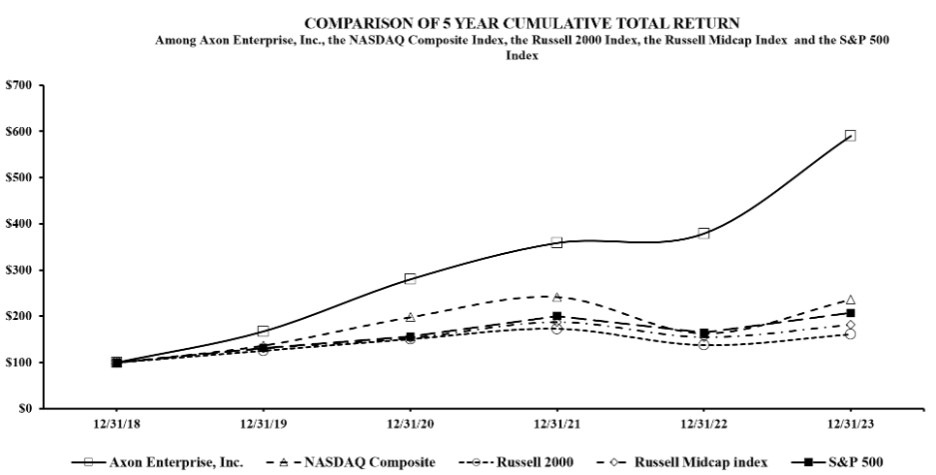
| | | | | | | | | | | | | | | | | | | |
|---|---|---|---|---|---|---|---|---|---|---|---|---|---|---|---|---|---|---|
| | 2018 | 2019 | 2020 | 2021 | 2022 | 2023 | ||||||||||||
| Axon Enterprise, Inc. | | $ | 100.00 | | $ | 167.50 | | $ | 280.07 | | $ | 358.86 | | $ | 379.22 | | $ | 590.32 |
| NASDAQ Composite | | | 100.00 | | | 136.69 | | | 198.10 | | | 242.03 | | | 163.28 | | | 236.17 |
| Russell 2000 | | | 100.00 | | | 125.52 | | | 150.58 | | | 172.90 | | | 137.56 | | | 160.85 |
| Russell Midcap Index | | | 100.00 | | | 130.54 | | | 152.87 | | | 187.39 | | | 154.94 | | | 181.63 |
| S&P 500 | | | 100.00 | | | 131.49 | | | 155.68 | | | 200.37 | | | 164.08 | | | 207.21 |
We have historically included the Russell 2000 and Russell Midcap as a point of reference in our Comparative Stock Performance chart; however, we have made the decision to remove the Russell 2000 and Russell Midcap from this chart beginning with our Annual Report on Form 10-K for the year ended December 31, 2024.
Index data copyright NASDAQ; Russell Investments; and Standard and Poor’s, Inc. Used with permission. All rights reserved.
Item 6. [Reserved]
Item 7. Management’s Discussion and Analysis of Financial Condition and Results of Operations
Management’s Discussion and Analysis of Financial Condition and Results of Operations (“MD&A”) is designed to provide a reader of our consolidated financial statements with a narrative from the perspective of our management on our financial condition, results of operations, liquidity and certain other factors that may affect our future results. Our MD&A should be read in conjunction with the other sections of this Annual Report on Form 10-K, including “Part I, Item 1A. Risk Factors” and “Part II, Item 8. Financial Statements and Supplementary Data.” The various sections of our MD&A contain a number of forward-looking statements, all of which are based on our current expectations and could be affected by the uncertainties and risk factors described throughout this filing. The tables in the MD&A sections below are derived from exact numbers and may have immaterial rounding differences.
Our MD&A discusses our results of operations for the year ended December 31, 2023 as compared to the year ended December 31, 2022. For a discussion and analysis of the year ended December 31, 2022 as compared to the year ended December 31, 2021, please refer to Management’s Discussion and Analysis of Financial Condition and Results of Operations included in Part II, Item 7 of our Annual Report on Form 10-K for the year ended December 31, 2022, filed with the SEC on February 28, 2023.
Overview
Axon’s product suite includes cloud-hosted digital evidence management, productivity and real-time operations software, body-worn cameras, in-car cameras, TASER energy devices, robotic security and training solutions. Our financial strategy is to build highly recurring, highly profitable businesses. Axon products are generally cloud-connected, designed to drive better outcomes and customer experiences, and sold via mutually reinforcing integrated bundles.
Axon’s operations comprise two reportable segments:
| 1. | TASER: Axon is the market leader in the development, manufacture and sale of CEDs, which we sell under our brand name, TASER. |
|---|
| 2. | Software and Sensors: We develop, manufacture and sell fully integrated hardware and cloud-based software solutions that enable law enforcement to capture, securely store, manage, share and analyze video and other digital evidence. Our software offerings also support productivity and real-time operations. |
|---|
We derive revenue from two primary sources: (i) the sale of physical products, including Axon cameras, Axon Signal-enabled devices, CEDs, corresponding hardware extended warranties, and related accessories such as Axon docks, cartridges and batteries, among others, and (ii) subscriptions to our Axon Evidence digital evidence management SaaS offering (including data storage fees and other ancillary services), which includes varying levels of support. To a lesser extent, we also recognize revenue from training, professional services and other software and SaaS services.
Some of our products and services are sold on a standalone basis. We also bundle our hardware products and services together and sell them to our customers in single transactions, where the customer can make payments over a multi-year period. These sales may include payments for upfront hardware and services, as well as payments for hardware and services to be provided by us at a future date.
Our revenues for the year ended December 31, 2023 were $1.6 billion, an increase of $373.5 million, or 31.4%, from the prior year. We had income from operations of $154.8 million in 2023 compared to income from operations of $93.3 million in the prior year. Gross margin dollars increased by $226.7 million in 2023 but remained relatively flat as a percentage of revenue compared to 2022. Operating expenses for the year ended December 31, 2023 increased $165.2 million, reflecting an increase of $97.2 million in salaries, benefits and bonus expense and an increase in stock compensation of $23.2 million primarily related to an increase in headcount. For the year ended December 31, 2023, we recorded net income of $174.2 million, which reflected net unrealized losses of $80.5 million related to impairment and observable price changes for our existing investments and related warrants, interest income, net of $42.1 million, and an unrealized gain of $38.7 million on marketable securities related to our investment in Cellebrite DI Ltd.
(“CLBT”). This represented an increase of $27.1 million over net income of $147.1 million for the year ended December 31, 2022, which included an unrealized gain of $131.9 million related to observable price changes for our existing investments and related warrants and an unrealized loss of $32.9 million related to CLBT for the prior year.
Results of Operations
The following table presents data from our consolidated statements of operations as well as the percentage relationship to total net sales of items included in our statements of operations (dollars in thousands):
| | | | | | | | | | | | | |
|---|---|---|---|---|---|---|---|---|---|---|---|---|
| | | Year Ended December 31, | ||||||||||
| | | 2023 | | 2022 | ||||||||
| Net sales from products | $ | 967,711 | 61.9 | % | | $ | 801,388 | | 67.3 | % | ||
| Net sales from services | | 595,680 | 38.1 | | | 388,547 | 32.7 | | ||||
| Net sales | | 1,563,391 | 100.0 | | | 1,189,935 | 100.0 | | ||||
| Cost of product sales | | 450,718 | 28.8 | | | 363,219 | 30.5 | | ||||
| Cost of service sales | | 157,291 | 10.1 | | | 98,078 | 8.3 | | ||||
| Cost of sales | | 608,009 | 38.9 | | | 461,297 | 38.8 | | ||||
| Gross margin | | 955,382 | 61.1 | | | 728,638 | 61.2 | | ||||
| Operating expenses: | | | | | | | | | | | ||
| Sales, general and administrative | | 496,874 | 31.8 | | | 401,575 | 33.7 | | ||||
| Research and development | | 303,719 | 19.4 | | | 233,810 | 19.7 | | ||||
| Total operating expenses | | 800,593 | 51.2 | | | 635,385 | 53.4 | | ||||
| Income from operations | | 154,789 | 9.9 | | | 93,253 | 7.8 | | ||||
| Interest income, net | | | 42,112 | | 2.7 | | | | 4,294 | | 0.4 | |
| Other income (loss), net | | (41,901) | (2.7) | | | 98,971 | 8.3 | | ||||
| Income before provision for income taxes | | 155,000 | 9.9 | | | 196,518 | 16.5 | | ||||
| Provision for (benefit from) income taxes | | (19,227) | (1.2) | | | 49,379 | 4.1 | | ||||
| Net income | $ | 174,227 | 11.1 | % | | $ | 147,139 | 12.4 | % |
Net sales to the United States and other countries are summarized as follows (dollars in thousands):
| | | | | | | | | | | | | |
|---|---|---|---|---|---|---|---|---|---|---|---|---|
| | | Year Ended December 31, | ||||||||||
| | | 2023 | | | 2022 | |||||||
| United States | $ | 1,338,208 | 86 | % | | $ | 987,975 | 83 | % | |||
| Other Countries | | 225,183 | 14 | | | 201,960 | 17 | | ||||
| Total | | $ | 1,563,391 | 100 | % | | $ | 1,189,935 | 100 | % |
International revenue increased in 2023, driven by strength in our Americas region, but decreased as a percentage of total revenue compared to 2022.
Our operations comprise two reportable segments. In both segments, we report sales of products and services.
| ● | The TASER segment includes the manufacture and sale of CEDs, batteries, accessories and extended warranties, digital subscription training content, VR training content, TASER Evidence.com license revenue, and other professional services tied to TASER and VR deployments. |
|---|
| | ● | The Software and Sensors
Showing the first 8K of 67K characters. Open the full section
Item 7A. Quantitative and Qualitative Disclosures About Market Risk
Interest Rate Risk
We typically invest in a limited number of financial instruments, consisting principally of investments in money market accounts, certificates of deposit, corporate and municipal bonds with a typical long-term debt rating of “A” or better by any nationally recognized statistical rating organization, denominated in U.S. dollars. All of our cash equivalents and investments are treated as “available-for-sale.” We report available-for-sale investments at fair value as of each balance sheet date and record any unrealized gains or losses as a component of stockholders’ equity. The cost of securities sold is determined on a specific identification basis, and realized gains and losses are included in interest and other income, net within the consolidated statements of operations. When the fair value is below the amortized cost of a marketable security, an estimate of expected credit losses is made. The credit-related impairment amount is recognized in the consolidated statements of operations. Credit losses are recognized through the use of an allowance for credit losses account in the consolidated balance sheets and subsequent improvements in expected credit losses are recognized as a reversal of an amount in the allowance account. If we have the intent to sell the security or it is more likely than not that we will be required to sell the security prior to recovery of its amortized cost basis, then the allowance for the credit loss is written-off and the excess of the amortized cost basis of the asset over its fair value is recorded in the consolidated statements of operations. Based on investment positions as of December 31, 2023, a hypothetical 100 basis point increase in interest rates across all maturities would result in a $1.8 million decline in the fair market value of the portfolio. Such losses would only be realized if we sold the investments prior to maturity.
Additionally, we have access to a $200.0 million line of credit borrowing facility which bears interest at SOFR 1.25 to 1.75% per year determined in accordance with a pricing grid based on our net leverage ratio and consolidated interest coverage ratio. Under the terms of the line of credit, available borrowings are reduced by outstanding letters of credit, which totaled $7.5 million at December 31, 2023. At December 31, 2023, there was no amount outstanding under the line of credit, and the available borrowing under the line of credit was $192.5 million. We have not borrowed any funds under the line of credit since its inception; however; should we need to do so in the future, such borrowings could be subject to adverse or favorable changes in the underlying interest rate.
Exchange Rate Risk
Our results of operations and cash flows are subject to fluctuations due to changes in foreign currency exchange rates, in each case compared to the U.S. dollar, related to transactions by our foreign subsidiaries. The majority of our sales to international customers are transacted in foreign currencies and therefore are subject to exchange rate fluctuations on these transactions. The cost of our products to our customers increases when the U.S. dollar strengthens against their local currency, and we may have more sales and expenses denominated in foreign currencies in future years which could increase our foreign exchange rate risk. Additionally, intercompany sales to our non-U.S. dollar functional currency international subsidiaries are transacted in U.S. dollars which could increase our foreign exchange rate risk caused by foreign currency transaction gains and losses.
To date, we have not engaged in any currency hedging activities. However, we may enter into foreign currency forward and option contracts with financial institutions to protect against foreign exchange risks associated with certain existing assets and liabilities, certain firmly committed transactions, forecasted future cash flows and net investments in foreign subsidiaries. However, we may choose not to hedge certain foreign exchange exposures for a variety of reasons, including the prohibitive economic cost of hedging particular exposures. As such, fluctuations in currency exchange rates could harm our business in the future.
Item 8. Financial Statements and Supplementary Data
AXON ENTERPRISE, INC.
CONSOLIDATED BALANCE SHEETS
(in thousands, except share data)
| | | | | | | |
|---|---|---|---|---|---|---|
| | December 31, | | December 31, | |||
| | | 2023 | | 2022 | ||
| ASSETS | | | ||||
| Current assets: | | | ||||
| Cash and cash equivalents | | $ | 598,545 | | $ | 353,684 |
| Marketable securities | | | 77,940 | | | 39,240 |
| Short-term investments | | 644,054 | | 581,769 | ||
| Accounts and notes receivable, net of allowance of $2,392 and $2,176 as of December 31, 2023 and December 31, 2022, respectively | | 417,690 | | 358,190 | ||
| Contract assets, net | | 275,779 | | 196,902 | ||
| Inventory | | 269,855 | | 202,471 | ||
| Prepaid expenses and other current assets | | 112,786 | | 73,022 | ||
| Total current assets | | 2,396,649 | | 1,805,278 | ||
| Property and equipment, net | | 200,533 | | 169,843 | ||
| Deferred tax assets, net | | 229,513 | | 156,866 | ||
| Intangible assets, net | | 19,539 | | 12,158 | ||
| Goodwill | | 57,945 | | 44,983 | ||
| Long-term investments | | — | | 156,207 | ||
| Long-term notes receivable, net | | 2,588 | | 5,210 | ||
| Long-term contract assets, net | | | 77,710 | | | 45,170 |
| Strategic investments | | | 231,730 | | | 296,563 |
| Other long-term assets | | 220,638 | | 159,616 | ||
| Total assets | | $ | 3,436,845 | | $ | 2,851,894 |
| LIABILITIES AND STOCKHOLDERS’ EQUITY | | | | |||
| Current liabilities: | | | ||||
| Accounts payable | | $ | 88,326 | | $ | 59,918 |
| Accrued liabilities | | 188,230 | | 155,934 | ||
| Current portion of deferred revenue | | 491,691 | | 360,037 | ||
| Customer deposits | | 21,935 | | 20,399 | ||
| Other current liabilities | | 9,787 | | 6,358 | ||
| Total current liabilities | | 799,969 | | 602,646 | ||
| Deferred revenue, net of current portion | | 281,852 | | 248,003 | ||
| Liability for unrecognized tax benefits | | 18,049 | | 10,745 | ||
| Long-term deferred compensation | | 11,342 | | 6,285 | ||
| Deferred tax liability, net | | | — | | | 1 |
| Long-term lease liabilities | | 33,550 | | 37,143 | ||
| Convertible notes, net | | | 677,113 | | | 673,967 |
| Other long-term liabilities | | 2,936 | | 4,613 | ||
| Total liabilities | | 1,824,811 | | 1,583,403 | ||
| Commitments and contingencies (Note 12) | | | ||||
| Stockholders’ equity: | | | ||||
| Preferred stock, $0.00001 par value; 25,000,000 shares authorized; no shares issued and outstanding as of December 31, 2023 and December 31, 2022, respectively | | — | | — | ||
| Common stock, $0.00001 par value; 200,000,000 shares authorized; 75,301,424 and 71,474,581 shares issued and outstanding as of December 31, 2023 and December 31, 2022, respectively | | 1 | | 1 | ||
| Additional paid-in capital | | 1,347,410 | | 1,174,594 | ||
| Treasury stock at cost, 20,220,227 shares as of December 31, 2023 and December 31, 2022 | | (155,947) | | (155,947) | ||
| Retained earnings | | 431,249 | | 257,022 | ||
| Accumulated other comprehensive loss | | (10,679) | | (7,179) | ||
| Total stockholders’ equity | | 1,612,034 | | 1,268,491 | ||
| Total liabilities and stockholders’ equity | | $ | 3,436,845 | | $ | 2,851,894 |
The accompanying notes are an integral part of these consolidated financial statements.
AXON ENTERPRISE, INC.
CONSOLIDATED STATEMENTS OF OPERATIONS AND COMPREHENSIVE INCOME (LOSS)
(in thousands, except per share data)
| | | | | | | | | | |
|---|---|---|---|---|---|---|---|---|---|
| | | For the Years Ended December 31, | |||||||
| | 2023 | 2022 | | 2021 | |||||
| Net sales from products | | $ | 967,711 | | $ | 801,388 | | $ | 608,525 |
| Net sales from services | | 595,680 | | 388,547 | | 254,856 | |||
| Net sales | | 1,563,391 | | 1,189,935 | | 863,381 | |||
| Cost of product sales | | 450,718 | | 363,219 | | 260,098 | |||
| Cost of service sales | | 157,291 | | 98,078 | | 62,373 | |||
| Cost of sales | | 608,009 | | 461,297 | | 322,471 | |||
| Gross margin | | 955,382 | | 728,638 | | 540,910 | |||
| Sales, general and administrative | | 496,874 | | 401,575 | | 515,007 | |||
| Research and development | | 303,719 | | 233,810 | | 194,026 | |||
| Total operating expenses | | 800,593 | | 635,385 | | 709,033 | |||
| Income (loss) from operations | | 154,789 | | 93,253 | | (168,123) | |||
| Interest income, net | | | 42,112 | | | 4,294 | | | 1,483 |
| Other income (loss), net | | (41,901) | | 98,971 | | 25,265 | |||
| Income (loss) before provision (benefit) for income taxes | | 155,000 | | 196,518 | | (141,375) | |||
| Provision (benefit) for income taxes | | (19,227) | | 49,379 | | (81,357) | |||
| Net income (loss) | | $ | 174,227 | | $ | 147,139 | | $ | (60,018) |
| Net income (loss) per share: | | | | ||||||
| Basic | | $ | 2.35 | | $ | 2.07 | | $ | (0.91) |
| Diluted | | $ | 2.31 | | $ | 2.03 | | $ | (0.91) |
| Weighted average shares outstanding: | | | | ||||||
| Basic | | 74,195 | | 71,093 | | 66,191 | |||
| Diluted | | 75,456 | | 72,534 | | 66,191 | |||
| | | | | | | | | | |
| Net income (loss) | | $ | 174,227 | | $ | 147,139 | | $ | (60,018) |
| Foreign currency translation adjustments | | | (4,352) | | | (4,818) | | (1,251) | |
| Unrealized gain (loss) on available-for-sale investments | | 852 | | (1,044) | | | (207) | ||
| Comprehensive income (loss) | | $ | 170,727 | | $ | 141,277 | | $ | (61,476) |
The accompanying notes are an integral part of these consolidated financial statements.
AXON ENTERPRISE, INC.
CONSOLIDATED STATEMENTS OF STOCKHOLDERS’ EQUITY
(in thousands, except share data)
| | | | | | | | | | | | | | | | | | | | | | | |
|---|---|---|---|---|---|---|---|---|---|---|---|---|---|---|---|---|---|---|---|---|---|---|
| | | | | | | | | | | | Accumulated | | | |||||||||
| | | | | | | | Additional | | | | | | | | | | Other | | Total | |||
| | | Common Stock | | Paid-in | | Treasury Stock | | Retained | ** |
Showing the first 8K of 162K characters. Open the full section
Item 9. Changes in and Disagreements With Accountants on Accounting and Financial Disclosure
None.
Item 9A. Controls and Procedures
Attached as exhibits to this Form 10-K are certifications of the Chief Executive Officer (as the principal executive officer) and Chief Financial Officer (as the principal financial and accounting officer), which are required in accordance with Rule 13a-14 of the Exchange Act. This section includes information concerning the controls and controls evaluation referred to in the certifications. This section should be read in conjunction with the certifications and the Grant Thornton LLP attestation report for a more complete understanding of the topics presented. Grant Thornton LLP has independently assessed the effectiveness of our internal control over financial reporting and its report is included below.
Evaluation of Disclosure Controls and Procedures
Our Chief Executive Officer and Chief Financial Officer are responsible for the evaluation of the effectiveness of our disclosure controls and procedures (as defined in Rules 13a-15(e) under the Exchange Act) as of the end of the period covered by this Annual Report on Form 10-K. Our disclosure controls and procedures are designed to ensure that information we are required to disclose in reports that we file or submit under the Exchange Act is (i) recorded, processed, summarized and reported, within the time periods specified in the SEC’s rules and forms and (ii) accumulated and communicated to our management, including our Chief Executive Officer and Chief Financial Officer, as appropriate to allow timely decisions regarding required disclosure. Based on this evaluation, our Chief Executive Officer and our Chief Financial Officer have concluded that as of December 31, 2023 our disclosure controls and procedures were effective to ensure that information we are required to disclose in reports that we file or submit under the Exchange Act (i) is recorded, processed, summarized and reported within the time periods specified in SEC rules and forms, and (ii) is accumulated and communicated to our management, including our Chief Executive Officer and our Chief Financial Officer, as appropriate to allow timely decisions regarding required disclosure.
Management Report on Internal Control over Financial Reporting
Management is responsible for establishing and maintaining adequate internal control over financial reporting (as defined in Rule 13a-15(f) or 15d-15(f) under the Exchange Act). Management has assessed the effectiveness of our internal control over financial reporting as of December 31, 2023 based on criteria established in Internal Control-Integrated Framework (2013) issued by the Committee of Sponsoring Organizations of the Treadway Commission. As a result of this assessment, management concluded that, as of December 31, 2023, our internal control over financial reporting was effective in providing reasonable assurance regarding the reliability of financial reporting and the preparation of financial statements for external purposes in accordance with GAAP. Grant Thornton LLP has independently assessed the effectiveness of our internal control over financial reporting and its report is included below.
Remediation Plan of Prior Period Material Weakness
Management previously identified and disclosed in our Annual Report on Form 10-K for the year ended December 31, 2022, as well as in our Quarterly Reports on Form 10-Q for each interim period in fiscal 2023, a material weakness in our internal control over financial reporting. Specifically, during the fourth quarter of 2022, management identified a material weakness in our internal controls stemming from control deficiencies with respect to the risks of understatement of software and services revenue and overstatement of deferred revenue. This material weakness in internal control over financial reporting resulted from a failure to effectively manage the migration of triggering events for certain software and services performance obligations during the quote-to-cash phase of the implementation of our Enterprise Resource Planning (“ERP”) and related systems in 2021.
We have completed our plan of remediation for the material weakness described above, which primarily consisted of the design and implementation of new business processes and automation of integrations between our systems as well as enhanced our reconciliation controls and monitoring procedures to properly ensure transactions are identified and recorded timely and accurately. During the quarter ended December 31, 2023, management completed its evaluation and
testing of the operating effectiveness of the improved controls and deemed them to be designed and operating effectively. As a result, management concluded that the previously disclosed material weakness has been remediated as of December 31, 2023.
Changes in Internal Control over Financial Reporting
Except for the changes noted above, there have been no other changes in our internal control over financial reporting during the fiscal quarter ended December 31, 2023, that has materially affected, or is reasonably likely to materially affect, our internal control over financial reporting.
REPORT OF INDEPENDENT REGISTERED PUBLIC ACCOUNTING FIRM
Board of Directors and Stockholders
Axon Enterprise, Inc.
Opinion on internal control over financial reporting
We have audited the internal control over financial reporting of Axon Enterprise, Inc. (a Delaware corporation) and subsidiaries (the “Company”) as of December 31, 2023, based on criteria established in the 2013 Internal Control—Integrated Framework issued by the Committee of Sponsoring Organizations of the Treadway Commission (“COSO”). In our opinion, the Company maintained, in all material respects, effective internal control over financial reporting as of December 31, 2023, based on criteria established in the 2013 Internal Control—Integrated Framework issued by COSO.
We also have audited, in accordance with the standards of the Public Company Accounting Oversight Board (United States) (“PCAOB”), the consolidated financial statements of the Company as of and for the year ended December 31, 2023, and our report dated February 27, 2024 expressed an unqualified opinion on those financial statements.
Basis for opinion
The Company’s management is responsible for maintaining effective internal control over financial reporting and for its assessment of the effectiveness of internal control over financial reporting, included in the accompanying Management Report on Internal Control over Financial Reporting. Our responsibility is to express an opinion on the Company’s internal control over financial reporting based on our audit. We are a public accounting firm registered with the PCAOB and are required to be independent with respect to the Company in accordance with the U.S. federal securities laws and the applicable rules and regulations of the Securities and Exchange Commission and the PCAOB.
We conducted our audit in accordance with the standards of the PCAOB. Those standards require that we plan and perform the audit to obtain reasonable assurance about whether effective internal control over financial reporting was maintained in all material respects. Our audit included obtaining an understanding of internal control over financial reporting, assessing the risk that a material weakness exists, testing and evaluating the design and operating effectiveness of internal control based on the assessed risk, and performing such other procedures as we considered necessary in the circumstances. We believe that our audit provides a reasonable basis for our opinion.
Definition and limitations of internal control over financial reporting
A company’s internal control over financial reporting is a process designed to provide reasonable assurance regarding the reliability of financial reporting and the preparation of financial statements for external purposes in accordance with generally accepted accounting principles. A company’s internal control over financial reporting includes those policies and procedures that (1) pertain to the maintenance of records that, in reasonable detail, accurately and fairly reflect the transactions and dispositions of the assets of the company; (2) provide reasonable assurance that transactions are recorded as necessary to permit preparation of financial statements in accordance with generally accepted accounting principles, and that receipts and expenditures of the company are being made only in accordance with authorizations of management and directors of the company; and (3) provide reasonable assurance regarding prevention or timely detection of unauthorized acquisition, use, or disposition of the company’s assets that could have a material effect on the financial statements.
Because of its inherent limitations, internal control over financial reporting may not prevent or detect misstatements. Also, projections of any evaluation of effectiveness to future periods are subject to the risk that controls may become inadequate because of changes in conditions, or that the degree of compliance with the policies or procedures may deteriorate.
/s/ GRANT THORNTON LLP
Phoenix, Arizona
February 27, 2024
Item 9B. Other Information
During the fiscal quarter ended December 31, 2023, certain of our officers or directors have made, and may from time to time make, elections to have shares withheld or sold to cover withholding taxes or pay the exercise price of options, which may be designed to satisfy the affirmative defense conditions of Rule 10b5-1 under the Exchange Act or may constitute non-Rule 10b5-1 trading arrangements (as defined in Item 408(c) of Regulation S-K).
No other Rule 10b5-1 trading arrangements or “non-Rule 10b5-1 trading arrangements” (as defined by Item 408(c) of Regulation S-K) were entered into, modified or terminated by our directors or officers during such period.
Item 9C. Disclosure Regarding Foreign Jurisdictions that Prevent Inspections
None.
PART III
Item 10. Directors, Executive Officers and Corporate Governance
The information required to be disclosed by this item is incorporated herein by reference to our definitive proxy statement for the 2024 Annual Meeting of Shareholders (the “2024 Proxy Statement”), which we expect to file with the SEC within 120 days after the end of our fiscal year ended December 31, 2023.
Item 11. Executive Compensation
The information required to be disclosed by this item is incorporated herein by reference to our 2024 Proxy Statement.
Item 12. Security Ownership of Certain Beneficial Owners and Management and Related Stockholder Matters
A description of our equity compensation plans approved by our shareholders is included in Note 15 to the consolidated financial statements included in Part II, Item 8 of this Annual Report on Form 10-K. The following table provides details of our equity compensation plans at December 31, 2023:
| | | | | | | | |
|---|---|---|---|---|---|---|---|
| | | Number of | | Weighted | | Number of Securities | |
| | | Securities to be | | Average | | Remaining Available for | |
| | | Issued upon | | Exercise Price | | Future Issuance Under Equity | |
| | | Exercise of Outstanding | | of Outstanding Options, | | Compensation Plans (Excluding Securities | |
| | | Options, Warrants and Rights | | Warrants and Rights | | Reflected | |
| Plan Category | (a) | (b) (1) | in Column (a)) (c) | ||||
| Equity compensation plans approved by security holders | | 2,469,260 | $ | 28.58 | 1,708,146 | ||
| Equity compensation plans not approved by security holders(2) | | 70,694 | | | — | 112,505 | |
| Total | | 2,539,954 | | | 1,820,651 |
| (1) | The weighted average exercise price is calculated based solely on the exercise prices of the outstanding stock options and does not reflect the shares that will be issued upon the vesting of outstanding awards of RSUs that have no exercise price. |
|---|
| (2) | In September 2022, our Board of Directors adopted the Axon Enterprise, Inc. 2022 Stock Inducement Plan (the “2022 Inducement Plan”) pursuant to which we reserved 250,000 shares of common stock for issuance under the 2022 Inducement Plan. In September 2019, our Board of Directors adopted the Axon Enterprise, Inc. 2019 Stock Inducement Plan (the “2019 Inducement Plan” and, together with the 2022 Inducement Plan, the “Inducement Plans”) pursuant to which we reserved 500,000 shares of common stock for issuance under the 2019 Inducement Plan. The Inducement Plans were adopted without shareholder approval pursuant to Rule 5635(c)(4) and Rule 5635(c)(3) of the Nasdaq Listing Rules. Each Inducement Plan provides for the grant of equity-based awards, including restricted stock, |
|---|
| RSUs, performance shares and PSUs, and its terms are substantially similar to our shareholder-approved 2022 Plan and 2019 Plan, respectively. In accordance with Rule 5635(c)(4) and Rule 5635(c)(3) of the Nasdaq Listing Rules, awards under each Inducement Plan may only be made to individuals not previously employees or non-employee directors of the Company (or following such individuals’ bona fide period of non-employment with the Company), as an inducement material to the individuals’ entry into employment with the Company. |
|---|
All other information required to be disclosed by this item is incorporated herein by reference to our 2024 Proxy Statement.
Item 13. Certain Relationships and Related Transactions, and Director Independence
The information required to be disclosed by this item is incorporated herein by reference to our 2024 Proxy Statement.
Item 14. Principal Accountant Fees and Services
The information required to be disclosed by this item is incorporated herein by reference to our 2024 Proxy Statement.
PART IV
Item 15. Exhibits, Financial Statement Schedules
| (a) | The following documents are filed as part of this report: |
|---|
| 1. | Consolidated financial statements: All consolidated financial statements as set forth under Part II, Item 8 of this report. |
|---|
| 2. | Supplementary Financial Statement Schedules: Supplementary schedules have not been included because they are not applicable or because the information is included elsewhere in this report. |
|---|
| 3. | Exhibits: |
|---|
| + | Management contract or compensatory plan or arrangement |
|---|
| * | Filed herewith |
|---|
| ** | Furnished herewith |
|---|
| ± | Certain confidential portions of this Exhibit were omitted by means of marking such portions with brackets (“[***]”) because the identified confidential portions (i) are not material and (ii) would be competitively harmful if publicly disclosed. |
|---|
Item 16. Form 10-K Summary
Not applicable.
SIGNATURES
Pursuant to the requirements of Section 13 or 15(d) of the Securities Exchange Act of 1934, the registrant has duly caused this report to be signed on its behalf by the undersigned, thereunto duly authorized.
| | | |
|---|---|---|
| AXON ENTERPRISE, INC. | | |
| | | |
| Date: February 27, 2024 | | |
| | By: | /s/ PATRICK W. SMITH |
| | | Chief Executive Officer, Director |
| | | (Principal Executive Officer) |
| | | |
| Date: February 27, 2024 | By: | /s/ BRITTANY BAGLEY |
| | | Chief Operating Officer and Chief Financial Officer |
| | | (Principal Financial and Accounting Officer) |
POWER OF ATTORNEY
KNOW ALL PERSONS BY THESE PRESENTS, that each person whose signature appears below constitutes and appoints Patrick W. Smith his or her true and lawful attorney-in-fact and agent, with full power of substitution and resubstitution, for him or her in any and all capacities, to sign any amendments to this Annual Report on Form 10-K, and to file the same, with exhibits thereto and other documents in connection therewith, with the Securities and Exchange Commission, hereby ratifying and confirming all that each of said attorneys-in-fact, or his substitute or substitutes, may do or cause to be done by virtue hereof.
Pursuant to the requirements of the Securities Exchange Act of 1934, this report has been signed by the following persons on behalf of the registrant and in the capacities and on the dates indicated.
| Signature | Title | Date | ||
|---|---|---|---|---|
| | | | | |
| | | Chief Executive Officer, Director | | |
| /s/ PATRICK W. SMITH | | (Principal Executive Officer) | | February 27, 2024 |
| Patrick W. Smith | | | | |
| | | | | |
| | | Chief Operating Officer and Chief Financial Officer | | |
| /s/ BRITTANY BAGLEY | | (Principal Financial and Accounting Officer) | | February 27, 2024 |
| Brittany Bagley | | | | |
| | | | | |
| /s/ ERIKA AYERS BADAN | | Director | | February 27, 2024 |
| Erika Ayers Badan | | | | |
| | | | | |
| /s/ ADRIANE M. BROWN | | Director | | February 27, 2024 |
| Adriane M. Brown | | | | |
| | | | | |
| /s/ JULIE A. CULLIVAN | | Director | | February 27, 2024 |
| Julie A. Cullivan | | | | |
| | | | | |
| /s/ MICHAEL GARNREITER | | Director | | February 27, 2024 |
| Michael Garnreiter | | | | |
| | | | | |
| /s/ CAITLIN E. KALINOWSKI | | Director | | February 27, 2024 |
| Caitlin E. Kalinowski | | | | |
| | | | | |
| /s/ MARK W. KROLL | | Director | | February 27, 2024 |
| Mark W. Kroll | | | | |
| | | | | |
| /s/ MATTHEW R. MCBRADY | | Director | | February 27, 2024 |
| Matthew R. McBrady | | | | |
| | | | | |
| /s/ HADI PARTOVI | | Director | | February 27, 2024 |
| Hadi Partovi | | | | |
| | | | | |
| /s/ GRAHAM SMITH | | Director | | February 27, 2024 |
| Graham Smith | | | | |
| | | | | |
| /s/ JERI WILLIAMS | | Director | | February 27, 2024 |
| Jeri Williams | | | | |