 filings.tools
AutoZone 10-K 2017-08-26
Filed 2017-10-25. 21 sections, 336K characters. Original on sec.gov · Markdown · JSON
Cover and table of contents
10-K 1 d447746d10k.htm FORM 10-K
Table of Contents
UNITED STATES
SECURITIES AND EXCHANGE COMMISSION
Washington, D.C. 20549
FORM 10-K
| ☒ | Annual Report pursuant to section 13 or 15(d) of the Securities Exchange Act of 1934 |
|---|
For the fiscal year ended August 26, 2017,
or
| ☐ | Transition report pursuant to section 13 or 15(d) of the Securities Exchange Act of 1934 |
|---|
For the transition period from to .
Commission file number 1-10714

AUTOZONE, INC.
(Exact name of registrant as specified in its charter)
| Nevada | 62-1482048 | |
| (State or other jurisdiction of incorporation or organization) | (I.R.S. Employer Identification No.) | |
| 123 South Front Street, Memphis, Tennessee | 38103 | |
| (Address of principal executive offices) | (Zip Code) |
(901) 495-6500
(Registrant’s telephone number, including area code)
Securities registered pursuant to Section 12(b) of the Act:
| Title of each class | Name of each exchange on which registered | |
| Common Stock ($.01 par value) | New York Stock Exchange |
Securities registered pursuant to Section 12(g) of the Act:
None
Indicate by check mark if the Registrant is a well-known seasoned issuer, as defined in Rule 405 of the Securities Act. Yes ☒ No ☐
Indicate by check mark if the Registrant is not required to file reports pursuant to Section 13 or Section 15(d) of the Act. Yes ☐ No ☒
Indicate by check mark whether the Registrant (1) has filed all reports required to be filed by Section 13 or 15(d) of the Securities Exchange Act of 1934 during the preceding 12 months (or for such shorter period that the registrant was required to file such reports), and (2) has been subject to such filing requirements for the past 90 days. Yes ☒ No ☐
Indicate by check mark whether the Registrant has submitted electronically and posted on its corporate Web site, if any, every Interactive Data File required to be submitted and posted pursuant to Rule 405 of Regulation S-T (§ 232.405 of this chapter) during the preceding 12 months (or for such shorter period that the Registrant was required to submit and post such files). Yes ☒ No ☐
Indicate by check mark if disclosure of delinquent filers pursuant to Item 405 of Regulation S-K (§ 229.405 of this chapter) is not contained herein, and will not be contained, to the best of Registrant’s knowledge, in definitive proxy or information statements incorporated by reference in Part III of this Form 10-K or any amendment to this Form 10-K. ☒
Indicate by check mark whether the registrant is a large accelerated filer, an accelerated filer, a non-accelerated filer, smaller reporting company, or an emerging growth company. See the definitions of “large accelerated filer,” “accelerated filer,” “smaller reporting company,” and “emerging growth company” in Rule 12b-2 of the Exchange Act.
| Large accelerated filer | ☒ | Accelerated filer | ☐ | |||
| Non-accelerated filer | ☐ (Do not check if a smaller reporting company) | Smaller reporting company | ☐ | |||
| Emerging growth company | ☐ |
If an emerging growth company, indicate by check mark if the registrant has elected not to use the extended transition period for complying with any new or revised financial accounting standards provided pursuant to Section 13(a) of the Exchange Act. ☐
Indicate by check mark whether the Registrant is a shell company (as defined in Rule 12b-2 of the Act). Yes ☐ No ☒
The aggregate market value of the voting and non-voting common equity held by non-affiliates computed by reference to the price at which the common equity was last sold, or the average bid and asked price of such common equity, as of the last business day of the registrant’s most recently completed second fiscal quarter was $20,972,678,680.
The number of shares of Common Stock outstanding as of October 23, 2017, was 27,492,520.
Documents Incorporated By Reference
Portions of the definitive Proxy Statement to be filed within 120 days of August 26, 2017, pursuant to Regulation 14A under the Securities Exchange Act of 1934 for the Annual Meeting of Stockholders to be held December 20, 2017, are incorporated by reference into Part III.
Table of Contents
TABLE OF CONTENTS
Table of Contents
Forward-Looking Statements
Certain statements contained in this annual report are forward-looking statements. Forward-looking statements typically use words such as “believe,” “anticipate,” “should,” “intend,” “plan,” “will,” “expect,” “estimate,” “project,” “positioned,” “strategy” and similar expressions. These are based on assumptions and assessments made by our management in light of experience and perception of historical trends, current conditions, expected future developments and other factors that we believe to be appropriate. These forward-looking statements are subject to a number of risks and uncertainties, including without limitation: product demand; energy prices; weather; competition; credit market conditions; access to available and feasible financing; the impact of recessionary conditions; consumer debt levels; changes in laws or regulations; war and the prospect of war, including terrorist activity; inflation; the ability to hire and retain qualified employees; construction delays; the compromising of confidentiality, availability or integrity of information, including cyber attacks; and raw material costs of suppliers. Certain of these risks are discussed in more detail in the “Risk Factors” section contained in Item 1A under Part 1 of this Annual Report on Form 10-K for the year ended August 26, 2017, and these Risk Factors should be read carefully. Forward-looking statements are not guarantees of future performance and actual results; developments and business decisions may differ from those contemplated by such forward-looking statements, and events described above and in the “Risk Factors” could materially and adversely affect our business. Forward-looking statements speak only as of the date made. Except as required by applicable law, we undertake no obligation to update publicly any forward-looking statements, whether as a result of new information, future events or otherwise. Actual results may materially differ from anticipated results.
Table of Contents
PART I
Item 1. Business
Introduction
AutoZone, Inc. (“AutoZone,” the “Company,” “we,” “our” or “us”) is the nation’s leading retailer, and a leading distributor, of automotive replacement parts and accessories in the United States. We began operations in 1979 and at August 26, 2017, operated 5,465 AutoZone stores in the United States, including Puerto Rico; 524 stores in Mexico; 14 stores in Brazil; and 26 Interamerican Motor Corporation (“IMC”) branches. Each AutoZone store carries an extensive product line for cars, sport utility vehicles, vans and light trucks, including new and remanufactured automotive hard parts, maintenance items, accessories and non-automotive products. At August 26, 2017, in 4,592 of our domestic AutoZone stores, we also had a commercial sales program that provides commercial credit and prompt delivery of parts and other products to local, regional and national repair garages, dealers, service stations and public sector accounts. We also have commercial programs in AutoZone stores in Mexico and Brazil. IMC branches carry an extensive line of original equipment quality import replacement parts. We also sell the ALLDATA brand automotive diagnostic and repair software through www.alldata.com and www.alldatadiy.com. Additionally, we sell automotive hard parts, maintenance items, accessories and non-automotive products through www.autozone.com, and accessories, performance and replacement parts through www.autoanything.com, and our commercial customers can make purchases through www.autozonepro.com and www.imcparts.net. We do not derive revenue from automotive repair or installation services.
At August 26, 2017, our AutoZone stores and IMC branches were in the following locations:
| Location Count | ||||
| Alabama | 110 | |||
| Alaska | 8 | |||
| Arizona | 136 | |||
| Arkansas | 64 | |||
| California | 585 | |||
| Colorado | 87 | |||
| Connecticut | 47 | |||
| Delaware | 16 | |||
| Florida | 318 | |||
| Georgia | 200 | |||
| Hawaii | 4 | |||
| Idaho | 28 | |||
| Illinois | 238 | |||
| Indiana | 155 | |||
| Iowa | 29 | |||
| Kansas | 50 | |||
| Kentucky | 95 | |||
| Louisiana | 123 | |||
| Maine | 13 | |||
| Maryland | 75 | |||
| Massachusetts | 81 | |||
| Michigan | 188 | |||
| Minnesota | 54 | |||
| Mississippi | 94 | |||
| Missouri | 112 | |||
| Montana | 13 | |||
| Nebraska | 20 | |||
| Nevada | 64 | |||
| New Hampshire | 23 | |||
| New Jersey | 96 |
Table of Contents
| New Mexico | 62 | |||
| New York | 189 | |||
| North Carolina | 219 | |||
| North Dakota | 3 | |||
| Ohio | 259 | |||
| Oklahoma | 74 | |||
| Oregon | 43 | |||
| Pennsylvania | 177 | |||
| Puerto Rico | 43 | |||
| Rhode Island | 17 | |||
| South Carolina | 88 | |||
| South Dakota | 7 | |||
| Tennessee | 165 | |||
| Texas | 597 | |||
| Utah | 58 | |||
| Vermont | 2 | |||
| Virginia | 123 | |||
| Washington | 88 | |||
| Washington, DC | 5 | |||
| West Virginia | 44 | |||
| Wisconsin | 67 | |||
| Wyoming | 9 | |||
| Total Domestic AutoZone stores | 5,465 | |||
| Mexico | 524 | |||
| Brazil | 14 | |||
| Total AutoZone stores | 6,003 | |||
| IMC branches | 26 | |||
| Total locations | 6,029 | |||
Marketing and Merchandising Strategy
We are dedicated to providing customers with superior service and trustworthy advice as well as quality automotive parts and products at a great value in conveniently located, well-designed stores. Key elements of this strategy are:
Customer Service
Customer service is the most important element in our marketing and merchandising strategy, which is based upon consumer marketing research. We emphasize that our AutoZoners (employees) should always put customers first by providing prompt, courteous service and trustworthy advice. Our electronic parts catalog assists in the selection of parts as well as identifying any associated warranties that are offered by us or our vendors. We sell automotive hard parts, maintenance items, accessories and non-automotive parts through www.autozone.com for pick-up in store or to be shipped directly to a customer’s home or business. Additionally, we offer smartphone apps that provide customers with store locations, driving directions, operating hours, ability to purchase products and product availability.
Our stores generally open at 7:30 or 8 a.m. and close between 8 and 10 p.m. Monday through Saturday and typically open at 9 a.m. and close between 6 and 9 p.m. on Sunday. However, some stores are open 24 hours, and some have extended hours of 6 or 7 a.m. until midnight seven days a week.
We also provide specialty tools through our Loan-A-Tool program. Customers can borrow a specialty tool, such as a steering wheel puller, for which a do-it-yourself (“DIY”) customer or a repair shop would have little or no use other than for a single job. AutoZoners also provide other free services, including check engine light readings where allowed by law, battery charging, the collection of used oil for recycling, and the testing of starters, alternators and batteries.
Table of Contents
Merchandising
The following tables show some of the types of products that we sell by major category of items:
| Failure | Maintenance | Discretionary | ||
| A/C Compressors Batteries & Accessories Bearings Belts & Hoses Calipers Carburetors Chassis Clutches CV Axles Engines Fuel Pumps Fuses Ignition Lighting Mufflers Radiators Tire Repair Thermostats Starters & Alternators Water Pumps | Antifreeze & Windshield Washer Fluid Brake Drums, Rotors, Shoes & Pads Chemicals, including Brake & Power Steering Fluid, Oil & Fuel Additives Oil & Transmission Fluid Oil, Air, Fuel & Transmission Filters Oxygen Sensors Paint & Accessories Refrigerant & Accessories Shock Absorbers & Struts Spark Plugs & Wires Windshield Wipers | Air Fresheners Cell Phone Accessories Drinks & Snacks Floor Mats & Seat Covers Interior & Exterior Accessories Mirrors Performance Products Protectants & Cleaners Sealants & Adhesives Steering Wheel Covers Stereos & Radios Tools Wash & Wax |
We believe that the satisfaction of our customers is often impacted by our ability to provide specific automotive products as requested. Each store carries the same basic products, but we tailor our hard parts inventory to the makes and models of the vehicles in each store’s trade area, and our sales floor products are tailored to the local store’s demographics. Our hub stores (including mega hubs, which carry an even broader assortment) carry a larger assortment of products that are delivered to local satellite stores. We are constantly updating the products we offer to ensure that our inventory matches the products our customers need or desire.
Pricing
We want to be the value leader in our industry, by consistently providing quality merchandise at the right price, backed by a satisfactory warranty and outstanding customer service. For many of our products, we offer multiple value choices in a good/better/best assortment, with appropriate price and quality differences from the “good” products to the “better” and “best” products. A key differentiating component versus our competitors is our exclusive line of in-house brands, which includes the Valucraft, AutoZone, SureBilt, ProElite, Duralast, Duralast Max, Duralast Gold, Duralast Platinum, Duralast ProPower and Duralast GT brands. We believe that our overall value compares favorably to that of our competitors.
Brand Marketing: Advertising and Promotions
We believe that targeted advertising and promotions play important roles in succeeding in today’s environment. We are constantly working to understand our customers’ wants and needs so that we can build long-lasting, loyal relationships. We utilize promotions, advertising and loyalty programs primarily to highlight our great value and the availability of high quality parts. Broadcast and internet media are our primary advertising methods of driving retail traffic to our stores, while we leverage a dedicated sales force and our ProVantage loyalty program to drive commercial sales. In the stores, we utilize in-store signage, in-store circulars, and creative product placement and promotions to help educate customers about products that they need.
Store Design and Visual Merchandising
We design and build stores for high visual impact. The typical AutoZone store utilizes colorful exterior and interior signage, exposed beams and ductwork and brightly lit interiors. Maintenance products, accessories and non-automotive items are attractively displayed for easy browsing by customers. In-store signage and special displays promote products on floor displays, end caps and shelves.
Table of Contents
Commercial
Our commercial sales program operates in a highly fragmented market, and we are one of the leading distributors of automotive parts and other products to local, regional and national repair garages, dealers, service stations and public sector accounts in the United States, Puerto Rico and Mexico. As a part of the domestic store program, we offer credit and delivery to our customers, as well as online ordering through www.autozonepro.com and www.imcparts.net. Through our hub stores, we offer a greater range of parts and products desired by professional technicians. We have dedicated sales teams focused on independent repair shops as well as national, regional and public sector commercial accounts.
Store Operations
Store Formats
Substantially all AutoZone stores are based on standard store formats, resulting in generally consistent appearance, merchandising and product mix. Approximately 85% to 90% of each store’s square footage is selling space. In our satellite stores, approximately 40% to 45% of our space is dedicated to hard parts inventory, while our hub stores and mega hubs have 75% to 85% of their space utilized for hard parts. The hard parts inventory area is generally fronted by counters or pods that run the depth or length of the store, dividing the hard parts area from the remainder of the store. The remaining selling space contains displays of maintenance, accessories and non-automotive items.
We believe that our stores are “destination stores,” generating their own traffic rather than relying on traffic created by adjacent stores. Therefore, we situate most stores on major thoroughfares with easy access and good parking.
Store Personnel and Training
We provide on-the-job training as well as formal training programs, including an annual national sales meeting, store meetings on specific sales and product topics, standardized training manuals and computer based modules and a specialist program that provides training to AutoZoners in several areas of technical expertise from the Company, our vendors and independent certification agencies. All domestic AutoZoners are encouraged to complete tests resulting in certifications by the National Institute for Automotive Service Excellence (“ASE”), which is broadly recognized for training certification in the automotive industry. Training is supplemented with frequent store visits by management.
Store managers, sales representatives, commercial sales managers, and managers at various levels across the organization receive financial incentives through performance-based bonuses. In addition, our growth has provided opportunities for the promotion of qualified AutoZoners. We believe these opportunities are important to attract, motivate and retain high quality AutoZoners.
All store and branch support functions are centralized in our store support centers located in Memphis, Tennessee; Monterrey, Mexico; Chihuahua, Mexico and Sao Paulo, Brazil, and our branch support center located in Canoga Park, California. We believe that this centralization enhances consistent execution of our merchandising and marketing strategies at the store level, while reducing expenses and cost of sales.
Store Automation
All of our AutoZone stores have Z-net, our proprietary electronic catalog that enables our AutoZoners to efficiently look up the parts that our customers need and to provide complete job solutions, advice and information for customer vehicles. Z-net provides parts information based on the year, make, model and engine type of a vehicle and also tracks inventory availability at the store, at other nearby stores and through special order. The Z-net display screens are placed on the hard parts counter or pods, where both the AutoZoner and customer can view the screen.
Our AutoZone stores utilize our computerized proprietary Store Management System, which includes bar code scanning and point-of-sale data collection terminals. The Store Management System provides administrative assistance and improved personnel scheduling at the store level, as well as enhanced merchandising information and improved inventory control. We believe the Store Management System also enhances customer service through faster processing of transactions and simplified warranty and product return procedures.
Table of Contents
Store Development
The following table reflects our location development during the past five fiscal years:
| Fiscal Year | ||||||||||||||||||||
| 2017 | 2016 | 2015 | 2014 | 2013 | ||||||||||||||||
| Locations: | ||||||||||||||||||||
| Beginning | 5,814 | 5,609 | 5,391 | 5,201 | 5,006 | |||||||||||||||
| Acquired(1) | — | — | 17 | — | — | |||||||||||||||
| New | 215 | 205 | 202 | 190 | 197 | |||||||||||||||
| Closed | — | — | 1 | — | 2 | |||||||||||||||
| Net new | 215 | 205 | 201 | 190 | 195 | |||||||||||||||
| Relocated | 5 | 6 | 5 | 8 | 11 | |||||||||||||||
| Ending | 6,029 | 5,814 | 5,609 | 5,391 | 5,201 | |||||||||||||||
| (1) | 17 IMC branches acquired on September 27, 2014. |
|---|
We believe that expansion opportunities exist in markets that we do not currently serve, as well as in markets where we can achieve a larger presence. We undertake substantial research prior to entering new markets. The most important criteria for opening a new AutoZone store or IMC branch are the projected future profitability and the ability to achieve our required investment hurdle rate. Key factors in selecting new site and market locations for AutoZone stores and IMC branches include population, demographics, vehicle profile, customer buying trends, commercial businesses, number and strength of competitors’ stores and the cost of real estate. In reviewing the vehicle profile, we also consider the number of vehicles that are seven years old and older, or “our kind of vehicles”; these vehicles are generally no longer under the original manufacturers’ warranties and require more maintenance and repair than newer vehicles. We seek to open new AutoZone stores in high visibility sites in high traffic locations within or contiguous to existing market areas and attempt to cluster development in markets in a relatively short period of time. When selecting future sites and market locations for our IMC branches, we look for locations close to major highways to support IMC’s delivery schedule and also consider the population of AutoZone stores in the market. In addition to continuing to lease or develop our own locations, we evaluate and may make strategic acquisitions.
Purchasing and Supply Chain
Merchandise is selected and purchased for all AutoZone stores through our store support centers located in Memphis, Tennessee; Monterrey, Mexico and Sao Paulo, Brazil. Additionally, we have an office in Shanghai, China to support our sourcing efforts in Asia. Merchandise is selected and purchased for all IMC branches through our branch support center located in Canoga Park, California. In fiscal 2017, one class of similar products accounted for approximately 11 percent of our total sales, and one vendor supplied approximately 11 percent of our purchases. No other class of similar products accounted for 10 percent or more of our total sales, and no other individual vendor provided more than 10 percent of our total purchases. We believe that alternative sources of supply exist, at similar costs, for most types of product sold. Most of our merchandise flows through our distribution centers to our stores by our fleet of tractors and trailers or by third-party trucking firms.
We ended fiscal 2017 with 186 domestic hub stores, which have a larger assortment of products as well as regular replenishment items that can be delivered to a store in its network within 24 hours. Hub stores are generally replenished from distribution centers multiple times per week. Hub stores have increased our ability to distribute products on a timely basis to many of our stores and to expand our product assortment.
During fiscal 2014 and 2015, we tested two new concepts of our domestic supply chain strategy, increased delivery frequency to our stores utilizing our distribution centers and significantly expanded parts assortments in select stores we call mega hubs. Our tests were concluded during fiscal 2015, and both initiatives were expanded to additional locations in fiscal 2016 and 2017.
Table of Contents
Increased delivery frequency focuses on improving our in-stock position of our core store-stocked product by providing deliveries to certain stores multiple times per week. We are continuing to test our new frequency of delivery for certain volume stores to ensure the model is producing sufficient benefit to justify the costs. We had roughly 2,300 stores receiving more deliveries multiple times per week at the end of the third quarter of fiscal 2017. As the results have not been conclusive to date, we are continuing to test different scenarios to determine the optimal approach.
A mega hub store carries inventory of 80,000 to 100,000 unique SKUs, approximately twice what a hub store carries. Mega hubs provide coverage to both surrounding stores and other hub stores multiple times a day or on an overnight basis. Currently, we have over 4,000 stores with access to mega hub inventory. A majority of these 4,000 stores receive their service on an overnight basis today, but as we expand our mega hubs, more of them will receive this service same day and many will receive it multiple times per day. We ended fiscal 2017 with 16 mega hubs, an increase of five since fiscal 2016.
Competition
The sale of automotive parts, accessories and maintenance items is highly competitive in many areas, including name recognition, product availability, customer service, store location and price. AutoZone competes in the aftermarket auto parts industry, which includes both the retail DIY and commercial do-it-for-me (“DIFM”) auto parts and products markets.
Competitors include national, regional and local auto parts chains, independently owned parts stores, online parts stores, wholesale distributors, jobbers, repair shops, car washes and auto dealers, in addition to discount and mass merchandise stores, department stores, hardware stores, supermarkets, drugstores, convenience stores, home stores, and other online retailers that sell aftermarket vehicle parts and supplies, chemicals, accessories, tools and maintenance parts. AutoZone competes on the basis of customer service, including the trustworthy advice of our AutoZoners; merchandise quality, selection and availability; price; product warranty; store layouts, location and convenience; and the strength of our AutoZone brand name, trademarks and service marks.
Trademarks and Patents
We have registered several service marks and trademarks in the United States Patent and Trademark office as well as in certain other countries, including our service marks, “AutoZone” and “Get in the Zone,” and trademarks, “AutoZone,” “Duralast,” “Duralast Gold,” “Duralast Platinum,” “Duralast ProPower,” “Duralast ProPower Plus,” “Duralast ProPower Ultra,” “Duralast ProPower AGM,” “Valucraft,” “ProElite,” “SureBilt,” “ALLDATA,” “AutoAnything,” “IMC,” “Loan-A-Tool” and “Z-net.” We believe that these service marks and trademarks are important components of our marketing and merchandising strategies.
Employees
As of August 26, 2017, we employed over 87,000 persons, approximately 61 percent of whom were employed full-time. About 90 percent of our AutoZoners were employed in stores or in direct field supervision, approximately 6 percent in distribution centers and approximately 4 percent in store support and other functions. Included in the above numbers are approximately 8,200 persons employed in our Mexico and Brazil operations.
We have never experienced any material labor disruption and believe that relations with our AutoZoners are good.
AutoZone Websites
AutoZone’s primary website is at http://www.autozone.com. We make available, free of charge, at our investor relations website, http://www.autozoneinc.com, our Annual Reports on Form 10-K, Quarterly Reports on Form 10-Q, Current Reports on Form 8-K, proxy statements, registration statements and amendments to those reports filed or furnished pursuant to Section 13(a) or 15(d) of the Securities and Exchange Act of 1934, as amended, as soon as reasonably feasible after we electronically file such material with, or furnish it to, the Securities and Exchange Commission. Our website and the information contained therein or linked thereto are not intended to be incorporated into this Annual Report or Form 10-K.
Table of Contents
Executive Officers of the Registrant
The following list describes our executive officers. The title of each executive officer includes the words “Customer Satisfaction” which reflects our commitment to customer service. Officers are elected by and serve at the discretion of the Board of Directors.
William C. Rhodes, III, 52—Chairman, President and Chief Executive Officer, Customer Satisfaction
William C. Rhodes, III, was named Chairman of AutoZone during fiscal 2007 and has been President, Chief Executive Officer and a director since March 2005. Prior to his appointment as President and Chief Executive Officer, Mr. Rhodes was Executive Vice President – Store Operations and Commercial. Previously, he held several key management positions with the Company. Prior to 1994, Mr. Rhodes was a manager with Ernst & Young LLP. Mr. Rhodes is a member of the Board of Directors for Dollar General Corporation.
William T. Giles, 58—Chief Financial Officer and Executive Vice President – Finance and Information Technology, Customer Satisfaction
William T. Giles was named Chief Financial Officer during May 2006. He has also held other responsibilities at various times including Executive Vice President of Finance, Information Technology, ALLDATA and Store Development. From 1991 to May 2006, he held several positions with Linens N’ Things, Inc., most recently as the Executive Vice President and Chief Financial Officer. Prior to 1991, he was with Melville, Inc. and PricewaterhouseCoopers. Mr. Giles is a member of the Board of Directors for Brinker International.
Mark A. Finestone, 56—Executive Vice President – Merchandising, Supply Chain and Marketing, Customer Satisfaction
Mark A. Finestone was named Executive Vice President – Merchandising, Supply Chain and Marketing during October 2015. Previously, he was Senior Vice President – Merchandising and Store Development since 2014, Senior Vice President – Merchandising from 2008 to 2014, and Vice President – Merchandising from 2002 to 2008. Prior to joining AutoZone in 2002, Mr. Finestone worked for May Department Stores for 19 years where he held a variety of leadership roles which included Divisional Vice President, Merchandising.
William W. Graves, 57—Executive Vice President – Mexico, Brazil, IMC and Store Development, Customer Satisfaction
William W. Graves was named Executive Vice President – Mexico, Brazil, IMC and Store Development during October 2015. Previously, he was Senior Vice President – Supply Chain and International since 2012. Prior thereto, he was Senior Vice President – Supply Chain from 2006 to 2012 and Vice President – Supply Chain from 2000 to 2006. From 1992 to 2000, Mr. Graves served in various capacities within the Company.
Thomas B. Newbern, 55—Executive Vice President – Store Operations, Commercial, Loss Prevention and ALLDATA, Customer Satisfaction
Thomas B. Newbern was named Executive Vice President – Store Operations, Commercial, Loss Prevention and ALLDATA during February 2017. Prior to that, he was Executive Vice President – Store Operations, Commercial and Loss Prevention since October 2015. Previously, he held the titles Senior Vice President – Store Operations and Loss Prevention from 2014 to 2015, Senior Vice President – Store Operations and Store Development from 2012 to 2014, Senior Vice President – Store Operations from 2007 to 2012 and Vice President – Store Operations from 1998 to 2007. Prior thereto, he served in various capacities within the Company.
Philip B. Daniele, 48—Senior Vice President – Commercial, Customer Satisfaction
Philip B. Daniele was elected Senior Vice President – Commercial during November 2015. Prior to that, he was Vice President – Commercial since 2013 and Vice President – Merchandising from 2008 to 2013. Previously, he was Vice President – Store Operations from 2005 to 2008. From 1993 until 2008, Mr. Daniele served in various capacities within the Company.
Table of Contents
Ronald B. Griffin, 63—Senior Vice President and Chief Information Officer, Customer Satisfaction
Ronald B. Griffin was elected Senior Vice President and Chief Information Officer during June 2012. Prior to that, he was Senior Vice President, Global Information Technology at Hewlett-Packard Company. During his tenure at Hewlett-Packard Company, he also served as the Chief Information Officer for the Enterprise Business Division. Prior to that, Mr. Griffin was Executive Vice President and Chief Information Officer for Fleming Companies, Inc. He also spent over 12 years with The Home Depot, Inc., with the last eight years in the role of Chief Information Officer. Mr. Griffin also served at Deloitte & Touche LLP and Delta Air Lines, Inc.
James C. Griffith, 52—Senior Vice President – Store Operations, Customer Satisfaction
James C. Griffith was named Senior Vice President – Store Operations in November 2015. Prior to that, he was Vice President – Store Development since October 2010 and Vice President – Store Operations since 2007. Prior thereto, he held several management positions within the Company.
William R. Hackney, 52—Senior Vice President – Merchandising, Customer Satisfaction
William R. Hackney was named Senior Vice President, Merchandising in October 2015. His career with AutoZone began in 1983, and he has held several key management roles within the Company, including Vice President – Store Operations Support and Vice President – Merchandising.
Rodney C. Halsell, 49—Senior Vice President –Supply Chain, Customer Satisfaction
Rodney C. Halsell was named Senior Vice President – Supply Chain during October 2015. Prior to that, he was Vice President – Distribution since 2005. From 1985 to 2005, he held several management positions and served in various capacities within the Company.
Charlie Pleas, III, 52—Senior Vice President and Controller, Customer Satisfaction
Charlie Pleas, III, was elected Senior Vice President and Controller during 2007. Prior to that, he was Vice President and Controller since 2003. Previously, he was Vice President – Accounting since 2000, and Director of General Accounting since 1996. Prior to joining AutoZone, Mr. Pleas was a Division Controller with Fleming Companies, Inc. where he served in various capacities since 1988. Mr. Pleas is a member of the Board of Directors for Kirkland’s Inc.
Albert Saltiel, 53—Senior Vice President – Marketing and E-Commerce, Customer Satisfaction
Albert Saltiel was named Senior Vice President – Marketing and E-Commerce during October 2014. Previously, he was elected Senior Vice President – Marketing since 2013. Prior to that, he was Chief Marketing Officer and a key member of the leadership team at Navistar International Corporation. Mr. Saltiel has also been with Sony Electronics as General Manager, Marketing, and Ford Motor Company where he held multiple marketing roles.
Richard C. Smith, 53—Senior Vice President – Human Resources, Customer Satisfaction
Richard C. Smith was elected Senior Vice President – Human Resources in December 2015. He has been an AutoZoner since 1985, previously holding the position of Vice President of Stores since 1997. Prior thereto, he served in various capacities within the Company.
Kristen C. Wright, 41—Senior Vice President – General Counsel & Secretary, Customer Satisfaction
Kristen C. Wright was named Senior Vice President – General Counsel & Secretary effective January 2014. She previously held the title of Vice President – Assistant General Counsel & Assistant Secretary since January 2012. Before joining AutoZone, she was a partner with the law firm of Bass, Berry & Sims PLC.
Table of Contents
Item 1A. Risk Factors
Our business is subject to a variety of risks. Set forth below are certain of the important risks that we face, the occurrence of which could have a material adverse effect on our business. These risks are not the only ones we face. Our business could also be affected by additional factors that are presently unknown to us or that we currently believe to be immaterial to our business.
If demand for our products slows, then our business may be materially adversely affected.
Demand for the products we sell may be affected by a number of factors we cannot control, including:
| • | the number of older vehicles in service. Vehicles seven years old or older are generally no longer under the original vehicle manufacturers’ warranties and tend to need more maintenance and repair than newer vehicles. |
|---|
| • | rising energy prices. Increases in energy prices may cause our customers to defer purchases of certain of our products as they use a higher percentage of their income to pay for gasoline and other energy costs and may drive their vehicles less, resulting in less wear and tear and lower demand for repairs and maintenance. |
|---|
| • | the economy. In periods of declining economic conditions, consumers may defer vehicle maintenance or repair and discretionary spending. Additionally, such conditions may affect our customers’ ability to obtain credit. During periods of expansionary economic conditions, more of our DIY customers may pay others to repair and maintain their vehicles instead of working on their own vehicles, or they may purchase new vehicles. |
|---|
| • | the weather. Mild weather conditions may lower the failure rates of automotive parts, while wet conditions may cause our customers to defer maintenance and repair on their vehicles. Extremely hot or cold conditions may enhance demand for our products due to increased failure rates of our customers’ automotive parts. |
|---|
| • | technological advances. Advances in automotive technology and parts design can result in cars needing maintenance less frequently and parts lasting longer. |
|---|
For the long term, demand for our products may be affected by:
| • | the number of miles vehicles are driven annually. Higher vehicle mileage increases the need for maintenance and repair. Mileage levels may be affected by gas prices and other factors. |
|---|
| • | the quality of the vehicles manufactured by the original vehicle manufacturers and the length of the warranties or maintenance offered on new vehicles. |
|---|
| • | restrictions on access to telematics and diagnostic tools and repair information imposed by the original vehicle manufacturers or by governmental regulation, which may cause vehicle owners to rely on dealers to perform maintenance and repairs. |
|---|
All of these factors could result in immediate and longer term declines in the demand for our products, which could adversely affect our sales, cash flows and overall financial condition.
If we are unable to compete successfully against other businesses that sell the products that we sell, we could lose customers and our sales and profits may decline.
The sale of automotive parts, accessories and maintenance items is highly competitive, and sales volumes are dependent on many factors, including name recognition, product availability, customer service, store location and price. Competitors are opening locations near our existing locations. AutoZone competes as a provider in both the DIY and DIFM auto parts and accessories markets.
Table of Contents
Our competitors include national, regional and local auto parts chains, independently owned parts stores, online automotive parts stores or marketplaces, wholesale distributors, jobbers, repair shops, car washes and auto dealers, in addition to discount and mass merchandise stores, hardware stores, supermarkets, drugstores, convenience stores, home stores, and other retailers that sell aftermarket vehicle parts and supplies, chemicals, accessories, tools and maintenance parts. Although we believe we compete effectively on the basis of customer service, including the knowledge and expertise of our AutoZoners; merchandise quality, selection and availability; product warranty; store layout, location and convenience; price; and the strength of our AutoZone brand name, trademarks and service marks, some of our competitors may gain competitive advantages, such as greater financial and marketing resources allowing them to sell automotive products at lower prices, larger stores with more merchandise, longer operating histories, more frequent customer visits and more effective advertising. Online and multi-channel retailers often focus on delivery services, offering customers faster, guaranteed delivery times and low-price or free shipping. Some online businesses have lower operating costs than we do and may not be required to collect and remit sales taxes in all U.S. states, which may negatively impact our ability to be price-competitive on a tax-included basis. In addition, because our business strategy is based on offering superior levels of customer service to complement the products we offer, our cost structure is higher than some of our competitors, which also puts pressure on our margins.
Consumers are embracing shopping online and through mobile commerce applications. With the increasing use of digital tools and social media, and our competitors’ increased focus on optimizing customers’ online experience, our customers are quickly able to compare prices, product assortment, and feedback from other customers before purchasing our products either online, in the physical stores, or through a combination of both offerings. We believe that we compete effectively on the basis of merchandise availability as a result of investments in inventory available for immediate sale, the development of a robust hub and mega hub distribution network providing efficient access to obtain products required on-demand, options to order products online or by telephone and pick them up in stores and options for special orders directly from our vendors. We also offer hassle-free returns to our customers. In addition, we believe that customers value the personal interaction with a salesperson that is qualified to offer trustworthy advice and provide other free services such as parts testing.
We also utilize promotions, advertising and our loyalty programs to drive customer traffic and compete more effectively, and we must regularly assess and adjust our efforts to address changes in the competitive marketplace. If we are unable to continue to manage readily-available inventory demand and competitive delivery options as well as develop successful competitive strategies, including the maintenance of effective promotions, advertising and loyalty card programs, or if our competitors develop more effective strategies, we could lose customers and our sales and profits may decline.
We may not be able to sustain our historic rate of sales growth.
We have increased our location count in the past five fiscal years, growing from 5,006 locations at August 25, 2012, to 6,029 locations at August 26, 2017, an average location increase per year of 4%. Additionally, we have increased annual revenues in the past five fiscal years from $8.604 billion in fiscal 2012 to $10.889 billion in fiscal 2017, an average increase per year of 5%. Annual revenue growth is driven by the opening of new locations, the development of new commercial programs and increases in same store sales. We open new locations only after evaluating customer buying trends and market demand/needs, all of which could be adversely affected by persistent unemployment, wage cuts, small business failures and microeconomic conditions unique to the automotive industry. Same store sales are impacted both by customer demand levels and by the prices we are able to charge for our products, which can also be negatively impacted by the economic pressures mentioned above. We cannot provide any assurance that we will continue to open locations at historical rates or continue to achieve increases in same store sales.
Consolidation among our competitors may negatively impact our business.
Historically some of our competitors have merged. Consolidation among our competitors could enhance their market share and financial position, provide them with the ability to achieve better purchasing terms and provide more competitive prices to customers for whom we compete, and allow them to utilize merger synergies and cost savings to increase advertising and marketing budgets to more effectively compete for customers. Consolidation by our competitors could also increase their access to local market parts assortment.
Table of Contents
These consolidated competitors could take sales volume away from us in certain markets, could achieve greater market penetration, could cause us to change our pricing with a negative impact on our margins or could cause us to spend more money to maintain customers or seek new customers, all of which could negatively impact our business.
If we cannot profitably increase our market share in the commercial auto parts business, our sales growth may be limited.
Although we are one of the largest sellers of auto parts in the commercial market, we must effectively compete against national and regional auto parts chains, independently owned parts stores, wholesalers and jobbers in order to increase our commercial market share. Although we believe we compete effectively in the commercial market on the basis of customer service, merchandise quality, selection and availability, price, product warranty, distribution locations, and the strength of our AutoZone brand name, trademarks and service marks, some automotive aftermarket participants have been in business for substantially longer periods of time than we have, and as a result have developed long-term customer relationships and have large available inventories. If we are unable to profitably develop new commercial customers, our sales growth may be limited.
A downgrade in our credit ratings or a general disruption in the credit markets could make it more difficult for us to access funds, refinance our debt, obtain new funding or issue securities.
Our short-term and long-term debt is rated investment grade by the major rating agencies. These investment-grade credit ratings have historically allowed us to take advantage of lower interest rates and other favorable terms on our short-term credit lines, in our senior debt offerings and in the commercial paper markets. To maintain our investment-grade ratings, we are required to meet certain financial performance ratios. A change by the rating agencies in these ratios, an increase in our debt, and/or a decline in our earnings could result in downgrades in our credit ratings. A downgrade in our credit ratings could limit our access to public debt markets, limit the institutions willing to provide credit facilities to us, result in more restrictive financial and other covenants in our public and private debt and would likely significantly increase our overall borrowing costs and adversely affect our earnings.
Moreover, significant deterioration in the financial condition of large financial institutions during the Great Recession resulted in a severe loss of liquidity and availability of credit in global credit markets and in more stringent borrowing terms. During brief time intervals, there was limited liquidity in the commercial paper markets, resulting in an absence of commercial paper buyers and extraordinarily high interest rates. We can provide no assurance that such similar events that occurred during the Great Recession will not occur again in the foreseeable future. Conditions and events in the global credit markets could have a material adverse effect on our access to short-term and long-term debt and the terms and cost of that debt.
Significant changes in macroeconomic and geo-political factors could adversely affect our financial condition and results of operations.
Macroeconomic conditions impact both our customers and our suppliers. Job growth in the U.S. was stagnated and unemployment was at historically high levels during the Great Recession; however, in recent years, the unemployment rate has improved to pre-recession levels. Moreover, the United States government continues to operate under historically large deficits and debt burden. Continued distress in global credit markets, business failures, inflation, foreign exchange rate fluctuations, significant geo-political conflicts, continued volatility in energy prices and other factors continue to affect the global economy. Moreover, rising energy prices could impact our merchandise distribution, commercial delivery, utility and product costs. Over the short term, such factors could positively impact our business. Over a longer period of time, all of these macroeconomic and geo-political conditions could adversely affect our sales growth, margins and overhead, which could adversely affect our financial condition and operations.
Table of Contents
Our business depends upon hiring and retaining qualified employees.
We believe that much of our brand value lies in the quality of the more than 87,000 AutoZoners employed in our stores, distribution centers, store support centers, ALLDATA, AutoAnything and IMC. Our workforce costs represent our largest operating expense, and our business is subject to employment laws and regulations, including requirements related to minimum wage and benefits. In addition, the implementation of potential regulatory changes relating to overtime exemptions and benefits for certain employees under federal and state laws could result in increased labor costs to our business and negatively impact our operating results. We cannot be assured that we can continue to hire and retain qualified employees at current wage rates since we operate in a competitive labor market and there is a risk of market increases in compensation.
If we are unable to hire, properly train and/or retain qualified employees, we could experience higher employment costs, reduced sales, losses of customers and diminution of our brand, which could adversely affect our earnings. If we do not maintain competitive wages, our customer service could suffer due to a declining quality of our workforce or, alternatively, our earnings could decrease if we increase our wage rates. A violation or change in employment laws and/or regulations could have a material adverse effect on our results of operations, financial condition and cash flows.
Inability to acquire and provide quality merchandise at competitive prices could adversely affect our sales and results of operations.
We are dependent upon our domestic and international vendors continuing to supply us with quality merchandise at favorable prices and payment terms. If our merchandise offerings do not meet our customers’ expectations regarding quality and safety, we could experience lost sales, increased costs and exposure to legal and reputational risk. All of our vendors must comply with applicable product safety laws, and we are dependent on them to ensure that the products we buy comply with all safety and quality standards. Events that give rise to actual, potential or perceived product safety concerns could expose us to government enforcement action or private litigation and result in costly product recalls and other liabilities. To the extent our suppliers are subject to added government regulation of their product design and/or manufacturing processes, the cost of the merchandise we purchase may rise. In addition, negative customer perceptions regarding the safety or quality of the products we sell could cause our customers to seek alternative sources for their needs, resulting in lost sales. In those circumstances, it may be difficult and costly for us to rebuild our reputation and regain the confidence of our customers. Moreover, our vendors are impacted by global economic conditions. Credit market and other macroeconomic conditions could have a material adverse effect on the ability of our suppliers to finance and operate their businesses, resulting in increased product costs and difficulties in meeting our inventory demands. If any of our significant vendors experience financial difficulties or otherwise are unable to deliver merchandise to us on a timely basis, or at all, we could have product shortages in our stores that could adversely affect customers’ perceptions of us and cause us to lose customers and sales.
We directly imported approximately 10% of our purchases in fiscal 2017, but many of our domestic vendors directly import their products or components of their products. Disruptions in the price or flow of these goods for any reason, such as political unrest or acts of war, currency fluctuations, disruptions in maritime lanes, port labor disputes and economic conditions and instability in the countries in which foreign suppliers are located, the financial instability of suppliers, suppliers’ failure to meet our standards, issues with labor practices of our suppliers or labor problems they may experience (such as strikes, stoppages or slowdowns, which could also increase labor costs during and following the disruption), the availability and cost of raw materials to suppliers, increased import duties, merchandise quality or safety issues, transport availability and cost, increases in wage rates and taxes, transport security, inflation and other factors relating to the suppliers and the countries in which they are located or from which they import, are beyond our control and could adversely affect our operations and profitability. In addition, the United States’ foreign trade policies, tariffs and other impositions on imported goods, trade sanctions imposed on certain countries, the limitation on the importation of certain types of goods or of goods containing certain materials from other countries and other factors relating to foreign trade and port labor agreements are beyond our control. These and other factors affecting our suppliers and our access to products could adversely affect our business and financial performance. As we increase our imports of merchandise from foreign vendors, the risks associated with these imports will also increase.
Table of Contents
Our ability to grow depends in part on new location openings, existing location remodels and expansions and effective utilization of our existing supply chain and hub network.
Our continued growth and success will depend in part on our ability to open and operate new locations and expand and remodel existing locations to meet customers’ needs on a timely and profitable basis. Accomplishing our new and existing location expansion goals will depend upon a number of factors, including the ability to partner with developers and landlords to obtain suitable sites for new and expanded locations at acceptable costs, the hiring and training of qualified personnel and the integration of new locations into existing operations. There can be no assurance we will be able to achieve our location expansion goals, manage our growth effectively, successfully integrate the planned new locations into our operations or operate our new, remodeled and expanded locations profitably.
In addition, we extensively utilize our hub network, our supply chain and logistics management techniques to efficiently stock our locations. We have made, and plan to continue to make, significant investments in our supply chain to improve our ability to provide the best parts at the right price and to meet consumer product needs. If we fail to effectively utilize our existing hubs and/or supply chains or if our investments in our supply chain initiatives, including directly sourcing some products from outside the United States, do not provide the anticipated benefits, we could experience sub-optimal inventory levels in our locations or increases in our operating costs, which could adversely affect our sales volume and/or our margins.
Our failure to protect our reputation could have a material adverse effect on our brand name and profitability.
We believe our continued strong sales growth is driven in significant part by our brand name. The value in our brand name and its continued effectiveness in driving our sales growth are dependent to a significant degree on our ability to maintain our reputation for safety, high product quality, friendliness, service, trustworthy advice, integrity and business ethics. Any negative publicity about these areas could damage our reputation and may result in reduced demand for our merchandise. The increasing use of technology also poses a risk as customers are able to quickly compare products and prices and use social media to provide feedback in a manner that is rapidly and broadly dispersed. Our reputation could be impacted if customers have a bad experience and share it over social media.
Failure to comply with ethical, social, product, labor, environmental, and anti-corruption standards could also jeopardize our reputation and potentially lead to various adverse actions by consumer or environmental groups, employees or regulatory bodies. Failure to comply with applicable laws and regulations, to maintain an effective system of internal controls or to provide accurate and timely financial statement information could also hurt our reputation. If we fail to comply with existing or future laws or regulations, we may be subject to governmental or judicial fines or sanctions, while incurring substantial legal fees and costs. In addition, our capital and operating expenses could increase due to implementation of and compliance with existing and future laws and regulations or remediation measures that may be required if we are found to be noncompliant with any existing or future laws or regulations. The inability to pass through any increased expenses through higher prices would have an adverse effect on our results of operations.
Damage to our reputation or loss of consumer confidence for any of these or other reasons could have a material adverse effect on our results of operations and financial condition, as well as require additional resources to rebuild our reputation.
Our success in international operations is dependent on our ability to manage the unique challenges presented by international markets.
The various risks we face in our U.S. operations generally also exist when conducting operations in and sourcing products and materials from outside of the U.S., in addition to the unique costs, risks and difficulties of managing international operations. Our expansion into international markets may be adversely affected by local laws and customs, U.S. laws applicable to foreign operations, and political and socio-economic conditions.
Table of Contents
Risks inherent in international operations also include potential adverse tax consequences, potential changes to trade policies and trade agreements, compliance with the Foreign Corrupt Practices Act and local anti-bribery and anti-corruption laws, greater difficulty in enforcing intellectual property rights, challenges to identify and gain access to local suppliers, and possibly misjudging the response of consumers in foreign countries to our product assortment and marketing strategy.
In addition, our operations in international markets are conducted primarily in the local currency of those countries. Since our consolidated financial statements are denominated in U.S. dollars, amounts of assets, liabilities, net sales, and other revenues and expenses denominated in local currencies must be translated into U.S. dollars using exchange rates for the current period. As a result, foreign currency exchange rates and fluctuations in those rates may adversely impact our financial performance.
Failure to protect or effectively respond to a breach of the privacy and security of customers’, suppliers’, AutoZoners’ or Company information could damage our reputation, subject us to litigation, and cause us to incur substantial costs.
Our business, like that of most retailers and distributors, involves the receipt, storage and transmission of personal information about our customers, suppliers and AutoZoners, some of which is entrusted to third-party service providers and vendors. Failure to protect the security of our customers’, suppliers’, employees’ and company information could subject us to costly regulatory enforcement actions, expose us to litigation and impair our reputation, which may have a negative impact on our sales. While we and our third-party service providers and vendors take significant steps to protect customer, supplier, employee and other confidential information, including maintaining compliance with payment card industry standards, these security measures may be breached in the future due to cyber-attack, employee error, system compromises, fraud, trickery, hacking or other intentional or unintentional acts, and unauthorized parties may obtain access to this data. Failure to effectively respond to system compromises may undermine our security measures. The methods used to obtain unauthorized access are constantly evolving, and may be difficult to anticipate or detect for long periods of time. As the regulatory environment related to information security, data collection and use, and privacy becomes increasingly rigorous, compliance with these requirements could also result in significant additional costs.
We accept payments using a variety of methods, including cash, checks, credit, debit and gift cards, and we may offer new payment options over time, which may have information security risk implications. As a retailer accepting debit and credit cards for payment, we are subject to various industry data protection standards and protocols, such as the American National Standards Institute encryption standards and payment network security operating guidelines and Payment Card Industry Data Security Standard. Even though we comply with these standards and protocols and other information security measures, we cannot be certain that the security measures we maintain to protect all of our information technology systems are able to prevent, contain or detect any cyber-attacks, cyber terrorism, or security breaches from known cyber-attacks or malware that may be developed in the future. To the extent that any cyber-attack or incursion in our or one of our third-party service provider’s information systems results in the loss, damage or misappropriation of information, we may be materially adversely affected by claims from customers, financial institutions, regulatory authorities, payment card networks and others. In certain circumstances, payment card association rules and obligations to which we are subject under our contracts with payment card processors make us liable to payment card issuers if information in connection with payment cards and payment card transactions that we hold is compromised, which liabilities could be substantial. In addition, the cost of complying with stricter and more complex data privacy, data collection and information security laws and standards could be significant to us.
We rely heavily on our information technology systems for our key business processes. Any failure or interruption in these systems could have a material adverse impact on our business.
We rely extensively on our information technology systems, some of which are managed or provided by third-party service providers, to manage inventory, communicate with customers, process transactions and summarize results. Our systems and the third-party systems we rely on are subject to damage or interruption from power outages, telecommunications failures, computer viruses, security breaches, malicious cyber-attacks, catastrophic events, and design or usage errors by our AutoZoners, contractors or third-party service providers. Although we and our third-party service providers work diligently to maintain our respective systems, we may not be successful in doing so.
Table of Contents
If our systems are damaged or fail to function properly, we may incur substantial costs to repair or replace them, and may experience loss of critical data and interruptions or delays in our ability to manage inventories or process transactions, which could result in lost sales, inability to process purchase orders and/or a potential loss of customer loyalty, which could adversely affect our results of operations.
Business interruptions may negatively impact our location hours, operability of our computer and other systems, availability of merchandise and otherwise have a material negative effect on our sales and our business.
War or acts of terrorism, political unrest, unusual weather conditions, hurricanes, tornadoes, windstorms, fires, earthquakes, floods and other natural or other disasters or the threat of any of them, may result in certain of our locations being closed for a period of time or permanently or have a negative impact on our ability to obtain merchandise available for sale in our locations. Some of our merchandise is imported from other countries. If imported goods become difficult or impossible to bring into the United States, and if we cannot obtain such merchandise from other sources at similar costs, our sales and profit margins may be negatively affected.
In the event that commercial transportation is curtailed or substantially delayed, our business may be adversely impacted, as we may have difficulty shipping merchandise to our distribution centers and locations resulting in lost sales and/or a potential loss of customer loyalty. Transportation issues could also cause us to cancel purchase orders if we are unable to receive merchandise in our distribution centers.
Item 1B. Unresolved Staff Comments
None.
Item 2. Properties
The following table reflects the square footage and number of leased and owned properties for our AutoZone stores as of August 26, 2017:
| No. of AZ Stores | AZ Store Square Footage | |||||||
| Leased | 3,115 | 20,177,795 | ||||||
| Owned | 2,888 | 19,506,505 | ||||||
| Total | 6,003 | 39,684,300 | ||||||
We have approximately 5.3 million square feet in distribution centers servicing our AutoZone stores, of which approximately 1.8 million square feet is leased and the remainder is owned. Our 11 AutoZone distribution centers are located in Arizona, California, Georgia, Illinois, Ohio, Pennsylvania, Tennessee, Texas, Washington and two in Mexico. We currently have one additional domestic distribution center under development. Of our 26 IMC branches, 25 branches, consisting of 854,804 square feet, are leased, and one branch, consisting of approximately 23 thousand square feet, is owned. Our primary store support center is located in Memphis, Tennessee, and consists of approximately 260,000 square feet. We also have three additional AutoZone store support centers located in Monterrey, Mexico; Chihuahua, Mexico and Sao Paulo, Brazil, and an IMC branch support center located in Canoga Park, California. The ALLDATA headquarters in Elk Grove, California and the AutoAnything headquarters space in San Diego, California are leased, and we also own or lease other properties that are not material in the aggregate.
Item 3. Legal Proceedings
In 2004, we acquired a store site in Mount Ephraim, New Jersey that had previously been the site of a gasoline service station and contained evidence of groundwater contamination. Upon acquisition, we voluntarily reported the groundwater contamination issue to the New Jersey Department of Environmental Protection (“NJDEP”) and entered into a Voluntary Remediation Agreement providing for the remediation of the contamination associated with the property. We have conducted and paid for (at an immaterial cost to us) remediation of contamination on the property.
Table of Contents
We have also voluntarily investigated and addressed potential vapor intrusion impacts in downgradient residences and businesses. The NJDEP has asserted, in a Directive and Notice to Insurers dated February 19, 2013 and again in an Amended Directive and Notice to Insurers dated January 13, 2014 (collectively the “Directives”), that we are liable for the downgradient impacts under a joint and severable liability theory. By letter dated April 23, 2015, NJDEP has demanded payment from us, and other parties, in the amount of approximately $296 thousand for costs incurred by NJDEP in connection with contamination downgradient of the property. By letter dated January 29, 2016, we were informed that NJDEP has filed a lien against the property in connection with approximately $355 thousand in costs incurred by NJDEP in connection with contamination downgradient of the property. We have contested, and will continue to contest, any such assertions due to the existence of other entities/sources of contamination, some of which are named in the Directives and the April 23, 2015 demand, in the area of the property. Pursuant to the Voluntary Remediation Agreement, upon completion of all remediation required by the agreement, we believe we should be eligible to be reimbursed up to 75 percent of qualified remediation costs by the State of New Jersey. We have asked the state for clarification that the agreement applies to off-site work, and the state is considering the request. Although the aggregate amount of additional costs that we may incur pursuant to the remediation cannot currently be ascertained, we do not currently believe that fulfillment of our obligations under the agreement or otherwise will result in costs that are material to our financial condition, results of operations or cash flow.
In July 2014, we received a subpoena from the District Attorney of the County of Alameda, along with other environmental prosecutorial offices in the state of California, seeking documents and information related to the handling, storage and disposal of hazardous waste. We received notice that the District Attorney will seek injunctive and monetary relief. We are cooperating fully with the request and cannot predict the ultimate outcome of these efforts, although we have accrued all amounts we believe to be probable and reasonably estimable. We do not believe the ultimate resolution of this matter will have a material adverse effect on our consolidated financial position, results of operations or cash flows.
In April 2016, we received a letter from the California Air Resources Board seeking payment for alleged violations of the California Health and Safety Code related to the sale of certain aftermarket emission parts in the State of California. We do not believe that any resolution of the matter will have a material adverse effect on our consolidated financial position, results of operations or cash flows.
We are involved in various other legal proceedings incidental to the conduct of our business, including several lawsuits containing class-action allegations in which the plaintiffs are current and former hourly and salaried employees who allege various wage and hour violations and unlawful termination practices. We do not currently believe that, either individually or in the aggregate, these matters will result in liabilities material to our financial condition, results of operations or cash flows.
Item 4. Mine Safety Disclosures
Item 5. Market for Registrant’s Common Equity, Related Stockholder Matters and Issuer Purchases of Equity Securities
Our common stock is listed on the New York Stock Exchange under the symbol “AZO.” On October 23, 2017, there were 2,347 stockholders of record, which does not include the number of beneficial owners whose shares were represented by security position listings.
We currently do not pay a dividend on our common stock. Our ability to pay dividends is subject to limitations imposed by Nevada law. Any future payment of dividends would be dependent upon our financial condition, capital requirements, earnings and cash flow.
The following table sets forth the high and low sales prices per share of common stock, as reported by the New York Stock Exchange, for the periods indicated:
| Price Range of Common Stock | ||||||||
| High | Low | |||||||
| Fiscal Year ended August 26, 2017: | ||||||||
| Fourth quarter | $ | 709.98 | $ | 493.15 | ||||
| Third quarter | $ | 741.05 | $ | 682.99 | ||||
| Second quarter | $ | 809.87 | $ | 714.99 | ||||
| First quarter | $ | 779.61 | $ | 722.44 | ||||
| Fiscal Year Ended August 27, 2016: | ||||||||
| Fourth quarter | $ | 815.98 | $ | 742.08 | ||||
| Third quarter | $ | 805.40 | $ | 748.51 | ||||
| Second quarter | $ | 796.09 | $ | 695.46 | ||||
| First quarter | $ | 797.29 | $ | 714.37 |
During 1998, the Company announced a program permitting the Company to repurchase a portion of its outstanding shares not to exceed a dollar maximum established by the Company’s Board of Directors. The program was most recently amended on March 21, 2017, to increase the repurchase authorization by $750 million bringing total value of authorized share repurchases to $18.65 billion.
Shares of common stock repurchased by the Company during the quarter ended August 26, 2017, were as follows:
| Period | Total Number of Shares Purchased | Average Price Paid per Share | Total Number of Shares Purchased as Part of Publicly Announced Plans or Programs | Maximum Dollar Value that May Yet Be Purchased Under the Plans or Programs | ||||||||||||
| May 7, 2017, to June 3, 2017 | 131,400 | $ | 689.21 | 131,400 | $ | 960,606,233 | ||||||||||
| June 4, 2017, to July 1, 2017 | 187,136 | 597.99 | 187,136 | 848,701,210 | ||||||||||||
| July 2, 2017, to July 29, 2017 | — | — | — | 848,701,210 | ||||||||||||
| July 30, 2017, to August 26, 2017 | 47,118 | 530.57 | 47,118 | 823,701,893 | ||||||||||||
| Total | 365,654 | $ | 622.08 | 365,654 | $ | 823,701,893 | ||||||||||
The Company also repurchased, at market value, an additional 12,455 shares in fiscal 2017, 12,460 shares in fiscal 2016, and 15,594 shares in fiscal 2015 from employees electing to sell their stock under the Company’s Sixth Amended and Restated Employee Stock Purchase Plan (the “Employee Plan”), qualified under Section 423 of the Internal Revenue Code, under which all eligible employees may purchase AutoZone’s common stock at 85% of the lower of the market price of the common stock on the first day or last day of each calendar quarter through payroll deductions. Maximum permitted annual purchases are $15,000 per employee or 10 percent of compensation, whichever is less. Under the Employee Plan, 14,205 shares were sold to employees in fiscal 2017, 12,662 shares in fiscal 2016, and 14,222 shares were sold to employees in fiscal 2015. At August 26, 2017, 178,300 shares of common stock were reserved for future issuance under the Employee Plan.
Table of Contents
Once executives have reached the maximum purchases under the Employee Plan, the Fifth Amended and Restated Executive Stock Purchase Plan (the “Executive Plan”) permits all eligible executives to purchase AutoZone’s common stock up to 25 percent of his or her annual salary and bonus. Purchases by executives under the Executive Plan were 1,865 shares in fiscal 2017, 1,943 shares in fiscal 2016, and 2,229 shares in fiscal 2015. At August 26, 2017, 239,888 shares of common stock were reserved for future issuance under the Executive Plan.
Stock Performance Graph
The graph below presents changes in the value of AutoZone’s stock as compared to Standard & Poor’s 500 Composite Index (“S&P 500”) and to Standard & Poor’s Retail Index (“S&P Retail Index”) for the five-year period beginning August 25, 2012 and ending August 26, 2017.
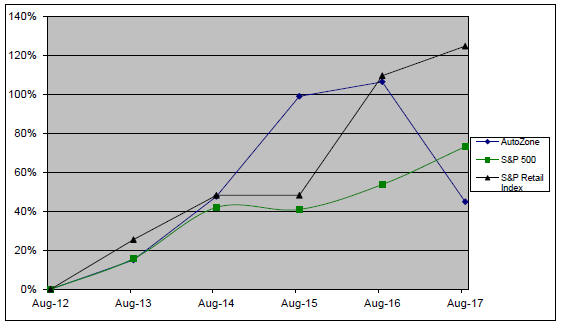
Table of Contents
Item 6. Selected Financial Data
| (in thousands, except per share data, same store sales and selected | Fiscal Year Ended August | |||||||||||||||||||
| operating data) | 2017 | 2016 | 2015 | 2014 | 2013(1) | |||||||||||||||
| Income Statement Data | ||||||||||||||||||||
| Net sales | $ | 10,888,676 | $ | 10,635,676 | $ | 10,187,340 | $ | 9,475,313 | $ | 9,147,530 | ||||||||||
| Cost of sales, including warehouse and delivery expenses | 5,149,056 | 5,026,940 | 4,860,309 | 4,540,406 | 4,406,595 | |||||||||||||||
| Gross profit | 5,739,620 | 5,608,736 | 5,327,031 | 4,934,907 | 4,740,935 | |||||||||||||||
| Operating, selling, general and administrative expenses | 3,659,551 | 3,548,341 | 3,373,980 | 3,104,684 | 2,967,837 | |||||||||||||||
| Operating profit | 2,080,069 | 2,060,395 | 1,953,051 | 1,830,223 | 1,773,098 | |||||||||||||||
| Interest expense, net | 154,580 | 147,681 | 150,439 | 167,509 | 185,415 | |||||||||||||||
| Income before income taxes | 1,925,489 | 1,912,714 | 1,802,612 | 1,662,714 | 1,587,683 | |||||||||||||||
| Income tax expense(2) | 644,620 | 671,707 | 642,371 | 592,970 | 571,203 | |||||||||||||||
| Net income(2) | $ | 1,280,869 | $ | 1,241,007 | $ | 1,160,241 | $ | 1,069,744 | $ | 1,016,480 | ||||||||||
| Diluted earnings per share(2) | $ | 44.07 | $ | 40.70 | $ | 36.03 | $ | 31.57 | $ | 27.79 | ||||||||||
| Weighted average shares for diluted earnings per share(2) | 29,065 | 30,488 | 32,206 | 33,882 | 36,581 | |||||||||||||||
| Adjusted diluted earnings per share(2) | $ | 43.26 | $ | 40.70 | $ | 36.03 | $ | 31.57 | $ | 27.79 | ||||||||||
| Same Store Sales | ||||||||||||||||||||
| Increase in domestic comparable store net sales(3) | 0.5 | % | 2.4 | % | 3.8 | % | 2.8 | % | 0.0 | % | ||||||||||
| Balance Sheet Data | ||||||||||||||||||||
| Current assets | $ | 4,611,255 | $ | 4,239,573 | $ | 3,970,294 | $ | 3,580,612 | $ | 3,278,013 | ||||||||||
| Working capital (deficit) | (155,046 | ) | (450,747 | ) | (742,579 | ) | (960,482 | ) | (891,137 | ) | ||||||||||
| Total assets | 9,259,781 | 8,599,787 | 8,102,349 | 7,497,163 | 6,869,167 | |||||||||||||||
| Current liabilities | 4,766,301 | 4,690,320 | 4,712,873 | 4,541,094 | 4,169,150 | |||||||||||||||
| Debt | 5,081,238 | 4,924,119 | 4,624,876 | 4,323,106 | 4,164,078 | |||||||||||||||
| Long-term capital leases | 102,322 | 102,451 | 87,639 | 83,098 | 73,925 | |||||||||||||||
| Stockholders’ (deficit) | (1,428,377 | ) | (1,787,538 | ) | (1,701,390 | ) | (1,621,857 | ) | (1,687,319 | ) | ||||||||||
| Selected Operating Data | ||||||||||||||||||||
| Number of locations at beginning of year | 5,814 | 5,609 | 5,391 | 5,201 | 5,006 | |||||||||||||||
| Acquired locations(4) | — | — | 17 | — | — | |||||||||||||||
| New locations | 215 | 205 | 202 | 190 | 197 | |||||||||||||||
| Closed locations | — | — | 1 | — | 2 | |||||||||||||||
| Net new locations | 215 | 205 | 201 | 190 | 195 | |||||||||||||||
| Relocated locations | 5 | 6 | 5 | 8 | 11 | |||||||||||||||
| Number of locations at end of year | 6,029 | 5,814 | 5,609 | 5,391 | 5,201 | |||||||||||||||
| AutoZone domestic commercial programs | 4,592 | 4,390 | 4,141 | 3,845 | 3,421 | |||||||||||||||
| Inventory per location (in thousands) | $ | 644 | $ | 625 | $ | 610 | $ | 582 | $ | 550 | ||||||||||
| Total AutoZone store square footage (in thousands) | 39,684 | 38,198 | 36,815 | 35,424 | 34,076 | |||||||||||||||
| Average square footage per AutoZone store | 6,611 | 6,600 | 6,587 | 6,571 | 6,552 | |||||||||||||||
| Increase in AutoZone store square footage | 3.9 | % | 3.8 | % | 3.9 | % | 4.0 | % | 4.2 | % | ||||||||||
| Average net sales per AutoZone store (in thousands) | $ | 1,756 | $ | 1,773 | $ | 1,761 | $ | 1,724 | $ | 1,736 | ||||||||||
| Net sales per AutoZone store square foot | $ | 266 | $ | 269 | $ | 268 | $ | 263 | $ | 265 | ||||||||||
| Total employees at end of year (in thousands) | 87 | 84 | 81 | 76 | 71 | |||||||||||||||
| Inventory turnover(5) | 1.4x | 1.4x | 1.4x | 1.5x | 1.6x | |||||||||||||||
| Accounts payable to inventory ratio | 107.4 | % | 112.8 | % | 112.9 | % | 114.9 | % | 115.6 | % | ||||||||||
| After-tax return on invested capital(6) | 29.9 | % | 31.3 | % | 31.2 | % | 32.1 | % | 32.9 | % | ||||||||||
| Adjusted debt to EBITDAR(7) | 2.6 | 2.5 | 2.5 | 2.5 | 2.5 | |||||||||||||||
| Net cash provided by operating activities (in thousands)(2) | $ | 1,570,612 | $ | 1,641,060 | $ | 1,573,018 | $ | 1,365,005 | $ | 1,481,763 | ||||||||||
| Cash flow before share repurchases and changes in debt (in thousands)(8) | $ | 1,017,585 | $ | 1,166,987 | $ | 1,018,440 | $ | 924,706 | $ | 1,007,761 | ||||||||||
| Share repurchases (in thousands) | $ | 1,071,649 | $ | 1,452,462 | $ | 1,271,416 | $ | 1,099,212 | $ | 1,387,315 | ||||||||||
| Number of shares repurchased (in thousands) | 1,495 | 1,903 | 2,010 | 2,232 | 3,511 |
| (1) | The fiscal year ended August 31, 2013 consisted of 53 weeks. |
|---|
| (2) | As described in the consolidated financial statements and notes, thereto, we have adopted the provisions of ASU 2016-09, Compensation – Stock Compensation (Topic 718): Improvement to Employee Share-based Payment Accounting, as of August 28, 2016. The ASU simplifies several aspects of accounting for share-based payments transactions, including income tax consequences, classification of awards as either equity or liabilities and classification on the statement of cash flows. We have applied the amendment requiring recognition of excess tax deficiencies and tax benefits in the income statement, prospectively. Prior period income tax expense, net income and diluted earnings per share amounts were not restated. The adoption of |
|---|
Table of Contents
| the new standard increased diluted earnings per share for fiscal 2017 by $0.81, driven by a lower effective tax rate of 162 basis points, partially offset by a change to the dilutive outstanding shares calculation. Excluding the impact of excess tax benefits from option exercises, adjusted diluted earnings per share was $43.26. See Reconciliation of Non-GAAP Financial Measures in Management’s Discussion and Analysis of Financial Condition and Results of Operations. We have applied the amendment relating to the presentation of the excess tax benefits on the Consolidated Statements of Cash Flows retrospectively. Prior period amounts for net cash provided by operating activities for all years presented above were restated to conform to the current period presentation. |
|---|
| (3) | The domestic comparable sales increases are based on sales for all AutoZone domestic stores open at least one year. Relocated stores are included in the same store sales computation based on the year the original store was opened. Closed store sales are included in the same store sales computation up to the week it closes, and excluded from the computation for all periods subsequent to closing. All sales through our www.autozone.com website, including consumer direct ship-to-home sales, are also included in the computation. |
|---|
| (4) | 17 IMC branches acquired on September 27, 2014. |
|---|
| (5) | Inventory turnover is calculated as cost of sales divided by the average merchandise inventory balance over the trailing 5 quarters. |
|---|
| (6) | After-tax return on invested capital is defined as after-tax operating profit (excluding rent charges) divided by invested capital (which includes a factor to capitalize operating leases). See Reconciliation of Non-GAAP Financial Measures in Management’s Discussion and Analysis of Financial Condition and Results of Operations. |
|---|
| (7) | Adjusted debt to EBITDAR is defined as the sum of total debt, capital lease obligations and annual rents times six; divided by net income plus interest, taxes, depreciation, amortization, rent and share-based compensation expense. See Reconciliation of Non-GAAP Financial Measures in Management’s Discussion and Analysis of Financial Condition and Results of Operations. |
|---|
| (8) | Cash flow before share repurchases and changes in debt is defined as the change in cash and cash equivalents less the change in debt plus treasury stock purchases. See Reconciliation of Non-GAAP Financial Measures in Management’s Discussion and Analysis of Financial Condition and Results of Operations. |
|---|
Item 7. Management’s Discussion and Analysis of Financial Condition and Results of Operations
We are the nation’s leading retailer, and a leading distributor, of automotive replacement parts and accessories in the United States. We began operations in 1979 and at August 26, 2017, operated 5,465 AutoZone stores in the United States, including Puerto Rico; 524 stores in Mexico; 14 stores in Brazil; and 26 IMC branches. Each AutoZone store carries an extensive product line for cars, sport utility vehicles, vans and light trucks, including new and remanufactured automotive hard parts, maintenance items, accessories and non-automotive products. At August 26, 2017, in 4,592 of our domestic AutoZone stores, we also had a commercial sales program that provides commercial credit and prompt delivery of parts and other products to local, regional and national repair garages, dealers, service stations and public sector accounts. We also have commercial programs in AutoZone stores in Mexico and Brazil. IMC branches carry an extensive line of original equipment quality import replacement parts. We also sell the ALLDATA brand automotive diagnostic and repair software through www.alldata.com and www.alldatadiy.com. Additionally, we sell automotive hard parts, maintenance items, accessories and non-automotive products through www.autozone.com, and accessories, performance and replacement parts through www.autoanything.com, and our commercial customers can make purchases through www.autozonepro.com and www.imcparts.net. We do not derive revenue from automotive repair or installation services.
Executive Summary
For fiscal 2017, we achieved record net income of $1.281 billion, a 3.2% increase over the prior year, and sales growth of $253.0 million, a 2.4% increase over the prior year. Both our retail sales and commercial sales grew this past year, as we continue to make progress on our initiatives that are aimed at improving our ability to say yes to our customers more frequently, drive traffic to our stores and accelerate our commercial growth.
Our business is impacted by various factors within the economy that affect both our consumer and our industry, including but not limited to fuel costs, wage rates, and other economic conditions. Given the nature of these macroeconomic factors, we cannot predict whether or for how long certain trends will continue, nor can we predict to what degree these trends will impact us in the future.
Table of Contents
One macroeconomic factor affecting our customers and our industry during fiscal 2017 was gas prices. During fiscal 2017, the average price per gallon of unleaded gasoline in the United States was $2.31 per gallon, compared to $2.14 per gallon during fiscal 2016. We believe fluctuations in gas prices impact our customers’ level of disposable income. With approximately 12 billion gallons of unleaded gas consumption each month across the U.S., each $1 increase at the pump reduces approximately $12 billion of additional spending capacity to consumers each month. Given the unpredictability of gas prices, we cannot predict whether gas prices will increase or decrease, nor can we predict how any future changes in gas prices will impact our sales in future periods.
We have also experienced accelerated pressure on wages in the United States during fiscal 2017. Some of this is attributed to regulatory changes in certain states and municipalities, while the larger portion is being driven by general market pressures with lower unemployment rates and some specific actions taken in recent years by other retailers. The regulatory changes are going to continue, as evidenced by the areas that have passed legislation to increase their wages substantially over the next few years, but we are still assessing to what degree these changes will impact our earnings growth in future periods.
During fiscal 2017, failure and maintenance related categories represented the largest portion of our sales mix, at approximately 84% of total sales, with failure related categories continuing to be our largest set of categories. While we have not experienced any fundamental shifts in our category sales mix as compared to previous years, in our domestic stores we did experience a slight increase in mix of sales of the failure category as compared to last year. We believe the improvement in this sales category was driven by differences in regional weather patterns and improved merchandise assortments due to the products we have added over the last year. Our sales mix can be impacted by severe or unusual weather over a short term period. Over the long term, we believe the impact of the weather on our sales mix is not significant.
Our primary response to fluctuations in the demand for the products we sell is to adjust our advertising message, store staffing, and product assortment. In recent years, we initiated a variety of strategic tests focused on increasing inventory availability in our domestic stores. As part of those tests, we closely studied our hub distribution model, store inventory levels and product assortment, which led to strategic tests on increased frequency of delivery to our domestic stores and significantly expanding parts and assortment in select domestic stores we call mega hubs. During fiscal 2015, we concluded our tests on these specific new concepts. During fiscal 2016 and most of fiscal 2017, we continued the implementation of more frequent deliveries from our distribution centers to additional domestic stores and the execution of our mega hub strategy. In the fourth quarter of fiscal 2017, however, we made substantial changes to test different scenarios to determine the optimal approach around increased delivery frequency. We expect to conclude this test in fiscal 2018.
The two statistics we believe have the closest correlation to our market growth over the long-term are miles driven and the number of seven year old or older vehicles on the road.
Miles Driven
We believe that as the number of miles driven increases, consumers’ vehicles are more likely to need service and maintenance, resulting in an increase in the need for automotive hard parts and maintenance items. While over the long-term we have seen a close correlation between our net sales and the number of miles driven, we have also seen certain time frames of minimal correlation in sales performance and miles driven. During the periods of minimal correlation between net sales and miles driven, we believe net sales have been positively impacted by other factors, including the number of seven year old or older vehicles on the road. Since the beginning of the fiscal year and through June 2017 (latest publicly available information), miles driven in the U.S. increased by 1.2% compared to the same period in the prior year.
Seven Year Old or Older Vehicles
Between 2008 and 2012, new vehicle sales were significantly lower than historical levels, which we believe contributed to an increasing number of seven year old or older vehicles on the road. We estimate vehicles are driven an average of approximately 12,500 miles each year. In seven years, the average miles driven equates to approximately 87,500 miles. Our experience is that at this point in a vehicle’s life, most vehicles are not covered by warranties and increased maintenance is needed to keep the vehicle operating.
Table of Contents
According to the latest data provided by the Auto Care Association, as of January 1, 2017, the average age of vehicles on the road is 11.7 years as compared to 11.6 years as of January 1, 2016. Although the average age of vehicles continues to increase, it is increasing at a decelerated rate primarily driven by the improvement in new car sales in recent years. However, in the near term, we expect the aging vehicle population to continue to increase as consumers keep their cars longer in an effort to save money. As the number of seven year old or older vehicles on the road increases, we expect an increase in demand for the products we sell.
**Re
Showing the first 8K of 68K characters. Open the full section
Item 7A. Quantitative and Qualitative Disclosures about Market Risk
We are exposed to market risk from, among other things, changes in interest rates, foreign exchange rates and fuel prices. From time to time, we use various derivative instruments to reduce interest rate and fuel price risks. To date, based upon our current level of foreign operations, no derivative instruments have been utilized to reduce foreign exchange rate risk. All of our hedging activities are governed by guidelines that are authorized by the Board. Further, we do not buy or sell derivative instruments for trading purposes.
Interest Rate Risk
Our financial market risk results primarily from changes in interest rates. At times, we reduce our exposure to changes in interest rates by entering into various interest rate hedge instruments such as interest rate swap contracts, treasury lock agreements and forward-starting interest rate swaps.
We have historically utilized interest rate swaps to convert variable rate debt to fixed rate debt and to lock in fixed rates on future debt issuances. We reflect the current fair value of all interest rate hedge instruments as a component of either other current assets or accrued expenses and other. Our interest rate hedge instruments are designated as cash flow hedges.
Unrealized gains and losses on interest rate hedges are deferred in stockholders’ deficit as a component of Accumulated other comprehensive loss. These deferred gains and losses are recognized in income as a decrease or increase to interest expense in the period in which the related cash flows being hedged are recognized in expense. However, to the extent that the change in value of an interest rate hedge instrument does not perfectly offset the change in the value of the cash flow being hedged, that ineffective portion is immediately recognized in earnings.
The fair value of our debt was estimated at $5.171 billion as of August 26, 2017, and $5.117 billion as of August 27, 2016, based on the quoted market prices for the same or similar debt issues or on the current rates available to us for debt having the same remaining maturities. Such fair value is greater than the carrying value of debt by $90.3 million and $192.7 million at August 26, 2017 and August 27, 2016, respectively. We had $1.155 billion of variable rate debt outstanding at August 26, 2017, and $1.198 billion of variable rate debt outstanding at August 27, 2016. In fiscal 2017, at this borrowing level for variable rate debt, a one percentage point increase in interest rates would have had an unfavorable impact on our pre-tax earnings and cash flows of approximately $11.6 million. The primary interest rate exposure on variable rate debt is based on LIBOR. We had outstanding fixed rate debt of $3.926 billion, net of unamortized debt issuance costs of $23.9 million, at August 26, 2017, and $3.727 billion, net of unamortized debt issuance costs of $23.4 million, at August 27, 2016. A one percentage point increase in interest rates would reduce the fair value of our fixed rate debt by approximately $191.3 million at August 26, 2017.
Fuel Price Risk
From time to time, we utilize fuel swap contracts in order to lower fuel cost volatility in our operating results. Historically, the instruments were executed to economically hedge a portion of our diesel and unleaded fuel exposure. However, we have not designated the fuel swap contracts as hedging instruments; and therefore, the contracts have not qualified for hedge accounting treatment. In fiscal 2015, we entered into a fuel swap to economically hedge the commodity cost associated with our unleaded fuel usage. The notional amount of the contract was 2.9 million gallons and terminated March 31, 2015. The swap had no significant impact on the results of operations. We did not enter into any fuel swap contracts during fiscal 2017 or 2016.
Table of Contents
Foreign Currency Risk
Foreign currency exposures arising from transactions include firm commitments and anticipated transactions denominated in a currency other than our entities’ functional currencies. To minimize our risk, we generally enter into transactions denominated in the respective functional currencies. We are exposed to Brazilian reals, Canadian dollars, euros, Chinese yuan renminbi and British pounds, but our primary foreign currency exposure arises from Mexican peso-denominated revenues and profits and their translation into U.S. dollars. Foreign currency exposures arising from transactions denominated in currencies other than the functional currency are not material.
We view our investments in Mexican subsidiaries as long-term. As a result, we generally do not hedge these net investments. The net asset exposure in the Mexican subsidiaries translated into U.S. dollars using the year-end exchange rates was $519.3 million at August 26, 2017 and $398.0. million at August 27, 2016. The year-end exchange rates with respect to the Mexican peso increased by approximately 4% with respect to the U.S. dollar during fiscal 2017 and decreased by approximately 9% during fiscal 2016. The potential loss in value of our net assets in the Mexican subsidiaries resulting from a hypothetical 10 percent adverse change in quoted foreign currency exchange rates at August 26, 2017 and August 27, 2016, would be approximately $47.2 million and approximately $36.2 million, respectively. Any changes in our net assets in the Mexican subsidiaries relating to foreign currency exchange rates would be reflected in the foreign currency translation component of Accumulated other comprehensive loss, unless the Mexican subsidiaries are sold or otherwise disposed.
A hypothetical 10 percent adverse change in average exchange rates would not have a material impact on our results of operations.
Table of Contents
Item 8. Financial Statements and Supplementary Data
Index
Table of Contents
Management’s Report on Internal Control Over Financial Reporting
Our management is responsible for establishing and maintaining adequate internal control over financial reporting (as defined in Rules 13a-15(f) and 15d-15(f) under the Securities Exchange Act of 1934, as amended). Our internal control over financial reporting includes, among other things, defined policies and procedures for conducting and governing our business, sophisticated information systems for processing transactions and properly trained staff. Mechanisms are in place to monitor the effectiveness of our internal control over financial reporting, including regular testing performed by the Company’s internal audit team. Actions are taken to correct deficiencies as they are identified. Our procedures for financial reporting include the active involvement of senior management, our Audit Committee and a staff of highly qualified financial and legal professionals.
Management, with the participation of our principal executive and financial officers, assessed our internal control over financial reporting as of August 26, 2017, the end of our fiscal year. Management based its assessment on criteria established in Internal Control—Integrated Framework issued by the Committee of Sponsoring Organizations of the Treadway Commission 2013 framework.
Based on this assessment, management has concluded that our internal control over financial reporting was effective as of August 26, 2017.
Our independent registered public accounting firm, Ernst & Young LLP, audited the effectiveness of our internal control over financial reporting. Ernst & Young LLP’s attestation report on the Company’s internal control over financial reporting as of August 26, 2017 is included in this Annual Report on Form 10-K.
| /s/ WILLIAM C. RHODES, III |
| William C. Rhodes, III |
| Chairman, President and |
| Chief Executive Officer |
| (Principal Executive Officer) |
| /s/ WILLIAM T. GILES |
| William T. Giles |
| Chief Financial Officer and Executive |
| Vice President – Finance and Information |
| Technology |
| (Principal Financial Officer) |
Certifications
Compliance with NYSE Corporate Governance Listing Standards
On January 4, 2017, the Company submitted to the New York Stock Exchange the Annual CEO Certification required pursuant to Section 303A.12(a) of the New York Stock Exchange Listed Company Manual.
Rule 13a-14(a) Certifications of Principal Executive Officer and Principal Financial Officer
The Company has filed, as exhibits to its Annual Report on Form 10-K for the fiscal year ended August 26, 2017, the certifications of its Principal Executive Officer and Principal Financial Officer required pursuant to Section 302 of the Sarbanes-Oxley Act of 2002.
Table of Contents
Report of Independent Registered Public Accounting Firm
The Board of Directors and Stockholders of AutoZone, Inc.
We have audited AutoZone, Inc.’s internal control over financial reporting as of August 26, 2017, based on criteria established in Internal Control—Integrated Framework issued by the Committee of Sponsoring Organizations of the Treadway Commission 2013 framework (the “COSO criteria”). AutoZone, Inc.’s management is responsible for maintaining effective internal control over financial reporting, and for its assessment of the effectiveness of internal control over financial reporting included in the accompanying Management’s Report on Internal Control over Financial Reporting. Our responsibility is to express an opinion on AutoZone, Inc.’s internal control over financial reporting based on our audit.
We conducted our audit in accordance with the standards of the Public Company Accounting Oversight Board (United States). Those standards require that we plan and perform the audit to obtain reasonable assurance about whether effective internal control over financial reporting was maintained in all material respects. Our audit included obtaining an understanding of internal control over financial reporting, assessing the risk that a material weakness exists, testing and evaluating the design and operating effectiveness of internal control based on the assessed risk, and performing such other procedures as we considered necessary in the circumstances. We believe that our audit provides a reasonable basis for our opinion.
A company’s internal control over financial reporting is a process designed to provide reasonable assurance regarding the reliability of financial reporting and the preparation of financial statements for external purposes in accordance with generally accepted accounting principles. A company’s internal control over financial reporting includes those policies and procedures that (1) pertain to the maintenance of records that, in reasonable detail, accurately and fairly reflect the transactions and dispositions of the assets of the company; (2) provide reasonable assurance that transactions are recorded as necessary to permit preparation of financial statements in accordance with generally accepted accounting principles, and that receipts and expenditures of the company are being made only in accordance with authorizations of management and directors of the company; and (3) provide reasonable assurance regarding prevention or timely detection of unauthorized acquisition, use, or disposition of the company’s assets that could have a material effect on the financial statements.
Because of its inherent limitations, internal control over financial reporting may not prevent or detect misstatements. Also, projections of any evaluation of effectiveness to future periods are subject to the risk that controls may become inadequate because of changes in conditions, or that the degree of compliance with the policies or procedures may deteriorate.
In our opinion, AutoZone, Inc. maintained, in all material respects, effective internal control over financial reporting as of August 26, 2017, based on the COSO criteria**.**
We also have audited, in accordance with the standards of the Public Company Accounting Oversight Board (United States), the consolidated balance sheets of AutoZone, Inc. as of August 26, 2017 and August 27, 2016, and the related consolidated statements of income, comprehensive income, stockholders’ deficit, and cash flows for each of the three years in the period ended August 26, 2017 of AutoZone, Inc. and our report dated October 25, 2017 expressed an unqualified opinion thereon.
| /s/ Ernst & Young LLP |
Memphis, Tennessee
October 25, 2017
Table of Contents
Report of Independent Registered Public Accounting Firm
The Board of Directors and Stockholders of AutoZone, Inc.
We have audited the accompanying consolidated balance sheets of AutoZone, Inc. as of August 26, 2017 and August 27, 2016, and the related consolidated statements of income, comprehensive income, stockholders’ deficit, and cash flows for each of the three years in the period ended August 26, 2017. These financial statements are the responsibility of AutoZone, Inc.’s management. Our responsibility is to express an opinion on these financial statements based on our audits.
We conducted our
Showing the first 8K of 144K characters. Open the full section
Item 9. Changes In and Disagreements with Accountants on Accounting and Financial Disclosure
Not applicable.
Table of Contents
Item 9A. Controls and Procedures
As of August 26, 2017, an evaluation was performed under the supervision and with the participation of AutoZone’s management, including the Chief Executive Officer and the Chief Financial Officer, of the effectiveness of the design and operation of our disclosure controls and procedures, as defined in Rules 13a-15(e) and 15d-15(e) under the Exchange Act, as amended. Based on that evaluation, our management, including the Chief Executive Officer and the Chief Financial Officer, concluded that our disclosure controls and procedures were effective. During or subsequent to the quarter ended August 26, 2017, there were no changes in our internal controls that have materially affected or are reasonably likely to materially affect, internal controls over financial reporting.
Item 9B. Other Information
Item 10. Directors, Executive Officers and Corporate Governance
The information set forth in Part I of this document in the section entitled “Executive Officers of the Registrant,” is incorporated herein by reference in response to this item. Additionally, the information contained in AutoZone, Inc.’s Proxy Statement dated October 21, 2017, in the sections entitled “Proposal 1 – Election of Directors” and “Section 16(a) Beneficial Ownership Reporting Compliance,” is incorporated herein by reference in response to this item.
The Company has adopted a Code of Ethical Conduct for Financial Executives that applies to its chief executive officer, chief financial officer, chief accounting officer and other financial executives. The Company has made the Code of Ethical Conduct available on its investor relations website at http://www.autozoneinc.com.
Item 11. Executive Compensation
The information contained in AutoZone, Inc.’s Proxy Statement dated October 21, 2017, in the section entitled “Executive Compensation,” is incorporated herein by reference in response to this item.
Item 12. Security Ownership of Certain Beneficial Owners and Management and Related Stockholder Matters
The information contained in AutoZone, Inc.’s Proxy Statement dated October 21, 2017, in the sections entitled “Security Ownership of Management and Board of Directors” and “Security Ownership of Certain Beneficial Owners,” is incorporated herein by reference in response to this item.
Item 13. Certain Relationships and Related Transactions, and Director Independence
Not applicable.
Item 14. Principal Accounting Fees and Services
The information contained in AutoZone, Inc.’s Proxy Statement dated October 21, 2017, in the section entitled “Proposal 2 – Ratification of Independent Registered Public Accounting Firm,” is incorporated herein by reference in response to this item.
Table of Contents
PART IV
Item 15. Exhibits, Financial Statement Schedules
The following information required under this item is filed as part of this report.
(a) Financial Statements
The following financial statements, related notes and reports of independent registered public accounting firm are filed with this Annual Report on Form 10-K in Part II, Item 8:
(b) Exhibits
The following exhibits are being filed herewith:
Table of Contents
Table of Contents
Table of Contents
Table of Contents
| * | Management contract or compensatory plan or arrangement. |
|---|
(c) Financial Statement Schedules
Schedules are omitted because the information is not required or because the information required is included in the financial statements or notes thereto.
Table of Contents
SIGNATURES
Pursuant to the requirements of Section 13 or 15(d) of the Securities Exchange Act of 1934, the Registrant has duly caused this report to be signed on its behalf by the undersigned, thereunto duly authorized.
| AUTOZONE, INC. | ||
| By: | /s/ WILLIAM C. RHODES, III | |
| William C. Rhodes, III | ||
| Chairman, President and | ||
| Chief Executive Officer | ||
| (Principal Executive Officer) |
Dated: October 25, 2017
Table of Contents
Pursuant to the requirements of the Securities Exchange Act of 1934, this report has been signed below by the following persons on behalf of the Registrant and in the capacities and on the dates indicated:
| SIGNATURE | TITLE | DATE | ||
| /s/ WILLIAM C. RHODES, III William C. Rhodes, III | Chairman, President and Chief Executive Officer (Principal Executive Officer) | October 25, 2017 | ||
| /s/ WILLIAM T. GILES William T. Giles | Chief Financial Officer and Executive Vice President – Finance and Information Technology (Principal Financial Officer) | October 25, 2017 | ||
| /s/ CHARLIE PLEAS, III Charlie Pleas, III | Senior Vice President and Controller (Principal Accounting Officer) | October 25, 2017 | ||
| /s/ DOUGLAS H. BROOKS Douglas H. Brooks | Director | October 25, 2017 | ||
| /s/ LINDA A. GOODSPEED Linda A. Goodspeed | Director | October 25, 2017 | ||
| /s/ SUE E. GOVE Sue E. Gove | Director | October 25, 2017 | ||
| /s/ EARL G. GRAVES, JR. Earl G. Graves, Jr. | Director | October 25, 2017 | ||
| /s/ ENDERSON GUIMARAES Enderson Guimaraes | Director | October 25, 2017 | ||
| /s/ J.R. HYDE, III J.R. Hyde, III | Director | October 25, 2017 | ||
| /s/ D. BRYAN JORDAN D. Bryan Jordan | Director | October 25, 2017 | ||
| /s/ W. ANDREW MCKENNA W. Andrew McKenna | Director | October 25, 2017 | ||
| /s/ GEORGE R. MRKONIC, JR. George R. Mrkonic, Jr. | Director | October 25, 2017 | ||
| /s/ LUIS P. NIETO Luis P. Nieto | Director | October 25, 2017 |