 filings.tools
Ball (BALL) 10-K risk factor changes: FY2020 vs FY2019
The 2020-12-31 10-K against the 2019-12-31 one, compared heading by heading and sentence by sentence.
Item 1A57 rewritten76 added10 removed172 unchanged
All filing items952 rewritten497 added611 removed2,099 unchanged
Summary
counted, not written
- Item 1A headings could not be compared: only 0 carried over between the two years, which usually means one filing was read wrongly, so none is reported as new or removed.
- Sentence by sentence, 497 added, 611 removed, 952 rewritten and 2,099 unchanged across 18 items that differ.
Sentences by item
21 items, with every count and a link to each item that changed
Underlined words on a shaded ground are new in FY2020; struck-through words were in FY2019. Sentences that are wholly new or wholly gone are labelled rather than marked.
Item 1A. Risk Factors
57 rewritten, 76 added, 10 removed, 172 unchanged
Any of the following risks could materially and adversely affect our business, [removed: financial condition or] results of [removed: operations.][added: operations, cash flows and financial condition.]
[removed: If] [added: _If] we do not effectively manage change and growth, our business could be adversely [removed: affected.][added: affected._]
We have experienced significant growth in [added: demand for our products and services in] recent years and are expanding our operations, increasing our headcount and expanding into new product offerings.
[removed: This growth] [added: It] has [added: also] placed significant demands on our management as well as our financial and operational resources, and continued growth presents several challenges, including:
[removed: We] [added: _We] have a significant level of debt that could have important consequences for our business and any investment in our [removed: securities.][added: securities._]
The company had $7.8 billion of interest-bearing debt at December 31, [removed: 2019.][added: 2020.]
[removed: Our] [added: _Our] business, operating results and financial condition are subject to particular risks in certain regions of the [removed: world.][added: world._]
Moreover, overcapacity, which often leads to lower prices, [removed: exists] [added: may develop over time] in certain regions in which we operate [removed: and may persist] even if demand [removed: grows.][added: continues to grow.]
[removed: The] [added: _The] loss of a key customer, or a reduction in its requirements, could have a significant negative impact on our [removed: sales.][added: sales._]
[removed: We] [added: _We] face competitive risks from many sources that may negatively impact our [removed: profitability.][added: profitability._]
Increases in productivity, combined with [removed: existing or] potential surplus capacity in the industry, have maintained competitive pricing pressures.
[removed: We] [added: _We] are subject to competition from alternative products, which could result in lower profits and reduced cash [removed: flows.][added: flows._]
Our [removed: metal] [added: aluminum] packaging products are subject to significant competition from substitute products, particularly plastic carbonated soft drink bottles made from PET, single serve beer bottles and other beverage containers made of glass, cardboard or other materials.
There can be no assurance that our products will successfully compete against alternative products, which could result in a reduction in our profits or cash [removed: flow.][added: flows.]
[removed: Our] [added: _Our] packaging businesses have a narrow product range, and our business would suffer if usage of our products decreased or if decreases occur in the demand for the beverages and other goods filled in our [removed: products.][added: products._]
If demand for glass and PET bottles increases relative to [removed: metal] [added: aluminum] containers, or the demand for aluminum containers does not develop as expected, our business, [removed: financial condition or] results of [removed: operations] [added: operations, cash flows and financial condition] could be materially adversely affected.
[removed: Changes] [added: _Changes] in laws and governmental regulations may adversely affect our business and [removed: operations.][added: operations._]
[removed: Our] [added: _Our] business, financial [removed: condition] [added: condition, cash flows] and results of operations are subject to risks resulting from broader geographic [removed: operations.][added: operations._]
We derived approximately [removed: 50] [added: 46] percent of our consolidated net sales from outside of the U.S. for the year ended December 31, [removed: 2019.][added: 2020.]
The sizeable scope of operations [added: inside and] outside of the U.S. may lead to more volatile financial results and make it more difficult for us to manage our business.
[removed: We] [added: _We] are exposed to exchange rate [removed: fluctuations.][added: fluctuations._]
The [added: company’s] financial results [removed: of the company] are exposed to currency exchange rate fluctuations and a significant proportion of assets, liabilities and earnings denominated in non-U.S. dollar currencies.
[removed: If] [added: _If] we fail to retain key management and personnel, we may be unable to implement our key [removed: objectives.][added: objectives._]
[removed: Decreases] [added: _Decreases] in our ability to develop or apply new technology and know-how may affect our [removed: competitiveness.][added: competitiveness._]
As a result, our business, financial [removed: condition] [added: condition, cash flows] or results of operations could be adversely affected.
[removed: Adverse] [added: _Adverse] weather and climate changes may result in lower [removed: sales.][added: sales._]
[removed: We] [added: _We] are vulnerable to fluctuations in the supply and price of raw [removed: materials.][added: materials._]
Economic, [removed: operational] [added: financial,] and [removed: financial] [added: operational] factors, [added: including strikes or labor shortages,] as well as governmental action, could impact our suppliers, thereby causing supply shortages.
[removed: Prolonged] [added: _Prolonged] work stoppages at facilities with union employees could jeopardize our financial [removed: position.][added: position._]
As of December 31, [removed: 2019, 15] [added: 2020, 12] percent of our North American employees and [removed: 53] [added: 54] percent of our European employees were covered by collective bargaining agreements.
Although we consider our employee relations to be generally good, a prolonged work stoppage or strike at any facility with union employees could have a material adverse effect on our business, financial [removed: condition] [added: condition, cash flows] or results of operations.
[removed: Our] [added: _Our] aerospace segment is subject to certain risks specific to that [removed: business.][added: business._]
[removed: We] [added: _We] use estimates in accounting for many of our programs in our aerospace business, and changes in our estimates could adversely affect our future financial [removed: results.][added: results._]
[removed: Because of] [added: Given] the significance of the judgments and estimates described above, it is likely that we could record materially different amounts if we used different assumptions or if the underlying circumstances or estimates were to change.
[removed: As] [added: _As] a U.S. government contractor, we could be adversely affected by changes in regulations or any negative findings from a U.S. government audit or [removed: investigation.][added: investigation._]
[removed: Our] [added: _Our] business is subject to substantial environmental remediation and compliance [removed: costs.][added: costs._]
[removed: Our] [added: _Our] business faces the potential of increased regulation on some of the raw materials utilized in our packaging [removed: operations.][added: operations._]
Our operations are subject to federal, state, provincial and local laws and regulations in multiple jurisdictions relating to some of the raw materials, [removed: such as] [added: including] epoxy-based coatings utilized in our container making process.
A significant change in these regulatory agency statements, adverse information concerning [removed: BPA,] [added: BPA] or [added: other chemicals present in our coatings, or] rulings made within certain federal, state, provincial and local jurisdictions could have a material adverse effect on our business, financial condition or results of operations.
[removed: Net] [added: _Net] earnings and net assets could be materially affected by an impairment of [removed: goodwill.][added: goodwill._]
General Risks
**
This growth has increased and may continue to constrain our ability to fully supply our customers’ requirements.
**
| | ● | virus and disease outbreaks and responses thereto; |
| --- | --- | --- |
_We face risks related to health epidemics, pandemics and other outbreaks, including the current COVID-19 pandemic, which could adversely affect our business._
The circumstances of the current COVID-19 pandemic and responses thereto continue to evolve.
The products produced and services provided by Ball have been deemed essential and, as a result, relevant governments around the world have allowed our operations to continue through this crisis.
Additionally, overall demand for our aluminum beverage cans has remained high and has increased during the pandemic.
However, COVID-19 could give rise to circumstances that cause one or more of the following risk factors to occur:
| | ● | We could lose key customers, customers could become insolvent or have a reduction in demand for our products and services; |
| --- | --- | --- |
| | ● | We could be subject to changes in laws and governmental regulations that adversely affect our business and operations; |
| --- | --- | --- |
| | ● | We could be subject to adverse fluctuations in currency exchange rates; |
| --- | --- | --- |
| | ● | We might lose key management and operating personnel; |
| --- | --- | --- |
| | ● | We may be subject to disruptions in the supply or price of our raw materials; |
| --- | --- | --- |
| | ● | We may face prolonged work stoppages at our facilities; |
| --- | --- | --- |
| | ● | We may be impacted by government budget constraints or government shutdowns; |
| --- | --- | --- |
| | ● | Our pension plan investments may not perform as expected, and we may be required to make additional contributions to our pension plans which would otherwise be available for other general corporate purposes; |
| --- | --- | --- |
| | ● | Our access to capital markets may be restricted, which could adversely affect our short-term liquidity and prevent us from fulfilling our obligations under the notes issued pursuant to our bond indentures; |
| --- | --- | --- |
| | ● | We may be subject to increased information technology (IT) security threats and reduced network access availability; |
| --- | --- | --- |
| | ● | Our operations and those of our principal customers and suppliers could be designated as non-essential in key markets; and |
| --- | --- | --- |
| | ● | A material weakness in our internal control over financial reporting or a material misstatement in our financial statements could occur. |
| --- | --- | --- |
Because the COVID-19 pandemic is far-reaching and its impacts cannot be completely anticipated, additional risks may arise that could materially impact the company’s financial results and liquidity.
The company has or may implement actions to minimize the risks and associated negative effects from COVID-19, which do not guarantee the prevention or mitigation of material impacts on our business.
Some of these actions may include, and are not limited to:
| | ● | Implementing alternative work arrangements including work from home; |
| --- | --- | --- |
In particular, the U.S. Tax Cuts and Jobs Act (the Act), which was signed into law on December 22, 2017, may continue to result in fluctuations in the company’s net earnings and cash flows.
The Act introduced major changes to U.S. income tax law that require significant judgment to interpret the impact of the provisions of the Act on the company’s financial results.
Given the various uncertainties and ambiguities that still remain with respect to the application of the Act, the Internal Revenue Service and the U.S. Treasury Department may issue subsequent guidance on the provisions of the Act, including final regulations, that differs from our current interpretations.
The impact of any adjustments required as a result of such subsequent guidance could materially affect the company’s financial results.
Additionally, on December 9, 2019, a tax reform law was enacted in Mexico which includes, among other changes, limitations on Mexican companies’ ability to deduct certain expenses.
We do not currently expect that this law will materially affect us, but that expectation could change with unanticipated enforcement or interpretation of the law.
In June 2016, the U.K. held a referendum and voted in favor of leaving the European Union (EU) and formally withdrew from the EU on January 31, 2020.
This withdrawal has created political and economic uncertainty, particularly in the U.K. and the EU, and this uncertainty may last for years, particularly as the U.K. and the EU continue to negotiate the terms of their ongoing relationship.
Our business in the U.K., the EU and worldwide could be affected by this uncertainty.
A failure by the U.K. and the EU to conclude on a trade agreement may increase this volatility.
An excerpt. Shown here: 40 of 57 rewritten, 40 of 76 added and all 10 removed. The counts are complete. For every sentence, read Item 1A. Risk Factors in the FY2020 filing and the FY2019 filing.
Item 7. Management’s Discussion and Analysis of Financial Condition and Results of Operations
103 rewritten, 114 added, 31 removed, 144 unchanged
The preparation of our consolidated financial statements in conformity with accounting principles generally accepted in the United States of America (U.S. GAAP) requires us to make estimates and assumptions that affect the reported amounts in our consolidated financial statements and the accompanying [removed: notes] [added: notes,] including various claims and contingencies related to lawsuits, taxes, environmental and other matters arising during the normal course of business.
The majority of [removed: the] [added: our] aerospace business involves work under contracts, generally from one to five years in duration, as a prime contractor or subcontractor for various U.S. government agencies.
| | ● | Maximizing value in our existing businesses by [added: expanding specialty container production across our global plant network to meet current demand and] improving efficiencies in our beverage container and end facilities in North America, South America and [removed: Europe, and expanding specialty container production across our global plant network to meet current demand;] [added: Europe;] leveraging plant floor [added: and integrated planning] systems [removed: in our beverage facilities] to reduce costs and manage contractual provisions across our diverse customer base; successfully acquiring and integrating a large global aluminum beverage business [added: and regional aluminum aerosol facility] while also divesting underperforming steel food and steel aerosol packaging assets in North and South America and four beverage packaging facilities in China; and in the remaining aluminum aerosol business, installing new extruded aluminum aerosol lines in our European, Mexican and Indian facilities while also implementing cost-out and value-in initiatives across all of our businesses; |
| | ● | Aligning ourselves with the right customers and markets by investing capital to meet continued growth for specialty beverage containers throughout our global network, which represent approximately [removed: 43] [added: 45] percent of our global beverage packaging mix; aligning with spiked seltzer and craft brewers, sparkling and still water fillers, wine producers and other new beverage producers who continue to use aluminum beverage containers to grow their business; [added: and in our new aluminum cup business, utilizing online platforms and North American retailers to provide infinitely recyclable aluminum cups directly to consumers;] |
| | ● | Broadening our geographic reach with our acquisition of Rexam and our new investments in beverage manufacturing facilities in the United States, [added: Brazil,] Paraguay, Spain, Mexico, Myanmar and Panama, as well as an extruded aluminum aerosol manufacturing facility in India and [removed: construction] [added: successful start-up] of a dedicated aluminum cup manufacturing facility in the U.S.; and |
Management’s Discussion and Analysis of Financial Condition and Results of Operations [of the company’s Annual Report on Form 10-K for the year ended December 31, [removed: 2018](http://www.sec.gov/Archives/edgar/data/9389/000155837019000909/bll-20181231x10k.htm),] [added: 2019,](https://www.sec.gov/ix?doc=/Archives/edgar/data/9389/000155837020001005/bll-20191231x10k1a847a.htm)] filed [added: on] February [removed: 22, 2019,] [added: 19, 2020,] for a comparison of [removed: the 2018] [added: our 2019] results of operations to the [removed: 2017] [added: 2018] results.
| | [removed: |] Years Ended December 31, | | | | | | | | |
| ($ in millions) | | [removed: 2019] [added: 2020] | | | [removed: 2018] [added: 2019] | | | [removed: 2017] [added: 2018] | | |
| Net sales | | $ | [removed: 11,474] [added: 11,781] | | $ | [removed: 11,635] [added: 11,474] | | $ | [removed: 10,983] [added: 11,635] | |
| Net earnings attributable to Ball Corporation | | | [removed: 566] [added: 585] | | | [removed: 454] [added: 566] | | | [removed: 374] [added: 454] | |
| Net earnings attributable to Ball Corporation as a % of net sales | | | 5 | % | | [removed: 4] [added: 5] | % | | [removed: 3] [added: 4] | % |
Sales in [removed: 2019] [added: 2020] were [removed: $161] [added: $307] million [removed: lower] [added: higher] compared to [removed: 2018] [added: 2019] primarily as a result of [removed: selling the U.S. and Argentine steel food and steel aerosol businesses, selling] [added: increased sales volumes in] our [removed: China] beverage packaging [removed: business,] [added: segments and increased sales in our aerospace segment, partially offset by] the pass through of lower aluminum prices, the [removed: conclusion] [added: sale] of the [removed: South America segment’s end sales associated with the Rexam acquisition and unfavorable exchange rates for our Europe segment, partially offset by higher] [added: China] beverage [added: packaging] can [removed: unit volumes and higher pricing] [added: business] in [removed: our Europe and North and Central America segments] [added: the third quarter of 2019] and [removed: increased sales] [added: the sale of the Argentine steel aerosol business] in the [removed: aerospace segment.][added: fourth quarter of 2019.]
Cost of sales, excluding depreciation and amortization, was [removed: $9,203] [added: $9,323] million in [removed: 2019] [added: 2020] compared to [removed: $9,329] [added: $9,203] million in [removed: 2018.][added: 2019.]
These amounts represented [added: 79 percent and] 80 percent of consolidated net sales for the years ended [removed: 2019] [added: 2020] and [removed: 2018.][added: 2019, respectively.]
Depreciation and amortization expense was [removed: $678] [added: $668] million in [removed: 2019] [added: 2020] compared to [removed: $702] [added: $678] million in [removed: 2018.][added: 2019.]
These amounts represented 6 percent of consolidated net sales for [removed: 2019] [added: the years ended 2020] and [removed: 2018.][added: 2019.]
Amortization expense in [removed: 2019] [added: 2020] and [removed: 2018] [added: 2019] included [removed: $155] [added: $150] million and [removed: $164] [added: $155] million, respectively, for the amortization of acquired Rexam intangibles.
Selling, general and administrative (SG&A) expenses were [removed: $417] [added: $525] million in [removed: 2019] [added: 2020] compared to [removed: $478] [added: $417] million in [removed: 2018.][added: 2019.]
Business consolidation [added: costs] and other activities were [removed: $244] [added: $262] million in [removed: 2019] [added: 2020] compared to [removed: $191] [added: $244] million in [removed: 2018.][added: 2019.]
Total interest expense was [removed: $324] [added: $316] million in [removed: 2019] [added: 2020] compared to [removed: $302] [added: $324] million in [removed: 2018.][added: 2019.]
Interest expense, excluding the effect of debt refinancing and other costs, as a percentage of average [removed: monthly] borrowings [removed: was 4] [added: decreased by approximately 85 basis points from 4.4] percent in 2019 [removed: and 2018.][added: to 3.5 percent in 2020 due to the drop in global interest rates.]
The [removed: 2019] [added: 2020] effective income tax rate was [removed: 11.7] [added: 14.4] percent compared to [removed: 29.2] [added: 11.7] percent for [removed: 2018.][added: 2019.]
As compared with the statutory U.S. federal income tax rate of 21 percent, the [removed: 2019] [added: 2020] effective rate was reduced by [removed: 7.1] [added: 6.8] percent for equity compensation benefits, by [removed: 3.1 percent for various uncertain tax positions and by 1.6] [added: 5.7] percent for the impact of the U.S. R&D [removed: credit.][added: credit and by 2 percent for various uncertain tax positions.]
Further details of taxes on income [removed: and the impacts of the U.S. tax reform] are included in Note 16 to the consolidated financial statements within Item 8 of this annual report.
| ($ in millions) | | [removed: 2019] [added: 2020] | | | [removed: 2018] [added: 2019] | | | [removed: 2017] [added: 2018] | | |
| Net sales | | $ | [removed: 4,758] [added: 5,076] | | $ | [removed: 4,626] [added: 4,758] | | $ | [removed: 4,178] [added: 4,626] | |
| Comparable operating earnings | | | [removed: 555] [added: 683] | | | [removed: 551] [added: 555] | | | [removed: 533] [added: 551] | |
| Business consolidation and other activities _(a)_ | | | [removed: (14)] [added: (5)] | | | [removed: (6)] [added: (14)] | | | [removed: (47)] [added: (6)] | |
| Amortization of acquired Rexam intangibles | | | [removed: (29)] [added: (27)] | | | [removed: (31)] [added: (29)] | | | [removed: (32)] [added: (31)] | |
| Total segment earnings | | $ | [removed: 512] [added: 651] | | $ | [removed: 514] [added: 512] | | $ | [removed: 448] [added: 514] | |
| Comparable operating earnings as a % of segment net sales | | | [removed: 12] [added: 13] | % | | 12 | % | | [removed: 13] [added: 12] | % |
Segment sales in [removed: 2019] [added: 2020] were [removed: $132] [added: $318] million higher compared to [removed: 2018.][added: 2019.]
The increase in [removed: 2019] [added: 2020] was primarily due to higher [added: sales] volumes [removed: of $192 million] and improved customer [removed: sales] [added: and specialty] mix, partially offset by the pass through of lower aluminum prices.
Comparable operating earnings in [removed: 2019] [added: 2020] were [removed: $4] [added: $128] million higher compared to [removed: 2018] [added: 2019] primarily due to higher sales [removed: volumes and] [added: volumes, higher specialty mix, benefits from] improved customer [removed: sales mix,] [added: contractual terms and improved operating performance,] partially offset by [removed: unfavorable U.S. aluminum scrap rates,] increased [removed: start-up costs] [added: capacity expansion] and [removed: operational inefficiencies.][added: labor costs.]
| Net sales | | $ | [removed: 1,670] [added: 1,695] | | $ | [removed: 1,701] [added: 1,670] | | $ | [removed: 1,692] [added: 1,701] | |
| Comparable operating earnings | | | [removed: 288] [added: 280] | | | [removed: 313] [added: 288] | | | [removed: 333] [added: 313] | |
| Business consolidation and other activities _(a)_ | | [removed: | 15] [added: (10)] | | | [removed: 11] [added: (39)] | | | [removed: (5)] [added: (49)] | |
| Amortization of acquired Rexam intangibles | | [removed: | (56)] [added: (64)] | | | [removed: (56)] [added: (67)] | | | [removed: (56)] [added: (73)] | |
| Total segment earnings | | $ | [removed: 247] [added: 226] | | $ | [removed: 268] [added: 247] | | $ | [removed: 258] [added: 268] | |
| Comparable operating earnings as a % of segment net sales | | [removed: | 17] [added: 12] | % | | [removed: 18] [added: 12] | % | | [removed: 20] [added: 12] | % |
Prior Forms 10-K have not been restated to reflect changes to Ball’s internal reporting structure that were effective January 1, 2020.
Novel Coronavirus (COVID-19)
The novel coronavirus (COVID-19) had a material effect upon the global business environment during the year ended December 31, 2020.
Ball provides key products and services to the consumer beverage and household markets and the U.S. aerospace markets and, consequently, the operations of Ball and of its principal customers and suppliers have been designated as essential across our key markets.
This designation allowed Ball to operate its manufacturing facilities throughout 2020, and it is expected that Ball will continue to operate its facilities without disruption in the foreseeable future.
However, countries around the globe have issued stay-at-home orders and mandated operational closures of non-essential businesses, which has impacted certain of our customers by constraining some supply of products to certain consumers.
The risks that COVID-19 continues to present to Ball’s business have been outlined in Item 1.
Risk Factors and Note 1 to the consolidated financial statements within Item 8 of this annual report.
Net earnings attributable to Ball Corporation in 2020 were $19 million higher than 2019 primarily due to higher comparable operating earnings for reportable segments and lower interest expense, partially offset by higher business consolidation and debt refinancing costs and a higher effective tax rate.
Personnel and other costs increased year over year to support growth investments.
These reductions were partially offset by an increase of 3.4 percent for the impact of foreign exchange fluctuations on certain deferred tax assets.
The 2020 effective income tax rate was also increased by 2.6 percent for enacted changes to tax rates in the UK and by 2.3 percent for the impact of non-deductible goodwill.
These items are not expected to recur.
Effective January 1, 2020, Ball implemented changes to its management and internal reporting structure for cost reduction and operational efficiency purposes.
As a result of these changes, the company’s plants in Cairo, Egypt, and Manisa, Turkey, are now included in the beverage packaging, Europe, Middle East and Africa (beverage packaging, EMEA), segment.
In addition, the company’s operations in India and Saudi Arabia are now combined with the former non-reportable beverage packaging, Asia Pacific, operating segment as a new non-reportable beverage packaging, other, operating segment.
The company’s segment results and disclosures for the years ended December 31, 2019 and 2018, have been retrospectively adjusted to conform to the current year presentation.
| ** | ** | | | ** | | | ** | | |
| Net sales | $ | 2,945 | | $ | 2,857 | | $ | 2,809 | |
| ** | ** | | | ** | | | ** | | |
| Comparable operating earnings | | 354 | | | 351 | | | 328 | |
Comparable operating earnings in 2020 were $3 million higher compared to 2019 primarily due to higher sales volumes and improved customer and specialty mix, partially offset by higher labor and warehousing costs and intermittent production line downtime during the second quarter of 2020.
| ($ in millions) | | 2020 | | | 2019 | | | 2018 | | |
Segment sales in 2020 were $25 million higher compared to 2019.
Comparable operating earnings in 2020 were $8 million lower compared to 2019 primarily related to adverse cost absorption due to intermittent production line downtime in the second quarter of 2020 and regional pricing, partially offset by increased sales volumes.
| | Years Ended December 31, | | | | | | | | |
| ($ in millions) | 2020 | | | 2019 | | | 2018 | | |
| ** | ** | | | ** | | | ** | | |
| | | | | | | | | |
| --- | --- | --- | --- | --- | --- | --- | --- | --- |
| | Years Ended December 31, | | | | | | | |
| ($ in millions) | 2020 | | | 2019 | | | 2018 | |
| | | | | | | | | |
| Net earnings attributable to Ball Corporation | $ | 585 | | $ | 566 | | $ | 454 |
| Net earnings (loss) attributable to noncontrolling interests, net of tax | | (3) | | | (30) | | | (1) |
| Net earnings | | 582 | | | 536 | | | 453 |
| Equity in results of affiliates, net of tax | | 6 | | | 1 | | | (5) |
| Tax provision (benefit) | | 99 | | | 71 | | | 185 |
| Earnings before taxes, as reported | | 687 | | | 608 | | | 633 |
| Total interest expense | | 316 | | | 324 | | | 302 |
| | | | | | | | | | | |
| --- | --- | --- | --- | --- | --- | --- | --- | --- | --- | --- |
| ** | | ** | | | ** | | | ** | | |
Net earnings attributable to Ball Corporation in 2019 were $112 million higher than 2018 primarily due to higher beverage can unit volumes and prices, increased sales in the aerospace segment, lower selling, general and administrative expenses and lower income tax expense, partially offset by the conclusion of our South America segment’s end sales agreement associated with the Rexam acquisition, higher interest expense, higher business consolidation and other costs, unfavorable U.S. aluminum scrap rates and manufacturing inefficiencies experienced in our North and Central America segment.
The year-over-year increase in business consolidation and other activities in 2019 compared to 2018 was primarily due to charges related to the impairment of long-lived and other assets in Saudi Arabia and the sale of the China beverage packaging and Argentine steel aerosol businesses, partially offset by a gain on indirect taxes in Brazil.
Interest expense was higher in 2019 as compared to 2018 as the average level of debt held was higher than the preceding period.
These reductions were partially offset by an increase of 2.0 percent due to the tax on global intangible low-taxed income (GILTI).
| Catch-up depreciation and amortization for 2016 from finalization of Rexam valuation _(b)_ | | | — | | | — | | | (6) | |
| --- | --- |
| (b) | _Catch-up depreciation and amortization of $6 million related to the six months ended December 31, 2016, was recorded during 2017, as a result of the finalization of fixed asset and intangible asset valuations and useful lives for the Rexam acquisition._ |
| Catch-up depreciation and amortization for 2016 from finalization of Rexam valuation _(b)_ | | | — | | | — | | | (14) | |
| (b) | _Catch-up depreciation and amortization of $14 million related to the six months ended December 31, 2016, was recorded during 2017, as a result of the finalization of fixed asset and intangible asset valuations and useful lives for the Rexam acquisition._ |
Segment sales in 2019 were $31 million lower compared to 2018.
Comparable operating earnings in 2019 were $25 million lower compared to 2018 primarily related to the conclusion of the end sales agreement associated with the Rexam acquisition, regional price/mix and unfavorable currency exchange rates, partially offset by higher can and end volumes.
| Net sales | | $ | 2,651 | | $ | 2,619 | | $ | 2,360 | |
| Comparable operating earnings | | | 308 | | | 282 | | | 233 | |
| Catch-up depreciation and amortization for 2016 from finalization of Rexam valuation _(b)_ | | | — | | | — | | | (19) | |
| (b) | _Catch-up depreciation and amortization of $19 million related to the six months ended December 31, 2016, was recorded during 2017, as a result of the finalization of fixed asset and intangible asset valuations and useful lives for the Rexam acquisition._ |
Comparable operating earnings in 2019 were $26 million higher compared to 2018 primarily due to increased sales volumes, price/mix and operational efficiencies from plant network optimization, partially offset by unfavorable currency exchange rates.
The year-over-year increase reflects several major contract awards during 2019.
| (a) | _Amounts in 2017 have been retrospectively adjusted to reflect the adoption of new accounting guidance for the preparation of the statement of cash flows that was effective January 1, 2018. See Notes 2 and 7 to the consolidated financial statements within Item 8 of this Annual Report on Form 10-K for further details._ |
The impact of changes in working capital on operating cash flows for 2019 was a $236 million inflow.
Excluding the impact of the sale of the U.S. steel food and steel aerosol packaging business in 2018 and the sale of the China beverage packaging and Argentina steel aerosol businesses in 2019, our working capital movements reflect a decrease of days sales outstanding from 42 days in 2018 to 39 days in 2019 and an increase in days payable outstanding from 112 days in 2018 to 121 days in 2019.
In March 2018, Ball issued $750 million of 4.875% senior notes and used the proceeds to repay $315 million of its Term A loan, as well as outstanding multi-currency revolver and short-term credit facility borrowings.
| Long-term debt _(b)_ | | $ | 7,857 | | $ | 1,454 | | $ | 752 | | $ | 3,282 | | $ | 2,369 |
| Interest payments on long-term debt _(c)_ | | | 1,077 | | | 240 | | | 448 | | | 298 | | | 91 |
| Purchase obligations _(d)_ | | | 14,091 | | | 4,625 | | | 6,378 | | | 2,714 | | | 374 |
| Lease liabilities _(e)_ | | | 302 | | | 66 | | | 95 | | | 53 | | | 88 |
| Total payments on contractual obligations | | $ | 23,327 | | $ | 6,385 | | $ | 7,673 | | $ | 6,347 | | $ | 2,922 |
| (e) | _As of December 31, 2019, the company has manufacturing equipment leases that have not yet commenced for which the payments are not known at this time. These leases will commence in 2020 and 2021 with lease terms of 10 years._ |
_Contingencies_
An excerpt. Shown here: 40 of 103 rewritten, 40 of 114 added and all 31 removed. The counts are complete. For every sentence, read Item 7. Management’s Discussion and Analysis of Financial Condition and Results of Operations in the FY2020 filing and the FY2019 filing.
Item 7A. Quantitative and Qualitative Disclosures About Market Risk
5 rewritten, 0 added, 0 removed, 29 unchanged
Considering the effects of derivative instruments, the company’s ability to pass through certain raw material costs through contractual provisions, the market’s ability to accept price increases and the company’s commodity price exposures under its contract terms, a hypothetical 10 percent adverse change in the company’s aluminum prices would result in an estimated [removed: $3] [added: $4] million after-tax reduction in net earnings over a one-year period.
Interest rate instruments held by the company at December 31, [removed: 2019,] [added: 2020,] included pay-fixed interest rate swaps which effectively convert variable rate obligations to fixed-rate instruments.
Based on our interest rate exposure at December 31, [removed: 2019,] [added: 2020,] assumed floating rate debt levels throughout the next 12 months and the effects of our existing derivative instruments, a 100-basis point increase in interest rates would result in an estimated [removed: $3] [added: $2] million after-tax reduction in net earnings over a one-year period.
Considering the company’s derivative financial instruments outstanding at December 31, [removed: 2019,] [added: 2020,] and the various currency exposures, a hypothetical 10 percent reduction (U.S. dollar strengthening, mainly against the Russian ruble) in currency exchange rates compared to the U.S. dollar would result in an estimated [removed: $27] [added: $12] million after-tax reduction in net earnings over a one-year period.
This hypothetical adverse change in currency exchange rates would also reduce our forecasted average debt balance by [removed: $224] [added: $256] million.
Item 1. Business
59 rewritten, 82 added, 19 removed, 123 unchanged
In [removed: 2019,] [added: 2020,] our total consolidated net sales were [removed: $11.5] [added: $11.8] billion.
Our packaging businesses were responsible for [removed: 87] [added: 85] percent of our net sales, with the remaining [removed: 13] [added: 15] percent contributed by our aerospace business.
Our largest product line is aluminum beverage containers and we also produce extruded aluminum aerosol [removed: containers] [added: containers, aluminum slugs] and aluminum [removed: slugs.][added: cups.]
We are headquartered in [removed: Broomfield,] [added: Westminster,] Colorado, and our stock is listed for trading on the New York Stock Exchange under the ticker symbol BLL.
Sustainability is a key part of our business strategy, and [added: it] influences how we manage and operate our businesses, serve our customers, care for the environment and our communities, secure profits and drive long-term prosperity.
And our commitment extends [removed: outside of] [added: beyond] our walls.
Today’s consumers are acutely aware of the plastic pollution crisis, and they are choosing brands based on their [removed: sustainability.][added: sustainability credentials.]
Customers understand this growing concern for the environment and their unique position in impacting the environment, [removed: for better or worse,] especially through the packaging materials they use.
Unlike plastic, glass, cartons or compostable containers, aluminum can be recycled again and again without losing quality, and is in high demand across industries and applications, pushing its collection, sorting and recycling rates to the highest of any [added: beverage packaging] material.
In the case of aluminum [removed: beverage packaging,] [added: cans, bottles or cups] which [removed: is] [added: are] monomaterial, [removed: a can, bottle or cup] [added: the aluminum] can be recycled and made back into the same product in as little as 60 days.
Because recycling aluminum saves resources and uses significantly less energy than primary aluminum production, we are innovating and [removed: collaborate] [added: collaborating] with our customers, supply chain, and other public and private partners to establish and financially support initiatives to increase recycling [removed: rates.][added: rates around the world.]
[removed: As two examples,] [added: For example,] we work together to create effective collection and recycling systems and educate consumers about the sustainability benefits of aluminum packaging.
At Ball, our sustained long-term success depends not only on our products and our operations, but on an engaged [removed: and sustainable] workforce.
In [removed: 2018,] [added: 2019,] Ball and its employees donated nearly [removed: $5.5] [added: $7.5] million and logged more than [removed: 42,000] [added: 38,500] hours of volunteer service to non-profit organizations centered on building sustainable communities through recycling, STEM education, and disaster preparedness and relief initiatives.
Ball Corporation reports its financial performance in four reportable segments: (1) beverage packaging, North and Central America; (2) beverage packaging, [removed: South America;] [added: Europe, Middle East and Africa (beverage packaging, EMEA);] (3) beverage packaging, [removed: Europe] [added: South America] and (4) aerospace.
[removed: The] [added: As a result of these changes, the] company’s plants in Cairo, Egypt, and Manisa, Turkey, [removed: will be managed with] [added: are now included in] the [removed: existing reportable] beverage packaging, [removed: Europe, operating] [added: EMEA,] segment.
[removed: The] [added: In addition, the] company’s operations in India and Saudi Arabia [removed: will be consolidated] [added: are now combined] with the [removed: remainder of the] [added: former non-reportable] beverage packaging, Asia Pacific, operating segment [removed: resulting in] [added: as] a new non-reportable beverage packaging, other, operating segment.
Beverage packaging, North and Central America, is Ball’s largest segment, accounting for [removed: 41] [added: 43] percent of consolidated net sales in [removed: 2019.][added: 2020.]
Aluminum beverage containers and ends are produced at [removed: 17] [added: 18] manufacturing facilities in the U.S., one in Canada and two in Mexico.
According to publicly available information and company estimates, the North American beverage container industry represents approximately [removed: 115] [added: 121] billion units.
Five companies manufacture substantially all of the [removed: metal] [added: aluminum] beverage containers in the U.S., Canada and Mexico.
Ball shipped approximately [removed: 48] [added: 51] billion [removed: infinitely recyclable] aluminum beverage containers in North America in [removed: 2019,] [added: 2020,] which represented approximately 42 percent of the aggregate [removed: production] [added: shipments] in these countries.
In North and Central America, a diverse base of no less than 10 global suppliers [removed: provide] [added: provides] almost all of our aluminum can and end sheet requirements_._
We limit our exposure to changes in the cost of aluminum [removed: ingot] as a result of the inclusion of provisions in most of our aluminum beverage container sales contracts to pass through aluminum price changes, as well as through the use of derivative instruments.
The beverage packaging, South America, segment accounted for [removed: 15] [added: 14] percent of Ball’s consolidated net sales in [removed: 2019.][added: 2020.]
For the countries where we operate, the South American beverage container market is approximately [removed: 36] [added: 39] billion containers, and we are the largest producer in this region with an estimated [removed: 49] [added: 50] percent of South American shipments in [removed: 2019.][added: 2020.]
Four companies currently manufacture substantially all of the [removed: metal] [added: aluminum] beverage containers in Brazil.
The company’s South American beverage facilities shipped approximately [removed: 18] [added: 20] billion aluminum beverage containers in [removed: 2019.][added: 2020.]
We limit our exposure to changes in the cost of aluminum [removed: ingot] as a result of the inclusion of provisions in most of our aluminum beverage container sales contracts to pass through aluminum [removed: ingot] price changes, as well as through the use of derivative instruments.
Beverage Packaging, [removed: Europe,] [added: EMEA,] Segment
The beverage packaging, [removed: Europe,] [added: EMEA,] segment accounted for [removed: 23] [added: 25] percent of Ball’s consolidated net sales in [removed: 2019.][added: 2020.]
[removed: The European] [added: For the countries in which we operate, the] beverage container market is approximately [removed: 72] [added: 80] billion containers, [removed: including Russia] and [removed: excluding Turkey, and] we are the largest producer with an estimated [removed: 42] [added: 43] percent of [removed: European shipments.][added: shipments in this region.]
The [removed: European market is] [added: regions served by our beverage packaging, EMEA, segment, including Russia, Egypt and Turkey, are] highly regional in terms of sales growth rates and packaging mix.
Four companies manufacture substantially all of the metal beverage containers in [removed: Europe.][added: EMEA.]
Our [removed: European] [added: EMEA] beverage facilities shipped [removed: 31] [added: 35] billion beverage containers in [removed: 2019,] [added: 2020,] the vast majority of which were produced from aluminum.
Historically, sales volumes of metal beverage containers in [removed: Europe] [added: EMEA] tend to be highest during the period from May through August with a smaller increase in demand leading up to the winter holiday season in the U.K. offset by much lower demand in Russia.
Much like [added: in] other parts of the world, the [removed: metal] [added: aluminum] beverage container competes aggressively with other packaging materials used by the [removed: European] beer and carbonated soft drink industries.
[removed: European raw] [added: Raw] material supply contracts [added: in this region] generally have longer term agreements.
[removed: In Europe, five] [added: Five] aluminum suppliers [removed: and two steel suppliers] provide almost all of our [added: aluminum can and end sheet] requirements.
Aluminum is traded primarily in U.S. dollars, while the functional currencies of our [removed: European] [added: EMEA] operations are various other currencies.
Effective January 1, 2020, Ball implemented changes to its management and internal reporting structure for cost reduction and operational efficiency purposes.
The company’s segment results and disclosures for historical, comparative periods have been retrospectively adjusted to conform to the current year presentation.
The company has announced plans to expand its network to Pittston, Pennsylvania, and Bowling Green, Kentucky.
Our operations consist of 17 facilities throughout Europe, three facilities in Russia and one facility each in Cairo, Egypt, and Manisa, Turkey.
The company has announced plans to construct an additional plant in Pilsen, Czech Republic.
The company has announced plans to construct an additional plant in Frutal, Brazil.
Human Capital and Employees
Ball Corporation’s people are its greatest asset and we are proud to set out the material aspects of our human capital program.
_Our Culture_
Embracing our rich 140-year history, we “know who we are”, a company that respects and values each of our employees and their collective desire to deliver value to all our stakeholders.
We embrace our diversity and are “one Ball” in valuing:
| | ● | Uncompromising integrity; |
| --- | --- | --- |
| | ● | Being close to our customers; |
| --- | --- | --- |
| | ● | Behaving like owners; |
| --- | --- | --- |
| | ● | Focusing on attention to detail; and |
| --- | --- | --- |
| | ● | Being innovative. |
| --- | --- | --- |
_Diversity and Inclusion_
Diversity and Inclusion (D&I) is embedded in our Drive for 10 vision and is key to the sustained success of our business.
We established a dedicated D&I function in 2015 to build on our longstanding commitment to D&I across the company.
Over the past five years, we have made good progress on D&I, which has been recognized by external organizations, including Forbes, which ranked Ball as number one on its 2019 list of “America’s Best Employers for Diversity” and recognized us again in 2020.
Our dedicated D&I function reports directly to our CEO, and we understand that the key to success is shared accountability rather than designating a single owner for this critical area.
Our focus to date has been on providing unconscious bias training for our global workforce, expanding our Ball Resource Groups (BRGs) in terms of quantity and geography, and increasing awareness about the importance of D&I and each employee’s role in ensuring that we have a culture where people can bring their authentic selves to work and thrive.
While we are proud of our progress, we know there is more work to do.
As we move forward, we are accelerating our D&I efforts with a greater sense of urgency.
In June 2020, we instituted a new global cloud-based human capital management platform that will – among many other talent-focused features – enable us to more fully understand employee demographics and identify how we can better enhance our diversity around the world.
We continue to evolve our talent acquisition process and focus on diversity for internships, candidate slates, interview panels, talent reviews and succession planning.
Each of our business segment leaders has committed to help drive further D&I progress during 2021 and beyond.
Currently, 58 percent of our board of directors are either gender or ethnically diverse, including four female board members, and 30 percent of our company’s executive leadership team are either gender or ethnically diverse.
_Talent_
We seek to attract, develop and retain the best talent throughout the company.
During the past decade, we established and expanded our talent management organization with dedicated talent acquisition and development functions that have implemented rigorous hiring and development processes, including standardized assessments for candidate selection, and an embedded “Inspire, Connect, Achieve” leadership framework, which details clear behaviors that we expect from our people leaders to ensure they align with our culture.
We have also strengthened our succession planning through a holistic approach to developing key managers that includes challenging assignments, formal development plans and professional coaching.
_Training and Development_
Our new global human capital management platform will further enable rigorous identification, analysis and development of talent around the world.
In conjunction with that platform, the company launched an updated approach to performance management focused on development and continuous improvement.
Beginning in January 2020, Ball has changed how the beverage packaging, AMEA, and beverage packaging, Asia Pacific, operating segments are being managed and reported for the purposes of cost reduction and operational efficiency.
These changes will be reflected in our segment financial reporting beginning in the first quarter of 2020 including comparative historical periods.
The North American beverage container manufacturing industry is relatively mature.
Since 2018, the industry has begun to see certain new products launched in aluminum cans at an increased rate than had been historically as well as further can penetration in existing beverage categories.
In order to serve growing customer demand for specialty cans across North America, the company constructed a four-line beverage packaging facility in Goodyear, Arizona, which began production in the second quarter of 2018 and recently announced plans to construct additional plants in Glendale, Arizona, and an unspecified location in the northeastern U.S.
Our beverage can manufacturing facility in Birmingham, Alabama, ceased production during the second quarter of 2018 and the Chatsworth, California, and Longview, Texas, facilities ceased production during the third quarter of 2018.
These facilities produced aluminum beverage cans and ends in a variety of sizes and their customers are now supplied by the company’s other U.S. facilities.
The company ceased operations at its Cuiabá, Brazil, beverage packaging facility in July 2018 and has relocated equipment from the Cuiabá facility to other existing facilities in South America.
Our European operations consist of 20 facilities throughout Europe.
In order to support growth for beverage cans in the Iberian Peninsula, the company constructed in 2018 a two-line, aluminum beverage can manufacturing facility near Madrid, Spain, with a majority of the facility’s capacity secured under a long-term customer contract.
The facility is fully operational and produces multiple can sizes utilizing both lines.
In December 2018, we closed a one-line beverage packaging facility located in San Martino, Italy.
The beverage container industry in this region shipped 19 billion cans in 2019, and we are one of eight major producers in this region with 23 percent of shipments.
_Beverage Packaging, Asia Pacific_
In September 2019, Ball sold its beverage packaging business in China.
The remaining operations of the Asia Pacific region include one aluminum beverage container manufacturing facility in Myanmar.
Ball has equity method ownership interests in beverage packaging manufacturing operations in Vietnam and Thailand.
The 2019 results for the Aluminum Cups business were reported in undistributed corporate expenses.
Employee Relations
An excerpt. Shown here: 40 of 59 rewritten, 40 of 82 added and all 19 removed. The counts are complete. For every sentence, read Item 1. Business in the FY2020 filing and the FY2019 filing.
Item 3. Legal Proceedings
1 rewritten, 0 added, 0 removed, 0 unchanged
Details of the company’s legal proceedings are included in Note [removed: 23] [added: 22] to the consolidated financial statements within Item 8 of this annual report.
Cover and table of contents
38 rewritten, 2 added, 1 removed, 66 unchanged
For the fiscal year ended December 31, [removed: 2019][added: 2020]
| [removed: Broomfield,] [added: Westminster,] Colorado | | [removed: 80021-2510] [added: 80021] |
See the definitions of “large accelerated filer,” “accelerated filer,” “smaller reporting [removed: company,”and] [added: company,” and] "emerging growth company" in Rule 12b-2 of the Exchange Act.
The aggregate market value of voting stock held by non-affiliates of the registrant was [removed: $23.2] [added: $22.7] billion based upon the closing market price and common shares outstanding as of June 30, [removed: 2019.][added: 2020.]
| Class | | Outstanding at February [removed: 17, 2020] [added: 15, 2021] |
| Common Stock, without par value | | [removed: 325,773,210] [added: 327,926,616] shares |
| 1. | Proxy statement to be filed with the Commission within 120 days after December 31, [removed: 2019,] [added: 2020,] to the extent indicated in Part III. |
For the year ended December 31, [removed: 2019][added: 2020]
| [Item 1.](#Item1Business_944236) | [Business](#Item1Business_944236) | [removed: 1] [added: 3] |
| [Item 1A.](#Item1ARiskFactors_344823) | [Risk Factors](#Item1ARiskFactors_344823) | [removed: 7] [added: 11] |
| [Item 1B.](#Item1BUnresolvedStaffComments_899593) | [Unresolved Staff Comments](#Item1BUnresolvedStaffComments_899593) | [removed: 15] [added: 21] |
| [Item 2.](#Item2Properties_228736) | [Properties](#Item2Properties_228736) | [removed: 16] [added: 21] |
| [Item 3.](#Item3LegalProceedings_181005) | [Legal Proceedings](#Item3LegalProceedings_181005) | [removed: 17] [added: 23] |
| [Item 4.](#Item4MineSafetyDisclosures_187525) | [Mine Safety Disclosures](#Item4MineSafetyDisclosures_187525) | [removed: 17] [added: 23] |
| [Item 5.](#Item5MarketfortheRegistrantsCommonStocka) | [Market for the Registrant’s Common Stock and Related Stockholder Matters](#Item5MarketfortheRegistrantsCommonStocka) | [removed: 17] [added: 23] |
| [Item 6.](#Item6SelectedFinancialData_950096) | [Selected Financial Data](#Item6SelectedFinancialData_950096) | [removed: 20] [added: 24] |
| [Item 7.](#Item7ManagementsDiscussionandAnalysisofF) | [Management’s Discussion and Analysis of Financial Condition and Results of Operations](#Item7ManagementsDiscussionandAnalysisofF) | [removed: 22] [added: 25] |
| | [Forward-Looking Statements](#FORWARDLOOKINGSTATEMENTS_743581) | [removed: 31] [added: 37] |
| [Item 7A.](#Item7AQuantitativeandQualitativeDisclosu) | [Quantitative and Qualitative Disclosures About Market Risk](#Item7AQuantitativeandQualitativeDisclosu) | [removed: 32] [added: 37] |
| [Item 8.](#Item8FinancialStatementsandSupplementary) | [Financial Statements and Supplementary Data](#Item8FinancialStatementsandSupplementary) | [removed: 34] [added: 39] |
| | [Report of Independent Registered Public Accounting Firm](#Item8ReportofIndependentRegisteredPublic) | [removed: 34] [added: 39] |
| | [Consolidated Statements of Earnings for the Years Ended December 31, [removed: 2019, 2018] [added: 2020, 2019] and [removed: 2017](#Earnings_26886)] [added: 2018](#Earnings_26886)] | [removed: 37] [added: 42] |
| | [Consolidated Statements of Comprehensive Earnings (Loss) for the Years Ended December 31, [removed: 2019, 2018] [added: 2020, 2019] and [removed: 2017](#ComprehensiveEarningsLoss_91149)] [added: 2018](#ComprehensiveEarningsLoss_91149)] | [removed: 38] [added: 43] |
| | [Consolidated Balance Sheets at December 31, [removed: 2019,] [added: 2020,] and December 31, [removed: 2018](#BalanceSheets_38407)] [added: 2019](#BalanceSheets_38407)] | [removed: 39] [added: 44] |
| | [Consolidated Statements of Cash Flows for the Years Ended December 31, [removed: 2019, 2018] [added: 2020, 2019] and [removed: 2017](#CashFlows_398598)] [added: 2018](#CashFlows_398598)] | [removed: 40] [added: 45] |
| | [Consolidated Statements of Shareholders’ Equity for the Years Ended December 31, [removed: 2019, 2018] [added: 2020, 2019] and [removed: 2017](#ShareholdersEquity_370455)] [added: 2018](#ShareholdersEquity_370455)] | [removed: 41] [added: 46] |
| | [Notes to the Consolidated Financial Statements](#NotestotheConsolidatedFinancialStatement) | [removed: 42] [added: 47] |
| [Item 9.](#Item9ChangesinandDisagreementswithAccoun) | [Changes in and Disagreements with Accountants on Accounting and Financial Disclosure](#Item9ChangesinandDisagreementswithAccoun) | [removed: 106] [added: 100] |
| [Item 9A.](#Item9AControlsandProcedures_585598) | [Controls and Procedures](#Item9AControlsandProcedures_585598) | [removed: 106] [added: 100] |
| [Item 9B.](#Item9BOtherInformation_366278) | [Other Information](#Item9BOtherInformation_366278) | [removed: 106] [added: 100] |
| [Item 10.](#Item10DirectorsExecutiveOfficersandCorpo) | [Directors, Executive Officers and Corporate Governance of the Registrant](#Item10DirectorsExecutiveOfficersandCorpo) | [removed: 107] [added: 101] |
| [Item 11.](#Item11ExecutiveCompensation_245235) | [Executive Compensation](#Item11ExecutiveCompensation_245235) | [removed: 107] [added: 101] |
| [Item 12.](#Item12SecurityOwnershipofCertainBenefici) | [Security Ownership of Certain Beneficial Owners and Management](#Item12SecurityOwnershipofCertainBenefici) | [removed: 108] [added: 102] |
| [Item 13.](#Item13CertainRelationshipsandRelatedTran) | [Certain Relationships and Related Transactions](#Item13CertainRelationshipsandRelatedTran) | [removed: 108] [added: 102] |
| [Item 14.](#Item14PrincipalAccountantFeesandServices) | [Principal Accountant Fees and Services](#Item14PrincipalAccountantFeesandServices) | [removed: 108] [added: 102] |
| [Item 15.](#Item15ExhibitsFinancialStatementSchedule) | [Exhibits, Financial Statement Schedules](#Item15ExhibitsFinancialStatementSchedule) | [removed: 109] [added: 103] |
| [Item 16](#Item16Form10KSummary_979229). | [Form 10-K Summary](#Item16Form10KSummary_979229) | [removed: 113] [added: 107] |
| | [Signatures](#SIGNATURES_980390) | [removed: 114] [added: 108] |
| 9200 West 108th Circle | | |
Indicate by check mark whether the registrant has filed a report on and attestation to its management’s assessment of the effectiveness of its internal control over financial reporting under Section 404(b) of the Sarbanes-Oxley Act (15 U.S.C. 7262(b)) by the registered public accounting firm that prepared or issued its audit report.
| 10 Longs Peak Drive, P.O. Box 5000 | | |
Item 2. Properties
3 rewritten, 7 added, 1 removed, 141 unchanged
Ball’s corporate headquarters [added: are located in Westminster, Colorado, U.S.] and [removed: the] [added: our] aerospace segment management offices are located in Broomfield, Colorado, U.S. The operations of the aerospace segment occupy a variety of company-owned and leased facilities in Colorado, U.S., which [removed: together aggregate 2.3 million square feet of] [added: comprise] office, laboratory, research and development, engineering and test and manufacturing space.
_Beverage packaging, [removed: Europe,] [added: EMEA,] locations:_
_Beverage packaging, [removed: AMEA,] [added: Other,] locations:_
| | ● | Glendale, Arizona |
| | ● | Itupeva, Brazil |
| --- | --- | --- |
| --- | --- | --- |
_Aluminum cups location:_
| | ● | Rome, Georgia |
| --- | --- | --- |
_Beverage packaging, Asia Pacific, location:_
Item 5. Market for the Registrant’s Common Stock and Related Stockholder Matters
7 rewritten, 5 added, 4 removed, 23 unchanged
There were [removed: 6,313] [added: 6,311] common shareholders of record on February [removed: 17, 2020.][added: 15, 2021.]
The following table summarizes the company’s repurchases of its common stock during the quarter ended December 31, [removed: 2019.][added: 2020.]
The line graph below compares the annual percentage change in Ball Corporation’s cumulative total shareholder return on its common stock with the cumulative total return of the Dow Jones Containers & Packaging Index and the S&P Composite 500 Stock Index for the five-year period ended December 31, [removed: 2019.][added: 2020.]
The graph assumes $100 was invested on December 31, [removed: 2014,] [added: 2015,] and that all dividends were reinvested.
(Assumes $100 investment on [removed: 12/31/14)][added: 12/31/15)]
[removed: 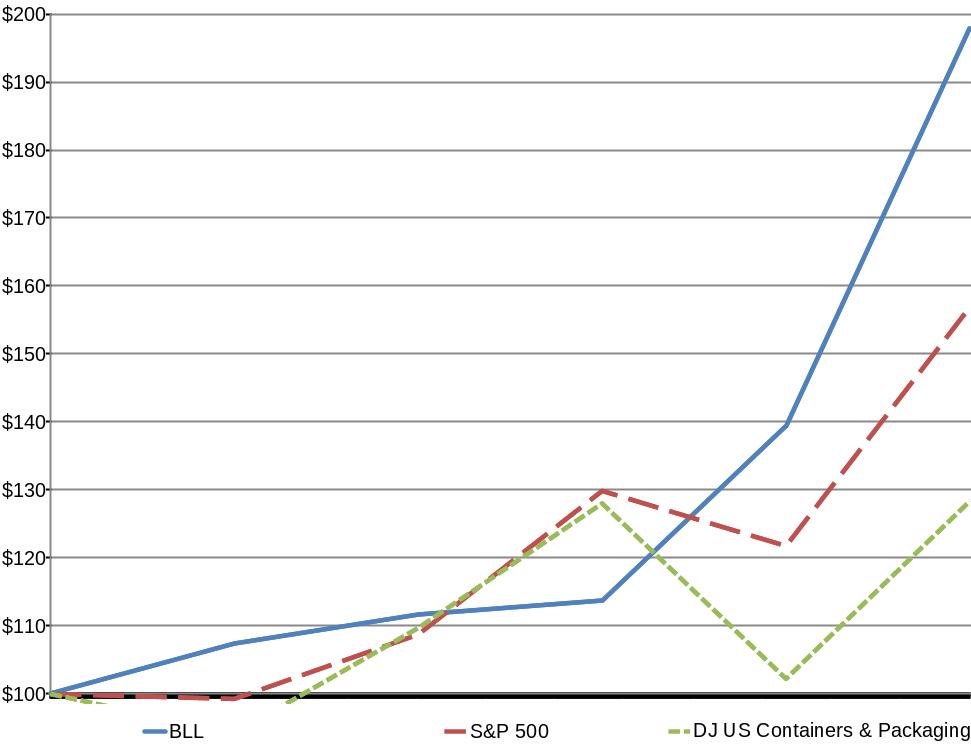][added: ]
| | | [removed: 12/31/2014 | | |] 12/31/2015 | | | 12/31/2016 | | | 12/31/2017 | | | 12/31/2018 | | | 12/31/2019 | | [added: | 12/31/2020 | |]
| October 1 to October 31, 2020 | | — | | $ | — | | — | | 36,547,906 |
| November 1 to November 30, 2020 | | — | | | — | | — | | 36,547,906 |
| December 1 to December 31, 2020 | | — | | | — | | — | | 36,547,906 |
| Total | | — | | | — | | — | | |
| October 1 to October 31, 2019 | | 2,378,800 | | $ | 72.27 | | 2,378,800 | | 39,856,888 |
| November 1 to November 30, 2019 | | 1,405,348 | | | 66.49 | | 1,405,348 | | 38,451,540 |
| December 1 to December 31, 2019 | | 1,128,600 | | | 64.50 | | 1,128,600 | | 37,322,940 |
| Total | | 4,912,748 | | | 68.83 | | 4,912,748 | | |
Item 6. Selected Financial Data
0 rewritten, 1 added, 57 removed, 0 unchanged
Removing and reserving Item 6 ("Selected Financial Data") of Part II.
Five-Year Review of Selected Financial Data
Ball Corporation
| | | | | | | | | | | | | | | | |
| --- | --- | --- | --- | --- | --- | --- | --- | --- | --- | --- | --- | --- | --- | --- | --- |
| ($ in millions, except per share amounts) | | 2019 | | | 2018 | | | 2017 | | | 2016 | | | 2015 | |
| | | | | | | | | | | | | | | | |
| Net sales | | $ | 11,474 | | $ | 11,635 | | $ | 10,983 | | $ | 9,061 | | $ | 7,997 |
| Earnings before interest and taxes (EBIT) | | $ | 932 | | $ | 935 | | $ | 802 | | $ | 463 | | $ | 606 |
| Total interest expense | | | (324) | | | (302) | | | (288) | | | (338) | | | (260) |
| Earnings before taxes | | $ | 608 | | $ | 633 | | $ | 514 | | $ | 125 | | $ | 346 |
| Net earnings attributable to Ball Corporation _(a)_ | | $ | 566 | | $ | 454 | | $ | 374 | | $ | 263 | | $ | 281 |
| Basic earnings per share _(a)_ | | $ | 1.71 | | $ | 1.32 | | $ | 1.07 | | $ | 0.83 | | $ | 1.02 |
| Weighted average common shares outstanding (000s) | | | 331,102 | | | 344,796 | | | 350,269 | | | 316,542 | | | 274,600 |
| Diluted earnings per share _(a)_ | | $ | 1.66 | | $ | 1.29 | | $ | 1.05 | | $ | 0.81 | | $ | 1.00 |
| Diluted weighted average common shares outstanding (000s) | | | 340,121 | | | 352,321 | | | 356,985 | | | 322,884 | | | 281,968 |
| Total assets | | $ | 17,360 | | $ | 16,554 | | $ | 17,169 | | $ | 16,173 | | $ | 9,697 |
| Total interest bearing debt and capital lease obligations | | $ | 7,817 | | $ | 6,729 | | $ | 6,971 | | $ | 7,532 | | $ | 5,051 |
| Cash dividends per share | | $ | 0.55 | | $ | 0.40 | | $ | 0.365 | | $ | 0.26 | | $ | 0.26 |
| Total cash provided by operating activities _(c)_ | | $ | 1,548 | | $ | 1,566 | | $ | 1,478 | | $ | 193 | | $ | 1,037 |
| Non-U.S. GAAP Measures _(b)_ | | | | | | | | | | | | | | | |
| | | | | | | | | | | | | | | | |
| Comparable operating earnings | | $ | 1,331 | | $ | 1,290 | | $ | 1,220 | | $ | 976 | | $ | 801 |
| Comparable net earnings | | $ | 861 | | $ | 775 | | $ | 728 | | $ | 563 | | $ | 490 |
| Diluted earnings per share (comparable basis) | | $ | 2.53 | | $ | 2.20 | | $ | 2.04 | | $ | 1.74 | | $ | 1.74 |
| Free cash flow _(c)_ | | $ | 950 | | $ | 750 | | $ | 922 | | $ | (413) | | $ | 509 |
| _(a)_ | _Includes business consolidation and other activities and other items affecting comparability between years. Additional details regarding the 2019, 2018 and 2017 items are available in Note 6 to the consolidated financial statements within Item 8 of this Annual Report on Form 10-K._ |
| --- | --- |
| _(b)_ | _Non-U.S. GAAP measures should not be considered in isolation and should not be considered superior to, or a substitute for, financial measures calculated in accordance with U.S. GAAP. See below for reconciliations of non-U.S. GAAP financial measures to U.S. GAAP measures. Further discussion of non-U.S. GAAP financial measures is available in Item 7 of this Annual Report on Form 10-K under Management Performance Measurements and Other Liquidity Measures._ |
| (c) | _Amounts in 2017, 2016 and 2015 have been retrospectively adjusted to reflect the adoption of new accounting guidance for the preparation of the statement of cash flows that was effective January 1, 2018. Cash provided by operating activities was increased by $30 million in 2015 as a result of adopting the new accounting guidance._ |
**
Reconciliations of non-U.S. GAAP financial measures to U.S. GAAP measures are as follows:
| ($ in millions) | | 2019 | | | 2018 | | | 2017 | | | 2016 | | | 2015 | |
| Net earnings attributable to Ball Corporation | | $ | 566 | | $ | 454 | | $ | 374 | | $ | 263 | | $ | 281 |
| Add: Net earnings attributable to noncontrolling interests | | | (30) | | | (1) | | | 6 | | | 3 | | | 22 |
| Net earnings | | | 536 | | | 453 | | | 380 | | | 266 | | | 303 |
| Less: Equity in results of affiliates, net of tax | | | 1 | | | (5) | | | (31) | | | (15) | | | (4) |
| Add: Tax provision (benefit) | | | 71 | | | 185 | | | 165 | | | (126) | | | 47 |
| Earnings before taxes, as reported | | | 608 | | | 633 | | | 514 | | | 125 | | | 346 |
| Total interest expense | | | 324 | | | 302 | | | 288 | | | 338 | | | 260 |
| Earnings before interest and taxes (EBIT) | | | 932 | | | 935 | | | 802 | | | 463 | | | 606 |
An excerpt. Shown here: all 0 rewritten, all 1 added and 40 of 57 removed. The counts are complete. For every sentence, read Item 6. Selected Financial Data in the FY2020 filing and the FY2019 filing.
Item 8. Financial Statements and Supplementary Data
623 rewritten, 188 added, 478 removed, 1,206 unchanged
We have audited the accompanying consolidated balance sheets of Ball Corporation and its subsidiaries (the “Company”) as of December 31, [removed: 2019] [added: 2020] and [removed: 2018,] [added: 2019,] and the related consolidated statements of earnings, [added: of] comprehensive earnings (loss), [added: of] shareholders' equity and [added: of] cash flows for each of the three years in the period ended December 31, [removed: 2019,] [added: 2020,] including the related notes (collectively referred to as the “consolidated financial statements”).
We also have audited the Company's internal control over financial reporting as of December 31, [removed: 2019,] [added: 2020,] based on criteria established in [removed: Internal] [added: _Internal] Control - Integrated [removed: Framework] [added: Framework_] (2013) issued by the Committee of Sponsoring Organizations of the Treadway Commission (COSO).
In our opinion, the consolidated financial statements referred to above present fairly, in all material respects, the financial position of the Company as of December 31, [removed: 2019] [added: 2020] and [removed: 2018,] [added: 2019,] and the results of its operations and its cash flows for each of the three years in the period ended December 31, [removed: 2019] [added: 2020] in conformity with accounting principles generally accepted in the United States of America.
Also in our opinion, the Company maintained, in all material respects, effective internal control over financial reporting as of December 31, [removed: 2019,] [added: 2020,] based on criteria established in [removed: Internal] [added: _Internal] Control - Integrated [removed: Framework] [added: Framework_] (2013) issued by the COSO.
As discussed in [removed: Notes 2 and] [added: Note] 1 to the consolidated financial statements, [removed: respectively,] the Company changed the manner in which it accounts for leases in 2019 and the manner in which it accounts for revenues from contracts with customers in 2018.
The critical audit [removed: matters] [added: matter] communicated below [removed: are matters] [added: is a matter] arising from the current period audit of the consolidated financial statements that [removed: were] [added: was] communicated or required to be communicated to the audit committee and that (i) [removed: relate] [added: relates] to accounts or disclosures that are material to the consolidated financial [removed: statements,] [added: statements] and (ii) involved our especially challenging, subjective, or complex judgments.
The communication of critical audit matters does not alter in any way our opinion on the consolidated financial statements, taken as a whole, and we are not, by communicating the critical audit [removed: matters] [added: matter] below, providing [added: a] separate [removed: opinions] [added: opinion] on the critical audit [removed: matters] [added: matter] or on the accounts or disclosures to which [removed: they relate.][added: it relates.]
If the [removed: carrying] [added: qualitative analysis concludes that fair] value [added: could be materially impacted, the company performs a quantitative impairment test to determine the fair value] of the reporting unit [removed: is greater than its fair value, the Company] [added: and] recognizes an impairment charge for the amount by which the carrying [removed: amount of goodwill] [added: value] exceeds the fair value.
[removed: Management] [added: When performing a quantitative analysis, the company] estimates fair value for each reporting unit primarily using the income approach.
The principal considerations for our determination that performing procedures relating to [removed: the recoverability of goodwill associated with the BPAMEA reporting unit] [added: revenue recognition - estimated costs at completion for aerospace fixed-price contracts] is a critical audit matter are [removed: there was] [added: the] significant judgment by management when [removed: developing the fair value measurement of] [added: determining] the [removed: BPAMEA reporting unit.][added: estimated costs at completion for such contracts.]
As described in Notes 1, 3 and 5 to the consolidated financial statements, sales for the aerospace segment were [removed: $1.5] [added: $1.7] billion for the year ended December 31, [removed: 2019,] [added: 2020,] including sales under long-term fixed-price contracts, which are primarily recognized using percentage-of-completion accounting under the cost-to-cost method.
[removed: February 19, 2020][added: 2020]
| ($ in millions, except per share amounts) | | [removed: 2019] [added: 2020] | | | [removed: 2018] [added: 2019] | | | [removed: 2017] [added: 2018] | |
| Net sales | | $ | [removed: 11,474] [added: 11,781] | | $ | [removed: 11,635] [added: 11,474] | | $ | [removed: 10,983] [added: 11,635] |
| Cost of sales (excluding depreciation and amortization) | | | [removed: (9,203)] [added: (9,323)] | | | [removed: (9,329)] [added: (9,203)] | | | [removed: (8,717)] [added: (9,329)] |
| Depreciation and amortization | | | [removed: (678)] [added: (668)] | | | [removed: (702)] [added: (678)] | | | [removed: (729)] [added: (702)] |
| Selling, general and administrative | | | [removed: (417)] [added: (525)] | | | [removed: (478)] [added: (417)] | | | [removed: (514)] [added: (478)] |
| Business consolidation and other activities | | | [removed: (244)] [added: (262)] | | | [removed: (191)] [added: (244)] | | | [removed: (221)] [added: (191)] |
| | | | [removed: (10,542)] [added: (10,778)] | | | [removed: (10,700)] [added: (10,542)] | | | [removed: (10,181)] [added: (10,700)] |
| Earnings before interest and taxes | | | [removed: 932] [added: 1,003] | | | [removed: 935] [added: 932] | | | [removed: 802] [added: 935] |
| Interest expense | | | [removed: (317)] [added: (275)] | | | [removed: (301)] [added: (317)] | | | [removed: (285)] [added: (301)] |
| Debt refinancing and other costs | | | [removed: (7)] [added: (41)] | | | [removed: (1)] [added: (7)] | | | [removed: (3)] [added: (1)] |
| Total interest expense | | | [removed: (324)] [added: (316)] | | | [removed: (302)] [added: (324)] | | | [removed: (288)] [added: (302)] |
| Earnings before taxes | | | [removed: 608] [added: 687] | | | [removed: 633] [added: 608] | | | [removed: 514] [added: 633] |
| Tax (provision) benefit | | | [removed: (71)] [added: (99)] | | | [removed: (185)] [added: (71)] | | | [removed: (165)] [added: (185)] |
| Equity in results of affiliates, net of tax | | | [removed: (1)] [added: (6)] | | | [removed: 5] [added: (1)] | | | [removed: 31] [added: 5] |
| Net earnings | | | [removed: 536] [added: 582] | | | [removed: 453] [added: 536] | | | [removed: 380] [added: 453] |
| Net (earnings) loss attributable to noncontrolling interests | | | [removed: 30] [added: 3] | | | [removed: 1] [added: 30] | | | [removed: (6)] [added: 1] |
| Net earnings attributable to Ball Corporation | | $ | [removed: 566] [added: 585] | | $ | [removed: 454] [added: 566] | | $ | [removed: 374] [added: 454] |
| Basic | | $ | [removed: 1.71] [added: 1.79] | | $ | [removed: 1.32] [added: 1.71] | | $ | [removed: 1.07] [added: 1.32] |
| Diluted | | $ | [removed: 1.66] [added: 1.76] | | $ | [removed: 1.29] [added: 1.66] | | $ | [removed: 1.05] [added: 1.29] |
| Basic | | | [removed: 331,102] [added: 326,260] | | | [removed: 344,796] [added: 331,102] | | | [removed: 350,269] [added: 344,796] |
| Diluted | | | [removed: 340,121] [added: 332,815] | | | [removed: 352,321] [added: 340,121] | | | [removed: 356,985] [added: 352,321] |
| [removed: | ] [added: ] | [removed: ] [added: ] | Years Ended December 31, | | | | | | | |
| ($ in millions) | [removed: |] | [removed: 2019] [added: 2020] | | | [removed: 2018] [added: 2019] | | | [removed: 2017] [added: 2018] | |
| Net earnings | | [removed: |] $ | [removed: 536] [added: 582] | | $ | [removed: 453] [added: 536] | | $ | [removed: 380] [added: 453] |
| Other comprehensive earnings (loss): | | | | | | | | | | [removed: |]
| Foreign currency translation adjustment | | | [removed: | 166] [added: (215)] | | | [removed: (197)] [added: 166] | | | [removed: 38] [added: (197)] |
| Pension and other postretirement benefits | | | [removed: | (270)] [added: 118] | | | [removed: 122] [added: (270)] | | | [removed: 296] [added: 122] |
| Derivatives designated as hedges | | | [removed: | 58] [added: 102] | | | [removed: (86)] [added: 58] | | | [removed: 17] [added: (86)] |
| | | ** | | | | | | ** | |
| Receivables | | | (135) | | | 49 | | | (17) | |
| Business acquisitions, net of cash acquired | | | (69) | | | — | | | — | |
| Net earnings | | — | | | — | | — | | | — | | | 585 | | | — | | | (3) | | | 582 | |
| Balance at December 31, 2020 | | 679,524 | | $ | 1,167 | | (351,939) | | $ | (3,130) | | $ | 6,192 | | $ | (954) | | $ | 62 | | $ | 3,337 | |
Stranded taxes in accumulated other comprehensive income are reclassified to the consolidated statement of earnings when the activity that generated the deferred gains and losses has fully ceased.
On an annual basis and at interim periods as circumstances require, the company performs a qualitative analysis to determine whether it is more likely than not that the fair value of a reporting unit exceeds its carrying amount, which includes an evaluation as to whether there have been significant changes to macro-economic factors related to the reporting unit that could materially impact fair value.
Ball typically enters into master agreements with customers, which establish the terms and conditions for subsequent orders of goods.
_Leases_
_Risks and Uncertainties – Novel Coronavirus (COVID-19)_
The preparation of financial statements requires the use of estimates and assumptions that affect the reported amounts of assets and liabilities at the reporting date and revenues and expenses during the reporting periods.
These estimates represent management’s judgment about the outcome of future events.
The current global business environment is being impacted directly and indirectly by the effects of the novel coronavirus (COVID-19), and it is not possible to accurately estimate the impacts of COVID-19.
However, Ball management has reviewed the estimates used in preparing the company’s consolidated financial statements and the following have a reasonably possible likelihood of being affected, to a material extent, by the direct and indirect impacts of COVID-19 in the near term.
| | ● | Estimates regarding the future financial performance of the business used in the impairment tests for goodwill, long-lived assets, equity method investments, recoverability of deferred tax assets and estimates regarding cash needs and associated indefinite reinvestment assertions; |
| | ● | Estimates of recoverability for customer receivables; |
| | ● | Estimates of net realizable value for inventory; |
| | ● | Estimates regarding the likelihood of forecasted transactions associated with hedge accounting positions at December 31, 2020, which could impact the company’s ability to satisfy hedge accounting requirements and result in the recognition of income and/or expenses. |
In addition to the above potential impacts on the estimates used in preparing financial statements, COVID-19 has the potential to increase Ball’s vulnerabilities to near-term severe impacts related to certain concentrations in its business.
In line with other companies in the packaging and aerospace industries, Ball makes the majority of its sales and significant purchases to or from a relatively small number of global, or large regional, customers and suppliers.
Furthermore, Ball makes the majority of its sales from a small number of product lines.
The potential of COVID-19 to affect a significant customer or supplier, or to affect demand for certain products to a significant degree, heightens the vulnerability of Ball to these concentrations.
The guidance was applied prospectively on January 1, 2020, and did not have a material effect on the company’s consolidated financial statements.
Ball adopted this guidance and all related amendments on January 1, 2020, applying the modified retrospective method, and this adoption did not have a material effect on the company’s consolidated financial statements.
Pension and Fair Value Measurement Disclosures
In August 2018, amendments to existing disclosure requirements were issued to clarify the disclosures around defined benefit plans and fair value measurements.
Effective January 1, 2020, the company implemented changes to its management and internal reporting structure for cost reduction and operational efficiency purposes.
As a result of these changes, the company’s plants in Cairo, Egypt, and Manisa, Turkey, are now included in the beverage packaging, Europe, Middle East and Africa (beverage packaging, EMEA), segment.
The company’s segment results and disclosures for comparative, historical periods have been retrospectively adjusted to conform to the current year presentation.
| 2020 | | $ | 6,317 | | $ | 1,295 | | $ | 4,169 | | $ | 11,781 |
| As of December 31, 2020 | | $ | 2,819 | | $ | 839 | | $ | 766 | | $ | 2,786 | | $ | 7,210 |
| Beverage packaging, EMEA | | | 2,945 | | | 2,857 | | | 2,809 |
| Reportable segment sales | | | 11,457 | | | 10,764 | | | 10,332 |
| Other | | | 324 | | | 710 | | | 1,303 |
| Beverage packaging, EMEA | | | 354 | | | 351 | | | 328 |
| Beverage packaging, EMEA | | | 230 | | | 246 | | | 252 |
| Beverage packaging, EMEA | | | 262 | | | 147 | | | 200 |
Brazil Aluminum Aerosol Packaging Business
In August 2020, the company acquired the entire share capital of Tubex Industria E Comercio de Embalagens Ltda, an aluminum aerosol packaging business with a plant in Itupeva, Brazil, for the purchase price of $80 million, subject to customary closing adjustments, including initial cash consideration of $69 million plus potential additional consideration not to exceed $30 million in total over the next three years.
The business is part of Ball’s aerosol packaging operating segment.
_Recoverability of Goodwill – BPAMEA Reporting Unit_
As described in Notes 1 and 11 to the consolidated financial statements, the Company’s consolidated goodwill balance was $4.4 billion as of December 31, 2019, and the goodwill associated with the Ball Packaging Asia, Middle East, and Africa (BPAMEA) reporting unit was $102 million.
On an annual basis and at interim periods when circumstances require, management tests the recoverability of the Company’s goodwill.
Management compares the carrying value of each identified reporting unit to its fair value.
Under the income approach, fair value is estimated as the present value of estimated future cash flows of each reporting unit.
The projected cash flows incorporate various assumptions related to weighted average cost of capital (WACC) and growth rates that are specific to each reporting unit, including assumptions relating to net sales growth rates, terminal growth rates, and EBITDA (a non-U.S. GAAP measure defined by the Company as earnings before interest, taxes, depreciation and amortization) margin.
Management corroborates the results of its income approach using the market approach.
Under the market approach, management uses available information regarding multiples used in any recent market transactions involving transfer of controlling interests as well as publicly available trading multiples based on the enterprise value of companies in either the packaging or aerospace and defense industries.
The appropriate multiple is applied to forecasted EBITDA of each reporting unit to estimate fair value.
This in turn led to a high degree of auditor judgment, subjectivity, and effort in performing procedures, and in evaluating the related audit evidence, over management’s cash flow projections and significant assumptions, including the net sales growth rate, terminal growth rate, EBITDA margin, and WACC.
In addition, the audit effort involved the use of professionals with specialized skill and knowledge to assist in performing these procedures and evaluating the related audit evidence.
Addressing the matter involved performing procedures and evaluating audit evidence in connection with forming our overall opinion on the consolidated financial statements.
These procedures included testing the effectiveness of controls relating to management’s evaluation of the recoverability of goodwill, including controls over the valuation of the Company’s BPAMEA reporting unit.
These procedures also included, among others, testing management’s process for developing the fair value estimate; evaluating the appropriateness of the income approach and the market approach; testing the completeness, accuracy and relevance of underlying data used in these approaches; and evaluating the significant assumptions used by management in the Company’s income approach, including the net sales growth rate, terminal growth rate, EBITDA margin, and WACC.
Evaluating management’s assumptions related to the net sales growth rate, terminal growth rate, and EBITDA margin involved evaluating whether the assumptions used by management were reasonable, considering (i) the past performance of the reporting units, (ii) the consistency of these assumptions with third-party industry and economic data, and (iii) whether these assumptions were consistent with evidence obtained in other areas of the audit.
Professionals with specialized skill and knowledge were used to assist in the evaluation of the Company’s income approach and market approach, as well as certain significant assumptions, including the WACC.
**
The principal considerations for our determination that performing procedures relating to revenue recognition - estimated costs at completion for aerospace fixed-price contracts is a critical audit matter are there was significant judgment by management when determining the estimated costs at completion for such contracts.
| | | | | | | | | | |
| | | | | | | | | | | |
| --- | --- | --- | --- | --- | --- | --- | --- | --- | --- | --- |
| | | | ** | | | | | | ** | |
| Receivables | | | 49 | | | (17) | | | (189) | |
| (a) | _Amounts in 2017 have been retrospectively adjusted to reflect the adoption of new accounting guidance for the preparation of the statement of cash flows that was effective January 1, 2018._ |
| --- | --- |
| Balance at December 31, 2016 | | 668,504 | | $ | 1,038 | | (318,774) | | $ | (1,401) | | $ | 4,739 | | $ | (941) | | $ | 106 | | $ | 3,541 | |
| Net earnings | | — | | | — | | — | | | — | | | 374 | | | — | | | 6 | | | 380 | |
Ball Corporation
Notes to the Consolidated Financial Statements
On an annual basis and at interim periods when circumstances require, the company tests the recoverability of its goodwill.
The company compares the carrying value of each identified reporting unit to its fair value.
If the carrying value of the reporting unit is greater than its fair value, the company recognizes an impairment charge for the amount by which the carrying value exceeds the fair value.
The company estimates fair value for each reporting unit primarily using the income approach.
Comparative periods have not been restated and continue to be reported under the accounting standards in effect for those periods.
For sales recognized in 2017, the company recognized sales of products in its packaging segments when the four basic criteria of the former guidance on revenue recognition were met: delivery had occurred, title had transferred, there was persuasive evidence of an agreement or arrangement and the price was fixed or determinable and collection was reasonably assured.
| --- | --- | --- |
Sales in 2017 from the majority of the company’s aerospace business contracts were recognized over time under the cost-to-cost method based on the continuous transfer of control to the customer, which is consistent with the new revenue accounting standard and related amendments.
New Lease Accounting Guidance
As part of adopting the new lease standard, Ball has made the following elections:
| | ● | To carry forward the historical lease determination and classification conclusions as established under the old standard, and not reassess initial direct costs for existing leases; |
An excerpt. Shown here: 40 of 623 rewritten, 40 of 188 added and 40 of 478 removed. The counts are complete. For every sentence, read Item 8. Financial Statements and Supplementary Data in the FY2020 filing and the FY2019 filing.
Item 9. Changes in and Disagreements with Accountants on Accounting and Financial Disclosure
4 rewritten, 0 added, 0 removed, 9 unchanged
As of December 31, [removed: 2019,] [added: 2020,] Ball Corporation, under the supervision of the Chief Executive Officer and Chief Financial Officer of the company, has conducted an evaluation of the effectiveness of the design and operation of the company’s disclosure controls and procedures (as defined in Rules 13a-15(e) and 15d-15(e) under the Securities Exchange Act of 1934, as amended) and the Chief Executive Officer and Chief Financial Officer have concluded that the company’s disclosure controls and procedures were effective.
Based on this evaluation, our management concluded that our internal control over financial reporting was effective as of December 31, [removed: 2019.][added: 2020.]
The effectiveness of our internal control over financial reporting as of December 31, [removed: 2019,] [added: 2020,] has been audited by PricewaterhouseCoopers LLP, an independent registered public accounting firm, as stated in their report, which is included herein.
There were no changes in our internal control over financial reporting that occurred during the quarter ended December 31, [removed: 2019,] [added: 2020,] that have materially affected, or are reasonably likely to materially affect, our internal control over financial reporting.
Item 10. Directors, Executive Officers and Corporate Governance of the Registrant
9 rewritten, 4 added, 2 removed, 7 unchanged
The executive officers of the company as of February [removed: 19, 2020,] [added: 17, 2021,] were as follows:
Baker, [removed: 62,] [added: 63,] Vice President, General Counsel and Corporate Secretary since July 2011; Vice President, General Counsel and Assistant Corporate Secretary from 2004 to 2011; Associate General Counsel, 1999 to 2004; various other positions within the company, 1993 to 1999.
Carey, [removed: 41,] [added: 42,] Vice President and Controller since November 2017; Assistant Controller from 2014 to November 2017; Senior Manager, PricewaterhouseCoopers LLP, 2001 to 2014.
Fisher, [removed: 47,] [added: 48, President, since January 2021;] Senior Vice President, Ball Corporation, and Chief Operating Officer, Global Beverage Packaging, since December 2016; President, Beverage Packaging North and Central America from 2014 to 2016; Senior Vice President, Finance and Planning, Beverage Packaging North and Central America, 2013 to 2014; various other positions within the company, 2010 to 2014.
Hayes, [removed: 54,] [added: 55, Chairman and Chief Executive Officer since January 2021;] Chairman, President and Chief Executive Officer since 2013; President and Chief Executive Officer, 2011 to 2013; President and Chief Operating Officer during 2010; Executive Vice President and Chief Operating Officer from 2008 to 2009; various other positions within the company, 1999 to 2008.
Knobel, [removed: 48,] [added: 49,] Vice President and Treasurer since 2011; Treasurer from 2010 to 2011; Senior Director, Treasury, 2008 to 2010; Director, Treasury Operations, 2005 to 2008; various other positions within the company, 1997 to 2005.
Morrison, [removed: 57,] [added: 58, Executive Vice President and Chief Financial Officer since January 2021;] Senior Vice President and Chief Financial Officer since 2010; Vice President and Treasurer from 2002 to 2010; and Treasurer, 2000 to 2002.
Pauley, [removed: 58,] [added: 59, Executive Vice President, Human Resources and Administration, since January 2021;] Senior Vice President, Human Resources and Administration, since 2011; Vice President, Administration and Compliance, 2007 to 2011; Senior Director, Administration and Compliance, 2004 to 2007; various other positions within the company, 1981 to 2004.
Other information required by Item 10 appearing under the caption “Director Nominees and Continuing Directors” and “Section 16(a) Beneficial Ownership Reporting Compliance,” of the company’s proxy statement to be filed pursuant to Regulation 14A within 120 days after December 31, [removed: 2019,] [added: 2020,] is incorporated herein by reference.
David A.
Kaufman, 55, Senior Vice President, Ball Corporation, and President, Ball Aerospace & Technologies Corp. since January 2021; Chief Operating Officer, Ball Aerospace & Technologies Corp. from 2020 to 2021; Vice President and General Manager of National Defense, Ball Aerospace & Technologies Corp from 2013 to 2020; various other positions within the company, 2000 to 2013.
Ronald J.
Lewis, 54, Senior Vice President, Ball Corporation, and Chief Operating Officer, Global Beverage Packaging, since January 2021; President, Beverage Packaging EMEA from 2019 to 2020; Chief Supply Chain Officer, Coca-Cola Coca-Cola European Partners plc, 2016 to 2019; Chief Procurement Officer, The Coca-Cola Company, 2011 to 2016.
Robert D.
Strain, 63, Senior Vice President, Ball Corporation, and President, Ball Aerospace & Technologies Corp. since 2013; Chief Operating Officer, Ball Aerospace & Technologies Corp. from 2012 to 2013; and Director at NASA Goddard Space Flight Center from 2008 to 2012.
Item 11. Executive Compensation
1 rewritten, 0 added, 0 removed, 0 unchanged
The information required by Item 11 appearing under the caption “Executive Compensation” in the company’s proxy statement, to be filed pursuant to Regulation 14A within 120 days after December 31, [removed: 2019,] [added: 2020,] is incorporated herein by reference.
Item 12. Security Ownership of Certain Beneficial Owners and Management
1 rewritten, 2 added, 2 removed, 15 unchanged
The information required by Item 12 appearing under the caption “Voting Securities and Principal Shareholders,” in the company’s proxy statement to be filed pursuant to Regulation 14A within 120 days after December 31, [removed: 2019,] [added: 2020,] is incorporated herein by reference.
| Equity compensation plans approved by security holders | | 10,113,396 | | $ | 40.40 | | 17,054,077 |
| Total | | 10,113,396 | | $ | 40.40 | | 17,054,077 |
| Equity compensation plans approved by security holders | | 12,385,460 | | $ | 32.41 | | 19,641,712 |
| Total | | 12,385,460 | | $ | 32.41 | | 19,641,712 |
Item 13. Certain Relationships and Related Transactions
1 rewritten, 0 added, 0 removed, 0 unchanged
The information required by Item 13 appearing under the caption “Ratification of the Appointment of Independent Registered Public Accounting Firm,” in the company’s proxy statement to be filed pursuant to Regulation 14A within 120 days after December 31, [removed: 2019,] [added: 2020,] is incorporated herein by reference.
Item 14. Principal Accountant Fees and Services
1 rewritten, 0 added, 0 removed, 1 unchanged
The information required by Item 14 appearing under the caption “Certain Committees of the Board,” in the company’s proxy statement to be filed pursuant to Regulation 14A within 120 days after December 31, [removed: 2019,] [added: 2020,] is incorporated herein by reference.
Item 15. Exhibits, Financial Statement Schedules
17 rewritten, 2 added, 0 removed, 110 unchanged
Consolidated statements of earnings — Years ended December 31, [removed: 2019, 2018] [added: 2020, 2019] and [removed: 2017][added: 2018]
Consolidated statements of comprehensive earnings (loss) — Years ended December 31, [removed: 2019, 2018] [added: 2020, 2019] and [removed: 2017][added: 2018]
Consolidated balance sheets — December 31, [removed: 2019] [added: 2020] and [removed: 2018][added: 2019]
Consolidated statements of cash flows — Years ended December 31, [removed: 2019, 2018] [added: 2020, 2019] and [removed: 2017][added: 2018]
Consolidated statements of shareholders’ equity — Years ended December 31, [removed: 2019, 2018] [added: 2020, 2019] and [removed: 2017][added: 2018]
| 3.ii | | [Bylaws of Ball Corporation as amended [removed: October 21, 2019.] [added: December 1, 2020.] (Filed [removed: herewith.)](https://www.sec.gov/Archives/edgar/data/9389/000155837020001005/ex-3dii.htm)] [added: herewith.)](https://www.sec.gov/Archives/edgar/data/9389/000155837021001121/bll-20201231xex3dii.htm)] |
| 4.2(d) | | [Description of Ball Corporation’s securities registered pursuant to Section 12 of the Securities Exchange Act of 1934 (Filed [removed: herewith.)](https://www.sec.gov/Archives/edgar/data/9389/000155837020001005/ex-4d2d.htm)] [added: herewith.)](https://www.sec.gov/Archives/edgar/data/9389/000155837021001121/bll-20201231xex4d2d.htm)] |
| 11 | | [Statement re: Computation of Earnings per Share (filed herewith in [removed: to] the notes to the consolidated financial statements in Item 8, “Financial Statements and Supplementary Data”.)](#Item8FinancialStatementsandSupplementary) |
| 21 | | [List of Subsidiaries of Ball Corporation. (Filed [removed: herewith.)](https://www.sec.gov/Archives/edgar/data/9389/000155837020001005/ex-21.htm)] [added: herewith.)](https://www.sec.gov/Archives/edgar/data/9389/000155837021001121/bll-20201231xex21.htm)] |
| 23 | | [Consent of Independent Registered Public Accounting Firm. (Filed [removed: herewith.)](https://www.sec.gov/Archives/edgar/data/9389/000155837020001005/ex-23.htm)] [added: herewith.)](https://www.sec.gov/Archives/edgar/data/9389/000155837021001121/bll-20201231xex23.htm)] |
| 24 | | [Limited Power of Attorney. (Filed [removed: herewith.)](https://www.sec.gov/Archives/edgar/data/9389/000155837020001005/ex-25.htm)] [added: herewith.)](https://www.sec.gov/Archives/edgar/data/9389/000155837021001121/bll-20201231xex24.htm)] |
| 31.1 | | [Certifications pursuant to Rule 13a-14(a) or Rule 15d-14(a), by John A. Hayes, [removed: Chairman, President] [added: Chairman] and Chief Executive Officer of Ball Corporation. (Filed [removed: herewith.)](https://www.sec.gov/Archives/edgar/data/9389/000155837020001005/ex-31d1.htm)] [added: herewith.)](https://www.sec.gov/Archives/edgar/data/9389/000155837021001121/bll-20201231xex31d1.htm)] |
| 31.2 | | [Certifications pursuant to Rule 13a-14(a) or Rule 15d-14(a), by Scott C. Morrison, [removed: Senior] [added: Executive] Vice President and Chief Financial Officer of Ball Corporation. (Filed [removed: herewith.)](https://www.sec.gov/Archives/edgar/data/9389/000155837020001005/ex-31d2.htm)] [added: herewith.)](https://www.sec.gov/Archives/edgar/data/9389/000155837021001121/bll-20201231xex31d2.htm)] |
| 32.1 | | [Certifications pursuant to Rule 13a-14(b) or Rule 15d-14(b) and Section 1350 of Chapter 63 of Title 18 of the United States Code, by John A. Hayes, [removed: Chairman, President] [added: Chairman] and Chief Executive Officer of Ball Corporation. (Furnished [removed: herewith.)](https://www.sec.gov/Archives/edgar/data/9389/000155837020001005/ex-32d1.htm)] [added: herewith.)](https://www.sec.gov/Archives/edgar/data/9389/000155837021001121/bll-20201231xex32d1.htm)] |
| 32.2 | | [Certifications pursuant to Rule 13a-14(b) or Rule 15d-14(b) and Section 1350 of Chapter 63 of Title 18 of the United States Code, by Scott C. Morrison, [removed: Senior] [added: Executive] Vice President and Chief Financial Officer of Ball Corporation. (Furnished [removed: herewith.)](https://www.sec.gov/Archives/edgar/data/9389/000155837020001005/ex-32d2.htm)] [added: herewith.)](https://www.sec.gov/Archives/edgar/data/9389/000155837021001121/bll-20201231xex32d2.htm)] |
| 99 | | [Cautionary statement for purposes of the safe harbor provisions of the Private Securities Litigation Reform Act of 1995, as amended. (Filed [removed: herewith.)](https://www.sec.gov/Archives/edgar/data/9389/000155837020001005/ex-99.htm)] [added: herewith.)](https://www.sec.gov/Archives/edgar/data/9389/000155837021001121/bll-20201231xex99.htm)] |
| 104 | | The following financial information from Ball Corporation’s Annual Report on Form 10-K for the year ended December 31, [removed: 2019,] [added: 2020,] formatted in Inline XBRL (contained in Exhibit 101): (i) the Consolidated Statements of Earnings, (ii) the Consolidated Statements of Comprehensive Earnings, (iii) the Consolidated Balance Sheets, (iv) the Consolidated Statements of Cash Flows, (v) the Consolidated Statements of Shareholders’ Equity and Comprehensive Earnings and (vi) Notes to the Consolidated Financial Statements. (Filed herewith.) |
| 12 | | [Obligor group subsidiaries of Ball Corporation. (Filed herewith.)](https://www.sec.gov/Archives/edgar/data/9389/000155837021001121/bll-20201231xex12.htm) |
| | | |
Item 16. Form 10-K Summary
22 rewritten, 14 added, 6 removed, 48 unchanged
| | | [removed: Chairman, President] [added: Chairman] and Chief Executive Officer |
| | /s/ John A. Hayes | | | [removed: Chairman, President] [added: Chairman] and Chief Executive Officer |
| | John A. Hayes | | | February [removed: 19, 2020] [added: 17, 2021] |
| | /s/ Scott C. Morrison | | | [removed: Senior] [added: Executive] Vice President and Chief Financial Officer |
| | Scott C. Morrison | | | February [removed: 19, 2020] [added: 17, 2021] |
| | Nate C. Carey | | | February [removed: 19, 2020] [added: 17, 2021] |
| | John Bryant | | | February [removed: 19, 2020] [added: 17, 2021] |
| | Michael J. Cave | | | February [removed: 19, 2020] [added: 17, 2021] |
| | Daniel J. Heinrich | | | February [removed: 19, 2020] [added: 17, 2021] |
| | Pedro H. Mariani | | | February [removed: 19, 2020] [added: 17, 2021] |
| | [removed: |] /s/ Georgia R. Nelson | * | | Director |
| | [removed: |] Georgia R. Nelson | | | February [removed: 19, 2020] [added: 17, 2021] |
| | [removed: |] /s/ Cynthia A. Niekamp | * | | Director |
| | [removed: |] Cynthia A. Niekamp | | | February [removed: 19, 2020] [added: 17, 2021] |
| | [removed: |] /s/ Todd Penegor | * | | Director |
| | [removed: |] Todd Penegor | | | February [removed: 19, 2020] [added: 17, 2021] |
| | [removed: |] /s/ Cathy D. Ross | * | | Director |
| | [removed: |] Cathy D. Ross | | | February [removed: 19, 2020] [added: 17, 2021] |
| | /s/ Betty Sapp | [removed: |] * | | Director |
| | Betty Sapp | [removed: |] | | February [removed: 19, 2020] [added: 17, 2021] |
| | /s/ Stuart A. Taylor II | [removed: |] * | | Director |
| | Stuart A. Taylor II | [removed: |] | | February [removed: 19, 2020] [added: 17, 2021] |
| | | February 17, 2021 |
| | /s/ Daniel W. Fisher | * | | Director |
| | Daniel W. Fisher | | | February 17, 2021 |
| | John A. Hayes | | | February 17, 2021 |
| | | | | |
| | | | | |
| --- | --- | --- | --- | --- |
| | | | | |
| | | | | |
| --- | --- | --- | --- | --- |
| | | | | |
| | | | | |
| | | | | |
| | | February 17, 2021 |
| | | February 19, 2020 |
| | | | | | |
| --- | --- | --- | --- | --- | --- |
| | | | | | |
| | | | | | |
| | | | | | |