 filings.tools
Baxter International 10-K 2016-12-31
Filed 2017-02-23. 21 sections, 411K characters. Original on sec.gov · Markdown · JSON
Cover and table of contents
10-K 1 bax-10k_20161231.htm 10-K
UNITED STATES
SECURITIES AND EXCHANGE COMMISSION
Washington, D.C. 20549
FORM 10-K
(Mark One)
| ☑ | ANNUAL REPORT PURSUANT TO SECTION 13 OR 15(d) OF THE SECURITIES EXCHANGE ACT OF 1934 |
|---|
For the fiscal year ended December 31, 2016
OR
| ☐ | TRANSITION REPORT PURSUANT TO SECTION 13 OR 15(d) OF THE SECURITIES EXCHANGE ACT OF 1934 |
|---|
For the transition period from to
Commission file number 1-4448

Baxter International Inc.
(Exact Name of Registrant as Specified in its Charter)
| Delaware | 36-0781620 | |
|---|---|---|
| (State or Other Jurisdiction of Incorporation or Organization) | (I.R.S. Employer Identification No.) | |
| One Baxter Parkway, Deerfield, Illinois | 60015 | |
| (Address of Principal Executive Offices) | (Zip Code) |
Registrant’s telephone number, including area code 224.948.2000
Securities registered pursuant to Section 12(b) of the Act:
| Title of Each Class | Name of Each Exchange on Which Registered | |
|---|---|---|
| Common stock, $1.00 par value | New York Stock Exchange Chicago Stock Exchange |
Securities registered pursuant to Section 12(g) of the Act: None
Indicate by check mark if the registrant is a well-known seasoned issuer, as defined in Rule 405 of the Securities Act. Yes ☑ No ☐
Indicate by check mark if the registrant is not required to file reports pursuant to Section 13 or 15(d) of the Act. Yes ☐ No ☑
Indicate by check mark whether the registrant (1) has filed all reports required to be filed by Section 13 or 15(d) of the Securities Exchange Act of 1934 during the preceding 12 months (or for such shorter period that the registrant was required to file such reports), and (2) has been subject to such filing requirements for the past 90 days. Yes ☑ No ☐
Indicate by check mark whether registrant has submitted electronically and posted on its corporate website, if any, every Interactive Data File required to be submitted and posted pursuant to Rule 405 of Regulation S-T during the preceding 12 months (or for such shorter period that the registrant was required to submit and post such files) Yes ☑ No ☐
Indicate by check mark if disclosure of delinquent filers pursuant to Item 405 of Regulation S-K is not contained herein and will not be contained, to the best of registrant’s knowledge, in definitive proxy or information statements incorporated by reference in Part III of this Form 10-K or any amendment to this Form 10-K. ☐
Indicate by check mark whether the registrant is a large accelerated filer, an accelerated filer, a non-accelerated filer or a smaller reporting company. See the definitions of “large accelerated filer,” “accelerated filer” and “smaller reporting company” in Rule 12b-2 of the Exchange Act.
| Large accelerated filer | ☑ | Accelerated filer | ☐ | ||
|---|---|---|---|---|---|
| Non-accelerated filer | ☐ | (Do not check if a smaller reporting company) | Smaller reporting company | ☐ |
Indicate by check mark whether the registrant is a shell company (as defined in Rule 12b-2 of the Act). Yes ☐ No ☑
The aggregate market value of the voting common equity held by non-affiliates of the registrant as of June 30, 2016 (the last business day of the registrant’s most recently completed second fiscal quarter), based on the per share closing sale price of $45.22 on that date and the assumption for the purpose of this computation only that all of the registrant’s directors and executive officers are affiliates, was approximately $24 billion. There is no non-voting common equity held by non-affiliates of the registrant. The number of shares of the registrant’s common stock, $1.00 par value, outstanding as of January 31, 2017 was 540,082,230.
DOCUMENTS INCORPORATED BY REFERENCE
Portions of the registrant’s definitive 2017 proxy statement for use in connection with its Annual Meeting of Stockholders to be held on May 2, 2017 are incorporated by reference into Part III of this report.
TABLE OF CONTENTS
PART I
Item 1. Business.
| --- | --- |
Company Overview
Baxter International Inc., through its subsidiaries, provides a broad portfolio of essential renal and hospital products, including acute and chronic dialysis; sterile IV solutions; infusion systems and devices; parenteral nutrition therapies; premixed and oncolytic injectables; biosurgery products and anesthetics; drug reconstitution systems; and pharmacy automation, software and services. The company’s global footprint and critical nature of its products and services play a key role in expanding access to healthcare in emerging and developed countries. These products are used by hospitals, kidney dialysis centers, nursing homes, rehabilitation centers, doctors’ offices and by patients at home under physician supervision. As of December 31, 2016, Baxter manufactured products in over 20 countries and sells them in over 100 countries.
Baxter International Inc. was incorporated under Delaware law in 1931. As used in this report, “Baxter International” means Baxter International Inc. and “Baxter,” the “company” or the “Company” means Baxter International and its consolidated subsidiaries (after giving effect to the separation and distribution of Baxalta Incorporated (Baxalta), as further described below), unless the context otherwise requires.
Separation of Baxalta
On July 1, 2015, Baxter completed the distribution of approximately 80.5% of the outstanding common stock of Baxalta to Baxter shareholders (the Distribution). The Distribution was made to Baxter’s shareholders of record as of the close of business on June 17, 2015 (the Record Date), who received one share of Baxalta common stock for each Baxter common share held as of the Record Date. As a result of the distribution, Baxalta became an independent public company trading under the symbol “BXLT” on the New York Stock Exchange.
In 2016, Baxter disposed of its remaining 19.5% interest in Baxalta through a series of transactions including debt-for-equity exchanges, an equity-for-equity exchange and a contribution to its U.S. pension plan. As a result of these transactions, the company extinguished approximately $3.65 billion in company indebtedness, repurchased 11,526,638 Baxter shares and contributed 17,145,570 Baxalta shares to its U.S. pension plan. On June 3, 2016, Baxalta became a wholly-owned subsidiary of Shire plc (Shire).
The local separation of Baxalta’s business in certain countries outside the United States did not occur prior to the distribution date due to regulatory requirements, the need to obtain consents from local governmental authorities and other business reasons. Separation of the remaining three countries is expected to occur by 2018.
As a result of the separation, the consolidated statements of income, consolidated balance sheets, consolidated statements of cash flow, and related financial information reflect Baxalta’s operations, assets and liabilities, and cash flows as discontinued operations for all periods presented.
Refer to Note 2 in Item 8 of this Annual Report on Form 10-K for additional information regarding the separation of Baxalta.
Business Segments and Products
The company operates in two segments: Hospital Products and Renal.
The Hospital Products business manufactures sterile intravenous (IV) solutions and administration sets, premixed drugs and drug-reconstitution systems, pre-filled vials and syringes for injectable drugs, IV nutrition products, parenteral nutrition therapies, infusion pumps, inhalation anesthetics, and biosurgery products. The business also provides products and services related to pharmacy compounding, and drug formulation; sterile IV solutions; infusion systems and devices; parenteral nutrition therapies; premixed and oncolytic injectables; biosurgery products and anesthetics; drug reconstitution systems; and pharmacy automation, software and services.
The Renal business offers a comprehensive portfolio to meet the needs of patients with end-stage renal disease, or irreversible kidney disease and acute kidney injuries, including technologies and therapies for peritoneal dialysis (PD), hemodialysis (HD), continuous renal replacement therapy (CRRT) and additional dialysis services.
For financial information about Baxter’s segments and sales franchises, see Note 17 in Item 8 of this Annual Report on Form 10-K.
Sales and Distribution
The company has its own direct sales force and also makes sales to and through independent distributors, drug wholesalers acting as sales agents and specialty pharmacy or other alternate site providers. In the United States, third parties such as Cardinal Health, Inc. warehouse and ship a significant portion of the company’s products through their distribution centers. These centers are generally stocked with adequate inventories to facilitate prompt customer service. Sales and distribution methods include frequent contact by sales and customer service representatives, automated communications via various electronic purchasing systems, circulation of catalogs and merchandising bulletins, direct-mail campaigns, trade publication presence and advertising.
International sales are made and products are distributed on a direct basis or through independent distributors or sales agents in more than 100 countries as of December 31, 2016.
International Operations
The majority of the company’s revenues are generated outside of the United States and geographic expansion remains a component of the company’s strategy. Baxter’s international presence includes operations in Europe (including Eastern and Central Europe), the Middle East, Africa, Asia-Pacific, Latin America and Canada. The company is subject to certain risks inherent in conducting business outside the United States. For more information on these risks, see the information under the captions “Risks Related to Baxter’s Business —We are subject to risks associated with doing business globally” and “— Changes in foreign currency exchange rates and interest rates could have a material adverse effect on our operating results and liquidity” in Item 1A of this Annual Report on Form 10-K.
For financial information about foreign and domestic operations and geographic information, see Note 17 in Item 8 of this Annual Report on Form 10-K. For more information regarding foreign currency exchange risk, refer to the discussion under the caption entitled “Financial Instrument Market Risk” in Item 7 of this Annual Report on Form 10-K.
Contractual Arrangements
Substantial portions of the company’s products are sold through contracts with customers, both within and outside the United States. Some of these contracts have terms of more than one year and place limits on the company’s ability to increase prices. In the case of hospitals, governments and other facilities, these contracts may specify minimum quantities of a particular product or categories of products to be purchased by the customer.
In keeping with the increased emphasis on cost-effectiveness in healthcare delivery, many hospitals and other customers of medical products in the United States have joined group purchasing organizations (GPOs), or formed integrated delivery networks (IDNs), to enhance purchasing power. GPOs and IDNs negotiate pricing arrangements with manufacturers and distributors, and the negotiated prices are made available to members. Baxter has purchasing agreements with several of the major GPOs in the United States. GPOs may have agreements with more than one supplier for certain products. Accordingly, in these cases, Baxter faces competition from other suppliers even where a customer is a member of a GPO under contract with Baxter. Purchasing power is similarly consolidated in many other countries. For example, public contracting authorities act as the purchasing entities for the hospitals and other customers of medical products in their region and many hospitals and other customers have joined joint procurement entities and buying consortia. The result is that demand for healthcare products is increasingly concentrated across the company’s markets globally.
Raw Materials
Raw materials essential to Baxter’s business are purchased from numerous suppliers worldwide in the ordinary course of business. Although most of these materials are generally available, Baxter at times may experience shortages of supply. In an effort to manage risk associated with raw materials supply, Baxter works closely with its suppliers to help ensure availability and continuity of supply while maintaining high quality and reliability. The company also seeks to develop new and alternative sources of supply where beneficial to its overall raw materials procurement strategy.
The company also utilizes long-term supply contracts with some suppliers to help maintain continuity of supply and manage the risk of price increases. Baxter is not always able to recover cost increases for raw materials through customer pricing due to contractual limits and market forces.
In connection with the separation and distribution, Baxter entered into a long-term manufacturing and supply agreement with Baxalta. Baxalta manufactures and supplies Baxter with ARTISS, TISSEEL, FLOSEAL and stand-alone thrombin under the manufacturing and supply agreement, on a cost-plus basis.
Competition and Healthcare Cost Containment
Baxter’s Hospital Products and Renal businesses benefit from a number of competitive advantages, including the breadth and depth of their product offerings, as well as strong relationships with customers, including hospitals and clinics, group purchasing organizations, physicians, and patients, many who self-administer the home-based therapies supplied by Baxter. Baxter as a whole benefits from efficiencies and cost advantages resulting from shared manufacturing facilities and the technological advantages of its products.
Although no single company competes with Baxter in all of its businesses, Baxter faces substantial competition in each of its segments from international and domestic healthcare and pharmaceutical companies and providers of all sizes, and these competitors often differ across our businesses. In addition, global and regional competitors continue to expand their manufacturing capacity and sales and marketing channels. Competition is primarily focused on cost-effectiveness, price, service, product performance, and technological innovation. There has been increasing consolidation in the company’s customer base and by its competitors, which continues to result in pricing and market pressures.
Global efforts toward healthcare cost containment continue to exert pressure on product pricing. Governments around the world use various mechanisms to control healthcare expenditures, such as price controls, the formation of public contracting authorities, product formularies (lists of recommended or approved products), and competitive tenders which require the submission of a bid to sell products. Sales of Baxter’s products are dependent, in part, on the availability of reimbursement by government agencies and healthcare programs, as well as insurance companies and other private payers. In the United States, the federal and many state governments have adopted or proposed initiatives relating to Medicaid and other health programs that may limit reimbursement or increase rebates that Baxter and other providers are required to pay to the state. In addition to government regulation, managed care organizations in the United States, which include medical insurance companies, medical plan administrators, health-maintenance organizations, hospital and physician alliances and pharmacy benefit managers, continue to put pressure on the price and usage of healthcare products. Managed care organizations seek to contain healthcare expenditures, and their purchasing strength has been increasing due to their consolidation into fewer, larger organizations and a growing number of enrolled patients. Baxter faces similar issues outside of the United States. In Europe and Latin America, for example, the government provides healthcare at low cost to patients, and controls its expenditures by purchasing products through public tenders, collective purchasing, regulating prices, setting reference prices in public tenders or limiting reimbursement or patient access to certain products.
Intellectual Property
Patents and other proprietary rights are essential to Baxter’s business. Baxter relies on patents, trademarks, copyrights, trade secrets, know-how and confidentiality agreements to develop, maintain and strengthen its competitive position. Baxter owns a number of patents and trademarks throughout the world and has entered into license arrangements relating to various third-party patents and technologies. Products manufactured by Baxter are sold primarily under its own trademarks and trade names. Some products distributed by the company are sold under the company’s trade names, while others are sold under trade names owned by its suppliers or partners. Trade secret protection of unpatented confidential and proprietary information is also important to Baxter. The company maintains certain details about its processes, products and technology as trade secrets and generally requires employees, consultants, and business partners to enter into confidentiality agreements. These agreements may be breached and Baxter may not have adequate remedies for any breach. In addition, Baxter’s trade secrets may otherwise become known or be independently discovered by competitors. To the extent that Baxter’s employees, consultants, and business partners use intellectual property owned by others in their work for the company, disputes may arise as to the rights in related or resulting know-how and inventions.
Baxter’s policy is to protect its products and technology through patents and trademarks on a worldwide basis. This protection is sought in a manner that balances the cost of such protection against obtaining the greatest value for the company. Baxter also recognizes the need to promote the enforcement of its patents and trademarks and takes commercially reasonable steps to enforce its patents and trademarks around the world against potential infringers, including judicial or administrative action where appropriate.
Baxter operates in an industry susceptible to significant patent litigation. At any given time, the company is involved as either a plaintiff or defendant in a number of patent infringement and other intellectual property-related actions. Such litigation can result in significant royalty or other payments or result in injunctions that can prevent the sale of products. For more information on patent and other litigation, see Note 16 in Item 8 of this Annual Report on Form 10-K.
Research and Development
Baxter’s investment in research and development (R&D), consistent with the company’s portfolio optimization and capital allocation strategies, helps fuel its future growth and its ability to remain competitive in each of its business segments. Accordingly, Baxter continues to focus its investment on select R&D programs to enhance future growth through clinical differentiation. Expenditures for Baxter’s R&D activities were $647 million in 2016, $603 million in 2015 and $610 million in 2014. These expenditures include costs
associated with R&D activities performed at the company’s R&D centers located around the world, which include facilities in Belgium, Sweden, Italy, Germany, China, Japan and the United States, as well as in-licensing, milestone and reimbursement payments made to partners for R&D work performed at non-Baxter locations.
For more information on the company’s R&D activities, refer to the discussion under the caption entitled “Strategic Objectives” in Item 7 of this Annual Report on Form 10-K.
Quality Management
Baxter’s continued success depends upon the quality of its products. Quality management plays an essential role in determining and meeting customer requirements, preventing defects, facilitating continuous improvement of the company’s processes, products and services, and assuring the safety and efficacy of the company’s products. Baxter’s quality system enables the design, development, manufacturing, packaging, sterilization, handling, distribution and labeling of the company’s products to ensure they conform to customer requirements. In order to continually improve the effectiveness and efficiency of the quality system, various measurements, monitoring and analysis methods such as management reviews and internal, external and vendor audits are employed at local and central levels.
Each product that Baxter markets is required to meet specific quality standards, both in packaging and in product integrity and quality. If any of those is determined to be compromised at any time, Baxter endeavors to take corrective and preventive actions designed to ensure compliance with regulatory requirements and to meet customer expectations. For more information on corrective actions taken by Baxter, refer to the discussion under the caption entitled “Certain Regulatory Matters” in Item 7 of this Annual Report on Form 10-K.
Government Regulation
The operations of Baxter and many of the products manufactured or sold by the company are subject to extensive regulation by numerous government agencies, both within and outside the United States. The Food and Drug Administration (FDA) in the United States, the European Medicines Agency (EMA) in Europe, the China Food and Drug Administration (CFDA) in China and other government agencies inside and outside of the United States, administer requirements covering the testing, safety, effectiveness, manufacturing, labeling, promotion and advertising, distribution and post-market surveillance of Baxter’s products. The company must obtain specific approval from FDA and non-U.S. regulatory authorities before it can market and sell most of its products in a particular country. Even after the company obtains regulatory approval to market a product, the product and the company’s manufacturing processes and quality systems are subject to continued review by FDA and other regulatory authorities globally. State agencies in the United States also regulate the facilities, operations, employees, products and services of the company within their respective states. The company and its facilities are subject to periodic inspections and possible administrative and legal actions by FDA and other regulatory agencies inside and outside the United States. Such actions may include warning letters, product recalls or seizures, monetary sanctions, injunctions to halt manufacture and distribution of products, civil or criminal sanctions, refusal of a government to grant approvals or licenses, restrictions on operations or withdrawal of existing approvals and licenses. As situations require, the company takes steps to ensure safety and efficacy of its products, such as removing products found not to meet applicable requirements from the market and improving the effectiveness of quality systems. For more information on compliance actions taken by the company, refer to the discussion under the caption entitled “Certain Regulatory Matters” in Item 7 of this Annual Report on Form 10-K.
The company is also subject to various laws inside and outside the United States concerning its relationships with healthcare professionals and government officials, price reporting and regulation, the promotion, sales and marketing of its products and services, the importation and exportation of products, the operation of its facilities and distribution of products. In the United States, the company is subject to the oversight of FDA, Office of the Inspector General within the Department of Health and Human Services (OIG), the Center for Medicare/Medicaid Services (CMS), the Department of Justice (DOJ), Environmental Protection Agency, Department of Defense and Customs and Border Protection in addition to others. The company supplies products and services to healthcare providers that are reimbursed by federally funded programs such as Medicare. As a result, the company’s activities are subject to regulation by CMS and enforcement by OIG and DOJ. In each jurisdiction outside the United States, the company’s activities are subject to regulation by government agencies including the EMA in Europe, CFDA in China and other agencies in other jurisdictions. Many of the agencies enforcing these laws have increased their enforcement activities with respect to healthcare companies in recent years. These actions appear to be part of a general trend toward increased enforcement activity globally.
Environmental policies of the company require compliance with all applicable environmental regulations and contemplate, among other things, appropriate capital expenditures for environmental protection.
Employees
As of December 31, 2016, Baxter employed approximately 48,000 people.
Available Information
Baxter makes available free of charge on its website at www.baxter.com its Annual Reports on Form 10-K, Quarterly Reports on Form 10-Q, Current Reports on Form 8-K, and amendments to those reports filed or furnished pursuant to Section 13(a) or 15(d) of the Securities Exchange Act of 1934, as amended (Exchange Act), as soon as reasonably practicable after electronically filing or furnishing such material to the Securities and Exchange Commission. In addition, Baxter’s Corporate Governance Guidelines, Code of Conduct, and the charters for the committees of Baxter’s Board of Directors are available on Baxter’s website at www.baxter.com under “About Baxter—About us — Governance.” All the foregoing materials will be made available to stockholders in print upon request by writing to: Corporate Secretary, Baxter International Inc., One Baxter Parkway, Deerfield, Illinois 60015. Information contained on Baxter’s website shall not be deemed incorporated into, or to be a part of, this Annual Report on Form 10-K.
Item 1A. Risk Factors.
In addition to the other information in this Annual Report on Form 10-K, stockholders or prospective investors should carefully consider the following risk factors. If any of the events described below occurs, our business, financial condition and results of operations and future growth prospects could suffer.
Risks Related to Baxter’s Business
We may not achieve our long-term financial improvement goals.
We have begun implementing plans to enhance profitability and returns for our stockholders. These plans include the achievement of certain financial goals (including improved operating margin) in 2017 and beyond. While we are continuing to refine these goals, our plan contemplates significant margin expansion over our long-range plan, which runs through 2020. We have identified certain key strategies to help achieve these targets. These strategies include optimizing our core product portfolio globally, driving operational excellence through the rebasing of our cost structure and various restructuring activities and maximizing the value derived from the allocation of our capital.
As part of these strategies, we continue to evaluate the performance of all of our businesses and may sell or acquire a business or product line or exit a particular market. We are also evaluating our corporate and commercial infrastructure in the interest of streamlining costs while maintaining our commitment to quality and safety. Future divestitures may result in significant write-offs, including those related to goodwill and other intangible assets. Future acquisitions may fail to achieve the desired financial results (including return on investment) and synergies and may not provide the desired market access. The restructuring of our operations may not generate targeted savings or may cause unexpected disruptions to our business. As a result, we may not achieve our targeted financial results, which could have a material adverse effect on our business, financial condition or results of operations.
If we are unable to successfully introduce new products or fail to keep pace with advances in technology, our business, financial condition and results of operations could be adversely affected.
We need to successfully introduce new products to achieve our strategic business objectives. Product development requires substantial investment and there is inherent risk in the research and development process. A successful product development process depends on many factors, including our ability to properly anticipate and satisfy customer needs, adapt to new technologies, obtain regulatory approvals on a timely basis, demonstrate satisfactory clinical results, manufacture products in an economical and timely manner and differentiate our products from those of our competitors. If we cannot successfully introduce new products or adapt to changing technologies, our products may become obsolete and our revenue and profitability could suffer.
Issues with product supply or quality could have an adverse effect upon our business, subject us to regulatory actions and cause a loss of customer confidence in us or our products.
Our success depends upon the availability and quality of our products. The medical products industry is competitive and subject to complex market dynamics and varying demand levels. These levels vary in response to macro-economic conditions, regulatory requirements (including the availability of private or public reimbursement) and seasonality. Additionally the development of new or enhanced products involves a lengthy regulatory process and is capital intensive. As a result, our ability to match our production levels and capacity to market demand is imprecise and may result in a failure to meet market demand or satisfy customer requirements for our products or, alternatively, an oversupply of inventory. Failure to meet market demand may result in customers transitioning to
available competitive products resulting in a loss of market share or customer confidence. In the event of an oversupply, we may be forced to lower our prices or record asset impairment charges or take other action which may adversely affect our business, financial condition and results of operations.
Additionally, quality management plays an essential role in determining and meeting customer requirements, preventing defects, improving the company’s products and services and assuring the safety and efficacy of our products. Our future success depends on our ability to maintain and continuously improve our quality management program. While we have a quality system that covers the lifecycle of our products, quality and safety issues may occur with respect to any of our products. A quality or safety issue may result in adverse inspection reports, warning letters, product recalls (either voluntary or required by the FDA or similar governmental authorities in other countries) or seizures, monetary sanctions, injunctions to halt manufacture and distribution of products, civil or criminal sanctions, costly litigation, refusal of a government to grant approvals and licenses, restrictions on operations or withdrawal of existing approvals and licenses. An inability to address a quality or safety issue in an effective and timely manner may also cause negative publicity, a loss of customer confidence in us or our current or future products, which may result in the loss of sales and difficulty in successfully launching new products. Additionally, Baxter has made and continues to make significant investments in assets, including inventory and property, plant and equipment, which relate to potential new products or modifications to existing products. Product quality or safety issues may restrict the company from being able to realize the expected returns from these investments, potentially resulting in asset impairments in the future.
Unaffiliated third party suppliers provide a number of goods and services to our R&D, clinical and manufacturing organizations. Third party suppliers are required to comply with our quality standards. Failure of a third party supplier to provide compliant raw materials or supplies could result in delays, service interruptions or other quality related issues that may negatively impact our business results.
For more information on regulatory matters currently affecting us, refer to the discussion under the caption entitled “Certain Regulatory Matters” in Item 7 of this Annual Report on Form 10-K.
We are subject to a number of existing laws and regulations, non-compliance with which could adversely affect our business, financial condition and results of operations, and we are susceptible to a changing regulatory environment.
As a participant in the healthcare industry, our operations and products, and those of our customers, are regulated by numerous government agencies, both inside and outside the United States. The impact of this on us is direct to the extent we are subject to these laws and regulations, and indirect in that in a number of situations, even though we may not be directly regulated by specific healthcare laws and regulations, our products must be capable of being used by our customers in a manner that complies with those laws and regulations.
The manufacture, distribution, marketing and use of our products are subject to extensive regulation and scrutiny by FDA and other regulatory authorities globally. Any new product must undergo lengthy and rigorous testing and other extensive, costly and time-consuming procedures mandated by FDA and foreign regulatory authorities. Changes to current products may be subject to vigorous review, including additional 510(k) and other regulatory submissions, and approvals are not certain. Our facilities must be approved and licensed prior to production and remain subject to inspection from time to time thereafter. Failure to comply with the requirements of FDA or other regulatory authorities, including a failed inspection or a failure in our adverse event reporting system, could result in adverse inspection reports, warning letters, product recalls or seizures, monetary sanctions, injunctions to halt the manufacture and distribution of products, civil or criminal sanctions, refusal of a government to grant approvals or licenses, restrictions on operations or withdrawal of existing approvals and licenses. Any of these actions could cause a loss of customer confidence in us and our products, which could adversely affect our sales. The requirements of regulatory authorities, including interpretative guidance, are subject to change and compliance with additional or changing requirements or interpretative guidance may subject the company to further review, result in product launch delays or otherwise increase our costs. For information on current regulatory issues affecting us, please refer to the caption entitled “Certain Regulatory Matters” in Item 7 of this Annual Report on Form 10-K. In connection with these issues, there can be no assurance that additional costs or civil and criminal penalties will not be incurred, that additional regulatory actions with respect to the company will not occur, that the company will not face civil claims for damages from purchasers or users, that substantial additional charges or significant asset impairments may not be required, that sales of other products may not be adversely affected, or that additional regulation will not be introduced that may adversely affect the company’s operations and consolidated financial statements.
The sales, marketing and pricing of products and relationships that pharmaceutical and medical device companies have with healthcare providers are under increased scrutiny by federal, state and foreign government agencies. Compliance with the Anti-Kickback Statute, False Claims Act, Food, Drug and Cosmetic Act (including as these laws relate to off-label promotion of products) and other healthcare related laws, as well as competition, data and patient privacy and export and import laws, is under increased focus by the agencies charged with overseeing such activities, including FDA, OIG, DOJ and the Federal Trade Commission. The DOJ and the Securities and Exchange Commission have also increased their focus on the enforcement of the U.S. Foreign Corrupt Practices Act
(FCPA), particularly as it relates to the conduct of pharmaceutical and medical product companies. The FCPA and similar anti-bribery laws generally prohibit companies and their employees, contractors or agents from making improper payments to government officials for the purpose of obtaining or retaining business. Healthcare professionals in many countries are employed by the government and consequently may be considered government officials. Foreign governments have also increased their scrutiny of pharmaceutical and medical product companies’ sales and marketing activities and relationships with healthcare providers and competitive practices generally. The laws and standards governing the promotion, sale and reimbursement of our products and those governing our relationships with healthcare providers and governments, including the Sunshine Act enacted under the Patient Protection and Affordable Care Act, can be complicated, are subject to frequent change and may be violated unknowingly.
Additionally, the U.S. Department of the Treasury’s Office of Foreign Control and the Bureau of Industry and Security at the U.S. Department of Commerce administer laws and regulations that restrict U.S. persons and, in some instances, non-U.S. persons, in conducting activities, transacting business or making investments in certain countries, governments, entities and individuals subject to U.S. economic sanctions. From time to time, certain of our subsidiaries have limited business dealings in countries subject to these sanctions, including Iran, Sudan, Syria, Cuba, and Russia. These dealings represent an insignificant amount of our consolidated revenues and income but expose us to an increased risk of violating applicable sanctions regulations, which are complex and subject to frequent change. Additional restrictions may be enacted, enforced or interpreted in a way that may adversely affect our operations.
We have compliance programs in place, including policies, training and various forms of monitoring, designed to address the risks discussed above. Nonetheless, these programs and policies may not always protect us from conduct by individual employees that violate these laws. Violations or allegations of violations of these laws may result in large civil and criminal penalties, debarment from participating in government programs, diversion of management time, attention and resources and may otherwise have an adverse effect on our business, financial condition and results of operations. For more information related to the company’s ongoing government investigations, please refer to Note 16 in Item 8 of this Annual Report on Form 10-K.
The laws and regulations discussed above are broad in scope and subject to evolving interpretations, which could require us to incur substantial cost associated with compliance or to alter one or more of our sales and marketing practices and may subject us to enforcement actions which could adversely affect our business, financial condition and results of operations.
If reimbursement or other payment for our current or future products is reduced or modified in the United States or abroad, including through the implementation of government-sponsored healthcare reform or other similar actions, cost containment measures, or changes to policies with respect to pricing, taxation or rebates, then our business could suffer.
Sales of our products depend, in part, on the extent to which the costs of our products are paid by both public and private payers. These payers include Medicare, Medicaid, and private health care insurers in the United States and foreign governments and third-party payers outside the United States. Public and private payers are increasingly challenging the prices charged for medical products and services. We may continue to experience continued downward pricing pressures from any or all of these payers which could result in an adverse effect on our business, financial condition and operational results.
Global efforts toward healthcare cost containment continue to exert pressure on product pricing. Governments around the world use various mechanisms to control healthcare expenditures such as price controls, the formation of public contracting authorities, product formularies (lists of recommended or approved products), and competitive tenders which require the submission of a bid to sell products. Sales of our products are dependent, in part, on the availability of reimbursement by government agencies and healthcare programs, as well as insurance companies and other private payers. In much of Europe, Latin America, Asia and Australia, for example, the government provides healthcare at low cost to patients, and controls its expenditures by purchasing products through public tenders, collective purchasing, regulating prices, setting reference prices in public tenders or limiting reimbursement or patient access to certain products. Additionally, austerity measures or other reforms by foreign governments may limit, reduce or eliminate payments for our products and adversely affect both pricing flexibility and demand for our products.
For example, in the United States the Patient Protection and Affordable Care Act (PPACA), which was signed into law in March 2010, includes several provisions which impact our businesses in the United States, including increased Medicaid rebates and an expansion of the 340B Drug Pricing Program which provides certain qualified entities, such as hospitals serving disadvantaged populations, with discounts on the purchase of drugs for outpatient use and an excise tax on the sale of certain drugs. The PPACA reduces Medicare and Medicaid payments to hospitals and other providers, which may cause us to experience downward pricing pressure. Members of Congress and the Executive Branch have made statements suggesting plans to seek repeal of all or portions of the PPACA. Because of the continued uncertainty about the implementation of the PPACA, including the potential for legal challenges or repeal of that legislation, we cannot quantify or predict the likely impact of any change in or replacement of the PPACA on our business and the demand for our products.
As a result of these and other measures, including future measures or reforms that cannot be predicted, reimbursement may not be available or sufficient to allow us to sell our products on a competitive basis. Legislation and regulations affecting reimbursement for our products may change at any time and in ways that may be adverse to us. We cannot predict the impact of these pressures and initiatives, or any negative effects of any additional regulations that may affect our business.
There is substantial competition in the product markets in which we operate.
Although no single company competes with us in all of our businesses, we face substantial competition in both of our segments from international and domestic healthcare and pharmaceutical companies and providers of all sizes, and these competitors often differ across our businesses. Competition is primarily focused on cost-effectiveness, price, service, product performance, and technological innovation.
Competition may increase further as additional companies begin to enter our markets or modify their existing products to compete directly with ours. If our competitors respond more quickly to new or emerging technologies and changes in customer requirements or we do not introduce new versions or upgrades to our product portfolio in response to those requirements, our products may be rendered obsolete or non-competitive. If our competitors develop more effective or affordable products, or achieve earlier patent protection or product commercialization than we do, our operations will likely be negatively affected. If we are forced to reduce our prices due to increased competition, our business could become less profitable. The company’s sales could be adversely affected if any of its contracts with GPOs, IDNs or other customers are terminated due to increased competition or otherwise.
If our business development activities are unsuccessful, our business could suffer and our financial performance could be adversely affected.
As part of our long-term strategy, we are engaged in business development activities including evaluating acquisitions, joint development opportunities, technology licensing arrangements and other opportunities. These activities may result in substantial investment of the company’s resources. Our success developing products or expanding into new markets from such activities will depend on a number of factors, including our ability to find suitable opportunities for acquisition, investment or alliance; whether we are able to complete an acquisition, investment or alliance on terms that are satisfactory to us; the strength of the other company’s underlying technology, products and ability to execute its business strategies; any intellectual property and litigation related to these products or technology; and our ability to successfully integrate the acquired company, business, product, technology or research into our existing operations, including the ability to adequately fund acquired in-process research and development projects and to maintain adequate controls over the combined operations. Certain of these activities are subject to antitrust and competition laws, which laws could impact our ability to pursue strategic transactions and could result in mandated divestitures in the context of proposed acquisitions. If we are unsuccessful in our business development activities, we may be unable to meet our financial targets and our financial performance could be adversely affected.
For more information on recent business development activities, see Note 5 in Item 8 of this Annual Report on Form 10-K.
If we are unable to obtain sufficient components or raw materials on a timely basis or if we experience other manufacturing or supply difficulties, our business may be adversely affected.
The manufacture of our products requires the timely delivery of sufficient amounts of quality components and materials. We manufacture our products in approximately 50 manufacturing facilities around the world. We acquire our components and materials from many suppliers in various countries. We work closely with our suppliers to ensure the continuity of supply but we cannot guarantee these efforts will always be successful. Further, while efforts are made to diversify our sources of components and materials, in certain instances we acquire components and materials from a sole supplier. For most of our components and materials for which a sole supplier is used, we believe that alternative sources of supply exist and have made a strategic determination to use a sole supplier. In very limited instances, however, we do rely upon sole supplier relationships for which no alternatives have currently been identified. Although we do carry strategic inventory and maintain insurance to mitigate the potential risk related to any related supply disruption, there can be no assurance that such measures will be effective. Due to the regulatory environment in which we operate, we may be unable to quickly establish additional or replacement sources for some components or materials. A reduction or interruption in supply, and an inability to develop alternative sources for such supply, could adversely affect our ability to manufacture our products in a timely or cost-effective manner, and our ability to make product sales.
Many of our products are difficult to manufacture. This is due to the complex nature of manufacturing pharmaceuticals, including biologics, and devices, as well as the strict regulatory regime governing our manufacturing operations. Variations in the manufacturing process may result in production failures which could lead to launch delays, product shortage, unanticipated costs, lost revenues and damage to our reputation. A failure to identify and address manufacturing problems prior to the release of products to our customers may also result in a quality or safety issue of the type discussed above.
Some of our products are manufactured at a single manufacturing facility or stored at a single storage site. Loss or damage to a manufacturing facility or storage site due to a natural disaster or otherwise could adversely affect our ability to manufacture sufficient quantities of key products or otherwise deliver products to meet customer demand or contractual requirements which may result in a loss of revenue and other adverse business consequences. Because of the time required to approve and license a manufacturing facility a third party manufacturer may not be available on a timely basis to replace production capacity in the event we lose manufacturing capacity or products are otherwise unavailable due to natural disaster, regulatory action or otherwise.
If we are unable to protect our patents or other proprietary rights, or if we infringe the patents or other proprietary rights of others, our competitiveness and business prospects may be materially damaged.
Patent and other proprietary rights are essential to our business. Our success depends to a significant degree on our ability to obtain and enforce patents and licenses to patent rights, both in the United States and in other countries. We cannot guarantee that pending patent applications will result in issued patents, that patents issued or licensed will not be challenged or circumvented by competitors, that our patents will not be found to be invalid or that the intellectual property rights of others will not prevent the company from selling certain products or including key features in the company’s products.
The patent position of a healthcare company is often uncertain and involves complex legal and factual questions. Significant litigation concerning patents and products is pervasive in our industry. Patent claims include challenges to the coverage and validity of our patents on products or processes as well as allegations that our products infringe patents held by competitors or other third parties. A loss in any of these types of cases could result in a loss of patent protection or the ability to market products, which could lead to a significant loss of sales, or otherwise materially affect future results of operations. We also rely on trademarks, copyrights, trade secrets and know-how to develop, maintain and strengthen our competitive positions. Third parties may know, discover or independently develop equivalent proprietary information or techniques, or they may gain access to our trade secrets or disclose our trade secrets to the public.
Although our employees, consultants, parties to collaboration agreements and other business partners are generally subject to confidentiality or similar agreements to protect our confidential and proprietary information, these agreements may be breached, and we may not have adequate remedies for any breach. To the extent that our employees, consultants, parties to collaboration agreements and other business partners use intellectual property owned by others in their work for us, disputes may arise as to the rights in related or resulting know-how and inventions.
Furthermore, our intellectual property, other proprietary technology and other sensitive company data is potentially vulnerable to loss, damage or misappropriation from system malfunction, computer viruses, unauthorized access to our data or misappropriation or misuse thereof by those with permitted access and other events. While we have invested to protect our intellectual property and other data, and continue to work diligently in this area, there can be no assurance that our precautionary measures will prevent breakdowns, breaches, cyber incidents or other events. Such events could have a material adverse effect on our reputation, business, financial condition or results of operations.
Misappropriation or other loss of our intellectual property from any of the foregoing would have an adverse effect on our competitive position and may cause us to incur substantial litigation costs.
We are subject to risks associated with doing business globally.
Our operations are subject to risks inherent in conducting business globally and under the laws, regulations and customs of various jurisdictions and geographies. These risks include changes in exchange controls and other governmental actions, loss of business in government and public tenders that are held annually in many cases, increasingly complex labor environments, availability of raw materials, changes in taxation, export control restrictions, changes in or violations of U.S. or local laws, including the FCPA and the United Kingdom Bribery Act, dependence on a few government entities as customers, pricing restrictions, economic and political instability (including instability as it relates to the Euro and currencies in certain emerging market countries), disputes between countries, diminished or insufficient protection of intellectual property, and disruption or destruction of operations in a significant geographic region regardless of cause, including war, terrorism, riot, civil insurrection or social unrest. Failure to comply with, or material changes to, the laws and regulations that affect our global operations could have an adverse effect on our business, financial condition or results of operations.
The 2016 referendum by British voters to exit the European Union (EU) (commonly known as Brexit) has created uncertainties affecting business operations in the EU. The UK government is expected to initiate a process to withdraw from the EU in the coming months. A withdrawal could result in the deterioration of economic conditions, volatility in currency exchange rates (as evidenced by the deterioration in the value of the British pound as compared to the U.S. dollar following the Brexit vote), and increased regulatory complexities. These outcomes could have an adverse effect on our business, financial condition or results of operations.
Changes in foreign currency exchange rates and interest rates could have a material adverse effect on our operating results and liquidity.
We generate the majority of our revenue and profit outside the United States. As a result, our financial results may be adversely affected by fluctuations in foreign currency exchange rates. We cannot predict with any certainty changes in foreign currency exchange rates or our ability to mitigate these risks. We may experience additional volatility as a result of inflationary pressures and other macroeconomic factors in certain emerging market countries. We are also exposed to changes in interest rates, and our ability to access the money markets and capital markets could be impeded if adverse liquidity market conditions occur. A discussion of the financial impact of foreign exchange rate and interest rate fluctuations, and the ways and extent to which we attempt to mitigate such impact is contained under the caption “Financial Instrument Market Risk” in Item 7 of this Annual Report on Form 10-K.
Changes in tax laws or exposure to additional income tax liabilities may have a negative impact on our operating results.
Tax policy reform continues to be a topic of discussion in the United States. Members of the newly installed U.S. Congress, including the Speaker of the House Paul Ryan, have identified comprehensive tax reform as a priority for 2017. A significant change to the tax system in the United States, including changes to the taxation of international income or imported product, could have an adverse effect upon our results of operations. Because we operate in multiple income tax jurisdictions both inside and outside the United States, cross border transactions among our affiliates are a significant part of the manner in which we operate. Although we believe that we transact intercompany business in accordance with arms-length principles, taxing authorities may audit us from time to time, disagree with certain positions we have taken and assess additional taxes. We regularly assess the likely outcomes of these audits in order to determine the appropriateness of our tax provision. However, we may not accurately predict the outcome of these audits, and as a result the actual outcome of these audits may have an adverse impact on our financial results. For more information on ongoing audits, see Note 15 in Item 8 of this Annual Report on Form 10-K.
We are increasingly dependent on information technology systems and subject to privacy and security laws, and our systems and infrastructure face certain risks, including from cyber security breaches and data leakage.
We increasingly rely upon technology systems and infrastructure. Our technology systems are potentially vulnerable to breakdown or other interruption by fire, power loss, system malfunction, unauthorized access and other events. Likewise, data privacy breaches by employees and others with both permitted and unauthorized access to our systems and products may pose a risk that sensitive data (including protected health information (PHI)) may be exposed to unauthorized persons or to the public, or may be permanently lost. The increasing use and evolution of technology, including cloud-based computing, creates additional opportunities for the unintentional dissemination of information, intentional destruction of confidential information stored in our systems, products or in non-encrypted portable media or storage devices. We could also experience a business interruption, information theft of confidential information, or reputational damage from industrial espionage attacks, malware or other cyber incidents, which may compromise our system infrastructure or lead to data leakage, either internally or at our third-party providers or other business partners. As our products continue to evolve, third-parties may attempt to access or obtain proprietary information from our products or systems. Additionally, we must comply with numerous federal and state laws and regulations governing the collection, dissemination, access, use, security and PHI, including The Health Insurance Portability and Accountability Act of 1996 and its implementing privacy and security regulations. While we have invested heavily in the protection of data and information technology and in related training, there can be no assurance that our efforts will prevent significant breakdowns, breaches in our systems or other cyber incidents or ensure compliance with all applicable security and privacy laws, regulations and standards, including with respect to third-party service providers that utilize sensitive personal information, including PHI, on our behalf. Any such breakdown, breach, incident or failure to comply could have a material adverse effect upon our reputation, business, operations or financial condition. In addition, significant implementation issues may arise as we continue to consolidate and outsource certain computer operations and application support activities.
If we fail to attract and retain key employees our business may suffer.
Our ability to compete effectively depends on our ability to attract and retain key employees, including people in senior management, sales, marketing and research positions. Competition for top talent in healthcare can be intense. Our ability to recruit and retain such talent will depend on a number of factors, including hiring practices of our competitors, compensation and benefits, work location, work environment and industry economic conditions. If we cannot effectively recruit and retain qualified employees, our business could suffer.
We are subject to a number of pending lawsuits.
We are a defendant in a number of pending lawsuits. In addition, we may be named as a defendant in future patent, product liability or other lawsuits. These current and future matters may result in a loss of patent protection, reduced revenue, significant liabilities and
diversion of our management’s time, attention and resources. Given the uncertain nature of litigation generally, we are not able in all cases to estimate the amount or range of loss that could result from an unfavorable outcome in these current matters. In view of these uncertainties, the outcome of these matters may result in charges in excess of any established reserves, and, to the extent available, liability insurance. We also continue to be self-insured with respect to product liability claims. The absence of third-party insurance coverage for current or future claims increases our potential exposure to unanticipated claims and adverse decisions. Protracted litigation, including any adverse outcomes, may have an adverse impact on the business, operations or financial condition of the company. Even claims without merit could subject us to adverse publicity and require us to incur significant legal fees. See Note 16 in Item 8 of this Annual Report on Form 10-K for more information regarding current lawsuits.
Current or worsening economic conditions may adversely affect our business and financial condition.
The company’s ability to generate cash flows from operations could be affected if there is a material decline in the demand for the company’s products, in the solvency of its customers or suppliers, or deterioration in the company’s key financial ratios or credit ratings. Current or worsening economic conditions may adversely affect the ability of our customers (including governments) to pay for our products and services, and the amount spent on healthcare generally. This could result in a decrease in the demand for our products and services, declining cash flows, longer sales cycles, slower adoption of new technologies and increased price competition. These conditions may also adversely affect certain of our suppliers, which could cause a disruption in our ability to produce our products. We continue to do business with foreign governments in certain countries, including Greece, Spain, Portugal, and Italy, which have experienced deterioration in credit and economic conditions. As of December 31, 2016, the company’s net accounts receivable from the public sector in Greece, Spain, Portugal and Italy totaled $137 million. While global economic conditions have not significantly impacted the company’s ability to collect receivables, liquidity issues in certain countries have resulted, and may continue to result, in delays in the collection of receivables and credit losses. These conditions may also impact the stability of the Euro or Yuan. For more information on accounts receivable and credit matters with respect to certain of these countries, refer to the discussion under the caption entitled “Credit Facilities, Access to Capital and Credit Ratings” in Item 7 of this Annual Report on Form 10-K.
We may incur operational difficulties or be exposed to claims and liabilities as a result of the separation and distribution.
On July 1, 2015, we distributed approximately 80.5% of the outstanding shares of Baxalta common stock to Baxter stockholders in connection with the separation of our biopharmaceuticals business. We disposed of our remaining 19.5% stake in Baxalta (Retained Shares) in 2016, in connection with a series of transactions including debt-for-equity exchanges, an equity-for-equity exchange and a contribution to our U.S. pension plan (Retained Shares Transactions). Shire plc (Shire) acquired Baxalta in June 2016, after completion of the last Retained Shares Transaction. In connection with the July 2015 distribution, we entered into a separation and distribution agreement and various other agreements (including a transition services agreement, a tax matters agreement, a long term services agreement, a manufacturing and supply agreement, an employee matters agreement, a trademark license agreement, a Galaxy license agreement, an international commercial operations agreement, a shareholders’ and registration rights agreement and certain other commercial agreements) with Baxalta. These agreements govern the separation and distribution and the relationship between the companies going forward, including with respect to potential tax-related losses associated with the separation and distribution and the Retained Shares Transactions. They also provide for the performance of services by each company for the benefit of the other for a period of time (including under the manufacturing and supply agreement pursuant to which Shire now manufactures and sells certain products and materials to us).
The separation and distribution agreement provides for indemnification obligations designed to make Baxalta financially responsible for many liabilities that may exist relating to its business activities, whether incurred prior to or after the distribution, including any pending or future litigation. It is possible that a court would disregard the allocation agreed to between us and Baxalta and require us to assume responsibility for obligations allocated to Baxalta. Third parties could also seek to hold us responsible for any of these liabilities or obligations, and the indemnity rights we have under the separation and distribution agreement may not be sufficient to fully cover all of these liabilities and obligations. Even if we are successful in obtaining indemnification, we may have to bear costs temporarily. In addition, our indemnity obligations to Baxalta may be significant. These risks could negatively affect our business, financial condition or results of operations.
The separation of Baxalta continues to involve a number of risks, including, among other things, the indemnification risks described above and the potential that management’s and our employees’ attention will be significantly diverted by the provision of transitional services. Certain of the agreements described above provide for the performance of services by each company for the benefit of the other for a period of time. Shire may elect to extend the term for which we provide services to Baxalta under these agreements. If Baxalta is unable to satisfy its obligations under these agreements, including its indemnification obligations, we could incur losses. These arrangements could also lead to disputes over rights to certain shared property and rights and over the allocation of costs and revenues for products and operations. Our inability to effectively manage the separation activities and related events could adversely affect our business, financial condition or results of operations.
There could be significant liability if the separation and distribution or any Retained Shares Transaction is determined to be a taxable transaction. Baxalta has indemnified us for certain potential liabilities that may arise, and such indemnification obligation is guaranteed by Shire, but Baxalta and Shire may be unable to satisfy their indemnification obligations to us in the future.
The separation and distribution and the Retained Shares Transactions (collectively, the Baxter Transactions) qualify for tax-free treatment to Baxter and its stockholders under the Internal Revenue Code of 1986, as amended (the Code). Completion of the separation and distribution was conditioned upon, among other things, the receipt of a private letter ruling from the IRS regarding certain issues relating to the tax-free treatment of the Baxter Transactions. Although the IRS private letter ruling is generally binding on the IRS, the continuing validity of such ruling is subject to the accuracy of factual representations and assumptions made in the ruling. Completion of the distribution was also conditioned upon Baxter’s receipt of a tax opinion from KPMG LLP regarding certain aspects of the Baxalta spin-off not covered by the IRS private letter ruling. The opinion was based upon various factual representations and assumptions, as well as certain undertakings made by Baxter and Baxalta. If any of the factual representations or assumptions in the IRS private letter ruling or tax opinion is untrue or incomplete in any material respect, if any undertaking is not complied with, or if the facts upon which the IRS private letter ruling or tax opinion are based are materially different from the actual facts relating to the Baxter Transactions, the opinion or IRS private letter ruling may not be valid. Moreover, opinions of a tax advisor are not binding on the IRS. As a result, the conclusions expressed in the opinion of a tax advisor could be successfully challenged by the IRS.
If the Baxter Transactions are determined to be taxable, Baxter and its stockholders could incur significant tax liabilities. Pursuant to the tax matters agreement, Baxalta agreed to indemnify us for certain tax-related losses incurred if Baxalta’s actions cause the separation and distribution and certain related transactions to fail to qualify for tax-free status under the applicable provisions of the Code.
In anticipation of the proposed Baxalta — Shire merger (the Merger), we entered into a letter agreement with Shire and Baxalta (the Letter Agreement). Under the Letter Agreement, Baxalta agreed to indemnify, and Shire agreed to guarantee such indemnity to, Baxter and each of its affiliates and each of their respective officers, directors and employees against certain tax-related losses attributable to or resulting from (in whole or in part) the merger as further described in the Letter Agreement. If the Baxter Transactions are determined to be taxable as a result (in whole or in part) of the merger (for example, if the merger is deemed to be part of a plan (or series of related transactions) that includes the Baxter Transactions), Baxter and its stockholders could incur significant tax liabilities. Although Baxalta and Shire may be required to indemnify Baxter under the tax matters agreement and the Letter Agreement for any such tax liabilities incurred by Baxter, there can be no assurance that the indemnity from Baxalta or the guarantee thereof by Shire will be sufficient to protect us against all or a part of the amount of such liabilities, or that either Baxalta or Shire will be able to fully satisfy their respective obligations.
Even if we ultimately succeed in recovering from Baxalta or Shire any amounts for which we are held liable, we may be temporarily required to bear these costs ourselves, which could negatively affect our business, results of operations and financial condition.
Item 1B. Unresolved Staff Comments.
| --- | --- |
None.
Item 2. Properties.
| --- | --- |
The company’s corporate offices are owned and located at One Baxter Parkway, Deerfield, Illinois 60015.
Baxter owns or has long-term leases on all of its manufacturing facilities. The company’s principal manufacturing facilities by segment are listed below:
| Business | Location | Owned/Leased | ||
|---|---|---|---|---|
| Hospital Products | ||||
| Shanghai, China | Owned | |||
| Tianjin, China | Owned | |||
| Cartago, Costa Rica | Owned | |||
| Haina, Dominican Republic | Leased | |||
| Halle, Germany | Owned | |||
| Guayama, Puerto Rico | Owned | |||
| Jayuya, Puerto Rico | Leased | |||
| Aibonito, Puerto Rico | Leased | |||
| Sabinanigo, Spain | Owned | |||
| San Vittore, Switzerland | Owned | |||
| Tunis, Tunisia | Owned | |||
| Elstree, United Kingdom | Leased | |||
| Thetford, United Kingdom | Owned | |||
| Hayward, California | Leased | |||
| Irvine, California | Owned | |||
| Englewood, Colorado | Leased | |||
| Round Lake, Illinois | Owned | |||
| Bloomington, Indiana | Owned/Leased(1) | |||
| Cleveland, Mississippi | Leased | |||
| St. Paul, Minnesota | Leased | |||
| Medina, New York | Leased | |||
| Renal | ||||
| Guangzhou, China | Owned | |||
| Prerov, Czech Republic | Leased | |||
| Meyzieu, France | Owned | |||
| Hechingen, Germany | Leased | |||
| Rostock, Germany | Leased | |||
| Medolla, Italy | Owned | |||
| Sondalo, Italy | Owned | |||
| Miyazaki, Japan | Owned | |||
| Tijuana, Mexico | Owned | |||
| Lund, Sweden | Leased | |||
| Amata, Thailand | Owned | |||
| Liverpool, United Kingdom | Leased | |||
| Opelika, Alabama | Owned | |||
| Brooklyn Park, Minnesota | Leased | |||
| Shared (Hospital Products and Renal) | ||||
| Toongabbie, Australia | Owned | |||
| Lessines, Belgium | Owned | |||
| Sao Paulo, Brazil | Owned | |||
| Alliston, Canada | Owned | |||
| Suzhou, China | Owned | |||
| Cali, Colombia | Owned | |||
| Manesar, India | Owned | |||
| Castlebar, Ireland | Owned | |||
| Grosotta, Italy | Owned | |||
| Marsa, Malta | Owned | |||
| Cuernavaca, Mexico | Owned | |||
| PESA, Mexico | Owned | |||
| Canlubang, Philippines | Leased | |||
| Lublin, Poland | Owned/Leased(1) | |||
| Woodlands, Singapore | Owned/Leased(2) | |||
| Mountain Home, Arkansas | Owned/Leased(1) | |||
| North Cove, North Carolina | Owned |
| (1) | Includes both owned and leased facilities. |
|---|
| (2) | Baxter owns the facility located at Woodlands, Singapore and leases the property upon which it rests. |
|---|
The company also owns or operates shared distribution facilities throughout the world. In the United States and Puerto Rico, there are six shared distribution facilities with the principal facilities located in Memphis, Tennessee; Catano, Puerto Rico; North Cove, North Carolina; and Round Lake, Illinois. Internationally, we have more than 100 shared distribution facilities located in Argentina, Australia, Benelux, Brazil, Brunei, Canada, Chile, China, Colombia, Costa Rica, the Czech Republic, Ecuador, France, Germany, Greece, Guatemala, Hong Kong, India, Ireland, Italy, Japan, Korea, Mexico, New Zealand, Panama, the Philippines, Poland, Portugal, Russia, Singapore, Spain, Sweden, Switzerland, Thailand, Turkey, the United Arab Emirates, the United Kingdom and Venezuela.
The company continually evaluates its plants and production lines and believes that its current facilities plus any planned expansions are generally sufficient to meet its expected needs and expected near-term growth. Expansion projects and facility closings will be undertaken as necessary in response to market needs.
Item 3. Legal Proceedings.
| --- | --- |
Incorporated by reference to Note 16 in Item 8 of this Annual Report on Form 10-K.
Item 4. Mine Safety Disclosures.
| --- | --- |
Not Applicable.
Executive Officers of the Registrant
As of February 23, 2017, the following serve as Baxter’s executive officers:
José E. Almeida, age 54, is Chairman and Chief Executive Officer, having served in that capacity since January 2016. Between October 2015 and January 2016, Mr. Almeida served as an executive officer of the company. Previously, he served as an operating executive to the Carlye Group L.P. from May 2015 until October 2015. Previously, he served as the Chairman, President and Chief Executive Officer of Covidien plc (Covidien) from March 2012 to January 2015, prior to Medtronic plc’s acquisition of Covidien, and President and Chief Executive Officer of Covidien from July 2011 to March 2012. Mr. Almeida served in other executive roles with Covidien (formerly Tyco Healthcare) between April 2004 and June 2011.
Giuseppe Accogli, age 46, is Corporate Vice President and President, Renal. Mr. Accogli joined the company in 2007 as renal business unit director in Italy, and assumed positions of increasing responsibility with the Renal business in Europe, including head of the EMEA region for renal from 2013 to 2015. Prior to joining Baxter, he served as business unit manager and sales and marketing manager for Medtronic, Inc. (Italy) from 2004 to 2007. From 1996 to 2004, he held a series of positions in Europe with Tyco Healthcare – Covidien Ltd., including marketing director and group product director.
Brik V. Eyre, age 53, is Corporate Vice President and President, Hospital Products. Mr. Eyre joined the company in 2008 as general manager for BioPharma Solutions, Baxter’s manufacturing and contract services business. He later served as general manager for our U.S. medication delivery business and most recently he was Corporate Vice President and President, Renal. Prior to joining Baxter, he held a variety of senior management positions at Cardinal Health, Inc., including president of Cardinal’s PreSource Products and Services business.
Jeanne K. Mason, Ph.D., age 61, is Corporate Vice President, Human Resources. Prior to joining Baxter in May 2006, Dr. Mason was with General Electric from 1988, holding various leadership positions, the most recent of which was with GE Insurance Solutions where she was responsible for global human resource functions.
Scott Pleau, age 51, is Corporate Vice President, Operations. Prior to joining Baxter in June 2016, Mr. Pleau served as vice president of operations for medical devices at Medtronic plc from 2015 to 2016, and at Covidien from 2013 to 2015, prior to Medtronic plc’s acquisition of Covidien. From 1995 to 2013, he held several key operations positions at Covidien, including vice president of operations, surgical solutions; vice president of operations, vascular therapies & medical supplies; vice president of engineering; and director of operational quality.
James K. Saccaro, age 44, is Corporate Vice President and Chief Financial Officer and has served in that capacity since June 2015. Mr. Saccaro was Senior Vice President and Chief Financial Officer at Hill-Rom Corporation from December 2013 to July 2014 prior to rejoining Baxter in July 2014 as Special Advisor to the Chief Executive Officer. Prior to that, Mr. Saccaro served as Corporate Vice President and Treasurer of Baxter from 2011 to 2013. He originally joined the company in 2002 as manager of strategy for the company’s former BioScience business, and from there moved onto positions of increasing responsibility, including Vice President of
Financial Planning and Vice President of Finance for the company’s operations in Europe, Middle East and Africa. Prior to Baxter, he held strategy and business development positions at Clear Channel Communications and the Walt Disney Company.
Marcus Schabacker, M.D., Ph.D., age 53, is Corporate Vice President and Chief Scientific Officer. Dr. Schabacker joined the company in 2011. Prior to his current role, Dr. Schabacker served as Vice President, R&D, Medical Products. Dr. Schabacker held the position of Senior Vice President and Chief Scientific Officer at ConvaTec, Inc. before joining the company. His previous roles include Corporate Vice President R&D at B. Braun Medical and Senior Medical Officer at Mafikeng General Hospital, South Africa.
David P. Scharf, age 49, is Corporate Vice President and General Counsel, having served in this capacity since August 2009. Mr. Scharf joined Baxter in July 2005 and served in advancing leadership roles within the legal department. Prior to joining Baxter, Mr. Scharf was with Guidant Corporation from 2002, in roles of increasing responsibility.
Paul Vibert, age 57, is Corporate Vice President and President, International. Mr. Vibert joined the company in January 2008 as Vice President of Business Development for Asia Pacific. He also served as regional general manager for China and Hong Kong for two years before moving to Ferring Pharmaceuticals, as Senior Vice President, Asia Pacific, from May 2011 to May 2013. He returned to Baxter in May 2013 as President of Western Europe, and assumed his current role in January 2015. Prior to joining Baxter in 2008, Vibert spent 19 years with Abbott Laboratories, where he held various leadership positions.
All executive officers hold office until the next annual election of officers and until their respective successors are elected and qualified.
PART II
Item 5. Market for Registrant’s Common Equity, Related Stockholder Matters and Issuer Purchases of Equity Securities.
| --- | --- |
On July 25, 2012, the company announced that its Board of Directors authorized the company to repurchase up to $2.0 billion of its common stock on the open market or in private transactions. The Board of Directors increased this authority by $1.5 billion in November 2016. During 2016, the company repurchased approximately 6.3 million shares for $287 million in cash pursuant to this authority. The remaining authorization under this program totaled approximately $1.7 billion at December 31, 2016. This program does not have an expiration date.
Additional information required by this item is incorporated by reference to Note 18 in Item 8 of this Annual Report on Form 10-K.
Performance Graph
The following graph compares the change in Baxter’s cumulative total shareholder return (including reinvested dividends) on Baxter’s common stock with the Standard & Poor’s 500 Composite Index and the Standard & Poor’s 500 Health Care Index over the past five years. Performance through June 30, 2015 has been adjusted for the Baxalta separation which occurred on July 1, 2015.
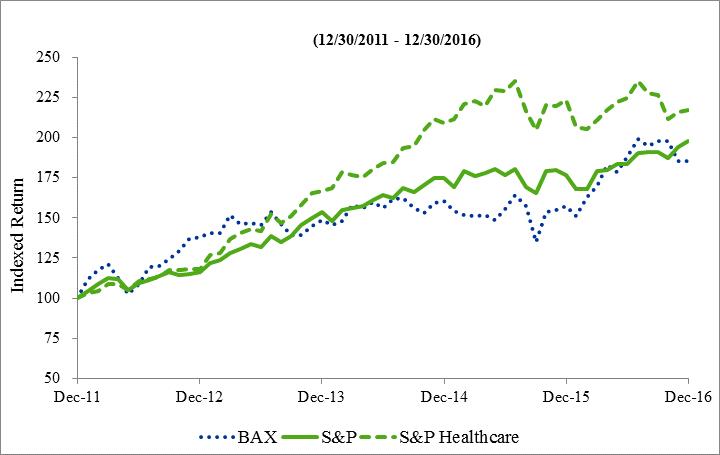
Item 6. Selected Financial Data.
| --- | --- |
See Note 1 of Item 8 for additional details regarding basis of presentation.
| as of or for the years ended December 31 | 20162,1 | 20153,1 | 20144,1 | 20135,1 | 20126,1 | |||||||||||||||||
|---|---|---|---|---|---|---|---|---|---|---|---|---|---|---|---|---|---|---|---|---|---|---|
| Operating Results | Net sales | $ | 10,163 | 9,968 | 10,719 | 9,413 | 8,626 | |||||||||||||||
| (in millions) | Income from continuing operations | $ | 4,966 | 393 | 457 | 315 | 663 | |||||||||||||||
| Income (loss) from discontinued operations, net of tax | $ | (1 | ) | 575 | 2,040 | 1,697 | 1,663 | |||||||||||||||
| Net income | $ | 4,965 | 968 | 2,497 | 2,012 | 2,326 | ||||||||||||||||
| Balance Sheet | Capital expenditures, continuing operations | $ | 719 | 911 | 925 | 706 | 622 | |||||||||||||||
| Information | Total assets | $ | 15,546 | 20,962 | 26,138 | 25,224 | 20,390 | |||||||||||||||
| (in millions) | Long-term debt and lease obligations | $ | 2,779 | 3,922 | 7,331 | 8,126 | 5,580 | |||||||||||||||
| Common Stock Information | Weighted-average number of common shares outstanding | |||||||||||||||||||||
| Basic | 546 | 545 | 542 | 543 | 551 | |||||||||||||||||
| Diluted | 551 | 549 | 547 | 549 | 556 | |||||||||||||||||
| Income from continuing operations per common share | ||||||||||||||||||||||
| Basic | $ | 9.10 | 0.72 | 0.84 | 0.58 | 1.20 | ||||||||||||||||
| Diluted | $ | 9.01 | 0.72 | 0.83 | 0.57 | 1.19 | ||||||||||||||||
| Income from discontinued operations per common share | ||||||||||||||||||||||
| Basic | $ | (0.01 | ) | 1.06 | 3.77 | 3.12 | 3.02 | |||||||||||||||
| Diluted | $ | 0.00 | 1.04 | 3.73 | 3.09 | 2.99 | ||||||||||||||||
| Net income per common share | ||||||||||||||||||||||
| Basic | $ | 9.09 | 1.78 | 4.61 | 3.70 | 4.22 | ||||||||||||||||
| Diluted | $ | 9.01 | 1.76 | 4.56 | 3.66 | 4.18 | ||||||||||||||||
| Cash dividends declared per common share | $ | 0.505 | 1.270 | 2.050 | 1.920 | 1.570 |
| 1 | Refer to the notes to the consolidated financial statements for information regarding other charges and income items. |
|---|
| 2 | Income from continuing operations included charges totaling $409 million for business optimization, $54 million related to the Baxalta separation, $149 million of debt extinguishment costs related to the March 2016 debt-for-equity exchange for certain company indebtedness and certain debt redemptions, $51 million for impairment primarily related to developed technology and $9 million related to the settlement of an income tax matter in the company’s non-wholly owned joint venture in Turkey. Also included were net realized gains of $4.4 billion related to the Baxalta Retained Shares transactions and a benefit of $18 million primarily related to adjustments to the COLLEAGUE and SIGMA SPECTRUM infusion pump reserves. |
|---|
| 3 | Income from continuing operations included charges totaling $200 million for business optimization, $111 million related to the Baxalta separation and $130 million related to Baxter’s July 2015 tender offer for certain outstanding indebtedness. Also included were benefits of $28 million primarily related to adjustments to the COLLEAGUE and SIGMA SPECTRUM infusion pump reserves, $52 million related to a litigation settlement in which Baxter was the beneficiary and $20 million relating to the reversal of contingent consideration milestone liabilities. |
|---|
| 4 | Income from continuing operations included charges totaling $138 million for business optimization, $68 million for SIGMA Spectrum Infusion Pump product remediation efforts, $11 million related to the Baxalta separation and $3 million to account for an additional year of the Branded Prescription Drug Fee in accordance with final regulations issued by the Internal Revenue Service. Also included were benefits of $1 million related to third-party recoveries and reversals of prior reserves. |
|---|
| 5 | Income from continuing operations included charges totaling $148 million for business optimization, $17 million primarily related to remediation efforts associated with modifications to the SIGMA Spectrum Infusion Pump in conjunction with re-filing for 510(k) clearance, $255 million related to the acquisition and integration of Gambro and losses from the derivative instruments used to hedge the anticipated foreign currency cash outflows and $25 million related to an upfront payment associated with one of the company’s collaboration arrangements. Also included were benefits of $3 million related to tax and legal reserves associated with VAT matters in Turkey. |
|---|
| 6 | Income from continuing operations included charges totaling $106 million for business optimization, $15 million primarily related to business development, and $170 million primarily related to pension settlement charges and other pension-related items. Also included were benefits of $23 million primarily related to an adjustment to the COLLEAGUE infusion pump reserve when the company substantially completed its recall activities in the United States and $91 million for gains related to a decrease in the estimated fair value of acquisition-related contingent payment liabilities. |
|---|
Item 7. Management’s Discussion and Analysis of Financial Condition and Results of Operations.
| --- | --- |
The following commentary should be read in conjunction with the consolidated financial statements and accompanying notes.
EXECUTIVE OVERVIEW
Description of the Company and Business Segments
Baxter International Inc., through its subsidiaries, provides a broad portfolio of essential renal and hospital products, including acute and chronic dialysis; sterile IV solutions; infusion systems and devices; parenteral nutrition therapies; premixed and oncolytic injectables; biosurgery products and anesthetics; drug reconstitution systems; and pharmacy automation, software and services. The company’s global footprint and critical nature of its products and services play a key role in expanding access to healthcare in emerging and developed countries. These products are used by hospitals, kidney dialysis centers, nursing homes, rehabilitation centers, doctors’ offices and by patients at home under physician supervision.
Separation of Baxalta Incorporated
On July 1, 2015, Baxter completed the distribution of approximately 80.5% of the outstanding common stock of its biopharmaceuticals business, Baxalta Incorporated (Baxalta), to Baxter stockholders (the Distribution). As a result of the separation, the operating results of Baxalta have been reflected as discontinued operations for the years ended December 31, 2016, 2015, and 2014. Refer to Note 2 in Item 8 for additional information regarding the separation of Baxalta. Unless otherwise stated, financial results herein reflect continuing operations.
Segments
Baxter operates under two reportable segments, Hospital Products and Renal. Refer to Note 14 in Item 8 for additional information regarding the company’s segments.
The segments and a description of their products and services are as follows:
The Hospital Products business manufactures sterile intravenous (IV) solutions and administration sets, premixed drugs and drug-reconstitution systems, pre-filled vials and syringes for injectable drugs, parenteral nutrition therapies, infusion pumps, inhalation anesthetics, and biosurgery products. The business also provides products and services related to pharmacy compounding, and drug formulation; sterile IV solutions; infusion systems and devices; parenteral nutrition therapies; premixed and oncolytic injectables; biosurgery products and anesthetics; drug reconstitution systems; and pharmacy automation, software and services.
The Renal business offers a comprehensive portfolio to meet the needs of patients with end-stage renal disease, or irreversible kidney disease and acute kidney injuries, including technologies and therapies for peritoneal dialysis (PD), hemodialysis (HD), continuous renal replacement therapy (CRRT) and additional dialysis services.
Baxter has approximately 48,000 employees and conducts business in over 100 countries. The company generates approximately 60% of its revenues outside the United States, and maintains approximately 50 manufacturing facilities and over 100 distribution facilities in the United States, Europe, Asia-Pacific, Latin America and Canada.
Financial Results
Baxter’s global net sales totaled $10.2 billion in 2016, an increase of 2% over 2015, including an unfavorable foreign currency impact of two percentage points. International sales totaled $5.9 billion in 2016, a decrease of 1% compared to 2015, including an unfavorable foreign currency impact of four percentage points. Sales in the United States totaled $4.3 billion in 2016, an increase of 6% compared to 2015.
Baxter’s income from continuing operations for 2016 totaled $5.0 billion or $9.01 per diluted share, compared to $393 million, or $0.72 per diluted share, in the prior year. Income from continuing operations in 2016 included special items which resulted in a net increase to income from continuing operations of $3.9 billion, or $7.05 per diluted share. Income from continuing operations in 2015 included special items which resulted in a net reduction to income from continuing operations of $362 million, or $0.66 per diluted share. The company’s special items are discussed further in the Results of Operations section below.
Baxter’s financial results included R&D expenses totaling $647 million in 2016, which reflects the company’s focus on balancing increased investments to support the company’s new product pipeline with efforts to optimize overall R&D spending through continuous evaluation of the portfolio.
The company’s financial position remains strong, with operating cash flows from continuing operations totaling $1.6 billion in 2016. The company has continued to execute on its disciplined capital allocation framework, which is designed to optimize stockholder value creation through reinvestment in the businesses, dividends and targeted share repurchases, as well as acquisitions and other business development initiatives as discussed in the Strategic Objectives section below.
Capital investments totaled $719 million in 2016 as the company continues to invest across its businesses to support future growth, including additional investments in support of new and existing product capacity expansions. The company’s investments in capital expenditures in 2016 were focused on projects that improve production efficiency and enhance manufacturing capabilities to support its strategy of geographic expansion with select investments in growing markets.
The company also continued to return value to its stockholders in the form of dividends. During 2016, the company paid cash dividends to its shareholders totaling $268 million. Additionally, in 2016 the company repurchased 17.8 million shares through cash repurchases and an equity-for-equity exchange of Retained Shares for outstanding Baxter shares.
Strategic Objectives
Baxter continues to focus on several key objectives to successfully execute its long-term strategy to achieve sustainable growth and deliver enhanced stockholder value. Baxter’s diversified and broad portfolio of medical products that treat life-threatening acute or chronic conditions and its global presence are core components of the company’s strategy to achieve these objectives. The company is focused on three strategic factors as part of its pursuit of industry leading performance: optimizing its core portfolio globally; operational excellence focused on streamlining the cost structure and enhancing operational efficiency; and following a disciplined and balanced approach to capital allocation.
Optimizing the Core Portfolio Globally
Baxter has categorized its product portfolio into four strategic business groupings. Those groupings include core growth, core return on capital, maintain or manage differently and strategic bets. Within the core growth grouping, Baxter looks to invest for long-term, higher margin growth. Baxter looks to optimize its return on investment and to maintain or enhance its market position with its core return on capital products. Maintain or manage differently products are those for which Baxter looks to sustain or reposition its underlying investment. Finally, the strategic bet grouping includes products for which Baxter is evaluating its market position and investment strategy. These products cover mature and emerging markets. While Baxter has made an initial assignment of each of its product categories to one of the business groupings described above, Baxter continues to evaluate each product category’s placement in light of shifting market dynamics and company priorities and may reassign a product category into a different business grouping from time to time.
As part of this portfolio review, Baxter seeks to optimize its position in product areas where the company has a stable, profitable business model, identify and alter investments in products that have reached the end of their life cycles or with respect to which market positions have evolved unfavorably. In the course of doing so, Baxter expects to continue to reallocate capital to more p
Showing the first 8K of 106K characters. Open the full section
Item 7A. Quantitative and Qualitative Disclosures About Market Risk.
| --- | --- |
Incorporated by reference to the section entitled “Financial Instrument Market Risk” in “Management’s Discussion and Analysis of Financial Condition and Results of Operations” in Item 7 of this Annual Report on Form 10-K.
Item 8. Financial Statements and Supplementary Data.
| --- | --- |
CONSOLIDATED BALANCE SHEETS
| as of December 31 (in millions, except share information) | 2016 | 2015 | ||||||||
|---|---|---|---|---|---|---|---|---|---|---|
| Current assets | Cash and equivalents | $ | 2,801 | $ | 2,213 | |||||
| Accounts and other current receivables, net | 1,691 | 1,731 | ||||||||
| Inventories | 1,430 | 1,604 | ||||||||
| Prepaid expenses and other | 602 | 855 | ||||||||
| Investment in Baxalta common stock | — | 5,148 | ||||||||
| Current assets held for disposition | 50 | 245 | ||||||||
| Total current assets | 6,574 | 11,796 | ||||||||
| Property, plant and equipment, net | 4,289 | 4,386 | ||||||||
| Other assets | Goodwill | 2,595 | 2,687 | |||||||
| Other intangible assets, net | 1,111 | 1,349 | ||||||||
| Other | 977 | 744 | ||||||||
| Total other assets | 4,683 | 4,780 | ||||||||
| Total assets | $ | 15,546 | $ | 20,962 | ||||||
| Current liabilities | Short-term debt | $ | — | $ | 1,775 | |||||
| Current maturities of long-term debt and lease obligations | 3 | 810 | ||||||||
| Accounts payable and accrued liabilities | 2,612 | 2,666 | ||||||||
| Current income taxes payable | 126 | 453 | ||||||||
| Current liabilities held for disposition | 3 | 46 | ||||||||
| Total current liabilities | 2,744 | 5,750 | ||||||||
| Long-term debt and lease obligations | 2,779 | 3,922 | ||||||||
| Other long-term liabilities | 1,743 | 2,425 | ||||||||
| Equity | Common stock, $1 par value, authorized 2,000,000,000 shares, issued 683,494,944 shares in 2016 and 2015 | 683 | 683 | |||||||
| Common stock in treasury, at cost, 143,890,064 shares in 2016 and 135,839,938 shares in 2015 | (7,995 | ) | (7,646 | ) | ||||||
| Additional contributed capital | 5,958 | 5,902 | ||||||||
| Retained earnings | 14,200 | 9,683 | ||||||||
| Accumulated other comprehensive (loss) income | (4,556 | ) | 224 | |||||||
| Total Baxter shareholders’ equity | 8,290 | 8,846 | ||||||||
| Noncontrolling interests | (10 | ) | 19 | |||||||
| Total equity | 8,280 | 8,865 | ||||||||
| Total liabilities and equity | $ | 15,546 | $ | 20,962 |
The accompanying notes are an integral part of these consolidated financial statements.
CONSOLIDATED STATEMENTS OF INCOME
| years ended December 31 (in millions, except per share data) | 2016 | 2015 | 2014 | |||||||||
|---|---|---|---|---|---|---|---|---|---|---|---|---|
| Net sales | $ | 10,163 | $ | 9,968 | $ | 10,719 | ||||||
| Cost of sales | 6,053 | 5,822 | 6,138 | |||||||||
| Gross margin | 4,110 | 4,146 | 4,581 | |||||||||
| Marketing and administrative expenses | 2,739 | 3,094 | 3,315 | |||||||||
| Research and development expenses | 647 | 603 | 610 | |||||||||
| Operating income | 724 | 449 | 656 | |||||||||
| Net interest expense | 66 | 126 | 145 | |||||||||
| Other (income) expense, net | (4,296 | ) | (105 | ) | 21 | |||||||
| Income from continuing operations before income taxes | 4,954 | 428 | 490 | |||||||||
| Income tax (benefit) expense | (12 | ) | 35 | 33 | ||||||||
| Income from continuing operations | 4,966 | 393 | 457 | |||||||||
| (Loss) income from discontinued operations, net of tax | (1 | ) | 575 | 2,040 | ||||||||
| Net income | $ | 4,965 | $ | 968 | $ | 2,497 | ||||||
| Income from continuing operations per common share | ||||||||||||
| Basic | $ | 9.10 | $ | 0.72 | $ | 0.84 | ||||||
| Diluted | $ | 9.01 | $ | 0.72 | $ | 0.83 | ||||||
| (Loss) income from discontinued operations per common share | ||||||||||||
| Basic | $ | (0.01 | ) | $ | 1.06 | $ | 3.77 | |||||
| Diluted | $ | 0.00 | $ | 1.04 | $ | 3.73 | ||||||
| Net income per common share | ||||||||||||
| Basic | $ | 9.09 | $ | 1.78 | $ | 4.61 | ||||||
| Diluted | $ | 9.01 | $ | 1.76 | $ | 4.56 | ||||||
| Weighted-average number of common shares outstanding | ||||||||||||
| Basic | 546 | 545 | 542 | |||||||||
| Diluted | 551 | 549 | 547 |
The accompanying notes are an integral part of these consolidated financial statements.
CONSOLIDATED STATEMENTS OF COMPREHENSIVE INCOME
| years ended December 31 (in millions) | 2016 | 2015 | 2014 | |||||||||
|---|---|---|---|---|---|---|---|---|---|---|---|---|
| Net income | $ | 4,965 | $ | 968 | $ | 2,497 | ||||||
| Other comprehensive (loss) income, net of tax: | ||||||||||||
| Currency translation adjustments, net of tax benefit of ($39) in 2016, ($107) in 2015 and ($132) in 2014 | (247 | ) | (1,094 | ) | (1,332 | ) | ||||||
| Pension and other employee benefits, net of tax (benefit) expense of ($36) in 2016, $104 in 2015 and ($193) in 2014 | (97 | ) | 165 | (400 | ) | |||||||
| Hedging activities, net of tax (benefit) expense of ($2) in 2016, $9 in 2015 and $14 in 2014 | (4 | ) | 15 | 24 | ||||||||
| Available-for-sale securities, net of tax expense (benefit) of zero in 2016, $6 in 2015 and ($2) in 2014 | (4,432 | ) | 4,438 | 34 | ||||||||
| Total other comprehensive income (loss), net of tax | (4,780 | ) | 3,524 | (1,674 | ) | |||||||
| Comprehensive income | $ | 185 | $ | 4,492 | $ | 823 |
The accompanying notes are an integral part of these consolidated financial statements.
CONSOLIDATED STATEMENTS OF CASH FLOWS
| years ended December 31 (in millions) (brackets denote cash outflows) | 2016 | 2015 | 2014 | |||||||||||
|---|---|---|---|---|---|---|---|---|---|---|---|---|---|---|
| Cash flows from | Net income | $ | 4,965 | $ | 968 | $ | 2,497 | |||||||
| operations | Adjustments to reconcile income from continuing operations to net cash from operating activities: | |||||||||||||
| Loss (income) from discontinued operations, net of tax | 1 | (575 | ) | (2,040 | ) | |||||||||
| Depreciation and amortization | 800 | 759 | 792 | |||||||||||
| Deferred income taxes | (302 | ) | (50 | ) | (117 | ) | ||||||||
| Stock compensation | 115 | 126 | 126 | |||||||||||
| Realized excess tax benefits from stock issued under employee benefit plans | (39 | ) | (7 | ) | (15 | ) | ||||||||
| Net periodic pension benefit and OPEB costs | 116 | 227 | 219 | |||||||||||
| Business optimization items | 285 | 130 | (6 | ) | ||||||||||
| Net realized gains on Baxalta common stock | (4,387 | ) | — | — | ||||||||||
| Infusion pump and other product-related charges | (18 | ) | (28 | ) | 93 | |||||||||
| Other | 264 | 42 | 19 | |||||||||||
| Changes in balance sheet items | ||||||||||||||
| Accounts and other current receivables, net | 15 | (4 | ) | (93 | ) | |||||||||
| Inventories | 80 | (118 | ) | (143 | ) | |||||||||
| Accounts payable and accrued liabilities | (197 | ) | 236 | (37 | ) | |||||||||
| Business optimization and infusion pump payments | (189 | ) | (112 | ) | (124 | ) | ||||||||
| Other |
Showing the first 8K of 189K characters. Open the full section
Item 9. Changes in and Disagreements with Accountants on Accounting and Financial Disclosure.
| --- | --- |
None.
Item 9A. Controls and Procedures.
| --- | --- |
Evaluation of Disclosure Controls and Procedures
Baxter carried out an evaluation, under the supervision and with the participation of its Disclosure Committee and management, including the Chief Executive Officer and Chief Financial Officer, of the effectiveness of Baxter’s disclosure controls and procedures (as defined in Rules 13a-15(e) and 15d-15(e) under the Exchange Act) as of December 31, 2016. Baxter’s disclosure controls and procedures are designed to ensure that information required to be disclosed by Baxter in the reports it files or submits under the Exchange Act is recorded, processed, summarized and reported on a timely basis and that such information is communicated to management, including the Chief Executive Officer, Chief Financial Officer and its Board of Directors, to allow timely decisions regarding required disclosure.
Based on that evaluation the Chief Executive Officer and Chief Financial Officer concluded that the company’s disclosure controls and procedures were effective as of December 31, 2016.
Management’s Assessment of Internal Control Over Financial Reporting
Management is responsible for establishing and maintaining adequate internal control over financial reporting, as defined in Rules 13a-15(f) and 15d-15(f) under the Securities Exchange Act of 1934, as amended. The company’s internal control over financial reporting is a process designed under the supervision of the principal executive and financial officers, and effected by the board of directors, management and other personnel, to provide reasonable assurance regarding the reliability of financial reporting and the preparation of financial statements for external purposes in accordance with accounting principles generally accepted in the United States of America.
Management performed an assessment of the effectiveness of the company’s internal control over financial reporting as of December 31, 2016. In making this assessment, management used the framework in Internal Control-Integrated Framework (2013) issued by the Committee of Sponsoring Organizations of the Treadway Commission. Based on that assessment under the framework in Internal Control-Integrated Framework (2013) , management concluded that the company’s internal control over financial reporting was effective as of December 31, 2016.
The effectiveness of the company’s internal control over financial reporting as of December 31, 2016 has been audited by PricewaterhouseCoopers LLP, an independent registered public accounting firm, as stated in their report which appears herein.
Changes in Internal Control over Financial Reporting
There have been no changes in Baxter’s internal control over financial reporting (as such term is defined in Rules 13a-15(f) and 15d-15(f) under the Exchange Act) during the quarter ended December 31, 2016 that have materially affected, or are reasonably likely to materially affect, Baxter’s internal control over financial reporting.
Item 9B. Other Information.
| --- | --- |
None.
PART III
Item 10. Directors, Executive Officers and Corporate Governance.
| --- | --- |
Refer to information under the captions entitled “Corporate Governance at Baxter International Inc. — Proposal 1 — Election of Directors,” “— Directors Continuing in Office,” “— Board of Directors — Nomination of Directors,” “— Committees of the Board — Audit Committee,” “— Board Responsibilities — Code of Conduct,” and “Ownership of Our Stock — Section 16(a) Beneficial Ownership Reporting Compliance” in Baxter’s definitive proxy statement to be filed with the Securities and Exchange Commission and delivered to stockholders in connection with the Annual Meeting of Stockholders to be held on May 2, 2017 (the Proxy Statement), all of which information is incorporated herein by reference. Also refer to information regarding executive officers of Baxter under the caption entitled “Executive Officers of the Registrant” in Part I of this Annual Report on Form 10-K.
Item 11. Executive Compensation.
| --- | --- |
Refer to information under the captions entitled “Executive Compensation,” and “Corporate Governance at Baxter International—Director Compensation” in the Proxy Statement, all of which information is incorporated herein by reference.
Item 12. Security Ownership of Certain Beneficial Owners and Management and Related Stockholder Matters.
| --- | --- |
The following table provides information relating to shares of common stock that may be issued under Baxter’s existing equity compensation plans as of December 31, 2016.
| Plan Category | Number of Shares to be Issued upon Exercise of Outstanding Options, Warrants and Rights(a) | Weighted-Average Exercise Price of Outstanding Options, Warrants and Rights(b) | Number of Shares Remaining Available for Future Issuance Under Equity Compensation Plans (Excluding Shares Reflected in Column(a))(c) | ||||||||||||
|---|---|---|---|---|---|---|---|---|---|---|---|---|---|---|---|
| Equity Compensation Plans Approved by Shareholders | 35,252,613 | (1) | $ | 35.95 | (2) | 45,829,969 | (3) | ||||||||
| Equity Compensation Plans Not Approved by Shareholders | 1,140,770 | (4) | $ | 30.06 | — | ||||||||||
| Total | 36,393,383 | (5) | $ | 35.73 | (2) | 45,829,969 |
| (1) | Excludes purchase rights under the Employee Stock Purchase Plan. Under the Employee Stock Purchase Plan, eligible employees may purchase shares of common stock through payroll deductions of up to 15 percent of base pay at a purchase price equal to 85 percent of the closing market price on the purchase date (as defined by the Employee Stock Purchase Plan). A participating employee may not purchase more than $25,000 in fair market value of common stock under the Employee Stock Purchase Plan in any calendar year and may withdraw from the Employee Stock Purchase Plan at any time. |
|---|
| (2) | Restricted stock units and performance share units are excluded when determining the weighted-average exercise price of outstanding options. |
|---|
| (3) | Includes (i) 5,032,670 shares of common stock available for purchase under the Employee Stock Purchase Plan; (ii) 119,171 shares of common stock available under the 2007 Incentive Plan; (iii) 7,228,968 shares of common stock available under the 2011 Incentive Plan; and (iv) 33,449,160 shares of common stock available under the 2015 Incentive Plan. |
|---|
| (4) | Includes shares of common stock issuable upon exercise of options granted under the 2001 Incentive Compensation Program. These shares were made available pursuant to an amendment thereto not approved by shareholders. These additional shares were approved by the company’s board of directors, not the company’s shareholders, although the company shareholders have approved the 2001 Incentive Compensation Program. |
|---|
| (5) | Includes outstanding awards of 33,076,401 stock options, which have a weighted-average exercise price of $35.73 and a weighted-average remaining term of 6.2 years, 2,697,906 shares of common stock issuable upon vesting of restricted stock units, and 277,743 shares of common stock reserved for issuance in connection with performance share unit grants. |
|---|
Refer to information under the captions entitled “Ownership of Our Stock — Security Ownership by Directors and Executive Officers” and “— Security Ownership by Certain Beneficial Owners” in the Proxy Statement, all of which information is incorporated herein by reference.
Item 13. Certain Relationships and Related Transactions, and Director Independence.
| --- | --- |
Refer to the information under the first paragraph of the caption entitled “Corporate Governance—at Baxter International Inc.—Board of Directors” and the captions entitled “Corporate Governance at Baxter International Inc.—Board of Directors—Director Independence” and “Corporate Governance at Baxter International Inc.—Other Corporate Governance Information—Certain Relationships and Related Person Transactions” in the Proxy Statement, all of which information is incorporated herein by reference.
Item 14. Principal Accountant Fees and Services.
| --- | --- |
Refer to the information under the caption entitled “Audit Matters — Audit and Non-Audit Fees” and “—Pre-Approval of Audit and Permissible Non-Audit Fees” in the Proxy Statement, all of which information is incorporated herein by reference.
PART IV
Item 15. Exhibits and Financial Statement Schedules.
| --- | --- |
The following documents are filed as a part of this report:
| Page Number | ||||
|---|---|---|---|---|
| (1) | Financial Statements: | |||
| Consolidated Balance Sheets | 40 | |||
| Consolidated Statements of Income | 41 | |||
| Consolidated Statements of Comprehensive Income | 42 | |||
| Consolidated Statements of Cash Flows | 43 | |||
| Consolidated Statements of Changes in Equity | 44 | |||
| Notes to Consolidated Financial Statements | 45 | |||
| Report of Independent Registered Public Accounting Firm | 87 | |||
| (2) | Schedules required by Article 12 of Regulation S-X: | |||
| Schedule II — Valuation and Qualifying Accounts | 96 | |||
| All other schedules have been omitted because they are not applicable or not required. | ||||
| (3) | Exhibits required by Item 601 of Regulation S-K are listed in the Exhibit Index, which is incorporated herein by reference. Exhibits in the Exhibit Index marked with a “C” in the left margin constitute management contracts or compensatory plans or arrangements contemplated by Item 15(b) of Form 10-K. |
SIGNATURES
Pursuant to the requirements of Section 13 or 15(d) of the Securities Exchange Act of 1934, the registrant has duly caused this report to be signed on its behalf by the undersigned, thereunto duly authorized.
| BAXTER INTERNATIONAL INC. | ||
|---|---|---|
| By: | /s/ José E. Almeida | |
| José E. Almeida | ||
| Chairman and Chief Executive Officer |
DATE: February 23, 2017
Pursuant to the requirements of the Securities Exchange Act of 1934, this report has been signed below by the following persons on behalf of the registrant and in the capacities indicated on February 23, 2017.
| Signature | Title | |
|---|---|---|
| /s/ José E. Almeida | Chairman and Chief Executive Officer | |
| José E. Almeida. | (principal executive officer) | |
| /s/ James K. Saccaro | Corporate Vice President and Chief Financial Officer | |
| James K. Saccaro | (principal financial officer) | |
| /s/ Caroline D. Karp | Corporate Vice President and Controller | |
| Caroline D. Karp | (principal accounting officer) | |
| /s/ Thomas F. Chen | Director | |
| Thomas F. Chen | ||
| /s/ John D. Forsyth | Director | |
| John D. Forsyth | ||
| /s/ James R. Gavin III, M.D., Ph.D. | Director | |
| James R. Gavin III, M.D., Ph.D. | ||
| /s/ Peter S. Hellman | Director | |
| Peter S. Hellman | ||
| /s/ Munib Islam | Director | |
| Munib Islam | ||
| /s/ Michael F. Mahoney | Director | |
| Michael F. Mahoney | ||
| Director | ||
| Stephen N. Oesterle, M.D. | ||
| /s/ Carole J. Shapazian | Director | |
| Carole J. Shapazian | ||
| /s/ Thomas T. Stallkamp | Director | |
| Thomas T. Stallkamp | ||
| /s/ K.J. Storm | Director | |
| K.J. Storm | ||
| /s/ Albert P. L. Stroucken | Director | |
| Albert P. L. Stroucken |
EXHIBIT INDEX
| Number and Description of Exhibit | ||
|---|---|---|
| 2.1 | Separation and Distribution Agreement (incorporated by reference to Exhibit 2.1 to the Company’s Current Report on Form 8-K, filed on July 7, 2015). | |
| 3.1 3.2 | Amended and Restated Certificate of Incorporation (incorporated by reference to Exhibit 3.1 to the Company’s Current Report on Form 8-K, filed on May 10, 2013). Certificate of Amendment to the Amended and Restated Certificate of Incorporation dated May 3, 2016 (incorporated by reference to Exhibit 3.1 to the Company’s Current Report on Form 8-K, filed on May 4, 2016). | |
| 3.3 | Bylaws, as amended and restated on December 18, 2015 (incorporated by reference to Exhibit 3.1 to the Company’s Current Report on Form 8-K, filed on December 18, 2015). | |
| 4.1 | Form of Common Stock Certificate of the Company (incorporated by reference to Exhibit(a) to the Company’s Registration Statement on Form S-16 (Registration No. 02-65269), filed on August 17, 1979). | |
| 4.2 | Indenture, dated August 8, 2006, between the Company and J.P. Morgan Trust Company, National Association, as Trustee (incorporated by reference to Exhibit 4.1 to the Company’s Current Report on Form 8-K, filed on August 9, 2006). | |
| 4.3 | First Supplemental Indenture, dated August 8, 2006, between the Company and J.P. Morgan Trust Company, National Association, as Trustee (including form of 5.90% Senior Note due 2016) (incorporated by reference to Exhibit 4.2 to the Company’s Current Report on Form 8-K, filed on August 9, 2006). | |
| 4.4 | Second Supplemental Indenture, dated December 7, 2007, between the Company and The Bank of New York Trust Company, N.A. (as successor in interest to J.P. Morgan Trust Company, National Association), as Trustee (including form of 6.250% Senior Note due 2037) (incorporated by reference to Exhibit 4.1 to the Company’s Current Report on Form 8-K, filed on December 7, 2007). | |
| 4.5 | Eighth Supplemental Indenture, dated August 13, 2012, between the Company and The Bank of New York Mellon Trust Company, N.A. (as successor in interest to J.P. Morgan Trust Company, National Association), as Trustee (including forms of 2.400% Senior Notes due 2022 and 3.650% Senior Notes due 2042) (incorporated by reference to Exhibit 4.1 to the Company’s Current Report on Form 8-K, filed on August 13, 2012). | |
| 4.6 4.7 | Ninth Supplemental Indenture, dated June 11, 2013, between the Company and The Bank of New York Mellon Trust Company, N.A. (as successor in interest to J.P. Morgan Trust Company, National Association), as Trustee (including forms of 0.950% Senior Notes due 2016 and 4.500% Senior Notes due 2043) (incorporated by reference to Exhibit 4.1 to the Company’s Current Report on Form 8-K, filed on June 11, 2013). Tenth Supplemental Indenture, dated August 13, 2016, between the Company and The Bank of New York Mellon Trust Company, N.A., as Trustee (including forms of 1.700% Senior Notes due 2021, 2.600% Senior Notes due 2026 and 3.500% Senior Notes due 2046) (incorporated by reference to Exhibit 4.2 to the Company’s Current Report on Form 8-K, filed on August 15, 2016). | |
| 10.1 | Five-Year Credit Agreement, dated as of July 1, 2015, among Baxter International Inc. as Borrower, JPMorgan Chase Bank, National Association, as Administrative Agent and certain other financial institutions named therein (incorporated by reference to Exhibit 10.4 to the Company’s Current Report on Form 8-K, filed on July 7, 2015). | |
| 10.2 | Amendment No. 1 to the Five-Year Credit Agreement, dated as of October 26, 2015, among Baxter International Inc. as Borrower, JPMorgan Chase Bank, National Association, as Administrative Agent and certain other financial institutions named therein (incorporated by reference to Exhibit 10.1 to the Company’s Current Report on Form 8-K, filed on October 27, 2015). | |
| 10.3 | Credit Agreement, dated as of July 1, 2015, among Baxter Healthcare SA and Baxter World Trade SPRL, as Borrowers, J.P. Morgan Europe Limited, as Administrative Agent and certain other financial institutions named therein (incorporated by reference to Exhibit 10.5 to the Company’s Current Report on Form 8-K, filed on July 7, 2015). | |
| 10.4 | Amendment No. 1 to the Credit Agreement, dated as of October 26, 2015, among Baxter Healthcare SA and Baxter World Trade SPRL, as Borrowers, J.P. Morgan Europe Limited, as Administrative Agent and certain other financial institutions named therein (incorporated by reference to Exhibit 10.2 to the Company’s Current Report on Form 8-K, filed on October 27, 2015), | |
| Number and Description of Exhibit | ||
|---|---|---|
| 10.5 | Employee Matters Agreement, dated as of June 30, 2015, by and between Baxter International Inc. and Baxalta Incorporated (incorporated by reference to Exhibit 10.1 to the Company’s Current Report on Form 8-K, filed on July 7, 2015). | |
| 10.6 | Tax Matters Agreement, dated as of June 30, 2015, by and between Baxter International Inc. and Baxalta Incorporated (incorporated by reference to Exhibit 10.2 to the Company’s Current Report on Form 8-K, filed on July 7, 2015). | |
| 10.7 | Shareholder’s and Registration Rights Agreement, dated as of June 30, 2015, by and between Baxter International Inc. and Baxalta Incorporated (incorporated by reference to Exhibit 10.3 to the Company’s Current Report on Form 8-K, filed on July 7, 2015). | |
| 10.8 | Support Agreement, dated as of September 29, 2015, by and among Baxter International Inc., Third Point LLC, Third Point Partners L.P., Third Point Partners Qualified L.P., Third Point Offshore Master Fund L.P., Third Point Ultra Master Fund L.P., Third Point Reinsurance Co. Ltd., Third Point Advisors LLC, Third Point Advisors II LLC, Daniel S. Loeb and Munib Islam (incorporated by reference to Exhibit 10.1 to the Company’s Current Report on Form 8-K, filed on September 30, 2015). | |
| C 10.9 | Form of Indemnification Agreement entered into with directors and officers (incorporated by reference to Exhibit 19.4 to the Company’s Quarterly Report on Form 10-Q, filed on November 14, 1986). | |
| C 10.10 | Baxter International Inc. 2007 Incentive Plan (incorporated by reference to Appendix A to the Company’s Definitive Proxy Statement on Schedule 14A, filed on March 20, 2007). | |
| C 10.11 | Baxter International Inc. Equity Plan for the 2007 Incentive Plan (incorporated by reference to Exhibit 10.1 to the Company’s Current Report on Form 8-K, filed on March 16, 2007). | |
| C 10.12 | Baxter International Inc. 2011 Incentive Plan (incorporated by reference to Appendix B to the Company’s Definitive Proxy Statement on Schedule 14A, filed on March 18, 2011). | |
| C 10.13 | Baxter International Inc. Equity Plan for the 2011 Incentive Plan (incorporated by reference to Exhibit 10.1 to the Company’s Quarterly Report on Form 10-Q, filed on May 3, 2011). | |
| C 10.14 | Baxter International Inc. 2015 Incentive Plan (incorporated by reference to Appendix A to the Company’s Definitive Proxy Statement on Schedule 14A, filed on March 25, 2015). | |
| C 10.15 | Baxter International Inc. Equity Plan for the 2015 Incentive Plan (incorporated by reference to Exhibit 10.6 to the Company’s Current Report on Form 8-K, filed on July 7, 2015). | |
| C 10.16 | Baxter International Inc. Equity Plan for José E. Almeida under the 2015 Incentive Plan (incorporated by reference to Exhibit 10.2 to the Company’s Current Report on Form 8-K, filed on October 29, 2015). | |
| C 10.17 | Baxter International Inc. Directors’ Deferred Compensation Plan (amended and restated effective January 1, 2009) and Amendment No. 1 thereto effective January 1, 2012 (incorporated by reference to Exhibit 10.9 to the Company’s Annual Report on Form 10-K filed on February 23, 2012). | |
| C 10.18 | Offer Letter between Baxter International Inc. and José E. Almeida, dated as of October 28, 2015 (incorporated by reference to Exhibit 10.1 to the Company’s Current Report on Form 8-K, filed on October 29, 2015). | |
| C 10.19 | Form of Severance Agreement entered into with executive officers (incorporated by reference to Exhibit 10.11 to the Company’s Annual Report on Form 10-K, filed on February 21, 2014). | |
| C 10.20* C 10.21* C 10.22* | Baxter International Inc. and Subsidiaries Pension Plan (amended and restated effective January 1, 2016). First Amendment to Baxter International Inc. and Subsidiaries Pension Plan (dated as of December 21, 2016). Baxter International Inc. and Subsidiaries Supplemental Pension Plan (amended and restated effective January 1, 2015). | |
| C 10.23* | Baxter International Inc. and Subsidiaries Deferred Compensation Plan (amended and restated effective January 1, 2015). | |
| Number and Description of Exhibit | ||
|---|---|---|
| C 10.24* C 10.25* C 10.26 | First Amendment to the Baxter International Inc. and Subsidiaries Deferred Compensation Plan (effective May 11, 2016). Second Amendment to the Baxter International Inc. and Subsidiaries Deferred Compensation Plan (effective December 21, 2016). Baxter International Inc. Employee Stock Purchase Plan (as amended and restated effective July 1, 2011) (incorporated by reference to Appendix A to the Company’s Definitive Proxy Statement on Schedule 14A, filed on March 18, 2011). | |
| C 10.27* C 10.28* | First Amendment to Baxter International Inc. Employee Stock Purchase Plan (dated as of July 15, 2016). Baxter International Inc. Non-Employee Director Compensation Plan (as amended and restated effective January 1, 2017). | |
| 10.29 | Letter Agreement, dated as of January 11, 2016, by and among Baxter International Inc., Baxalta Incorporated and Shire plc. (Incorporated by reference to Exhibit 10.1 to the Company’s Current Report on Form 8-K, filed on January 11, 2016). | |
| 12* | Computation of Ratio of Earnings to Fixed Charges. | |
| 21* | Subsidiaries of Baxter International Inc. | |
| 23* | Consent of PricewaterhouseCoopers LLP. | |
| 31.1* | Certification of Chief Executive Officer pursuant to Rules 13a-14(a) and 15d-14(a) of the Securities Exchange Act of 1934, as amended. | |
| 31.2* | Certification of Chief Financial Officer pursuant to Rules 13a-14(a) and 15d-14(a) and 15d-14(a) of the Securities Exchange Act of 1934, as amended. | |
| 32.1* | Certification of Chief Executive Officer pursuant to 18 U.S.C. Section 1350, as adopted pursuant to Section 906 of the Sarbanes-Oxley Act of 2002. | |
| 32.2* | Certification of Chief Financial Officer pursuant to 18 U.S.C. Section 1350, as adopted pursuant to Section 906 of the Sarbanes-Oxley Act of 2002. | |
| 101.INS* | XBRL Instance Document | |
| 101.SCH* | XBRL Taxonomy Extension Schema Document | |
| 101.CAL* | XBRL Taxonomy Extension Calculation Linkbase Document | |
| 101.LAB* | XBRL Taxonomy Extension Label Linkbase Document | |
| 101.PRE* | XBRL Taxonomy Extension Presentation Linkbase Document | |
| 101.DEF* | XBRL Taxonomy Extension Definition Linkbase Document |
| * | Filed herewith. |
|---|
| C | Management contract or compensatory plan or arrangement. |
|---|
SCHEDULE II
| Additions | ||||||||||||||||||||
|---|---|---|---|---|---|---|---|---|---|---|---|---|---|---|---|---|---|---|---|---|
| Valuation and Qualifying Accounts (in millions) | Balance at beginning of period | Charged to costs and expenses | Charged (credited) to other accounts (1)(2) | Deductions from reserves | Balance at end of period | |||||||||||||||
| Year ended December 31, 2016: | ||||||||||||||||||||
| Allowance for doubtful accounts | $ | 110 | 16 | 11 | (10 | ) | $ | 127 | ||||||||||||
| Deferred tax asset valuation allowance | $ | 135 | 16 | 3 | (4 | ) | $ | 150 | ||||||||||||
| Year ended December 31, 2015: | ||||||||||||||||||||
| Allowance for doubtful accounts | $ | 119 | 30 | (10 | ) | (29 | ) | $ | 110 | |||||||||||
| Deferred tax asset valuation allowance | $ | 129 | 30 | (16 | ) | (8 | ) | $ | 135 | |||||||||||
| Year ended December 31, 2014: | ||||||||||||||||||||
| Allowance for doubtful accounts | $ | 148 | 1 | (15 | ) | (15 | ) | $ | 119 | |||||||||||
| Deferred tax asset valuation allowance | $ | 128 | 10 | (6 | ) | (3 | ) | $ | 129 |
| (1) | Valuation accounts of acquired or divested companies and foreign currency translation adjustments. |
|---|
| (2) | Amounts include adjustments related to the divestiture of the BioSciences business. |
|---|
Reserves are deducted from assets to which they apply.