 filings.tools
Item 1. Business
40K characters. Original on sec.gov · Markdown
Item 1. Business
Overview
Brown-Forman Corporation (the “Company,” “Brown-Forman,” “we,” “us,” or “our” below) was incorporated under the laws of the State of Delaware in 1933, successor to a business founded in 1870 as a partnership and later incorporated under the laws of the Commonwealth of Kentucky in 1901. We primarily manufacture, bottle, import, export, market, and sell a wide variety of alcoholic beverages under recognized brands. We employ approximately 4,700 people on six continents (excluding individuals that work on a part-time or temporary basis), including approximately 1,200 people in Louisville, Kentucky, USA, home of our world headquarters. We are the largest American-owned spirits and wine company with global reach. We are a “controlled company” under New York Stock Exchange rules because the Brown family owns more than 50% of our voting stock. Taking into account ownership of shares of our non-voting stock, the Brown family also controls more than 50% of the economic ownership in Brown-Forman.
For a discussion of recent developments, see “Item 7. Management’s Discussion and Analysis of Financial Condition and Results of Operations – Executive Summary.”
Brands
Beginning in 1870 with Old Forester Kentucky Straight Bourbon Whisky – our founding brand – and spanning the generations since, we have built a portfolio of more than 40 spirit, ready-to-drink (RTD) cocktail, and wine brands that includes some of the best-known and most loved trademarks in our industry. The most important brand in our portfolio is Jack Daniel’s Tennessee Whiskey, which was ranked in the 2018 Interbrand “Best Global Brands” as the most valuable global spirits brand in the world and the second most valuable beverage alcohol brand. Jack Daniel’s Tennessee Whiskey is the largest American whiskey brand in the world and the fourth-largest spirits brand of any kind, according to Impact Databank’s “Top 100 Premium Spirits Brands Worldwide” list. Among the top five premium spirits brands on the list, Jack Daniel’s Tennessee Whiskey was the only one to grow volume in each of the past five years. Our other leading global brands on the Worldwide Impact list are Finlandia, which is the tenth-largest-selling vodka; Jack Daniel’s Tennessee Honey, which is the second-largest-selling flavored whiskey; and el Jimador, which grew to become the fourth-largest-selling tequila. Woodford Reserve was once again selected as an Impact “Hot Brand,”1 marking six consecutive years on the list. Old Forester and Pepe Lopez were also named to the 2018 “Hot Brand”1 list.
| Principal Brands | ||
|---|---|---|
| Jack Daniel’s Tennessee Whiskey | el Jimador Tequilas | |
| Jack Daniel’s RTDs2 | el Jimador New Mix RTDs | |
| Jack Daniel’s Tennessee Honey | Herradura Tequilas6 | |
| Gentleman Jack Rare Tennessee Whiskey | Sonoma-Cutrer California Wines | |
| Jack Daniel’s Tennessee Fire | Canadian Mist Canadian Whisky | |
| Jack Daniel’s Single Barrel Collection3 | GlenDronach Single Malt Scotch Whisky | |
| Jack Daniel’s Tennessee Rye | BenRiach Single Malt Scotch Whisky | |
| Jack Daniel’s Sinatra Select | Glenglassaugh Single Malt Scotch Whisky | |
| Jack Daniel’s No. 27 Gold Tennessee Whiskey | Old Forester Kentucky Straight Bourbon Whisky | |
| Jack Daniel’s Winter Jack | Old Forester Whiskey Row Series | |
| Jack Daniel’s Bottled-in-Bond4 | Old Forester Kentucky Straight Rye Whisky4 | |
| Woodford Reserve Kentucky Bourbon | Chambord Liqueur | |
| Woodford Reserve Double Oaked | Early Times Kentucky Whisky and Bourbon | |
| Woodford Reserve Kentucky Rye Whiskey | Pepe Lopez Tequila | |
| Woodford Reserve Kentucky Straight Malt Whiskey4 | Antiguo Tequila | |
| Finlandia Vodkas | Slane Irish Whiskey | |
| Korbel California Champagnes5 | Coopers’ Craft Kentucky Bourbon | |
| Korbel California Brandy5 |
| 1Impact Databank, March 2019. | |
| 2Jack Daniel’s RTDs includes Jack Daniel’s & Cola, Jack Daniel’s & Diet Cola, Jack & Ginger, Jack Daniel’s Country Cocktails, Gentleman Jack & Cola, Jack Daniel’s Double Jack, Jack Daniel’s American Serve, Jack Daniel’s Tennessee Honey RTD, Jack Daniel’s Cider, and Jack Daniel’s Lynchburg Lemonade. | |
| 3The Jack Daniel’s Single Barrel Collection includes Jack Daniel’s Single Barrel Select, Jack Daniel’s Single Barrel Barrel Proof, Jack Daniel’s Single Barrel Rye, and Jack Daniel’s Single Barrel 100 Proof. | |
| 4New brands launched in fiscal 2019. | |
| 5Korbel is not an owned brand. We sell Korbel products under contract in the United States and other select markets. | |
| 6Herradura Tequilas comprises all expressions of Herradura including Herradura Ultra. |
See “Item 7. Management’s Discussion and Analysis of Financial Condition and Results of Operations – Results of Operations – Fiscal 2019 Brand Highlights” for brand performance details.
Our vision in marketing is to be the best brand-builders in the industry. We build our brands by investing in programs that we believe create enduring connections with our consumers. These programs cover a wide spectrum of activities, including media (TV, radio, print, outdoor, and, increasingly, digital and social), consumer and trade promotions, sponsorships, and visitors’ center programs at our distilleries and our winery. We expect to grow our sales and profits by consistently delivering creative, responsible marketing programs that drive brand recognition, brand trial, brand loyalty – and, ultimately, consumer demand around the world.
Markets
We sell our products in over 170 countries around the world. The United States, our most important market, accounted for 47% of our net sales in fiscal 2019. We generated 53% of our net sales outside the United States in fiscal 2019. Our largest international markets include the United Kingdom, Mexico, Australia, Germany, France, Poland, Russia, Japan, and Brazil. We present the percentage of total net sales by geographic area for our most recent five fiscal years below:
| Percentage of Total Net Sales by Geographic Area | ||||||||||
|---|---|---|---|---|---|---|---|---|---|---|
| Year ended April 30 | ||||||||||
| 2015 | 2016 | 2017 | 2018 | 2019 | ||||||
| United States | 46 | % | 48 | % | 48 | % | 47 | % | 47 | % |
| International: | ||||||||||
| Europe | 27 | % | 27 | % | 26 | % | 27 | % | 26 | % |
| Australia | 6 | % | 5 | % | 5 | % | 5 | % | 5 | % |
| Other | 21 | % | 20 | % | 21 | % | 21 | % | 22 | % |
| Total International | 54 | % | 52 | % | 52 | % | 53 | % | 53 | % |
| TOTAL | 100 | % | 100 | % | 100 | % | 100 | % | 100 | % |
| Note: Totals may differ due to rounding |
For details about net sales in our largest markets, see “Item 7. Management’s Discussion and Analysis of Financial Condition and Results of Operations – Fiscal 2019 Market Highlights.” For details about our reportable segment and for additional geographic information about net sales and long-lived assets, see Note 17 to the Consolidated Financial Statements in “Item 8. Financial Statements and Supplementary Data.” For details on risks related to our global operations, see “Item 1A. Risk Factors.”
Distribution Network and Customers
Our distribution network, or our “route-to-consumer” (RTC), varies depending on (a) a market’s laws and regulatory framework for trade in beverage alcohol, (b) our assessment of a market’s long-term attractiveness and competitive dynamics, (c) the relative profitability of distribution options available to us, (d) the structure of the retail and wholesale trade in a market, and (e) our portfolio’s development stage in a market. As these factors change, we evaluate our RTC strategy and, from time to time, adapt our model.
In the United States, which generally prohibits spirits and wine manufacturers from selling their products directly to consumers, we sell our brands either to distributors or (in states that directly control alcohol sales) to state governments that then sell to retail customers and consumers.
Outside the United States, we use a variety of RTC models, which can be grouped into three categories: owned distribution, partner, and government-controlled markets. We own and operate distribution companies in 11 markets: Australia, Brazil, Canada, Czechia, France, Germany, Korea, Mexico, Poland, Spain, and Turkey. In these markets, and in a large portion of the Travel Retail channel, we sell our products directly to retailers or wholesalers. Over the past decade, we began distribution operations in several markets outside the United States, most recently in Spain during fiscal 2018.
In the United Kingdom, we partner in a cost-sharing arrangement with another supplier, Bacardi Limited, to sell a portfolio of both companies’ brands. In Canada, we sell our products to provincial governments. In many other markets, including Russia, Japan, Italy, and South Africa, we rely on third parties to distribute our brands, generally under fixed-term distribution contracts.
We believe that our customer relationships are good and our exposure to concentrations of credit risk is limited due to the diverse geographic areas covered by our operations.
Seasonality
Holiday buying makes the fourth calendar quarter the peak season for our business. Approximately 30%, 31%, and 31% of our net sales for fiscal 2017, fiscal 2018, and fiscal 2019, respectively, were in the fourth calendar quarter.
Competition
Trade information indicates that we are one of the largest global suppliers of premium spirits. According to International Wine & Spirit Research (IWSR), for calendar year 2018, the ten largest global spirits companies controlled less than 20% of the total global market for spirits (on a volume basis). While we believe that the overall market environment offers considerable growth opportunities for us, our industry is now, and will remain, highly competitive. We compete against many global, regional, and local brands in a variety of categories of beverage alcohol, but our brands compete primarily in the industry’s premium-and-higher price categories. Our competitors include major global spirits and wine companies, such as Bacardi Limited, Becle S.A.B. de C.V., Beam Suntory Inc., Davide Campari-Milano S.p.A., Diageo PLC, LVMH Moët Hennessy Louis Vuitton SE, Pernod Ricard SA, and Rémy Cointreau. In addition, particularly in the United States, we increasingly compete with national companies and craft spirit brands, many of which are recent entrants to the industry.
Brand recognition, brand provenance, quality of product and packaging, availability, flavor profile, and price affect consumers’ choices among competing brands in our industry. Several factors influence consumers’ buying decisions, including advertising, promotions, merchandising at the point of sale, expert or celebrity endorsement, social media and word of mouth, and the timing and relevance of new product introductions. Although some competitors have substantially greater resources than we do, we believe that our competitive position is strong, particularly as it relates to brand recognition, quality, availability, and relevance of new product introductions.
Ingredients and Other Supplies
The principal raw materials used in manufacturing and packaging our distilled spirits, liqueurs, RTD products, and wines are shown in the table below.
| Principal Raw Materials | ||||||||
|---|---|---|---|---|---|---|---|---|
| Distilled Spirits | Liqueurs | RTD Products | Wines | Packaging | ||||
| Agave | Flavorings | Flavorings | Grapes | Aluminum cans | ||||
| Barley | Neutral spirits | Malt | Wood | Cartons | ||||
| Corn | Sugar | Neutral spirits | Closures | |||||
| Malted barley | Water | Sugar | Glass bottles | |||||
| Rye | Whiskey | Tequila | Labels | |||||
| Sugar | Wine | Water | PET1 bottles | |||||
| Water | Whiskey | |||||||
| Wood |
| 1Polyethylene terephthalate (PET) is a polymer used in non-glass containers. |
Currently, none of these raw materials are in short supply, but shortages could occur. From time to time, our agricultural ingredients (agave, barley, corn, grapes, malted barley, rye, and wood) could be adversely affected by weather and other forces out of our control that might constrain supply or reduce our inventory below desired levels for optimum production.
Whiskeys, certain tequilas, and other distilled spirits must be aged. Because we must schedule production years in advance to meet projected future demand, our inventories of these products may be larger in relation to sales and total assets than in many other businesses.
For details on risks related to the unavailability of raw materials and the inherent uncertainty in forecasting supply and demand, see “Item 1A. Risk Factors.”
Intellectual Property
Our intellectual property includes trademarks, copyrights, proprietary packaging and trade dress, proprietary manufacturing technologies, know-how, and patents. Our intellectual property, especially our trademarks, is essential to our business. We register our trademarks broadly around the world, focusing primarily on where we sell or expect to sell our products. We protect our intellectual property rights vigorously but fairly. We have licensed some of our trademarks to third parties for use with services or on products other than alcoholic beverages, which enhances the awareness and protection of our brands.
For details on risks related to the protection of our intellectual property, see “Item 1A. Risk Factors.” For details on our most important brands, see “Item 7. Management’s Discussion and Analysis of Financial Condition and Results of Operations – Results of Operations – Fiscal 2019 Brand Highlights.”
Regulatory Environment
Federal, state, local, and foreign authorities regulate how we produce, store, transport, distribute, and sell our products. Some countries and local jurisdictions prohibit or restrict the marketing or sale of distilled spirits in whole or in part.
In the United States, at the federal level, the Alcohol and Tobacco Tax and Trade Bureau of the U.S. Department of the Treasury regulates the spirits and wine industry with respect to the production, blending, bottling, labeling, sales, advertising, and transportation of beverage alcohol. Similar regulatory regimes exist at the state level and in most non-U.S. jurisdictions where we sell our products. In addition, beverage alcohol products are subject to customs duties or excise taxation in many countries, including taxation at the federal, state, and local level in the United States.
Many countries set their own distilling and maturation requirements; for example, under U.S. federal and state regulations, bourbon and Tennessee whiskeys must be aged in new charred oak barrels; we typically age our whiskeys three to six years. Canadian whisky must be manufactured in Canada in compliance with Canadian laws. Mexican authorities regulate the production and bottling of tequilas; they mandate minimum aging periods for extra anejo (three years), anejo (one year), and reposado (two months). Irish whiskey must be matured at least three years in a wood cask, such as oak, on the island of Ireland. Scotch whisky must be matured in oak casks for at least three years in Scotland. We comply with all of the above laws and regulations.
Our operations are subject to various environmental protection statutes and regulations, and our policy is to comply with them.
Strategy
Nine years ago, we introduced our “Brown-Forman 150” long-term strategy, focused on driving sustainable growth toward our 150th anniversary in 2020. The B-F Arrow articulates our core purpose as well as the values and behaviors that we expect our employees to embrace and exhibit. Our purpose, values, and behaviors are a constant, powerful means of connecting our stakeholders to our shared vision of “Building Forever.” We continue to refresh our strategies to reflect current realities and look beyond 2020.
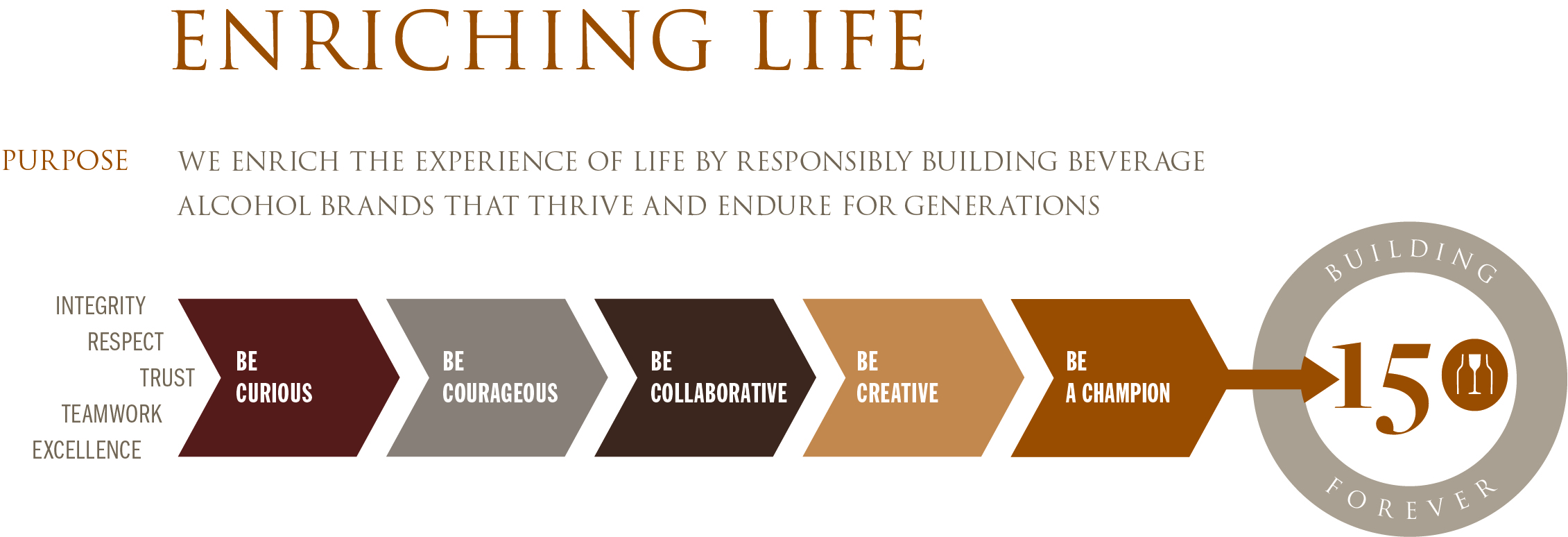
We realize that our people are integral to building our brands and growing our business, and to support this strategy we strive to build a strong, agile workforce emphasizing diversity and inclusion. The strategic ambitions described below demonstrate both a sustained focus on several drivers of our recent growth and acknowledge today’s emerging opportunities.
Portfolio
We seek to build brands and businesses that create significant shareholder value, by delivering strong and sustainable growth, solid margins, and high returns on invested capital. In addition, given our growing size and scale, we focus on building brands that can be meaningful for our company over time. Our first priority is to grow our premium spirits portfolio organically and through innovation. As opportunities arise, we also consider acquisitions and partnerships that will enhance our portfolio and our capacity to deliver growth, margins, and returns in line with our rigorous quantitative and qualitative criteria.
We are the global leader in American whiskey.1 We see significant, additional opportunity to promote the mixability, versatility, accessibility, and premiumization of our American whiskey brands around the world. We believe that we can leverage our whiskey-making knowledge, production assets, trademarks, and brand-building skills to realize this opportunity.
The Jack Daniel’s family of brands, led by Jack Daniel’s Tennessee Whiskey (JDTW), is our most valuable asset – the engine of our overall financial performance and the foundation of our leadership position in the American whiskey category. We will always work to keep JDTW strong, healthy, and relevant to consumers worldwide while pursuing the abundant opportunities to grow the Jack Daniel’s family of brands across markets, premium price points, channels, and consumer groups. Product innovation continues to be a meaningful contributor to our performance. New Jack Daniel’s expressions have led innovation in the American whiskey category, including Honey (2011), Fire (2015), Rye (2017), and the recently announced launch of Jack Daniel’s Tennessee Apple, which we expect to introduce in the United States in the fall of 2019.
Beyond the Jack Daniel’s family of brands, we expect to sustain excellent growth around the world with our other whiskey brands, particularly Woodford Reserve and Old Forester. Woodford Reserve is the leading super-premium American whiskey globally1, and is poised for continued growth as interest in bourbon continues to increase around the world. Old Forester has continued its return to prominence in the United States and in select international markets through its unparalleled taste and quality. Following on the success of its high-end expressions, including the Old Forester Whiskey Row Series, we recently added Old Forester Rye to the brand line up.
| 1IWSR, 2018 data. |
We believe that super- and ultra-premium whiskeys are an attractive long-term business. Through our acquisition of The BenRiach Distillery Company Limited in June 2016, we added three world-class single malt Scotch whisky brands to our portfolio: The GlenDronach, BenRiach, and Glenglassaugh. Since acquiring the Scotch business, we have evolved our portfolio and geographic strategies to ensure that these single malt brands are positioned to become meaningful contributors to Brown-Forman and significant competitors in the fast-growing single malt category over the longer term. Similarly, Slane Irish Whiskey, which opened its distillery and visitors’ center in 2018 is poised to become a meaningful contributor for the Company in the fast-growing Irish whiskey category over time.
It has been over a decade since we acquired Casa Herradura, a portfolio led by two tequila brands steeped in Mexican heritage – Herradura and el Jimador. Despite current cost pressures resulting from the high price of agave, we remain pleased with the development of our tequila business in both Mexico and the United States, the brands’ two primary markets. We plan to continue expanding Herradura to reach new consumers in Mexico, the United States, and other high-potential markets. In addition to the success of the brand’s core expressions, Herradura Ultra – an ultra-premium “cristalino” line extension – continued to accelerate, surpassing 90,000 nine-liter cases in fiscal 2019. We intend to ensure el Jimador tequila remains a premium brand in Mexico by increasing pricing again in fiscal 2020, and remain encouraged by our prospects for long-term, profitable growth there. Outside Mexico, we have more than quadrupled el Jimador’s volumes since fiscal 2008. We remain confident in el Jimador’s potential to improve its position among the world’s leading tequila brands as the category continues to develop.
Finlandia, one of the top-ten selling vodkas in the world,1 is prominent in several of the world’s largest vodka markets, such as Poland, Russia, Ukraine, and Czechia. We plan to grow Finlandia where its position is strong, including in its largest market, Poland, where Finlandia accounts for one out of every two bottles of imported vodka sold.2
Geography
The United States remains our largest market, and continuing to grow there is important to our long-term success. We expect to foster this growth by emphasizing fast-growing spirits categories such as super-premium whiskeys and tequilas, continued product and packaging innovation, and brand building within growing consumer segments, including increasing emphasis on inclusive marketing.
Over the last two decades, our business outside the United States has generally grown faster than our business within it. Achieving our long-term growth objectives requires us to deliver balanced geographic growth while increasing our competitiveness through improved routes to consumer. We expect to continue to grow our business in developed markets such as Australia, France, Germany, and the United Kingdom. We will continue to pursue RTC strategies that will expand our access to and understanding of consumers, with the most recent example being the establishment of our owned distribution organization in Spain during fiscal 2018. In addition, we expect increasingly significant contributions to our growth from emerging markets including Africa, Brazil, China, Eastern Europe, Latin America, Mexico, Poland, Russia, Southeast Asia, and Turkey.
| 1Impact Databank, March 2019. | |
| 2IWSR, 2018 data. |
Integrated Performance
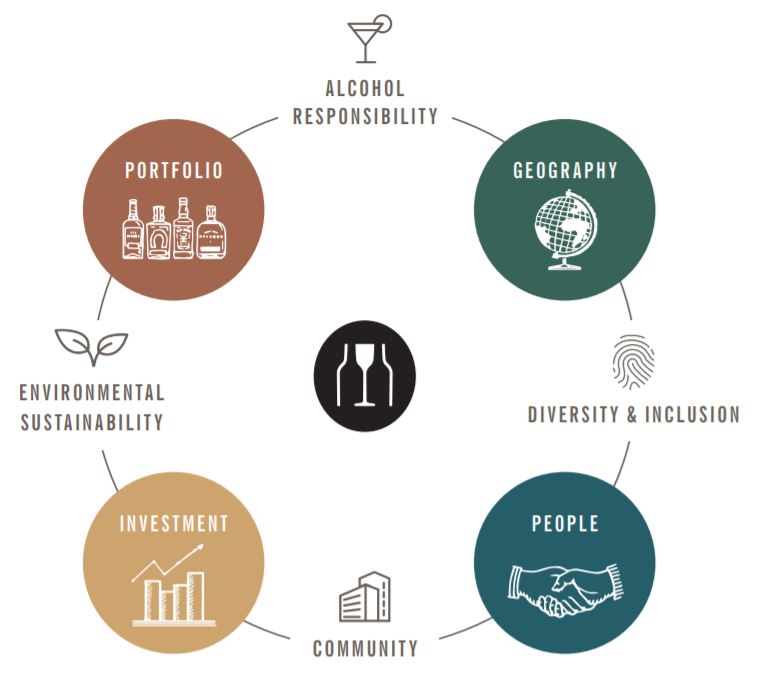
Having a long-term-focused, committed, and engaged stockholder base, anchored by the Brown family, gives us an important strategic advantage, particularly in a business with aged products and multi-generational brands. For nearly 150 years, the Company and the Brown family have been committed to preserving Brown-Forman as a thriving, family-controlled, independent company.
Recognizing the strong cash-generating capacity and the capital efficiency of our business, we will continue to pursue what we believe to be well-balanced capital deployment strategies aimed at perpetuating Brown-Forman’s strength and independence.
Our view of Brown-Forman’s performance is multi-faceted, the “what” of our financial and business results are very much related to “how” we achieve them. This view is shown in the quality of our culture, our people, our values, and our stakeholder relationships. Our sense of corporate responsibility is informed by our commitment to ethics, diversity and inclusion, alcohol responsibility, environmental sustainability, and the community in which our employees live and work. This integrated lens on performance, including Corporate Responsibility, recognizes that many aspects of our company contribute to value creation, our reputation and our success.
Corporate Responsibility
In pursuing the objectives described above, we will strive to be responsible in everything we do. Our history of responsibility began in 1870, when our founder, George Garvin Brown, first sold whiskey in sealed glass bottles to ensure quality and safety – an innovation some consider the first act of corporate responsibility in the industry. Today, achieving our stated business purpose, to “enrich the experience of life,” is possible only within a context of corporate responsibility. This means putting our values in action by creating a responsible drinking culture; providing a healthy, safe, inclusive, and engaging workplace; protecting the environment; and making a positive contribution to our communities.
We subscribe to the United Nations Sustainable Development Goals (SDGs), a set of 17 global goals designed to address a broad range of sustainable development issues from poverty and gender equality to climate change. In 2017, we reviewed our corporate responsibility strategy against the SDGs to understand where our work aligns with these goals. In 2018, we also became signatories to the United National Global Compact and submitted our first Communication on Progress.
Our core values of integrity, respect, trust, teamwork, and excellence are the foundation of our culture. Our employee engagement survey responses demonstrate that we not only state these words as our values, but we live them, too. Our values are
reflected in our Code of Conduct that employees are educated on and pledge to comply with. Additionally, in the spirit of teamwork, we use our values as one set of criteria when evaluating business partners.
Alcohol Responsibility. Our business is based on the belief that beverage alcohol, consumed in moderation, can enrich the experience of life. However, we are well aware that when consumed irresponsibly, alcohol can have harmful effects on individuals and society. We appreciate the need for governments to regulate our industry appropriately and effectively, taking into account national circumstances and local cultures. We also appreciate that some people should not drink or choose not to drink, and we respect this choice. Acting in partnership with others, we want to create a responsible drinking culture and be part of the solution to real, complex problems such as underage drinking, drunk driving, overconsumption, and alcoholism.
Since 2009, we have hosted an open forum to share our points of view, post the research of outside experts, and encourage the opinions of others at www.OurThinkingAboutDrinking.com. As part of our commitment to responsible marketing, and to enable consumers to make more informed decisions, we provide nutritional information on our brands in our top markets on our website, nutrition.brown-forman.com.
We also work closely with partners to extend our reach and impact. In Poland, we partnered with Carrefour, a large retailer chain, to deliver key responsibility messages to consumers across 90 of their stores. For the fifth consecutive year, the New Hampshire (NH) Liquor Commission and Jack Daniel’s teamed up for the award-winning Live Free & Host Responsibly campaign. Since its launch in 2015, the campaign has reached thousands of NH Liquor & Wine Outlet customers, promoting responsible service and consumption of alcohol. This first-of-its-kind collaboration between a control state and a beverage alcohol company has become a model for the industry, gaining widespread attention and industry praise. In our consumer relationships, we seek to communicate through responsible advertising content and placement, relying on our comprehensive internal marketing code and adhering to industry marketing and advertising guidelines. We also engage with our customers through our trade associations. For example, we worked with Avec Modération in France to engage convenience stores on underage drinking prevention.
We are founding members of, and contribute significant resources to, the Foundation for Advancing Alcohol Responsibility (responsibility.org), an organization created by spirits producers to prevent drunk driving and underage drinking and to promote responsible decision making. While this is a U.S. organization, we participate actively in similar organizations in other markets, such as DrinkWise in Australia, BSI in Germany, The Portman Group in the United Kingdom, and FISAC in Mexico. In 2019, our Chambord Liqueur brand has partnered with Alteristic, a national organization of social accelerators dedicated to reducing power-based personal violence, to train bartenders on bystander intervention to help prevent sexual assault. We also supported alcohol responsibility education of our employees through our recently launched Pause campaign, encouraging everyone to pause, consider, and make responsible decisions around alcohol consumption. Through our corporate charitable contributions, we support organizations that offer treatment and recovery for those struggling with alcoholism and addiction. In addition to our financial contributions, we support these organizations by having Brown-Forman employees serve on their boards of directors.
Sustainability. Our environmental sustainability strategy aims to protect and conserve the resources we depend on. It also reinforces our business strategy through programs that reduce costs through efficiency, lessen risks to our operations, and improve effectiveness through innovation. We invest in renewable energy, energy efficiency, and efficient transportation to reduce our carbon footprint. In 2018, we executed a 15-year power purchase agreement for environmental attributes associated with the energy output from a wind farm facility located in Kansas. The wind farm is expected to generate the equivalent of more than 90% of Brown-Forman’s annual electricity use in the United States.
Mindful of our overall impact, in fiscal 2014, we set ambitious environmental sustainability goals for fiscal 2023: reducing our absolute greenhouse gas emissions by 15% and reducing our water use and wastewater discharges per unit of product by 30% (compared to metrics in 2012). In addition, we set a goal of sending zero waste to landfills by 2020. These goals support our ambition to grow our brands and our company responsibly while protecting and enriching the natural environment. We have refreshed our strategy to include a greater focus beyond our operational borders into our supply chain.
Diversity and Inclusion. We believe that having a diverse, inclusive workforce is central to our success. As we work to increase our brands’ relevance and appeal to diverse consumer groups, we need a diversity of experiences and outlooks within our own workforce. We also want employees to feel comfortable in contributing their whole selves and different perspectives to their work. We continue to have diverse representation at the senior level. Four women and one African American serve on our Board of Directors. Two members of our nine-member Executive Leadership Team are women and two are minorities. In 2019, we once again earned a perfect score of 100% in the Corporate Equality Index, a national benchmarking survey and report on corporate policies and practices related to LGBTQ workplace equality administered by the Human Rights Campaign. This makes us one of the “Best Places to Work for LGBTQ equality”1 in the United States for the ninth consecutive year.
| 1Human Rights Campaign 2019 Corporate Equity Index at www.hrc.org/cei |
Our Employee Resource Groups (ERGs) have been core to our diversity culture by supporting employees’ growth while enhancing their contributions. Our eight ERGs, with sub-chapters globally, foster a diverse, inclusive environment that drives our high-commitment, high-performance organization and encourages our employees to bring their individuality to work. Our commitment to diversity extends to our partnerships with small and diverse suppliers. By 2020, our goal is to source at least 16% of our procurement from businesses owned by ethnic minorities, women, LGBTQ persons, people with disabilities, or veterans. Currently, we procure approximately 12% of our supplies from such businesses.
In the marketplace, we focus on promoting fair, ethical business practices. We remain committed to the guidelines set forth in our Global Human Rights Statement, defining our commitment to respecting the fundamental rights of all human beings. Our work in this area helped inform our response to the U.K.’s passage of the Modern Slavery Act in 2015, which is available on our corporate website.
Community. Our approach to philanthropy reflects our values as a corporate citizen. Brown-Forman believes, as a responsible and caring corporate citizen, it is vital that we give back to the communities that support both our employees and our business by thoughtfully deploying our time, talent, and resources. We collaborate with a variety of mission-driven organizations focused on enhancing intellectual and cultural living, ensuring essential living standards, and empowering responsible and sustainable living. While we focus on our hometown of Louisville, Kentucky, our civic engagement activities extend to the communities around the globe where our employees work, live, and raise their families.
In fiscal 2019, we made charitable donations of $7.4 million, logged approximately 15,000 volunteer hours, and had 127 employees serve on boards of directors of 201 non-profit organizations. In addition, with the goal of helping fund our ongoing philanthropic endeavors in the communities where our employees live and work, we created and funded the Brown-Forman Foundation (the Foundation) with a contribution of $70 million in fiscal 2018. The Foundation distributed $2.5 million in charitable contributions in fiscal 2019. We anticipate that the Foundation’s earnings will provide a consistent source of revenue for its charitable giving program independent of our yearly earnings.
We report our ongoing commitment and progress against all of these goals in our integrated Annual and Corporate Responsibility Report and on our website (www.brown-forman.com/responsibility).
Employees and Executive Officers
As of April 30, 2019, we employed approximately 4,700 people worldwide (2,600 in the United States), excluding individuals that work on a part-time or temporary basis. This includes approximately 15% of our U.S. employees that are represented by a union. We believe our employee relations are good.
The following persons served as executive officers as of June 13, 2019:
| Name | Age | Principal Occupation and Business Experience |
| Lawson E. Whiting | 50 | President and Chief Executive Officer since 2019. Executive Vice President and Chief Operating Officer from October 2017 to December 2018. Executive Vice President and Chief Brands and Strategy Officer from 2015 to 2017. Senior Vice President and Chief Brands Officer from 2013 to 2015. Senior Vice President and Managing Director for Western Europe from 2011 to 2013. Vice President and Finance Director for Western Europe from 2010 to 2011. Vice President and Finance Director for North America from 2009 to 2010. |
| Jane C. Morreau | 60 | Executive Vice President and Chief Financial Officer since 2014. Senior Vice President, Chief Production Officer, and Head of Information Technology from 2013 to 2014. Senior Vice President and Director of Financial Management, Accounting, and Technology from 2008 to 2013. |
| Matthew E. Hamel | 59 | Executive Vice President, General Counsel, and Secretary since 2007. |
| Mark I. McCallum | 64 | Executive Vice President and Chief Brands Officer since June 2018. Executive Vice President and President of Jack Daniel’s Brands from February 2015 to June 2018. Executive Vice President and President for Europe, Africa, Middle East, Asia Pacific, and Travel Retail from 2013 to 2015. Executive Vice President and Chief Operating Officer from 2009 to 2013. Executive Vice President and Chief Brands Officer from 2006 to 2009. |
| Alejandro “Alex” Alvarez | 51 | Senior Vice President and Chief Production Officer since 2014. Vice President and General Manager for Brown-Forman Tequila Mexico Operations from 2008 to 2014. |
| Ralph De Chabert | 72 | Senior Vice President, Chief Diversity and Global Community Relations Officer since March 2019. Senior Vice President and Chief Diversity Officer from December 2007 to February 2019. |
| Kirsten M. Hawley | 49 | Senior Vice President, Chief Human Resources and Corporate Communications Officer since March 2019. Senior Vice President and Chief Human Resources Officer from February 2015 to February 2019. Senior Vice President and Director of Human Resources Business Partnerships from 2013 to 2015. Vice President and Director of Organization and Leader Development from 2011 to 2013. Assistant Vice President and Director of Employee Engagement from 2009 to 2011. |
| John V. Hayes | 59 | Senior Vice President, President U.S.A. and Canada since June 2018. Senior Vice President, Chief Marketing Officer of Brown-Forman Brands from February 2015 to June 2018. Senior Vice President, Managing Director Jack Daniel’s from 2011 to 2015. Senior Vice President, Managing Director Herradura from 2007 to 2011. |
| Thomas Hinrichs | 57 | Senior Vice President, International Division since June 2018. Senior Vice President and President for Europe, North Asia, and ANZSEA from February 2015 to June 2018. Senior Vice President and Managing Director for Europe from 2013 to 2015. Senior Vice President and Managing Director for Greater Europe and Africa from 2006 to 2013. |
| Kelli Nelson | 49 | Senior Vice President and Chief Accounting Officer since August 2018. Vice President and Director Finance (North America Region) from 2015 to August 2018. Director NAR Division Finance (North America Region) from 2013 to 2015. Director Business Planning and Analytics (North America Region) from 2012 to 2013. |
Available Information
Our website address is www.brown-forman.com. Our annual reports on Form 10-K, quarterly reports on Form 10-Q, current reports on Form 8-K, and any amendments to these reports are available free of charge on our website as soon as reasonably practicable after we electronically file those reports with the Securities and Exchange Commission (SEC). The information provided on our website is not part of this report, and is therefore not incorporated by reference into this report or any other filing we make with the SEC, unless that information is otherwise specifically incorporated by reference.
On our website, we have posted our Code of Conduct that applies to all our directors and employees, and our Code of Ethics that applies specifically to our senior financial officers. If we amend or waive any of the provisions of our Code of Conduct or our Code of Ethics applicable to our principal executive officer, principal financial officer, or principal accounting officer that relates to any element of the definition of “code of ethics” enumerated in Item 406(b) of Regulation S-K under the Securities Act of 1934 Act, as amended, we intend to disclose these actions on our website. We have also posted on our website our Corporate Governance Guidelines and the charters of our Audit Committee, Compensation Committee, Corporate Governance and Nominating Committee, and Executive Committee of our Board of Directors. Copies of these materials are also available free of
charge by writing to our Secretary, Matthew E. Hamel, 850 Dixie Highway, Louisville, Kentucky 40210 or emailing him at Secretary@b-f.com.
Previous: Cover and table of contents · Next: Item 1A. Risk Factors