 filings.tools
Item 1. Business
48K characters. Original on sec.gov · Markdown
Item 1. Business
Overview
Brown-Forman Corporation (the “Company,” “Brown-Forman,” “we,” “us,” or “our” below) was incorporated under the laws of the State of Delaware in 1933, successor to a business founded in 1870 as a partnership and later incorporated under the laws of the Commonwealth of Kentucky in 1901. We primarily manufacture, distill, bottle, import, export, market, and sell a wide variety of beverage alcohol products under recognized brands. We employ approximately 5,200 people (excluding individuals that work on a part-time or temporary basis) on six continents, including approximately 2,600 people in the United States (approximately 15% of whom are represented by a union) and 1,200 people in Louisville, Kentucky, USA, home of our world headquarters. According to International Wine & Spirit Research (IWSR), we are the largest American-owned spirits and wine company with global reach. We are a “controlled company” under New York Stock Exchange rules because the Brown family owns more than 50% of our voting stock. Taking into account ownership of shares of our non-voting stock, the Brown family also controls more than 50% of the economic ownership in Brown-Forman.
For a discussion of recent developments, see “Item 7. Management's Discussion and Analysis of Financial Condition and Results of Operations – Executive Summary.”
Brands
Beginning in 1870 with Old Forester Kentucky Straight Bourbon Whisky – our founding brand – and spanning the generations since, we have built a portfolio of more than 40 spirit, ready-to-drink (RTD) cocktail, and wine brands that includes some of the best-known and most loved trademarks in our industry. The most important and iconic brand in our portfolio is Jack Daniel’s Tennessee Whiskey, the #1 selling American whiskey in the world1. Jack Daniel’s Tennessee Whiskey was recently named the most valuable spirits brand in the world in the 2021 Interbrand “Best Global Brands” rankings. Our premium bourbons, Woodford Reserve and Old Forester, were once again selected for the Impact “Hot Brands”2 list, marking nine and four consecutive years on the list, respectively. Our tequilas, el Jimador and Herradura, were also named to the “Hot Brands”2 list.
| Principal Brands | ||||||||
| Jack Daniel's Tennessee Whiskey | el Jimador Tequilas5 | |||||||
| Jack Daniel's RTD3 | el Jimador New Mix RTD | |||||||
| Jack Daniel's Tennessee Honey | Korbel California Champagnes6 | |||||||
| Gentleman Jack Rare Tennessee Whiskey | Korbel California Brandy6 | |||||||
| Jack Daniel's Tennessee Fire | Herradura Tequilas7 | |||||||
| Jack Daniel's Tennessee Apple | Finlandia Vodkas | |||||||
| Jack Daniel's Single Barrel Collection4 | Sonoma-Cutrer California Wines | |||||||
| Jack Daniel's Tennessee Rye | Old Forester Kentucky Straight Bourbon Whisky | |||||||
| Jack Daniel's Winter Jack | Old Forester Whiskey Row Series | |||||||
| Jack Daniel's Sinatra Select | Old Forester Kentucky Straight Rye Whisky | |||||||
| Jack Daniel’s Bonded | GlenDronach Single Malt Scotch Whisky | |||||||
| Jack Daniel's No. 27 Gold Tennessee Whiskey | Benriach Single Malt Scotch Whisky | |||||||
| Jack Daniel's Bottled-in-Bond | Glenglassaugh Single Malt Scotch Whisky | |||||||
| Jack Daniel’s 10 Year Old | Chambord Liqueur | |||||||
| Jack Daniel’s Triple Mash | Slane Irish Whiskey | |||||||
| Woodford Reserve Kentucky Bourbon | Fords Gin | |||||||
| Woodford Reserve Double Oaked | Coopers' Craft Kentucky Bourbon | |||||||
| Woodford Reserve Kentucky Rye Whiskey | Part Time Rangers RTDs | |||||||
| Woodford Reserve Kentucky Straight Malt Whiskey | ||||||||
| Woodford Reserve Kentucky Straight Wheat Whiskey |
| 1IWSR, 2022. | |||||
| 2Impact Databank, March 2022. | |||||
| 3Jack Daniel's RTD includes Jack Daniel's & Cola, Jack Daniel's Country Cocktails, Jack Daniel's Double Jack, and other malt- and spirit-based Jack Daniel’s RTDs. | |||||
| 4The Jack Daniel's Single Barrel Collection includes Jack Daniel's Single Barrel Select, Jack Daniel's Single Barrel Barrel Proof, Jack Daniel's Single Barrel Rye, and Jack Daniel's Single Barrel 100 Proof. | |||||
| 5el Jimador Tequilas comprise all full-strength expressions of el Jimador. | |||||
| 6Korbel is not an owned brand. We sell Korbel products under contract in the United States and other select markets. | |||||
| 7Herradura Tequilas comprise all expressions of Herradura. |
See “Item 7. Management's Discussion and Analysis of Financial Condition and Results of Operations – Results of Operations – Fiscal 2022 Brand Highlights” for brand performance details.
Our vision in marketing is to be the best brand-builder in the industry. We build our brands by investing in platforms that we believe create enduring connections with our consumers. These platforms cover a wide spectrum of activities, including media advertising (TV, radio, print, outdoor, digital, and social), consumer and trade promotions, sponsorships, and visitors' center programs at our distilleries and our winery. We expect to grow our sales and profits by consistently delivering creative, responsible marketing programs that drive brand recognition, brand trial, brand loyalty, and ultimately, consumer demand around the world.
Markets
We sell our products in over 170 countries around the world. The United States, our most important market, accounted for 49% of our net sales in fiscal 2022 and the other 51% were outside of the United States. The table below shows the percentage of total net sales for our largest markets in our three most recent fiscal years:
| Percentage of Total Net Sales by Geographic Area | |||||||||||||||||
| Year ended April 30 | |||||||||||||||||
| 2020 | 2021 | 2022 | |||||||||||||||
| United States | 50 | % | 50 | % | 49 | % | |||||||||||
| Germany | 5 | % | 6 | % | 6 | % | |||||||||||
| Australia | 5 | % | 6 | % | 6 | % | |||||||||||
| United Kingdom | 5 | % | 6 | % | 6 | % | |||||||||||
| Mexico | 5 | % | 4 | % | 5 | % | |||||||||||
| Other | 30 | % | 28 | % | 28 | % | |||||||||||
| TOTAL | 100 | % | 100 | % | 100 | % | |||||||||||
| Note: Totals may differ due to rounding |
For details about net sales in our largest markets, see “Item 7. Management's Discussion and Analysis of Financial Condition and Results of Operations – Results of Operations – Fiscal 2022 Market Highlights.” For details about our reportable segment and for additional geographic information about net sales and long-lived assets, see Note 17 to the Consolidated Financial Statements in “Item 8. Financial Statements and Supplementary Data.” For details on risks related to our global operations, see “Item 1A. Risk Factors.”
Distribution Network and Customers
Our distribution network, or our “route to consumer” (RTC), varies depending on (a) the laws and regulatory framework for trade in beverage alcohol by market, (b) our assessment of a market's long-term attractiveness and competitive dynamics, (c) the relative profitability of distribution options available to us, (d) the structure of the retail and wholesale trade in a market, and (e) our portfolio's development stage in a market. As these factors change, we evaluate our RTC strategy and, from time to time, adapt our model.
In the United States, which generally prohibits spirits and wine manufacturers from selling their products directly to consumers, we sell our brands either to distributors or to state governments (in states that directly control alcohol sales) that then sell to retail customers and consumers.
Outside the United States, we use a variety of RTC models, which can be grouped into three categories: owned distribution, partner, and government-controlled markets. We own and operate distribution companies for Australia, Belgium and Luxembourg, Brazil, Czechia, France, Germany, Korea, Mexico, Poland, Spain, Taiwan, Thailand, Turkey, and the United Kingdom. In these owned-distribution markets, and in a large portion of the Travel Retail channel, we sell our products directly to retailers or wholesalers. In many other markets, including Italy, Japan, and South Africa, we rely on third parties to distribute our brands, generally under fixed-term distribution contracts. In Canada, we sell our products to provincial governments.
We believe that our customer relationships are good and our exposure to concentrations of credit risk is limited due to the diverse geographic areas covered by our operations and our thorough evaluation of each customer. In fiscal 2022, our two largest customers accounted for approximately 14% and 12% of consolidated net sales, respectively. No other customer accounted for 10% or more of our consolidated net sales in fiscal 2022.
Seasonality
Holiday buying makes the fourth calendar quarter the peak season for our business. Approximately 30% of our reported net sales for fiscal 2020, fiscal 2021, and fiscal 2022 were in the fourth calendar quarter of each year.
Competition
Trade information indicates that we are one of the largest global suppliers of premium spirits. According to IWSR, for calendar year 2021, the ten largest global spirits companies controlled approximately 20% of the total spirits volume sold around the world. While we believe that the overall market environment offers considerable growth opportunities for us, our industry is, and will remain, highly competitive. We compete against many global, regional, and local brands in a variety of categories of beverage alcohol, but our brands compete primarily in the industry's premium-and-above price points. Our competitors include major global spirits and wine companies, such as Bacardi Limited, Beam Suntory Inc., Becle S.A.B. de C.V., Davide Campari-Milano N.V., Diageo PLC, LVMH Moët Hennessy Louis Vuitton SE, Pernod Ricard SA, and Rémy Cointreau. In addition, particularly in the United States, we compete with national companies and craft spirit brands, many of which entered the market in the last few years.
Brand recognition, brand provenance, quality of product and packaging, availability, flavor profile, and price affect consumers' choices among competing brands in our industry. Other factors also influence consumers, including advertising, promotions, merchandising at the point of sale, expert or celebrity endorsement, social media and word of mouth, and the timing and relevance of new product introductions. Although some competitors have substantially greater resources than we do, we believe that our competitive position is strong, particularly as it relates to brand awareness, quality, availability, and relevance of new product introductions.
Ingredients and Other Supplies
The principal raw materials used in manufacturing and packaging our distilled spirits, liqueurs, RTD products, and wines are shown in the table below.
| Principal Raw Materials | ||||||||||||||||||||||||||
| Distilled Spirits | Liqueurs | RTD Products | Wines | Packaging | ||||||||||||||||||||||
| Agave | Flavorings | Flavorings | Grapes | Aluminum cans | ||||||||||||||||||||||
| Barley | Neutral spirits | Malt | Wood | Cartons | ||||||||||||||||||||||
| Corn | Sugar | Neutral spirits | Closures | |||||||||||||||||||||||
| Malted barley | Water | Sugar | Glass bottles | |||||||||||||||||||||||
| Rye | Whiskey | Tequila | Labels | |||||||||||||||||||||||
| Sugar | Wine | Water | PET1 bottles | |||||||||||||||||||||||
| Water | Whiskey | |||||||||||||||||||||||||
| Wood |
| 1Polyethylene terephthalate (PET) is a polymer used in non-glass containers. |
We are currently managing through a variety of global supply chain disruptions, largely related to glass supply, and have deployed a number of risk mitigation strategies to address the various constraints on our business. See “Item 7. Management’s Discussion and Analysis of Financial Condition and Results of Operations” for more information on the effect of supply chain disruptions on our results.
From time to time, our agricultural ingredients (agave, barley, corn, grapes, malted barley, rye, and wood) could be adversely affected by weather and other forces out of our control that might constrain supply or reduce our inventory below desired levels for optimum production.
Whiskeys and certain tequilas and other distilled spirits must be aged. Because we must produce these distilled spirits years in advance to meet projected future demand, our inventories of these products may be larger in relation to sales and total assets than in many other businesses.
For details on risks related to the unavailability of raw materials and the inherent uncertainty in forecasting supply and demand, see “Item 1A. Risk Factors.”
Intellectual Property
Our intellectual property includes trademarks, copyrights, proprietary packaging and trade dress, proprietary manufacturing technologies, know-how, and patents. Our intellectual property, especially our trademarks, is essential to our business. We register our trademarks broadly around the world, focusing primarily on where we sell or expect to sell our products. We protect our intellectual property rights vigorously but fairly. We have licensed some of our trademarks to third parties for use with services or on products other than alcoholic beverages, which enhances the awareness and protection of our brands. Depending on the jurisdiction, trademarks are valid as long as they are in use and/or their registrations are properly maintained. We also have various licenses and distribution agreements for the production, sale, and marketing of our products,
and for the sale and marketing of products of others. These licenses and distribution agreements have varying terms and durations.
For details on risks related to the protection of our intellectual property, see “Item 1A. Risk Factors.” For details on our most important brands, see “Item 7. Management's Discussion and Analysis of Financial Condition and Results of Operations – Results of Operations – Fiscal 2022 Brand Highlights.”
Regulatory Environment
Federal, state, local, and foreign authorities regulate how we produce, store, transport, distribute, market, and sell our products. Some countries and local jurisdictions prohibit or restrict the marketing or sale of distilled spirits in whole or in part.
In the United States, at the federal level, the Alcohol and Tobacco Tax and Trade Bureau of the U.S. Department of the Treasury regulates the spirits and wine industry with respect to the production, blending, bottling, labeling, advertising, sales, and transportation of beverage alcohol. Similar regulatory regimes exist at the state level and in most non-U.S. jurisdictions where we sell our products. In addition, beverage alcohol products are subject to customs duties, excise taxes, and/or sales taxes in many countries, including taxation at the federal, state, and local level in the United States.
Many countries set their own distilling and maturation requirements; for example, under U.S. federal and state regulations, bourbon and Tennessee whiskeys must be aged in new, charred oak barrels; we typically age our whiskeys at least three years. Mexican authorities regulate the production and bottling of tequilas; they mandate minimum aging periods for extra añejo (three years), añejo (one year), and reposado (two months). Irish whiskey must be matured at least three years in a wood cask, such as oak, on the island of Ireland. Scotch whisky must be matured in oak casks for at least three years in Scotland. We comply with all of the applicable laws and regulations.
Our operations are subject to various environmental protection statutes and regulations, and our policy is to comply with them.
Integrated Strategy and Performance
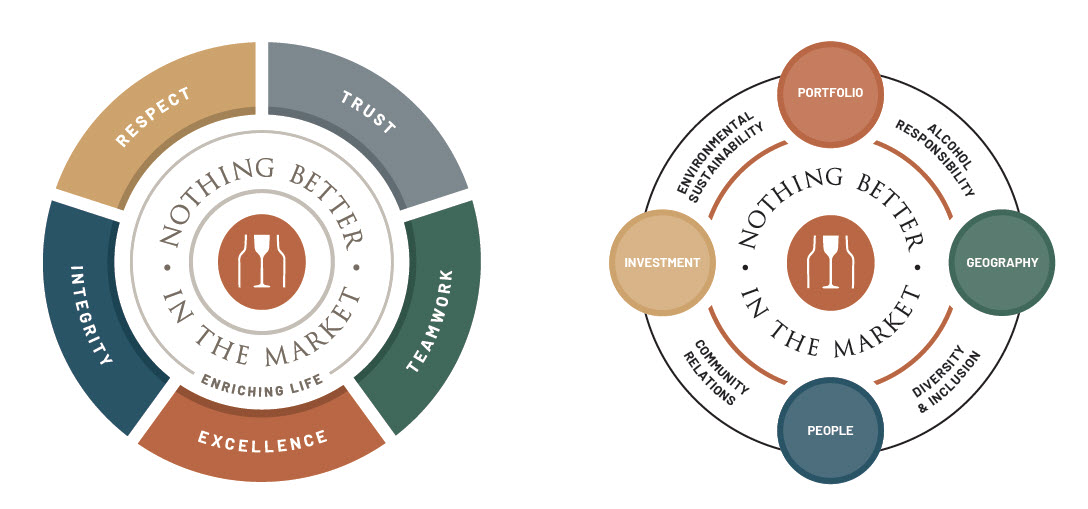
For more than 150 years, Brown-Forman and the Brown family have been committed to driving sustainable growth and preserving Brown-Forman as a thriving, family-controlled, independent company. The image on the left illustrates our core purpose, “Enriching Life,” and our highest ambition, “Nothing Better in the Market,” surrounded by the values that have guided us for decades: integrity, respect, trust, teamwork, and excellence. In addition to these guiding principles, our success depends on several strategic priorities, as illustrated in the image on the right: the quality of our brands within our portfolio, our geographic reach, the talent and diversity of our people, and the return on our investments. Moreover, taking an integrated approach means that many aspects of our company contribute to this value creation and are fundamental to our strategy, including our commitment to environmental sustainability, alcohol and marketing responsibility, diversity and inclusion, and to building communities in which we live and work.
We faced a challenging and volatile environment, including supply chain disruptions and the ongoing pandemic, over the past two fiscal years. Our employees' unique mix of agility, resilience, energy, and collaboration enabled us to succeed despite these challenges, and we believe will continue to strengthen us over time. Our values drove decisions throughout this year, and our core purpose of “Enriching Life” and our highest ambition of “Nothing Better in the Market” continue to guide us as we move forward to a reimagined future with a renewed sense of opportunity for what lies ahead. We believe that several recent headwinds are becoming tailwinds. For example, after more than three years, tariffs on American whiskey in the European Union were removed on January 1, 2022, and tariffs in the United Kingdom were removed on June 1, 2022.
This Integrated Annual Report presents not only our financial performance but also our environmental, social, and governance (“ESG”) strategies, commitments, and results. It provides a more holistic view of Brown-Forman, our culture, our strategic approach to our business, and how we achieve results.
Portfolio and Responsibility
We seek to build brands and create shareholder value responsibly by delivering strong and sustainable growth, solid margins, and high returns on invested capital. We focus on building brands that can be meaningful for our company and our consumers over the longer term. We aim to grow our premium spirits portfolio both organically and through innovation. Opportunistically and thoughtfully, we also consider acquisitions and partnerships that will enhance our capacity to deliver meaningful growth, improve margins, and increase shareholder returns.
We strive to grow our brands and enhance consumers' experience with them. Even as we do so, we remain committed to marketing our brands responsibly and promoting responsible drinking. Regulation of our industry is not new, and external interest from the World Health Organization and other health bodies has grown over time. We uphold high standards of self-regulation by adhering to industry guidelines on responsible marketing and advertising. We work both independently and with industry organizations to promote alcohol responsibility, such as the International Alliance for Responsible Drinking, the Foundation for Advancing Alcohol Responsibility (responsibility.org) in the United States, The Portman Group in the United Kingdom, DrinkWise in Australia, and FISAC in Mexico.
The Jack Daniel's family of brands, led by Jack Daniel's Tennessee Whiskey (JDTW), is our most valuable asset – the engine of our overall financial performance and the foundation of our leadership position in the American whiskey category1. We strive to strengthen the brand's leadership position, and will steadfastly work to keep JDTW relevant to consumers worldwide, while pursuing the opportunities to grow the Jack Daniel's family of brands across markets, premium-and-above price points, channels, and consumer groups. Product innovation continues to contribute meaningfully to our performance. Different Jack Daniel's expressions have brought new consumers to the franchise, including Honey (2011), Fire (2015), Rye (2017), Apple (2019), and our most recent launch, Jack Daniel's 10 Year Old Tennessee Whiskey (2021), which individually and collectively add great value to the company and to our consumers the world over.
In addition to the leadership of our Jack Daniel's family of brands, we expect strong worldwide growth from our other whiskey brands, particularly Woodford Reserve and Old Forester. Woodford Reserve is the leading super-premium American whiskey globally1, growing volumes at a strong double-digit compound annual growth rate since the brand was introduced 25 years ago. Woodford Reserve surpassed 1.4 million nine-liter cases of annual volume as of April 30, 2022. We believe the brand is poised for continued growth as the bourbon category continues to grow around the world. Old Forester has continued its return to prominence in the United States and in select international markets. Innovation has played an important role in the premiumization of both of these brands, including the success of high-end expressions such as Woodford Reserve Double Oaked and the Old Forester Whiskey Row Series.
Outside of our American whiskey brands, we believe our portfolio remains well positioned in other high-growth categories with meaningful premium brands and a focus on accelerating our super-premium portfolio. Our tequila portfolio is led by two brands steeped in Mexican heritage, Herradura and el Jimador. Despite the cyclical cost pressures resulting from the unprecedented cost of agave, we remain pleased with the growth of our tequila business in the United States and the long-term growth prospects of this business globally. We believe that our Scotch whiskies GlenDronach, Benriach, and Glenglassaugh, and our Irish whiskey Slane, are well-positioned in their respective categories. We expect them all to become meaningful contributors over the longer term. Lastly, we believe our acquisition of Fords Gin in the summer of 2019 provides access to the premium gin category, particularly in the United States, and we look to grow this brand in key gin markets globally.
Fiscal 2022 was another year of growth for our ready-to-drink (RTD) portfolio. Jack Daniel's RTDs are approaching 14 million nine-liter cases globally. In Mexico, our el Jimador tequila-based RTD, New Mix, sold approximately 8 million nine-liter cases. In calendar 2020 we introduced Jack Daniel's Can Cocktails in the United States and also announced a new partnership with Pabst Brewing Company for the supply, sales, and distribution of Jack Daniel's Country Cocktails in this important market. In December 2020, we acquired Part Time Rangers, a line of low-calorie, spirit-based RTDs with natural fruit flavorings. Part Time Rangers is based in New Zealand, and we believe it will help us grow our RTD portfolio in that country, Australia, and potentially beyond.
We appreciate the power of our brands to enrich the experience of life, and we believe it is our duty to ensure that our products are marketed and enjoyed with deep respect for our consumers. Our mission for alcohol responsibility is to empower mindful choices around beverage alcohol. We launched the Pause campaign in 2019. Pause is Brown-Forman’s driving effort to encourage mindful choices. The campaign began by raising awareness and inspiring action from our colleagues and business partners around the importance of alcohol responsibility.
Geography
The United States remains our largest market, and continued growth there is important to our long-term success. We expect to foster this growth by emphasizing fast-growing spirits categories, continued product and packaging innovation, and brand building within growing consumer segments. This includes increasing emphasis on inclusive, digital, and integrated marketing and the growth of our e-commerce capabilities to better connect and engage with consumers where they are.
Outside the United States, we continue to increase our competitiveness through improved routes to consumers. In 2022, we established our owned-distribution organizations for Belgium & Luxembourg and Taiwan. More direct connection with customers and consumers enabled through owned distribution is an important part of our strategic growth.
The COVID-19 pandemic has impacted our global markets differently. While the recovery has been varied by geography, we expect increasing contributions to our long-term future growth from emerging markets, including Brazil, China, India, Mexico, Poland, and Southeast Asia.
1 IWSR 2022
People, Diversity & Inclusion, and Ethics & Compliance
As we work to increase our brands' relevance and appeal to diverse consumer groups around the world, we believe a diversity of experiences and mindsets within our own workforce is essential. In the summer of 2019, we unveiled Many Spirits, One Brown-Forman: Gender and Race Edition, our 2030 Diversity & Inclusion Strategy aimed at creating a foundation from which to build a more diverse workforce and inclusive culture. In the summer of 2020, we developed and published commitments to be better and do better – to live our value of respect, educate ourselves more fully on what it means to be anti-racist, identify and eliminate barriers to inclusion, create an environment where all employees can bring their best selves to work, and extend our commitment more deeply in our communities, especially our hometown of Louisville, Kentucky. We believe these actions will help us continue to build an inclusive culture at Brown-Forman.
Our vision is to create an environment where leveraging diversity and inclusion occurs naturally, giving us a sustainable marketplace advantage. We have set race and gender ambitions to have at least 50% women in professional- and leader-level roles globally, 40% women in senior leadership positions globally, and 25% people of color in our United States workforce by 2030. We have also set a goal to reach 16% of our supplier spend in locations such as the United States, the United Kingdom, and Australia, with businesses that are woman- or minority-owned by 2030. For more than a decade, we have earned a perfect score in the Corporate Equality Index, a national benchmarking survey and report on corporate policies and practices related to LGBTQ workplace equality administered by the Human Rights Campaign Foundation.
One of the main drivers of Brown-Forman’s inclusive culture is the continued growth and leadership of our 10 Employee Resource Groups (ERGs). We believe ERGs are instrumental in enriching our company's culture, and our employees experience this by supporting development and engagement of our diverse workforce, driving cultural awareness and competency across the organization, and enabling authentic engagement with our consumers. Our ERGs also create spaces for our employees and their allies to connect with, support, and advocate for one another.
Our core values of integrity, respect, trust, teamwork, and excellence form the foundation of our ethics and compliance program. “Values Drive Decisions” is the key theme of this program, and we use it to teach our employees to rely on our values when faced with a difficult decision and to “speak up” if they believe they, a colleague, or a business partner may have violated the law, our Code of Conduct, or company policy. In 44 countries, we offer a third-party service to employees and others who choose to “speak up” anonymously. We deliver training to Managers reinforcing our commitment to non-retaliation and maintaining a “Speak-Up” culture.
We convey our compliance expectations to employees via our Code of Conduct, and all employees certify annually that they will comply with the Code of Conduct and report a potential violation. The Code of Conduct is a toolkit for employees, as it details expectations for 18 different risks, includes links to Q&A, policies, training and the ability to contact a subject-matter expert. Our Code of Conduct and certification is refreshed annually and is available in 13 languages.
Investment and Sustainability
One thing we have learned over more than a century and a half is that long-term success requires investment and a mindset of sustainability. We understand the need to invest in our brands, global supply chain facilities, homeplace and visitor centers, and aging inventory. For example, in fiscal 2021, our Board of Directors approved a $125 million capital investment to expand our bourbon-making capacity in Kentucky to meet anticipated future consumer demand. Additionally, in fiscal 2022 our Board of Directors approved a $50 million capital investment to expand our scotch-making capacity to meet anticipated future demand. We also understand the importance of investing in our people, communities, and the environment. We recognize that climate change is a business issue with risks and opportunities. As such, we are committed to actions that will ensure the long-term health of the planet and our business. In fiscal 2021, we established a new 2030 Sustainability Strategy to align our efforts with industry best practices and the most current climate science. Our new goals broaden our focus beyond business operations to include our supply chain, where the majority of our environmental footprint resides. With this new strategy, we have a roadmap for continued progress over the next quarter-century.
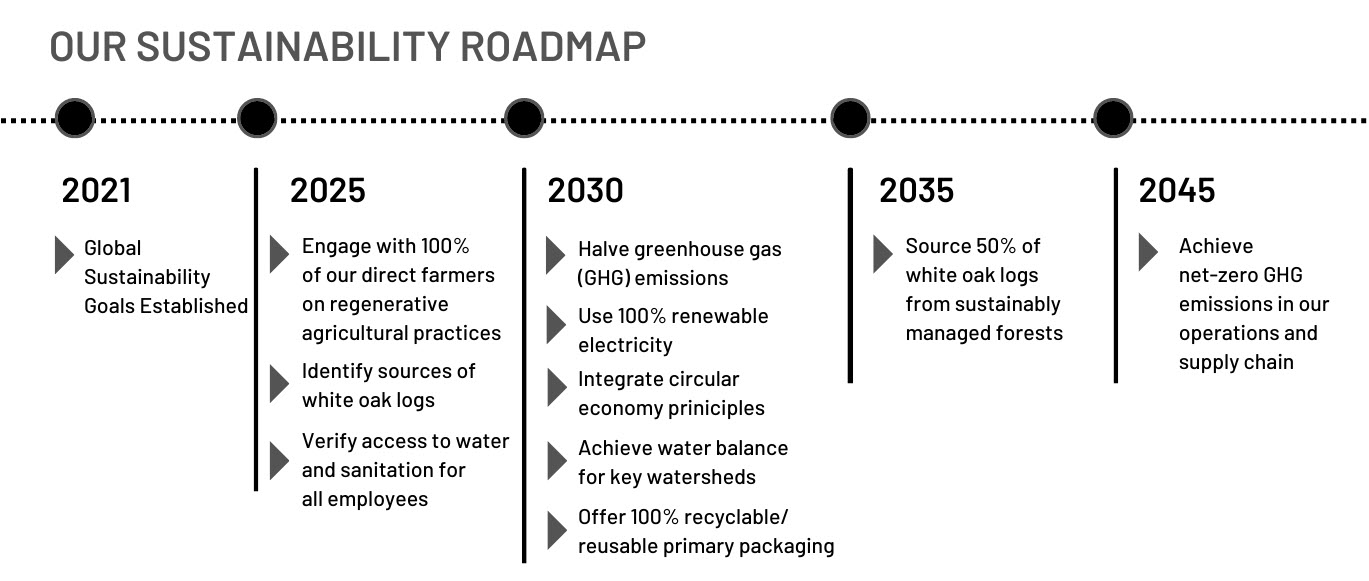
Our recent investments in renewable energy and resource stewardship underscore our long-term focus:
-
Wind: Our partnership with the East Fork Wind project, which became operational in April 2020, provides a renewable energy source that offsets more than 90% of our electricity usage in the United States.
-
Solar: Last year, Jack Daniel's announced a partnership to provide our Lynchburg distillery with 20 megawatts of solar energy. The agreement will provide nearly three-quarters of the distillery's electricity needs, and makes Jack Daniel's the first distillery to participate in Tennessee Valley Authority's Green Invest Program.
-
Watersheds: To manage water risk, we have completed watershed risk assessments to evaluate watersheds we operate in that are considered at-risk or business critical. Following the assessments, we have begun to develop multi-year mitigation plans to address risk.
-
Waste: In 2020, we were pleased to achieve our zero-waste-to-landfill (defined as sending less than 1% to landfill) goal across our production facilities. Our next priority is to integrate circular economy principles into our business that will allow us to go beyond zero-waste to a regenerative approach where resources are continually reused.
We believe we are better positioned than ever to deliver exceptional high-quality products to our consumers around the world. We have a highly capable and engaged workforce. We have developed brand-building capabilities by equipping our teams with the training and tools necessary for an increasingly data-driven digital global marketplace. Among other trends, the expansion of the digital economy accelerated significantly as consumers, businesses, and communities adapted to the challenges brought on by the COVID-19 pandemic. To continue our success in how we market and sell our brands, we announced in fiscal 2021 an investment in a new Integrated Marketing Communications organization that we believe will further enhance our ability to win in the digital economy.
Community
In addition to the investments we make in our employees, we believe it is vital that we give back to the communities that support both our employees and our company by thoughtfully deploying our time, talent, and resources. We have been a proud corporate citizen of our hometown of Louisville, Kentucky, since we were founded. Being a good neighbor is something we strive for wherever we operate, and our expanded focus and commitment to the neighborhood around our corporate campus meets this call to be the best neighbor we can be in an area that has experienced the effects of underinvestment and systemic racism.
We also continue to expand our civic engagement into Brown-Forman global office locations, allowing those employees closest to the needs of their communities to decide how to invest their charitable-giving resources. We leverage our key community relations partners to stay informed of collaborative opportunities in the communities where we work and live, and to shape our charitable-giving strategy to meet the essential needs of the communities that sustain us. We provide charitable donations and our employees volunteer throughout our communities, including 128 serving on 230 nonprofit boards in the United States. The Brown-Forman Foundation (the Foundation) was created in fiscal 2018 with the goal of helping fund our ongoing philanthropic endeavors. The Foundation's earnings provide a consistent source of revenue for charitable giving
independent of our annual earnings. We work to partner with organizations that support our key focus areas: empowering responsible and sustainable living, ensuring essential living standards, and enhancing arts and cultural living. As part of our commitment to be better and do better as neighbors and as corporate citizens, the Brown-Forman Foundation made a 10-year, $50 million commitment to five organizations in west Louisville in 2022, which is the largest investment in its history. Our partner organizations include AMPED, the Louisville Central Community Center, the Louisville Urban League, Simmons College of Kentucky, and the West End School. Together, these organizations will advance educational opportunities in west Louisville, from early childhood through adult learning.
We believe that having a long-term-focused, committed, and engaged shareholder base, anchored by the Brown Family, gives us a distinct strategic advantage, particularly in a business with multi-generational brands and products that must be aged. We are committed to continually improving our environmental, social, and governance performance and acting upon our deeply held values. Recognizing the strong cash-generating capacity and the capital efficiency of our business, we will continue to pursue top-tier shareholder return through shareholder-friendly capital allocation and socially and environmentally conscious investments to fuel long-term growth.
Human Capital Resources
Overview: Culture of Care
We put our values at the forefront of all our decisions and actions, in an effort to make our employees feel respected, safe, and supported so they can make, market, and sell our products with the finest craftsmanship, quality, and care. What enables our success are the 5,200 people (excluding individuals that work on a part-time or temporary basis) we employ in 43 countries around the world. This includes approximately 3,400 salaried employees and 1,800 hourly employees, with the largest percentage of our employees residing within the United States, Mexico, and the United Kingdom. We believe our employee relations are good and our turnover rate is low.
COVID-19 Response
Shortly after the global pandemic began, we shifted nearly all global salaried employees to a virtual working environment and safely maintained our essential production operations. Over the last year, salaried employees have begun returning to their offices as local conditions have allowed. We welcomed salaried employees back to our Louisville headquarters on May 2, 2022, where we have made investments in our facilities and services to ease this transition.
The majority of our employees will be working under a hybrid work style going forward, working a minimum of three days per week in the office and the remaining days at home (or the location of their choice). We believe this structure will allow our employees to collaborate and build relationships, while enjoying the flexibility that they have come to appreciate. Flexibility has been a cultural priority at Brown-Forman since well before the pandemic and we are pleased to have found a solution that meets the needs of our business and our employees.
Structural Investments
We launched a new capability and organization within Brown-Forman that we call “Integrated Marketing Communications” (IMC). IMC focuses on driving excellence within five highly integrated, interdependent disciplines: e-commerce, Media, Performance, Search, and Content. These disciplines are supported by increased investments to advance our consumer-centric philosophy, agile processes, technology, and our organization, which has been significantly enhanced to support this initiative. The IMC organization consists of many marketers around the world who are solely focused on advancing our digital marketing and e-commerce initiatives. This includes new roles that we have recently created, which has given us the opportunity to elevate internal talent as well as incorporate external talent from leading companies with critical expertise. Through IMC, we can better meet consumers where they are by customizing content to maximize relevance and more effectively drive their behavior. We can now do this in real time and at scale. By integrating e-commerce within IMC, we can create a truly cohesive end-to-end consumer journey starting from awareness and closing the loop with sales.
Diversity & Inclusion
We are continuing to pursue our 2030 Diversity & Inclusion strategy, as outlined in Many Spirits, One Brown-Forman: Gender and Race Edition. This year, we continued to increase the number of women in senior leadership globally and people of color in the United States through both internal promotions and external hiring.
To support our culture of inclusion, all executive leaders participated in our six month Inclusive Leadership Program. This group completed the program at the end of the calendar year and we have recently begun cascading it down to our business leaders.
Workforce Stability
We must remain focused on winning the war for talent in a marketplace where opportunities abound and highly skilled knowledge workers can work from anywhere. While we have historically enjoyed low turnover amongst our salaried population, we have tracked our departures carefully over the last year, given the acceleration of the job market. We have analyzed our data quarterly, looking at cuts by gender, ethnicity, function, location, age, management level, etc. in addition to qualitative exit interview data. We have been pleased to find that our turnover remains consistent with our pre-pandemic levels. We will, of course, continue to monitor our data carefully.
Executive Officers
Information about Our Executive Officers
The following persons served as executive officers as of June 17, 2022:
| Name | Age | Principal Occupation and Business Experience | ||||||
| Lawson E. Whiting | 53 | President and Chief Executive Officer since 2019. Executive Vice President and Chief Operating Officer from October 2017 to December 2018. Executive Vice President and Chief Brands and Strategy Officer from 2015 to 2017. Senior Vice President and Chief Brands Officer from 2013 to 2015. Senior Vice President and Managing Director for Western Europe from 2011 to 2013. Vice President and Finance Director for Western Europe from 2010 to 2011. Vice President and Finance Director for North America from 2009 to 2010. | ||||||
| Matthew E. Hamel | 62 | Executive Vice President and General Counsel since 2021. Executive Vice President, General Counsel and Secretary from 2007 to 2021. | ||||||
| Leanne D. Cunningham | 52 | Senior Vice President and Chief Financial Officer since July 2021. Senior Vice President, Shareholder Relations Officer, Global Commercial Finance, and Financial Planning and Analysis from August 2020 to June 2021. Senior Vice President, Shareholder Relations Officer from August 2019 to July 2020. Senior Vice President, and General Manager - Brown-Forman Brands from May 2015 to July 2019. Vice President, Director of Finance Global Production from October 2013 to April 2015. Vice President, Chief of Staff and Director of Business Development Global Production from November 2009 to October 2013. | ||||||
| Matias Bentel | 47 | Senior Vice President and Chief Brands Officer since January 2020. Senior Vice President and Managing Director of Jack Daniel’s Family of Brands from August 2018 to January 2020. Vice President and General Manager of Mexico from January 2016 to August 2018. Vice President Latin America Marketing and Chief of Staff from October 2009 to January 2016. | ||||||
| Kelli N. Brown | 52 | Senior Vice President and Chief Accounting Officer since August 2018. Vice President and Director Finance (North America Region) from 2015 to August 2018. Director NAR Division Finance (North America Region) from 2013 to 2015. Director Business Planning and Analytics (North America Region) from 2012 to 2013. | ||||||
| Ralph E. de Chabert | 75 | Senior Vice President, Chief Corporate Citizenship Officer since February 2022. Senior Vice President, Chief Diversity Inclusion and Global Community Relations Officer from March 2019 to February 2022. Vice President and Chief Diversity Officer from 2007 to 2019. | ||||||
| Marshall B. Farrer | 51 | Senior Vice President, President Europe since August 2020. Senior Vice President, Managing Director, Global Travel Retail and Developed APAC Region from August 2018 to July 2020. Senior Vice President, Managing Director, Global Travel Retail from July 2018 to May 2015. Vice President, Managing Director, Jack Daniel’s Tennessee Honey from January 2014 to April 2015. Vice President, Managing Director, Australia/New Zealand region from 2010 to 2014. | ||||||
| Kirsten M. Hawley | 52 | Senior Vice President, Chief People, Places, and Communications Officer since May 2021. Senior Vice President, Chief Human Resources and Corporate Communications Officer from March 2019 to April 2021. Senior Vice President and Chief Human Resources Officer from February 2015 to February 2019. Senior Vice President and Director of Human Resources Business Partnerships from 2013 to 2015. Vice President and Director of Organization and Leader Development from 2011 to 2013. | ||||||
| John V. Hayes | 62 | Senior Vice President, President, U.S.A. and Canada since June 2018. Senior Vice President, Chief Marketing Officer of Brown-Forman Brands from February 2015 to June 2018. Senior Vice President, Managing Director Jack Daniel’s from 2011 to 2015. | ||||||
| Thomas W. Hinrichs | 60 | Senior Vice President, President Emerging International since August 2020. Senior Vice President, President, International Division from June 2018 to July 2020. Senior Vice President and President for Europe, North Asia, and ANZSEA from February 2015 to June 2018. Senior Vice President and Managing Director for Europe from 2013 to 2015. Senior Vice President and Managing Director for Greater Europe and Africa from 2006 to 2013. | ||||||
| Timothy M. Nall | 51 | Senior Vice President, Chief Global Supply Chain and Technology Officer since March 2022. Senior Vice President, Chief Information and Advanced Analytics Officer from January 2015 to February 2022. Vice President Director Technical Services from May 2013 to December 2014. Vice President Director Wines/ENV/Govt Comp 2011 to 2013. | ||||||
| Crystal L. Peterson | 51 | Vice President, Chief Inclusion and Global Community Relations Officer since June 2022. Vice President and Chief Diversity Officer from February 2022 to June 2022. Vice President and Human Resources Director - Global Production, Diversity and Inclusion from March 2021 to January 2022. Vice President and Human Resources Director - Global Production from August 2017 to February 2021. Vice President and Human Resources Director - North America Region from May 2015 to July 2017. Human Resources Director - North America Region and Latin America Region from May 2013 to April 2015. | ||||||
Available Information
Our website address is www.brown-forman.com. Our annual reports on Form 10-K, quarterly reports on Form 10-Q, current reports on Form 8-K, and any amendments to these reports are available free of charge on our website as soon as reasonably practicable after we electronically file those reports with the Securities and Exchange Commission (SEC). The information provided on our website, and any other website referenced herein, is not part of this report, and is therefore not incorporated by reference into this report or any other filing we make with the SEC, unless that information is otherwise specifically incorporated by reference.
On our website, we have posted our Code of Conduct that applies to all our directors and employees, and our Code of Ethics that applies specifically to our senior financial officers. If we amend or waive any of the provisions of our Code of Conduct or our Code of Ethics applicable to our principal executive officer, principal financial officer, or principal accounting officer that relates to any element of the definition of “code of ethics” enumerated in Item 406(b) of Regulation S-K under the Securities Exchange Act of 1934 Act, as amended, we intend to disclose these actions on our website. We have also posted on our website our Corporate Governance Guidelines and the charters of our Audit Committee, Compensation Committee, Corporate Governance and Nominating Committee, and Executive Committee of our Board of Directors. Copies of these materials are also available free of charge by writing to our Secretary at 850 Dixie Highway, Louisville, Kentucky 40210 or emailing Secretary@b-f.com.
Previous: Cover and table of contents · Next: Item 1A. Risk Factors