 filings.tools
Biogen 10-K 2020-12-31
Filed 2021-02-03. 22 sections, 796K characters. Original on sec.gov · Markdown · JSON
Cover and table of contents
UNITED STATES SECURITIES AND EXCHANGE COMMISSION
Washington, D.C. 20549
Form 10-K
| ☒ | ANNUAL REPORT PURSUANT TO SECTION 13 OR 15(d) OF THE SECURITIES EXCHANGE ACT OF 1934 |
For the fiscal year ended December 31, 2020
or
| ☐ | TRANSITION REPORT PURSUANT TO SECTION 13 OR 15(d) OF THE SECURITIES EXCHANGE ACT OF 1934 |
Commission file number: 0-19311
BIOGEN INC.
(Exact name of registrant as specified in its charter)
| Delaware | 33-0112644 | |||||||
| (State or other jurisdiction of incorporation or organization) | (I.R.S. Employer Identification No.) |
225 Binney Street, Cambridge, MA 02142
(617) 679-2000
(Address, including zip code, and telephone number, including area code, of Registrant’s principal executive offices)
Securities registered pursuant to Section 12(b) of the Act:
| Title of Each Class | Trading Symbol(s) | Name of Each Exchange Where Registered | |||||||||||||||
| Common Stock, $0.0005 par value | BIIB | The | Nasdaq Global Select Market |
Securities registered pursuant to Section 12(g) of the Act:
None
Indicate by check mark if the registrant is a well-known seasoned issuer, as defined in Rule 405 of the Securities Act. Yes x No o
Indicate by check mark if the registrant is not required to file reports pursuant to Section 13 or Section 15(d) of the Act. Yes o No x
Indicate by check mark whether the registrant (1) has filed all reports required to be filed by Section 13 or 15(d) of the Securities Exchange Act of 1934 during the preceding 12 months (or for such shorter period that the registrant was required to file such reports), and (2) has been subject to such filing requirements for the past 90 days. Yes x No o
Indicate by check mark whether the registrant has submitted electronically every Interactive Data File required to be submitted pursuant to Rule 405 of Regulation S-T (§ 232.405 of this chapter) during the preceding 12 months (or for such shorter period that the registrant was required to submit such files). Yes x No o
Indicate by check mark whether the registrant is a large accelerated filer, an accelerated filer, a non-accelerated filer, a smaller reporting company, or an emerging growth company. See the definitions of “large accelerated filer,” “accelerated filer,” “smaller reporting company” and "emerging growth company" in Rule 12b-2 of the Exchange Act. x
| Large accelerated filer | x | Accelerated filer | ☐ | |||||||||||
| Non-accelerated filer | ☐ | Smaller reporting company | ☐ | |||||||||||
| Emerging growth company | ☐ |
If an emerging growth company, indicate by check mark if the registrant has elected not to use the extended transition period for complying with any new or revised financial accounting standards provided pursuant to Section 13(a) of the Exchange Act. ☐
Indicate by check mark whether the registrant has filed a report on and attestation to its management's assessment of the effectiveness of its internal control over financial reporting under Section 404(b) of the Sarbanes-Oxley Act (15 U.S.C. 7262(b)) by the registered public accounting firm that prepared or issued its audit report. ☒
Indicate by check mark whether the registrant is a shell company (as defined in Rule 12b-2 of the Act). Yes ☐ No x
The aggregate market value of the registrant’s common stock held by non-affiliates of the registrant (without admitting that any person whose shares are not included in such calculation is an affiliate) computed by reference to the price at which the common stock was last sold as of the last business day of the registrant’s most recently completed second fiscal quarter was $42,102,640,463.
As of February 2, 2021, the registrant had 152,335,731 shares of common stock, $0.0005 par value, outstanding.
DOCUMENTS INCORPORATED BY REFERENCE
Portions of the definitive proxy statement for our 2021 Annual Meeting of Stockholders are incorporated by reference into Part III of this report.
BIOGEN INC.
ANNUAL REPORT ON FORM 10-K
For the Year Ended December 31, 2020
TABLE OF CONTENTS
NOTE REGARDING FORWARD-LOOKING STATEMENTS
This report contains forward-looking statements that are being made pursuant to the provisions of the Private Securities Litigation Reform Act of 1995 (the Act) with the intention of obtaining the benefits of the “Safe Harbor” provisions of the Act. These forward-looking statements may be accompanied by such words as “aim,” “anticipate,” “believe,” “could,” “estimate,” “expect,” “forecast,” "goal," “intend,” “may,” “plan,” “potential,” “possible,” “will,” “would” and other words and terms of similar meaning. Reference is made in particular to forward-looking statements regarding:
-
the anticipated amount, timing and accounting of revenues; contingent, milestone, royalty and other payments under licensing, collaboration, acquisition or divestiture agreements; tax positions and contingencies; collectability of receivables; pre-approval inventory; cost of sales; research and development costs; compensation and other selling, general and administrative expenses; amortization of intangible assets; foreign currency exchange risk; estimated fair value of assets and liabilities; and impairment assessments;
-
expectations, plans and prospects relating to sales, pricing, growth and launch of our marketed and pipeline products;
-
the potential impact of increased product competition in the markets in which we compete, including increased competition from new originator therapies, generics, prodrugs and biosimilars of existing products and products approved under abbreviated regulatory pathways, including generic or biosimilar versions of our products;
-
patent terms, patent term extensions, patent office actions and expected availability and period of regulatory exclusivity;
-
our plans and investments in our core and emerging growth areas as well as implementation of our corporate strategy;
-
the drivers for growing our business, including our plans and intention to commit resources relating to discovery, research and development programs and business development opportunities as well as the potential benefits and results of certain business development transactions;
-
the expectations, development plans and anticipated timelines, including costs and timing of potential clinical trials, filings and approvals, of our products, drug candidates and pipeline programs, including collaborations with third-parties, as well as the potential therapeutic scope of the development and commercialization of our and our collaborators’ pipeline products;
-
the timing, outcome and impact of administrative, regulatory, legal and other proceedings related to our patents and other proprietary and intellectual property rights, tax audits, assessments and settlements, pricing matters, sales and promotional practices, product liability and other matters;
-
our ability to finance our operations and business initiatives and obtain funding for such activities;
-
adverse safety events involving our marketed products, generic or biosimilar versions of our marketed products or any other products from the same class as one of our products;
-
the direct and indirect impact of the COVID-19 pandemic on our business and operations, including sales, expenses, supply chain, manufacturing, cyber-attacks or other privacy or data security incidents, research and development costs, clinical trials and employees;
-
the potential impact of healthcare reform in the United States (U.S.) and measures being taken worldwide designed to reduce healthcare costs and limit the overall level of government expenditures, including the impact of pricing actions and reduced reimbursement for our products;
-
our manufacturing capacity, use of third-party contract manufacturing organizations, plans and timing relating to changes in our manufacturing capabilities, activities in new or existing manufacturing facilities and the expected timeline for the Solothurn manufacturing facility to be partially operational;
-
the impact of the continued uncertainty of the credit and economic conditions in certain countries in Europe and our collection of accounts receivable in such countries;
-
the potential impact on our results of operations and liquidity of the United Kingdom's (U.K.) departure from the European Union (E.U.);
-
lease commitments, purchase obligations and the timing and satisfaction of other contractual obligations; and
- the impact of new laws, regulatory requirements, judicial decisions and accounting standards.
These forward-looking statements involve risks and uncertainties, including those that are described in Item 1A. Risk Factors included in this report and elsewhere in this report, that could cause actual results to differ materially from those reflected in such statements. You should not place undue reliance on these statements. Forward-looking statements speak only as of the date of this report. Except as required by law, we do not undertake any obligation to publicly update any forward-looking statements, whether as a result of new information, future developments or otherwise.
NOTE REGARDING COMPANY AND PRODUCT REFERENCES
References in this report to:
-
“Biogen,” the “company,” “we,” “us” and “our” refer to Biogen Inc. and its consolidated subsidiaries; and
-
“RITUXAN” refers to both RITUXAN (the trade name for rituximab in the U.S., Canada and Japan) and MabThera (the trade name for rituximab outside the U.S., Canada and Japan).
NOTE REGARDING TRADEMARKS
AVONEX®, PLEGRIDY®, RITUXAN®, RITUXAN HYCELA®, SPINRAZA®, TECFIDERA®, TYSABRI®, VUMERITY® and ZINBRYTA® are registered trademarks of Biogen.
BENEPALI™, FLIXABI™, FUMADERM™, IMRALDI™ and Healthy Climate, Healthy Lives™ are trademarks of Biogen.
ENBREL®, EYLEA®, FAMPYRA™, GAZYVA®, HUMIRA®, LUCENTIS®, OCREVUS®, REMICADE® and other trademarks referenced in this report are the property of their respective owners.
PART I
Item 1. Business
Overview
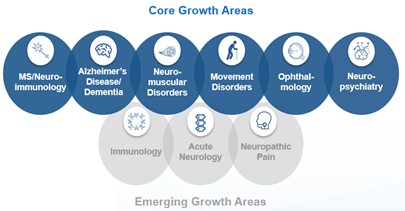
Biogen is a global biopharmaceutical company focused on discovering, developing and delivering worldwide innovative therapies for people living with serious neurological and neurodegenerative diseases as well as related therapeutic adjacencies. Our core growth areas include multiple sclerosis (MS) and neuroimmunology; Alzheimer’s disease and dementia; neuromuscular disorders, including spinal muscular atrophy (SMA) and amyotrophic lateral sclerosis (ALS); movement disorders, including Parkinson's disease; ophthalmology; and neuropsychiatry. We are also focused on discovering, developing and delivering worldwide innovative therapies in our emerging growth areas of immunology; acute neurology; and neuropathic pain. In addition, we commercialize biosimilars of advanced biologics. We support our drug discovery and development efforts through the commitment of significant resources to discovery, research and development programs and business development opportunities.
Our marketed products include TECFIDERA, VUMERITY, AVONEX, PLEGRIDY, TYSABRI and FAMPYRA for the treatment of MS; SPINRAZA for the treatment of SMA; and FUMADERM for the treatment of severe plaque psoriasis. We have certain business and financial rights with respect to RITUXAN for the treatment of non-Hodgkin's lymphoma, chronic lymphocytic leukemia (CLL) and other conditions; RITUXAN HYCELA for the treatment of non-Hodgkin's lymphoma and CLL; GAZYVA for the treatment of CLL and follicular lymphoma; OCREVUS for the treatment of primary progressive MS (PPMS) and relapsing MS (RMS); and other potential anti-CD20 therapies pursuant to our collaboration arrangements with Genentech, Inc. (Genentech), a wholly-owned member of the Roche Group. For additional information on our collaboration arrangements with Genentech, please read Note 18, Collaborative and Other Relationships, to our consolidated financial statements included in this report.
For over two decades we have led in the research and development of new therapies to treat MS, resulting in our leading portfolio of MS treatments. Now our research is focused on developing next generation treatments for MS. We introduced the first approved treatment for SMA and are continuing to pursue research and development for potential advancements in the treatment of SMA. We are also applying our scientific expertise to solve some of the most challenging and complex diseases, including Alzheimer's disease, ALS, Parkinson's disease, choroideremia (CHM), major depressive disorder, postpartum depression, X-linked retinitis pigmentosa (XLRP), systemic lupus erythematosus (SLE), cutaneous lupus erythematosus (CLE), cognitive impairment associated with schizophrenia (CIAS), stroke and neuropathic pain.
Our innovative drug development and commercialization activities are complemented by our biosimilar business that expands access to medicines and reduces the cost burden for healthcare systems. Through our agreements with Samsung Bioepis Co., Ltd. (Samsung Bioepis), our joint venture with Samsung BioLogics Co., Ltd. (Samsung BioLogics), we market and sell BENEPALI, an etanercept biosimilar referencing ENBREL, IMRALDI, an adalimumab biosimilar referencing HUMIRA, and FLIXABI, an infliximab biosimilar referencing REMICADE, in certain countries in Europe and have an option to acquire exclusive rights to commercialize these products in China. Additionally, we have exclusive rights to commercialize two potential ophthalmology biosimilar products, SB11, a proposed ranibizumab biosimilar referencing LUCENTIS, and SB15, a proposed aflibercept biosimilar referencing EYLEA, in major markets worldwide, including the U.S., Canada, Europe, Japan and Australia. For additional information on our collaboration arrangements with Samsung Bioepis, please read Note 18, Collaborative and Other Relationships, to our consolidated financial statements included in this report.
Key Business Developments
The following is a summary of key developments affecting our business since the beginning of 2020.
For additional information on our acquisitions, collaborative and other relationships discussed below, please read Note 2, Acquisitions, Note 18, Collaborative and Other Relationships, and Note 19, Investments in Variable Interest Entities, to our consolidated financial statements included in this report.
Acquisitions, Collaborative and Other Relationships
BIIB118 Acquisition
In March 2020 we acquired BIIB118 (CK1 inhibitor), a novel CNS-penetrant small molecule inhibitor of casein kinase 1, for the potential treatment of patients with behavioral and neurological symptoms across various psychiatric and neurological diseases from Pfizer Inc. (Pfizer). We are developing BIIB118 for the potential treatment of irregular sleep wake rhythm disorder (ISWRD) in Parkinson’s disease and plan to develop BIIB118 for the potential treatment of sundowning in Alzheimer's disease.
Sangamo Therapeutics, Inc.
In April 2020 we closed a collaboration and license agreement with Sangamo Therapeutics, Inc. (Sangamo) to develop and commercialize ST-501 for tauopathies, including Alzheimer’s disease; ST-502 for synucleinopathies, including, Parkinson’s disease; a third neuromuscular disease target; and up to nine additional neurological disease targets to be identified and selected within a five-year period. The companies are leveraging Sangamo's proprietary zinc finger protein technology delivered via adeno-associated virus to modulate the expression of key genes involved in neurological diseases. In connection with the closing of this transaction, we purchased $225.0 million of Sangamo common stock, or approximately 24 million shares at approximately $9.21 per share.
Denali Therapeutics Inc.
In October 2020 we closed a collaboration and license agreement with Denali Therapeutics Inc. (Denali) to co-develop and co-commercialize Denali’s small molecule inhibitors of leucine-rich repeat kinase 2 (LRRK2) for Parkinson’s disease. In addition to the LRRK2 program, we also have an exclusive option to license two preclinical programs from Denali’s Transport Vehicle platform, including its Antibody Transport Vehicle (ATV): ATV enabled anti-amyloid beta (Abeta) program and a second program utilizing its Transport Vehicle technology. Further, we have a right of first negotiation on two additional Transport Vehicle-enabled therapeutics, should Denali decide to seek a collaboration for such programs. As part of this collaboration we purchased approximately $465.0 million of Denali common stock in September 2020, or approximately 13 million shares at approximately $34.94 per share.
Sage Therapeutics, Inc.
In December 2020 we closed a global collaboration and license agreement with Sage Therapeutics, Inc. (Sage) to jointly develop and commercialize zuranolone (SAGE-217) for the potential treatment of major depressive disorder, postpartum depression and other psychiatric disorders and SAGE-324 for the potential treatment of essential tremor and other neurological disorders. In connection with the closing of this transaction we purchased $650.0 million of Sage common stock, or approximately 6.2 million shares at approximately $104.14 per share.
Other Key Developments
Aducanumab (Aβ mAb)
In July 2020 we completed the submission of a Biologics License Application (BLA) to the U.S. Food and Drug Administration (FDA) for the approval of aducanumab, an anti-amyloid beta antibody candidate for the potential treatment of Alzheimer's disease that we are developing in collaboration with Eisai Co., Ltd. (Eisai). In August 2020 the FDA accepted the BLA and granted Priority Review with a Prescription Drug User Fee Act (PDUFA) action date on March 7, 2021.
In November
Showing the first 8K of 145K characters. Open the full section
Item 1A. Risk Factors
Risks Related to Our Business
We are substantially dependent on revenues from our products.
Our revenues depend upon continued sales of our products as well as the financial rights we have in our anti-CD20 therapeutic programs. A significant portion of our revenues are concentrated on sales of our products in increasingly competitive markets and in markets affected directly and indirectly by the COVID-19 pandemic. Any of the following negative developments relating to any of our products or any of our anti-CD20 therapeutic programs may adversely affect our revenues and results of operations or could cause a decline in our stock price:
-
the introduction or greater acceptance of competing products, including new originator therapies, generics, prodrugs and biosimilars of existing products and products approved under abbreviated regulatory pathways;
-
safety or efficacy issues;
-
limitations and additional pressures on product pricing or price increases, including those resulting from governmental or regulatory requirements; increased competition, including from generic or biosimilar versions of our products; or changes in, or implementation of, reimbursement policies and practices of payors and other third parties;
-
adverse legal, administrative, regulatory or legislative developments;
-
our ability to maintain a positive reputation among patients, healthcare providers and others, which may be impacted by our pricing and reimbursement decisions; or
-
the inability or reluctance of patients to receive a diagnosis, prescription or administration of our products or a decision to prescribe and administer competitive therapies as a direct or indirect result of the COVID-19 pandemic.
Our long-term success depends upon the successful development of new products and additional indications for our existing products.
Our long-term success will depend upon the successful development of new products and technologies from our research and development activities or our licenses or acquisitions from third parties, including our commercialization agreements with Samsung Bioepis, as well as additional indications for our existing products.
Product development is very expensive and involves a high degree of uncertainty and risk and may not be successful. Only a small number of research and development programs result in the commercialization of a product. It is difficult to predict the success and the time and cost of product development of novel approaches for the treatment of diseases. The development of novel approaches for the treatment of diseases, including development efforts in new modalities such as those based on the ASO platform and gene therapy, may present additional challenges and risks, including obtaining approval from regulatory authorities that have limited experience with the development of such therapies. In addition, clinical trial data are subject to differing interpretations and even if we view data as sufficient to support the safety, effectiveness and/or approval of an investigational therapy, regulatory authorities may disagree and may require additional data, limit the scope of the approval or deny approval altogether.
Success in preclinical work or early stage clinical trials does not ensure that later stage or larger scale clinical trials will be successful. Clinical trials may indicate that our product candidates lack efficacy, have harmful side effects, result in unexpected adverse events or raise other concerns that may significantly reduce the likelihood of regulatory approval. This may result in terminated programs, significant restrictions on use and safety warnings in an approved label, adverse placement within the treatment paradigm or significant reduction in the commercial potential of the product candidate.
Even if we could successfully develop new products or indications, we may make a strategic decision to discontinue development of a product candidate or indication if, for example, we believe commercialization will be difficult relative to the standard of care or we prefer to pursue other opportunities in our pipeline.
Sales of new products or products with additional indications may also not meet investor expectations.
If we fail to compete effectively, our business and market position would suffer.
The biopharmaceutical industry and the markets in which we operate are intensely competitive. We compete in the marketing and sale of our products, the development of new products and processes, the acquisition of rights to new products with commercial potential and the hiring and retention of personnel. We compete with biotechnology and pharmaceutical companies that have a greater number of products on the market and in the product pipeline, substantially greater financial, marketing, research and development and other resources and other technological or competitive advantages.
Our products continue to face increasing competition from the introduction of new originator therapies, generics, prodrugs and biosimilars of existing products and products approved under abbreviated regulatory pathways. Some of these products are likely to be sold at substantially lower prices than our branded products. The introduction of such products as well as other lower-priced competing products has reduced, and may in the future, significantly reduce both the price that we are able to charge for our products and the volume of products we sell, which will negatively impact our revenues. For instance, demand and price for TECFIDERA declined significantly as a result of multiple TECFIDERA generic entrants entering the U.S. market during the year ended December 31, 2020. In addition, in some markets, when a generic or biosimilar version of one of our products is commercialized, it may be automatically substituted for our product and significantly reduce our revenues in a short period of time.
In the MS market, we face intense competition as the number of products and competitors continues to expand. Due to our significant reliance on sales of our MS products, our business could be harmed if we are unable to successfully compete in the MS market. More specifically, our ability to compete, maintain and grow our share in the MS market may be adversely affected due to a number of factors, including:
-
the introduction of more efficacious, safer, less expensive or more convenient alternatives to our MS products, including our own products and products of our collaborators;
-
the introduction of generic versions of branded MS products, including our own products, biosimilars, follow-on products, prodrugs or products approved under abbreviated regulatory pathways, which would be significantly less costly than our products to bring to market and would be offered for sale at lower prices, and could result in a significant percentage of the sales of our products being lost to such products;
-
the off-label use by physicians of therapies indicated for other conditions to treat MS patients;
-
patient dynamics, including the size of the patient population and our ability to attract and maintain new and current patients to our therapies;
-
damage to physician and patient confidence in any of our MS products, generic or biosimilars of our MS products or any other product from the same class as one of our products, or to our sales and reputation as a result of label changes or adverse experiences or events that may occur with patients treated with our MS products or generic or biosimilars of our MS products;
-
inability to obtain appropriate pricing and reimbursement for our MS products compared to our competitors in key international markets; or
-
our ability to obtain and maintain patent, data or market exclusivity for our MS products.
In the SMA market, we face competition from a gene therapy product that was approved the
Showing the first 8K of 77K characters. Open the full section
Item 1B. Unresolved Staff Comments
None.
Item 2. Properties
Below is a summary of our owned and leased properties as of December 31, 2020.
Massachusetts
In Cambridge, MA we own approximately 508,000 square feet of real estate space, consisting of a building that houses a research laboratory and a cogeneration plant totaling approximately 263,000 square feet and a building that contains research, development and quality laboratories totaling approximately 245,000 square feet.
In addition, we lease a total of approximately 1,169,000 square feet in Massachusetts, which is summarized as follows:
- 800,000 square feet in Cambridge, MA, which is comprised of offices for our corporate headquarters and other administrative and development functions and laboratories, of which 265,000 square feet is subleased by multiple companies for general office space, laboratories and manufacturing facilities;
-
357,000 square feet of office space in Weston, MA, of which 174,000 square feet is subleased through the remaining term of our lease agreement; and
-
12,000 square feet of office space in Waltham, MA.
Our Massachusetts lease agreements expire at various dates through the year 2028.
North Carolina
In RTP, NC we own approximately 1,040,000 square feet of real estate space, which is summarized as follows:
-
357,000 square feet of laboratory and office space;
-
206,000 square foot multi-purpose facility, including an ASO manufacturing suite and administrative space;
-
175,000 square feet related to a large-scale biologics manufacturing facility;
-
105,000 square feet related to a small-scale biologics manufacturing facility;
-
84,000 square feet of warehouse space and utilities;
-
70,000 square feet related to a parenteral fill-finish facility; and
-
43,000 square feet related to a large-scale purification facility.
In addition, we lease approximately 65,000 square feet of warehouse space and 103,000 square feet of office space in Durham, NC. Our North Carolina lease agreements expire at various dates through the year 2031.
Switzerland
In order to support our future growth and drug development pipeline, we are building a large-scale biologics manufacturing facility in Solothurn, Switzerland. We expect this facility to be partially operational during the first half of 2021. Upon completion, the facility will include 393,000 square feet related to a large-scale biologics manufacturing facility, 290,000 square feet of warehouse, utilities and support space and 51,000 square feet of administrative space.
Other International
We lease office space in Baar, Switzerland, our international headquarters; the U.K.; Germany; France; Japan; Canada and numerous other countries. Our international lease agreements expire at various dates through the year 2030.
Item 3. Legal Proceedings
For a discussion of legal matters as of December 31, 2020, please read Note 20, Litigation, to our consolidated financial statements included in this report, which is incorporated into this item by reference.
Item 4. Mine Safety Disclosures
Item 5. Market for Registrant’s Common Equity, Related Stockholder Matters and Issuer Purchases of Equity Securities
Market and Stockholder Information
Our common stock trades on The Nasdaq Global Select Market under the symbol “BIIB.” As of February 2, 2021, there were approximately 505 shareholders of record of our common stock.
Dividends
We have not paid cash dividends since our inception. While we historically have not paid cash dividends and do not have a current intention to pay cash dividends, we continually review our capital allocation strategies, including, among other things, payment of cash dividends, share repurchases and acquisitions.
Issuer Purchases of Equity Securities
The following table summarizes our common stock repurchase activity during the fourth quarter of 2020:
| Period | Total Number of Shares Purchased (#) | Average Price Paid per Share ($) | Total Number of Shares Purchased as Part of Publicly Announced Programs (#) | Approximate Dollar Value of Shares That May Yet Be Purchased Under Our Programs ($ in millions) | |||||||||||||||||||
| October 2020 | — | $ | — | — | $ | 5,000.0 | |||||||||||||||||
| November 2020 | — | $ | — | — | $ | 5,000.0 | |||||||||||||||||
| December 2020 | 1,620,969 | $ | 246.77 | — | $ | 4,600.0 | |||||||||||||||||
| Total | 1,620,969 | $ | 246.77 |
In October 2020 our Board of Directors authorized our 2020 Share Repurchase Program, which is a program to repurchase up to $5.0 billion of our common stock. Our 2020 Share Repurchase Program does not have an expiration date. All share repurchases under our 2020 Share Repurchase Program will be retired. Under our 2020 Share Repurchase Program, we repurchased and retired approximately 1.6 million shares of our common stock at a cost of approximately $400.0 million during the year ended December 31, 2020.
In December 2019 our Board of Directors authorized a program to repurchase up to $5.0 billion of our common stock (December 2019 Share Repurchase Program), which was completed as of September 30, 2020. All shares repurchased under our December 2019 Share Repurchase Program were retired. Under our December 2019 Share Repurchase Program, we repurchased and retired approximately 16.7 million shares of our common stock at a cost of approximately $5.0 billion during the year ended December 31, 2020.
In March 2019 our Board of Directors authorized a program to repurchase up to $5.0 billion of our common stock (March 2019 Share Repurchase Program), which was completed as of March 31, 2020. All shares repurchased under our March 2019 Share Repurchase Program were retired. Under our March 2019 Share Repurchase Program, we repurchased and retired approximately 4.1 million and 14.7 million shares of our common stock at a cost of approximately $1.3 billion and $3.7 billion during the years ended December 31, 2020 and 2019, respectively.
In August 2018 our Board of Directors authorized a program to repurchase up to $3.5 billion of our common stock (2018 Share Repurchase Program), which was completed as of June 30, 2019. All share repurchases under our 2018 Share Repurchase Program were retired. Under our 2018 Share Repurchase Program, we repurchased and retired approximately 8.9 million and 4.3 million shares of our common stock at a cost of approximately $2.1 billion and $1.4 billion during the years ended December 31, 2019 and 2018, respectively.
In July 2016 our Board of Directors authorized a program to repurchase up to $5.0 billion of our common stock (2016 Share Repurchase Program), which was completed as of June 30, 2018. All share repurchases under our 2016 Share Repurchase Program were retired. Under our 2016 Share Repurchase Program, we repurchased and retired approximately 10.5 million shares of common stock at a cost of approximately $3.0 billion during the year ended December 31, 2018.
Performance Graph
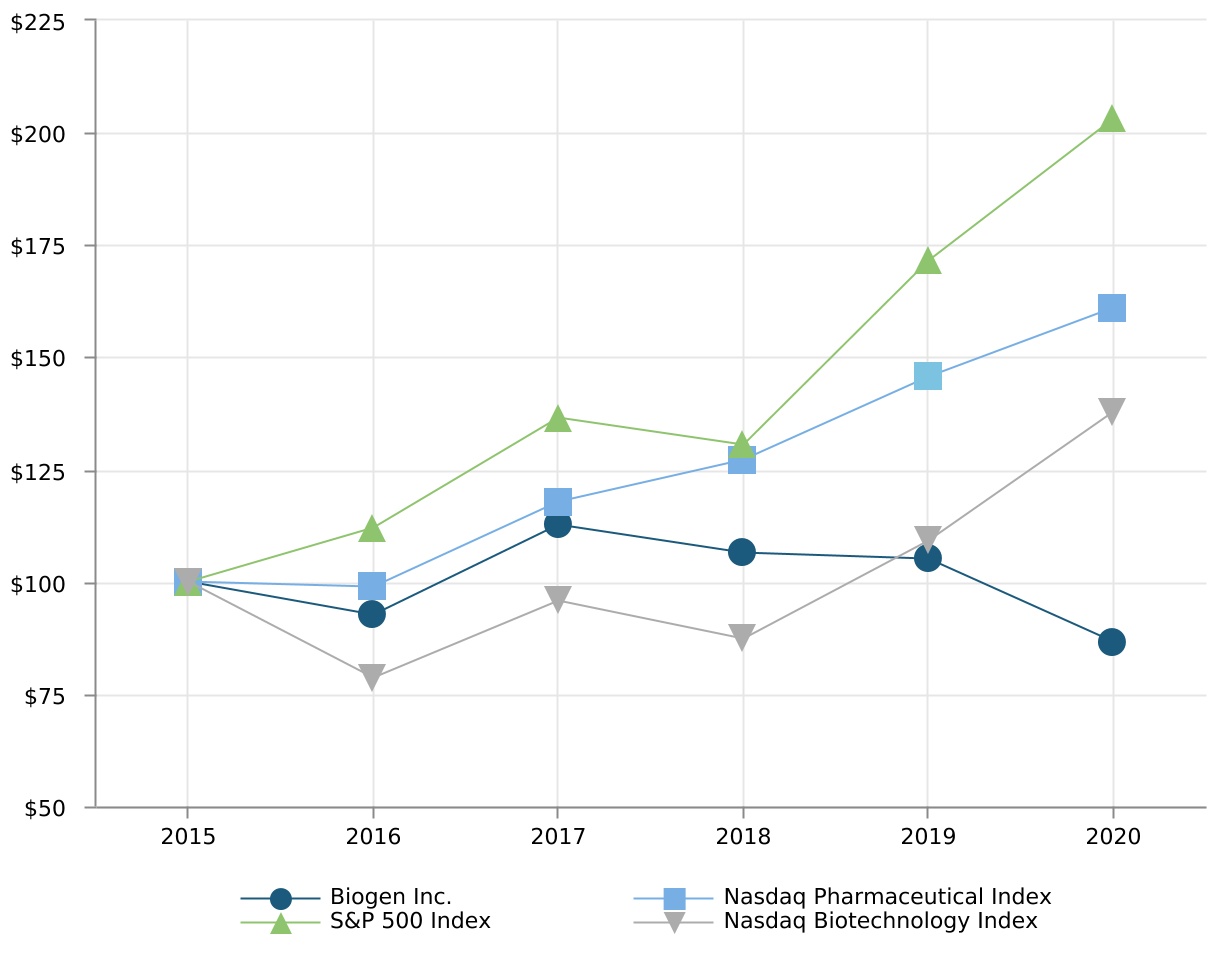
The performance graph below compares the five-year cumulative total stockholder return on our common stock, the Nasdaq Pharmaceutical Index, the S&P 500 Index and the Nasdaq Biotechnology Index.
On February 1, 2017, we completed the spin-off of our hemophilia business, Bioverativ Inc. (Bioverativ), as an independent, publicly traded company. In connection with the spin-off, each Biogen shareholder received one share of Bioverativ common stock for every two shares of Biogen common stock they owned. For additional information on the spin-off of our hemophilia business, please read Note 3, Hemophilia Spin-Off, to our consolidated financial statements included in our Annual Report on Form 10-K for the year ended December 31, 2018.
The performance graph below assumes the investment of $100.00 on December 31, 2015, in our common stock and each of the three indexes, with dividends being reinvested. Our stock prices have been adjusted for the effect of the spin-off of our hemophilia business. The five-year cumulative total stockholder return for Biogen does not reflect the reinvestment by Biogen shareholders of the distribution they received in connection with the spin-off of our hemophilia business or any subsequent increase or decrease in value of Bioverativ stock subsequent to the spin-off.
The stock price performance in the graph below is not necessarily indicative of future price performance.
| 2015 | 2016 | 2017 | 2018 | 2019 | 2020 | |||||||||||||||||||||||||||||||||
| Biogen Inc. | $100.00 | $92.57 | $112.74 | $106.49 | $105.01 | $86.65 | ||||||||||||||||||||||||||||||||
| Nasdaq Pharmaceutical Index | $100.00 | $98.91 | $117.83 | $127.20 | $145.65 | $160.97 | ||||||||||||||||||||||||||||||||
| S&P 500 Index | $100.00 | $111.96 | $136.40 | $130.42 | $171.49 | $203.04 | ||||||||||||||||||||||||||||||||
| Nasdaq Biotechnology Index | $100.00 | $78.65 | $95.69 | $87.21 | $109.11 | $137.94 |
The information included under the heading Performance Graph is “furnished” and not “filed” for purposes of Section 18 of the Securities Exchange Act, or otherwise subject to the liabilities of that section, nor shall it be deemed to be “soliciting material” subject to Regulation 14A or incorporated by reference in any filing under the Securities Act of 1933 or the Securities Exchange Act of 1934.
Item 6. Selected Financial Data
BIOGEN INC. AND SUBSIDIARIES
SELECTED FINANCIAL DATA
| Our results of operations are summarized as follows: | |||||||||||||||||||||||||||||
| For the Years Ended December 31, | |||||||||||||||||||||||||||||
| (In millions, except per share amounts) | 2020 | 2019 | 2018 | 2017 | 2016 | ||||||||||||||||||||||||
| Results of Operations | |||||||||||||||||||||||||||||
| Product revenues, net | $ | 10,692.2 | $ | 11,379.8 | $ | 10,886.8 | $ | 10,354.7 | $ | 9,817.9 | |||||||||||||||||||
| Revenues from anti-CD20 therapeutic programs | 1,977.8 | 2,290.4 | 1,980.2 | 1,559.2 | 1,314.5 | ||||||||||||||||||||||||
| Other revenues | 774.6 | 707.7 | 585.9 | 360.0 | 316.4 | ||||||||||||||||||||||||
| Total revenues | 13,444.6 | 14,377.9 | 13,452.9 | 12,273.9 | 11,448.8 | ||||||||||||||||||||||||
| Total cost and expenses | 8,894.5 | 7,335.3 | 7,564.3 | 6,928.1 | 6,297.1 | ||||||||||||||||||||||||
| Income from operations | 4,550.1 | 7,042.6 | 5,888.6 | 5,345.8 | 5,151.7 | ||||||||||||||||||||||||
| Other income (expense), net | 497.4 | 83.3 | 11.0 | (217.0) | (218.7) | ||||||||||||||||||||||||
| Income before income tax expense and equity in loss of investee, net of tax | 5,047.5 | 7,125.9 | 5,899.6 | 5,128.8 | 4,933.0 | ||||||||||||||||||||||||
| Income tax expense | 992.3 | 1,158.0 | 1,425.6 | 2,458.7 | 1,237.3 | ||||||||||||||||||||||||
| Equity in loss of investee, net of tax | (5.3) | 79.4 | — | — | — | ||||||||||||||||||||||||
| Net income | 4,060.5 | 5,888.5 | 4,474.0 | 2,670.1 | 3,695.7 | ||||||||||||||||||||||||
| Net income (loss) attributable to noncontrolling interests, net of tax | 59.9 | — | 43.3 | 131.0 | (7.1) | ||||||||||||||||||||||||
| Net income attributable to Biogen Inc. | $ | 4,000.6 | $ | 5,888.5 | $ | 4,430.7 | $ | 2,539.1 | $ | 3,702.8 | |||||||||||||||||||
| Diluted Earnings Per Share | |||||||||||||||||||||||||||||
| Diluted earnings per share attributable to Biogen Inc. | $ | 24.80 | $ | 31.42 | $ | 21.58 | $ | 11.92 | $ | 16.93 | |||||||||||||||||||
| Weighted-average shares used in calculating diluted earnings per share attributable to Biogen Inc. | 161.3 | 187.4 | 205.3 | 213.0 | 218.8 | ||||||||||||||||||||||||
| Our financial condition is summarized as follows: | |||||||||||||||||||||||||||||
| As of December 31, | |||||||||||||||||||||||||||||
| (In millions) | 2020 | 2019 | 2018 | 2017 | 2016 | ||||||||||||||||||||||||
| Financial Condition | |||||||||||||||||||||||||||||
| Cash, cash equivalents and marketable securities | $ | 3,382.2 | $ | 5,884.0 | $ | 4,913.9 | $ | 6,746.3 | $ | 7,724.5 | |||||||||||||||||||
| Total assets | $ | 24,618.9 | $ | 27,234.3 | $ | 25,288.9 | $ | 23,652.6 | $ | 22,876.8 | |||||||||||||||||||
| Notes payable, less current portion | $ | 7,426.2 | $ | 4,459.0 | $ | 5,936.5 | $ | 5,935.0 | $ | 6,512.7 | |||||||||||||||||||
| Total Biogen Inc. shareholders’ equity | $ | 10,700.3 | $ | 13,343.2 | $ | 13,039.6 | $ | 12,612.8 | $ | 12,140.1 |
The financial data included within the tables above should be read in conjunction with our consolidated financial statements and related notes and Item 7. Management’s Discussion and Analysis of Financial Condition and Results of Operations included in this report and our previously filed Annual Reports on Form 10-K.
Item 7. Management’s Discussion and Analysis of Financial Condition and Results of Operations
The following discussion should be read in conjunction with our consolidated financial statements and the accompanying notes beginning on page F-1 of this report.
For our discussion of the year ended December 31, 2019, compared to the year ended December 31, 2018, please read Item 7. Management's Discussion and Analysis of Financial Condition and Results of Operations located in our Annual Report on Form 10-K for the year ended December 31, 2019.
Executive Summary
Introduction
Biogen is a global biopharmaceutical company focused on discovering, developing and delivering worldwide innovative therapies for people living with serious neurological and neurodegenerative diseases as well as related therapeutic adjacencies. Our core growth areas include MS and neuroimmunology; Alzheimer's disease and dementia; neuromuscular disorders, including SMA and ALS; movement disorders, including Parkinson's disease; ophthalmology; and neuropsychiatry. We are also focused on discovering, developing and delivering worldwide innovative therapies in our emerging growth areas of immunology; acute neurology; and neuropathic pain. In addition, we commercialize biosimilars of advanced biologics. We support our drug discovery and development efforts through the commitment of significant resources to discovery, research and development programs and business development opportunities.
Our marketed products include TECFIDERA, VUMERITY, AVONEX, PLEGRIDY, TYSABRI and FAMPYRA for the treatment of MS; SPINRAZA for the treatment of SMA; and FUMADERM for the treatment of severe plaque psoriasis. We have certain business and financial rights with respect to RITUXAN for the treatment of non-Hodgkin's lymphoma, CLL and other conditions; RITUXAN HYCELA for the treatment of non-Hodgkin's lymphoma and CLL; GAZYVA for the treatment of CLL and follicular lymphoma; OCREVUS for the treatment of PPMS and RMS; and other potential anti-CD20 therapies pursuant to our collaboration arrangements with Genentech. For additional information on our collaboration arrangements with Genentech, please read Note 18, Collaborative and Other Relationships, to our consolidated financial statements included in this report.
Our innovative drug development and commercialization activities are complemented by our biosimilar business that expands access to medicines and reduces the cost burden for healthcare systems. Through our agreements with Samsung Bioepis, our joint venture with Samsung BioLogics, we market and sell BENEPALI, an etanercept biosimilar referencing ENBREL, IMRALDI, an adalimumab biosimilar referencing HUMIRA, and FLIXABI, an infliximab biosimilar referencing REMICADE, in certain countries in Europe and have an option to acquire exclusive rights to commercialize these products in China. Additionally, we have exclusive rights to commercialize two potential ophthalmology biosimilar products, SB11, a proposed ranibizumab biosimilar referencing LUCENTIS, and SB15, a proposed aflibercept biosimilar referencing EYLEA, in major markets worldwide, including the U.S., Canada, Europe, Japan and Australia. For additional information on our collaboration arrangements with Samsung Bioepis, please read Note 18, Collaborative and Other Relationships, to our consolidated financial statements included in this report.
We seek to ensure an uninterrupted supply of medicines to our patients around the world. To that end, we continually review our manufacturing capacity, capabilities, processes and facilities. In order to support our future growth and drug development pipeline, we are expanding our large molecule production capacity by building a large-scale biologics manufacturing facility in Solothurn, Switzerland, which we expect to be partially operational during the first half of 2021. We believe that the Solothurn manufacturing facility will provide us with the ability to further expand if our future growth and drug development plans increase.
Our revenues depend upon continued sales of our products as well as the financial rights we have in our anti-CD20 therapeutic programs, and, unless we develop, acquire rights to and/or commercialize new products and technologies, we will be substantially dependent on sales from our products and our financial rights in our anti-CD20 therapeutic programs for many years.
In the longer term, our revenue growth will depend upon the successful clinical development, regulatory approval and launch of new commercial products as well as additional indications for our existing products, our ability to obtain and maintain patents and other rights related to our marketed products, assets originating from our research and development efforts and/or successful execution of external business development opportunities.
Business Environment
For a detailed discussion on our business environment, please read Item 1. Business included in this report. For additional information on our competition and pricing risks that could negatively impact our product sales, please read Item 1A. Risk Factors and Item 7A. Quantitative and Qualitative Disclosures About Market Risk included in this report.
TECFIDERA
In June 2020 and September 2020 judgments were entered in favor of the defendants in the patent infringement proceedings relating to TECFIDERA Orange-Book listed patents pursuant to the Hatch-Waxman Act in West Virginia and Delaware. We have appealed the judgments in both actions. For additional information, please read Note 20, Litigation, to our consolidated financial statements included in this report.
Multiple TECFIDERA generic entrants are now in the U.S. market and have deeply discounted prices compared to TECFIDERA. The generic competition for TECFIDERA significantly reduced our TECFIDERA revenues during the year ended December 31, 2020, and is expected to have a substantial negative impact on our TECFIDERA revenues for as long as there is generic competition. For additional information, please read the discussion under Results of Operations - Product Revenues - Multiple Sclerosis (MS) - Fumarate below.
Business Update Regarding COVID-19
The COVID-19 pandemic continues to present a substantial public health and economic challenge around the world. The length of time and full extent to which the COVID-19 pandemic directly or indirectly impacts our business, results of operations and financial condition depends on future developments that are highly uncertain, subject to change and are difficult to predict, including as a result of new information that may emerge concerning COVID-19 and the actions taken to contain or treat COVID-19 as well as the economic impact on local, regional, national and international customers and markets.
We are monitoring the demand for our products, including the duration and degree to which we may see delays in starting new patients on a product due to hospitals diverting the resources that are necessary to administer certain of our products to care for COVID-19 patients, including products, such as TYSABRI and SPINRAZA, that are administered in a physician's office or hospital setting. We may also see reduced demand for immunosuppressant therapies during the COVID-19 pandemic.
While we are currently continuing the clinical trials we have underway in sites across the globe,
COVID-19 precautions have impacted the timeline for some of our clinical trials and these precautions may, directly or indirectly, have a further impact on timing in the future. For example, our Phase 3 study of BIIB093 for LHI, a severe form of ischemic stroke, has been delayed as this study involves administration of BIIB093 in an acute hospital setting. To help mitigate the impact of the COVID-19 pandemic to our clinical trials, we are pursuing innovative approaches such as remote monitoring, remote patient visits and supporting home infusions
Showing the first 8K of 124K characters. Open the full section
Item 7A. Quantitative and Qualitative Disclosures About Market Risk
We are subject to certain risks that may affect our results of operations, cash flows and fair values of assets and liabilities, including volatility in foreign currency exchange rates, interest rate movements and pricing pressures worldwide as well as changes in economic conditions in the markets in which we
operate as a result of the COVID-19 pandemic. We manage the impact of foreign currency exchange rates and interest rates through various financial instruments, including derivative instruments such as foreign currency forward contracts, interest rate lock contracts and interest rate swap contracts. We do not enter into financial instruments for trading or speculative purposes. The counterparties to these contracts are major financial institutions, and there is no significant concentration of exposure with any one counterparty.
Foreign Currency Exchange Risk
Our results of operations are subject to foreign currency exchange rate fluctuations due to the global nature of our operations. As a result, our consolidated financial position, results of operations and cash flows can be affected by market fluctuations in foreign currency exchange rates, primarily with respect to the Euro, British pound sterling, Canadian dollar, Swiss franc, Japanese yen and South Korean won.
While the financial results of our global activities are reported in U.S. dollars, the functional currency for most of our foreign subsidiaries is their respective local currency. Fluctuations in the foreign currency exchange rates of the countries in which we do business will affect our operating results, often in ways that are difficult to predict. In particular, as the U.S. dollar strengthens versus other currencies, the value of the non-U.S. revenues will decline when reported in U.S. dollars. The impact to net income as a result of a strengthening U.S. dollar will be partially mitigated by the value of non-U.S. expenses, which will also decline when reported in U.S. dollars. As the U.S. dollar weakens versus other currencies, the value of the non-U.S. revenues and expenses will increase when reported in U.S. dollars.
We have established revenue and operating expense hedging and balance sheet risk management programs to protect against volatility of future foreign currency cash flows and changes in fair value caused by volatility in foreign currency exchange rates.
During the second quarter of 2018 the International Practices Task Force of the Center for Audit Quality categorized Argentina as a country with a projected three-year cumulative inflation rate greater than 100.0%, which indicated that Argentina’s economy is highly inflationary. This categorization did not have a material impact on our results of operations or financial position as of December 31, 2020, and is not expected to have a material impact on our results of operations or financial position in the future.
Revenue and Operating Expense Hedging Program
Our foreign currency hedging program is designed to mitigate, over time, a portion of the impact resulting from volatility in exchange rate changes on revenues and operating expenses. We use foreign currency forward contracts to manage foreign currency risk, with the majority of our forward contracts used to hedge certain forecasted revenue and operating expense transactions denominated in foreign currencies in the next 24 months. We do not engage in currency speculation. For a more detailed disclosure of our revenue and operating expense hedging program, please read Note 9, Derivative Instruments, to our consolidated financial statements included in this report.
Our ability to mitigate the impact of foreign currency exchange rate changes on revenues and net income diminishes as significant foreign currency exchange rate fluctuations are sustained over extended periods of time. In particular, devaluation or significant deterioration of foreign currency exchange rates are difficult to mitigate and likely to negatively impact earnings. The cash flows from these contracts are reported as operating activities in our consolidated statements of cash flows.
Balance Sheet Risk Management Hedging Program
We also use forward contracts to mitigate the foreign currency exposure related to certain balance sheet items. The primary objective of our balance sheet risk management program is to mitigate the exposure of foreign currency denominated net monetary assets and liabilities of foreign affiliates. In these instances, we principally utilize currency forward contracts. We have not elected hedge accounting for the balance sheet related items. The cash flows from these contracts are reported as operating activities in our consolidated statements of cash flows.
The following quantitative information includes the impact of currency movements on forward contracts used in our revenue, operating expense and balance sheet hedging programs. As of December 31, 2020 and 2019, a hypothetical adverse 10.0% movement in foreign currency exchange rates compared to the U.S. dollar across all maturities would result in a hypothetical decrease in the fair value of forward contracts of approximately $458.2 million and $265.0 million, respectively. The estimated fair value change was determined by measuring the impact of the hypothetical exchange rate movement on outstanding forward contracts. Our use of this methodology to quantify the market risk of such instruments is subject to assumptions and actual impact could be significantly different. The quantitative information about market risk is limited because it does not take into account all foreign currency operating transactions.
Net Investment Hedge Program
Our net investment hedging program is designed to mitigate currency fluctuations between the U.S. dollar and the South Korean won as a result of our approximately 49.9% ownership interest in Samsung Bioepis. We entered into foreign currency forward contracts to manage the foreign currency risk with our forward contracts used to hedge changes in the spot rate over the next 10 months. As of December 31, 2020 and 2019, a hypothetical adverse 10.0% movement would result in a hypothetical decrease in fair value of approximately $56.9 million and $43.0 million, respectively. The estimated fair value was determined by measuring the impact of the hypothetical spot rate movement on outstanding forward contracts.
Interest Rate Risk
Our investment portfolio includes cash equivalents and short-term investments. The fair value of our marketable securities is subject to change as a result of potential changes in market interest rates, including changes resulting from the impact of the COVID-19 pandemic. The potential change in fair value for interest rate sensitive instruments has been assessed on a hypothetical 100 basis point adverse movement across all maturities. As of December 31, 2020 and 2019, we estimate that such hypothetical 100 basis point adverse movement would result in a hypothetical loss in fair value of approximately $13.2 million and $21.0 million, respectively, to our interest rate sensitive instruments. The fair values of our investments were determined using third-party pricing services or other market observable data.
Pricing Pressure
Governments in certain international markets in which we operate have implemented measures, and may in the future implement new or additional measures, to reduce health care costs to limit the overall level of government expenditures. These measures vary by country and may include, among other things, patient access restrictions, suspensions on price increases, prospective and possible retroactive price reductions and other recoupments and increased mandatory discounts or rebates, recoveries of past price increases and greater importation of drugs from lower-cost countries. In addition, certain countries set prices by reference to the prices in other countries where our products are marketed. Our inability to obtain and maintain adequate prices in a particular country may not only limit the revenues from our products within that country but may also adversely affect our ability to secure acceptable prices in existing and potential new markets, which may limit market growth. The continued implementation of pricing actions
throughout Europe may also lead to higher levels of parallel trade.
In the U.S., federal and state legislatures, health agencies and third-party payors continue to focus on containing the cost of health care. Legislative and regulatory proposals, enactments to reform health care insurance programs and increasing pressure from social sources could significantly influence the way our products are prescribed and purchased. It is possible that additional federal health care reform measures will be adopted in the future, which could result in increased pricing pressure and reduced reimbursement for our products and otherwise have an adverse impact on our consolidated financial position or results of operations. There is also significant economic pressure on state budgets that may result in states increasingly seeking to achieve budget savings through mechanisms that limit coverage or payment for our drugs. Managed care organizations are also continuing to seek price discounts and, in some cases, impose restrictions on the coverage of certain drugs.
Our products continue to face increasing competition in many markets from new originator therapies, generics, prodrugs and biosimilars of existing products and products approved under abbreviated regulatory pathways. Such products are likely to be sold at substantially lower prices than branded products. Accordingly, the introduction of such products, as well as other lower-priced competing products, may significantly reduce both the price that we are able to charge for our products and the volume of products we sell, which will negatively impact our revenues. In addition, in some markets, when a generic or biosimilar version of one of our products is commercialized, it may be automatically substituted for our product and significantly reduce our revenues in a short period of time.
Multiple TECFIDERA generic entrants are now in the U.S. market and have deeply discounted prices compared to TECFIDERA. The generic competition for TECFIDERA significantly reduced our TECFIDERA revenues during the year ended December 31, 2020, and is expected to have a substantial negative impact on our TECFIDERA revenues for as long as there is generic competition.
Credit Risk
We are subject to credit risk from our accounts receivable related to our product sales. The majority of our accounts receivable arise from product sales in the U.S. and Europe with concentrations of credit risk limited due to the wide variety of customers and markets using our products as well as their dispersion across many different geographic areas. Our accounts receivable are primarily due from wholesale and other
third-party distributors, public hospitals, pharmacies and other government entities. We monitor the financial performance and creditworthiness of our customers so that we can properly assess and respond to changes in their credit profile. We operate in certain countries where weakness in economic conditions, including as a result of the COVID-19 pandemic, can result in extended collection periods. We continue to monitor these conditions, including the volatility associated with international economies and the relevant financial markets, and assess their possible impact on our business. To date, we have not experienced any significant losses with respect to the collection of our accounts receivable.
We believe that our allowance for doubtful accounts was adequate as of December 31, 2020 and 2019. However, if significant changes occur in the availability of government funding or the reimbursement practices of these or other governments, we may not be able to collect on amounts due to us from customers in such countries and our results of operations could be adversely affected.
Item 8. Financial Statements and Supplementary Data
The information required by this Item 8 is contained on pages F-1 through F-80 of this report and is incorporated herein by reference.
Item 9. Changes in and Disagreements with Accountants on Accounting and Financial Disclosure
None.
Item 9A. Controls and Procedures
Disclosure Controls and Procedures and Internal Control over Financial Reporting
Controls and Procedures
We have carried out an evaluation, under the supervision and with the participation of our management, including our principal executive officer and principal financial officer, of the effectiveness of the design and operation of our disclosure controls and procedures (as defined in Rules 13a-15(e) and 15d-15(e) under the Securities Exchange Act of 1934, as amended), as of December 31, 2020. Based upon that evaluation, our principal executive officer and principal financial officer concluded that, as of the end of the period covered by this report, our disclosure controls and procedures are effective in ensuring that:
(a) the information required to be disclosed by us in the reports that we file or submit under the Securities Exchange Act is recorded, processed, summarized and reported within the time periods specified in the U.S. Securities and Exchange Commission's rules and forms; and
(b) such information is accumulated and communicated to our management, including our principal executive officer and principal financial officer, as appropriate to allow timely decisions regarding required disclosure.
In designing and evaluating our disclosure controls and procedures, our management recognized that any controls and procedures, no matter how well designed and operated, can provide only reasonable assurance of achieving the desired control objectives, and our management necessarily was required to apply its judgment in evaluating the cost-benefit relationship of possible controls and procedures.
Changes in Internal Control over Financial Reporting
There were no changes in our internal control over financial reporting during the quarter ended December 31, 2020, that have materially affected, or are reasonably likely to materially affect, our internal control over financial reporting.
Management’s Annual Report on Internal Control over Financial Reporting
Our management is responsible for establishing and maintaining adequate internal control over our financial reporting. Internal control over financial reporting is defined in Rules 13a-15(f) and 15d-15(f) under the Securities Exchange Act as a process designed by, or under the supervision of, a company’s principal executive and principal financial officers and effected by a company’s board of directors, management and other personnel to provide reasonable assurance regarding the reliability of financial reporting and the preparation of financial statements for external purposes in accordance with U.S. GAAP. Our internal control over financial reporting includes those policies and procedures that:
-
pertain to the maintenance of records that, in reasonable detail, accurately and fairly reflect our transactions and dispositions of our assets;
-
provide reasonable assurance that transactions are recorded as necessary to permit preparation of financial statements in accordance with U.S. GAAP, and that our receipts and expenditures are being made only in accordance with authorizations of our management and directors; and
-
provide reasonable assurance regarding prevention or timely detection of unauthorized acquisition, use or disposition of our assets that could have a material effect on our financial statements.
Because of its inherent limitations, internal control over financial reporting may not prevent or detect misstatements. Projections of any evaluation of effectiveness to future periods are subject to the risk that controls may become inadequate because of changes in conditions, or that the degree of compliance with the policies or procedures may deteriorate.
Our management assessed the effectiveness of our internal control over financial reporting as of December 31, 2020. In making this assessment, management used the criteria set forth by the Committee of Sponsoring Organizations of the Treadway Commission (COSO) in its 2013 Internal Control — Integrated Framework.
Based on our assessment, our management has concluded that, as of December 31, 2020, our internal control over financial reporting is effective based on those criteria.
The effectiveness of our internal control over financial reporting as of December 31, 2020, has been audited by PricewaterhouseCoopers LLP, an independent registered public accounting firm, as stated in their attestation report, which is included herein.
Item 9B. Other Information
Item 10. Directors, Executive Officers and Corporate Governance
The information concerning our executive officers is set forth under the heading Information about our Executive Officers in Item 1 of this report. The text of our code of business conduct, which includes the code of ethics that applies to our principal executive officer, principal financial officer, principal accounting officer or controller, and persons performing similar functions, is posted on our website, www.biogen.com, under the “Corporate Governance” subsection of the “Investors” section of the site. We intend to make all required disclosures regarding any amendments to, or waivers from, provisions of our code of business conduct at the same location of our website.
The response to the remainder of this item is incorporated by reference from the discussion responsive thereto in the sections entitled “Proposal 1 - Election of Directors,” “Corporate Governance at Biogen” and “Miscellaneous - Stockholder Proposals” contained in the proxy statement for our 2021 annual meeting of stockholders.
Item 11. Executive Compensation
The response to this item is incorporated by reference from the discussion responsive thereto in the sections entitled “Executive Compensation Matters” and “Corporate Governance at Biogen” contained in the proxy statement for our 2021 annual meeting of stockholders.
Item 12. Security Ownership of Certain Beneficial Owners and Management and Related Stockholder Matters
The response to this item is incorporated by reference from the discussion responsive thereto in the sections entitled “Stock Ownership” and “Equity Compensation Plan Information” contained in the proxy statement for our 2021 annual meeting of stockholders.
Item 13. Certain Relationships and Related Transactions, and Director Independence
The response to this item is incorporated by reference from the discussion responsive thereto in the sections entitled “Certain Relationships and Related Person Transactions” and “Corporate Governance at Biogen” contained in the proxy statement for our 2021 annual meeting of stockholders.
Item 14. Principal Accountant Fees and Services
The response to this item is incorporated by reference from the discussion responsive thereto in the section entitled “Proposal 2 - Ratification of the Selection of our Independent Registered Public Accounting Firm” contained in the proxy statement for our 2021 annual meeting of stockholders.
PART IV
Item 15. Exhibits and Financial Statement Schedules
a. (1) Consolidated Financial Statements:
The following financial statements are filed as part of this report:
| Financial Statements | Page Number | |||||||
| Consolidated Statements of Income | F-2 | |||||||
| Consolidated Statements of Comprehensive Income | F-3 | |||||||
| Consolidated Balance Sheets | F-4 | |||||||
| Consolidated Statements of Cash Flows | F-5 | |||||||
| Consolidated Statements of Equity | F-6 | |||||||
| Notes to Consolidated Financial Statements | F-9 | |||||||
| Report of Independent Registered Public Accounting Firm | F-79 |
Certain totals may not sum due to rounding.
(2) Exhibits
The exhibits listed on the Exhibit Index beginning on page 86, which is incorporated herein by reference, are filed or furnished as part of this report or are incorporated into this report by reference.
(3) Financial Statement Schedules
Schedules are omitted because they are not applicable, or are not required, or because the information is included in the consolidated financial statements and notes thereto.
Item 16. Form 10-K Summary
Not applicable.
EXHIBIT INDEX
| Exhibit No. | Description | |||||||
| 10.13* | Form of performance stock units award agreement under the Biogen Inc. 2017 Omnibus Equity Plan. Filed as Exhibit 10.1 to our Quarterly Report on Form 10-Q for the quarter ended March 31, 2018. | |||||||
| 10.14* | [Form of performance stock units award agreement (cash settled) under the Biogen Inc. 2017 Omnibus Equity Plan. Filed as Exhibit 10.2 to our Quarterly Report on Form 10-Q for the quarter ended March 31, 2018.](http://www.sec.gov/Archives/edgar/data/875045/ |
Showing the first 8K of 398K characters. Open the full section